Cambridge IGCSE Mathematics - Additional 0606 — 2021 Oct/Nov Paper 2 · Variant 3
0606/23/O/N/21 · 10 questions · 80 marks · ≈90 min
The question paper and its mark scheme, free to read here and free to download. This is Cambridge’s own paper, exactly as it was sat.
Question paper16 pages
Mark scheme10 pages
Answers below. Sit the paper first if you are practising.
Questions as text
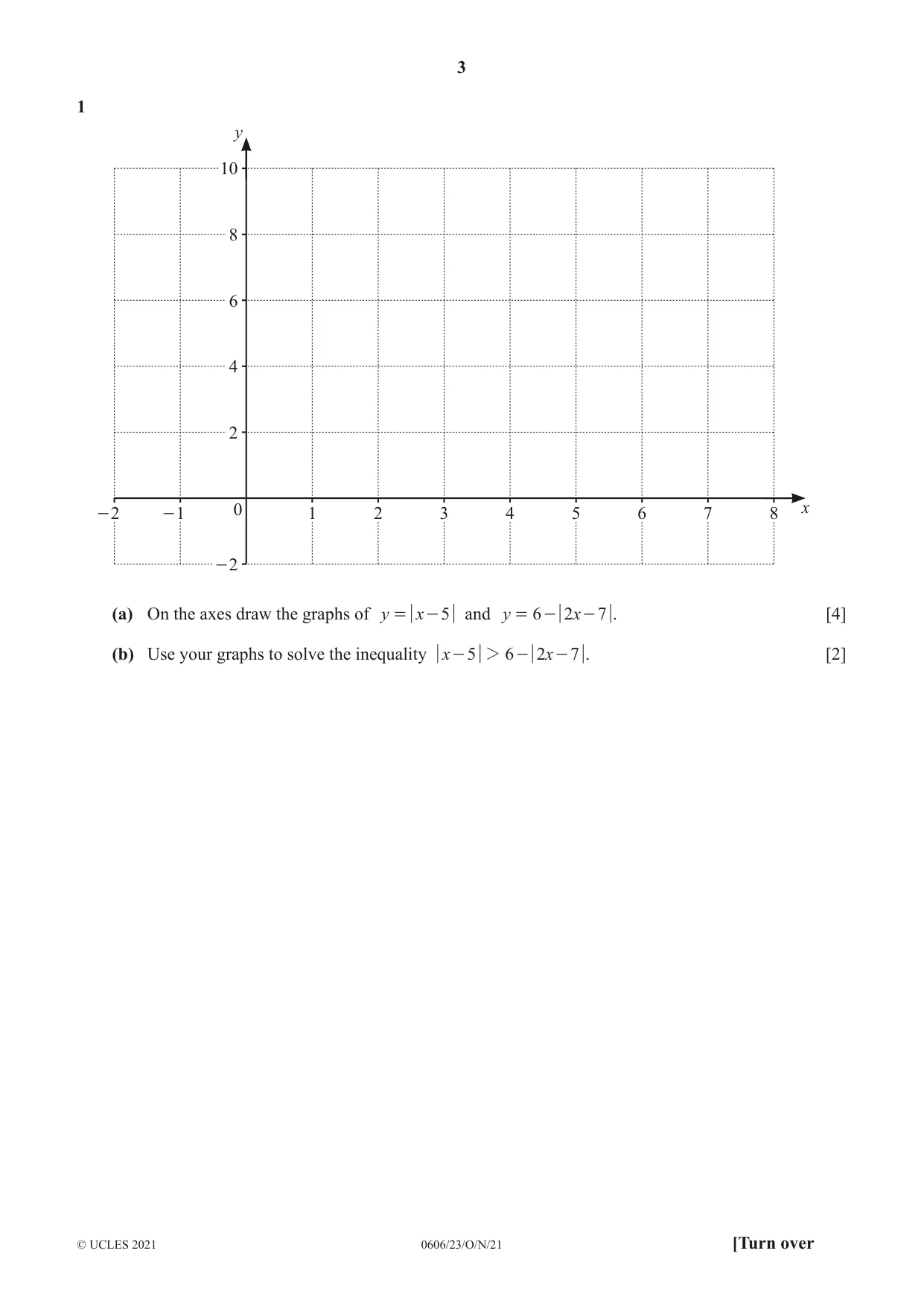
Q1 · Y 10 8 6 4 2 - 2 - 1 0 1 2 3 4 5 6 7 8 x - 2 (a) On the axes draw the graphs of y = x - 5…
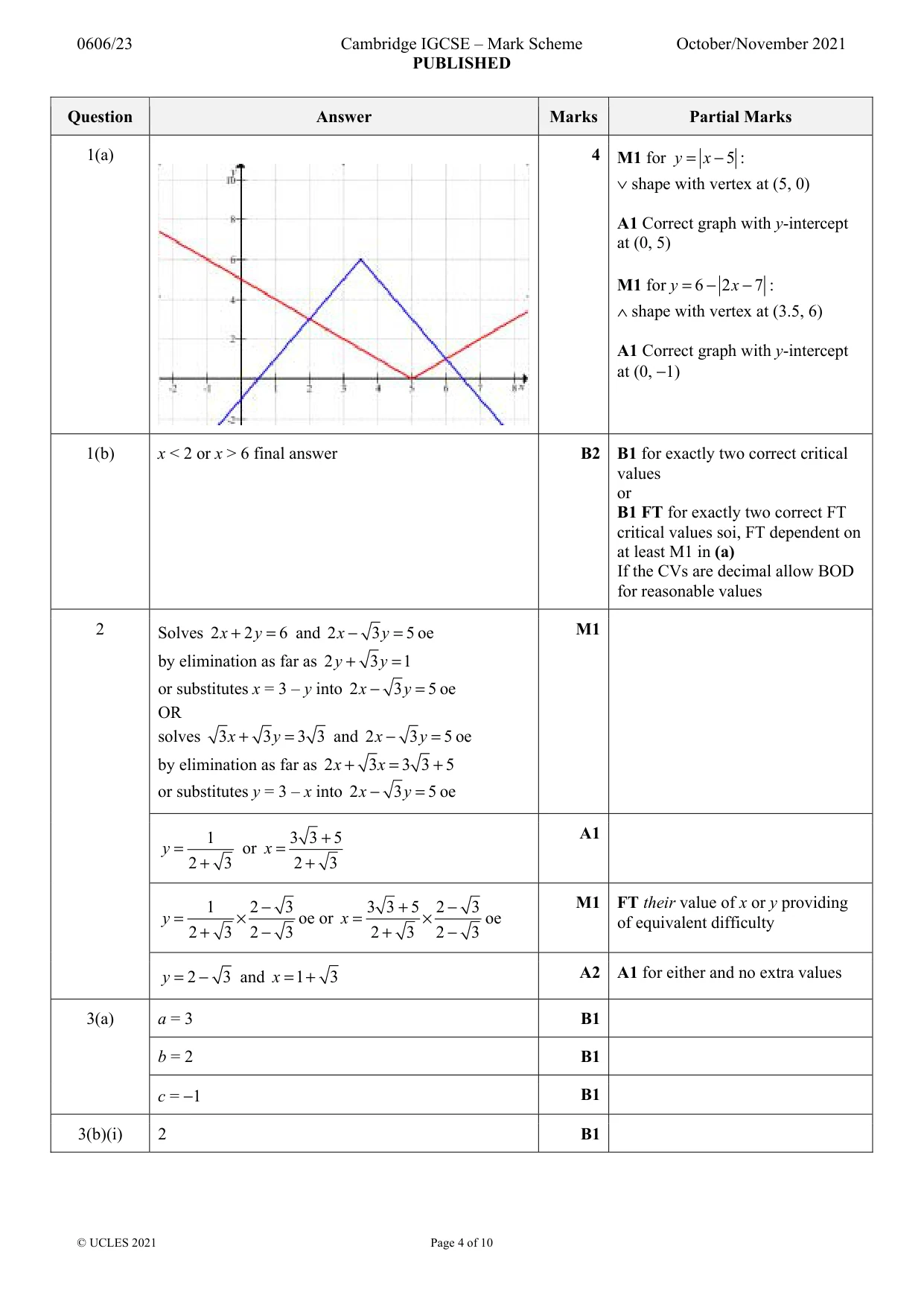
1 y 10 8 6 4 2 - 2 - 1 0 1 2 3 4 5 6 7 8 x - 2 (a) On the axes draw the graphs of y = x - 5 and y = 6 - 2 x - 7 . [4] (b) Use your graphs to solve the inequality x - 5 2 6 - 2 x - 7 . [2]
Mark scheme: Question Answer Marks Partial Marks 1(a) 4 M1 for y = x − 5 : ∨ shape with vertex at (5, 0) A1 Correct graph with y-intercept at (0, 5) M1 for y = 6 − 2 x − 7 : ∧ shape with vertex at (3.5, 6) A1 Correct graph with y-intercept at (0, −1) 1(b) x < 2 or x > 6 final answer B2 B1 for exactly two correct critical values or B1 FT for exactly two correct FT critical values soi, FT dependent on at least M1 in (a) If the CVs are decimal allow BOD for reasonable values
Q2 · Solve the following simultaneous equations
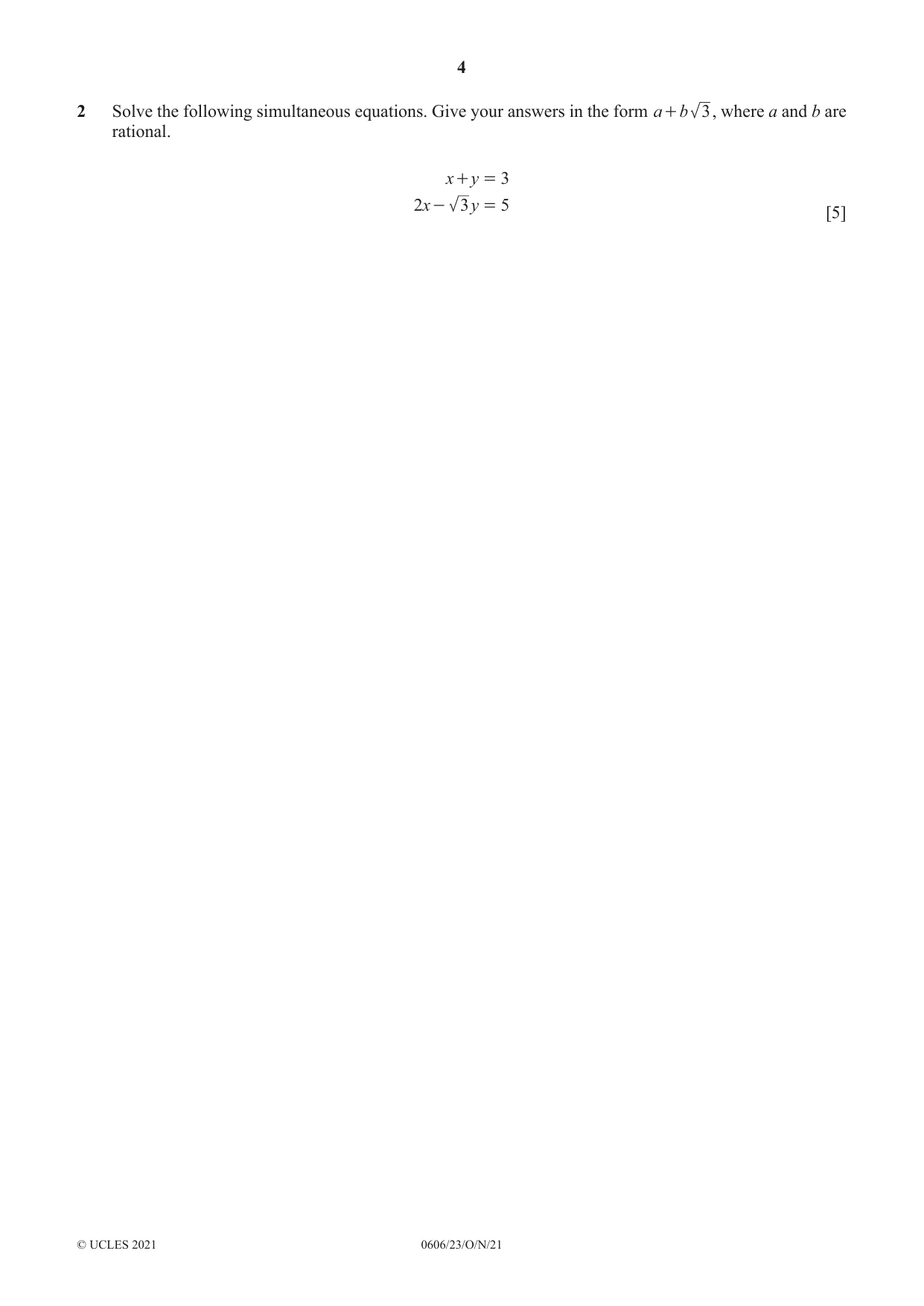
2 Solve the following simultaneous equations. Give your answers in the form a + b 3 , where a and b are rational. x + y = 3 2x - 3 y = 5 [5]
Mark scheme: 2 Solves 2 x + 2 y = 6 and 2 x − 3 y = 5 oe M1 by elimination as far as 2 y + 3 y = 1 or substitutes x = 3 – y into 2 x − 3 y = 5 oe OR solves 3 x + 3 y = 3 3 and 2 x − 3 y = 5 oe by elimination as far as 2 x + 3 x = 3 3 + 5 or substitutes y = 3 – x into 2 x − 3 y = 5 oe 1 3 3 + 5 A1 y = or x = 2 + 3 2 + 3 1 2 − 3 3 3 + 5 2 − 3 M1 FT their value of x or y providing y = × oe or x = × oe of equivalent difficulty 2 + 3 2 − 3 2 + 3 2 − 3 y = 2 − 3 and x = 1 + 3 A2 A1 for either and no extra values
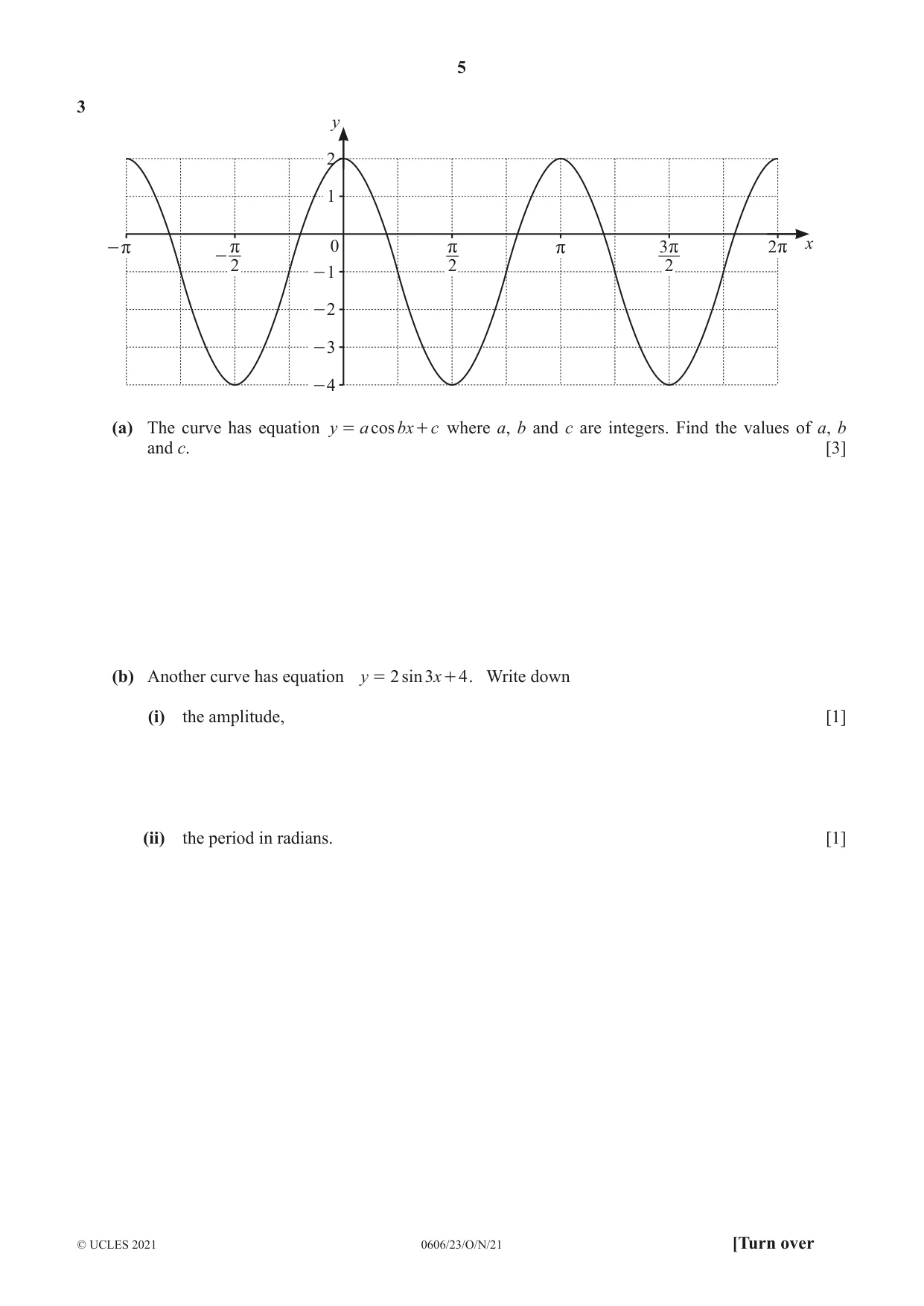
Q3 · Y 2 1 - r r 0 r r 3 r 2r x - 2 - 1 2 2 - 2 - 3 - 4 (a) The curve has equation y = a cos…
3 y 2 1 - r r 0 r r 3 r 2r x - 2 - 1 2 2 - 2 - 3 - 4 (a) The curve has equation y = a cos bx + c where a, b and c are integers. Find the values of a, b and c. [3] (b) Another curve has equation y = 2 sin 3x + 4 . Write down (i) the amplitude, [1] (ii) the period in radians. [1]
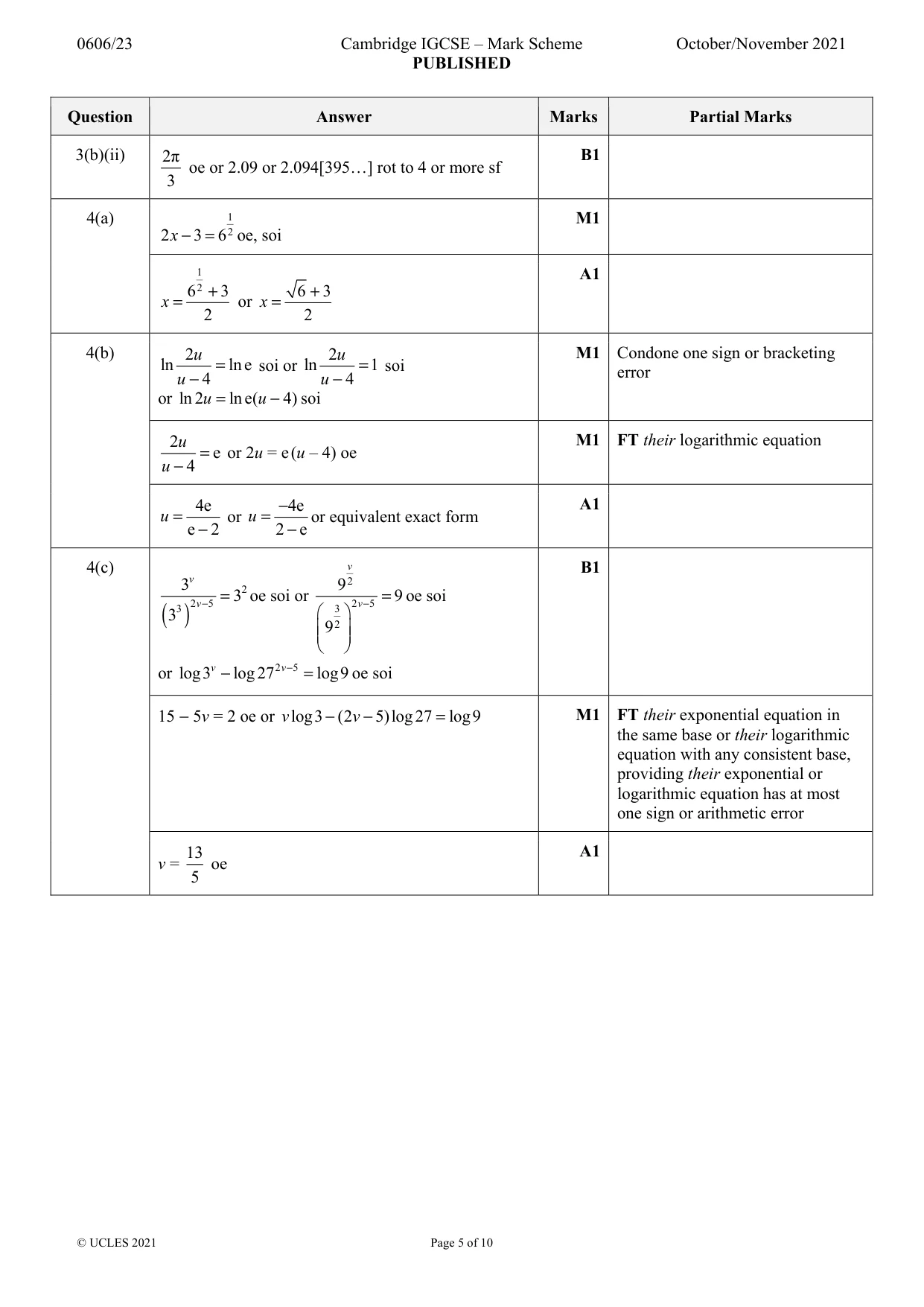
Mark scheme: 3(a) a = 3 B1 b = 2 B1 c = −1 B1 3(b)(i) 2 B1 3(b)(ii) 2π B1 oe or 2.09 or 2.094[395…] rot to 4 or more sf 3
Q4 · Solve the equation log 6 ( 2x - 3) =
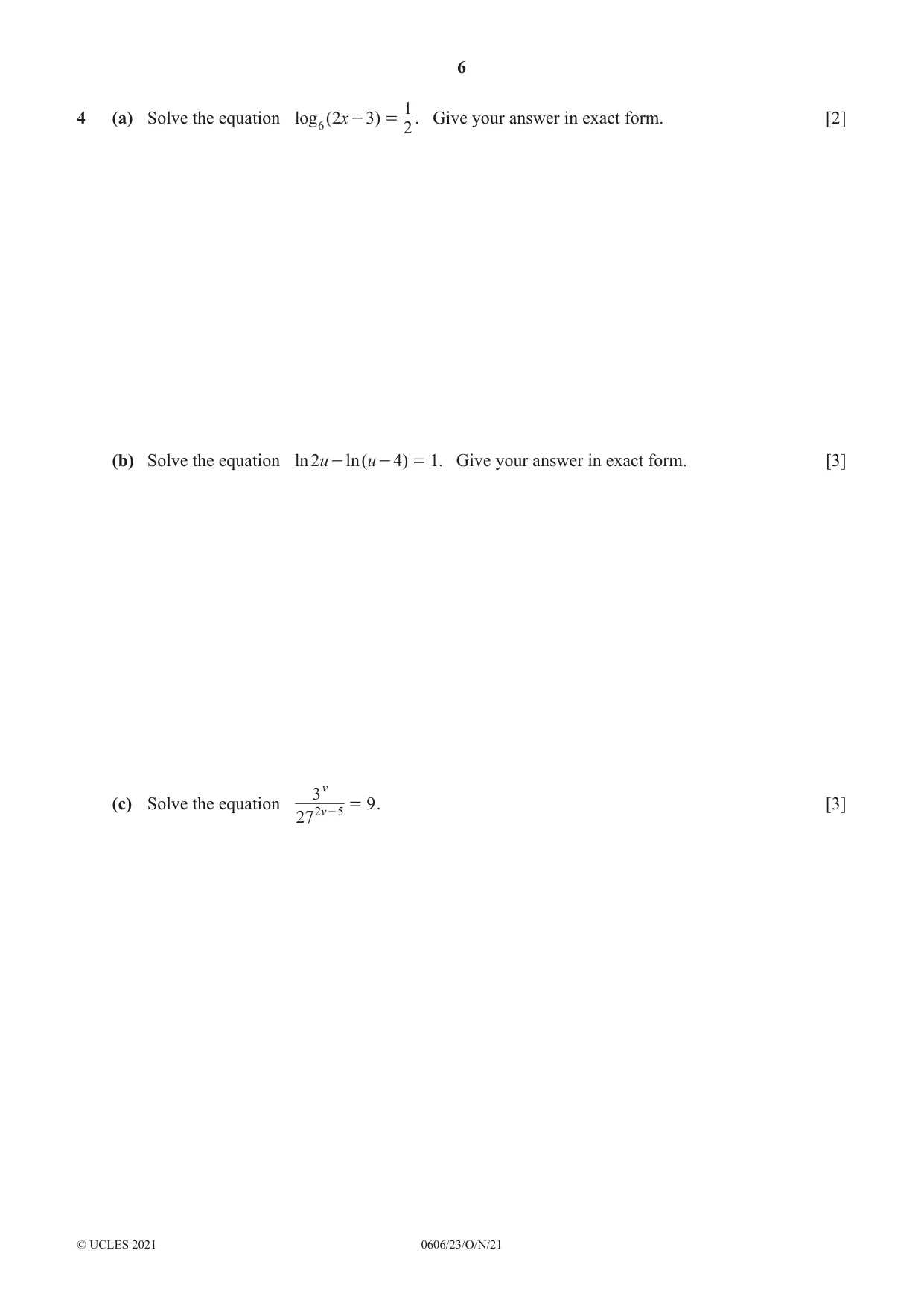
4 (a) Solve the equation log 6 ( 2x - 3) = . Give your answer in exact form. [2] 2 (b) Solve the equation ln 2u - ln ( u - 4) = 1. Give your answer in exact form. [3] 3 v (c) Solve the equation 2 v - 5 = 9 . [3] 27
Mark scheme: 4(a) 1 M1 2 x − 3 = 6 2 oe, soi 1 A1 6 2 + 3 6 + 3 x = or x = 2 2 4(b) 2u 2u M1 Condone one sign or bracketing ln = lne soi or ln = 1 soi error u − 4 u − 4 or ln 2u = lne(u − 4) soi 2u M1 FT their logarithmic equation = e or 2u = e (u – 4) oe u − 4 4e −4e A1 u = or u = or equivalent exact form e − 2 2 − e 4(c) v B1 3v 2 9 2 2 v −=5 3 oe soi or 2 v −=5 9 oe soi ( 33 ) 32 9 or log3v − log27 2 v − 5 = log9 oe soi 15 − 5v = 2 oe or v log3 − (2 v − 5)log27 = log9 M1 FT their exponential equation in the same base or their logarithmic equation with any consistent base, providing their exponential or logarithmic equation has at most one sign or arithmetic error 13 A1 v = oe 5
Q5 · Show that + = 2 tan x sec x
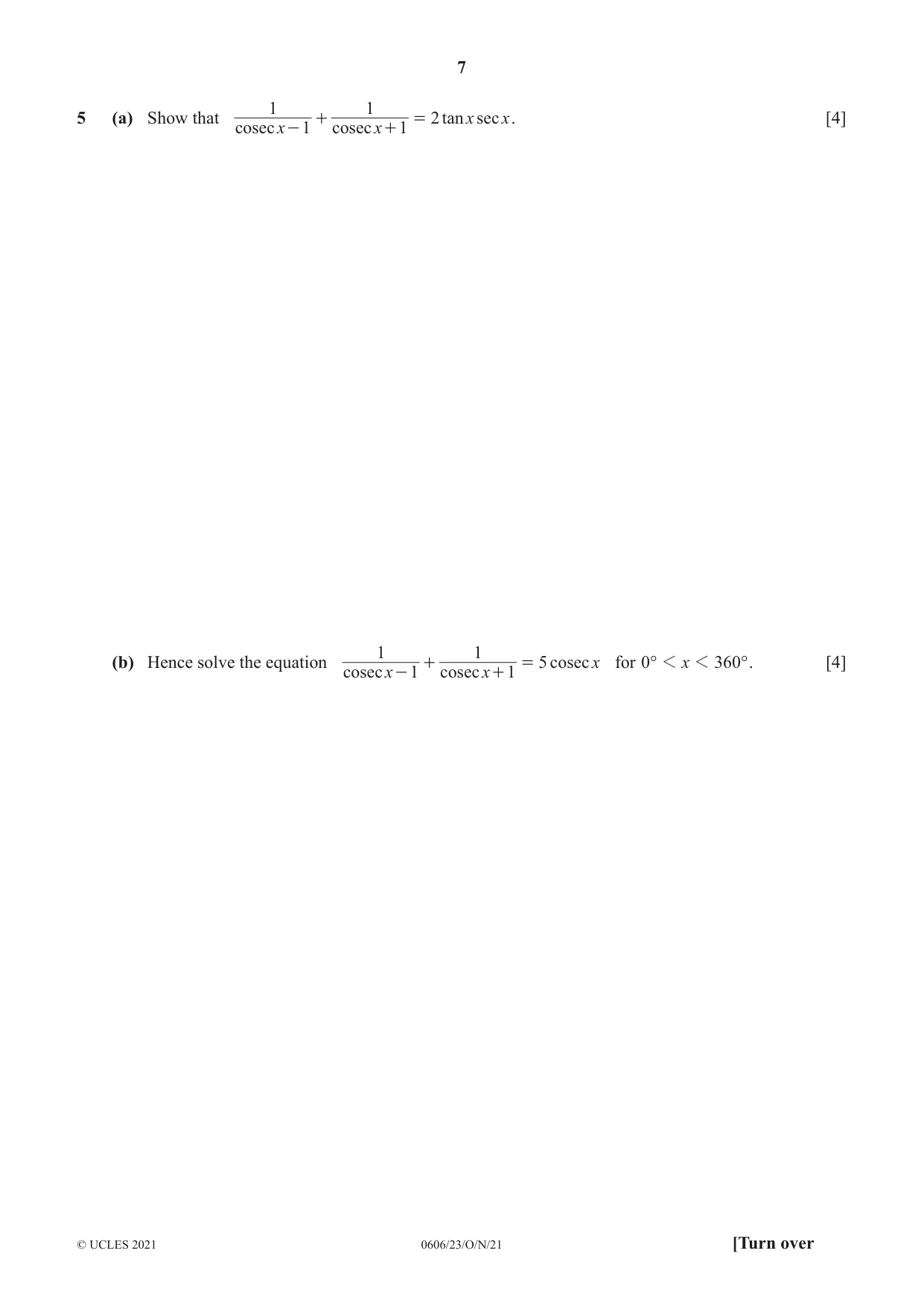
5 (a) Show that + = 2 tan x sec x . [4] cosec x - 1 cosec x + 1 1 1 (b) Hence solve the equation + = 5 cosec x for 0° 1 x 1 360° . [4] cosec x - 1 cosec x + 1
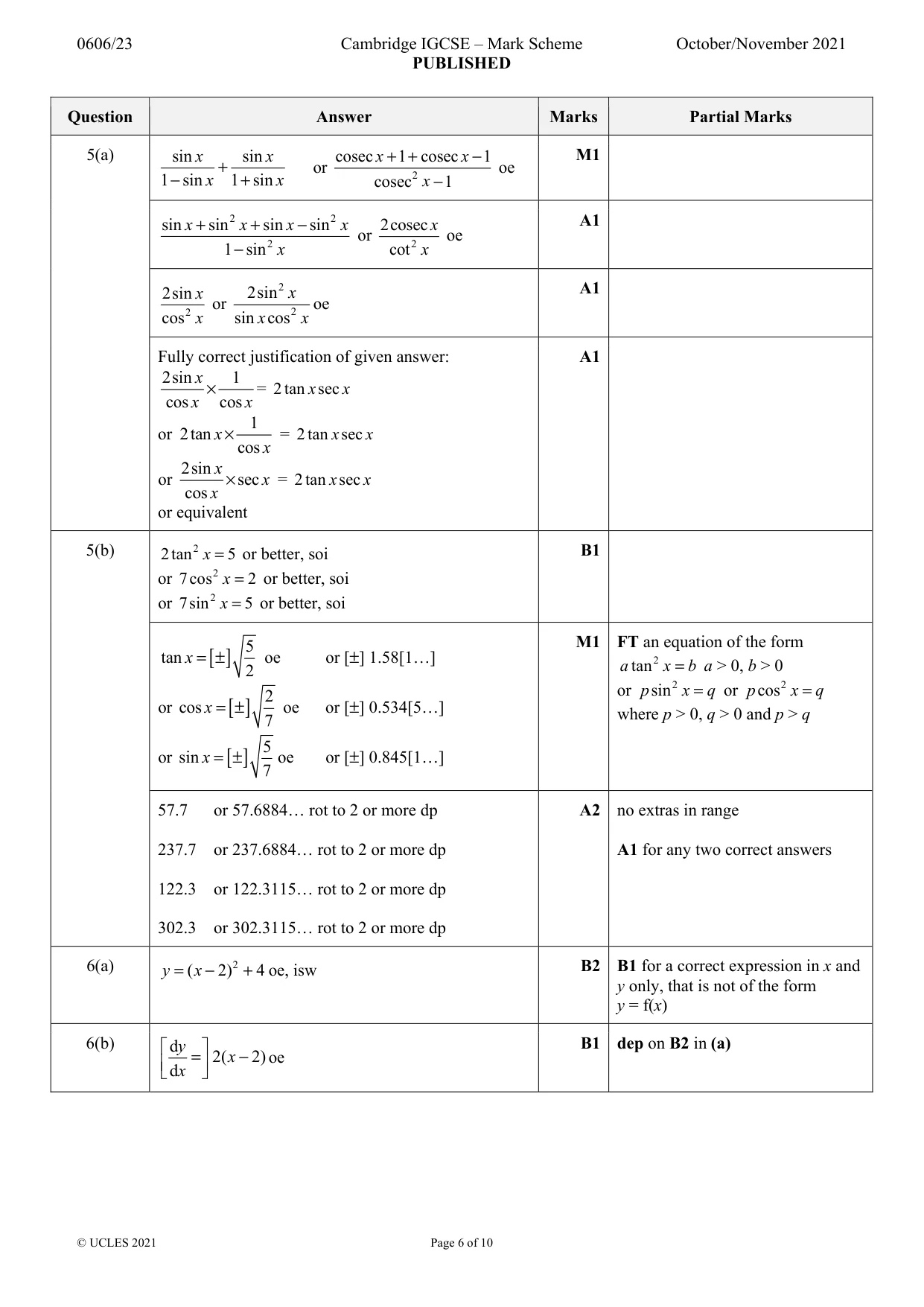
Mark scheme: 5(a) sin x sin x cosec x + 1 + cosec x − 1 M1 + or oe 1 − sin x 1 + sin x cosec 2 x − 1 sin x + sin 2 x + sin x − sin 2 x 2cosec x A1 or oe 1 − sin 2 x cot 2 x 2sin x 2sin 2 x A1 or oe cos 2 x sin x cos 2 x Fully correct justification of given answer: A1 2sin x 1 × = 2tan x sec x cos x cos x 1 or 2tan x × = 2tan x sec x cos x 2sin x or × sec x = 2tan x sec x cos x or equivalent 5(b) 2tan 2 x = 5 or better, soi B1 or 7cos 2 x = 2 or better, soi or 7sin 2 x = 5 or better, soi 5 M1 FT an equation of the form tan x = [ ± ] oe or [±] 1.58[1…] 2 a tan x = b a > 0, b > 0 2 or p sin 2 x = q or p cos 2 x = q 2 or cos x = [ ± ] oe or [±] 0.534[5…] where p > 0, q > 0 and p > q 7 5 or sin x = [ ± ] oe or [±] 0.845[1…] 7 57.7 or 57.6884… rot to 2 or more dp A2 no extras in range 237.7 or 237.6884… rot to 2 or more dp A1 for any two correct answers 122.3 or 122.3115… rot to 2 or more dp 302.3 or 302.3115… rot to 2 or more dp
More questions on Prove trigonometric relationships involving the
Q6 · It is given that x = 2 + sec i and y = 5 + tan 2i
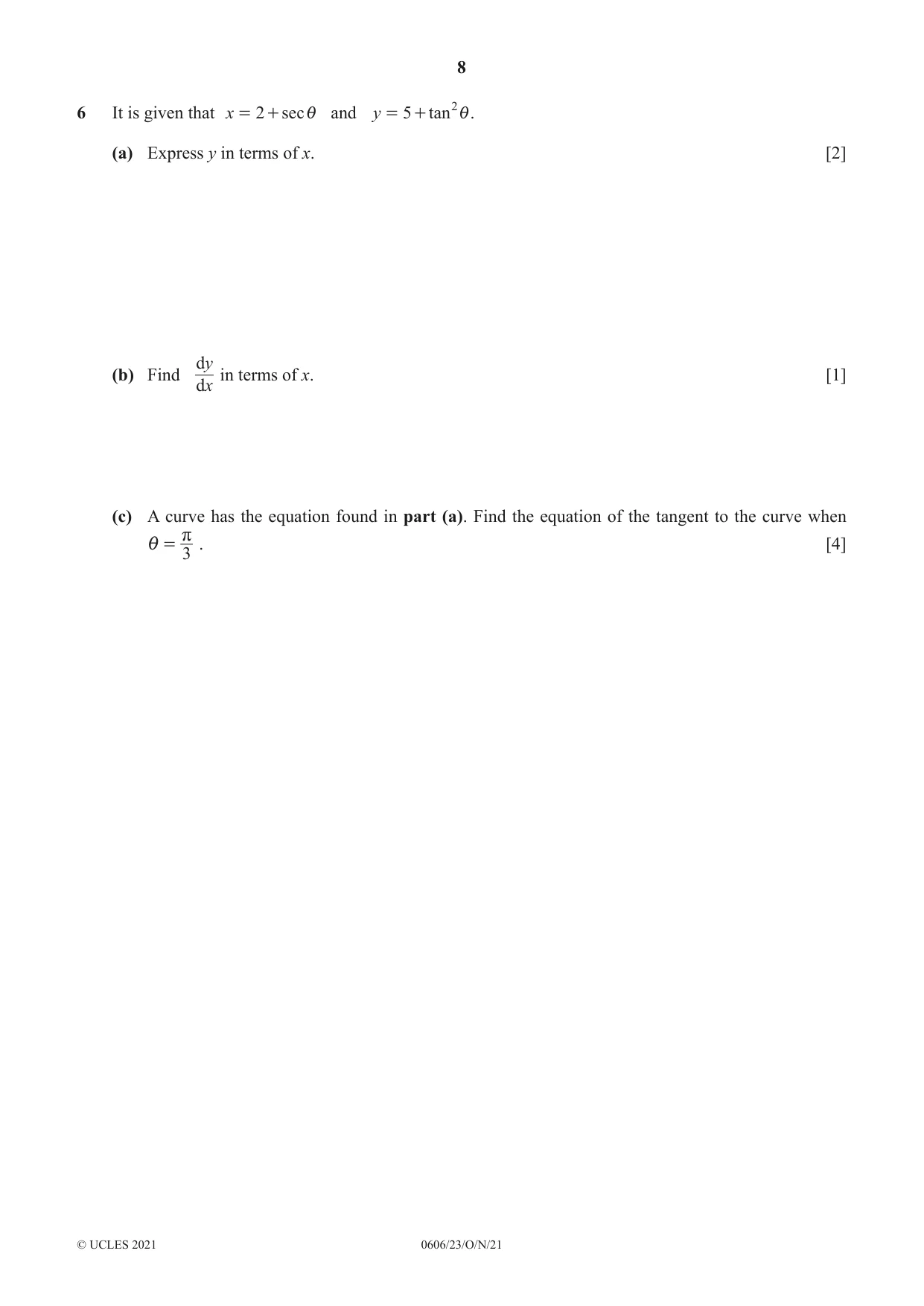
6 It is given that x = 2 + sec i and y = 5 + tan 2i . (a) Express y in terms of x. [2] dy (b) Find in terms of x. [1] dx (c) A curve has the equation found in part (a). Find the equation of the tangent to the curve when r i = . [4] 3
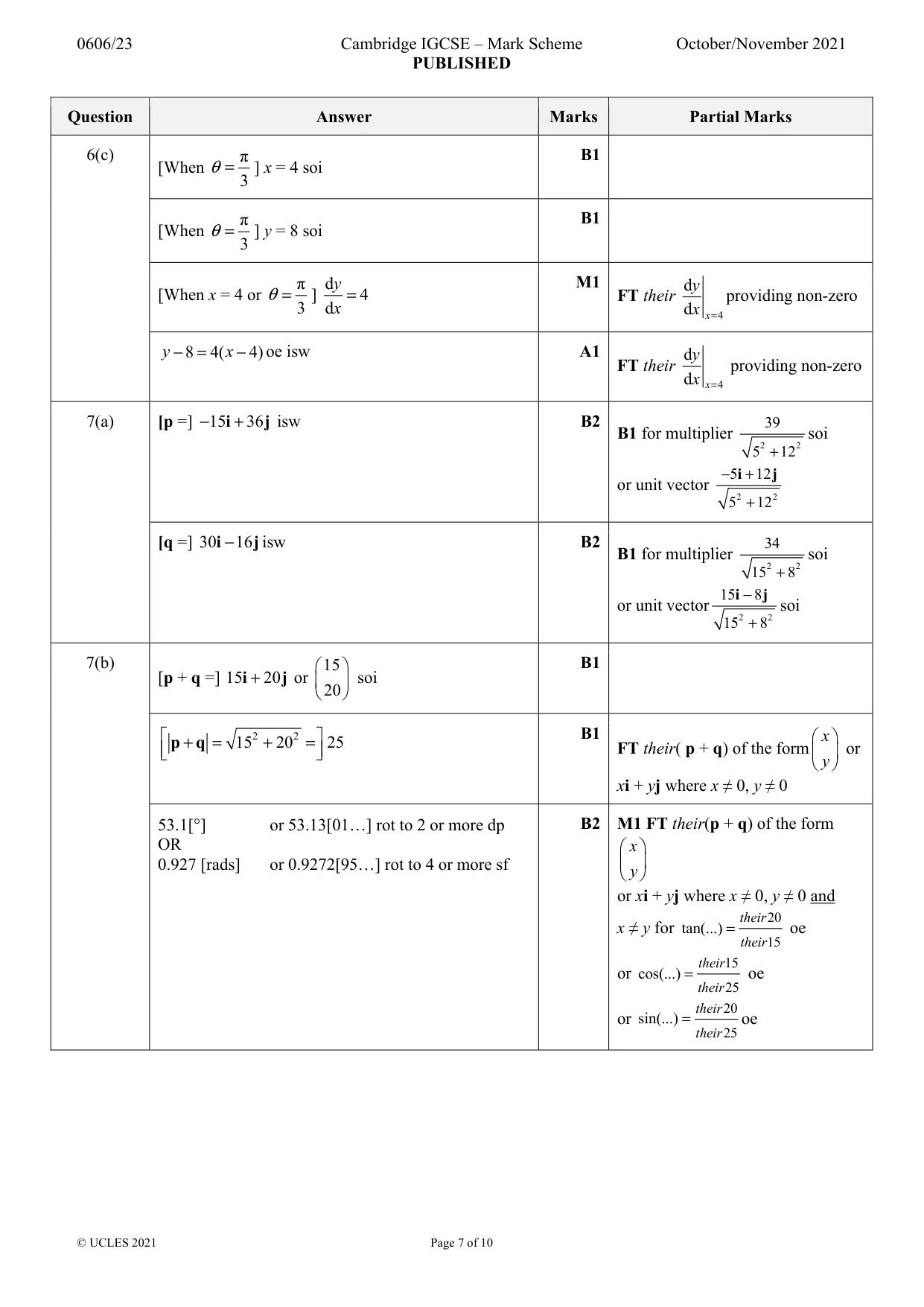
Mark scheme: 6(a) y = ( x − 2) 2 + 4 oe, isw B2 B1 for a correct expression in x and y only, that is not of the form y = f(x) 6(b) dy B1 dep on B2 in (a) = 2( x − 2) oe dx 6(c) π B1 [When θ = ] x = 4 soi 3 π B1 [When θ = ] y = 8 soi 3 π dy M1 d y [When x = 4 or θ = ] = 4 FT their providing non-zero 3 dx dx x = 4 y − 8 = 4( x − 4) oe isw A1 d y FT their providing non-zero dx x = 4
More questions on Use differentiation to find gradients, tangents
Q7 · The vector p has magnitude 39 and is in the direction - 5i + 12j
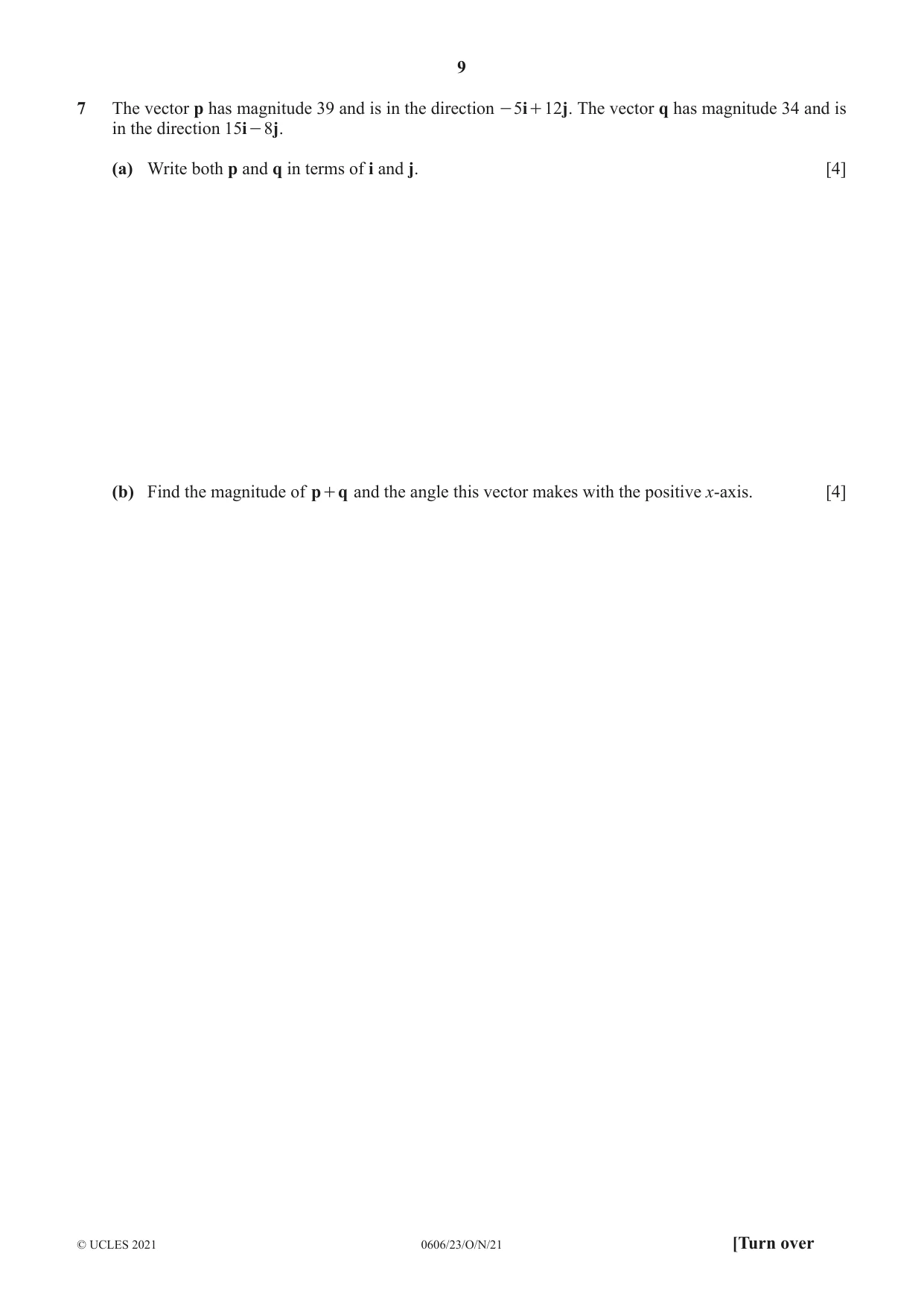
7 The vector p has magnitude 39 and is in the direction - 5i + 12j . The vector q has magnitude 34 and is in the direction 15i - 8j . (a) Write both p and q in terms of i and j. [4] (b) Find the magnitude of p + q and the angle this vector makes with the positive x-axis. [4]
Mark scheme: 7(a) [p =] −15i + 36 j isw B2 39 B1 for multiplier soi 5 2 + 12 2 −5i + 12 j or unit vector 5 2 + 12 2 [q =] 30i − 16 j isw B2 34 B1 for multiplier soi 15 2 + 8 2 15i − 8 j or unit vector soi 15 2 + 8 2 7(b) 15 B1 [p + q =] 15i + 20 j or soi 20 2 2 B1 x p + q = 15 + 20 = 25 form or FT their( p + q) of the y xi + yj where x ≠ 0, y ≠ 0 53.1[°] or 53.13[01…] rot to 2 or more dp B2 M1 FT their(p + q) of the form OR x 0.927 [rads] or 0.9272[95…] rot to 4 or more sf y or xi + yj where x ≠ 0, y ≠ 0 and their 20 x ≠ y for tan(...) = oe their15 their15 or cos(...) = oe their 25 their 20 or sin(...) = oe their 25
Q8 · Y 5 y = + 2 x x - 1 2y = 9x x = 4 x 0 5 The diagram shows part of the curve y = + 2x…
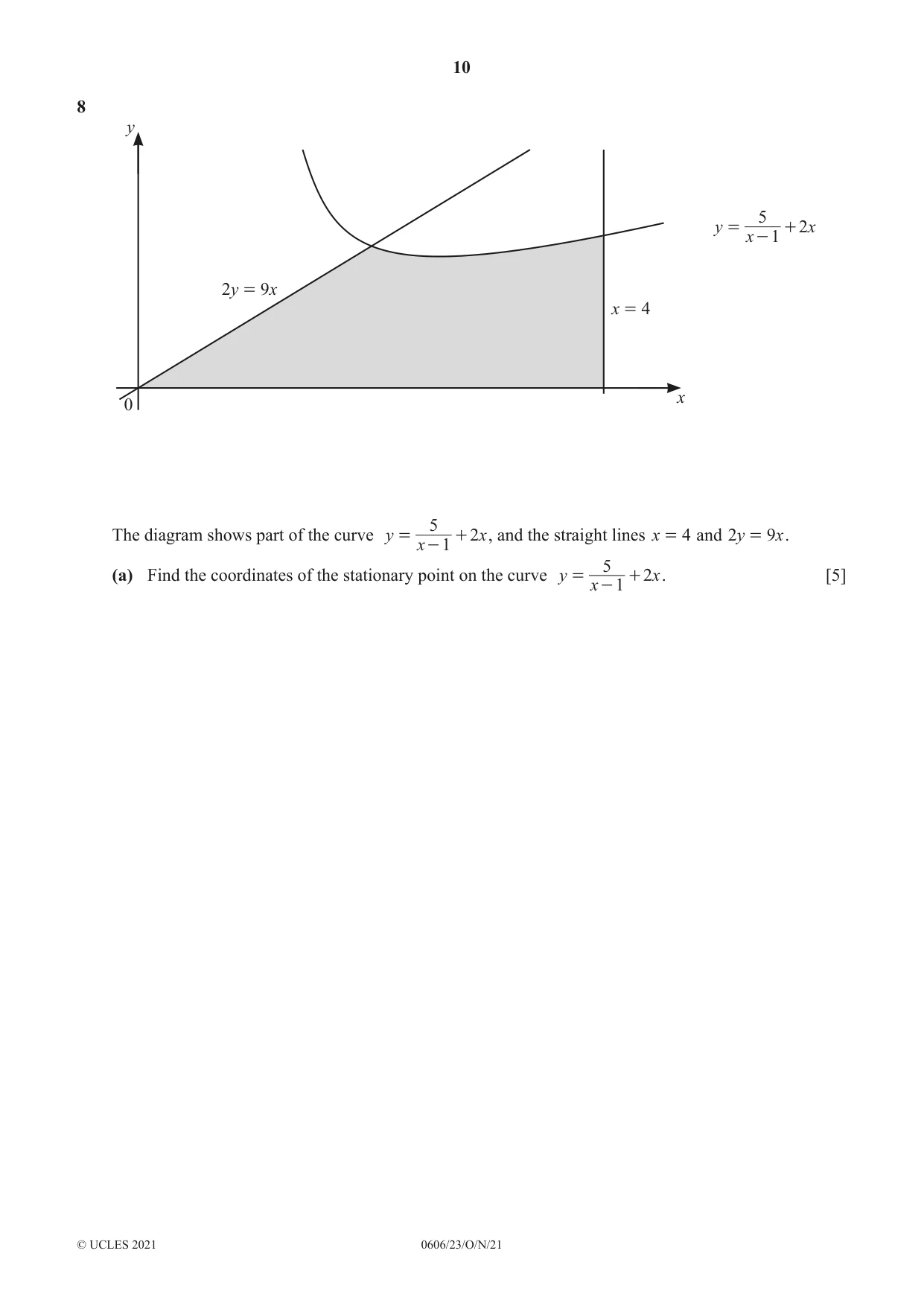
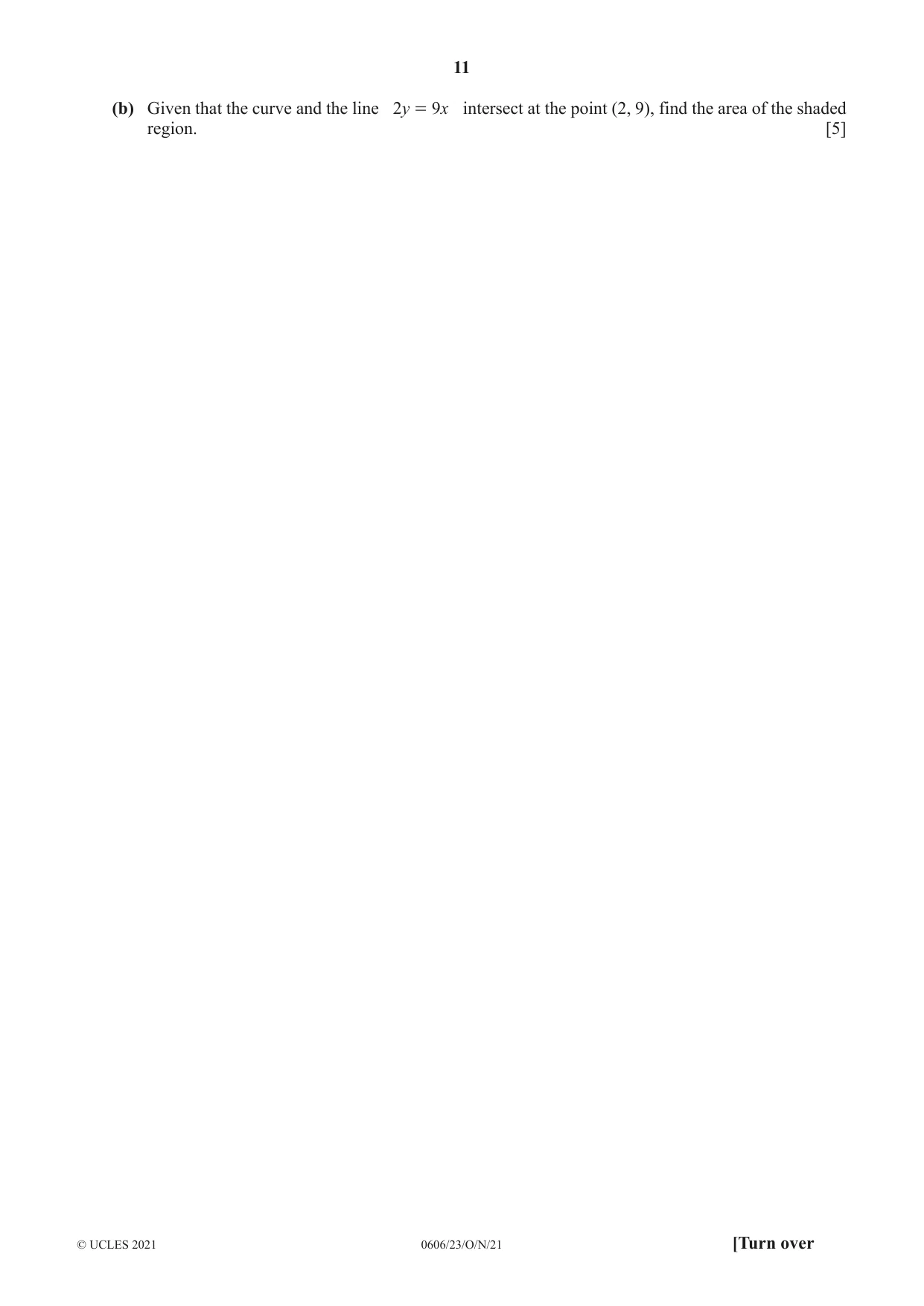
8 y 5 y = + 2 x x - 1 2y = 9x x = 4 x 0 5 The diagram shows part of the curve y = + 2x , and the straight lines x = 4 and 2y = 9x . x - 1 5 (a) Find the coordinates of the stationary point on the curve y = + 2x . [5] x - 1 (b) Given that the curve and the line 2y = 9x intersect at the point (2, 9), find the area of the shaded region. [5]
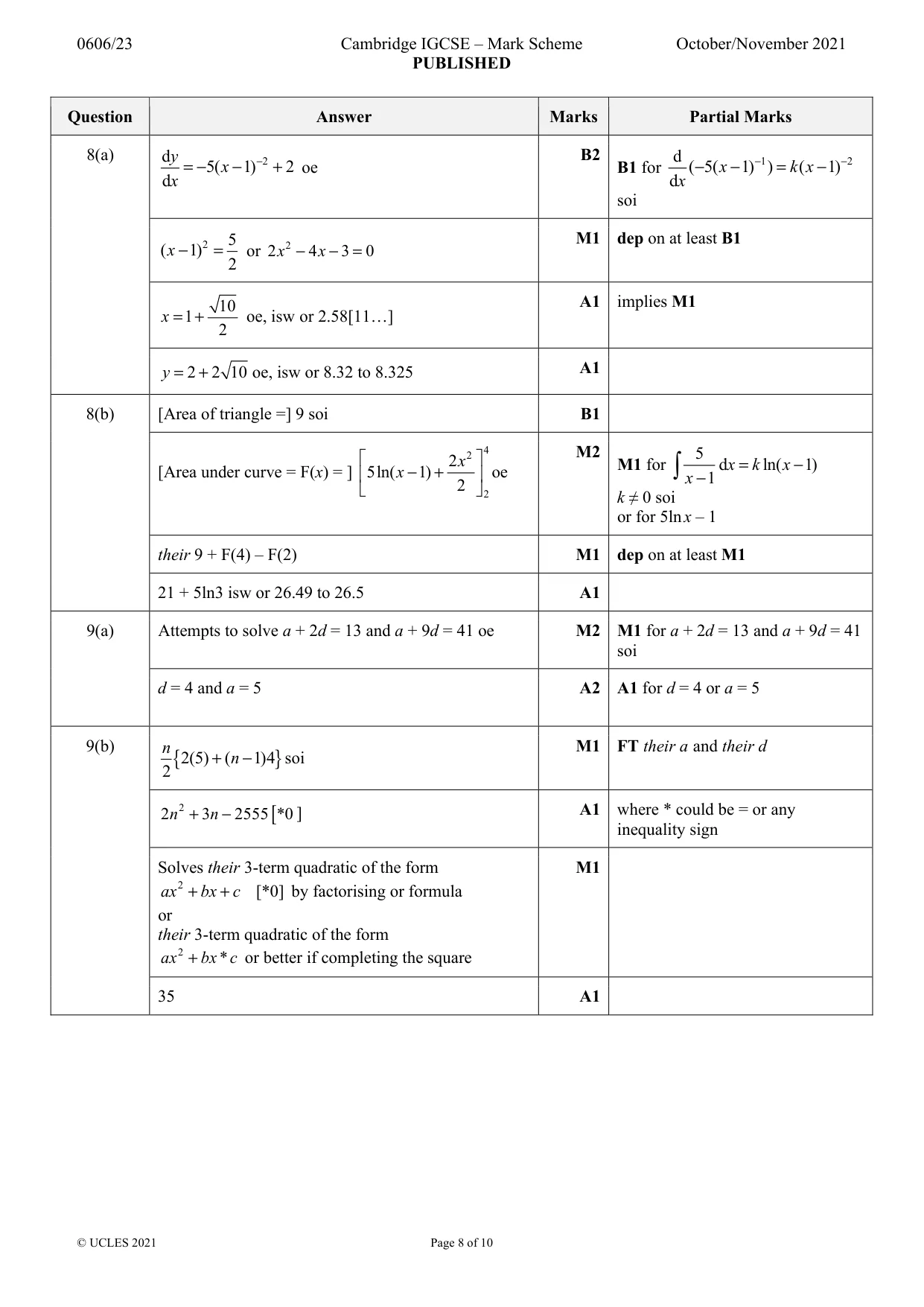
Mark scheme: 8(a) dy −2 B2 d −1 −2 = −5( x − 1) + 2 oe B1 for ( −5( x − 1) ) = k ( x − 1) dx dx soi 2 5 2 M1 dep on at least B1 ( x − 1) = or 2 x − 4 x − 3 = 0 2 10 A1 implies M1 x = 1 + oe, isw or 2.58[11…] 2 y = 2 + 2 10 oe, isw or 8.32 to 8.325 A1 8(b) [Area of triangle =] 9 soi B1 4 2 M2 5 2 x M1 for dx = k ln( x − 1) [Area under curve = F(x) = ] 5ln( x − 1) + oe x − 1 2 2 k ≠ 0 soi or for 5ln x – 1 their 9 + F(4) – F(2) M1 dep on at least M1 21 + 5ln3 isw or 26.49 to 26.5 A1
More questions on Use differentiation to find stationary points
Q9 · An arithmetic progression has first term a and common difference d
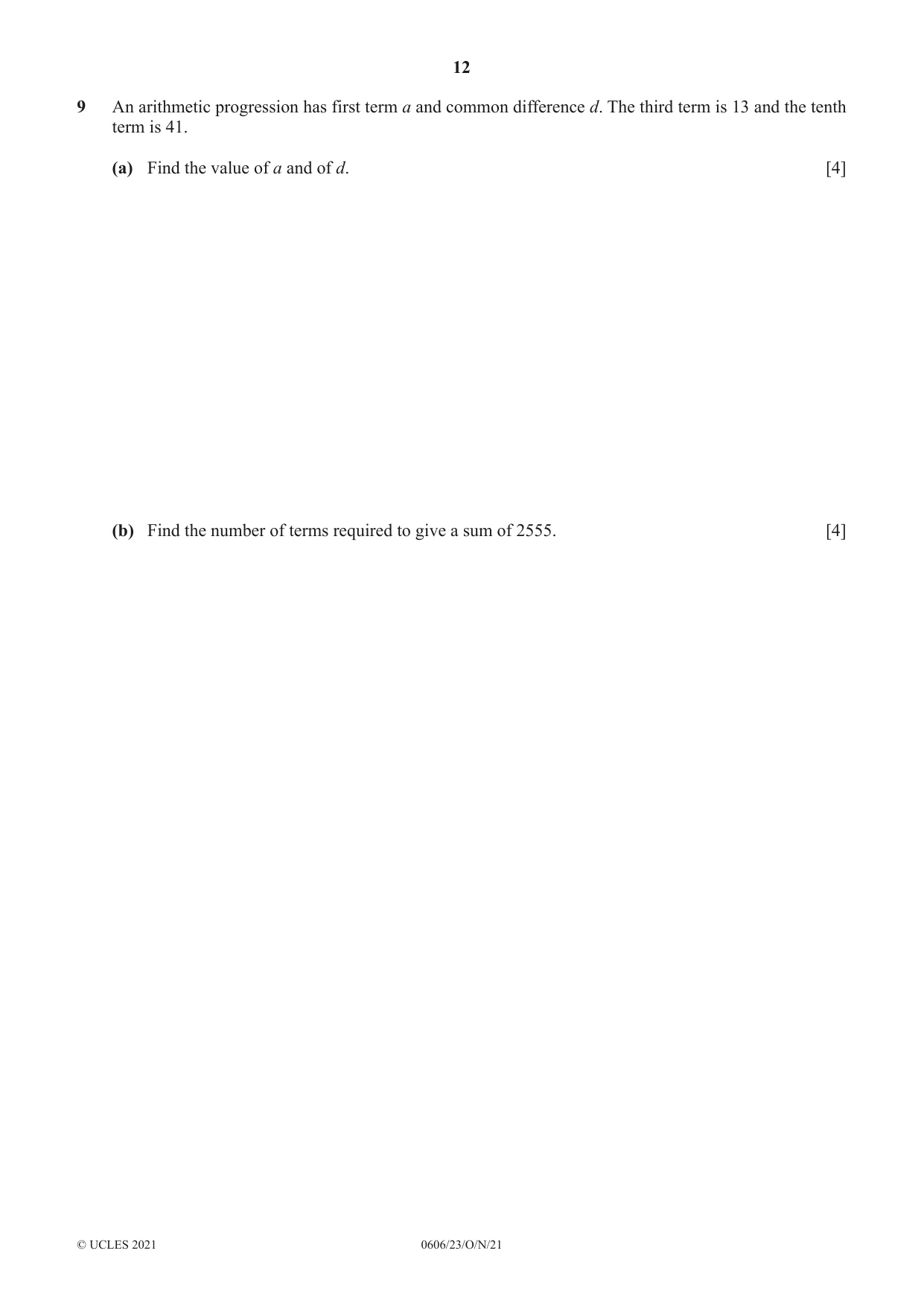
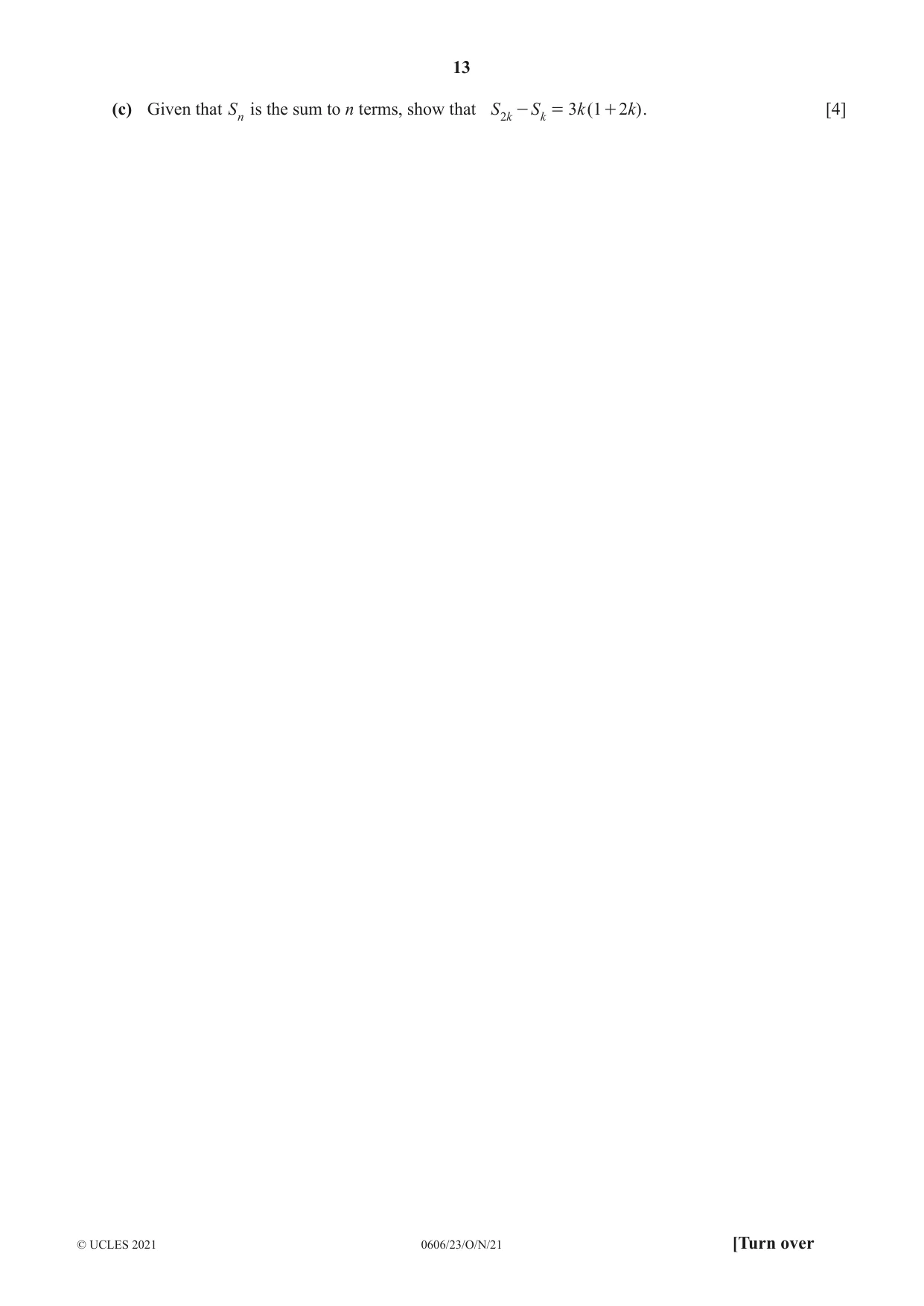
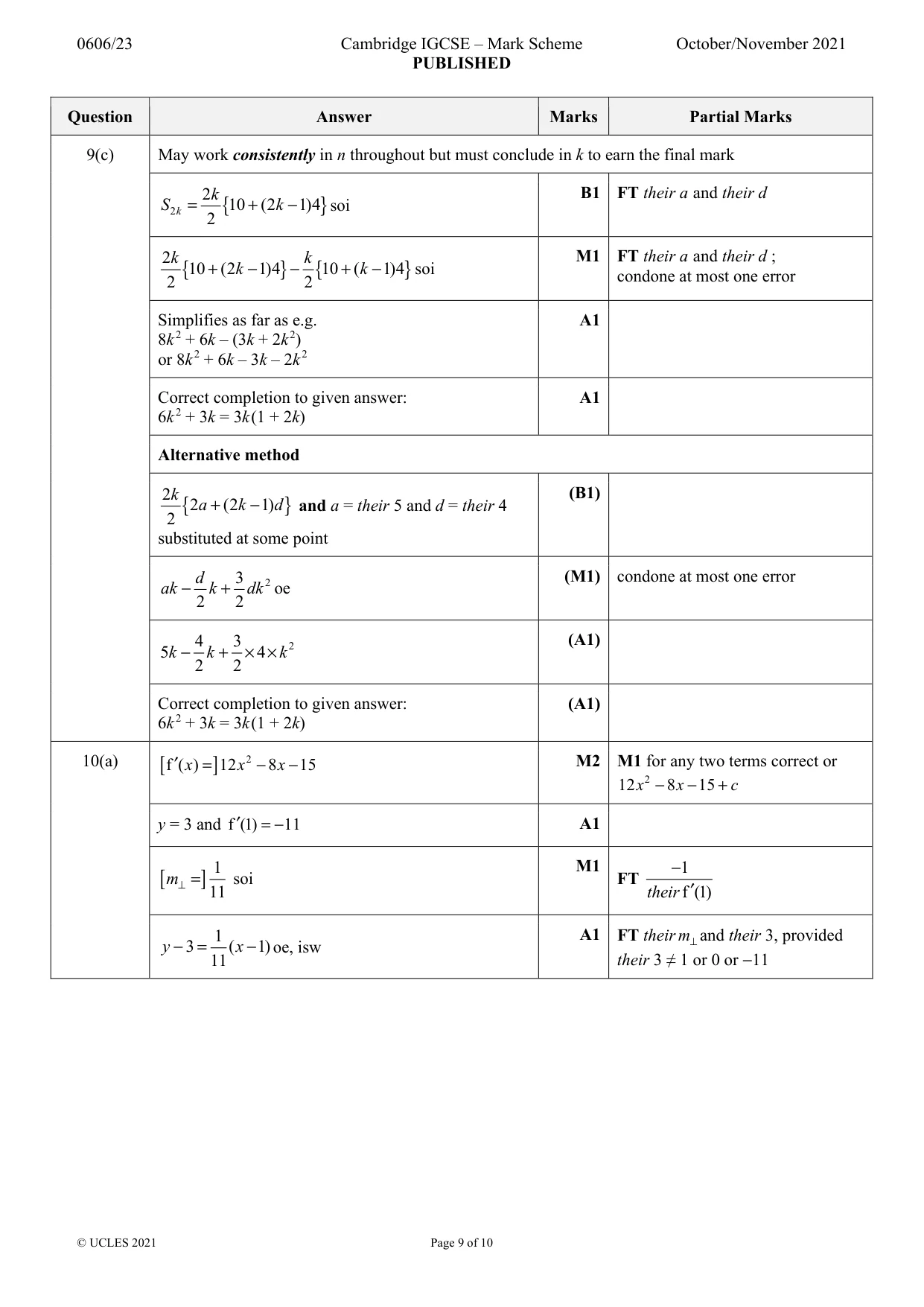
9 An arithmetic progression has first term a and common difference d. The third term is 13 and the tenth term is 41. (a) Find the value of a and of d. [4] (b) Find the number of terms required to give a sum of 2555. [4] (c) Given that Sn is the sum to n terms, show that S 2 k - S k = 3k ( 1 + 2 k) . [4]
Mark scheme: 9(a) Attempts to solve a + 2d = 13 and a + 9d = 41 oe M2 M1 for a + 2d = 13 and a + 9d = 41 soi d = 4 and a = 5 A2 A1 for d = 4 or a = 5 9(b) n M1 FT their a and their d { 2(5) + ( n − 1)4} soi 2 2 n 2 + 3n − 2555 [*0 ] A1 where * could be = or any inequality sign Solves their 3-term quadratic of the form M1 ax 2 + bx + c [*0] by factorising or formula or their 3-term quadratic of the form ax 2 + bx * c or better if completing the square 35 A1
More questions on Use the formulas for the nth term and for the
Q10 · It is given that f ( )x = 4x 3 - 4x 2 - 15x + 18
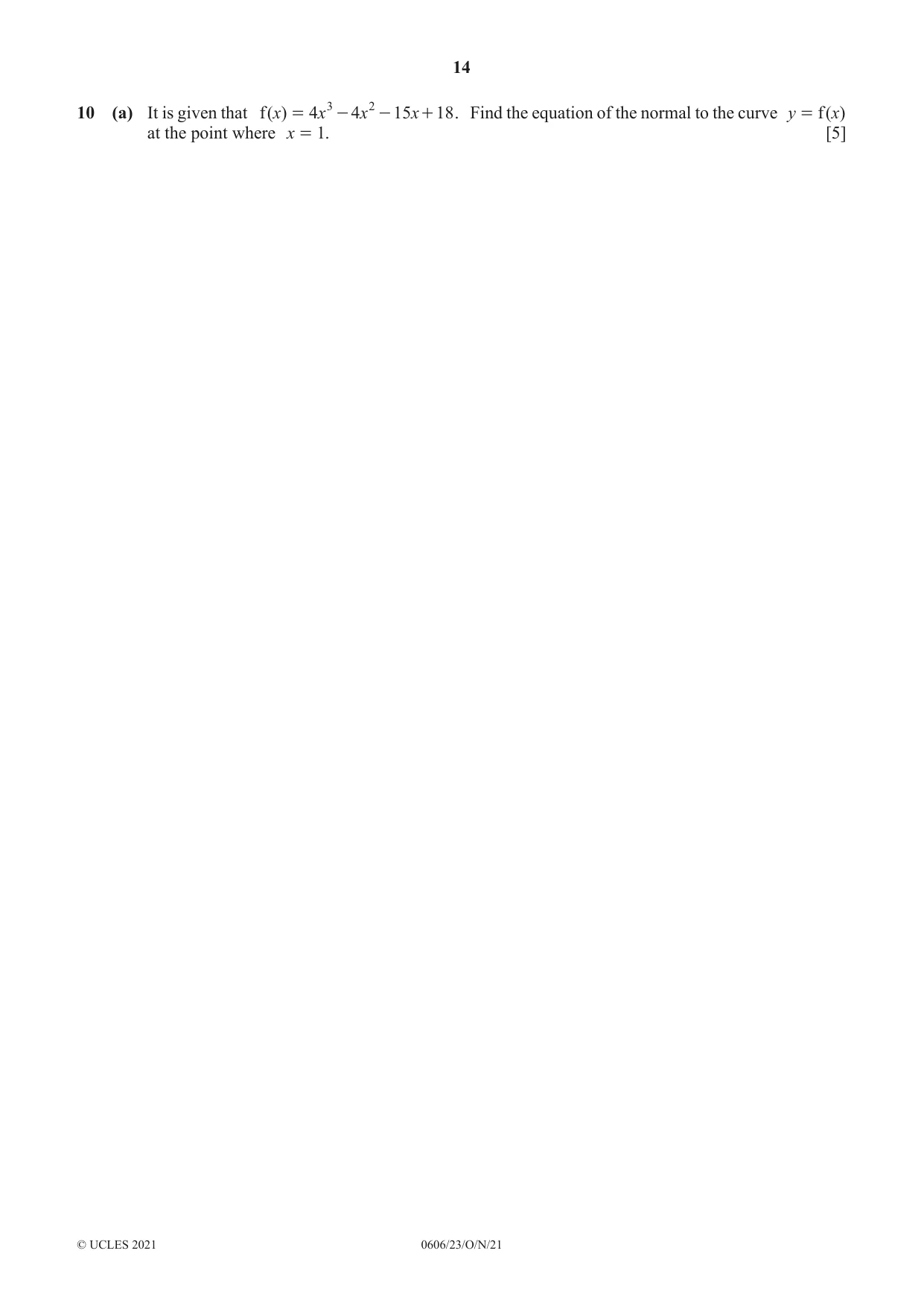
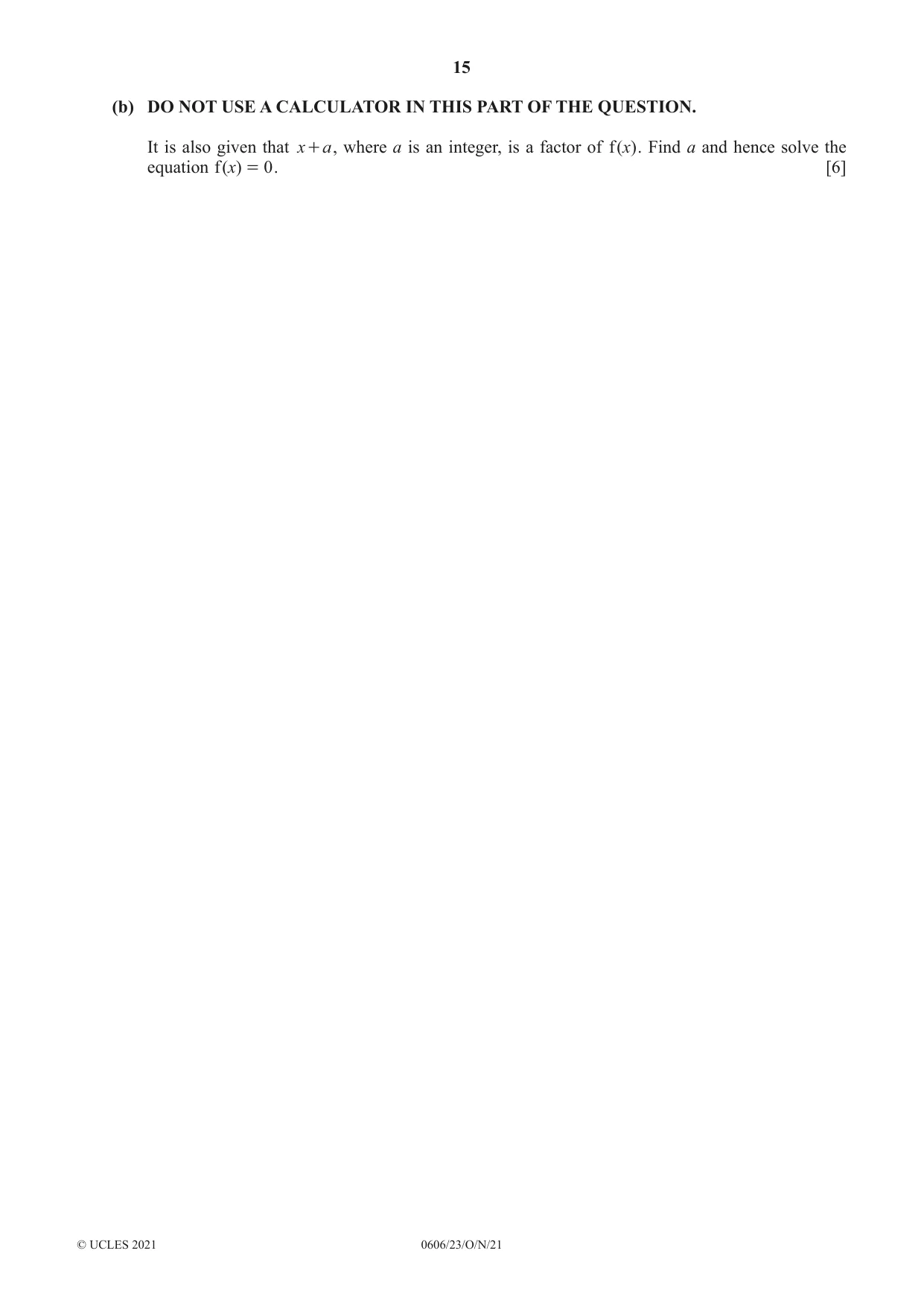
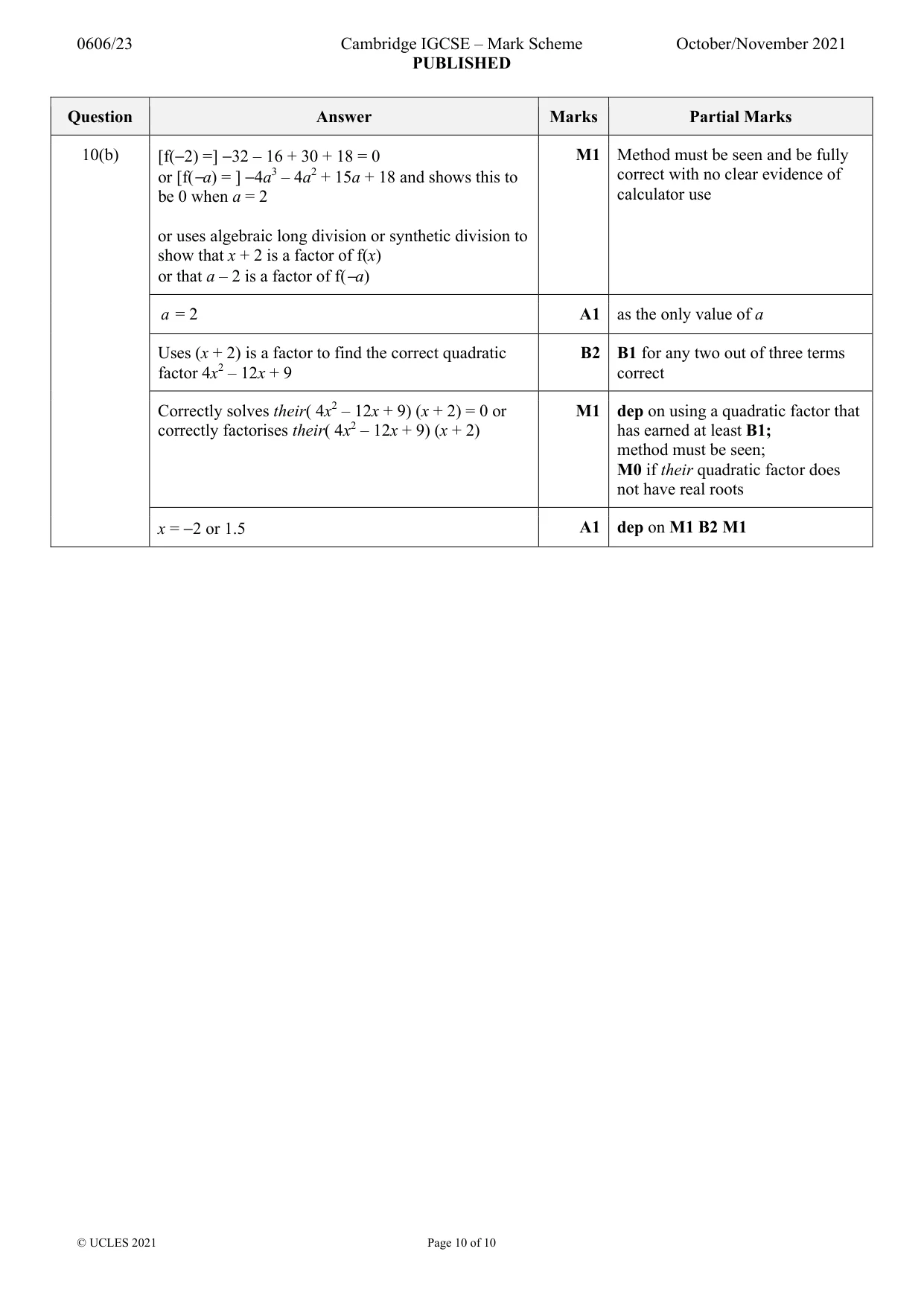
10 (a) It is given that f ( )x = 4x 3 - 4x 2 - 15x + 18 . Find the equation of the normal to the curve y = f ( x) at the point where x = 1. [5] (b) DO NOT USE A CALCULATOR IN THIS PART OF THE QUESTION. It is also given that x + a , where a is an integer, is a factor of f ( )x . Find a and hence solve the equation f ( )x = 0 . [6]
Mark scheme: 10(a) [ f ′( x ) = ] 12 x 2 − 8 x − 15 M2 M1 for any two terms correct or 12 x 2 − 8 x − 15 + c y = 3 and f ′(1) = − 11 A1 1 M1 −1 [ m⊥= ] soi FT 11 their f ′(1) 1 A1 FT their m⊥ and their 3, provided y − 3 = ( x − 1) oe, isw 11 their 3 ≠ 1 or 0 or −11 10(b) [f(−2) =] −32 – 16 + 30 + 18 = 0 M1 Method must be seen and be fully or [f(−a) = ] −4a3 – 4a2 + 15a + 18 and shows this to correct with no clear evidence of be 0 when a = 2 calculator use or uses algebraic long division or synthetic division to show that x + 2 is a factor of f(x) or that a – 2 is a factor of f(−a) a = 2 A1 as the only value of a Uses (x + 2) is a factor to find the correct quadratic B2 B1 for any two out of three terms factor 4x2 – 12x + 9 correct Correctly solves their( 4x2 – 12x + 9) (x + 2) = 0 or M1 dep on using a quadratic factor that correctly factorises their( 4x2 – 12x + 9) (x + 2) has earned at least B1; method must be seen; M0 if their quadratic factor does not have real roots x = −2 or 1.5 A1 dep on M1 B2 M1
What was in this paper
The subtopics covered by these 10 questions, and how many questions each got. Open one in a new tab to see every Cambridge question on it.
1Know and use simple properties and graphs1Prove trigonometric relationships involving the1Solve cubic equations1Solve equations of the form ax = b1Solve simultaneous equations in two1Understand and use the amplitude and1Use differentiation to find gradients, tangents1Use differentiation to find stationary points1Use the formulas for the nth term and for the1What you needed in this session
Cambridge’s own grade thresholds for 2021 Oct/Nov, Paper 2 · Variant 3. A higher threshold means an easier paper — the bar moves with how the cohort did.