Cambridge IGCSE Mathematics - Additional 0606 — 2022 Oct/Nov Paper 2 · Variant 2
0606/22/O/N/22 · 9 questions · 80 marks · ≈90 min
The question paper and its mark scheme, free to read here and free to download. This is Cambridge’s own paper, exactly as it was sat.
Question paper16 pages
Mark scheme14 pages
Answers below. Sit the paper first if you are practising.
Questions as text
Q1 · Solve the following simultaneous equations
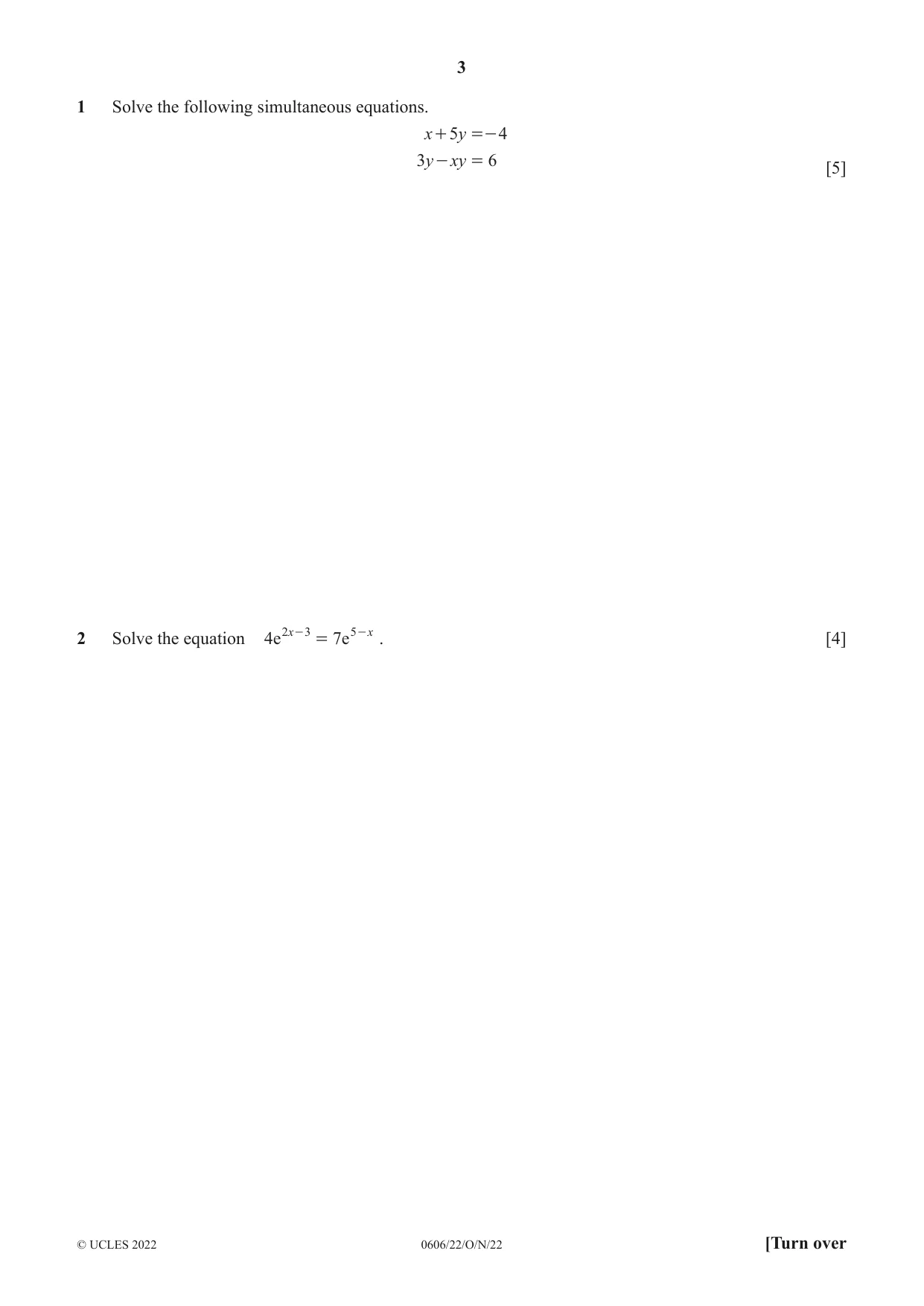
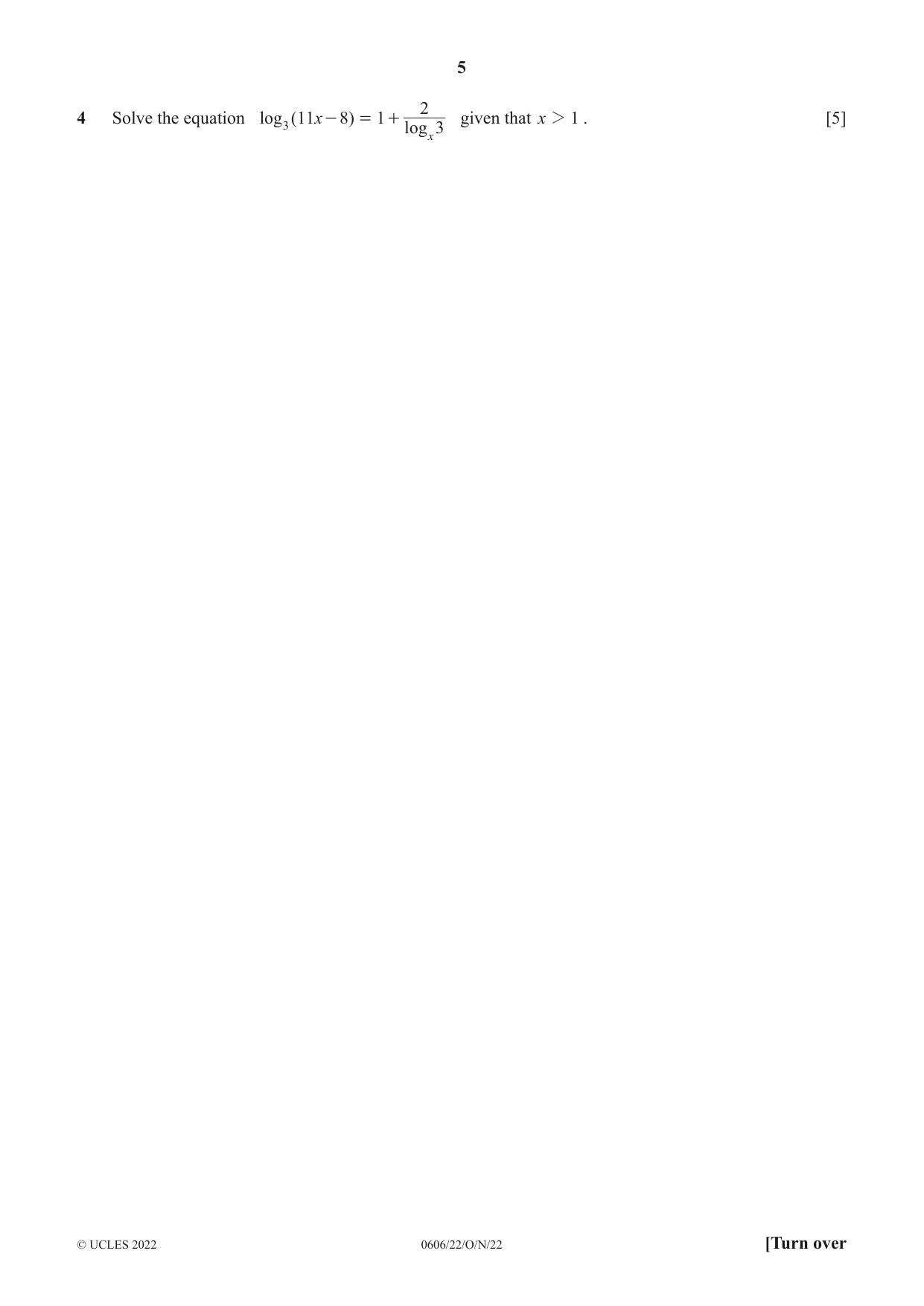
1 Solve the following simultaneous equations. x + 5y =- 4 3y - xy = 6 [5]
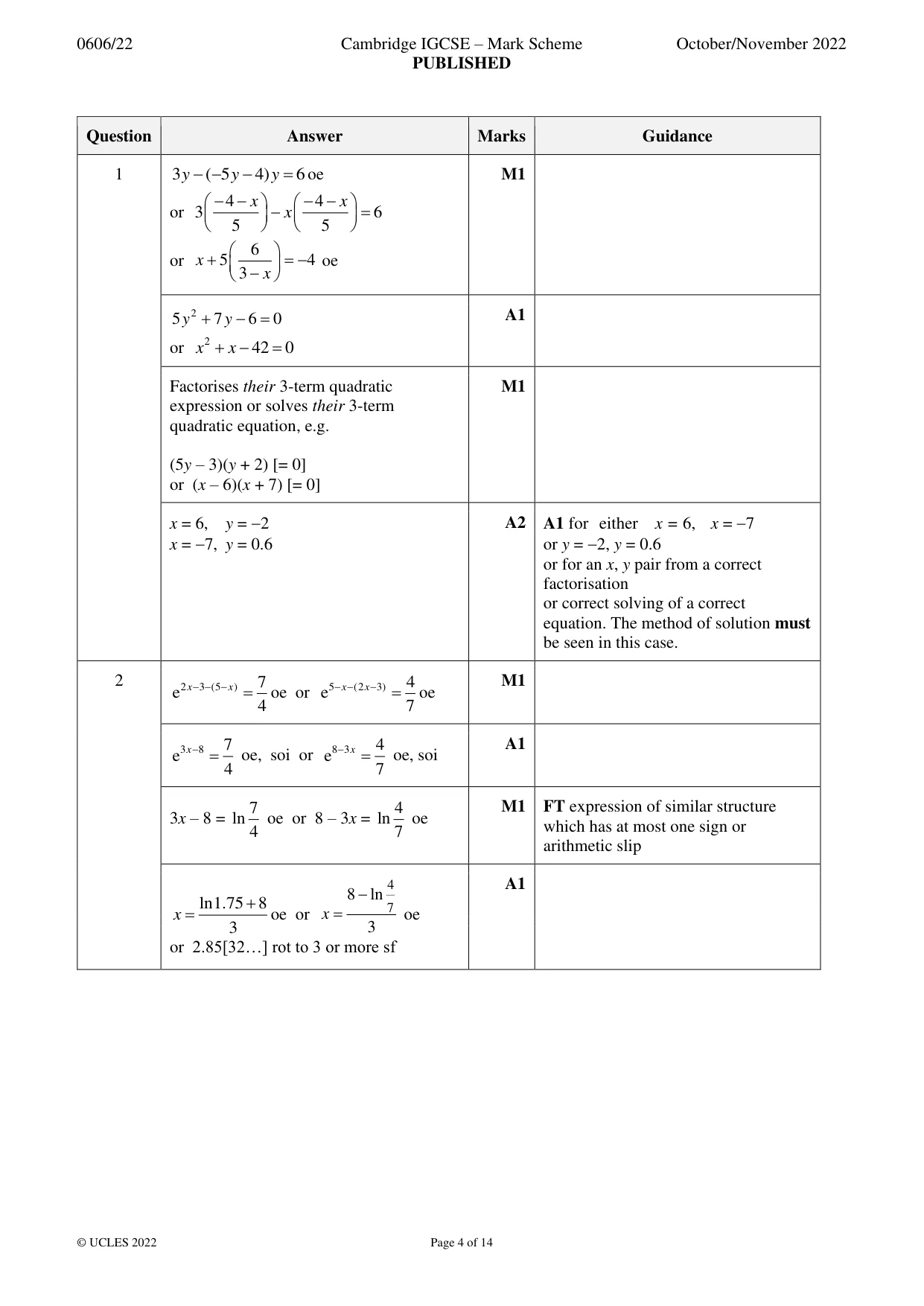
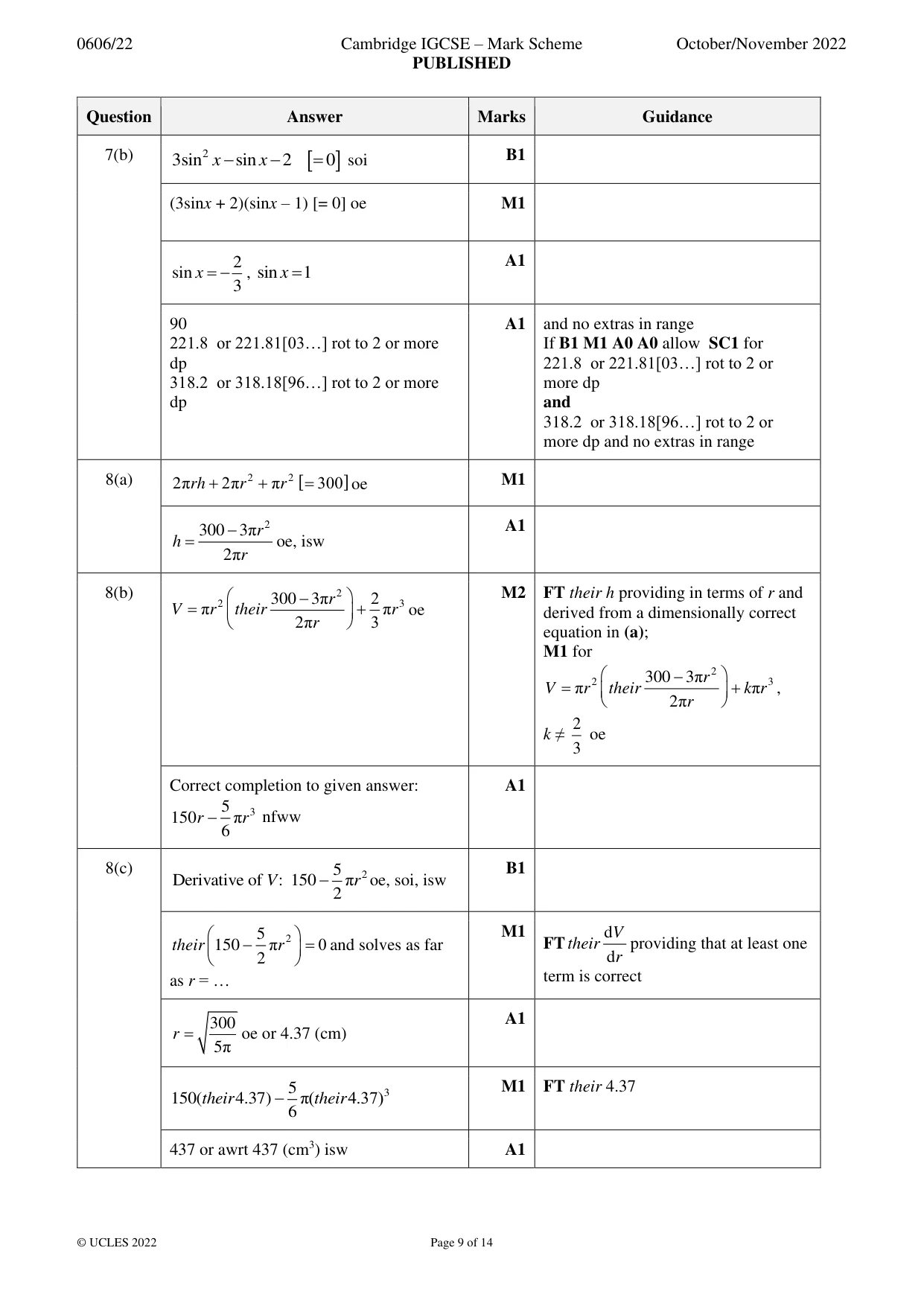
Mark scheme: Question Answer Marks Guidance 1 3 y −−( 5 y − 4) y = 6 oe M1 −−4 x −−4 x or 3 − x = 6 5 5 6 or x + 5 = − 4 oe 3 − x 5 y 2 + 7 y − 6 = 0 A1 or x 2 + x − 42 = 0 Factorises their 3-term quadratic M1 expression or solves their 3-term quadratic equation, e.g. (5y – 3)(y + 2) [= 0] or (x – 6)(x + 7) [= 0] x = 6, y = −2 A2 A1 for either x = 6, x = −7 x = −7, y = 0.6 or y = −2, y = 0.6 or for an x, y pair from a correct factorisation or correct solving of a correct equation. The method of solution must be seen in this case.
Q3 · In this question a and b are constants
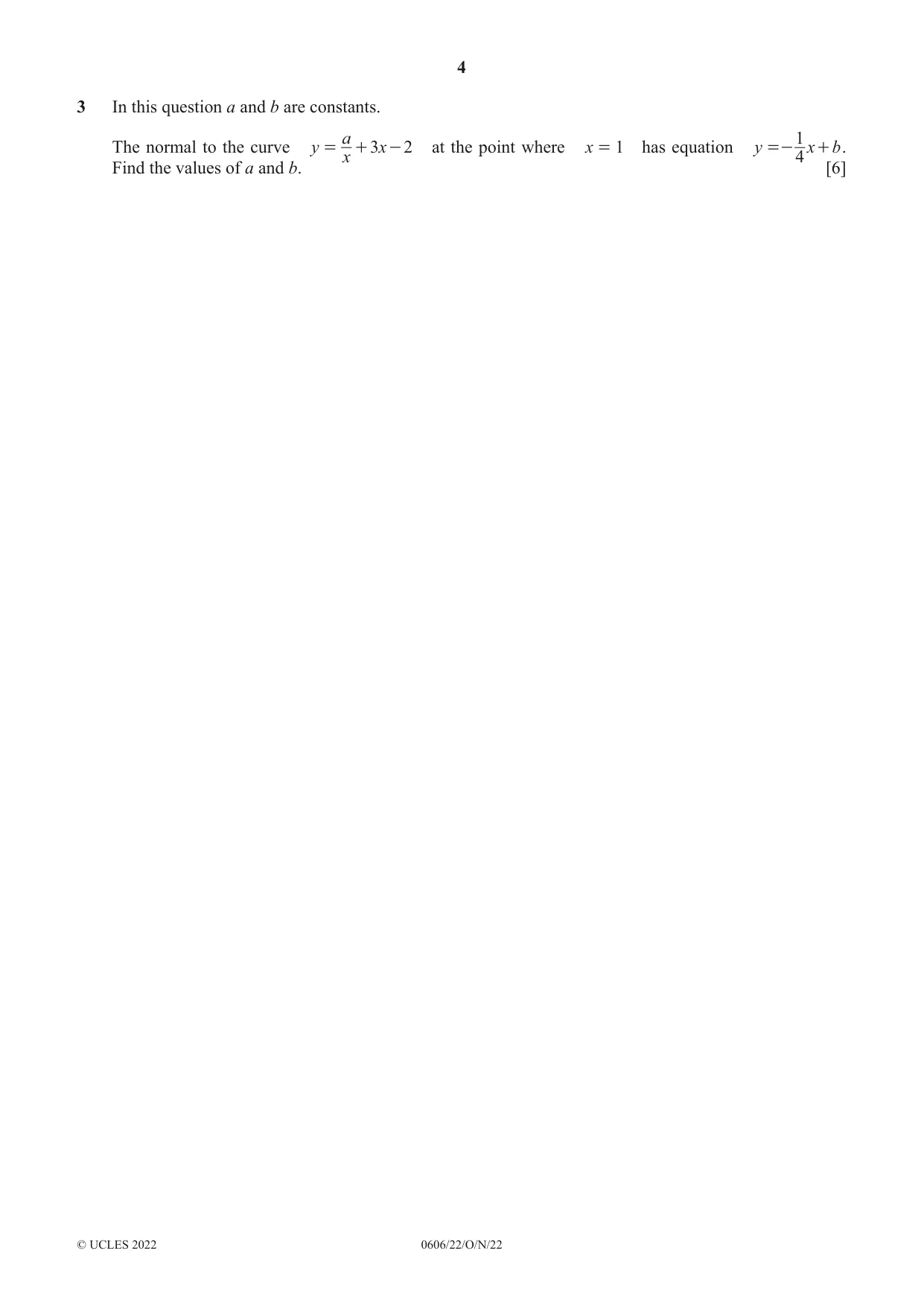
3 In this question a and b are constants. a 1 The normal to the curve y = + 3x - 2 at the point where x = 1 has equation y =- x + b . x 4 Find the values of a and b. [6]
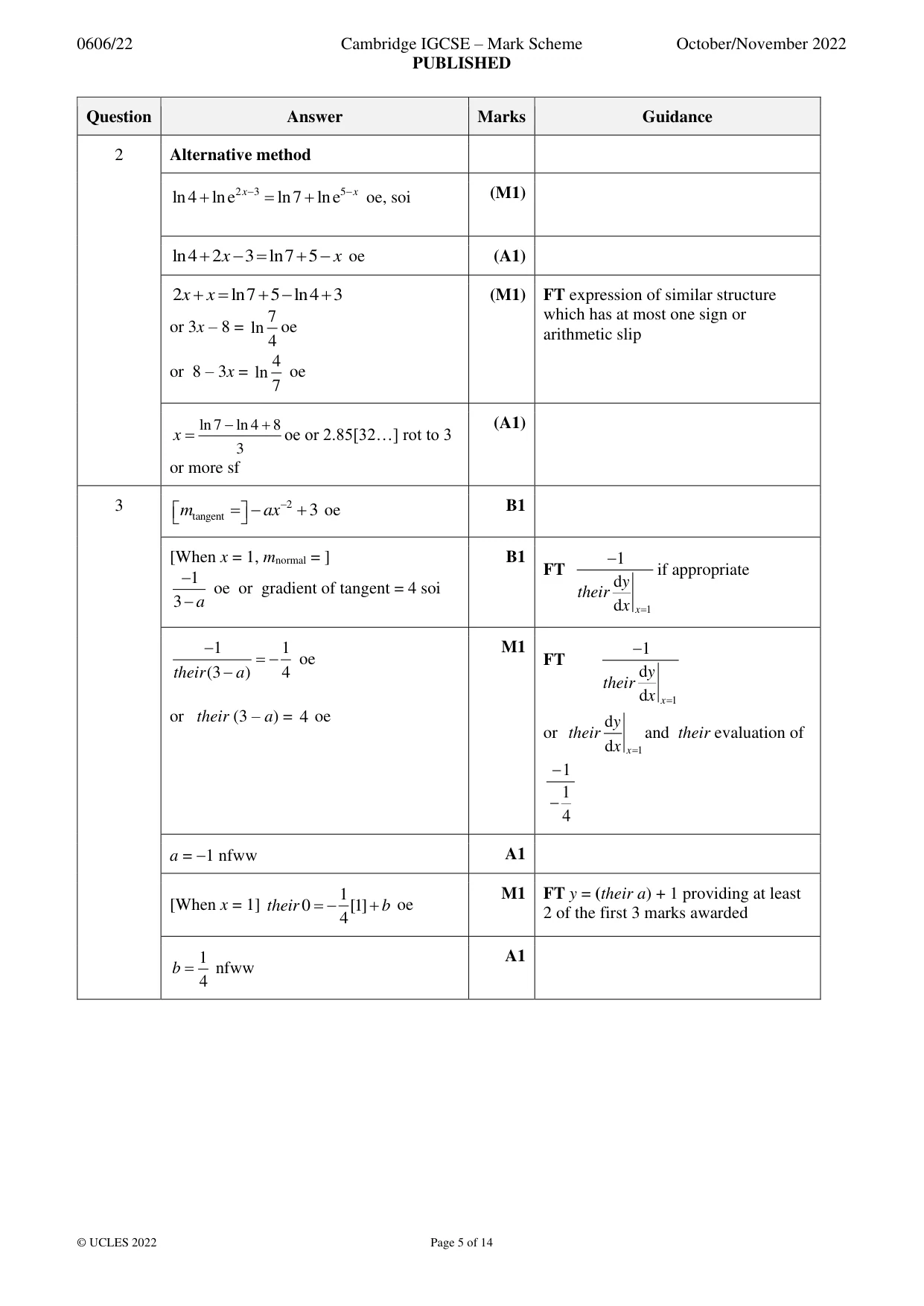
Mark scheme: 3 −2 B1 mtangent = − ax + 3 oe [When x = 1, mnormal = ] B1 −1 FT if appropriate −1 dy oe or gradient of tangent = 4 soi their 3 −a dx x =1 −1 1 M1 −1 = − oe FT their (3 − a ) 4 dy their dx x =1 or their (3 – a) = 4 oe d y or their and their evaluation of d x x =1 − 1 1 − 4 a = −1 nfww A1 1 M1 FT y = (their a) + 1 providing at least [When x = 1] their 0 = − [1] + b oe 2 of the first 3 marks awarded 4 1 A1 b = nfww 4
More questions on Use differentiation to find gradients, tangents
Q5 · DO NOT USE A CALCULATOR IN THIS QUESTION
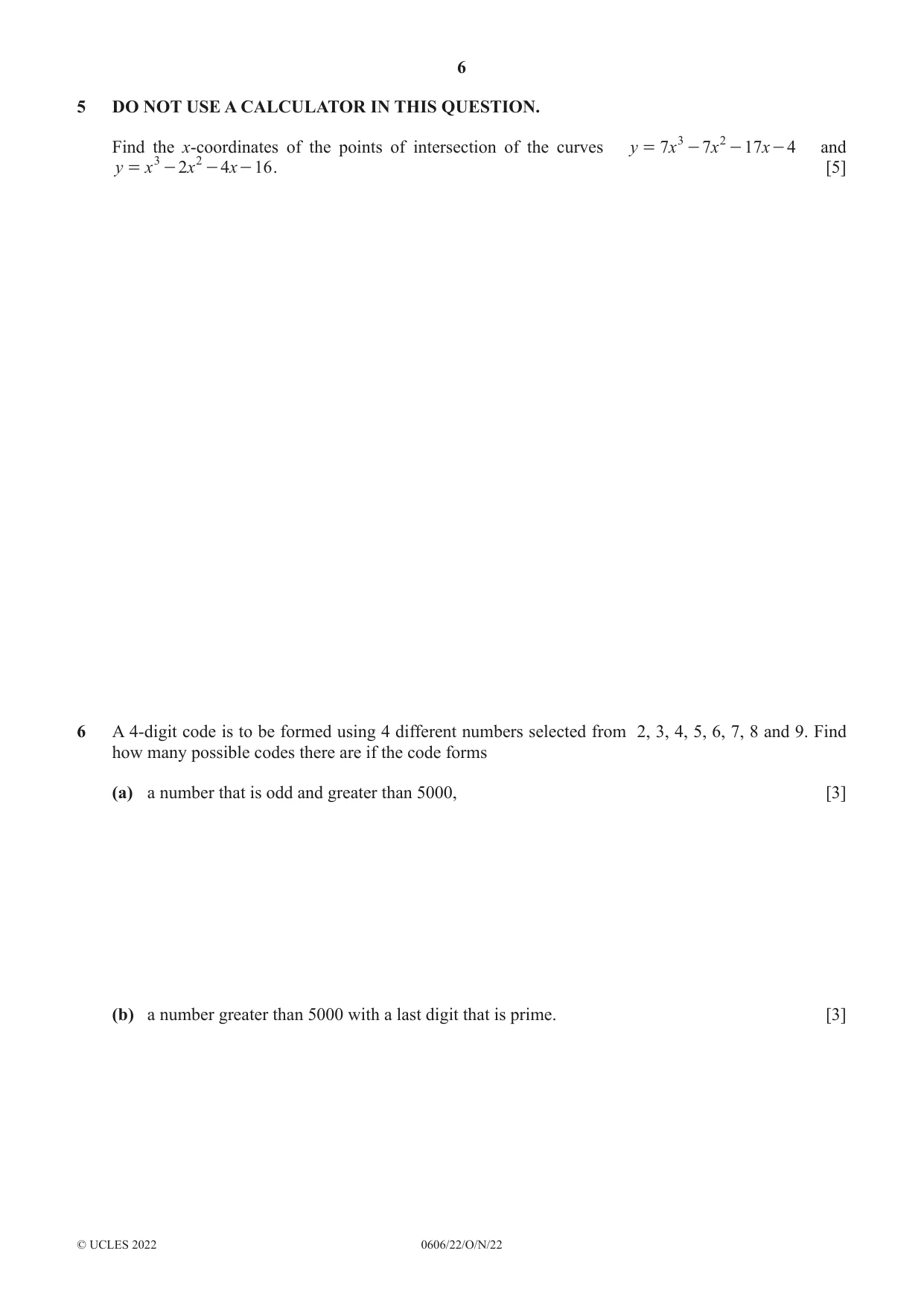
5 DO NOT USE A CALCULATOR IN THIS QUESTION. Find the x-coordinates of the points of intersection of the curves y = 7x 3 - 7x 2 - 17x - 4 and y = x 3 - 2x 2 - 4x - 16 . [5]
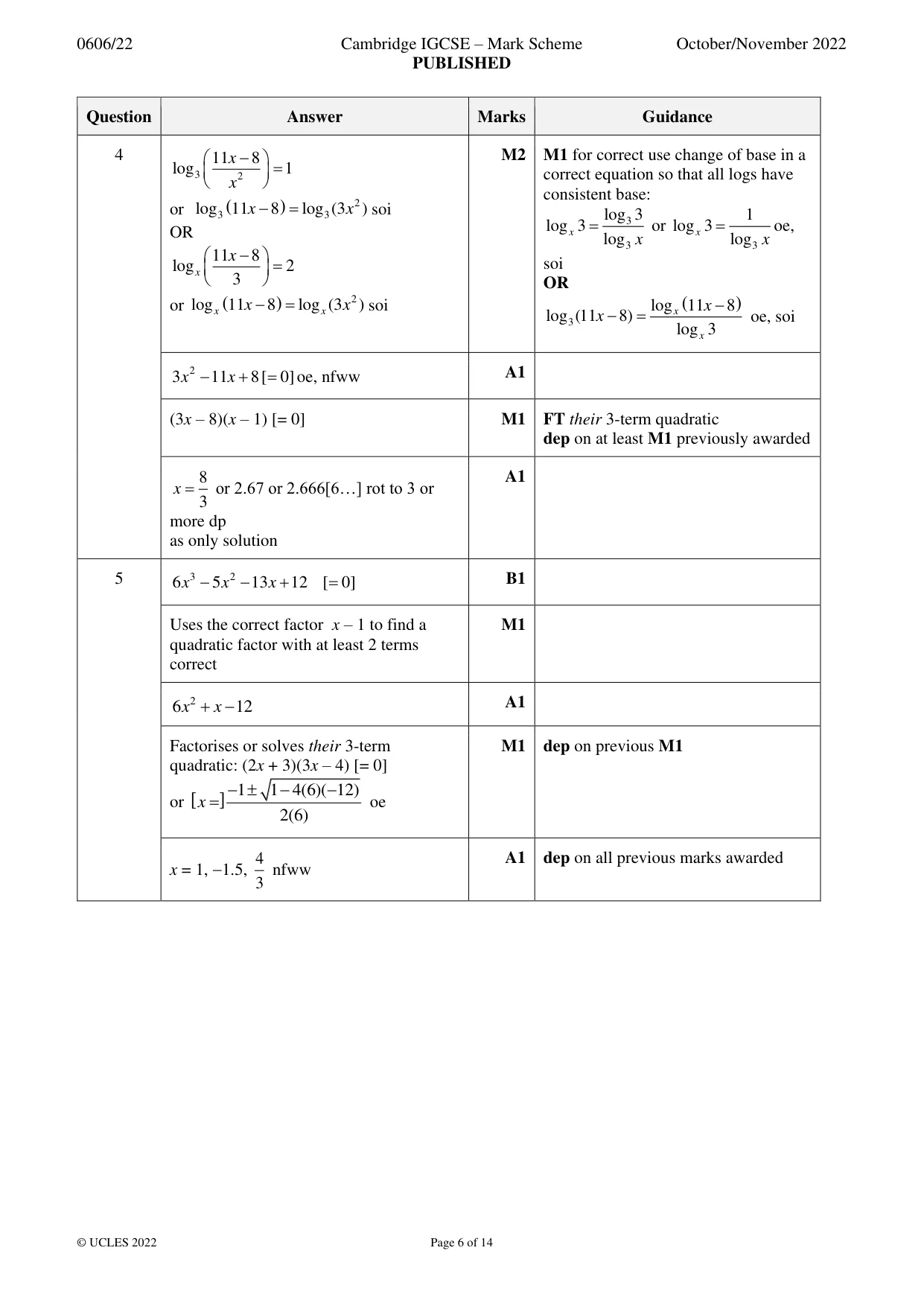
Mark scheme: 5 6 x 3 − 5 x 2 − 13 x + 12 [ = 0] B1 Uses the correct factor x – 1 to find a M1 quadratic factor with at least 2 terms correct 6 x 2 + x − 12 A1 Factorises or solves their 3-term M1 dep on previous M1 quadratic: (2x + 3)(3x – 4) [= 0] − 1 − 4(6)( −12) or x = 1 oe 2(6) 4 A1 dep on all previous marks awarded x = 1, −1.5, nfww 3
Q6 · A 4-digit code is to be formed using 4 different numbers selected from 2, 3, 4, 5, 6, 7…
6 A 4-digit code is to be formed using 4 different numbers selected from 2, 3, 4, 5, 6, 7, 8 and 9. Find how many possible codes there are if the code forms (a) a number that is odd and greater than 5000, [3] (b) a number greater than 5000 with a last digit that is prime. [3]
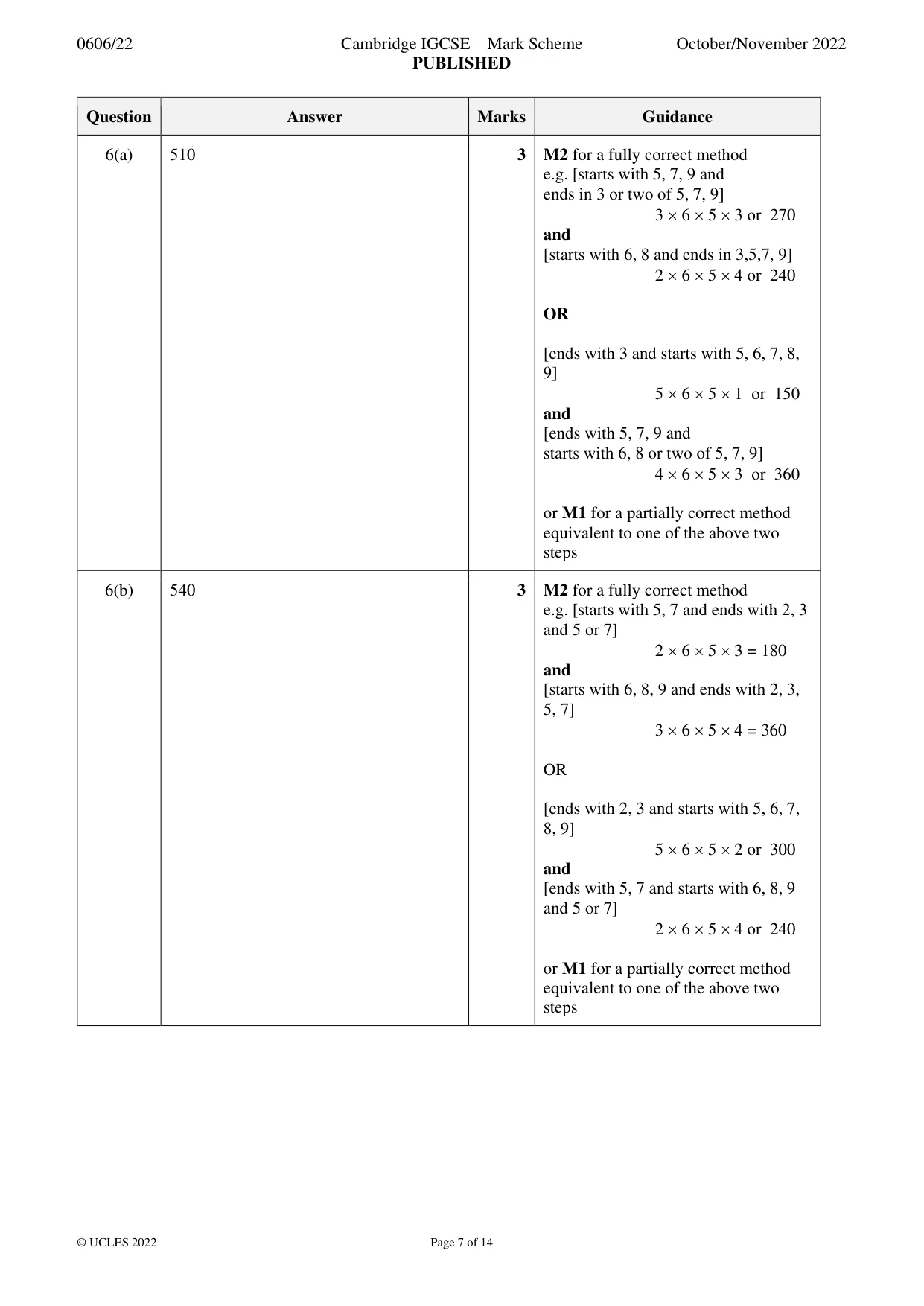
Mark scheme: 6(a) 510 3 M2 for a fully correct method e.g. [starts with 5, 7, 9 and ends in 3 or two of 5, 7, 9] 3 6 5 3 or 270 and [starts with 6, 8 and ends in 3,5,7, 9] 2 6 5 4 or 240 OR [ends with 3 and starts with 5, 6, 7, 8, 9] 5 6 5 1 or 150 and [ends with 5, 7, 9 and starts with 6, 8 or two of 5, 7, 9] 4 6 5 3 or 360 or M1 for a partially correct method equivalent to one of the above two steps 6(b) 540 3 M2 for a fully correct method e.g. [starts with 5, 7 and ends with 2, 3 and 5 or 7] 2 6 5 3 = 180 and [starts with 6, 8, 9 and ends with 2, 3, 5, 7] 3 6 5 4 = 360 OR [ends with 2, 3 and starts with 5, 6, 7, 8, 9] 5 6 5 2 or 300 and [ends with 5, 7 and starts with 6, 8, 9 and 5 or 7] 2 6 5 4 or 240 or M1 for a partially correct method equivalent to one of the above two steps
More questions on Solve problems on arrangement and selection
Q7 · Show that + = 2 cosec x
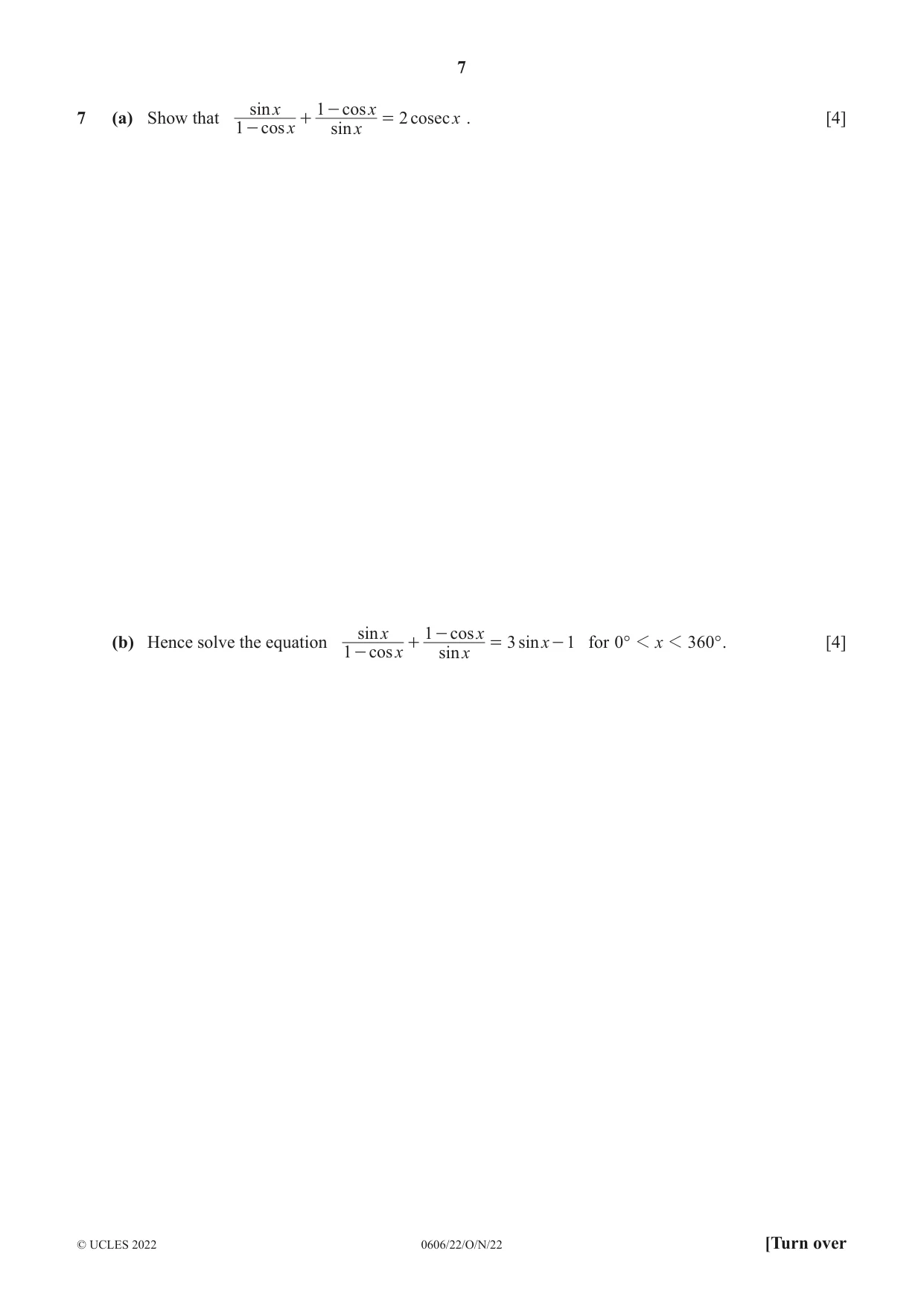
7 (a) Show that + = 2 cosec x . [4] 1 - cos x sin x sin x 1 - cos x (b) Hence solve the equation + = 3 sin x - 1 for 0° 1 x 1 360° . [4] 1 - cos x sin x
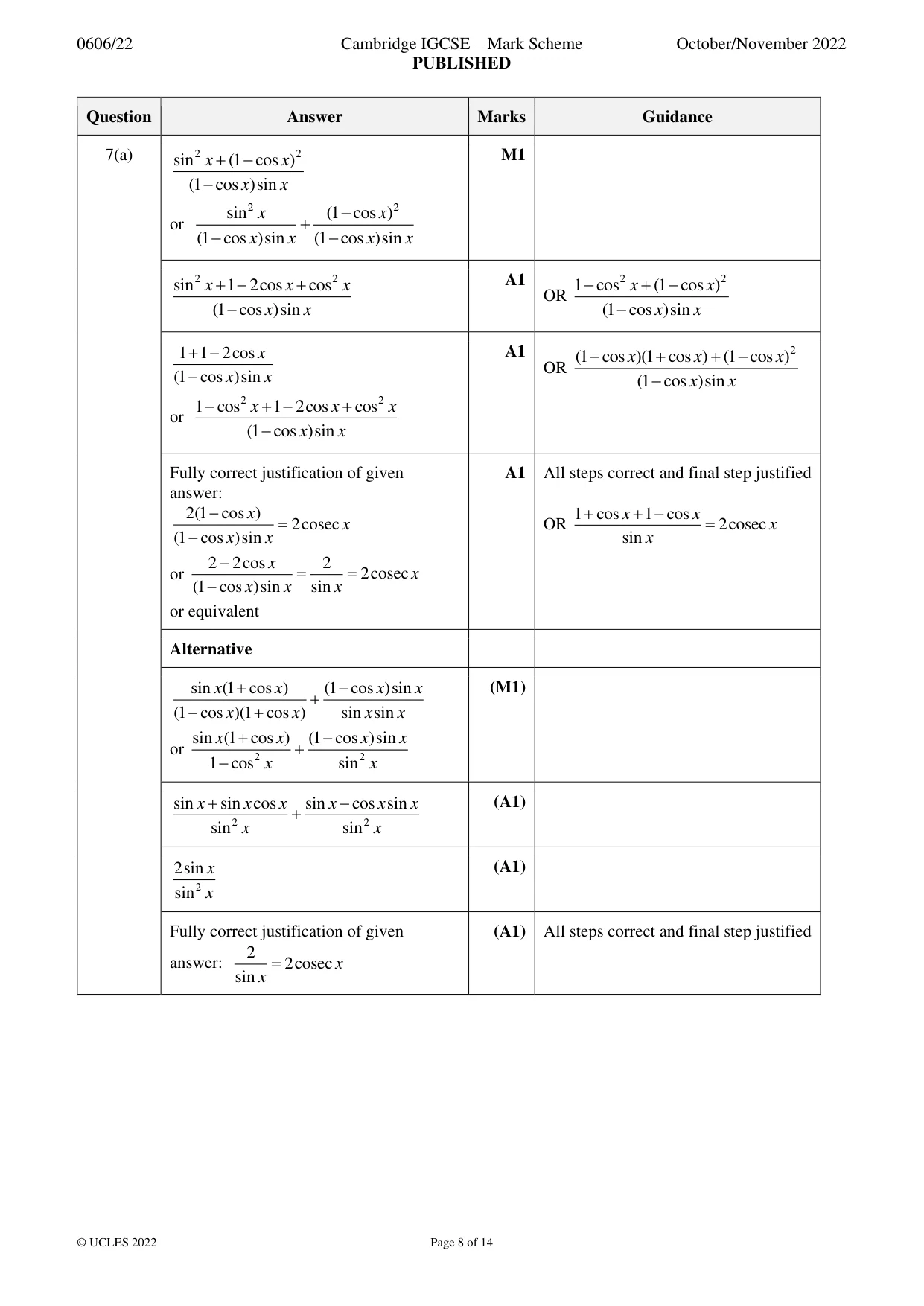
Mark scheme: 7(a) sin 2 x + (1 − cos x ) 2 M1 (1 − cos x )sin x sin 2 x (1 − cos x) 2 or + (1 − cos x )sin x (1 − cos x)sin x sin 2 x + 1 − 2cos x + cos 2 x A1 1 − cos 2 x + (1 − cos x ) 2 OR (1 − cos x )sin x (1 − cos x )sin x 1 + 1 − 2cos x A1 (1 − cos x )(1 + cos x ) + (1 − cos x) 2 OR (1 − cos x )sin x (1 − cos x )sin x 1 − cos 2 x + 1 − 2cos x + cos 2 x or (1 − cos x )sin x Fully correct justification of given A1 All steps correct and final step justified answer: 2(1 − cos x ) 1 + cos x + 1 − cos x = 2cosec x OR = 2cosec x (1 − cos x )sin x sin x 2 − 2cos x 2 or = = 2cosec x (1 − cos x )sin x sin x or equivalent Alternative sin x (1 + cos x ) (1 − cos x )sin x (M1) + (1 − cos x )(1 + cos x ) sin x sin x sin x (1 + cos x ) (1 − cos x )sin x or + 1 − cos 2 x sin 2 x sin x + sin x cos x sin x − cos x sin x (A1) + sin 2 x sin 2 x 2sin x (A1) sin 2 x Fully correct justification of given (A1) All steps correct and final step justified 2 answer: = 2cosec x sin x 7(b) 3sin 2 x − sin x − 2 = 0 soi B1 (3sinx + 2)(sinx – 1) [= 0] oe M1 2 A1 sin x = − , sin x = 1 3 90 A1 and no extras in range 221.8 or 221.81[03…] rot to 2 or more If B1 M1 A0 A0 allow SC1 for dp 221.8 or 221.81[03…] rot to 2 or 318.2 or 318.18[96…] rot to 2 or more more dp dp and 318.2 or 318.18[96…] rot to 2 or more dp and no extras in range
More questions on Prove trigonometric relationships involving the
Q8 · In this question all lengths are in centimetres
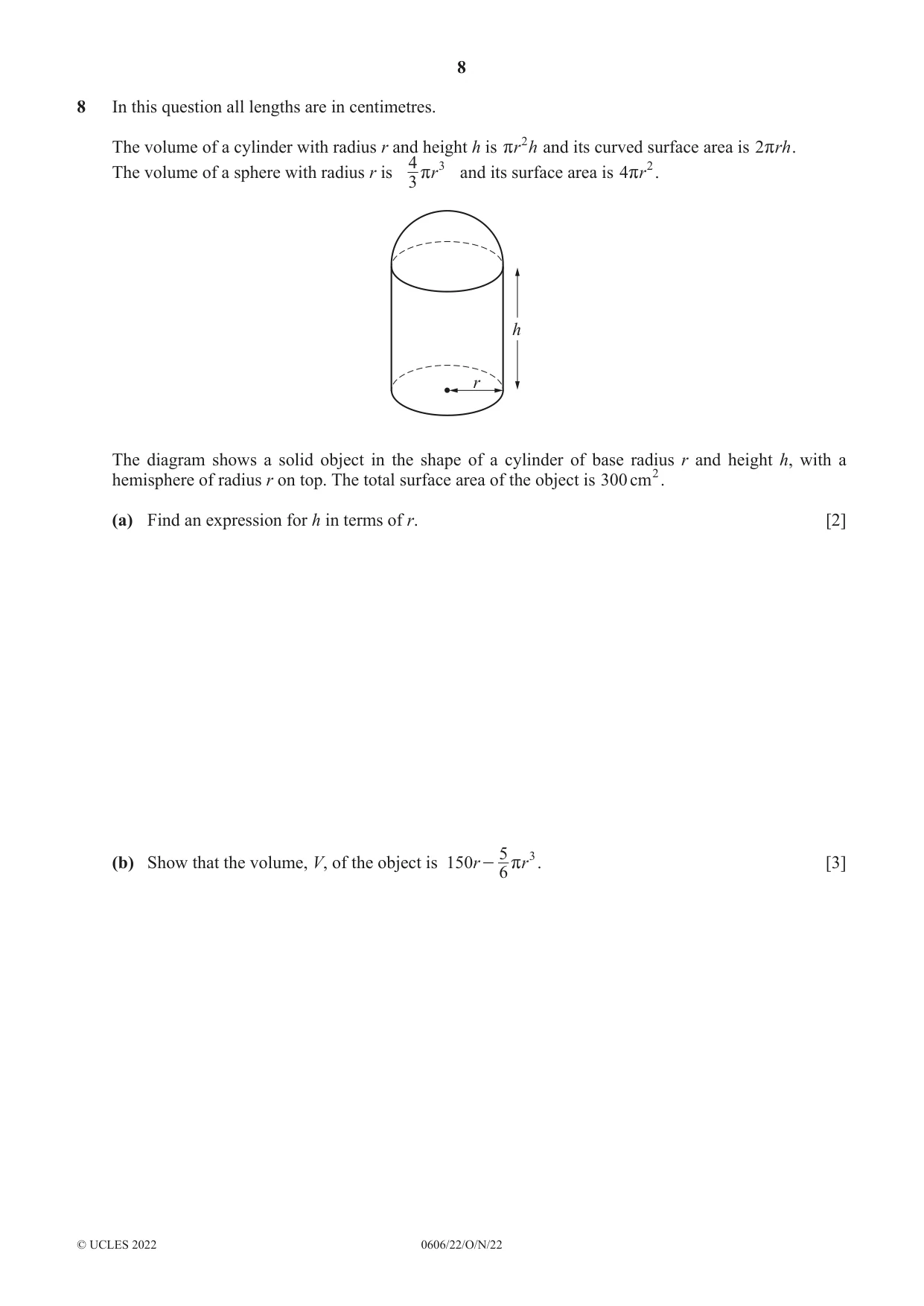
8 In this question all lengths are in centimetres. The volume of a cylinder with radius r and height h is rr 2 h and its curved surface area is 2rrh . 4 3 2 The volume of a sphere with radius r is rr and its surface area is 4rr . 3 h r The diagram shows a solid object in the shape of a cylinder of base radius r and height h, with a hemisphere of radius r on top. The total surface area of the object is 300 cm 2. (a) Find an expression for h in terms of r. [2] 5 3 (b) Show that the volume, V, of the object is 150r - r r . [3] 6
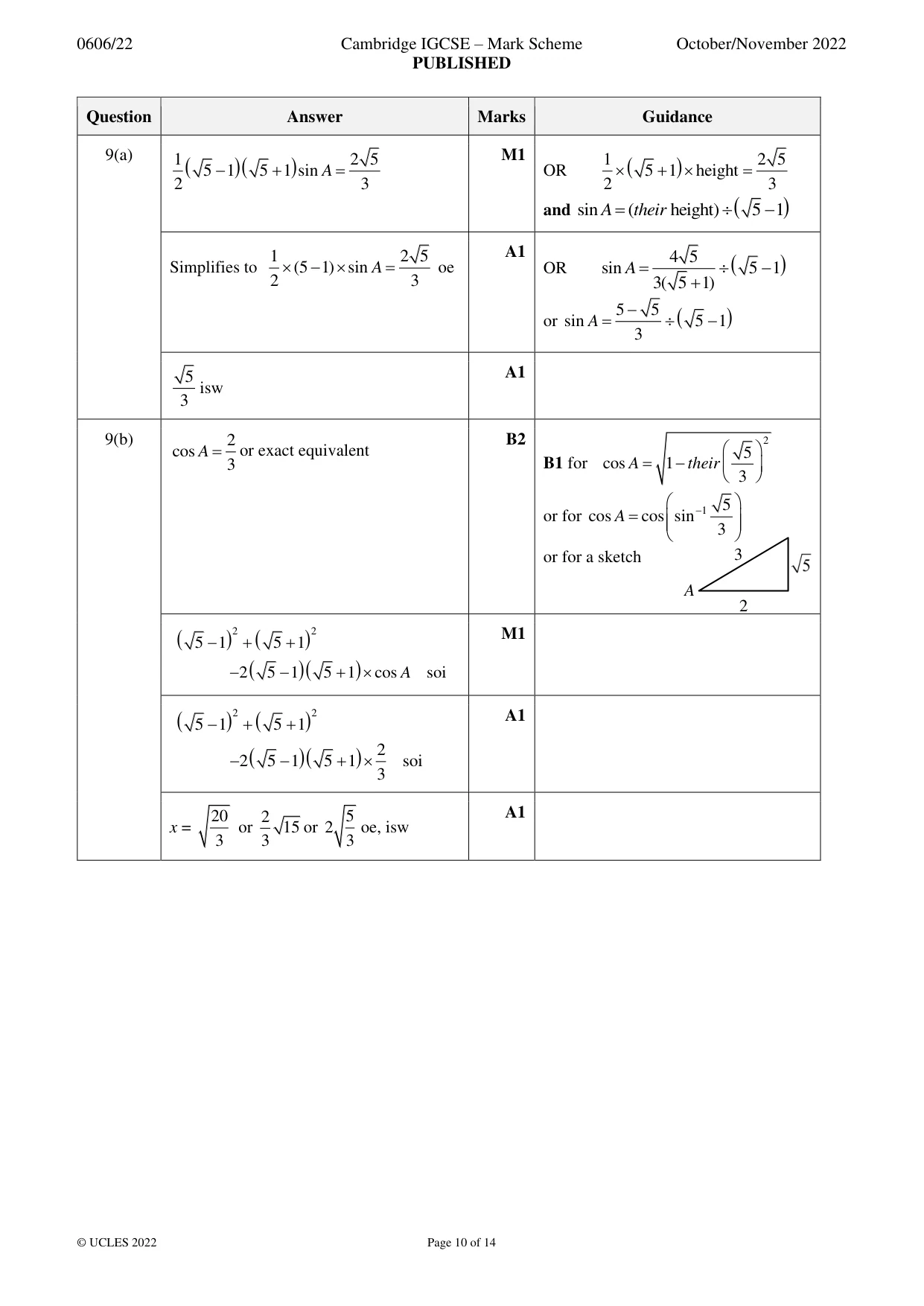
Mark scheme: 8(a) 2πrh + 2πr 2 + πr 2 = 300 oe M1 300 − 3πr 2 A1 h = oe, isw 2πr 8(b) 2 300 − 3πr 2 2 3 M2 FT their h providing in terms of r and V = πr their + πr oe derived from a dimensionally correct 2πr 3 equation in (a); M1 for 2 300 − 3πr 2 3 V = πr their + kπr , 2πr 2 k ≠ oe 3 Correct completion to given answer: A1 5 3 150 r − πr nfww 6 8(c) 5 2 B1 Derivative of V : 150 − πr oe, soi, isw 2 5 2 M1 dV their 150 − πr = 0 and solves as far FT their providing that at least one 2 d r term is correct as r = … 300 A1 r = oe or 4.37 (cm) 5π 5 3 M1 FT their 4.37 150(their 4.37) − π(their 4.37) 6 437 or awrt 437 (cm3) isw A1
More questions on Apply differentiation to practical problems
Q9 · In this question all lengths are in centimetres
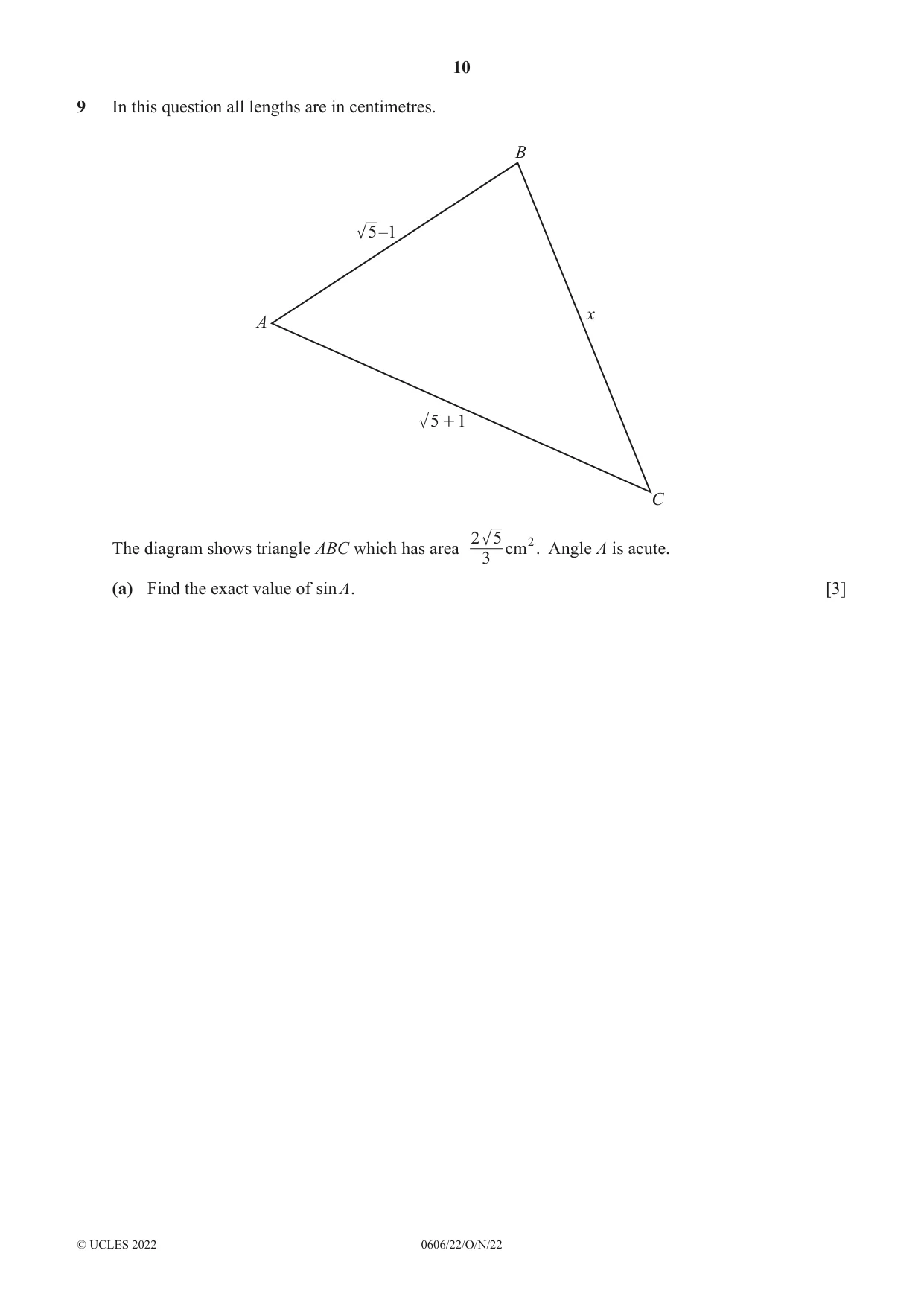
9 In this question all lengths are in centimetres. B 5 –1 x A 5 + 1 C 2 5 The diagram shows triangle ABC which has area cm 2. Angle A is acute. 3 (a) Find the exact value of sinA. [3] (b) Find the exact value of cosA and hence find the exact value of x. [5] (c) Find the exact value of sinB. [3]
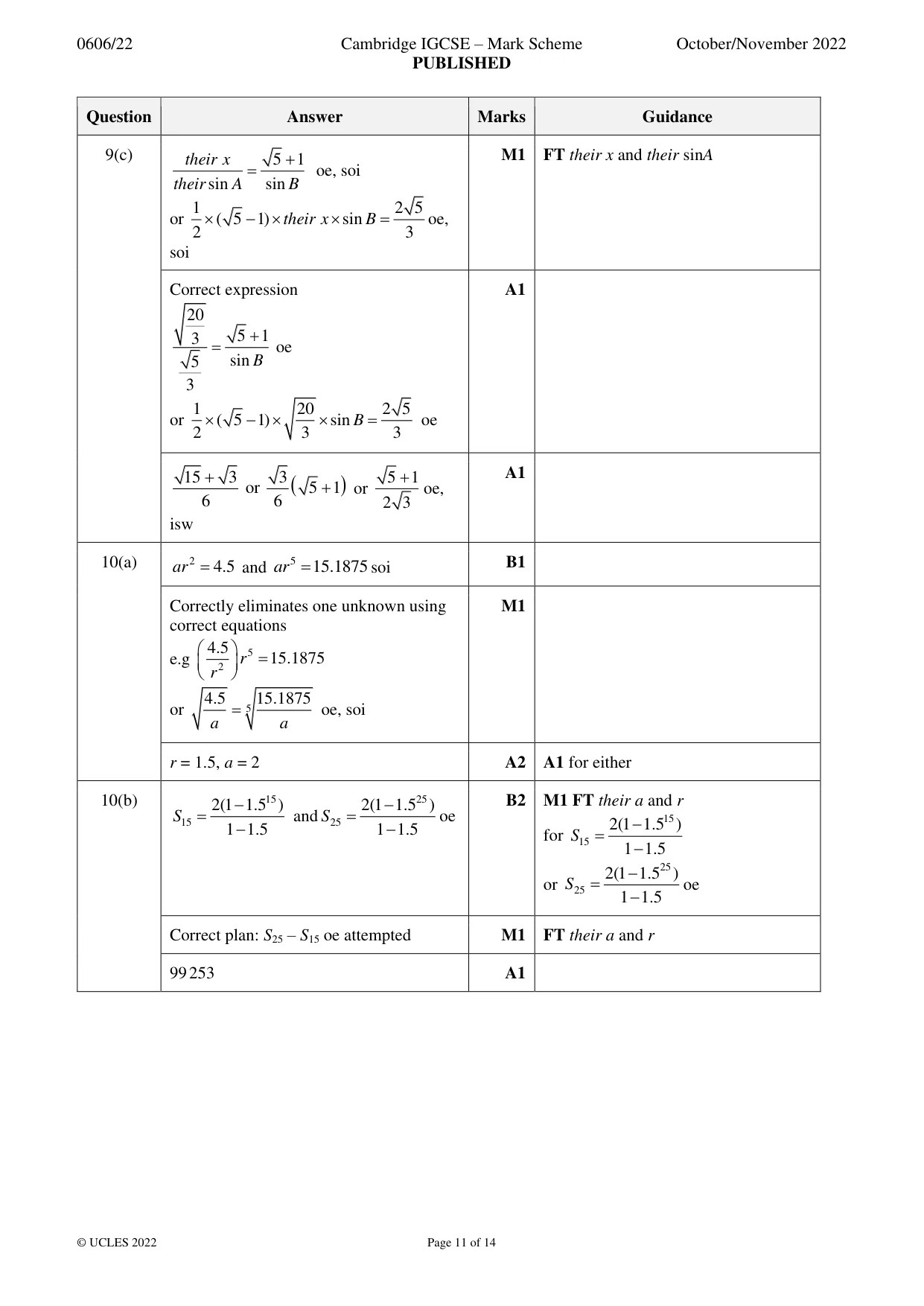
Mark scheme: 9(a) 1 2 5 M1 1 2 5 ( 5 − 1)( 5 + 1) sin A = OR ( 5 + 1) height = 2 3 2 3 and sin A = (their height) ( 5 − 1) 1 2 5 A1 4 5 Simplifies to (5 − 1) sin A = oe OR sin A = ( 5 − 1) 2 3 3( 5 + 1) 5 − 5 ( 5 − 1) or sin A = 3 5 A1 isw 3 9(b) 2 B2 2 cos A = or exact equivalent 5 3 B1 for cos A = 1 − their 3 −1 5 or for cos A = cos sin 3 or for a sketch 3 A 2 ( 5 − 1) 2 + ( 5 + 1) 2 M1 −2 ( 5 − 1)( 5 + 1) cos A soi ( 5 − 1) 2 + ( 5 + 1) 2 A1 −2 ( 5 − 1)( 5 + 1) 2 soi 3 20 2 5 A1 x = or 15 or 2 oe, isw 3 3 3 9(c) their x 5 + 1 M1 FT their x and their sinA = oe, soi their sin A sin B 1 2 5 or ( 5 − 1) their x sin B = oe, 2 3 soi Correct expression A1 20 3 5 + 1 = oe 5 sin B 3 1 20 2 5 or ( 5 − 1) sin B = oe 2 3 3 15 + 3 3 5 + 1 A1 or ( 5 + 1) or oe, 6 6 2 3 isw
Q10 · A geometric progression has third term 4.5 and sixth term 15.1875
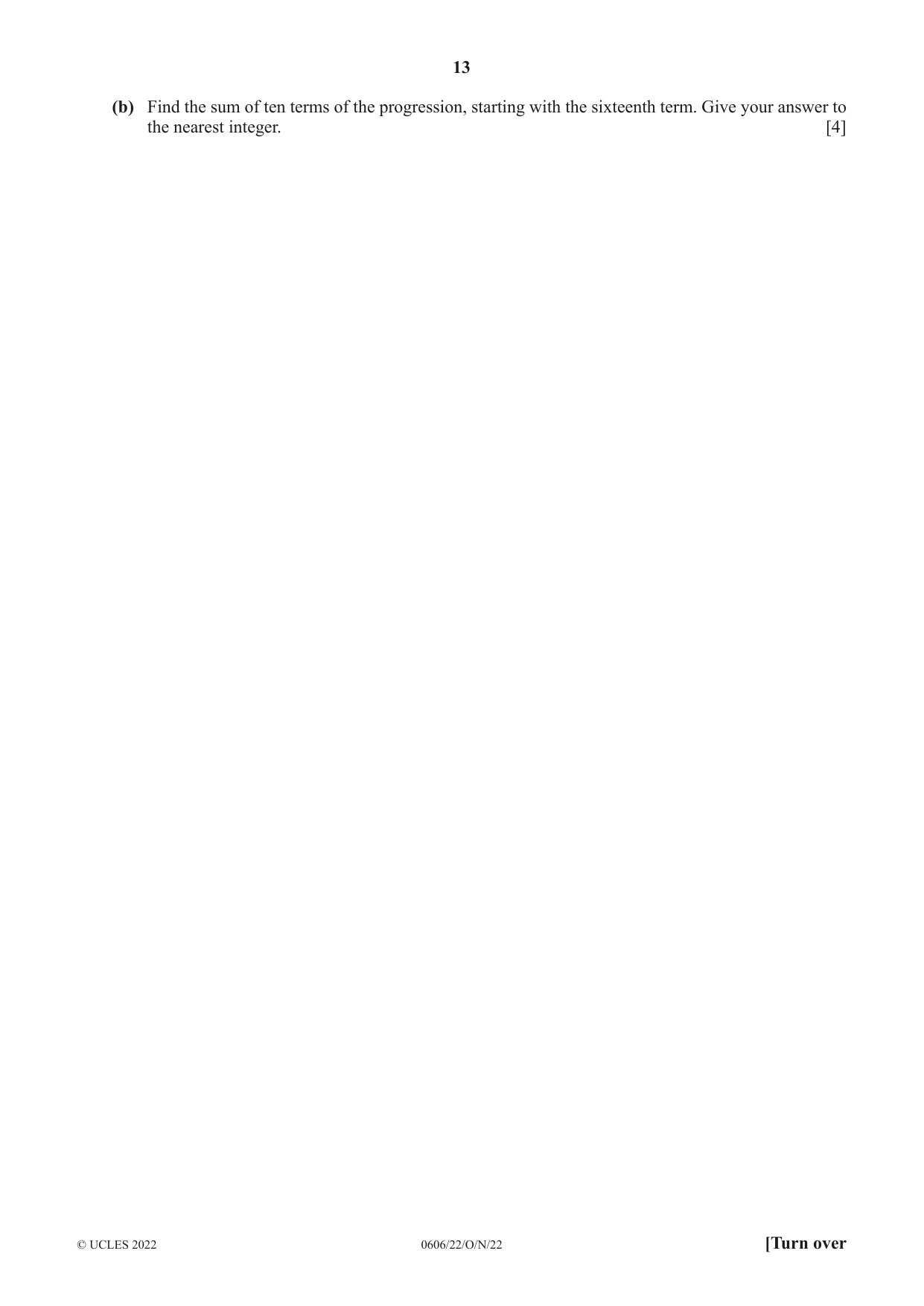
10 (a) A geometric progression has third term 4.5 and sixth term 15.1875. Find the first term and the common ratio. [4] (b) Find the sum of ten terms of the progression, starting with the sixteenth term. Give your answer to the nearest integer. [4]
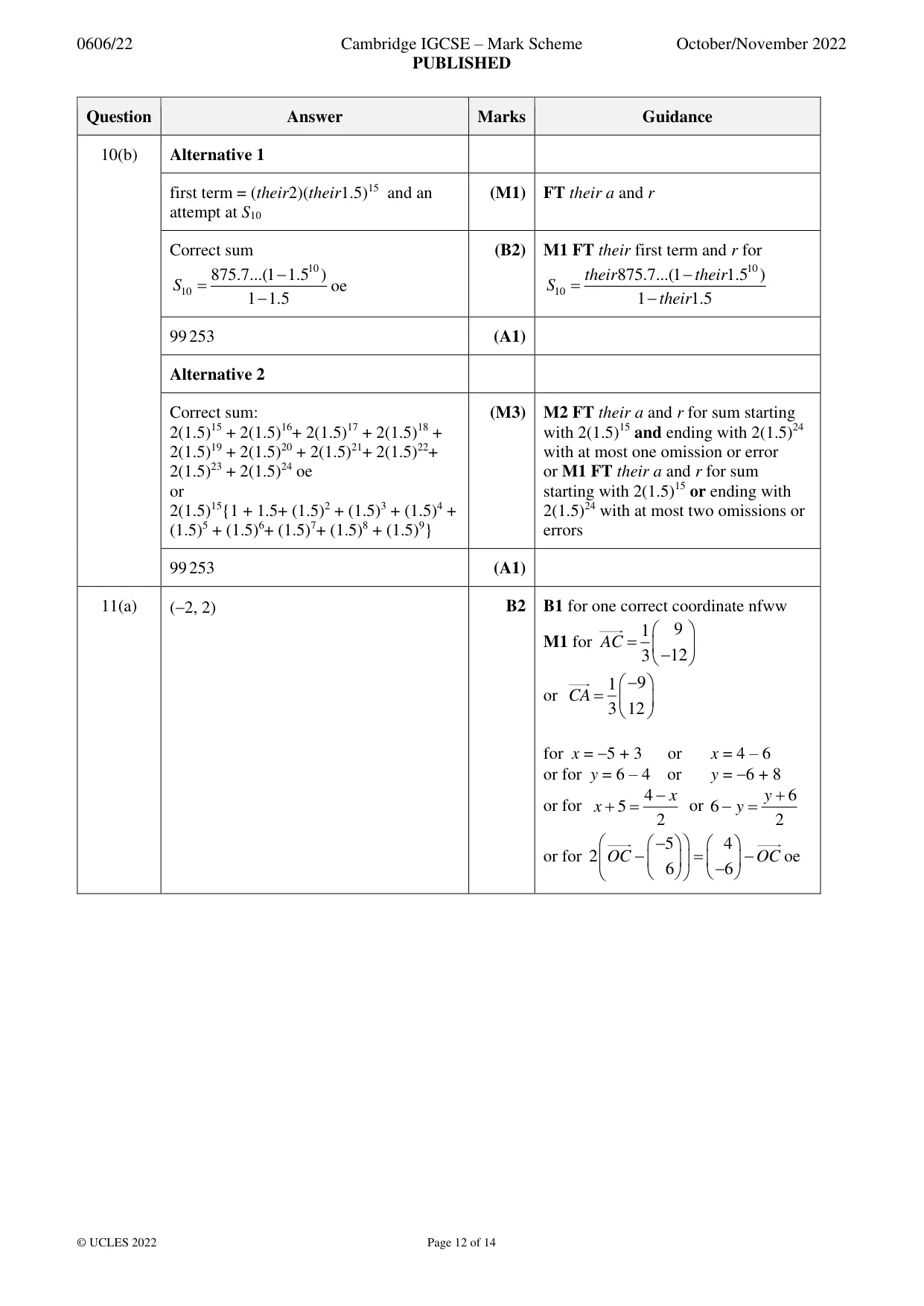
Mark scheme: 10(a) ar 2 = 4.5 and ar 5 = 15.1875 soi B1 Correctly eliminates one unknown using M1 correct equations 4.5 5 e.g 2 r = 15.1875 r 4.5 15.1875 or = 5 oe, soi a a r = 1.5, a = 2 A2 A1 for either 10(b) 2(1 − 1.515 ) 2(1 − 1.525 ) B2 M1 FT their a and r S15 = and S 25 = oe 15 1 − 1.5 1 − 1.5 2(1 − 1.5 ) for S15 = 1 − 1.5 2(1 − 1.525 ) or S 25 = oe 1 − 1.5 Correct plan: S25 – S15 oe attempted M1 FT their a and r 99 253 A1 10(b) Alternative 1 first term = (their2)(their1.5)15 and an (M1) FT their a and r attempt at S10 Correct sum (B2) M1 FT their first term and r for 875.7...(1 − 1.510 ) their 875.7...(1 − their1.510 ) S10 = oe S10 = 1 − 1.5 1 − their1.5 99 253 (A1) Alternative 2 Correct sum: (M3) M2 FT their a and r for sum starting 2(1.5)15 + 2(1.5)16+ 2(1.5)17 + 2(1.5)18 + with 2(1.5)15 and ending with 2(1.5)24 2(1.5)19 + 2(1.5)20 + 2(1.5)21+ 2(1.5)22+ with at most one omission or error 2(1.5)23 + 2(1.5)24 oe or M1 FT their a and r for sum or starting with 2(1.5)15 or ending with 2(1.5)15{1 + 1.5+ (1.5)2 + (1.5)3 + (1.5)4 + 2(1.5)24 with at most two omissions or (1.5)5 + (1.5)6+ (1.5)7+ (1.5)8 + (1.5)9} errors 99 253 (A1)
More questions on Use the formulas for the nth term and for the
Q11 · The coordinates of points A and B are ( - 5, 6) and ( 4, - 6) respectively
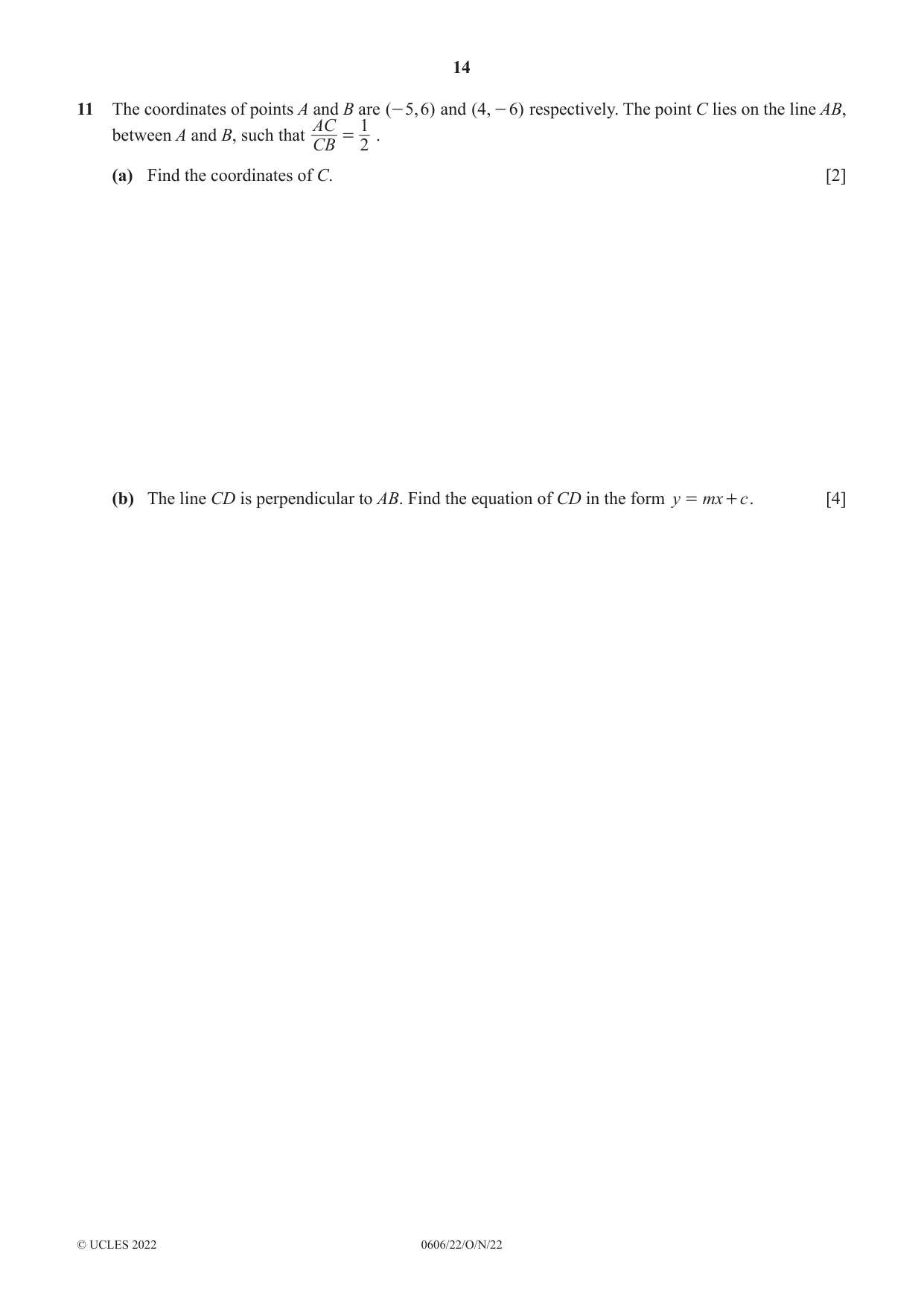
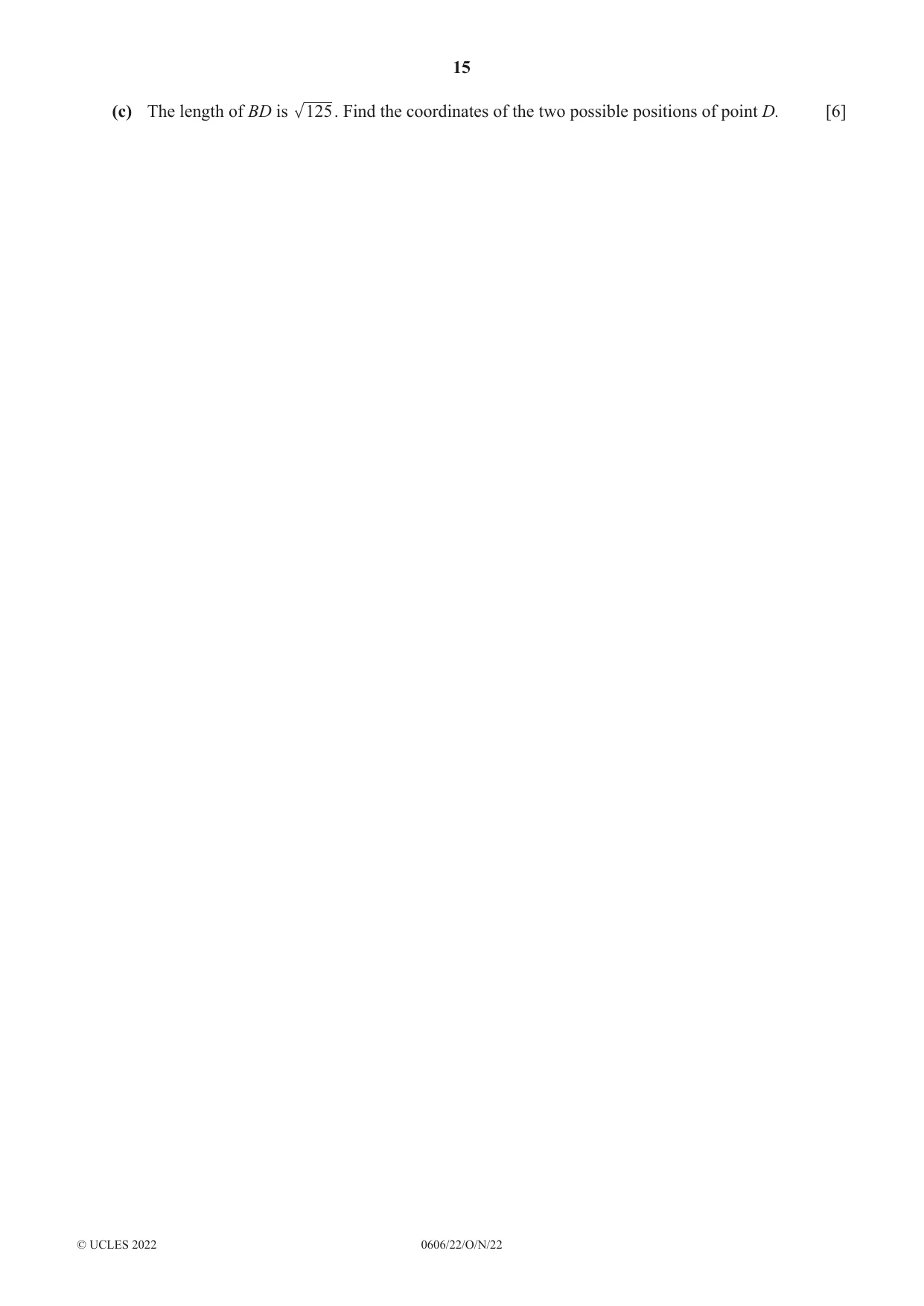
11 The coordinates of points A and B are ( - 5, 6) and ( 4, - 6) respectively. The point C lies on the line AB, AC 1 between A and B, such that = . CB 2 (a) Find the coordinates of C. [2] (b) The line CD is perpendicular to AB. Find the equation of CD in the form y = mx + c . [4] (c) The length of BD is 125. Find the coordinates of the two possible positions of point D. [6]
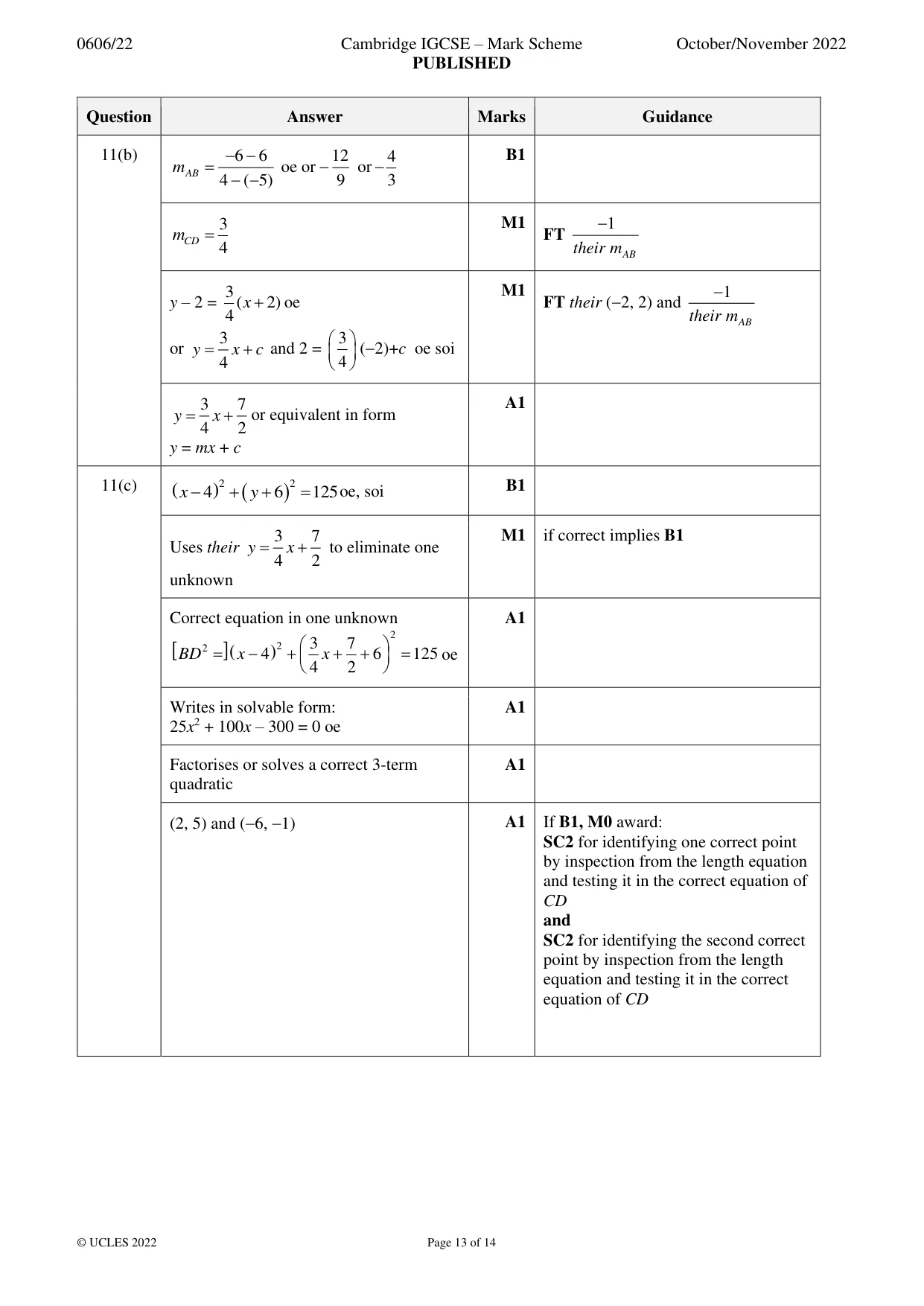
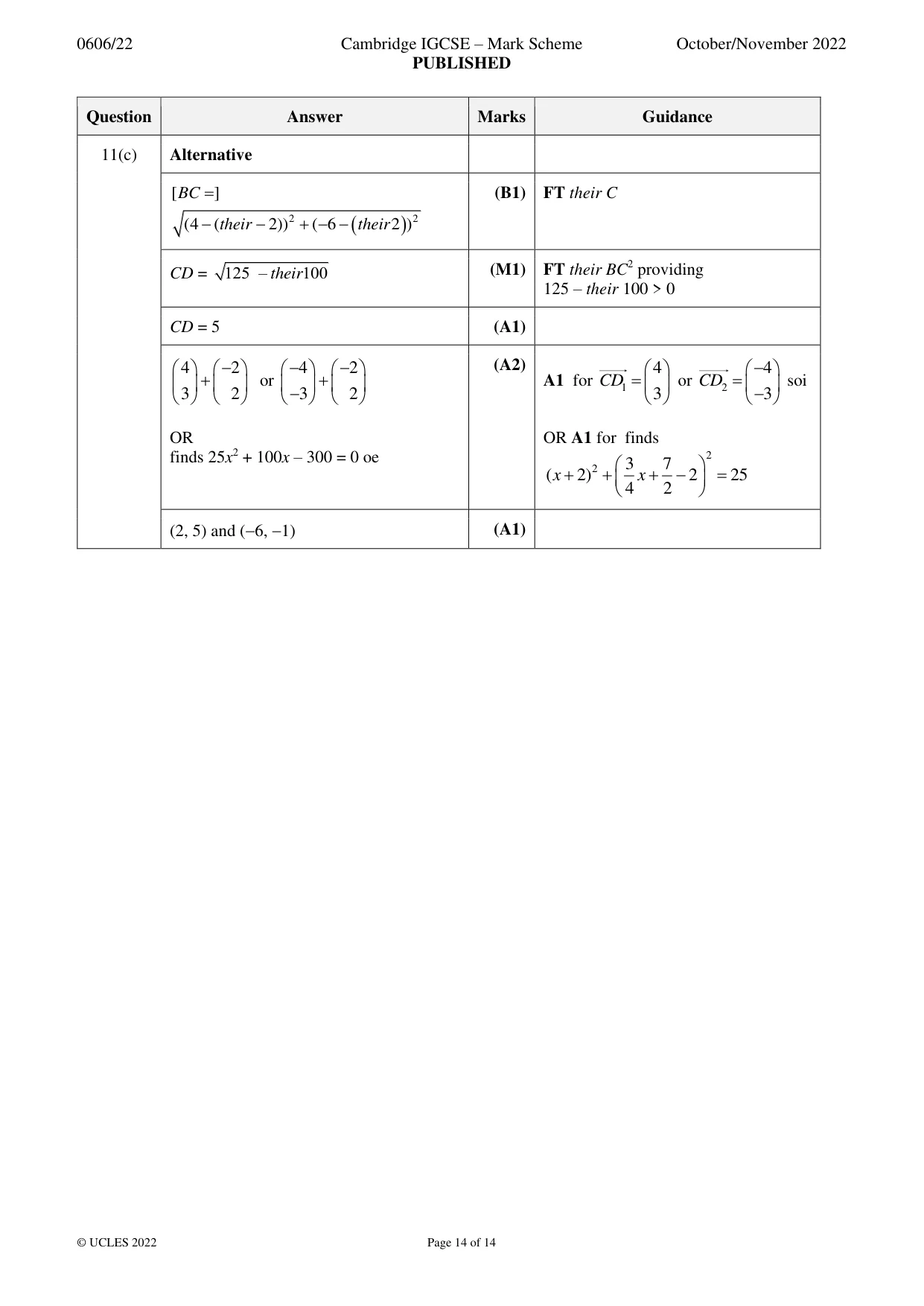
Mark scheme: 11(a) (−2, 2) B2 B1 for one correct coordinate nfww 1 9 M1 for AC = 3 −12 1 −9 or CA = 3 12 for x = −5 + 3 or x = 4 – 6 or for y = 6 – 4 or y = −6 + 8 4 − x y + 6 or for x + 5 = or 6 − y = 2 2 −5 4 or for 2 OC − = − OC oe 6 −6 11(b) −−6 6 12 4 B1 m AB = oe or − or − 4 −−( 5) 9 3 3 M1 −1 mCD = FT 4 their m AB M1 −1 y – 2 = 3( x + 2) oe FT their (−2, 2) and 4 their m AB 3 3 or y = x + c and 2 = (−2)+c oe soi 4 4 3 7 A1 y = x + or equivalent in form 4 2 y = mx + c 11(c) ( x − 4 ) 2 + ( y + 6 ) 2 = 125 oe, soi B1 3 7 M1 if correct implies B1 Uses their y = x + to eliminate one 4 2 unknown Correct equation in one unknown A1 2 BD 2 = ( x − 4 ) 2 + 3 x + 7 + 6 = 125 oe 4 2 Writes in solvable form: A1 25x2 + 100x – 300 = 0 oe Factorises or solves a correct 3-term A1 quadratic (2, 5) and (−6, −1) A1 If B1, M0 award: SC2 for identifying one correct point by inspection from the length equation and testing it in the correct equation of CD and SC2 for identifying the second correct point by inspection from the length equation and testing it in the correct equation of CD 11(c) Alternative [ BC = ] (B1) FT their C (4 − (their − 2)) 2 + ( −−6 ( their 2 )) 2 CD = 125 – their100 (M1) FT their BC2 providing 125 – their 100 > 0 CD = 5 (A1) 4 −2 −4 −2 (A2) 4 −4 + or + A1 for CD1 = or CD2 = soi 3 2 −3 2 3 −3 OR OR A1 for finds finds 25x2 + 100x – 300 = 0 oe 2 2 3 7 ( x + 2) + x + − 2 = 25 4 2 (2, 5) and (−6, −1) (A1)
More questions on Solve problems involving midpoint and length
What was in this paper
The subtopics covered by these 9 questions, and how many questions each got. Open one in a new tab to see every Cambridge question on it.
1Prove trigonometric relationships involving the1Solve cubic equations1Solve problems involving midpoint and length1Solve problems on arrangement and selection1Solve simultaneous equations in two1Use differentiation to find gradients, tangents1Use the formulas for the nth term and for the1Use the relationships1What you needed in this session
Cambridge’s own grade thresholds for 2022 Oct/Nov, Paper 2 · Variant 2. A higher threshold means an easier paper — the bar moves with how the cohort did.