Questions as text
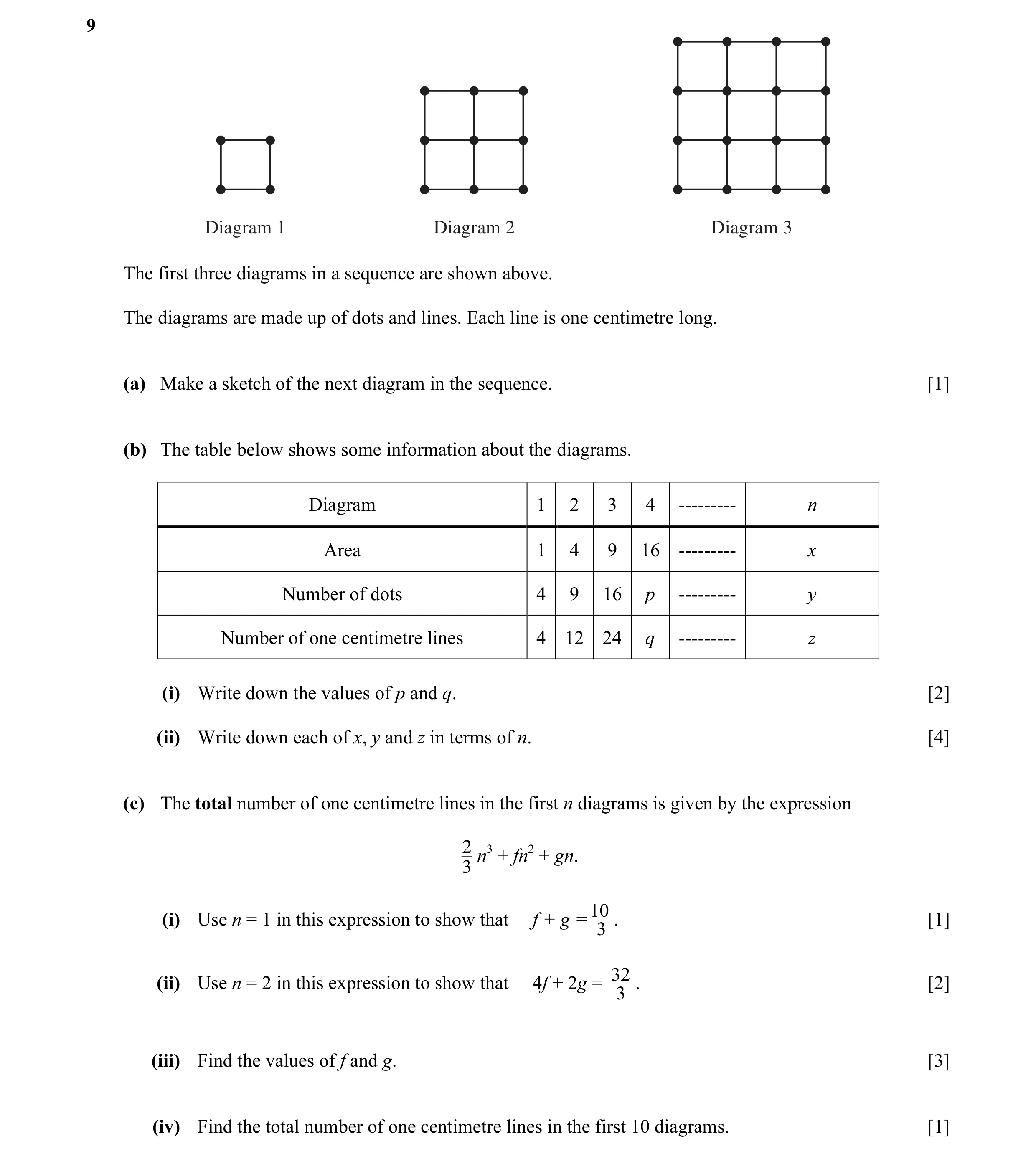
Q1 · Diagram 1 Diagram 2 Diagram 3 The first three diagrams in a sequence are shown above 0580/41 May/June 2007
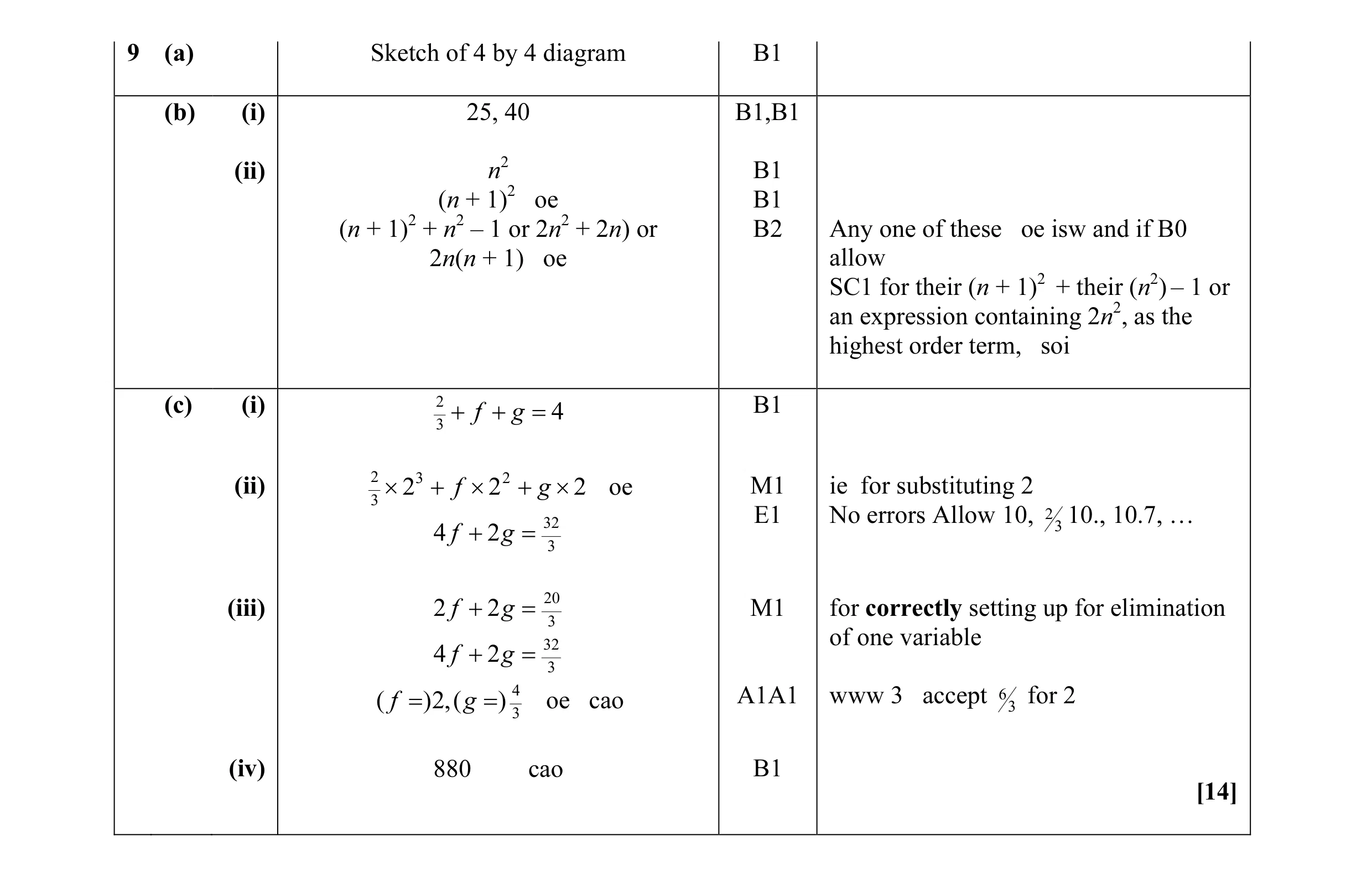
9 Diagram 1 Diagram 2 Diagram 3 The first three diagrams in a sequence are shown above. The diagrams are made up of dots and lines. Each line is one centimetre long. (a) Make a sketch of the next diagram in the sequence. [1] (b) The table below shows some information about the diagrams. Diagram 1 2 3 4 --------- n Area 1 4 9 16 --------- x Number of dots 4 9 16 p --------- y Number of one centimetre lines 4 12 24 q --------- z (i) Write down the values of p and q. [2] (ii) Write down each of x, y and z in terms of n. [4] (c) The total number of one centimetre lines in the first n diagrams is given by the expression 2 n3 + fn2 + gn. 3 (i) Use n = 1 in this expression to show that f + g =10 . [1] 3 32 (ii) Use n = 2 in this expression to show that 4f + 2g = . [2] 3 (iii) Find the values of f and g. [3] (iv) Find the total number of one centimetre lines in the first 10 diagrams. [1]
14 marks
Mark scheme: 9 (a) Sketch of 4 by 4 diagram B1 (b) (i) 25, 40 B1,B1 (ii) n2 B1 (n + 1)2 oe B1 (n + 1)2 + n2 – 1 or 2n2 + 2n) or B2 Any one of these oe isw and if B0 2n(n + 1) oe allow SC1 for their (n + 1)2 + their (n2) – 1 or an expression containing 2n2, as the highest order term, soi (c) (i) 2 + f + g = 4 B1 3 (ii) 2 × 2 3 + f × 2 2 + g × 2 oe M1 ie for substituting 2 3 32 E1 No errors Allow 10, 2 3 10., 10.7, … 4 f + 2 g = 3 (iii) 2 f + 2 g = 20 M1 for correctly setting up for elimination 3 32 of one variable 4 f + 2 g = 3 ( f = ) (,2 g = ) 4 oe cao A1A1 www 3 accept 6 3 for 2 3 (iv) 880 cao B1 [14]
This question in 0580/41 May/June 2007
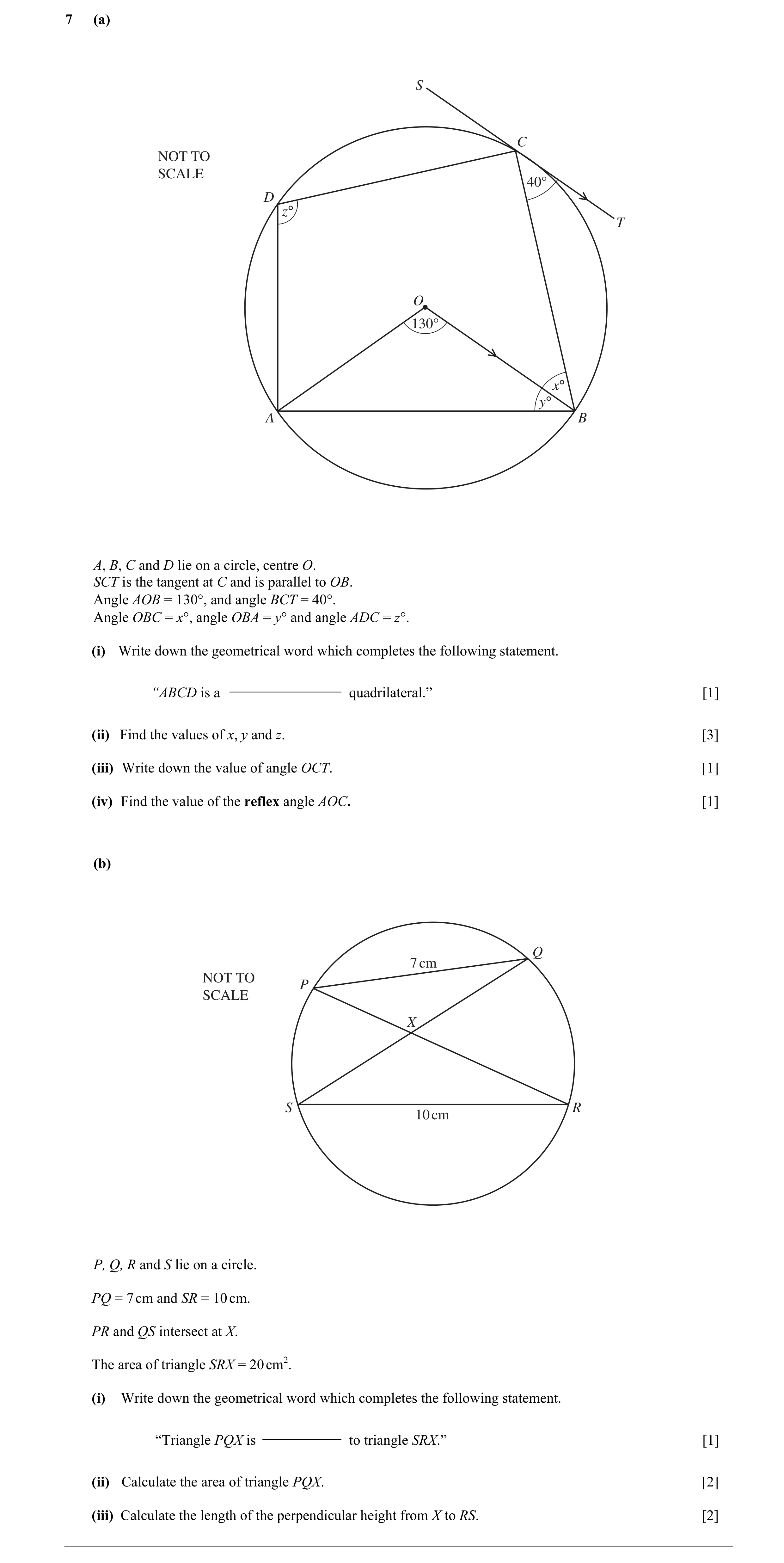
Q2 · S C NOT TO SCALE 40° D z° T O 130° x° y° A B A, B, C and D lie on a circle, centre O 0580/41 May/June 2008
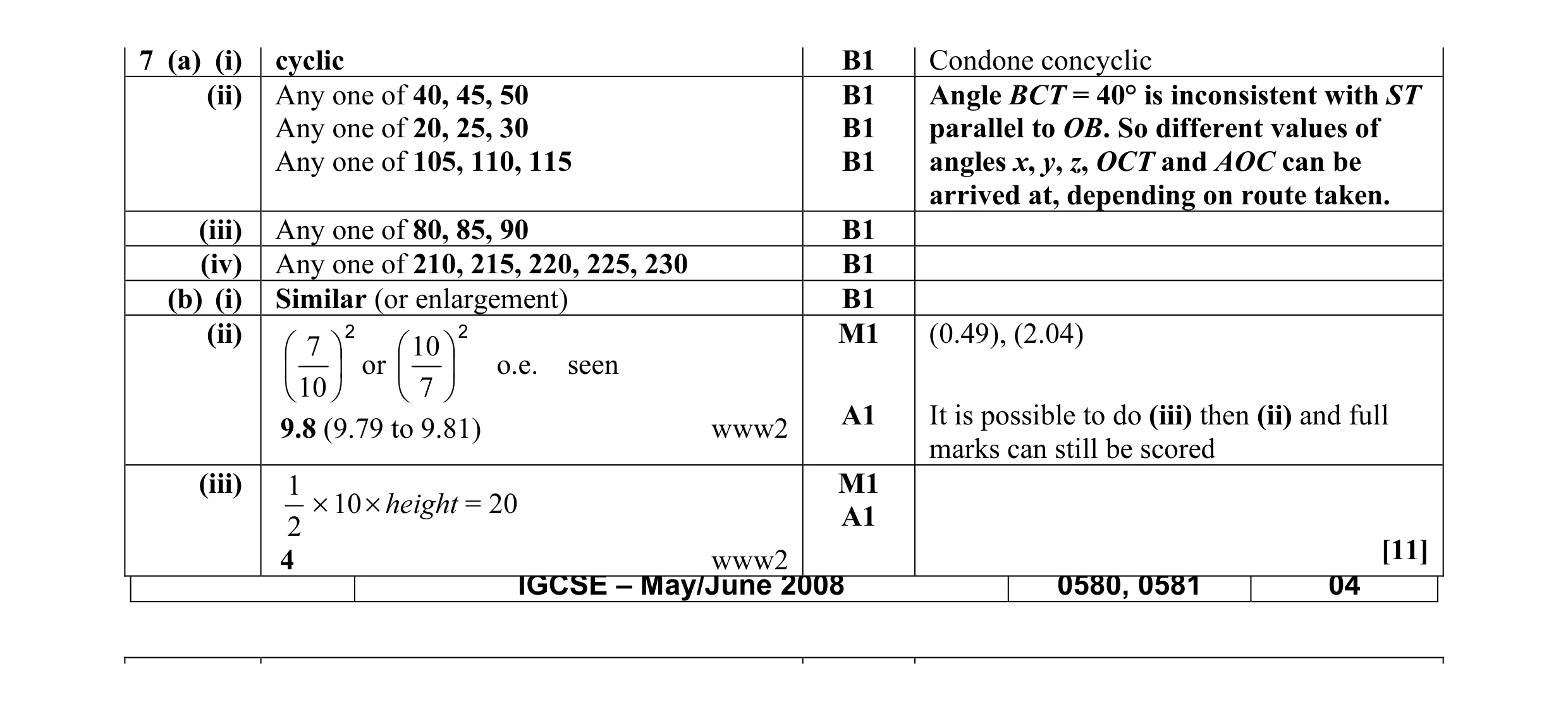
7 (a) S C NOT TO SCALE 40° D z° T O 130° x° y° A B A, B, C and D lie on a circle, centre O. SCT is the tangent at C and is parallel to OB. Angle AOB = 130°, and angle BCT = 40°. Angle OBC = x°, angle OBA = y° and angle ADC = z°. (i) Write down the geometrical word which completes the following statement. “ABCD is a quadrilateral.” [1] (ii) Find the values of x, y and z. [3] (iii) Write down the value of angle OCT. [1] (iv) Find the value of the reflex angle AOC. [1] (b) Q 7 cm NOT TO P SCALE X S R 10 cm P, Q, R and S lie on a circle. PQ = 7 cm and SR = 10 cm. PR and QS intersect at X. The area of triangle SRX = 20 cm2. (i) Write down the geometrical word which completes the following statement. “Triangle PQX is to triangle SRX.” [1] (ii) Calculate the area of triangle PQX. [2] (iii) Calculate the length of the perpendicular height from X to RS. [2]
11 marks
Mark scheme: 7 (a) (i) cyclic B1 Condone concyclic (ii) Any one of 40, 45, 50 B1 Angle BCT = 40° is inconsistent with ST Any one of 20, 25, 30 B1 parallel to OB. So different values of Any one of 105, 110, 115 B1 angles x, y, z, OCT and AOC can be arrived at, depending on route taken. (iii) Any one of 80, 85, 90 B1 (iv) Any one of 210, 215, 220, 225, 230 B1 (b) (i) Similar (or enlargement) B1 (ii) 2 2 M1 (0.49), (2.04) 7 10 or o.e. seen 10 7 A1 It is possible to do (iii) then (ii) and full 9.8 (9.79 to 9.81) www2 marks can still be scored (iii) 1 M1 ×10×height = 20 A1 2 [11] 4 www2 IGCSE – May/June 2008 0580, 0581 04
This question in 0580/41 May/June 2008
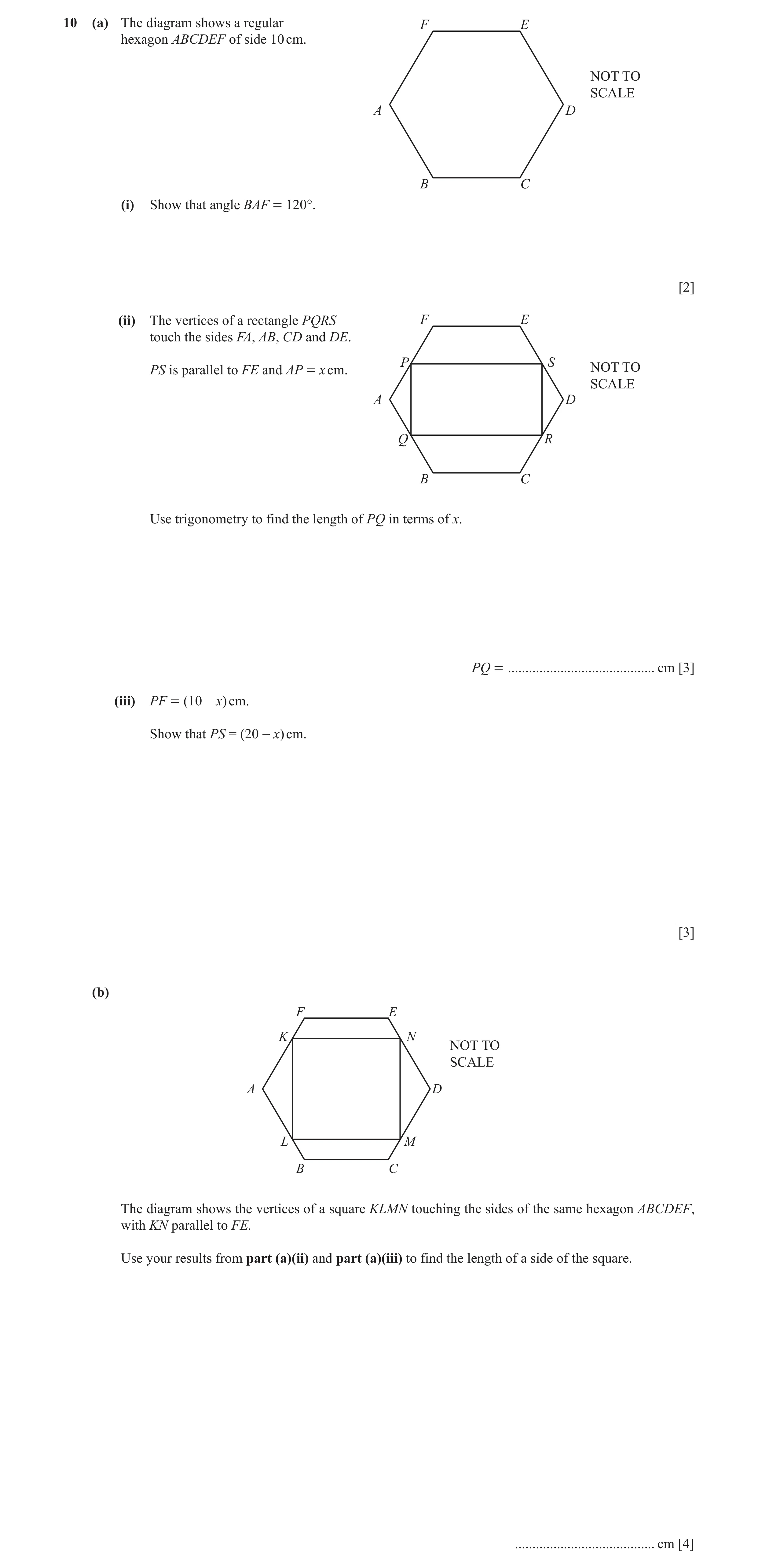
Q3 · The diagram shows a regular F E hexagon ABCDEF of side 10 cm 0580/42 Feb/March 2017
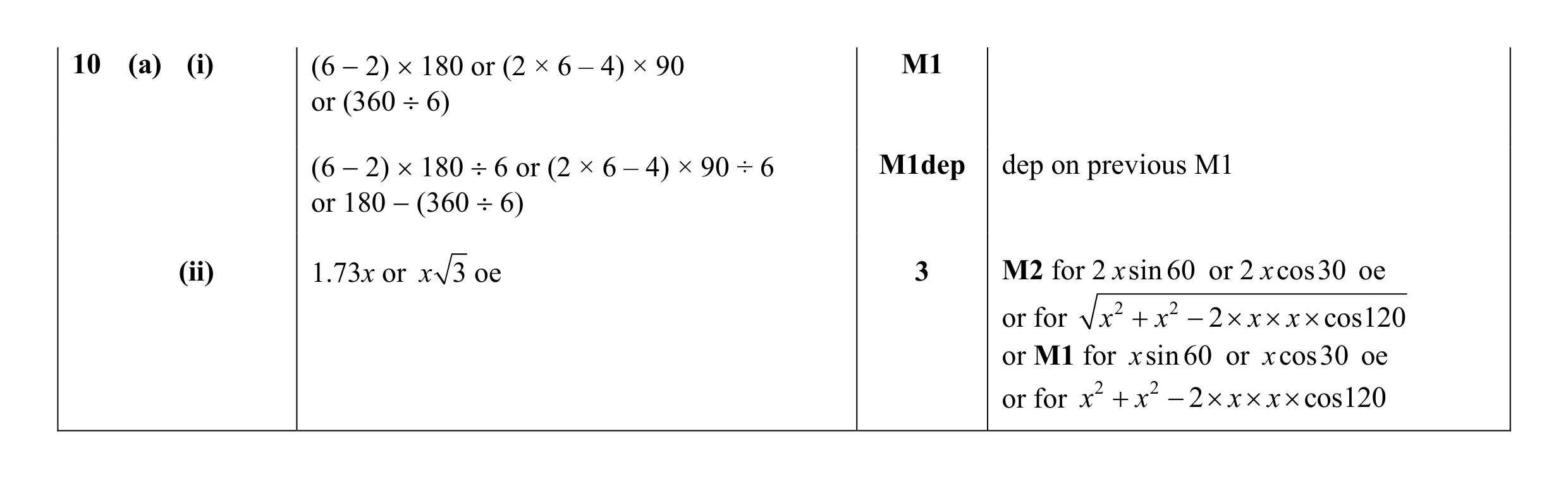
10 (a) The diagram shows a regular F E hexagon ABCDEF of side 10 cm. NOT TO SCALE A D B C (i) Show that angle BAF = 120°. [2] (ii) The vertices of a rectangle PQRS F E touch the sides FA, AB, CD and DE. P S PS is parallel to FE and AP = x cm. NOT TO SCALE A D Q R B C Use trigonometry to find the length of PQ in terms of x. PQ = … cm [3] (iii) PF = (10 – x) cm. Show that PS = (20 − x) cm. [3] (b) F E K N NOT TO SCALE A D L M B C The diagram shows the vertices of a square KLMN touching the sides of the same hexagon ABCDEF, with KN parallel to FE. Use your results from part (a)(ii) and part (a)(iii) to find the length of a side of the square. … cm [4]
12 marks
Mark scheme: 10 (a) (i) (6 − 2) × 180 or (2 × 6 – 4) × 90 M1 or (360 ÷ 6) (6 − 2) × 180 ÷ 6 or (2 × 6 – 4) × 90 ÷ 6 M1dep dep on previous M1 or 180 − (360 ÷ 6) (ii) 1.73x or x 3 oe 3 M2 for 2 x sin60 or 2 x cos30 oe or for x 2 + x 2 − 2 × x × x × cos120 or M1 for x sin60 or x cos30 oe or for x 2 + x 2 −×2 x × x × cos120
This question in 0580/42 Feb/March 2017
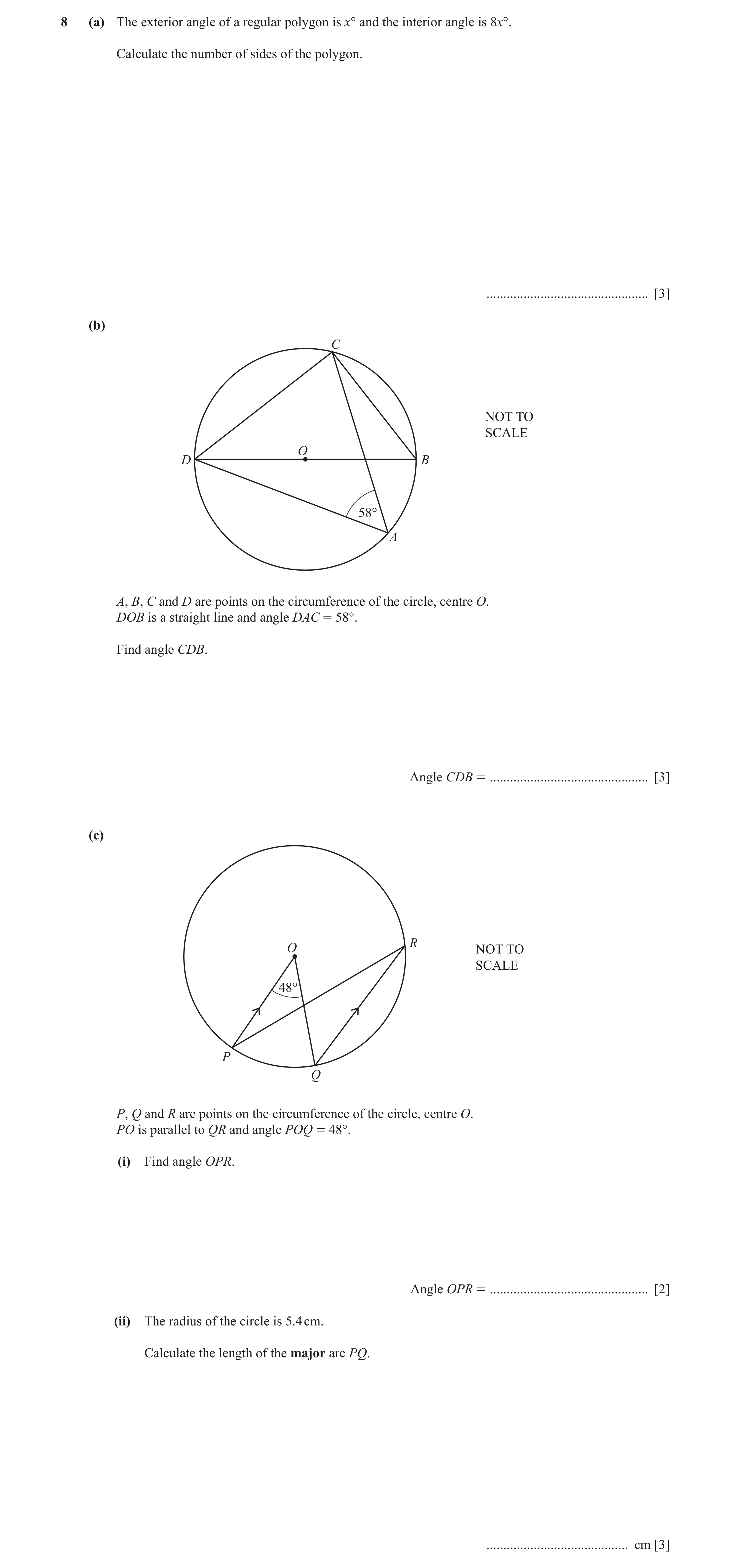
Q4 · The exterior angle of a regular polygon is x° and the interior angle is 8x° 0580/41 May/June 2018
8 (a) The exterior angle of a regular polygon is x° and the interior angle is 8x°. Calculate the number of sides of the polygon. … [3] (b) C NOT TO SCALE O D B 58° A A, B, C and D are points on the circumference of the circle, centre O. DOB is a straight line and angle DAC = 58°. Find angle CDB. Angle CDB = … [3] (c) R O NOT TO SCALE 48° P Q P, Q and R are points on the circumference of the circle, centre O. PO is parallel to QR and angle POQ = 48°. (i) Find angle OPR. Angle OPR = … [2] (ii) The radius of the circle is 5.4 cm. Calculate the length of the major arc PQ. … cm [3]
11 marks
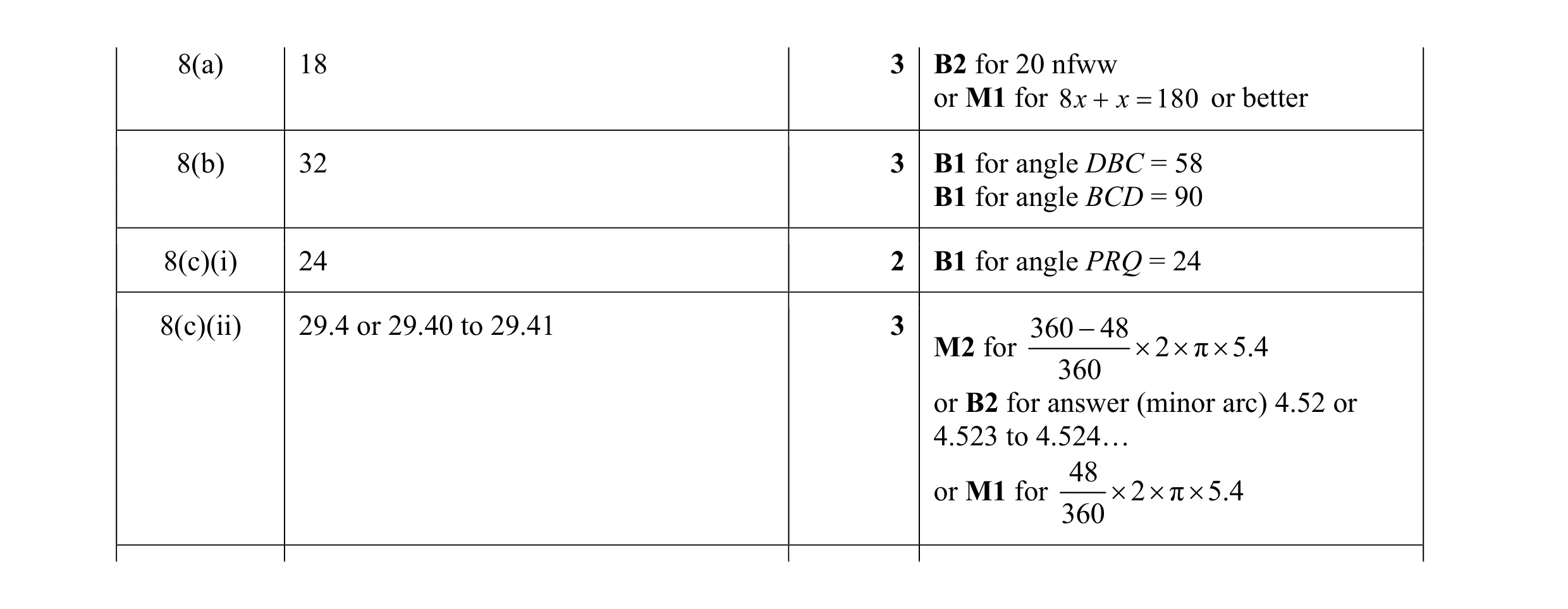
Mark scheme: 8(a) 18 3 B2 for 20 nfww or M1 for 8 x + x = 180 or better 8(b) 32 3 B1 for angle DBC = 58 B1 for angle BCD = 90 8(c)(i) 24 2 B1 for angle PRQ = 24 8(c)(ii) 29.4 or 29.40 to 29.41 3 360 − 48 M2 for × 2 × π × 5.4 360 or B2 for answer (minor arc) 4.52 or 4.523 to 4.524… 48 or M1 for × 2 × π × 5.4 360
This question in 0580/41 May/June 2018
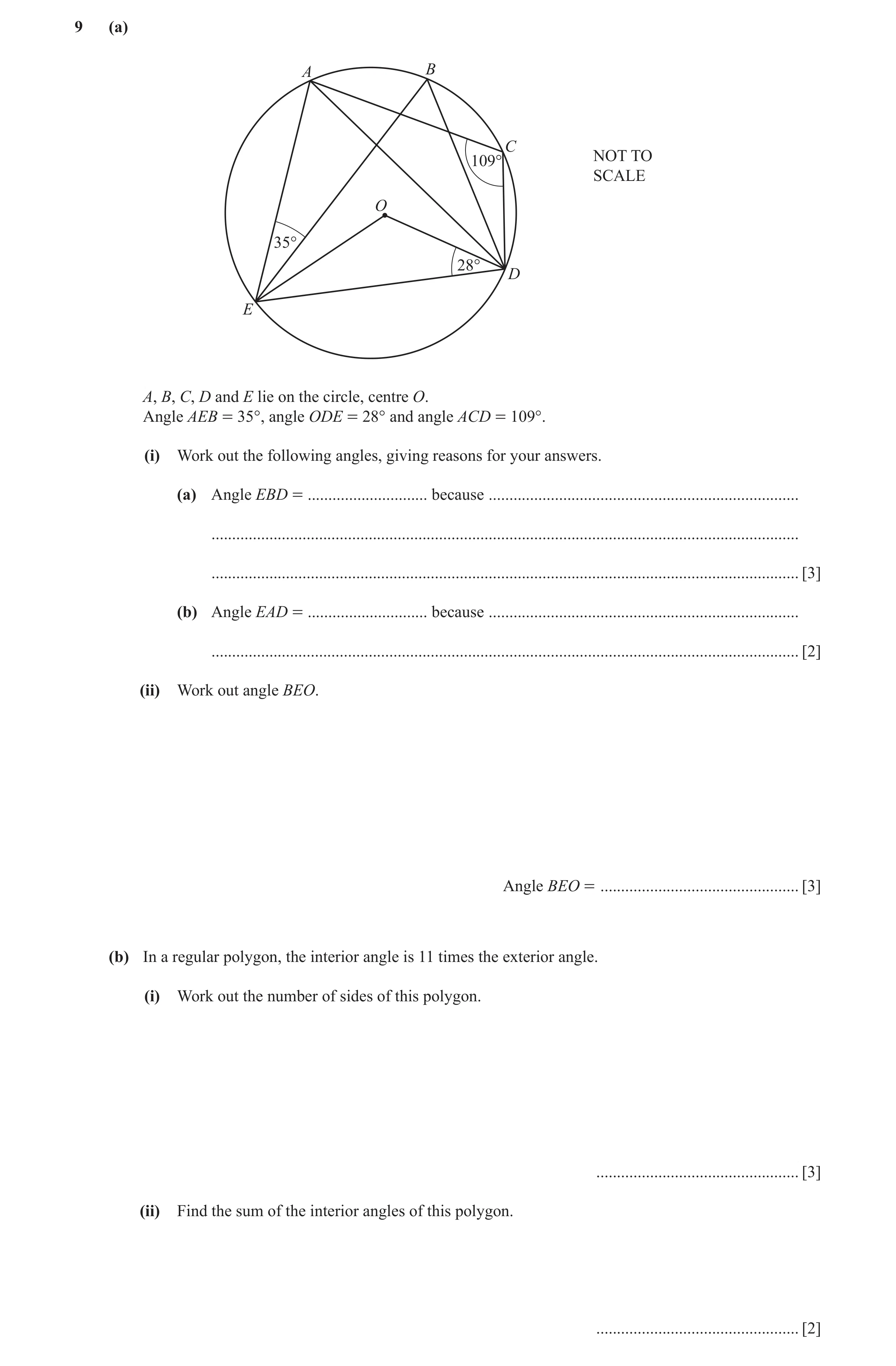
Q5 · A B C NOT TO 109° SCALE O 35° 28° D E A, B, C, D and E lie on the circle, centre O 0580/42 May/June 2018
9 (a) A B C NOT TO 109° SCALE O 35° 28° D E A, B, C, D and E lie on the circle, centre O. Angle AEB = 35°, angle ODE = 28° and angle ACD = 109°. (i) Work out the following angles, giving reasons for your answers. (a) Angle EBD = … because … … … [3] (b) Angle EAD = … because … … [2] (ii) Work out angle BEO. Angle BEO = … [3] (b) In a regular polygon, the interior angle is 11 times the exterior angle. (i) Work out the number of sides of this polygon. … [3] (ii) Find the sum of the interior angles of this polygon. … [2]
13 marks
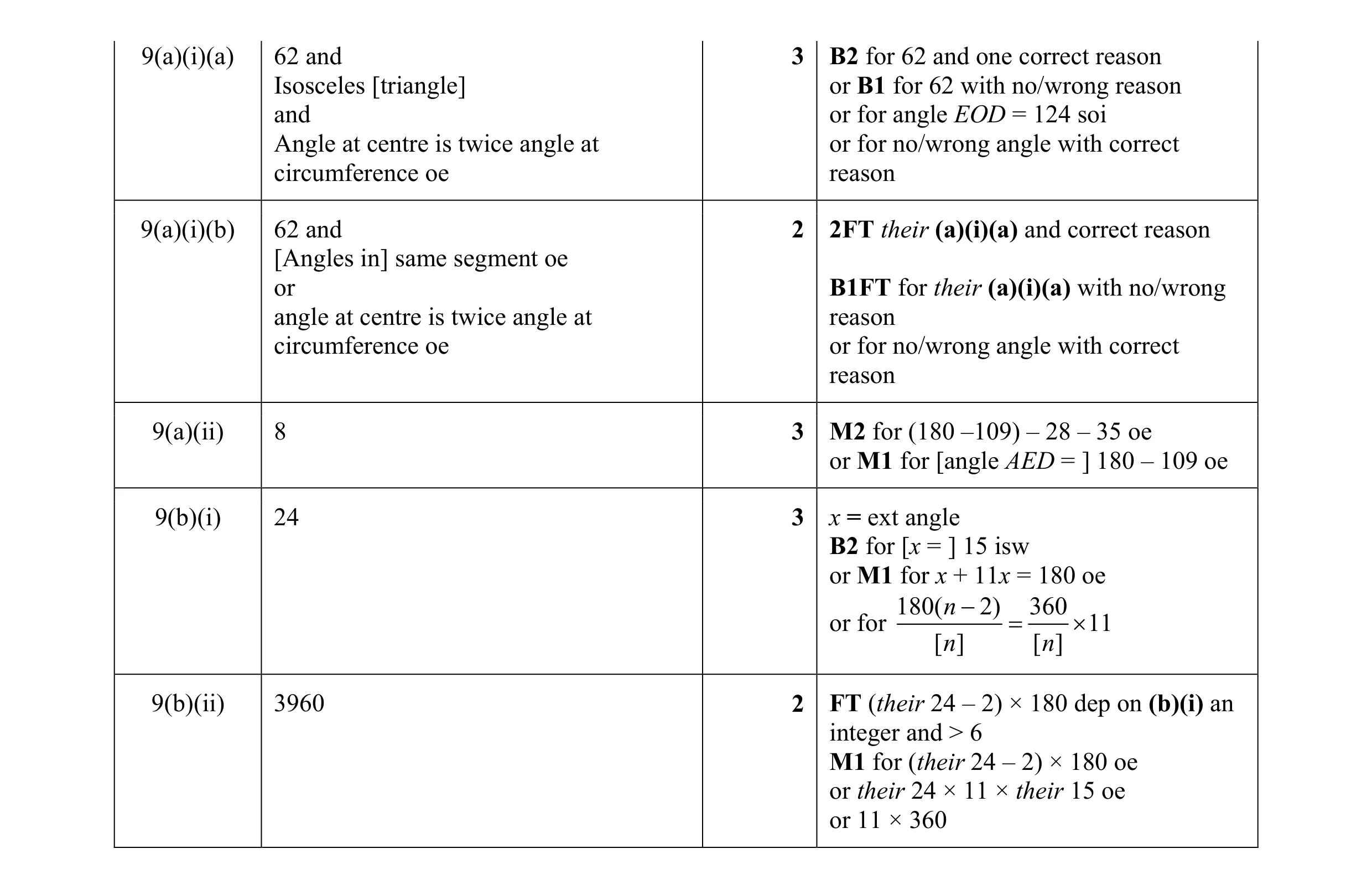
Mark scheme: 9(a)(i)(a) 62 and 3 B2 for 62 and one correct reason Isosceles [triangle] or B1 for 62 with no/wrong reason and or for angle EOD = 124 soi Angle at centre is twice angle at or for no/wrong angle with correct circumference oe reason 9(a)(i)(b) 62 and 2 2FT their (a)(i)(a) and correct reason [Angles in] same segment oe or B1FT for their (a)(i)(a) with no/wrong angle at centre is twice angle at reason circumference oe or for no/wrong angle with correct reason 9(a)(ii) 8 3 M2 for (180 –109) – 28 – 35 oe or M1 for [angle AED = ] 180 – 109 oe 9(b)(i) 24 3 x = ext angle B2 for [x = ] 15 isw or M1 for x + 11x = 180 oe 180( n − 2) 360 or for = × 11 [ n ] [ n ] 9(b)(ii) 3960 2 FT (their 24 – 2) × 180 dep on (b)(i) an integer and > 6 M1 for (their 24 – 2) × 180 oe or their 24 × 11 × their 15 oe or 11 × 360
This question in 0580/42 May/June 2018
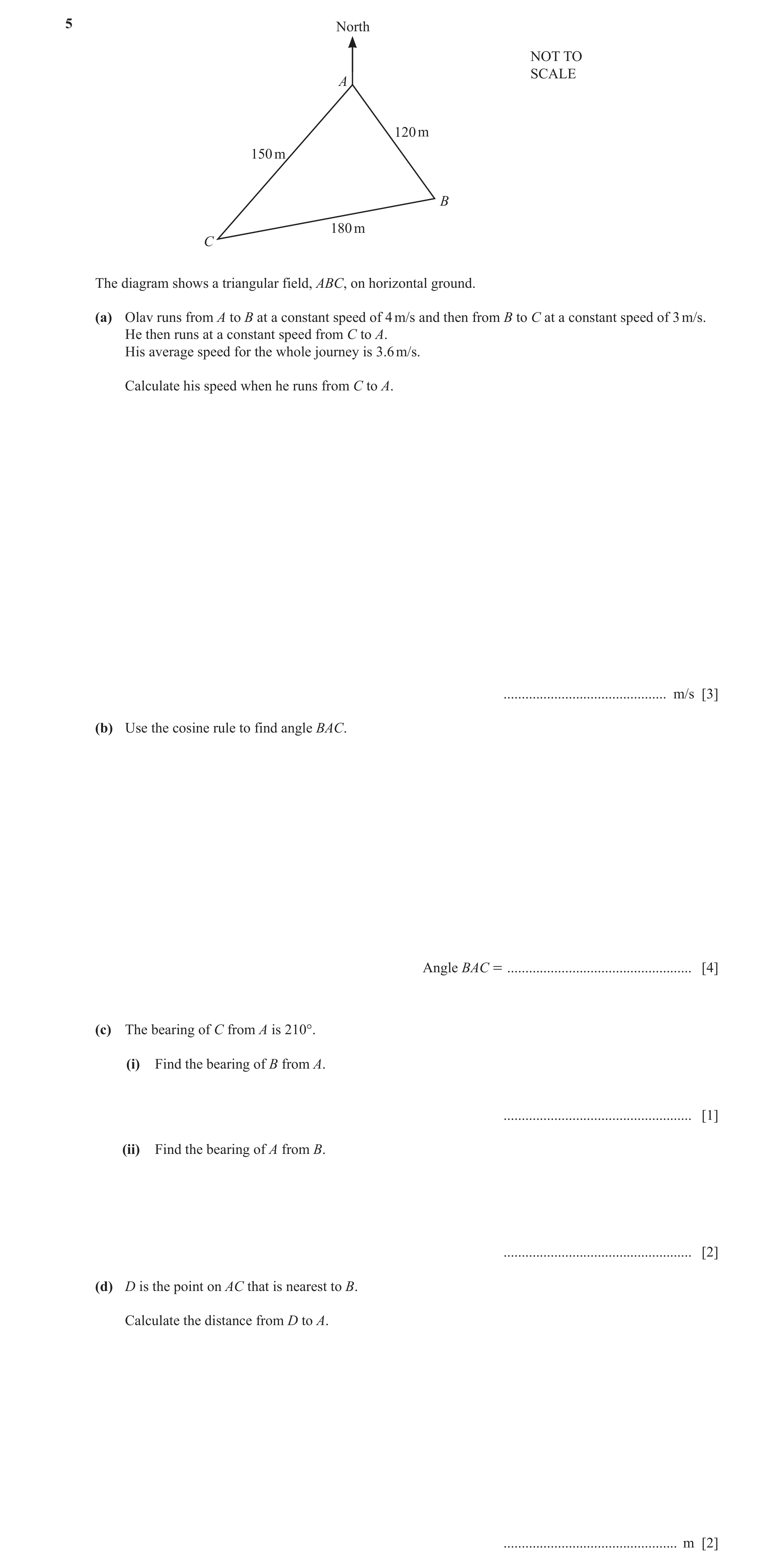
Q6 · North NOT TO SCALE A 120 m 150 m B 180 m C The diagram shows a triangular field, ABC, on… 0580/41 Oct/Nov 2019
5 North NOT TO SCALE A 120 m 150 m B 180 m C The diagram shows a triangular field, ABC, on horizontal ground. (a) Olav runs from A to B at a constant speed of 4 m/s and then from B to C at a constant speed of 3 m/s. He then runs at a constant speed from C to A. His average speed for the whole journey is 3.6 m/s. Calculate his speed when he runs from C to A. … m/s [3] (b) Use the cosine rule to find angle BAC. Angle BAC = … [4] (c) The bearing of C from A is 210°. (i) Find the bearing of B from A. … [1] (ii) Find the bearing of A from B. … [2] (d) D is the point on AC that is nearest to B. Calculate the distance from D to A. … m [2]
12 marks
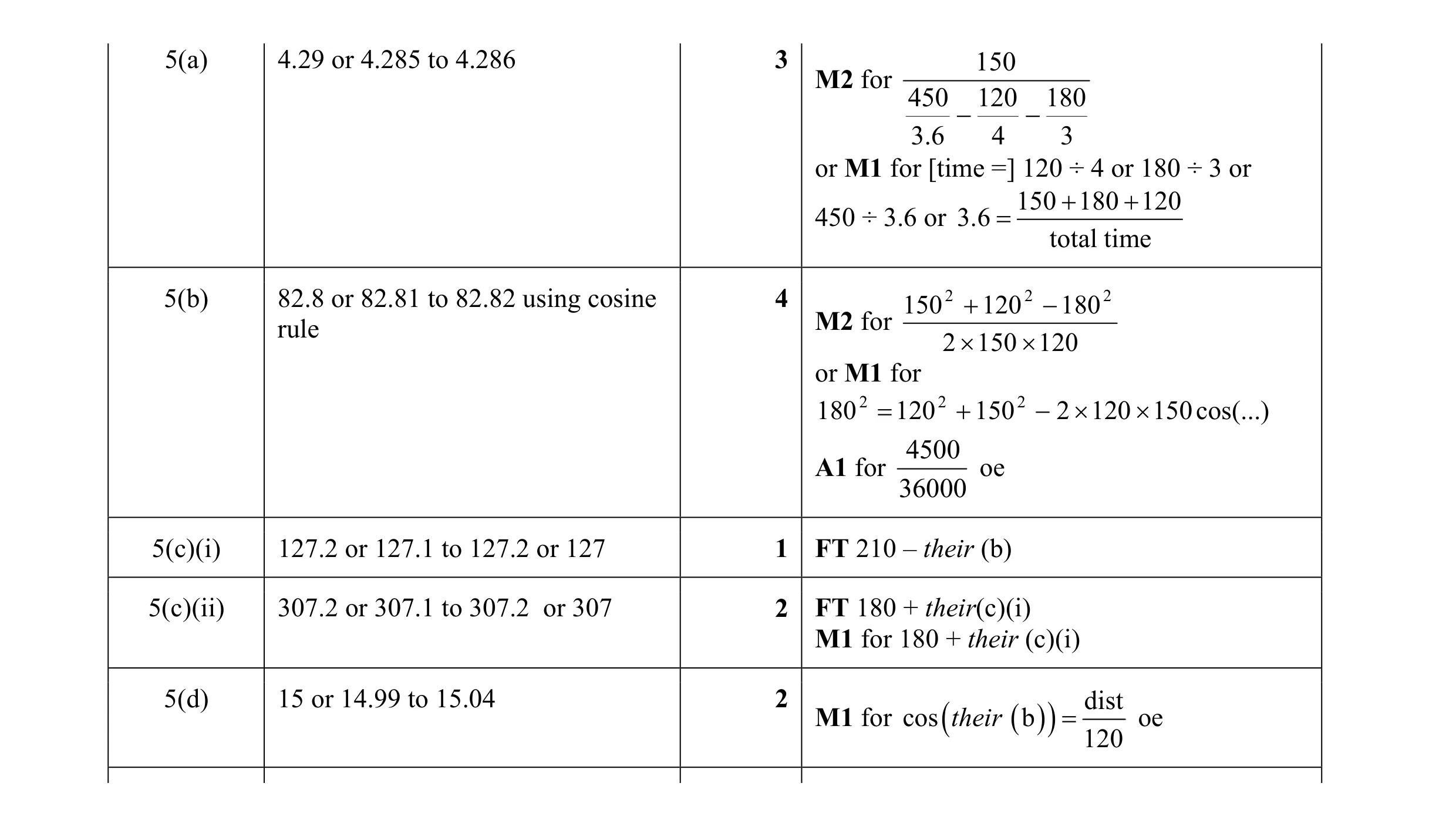
Mark scheme: 5(a) 4.29 or 4.285 to 4.286 3 150 M2 for 450 120 180 − − 6.3 4 3 or M1 for [time =] 120 ÷ 4 or 180 ÷ 3 or 150 + 180 + 120 450 ÷ 3.6 or 3.6 = total time 5(b) 82.8 or 82.81 to 82.82 using cosine 4 150 2 + 120 2 − 180 2 M2 for rule 2 × 150 × 120 or M1 for 180 2 = 120 2 + 150 2 − 2 × 120 × 150 cos(...) 4500 A1 for oe 36000 5(c)(i) 127.2 or 127.1 to 127.2 or 127 1 FT 210 – their (b) 5(c)(ii) 307.2 or 307.1 to 307.2 or 307 2 FT 180 + their(c)(i) M1 for 180 + their (c)(i) 5(d) 15 or 14.99 to 15.04 2 dist M1 for cos ( their ( b ) ) = oe 120
This question in 0580/41 Oct/Nov 2019
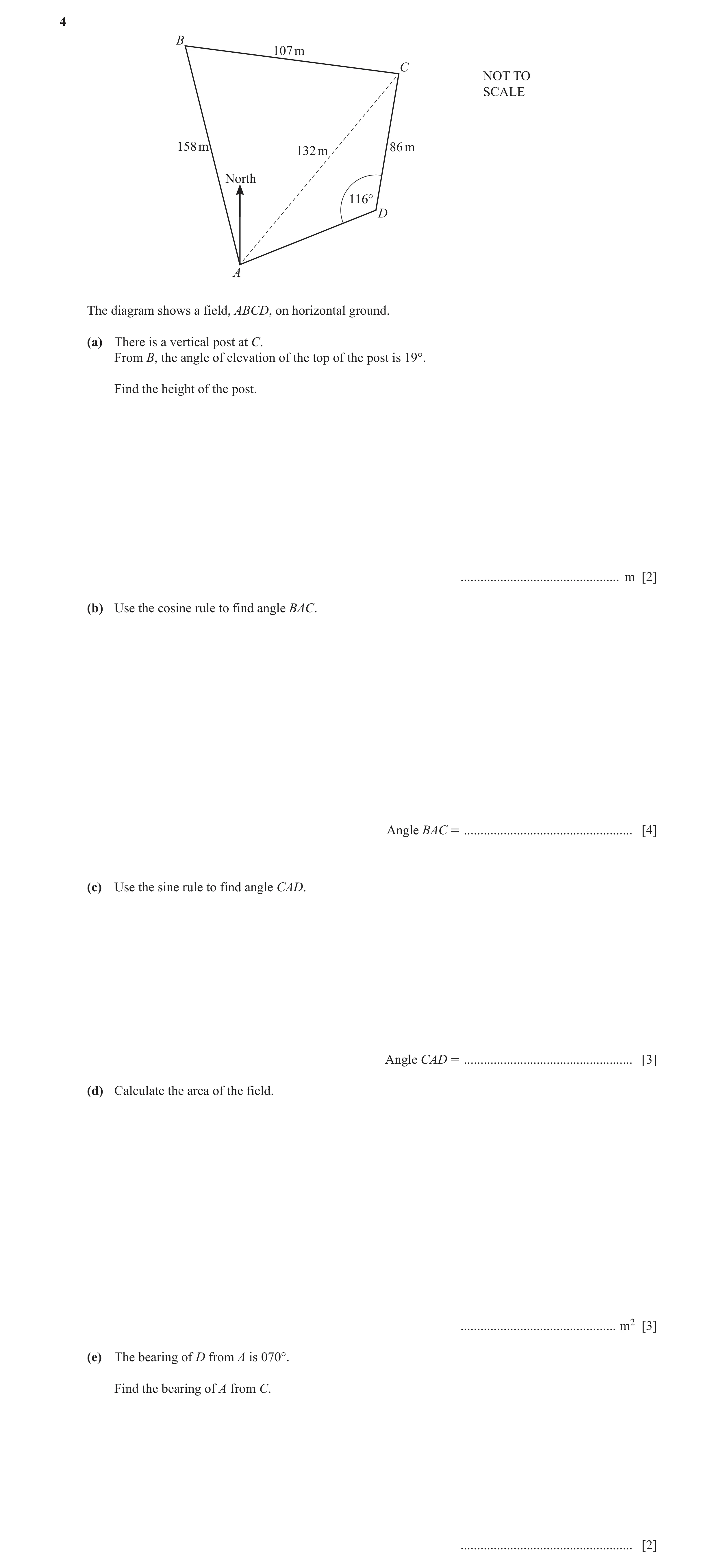
Q7 · B 107 m C NOT TO SCALE 158 m 132 m 86 m North 116° D A The diagram shows a field, ABCD… 0580/43 Oct/Nov 2019
4 B 107 m C NOT TO SCALE 158 m 132 m 86 m North 116° D A The diagram shows a field, ABCD, on horizontal ground. (a) There is a vertical post at C. From B, the angle of elevation of the top of the post is 19°. Find the height of the post. … m [2] (b) Use the cosine rule to find angle BAC. Angle BAC = … [4] (c) Use the sine rule to find angle CAD. Angle CAD = … [3] (d) Calculate the area of the field. … m2 [3] (e) The bearing of D from A is 070°. Find the bearing of A from C. … [2]
14 marks
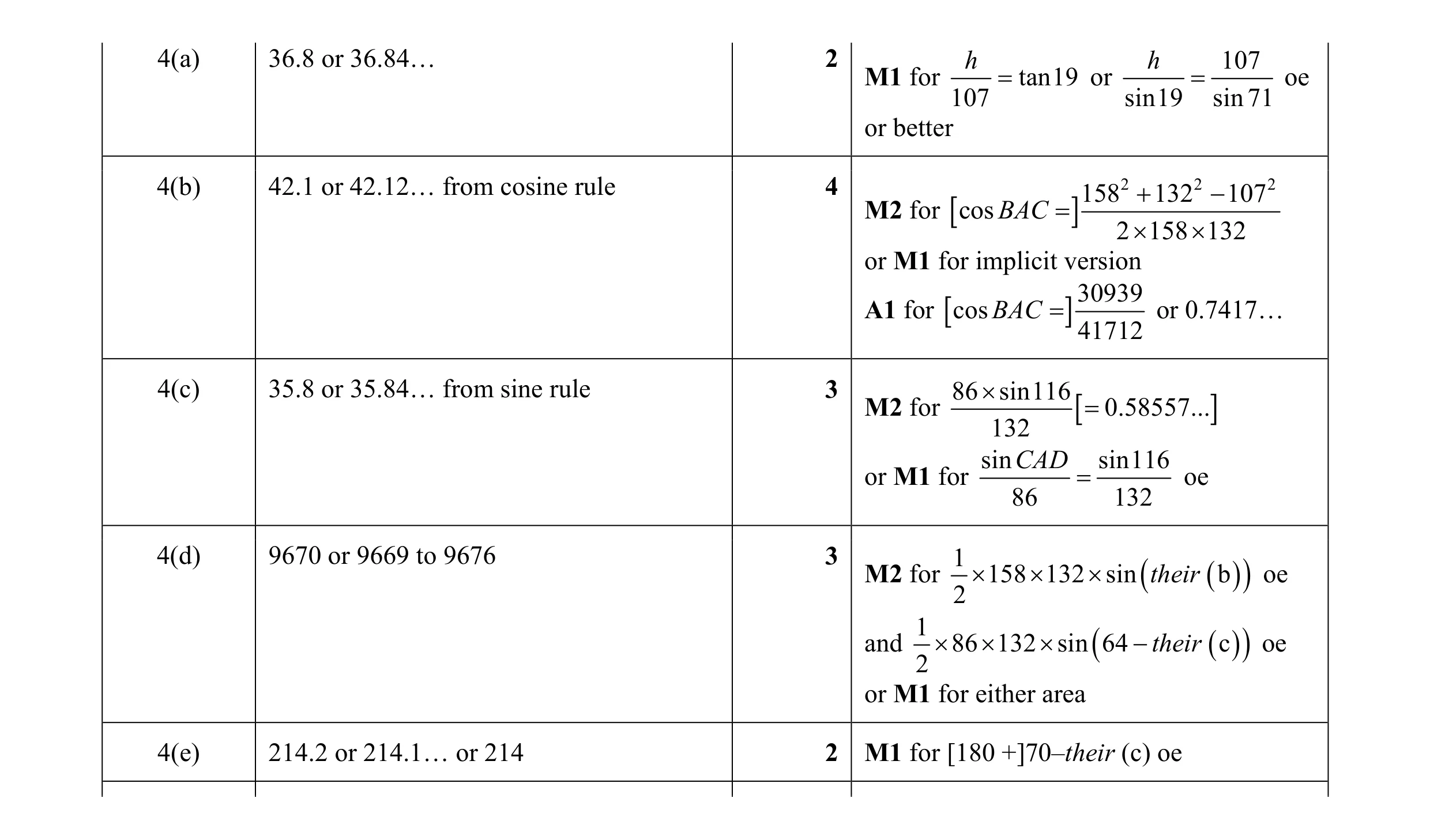
Mark scheme: 4(a) 36.8 or 36.84… 2 h h 107 M1 for = tan19 or = oe 107 sin19 sin71 or better 4(b) 42.1 or 42.12… from cosine rule 4 158 2 + 132 2 − 107 2 M2 for [ cos BAC = ] 2 × 158 × 132 or M1 for implicit version A1 for [ cos BAC = ]30939 or 0.7417… 41712 4(c) 35.8 or 35.84… from sine rule 3 86 × sin116 M2 for [ = 0.58557...] 132 sin CAD sin116 or M1 for = oe 86 132 4(d) 9670 or 9669 to 9676 3 1 M2 for × 158 × 132 × sin ( their ( b ) ) oe 2 1 and × 86 × 132 × sin ( 64 − their ( c ) ) oe 2 or M1 for either area 4(e) 214.2 or 214.1… or 214 2 M1 for [180 +]70–their (c) oe
This question in 0580/43 Oct/Nov 2019
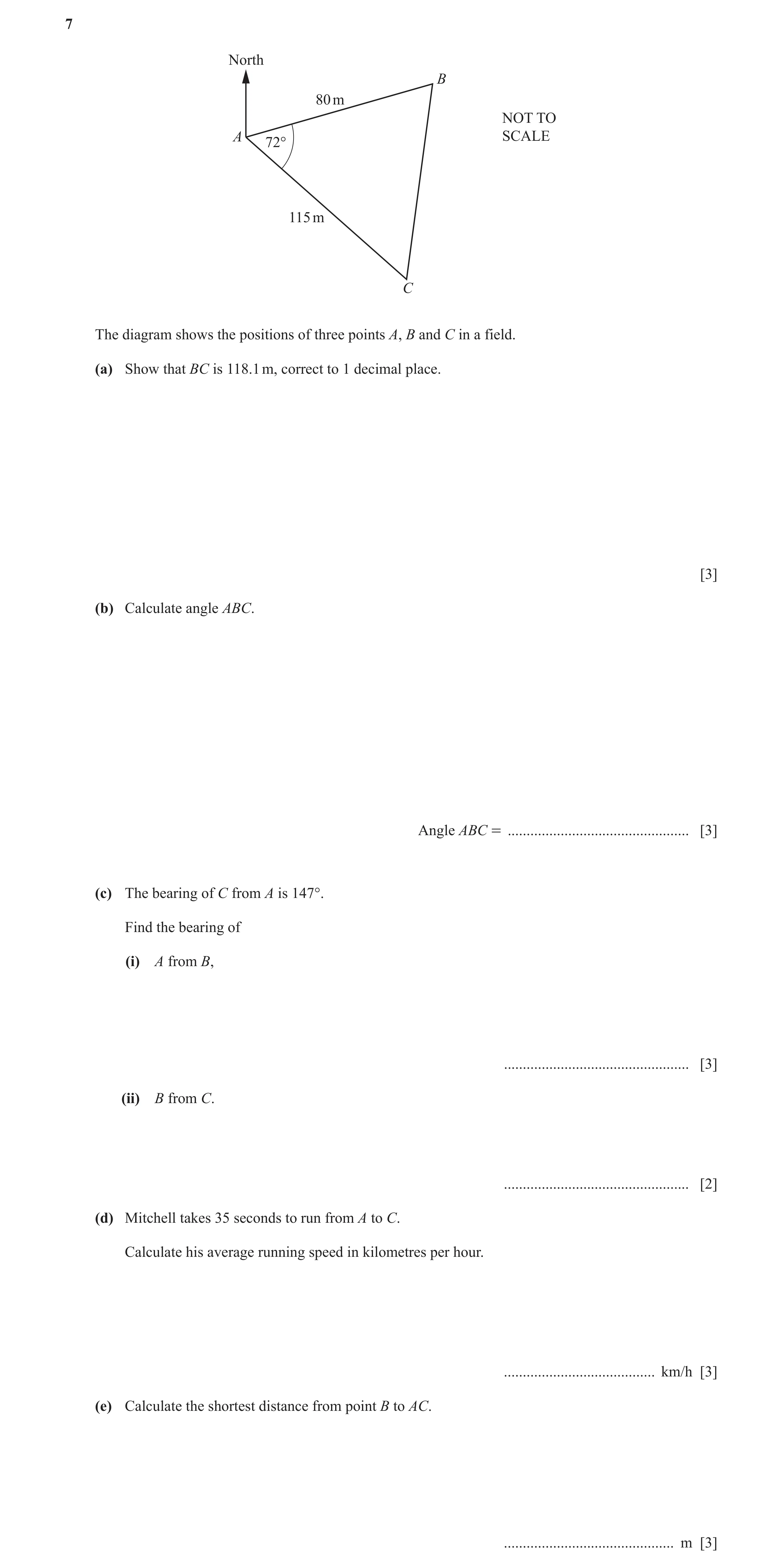
Q8 · North B 80 m NOT TO A SCALE 72° 115 m C The diagram shows the positions of three points… 0580/41 May/June 2020
7 North B 80 m NOT TO A SCALE 72° 115 m C The diagram shows the positions of three points A, B and C in a field. (a) Show that BC is 118.1 m, correct to 1 decimal place. [3] (b) Calculate angle ABC. Angle ABC = … [3] (c) The bearing of C from A is 147°. Find the bearing of (i) A from B, … [3] (ii) B from C. … [2] (d) Mitchell takes 35 seconds to run from A to C. Calculate his average running speed in kilometres per hour. … km/h [3] (e) Calculate the shortest distance from point B to AC. … m [3]
17 marks
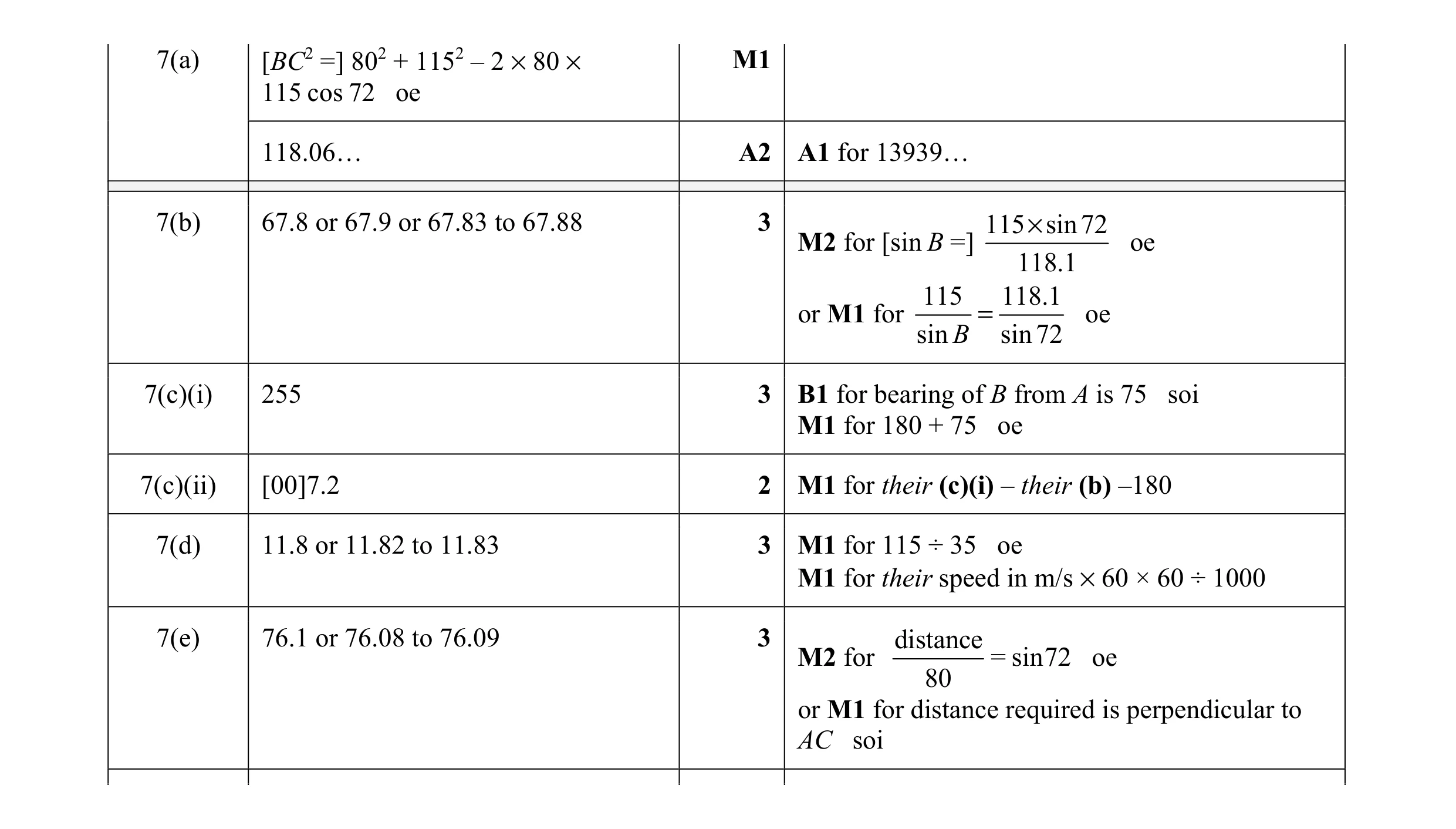
Mark scheme: 7(a) [BC2 =] 802 + 1152 – 2 × 80 × M1 115 cos 72 oe 118.06… A2 A1 for 13939… 7(b) 67.8 or 67.9 or 67.83 to 67.88 3 115 × sin72 M2 for [sin B =] oe 118.1 115 118.1 or M1 for = oe sin B sin72 7(c)(i) 255 3 B1 for bearing of B from A is 75 soi M1 for 180 + 75 oe 7(c)(ii) [00]7.2 2 M1 for their (c)(i) – their (b) –180 7(d) 11.8 or 11.82 to 11.83 3 M1 for 115 ÷ 35 oe M1 for their speed in m/s × 60 × 60 ÷ 1000 7(e) 76.1 or 76.08 to 76.09 3 distance M2 for = sin72 oe 80 or M1 for distance required is perpendicular to AC soi
This question in 0580/41 May/June 2020
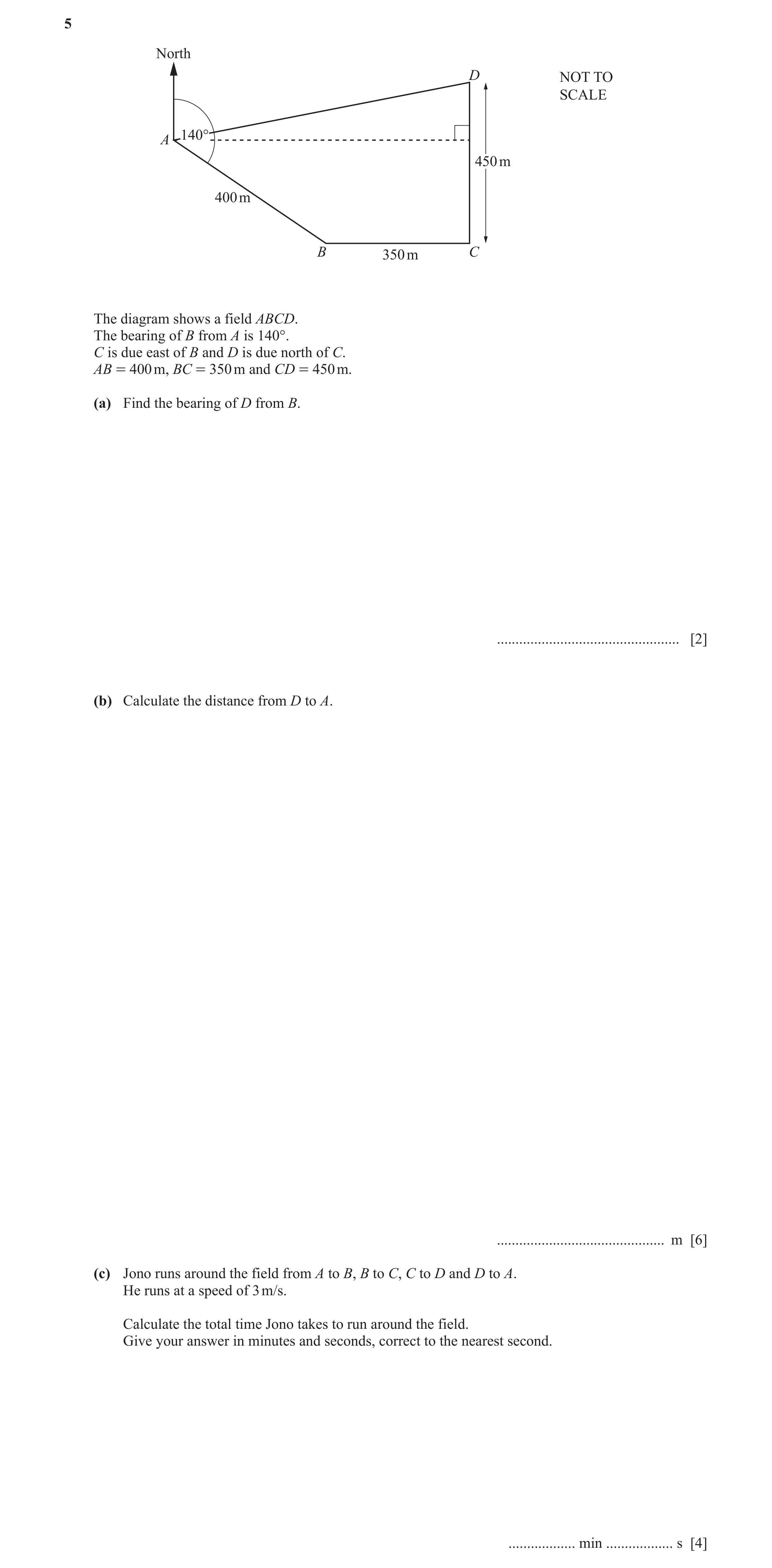
Q9 · North D NOT TO SCALE 140° A 450 m 400 m B 350 m C The diagram shows a field ABCD 0580/42 May/June 2020
5 North D NOT TO SCALE 140° A 450 m 400 m B 350 m C The diagram shows a field ABCD. The bearing of B from A is 140°. C is due east of B and D is due north of C. AB = 400 m, BC = 350 m and CD = 450 m. (a) Find the bearing of D from B. … [2] (b) Calculate the distance from D to A. … m [6] (c) Jono runs around the field from A to B, B to C, C to D and D to A. He runs at a speed of 3 m/s. Calculate the total time Jono takes to run around the field. Give your answer in minutes and seconds, correct to the nearest second. … min … s [4]
12 marks
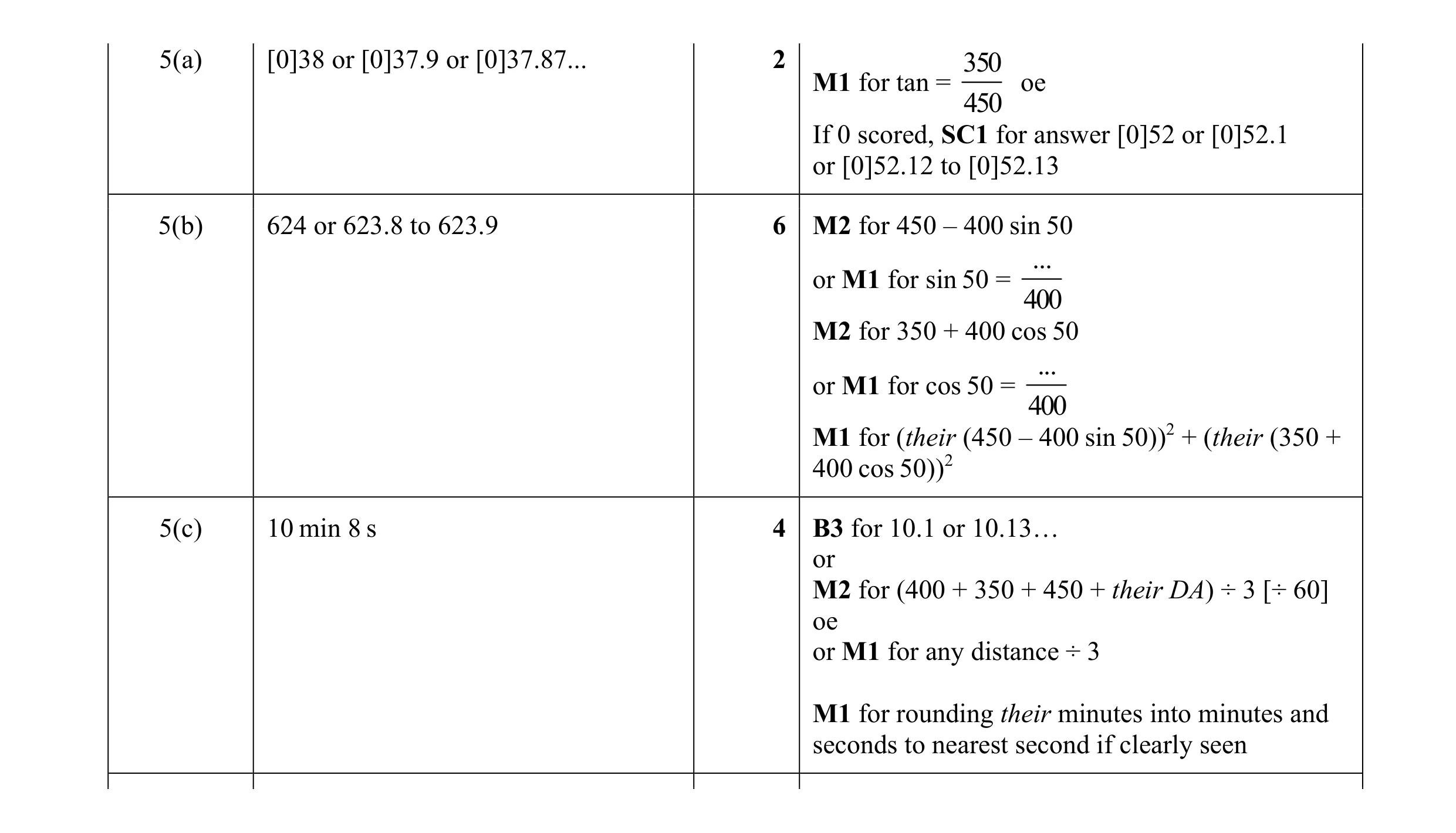
Mark scheme: 5(a) [0]38 or [0]37.9 or [0]37.87... 2 350 M1 for tan = oe 450 If 0 scored, SC1 for answer [0]52 or [0]52.1 or [0]52.12 to [0]52.13 5(b) 624 or 623.8 to 623.9 6 M2 for 450 – 400 sin 50 ... or M1 for sin 50 = 400 M2 for 350 + 400 cos 50 ... or M1 for cos 50 = 400 M1 for (their (450 – 400 sin 50))2 + (their (350 + 400 cos 50))2 5(c) 10 min 8 s 4 B3 for 10.1 or 10.13… or M2 for (400 + 350 + 450 + their DA) ÷ 3 [÷ 60] oe or M1 for any distance ÷ 3 M1 for rounding their minutes into minutes and seconds to nearest second if clearly seen
This question in 0580/42 May/June 2020
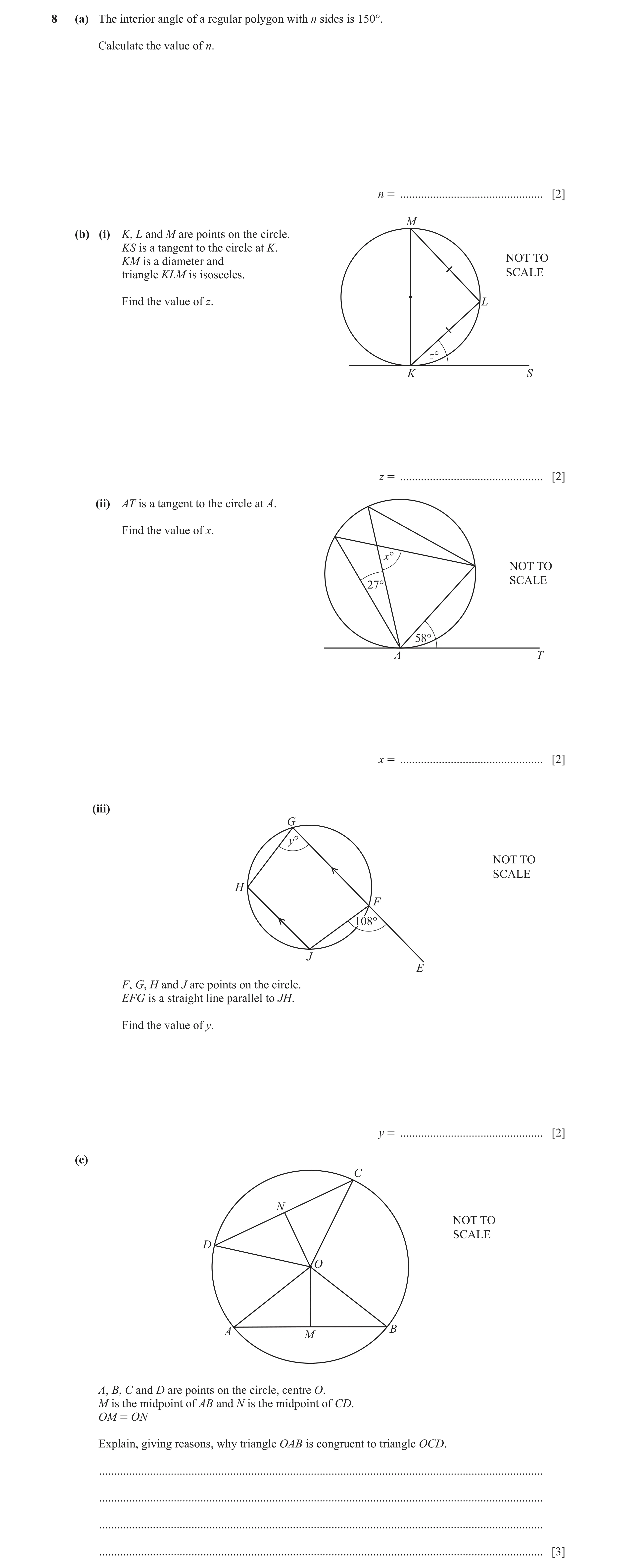
Q10 · The interior angle of a regular polygon with n sides is 150° 0580/43 May/June 2020
8 (a) The interior angle of a regular polygon with n sides is 150°. Calculate the value of n. n = … [2] M (b) (i) K, L and M are points on the circle. KS is a tangent to the circle at K. KM is a diameter and NOT TO triangle KLM is isosceles. SCALE Find the value of z. L z° K S z = … [2] (ii) AT is a tangent to the circle at A. Find the value of x. x° NOT TO SCALE 27° 58° A T x = … [2] (iii) G y° NOT TO SCALE H F 108° J E F, G, H and J are points on the circle. EFG is a straight line parallel to JH. Find the value of y. y = … [2] (c) C N NOT TO SCALE D O A B M A, B, C and D are points on the circle, centre O. M is the midpoint of AB and N is the midpoint of CD. OM = ON Explain, giving reasons, why triangle OAB is congruent to triangle OCD. … … … … [3]
11 marks
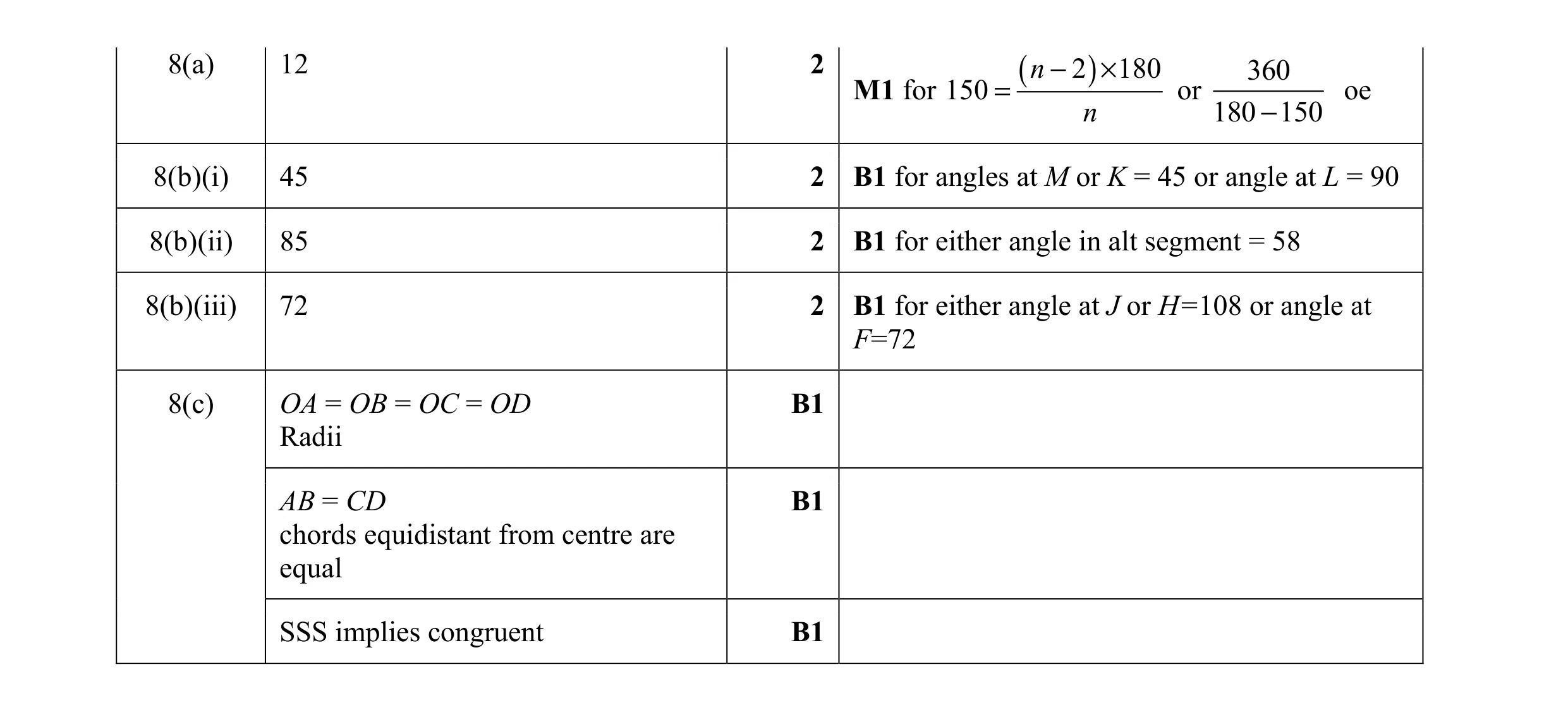
Mark scheme: 8(a) 12 2 ( n − 2 ) × 180 360 M1 for 150 = or oe n 180 − 150 8(b)(i) 45 2 B1 for angles at M or K = 45 or angle at L = 90 8(b)(ii) 85 2 B1 for either angle in alt segment = 58 8(b)(iii) 72 2 B1 for either angle at J or H=108 or angle at F=72 8(c) OA = OB = OC = OD B1 Radii AB = CD B1 chords equidistant from centre are equal SSS implies congruent B1
This question in 0580/43 May/June 2020
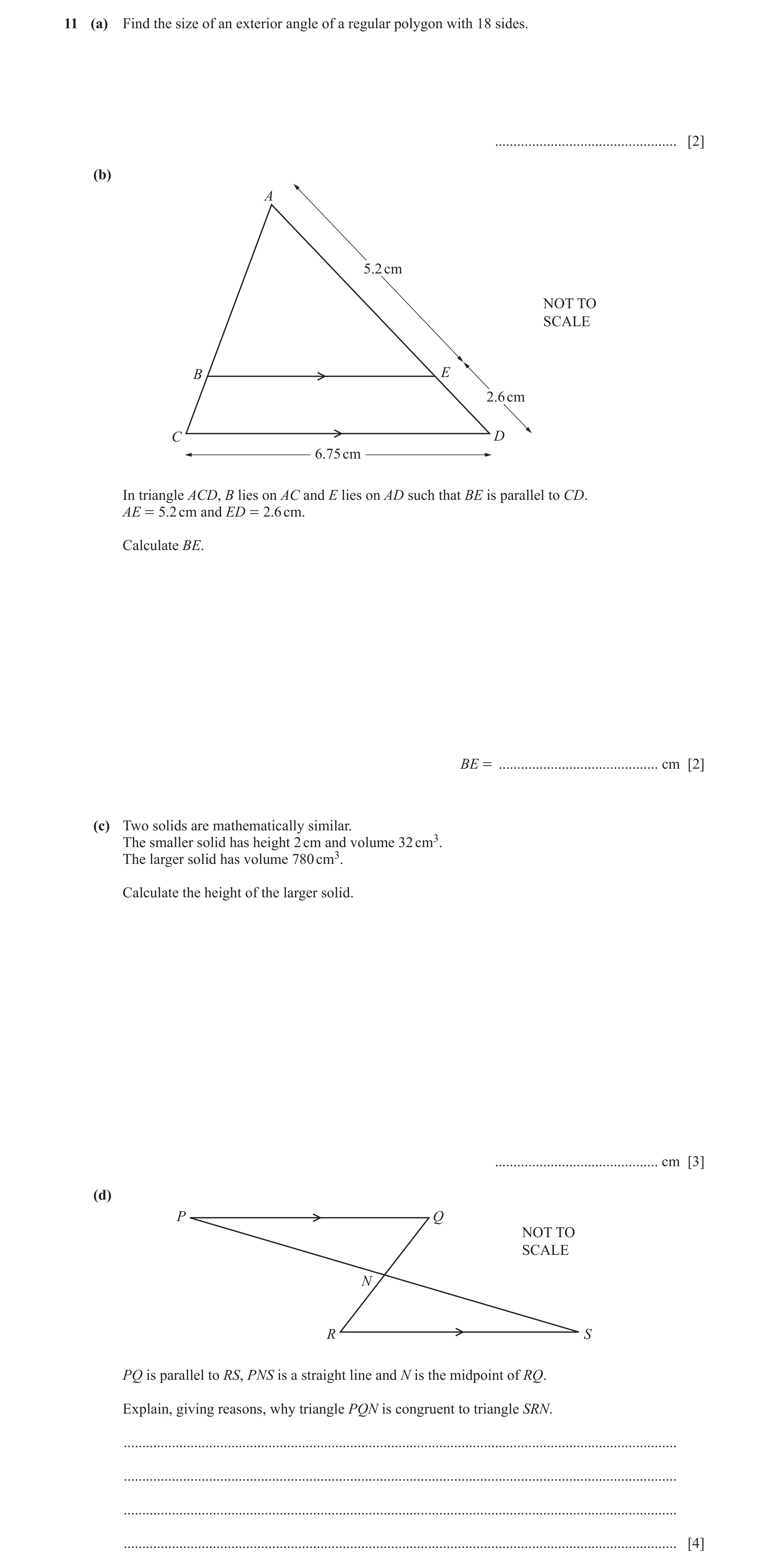
Q11 · Find the size of an exterior angle of a regular polygon with 18 sides 0580/41 May/June 2021
11 (a) Find the size of an exterior angle of a regular polygon with 18 sides. … [2] (b) A 5.2 cm NOT TO SCALE B E 2.6 cm C D 6.75 cm In triangle ACD, B lies on AC and E lies on AD such that BE is parallel to CD. AE = 5.2 cm and ED = 2.6 cm. Calculate BE. BE = … cm [2] (c) Two solids are mathematically similar. The smaller solid has height 2 cm and volume 32 cm3. The larger solid has volume 780 cm3. Calculate the height of the larger solid. … cm [3] (d) P Q NOT TO SCALE N R S PQ is parallel to RS, PNS is a straight line and N is the midpoint of RQ. Explain, giving reasons, why triangle PQN is congruent to triangle SRN. … … … … [4]
11 marks
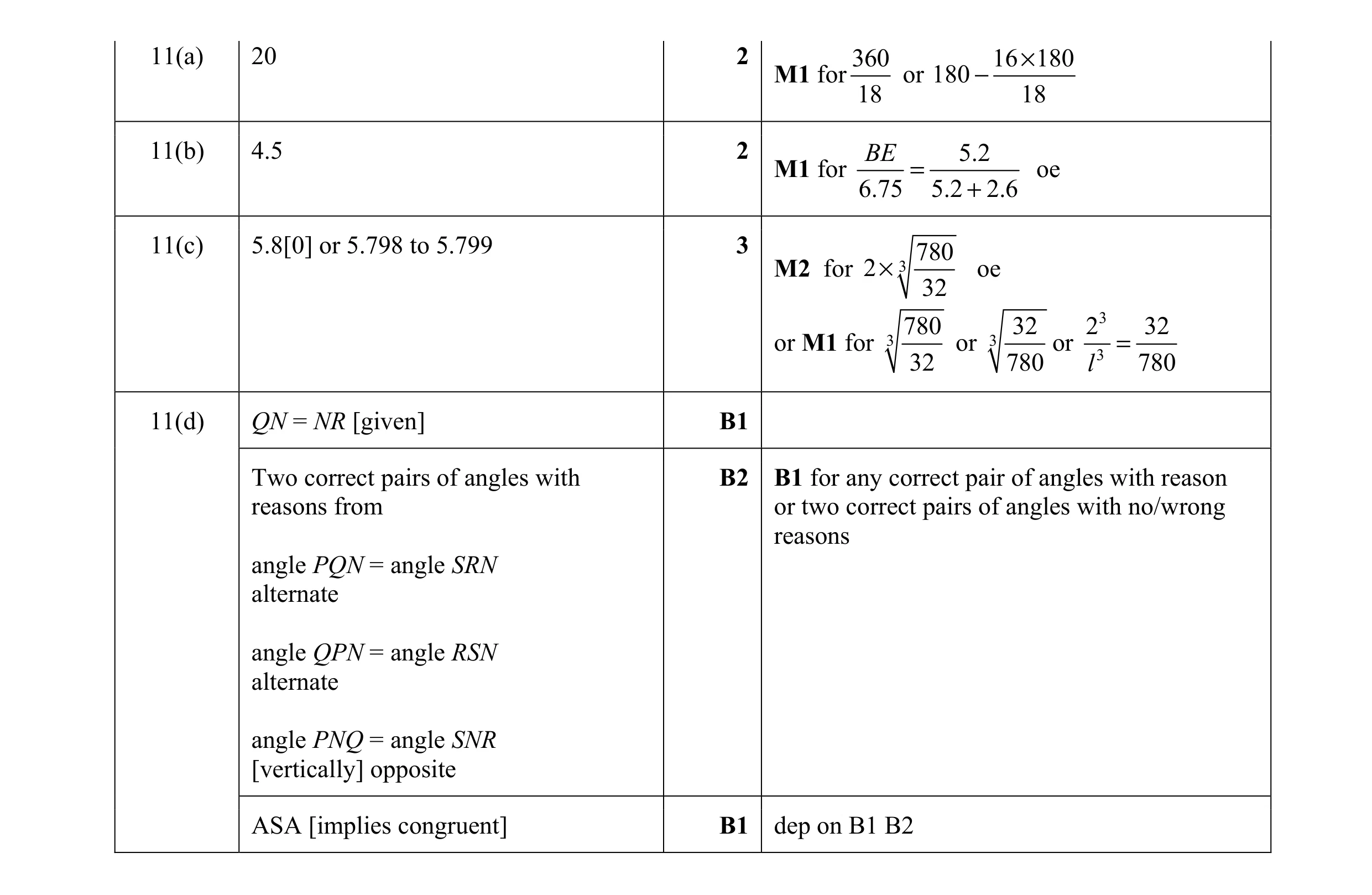
Mark scheme: 11(a) 20 2 360 16 × 180 M1 for or 180 − 18 18 11(b) 4.5 2 BE 5.2 M1 for = oe 6.75 5.2 + 2.6 11(c) 5.8[0] or 5.798 to 5.799 3 780 M2 for 2 × 3 oe 32 780 32 2 3 32 or M1 for 3 or 3 or = 32 780 l 3 780 11(d) QN = NR [given] B1 Two correct pairs of angles with B2 B1 for any correct pair of angles with reason reasons from or two correct pairs of angles with no/wrong reasons angle PQN = angle SRN alternate angle QPN = angle RSN alternate angle PNQ = angle SNR [vertically] opposite ASA [implies congruent] B1 dep on B1 B2
This question in 0580/41 May/June 2021
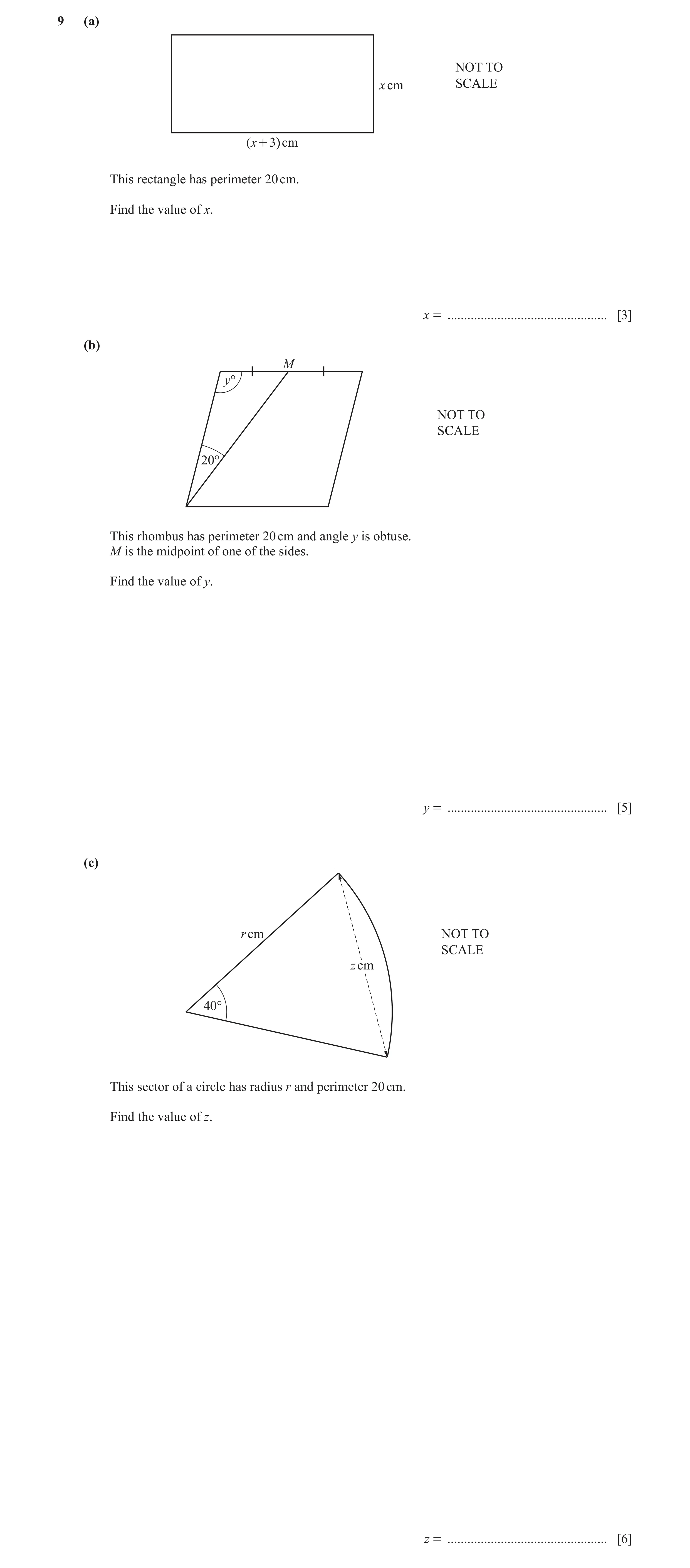
Q12 · NOT TO x cm SCALE ( x + 3)cm This rectangle has perimeter 20 cm 0580/41 Oct/Nov 2021
9 (a) NOT TO x cm SCALE ( x + 3)cm This rectangle has perimeter 20 cm. Find the value of x. x = … [3] (b) M y° NOT TO SCALE 20° This rhombus has perimeter 20 cm and angle y is obtuse. M is the midpoint of one of the sides. Find the value of y. y = … [5] (c) r cm NOT TO SCALE z cm 40° This sector of a circle has radius r and perimeter 20 cm. Find the value of z. z = … [6]
14 marks
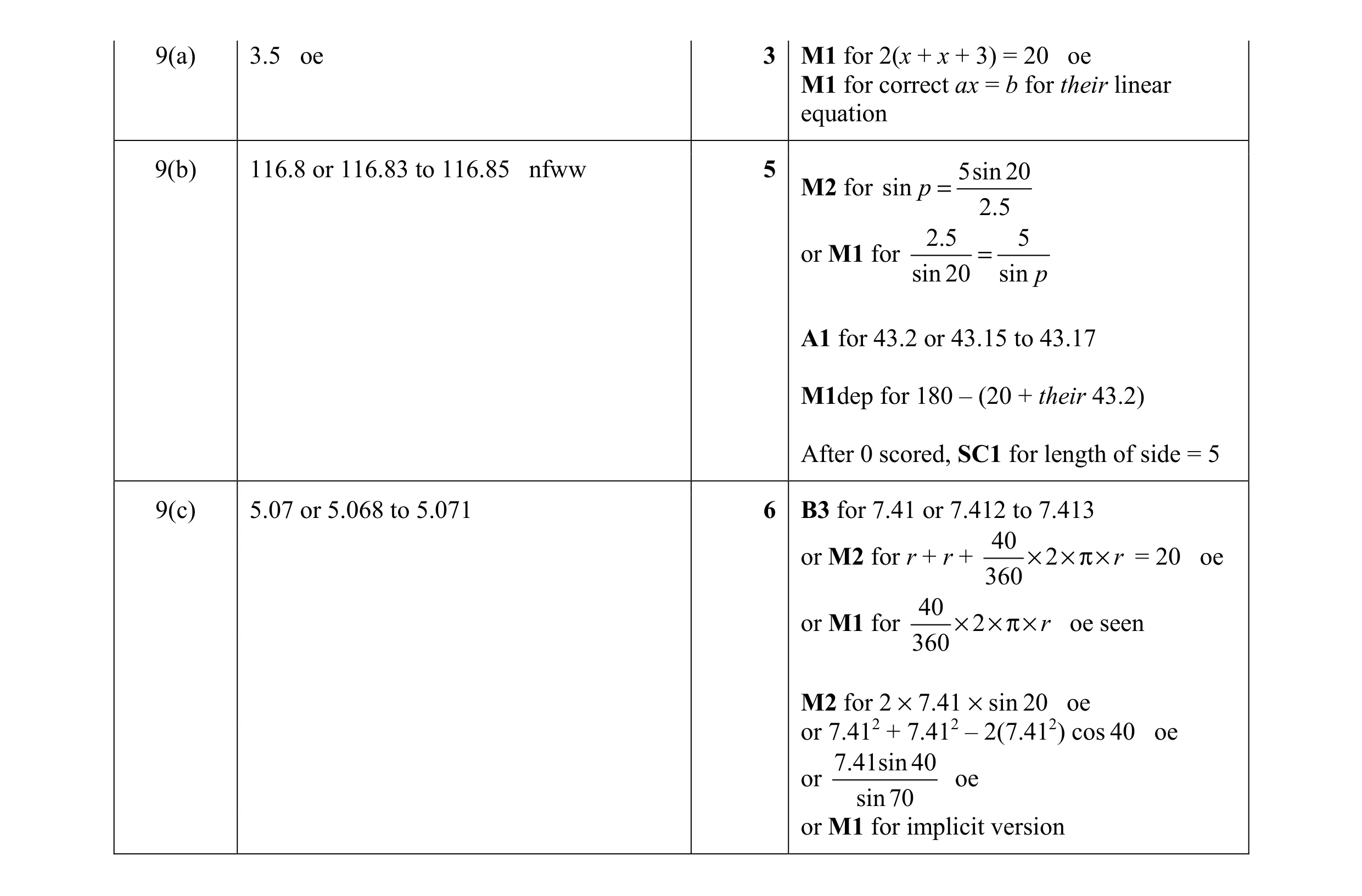
Mark scheme: 9(a) 3.5 oe 3 M1 for 2(x + x + 3) = 20 oe M1 for correct ax = b for their linear equation 9(b) 116.8 or 116.83 to 116.85 nfww 5 5sin 20 M2 for sin p = 2.5 2.5 5 or M1 for = sin 20 sin p A1 for 43.2 or 43.15 to 43.17 M1dep for 180 – (20 + their 43.2) After 0 scored, SC1 for length of side = 5 9(c) 5.07 or 5.068 to 5.071 6 B3 for 7.41 or 7.412 to 7.413 40 or M2 for r + r + × 2 × π× r = 20 oe 360 40 or M1 for × 2 × π× r oe seen 360 M2 for 2 × 7.41 × sin 20 oe or 7.412 + 7.412 – 2(7.412) cos 40 oe 7.41sin 40 or oe sin70 or M1 for implicit version
This question in 0580/41 Oct/Nov 2021
Q13 · The interior angle of a regular polygon is 156° 0580/42 Feb/March 2022
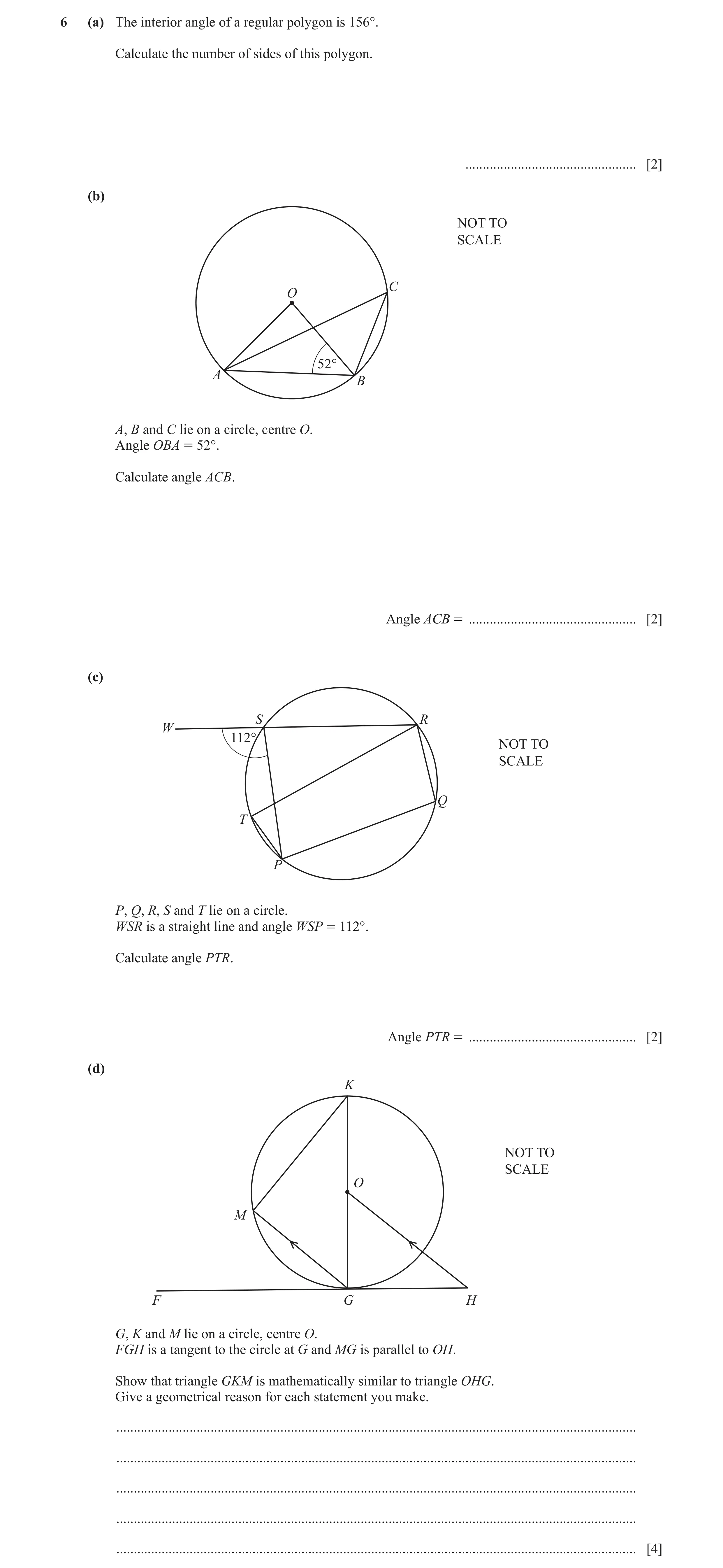
6 (a) The interior angle of a regular polygon is 156°. Calculate the number of sides of this polygon. … [2] (b) NOT TO SCALE C O 52° A B A, B and C lie on a circle, centre O. Angle OBA = 52°. Calculate angle ACB. Angle ACB = … [2] (c) S R W 112° NOT TO SCALE Q T P P, Q, R, S and T lie on a circle. WSR is a straight line and angle WSP = 112°. Calculate angle PTR. Angle PTR = … [2] (d) K NOT TO SCALE O M F G H G, K and M lie on a circle, centre O. FGH is a tangent to the circle at G and MG is parallel to OH. Show that triangle GKM is mathematically similar to triangle OHG. Give a geometrical reason for each statement you make. … … … … … [4]
10 marks
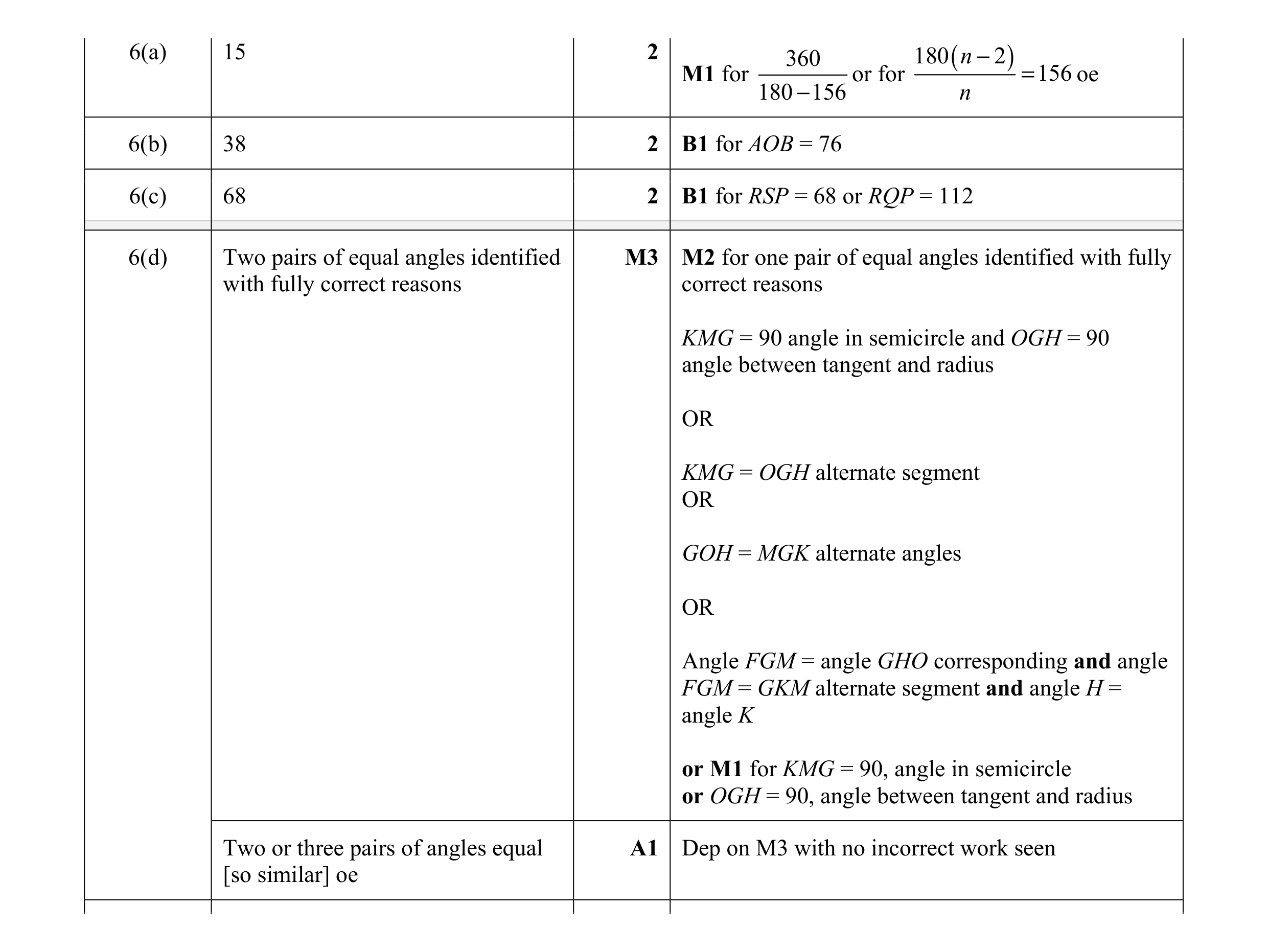
Mark scheme: 6(a) 15 2 360 180 ( n − 2 ) M1 for or for = 156 oe 180 − 156 n 6(b) 38 2 B1 for AOB = 76 6(c) 68 2 B1 for RSP = 68 or RQP = 112 6(d) Two pairs of equal angles identified M3 M2 for one pair of equal angles identified with fully with fully correct reasons correct reasons KMG = 90 angle in semicircle and OGH = 90 angle between tangent and radius OR KMG = OGH alternate segment OR GOH = MGK alternate angles OR Angle FGM = angle GHO corresponding and angle FGM = GKM alternate segment and angle H = angle K or M1 for KMG = 90, angle in semicircle or OGH = 90, angle between tangent and radius Two or three pairs of angles equal A1 Dep on M3 with no incorrect work seen [so similar] oe
This question in 0580/42 Feb/March 2022
Q14 · A regular 12-sided polygon has side length 6 cm 0580/43 May/June 2022
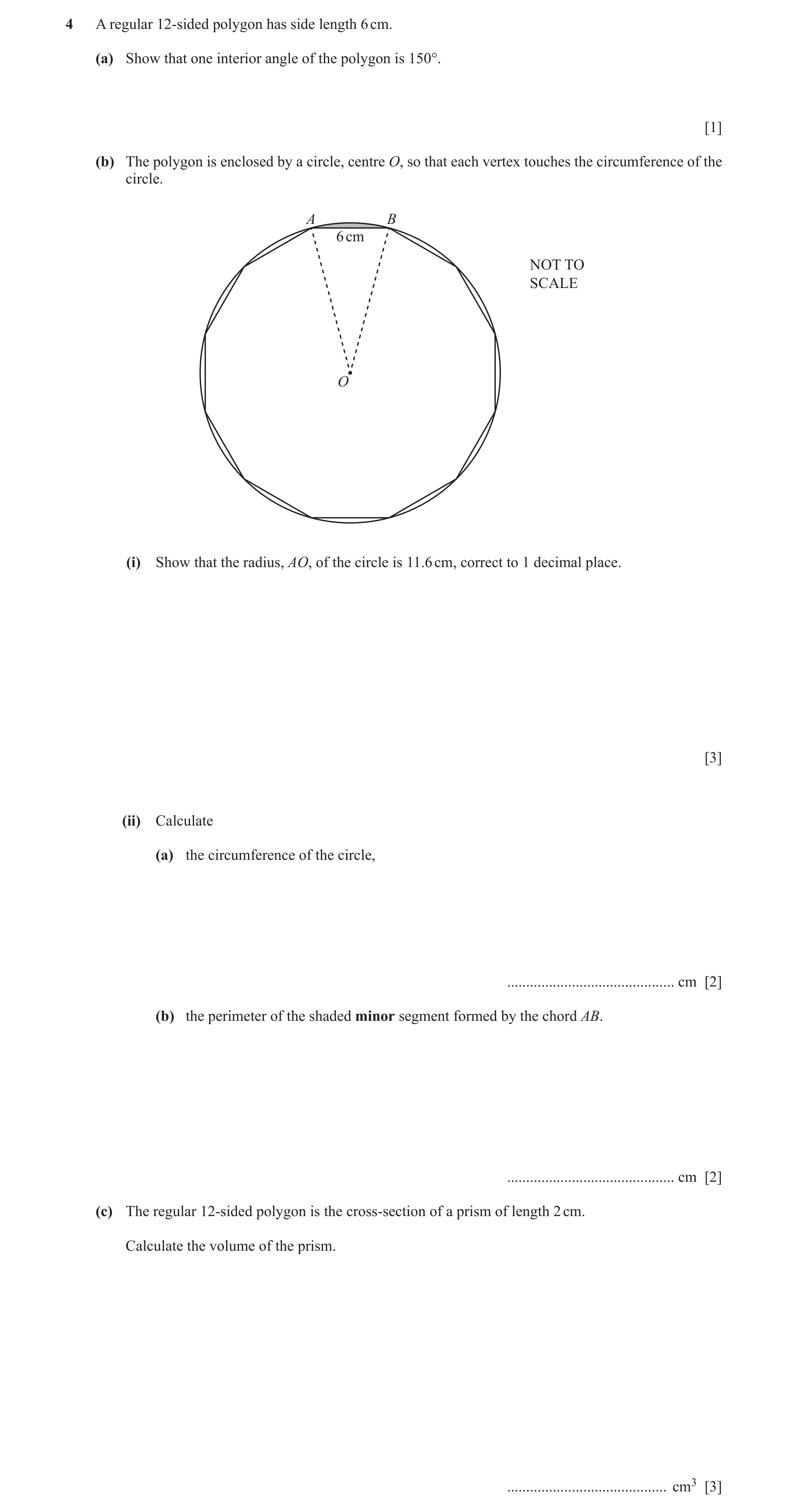
4 A regular 12-sided polygon has side length 6 cm. (a) Show that one interior angle of the polygon is 150°. [1] (b) The polygon is enclosed by a circle, centre O, so that each vertex touches the circumference of the circle. A B 6 cm NOT TO SCALE O (i) Show that the radius, AO, of the circle is 11.6 cm, correct to 1 decimal place. [3] (ii) Calculate (a) the circumference of the circle, … cm [2] (b) the perimeter of the shaded minor segment formed by the chord AB. … cm [2] (c) The regular 12-sided polygon is the cross-section of a prism of length 2 cm. Calculate the volume of the prism. … cm3 [3]
11 marks
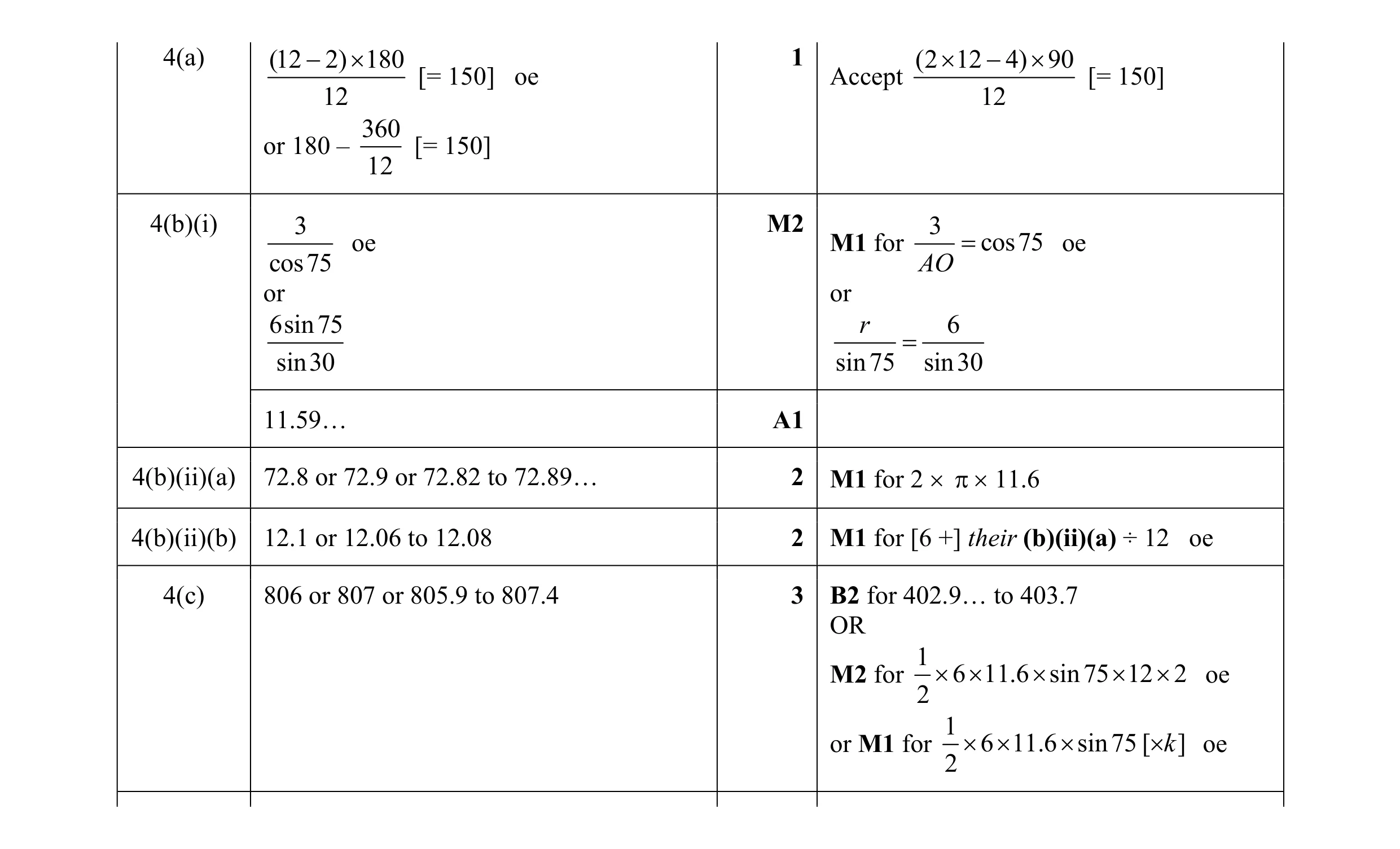
Mark scheme: 4(a) (12 2) 180 1 (2 12 4) 90 [= 150] oe Accept [= 150] 12 12 360 or 180 – [= 150] 12 4(b)(i) 3 M2 3 oe M1 for cos75 oe cos75 AO or or 6sin75 r 6 sin30 sin75 sin30 11.59… A1 4(b)(ii)(a) 72.8 or 72.9 or 72.82 to 72.89… 2 M1 for 2 11.6 4(b)(ii)(b) 12.1 or 12.06 to 12.08 2 M1 for [6 +] their (b)(ii)(a) ÷ 12 oe 4(c) 806 or 807 or 805.9 to 807.4 3 B2 for 402.9… to 403.7 OR 1 M2 for 6 11.6 sin75 12 2 oe 2 1 or M1 for 6 11.6 sin75 [k ] oe 2
This question in 0580/43 May/June 2022
Q15 · North 114° A NOT TO SCALE C B A, B and C are three towns and the bearing of C from A is… 0580/43 May/June 2023
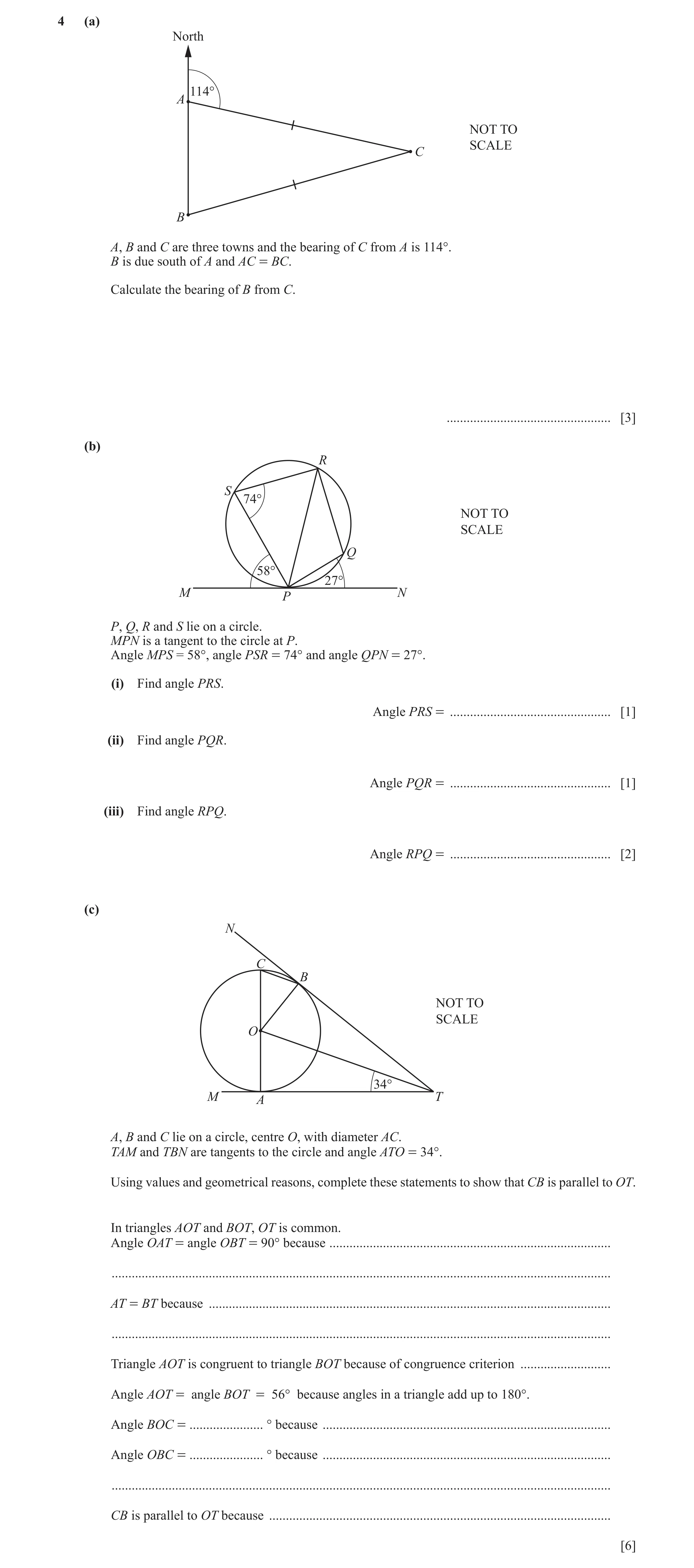
4 (a) North 114° A NOT TO SCALE C B A, B and C are three towns and the bearing of C from A is 114°. B is due south of A and AC = BC. Calculate the bearing of B from C. … [3] (b) R S 74° NOT TO SCALE Q 58° 27° M P N P, Q, R and S lie on a circle. MPN is a tangent to the circle at P. Angle MPS = 58°, angle PSR = 74° and angle QPN = 27°. (i) Find angle PRS. Angle PRS = … [1] (ii) Find angle PQR. Angle PQR = … [1] (iii) Find angle RPQ. Angle RPQ = … [2] (c) N C B NOT TO SCALE O 34° M A T A, B and C lie on a circle, centre O, with diameter AC. TAM and TBN are tangents to the circle and angle ATO = 34°. Using values and geometrical reasons, complete these statements to show that CB is parallel to OT. In triangles AOT and BOT, OT is common. Angle OAT = angle OBT = 90° because … … AT = BT because … … Triangle AOT is congruent to triangle BOT because of congruence criterion … Angle AOT = angle BOT = 56° because angles in a triangle add up to 180°. Angle BOC = … ° because … Angle OBC = … ° because … … CB is parallel to OT because … [6]
13 marks
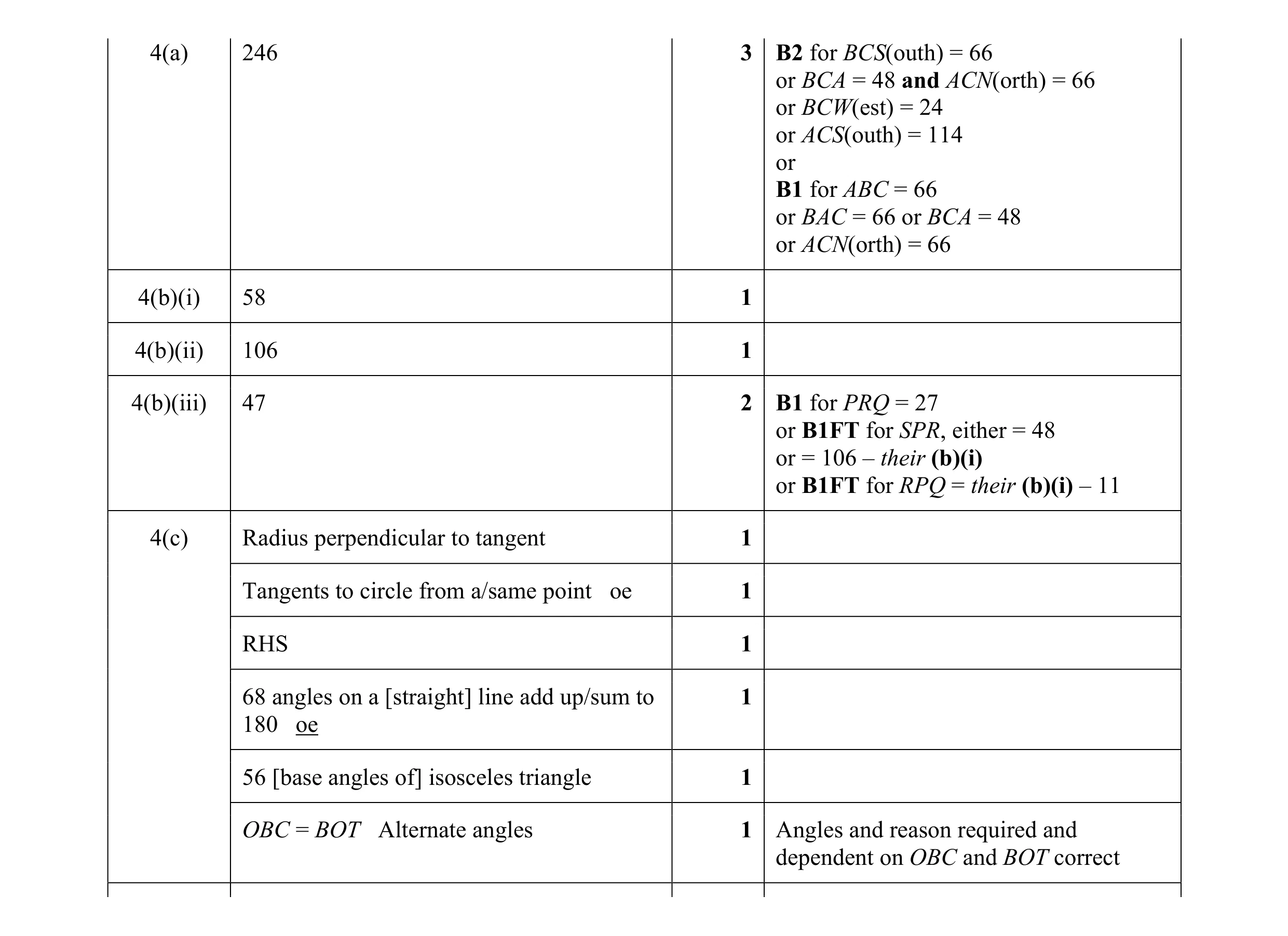
Mark scheme: 4(a) 246 3 B2 for BCS(outh) = 66 or BCA = 48 and ACN(orth) = 66 or BCW(est) = 24 or ACS(outh) = 114 or B1 for ABC = 66 or BAC = 66 or BCA = 48 or ACN(orth) = 66 4(b)(i) 58 1 4(b)(ii) 106 1 4(b)(iii) 47 2 B1 for PRQ = 27 or B1FT for SPR, either = 48 or = 106 – their (b)(i) or B1FT for RPQ = their (b)(i) – 11 4(c) Radius perpendicular to tangent 1 Tangents to circle from a/same point oe 1 RHS 1 68 angles on a [straight] line add up/sum to 1 180 oe 56 [base angles of] isosceles triangle 1 OBC = BOT Alternate angles 1 Angles and reason required and dependent on OBC and BOT correct
This question in 0580/43 May/June 2023
Q16 · Find the size of one interior angle of a regular 10-sided polygon 0580/43 Oct/Nov 2023
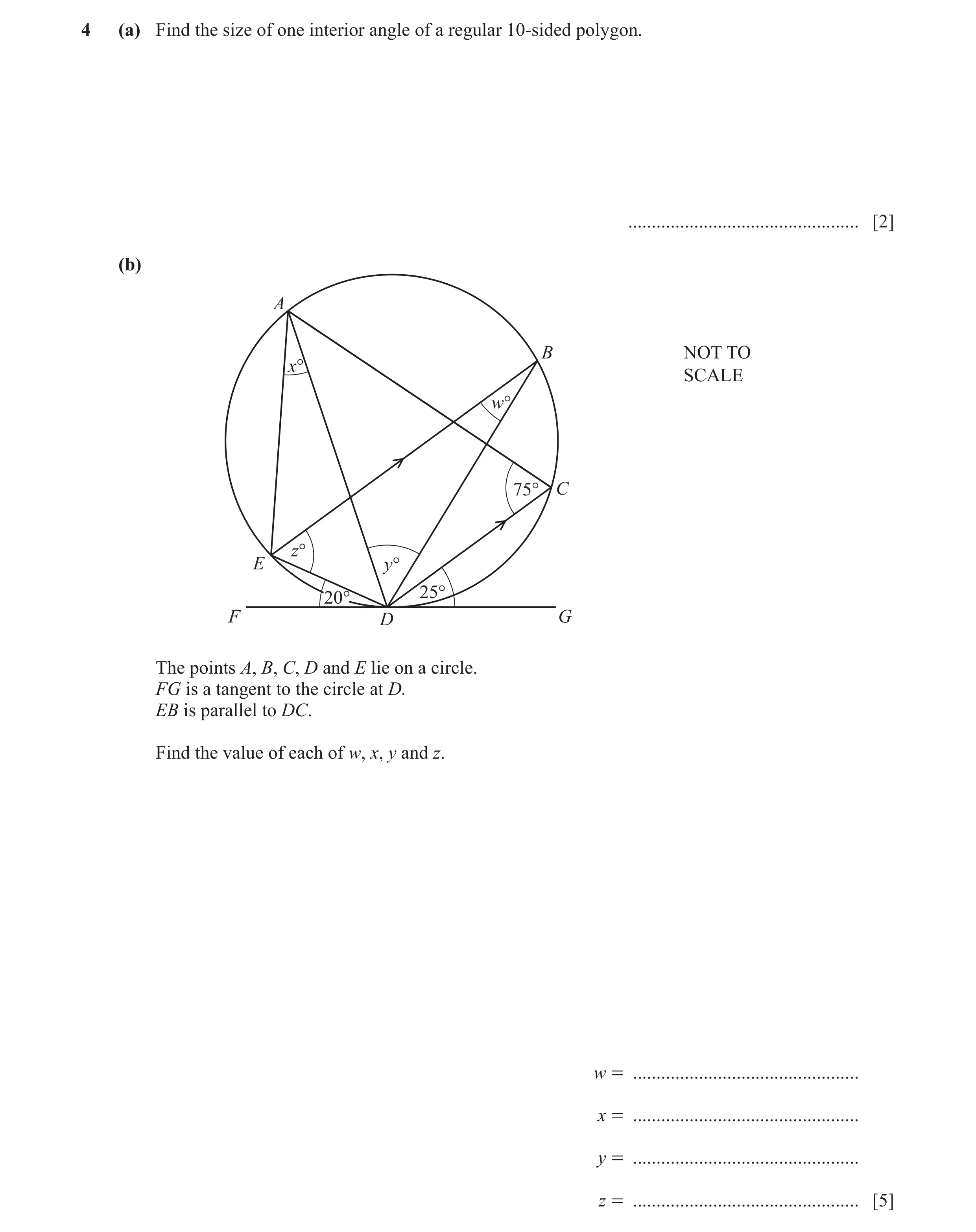
4 (a) Find the size of one interior angle of a regular 10-sided polygon. … [2] (b) A B NOT TO x° SCALE w° 75° C z° E y° 25° 20°20° F D G The points A, B, C, D and E lie on a circle. FG is a tangent to the circle at D. EB is parallel to DC. Find the value of each of w, x, y and z. w = … x = … y = … z = … [5]
7 marks
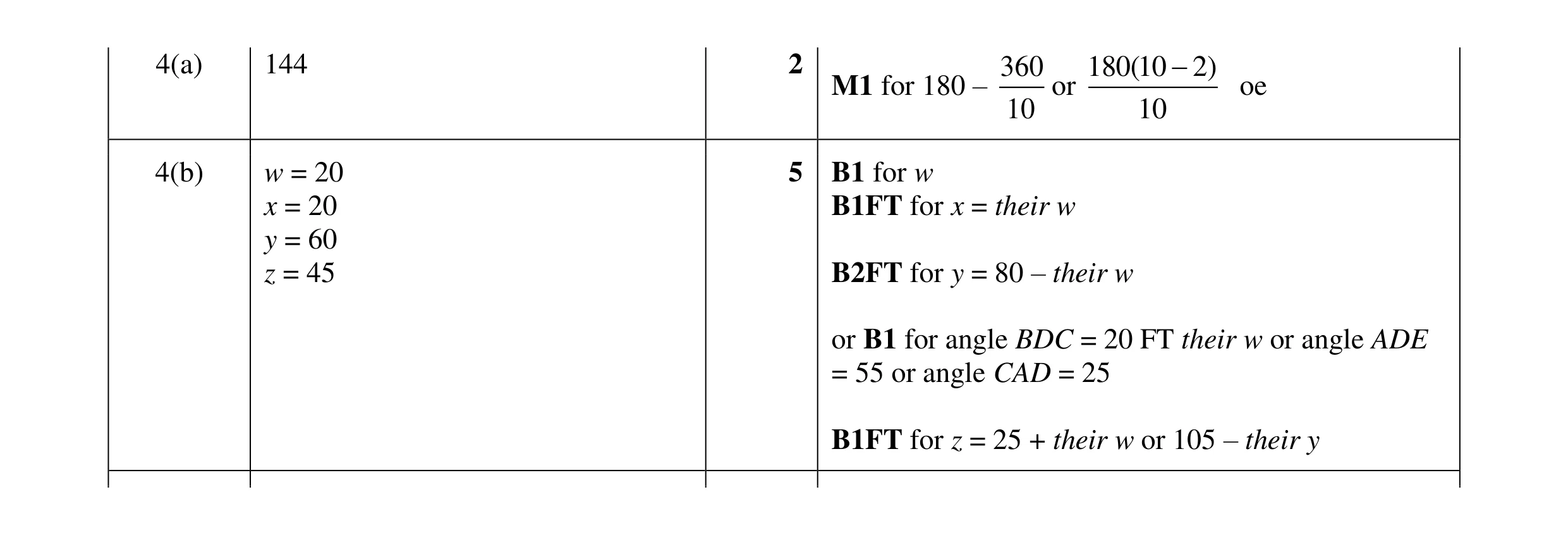
Mark scheme: 4(a) 144 2 360 180(10 − 2) M1 for 180 – or oe 10 10 4(b) w = 20 5 B1 for w x = 20 B1FT for x = their w y = 60 z = 45 B2FT for y = 80 – their w or B1 for angle BDC = 20 FT their w or angle ADE = 55 or angle CAD = 25 B1FT for z = 25 + their w or 105 – their y
This question in 0580/43 Oct/Nov 2023
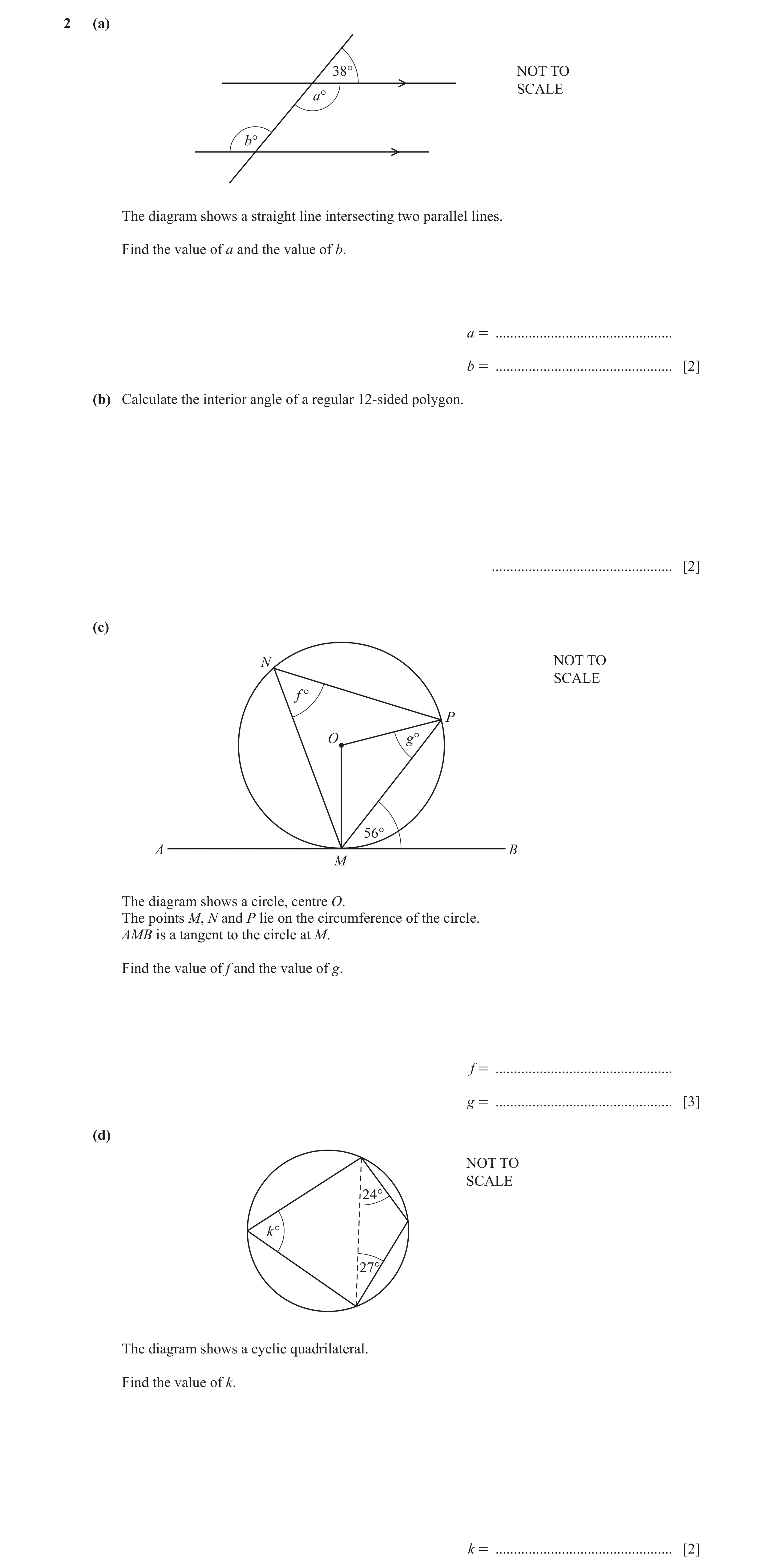
Q17 · 38° NOT TO SCALE a° b° The diagram shows a straight line intersecting two parallel lines 0580/42 May/June 2024
2 (a) 38° NOT TO SCALE a° b° The diagram shows a straight line intersecting two parallel lines. Find the value of a and the value of b. a = … b = … [2] (b) Calculate the interior angle of a regular 12-sided polygon. … [2] (c) N NOT TO SCALE f ° P O g° 56° A B M The diagram shows a circle, centre O. The points M, N and P lie on the circumference of the circle. AMB is a tangent to the circle at M. Find the value of f and the value of g. f = … g = … [3] (d) NOT TO SCALE 24° k ° 27° The diagram shows a cyclic quadrilateral. Find the value of k. k = … [2]
9 marks
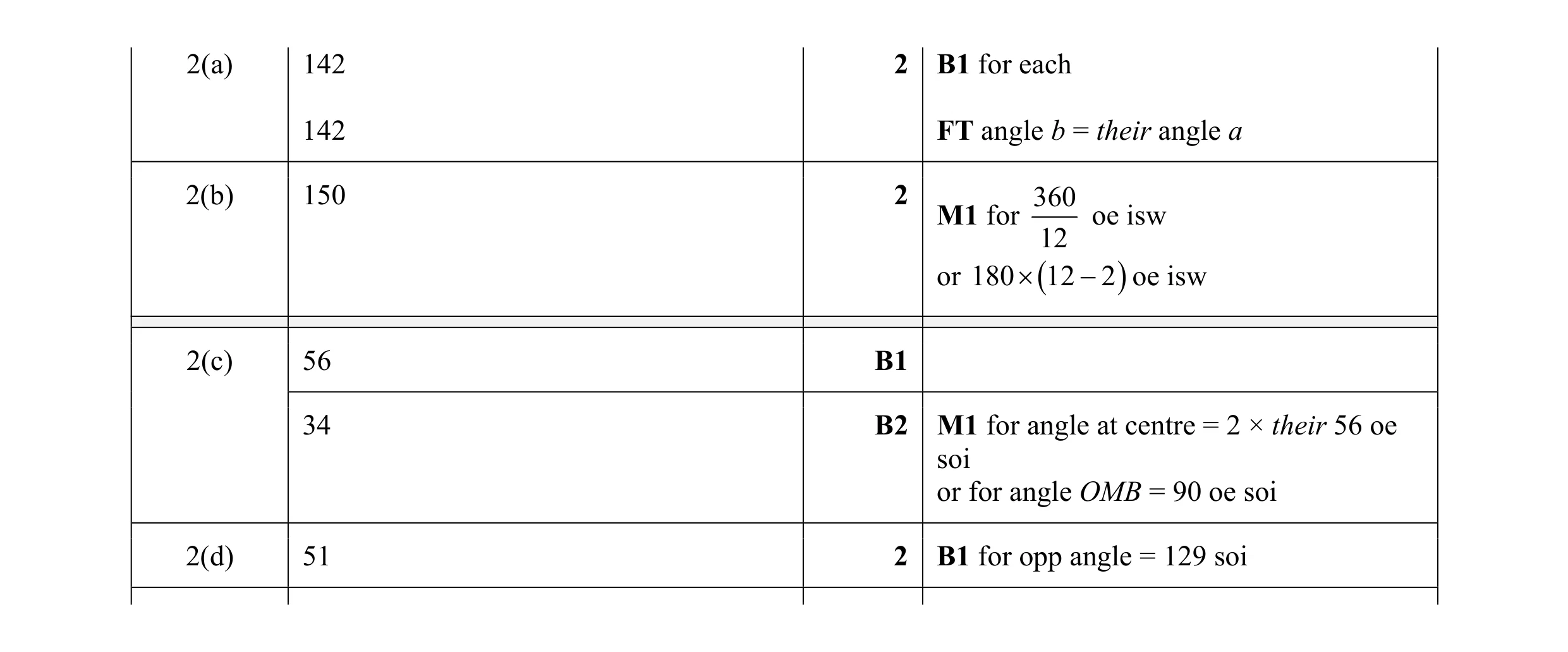
Mark scheme: 2(a) 142 2 B1 for each 142 FT angle b = their angle a 2(b) 150 2 360 M1 for oe isw 12 or 180 12 2 oe isw 2(c) 56 B1 34 B2 M1 for angle at centre = 2 × their 56 oe soi or for angle OMB = 90 oe soi 2(d) 51 2 B1 for opp angle = 129 soi
This question in 0580/42 May/June 2024
 1 / 27
 25 / 27
 14
 11
 12
 11
 13
 12
 14
 17
 12
 11
 11
 14
 10
 11
 13
 7
 9