Questions as text
Q1 · 1 2 3 4 5 6 7 8 9 10 11 12 13 14 15 16 17 18 19 20 21 22 23 24 25 26 27 28 29 30 31 32 33… 0580/41 May/June 2008
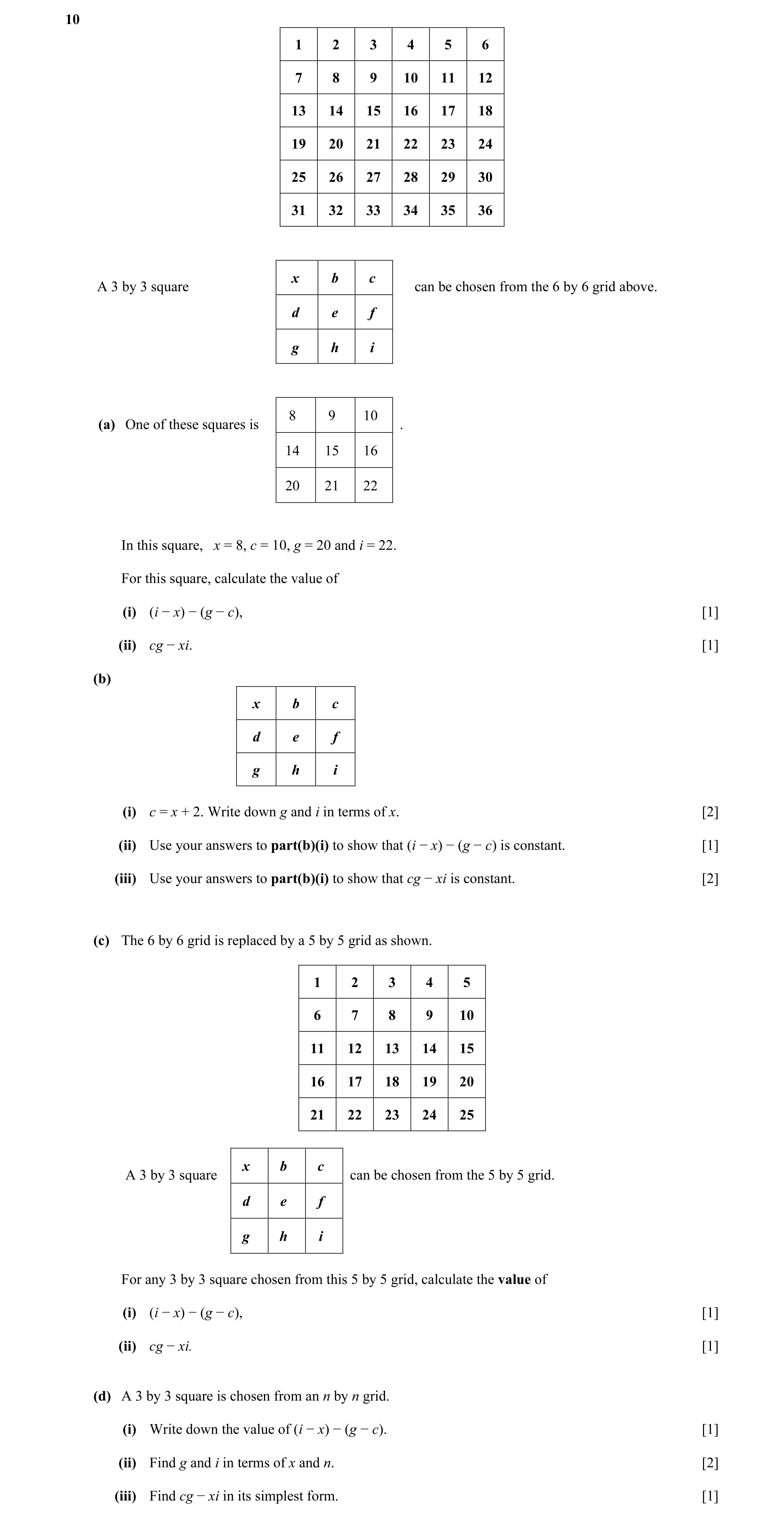
10 1 2 3 4 5 6 7 8 9 10 11 12 13 14 15 16 17 18 19 20 21 22 23 24 25 26 27 28 29 30 31 32 33 34 35 36 x b c A 3 by 3 square can be chosen from the 6 by 6 grid above. d e f g h i 8 9 10 (a) One of these squares is . 14 15 16 20 21 22 In this square, x = 8, c = 10, g = 20 and i = 22. For this square, calculate the value of (i) (i − x) − (g − c), [1] (ii) cg − xi. [1] (b) x b c d e f g h i (i) c = x + 2. Write down g and i in terms of x. [2] (ii) Use your answers to part(b)(i) to show that (i − x) − (g − c) is constant. [1] (iii) Use your answers to part(b)(i) to show that cg − xi is constant. [2] (c) The 6 by 6 grid is replaced by a 5 by 5 grid as shown. 1 2 3 4 5 6 7 8 9 10 11 12 13 14 15 16 17 18 19 20 21 22 23 24 25 x b c A 3 by 3 square can be chosen from the 5 by 5 grid. d e f g h i For any 3 by 3 square chosen from this 5 by 5 grid, calculate the value of (i) (i − x) − (g − c), [1] (ii) cg − xi. [1] (d) A 3 by 3 square is chosen from an n by n grid. (i) Write down the value of (i − x) − (g − c). [1] (ii) Find g and i in terms of x and n. [2] (iii) Find cg − xi in its simplest form. [1]
13 marks
Mark scheme: 10(a) (i) 4 B1 (ii) 24 B1 (b) (i) x + 12, x + 14 o.e. B1,B1 Any order ignore ref to g and i (ii) (x + 14 – x) and (x + 12 – (x + 2)) x + 12 and x + 14 must be seen to be used 14 – 10 or 14 – 12 + 2 or 4 E1 No errors seen (iii) (x + 2)(x + 12) – x(x + 14) B1 Subtraction can be implied later 24 E1 Dep on B1 and no errors anywhere for the E mark (c) (i) 4 B1 (ii) 20 B1 (d) (i) 4 B1 (ii) x + 2n o.e., x + 2+ 2n o.e. B1,B1 (iii) 4n B1 Allow 4×n, n×4, n4 [13]
This question in 0580/41 May/June 2008
Q2 · Y is 5 less than the square of the sum of p and q 0580/42 May/June 2010
8 (a) y is 5 less than the square of the sum of p and q. Examiner's Use Write down a formula for y in terms of p and q. Answer(a) y = [2] (b) The cost of a magazine is $x and the cost of a newspaper is $(x – 3). The total cost of 6 magazines and 9 newspapers is $51. Write down and solve an equation in x to find the cost of a magazine. Answer(b) $ [4] For (c) Bus tickets cost $3 for an adult and $2 for a child. Examiner's Use There are a adults and c children on a bus. The total number of people on the bus is 52. The total cost of the 52 tickets is $139. Find the number of adults and the number of children on the bus. Answer(c) Number of adults = Number of children = [5]
11 marks
Mark scheme: 8 (a) (p + q)2 – 5 oe final answer 2 SC1 for (p + q)2 oe seen (b) 6x + 9(x – 3) = 51 or better B3 B2 for 6x + 9(x – 3) or B1 for 6x or 9(x – 3) 5.2(0) final answer B1 5.2(0) ww is B1 only (c) a + c = 52 oe B1 Condone consistent use of other variables 3a + 2c = 139 oe B1 or M3 for 3a + 2(52 – a) = 139 or 3(52 – c) + 2c = 139 o.e. Correctly eliminating a or c. M1 Allow one numerical slip. 35 A1 If A0, SC1 for 17, 35 17 A1 IGCSE – May/June 2010 0580 42
This question in 0580/42 May/June 2010
Q3 · F(x) = 2x – 1 g(x) = x2 For Examiner's Work out Use (i) f(2), Answer(a)(i) [1] (ii) g(… 0580/41 Oct/Nov 2010
8 (a) f(x) = 2x – 1 g(x) = x2 For Examiner's Work out Use (i) f(2), Answer(a)(i) [1] (ii) g( – 2), Answer(a)(ii) [1] (iii) ff(x) in its simplest form, Answer(a)(iii) ff(x) = [2] (iv) f –1(x), the inverse of f(x), Answer(a)(iv) f –1(x) = [2] (v) x when gf(x) = 4. Answer(a)(v) x = or x = [4] (b) y is inversely proportional to x and y = 8 when x = 2. Find, (i) an equation connecting y and x, Answer(b)(i) [2] 1 (ii) y when x = . 2 Answer(b)(ii) y = [1]
13 marks
Mark scheme: 8 (a) (i) 3 1 (ii) 4 1 (iii) 4x – 3 final answer 2 M1 for 2(2x – 1) – 1 x + 1 y + 1 f ( x ) + 1 (iv) oe final answer 2 M1 for x = 2y – 1 or oe or oe 2 2 2 1 1 (v) – and 1 4 B1 for (2x – 1)2 soi 2 2 M2 for 2x – 1 = ± 2 M1 for 4x2 – 2x – 2x + 1 or M1 for 2x – 1 = 2 and M1 for (2x + 1)(2x – 3) or correct substitution in formula soi by (4 ± √64)/8 16 (b) (i) y = oe 2 Condone y = k/x and k = 16 stated x k M1 for y = oe x (ii) 32 1
This question in 0580/41 Oct/Nov 2010
Q4 · F(x) = x2 + x O1 g(x) = 1 O 2x h(x) = 3x Examiner's Use (a) Find the value of hg(–2) 0580/43 Oct/Nov 2011
8 f(x) = x2 + x O1 g(x) = 1 O 2x h(x) = 3x Examiner's Use (a) Find the value of hg(–2). Answer(a) [2] (b) Find g –1(x). Answer(b) g O1(x) = [2] (c) Solve the equation f(x) = 0. Show all your working and give your answers correct to 2 decimal places. Answer(c) x = or x = [4] (d) Find fg(x). Give your answer in its simplest form. Answer(d) fg(x) = [3] (e) Solve the equation h – 1(x) = 2. Answer(e) x = [1]
12 marks
Mark scheme: 8 (a) 243 2 B1 for (g(–2) =) 5 seen or 3(1–2x) 1 − x x − 1 2 M1 for x = 1 − 2y or x = (1 − y)/2 (b) or final ans 2 − 2 − 1 ± 12 − 41()( −)1 B2 B1 for 12 − 4 1()( −)1 or better ( 5 ) seen (c) 2)1( anywhere p + q p − q If in form or r r B1 for p = –1 and r = 2(1) –1.62, 0.62 B1B1 SC1 for –1.62 and 0.62 seen or –1.6 or –1.618.. and 0.6 or 0.618… (d) 4x2 – 6x + 1 final ans www3 3 M1 for (1 – 2x)2 + (1 – 2x) – 1 or better and B1 for (1 – 2x)2 = 1 – 2x – 2x + 4x2 or better (e) 9 1 IGCSE – October/November 2011 0580 43
This question in 0580/43 Oct/Nov 2011
Q5 · F(x) = 3x + 5 g(x) = 7 O 2x h(x) = x2 O 8 For Examiner's (a) Find Use (i) f(3)… 0580/41 May/June 2012
9 f(x) = 3x + 5 g(x) = 7 O 2x h(x) = x2 O 8 For Examiner's (a) Find Use (i) f(3), Answer(a)(i) [1] (ii) g(x O 3) in terms of x in its simplest form, Answer(a)(ii) [2] (iii) h(5x) in terms of x in its simplest form. Answer(a)(iii) [1] (b) Find the inverse function g –1(x). Answer(b) g –1(x) = [2] (c) Find hf(x) in the form ax2 + bx + c . Answer(c) hf(x) = [3] (d) Solve the equation ff(x) = 83. Answer(d) x = [3] (e) Solve the inequality 2f(x) I g(x). Answer(e) [3] Question 10 is printed on the next page.
15 marks
Mark scheme: 9 (a) (i) 14 1 (ii) 13 − 2 x 2 M1 for 7 − 2( x − 3) (iii) 25 x 2 − 8 final answer 1 7 − y (b) 7 − x 2 M1 for 2 x = 7 − y , x = oe oe 2 2 or x = 7 − 2 y , 2 y = 7 − x oe i.e one step from answer 2 (c) 9 x 2 + 30 x + 17 3 M1 for (3 x + 5 ) − 8 seen B1 for 9 x 2 + 30 x + 25 (d) 7 cao 3 M2 for 3(3 x + 5) + 5 = 83 or better or B1 for 3(3 x + 5) + 5 oe (e) 3 3 M1 for 2 (3 x + 5) < 7 − 2 x oe x < − oe cao 8 B1 for 8x * – 3 or – 8x * 3 3 Do not accept − 8
This question in 0580/41 May/June 2012
Q6 · Consecutive integers are set out in rows in a grid 0580/42 Oct/Nov 2012
10 Consecutive integers are set out in rows in a grid. For Examiner's Use (a) This grid has 5 columns. 1 2 3 4 5 6 7 8 9 10 a b 11 12 13 14 15 n 16 17 18 19 20 c d 21 22 23 24 25 26 27 28 29 30 31 32 33 34 35 The shape drawn encloses five numbers 7, 9, 13, 17 and 19. This is the n = 13 shape. In this shape, a = 7, b = 9, c = 17 and d = 19. (i) Calculate bc O ad for the n = 13 shape. Answer(a)(i) [1] (ii) For the 5 column grid, a = n O 6. Write down b, c and d in terms of n for this grid. Answer(a)(ii) b = c = d = [2] (iii) Write down bc O ad in terms of n. Show clearly that it simplifies to 20. Answer(a)(iii) [2] (b) This grid has 6 columns. The shape is drawn for n = 10. For Examiner's Use 1 2 3 4 5 6 a b 7 8 9 10 11 12 n 13 14 15 16 17 18 c d 19 20 21 22 23 24 25 26 27 28 29 30 31 32 33 34 35 36 (i) Calculate the value of bc O ad for n = 10. Answer(b)(i) [1] (ii) Without simplifying, write down bc O ad in terms of n for this grid. Answer(b)(ii) [2] (c) This grid has 7 columns. 1 2 3 4 5 6 7 a b 8 9 10 11 12 13 14 n 15 16 17 18 19 20 21 c d 22 23 24 25 26 27 28 29 30 31 32 33 34 35 Show clearly that bc O ad = 28 for n = 17. Answer(c) [1] Question 10 continues on the next page. (d) Write down the value of bc O ad when there are t columns in the grid. For Examiner's Use Answer(d) [1] (e) Find the values of c, d and bc O ad for this shape. 2 3 4 16 c d Answer (e) c = d = bc O ad = [2]
12 marks
Mark scheme: 10 (a) (i) 20 1 (ii) n – 4 oe Accept unsimplified n + 4 oe n + 6 oe 2 B1 for two correct (iii) (n – 4)(n + 4) – (n – 6)(n + 6) M1 ft from their algebraic expressions can be implied by n2 – 4n + 4n – 16 – (n2 – 6n + 6n – 36) or n2 – 16 – (n2 – 36) n2 – 4n + 4n – 16 – (n2 – 6n + 6n Must have a line of algebra – 36) or better 20 E1 With no errors or omission of brackets (b) (i) 24 1 IGCSE – October/November 2012 0580 42 (ii) (n – 5)(n + 5) – (n – 7)(n + 7) 2 M1 for n – 5, n + 5, n – 7, n + 7 seen isw or n2 – 25 – (n2 – 49) isw or n2 – 25 – n2 + 49 isw (c) (11 × 23) – (9 × 25) Allow algebraic solution from 253 – 225 (n – 6)(n + 6) – (n – 8)(n + 8) [= 28] E1 (d) 4t oe 1 Accept unsimplified e.g. n2 – (t – 1)2 – [n2 – (t + 1)2] (e) c = 28 and d = 30 1 52 1
This question in 0580/42 Oct/Nov 2012
Q7 · F(x) = 4 – 3x g(x) = 3–x (a) Find f(2x) in terms of x 0580/43 May/June 2014
9 f(x) = 4 – 3x g(x) = 3–x (a) Find f(2x) in terms of x. Answer(a) f(2x) = … [1] (b) Find ff(x) in its simplest form. Answer(b) ff(x) = … [2] (c) Work out gg(–1). Give your answer as a fraction. Answer(c) … [3] (d) Find f –1(x), the inverse of f(x). Answer(d) f –1(x) = … [2] (e) Solve the equation gf(x) = 1. Answer(e) x = … [3] __________________________________________________________________________________________
11 marks
Mark scheme: 9 (a) 4 − 6x final answer 1 (b) 9 x − 8 final answer 2 M1 for 4 − 3(4 − 3x) seen 1 3 (c) final answer 3 M2 for 3−soi by final answer 0.037037… 27 to 3sf or better or M1 for [g( − 1) =] 3 soi 4 − x (d) oe final answer 2 M1 for a correct first step 3 y 4 3 x = 4 − y oe or x = 4 − 3 y or = − x 3 3 4 1 (e) or 1 or 1.33 or better 3 M2 for 3x − 4 = 0 or better 3 3 or M1 for 3 − ( 4 −3 x ) IGCSE – May/June 2014 0580 43 Qu Answers Mark Part Marks
This question in 0580/43 May/June 2014
Q8 · Diagram 1 Diagram 2 Diagram 3 Diagram 4 Diagram 5 Diagram 1 shows two lines of length 1… 0580/42 Feb/March 2015
11 Diagram 1 Diagram 2 Diagram 3 Diagram 4 Diagram 5 Diagram 1 shows two lines of length 1 unit at right angles forming an . Two s are added to Diagram 1 to make Diagram 2. This forms one small square. Three s are added to Diagram 2 to make Diagram 3. This forms three small squares. The sequence of Diagrams continues. (a) Draw Diagram 5. [1] (b) Complete the table. Diagram 1 Diagram 2 Diagram 3 Diagram 4 Diagram 5 Number of lines of length 1 unit 2 6 12 20 Number of small squares 0 1 3 6 [2] (c) Find an expression, in terms of n, for the number of lines of length 1 unit in Diagram n. Answer(c) … [2] (d) Find an expression, in terms of n, for the number of small squares in Diagram n. Answer(d) … [2]
7 marks
Mark scheme: 11 (a) 1 (b) 30 1 10 1 2 + bn + c a, b, c numeric a ≠ 0 (c) n (n + )1 oe 2 B1 for an 1 (d) n (n − )1 oe 2 1 2 B1 for using oe in expression of form 2 1 (an 2 + bn + c ) a ≠ 0 or kn(n − )1 k ≠ 0 2
This question in 0580/42 Feb/March 2015
Q9 · F(x) = 2x + 5 g(x) = 2x h(x) = 7 - 3x (a) Find (i) f(3), Answer(a)(i) … [1] (ii) gg(3) 0580/42 Oct/Nov 2015
9 f(x) = 2x + 5 g(x) = 2x h(x) = 7 - 3x (a) Find (i) f(3), Answer(a)(i) … [1] (ii) gg(3). Answer(a)(ii) … [2] (b) Find f –1(x). Answer(b) f –1(x) = … [2] (c) Find fh(x), giving your answer in its simplest form. Answer(c) … [2] (d) Find the integer values of x which satisfy this inequality. 1 f(x) 9 Answer(d) … [3] Question 10 is printed on the next page.
10 marks
Mark scheme: 9 (a) (i) 11 1 (ii) 256 2 M1 for [g(3) =] 8 or 23 or 2 2 x x − 5 (b) 2 M1 for x = 2 y + 5 or 2 x = y − 5 or better oe final answer 2 y 5 or = x + 2 2 (c) 19 − 6 x final answer 2 M1 for 2 (7 −x3 ) + 5 (d) − 1, 0, 1, 2 3 Additional values count as errors B2 for one error /omission or B1 for two errors/omissions or M2 for –2 < x ⩽ 2oe seen or M1 for –2 < x or x ⩽ 2 or x = −2 and x = 2 or − 4 < 2 x ⩽ 4
This question in 0580/42 Oct/Nov 2015
Q10 · F(x) = 2 − 3x g(x) = 7x + 3 (a) Find (i) f(−3), … [1] (ii) g(2x) 0580/42 Feb/March 2016
11 f(x) = 2 − 3x g(x) = 7x + 3 (a) Find (i) f(−3), … [1] (ii) g(2x). … [1] (b) Find gf(x) in its simplest form. … [2] (c) Find x when 3f(x) = 7. x = … [3] (d) Solve the equation. f(x + 4) − g(x) = 0 x = … [3]
10 marks
Mark scheme: 11 (a) (i) 11 1 (ii) 14 x + 3 final answer 1 (b) 17 − 21x final answer 2 M1 for 7 ( 2 − 3 x ) + 3 oe 1 (c) − 3 M1 for 3 ( 2 − 3 x ) = 7 oe 9 M1 for correct first step (d) −1.3 3 M1 for 2 − 3 ( x + 4 ) − (7 x + 3) = 0 M1 for − 10 x − 13 = 0 oe If 0 scored, SC1 for answer − 0.7 oe after 2 − 3 ( x + 4 ) − 7 x + 3 = 0 shown previously
This question in 0580/42 Feb/March 2016
Q11 · 1 4 8 (a) M = N = 1 2 P = c4 3m ^ h f 1 p (i) For the following calculations, put a tick… 0580/43 May/June 2018
2 1 4 8 (a) M = N = 1 2 P = c4 3m ^ h f 1 p (i) For the following calculations, put a tick (ü) if it is possible or put a cross (û) if it is not possible. There is no need to carry out any of the calculations. Calculation ü or û N + P NP M2 N2 MN NM [4] 1 (ii) Work out + P . f 2 p … [1] (iii) Work out PN. … [2] (iv) Work out M -1 . … [2] 0 - 1 (b) Describe fully the single transformation represented by the matrix f1 0p. … … [3]
12 marks
Mark scheme: 8(a)(i) × 4 B3 for 5 correct 9 B2 for 4 correct 9 B1 for 3 correct × × 9 8(a)(ii) 5 1 Fraction line and/or missing brackets scores 0 3 8(a)(iii) 4 8 2 B1 for 2 or 3 correct elements (dep on 2 × 2 matrix) 1 2 8(a)(iv) 1 3 −1 2 3 −1 oe isw B1 for k or determinant = 2 soi 2 −4 2 −4 2 8(b) Rotation 3 B1 for each Origin oe 90 [anticlockwise] oe
This question in 0580/43 May/June 2018
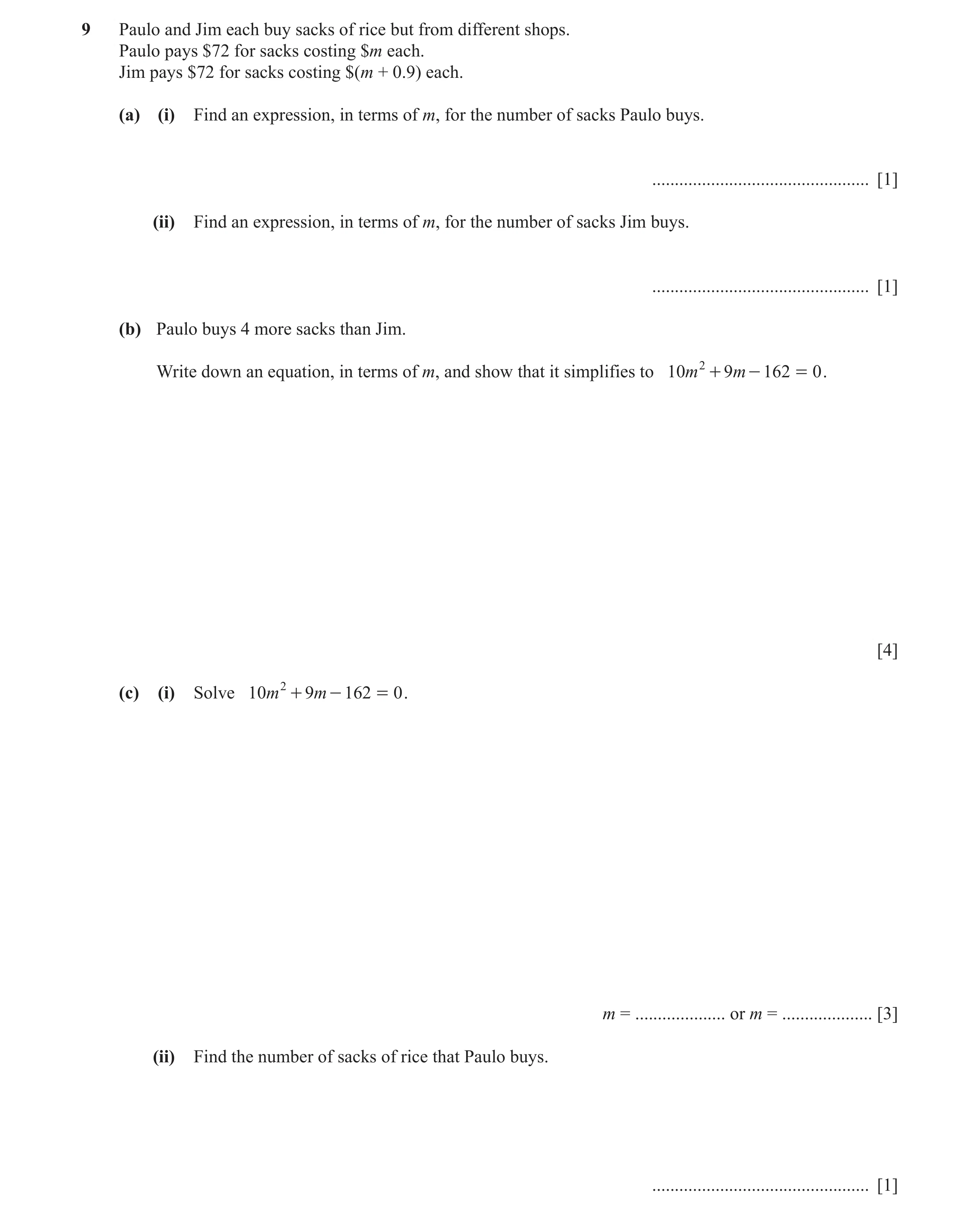
Q12 · Paulo and Jim each buy sacks of rice but from different shops 0580/41 Oct/Nov 2018
9 Paulo and Jim each buy sacks of rice but from different shops. Paulo pays $72 for sacks costing $m each. Jim pays $72 for sacks costing $(m + 0.9) each. (a) (i) Find an expression, in terms of m, for the number of sacks Paulo buys. … [1] (ii) Find an expression, in terms of m, for the number of sacks Jim buys. … [1] (b) Paulo buys 4 more sacks than Jim. Write down an equation, in terms of m, and show that it simplifies to 10m 2 + 9m - 162 = 0 . [4] (c) (i) Solve 10m 2 + 9m - 162 = 0 . m = … or m = … [3] (ii) Find the number of sacks of rice that Paulo buys. … [1]
10 marks
Mark scheme: 9(a)(i) 72 1 m 9(a)(ii) 72 1 m + 9.0 9 (b) 72 72 M1 FT their (a)(i) and (a)(ii) if expressions in = 4 oe m m −m + 9.0 72 (m + 9.0 ) − 72 m = 4 m (m + 9.0 ) oe M1 Dependent on M1 and correct fractions [ 72 m − 72 m ] + 64.8 = 4 m 2 + 3.6 m oe A1 nfww Correct completion to A1 10 m 2 + 9 m − 162 = 0 9(c)(i) 3.6 and −4.5 final answer 3 B2 for (2 m + 9 )(5 m − 18 ) or − 9 ± (9 )2 − 4(10 )(− 162 ) or better 2 × 10 or B1 for (am + b )(cm + d ) where ac = 10 and either bd = −162 or ad + bc = 9 or for (9 )2 − 4 (10 )(− 162 ) or better or − 9 ± q or better 2 (10 ) 9(c)(ii) 20 1
This question in 0580/41 Oct/Nov 2018
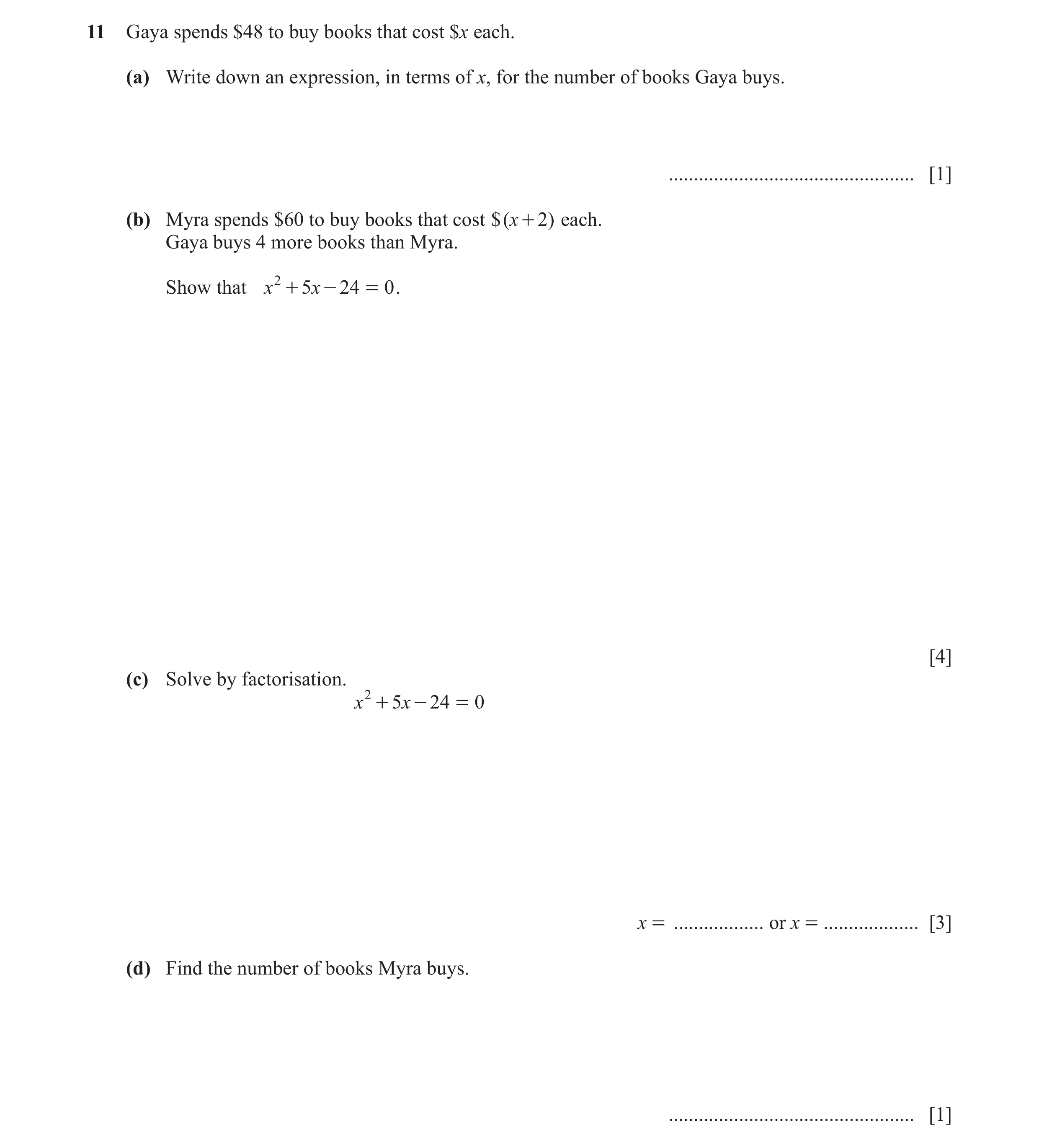
Q13 · Gaya spends $48 to buy books that cost $x each 0580/42 Feb/March 2021
11 Gaya spends $48 to buy books that cost $x each. (a) Write down an expression, in terms of x, for the number of books Gaya buys. … [1] (b) Myra spends $60 to buy books that cost $( x + 2) each. Gaya buys 4 more books than Myra. Show that x 2 + 5x - 24 = 0 . [4] (c) Solve by factorisation. x 2 + 5x - 24 = 0 x = … or x = … [3] (d) Find the number of books Myra buys. … [1]
9 marks
Mark scheme: 11(a) 48 1 Accept 48 ÷ x final answer x 11(b) 60 M1 FT their (a) provided expression in x their ( a ) − = 4 oe x + 2 48 ( x + 2 ) − 60 x = 4 x ( x + 2 ) oe M2 FT their 3 term eqn with algebraic denominators, x and x + 2, for M2 or M1 M1 for common denominator x ( x + 2 ) oe seen or any two terms in a 3 term equation from ± 48 (x + 2) , ± 60x , ± 4x(x + 2) oe seen 48x + 96 – 60x = 4x2 + 8x oe A1 With brackets expanded and no errors or omissions leading to x 2 + 5 x − 24 = 0 seen 11(c) ( x − 3 )( x + 8 ) B2 B1 for x(x + 8) – 3(x + 8) or x(x – 3) + 8(x – 3) or (x + a)(x + b) [= 0] where ab = – 24 or a + b = 5 [a, b integers] 3 and − 8 B1 11(d) 12 1
This question in 0580/42 Feb/March 2021
Q14 · Y = px 2 + t (i) Find the value of y when p = 3, x = 2 and t = -13 0580/43 May/June 2021
2 (a) y = px 2 + t (i) Find the value of y when p = 3, x = 2 and t = -13. y = … [2] (ii) Rearrange the formula to write x in terms of p, t and y. x = … [3] (b) (i) Factorise. 15x 2 - 2x - 8 … [2] (ii) Solve the equation. 15x 2 - 2x - 8 = 0 x = … or x = … [1] (c) Factorise completely. x 3 - 16xy 2 … [3] (d) Simplify. 2x - 1 - 4ax + 2a 2x 2 - x … [4]
15 marks
Mark scheme: 2(a)(i) –1 2 M1 for 3 × 22 – 13 oe 2(a)(ii) y − t 3 M1 for correct rearrangement to isolate x2 [±] oe final answer term p M1 for correct division by p M1 for correct square root Incorrect answer scores a maximum of M2 If 0 scored, SC1 for a correctly rearranged formula with p = 3 and t = – 13 substituted 2(b)(i) (5 x − 4)(3 x + 2) oe final answer 2 B1 for ( ax + b )( cx + d ) where either ac = 15 and bd = –8 or ad + bc = –2 or 5x(3x + 2) – 4(3x + 2) or 3x(5x – 4) + 2(5x – 4) or correct factors seen and spoiled 2(b)(ii) 4 2 1 FT a factorised quadratic oe and − oe 5 3 2(c) x ( x + 4 y )( x − 4 y ) final answer 3 B2 for ( x 2 + 4 xy )( x − 4 y ) or ( x + 4 y )( x 2 − 4 xy ) or answer in the form x(a + b)(a – b) or correct answer seen and spoiled or B1 for x ( x 2 − 16 y 2 ) oe or ( x + 4 y )( x − 4 y ) 2(d) 1 −a2 4 B2 for (2x – 1)(1 – 2a) oe oe final answer or B1 for 2x – 1 – 2a(2x – 1) x or 2x(1 – 2a) – (1 – 2a) B1 for x(2x – 1)
This question in 0580/43 May/June 2021
Q15 · 22 (a) s = at 2 Find the value of s when a = 9.8 and t = 20 0580/41 Oct/Nov 2023
1 22 (a) s = at 2 Find the value of s when a = 9.8 and t = 20 . s = … [2] (b) Solve. 5 ( 4y - 3) = 15 y = … [3] (c) Expand and simplify. 3 ( 5x - 8) - 2 ( 3x - 7) … [2] (d) Rearrange A = 2 b 2 - 3c 3 to make c the subject. c = … [3] (e) Factorise completely. 6pq - 4q - 3p + 2 … [2]
12 marks
Mark scheme: 2(a) 1960 2 1 M1 for 9.8 202 oe 2 2(b) 3 3 M1 for a first correct step, e.g. 1.5 or 1½ or 20y – 15 = 15 or 4y – 3 = 3 2 M1FTdep for a second correct step, e.g. 20y = 30 or 4y = 6 15 15 or y – = oe 20 20 2(c) 9x – 10 final answer 2 B1 for kx – 10 or 9x + c or M1 for 15x – 24 or –6x + 14 or B1 for correct answer seen and then spoiled 2(d) 2 3 2b − A 3 oe final answer 3 M1 for isolating 3c3, 3c3 = 2b2 – A oe or for A 2b 2 3 A 2b 2 3 = − c or = + c 3 3 −3 −3 M1FT for isolating c3, follow through their first step dep on a 3-term expression with a kc3 term M1FT taking the cube root to the final answer, follow through their previous step Maximum of two marks if answer incorrect 2(e) (2q – 1)(3p – 2) or (1 – 2q)(2 – 2 M1 for 2q(3p – 2) – [1](3p – 2) 3p) final answer or 3p(2q – 1) – 2(2q – 1) or for correct answer seen then spoiled
This question in 0580/41 Oct/Nov 2023
Q16 · 23 (a) C = xy 4 (i) Find C when x = 5 and y = 8 0580/41 May/June 2024
1 23 (a) C = xy 4 (i) Find C when x = 5 and y = 8 . C = … [2] (ii) Find the positive value of y when C = 15 and x = 2.4 . y = … [2] (b) Write as a single fraction in its simplest form. 4 3 - x - 1 2x + 5 … [3] (c) Expand and simplify. 2 2x + 3 4 - x ` `j j … [3] (d) Simplify. 8 - 43 y 16 f 16x p … [3]
13 marks
Mark scheme: 3(a)(i) 80 2 1 2 M1 for 5 8 4 3(a)(ii) 5 2 2 15 4 M1 for [ y ] oe 2.4 3(b) 5 x 23 5 x 23 3 or final ( x 1)(2 x 5) 2 x 2 3 x 5 B1 for 4(2x + 5) –3(x – 1) oe isw answer B1 for common denominator = (x – 1) (2x + 5) oe isw 3(c) 2x3 –13x2 + 8x + 48 final answer 3 B2 for correct expansion of 3 brackets but unsimplified or for simplified four-term expression of correct form with 3 terms correct or B1 for correct expansion of two brackets with at least 3 terms out of 4 correct 3(d) 8x12 12 6 3 B2 for two elements correct in final or 8 x y final answer 6 answer y or for correct answer seen then spoiled or for correct expression where all parts of the power have been dealt with 3 1 2 x 4 or for or 2 y or B1 for 8 or y6 or y 6 or x12 correct in final answer 3 3 4 y 2 16 x16 or for 8 or 4 y 2 x
This question in 0580/41 May/June 2024
Q17 · F ( )x = 4 x + 1 g ( )x = 6 - 2 x h ( )x = 3 x - 2 (a) Find (i) f ( 3) … [1] (ii) gf ( 3) 0580/41 May/June 2024
9 f ( )x = 4 x + 1 g ( )x = 6 - 2 x h ( )x = 3 x - 2 (a) Find (i) f ( 3) … [1] (ii) gf ( 3) . … [1] (b) Find g -1 ( )x . g -1 ( )x = … [2] (c) Find x when f ( x) = g ( 2x - 7) . x = … [4] (d) Find the value of hh(2). … [2] (e) Find x when h -1 ( )x = 10 . x = … [2]
12 marks
Mark scheme: 9(a)(i) 13 1 9(a)(ii) –20 1 FT 6 – 2(their (a)(i)) 9(b) 6 x 2 M1 for correct first step oe final answer 2 y x = 6 – 2y, y – 6 = – 2x, 3 x 2 9(c) 2.375 oe 4 B1 for 6 – 2(2x – 7) oe B1 for 4x + 1 = 6 – 4x + 14 M1 for 8x = 19 FT their linear equation rearranged correctly from ax b cx d to form ex = f 9(d) 1 2 M1 for h(1) or 3^(3x-2 – 2) or 3^(32-2 – 2) or 0.333… or better 3 9(e) 6561 2 M1 for 310–2 or x = h(10)
This question in 0580/41 May/June 2024
![Question 2: (a) y is 5 less than the square of the sum of p and q. Examiner's Use Write down a formula for y in terms of p and q. Answer(a) y = [2] (b)…](https://img.pastlit.com/crops/106955dd-27f6-478f-b6c2-cea5efb1aeba/q8.webp)
![Question 3: (a) f(x) = 2x – 1 g(x) = x2 For Examiner's Work out Use (i) f(2), Answer(a)(i) [1] (ii) g( – 2), Answer(a)(ii) [1] (iii) ff(x) in its simpl…](https://img.pastlit.com/crops/49a0d639-a4c8-46ff-a7d0-569d05bcf0a4/q8.webp) 5 / 23
5 / 23![Question 4: f(x) = x2 + x O1 g(x) = 1 O 2x h(x) = 3x Examiner's Use (a) Find the value of hg(–2). Answer(a) [2] (b) Find g –1(x). Answer(b) g O1(x) = […](https://img.pastlit.com/crops/f07ad104-2a6b-49d0-ad7d-955a4a8e93a4/q8.webp) 6 / 23
6 / 23![Question 5: f(x) = 3x + 5 g(x) = 7 O 2x h(x) = x2 O 8 For Examiner's (a) Find Use (i) f(3), Answer(a)(i) [1] (ii) g(x O 3) in terms of x in its simples…](https://img.pastlit.com/crops/ccb08dcf-464f-4e6c-a054-b7aca52ba7fb/q9.webp) 7 / 23
7 / 23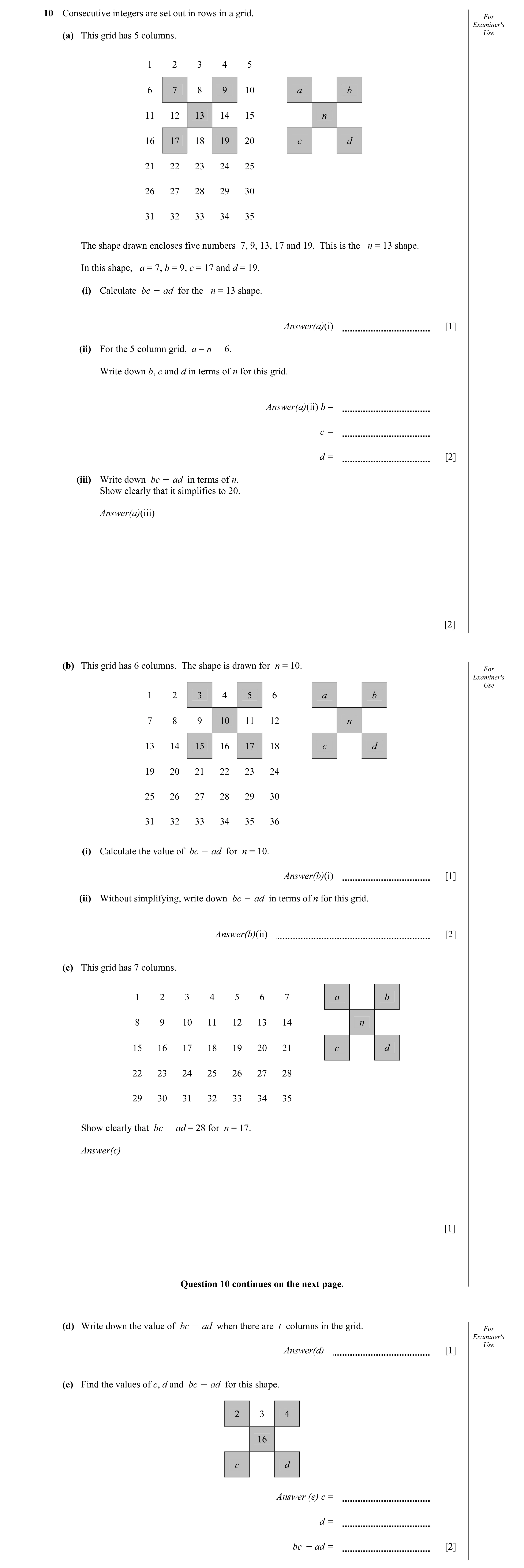
![Question 7: f(x) = 4 – 3x g(x) = 3–x (a) Find f(2x) in terms of x. Answer(a) f(2x) = ................................................ [1] (b) Find ff(x…](https://img.pastlit.com/crops/e826fbe6-5bd5-4e6b-a78f-e107d55b60e9/q9.webp) 11 / 23
11 / 23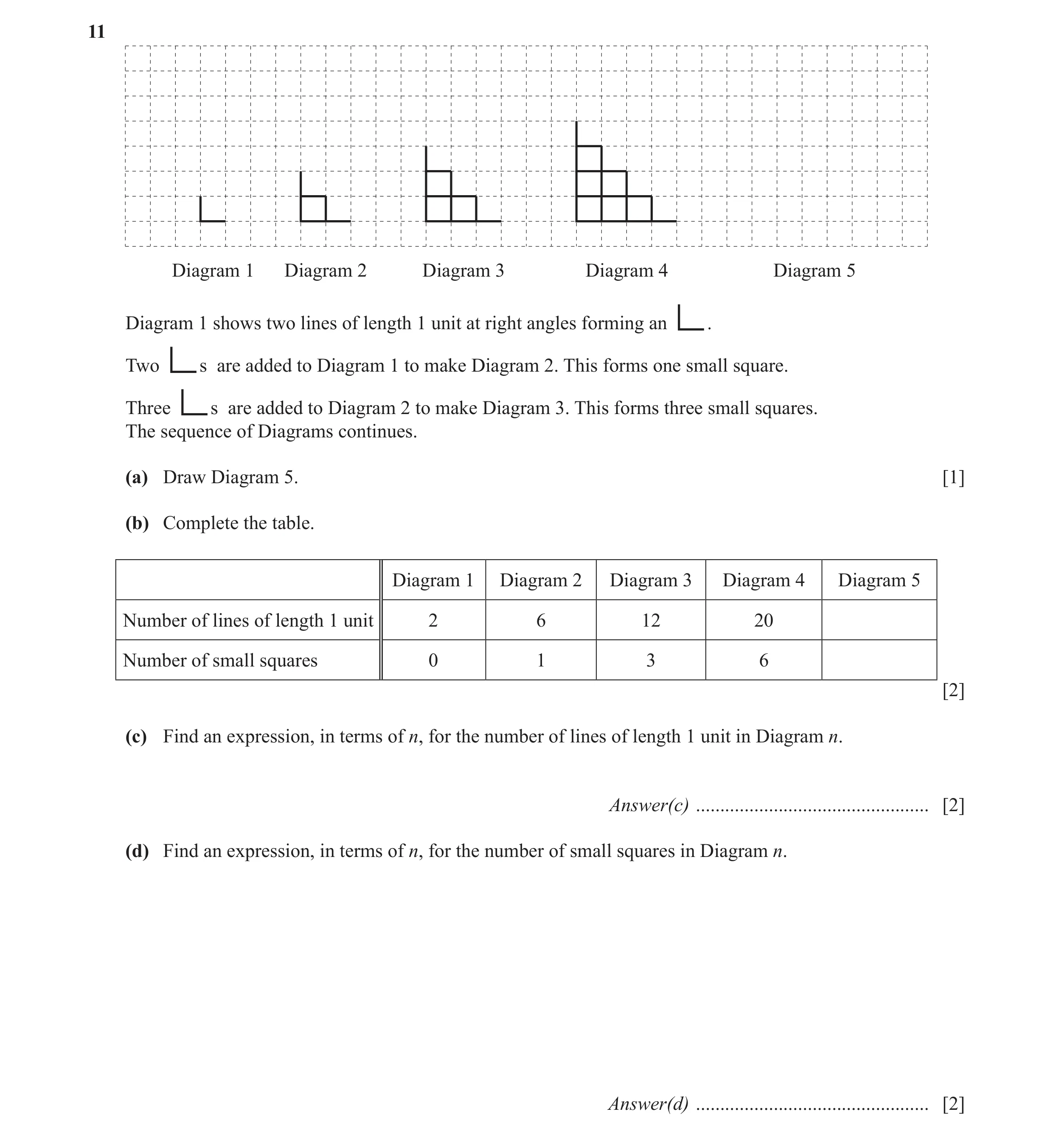 12 / 23
![Question 9: f(x) = 2x + 5 g(x) = 2x h(x) = 7 - 3x (a) Find (i) f(3), Answer(a)(i) ............................................... [1] (ii) gg(3). Answe…](https://img.pastlit.com/crops/a6f74002-bcdf-42c4-b7b4-e8151e9ebab5/q9.webp) 13 / 23
13 / 23![Question 10: f(x) = 2 − 3x g(x) = 7x + 3 (a) Find (i) f(−3), ........................................ [1] (ii) g(2x). ..................................…](https://img.pastlit.com/crops/fcf7a9c2-0fd7-45d7-bc04-a6609aa885ff/q11.webp) 14 / 23
14 / 23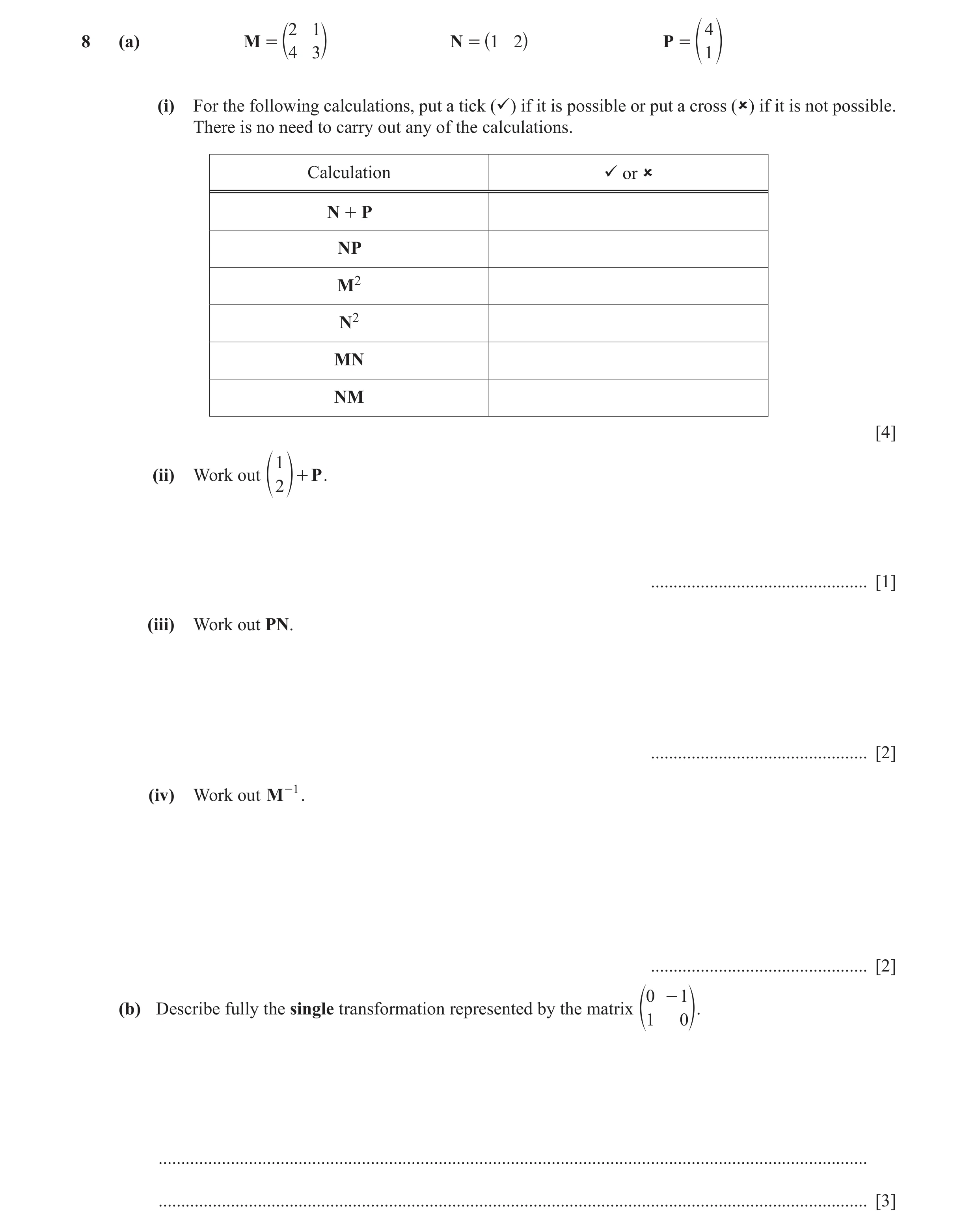 15 / 23
 16 / 23
 17 / 23
![Question 14: (a) y = px 2 + t (i) Find the value of y when p = 3, x = 2 and t = -13. y = ................................................. [2] (ii) Rear…](https://img.pastlit.com/crops/3ef72f55-5a57-44e6-9d01-91338575f77e/q2.webp)
![Question 15: 22 (a) s = at 2 Find the value of s when a = 9.8 and t = 20 . s = ................................................ [2] (b) Solve. 5 ( 4y - …](https://img.pastlit.com/crops/76af3b34-d759-43c3-b2e6-f4d4d8738582/q2.webp) 20 / 23
20 / 23![Question 16: 23 (a) C = xy 4 (i) Find C when x = 5 and y = 8 . C = ................................................ [2] (ii) Find the positive value of …](https://img.pastlit.com/crops/e5ff309b-ed41-4d46-8528-b18db26bf32a/q3.webp)
![Question 17: f ( )x = 4 x + 1 g ( )x = 6 - 2 x h ( )x = 3 x - 2 (a) Find (i) f ( 3) ................................................. [1] (ii) gf ( 3) .…](https://img.pastlit.com/crops/e5ff309b-ed41-4d46-8528-b18db26bf32a/q9.webp) 23 / 23
23 / 23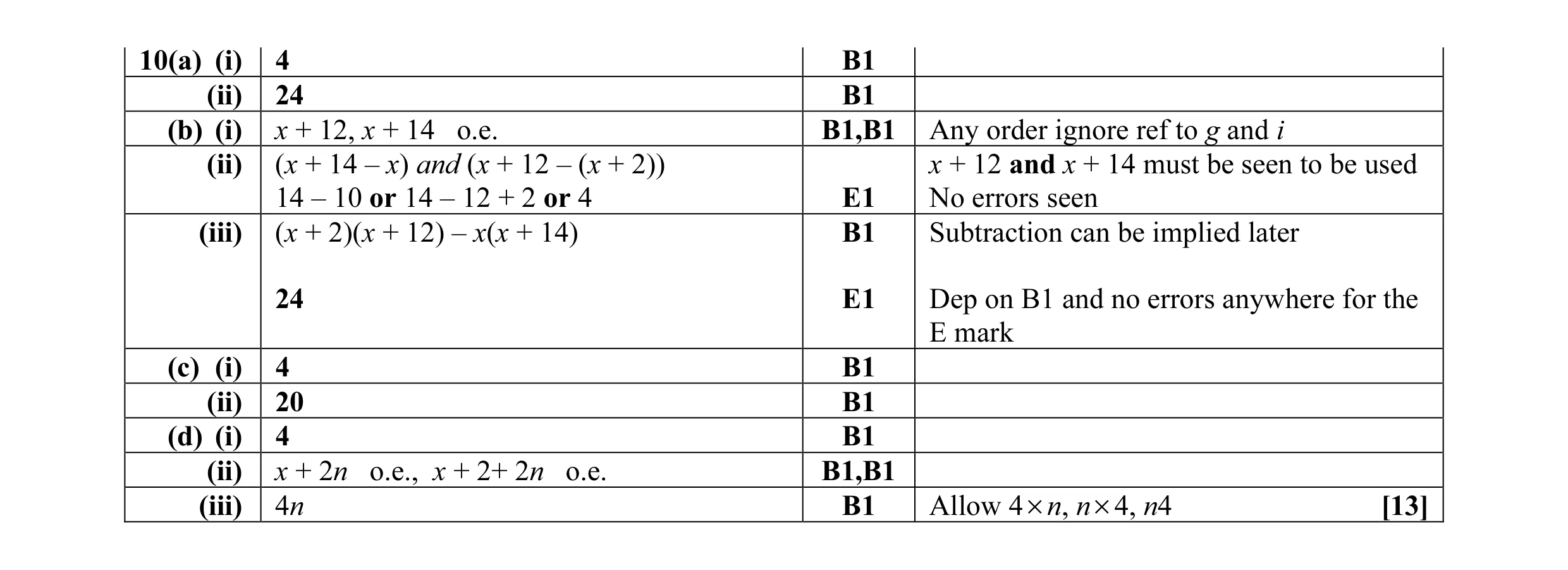 13
13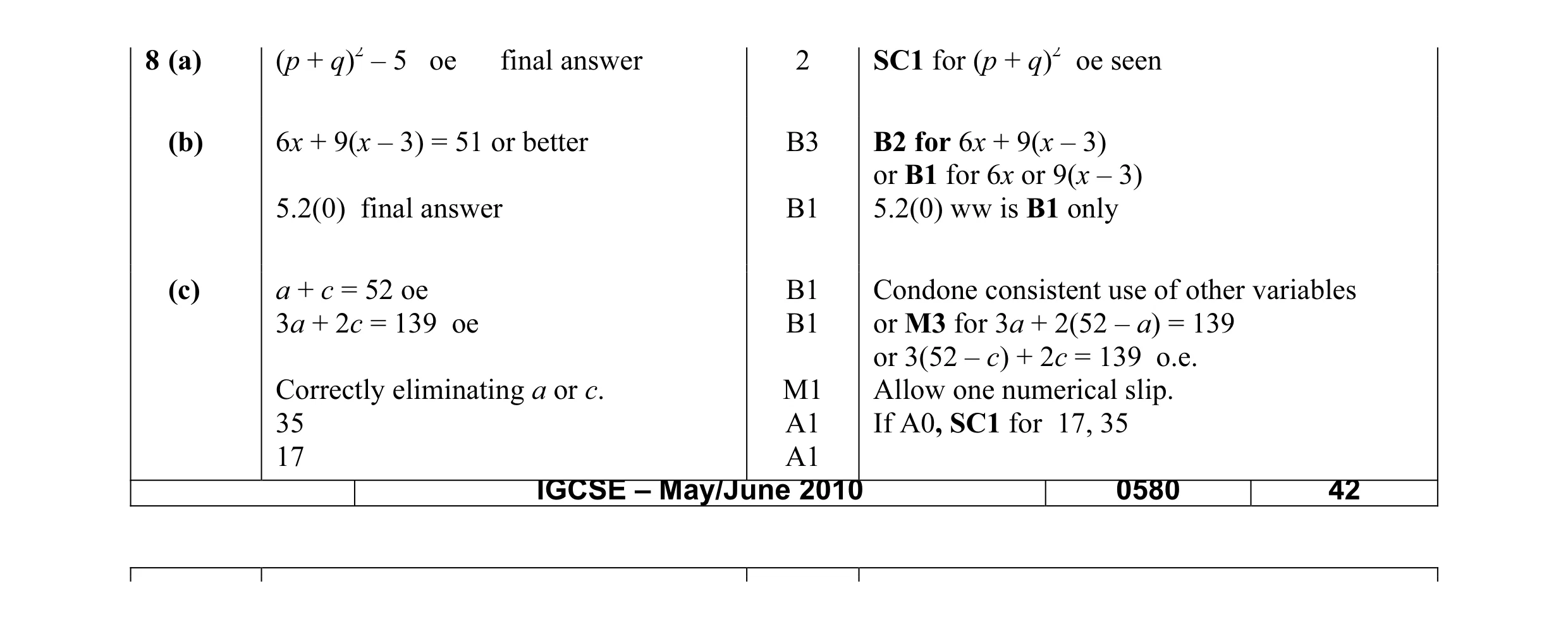 11
11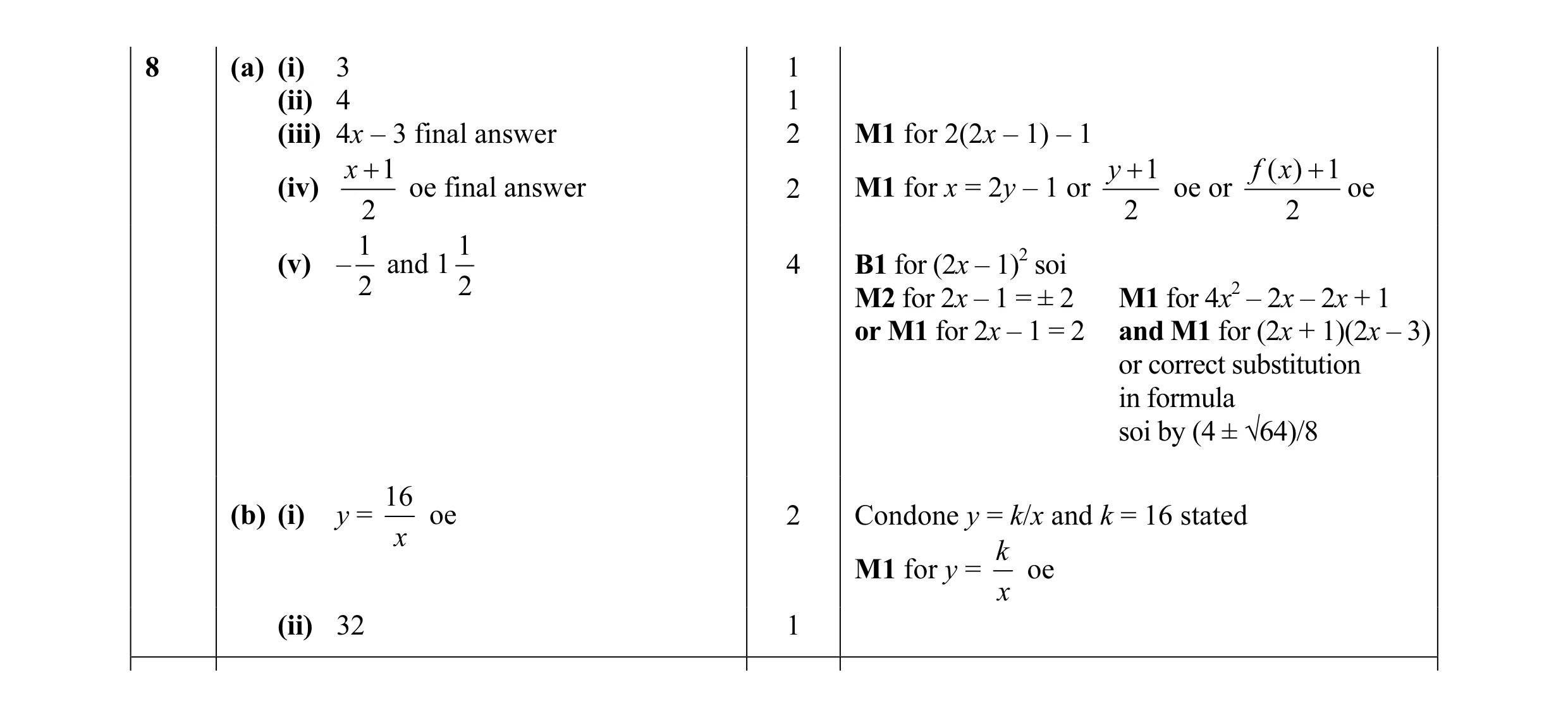 13
13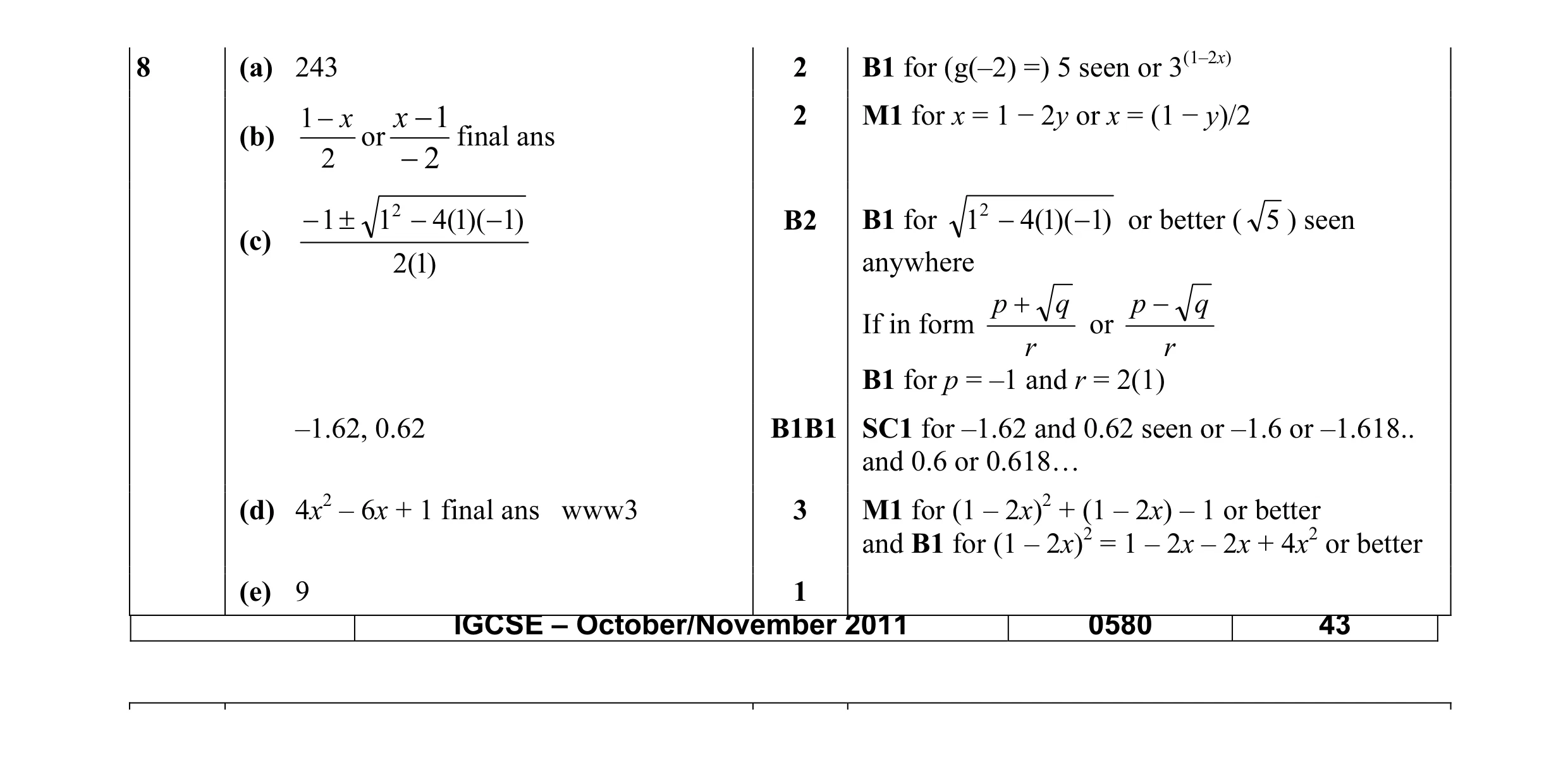 12
12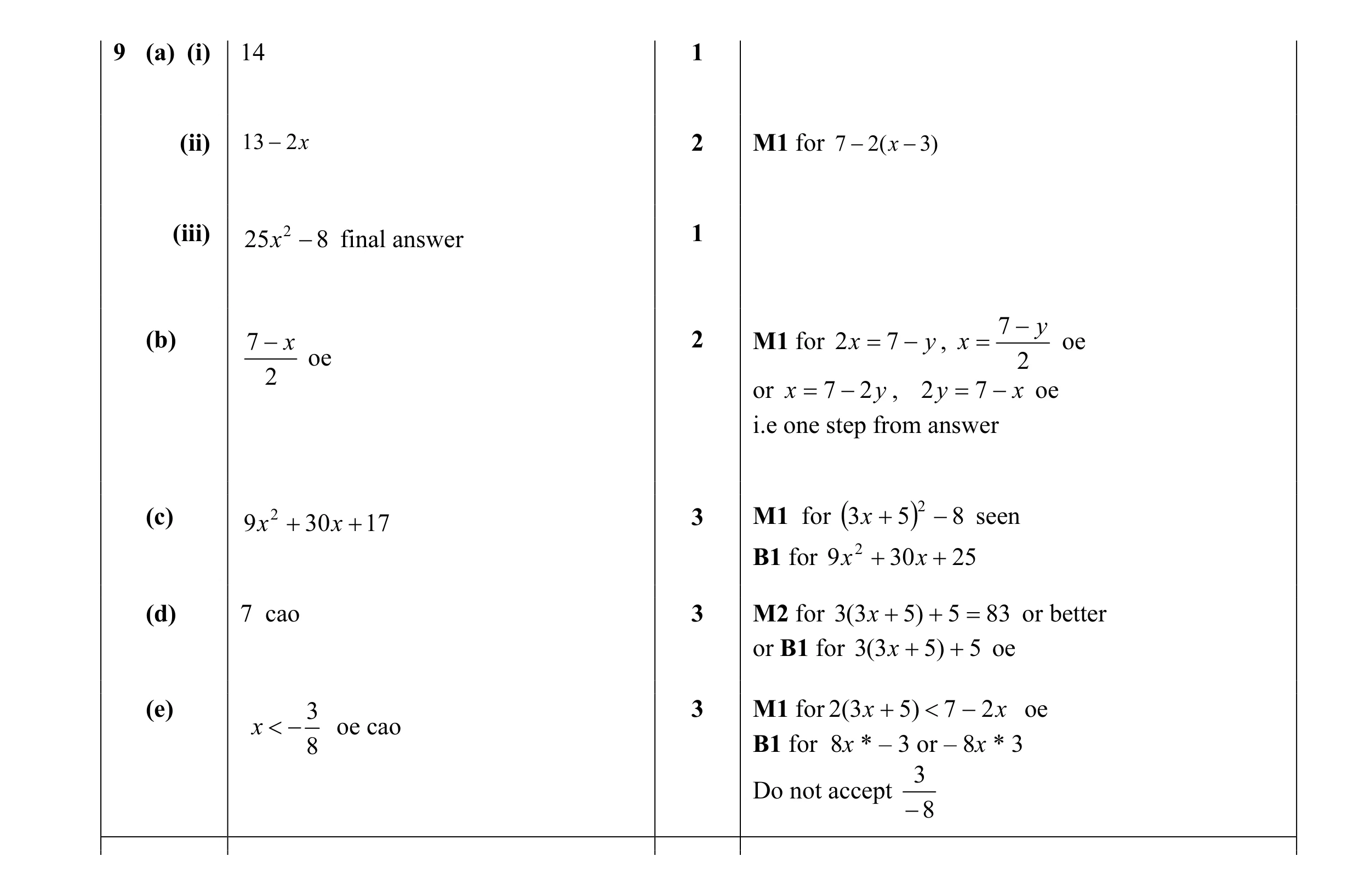 15
15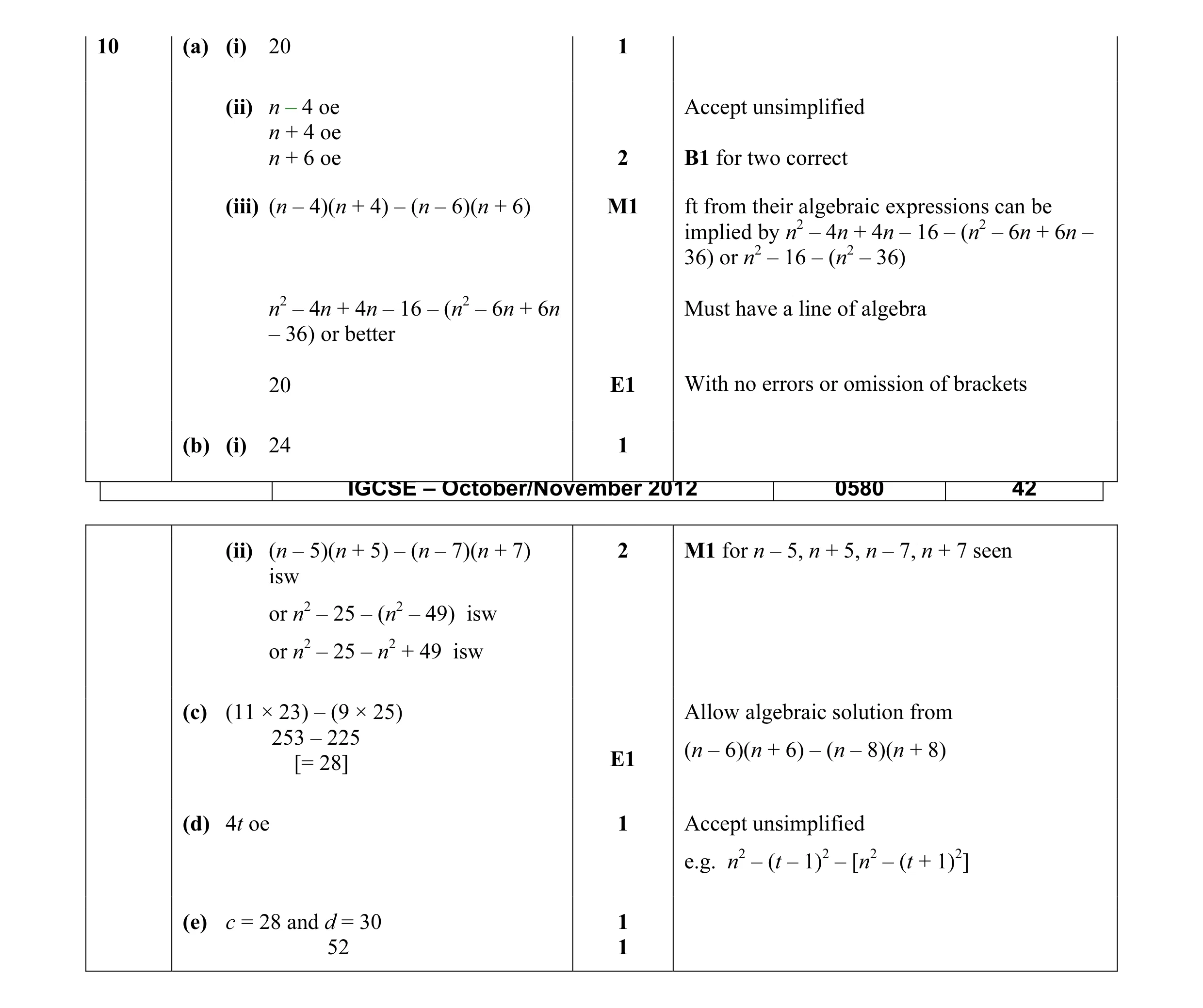 12
12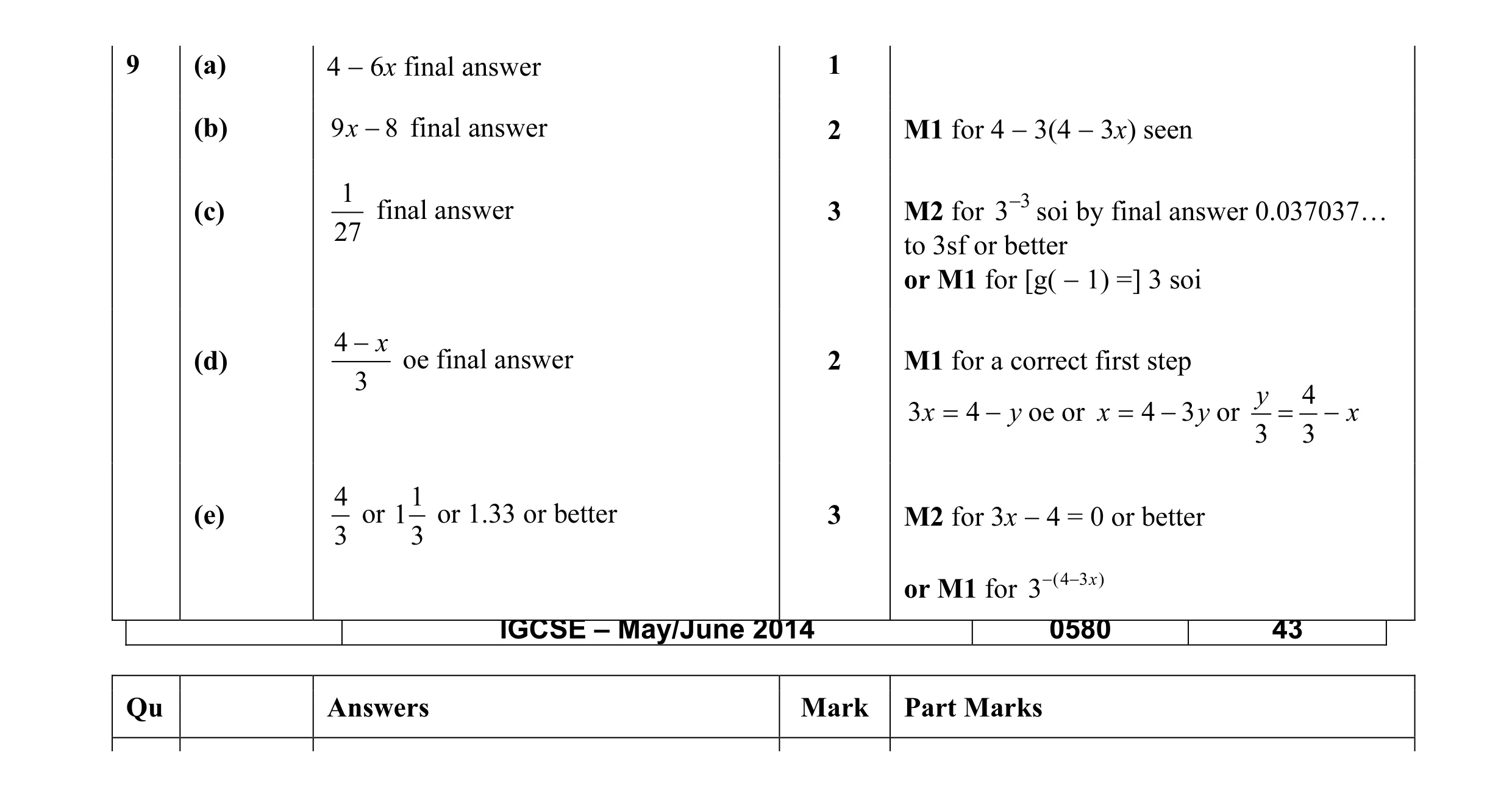 11
11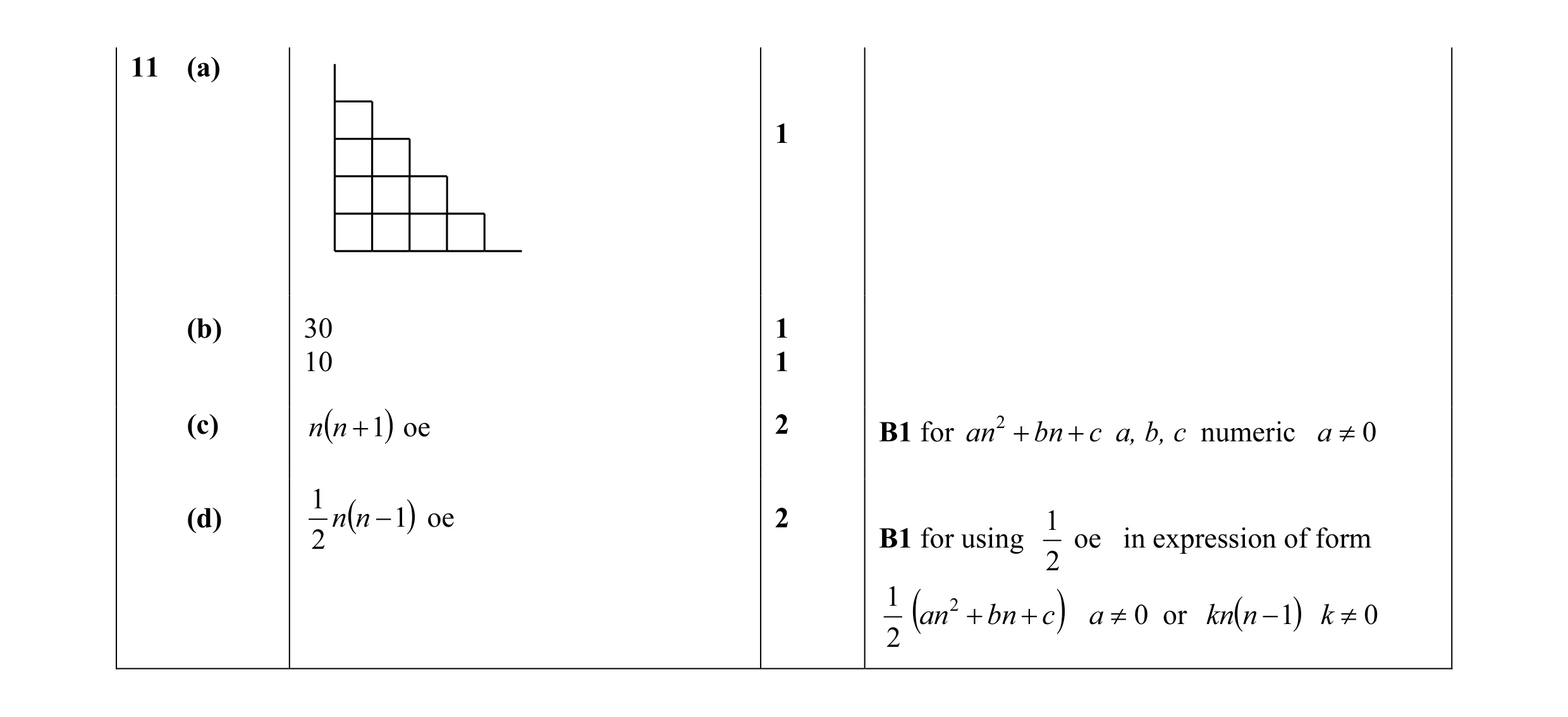 7
7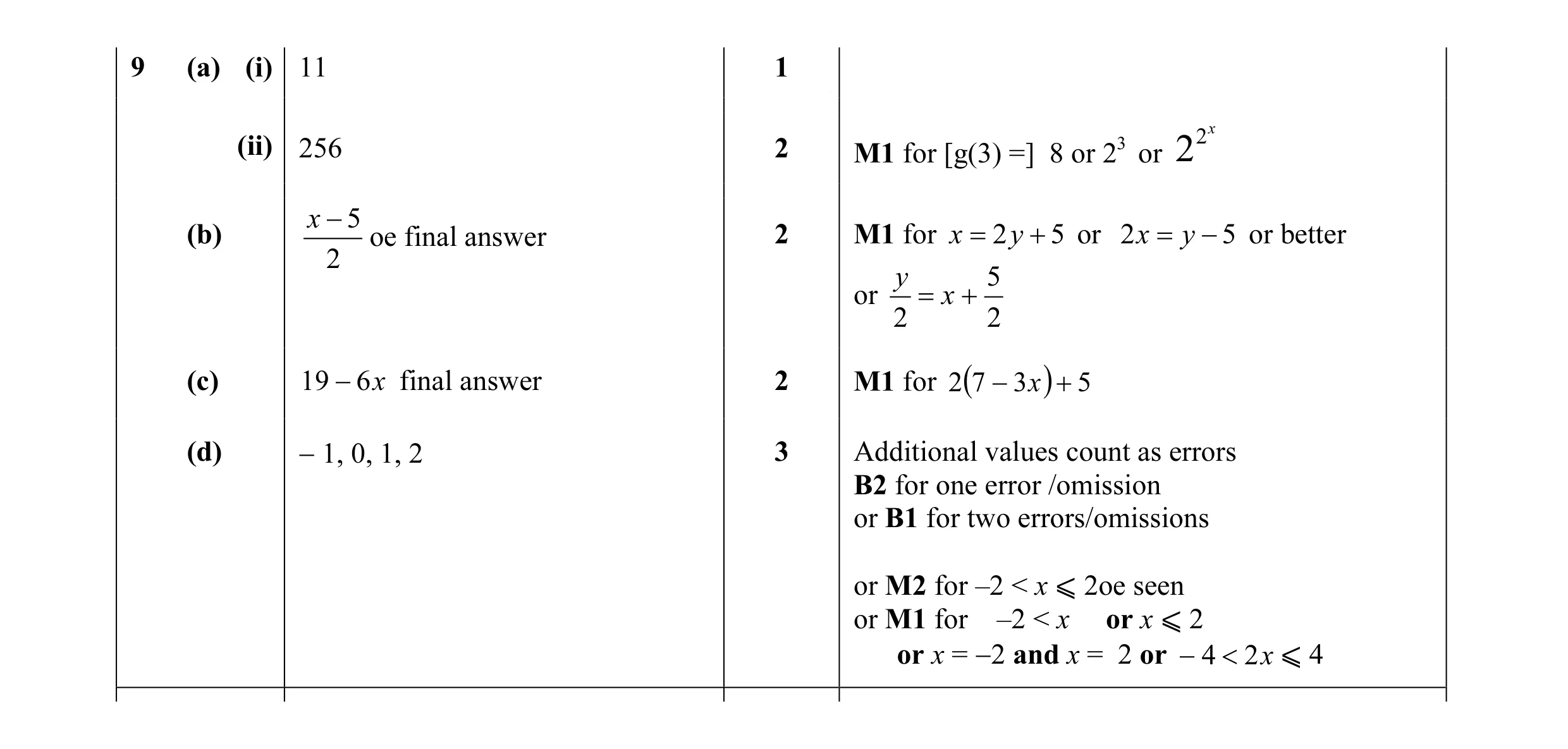 10
10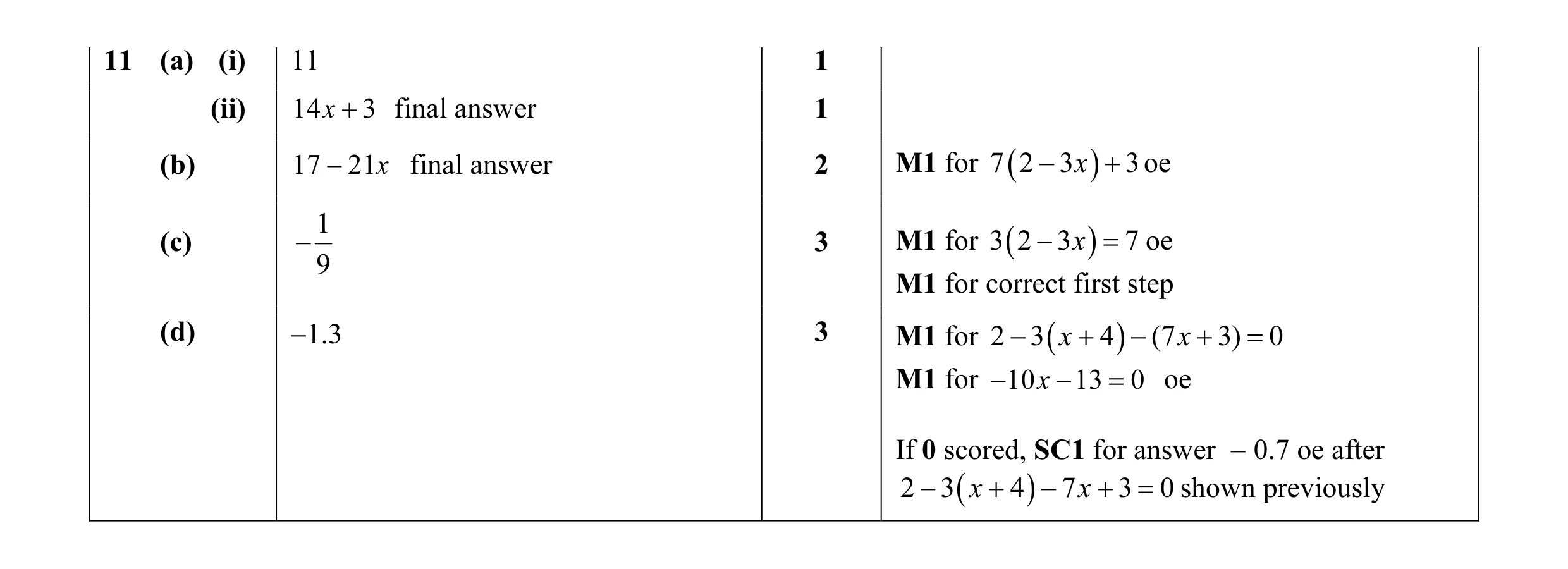 10
10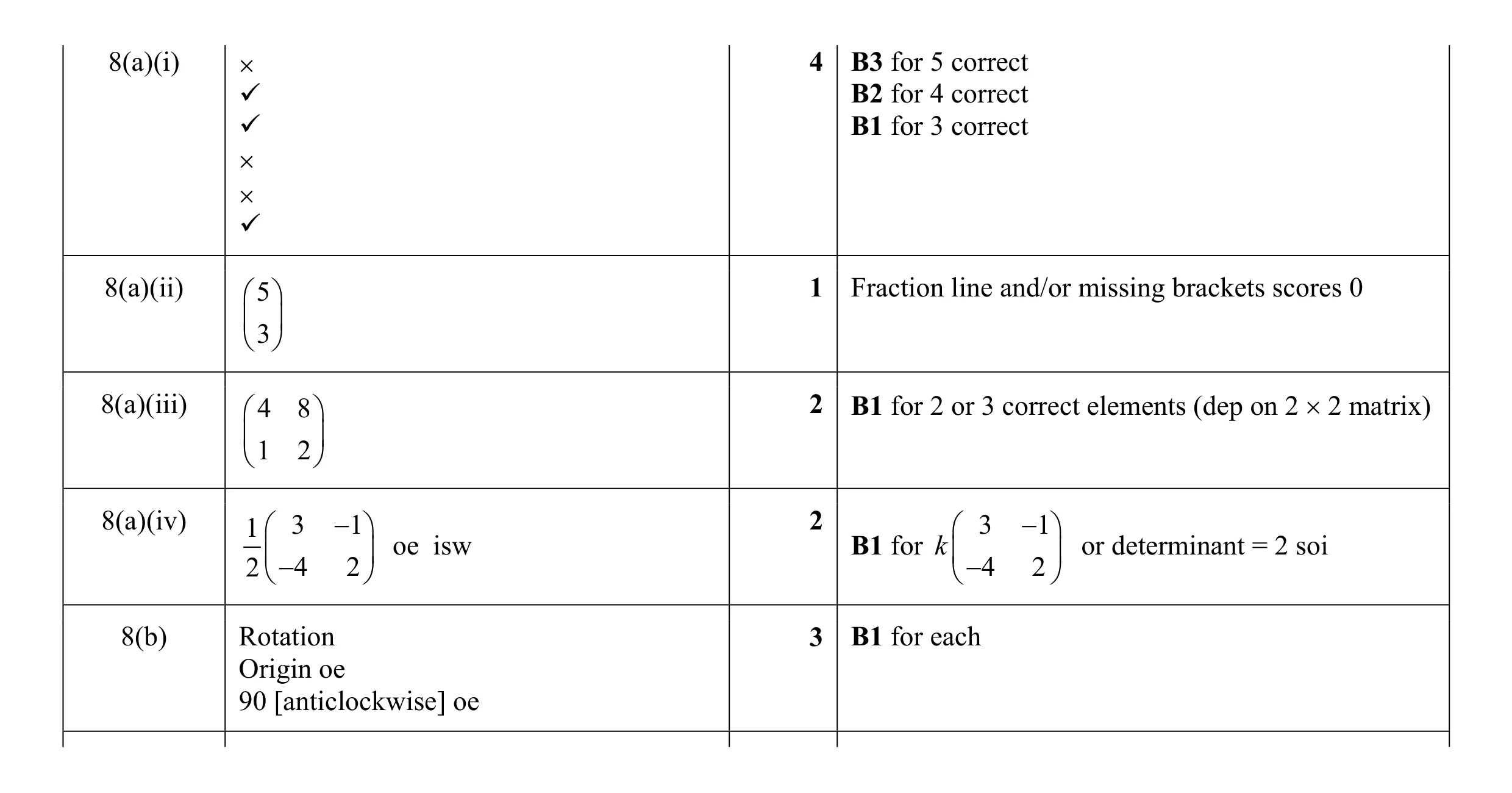 12
12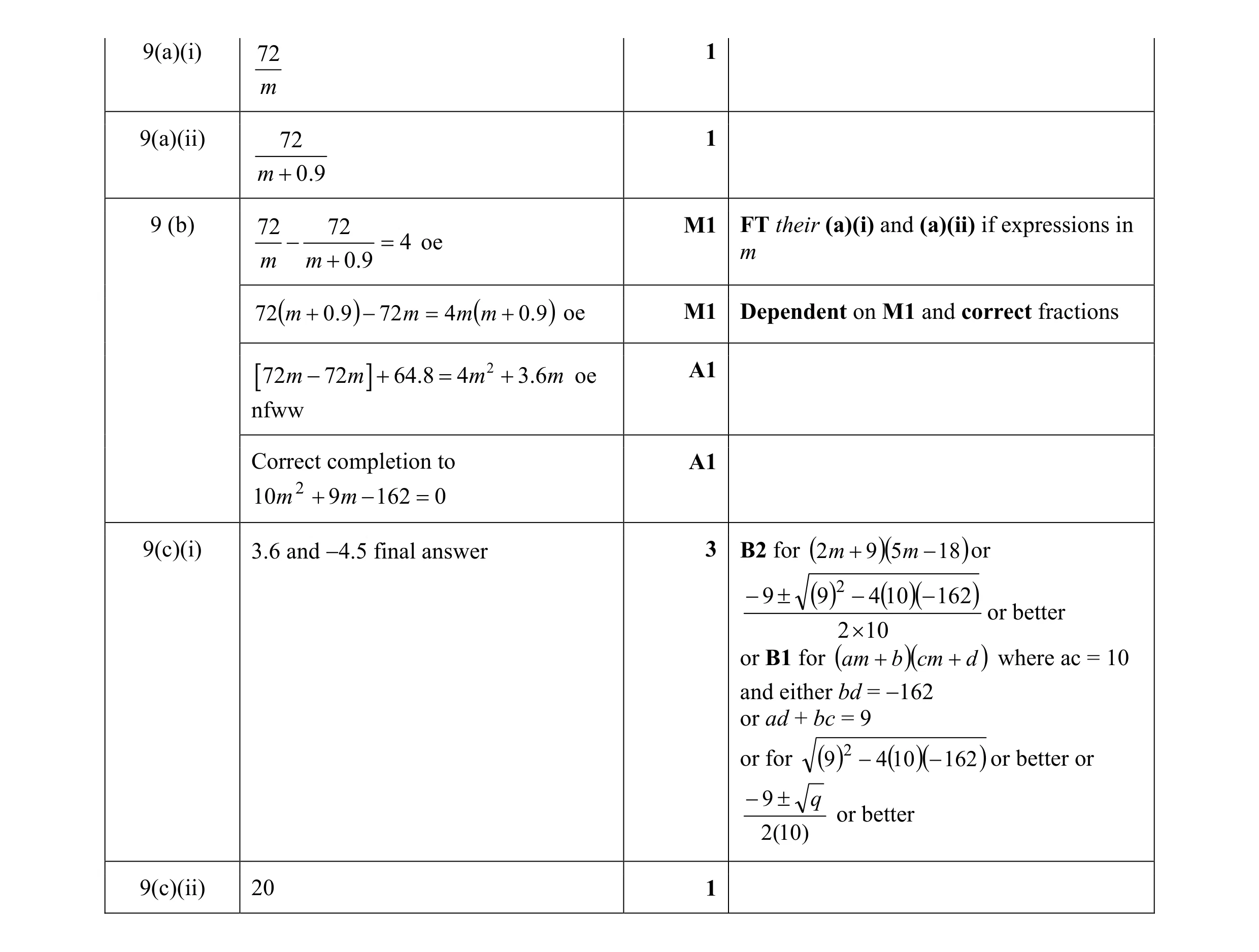 10
10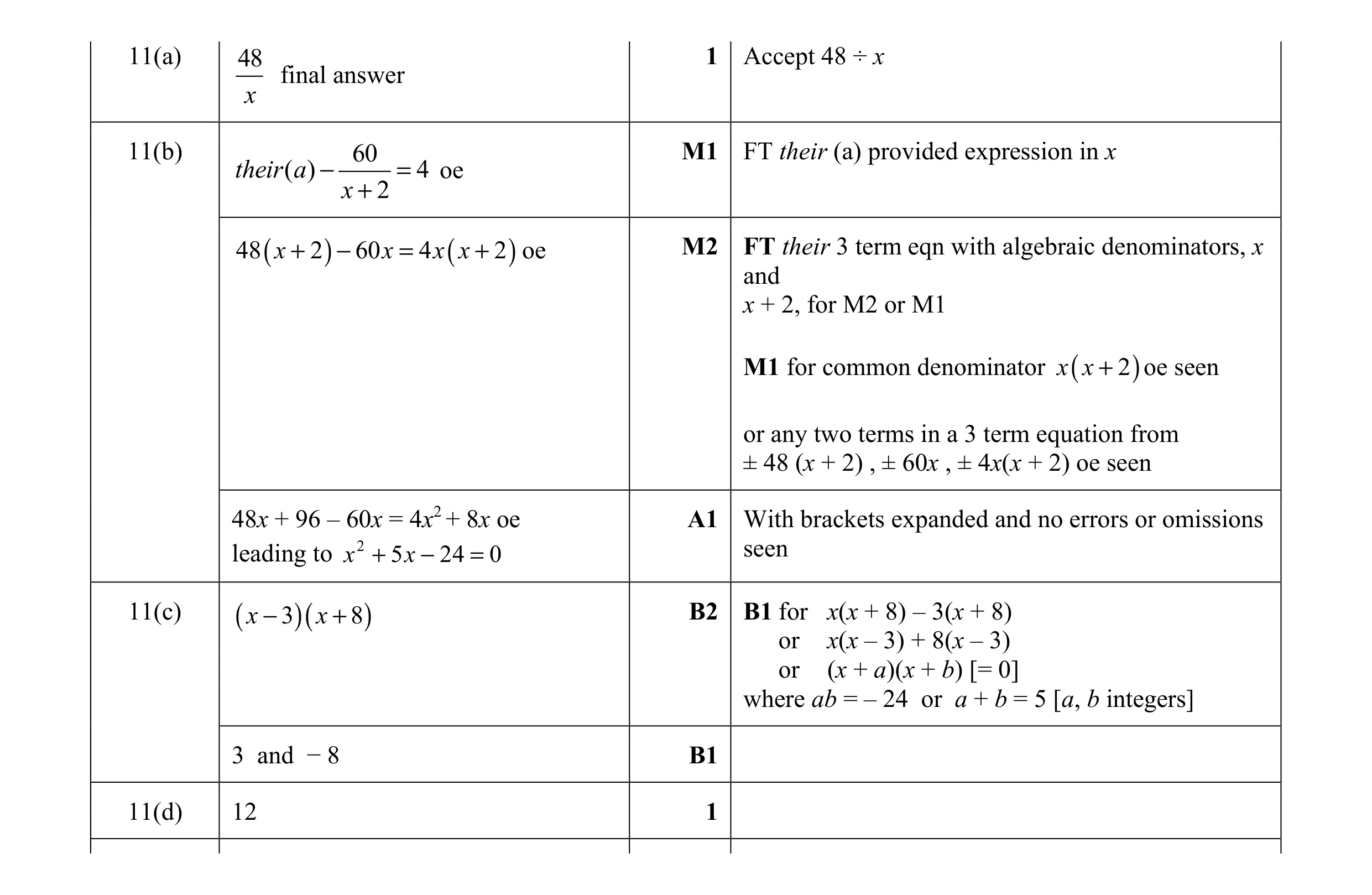 9
9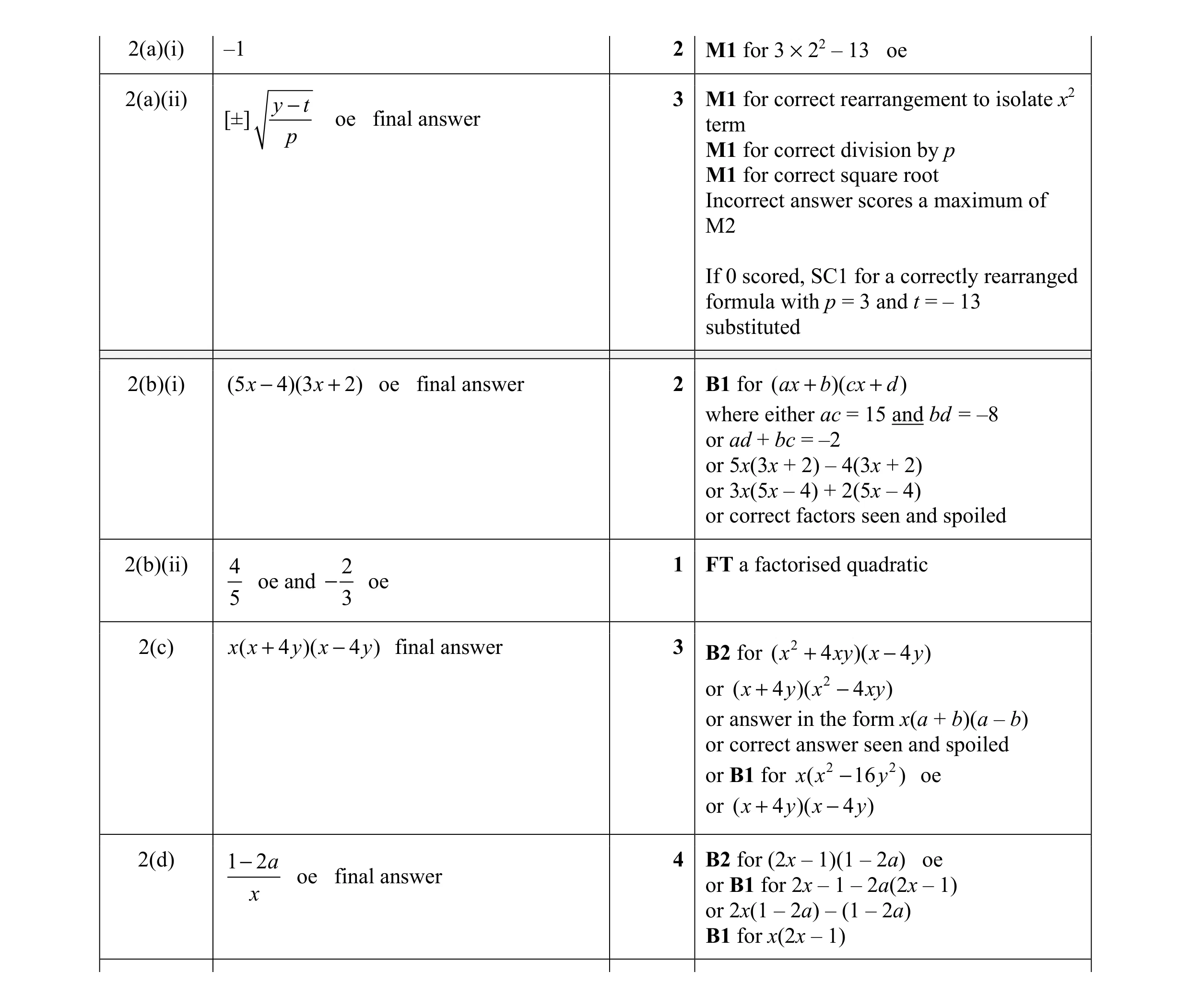 15
15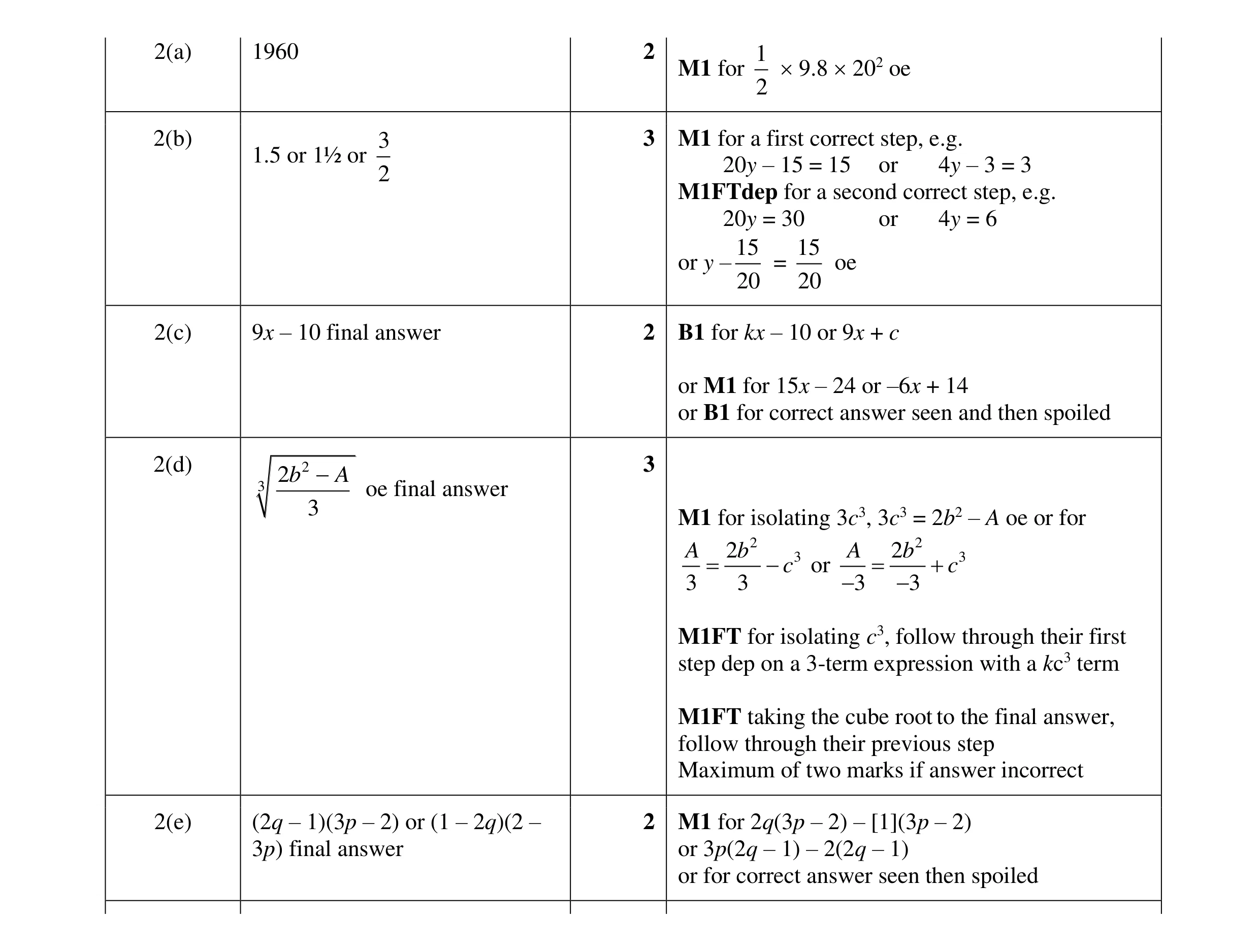 12
12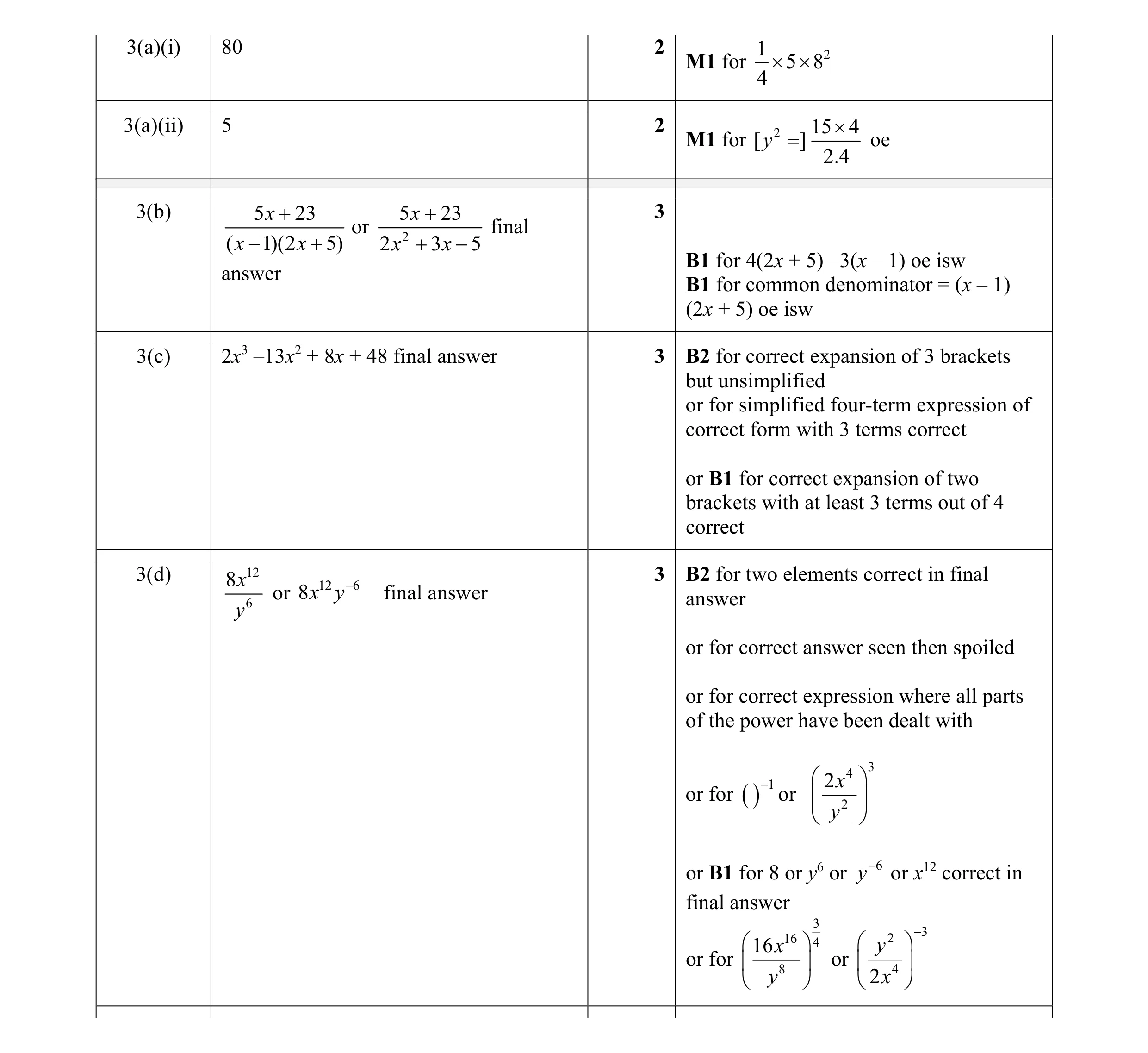 13
13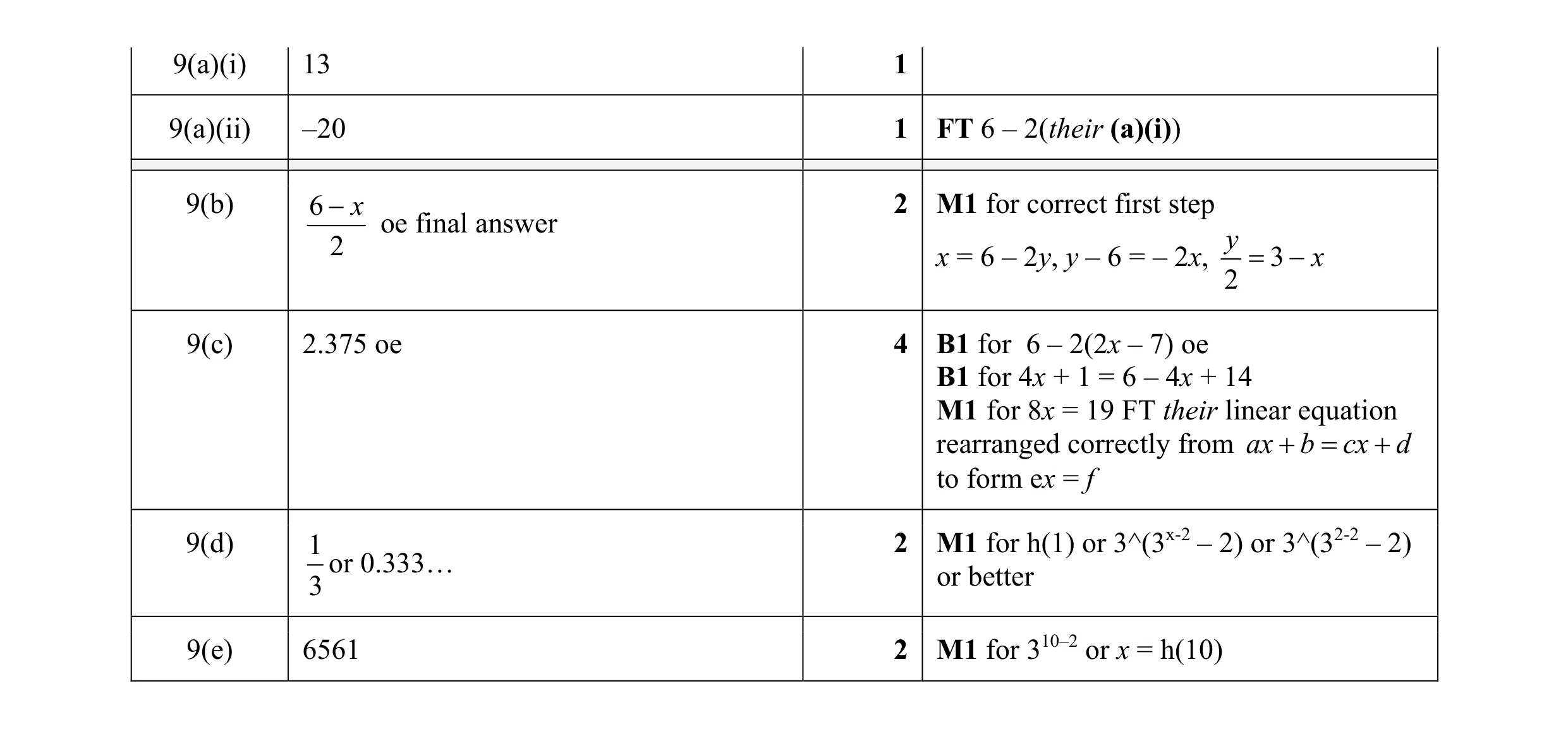 12
12