Cambridge IGCSE Mathematics 0580 — 2012 May/June Paper 4 · Variant 1
0580/41/M/J/12 · 5 questions · 130 marks · ≈146 min
The question paper and its mark scheme, free to read here and free to download. This is Cambridge’s own paper, exactly as it was sat.
Question paper16 pages
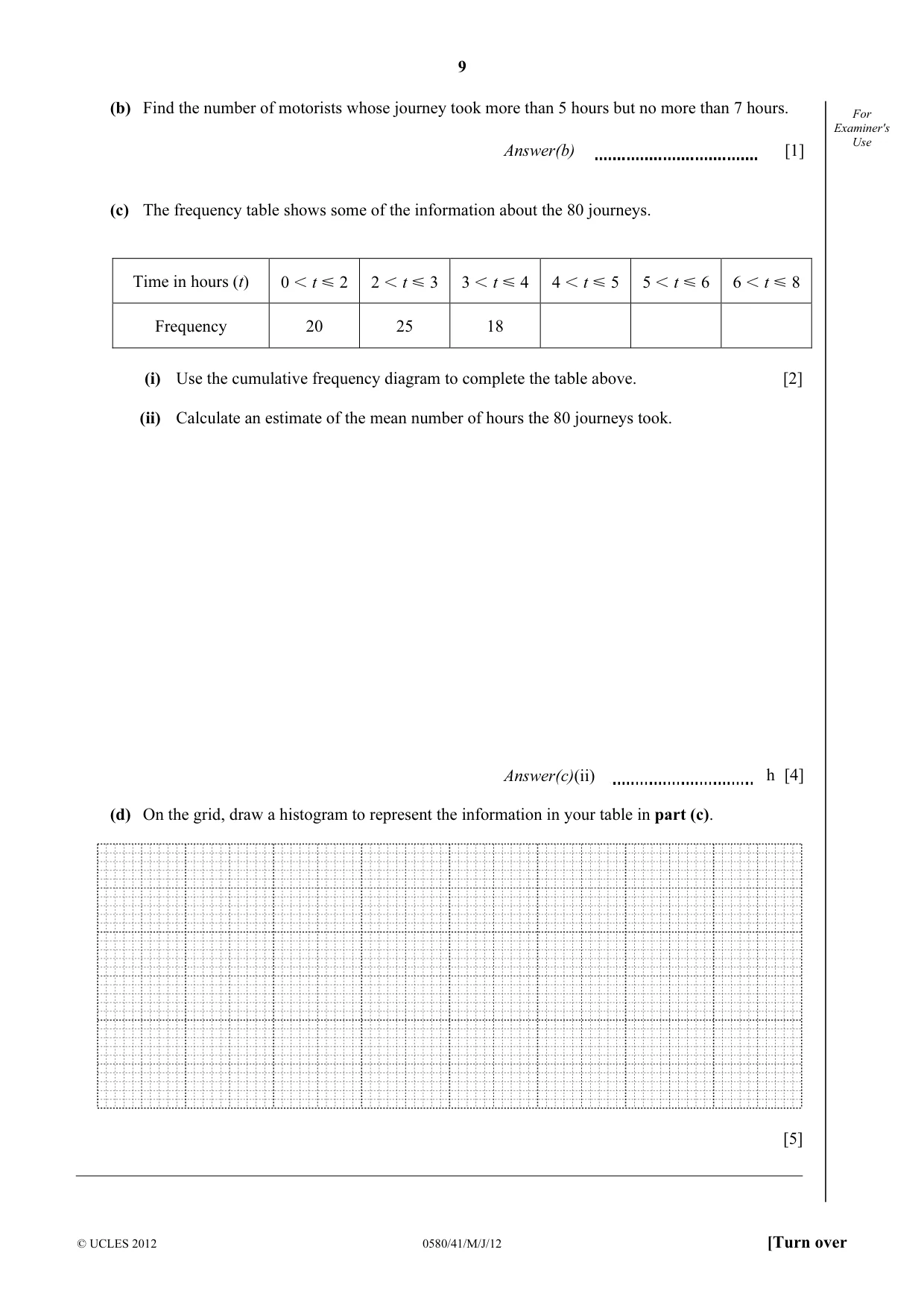
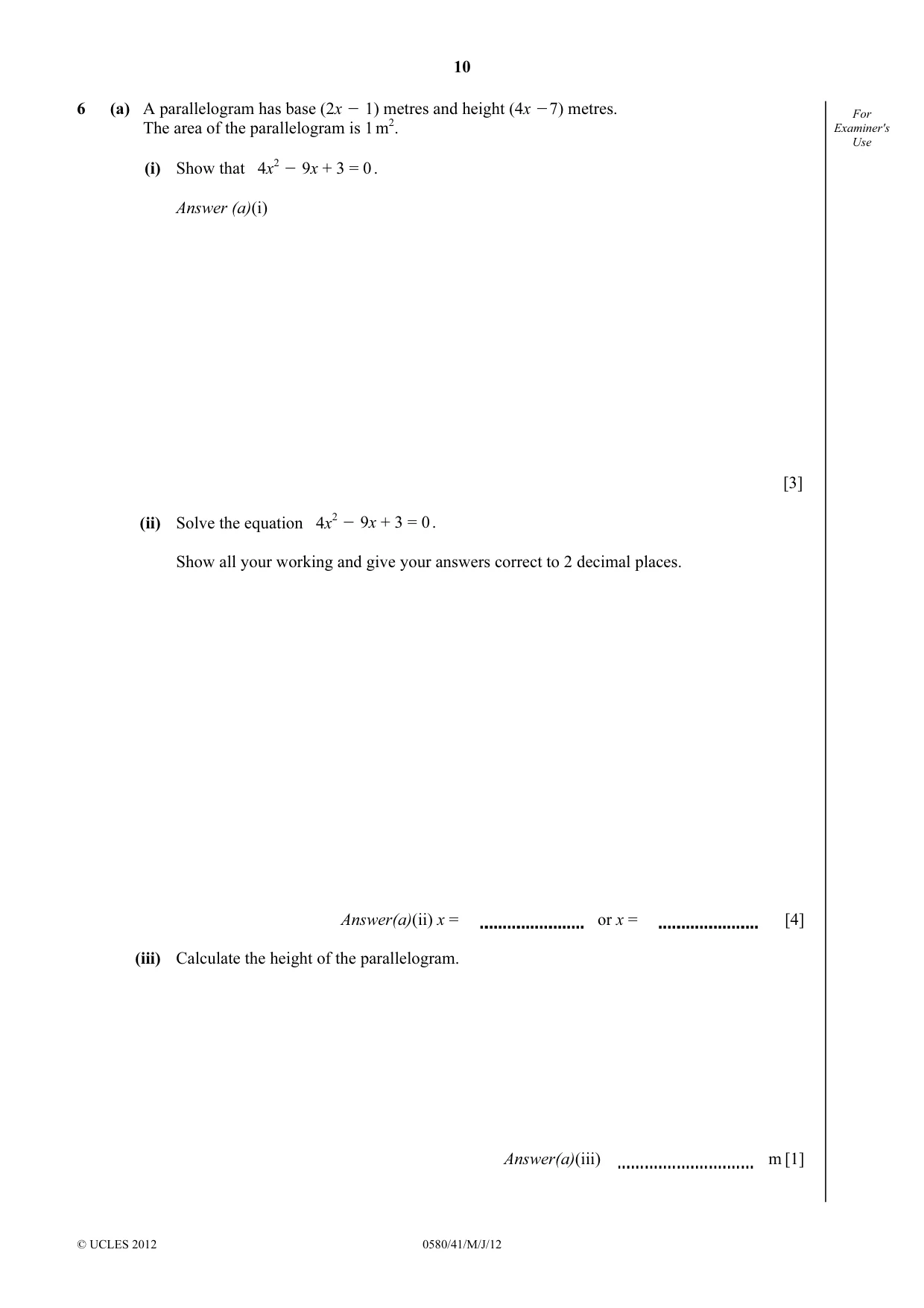
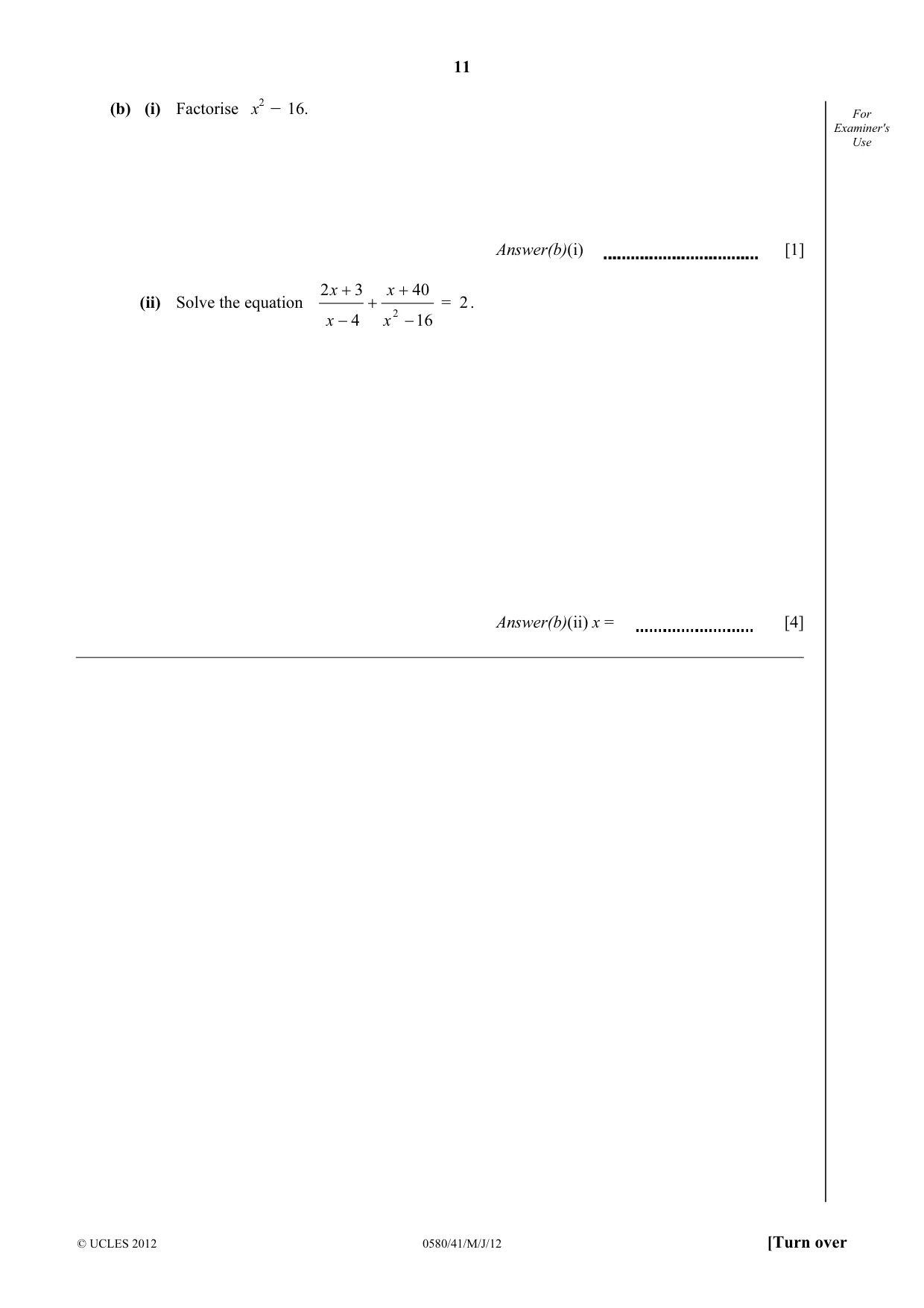
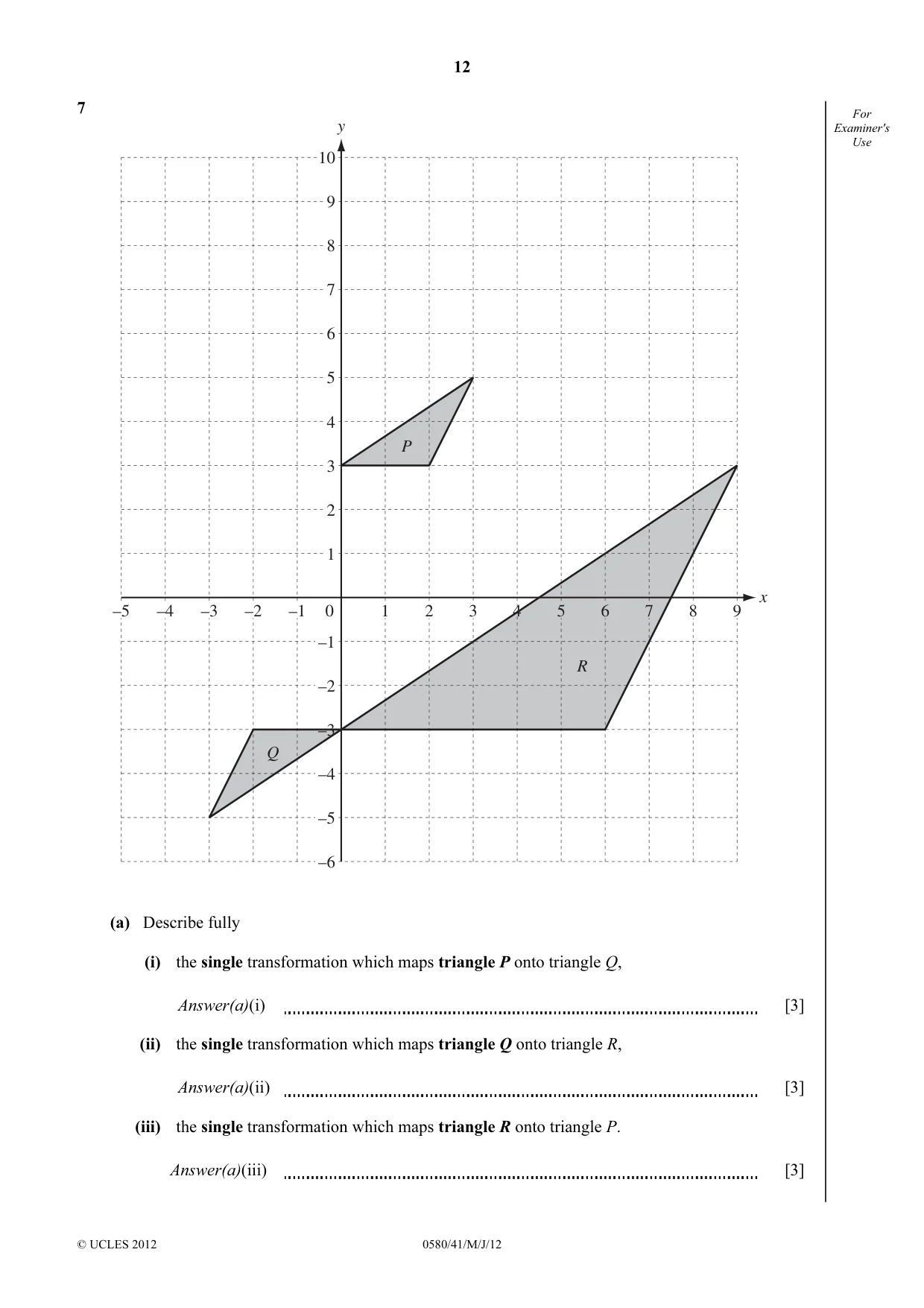
Mark scheme6 pages
Answers below. Sit the paper first if you are practising.
Questions as text
Q6 · A parallelogram has base (2x O 1) metres and height (4x O7) metres
6 (a) A parallelogram has base (2x O 1) metres and height (4x O7) metres. For The area of the parallelogram is 1 m2. Examiner's Use (i) Show that 4x2 O 9x + 3 = 0 . Answer (a)(i) [3] (ii) Solve the equation 4x2 O 9x + 3 = 0 . Show all your working and give your answers correct to 2 decimal places. Answer(a)(ii) x = or x = [4] (iii) Calculate the height of the parallelogram. Answer(a)(iii) m [1] (b) (i) Factorise x2 O 16. For Examiner's Use Answer(b)(i) [1] 2 x + 3 x + 40 (ii) Solve the equation + = 2 . x − 4 x 2 − 16 Answer(b)(ii) x = [4]
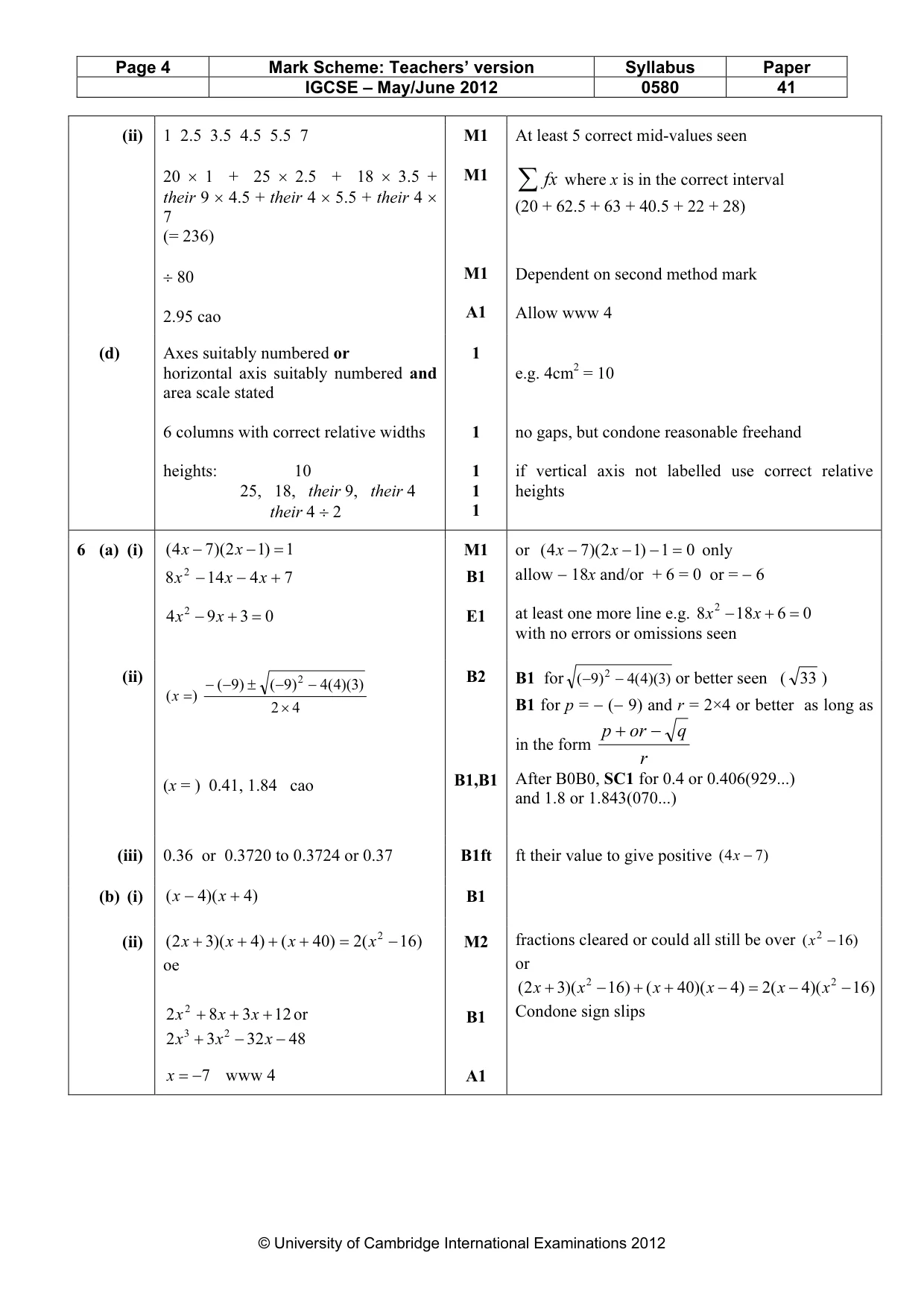
Mark scheme: 6 (a) (i) ( 4 x − 7 )( 2 x − )1 = 1 M1 or ( 4 x − 7 )( 2 x − )1 − 1 = 0 only 8 x 2 − 14 x − 4 x + 7 B1 allow − 18x and/or + 6 = 0 or = − 6 4 x 2 −x9 + 3 = 0 E1 at least one more line e.g. 8 x 2 − 18 x + 6 = 0 with no errors or omissions seen (ii) 2 B2 B1 for ( −9 ) 2 − 4( 4)(3) or better seen ( 33 ) − ( − 9) ± ( − 9) − 4( 4)(3) ( x = ) 2 × 4 B1 for p = − (− 9) and r = 2×4 or better as long as p + or − q in the form r B1,B1 After B0B0, SC1 for 0.4 or 0.406(929...) (x = ) 0.41, 1.84 cao and 1.8 or 1.843(070...) (iii) 0.36 or 0.3720 to 0.3724 or 0.37 B1ft ft their value to give positive ( 4 x − 7 ) (b) (i) ( x − 4 )( x + 4 ) B1 (ii) ( 2 x + 3)( x + 4) + ( x + 40 ) = 2( x 2 − 16 ) M2 fractions cleared or could all still be over ( x 2 − 16) oe or ( 2 x + 3)( x 2 − 16 ) + ( x + 40)( x − 4) = 2( x − 4)( x 2 − 16 ) 2 x 2 + 8 x + 3 x + 12 or B1 Condone sign slips 2 x 3 + 3 x 2 − 32 x − 48 x = −7 www 4 A1 IGCSE – May/June 2012 0580 41
Q7 · For y Examiner's Use 10 9 8 7 6 5 4 P 3 2 1 x –5 –4 –3 –2 –1 0 1 2 3 4 5 6 7 8 9 –1 R –2…
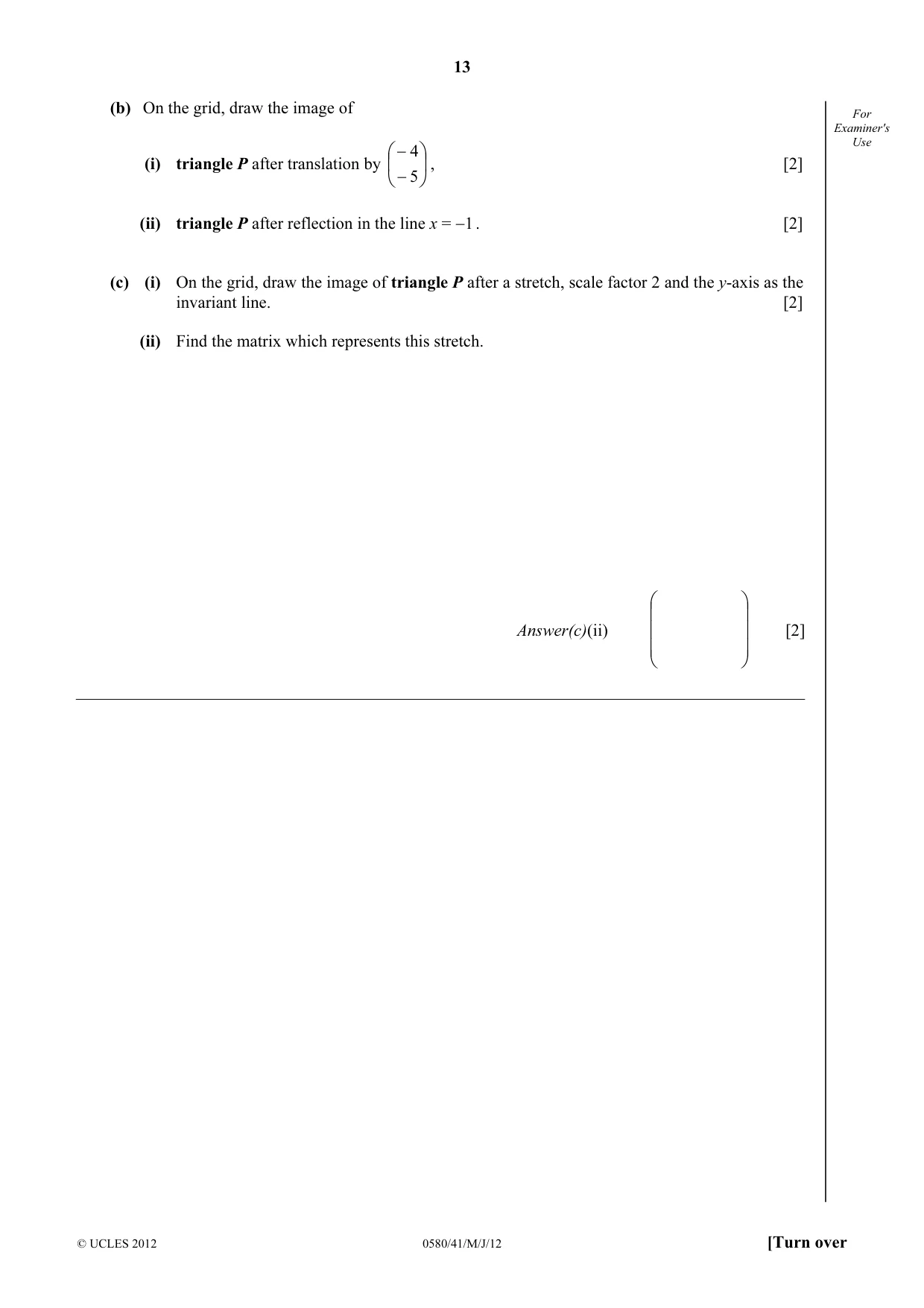
7 For y Examiner's Use 10 9 8 7 6 5 4 P 3 2 1 x –5 –4 –3 –2 –1 0 1 2 3 4 5 6 7 8 9 –1 R –2 –3 Q –4 –5 –6 (a) Describe fully (i) the single transformation which maps triangle P onto triangle Q, Answer(a)(i) [3] (ii) the single transformation which maps triangle Q onto triangle R, Answer(a)(ii) [3] (iii) the single transformation which maps triangle R onto triangle P. Answer(a)(iii) [3] (b) On the grid, draw the image of For Examiner's Use − 4 (i) triangle P after translation by , [2] − 5 (ii) triangle P after reflection in the line x = −1 . [2] (c) (i) On the grid, draw the image of triangle P after a stretch, scale factor 2 and the y-axis as the invariant line. [2] (ii) Find the matrix which represents this stretch. Answer(c)(ii) [2]
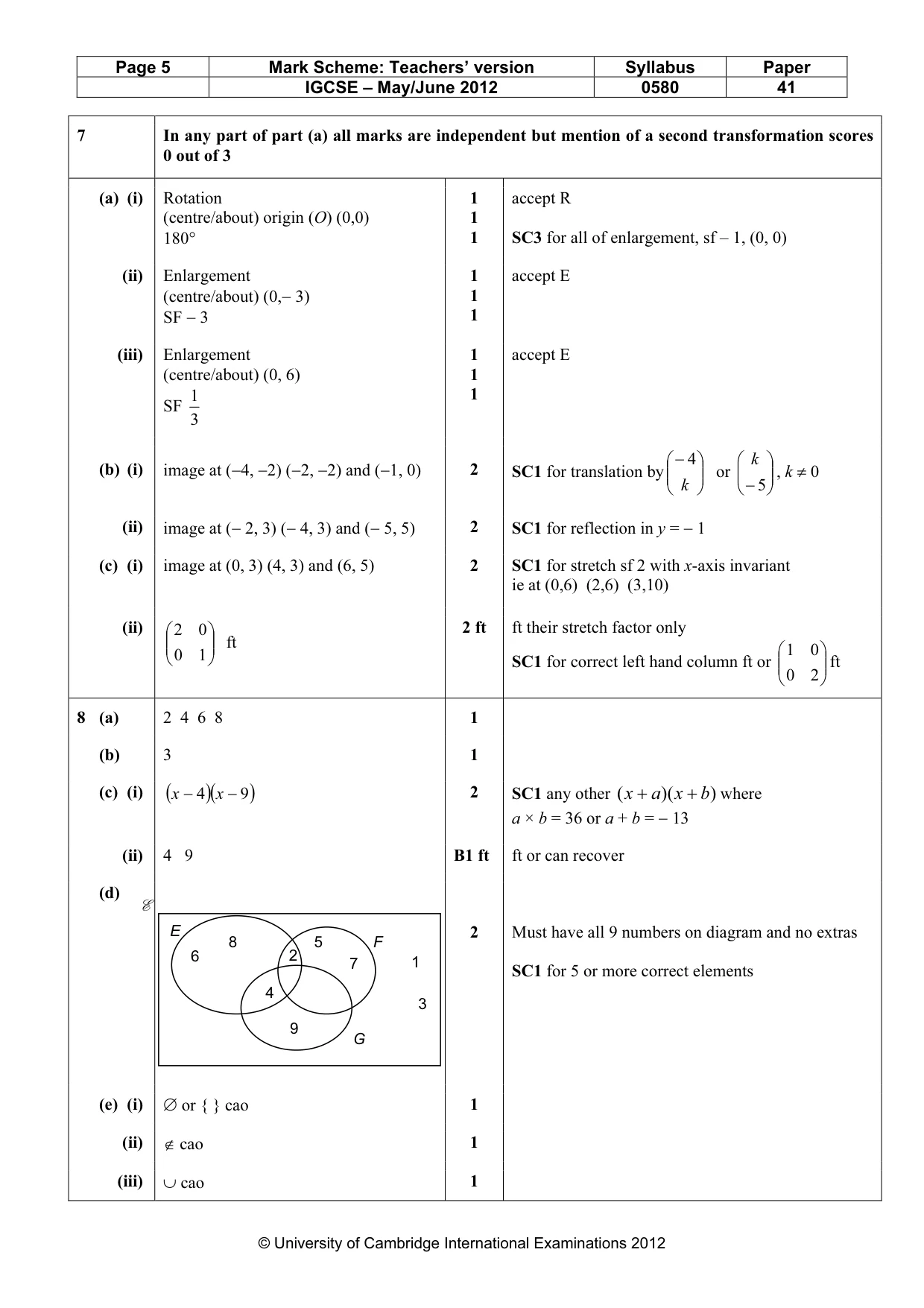
Mark scheme: 7 In any part of part (a) all marks are independent but mention of a second transformation scores 0 out of 3 (a) (i) Rotation 1 accept R (centre/about) origin (O) (0,0) 1 180° 1 SC3 for all of enlargement, sf – 1, (0, 0) (ii) Enlargement 1 accept E (centre/about) (0,− 3) 1 SF − 3 1 (iii) Enlargement 1 accept E (centre/about) (0, 6) 1 1 1 SF 3 − 4 k (b) (i) image at (−4, −2) (−2, −2) and (−1, 0) 2 SC1 for translation by or , k ≠ 0 k −5 (ii) image at (− 2, 3) (− 4, 3) and (− 5, 5) 2 SC1 for reflection in y = − 1 (c) (i) image at (0, 3) (4, 3) and (6, 5) 2 SC1 for stretch sf 2 with x-axis invariant ie at (0,6) (2,6) (3,10) (ii) 2 0 2 ft ft their stretch factor only ft 1 0 0 1 SC1 for correct left hand column ft or ft 0 2
Q8 · = {1, 2, 3, 4, 5, 6, 7, 8, 9} For Examiner's E = {x : x is an even number} Use F = {2, 5…
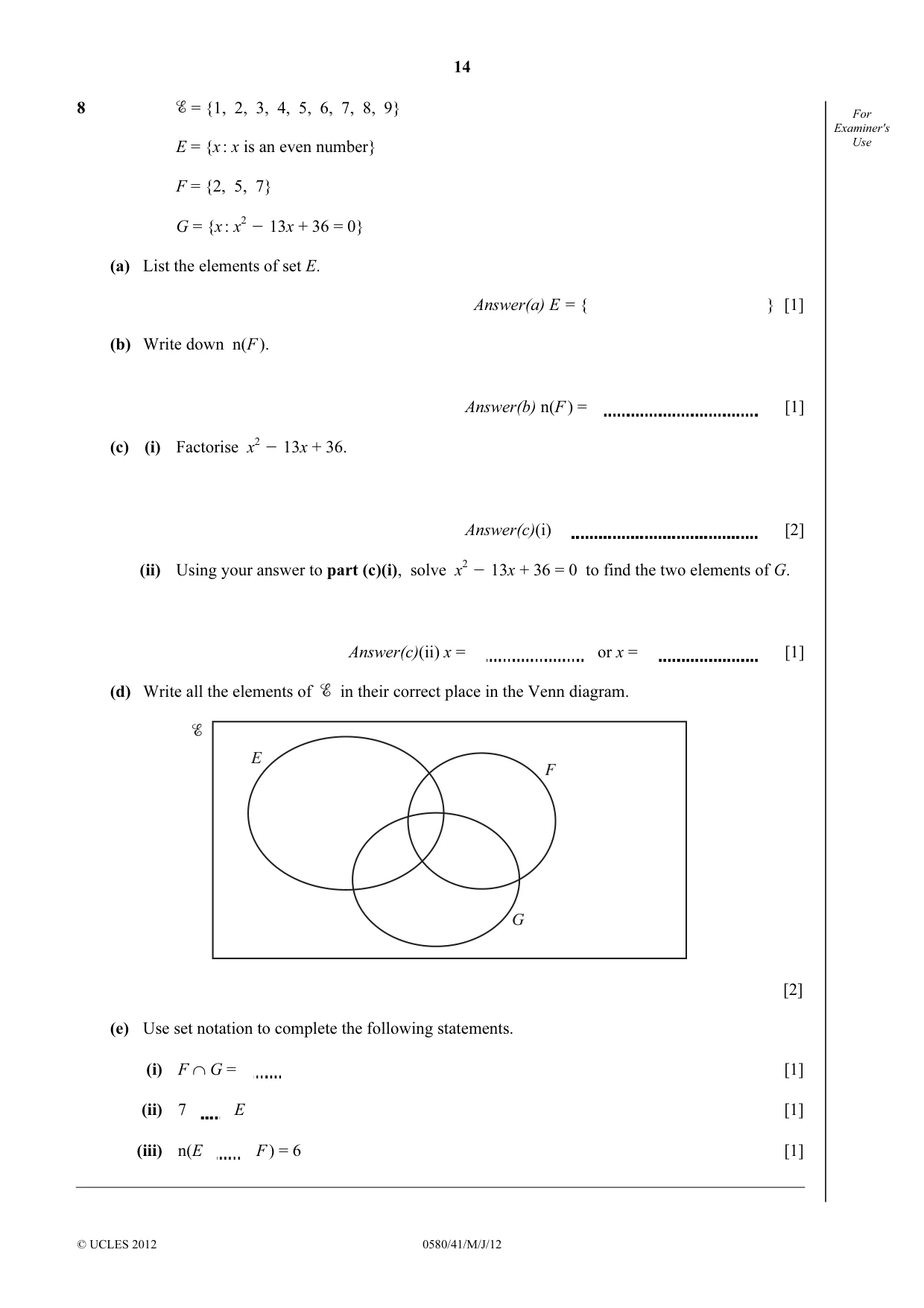
8 = {1, 2, 3, 4, 5, 6, 7, 8, 9} For Examiner's E = {x : x is an even number} Use F = {2, 5, 7} G = {x : x2 O 13x + 36 = 0} (a) List the elements of set E. Answer(a) E = { } [1] (b) Write down n(F ). Answer(b) n(F ) = [1] (c) (i) Factorise x2 O 13x + 36. Answer(c)(i) [2] (ii) Using your answer to part (c)(i), solve x2 O 13x + 36 = 0 to find the two elements of G. Answer(c)(ii) x = or x = [1] (d) Write all the elements of in their correct place in the Venn diagram. E F G [2] (e) Use set notation to complete the following statements. (i) F ∩ G = [1] (ii) 7 E [1] (iii) n(E F ) = 6 [1]
Mark scheme: 8 (a) 2 4 6 8 1 (b) 3 1 (c) (i) ( x − 4 )( x − 9 ) 2 SC1 any other ( x + a )( x + b ) where a × b = 36 or a + b = − 13 (ii) 4 9 B1 ft ft or can recover (d) E E 2 Must have all 9 numbers on diagram and no extras 8 5 F 6 2 7 1 SC1 for 5 or more correct elements 4 3 9 G (e) (i) ∅ or { } cao 1 (ii) ∉ cao 1 (iii) ∪ cao 1 IGCSE – May/June 2012 0580 41
Q9 · F(x) = 3x + 5 g(x) = 7 O 2x h(x) = x2 O 8 For Examiner's (a) Find Use (i) f(3)…
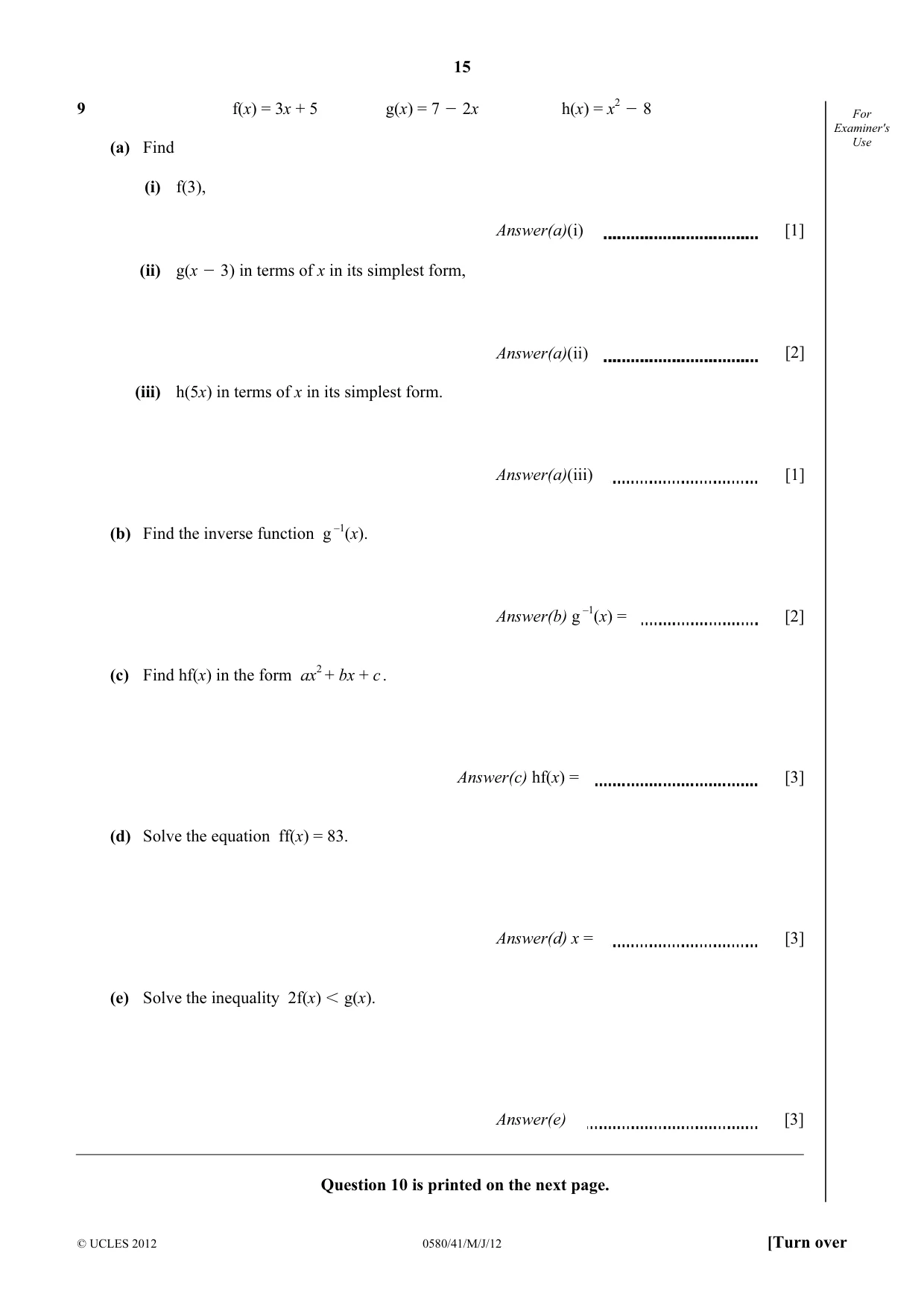
9 f(x) = 3x + 5 g(x) = 7 O 2x h(x) = x2 O 8 For Examiner's (a) Find Use (i) f(3), Answer(a)(i) [1] (ii) g(x O 3) in terms of x in its simplest form, Answer(a)(ii) [2] (iii) h(5x) in terms of x in its simplest form. Answer(a)(iii) [1] (b) Find the inverse function g –1(x). Answer(b) g –1(x) = [2] (c) Find hf(x) in the form ax2 + bx + c . Answer(c) hf(x) = [3] (d) Solve the equation ff(x) = 83. Answer(d) x = [3] (e) Solve the inequality 2f(x) I g(x). Answer(e) [3] Question 10 is printed on the next page.
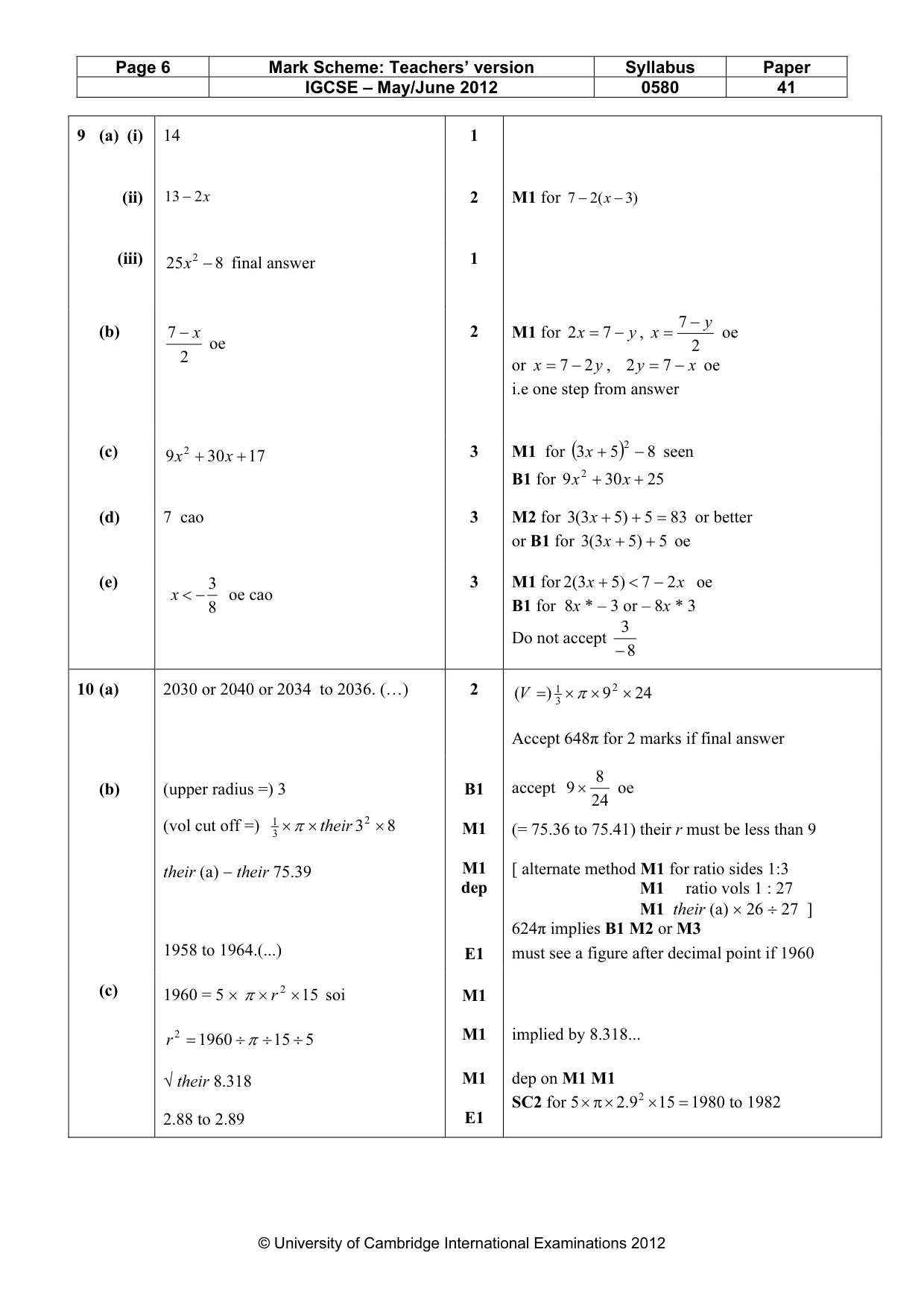
Mark scheme: 9 (a) (i) 14 1 (ii) 13 − 2 x 2 M1 for 7 − 2( x − 3) (iii) 25 x 2 − 8 final answer 1 7 − y (b) 7 − x 2 M1 for 2 x = 7 − y , x = oe oe 2 2 or x = 7 − 2 y , 2 y = 7 − x oe i.e one step from answer 2 (c) 9 x 2 + 30 x + 17 3 M1 for (3 x + 5 ) − 8 seen B1 for 9 x 2 + 30 x + 25 (d) 7 cao 3 M2 for 3(3 x + 5) + 5 = 83 or better or B1 for 3(3 x + 5) + 5 oe (e) 3 3 M1 for 2 (3 x + 5) < 7 − 2 x oe x < − oe cao 8 B1 for 8x * – 3 or – 8x * 3 3 Do not accept − 8
Q10 · For Examiner's Use NOT TO 24 cm SCALE 9 cm A solid metal cone has base radius 9 cm and…
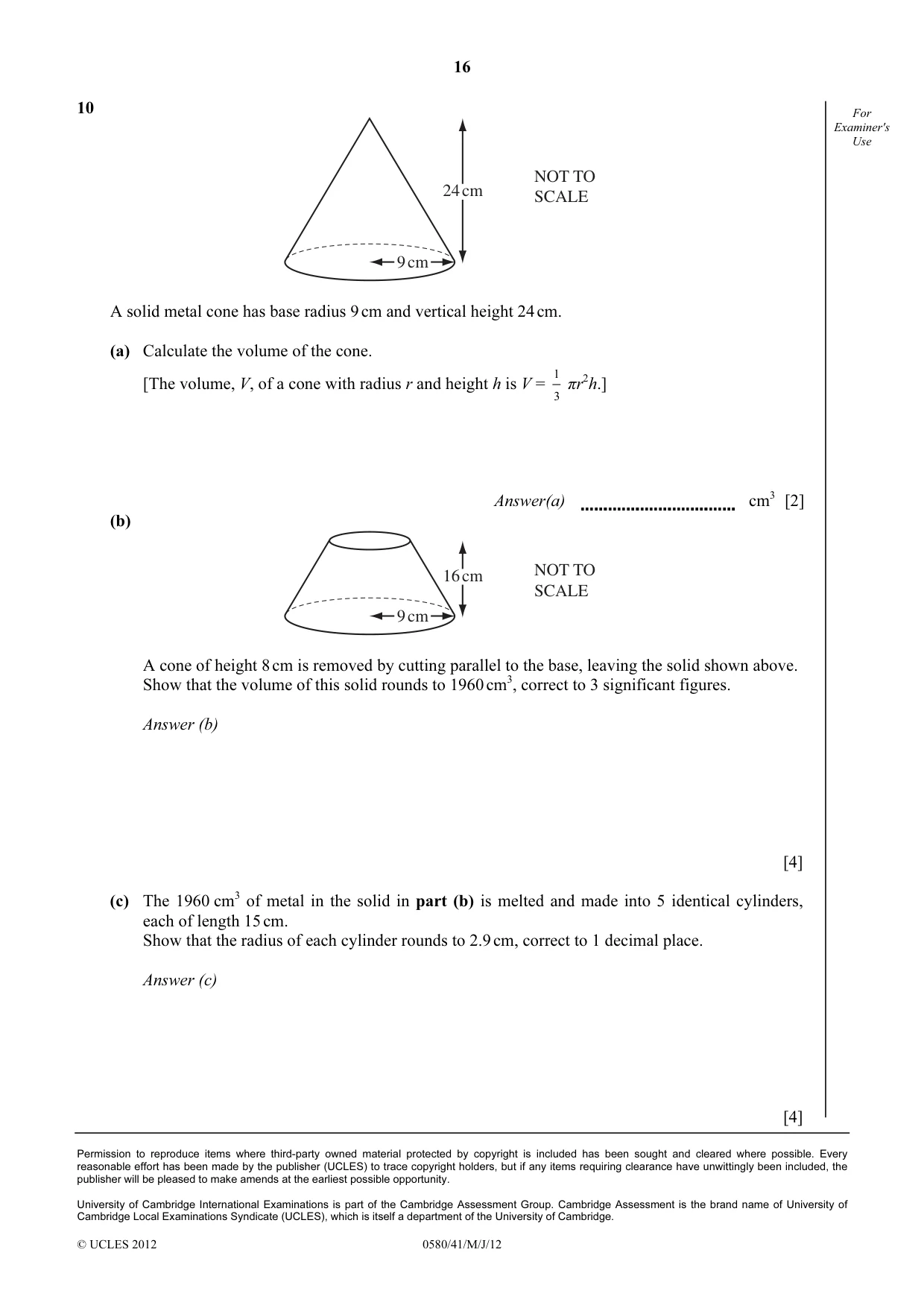
10 For Examiner's Use NOT TO 24 cm SCALE 9 cm A solid metal cone has base radius 9 cm and vertical height 24 cm. (a) Calculate the volume of the cone. 1 [The volume, V, of a cone with radius r and height h is V = πr2h.] 3 Answer(a) cm3 [2] (b) NOT TO 16 cm SCALE 9 cm A cone of height 8 cm is removed by cutting parallel to the base, leaving the solid shown above. Show that the volume of this solid rounds to 1960 cm3, correct to 3 significant figures. Answer (b) [4] (c) The 1960 cm3 of metal in the solid in part (b) is melted and made into 5 identical cylinders, each of length 15 cm. Show that the radius of each cylinder rounds to 2.9 cm, correct to 1 decimal place. Answer (c) [4]
Mark scheme: 10 (a) 2030 or 2040 or 2034 to 2036. (…) 2 (V = ) 13 × π × 9 2 × 24 Accept 648π for 2 marks if final answer 8 (b) (upper radius =) 3 B1 accept 9× oe 24 (vol cut off =) 13 × π × their 32 × 8 M1 (= 75.36 to 75.41) their r must be less than 9 their (a) − their 75.39 M1 [ alternate method M1 for ratio sides 1:3 dep M1 ratio vols 1 : 27 M1 their (a) × 26 ÷ 27 ] 624π implies B1 M2 or M3 1958 to 1964.(...) E1 must see a figure after decimal point if 1960 (c) 1960 = 5 × π × r 2 × 15 soi M1 r 2 = 1960 ÷ π ÷ 15 ÷ 5 M1 implied by 8.318... √ their 8.318 M1 dep on M1 M1 SC2 for 5 × π × 9.2 2 × 15 = 1980 to 1982 2.88 to 2.89 E1
What was in this paper
The subtopics covered by these 5 questions, and how many questions each got. Open one in a new tab to see every Cambridge question on it.
What you needed in this session
Cambridge’s own grade thresholds for 2012 May/June, Paper 4 · Variant 1. A higher threshold means an easier paper — the bar moves with how the cohort did.