Cambridge IGCSE Mathematics 0580 — 2011 Oct/Nov Paper 4 · Variant 3
0580/43/O/N/11 · 11 questions · 130 marks · ≈146 min
The question paper and its mark scheme, free to read here and free to download. This is Cambridge’s own paper, exactly as it was sat.
Question paper20 pages
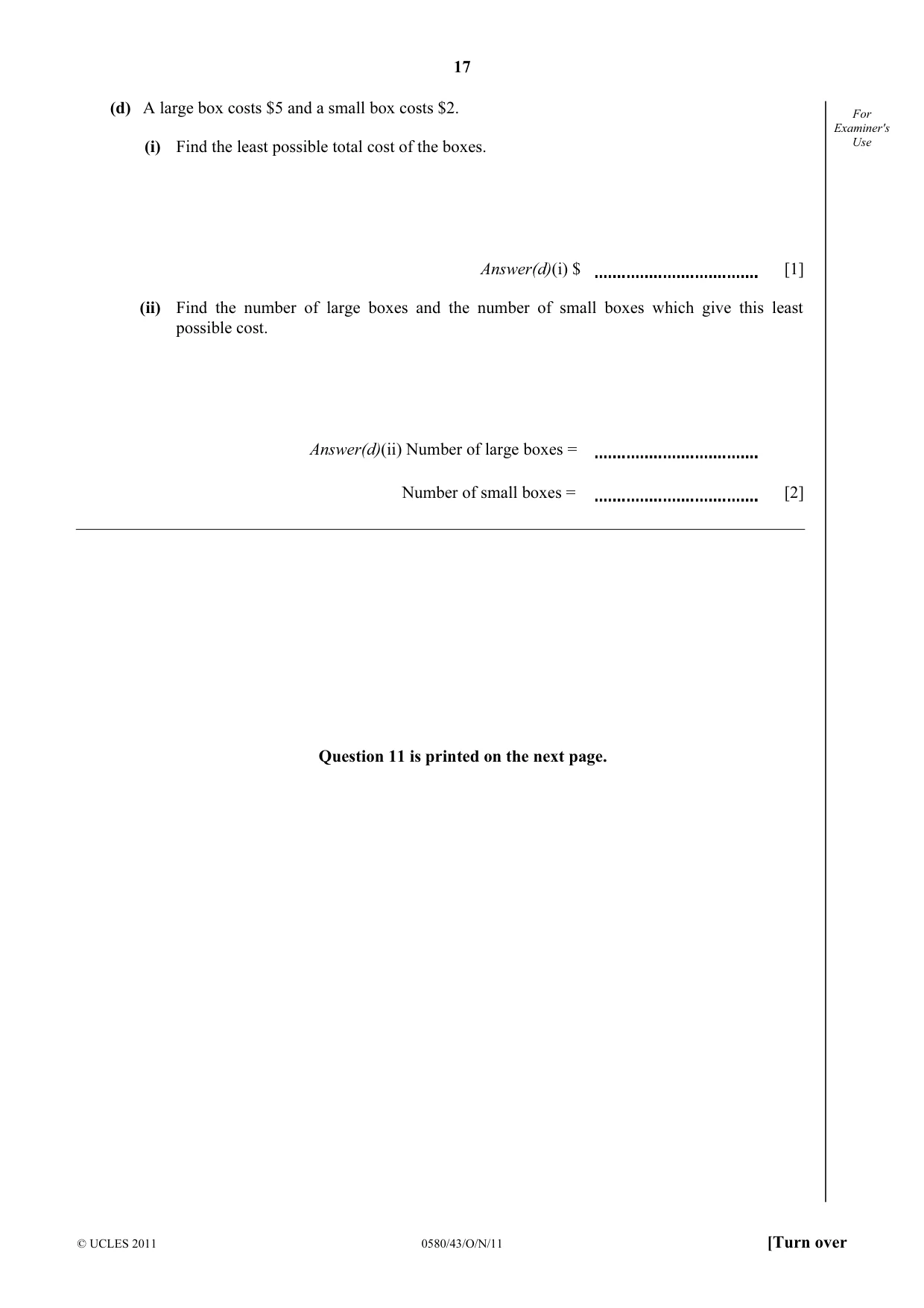
Mark scheme6 pages
Answers below. Sit the paper first if you are practising.
Questions as text
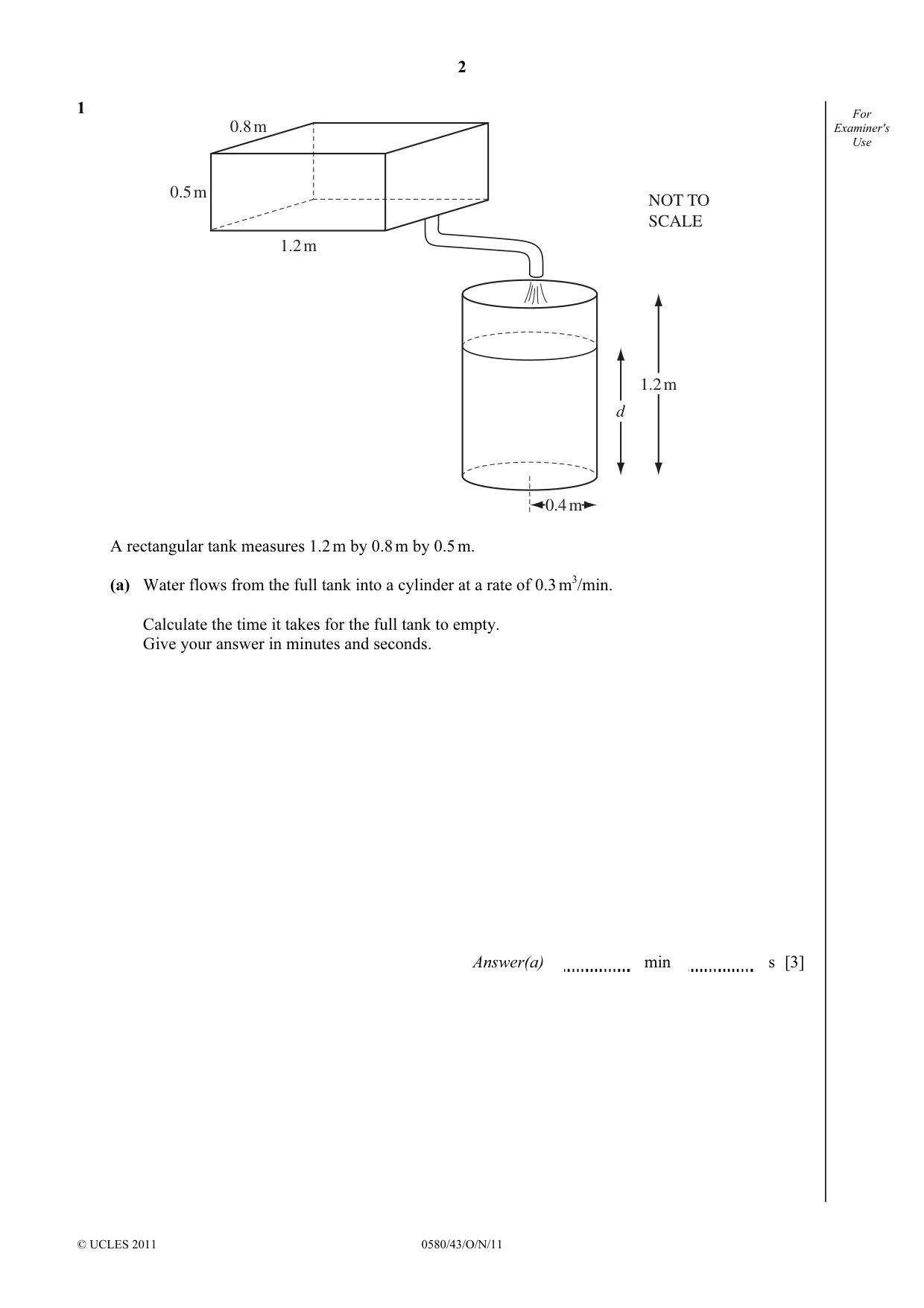
Q1 · For 0.8 m Examiner's Use 0.5 m NOT TO SCALE 1.2 m 1.2 m d 0.4 m A rectangular tank…
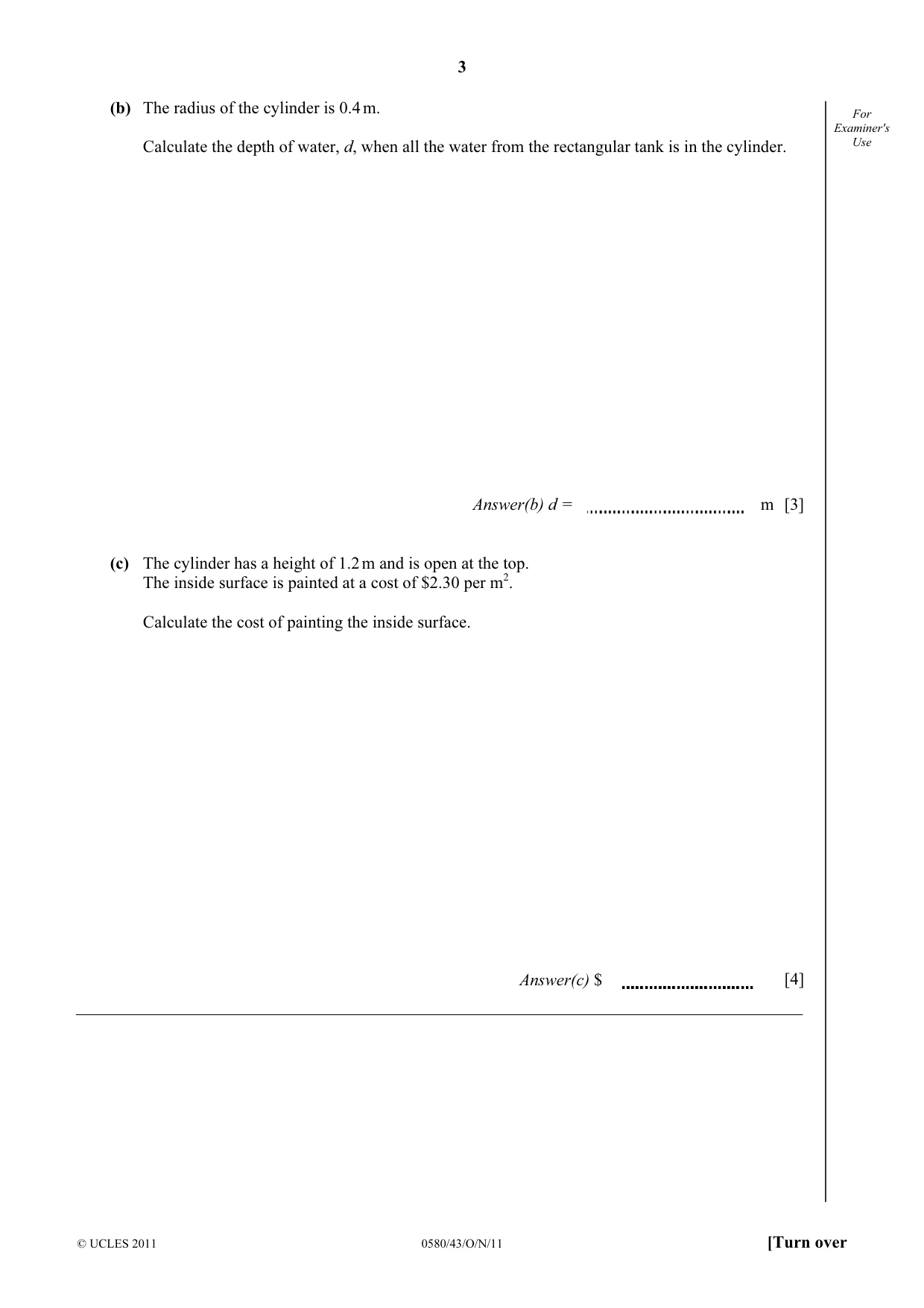
1 For 0.8 m Examiner's Use 0.5 m NOT TO SCALE 1.2 m 1.2 m d 0.4 m A rectangular tank measures 1.2 m by 0.8 m by 0.5 m. (a) Water flows from the full tank into a cylinder at a rate of 0.3 m3/min. Calculate the time it takes for the full tank to empty. Give your answer in minutes and seconds. Answer(a) min s [3] (b) The radius of the cylinder is 0.4 m. For Examiner's Calculate the depth of water, d, when all the water from the rectangular tank is in the cylinder. Use Answer(b) d = m [3] (c) The cylinder has a height of 1.2 m and is open at the top. The inside surface is painted at a cost of $2.30 per m2. Calculate the cost of painting the inside surface. Answer(c) $ [4]
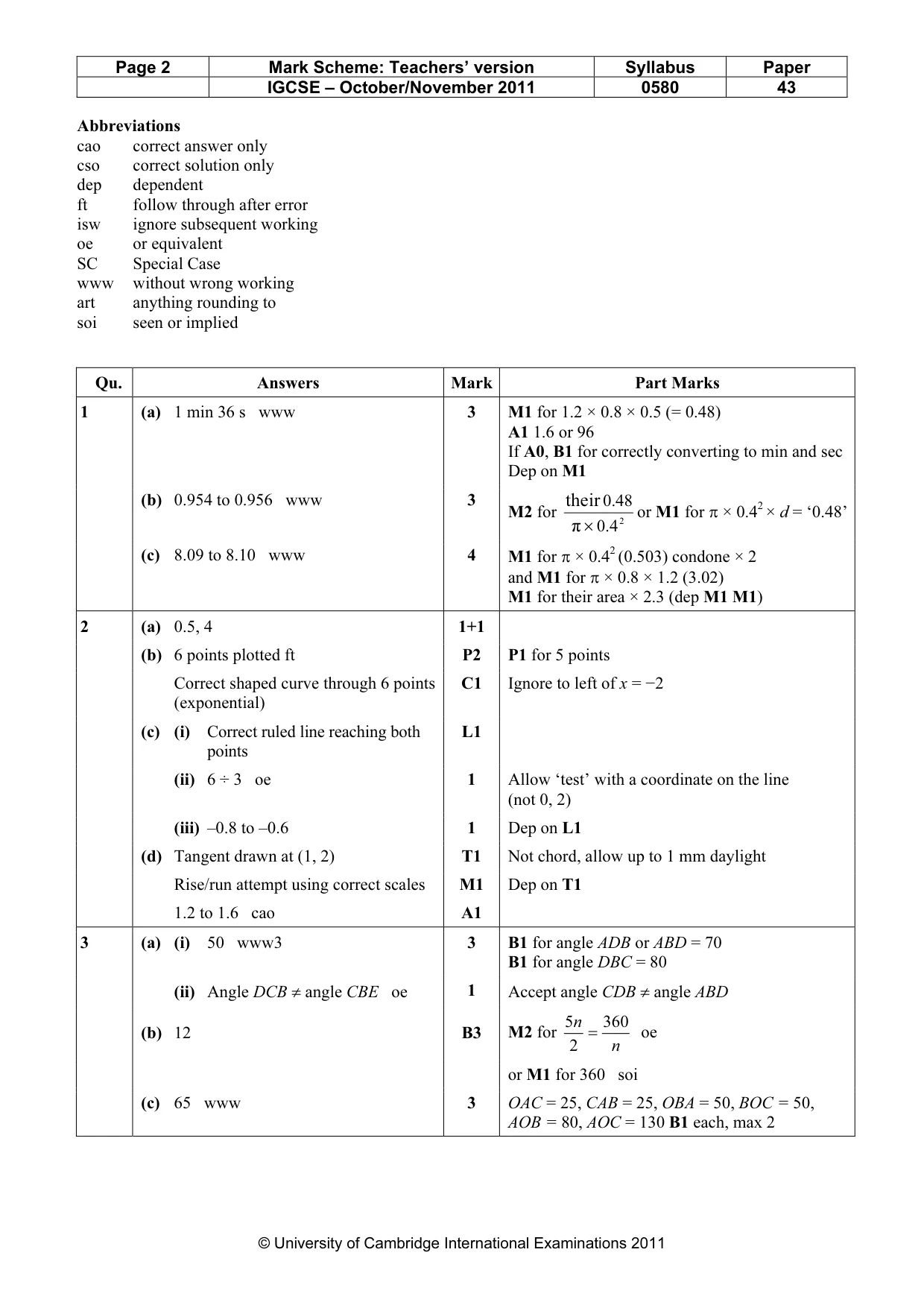
Mark scheme: Qu. Answers Mark Part Marks 1 (a) 1 min 36 s www 3 M1 for 1.2 × 0.8 × 0.5 (= 0.48) A1 1.6 or 96 If A0, B1 for correctly converting to min and sec Dep on M1 (b) 0.954 to 0.956 www 3 their 0.48 M2 for or M1 for π × 0.42 × d = ‘0.48’ π × 0.4 2 (c) 8.09 to 8.10 www 4 M1 for π × 0.42 (0.503) condone × 2 and M1 for π × 0.8 × 1.2 (3.02) M1 for their area × 2.3 (dep M1 M1)
Q2 · Complete the table of values for y = 2x
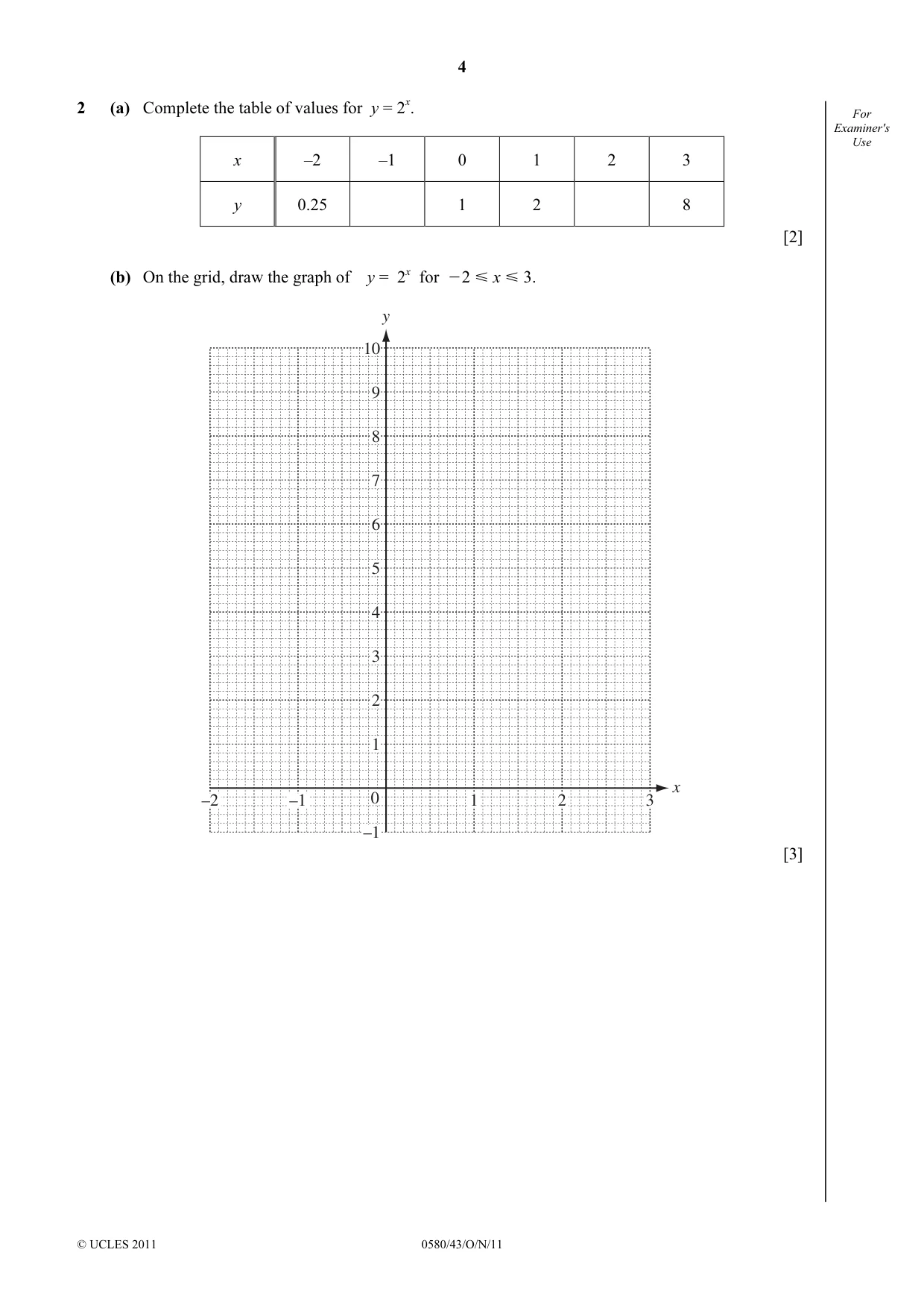
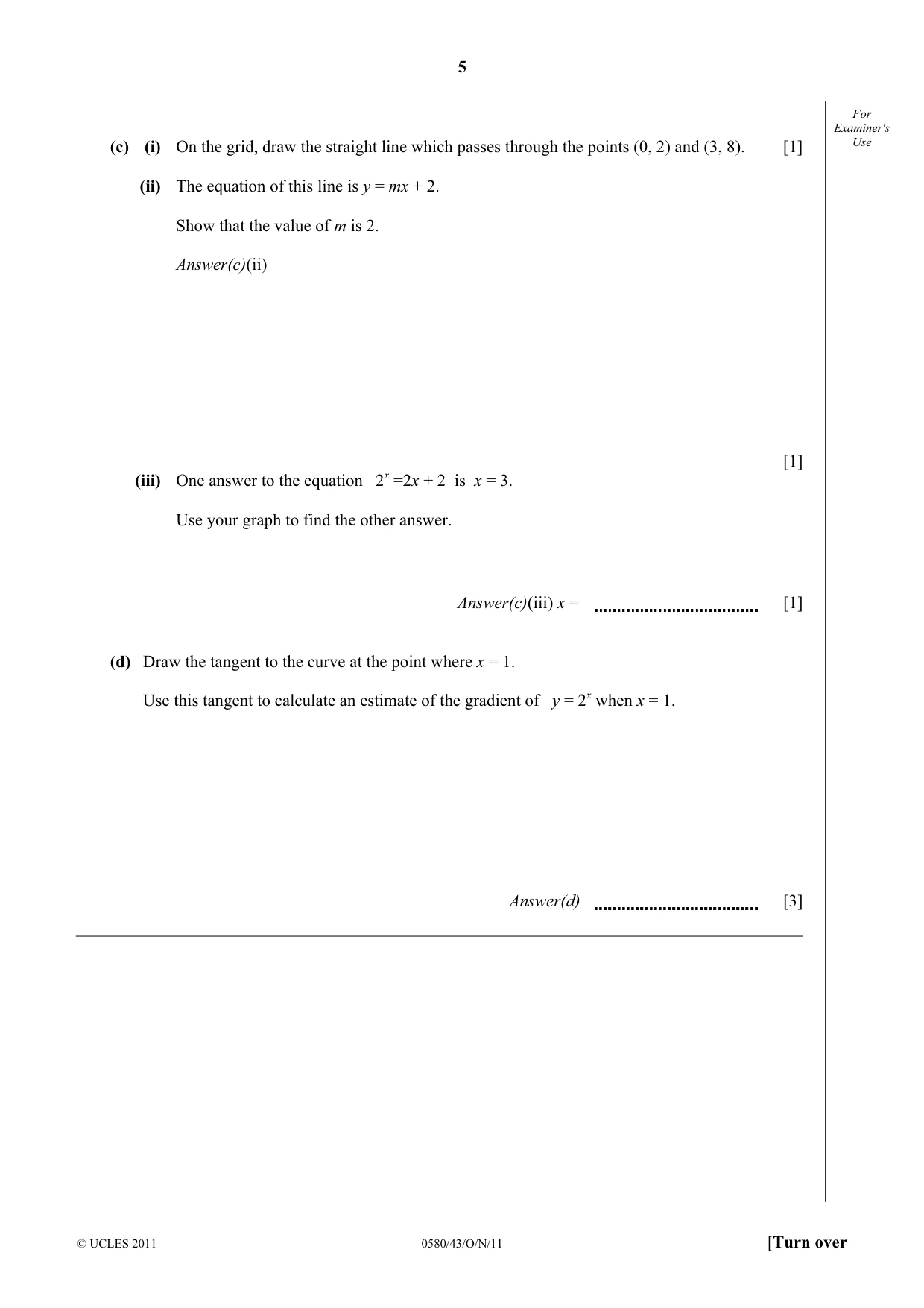
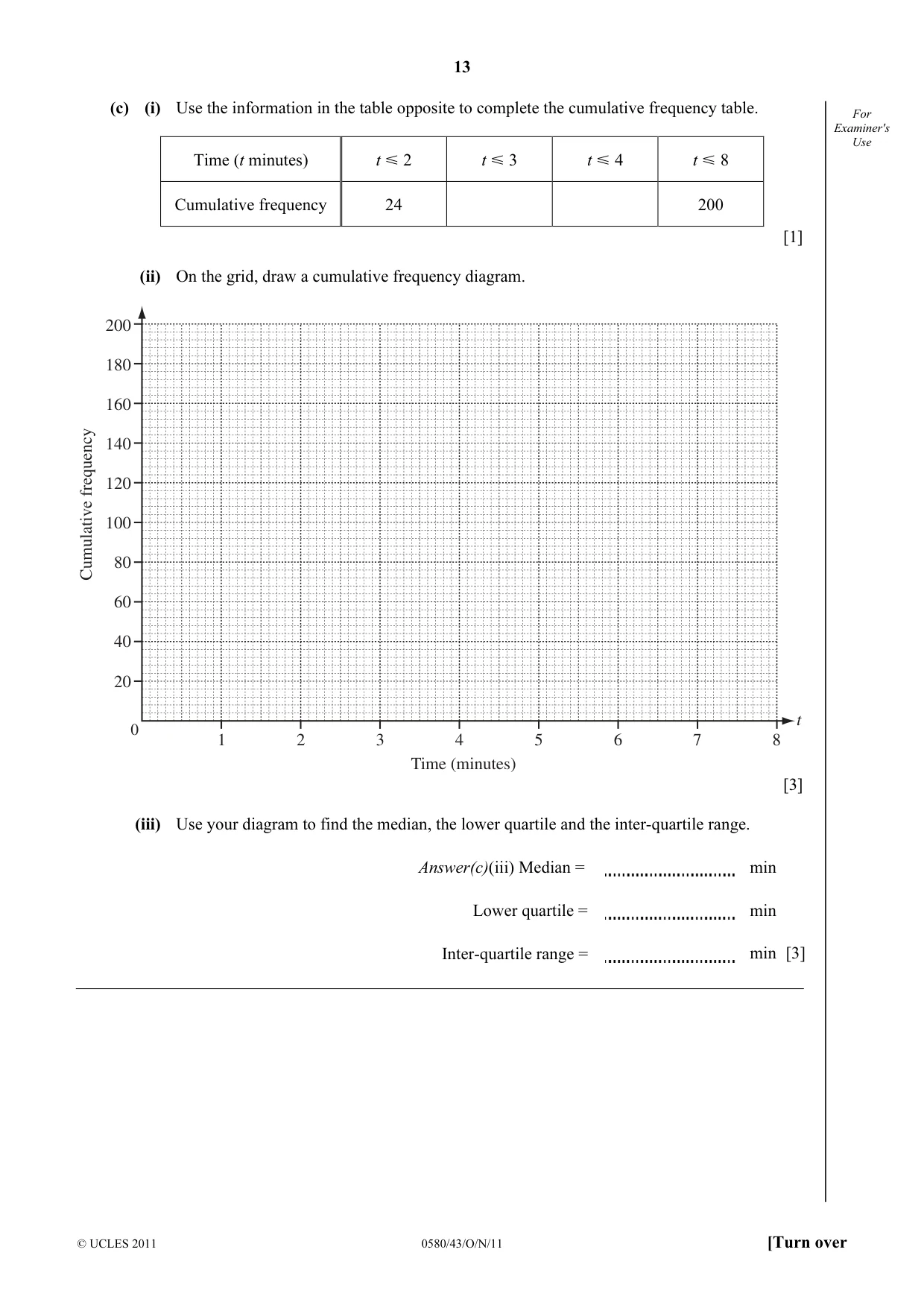
2 (a) Complete the table of values for y = 2x. For Examiner's Use x –2 –1 0 1 2 3 y 0.25 1 2 8 [2] (b) On the grid, draw the graph of y = 2x for O2 Y x Y 3. y 10 9 8 7 6 5 4 3 2 1 x –2 –1 0 1 2 3 –1 [3] For Examiner's (c) (i) On the grid, draw the straight line which passes through the points (0, 2) and (3, 8). [1] Use (ii) The equation of this line is y = mx + 2. Show that the value of m is 2. Answer(c)(ii) [1] (iii) One answer to the equation 2x =2x + 2 is x = 3. Use your graph to find the other answer. Answer(c)(iii) x = [1] (d) Draw the tangent to the curve at the point where x = 1. Use this tangent to calculate an estimate of the gradient of y = 2x when x = 1. Answer(d) [3]
Mark scheme: 2 (a) 0.5, 4 1+1 (b) 6 points plotted ft P2 P1 for 5 points Correct shaped curve through 6 points C1 Ignore to left of x = −2 (exponential) (c) (i) Correct ruled line reaching both L1 points (ii) 6 ÷ 3 oe 1 Allow ‘test’ with a coordinate on the line (not 0, 2) (iii) –0.8 to –0.6 1 Dep on L1 (d) Tangent drawn at (1, 2) T1 Not chord, allow up to 1 mm daylight Rise/run attempt using correct scales M1 Dep on T1 1.2 to 1.6 cao A1
Q3 · For D Examiner's NOT TO Use SCALE C 40° 30° A B E ABCD is a quadrilateral with angle BAD…
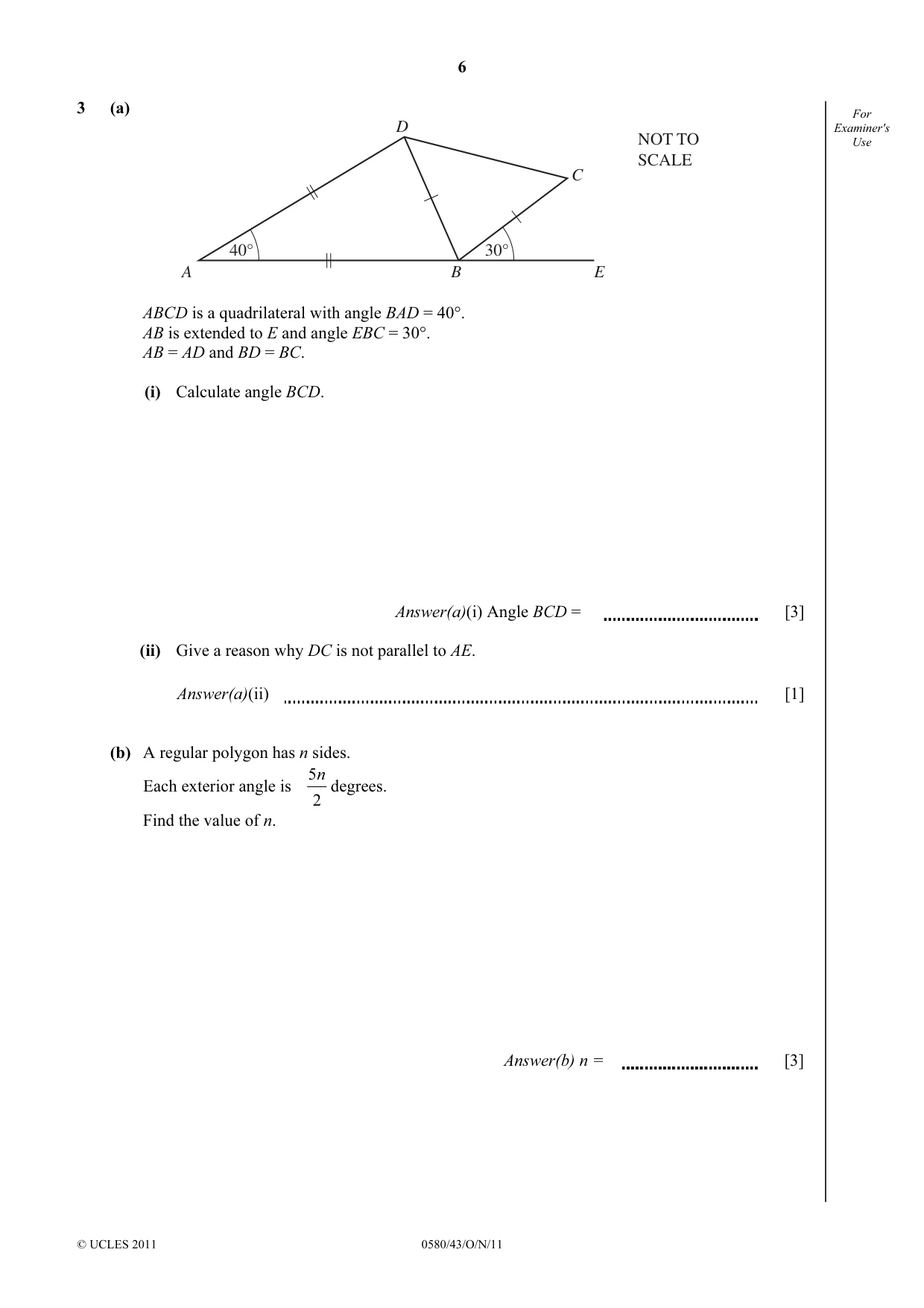
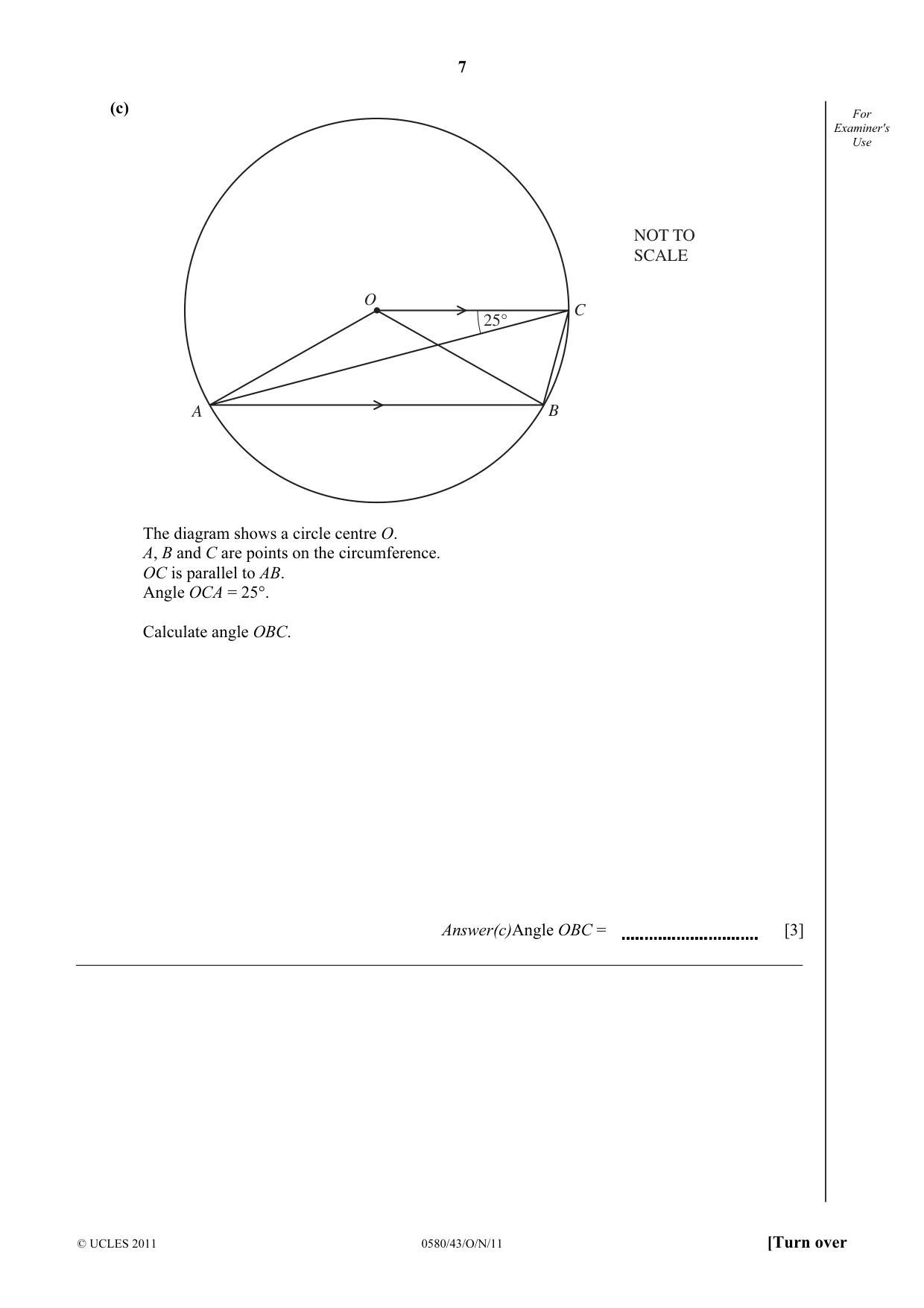
3 (a) For D Examiner's NOT TO Use SCALE C 40° 30° A B E ABCD is a quadrilateral with angle BAD = 40°. AB is extended to E and angle EBC = 30°. AB = AD and BD = BC. (i) Calculate angle BCD. Answer(a)(i) Angle BCD = [3] (ii) Give a reason why DC is not parallel to AE. Answer(a)(ii) [1] (b) A regular polygon has n sides. 5n Each exterior angle is degrees. 2 Find the value of n. Answer(b) n = [3] (c) For Examiner's Use NOT TO SCALE O C 25° A B The diagram shows a circle centre O. A, B and C are points on the circumference. OC is parallel to AB. Angle OCA = 25°. Calculate angle OBC. Answer(c)Angle OBC = [3]
Mark scheme: 3 (a) (i) 50 www3 3 B1 for angle ADB or ABD = 70 B1 for angle DBC = 80 (ii) Angle DCB ≠ angle CBE oe 1 Accept angle CDB ≠ angle ABD 5n 360 (b) 12 B3 M2 for = oe 2 n or M1 for 360 soi (c) 65 www 3 OAC = 25, CAB = 25, OBA = 50, BOC = 50, AOB = 80, AOC = 130 B1 each, max 2 IGCSE – October/November 2011 0580 43
Q4 · For y Examiner's Use 6 4 P 2 W x –6 –4 –2 0 2 4 6 –2 –4 –6 (a) Draw the reflection of…
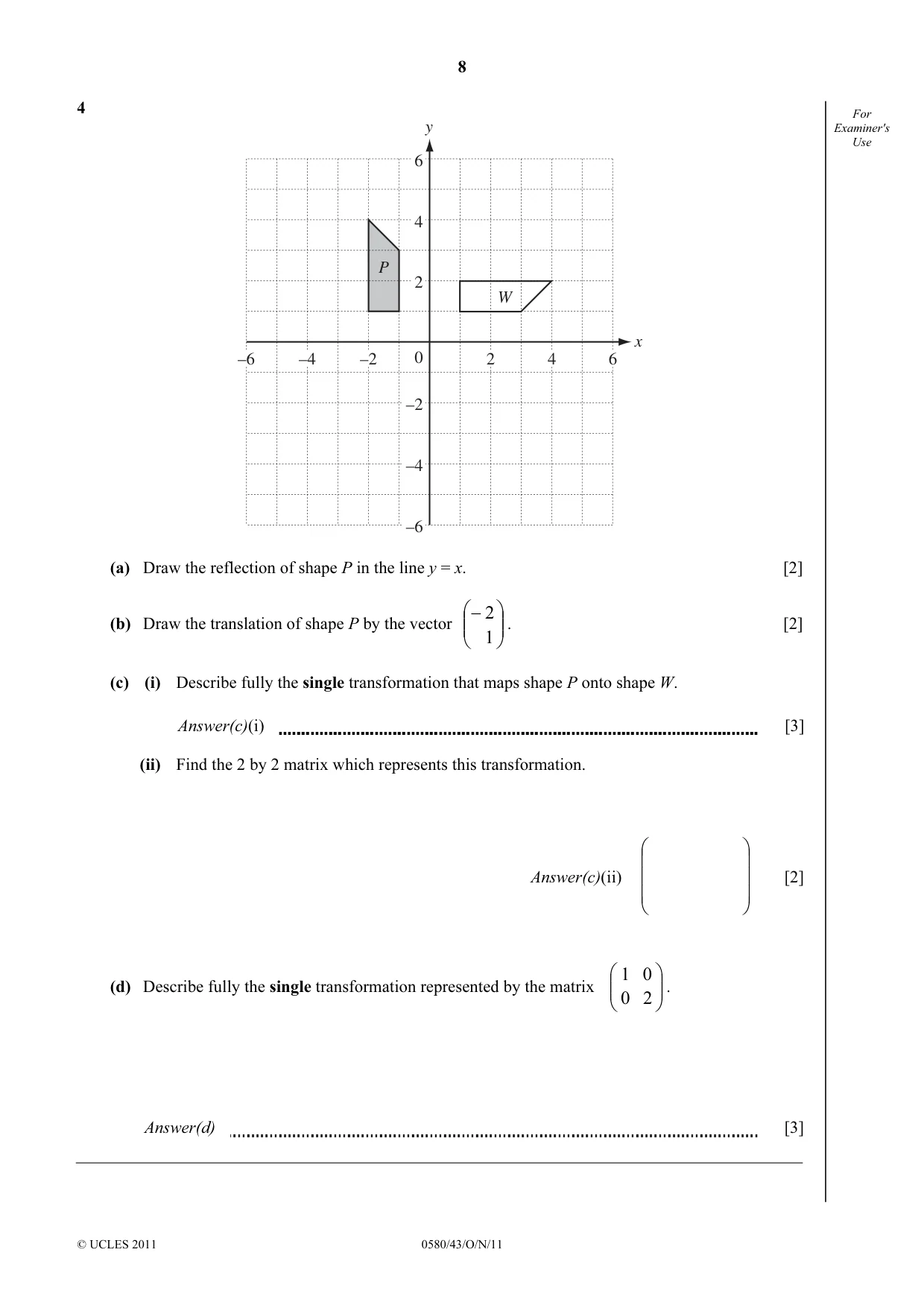
4 For y Examiner's Use 6 4 P 2 W x –6 –4 –2 0 2 4 6 –2 –4 –6 (a) Draw the reflection of shape P in the line y = x. [2] − 2 (b) Draw the translation of shape P by the vector . [2] 1 (c) (i) Describe fully the single transformation that maps shape P onto shape W. Answer(c)(i) [3] (ii) Find the 2 by 2 matrix which represents this transformation. Answer(c)(ii) [2] 1 0 (d) Describe fully the single transformation represented by the matrix . 0 2 Answer(d) [3]
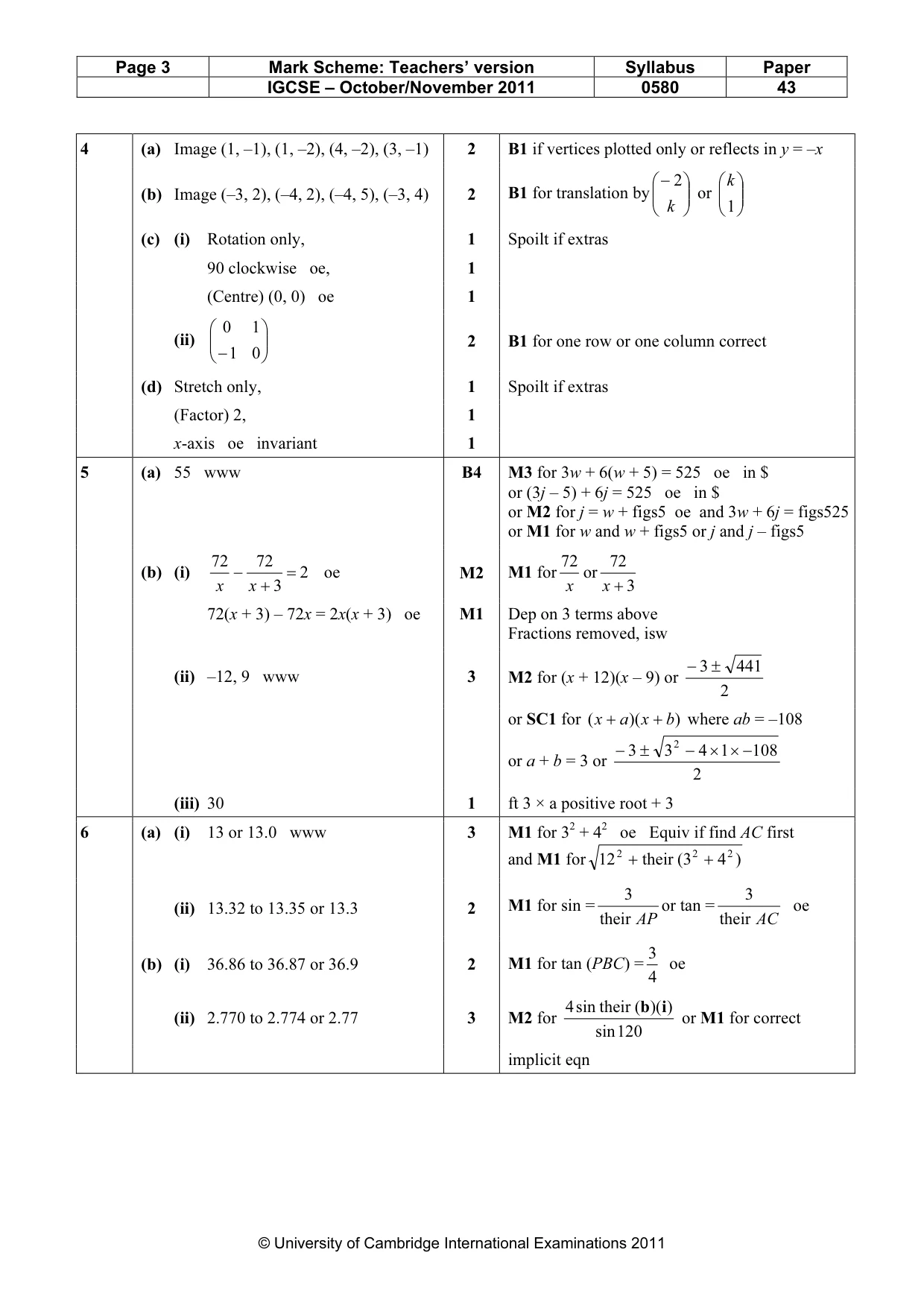
Mark scheme: 4 (a) Image (1, –1), (1, –2), (4, –2), (3, –1) 2 B1 if vertices plotted only or reflects in y = –x − 2 k (b) Image (–3, 2), (–4, 2), (–4, 5), (–3, 4) 2 B1 for translation by or k 1 (c) (i) Rotation only, 1 Spoilt if extras 90 clockwise oe, 1 (Centre) (0, 0) oe 1 0 1 (ii) 2 B1 for one row or one column correct − 1 0 (d) Stretch only, 1 Spoilt if extras (Factor) 2, 1 x-axis oe invariant 1
Q5 · The cost of a bottle of juice is 5 cents more than the cost of a bottle of water
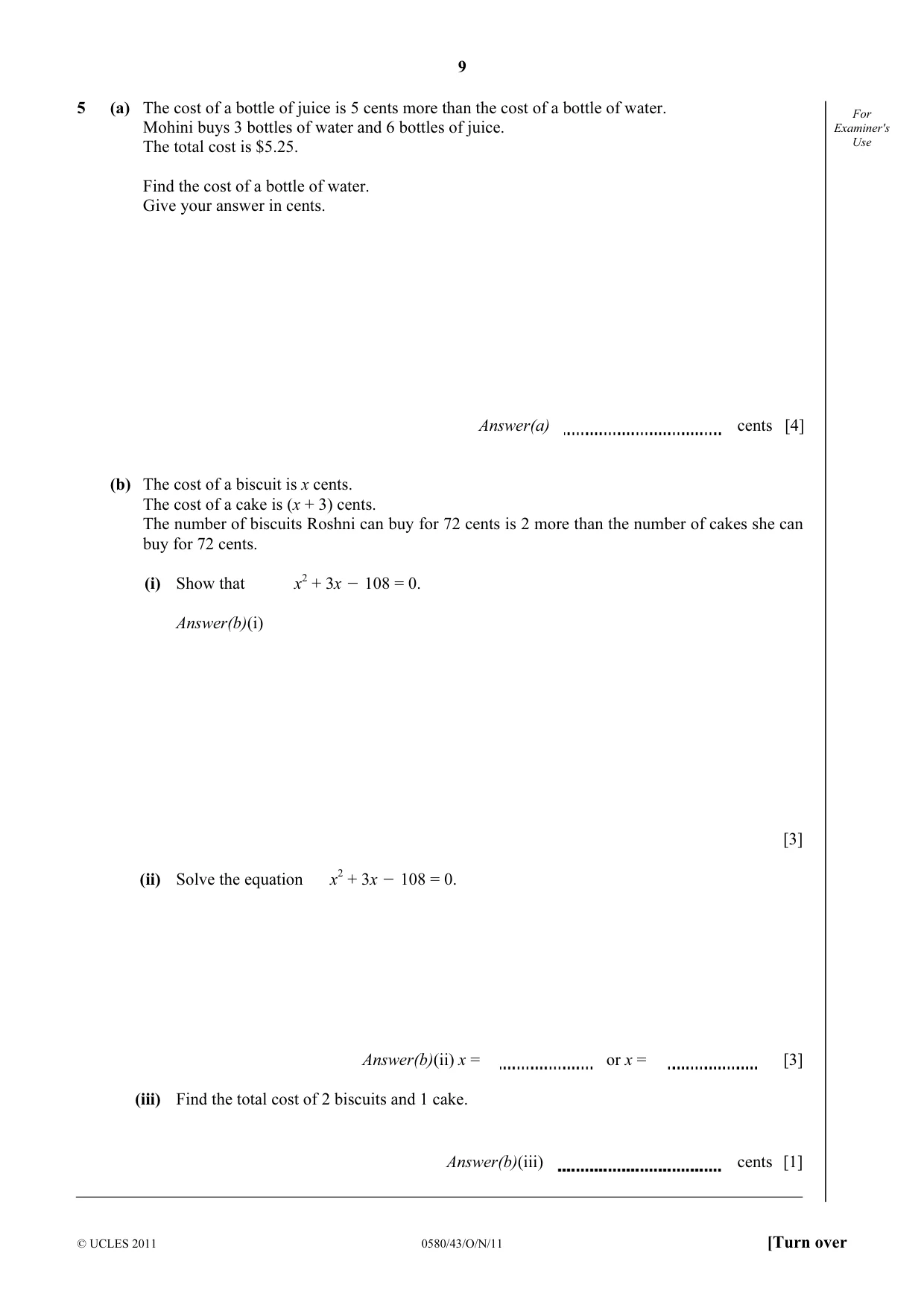
5 (a) The cost of a bottle of juice is 5 cents more than the cost of a bottle of water. For Mohini buys 3 bottles of water and 6 bottles of juice. Examiner's The total cost is $5.25. Use Find the cost of a bottle of water. Give your answer in cents. Answer(a) cents [4] (b) The cost of a biscuit is x cents. The cost of a cake is (x + 3) cents. The number of biscuits Roshni can buy for 72 cents is 2 more than the number of cakes she can buy for 72 cents. (i) Show that x2 + 3x O 108 = 0. Answer(b)(i) [3] (ii) Solve the equation x2 + 3x O 108 = 0. Answer(b)(ii) x = or x = [3] (iii) Find the total cost of 2 biscuits and 1 cake. Answer(b)(iii) cents [1]
Mark scheme: 5 (a) 55 www B4 M3 for 3w + 6(w + 5) = 525 oe in $ or (3j – 5) + 6j = 525 oe in $ or M2 for j = w + figs5 oe and 3w + 6j = figs525 or M1 for w and w + figs5 or j and j – figs5 72 72 72 72 (b) (i) = 2 oe M2 M1 for or x −x + 3 x x + 3 72(x + 3) – 72x = 2x(x + 3) oe M1 Dep on 3 terms above Fractions removed, isw − 3 ± 441 (ii) –12, 9 www 3 M2 for (x + 12)(x – 9) or 2 or SC1 for ( x + a )( x + b ) where ab = –108 − 3 ± 3 2 − 4 × 1 × − 108 or a + b = 3 or 2 (iii) 30 1 ft 3 × a positive root + 3
Q6 · For Q P Examiner's Use NOT TO SCALE 3 cm D C 4 cm A B 12 cm The diagram shows a…
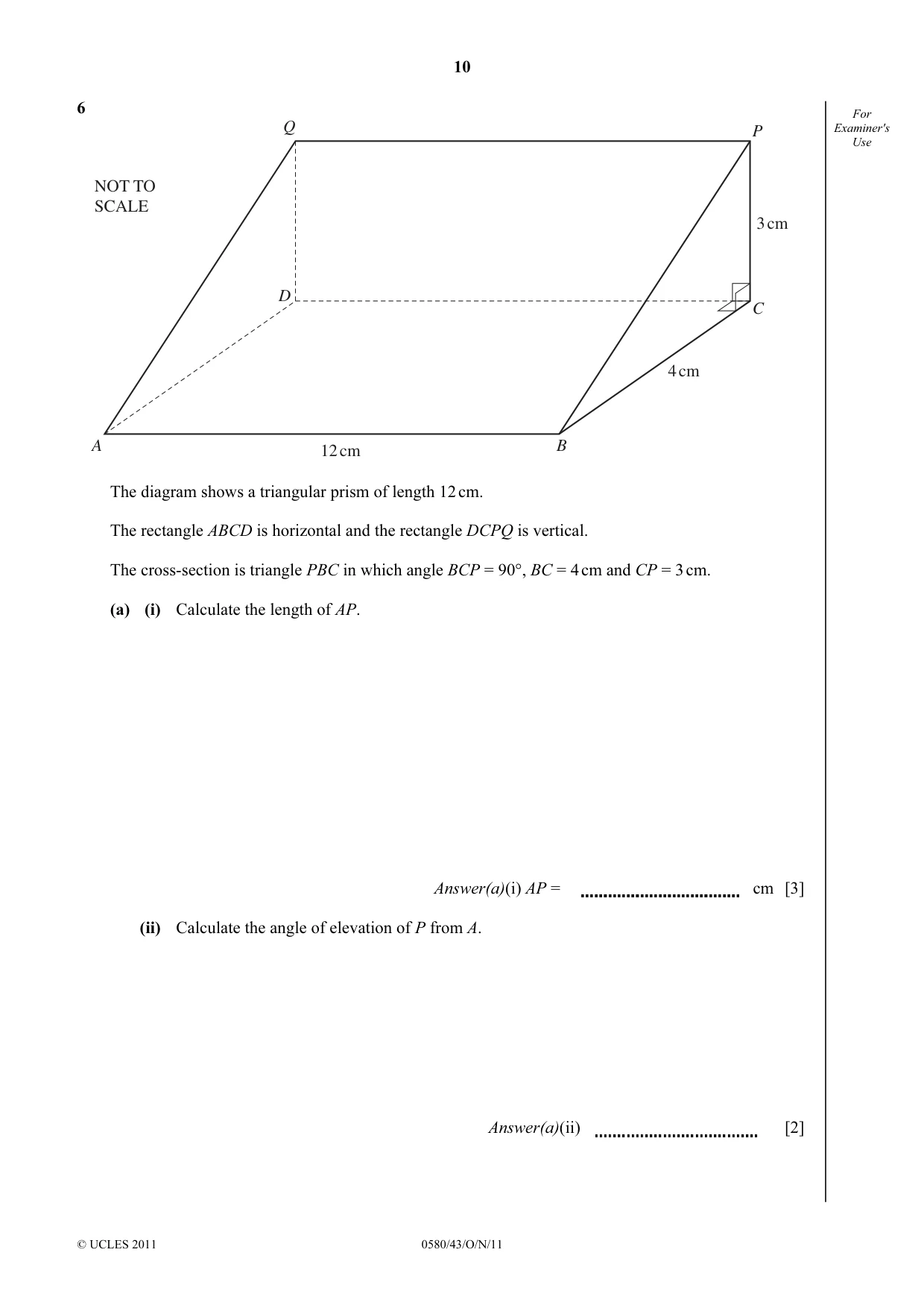
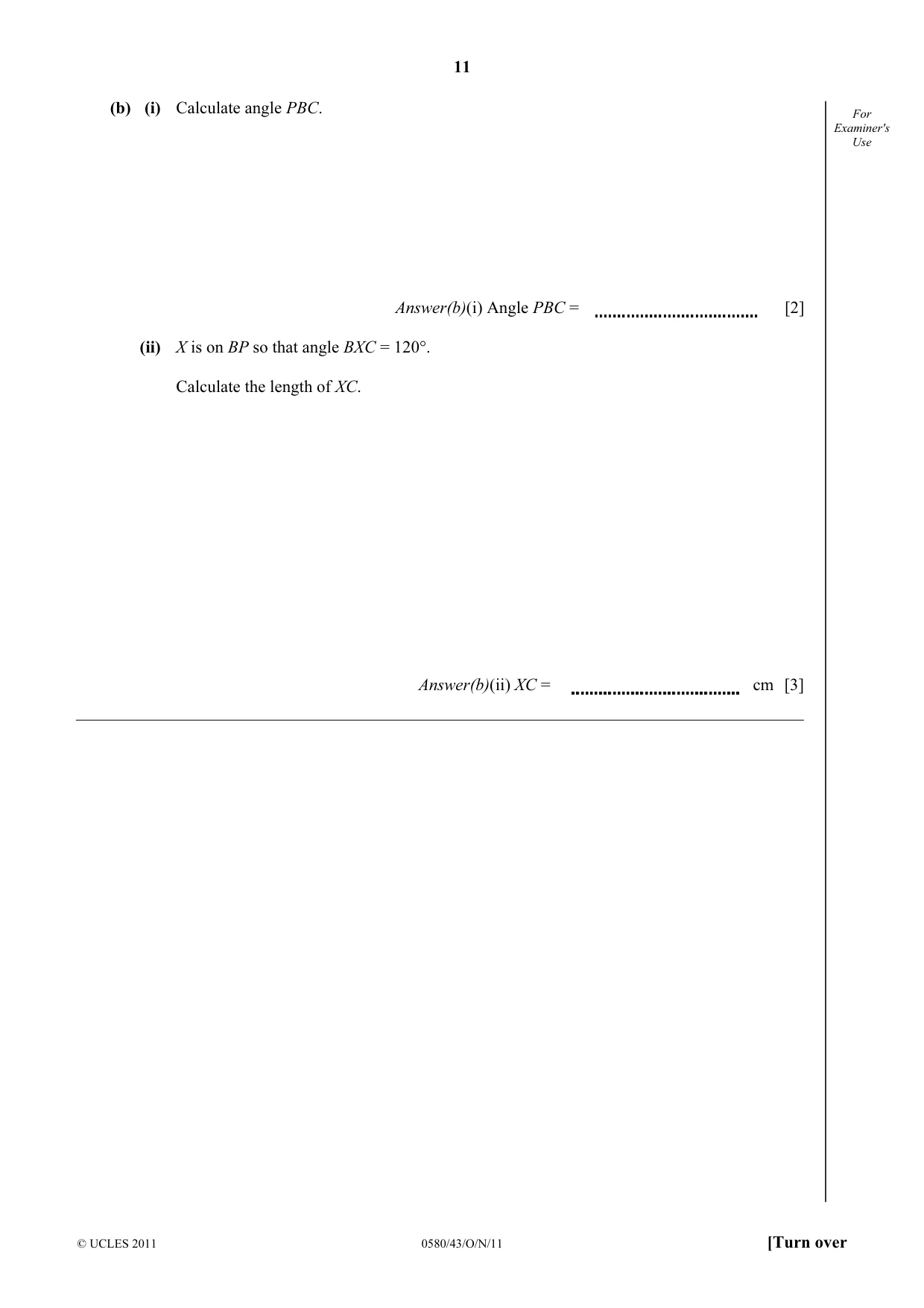
6 For Q P Examiner's Use NOT TO SCALE 3 cm D C 4 cm A B 12 cm The diagram shows a triangular prism of length 12 cm. The rectangle ABCD is horizontal and the rectangle DCPQ is vertical. The cross-section is triangle PBC in which angle BCP = 90°, BC = 4 cm and CP = 3 cm. (a) (i) Calculate the length of AP. Answer(a)(i) AP = cm [3] (ii) Calculate the angle of elevation of P from A. Answer(a)(ii) [2] (b) (i) Calculate angle PBC. For Examiner's Use Answer(b)(i) Angle PBC = [2] (ii) X is on BP so that angle BXC = 120°. Calculate the length of XC. Answer(b)(ii) XC = cm [3]
Mark scheme: 6 (a) (i) 13 or 13.0 www 3 M1 for 32 + 42 oe Equiv if find AC first and M1 for 12 2 + their (3 2 + 4 2 ) 3 3 (ii) 13.32 to 13.35 or 13.3 2 M1 for sin = or tan = oe their AP their AC 3 (b) (i) 36.86 to 36.87 or 36.9 2 M1 for tan (PBC) = oe 4 4 sin their (b )( i ) (ii) 2.770 to 2.774 or 2.77 3 M2 for or M1 for correct sin 120 implicit eqn IGCSE – October/November 2011 0580 43
Q8 · F(x) = x2 + x O1 g(x) = 1 O 2x h(x) = 3x Examiner's Use (a) Find the value of hg(–2)
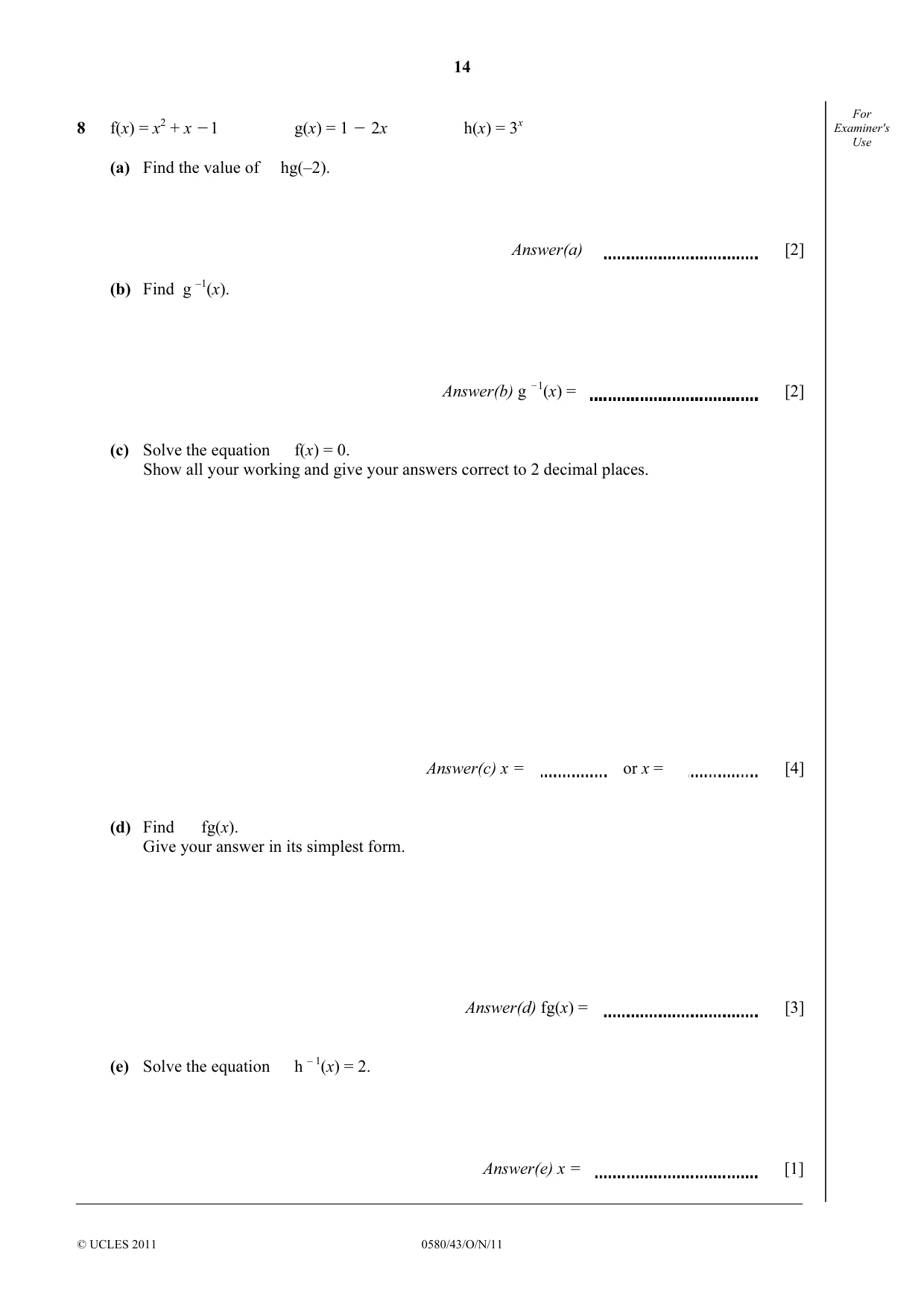
8 f(x) = x2 + x O1 g(x) = 1 O 2x h(x) = 3x Examiner's Use (a) Find the value of hg(–2). Answer(a) [2] (b) Find g –1(x). Answer(b) g O1(x) = [2] (c) Solve the equation f(x) = 0. Show all your working and give your answers correct to 2 decimal places. Answer(c) x = or x = [4] (d) Find fg(x). Give your answer in its simplest form. Answer(d) fg(x) = [3] (e) Solve the equation h – 1(x) = 2. Answer(e) x = [1]
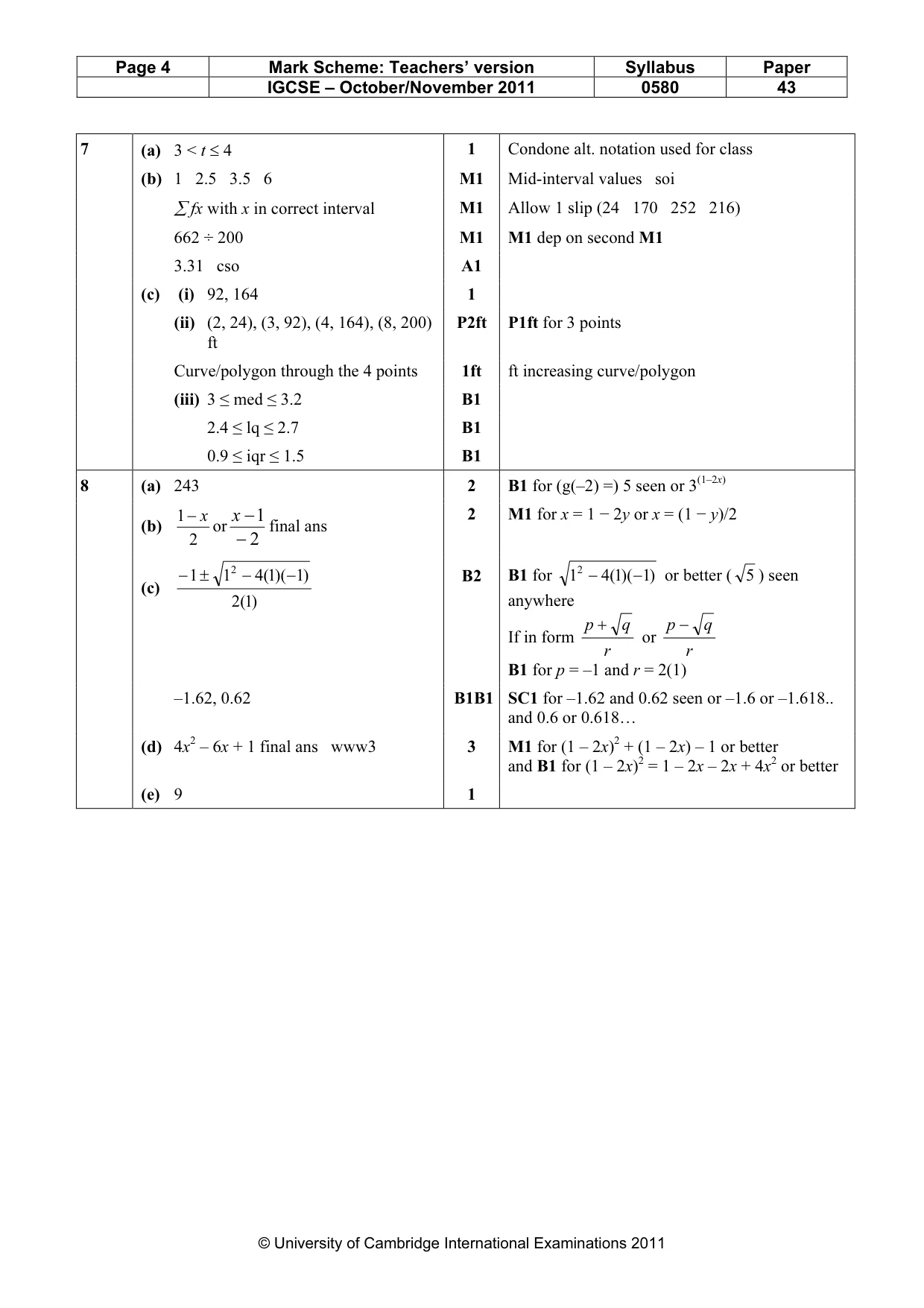
Mark scheme: 8 (a) 243 2 B1 for (g(–2) =) 5 seen or 3(1–2x) 1 − x x − 1 2 M1 for x = 1 − 2y or x = (1 − y)/2 (b) or final ans 2 − 2 − 1 ± 12 − 41()( −)1 B2 B1 for 12 − 4 1()( −)1 or better ( 5 ) seen (c) 2)1( anywhere p + q p − q If in form or r r B1 for p = –1 and r = 2(1) –1.62, 0.62 B1B1 SC1 for –1.62 and 0.62 seen or –1.6 or –1.618.. and 0.6 or 0.618… (d) 4x2 – 6x + 1 final ans www3 3 M1 for (1 – 2x)2 + (1 – 2x) – 1 or better and B1 for (1 – 2x)2 = 1 – 2x – 2x + 4x2 or better (e) 9 1 IGCSE – October/November 2011 0580 43
Q9 · For Examiner's Set A Use S U M S Set B M I N U S The diagram shows two sets of cards
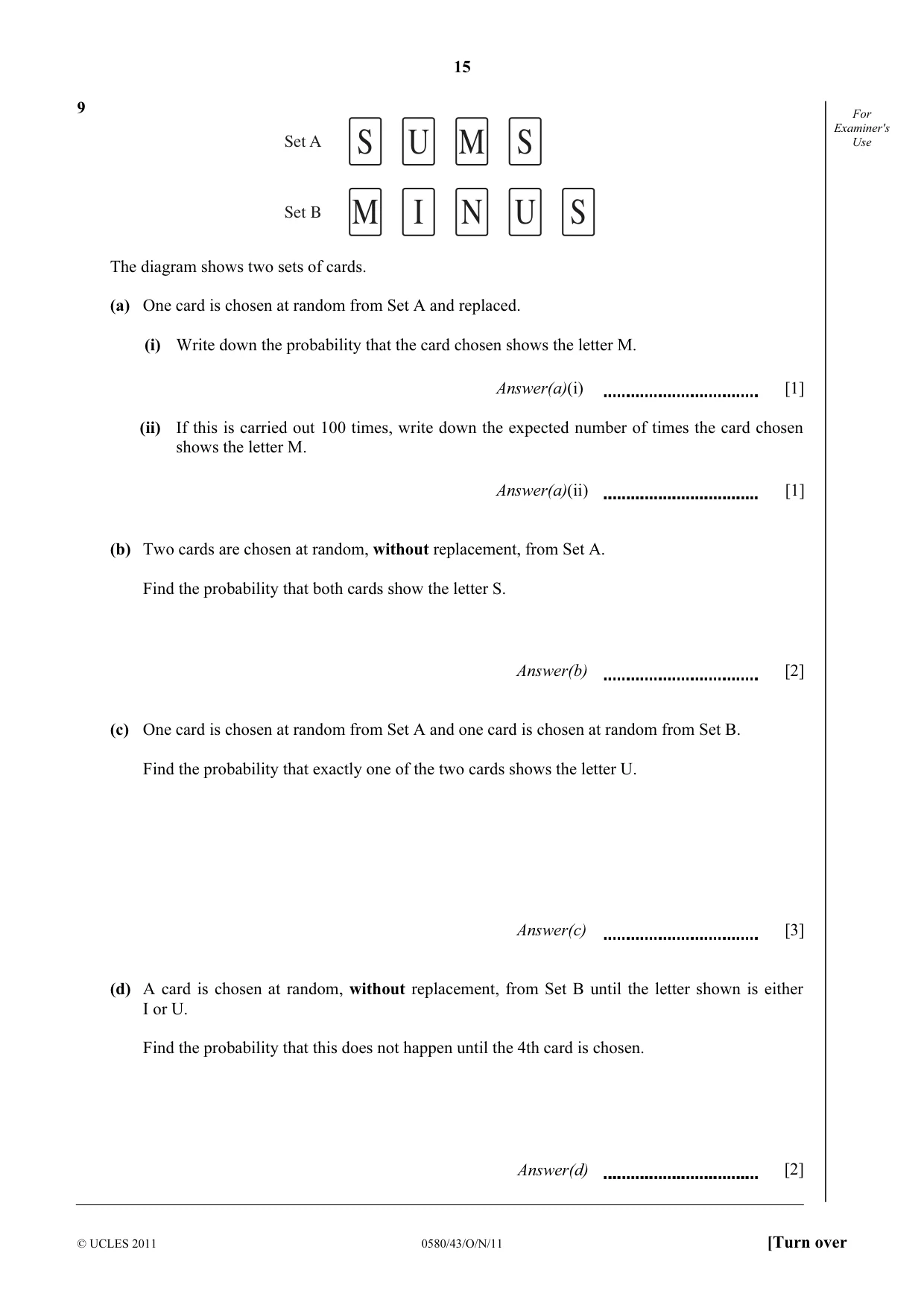
9 For Examiner's Set A Use S U M S Set B M I N U S The diagram shows two sets of cards. (a) One card is chosen at random from Set A and replaced. (i) Write down the probability that the card chosen shows the letter M. Answer(a)(i) [1] (ii) If this is carried out 100 times, write down the expected number of times the card chosen shows the letter M. Answer(a)(ii) [1] (b) Two cards are chosen at random, without replacement, from Set A. Find the probability that both cards show the letter S. Answer(b) [2] (c) One card is chosen at random from Set A and one card is chosen at random from Set B. Find the probability that exactly one of the two cards shows the letter U. Answer(c) [3] (d) A card is chosen at random, without replacement, from Set B until the letter shown is either I or U. Find the probability that this does not happen until the 4th card is chosen. Answer(d) [2]
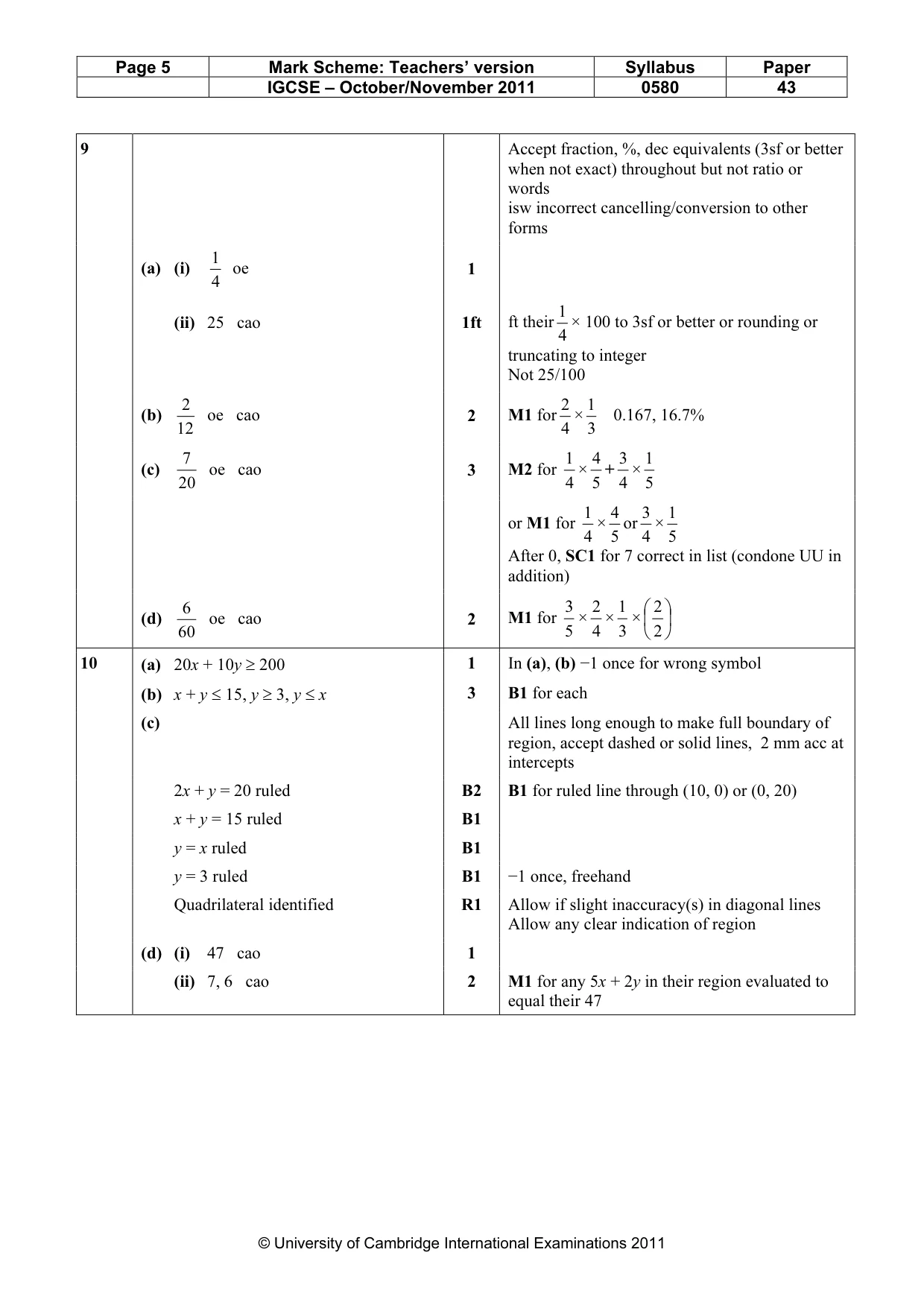
Mark scheme: 9 Accept fraction, %, dec equivalents (3sf or better when not exact) throughout but not ratio or words isw incorrect cancelling/conversion to other forms 1 (a) (i) oe 1 4 1 (ii) 25 cao 1ft ft their × 100 to 3sf or better or rounding or 4 truncating to integer Not 25/100 2 2 1 (b) oe cao 2 M1 for × 0.167, 16.7% 12 4 3 7 1 4 3 1 (c) oe cao 3 M2 for × + × 20 4 5 4 5 1 4 3 1 or M1 for × or × 4 5 4 5 After 0, SC1 for 7 correct in list (condone UU in addition) 6 3 2 1 2 (d) oe cao 2 M1 for × × × 60 5 4 3 2
Q10 · Hassan stores books in large boxes and small boxes
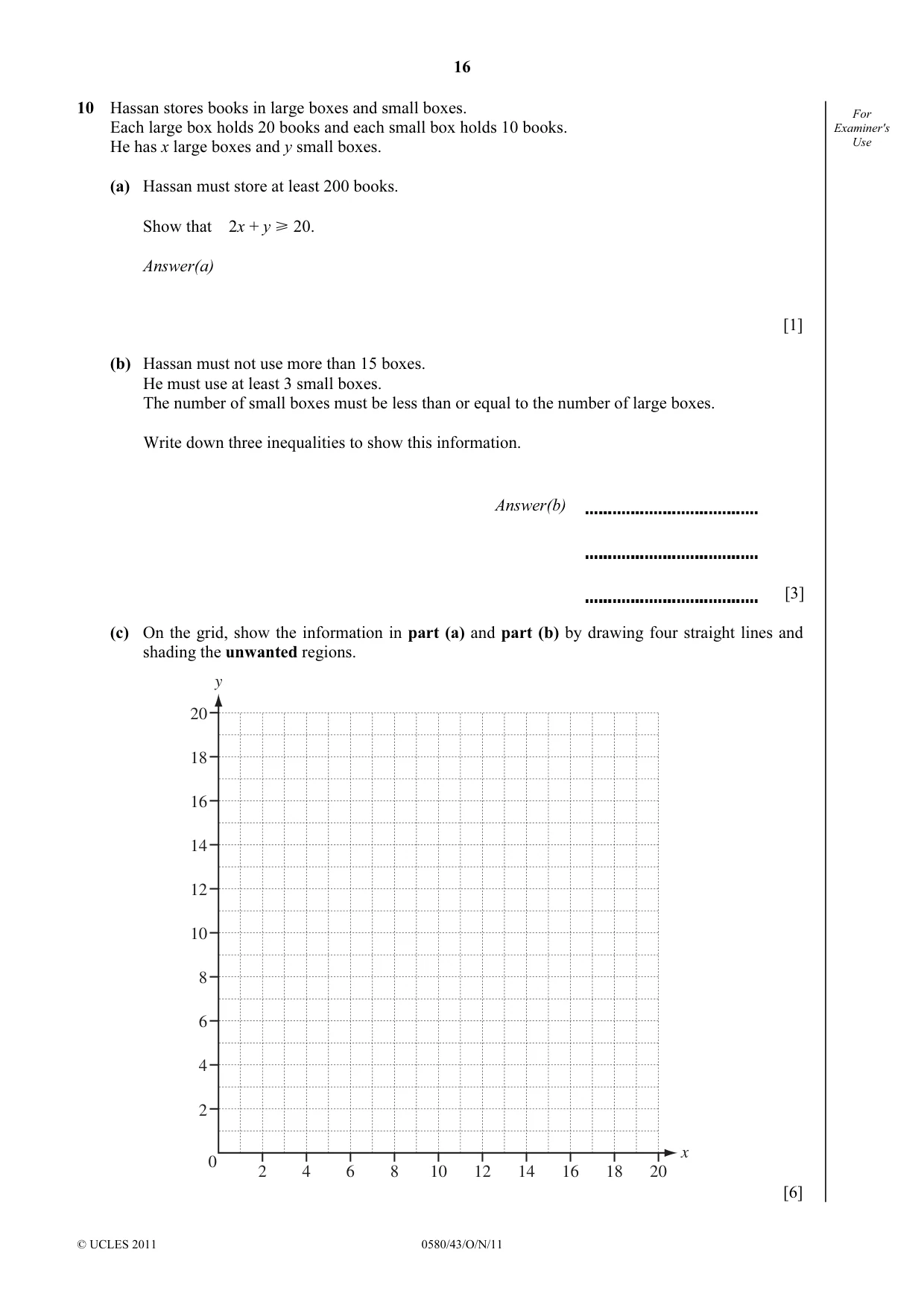
10 Hassan stores books in large boxes and small boxes. For Each large box holds 20 books and each small box holds 10 books. Examiner's He has x large boxes and y small boxes. Use (a) Hassan must store at least 200 books. Show that 2x + y [ 20. Answer(a) [1] (b) Hassan must not use more than 15 boxes. He must use at least 3 small boxes. The number of small boxes must be less than or equal to the number of large boxes. Write down three inequalities to show this information. Answer(b) [3] (c) On the grid, show the information in part (a) and part (b) by drawing four straight lines and shading the unwanted regions. y 20 18 16 14 12 10 8 6 4 2 x 0 2 4 6 8 10 12 14 16 18 20 [6] (d) A large box costs $5 and a small box costs $2. For Examiner's (i) Find the least possible total cost of the boxes. Use Answer(d)(i) $ [1] (ii) Find the number of large boxes and the number of small boxes which give this least possible cost. Answer(d)(ii) Number of large boxes = Number of small boxes = [2] Question 11 is printed on the next page.
Mark scheme: 10 (a) 20x + 10y ≥ 200 1 In (a), (b) −1 once for wrong symbol (b) x + y ≤ 15, y ≥ 3, y ≤ x 3 B1 for each (c) All lines long enough to make full boundary of region, accept dashed or solid lines, 2 mm acc at intercepts 2x + y = 20 ruled B2 B1 for ruled line through (10, 0) or (0, 20) x + y = 15 ruled B1 y = x ruled B1 y = 3 ruled B1 −1 once, freehand Quadrilateral identified R1 Allow if slight inaccuracy(s) in diagonal lines Allow any clear indication of region (d) (i) 47 cao 1 (ii) 7, 6 cao 2 M1 for any 5x + 2y in their region evaluated to equal their 47 IGCSE – October/November 2011 0580 43 8
Q11 · For y Examiner's Use 5 4 3 Q 2 P 1 x –3 –2 –1 0 1 2 3 4 5 The points P and Q have…
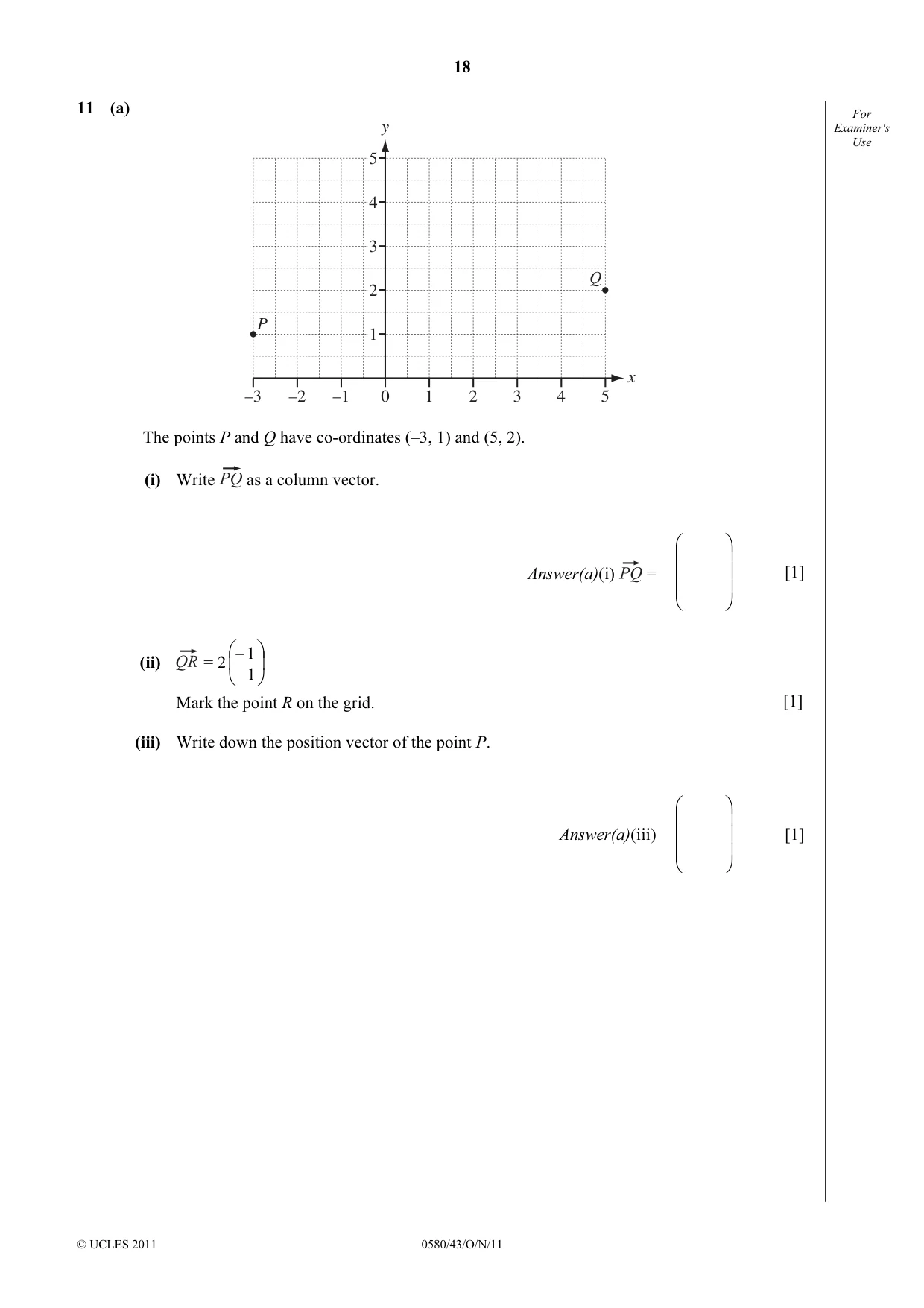
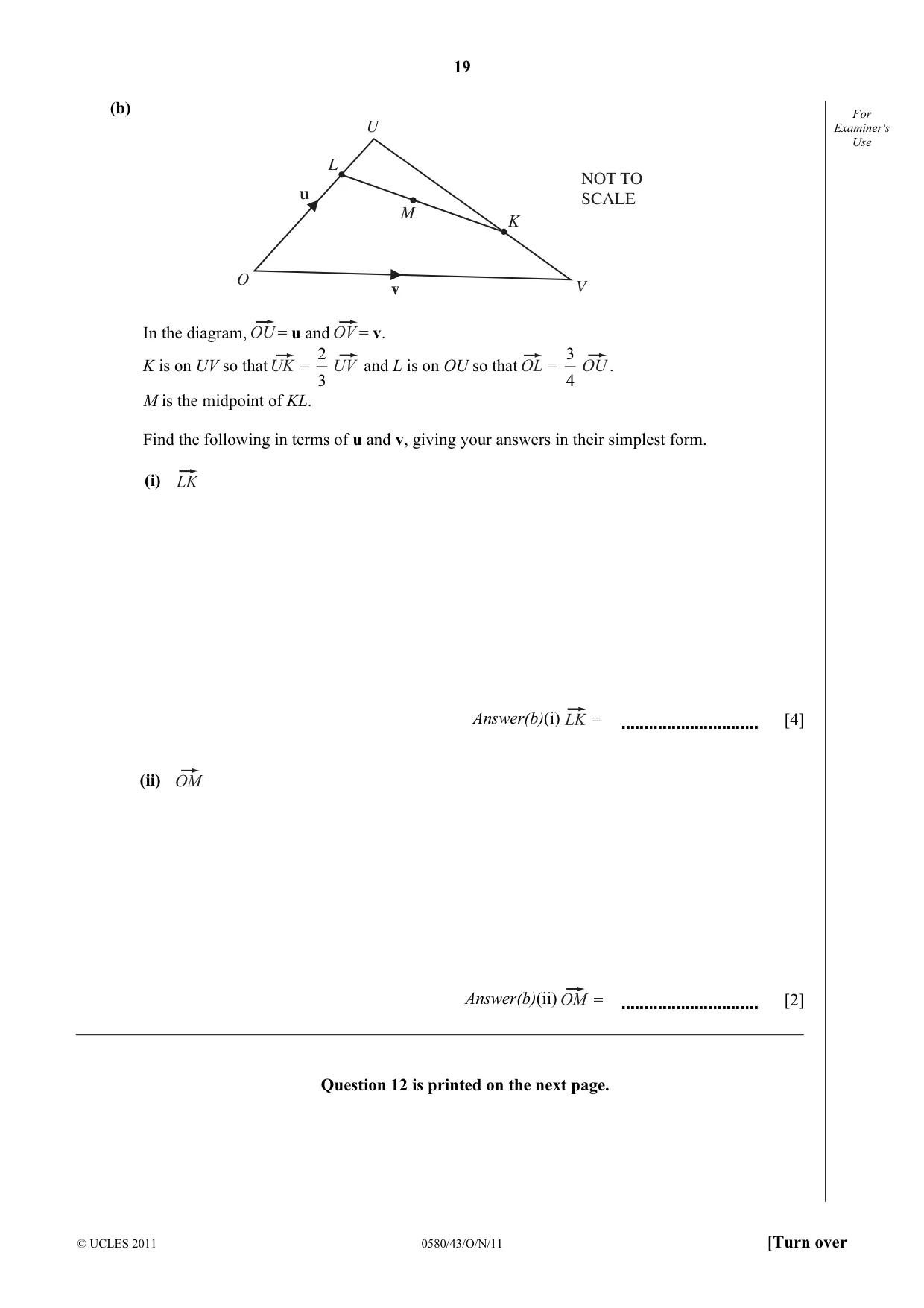
11 (a) For y Examiner's Use 5 4 3 Q 2 P 1 x –3 –2 –1 0 1 2 3 4 5 The points P and Q have co-ordinates (–3, 1) and (5, 2). (i) Write as a column vector. Answer(a)(i) = [1] − 1 (ii) = 2 1 Mark the point R on the grid. [1] (iii) Write down the position vector of the point P. Answer(a)(iii) [1] (b) For U Examiner's Use L NOT TO u SCALE M K O V v In the diagram, = u and = v. 2 3 K is on UV so that = and L is on OU so that = . 3 4 M is the midpoint of KL. Find the following in terms of u and v, giving your answers in their simplest form. (i) Answer(b)(i) = [4] (ii) Answer(b)(ii) = [2] Question 12 is printed on the next page.
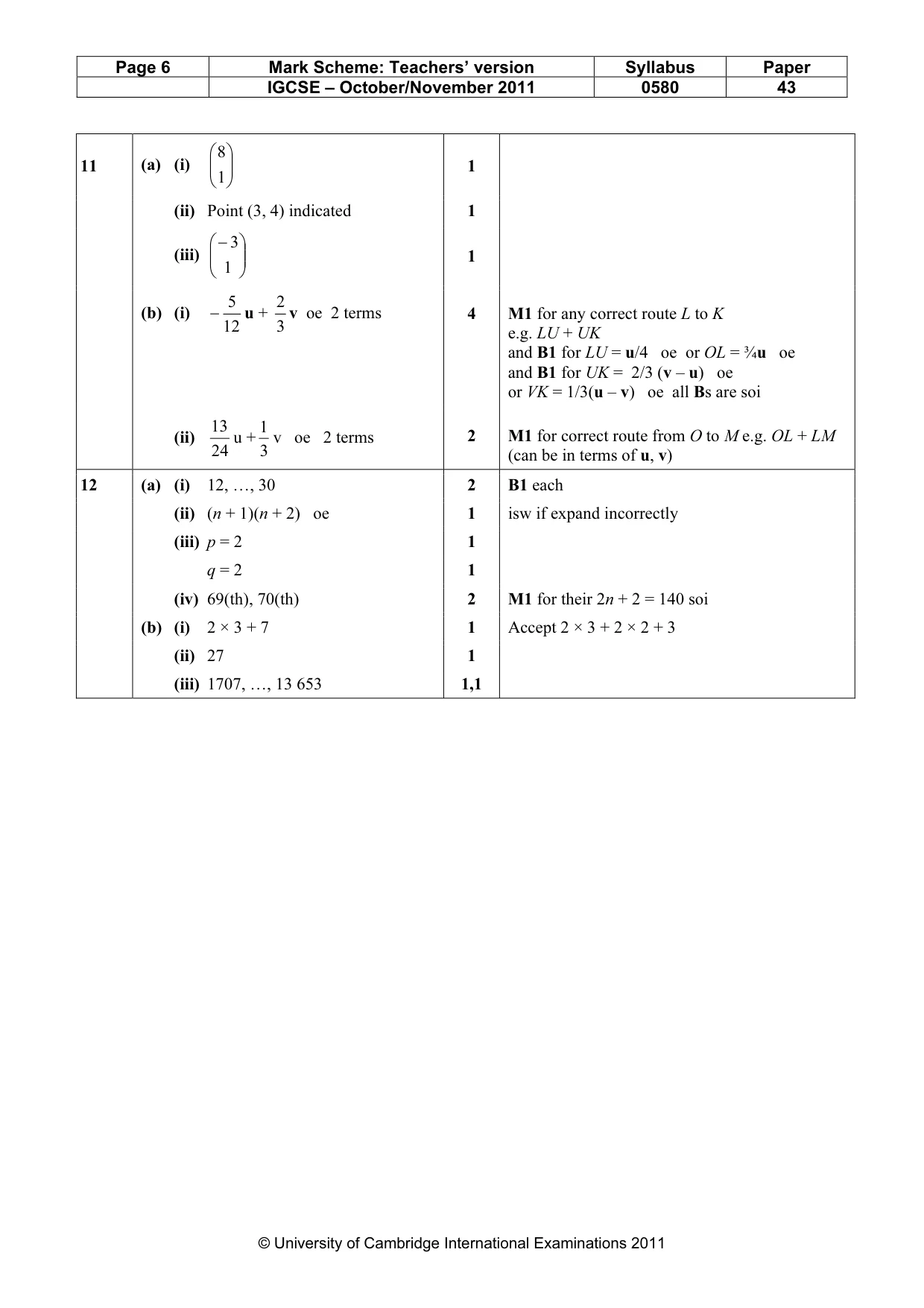
Mark scheme: 8 11 (a) (i) 1 1 (ii) Point (3, 4) indicated 1 − 3 (iii) 1 1 5 2 (b) (i) − u + v oe 2 terms 4 M1 for any correct route L to K 12 3 e.g. LU + UK and B1 for LU = u/4 oe or OL = ¾u oe and B1 for UK = 2/3 (v – u) oe or VK = 1/3(u – v) oe all Bs are soi 13 1 (ii) u + v oe 2 terms 2 M1 for correct route from O to M e.g. OL + LM 24 3 (can be in terms of u, v)
Q12 · The nth term of a sequence is n(n+1)
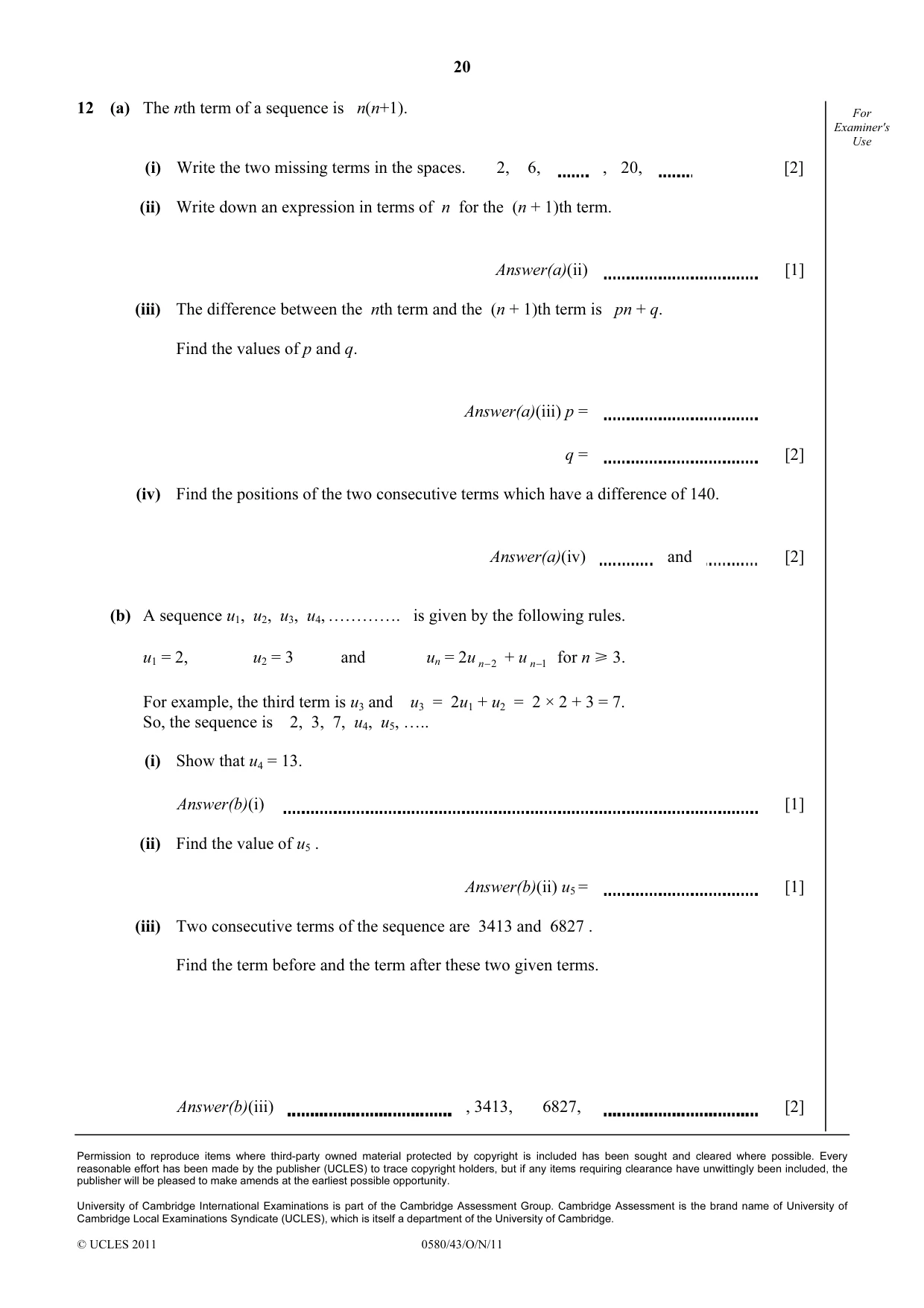
12 (a) The nth term of a sequence is n(n+1). For Examiner's Use (i) Write the two missing terms in the spaces. 2, 6, , 20, [2] (ii) Write down an expression in terms of n for the (n + 1)th term. Answer(a)(ii) [1] (iii) The difference between the nth term and the (n + 1)th term is pn + q. Find the values of p and q. Answer(a)(iii) p = q = [2] (iv) Find the positions of the two consecutive terms which have a difference of 140. Answer(a)(iv) and [2] (b) A sequence u1, u2, u3, u4, …………. is given by the following rules. u1 = 2, u2 = 3 and un = 2u n − 2 + u n −1 for n [ 3. For example, the third term is u3 and u3 = 2u1 + u2 = 2 × 2 + 3 = 7. So, the sequence is 2, 3, 7, u4, u5, ….. (i) Show that u4 = 13. Answer(b)(i) [1] (ii) Find the value of u5 . Answer(b)(ii) u5 = [1] (iii) Two consecutive terms of the sequence are 3413 and 6827 . Find the term before and the term after these two given terms. Answer(b)(iii) , 3413, 6827, [2]
Mark scheme: 12 (a) (i) 12, …, 30 2 B1 each (ii) (n + 1)(n + 2) oe 1 isw if expand incorrectly (iii) p = 2 1 q = 2 1 (iv) 69(th), 70(th) 2 M1 for their 2n + 2 = 140 soi (b) (i) 2 × 3 + 7 1 Accept 2 × 3 + 2 × 2 + 3 (ii) 27 1 (iii) 1707, …, 13 653 1,1
What was in this paper
The subtopics covered by these 11 questions, and how many questions each got. Open one in a new tab to see every Cambridge question on it.
What you needed in this session
Cambridge’s own grade thresholds for 2011 Oct/Nov, Paper 4 · Variant 3. A higher threshold means an easier paper — the bar moves with how the cohort did.