Cambridge IGCSE Mathematics 0580 — 2010 Oct/Nov Paper 4 · Variant 1
0580/41/O/N/10 · 2 questions · 130 marks · ≈146 min
The question paper and its mark scheme, free to read here and free to download. This is Cambridge’s own paper, exactly as it was sat.
Question paper16 pages
Mark scheme6 pages
Answers below. Sit the paper first if you are practising.
Questions as text
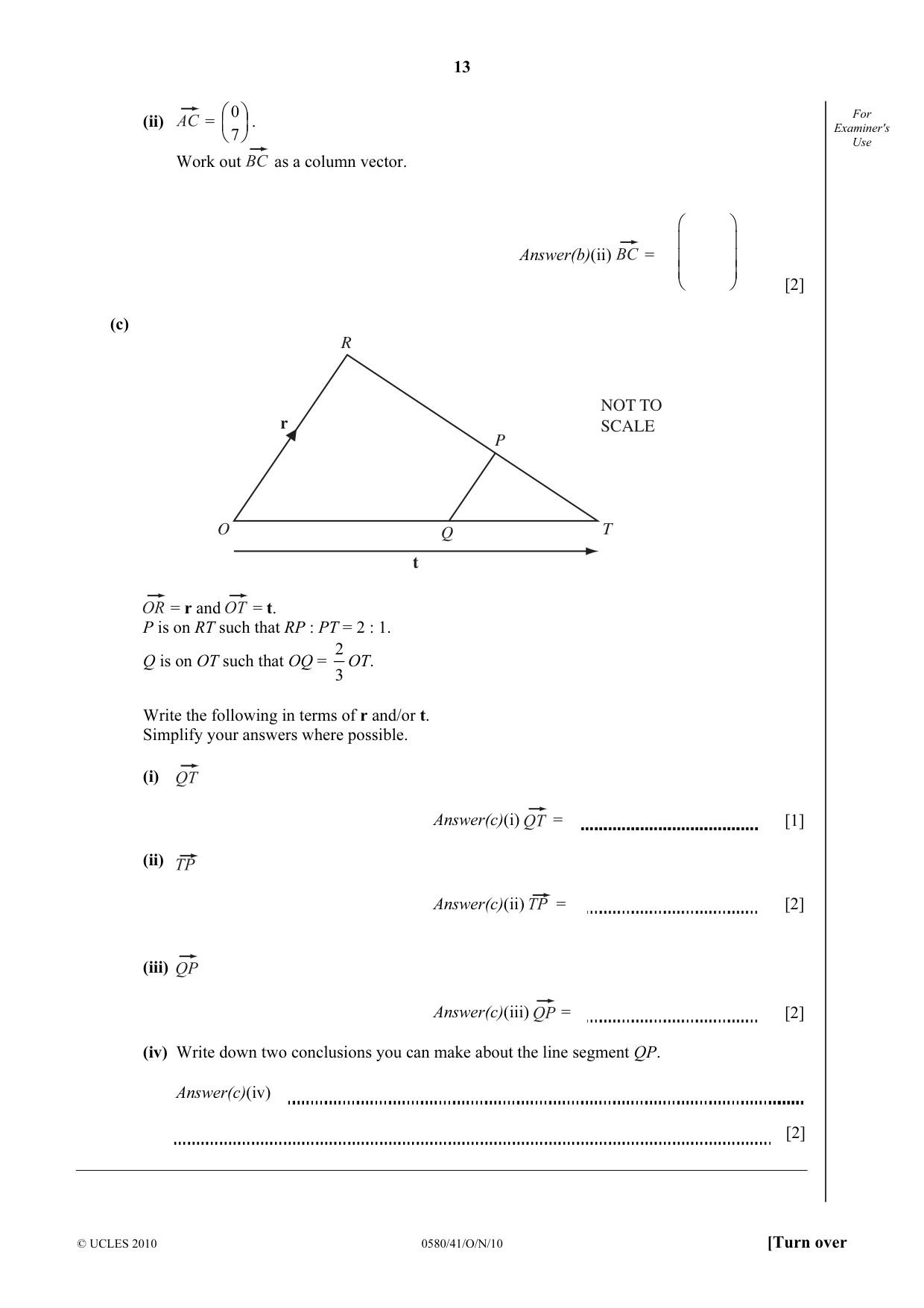
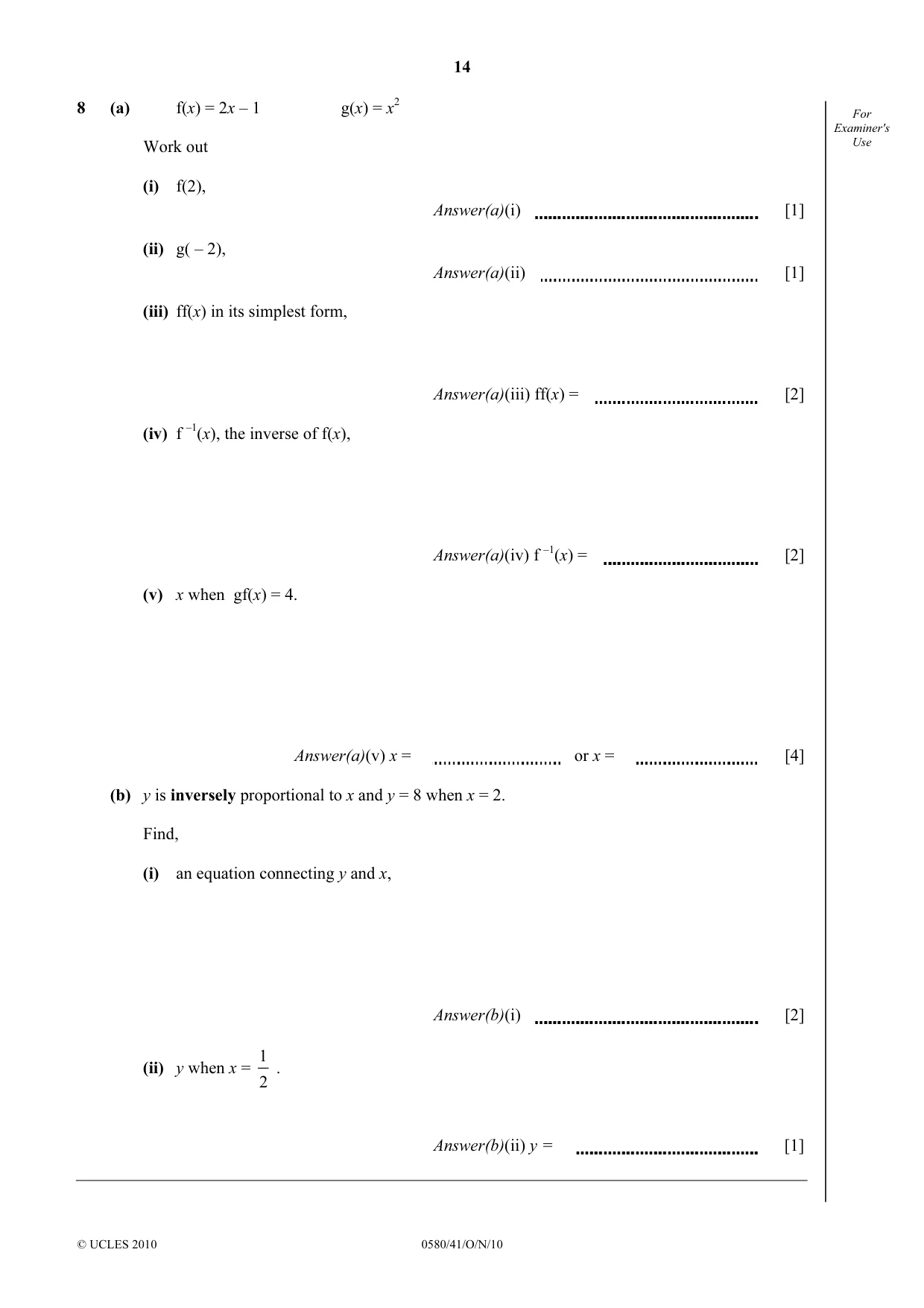
Q8 · F(x) = 2x – 1 g(x) = x2 For Examiner's Work out Use (i) f(2), Answer(a)(i) [1] (ii) g(…
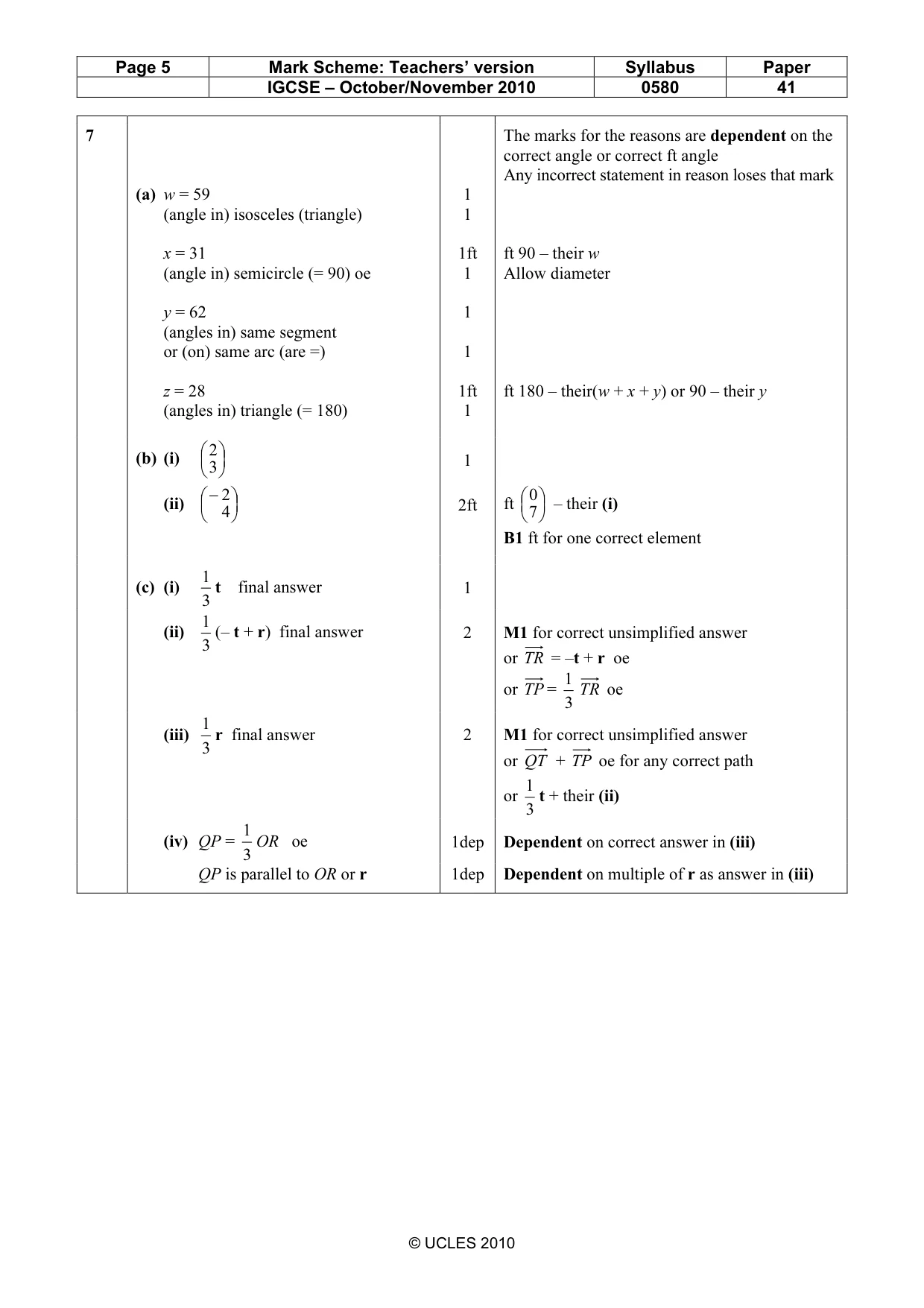
8 (a) f(x) = 2x – 1 g(x) = x2 For Examiner's Work out Use (i) f(2), Answer(a)(i) [1] (ii) g( – 2), Answer(a)(ii) [1] (iii) ff(x) in its simplest form, Answer(a)(iii) ff(x) = [2] (iv) f –1(x), the inverse of f(x), Answer(a)(iv) f –1(x) = [2] (v) x when gf(x) = 4. Answer(a)(v) x = or x = [4] (b) y is inversely proportional to x and y = 8 when x = 2. Find, (i) an equation connecting y and x, Answer(b)(i) [2] 1 (ii) y when x = . 2 Answer(b)(ii) y = [1]
Mark scheme: 8 (a) (i) 3 1 (ii) 4 1 (iii) 4x – 3 final answer 2 M1 for 2(2x – 1) – 1 x + 1 y + 1 f ( x ) + 1 (iv) oe final answer 2 M1 for x = 2y – 1 or oe or oe 2 2 2 1 1 (v) – and 1 4 B1 for (2x – 1)2 soi 2 2 M2 for 2x – 1 = ± 2 M1 for 4x2 – 2x – 2x + 1 or M1 for 2x – 1 = 2 and M1 for (2x + 1)(2x – 3) or correct substitution in formula soi by (4 ± √64)/8 16 (b) (i) y = oe 2 Condone y = k/x and k = 16 stated x k M1 for y = oe x (ii) 32 1
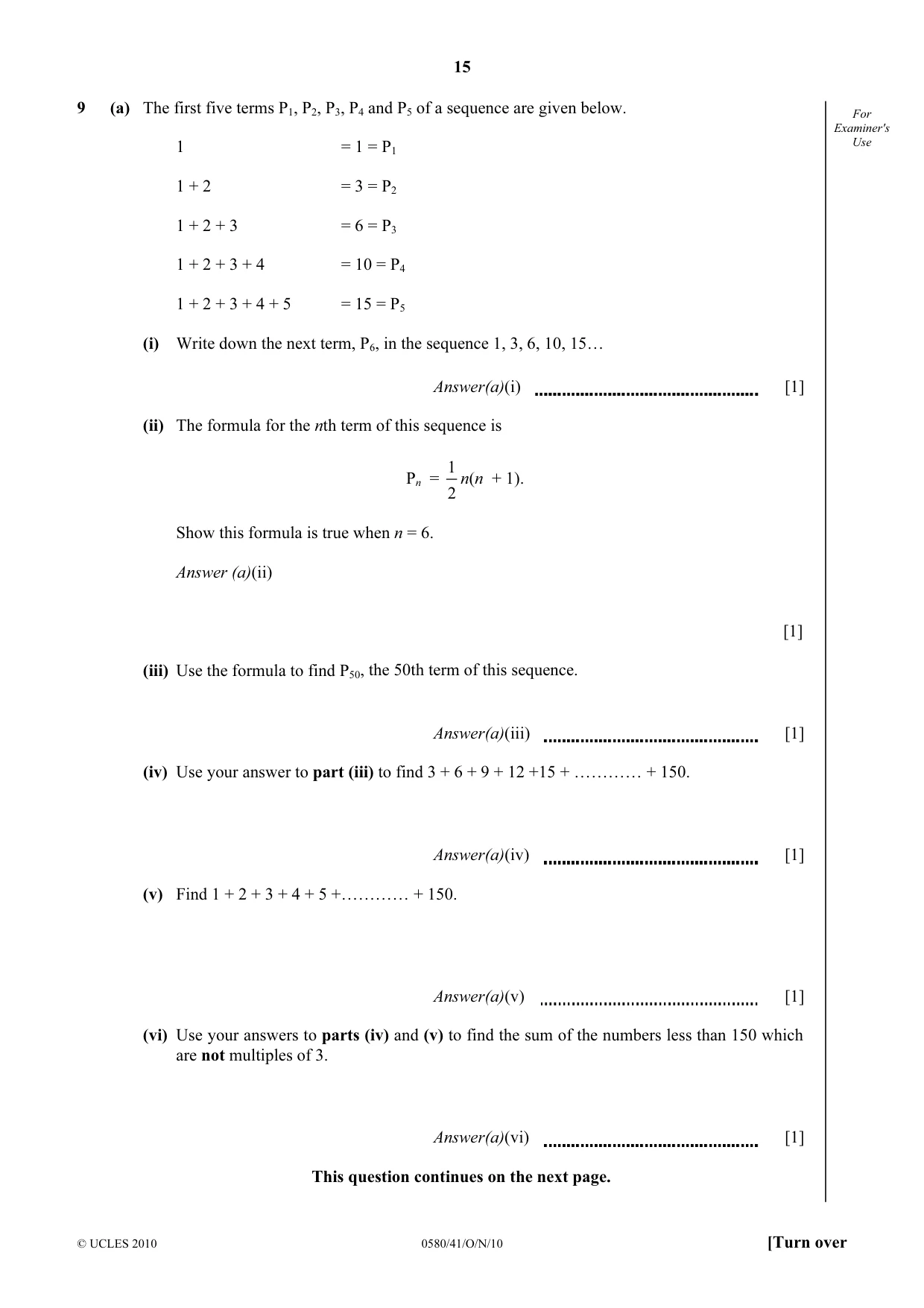
Q9 · The first five terms P1, P2, P3, P4 and P5 of a sequence are given below
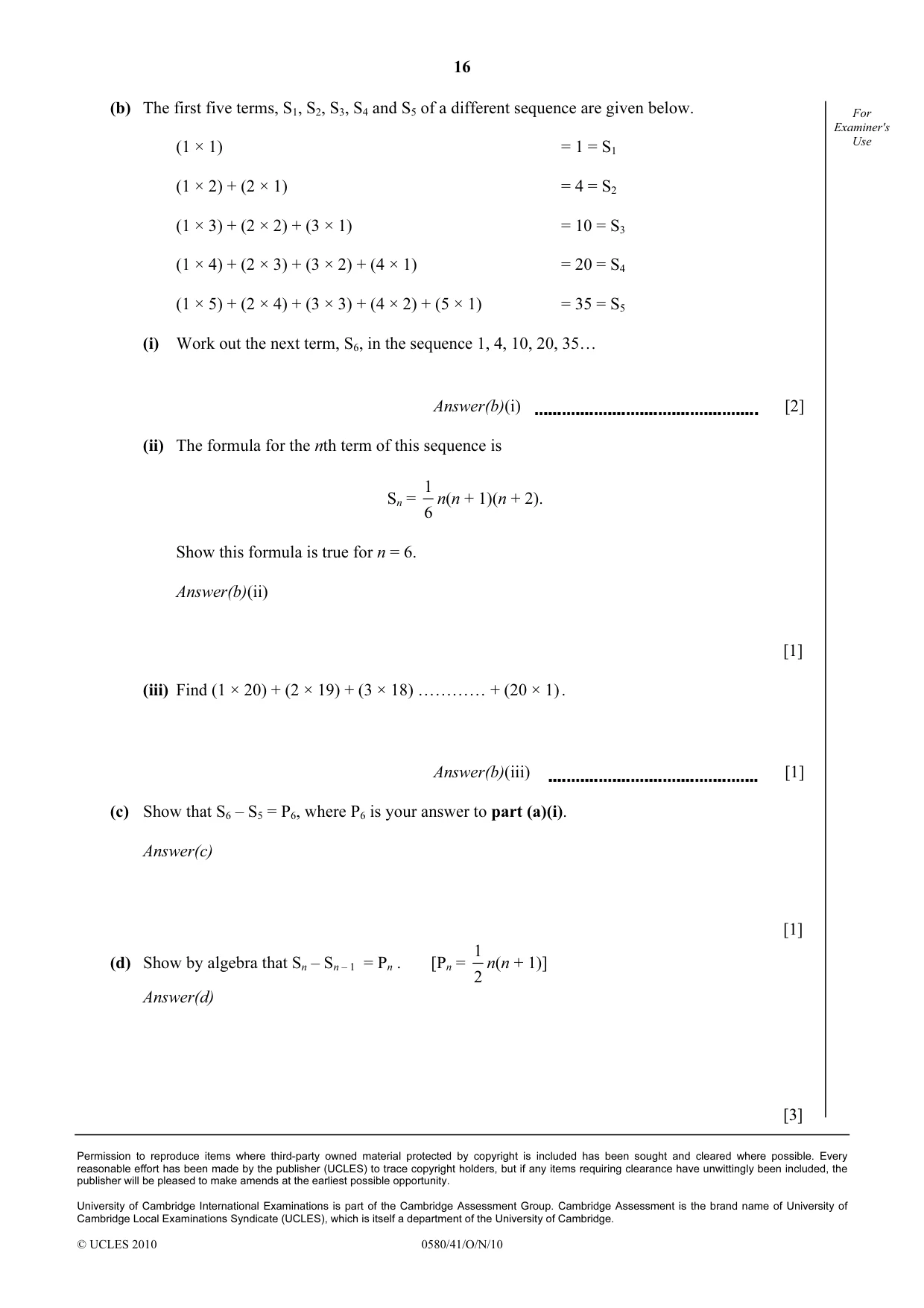
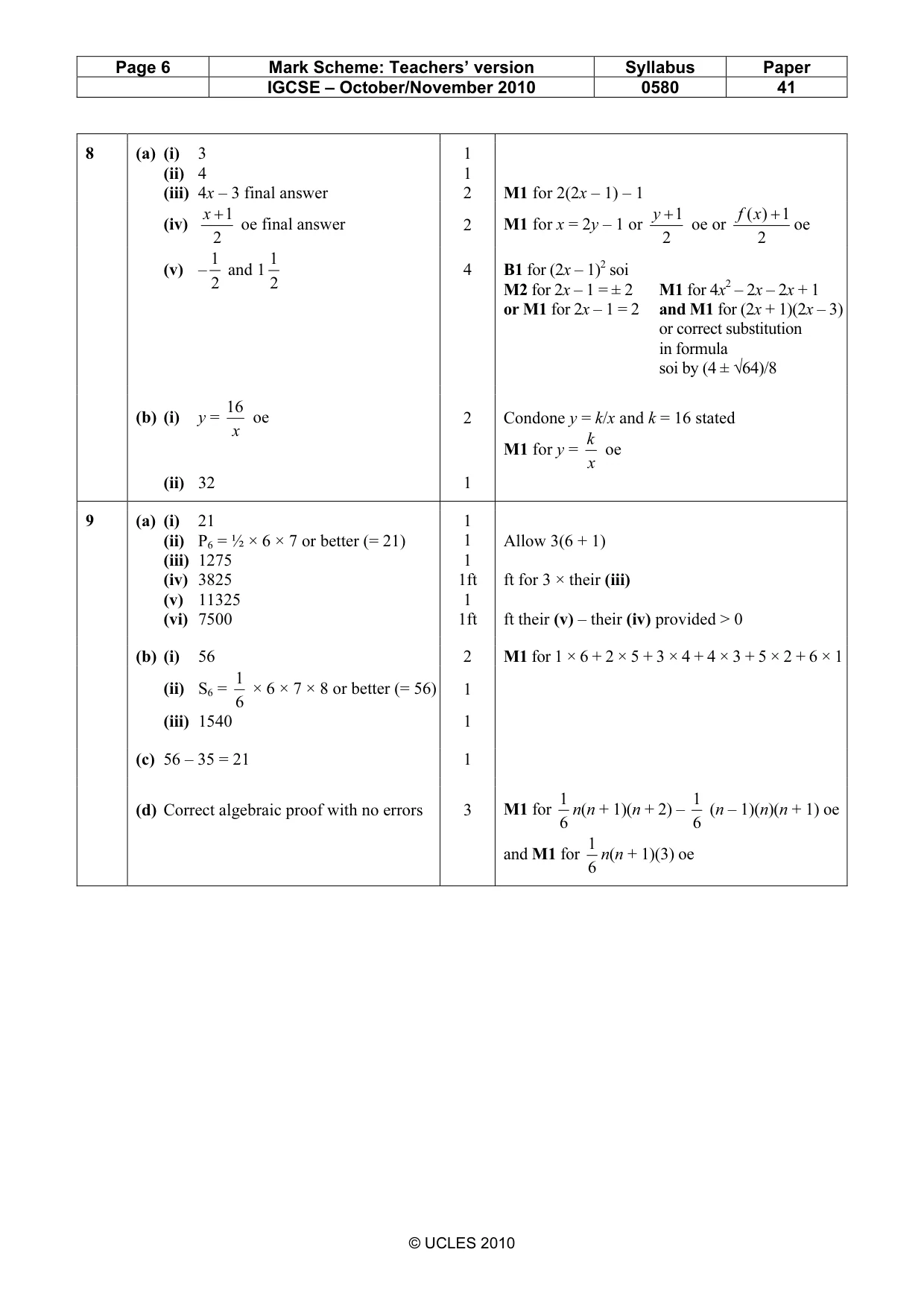
9 (a) The first five terms P1, P2, P3, P4 and P5 of a sequence are given below. For Examiner's 1 = 1 = P1 Use 1 + 2 = 3 = P2 1 + 2 + 3 = 6 = P3 1 + 2 + 3 + 4 = 10 = P4 1 + 2 + 3 + 4 + 5 = 15 = P5 (i) Write down the next term, P6, in the sequence 1, 3, 6, 10, 15… Answer(a)(i) [1] (ii) The formula for the nth term of this sequence is 1 Pn = n(n + 1). 2 Show this formula is true when n = 6. Answer (a)(ii) [1] (iii) Use the formula to find P50, the 50th term of this sequence. Answer(a)(iii) [1] (iv) Use your answer to part (iii) to find 3 + 6 + 9 + 12 +15 + ………… + 150. Answer(a)(iv) [1] (v) Find 1 + 2 + 3 + 4 + 5 +………… + 150. Answer(a)(v) [1] (vi) Use your answers to parts (iv) and (v) to find the sum of the numbers less than 150 which are not multiples of 3. Answer(a)(vi) [1] This question continues on the next page. (b) The first five terms, S1, S2, S3, S4 and S5 of a different sequence are given below. For Examiner's (1 × 1) = 1 = S1 Use (1 × 2) + (2 × 1) = 4 = S2 (1 × 3) + (2 × 2) + (3 × 1) = 10 = S3 (1 × 4) + (2 × 3) + (3 × 2) + (4 × 1) = 20 = S4 (1 × 5) + (2 × 4) + (3 × 3) + (4 × 2) + (5 × 1) = 35 = S5 (i) Work out the next term, S6, in the sequence 1, 4, 10, 20, 35… Answer(b)(i) [2] (ii) The formula for the nth term of this sequence is 1 Sn = n(n + 1)(n + 2). 6 Show this formula is true for n = 6. Answer(b)(ii) [1] (iii) Find (1 × 20) + (2 × 19) + (3 × 18) ………… + (20 × 1) . Answer(b)(iii) [1] (c) Show that S6 – S5 = P6, where P6 is your answer to part (a)(i). Answer(c) [1] 1 (d) Show by algebra that Sn – Sn – 1 = Pn . [Pn = n(n + 1)] 2 Answer(d) [3]
Mark scheme: 9 (a) (i) 21 1 (ii) P6 = ½ × 6 × 7 or better (= 21) 1 Allow 3(6 + 1) (iii) 1275 1 (iv) 3825 1ft ft for 3 × their (iii) (v) 11325 1 (vi) 7500 1ft ft their (v) – their (iv) provided > 0 (b) (i) 56 2 M1 for 1 × 6 + 2 × 5 + 3 × 4 + 4 × 3 + 5 × 2 + 6 × 1 1 (ii) S6 = × 6 × 7 × 8 or better (= 56) 1 6 (iii) 1540 1 (c) 56 – 35 = 21 1 1 1 (d) Correct algebraic proof with no errors 3 M1 for n(n + 1)(n + 2) – (n – 1)(n)(n + 1) oe 6 6 1 and M1 for n(n + 1)(3) oe 6
What was in this paper
The subtopics covered by these 2 questions, and how many questions each got. Open one in a new tab to see every Cambridge question on it.
What you needed in this session
Cambridge’s own grade thresholds for 2010 Oct/Nov, Paper 4 · Variant 1. A higher threshold means an easier paper — the bar moves with how the cohort did.