Questions as text
Q1 · In a market economy, who determines the allocation of resources? 0455/11 May/June 2007
3 In a market economy, who determines the allocation of resources? A central authorities only B firms only C consumers and firms only D central authorities and firms only
1 marks
Answer: C
This question in 0455/11 May/June 2007
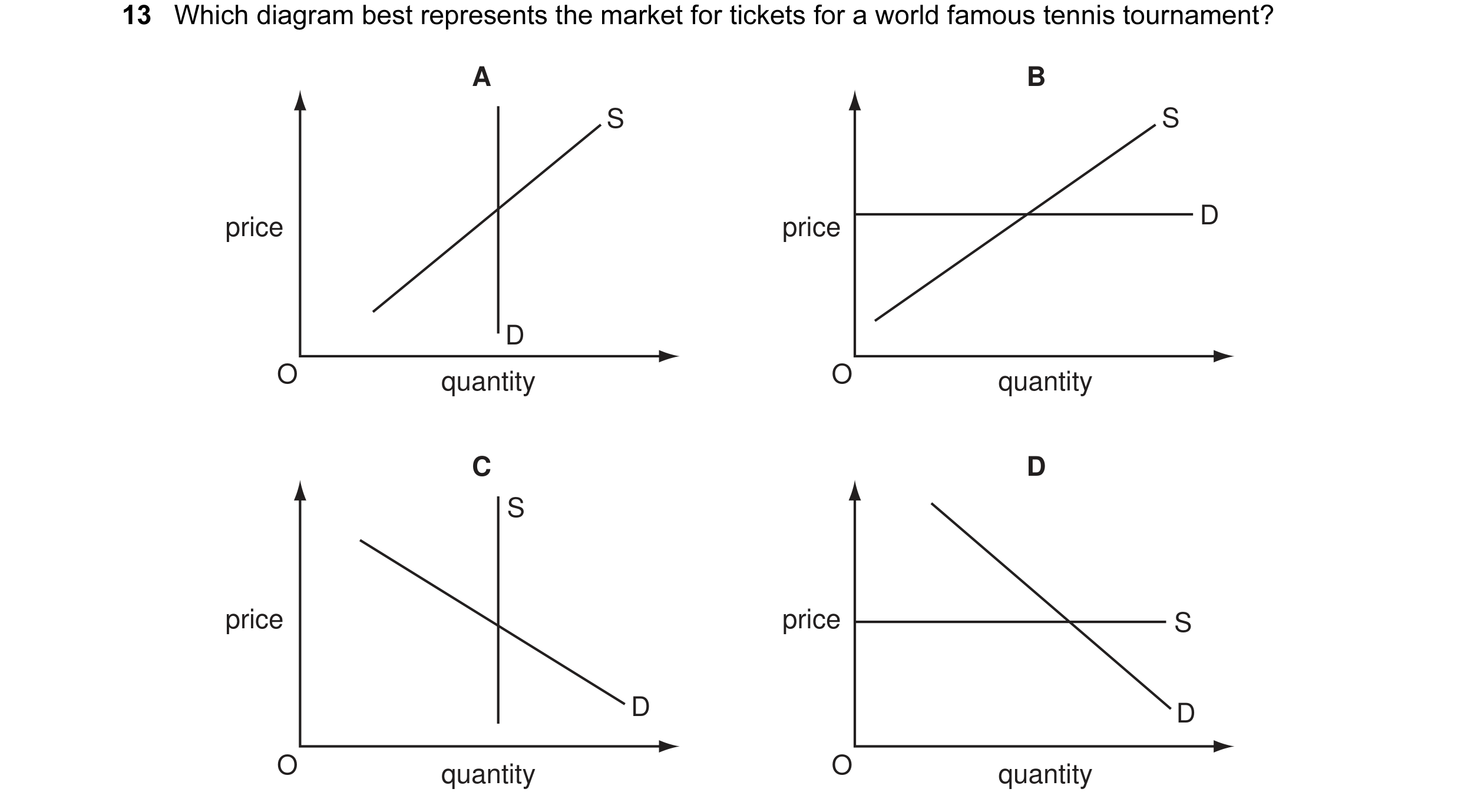
Q2 · Which diagram best represents the market for tickets for a world famous tennis tournament? 0455/11 May/June 2008
13 Which diagram best represents the market for tickets for a world famous tennis tournament? A B S S price price D D O quantity O quantity C D S price price S D D O quantity O quantity
1 marks
Answer: C
This question in 0455/11 May/June 2008
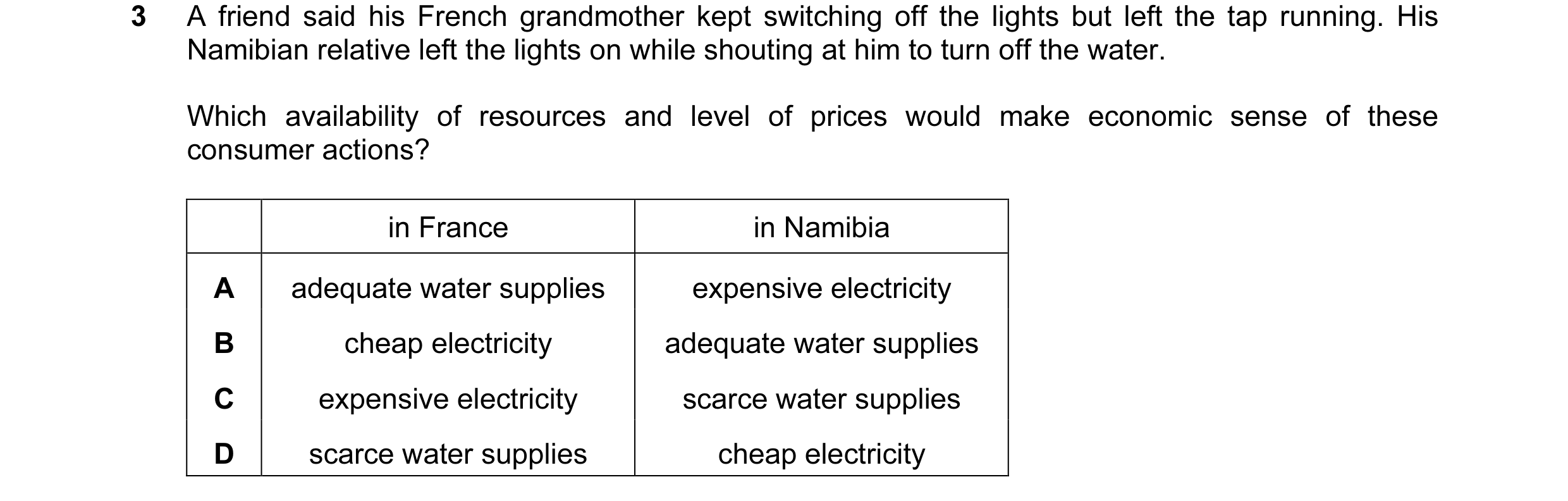
Q3 · A friend said his French grandmother kept switching off the lights but left the tap… 0455/11 Oct/Nov 2009
3 A friend said his French grandmother kept switching off the lights but left the tap running. His Namibian relative left the lights on while shouting at him to turn off the water. Which availability of resources and level of prices would make economic sense of these consumer actions? in France in Namibia A adequate water supplies expensive electricity B cheap electricity adequate water supplies C expensive electricity scarce water supplies D scarce water supplies cheap electricity
1 marks
Answer: C
This question in 0455/11 Oct/Nov 2009
Q4 · The table shows the value of output for some parts of an economy 0455/11 Oct/Nov 2009
4 The table shows the value of output for some parts of an economy. $ billion fishing 25.0 mining 23.0 manufacturing 130.5 financial services 100.3 other services 170.0 Which conclusion may be drawn from these statistics? A The tertiary sector was the most valuable. B The value of the primary sector was $ 25.0 billion. C The value of the secondary sector was $ 153.5 billion. D The value of the secondary sector was worth less than the value of the primary sector.
1 marks
Answer: A
This question in 0455/11 Oct/Nov 2009
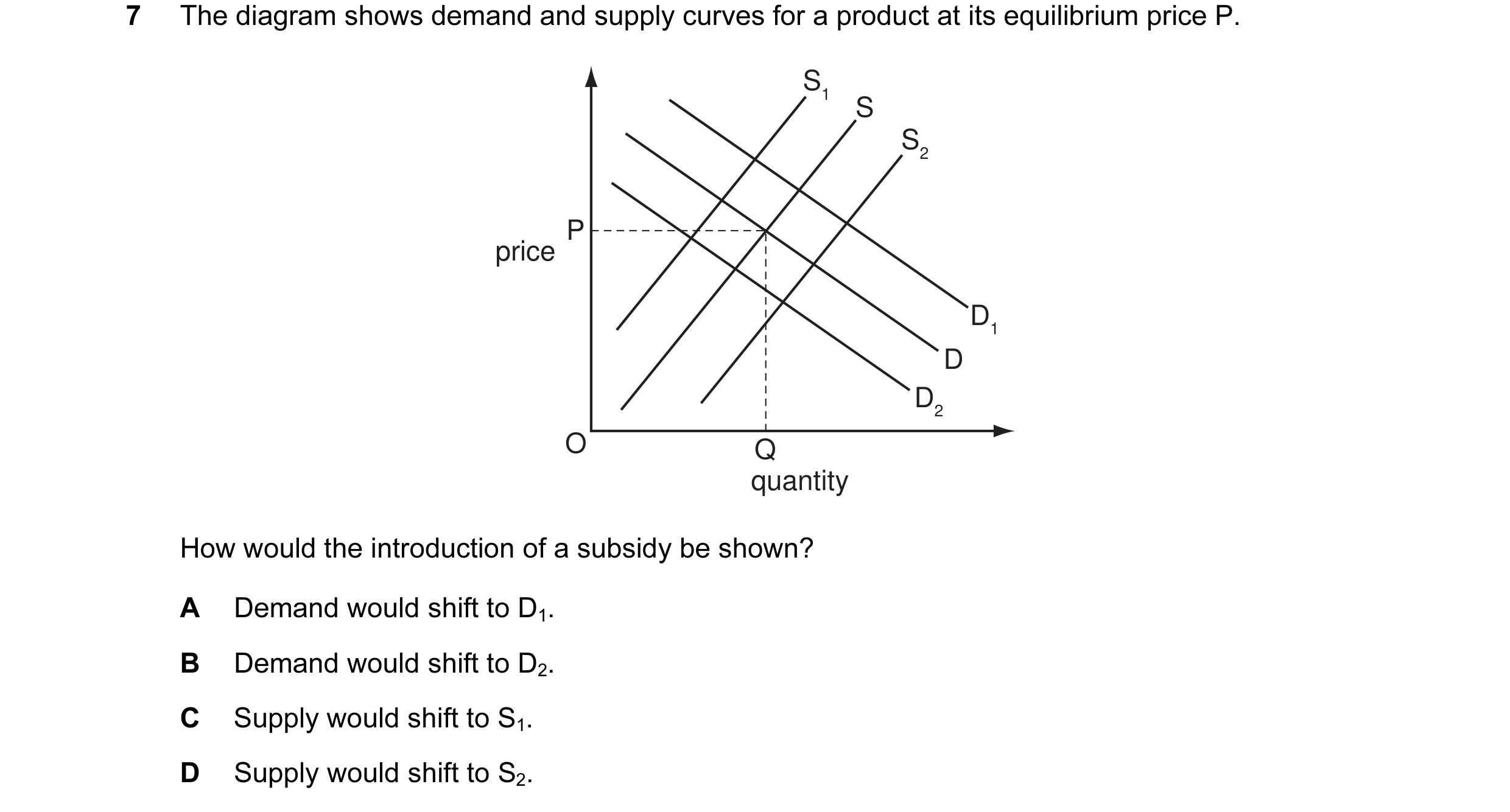
Q5 · The diagram shows demand and supply curves for a product at its equilibrium price P 0455/13 Oct/Nov 2010
7 The diagram shows demand and supply curves for a product at its equilibrium price P. S1 S S2 price P D1 D D2 O Q quantity How would the introduction of a subsidy be shown? A Demand would shift to D1. B Demand would shift to D2. C Supply would shift to S1. D Supply would shift to S2.
1 marks
Answer: D
This question in 0455/13 Oct/Nov 2010
Q6 · Which person would wish to encourage the use of the market system? 0455/13 Oct/Nov 2011
4 Which person would wish to encourage the use of the market system? A someone who believes that people should have equal living standards B someone who believes that people should have freedom of action C someone who believes that profit maximisation is wrong D someone who believes that the government should correct peoples’ bad behaviour
1 marks
Answer: B
This question in 0455/13 Oct/Nov 2011
Q7 · How are economic decisions determined in a pure market system? 0455/13 Oct/Nov 2011
6 How are economic decisions determined in a pure market system? A by a mixture of market forces and government regulation B by central planners of production and consumption C by government regulation of the price mechanism D by the forces of demand and supply
1 marks
Answer: D
This question in 0455/13 Oct/Nov 2011
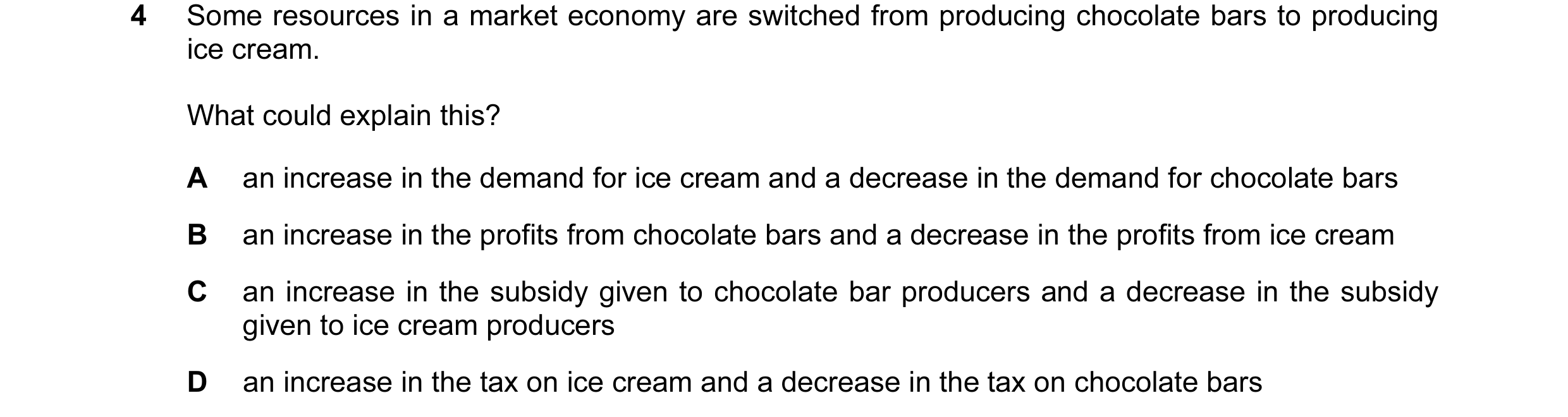
Q8 · Some resources in a market economy are switched from producing chocolate bars to… 0455/13 Oct/Nov 2013
4 Some resources in a market economy are switched from producing chocolate bars to producing ice cream. What could explain this? A an increase in the demand for ice cream and a decrease in the demand for chocolate bars B an increase in the profits from chocolate bars and a decrease in the profits from ice cream C an increase in the subsidy given to chocolate bar producers and a decrease in the subsidy given to ice cream producers D an increase in the tax on ice cream and a decrease in the tax on chocolate bars
1 marks
Answer: A
This question in 0455/13 Oct/Nov 2013
Q9 · What would not be an example of the working of a market system? 0455/12 May/June 2015
5 What would not be an example of the working of a market system? A a high price charged because of costly research to produce the good B a high price charged for a well-known painting C a low price charged because of economies of scale D a low price charged for subsidised bus travel
1 marks
Answer: D
This question in 0455/12 May/June 2015
Q10 · Who determines what goods and services are produced in a market economy? 0455/13 Oct/Nov 2018
4 Who determines what goods and services are produced in a market economy? A consumers B employees C government D trade unions
1 marks
Answer: A
This question in 0455/13 Oct/Nov 2018
Q11 · What necessarily describes the market system? 0455/12 Feb/March 2020
5 What necessarily describes the market system? A an economy with both a private and public sector B limited resources but unlimited wants C resources are allocated through demand and supply D when all resources are used to produce consumer goods
1 marks
This question in 0455/12 Feb/March 2020
Q12 · What is the function of the price mechanism in a market economy? 0455/13 May/June 2020
5 What is the function of the price mechanism in a market economy? A allocating resources and guiding choices B allowing governments to provide price stability C enabling markets to operate fairly D preventing competitors from entering a market
1 marks
Answer: A
This question in 0455/13 May/June 2020
Q13 · What is a function of the price mechanism? 0455/11 Oct/Nov 2020
5 What is a function of the price mechanism? A to allocate goods and services B to calculate national expenditure C to ensure an equal distribution of income D to guide government policy decisions
1 marks
Answer: A
This question in 0455/11 Oct/Nov 2020
Q14 · What is an advantage of a market economy in the allocation of resources? 0455/12 Feb/March 2021
5 What is an advantage of a market economy in the allocation of resources? A It ensures that all consumers are willing to pay the same price. B It fixes prices based on costs of production. C It guarantees suppliers will make a profit. D It indicates the relative demand for goods and services.
1 marks
Answer: D
This question in 0455/12 Feb/March 2021
Q15 · What is an economist’s definition of a market? 0455/11 May/June 2021
5 What is an economist’s definition of a market? A a collection of informal retail outlets run by small firms B a place where traders gather regularly for short periods C a system that enables individuals and firms to buy and sell goods D the existence of consumer demand for a good
1 marks
Answer: C
This question in 0455/11 May/June 2021
Q16 · What is an essential feature of a market economy? 0455/13 May/June 2021
5 What is an essential feature of a market economy? A Central planners determine what, how and for whom to produce. B It aims for equality in the distribution of goods and services. C The market price reflects both the private and external costs of production. D The price mechanism sends signals to consumers and producers to allocate resources.
1 marks
Answer: D
This question in 0455/13 May/June 2021
Q17 · What is the role of the price mechanism in a market economy? 0455/11 Oct/Nov 2021
5 What is the role of the price mechanism in a market economy? A to allocate scarce resources B to increase the provision of merit goods C to make the distribution of goods and services more equal D to reduce the negative externalities of production and consumption
1 marks
Answer: A
This question in 0455/11 Oct/Nov 2021
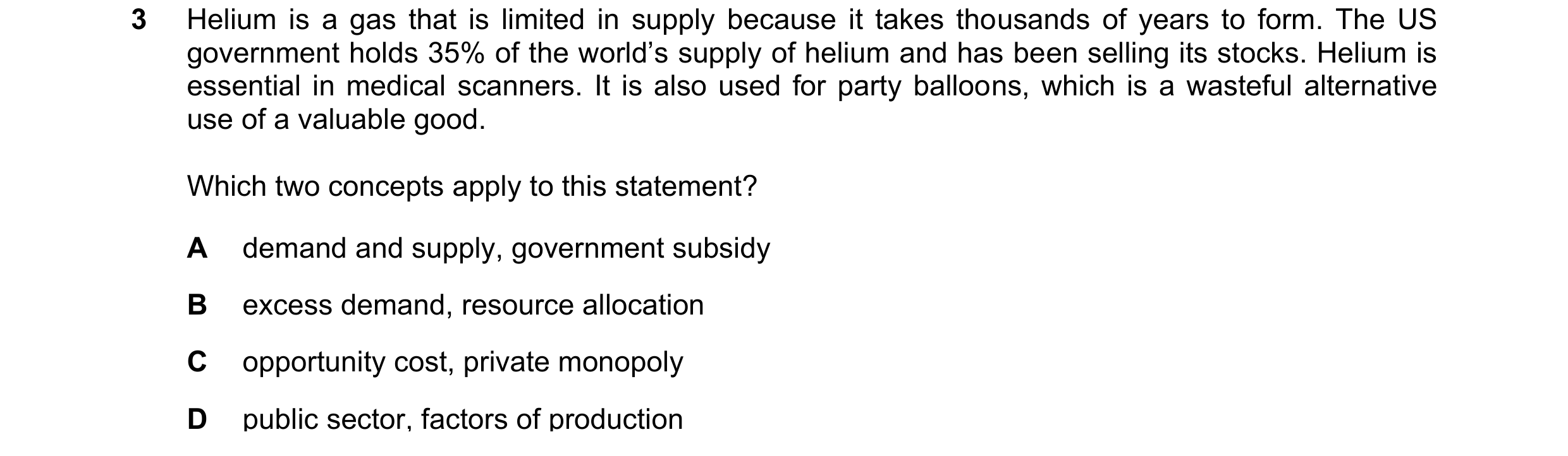
Q18 · Helium is a gas that is limited in supply because it takes thousands of years to form 0455/13 Oct/Nov 2021
3 Helium is a gas that is limited in supply because it takes thousands of years to form. The US government holds 35% of the world’s supply of helium and has been selling its stocks. Helium is essential in medical scanners. It is also used for party balloons, which is a wasteful alternative use of a valuable good. Which two concepts apply to this statement? A demand and supply, government subsidy B excess demand, resource allocation C opportunity cost, private monopoly D public sector, factors of production
1 marks
Answer: D
This question in 0455/13 Oct/Nov 2021
Q19 · For health reasons, consumers decide that they want to eat more vegetables and less meat 0455/12 Feb/March 2024
6 For health reasons, consumers decide that they want to eat more vegetables and less meat. What price signals would the market system send to reallocate resources so that consumers get what they want? price of price of vegetables meat A decrease decrease B decrease increase C increase decrease D increase increase
1 marks
Answer: C
This question in 0455/12 Feb/March 2024
Q20 · What is the function of the price mechanism in a market economy? 0455/13 May/June 2025
4 What is the function of the price mechanism in a market economy? A allocating resources and guiding choices B allowing governments to provide price stability C enabling markets to operate fairly D preventing competitors from entering a market
1 marks
Answer: A
This question in 0455/13 May/June 2025

 1 / 5
1 / 5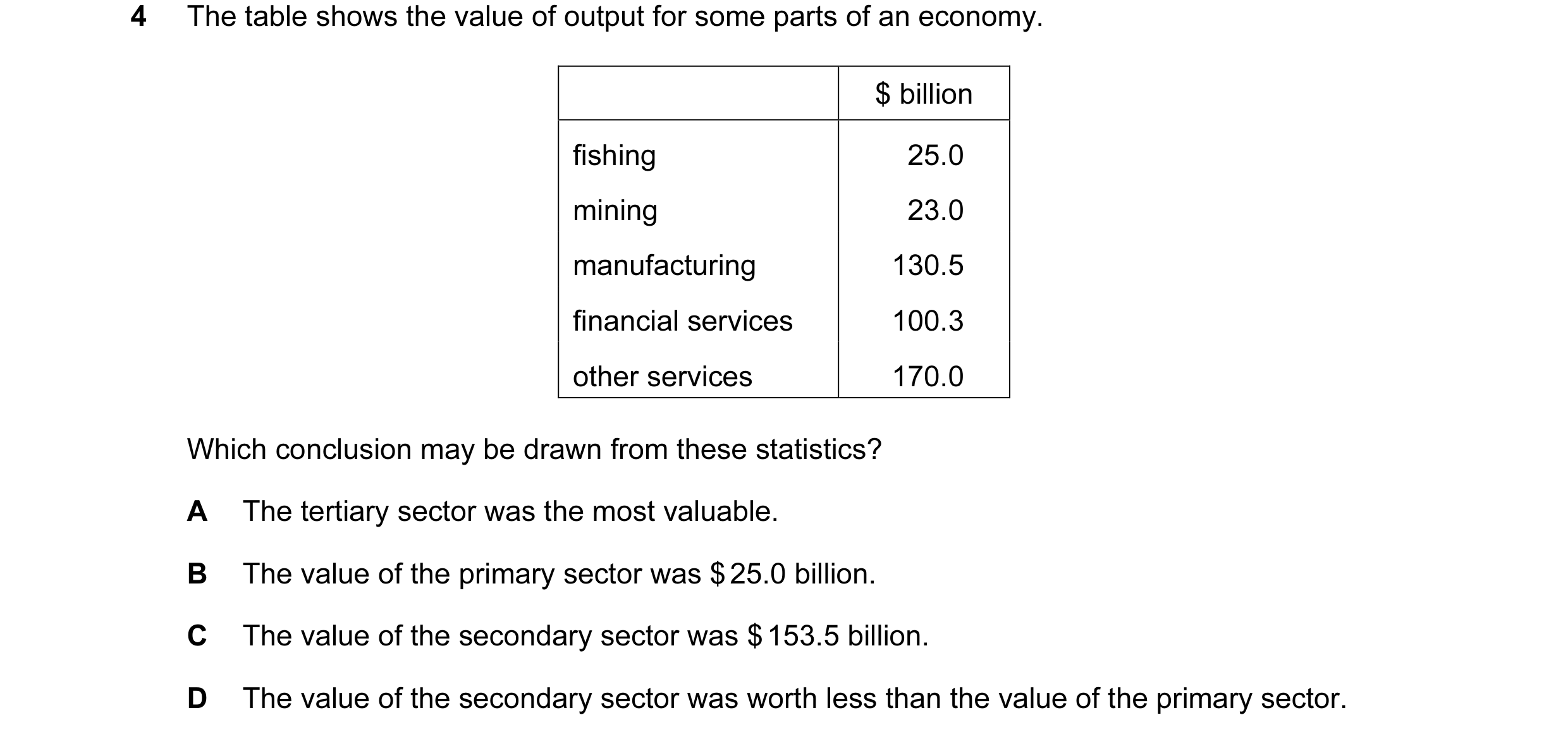
 2 / 5
2 / 5



 3 / 5
3 / 5




 4 / 5
4 / 5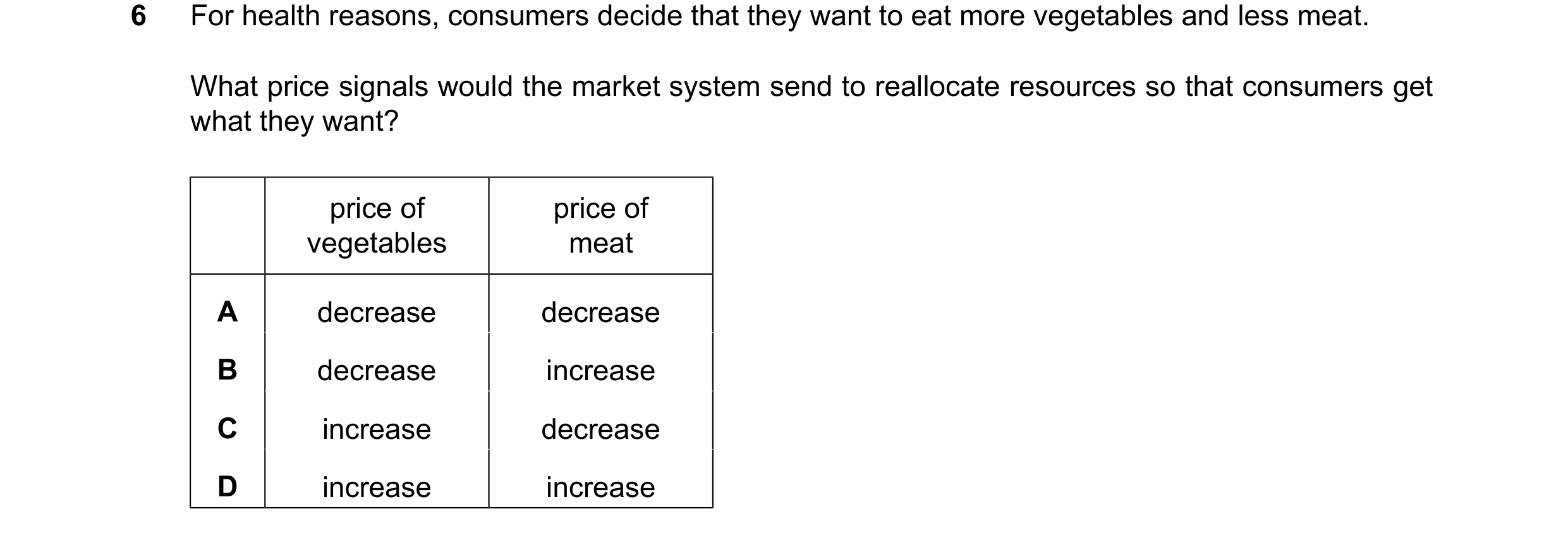
 5 / 5
5 / 5