Questions as text
Q1 · The actions of the Government of Georgia to reduce inflation and unemployment had an… 0455/22 Feb/March 2017
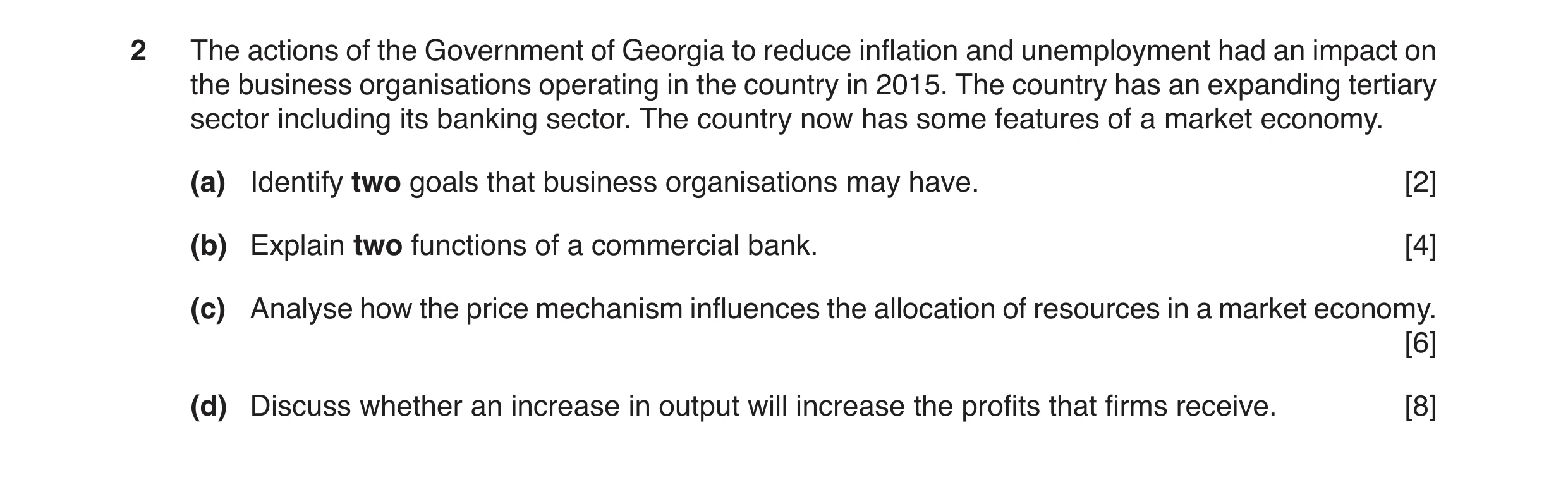
2 The actions of the Government of Georgia to reduce inflation and unemployment had an impact on the business organisations operating in the country in 2015. The country has an expanding tertiary sector including its banking sector. The country now has some features of a market economy. (a) Identify two goals that business organisations may have. [2] (b) Explain two functions of a commercial bank. [4] (c) Analyse how the price mechanism influences the allocation of resources in a market economy. [6] (d) Discuss whether an increase in output will increase the profits that firms receive. [8]
20 marks
Mark scheme: 2(a) Identify two goals that business organisations may have. 1 mark each for each of two goals: • profit maximisation • growth • survival • sales revenue maximisation • profit satisficing • social responsibility • improving the environment 2 for profit maximisation. 2(b) Explain two functions of a commercial bank. 1 mark each for each of two functions identified e.g.: • accepting deposits/allow people to save • lending • allowing customers to make payments • providing a range of other financial services e.g. insurance 1 mark each for each of two explanations given: • customers can open current accounts or deposit accounts/earn interest on savings • customers may keep e.g. documents at the bank. • customers can borrow money to e.g. purchase a home/pay interest on loans. • customers can make payments through e.g. direct debits • customers may be able to get e.g. a guarantee of compensation for theft from a bank. 4 Question Answer Marks Guidance 2(c) Analyse how the price mechanism influences the allocation of resources in a market economy. An increase in demand (1) will increase price (1) this will provide a financial incentive (1) profit motive (1) to supply more of the product (1) resources will move away from less popular products (1). An increase in supply (1) will reduce price (1) this will lead to a rise in demand (1) resulting in more resources being devoted to the product (1). Makes use of demand and supply (1) consumers make the decisions/consumer sovereignty (1). Will encourage firms to use the most cost efficient methods of production (1) e.g. will use labour intensive method of production (1) if ready supply of labour (1). Award up to 3 marks for a correctly labelled demand & supply diagram, showing 3 elements of the above e.g. shift (1) change in price (1) and new equilibrium quantity (1). 6 If a diagram is included, avoid double credit e.g. only 1 mark can be awarded for an increase in demand whether written or drawn. 2(d) Discuss whether an increase in output will increase the profits that firms receive. Up to 5 marks for why it might: The higher output may be the response to higher demand (1) raise revenue (1) may widen the gap between revenue and cost (1). If to sell the higher output a firm has lowered price, revenue would increase if demand is elastic (1) fall in price will cause a greater percentage rise in demand (1). A higher output may enable a firm to take greater advantage of economies of scale (1) lower average costs (1) example (1). Up to 5 marks for why it might not: If demand is inelastic (1) a fall in price will cause a smaller percentage rise in demand (1) revenue will fall (1). May result in the firm experiencing diseconomies of scale (1) raise average costs (1) example (1). May occur when demand is falling (1) revenue will fall (1) may make a loss (1). 8
This question in 0455/22 Feb/March 2017
Q2 · More than 80% of Qatar’s population are immigrants 0455/21 May/June 2018
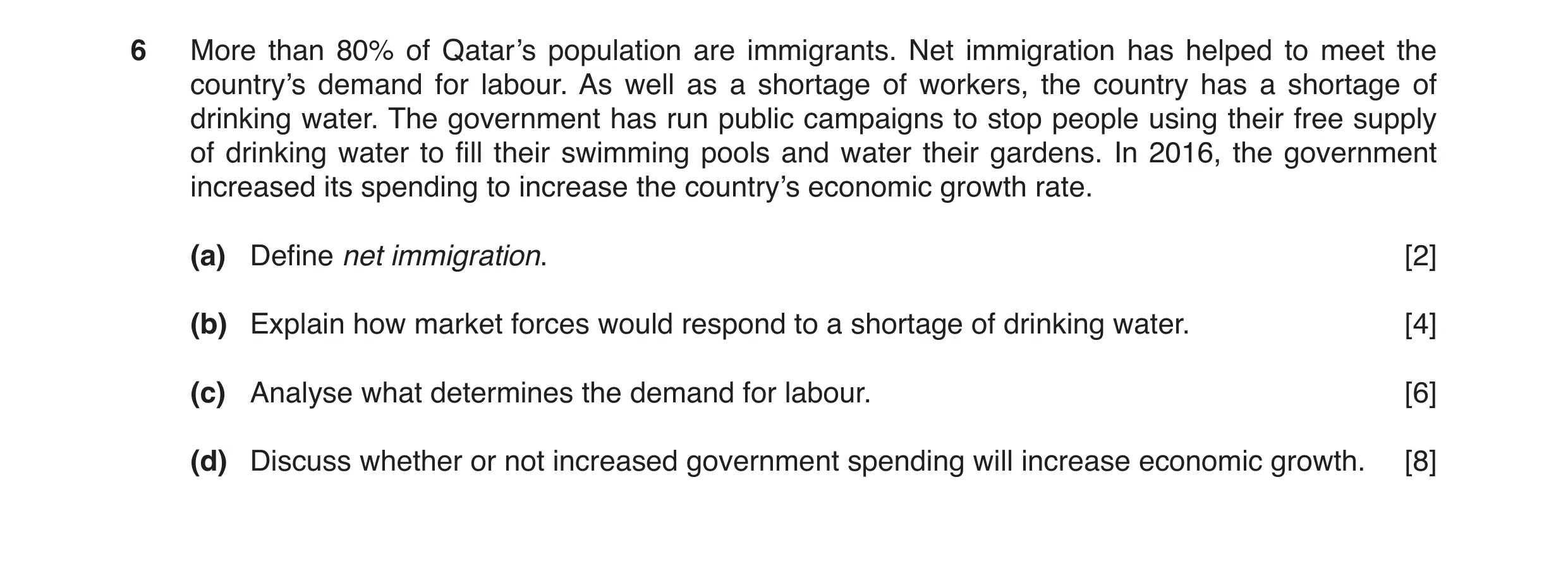
6 More than 80% of Qatar’s population are immigrants. Net immigration has helped to meet the country’s demand for labour. As well as a shortage of workers, the country has a shortage of drinking water. The government has run public campaigns to stop people using their free supply of drinking water to fill their swimming pools and water their gardens. In 2016, the government increased its spending to increase the country’s economic growth rate. (a) Define net immigration. [2] (b) Explain how market forces would respond to a shortage of drinking water. [4] (c) Analyse what determines the demand for labour. [6] (d) Discuss whether or not increased government spending will increase economic growth. [8]
20 marks
Mark scheme: 6(a) Define net immigration. More people coming to live in the country than leaving the country to live elsewhere (2). The number of immigrants exceeding emigrants (2). The difference between immigration and emigration (1). People coming to live in the country (1). 2 6(b) Explain how market forces would respond to a shortage of drinking water. A shortage means demand exceeds supply (1) price would rise (1) more would be supplied (1) due to the profit motive (1) price signal sent to producers (1) demand would also contract (1). Demand likely to be price inelastic (1) leading to large rise in price (1). 4 Up to 2 marks for a relevant diagram, showing demand being greater than supply (1) and price below equilibrium (1). 6(c) Analyse what determines the demand for labour. Demand for goods and services (1) demand for labour is a derived demand (1). Productivity/skills (1) higher productivity will increase demand for labour (1). Wage rates (1) higher wage rates will reduce demand for labour (1). Price of capital (1) higher price may increase demand for labour if they are substitutes (1) higher price will reduce demand for labour if they are complements (1). Non-wage costs e.g. employer’s contribution to pension scheme (1) higher costs reduce demand for labour (1). Taxes on employment of labour (1) higher taxes reduce demand for labour (1). Government employment subsidies (1) higher subsidies will increase demand for labour (1). 6 Question Answer Marks Guidance 6(d) Discuss whether or not increased government spending will increase economic growth. Up to 5 marks for why it might: Higher government spending will increase total (aggregate) demand (1) higher total demand may encourage firms to increase output (1). Higher government spending on education/training (1) health (1) may raise labour productivity (1) increase productive potential/long run economic growth (1). Higher government spending on infrastructure (1) will reduce costs of production (1) encouraging firms to expand (1). Higher government spending on R & D (1) would lower costs/raise productive potential (1). Up to 5 marks for why it might not: Higher government spending may increase inflation (1) this may make products less internationally competitive (1) reducing net exports (1) reducing output (1). Higher government spending may not increase total demand if offset by e.g. lower consumer expenditure (1). Higher government spending may not increase total demand if it is accompanied by higher taxation (1). Higher government spending on education/training may not increase labour productivity if it does not raise the quality of education/training (1). Higher benefits (1) may reduce incentives to work (1). Government spending may be spent wastefully/inefficiently (1). 8
This question in 0455/21 May/June 2018
Q3 · Indian Railways is a state-owned enterprise, owned and operated by the Ministry of… 0455/22 Feb/March 2019
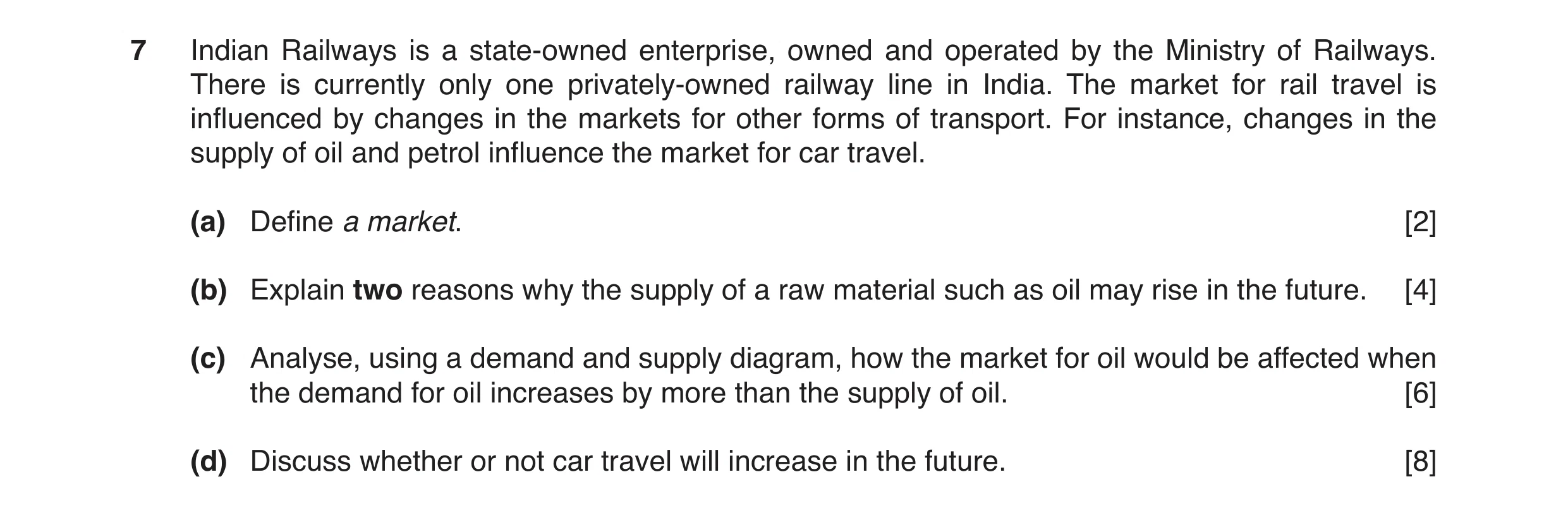
7 Indian Railways is a state-owned enterprise, owned and operated by the Ministry of Railways. There is currently only one privately-owned railway line in India. The market for rail travel is influenced by changes in the markets for other forms of transport. For instance, changes in the supply of oil and petrol influence the market for car travel. (a) Define a market. [2] (b) Explain two reasons why the supply of a raw material such as oil may rise in the future. [4] (c) Analyse, using a demand and supply diagram, how the market for oil would be affected when the demand for oil increases by more than the supply of oil. [6] (d) Discuss whether or not car travel will increase in the future. [8]
20 marks
Mark scheme: 7(a) Define a market. 2 An arrangement that brings buyers and sellers into contact / products are bought and sold (2). Buyers (1) sellers (1). Example of the purchase and sale of products (1). 7(b) Explain two reasons why the supply of a raw material such as oil may 4 rise in the future. • New supplies may be discovered (1) after investment searching for them (1) • Price may rise (1) giving suppliers a profit incentive to supply more (1) • Advances in technology / cuts in wages (1) may reduce costs of obtaining the raw material (1) • Government subsidies (1) providing finance to search for oil / greater incentive to increase output (1) 7(c) Analyse, using a demand and supply diagram, how the market for oil 6 would be affected when the demand for oil increases by more than the supply of oil. Up to 4 marks for the diagram: Axes correctly labelled – price and quantity or P and Q (1). Demand and supply curves correctly labelled D1 and S1 (1). Demand and supply curves shifted to the right D2 and S2 (1). Equilibrium – shown by lines e.g. P2 Q2 or at point e.g. E2 (1). S1 price S2 of oil P2 E2 P1 D2 D1 O Q1 Q2 quantity of oil Up to 2 marks for written comments: More of the product will be traded / quantity will rise (1). Price will be higher (1). Note: Do not reward analysis marks for description of diagram e.g. price changes from P2 to P1 or quantity changes from Q1 to Q2. 7(d) Discuss whether or not car travel will increase in the future. 8 Up to 5 marks for why it might: Price of cars may fall (1) encouraging more people to buy cars (1). Price of petrol may fall (1) making it cheaper to run a car/petrol is a complement to cars (1). Population may increase (1) more potential drivers (1). More roads may be built (1) reduce time of car journeys (1). People may live further from work (1) requiring longer journeys (1). Driverless cars (1) may enable more people e.g. those with poor eyesight to use cars (1). Income may rise (1) enabling people to buy and use more cars (1). Up to 5 marks for why it might not: Price of substitute travel may fall (1) e.g. due to government subsidising rail travel (1). Taxes on car travel may rise (1) raising the cost of car travel (1). Parking charges may increase (1) parking is a complement to car travel (1). Congestion may rise (1) increasing travel time (1). Greater concern about the environment (1) may encourage some people to switch to more environmentally friendly forms of transport (1).
This question in 0455/22 Feb/March 2019
Q4 · There is a high level of division of labour in the United Kingdom (UK) energy industry 0455/23 May/June 2020
5 There is a high level of division of labour in the United Kingdom (UK) energy industry. Cold weather in early 2018 caused very high demand for energy and a change in its price. This led to a temporary shortage of energy for firms and households in the UK. Part of the change in price may have been the result of UK energy firms abusing their monopoly power. This would be an example of market failure. (a) Define market failure. [2] (b) Explain two influences, other than weather, that could affect the demand for a product. [4] (c) Analyse the possible effects of a shortage of a product such as energy on an economy. [6] (d) Discuss whether or not workers benefit from division of labour. [8]
20 marks
Mark scheme: 5(a) Define market failure. 2 Market failure is when the market mechanism / price mechanism / demand and supply (1) does not lead to an efficient allocation of resources (1). 5(b) Explain two influences, other than weather, that could affect the 4 demand for a product. Logical explanation which might include: Price of substitutes (1) If the price of substitutes increase, demand for the product will increase or vice versa (1). Price of complements (1) If the price of complements increase, demand for the product will decrease or vice versa (1). Expected future prices (1) if the price is expected to increase in the future, demand for the product will increase now or vice versa (1). Advertising (1) if there is a successful advertising campaign, demand will increase (1). Income (1) if income increases, demand will increase for a normal good or vice versa (1). Change in price (1) if price increases, demand will contract, vice versa (1). 5(c) Analyse the possible effects of a shortage of a product such as energy 6 on an economy. Coherent analysis which might include: Low supply (1) high prices (1) increase cost of production for firms (1). Cost- push inflation (1) firms might try to cut cost (1) by firing workers (1) increase unemployment (1). Increase price of goods and services (1) decrease affordability (1) decrease demand for goods and services (1) decrease standards of living (1). More imports to address shortage (1) less production (1) leading to lower growth rate (1). 5(d) Discuss whether or not workers benefit from division of labour. 8 In assessing each answer, use the table below. Level Description Marks 3 A reasoned discussion which accurately examines both 6–8 sides of the economic argument, making use of economic information and clear and logical analysis to evaluate economic issues and situations. One side of the argument may have more depth than the other but, overall, both sides of the argument are considered and developed. There is thoughtful evaluation of economic concepts, terminology, information and/or data appropriate to the question. The discussion may also point out the possible uncertainties of alternative decisions and outcomes. 2 A reasoned discussion which makes use of economic 3–5 information and clear analysis to evaluate economic issues and situations. The answer may lack some depth and development may be one-sided. There is relevant use of economic concepts, terminology, information and data appropriate to the question. 1 There is a simple attempt at using economic definitions 1–2 and terminology. Some reference may be made to economic theory, with occasional understanding. 0 A mark of zero should be awarded for no creditable 0 content. Why it is a benefit: • saves time • increased skills • increased productivity • increased wages Why it is not a benefit: • increased boredom • limited skills • lack of motivation • lack of occupational mobility • overdependence on others
This question in 0455/23 May/June 2020
Q5 · Two of Uzbekistan’s main industries are cotton and gas 0455/22 Oct/Nov 2021
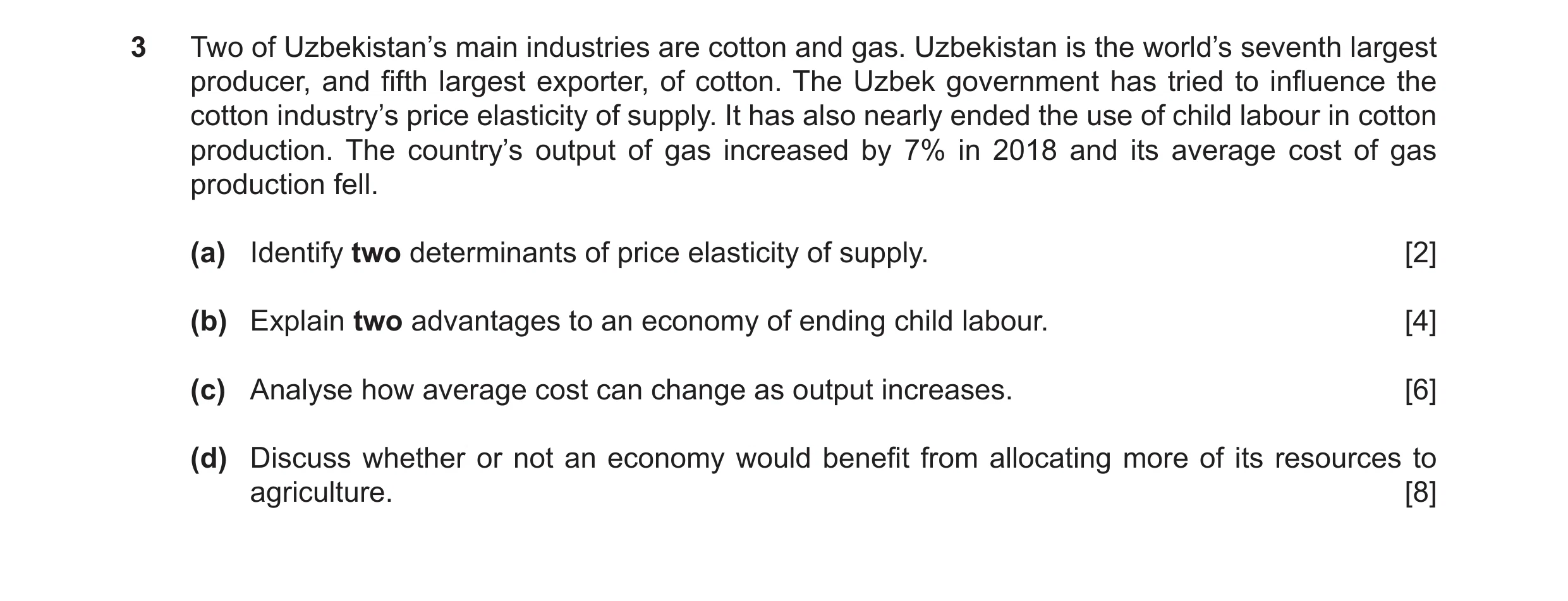
3 Two of Uzbekistan’s main industries are cotton and gas. Uzbekistan is the world’s seventh largest producer, and fifth largest exporter, of cotton. The Uzbek government has tried to influence the cotton industry’s price elasticity of supply. It has also nearly ended the use of child labour in cotton production. The country’s output of gas increased by 7% in 2018 and its average cost of gas production fell. (a) Identify two determinants of price elasticity of supply. [2] (b) Explain two advantages to an economy of ending child labour. [4] (c) Analyse how average cost can change as output increases. [6] (d) Discuss whether or not an economy would benefit from allocating more of its resources to agriculture. [8]
20 marks
Mark scheme: 3(a) Identify two determinants of price elasticity of supply. Two from: • ability to store • level of stocks • perishability • production time • level of spare capacity • cost of altering supply • time period under consideration – short/long run 2 Accept weather. 3(b) Explain two advantages to an economy of ending child labour. Logical explanation which might include: Enable children to be educated (1) raise productivity / workers’ skills / literacy rates / long run economic growth (1). Improve children’s health (1) increase life expectancy / raise living standards (1). Reduce cycle of poverty (1) children will later gain higher paid jobs (1). Raise wages (1) due to reduced supply of cheap labour (1). Remove international bans / encourage more foreign tourists (1) increase exports (1). Increase job opportunities for adults (1) lower unemployment / increase employment of adults (1). 4 One mark each for each of two advantages identified and one mark each for each of two explanations. Question Answer Marks Guidance 3(c) Analyse how average cost can change as output increases. Average cost may fall due to economies of scale (1) example of an economy of scale e.g. financial economy (1) explanation of the example (up to 2 marks) e.g. banks may charge lower interest rates (1) reducing firms’ cost of borrowing (1). Another example e.g. buying economy (1) explanation of the example (up to 2 marks) e.g. able to buy in bulk (1) and receive a discount (1). Higher output may enable fixed costs to be spread over a larger output (1) which may reduce average fixed costs (1) whether average total cost will fall will depend on what happens to average fixed cost plus average variable cost (1). Average cost may rise due to diseconomies of scale (1) example e.g. managerial economy (1) explanation of the example (up to 2 marks) e.g. difficulty of keeping control of a large organisation (1) leading to more mistakes / poor decision making (1). Another example e.g. poor labour relations (1) explanation of the example (up to 2 marks) e.g. lack of contact between workers and managers (1) may be strikes (1). 6 Nothing for reference to causes of changes in total costs e.g. employing more workers will increase wages paid. Question Answer Marks Guidance 3(d) Discuss whether or not an economy would benefit from allocating more of its resources to agriculture. In assessing each answer, use the table opposite. Why it might: • specialisation may increase efficiency, raise output, increase exports • may improve the current account of the balance of payments • imports of food may be reduced, reduced reliance on other countries for basic necessities • health and safety standards may be maintained • the industry is labour intensive in some countries and so may reduce unemployment Why it might not: • wages in the industry tend to be relatively low • the supply of agricultural products can fluctuate significantly due to changes in weather conditions • opportunity cost of fewer resources for manufacturing goods and for services • demand for manufactured goods and for services tend to rise more as income increases • agriculture uses up considerable amounts of water. 8 Level Description Marks 3 A reasoned discussion which accurately examines both sides of the economic argument, making use of economic information and clear and logical analysis to evaluate economic issues and situations. One side of the argument may have more depth than the other, but overall, both sides of the argument are considered and developed. There is thoughtful evaluation of economic concepts, terminology, information and/or data appropriate to the question. The discussion may also point out the possible uncertainties of alternative decisions and outcomes. 6–8 2 A reasoned discussion which makes use of economic information and clear analysis to evaluate economic issues and situations. The answer may lack some depth and development may be one-sided. There is relevant use of economic concepts, terminology, information and data appropriate to the question. 3–5 1 There is a simple attempt at u sing economic definitions and terminology. Some reference may be made to economic theory, with occasional understanding. 1–2 Question Answer Marks Guidance 3(d) Level Description Marks 0 A mark of zero should be awarded for no creditable content. 0
This question in 0455/22 Oct/Nov 2021
Q6 · In 2018, 54% of Russia’s population was female and the government announced plans to… 0455/23 Oct/Nov 2021
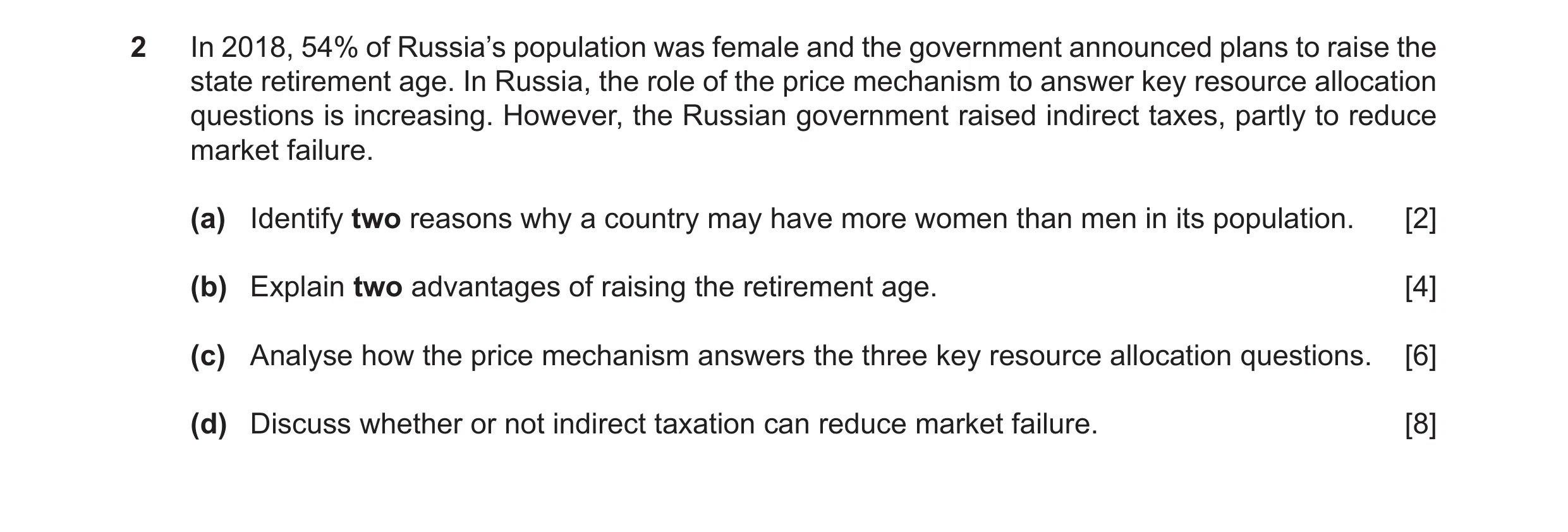
2 In 2018, 54% of Russia’s population was female and the government announced plans to raise the state retirement age. In Russia, the role of the price mechanism to answer key resource allocation questions is increasing. However, the Russian government raised indirect taxes, partly to reduce market failure. (a) Identify two reasons why a country may have more women than men in its population. [2] (b) Explain two advantages of raising the retirement age. [4] (c) Analyse how the price mechanism answers the three key resource allocation questions. [6] (d) Discuss whether or not indirect taxation can reduce market failure. [8]
20 marks
Mark scheme: 2(a) Identify two reasons why a country may have more women than men in its population. Two from: • women living longer • more girls being born • fewer female emigrants or male immigrants • more female immigrants or male emigrants • more men killed in wars 2 2(b) Explain two advantages of raising the retirement age. Logical explanation which might include: Reduction in pensions paid (1) money could be spent for other purposes e.g. infrastructure (1). Increase in size of the labour force/(1) increase in output/productive potential/GDP/reduction in firms’ wage costs (1). Reduction in size of dependency ratio (1) less burden on working population (1). Rise in tax revenue/improve budget position (1) government can spend more on e.g. public sector wages (1). May increase health of the old (1) work may be mentally challenging (1). People can work longer (1) and earn more income/enjoy higher living standards (1). Older people have greater skills/more years of training (1) can raise productivity/pass on skills to younger workers (1). 4 One mark each for each of two advantages identified and one mark each for each of two explanations. Question Answer Marks Guidance 2(c) Analyse how the price mechanism answers the three key resource allocation questions. Coherent analysis which might include: Definition of price mechanism e.g. where forces of demand and supply determine the prices of goods and services (1) in a market economy (1). What to produce (1) the price mechanism acts a signal/the price mechanism acts as an incentive on what to produce (1) rations goods and services (1) price will rise for products in higher demand (1) encouraging more to be made (1). How to produce (1) e.g. more labour-intensive/more capital- intensive methods of production will be used (1) if wages fall/if cost of capital goods fall (1). Who to produce for (1) those whose services are most in demand will have the highest income (1) will be able to buy the most (1) 6 Question Answer Marks Guidance 2(d) Discuss whether or not indirect taxation can reduce market failure. In assessing each answer, use the table opposite. Why it might: • demerit goods are overconsumed and cause external costs • demerit goods and other products causing external costs can be taxed • indirect taxation on demerit goods can discourage their consumption • merit goods are under-consumed and create external benefits • indirect tax revenue can be used to subsidise or produce merit goods • public goods would not be produced by the private sector as they have the characteristics of non-rival and non- excludable • indirect tax revenue can be used to finance the production of public goods Why it might not: • difficult to measure external costs • demerit goods may be overtaxed, changing from being overconsumed to being under-consumed • demand for some demerit goods is price inelastic • indirect taxes may fall more heavily on the poor • demand may just shift to imports if other countries do not impose indirect tax or have lower tax rates • tax revenue may not be used to promote the consumption of merit and public goods 8 Level Description Marks 3 A reasoned discussion which accurately examines both sides of the economic argument, making use of economic information and clear and logical analysis to evaluate economic issues and situations. One side of the argument may have more depth than the other, but overall, both sides of the argument are considered and developed. There is thoughtful evaluation of economic concepts, terminology, information and/or data appropriate to the question. The discussion may also point out the possible uncertainties of alternative decisions and outcomes. 6–8 2 A reasoned discussion which makes use of economic information and clear analysis to evaluate economic issues and situations. The answer may lack some depth and development may be one- sided. There is relevant use of economic concepts, terminology, information and data appropriate to the question. 3–5 Question Answer Marks Guidance 2(d) Level Description Marks 1 There is a simple attempt at u sing economic definitions and terminology. Some reference may be made to economic theory, with occasional understanding. 1–2 0 A mark of zero should be awarded for no creditable content. 0
This question in 0455/23 Oct/Nov 2021
Q7 · Calculate Australia’s unemployment rate in 2021 0455/21 May/June 2023
1 (a) Calculate Australia’s unemployment rate in 2021. [1] (b) Identify two substitutes for coal. [2] (c) Explain one economy of scale that could benefit a coal-mining firm. [2] (d) Explain two influences on the price elasticity of supply of coal. [4] (e) Draw a demand and supply diagram to show how setting a maximum price below the equilibrium price will affect a market. [4] (f) Analyse whether large coal-producing countries are likely to be net exporters of coal. [5] (g) Discuss whether or not an increase in the size of its coal industry will benefit the Australian economy. [6] (h) Discuss whether or not Australia is likely to have a budget deficit in 2026. [6]
30 marks
Mark scheme: 1(a) Calculate Australia’s unemployment rate in 2021. 4% Allow 4 without percentage 1(b) Identify two substitutes for coal. Two from: gas offshore wind / wind power solar power / panels 2 1(c) Explain one economy of scale that could benefit a coal- mining firm. Managerial / labour economy (1) employing specialist workers e.g. mining engineers (1). Technical economy (1) employing efficient / technologically advanced equipment e.g. drones (1). External economy of scale (1) example e.g. skilled labour force (1). 2 One mark for the economy of scale identified and one mark for an explanation. 1(d) Explain two influences on the price elasticity of supply of coal. Storage time (1) expensive to store so inelastic supply (1). Construction of new mine / production time (1) takes a long time, so inelastic supply (1). Stocks (1) may make supply elastic (1). 4 One mark each for each of two influences identified and one mark each for each of two explanations. Question Answer Marks Guidance 1(e) Draw a demand and supply diagram to show how setting a maximum price below the equilibrium price will affect a market. Demand and supply diagram: Axes correctly labelled – price and quantity or p and q (1). Demand and supply curves correctly labelled (1). Price line set below the equilibrium (1). Demand shown as greater than supply (1) e.g. has the two dotted lines downwards (it does not have to be labelled Qs and Qd). 4 Note: Accept unlabelled price line / line drawn only to demand curve. Accept shortage if correctly identified on the diagram. Do not accept demand greater than supply if demand and supply curves are incorrectly drawn Question Answer Marks Guidance 1(f) Analyse whether large coal-producing countries are likely to be net exporters of coal. Coherent analysis which might include: Expected outcome: Large coal producing countries may have a surplus to sell / may have grown their production in order to sell abroad (1) most of the evidence supports this relationship (1) Supporting evidence: Five of the seven countries consume less coal than they produce (1) calculation e.g. US could have exported 11 million tonnes / Australia could have exported 394 million tonnes or simply the difference (1). Analysis: Countries that produce more coal than they consume may benefit from economies of scale / can export because their prices are low (1). Exceptions: China or India are an exception (1) as they consumed more coal than they produced (1). Analysis: they may have been net importers (1) since had used up stocks of coal / need more energy as a developing country (1) may not be able to export coal if world demand for coal is low / countries may both import and export coal (1). 5 Responses do not have to be in the format suggested but they should address the expected / normal outcome, offer supporting evidence of that, highlight any exceptions to that, and analyse the overall data. Question Answer Marks Guidance 1(g) Discuss whether or not an increase in the size of its coal industry will benefit the Australian economy. Award up to 4 marks for logical reasons why it might, which may include: may increase GDP / economic growth (1) increasing living standards / raise incomes / reduce poverty (1) may reduce unemployment (1) structural unemployment (1) may improve current account position / have a surplus (1) as Australia seems to be a net exporter of coal (1) may increase tax revenue (1) increasing government’s ability to spend (1) economies of scale (1) result in lower prices for households and industries (1). Award up to 4 marks for logical reasons why it might not, which may include: may increase pollution (1) lowering living standards / cause health issues (1) reduce tourism / negative impact on current account (1) other forms of power may not be developed (1) example (1) some workers may leave other jobs (1) these jobs may have better working conditions (1) coal mining is a relatively dangerous industry (1) so life expectancy may be reduced / creates chronic illnesses / workers unable to work (1). Global demand for coal may fall (1) impact upon Australia e.g. unsold stock (1). May rapidly deplete stocks (1) leading to lower exports (1) and less employment (1). 6 Apply this example to all questions with the command word DISCUSS (1g, 1h, 2d, 3d, 4d and 5d) Each point may be credited only once, on either side of an argument, but separate development as to how/why the outcome may differ is rewarded. Generic example Mark Tax revenue may decrease … 1 … because of reason e.g. incomes may be lower. 1 Tax revenue may increase because incomes may be higher i.e. reverse of a previous argument. 0 Tax revenue may increase because of a different reason i.e. not the reverse of a previous argument e.g. government spending on subsidies may stimulate the economy more than spending on education. 1 Question Answer Marks Guidance 1(h) Discuss whether or not Australia is likely to have a budget deficit in 2026. Award up to 4 marks for logical reasons why it might, which may include: unemployment is forecast to increase (1) so there may be more government spending on unemployment benefits (1) less income tax revenue (1) there may be more government spending on retraining unemployed workers (1) some of the rise in population may result in more government spending (1) e.g. on pensions / healthcare / education (up to 2 marks) budget deficit in previous years (1) would mean interest would have to be paid on the debt that has built up (1). Award up to 4 marks for logical reasons why it might not, which may include: population and the labour force are forecast to increase (1) so there may be more taxpayers / fewer claiming benefits (1) tax revenue may rise (1) due to higher profits / higher tax rates (1) GDP is forecast to increase (1) more people in work (1) which would be likely to increase direct and indirect tax revenue (1) state support for industries may fall (1) may have been high in 2021 due to Covid-19 (1). 6
This question in 0455/21 May/June 2023
Q8 · In 2021, the Suez Canal was blocked by one of the world’s biggest container ships 0455/22 Feb/March 2024
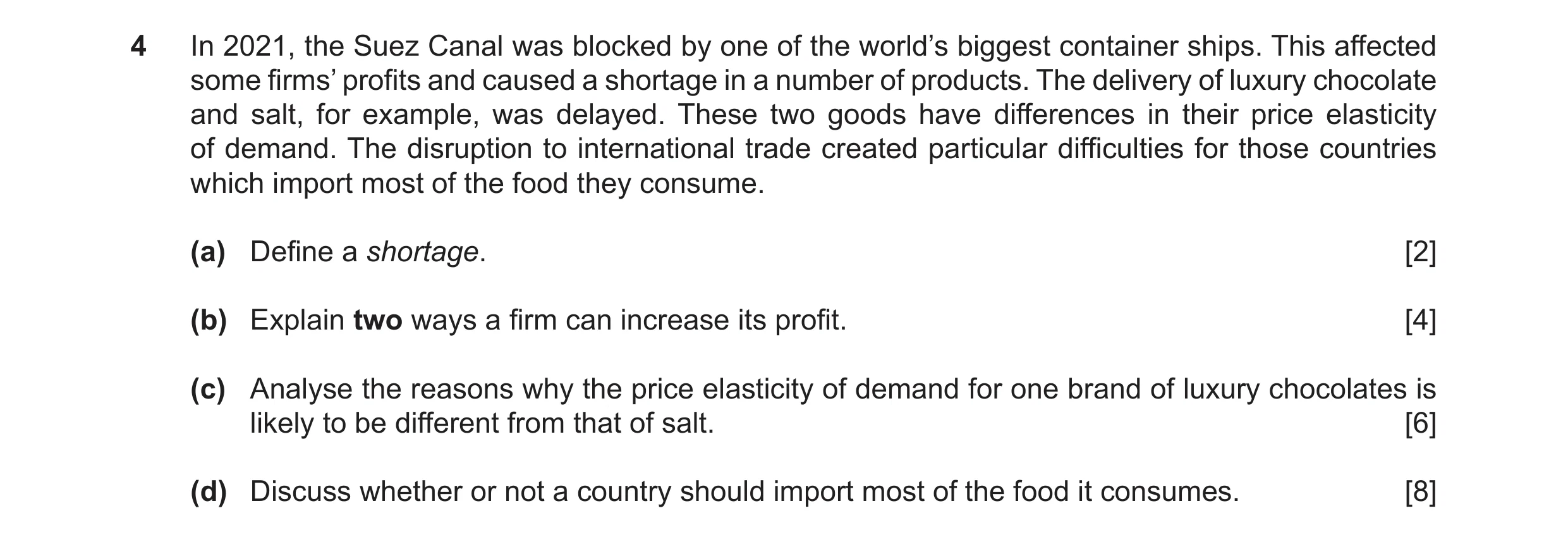
4 In 2021, the Suez Canal was blocked by one of the world’s biggest container ships. This affected some firms’ profits and caused a shortage in a number of products. The delivery of luxury chocolate and salt, for example, was delayed. These two goods have differences in their price elasticity of demand. The disruption to international trade created particular difficulties for those countries which import most of the food they consume. (a) Define a shortage. [2] (b) Explain two ways a firm can increase its profit. [4] (c) Analyse the reasons why the price elasticity of demand for one brand of luxury chocolates is likely to be different from that of salt. [6] (d) Discuss whether or not a country should import most of the food it consumes. [8]
20 marks
Mark scheme: 4(a) Define a shortage. 2 Demand exceeding supply (2). Too much demand / not enough supply / supply is low and demand is high (1). 4(b) Explain two ways a firm can increase its profit. 4 One mark each for each of two ways identified and one mark for each of two explanations. Logical explanation which might include: Note: in each case, reduce cost of production, raise Becoming more capital-intensive (1) which may reduce cost demand, increase revenue can only be rewarded once. of production (1). Buying cheaper raw materials (1) which may reduce cost of Nothing for change in price without relative reference to production (1). PED. Increasing efficiency / raising quality of product (1) by e.g. employing skilled workers (1). Increase training of workers (1) to raise productivity (1). Merging (1) enabling greater advantage to be taken of economies of scale (1). Advertising / improved packaging / adding more features (1) to increase demand / raise revenue (1). Gaining greater market power (1) enabling price to rise and revenue to increase / making demand inelastic (1). Raise revenue (1) by reducing price if demand is elastic / by raising price if demand is inelastic (1). 4(c) Analyse the reasons why the price elasticity of demand 6 Award: for one brand of luxury chocolates is likely to be Demand for a luxury brand of chocolate may be inelastic is different from that of salt. consumers have brand loyalty (1) reinforced by advertising (1). Coherent analysis which might include: One brand of chocolates is likely to have substitutes / other brands to switch to (1) is narrowly defined (1) it is not a necessity / is a want (1) the purchase can be postponed (1) it takes up a large proportion of income (1) demand is likely to be price elastic (1) a rise in price will cause a greater percentage change in quantity demand (1). Salt does not have substitutes (1) is widely defined (1) it takes up a small proportion of income / is likely to be cheap (so price change less noticeable) (1) people become addicted to the taste (1) may be seen as a necessity (1) demand is likely to be price inelastic (1) a rise in price will cause a smaller percentage change in quantity demanded (1). 4(d) Discuss whether or not a country should import most of 8 Level Description Marks the food it consumes. 3 A reasoned discussion which 6–8 In assessing each answer, use the table opposite. accurately examines both sides of the economic argument, making use of Why it should: economic information and clear and • may lack appropriate resources to produce food logical analysis to evaluate economic • will allow the country to produce other goods and issues and situations. One side of the services argument may have more depth than • value added may be greater in the secondary and the other, but overall both sides of the tertiary sectors argument are considered and • wages may be higher in the secondary and tertiary developed. There is thoughtful evaluation of economic concepts, sectors • working conditions may be better in the secondary and terminology, information and/or data appropriate to the question. The tertiary sectors discussion may also point out the • the output of food can be affected by changes in possible uncertainties of alternative weather and natural disasters. decisions and outcomes. 2 A reasoned discussion which makes 3–5 Why it should not: use of economic information and clear • makes the country dependent on other countries analysis to evaluate economic issues • agriculture may be considered to be a strategic industry and situations. The answer may lack • foreign producers may raise price some depth and development may be • food is a basic essential one-sided. There is relevant use of • a higher price could increase poverty economic concepts, terminology, • there may be disruptions in supply. information and data appropriate to the question. 1 There is a simple attempt at using 1–2 economic definitions and terminology. Some reference may be made to economic theory, with occasional understanding. 0 A mark of zero should be awarded for 0 no creditable content. 4(d) Reward but do not expect reference to comparative advantage or absolute advantage.
This question in 0455/22 Feb/March 2024
Q9 · Calculate Romania’s current account deficit on its balance of payments in $s 0455/22 Feb/March 2025
1 (a) Calculate Romania’s current account deficit on its balance of payments in $s. [1] (b) Identify two reasons why Romania’s population fell between 1990 and 2022. [2] (c) Explain why immigration into Romania may increase in the future. [2] (d) Explain two reasons why household spending has increased in Romania. [4] (e) Draw a demand and supply diagram to show the effect of setting a maximum price on electricity. [4] (f) Analyse the relationship between GDP per head and average spending on food as a percentage of total household spending. [5] (g) Discuss whether or not foreign MNCs reduce poverty in their host countries. [6] (h) Discuss whether or not a higher proportion of women is likely to enter Romania’s labour force in the future. [6]
30 marks
Mark scheme: Question Answer Marks Guidance 1(a) Calculate Romania’s current account deficit on its balance of 1 Accept 27bn without $. payments in $s. $27 000 000 000. $27 10⁹ $27bn (1). $2.7 10 to the power 10. 1(b) Identify two reasons why Romania’s population fell between 1990 2 and 2022. Fall in birth rate (1) emigration / net emigration / people leaving the country (1). 1(c) Explain why immigration into Romania may increase in the future. 2 1 mark for identification of high economic growth rate, and 1 mark for explanation. High economic growth rate / economic growth (1) higher wages / higher income / more chance of employment / more job opportunities / higher living standards (1). 1(d) Explain two reasons why household spending has increased in 4 Romania. Logical explanation which might include: • Romanians have become wealthier (1) more money to spend / greater purchasing power / higher income / higher GDP per head / can sell assets to get money to spend / more able to borrow / greater confidence (1). • More confident about the future / increased optimism (1) about future job prospects / higher earning / job security / may encourage more borrowing / less saving (1). • Low interest rates (1) encourage borrowing / reduce cost of borrowing / discourage saving (1). • High rate of inflation (1) spending more to maintain living standards (1). 1(e) Draw a demand and supply diagram to show the effect of setting a 4 maximum price on electricity. Coherent analysis which might include: D&S diagram: Axes correctly labelled – price and quantity or p and q (1). Demand and supply curves correctly labelled (1). Maximum price set below the equilibrium price – labelled as max price, P1, PX or any other P. (1). Quantity demanded and quantity supplied at the maximum price identified (1). 1(f) Analyse the relationship between GDP per head and average 5 Responses do not have to be in the format spending on food as a percentage of total household spending. suggested but they should address the expected/normal relationship, offer supporting Relationship (up to 2 marks): evidence of that, highlight any exceptions to Generally, an inverse relationship / negative relationship (1) the higher that, and analyse the overall data. the GDP per head, the lower the average household spending on food as a % of household spending (1). Supporting evidence (up to 2 marks): E.g. the five countries with the lowest GDP per head had the highest % Supporting evidence should involve average household spending on food (1). Ethiopia had the lowest GDP interpretation, not just description but note: per head and the highest average household spending on food as a % of A mark can be given for an implied comparison total spending (1) Cambodia had the second lowest GDP per head and e.g. the second highest spending on food as a % of total spending (1) Egypt after stating that there is a negative relationship had the third lowest GDP per head and the third highest spending on (1): food as a % of total spending (1). e.g. Belgium had a GDP per head of $52 100 and only spent 13% of their total spending on food whereas Romania had a GDP per head of Analysis of relationship (up to 2 marks): $15 000 and spent 26% of their spending on As households get richer, they can afford to spend more in total on food / food (1), higher quality food (1) but can afford to buy more of other items / buy more luxury items / spend less on necessities (1). Rewarding GDP per head (income) but not just GDP. Exception (up to 2 marks): Norway / USA (1) Norway had a higher GDP per head but also a higher % of household spending on food (1). Analysis of exception (up to 1 mark): Food may be more expensive in Norway / Norwegians may have a different diet / buy a higher proportion of high quality food (1). 1(g) Discuss whether or not foreign MNCs reduce poverty in their host 6 Apply this example to all questions with the countries. command word DISCUSS (1g, 1h, 2d, 3d, 4d and 5d) Award up to 4 marks for logical reasons why they might, which may include: Each point may be credited only once, on either • they may increase employment / reduce unemployment (1) which side of an argument, but separate development may increase incomes / increase wages (1) cause economic growth / as to how/why the outcome may differ is raise GDP (1) enabling people to buy more basic necessities / raise rewarded. purchasing power (1). • may train workers (1) increase skills (1). Generic example Mark • they may have lower costs of production / more efficient (1) use more advanced technology (1) may take advantage of economies of Tax revenue may decrease… 1 scale (1) able to charge lower prices (1). • they may pay tax / less may be spent on unemployment benefit (1) ...because of reason e.g. incomes 1 some of this could be spent on e.g. education / healthcare / training may be lower. unemployed (1) income could be redistributed (1). Tax revenue may increase because 0 Award up to 4 marks for logical reasons why it might not, which may incomes may be higher i.e. reverse include: of a previous argument. • they may replace domestic firms / drive domestic firms out of business (1) may employ workers from their own countries (1) Tax revenue may increase because 1 leaving employment / unemployment unchanged (1). of a different reason i.e. not the • they may use capital-intensive methods (1) reducing demand for reverse of a previous argument e.g. unskilled workers (1). government spending on subsidies • they may use up non-renewable resources (1) reducing incomes in may stimulate the economy more the future / raising prices (1). than spending on education. • they may send profits back home (1) making them unavailable for re- investment in the host country (1). Extract from the source material: • may increase relative poverty / not reduce relative poverty (1) may More MNCs may affect poverty because of the widen gap in pay between e.g. skilled and unskilled workers (1). possible effects on unemployment and prices. • may become a monopoly (1) charge high prices (1). 1(h) Discuss whether or not a higher proportion of women is likely to 6 Extract from the source material: enter Romania’s labour force in the future. There is a range of influences on whether women enter the labour force. These include Award up to 4 marks for logical reasons why it might, which may include: social attitudes, female education and whether • there may be an increase in childcare facilities (1) making it easier childcare facilities and part-time work are for women who are parents to work (1) available. • more part-time work / more job opportunities for women / shortage of No marks for just reproducing these words. labour / higher demand for labour (1) lower birth rate (1) which may Interpretation needed e.g. more part-time work. enable women to combine work and child rearing (1) • increase in female education / qualifications / training (1) which may Many of the influences can be given either way increase skills / productivity (1) which may increase wages (1). but only reward identification of the influence • increase in healthcare / family planning (1) reduce size of families (1) once e.g., one mark for there may be increase • may seek to reduce poverty / improve living standards (1) by earning in childcare facilities or a decrease in childcare facilities. an income (1). Award up to 4 marks for logical reasons why it might not, which may include: • discrimination may occur (1) in terms of jobs available / wages (1). • negative social attitudes may continue (1) e.g. other workers may make the working environment uncomfortable for women (1). • women may emigrate (1) leaving the labour force (1) • working hours may increase (1) making it more difficult for women to combine work and home life (1). • An increase in income / higher household income (1) may enable women to work fewer hours / reduce need to work (1).
This question in 0455/22 Feb/March 2025
Q10 · Missions to outer space face the same basic economic problem as that experienced on Earth 0455/23 May/June 2025
5 Missions to outer space face the same basic economic problem as that experienced on Earth. The African Space Agency was created to improve science and technology on the African continent. This agency also aims to coordinate trade between African countries to help technological development. This may improve how markets work. In 2021, total government spending on this agency was more than $500 million. (a) Define the basic economic problem. [2] (b) Explain how a market allocates resources. [4] (c) Analyse the benefits a country may gain from exporting to and importing from other countries. [6] (d) Discuss whether or not an increase in government spending will benefit an economy. [8]
20 marks
Mark scheme: 5(a) Define the basic economic problem. 2 The basic economic problem is the scarcity (1) of resources / factors of production (1) compared to unlimited wants of humans (1) . 5(b) Explain how a market allocates resources. 4 One mark for more resources devoted to products in high demand / fewer resources devoted to products in low Logical explanation which might include: demand. A market is made up of buyers (1) and sellers (1) who trade products (1) through the interaction of demand (1) and supply (1) creating market equilibrium (1) Price signals / price mechanism indicate to sellers how to allocate their resources (1) profit provides the incentive for sellers to respond to changes in demand (1). If demand for the product increases, price will rise (1) more resources will be devoted to its production (1). If demand for the product decreases, price will fall (1) fewer resources will be devoted to its production (1). 5(c) Analyse the benefits a country may gain from exporting 6 Reward but do not expect reference to comparative or to and importing from other countries. absolute advantage. Allows countries to specialise (1) in what they are best at producing (1) develop skills (1) increase efficiency (1) Exports create demand for the output of domestic producers (1) causing economic growth in that country (1) creating employment (1) Exports create larger markets (1) able to take advantage of economies of scale (1) produce at a lower average cost (1). Incomes in other countries maybe higher (1) allowing more income to be earned by exporting (1) Exports are a component of total (aggregate) demand (1) so increased exports will lead to higher output / cause economic growth (1). Imports allow consumers to enjoy more goods and services (1) greater choice / variety (1) at low prices (1) increase living standards (1). Imports provide greater competition (1) which can increase quality (1). Imports allow countries to obtain goods / raw materials they cannot produce (1) at a lower price (1) reducing costs of production (1) obtain tariff revenue (1). Spread of ideas / technology (1) increasing productivity (1). 5(d) Discuss whether or not an increase in government 8 Level Description Marks spending will benefit an economy. 3 A reasoned discussion which accurately 6–8 In assessing each answer, use the table opposite. examines both sides of the economic argument, making use of economic Why it might: information and clear and logical • increase total demand analysis to evaluate economic issues • some forms of government spending e.g. education / and situations. One side of the argument healthcare may increase productivity may have more depth than the other, but • reduce unemployment overall both sided of the argument are • increase economic growth considered and developed. There is • reduce inequality thoughtful evaluation of economic • increase access to merit goods concepts, terminology, information • provide public goods and/or data appropriate to the question. The discussion may also point out the Why it might not: possible uncertainties of alternative • increased inflation decisions and outcomes. • increase a current account deficit if spent on e.g. imported capital goods 2 A reasoned discussion which makes use 3–5 • increased taxation to pay for increased spending of economic information and clear • increase government debt analysis to evaluate economic issues • government spending may be inefficient – the private and situations. The answer may lack some depth and development may be sector may be more efficient one-sided. There is relevant use of economic concepts, terminology, information and data appropriate to the question. 5(d) 8 Level Description Marks 1 There is a simple attempt at using 1–2 economic definitions and terminology. Some reference may be made to economic theory, with occasional understanding. 0 A mark of zero should be awarded for no 0 creditable content.
This question in 0455/23 May/June 2025
 1 / 4
1 / 4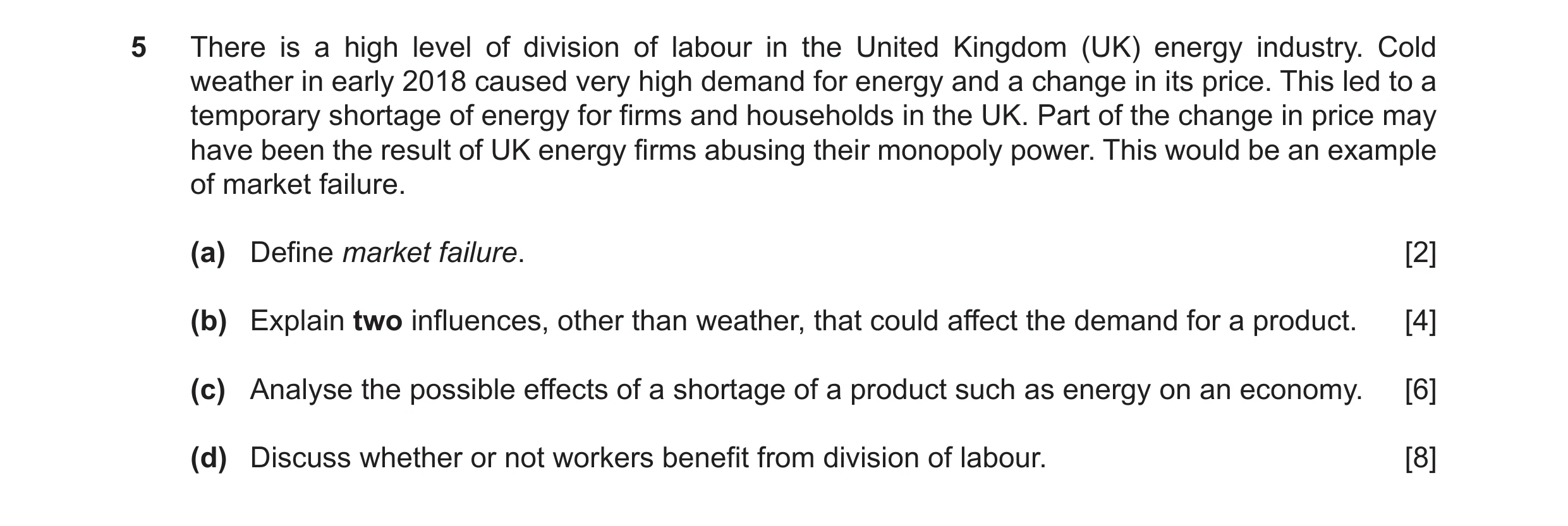
 2 / 4
2 / 4![Question 7: (a) Calculate Australia’s unemployment rate in 2021. [1] (b) Identify two substitutes for coal. [2] (c) Explain one economy of scale that c…](https://img.pastlit.com/crops/98fc39f6-25f7-4ed0-b403-3fea1f534b68/q1.webp)
![Question 9: (a) Calculate Romania’s current account deficit on its balance of payments in $s. [1] (b) Identify two reasons why Romania’s population fel…](https://img.pastlit.com/crops/c00dd8c3-df8a-45c1-8b40-cb09b15b7421/q1.webp) 3 / 4
3 / 4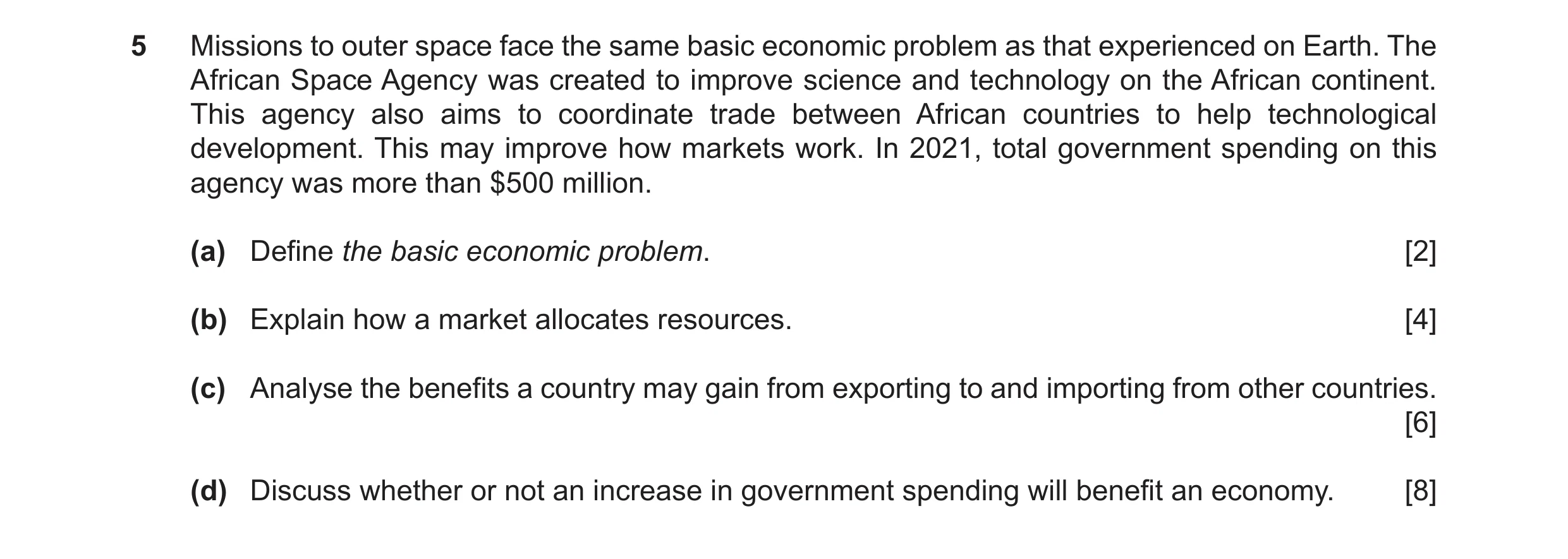 4 / 4
4 / 4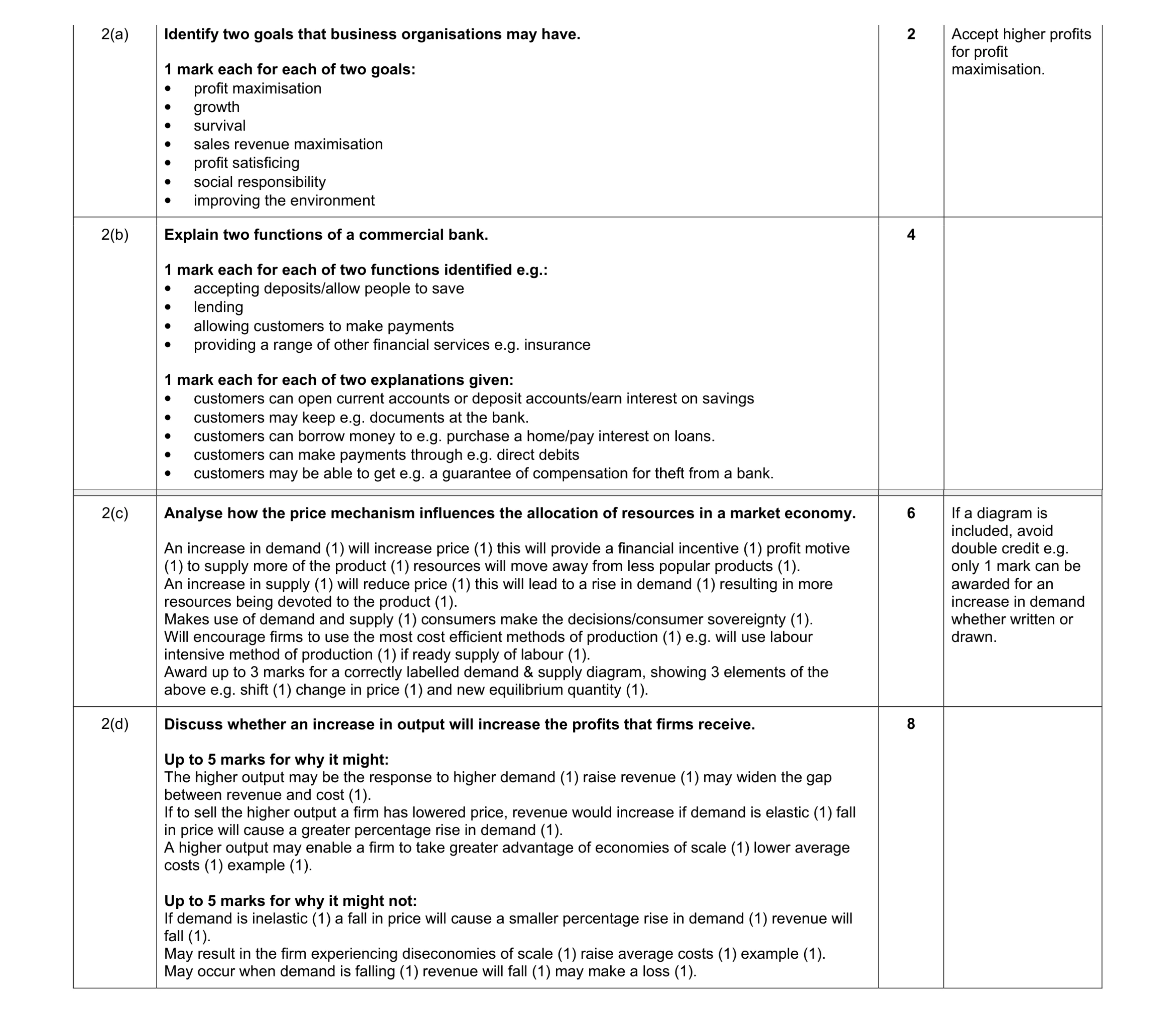 20
20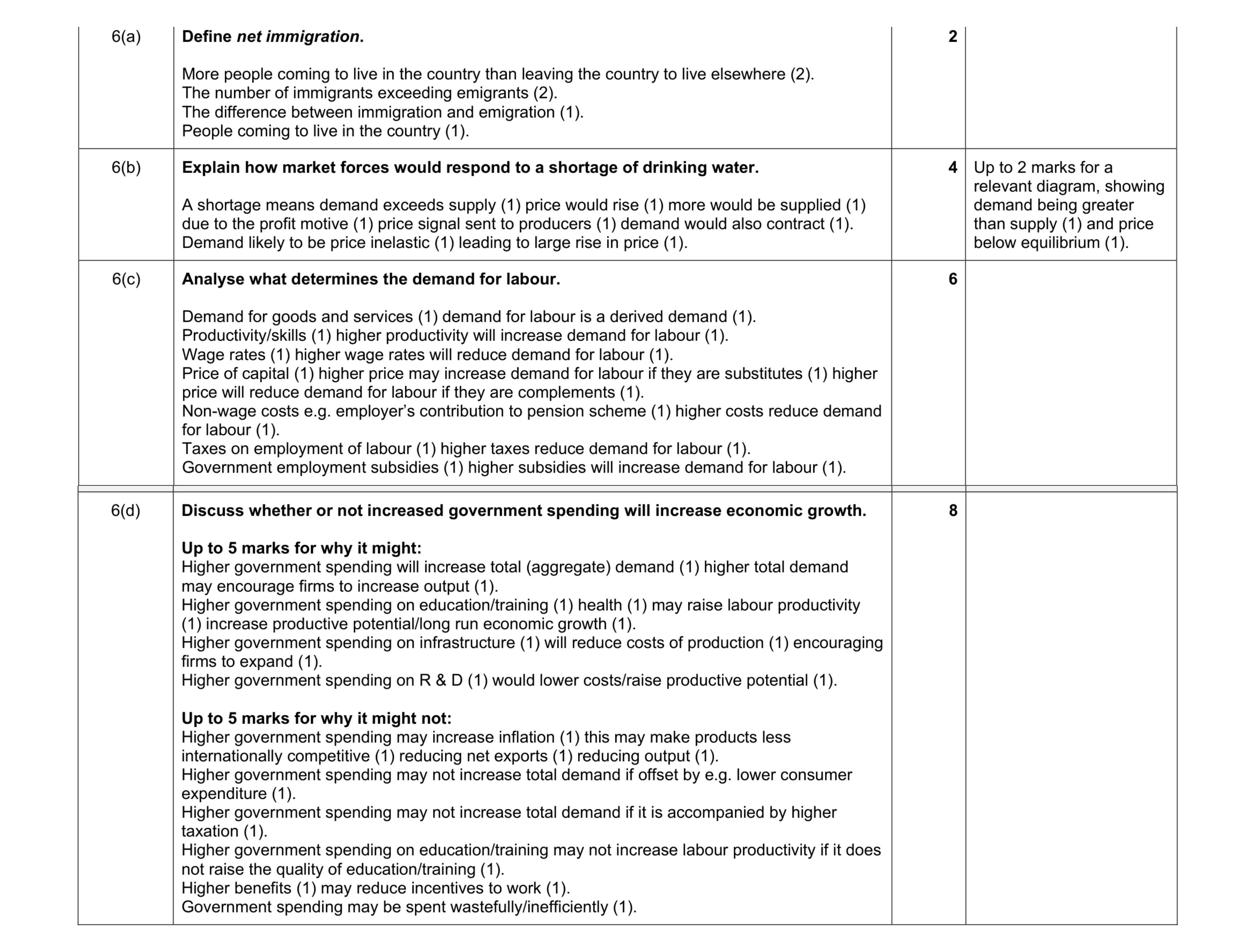 20
20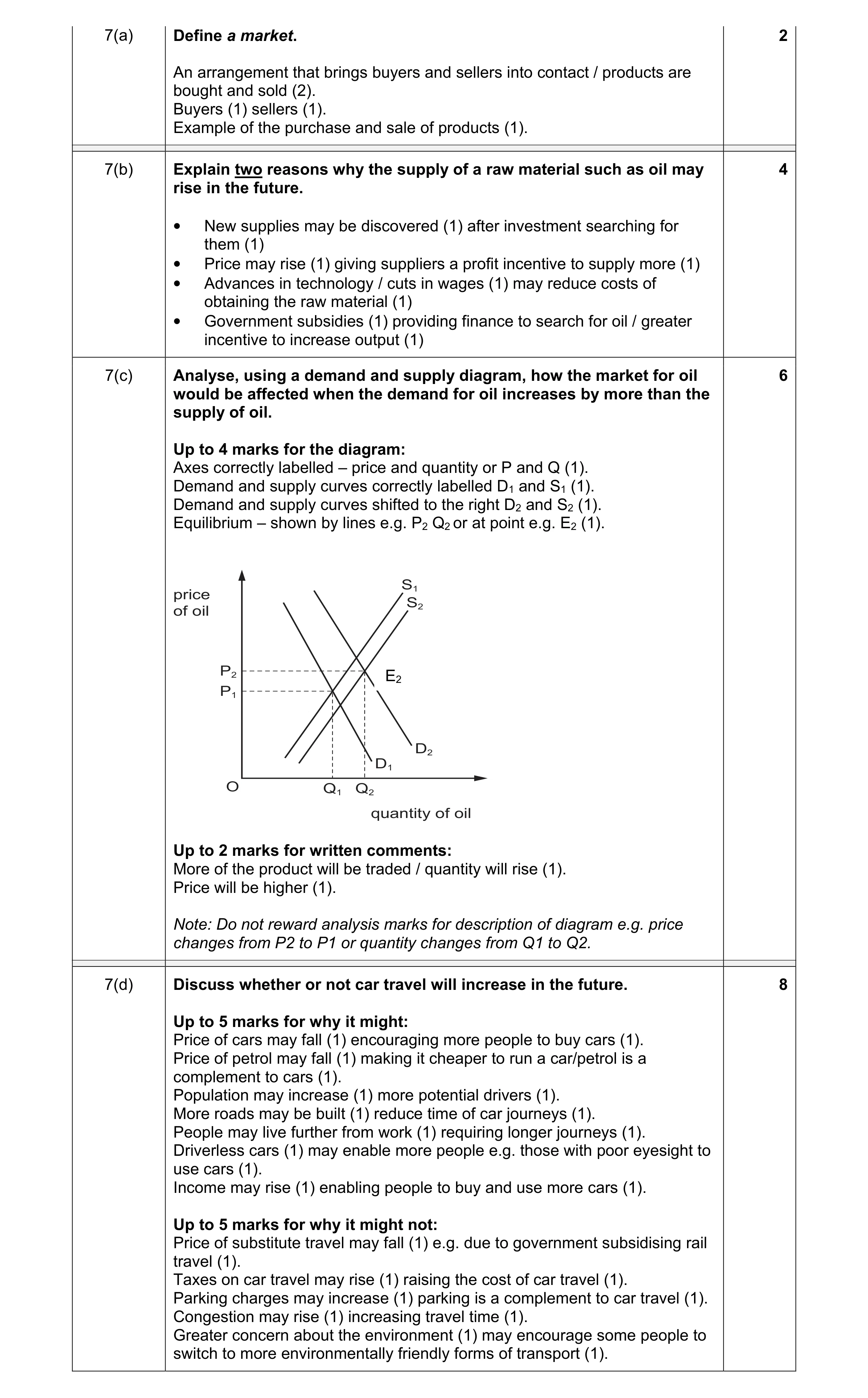 20
20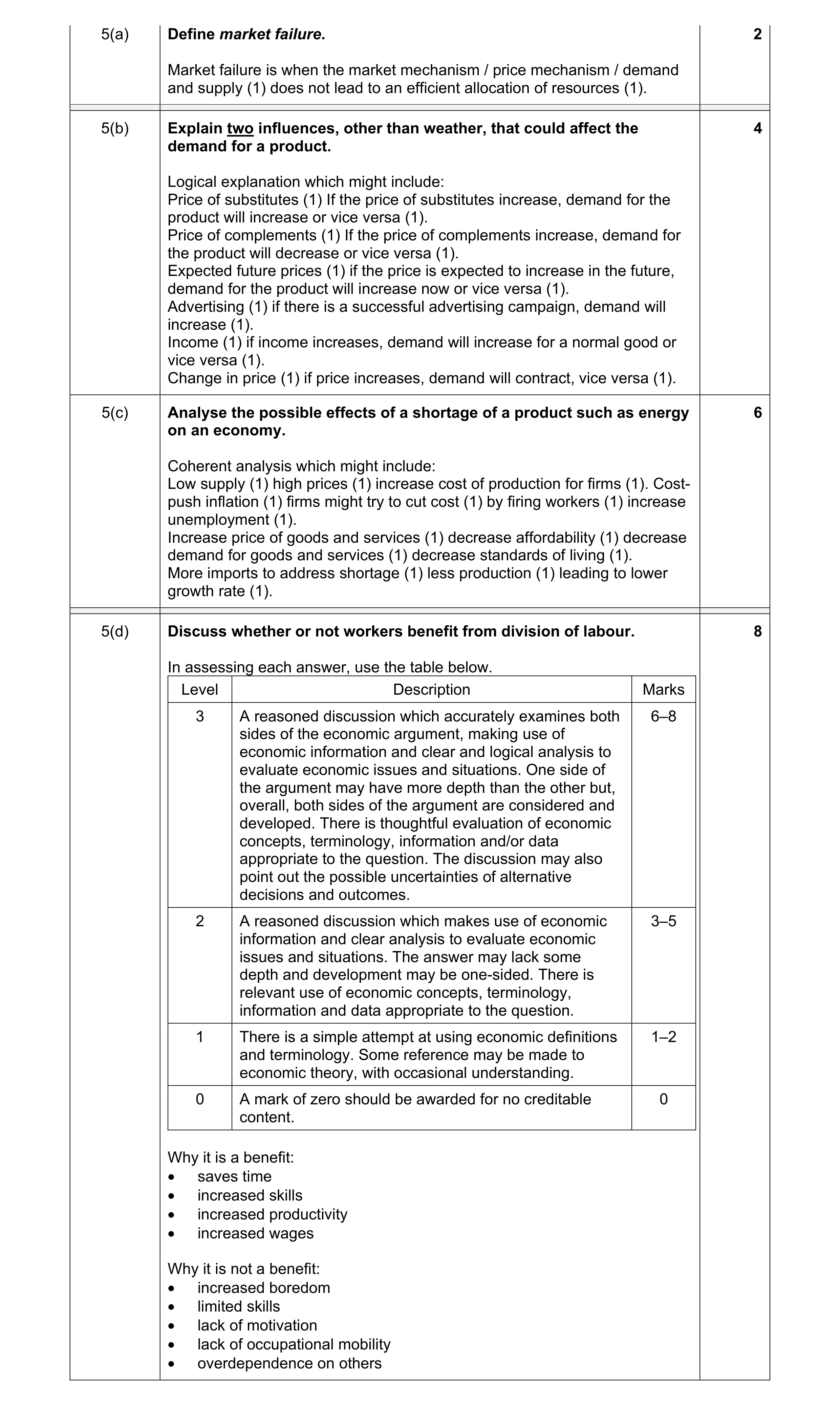 20
20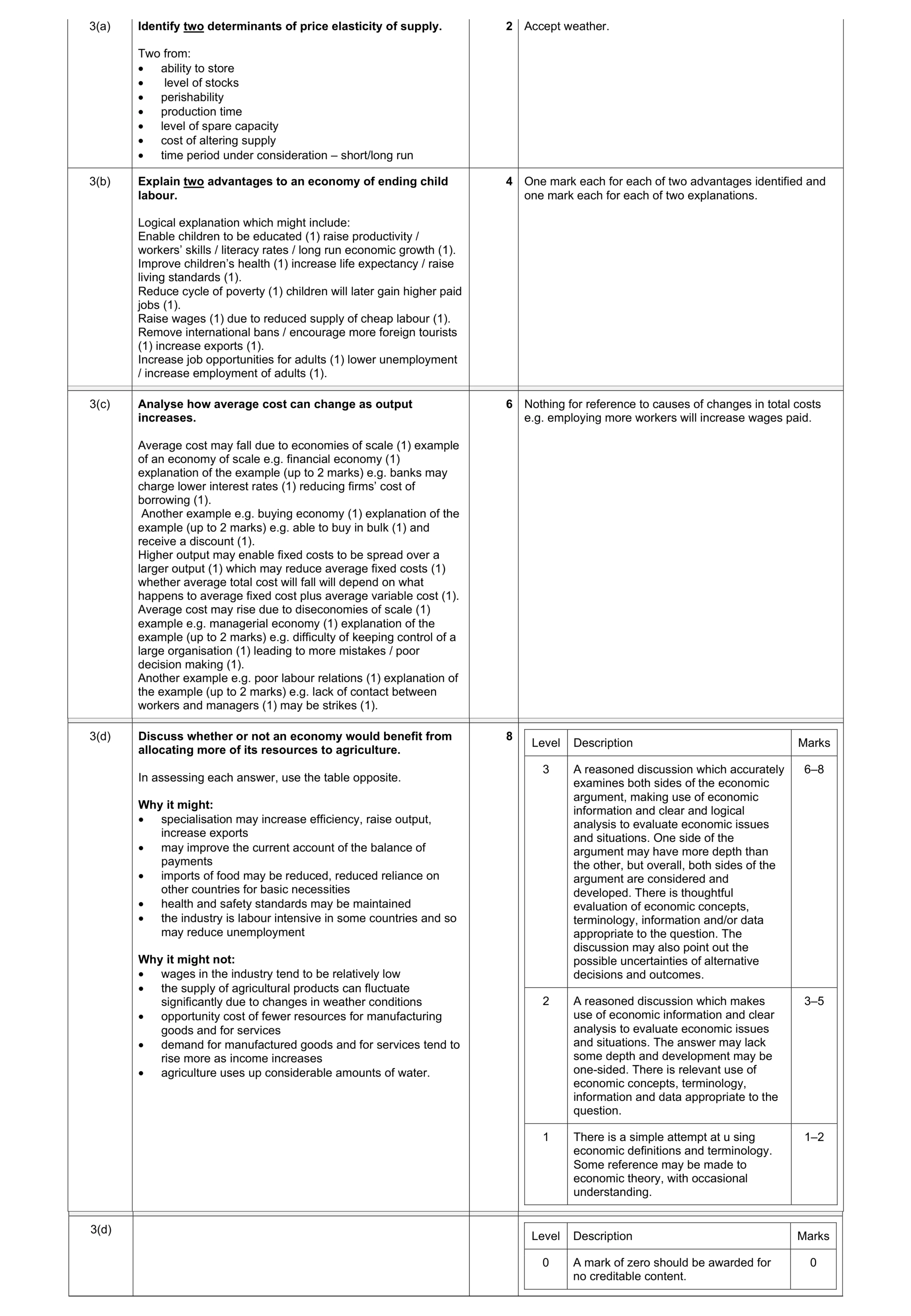 20
20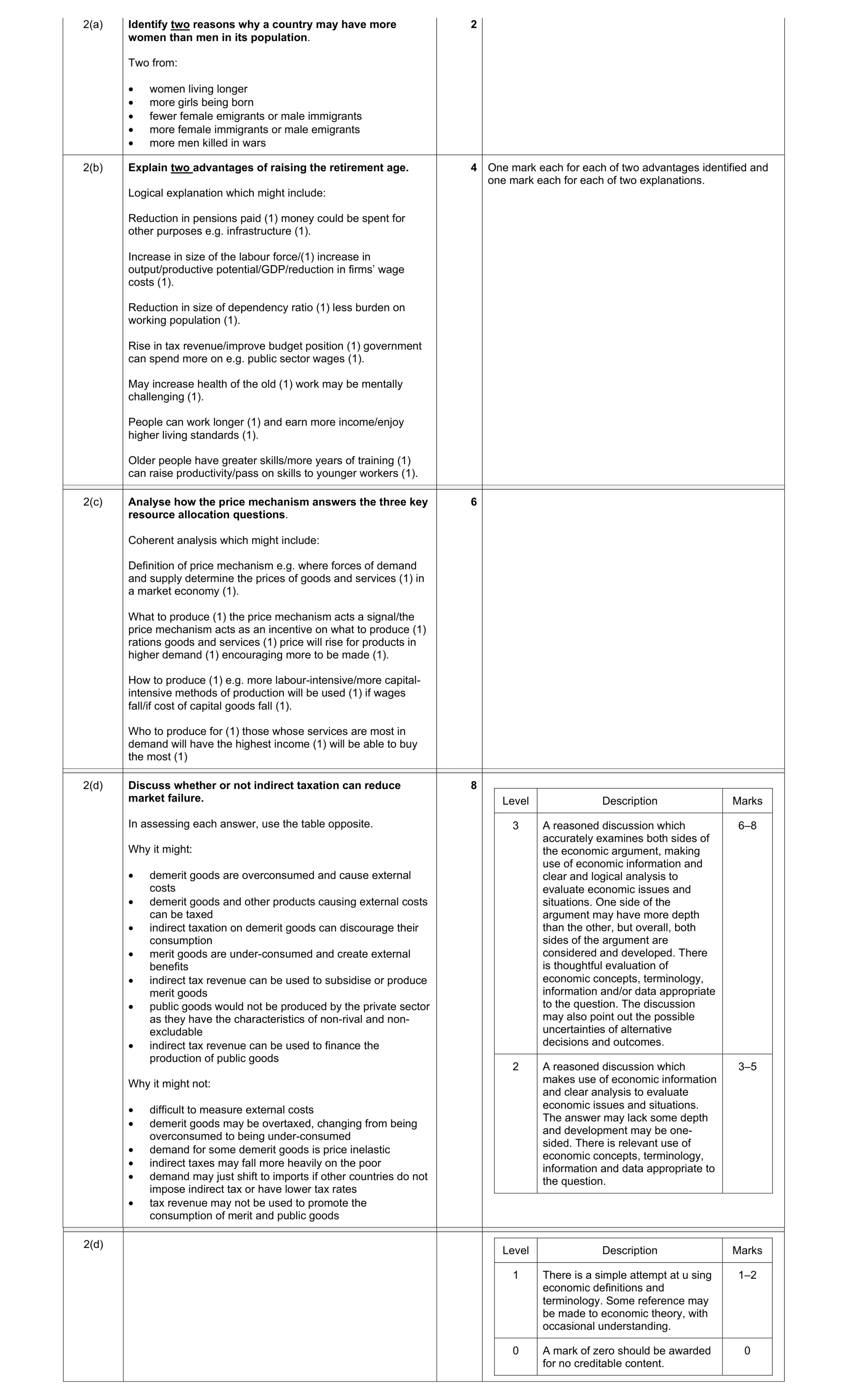 20
20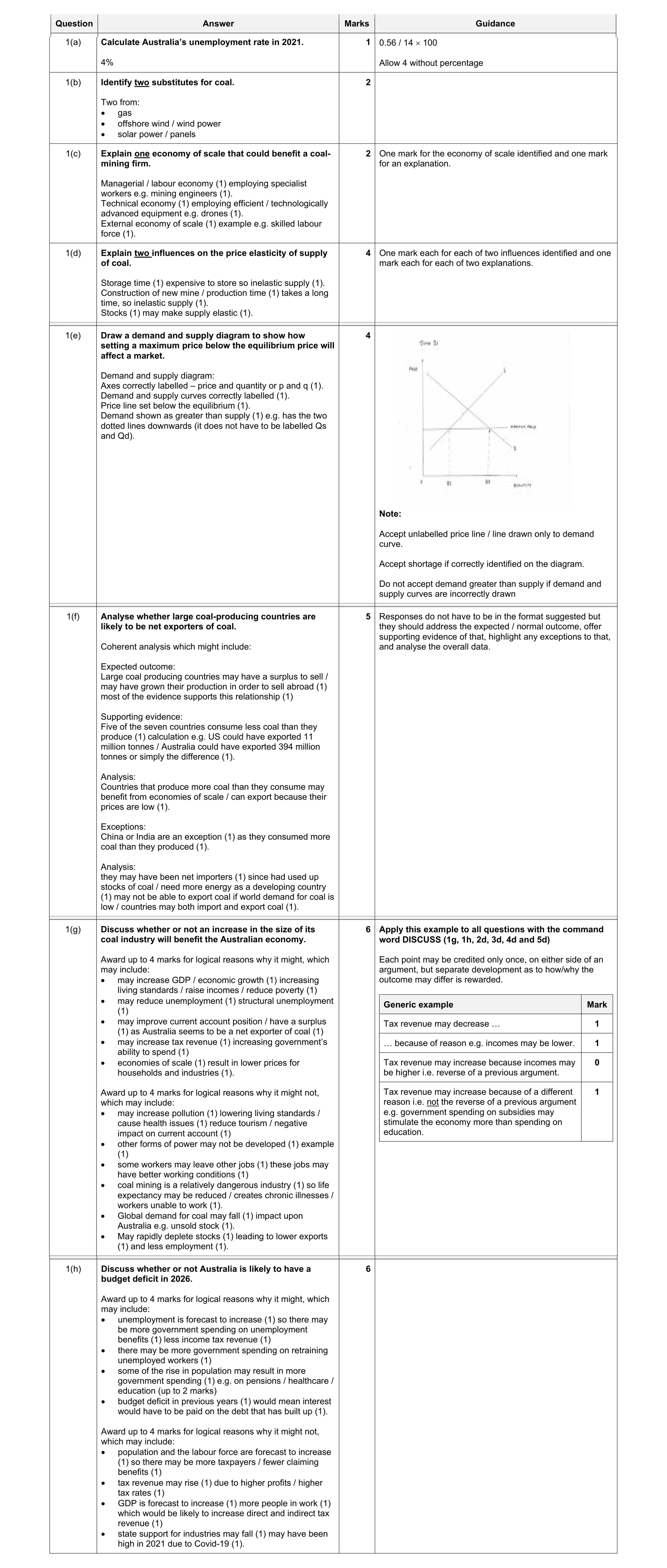 30
30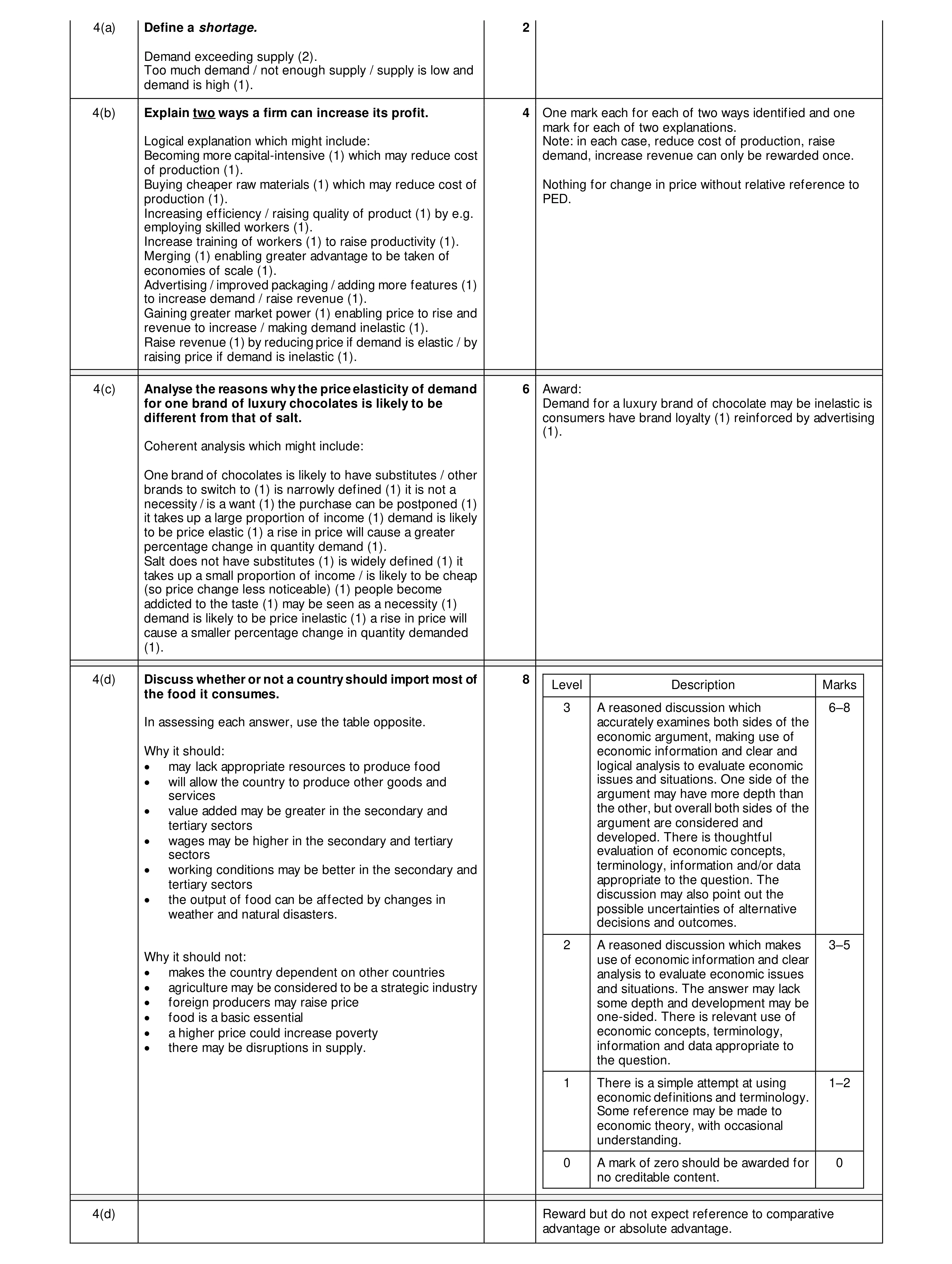 20
20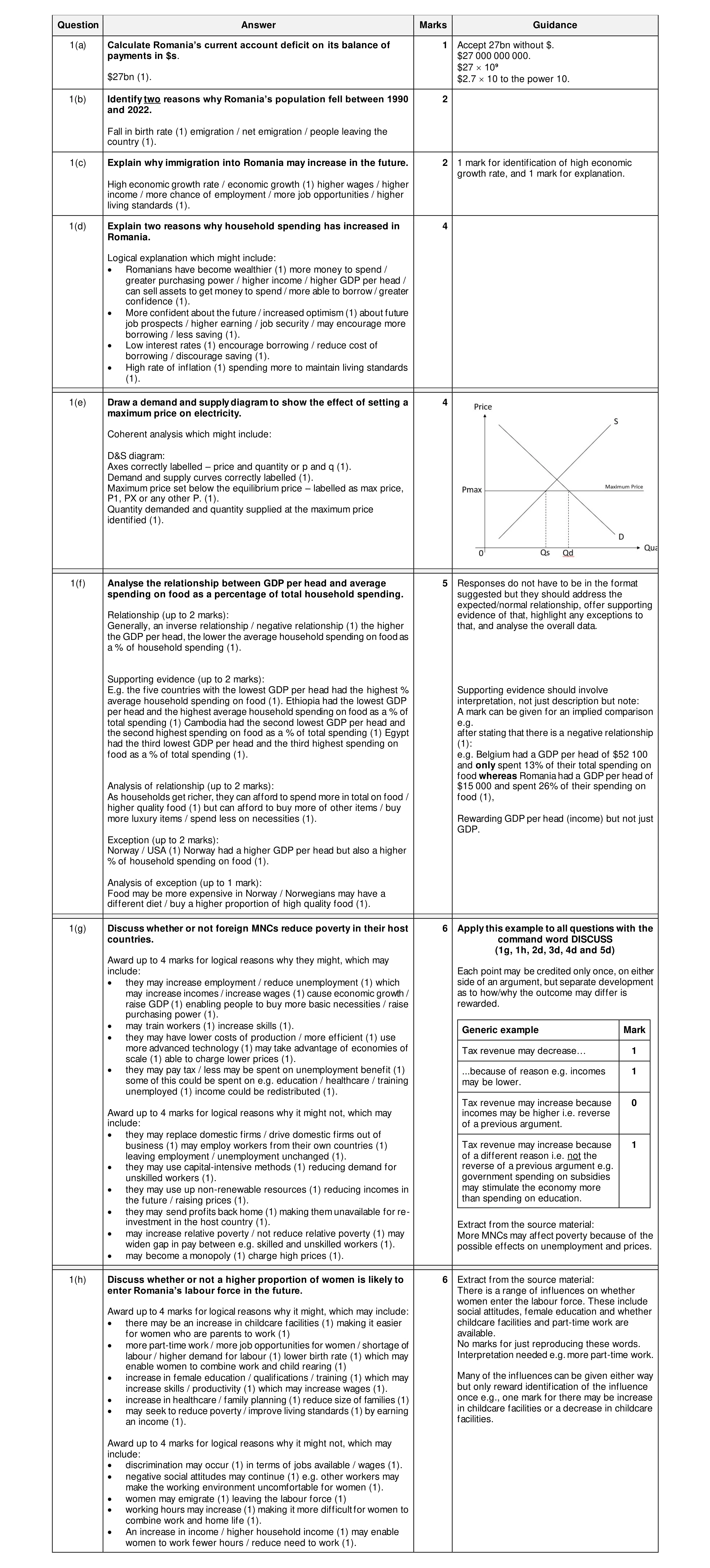 30
30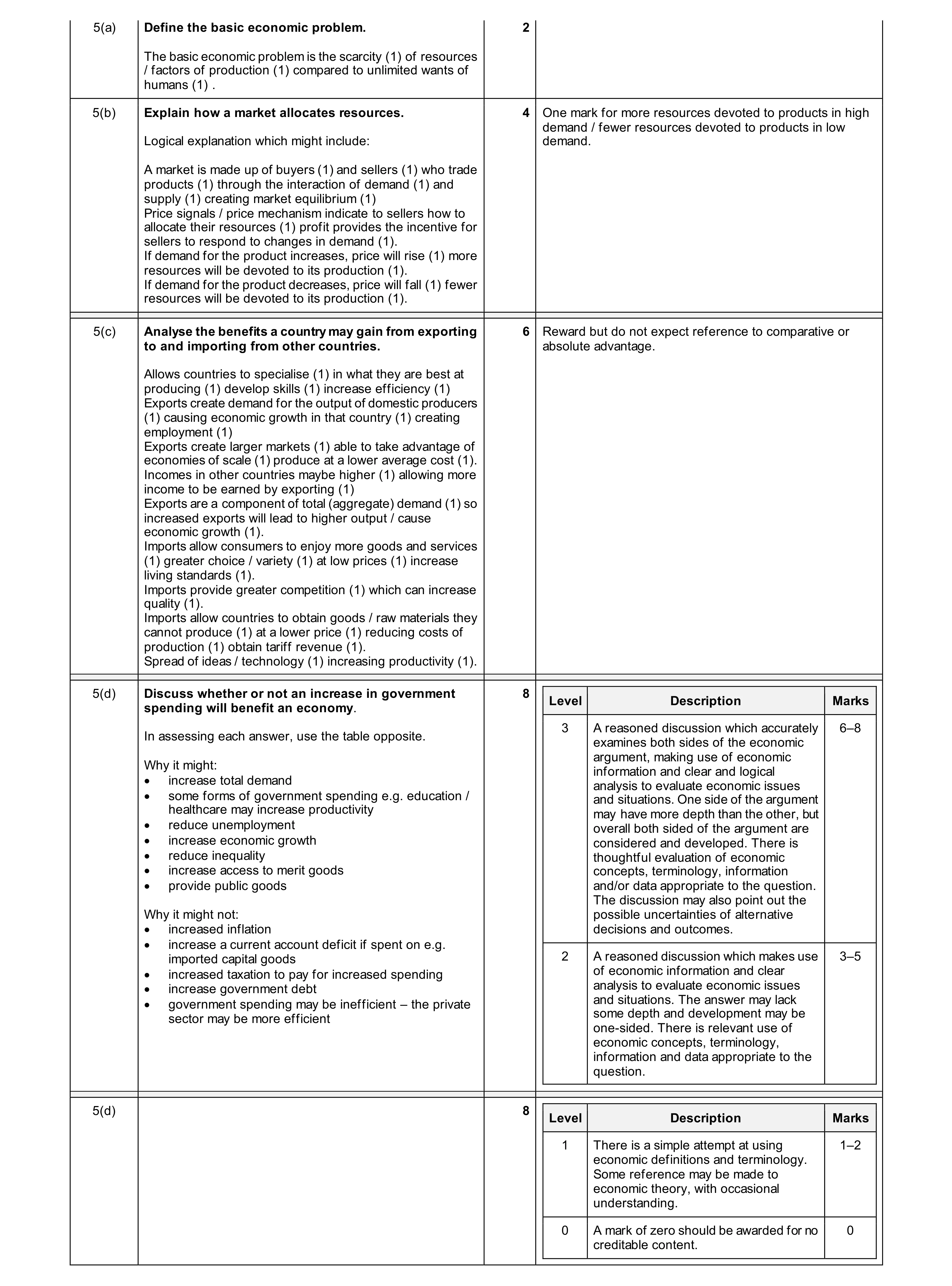 20
20