Questions as text
Q1 · Polymers are long-chain molecules made from small molecules linked together 0971/11 May/June 2018
40 Polymers are long-chain molecules made from small molecules linked together. Four polymers or types of polymer are listed. 1 carbohydrates 2 nylon 3 proteins 4 Terylene Which of these polymers or types of polymer are synthetic? A 1 and 3 B 1 and 4 C 2 and 3 D 2 and 4
1 marks
Answer: D
This question in 0971/11 May/June 2018
Q2 · Which naturally occurring polymers are found in foods? 0971/11 May/June 2019
40 Which naturally occurring polymers are found in foods? 1 complex carbohydrates 2 nylon 3 salts 4 proteins A 1 and 2 B 1 and 4 C 2 and 3 D 3 and 4
1 marks
Answer: B
This question in 0971/11 May/June 2019
Q3 · The diagram shows the structure of a monomer and of the polymer made from it 0971/12 Oct/Nov 2019
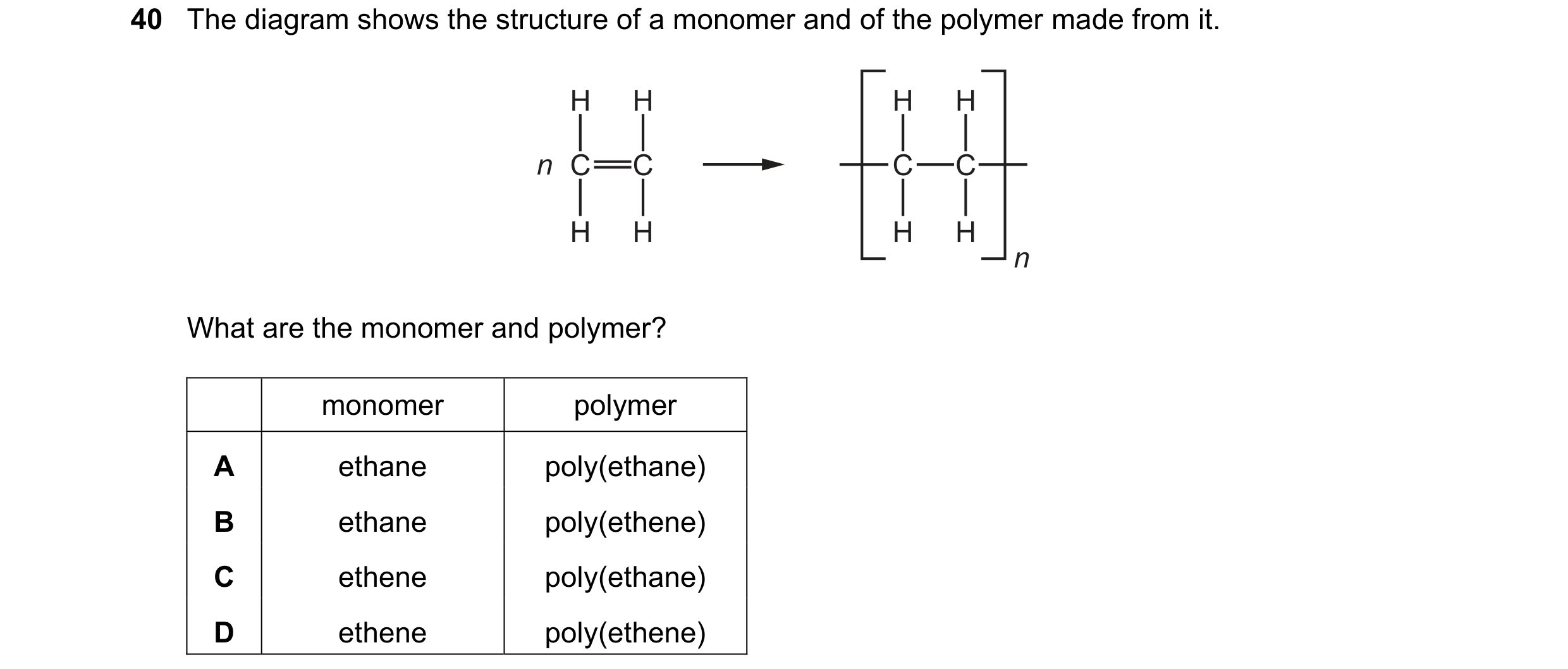
40 The diagram shows the structure of a monomer and of the polymer made from it. H H H H n C C C C H H H H n What are the monomer and polymer? monomer polymer A ethane poly(ethane) B ethane poly(ethene) C ethene poly(ethane) D ethene poly(ethene)
1 marks
Answer: D
This question in 0971/12 Oct/Nov 2019
Q4 · Which polymers or types of polymer are synthetic? 0971/11 May/June 2020
40 Which polymers or types of polymer are synthetic? 1 carbohydrates 2 nylon 3 proteins 4 Terylene A 1 and 3 B 1 and 4 C 2 and 3 D 2 and 4
1 marks
Answer: D
This question in 0971/11 May/June 2020
Q5 · Which substances are natural polymers? 0971/12 May/June 2020
40 Which substances are natural polymers? 1 proteins 2 carbohydrates 3 nylon 4 poly(ethene) A 1 and 2 B 1 and 3 C 2 and 3 D 3 and 4
1 marks
Answer: A
This question in 0971/12 May/June 2020
Q6 · Which structure represents poly(ethene)? 0971/11 May/June 2021
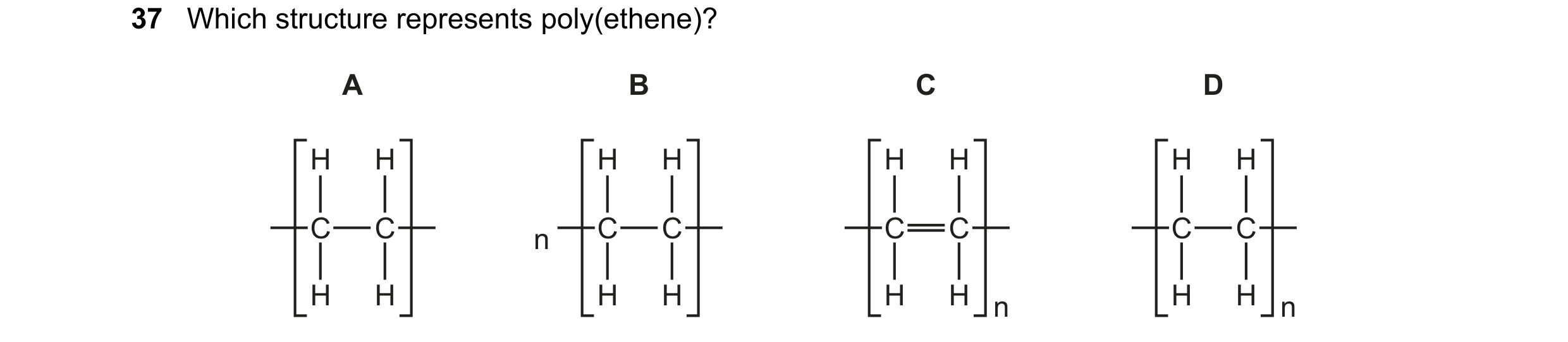
37 Which structure represents poly(ethene)? A B C D H H H H H H H H C C n C C C C C C H H H H H H n H H n
1 marks
Answer: D
This question in 0971/11 May/June 2021
Q7 · Which substance is a natural polymer? 0971/11 May/June 2021
40 Which substance is a natural polymer? A ethene B Terylene C nylon D protein
1 marks
Answer: D
This question in 0971/11 May/June 2021
Q8 · Which statements are correct? 0971/12 Oct/Nov 2021
40 Which statements are correct? 1 Polymers are large molecules built up from monomers. 2 Proteins are natural polymers. 3 Proteins and carbohydrates are constituents of food. A 1 and 2 only B 1 and 3 only C 2 and 3 only D 1, 2 and 3
1 marks
Answer: D
This question in 0971/12 Oct/Nov 2021
Q9 · Many molecules of J join together in reaction R to form a long chain molecule K 0971/11 May/June 2022
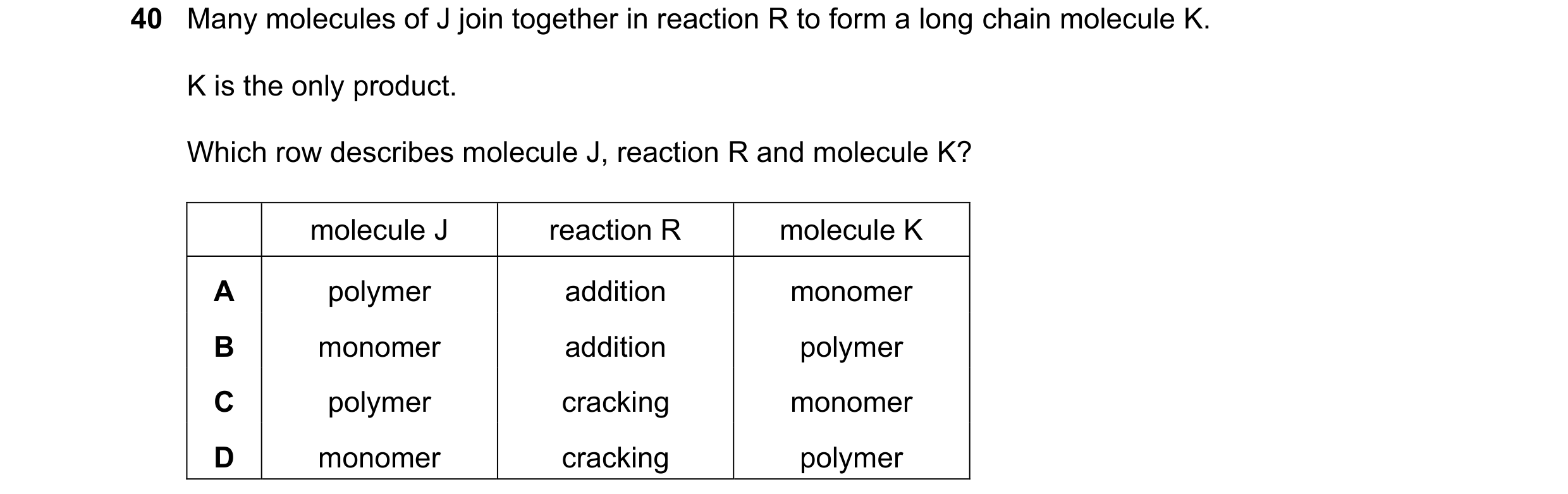
40 Many molecules of J join together in reaction R to form a long chain molecule K. K is the only product. Which row describes molecule J, reaction R and molecule K? molecule J reaction R molecule K A polymer addition monomer B monomer addition polymer C polymer cracking monomer D monomer cracking polymer
1 marks
Answer: B
This question in 0971/11 May/June 2022
Q10 · Which statement about polymerisation is correct? 0971/12 May/June 2022
40 Which statement about polymerisation is correct? A Large monomer molecules join to form small polymer molecules. B Large polymer molecules join to form small monomer molecules. C Small monomer molecules join to form large polymer molecules. D Small polymer molecules join to form large monomer molecules.
1 marks
Answer: C
This question in 0971/12 May/June 2022
Q11 · Which homologous series of compounds reacts to form an addition polymer? 0971/12 Oct/Nov 2022
36 Which homologous series of compounds reacts to form an addition polymer? A alcohols B alkanes C alkenes D carboxylic acids
1 marks
Answer: C
This question in 0971/12 Oct/Nov 2022
Q12 · In reaction R, 2000 molecules of CH2=CH2 react to form a single molecule X only 0971/11 May/June 2023
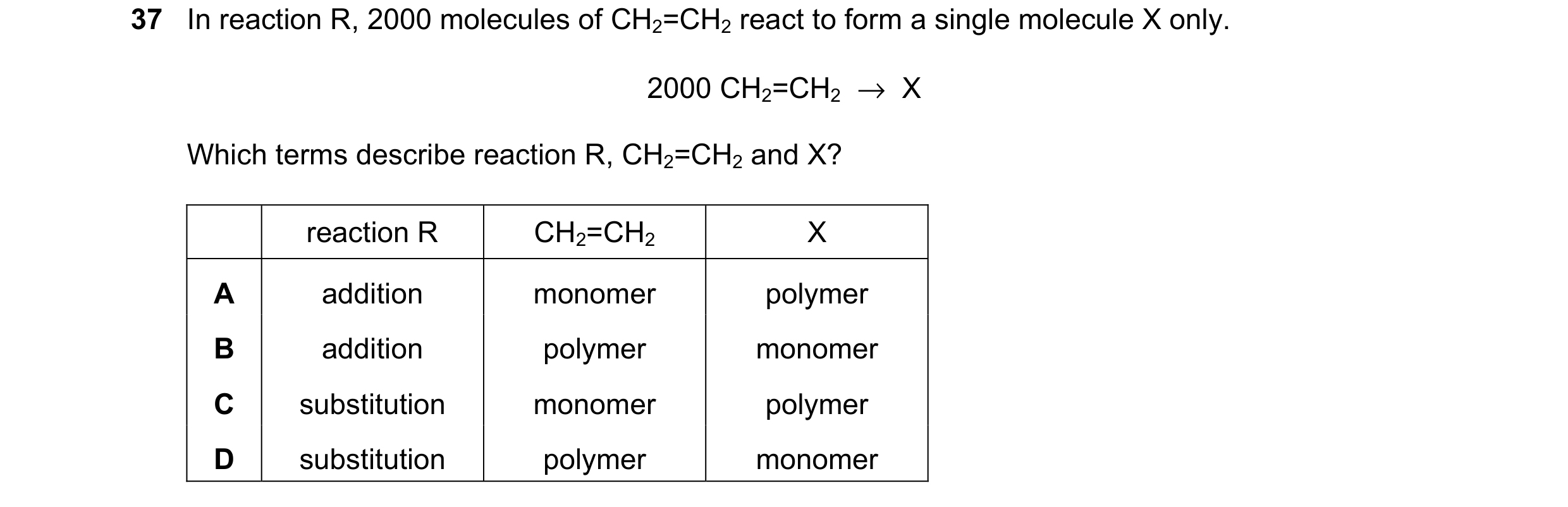
37 In reaction R, 2000 molecules of CH2=CH2 react to form a single molecule X only. 2000 CH2=CH2 → X Which terms describe reaction R, CH2=CH2 and X? reaction R CH2=CH2 X A addition monomer polymer B addition polymer monomer C substitution monomer polymer D substitution polymer monomer
1 marks
Answer: A
This question in 0971/11 May/June 2023
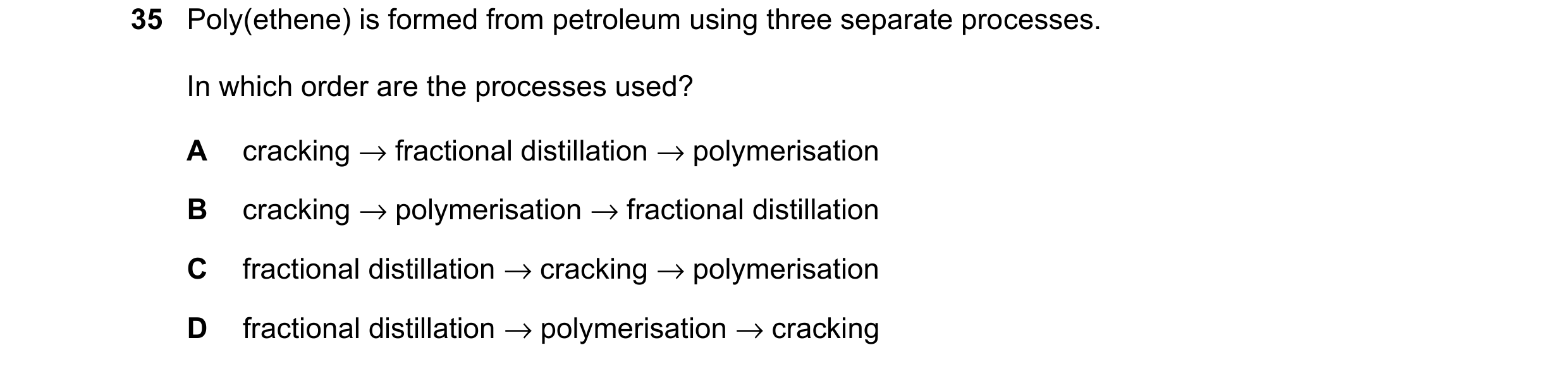
Q13 · Poly(ethene) is formed from petroleum using three separate processes 0971/12 Oct/Nov 2023
35 Poly(ethene) is formed from petroleum using three separate processes. In which order are the processes used? A cracking → fractional distillation → polymerisation B cracking → polymerisation → fractional distillation C fractional distillation → cracking → polymerisation D fractional distillation → polymerisation → cracking
1 marks
Answer: C
This question in 0971/12 Oct/Nov 2023
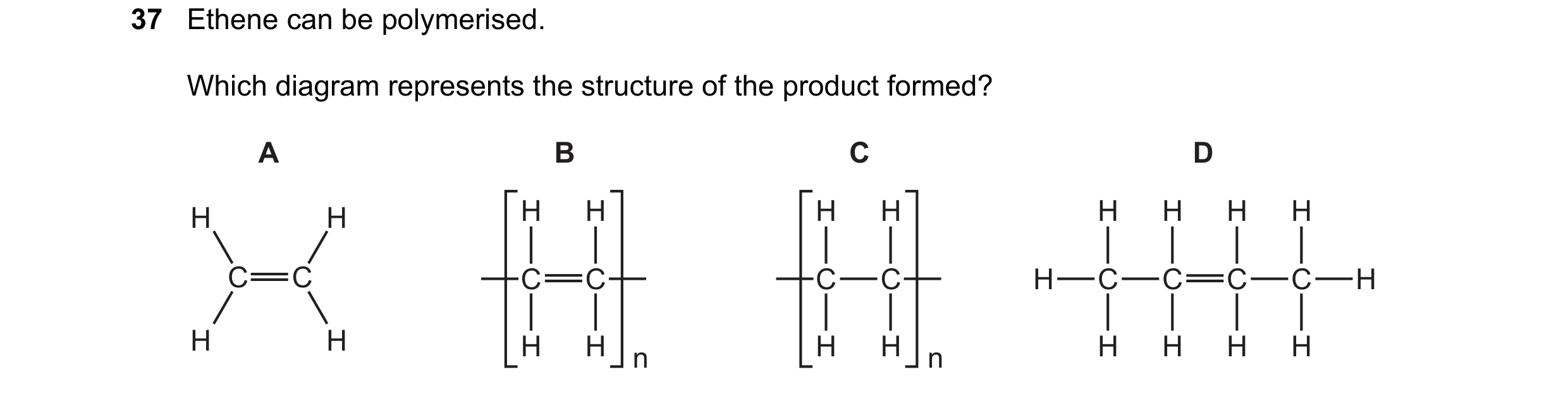
Q14 · Ethene can be polymerised 0971/12 Oct/Nov 2023
37 Ethene can be polymerised. Which diagram represents the structure of the product formed? A B C D H H H H H H H H H H C C C C C C H C C C C H H H H H H H H H H H n n
1 marks
Answer: C
This question in 0971/12 Oct/Nov 2023
Q15 · Which statement explains why the disposal of plastic waste leads to environmental… 0971/11 May/June 2024
37 Which statement explains why the disposal of plastic waste leads to environmental problems? A Plastic waste forms toxic gases when it is burned. B Plastic waste contains many small molecules. C Plastic waste rapidly dissolves in the oceans. D Plastic waste reacts with both acids and bases.
1 marks
Answer: A
This question in 0971/11 May/June 2024
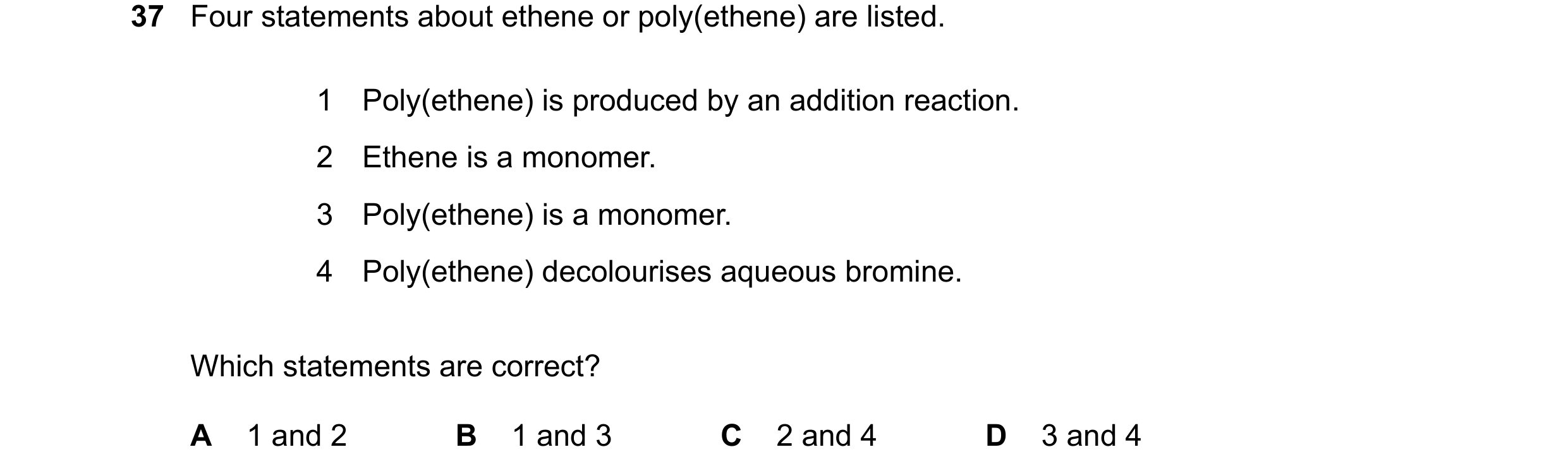
Q16 · Four statements about ethene or poly(ethene) are listed 0971/12 May/June 2024
37 Four statements about ethene or poly(ethene) are listed. 1 Poly(ethene) is produced by an addition reaction. 2 Ethene is a monomer. 3 Poly(ethene) is a monomer. 4 Poly(ethene) decolourises aqueous bromine. Which statements are correct? A 1 and 2 B 1 and 3 C 2 and 4 D 3 and 4
1 marks
Answer: A
This question in 0971/12 May/June 2024
Q17 · Which statement explains why plastic bags made from poly(ethene) accumulate in oceans? 0971/12 May/June 2025
37 Which statement explains why plastic bags made from poly(ethene) accumulate in oceans? A Poly(ethene) is a saturated molecule. B Poly(ethene) is made from hydrocarbon monomers. C Poly(ethene) reacts with water. D Poly(ethene) does not decompose in water.
1 marks
Answer: D
This question in 0971/12 May/June 2025
 1 / 4
1 / 4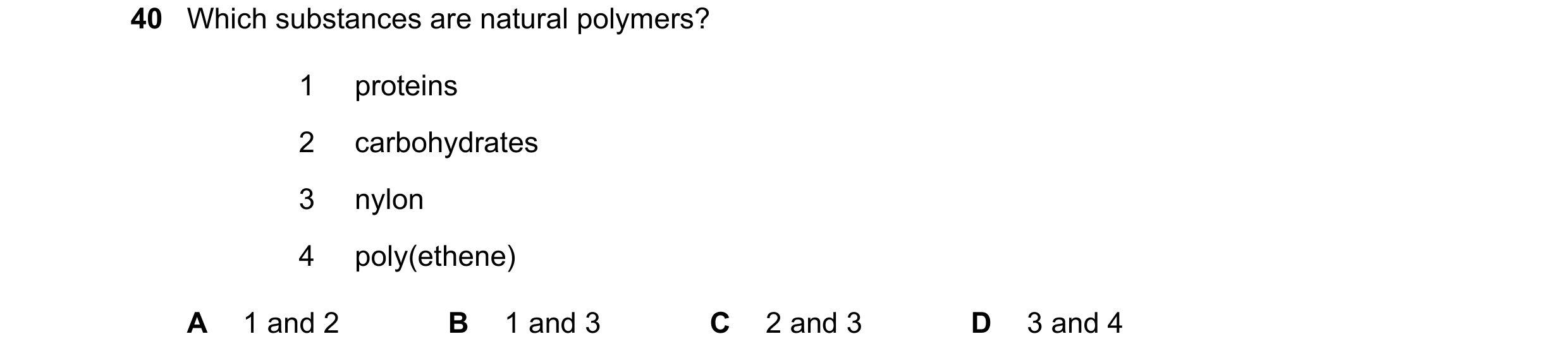


 2 / 4
2 / 4

 3 / 4
3 / 4
 4 / 4
4 / 4