Questions as text
Q1 · An experiment was carried out to investigate the effect of pH on enzyme action 0970/21 May/June 2018
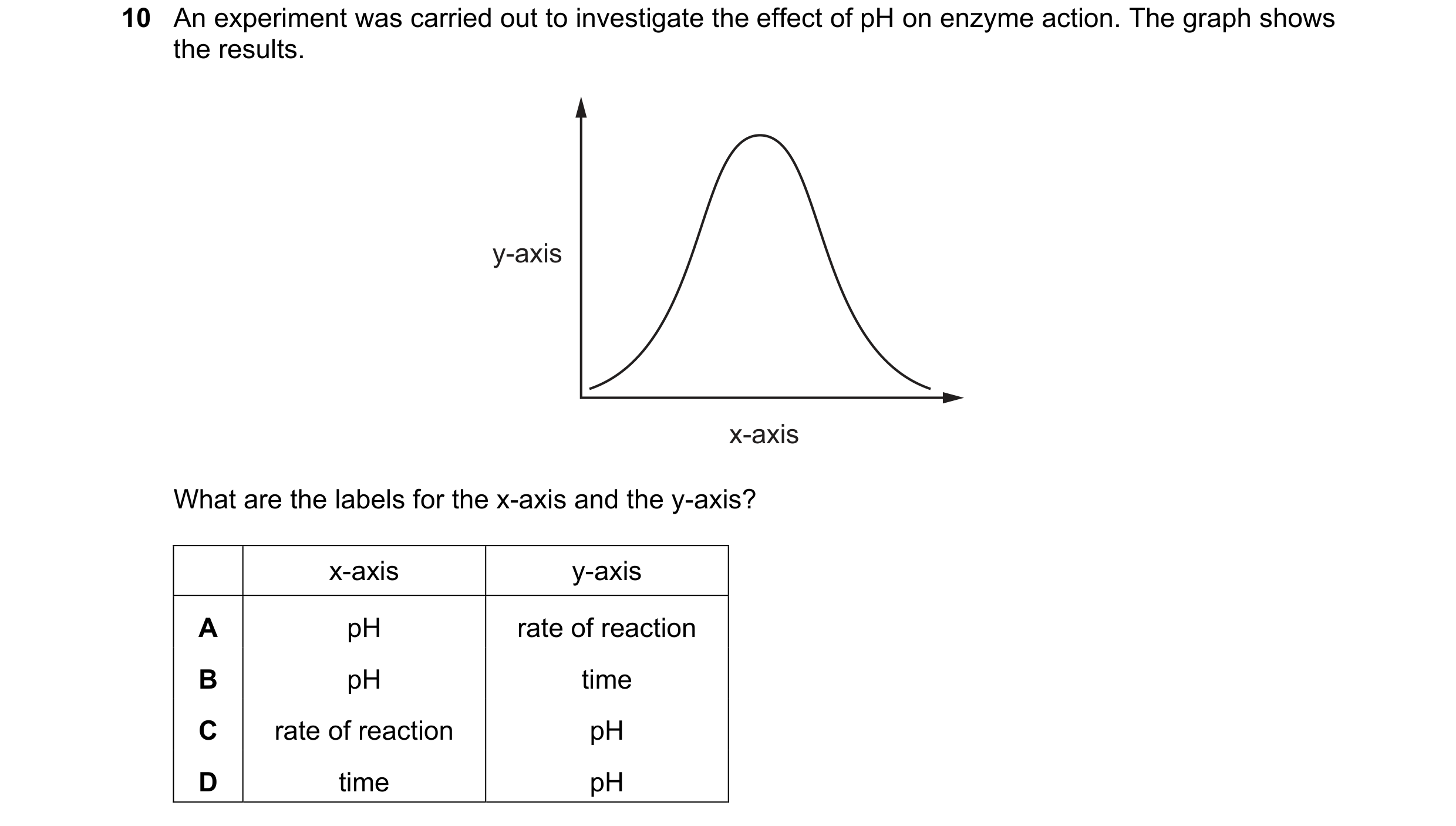
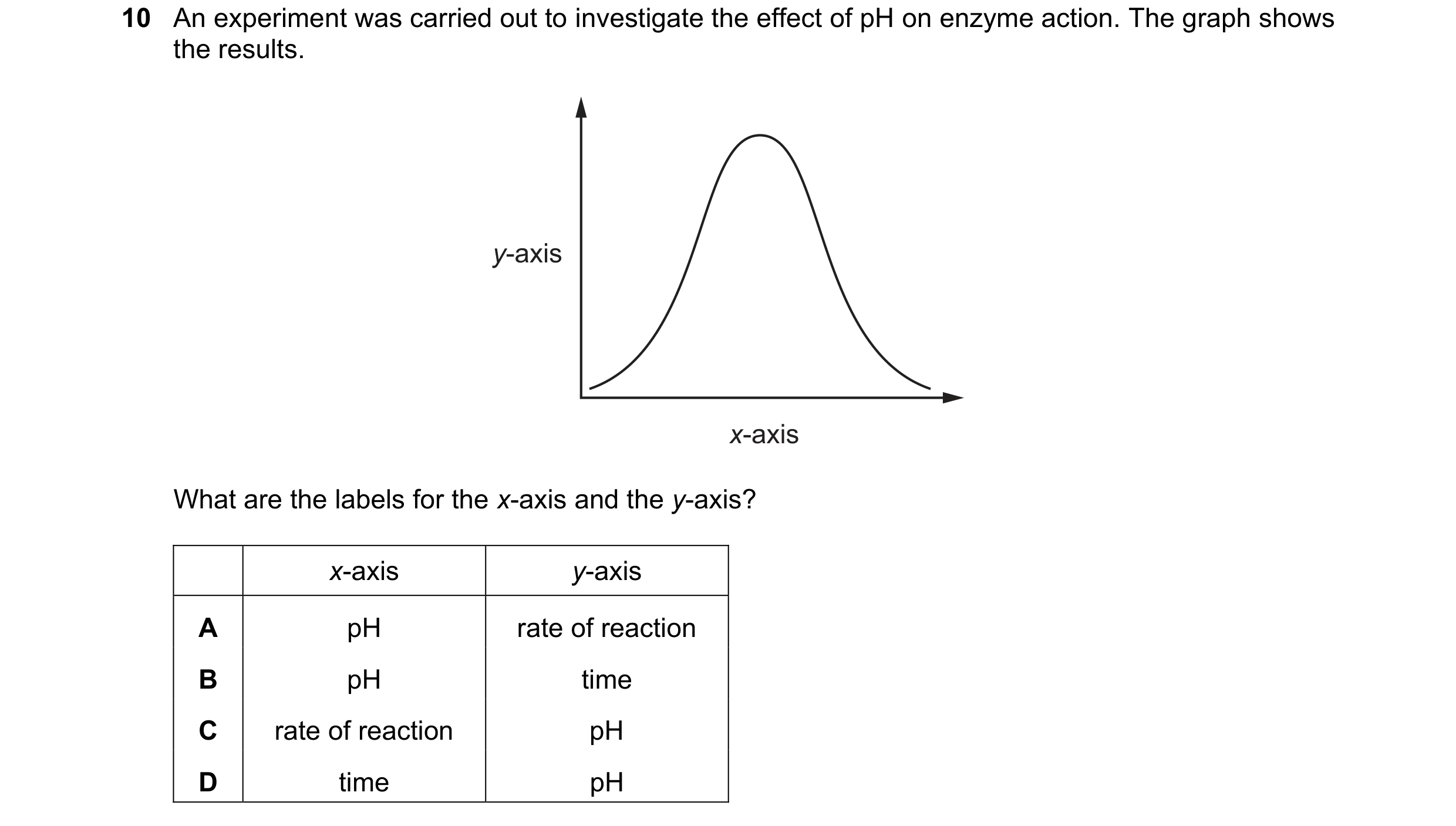
10 An experiment was carried out to investigate the effect of pH on enzyme action. The graph shows the results. y-axis x-axis What are the labels for the x-axis and the y-axis? x-axis y-axis A pH rate of reaction B pH time C rate of reaction pH D time pH
1 marks
Answer: A
This question in 0970/21 May/June 2018
Q2 · A student places two samples of crushed apple into two beakers, P and Q 0970/21 May/June 2018
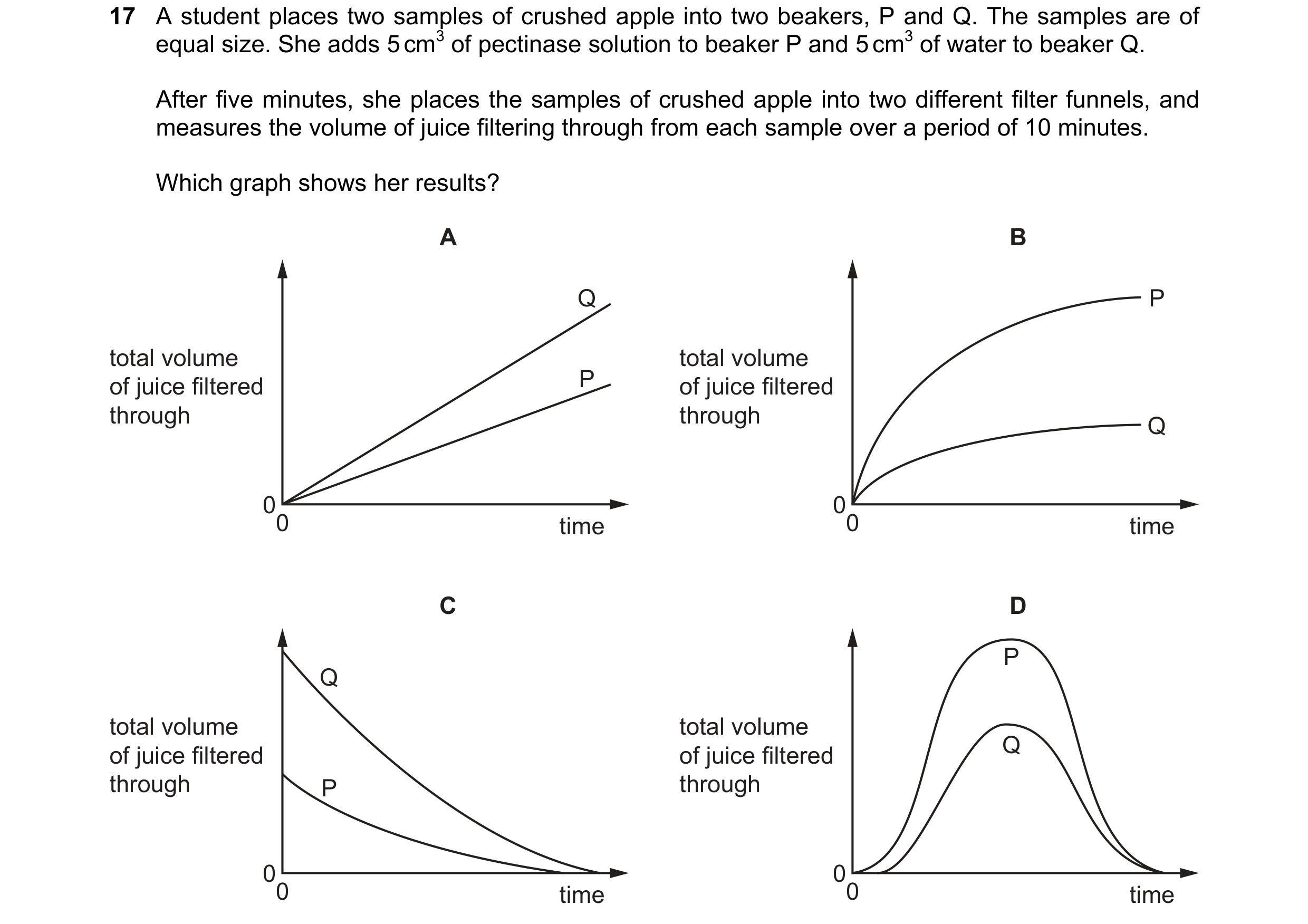
17 A student places two samples of crushed apple into two beakers, P and Q. The samples are of equal size. She adds 5 cm3 of pectinase solution to beaker P and 5 cm3 of water to beaker Q. After five minutes, she places the samples of crushed apple into two different filter funnels, and measures the volume of juice filtering through from each sample over a period of 10 minutes. Which graph shows her results? A B Q P total volume total volume of juice filtered P of juice filtered through through Q 00 00 time time C D P Q total volume total volume of juice filtered of juice filtered Q through P through 00 00 time time
1 marks
Answer: B
This question in 0970/21 May/June 2018
Q3 · The apparatus shown is used for an experiment on starch digestion 0970/22 Oct/Nov 2018
9 The apparatus shown is used for an experiment on starch digestion. Which test-tube contains the most sugar after 20 minutes? A B C D starch starch solution starch solution and salivary solution and salivary amylase amylase water-bath at 15 °C water-bath at 37 °C
1 marks
Answer: D
This question in 0970/22 Oct/Nov 2018
Q4 · The graph shows the effect of temperature on the action of an enzyme 0970/22 Oct/Nov 2018
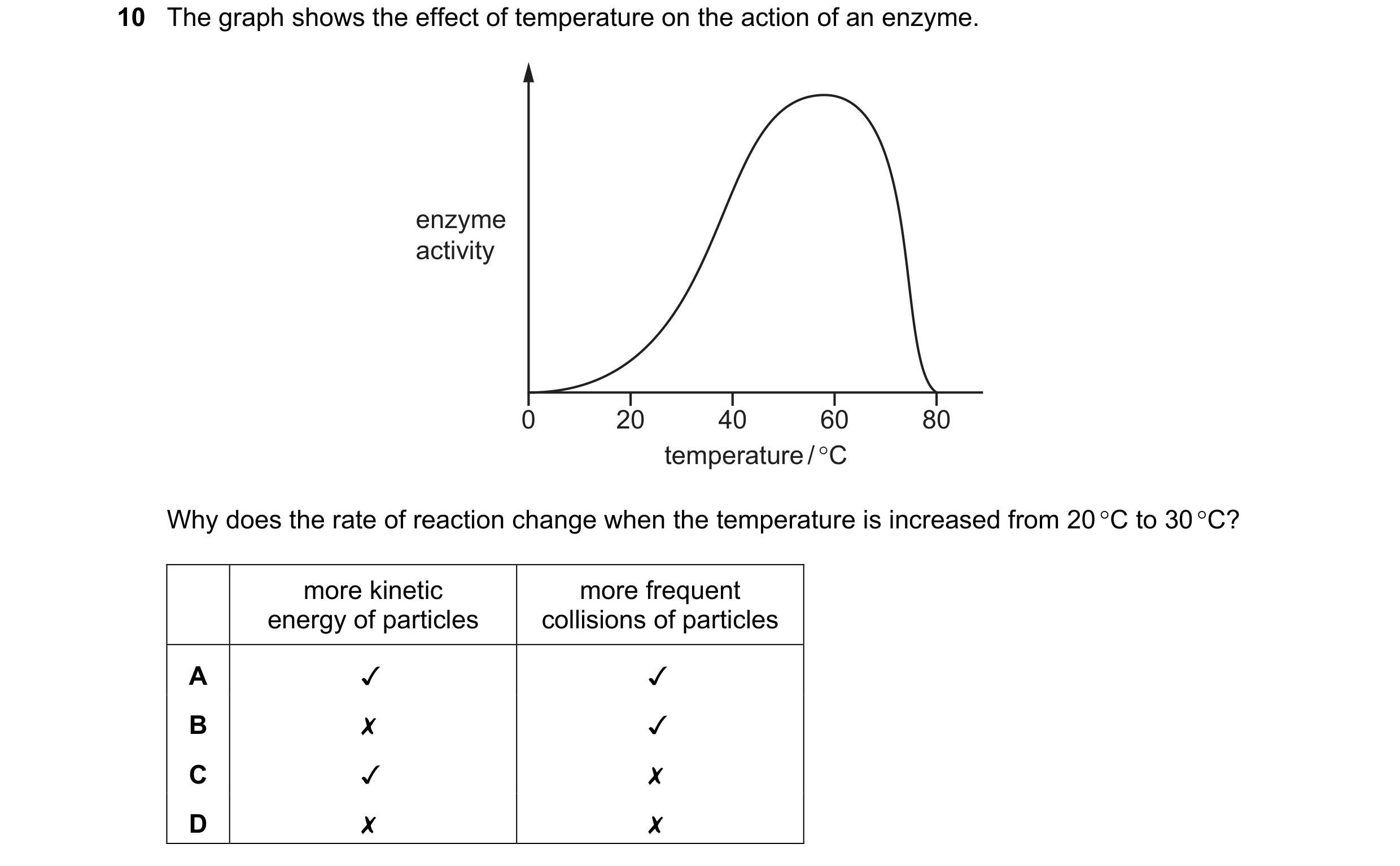
10 The graph shows the effect of temperature on the action of an enzyme.
enzyme
activity
0 20 40 60 80
temperature /°C
Why does the rate of reaction change when the temperature is increased from 20°C to 30°C?
more kinetic more frequent
energy of particles collisions of particles
A v v
B x v
Cc v x
D x x
1 marks
Answer: A
This question in 0970/22 Oct/Nov 2018
Q5 · Which row shows an enzyme with the correct site of production and products? 0970/22 Oct/Nov 2018
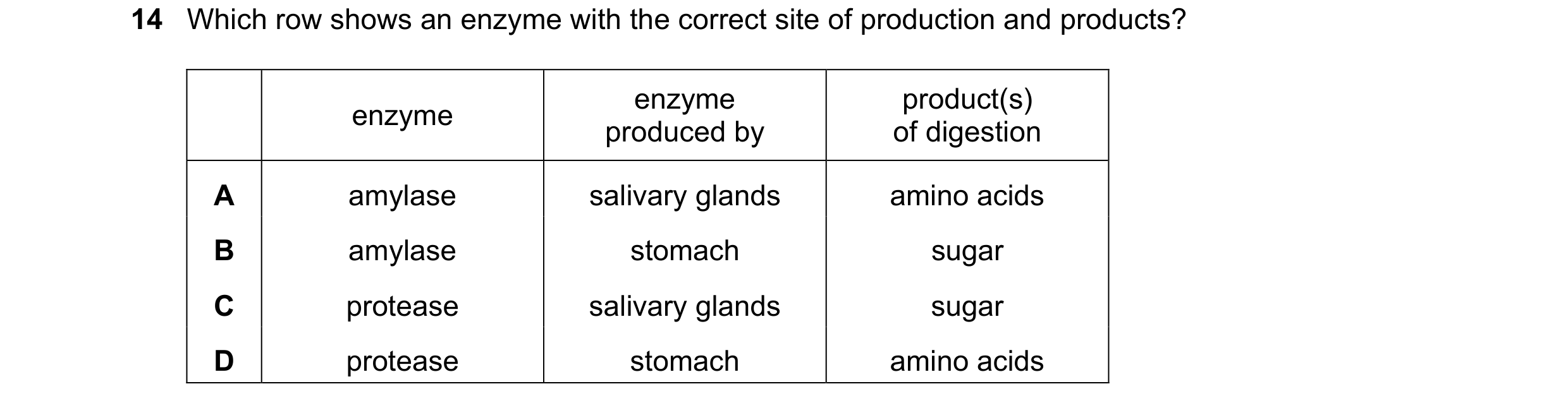
14 Which row shows an enzyme with the correct site of production and products? enzyme product(s) enzyme produced by of digestion A amylase salivary glands amino acids B amylase stomach sugar C protease salivary glands sugar D protease stomach amino acids
1 marks
Answer: D
This question in 0970/22 Oct/Nov 2018
Q6 · The diagrams show a protease enzyme catalysing the breaking of part of a protein molecule… 0970/21 May/June 2019
10 The diagrams show a protease enzyme catalysing the breaking of part of a protein molecule into smaller pieces. Which diagram has three correct labels? A B product active site substrate product enzyme enzyme C D active site active site substrate enzyme substrate product
1 marks
Answer: C
This question in 0970/21 May/June 2019
Q7 · A student investigates the breakdown of fats in milk by lipase 0970/21 May/June 2019
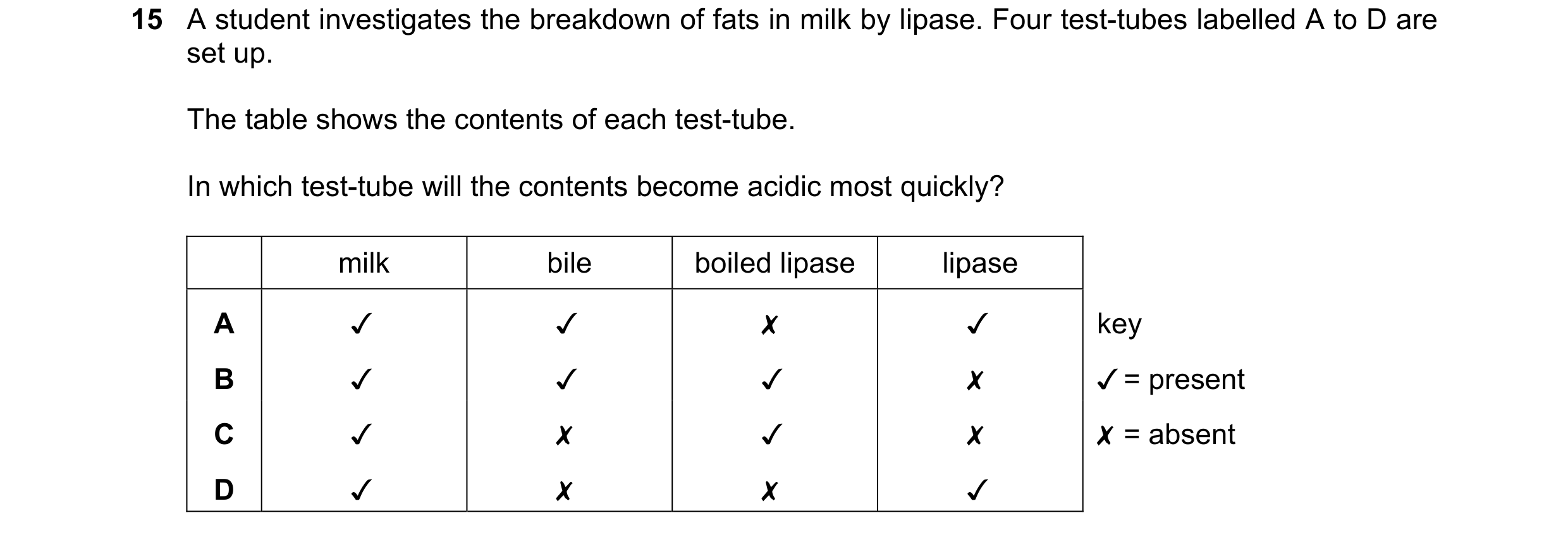
15 A student investigates the breakdown of fats in milk by lipase. Four test-tubes labelled A to D are
set up.
The table shows the contents of each test-tube.
In which test-tube will the contents become acidic most quickly?
milk bile boiled lipase
Jv x
Jv Jv
x Jv
x x
lipase
< x« x
key
v¥ = present
X = absent
1 marks
Answer: A
This question in 0970/21 May/June 2019
Q8 · The diagrams show a protease enzyme catalysing the breaking of part of a protein molecule… 0970/22 May/June 2019
10 The diagrams show a protease enzyme catalysing the breaking of part of a protein molecule into smaller pieces. Which diagram has three correct labels? A B product active site substrate product enzyme enzyme C D active site active site substrate enzyme substrate product
1 marks
Answer: C
This question in 0970/22 May/June 2019
Q9 · A person eats some cheese which contains a lot of fats and protein 0970/22 May/June 2019
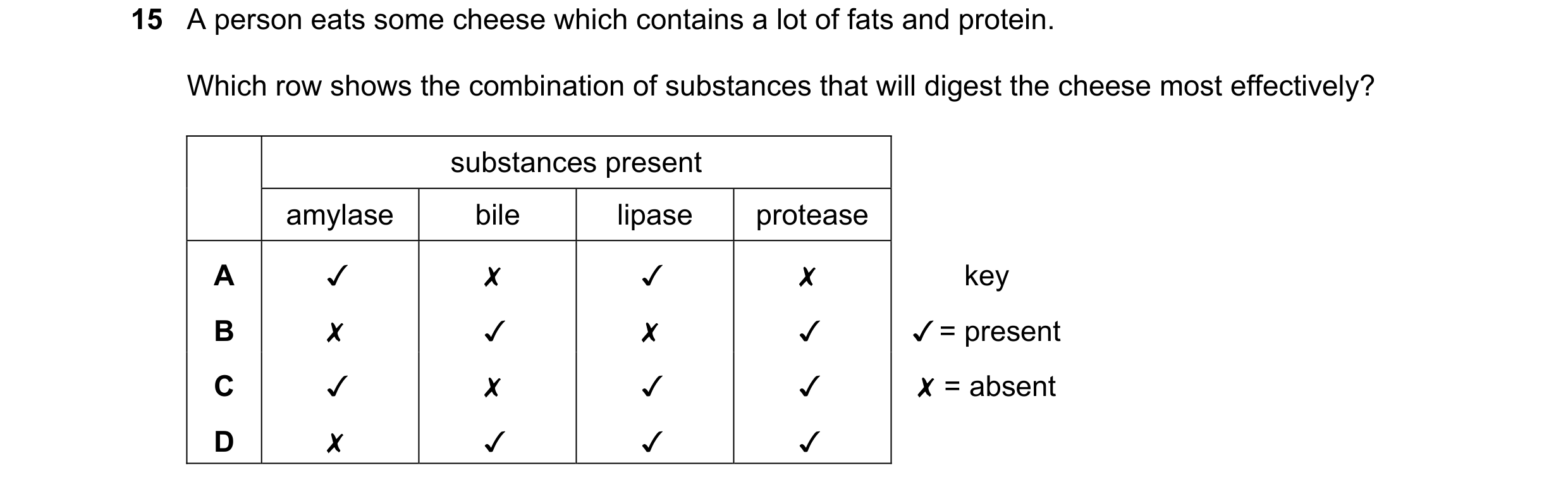
15 A person eats some cheese which contains a lot of fats and protein.
Which row shows the combination of substances that will digest the cheese most effectively?
substances present |
amylase
protease |
0 0O WwW D>
key
J/ = present
X = absent
1 marks
Answer: D
This question in 0970/22 May/June 2019
Q10 · Which chemical reaction is catalysed by maltase? 0970/22 Oct/Nov 2019
38 Which chemical reaction is catalysed by maltase? A glycogen → glucose + maltose B maltose → glucose + glucose C maltose → starch D starch → glucose + maltose
1 marks
Answer: B
This question in 0970/22 Oct/Nov 2019
Q11 · What is the definition of an enzyme? 0970/21 May/June 2020
9 What is the definition of an enzyme? A a carbohydrate that acts as a catalyst B a DNA molecule that acts as a catalyst C a fat that acts as a catalyst D a protein that acts as a catalyst
1 marks
Answer: D
This question in 0970/21 May/June 2020
Q12 · Biological washing powder can be used to remove stains on clothing 0970/21 May/June 2020
14 Biological washing powder can be used to remove stains on clothing.
Which enzymes will remove stains caused by starch, fat and protein?
amylase
v x x key
/ = removes stain
X = does not remove stain
x « &
Kx 4
Q 44
1 marks
Answer: B
This question in 0970/21 May/June 2020
Q13 · Enzymes function best at their optimum temperature 0970/22 May/June 2020
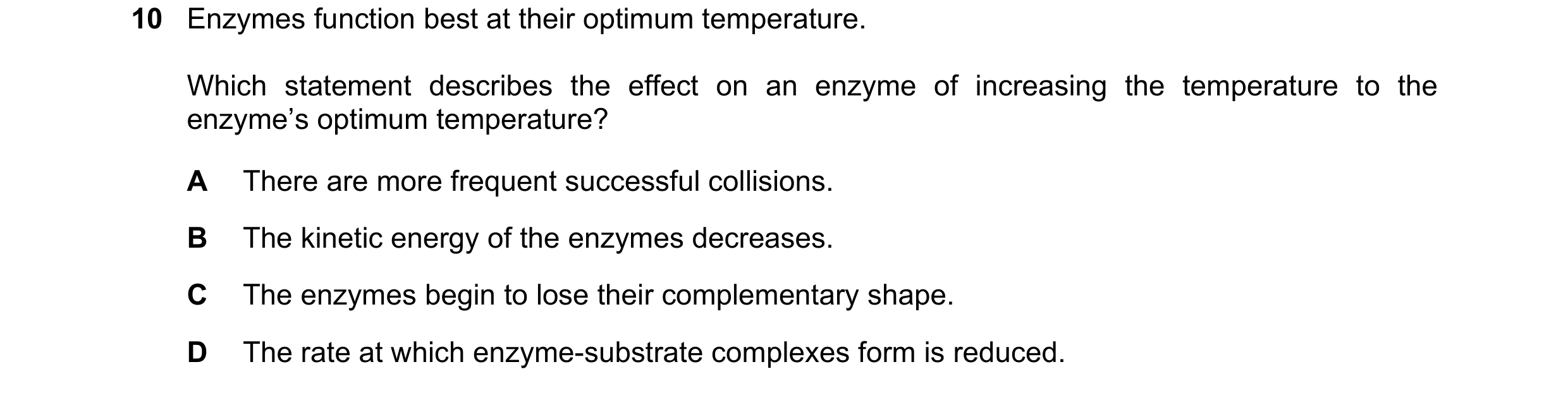
10 Enzymes function best at their optimum temperature. Which statement describes the effect on an enzyme of increasing the temperature to the enzyme’s optimum temperature? A There are more frequent successful collisions. B The kinetic energy of the enzymes decreases. C The enzymes begin to lose their complementary shape. D The rate at which enzyme-substrate complexes form is reduced.
1 marks
Answer: A
This question in 0970/22 May/June 2020
Q14 · The graph shows the effect of pH on the activity of an enzyme 0970/22 May/June 2020
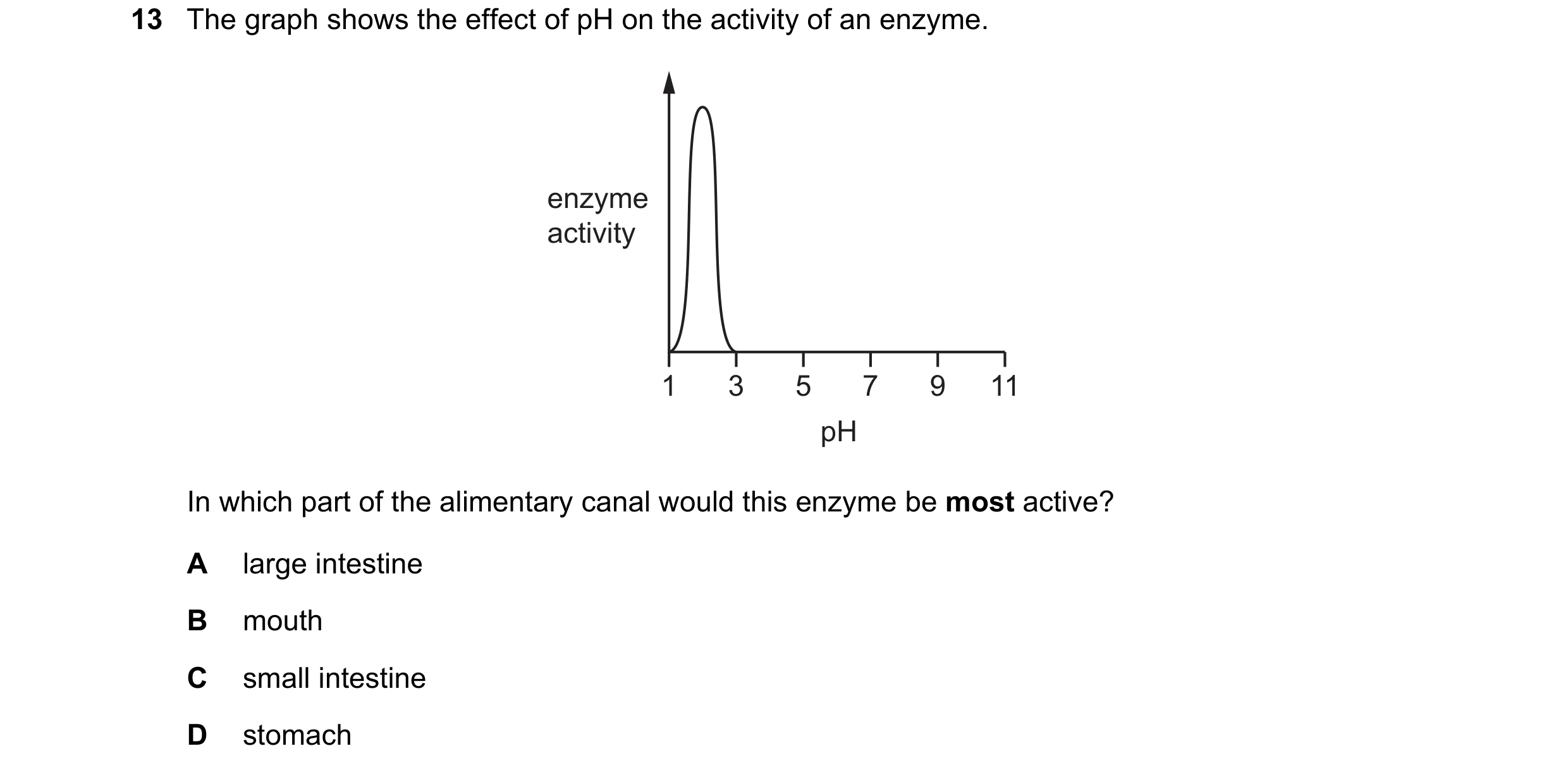
13 The graph shows the effect of pH on the activity of an enzyme. enzyme activity 1 3 5 7 9 11 pH In which part of the alimentary canal would this enzyme be most active? A large intestine B mouth C small intestine D stomach
1 marks
Answer: D
This question in 0970/22 May/June 2020
Q15 · The graph shows the effect of pH on the rate of reaction of an enzyme 0970/22 Oct/Nov 2020
9 The graph shows the effect of pH on the rate of reaction of an enzyme. rate of reaction 3 4 5 6 7 8 9 pH What does the graph show? A The enzyme is destroyed at pH 9. B The enzyme works best at pH 6. C The rate of reaction halves as the pH changes from pH 5 to pH 7. D The rate of reaction is the same at pH 5 and pH 8.5.
1 marks
Answer: D
This question in 0970/22 Oct/Nov 2020
Q16 · The graph shows how enzyme activity is affected by temperature 0970/22 Oct/Nov 2020
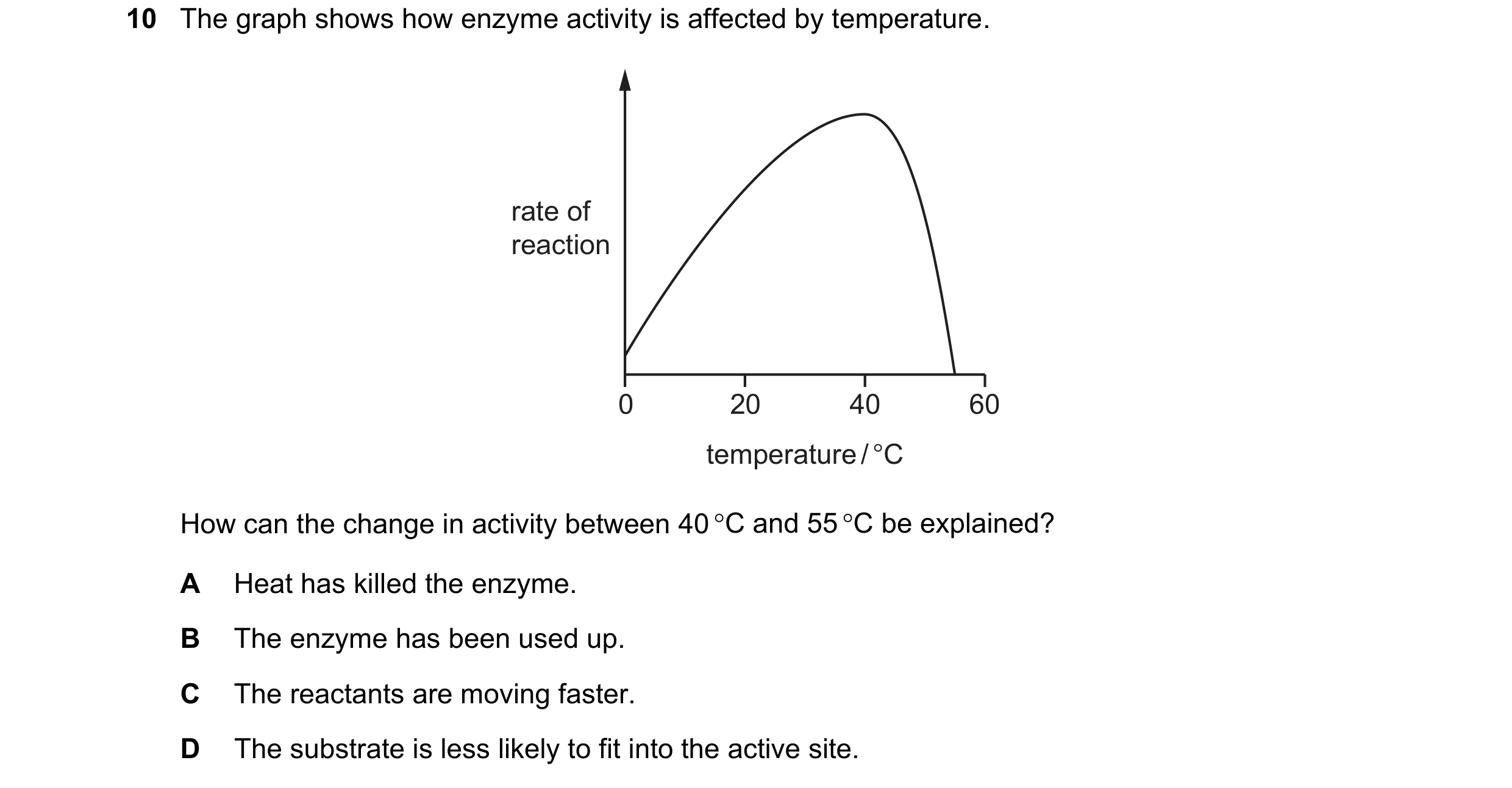
10 The graph shows how enzyme activity is affected by temperature. rate of reaction 0 20 40 60 temperature / °C How can the change in activity between 40 C and 55 C be explained? A Heat has killed the enzyme. B The enzyme has been used up. C The reactants are moving faster. D The substrate is less likely to fit into the active site.
1 marks
Answer: D
This question in 0970/22 Oct/Nov 2020
Q17 · Starch is digested by amylase in the mouth, but it is not digested in the stomach 0970/21 May/June 2021
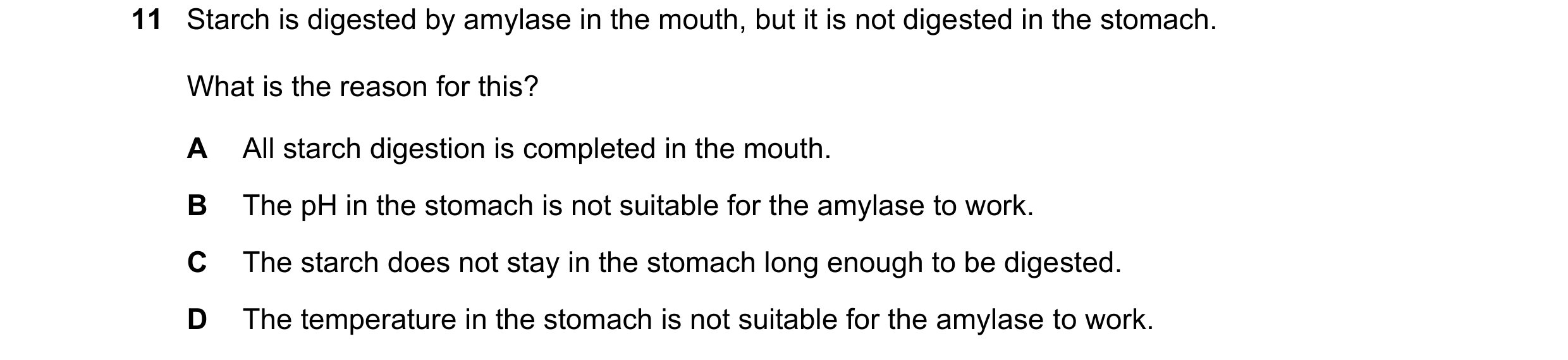
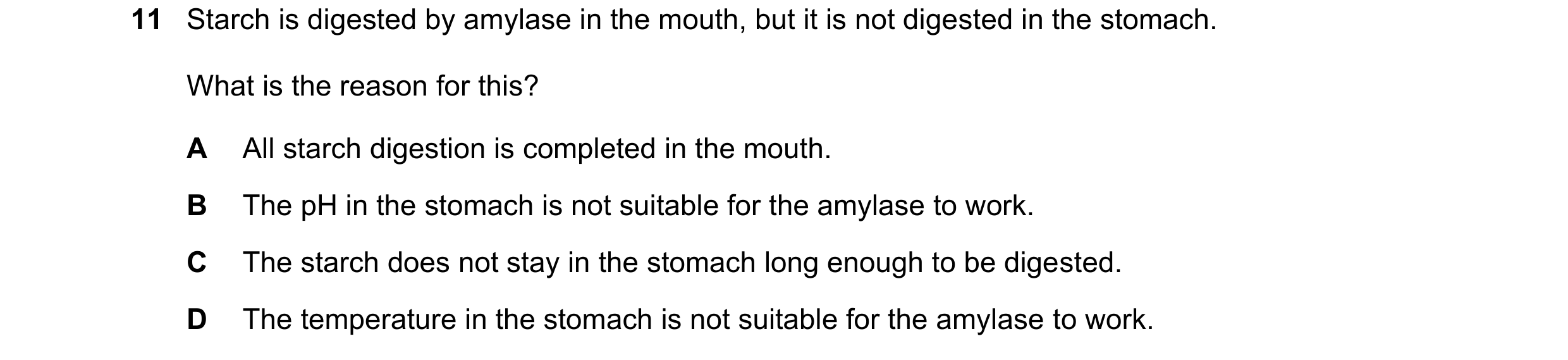
11 Starch is digested by amylase in the mouth, but it is not digested in the stomach. What is the reason for this? A All starch digestion is completed in the mouth. B The pH in the stomach is not suitable for the amylase to work. C The starch does not stay in the stomach long enough to be digested. D The temperature in the stomach is not suitable for the amylase to work.
1 marks
Answer: B
This question in 0970/21 May/June 2021
Q18 · Which statement describes a catalyst? 0970/21 May/June 2021
12 Which statement describes a catalyst? A a substance that decreases the rate of a chemical reaction and is not changed by the reaction B a substance that decreases the rate of a chemical reaction and is changed by the reaction C a substance that increases the rate of a chemical reaction and is changed by the reaction D a substance that increases the rate of a chemical reaction and is not changed by the reaction
1 marks
Answer: D
This question in 0970/21 May/June 2021
Q19 · Starch is digested by amylase in the mouth, but it is not digested in the stomach 0970/22 May/June 2021
11 Starch is digested by amylase in the mouth, but it is not digested in the stomach. What is the reason for this? A All starch digestion is completed in the mouth. B The pH in the stomach is not suitable for the amylase to work. C The starch does not stay in the stomach long enough to be digested. D The temperature in the stomach is not suitable for the amylase to work.
1 marks
Answer: B
This question in 0970/22 May/June 2021
Q20 · Which statement about an enzyme-controlled reaction is correct? 0970/22 May/June 2021
12 Which statement about an enzyme-controlled reaction is correct? A During the reaction, the substrate changes into products. B The enzyme is gradually used up during the reaction. C The enzyme is slowly broken down during the reaction. D The higher the temperature, the slower the reaction.
1 marks
Answer: A
This question in 0970/22 May/June 2021
Q21 · An experiment was carried out to investigate the effect of pH on enzyme action 0970/22 Oct/Nov 2021
10 An experiment was carried out to investigate the effect of pH on enzyme action. The graph shows the results. y-axis x-axis What are the labels for the x-axis and the y-axis? x-axis y-axis A pH rate of reaction B pH time C rate of reaction pH D time pH
1 marks
Answer: A
This question in 0970/22 Oct/Nov 2021
Q22 · Four test-tubes were set up as shown in the diagram 0970/22 Oct/Nov 2021
11 Four test-tubes were set up as shown in the diagram. In which test-tube is the starch digested most quickly? A B C D water-bath water-bath at 15 °C at 35 °C starch solution starch solution and amylase and amylase starch solution starch solution and boiled amylase and boiled amylase
1 marks
Answer: C
This question in 0970/22 Oct/Nov 2021
Q23 · Some terms used to describe enzyme-controlled reactions are listed 0970/21 May/June 2022
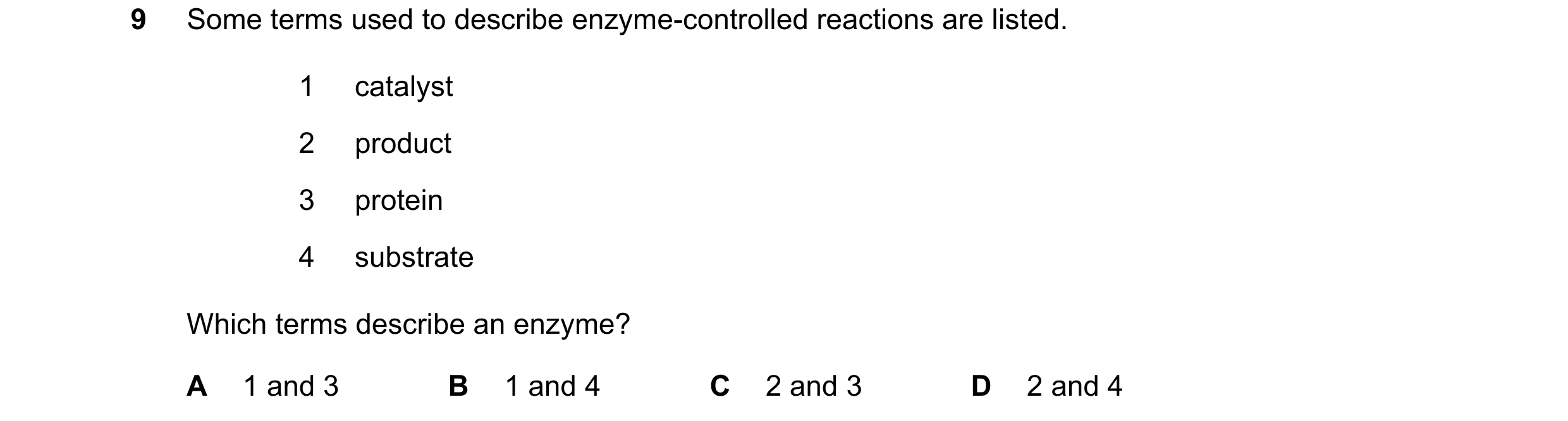
9 Some terms used to describe enzyme-controlled reactions are listed. 1 catalyst 2 product 3 protein 4 substrate Which terms describe an enzyme? A 1 and 3 B 1 and 4 C 2 and 3 D 2 and 4
1 marks
Answer: A
This question in 0970/21 May/June 2022
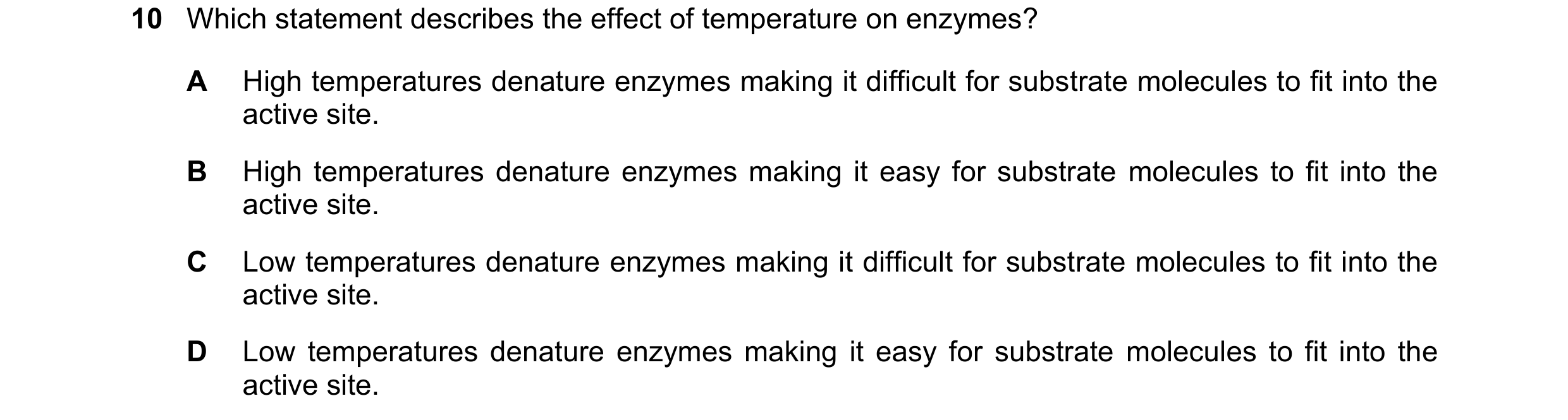
Q24 · Which statement describes the effect of temperature on enzymes? 0970/21 May/June 2022
10 Which statement describes the effect of temperature on enzymes? A High temperatures denature enzymes making it difficult for substrate molecules to fit into the active site. B High temperatures denature enzymes making it easy for substrate molecules to fit into the active site. C Low temperatures denature enzymes making it difficult for substrate molecules to fit into the active site. D Low temperatures denature enzymes making it easy for substrate molecules to fit into the active site.
1 marks
Answer: A
This question in 0970/21 May/June 2022
Q25 · Which type of molecule are enzymes made of? 0970/22 May/June 2022
9 Which type of molecule are enzymes made of? A carbohydrates B fats C proteins D vitamins
1 marks
Answer: C
This question in 0970/22 May/June 2022
Q26 · Which statement describes the effect of temperature on enzymes? 0970/22 May/June 2022
10 Which statement describes the effect of temperature on enzymes? A High temperatures denature enzymes making it difficult for substrate molecules to fit into the active site. B High temperatures denature enzymes making it easy for substrate molecules to fit into the active site. C Low temperatures denature enzymes making it difficult for substrate molecules to fit into the active site. D Low temperatures denature enzymes making it easy for substrate molecules to fit into the active site.
1 marks
Answer: A
This question in 0970/22 May/June 2022
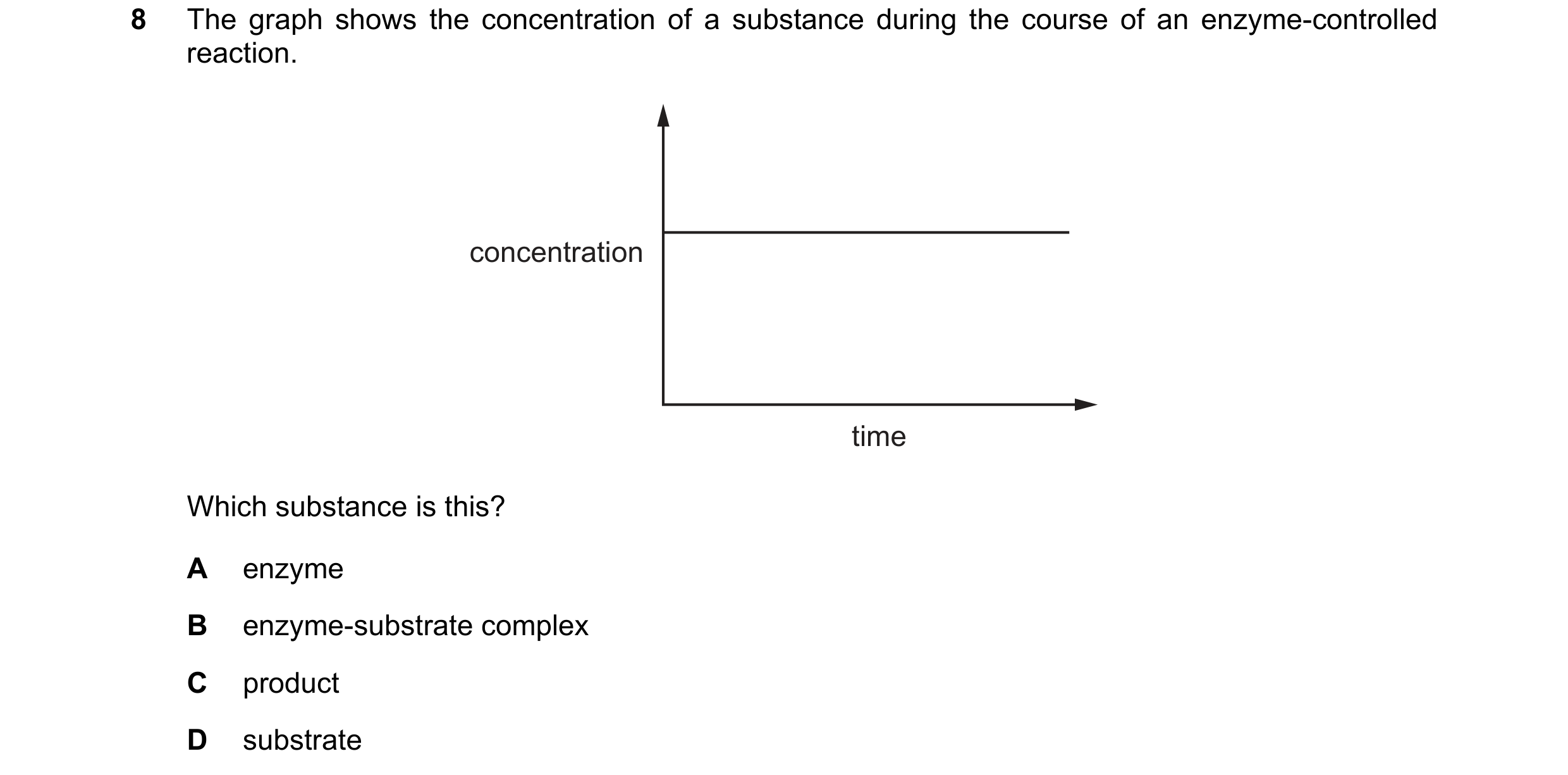
Q27 · The graph shows the concentration of a substance during the course of an… 0970/22 Oct/Nov 2022
8 The graph shows the concentration of a substance during the course of an enzyme-controlled reaction. concentration time Which substance is this? A enzyme B enzyme-substrate complex C product D substrate
1 marks
Answer: A
This question in 0970/22 Oct/Nov 2022
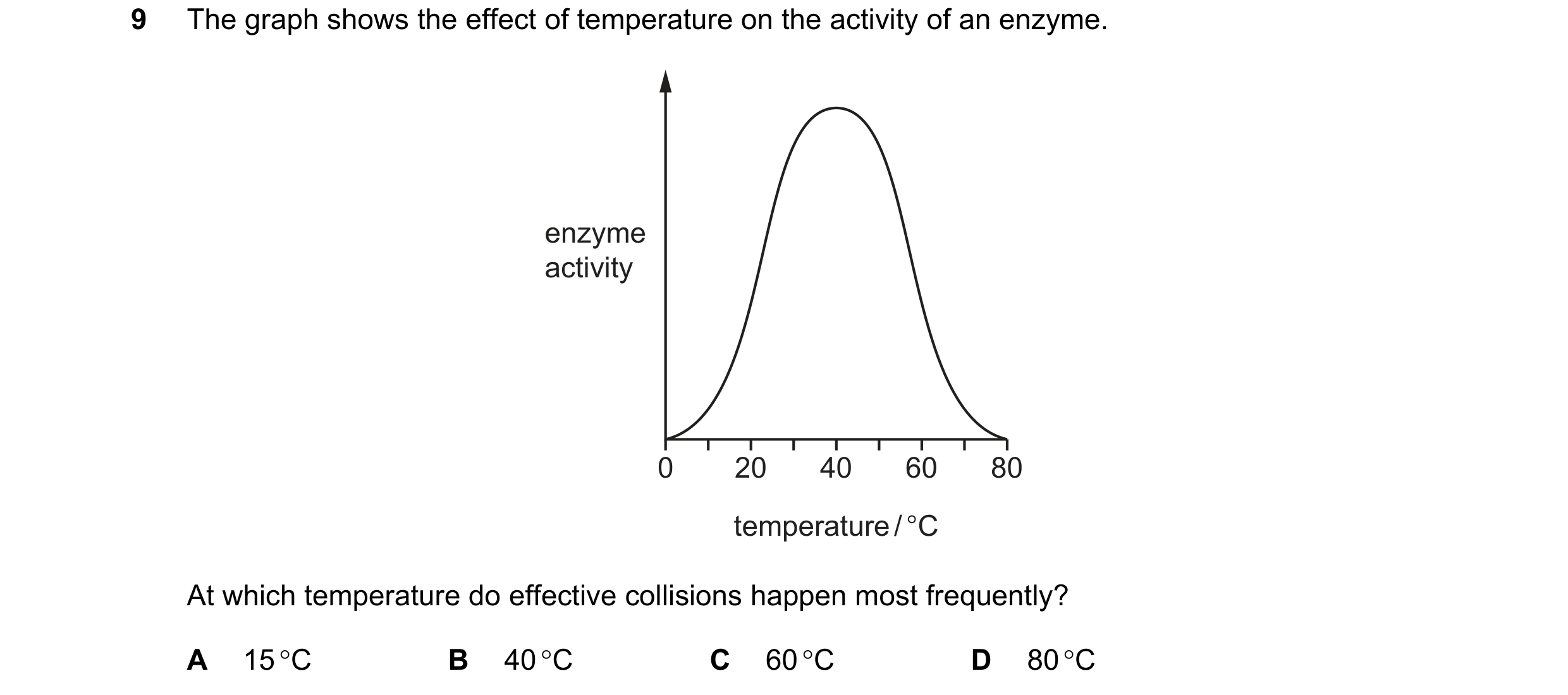
Q28 · The graph shows the effect of temperature on the activity of an enzyme 0970/22 Oct/Nov 2022
9 The graph shows the effect of temperature on the activity of an enzyme. enzyme activity 0 20 40 60 80 temperature / °C At which temperature do effective collisions happen most frequently? A 15 °C B 40 °C C 60 °C D 80 °C
1 marks
Answer: B
This question in 0970/22 Oct/Nov 2022
Q29 · Which statement about enzymes is correct? 0970/22 Oct/Nov 2022
10 Which statement about enzymes is correct? A They are made of carbohydrates. B Their activity is unaffected by pH. C They are used up during the reaction. D They have a complementary shape to their substrate.
1 marks
Answer: D
This question in 0970/22 Oct/Nov 2022
Q30 · The graph shows how much penicillin is produced by the fungus Penicillium in a fermenter 0970/22 Oct/Nov 2022
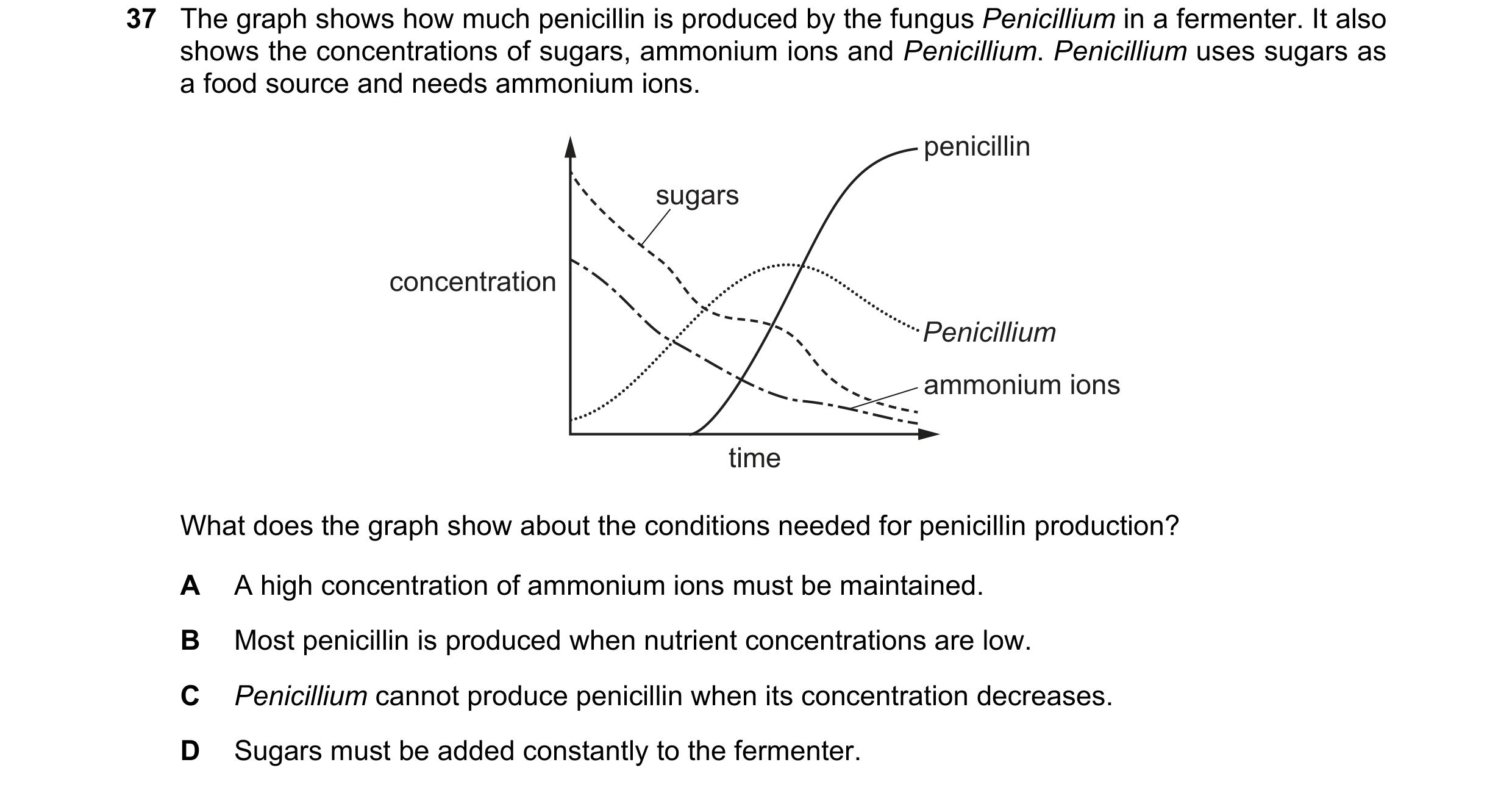
37 The graph shows how much penicillin is produced by the fungus Penicillium in a fermenter. It also shows the concentrations of sugars, ammonium ions and Penicillium. Penicillium uses sugars as a food source and needs ammonium ions. penicillin sugars concentration Penicillium ammonium ions time What does the graph show about the conditions needed for penicillin production? A A high concentration of ammonium ions must be maintained. B Most penicillin is produced when nutrient concentrations are low. C Penicillium cannot produce penicillin when its concentration decreases. D Sugars must be added constantly to the fermenter.
1 marks
Answer: B
This question in 0970/22 Oct/Nov 2022
Q31 · What is true of all enzymes? 0970/21 May/June 2023
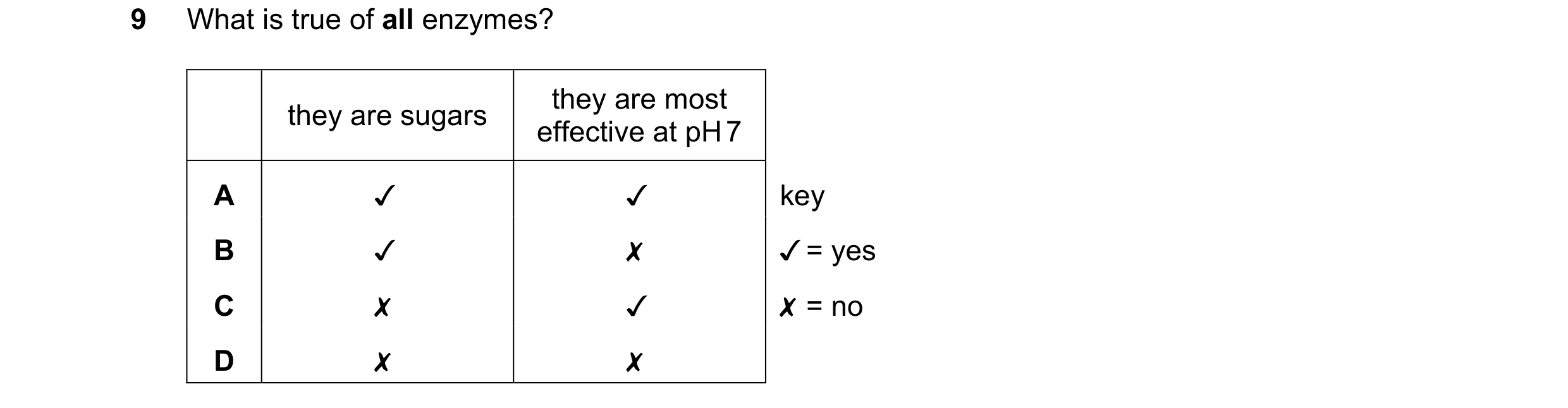
9 What is true of all enzymes?
they are sugars
they are most
effective at pH 7
0 0O WwW >
x «KOK
v
x
v
x
key
v= yes
X =no
1 marks
Answer: D
This question in 0970/21 May/June 2023
Q32 · Which statement about human enzymes is correct when they are at temperatures above 80 °C? 0970/21 May/June 2023
10 Which statement about human enzymes is correct when they are at temperatures above 80 °C? A The enzyme molecules are denatured. B The shape of the active site is stable. C More enzyme-substrate complexes form. D More product is formed by the enzyme.
1 marks
Answer: A
This question in 0970/21 May/June 2023
Q33 · The graphs show the effect of temperature on enzyme activity 0970/22 May/June 2023
10 The graphs show the effect of temperature on enzyme activity. This enzyme has an optimum temperature of 30 °C. Which graph shows the effect of temperature on the activity of this enzyme? A B enzyme enzyme activity activity 0 10 20 30 40 50 60 0 10 20 30 40 50 60 temperature / °C temperature / °C C D enzyme enzyme activity activity 0 10 20 30 40 50 60 0 10 20 30 40 50 60 temperature / °C temperature / °C
1 marks
Answer: D
This question in 0970/22 May/June 2023
Q34 · The graph shows the effect of temperature on the rate of photosynthesis 0970/22 May/June 2023
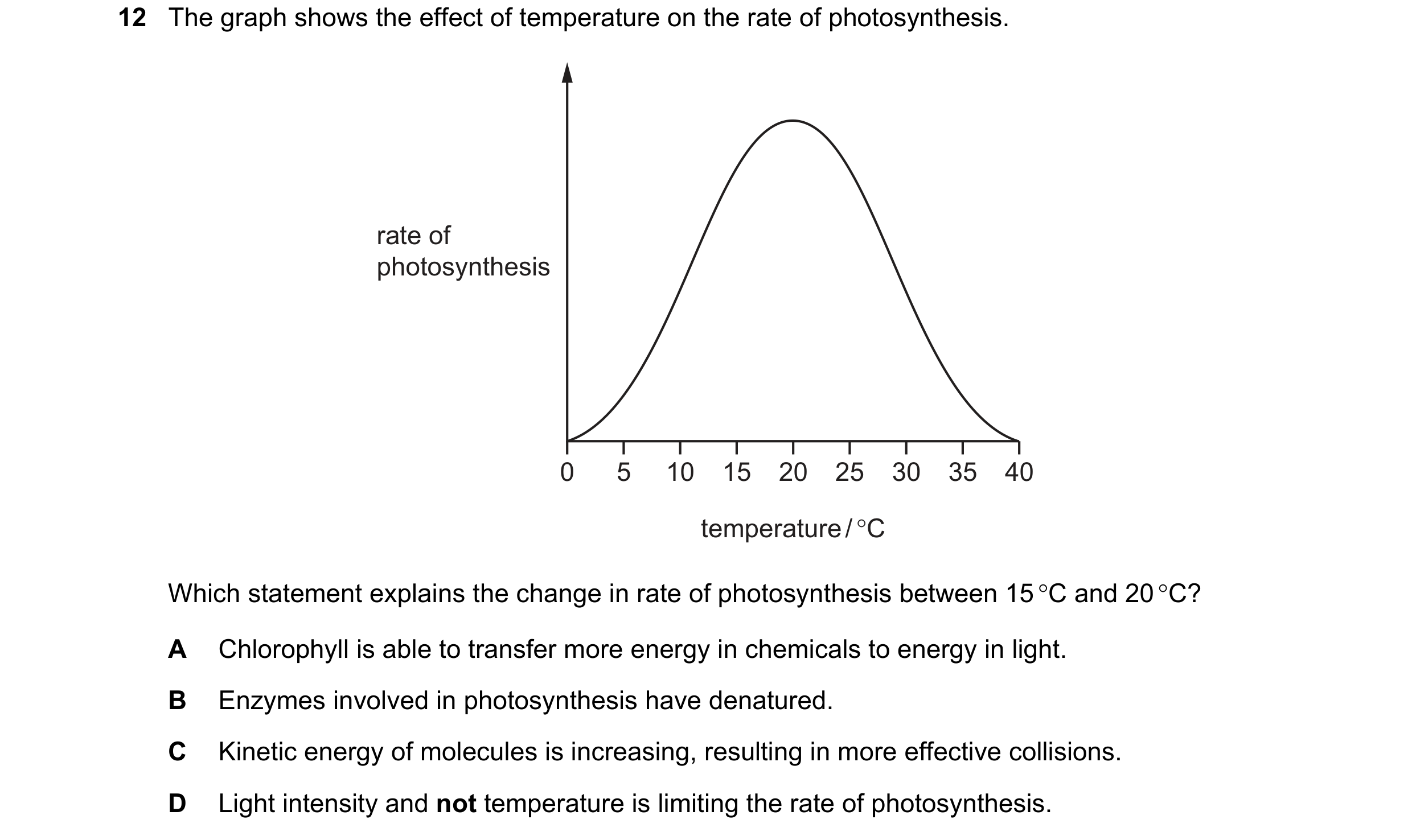
12 The graph shows the effect of temperature on the rate of photosynthesis. rate of photosynthesis 0 5 10 15 20 25 30 35 40 temperature / °C Which statement explains the change in rate of photosynthesis between 15 °C and 20 °C? A Chlorophyll is able to transfer more energy in chemicals to energy in light. B Enzymes involved in photosynthesis have denatured. C Kinetic energy of molecules is increasing, resulting in more effective collisions. D Light intensity and not temperature is limiting the rate of photosynthesis.
1 marks
Answer: C
This question in 0970/22 May/June 2023
Q35 · The graph shows the results of an experiment to investigate the rate of respiration in an… 0970/22 Oct/Nov 2023
10 The graph shows the results of an experiment to investigate the rate of respiration in an organism in different environmental temperatures. rate of respiration 0 10 15 20 25 30 35 40 temperature / °C What explains the increase in the rate of respiration between 10 °C and 30 °C? A The enzymes are denaturing. B There are more frequent effective collisions between enzyme and substrate molecules. C There are fewer enzyme-substrate complexes formed. D There is less kinetic energy.
1 marks
Answer: B
This question in 0970/22 Oct/Nov 2023
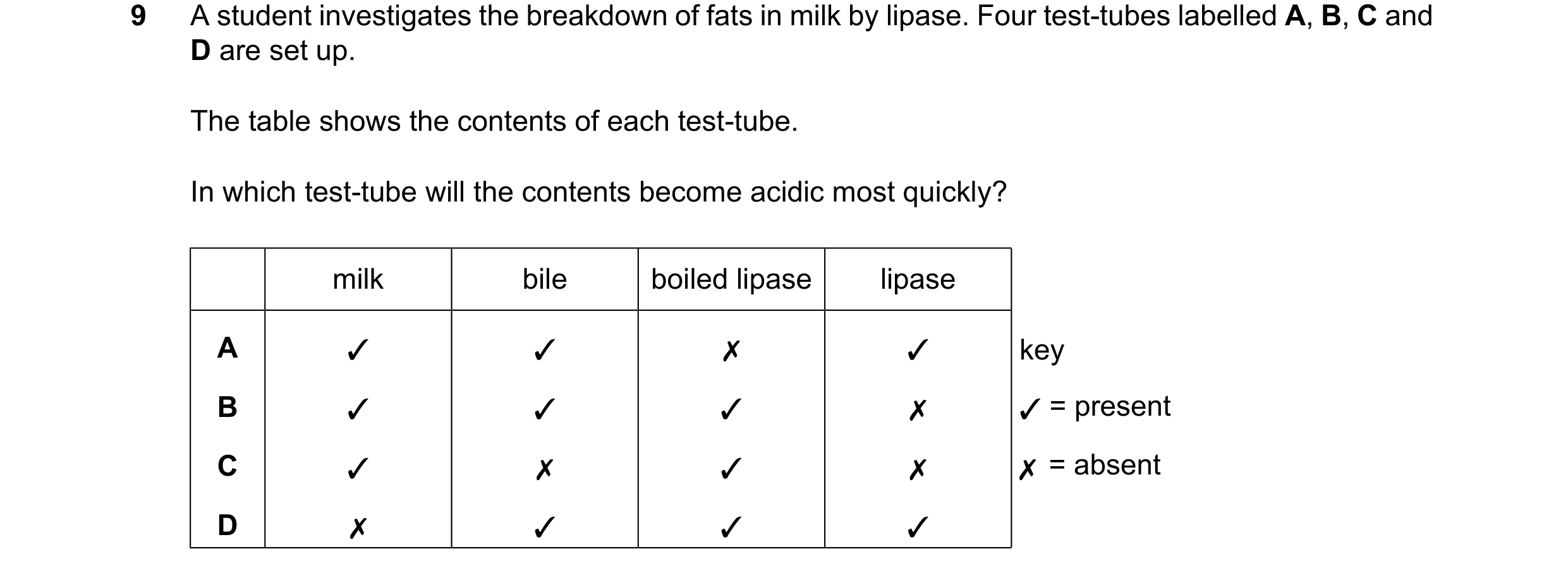
Q36 · A student investigates the breakdown of fats in milk by lipase 0970/21 May/June 2024
9 A student investigates the breakdown of fats in milk by lipase. Four test-tubes labelled A, B, C and D are set up. The table shows the contents of each test-tube. In which test-tube will the contents become acidic most quickly? milk bile boiled lipase lipase A ✓ ✓ ✗ ✓ key B ✓ ✓ ✓ ✗ ✓ = present C ✓ ✗ ✓ ✗ ✗ = absent D ✗ ✓ ✓ ✓
1 marks
Answer: A
This question in 0970/21 May/June 2024
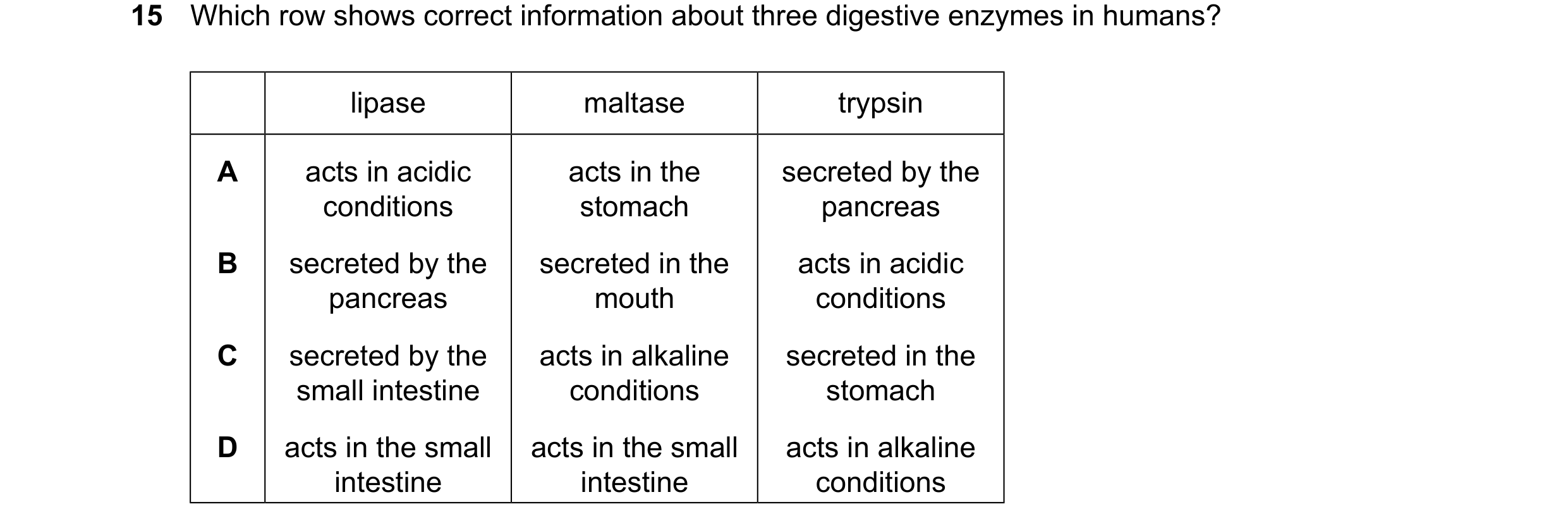
Q37 · Which row shows correct information about three digestive enzymes in humans? 0970/21 May/June 2024
15 Which row shows correct information about three digestive enzymes in humans? lipase maltase trypsin A acts in acidic acts in the secreted by the conditions stomach pancreas B secreted by the secreted in the acts in acidic pancreas mouth conditions C secreted by the acts in alkaline secreted in the small intestine conditions stomach D acts in the small acts in the small acts in alkaline intestine intestine conditions
1 marks
Answer: D
This question in 0970/21 May/June 2024
Q38 · The diagram shows the steps in an enzyme-controlled reaction 0970/22 Oct/Nov 2024
9 The diagram shows the steps in an enzyme-controlled reaction. X enzyme enzyme What describes the part labelled X? A active site B enzyme–substrate complex C product D substrate
1 marks
Answer: B
This question in 0970/22 Oct/Nov 2024
Q39 · The graph shows the effect of temperature on the time taken for the complete digestion of… 0970/22 Oct/Nov 2024
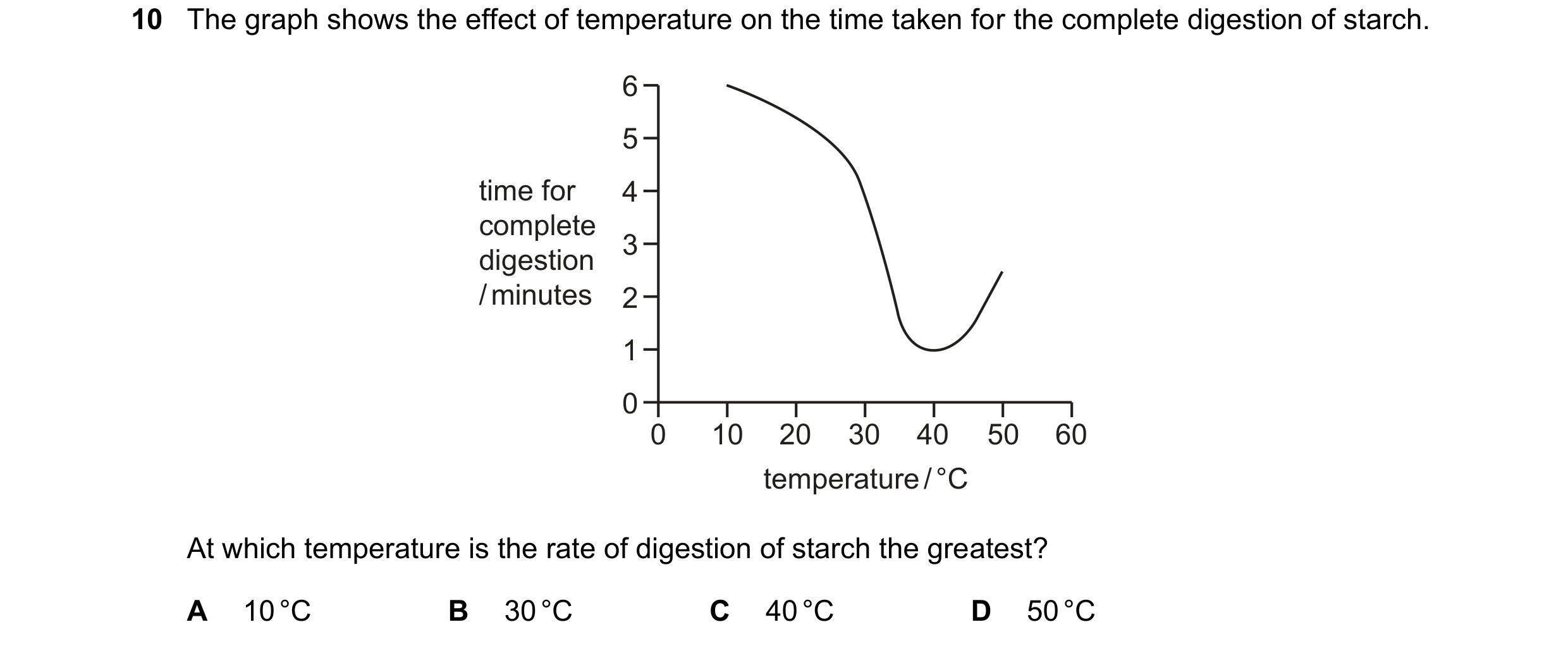
10 The graph shows the effect of temperature on the time taken for the complete digestion of starch. 6 5 time for 4 complete 3 digestion / minutes 2 1 0 0 10 20 30 40 50 60 temperature / °C At which temperature is the rate of digestion of starch the greatest? A 10 °C B 30 °C C 40 °C D 50 °C
1 marks
Answer: C
This question in 0970/22 Oct/Nov 2024
Q40 · The diagram shows some apparatus that was used to produce lactose-free milk 0970/22 Oct/Nov 2024
40 The diagram shows some apparatus that was used to produce lactose-free milk. milk alginate beads containing X milk containing Y The alginate beads do not react with any of the substances. X is an enzyme that catalyses a reaction involving one of the substances found in milk. What are X and Y? X Y A amylase glucose B amylase starch C lactase glucose D lactase starch
1 marks
Answer: C
This question in 0970/22 Oct/Nov 2024
Q41 · The graph shows how enzyme activity is affected by temperature 0970/21 May/June 2025
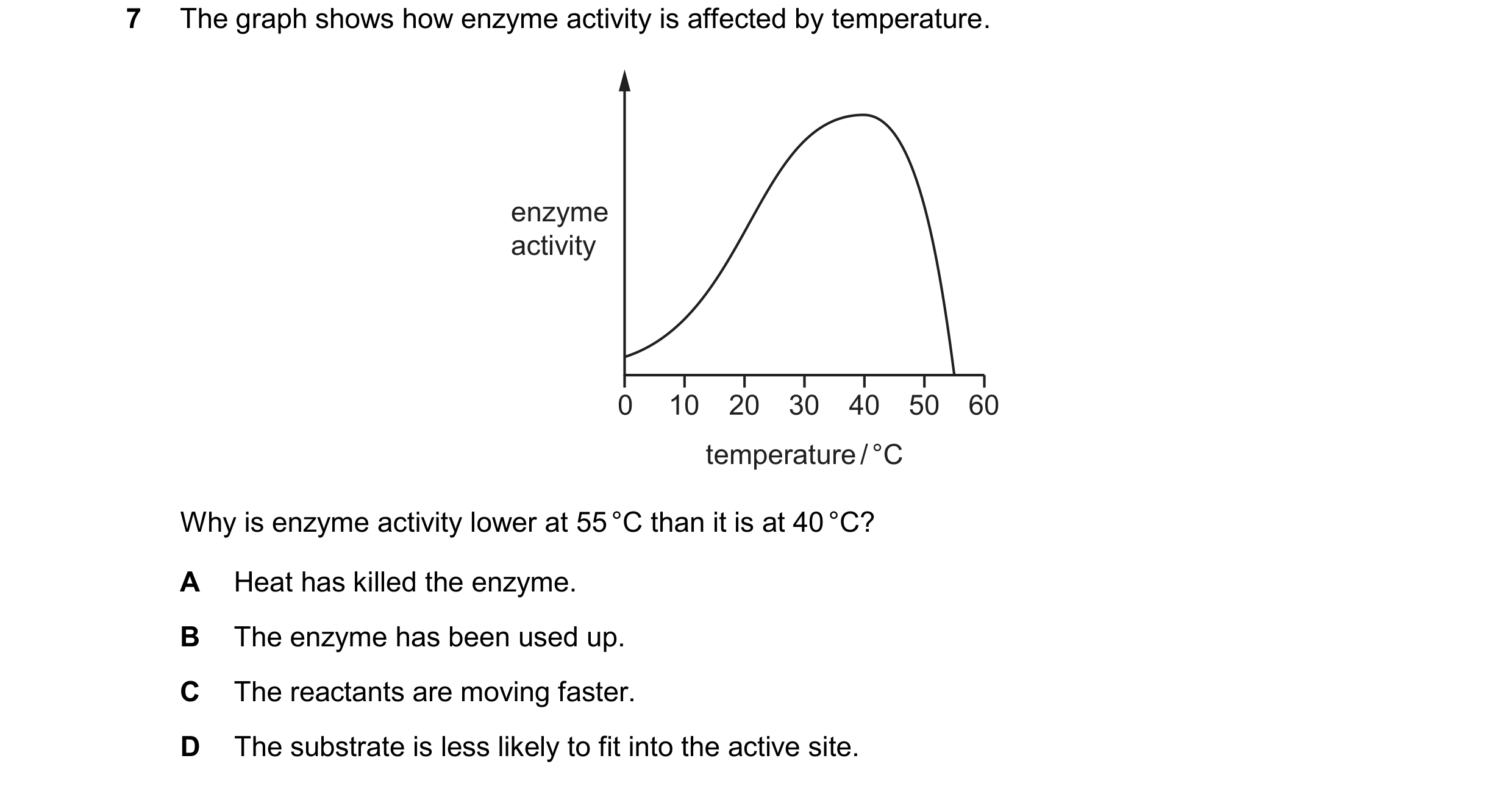
7 The graph shows how enzyme activity is affected by temperature. enzyme activity 0 10 20 30 40 50 60 temperature / °C Why is enzyme activity lower at 55 °C than it is at 40 °C? A Heat has killed the enzyme. B The enzyme has been used up. C The reactants are moving faster. D The substrate is less likely to fit into the active site.
1 marks
Answer: D
This question in 0970/21 May/June 2025
Q42 · What is the correct definition of enzymes? 0970/22 May/June 2025
8 What is the correct definition of enzymes? A carbohydrates that act as biological catalysts B carbohydrates that act as substrates C proteins that act as biological catalysts D proteins that act as substrates
1 marks
Answer: C
This question in 0970/22 May/June 2025
Q43 · A student investigated how the rate of photosynthesis is affected by carbon dioxide… 0970/22 May/June 2025
9 A student investigated how the rate of photosynthesis is affected by carbon dioxide concentration, temperature and light intensity. The graphs show the results. 2 rate of rate of photosynthesis photosynthesis 3 1 carbon dioxide temperature concentration 4 rate of photosynthesis light intensity What is a correct statement for these results? A Carbon dioxide concentration is a limiting factor at 1. B No enzymes are denatured at 3. C Light intensity is a limiting factor at 4. D Temperature is a limiting factor at 2.
1 marks
Answer: A
This question in 0970/22 May/June 2025
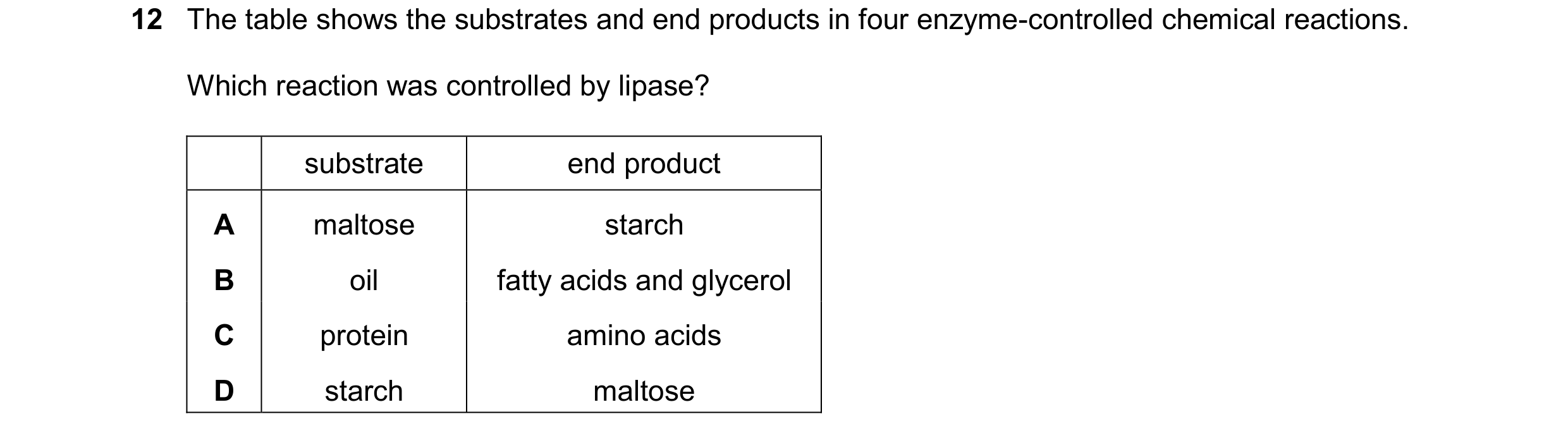
Q44 · The table shows the substrates and end products in four enzyme-controlled chemical… 0970/22 May/June 2025
12 The table shows the substrates and end products in four enzyme-controlled chemical reactions. Which reaction was controlled by lipase? substrate end product A maltose starch B oil fatty acids and glycerol C protein amino acids D starch maltose
1 marks
Answer: B
This question in 0970/22 May/June 2025
Q45 · Which substance is an enzyme? 0970/22 Oct/Nov 2025
6 Which substance is an enzyme? A fibrinogen B mRNA C pepsin D saliva
1 marks
Answer: C
This question in 0970/22 Oct/Nov 2025
 1 / 15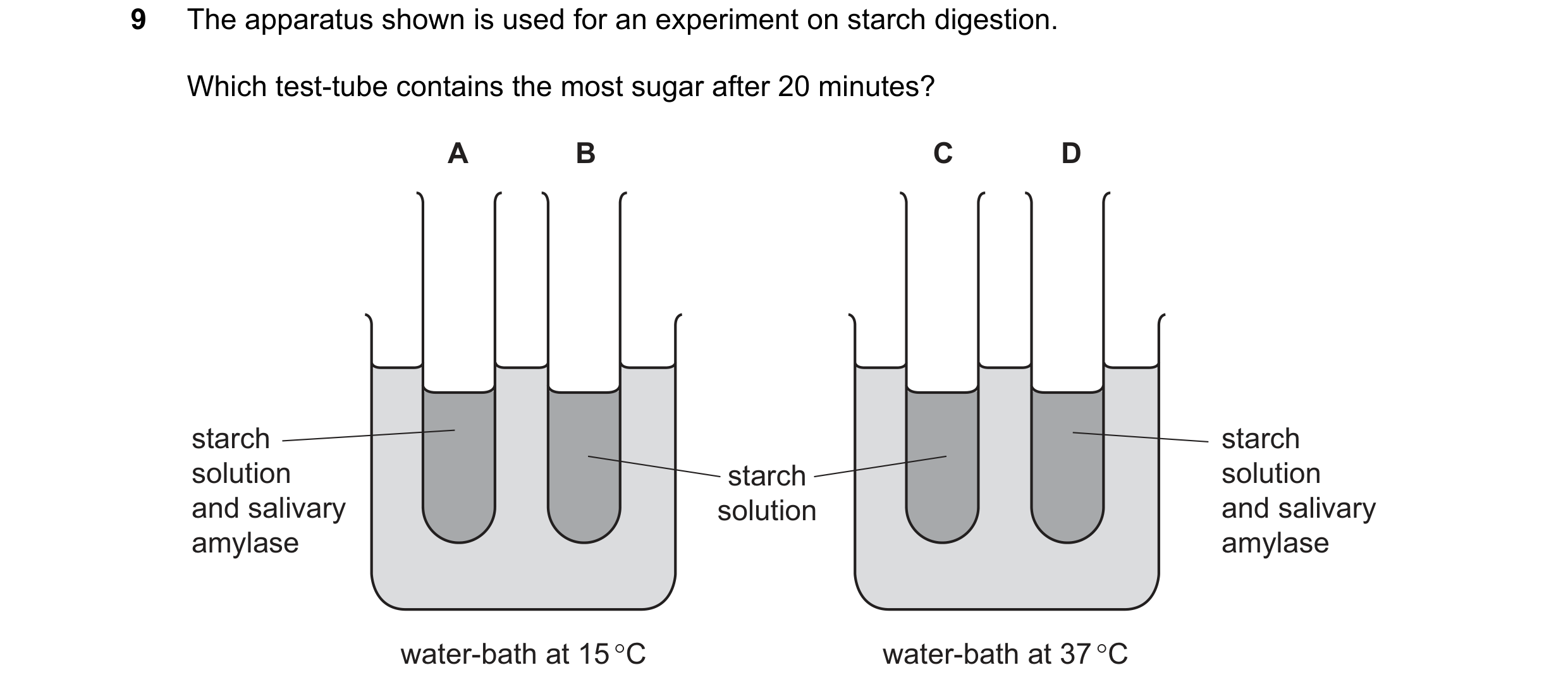
 2 / 15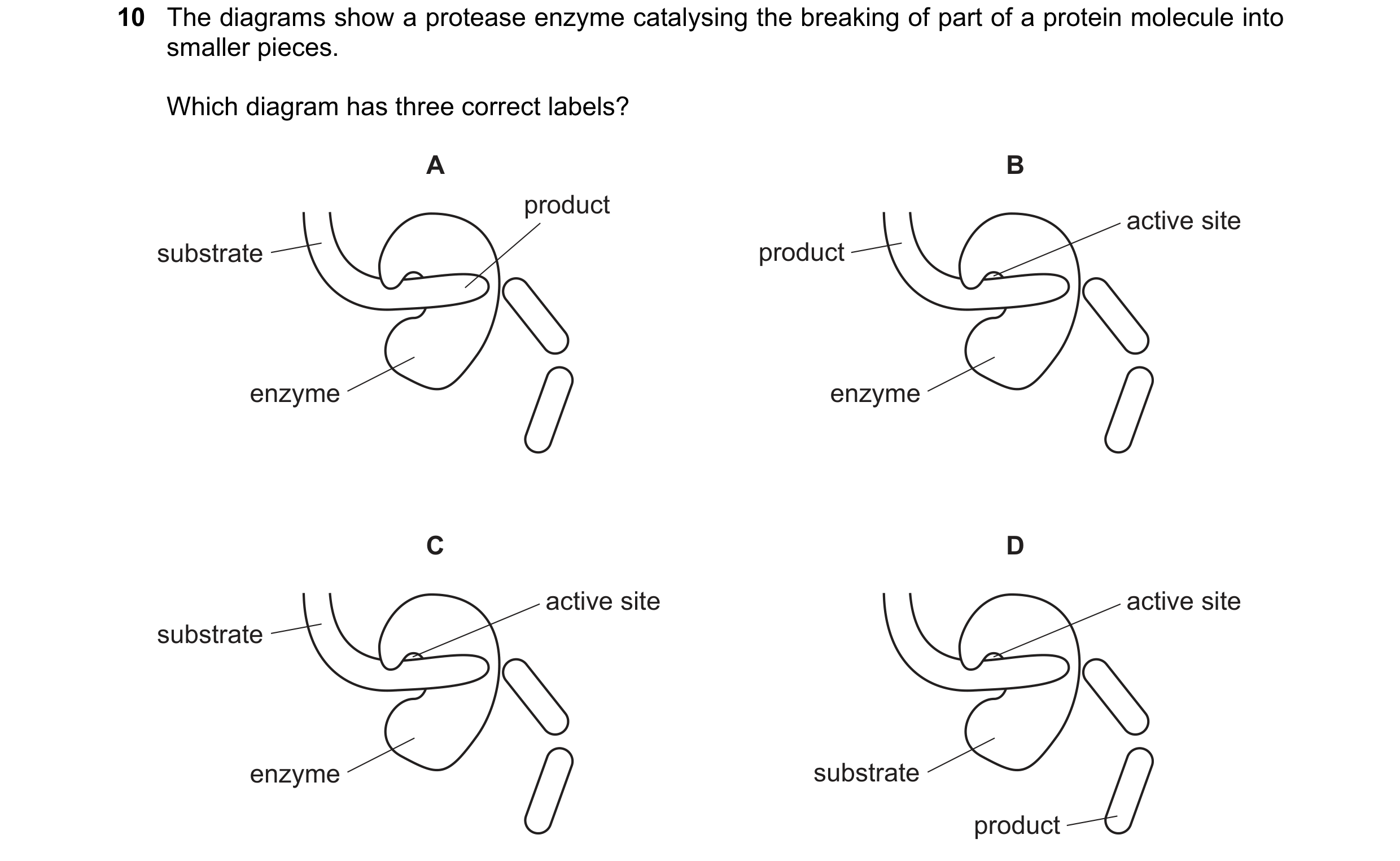
 3 / 15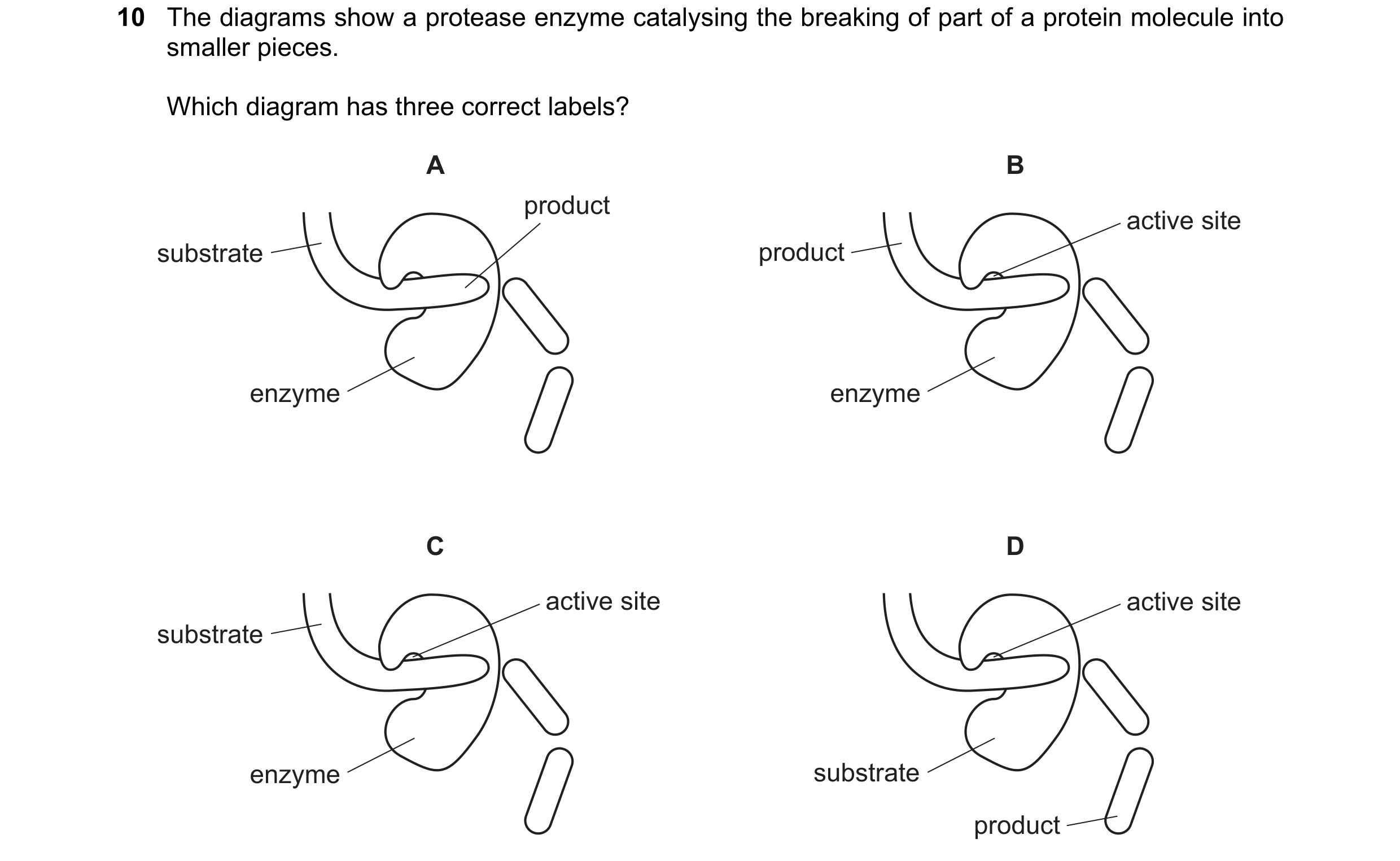

 4 / 15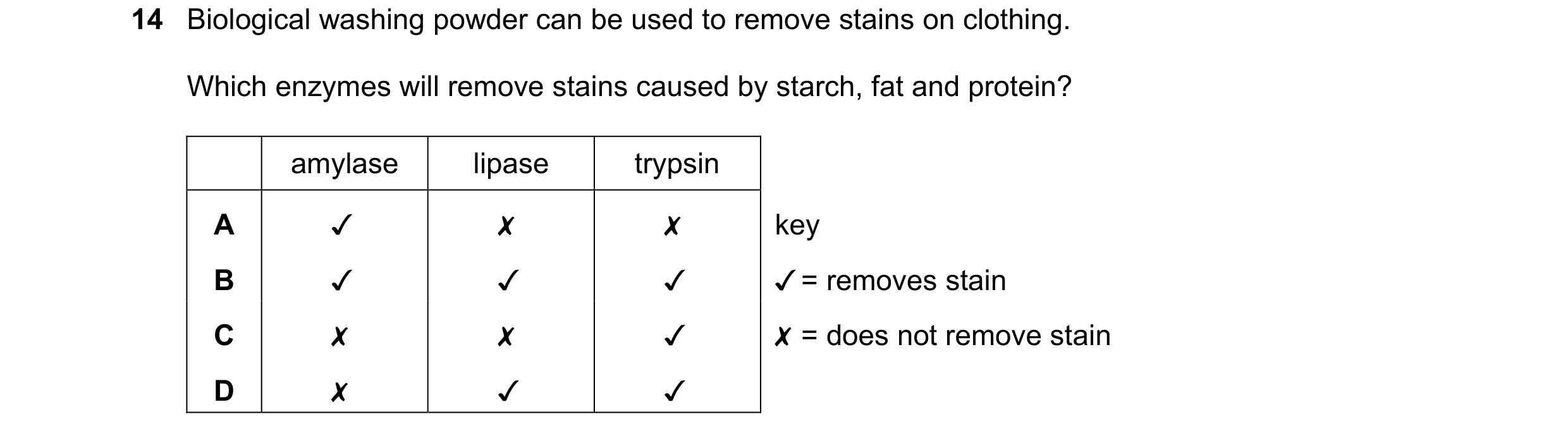
 5 / 15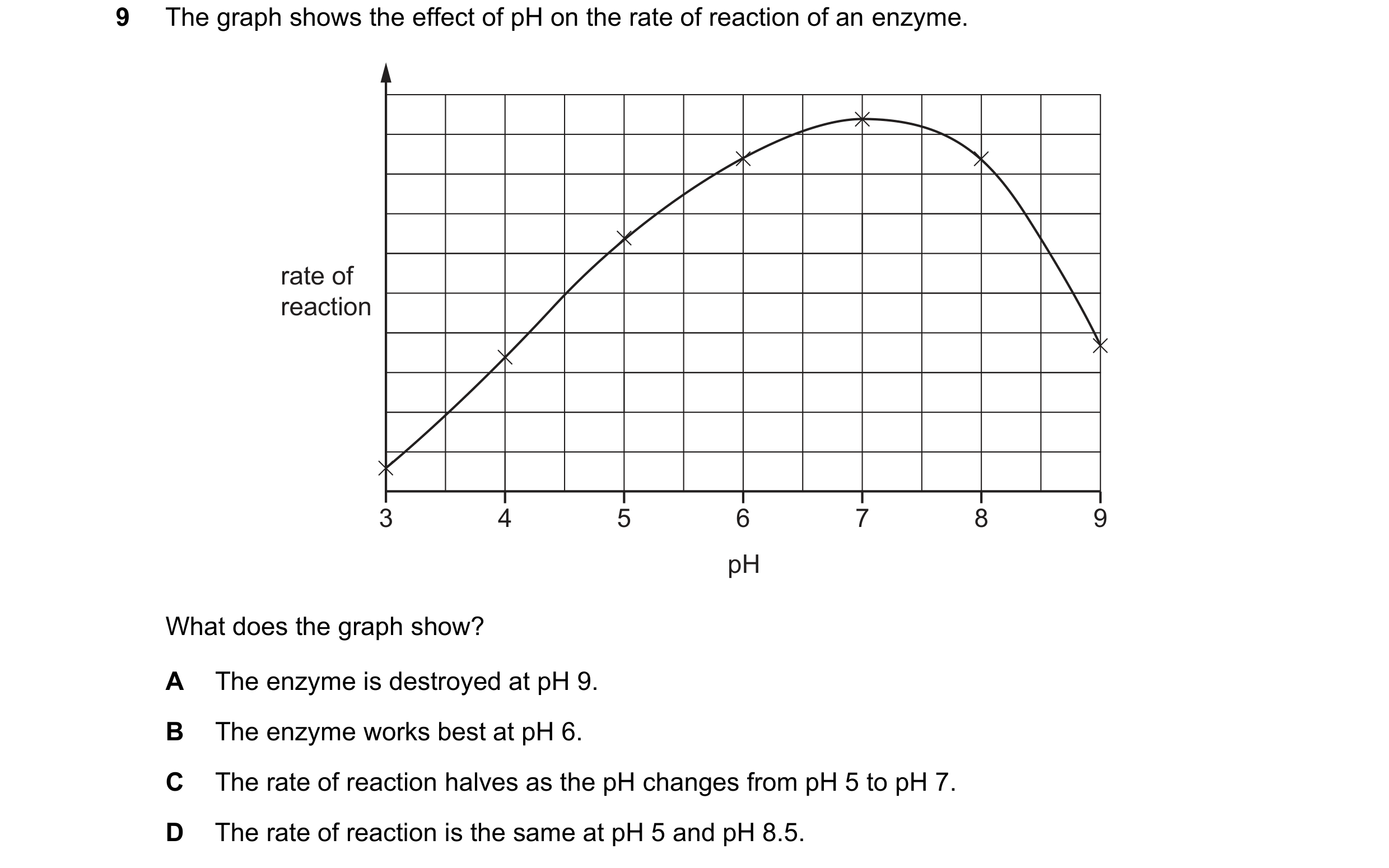
 6 / 15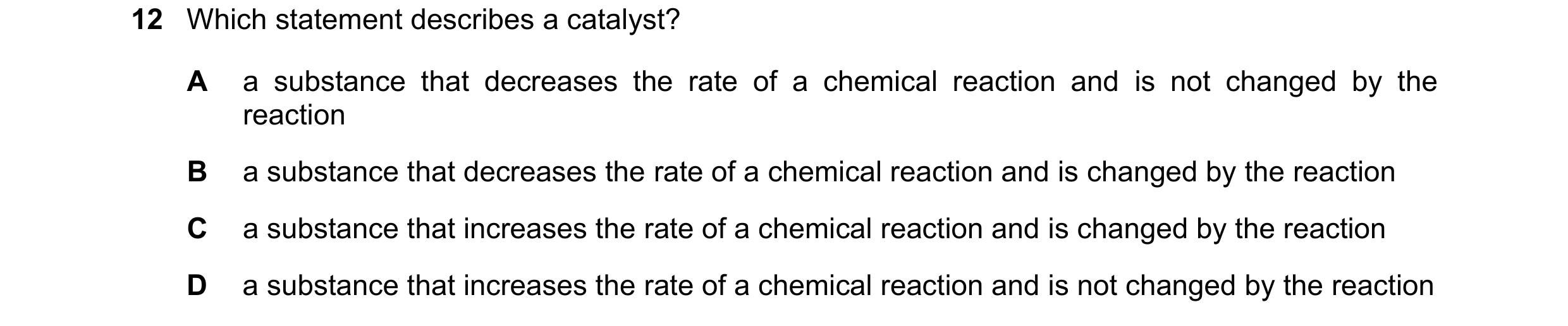

 7 / 15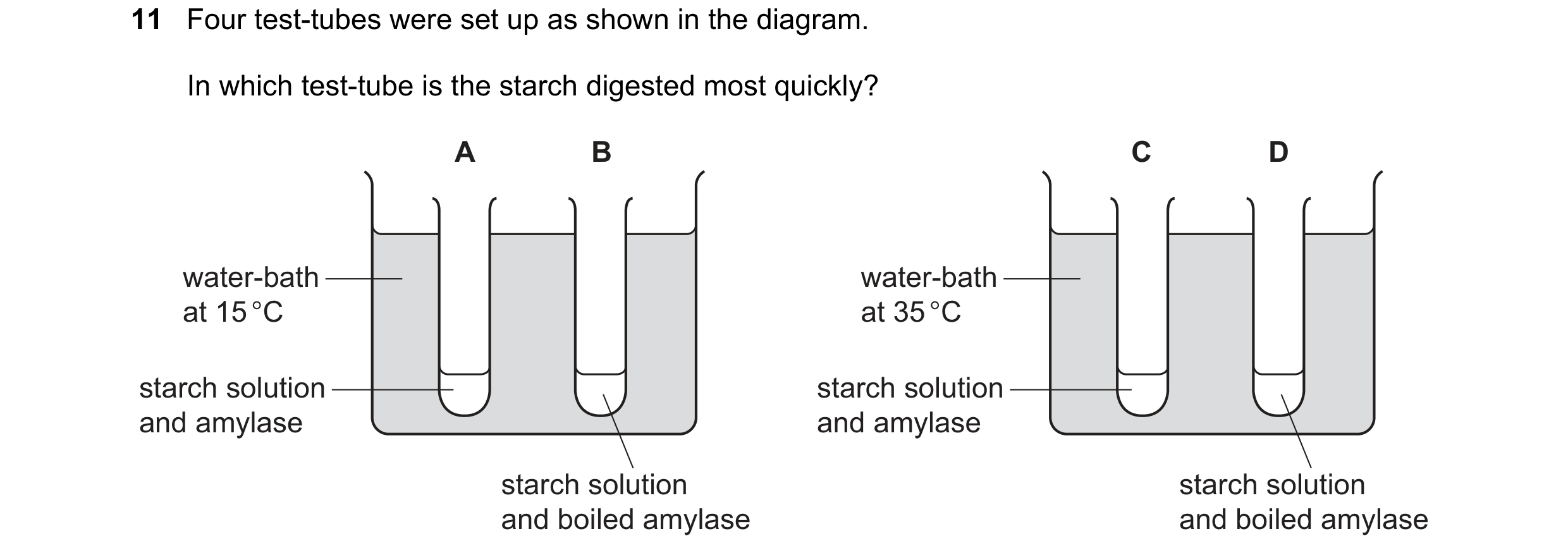
 8 / 15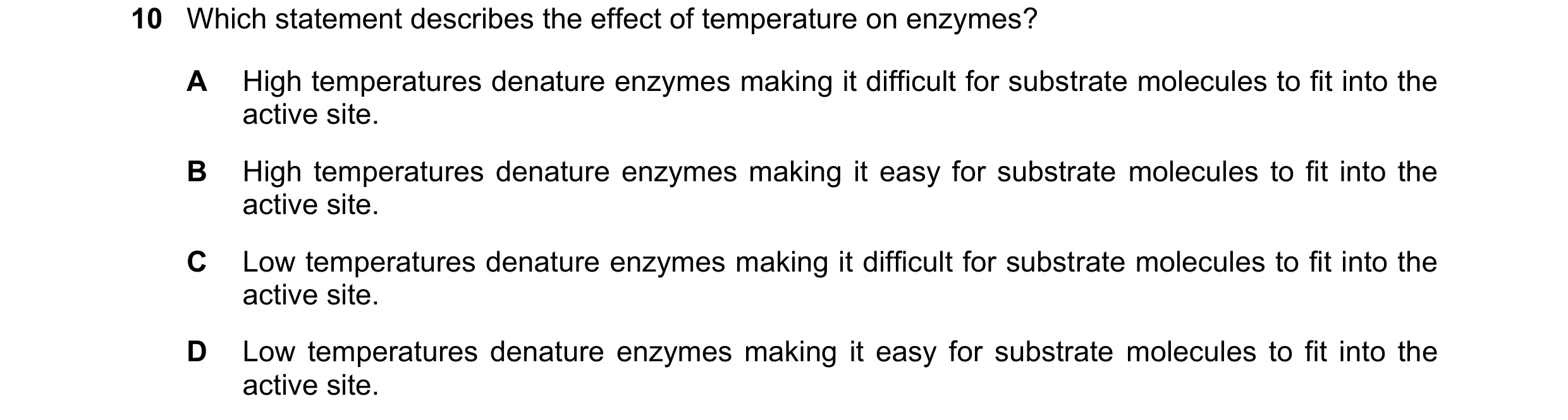
 9 / 15
 10 / 15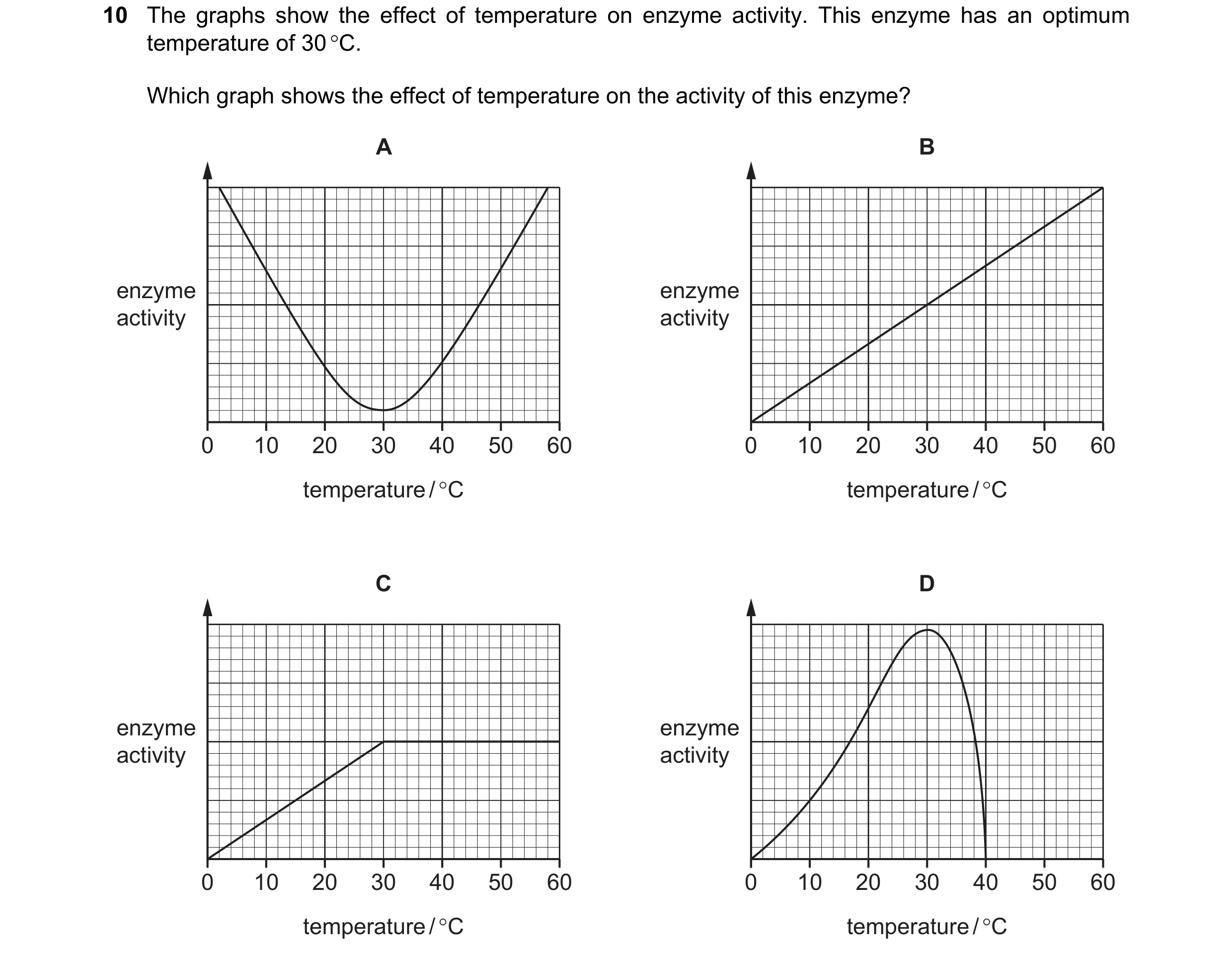
 11 / 15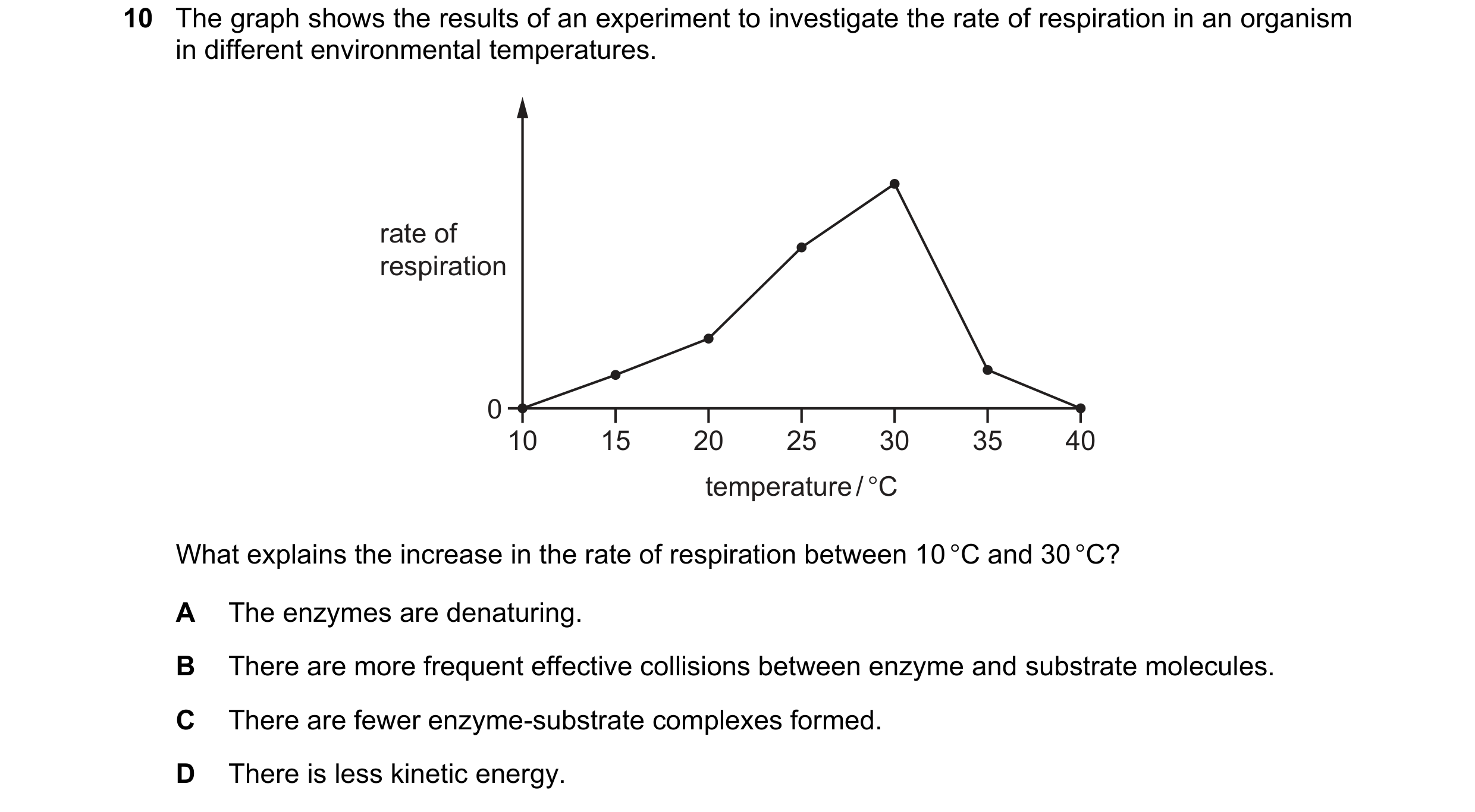
 12 / 15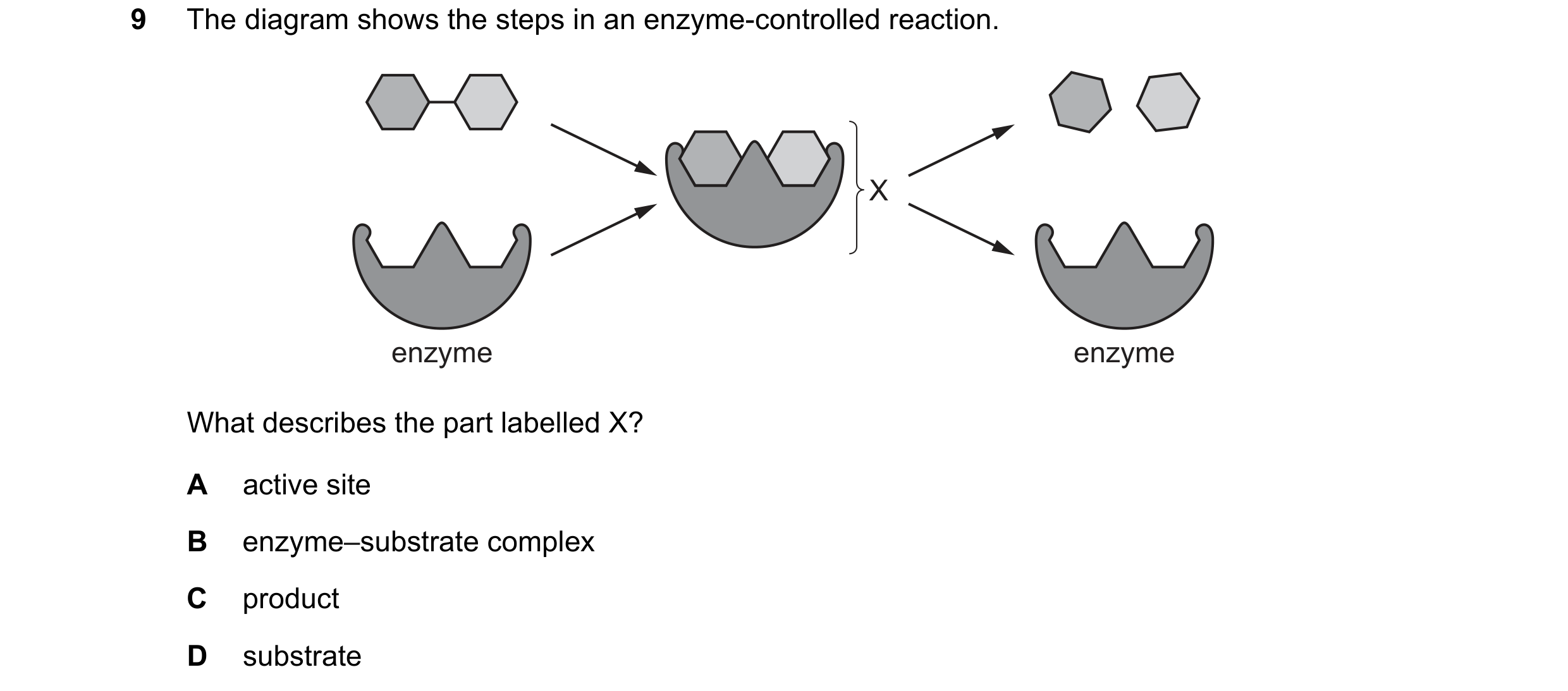
 13 / 15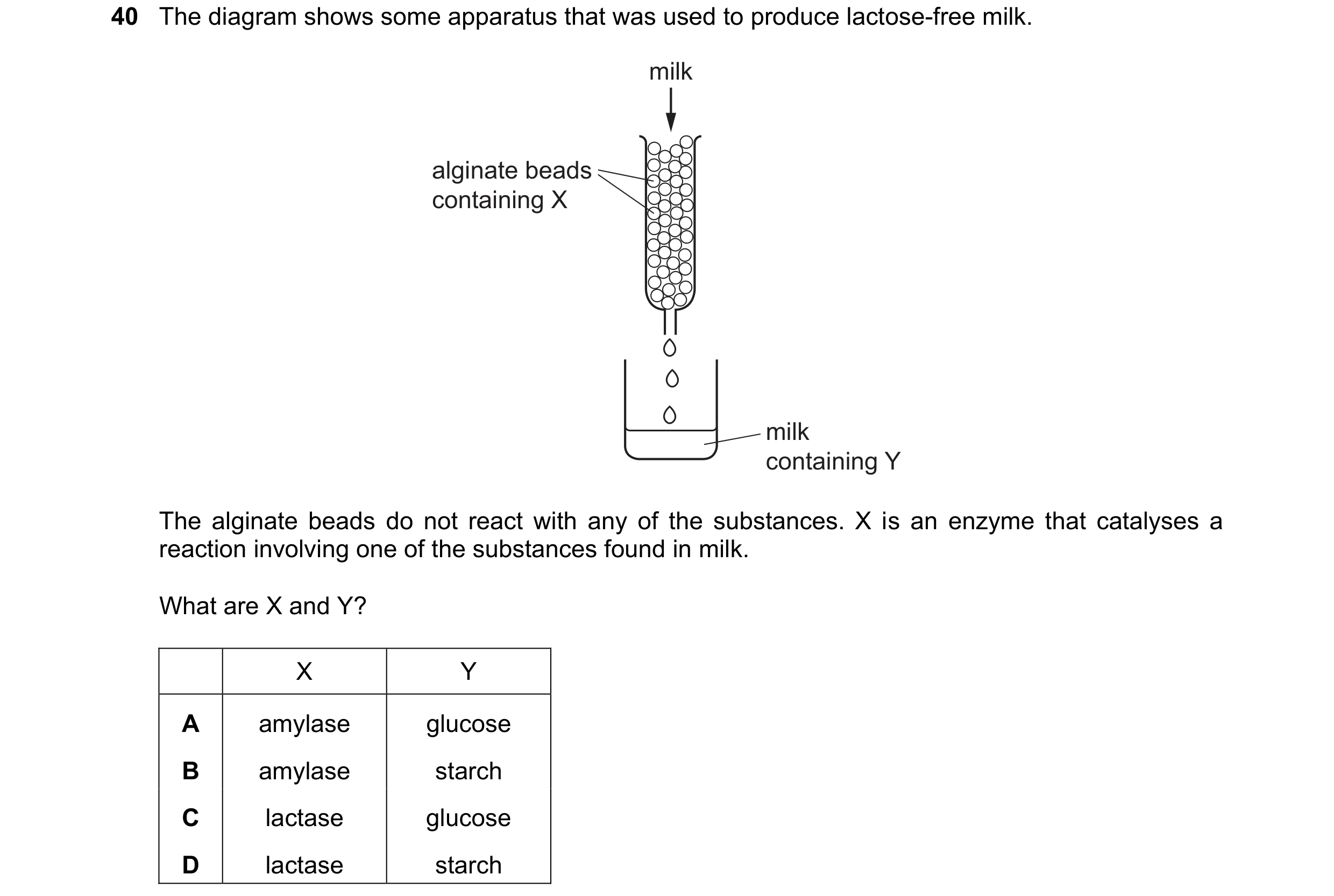
 14 / 15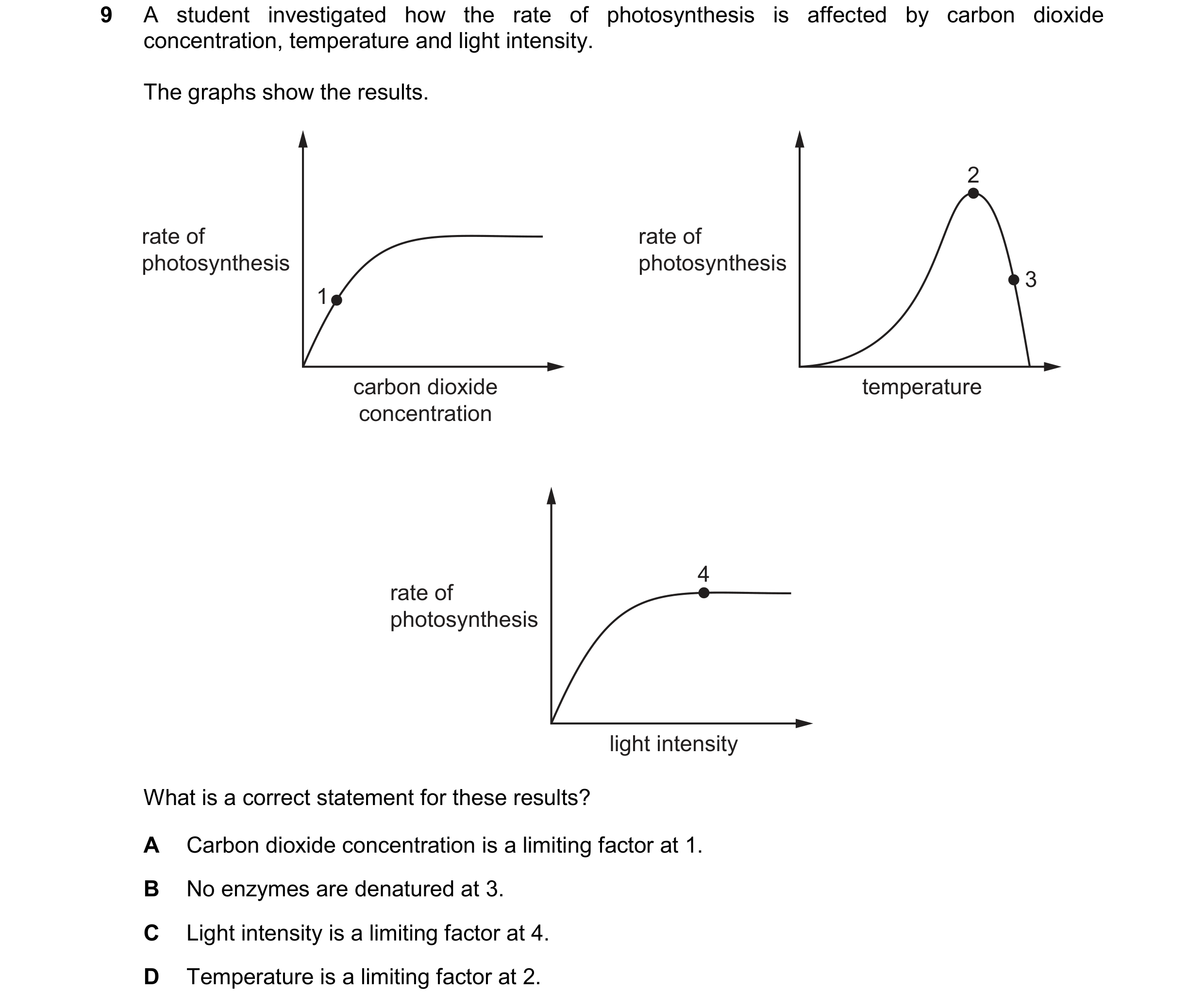
 15 / 15