Cambridge IGCSE Biology (9-1) 0970 — 2023 May/June Paper 2 · Variant 1
0970/21/M/J/23 · 40 questions · 40 marks · ≈45 min
The question paper and its mark scheme, free to read here and free to download. This is Cambridge’s own paper, exactly as it was sat.
Question paper16 pages

Mark scheme3 pages
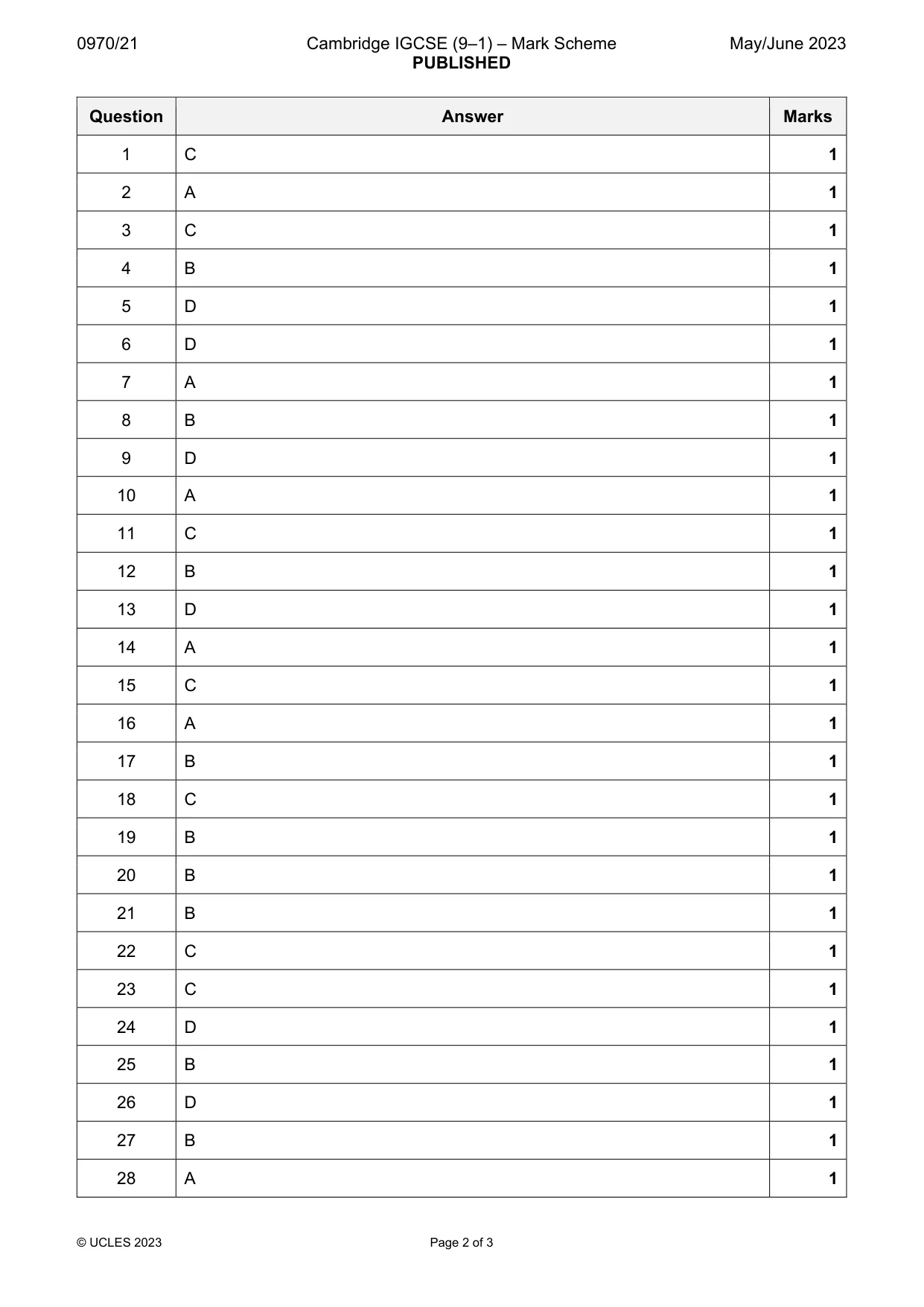
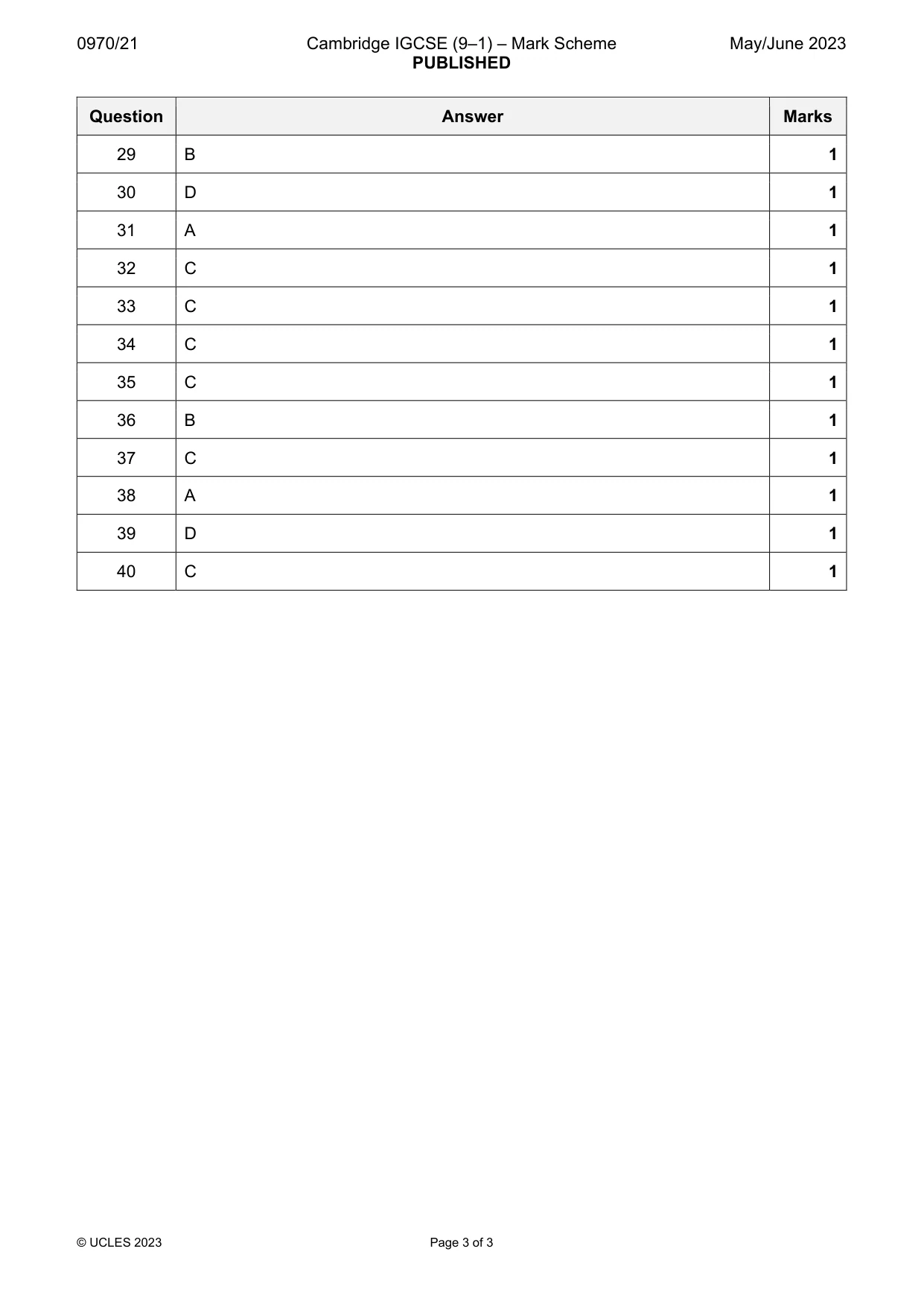
Answers below. Sit the paper first if you are practising.
Questions as text
Q1 · What are characteristics of all organisms?
1 What are characteristics of all organisms? A egestion and excretion B egestion and nutrition C excretion and nutrition D excretion and photosynthesis
Mark scheme: C
Q2 · The scientific name for the golden eagle is Aquila chrysaetos
2 The scientific name for the golden eagle is Aquila chrysaetos. What is the genus of the golden eagle? A Aquila B chrysaetos C eagle D golden
Mark scheme: A
More questions on Concept and uses of classification systems
Q3 · Which row shows structures that are present in both root hair cells and palisade…
3 Which row shows structures that are present in both root hair cells and palisade mesophyll cells? cell wall chloroplasts | cytoplasm vacuole v v v x key / = present x J J J Jv x Jv Jv X = absent J J x J 0 0O WwW >
Mark scheme: C
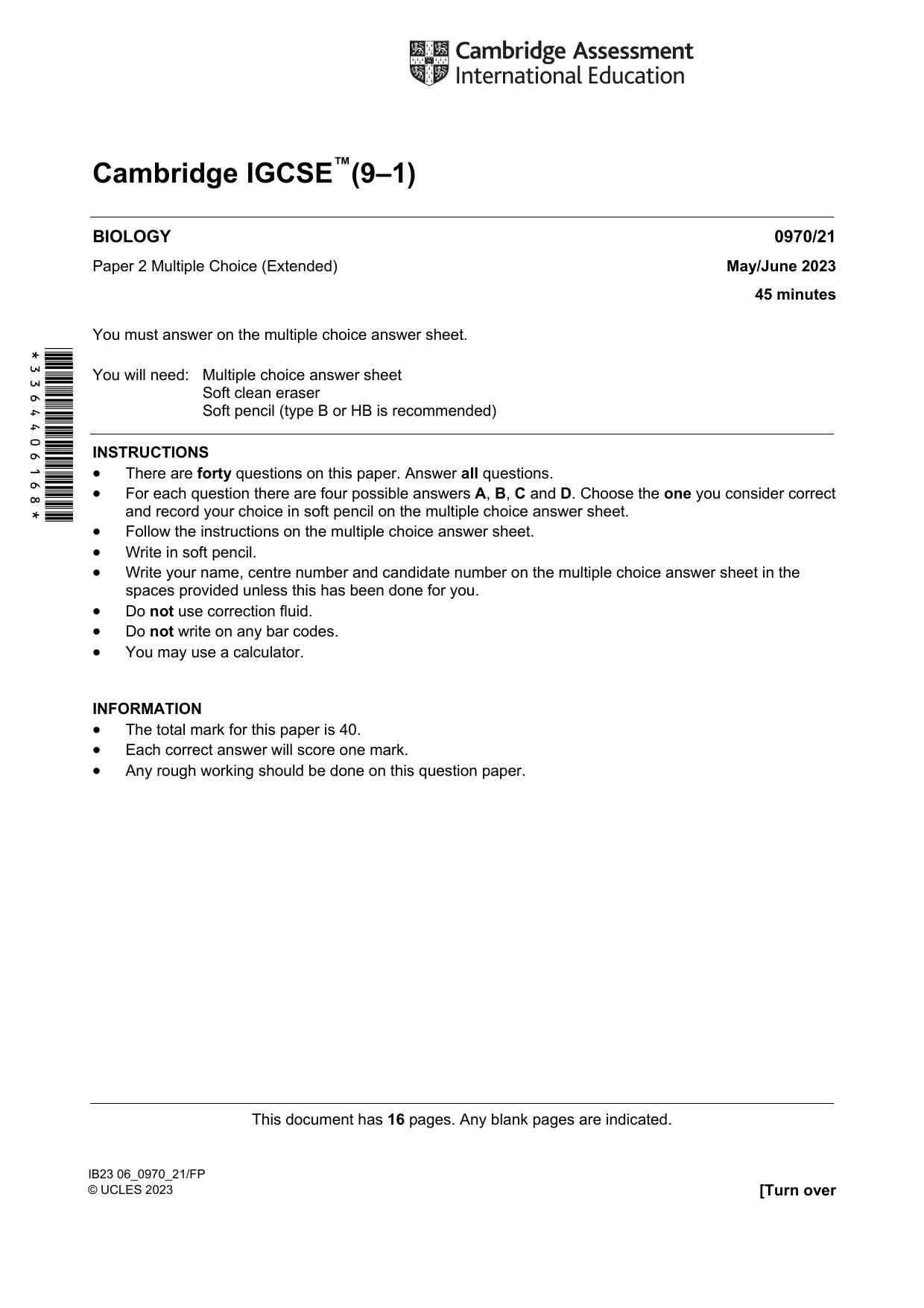
Q4 · The photomicrograph shows a plant cell
4 The photomicrograph shows a plant cell. The length of line XY is 90 mm. The actual length of the cell is 30 µm. X Y What is the magnification of the photomicrograph? A ×300 B ×3000 C ×33 000 D ×330 000
Mark scheme: B
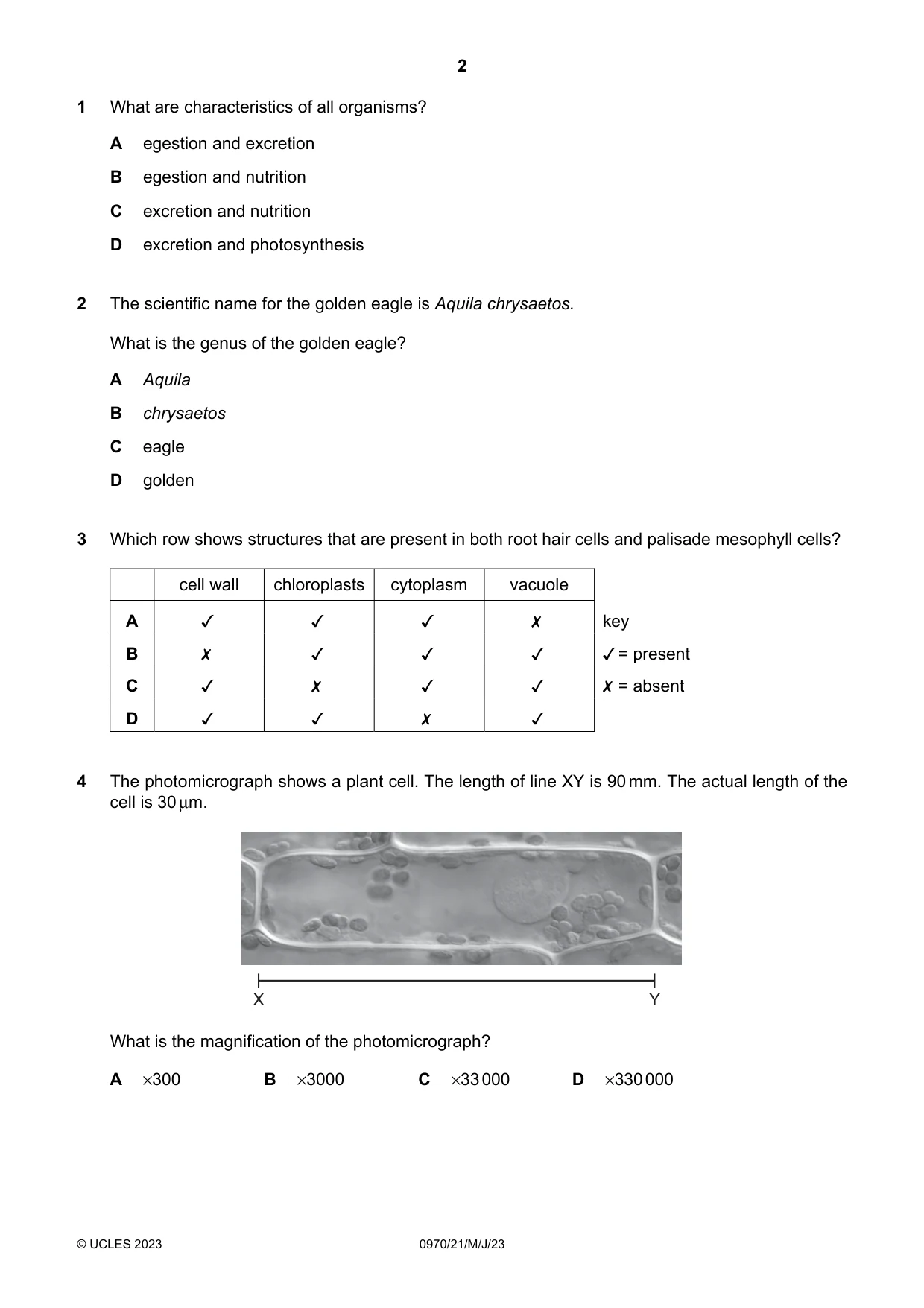
Q5 · The diagram shows an experiment demonstrating osmosis using a dialysis tubing bag
5 The diagram shows an experiment demonstrating osmosis using a dialysis tubing bag. glass tube water sugar solution dialysis tubing bag After 30 minutes, the level of the liquid in the glass tube goes ......1...... because the water had a ......2...... water potential than the sugar solution. Which words correctly complete the statement? 1 2 A down lower B down higher C up lower D up higher
Mark scheme: D
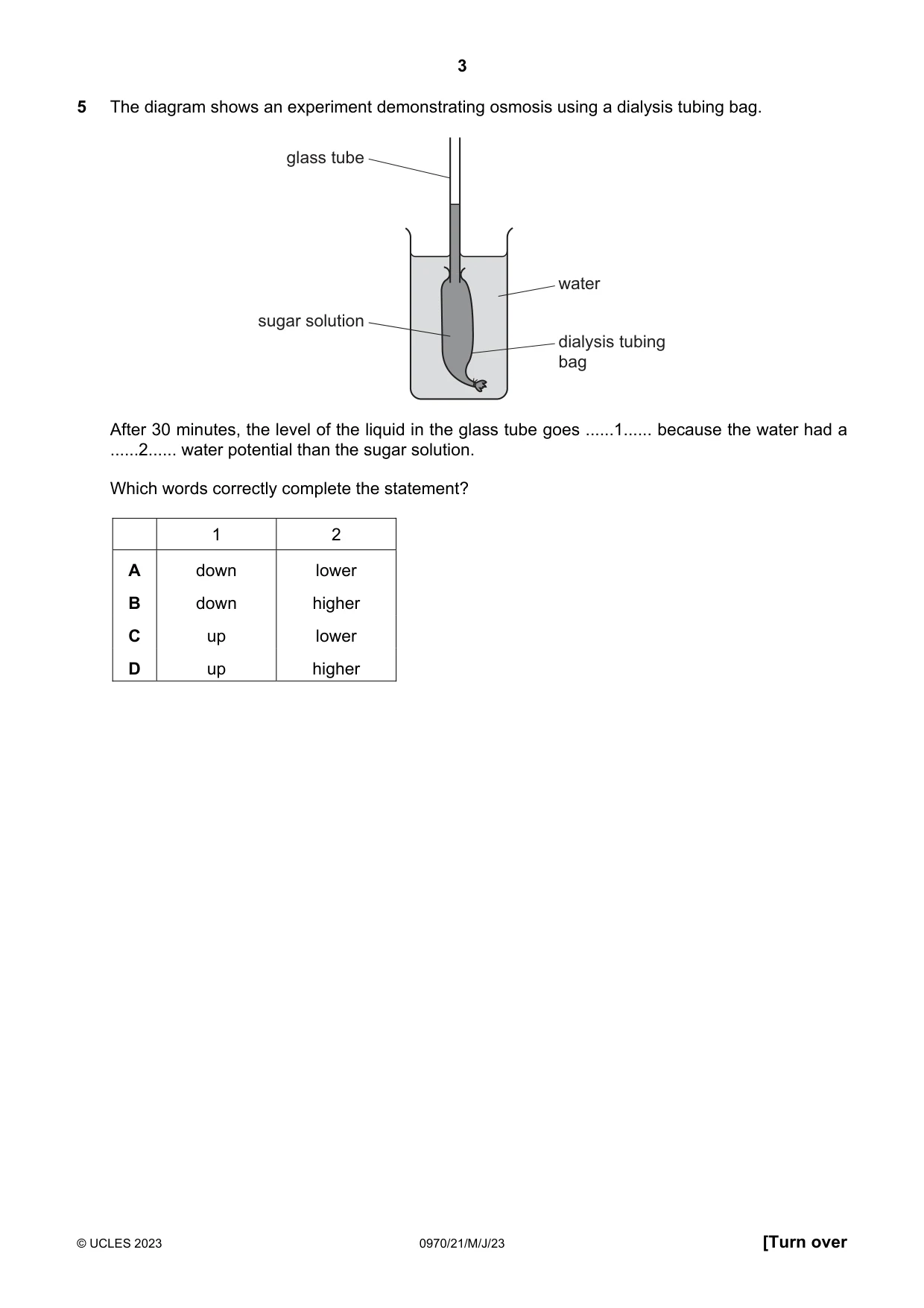
Q6 · The diagram shows the movement of glucose molecules across a cell membrane
6 The diagram shows the movement of glucose molecules across a cell membrane. low concentration glucose T cell membrane energy high concentration Which statement describes molecule T? A It is a fat molecule used to transport glucose down a concentration gradient. B It is a fat molecule used to transport glucose against a concentration gradient. C It is a protein molecule used to transport glucose down a concentration gradient. D It is a protein molecule used to transport glucose against a concentration gradient.
Mark scheme: D
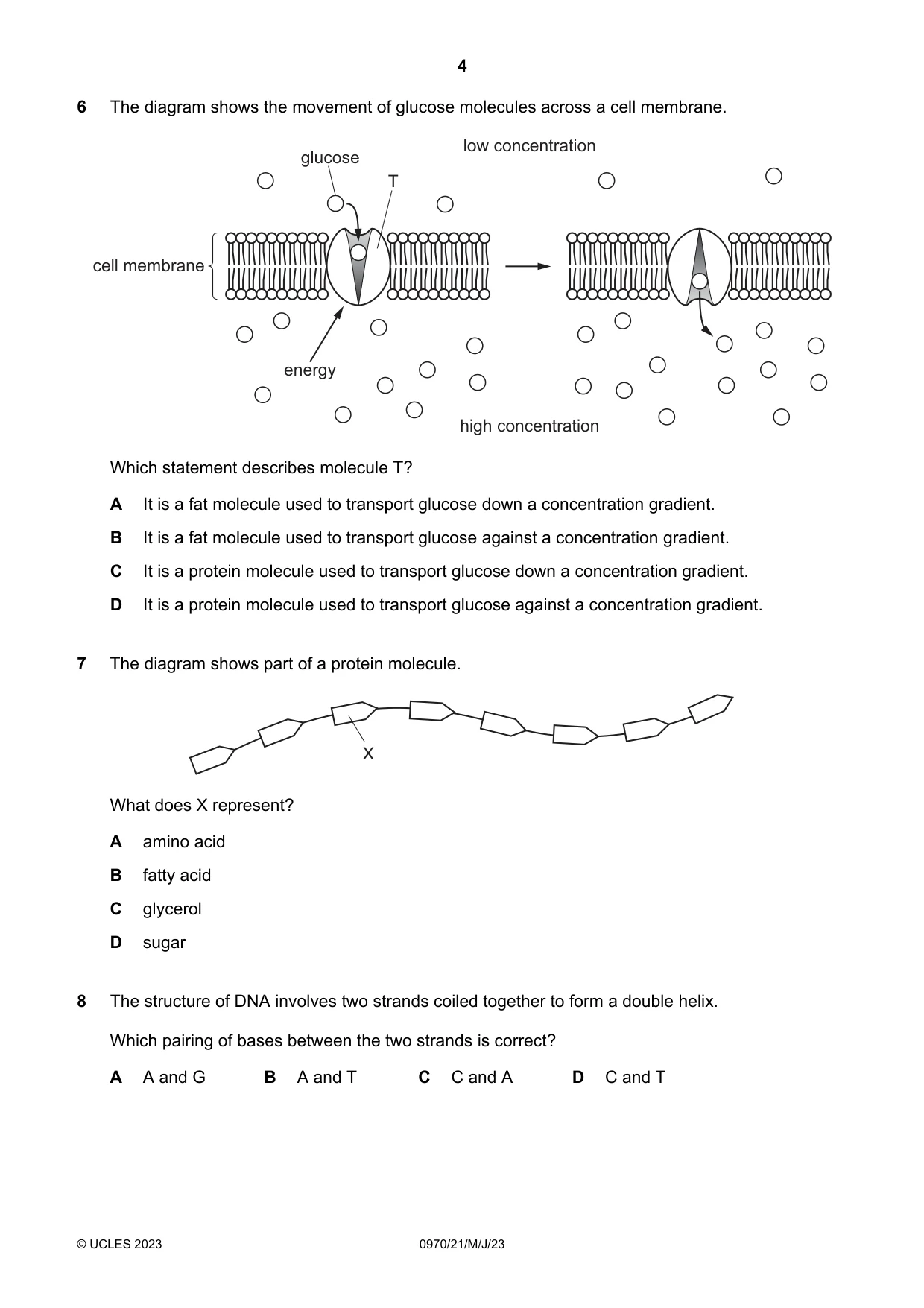
Q7 · The diagram shows part of a protein molecule
7 The diagram shows part of a protein molecule. X What does X represent? A amino acid B fatty acid C glycerol D sugar
Mark scheme: A
Q8 · The structure of DNA involves two strands coiled together to form a double helix
8 The structure of DNA involves two strands coiled together to form a double helix. Which pairing of bases between the two strands is correct? A A and G B A and T C C and A D C and T
Mark scheme: B
Q9 · What is true of all enzymes?
9 What is true of all enzymes? they are sugars they are most effective at pH 7 0 0O WwW > x «KOK v x v x key v= yes X =no
Mark scheme: D
Q10 · Which statement about human enzymes is correct when they are at temperatures above 80 °C?
10 Which statement about human enzymes is correct when they are at temperatures above 80 °C? A The enzyme molecules are denatured. B The shape of the active site is stable. C More enzyme-substrate complexes form. D More product is formed by the enzyme.
Mark scheme: A
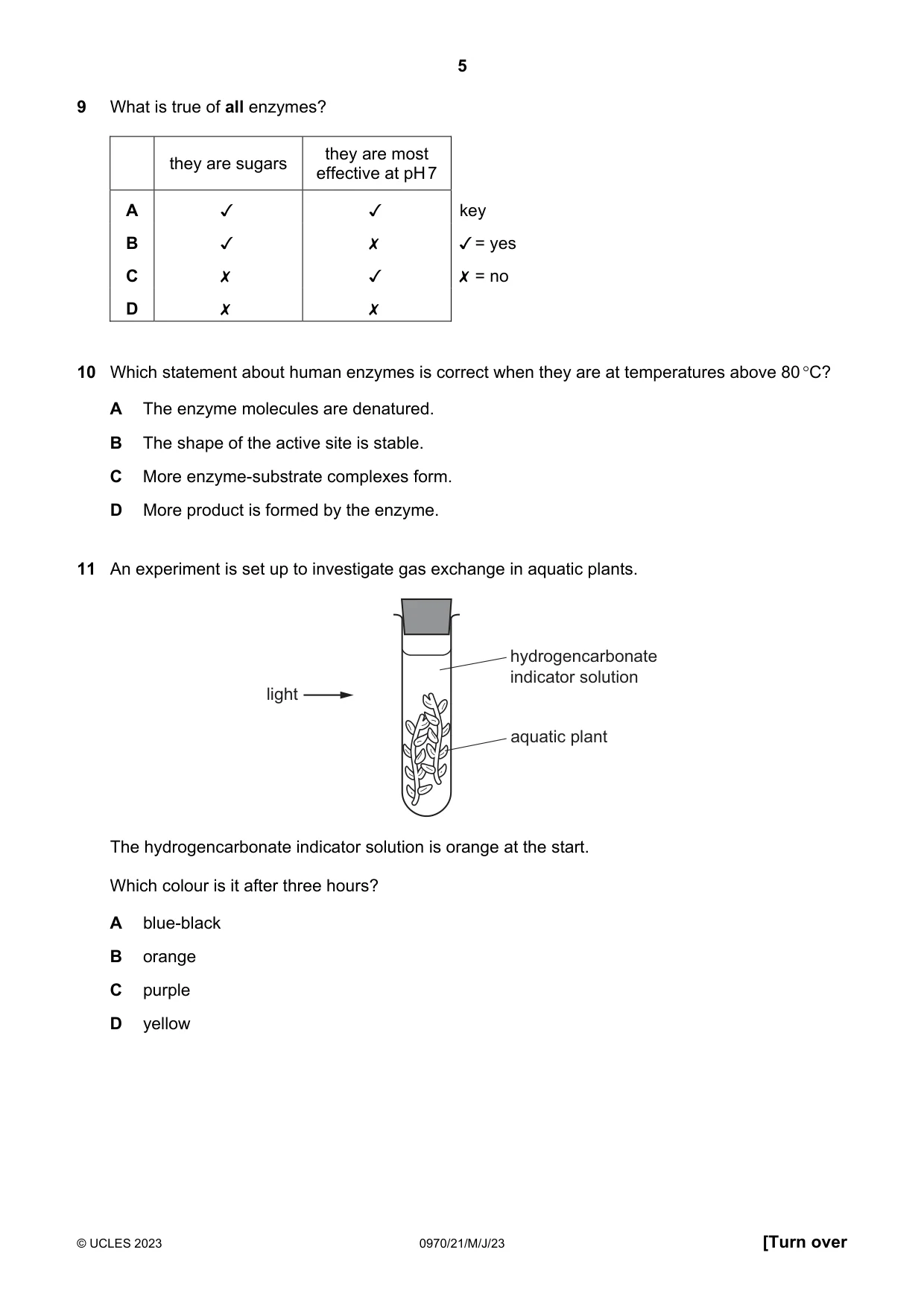
Q11 · An experiment is set up to investigate gas exchange in aquatic plants
11 An experiment is set up to investigate gas exchange in aquatic plants. hydrogencarbonate indicator solution light aquatic plant The hydrogencarbonate indicator solution is orange at the start. Which colour is it after three hours? A blue-black B orange C purple D yellow
Mark scheme: C
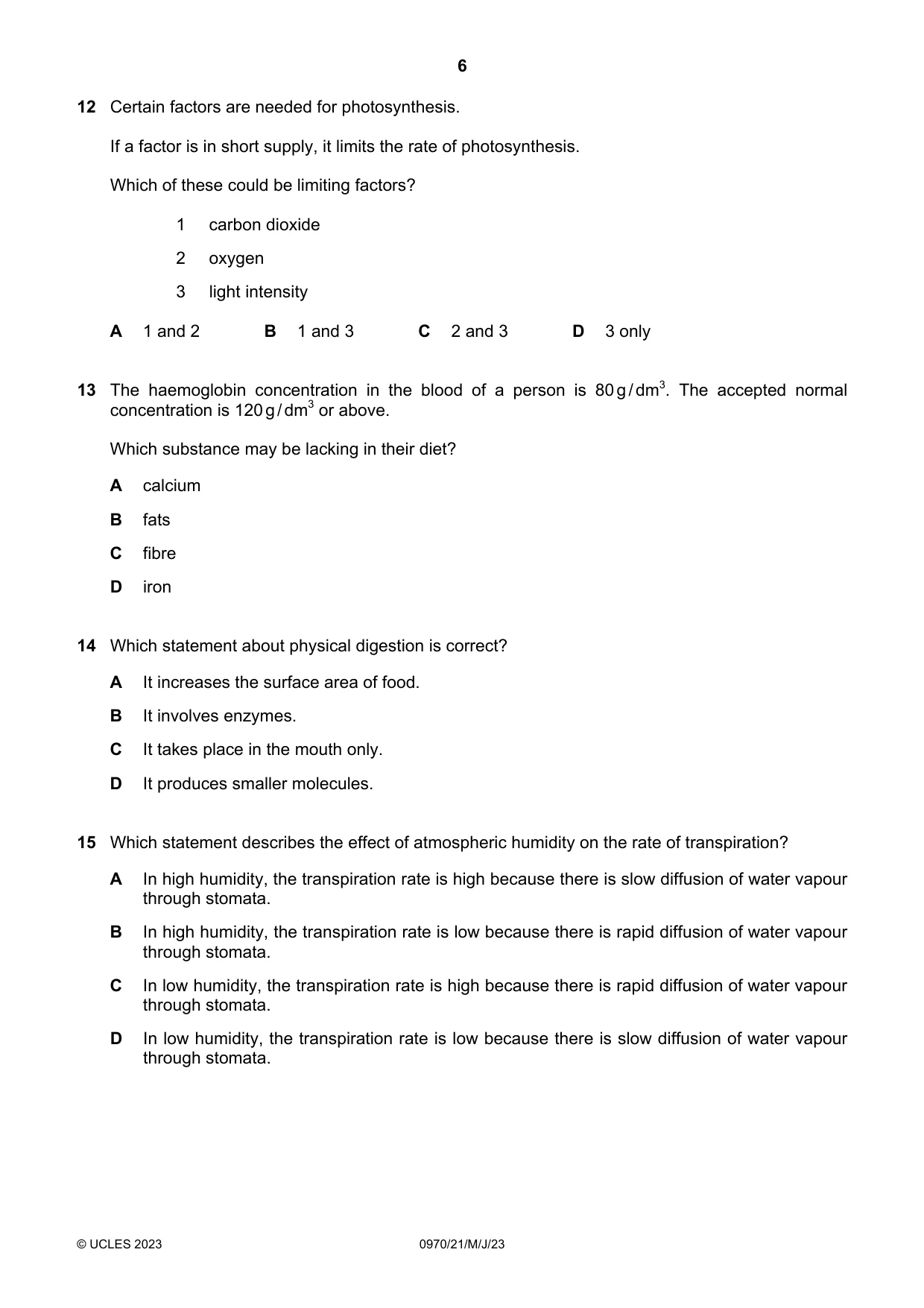
Q12 · Certain factors are needed for photosynthesis
12 Certain factors are needed for photosynthesis. If a factor is in short supply, it limits the rate of photosynthesis. Which of these could be limiting factors? 1 carbon dioxide 2 oxygen 3 light intensity A 1 and 2 B 1 and 3 C 2 and 3 D 3 only
Mark scheme: B
Q13 · The haemoglobin concentration in the blood of a person is 80 g / dm3
13 The haemoglobin concentration in the blood of a person is 80 g / dm3. The accepted normal concentration is 120 g / dm3 or above. Which substance may be lacking in their diet? A calcium B fats C fibre D iron
Mark scheme: D
Q14 · Which statement about physical digestion is correct?
14 Which statement about physical digestion is correct? A It increases the surface area of food. B It involves enzymes. C It takes place in the mouth only. D It produces smaller molecules.
Mark scheme: A
Q15 · Which statement describes the effect of atmospheric humidity on the rate of transpiration?
15 Which statement describes the effect of atmospheric humidity on the rate of transpiration? A In high humidity, the transpiration rate is high because there is slow diffusion of water vapour through stomata. B In high humidity, the transpiration rate is low because there is rapid diffusion of water vapour through stomata. C In low humidity, the transpiration rate is high because there is rapid diffusion of water vapour through stomata. D In low humidity, the transpiration rate is low because there is slow diffusion of water vapour through stomata.
Mark scheme: C
Q16 · Sucrose and amino acids move around a plant from sources to sinks
16 Sucrose and amino acids move around a plant from sources to sinks. Which row shows the sources and sinks? palisade root cortex cells xylem vessels mesophyll cells A source and sink neither source B sink sink source and sink C neither source and sink sink D source and sink source neither
Mark scheme: A
Q17 · Which statements describe how the structures in the circulatory system function?
17 Which statements describe how the structures in the circulatory system function? 1 a muscular pump to push blood into vessels 2 valves to ensure one-way blood flow 3 veins to take blood away from the heart 4 vessels to return blood to the heart A 1, 2 and 3 B 1, 2 and 4 C 1, 3 and 4 D 2, 3 and 4
Mark scheme: B
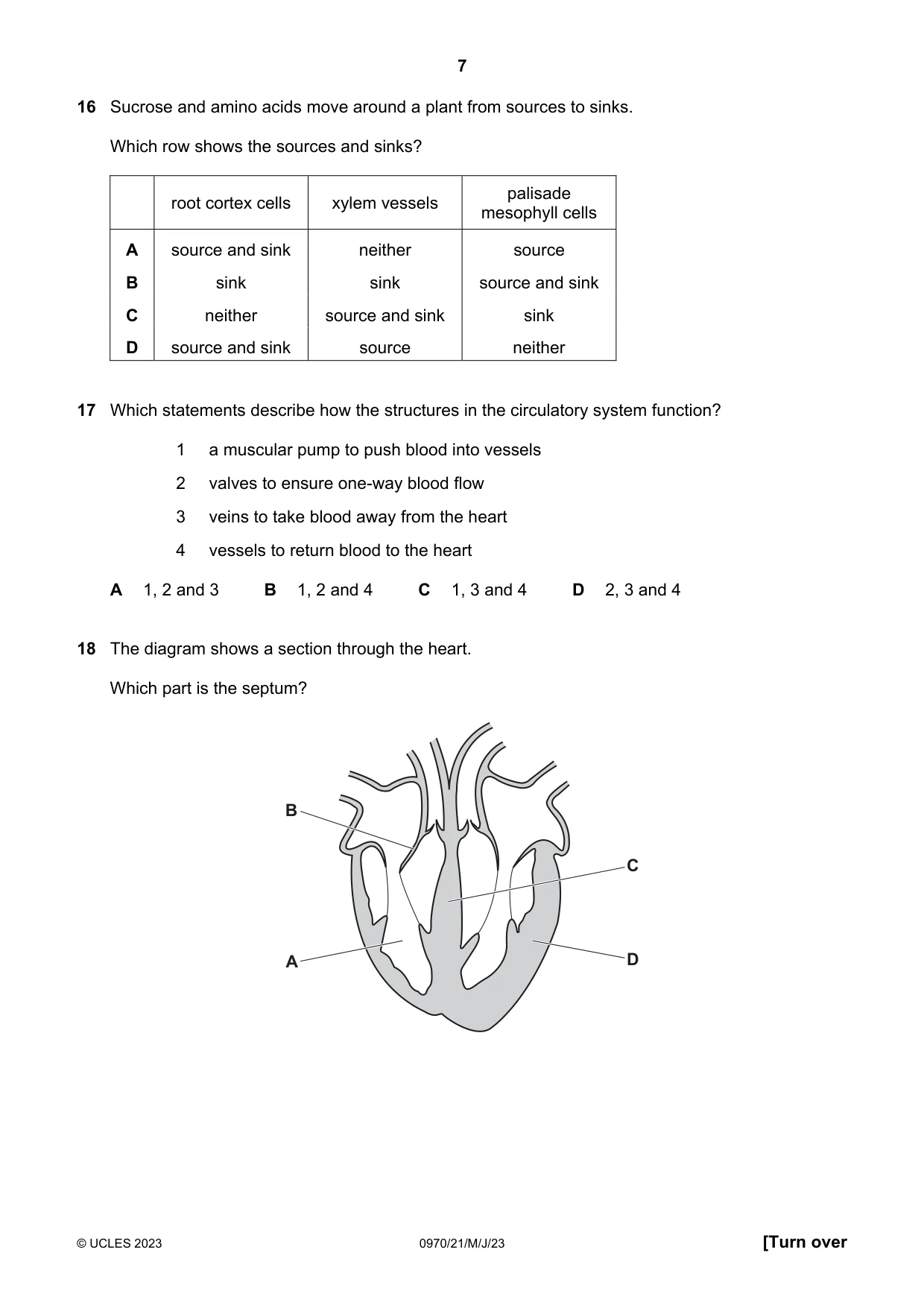
Q18 · The diagram shows a section through the heart
18 The diagram shows a section through the heart. Which part is the septum? B C A D
Mark scheme: C
Q19 · The cholera bacterium toxin causes dehydration and loss of salts from the blood in humans
19 The cholera bacterium toxin causes dehydration and loss of salts from the blood in humans. Which statement explains the reason for this? A Chloride ions are secreted into the small intestine where they increase the water potential. B Chloride ions are secreted into the small intestine which causes water to move into the intestine by osmosis. C Chloride ions are secreted into the small intestine which causes water to move out of the intestine by osmosis. D Chloride ions are secreted into the small intestine which causes the water potential of the blood to decrease.
Mark scheme: B
Q20 · During inspiration, the processes listed take place
20 During inspiration, the processes listed take place. P volume of the thorax increases Q air rushes into the lungs R pressure in the thorax decreases S external intercostal muscles contract T diaphragm moves down, ribs move upwards and outwards What is the correct sequence for these processes? A Q → P → S → R → T B S → T → P → R → Q C Q → P → S → T → R D S → Q → R → P → T
Mark scheme: B
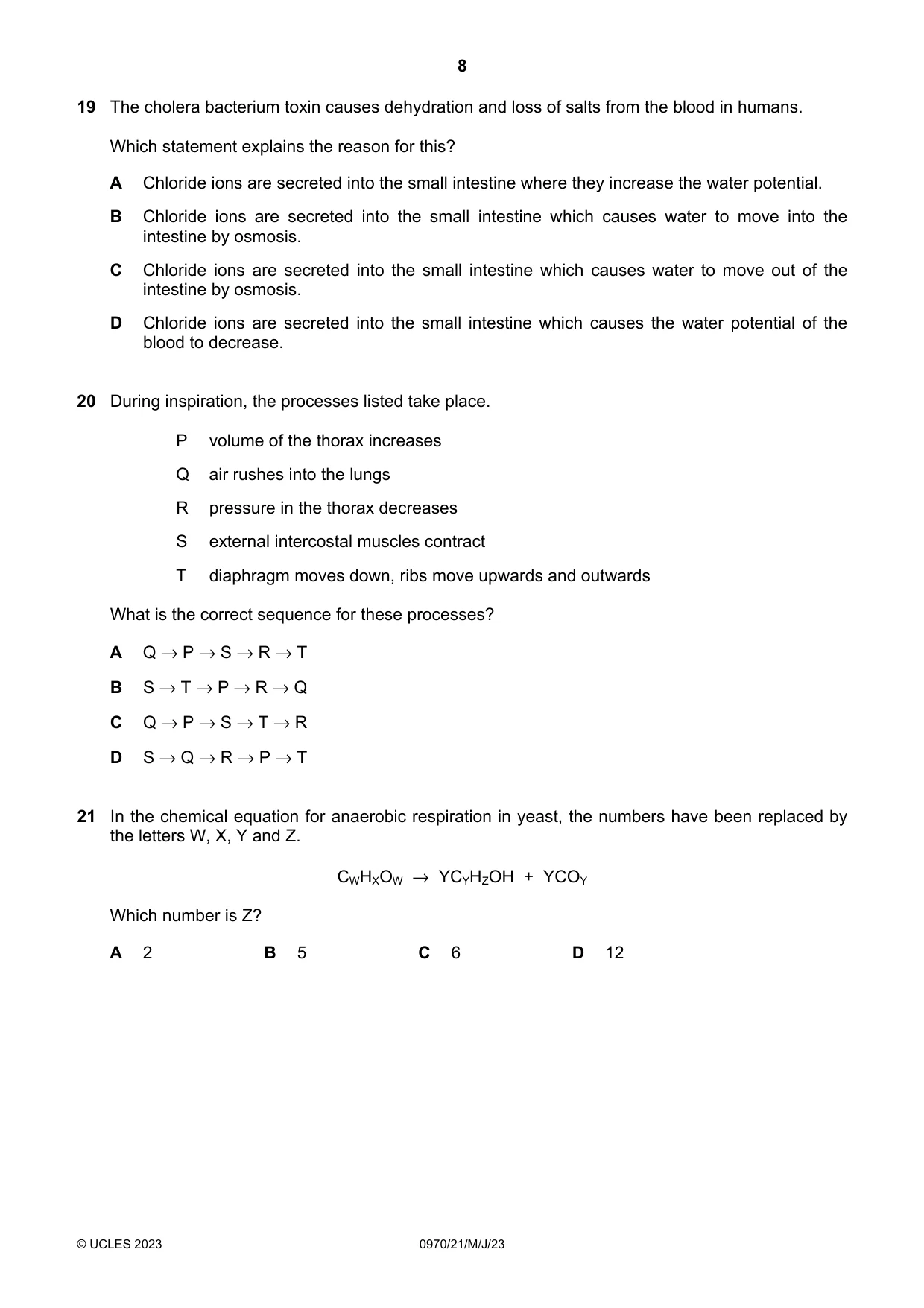
Q21 · In the chemical equation for anaerobic respiration in yeast, the numbers have been…
21 In the chemical equation for anaerobic respiration in yeast, the numbers have been replaced by the letters W, X, Y and Z. CWHXOW → YCYHZOH + YCOY Which number is Z? A 2 B 5 C 6 D 12
Mark scheme: B
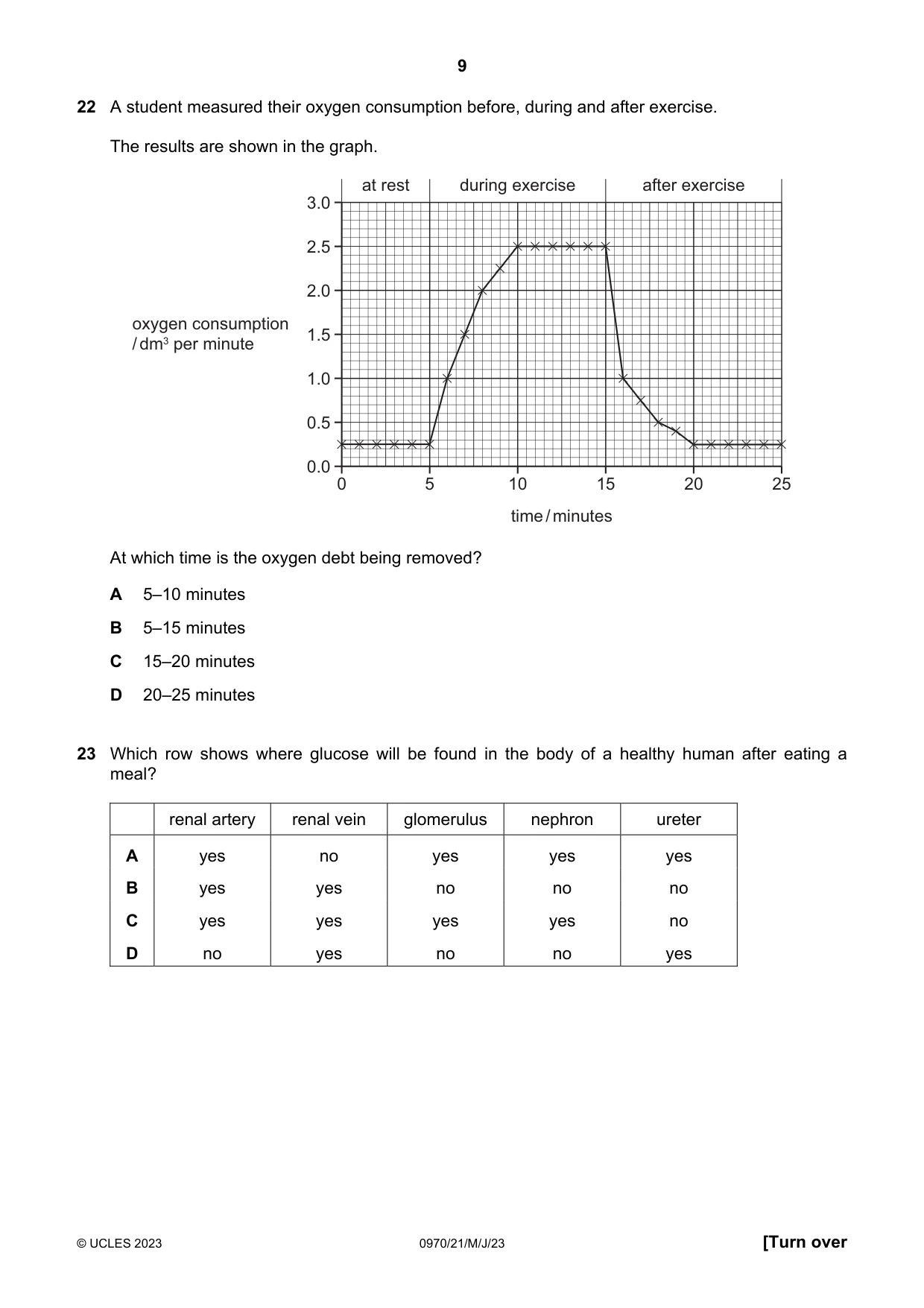
Q22 · A student measured their oxygen consumption before, during and after exercise
22 A student measured their oxygen consumption before, during and after exercise. The results are shown in the graph. at rest during exercise after exercise 3.0 2.5 2.0 oxygen consumption 1.5 / dm3 per minute 1.0 0.5 0.0 0 5 10 15 20 25 time / minutes At which time is the oxygen debt being removed? A 5–10 minutes B 5–15 minutes C 15–20 minutes D 20–25 minutes
Mark scheme: C
Q23 · Which row shows where glucose will be found in the body of a healthy human after eating a…
23 Which row shows where glucose will be found in the body of a healthy human after eating a meal? renal artery renal vein glomerulus nephron ureter A yes no yes yes yes B yes yes no no no C yes yes yes yes no D no yes no no yes
Mark scheme: C
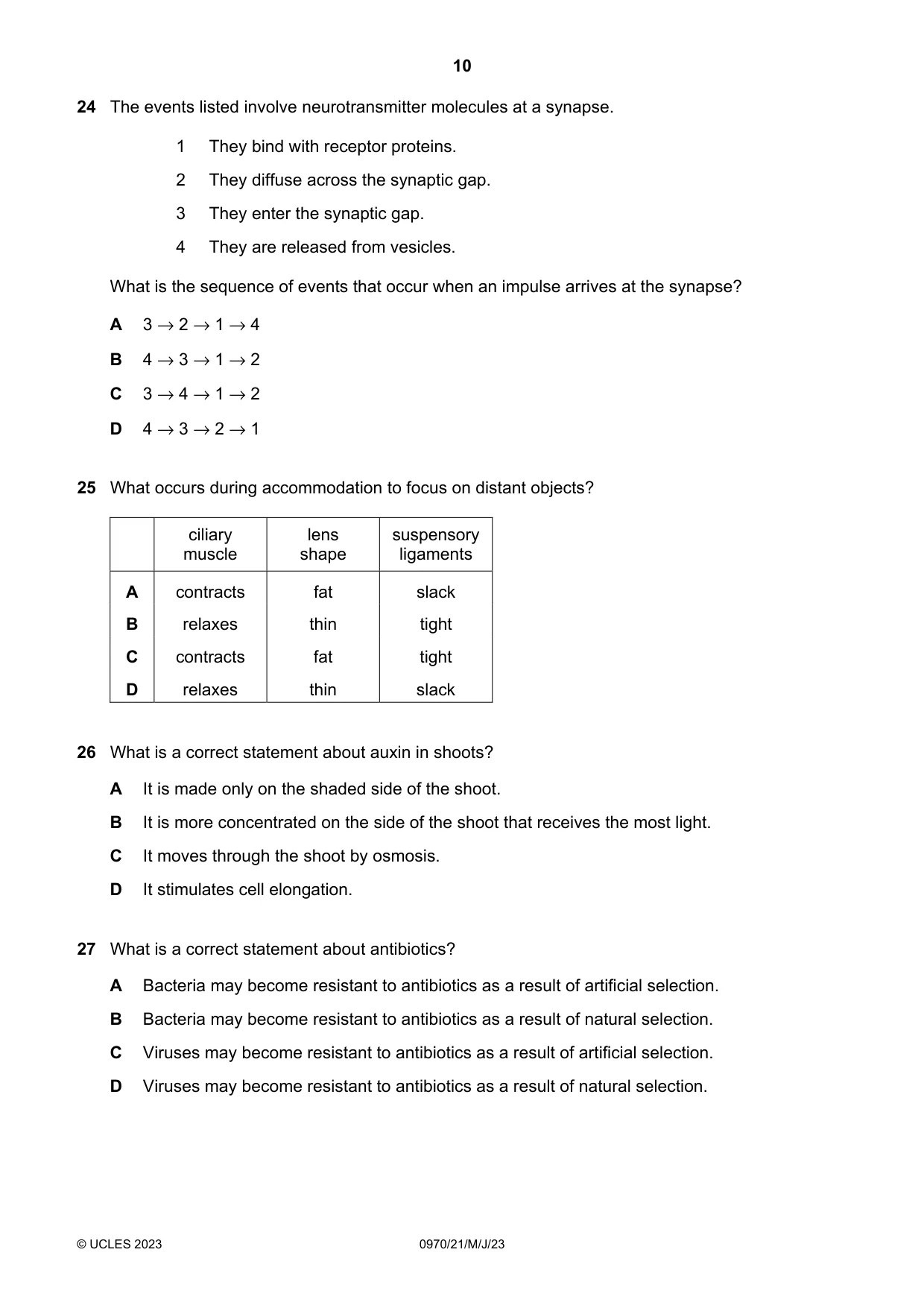
Q24 · The events listed involve neurotransmitter molecules at a synapse
24 The events listed involve neurotransmitter molecules at a synapse. 1 They bind with receptor proteins. 2 They diffuse across the synaptic gap. 3 They enter the synaptic gap. 4 They are released from vesicles. What is the sequence of events that occur when an impulse arrives at the synapse? A 3 → 2 → 1 → 4 B 4 → 3 → 1 → 2 C 3 → 4 → 1 → 2 D 4 → 3 → 2 → 1
Mark scheme: D
Q25 · What occurs during accommodation to focus on distant objects?
25 What occurs during accommodation to focus on distant objects? ciliary lens suspensory muscle shape ligaments A contracts fat slack B relaxes thin tight C contracts fat tight D relaxes thin slack
Mark scheme: B
Q26 · What is a correct statement about auxin in shoots?
26 What is a correct statement about auxin in shoots? A It is made only on the shaded side of the shoot. B It is more concentrated on the side of the shoot that receives the most light. C It moves through the shoot by osmosis. D It stimulates cell elongation.
Mark scheme: D
Q27 · What is a correct statement about antibiotics?
27 What is a correct statement about antibiotics? A Bacteria may become resistant to antibiotics as a result of artificial selection. B Bacteria may become resistant to antibiotics as a result of natural selection. C Viruses may become resistant to antibiotics as a result of artificial selection. D Viruses may become resistant to antibiotics as a result of natural selection.
Mark scheme: B
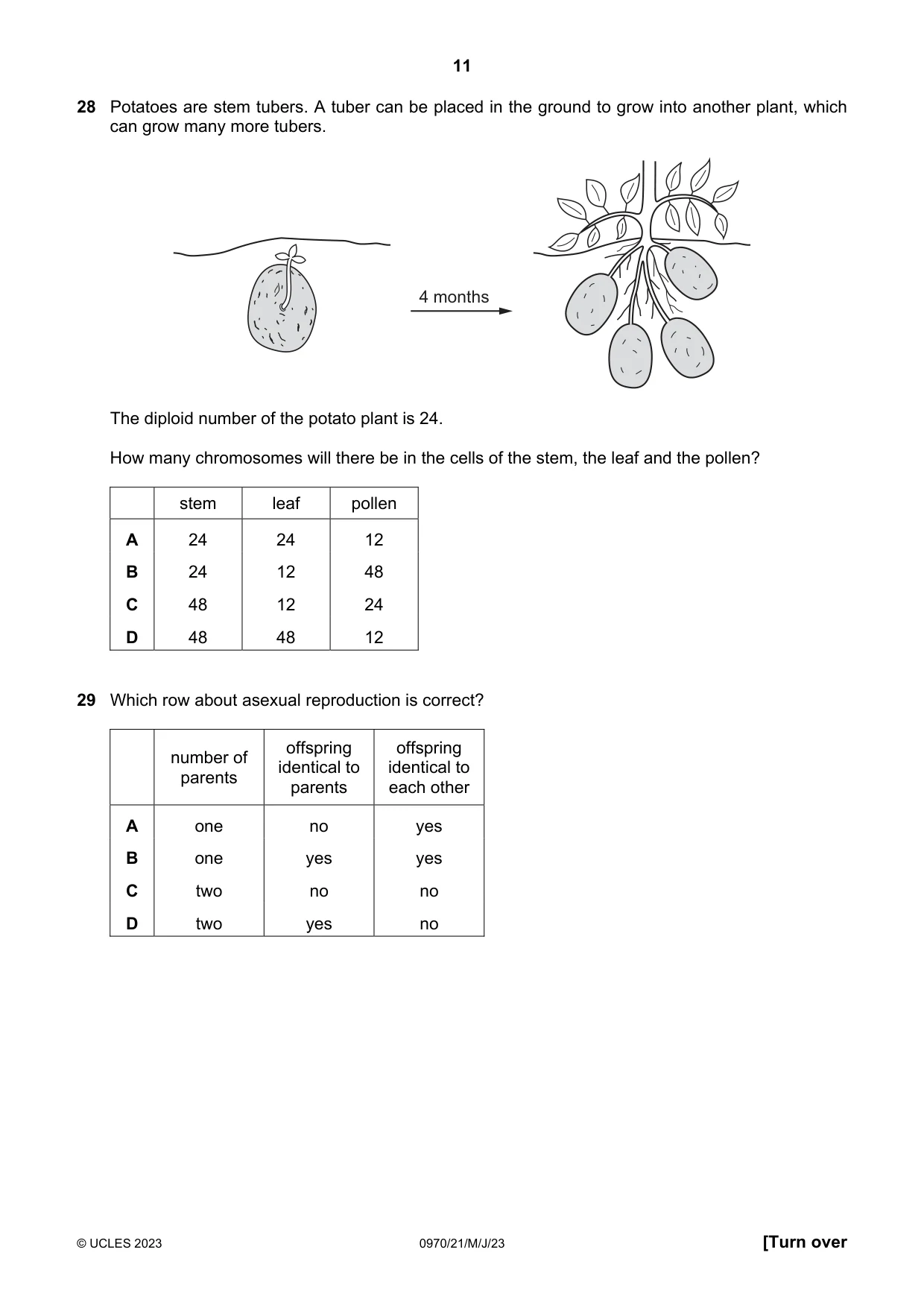
Q28 · Potatoes are stem tubers
28 Potatoes are stem tubers. A tuber can be placed in the ground to grow into another plant, which can grow many more tubers. 4 months The diploid number of the potato plant is 24. How many chromosomes will there be in the cells of the stem, the leaf and the pollen? stem leaf pollen A 24 24 12 B 24 12 48 C 48 12 24 D 48 48 12
Mark scheme: A
Q29 · Which row about asexual reproduction is correct?
29 Which row about asexual reproduction is correct? offspring offspring number of identical to identical to parents parents each other A one no yes B one yes yes C two no no D two yes no
Mark scheme: B
Q30 · The statements describe how a protein is made
30 The statements describe how a protein is made. 1 mRNA passes through a ribosome. 2 mRNA molecules carry a copy of the gene to the cytoplasm. 3 The gene coding for the protein is copied in the nucleus. 4 Ribosomes assemble amino acids into proteins. What is the order of statements that describes how a protein is made? A 2 → 1 → 3 → 4 B 2 → 3 → 4 → 1 C 3 → 1 → 2 → 4 D 3 → 2 → 1 → 4
Mark scheme: D
Q31 · Which parents could produce offspring with blood group O?
31 Which parents could produce offspring with blood group O? A heterozygous father with blood group A and heterozygous mother with blood group B B heterozygous father with blood group A and homozygous mother with blood group B C homozygous father with blood group A and heterozygous mother with blood group B D homozygous father with blood group A and homozygous mother with blood group O
Mark scheme: A
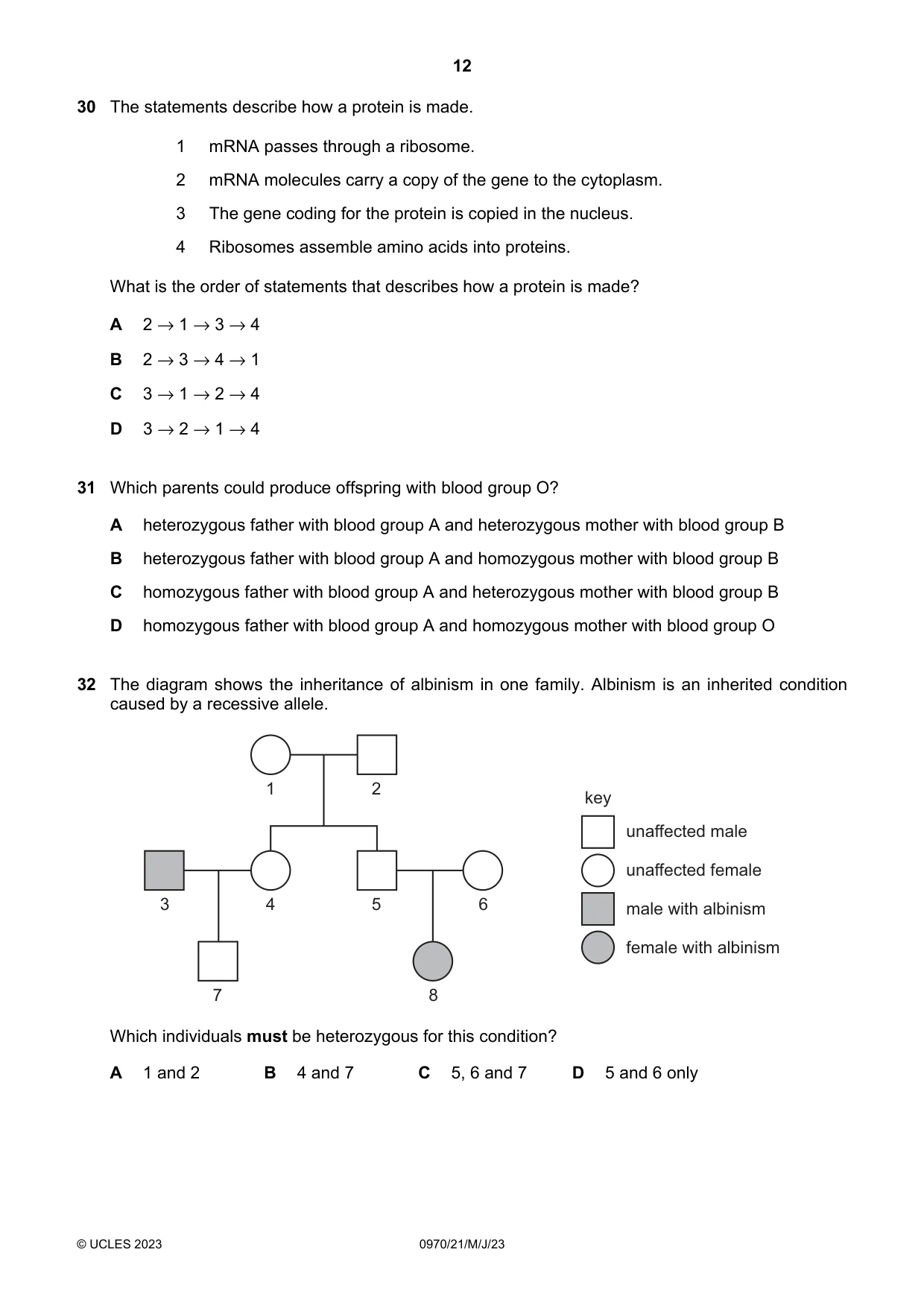
Q32 · The diagram shows the inheritance of albinism in one family
32 The diagram shows the inheritance of albinism in one family. Albinism is an inherited condition caused by a recessive allele. 1 2 key unaffected male unaffected female 3 4 5 6 male with albinism female with albinism 7 8 Which individuals must be heterozygous for this condition? A 1 and 2 B 4 and 7 C 5, 6 and 7 D 5 and 6 only
Mark scheme: C
Q33 · Which term is a genetic change?
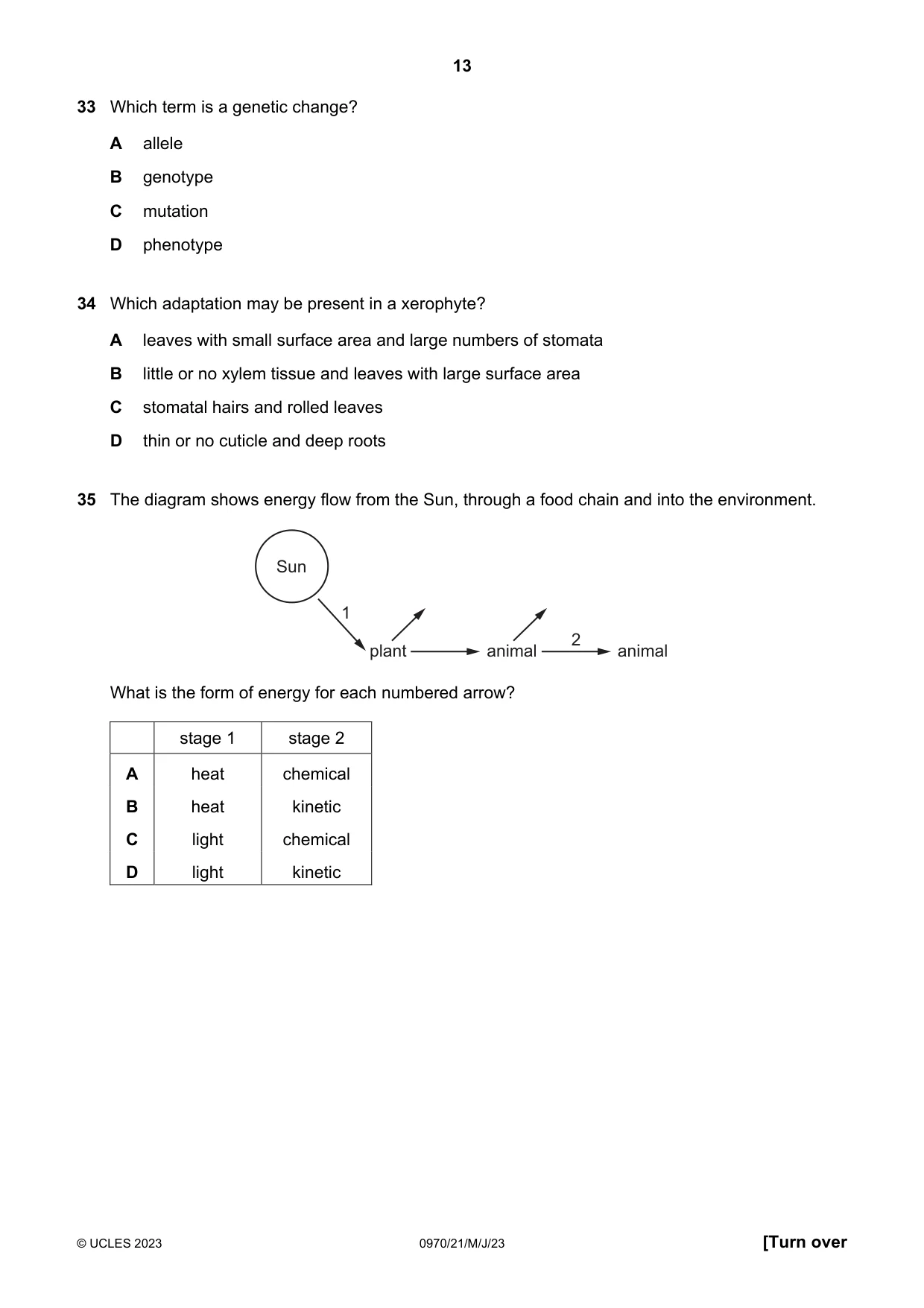
33 Which term is a genetic change? A allele B genotype C mutation D phenotype
Mark scheme: C
Q34 · Which adaptation may be present in a xerophyte?
34 Which adaptation may be present in a xerophyte? A leaves with small surface area and large numbers of stomata B little or no xylem tissue and leaves with large surface area C stomatal hairs and rolled leaves D thin or no cuticle and deep roots
Mark scheme: C
Q35 · The diagram shows energy flow from the Sun, through a food chain and into the environment
35 The diagram shows energy flow from the Sun, through a food chain and into the environment. Sun 1 2 plant animal animal What is the form of energy for each numbered arrow? stage 1 stage 2 A heat chemical B heat kinetic C light chemical D light kinetic
Mark scheme: C
Q36 · A few yeast cells were placed in a container of nutrient solution
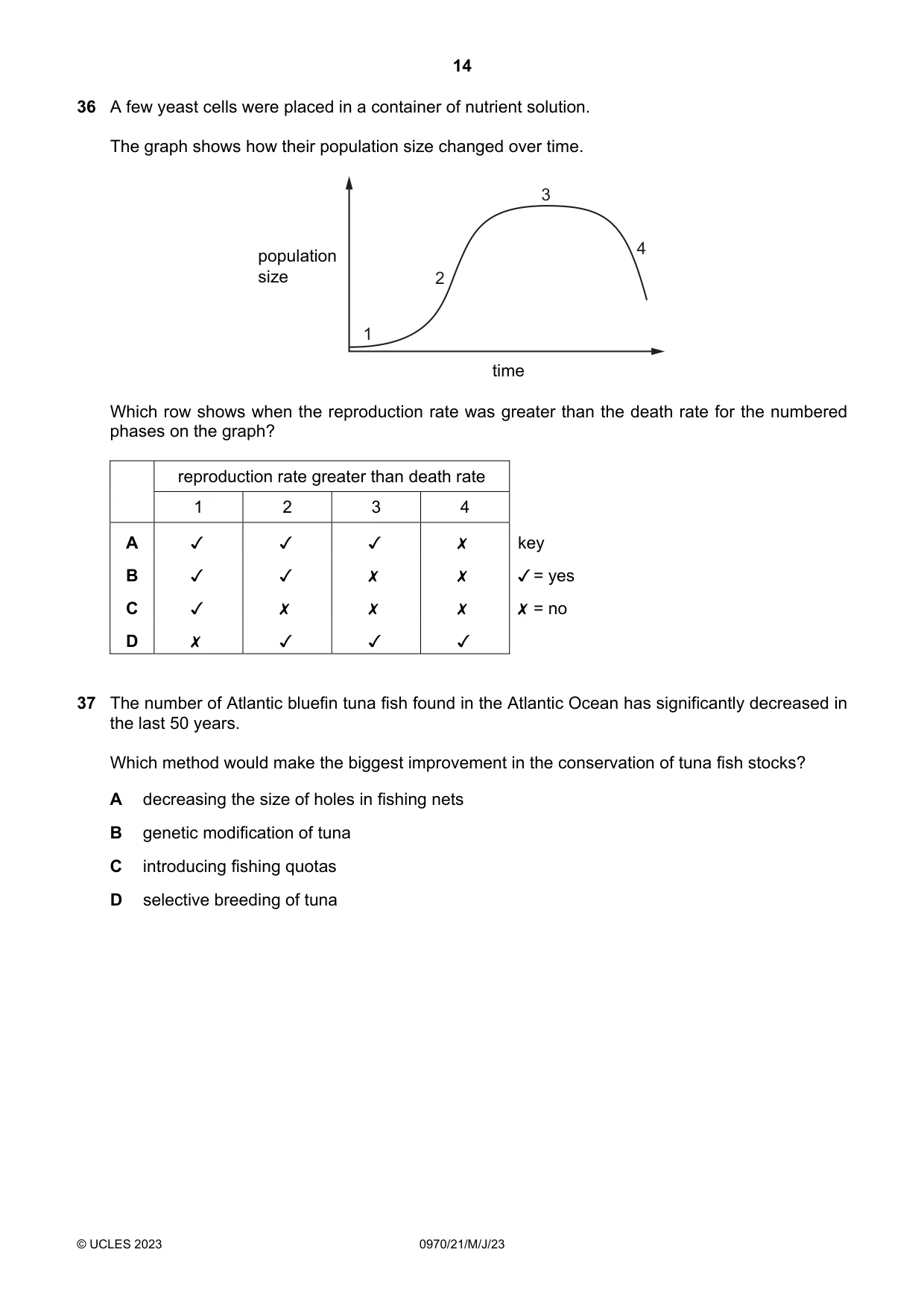
36 A few yeast cells were placed in a container of nutrient solution. The graph shows how their population size changed over time. population size time Which row shows when the reproduction rate was greater than the death rate for the numbered phases on the graph? reproduction rate greater than death rate 1 2 3 4 A v v v x B v v x x Cc v x x x D x v v v key v= yes xX =no
Mark scheme: B
Q37 · The number of Atlantic bluefin tuna fish found in the Atlantic Ocean has significantly…
37 The number of Atlantic bluefin tuna fish found in the Atlantic Ocean has significantly decreased in the last 50 years. Which method would make the biggest improvement in the conservation of tuna fish stocks? A decreasing the size of holes in fishing nets B genetic modification of tuna C introducing fishing quotas D selective breeding of tuna
Mark scheme: C
Q38 · The bloodworm is an organism that is found in heavily polluted water
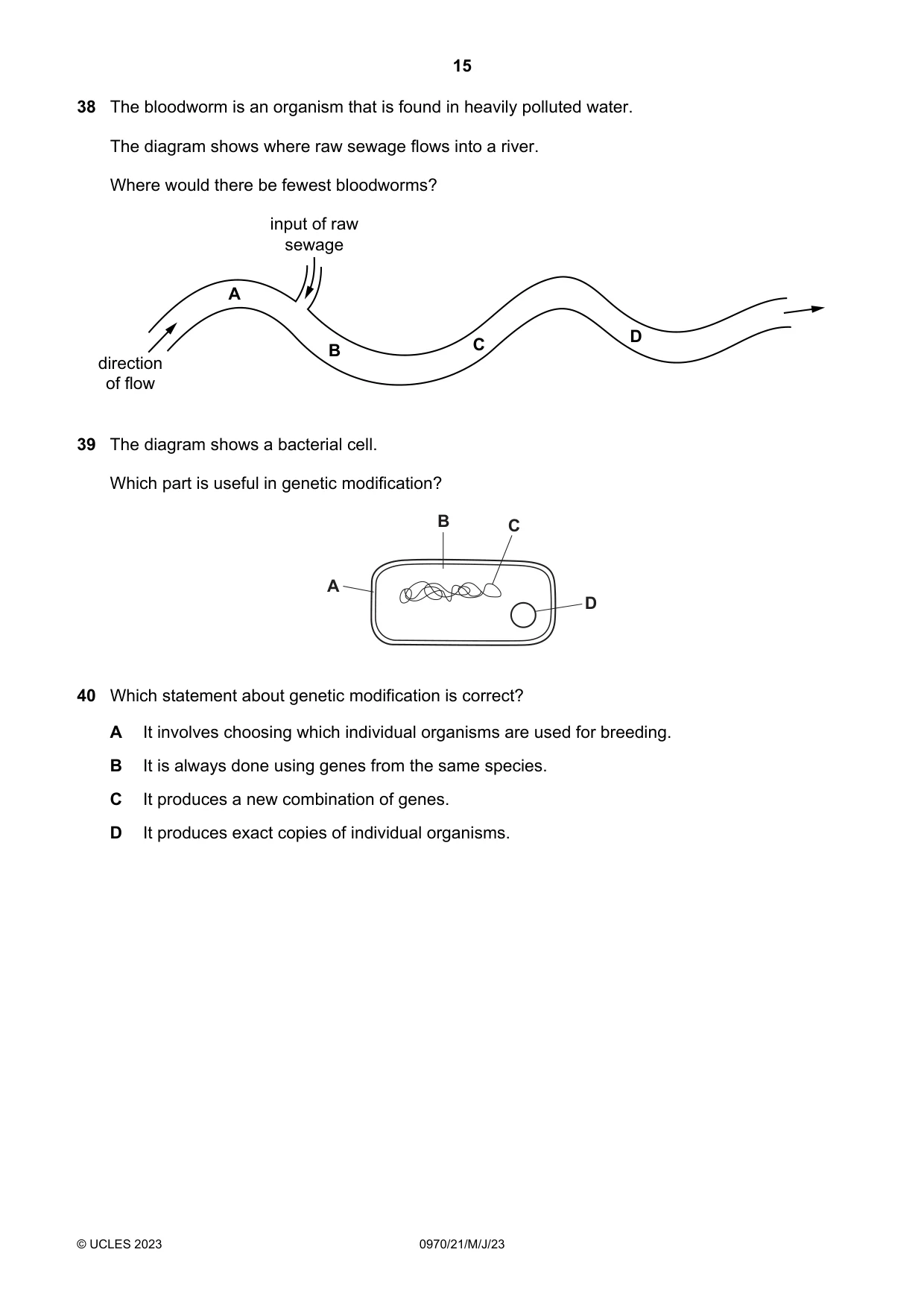
38 The bloodworm is an organism that is found in heavily polluted water. The diagram shows where raw sewage flows into a river. Where would there be fewest bloodworms? input of raw sewage A D B C direction of flow
Mark scheme: A
Q39 · The diagram shows a bacterial cell
39 The diagram shows a bacterial cell. Which part is useful in genetic modification? B C A D
Mark scheme: D
Q40 · Which statement about genetic modification is correct?
40 Which statement about genetic modification is correct? A It involves choosing which individual organisms are used for breeding. B It is always done using genes from the same species. C It produces a new combination of genes. D It produces exact copies of individual organisms.
Mark scheme: C
What was in this paper
The subtopics covered by these 40 questions, and how many questions each got. Open one in a new tab to see every Cambridge question on it.
3Anaerobic respiration2Diseases and immunity2Enzymes2Genetic modification2Monohybrid inheritance2Photosynthesis2Active transport1Adaptive features1Asexual reproduction1Biological molecules1Cell structure1Characteristics of living organisms1Circulatory systems1Concept and uses of classification systems1Conservation1Coordination and response1Diet1Energy flow1Excretion in humans1Gas exchange in humans1Heart1Osmosis1Physical digestion1Pollution1Populations1Sense organs1Sexual reproduction1Size of specimens1Translocation1Transpiration1Tropic responses1What you needed in this session
Cambridge’s own grade thresholds for 2023 May/June, Paper 2 · Variant 1. A higher threshold means an easier paper — the bar moves with how the cohort did.