Cambridge IGCSE Biology (9-1) 0970 — 2019 May/June Paper 2 · Variant 2
0970/22/M/J/19 · 40 questions · 40 marks · ≈45 min
The question paper and its mark scheme, free to read here and free to download. This is Cambridge’s own paper, exactly as it was sat.
Question paper16 pages
Mark scheme3 pages
Answers below. Sit the paper first if you are practising.
Questions as text
Q1 · Carbon dioxide diffuses into a leaf
1 Carbon dioxide diffuses into a leaf. Which characteristic of living things requires this? A excretion B movement C nutrition D respiration
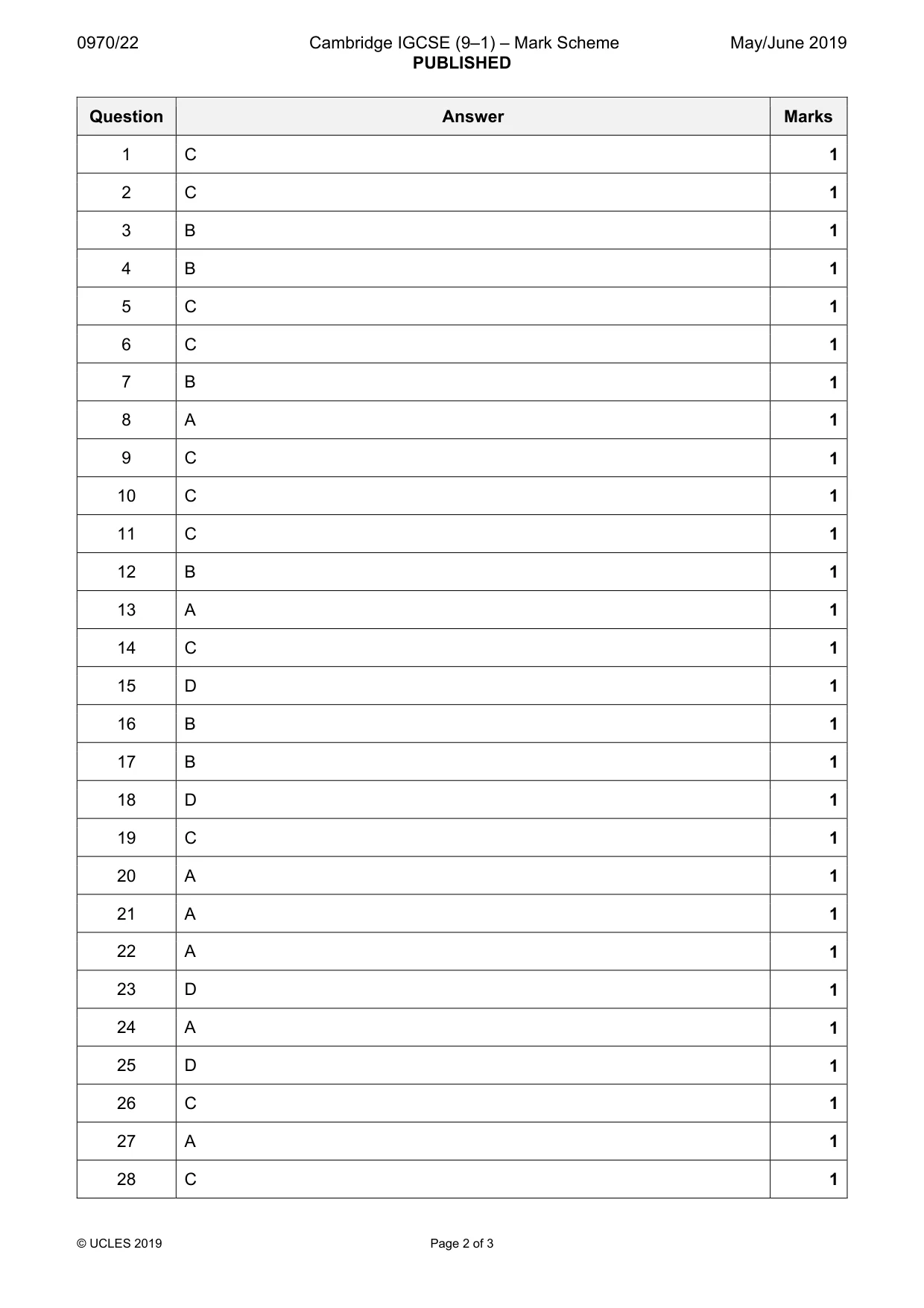
Mark scheme: C
Q2 · The diagram shows how Homo sapiens (modern people) could have evolved from earlier…
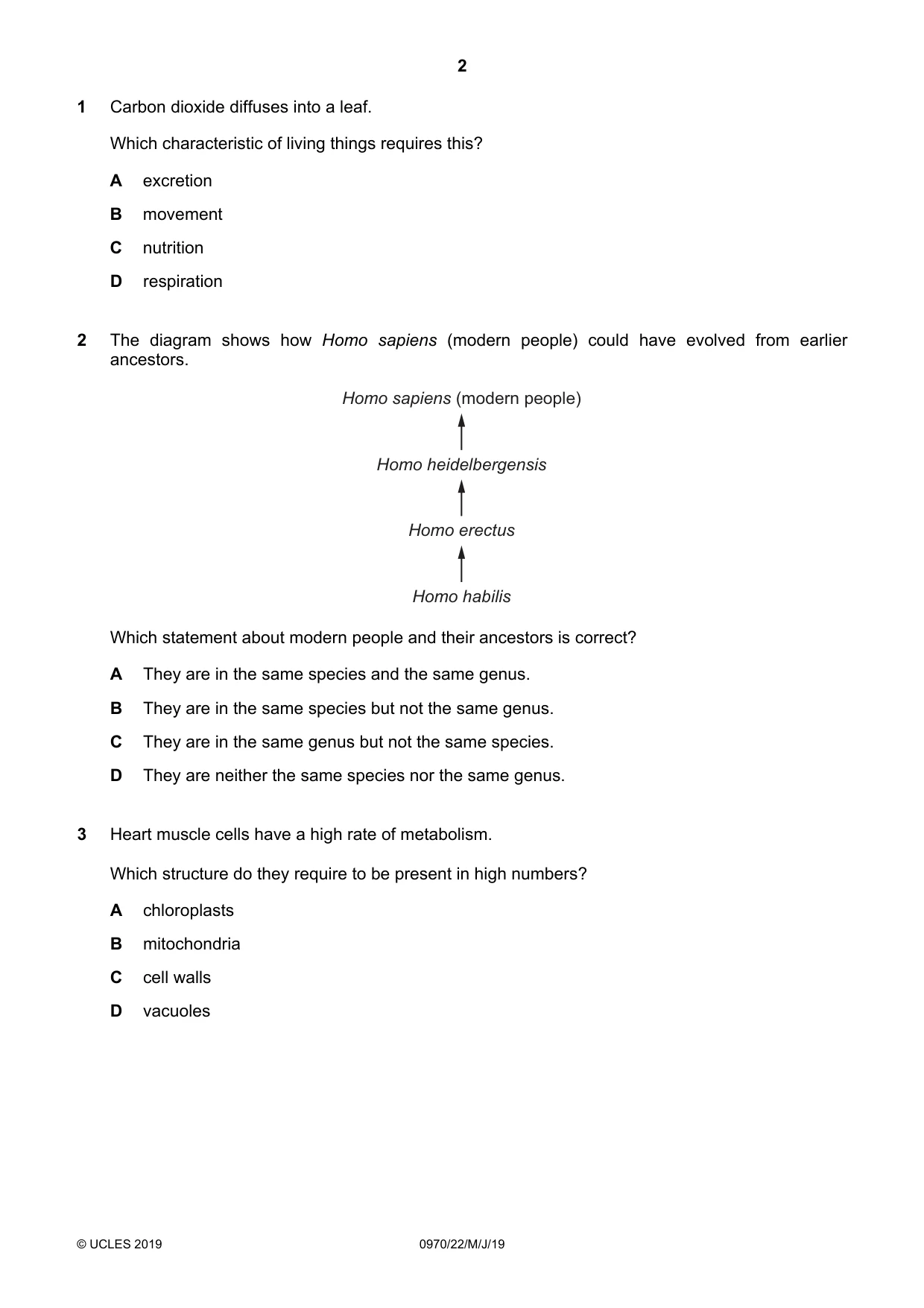
2 The diagram shows how Homo sapiens (modern people) could have evolved from earlier ancestors. Homo sapiens (modern people) Homo heidelbergensis Homo erectus Homo habilis Which statement about modern people and their ancestors is correct? A They are in the same species and the same genus. B They are in the same species but not the same genus. C They are in the same genus but not the same species. D They are neither the same species nor the same genus.
Mark scheme: C
More questions on Concept and uses of classification systems
Q3 · Heart muscle cells have a high rate of metabolism
3 Heart muscle cells have a high rate of metabolism. Which structure do they require to be present in high numbers? A chloroplasts B mitochondria C cell walls D vacuoles
Mark scheme: B
Q4 · Which features are possessed by all plant cells?
4 Which features are possessed by all plant cells? a cell wall chloroplasts A J Jv B Jv x Cc x v D x x key J/ = present X = absent
Mark scheme: B
Q5 · The diagram shows a xylem vessel in a plant stem
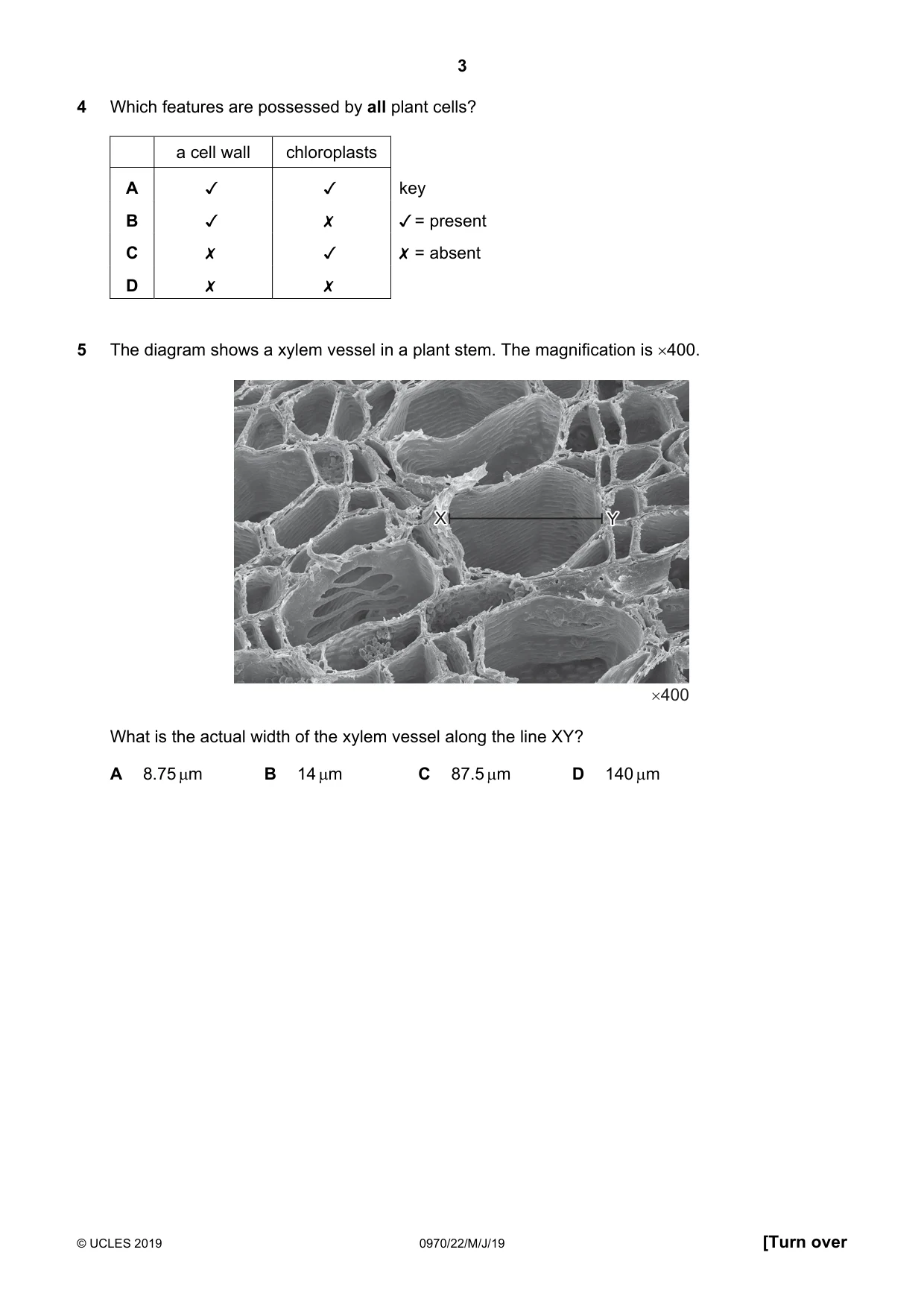
5 The diagram shows a xylem vessel in a plant stem. The magnification is ×400. X X Y Y ×400 What is the actual width of the xylem vessel along the line XY? A 8.75 µm B 14 µm C 87.5 µm D 140 µm
Mark scheme: C
Q6 · The diagram shows a test-tube containing clear jelly
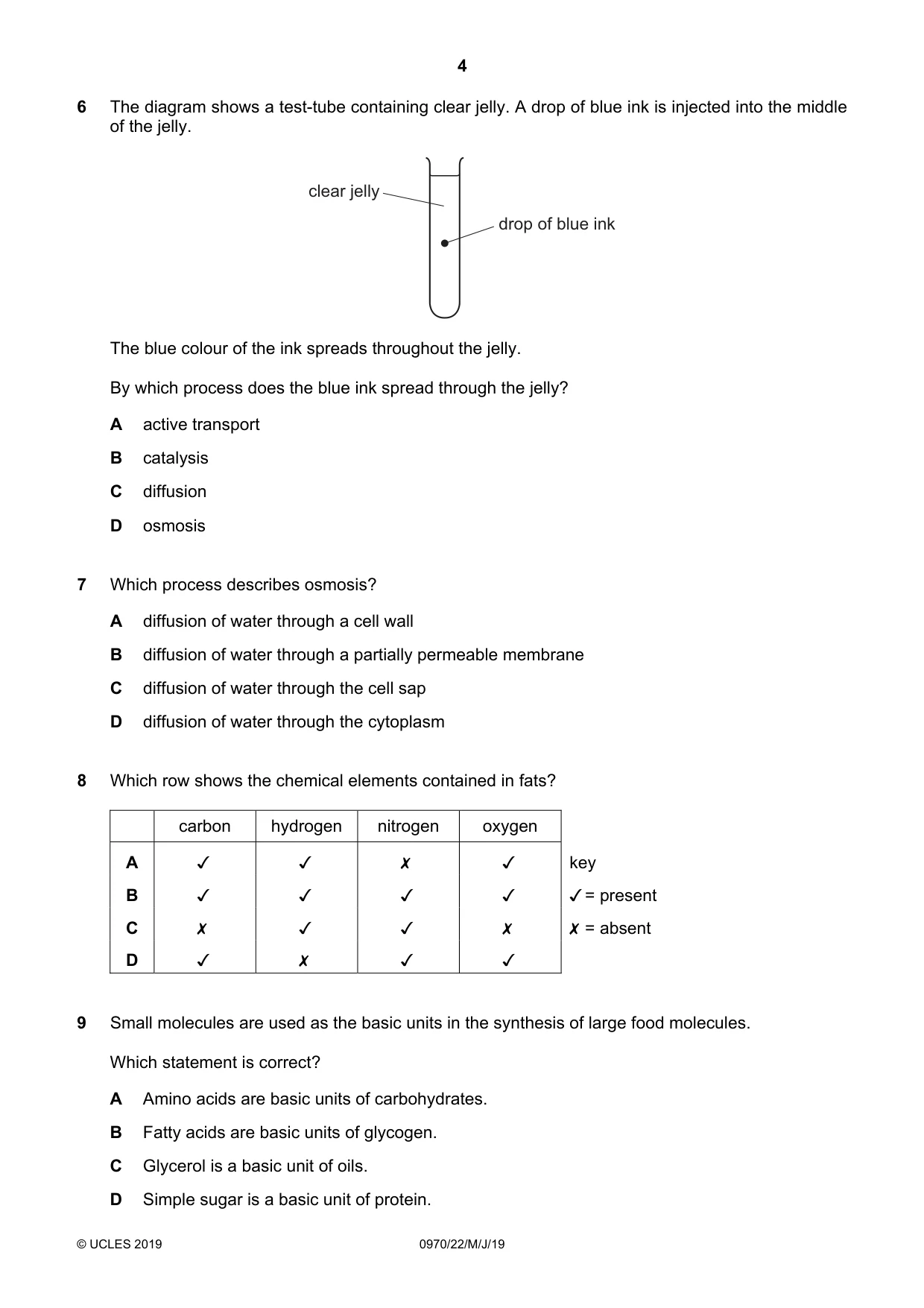
6 The diagram shows a test-tube containing clear jelly. A drop of blue ink is injected into the middle of the jelly. clear jelly drop of blue ink The blue colour of the ink spreads throughout the jelly. By which process does the blue ink spread through the jelly? A active transport B catalysis C diffusion D osmosis
Mark scheme: C
Q7 · Which process describes osmosis?
7 Which process describes osmosis? A diffusion of water through a cell wall B diffusion of water through a partially permeable membrane C diffusion of water through the cell sap D diffusion of water through the cytoplasm
Mark scheme: B
Q8 · Which row shows the chemical elements contained in fats?
8 Which row shows the chemical elements contained in fats? carbon hydrogen nitrogen oxygen A Jv v x v B Jv Jv Jv v Cc x v v x D Jv x v v key / = present X = absent
Mark scheme: A
Q9 · Small molecules are used as the basic units in the synthesis of large food molecules
9 Small molecules are used as the basic units in the synthesis of large food molecules. Which statement is correct? A Amino acids are basic units of carbohydrates. B Fatty acids are basic units of glycogen. C Glycerol is a basic unit of oils. D Simple sugar is a basic unit of protein.
Mark scheme: C
Q10 · The diagrams show a protease enzyme catalysing the breaking of part of a protein molecule…
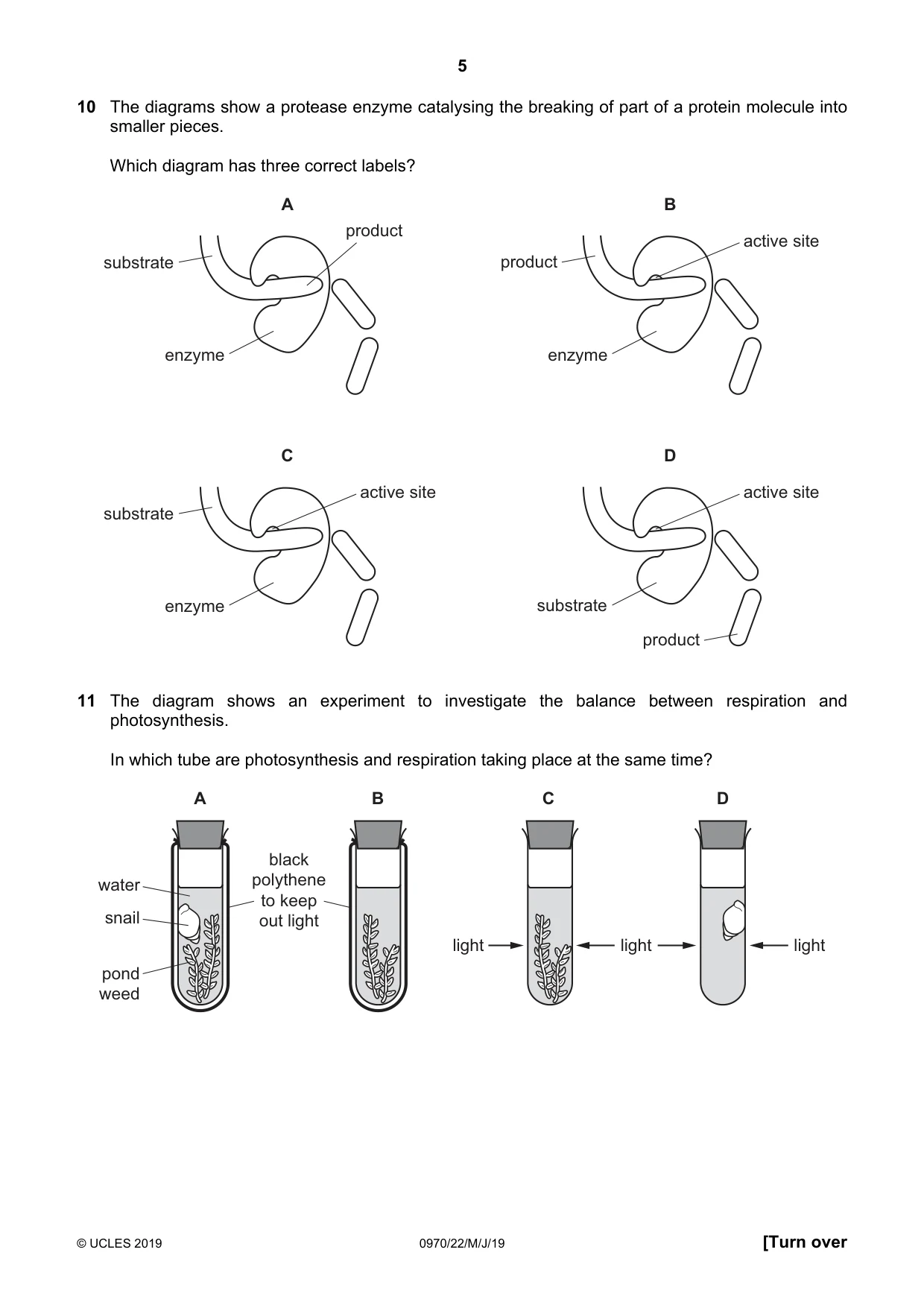
10 The diagrams show a protease enzyme catalysing the breaking of part of a protein molecule into smaller pieces. Which diagram has three correct labels? A B product active site substrate product enzyme enzyme C D active site active site substrate enzyme substrate product
Mark scheme: C
Q11 · The diagram shows an experiment to investigate the balance between respiration and…
11 The diagram shows an experiment to investigate the balance between respiration and photosynthesis. In which tube are photosynthesis and respiration taking place at the same time? A B C D black water polythene to keep snail out light light light light pond weed
Mark scheme: C
Q12 · Some gardeners use Epsom salts (magnesium sulfate) as a fertiliser for their plants
12 Some gardeners use Epsom salts (magnesium sulfate) as a fertiliser for their plants. Epsom salts release magnesium ions into the soil. How would this benefit the plants? A prevents pests from eating the leaves B prevents the leaves from going yellow C prevents water loss from the leaves D prevents the growth of weeds
Mark scheme: B
Q13 · The food label is from a packet of cereal
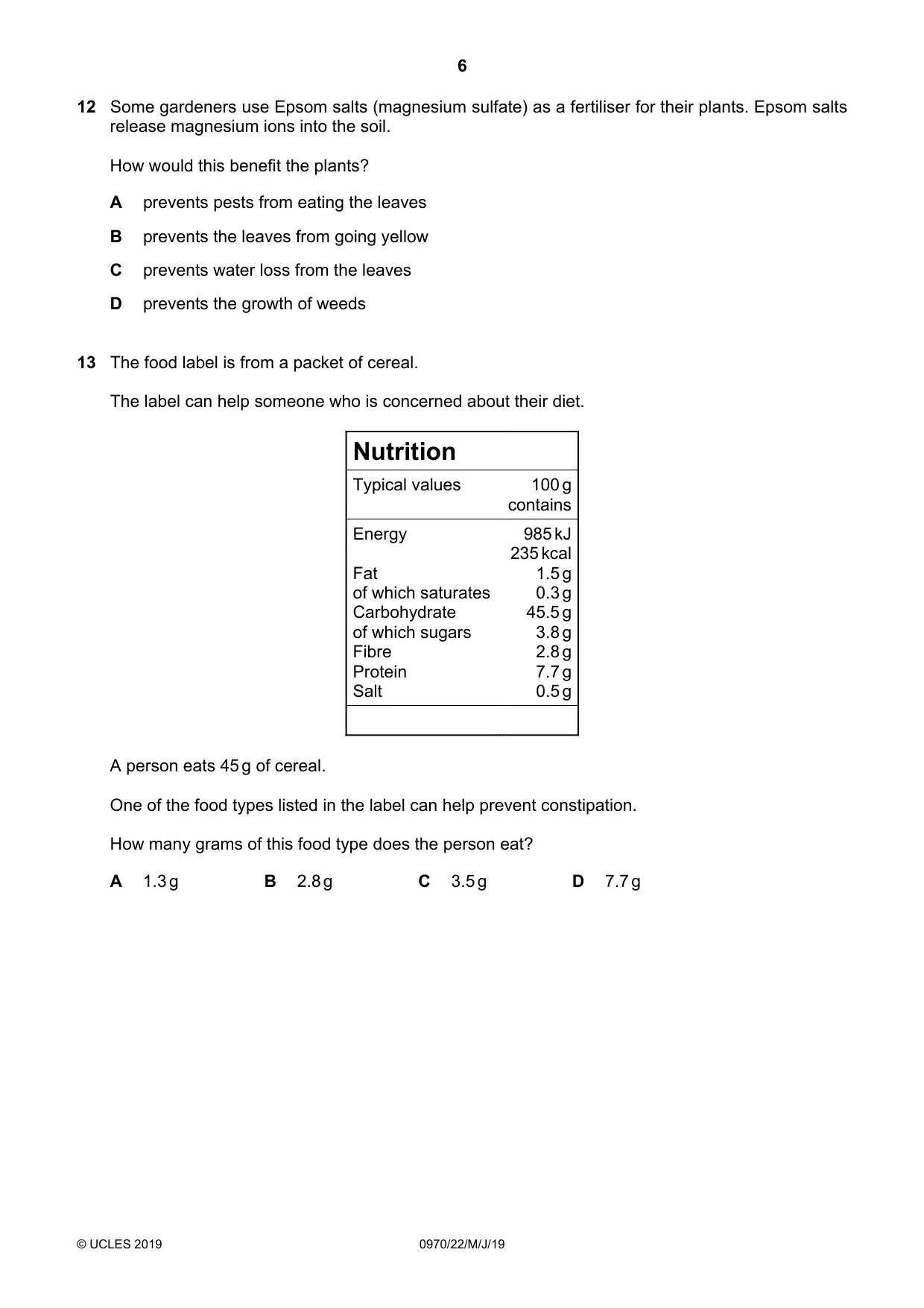
13 The food label is from a packet of cereal. The label can help someone who is concerned about their diet. Nutrition Typical values 100 g contains Energy 985 kJ 235 kcal Fat 1.5 g of which saturates 0.3 g Carbohydrate 45.5 g of which sugars 3.8 g Fibre 2.8 g Protein 7.7 g Salt 0.5 g A person eats 45 g of cereal. One of the food types listed in the label can help prevent constipation. How many grams of this food type does the person eat? A 1.3 g B 2.8 g C 3.5 g D 7.7 g
Mark scheme: A
Q14 · The cholera bacterium produces toxins that cause chloride ions to be secreted into the…
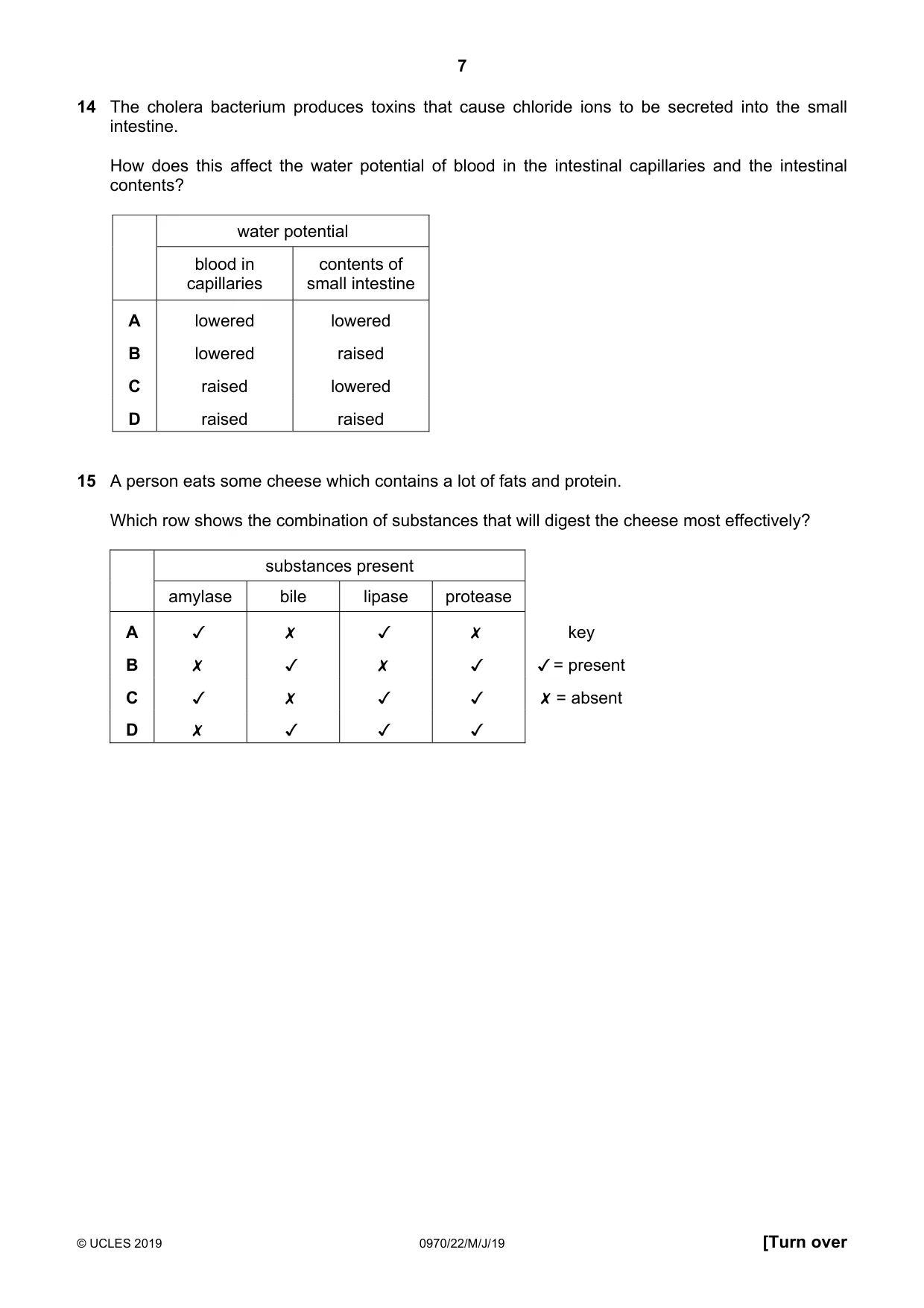
14 The cholera bacterium produces toxins that cause chloride ions to be secreted into the small intestine. How does this affect the water potential of blood in the intestinal capillaries and the intestinal contents? water potential blood in contents of capillaries small intestine A lowered lowered B lowered raised C raised lowered D raised raised
Mark scheme: C
Q15 · A person eats some cheese which contains a lot of fats and protein
15 A person eats some cheese which contains a lot of fats and protein. Which row shows the combination of substances that will digest the cheese most effectively? substances present | amylase protease | 0 0O WwW D> key J/ = present X = absent
Mark scheme: D
Q16 · A celery stalk was placed into a beaker of blue dye
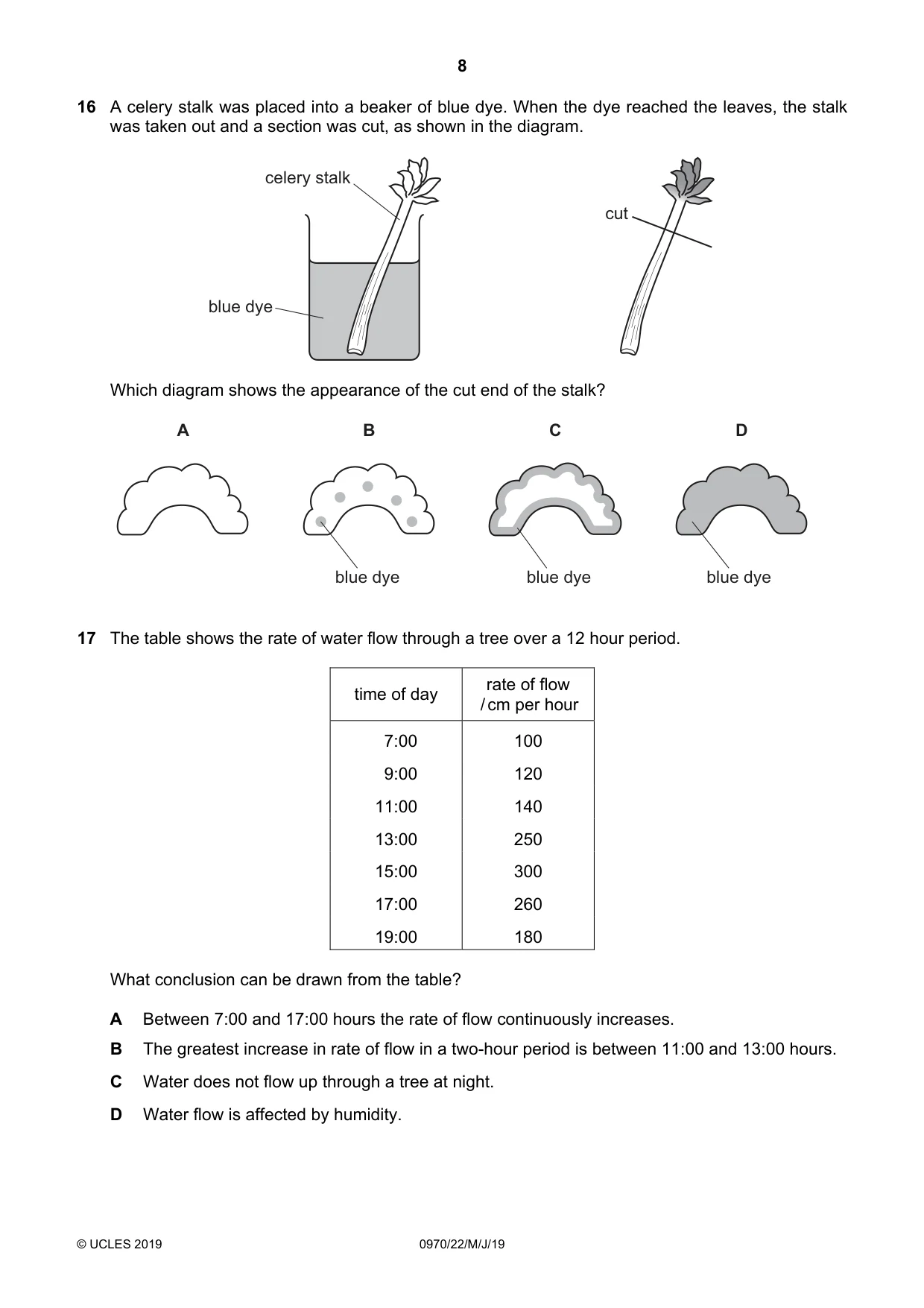
16 A celery stalk was placed into a beaker of blue dye. When the dye reached the leaves, the stalk was taken out and a section was cut, as shown in the diagram. celery stalk cut blue dye Which diagram shows the appearance of the cut end of the stalk? A B C D blue dye blue dye blue dye
Mark scheme: B
Q17 · The table shows the rate of water flow through a tree over a 12 hour period
17 The table shows the rate of water flow through a tree over a 12 hour period. rate of flow time of day / cm per hour 17:00 100 19:00 120 11:00 140 13:00 250 15:00 300 17:00 260 19:00 180 What conclusion can be drawn from the table? A Between 7:00 and 17:00 hours the rate of flow continuously increases. B The greatest increase in rate of flow in a two-hour period is between 11:00 and 13:00 hours. C Water does not flow up through a tree at night. D Water flow is affected by humidity.
Mark scheme: B
Q18 · The diagram shows some potato tubers
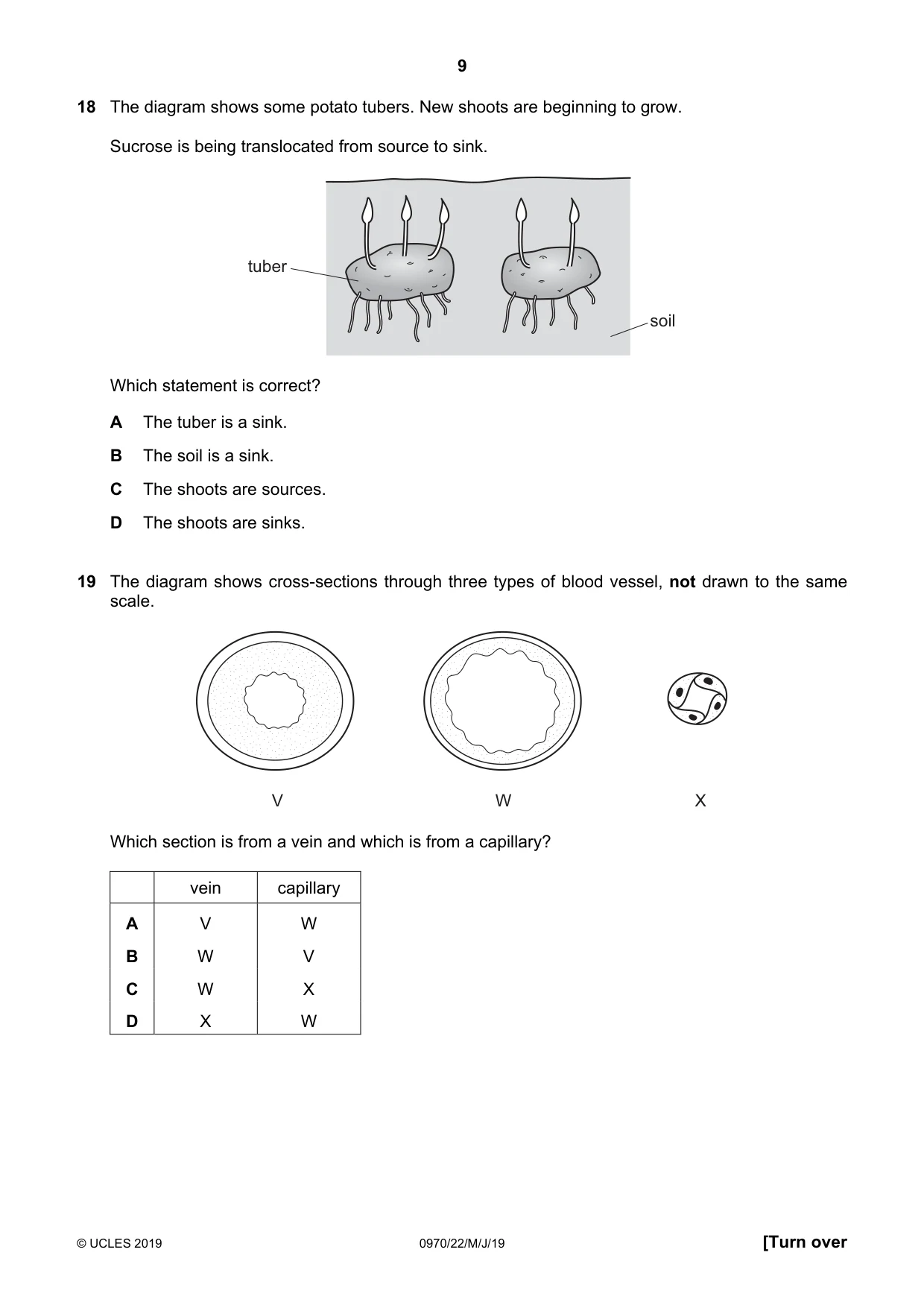
18 The diagram shows some potato tubers. New shoots are beginning to grow. Sucrose is being translocated from source to sink. tuber soil Which statement is correct? A The tuber is a sink. B The soil is a sink. C The shoots are sources. D The shoots are sinks.
Mark scheme: D
Q19 · The diagram shows cross-sections through three types of blood vessel, not drawn to the…
19 The diagram shows cross-sections through three types of blood vessel, not drawn to the same scale. V W X Which section is from a vein and which is from a capillary? vein capillary A V W B W V C W X D X W
Mark scheme: C
Q20 · Which disease is transmissible?
20 Which disease is transmissible? A cholera B coronary heart disease C lung cancer D scurvy
Mark scheme: A
Q21 · The diagram illustrates changes in air pressure taking place inside the lungs during a…
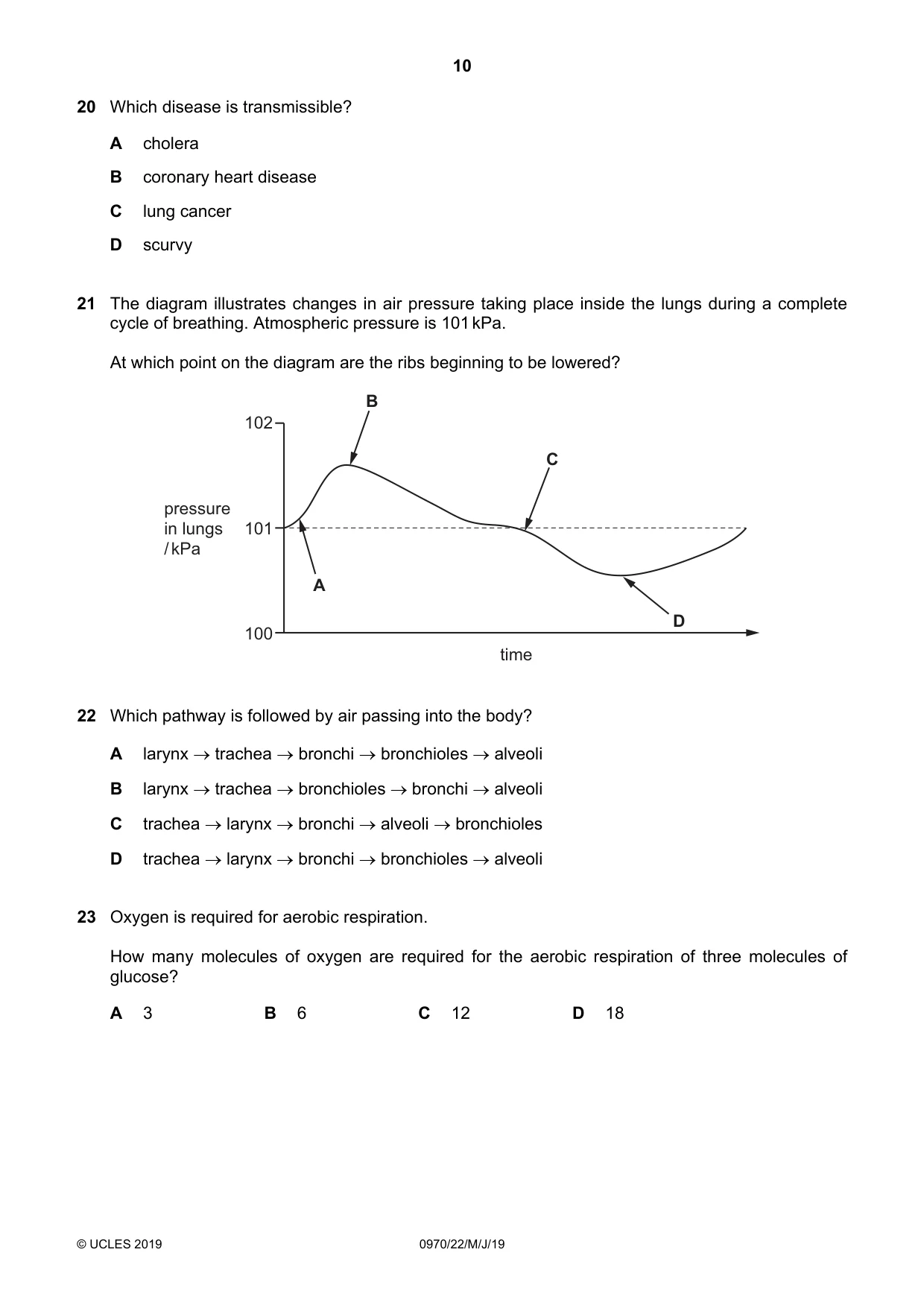
21 The diagram illustrates changes in air pressure taking place inside the lungs during a complete cycle of breathing. Atmospheric pressure is 101 kPa. At which point on the diagram are the ribs beginning to be lowered? B 102 C pressure in lungs 101 / kPa A D 100 time
Mark scheme: A
Q22 · Which pathway is followed by air passing into the body?
22 Which pathway is followed by air passing into the body? A larynx → trachea → bronchi → bronchioles → alveoli B larynx → trachea → bronchioles → bronchi → alveoli C trachea → larynx → bronchi → alveoli → bronchioles D trachea → larynx → bronchi → bronchioles → alveoli
Mark scheme: A
Q23 · Oxygen is required for aerobic respiration
23 Oxygen is required for aerobic respiration. How many molecules of oxygen are required for the aerobic respiration of three molecules of glucose? A 3 B 6 C 12 D 18
Mark scheme: D
Q24 · Which statement about involuntary responses is correct?
24 Which statement about involuntary responses is correct? A They always result in the same response to the same stimulus. B They are learned responses. C They are slower than voluntary responses. D They never use voluntary muscles.
Mark scheme: A
Q25 · The diagram shows the first part of a kidney tubule and its blood supply
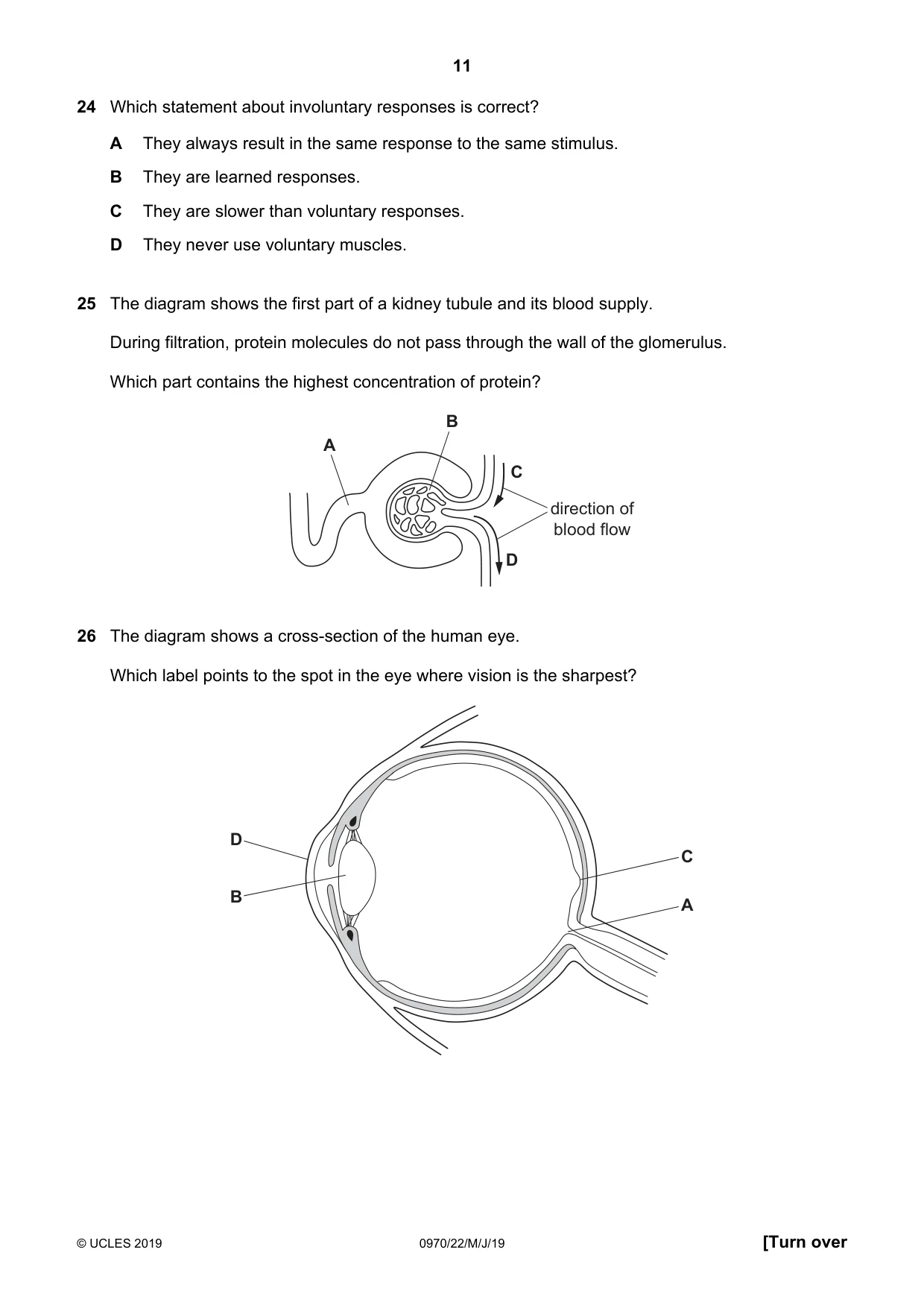
25 The diagram shows the first part of a kidney tubule and its blood supply. During filtration, protein molecules do not pass through the wall of the glomerulus. Which part contains the highest concentration of protein? B A C direction of blood flow D
Mark scheme: D
Q26 · The diagram shows a cross-section of the human eye
26 The diagram shows a cross-section of the human eye. Which label points to the spot in the eye where vision is the sharpest? D C B A
Mark scheme: C
Q27 · Three plant shoots have their tips removed
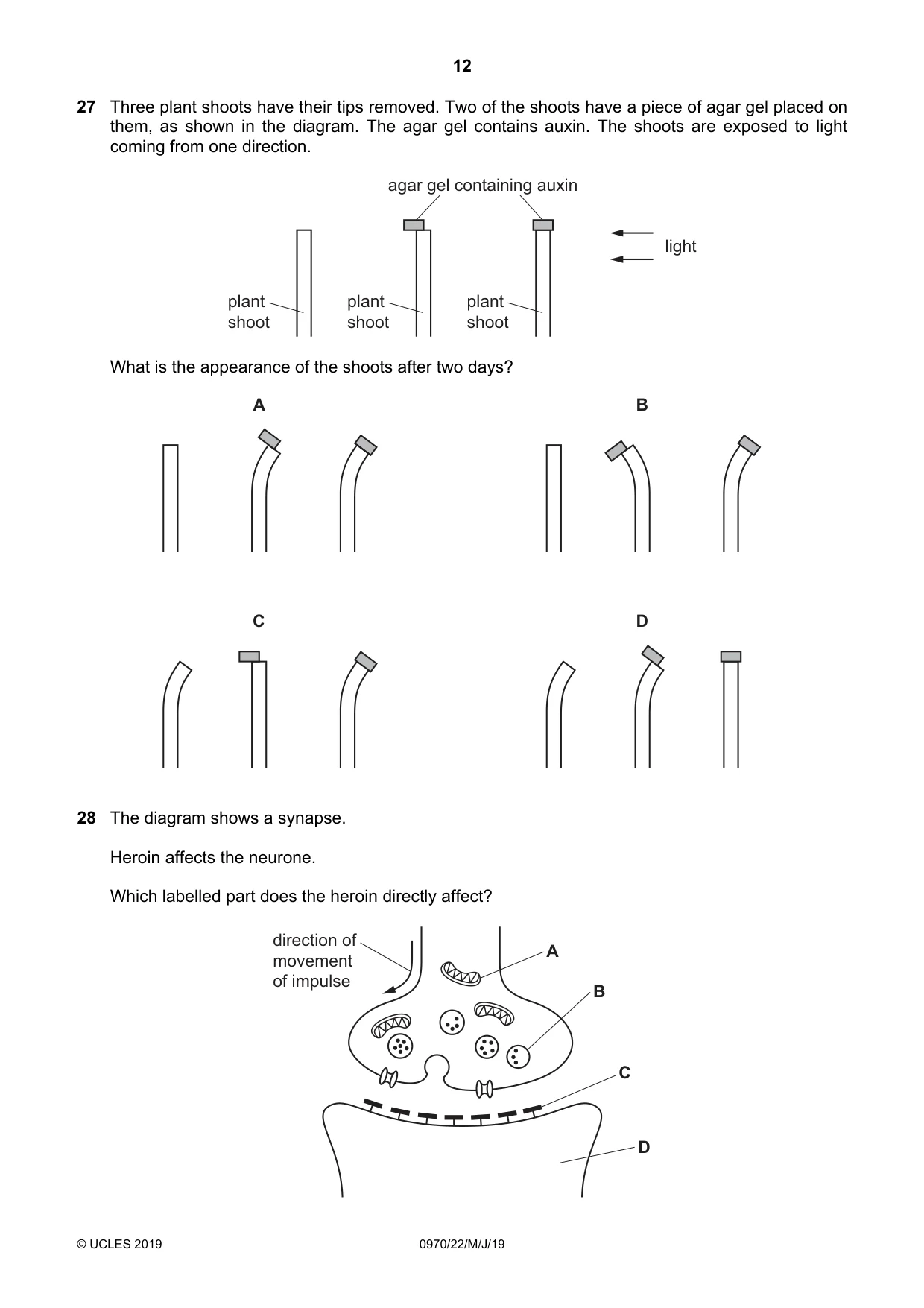
27 Three plant shoots have their tips removed. Two of the shoots have a piece of agar gel placed on them, as shown in the diagram. The agar gel contains auxin. The shoots are exposed to light coming from one direction. agar gel containing auxin light plant plant plant shoot shoot shoot What is the appearance of the shoots after two days? A B C D
Mark scheme: A
Q28 · The diagram shows a synapse
28 The diagram shows a synapse. Heroin affects the neurone. Which labelled part does the heroin directly affect? direction of A movement of impulse B C D
Mark scheme: C
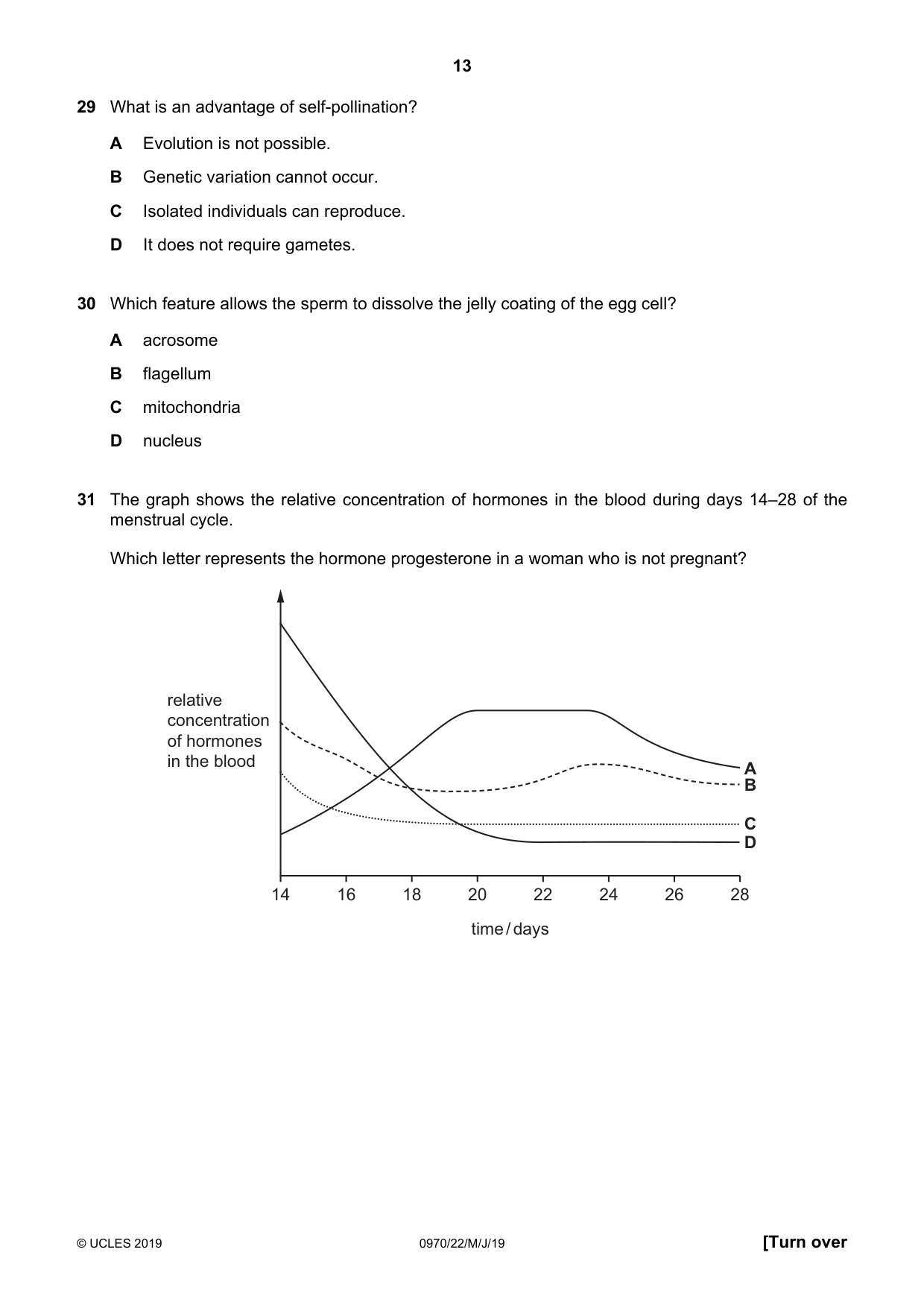
Q29 · What is an advantage of self-pollination?
29 What is an advantage of self-pollination? A Evolution is not possible. B Genetic variation cannot occur. C Isolated individuals can reproduce. D It does not require gametes.
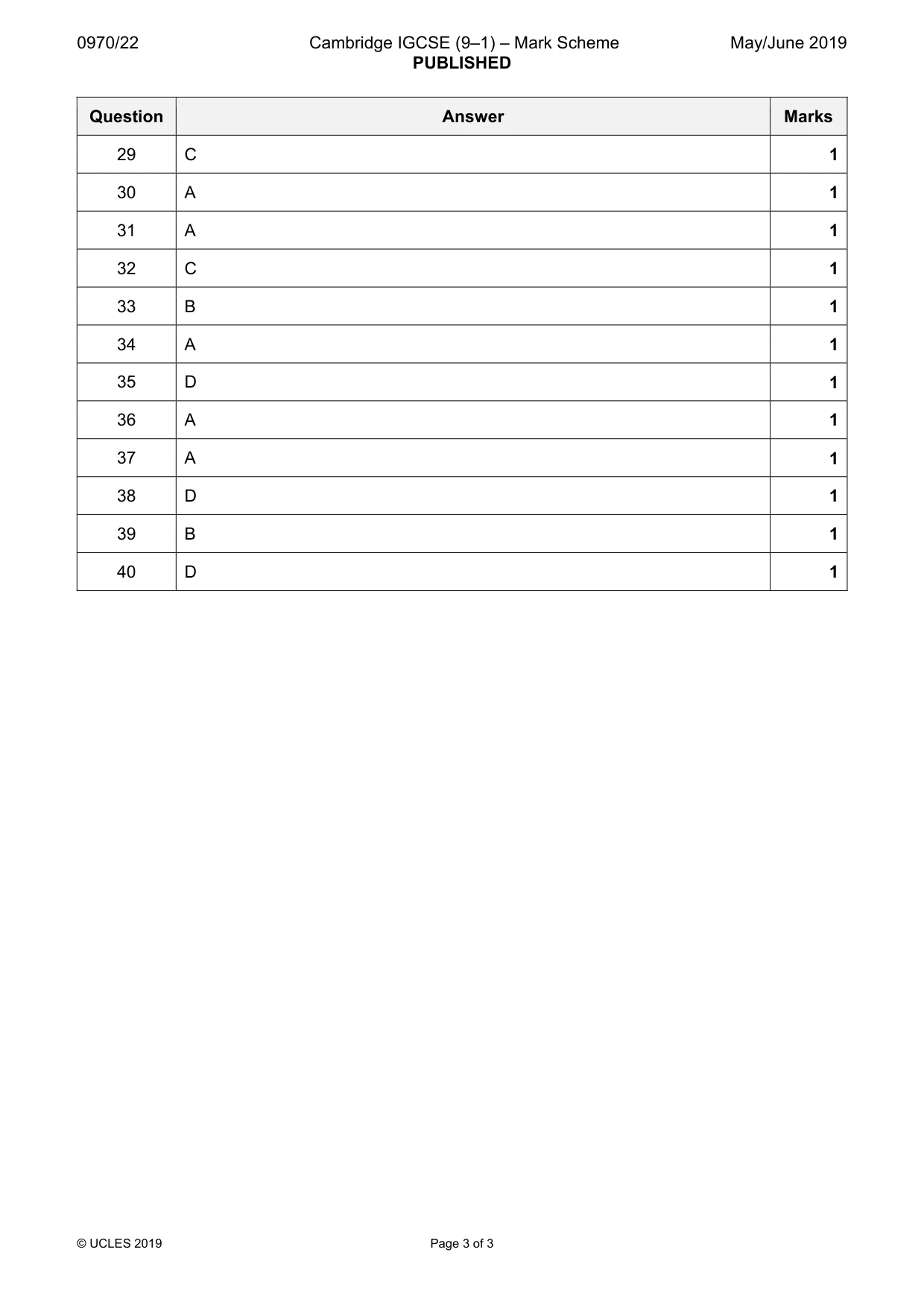
Mark scheme: C
Q30 · Which feature allows the sperm to dissolve the jelly coating of the egg cell?
30 Which feature allows the sperm to dissolve the jelly coating of the egg cell? A acrosome B flagellum C mitochondria D nucleus
Mark scheme: A
Q31 · The graph shows the relative concentration of hormones in the blood during days 14–28 of…
31 The graph shows the relative concentration of hormones in the blood during days 14–28 of the menstrual cycle. Which letter represents the hormone progesterone in a woman who is not pregnant? relative concentration of hormones in the blood A B C D 14 16 18 20 22 24 26 28 time / days
Mark scheme: A
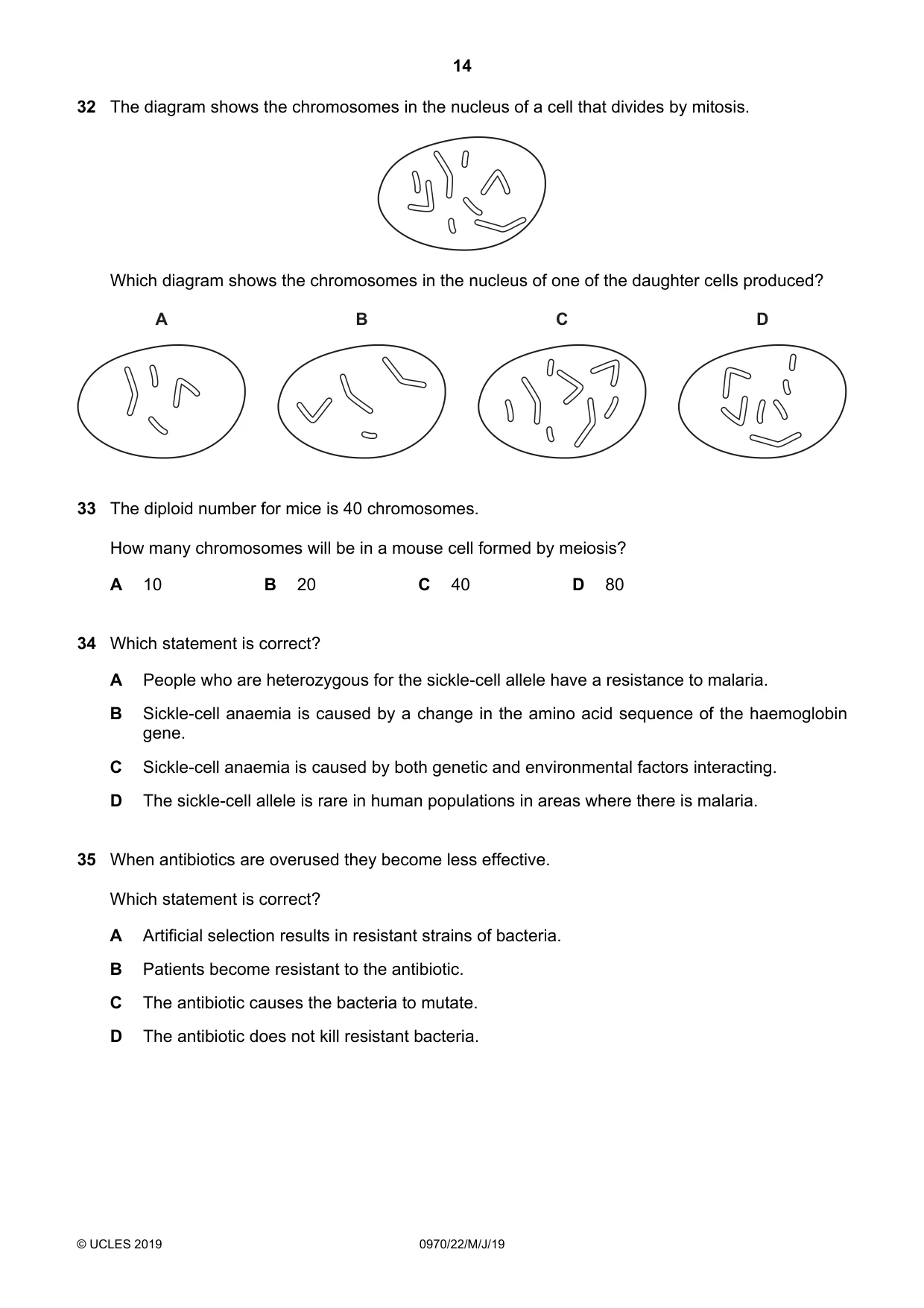
Q32 · The diagram shows the chromosomes in the nucleus of a cell that divides by mitosis
32 The diagram shows the chromosomes in the nucleus of a cell that divides by mitosis. Which diagram shows the chromosomes in the nucleus of one of the daughter cells produced? A B C D
Mark scheme: C
Q33 · The diploid number for mice is 40 chromosomes
33 The diploid number for mice is 40 chromosomes. How many chromosomes will be in a mouse cell formed by meiosis? A 10 B 20 C 40 D 80
Mark scheme: B
Q34 · Which statement is correct?
34 Which statement is correct? A People who are heterozygous for the sickle-cell allele have a resistance to malaria. B Sickle-cell anaemia is caused by a change in the amino acid sequence of the haemoglobin gene. C Sickle-cell anaemia is caused by both genetic and environmental factors interacting. D The sickle-cell allele is rare in human populations in areas where there is malaria.
Mark scheme: A
Q35 · When antibiotics are overused they become less effective
35 When antibiotics are overused they become less effective. Which statement is correct? A Artificial selection results in resistant strains of bacteria. B Patients become resistant to the antibiotic. C The antibiotic causes the bacteria to mutate. D The antibiotic does not kill resistant bacteria.
Mark scheme: D
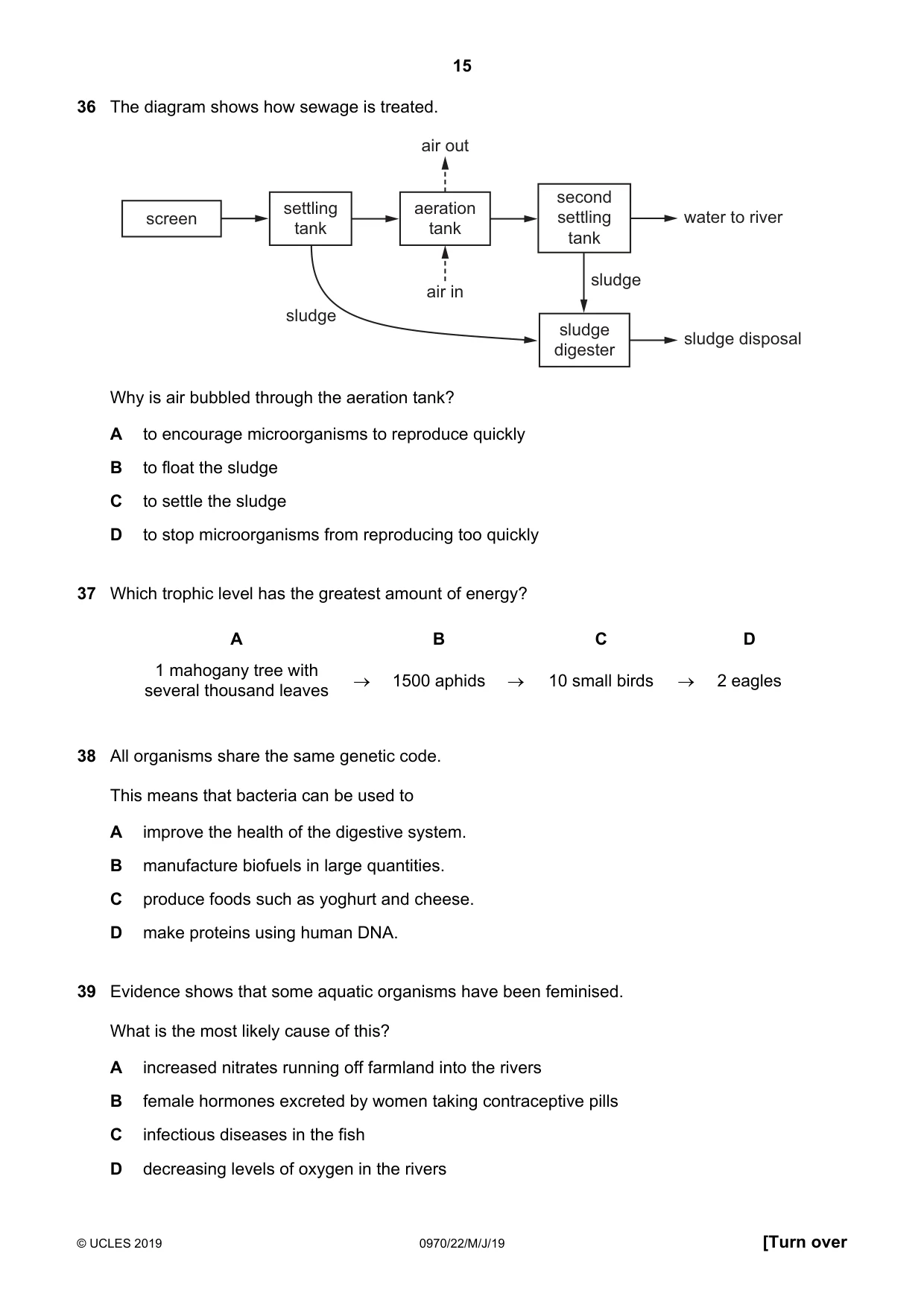
Q36 · The diagram shows how sewage is treated
36 The diagram shows how sewage is treated. air out second settling aeration screen settling water to river tank tank tank sludge air in sludge sludge sludge disposal digester Why is air bubbled through the aeration tank? A to encourage microorganisms to reproduce quickly B to float the sludge C to settle the sludge D to stop microorganisms from reproducing too quickly
Mark scheme: A
Q37 · Which trophic level has the greatest amount of energy?
37 Which trophic level has the greatest amount of energy? A B C D 1 mahogany tree with → 1500 aphids → 10 small birds → 2 eagles several thousand leaves
Mark scheme: A
Q38 · All organisms share the same genetic code
38 All organisms share the same genetic code. This means that bacteria can be used to A improve the health of the digestive system. B manufacture biofuels in large quantities. C produce foods such as yoghurt and cheese. D make proteins using human DNA.
Mark scheme: D
Q39 · Evidence shows that some aquatic organisms have been feminised
39 Evidence shows that some aquatic organisms have been feminised. What is the most likely cause of this? A increased nitrates running off farmland into the rivers B female hormones excreted by women taking contraceptive pills C infectious diseases in the fish D decreasing levels of oxygen in the rivers
Mark scheme: B
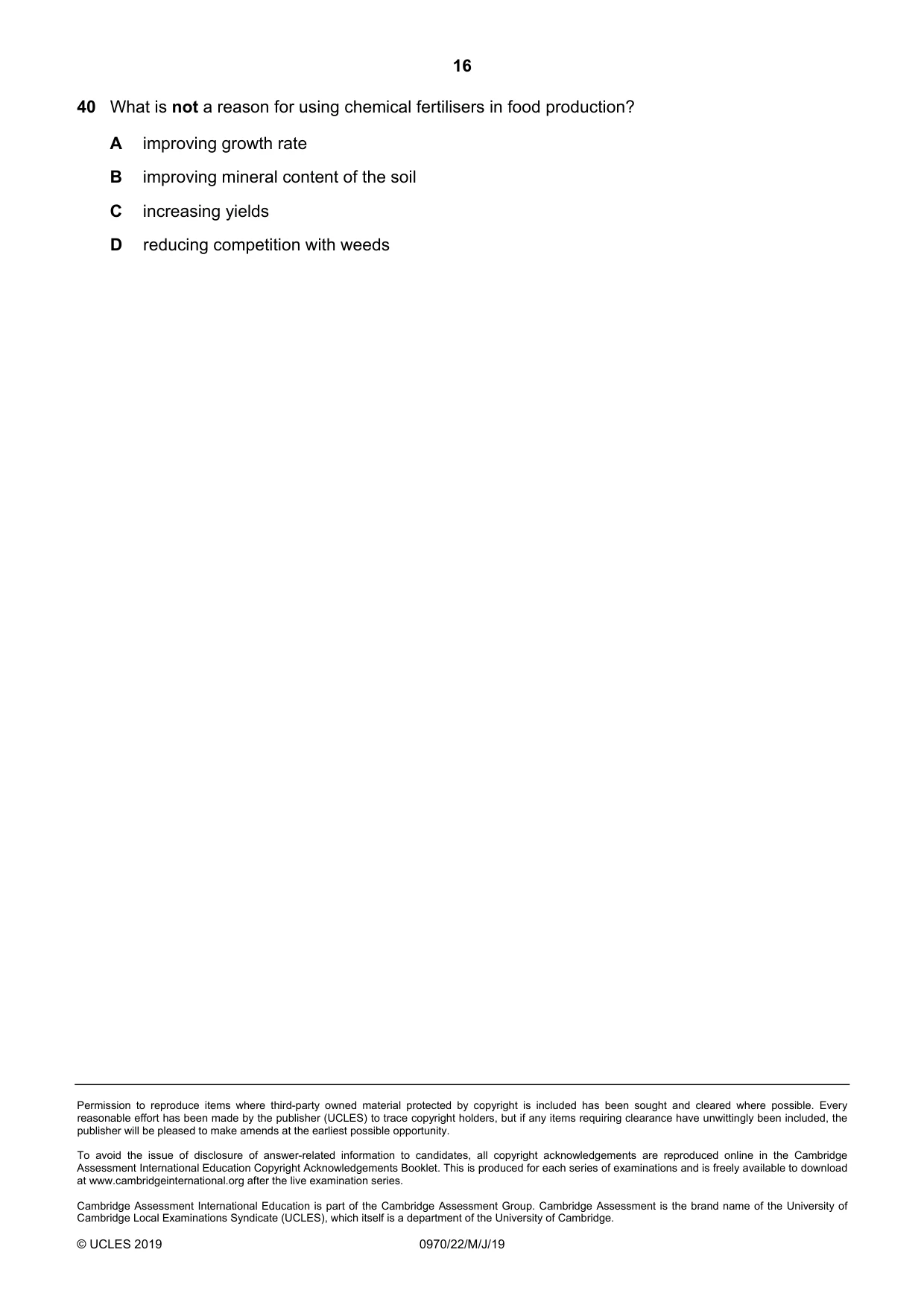
Q40 · What is not a reason for using chemical fertilisers in food production?
40 What is not a reason for using chemical fertilisers in food production? A improving growth rate B improving mineral content of the soil C increasing yields D reducing competition with weeds
Mark scheme: D
What was in this paper
The subtopics covered by these 40 questions, and how many questions each got. Open one in a new tab to see every Cambridge question on it.
2Coordination and response2Diet2Gas exchange in humans2Osmosis2Pollution2Adaptive features1Aerobic respiration1Blood vessels1Cell structure1Characteristics of living organisms1Chemical digestion1Concept and uses of classification systems1Diffusion1Diseases and immunity1Energy flow1Enzymes1Excretion in humans1Features of organisms1Food supply1Genetic modification1Meiosis1Mitosis1Photosynthesis1Selection1Sense organs1Sex hormones in humans1Sexual reproduction in humans1Sexual reproduction in plants1Size of specimens1Translocation1Transpiration1Tropic responses1Xylem and phloem1What you needed in this session
Cambridge’s own grade thresholds for 2019 May/June, Paper 2 · Variant 2. A higher threshold means an easier paper — the bar moves with how the cohort did.