Cambridge IGCSE Biology (9-1) 0970 — 2020 Oct/Nov Paper 2 · Variant 2
0970/22/O/N/20 · 40 questions · 40 marks · ≈45 min
The question paper and its mark scheme, free to read here and free to download. This is Cambridge’s own paper, exactly as it was sat.
Question paper16 pages
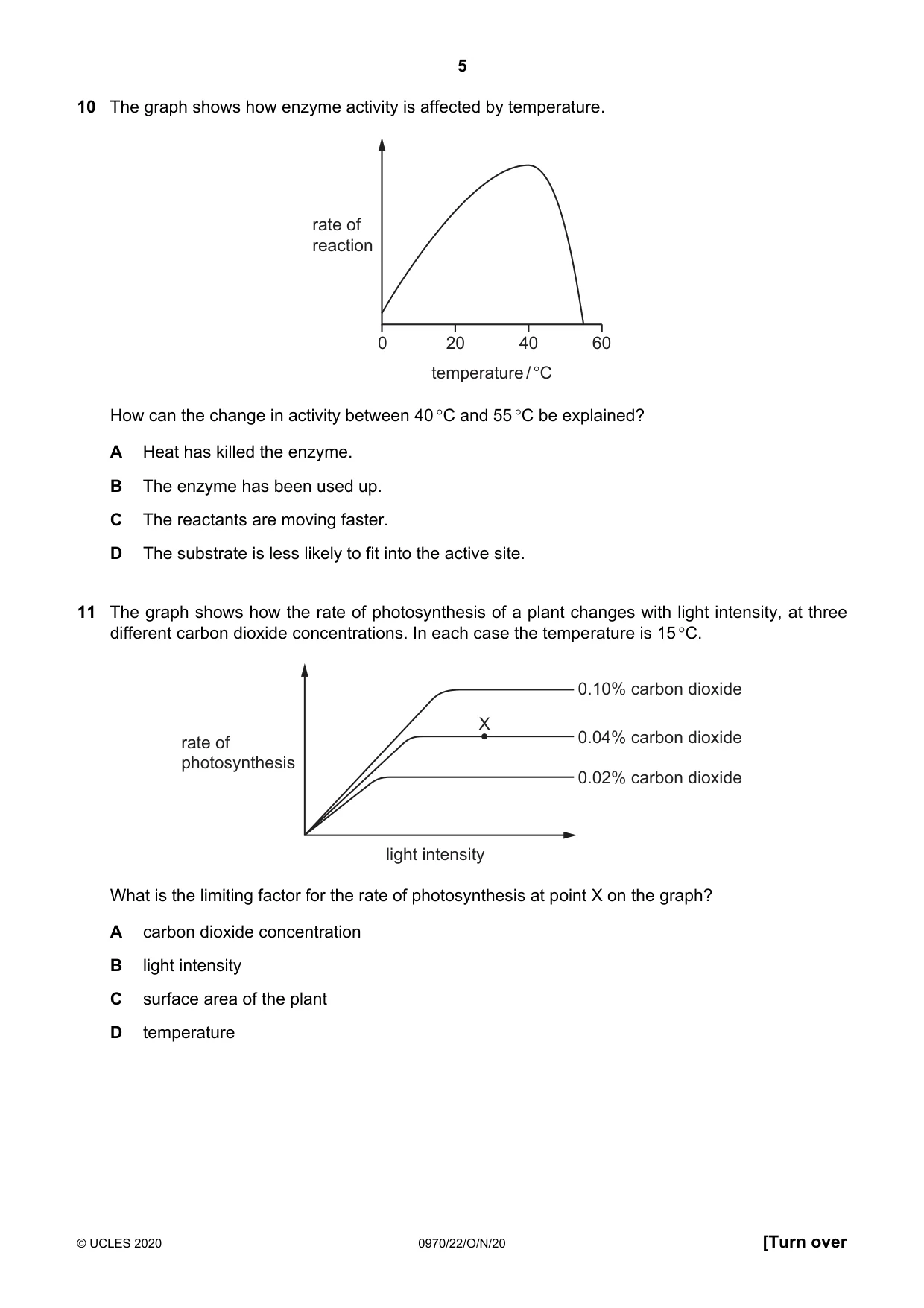
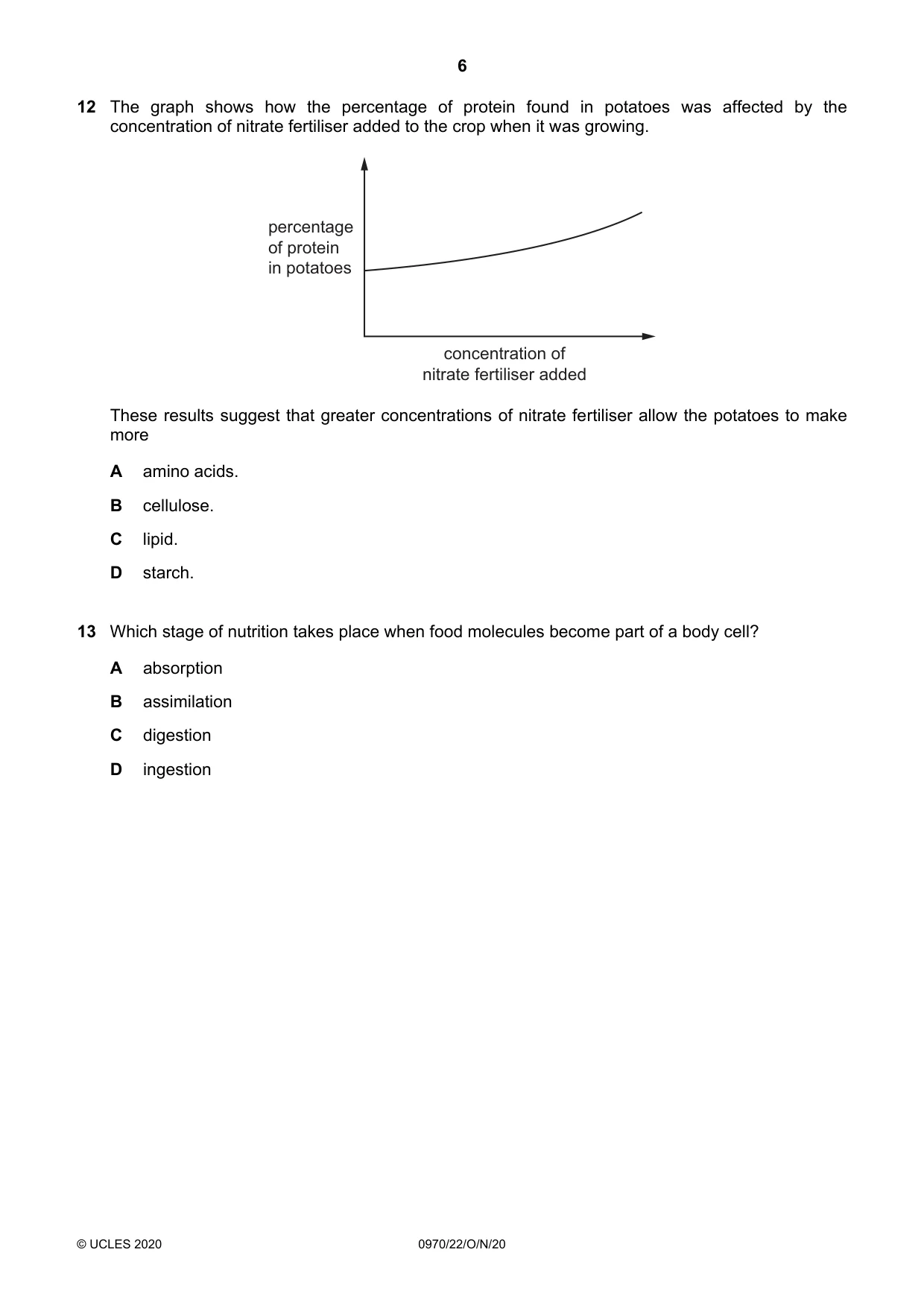
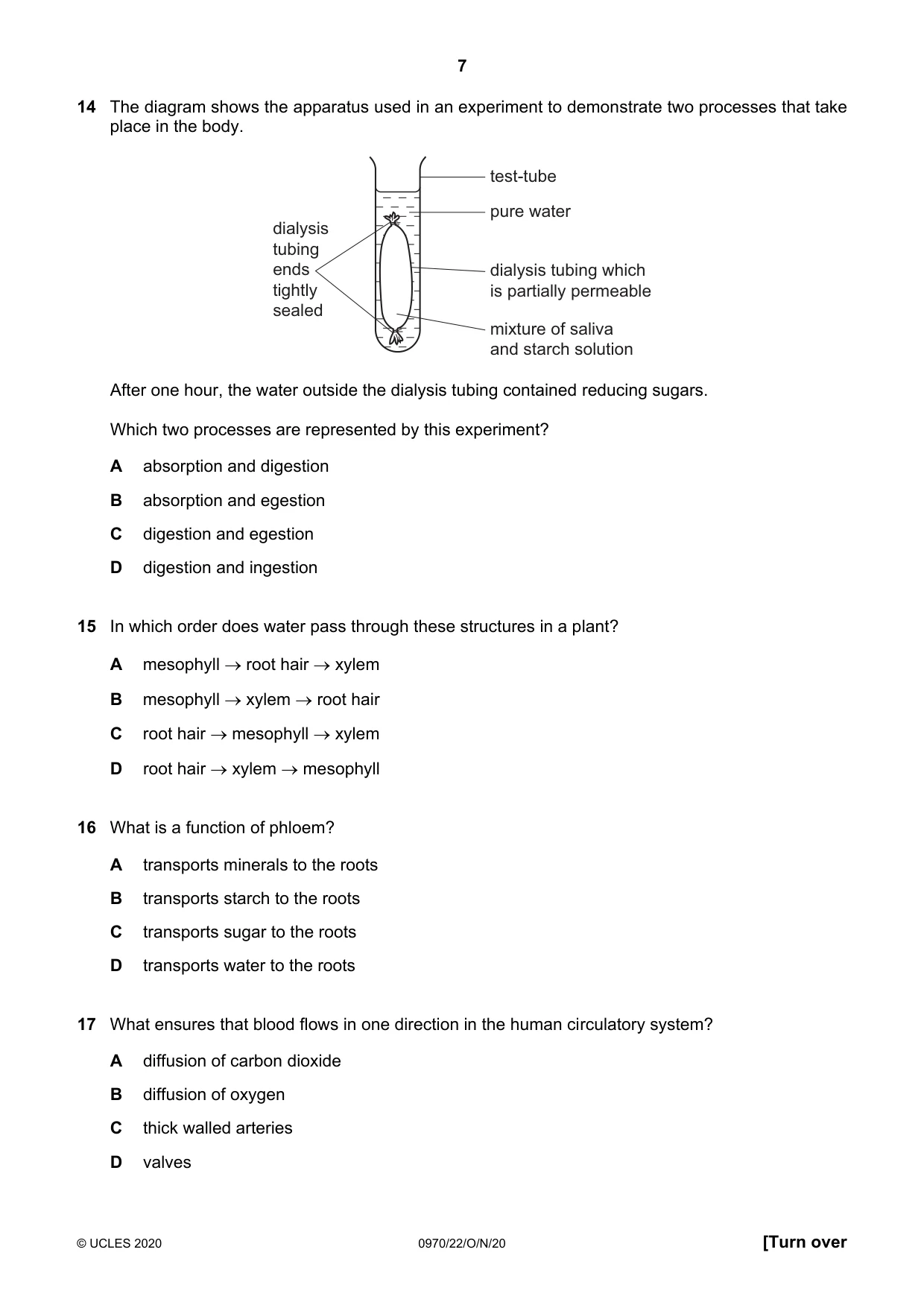
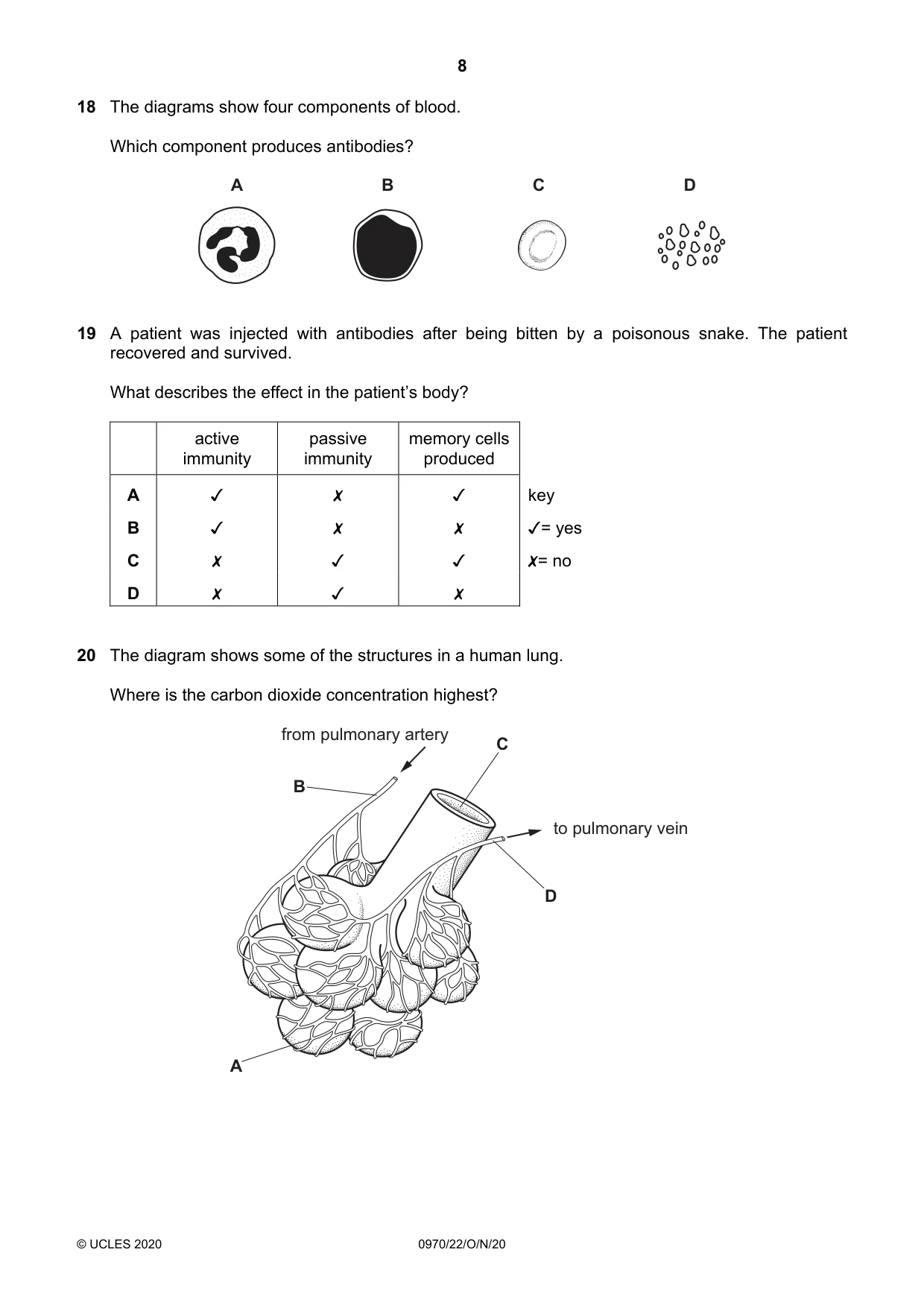


Mark scheme3 pages
Answers below. Sit the paper first if you are practising.
Questions as text
Q1 · Which process is carried out by all organisms?
1 Which process is carried out by all organisms? A growth B photosynthesis C sexual reproduction D transpiration
Mark scheme: A
Q2 · What are features of the leaves of a plant that is a dicotyledon?
2 What are features of the leaves of a plant that is a dicotyledon? broad leaves parallel veins 00 WwW > v v x x v key x v= yes v X= no x
Mark scheme: B
Q3 · The photomicrograph shows a cell from a type of aquatic plant
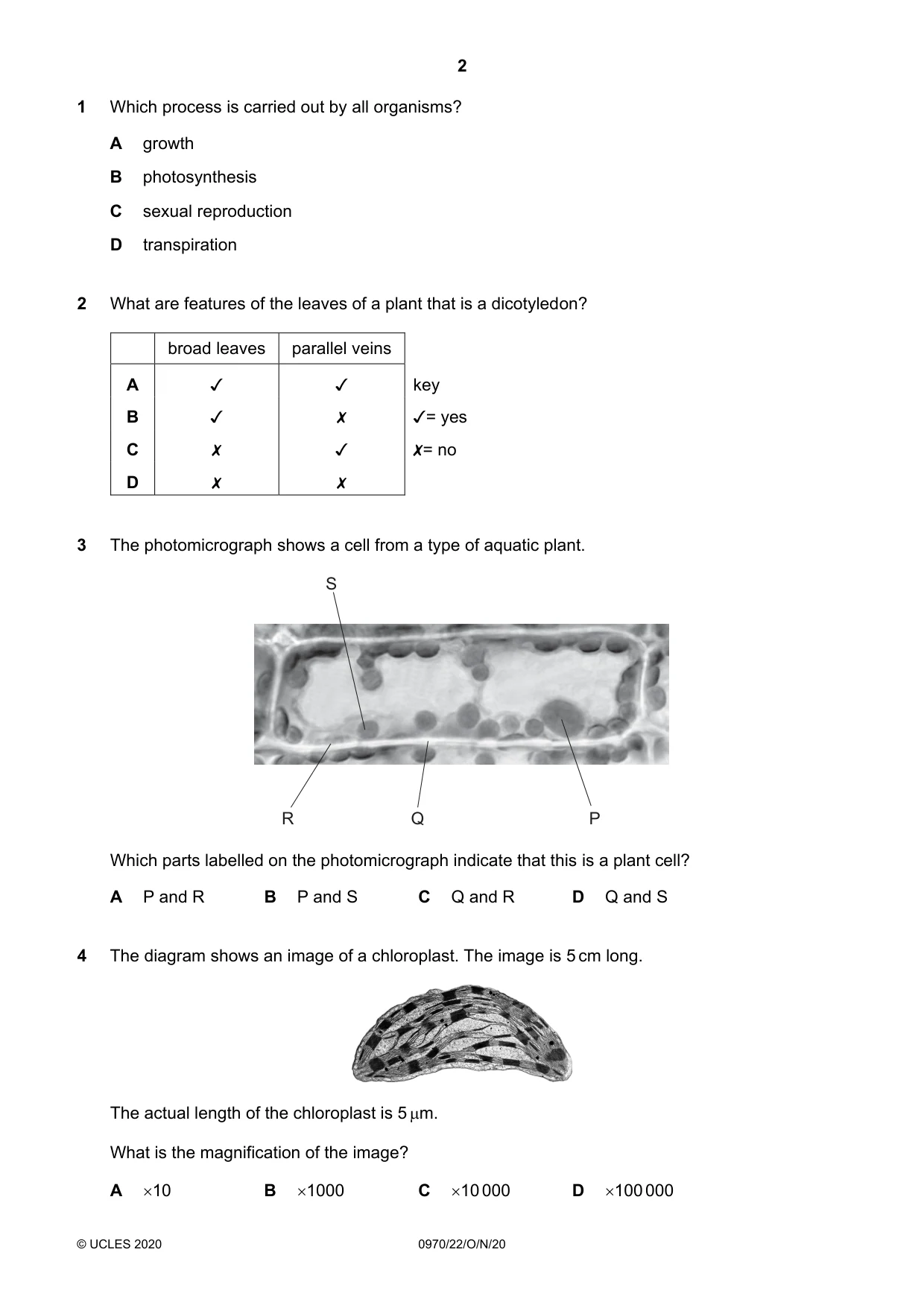
3 The photomicrograph shows a cell from a type of aquatic plant. S R Q P Which parts labelled on the photomicrograph indicate that this is a plant cell? A P and R B P and S C Q and R D Q and S
Mark scheme: D
Q4 · The diagram shows an image of a chloroplast
4 The diagram shows an image of a chloroplast. The image is 5 cm long. The actual length of the chloroplast is 5 m. What is the magnification of the image? A 10 B 1000 C 10 000 D 100 000
Mark scheme: C
Q5 · What are features of osmosis?
5 What are features of osmosis? requires a partially ousion . requires cell walls permeable membrane A v x Y B v x x Cc x v Y D x v x key /= yes X= no
Mark scheme: A
Q6 · The diagram shows apparatus which can be used to demonstrate osmosis
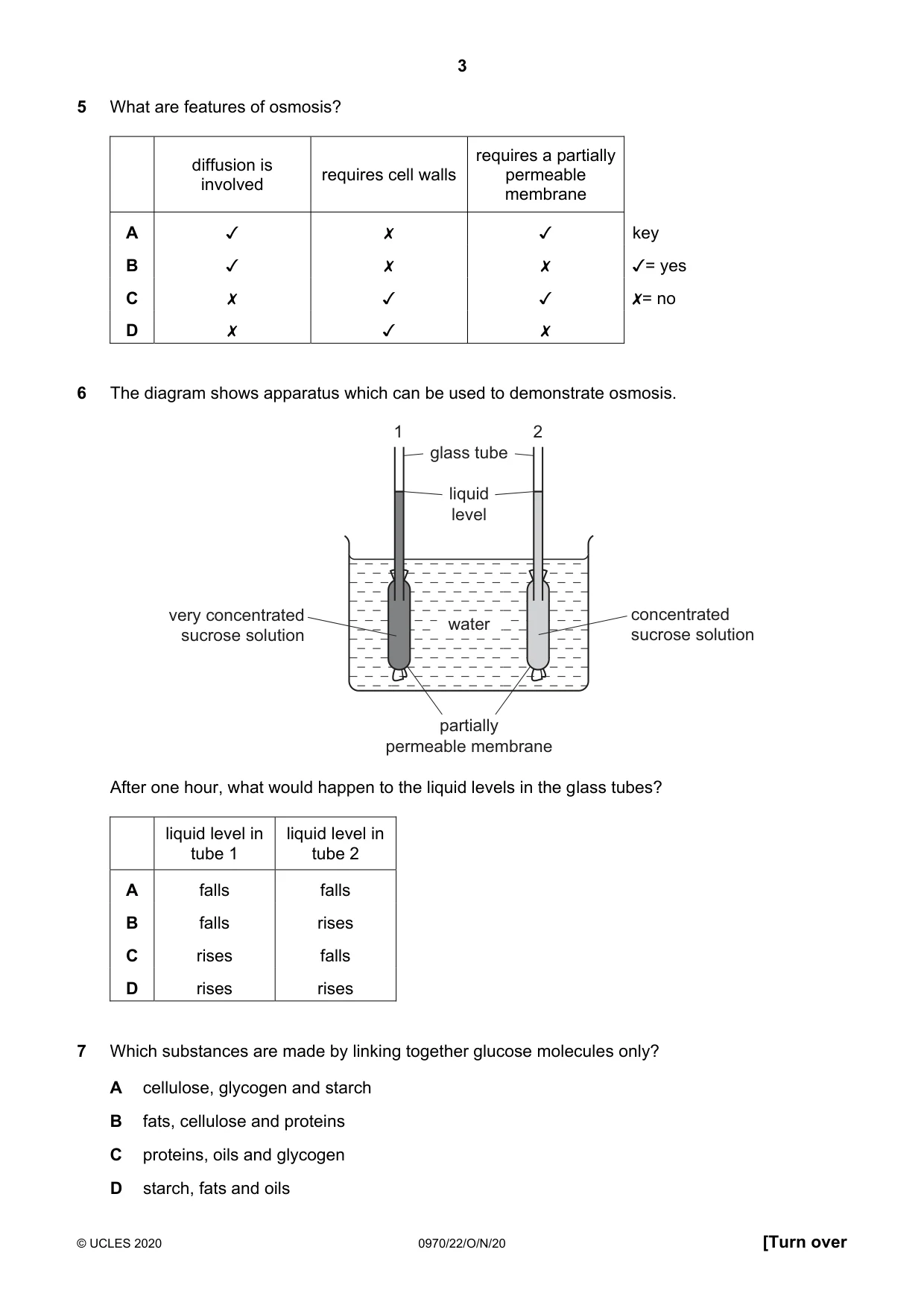
6 The diagram shows apparatus which can be used to demonstrate osmosis. 1 2 glass tube liquid level very concentrated concentrated water sucrose solution sucrose solution partially permeable membrane After one hour, what would happen to the liquid levels in the glass tubes? liquid level in liquid level in tube 1 tube 2 A falls falls B falls rises C rises falls D rises rises
Mark scheme: D
Q7 · Which substances are made by linking together glucose molecules only?
7 Which substances are made by linking together glucose molecules only? A cellulose, glycogen and starch B fats, cellulose and proteins C proteins, oils and glycogen D starch, fats and oils
Mark scheme: A
Q8 · When bases pair up in the formation of DNA, what is one of the pairings?
8 When bases pair up in the formation of DNA, what is one of the pairings? A G with A B G with C C G with G D G with T
Mark scheme: B
Q9 · The graph shows the effect of pH on the rate of reaction of an enzyme
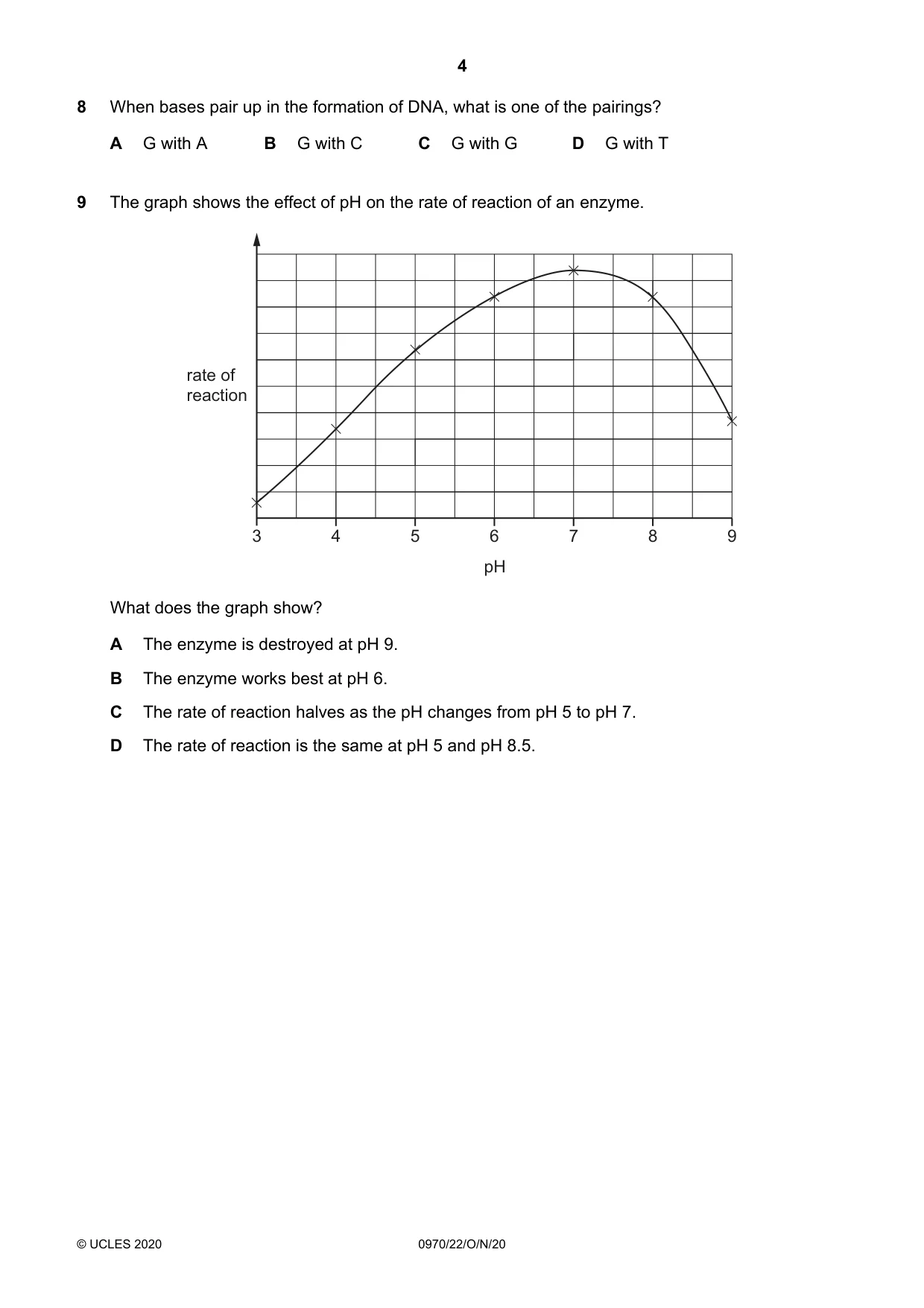
9 The graph shows the effect of pH on the rate of reaction of an enzyme. rate of reaction 3 4 5 6 7 8 9 pH What does the graph show? A The enzyme is destroyed at pH 9. B The enzyme works best at pH 6. C The rate of reaction halves as the pH changes from pH 5 to pH 7. D The rate of reaction is the same at pH 5 and pH 8.5.
Mark scheme: D
Q10 · The graph shows how enzyme activity is affected by temperature
10 The graph shows how enzyme activity is affected by temperature. rate of reaction 0 20 40 60 temperature / °C How can the change in activity between 40 C and 55 C be explained? A Heat has killed the enzyme. B The enzyme has been used up. C The reactants are moving faster. D The substrate is less likely to fit into the active site.
Mark scheme: D
Q11 · The graph shows how the rate of photosynthesis of a plant changes with light intensity…
11 The graph shows how the rate of photosynthesis of a plant changes with light intensity, at three different carbon dioxide concentrations. In each case the temperature is 15 C. 0.10% carbon dioxide X rate of 0.04% carbon dioxide photosynthesis 0.02% carbon dioxide light intensity What is the limiting factor for the rate of photosynthesis at point X on the graph? A carbon dioxide concentration B light intensity C surface area of the plant D temperature
Mark scheme: A
Q12 · The graph shows how the percentage of protein found in potatoes was affected by the…
12 The graph shows how the percentage of protein found in potatoes was affected by the concentration of nitrate fertiliser added to the crop when it was growing. percentage of protein in potatoes concentration of nitrate fertiliser added These results suggest that greater concentrations of nitrate fertiliser allow the potatoes to make more A amino acids. B cellulose. C lipid. D starch.
Mark scheme: A
Q13 · Which stage of nutrition takes place when food molecules become part of a body cell?
13 Which stage of nutrition takes place when food molecules become part of a body cell? A absorption B assimilation C digestion D ingestion
Mark scheme: B
Q14 · The diagram shows the apparatus used in an experiment to demonstrate two processes that…
14 The diagram shows the apparatus used in an experiment to demonstrate two processes that take place in the body. test-tube pure water dialysis tubing ends dialysis tubing which tightly is partially permeable sealed mixture of saliva and starch solution After one hour, the water outside the dialysis tubing contained reducing sugars. Which two processes are represented by this experiment? A absorption and digestion B absorption and egestion C digestion and egestion D digestion and ingestion
Mark scheme: A
Q15 · In which order does water pass through these structures in a plant?
15 In which order does water pass through these structures in a plant? A mesophyll root hair xylem B mesophyll xylem root hair C root hair mesophyll xylem D root hair xylem mesophyll
Mark scheme: D
Q16 · What is a function of phloem?
16 What is a function of phloem? A transports minerals to the roots B transports starch to the roots C transports sugar to the roots D transports water to the roots
Mark scheme: C
Q17 · What ensures that blood flows in one direction in the human circulatory system?
17 What ensures that blood flows in one direction in the human circulatory system? A diffusion of carbon dioxide B diffusion of oxygen C thick walled arteries D valves
Mark scheme: D
Q18 · The diagrams show four components of blood
18 The diagrams show four components of blood. Which component produces antibodies? A B C D
Mark scheme: B
Q19 · A patient was injected with antibodies after being bitten by a poisonous snake
19 A patient was injected with antibodies after being bitten by a poisonous snake. The patient recovered and survived. What describes the effect in the patient's body? active passive memory cells immunity immunity produced A J x Jv B v x x Cc x Jv Jv D x Jv x key /= yes X= no
Mark scheme: D
Q20 · The diagram shows some of the structures in a human lung
20 The diagram shows some of the structures in a human lung. Where is the carbon dioxide concentration highest? from pulmonary artery C B to pulmonary vein D A
Mark scheme: B
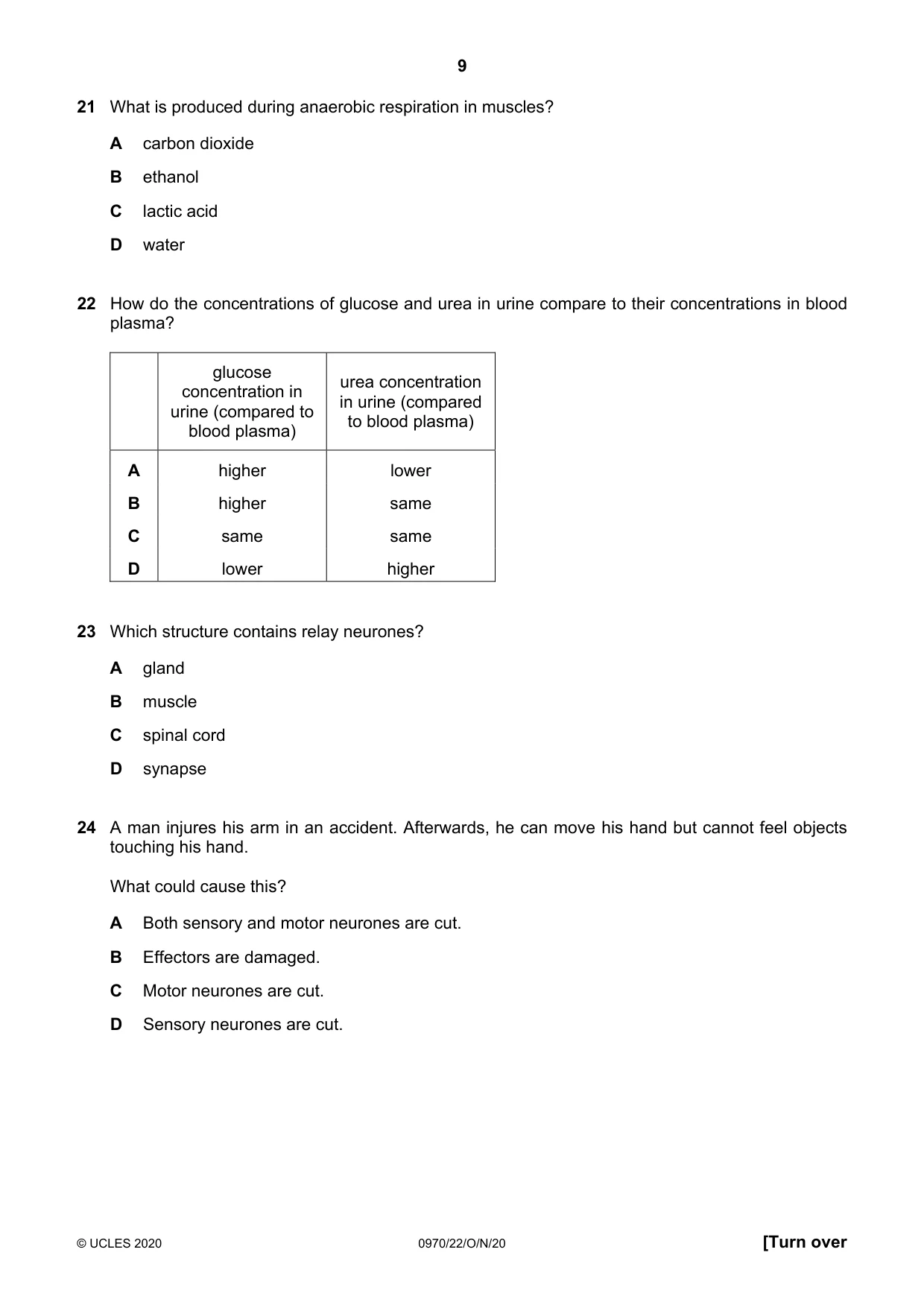
Q21 · What is produced during anaerobic respiration in muscles?
21 What is produced during anaerobic respiration in muscles? A carbon dioxide B ethanol C lactic acid D water
Mark scheme: C
Q22 · How do the concentrations of glucose and urea in urine compare to their concentrations in…
22 How do the concentrations of glucose and urea in urine compare to their concentrations in blood plasma? glucose urea concentration concentration in in urine (compared urine (compared to to blood plasma) blood plasma) A higher lower B higher same C same same D lower higher
Mark scheme: D
Q23 · Which structure contains relay neurones?
23 Which structure contains relay neurones? A gland B muscle C spinal cord D synapse
Mark scheme: C
Q24 · A man injures his arm in an accident
24 A man injures his arm in an accident. Afterwards, he can move his hand but cannot feel objects touching his hand. What could cause this? A Both sensory and motor neurones are cut. B Effectors are damaged. C Motor neurones are cut. D Sensory neurones are cut.
Mark scheme: D
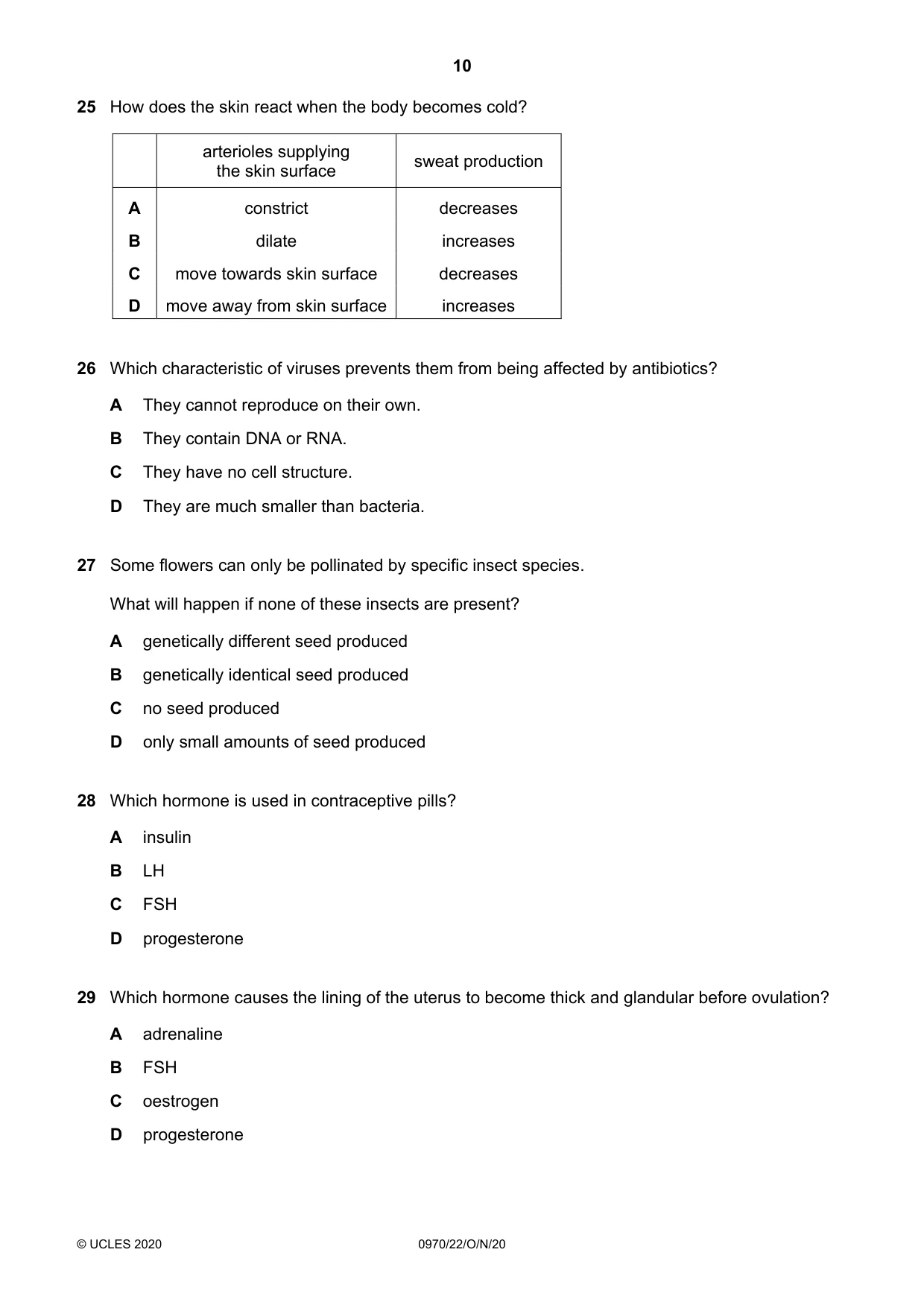
Q25 · How does the skin react when the body becomes cold?
25 How does the skin react when the body becomes cold? arterioles supplying sweat production the skin surface A constrict decreases B dilate increases C move towards skin surface decreases D move away from skin surface increases
Mark scheme: A
Q26 · Which characteristic of viruses prevents them from being affected by antibiotics?
26 Which characteristic of viruses prevents them from being affected by antibiotics? A They cannot reproduce on their own. B They contain DNA or RNA. C They have no cell structure. D They are much smaller than bacteria.
Mark scheme: C
Q27 · Some flowers can only be pollinated by specific insect species
27 Some flowers can only be pollinated by specific insect species. What will happen if none of these insects are present? A genetically different seed produced B genetically identical seed produced C no seed produced D only small amounts of seed produced
Mark scheme: C
Q28 · Which hormone is used in contraceptive pills?
28 Which hormone is used in contraceptive pills? A insulin B LH C FSH D progesterone
Mark scheme: D
Q29 · Which hormone causes the lining of the uterus to become thick and glandular before…
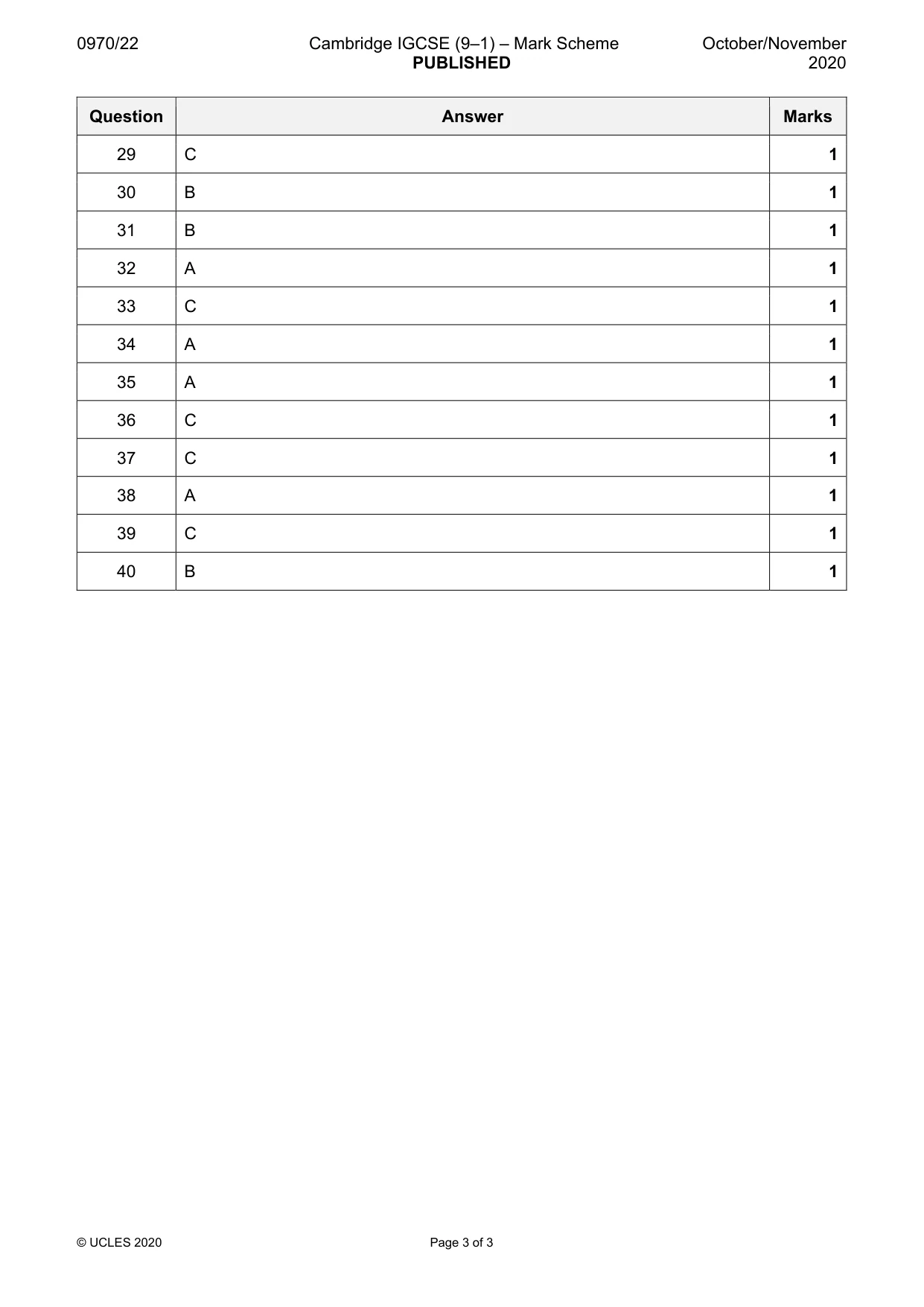
29 Which hormone causes the lining of the uterus to become thick and glandular before ovulation? A adrenaline B FSH C oestrogen D progesterone
Mark scheme: C
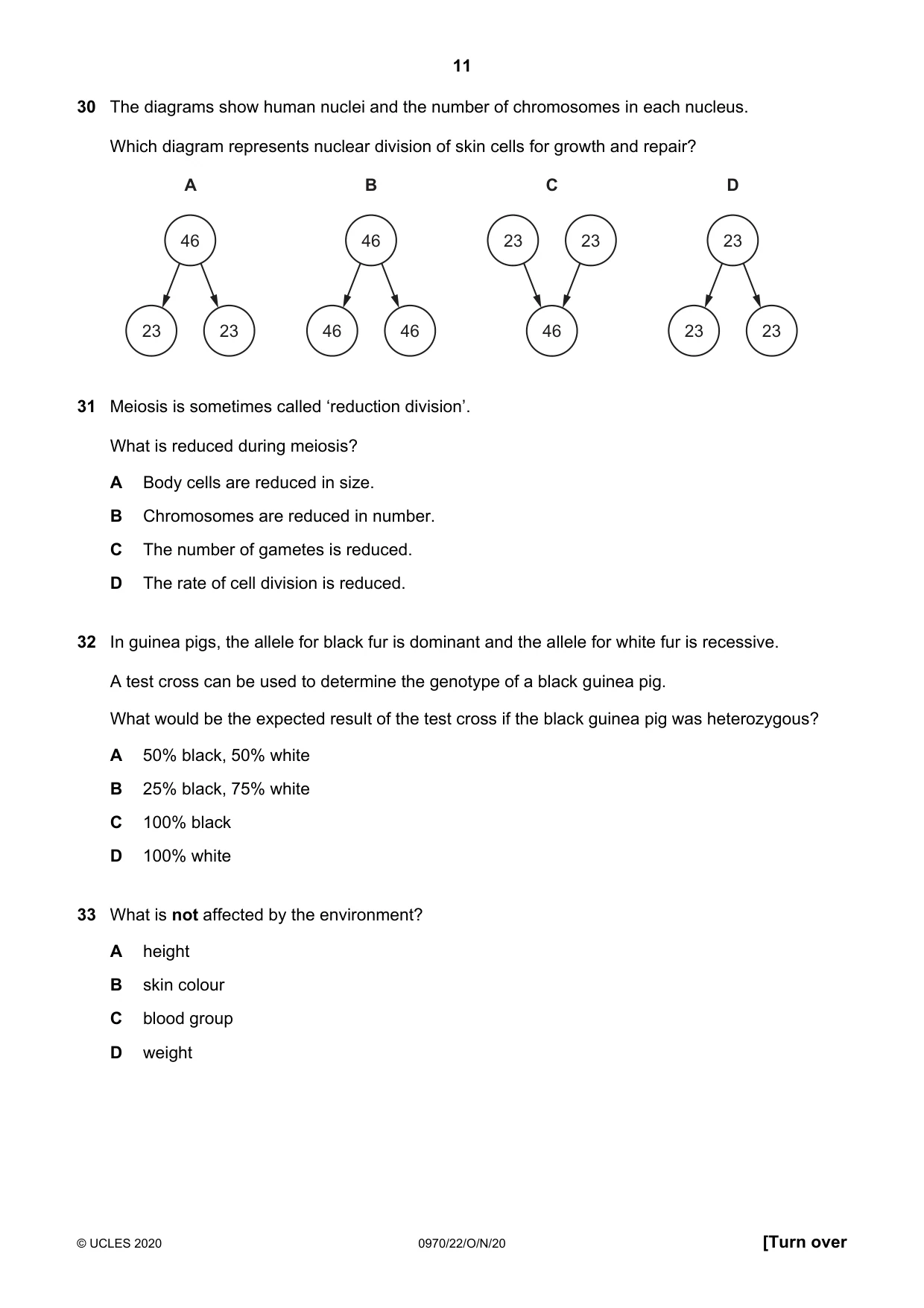
Q30 · The diagrams show human nuclei and the number of chromosomes in each nucleus
30 The diagrams show human nuclei and the number of chromosomes in each nucleus. Which diagram represents nuclear division of skin cells for growth and repair? A B C D 46 46 23 23 23 23 23 46 46 46 23 23
Mark scheme: B
Q31 · Meiosis is sometimes called ‘reduction division’
31 Meiosis is sometimes called ‘reduction division’. What is reduced during meiosis? A Body cells are reduced in size. B Chromosomes are reduced in number. C The number of gametes is reduced. D The rate of cell division is reduced.
Mark scheme: B
Q32 · In guinea pigs, the allele for black fur is dominant and the allele for white fur is…
32 In guinea pigs, the allele for black fur is dominant and the allele for white fur is recessive. A test cross can be used to determine the genotype of a black guinea pig. What would be the expected result of the test cross if the black guinea pig was heterozygous? A 50% black, 50% white B 25% black, 75% white C 100% black D 100% white
Mark scheme: A
Q33 · What is not affected by the environment?
33 What is not affected by the environment? A height B skin colour C blood group D weight
Mark scheme: C
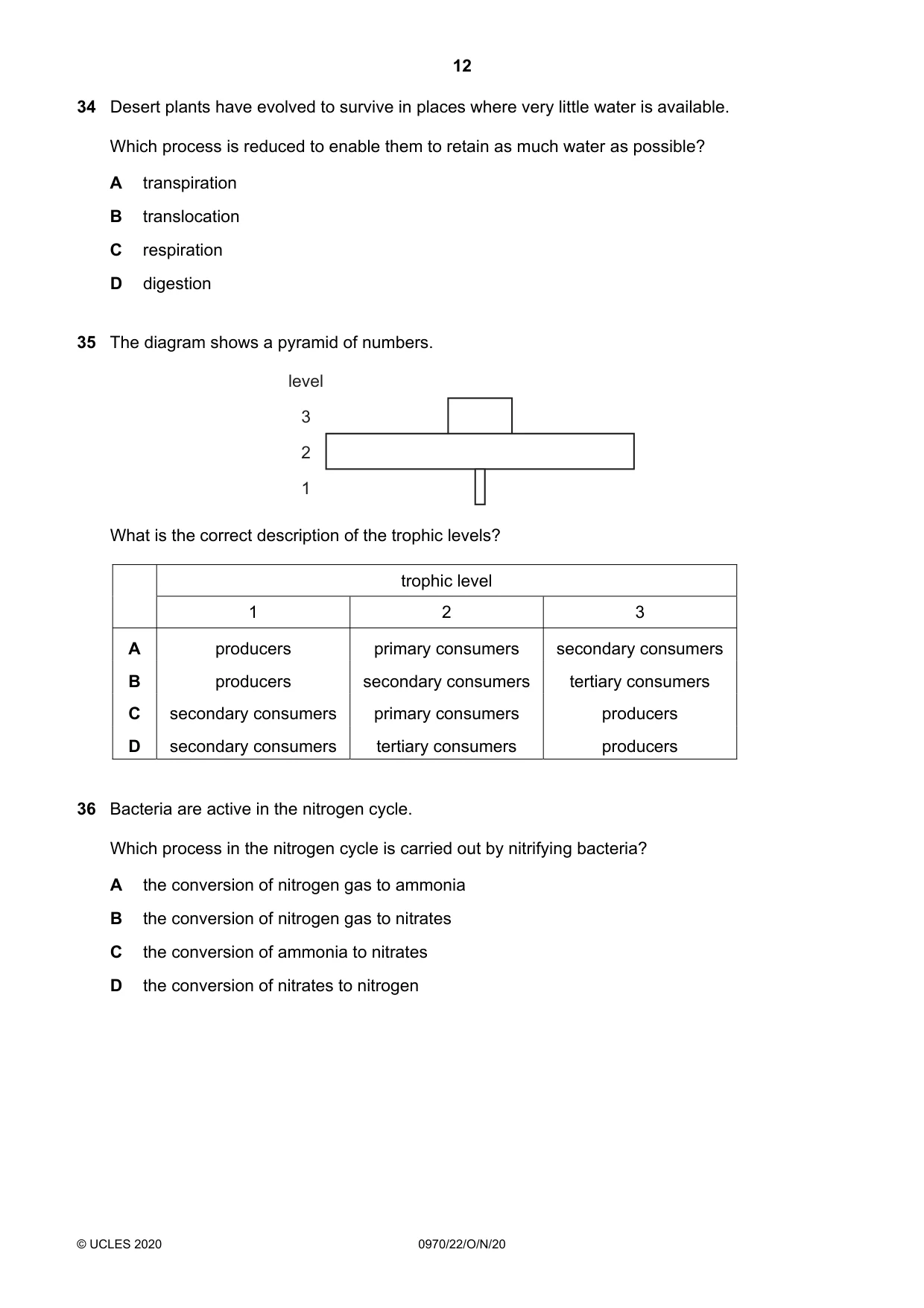
Q34 · Desert plants have evolved to survive in places where very little water is available
34 Desert plants have evolved to survive in places where very little water is available. Which process is reduced to enable them to retain as much water as possible? A transpiration B translocation C respiration D digestion
Mark scheme: A
Q35 · The diagram shows a pyramid of numbers
35 The diagram shows a pyramid of numbers. level 3 2 1 What is the correct description of the trophic levels? trophic level 1 2 3 A producers primary consumers secondary consumers B producers secondary consumers tertiary consumers C secondary consumers primary consumers producers D secondary consumers tertiary consumers producers
Mark scheme: A
Q36 · Bacteria are active in the nitrogen cycle
36 Bacteria are active in the nitrogen cycle. Which process in the nitrogen cycle is carried out by nitrifying bacteria? A the conversion of nitrogen gas to ammonia B the conversion of nitrogen gas to nitrates C the conversion of ammonia to nitrates D the conversion of nitrates to nitrogen
Mark scheme: C
Q37 · The diagram shows a population growth curve
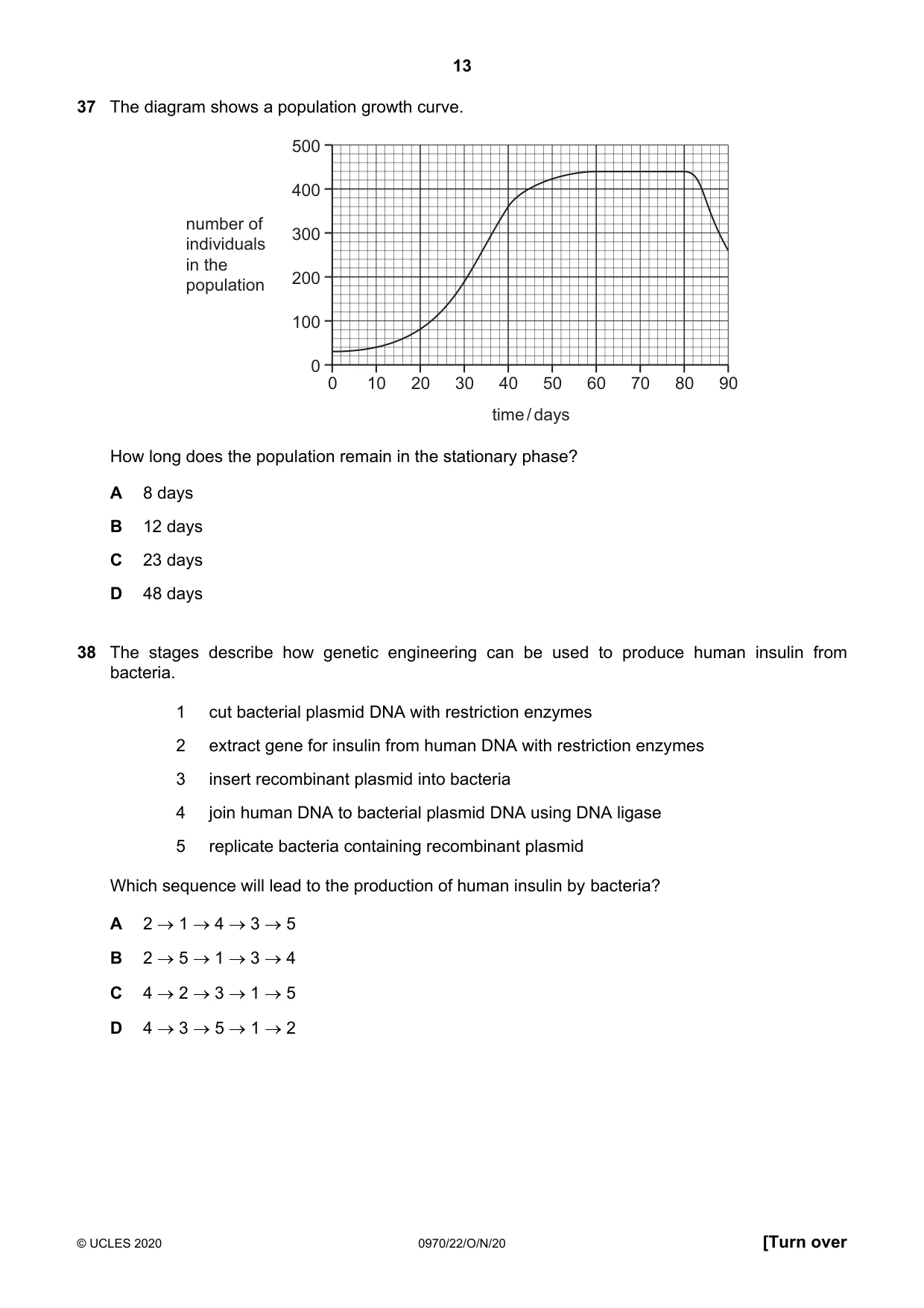
37 The diagram shows a population growth curve. 500 400 number of 300 individuals in the population 200 100 0 0 10 20 30 40 50 60 70 80 90 time / days How long does the population remain in the stationary phase? A 8 days B 12 days C 23 days D 48 days
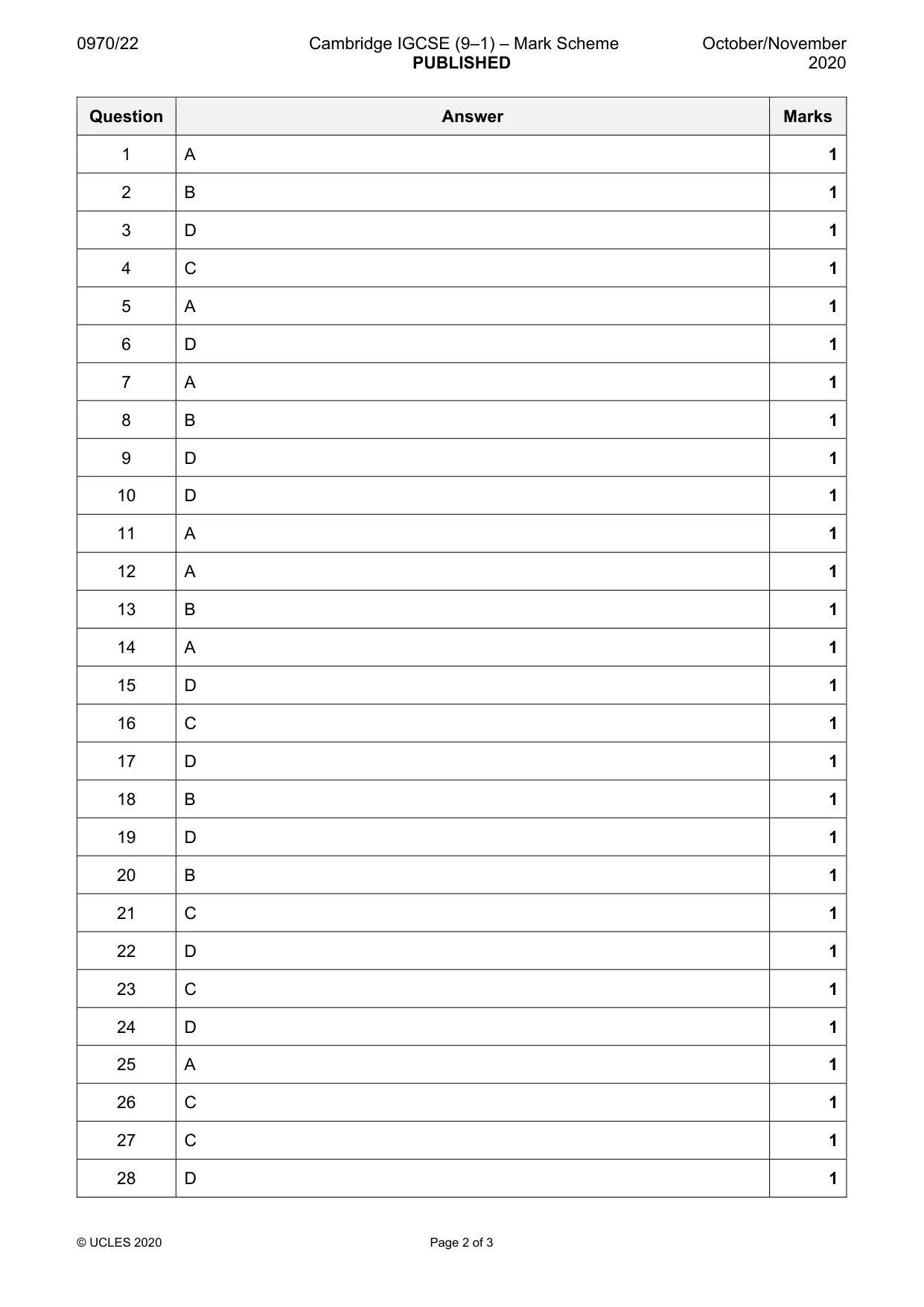
Mark scheme: C
Q38 · The stages describe how genetic engineering can be used to produce human insulin from…
38 The stages describe how genetic engineering can be used to produce human insulin from bacteria. 1 cut bacterial plasmid DNA with restriction enzymes 2 extract gene for insulin from human DNA with restriction enzymes 3 insert recombinant plasmid into bacteria 4 join human DNA to bacterial plasmid DNA using DNA ligase 5 replicate bacteria containing recombinant plasmid Which sequence will lead to the production of human insulin by bacteria? A 2 1 4 3 5 B 2 5 1 3 4 C 4 2 3 1 5 D 4 3 5 1 2
Mark scheme: A
Q39 · What is an example of sustainable use of resources?
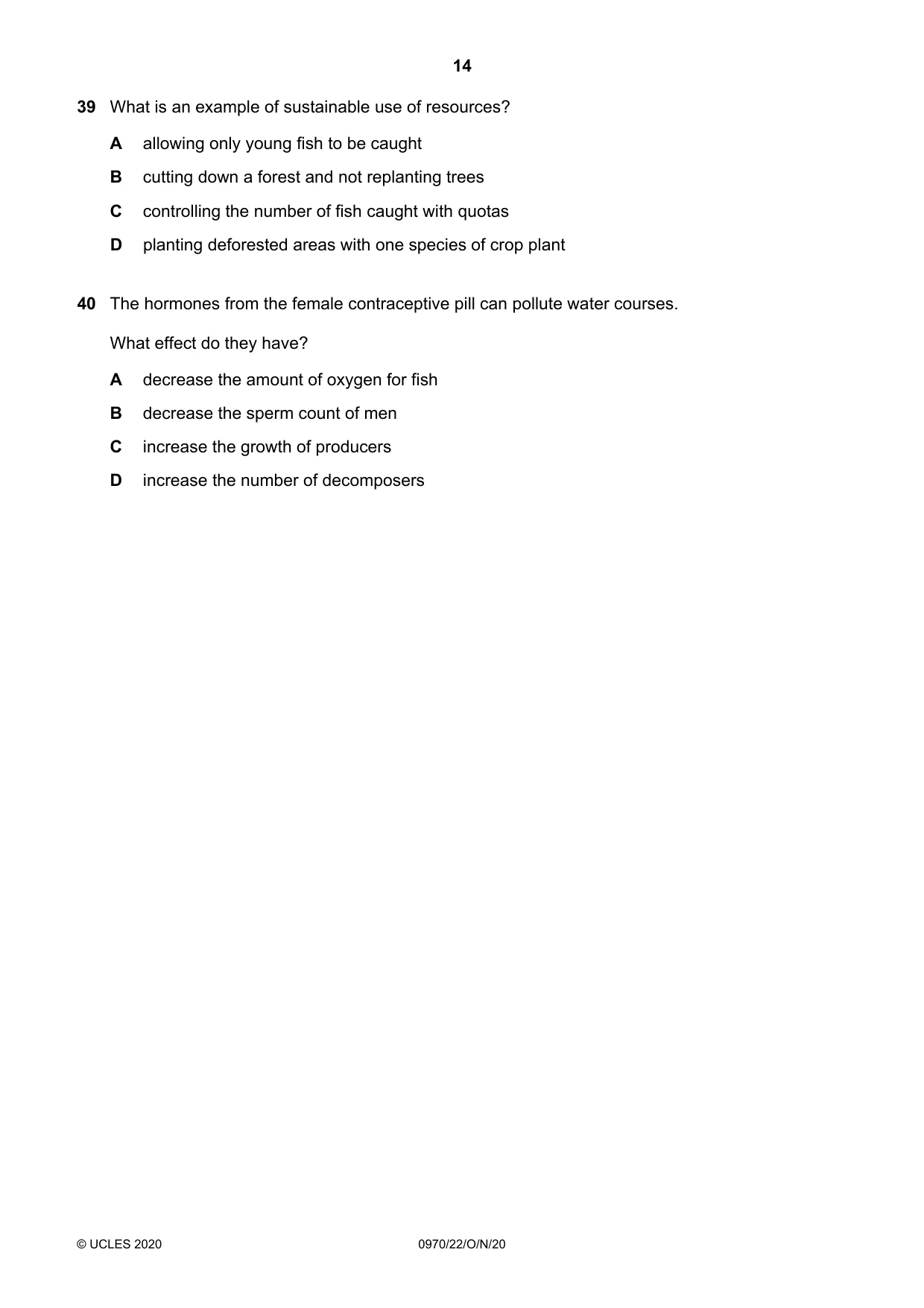
39 What is an example of sustainable use of resources? A allowing only young fish to be caught B cutting down a forest and not replanting trees C controlling the number of fish caught with quotas D planting deforested areas with one species of crop plant
Mark scheme: C
Q40 · The hormones from the female contraceptive pill can pollute water courses
40 The hormones from the female contraceptive pill can pollute water courses. What effect do they have? A decrease the amount of oxygen for fish B decrease the sperm count of men C increase the growth of producers D increase the number of decomposers
Mark scheme: B
What was in this paper
The subtopics covered by these 40 questions, and how many questions each got. Open one in a new tab to see every Cambridge question on it.
2Coordination and response2Drugs2Enzymes2Osmosis2Absorption1Anaerobic respiration1Blood1Cell structure1Characteristics of living organisms1Chemical digestion1Chromosomes, genes and proteins1Conservation1Diseases and immunity1Excretion in humans1Features of organisms1Food chains and food webs1Gas exchange in humans1Genetic modification1Heart1Homeostasis1Meiosis1Mitosis1Monohybrid inheritance1Nutrient cycles1Photosynthesis1Pollution1Populations1Sex hormones in humans1Sexual reproduction in plants1Size of specimens1Translocation1Transpiration1Variation1Water uptake1What you needed in this session
Cambridge’s own grade thresholds for 2020 Oct/Nov, Paper 2 · Variant 2. A higher threshold means an easier paper — the bar moves with how the cohort did.