Cambridge IGCSE Biology (9-1) 0970 — 2025 May/June Paper 2 · Variant 2
0970/22/M/J/25 · 40 questions · 40 marks · ≈45 min
The question paper and its mark scheme, free to read here and free to download. This is Cambridge’s own paper, exactly as it was sat.
Question paper16 pages
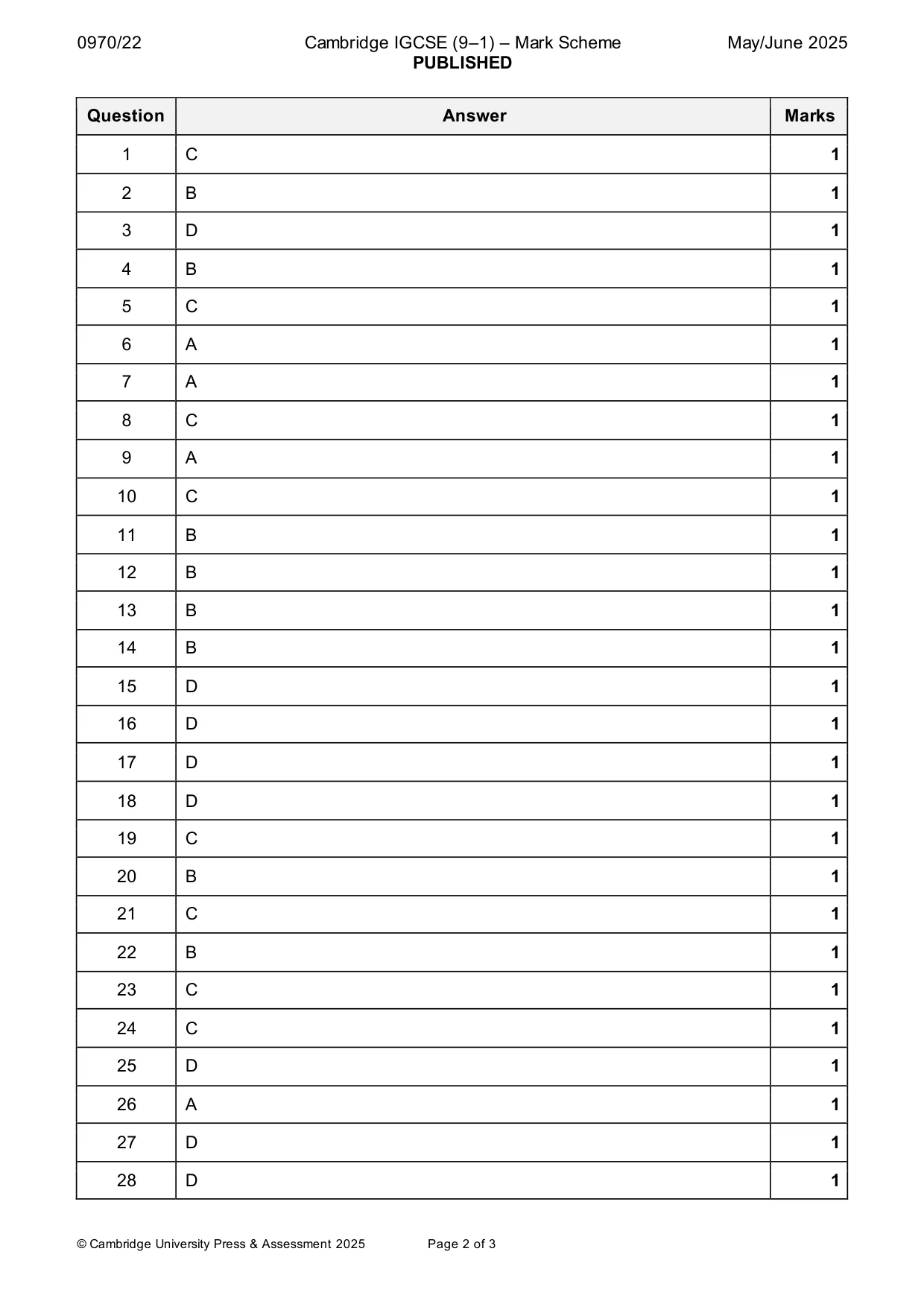
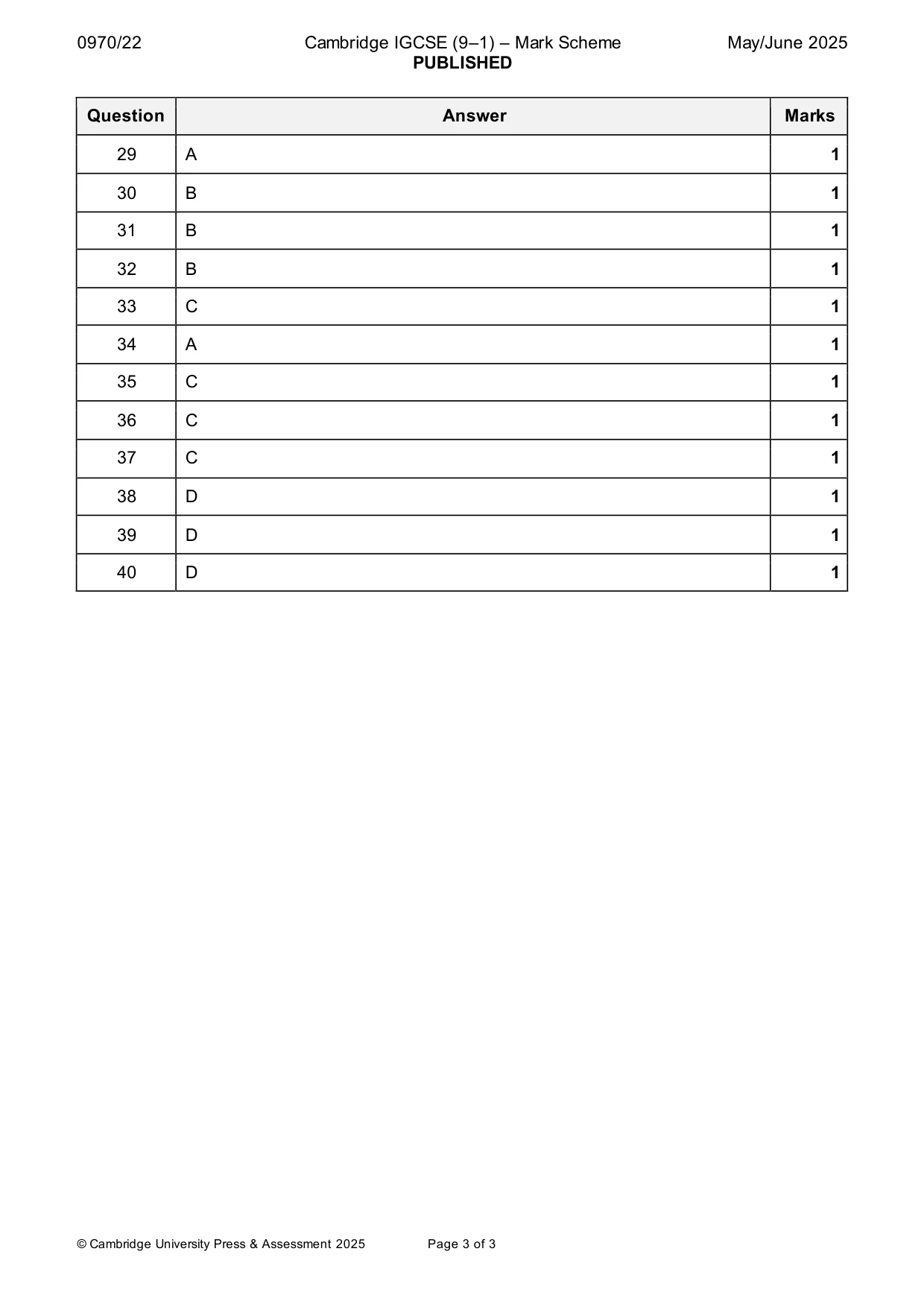
Mark scheme3 pages
Answers below. Sit the paper first if you are practising.
Questions as text
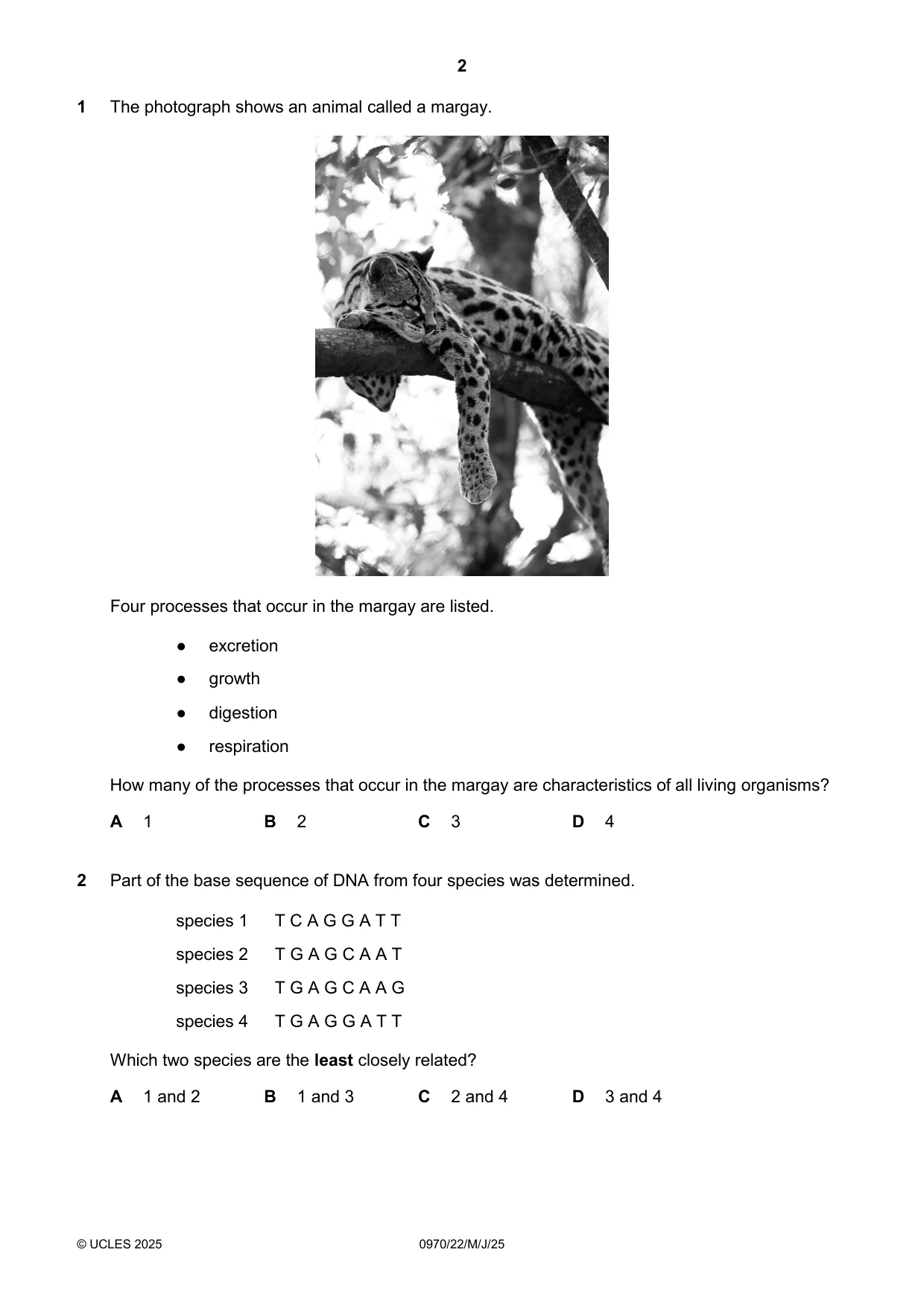
Q1 · The photograph shows an animal called a margay
1 The photograph shows an animal called a margay. Four processes that occur in the margay are listed. ● excretion ● growth ● digestion ● respiration How many of the processes that occur in the margay are characteristics of all living organisms? A 1 B 2 C 3 D 4
Mark scheme: C
Q2 · Part of the base sequence of DNA from four species was determined
2 Part of the base sequence of DNA from four species was determined. species 1 T C A G G A T T species 2 T G A G C A A T species 3 T G A G C A A G species 4 T G A G G A T T Which two species are the least closely related? A 1 and 2 B 1 and 3 C 2 and 4 D 3 and 4
Mark scheme: B
More questions on Concept and uses of classification systems
Q3 · A single-celled organism has chloroplasts, a cell wall and a nucleus
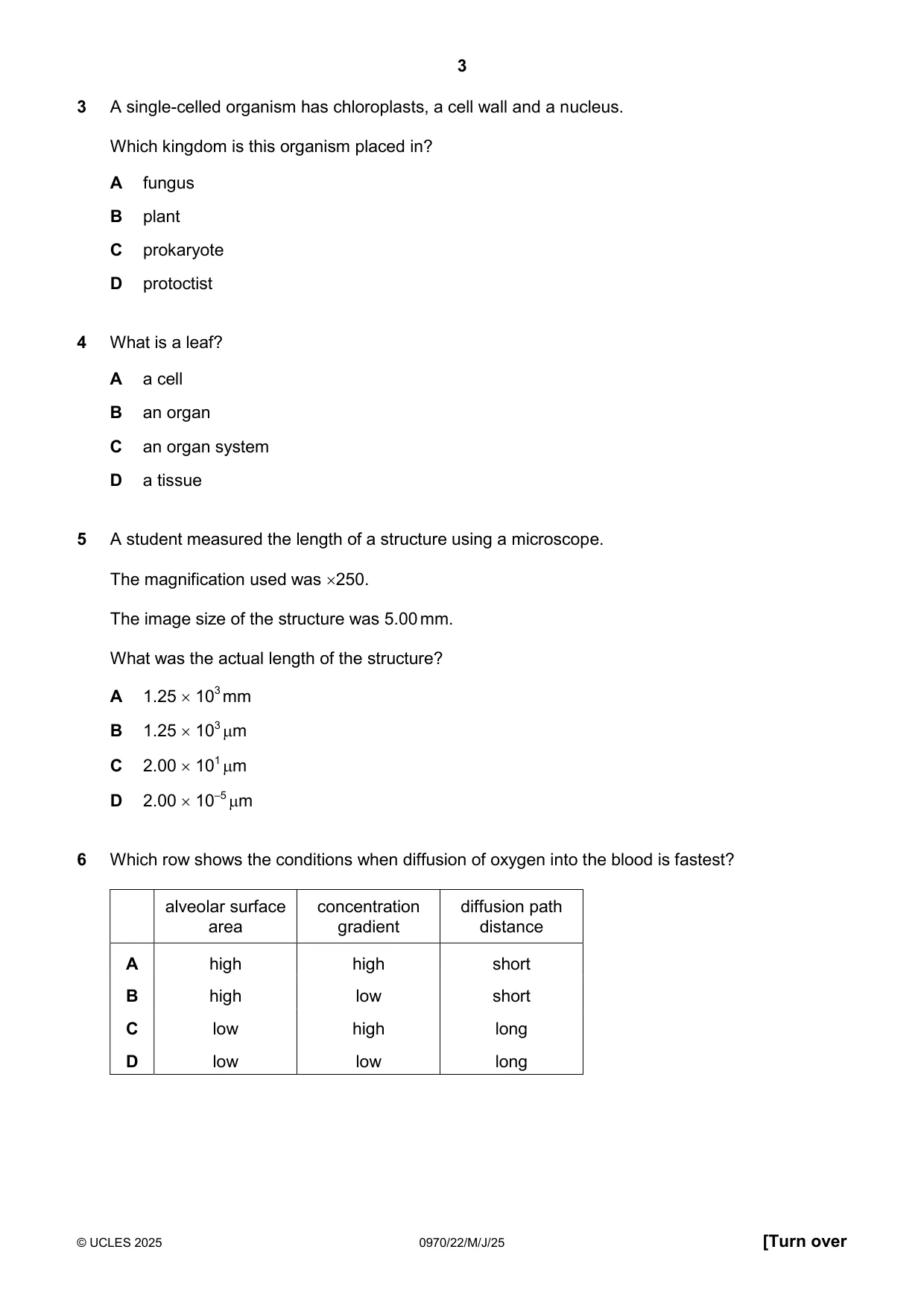
3 A single-celled organism has chloroplasts, a cell wall and a nucleus. Which kingdom is this organism placed in? A fungus B plant C prokaryote D protoctist
Mark scheme: D
Q4 · What is a leaf?
4 What is a leaf? A a cell B an organ C an organ system D a tissue
Mark scheme: B
Q5 · A student measured the length of a structure using a microscope
5 A student measured the length of a structure using a microscope. The magnification used was 250. The image size of the structure was 5.00 mm. What was the actual length of the structure? A 1.25 103 mm B 1.25 103 m C 2.00 101 m D 2.00 10–5 m
Mark scheme: C
Q6 · Which row shows the conditions when diffusion of oxygen into the blood is fastest?
6 Which row shows the conditions when diffusion of oxygen into the blood is fastest? alveolar surface concentration diffusion path area gradient distance A high high short B high low short C low high long D low low long
Mark scheme: A
Q7 · Uncooked potato cylinders of identical size were placed in four different liquids for two…
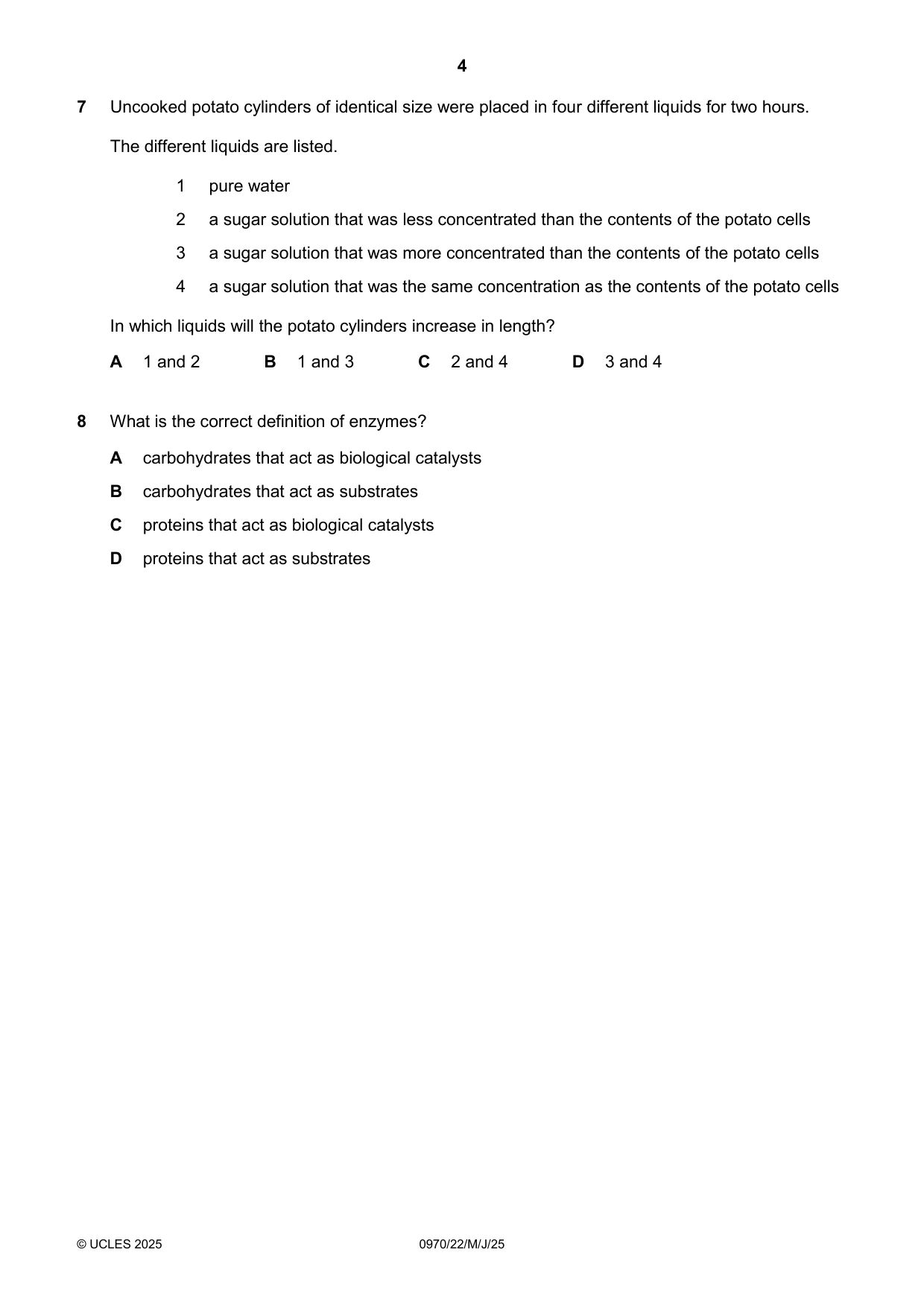
7 Uncooked potato cylinders of identical size were placed in four different liquids for two hours. The different liquids are listed. 1 pure water 2 a sugar solution that was less concentrated than the contents of the potato cells 3 a sugar solution that was more concentrated than the contents of the potato cells 4 a sugar solution that was the same concentration as the contents of the potato cells In which liquids will the potato cylinders increase in length? A 1 and 2 B 1 and 3 C 2 and 4 D 3 and 4
Mark scheme: A
Q8 · What is the correct definition of enzymes?
8 What is the correct definition of enzymes? A carbohydrates that act as biological catalysts B carbohydrates that act as substrates C proteins that act as biological catalysts D proteins that act as substrates
Mark scheme: C
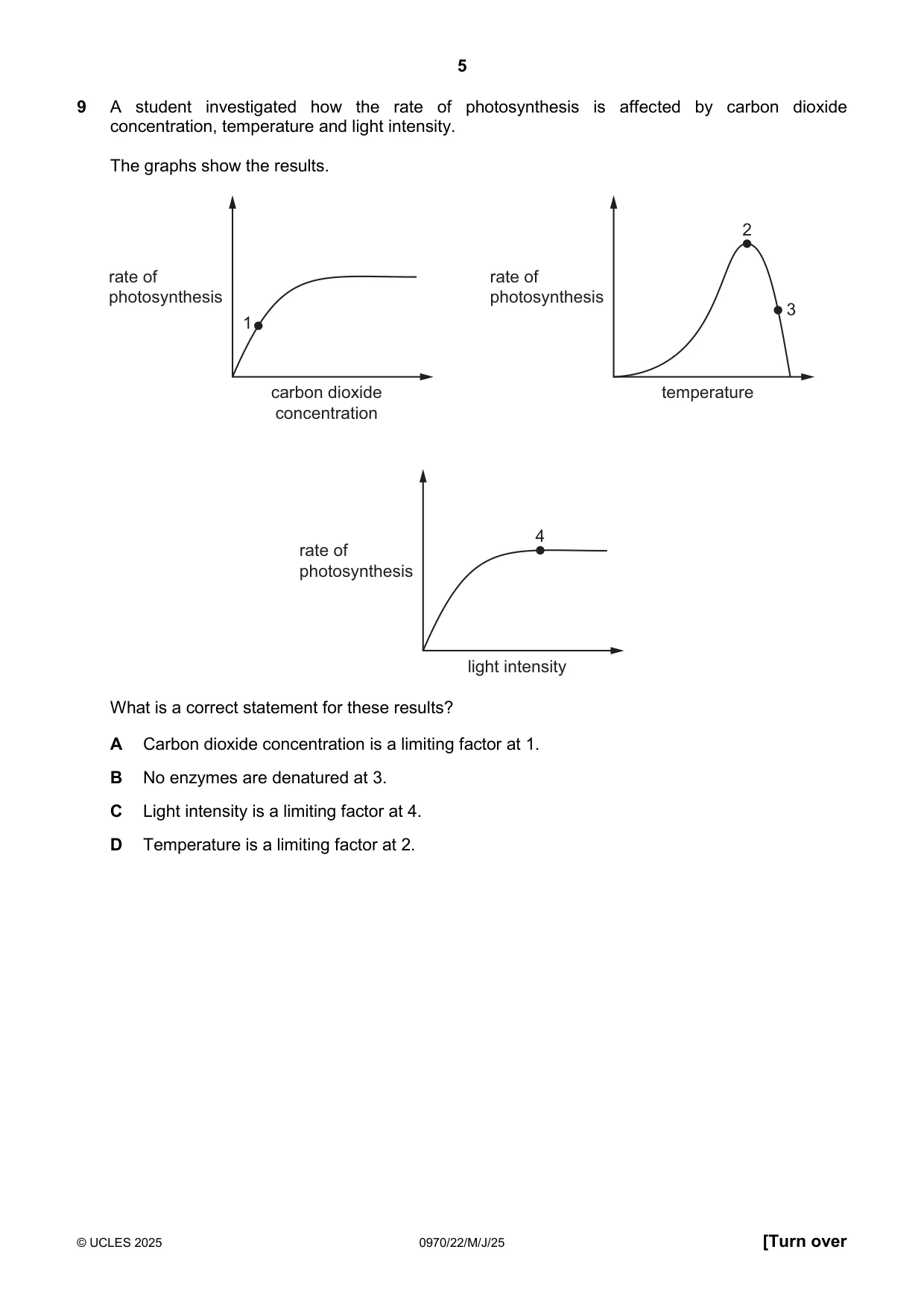
Q9 · A student investigated how the rate of photosynthesis is affected by carbon dioxide…
9 A student investigated how the rate of photosynthesis is affected by carbon dioxide concentration, temperature and light intensity. The graphs show the results. 2 rate of rate of photosynthesis photosynthesis 3 1 carbon dioxide temperature concentration 4 rate of photosynthesis light intensity What is a correct statement for these results? A Carbon dioxide concentration is a limiting factor at 1. B No enzymes are denatured at 3. C Light intensity is a limiting factor at 4. D Temperature is a limiting factor at 2.
Mark scheme: A
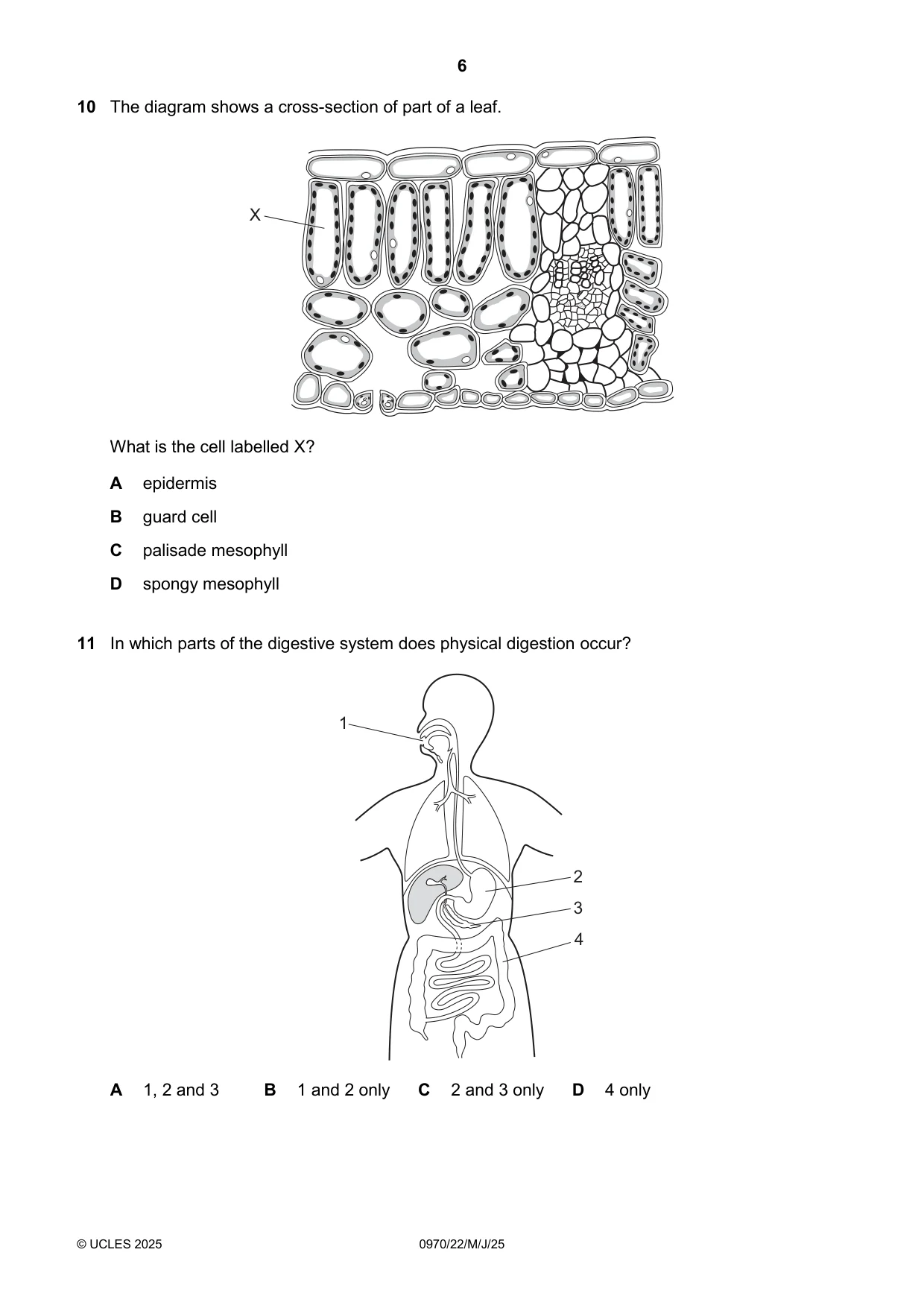
Q10 · The diagram shows a cross-section of part of a leaf
10 The diagram shows a cross-section of part of a leaf. X What is the cell labelled X? A epidermis B guard cell C palisade mesophyll D spongy mesophyll
Mark scheme: C
Q11 · In which parts of the digestive system does physical digestion occur?
11 In which parts of the digestive system does physical digestion occur? 1 2 3 4 A 1, 2 and 3 B 1 and 2 only C 2 and 3 only D 4 only
Mark scheme: B
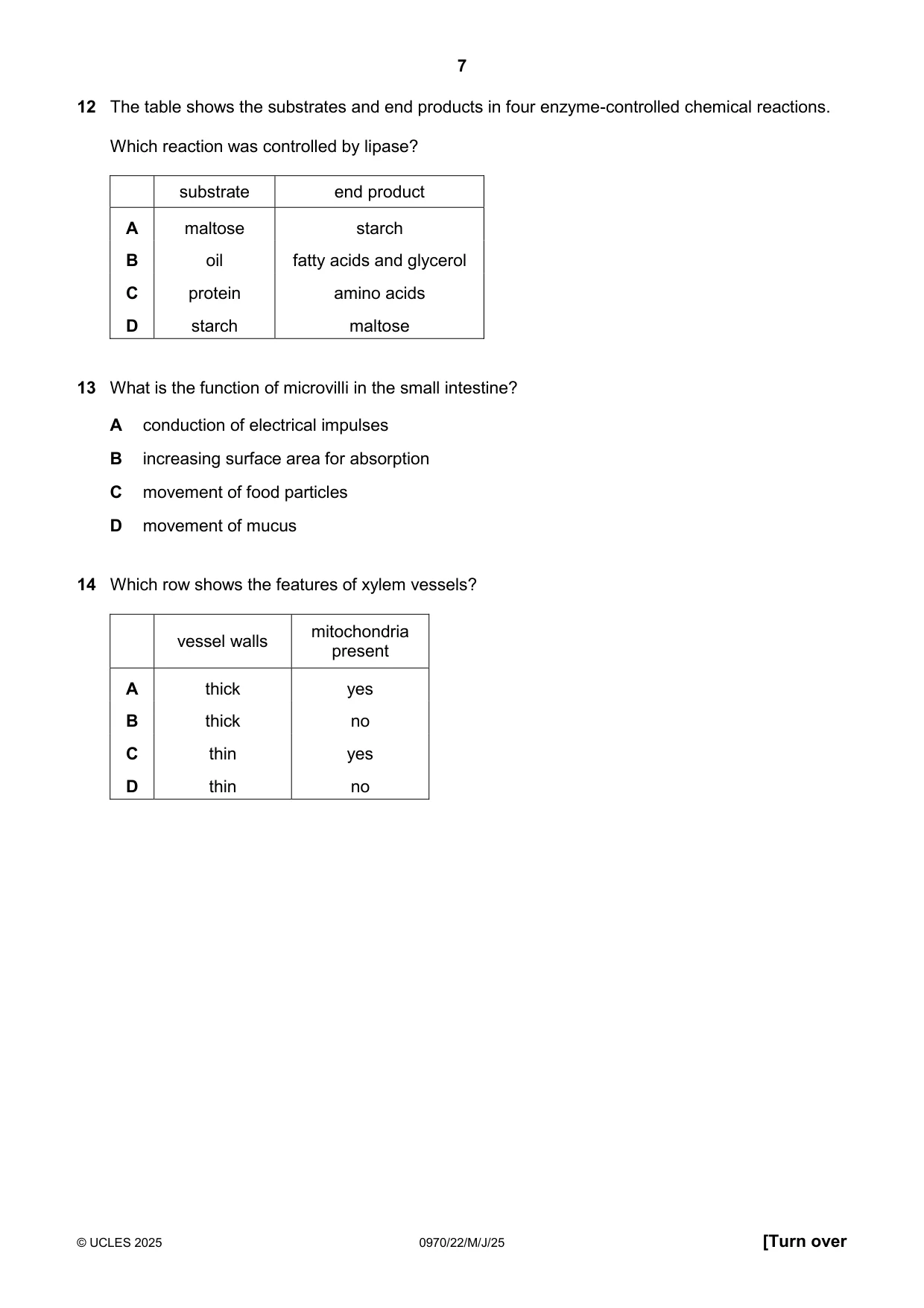
Q12 · The table shows the substrates and end products in four enzyme-controlled chemical…
12 The table shows the substrates and end products in four enzyme-controlled chemical reactions. Which reaction was controlled by lipase? substrate end product A maltose starch B oil fatty acids and glycerol C protein amino acids D starch maltose
Mark scheme: B
Q13 · What is the function of microvilli in the small intestine?
13 What is the function of microvilli in the small intestine? A conduction of electrical impulses B increasing surface area for absorption C movement of food particles D movement of mucus
Mark scheme: B
Q14 · Which row shows the features of xylem vessels?
14 Which row shows the features of xylem vessels? mitochondria vessel walls present A thick yes B thick no C thin yes D thin no
Mark scheme: B
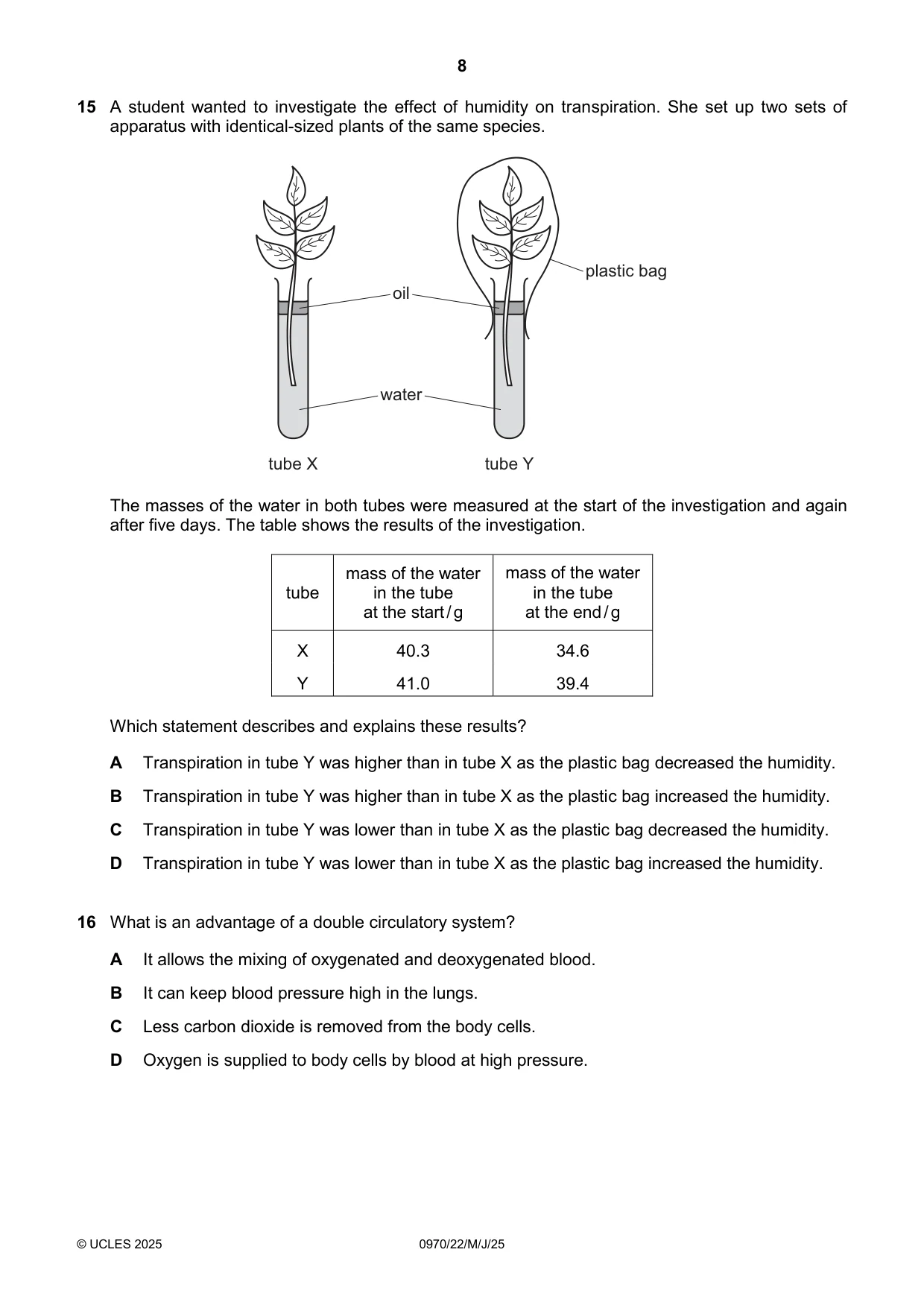
Q15 · A student wanted to investigate the effect of humidity on transpiration
15 A student wanted to investigate the effect of humidity on transpiration. She set up two sets of apparatus with identical-sized plants of the same species. plastic bag oil water tube X tube Y The masses of the water in both tubes were measured at the start of the investigation and again after five days. The table shows the results of the investigation. mass of the water mass of the water tube in the tube in the tube at the start / g at the end / g X 40.3 34.6 Y 41.0 39.4 Which statement describes and explains these results? A Transpiration in tube Y was higher than in tube X as the plastic bag decreased the humidity. B Transpiration in tube Y was higher than in tube X as the plastic bag increased the humidity. C Transpiration in tube Y was lower than in tube X as the plastic bag decreased the humidity. D Transpiration in tube Y was lower than in tube X as the plastic bag increased the humidity.
Mark scheme: D
Q16 · What is an advantage of a double circulatory system?
16 What is an advantage of a double circulatory system? A It allows the mixing of oxygenated and deoxygenated blood. B It can keep blood pressure high in the lungs. C Less carbon dioxide is removed from the body cells. D Oxygen is supplied to body cells by blood at high pressure.
Mark scheme: D
Q17 · Which structure in the heart separates oxygenated and deoxygenated blood?
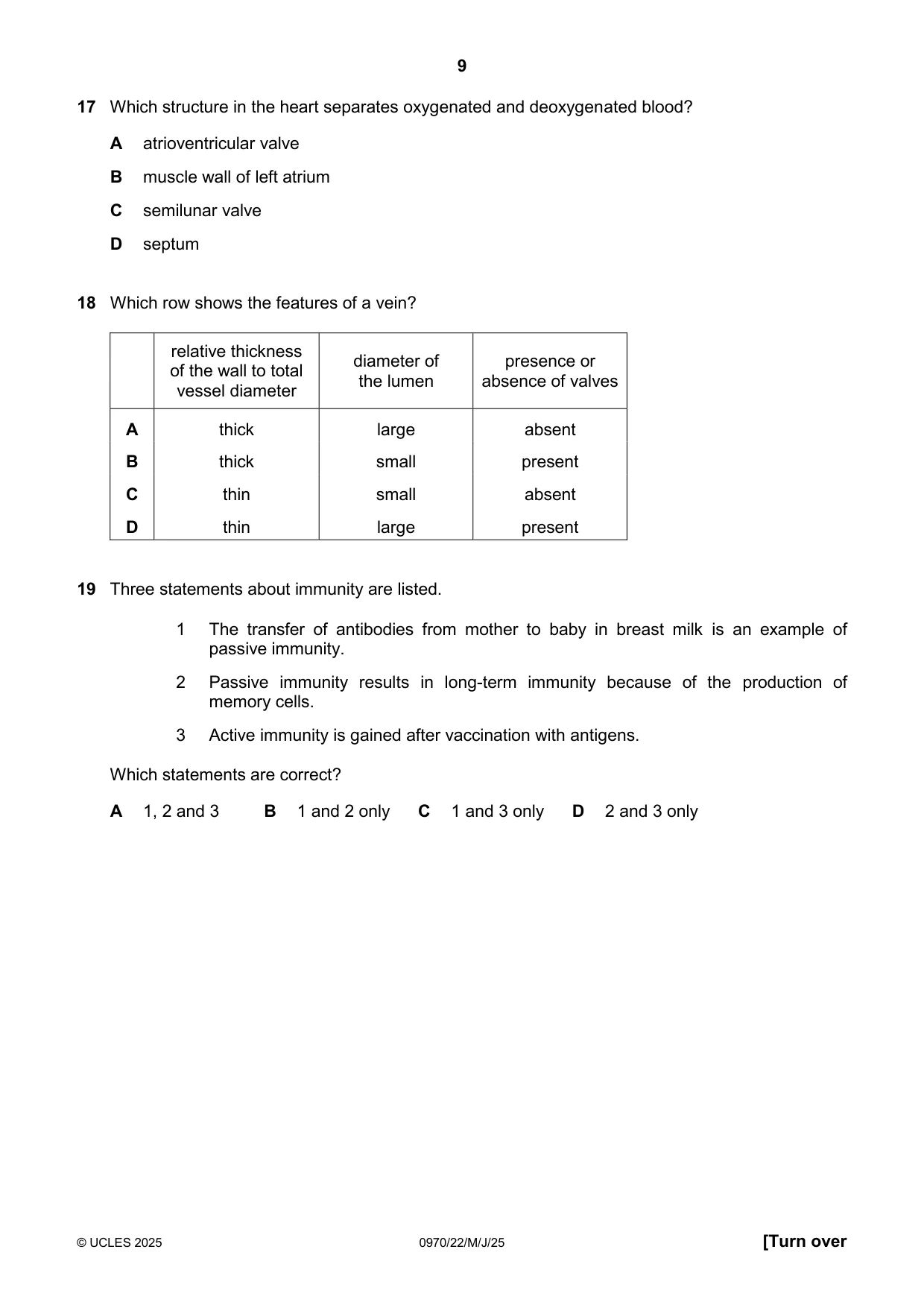
17 Which structure in the heart separates oxygenated and deoxygenated blood? A atrioventricular valve B muscle wall of left atrium C semilunar valve D septum
Mark scheme: D
Q18 · Which row shows the features of a vein?
18 Which row shows the features of a vein? relative thickness diameter of presence or of the wall to total the lumen absence of valves vessel diameter A thick large absent B thick small present C thin small absent D thin large present
Mark scheme: D
Q19 · Three statements about immunity are listed
19 Three statements about immunity are listed. 1 The transfer of antibodies from mother to baby in breast milk is an example of passive immunity. 2 Passive immunity results in long-term immunity because of the production of memory cells. 3 Active immunity is gained after vaccination with antigens. Which statements are correct? A 1, 2 and 3 B 1 and 2 only C 1 and 3 only D 2 and 3 only
Mark scheme: C
Q20 · The table shows the breathing rate and the average total volume of air breathed by a…
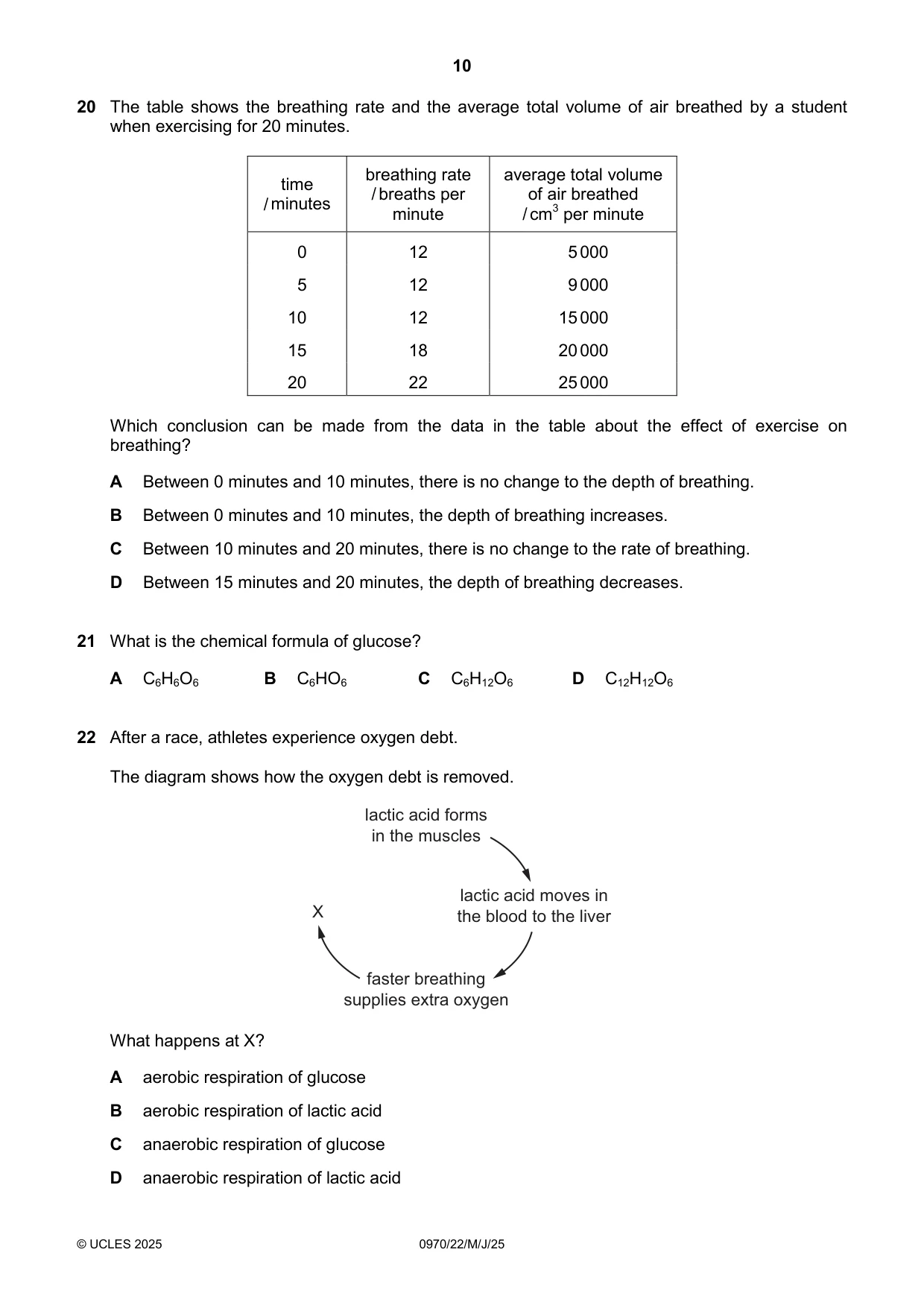
20 The table shows the breathing rate and the average total volume of air breathed by a student when exercising for 20 minutes. breathing rate average total volume time / breaths per of air breathed / minutes minute / cm3 per minute 0 12 5 000 5 12 9 000 10 12 15 000 15 18 20 000 20 22 25 000 Which conclusion can be made from the data in the table about the effect of exercise on breathing? A Between 0 minutes and 10 minutes, there is no change to the depth of breathing. B Between 0 minutes and 10 minutes, the depth of breathing increases. C Between 10 minutes and 20 minutes, there is no change to the rate of breathing. D Between 15 minutes and 20 minutes, the depth of breathing decreases.
Mark scheme: B
Q21 · What is the chemical formula of glucose?
21 What is the chemical formula of glucose? A C6H6O6 B C6HO6 C C6H12O6 D C12H12O6
Mark scheme: C
Q22 · After a race, athletes experience oxygen debt
22 After a race, athletes experience oxygen debt. The diagram shows how the oxygen debt is removed. lactic acid forms in the muscles lactic acid moves in X the blood to the liver faster breathing supplies extra oxygen What happens at X? A aerobic respiration of glucose B aerobic respiration of lactic acid C anaerobic respiration of glucose D anaerobic respiration of lactic acid
Mark scheme: B
Q23 · Which organ produces urea?
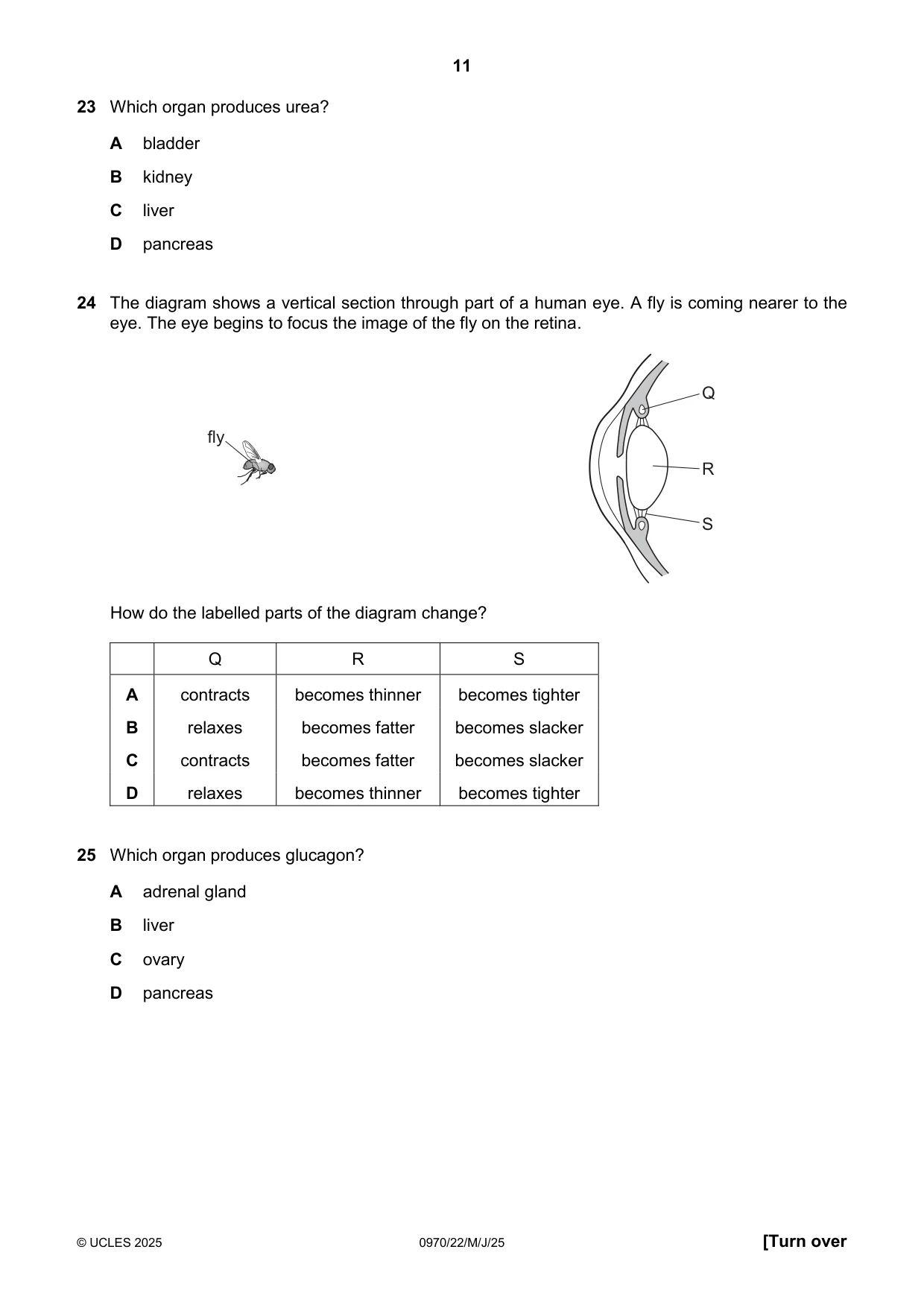
23 Which organ produces urea? A bladder B kidney C liver D pancreas
Mark scheme: C
Q24 · The diagram shows a vertical section through part of a human eye
24 The diagram shows a vertical section through part of a human eye. A fly is coming nearer to the eye. The eye begins to focus the image of the fly on the retina. Q fly R S How do the labelled parts of the diagram change? Q R S A contracts becomes thinner becomes tighter B relaxes becomes fatter becomes slacker C contracts becomes fatter becomes slacker D relaxes becomes thinner becomes tighter
Mark scheme: C
Q25 · Which organ produces glucagon?
25 Which organ produces glucagon? A adrenal gland B liver C ovary D pancreas
Mark scheme: D
Q26 · A young seedling is growing underground
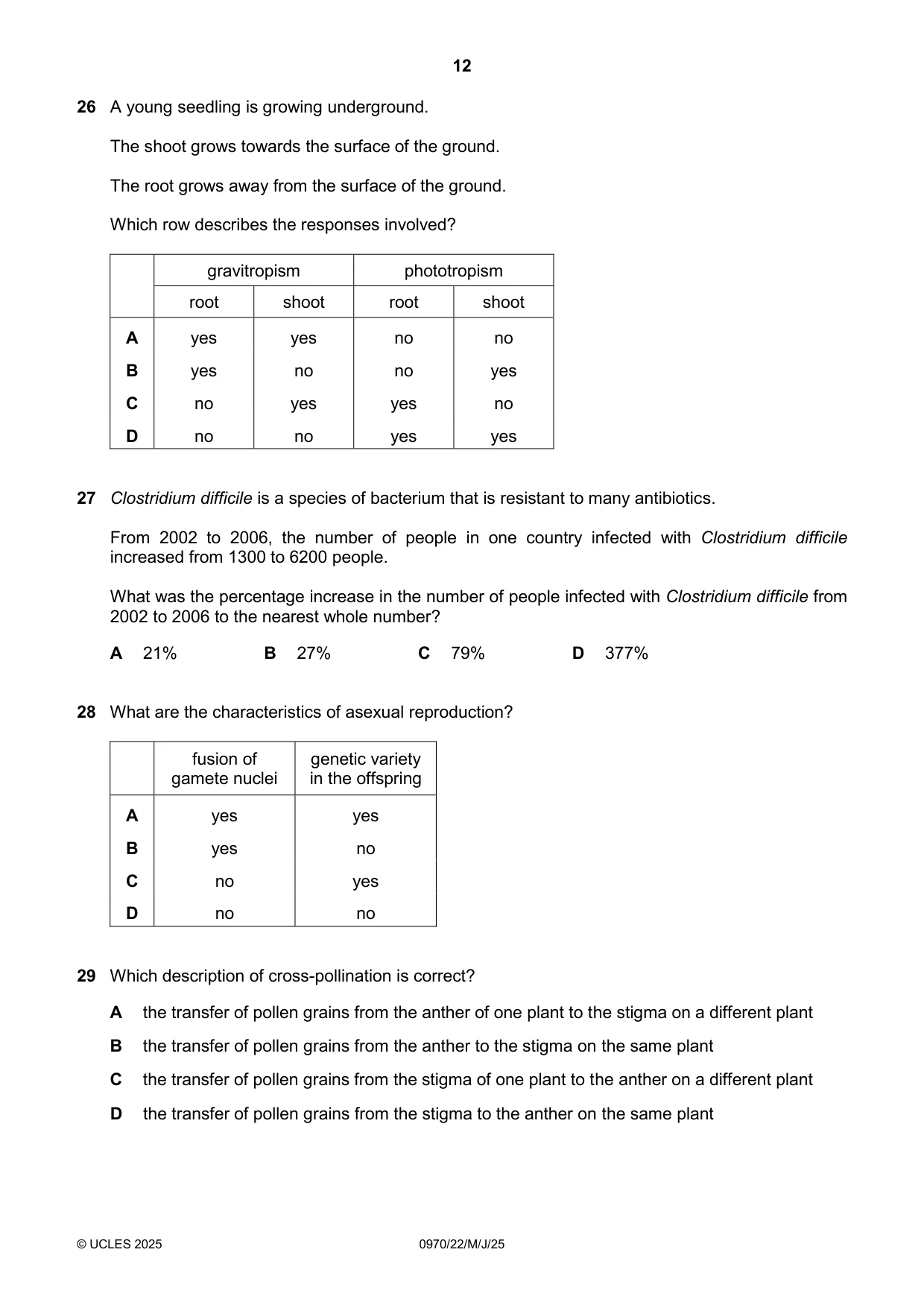
26 A young seedling is growing underground. The shoot grows towards the surface of the ground. The root grows away from the surface of the ground. Which row describes the responses involved? gravitropism phototropism root shoot root shoot A yes yes no no B yes no no yes C no yes yes no D no no yes yes
Mark scheme: A
Q27 · Clostridium difficile is a species of bacterium that is resistant to many antibiotics
27 Clostridium difficile is a species of bacterium that is resistant to many antibiotics. From 2002 to 2006, the number of people in one country infected with Clostridium difficile increased from 1300 to 6200 people. What was the percentage increase in the number of people infected with Clostridium difficile from 2002 to 2006 to the nearest whole number? A 21% B 27% C 79% D 377%
Mark scheme: D
Q28 · What are the characteristics of asexual reproduction?
28 What are the characteristics of asexual reproduction? fusion of genetic variety gamete nuclei in the offspring A yes yes B yes no C no yes D no no
Mark scheme: D
Q29 · Which description of cross-pollination is correct?
29 Which description of cross-pollination is correct? A the transfer of pollen grains from the anther of one plant to the stigma on a different plant B the transfer of pollen grains from the anther to the stigma on the same plant C the transfer of pollen grains from the stigma of one plant to the anther on a different plant D the transfer of pollen grains from the stigma to the anther on the same plant
Mark scheme: A
Q30 · Which row correctly links the named process with its description?
30 Which row correctly links the named process with its description? process description A menstruation release of an egg B menstruation shedding of the lining of the uterus C ovulation fusion of nuclei D ovulation start of puberty
Mark scheme: B
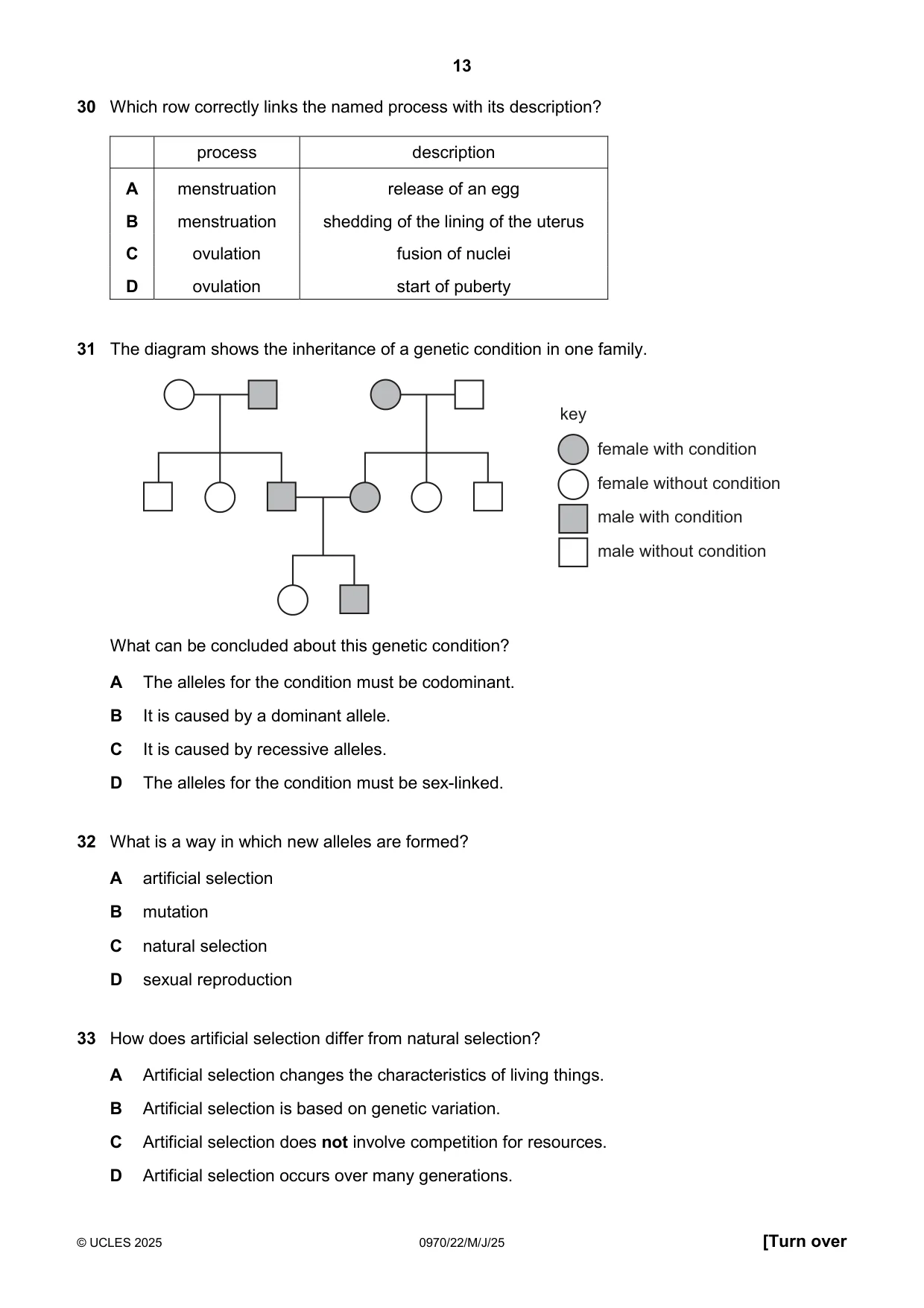
Q31 · The diagram shows the inheritance of a genetic condition in one family
31 The diagram shows the inheritance of a genetic condition in one family. key female with condition female without condition male with condition male without condition What can be concluded about this genetic condition? A The alleles for the condition must be codominant. B It is caused by a dominant allele. C It is caused by recessive alleles. D The alleles for the condition must be sex-linked.
Mark scheme: B
Q32 · What is a way in which new alleles are formed?
32 What is a way in which new alleles are formed? A artificial selection B mutation C natural selection D sexual reproduction
Mark scheme: B
Q33 · How does artificial selection differ from natural selection?
33 How does artificial selection differ from natural selection? A Artificial selection changes the characteristics of living things. B Artificial selection is based on genetic variation. C Artificial selection does not involve competition for resources. D Artificial selection occurs over many generations.
Mark scheme: C
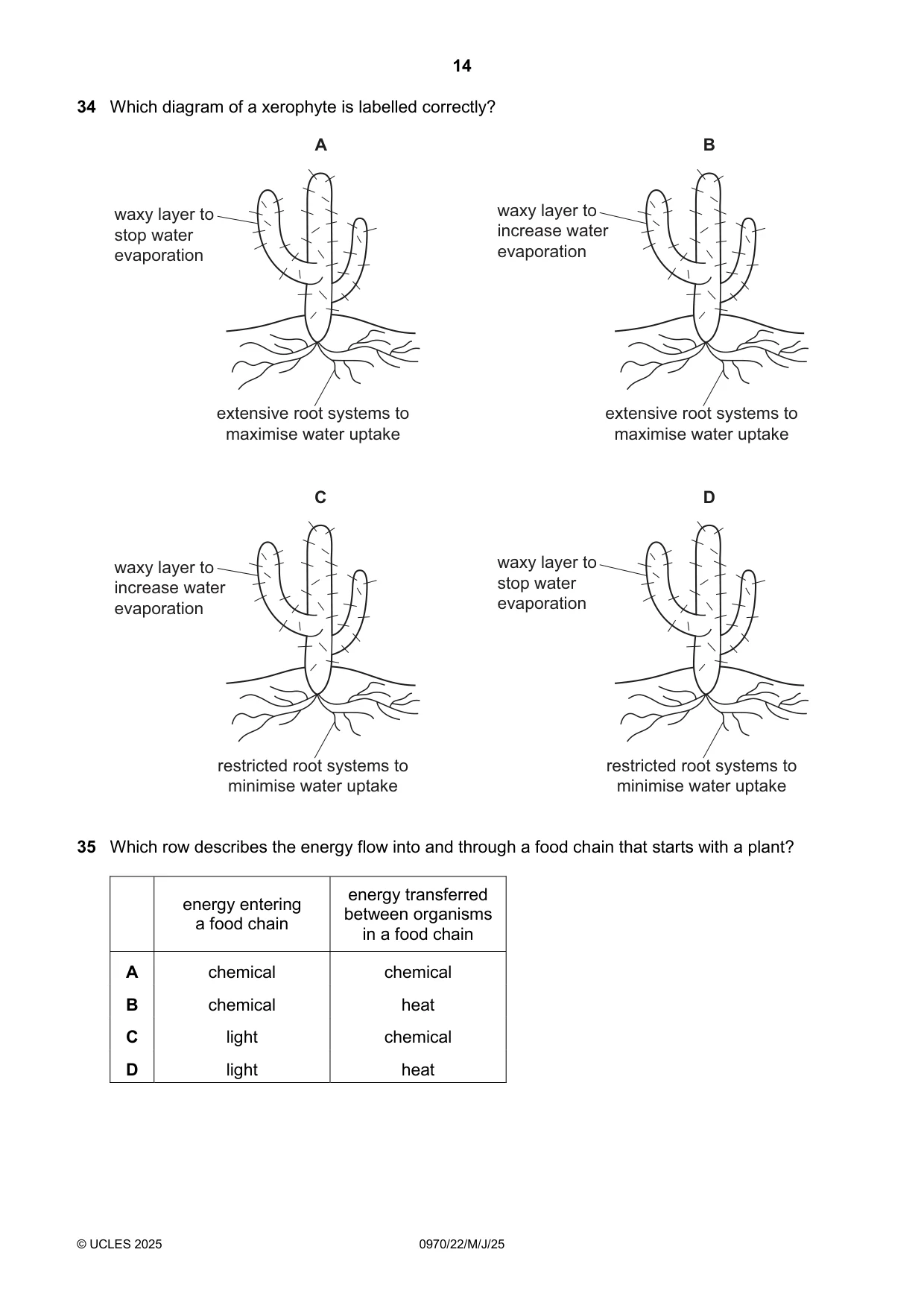
Q34 · Which diagram of a xerophyte is labelled correctly?
34 Which diagram of a xerophyte is labelled correctly? A B waxy layer to waxy layer to stop water increase water evaporation evaporation extensive root systems to extensive root systems to maximise water uptake maximise water uptake C D waxy layer to waxy layer to increase water stop water evaporation evaporation restricted root systems to restricted root systems to minimise water uptake minimise water uptake
Mark scheme: A
Q35 · Which row describes the energy flow into and through a food chain that starts with a…
35 Which row describes the energy flow into and through a food chain that starts with a plant? energy transferred energy entering between organisms a food chain in a food chain A chemical chemical B chemical heat C light chemical D light heat
Mark scheme: C
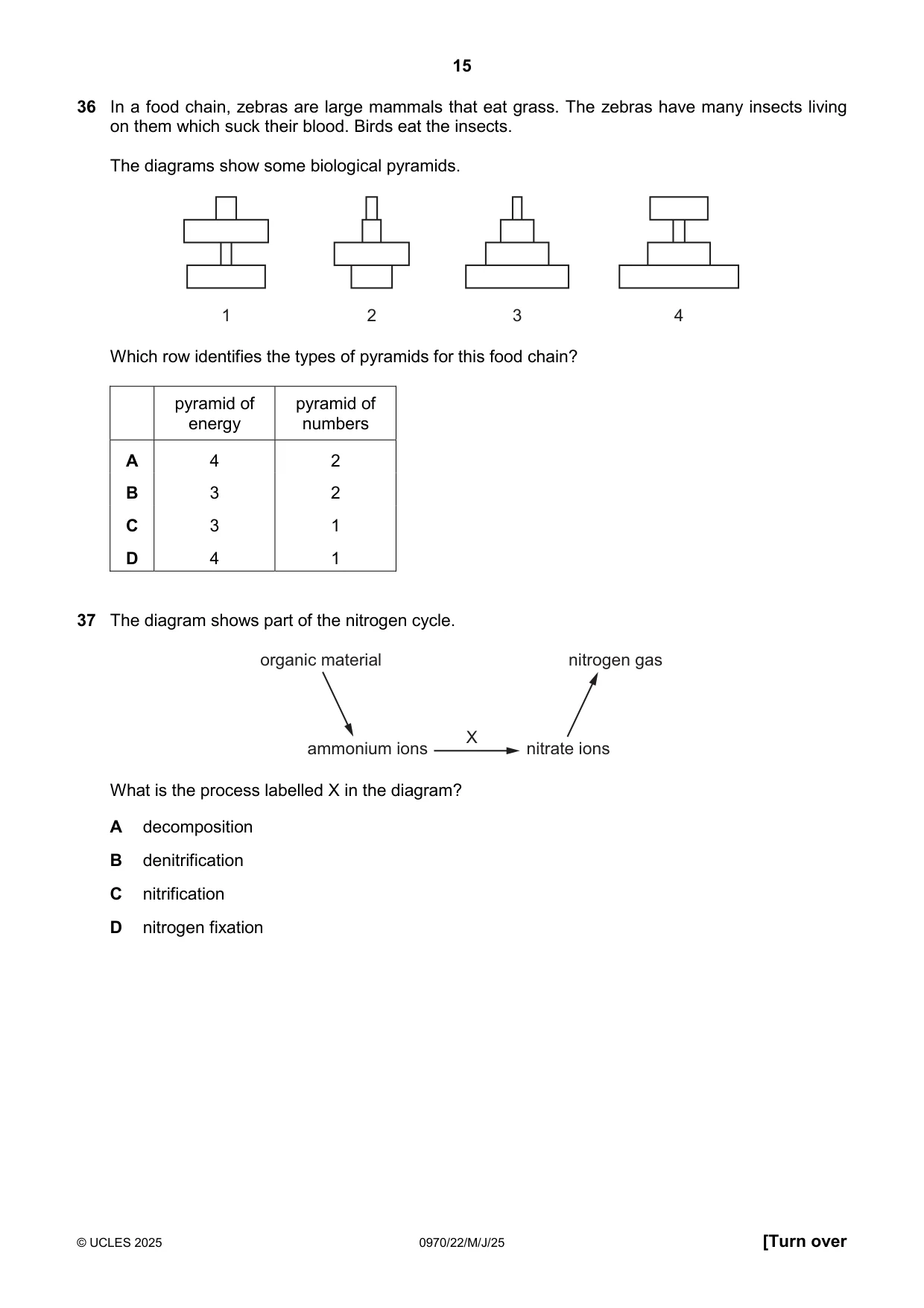
Q36 · In a food chain, zebras are large mammals that eat grass
36 In a food chain, zebras are large mammals that eat grass. The zebras have many insects living on them which suck their blood. Birds eat the insects. The diagrams show some biological pyramids. 1 2 3 4 Which row identifies the types of pyramids for this food chain? pyramid of pyramid of energy numbers A 4 2 B 3 2 C 3 1 D 4 1
Mark scheme: C
Q37 · The diagram shows part of the nitrogen cycle
37 The diagram shows part of the nitrogen cycle. organic material nitrogen gas X ammonium ions nitrate ions What is the process labelled X in the diagram? A decomposition B denitrification C nitrification D nitrogen fixation
Mark scheme: C
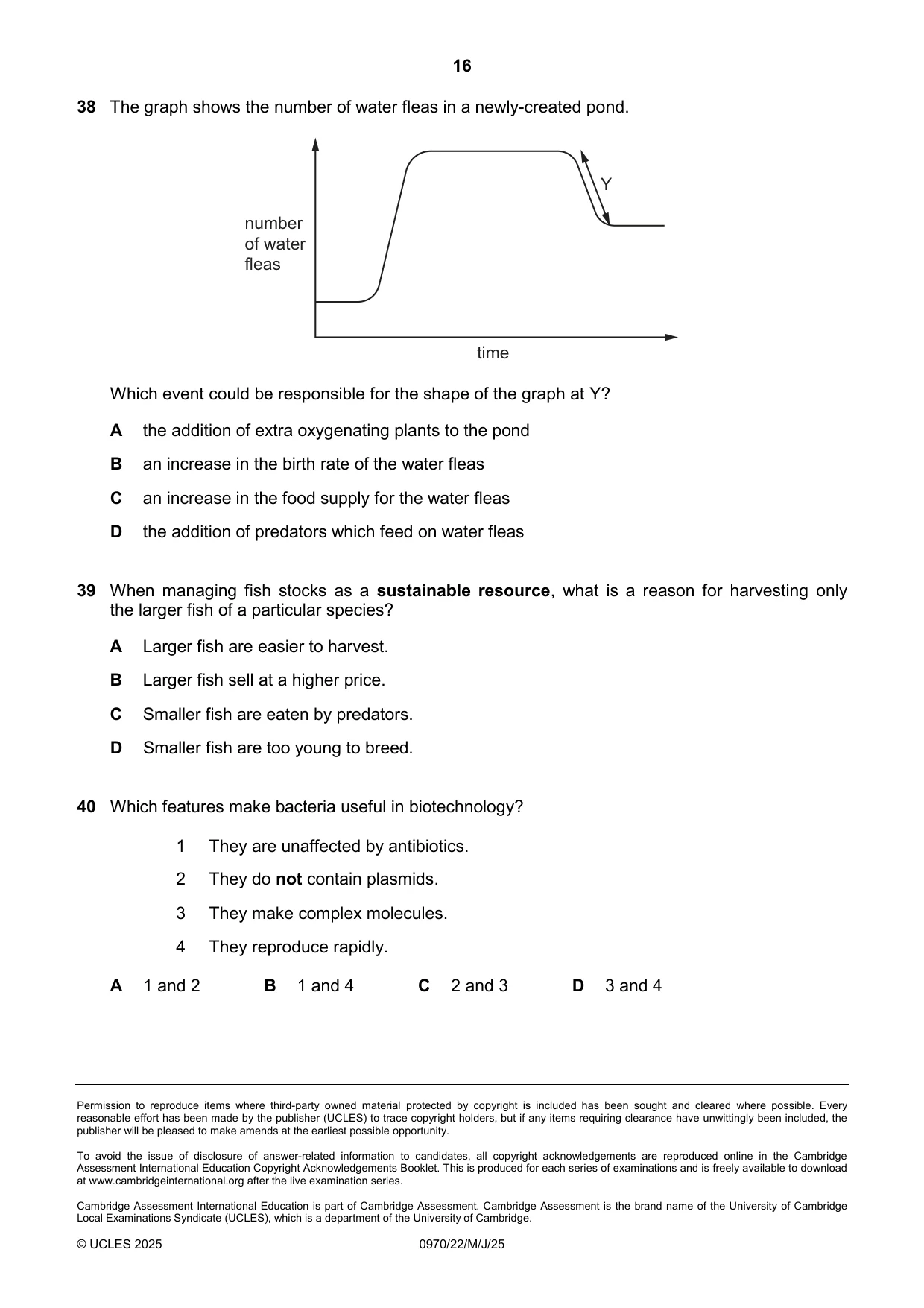
Q38 · The graph shows the number of water fleas in a newly-created pond
38 The graph shows the number of water fleas in a newly-created pond. Y number of water fleas time Which event could be responsible for the shape of the graph at Y? A the addition of extra oxygenating plants to the pond B an increase in the birth rate of the water fleas C an increase in the food supply for the water fleas D the addition of predators which feed on water fleas
Mark scheme: D
Q39 · When managing fish stocks as a sustainable resource, what is a reason for harvesting only…
39 When managing fish stocks as a sustainable resource, what is a reason for harvesting only the larger fish of a particular species? A Larger fish are easier to harvest. B Larger fish sell at a higher price. C Smaller fish are eaten by predators. D Smaller fish are too young to breed.
Mark scheme: D
Q40 · Which features make bacteria useful in biotechnology?
40 Which features make bacteria useful in biotechnology? 1 They are unaffected by antibiotics. 2 They do not contain plasmids. 3 They make complex molecules. 4 They reproduce rapidly. A 1 and 2 B 1 and 4 C 2 and 3 D 3 and 4
Mark scheme: D
What was in this paper
The subtopics covered by these 40 questions, and how many questions each got. Open one in a new tab to see every Cambridge question on it.
2Absorption1Adaptive features1Anaerobic respiration1Asexual reproduction1Biotechnology and genetic modification1Blood vessels1Cell structure1Characteristics of living organisms1Chemical digestion1Circulatory systems1Concept and uses of classification systems1Conservation1Diffusion1Energy flow1Enzymes1Excretion in humans1Features of organisms1Food chains and food webs1Gas exchange in humans1Heart1Hormones1Leaf structure1Monohybrid inheritance1Nutrient cycles1Osmosis1Photosynthesis1Physical digestion1Populations1Respiration1Selection1Sense organs1Sexual reproduction in humans1Sexual reproduction in plants1Size of specimens1Transpiration1Tropic responses1Variation1Xylem and phloem1What you needed in this session
Cambridge’s own grade thresholds for 2025 May/June, Paper 2 · Variant 2. A higher threshold means an easier paper — the bar moves with how the cohort did.