Cambridge IGCSE Biology (9-1) 0970 — 2024 May/June Paper 2 · Variant 1
0970/21/M/J/24 · 40 questions · 40 marks · ≈45 min
The question paper and its mark scheme, free to read here and free to download. This is Cambridge’s own paper, exactly as it was sat.
Question paper16 pages
Mark scheme3 pages
Answers below. Sit the paper first if you are practising.
Questions as text
Q1 · A person touches a hot object and rapidly moves their hand away from the hot object
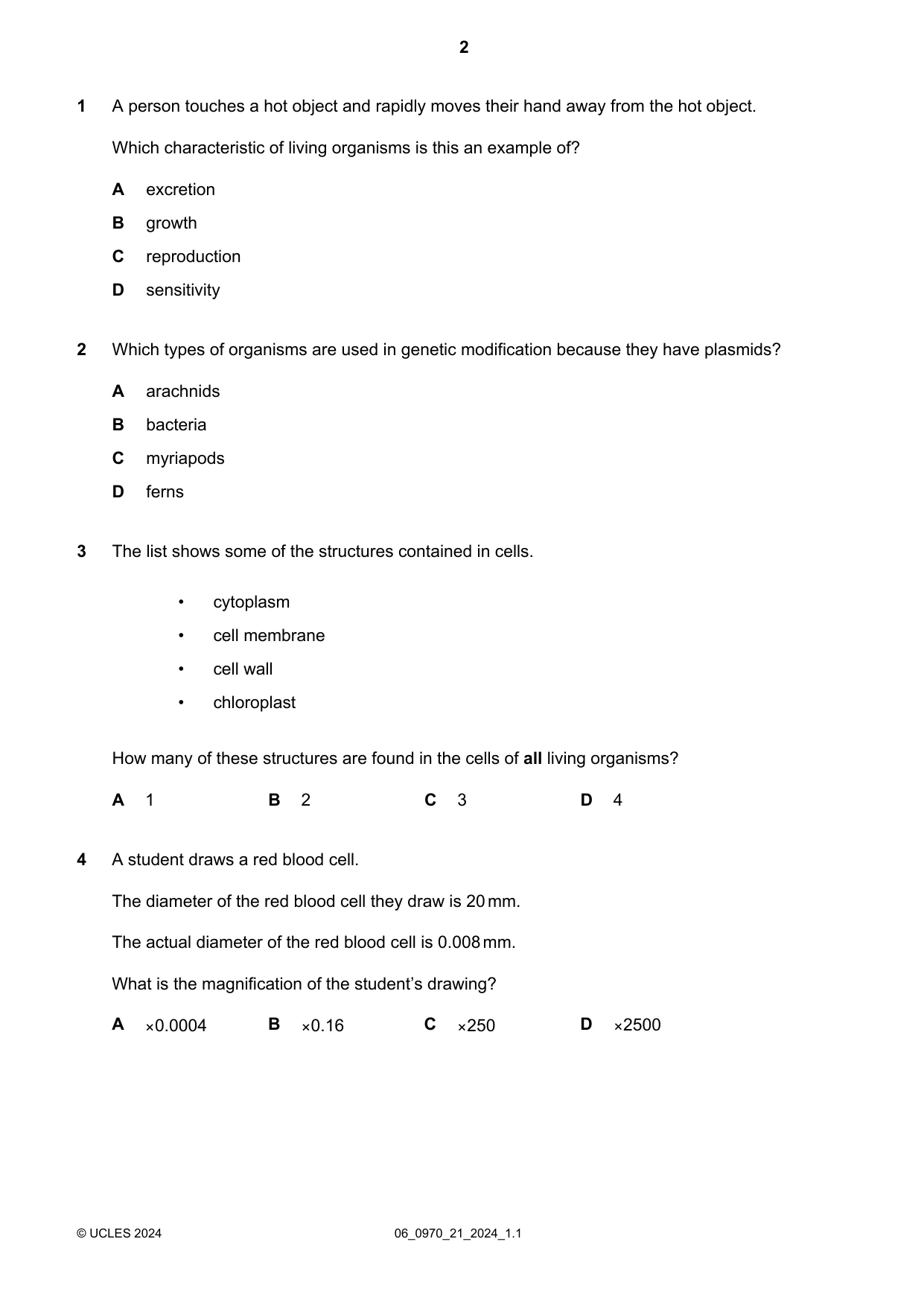
1 A person touches a hot object and rapidly moves their hand away from the hot object. Which characteristic of living organisms is this an example of? A excretion B growth C reproduction D sensitivity
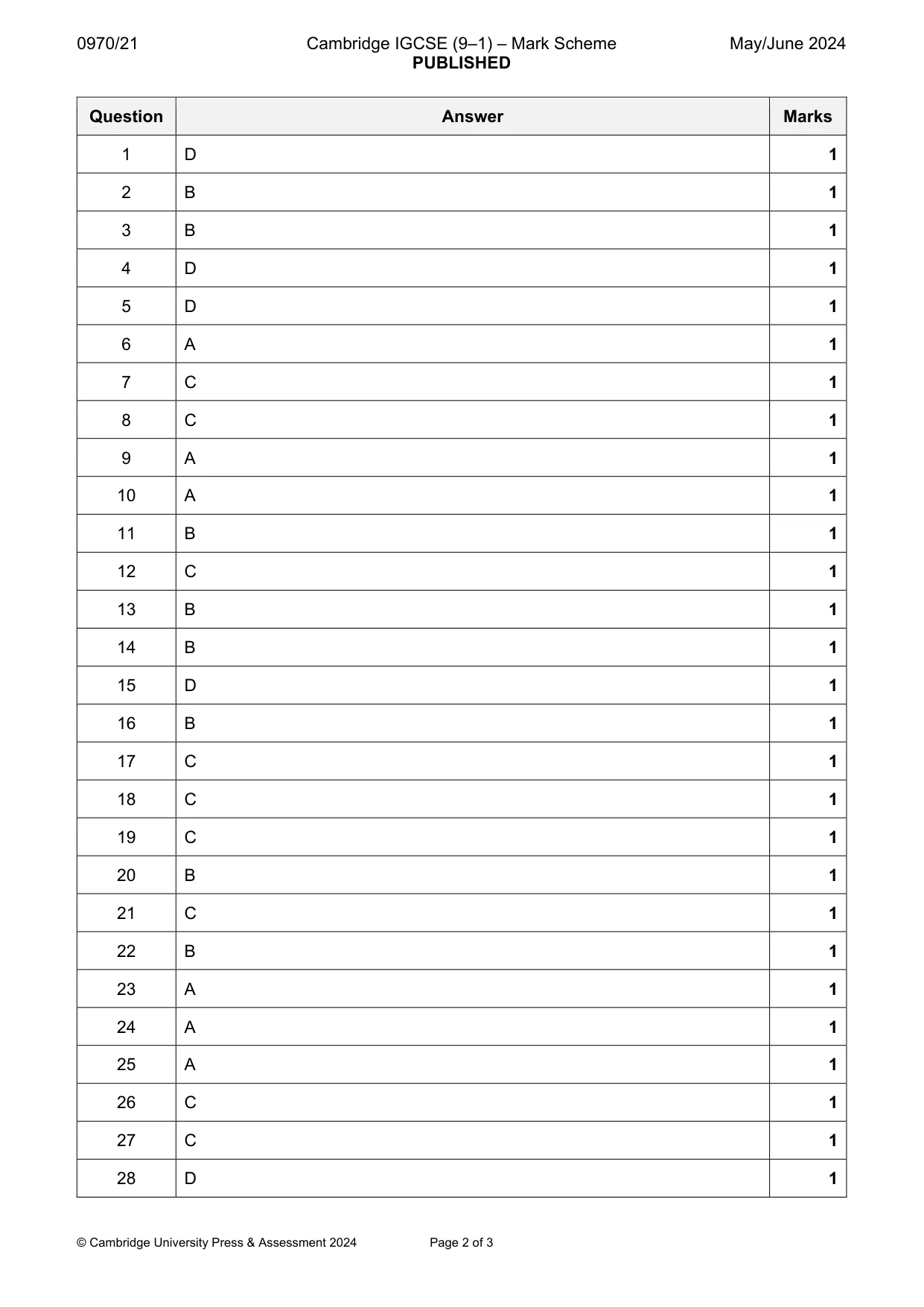
Mark scheme: D
Q2 · Which types of organisms are used in genetic modification because they have plasmids?
2 Which types of organisms are used in genetic modification because they have plasmids? A arachnids B bacteria C myriapods D ferns
Mark scheme: B
Q3 · The list shows some of the structures contained in cells
3 The list shows some of the structures contained in cells. • cytoplasm • cell membrane • cell wall • chloroplast How many of these structures are found in the cells of all living organisms? A 1 B 2 C 3 D 4
Mark scheme: B
Q4 · A student draws a red blood cell
4 A student draws a red blood cell. The diameter of the red blood cell they draw is 20 mm. The actual diameter of the red blood cell is 0.008 mm. What is the magnification of the student’s drawing? A ×0.0004 B ×0.16 C ×250 D ×2500
Mark scheme: D
Q5 · Samples of plant cells from the same species are immersed in three different liquids
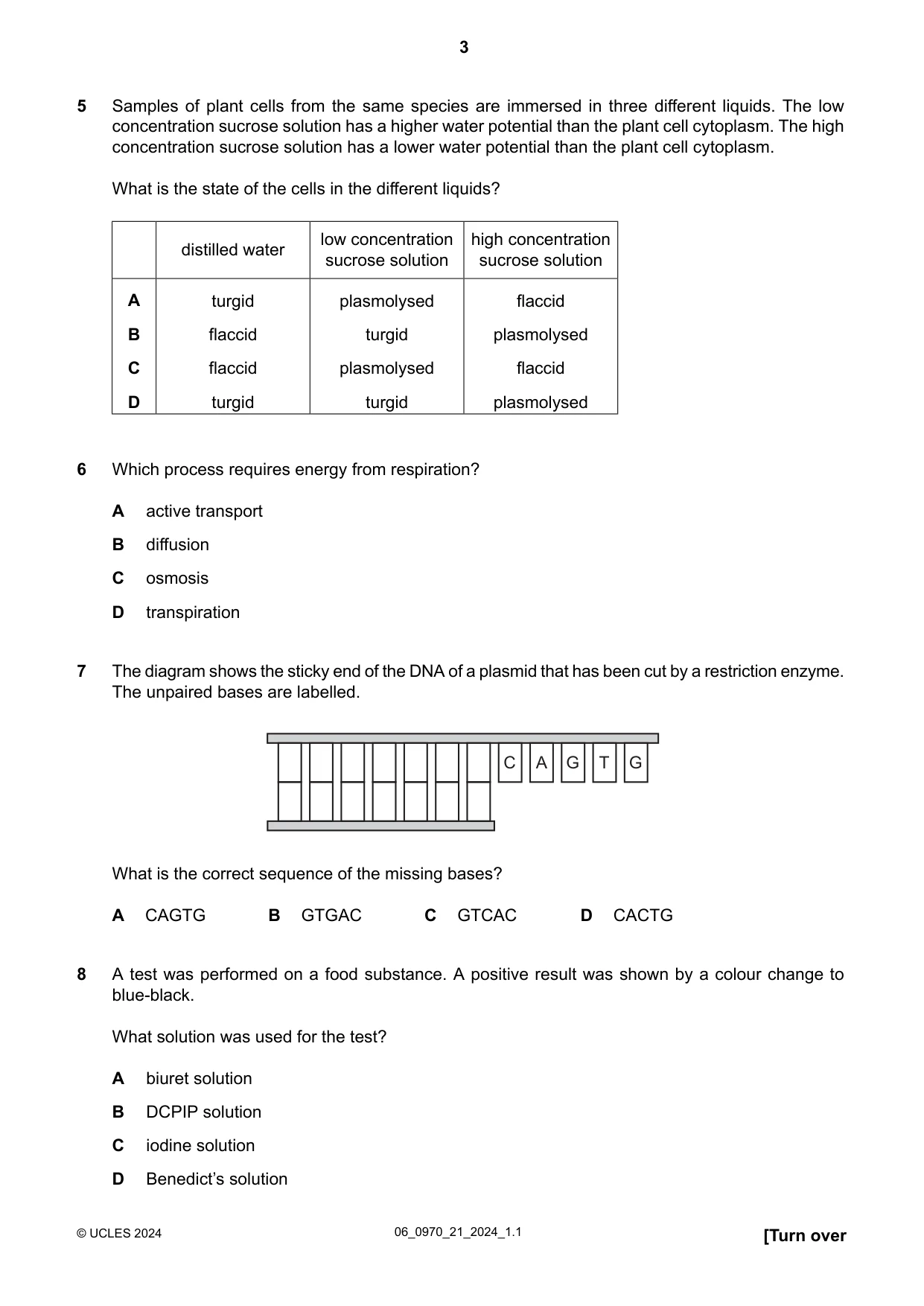
5 Samples of plant cells from the same species are immersed in three different liquids. The low concentration sucrose solution has a higher water potential than the plant cell cytoplasm. The high concentration sucrose solution has a lower water potential than the plant cell cytoplasm. What is the state of the cells in the different liquids? low concentration high concentration distilled water sucrose solution sucrose solution A turgid plasmolysed flaccid B flaccid turgid plasmolysed C flaccid plasmolysed flaccid D turgid turgid plasmolysed
Mark scheme: D
Q6 · Which process requires energy from respiration?
6 Which process requires energy from respiration? A active transport B diffusion C osmosis D transpiration
Mark scheme: A
Q7 · The diagram shows the sticky end of the DNA of a plasmid that has been cut by a…
7 The diagram shows the sticky end of the DNA of a plasmid that has been cut by a restriction enzyme. The unpaired bases are labelled. C A G T G What is the correct sequence of the missing bases? A CAGTG B GTGAC C GTCAC D CACTG
Mark scheme: C
Q8 · A test was performed on a food substance
8 A test was performed on a food substance. A positive result was shown by a colour change to blue-black. What solution was used for the test? A biuret solution B DCPIP solution C iodine solution D Benedict’s solution
Mark scheme: C
Q9 · A student investigates the breakdown of fats in milk by lipase
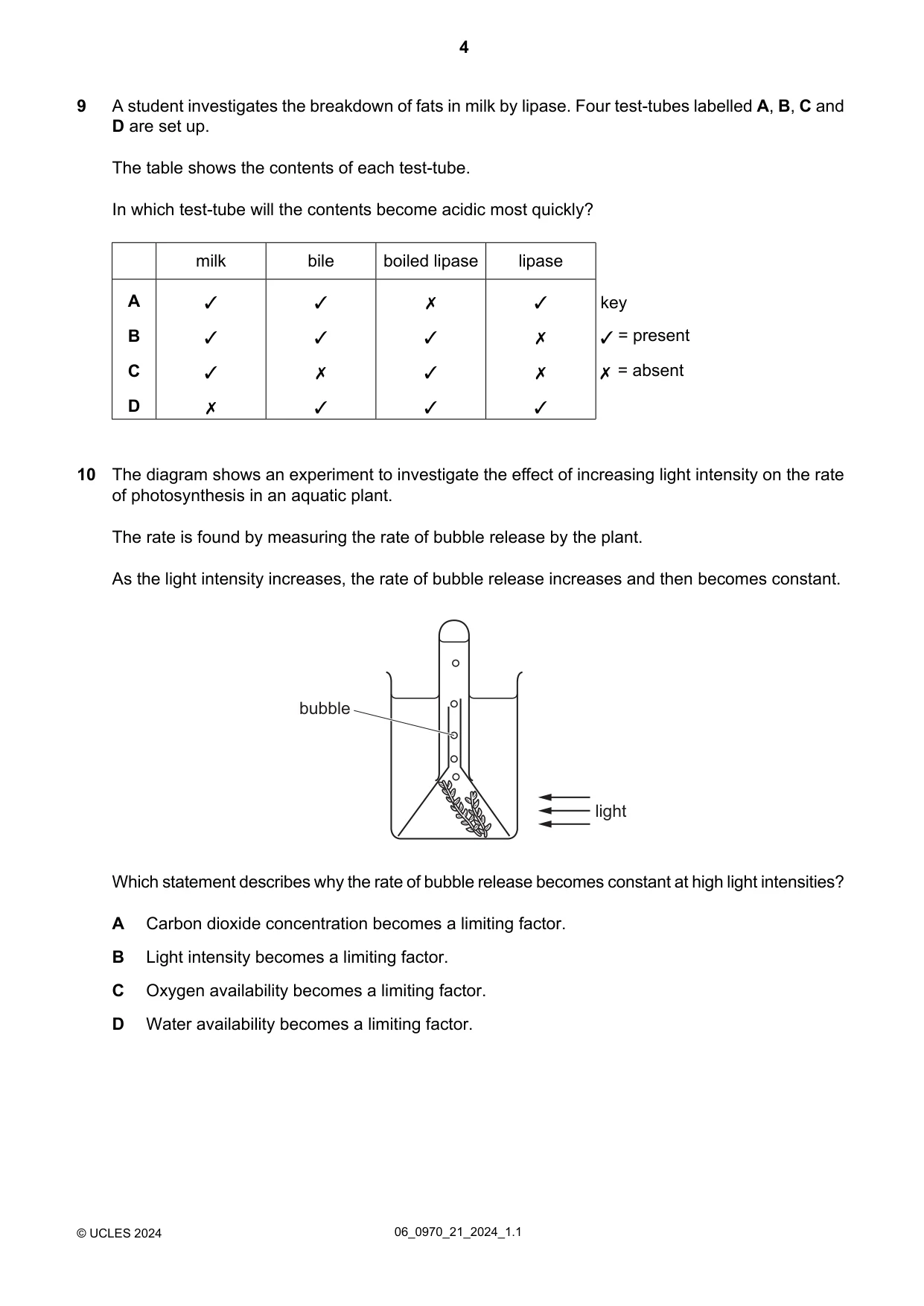
9 A student investigates the breakdown of fats in milk by lipase. Four test-tubes labelled A, B, C and D are set up. The table shows the contents of each test-tube. In which test-tube will the contents become acidic most quickly? milk bile boiled lipase lipase A ✓ ✓ ✗ ✓ key B ✓ ✓ ✓ ✗ ✓ = present C ✓ ✗ ✓ ✗ ✗ = absent D ✗ ✓ ✓ ✓
Mark scheme: A
Q10 · The diagram shows an experiment to investigate the effect of increasing light intensity…
10 The diagram shows an experiment to investigate the effect of increasing light intensity on the rate of photosynthesis in an aquatic plant. The rate is found by measuring the rate of bubble release by the plant. As the light intensity increases, the rate of bubble release increases and then becomes constant. bubble light Which statement describes why the rate of bubble release becomes constant at high light intensities? A Carbon dioxide concentration becomes a limiting factor. B Light intensity becomes a limiting factor. C Oxygen availability becomes a limiting factor. D Water availability becomes a limiting factor.
Mark scheme: A
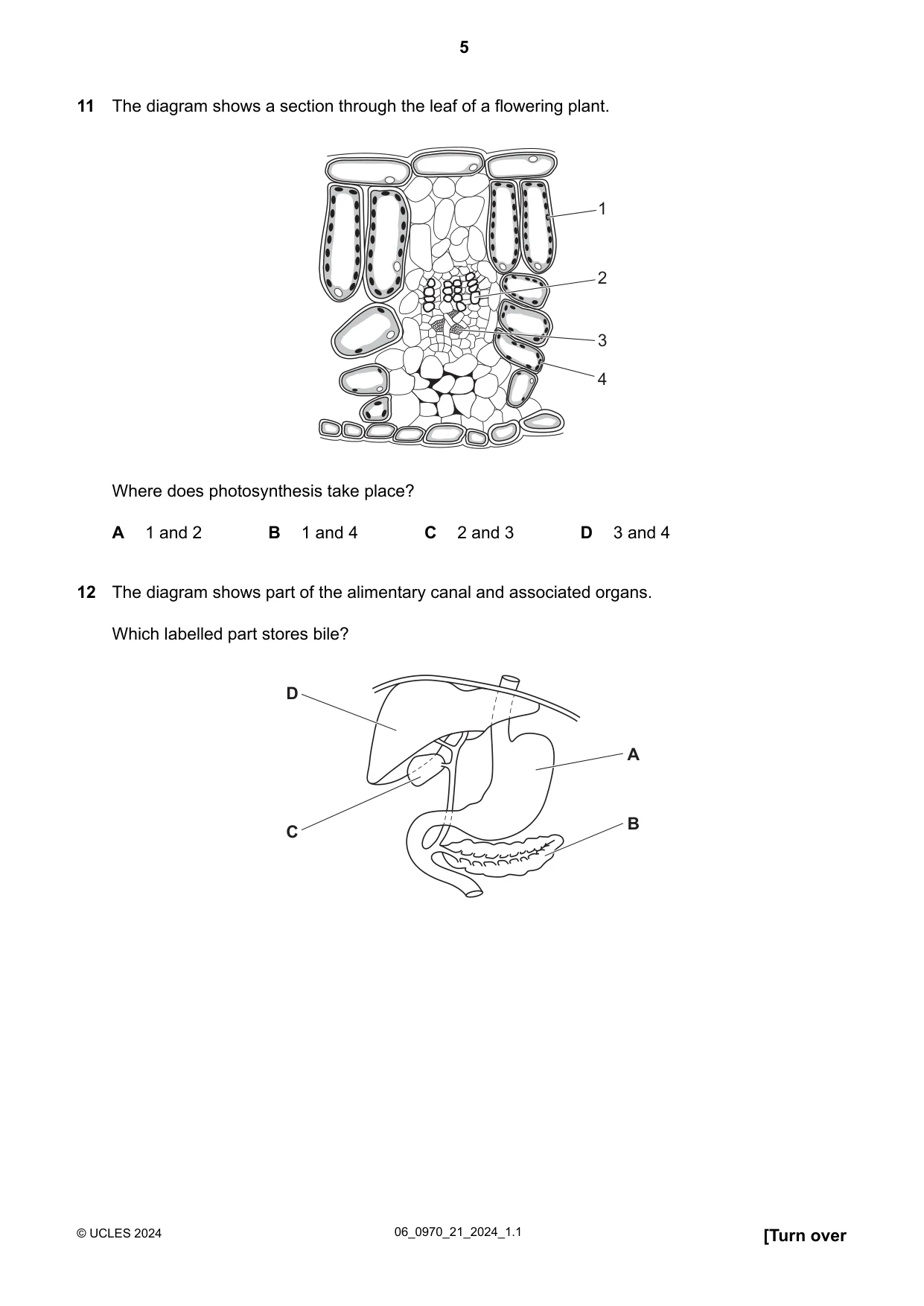
Q11 · The diagram shows a section through the leaf of a flowering plant
11 The diagram shows a section through the leaf of a flowering plant. 1 2 3 4 Where does photosynthesis take place? A 1 and 2 B 1 and 4 C 2 and 3 D 3 and 4
Mark scheme: B
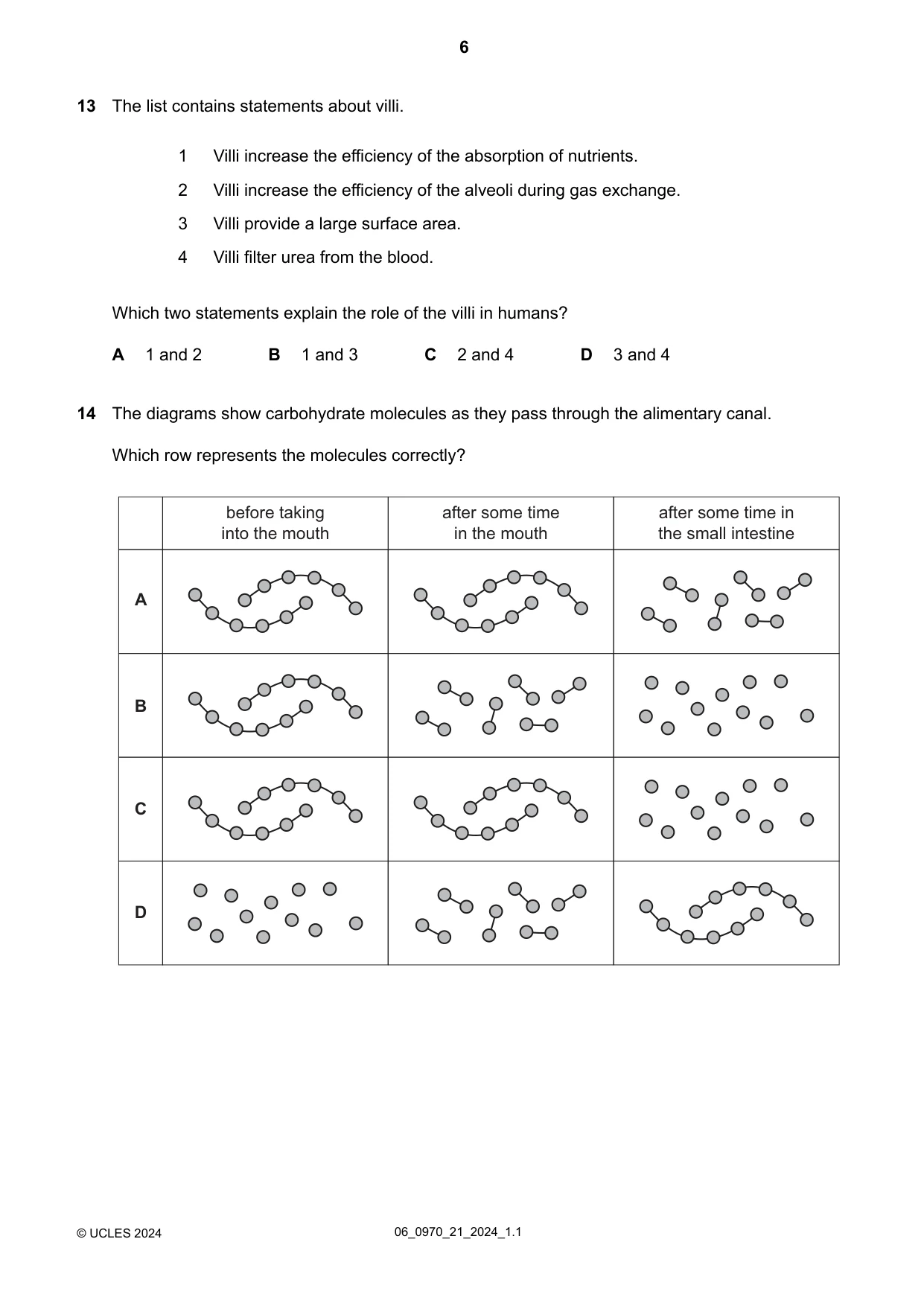
Q12 · The diagram shows part of the alimentary canal and associated organs
12 The diagram shows part of the alimentary canal and associated organs. Which labelled part stores bile? D A B C
Mark scheme: C
Q13 · The list contains statements about villi
13 The list contains statements about villi. 1 Villi increase the efficiency of the absorption of nutrients. 2 Villi increase the efficiency of the alveoli during gas exchange. 3 Villi provide a large surface area. 4 Villi filter urea from the blood. Which two statements explain the role of the villi in humans? A 1 and 2 B 1 and 3 C 2 and 4 D 3 and 4
Mark scheme: B
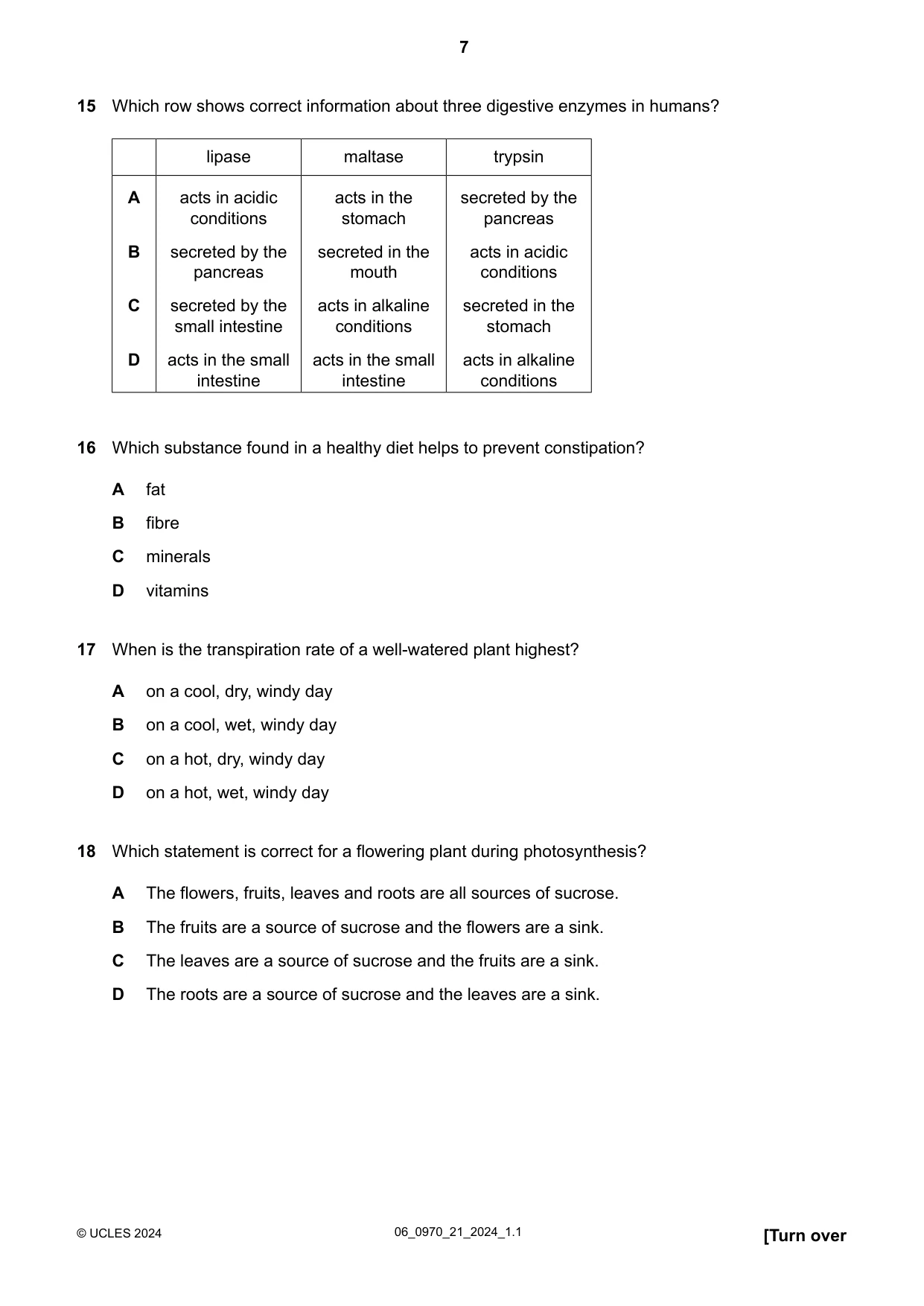
Q14 · The diagrams show carbohydrate molecules as they pass through the alimentary canal
14 The diagrams show carbohydrate molecules as they pass through the alimentary canal. Which row represents the molecules correctly? before taking after some time after some time in into the mouth in the mouth the small intestine A B C D
Mark scheme: B
Q15 · Which row shows correct information about three digestive enzymes in humans?
15 Which row shows correct information about three digestive enzymes in humans? lipase maltase trypsin A acts in acidic acts in the secreted by the conditions stomach pancreas B secreted by the secreted in the acts in acidic pancreas mouth conditions C secreted by the acts in alkaline secreted in the small intestine conditions stomach D acts in the small acts in the small acts in alkaline intestine intestine conditions
Mark scheme: D
Q16 · Which substance found in a healthy diet helps to prevent constipation?
16 Which substance found in a healthy diet helps to prevent constipation? A fat B fibre C minerals D vitamins
Mark scheme: B
Q17 · When is the transpiration rate of a well-watered plant highest?
17 When is the transpiration rate of a well-watered plant highest? A on a cool, dry, windy day B on a cool, wet, windy day C on a hot, dry, windy day D on a hot, wet, windy day
Mark scheme: C
Q18 · Which statement is correct for a flowering plant during photosynthesis?
18 Which statement is correct for a flowering plant during photosynthesis? A The flowers, fruits, leaves and roots are all sources of sucrose. B The fruits are a source of sucrose and the flowers are a sink. C The leaves are a source of sucrose and the fruits are a sink. D The roots are a source of sucrose and the leaves are a sink.
Mark scheme: C
Q19 · What is an advantage of having a double circulatory system?
19 What is an advantage of having a double circulatory system? A It uses less energy because blood flows through the heart only once in each circuit around the body. B Concentration gradients of solutes and gases are kept low. C Deoxygenated and oxygenated blood are separated to allow a high rate of oxygen supply to the tissues. D It maintains high-pressure blood flow to the lungs and low-pressure blood flow to the body.
Mark scheme: C
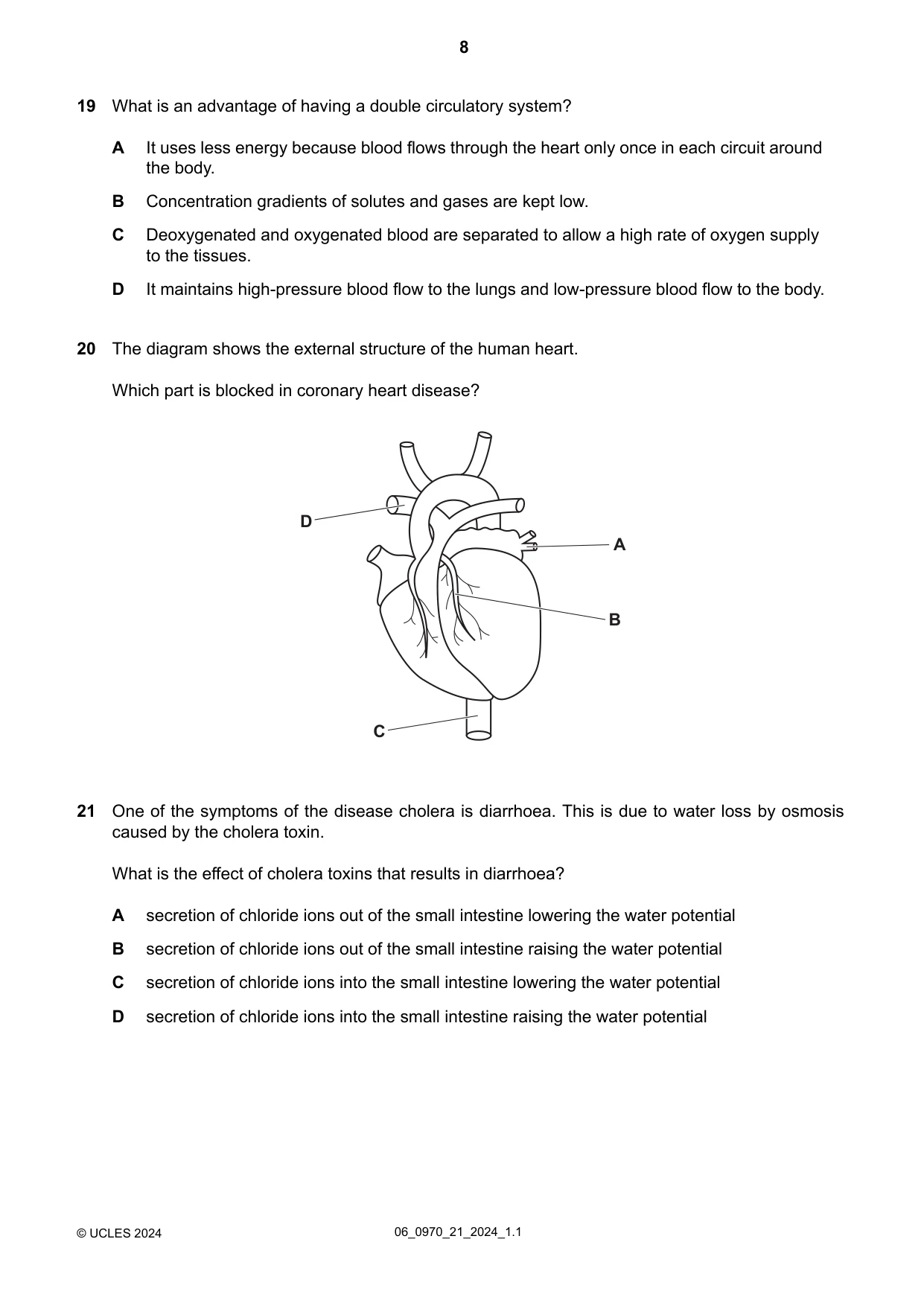
Q20 · The diagram shows the external structure of the human heart
20 The diagram shows the external structure of the human heart. Which part is blocked in coronary heart disease? D A B C
Mark scheme: B
Q21 · One of the symptoms of the disease cholera is diarrhoea
21 One of the symptoms of the disease cholera is diarrhoea. This is due to water loss by osmosis caused by the cholera toxin. What is the effect of cholera toxins that results in diarrhoea? A secretion of chloride ions out of the small intestine lowering the water potential B secretion of chloride ions out of the small intestine raising the water potential C secretion of chloride ions into the small intestine lowering the water potential D secretion of chloride ions into the small intestine raising the water potential
Mark scheme: C
Q22 · Which statement about immunity is correct?
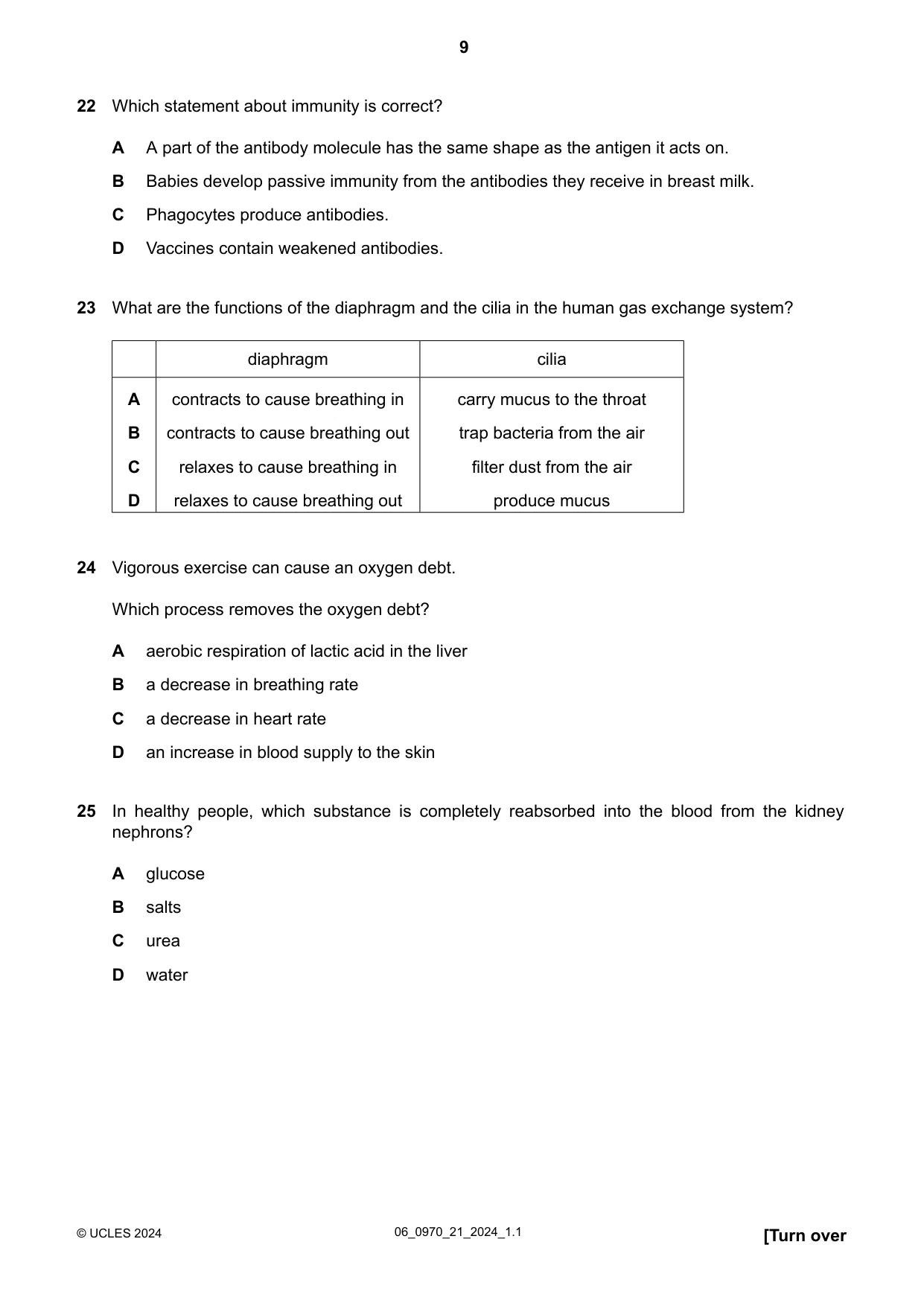
22 Which statement about immunity is correct? A A part of the antibody molecule has the same shape as the antigen it acts on. B Babies develop passive immunity from the antibodies they receive in breast milk. C Phagocytes produce antibodies. D Vaccines contain weakened antibodies.
Mark scheme: B
Q23 · What are the functions of the diaphragm and the cilia in the human gas exchange system?
23 What are the functions of the diaphragm and the cilia in the human gas exchange system? diaphragm cilia A contracts to cause breathing in carry mucus to the throat B contracts to cause breathing out trap bacteria from the air C relaxes to cause breathing in filter dust from the air D relaxes to cause breathing out produce mucus
Mark scheme: A
Q24 · Vigorous exercise can cause an oxygen debt
24 Vigorous exercise can cause an oxygen debt. Which process removes the oxygen debt? A aerobic respiration of lactic acid in the liver B a decrease in breathing rate C a decrease in heart rate D an increase in blood supply to the skin
Mark scheme: A
Q25 · In healthy people, which substance is completely reabsorbed into the blood from the…
25 In healthy people, which substance is completely reabsorbed into the blood from the kidney nephrons? A glucose B salts C urea D water
Mark scheme: A
Q26 · What would be the pupil size and lens shape of a person reading a mobile phone text…
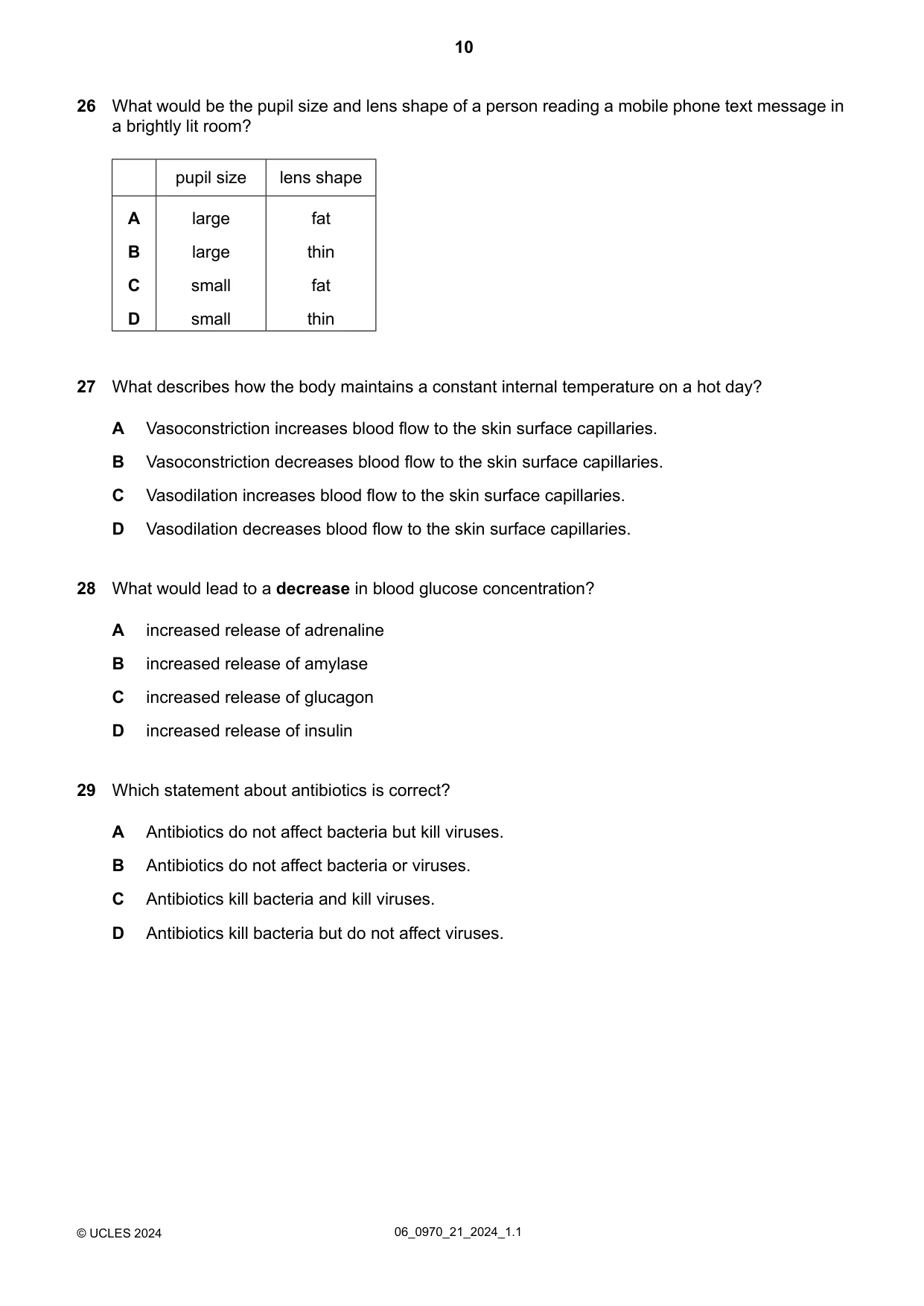
26 What would be the pupil size and lens shape of a person reading a mobile phone text message in a brightly lit room? pupil size lens shape A large fat B large thin C small fat D small thin
Mark scheme: C
Q27 · What describes how the body maintains a constant internal temperature on a hot day?
27 What describes how the body maintains a constant internal temperature on a hot day? A Vasoconstriction increases blood flow to the skin surface capillaries. B Vasoconstriction decreases blood flow to the skin surface capillaries. C Vasodilation increases blood flow to the skin surface capillaries. D Vasodilation decreases blood flow to the skin surface capillaries.
Mark scheme: C
Q28 · What would lead to a decrease in blood glucose concentration?
28 What would lead to a decrease in blood glucose concentration? A increased release of adrenaline B increased release of amylase C increased release of glucagon D increased release of insulin
Mark scheme: D
Q29 · Which statement about antibiotics is correct?
29 Which statement about antibiotics is correct? A Antibiotics do not affect bacteria but kill viruses. B Antibiotics do not affect bacteria or viruses. C Antibiotics kill bacteria and kill viruses. D Antibiotics kill bacteria but do not affect viruses.
Mark scheme: D
Q30 · The diagram shows the carpel of a flower just after pollination
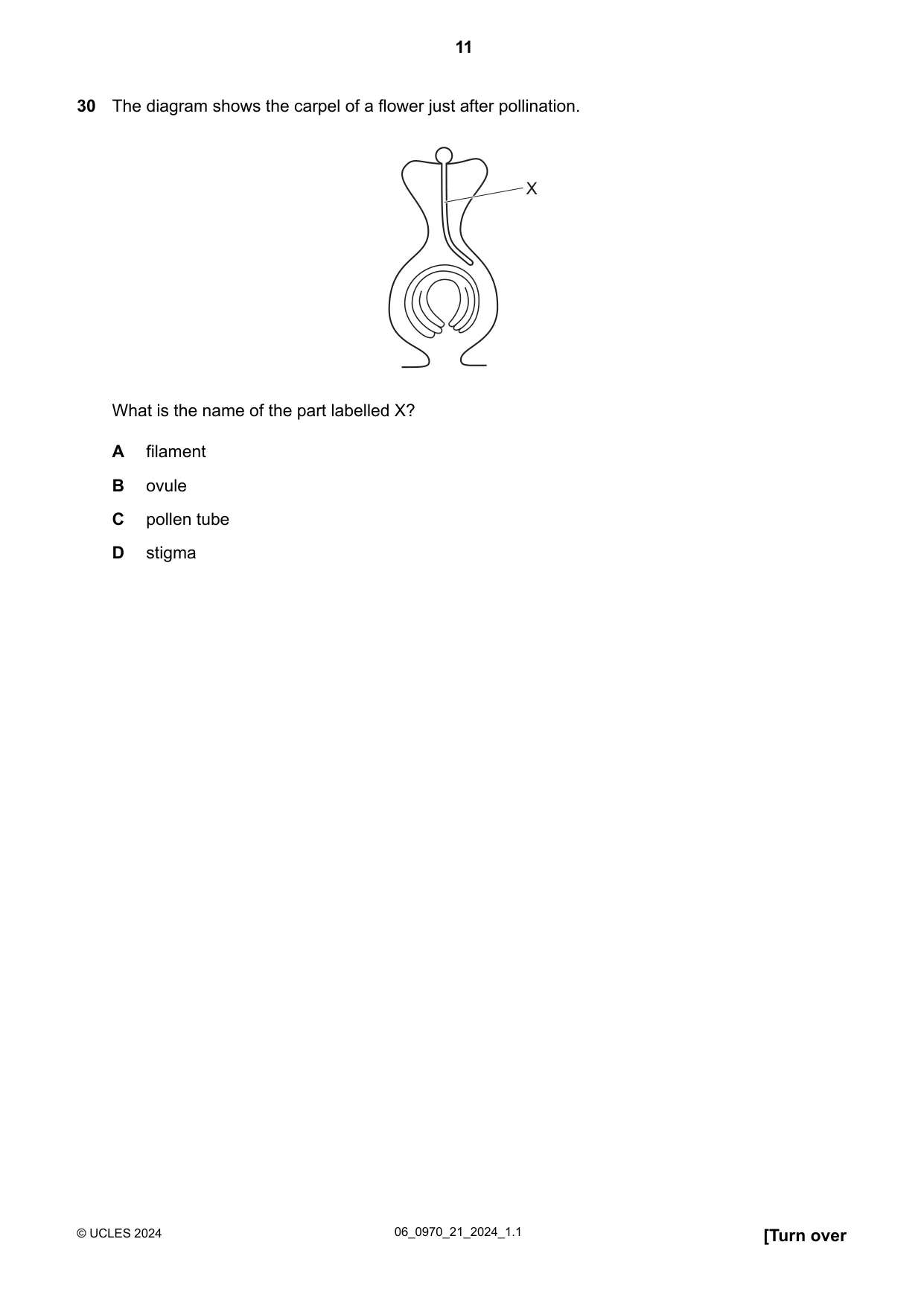
30 The diagram shows the carpel of a flower just after pollination. X What is the name of the part labelled X? A filament B ovule C pollen tube D stigma
Mark scheme: C
Q31 · The table shows the percentage of sperm with different abnormalities in samples from a…
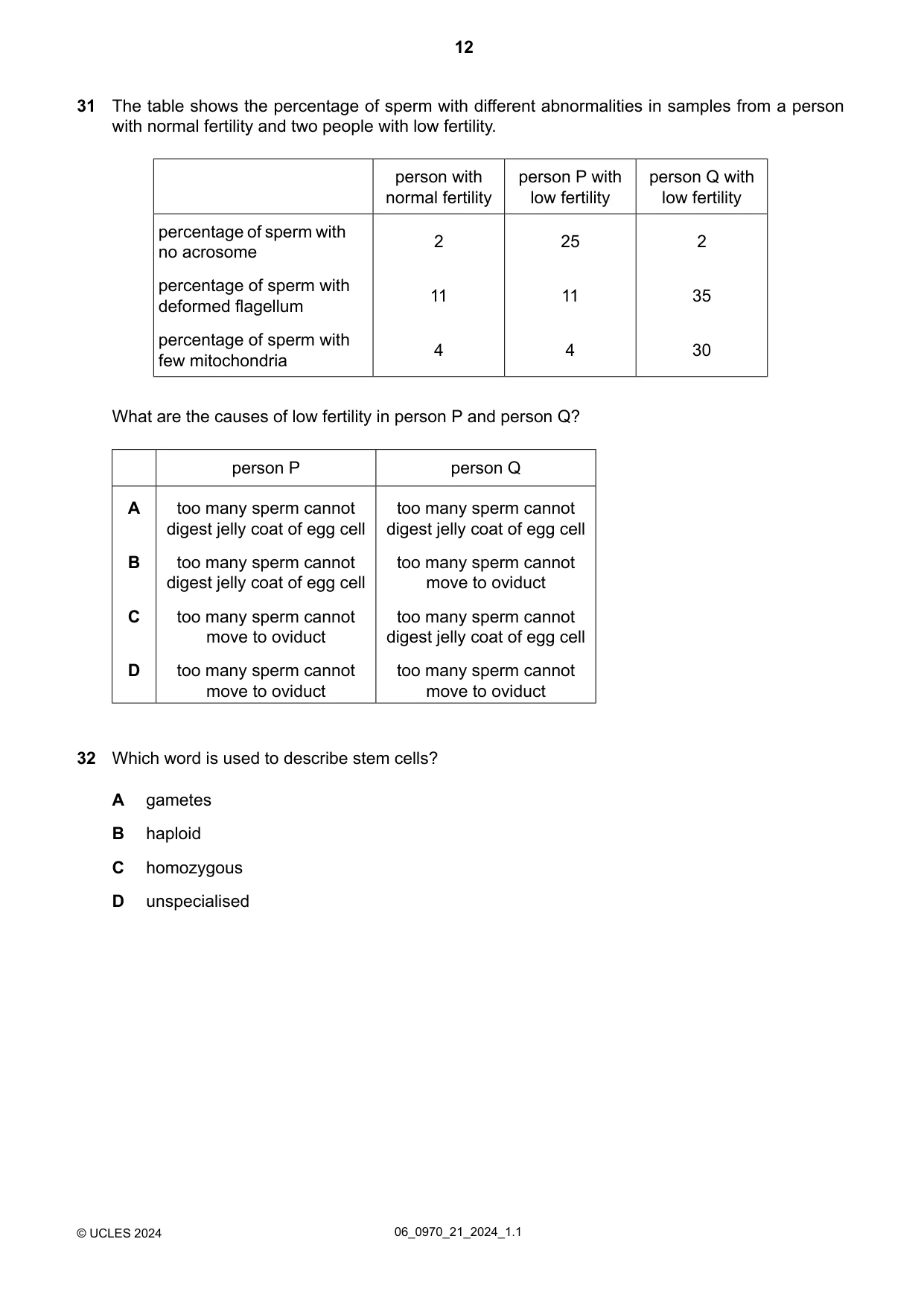
31 The table shows the percentage of sperm with different abnormalities in samples from a person with normal fertility and two people with low fertility. person with person P with person Q with normal fertility low fertility low fertility percentage of sperm with no acrosome 2 25 2 percentage of sperm with 11 11 35 deformed flagellum percentage of sperm with 4 4 30 few mitochondria What are the causes of low fertility in person P and person Q? person P person Q A too many sperm cannot too many sperm cannot digest jelly coat of egg cell digest jelly coat of egg cell B too many sperm cannot too many sperm cannot digest jelly coat of egg cell move to oviduct C too many sperm cannot too many sperm cannot move to oviduct digest jelly coat of egg cell D too many sperm cannot too many sperm cannot move to oviduct move to oviduct
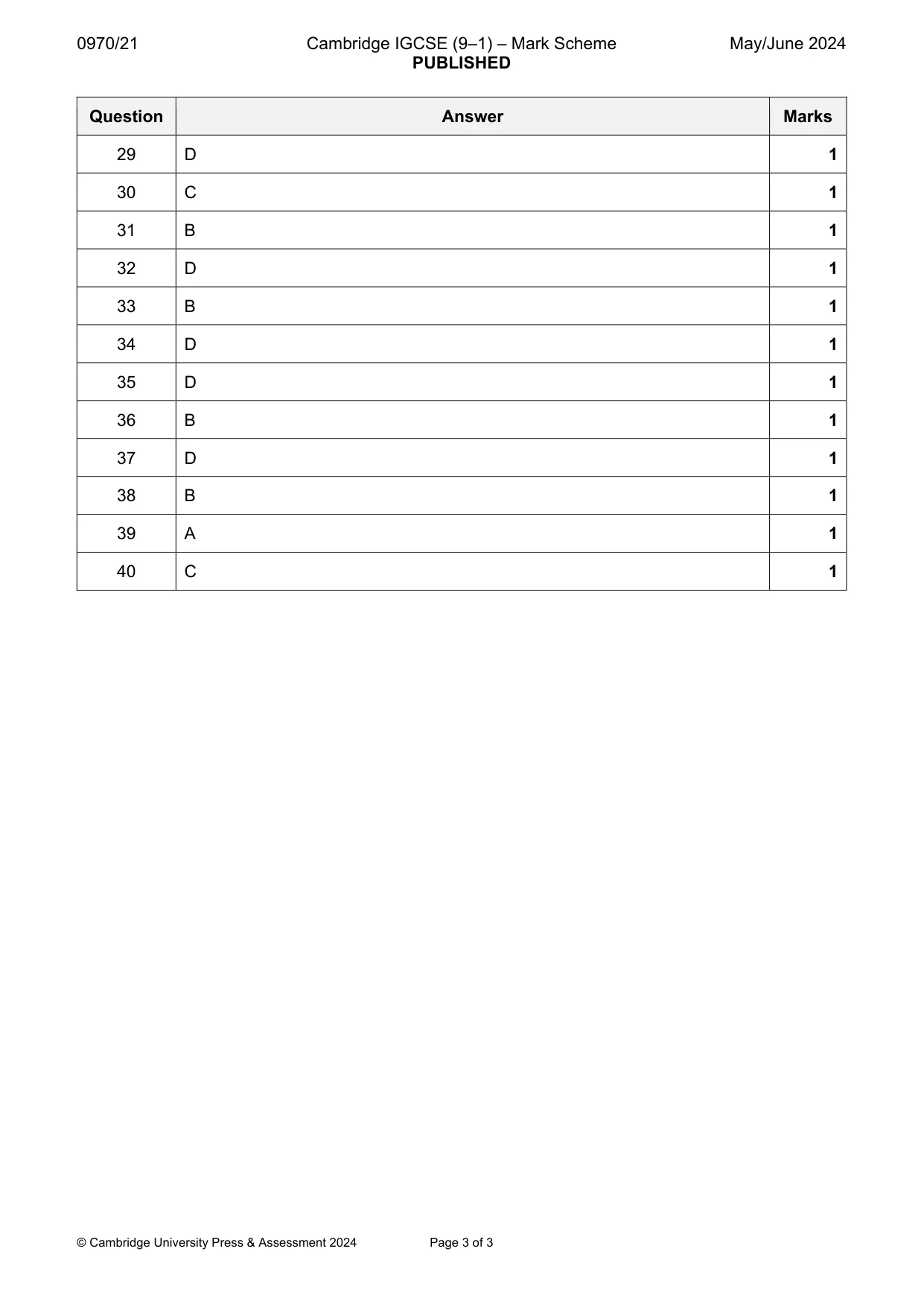
Mark scheme: B
Q32 · Which word is used to describe stem cells?
32 Which word is used to describe stem cells? A gametes B haploid C homozygous D unspecialised
Mark scheme: D
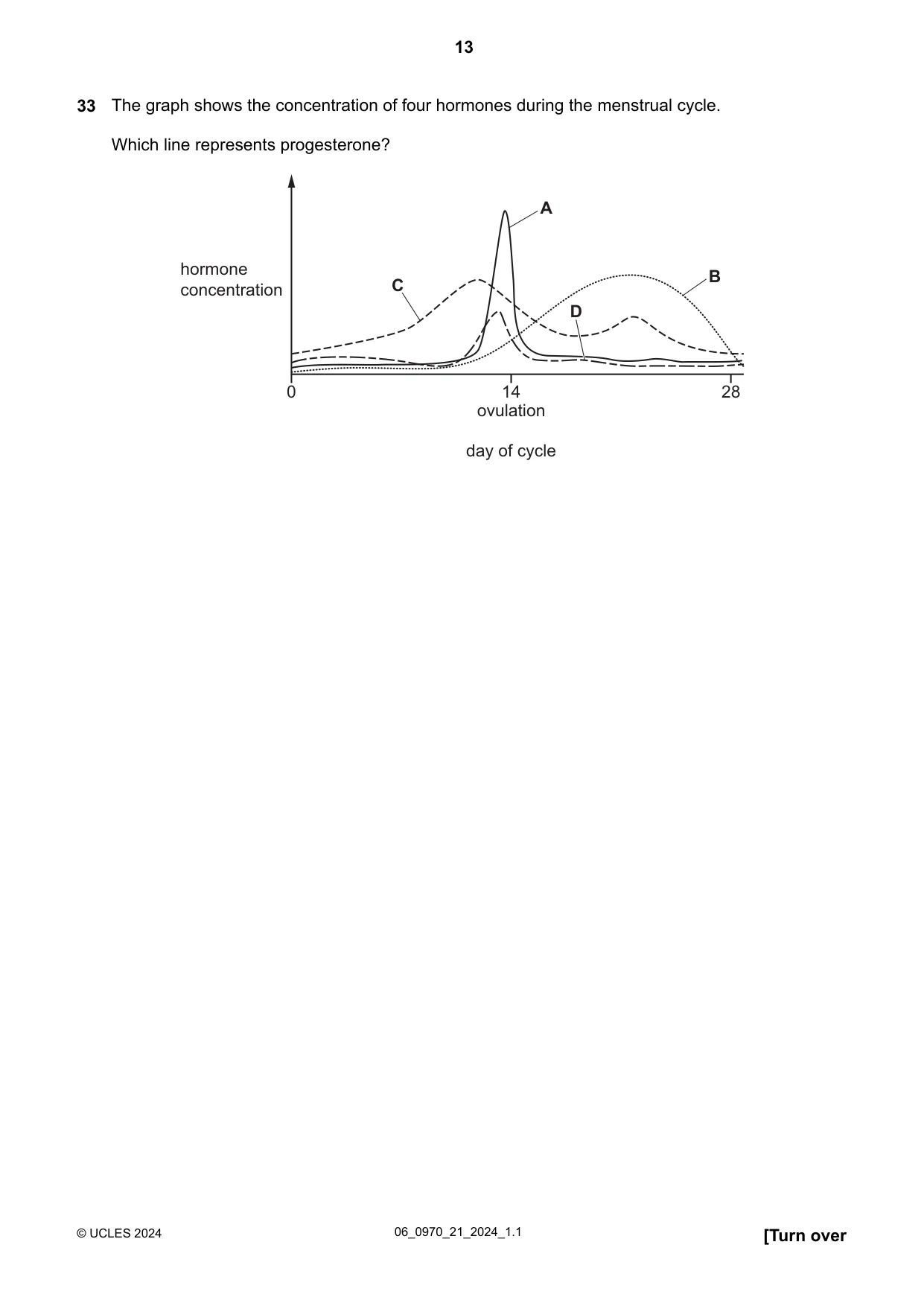
Q33 · The graph shows the concentration of four hormones during the menstrual cycle
33 The graph shows the concentration of four hormones during the menstrual cycle. Which line represents progesterone? A hormone B concentration C D 0 14 28 ovulation day of cycle
Mark scheme: B
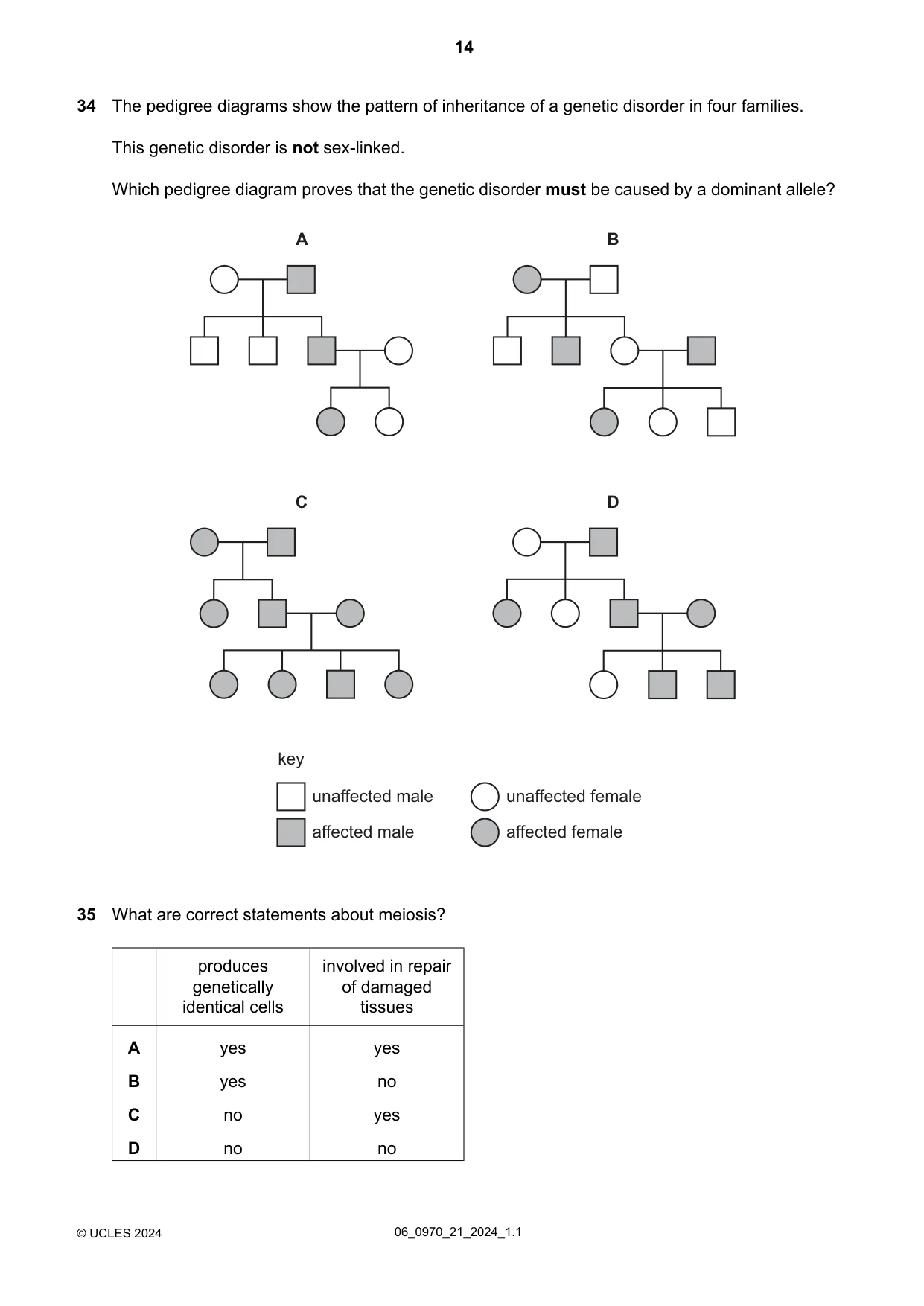
Q34 · The pedigree diagrams show the pattern of inheritance of a genetic disorder in four…
34 The pedigree diagrams show the pattern of inheritance of a genetic disorder in four families. This genetic disorder is not sex-linked. Which pedigree diagram proves that the genetic disorder must be caused by a dominant allele? A B C D key unaffected male unaffected female affected male affected female
Mark scheme: D
Q35 · What are correct statements about meiosis?
35 What are correct statements about meiosis? produces involved in repair genetically of damaged identical cells tissues A yes yes B yes no C no yes D no no
Mark scheme: D
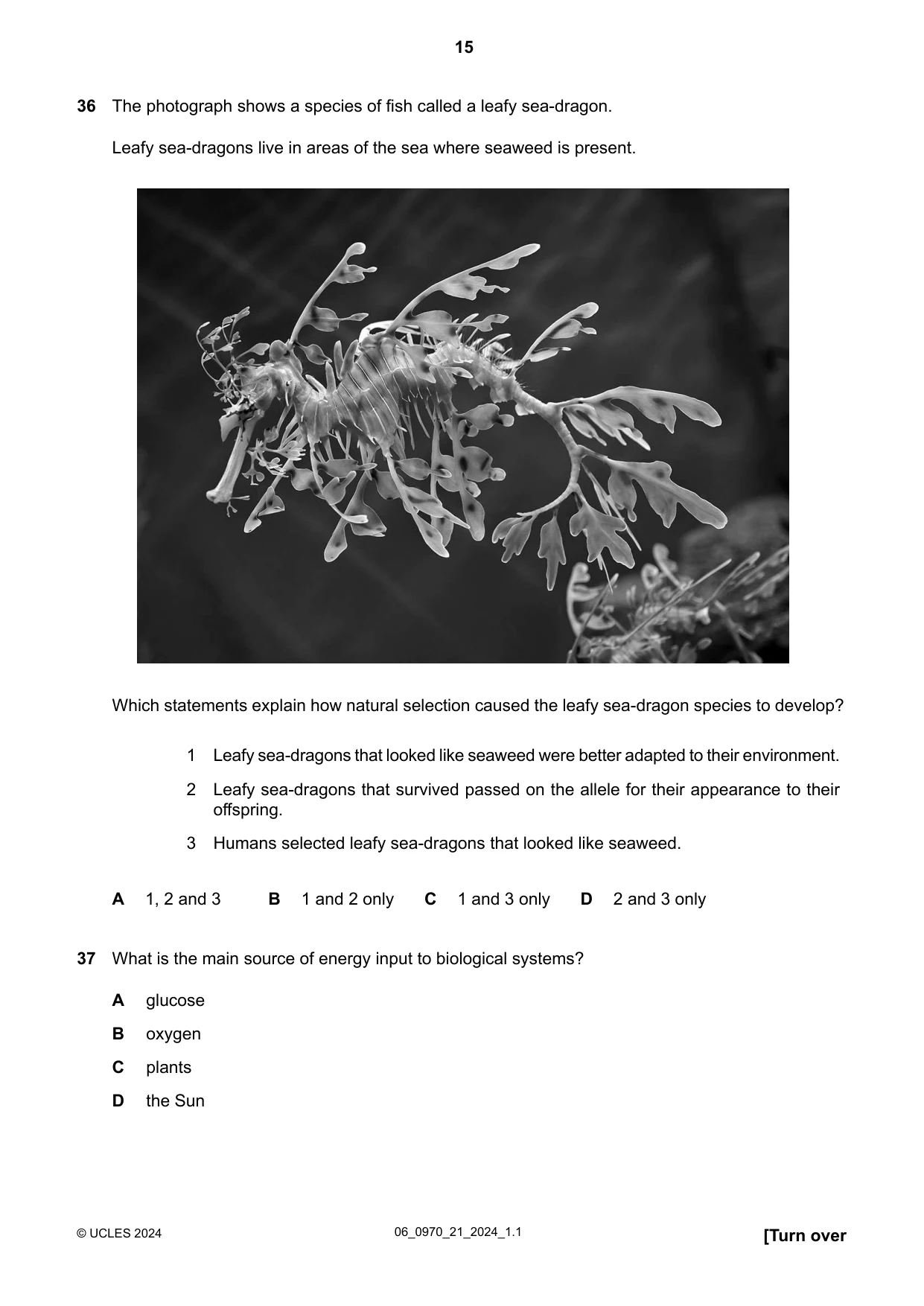
Q36 · The photograph shows a species of fish called a leafy sea-dragon
36 The photograph shows a species of fish called a leafy sea-dragon. Leafy sea-dragons live in areas of the sea where seaweed is present. Which statements explain how natural selection caused the leafy sea-dragon species to develop? 1 Leafy sea-dragons that looked like seaweed were better adapted to their environment. 2 Leafy sea-dragons that survived passed on the allele for their appearance to their offspring. 3 Humans selected leafy sea-dragons that looked like seaweed. A 1, 2 and 3 B 1 and 2 only C 1 and 3 only D 2 and 3 only
Mark scheme: B
Q37 · What is the main source of energy input to biological systems?
37 What is the main source of energy input to biological systems? A glucose B oxygen C plants D the Sun
Mark scheme: D
Q38 · Which organisms remove nitrate ions from soil?
38 Which organisms remove nitrate ions from soil? A denitrifying bacteria and nitrogen-fixing bacteria in root nodules B denitrifying bacteria and plants C nitrifying bacteria and plants D nitrogen-fixing bacteria in root nodules
Mark scheme: B
Q39 · What are two reasons for organisms becoming endangered?
39 What are two reasons for organisms becoming endangered? 1 habitat destruction 2 monitoring 3 education 4 pollution 5 captive breeding programmes A 1 and 4 B 1 and 5 C 2 and 3 D 3 and 4
Mark scheme: A
Q40 · What is an example of the use of genetic modification in agriculture?
40 What is an example of the use of genetic modification in agriculture? A choosing cattle to breed so that alleles for high milk yield will be passed on to their offspring B increasing food production by using insecticides to improve quality and yield C inserting genes into crop plants to improve the nutritional qualities of the plant D selecting crop plants with desirable characteristics and crossing these to produce the next generation
Mark scheme: C
What was in this paper
The subtopics covered by these 40 questions, and how many questions each got. Open one in a new tab to see every Cambridge question on it.
3Chemical digestion2Diseases and immunity2Absorption1Active transport1Anaerobic respiration1Biological molecules1Cell structure1Characteristics of living organisms1Circulatory systems1Diet1Digestive system1Drugs1Energy flow1Enzymes1Excretion in humans1Gas exchange in humans1Habitat destruction1Heart1Homeostasis1Hormones1Leaf structure1Meiosis1Mitosis1Monohybrid inheritance1Nutrient cycles1Osmosis1Photosynthesis1Selection1Sense organs1Sex hormones in humans1Sexual reproduction in humans1Sexual reproduction in plants1Size of specimens1Translocation1Transpiration1What you needed in this session
Cambridge’s own grade thresholds for 2024 May/June, Paper 2 · Variant 1. A higher threshold means an easier paper — the bar moves with how the cohort did.