Cambridge IGCSE Biology (9-1) 0970 — 2022 Oct/Nov Paper 2 · Variant 2
0970/22/O/N/22 · 40 questions · 40 marks · ≈45 min
The question paper and its mark scheme, free to read here and free to download. This is Cambridge’s own paper, exactly as it was sat.
Question paper16 pages

Mark scheme3 pages
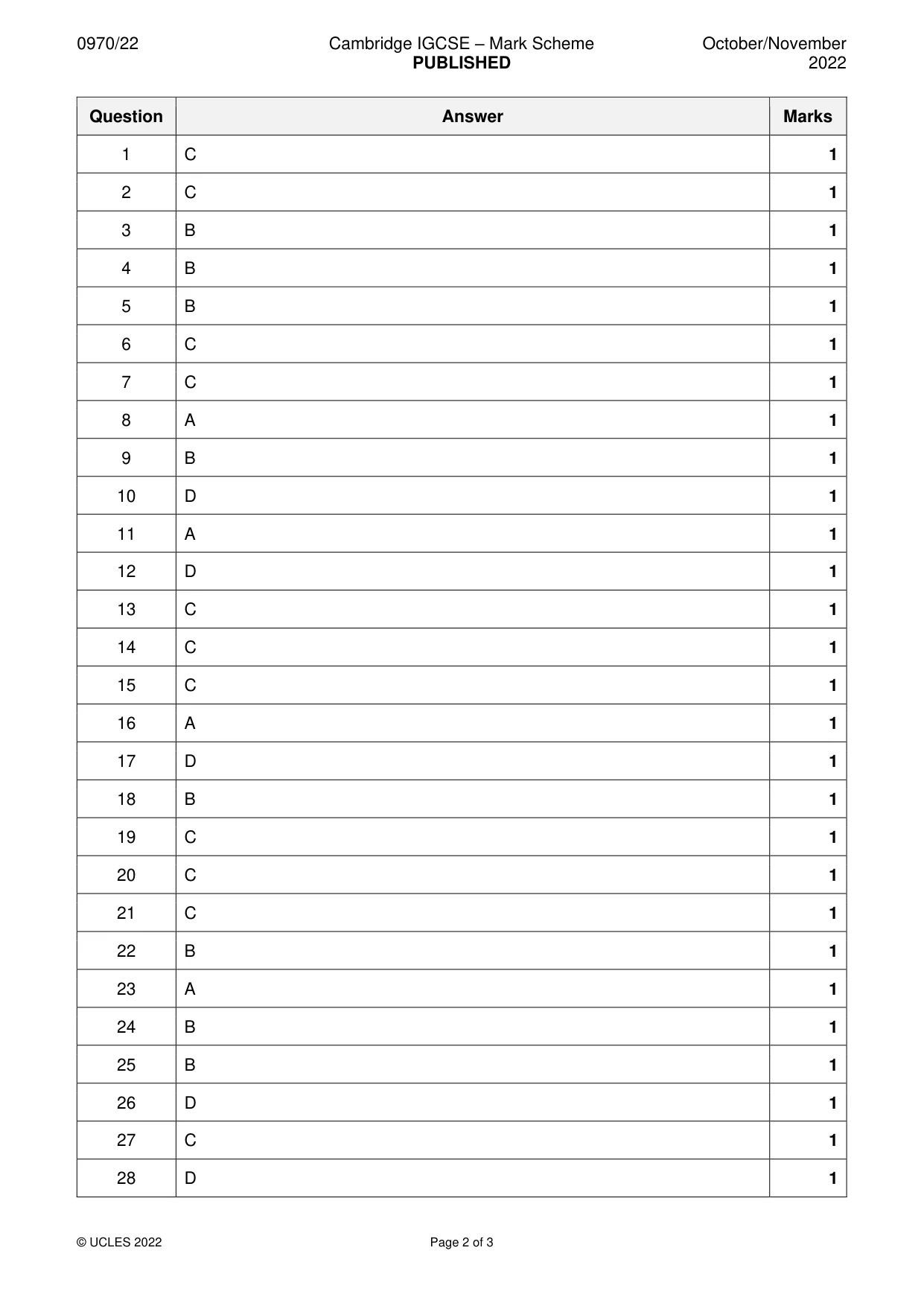
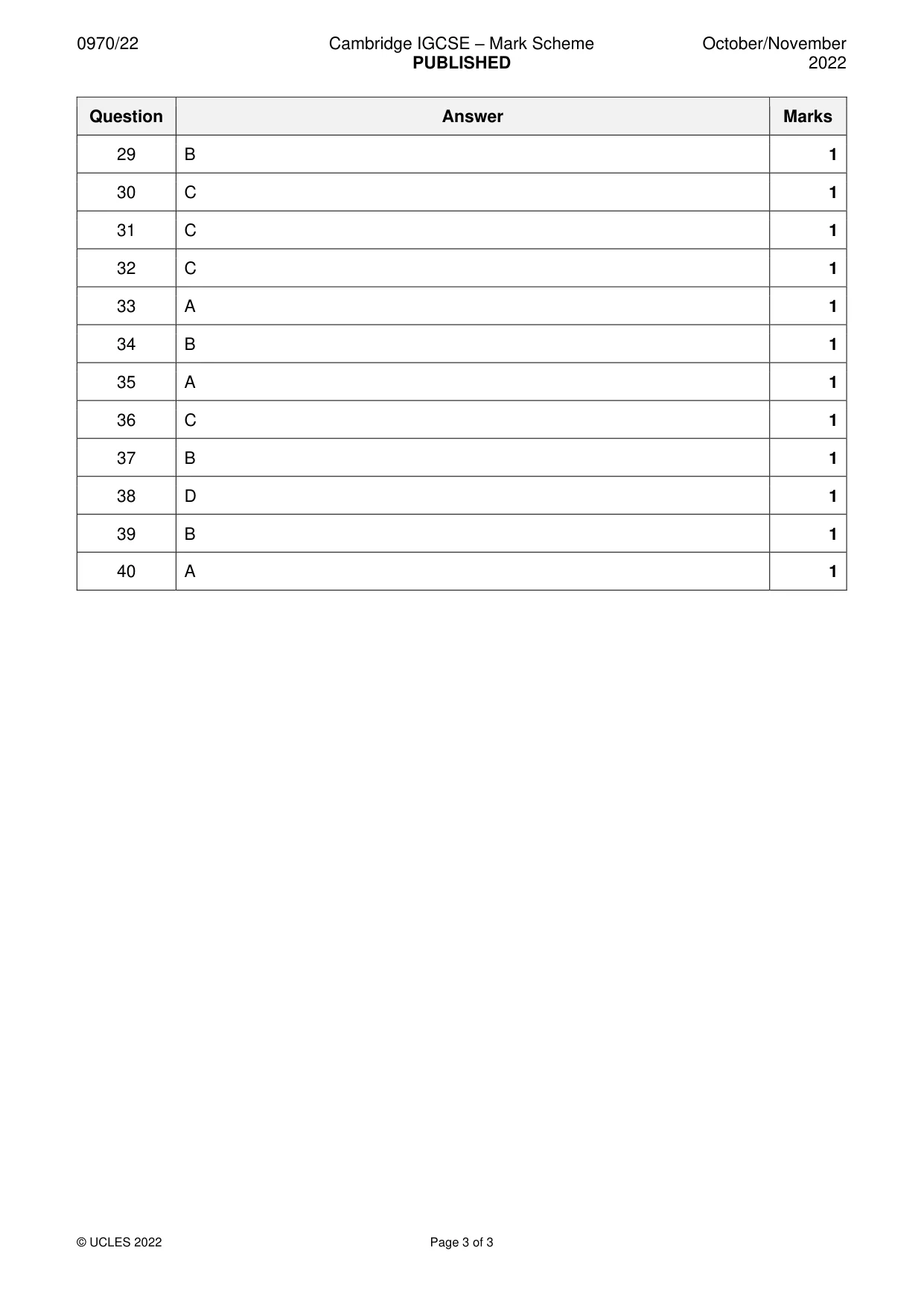
Answers below. Sit the paper first if you are practising.
Questions as text
Q1 · Which process provides an organism with the raw materials needed for tissue repair?
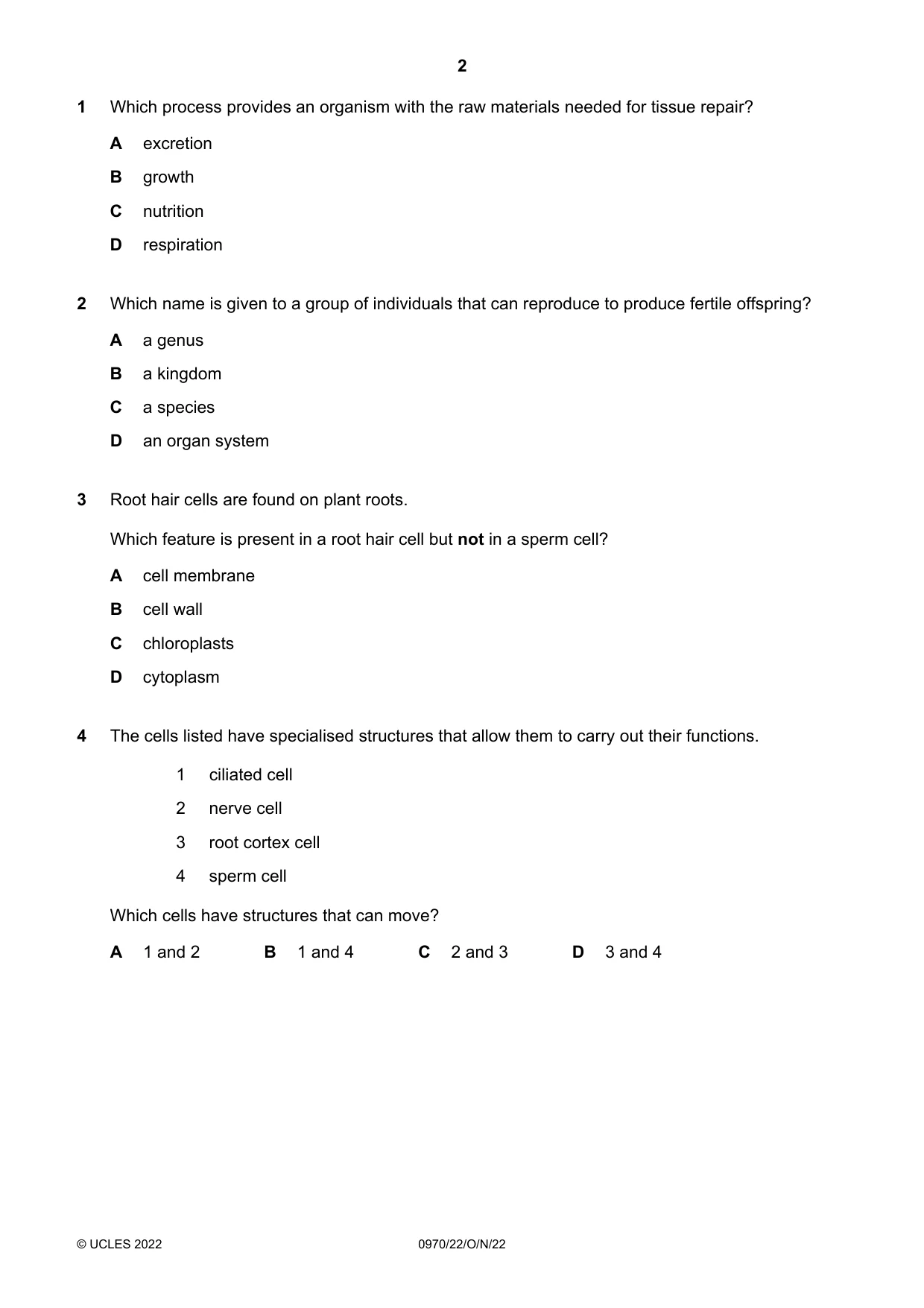
1 Which process provides an organism with the raw materials needed for tissue repair? A excretion B growth C nutrition D respiration
Mark scheme: C
Q2 · Which name is given to a group of individuals that can reproduce to produce fertile…
2 Which name is given to a group of individuals that can reproduce to produce fertile offspring? A a genus B a kingdom C a species D an organ system
Mark scheme: C
More questions on Concept and uses of classification systems
Q3 · Root hair cells are found on plant roots
3 Root hair cells are found on plant roots. Which feature is present in a root hair cell but not in a sperm cell? A cell membrane B cell wall C chloroplasts D cytoplasm
Mark scheme: B
Q4 · The cells listed have specialised structures that allow them to carry out their functions
4 The cells listed have specialised structures that allow them to carry out their functions. 1 ciliated cell 2 nerve cell 3 root cortex cell 4 sperm cell Which cells have structures that can move? A 1 and 2 B 1 and 4 C 2 and 3 D 3 and 4
Mark scheme: B
Q5 · Some examples of substances moving across membranes are listed
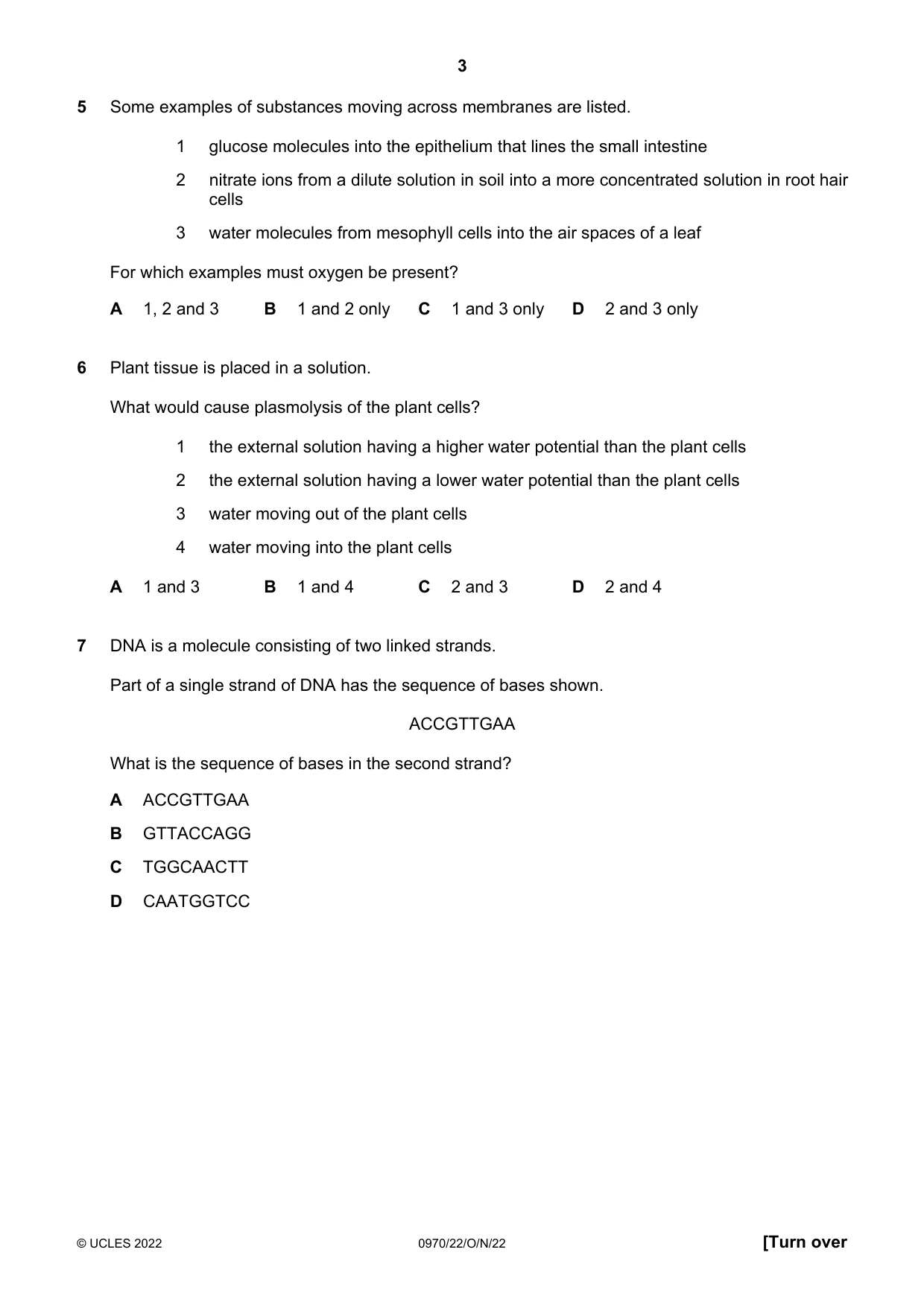
5 Some examples of substances moving across membranes are listed. 1 glucose molecules into the epithelium that lines the small intestine 2 nitrate ions from a dilute solution in soil into a more concentrated solution in root hair cells 3 water molecules from mesophyll cells into the air spaces of a leaf For which examples must oxygen be present? A 1, 2 and 3 B 1 and 2 only C 1 and 3 only D 2 and 3 only
Mark scheme: B
Q6 · Plant tissue is placed in a solution
6 Plant tissue is placed in a solution. What would cause plasmolysis of the plant cells? 1 the external solution having a higher water potential than the plant cells 2 the external solution having a lower water potential than the plant cells 3 water moving out of the plant cells 4 water moving into the plant cells A 1 and 3 B 1 and 4 C 2 and 3 D 2 and 4
Mark scheme: C
Q7 · DNA is a molecule consisting of two linked strands
7 DNA is a molecule consisting of two linked strands. Part of a single strand of DNA has the sequence of bases shown. ACCGTTGAA What is the sequence of bases in the second strand? A ACCGTTGAA B GTTACCAGG C TGGCAACTT D CAATGGTCC
Mark scheme: C
Q8 · The graph shows the concentration of a substance during the course of an…
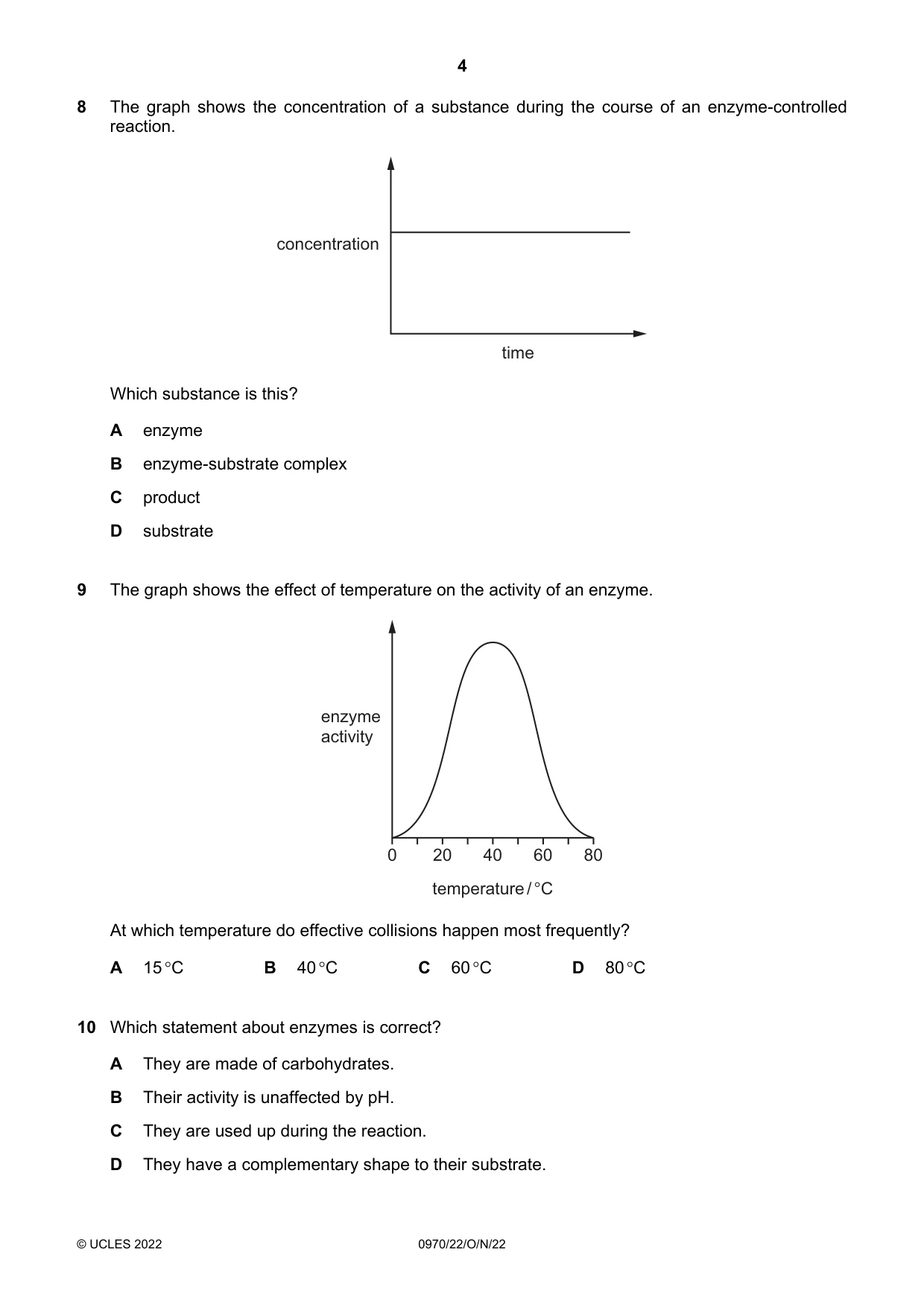
8 The graph shows the concentration of a substance during the course of an enzyme-controlled reaction. concentration time Which substance is this? A enzyme B enzyme-substrate complex C product D substrate
Mark scheme: A
Q9 · The graph shows the effect of temperature on the activity of an enzyme
9 The graph shows the effect of temperature on the activity of an enzyme. enzyme activity 0 20 40 60 80 temperature / °C At which temperature do effective collisions happen most frequently? A 15 °C B 40 °C C 60 °C D 80 °C
Mark scheme: B
Q10 · Which statement about enzymes is correct?
10 Which statement about enzymes is correct? A They are made of carbohydrates. B Their activity is unaffected by pH. C They are used up during the reaction. D They have a complementary shape to their substrate.
Mark scheme: D
Q11 · Two test-tubes were filled with hydrogencarbonate indicator
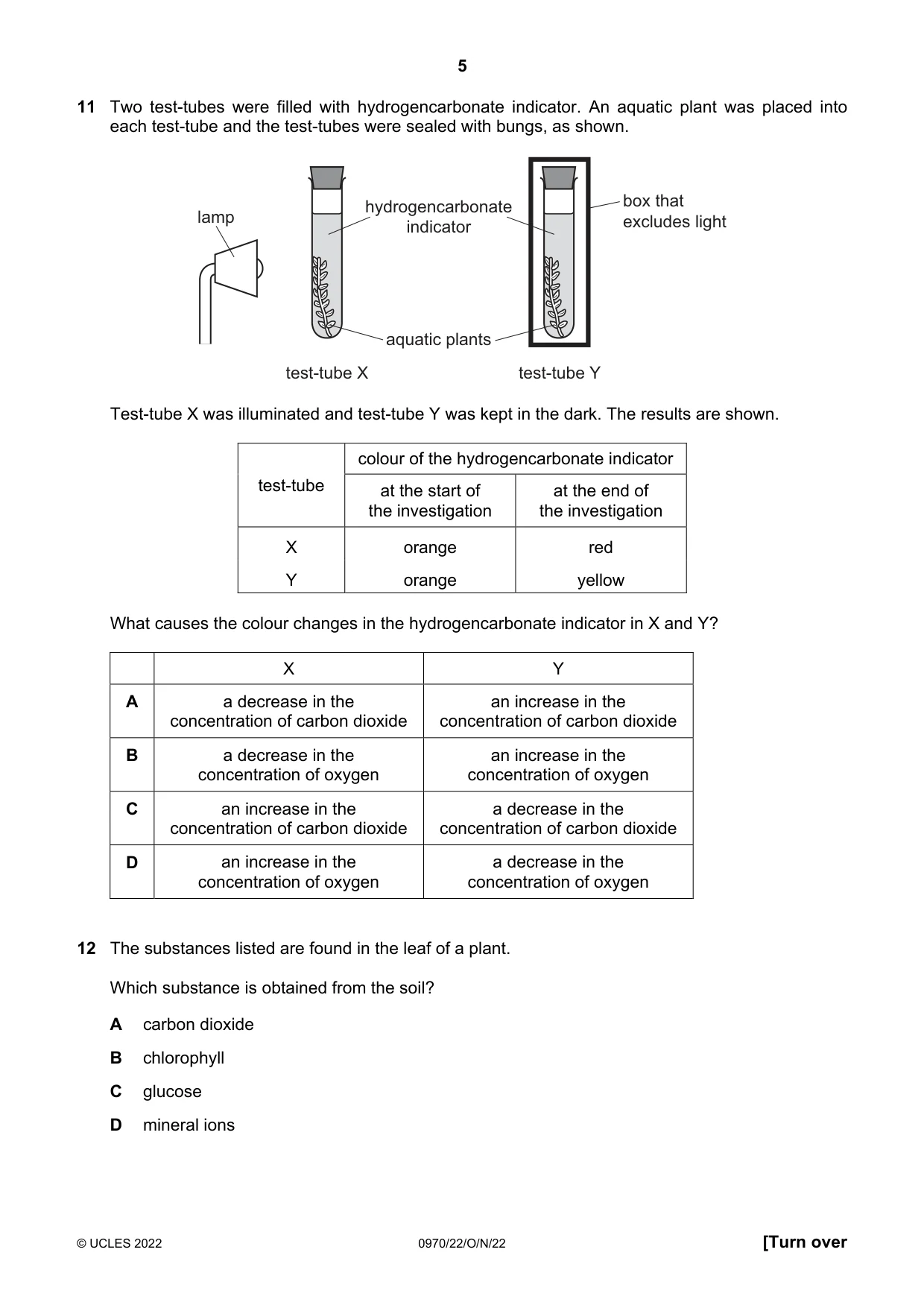
11 Two test-tubes were filled with hydrogencarbonate indicator. An aquatic plant was placed into each test-tube and the test-tubes were sealed with bungs, as shown. hydrogencarbonate box that lamp excludes light indicator aquatic plants test-tube X test-tube Y Test-tube X was illuminated and test-tube Y was kept in the dark. The results are shown. colour of the hydrogencarbonate indicator test-tube at the start of at the end of the investigation the investigation X orange red Y orange yellow What causes the colour changes in the hydrogencarbonate indicator in X and Y? X Y A a decrease in the an increase in the concentration of carbon dioxide concentration of carbon dioxide B a decrease in the an increase in the concentration of oxygen concentration of oxygen C an increase in the a decrease in the concentration of carbon dioxide concentration of carbon dioxide D an increase in the a decrease in the concentration of oxygen concentration of oxygen
Mark scheme: A
Q12 · The substances listed are found in the leaf of a plant
12 The substances listed are found in the leaf of a plant. Which substance is obtained from the soil? A carbon dioxide B chlorophyll C glucose D mineral ions
Mark scheme: D
Q13 · The cholera bacterium produces toxins that cause chloride ions to be secreted into the…
13 The cholera bacterium produces toxins that cause chloride ions to be secreted into the small intestine. What is the immediate effect of this on the water potential of blood in the intestinal capillaries, and on the water potential of the contents of the small intestine? water potential blood in contents of capillaries small intestine A lowered lowered B lowered raised C raised lowered D raised raised
Mark scheme: C
Q14 · The graph shows the concentration of maltose in different parts of the alimentary canal
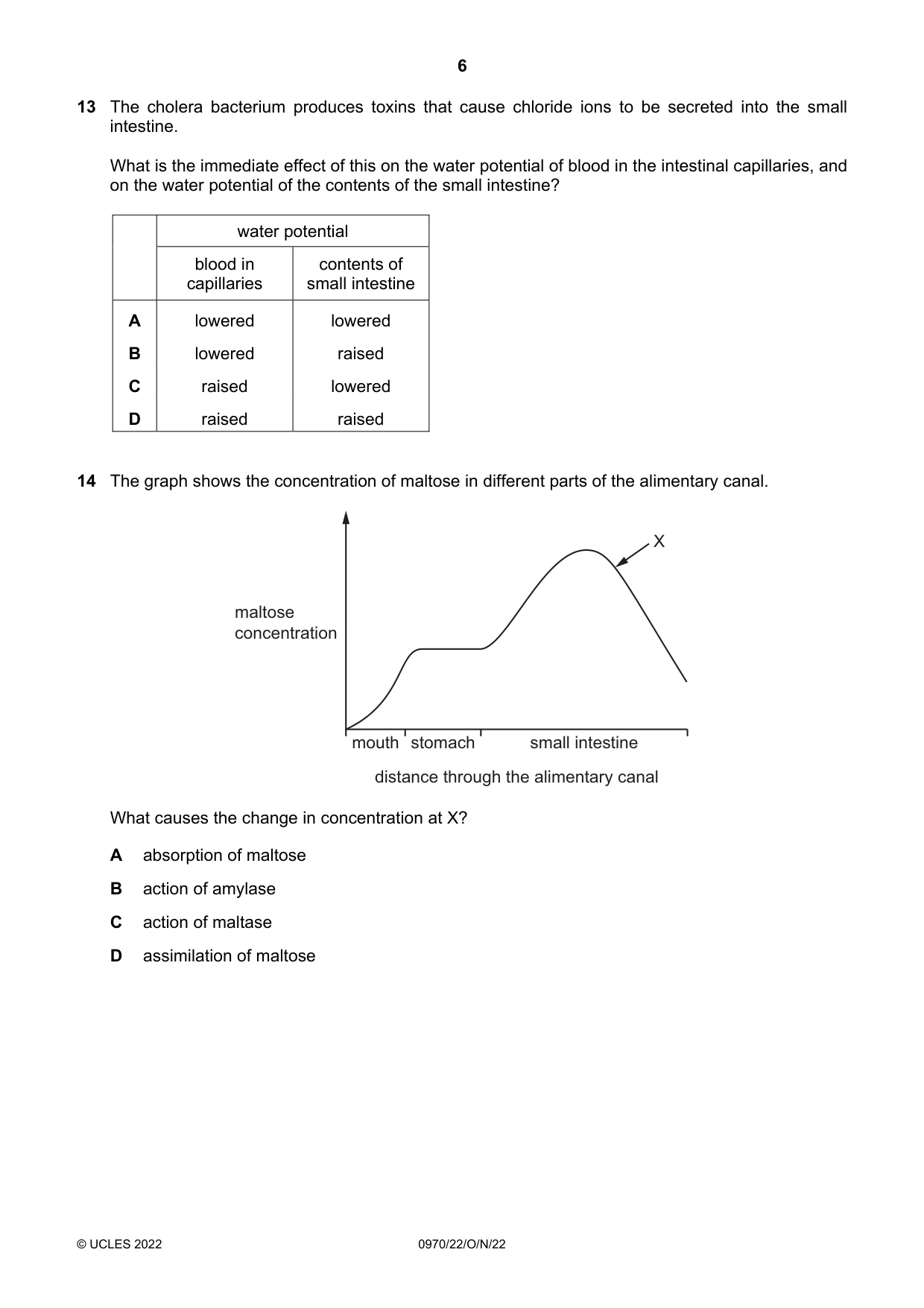
14 The graph shows the concentration of maltose in different parts of the alimentary canal. X maltose concentration mouth stomach small intestine distance through the alimentary canal What causes the change in concentration at X? A absorption of maltose B action of amylase C action of maltase D assimilation of maltose
Mark scheme: C
Q15 · The diagram shows a bean seedling soon after it has germinated
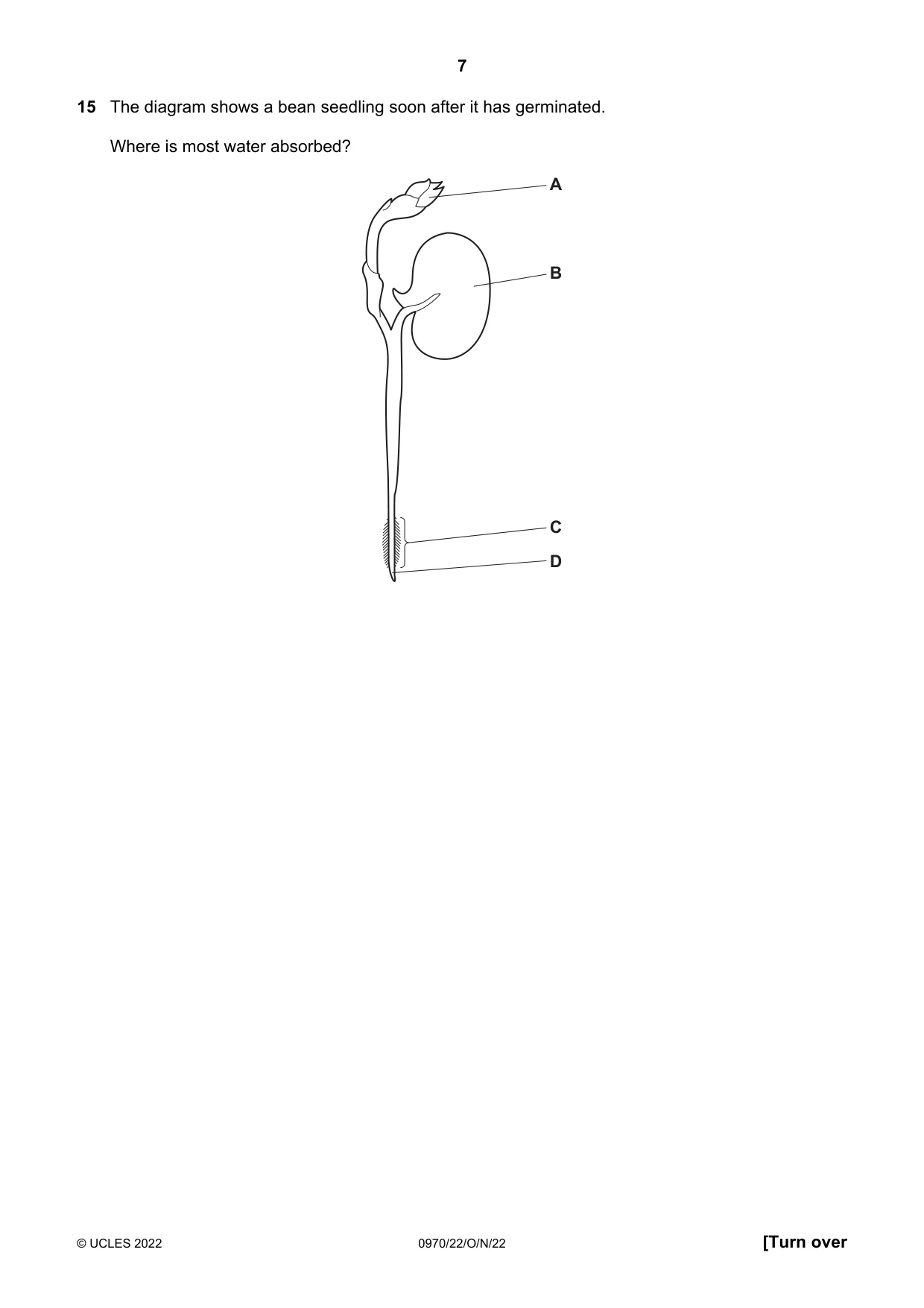
15 The diagram shows a bean seedling soon after it has germinated. Where is most water absorbed? A B C D
Mark scheme: C
Q16 · Scientists investigate the movement of substances in a plant
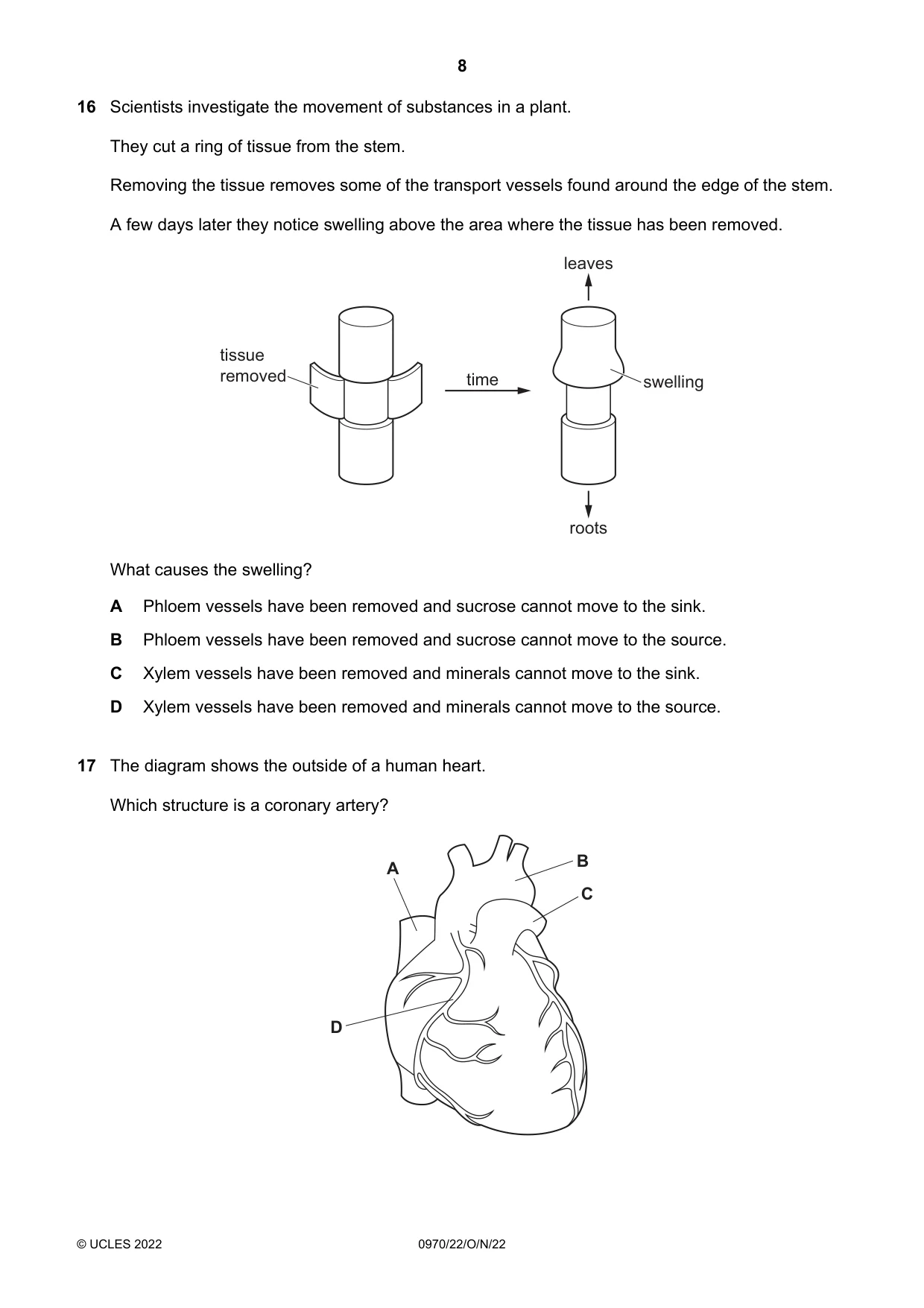
16 Scientists investigate the movement of substances in a plant. They cut a ring of tissue from the stem. Removing the tissue removes some of the transport vessels found around the edge of the stem. A few days later they notice swelling above the area where the tissue has been removed. leaves tissue removed time swelling roots What causes the swelling? A Phloem vessels have been removed and sucrose cannot move to the sink. B Phloem vessels have been removed and sucrose cannot move to the source. C Xylem vessels have been removed and minerals cannot move to the sink. D Xylem vessels have been removed and minerals cannot move to the source.
Mark scheme: A
Q17 · The diagram shows the outside of a human heart
17 The diagram shows the outside of a human heart. Which structure is a coronary artery? B A C D
Mark scheme: D
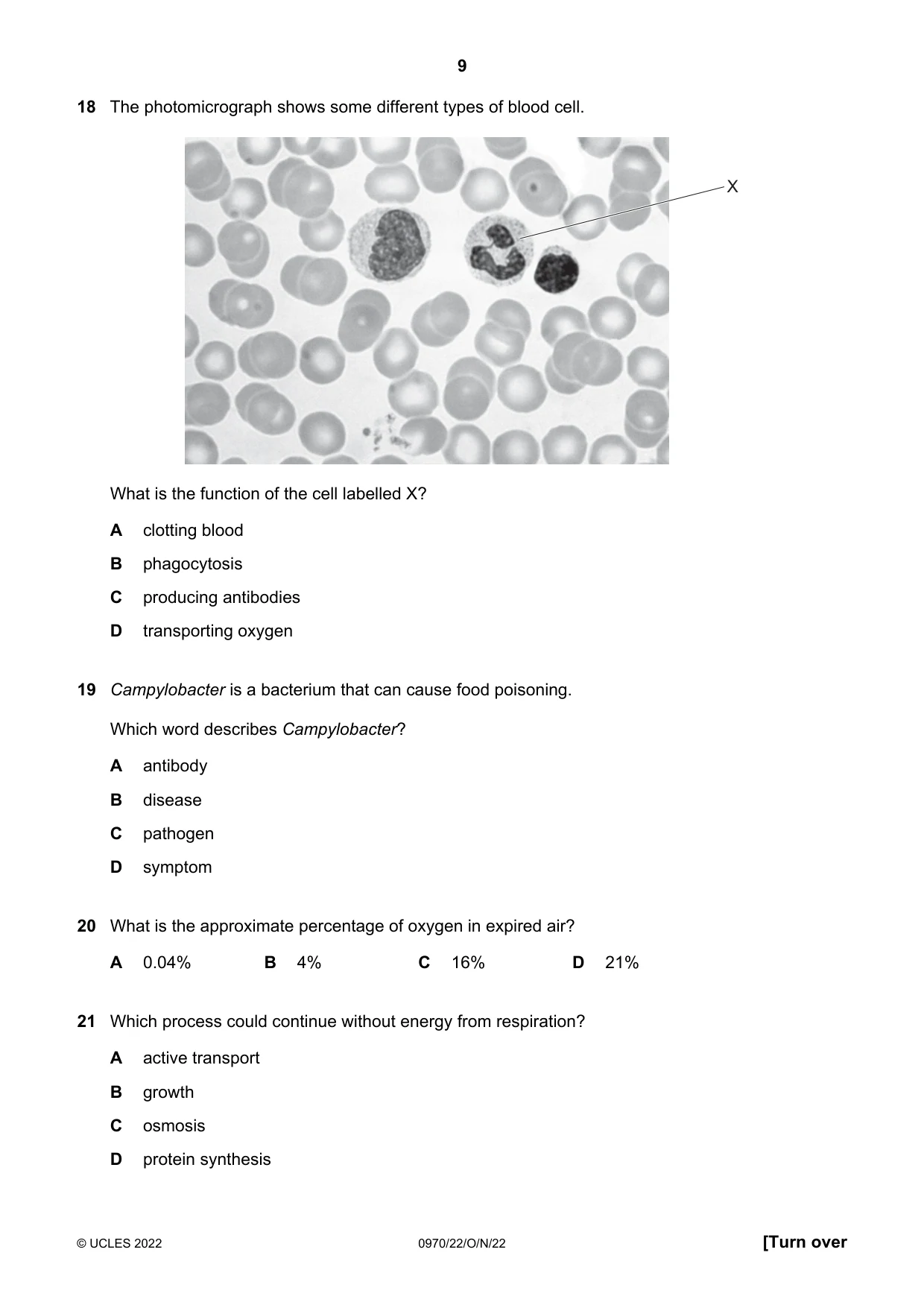
Q18 · The photomicrograph shows some different types of blood cell
18 The photomicrograph shows some different types of blood cell. X What is the function of the cell labelled X? A clotting blood B phagocytosis C producing antibodies D transporting oxygen
Mark scheme: B
Q19 · Campylobacter is a bacterium that can cause food poisoning
19 Campylobacter is a bacterium that can cause food poisoning. Which word describes Campylobacter? A antibody B disease C pathogen D symptom
Mark scheme: C
Q20 · What is the approximate percentage of oxygen in expired air?
20 What is the approximate percentage of oxygen in expired air? A 0.04% B 4% C 16% D 21%
Mark scheme: C
Q21 · Which process could continue without energy from respiration?
21 Which process could continue without energy from respiration? A active transport B growth C osmosis D protein synthesis
Mark scheme: C
Q22 · Which row shows the products of anaerobic respiration in humans and yeast?
22 Which row shows the products of anaerobic respiration in humans and yeast? products in humans products in yeast A lactic acid only alcohol only B lactic acid only alcohol and carbon dioxide C lactic acid and carbon dioxide alcohol only D lactic acid and carbon dioxide alcohol and carbon dioxide
Mark scheme: B
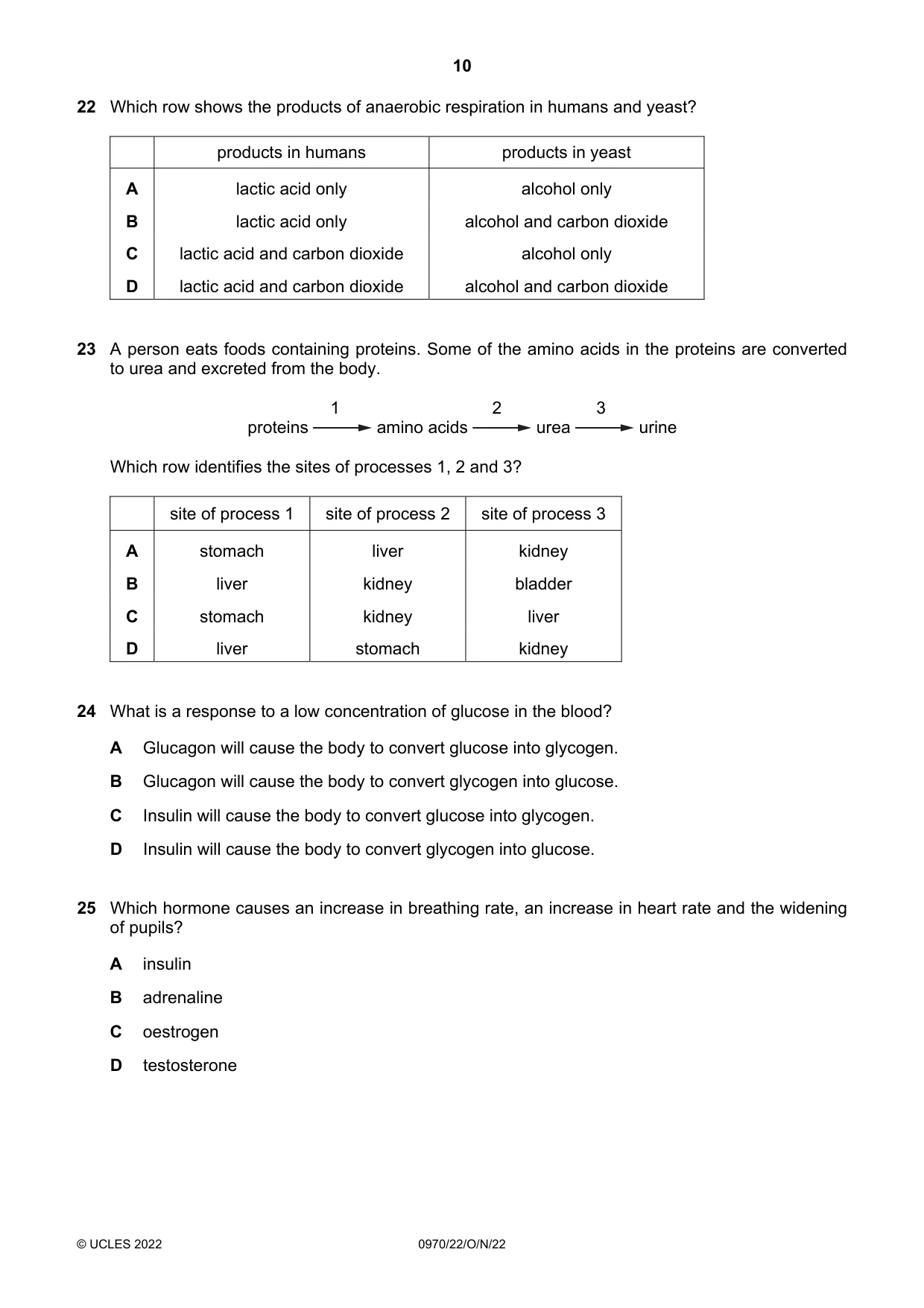
Q23 · A person eats foods containing proteins
23 A person eats foods containing proteins. Some of the amino acids in the proteins are converted to urea and excreted from the body. 1 2 3 proteins amino acids urea urine Which row identifies the sites of processes 1, 2 and 3? site of process 1 site of process 2 site of process 3 A stomach liver kidney B liver kidney bladder C stomach kidney liver D liver stomach kidney
Mark scheme: A
Q24 · What is a response to a low concentration of glucose in the blood?
24 What is a response to a low concentration of glucose in the blood? A Glucagon will cause the body to convert glucose into glycogen. B Glucagon will cause the body to convert glycogen into glucose. C Insulin will cause the body to convert glucose into glycogen. D Insulin will cause the body to convert glycogen into glucose.
Mark scheme: B
Q25 · Which hormone causes an increase in breathing rate, an increase in heart rate and the…
25 Which hormone causes an increase in breathing rate, an increase in heart rate and the widening of pupils? A insulin B adrenaline C oestrogen D testosterone
Mark scheme: B
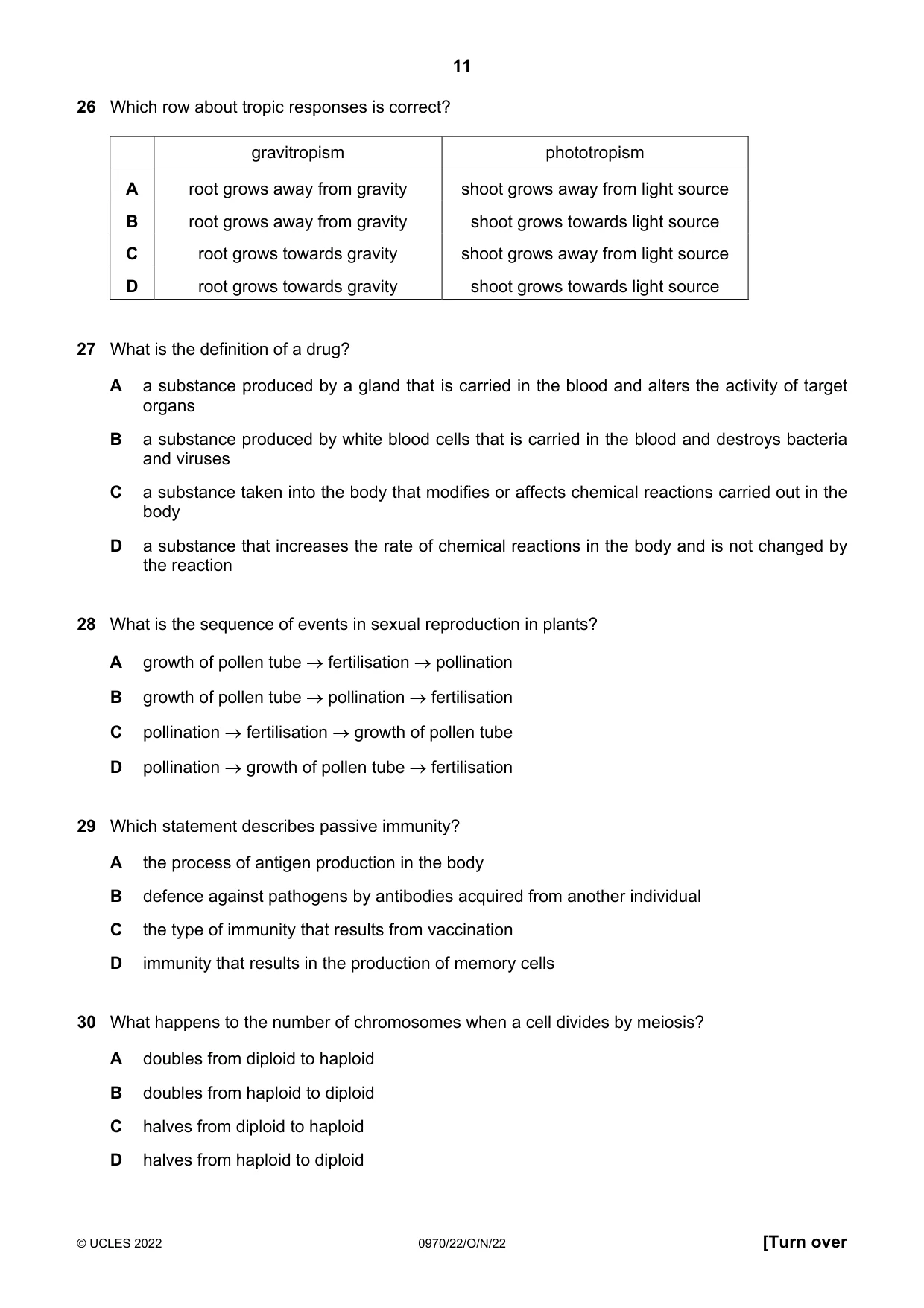
Q26 · Which row about tropic responses is correct?
26 Which row about tropic responses is correct? gravitropism phototropism A root grows away from gravity shoot grows away from light source B root grows away from gravity shoot grows towards light source C root grows towards gravity shoot grows away from light source D root grows towards gravity shoot grows towards light source
Mark scheme: D
Q27 · What is the definition of a drug?
27 What is the definition of a drug? A a substance produced by a gland that is carried in the blood and alters the activity of target organs B a substance produced by white blood cells that is carried in the blood and destroys bacteria and viruses C a substance taken into the body that modifies or affects chemical reactions carried out in the body D a substance that increases the rate of chemical reactions in the body and is not changed by the reaction
Mark scheme: C
Q28 · What is the sequence of events in sexual reproduction in plants?
28 What is the sequence of events in sexual reproduction in plants? A growth of pollen tube → fertilisation → pollination B growth of pollen tube → pollination → fertilisation C pollination → fertilisation → growth of pollen tube D pollination → growth of pollen tube → fertilisation
Mark scheme: D
Q29 · Which statement describes passive immunity?
29 Which statement describes passive immunity? A the process of antigen production in the body B defence against pathogens by antibodies acquired from another individual C the type of immunity that results from vaccination D immunity that results in the production of memory cells
Mark scheme: B
Q30 · What happens to the number of chromosomes when a cell divides by meiosis?
30 What happens to the number of chromosomes when a cell divides by meiosis? A doubles from diploid to haploid B doubles from haploid to diploid C halves from diploid to haploid D halves from haploid to diploid
Mark scheme: C
Q31 · A sex-linked condition is caused by a recessive allele
31 A sex-linked condition is caused by a recessive allele. A healthy male and female are both unaffected by the condition but the female has one copy of the recessive allele. What is the chance of their offspring being affected by the sex-linked condition? A 50% of all their offspring B 100% of male offspring and 0% of female offspring C 25% of all their offspring D 50% of male offspring and 25% of female offspring
Mark scheme: C
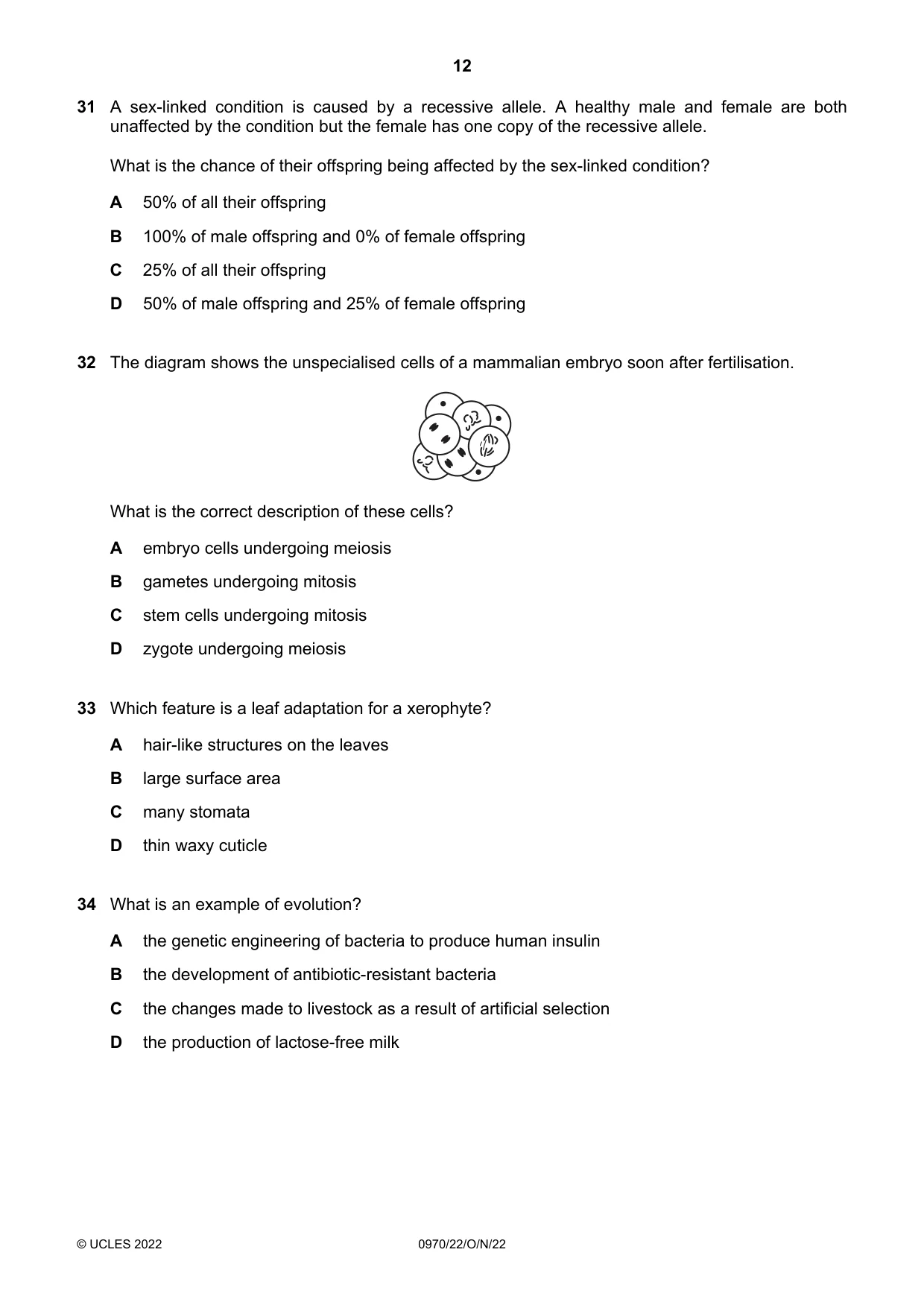
Q32 · The diagram shows the unspecialised cells of a mammalian embryo soon after fertilisation
32 The diagram shows the unspecialised cells of a mammalian embryo soon after fertilisation. What is the correct description of these cells? A embryo cells undergoing meiosis B gametes undergoing mitosis C stem cells undergoing mitosis D zygote undergoing meiosis
Mark scheme: C
Q33 · Which feature is a leaf adaptation for a xerophyte?
33 Which feature is a leaf adaptation for a xerophyte? A hair-like structures on the leaves B large surface area C many stomata D thin waxy cuticle
Mark scheme: A
Q34 · What is an example of evolution?
34 What is an example of evolution? A the genetic engineering of bacteria to produce human insulin B the development of antibiotic-resistant bacteria C the changes made to livestock as a result of artificial selection D the production of lactose-free milk
Mark scheme: B
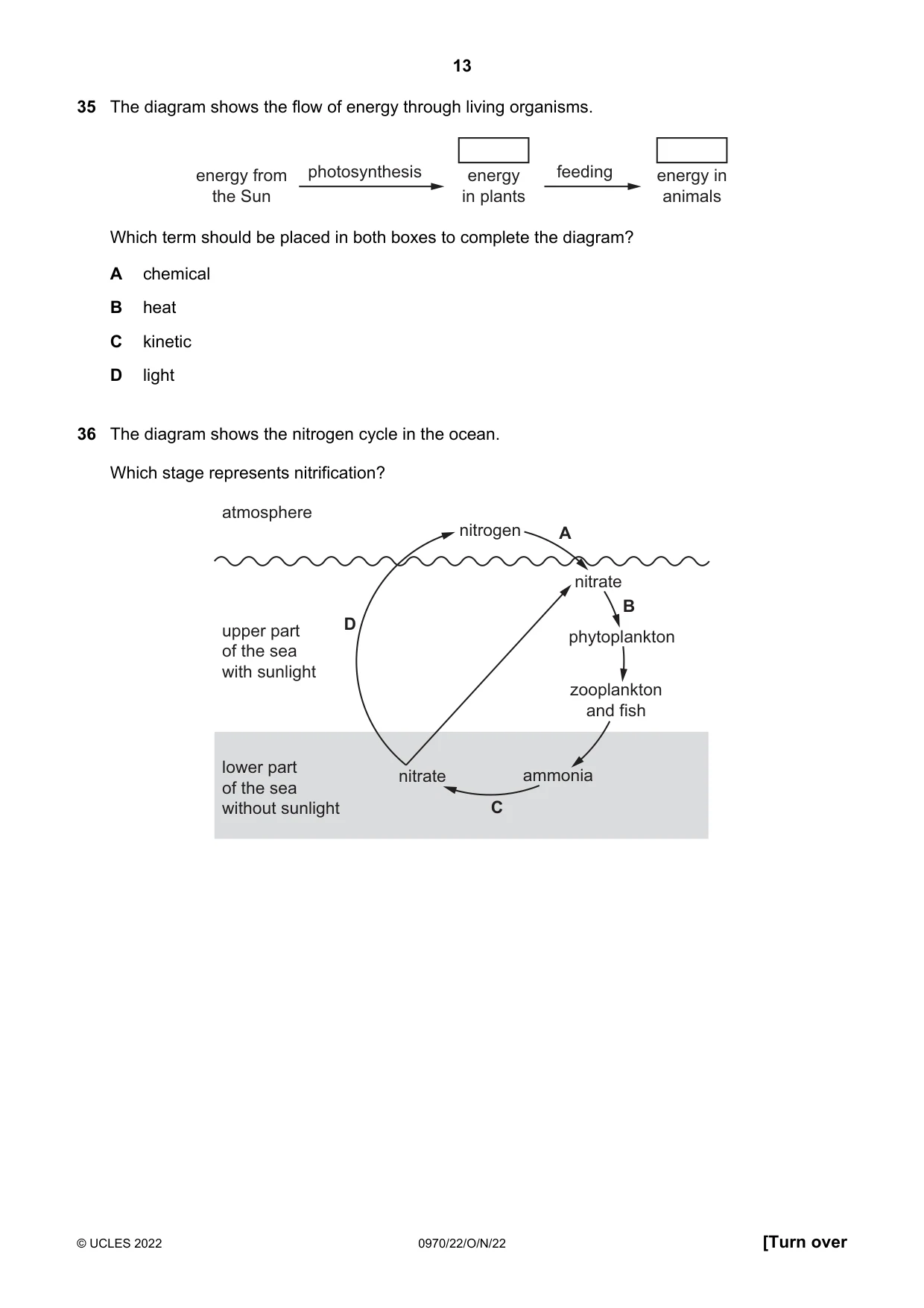
Q35 · The diagram shows the flow of energy through living organisms
35 The diagram shows the flow of energy through living organisms. energy from photosynthesis energy feeding energy in the Sun in plants animals Which term should be placed in both boxes to complete the diagram? A chemical B heat C kinetic D light
Mark scheme: A
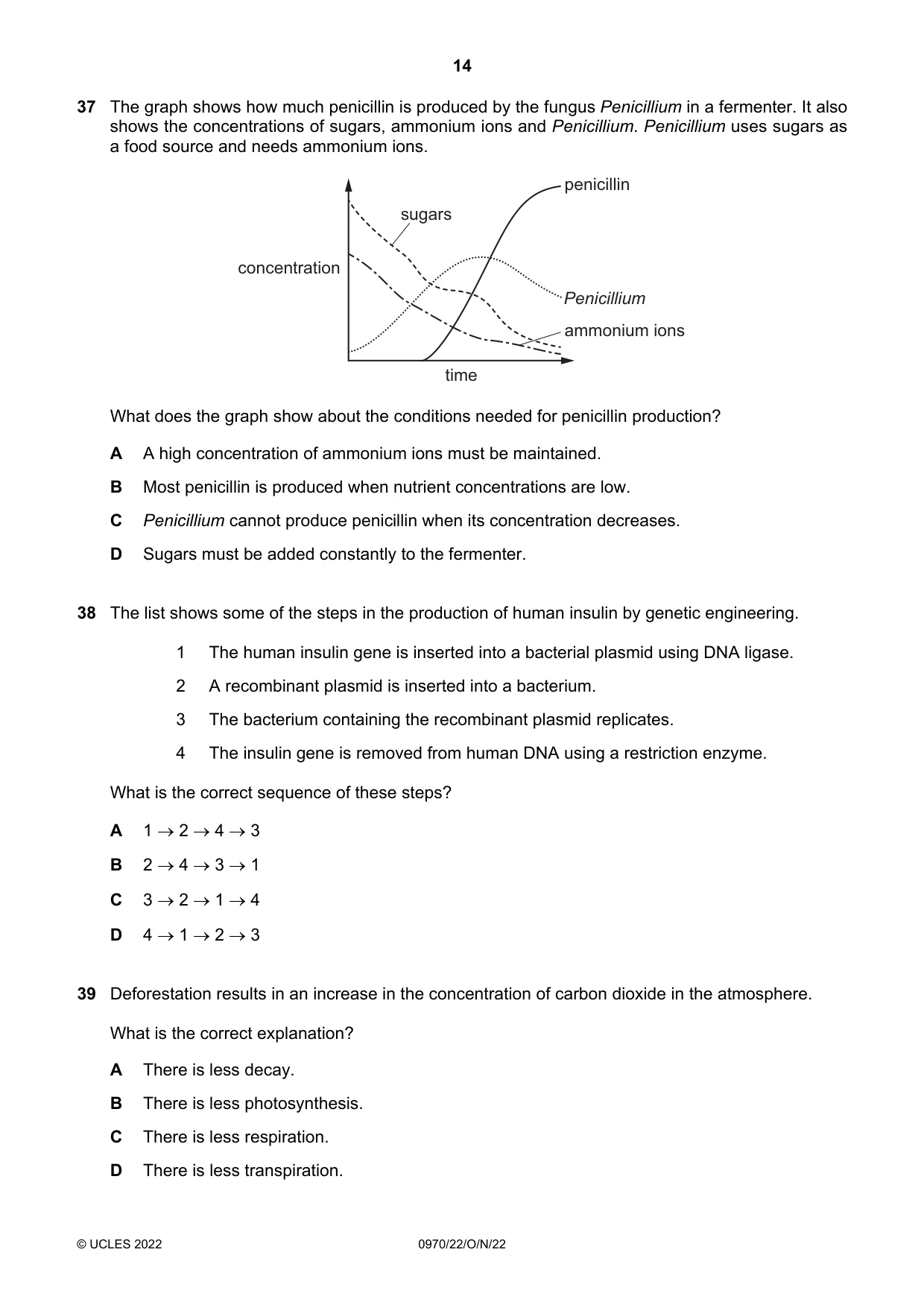
Q36 · The diagram shows the nitrogen cycle in the ocean
36 The diagram shows the nitrogen cycle in the ocean. Which stage represents nitrification? atmosphere nitrogen A nitrate B upper part D phytoplankton of the sea with sunlight zooplankton and fish lower part nitrate ammonia of the sea without sunlight C
Mark scheme: C
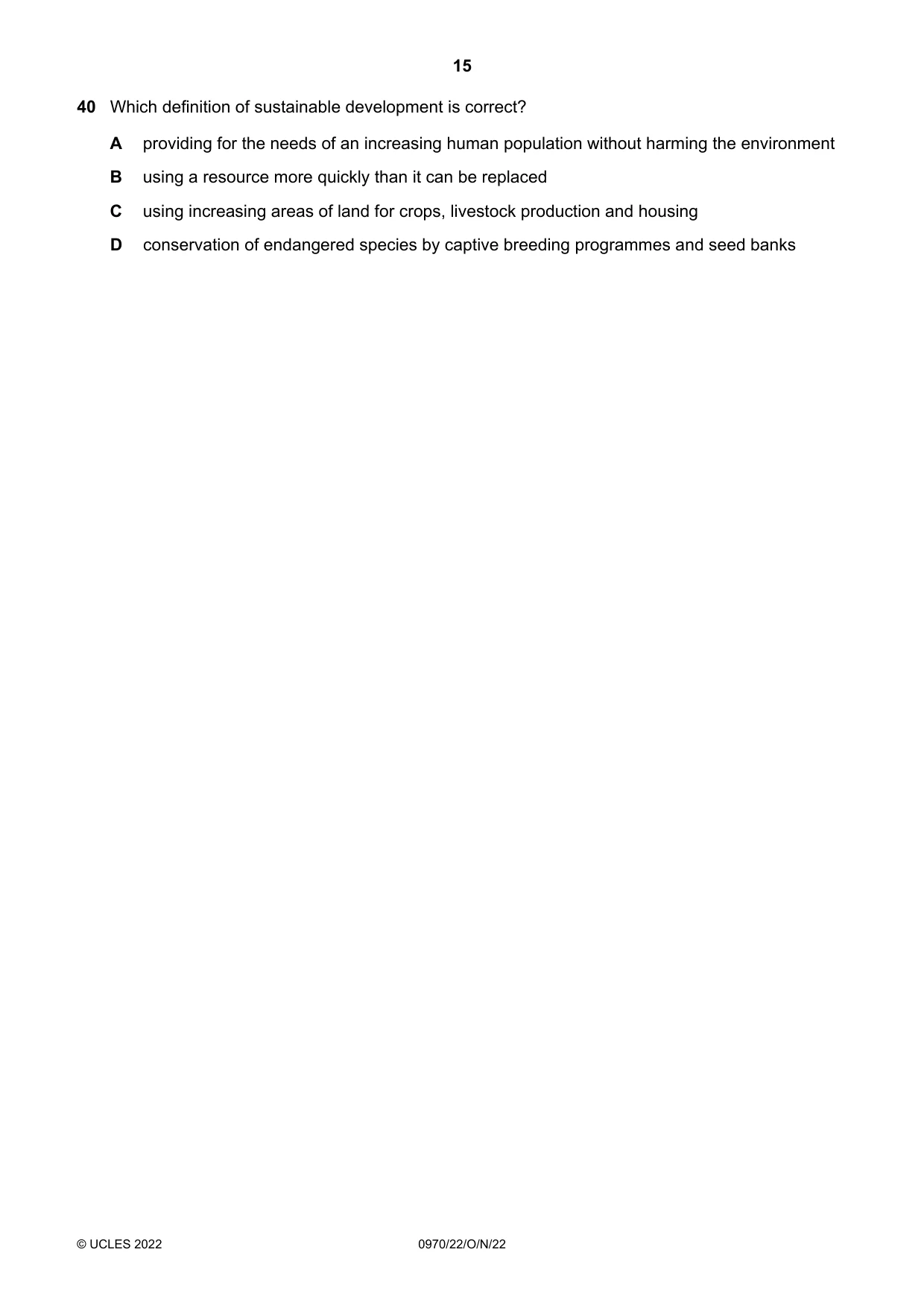
Q37 · The graph shows how much penicillin is produced by the fungus Penicillium in a fermenter
37 The graph shows how much penicillin is produced by the fungus Penicillium in a fermenter. It also shows the concentrations of sugars, ammonium ions and Penicillium. Penicillium uses sugars as a food source and needs ammonium ions. penicillin sugars concentration Penicillium ammonium ions time What does the graph show about the conditions needed for penicillin production? A A high concentration of ammonium ions must be maintained. B Most penicillin is produced when nutrient concentrations are low. C Penicillium cannot produce penicillin when its concentration decreases. D Sugars must be added constantly to the fermenter.
Mark scheme: B
Q38 · The list shows some of the steps in the production of human insulin by genetic engineering
38 The list shows some of the steps in the production of human insulin by genetic engineering. 1 The human insulin gene is inserted into a bacterial plasmid using DNA ligase. 2 A recombinant plasmid is inserted into a bacterium. 3 The bacterium containing the recombinant plasmid replicates. 4 The insulin gene is removed from human DNA using a restriction enzyme. What is the correct sequence of these steps? A 1 → 2 → 4 → 3 B 2 → 4 → 3 → 1 C 3 → 2 → 1 → 4 D 4 → 1 → 2 → 3
Mark scheme: D
Q39 · Deforestation results in an increase in the concentration of carbon dioxide in the…
39 Deforestation results in an increase in the concentration of carbon dioxide in the atmosphere. What is the correct explanation? A There is less decay. B There is less photosynthesis. C There is less respiration. D There is less transpiration.
Mark scheme: B
Q40 · Which definition of sustainable development is correct?
40 Which definition of sustainable development is correct? A providing for the needs of an increasing human population without harming the environment B using a resource more quickly than it can be replaced C using increasing areas of land for crops, livestock production and housing D conservation of endangered species by captive breeding programmes and seed banks
Mark scheme: A
What was in this paper
The subtopics covered by these 40 questions, and how many questions each got. Open one in a new tab to see every Cambridge question on it.
3Osmosis3Cell structure2Diseases and immunity2Photosynthesis2Active transport1Adaptive features1Anaerobic respiration1Biotechnology1Blood1Characteristics of living organisms1Chemical digestion1Chromosomes, genes and proteins1Concept and uses of classification systems1Conservation1Drugs1Energy flow1Excretion in humans1Gas exchange in humans1Genetic modification1Habitat destruction1Heart1Homeostasis1Hormones1Meiosis1Mitosis1Monohybrid inheritance1Nutrient cycles1Selection1Sexual reproduction in plants1Translocation1Tropic responses1Water uptake1What you needed in this session
Cambridge’s own grade thresholds for 2022 Oct/Nov, Paper 2 · Variant 2. A higher threshold means an easier paper — the bar moves with how the cohort did.