Cambridge IGCSE Biology (9-1) 0970 — 2019 May/June Paper 2 · Variant 1
0970/21/M/J/19 · 40 questions · 40 marks · ≈45 min
The question paper and its mark scheme, free to read here and free to download. This is Cambridge’s own paper, exactly as it was sat.
Question paper20 pages



Mark scheme3 pages
Answers below. Sit the paper first if you are practising.
Questions as text
Q1 · The diagram shows a leaf on a plant
1 The diagram shows a leaf on a plant. Sun simple sugars made in the leaf water from carbon dioxide the soil from the air Which characteristic of life is represented by this diagram? A excretion B nutrition C respiration D sensitivity
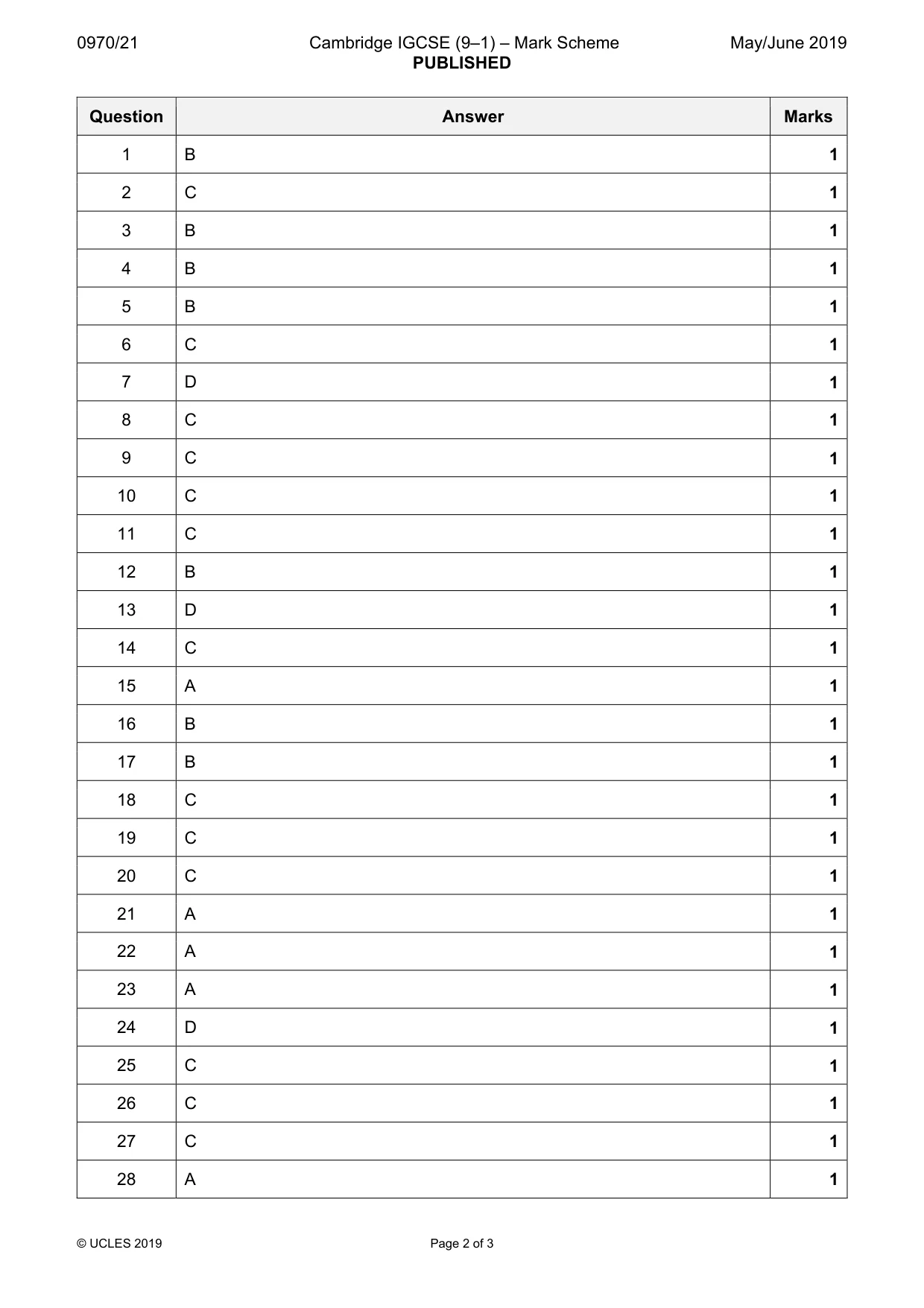
Mark scheme: B
Q2 · The diagram shows how Homo sapiens (modern people) could have evolved from earlier…
2 The diagram shows how Homo sapiens (modern people) could have evolved from earlier ancestors. Homo sapiens (modern people) Homo heidelbergensis Homo erectus Homo habilis Which statement about modern people and their ancestors is correct? A They are in the same species and the same genus. B They are in the same species but not the same genus. C They are in the same genus but not the same species. D They are neither the same species nor the same genus.
Mark scheme: C
More questions on Concept and uses of classification systems
Q3 · The photomicrograph shows part of an animal cell
3 The photomicrograph shows part of an animal cell. X What is the structure labelled X? A chloroplast B mitochondrion C ribosome D vacuole
Mark scheme: B
Q4 · Which features are possessed by all plant cells?
4 Which features are possessed by all plant cells? a cell wall chloroplasts A J Jv B Jv x Cc x v D x x key J/ = present X = absent
Mark scheme: B
Q5 · The diagram shows part of the skin
5 The diagram shows part of the skin. What is the correct level of organisation for the skin? A cell B organ C organ system D tissue
Mark scheme: B
Q6 · The diagram shows a test-tube containing clear jelly
6 The diagram shows a test-tube containing clear jelly. A drop of blue ink is injected into the middle of the jelly. clear jelly drop of blue ink The blue colour of the ink spreads throughout the jelly. By which process does the blue ink spread through the jelly? A active transport B catalysis C diffusion D osmosis
Mark scheme: C
Q7 · The apparatus shown was set up
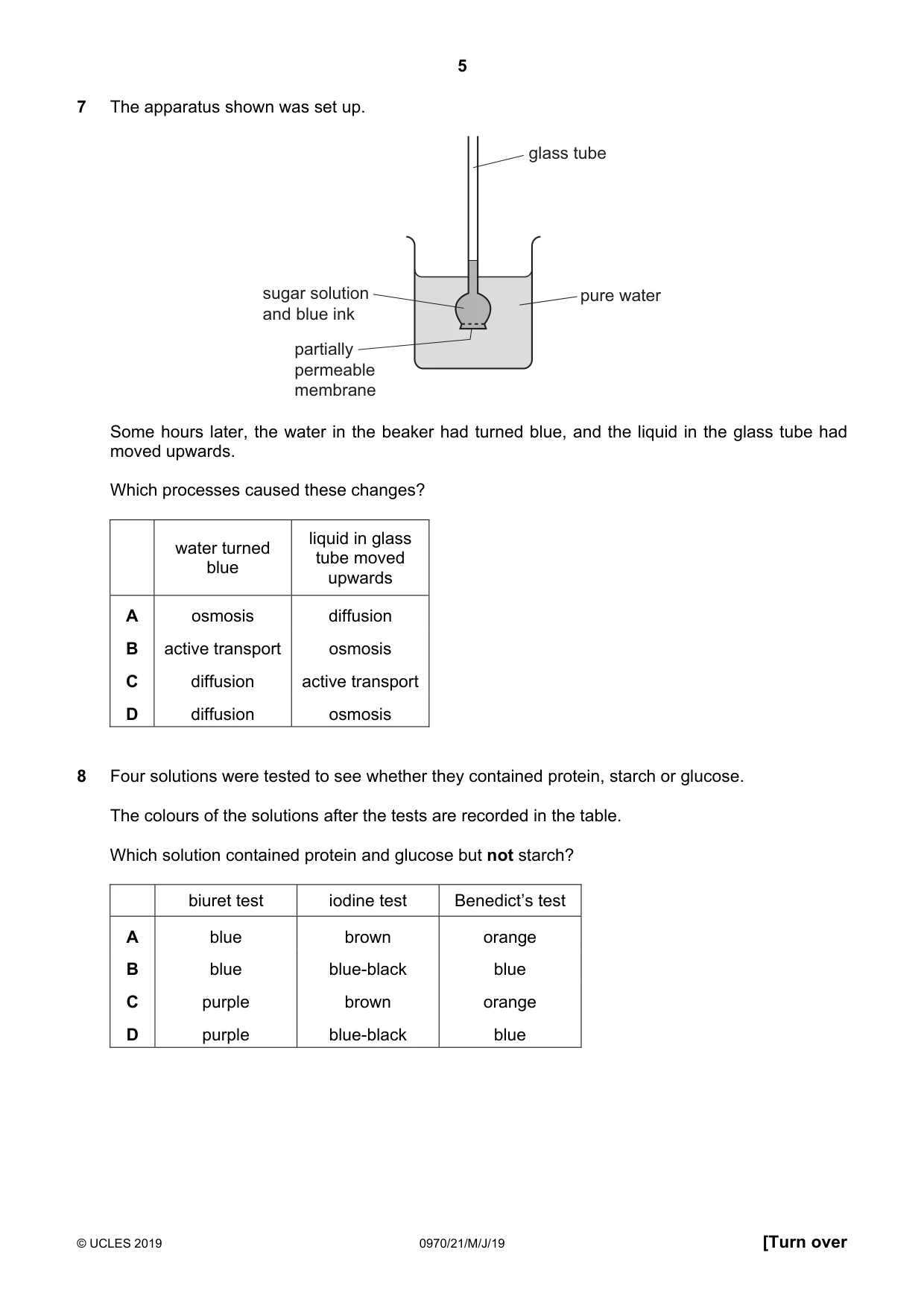
7 The apparatus shown was set up. glass tube sugar solution pure water and blue ink partially permeable membrane Some hours later, the water in the beaker had turned blue, and the liquid in the glass tube had moved upwards. Which processes caused these changes? liquid in glass water turned tube moved blue upwards A osmosis diffusion B active transport osmosis C diffusion active transport D diffusion osmosis
Mark scheme: D
Q8 · Four solutions were tested to see whether they contained protein, starch or glucose
8 Four solutions were tested to see whether they contained protein, starch or glucose. The colours of the solutions after the tests are recorded in the table. Which solution contained protein and glucose but not starch? biuret test iodine test Benedict’s test A blue brown orange B blue blue-black blue C purple brown orange D purple blue-black blue
Mark scheme: C
Q9 · Small molecules are used as the basic units in the synthesis of large food molecules
9 Small molecules are used as the basic units in the synthesis of large food molecules. Which statement is correct? A Amino acids are basic units of carbohydrates. B Fatty acids are basic units of glycogen. C Glycerol is a basic unit of oils. D Simple sugar is a basic unit of protein.
Mark scheme: C
Q10 · The diagrams show a protease enzyme catalysing the breaking of part of a protein molecule…
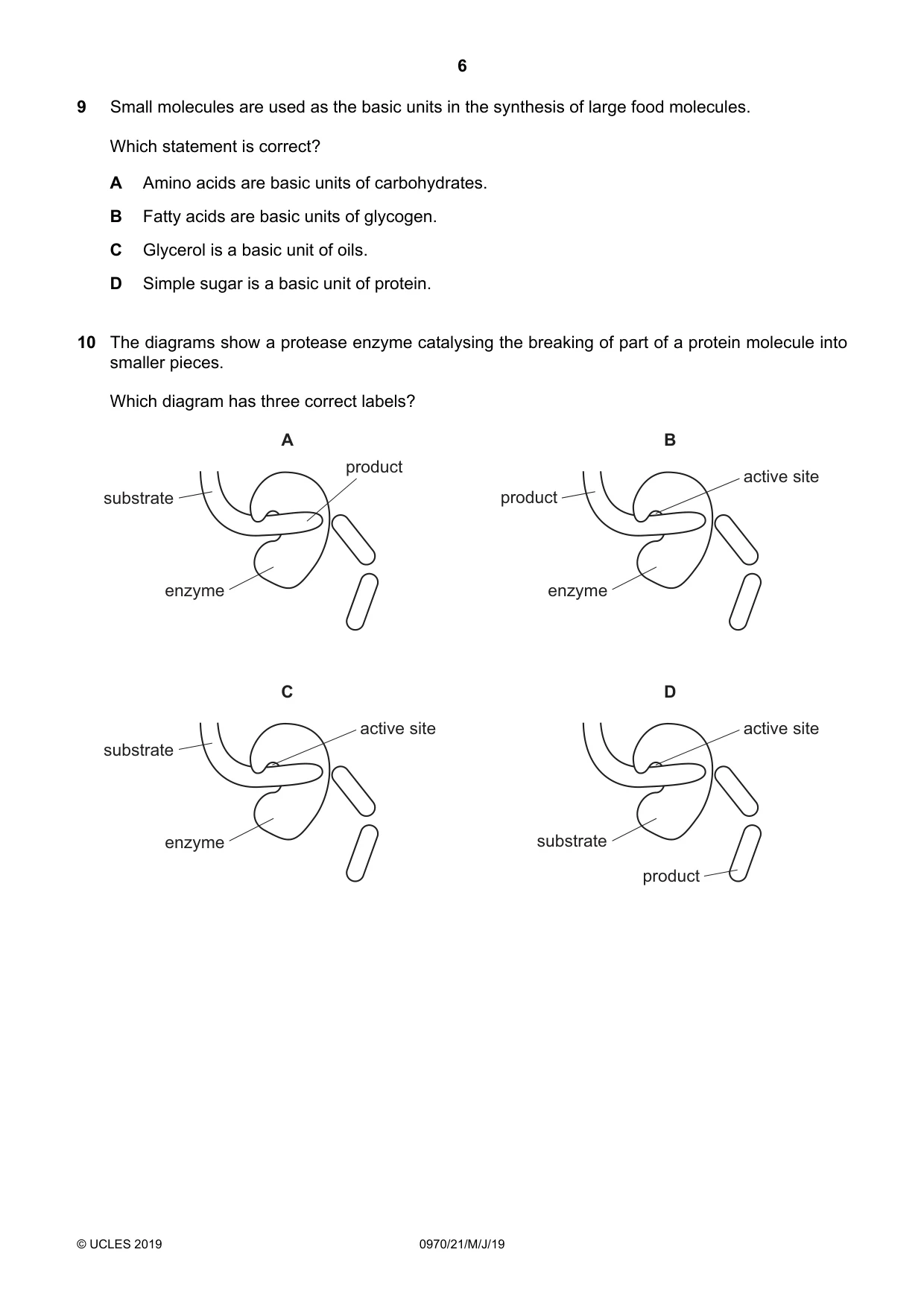
10 The diagrams show a protease enzyme catalysing the breaking of part of a protein molecule into smaller pieces. Which diagram has three correct labels? A B product active site substrate product enzyme enzyme C D active site active site substrate enzyme substrate product
Mark scheme: C
Q11 · The diagram shows an experiment to investigate the balance between respiration and…
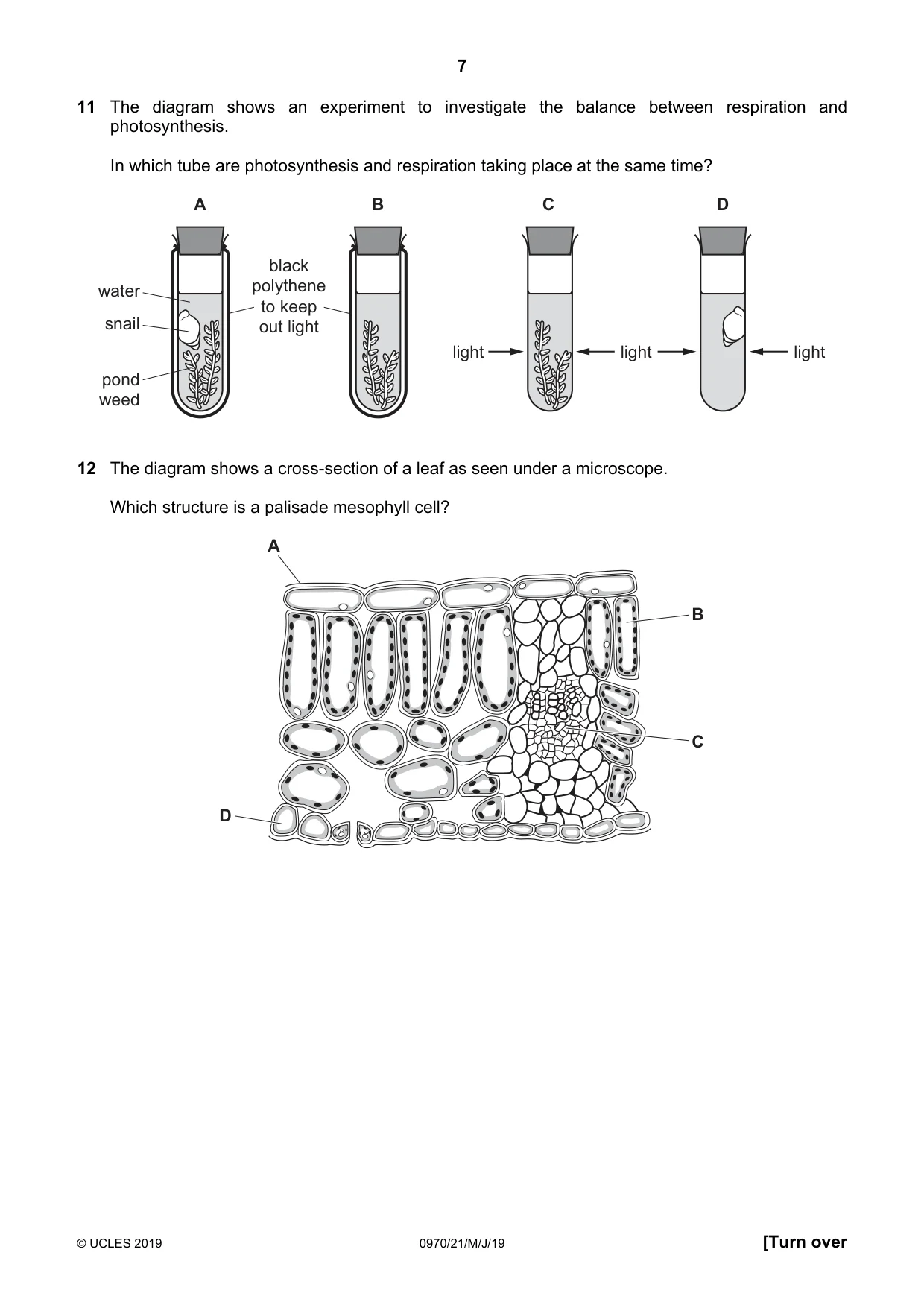
11 The diagram shows an experiment to investigate the balance between respiration and photosynthesis. In which tube are photosynthesis and respiration taking place at the same time? A B C D black water polythene to keep snail out light light light light pond weed
Mark scheme: C
Q12 · The diagram shows a cross-section of a leaf as seen under a microscope
12 The diagram shows a cross-section of a leaf as seen under a microscope. Which structure is a palisade mesophyll cell? A B C D
Mark scheme: B
Q13 · The chart is used to find a person’s recommended mass
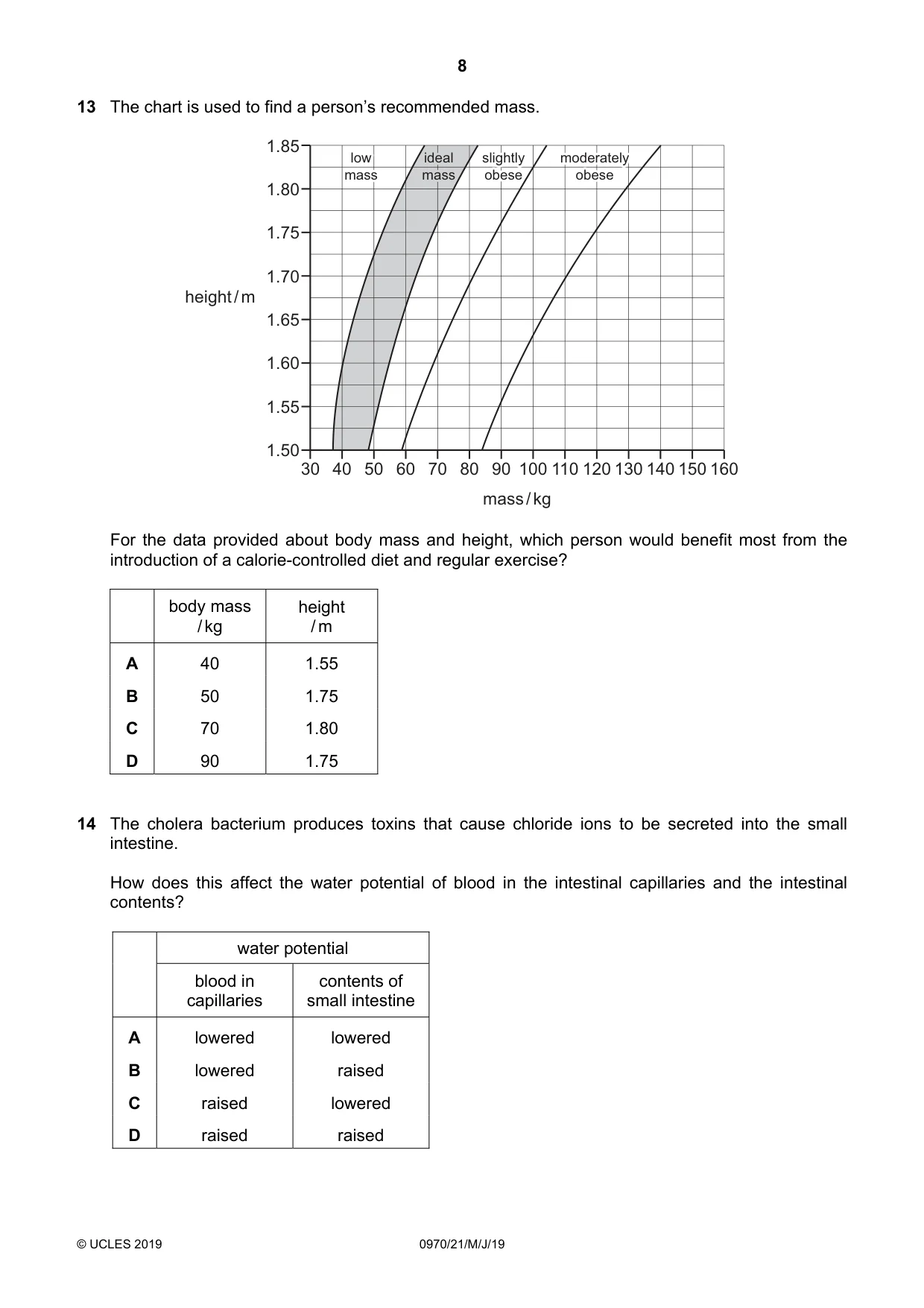
13 The chart is used to find a person’s recommended mass. 1.85 low low low ideal ideal ideal slightly slightly slightly moderately moderately moderately mass mass mass mass mass mass obese obese obese obese obese obese 1.80 1.75 1.70 height / m 1.65 1.60 1.55 1.50 30 40 50 60 70 80 90 100 110 120 130 140 150 160 mass / kg For the data provided about body mass and height, which person would benefit most from the introduction of a calorie-controlled diet and regular exercise? body mass height / kg / m A 40 1.55 B 50 1.75 C 70 1.80 D 90 1.75
Mark scheme: D
Q14 · The cholera bacterium produces toxins that cause chloride ions to be secreted into the…
14 The cholera bacterium produces toxins that cause chloride ions to be secreted into the small intestine. How does this affect the water potential of blood in the intestinal capillaries and the intestinal contents? water potential blood in contents of capillaries small intestine A lowered lowered B lowered raised C raised lowered D raised raised
Mark scheme: C
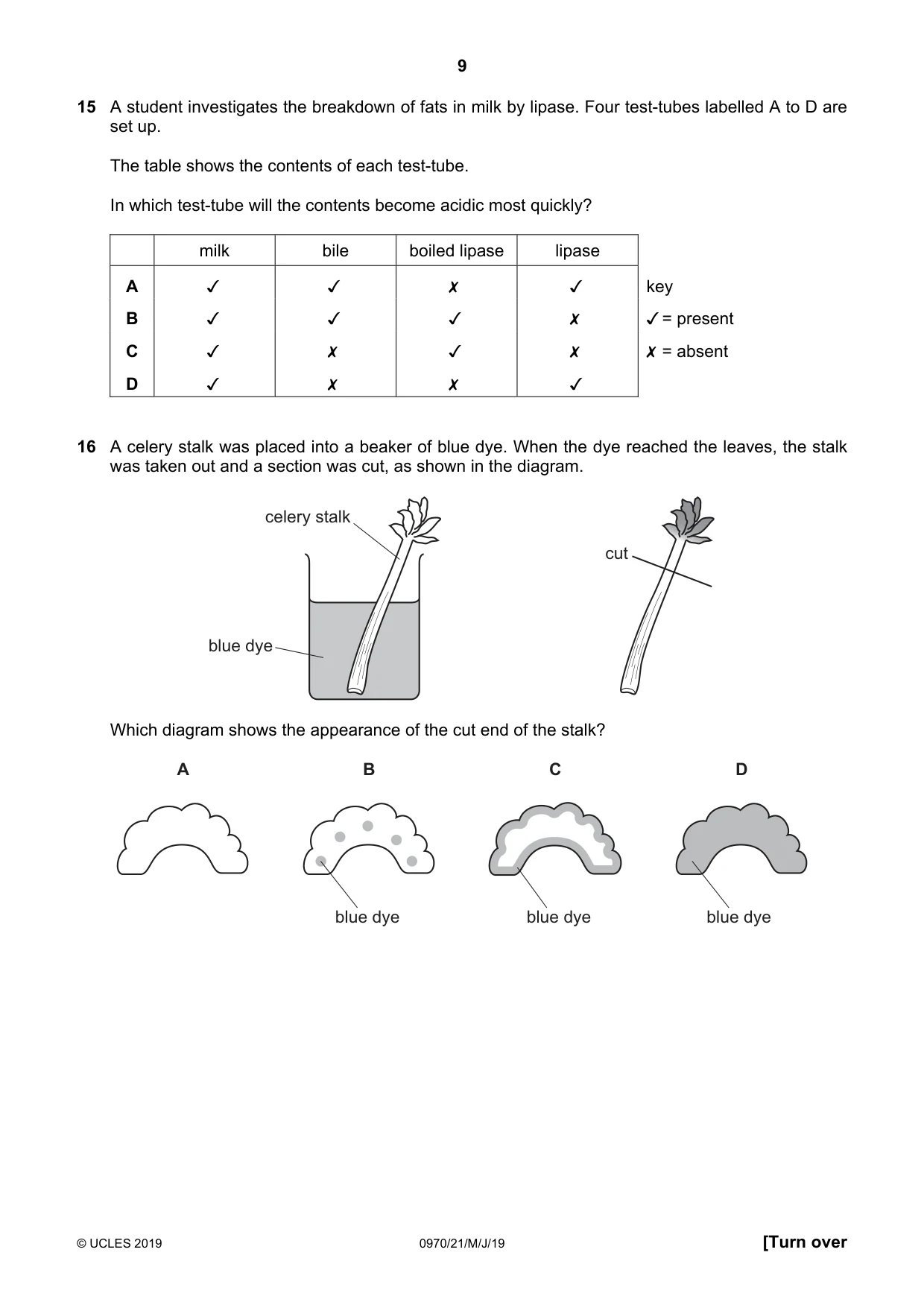
Q15 · A student investigates the breakdown of fats in milk by lipase
15 A student investigates the breakdown of fats in milk by lipase. Four test-tubes labelled A to D are set up. The table shows the contents of each test-tube. In which test-tube will the contents become acidic most quickly? milk bile boiled lipase Jv x Jv Jv x Jv x x lipase < x« x key v¥ = present X = absent
Mark scheme: A
Q16 · A celery stalk was placed into a beaker of blue dye
16 A celery stalk was placed into a beaker of blue dye. When the dye reached the leaves, the stalk was taken out and a section was cut, as shown in the diagram. celery stalk cut blue dye Which diagram shows the appearance of the cut end of the stalk? A B C D blue dye blue dye blue dye
Mark scheme: B
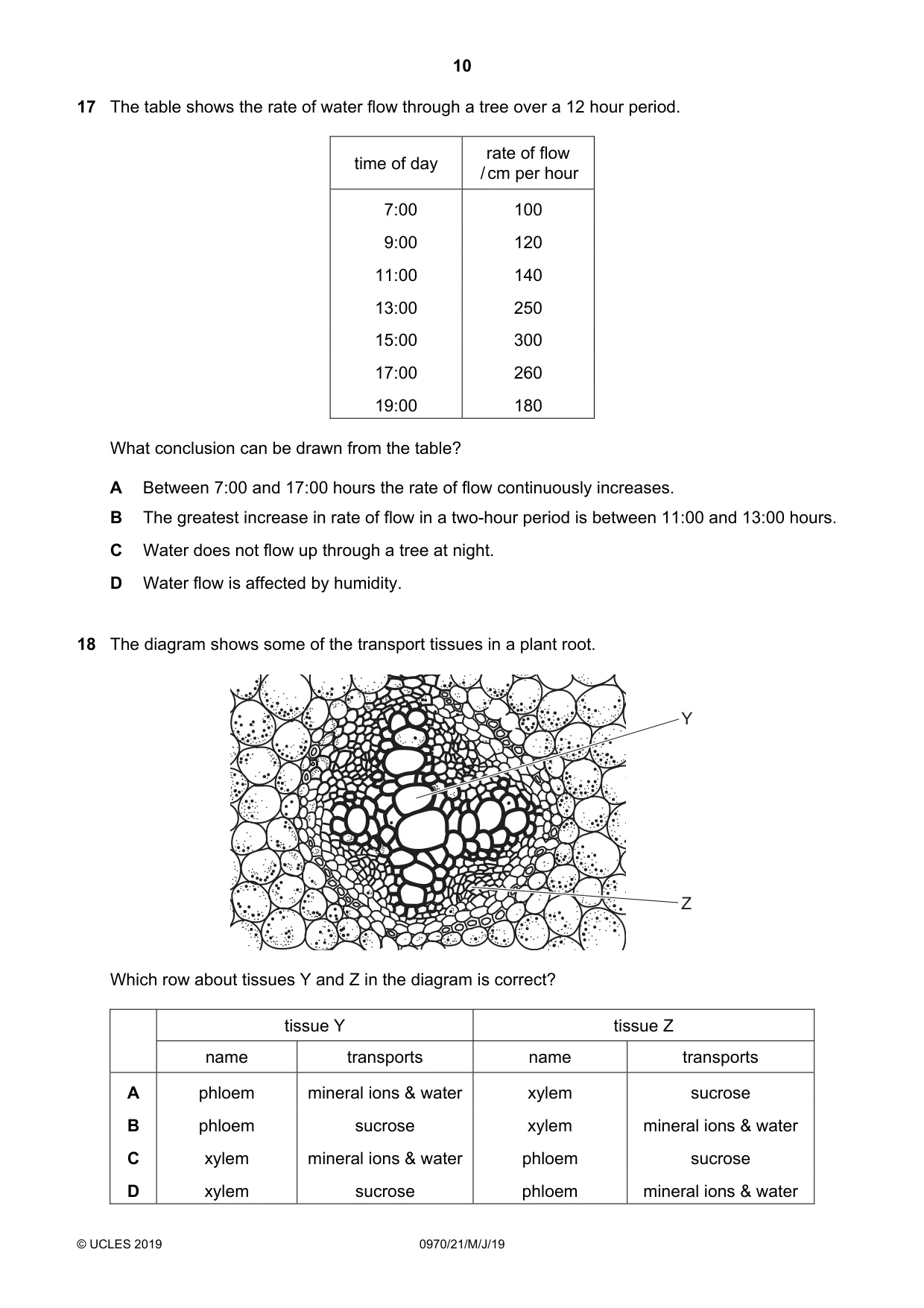
Q17 · The table shows the rate of water flow through a tree over a 12 hour period
17 The table shows the rate of water flow through a tree over a 12 hour period. rate of flow time of day / cm per hour 17:00 100 19:00 120 11:00 140 13:00 250 15:00 300 17:00 260 19:00 180 What conclusion can be drawn from the table? A Between 7:00 and 17:00 hours the rate of flow continuously increases. B The greatest increase in rate of flow in a two-hour period is between 11:00 and 13:00 hours. C Water does not flow up through a tree at night. D Water flow is affected by humidity.
Mark scheme: B
Q18 · The diagram shows some of the transport tissues in a plant root
18 The diagram shows some of the transport tissues in a plant root. Y Z Which row about tissues Y and Z in the diagram is correct? tissue Y tissue Z name transports name transports A phloem mineral ions & water xylem sucrose B phloem sucrose xylem mineral ions & water C xylem mineral ions & water phloem sucrose D xylem sucrose phloem mineral ions & water
Mark scheme: C
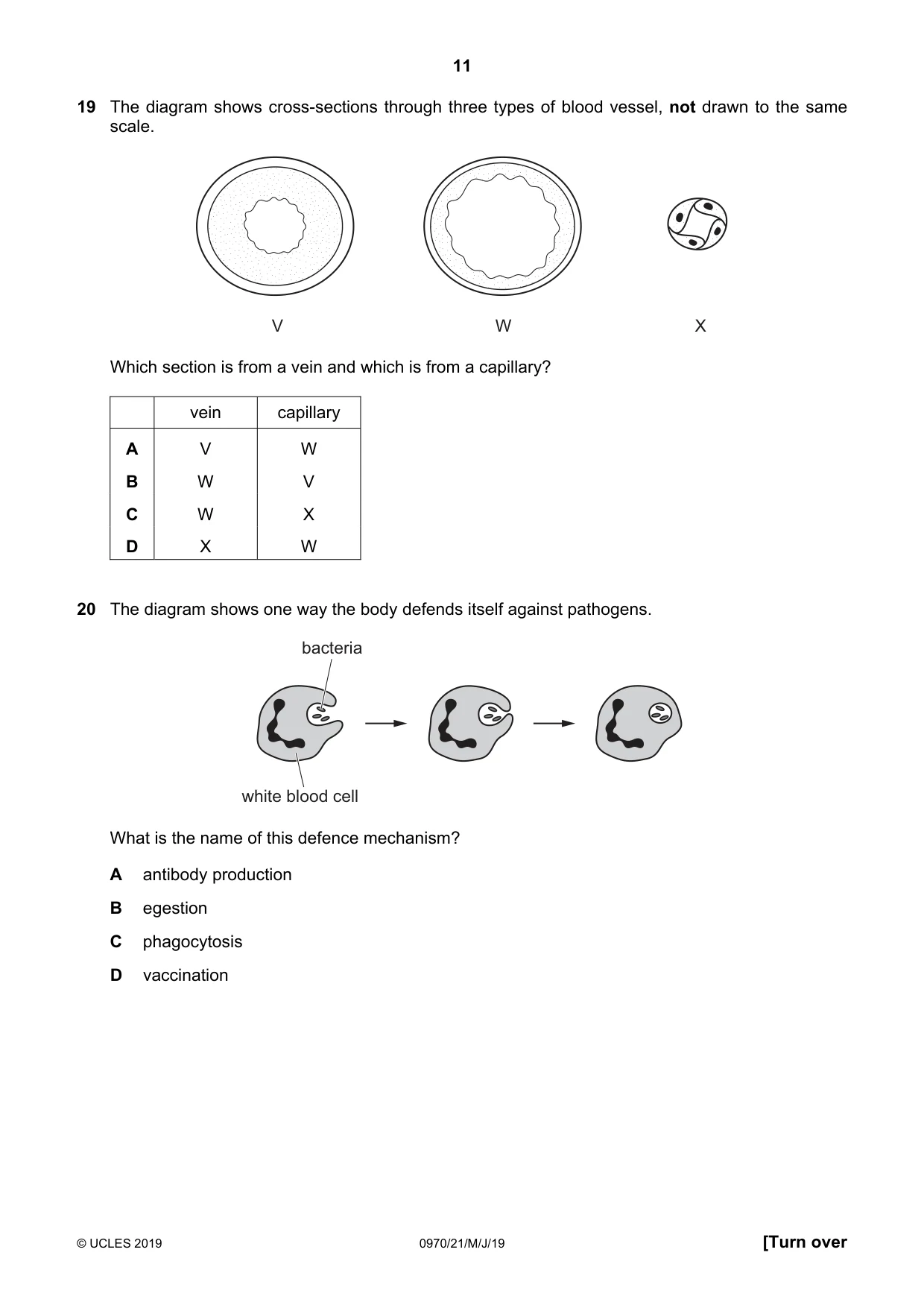
Q19 · The diagram shows cross-sections through three types of blood vessel, not drawn to the…
19 The diagram shows cross-sections through three types of blood vessel, not drawn to the same scale. V W X Which section is from a vein and which is from a capillary? vein capillary A V W B W V C W X D X W
Mark scheme: C
Q20 · The diagram shows one way the body defends itself against pathogens
20 The diagram shows one way the body defends itself against pathogens. bacteria white blood cell What is the name of this defence mechanism? A antibody production B egestion C phagocytosis D vaccination
Mark scheme: C
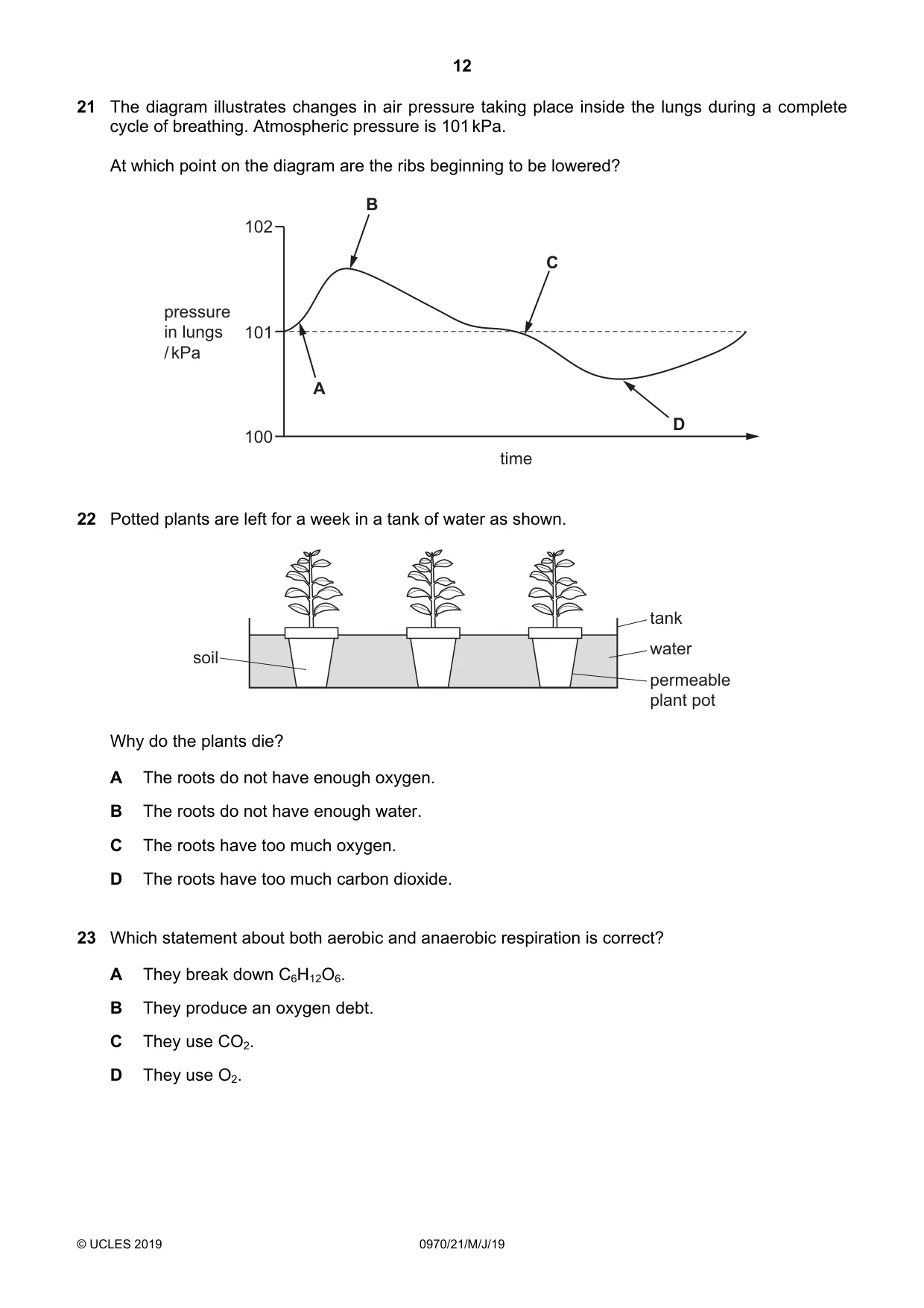
Q21 · The diagram illustrates changes in air pressure taking place inside the lungs during a…
21 The diagram illustrates changes in air pressure taking place inside the lungs during a complete cycle of breathing. Atmospheric pressure is 101 kPa. At which point on the diagram are the ribs beginning to be lowered? B 102 C pressure in lungs 101 / kPa A D 100 time
Mark scheme: A
Q22 · Potted plants are left for a week in a tank of water as shown
22 Potted plants are left for a week in a tank of water as shown. tank water soil permeable plant pot Why do the plants die? A The roots do not have enough oxygen. B The roots do not have enough water. C The roots have too much oxygen. D The roots have too much carbon dioxide.
Mark scheme: A
Q23 · Which statement about both aerobic and anaerobic respiration is correct?
23 Which statement about both aerobic and anaerobic respiration is correct? A They break down C6H12O6. B They produce an oxygen debt. C They use CO2. D They use O2.
Mark scheme: A
Q24 · The components of a reflex arc are shown in the flow diagram
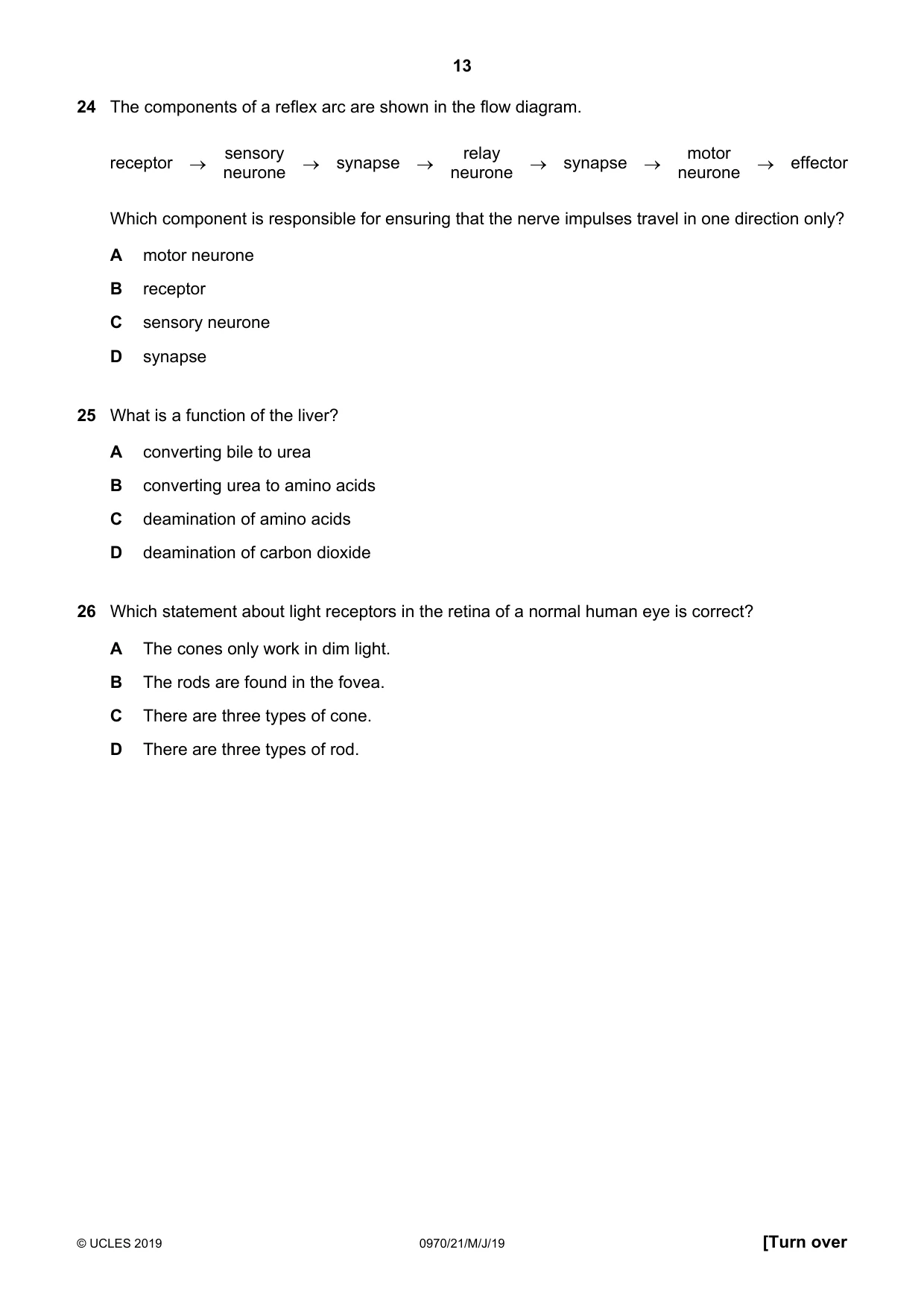
24 The components of a reflex arc are shown in the flow diagram. receptor → sensory relay motor → synapse → → synapse → neurone → effector neurone neurone Which component is responsible for ensuring that the nerve impulses travel in one direction only? A motor neurone B receptor C sensory neurone D synapse
Mark scheme: D
Q25 · What is a function of the liver?
25 What is a function of the liver? A converting bile to urea B converting urea to amino acids C deamination of amino acids D deamination of carbon dioxide
Mark scheme: C
Q26 · Which statement about light receptors in the retina of a normal human eye is correct?
26 Which statement about light receptors in the retina of a normal human eye is correct? A The cones only work in dim light. B The rods are found in the fovea. C There are three types of cone. D There are three types of rod.
Mark scheme: C
Q27 · A patient is injected with adrenaline
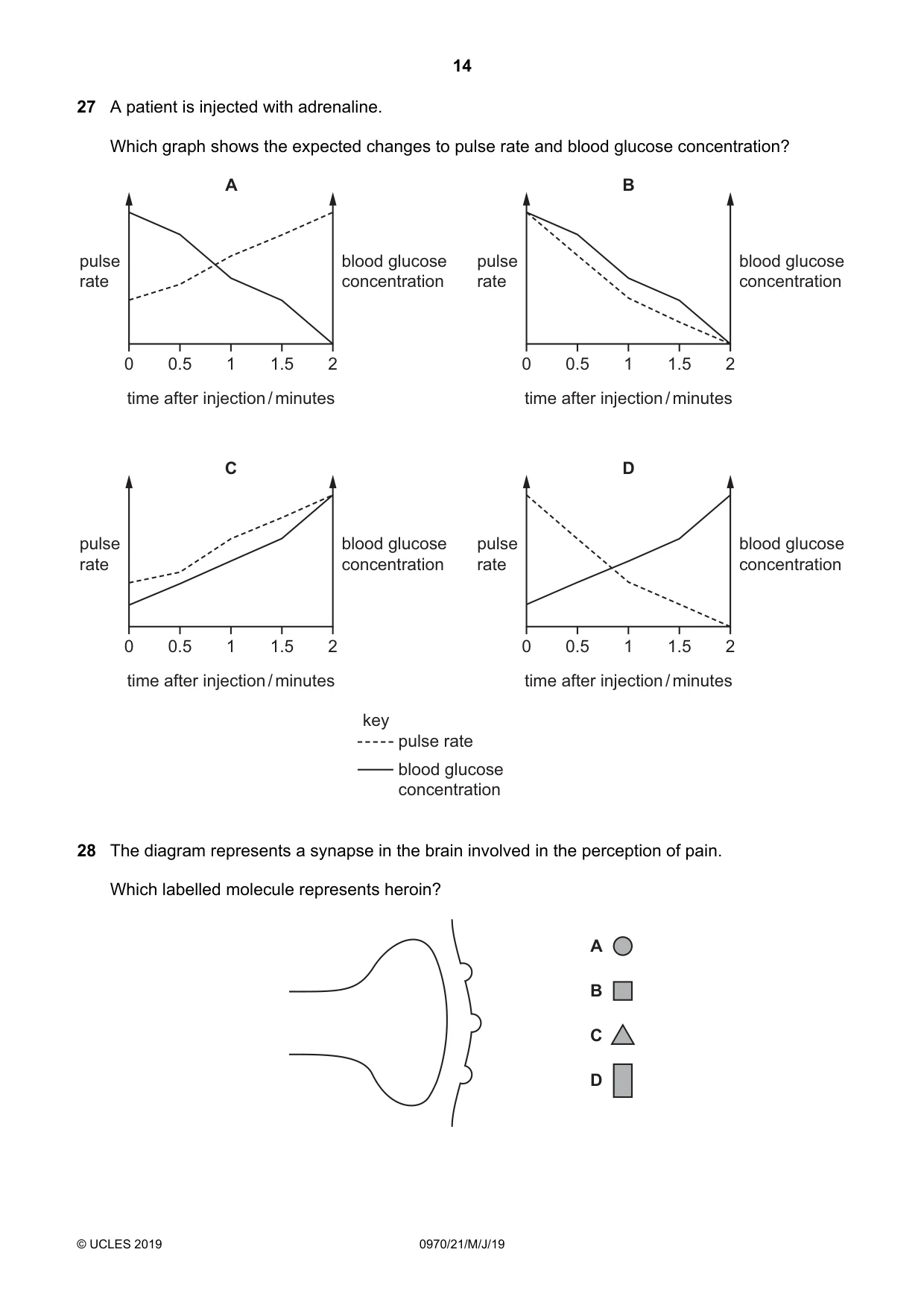
27 A patient is injected with adrenaline. Which graph shows the expected changes to pulse rate and blood glucose concentration? A B pulse blood glucose pulse blood glucose rate concentration rate concentration 0 0.5 1 1.5 2 0 0.5 1 1.5 2 time after injection / minutes time after injection / minutes C D pulse blood glucose pulse blood glucose rate concentration rate concentration 0 0.5 1 1.5 2 0 0.5 1 1.5 2 time after injection / minutes time after injection / minutes key pulse rate blood glucose concentration
Mark scheme: C
Q28 · The diagram represents a synapse in the brain involved in the perception of pain
28 The diagram represents a synapse in the brain involved in the perception of pain. Which labelled molecule represents heroin? A B C D
Mark scheme: A
Q29 · A human zygote is a diploid cell
29 A human zygote is a diploid cell. Which statement about human diploid cells is correct? A They do not have a nucleus. B They fuse to form gametes. C The nucleus contains a single set of chromosomes. D The nucleus contains two sets of chromosomes.
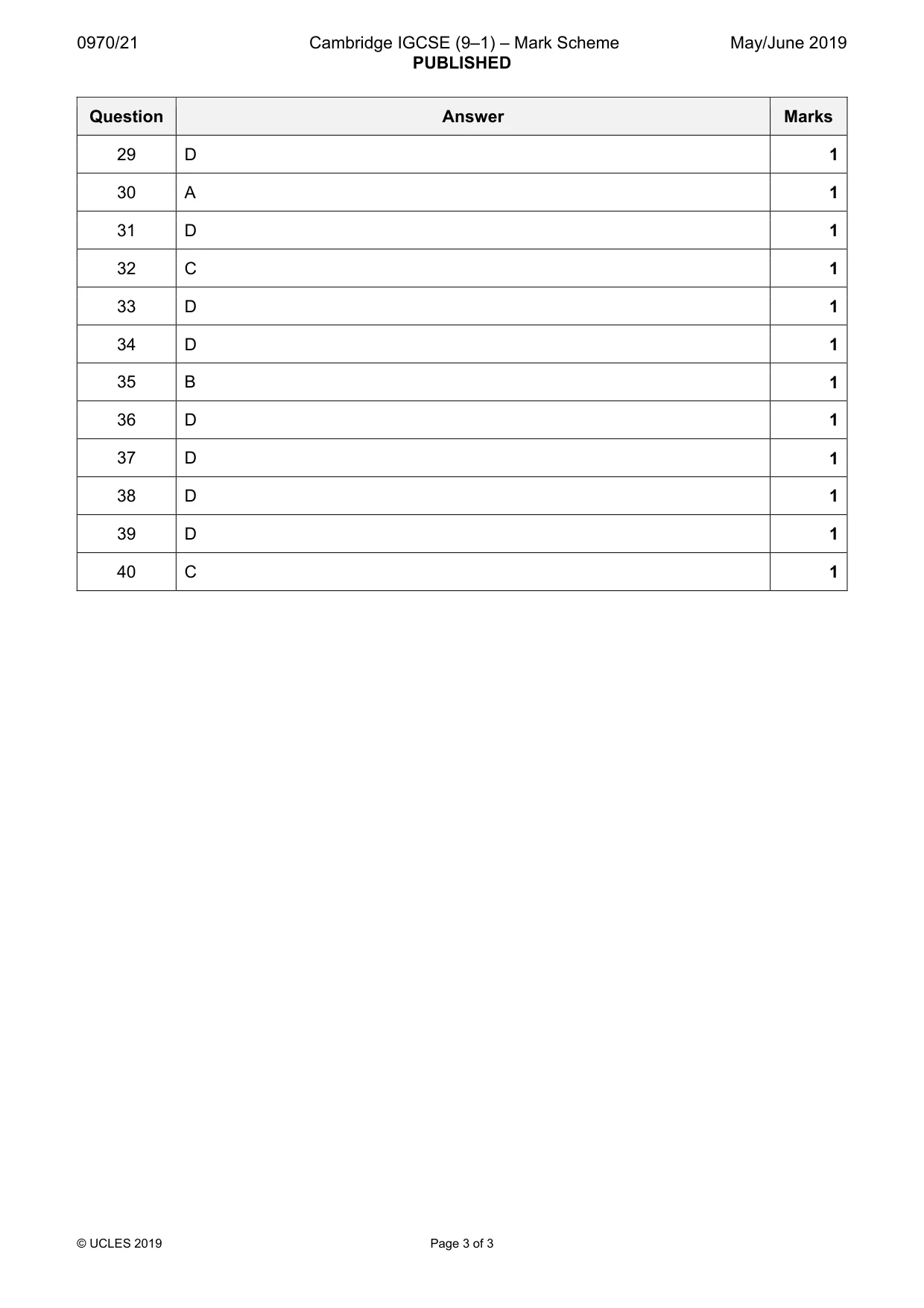
Mark scheme: D
Q30 · Which feature allows the sperm to dissolve the jelly coating of the egg cell?
30 Which feature allows the sperm to dissolve the jelly coating of the egg cell? A acrosome B flagellum C mitochondria D nucleus
Mark scheme: A
Q31 · Which statement about HIV is correct?
31 Which statement about HIV is correct? A It causes an increase in the number of lymphocytes. B It is caused by bacteria. C It increases the ability to produce antibodies. D It is transmitted through sexual contact.
Mark scheme: D
Q32 · The diagram shows the chromosomes in the nucleus of a cell that divides by mitosis
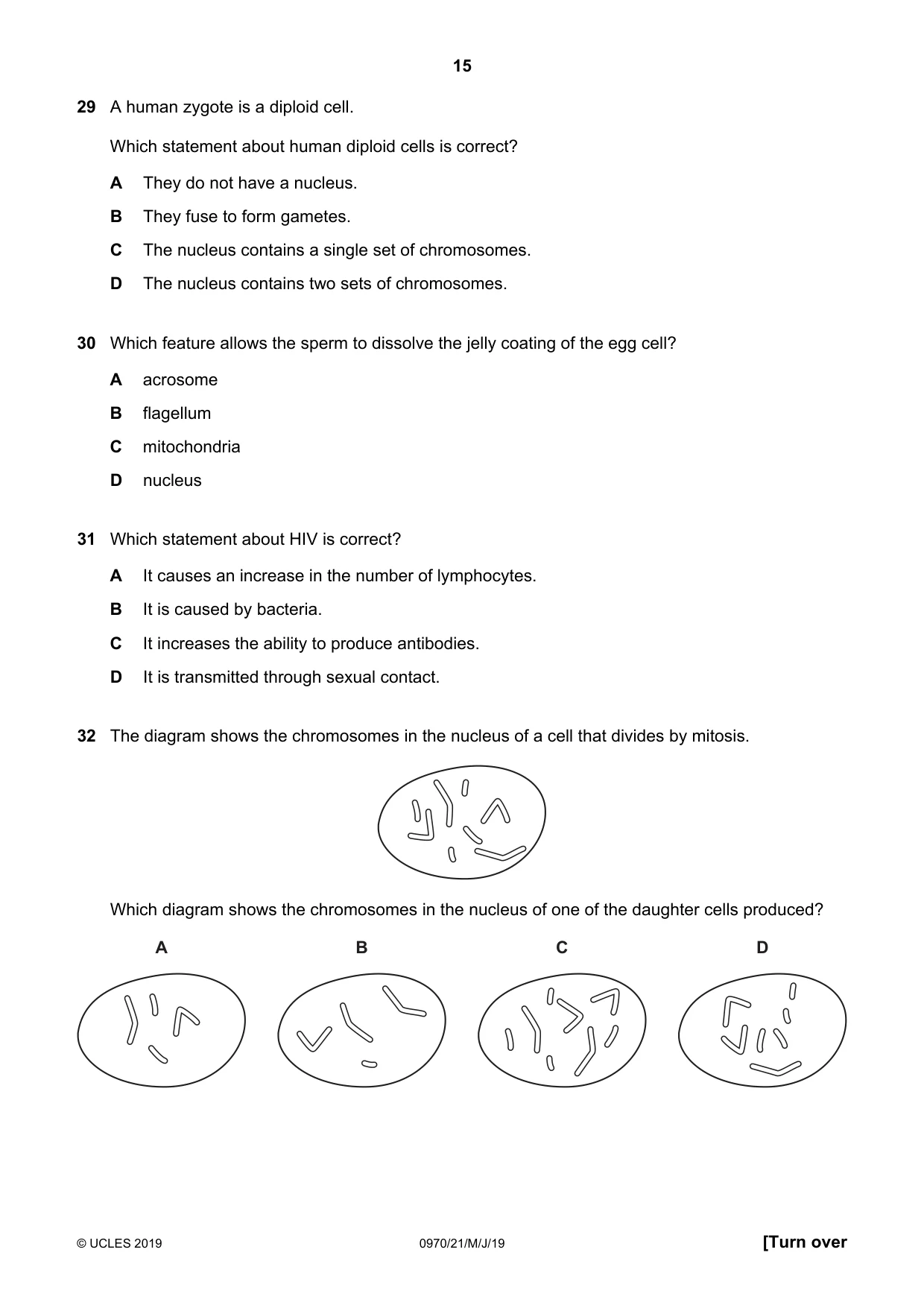
32 The diagram shows the chromosomes in the nucleus of a cell that divides by mitosis. Which diagram shows the chromosomes in the nucleus of one of the daughter cells produced? A B C D
Mark scheme: C
Q33 · What happens as a result of meiosis?
33 What happens as a result of meiosis? A Diploid cells are produced. B Diploid and haploid cells are produced. C Genetically identical cells are produced. D Haploid cells are produced.
Mark scheme: D
Q34 · Why is the allele for sickle-cell anaemia common in some parts of the world?
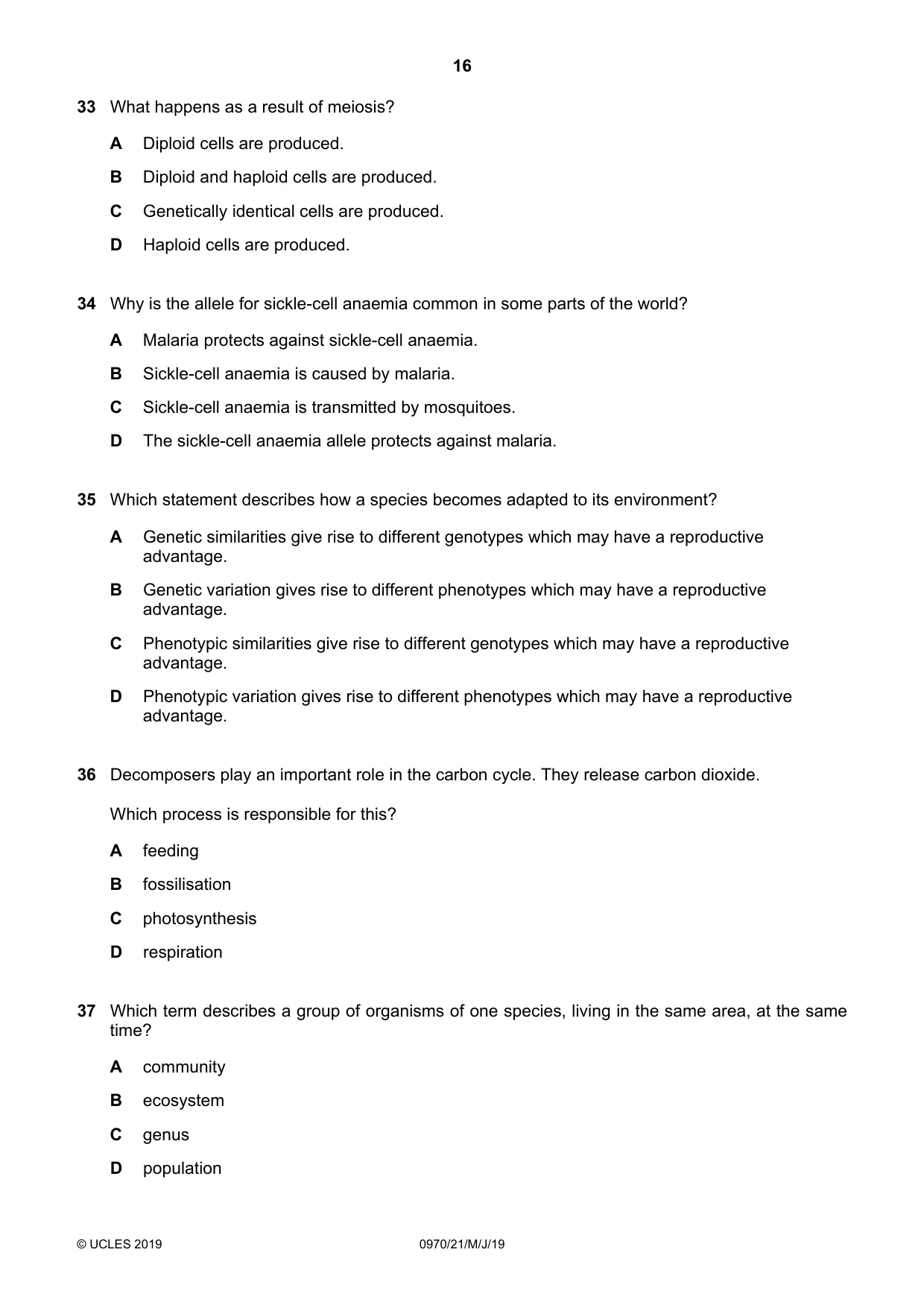
34 Why is the allele for sickle-cell anaemia common in some parts of the world? A Malaria protects against sickle-cell anaemia. B Sickle-cell anaemia is caused by malaria. C Sickle-cell anaemia is transmitted by mosquitoes. D The sickle-cell anaemia allele protects against malaria.
Mark scheme: D
Q35 · Which statement describes how a species becomes adapted to its environment?
35 Which statement describes how a species becomes adapted to its environment? A Genetic similarities give rise to different genotypes which may have a reproductive advantage. B Genetic variation gives rise to different phenotypes which may have a reproductive advantage. C Phenotypic similarities give rise to different genotypes which may have a reproductive advantage. D Phenotypic variation gives rise to different phenotypes which may have a reproductive advantage.
Mark scheme: B
Q36 · Decomposers play an important role in the carbon cycle
36 Decomposers play an important role in the carbon cycle. They release carbon dioxide. Which process is responsible for this? A feeding B fossilisation C photosynthesis D respiration
Mark scheme: D
Q37 · Which term describes a group of organisms of one species, living in the same area, at the…
37 Which term describes a group of organisms of one species, living in the same area, at the same time? A community B ecosystem C genus D population
Mark scheme: D
Q38 · The diagram shows a bacterial cell
38 The diagram shows a bacterial cell. Which part of its structure is particularly useful in genetic engineering? B C A D
Mark scheme: D
Q39 · What can be managed sustainably?
39 What can be managed sustainably? A taking coal from a coalfield B taking gas from under the earth’s surface C taking oil from an oilfield D taking wood from a woodland
Mark scheme: D
Q40 · Large areas of tropical forests have been cleared to grow monocultures of palm oil plants
40 Large areas of tropical forests have been cleared to grow monocultures of palm oil plants. Which effect will this have on the ecosystem? A The use of fossil fuels in the area will decrease. B The use of pesticides in the area will decrease. C The variety of species in the area will decrease. D The variety of species in the area will increase.
Mark scheme: C
What was in this paper
The subtopics covered by these 40 questions, and how many questions each got. Open one in a new tab to see every Cambridge question on it.
2Biological molecules2Cell structure2Diffusion2Enzymes2Gas exchange in humans2Xylem and phloem2Blood vessels1Characteristics of living organisms1Chromosomes, genes and proteins1Concept and uses of classification systems1Conservation1Coordination and response1Diet1Diseases and immunity1Drugs1Excretion in humans1Features of organisms1Genetic modification1Habitat destruction1Hormones1Leaf structure1Meiosis1Mitosis1Nutrient cycles1Osmosis1Photosynthesis1Populations1Respiration1Sense organs1Sexual reproduction in humans1Sexually transmitted infections1Transpiration1What you needed in this session
Cambridge’s own grade thresholds for 2019 May/June, Paper 2 · Variant 1. A higher threshold means an easier paper — the bar moves with how the cohort did.