Cambridge IGCSE Biology (9-1) 0970 — 2018 May/June Paper 2 · Variant 1
0970/21/M/J/18 · 40 questions · 40 marks · ≈45 min
The question paper and its mark scheme, free to read here and free to download. This is Cambridge’s own paper, exactly as it was sat.
Question paper16 pages

Mark scheme3 pages
Answers below. Sit the paper first if you are practising.
Questions as text
Q1 · Which organisms carry out respiration, growth, movement and excretion?
1 Which organisms carry out respiration, growth, movement and excretion? A all animals and all plants B animals only C arthropods and flowering plants only D plants only
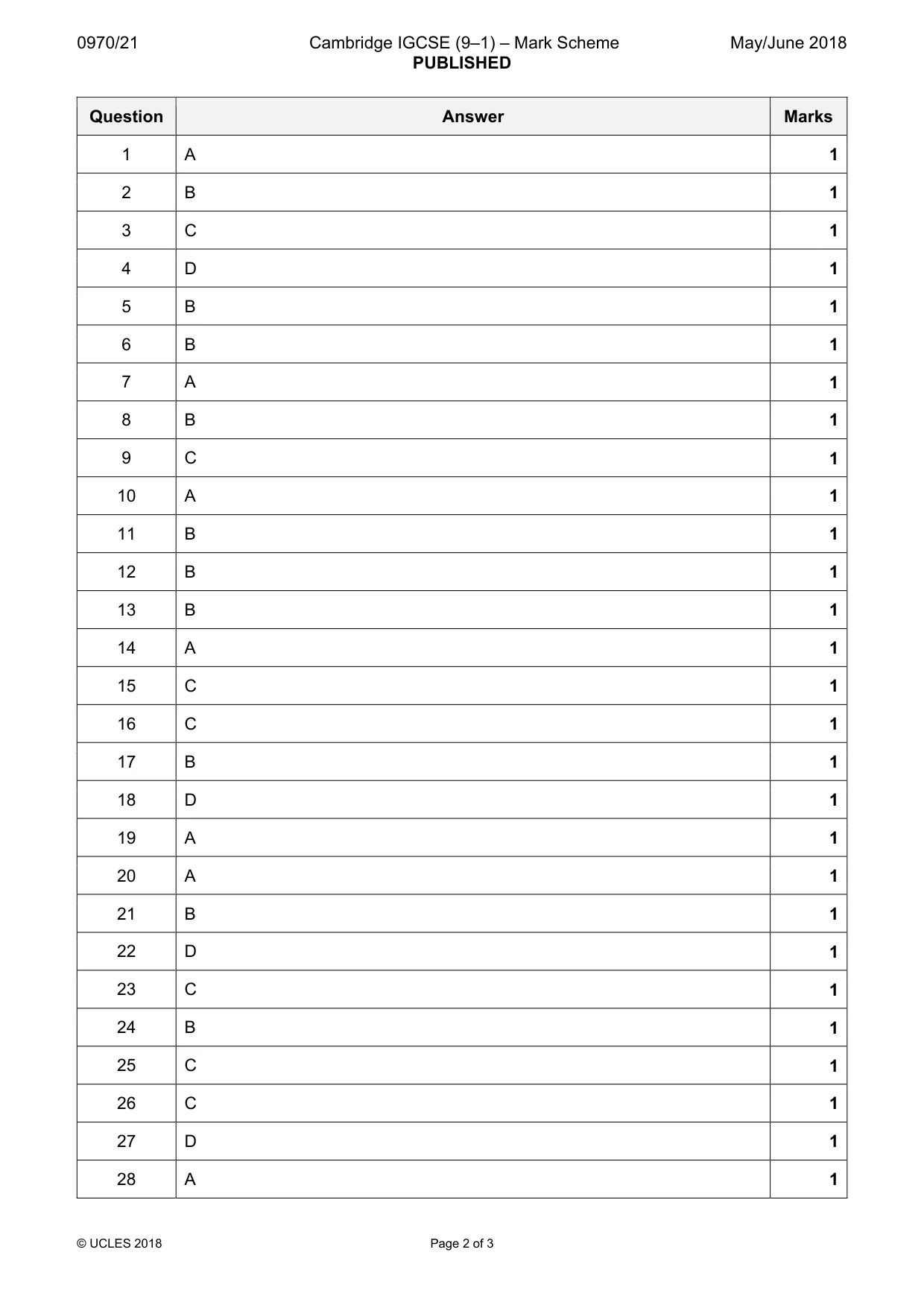
Mark scheme: A
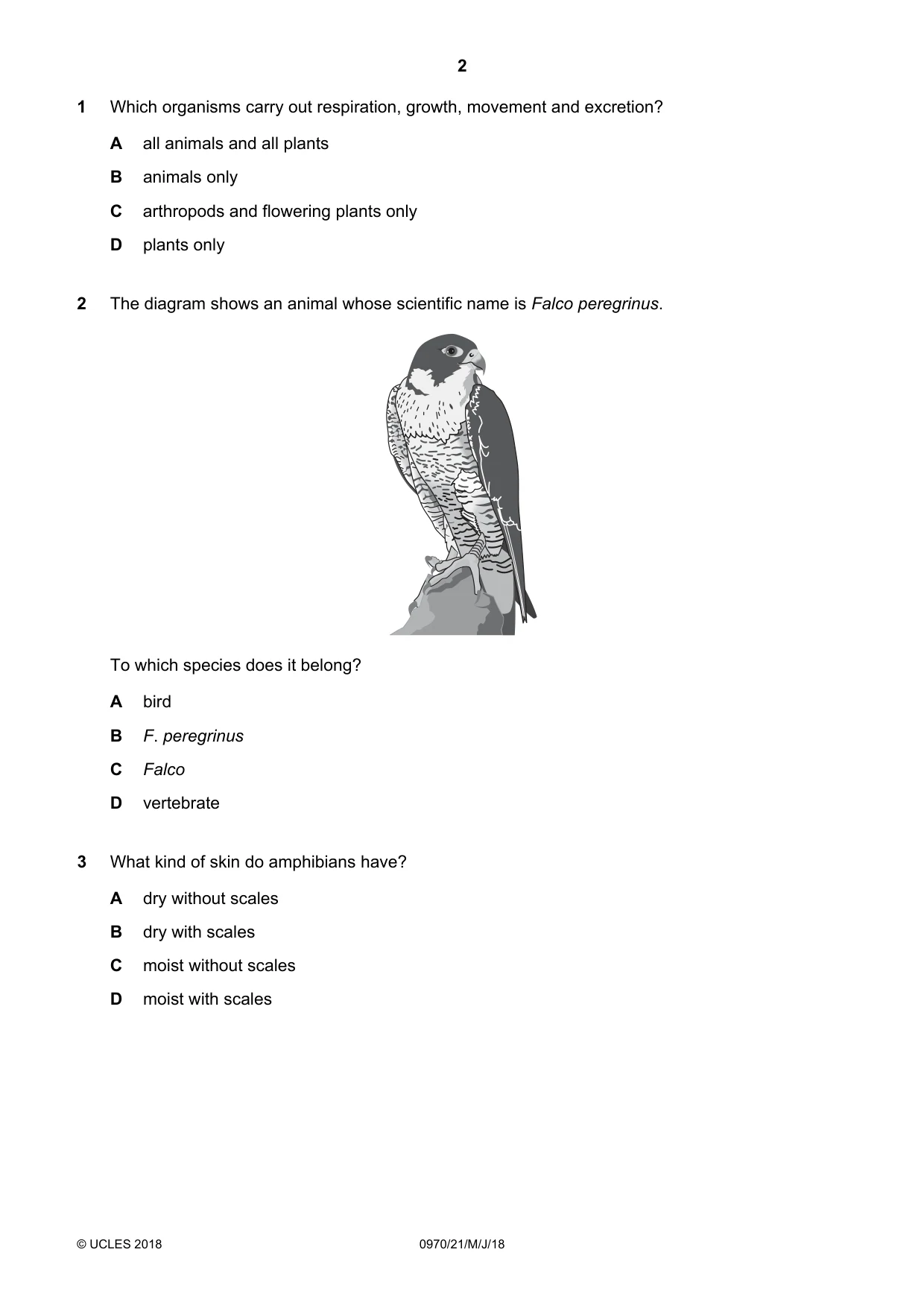
Q2 · The diagram shows an animal whose scientific name is Falco peregrinus
2 The diagram shows an animal whose scientific name is Falco peregrinus. To which species does it belong? A bird B F. peregrinus C Falco D vertebrate
Mark scheme: B
More questions on Concept and uses of classification systems
Q3 · What kind of skin do amphibians have?
3 What kind of skin do amphibians have? A dry without scales B dry with scales C moist without scales D moist with scales
Mark scheme: C
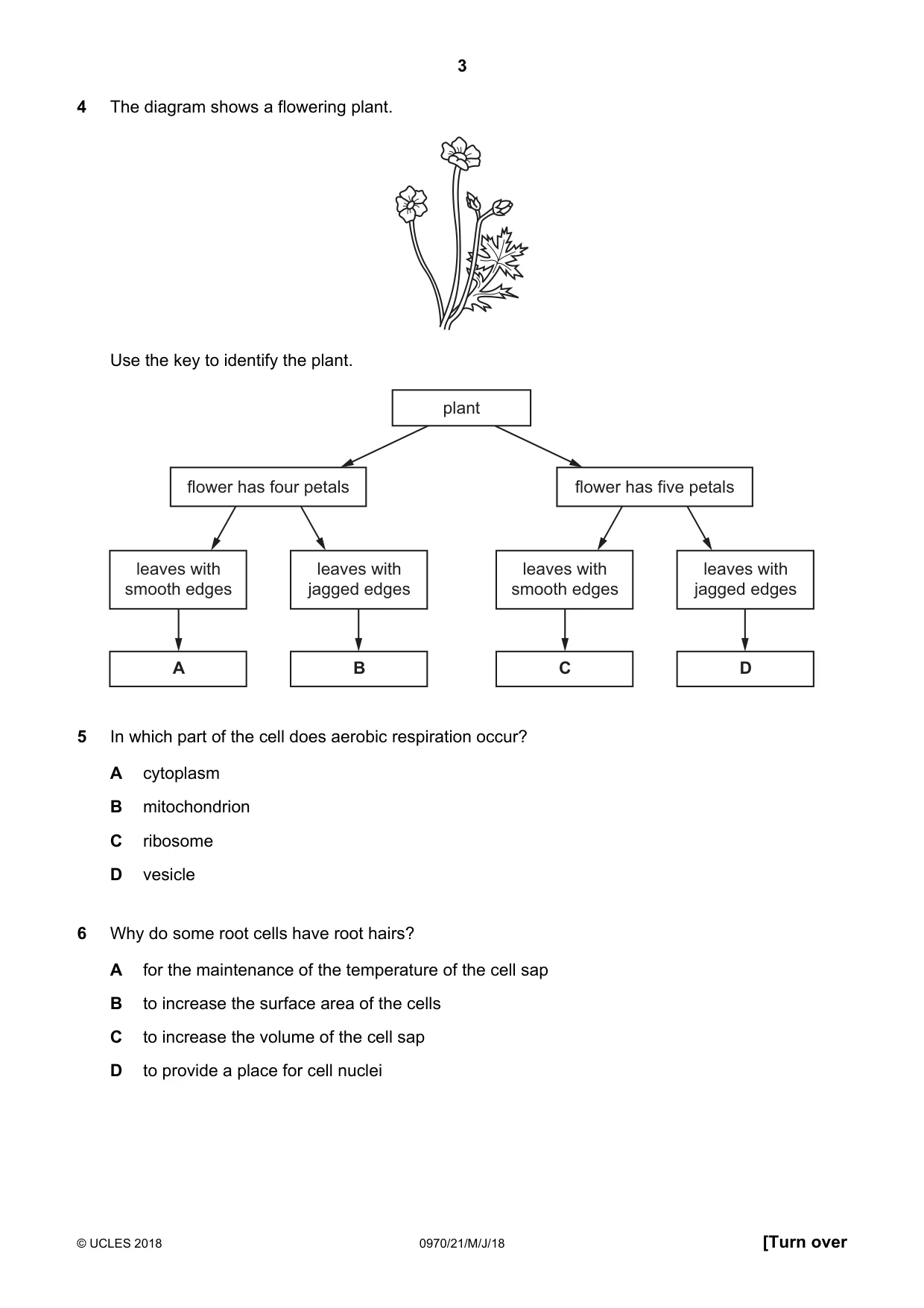
Q4 · The diagram shows a flowering plant
4 The diagram shows a flowering plant. Use the key to identify the plant. plant flower has four petals flower has five petals leaves with leaves with leaves with leaves with smooth edges jagged edges smooth edges jagged edges A B C D
Mark scheme: D
More questions on Concept and uses of classification systems
Q5 · In which part of the cell does aerobic respiration occur?
5 In which part of the cell does aerobic respiration occur? A cytoplasm B mitochondrion C ribosome D vesicle
Mark scheme: B
Q6 · Why do some root cells have root hairs?
6 Why do some root cells have root hairs? A for the maintenance of the temperature of the cell sap B to increase the surface area of the cells C to increase the volume of the cell sap D to provide a place for cell nuclei
Mark scheme: B
Q7 · Which words correctly complete the paragraph?
7 Which words correctly complete the paragraph? Diffusion may be defined as the net movement of particles from a region of their ««1«« concentration, to a region of their ««2«« concentration, where movement is ««3«« a concentration gradient. 1 2 3 A higher lower down B higher lower up C lower higher down D lower higher up
Mark scheme: A
Q8 · Which part of a plant root hair is partially permeable?
8 Which part of a plant root hair is partially permeable? A the cell sap B the cell surface membrane C the cell vacuole D the cell wall
Mark scheme: B
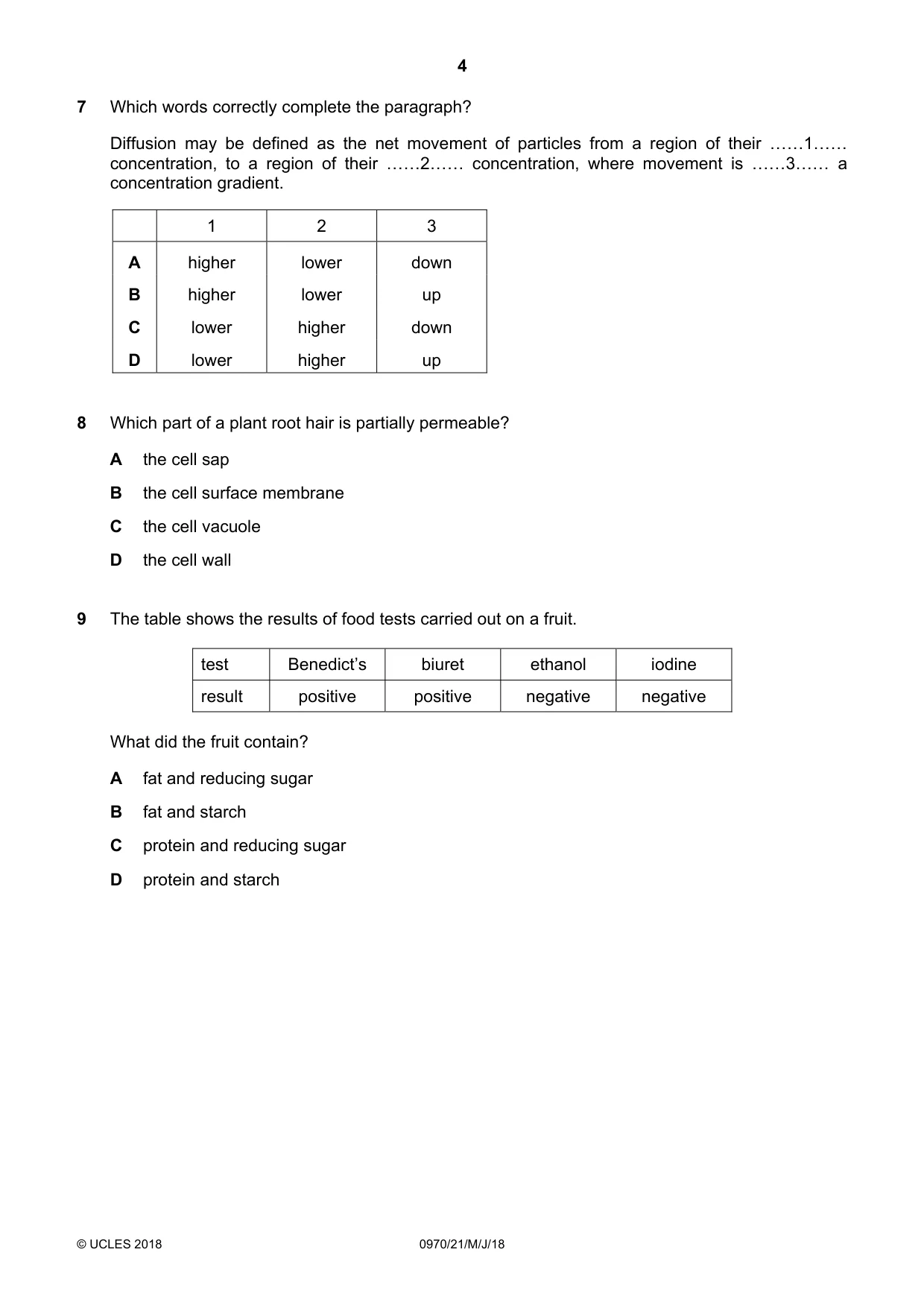
Q9 · The table shows the results of food tests carried out on a fruit
9 The table shows the results of food tests carried out on a fruit. test Benedict’s biuret ethanol iodine result positive positive negative negative What did the fruit contain? A fat and reducing sugar B fat and starch C protein and reducing sugar D protein and starch
Mark scheme: C
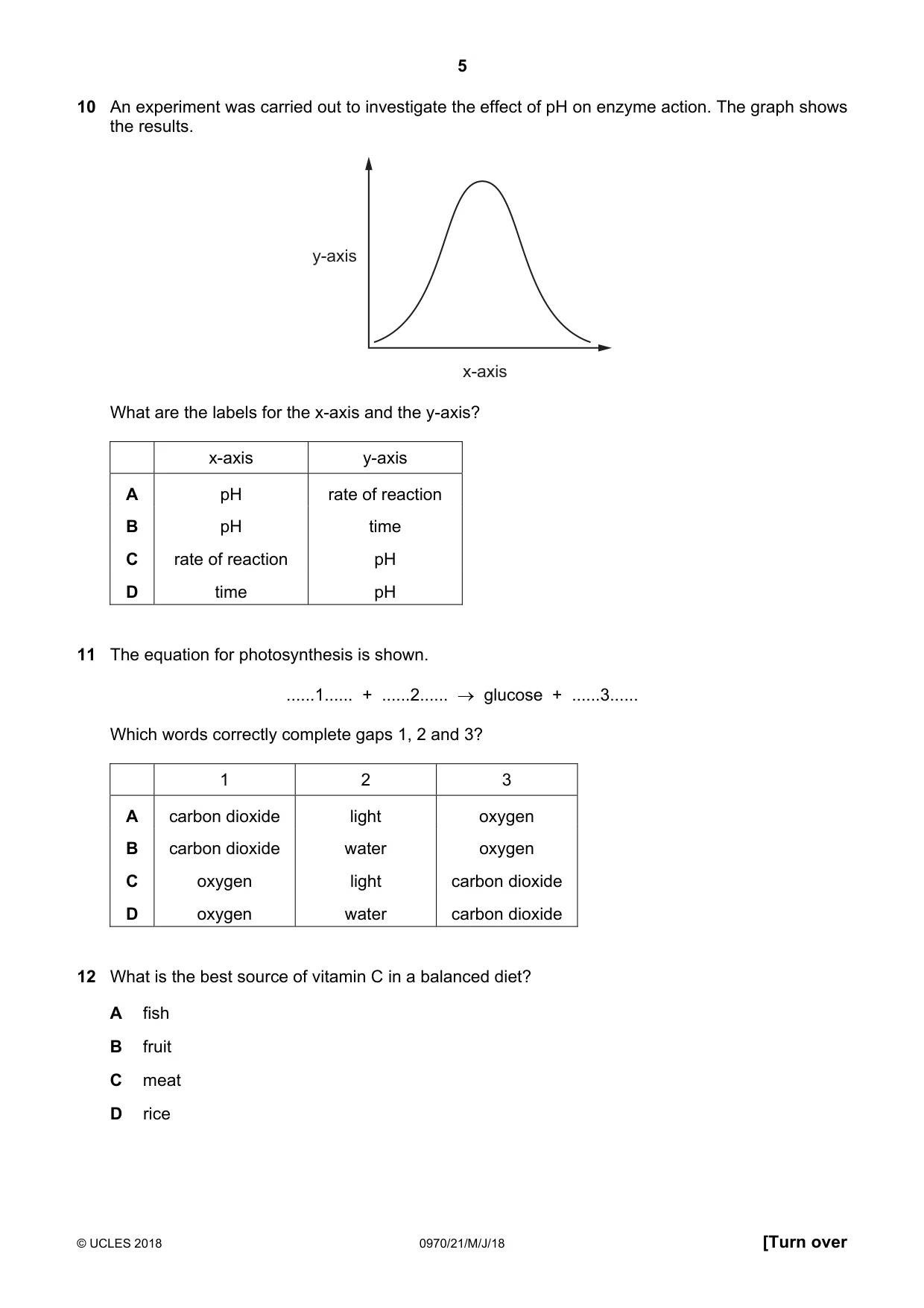
Q10 · An experiment was carried out to investigate the effect of pH on enzyme action
10 An experiment was carried out to investigate the effect of pH on enzyme action. The graph shows the results. y-axis x-axis What are the labels for the x-axis and the y-axis? x-axis y-axis A pH rate of reaction B pH time C rate of reaction pH D time pH
Mark scheme: A
Q11 · The equation for photosynthesis is shown
11 The equation for photosynthesis is shown. ......1...... + ......2...... → glucose + ......3...... Which words correctly complete gaps 1, 2 and 3? 1 2 3 A carbon dioxide light oxygen B carbon dioxide water oxygen C oxygen light carbon dioxide D oxygen water carbon dioxide
Mark scheme: B
Q12 · What is the best source of vitamin C in a balanced diet?
12 What is the best source of vitamin C in a balanced diet? A fish B fruit C meat D rice
Mark scheme: B
Q13 · A young, active woman requires more of which constituent in her diet than a young, active…
13 A young, active woman requires more of which constituent in her diet than a young, active man? A fat B iron C protein D vitamin C
Mark scheme: B
Q14 · Which condition could be caused by a lack of iron?
14 Which condition could be caused by a lack of iron? A anaemia B cholera C scurvy D diabetes
Mark scheme: A
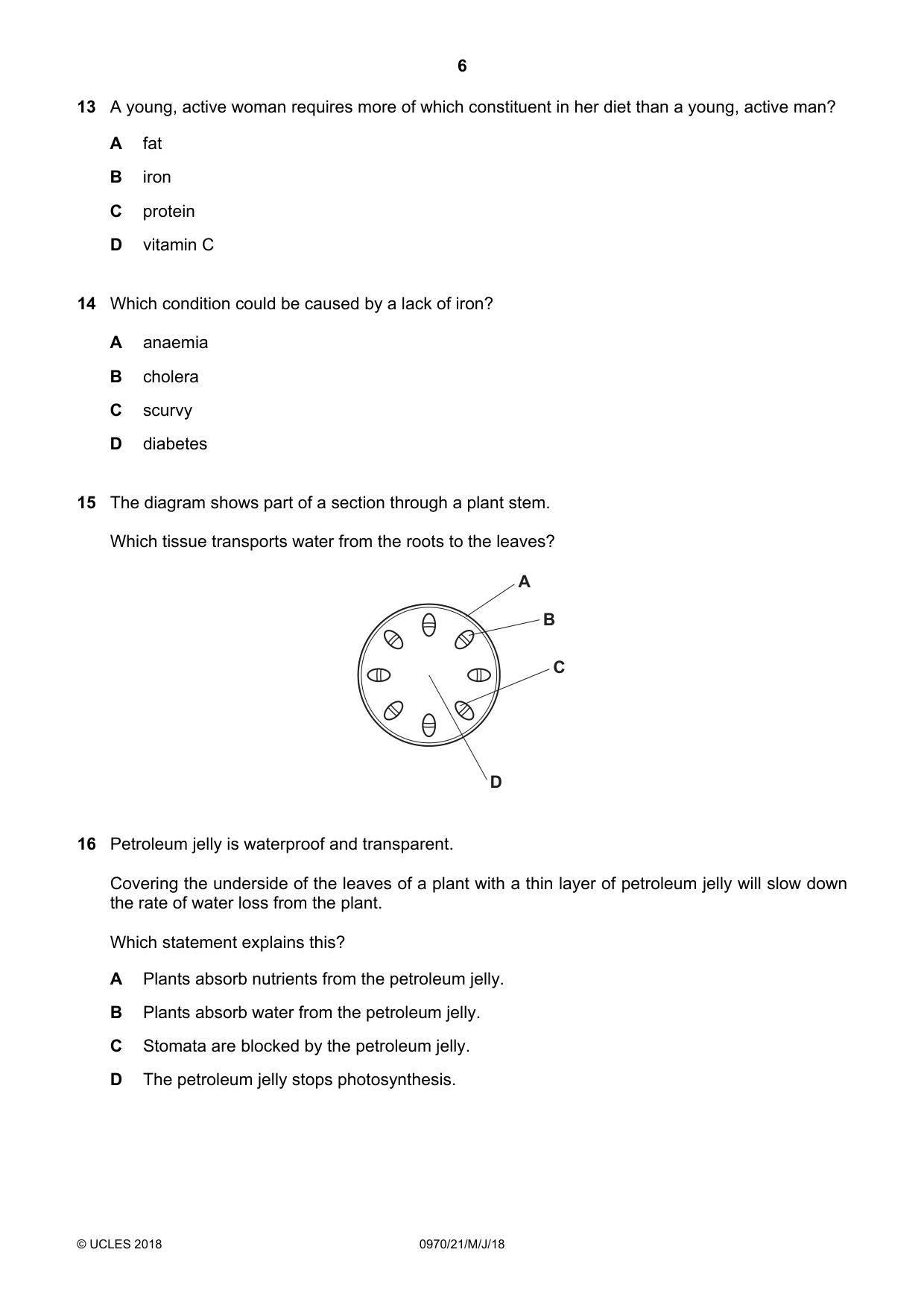
Q15 · The diagram shows part of a section through a plant stem
15 The diagram shows part of a section through a plant stem. Which tissue transports water from the roots to the leaves? A B C D
Mark scheme: C
Q16 · Petroleum jelly is waterproof and transparent
16 Petroleum jelly is waterproof and transparent. Covering the underside of the leaves of a plant with a thin layer of petroleum jelly will slow down the rate of water loss from the plant. Which statement explains this? A Plants absorb nutrients from the petroleum jelly. B Plants absorb water from the petroleum jelly. C Stomata are blocked by the petroleum jelly. D The petroleum jelly stops photosynthesis.
Mark scheme: C
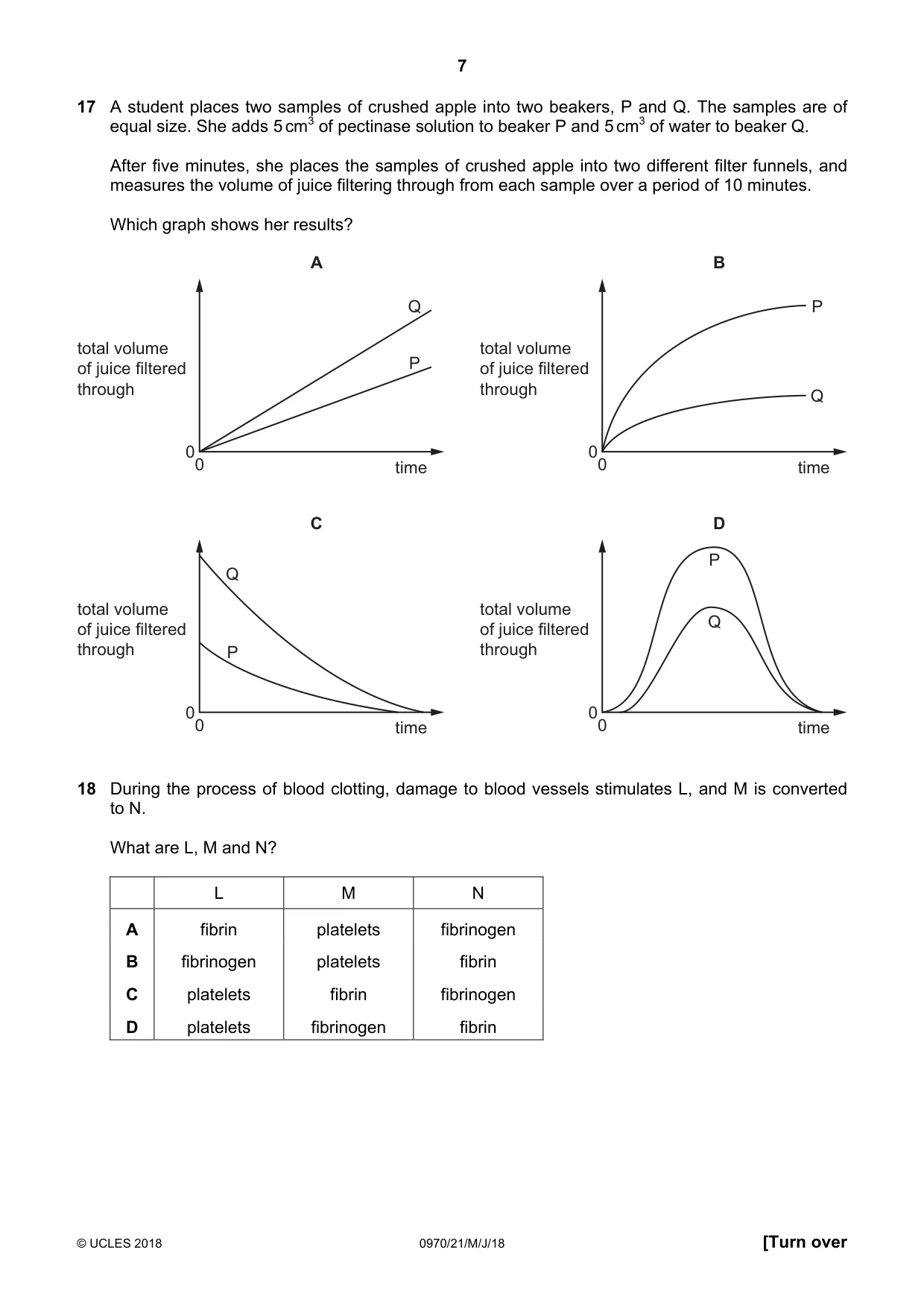
Q17 · A student places two samples of crushed apple into two beakers, P and Q
17 A student places two samples of crushed apple into two beakers, P and Q. The samples are of equal size. She adds 5 cm3 of pectinase solution to beaker P and 5 cm3 of water to beaker Q. After five minutes, she places the samples of crushed apple into two different filter funnels, and measures the volume of juice filtering through from each sample over a period of 10 minutes. Which graph shows her results? A B Q P total volume total volume of juice filtered P of juice filtered through through Q 00 00 time time C D P Q total volume total volume of juice filtered of juice filtered Q through P through 00 00 time time
Mark scheme: B
Q18 · During the process of blood clotting, damage to blood vessels stimulates L, and M is…
18 During the process of blood clotting, damage to blood vessels stimulates L, and M is converted to N. What are L, M and N? L M N A fibrin platelets fibrinogen B fibrinogen platelets fibrin C platelets fibrin fibrinogen D platelets fibrinogen fibrin
Mark scheme: D
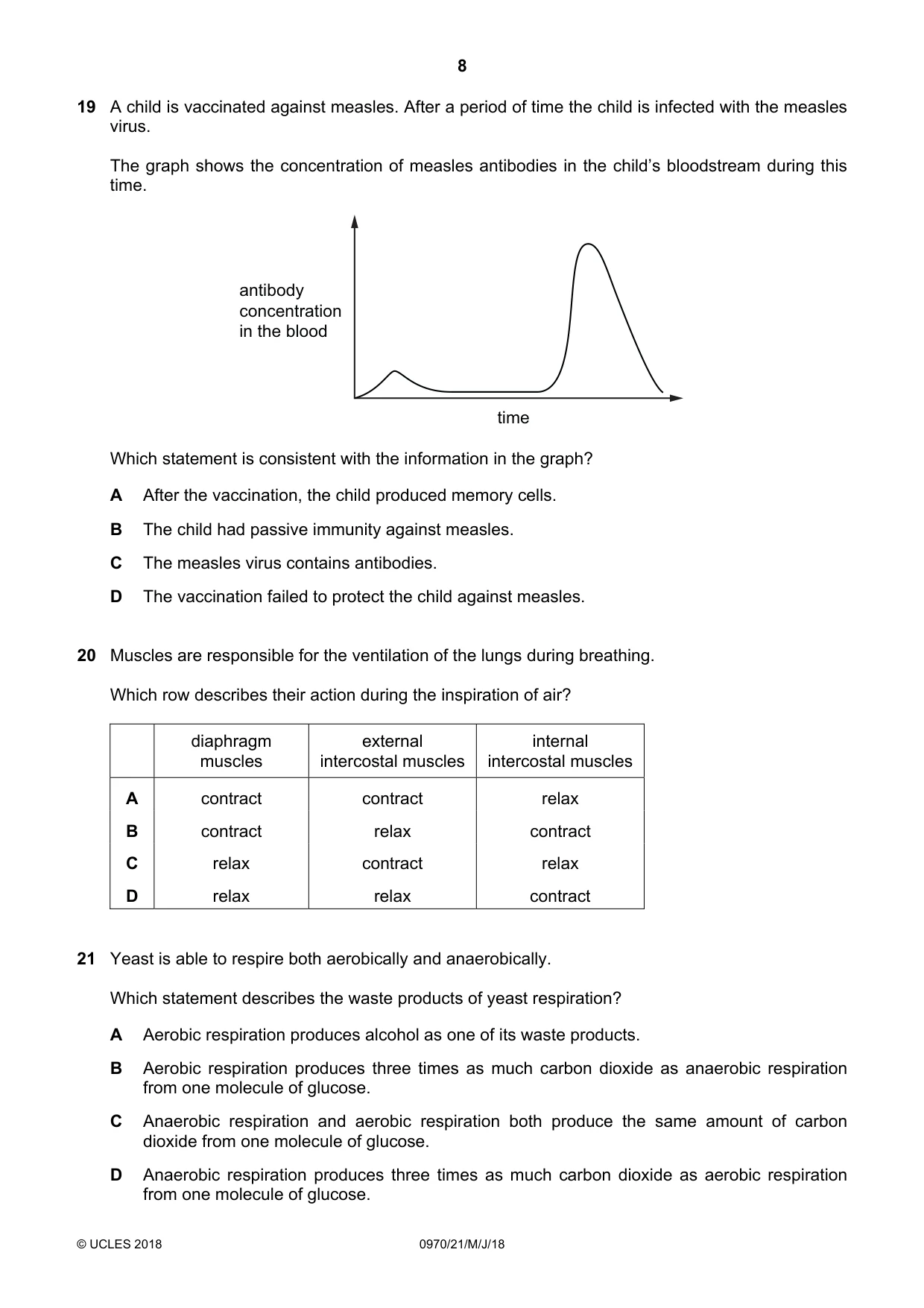
Q19 · A child is vaccinated against measles
19 A child is vaccinated against measles. After a period of time the child is infected with the measles virus. The graph shows the concentration of measles antibodies in the child’s bloodstream during this time. antibody concentration in the blood time Which statement is consistent with the information in the graph? A After the vaccination, the child produced memory cells. B The child had passive immunity against measles. C The measles virus contains antibodies. D The vaccination failed to protect the child against measles.
Mark scheme: A
Q20 · Muscles are responsible for the ventilation of the lungs during breathing
20 Muscles are responsible for the ventilation of the lungs during breathing. Which row describes their action during the inspiration of air? diaphragm external internal muscles intercostal muscles intercostal muscles A contract contract relax B contract relax contract C relax contract relax D relax relax contract
Mark scheme: A
Q21 · Yeast is able to respire both aerobically and anaerobically
21 Yeast is able to respire both aerobically and anaerobically. Which statement describes the waste products of yeast respiration? A Aerobic respiration produces alcohol as one of its waste products. B Aerobic respiration produces three times as much carbon dioxide as anaerobic respiration from one molecule of glucose. C Anaerobic respiration and aerobic respiration both produce the same amount of carbon dioxide from one molecule of glucose. D Anaerobic respiration produces three times as much carbon dioxide as aerobic respiration from one molecule of glucose.
Mark scheme: B
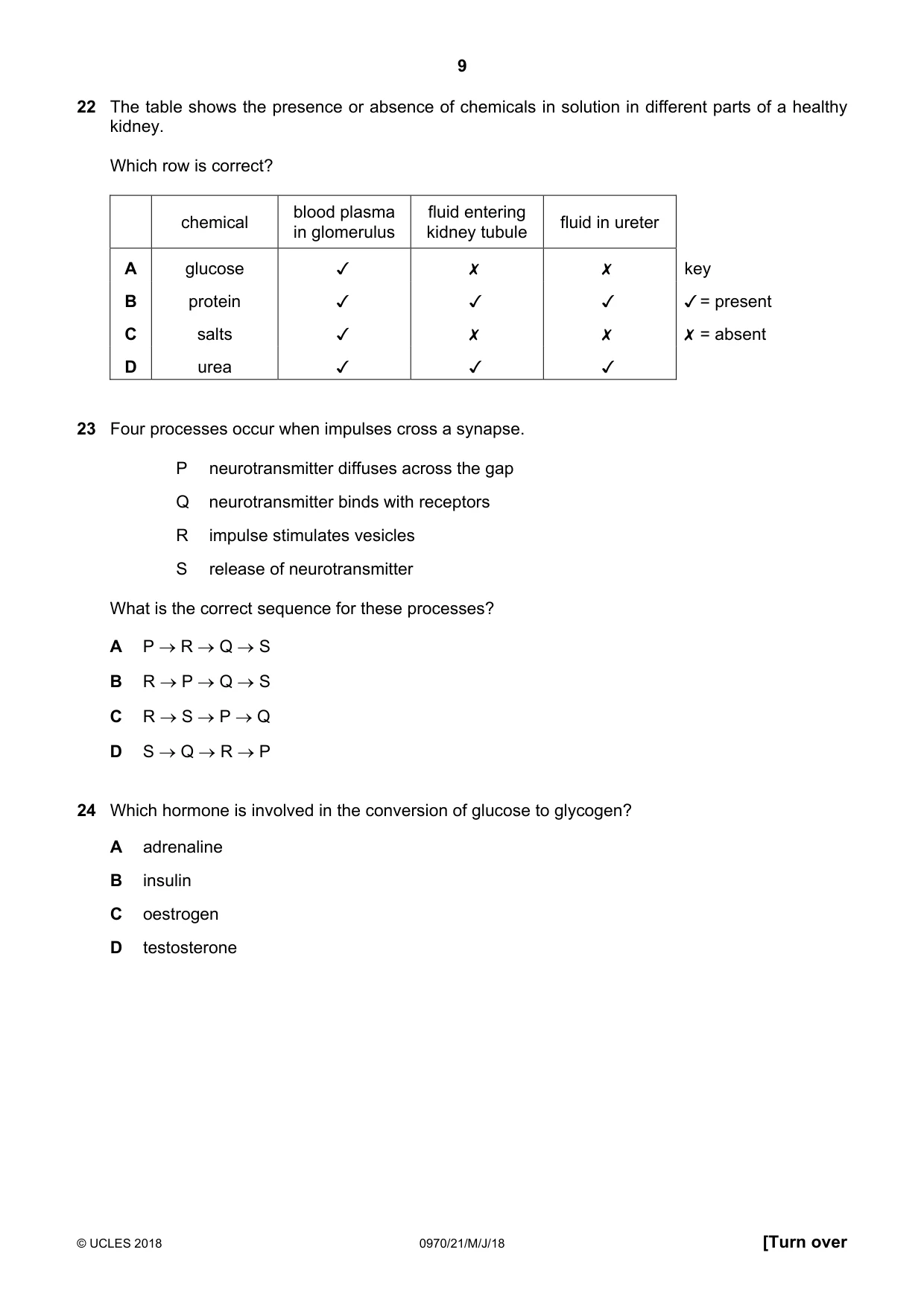
Q22 · The table shows the presence or absence of chemicals in solution in different parts of a…
22 The table shows the presence or absence of chemicals in solution in different parts of a healthy kidney. Which row is correct? ; blood plasma fluid entering ar chemical . ; fluid in ureter in glomerulus kidney tubule A glucose Jv x x key B protein Jv J J v¥ = present Cc salts v x x X = absent D urea v Jv v
Mark scheme: D
Q23 · Four processes occur when impulses cross a synapse
23 Four processes occur when impulses cross a synapse. P neurotransmitter diffuses across the gap Q neurotransmitter binds with receptors R impulse stimulates vesicles S release of neurotransmitter What is the correct sequence for these processes? A P → R → Q → S B R → P → Q → S C R → S → P → Q D S → Q → R → P
Mark scheme: C
Q24 · Which hormone is involved in the conversion of glucose to glycogen?
24 Which hormone is involved in the conversion of glucose to glycogen? A adrenaline B insulin C oestrogen D testosterone
Mark scheme: B
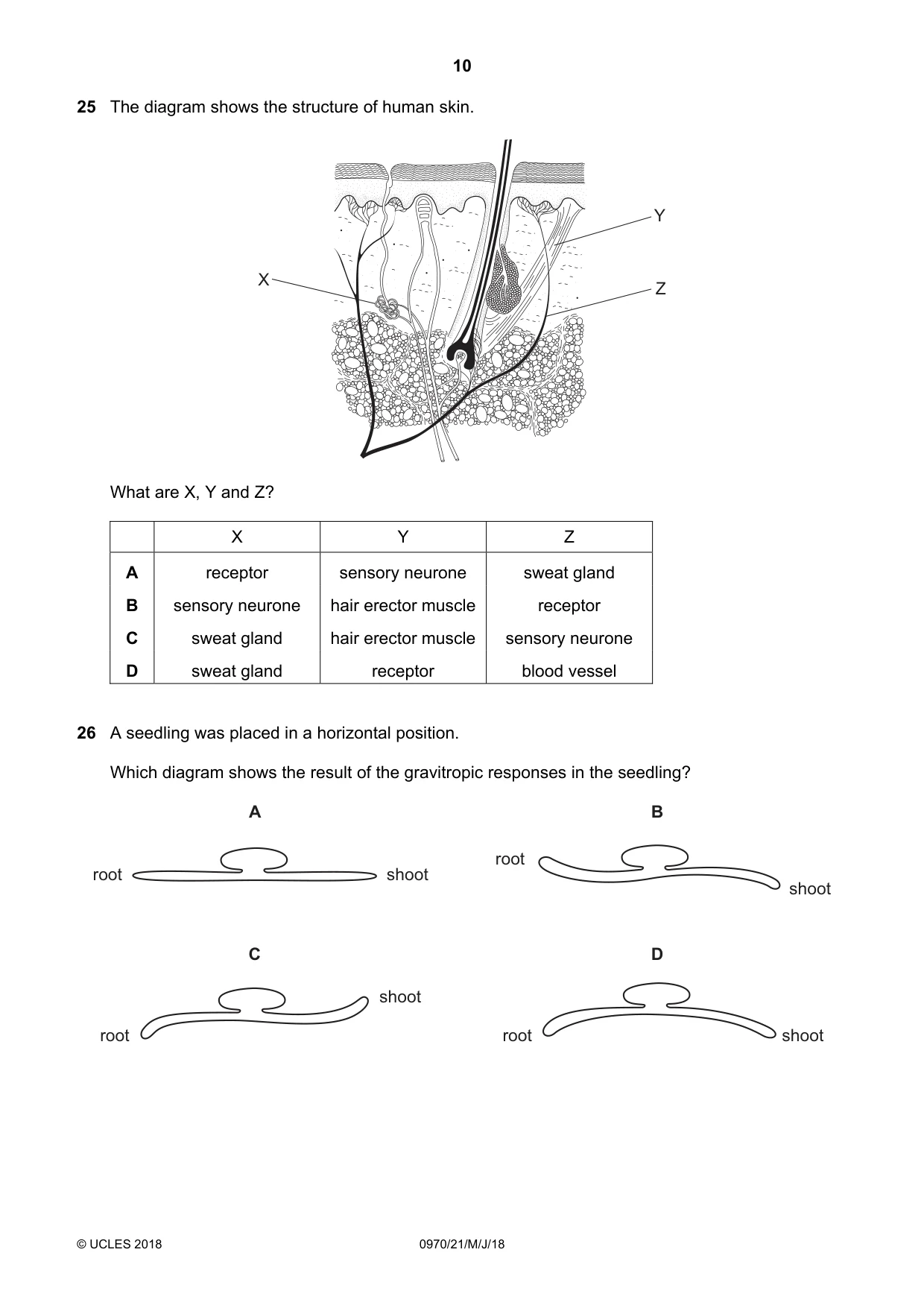
Q25 · The diagram shows the structure of human skin
25 The diagram shows the structure of human skin. Y X Z What are X, Y and Z? X Y Z A receptor sensory neurone sweat gland B sensory neurone hair erector muscle receptor C sweat gland hair erector muscle sensory neurone D sweat gland receptor blood vessel
Mark scheme: C
Q26 · A seedling was placed in a horizontal position
26 A seedling was placed in a horizontal position. Which diagram shows the result of the gravitropic responses in the seedling? A B root root shoot shoot C D shoot root root shoot
Mark scheme: C
Q27 · Which hormone may be used to improve sporting performance?
27 Which hormone may be used to improve sporting performance? A FSH B LH C oestrogen D testosterone
Mark scheme: D
Q28 · Specific grape varieties are maintained using stem cuttings from mature plants that are…
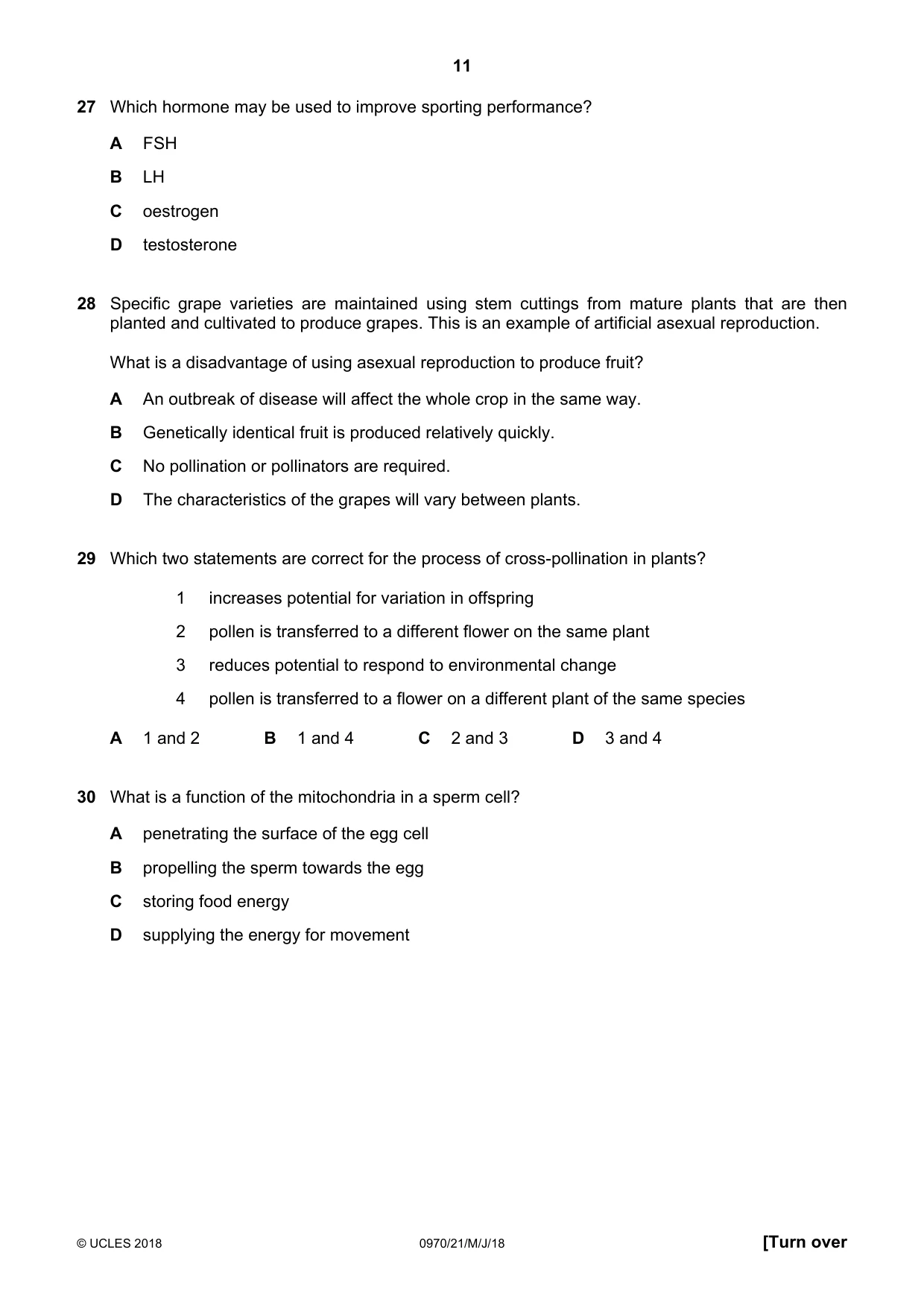
28 Specific grape varieties are maintained using stem cuttings from mature plants that are then planted and cultivated to produce grapes. This is an example of artificial asexual reproduction. What is a disadvantage of using asexual reproduction to produce fruit? A An outbreak of disease will affect the whole crop in the same way. B Genetically identical fruit is produced relatively quickly. C No pollination or pollinators are required. D The characteristics of the grapes will vary between plants.
Mark scheme: A
Q29 · Which two statements are correct for the process of cross-pollination in plants?
29 Which two statements are correct for the process of cross-pollination in plants? 1 increases potential for variation in offspring 2 pollen is transferred to a different flower on the same plant 3 reduces potential to respond to environmental change 4 pollen is transferred to a flower on a different plant of the same species A 1 and 2 B 1 and 4 C 2 and 3 D 3 and 4
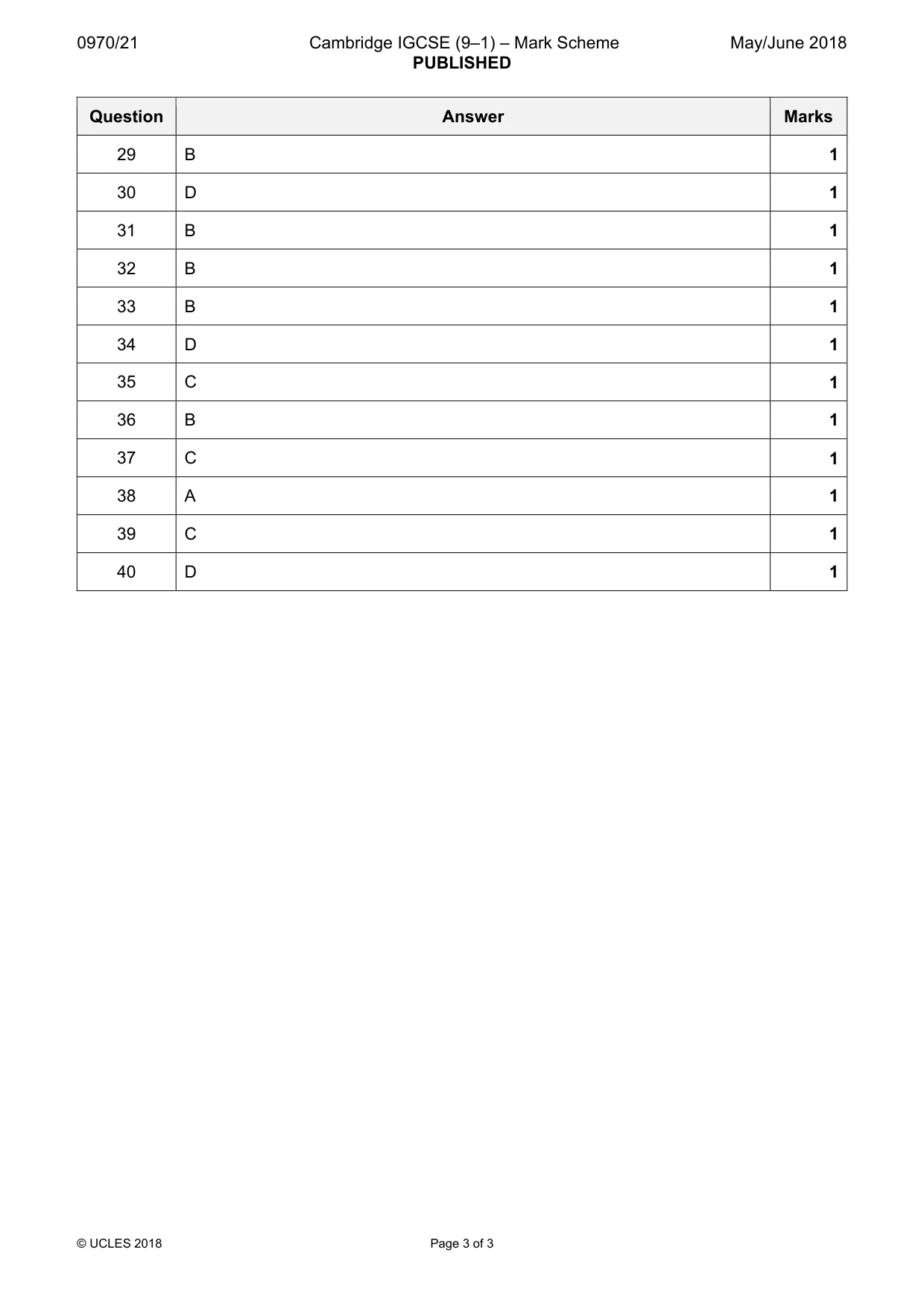
Mark scheme: B
Q30 · What is a function of the mitochondria in a sperm cell?
30 What is a function of the mitochondria in a sperm cell? A penetrating the surface of the egg cell B propelling the sperm towards the egg C storing food energy D supplying the energy for movement
Mark scheme: D
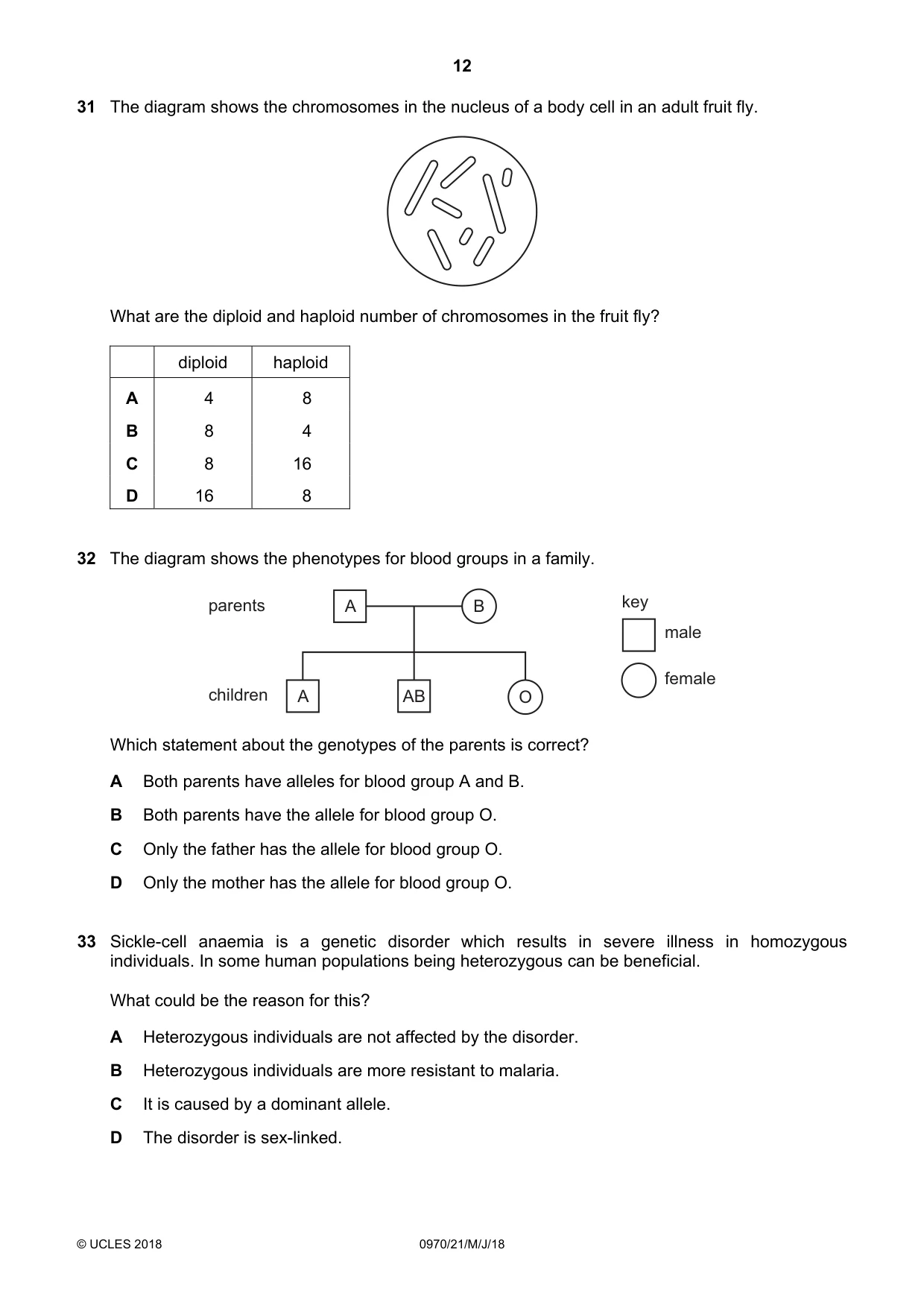
Q31 · The diagram shows the chromosomes in the nucleus of a body cell in an adult fruit fly
31 The diagram shows the chromosomes in the nucleus of a body cell in an adult fruit fly. What are the diploid and haploid number of chromosomes in the fruit fly? diploid haploid A 4 8 B 8 4 C 8 16 D 16 8
Mark scheme: B
Q32 · The diagram shows the phenotypes for blood groups in a family
32 The diagram shows the phenotypes for blood groups in a family. parents A B key male female children A AB O Which statement about the genotypes of the parents is correct? A Both parents have alleles for blood group A and B. B Both parents have the allele for blood group O. C Only the father has the allele for blood group O. D Only the mother has the allele for blood group O.
Mark scheme: B
Q33 · Sickle-cell anaemia is a genetic disorder which results in severe illness in homozygous…
33 Sickle-cell anaemia is a genetic disorder which results in severe illness in homozygous individuals. In some human populations being heterozygous can be beneficial. What could be the reason for this? A Heterozygous individuals are not affected by the disorder. B Heterozygous individuals are more resistant to malaria. C It is caused by a dominant allele. D The disorder is sex-linked.
Mark scheme: B
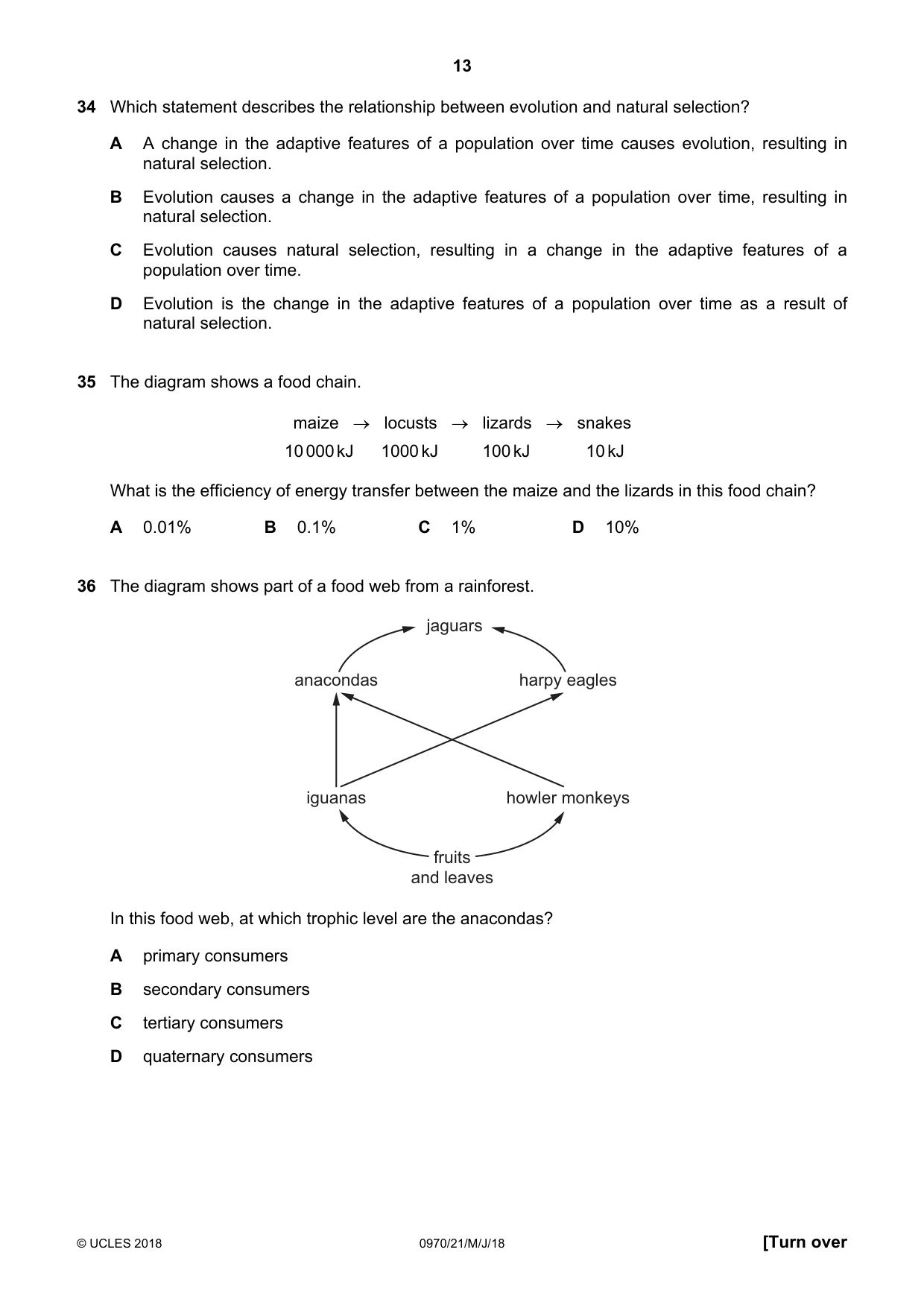
Q34 · Which statement describes the relationship between evolution and natural selection?
34 Which statement describes the relationship between evolution and natural selection? A A change in the adaptive features of a population over time causes evolution, resulting in natural selection. B Evolution causes a change in the adaptive features of a population over time, resulting in natural selection. C Evolution causes natural selection, resulting in a change in the adaptive features of a population over time. D Evolution is the change in the adaptive features of a population over time as a result of natural selection.
Mark scheme: D
Q35 · The diagram shows a food chain
35 The diagram shows a food chain. maize → locusts → lizards → snakes 10 000 kJ 1000 kJ 100 kJ 10 kJ What is the efficiency of energy transfer between the maize and the lizards in this food chain? A 0.01% B 0.1% C 1% D 10%
Mark scheme: C
Q36 · The diagram shows part of a food web from a rainforest
36 The diagram shows part of a food web from a rainforest. jaguars anacondas harpy eagles iguanas howler monkeys fruits and leaves In this food web, at which trophic level are the anacondas? A primary consumers B secondary consumers C tertiary consumers D quaternary consumers
Mark scheme: B
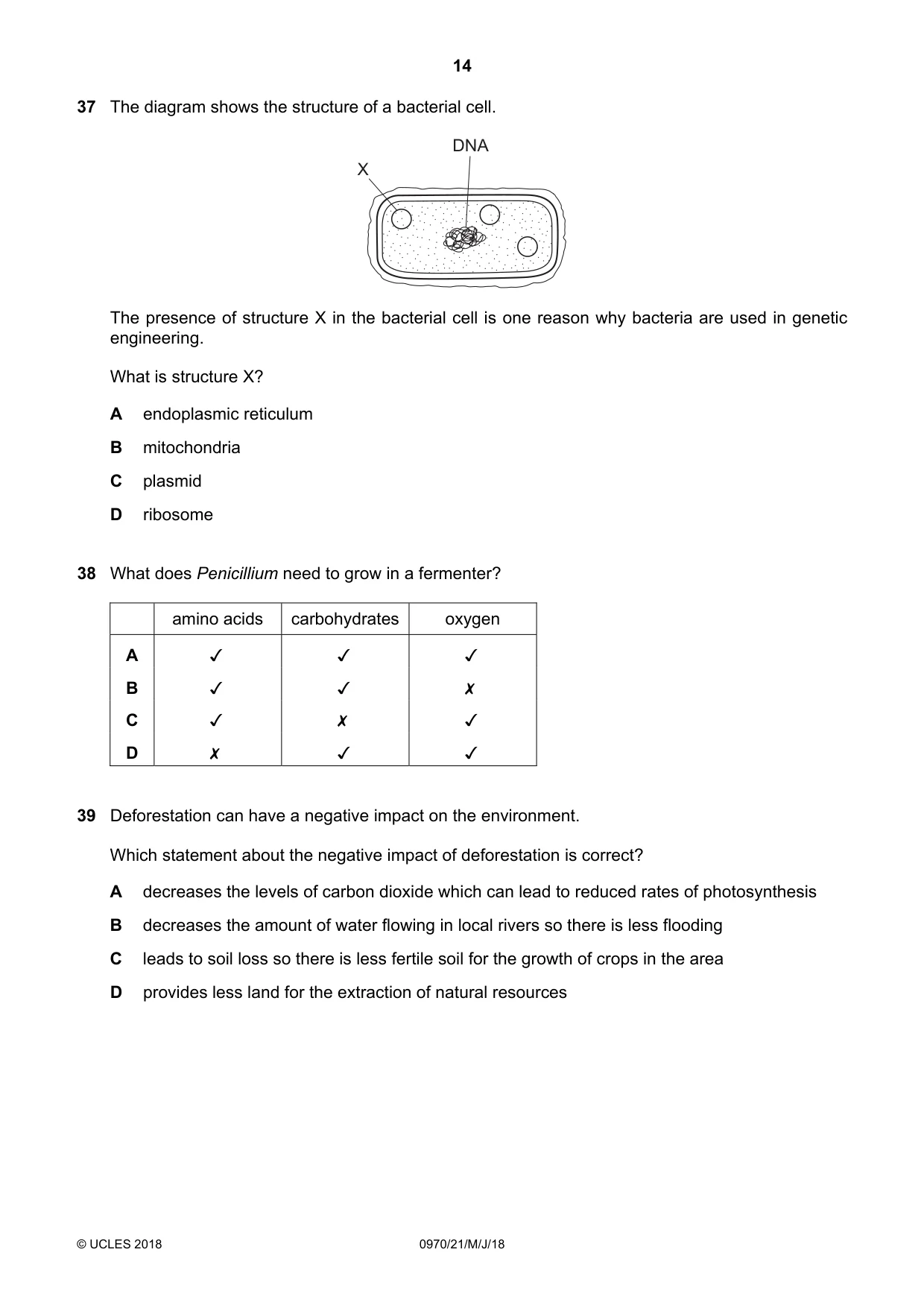
Q37 · The diagram shows the structure of a bacterial cell
37 The diagram shows the structure of a bacterial cell. DNA X The presence of structure X in the bacterial cell is one reason why bacteria are used in genetic engineering. What is structure X? A endoplasmic reticulum B mitochondria C plasmid D ribosome
Mark scheme: C
Q38 · What does Penicillium need to grow in a fermenter?
38 What does Penicillium need to grow in a fermenter? amino acids | carbohydrates oxygen v v v 0 0O WwW > v v x v x v x v v
Mark scheme: A
Q39 · Deforestation can have a negative impact on the environment
39 Deforestation can have a negative impact on the environment. Which statement about the negative impact of deforestation is correct? A decreases the levels of carbon dioxide which can lead to reduced rates of photosynthesis B decreases the amount of water flowing in local rivers so there is less flooding C leads to soil loss so there is less fertile soil for the growth of crops in the area D provides less land for the extraction of natural resources
Mark scheme: C
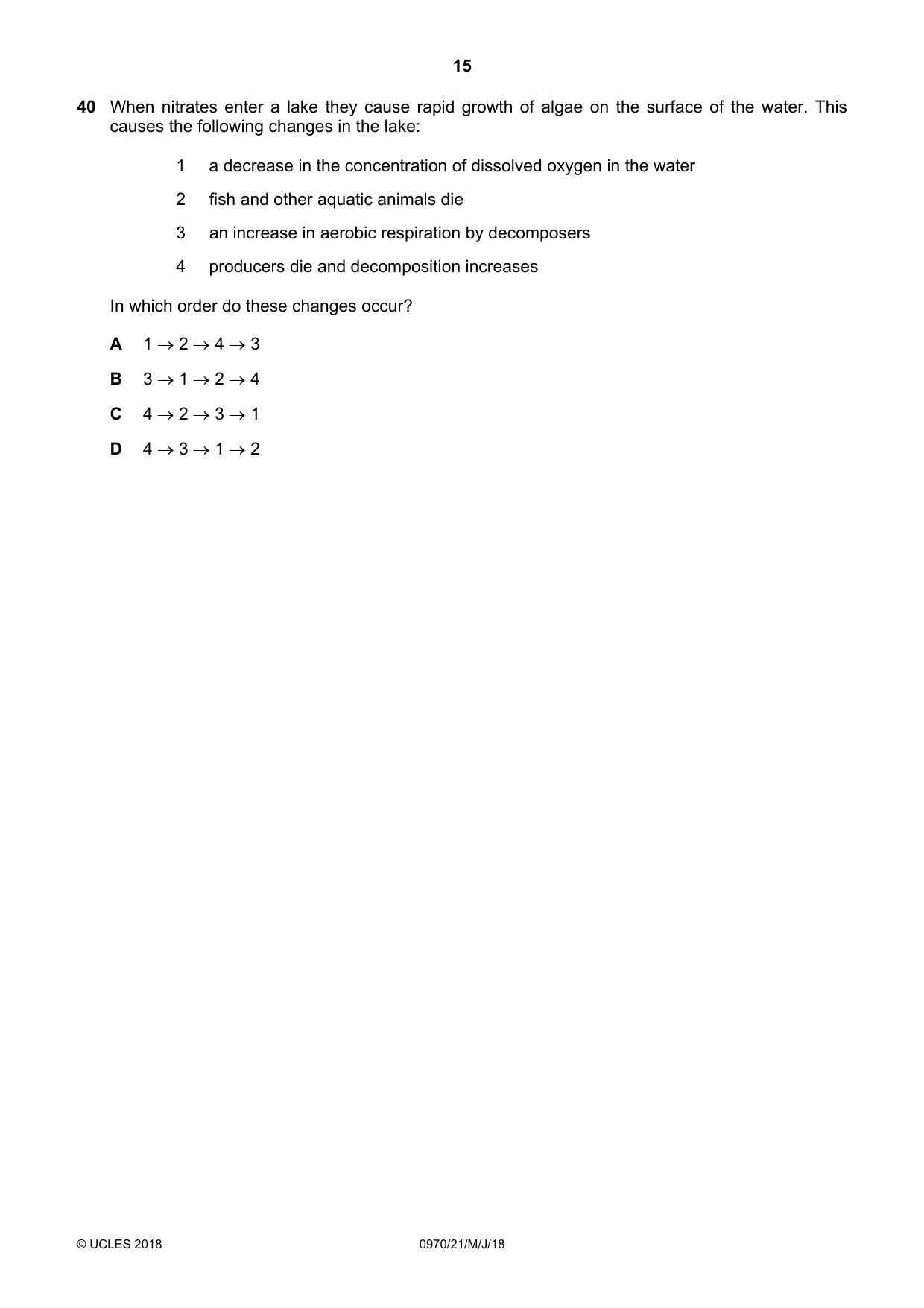
Q40 · When nitrates enter a lake they cause rapid growth of algae on the surface of the water
40 When nitrates enter a lake they cause rapid growth of algae on the surface of the water. This causes the following changes in the lake: 1 a decrease in the concentration of dissolved oxygen in the water 2 fish and other aquatic animals die 3 an increase in aerobic respiration by decomposers 4 producers die and decomposition increases In which order do these changes occur? A 1 → 2 → 4 → 3 B 3 → 1 → 2 → 4 C 4 → 2 → 3 → 1 D 4 → 3 → 1 → 2
Mark scheme: D
What was in this paper
The subtopics covered by these 40 questions, and how many questions each got. Open one in a new tab to see every Cambridge question on it.
3Concept and uses of classification systems2Enzymes2Adaptive features1Aerobic respiration1Anaerobic respiration1Asexual reproduction1Biological molecules1Biotechnology1Blood1Characteristics of living organisms1Chromosomes, genes and proteins1Coordination and response1Diffusion1Diseases and immunity1Drugs1Energy flow1Excretion in humans1Features of organisms1Food chains and food webs1Gas exchange in humans1Genetic modification1Habitat destruction1Hormones1Monohybrid inheritance1Osmosis1Photosynthesis1Pollution1Selection1Sense organs1Sexual reproduction in humans1Sexual reproduction in plants1Transpiration1Tropic responses1Water uptake1Xylem and phloem1What you needed in this session
Cambridge’s own grade thresholds for 2018 May/June, Paper 2 · Variant 1. A higher threshold means an easier paper — the bar moves with how the cohort did.