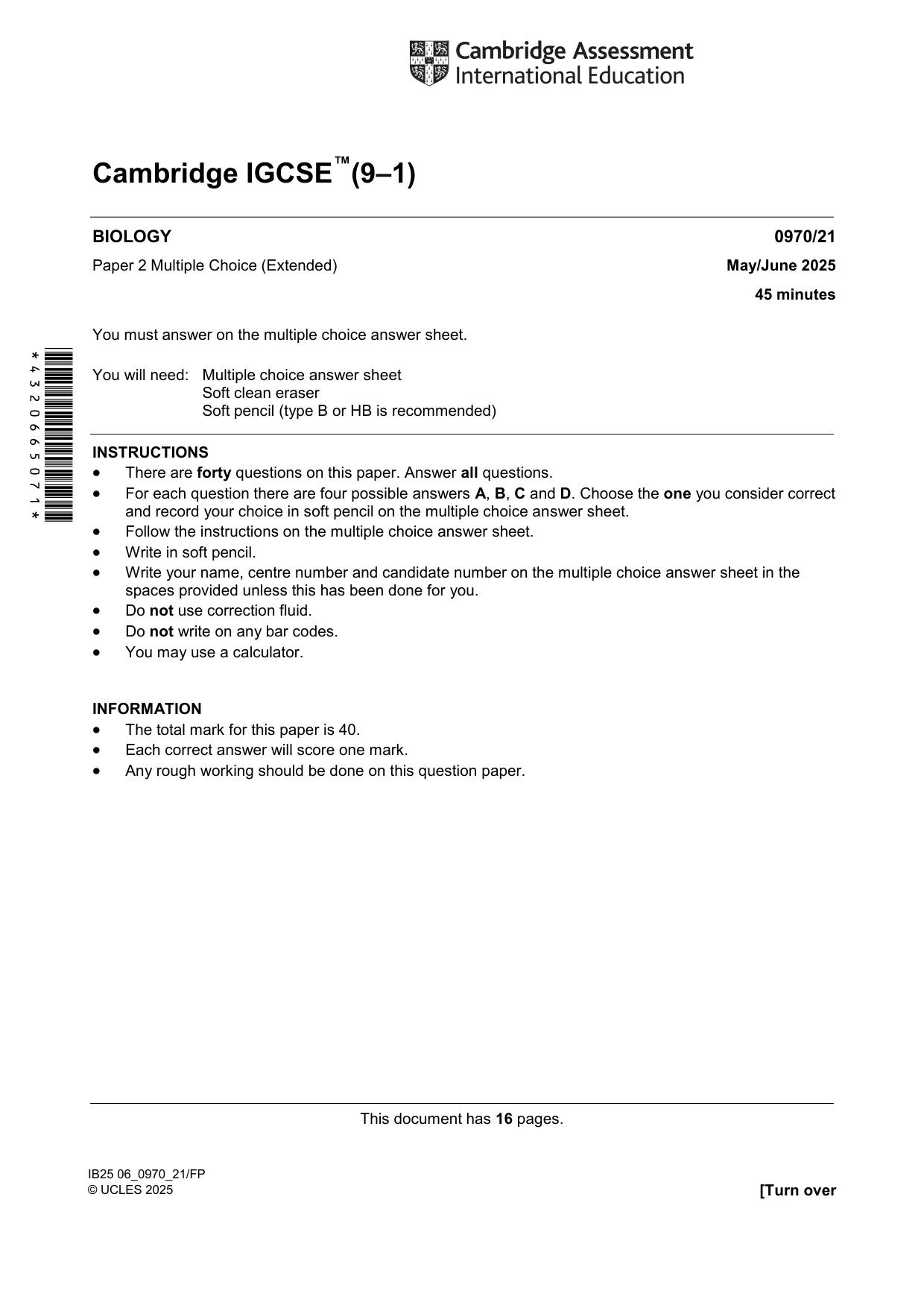
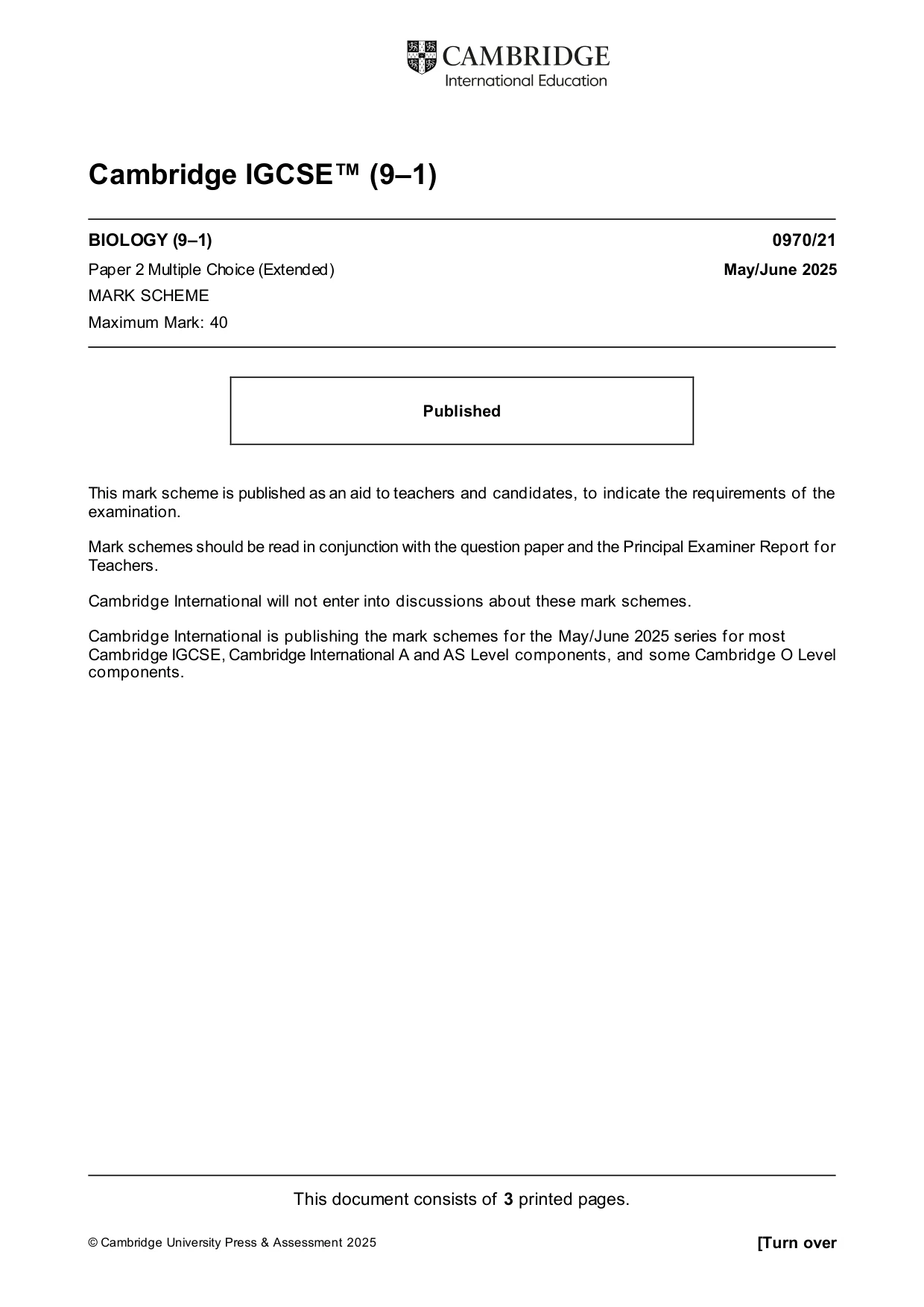
Cambridge IGCSE Biology (9-1) 0970 — 2025 May/June Paper 2 · Variant 1
0970/21/M/J/25 · 40 questions · 40 marks · ≈45 min
The question paper and its mark scheme, free to read here and free to download. This is Cambridge’s own paper, exactly as it was sat.
Question paper16 pages
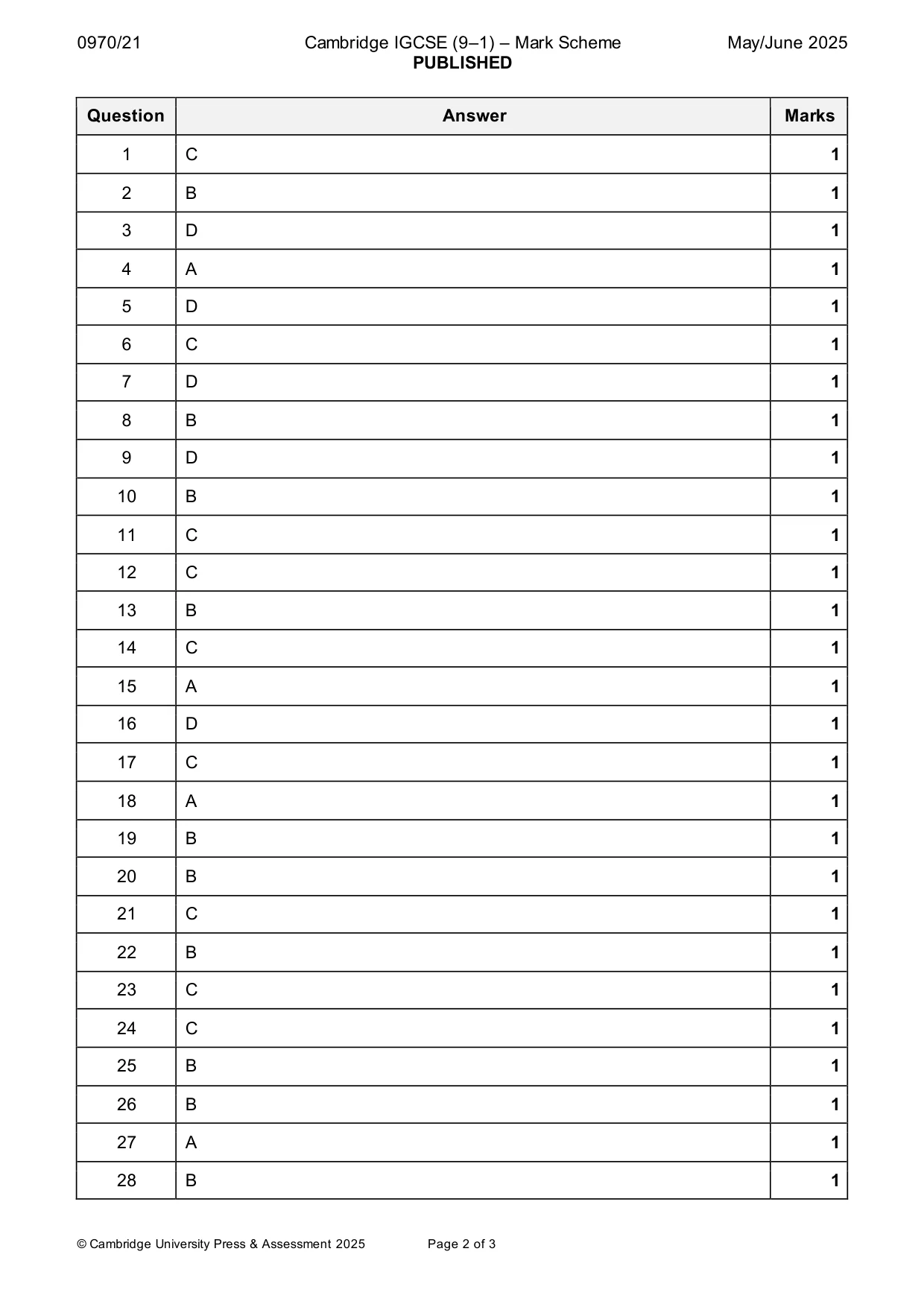
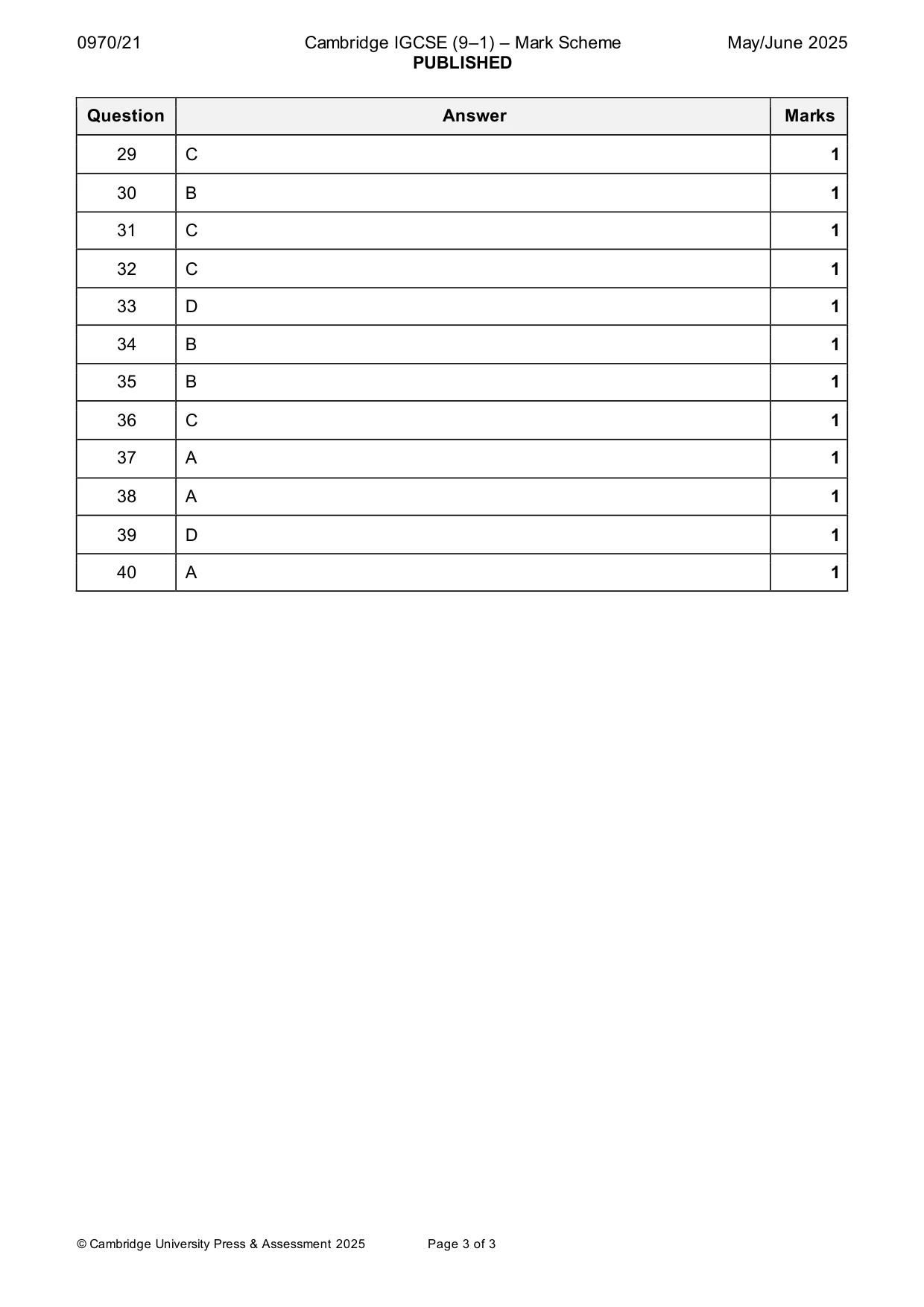
Mark scheme3 pages
Answers below. Sit the paper first if you are practising.
Questions as text
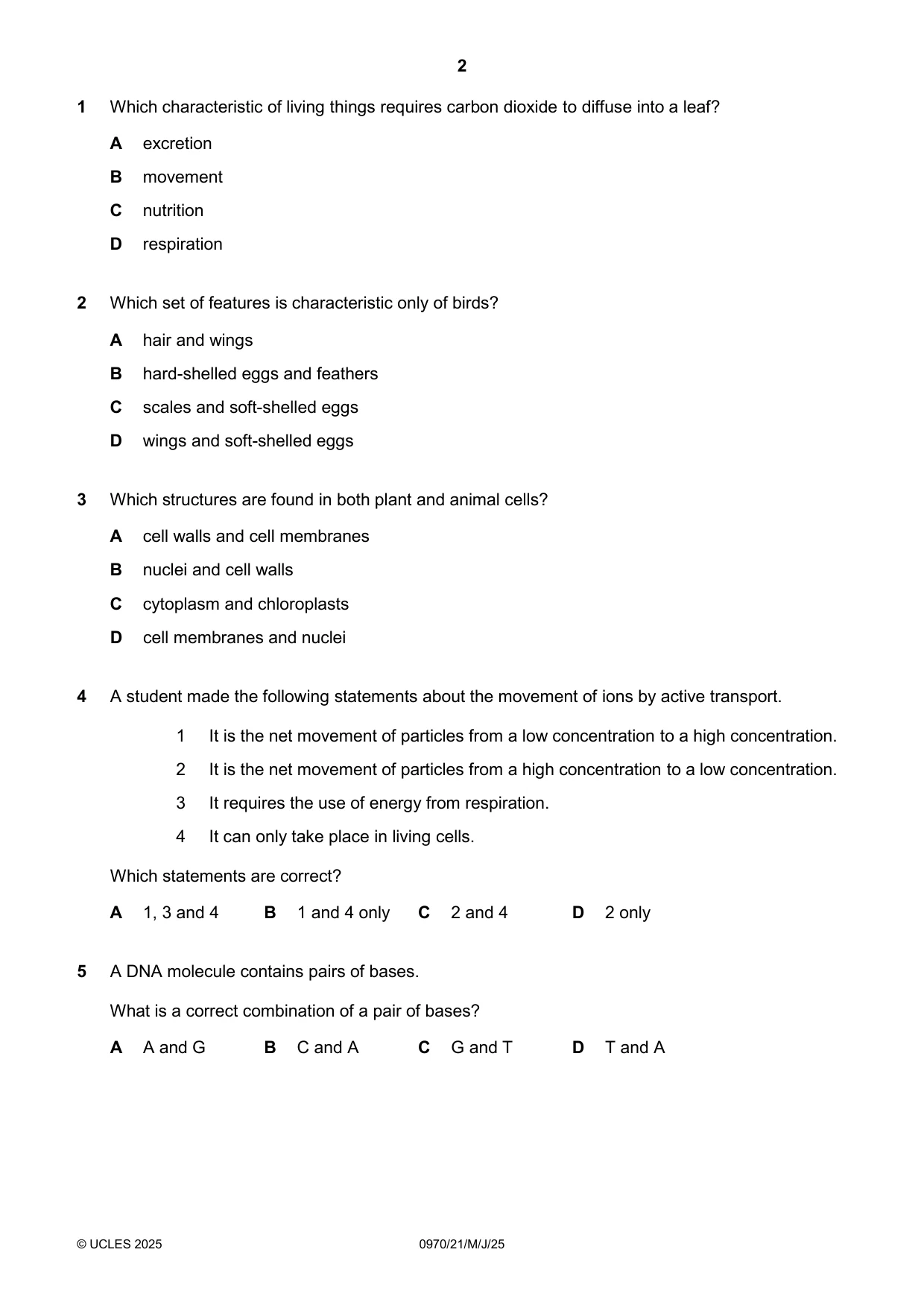
Q1 · Which characteristic of living things requires carbon dioxide to diffuse into a leaf?
1 Which characteristic of living things requires carbon dioxide to diffuse into a leaf? A excretion B movement C nutrition D respiration
Mark scheme: C
Q2 · Which set of features is characteristic only of birds?
2 Which set of features is characteristic only of birds? A hair and wings B hard-shelled eggs and feathers C scales and soft-shelled eggs D wings and soft-shelled eggs
Mark scheme: B
Q3 · Which structures are found in both plant and animal cells?
3 Which structures are found in both plant and animal cells? A cell walls and cell membranes B nuclei and cell walls C cytoplasm and chloroplasts D cell membranes and nuclei
Mark scheme: D
Q4 · A student made the following statements about the movement of ions by active transport
4 A student made the following statements about the movement of ions by active transport. 1 It is the net movement of particles from a low concentration to a high concentration. 2 It is the net movement of particles from a high concentration to a low concentration. 3 It requires the use of energy from respiration. 4 It can only take place in living cells. Which statements are correct? A 1, 3 and 4 B 1 and 4 only C 2 and 4 D 2 only
Mark scheme: A
Q5 · A DNA molecule contains pairs of bases
5 A DNA molecule contains pairs of bases. What is a correct combination of a pair of bases? A A and G B C and A C G and T D T and A
Mark scheme: D
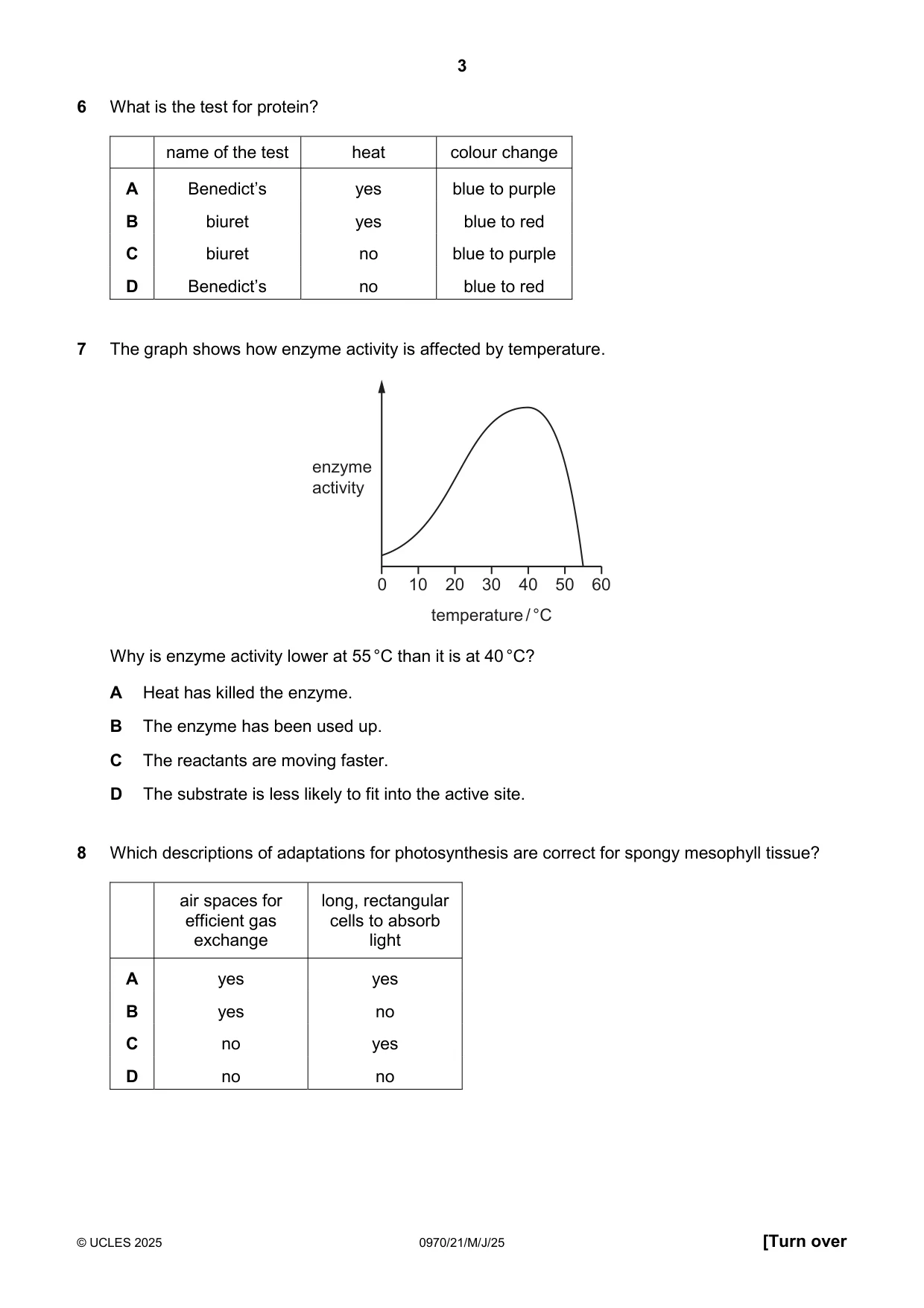
Q6 · What is the test for protein?
6 What is the test for protein? name of the test heat colour change A Benedict’s yes blue to purple B biuret yes blue to red C biuret no blue to purple D Benedict’s no blue to red
Mark scheme: C
Q7 · The graph shows how enzyme activity is affected by temperature
7 The graph shows how enzyme activity is affected by temperature. enzyme activity 0 10 20 30 40 50 60 temperature / °C Why is enzyme activity lower at 55 °C than it is at 40 °C? A Heat has killed the enzyme. B The enzyme has been used up. C The reactants are moving faster. D The substrate is less likely to fit into the active site.
Mark scheme: D
Q8 · Which descriptions of adaptations for photosynthesis are correct for spongy mesophyll…
8 Which descriptions of adaptations for photosynthesis are correct for spongy mesophyll tissue? air spaces for long, rectangular efficient gas cells to absorb exchange light A yes yes B yes no C no yes D no no
Mark scheme: B
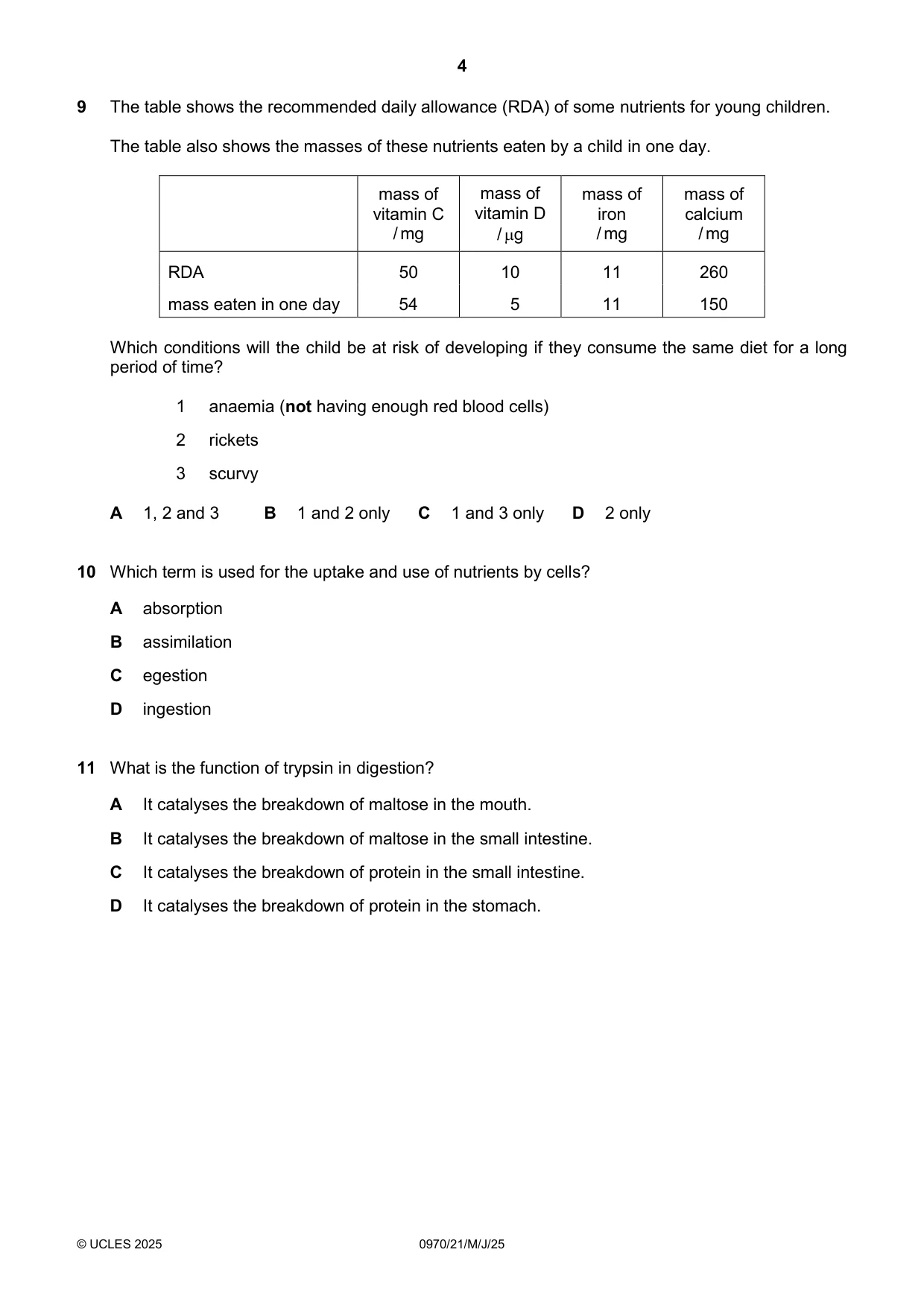
Q9 · The table shows the recommended daily allowance (RDA) of some nutrients for young children
9 The table shows the recommended daily allowance (RDA) of some nutrients for young children. The table also shows the masses of these nutrients eaten by a child in one day. mass of mass of mass of mass of vitamin C vitamin D iron calcium / mg / g / mg / mg RDA 50 10 11 260 mass eaten in one day 54 5 11 150 Which conditions will the child be at risk of developing if they consume the same diet for a long period of time? 1 anaemia (not having enough red blood cells) 2 rickets 3 scurvy A 1, 2 and 3 B 1 and 2 only C 1 and 3 only D 2 only
Mark scheme: D
Q10 · Which term is used for the uptake and use of nutrients by cells?
10 Which term is used for the uptake and use of nutrients by cells? A absorption B assimilation C egestion D ingestion
Mark scheme: B
Q11 · What is the function of trypsin in digestion?
11 What is the function of trypsin in digestion? A It catalyses the breakdown of maltose in the mouth. B It catalyses the breakdown of maltose in the small intestine. C It catalyses the breakdown of protein in the small intestine. D It catalyses the breakdown of protein in the stomach.
Mark scheme: C
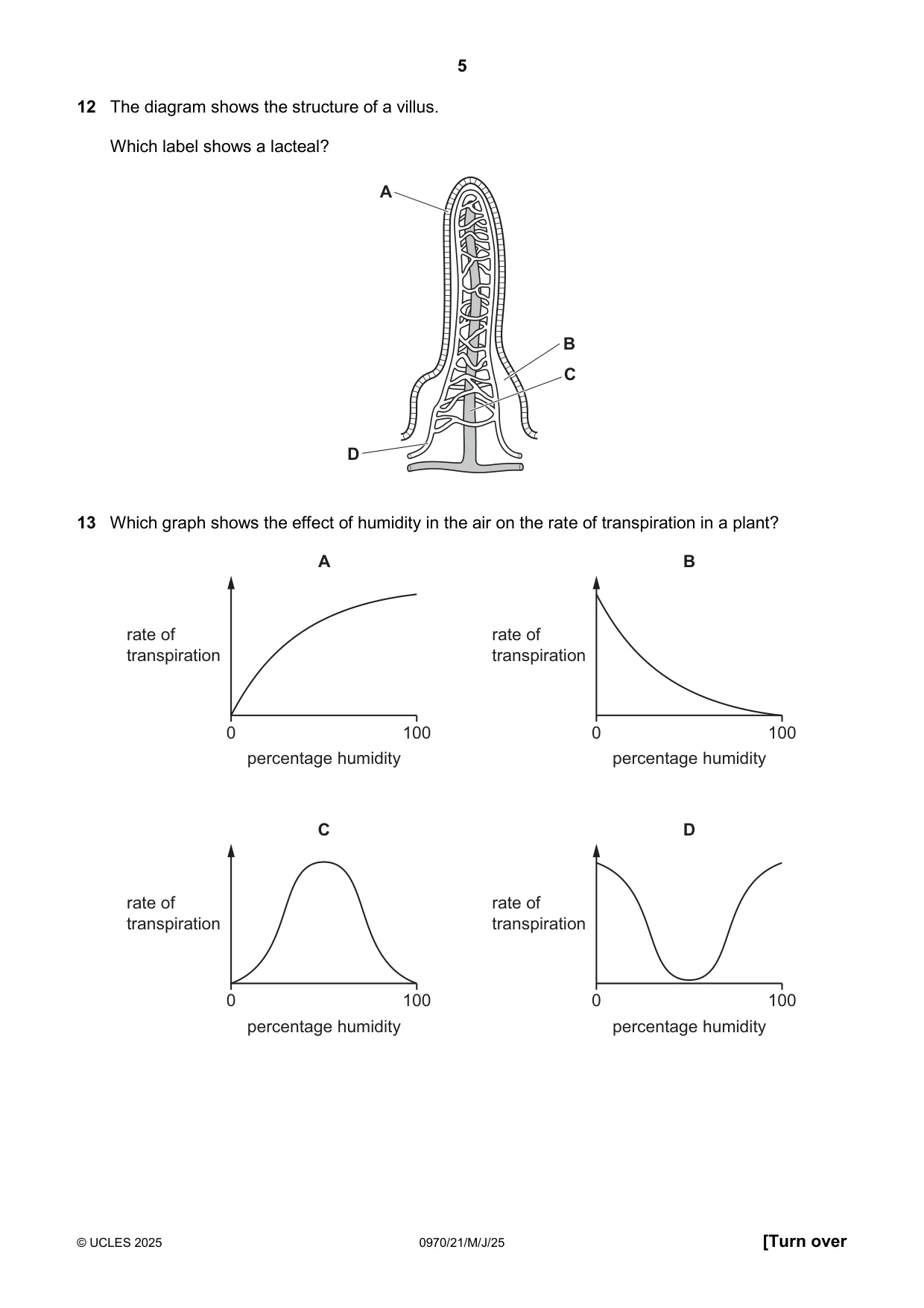
Q12 · The diagram shows the structure of a villus
12 The diagram shows the structure of a villus. Which label shows a lacteal? A B C D
Mark scheme: C
Q13 · Which graph shows the effect of humidity in the air on the rate of transpiration in a…
13 Which graph shows the effect of humidity in the air on the rate of transpiration in a plant? A B rate of rate of transpiration transpiration 0 100 0 100 percentage humidity percentage humidity C D rate of rate of transpiration transpiration 0 100 0 100 percentage humidity percentage humidity
Mark scheme: B
Q14 · In some countries, spring is the time of year when daffodil plants have green leaves and…
14 In some countries, spring is the time of year when daffodil plants have green leaves and produce flowers. Which parts of the daffodil plants act as sources and sinks in spring? flowers leaves A sink sink B source source C sink source D source sink
Mark scheme: C
Q15 · In a fish, what is the sequence of structures that blood passes through after it leaves…
15 In a fish, what is the sequence of structures that blood passes through after it leaves the heart? A gills muscles heart B gills heart muscles heart C muscles gills heart D muscles heart
Mark scheme: A
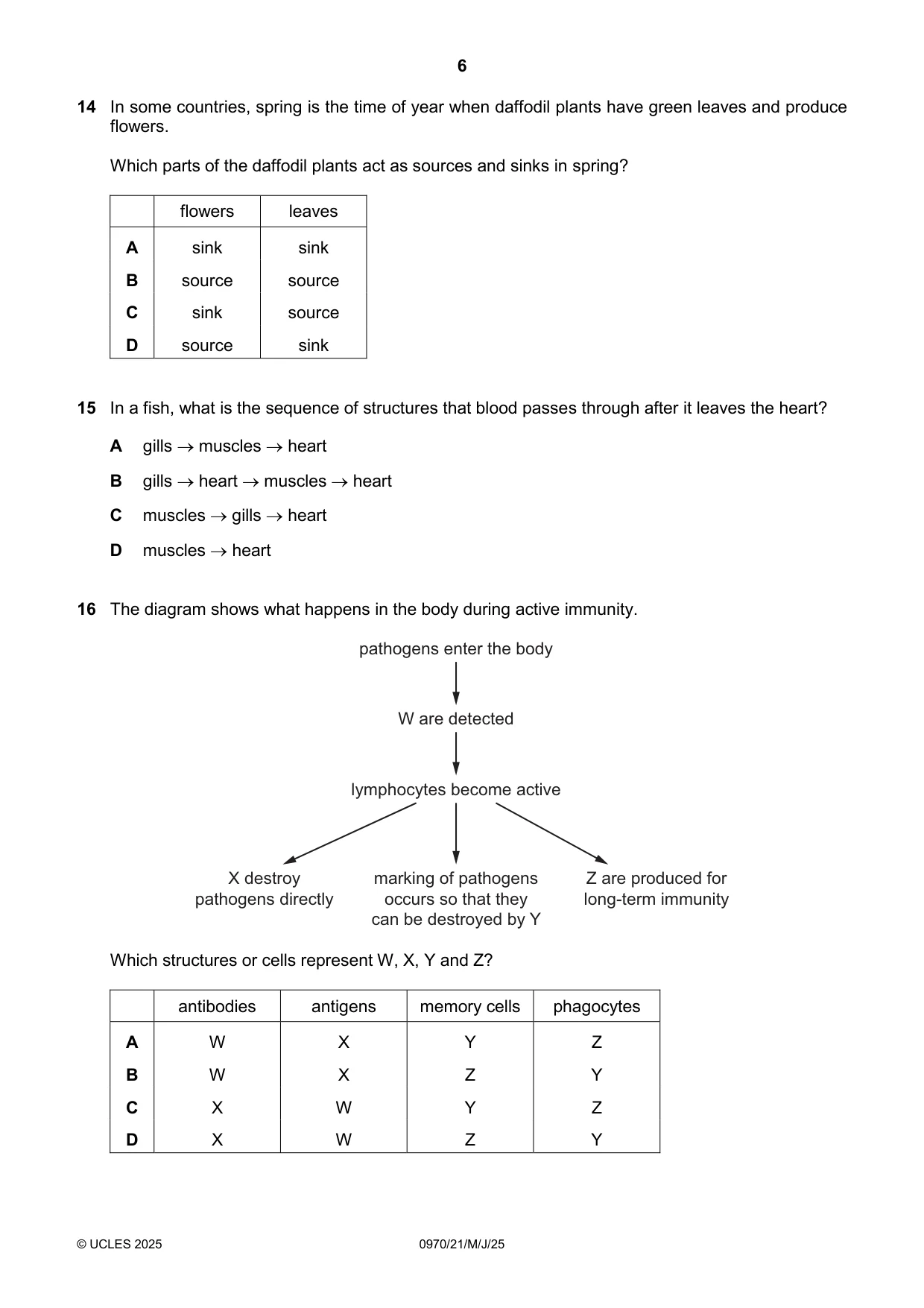
Q16 · The diagram shows what happens in the body during active immunity
16 The diagram shows what happens in the body during active immunity. pathogens enter the body W are detected lymphocytes become active X destroy marking of pathogens Z are produced for pathogens directly occurs so that they long-term immunity can be destroyed by Y Which structures or cells represent W, X, Y and Z? antibodies antigens memory cells phagocytes A W X Y Z B W X Z Y C X W Y Z D X W Z Y
Mark scheme: D
Q17 · Cholera is a disease caused by a bacterium called Vibrio cholerae which produces a toxin…
17 Cholera is a disease caused by a bacterium called Vibrio cholerae which produces a toxin in the infected person’s gut. What is the effect of this toxin? A The toxin causes loss of water from the gut into the blood. B The toxin causes loss of water from the gall bladder into the blood. C The toxin causes water to enter the gut from the blood. D The toxin causes water to enter the gall bladder from the blood.
Mark scheme: C
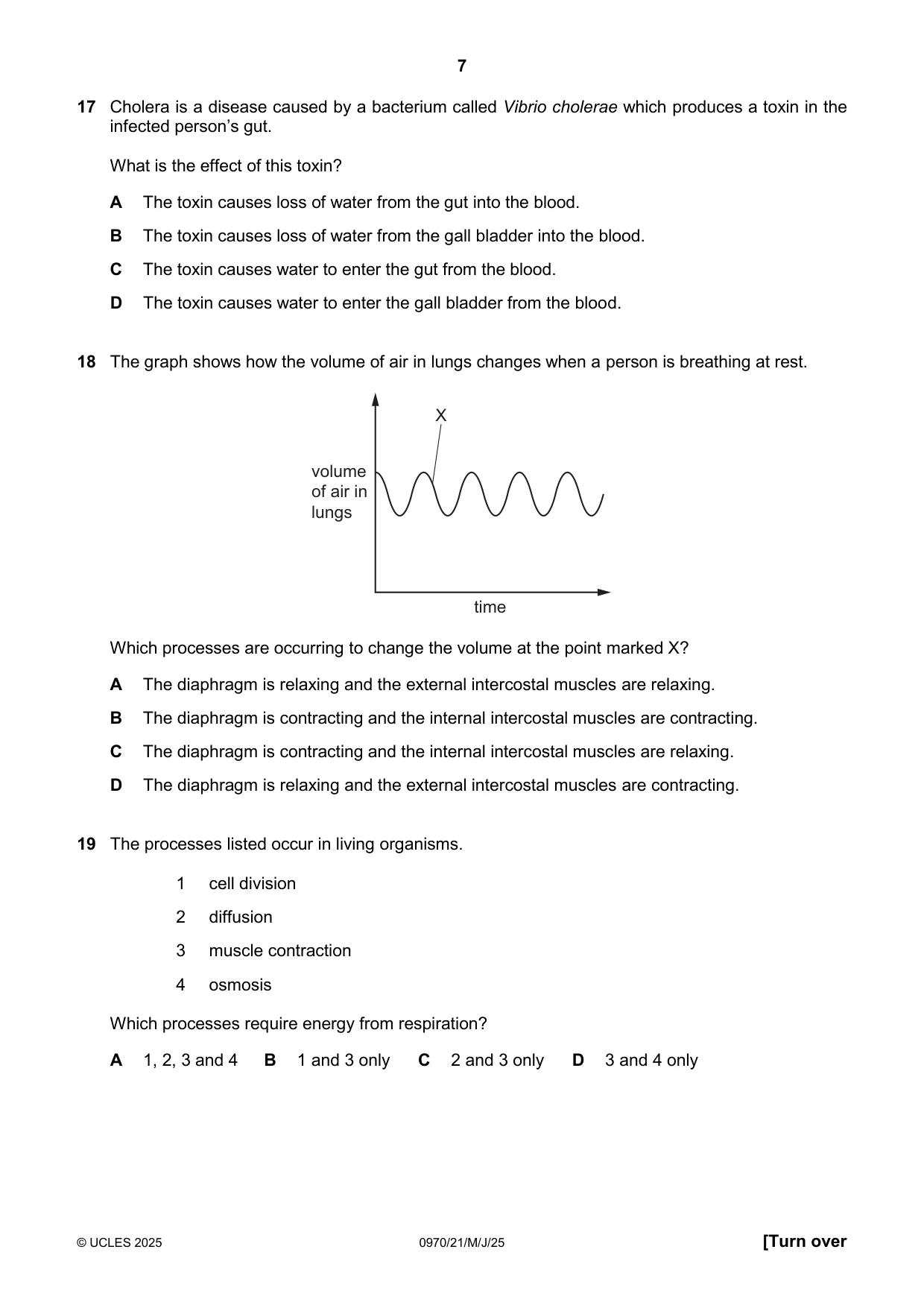
Q18 · The graph shows how the volume of air in lungs changes when a person is breathing at rest
18 The graph shows how the volume of air in lungs changes when a person is breathing at rest. X volume of air in lungs time Which processes are occurring to change the volume at the point marked X? A The diaphragm is relaxing and the external intercostal muscles are relaxing. B The diaphragm is contracting and the internal intercostal muscles are contracting. C The diaphragm is contracting and the internal intercostal muscles are relaxing. D The diaphragm is relaxing and the external intercostal muscles are contracting.
Mark scheme: A
Q19 · The processes listed occur in living organisms
19 The processes listed occur in living organisms. 1 cell division 2 diffusion 3 muscle contraction 4 osmosis Which processes require energy from respiration? A 1, 2, 3 and 4 B 1 and 3 only C 2 and 3 only D 3 and 4 only
Mark scheme: B
Q20 · What is a role of the glomerulus?
20 What is a role of the glomerulus? A assembling amino acids into proteins B filtration of water, glucose, urea and ions from the blood C reabsorption of glucose, ions and water back into the blood D removal of the nitrogen-containing part of amino acids to form urea
Mark scheme: B
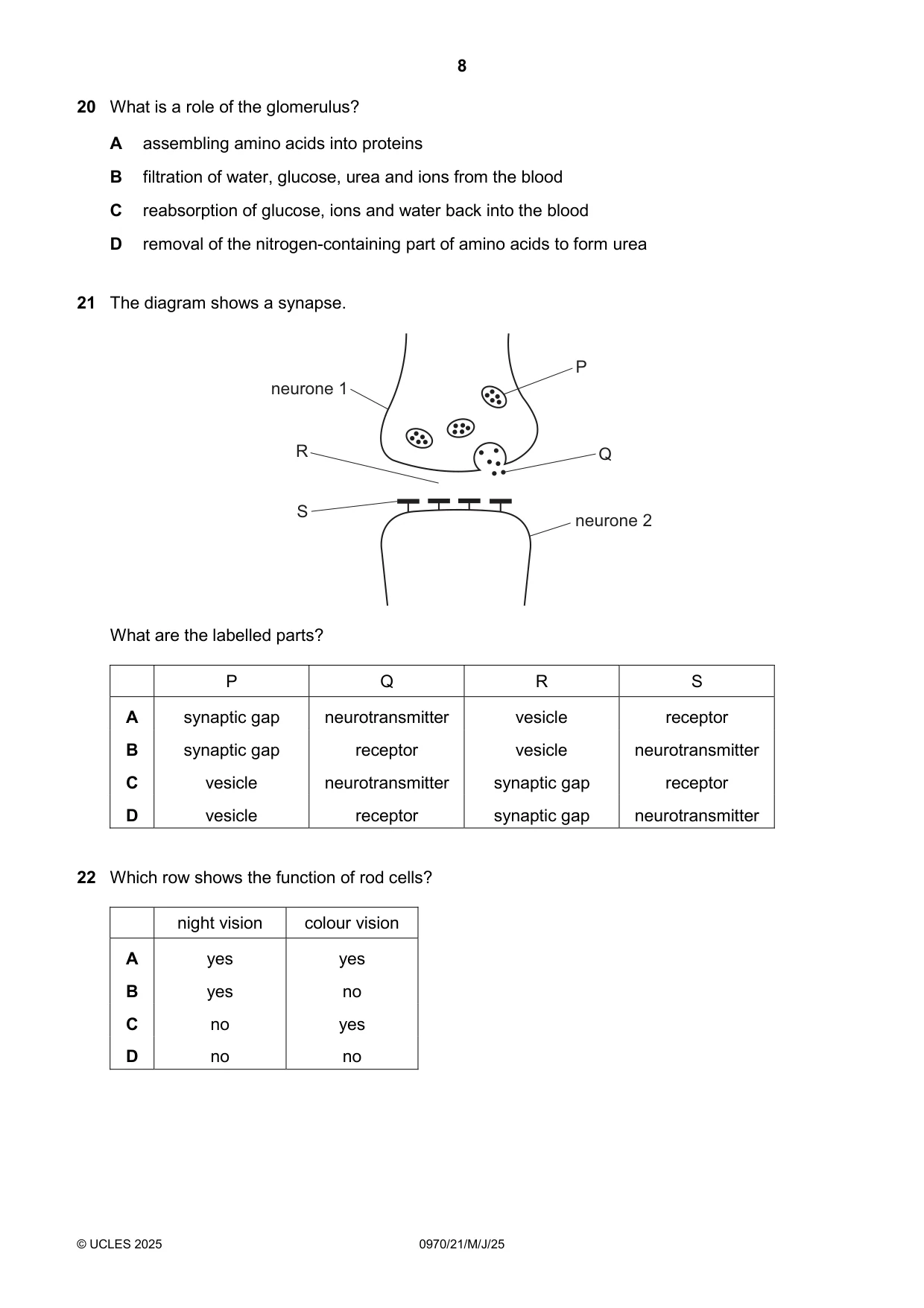
Q21 · The diagram shows a synapse
21 The diagram shows a synapse. P neurone 1 R Q S neurone 2 What are the labelled parts? P Q R S A synaptic gap neurotransmitter vesicle receptor B synaptic gap receptor vesicle neurotransmitter C vesicle neurotransmitter synaptic gap receptor D vesicle receptor synaptic gap neurotransmitter
Mark scheme: C
Q22 · Which row shows the function of rod cells?
22 Which row shows the function of rod cells? night vision colour vision A yes yes B yes no C no yes D no no
Mark scheme: B
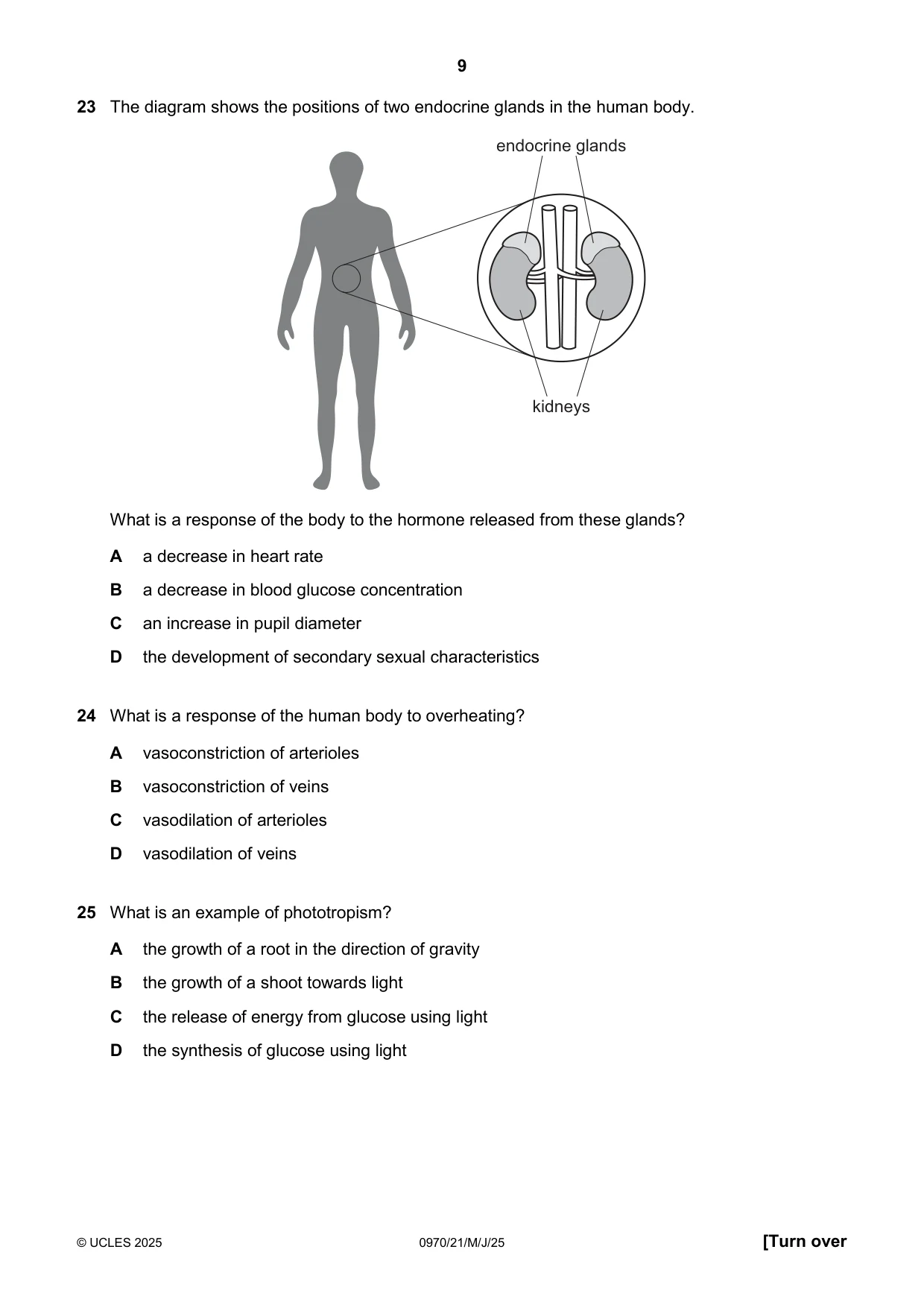
Q23 · The diagram shows the positions of two endocrine glands in the human body
23 The diagram shows the positions of two endocrine glands in the human body. endocrine glands kidneys What is a response of the body to the hormone released from these glands? A a decrease in heart rate B a decrease in blood glucose concentration C an increase in pupil diameter D the development of secondary sexual characteristics
Mark scheme: C
Q24 · What is a response of the human body to overheating?
24 What is a response of the human body to overheating? A vasoconstriction of arterioles B vasoconstriction of veins C vasodilation of arterioles D vasodilation of veins
Mark scheme: C
Q25 · What is an example of phototropism?
25 What is an example of phototropism? A the growth of a root in the direction of gravity B the growth of a shoot towards light C the release of energy from glucose using light D the synthesis of glucose using light
Mark scheme: B
Q26 · Which statement describes the effect of antibiotics?
26 Which statement describes the effect of antibiotics? A Antibiotics do not affect bacteria or viruses. B Antibiotics kill bacteria but do not affect viruses. C Antibiotics kill both bacteria and viruses. D Antibiotics kill viruses but do not affect bacteria.
Mark scheme: B
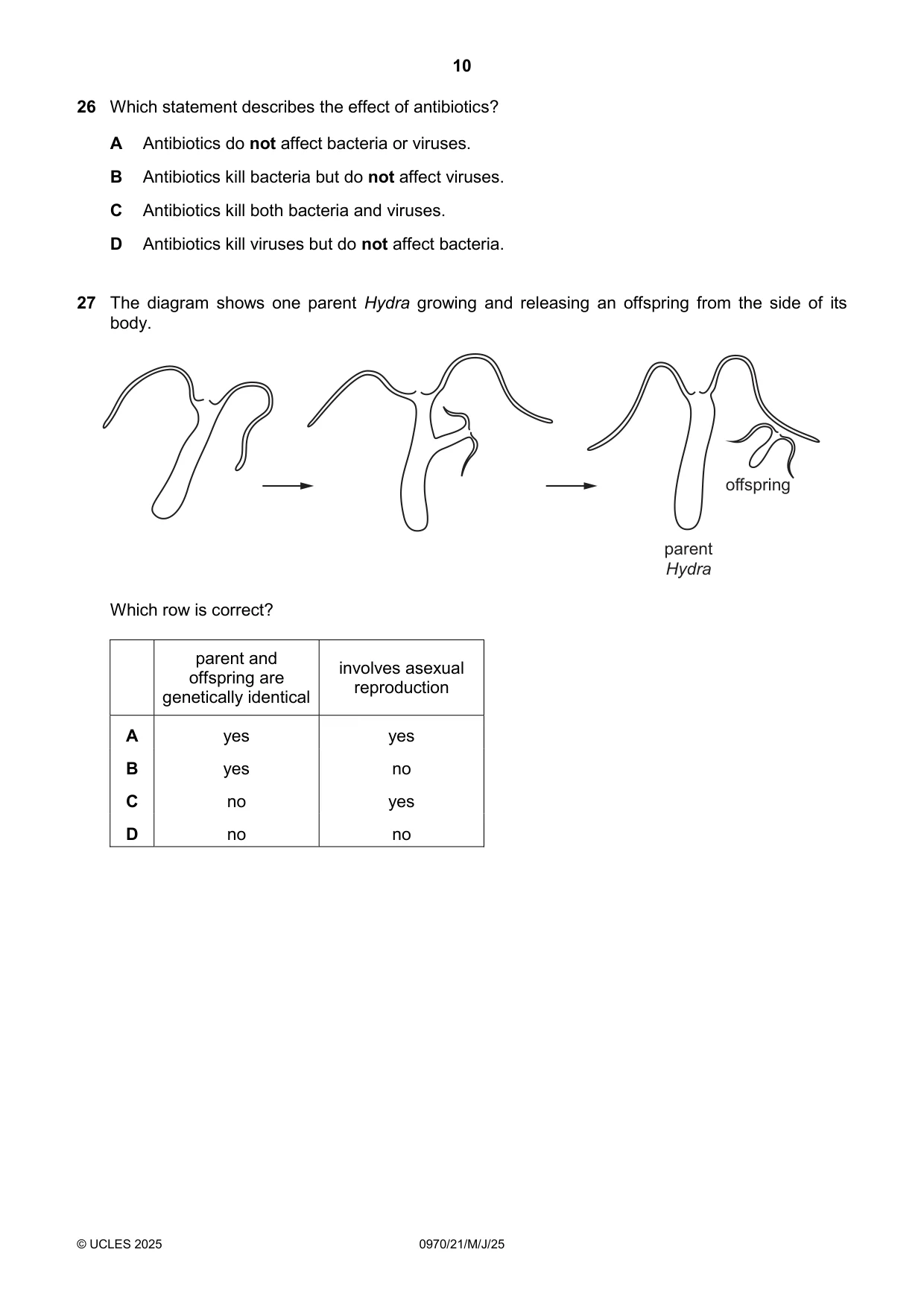
Q27 · The diagram shows one parent Hydra growing and releasing an offspring from the side of…
27 The diagram shows one parent Hydra growing and releasing an offspring from the side of its body. offspring parent Hydra Which row is correct? parent and involves asexual offspring are reproduction genetically identical A yes yes B yes no C no yes D no no
Mark scheme: A
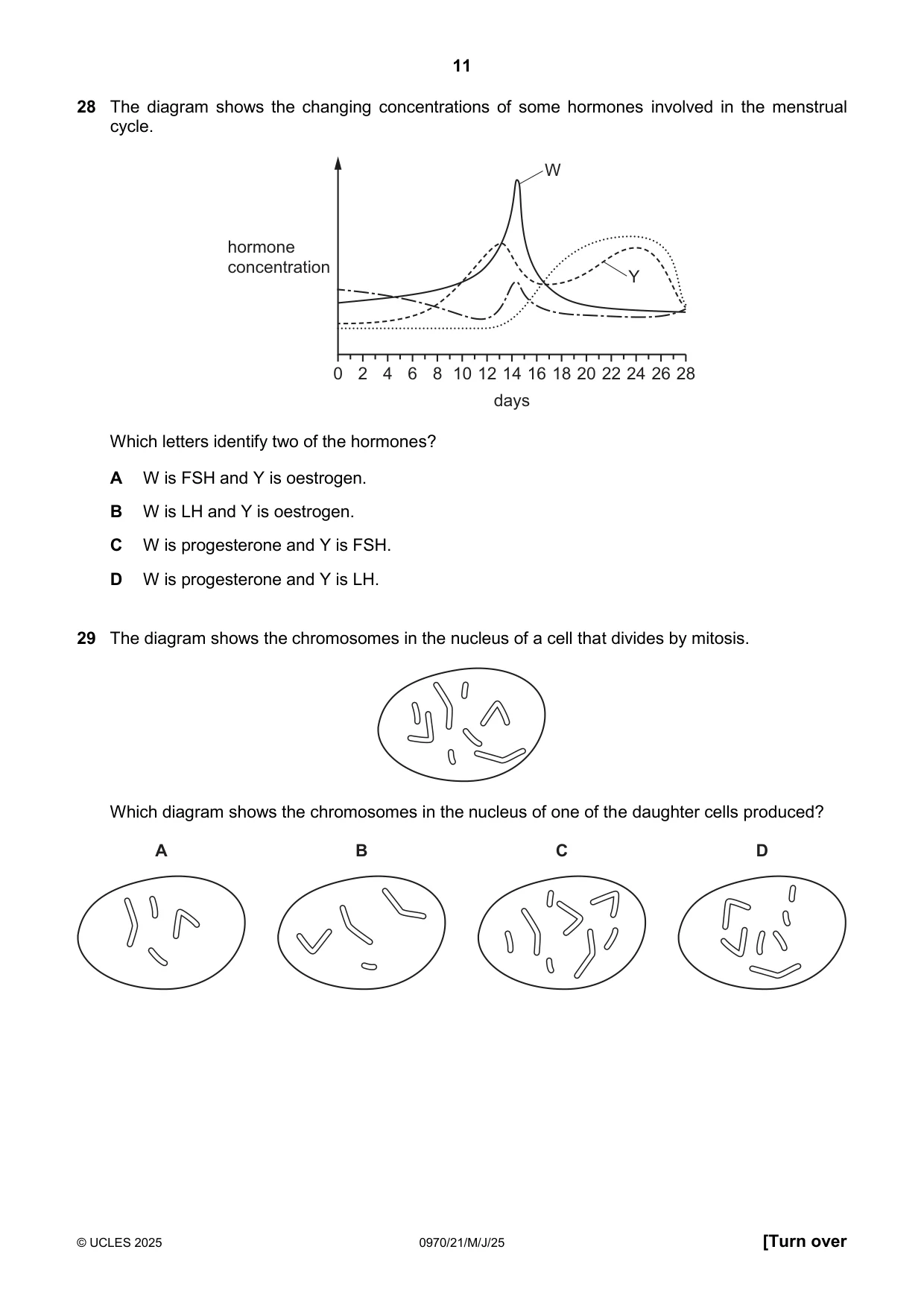
Q28 · The diagram shows the changing concentrations of some hormones involved in the menstrual…
28 The diagram shows the changing concentrations of some hormones involved in the menstrual cycle. W hormone concentration Y 0 2 4 6 8 10 12 14 16 18 20 22 24 26 28 days Which letters identify two of the hormones? A W is FSH and Y is oestrogen. B W is LH and Y is oestrogen. C W is progesterone and Y is FSH. D W is progesterone and Y is LH.
Mark scheme: B
Q29 · The diagram shows the chromosomes in the nucleus of a cell that divides by mitosis
29 The diagram shows the chromosomes in the nucleus of a cell that divides by mitosis. Which diagram shows the chromosomes in the nucleus of one of the daughter cells produced? A B C D
Mark scheme: C
Q30 · A farmer bred together male cattle with white hair and female cattle with red hair
30 A farmer bred together male cattle with white hair and female cattle with red hair. All the offspring produced had roan hair (a mixture of red and white). He then repeatedly bred together two roan cattle, and the offspring were in the ratio of 1 red : 2 roan : 1 white. What explains why the farmer obtained this ratio? A The red phenotype is dominant to the white phenotype. B The roan phenotype is an example of codominance. C The roan phenotype is dominant to the red phenotype and the white phenotype. D The white phenotype is dominant to the red phenotype.
Mark scheme: B
Q31 · Phagocytes and neurones are two types of specialised cell
31 Phagocytes and neurones are two types of specialised cell. Which statements are correct? 1 Phagocytes and neurones express the same genes. 2 Both types of cell have the same genes. 3 Both types of cell only express the genes that make the proteins needed for the cell to function. A 1 and 2 B 1 and 3 C 2 and 3 D 2 only
Mark scheme: C
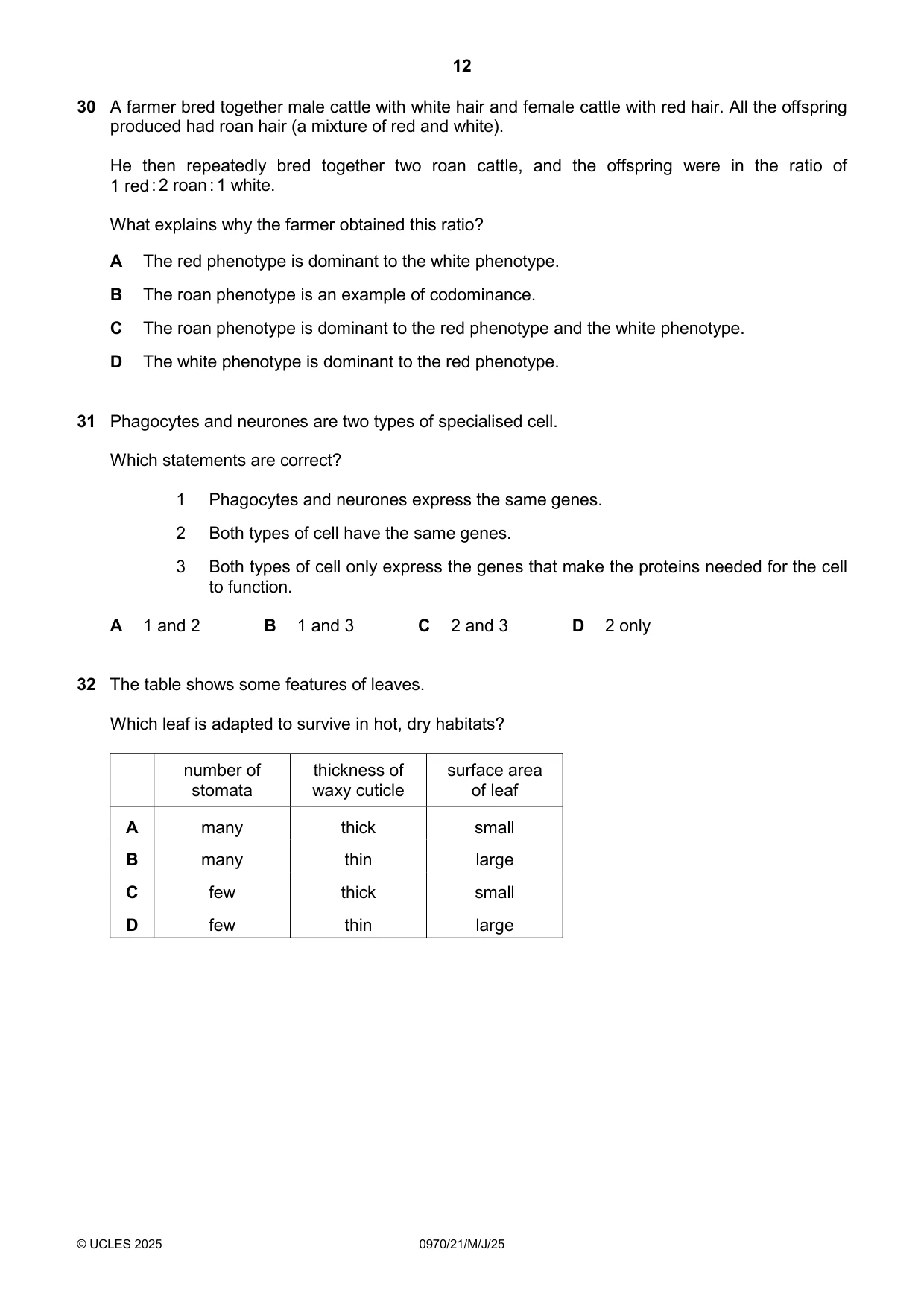
Q32 · The table shows some features of leaves
32 The table shows some features of leaves. Which leaf is adapted to survive in hot, dry habitats? number of thickness of surface area stomata waxy cuticle of leaf A many thick small B many thin large C few thick small D few thin large
Mark scheme: C
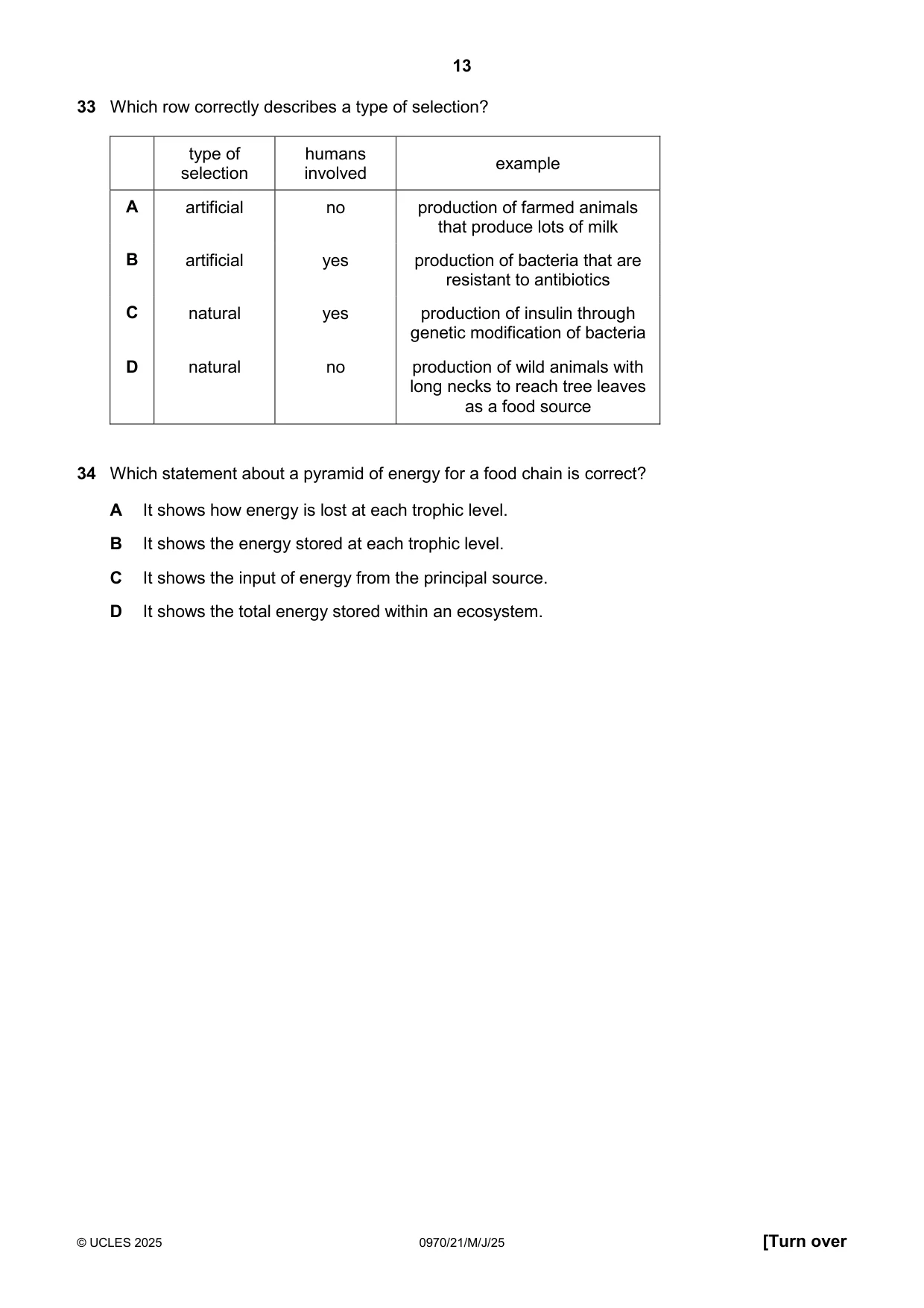
Q33 · Which row correctly describes a type of selection?
33 Which row correctly describes a type of selection? type of humans example selection involved A artificial no production of farmed animals that produce lots of milk B artificial yes production of bacteria that are resistant to antibiotics C natural yes production of insulin through genetic modification of bacteria D natural no production of wild animals with long necks to reach tree leaves as a food source
Mark scheme: D
Q34 · Which statement about a pyramid of energy for a food chain is correct?
34 Which statement about a pyramid of energy for a food chain is correct? A It shows how energy is lost at each trophic level. B It shows the energy stored at each trophic level. C It shows the input of energy from the principal source. D It shows the total energy stored within an ecosystem.
Mark scheme: B
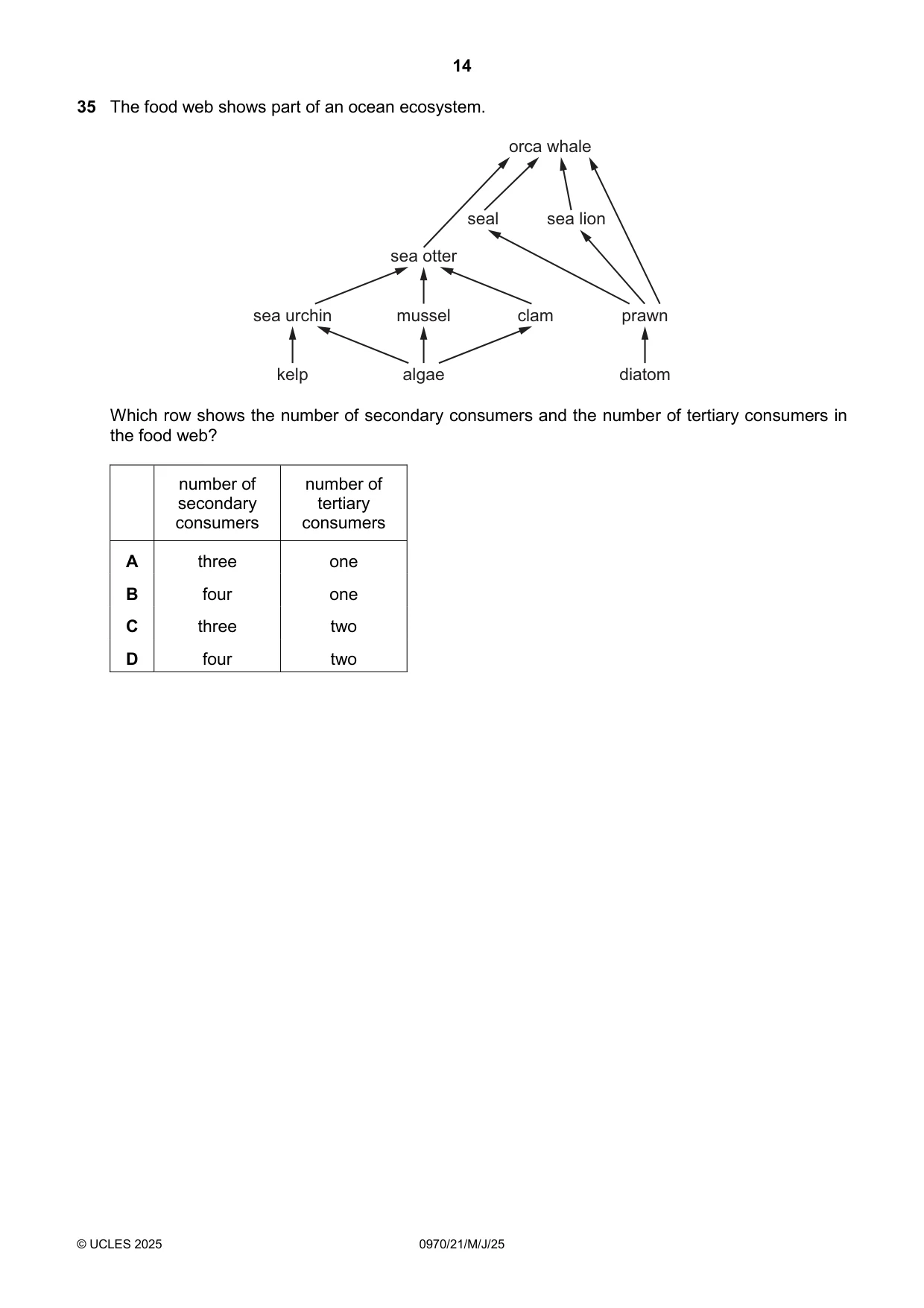
Q35 · The food web shows part of an ocean ecosystem
35 The food web shows part of an ocean ecosystem. orca whale seal sea lion sea otter sea urchin mussel clam prawn kelp algae diatom Which row shows the number of secondary consumers and the number of tertiary consumers in the food web? number of number of secondary tertiary consumers consumers A three one B four one C three two D four two
Mark scheme: B
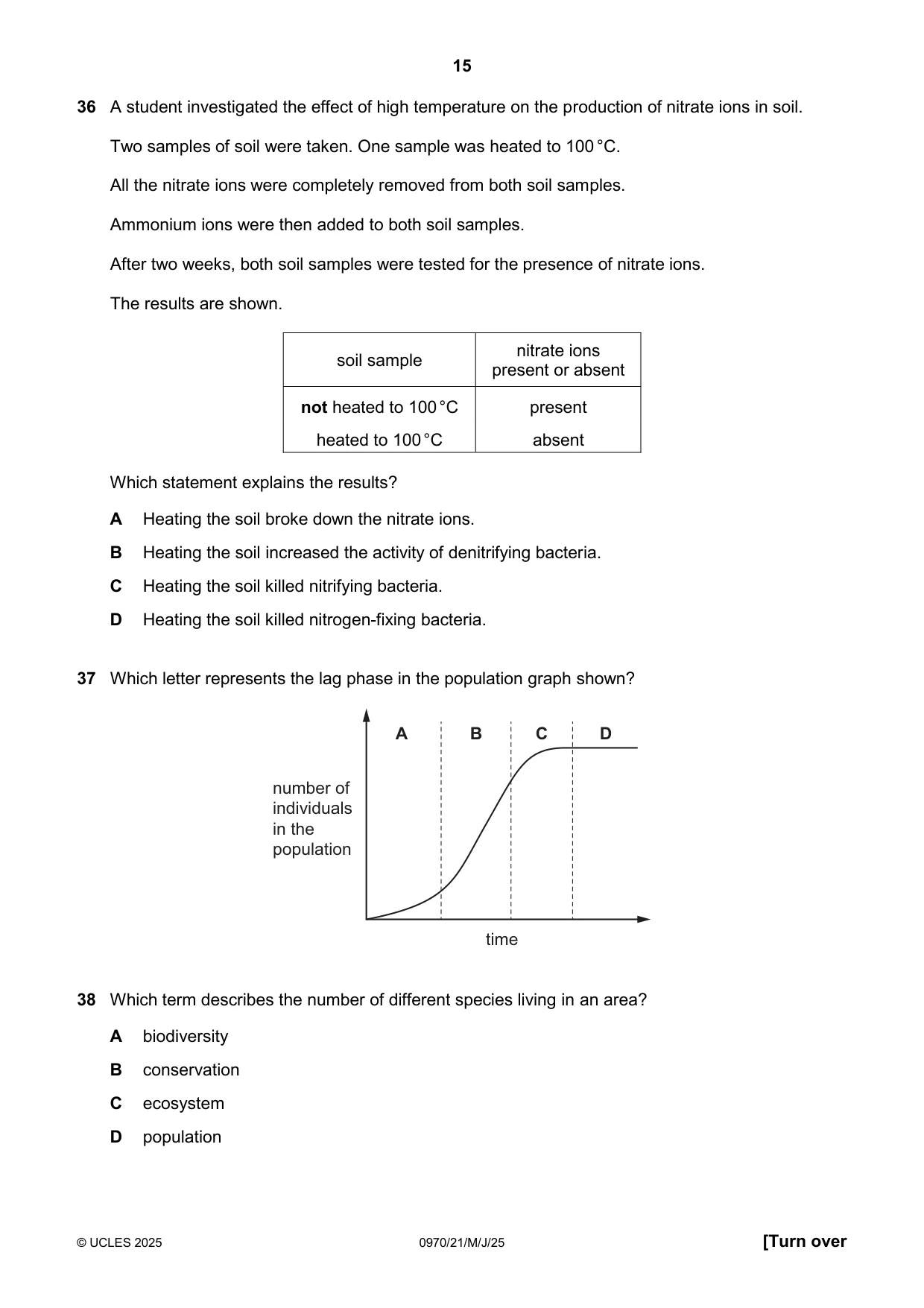
Q36 · A student investigated the effect of high temperature on the production of nitrate ions…
36 A student investigated the effect of high temperature on the production of nitrate ions in soil. Two samples of soil were taken. One sample was heated to 100 °C. All the nitrate ions were completely removed from both soil samples. Ammonium ions were then added to both soil samples. After two weeks, both soil samples were tested for the presence of nitrate ions. The results are shown. nitrate ions soil sample present or absent not heated to 100 °C present heated to 100 °C absent Which statement explains the results? A Heating the soil broke down the nitrate ions. B Heating the soil increased the activity of denitrifying bacteria. C Heating the soil killed nitrifying bacteria. D Heating the soil killed nitrogen-fixing bacteria.
Mark scheme: C
Q37 · Which letter represents the lag phase in the population graph shown?
37 Which letter represents the lag phase in the population graph shown? A B C D number of individuals in the population time
Mark scheme: A
Q38 · Which term describes the number of different species living in an area?
38 Which term describes the number of different species living in an area? A biodiversity B conservation C ecosystem D population
Mark scheme: A
Q39 · Which source of pollution can cause eutrophication?
39 Which source of pollution can cause eutrophication? A carbon dioxide B methane C non-biodegradable plastic D sewage
Mark scheme: D
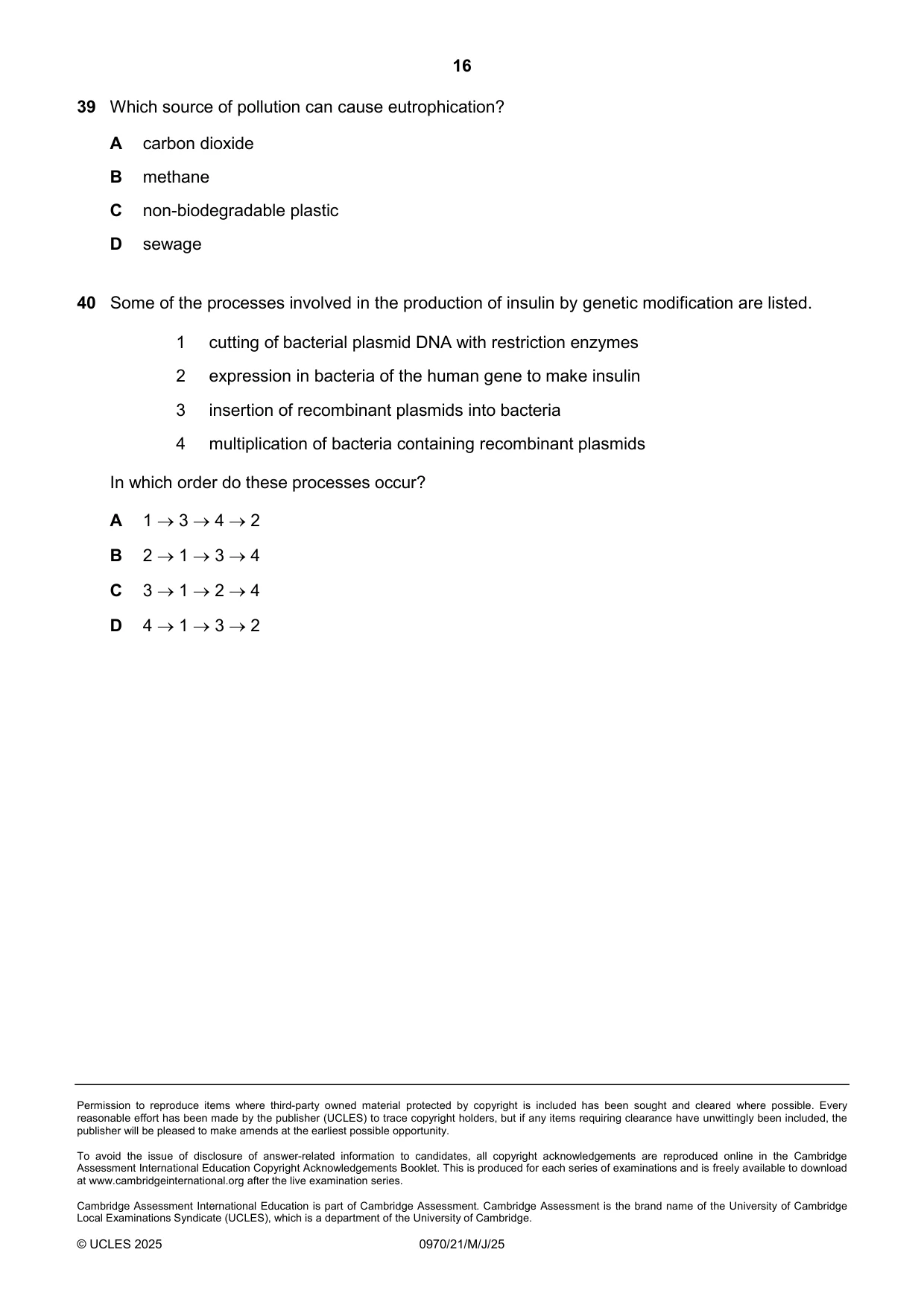
Q40 · Some of the processes involved in the production of insulin by genetic modification are…
40 Some of the processes involved in the production of insulin by genetic modification are listed. 1 cutting of bacterial plasmid DNA with restriction enzymes 2 expression in bacteria of the human gene to make insulin 3 insertion of recombinant plasmids into bacteria 4 multiplication of bacteria containing recombinant plasmids In which order do these processes occur? A 1 3 4 2 B 2 1 3 4 C 3 1 2 4 D 4 1 3 2
Mark scheme: A
What was in this paper
The subtopics covered by these 40 questions, and how many questions each got. Open one in a new tab to see every Cambridge question on it.
2Chromosomes, genes and proteins2Diseases and immunity2Active transport1Adaptive features1Asexual reproduction1Biological molecules1Cell structure1Characteristics of living organisms1Chemical digestion1Circulatory systems1Conservation1Coordination and response1Diet1Drugs1Energy flow1Enzymes1Excretion in humans1Features of organisms1Food chains and food webs1Gas exchange in humans1Genetic modification1Homeostasis1Hormones1Leaf structure1Mitosis1Monohybrid inheritance1Nutrient cycles1Pollution1Populations1Respiration1Selection1Sense organs1Sex hormones in humans1Translocation1Transpiration1Tropic responses1What you needed in this session
Cambridge’s own grade thresholds for 2025 May/June, Paper 2 · Variant 1. A higher threshold means an easier paper — the bar moves with how the cohort did.