Cambridge IGCSE Biology (9-1) 0970 — 2021 May/June Paper 2 · Variant 2
0970/22/M/J/21 · 40 questions · 40 marks · ≈45 min
The question paper and its mark scheme, free to read here and free to download. This is Cambridge’s own paper, exactly as it was sat.
Question paper16 pages

Mark scheme3 pages
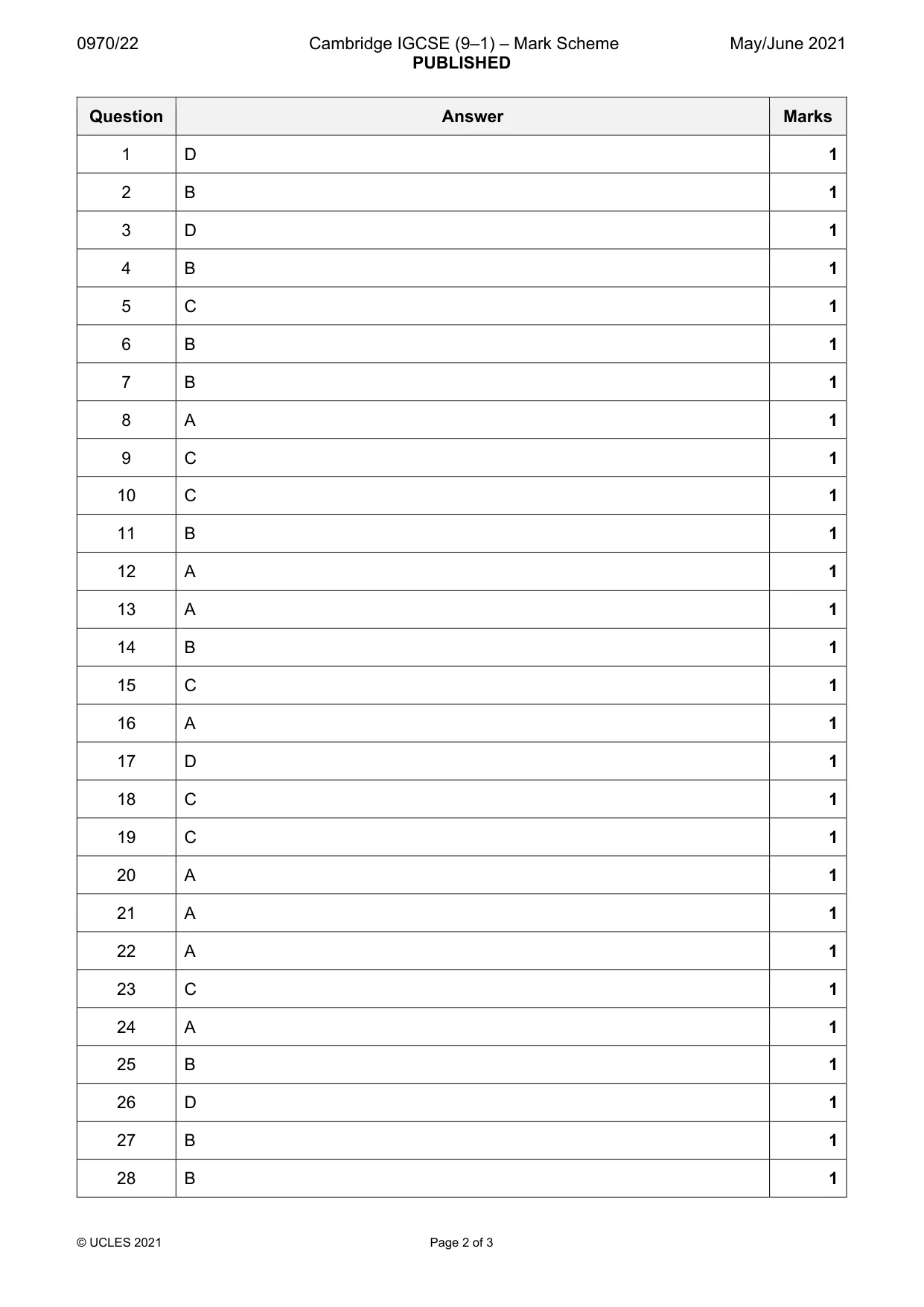
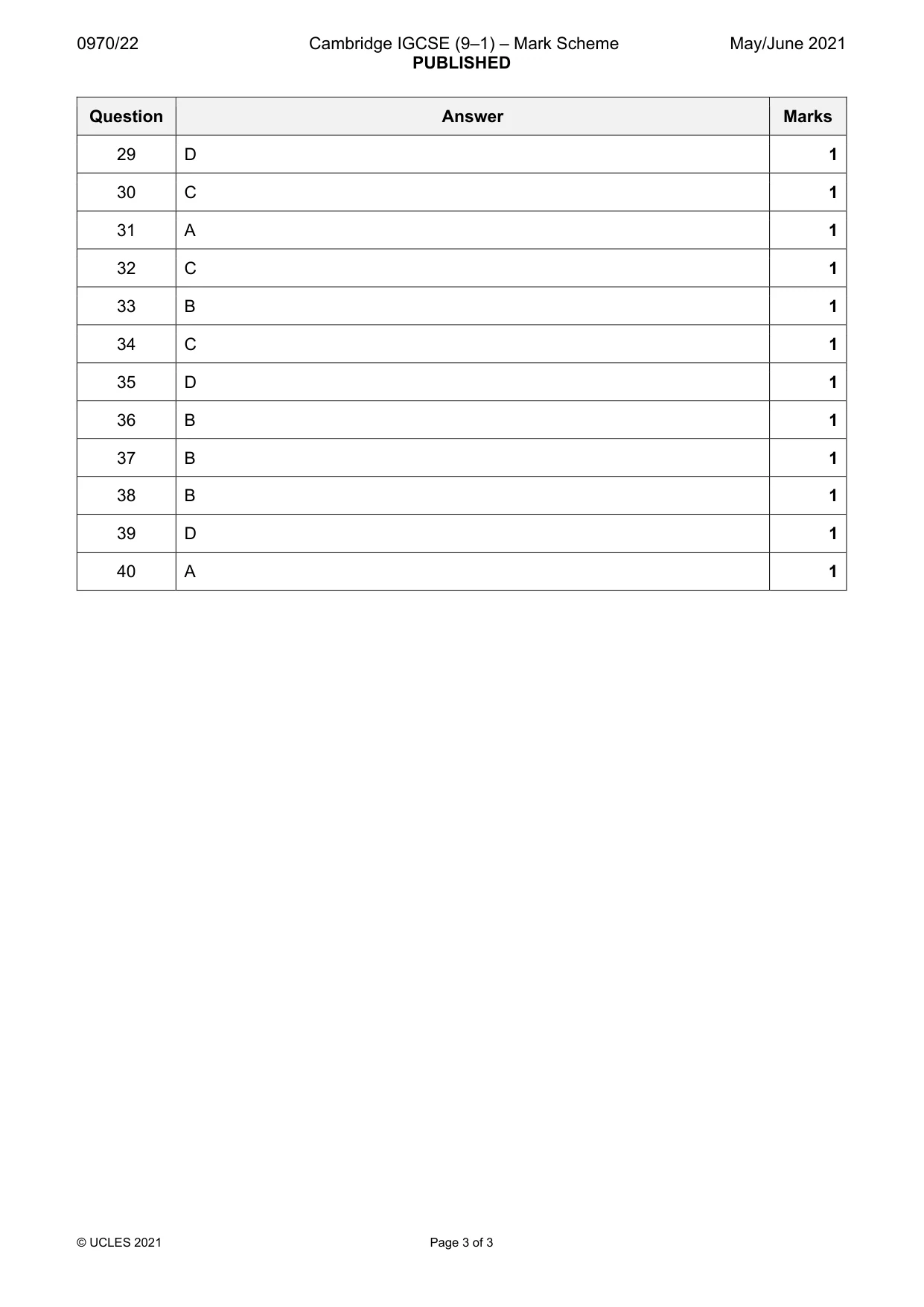
Answers below. Sit the paper first if you are practising.
Questions as text
Q1 · What is a characteristic of all living organisms?
1 What is a characteristic of all living organisms? A breathing B circulation C egestion D sensitivity
Mark scheme: D
Q2 · The bonobo and the chimpanzee are two closely related species
2 The bonobo and the chimpanzee are two closely related species. What is the most accurate method of deciding how closely related species are? A compare evolutionary relationships of other species B compare the base sequences of their DNA C compare their anatomy D compare their morphology
Mark scheme: B
More questions on Concept and uses of classification systems
Q3 · Scientists discover a new species of animal
3 Scientists discover a new species of animal. It has a segmented body with two pairs of legs on each segment. To which group of animals does this new species belong? A arachnids B crustaceans C insects D myriapods
Mark scheme: D
Q4 · Which part of a cell makes glucose?
4 Which part of a cell makes glucose? A cell membrane B chloroplast C nucleus D vacuole
Mark scheme: B
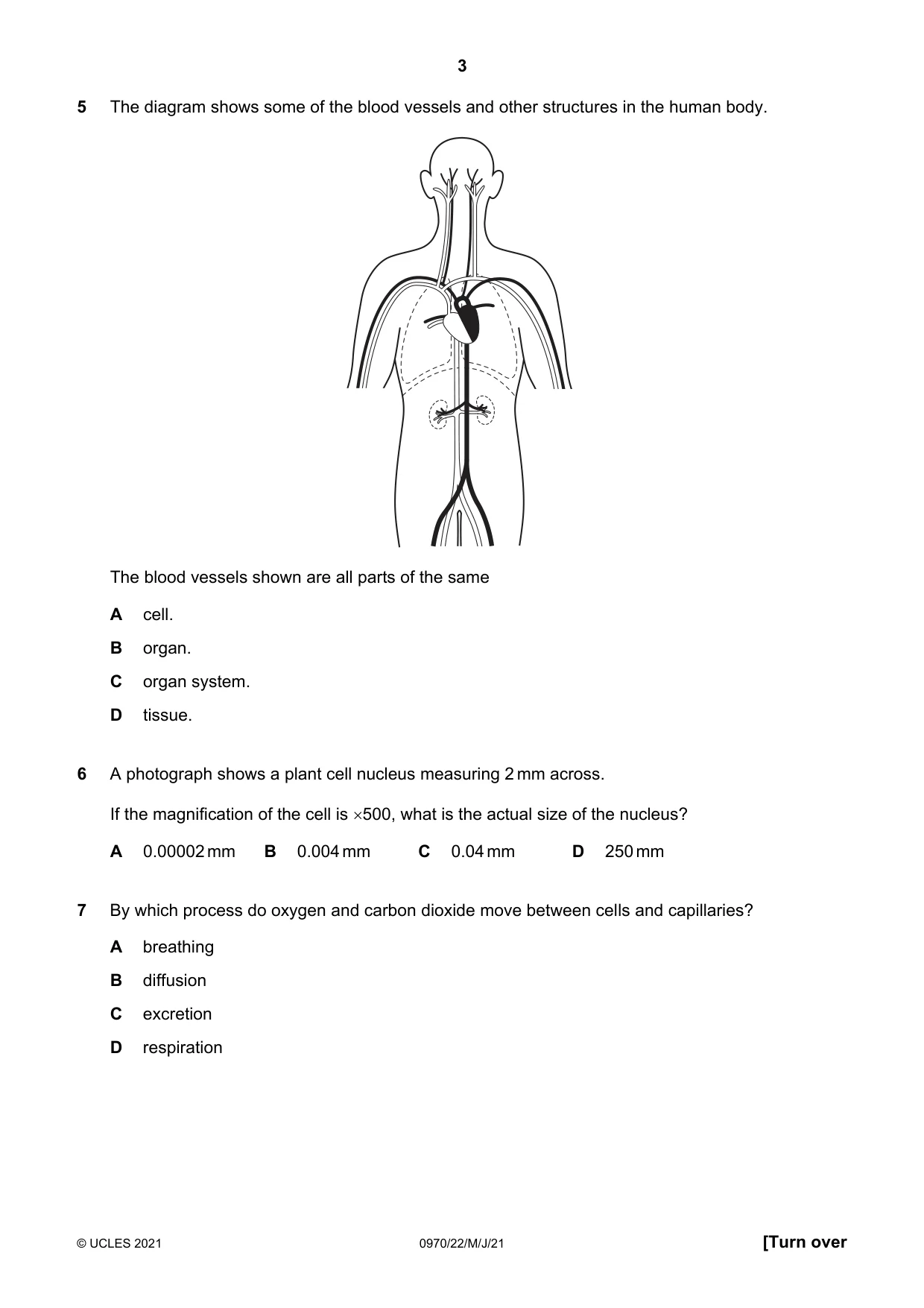
Q5 · The diagram shows some of the blood vessels and other structures in the human body
5 The diagram shows some of the blood vessels and other structures in the human body. The blood vessels shown are all parts of the same A cell. B organ. C organ system. D tissue.
Mark scheme: C
Q6 · A photograph shows a plant cell nucleus measuring 2 mm across
6 A photograph shows a plant cell nucleus measuring 2 mm across. If the magnification of the cell is 500, what is the actual size of the nucleus? A 0.00002 mm B 0.004 mm C 0.04 mm D 250 mm
Mark scheme: B
Q7 · By which process do oxygen and carbon dioxide move between cells and capillaries?
7 By which process do oxygen and carbon dioxide move between cells and capillaries? A breathing B diffusion C excretion D respiration
Mark scheme: B
Q8 · Which process is involved in the uptake of glucose by the epithelial cells of kidney…
8 Which process is involved in the uptake of glucose by the epithelial cells of kidney tubules? A active transport B osmosis C translocation D transpiration
Mark scheme: A
Q9 · Which element is found in proteins but not carbohydrates?
9 Which element is found in proteins but not carbohydrates? A carbon B hydrogen C nitrogen D oxygen
Mark scheme: C
Q10 · The sequence of the bases present on one strand of a DNA molecule is shown
10 The sequence of the bases present on one strand of a DNA molecule is shown. ATTGGACGGT Which sequence shows the bases present on the opposite strand? A CGGTTCATTG B TCCAATGAAC C TAACCTGCCA D ATTGGACGGT
Mark scheme: C
Q11 · Starch is digested by amylase in the mouth, but it is not digested in the stomach
11 Starch is digested by amylase in the mouth, but it is not digested in the stomach. What is the reason for this? A All starch digestion is completed in the mouth. B The pH in the stomach is not suitable for the amylase to work. C The starch does not stay in the stomach long enough to be digested. D The temperature in the stomach is not suitable for the amylase to work.
Mark scheme: B
Q12 · Which statement about an enzyme-controlled reaction is correct?
12 Which statement about an enzyme-controlled reaction is correct? A During the reaction, the substrate changes into products. B The enzyme is gradually used up during the reaction. C The enzyme is slowly broken down during the reaction. D The higher the temperature, the slower the reaction.
Mark scheme: A
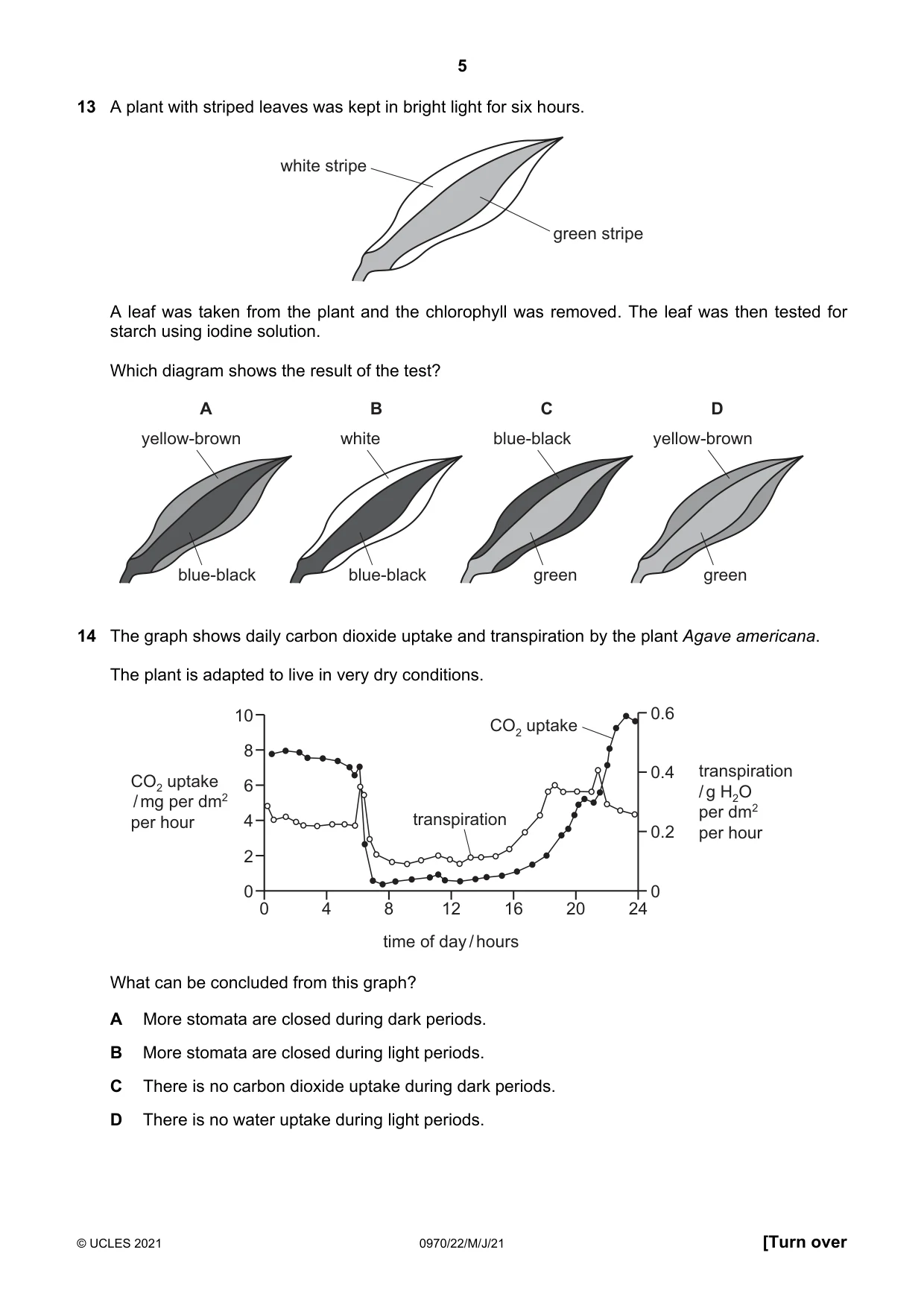
Q13 · A plant with striped leaves was kept in bright light for six hours
13 A plant with striped leaves was kept in bright light for six hours. white stripe green stripe A leaf was taken from the plant and the chlorophyll was removed. The leaf was then tested for starch using iodine solution. Which diagram shows the result of the test? A B C D yellow-brown white blue-black yellow-brown blue-black blue-black green green
Mark scheme: A
Q14 · The graph shows daily carbon dioxide uptake and transpiration by the plant Agave americana
14 The graph shows daily carbon dioxide uptake and transpiration by the plant Agave americana. The plant is adapted to live in very dry conditions. 10 0.6 CO2 uptake 8 0.4 transpiration CO2 uptake 6 / g H2O / mg per dm2 per dm2 per hour 4 transpiration 0.2 per hour 2 0 0 0 4 8 12 16 20 24 time of day / hours What can be concluded from this graph? A More stomata are closed during dark periods. B More stomata are closed during light periods. C There is no carbon dioxide uptake during dark periods. D There is no water uptake during light periods.
Mark scheme: B
Q15 · Statements 1 to 4 describe stages in the development of cholera
15 Statements 1 to 4 describe stages in the development of cholera. 1 Chloride ions are secreted into the gut. 2 Osmosis causes water to move into the gut. 3 The infected person becomes dehydrated. 4 Toxins are produced by the pathogenic bacteria. What is the correct sequence of the four stages? A 1 2 3 4 B 1 4 3 2 C 4 1 2 3 D 4 1 3 2
Mark scheme: C
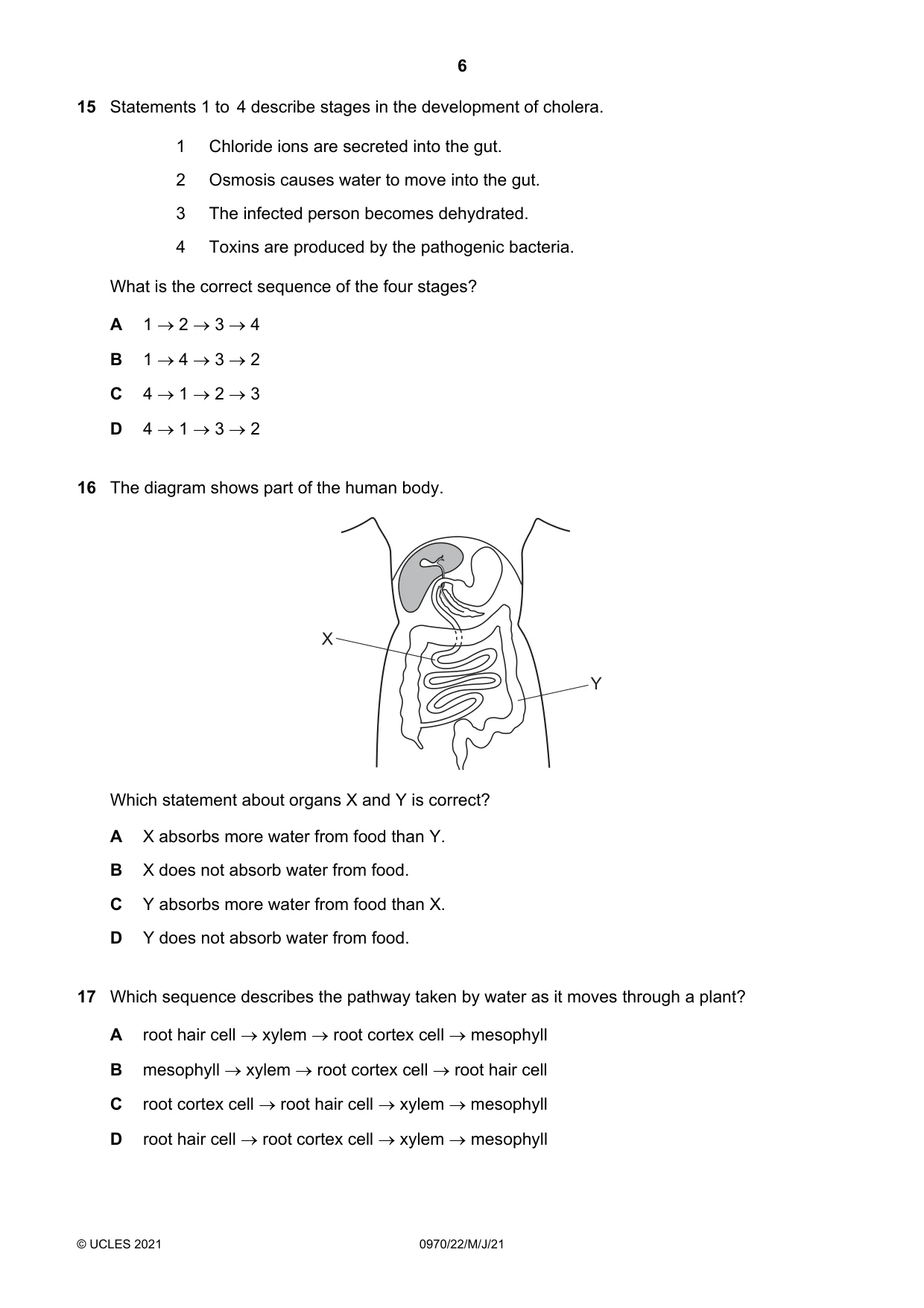
Q16 · The diagram shows part of the human body
16 The diagram shows part of the human body. X Y Which statement about organs X and Y is correct? A X absorbs more water from food than Y. B X does not absorb water from food. C Y absorbs more water from food than X. D Y does not absorb water from food.
Mark scheme: A
Q17 · Which sequence describes the pathway taken by water as it moves through a plant?
17 Which sequence describes the pathway taken by water as it moves through a plant? A root hair cell xylem root cortex cell mesophyll B mesophyll xylem root cortex cell root hair cell C root cortex cell root hair cell xylem mesophyll D root hair cell root cortex cell xylem mesophyll
Mark scheme: D
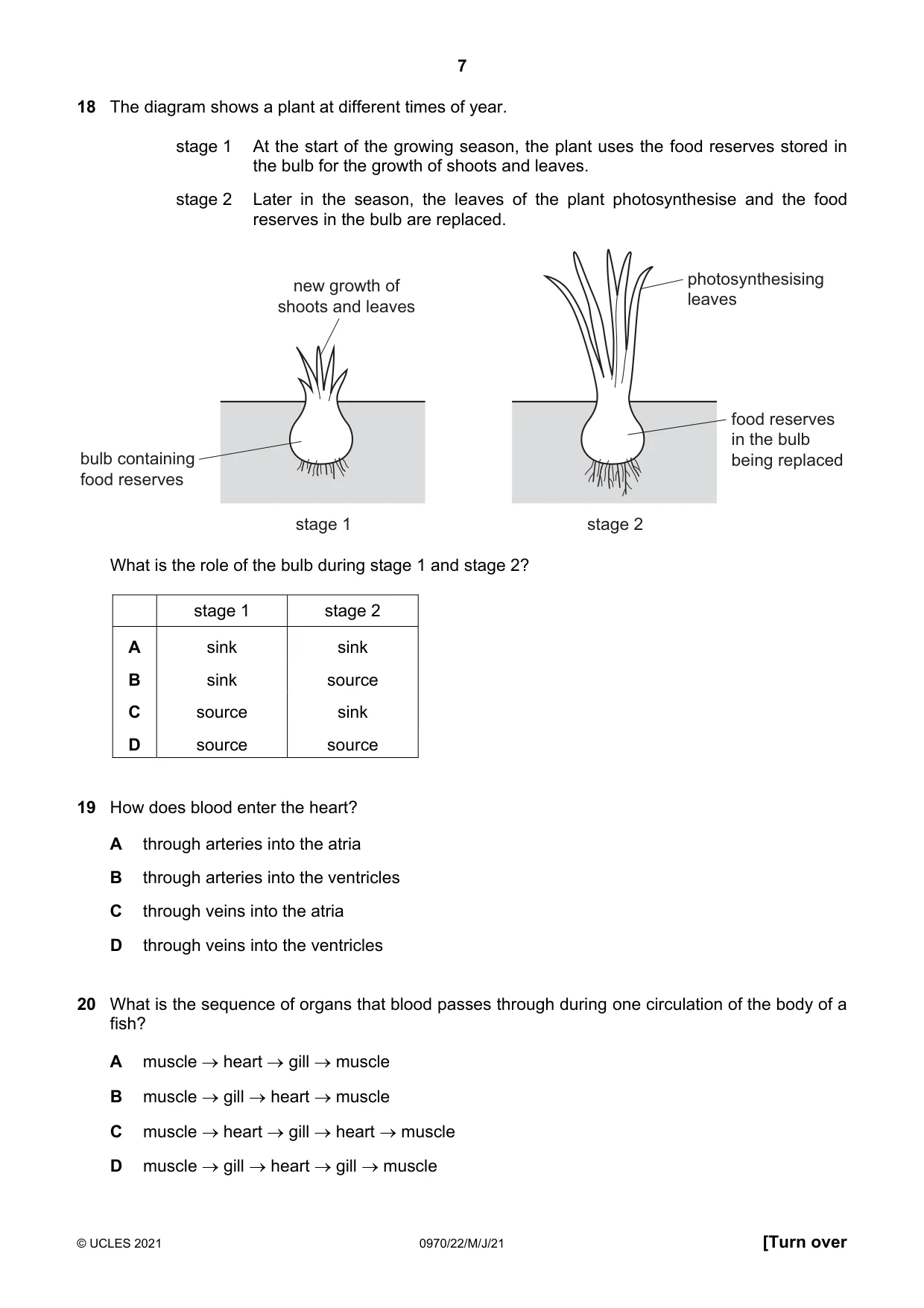
Q18 · The diagram shows a plant at different times of year
18 The diagram shows a plant at different times of year. stage 1 At the start of the growing season, the plant uses the food reserves stored in the bulb for the growth of shoots and leaves. stage 2 Later in the season, the leaves of the plant photosynthesise and the food reserves in the bulb are replaced. new growth of photosynthesising shoots and leaves leaves food reserves in the bulb bulb containing being replaced food reserves stage 1 stage 2 What is the role of the bulb during stage 1 and stage 2? stage 1 stage 2 A sink sink B sink source C source sink D source source
Mark scheme: C
Q19 · How does blood enter the heart?
19 How does blood enter the heart? A through arteries into the atria B through arteries into the ventricles C through veins into the atria D through veins into the ventricles
Mark scheme: C
Q20 · What is the sequence of organs that blood passes through during one circulation of the…
20 What is the sequence of organs that blood passes through during one circulation of the body of a fish? A muscle heart gill muscle B muscle gill heart muscle C muscle heart gill heart muscle D muscle gill heart gill muscle
Mark scheme: A
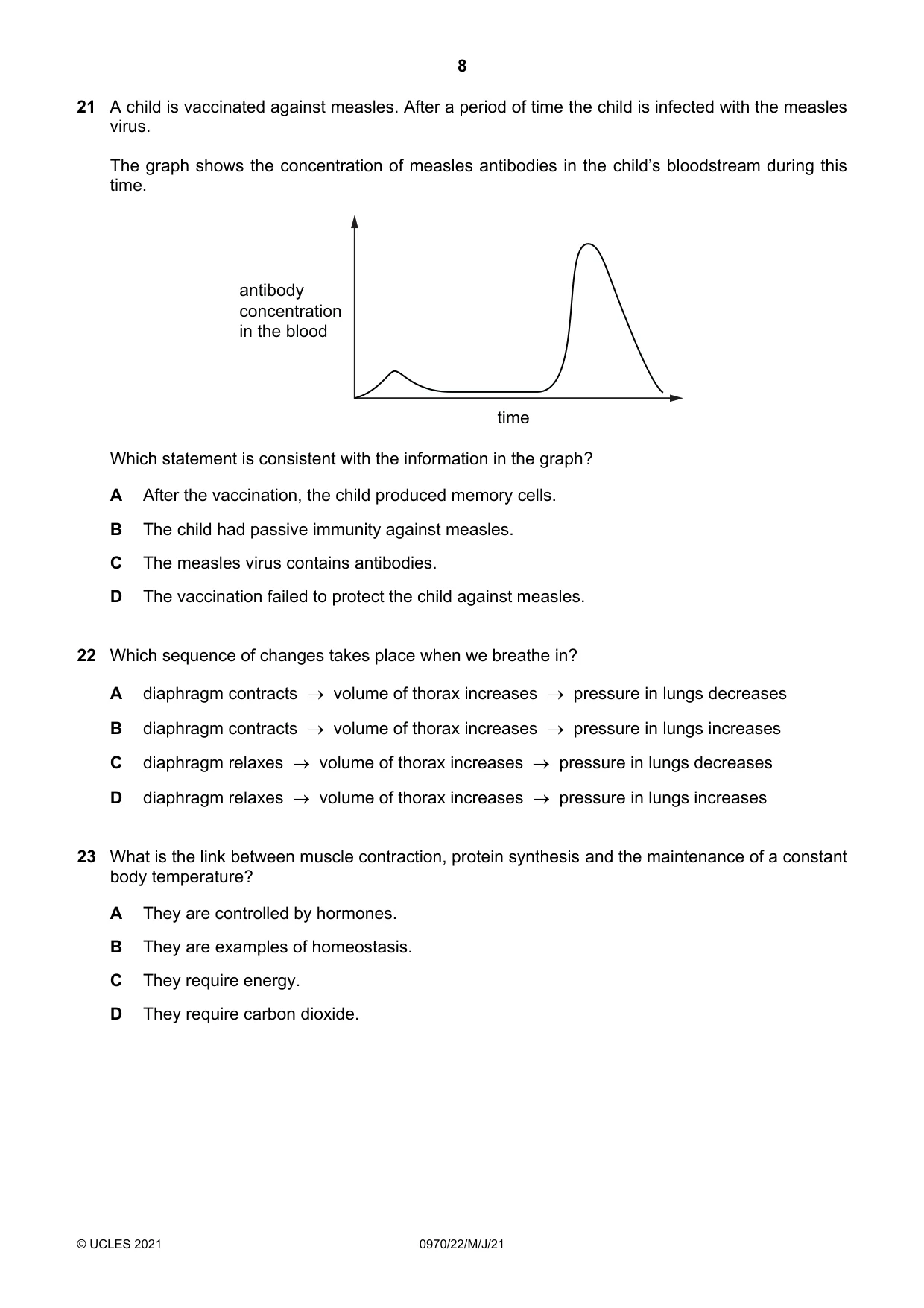
Q21 · A child is vaccinated against measles
21 A child is vaccinated against measles. After a period of time the child is infected with the measles virus. The graph shows the concentration of measles antibodies in the child’s bloodstream during this time. antibody concentration in the blood time Which statement is consistent with the information in the graph? A After the vaccination, the child produced memory cells. B The child had passive immunity against measles. C The measles virus contains antibodies. D The vaccination failed to protect the child against measles.
Mark scheme: A
Q22 · Which sequence of changes takes place when we breathe in?
22 Which sequence of changes takes place when we breathe in? A diaphragm contracts volume of thorax increases pressure in lungs decreases B diaphragm contracts volume of thorax increases pressure in lungs increases C diaphragm relaxes volume of thorax increases pressure in lungs decreases D diaphragm relaxes volume of thorax increases pressure in lungs increases
Mark scheme: A
Q23 · What is the link between muscle contraction, protein synthesis and the maintenance of a…
23 What is the link between muscle contraction, protein synthesis and the maintenance of a constant body temperature? A They are controlled by hormones. B They are examples of homeostasis. C They require energy. D They require carbon dioxide.
Mark scheme: C
Q24 · After vigorous exercise, an athlete continues to breathe deeply during the recovery period
24 After vigorous exercise, an athlete continues to breathe deeply during the recovery period. During this recovery period the oxygen debt is removed. Which reaction is used to remove the oxygen debt? A aerobic respiration of lactic acid in the liver B aerobic respiration of lactic acid in the muscles C anaerobic respiration of lactic acid in the liver D anaerobic respiration of lactic acid in the muscles
Mark scheme: A
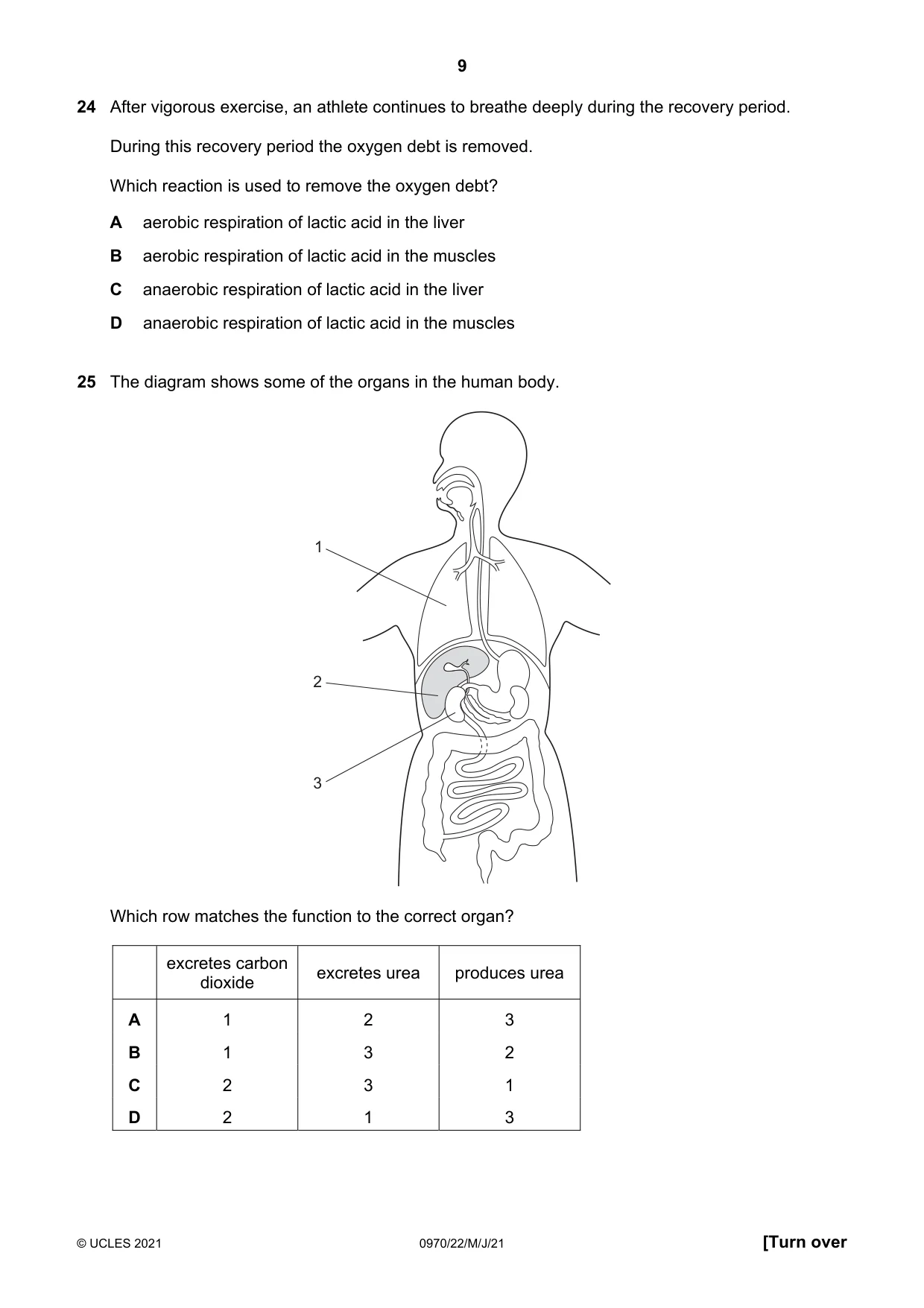
Q25 · The diagram shows some of the organs in the human body
25 The diagram shows some of the organs in the human body. 1 2 3 Which row matches the function to the correct organ? excretes carbon excretes urea produces urea dioxide A 1 2 3 B 1 3 2 C 2 3 1 D 2 1 3
Mark scheme: B
Q26 · What is the result of the release of adrenaline?
26 What is the result of the release of adrenaline? blood glucose breathing rate concentration A decreases decreases B decreases increases C increases decreases D increases increases
Mark scheme: D
Q27 · A person's skin looks more red in a warm environment than it does in a cool environment
27 A person's skin looks more red in a warm environment than it does in a cool environment. Which explanation is correct? A The arterioles supplying capillaries in the skin vasodilate and less blood flows to the skin surface. B The arterioles supplying capillaries in the skin vasodilate and more blood flows to the skin surface. C The arterioles supplying capillaries in the skin vasoconstrict and more blood flows to the skin surface. D The arterioles supplying capillaries in the skin vasoconstrict and less blood flows to the skin surface.
Mark scheme: B
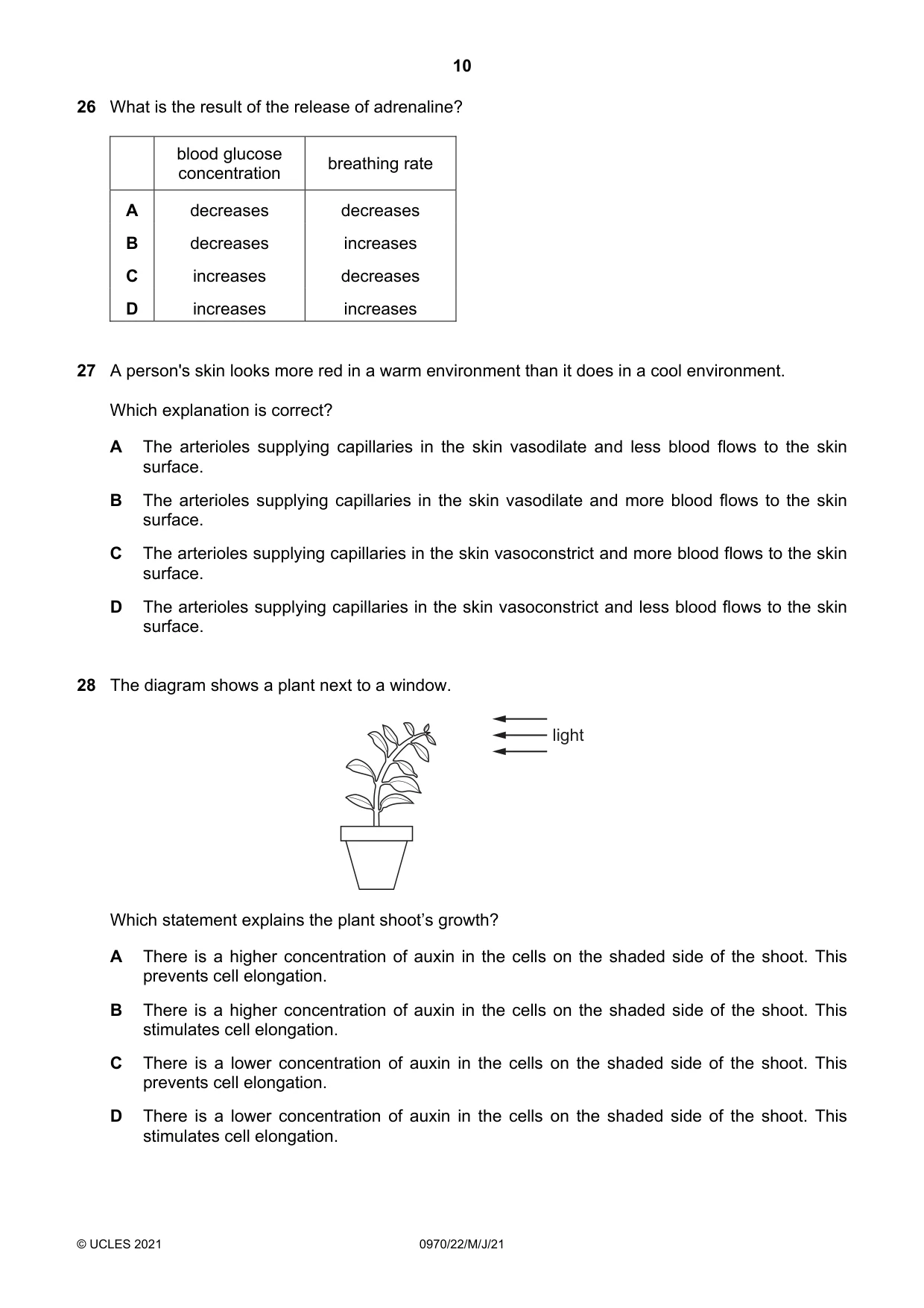
Q28 · The diagram shows a plant next to a window
28 The diagram shows a plant next to a window. light Which statement explains the plant shoot’s growth? A There is a higher concentration of auxin in the cells on the shaded side of the shoot. This prevents cell elongation. B There is a higher concentration of auxin in the cells on the shaded side of the shoot. This stimulates cell elongation. C There is a lower concentration of auxin in the cells on the shaded side of the shoot. This prevents cell elongation. D There is a lower concentration of auxin in the cells on the shaded side of the shoot. This stimulates cell elongation.
Mark scheme: B
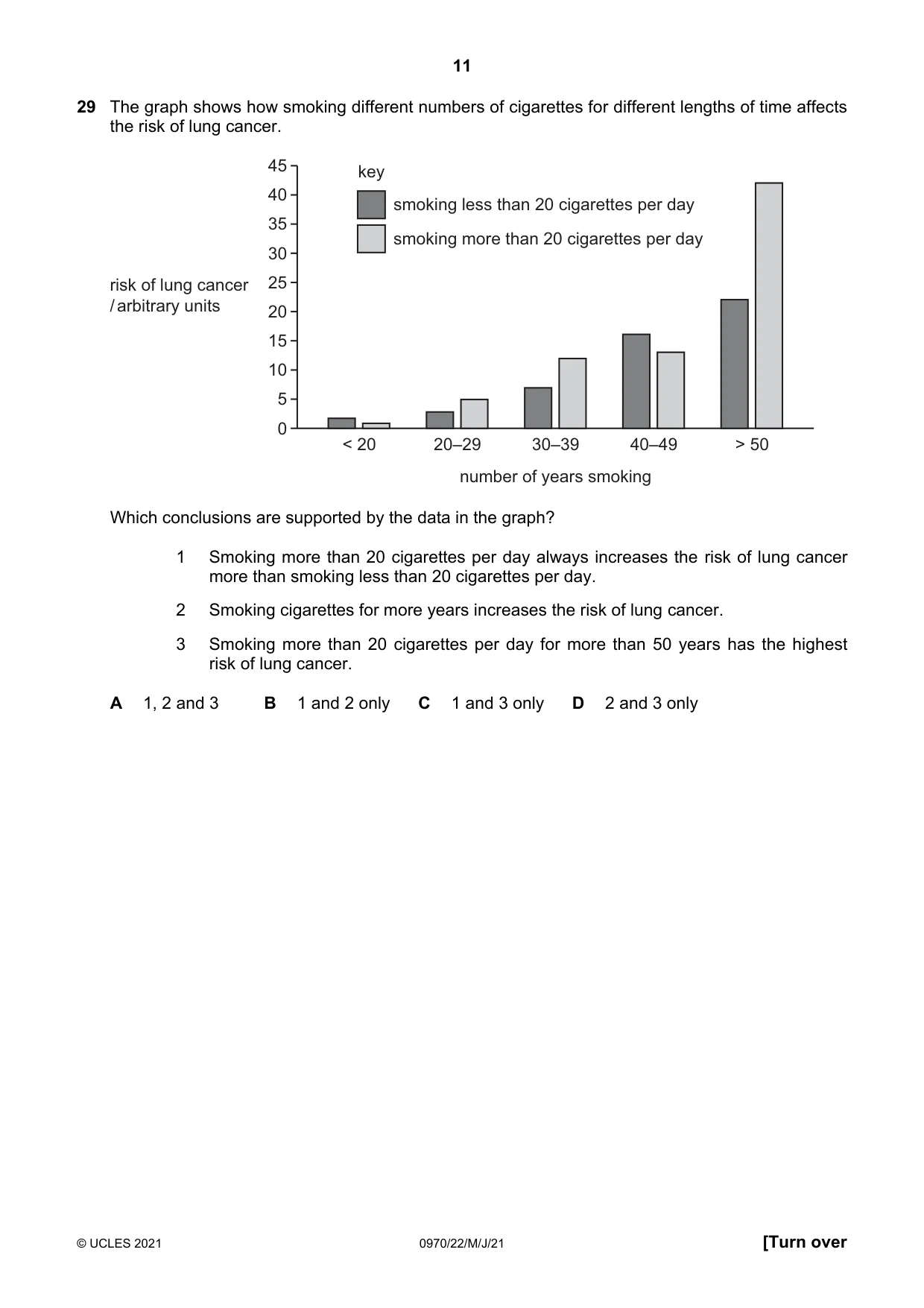
Q29 · The graph shows how smoking different numbers of cigarettes for different lengths of time…
29 The graph shows how smoking different numbers of cigarettes for different lengths of time affects the risk of lung cancer. 45 key 40 smoking less than 20 cigarettes per day 35 smoking more than 20 cigarettes per day 30 risk of lung cancer 25 / arbitrary units 20 15 10 5 0 < 20 20–29 30–39 40–49 > 50 number of years smoking Which conclusions are supported by the data in the graph? 1 Smoking more than 20 cigarettes per day always increases the risk of lung cancer more than smoking less than 20 cigarettes per day. 2 Smoking cigarettes for more years increases the risk of lung cancer. 3 Smoking more than 20 cigarettes per day for more than 50 years has the highest risk of lung cancer. A 1, 2 and 3 B 1 and 2 only C 1 and 3 only D 2 and 3 only
Mark scheme: D
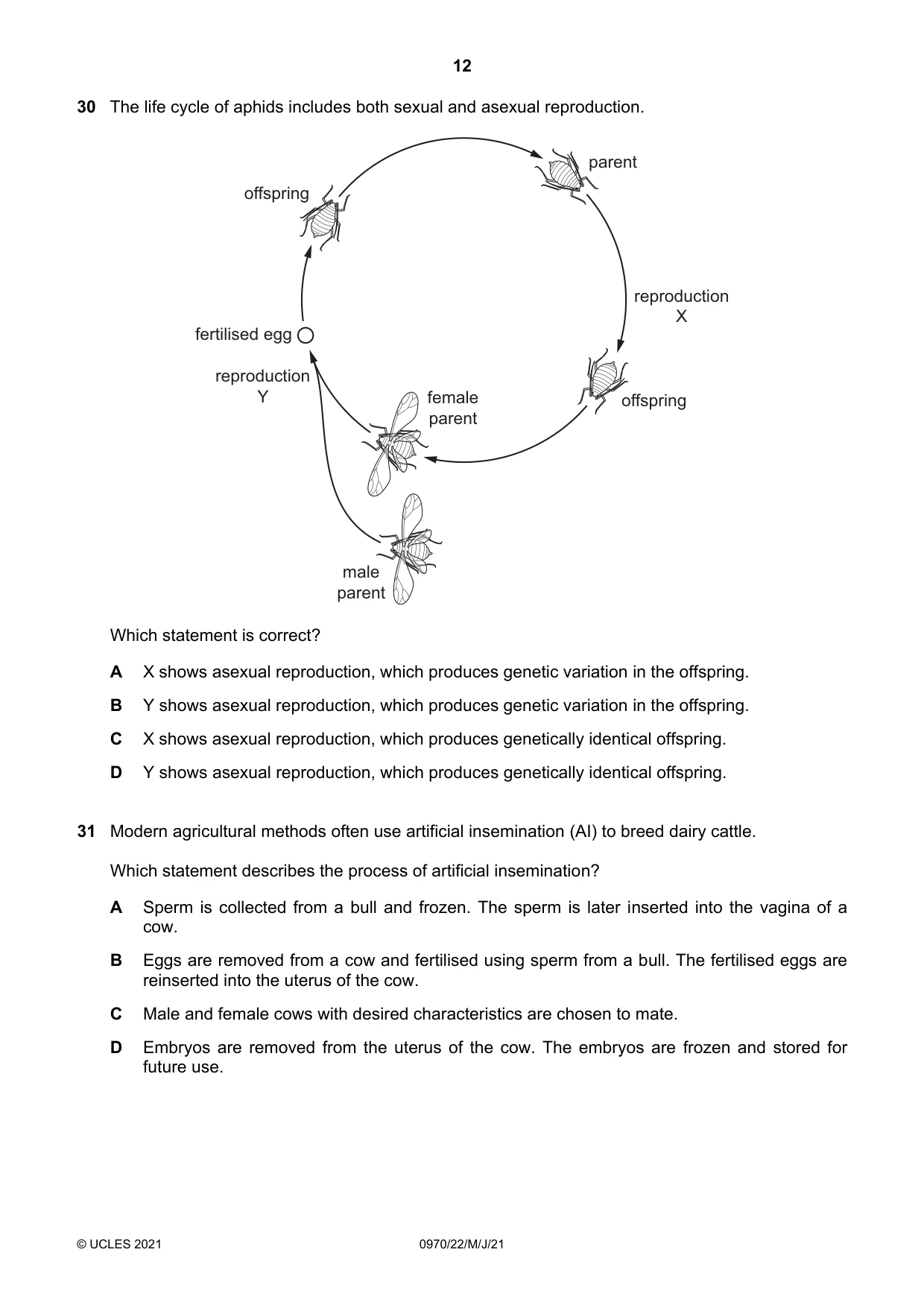
Q30 · The life cycle of aphids includes both sexual and asexual reproduction
30 The life cycle of aphids includes both sexual and asexual reproduction. parent offspring reproduction X fertilised egg reproduction Y female offspring parent male parent Which statement is correct? A X shows asexual reproduction, which produces genetic variation in the offspring. B Y shows asexual reproduction, which produces genetic variation in the offspring. C X shows asexual reproduction, which produces genetically identical offspring. D Y shows asexual reproduction, which produces genetically identical offspring.
Mark scheme: C
Q31 · Modern agricultural methods often use artificial insemination (AI) to breed dairy cattle
31 Modern agricultural methods often use artificial insemination (AI) to breed dairy cattle. Which statement describes the process of artificial insemination? A Sperm is collected from a bull and frozen. The sperm is later inserted into the vagina of a cow. B Eggs are removed from a cow and fertilised using sperm from a bull. The fertilised eggs are reinserted into the uterus of the cow. C Male and female cows with desired characteristics are chosen to mate. D Embryos are removed from the uterus of the cow. The embryos are frozen and stored for future use.
Mark scheme: A
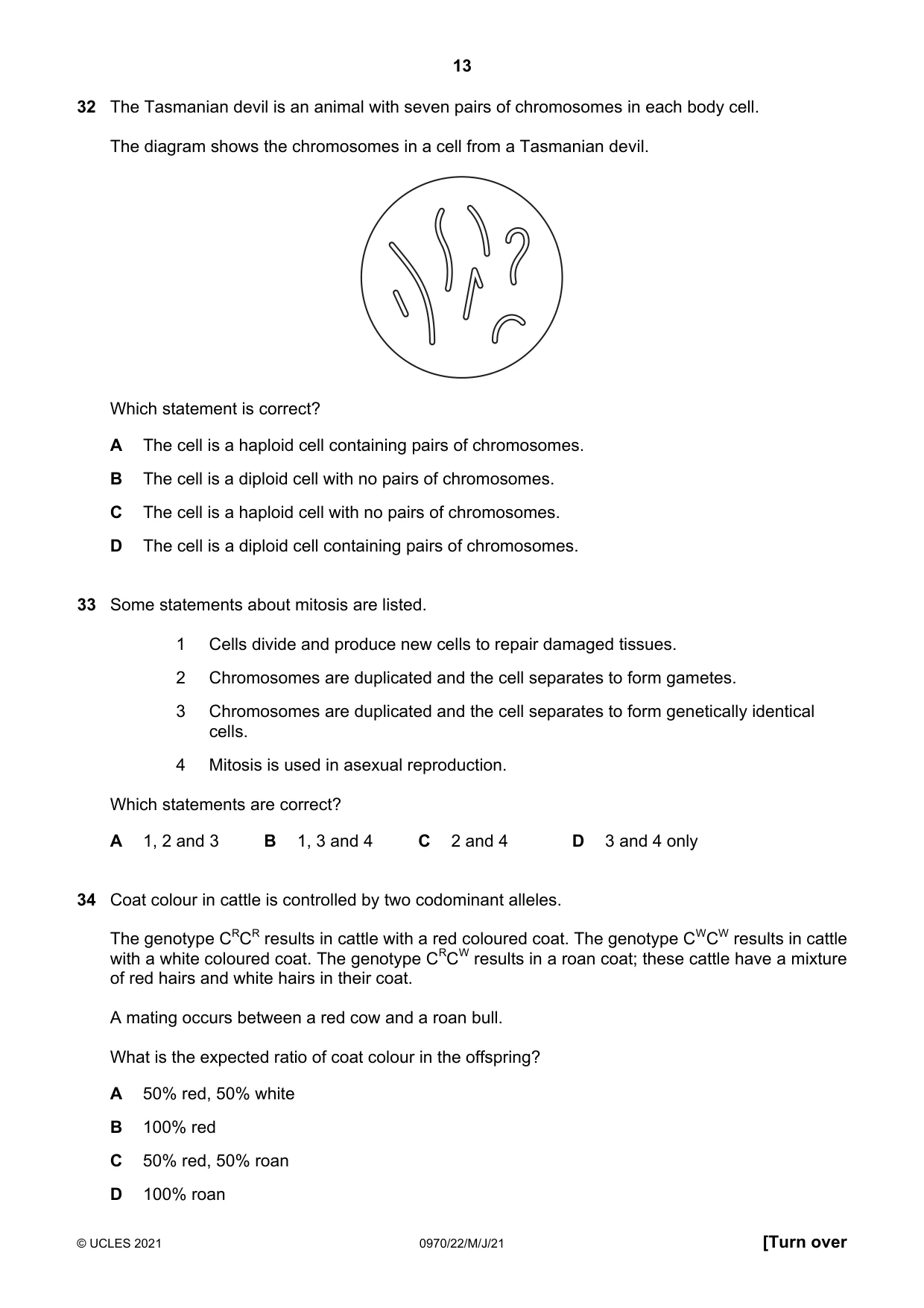
Q32 · The Tasmanian devil is an animal with seven pairs of chromosomes in each body cell
32 The Tasmanian devil is an animal with seven pairs of chromosomes in each body cell. The diagram shows the chromosomes in a cell from a Tasmanian devil. Which statement is correct? A The cell is a haploid cell containing pairs of chromosomes. B The cell is a diploid cell with no pairs of chromosomes. C The cell is a haploid cell with no pairs of chromosomes. D The cell is a diploid cell containing pairs of chromosomes.
Mark scheme: C
Q33 · Some statements about mitosis are listed
33 Some statements about mitosis are listed. 1 Cells divide and produce new cells to repair damaged tissues. 2 Chromosomes are duplicated and the cell separates to form gametes. 3 Chromosomes are duplicated and the cell separates to form genetically identical cells. 4 Mitosis is used in asexual reproduction. Which statements are correct? A 1, 2 and 3 B 1, 3 and 4 C 2 and 4 D 3 and 4 only
Mark scheme: B
Q34 · Coat colour in cattle is controlled by two codominant alleles
34 Coat colour in cattle is controlled by two codominant alleles. The genotype CRCR results in cattle with a red coloured coat. The genotype CWCW results in cattle with a white coloured coat. The genotype CRCW results in a roan coat; these cattle have a mixture of red hairs and white hairs in their coat. A mating occurs between a red cow and a roan bull. What is the expected ratio of coat colour in the offspring? A 50% red, 50% white B 100% red C 50% red, 50% roan D 100% roan
Mark scheme: C
Q35 · Which feature would help a plant to survive in a dry environment?
35 Which feature would help a plant to survive in a dry environment? A large leaves B many stomata C small roots D thick waxy cuticle
Mark scheme: D
Q36 · What occurs as a result of artificial selection?
36 What occurs as a result of artificial selection? A antibiotic resistance in bacteria B disease resistant crops C presence of roots in cactus plants D sickle cell anaemia
Mark scheme: B
Q37 · Which type of energy is passed from organism to organism in a food chain?
37 Which type of energy is passed from organism to organism in a food chain? A light B chemical C heat D kinetic
Mark scheme: B
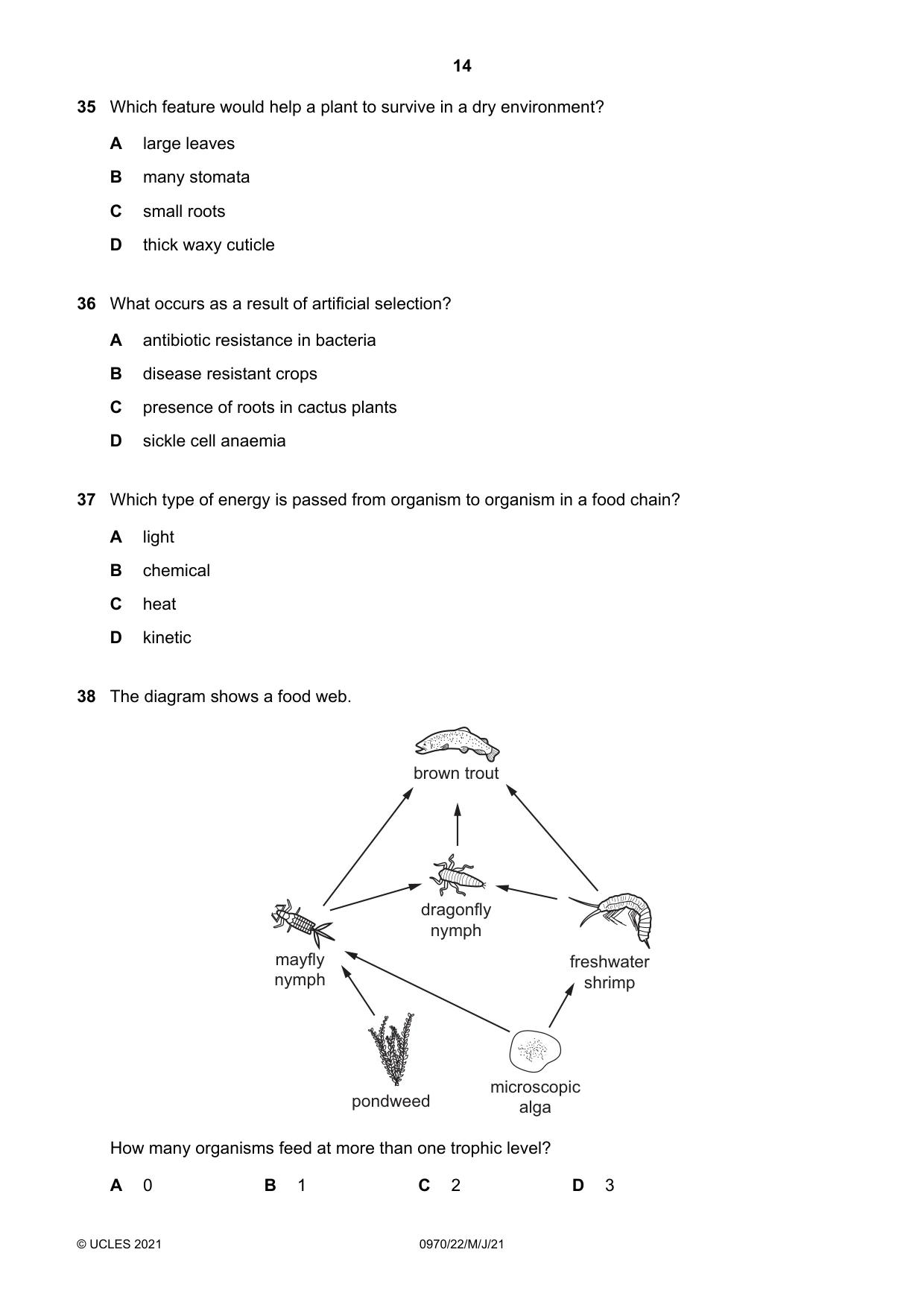
Q38 · The diagram shows a food web
38 The diagram shows a food web. brown trout dragonfly nymph mayfly freshwater nymph shrimp microscopic pondweed alga How many organisms feed at more than one trophic level? A 0 B 1 C 2 D 3
Mark scheme: B
Q39 · Bacteria can be used to make human proteins
39 Bacteria can be used to make human proteins. Which statement explains why this is possible when a human gene is placed in a bacterial cell? A Bacteria are able to reproduce rapidly. B Bacteria are very small organisms. C Bacteria contain genetic material in plasmids. D Bacteria have the same genetic code as humans.
Mark scheme: D
Q40 · The process of eutrophication begins with the increased availability of nitrate ions and…
40 The process of eutrophication begins with the increased availability of nitrate ions and other ions in water. The processes involved in eutrophication are listed. 1 increased aerobic respiration by decomposers 2 increased death of producers due to lack of light 3 rapid growth of producers 4 oxygen concentration in the water decreases and more organisms die What is the correct sequence? A 3 2 1 4 B 3 4 2 1 C 4 1 2 3 D 4 1 3 2
Mark scheme: A
What was in this paper
The subtopics covered by these 40 questions, and how many questions each got. Open one in a new tab to see every Cambridge question on it.
2Circulatory systems2Diseases and immunity2Enzymes2Photosynthesis2Absorption1Active transport1Adaptive features1Anaerobic respiration1Asexual reproduction1Biological molecules1Cell structure1Characteristics of living organisms1Concept and uses of classification systems1Diffusion1Drugs1Energy flow1Excretion in humans1Features of organisms1Food chains and food webs1Gas exchange in humans1Genetic modification1Homeostasis1Hormones1Mitosis1Monohybrid inheritance1Pollution1Respiration1Selection1Sexual reproduction1Size of specimens1Translocation1Transpiration1Tropic responses1Xylem and phloem1What you needed in this session
Cambridge’s own grade thresholds for 2021 May/June, Paper 2 · Variant 2. A higher threshold means an easier paper — the bar moves with how the cohort did.