Cambridge IGCSE Biology (9-1) 0970 — 2022 May/June Paper 2 · Variant 1
0970/21/M/J/22 · 40 questions · 40 marks · ≈45 min
The question paper and its mark scheme, free to read here and free to download. This is Cambridge’s own paper, exactly as it was sat.
Question paper16 pages
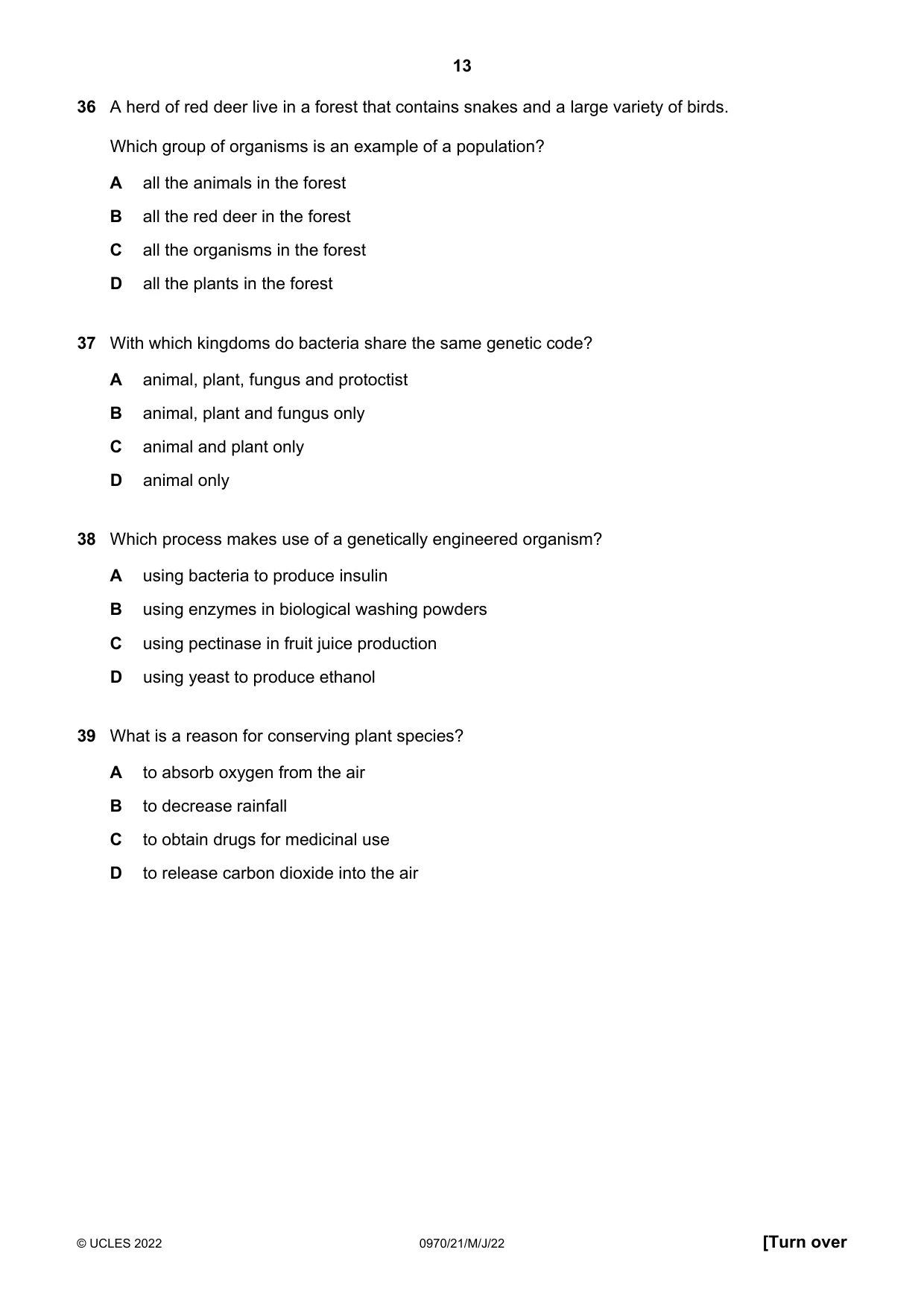


Mark scheme3 pages
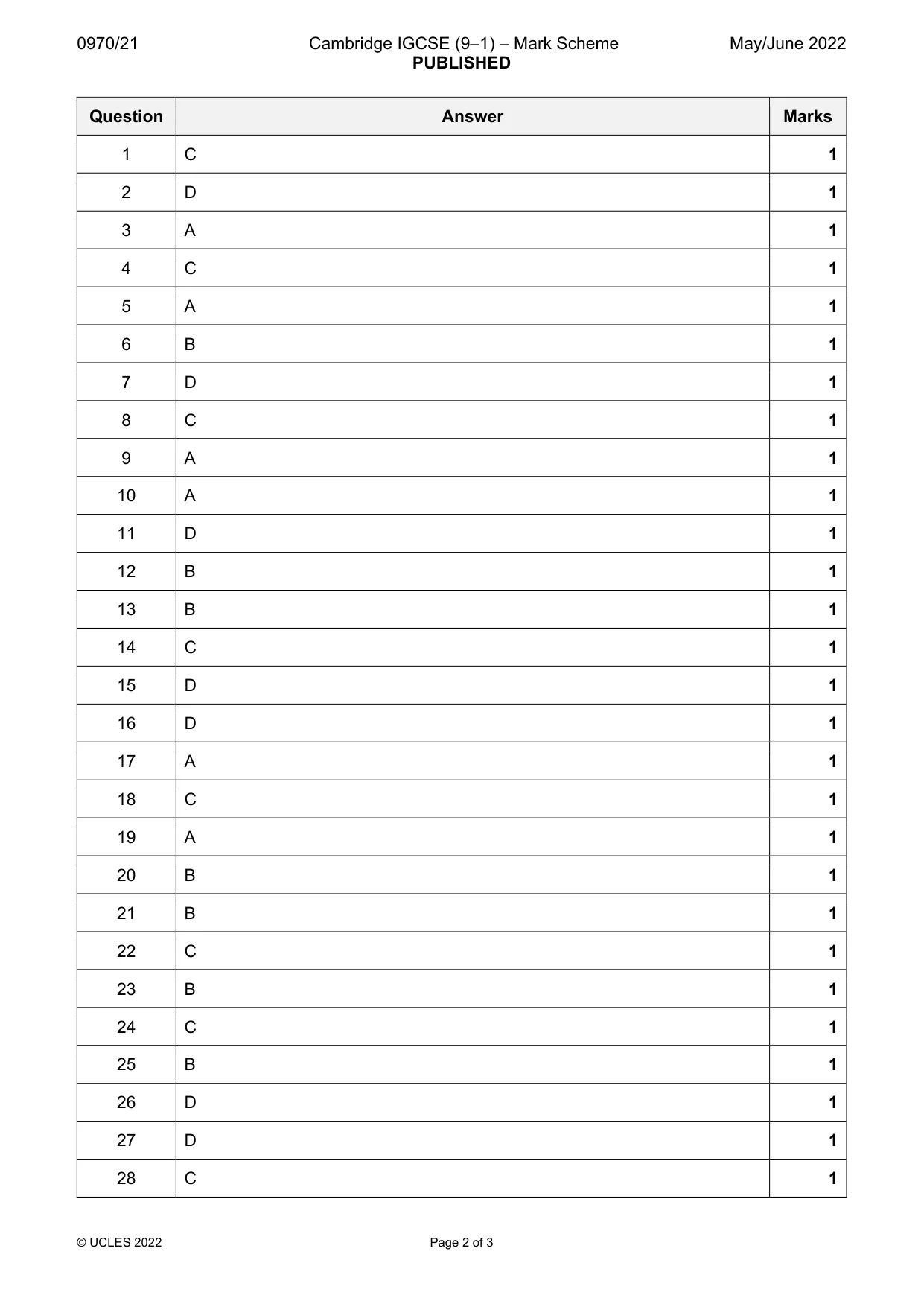
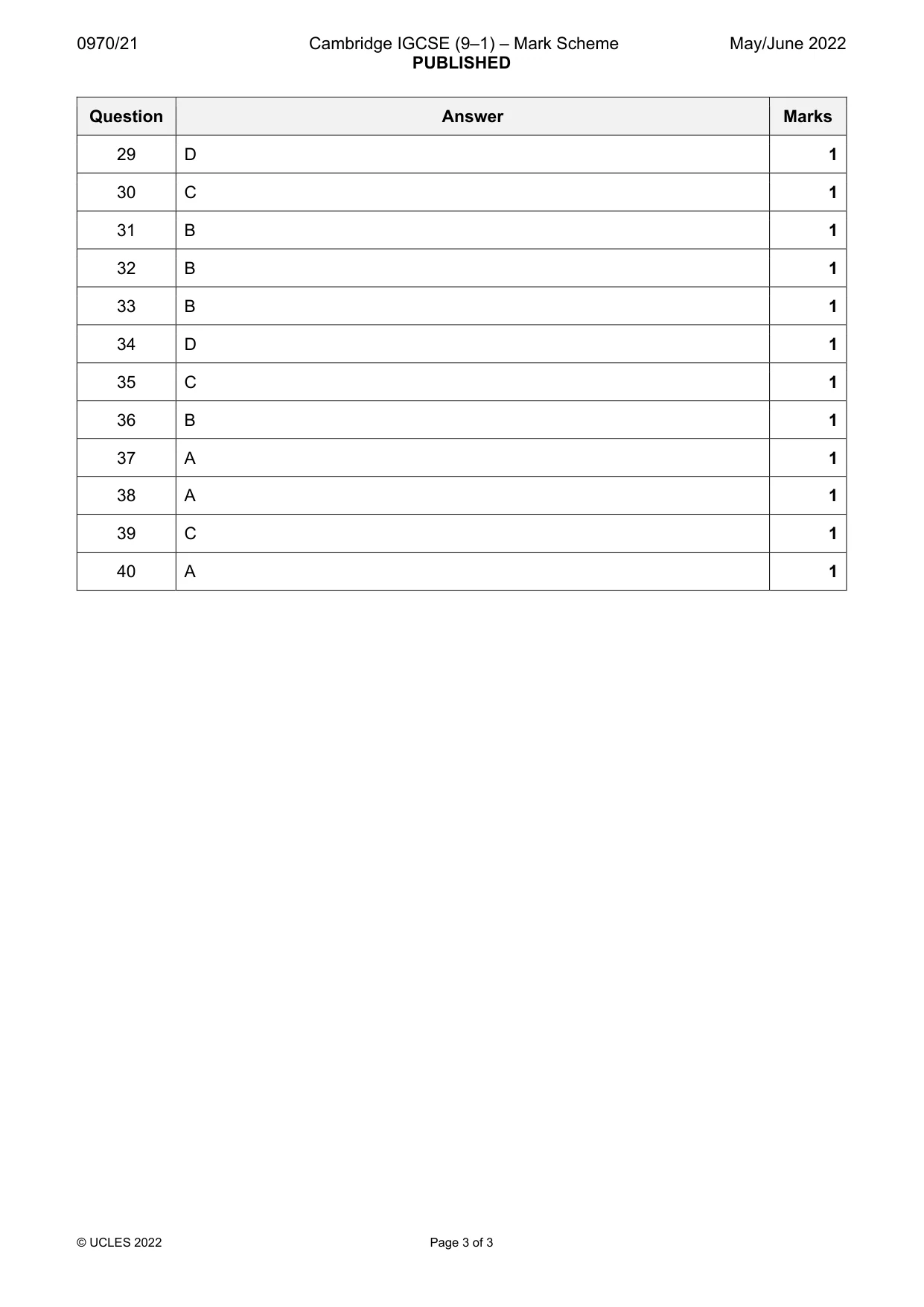
Answers below. Sit the paper first if you are practising.
Questions as text
Q1 · All living organisms release energy from nutrient molecules within their cells
1 All living organisms release energy from nutrient molecules within their cells. What is the name of this characteristic? A growth B nutrition C respiration D sensitivity
Mark scheme: C
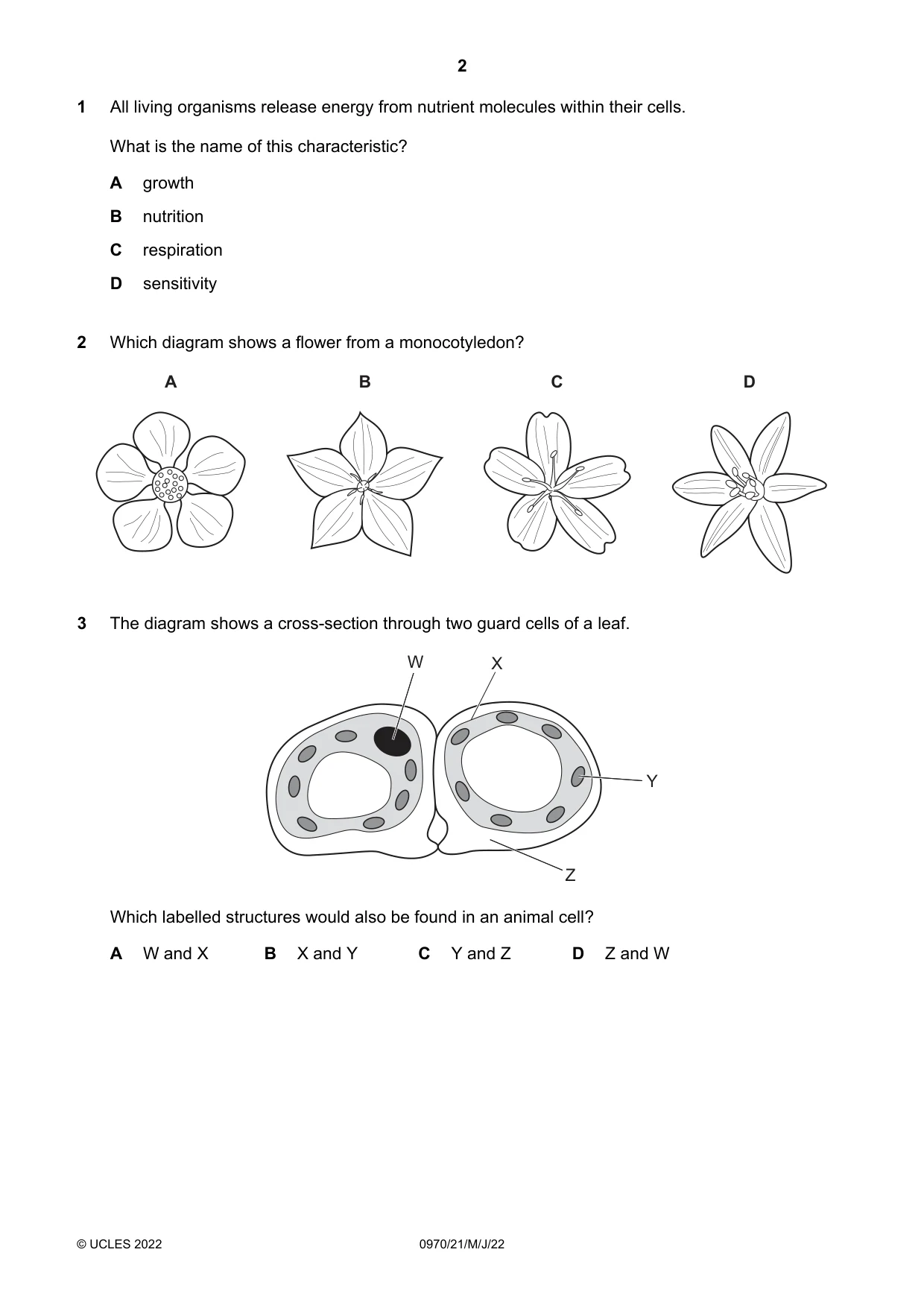
Q2 · Which diagram shows a flower from a monocotyledon?
2 Which diagram shows a flower from a monocotyledon? A B C D
Mark scheme: D
Q3 · The diagram shows a cross-section through two guard cells of a leaf
3 The diagram shows a cross-section through two guard cells of a leaf. W X Y Z Which labelled structures would also be found in an animal cell? A W and X B X and Y C Y and Z D Z and W
Mark scheme: A
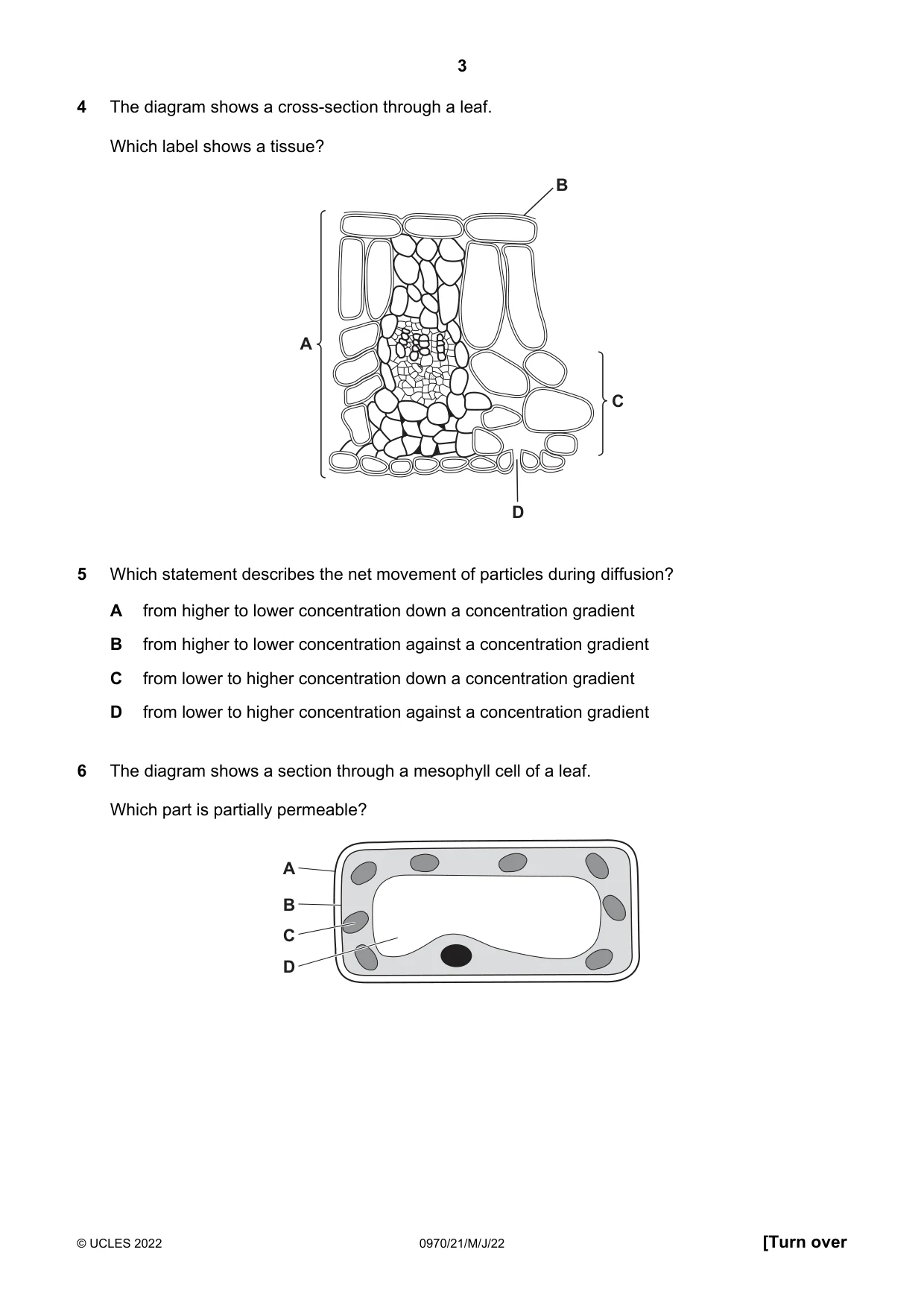
Q4 · The diagram shows a cross-section through a leaf
4 The diagram shows a cross-section through a leaf. Which label shows a tissue? B A C D
Mark scheme: C
Q5 · Which statement describes the net movement of particles during diffusion?
5 Which statement describes the net movement of particles during diffusion? A from higher to lower concentration down a concentration gradient B from higher to lower concentration against a concentration gradient C from lower to higher concentration down a concentration gradient D from lower to higher concentration against a concentration gradient
Mark scheme: A
Q6 · The diagram shows a section through a mesophyll cell of a leaf
6 The diagram shows a section through a mesophyll cell of a leaf. Which part is partially permeable? A B C D
Mark scheme: B
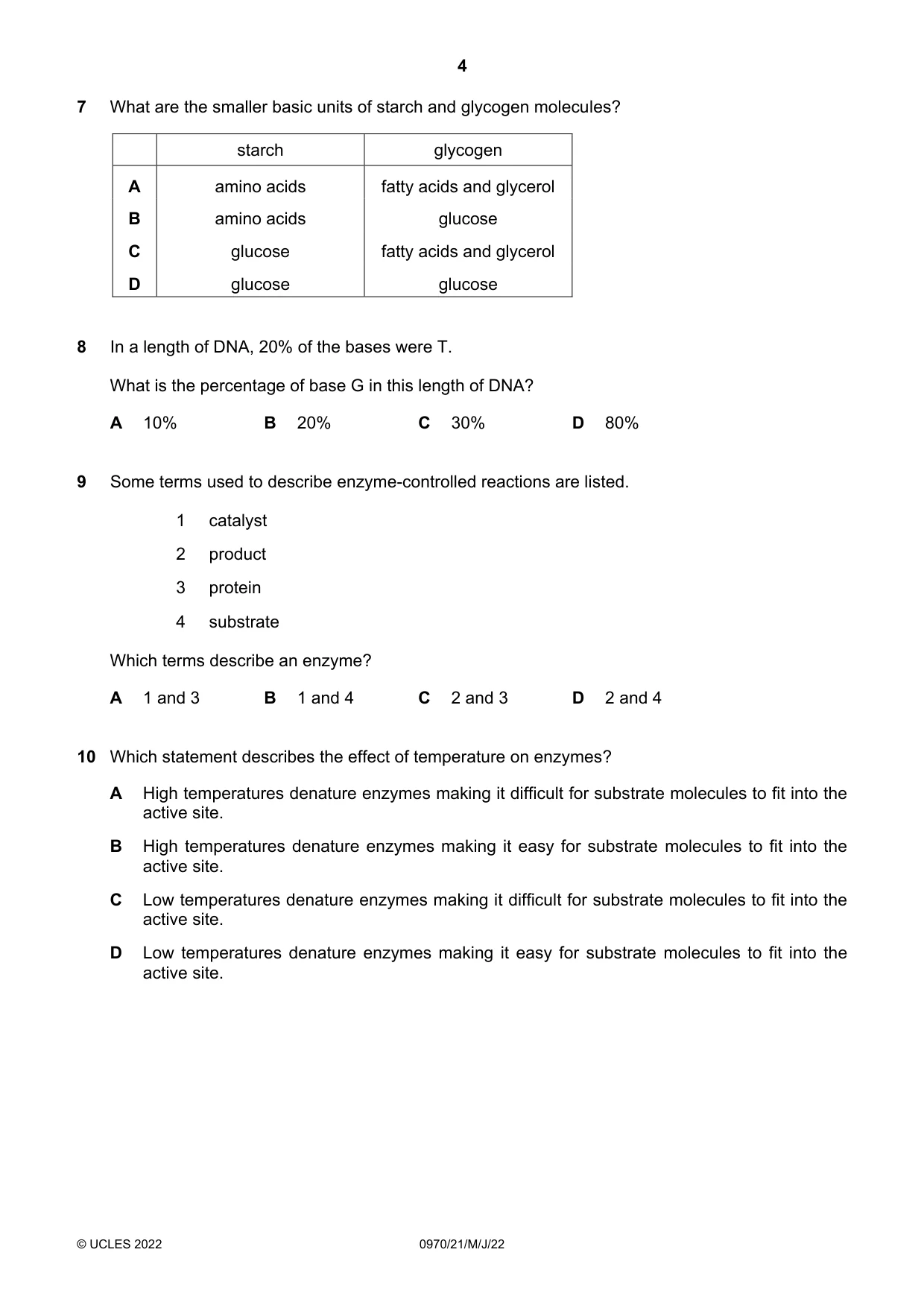
Q7 · What are the smaller basic units of starch and glycogen molecules?
7 What are the smaller basic units of starch and glycogen molecules? starch glycogen A amino acids fatty acids and glycerol B amino acids glucose C glucose fatty acids and glycerol D glucose glucose
Mark scheme: D
Q8 · In a length of DNA, 20% of the bases were T
8 In a length of DNA, 20% of the bases were T. What is the percentage of base G in this length of DNA? A 10% B 20% C 30% D 80%
Mark scheme: C
Q9 · Some terms used to describe enzyme-controlled reactions are listed
9 Some terms used to describe enzyme-controlled reactions are listed. 1 catalyst 2 product 3 protein 4 substrate Which terms describe an enzyme? A 1 and 3 B 1 and 4 C 2 and 3 D 2 and 4
Mark scheme: A
Q10 · Which statement describes the effect of temperature on enzymes?
10 Which statement describes the effect of temperature on enzymes? A High temperatures denature enzymes making it difficult for substrate molecules to fit into the active site. B High temperatures denature enzymes making it easy for substrate molecules to fit into the active site. C Low temperatures denature enzymes making it difficult for substrate molecules to fit into the active site. D Low temperatures denature enzymes making it easy for substrate molecules to fit into the active site.
Mark scheme: A
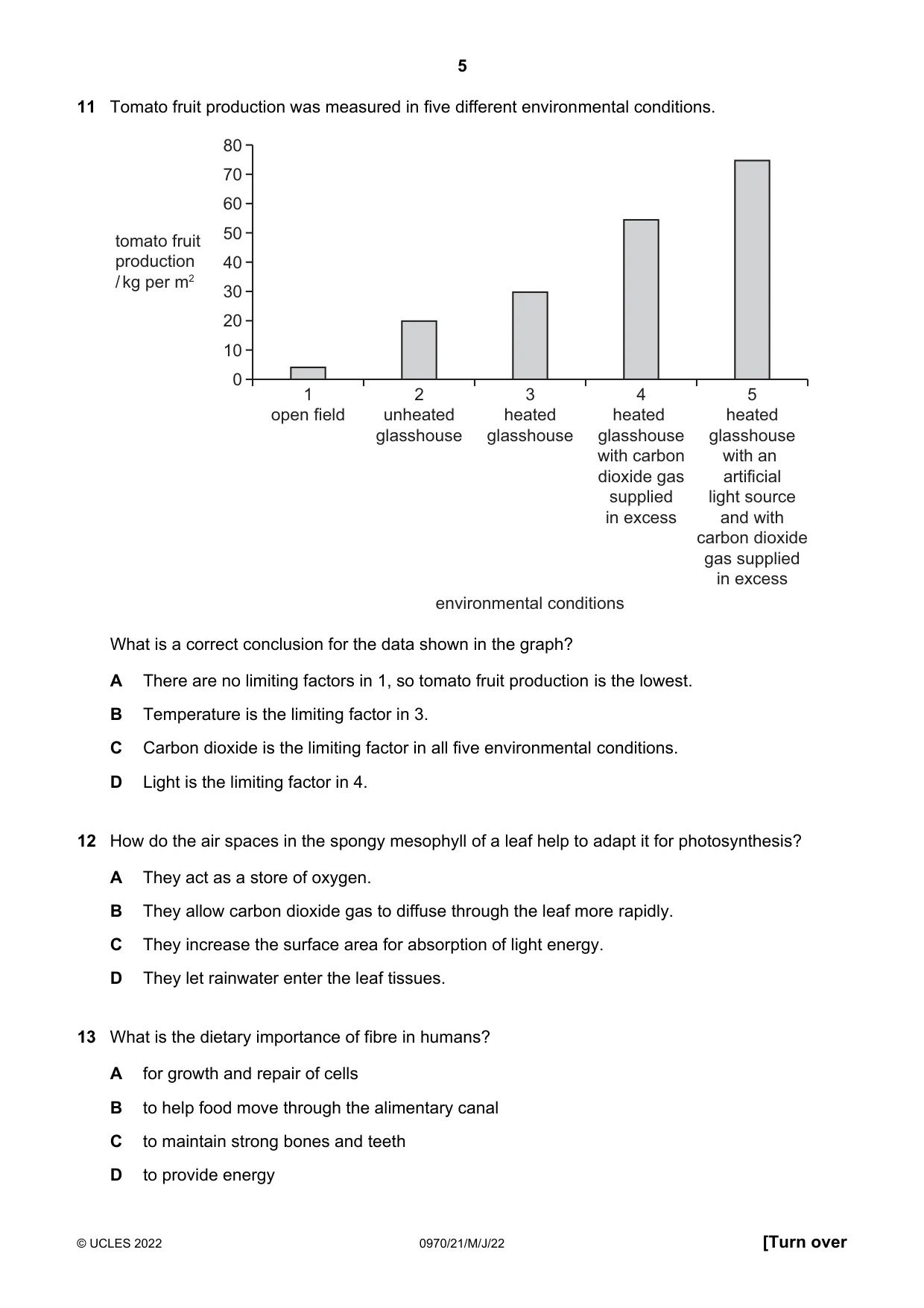
Q11 · Tomato fruit production was measured in five different environmental conditions
11 Tomato fruit production was measured in five different environmental conditions. 80 70 60 tomato fruit 50 production 40 / kg per m2 30 20 10 0 1 2 3 4 5 open field unheated heated heated heated glasshouse glasshouse glasshouse glasshouse with carbon with an dioxide gas artificial supplied light source in excess and with carbon dioxide gas supplied in excess environmental conditions What is a correct conclusion for the data shown in the graph? A There are no limiting factors in 1, so tomato fruit production is the lowest. B Temperature is the limiting factor in 3. C Carbon dioxide is the limiting factor in all five environmental conditions. D Light is the limiting factor in 4.
Mark scheme: D
Q12 · How do the air spaces in the spongy mesophyll of a leaf help to adapt it for…
12 How do the air spaces in the spongy mesophyll of a leaf help to adapt it for photosynthesis? A They act as a store of oxygen. B They allow carbon dioxide gas to diffuse through the leaf more rapidly. C They increase the surface area for absorption of light energy. D They let rainwater enter the leaf tissues.
Mark scheme: B
Q13 · What is the dietary importance of fibre in humans?
13 What is the dietary importance of fibre in humans? A for growth and repair of cells B to help food move through the alimentary canal C to maintain strong bones and teeth D to provide energy
Mark scheme: B
Q14 · In which part of the alimentary canal does ingestion take place?
14 In which part of the alimentary canal does ingestion take place? A anus B liver C mouth D stomach
Mark scheme: C
Q15 · A non-woody plant stem is placed in water containing a red dye
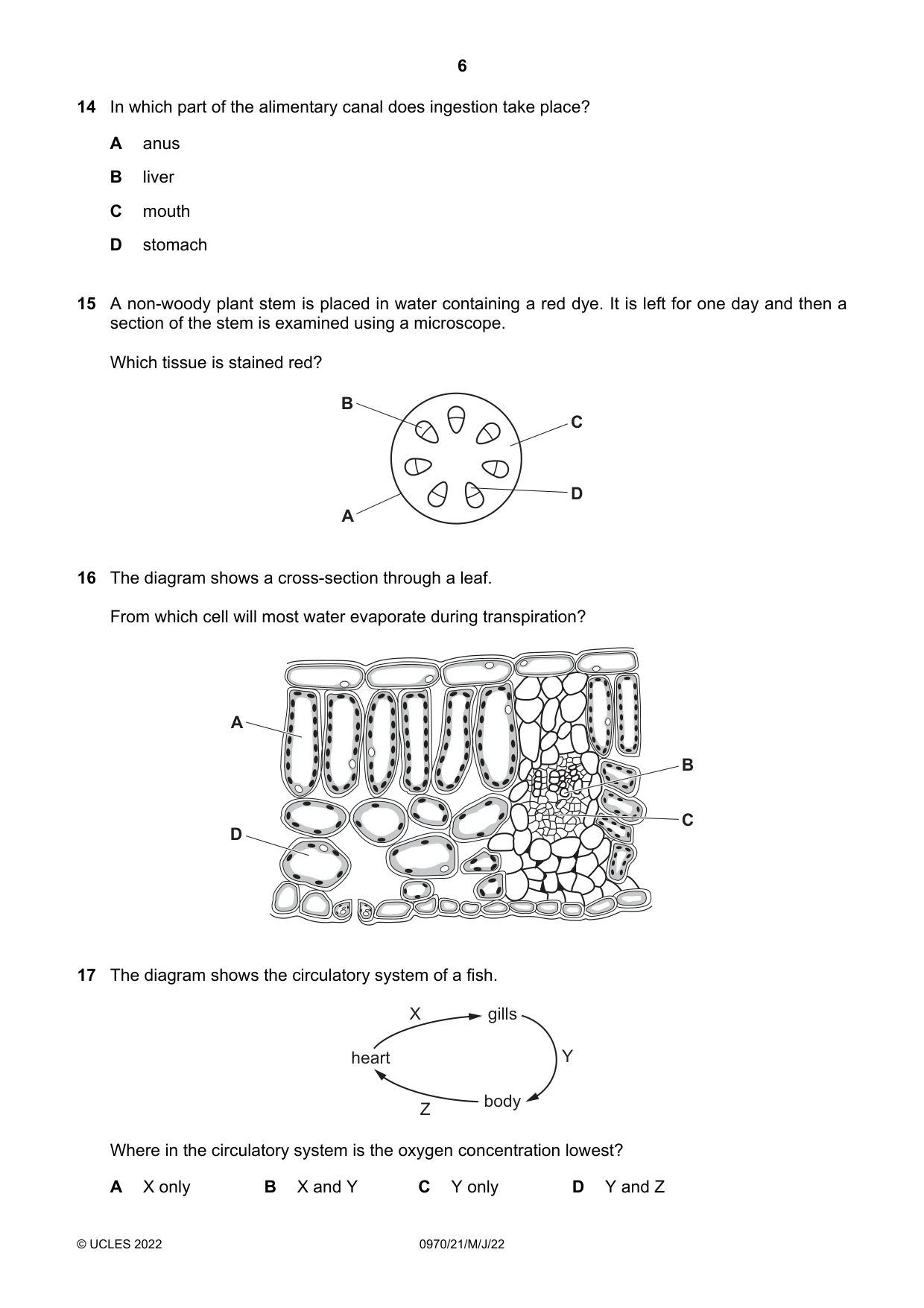
15 A non-woody plant stem is placed in water containing a red dye. It is left for one day and then a section of the stem is examined using a microscope. Which tissue is stained red? B C D A
Mark scheme: D
Q16 · The diagram shows a cross-section through a leaf
16 The diagram shows a cross-section through a leaf. From which cell will most water evaporate during transpiration? A B C D
Mark scheme: D
Q17 · The diagram shows the circulatory system of a fish
17 The diagram shows the circulatory system of a fish. X gills heart Y body Z Where in the circulatory system is the oxygen concentration lowest? A X only B X and Y C Y only D Y and Z
Mark scheme: A
Q18 · What is a function of the lymphatic system?
18 What is a function of the lymphatic system? A absorption of glucose B blood clotting C circulation of body fluids D temperature regulation
Mark scheme: C
Q19 · The graph shows the response of the body to vaccination
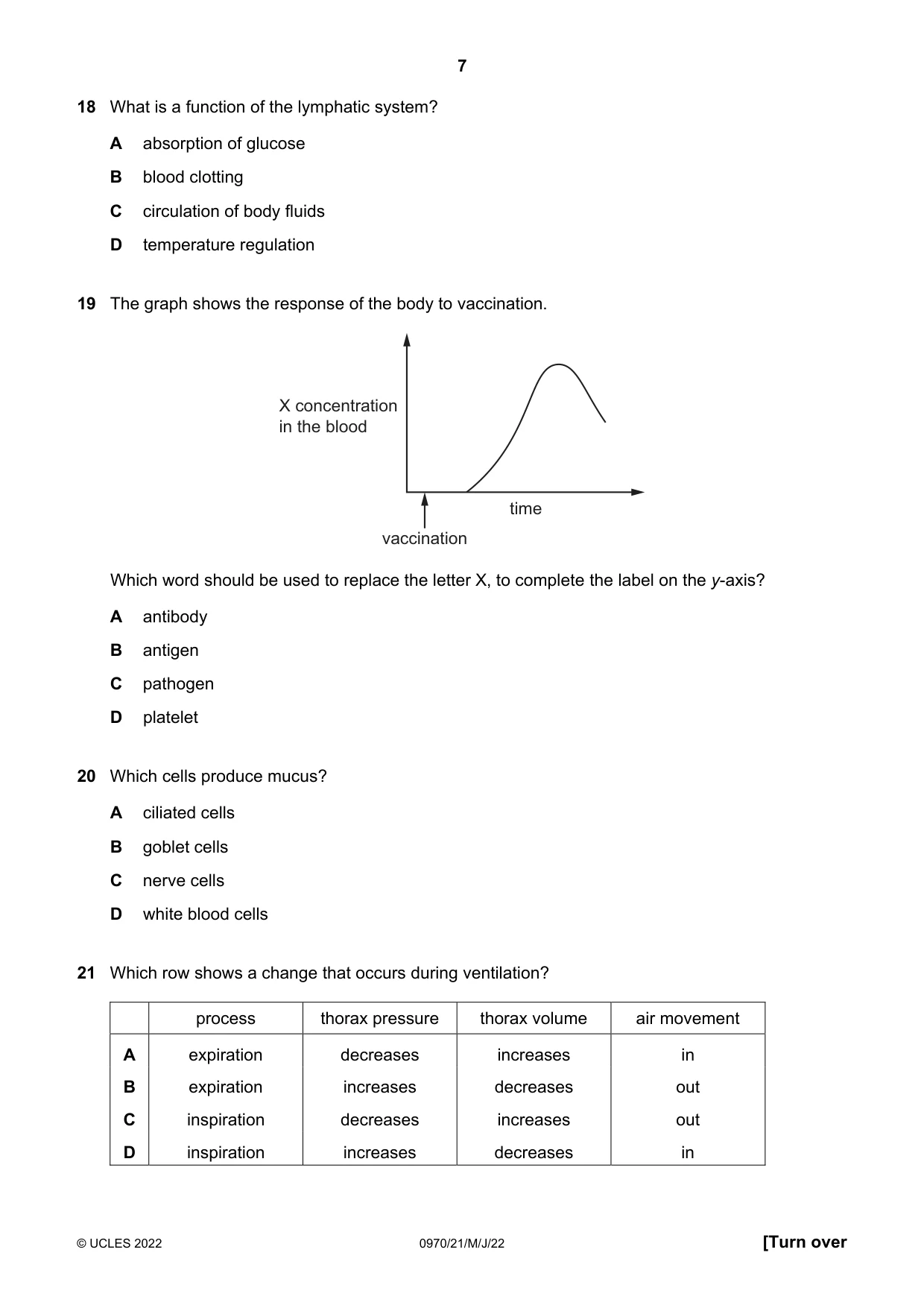
19 The graph shows the response of the body to vaccination. X concentration in the blood time vaccination Which word should be used to replace the letter X, to complete the label on the y-axis? A antibody B antigen C pathogen D platelet
Mark scheme: A
Q20 · Which cells produce mucus?
20 Which cells produce mucus? A ciliated cells B goblet cells C nerve cells D white blood cells
Mark scheme: B
Q21 · Which row shows a change that occurs during ventilation?
21 Which row shows a change that occurs during ventilation? process thorax pressure thorax volume air movement A expiration decreases increases in B expiration increases decreases out C inspiration decreases increases out D inspiration increases decreases in
Mark scheme: B
Q22 · What is the balanced chemical equation for anaerobic respiration in yeast?
22 What is the balanced chemical equation for anaerobic respiration in yeast? A C6H12O6 2CO2 + 6H2O B C6H12O6 6CO2 + 6H2O C C6H12O6 2C2H5OH + 2CO2 D C6H12O6 2C2H5OH + 2H2O
Mark scheme: C
Q23 · Which statement correctly explains the difference in glucose concentration in the kidney…
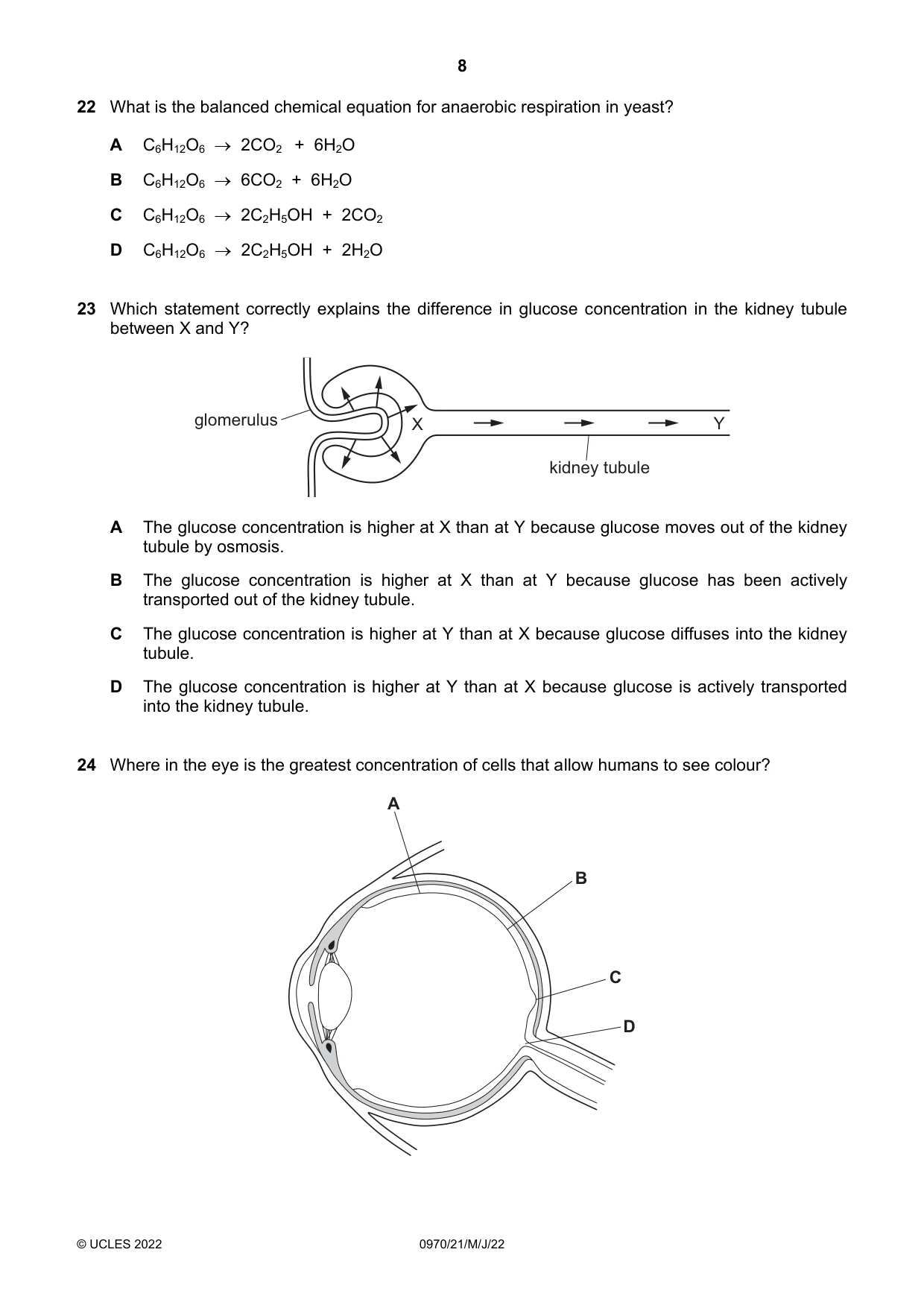
23 Which statement correctly explains the difference in glucose concentration in the kidney tubule between X and Y? glomerulus X Y kidney tubule A The glucose concentration is higher at X than at Y because glucose moves out of the kidney tubule by osmosis. B The glucose concentration is higher at X than at Y because glucose has been actively transported out of the kidney tubule. C The glucose concentration is higher at Y than at X because glucose diffuses into the kidney tubule. D The glucose concentration is higher at Y than at X because glucose is actively transported into the kidney tubule.
Mark scheme: B
Q24 · Where in the eye is the greatest concentration of cells that allow humans to see colour?
24 Where in the eye is the greatest concentration of cells that allow humans to see colour? A B C D
Mark scheme: C
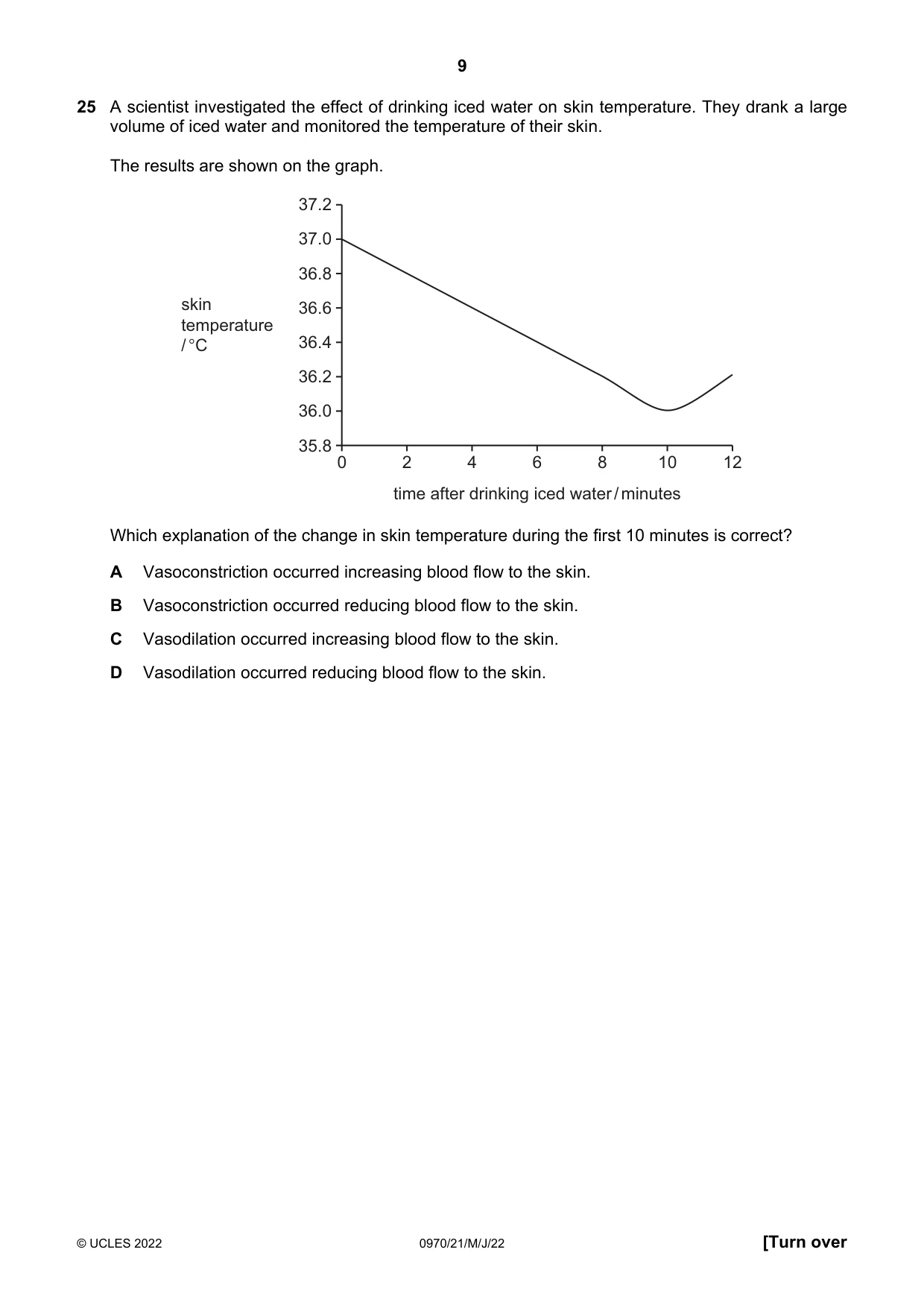
Q25 · A scientist investigated the effect of drinking iced water on skin temperature
25 A scientist investigated the effect of drinking iced water on skin temperature. They drank a large volume of iced water and monitored the temperature of their skin. The results are shown on the graph. 37.2 37.0 36.8 skin 36.6 temperature / °C 36.4 36.2 36.0 35.8 0 2 4 6 8 10 12 time after drinking iced water / minutes Which explanation of the change in skin temperature during the first 10 minutes is correct? A Vasoconstriction occurred increasing blood flow to the skin. B Vasoconstriction occurred reducing blood flow to the skin. C Vasodilation occurred increasing blood flow to the skin. D Vasodilation occurred reducing blood flow to the skin.
Mark scheme: B
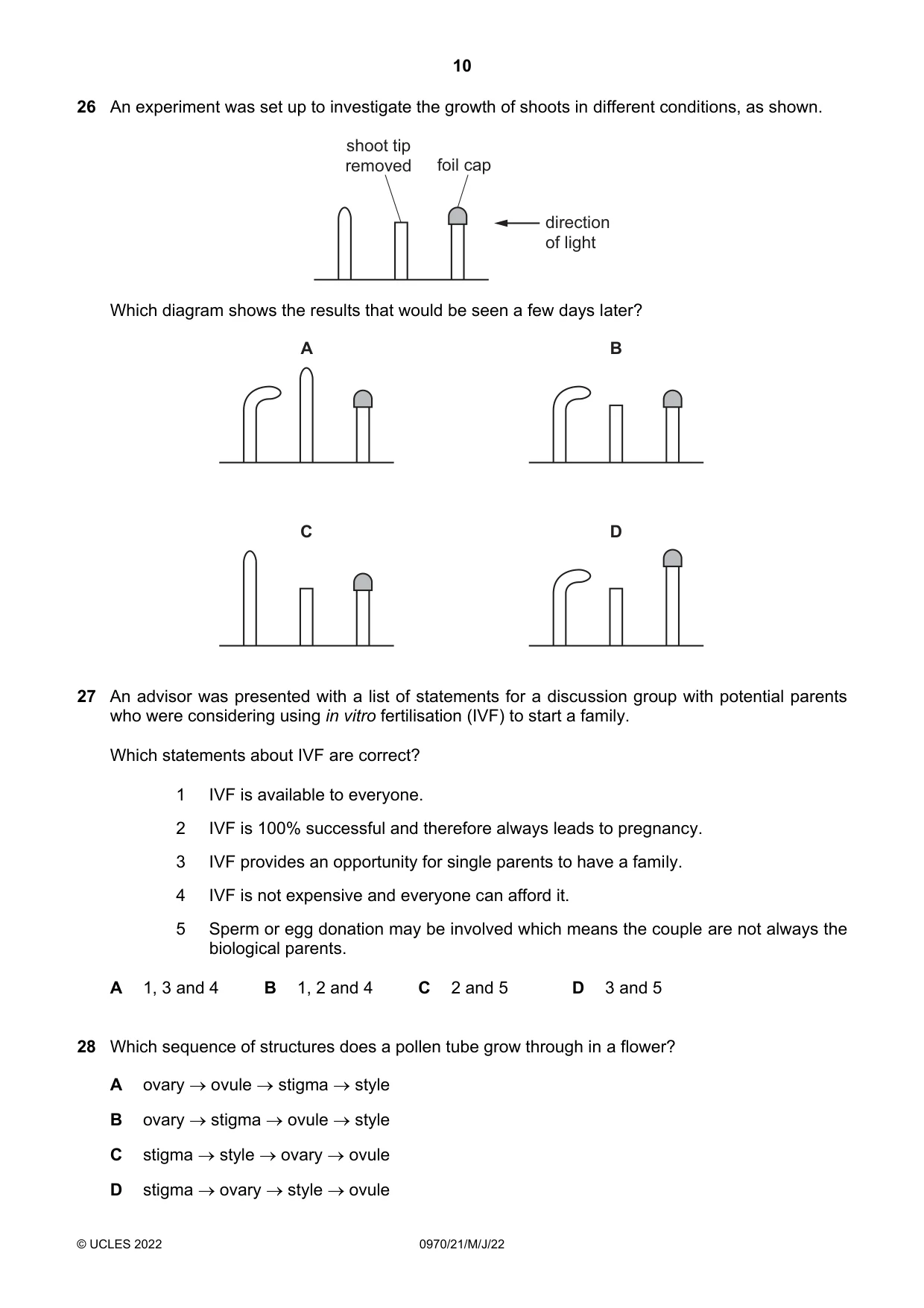
Q26 · An experiment was set up to investigate the growth of shoots in different conditions, as…
26 An experiment was set up to investigate the growth of shoots in different conditions, as shown. shoot tip removed foil cap direction of light Which diagram shows the results that would be seen a few days later? A B C D
Mark scheme: D
Q27 · An advisor was presented with a list of statements for a discussion group with potential…
27 An advisor was presented with a list of statements for a discussion group with potential parents who were considering using in vitro fertilisation (IVF) to start a family. Which statements about IVF are correct? 1 IVF is available to everyone. 2 IVF is 100% successful and therefore always leads to pregnancy. 3 IVF provides an opportunity for single parents to have a family. 4 IVF is not expensive and everyone can afford it. 5 Sperm or egg donation may be involved which means the couple are not always the biological parents. A 1, 3 and 4 B 1, 2 and 4 C 2 and 5 D 3 and 5
Mark scheme: D
Q28 · Which sequence of structures does a pollen tube grow through in a flower?
28 Which sequence of structures does a pollen tube grow through in a flower? A ovary ovule stigma style B ovary stigma ovule style C stigma style ovary ovule D stigma ovary style ovule
Mark scheme: C
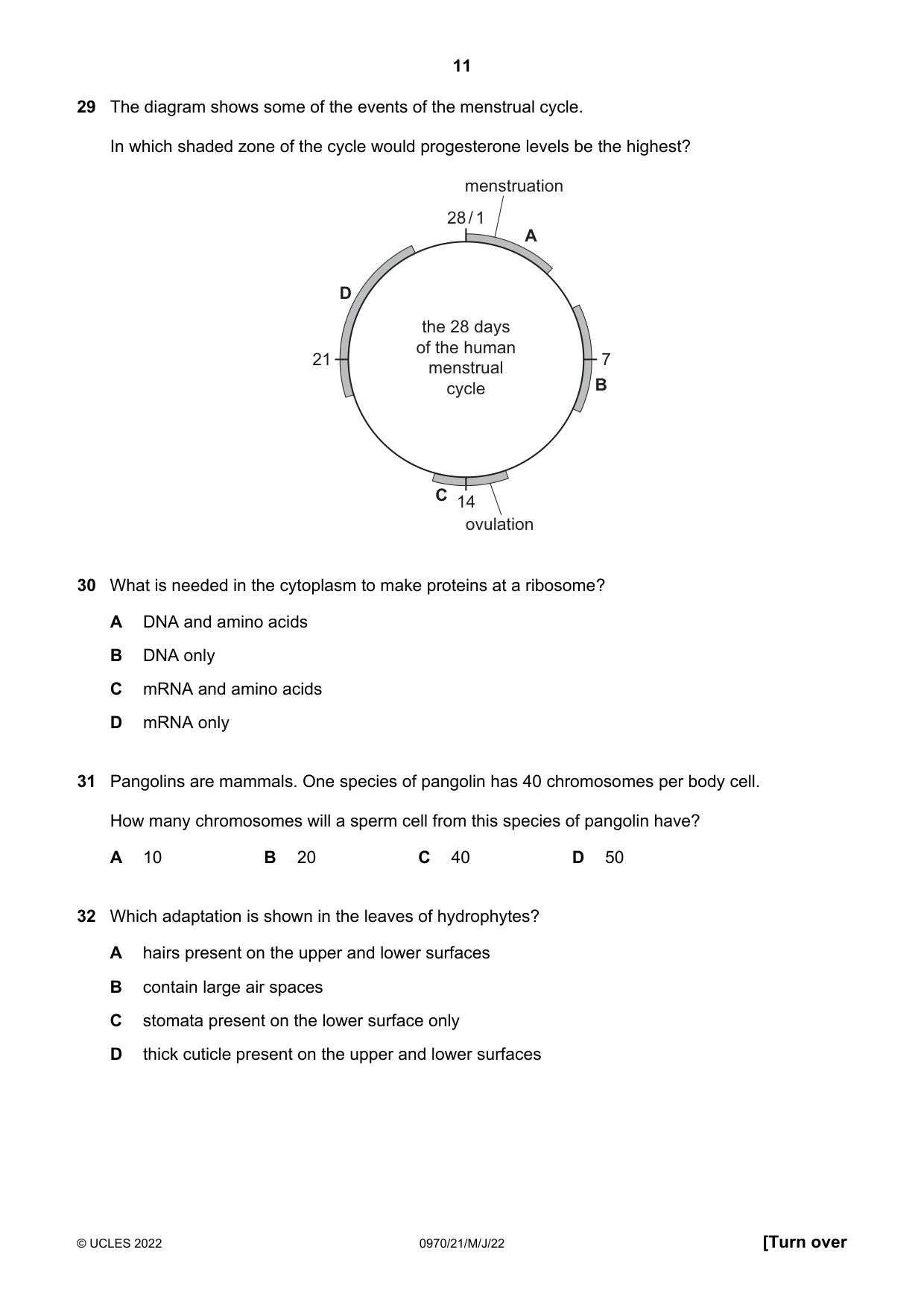
Q29 · The diagram shows some of the events of the menstrual cycle
29 The diagram shows some of the events of the menstrual cycle. In which shaded zone of the cycle would progesterone levels be the highest? menstruation 28 / 1 A D the 28 days of the human 21 7 menstrual cycle B C 14 ovulation
Mark scheme: D
Q30 · What is needed in the cytoplasm to make proteins at a ribosome?
30 What is needed in the cytoplasm to make proteins at a ribosome? A DNA and amino acids B DNA only C mRNA and amino acids D mRNA only
Mark scheme: C
Question 31
31 Pangolins are mammals. One species of pangolin has 40 chromosomes per body cell. How many chromosomes will a sperm cell from this species of pangolin have? A 10 B 20 C 40 D 50
Mark scheme: B
Q32 · Which adaptation is shown in the leaves of hydrophytes?
32 Which adaptation is shown in the leaves of hydrophytes? A hairs present on the upper and lower surfaces B contain large air spaces C stomata present on the lower surface only D thick cuticle present on the upper and lower surfaces
Mark scheme: B
Q33 · Sickle cell anaemia is a genetic disorder which results in severe illness in homozygous…
33 Sickle cell anaemia is a genetic disorder which results in severe illness in homozygous individuals. In some human populations, being heterozygous can be beneficial. What could be the reason for this? A Heterozygous individuals are not affected by the disorder. B Heterozygous individuals are more resistant to malaria. C The disorder is caused by a dominant allele. D The disorder is sex-linked.
Mark scheme: B
Q34 · Which statement about selective breeding is correct?
34 Which statement about selective breeding is correct? A It does not involve humans. B It involves a struggle for survival. C It always involves only one parent. D It involves parents that possess desirable features.
Mark scheme: D
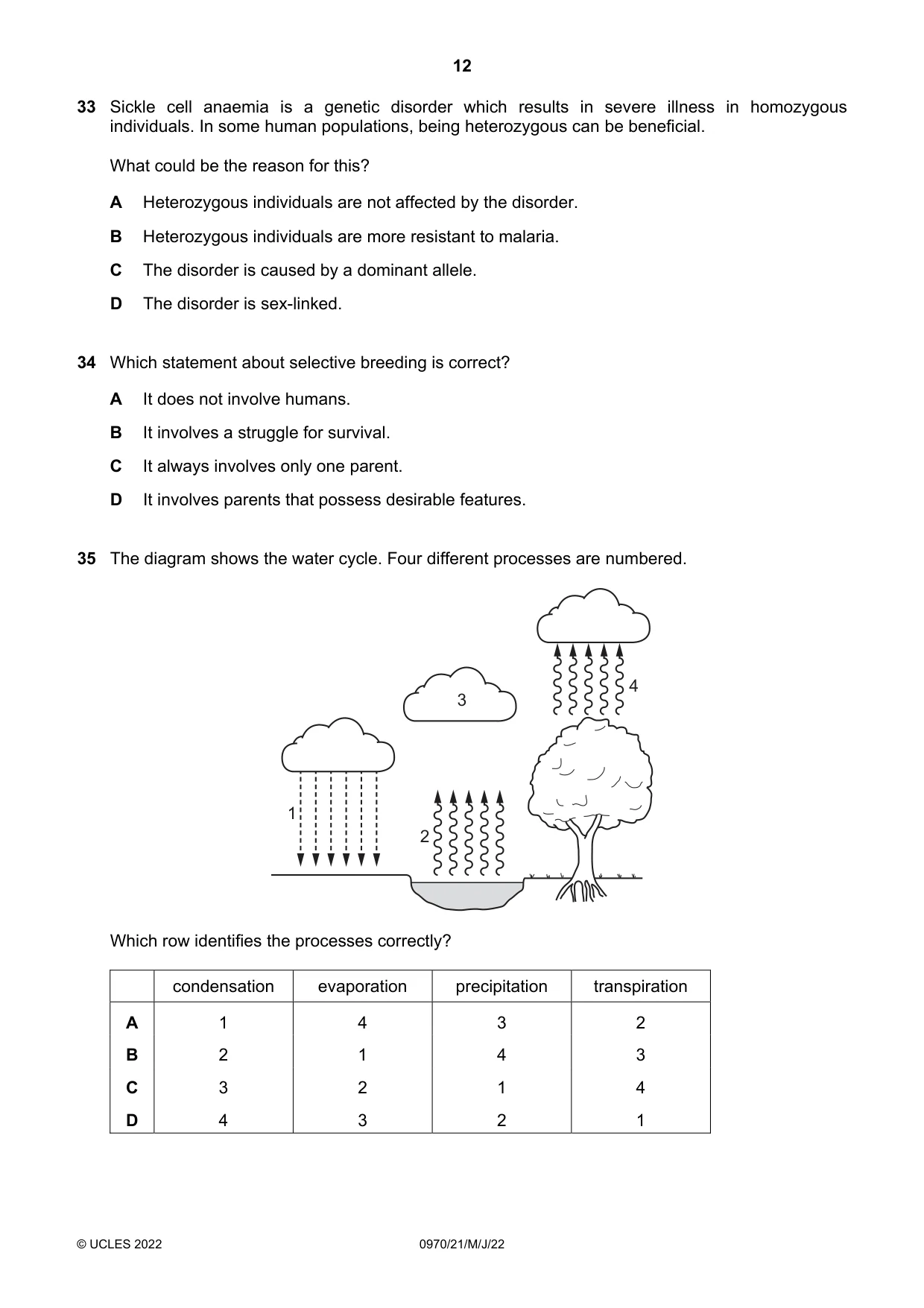
Q35 · The diagram shows the water cycle
35 The diagram shows the water cycle. Four different processes are numbered. 4 3 1 2 Which row identifies the processes correctly? condensation evaporation precipitation transpiration A 1 4 3 2 B 2 1 4 3 C 3 2 1 4 D 4 3 2 1
Mark scheme: C
Q36 · A herd of red deer live in a forest that contains snakes and a large variety of birds
36 A herd of red deer live in a forest that contains snakes and a large variety of birds. Which group of organisms is an example of a population? A all the animals in the forest B all the red deer in the forest C all the organisms in the forest D all the plants in the forest
Mark scheme: B
Q37 · With which kingdoms do bacteria share the same genetic code?
37 With which kingdoms do bacteria share the same genetic code? A animal, plant, fungus and protoctist B animal, plant and fungus only C animal and plant only D animal only
Mark scheme: A
Q38 · Which process makes use of a genetically engineered organism?
38 Which process makes use of a genetically engineered organism? A using bacteria to produce insulin B using enzymes in biological washing powders C using pectinase in fruit juice production D using yeast to produce ethanol
Mark scheme: A
Q39 · What is a reason for conserving plant species?
39 What is a reason for conserving plant species? A to absorb oxygen from the air B to decrease rainfall C to obtain drugs for medicinal use D to release carbon dioxide into the air
Mark scheme: C
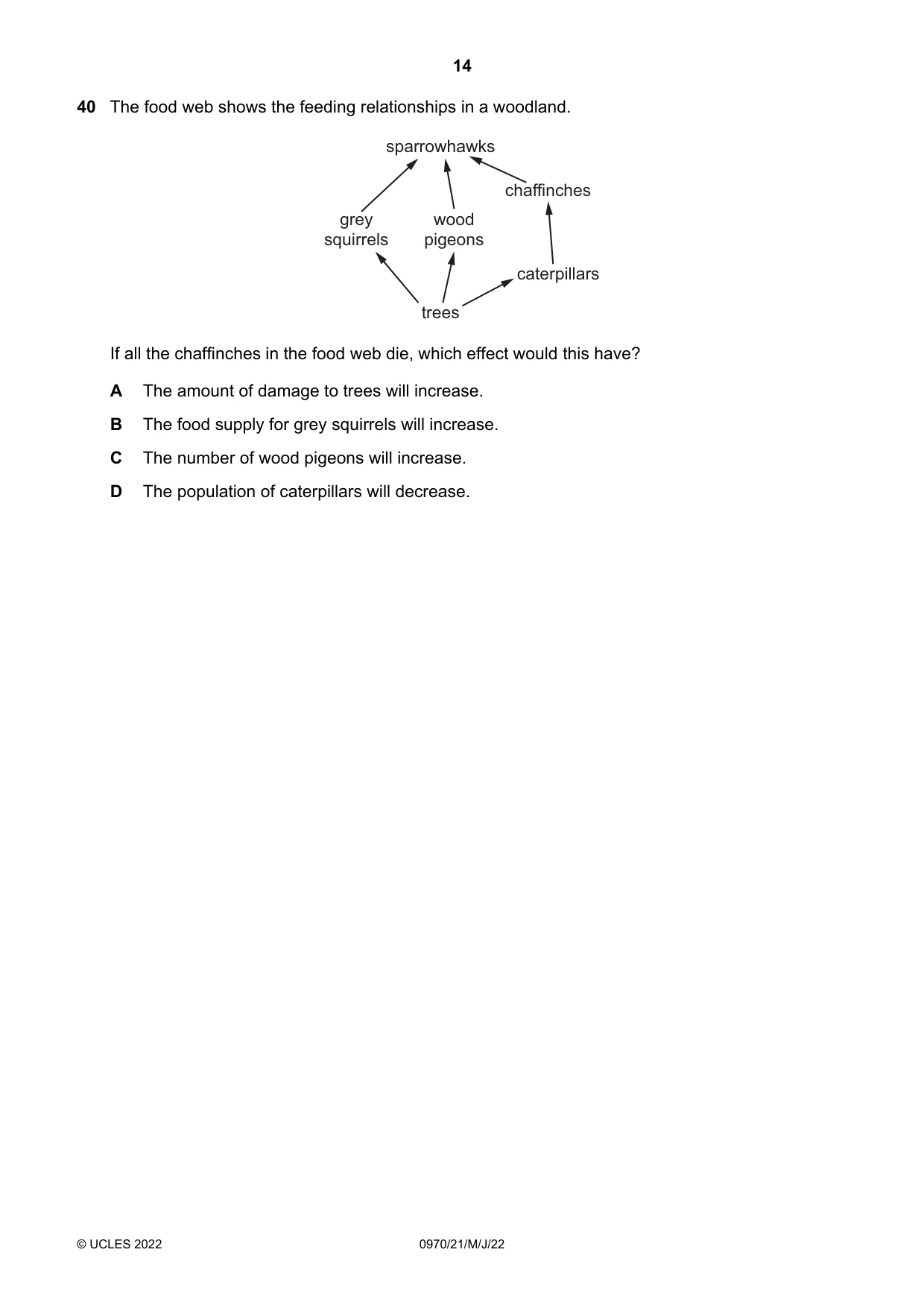
Q40 · The food web shows the feeding relationships in a woodland
40 The food web shows the feeding relationships in a woodland. sparrowhawks chaffinches grey wood squirrels pigeons caterpillars trees If all the chaffinches in the food web die, which effect would this have? A The amount of damage to trees will increase. B The food supply for grey squirrels will increase. C The number of wood pigeons will increase. D The population of caterpillars will decrease.
Mark scheme: A
What was in this paper
The subtopics covered by these 40 questions, and how many questions each got. Open one in a new tab to see every Cambridge question on it.
3Adaptive features2Chromosomes, genes and proteins2Circulatory systems2Enzymes2Features of organisms2Gas exchange in humans2Anaerobic respiration1Biological molecules1Biotechnology and genetic modification1Characteristics of living organisms1Conservation1Diet1Diffusion1Digestive system1Diseases and immunity1Excretion in humans1Food chains and food webs1Homeostasis1Leaf structure1Meiosis1Nutrient cycles1Photosynthesis1Populations1Selection1Sense organs1Sex hormones in humans1Sexual reproduction in humans1Sexual reproduction in plants1Transpiration1Tropic responses1Xylem and phloem1What you needed in this session
Cambridge’s own grade thresholds for 2022 May/June, Paper 2 · Variant 1. A higher threshold means an easier paper — the bar moves with how the cohort did.