Questions as text
Q1 · Sickle-cell anaemia is a genetic disorder which results in severe illness in homozygous… 0970/21 May/June 2018
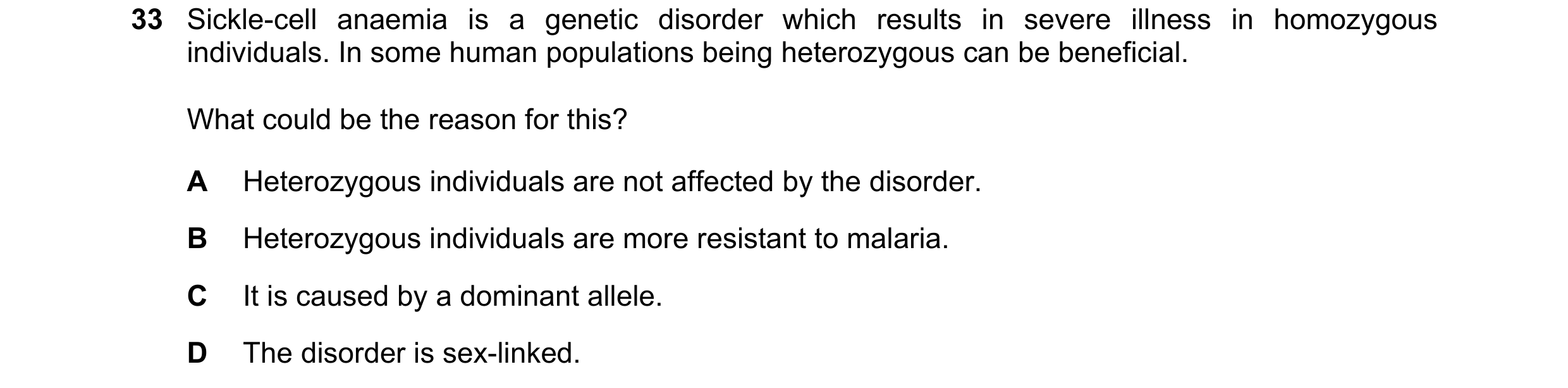
33 Sickle-cell anaemia is a genetic disorder which results in severe illness in homozygous individuals. In some human populations being heterozygous can be beneficial. What could be the reason for this? A Heterozygous individuals are not affected by the disorder. B Heterozygous individuals are more resistant to malaria. C It is caused by a dominant allele. D The disorder is sex-linked.
1 marks
Answer: B
This question in 0970/21 May/June 2018
Q2 · Which statement describes the relationship between evolution and natural selection? 0970/21 May/June 2018
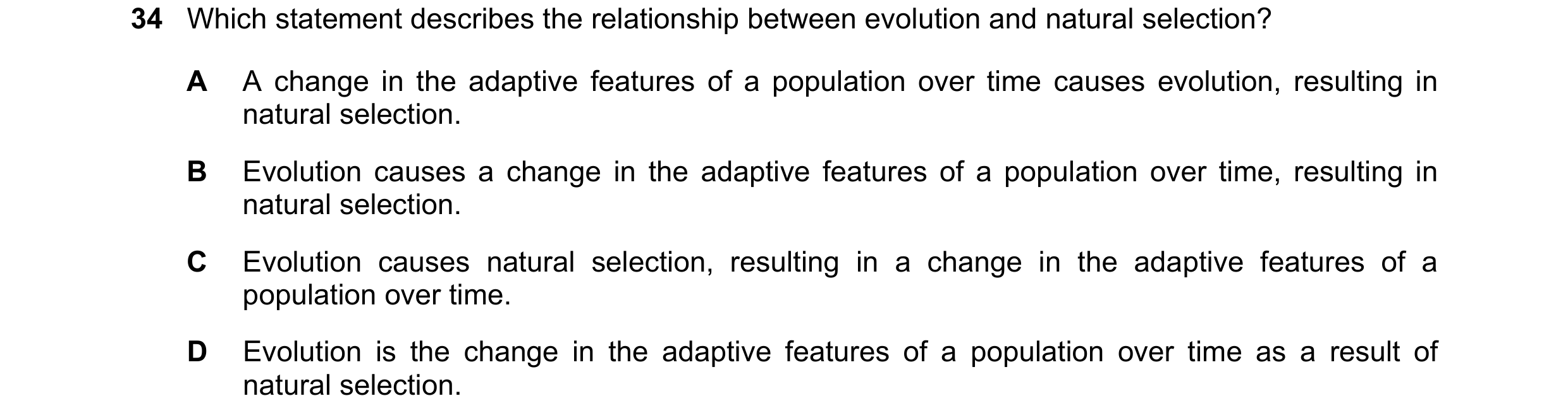
34 Which statement describes the relationship between evolution and natural selection? A A change in the adaptive features of a population over time causes evolution, resulting in natural selection. B Evolution causes a change in the adaptive features of a population over time, resulting in natural selection. C Evolution causes natural selection, resulting in a change in the adaptive features of a population over time. D Evolution is the change in the adaptive features of a population over time as a result of natural selection.
1 marks
Answer: D
This question in 0970/21 May/June 2018
Q3 · Farmers have bred Holstein-Friesian cattle to produce more milk than older breeds of… 0970/22 Oct/Nov 2018
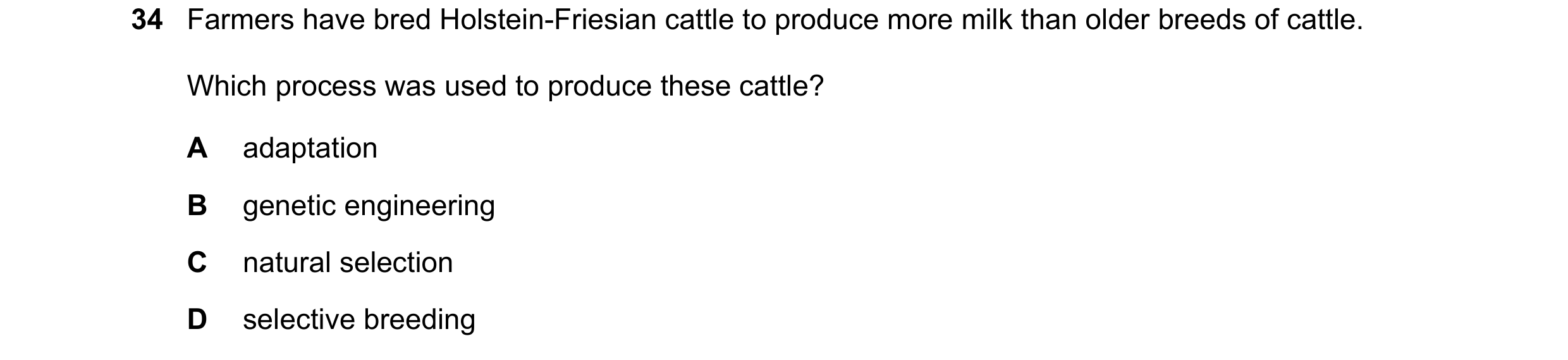
34 Farmers have bred Holstein-Friesian cattle to produce more milk than older breeds of cattle. Which process was used to produce these cattle? A adaptation B genetic engineering C natural selection D selective breeding
1 marks
Answer: D
This question in 0970/22 Oct/Nov 2018
Q4 · Why is the allele for sickle-cell anaemia common in some parts of the world? 0970/21 May/June 2019
34 Why is the allele for sickle-cell anaemia common in some parts of the world? A Malaria protects against sickle-cell anaemia. B Sickle-cell anaemia is caused by malaria. C Sickle-cell anaemia is transmitted by mosquitoes. D The sickle-cell anaemia allele protects against malaria.
1 marks
Answer: D
This question in 0970/21 May/June 2019
Q5 · Which statement describes how a species becomes adapted to its environment? 0970/21 May/June 2019
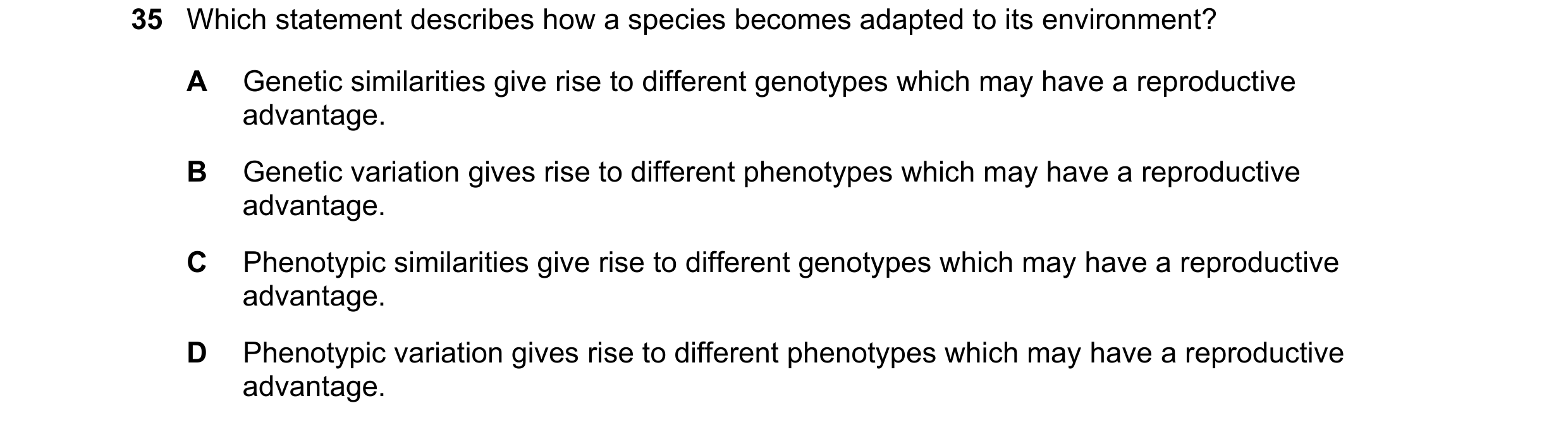
35 Which statement describes how a species becomes adapted to its environment? A Genetic similarities give rise to different genotypes which may have a reproductive advantage. B Genetic variation gives rise to different phenotypes which may have a reproductive advantage. C Phenotypic similarities give rise to different genotypes which may have a reproductive advantage. D Phenotypic variation gives rise to different phenotypes which may have a reproductive advantage.
1 marks
Answer: B
This question in 0970/21 May/June 2019
Q6 · When antibiotics are overused they become less effective 0970/22 May/June 2019
35 When antibiotics are overused they become less effective. Which statement is correct? A Artificial selection results in resistant strains of bacteria. B Patients become resistant to the antibiotic. C The antibiotic causes the bacteria to mutate. D The antibiotic does not kill resistant bacteria.
1 marks
Answer: D
This question in 0970/22 May/June 2019
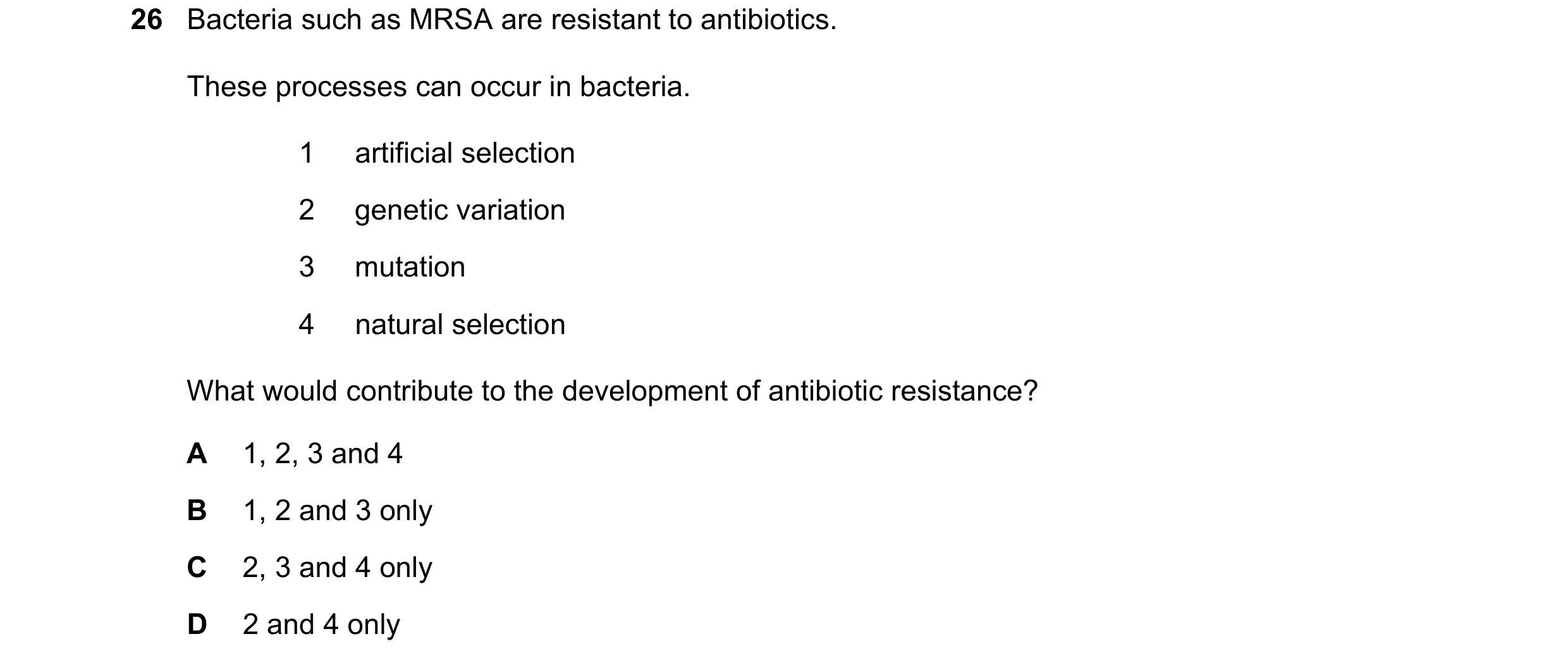
Q7 · Bacteria such as MRSA are resistant to antibiotics 0970/22 Oct/Nov 2019
26 Bacteria such as MRSA are resistant to antibiotics. These processes can occur in bacteria. 1 artificial selection 2 genetic variation 3 mutation 4 natural selection What would contribute to the development of antibiotic resistance? A 1, 2, 3 and 4 B 1, 2 and 3 only C 2, 3 and 4 only D 2 and 4 only
1 marks
Answer: C
This question in 0970/22 Oct/Nov 2019
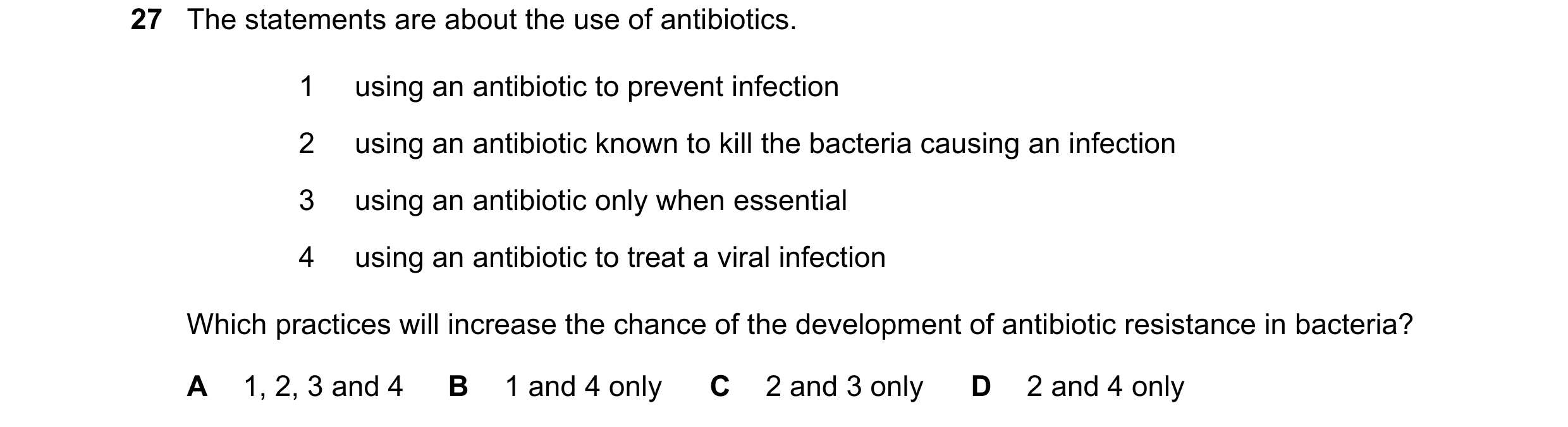
Q8 · The statements are about the use of antibiotics 0970/21 May/June 2020
27 The statements are about the use of antibiotics. 1 using an antibiotic to prevent infection 2 using an antibiotic known to kill the bacteria causing an infection 3 using an antibiotic only when essential 4 using an antibiotic to treat a viral infection Which practices will increase the chance of the development of antibiotic resistance in bacteria? A 1, 2, 3 and 4 B 1 and 4 only C 2 and 3 only D 2 and 4 only
1 marks
Answer: B
This question in 0970/21 May/June 2020
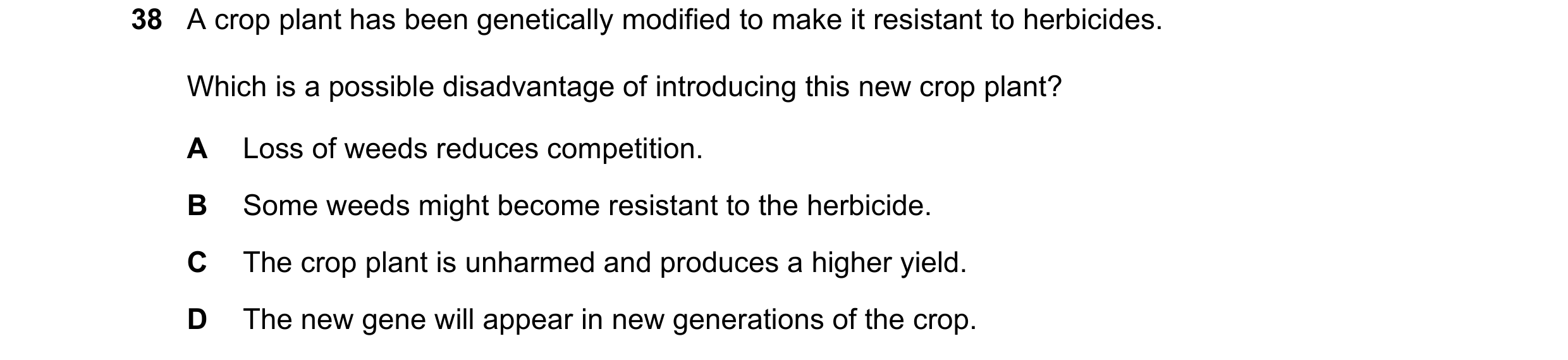
Q9 · A crop plant has been genetically modified to make it resistant to herbicides 0970/21 May/June 2020
38 A crop plant has been genetically modified to make it resistant to herbicides. Which is a possible disadvantage of introducing this new crop plant? A Loss of weeds reduces competition. B Some weeds might become resistant to the herbicide. C The crop plant is unharmed and produces a higher yield. D The new gene will appear in new generations of the crop.
1 marks
Answer: B
This question in 0970/21 May/June 2020
Q10 · A crop plant has been genetically modified to make it resistant to herbicides 0970/22 May/June 2020
38 A crop plant has been genetically modified to make it resistant to herbicides. Which is a possible disadvantage of introducing this new crop plant? A Loss of weeds reduces competition. B Some weeds might become resistant to the herbicide. C The crop plant is unharmed and produces a higher yield. D The new gene will appear in new generations of the crop.
1 marks
Answer: B
This question in 0970/22 May/June 2020
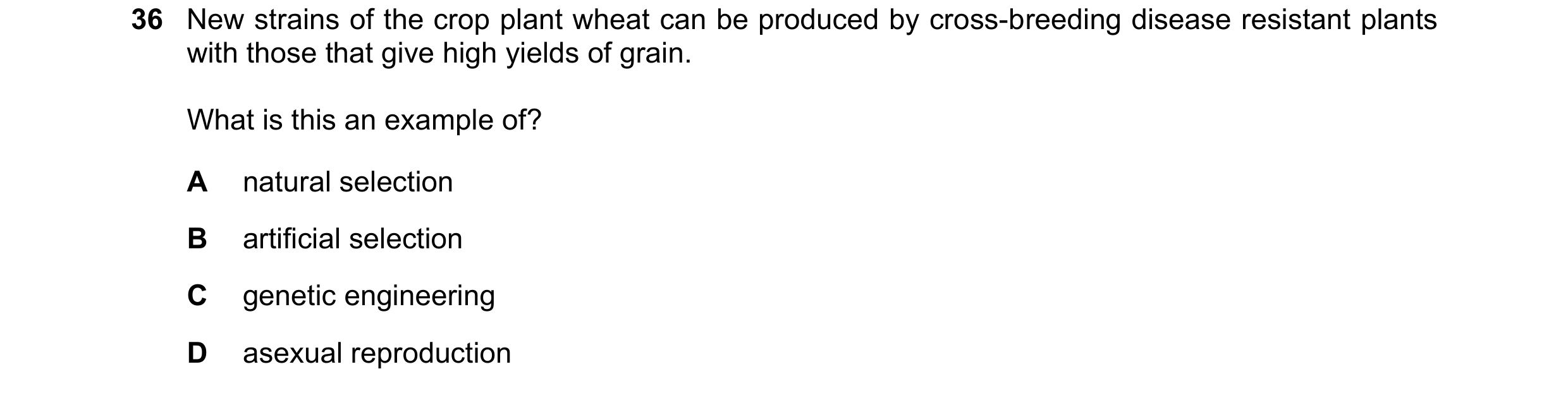
Q11 · New strains of the crop plant wheat can be produced by cross-breeding disease resistant… 0970/21 May/June 2021
36 New strains of the crop plant wheat can be produced by cross-breeding disease resistant plants with those that give high yields of grain. What is this an example of? A natural selection B artificial selection C genetic engineering D asexual reproduction
1 marks
Answer: B
This question in 0970/21 May/June 2021
Q12 · What occurs as a result of artificial selection? 0970/22 May/June 2021
36 What occurs as a result of artificial selection? A antibiotic resistance in bacteria B disease resistant crops C presence of roots in cactus plants D sickle cell anaemia
1 marks
Answer: B
This question in 0970/22 May/June 2021
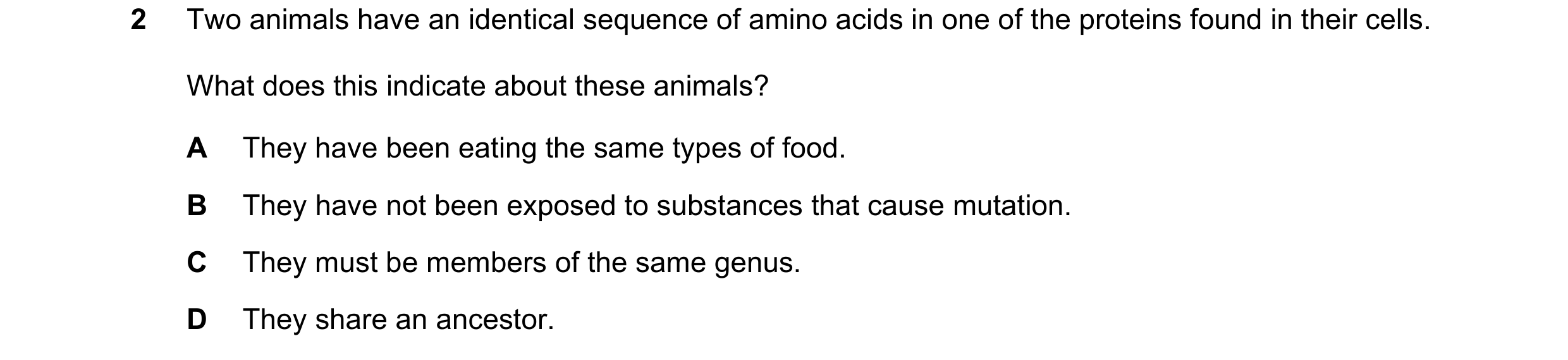
Q13 · Two animals have an identical sequence of amino acids in one of the proteins found in… 0970/22 Oct/Nov 2021
2 Two animals have an identical sequence of amino acids in one of the proteins found in their cells. What does this indicate about these animals? A They have been eating the same types of food. B They have not been exposed to substances that cause mutation. C They must be members of the same genus. D They share an ancestor.
1 marks
Answer: D
This question in 0970/22 Oct/Nov 2021
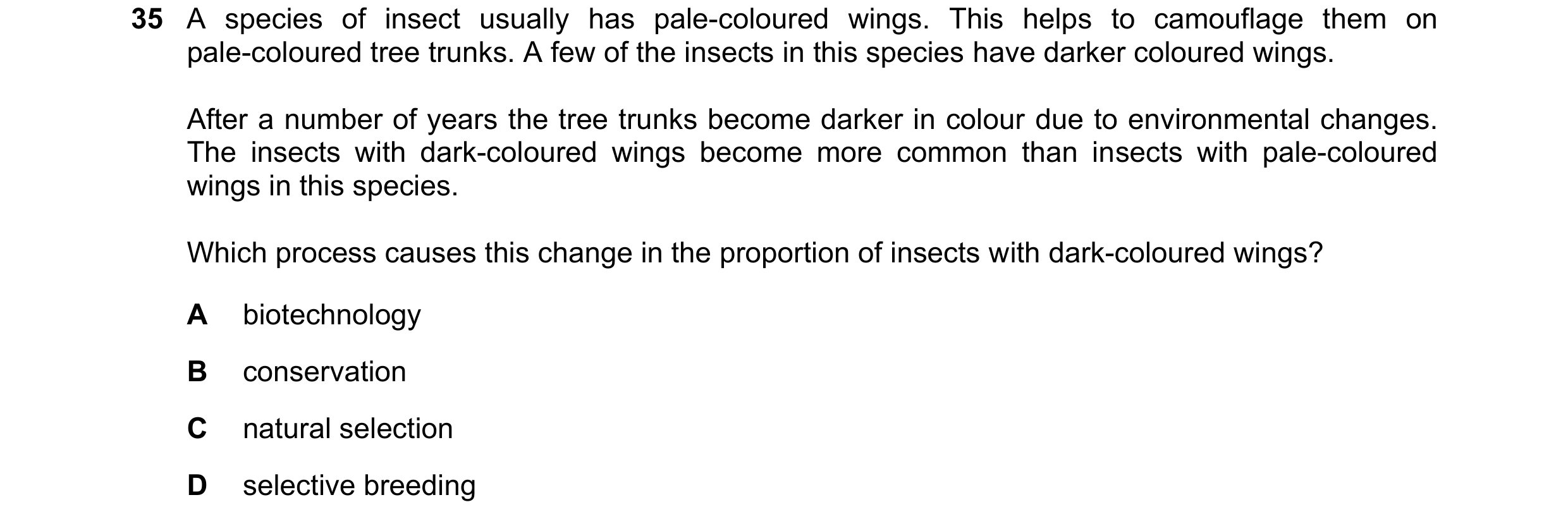
Q14 · A species of insect usually has pale-coloured wings 0970/22 Oct/Nov 2021
35 A species of insect usually has pale-coloured wings. This helps to camouflage them on pale-coloured tree trunks. A few of the insects in this species have darker coloured wings. After a number of years the tree trunks become darker in colour due to environmental changes. The insects with dark-coloured wings become more common than insects with pale-coloured wings in this species. Which process causes this change in the proportion of insects with dark-coloured wings? A biotechnology B conservation C natural selection D selective breeding
1 marks
Answer: C
This question in 0970/22 Oct/Nov 2021
Q15 · Which statement about selective breeding is correct? 0970/21 May/June 2022
34 Which statement about selective breeding is correct? A It does not involve humans. B It involves a struggle for survival. C It always involves only one parent. D It involves parents that possess desirable features.
1 marks
Answer: D
This question in 0970/21 May/June 2022
Q16 · Which statement about selective breeding is correct? 0970/22 May/June 2022
34 Which statement about selective breeding is correct? A It does not involve humans. B It involves a struggle for survival. C It always involves only one parent. D It involves parents that possess desirable features.
1 marks
Answer: D
This question in 0970/22 May/June 2022
Q17 · What is an example of evolution? 0970/22 Oct/Nov 2022
34 What is an example of evolution? A the genetic engineering of bacteria to produce human insulin B the development of antibiotic-resistant bacteria C the changes made to livestock as a result of artificial selection D the production of lactose-free milk
1 marks
Answer: B
This question in 0970/22 Oct/Nov 2022
Q18 · What is a correct statement about antibiotics? 0970/21 May/June 2023
27 What is a correct statement about antibiotics? A Bacteria may become resistant to antibiotics as a result of artificial selection. B Bacteria may become resistant to antibiotics as a result of natural selection. C Viruses may become resistant to antibiotics as a result of artificial selection. D Viruses may become resistant to antibiotics as a result of natural selection.
1 marks
Answer: B
This question in 0970/21 May/June 2023
Q19 · The photograph shows a species of fish called a leafy sea-dragon 0970/21 May/June 2024
36 The photograph shows a species of fish called a leafy sea-dragon. Leafy sea-dragons live in areas of the sea where seaweed is present. Which statements explain how natural selection caused the leafy sea-dragon species to develop? 1 Leafy sea-dragons that looked like seaweed were better adapted to their environment. 2 Leafy sea-dragons that survived passed on the allele for their appearance to their offspring. 3 Humans selected leafy sea-dragons that looked like seaweed. A 1, 2 and 3 B 1 and 2 only C 1 and 3 only D 2 and 3 only
1 marks
Answer: B
This question in 0970/21 May/June 2024
Q20 · Bacteria such as MRSA are resistant to antibiotics 0970/22 Oct/Nov 2024
29 Bacteria such as MRSA are resistant to antibiotics. These processes can occur in bacteria. 1 artificial selection 2 genetic variation 3 mutation 4 natural selection Which processes lead to the development of antibiotic resistance? A 1, 2, 3 and 4 B 1, 2 and 3 only C 2, 3 and 4 only D 2 and 4 only
1 marks
Answer: C
This question in 0970/22 Oct/Nov 2024
Q21 · Which row correctly describes a type of selection? 0970/21 May/June 2025
33 Which row correctly describes a type of selection? type of humans example selection involved A artificial no production of farmed animals that produce lots of milk B artificial yes production of bacteria that are resistant to antibiotics C natural yes production of insulin through genetic modification of bacteria D natural no production of wild animals with long necks to reach tree leaves as a food source
1 marks
Answer: D
This question in 0970/21 May/June 2025
Q22 · How does artificial selection differ from natural selection? 0970/22 May/June 2025
33 How does artificial selection differ from natural selection? A Artificial selection changes the characteristics of living things. B Artificial selection is based on genetic variation. C Artificial selection does not involve competition for resources. D Artificial selection occurs over many generations.
1 marks
Answer: C
This question in 0970/22 May/June 2025

 1 / 6
1 / 6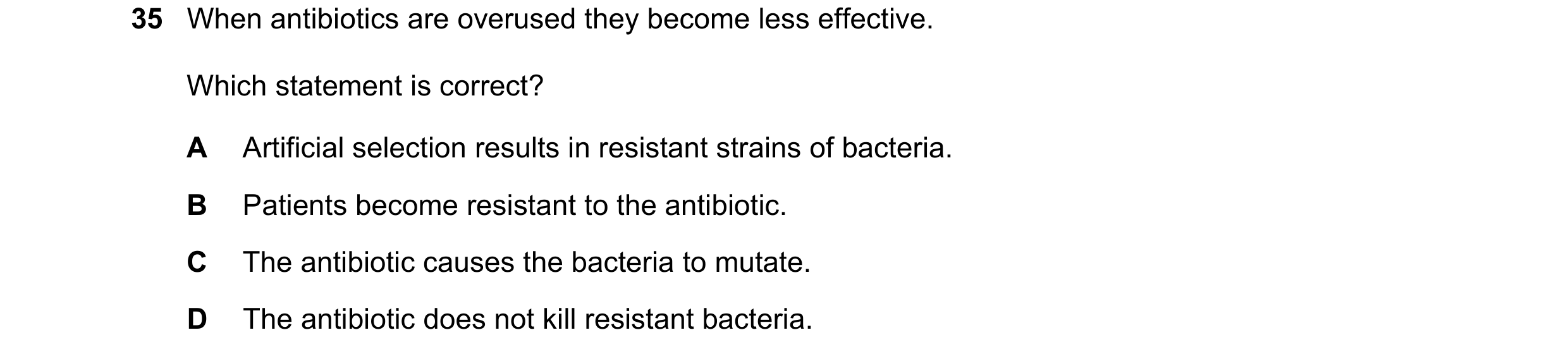
 2 / 6
2 / 6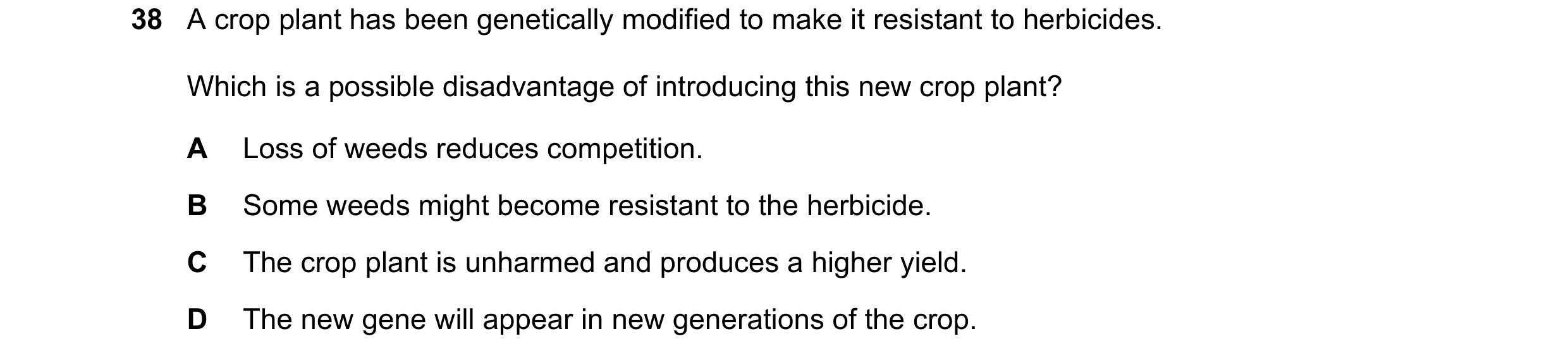

 3 / 6
3 / 6


 4 / 6
4 / 6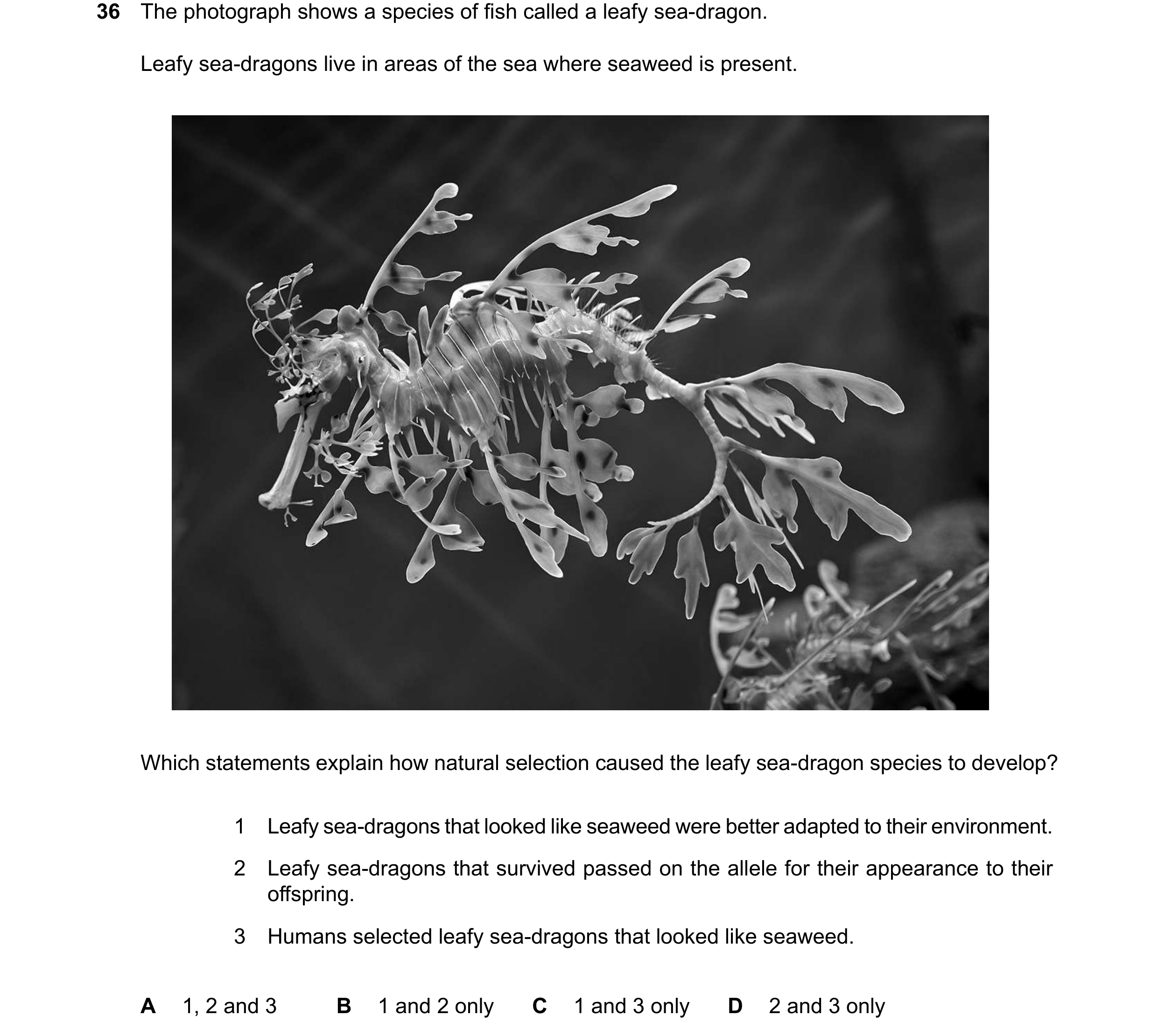
 5 / 6
5 / 6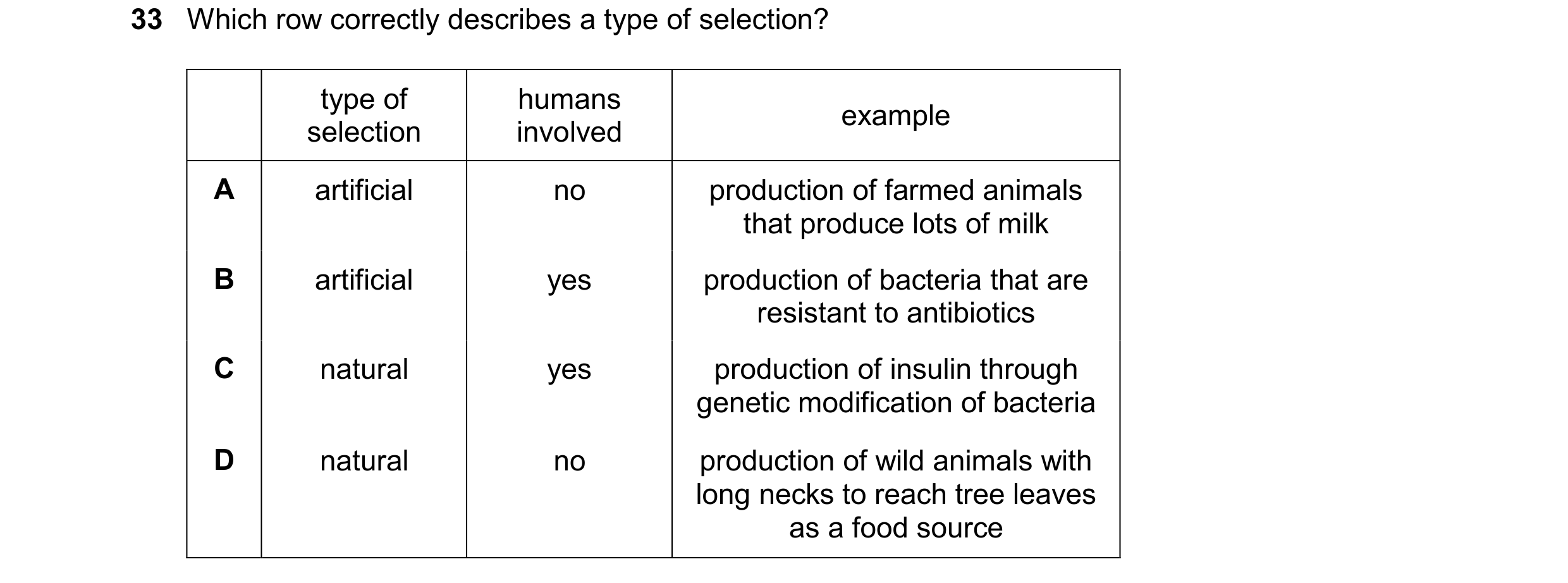
 6 / 6
6 / 6