Questions as text
Q1 · Farmers have bred Holstein-Friesian cattle to produce more milk than older breeds of… 0970/12 Oct/Nov 2018
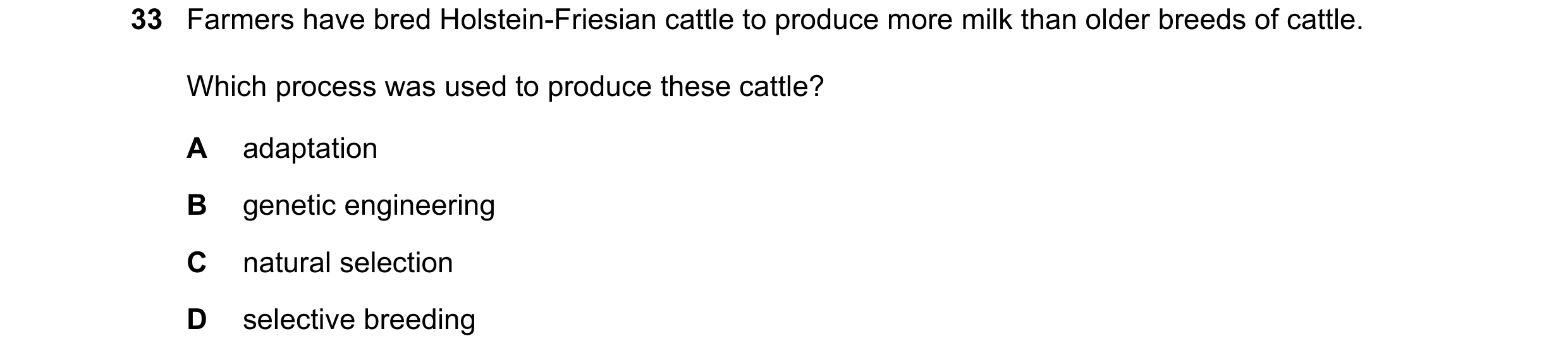
33 Farmers have bred Holstein-Friesian cattle to produce more milk than older breeds of cattle. Which process was used to produce these cattle? A adaptation B genetic engineering C natural selection D selective breeding
1 marks
Answer: D
This question in 0970/12 Oct/Nov 2018
Q2 · When is evolution by natural selection most likely to occur? 0970/11 May/June 2019
35 When is evolution by natural selection most likely to occur? A when there is a stable population of predators B when there is a stable environment C when there is less variation in the population D when there is more variation in the population
1 marks
Answer: D
This question in 0970/11 May/June 2019
Q3 · The statements describe aspects of selective breeding and natural selection 0970/12 Oct/Nov 2019
34 The statements describe aspects of selective breeding and natural selection. Which statement applies only to selective breeding? A Humans select individuals which have desirable features. B Individuals pass their alleles to the next generation. C There may be a large number of offspring produced. D There is variation between individual offspring.
1 marks
Answer: A
This question in 0970/12 Oct/Nov 2019
Q4 · A crop plant has been genetically modified to make it resistant to herbicides 0970/11 May/June 2020
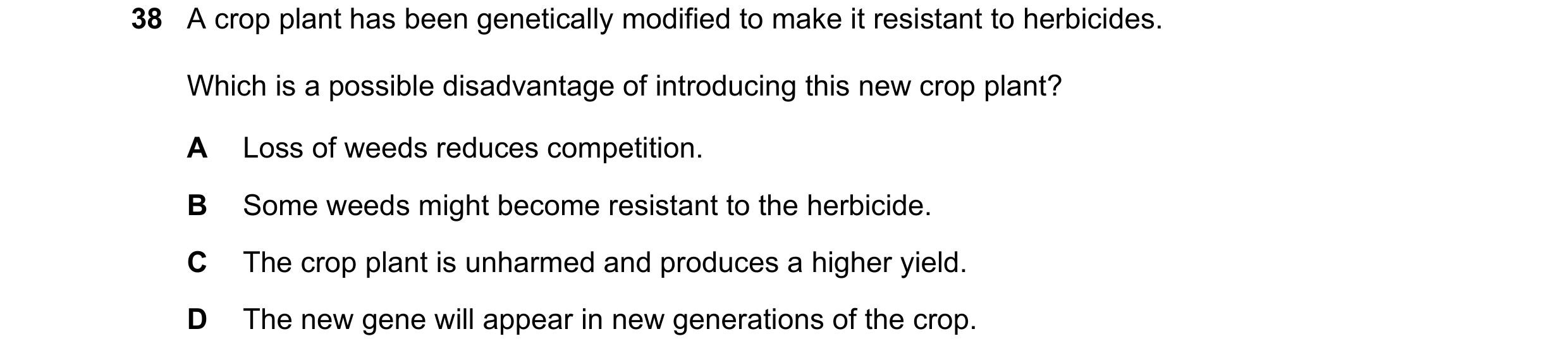
38 A crop plant has been genetically modified to make it resistant to herbicides. Which is a possible disadvantage of introducing this new crop plant? A Loss of weeds reduces competition. B Some weeds might become resistant to the herbicide. C The crop plant is unharmed and produces a higher yield. D The new gene will appear in new generations of the crop.
1 marks
Answer: B
This question in 0970/11 May/June 2020
Q5 · A crop plant has been genetically modified to make it resistant to herbicides 0970/12 May/June 2020
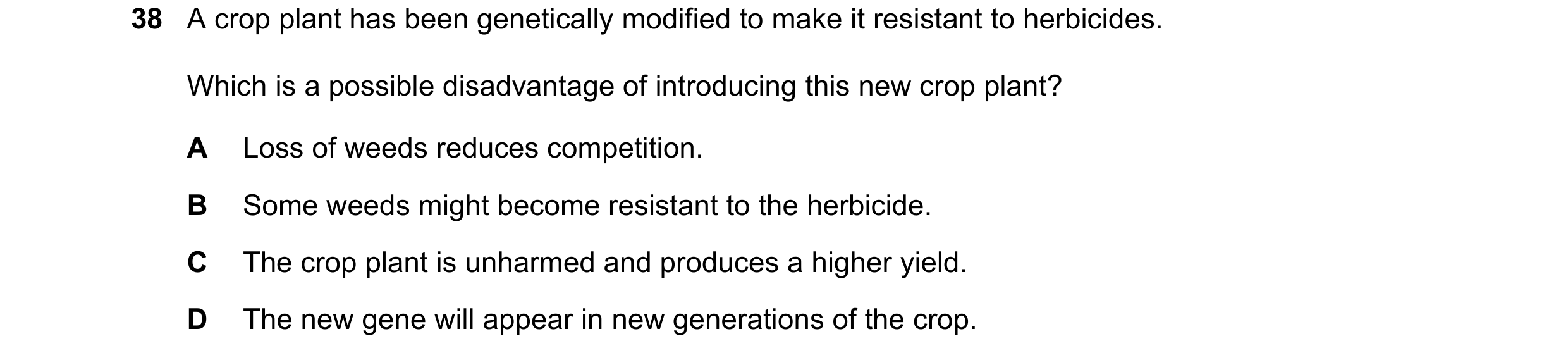
38 A crop plant has been genetically modified to make it resistant to herbicides. Which is a possible disadvantage of introducing this new crop plant? A Loss of weeds reduces competition. B Some weeds might become resistant to the herbicide. C The crop plant is unharmed and produces a higher yield. D The new gene will appear in new generations of the crop.
1 marks
Answer: B
This question in 0970/12 May/June 2020
Q6 · A species of insect usually has pale-coloured wings 0970/12 Oct/Nov 2021
35 A species of insect usually has pale-coloured wings. This helps to camouflage them on pale-coloured tree trunks. A few of the insects in this species have darker coloured wings. After a number of years the tree trunks become darker in colour due to environmental changes. The insects with dark-coloured wings become more common than insects with pale-coloured wings in this species. Which process causes this change in the proportion of insects with dark-coloured wings? A biotechnology B conservation C natural selection D selective breeding
1 marks
Answer: C
This question in 0970/12 Oct/Nov 2021
Q7 · Which statement about selective breeding is correct? 0970/11 May/June 2022
35 Which statement about selective breeding is correct? A It does not involve humans. B It involves a struggle for survival. C It always involves only one parent. D It involves parents that possess desirable features.
1 marks
Answer: D
This question in 0970/11 May/June 2022
Q8 · Which statement about selective breeding is correct? 0970/12 May/June 2022
35 Which statement about selective breeding is correct? A It does not involve humans. B It involves a struggle for survival. C It always involves only one parent. D It involves parents that possess desirable features.
1 marks
Answer: D
This question in 0970/12 May/June 2022
Q9 · The list shows statements about selection 0970/11 May/June 2024
36 The list shows statements about selection. 1 Individuals reproduce and pass on their alleles to the next generation. 2 Genetic variation exists between individuals and many offspring are produced. 3 Individuals struggle for survival and compete for resources. 4 Individuals that are better adapted to the environment survive. 5 Individuals with desirable features are selected by humans. Which statements are correct descriptions of natural selection? A 1, 2, 3 and 4 B 1, 2 and 5 only C 2, 3 and 4 only D 3, 4 and 5 only
1 marks
Answer: A
This question in 0970/11 May/June 2024
Q10 · The graph shows how the percentage effectiveness of antibiotic F against MRSA bacteria… 0970/12 May/June 2024
28 The graph shows how the percentage effectiveness of antibiotic F against MRSA bacteria varied between 1980 and 2000. 100 90 80 percentage effectiveness of antibiotic F 70 against MRSA 60 50 40 1980 1990 2000 time / year What is a correct conclusion from the graph? A Antibiotic F was completely ineffective against MRSA in 2000. B Antibiotic F was most effective in 1982. C MRSA developed resistance to antibiotic F between 1981 and 2000. D The greatest decrease in effectiveness of antibiotic F against MRSA was between 1988 and 1990.
1 marks
Answer: C
This question in 0970/12 May/June 2024
Q11 · Giraffes are mammals that have long necks 0970/11 May/June 2025
34 Giraffes are mammals that have long necks. This enables them to eat leaves from tall trees. One theory to explain how giraffes developed long necks is natural selection. Which statement is part of the explanation for the development of long necks in giraffes by natural selection? A Giraffes with longer necks were better adapted to the environment than giraffes with shorter necks. B Humans selected giraffes with the longest necks and bred them together. C There was no competition for food. D There were no trees in the environment.
1 marks
Answer: A
This question in 0970/11 May/June 2025


 1 / 3
1 / 3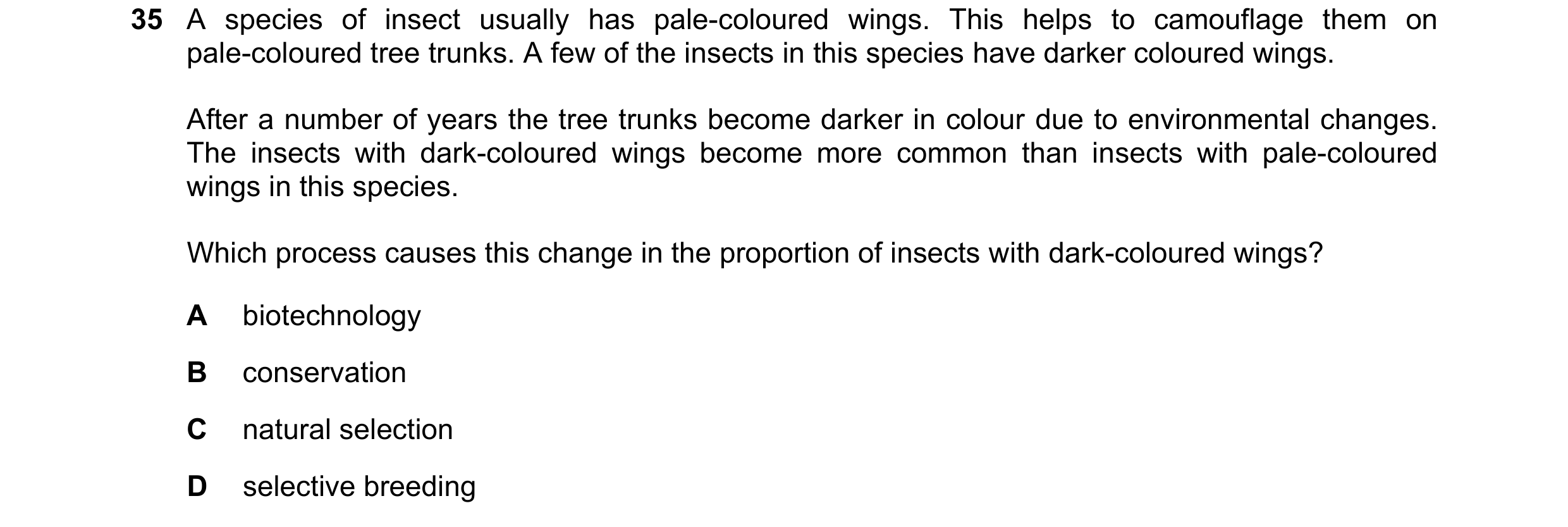


 2 / 3
2 / 3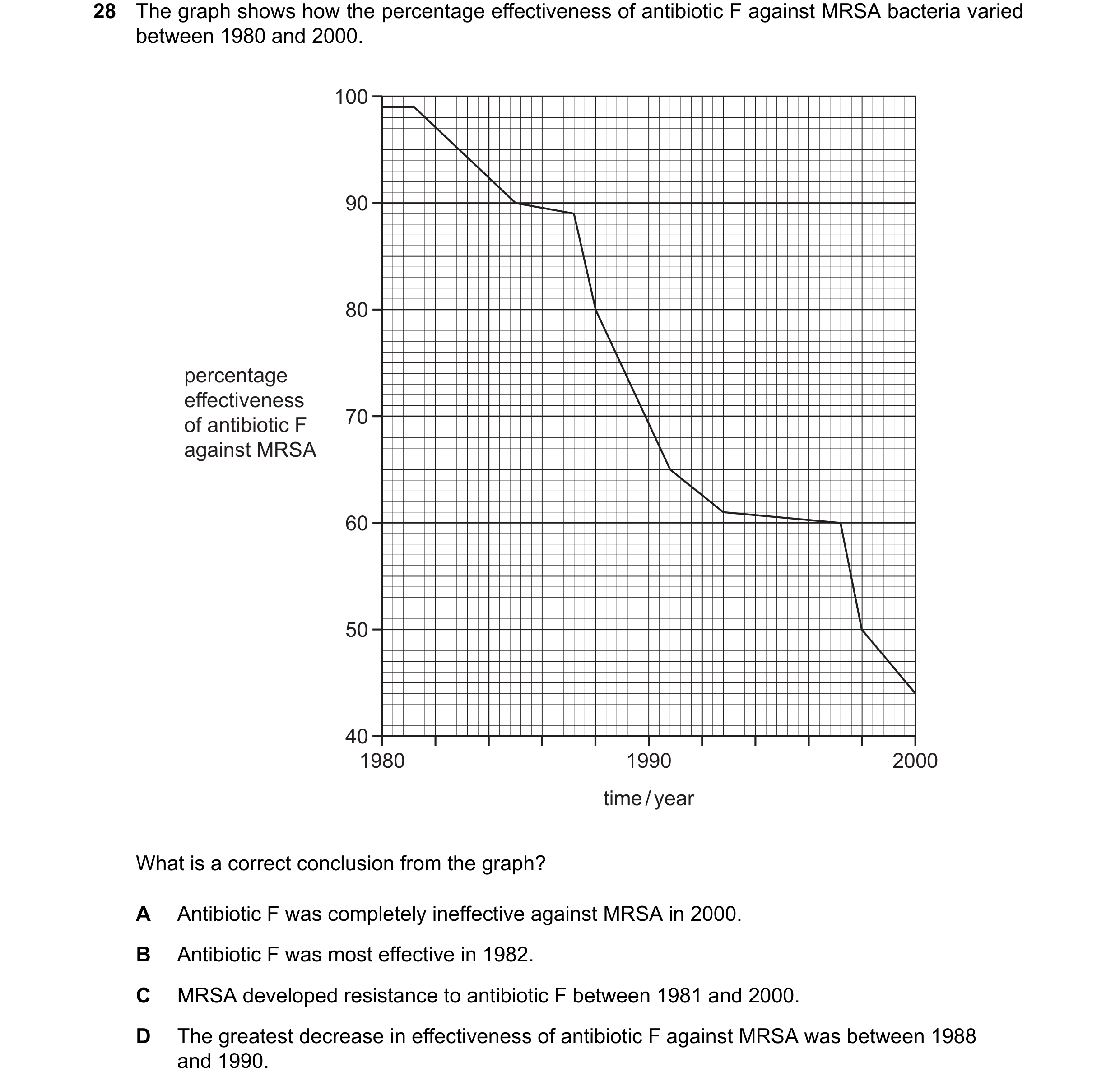
 3 / 3
3 / 3