Questions as text
Q1 · Sickle-cell anaemia is a genetic disorder which results in severe illness in homozygous… 0970/21 May/June 2018
33 Sickle-cell anaemia is a genetic disorder which results in severe illness in homozygous individuals. In some human populations being heterozygous can be beneficial. What could be the reason for this? A Heterozygous individuals are not affected by the disorder. B Heterozygous individuals are more resistant to malaria. C It is caused by a dominant allele. D The disorder is sex-linked.
1 marks
Answer: B
This question in 0970/21 May/June 2018
Q2 · Which statement describes the relationship between evolution and natural selection? 0970/21 May/June 2018
34 Which statement describes the relationship between evolution and natural selection? A A change in the adaptive features of a population over time causes evolution, resulting in natural selection. B Evolution causes a change in the adaptive features of a population over time, resulting in natural selection. C Evolution causes natural selection, resulting in a change in the adaptive features of a population over time. D Evolution is the change in the adaptive features of a population over time as a result of natural selection.
1 marks
Answer: D
This question in 0970/21 May/June 2018
Q3 · What are two adaptive features of a human sperm cell? 0970/22 Oct/Nov 2018
27 What are two adaptive features of a human sperm cell? 1 jelly coat present 2 relatively high number of mitochondria 3 acrosome present 4 relatively high energy stores A 1 and 2 B 1 and 4 C 2 and 3 D 3 and 4
1 marks
Answer: C
This question in 0970/22 Oct/Nov 2018
Q4 · Why is the allele for sickle-cell anaemia common in some parts of the world? 0970/21 May/June 2019
34 Why is the allele for sickle-cell anaemia common in some parts of the world? A Malaria protects against sickle-cell anaemia. B Sickle-cell anaemia is caused by malaria. C Sickle-cell anaemia is transmitted by mosquitoes. D The sickle-cell anaemia allele protects against malaria.
1 marks
Answer: D
This question in 0970/21 May/June 2019
Q5 · Which statement describes how a species becomes adapted to its environment? 0970/21 May/June 2019
35 Which statement describes how a species becomes adapted to its environment? A Genetic similarities give rise to different genotypes which may have a reproductive advantage. B Genetic variation gives rise to different phenotypes which may have a reproductive advantage. C Phenotypic similarities give rise to different genotypes which may have a reproductive advantage. D Phenotypic variation gives rise to different phenotypes which may have a reproductive advantage.
1 marks
Answer: B
This question in 0970/21 May/June 2019
Q6 · Which statement is correct? 0970/22 May/June 2019
34 Which statement is correct? A People who are heterozygous for the sickle-cell allele have a resistance to malaria. B Sickle-cell anaemia is caused by a change in the amino acid sequence of the haemoglobin gene. C Sickle-cell anaemia is caused by both genetic and environmental factors interacting. D The sickle-cell allele is rare in human populations in areas where there is malaria.
1 marks
Answer: A
This question in 0970/22 May/June 2019
Q7 · What is a feature of some xerophytes? 0970/22 Oct/Nov 2019
33 What is a feature of some xerophytes? A large air spaces in the tissues B leaves rolled up and covered with hairs C leaves with stomata on the upper surface D thin cuticle
1 marks
Answer: B
This question in 0970/22 Oct/Nov 2019
Q8 · Which adaptation may be present in a xerophyte? 0970/21 May/June 2020
34 Which adaptation may be present in a xerophyte? A leaves with small surface area and large numbers of stomata B little or no xylem tissue and leaves with large surface area C stomatal hairs and rolled leaves D thin or no cuticle and deep roots
1 marks
Answer: C
This question in 0970/21 May/June 2020
Q9 · Which adaptation may be present in a xerophyte? 0970/22 May/June 2020
34 Which adaptation may be present in a xerophyte? A leaves with small surface area and large numbers of stomata B little or no xylem tissue and leaves with large surface area C stomatal hairs and rolled leaves D thin or no cuticle and deep roots
1 marks
Answer: C
This question in 0970/22 May/June 2020
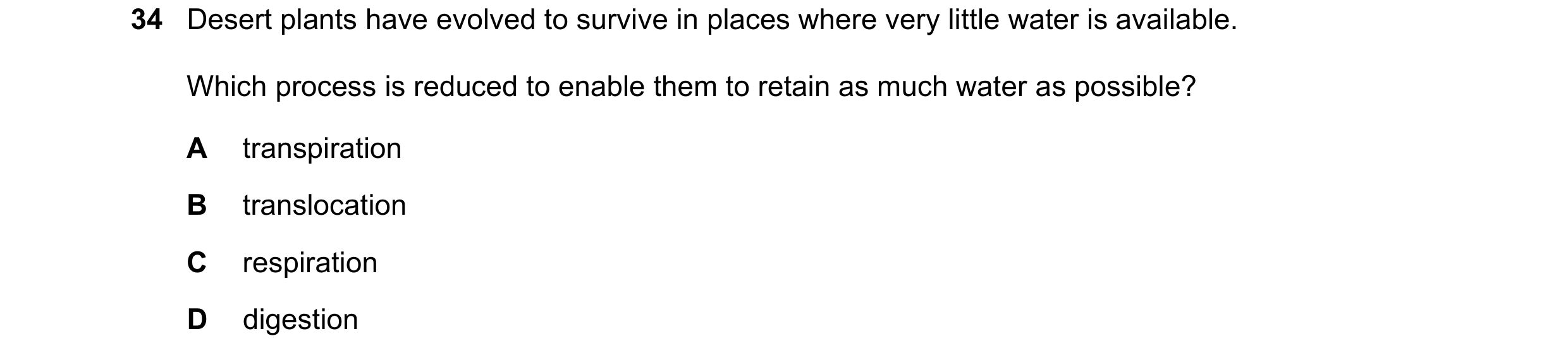
Q10 · Desert plants have evolved to survive in places where very little water is available 0970/22 Oct/Nov 2020
34 Desert plants have evolved to survive in places where very little water is available. Which process is reduced to enable them to retain as much water as possible? A transpiration B translocation C respiration D digestion
1 marks
Answer: A
This question in 0970/22 Oct/Nov 2020
Q11 · Which feature would help a plant to survive in a dry environment? 0970/22 May/June 2021
35 Which feature would help a plant to survive in a dry environment? A large leaves B many stomata C small roots D thick waxy cuticle
1 marks
Answer: D
This question in 0970/22 May/June 2021
Q12 · What is an adaptive feature of xerophytes? 0970/22 Oct/Nov 2021
33 What is an adaptive feature of xerophytes? A They do not have root hair cells. B Their leaves have a large surface area. C They have many stomata. D Their leaves have thick cuticles.
1 marks
Answer: D
This question in 0970/22 Oct/Nov 2021
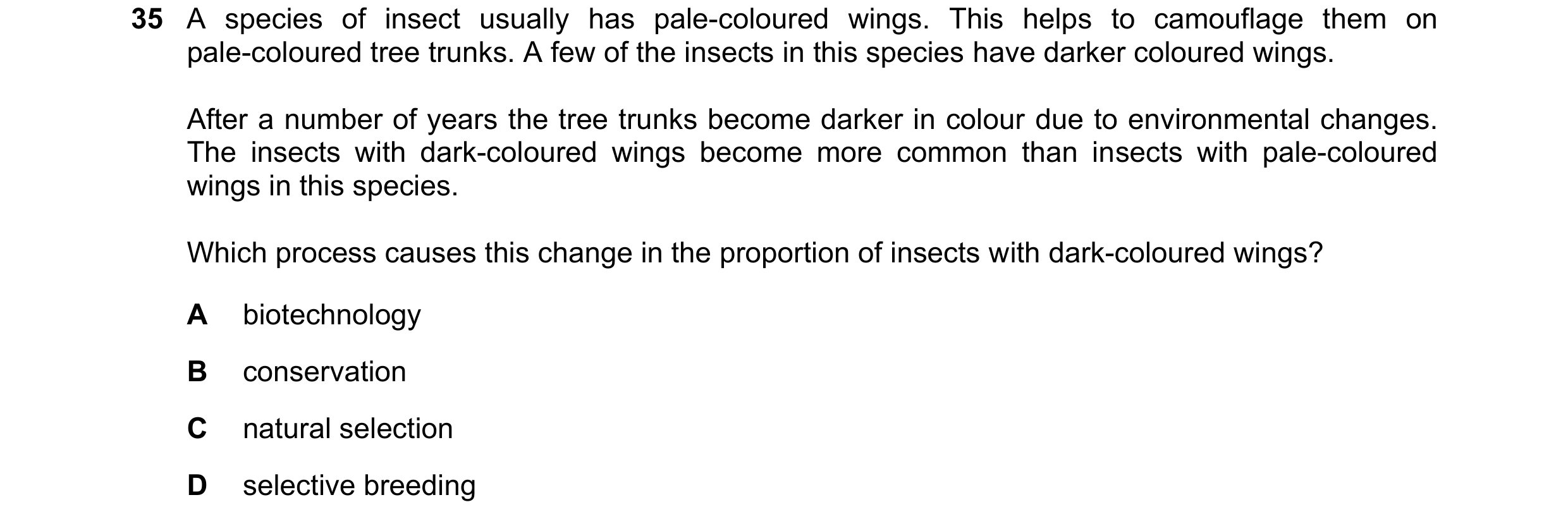
Q13 · A species of insect usually has pale-coloured wings 0970/22 Oct/Nov 2021
35 A species of insect usually has pale-coloured wings. This helps to camouflage them on pale-coloured tree trunks. A few of the insects in this species have darker coloured wings. After a number of years the tree trunks become darker in colour due to environmental changes. The insects with dark-coloured wings become more common than insects with pale-coloured wings in this species. Which process causes this change in the proportion of insects with dark-coloured wings? A biotechnology B conservation C natural selection D selective breeding
1 marks
Answer: C
This question in 0970/22 Oct/Nov 2021
Q14 · Which adaptation is shown in the leaves of hydrophytes? 0970/21 May/June 2022
32 Which adaptation is shown in the leaves of hydrophytes? A hairs present on the upper and lower surfaces B contain large air spaces C stomata present on the lower surface only D thick cuticle present on the upper and lower surfaces
1 marks
Answer: B
This question in 0970/21 May/June 2022
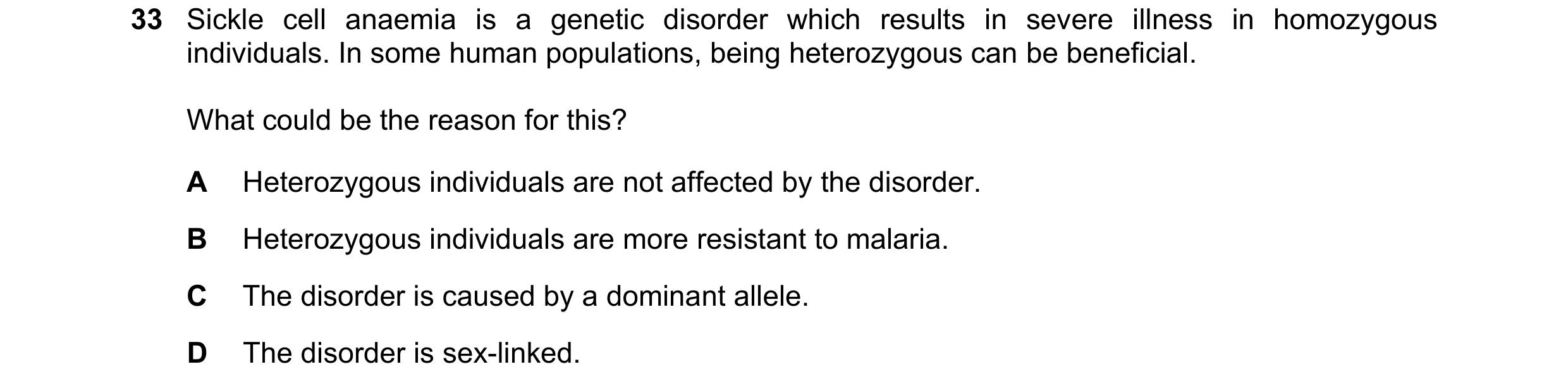
Q15 · Sickle cell anaemia is a genetic disorder which results in severe illness in homozygous… 0970/21 May/June 2022
33 Sickle cell anaemia is a genetic disorder which results in severe illness in homozygous individuals. In some human populations, being heterozygous can be beneficial. What could be the reason for this? A Heterozygous individuals are not affected by the disorder. B Heterozygous individuals are more resistant to malaria. C The disorder is caused by a dominant allele. D The disorder is sex-linked.
1 marks
Answer: B
This question in 0970/21 May/June 2022
Q16 · What is an adaptive feature of sperm? 0970/22 May/June 2022
27 What is an adaptive feature of sperm? A large stores of energy B enzymes in the acrosome C jelly coating that changes after fertilisation D diploid nucleus
1 marks
Answer: B
This question in 0970/22 May/June 2022
Q17 · The diagram shows a hydrophyte 0970/22 May/June 2022
32 The diagram shows a hydrophyte. air water soil What is an adaptive feature of this hydrophyte? A no stomata on the upper surface or the lower surface of the leaves B a network of large air spaces inside the leaves C leaf stalks containing many xylem vessels for support D a thick waxy cuticle on the lower surface of the leaves
1 marks
Answer: B
This question in 0970/22 May/June 2022
Q18 · Sickle cell anaemia is a genetic disorder which results in severe illness in homozygous… 0970/22 May/June 2022
33 Sickle cell anaemia is a genetic disorder which results in severe illness in homozygous individuals. In some human populations, being heterozygous can be beneficial. What could be the reason for this? A Heterozygous individuals are not affected by the disorder. B Heterozygous individuals are more resistant to malaria. C The disorder is caused by a dominant allele. D The disorder is sex-linked.
1 marks
Answer: B
This question in 0970/22 May/June 2022
Q19 · Which feature is a leaf adaptation for a xerophyte? 0970/22 Oct/Nov 2022
33 Which feature is a leaf adaptation for a xerophyte? A hair-like structures on the leaves B large surface area C many stomata D thin waxy cuticle
1 marks
Answer: A
This question in 0970/22 Oct/Nov 2022
Q20 · Which adaptation may be present in a xerophyte? 0970/21 May/June 2023
34 Which adaptation may be present in a xerophyte? A leaves with small surface area and large numbers of stomata B little or no xylem tissue and leaves with large surface area C stomatal hairs and rolled leaves D thin or no cuticle and deep roots
1 marks
Answer: C
This question in 0970/21 May/June 2023
Q21 · Which feature is a leaf adaptation for living in a hot, dry desert? 0970/22 May/June 2023
34 Which feature is a leaf adaptation for living in a hot, dry desert? A hairy B large surface area C many stomata D thin waxy cuticle
1 marks
Answer: A
This question in 0970/22 May/June 2023
Q22 · Which row shows features of xerophytes that reduce water loss? 0970/22 Oct/Nov 2023
35 Which row shows features of xerophytes that reduce water loss?
areal reduced to Presence of thick cuticle
chlorophyll spines
A Jv x Jv x
B J Jv x x
Cc x Jv x v
D x x Jv JV
key
JY = reduces water loss
X = does not reduce water loss
1 marks
Answer: C
This question in 0970/22 Oct/Nov 2023
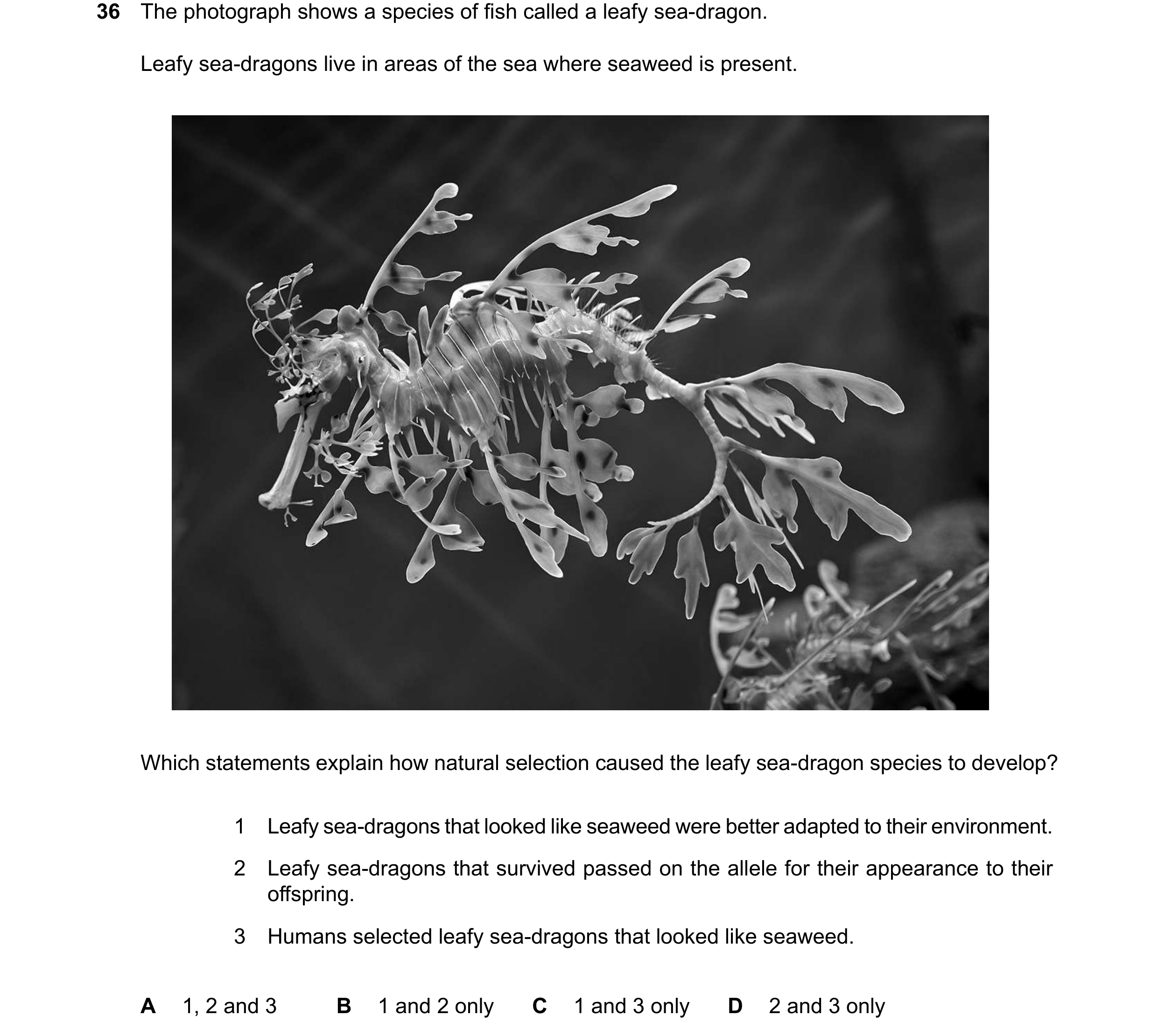
Q23 · The photograph shows a species of fish called a leafy sea-dragon 0970/21 May/June 2024
36 The photograph shows a species of fish called a leafy sea-dragon. Leafy sea-dragons live in areas of the sea where seaweed is present. Which statements explain how natural selection caused the leafy sea-dragon species to develop? 1 Leafy sea-dragons that looked like seaweed were better adapted to their environment. 2 Leafy sea-dragons that survived passed on the allele for their appearance to their offspring. 3 Humans selected leafy sea-dragons that looked like seaweed. A 1, 2 and 3 B 1 and 2 only C 1 and 3 only D 2 and 3 only
1 marks
Answer: B
This question in 0970/21 May/June 2024
Q24 · The table shows some features of leaves 0970/21 May/June 2025
32 The table shows some features of leaves. Which leaf is adapted to survive in hot, dry habitats? number of thickness of surface area stomata waxy cuticle of leaf A many thick small B many thin large C few thick small D few thin large
1 marks
Answer: C
This question in 0970/21 May/June 2025
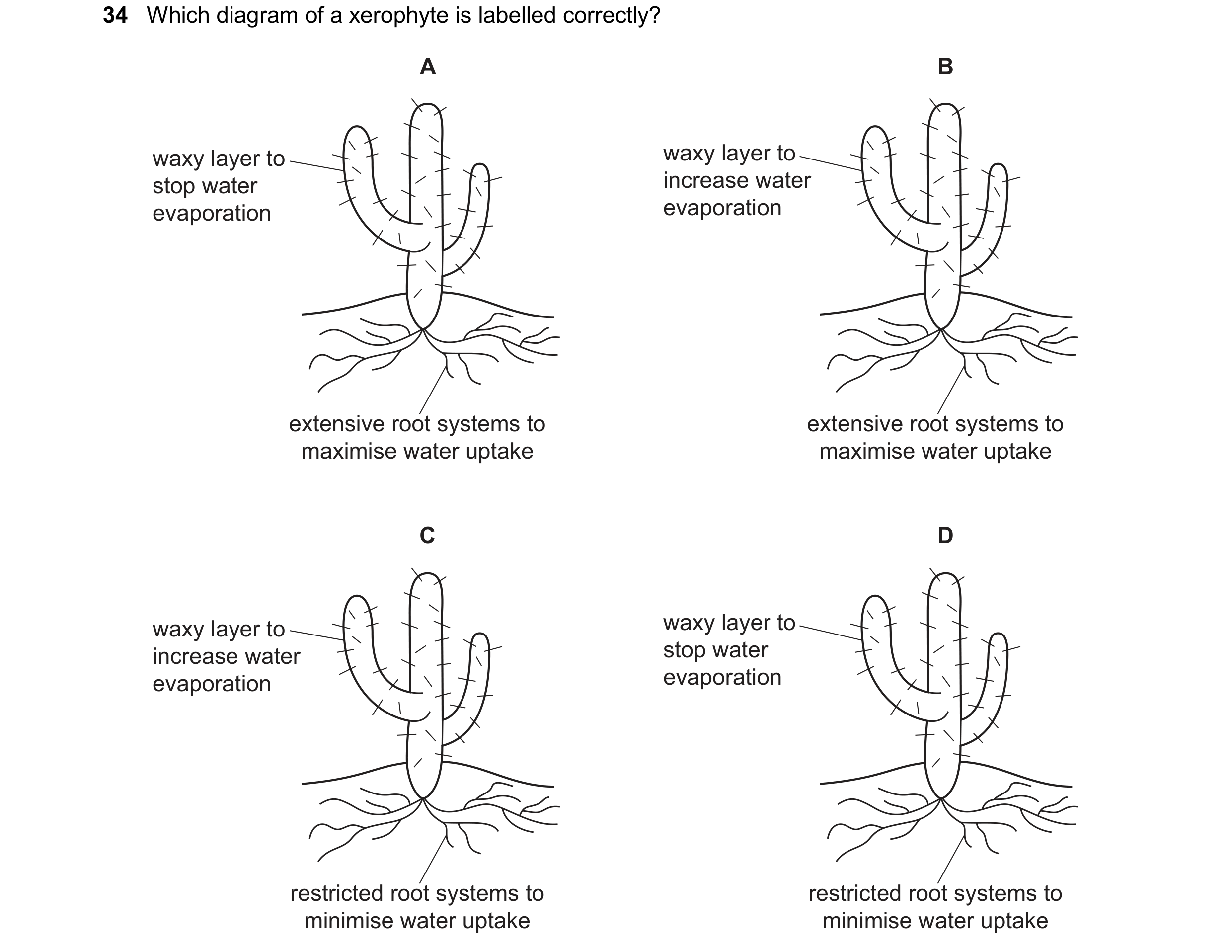
Q25 · Which diagram of a xerophyte is labelled correctly? 0970/22 May/June 2025
34 Which diagram of a xerophyte is labelled correctly? A B waxy layer to waxy layer to stop water increase water evaporation evaporation extensive root systems to extensive root systems to maximise water uptake maximise water uptake C D waxy layer to waxy layer to increase water stop water evaporation evaporation restricted root systems to restricted root systems to minimise water uptake minimise water uptake
1 marks
Answer: A
This question in 0970/22 May/June 2025
Q26 · What are features of hydrophytes which have leaves that float? 0970/22 Oct/Nov 2025
34 What are features of hydrophytes which have leaves that float? A long root system B many stomata on upper surface of leaves C hairy leaves D small air spaces in the spongy mesophyll
1 marks
Answer: B
This question in 0970/22 Oct/Nov 2025

 1 / 6
1 / 6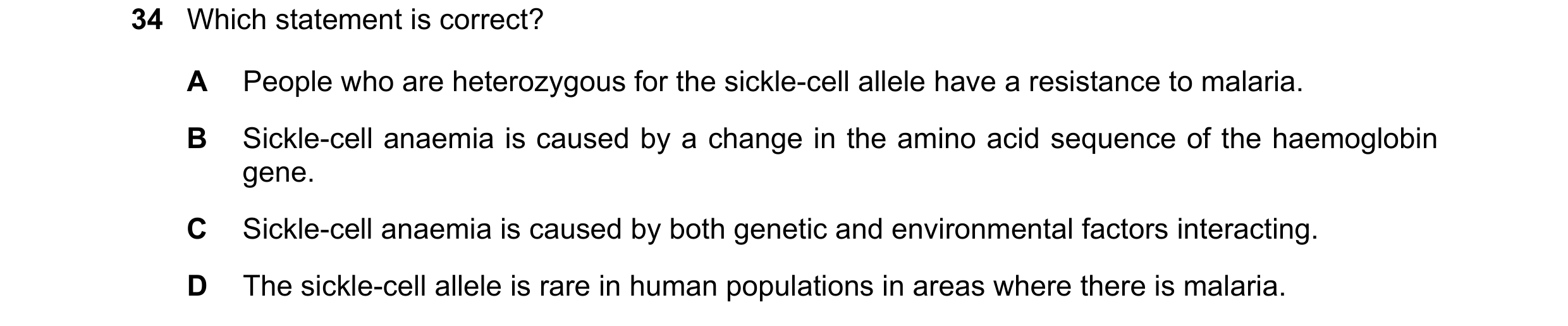



 2 / 6
2 / 6

 3 / 6
3 / 6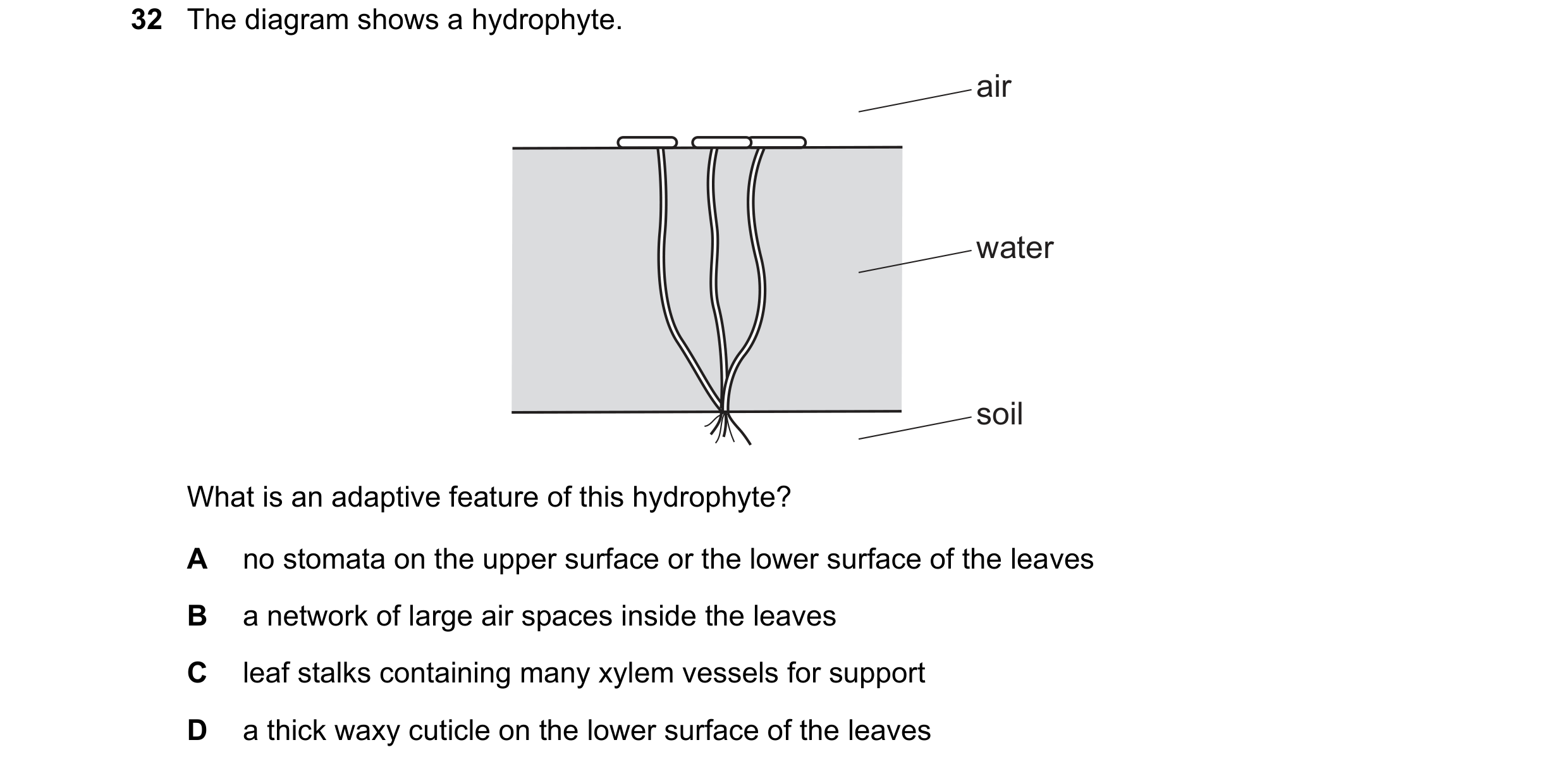


 4 / 6
4 / 6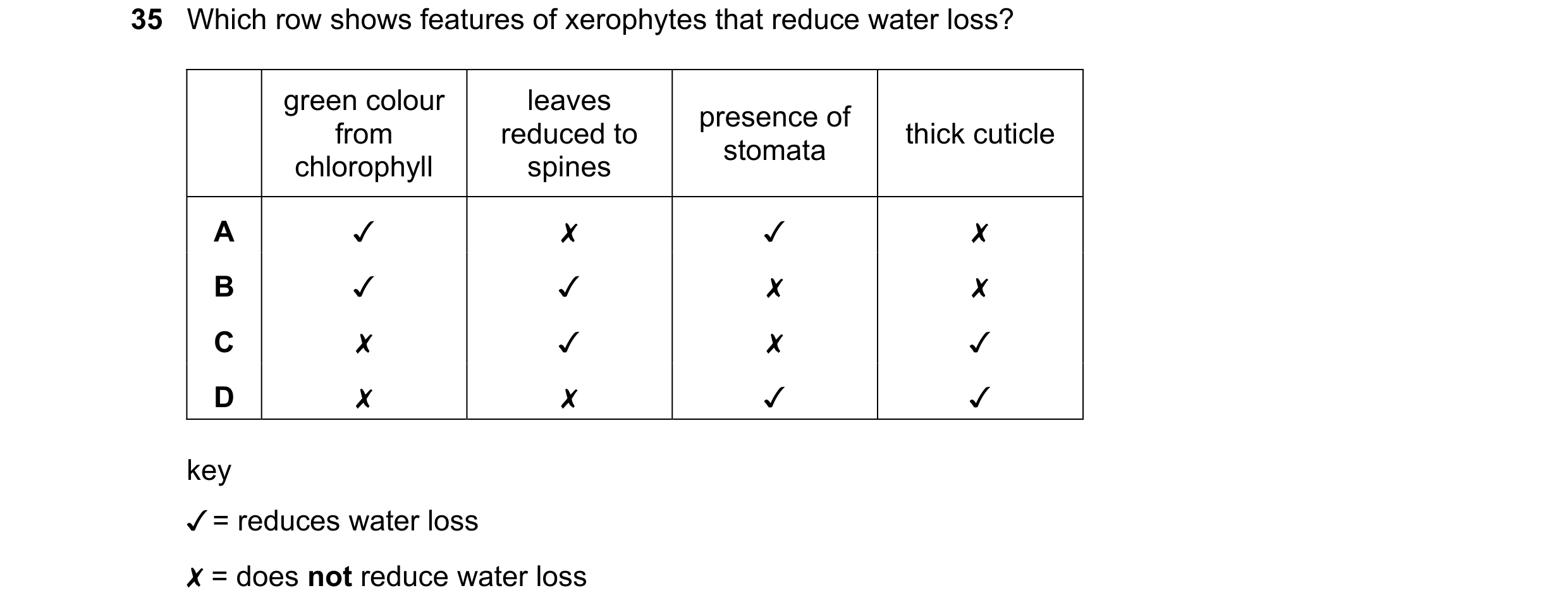
 5 / 6
5 / 6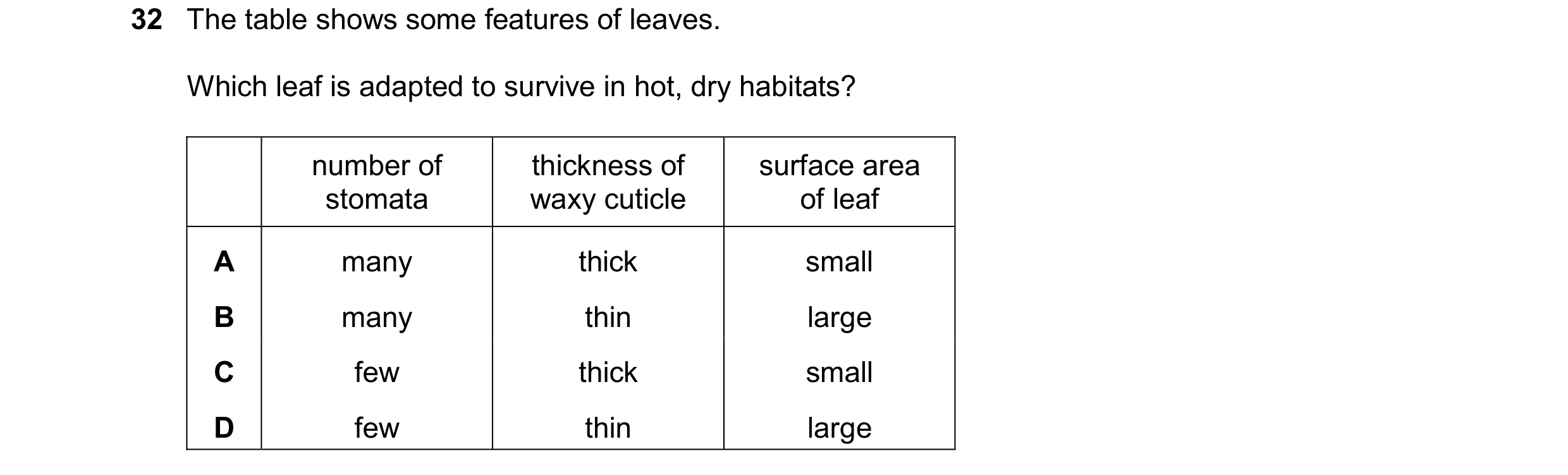
 6 / 6
6 / 6