Questions as text
Q1 · Antibiotics are used to treat some diseases 0970/11 May/June 2018
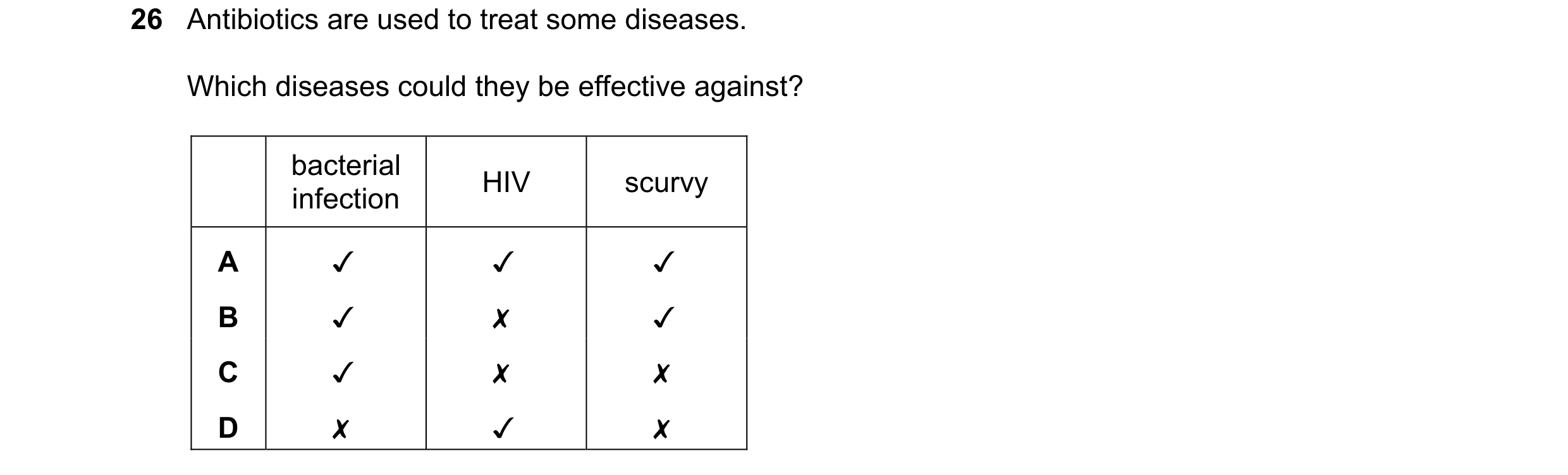
26 Antibiotics are used to treat some diseases.
Which diseases could they be effective against?
bacterial
infection SCUIVY
v v
v v
v x
x x
1 marks
Answer: C
This question in 0970/11 May/June 2018
Q2 · Where is alcohol broken down in the body? 0970/12 Oct/Nov 2018
24 Where is alcohol broken down in the body? A bladder B kidneys C liver D stomach
1 marks
Answer: C
This question in 0970/12 Oct/Nov 2018
Q3 · Which type of drug is used to treat bacterial infection? 0970/11 May/June 2019
28 Which type of drug is used to treat bacterial infection? A antibody B antibiotic C depressant D vaccine
1 marks
Answer: B
This question in 0970/11 May/June 2019
Q4 · Which factor increases the risk of developing coronary heart disease? 0970/12 Oct/Nov 2019
17 Which factor increases the risk of developing coronary heart disease? A low fat diet B regular exercise C relaxation D smoking
1 marks
Answer: D
This question in 0970/12 Oct/Nov 2019
Q5 · Which type of infection could be treated successfully with antibiotics? 0970/11 May/June 2020
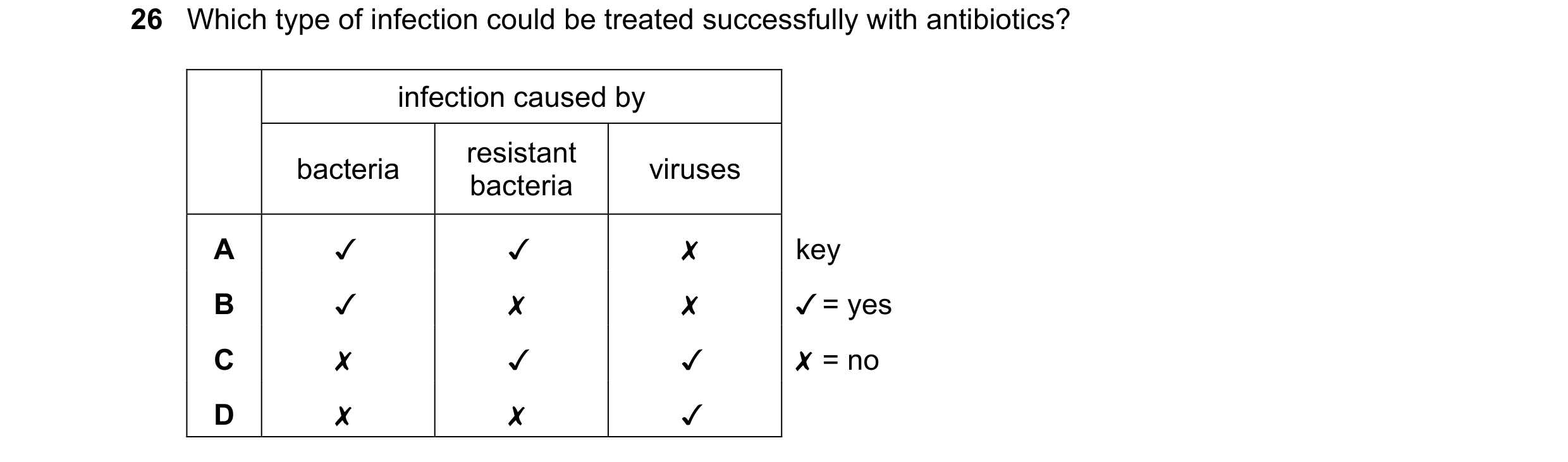
26 Which type of infection could be treated successfully with antibiotics?
infection caused by
bacteria resistan t viruses
bacteria
A v v x key
B Jv x x J/ = yes
Cc x v v X =no
D x x Jv
1 marks
Answer: B
This question in 0970/11 May/June 2020
Q6 · Which statement about antibiotic use in humans is correct? 0970/12 May/June 2020
26 Which statement about antibiotic use in humans is correct? A Different types of antibiotic are used to remove antibodies from the body. B Antibiotics are injected in childhood to prevent diseases in adults. C Antibiotics are used to treat diseases caused by viruses. D Different types of antibiotic are used because bacteria can become resistant.
1 marks
Answer: D
This question in 0970/12 May/June 2020
Q7 · Which is the correct definition of a drug? 0970/12 Oct/Nov 2020
28 Which is the correct definition of a drug? A a substance that affects or modifies chemical reactions in the body B a substance that can have negative social implications C a substance that can affect reaction times and self-control D a substance that can kill bacteria
1 marks
Answer: A
This question in 0970/12 Oct/Nov 2020
Q8 · Scientists carried out a survey on the effect of giving up smoking on the risk of… 0970/11 May/June 2021
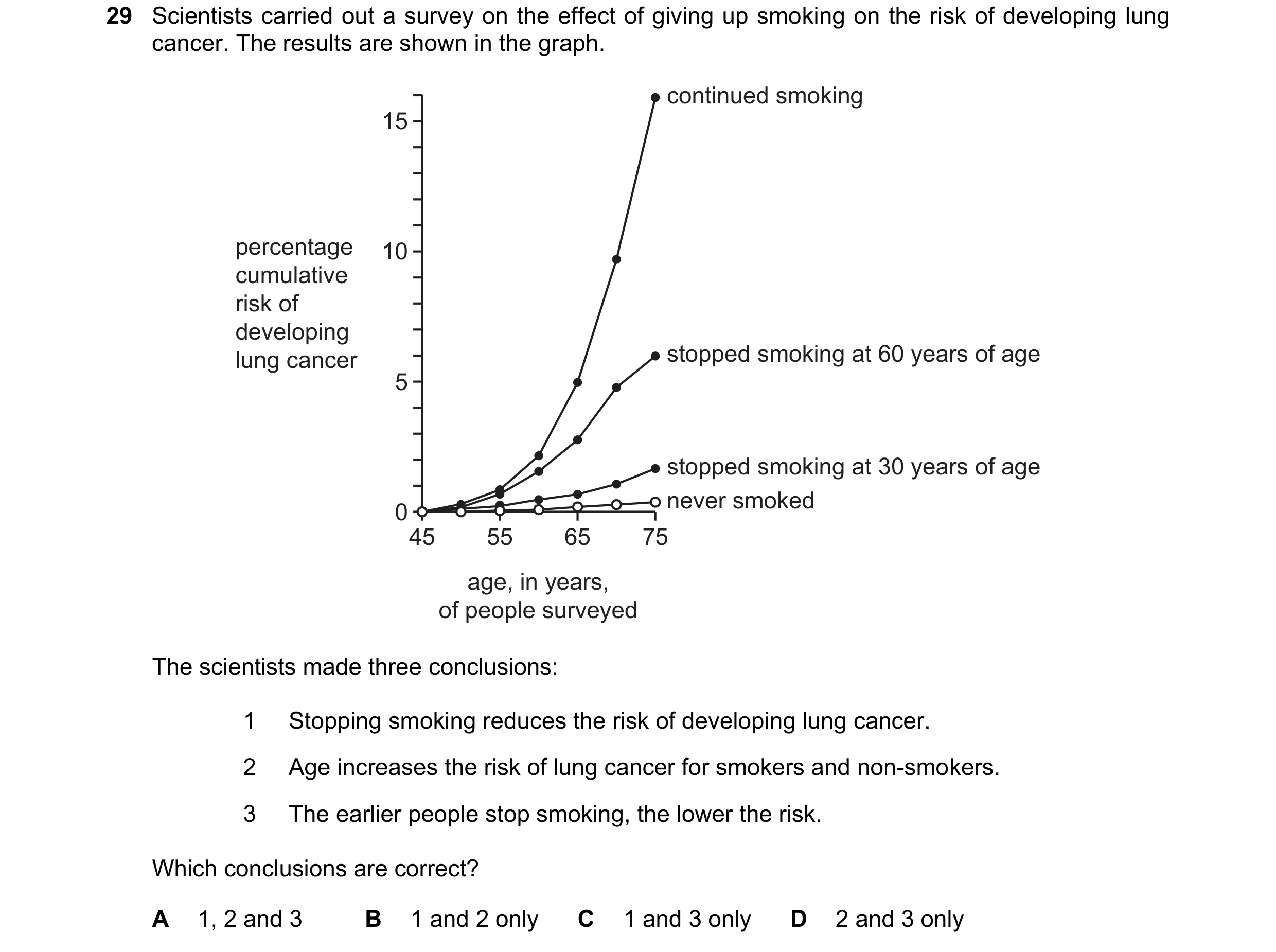
29 Scientists carried out a survey on the effect of giving up smoking on the risk of developing lung cancer. The results are shown in the graph. continued smoking 15 percentage 10 cumulative risk of developing lung cancer stopped smoking at 60 years of age 5 stopped smoking at 30 years of age never smoked 0 45 55 65 75 age, in years, of people surveyed The scientists made three conclusions: 1 Stopping smoking reduces the risk of developing lung cancer. 2 Age increases the risk of lung cancer for smokers and non-smokers. 3 The earlier people stop smoking, the lower the risk. Which conclusions are correct? A 1, 2 and 3 B 1 and 2 only C 1 and 3 only D 2 and 3 only
1 marks
Answer: A
This question in 0970/11 May/June 2021
Q9 · Which substance can be used to treat a bacterial infection? 0970/12 Oct/Nov 2021
29 Which substance can be used to treat a bacterial infection? A adrenaline B antibiotics C antigens D insulin
1 marks
Answer: B
This question in 0970/12 Oct/Nov 2021
Q10 · Why is excessive consumption of alcohol discouraged before someone operates machinery or… 0970/11 May/June 2022
29 Why is excessive consumption of alcohol discouraged before someone operates machinery or drives a vehicle? A Alcohol decreases reaction times. B Alcohol increases reaction times. C Alcohol is a stimulant drug. D Alcohol is an addictive drug.
1 marks
Answer: B
This question in 0970/11 May/June 2022
Q11 · The graph shows the relationship between deaths from lung cancer and the number of… 0970/12 May/June 2022
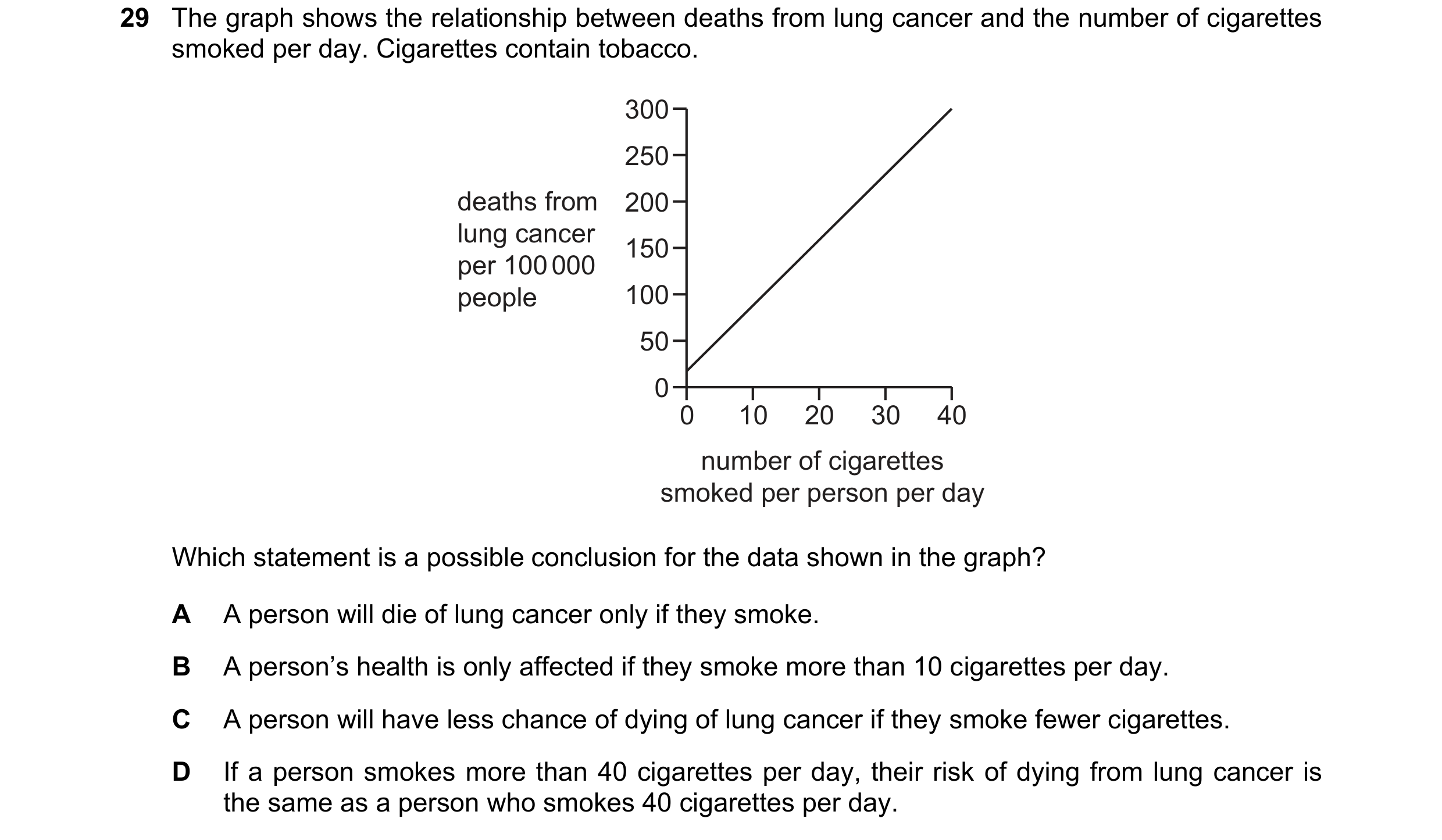
29 The graph shows the relationship between deaths from lung cancer and the number of cigarettes smoked per day. Cigarettes contain tobacco. 300 250 deaths from 200 lung cancer 150 per 100 000 people 100 50 0 0 10 20 30 40 number of cigarettes smoked per person per day Which statement is a possible conclusion for the data shown in the graph? A A person will die of lung cancer only if they smoke. B A person’s health is only affected if they smoke more than 10 cigarettes per day. C A person will have less chance of dying of lung cancer if they smoke fewer cigarettes. D If a person smokes more than 40 cigarettes per day, their risk of dying from lung cancer is the same as a person who smokes 40 cigarettes per day.
1 marks
Answer: C
This question in 0970/12 May/June 2022
Q12 · What is the definition of a drug? 0970/12 Oct/Nov 2022
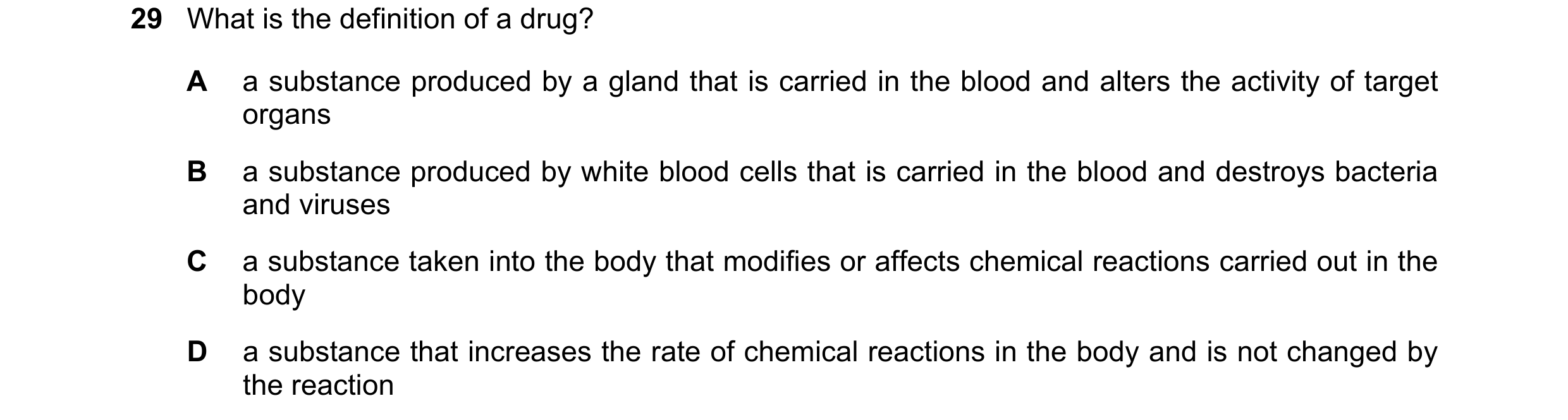
29 What is the definition of a drug? A a substance produced by a gland that is carried in the blood and alters the activity of target organs B a substance produced by white blood cells that is carried in the blood and destroys bacteria and viruses C a substance taken into the body that modifies or affects chemical reactions carried out in the body D a substance that increases the rate of chemical reactions in the body and is not changed by the reaction
1 marks
Answer: C
This question in 0970/12 Oct/Nov 2022
Q13 · Which statements about antibiotics are correct? 0970/11 May/June 2023
30 Which statements about antibiotics are correct? 1 Antibiotics can be used to treat bacterial infections. 2 Antibiotics can be used to treat viral infections. 3 Antibiotics are not effective against resistant bacteria. A 1, 2 and 3 B 1 and 2 only C 1 and 3 only D 2 and 3 only
1 marks
Answer: C
This question in 0970/11 May/June 2023
Q14 · The table shows which antibiotics are effective against different types of bacteria 0970/12 May/June 2023
29 The table shows which antibiotics are effective against different types of bacteria. The shaded areas show the antibiotic is effective against that type of bacteria. type of bacteria antibiotic MRSA Streptococcus Pseudomonas Anaerobes 1 2 3 4 5 6 A person has a disease caused by a type of Streptococcus bacteria and a second infection caused by a type of Pseudomonas bacteria. Which antibiotic should be taken? A 1 or 6 B 2 or 4 C 3 or 4 D 5 or 6
1 marks
Answer: B
This question in 0970/12 May/June 2023
Q15 · What is defined as a substance that is taken into the body and modifies or affects… 0970/12 Oct/Nov 2023
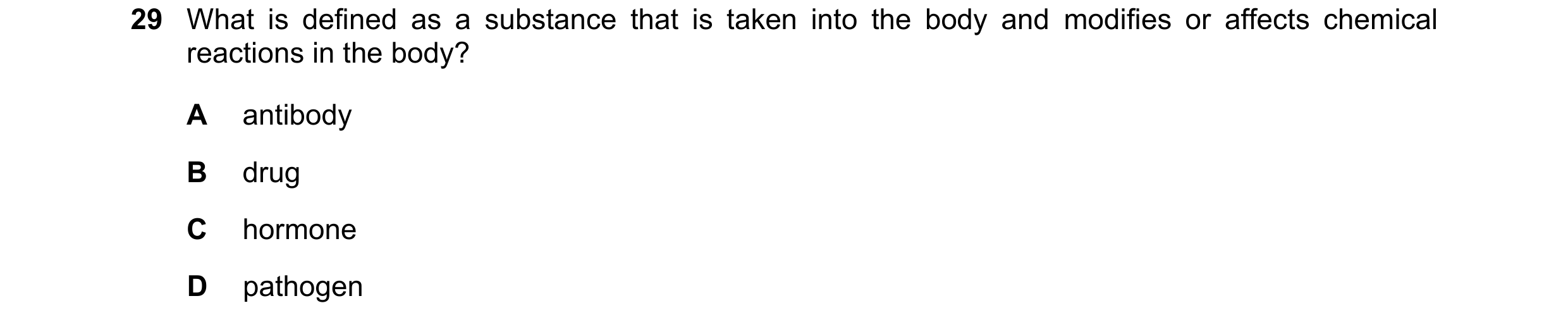
29 What is defined as a substance that is taken into the body and modifies or affects chemical reactions in the body? A antibody B drug C hormone D pathogen
1 marks
Answer: B
This question in 0970/12 Oct/Nov 2023
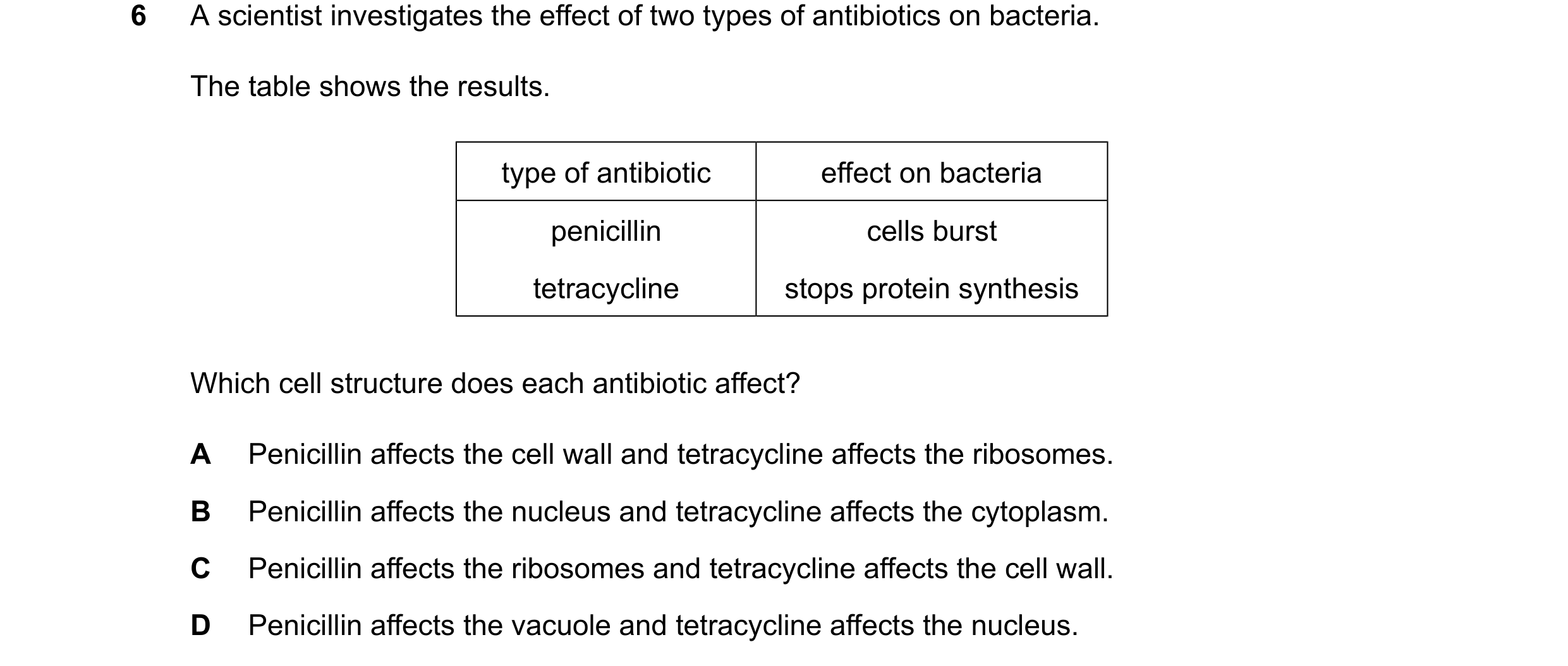
Q16 · A scientist investigates the effect of two types of antibiotics on bacteria 0970/11 May/June 2024
6 A scientist investigates the effect of two types of antibiotics on bacteria. The table shows the results. type of antibiotic effect on bacteria penicillin cells burst tetracycline stops protein synthesis Which cell structure does each antibiotic affect? A Penicillin affects the cell wall and tetracycline affects the ribosomes. B Penicillin affects the nucleus and tetracycline affects the cytoplasm. C Penicillin affects the ribosomes and tetracycline affects the cell wall. D Penicillin affects the vacuole and tetracycline affects the nucleus.
1 marks
Answer: A
This question in 0970/11 May/June 2024
Q17 · The graph shows how the percentage effectiveness of antibiotic F against MRSA bacteria… 0970/12 May/June 2024
28 The graph shows how the percentage effectiveness of antibiotic F against MRSA bacteria varied between 1980 and 2000. 100 90 80 percentage effectiveness of antibiotic F 70 against MRSA 60 50 40 1980 1990 2000 time / year What is a correct conclusion from the graph? A Antibiotic F was completely ineffective against MRSA in 2000. B Antibiotic F was most effective in 1982. C MRSA developed resistance to antibiotic F between 1981 and 2000. D The greatest decrease in effectiveness of antibiotic F against MRSA was between 1988 and 1990.
1 marks
Answer: C
This question in 0970/12 May/June 2024
Q18 · Which statement applies to antibiotics? 0970/11 May/June 2025
28 Which statement applies to antibiotics? A They kill bacteria. B They kill viruses. C They are produced by platelets. D They are produced by white blood cells.
1 marks
Answer: A
This question in 0970/11 May/June 2025
Q19 · A person measures their reaction time five times before and after drinking a cup of coffee 0970/12 Oct/Nov 2025
22 A person measures their reaction time five times before and after drinking a cup of coffee. The table shows the results. reaction time / s before drinking coffee 0.25 0.30 0.20 0.35 0.15 after drinking coffee 0.20 0.15 0.10 0.20 0.10 Which statement describes the results? A The mean reaction time after drinking coffee is 0.25 s. B The mean reaction time before drinking coffee is longer than after drinking coffee. C The mean reaction time before drinking coffee is 0.15 s. D The mean reaction time is not affected by drinking coffee.
1 marks
Answer: B
This question in 0970/12 Oct/Nov 2025



 1 / 6
1 / 6

 2 / 6
2 / 6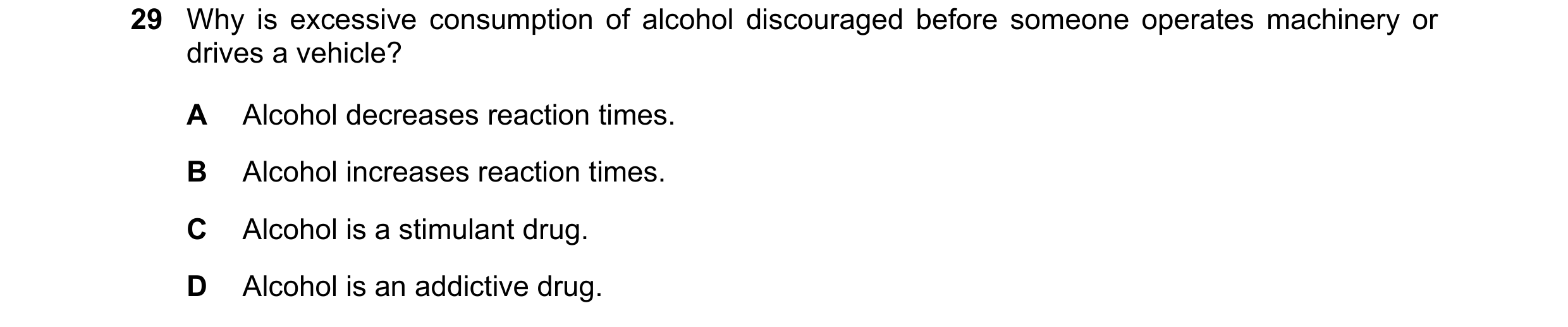
 3 / 6
3 / 6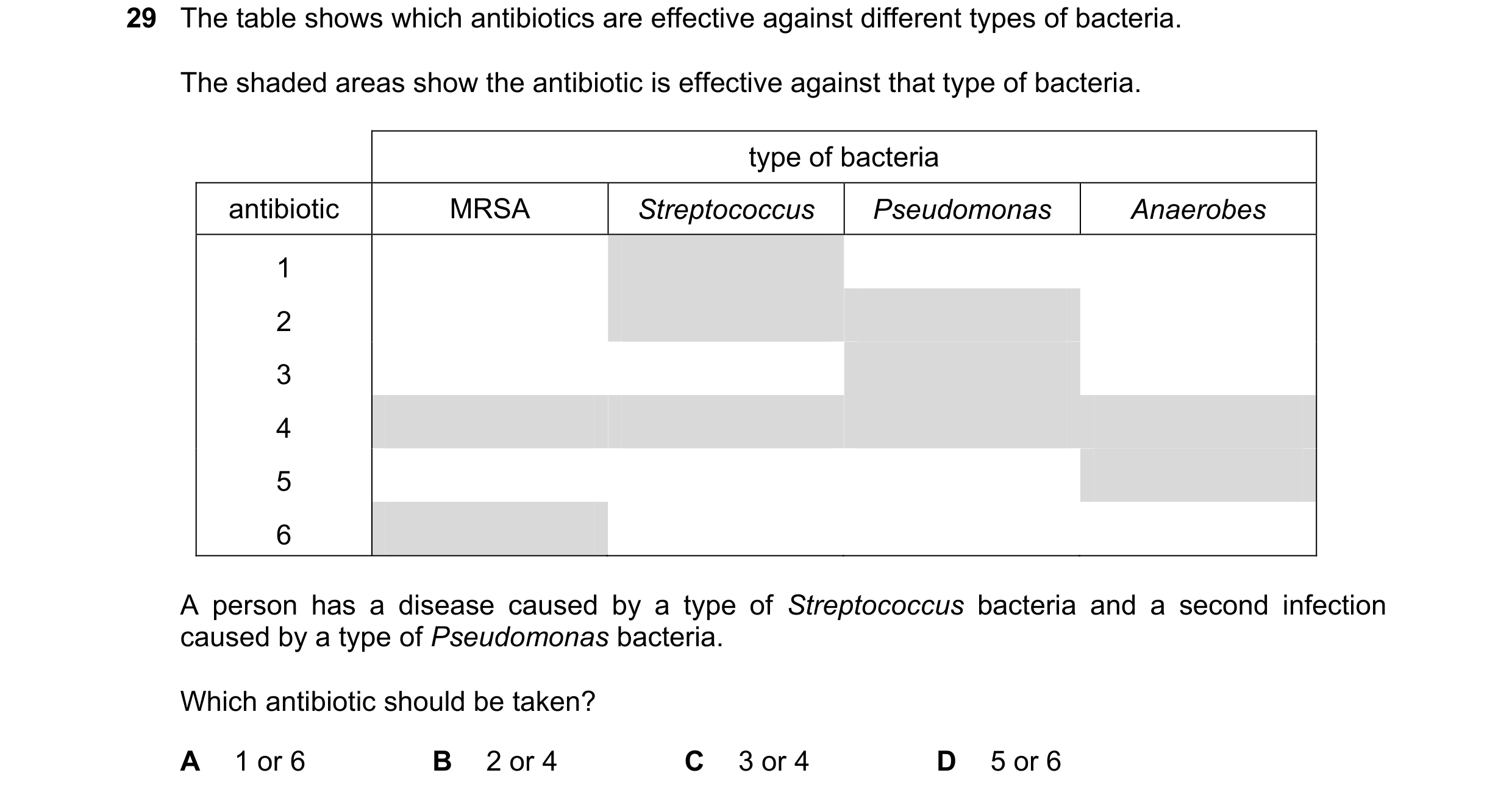
 4 / 6
4 / 6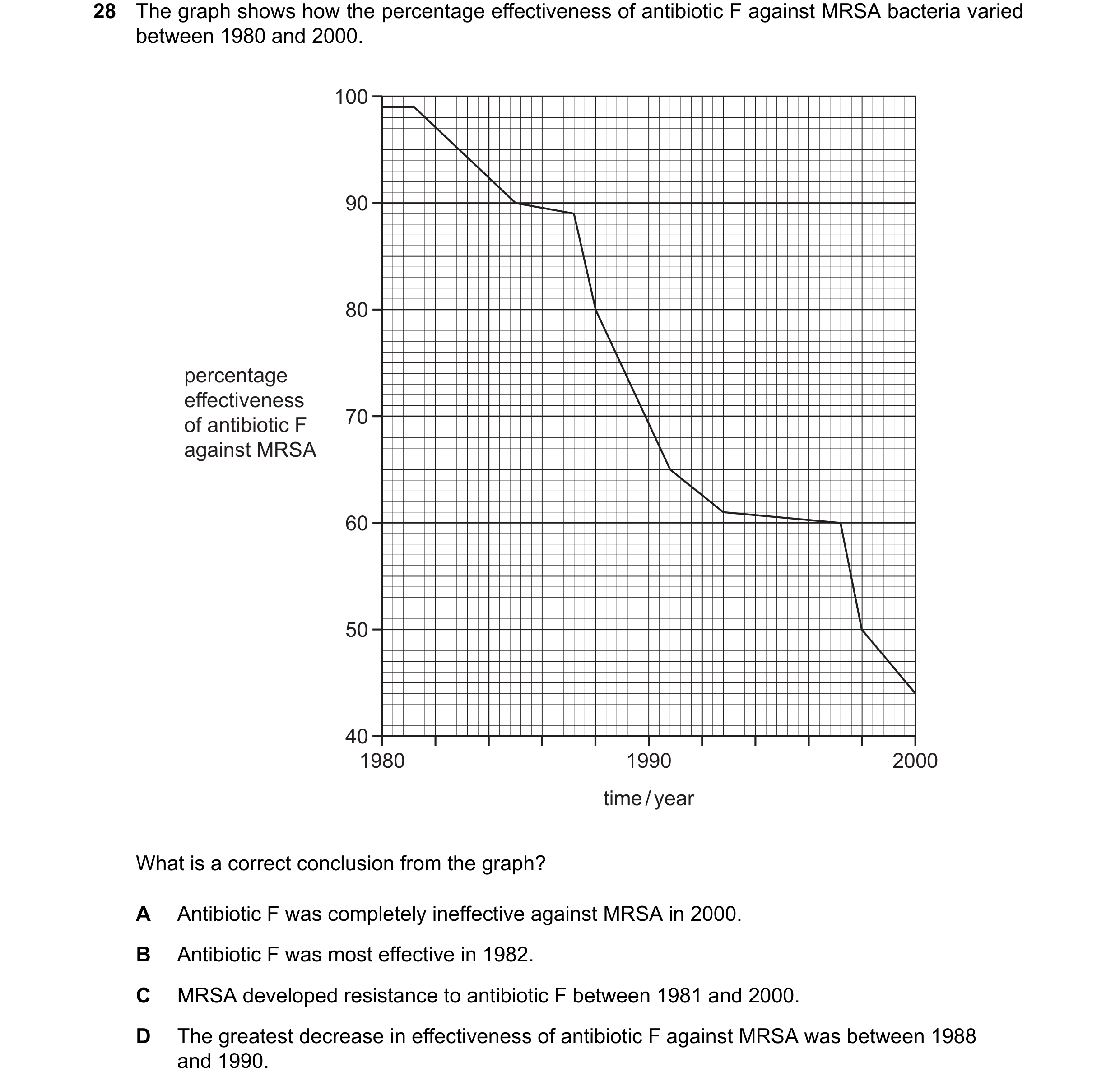
 5 / 6
5 / 6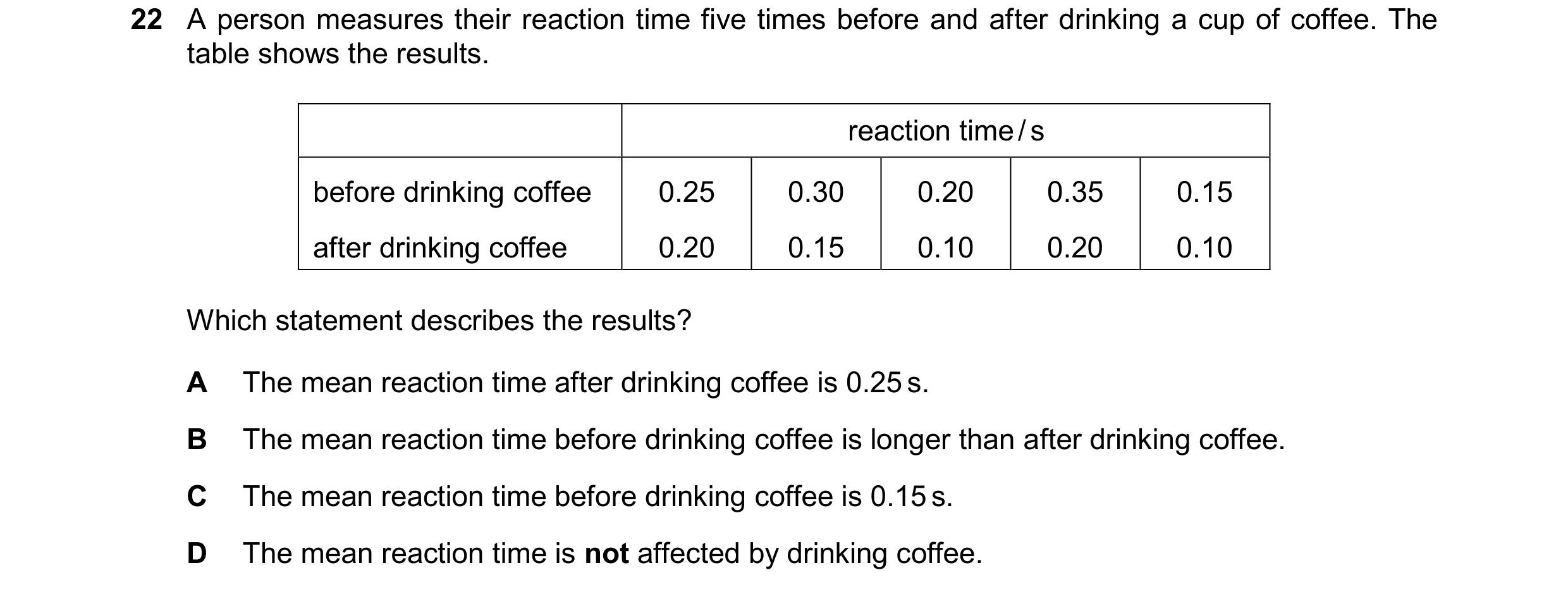 6 / 6
6 / 6