Cambridge IGCSE Biology (9-1) 0970 — 2025 Oct/Nov Paper 1 · Variant 2
0970/12/O/N/25 · 40 questions · 40 marks · ≈45 min
The question paper and its mark scheme, free to read here and free to download. This is Cambridge’s own paper, exactly as it was sat.
Question paper16 pages


Mark scheme3 pages
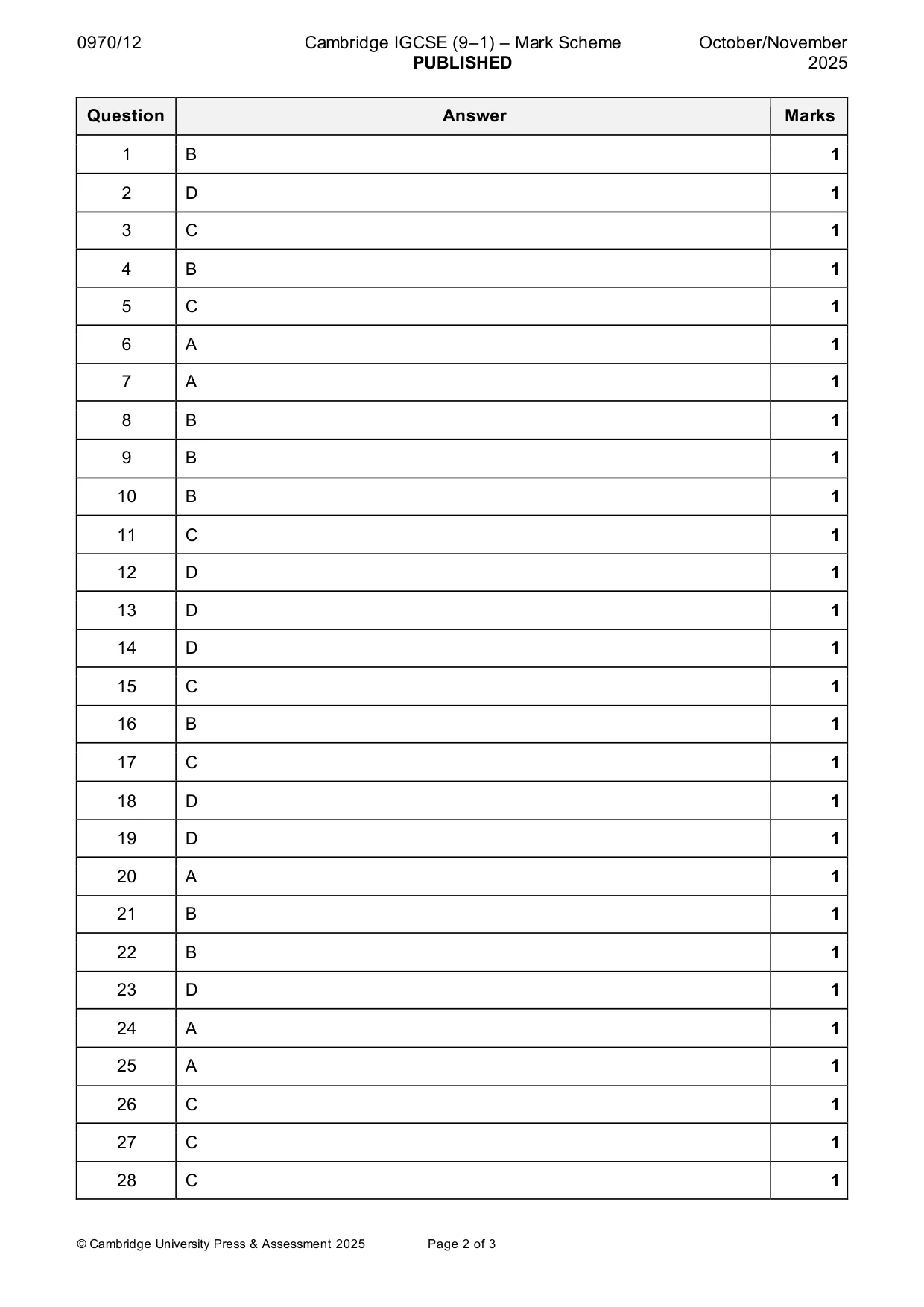
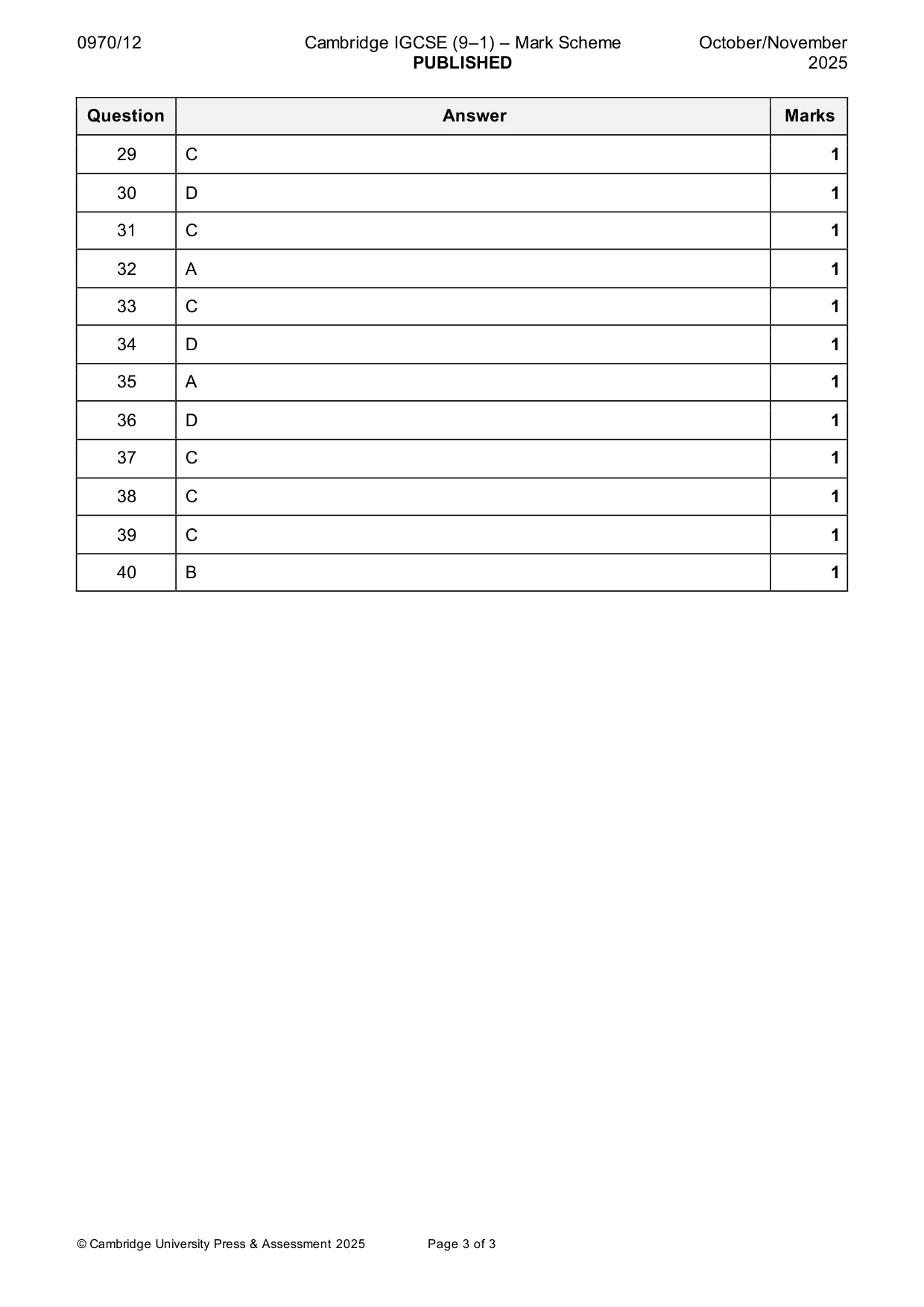
Answers below. Sit the paper first if you are practising.
Questions as text
Q1 · Which process causes a permanent increase in the dry mass of an organism?
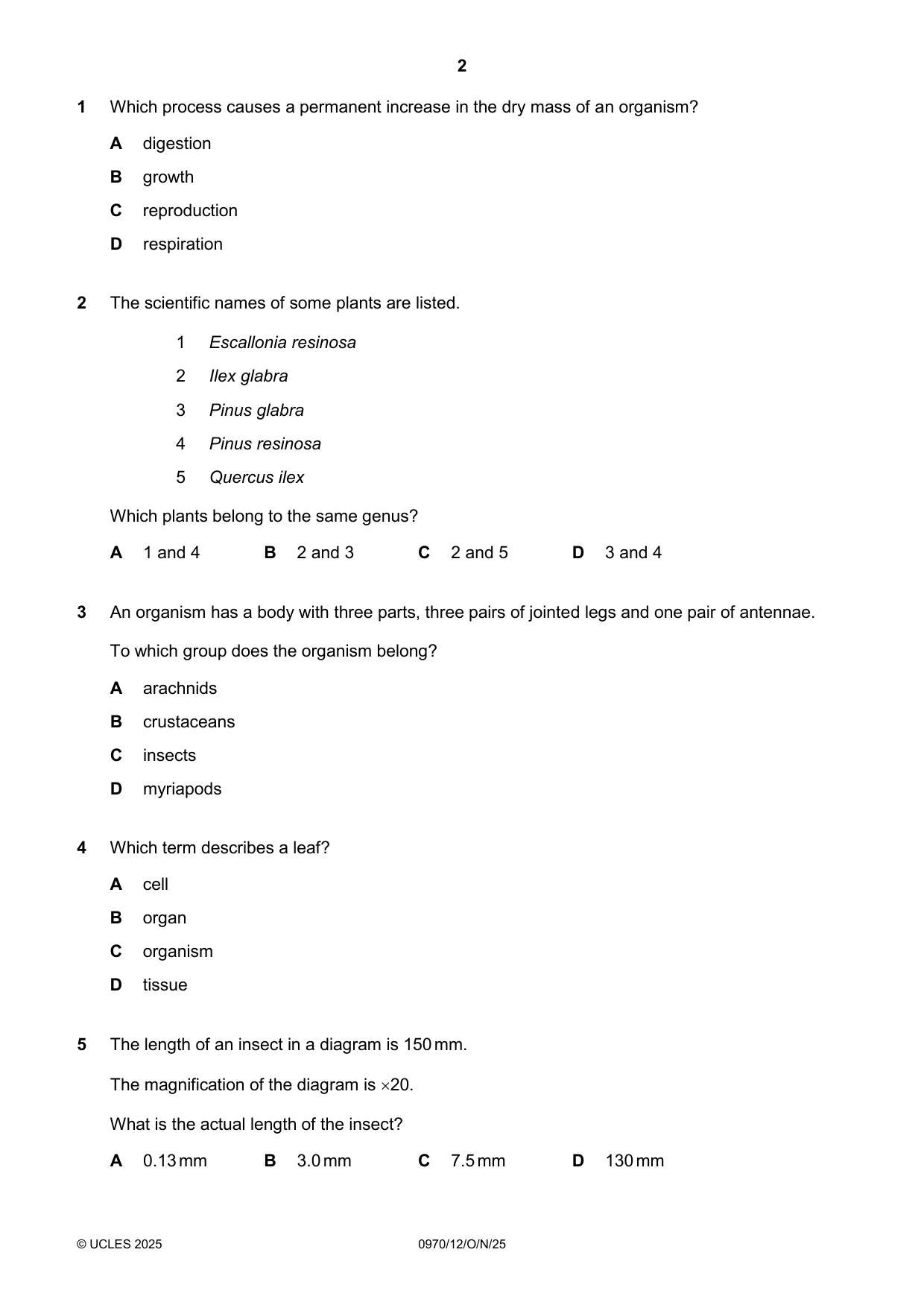
1 Which process causes a permanent increase in the dry mass of an organism? A digestion B growth C reproduction D respiration
Mark scheme: B
Q2 · The scientific names of some plants are listed
2 The scientific names of some plants are listed. 1 Escallonia resinosa 2 Ilex glabra 3 Pinus glabra 4 Pinus resinosa 5 Quercus ilex Which plants belong to the same genus? A 1 and 4 B 2 and 3 C 2 and 5 D 3 and 4
Mark scheme: D
More questions on Concept and uses of classification systems
Q3 · An organism has a body with three parts, three pairs of jointed legs and one pair of…
3 An organism has a body with three parts, three pairs of jointed legs and one pair of antennae. To which group does the organism belong? A arachnids B crustaceans C insects D myriapods
Mark scheme: C
Q4 · Which term describes a leaf?
4 Which term describes a leaf? A cell B organ C organism D tissue
Mark scheme: B
Q5 · The length of an insect in a diagram is 150 mm
5 The length of an insect in a diagram is 150 mm. The magnification of the diagram is 20. What is the actual length of the insect? A 0.13 mm B 3.0 mm C 7.5 mm D 130 mm
Mark scheme: C
Q6 · What are features of osmosis?
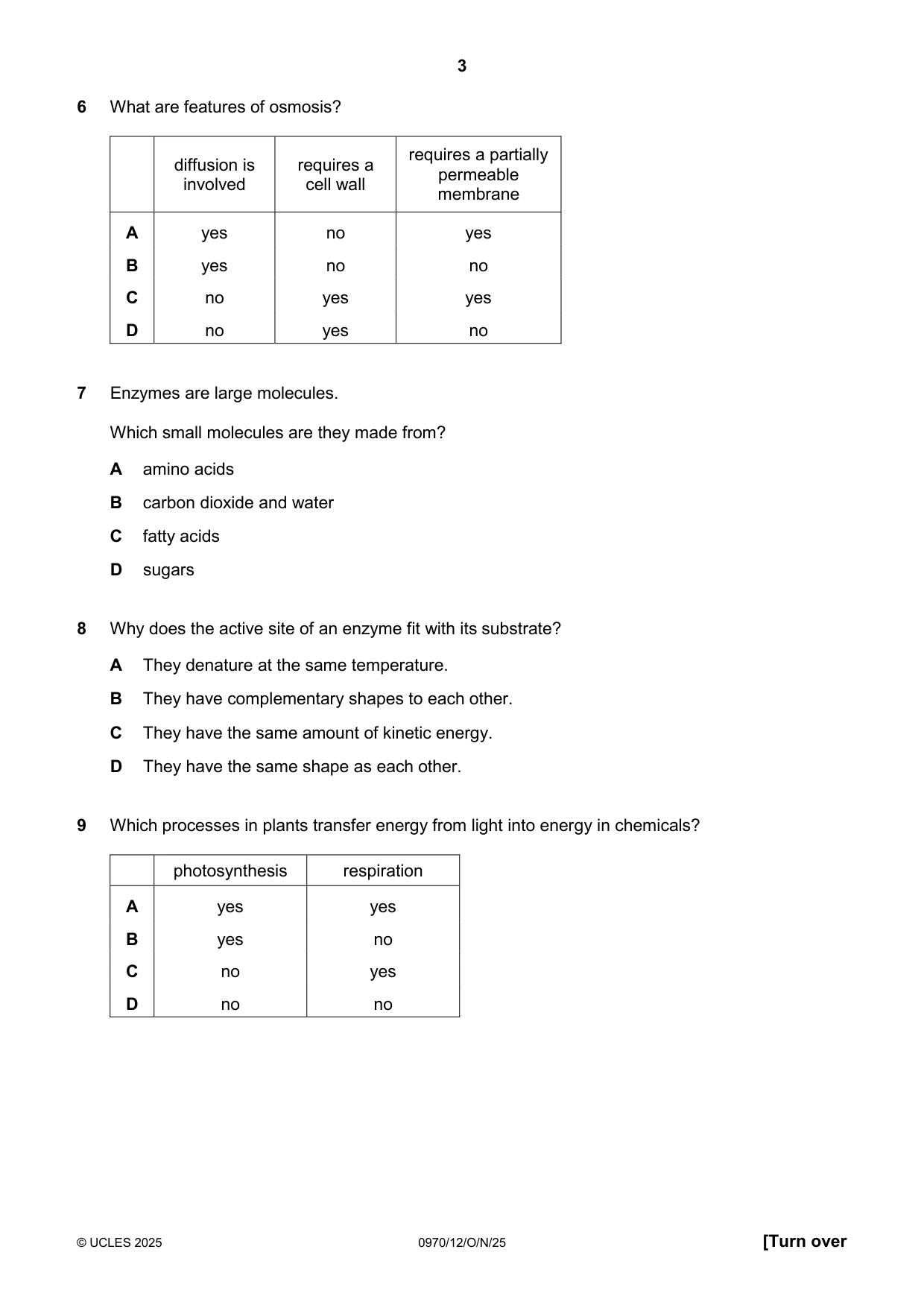
6 What are features of osmosis? requires a partially diffusion is requires a permeable involved cell wall membrane A yes no yes B yes no no C no yes yes D no yes no
Mark scheme: A
Q7 · Enzymes are large molecules
7 Enzymes are large molecules. Which small molecules are they made from? A amino acids B carbon dioxide and water C fatty acids D sugars
Mark scheme: A
Q8 · Why does the active site of an enzyme fit with its substrate?
8 Why does the active site of an enzyme fit with its substrate? A They denature at the same temperature. B They have complementary shapes to each other. C They have the same amount of kinetic energy. D They have the same shape as each other.
Mark scheme: B
Q9 · Which processes in plants transfer energy from light into energy in chemicals?
9 Which processes in plants transfer energy from light into energy in chemicals? photosynthesis respiration A yes yes B yes no C no yes D no no
Mark scheme: B
Q10 · The diagram shows a cross-section of a molar tooth
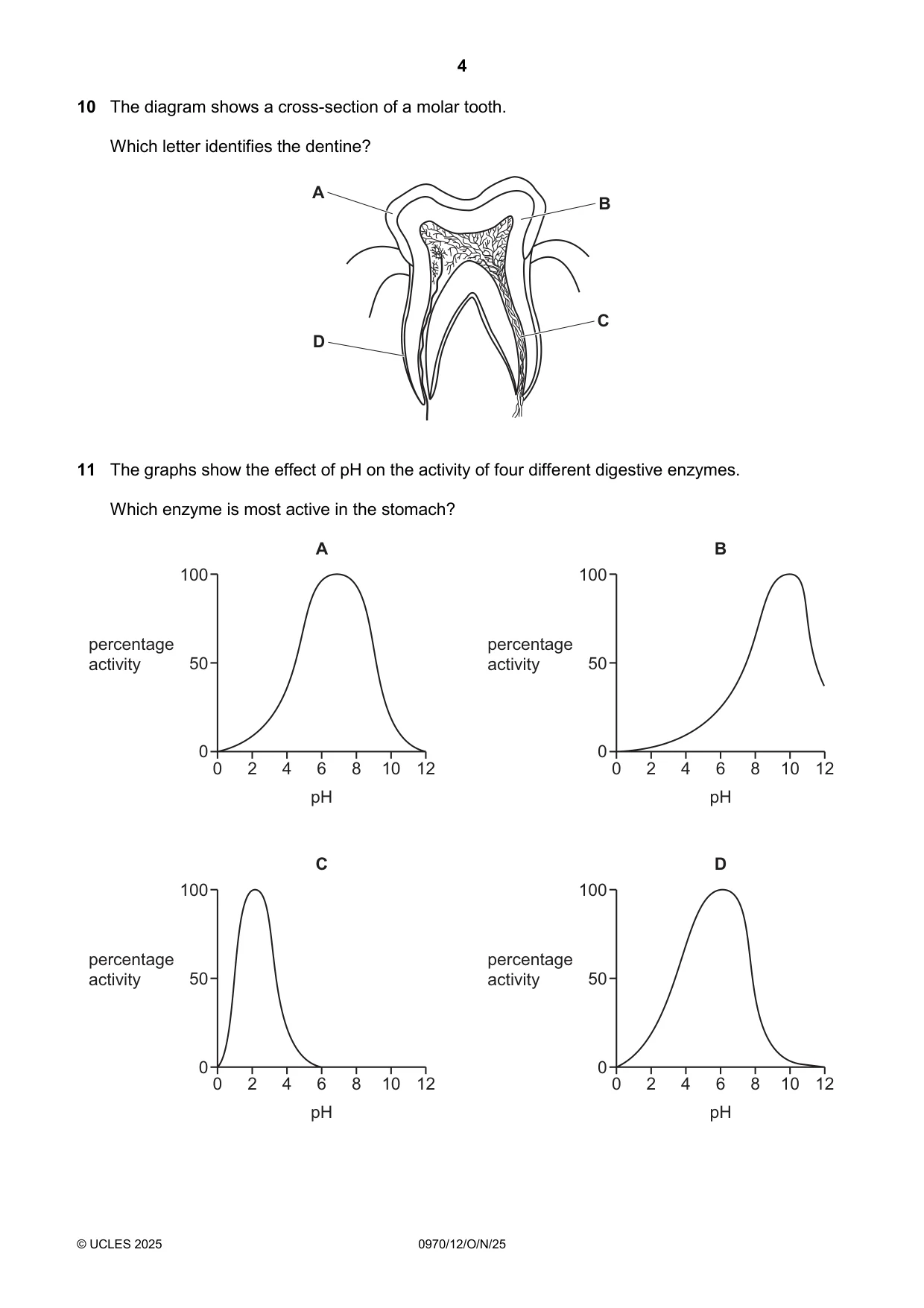
10 The diagram shows a cross-section of a molar tooth. Which letter identifies the dentine? A B C D
Mark scheme: B
Q11 · The graphs show the effect of pH on the activity of four different digestive enzymes
11 The graphs show the effect of pH on the activity of four different digestive enzymes. Which enzyme is most active in the stomach? A B 100 100 percentage percentage activity 50 activity 50 0 0 0 2 4 6 8 10 12 0 2 4 6 8 10 12 pH pH C D 100 100 percentage percentage activity 50 activity 50 0 0 0 2 4 6 8 10 12 0 2 4 6 8 10 12 pH pH
Mark scheme: C
Q12 · In which organ does physical digestion and chemical digestion occur?
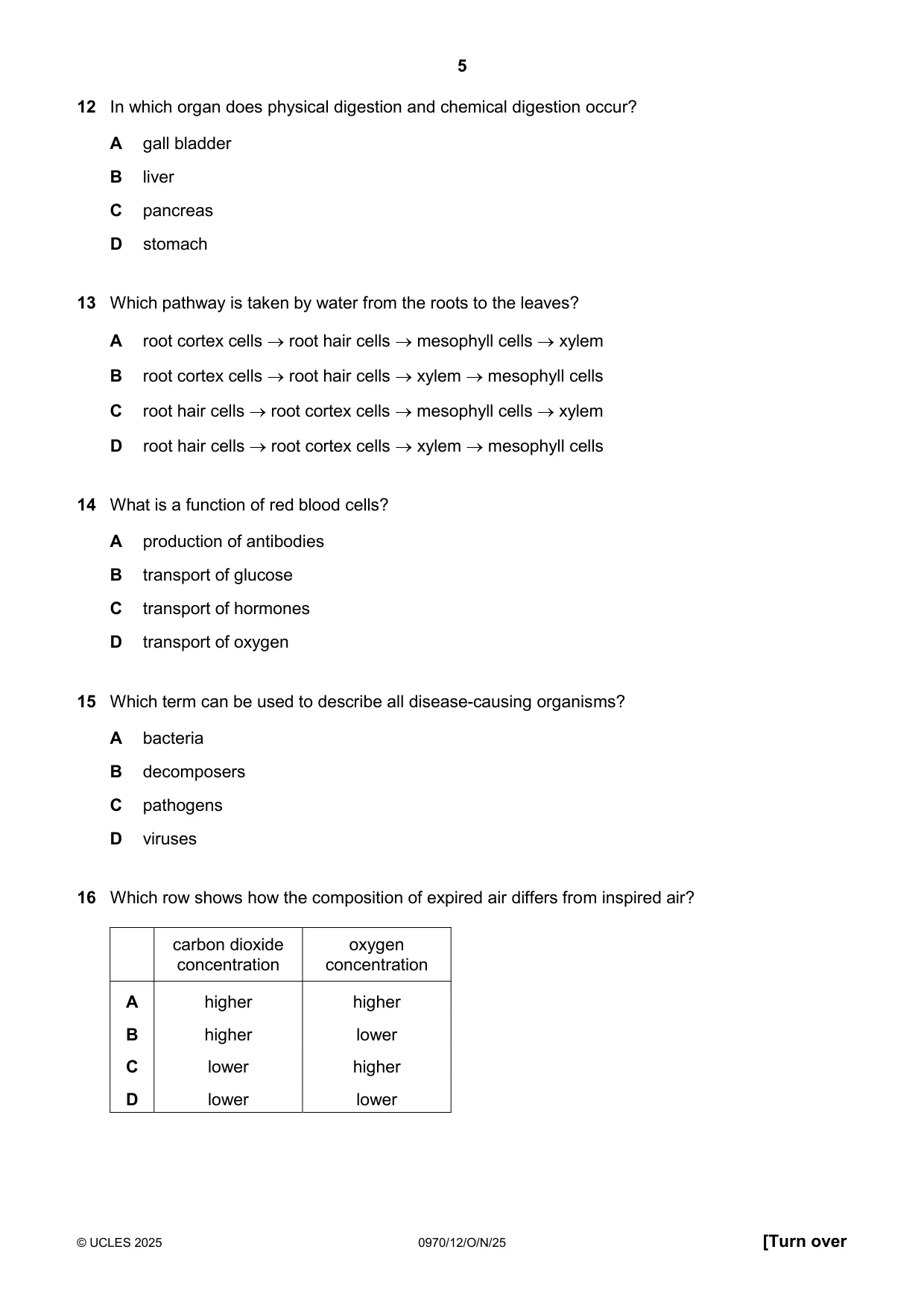
12 In which organ does physical digestion and chemical digestion occur? A gall bladder B liver C pancreas D stomach
Mark scheme: D
Q13 · Which pathway is taken by water from the roots to the leaves?
13 Which pathway is taken by water from the roots to the leaves? A root cortex cells root hair cells mesophyll cells xylem B root cortex cells root hair cells xylem mesophyll cells C root hair cells root cortex cells mesophyll cells xylem D root hair cells root cortex cells xylem mesophyll cells
Mark scheme: D
Q14 · What is a function of red blood cells?
14 What is a function of red blood cells? A production of antibodies B transport of glucose C transport of hormones D transport of oxygen
Mark scheme: D
Q15 · Which term can be used to describe all disease-causing organisms?
15 Which term can be used to describe all disease-causing organisms? A bacteria B decomposers C pathogens D viruses
Mark scheme: C
Q16 · Which row shows how the composition of expired air differs from inspired air?
16 Which row shows how the composition of expired air differs from inspired air? carbon dioxide oxygen concentration concentration A higher higher B higher lower C lower higher D lower lower
Mark scheme: B
Q17 · Which substance is produced in human muscles during anaerobic respiration?
17 Which substance is produced in human muscles during anaerobic respiration? A alcohol B carbon dioxide C lactic acid D urea
Mark scheme: C
Q18 · In humans, a ureter and a urethra are two structures involved in excretion
18 In humans, a ureter and a urethra are two structures involved in excretion. Which comparison between a ureter and a urethra is correct? A Only fluid passing through a ureter contains excess mineral ions and water. B Only fluid passing through a urethra contains urea. C Only a ureter is directly attached to the bladder. D Only a ureter is directly attached to the kidney.
Mark scheme: D
Q19 · The diagram shows the pathway of a reflex arc
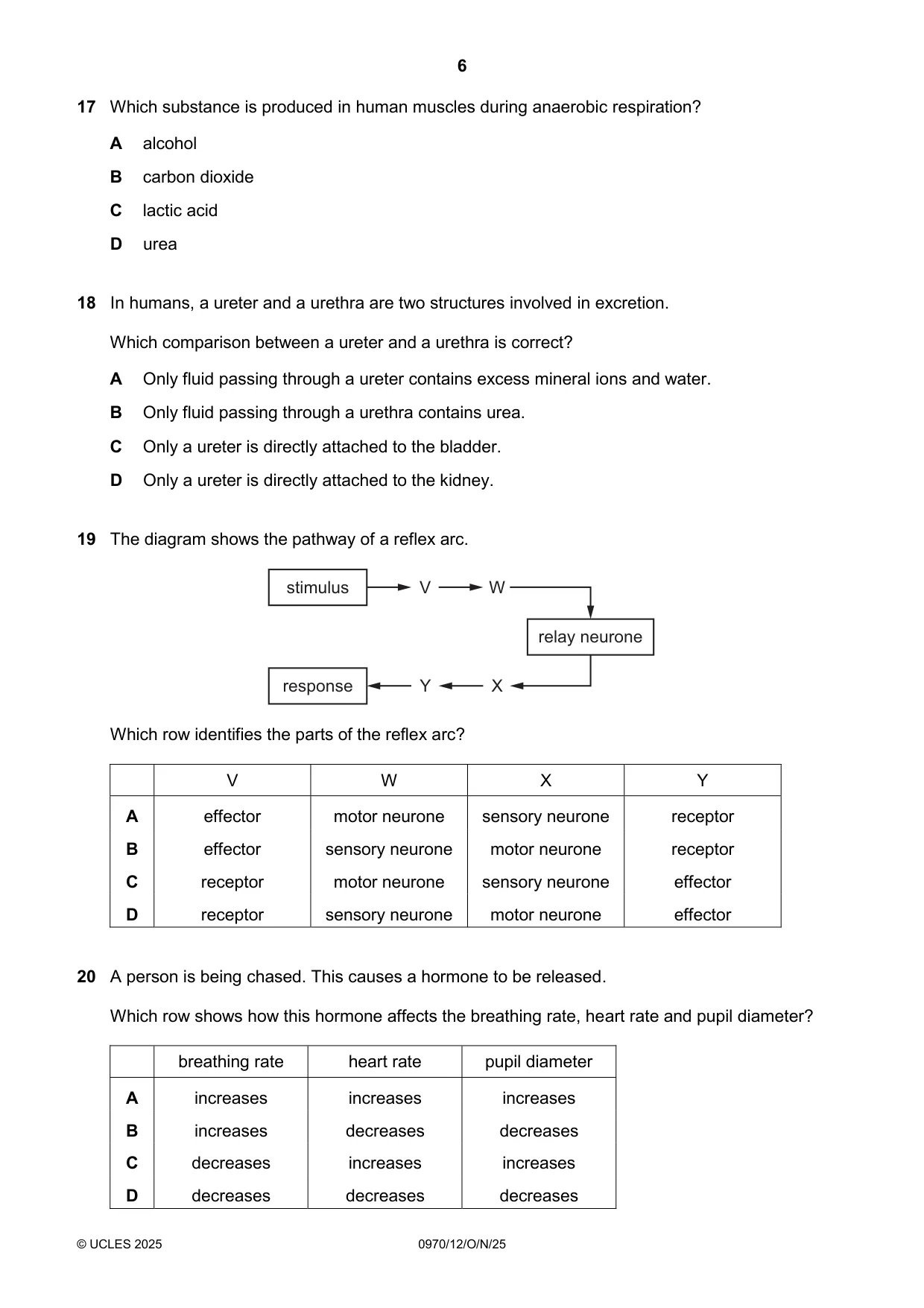
19 The diagram shows the pathway of a reflex arc. stimulus V W relay neurone response Y X Which row identifies the parts of the reflex arc? V W X Y A effector motor neurone sensory neurone receptor B effector sensory neurone motor neurone receptor C receptor motor neurone sensory neurone effector D receptor sensory neurone motor neurone effector
Mark scheme: D
Q20 · A person is being chased
20 A person is being chased. This causes a hormone to be released. Which row shows how this hormone affects the breathing rate, heart rate and pupil diameter? breathing rate heart rate pupil diameter A increases increases increases B increases decreases decreases C decreases increases increases D decreases decreases decreases
Mark scheme: A
Q21 · A plant is placed on the floor in a room, near a window that lets in a lot of light
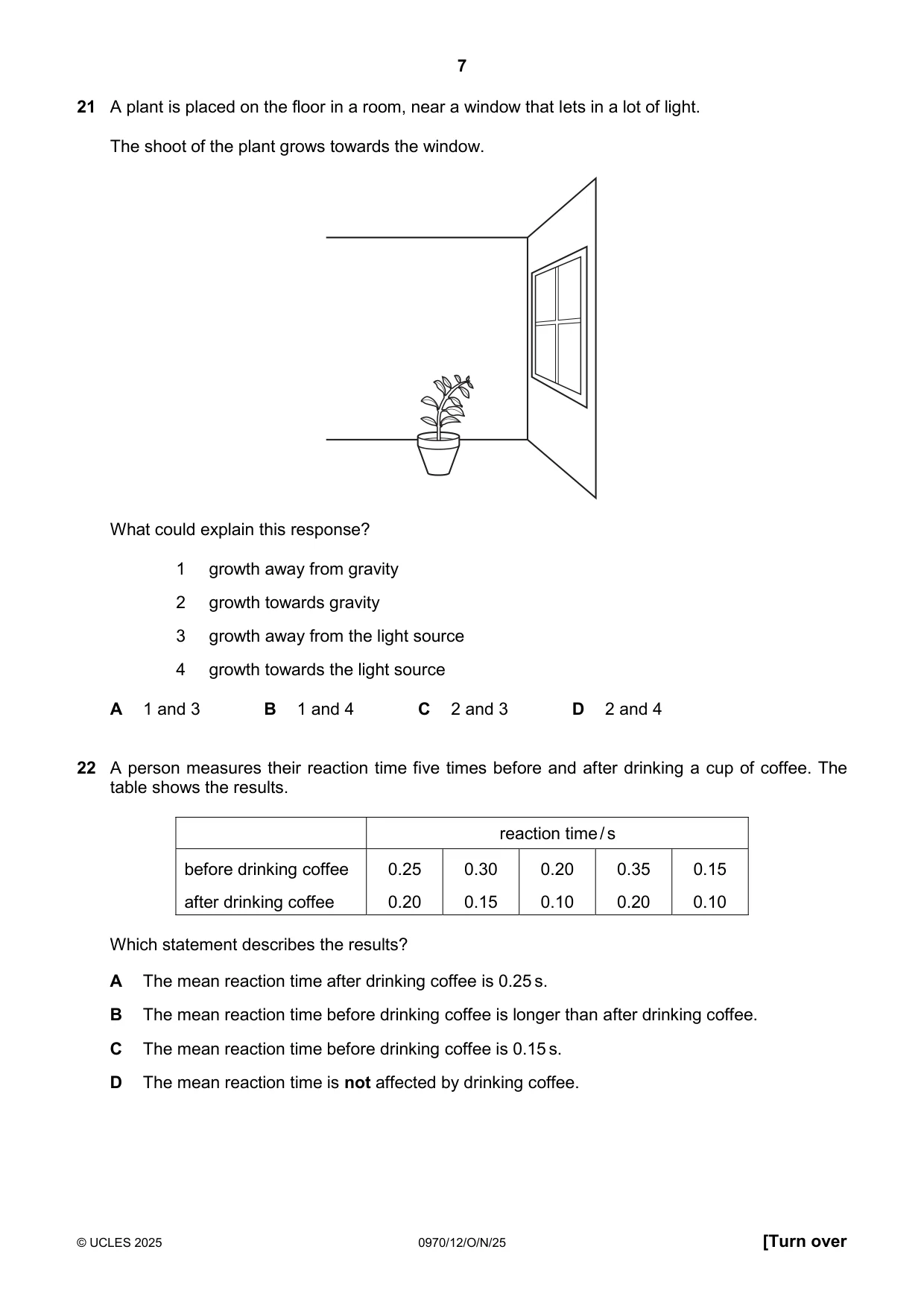
21 A plant is placed on the floor in a room, near a window that lets in a lot of light. The shoot of the plant grows towards the window. What could explain this response? 1 growth away from gravity 2 growth towards gravity 3 growth away from the light source 4 growth towards the light source A 1 and 3 B 1 and 4 C 2 and 3 D 2 and 4
Mark scheme: B
Q22 · A person measures their reaction time five times before and after drinking a cup of coffee
22 A person measures their reaction time five times before and after drinking a cup of coffee. The table shows the results. reaction time / s before drinking coffee 0.25 0.30 0.20 0.35 0.15 after drinking coffee 0.20 0.15 0.10 0.20 0.10 Which statement describes the results? A The mean reaction time after drinking coffee is 0.25 s. B The mean reaction time before drinking coffee is longer than after drinking coffee. C The mean reaction time before drinking coffee is 0.15 s. D The mean reaction time is not affected by drinking coffee.
Mark scheme: B
Q23 · Which set of conditions do most seeds require for germination?
23 Which set of conditions do most seeds require for germination? oxygen warmth water A Jv x Jv key B v Jv x / = required Cc x v v X = not required D v v v
Mark scheme: D
Q24 · The diagram shows part of a flower
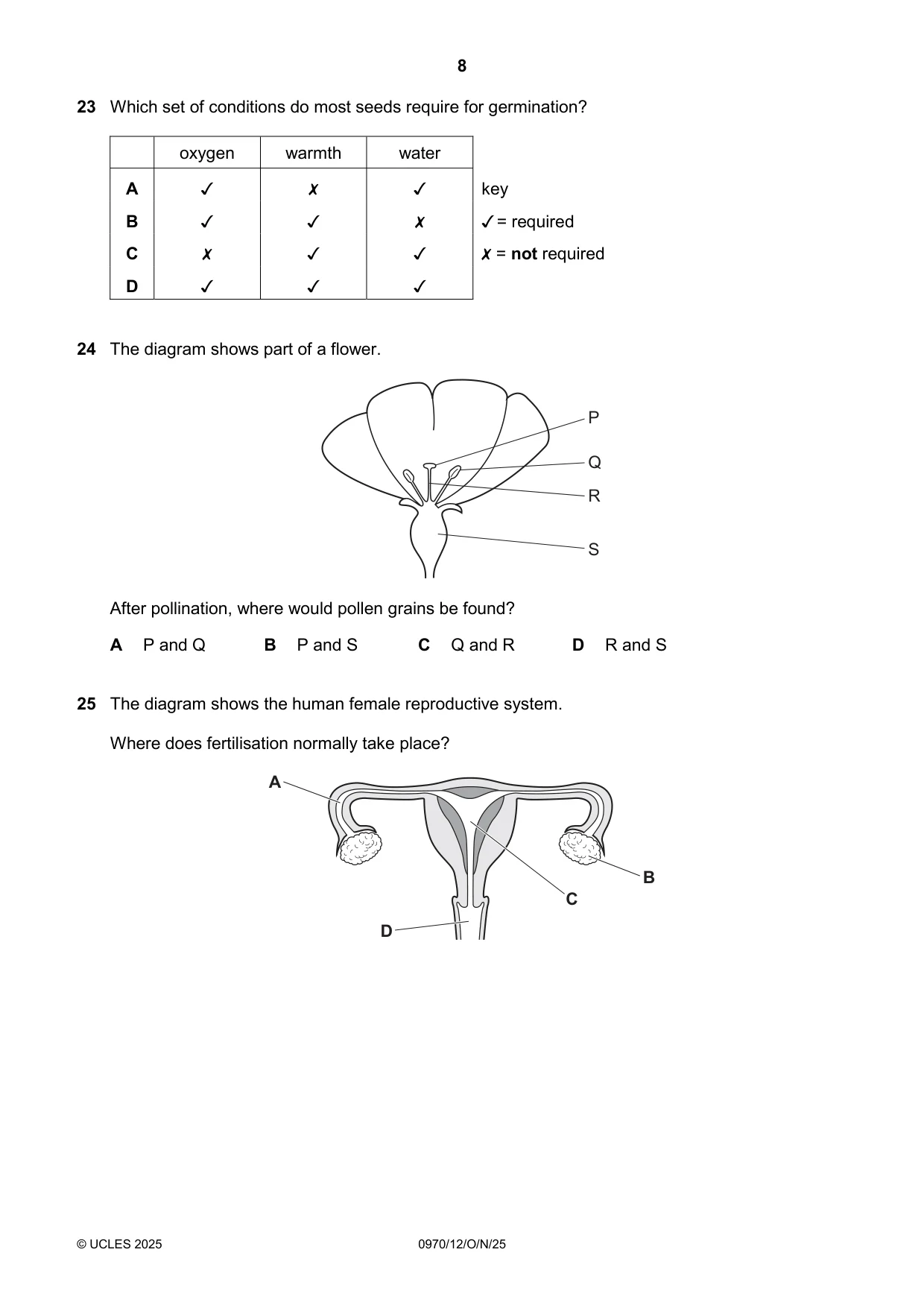
24 The diagram shows part of a flower. P Q R S After pollination, where would pollen grains be found? A P and Q B P and S C Q and R D R and S
Mark scheme: A
Q25 · The diagram shows the human female reproductive system
25 The diagram shows the human female reproductive system. Where does fertilisation normally take place? A B C D
Mark scheme: A
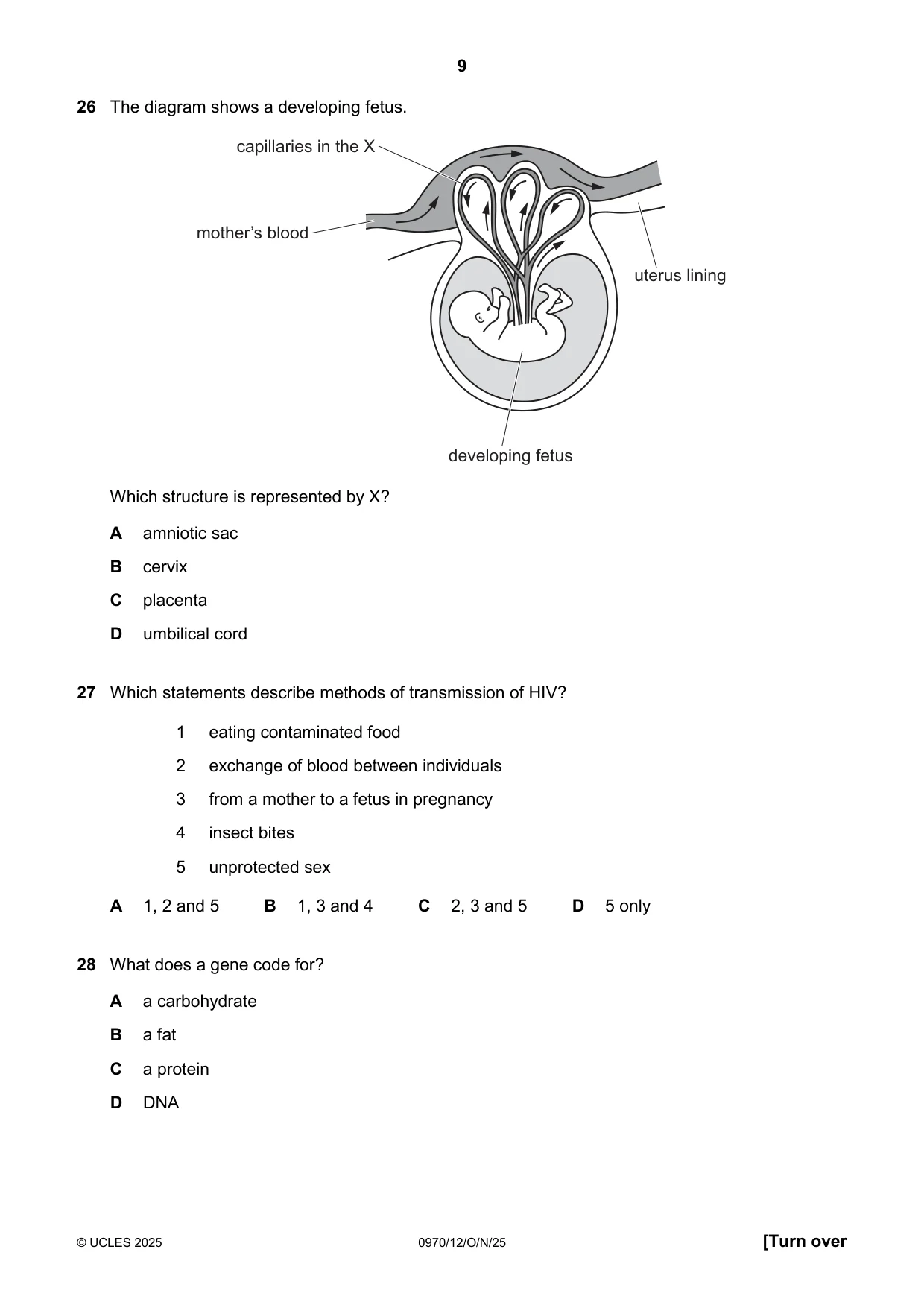
Q26 · The diagram shows a developing fetus
26 The diagram shows a developing fetus. capillaries in the X mother’s blood uterus lining developing fetus Which structure is represented by X? A amniotic sac B cervix C placenta D umbilical cord
Mark scheme: C
Q27 · Which statements describe methods of transmission of HIV?
27 Which statements describe methods of transmission of HIV? 1 eating contaminated food 2 exchange of blood between individuals 3 from a mother to a fetus in pregnancy 4 insect bites 5 unprotected sex A 1, 2 and 5 B 1, 3 and 4 C 2, 3 and 5 D 5 only
Mark scheme: C
Q28 · What does a gene code for?
28 What does a gene code for? A a carbohydrate B a fat C a protein D DNA
Mark scheme: C
Q29 · In a species of mammal, the allele for short hair, H, is dominant and the allele for long…
29 In a species of mammal, the allele for short hair, H, is dominant and the allele for long hair, h, is recessive. A heterozygous individual breeds with a long-haired individual. What is the expected ratio of the phenotypes in the offspring? A 100% short-haired, 0% long-haired B 75% short-haired, 25% long-haired C 50% short-haired, 50% long-haired D 25% short-haired, 75% long-haired
Mark scheme: C
Q30 · Which statement about variation and example is correct?
30 Which statement about variation and example is correct? A Continuous variation is caused by the environment and genes. An example is ABO blood groups. B Continuous variation is usually caused by genes only. An example is body mass. C Discontinuous variation is caused by both the environment and genes. An example is body mass. D Discontinuous variation is usually caused by genes only. An example is ABO blood groups.
Mark scheme: D
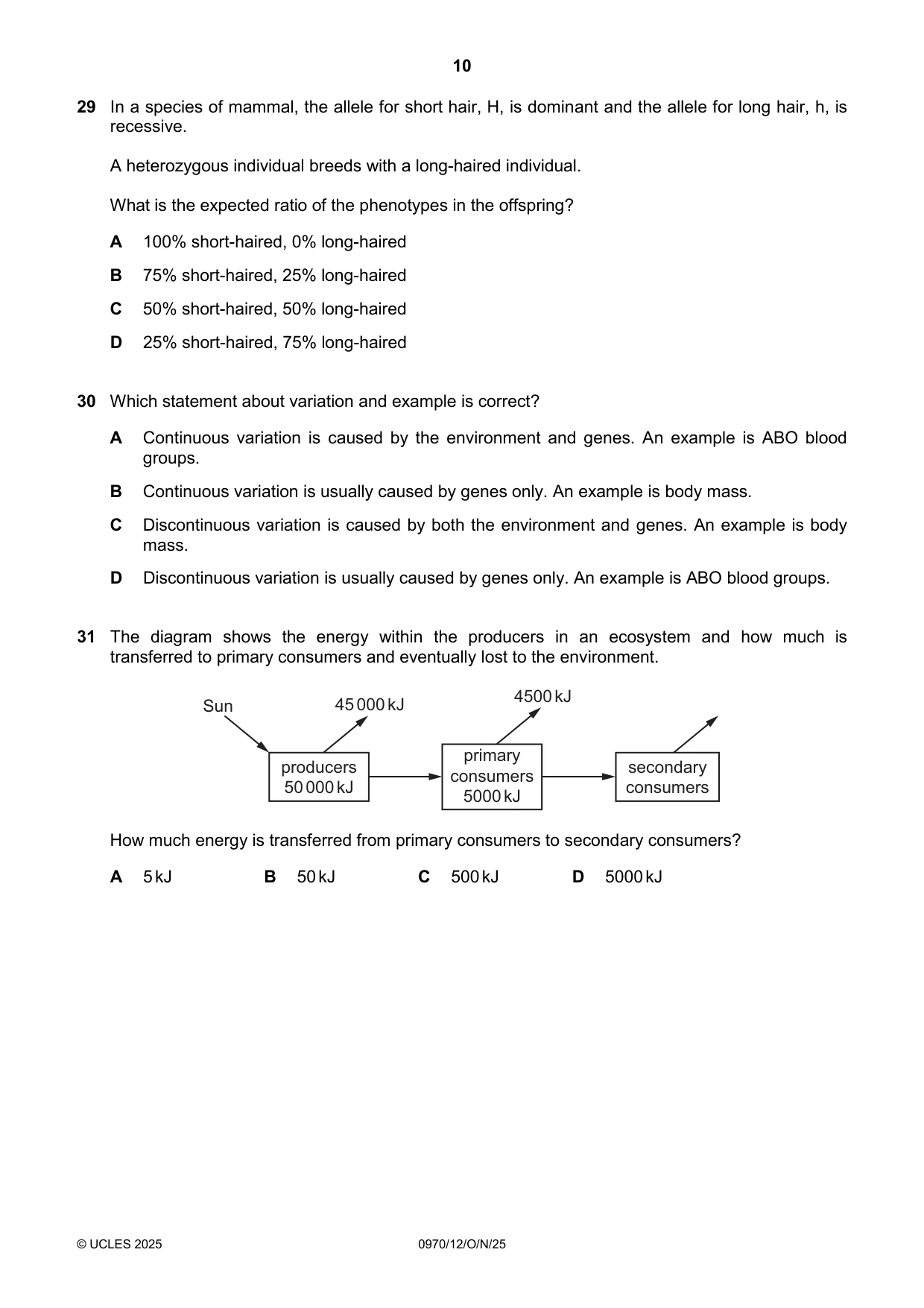
Q31 · The diagram shows the energy within the producers in an ecosystem and how much is…
31 The diagram shows the energy within the producers in an ecosystem and how much is transferred to primary consumers and eventually lost to the environment. 4500 kJ Sun 45 000 kJ primary producers secondary consumers 50 000 kJ consumers 5000 kJ How much energy is transferred from primary consumers to secondary consumers? A 5 kJ B 50 kJ C 500 kJ D 5000 kJ
Mark scheme: C
Q32 · The diagram represents part of an aquatic food web
32 The diagram represents part of an aquatic food web. tadpoles water beetles aquatic plants large fish small shrimps small fish Which organisms are primary consumers in this food web? A small shrimps and tadpoles B tadpoles and small fish C water beetles and large fish D water beetles and small fish
Mark scheme: A
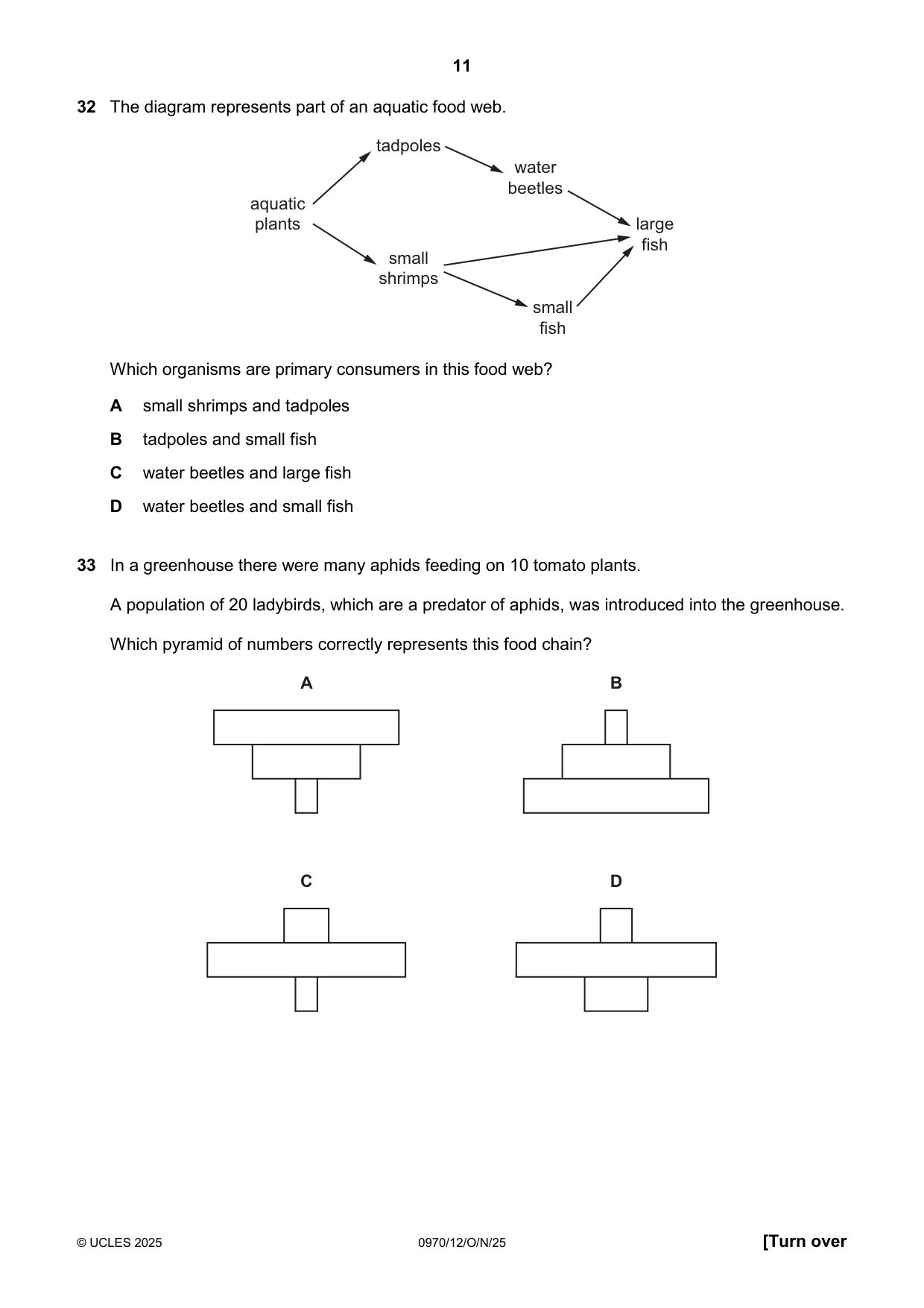
Q33 · In a greenhouse there were many aphids feeding on 10 tomato plants
33 In a greenhouse there were many aphids feeding on 10 tomato plants. A population of 20 ladybirds, which are a predator of aphids, was introduced into the greenhouse. Which pyramid of numbers correctly represents this food chain? A B C D
Mark scheme: C
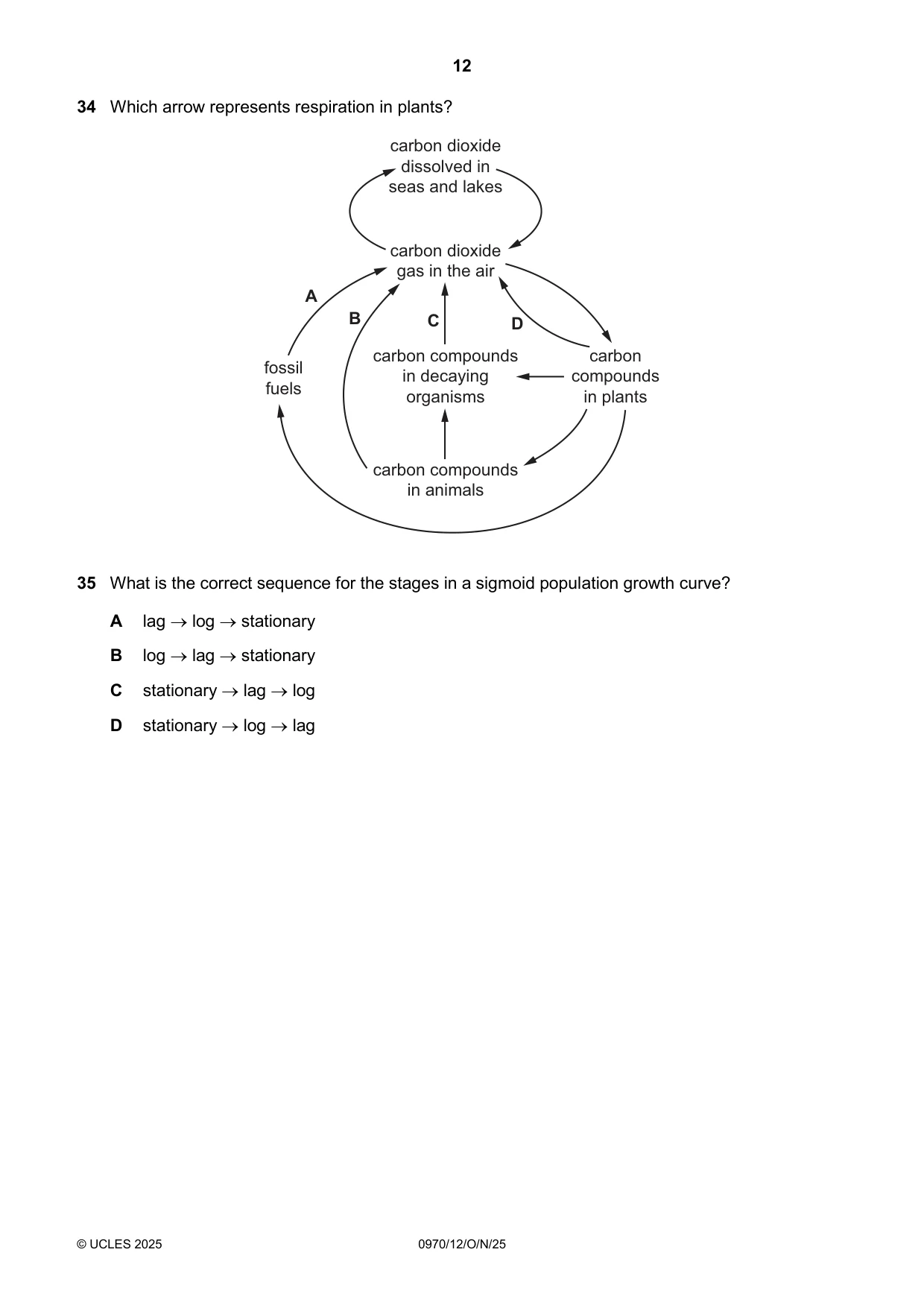
Q34 · Which arrow represents respiration in plants?
34 Which arrow represents respiration in plants? carbon dioxide dissolved in seas and lakes carbon dioxide gas in the air A B C D carbon compounds carbon fossil in decaying compounds fuels organisms in plants carbon compounds in animals
Mark scheme: D
Q35 · What is the correct sequence for the stages in a sigmoid population growth curve?
35 What is the correct sequence for the stages in a sigmoid population growth curve? A lag log stationary B log lag stationary C stationary lag log D stationary log lag
Mark scheme: A
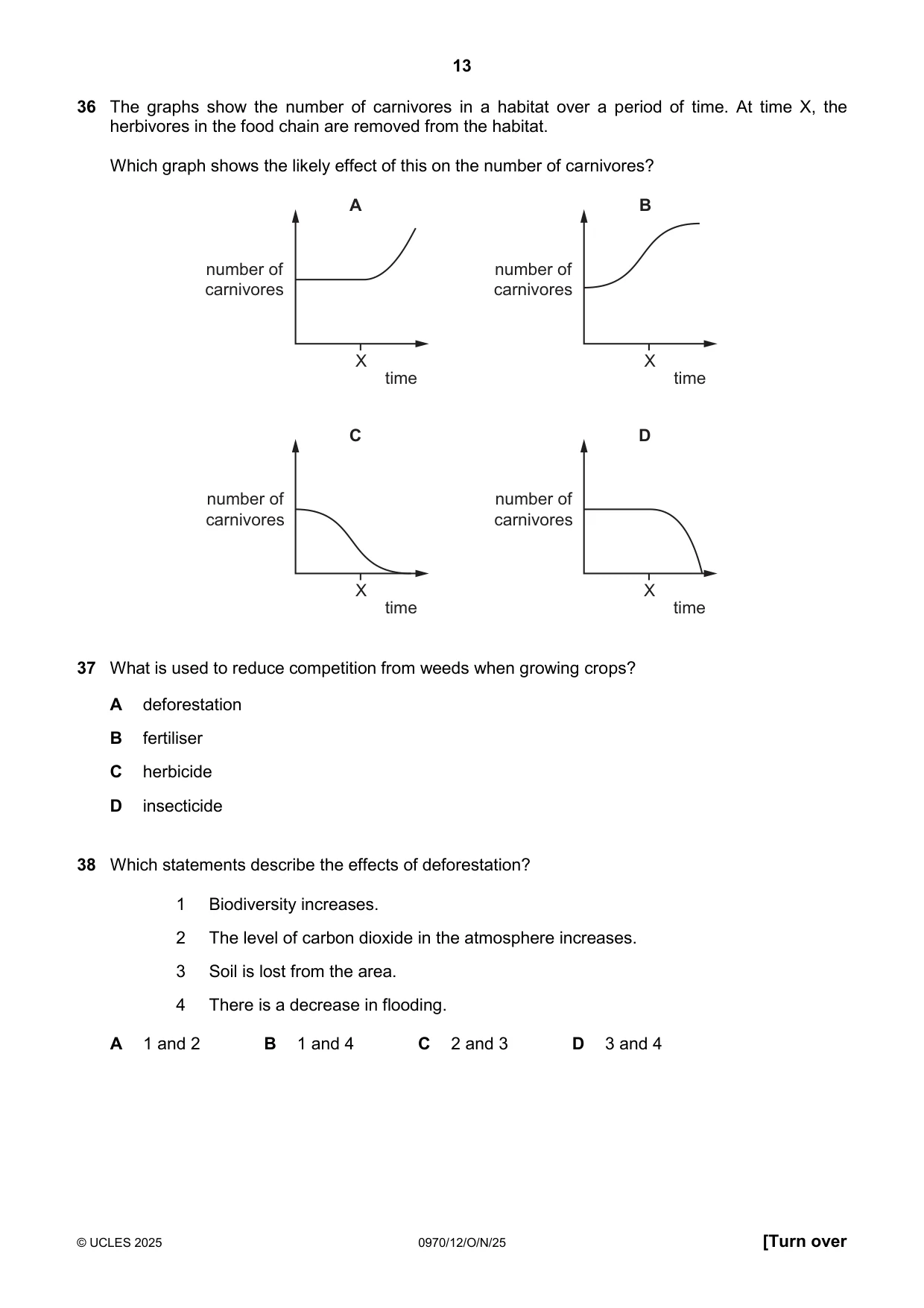
Q36 · The graphs show the number of carnivores in a habitat over a period of time
36 The graphs show the number of carnivores in a habitat over a period of time. At time X, the herbivores in the food chain are removed from the habitat. Which graph shows the likely effect of this on the number of carnivores? A B number of number of carnivores carnivores X X time time C D number of number of carnivores carnivores X X time time
Mark scheme: D
Q37 · What is used to reduce competition from weeds when growing crops?
37 What is used to reduce competition from weeds when growing crops? A deforestation B fertiliser C herbicide D insecticide
Mark scheme: C
Q38 · Which statements describe the effects of deforestation?
38 Which statements describe the effects of deforestation? 1 Biodiversity increases. 2 The level of carbon dioxide in the atmosphere increases. 3 Soil is lost from the area. 4 There is a decrease in flooding. A 1 and 2 B 1 and 4 C 2 and 3 D 3 and 4
Mark scheme: C
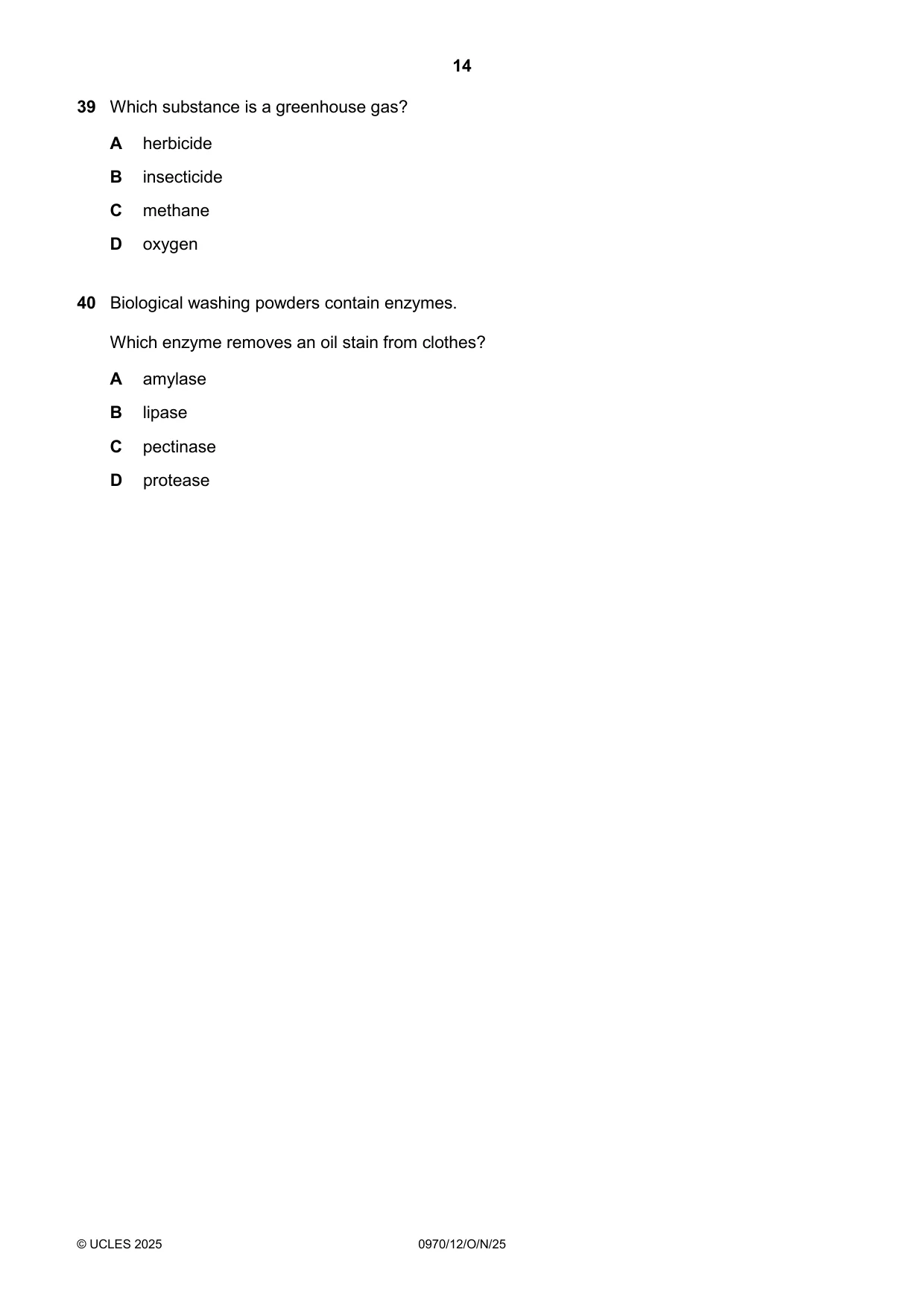
Q39 · Which substance is a greenhouse gas?
39 Which substance is a greenhouse gas? A herbicide B insecticide C methane D oxygen
Mark scheme: C
Q40 · Biological washing powders contain enzymes
40 Biological washing powders contain enzymes. Which enzyme removes an oil stain from clothes? A amylase B lipase C pectinase D protease
Mark scheme: B
What was in this paper
The subtopics covered by these 40 questions, and how many questions each got. Open one in a new tab to see every Cambridge question on it.
2Food chains and food webs2Populations2Sexual reproduction in humans2Sexual reproduction in plants2Anaerobic respiration1Biological molecules1Biotechnology1Blood1Cell structure1Characteristics of living organisms1Chemical digestion1Chromosomes, genes and proteins1Concept and uses of classification systems1Coordination and response1Diffusion1Digestive system1Diseases and immunity1Drugs1Energy flow1Excretion in humans1Features of organisms1Food supply1Gas exchange in humans1Habitat destruction1Hormones1Monohybrid inheritance1Nutrient cycles1Photosynthesis1Pollution1Sexually transmitted infections1Size of specimens1Tropic responses1Variation1Xylem and phloem1What you needed in this session
Cambridge’s own grade thresholds for 2025 Oct/Nov, Paper 1 · Variant 2. A higher threshold means an easier paper — the bar moves with how the cohort did.