Cambridge IGCSE Biology (9-1) 0970 — 2021 May/June Paper 1 · Variant 1
0970/11/M/J/21 · 40 questions · 40 marks · ≈45 min
The question paper and its mark scheme, free to read here and free to download. This is Cambridge’s own paper, exactly as it was sat.
Question paper20 pages




Mark scheme3 pages
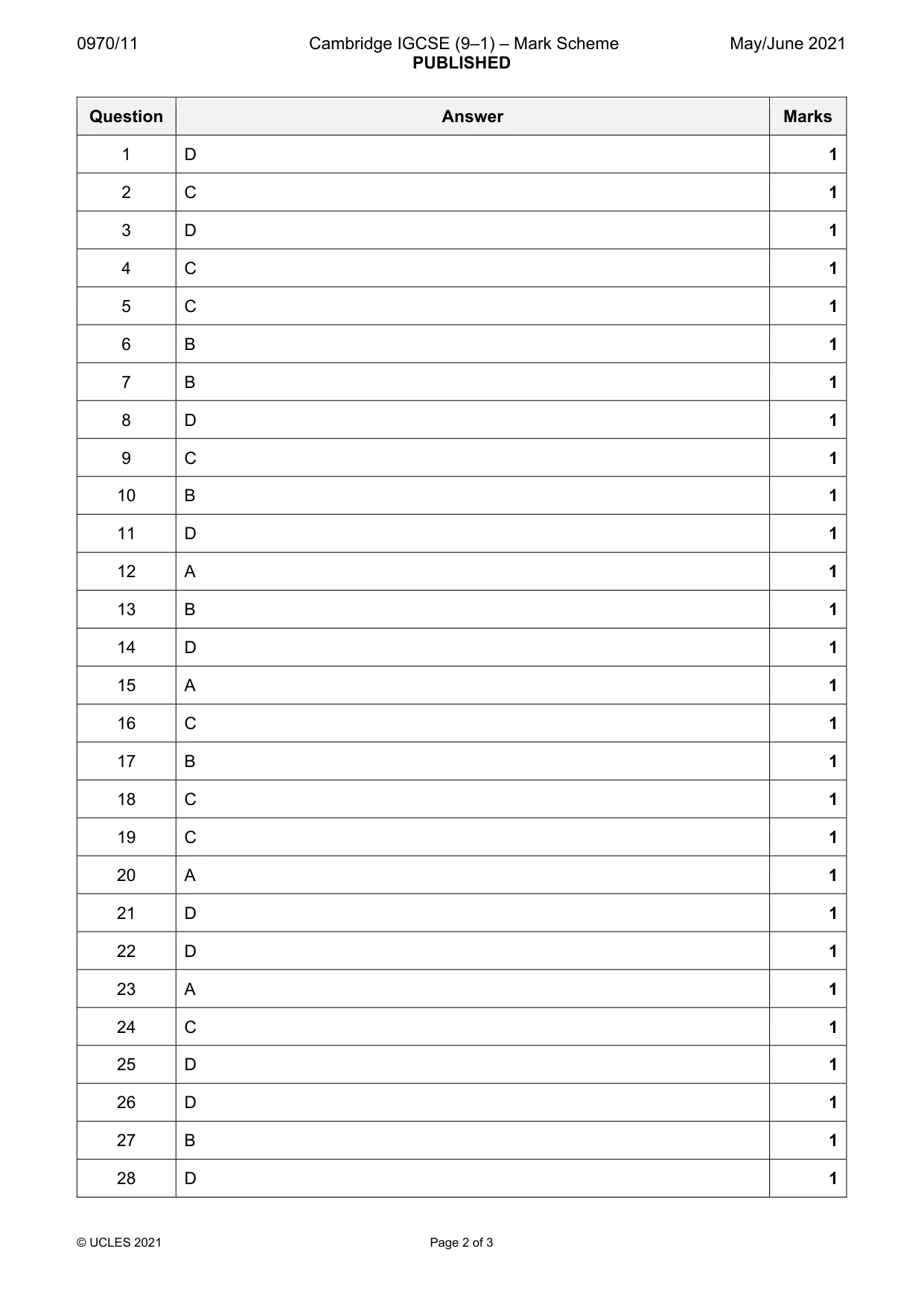
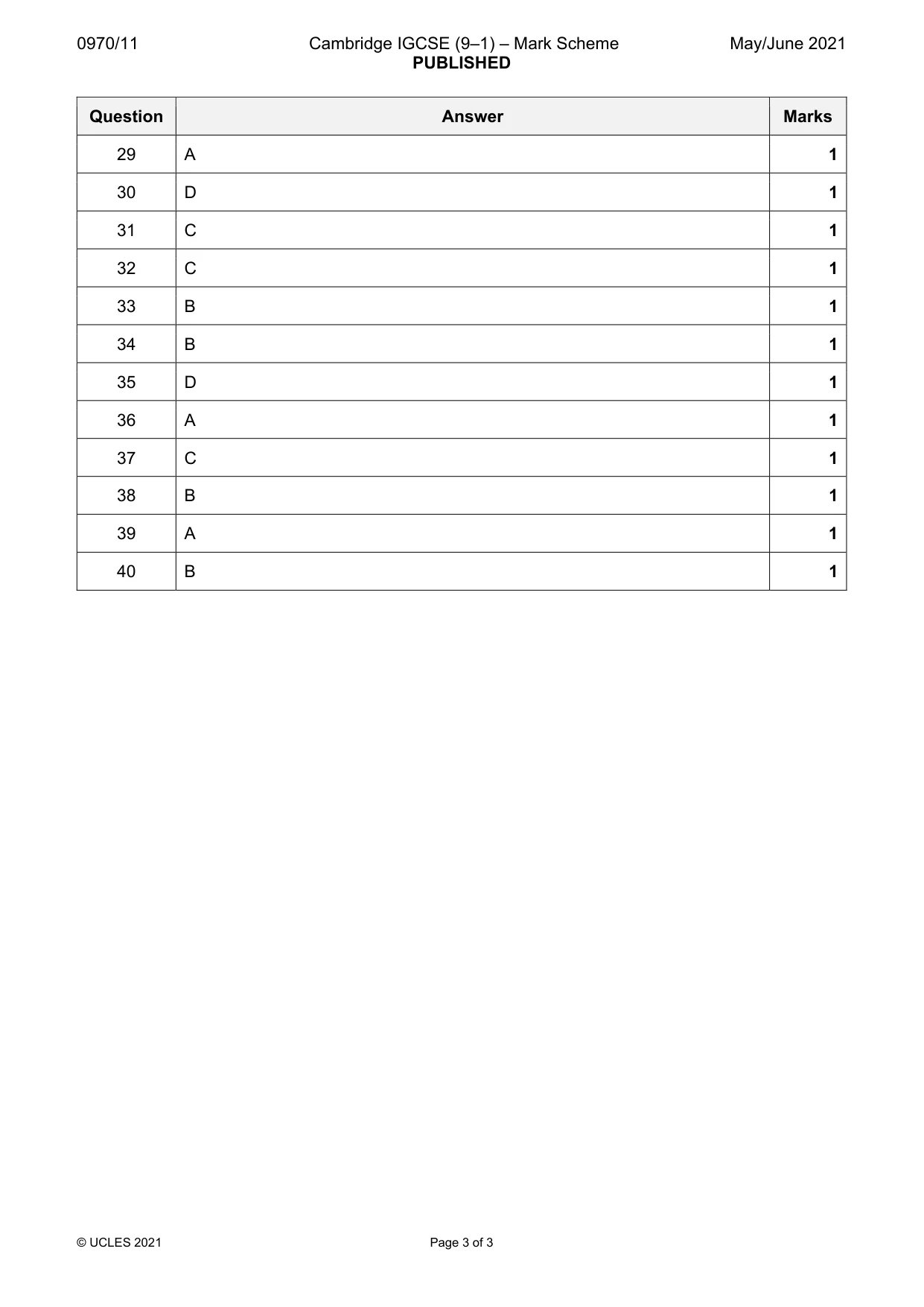
Answers below. Sit the paper first if you are practising.
Questions as text
Q1 · What is a characteristic of all living organisms?
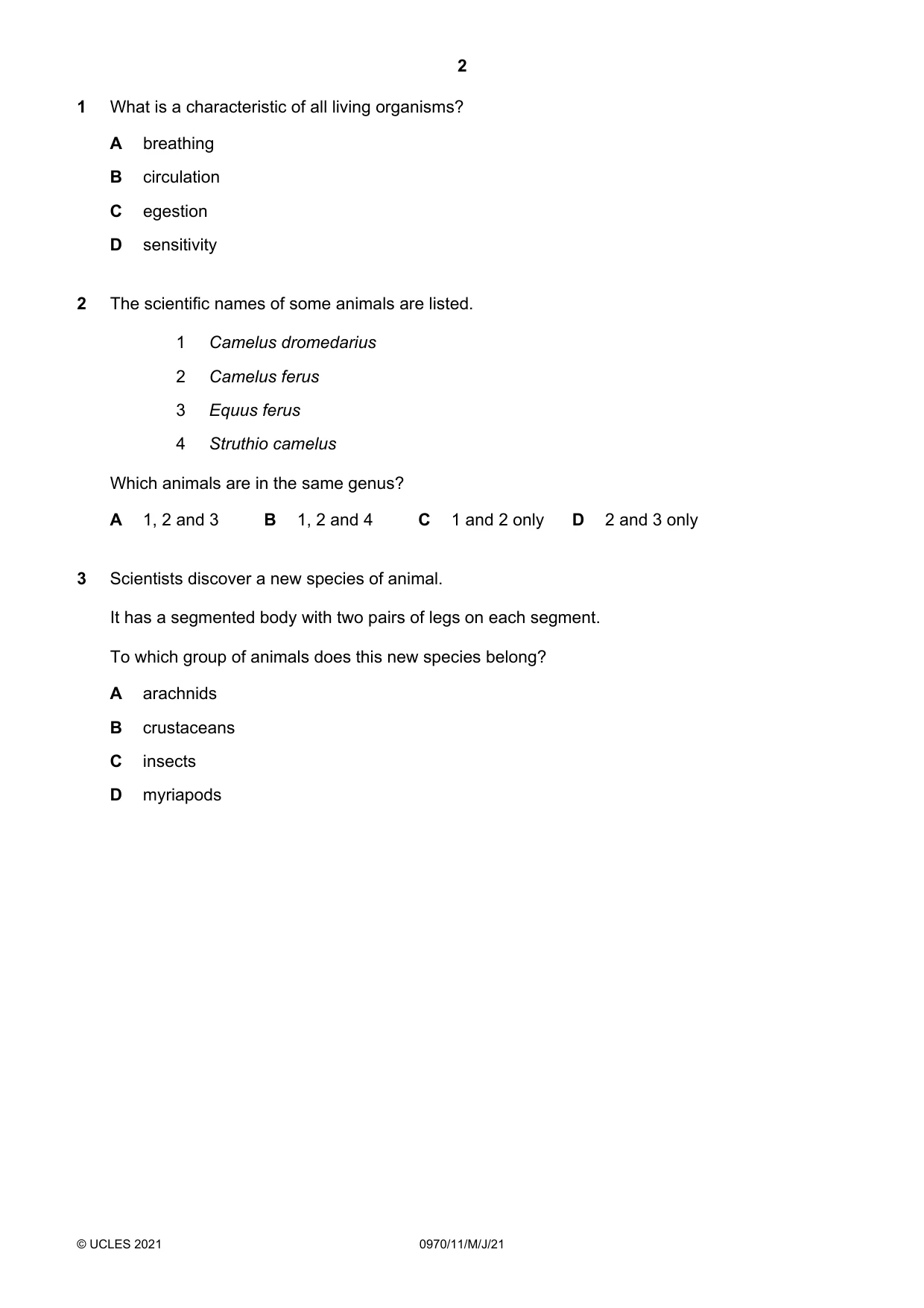
1 What is a characteristic of all living organisms? A breathing B circulation C egestion D sensitivity
Mark scheme: D
Q2 · The scientific names of some animals are listed
2 The scientific names of some animals are listed. 1 Camelus dromedarius 2 Camelus ferus 3 Equus ferus 4 Struthio camelus Which animals are in the same genus? A 1, 2 and 3 B 1, 2 and 4 C 1 and 2 only D 2 and 3 only
Mark scheme: C
More questions on Concept and uses of classification systems
Q3 · Scientists discover a new species of animal
3 Scientists discover a new species of animal. It has a segmented body with two pairs of legs on each segment. To which group of animals does this new species belong? A arachnids B crustaceans C insects D myriapods
Mark scheme: D
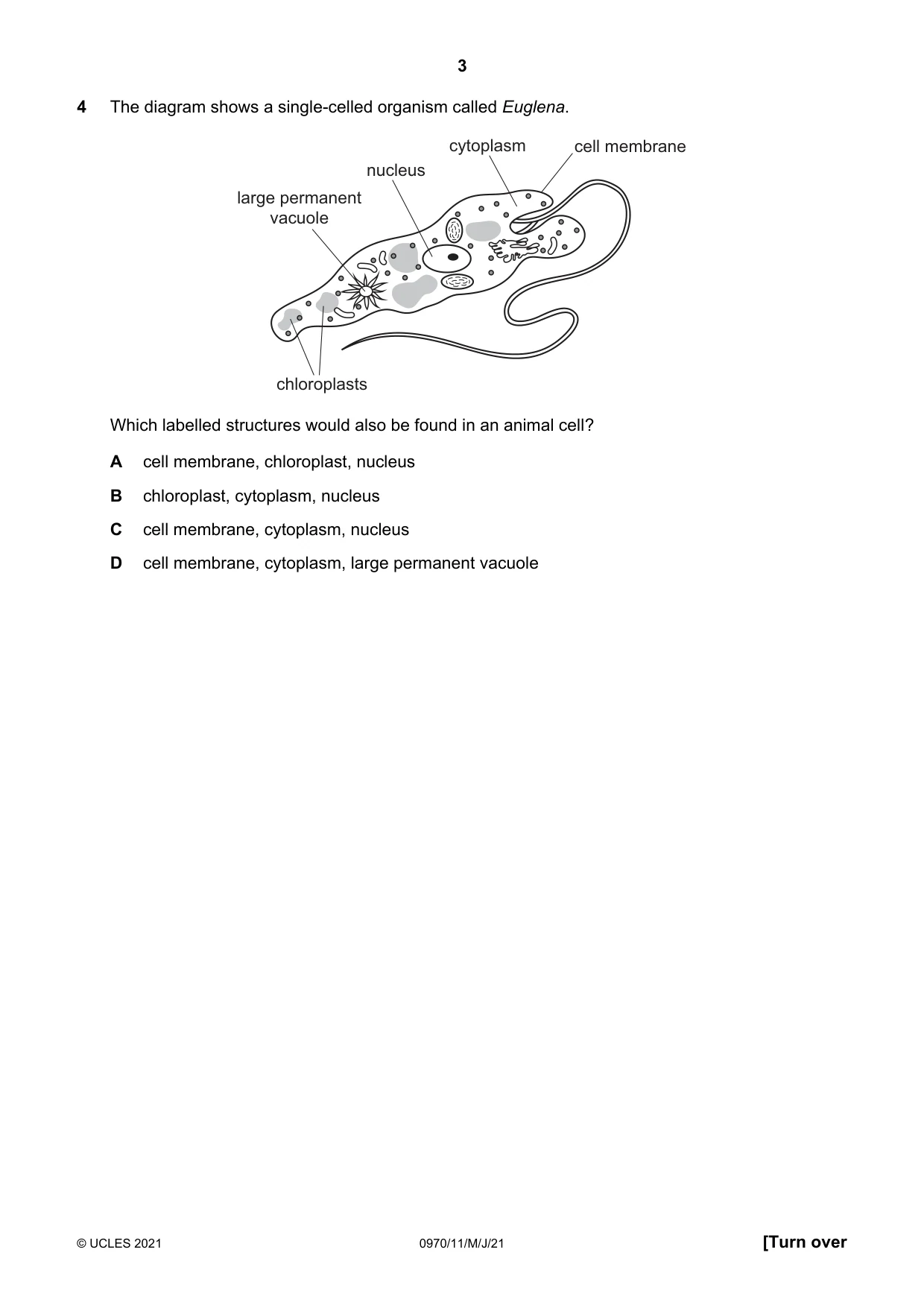
Q4 · The diagram shows a single-celled organism called Euglena
4 The diagram shows a single-celled organism called Euglena. cytoplasm cell membrane nucleus large permanent vacuole chloroplasts Which labelled structures would also be found in an animal cell? A cell membrane, chloroplast, nucleus B chloroplast, cytoplasm, nucleus C cell membrane, cytoplasm, nucleus D cell membrane, cytoplasm, large permanent vacuole
Mark scheme: C
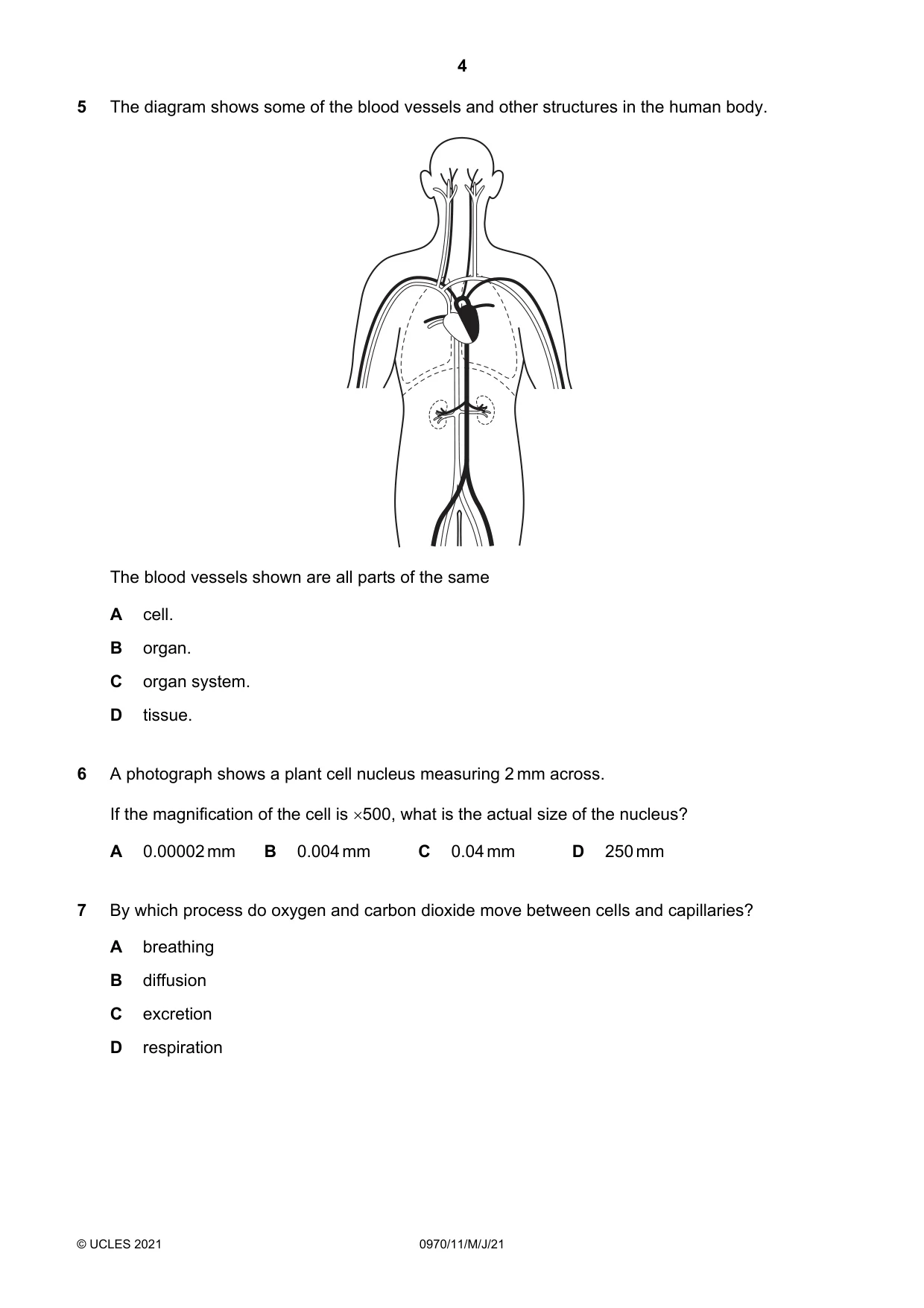
Q5 · The diagram shows some of the blood vessels and other structures in the human body
5 The diagram shows some of the blood vessels and other structures in the human body. The blood vessels shown are all parts of the same A cell. B organ. C organ system. D tissue.
Mark scheme: C
Q6 · A photograph shows a plant cell nucleus measuring 2 mm across
6 A photograph shows a plant cell nucleus measuring 2 mm across. If the magnification of the cell is 500, what is the actual size of the nucleus? A 0.00002 mm B 0.004 mm C 0.04 mm D 250 mm
Mark scheme: B
Q7 · By which process do oxygen and carbon dioxide move between cells and capillaries?
7 By which process do oxygen and carbon dioxide move between cells and capillaries? A breathing B diffusion C excretion D respiration
Mark scheme: B
Q8 · A cylinder of potato tissue was placed in a beaker of very salty water
8 A cylinder of potato tissue was placed in a beaker of very salty water. After one hour the mass of the potato cylinder had decreased. Why did this happen? A Salt entered the plant tissue by active transport. B Salt left the plant tissue by osmosis. C Water entered the plant tissue by active transport. D Water left the plant tissue by osmosis.
Mark scheme: D
Q9 · Which element is found in proteins but not carbohydrates?
9 Which element is found in proteins but not carbohydrates? A carbon B hydrogen C nitrogen D oxygen
Mark scheme: C
Q10 · Starch is digested by amylase in the mouth, but it is not digested in the stomach
10 Starch is digested by amylase in the mouth, but it is not digested in the stomach. What is the reason for this? A All starch digestion is completed in the mouth. B The pH in the stomach is not suitable for the amylase to work. C The starch does not stay in the stomach long enough to be digested. D The temperature in the stomach is not suitable for the amylase to work.
Mark scheme: B
Q11 · Which statement describes a catalyst?
11 Which statement describes a catalyst? A a substance that decreases the rate of a chemical reaction and is not changed by the reaction B a substance that decreases the rate of a chemical reaction and is changed by the reaction C a substance that increases the rate of a chemical reaction and is changed by the reaction D a substance that increases the rate of a chemical reaction and is not changed by the reaction
Mark scheme: D
Q12 · A plant with striped leaves was kept in bright light for six hours
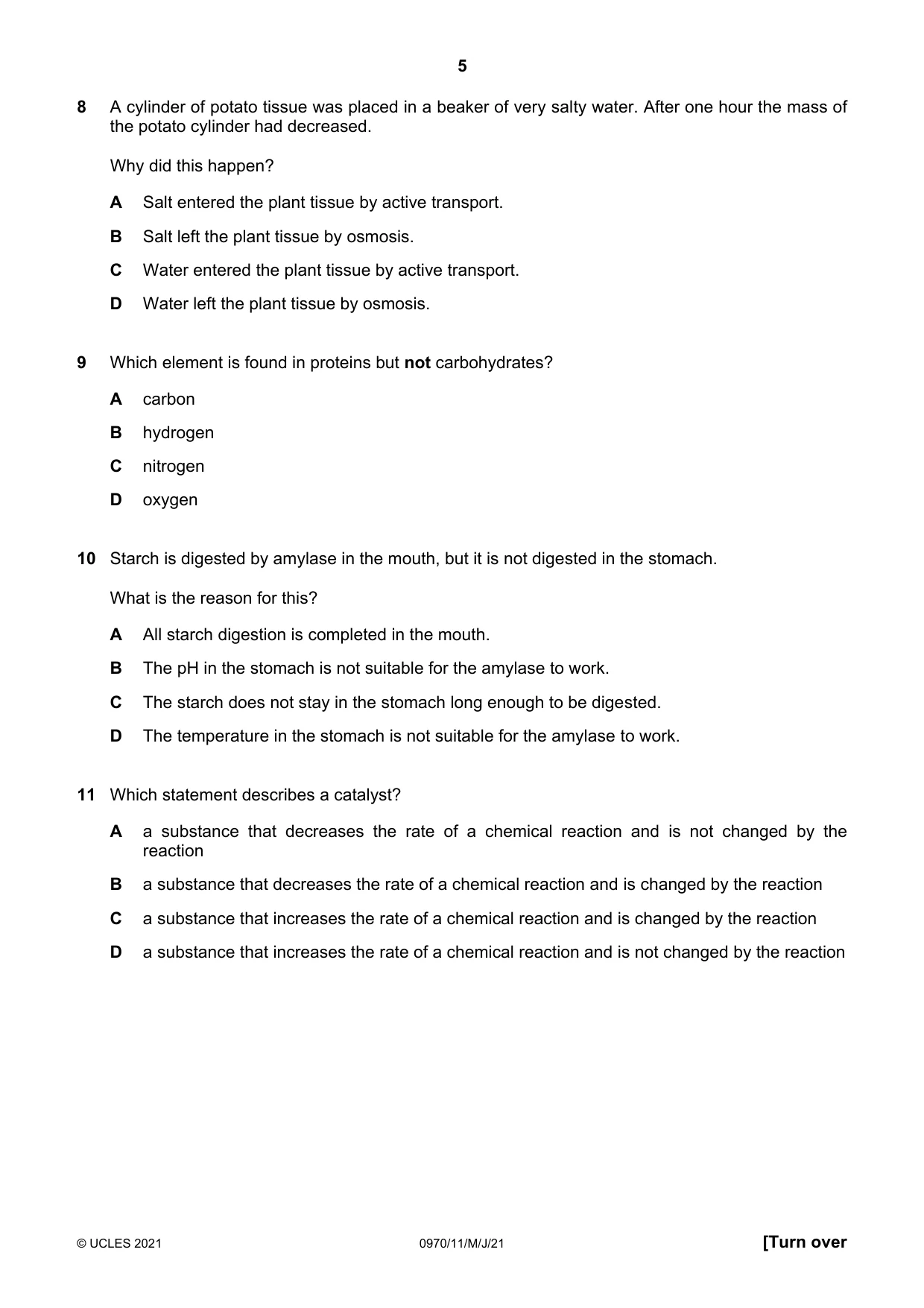
12 A plant with striped leaves was kept in bright light for six hours. white stripe green stripe A leaf was taken from the plant and the chlorophyll was removed. The leaf was then tested for starch using iodine solution. Which diagram shows the result of the test? A B C D yellow-brown white blue-black yellow-brown blue-black blue-black green green
Mark scheme: A
Q13 · The diagram shows a section through the leaf of a plant
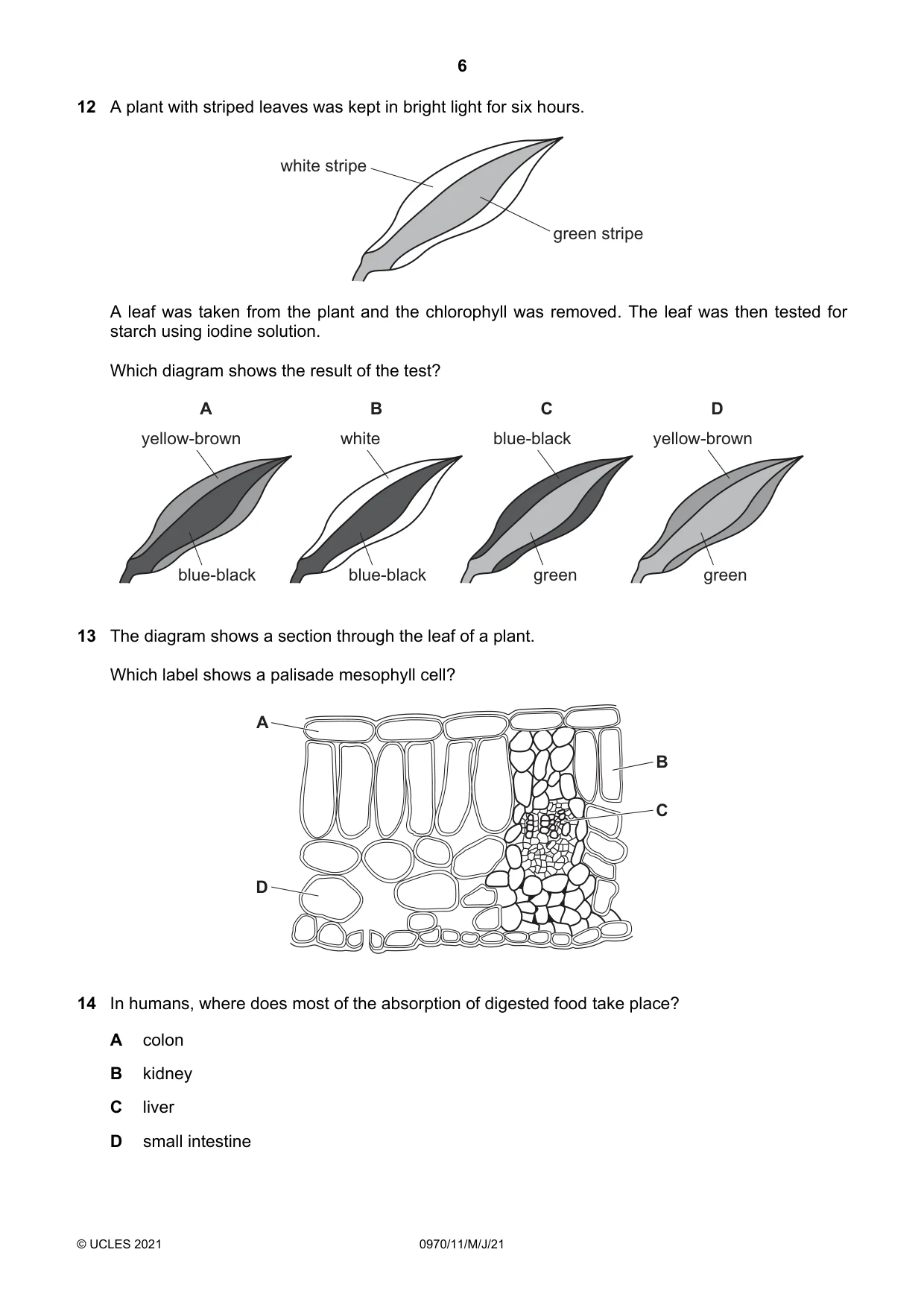
13 The diagram shows a section through the leaf of a plant. Which label shows a palisade mesophyll cell? A B C D
Mark scheme: B
Q14 · In humans, where does most of the absorption of digested food take place?
14 In humans, where does most of the absorption of digested food take place? A colon B kidney C liver D small intestine
Mark scheme: D
Q15 · What are the products when proteins are broken down?
15 What are the products when proteins are broken down? A amino acids B fatty acids C glycerol D simple sugars
Mark scheme: A
Q16 · Where does most of the absorption of water take place in the alimentary canal?
16 Where does most of the absorption of water take place in the alimentary canal? A colon B oesophagus C small intestine D stomach
Mark scheme: C
Q17 · The diagram shows part of a cross-section of a root
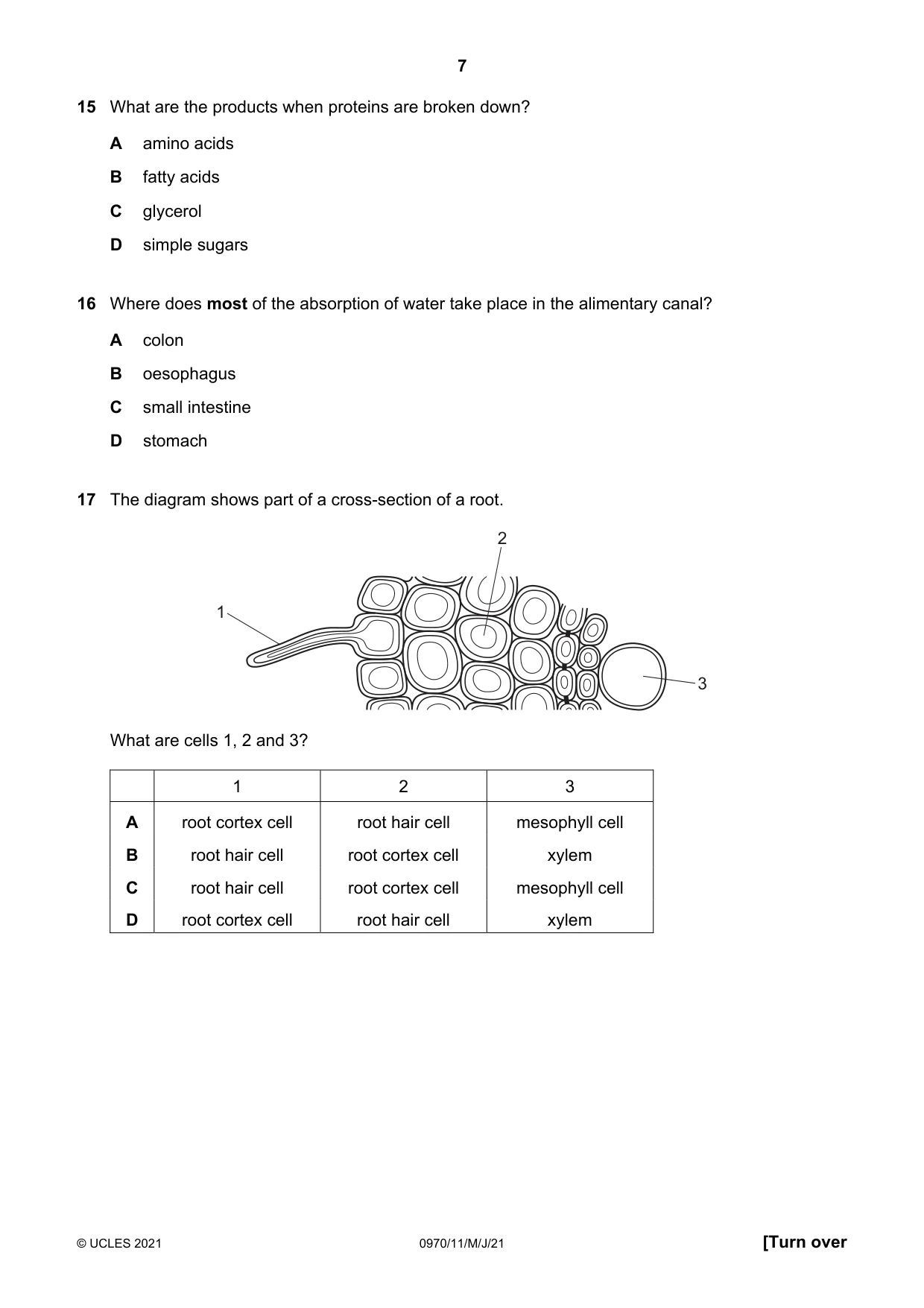
17 The diagram shows part of a cross-section of a root. 2 1 3 What are cells 1, 2 and 3? 1 2 3 A root cortex cell root hair cell mesophyll cell B root hair cell root cortex cell xylem C root hair cell root cortex cell mesophyll cell D root cortex cell root hair cell xylem
Mark scheme: B
Q18 · A plant shoot is placed in a solution of dye
18 A plant shoot is placed in a solution of dye. The dye moves up the stem. Under which conditions will the dye move most slowly? temperature humidity A high high B high low C low high D low low
Mark scheme: C
Q19 · What are the main vessels carrying blood to and from the kidney?
19 What are the main vessels carrying blood to and from the kidney? to kidney from kidney A pulmonary artery pulmonary vein B pulmonary vein pulmonary artery C renal artery renal vein D renal vein renal artery
Mark scheme: C
Q20 · The diagram shows a cross-section through a human blood vessel
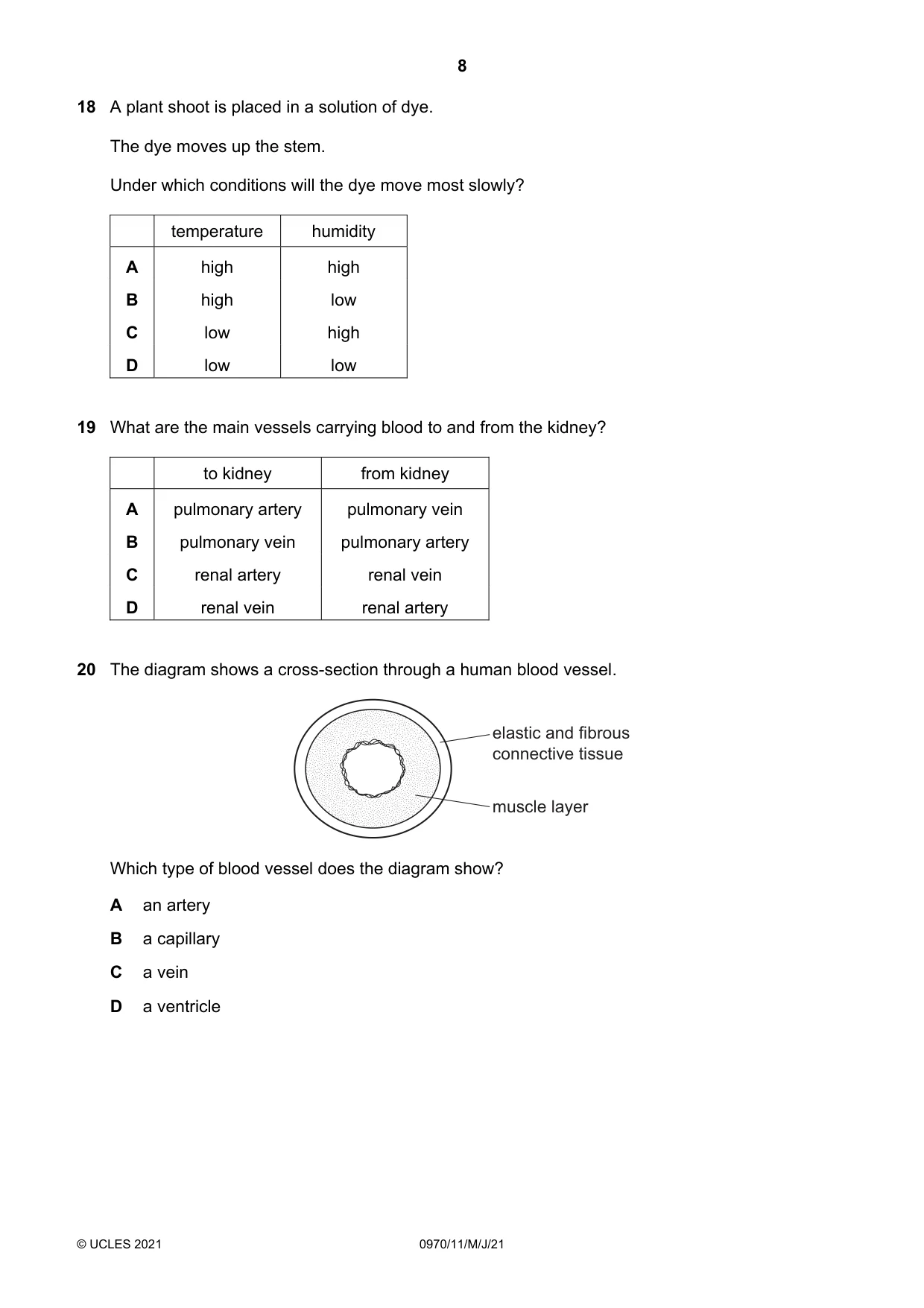
20 The diagram shows a cross-section through a human blood vessel. elastic and fibrous connective tissue muscle layer Which type of blood vessel does the diagram show? A an artery B a capillary C a vein D a ventricle
Mark scheme: A
Q21 · What is a function of some white blood cells?
21 What is a function of some white blood cells? A to carry glucose B to carry oxygen C to produce antibiotics D to produce antibodies
Mark scheme: D
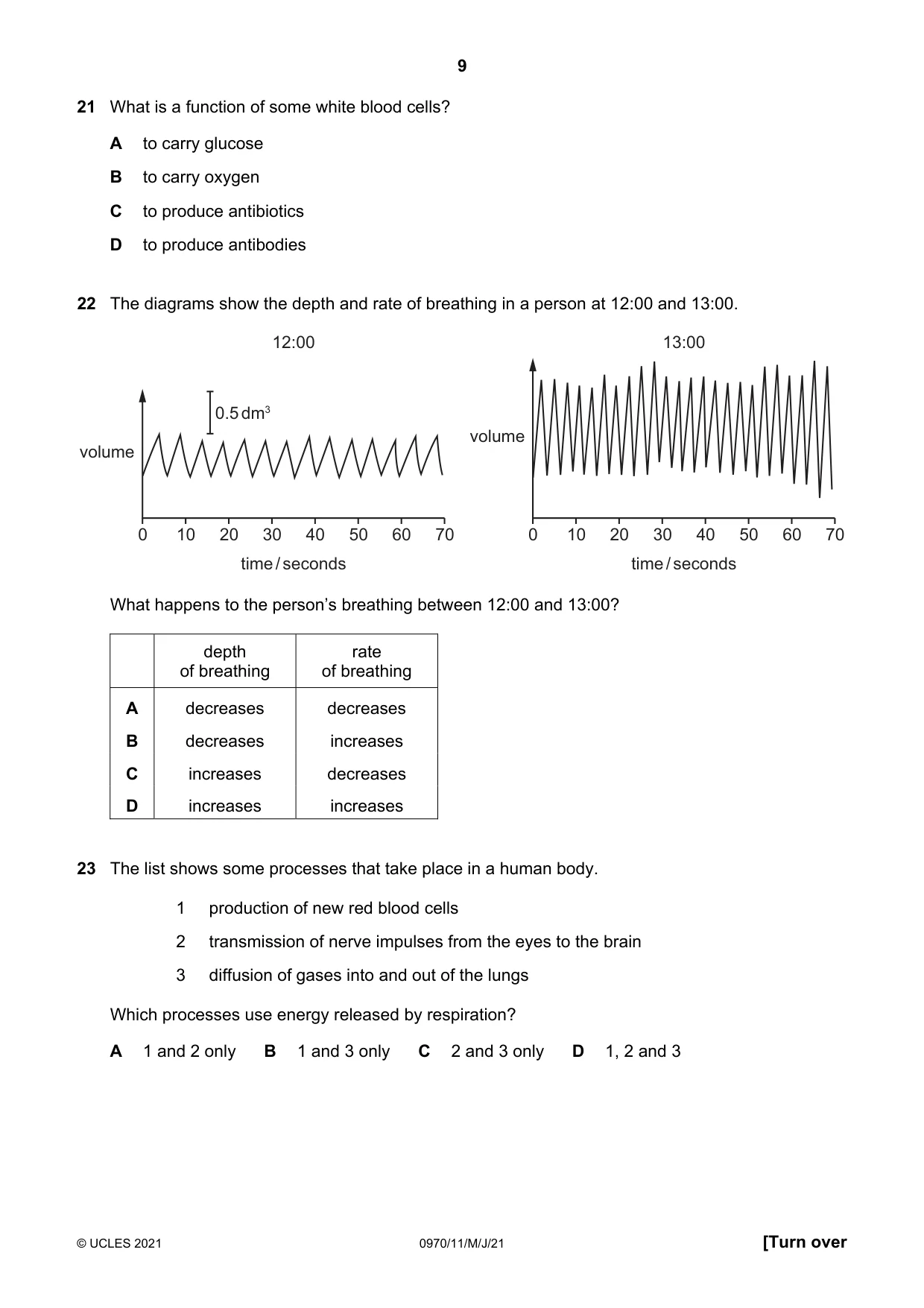
Q22 · The diagrams show the depth and rate of breathing in a person at 12:00 and 13:00
22 The diagrams show the depth and rate of breathing in a person at 12:00 and 13:00. 12:00 13:00 0.5 dm3 volume volume 0 10 20 30 40 50 60 70 0 10 20 30 40 50 60 70 time / seconds time / seconds What happens to the person’s breathing between 12:00 and 13:00? depth rate of breathing of breathing A decreases decreases B decreases increases C increases decreases D increases increases
Mark scheme: D
Q23 · The list shows some processes that take place in a human body
23 The list shows some processes that take place in a human body. 1 production of new red blood cells 2 transmission of nerve impulses from the eyes to the brain 3 diffusion of gases into and out of the lungs Which processes use energy released by respiration? A 1 and 2 only B 1 and 3 only C 2 and 3 only D 1, 2 and 3
Mark scheme: A
Q24 · What is produced by anaerobic respiration in humans?
24 What is produced by anaerobic respiration in humans? alcohol carbon dioxide lactic acid A x Jv Jv key B Jv Jv x /=yes Cc x x v X=no D v x x
Mark scheme: C
Q25 · Which statement about urea is correct?
25 Which statement about urea is correct? A Urea is formed from excess amino acids in the kidneys and excreted by the liver. B Urea is formed from excess glucose in the liver and egested by the kidneys. C Urea is formed from excess glucose in the kidneys and egested by the liver. D Urea is formed from excess amino acids in the liver and excreted by the kidneys.
Mark scheme: D
Q26 · What is the sequence of neurones connecting a receptor to an effector in a reflex arc?
26 What is the sequence of neurones connecting a receptor to an effector in a reflex arc? A motor relay sensory B motor sensory relay C sensory motor relay D sensory relay motor
Mark scheme: D
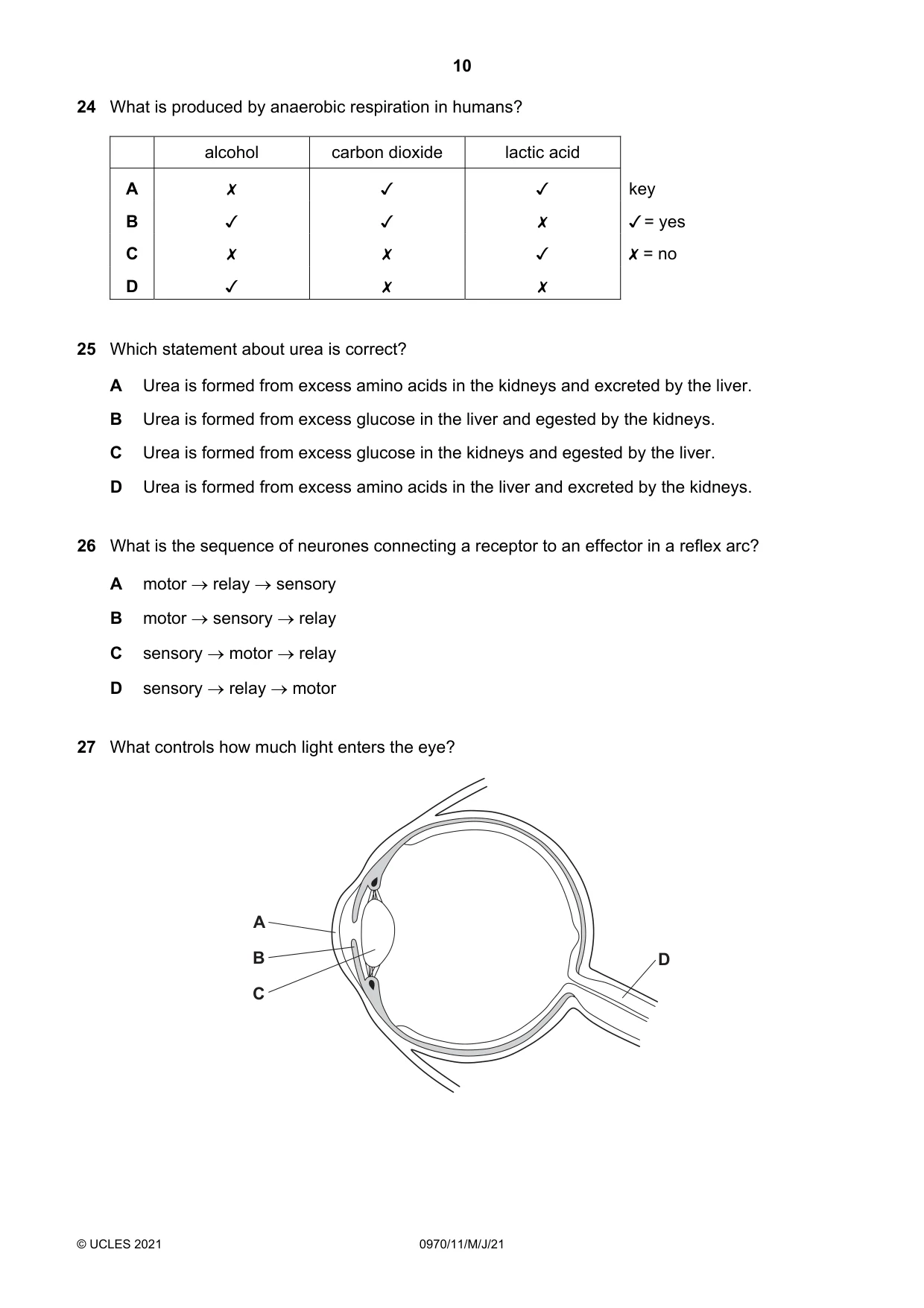
Q27 · What controls how much light enters the eye?
27 What controls how much light enters the eye? A B D C
Mark scheme: B
Q28 · Which row matches each hormone to its function?
28 Which row matches each hormone to its function? causes the growth reduces blood repairs the widens of facial hair glucose concentration lining of the uterus the pupils A oestrogen insulin testosterone adrenaline B oestrogen insulin insulin testosterone C testosterone adrenaline insulin oestrogen D testosterone insulin oestrogen adrenaline
Mark scheme: D
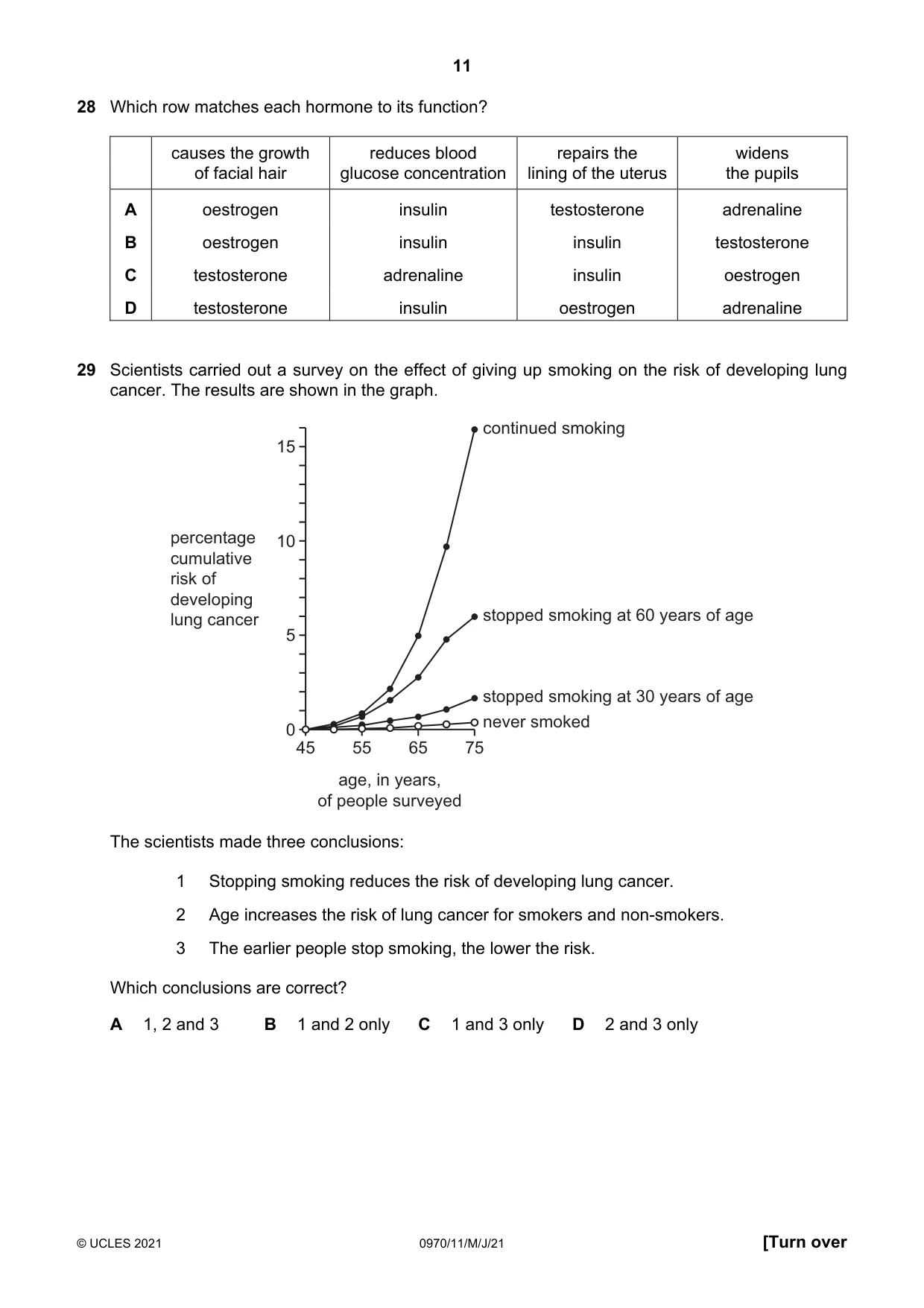
Q29 · Scientists carried out a survey on the effect of giving up smoking on the risk of…
29 Scientists carried out a survey on the effect of giving up smoking on the risk of developing lung cancer. The results are shown in the graph. continued smoking 15 percentage 10 cumulative risk of developing lung cancer stopped smoking at 60 years of age 5 stopped smoking at 30 years of age never smoked 0 45 55 65 75 age, in years, of people surveyed The scientists made three conclusions: 1 Stopping smoking reduces the risk of developing lung cancer. 2 Age increases the risk of lung cancer for smokers and non-smokers. 3 The earlier people stop smoking, the lower the risk. Which conclusions are correct? A 1, 2 and 3 B 1 and 2 only C 1 and 3 only D 2 and 3 only
Mark scheme: A
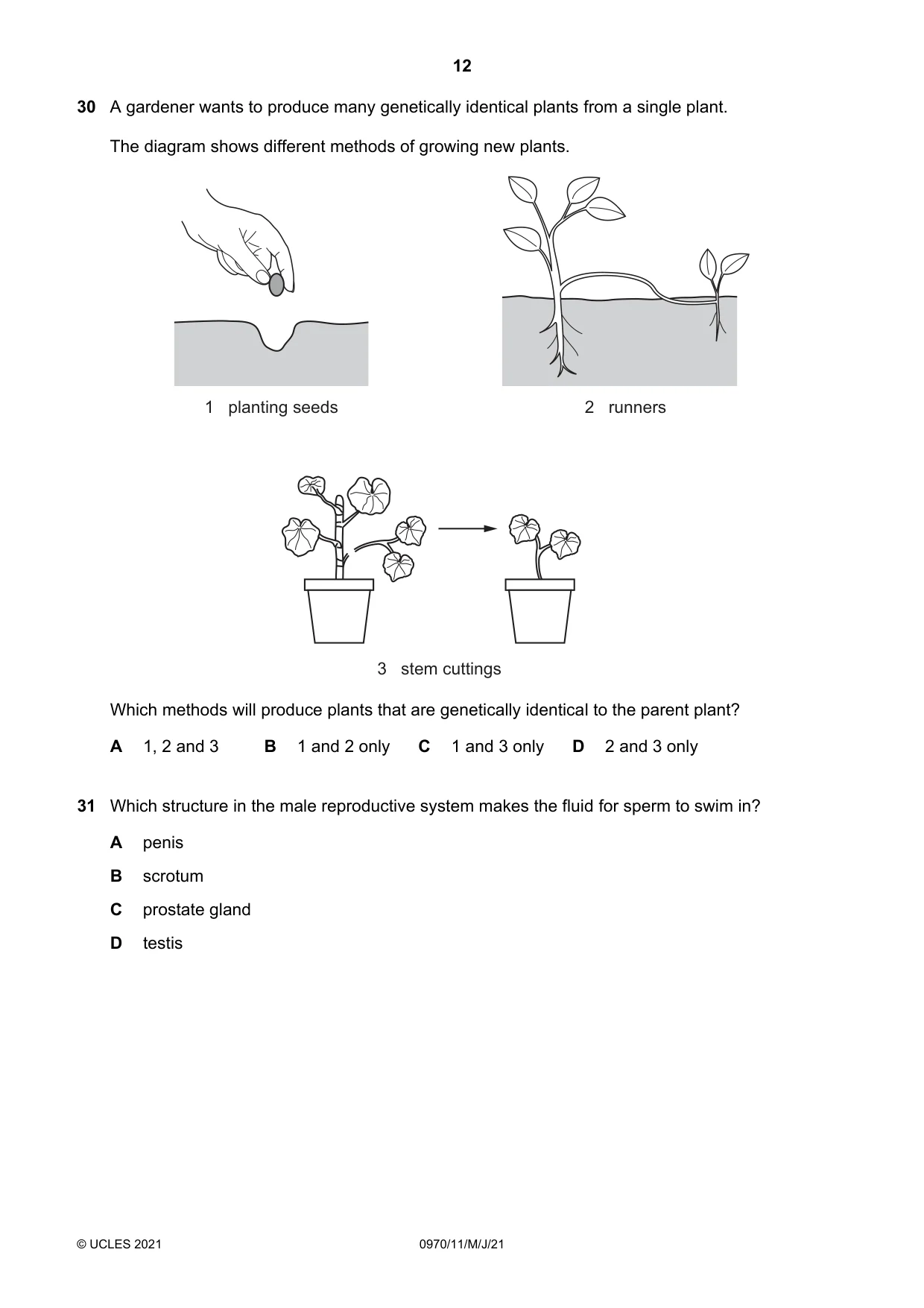
Q30 · A gardener wants to produce many genetically identical plants from a single plant
30 A gardener wants to produce many genetically identical plants from a single plant. The diagram shows different methods of growing new plants. 1 planting seeds 2 runners 3 stem cuttings Which methods will produce plants that are genetically identical to the parent plant? A 1, 2 and 3 B 1 and 2 only C 1 and 3 only D 2 and 3 only
Mark scheme: D
Q31 · Which structure in the male reproductive system makes the fluid for sperm to swim in?
31 Which structure in the male reproductive system makes the fluid for sperm to swim in? A penis B scrotum C prostate gland D testis
Mark scheme: C
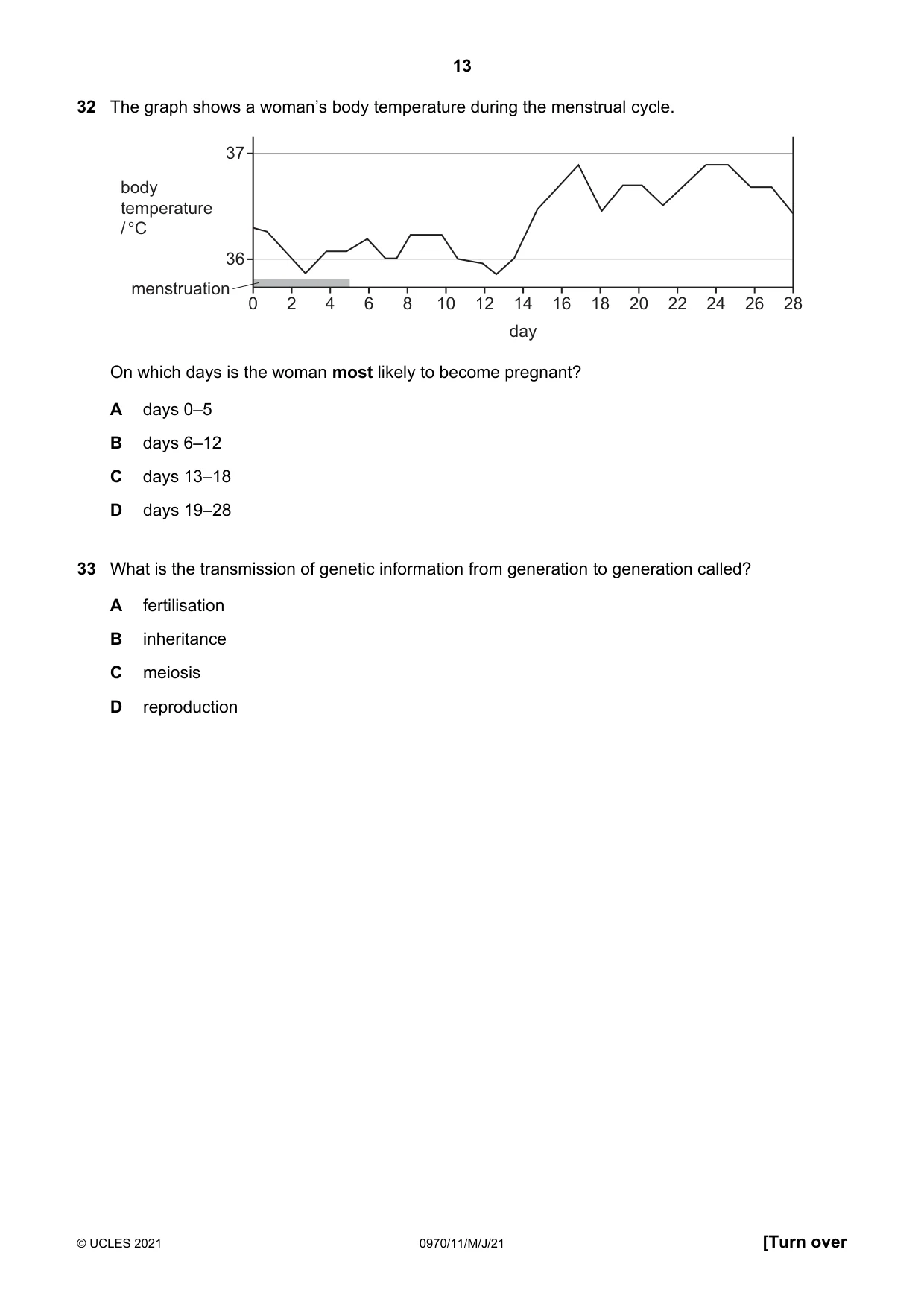
Q32 · The graph shows a woman’s body temperature during the menstrual cycle
32 The graph shows a woman’s body temperature during the menstrual cycle. 37 body temperature / °C 36 menstruation 0 2 4 6 8 10 12 14 16 18 20 22 24 26 28 day On which days is the woman most likely to become pregnant? A days 0–5 B days 6–12 C days 13–18 D days 19–28
Mark scheme: C
Q33 · What is the transmission of genetic information from generation to generation called?
33 What is the transmission of genetic information from generation to generation called? A fertilisation B inheritance C meiosis D reproduction
Mark scheme: B
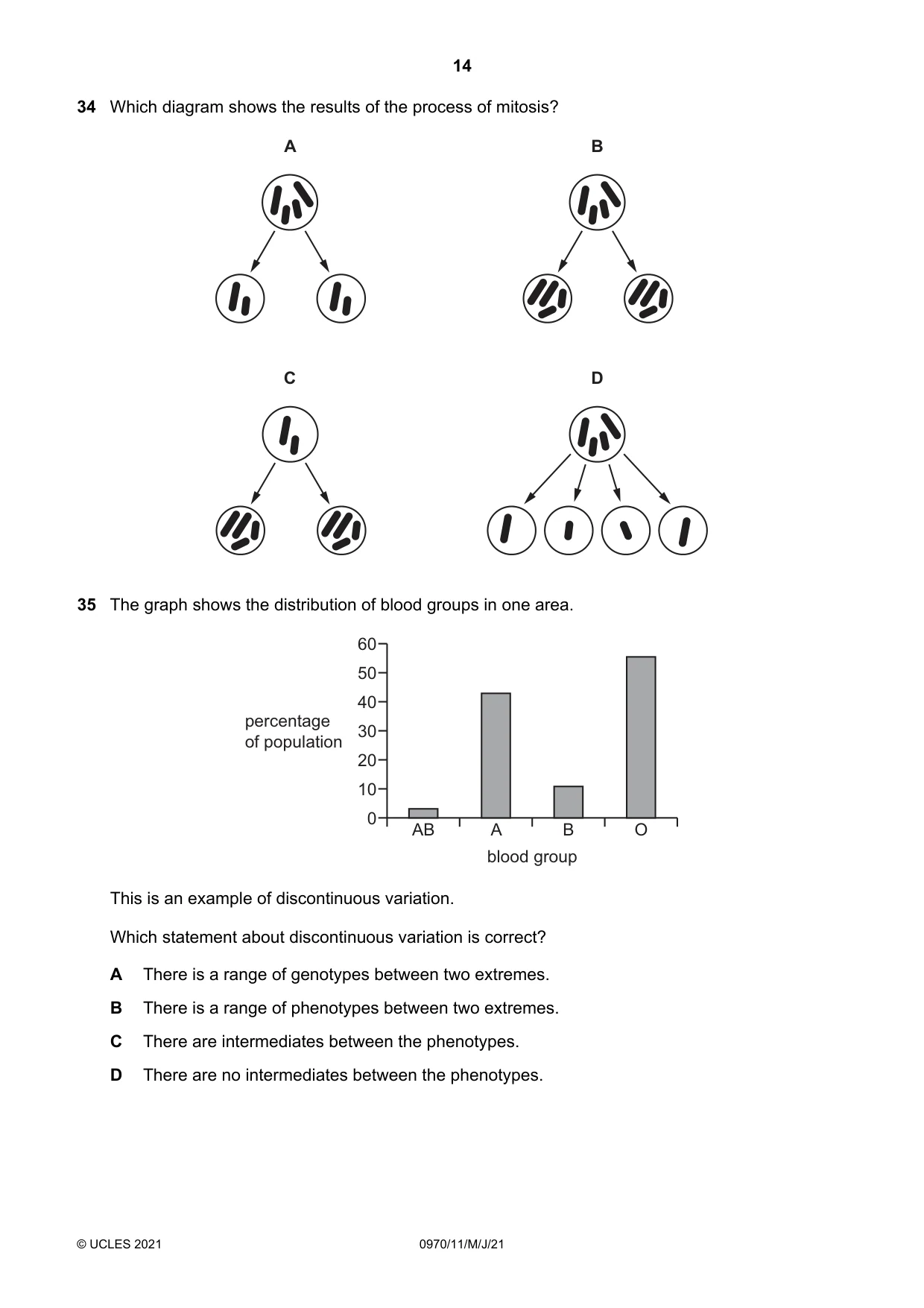
Q34 · Which diagram shows the results of the process of mitosis?
34 Which diagram shows the results of the process of mitosis? A B C D
Mark scheme: B
Q35 · The graph shows the distribution of blood groups in one area
35 The graph shows the distribution of blood groups in one area. 60 50 40 percentage 30 of population 20 10 0 AB A B O blood group This is an example of discontinuous variation. Which statement about discontinuous variation is correct? A There is a range of genotypes between two extremes. B There is a range of phenotypes between two extremes. C There are intermediates between the phenotypes. D There are no intermediates between the phenotypes.
Mark scheme: D
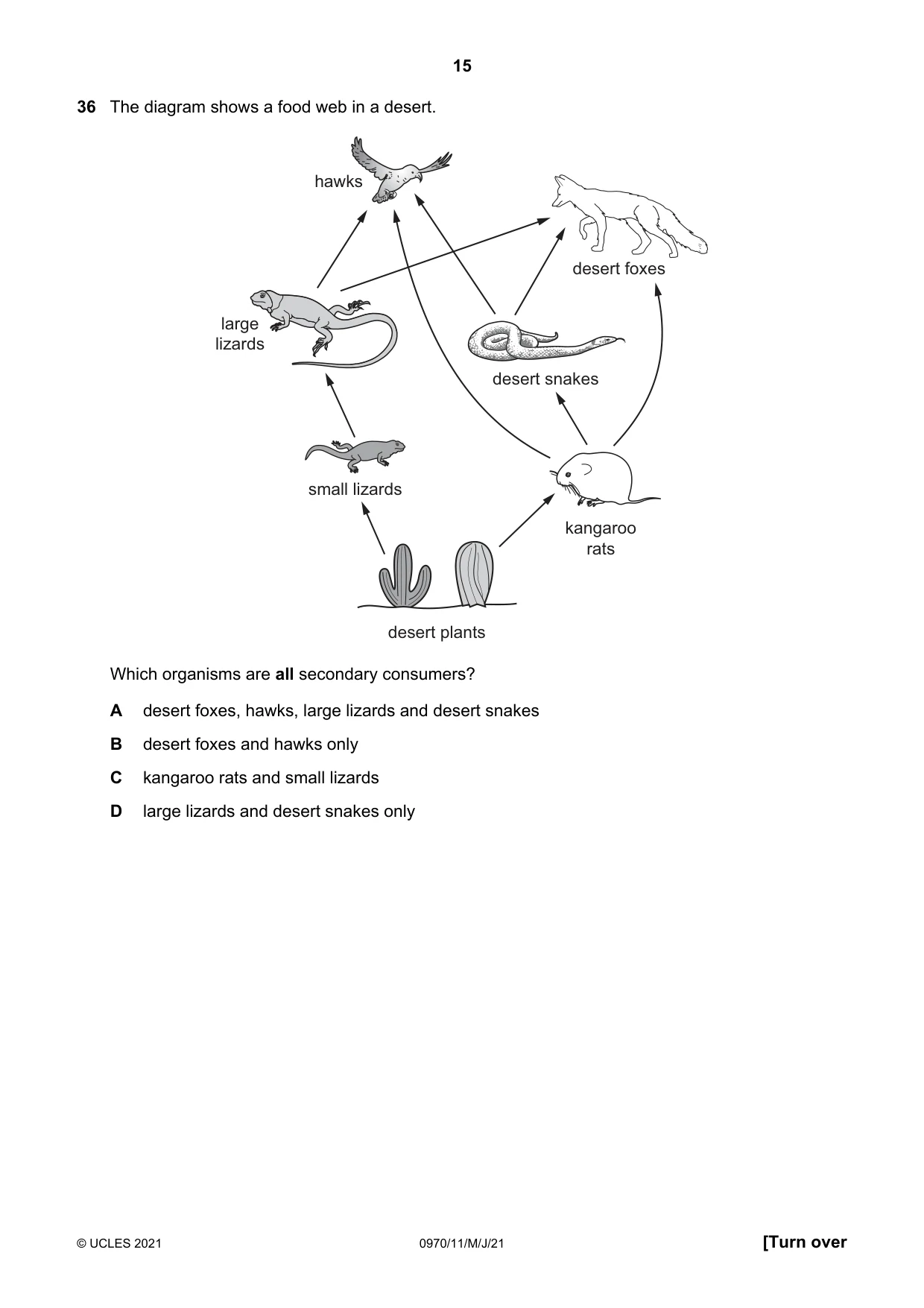
Q36 · The diagram shows a food web in a desert
36 The diagram shows a food web in a desert. hawks desert foxes large lizards desert snakes small lizards kangaroo rats desert plants Which organisms are all secondary consumers? A desert foxes, hawks, large lizards and desert snakes B desert foxes and hawks only C kangaroo rats and small lizards D large lizards and desert snakes only
Mark scheme: A
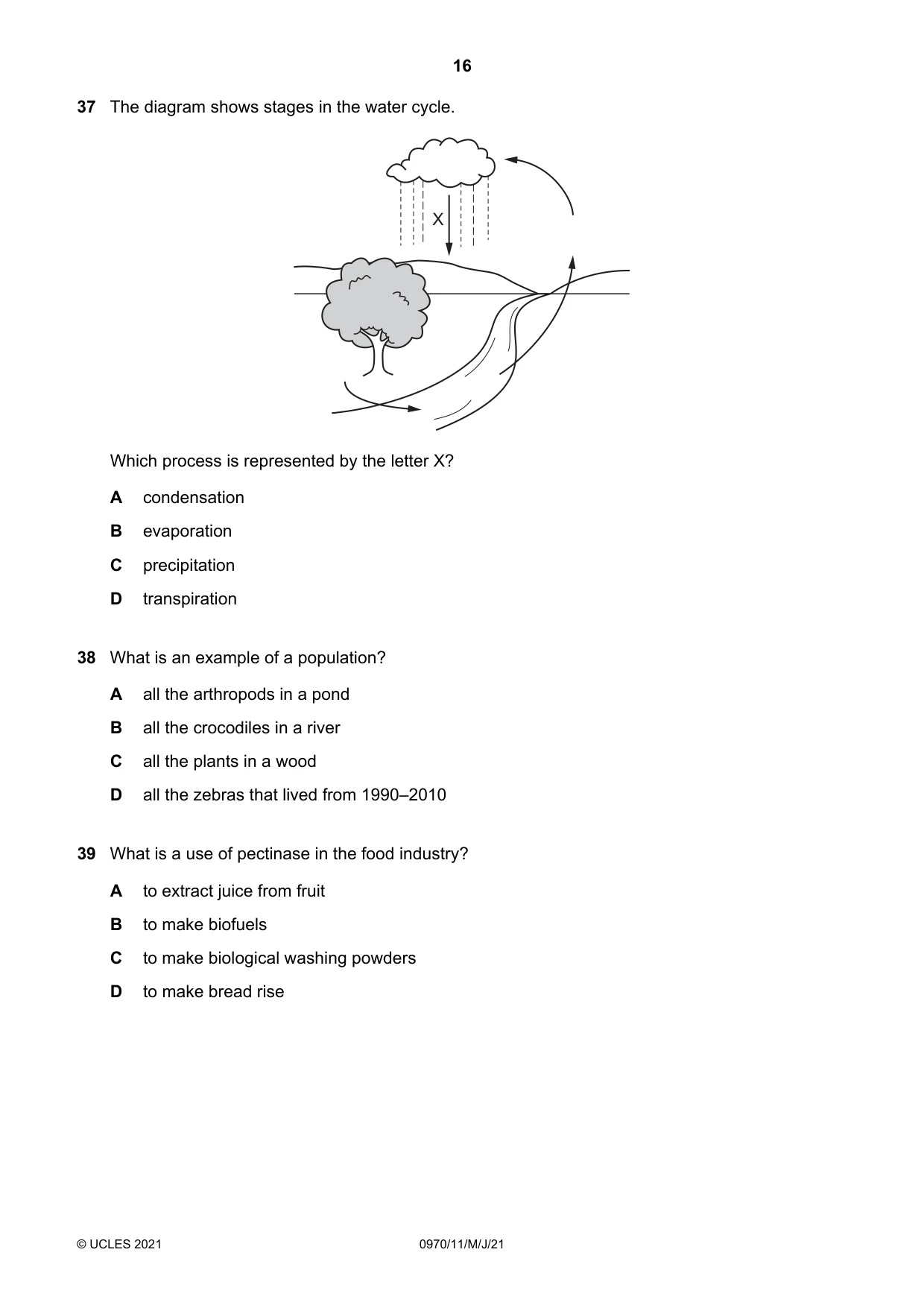
Q37 · The diagram shows stages in the water cycle
37 The diagram shows stages in the water cycle. X Which process is represented by the letter X? A condensation B evaporation C precipitation D transpiration
Mark scheme: C
Q38 · What is an example of a population?
38 What is an example of a population? A all the arthropods in a pond B all the crocodiles in a river C all the plants in a wood D all the zebras that lived from 1990–2010
Mark scheme: B
Q39 · What is a use of pectinase in the food industry?
39 What is a use of pectinase in the food industry? A to extract juice from fruit B to make biofuels C to make biological washing powders D to make bread rise
Mark scheme: A
Q40 · Which factors are believed to have contributed to the rise in sea levels?
40 Which factors are believed to have contributed to the rise in sea levels? A pollution of the air by carbon dioxide only B pollution of the air by carbon dioxide and methane C pollution of the sea by plastics only D pollution of the sea by insecticides and nuclear fall-out
Mark scheme: B
What was in this paper
The subtopics covered by these 40 questions, and how many questions each got. Open one in a new tab to see every Cambridge question on it.
2Blood vessels2Cell structure2Enzymes2Anaerobic respiration1Asexual reproduction1Biological molecules1Biotechnology1Blood1Characteristics of living organisms1Chemical digestion1Chromosomes, genes and proteins1Concept and uses of classification systems1Coordination and response1Diffusion1Drugs1Excretion in humans1Features of organisms1Food chains and food webs1Gas exchange in humans1Hormones1Leaf structure1Mitosis1Nutrient cycles1Osmosis1Photosynthesis1Pollution1Populations1Respiration1Sense organs1Sex hormones in humans1Sexual reproduction in humans1Size of specimens1Transpiration1Variation1Water uptake1What you needed in this session
Cambridge’s own grade thresholds for 2021 May/June, Paper 1 · Variant 1. A higher threshold means an easier paper — the bar moves with how the cohort did.