Cambridge IGCSE Biology (9-1) 0970 — 2022 May/June Paper 1 · Variant 1
0970/11/M/J/22 · 40 questions · 40 marks · ≈45 min
The question paper and its mark scheme, free to read here and free to download. This is Cambridge’s own paper, exactly as it was sat.
Question paper16 pages

Mark scheme3 pages
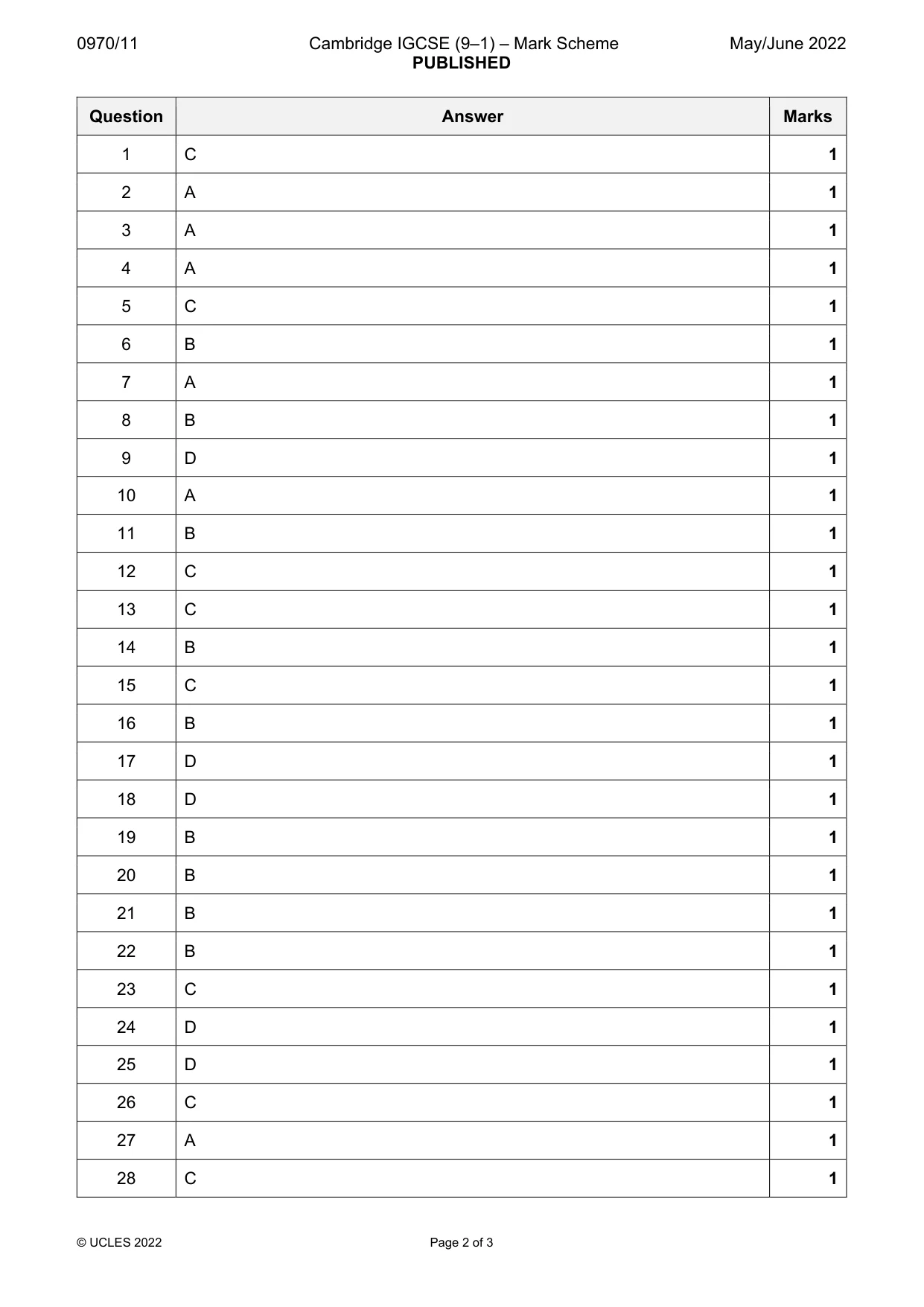
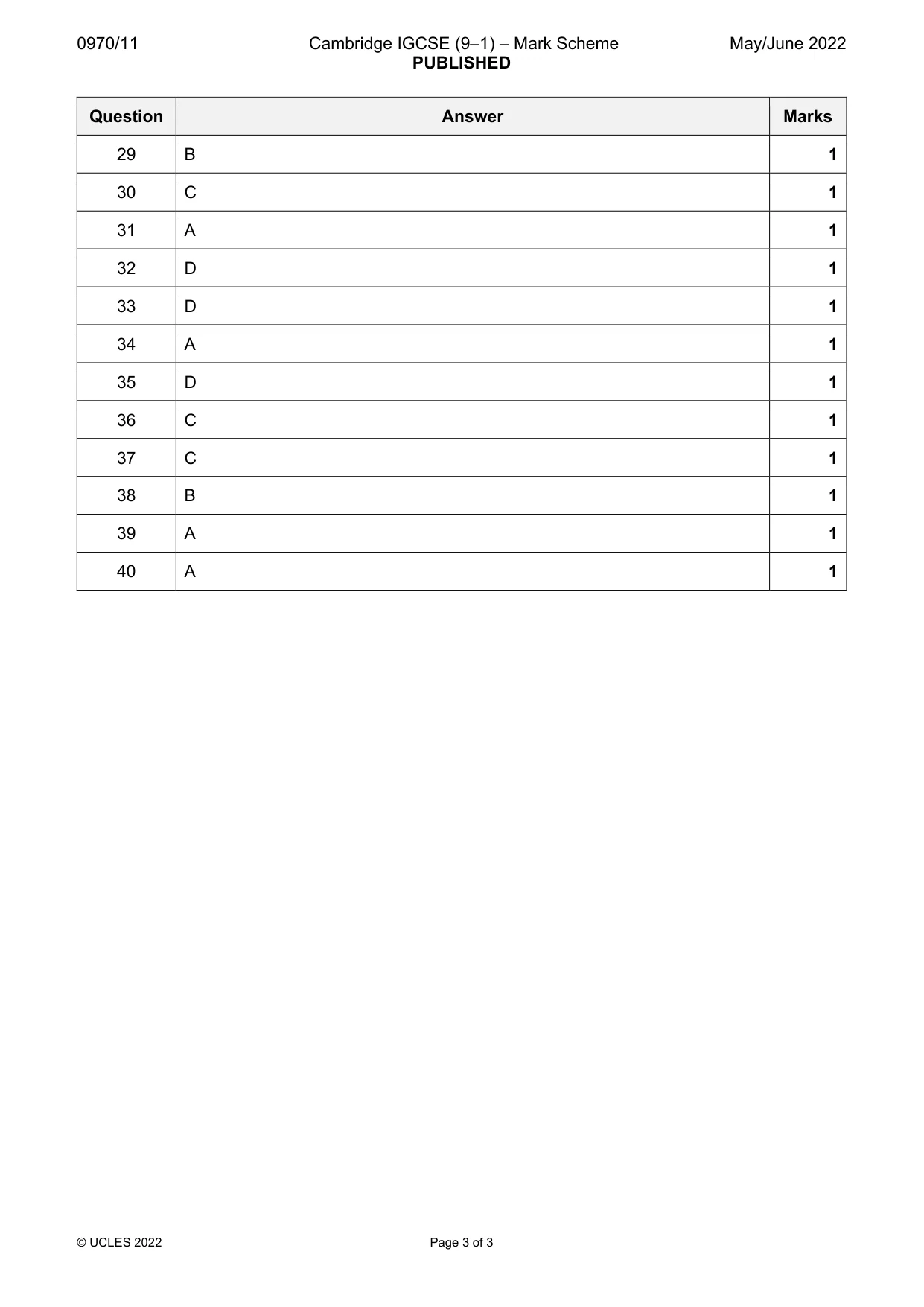
Answers below. Sit the paper first if you are practising.
Questions as text
Q1 · All living organisms release energy from nutrient molecules within their cells
1 All living organisms release energy from nutrient molecules within their cells. What is the name of this characteristic? A growth B nutrition C respiration D sensitivity
Mark scheme: C
Q2 · The horse, Equus ferus, and the donkey, Equus asinus, are able to interbreed
2 The horse, Equus ferus, and the donkey, Equus asinus, are able to interbreed. The offspring they produce is called a mule. Which statement is correct? A The horse and the donkey are the same genus; the mule is infertile. B The horse and the donkey are the same species; the mule is infertile. C The horse and the donkey are the same genus; the mule is fertile. D The horse and the donkey are the same species; the mule is fertile.
Mark scheme: A
More questions on Concept and uses of classification systems
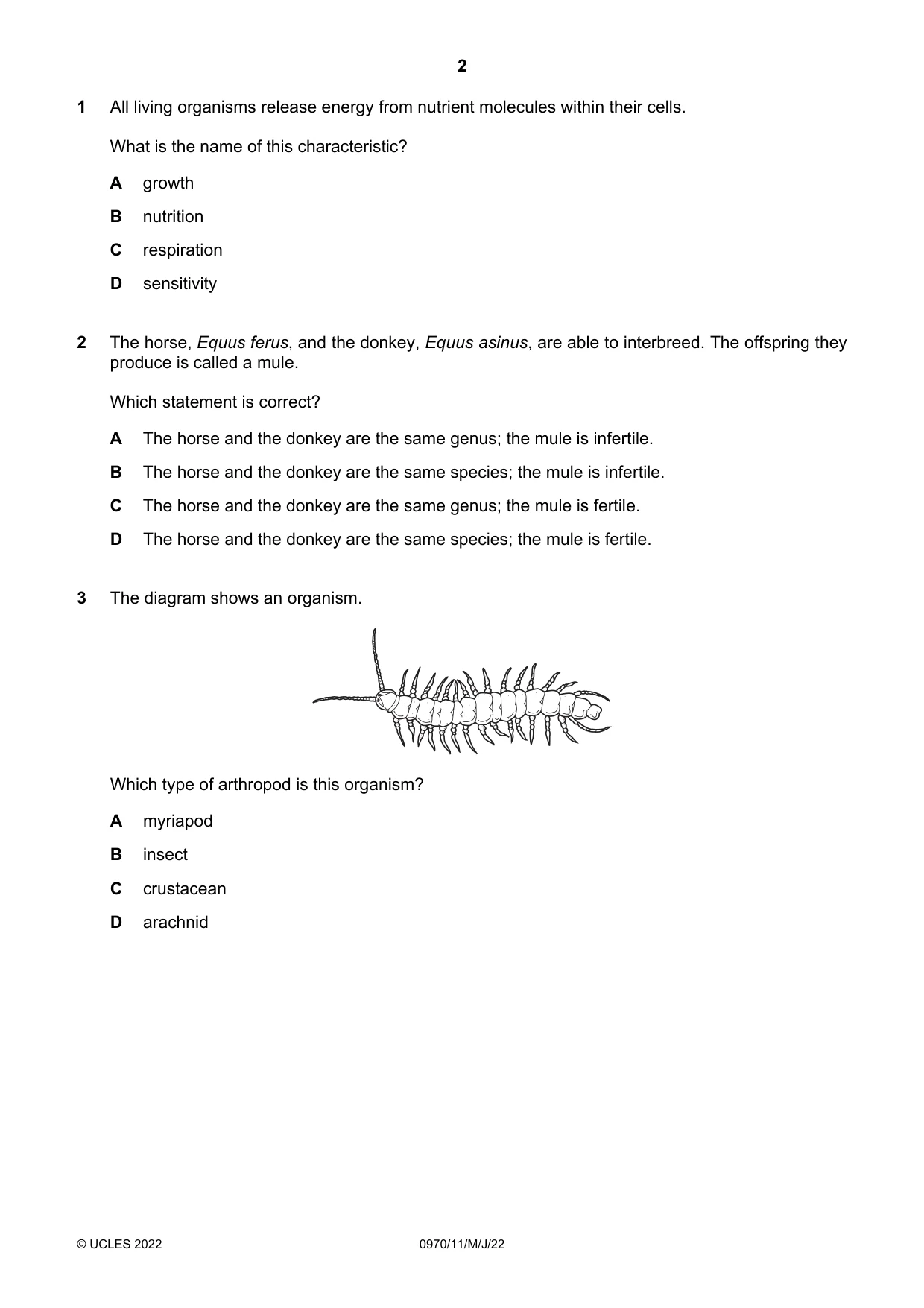
Q3 · The diagram shows an organism
3 The diagram shows an organism. Which type of arthropod is this organism? A myriapod B insect C crustacean D arachnid
Mark scheme: A
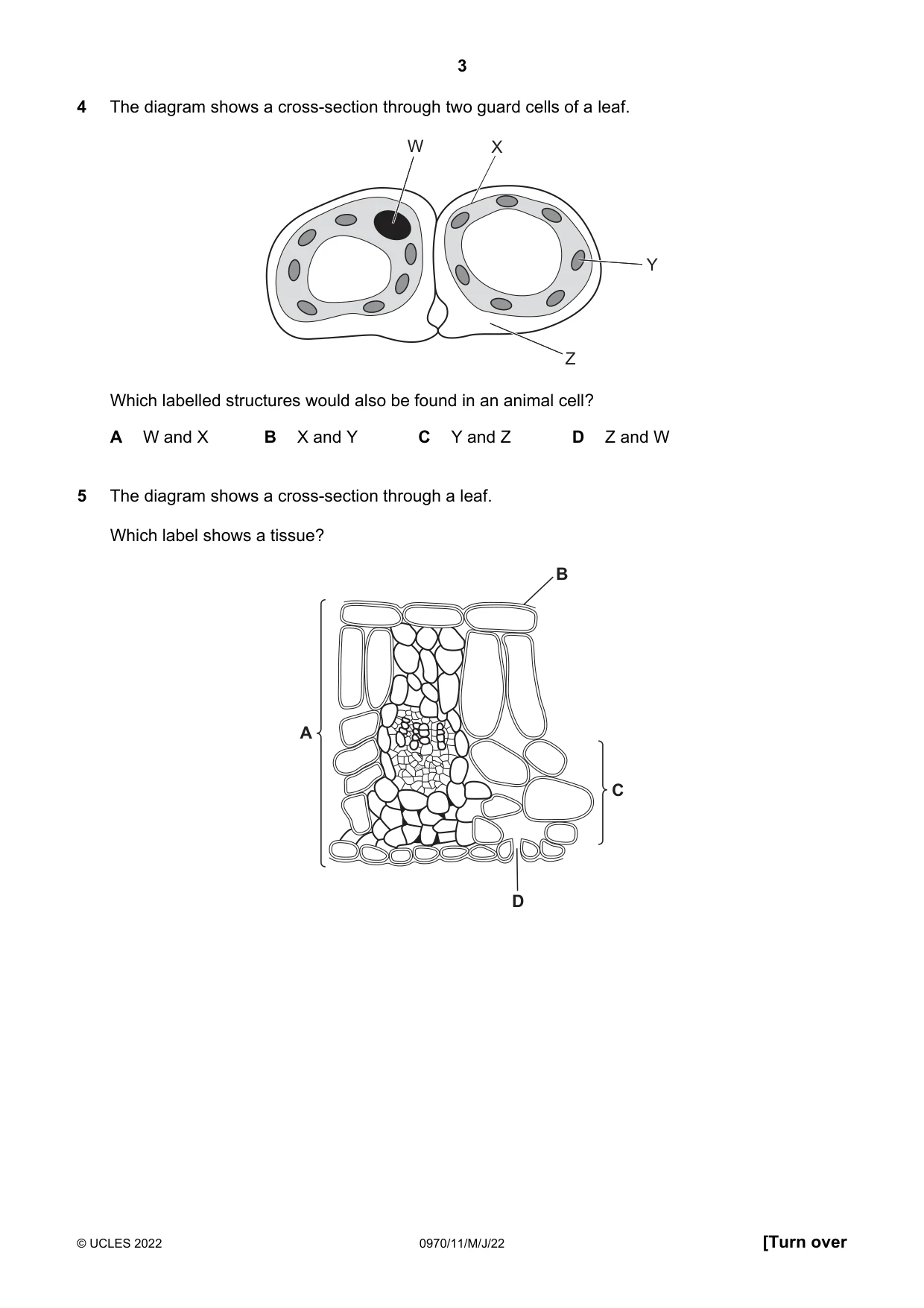
Q4 · The diagram shows a cross-section through two guard cells of a leaf
4 The diagram shows a cross-section through two guard cells of a leaf. W X Y Z Which labelled structures would also be found in an animal cell? A W and X B X and Y C Y and Z D Z and W
Mark scheme: A
Q5 · The diagram shows a cross-section through a leaf
5 The diagram shows a cross-section through a leaf. Which label shows a tissue? B A C D
Mark scheme: C
Q6 · A student found four different worms in a sample of soil and drew diagrams of them
6 A student found four different worms in a sample of soil and drew diagrams of them. The diagrams were drawn with different magnifications. Which worm was the longest? length of magnification diagram / mm A 60 3 B 70 1 C 100 2 D 120 5
Mark scheme: B
Q7 · Which statement describes the net movement of particles during diffusion?
7 Which statement describes the net movement of particles during diffusion? A from higher to lower concentration down a concentration gradient B from higher to lower concentration against a concentration gradient C from lower to higher concentration down a concentration gradient D from lower to higher concentration against a concentration gradient
Mark scheme: A
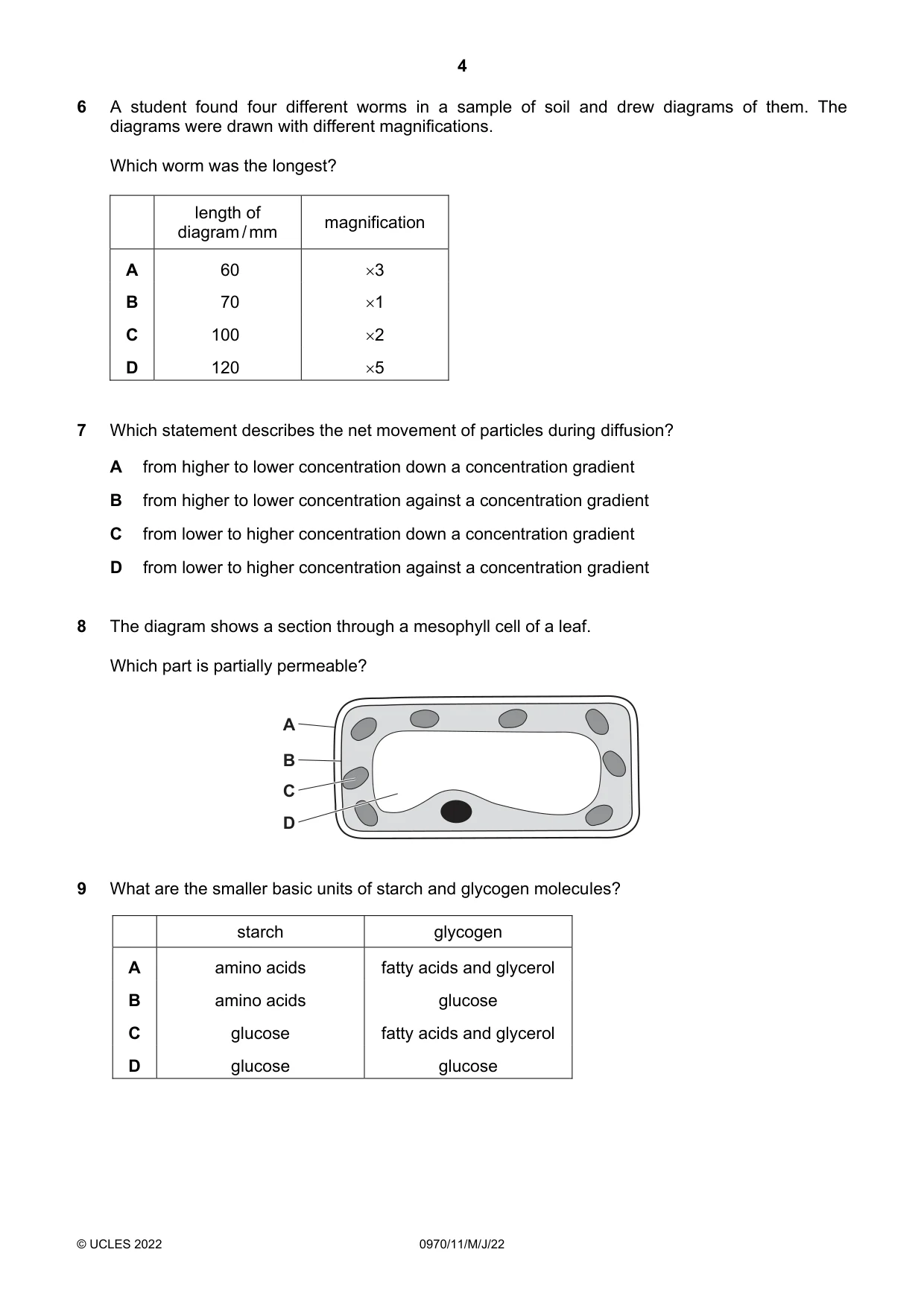
Q8 · The diagram shows a section through a mesophyll cell of a leaf
8 The diagram shows a section through a mesophyll cell of a leaf. Which part is partially permeable? A B C D
Mark scheme: B
Q9 · What are the smaller basic units of starch and glycogen molecules?
9 What are the smaller basic units of starch and glycogen molecules? starch glycogen A amino acids fatty acids and glycerol B amino acids glucose C glucose fatty acids and glycerol D glucose glucose
Mark scheme: D
Q10 · Some terms used to describe enzyme-controlled reactions are listed
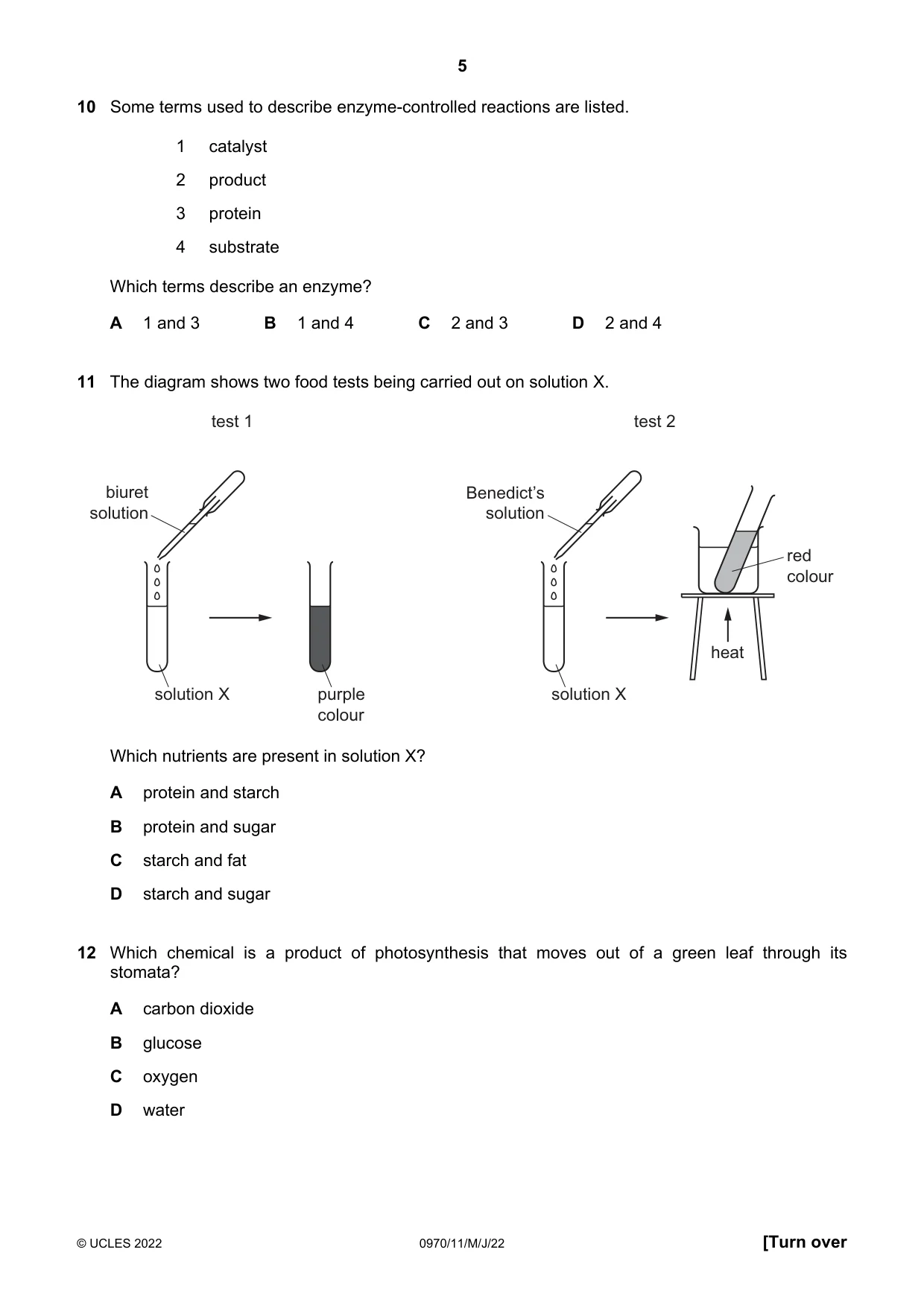
10 Some terms used to describe enzyme-controlled reactions are listed. 1 catalyst 2 product 3 protein 4 substrate Which terms describe an enzyme? A 1 and 3 B 1 and 4 C 2 and 3 D 2 and 4
Mark scheme: A
Q11 · The diagram shows two food tests being carried out on solution X
11 The diagram shows two food tests being carried out on solution X. test 1 test 2 biuret Benedict’s solution solution red colour heat solution X purple solution X colour Which nutrients are present in solution X? A protein and starch B protein and sugar C starch and fat D starch and sugar
Mark scheme: B
Q12 · Which chemical is a product of photosynthesis that moves out of a green leaf through its…
12 Which chemical is a product of photosynthesis that moves out of a green leaf through its stomata? A carbon dioxide B glucose C oxygen D water
Mark scheme: C
Q13 · Which tissues are found in vascular bundles?
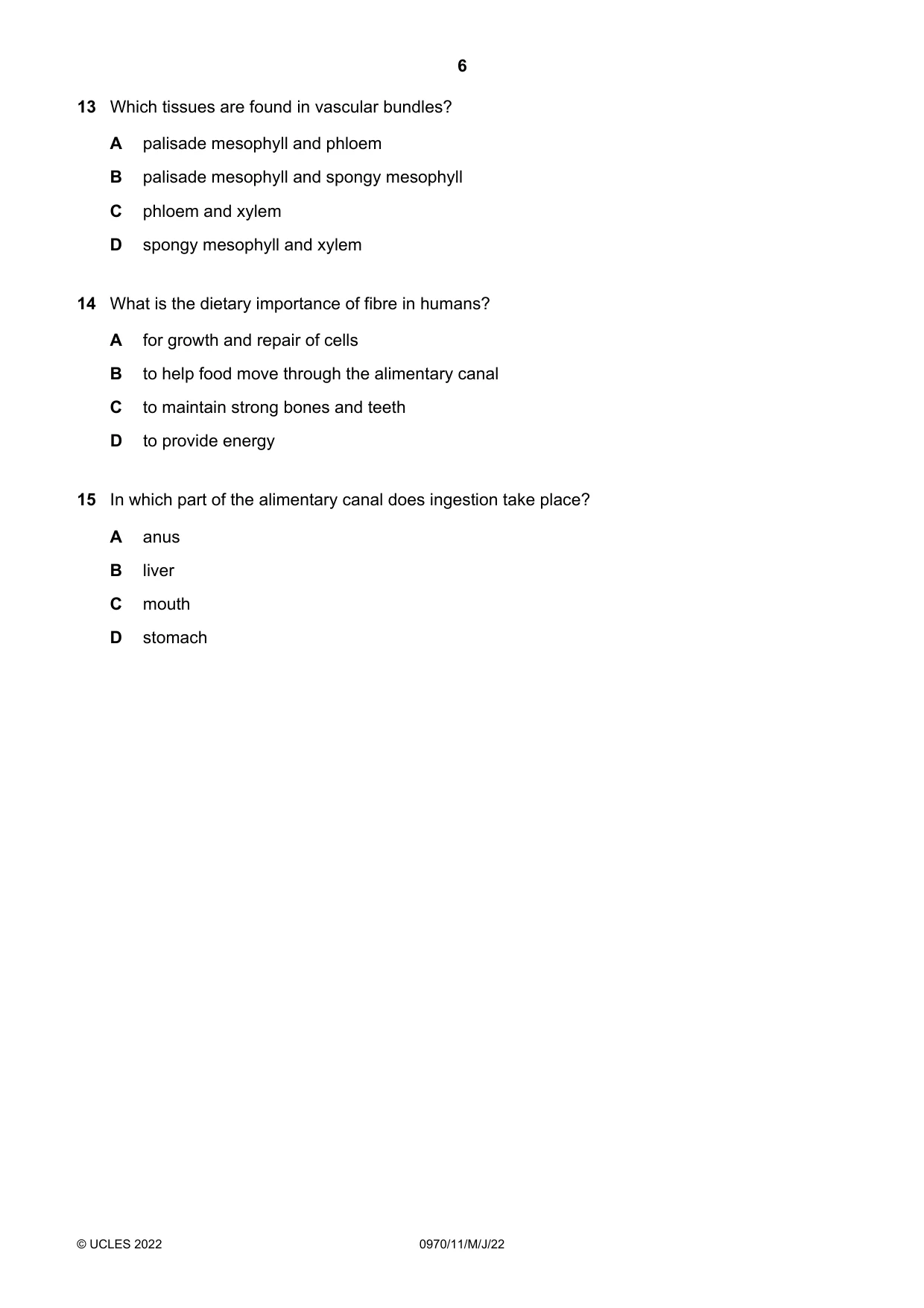
13 Which tissues are found in vascular bundles? A palisade mesophyll and phloem B palisade mesophyll and spongy mesophyll C phloem and xylem D spongy mesophyll and xylem
Mark scheme: C
Q14 · What is the dietary importance of fibre in humans?
14 What is the dietary importance of fibre in humans? A for growth and repair of cells B to help food move through the alimentary canal C to maintain strong bones and teeth D to provide energy
Mark scheme: B
Q15 · In which part of the alimentary canal does ingestion take place?
15 In which part of the alimentary canal does ingestion take place? A anus B liver C mouth D stomach
Mark scheme: C
Q16 · The diagram shows the human alimentary canal, with a string marked in metres beside it
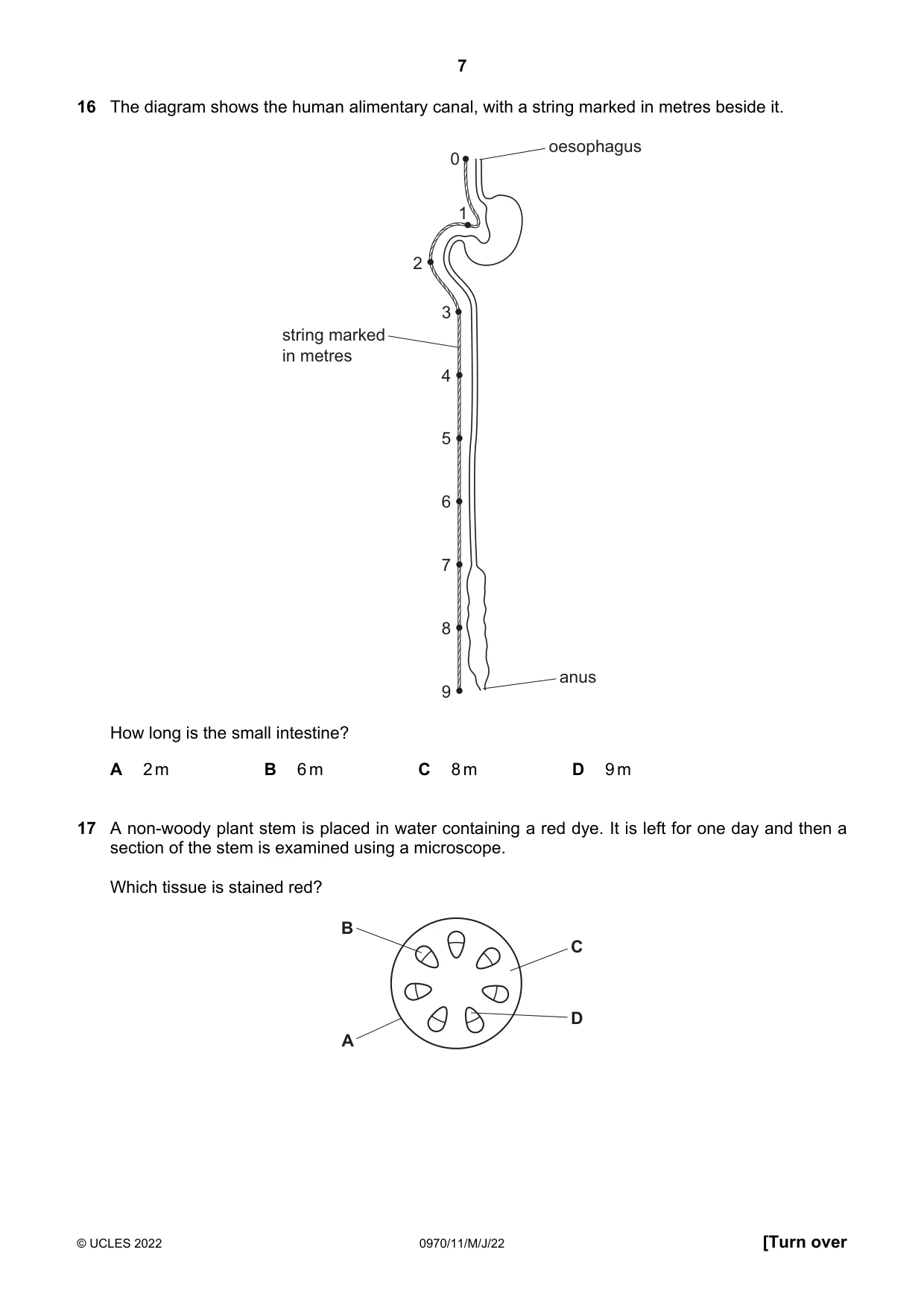
16 The diagram shows the human alimentary canal, with a string marked in metres beside it. oesophagus 0 1 2 3 string marked in metres 4 5 6 7 8 anus 9 How long is the small intestine? A 2 m B 6 m C 8 m D 9 m
Mark scheme: B
Q17 · A non-woody plant stem is placed in water containing a red dye
17 A non-woody plant stem is placed in water containing a red dye. It is left for one day and then a section of the stem is examined using a microscope. Which tissue is stained red? B C D A
Mark scheme: D
Q18 · The diagram shows a cross-section through a leaf
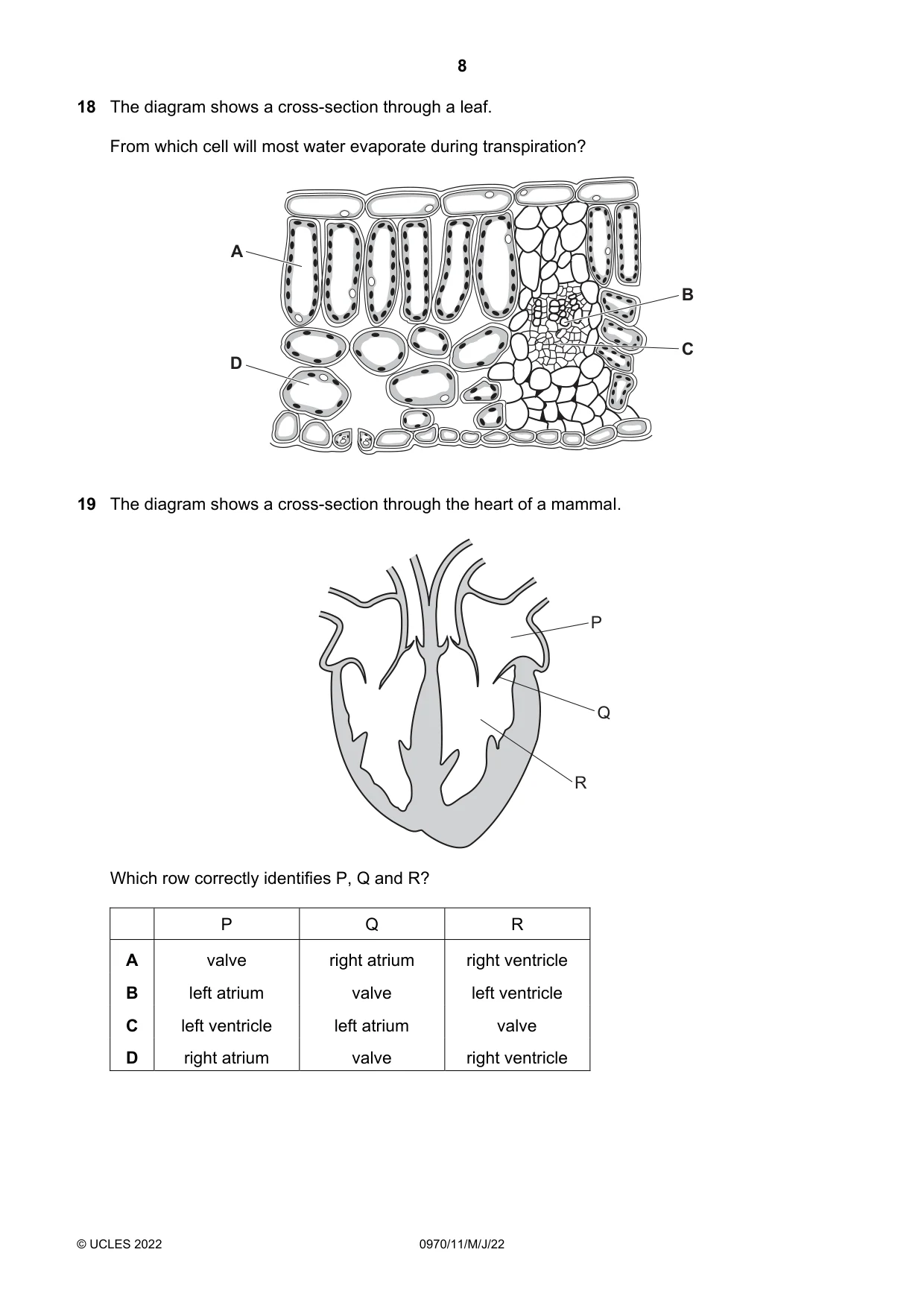
18 The diagram shows a cross-section through a leaf. From which cell will most water evaporate during transpiration? A B C D
Mark scheme: D
Q19 · The diagram shows a cross-section through the heart of a mammal
19 The diagram shows a cross-section through the heart of a mammal. P Q R Which row correctly identifies P, Q and R? P Q R A valve right atrium right ventricle B left atrium valve left ventricle C left ventricle left atrium valve D right atrium valve right ventricle
Mark scheme: B
Q20 · Which process is slower than normal in a person with very few platelets?
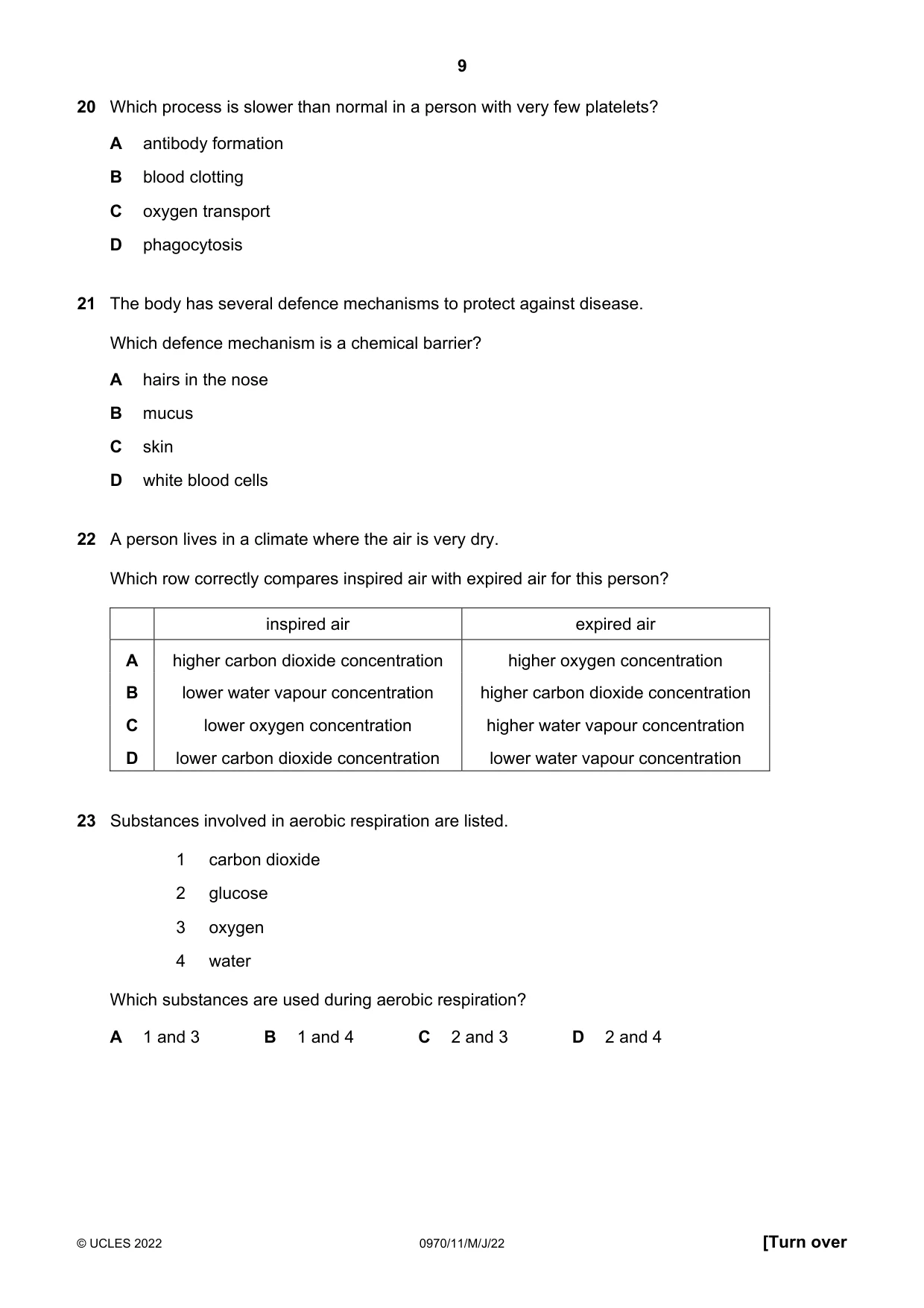
20 Which process is slower than normal in a person with very few platelets? A antibody formation B blood clotting C oxygen transport D phagocytosis
Mark scheme: B
Q21 · The body has several defence mechanisms to protect against disease
21 The body has several defence mechanisms to protect against disease. Which defence mechanism is a chemical barrier? A hairs in the nose B mucus C skin D white blood cells
Mark scheme: B
Q22 · A person lives in a climate where the air is very dry
22 A person lives in a climate where the air is very dry. Which row correctly compares inspired air with expired air for this person? inspired air expired air A higher carbon dioxide concentration higher oxygen concentration B lower water vapour concentration higher carbon dioxide concentration C lower oxygen concentration higher water vapour concentration D lower carbon dioxide concentration lower water vapour concentration
Mark scheme: B
Q23 · Substances involved in aerobic respiration are listed
23 Substances involved in aerobic respiration are listed. 1 carbon dioxide 2 glucose 3 oxygen 4 water Which substances are used during aerobic respiration? A 1 and 3 B 1 and 4 C 2 and 3 D 2 and 4
Mark scheme: C
Q24 · The diagram shows the oxygen uptake by germinating seeds at two different temperatures
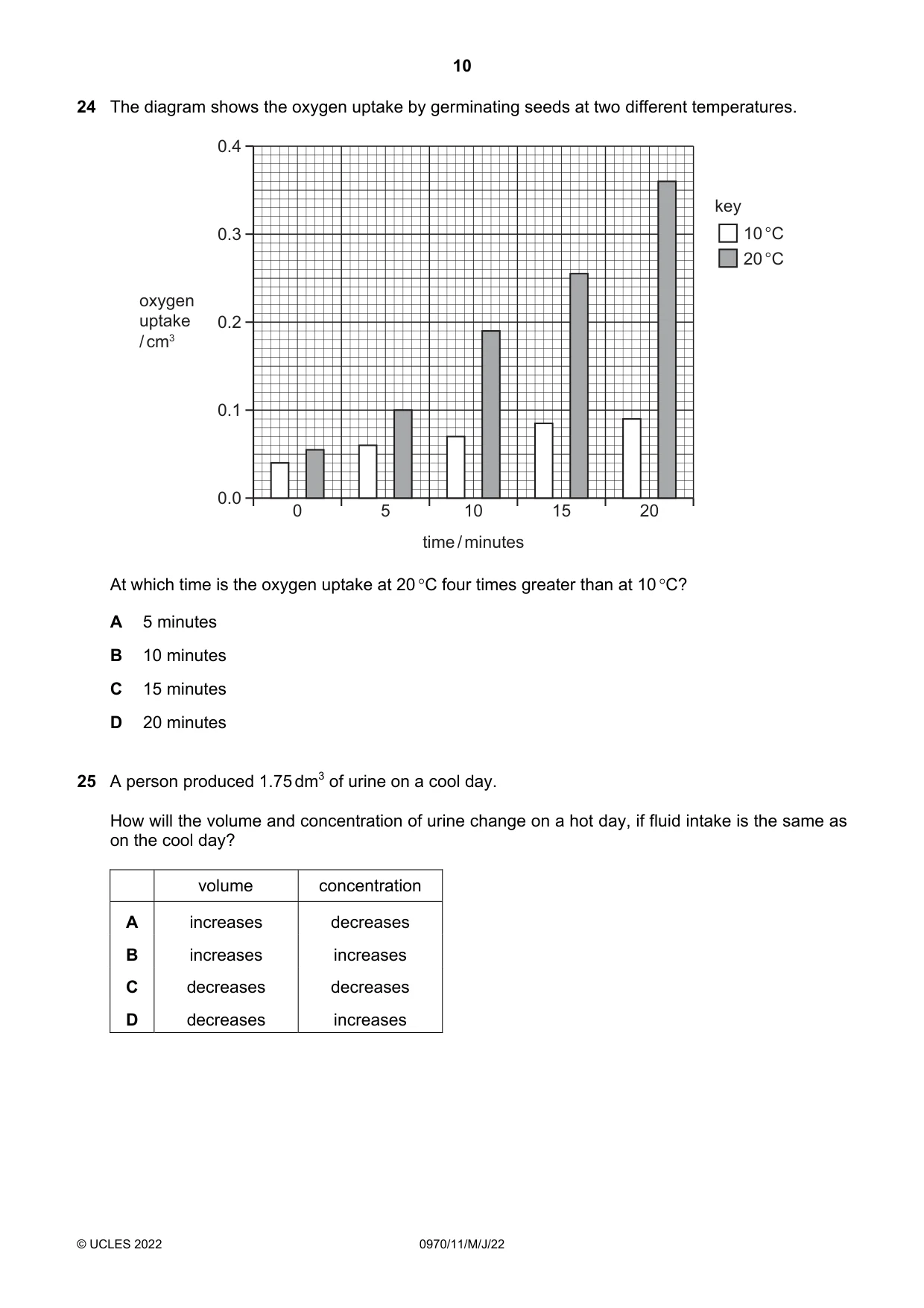
24 The diagram shows the oxygen uptake by germinating seeds at two different temperatures. 0.4 key 0.3 10 °C 20 °C oxygen uptake 0.2 / cm3 0.1 0.0 0 5 10 15 20 time / minutes At which time is the oxygen uptake at 20 C four times greater than at 10 C? A 5 minutes B 10 minutes C 15 minutes D 20 minutes
Mark scheme: D
Q25 · A person produced 1.75 dm3 of urine on a cool day
25 A person produced 1.75 dm3 of urine on a cool day. How will the volume and concentration of urine change on a hot day, if fluid intake is the same as on the cool day? volume concentration A increases decreases B increases increases C decreases decreases D decreases increases
Mark scheme: D
Q26 · Which hormone triggers the ‘fight or flight’ response?
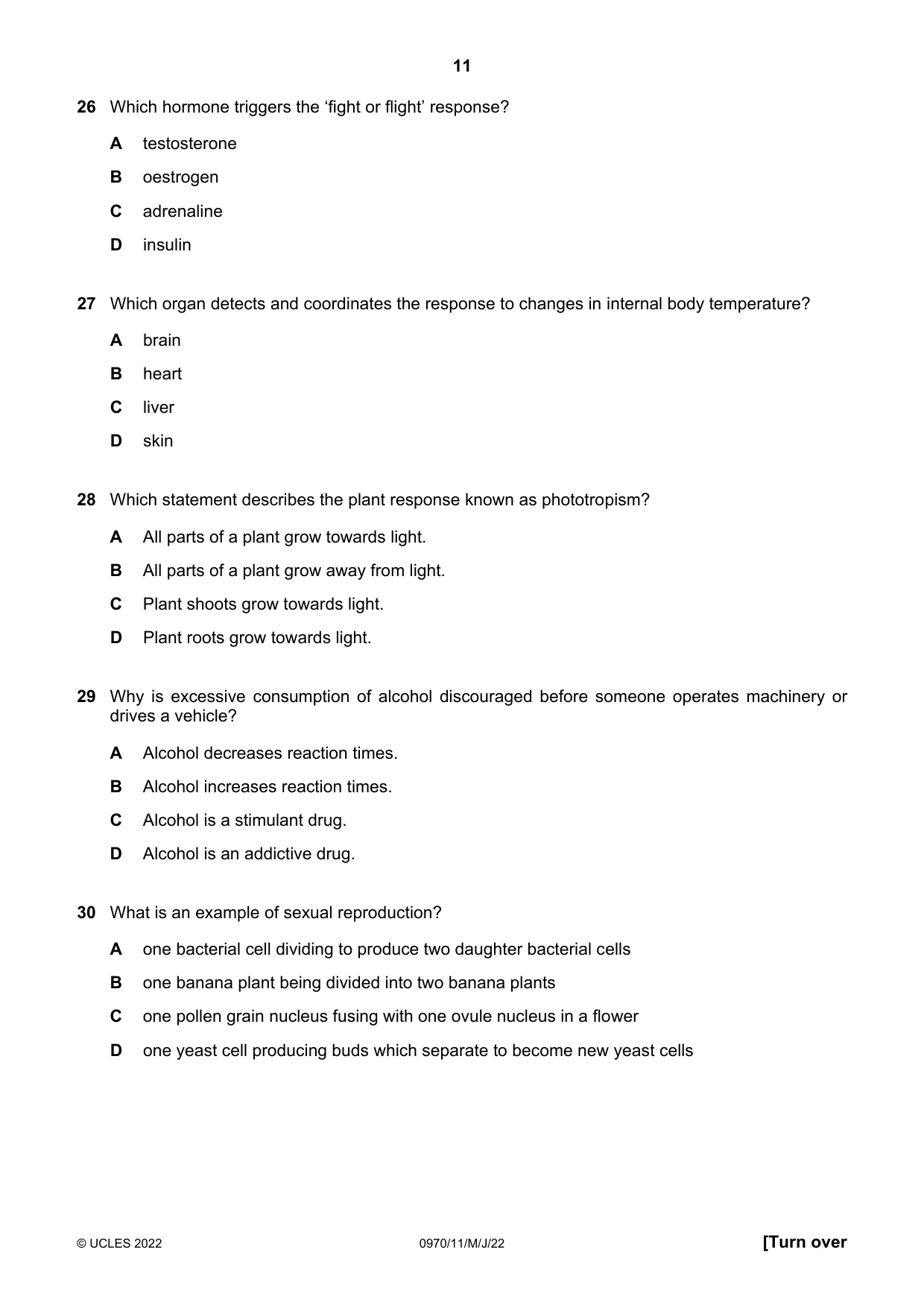
26 Which hormone triggers the ‘fight or flight’ response? A testosterone B oestrogen C adrenaline D insulin
Mark scheme: C
Q27 · Which organ detects and coordinates the response to changes in internal body temperature?
27 Which organ detects and coordinates the response to changes in internal body temperature? A brain B heart C liver D skin
Mark scheme: A
Q28 · Which statement describes the plant response known as phototropism?
28 Which statement describes the plant response known as phototropism? A All parts of a plant grow towards light. B All parts of a plant grow away from light. C Plant shoots grow towards light. D Plant roots grow towards light.
Mark scheme: C
Q29 · Why is excessive consumption of alcohol discouraged before someone operates machinery or…
29 Why is excessive consumption of alcohol discouraged before someone operates machinery or drives a vehicle? A Alcohol decreases reaction times. B Alcohol increases reaction times. C Alcohol is a stimulant drug. D Alcohol is an addictive drug.
Mark scheme: B
Q30 · What is an example of sexual reproduction?
30 What is an example of sexual reproduction? A one bacterial cell dividing to produce two daughter bacterial cells B one banana plant being divided into two banana plants C one pollen grain nucleus fusing with one ovule nucleus in a flower D one yeast cell producing buds which separate to become new yeast cells
Mark scheme: C
Q31 · The diagram shows a cross-section of an insect-pollinated flower
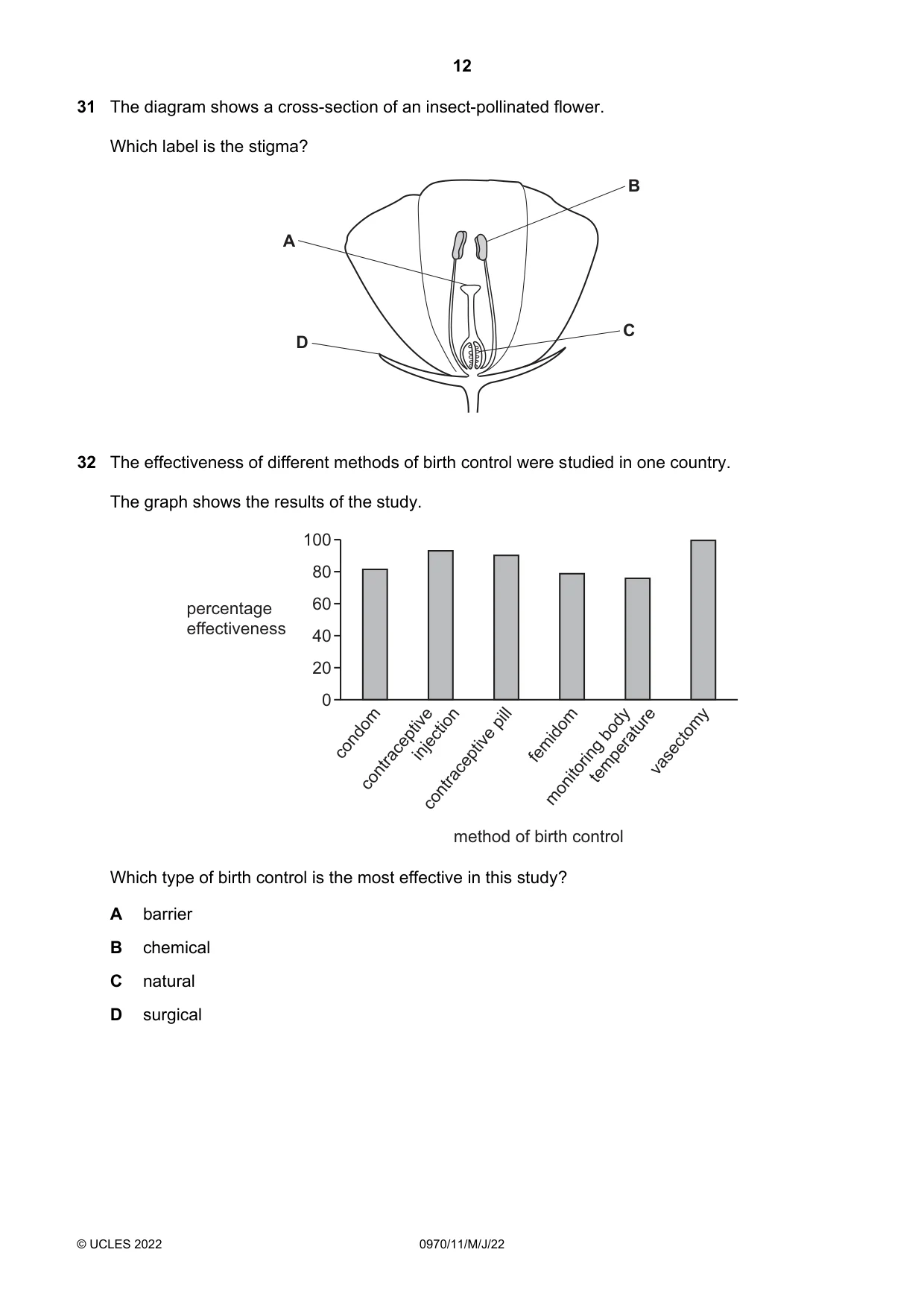
31 The diagram shows a cross-section of an insect-pollinated flower. Which label is the stigma? B A C D
Mark scheme: A
Q32 · The effectiveness of different methods of birth control were studied in one country
32 The effectiveness of different methods of birth control were studied in one country. The graph shows the results of the study. 100 80 percentage 60 effectiveness 40 20 0 condom contraceptive injection contraceptive pill femidom monitoring body temperature vasectomy method of birth control Which type of birth control is the most effective in this study? A barrier B chemical C natural D surgical
Mark scheme: D
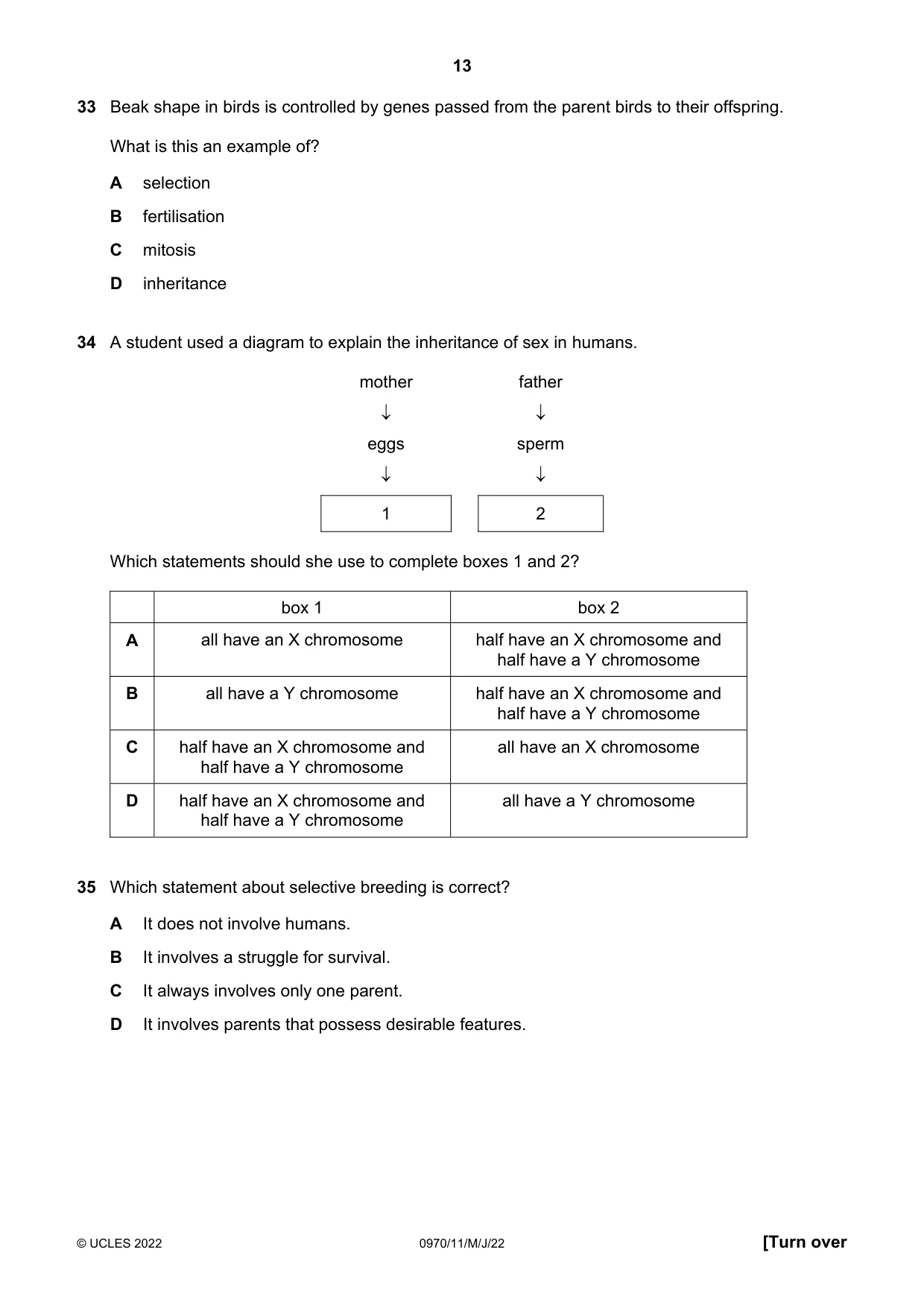
Q33 · Beak shape in birds is controlled by genes passed from the parent birds to their offspring
33 Beak shape in birds is controlled by genes passed from the parent birds to their offspring. What is this an example of? A selection B fertilisation C mitosis D inheritance
Mark scheme: D
Q34 · A student used a diagram to explain the inheritance of sex in humans
34 A student used a diagram to explain the inheritance of sex in humans. mother father eggs sperm 1 2 Which statements should she use to complete boxes 1 and 2? box 1 box 2 A all have an X chromosome half have an X chromosome and half have a Y chromosome B all have a Y chromosome half have an X chromosome and half have a Y chromosome C half have an X chromosome and all have an X chromosome half have a Y chromosome D half have an X chromosome and all have a Y chromosome half have a Y chromosome
Mark scheme: A
Q35 · Which statement about selective breeding is correct?
35 Which statement about selective breeding is correct? A It does not involve humans. B It involves a struggle for survival. C It always involves only one parent. D It involves parents that possess desirable features.
Mark scheme: D
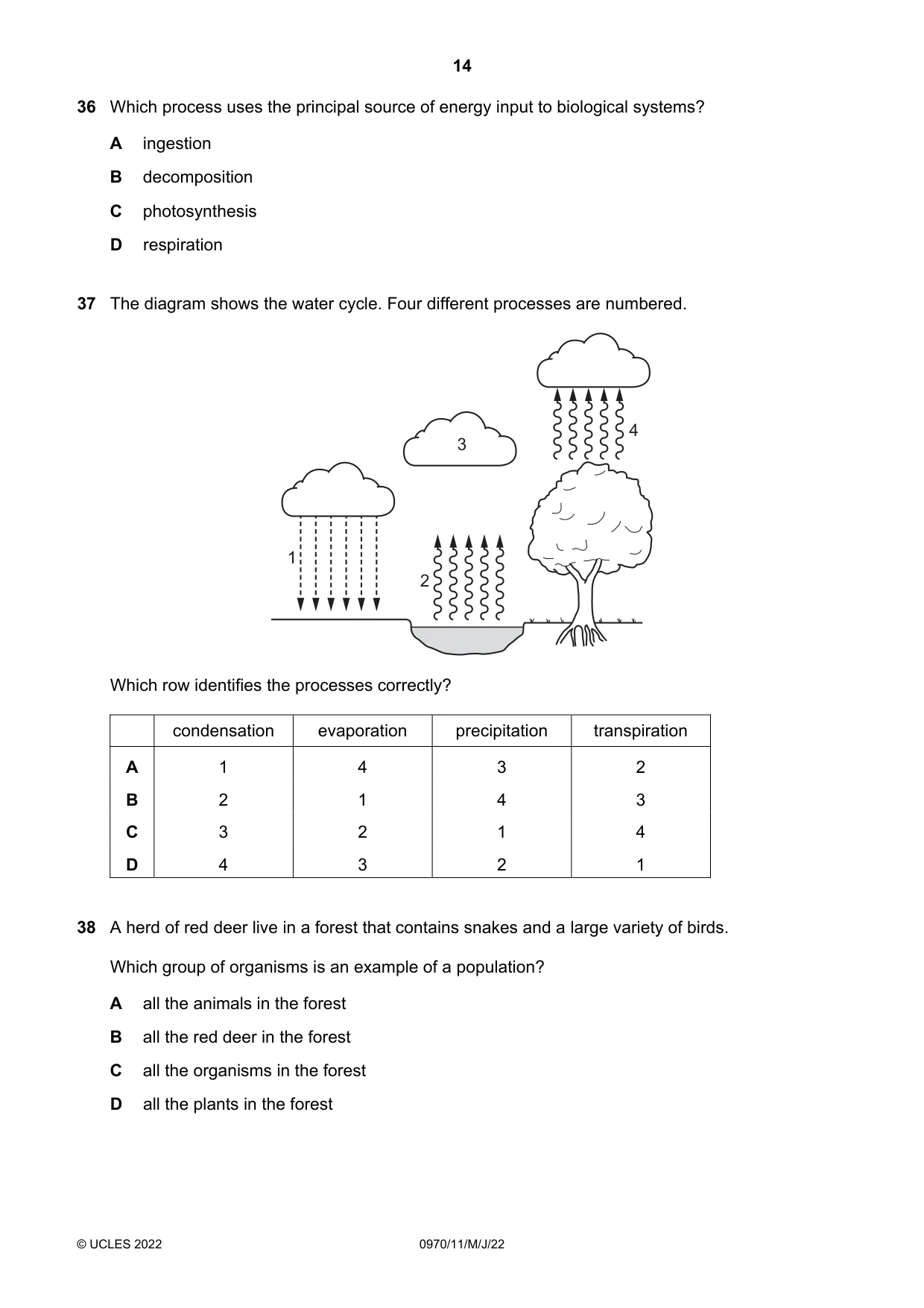
Q36 · Which process uses the principal source of energy input to biological systems?
36 Which process uses the principal source of energy input to biological systems? A ingestion B decomposition C photosynthesis D respiration
Mark scheme: C
Q37 · The diagram shows the water cycle
37 The diagram shows the water cycle. Four different processes are numbered. 4 3 1 2 Which row identifies the processes correctly? condensation evaporation precipitation transpiration A 1 4 3 2 B 2 1 4 3 C 3 2 1 4 D 4 3 2 1
Mark scheme: C
Q38 · A herd of red deer live in a forest that contains snakes and a large variety of birds
38 A herd of red deer live in a forest that contains snakes and a large variety of birds. Which group of organisms is an example of a population? A all the animals in the forest B all the red deer in the forest C all the organisms in the forest D all the plants in the forest
Mark scheme: B
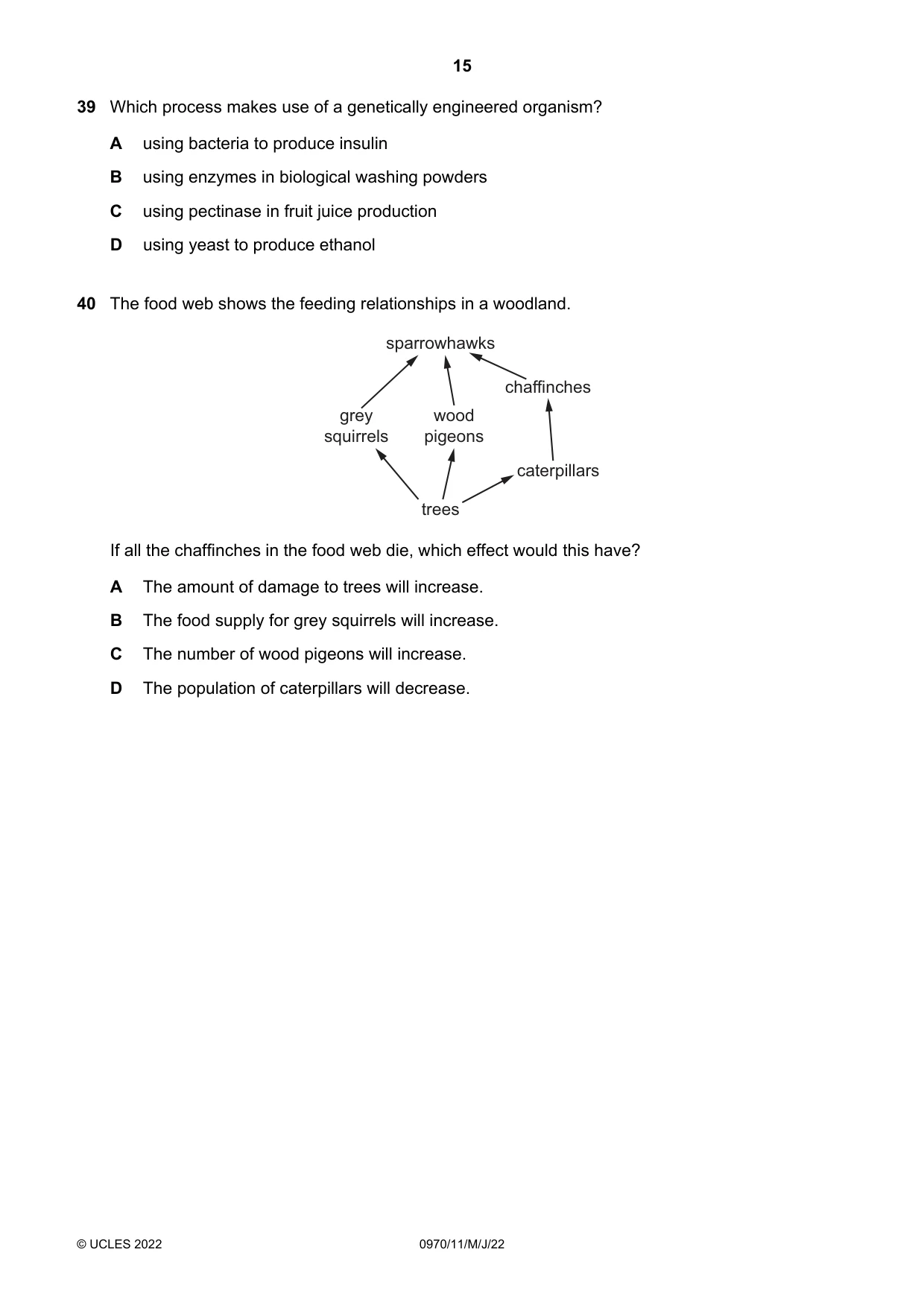
Q39 · Which process makes use of a genetically engineered organism?
39 Which process makes use of a genetically engineered organism? A using bacteria to produce insulin B using enzymes in biological washing powders C using pectinase in fruit juice production D using yeast to produce ethanol
Mark scheme: A
Q40 · The food web shows the feeding relationships in a woodland
40 The food web shows the feeding relationships in a woodland. sparrowhawks chaffinches grey wood squirrels pigeons caterpillars trees If all the chaffinches in the food web die, which effect would this have? A The amount of damage to trees will increase. B The food supply for grey squirrels will increase. C The number of wood pigeons will increase. D The population of caterpillars will decrease.
Mark scheme: A
What was in this paper
The subtopics covered by these 40 questions, and how many questions each got. Open one in a new tab to see every Cambridge question on it.
2Biological molecules2Cell structure2Diffusion2Xylem and phloem2Absorption1Blood1Characteristics of living organisms1Chromosomes, genes and proteins1Concept and uses of classification systems1Diet1Digestive system1Diseases and immunity1Drugs1Energy flow1Enzymes1Excretion in humans1Features of organisms1Food chains and food webs1Gas exchange in humans1Genetic modification1Heart1Homeostasis1Hormones1Monohybrid inheritance1Nutrient cycles1Photosynthesis1Populations1Selection1Sexual reproduction1Sexual reproduction in humans1Sexual reproduction in plants1Size of specimens1Transpiration1Tropic responses1What you needed in this session
Cambridge’s own grade thresholds for 2022 May/June, Paper 1 · Variant 1. A higher threshold means an easier paper — the bar moves with how the cohort did.