Cambridge IGCSE Biology (9-1) 0970 — 2023 May/June Paper 1 · Variant 1
0970/11/M/J/23 · 40 questions · 40 marks · ≈45 min
The question paper and its mark scheme, free to read here and free to download. This is Cambridge’s own paper, exactly as it was sat.
Question paper16 pages



Mark scheme3 pages
Answers below. Sit the paper first if you are practising.
Questions as text
Q1 · What are characteristics of all organisms?
1 What are characteristics of all organisms? A egestion and excretion B egestion and nutrition C excretion and nutrition D excretion and photosynthesis
Mark scheme: C
Q2 · The scientific name for the golden eagle is Aquila chrysaetos
2 The scientific name for the golden eagle is Aquila chrysaetos. What is the genus of the golden eagle? A Aquila B chrysaetos C eagle D golden
Mark scheme: A
More questions on Concept and uses of classification systems
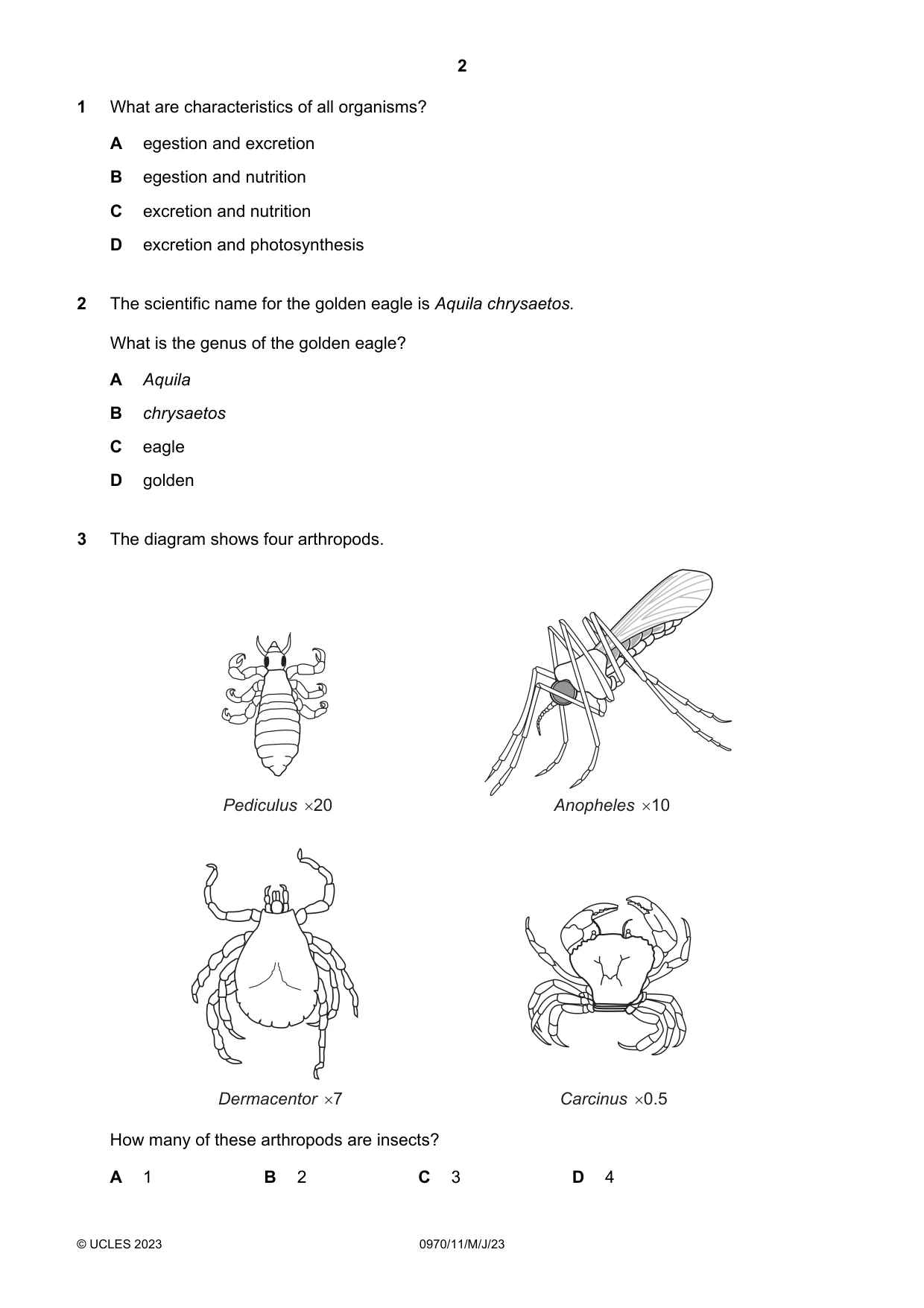
Q3 · The diagram shows four arthropods
3 The diagram shows four arthropods. Pediculus ×20 Anopheles ×10 Dermacentor ×7 Carcinus ×0.5 How many of these arthropods are insects? A 1 B 2 C 3 D 4
Mark scheme: B
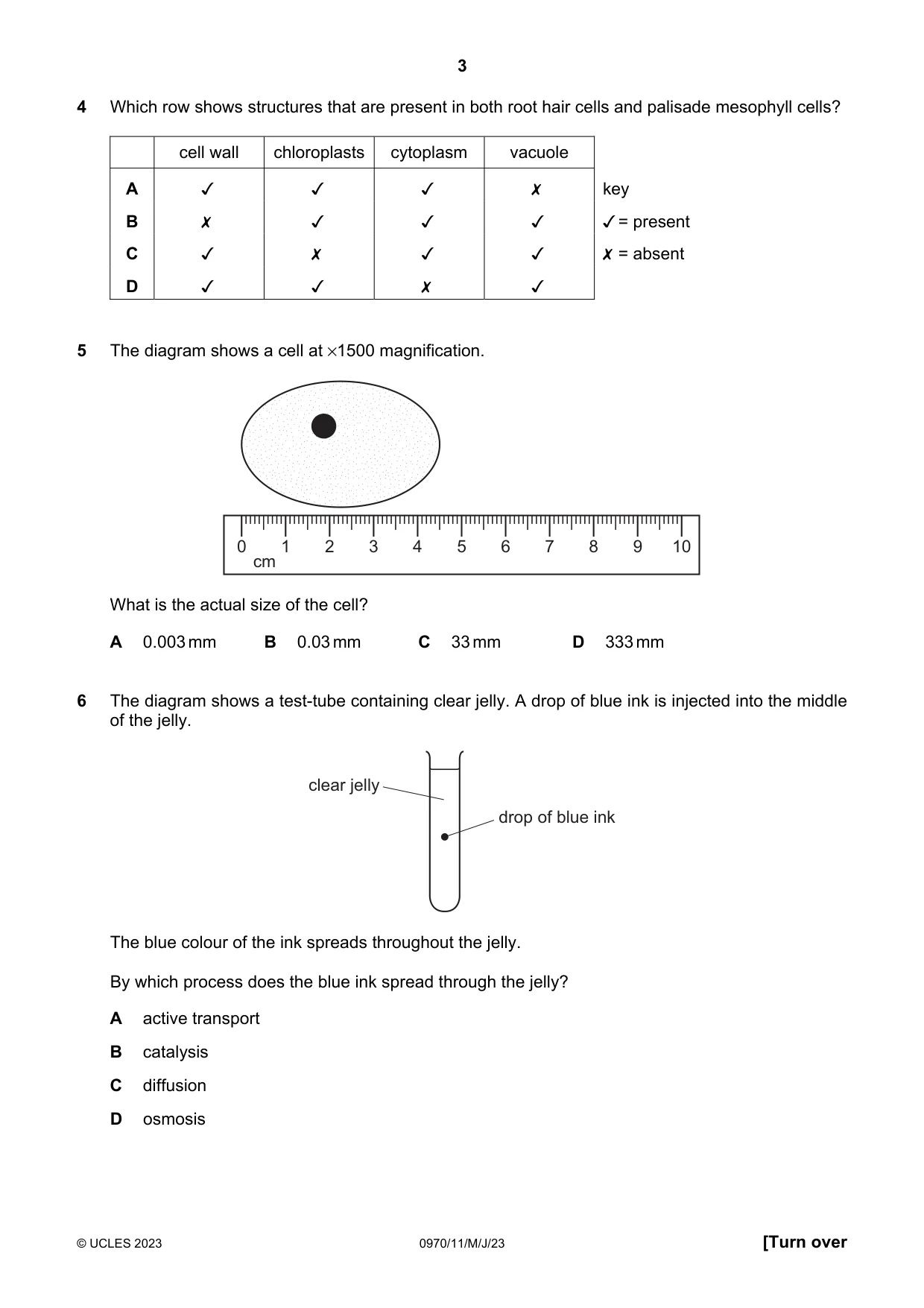
Q4 · Which row shows structures that are present in both root hair cells and palisade…
4 Which row shows structures that are present in both root hair cells and palisade mesophyll cells? cell wall chloroplasts | cytoplasm vacuole v v v x key / = present x J J J Jv x Jv Jv X = absent J J x J 0 0O WwW >
Mark scheme: C
Q5 · The diagram shows a cell at ×1500 magnification
5 The diagram shows a cell at ×1500 magnification. 0 1 2 3 4 5 6 7 8 9 10 cm What is the actual size of the cell? A 0.003 mm B 0.03 mm C 33 mm D 333 mm
Mark scheme: B
Q6 · The diagram shows a test-tube containing clear jelly
6 The diagram shows a test-tube containing clear jelly. A drop of blue ink is injected into the middle of the jelly. clear jelly drop of blue ink The blue colour of the ink spreads throughout the jelly. By which process does the blue ink spread through the jelly? A active transport B catalysis C diffusion D osmosis
Mark scheme: C
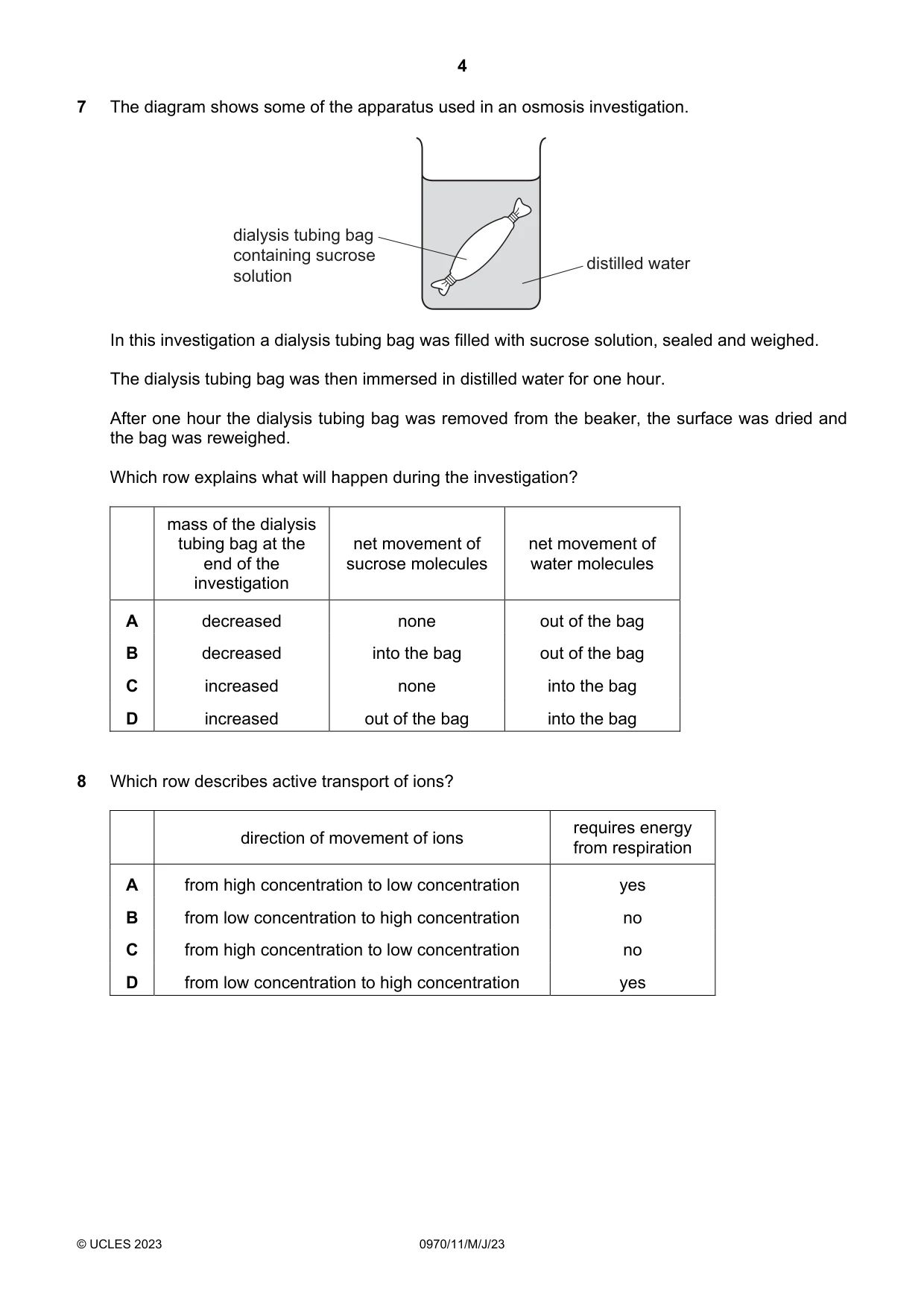
Q7 · The diagram shows some of the apparatus used in an osmosis investigation
7 The diagram shows some of the apparatus used in an osmosis investigation. dialysis tubing bag containing sucrose distilled water solution In this investigation a dialysis tubing bag was filled with sucrose solution, sealed and weighed. The dialysis tubing bag was then immersed in distilled water for one hour. After one hour the dialysis tubing bag was removed from the beaker, the surface was dried and the bag was reweighed. Which row explains what will happen during the investigation? mass of the dialysis tubing bag at the net movement of net movement of end of the sucrose molecules water molecules investigation A decreased none out of the bag B decreased into the bag out of the bag C increased none into the bag D increased out of the bag into the bag
Mark scheme: C
Q8 · Which row describes active transport of ions?
8 Which row describes active transport of ions? requires energy direction of movement of ions from respiration A from high concentration to low concentration yes B from low concentration to high concentration no C from high concentration to low concentration no D from low concentration to high concentration yes
Mark scheme: D
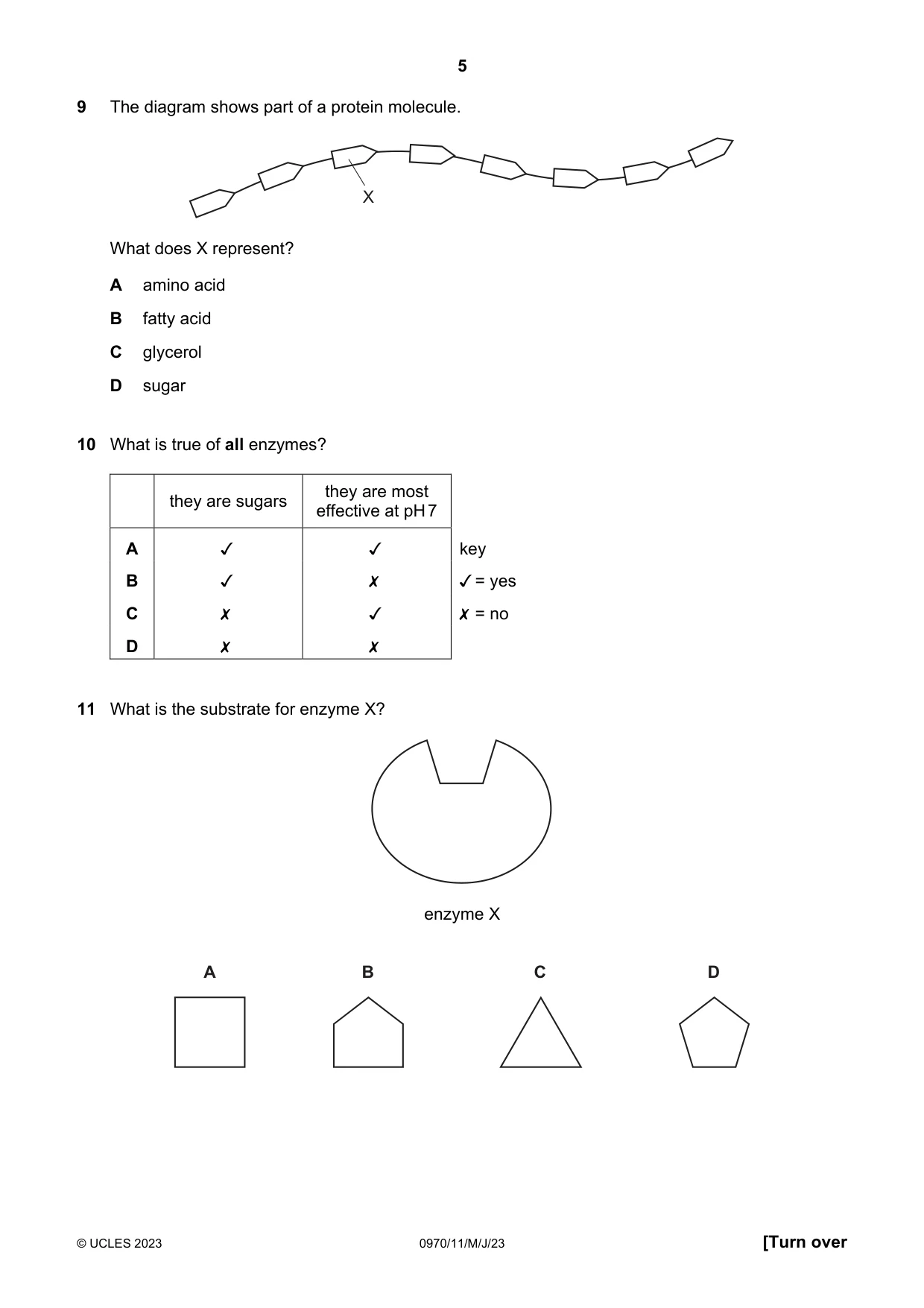
Q9 · The diagram shows part of a protein molecule
9 The diagram shows part of a protein molecule. X What does X represent? A amino acid B fatty acid C glycerol D sugar
Mark scheme: A
Q10 · What is true of all enzymes?
10 What is true of all enzymes? they are sugars they are most effective at pH 7 0 0O WwW D> x KOK v x v x key v= yes X =no
Mark scheme: D
Q11 · What is the substrate for enzyme X?
11 What is the substrate for enzyme X? enzyme X A B C D
Mark scheme: D
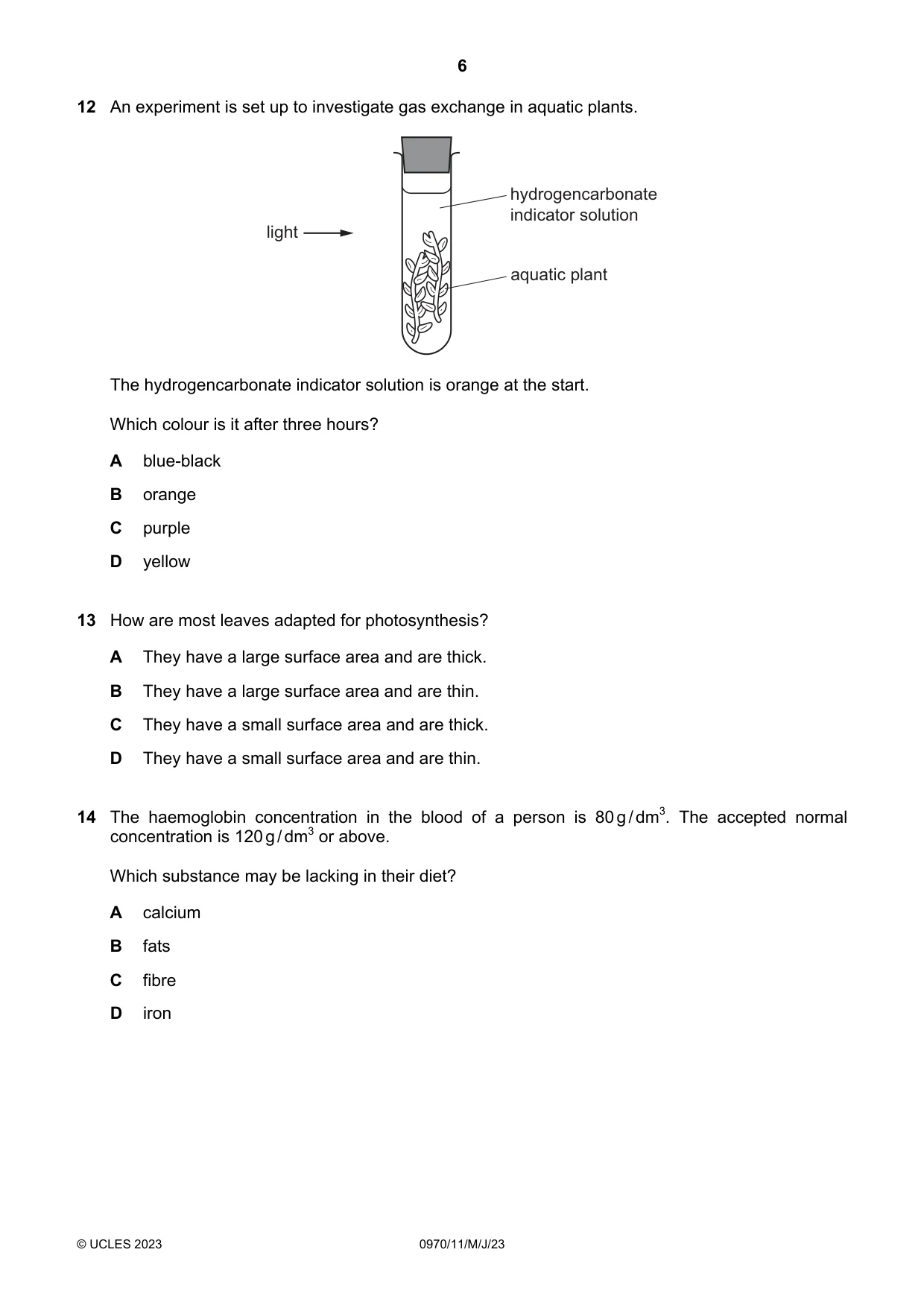
Q12 · An experiment is set up to investigate gas exchange in aquatic plants
12 An experiment is set up to investigate gas exchange in aquatic plants. hydrogencarbonate indicator solution light aquatic plant The hydrogencarbonate indicator solution is orange at the start. Which colour is it after three hours? A blue-black B orange C purple D yellow
Mark scheme: C
Q13 · How are most leaves adapted for photosynthesis?
13 How are most leaves adapted for photosynthesis? A They have a large surface area and are thick. B They have a large surface area and are thin. C They have a small surface area and are thick. D They have a small surface area and are thin.
Mark scheme: B
Q14 · The haemoglobin concentration in the blood of a person is 80 g / dm3
14 The haemoglobin concentration in the blood of a person is 80 g / dm3. The accepted normal concentration is 120 g / dm3 or above. Which substance may be lacking in their diet? A calcium B fats C fibre D iron
Mark scheme: D
Q15 · Which statement about physical digestion is correct?
15 Which statement about physical digestion is correct? A It increases the surface area of food. B It involves enzymes. C It takes place in the mouth only. D It produces smaller molecules.
Mark scheme: A
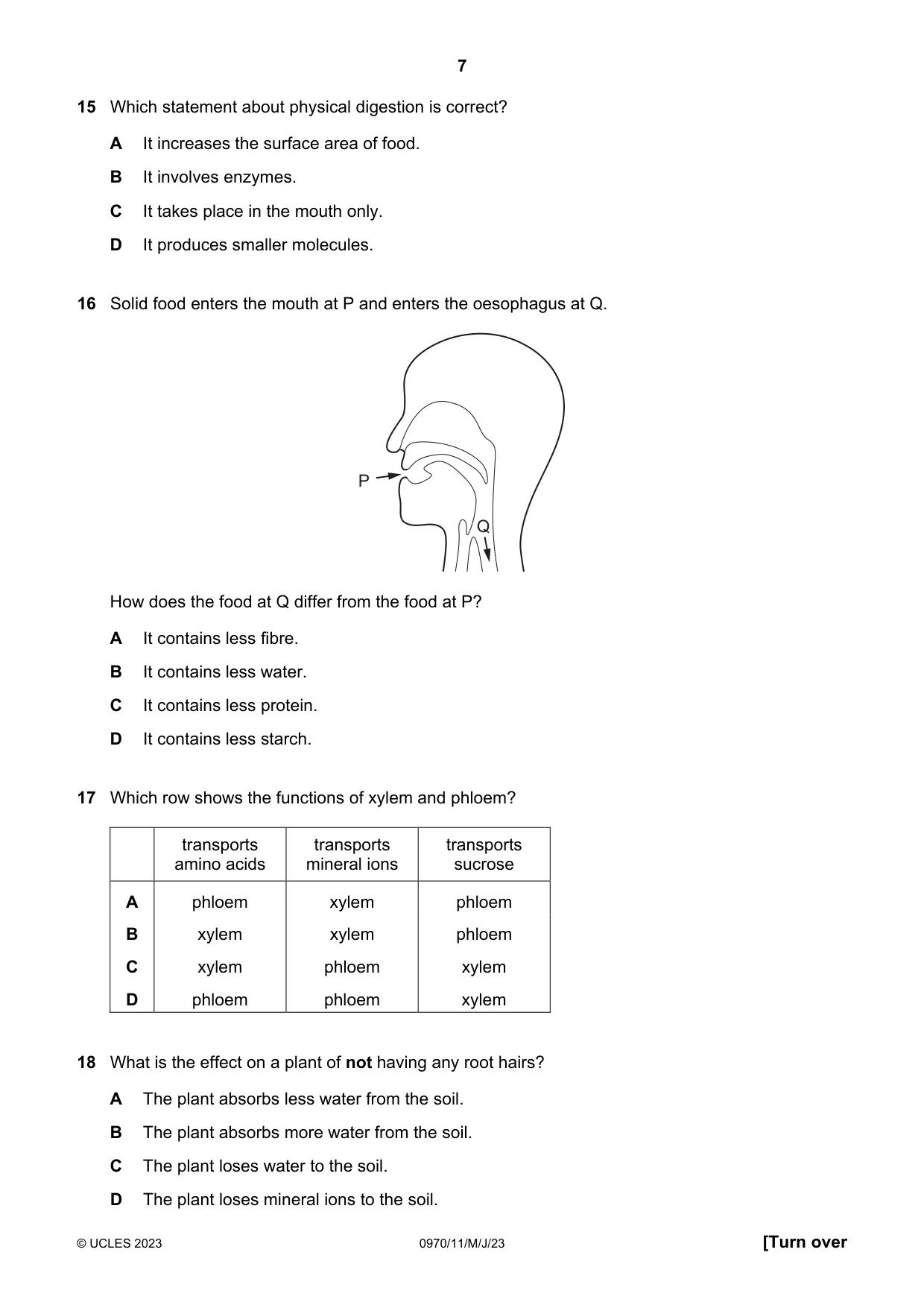
Q16 · Solid food enters the mouth at P and enters the oesophagus at Q
16 Solid food enters the mouth at P and enters the oesophagus at Q. P Q How does the food at Q differ from the food at P? A It contains less fibre. B It contains less water. C It contains less protein. D It contains less starch.
Mark scheme: D
Q17 · Which row shows the functions of xylem and phloem?
17 Which row shows the functions of xylem and phloem? transports transports transports amino acids mineral ions sucrose A phloem xylem phloem B xylem xylem phloem C xylem phloem xylem D phloem phloem xylem
Mark scheme: A
Q18 · What is the effect on a plant of not having any root hairs?
18 What is the effect on a plant of not having any root hairs? A The plant absorbs less water from the soil. B The plant absorbs more water from the soil. C The plant loses water to the soil. D The plant loses mineral ions to the soil.
Mark scheme: A
Q19 · Which statements describe how the structures in the circulatory system function?
19 Which statements describe how the structures in the circulatory system function? 1 a muscular pump to push blood into vessels 2 valves to ensure one-way blood flow 3 veins to take blood away from the heart 4 vessels to return blood to the heart A 1, 2 and 3 B 1, 2 and 4 C 1, 3 and 4 D 2, 3 and 4
Mark scheme: B
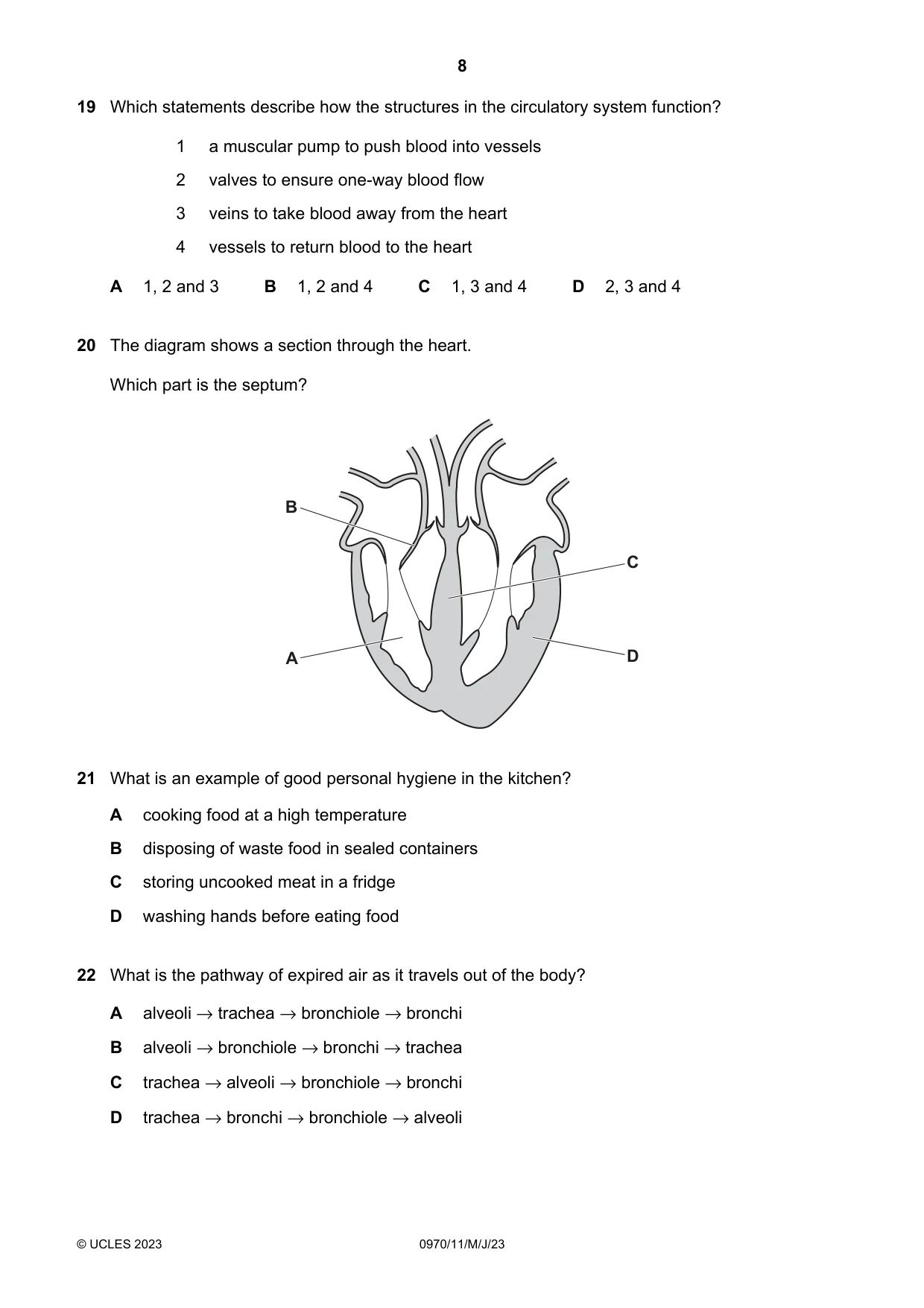
Q20 · The diagram shows a section through the heart
20 The diagram shows a section through the heart. Which part is the septum? B C A D
Mark scheme: C
Q21 · What is an example of good personal hygiene in the kitchen?
21 What is an example of good personal hygiene in the kitchen? A cooking food at a high temperature B disposing of waste food in sealed containers C storing uncooked meat in a fridge D washing hands before eating food
Mark scheme: D
Q22 · What is the pathway of expired air as it travels out of the body?
22 What is the pathway of expired air as it travels out of the body? A alveoli → trachea → bronchiole → bronchi B alveoli → bronchiole → bronchi → trachea C trachea → alveoli → bronchiole → bronchi D trachea → bronchi → bronchiole → alveoli
Mark scheme: B
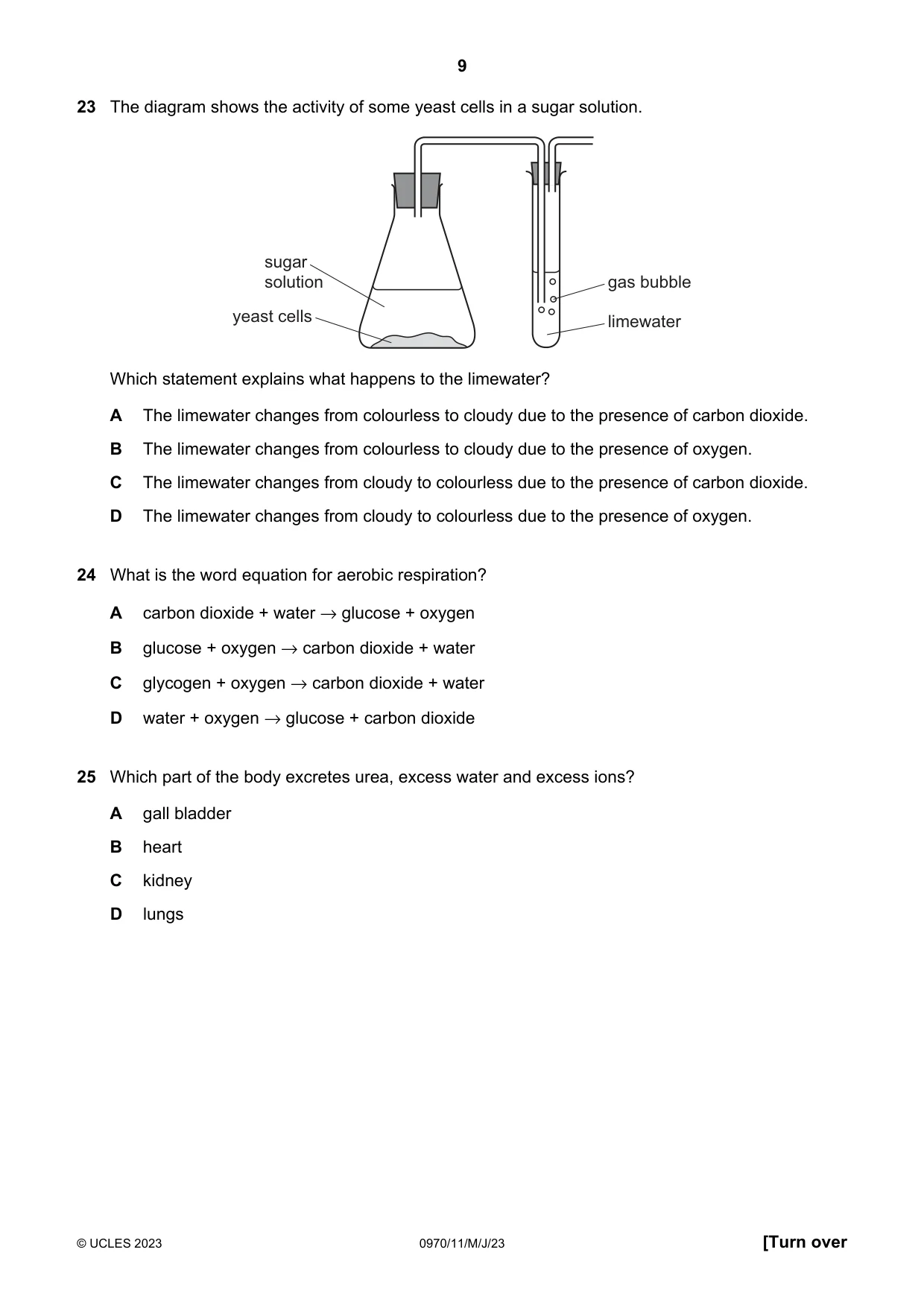
Q23 · The diagram shows the activity of some yeast cells in a sugar solution
23 The diagram shows the activity of some yeast cells in a sugar solution. sugar solution gas bubble yeast cells limewater Which statement explains what happens to the limewater? A The limewater changes from colourless to cloudy due to the presence of carbon dioxide. B The limewater changes from colourless to cloudy due to the presence of oxygen. C The limewater changes from cloudy to colourless due to the presence of carbon dioxide. D The limewater changes from cloudy to colourless due to the presence of oxygen.
Mark scheme: A
Q24 · What is the word equation for aerobic respiration?
24 What is the word equation for aerobic respiration? A carbon dioxide + water → glucose + oxygen B glucose + oxygen → carbon dioxide + water C glycogen + oxygen → carbon dioxide + water D water + oxygen → glucose + carbon dioxide
Mark scheme: B
Q25 · Which part of the body excretes urea, excess water and excess ions?
25 Which part of the body excretes urea, excess water and excess ions? A gall bladder B heart C kidney D lungs
Mark scheme: C
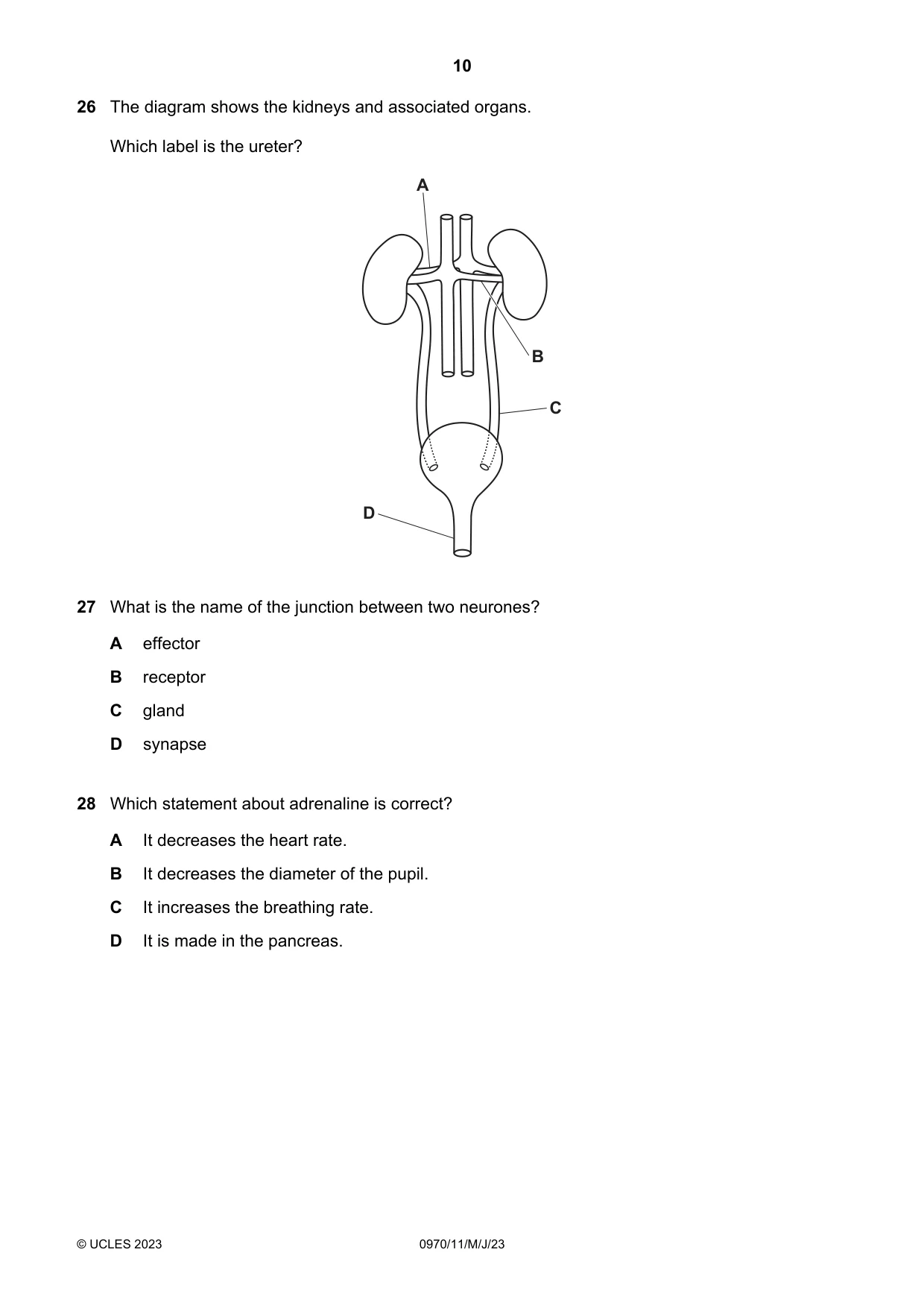
Q26 · The diagram shows the kidneys and associated organs
26 The diagram shows the kidneys and associated organs. Which label is the ureter? A B C D
Mark scheme: C
Q27 · What is the name of the junction between two neurones?
27 What is the name of the junction between two neurones? A effector B receptor C gland D synapse
Mark scheme: D
Q28 · Which statement about adrenaline is correct?
28 Which statement about adrenaline is correct? A It decreases the heart rate. B It decreases the diameter of the pupil. C It increases the breathing rate. D It is made in the pancreas.
Mark scheme: C
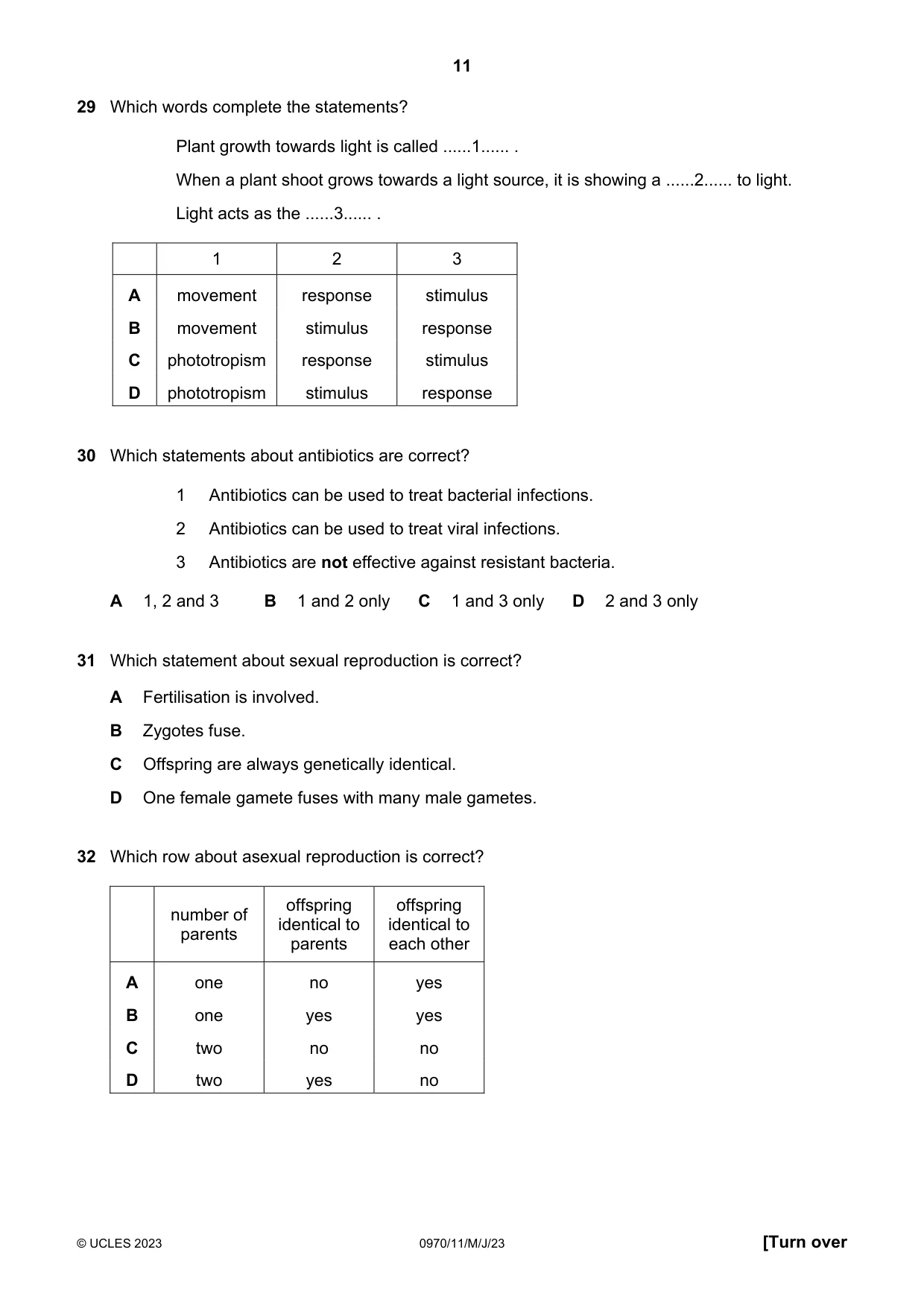
Q29 · Which words complete the statements?
29 Which words complete the statements? Plant growth towards light is called ......1...... . When a plant shoot grows towards a light source, it is showing a ......2...... to light. Light acts as the ......3...... . 1 2 3 A movement response stimulus B movement stimulus response C phototropism response stimulus D phototropism stimulus response
Mark scheme: C
Q30 · Which statements about antibiotics are correct?
30 Which statements about antibiotics are correct? 1 Antibiotics can be used to treat bacterial infections. 2 Antibiotics can be used to treat viral infections. 3 Antibiotics are not effective against resistant bacteria. A 1, 2 and 3 B 1 and 2 only C 1 and 3 only D 2 and 3 only
Mark scheme: C
Q31 · Which statement about sexual reproduction is correct?
31 Which statement about sexual reproduction is correct? A Fertilisation is involved. B Zygotes fuse. C Offspring are always genetically identical. D One female gamete fuses with many male gametes.
Mark scheme: A
Q32 · Which row about asexual reproduction is correct?
32 Which row about asexual reproduction is correct? offspring offspring number of identical to identical to parents parents each other A one no yes B one yes yes C two no no D two yes no
Mark scheme: B
Q33 · What is defined as a length of DNA that codes for a protein?
33 What is defined as a length of DNA that codes for a protein? A amino acid B antibody C chromosome D gene
Mark scheme: D
Q34 · A man has three sons
34 A man has three sons. What is the chance of his next child being a daughter? A 0% B 25% C 50% D 100%
Mark scheme: C
Q35 · Which term is a genetic change?
35 Which term is a genetic change? A allele B genotype C mutation D phenotype
Mark scheme: C
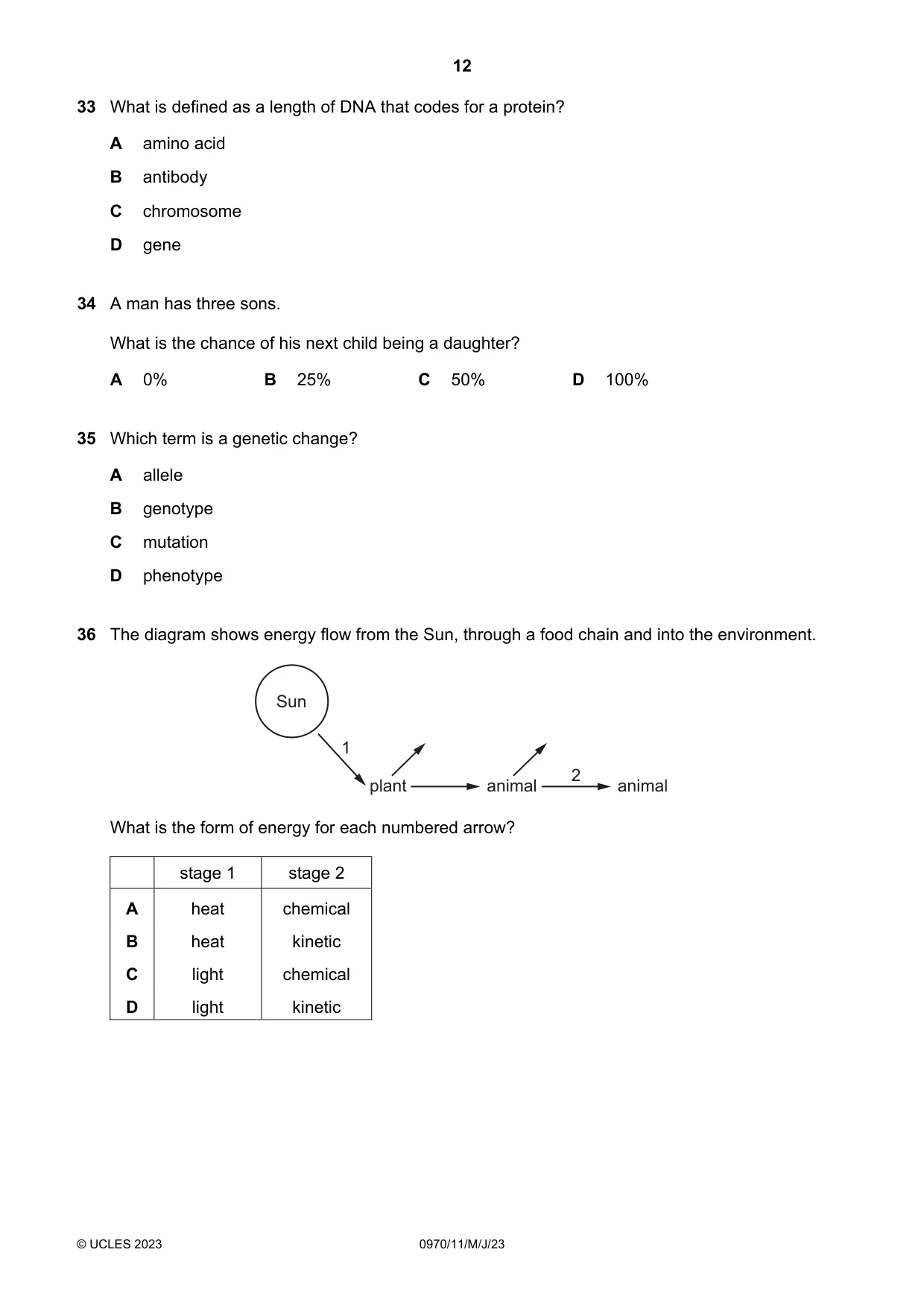
Q36 · The diagram shows energy flow from the Sun, through a food chain and into the environment
36 The diagram shows energy flow from the Sun, through a food chain and into the environment. Sun 1 2 plant animal animal What is the form of energy for each numbered arrow? stage 1 stage 2 A heat chemical B heat kinetic C light chemical D light kinetic
Mark scheme: C
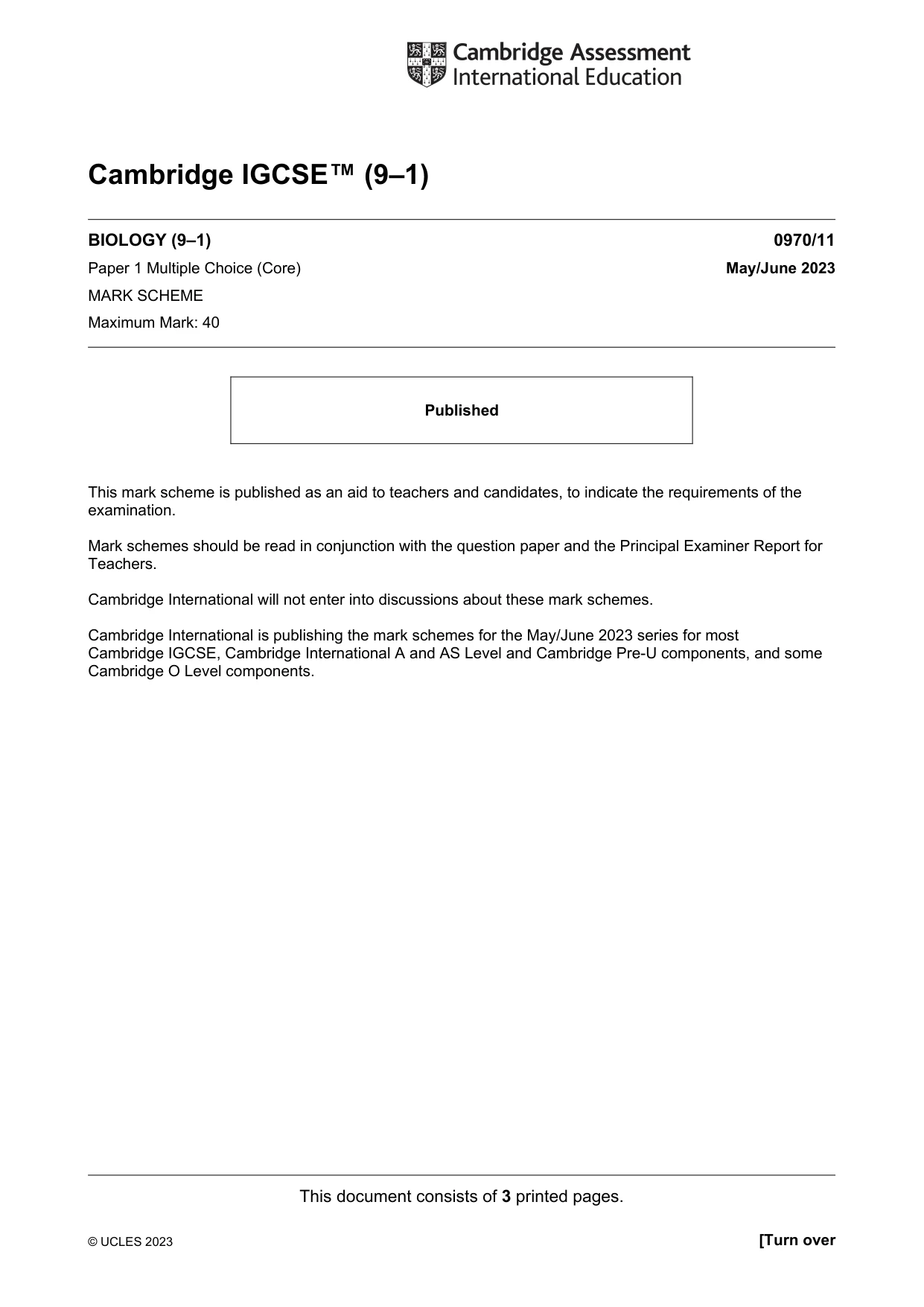
Q37 · In a pyramid of numbers, what does the top of the pyramid represent?
37 In a pyramid of numbers, what does the top of the pyramid represent? A carnivores B decomposers C herbivores D Sun
Mark scheme: A
Q38 · A few yeast cells were placed in a container of nutrient solution
38 A few yeast cells were placed in a container of nutrient solution. The graph shows how their population size changed over time. population size time Which row shows when the reproduction rate was greater than the death rate for the numbered phases on the graph? reproduction rate greater than death rate 1 2 A v Jv key B v v v/=yes Cc v x X =no D x v
Mark scheme: B
Q39 · The bloodworm is an organism that is found in heavily polluted water
39 The bloodworm is an organism that is found in heavily polluted water. The diagram shows where raw sewage flows into a river. Where would there be fewest bloodworms? input of raw sewage A D B C direction of flow
Mark scheme: A
Q40 · Which statement about genetic modification is correct?
40 Which statement about genetic modification is correct? A It involves choosing which individual organisms are used for breeding. B It is always done using genes from the same species. C It produces a new combination of genes. D It produces exact copies of individual organisms.
Mark scheme: C
What was in this paper
The subtopics covered by these 40 questions, and how many questions each got. Open one in a new tab to see every Cambridge question on it.
2Excretion in humans2Active transport1Aerobic respiration1Anaerobic respiration1Asexual reproduction1Biological molecules1Cell structure1Characteristics of living organisms1Chemical digestion1Chromosomes, genes and proteins1Circulatory systems1Concept and uses of classification systems1Coordination and response1Diet1Diffusion1Diseases and immunity1Drugs1Energy flow1Features of organisms1Food chains and food webs1Gas exchange in humans1Genetic modification1Heart1Hormones1Leaf structure1Monohybrid inheritance1Osmosis1Photosynthesis1Physical digestion1Pollution1Populations1Sexual reproduction1Size of specimens1Tropic responses1Variation1Water uptake1Xylem and phloem1What you needed in this session
Cambridge’s own grade thresholds for 2023 May/June, Paper 1 · Variant 1. A higher threshold means an easier paper — the bar moves with how the cohort did.