Cambridge IGCSE Biology (9-1) 0970 — 2024 May/June Paper 1 · Variant 1
0970/11/M/J/24 · 40 questions · 40 marks · ≈45 min
The question paper and its mark scheme, free to read here and free to download. This is Cambridge’s own paper, exactly as it was sat.
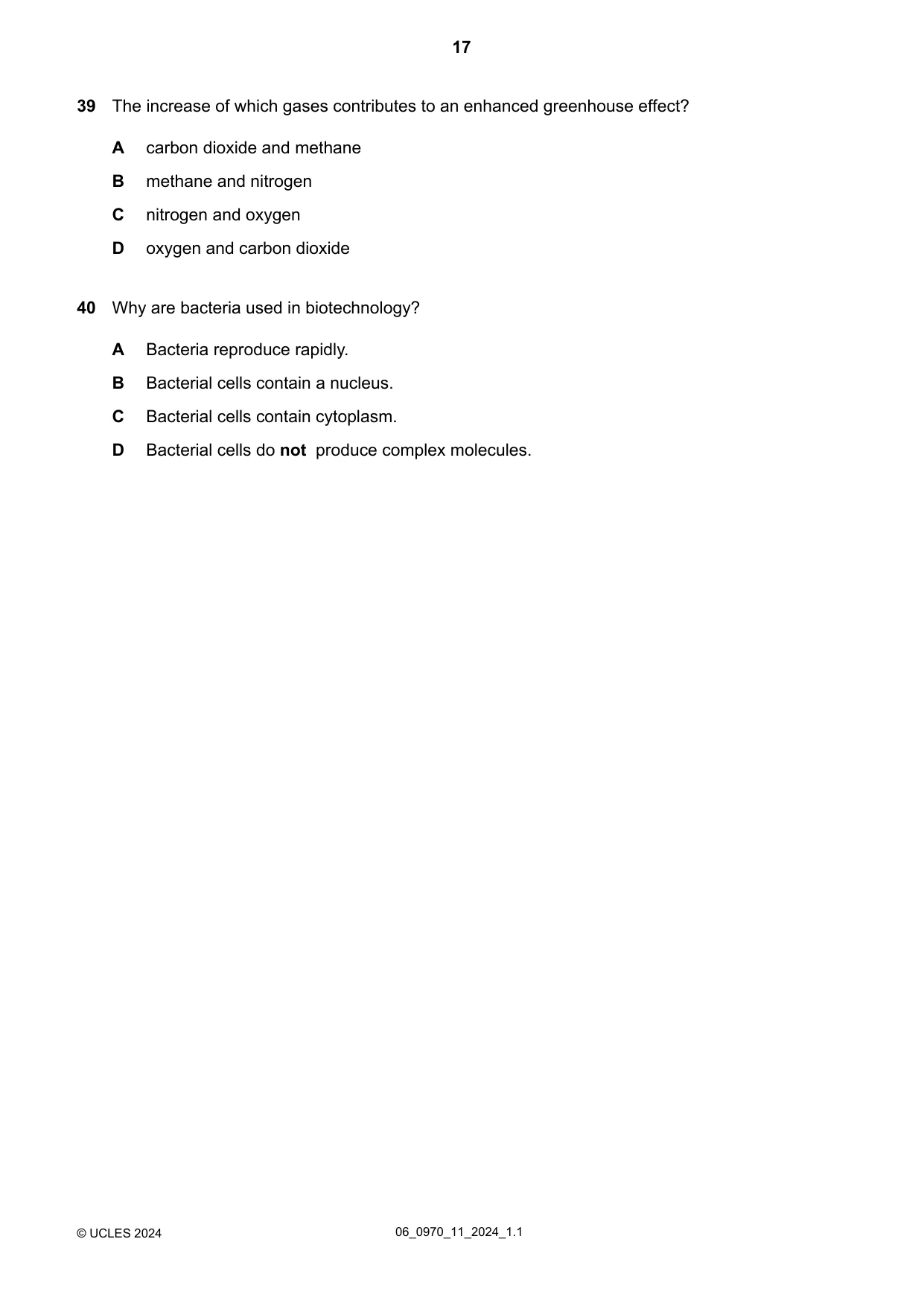
Question paper20 pages



Mark scheme3 pages
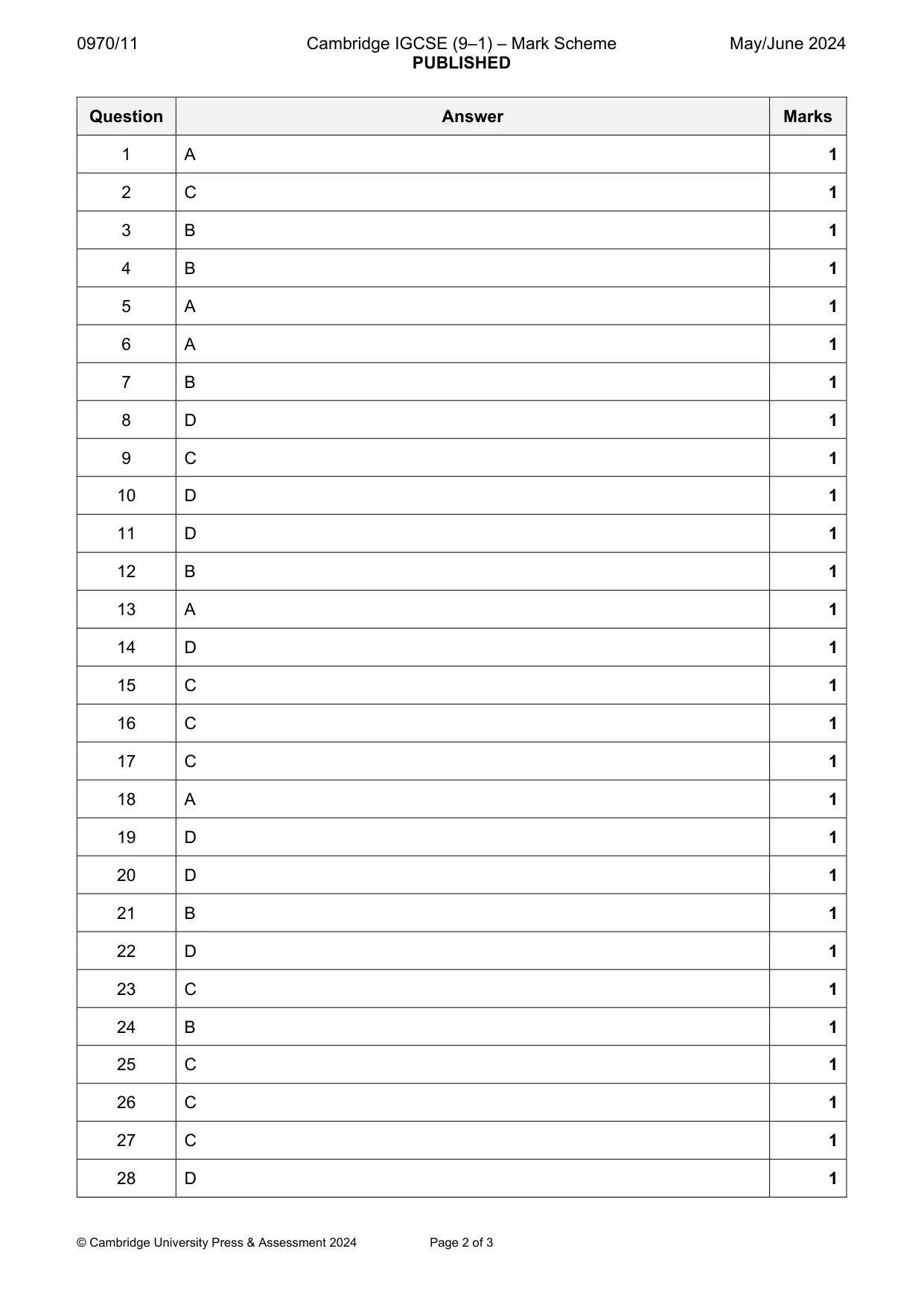
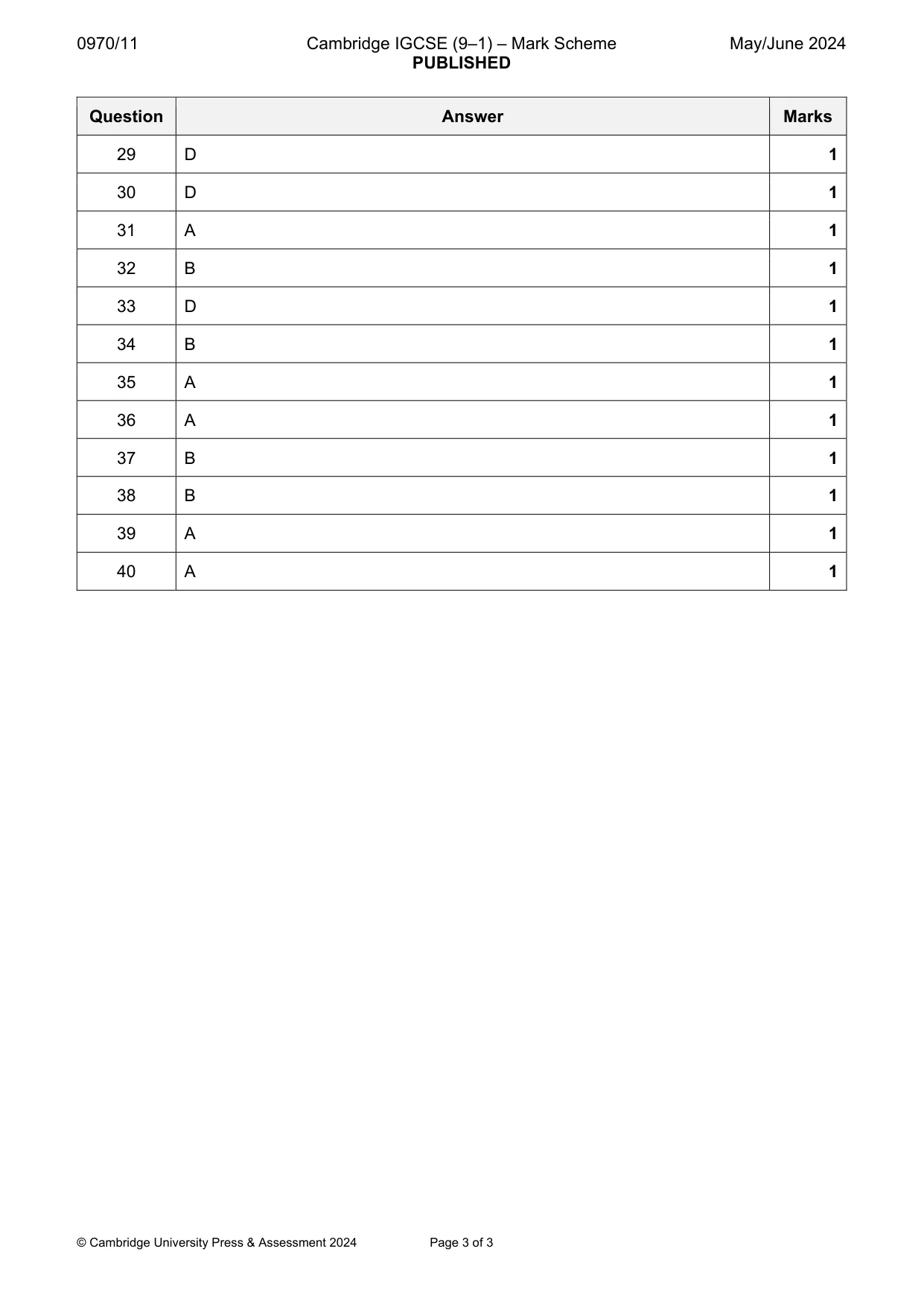
Answers below. Sit the paper first if you are practising.
Questions as text
Q1 · Which process do living organisms use to remove excess carbon dioxide from their bodies?
1 Which process do living organisms use to remove excess carbon dioxide from their bodies? A excretion B movement C nutrition D respiration
Mark scheme: A
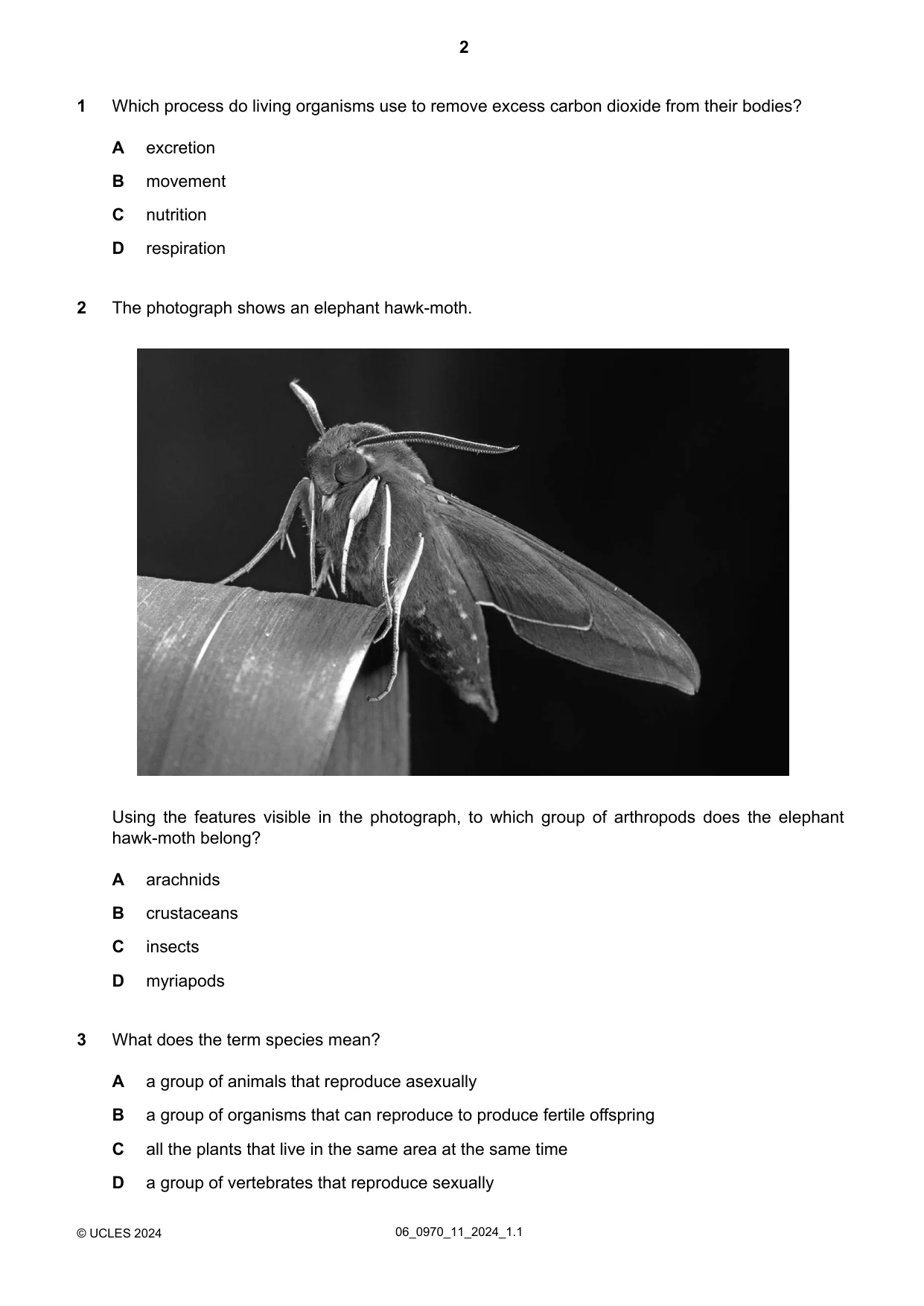
Q2 · The photograph shows an elephant hawk-moth
2 The photograph shows an elephant hawk-moth. Using the features visible in the photograph, to which group of arthropods does the elephant hawk-moth belong? A arachnids B crustaceans C insects D myriapods
Mark scheme: C
Q3 · What does the term species mean?
3 What does the term species mean? A a group of animals that reproduce asexually B a group of organisms that can reproduce to produce fertile offspring C all the plants that live in the same area at the same time D a group of vertebrates that reproduce sexually
Mark scheme: B
More questions on Concept and uses of classification systems
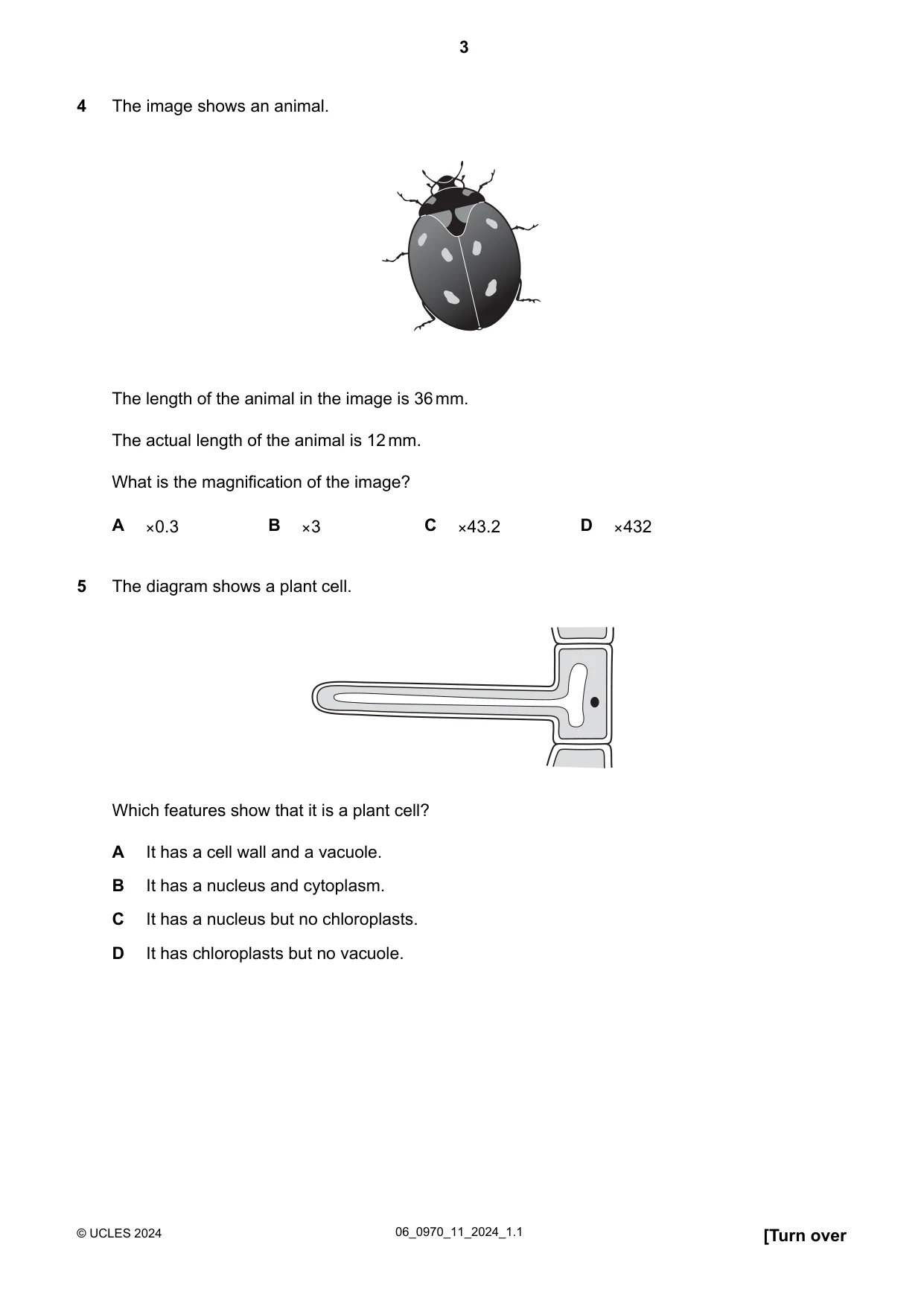
Q4 · The image shows an animal
4 The image shows an animal. The length of the animal in the image is 36 mm. The actual length of the animal is 12 mm. What is the magnification of the image? A ×0.3 B ×3 C ×43.2 D ×432
Mark scheme: B
Q5 · The diagram shows a plant cell
5 The diagram shows a plant cell. Which features show that it is a plant cell? A It has a cell wall and a vacuole. B It has a nucleus and cytoplasm. C It has a nucleus but no chloroplasts. D It has chloroplasts but no vacuole.
Mark scheme: A
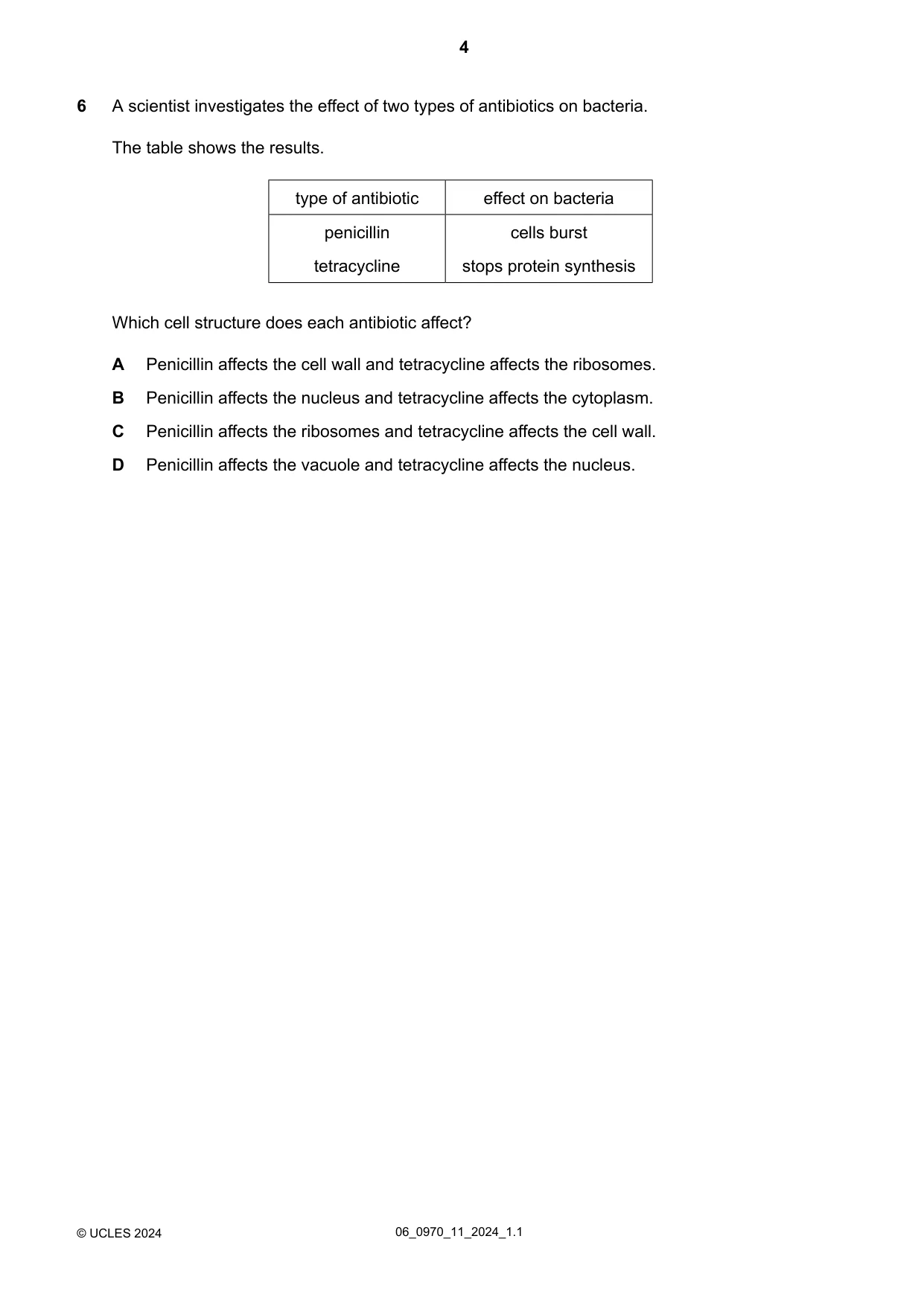
Q6 · A scientist investigates the effect of two types of antibiotics on bacteria
6 A scientist investigates the effect of two types of antibiotics on bacteria. The table shows the results. type of antibiotic effect on bacteria penicillin cells burst tetracycline stops protein synthesis Which cell structure does each antibiotic affect? A Penicillin affects the cell wall and tetracycline affects the ribosomes. B Penicillin affects the nucleus and tetracycline affects the cytoplasm. C Penicillin affects the ribosomes and tetracycline affects the cell wall. D Penicillin affects the vacuole and tetracycline affects the nucleus.
Mark scheme: A
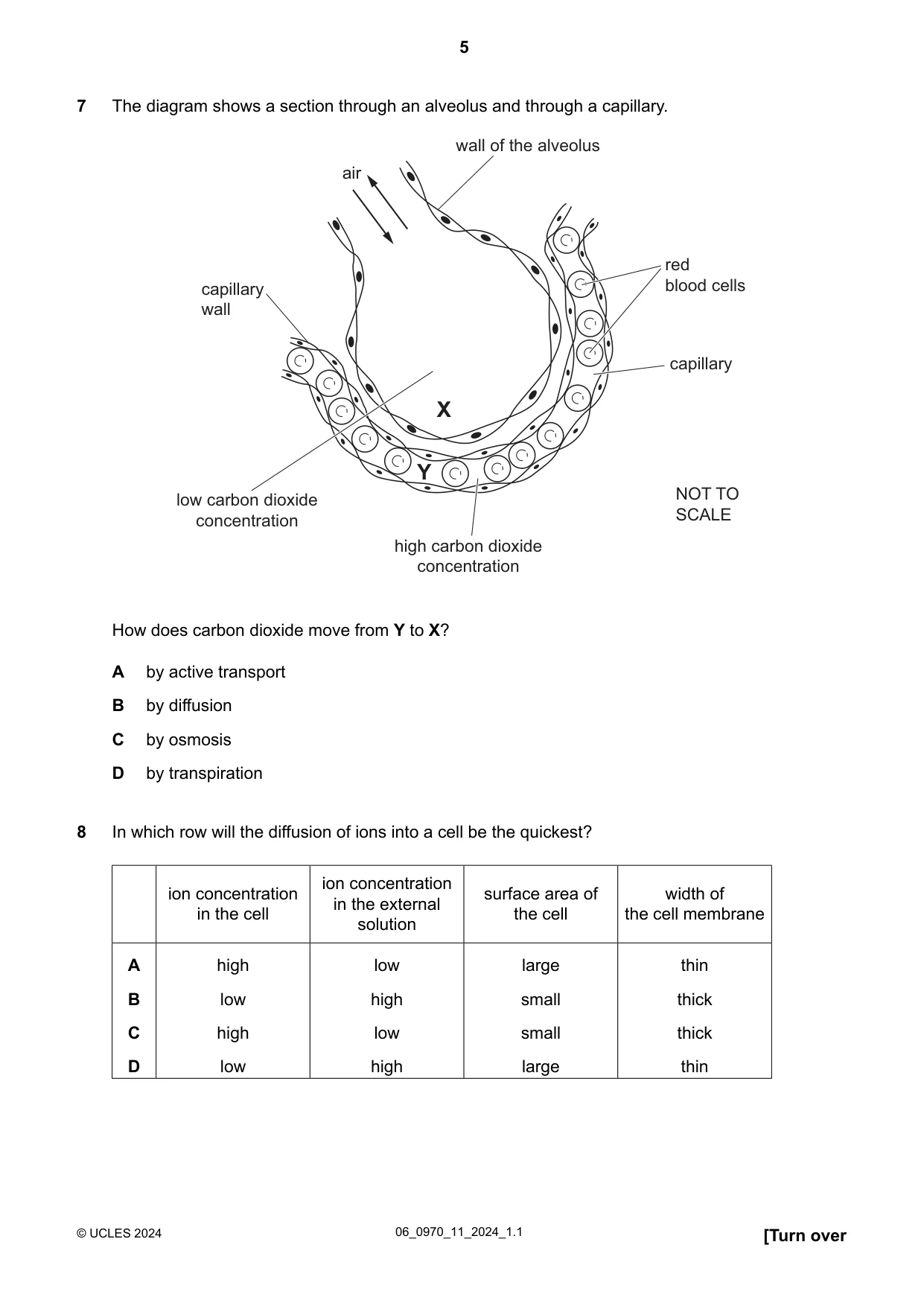
Q7 · The diagram shows a section through an alveolus and through a capillary
7 The diagram shows a section through an alveolus and through a capillary. wall of the alveolus air red capillary blood cells wall capillary X Y low carbon dioxide NOT TO concentration SCALE high carbon dioxide concentration How does carbon dioxide move from Y to X? A by active transport B by diffusion C by osmosis D by transpiration
Mark scheme: B
Q8 · In which row will the diffusion of ions into a cell be the quickest?
8 In which row will the diffusion of ions into a cell be the quickest? ion concentration ion concentration surface area of width of in the external in the cell the cell the cell membrane solution A high low large thin B low high small thick C high low small thick D low high large thin
Mark scheme: D
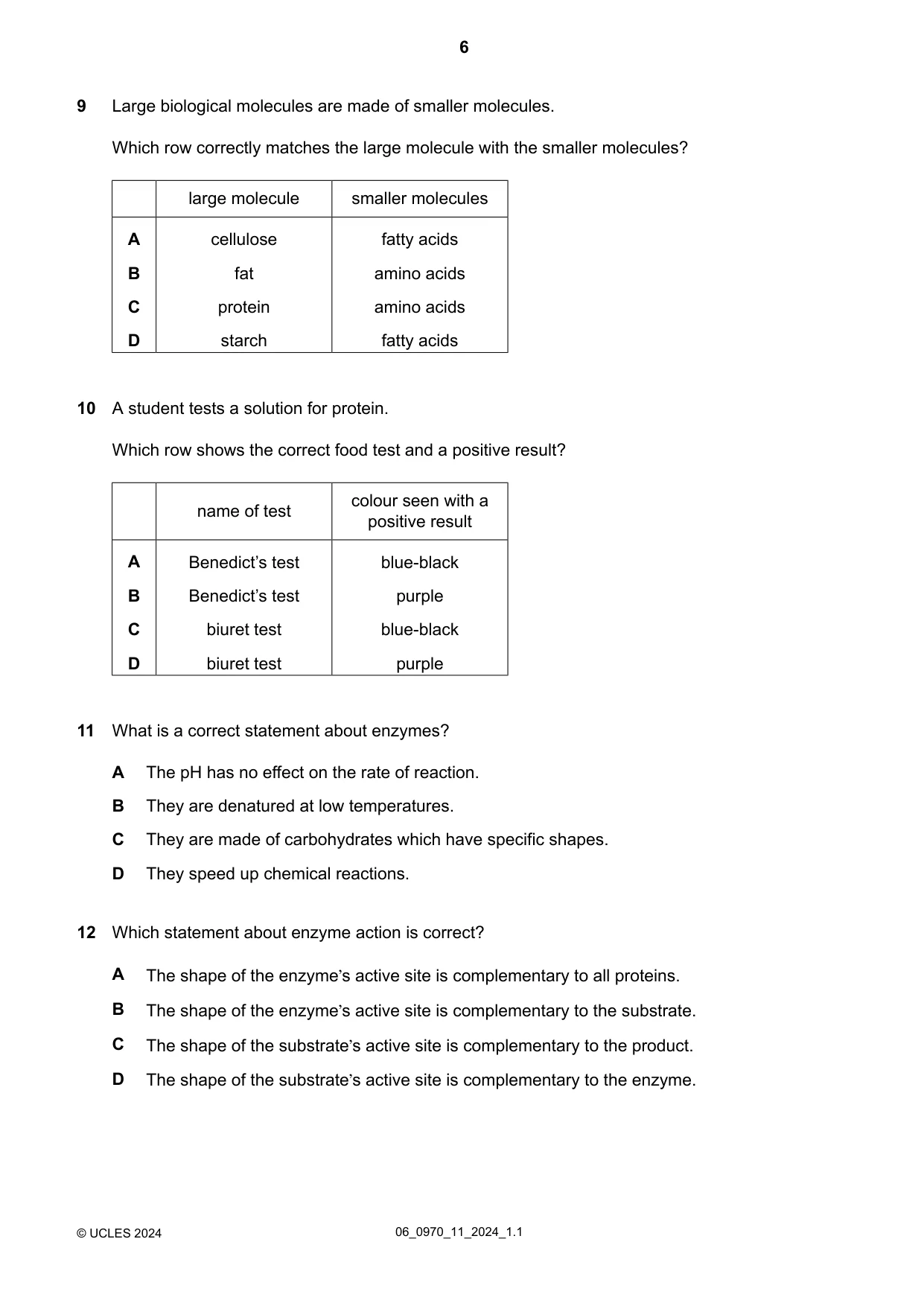
Q9 · Large biological molecules are made of smaller molecules
9 Large biological molecules are made of smaller molecules. Which row correctly matches the large molecule with the smaller molecules? large molecule smaller molecules A cellulose fatty acids B fat amino acids C protein amino acids D starch fatty acids
Mark scheme: C
Q10 · A student tests a solution for protein
10 A student tests a solution for protein. Which row shows the correct food test and a positive result? colour seen with a name of test positive result A Benedict’s test blue-black B Benedict’s test purple C biuret test blue-black D biuret test purple
Mark scheme: D
Q11 · What is a correct statement about enzymes?
11 What is a correct statement about enzymes? A The pH has no effect on the rate of reaction. B They are denatured at low temperatures. C They are made of carbohydrates which have specific shapes. D They speed up chemical reactions.
Mark scheme: D
Q12 · Which statement about enzyme action is correct?
12 Which statement about enzyme action is correct? A The shape of the enzyme’s active site is complementary to all proteins. B The shape of the enzyme’s active site is complementary to the substrate. C The shape of the substrate’s active site is complementary to the product. D The shape of the substrate’s active site is complementary to the enzyme.
Mark scheme: B
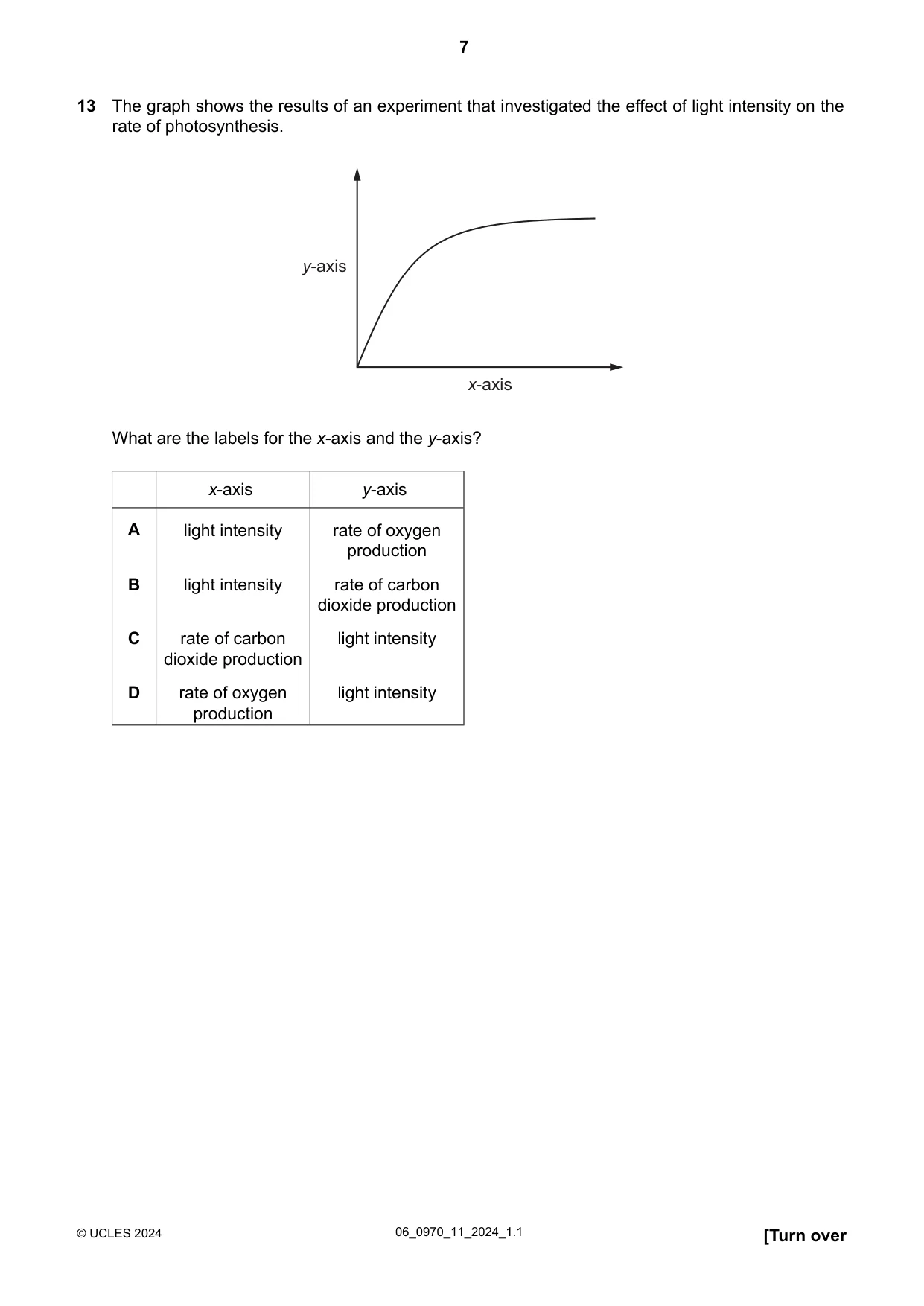
Q13 · The graph shows the results of an experiment that investigated the effect of light…
13 The graph shows the results of an experiment that investigated the effect of light intensity on the rate of photosynthesis. y-axis x-axis What are the labels for the x-axis and the y-axis? x-axis y-axis A light intensity rate of oxygen production B light intensity rate of carbon dioxide production C rate of carbon light intensity dioxide production D rate of oxygen light intensity production
Mark scheme: A
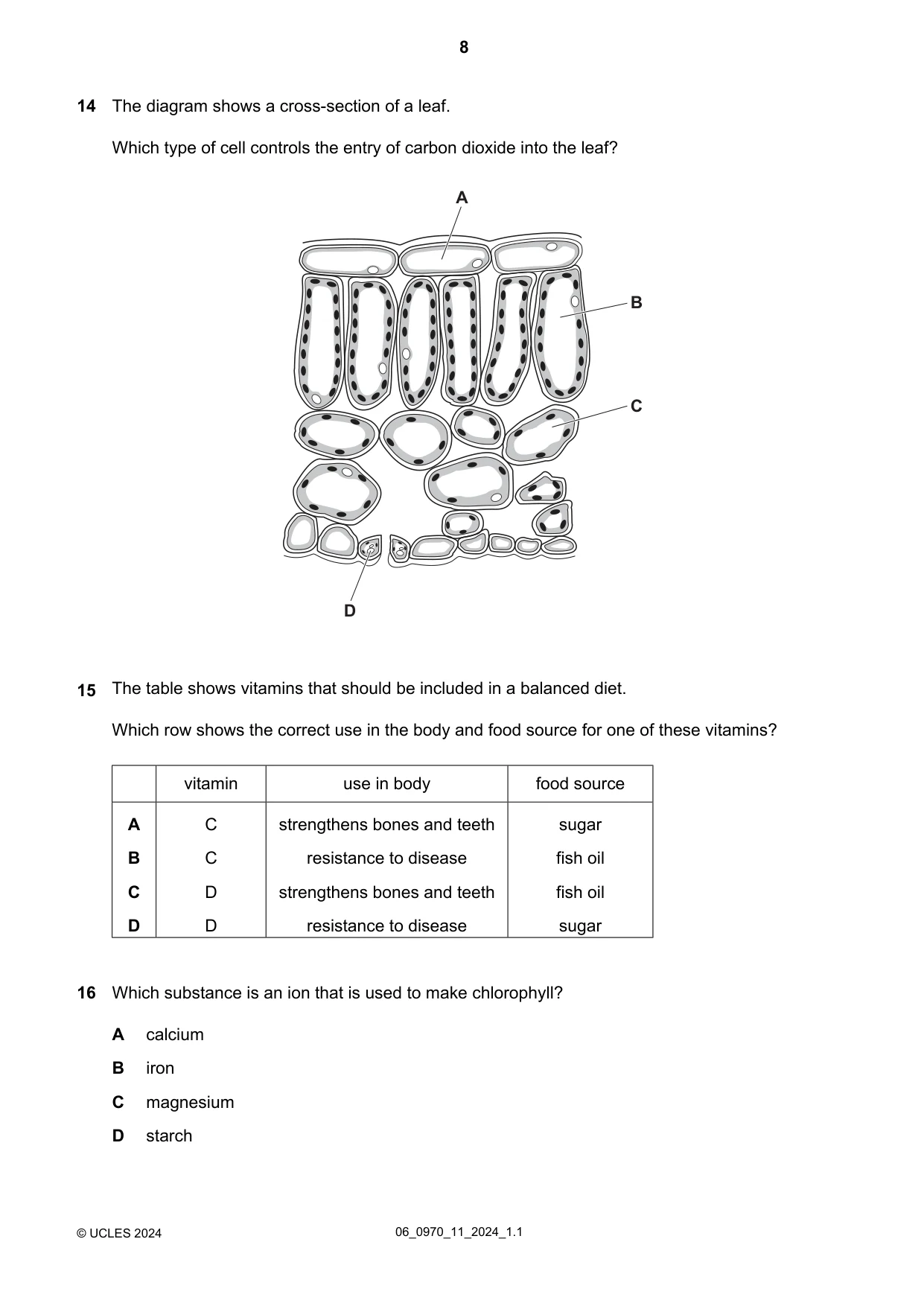
Q14 · The diagram shows a cross-section of a leaf
14 The diagram shows a cross-section of a leaf. Which type of cell controls the entry of carbon dioxide into the leaf? A B C D The table shows vitamins that should be included in a balanced diet.
Mark scheme: D
Q15 · Which row shows the correct use in the body and food source for one of these vitamins?
15 Which row shows the correct use in the body and food source for one of these vitamins? vitamin use in body food source A C strengthens bones and teeth sugar B C resistance to disease fish oil C D strengthens bones and teeth fish oil D D resistance to disease sugar
Mark scheme: C
Q16 · Which substance is an ion that is used to make chlorophyll?
16 Which substance is an ion that is used to make chlorophyll? A calcium B iron C magnesium D starch
Mark scheme: C
Q17 · What is the function of the gall bladder?
17 What is the function of the gall bladder? A production of bile B production of gastric juice C storage of bile D storage of gastric juice
Mark scheme: C
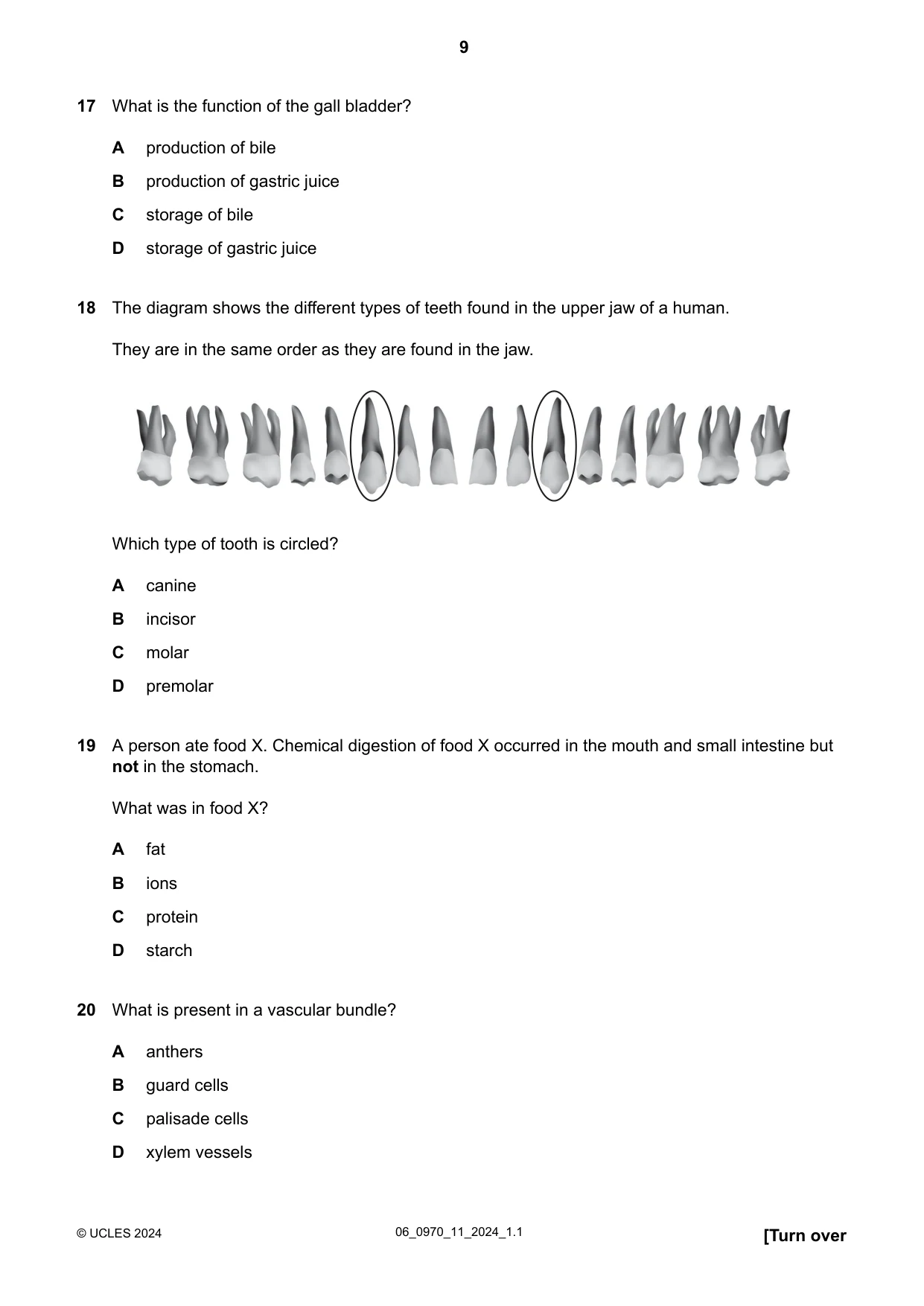
Q18 · The diagram shows the different types of teeth found in the upper jaw of a human
18 The diagram shows the different types of teeth found in the upper jaw of a human. They are in the same order as they are found in the jaw. Which type of tooth is circled? A canine B incisor C molar D premolar
Mark scheme: A
Q19 · A person ate food X
19 A person ate food X. Chemical digestion of food X occurred in the mouth and small intestine but not in the stomach. What was in food X? A fat B ions C protein D starch
Mark scheme: D
Q20 · What is present in a vascular bundle?
20 What is present in a vascular bundle? A anthers B guard cells C palisade cells D xylem vessels
Mark scheme: D
Q21 · What is the pathway taken by water from the soil to the leaf?
21 What is the pathway taken by water from the soil to the leaf? A root hair cells →root cortex →mesophyll →xylem B root hair cells →root cortex →xylem →mesophyll C root cortex→root hair cells →mesophyll →xylem D root cortex →root hair cells→xylem →mesophyll
Mark scheme: B
Q22 · What are methods for monitoring the activity of the heart?
22 What are methods for monitoring the activity of the heart? measuring listening to sounds ECG pulse rate of valves closing A ✓ ✗ ✗ key B ✗ ✓ ✓ ✓= yes C ✓ ✗ ✓ ✗= no D ✓ ✓ ✓
Mark scheme: D
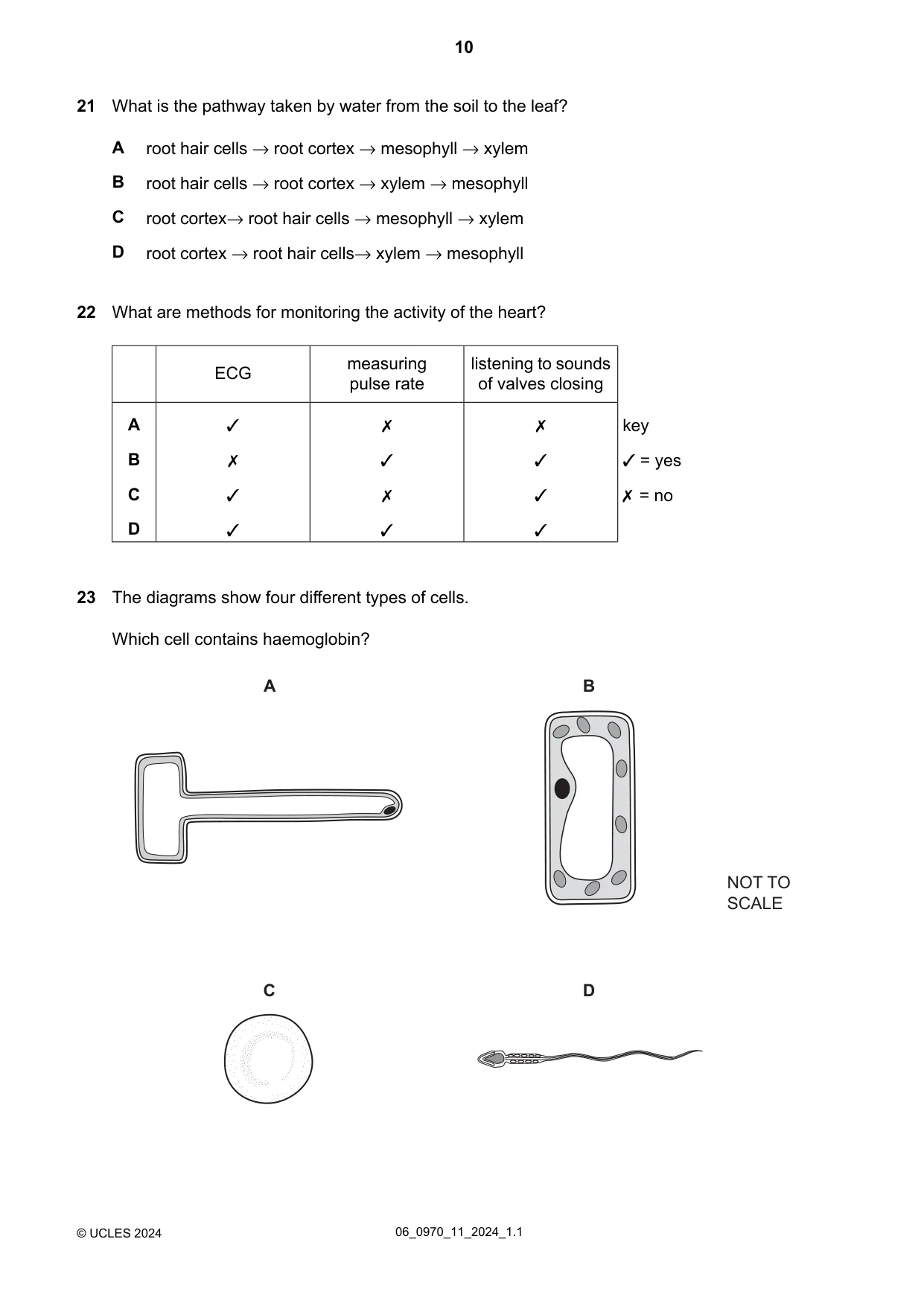
Q23 · The diagrams show four different types of cells
23 The diagrams show four different types of cells. Which cell contains haemoglobin? A B NOT TO SCALE C D
Mark scheme: C
Q24 · What is a direct way of transmitting a pathogen?
24 What is a direct way of transmitting a pathogen? A by contact with contaminated air B by contact with contaminated blood C by contact with contaminated food D by contact with contaminated surfaces
Mark scheme: B
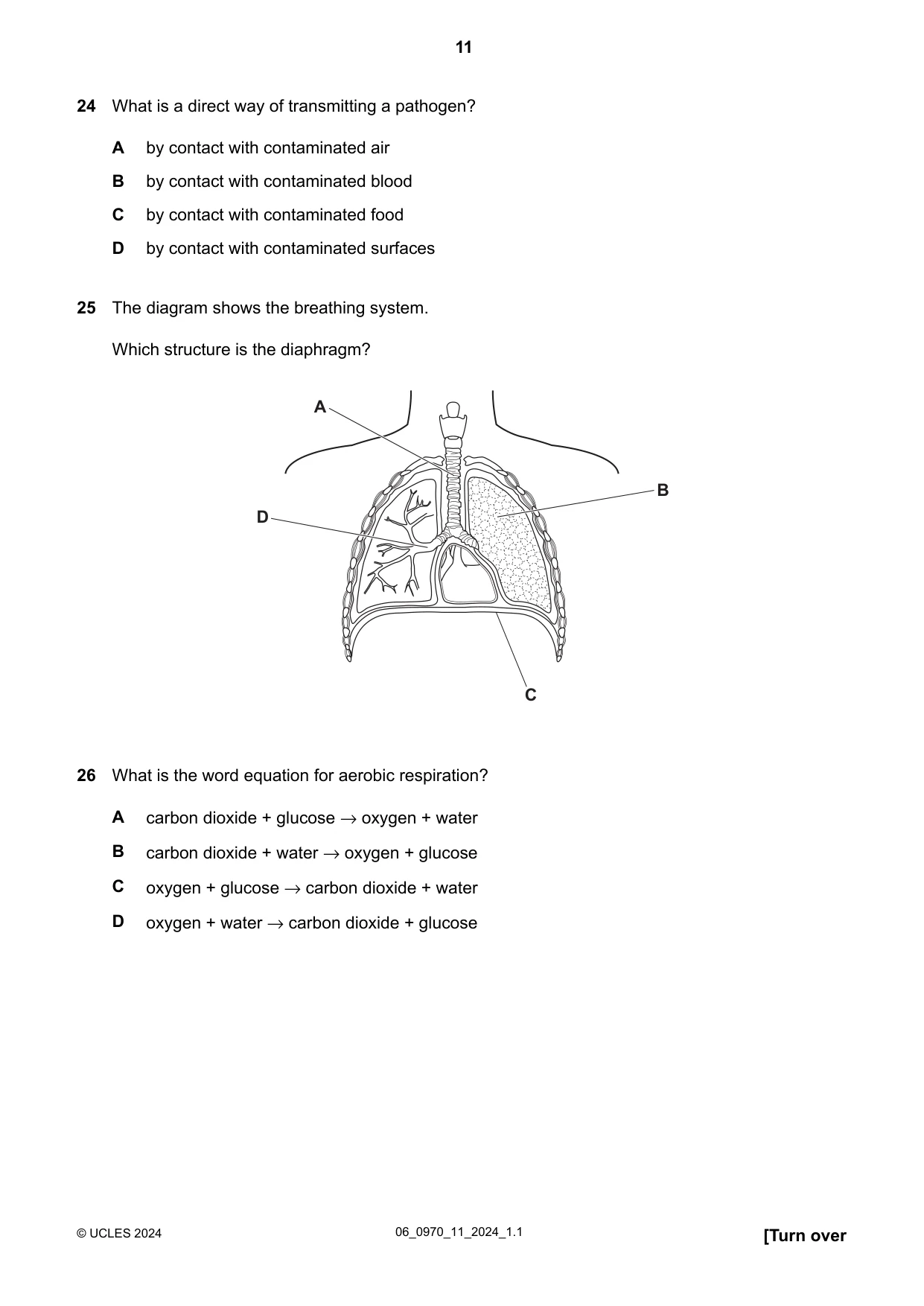
Q25 · The diagram shows the breathing system
25 The diagram shows the breathing system. Which structure is the diaphragm? A B D C
Mark scheme: C
Q26 · What is the word equation for aerobic respiration?
26 What is the word equation for aerobic respiration? A carbon dioxide + glucose →oxygen + water B carbon dioxide + water →oxygen + glucose C oxygen + glucose →carbon dioxide + water D oxygen + water →carbon dioxide + glucose
Mark scheme: C
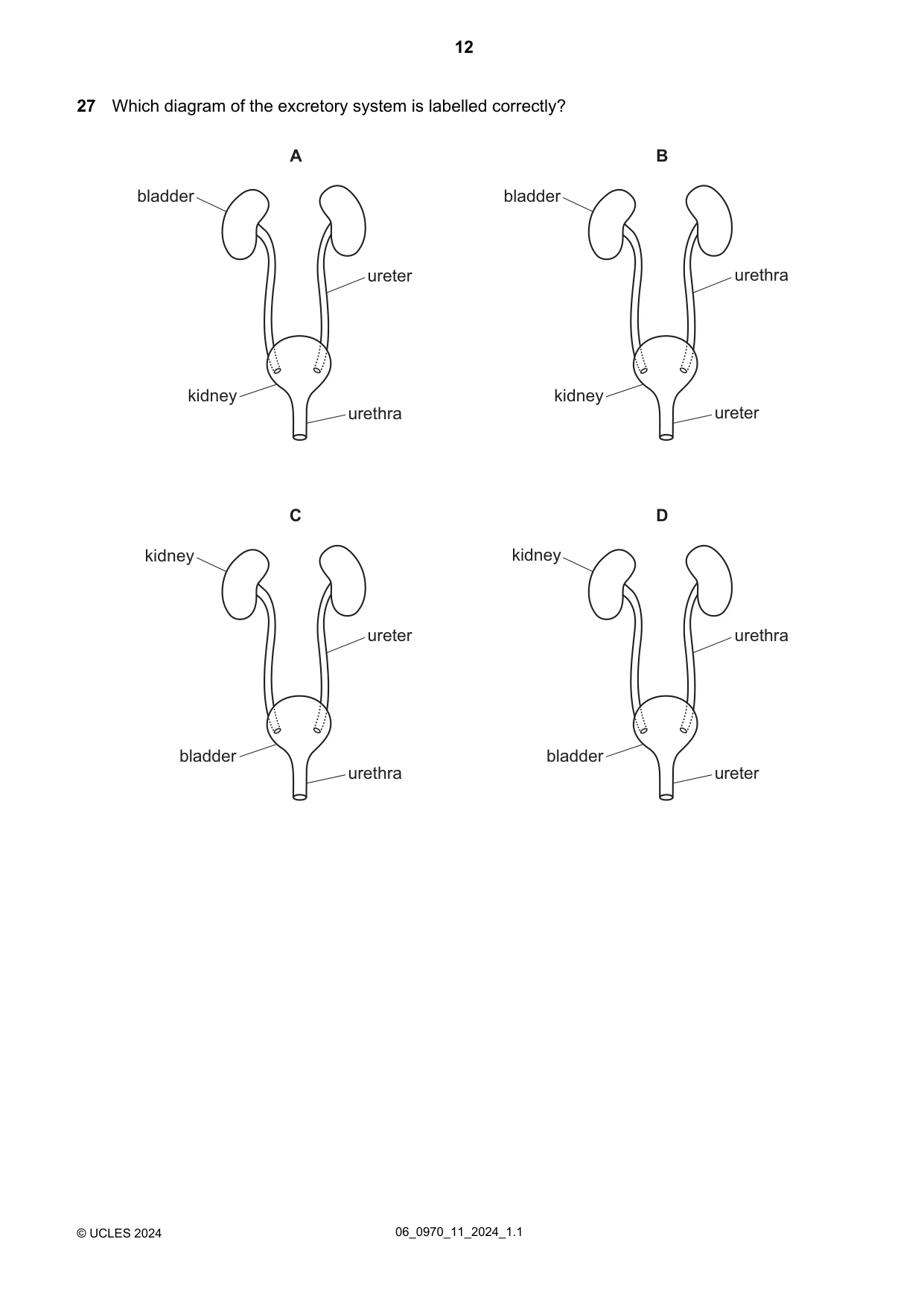
Q27 · Which diagram of the excretory system is labelled correctly?
27 Which diagram of the excretory system is labelled correctly? A B bladder bladder ureter urethra kidney kidney urethra ureter C D kidney kidney ureter urethra bladder bladder urethra ureter
Mark scheme: C
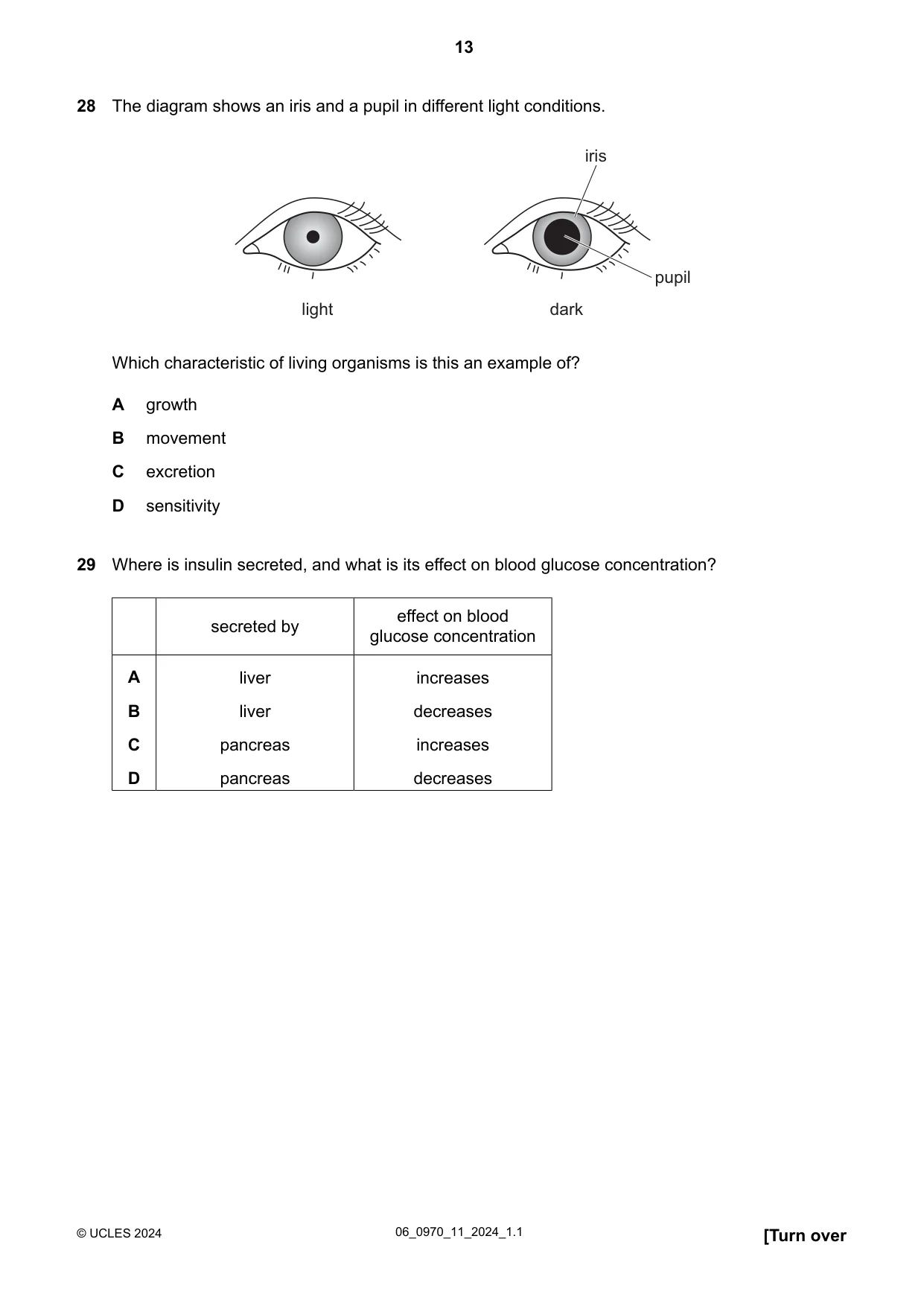
Q28 · The diagram shows an iris and a pupil in different light conditions
28 The diagram shows an iris and a pupil in different light conditions. iris pupil light dark Which characteristic of living organisms is this an example of? A growth B movement C excretion D sensitivity
Mark scheme: D
Q29 · Where is insulin secreted, and what is its effect on blood glucose concentration?
29 Where is insulin secreted, and what is its effect on blood glucose concentration? effect on blood secreted by glucose concentration A liver increases B liver decreases C pancreas increases D pancreas decreases
Mark scheme: D
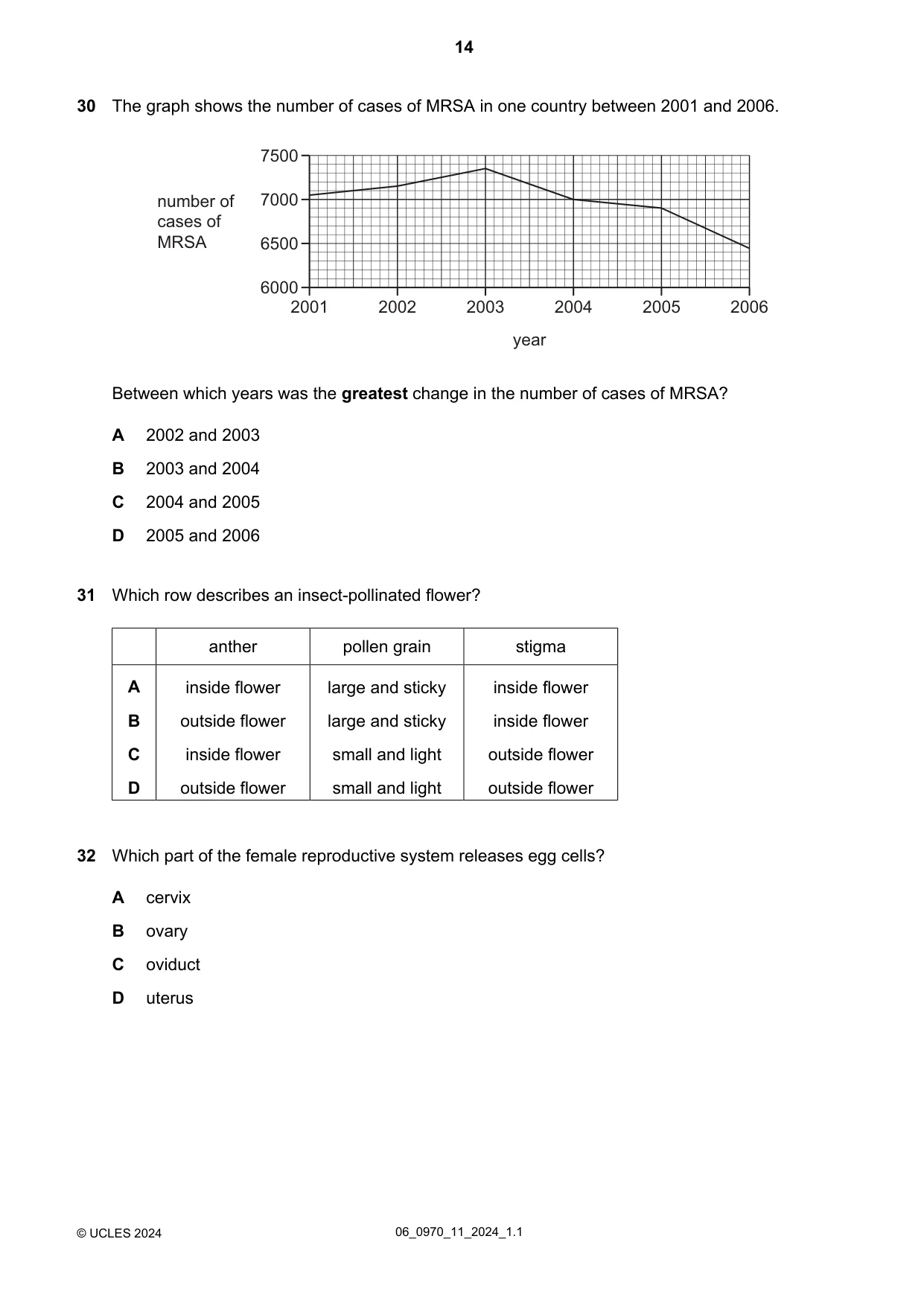
Q30 · The graph shows the number of cases of MRSA in one country between 2001 and 2006
30 The graph shows the number of cases of MRSA in one country between 2001 and 2006. 7500 number of 7000 cases of MRSA 6500 6000 2001 2002 2003 2004 2005 2006 year Between which years was the greatest change in the number of cases of MRSA? A 2002 and 2003 B 2003 and 2004 C 2004 and 2005 D 2005 and 2006
Mark scheme: D
Q31 · Which row describes an insect-pollinated flower?
31 Which row describes an insect-pollinated flower? anther pollen grain stigma A inside flower large and sticky inside flower B outside flower large and sticky inside flower C inside flower small and light outside flower D outside flower small and light outside flower
Mark scheme: A
Q32 · Which part of the female reproductive system releases egg cells?
32 Which part of the female reproductive system releases egg cells? A cervix B ovary C oviduct D uterus
Mark scheme: B
Q33 · Which adaptive feature of sperm provides the energy that enables it to swim?
33 Which adaptive feature of sperm provides the energy that enables it to swim? A the acrosome B the cell membrane C the flagellum D the mitochondria
Mark scheme: D
Q34 · What is a use of yeast in biotechnology?
34 What is a use of yeast in biotechnology? A aerobic respiration to make biofuels B anaerobic respiration to make bread C aerobic respiration to make alcohol D anaerobic respiration to make human proteins
Mark scheme: B
Q35 · Many mammals have coloured fur and many birds have coloured feathers
35 Many mammals have coloured fur and many birds have coloured feathers. Which uses of colour could help males survive long enough to pass on their features to their offspring? hiding from hiding from warning animals animals which animals which that they are might eat them they could eat poisonous A ✓ ✓ ✓ key B ✓ ✓ ✗ ✓ = yes C ✗ ✓ ✗ ✗ = no D ✓ ✗ ✓
Mark scheme: A
Q36 · The list shows statements about selection
36 The list shows statements about selection. 1 Individuals reproduce and pass on their alleles to the next generation. 2 Genetic variation exists between individuals and many offspring are produced. 3 Individuals struggle for survival and compete for resources. 4 Individuals that are better adapted to the environment survive. 5 Individuals with desirable features are selected by humans. Which statements are correct descriptions of natural selection? A 1, 2, 3 and 4 B 1, 2 and 5 only C 2, 3 and 4 only D 3, 4 and 5 only
Mark scheme: A
Q37 · Some of the processes involved in the carbon cycle are listed
37 Some of the processes involved in the carbon cycle are listed. 1 combustion 2 decomposition 3 photosynthesis 4 respiration During the carbon cycle, which processes release carbon dioxide into the atmosphere? A 1, 2 and 3 B 1, 2 and 4 C 1 and 4 only D 2 and 3 only
Mark scheme: B
Q38 · What are the effects of sewage pollution on the biodiversity and the number of bacteria…
38 What are the effects of sewage pollution on the biodiversity and the number of bacteria in a river? biodiversity number of bacteria A decreases decreases B decreases increases C increases decreases D increases increases
Mark scheme: B
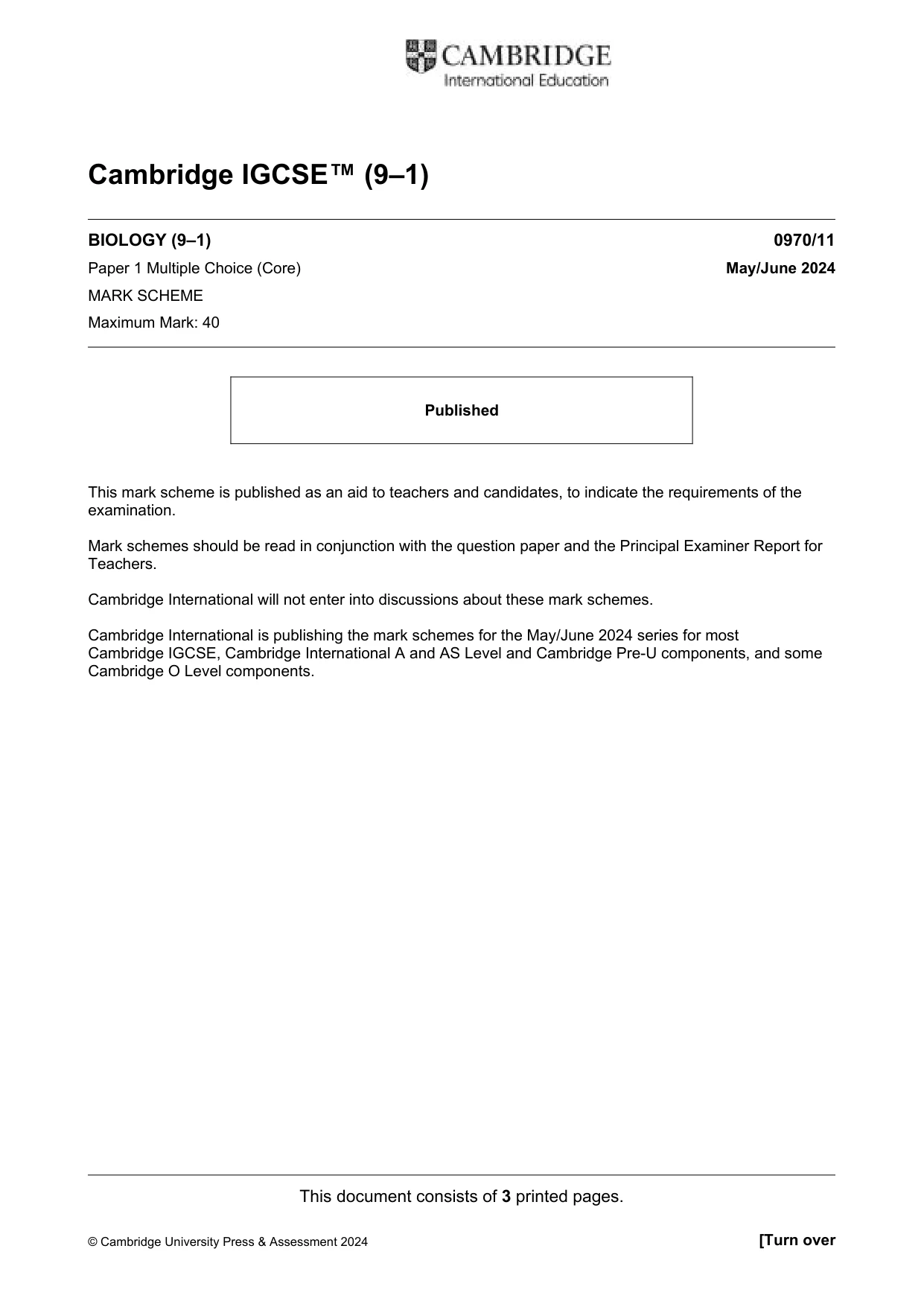
Q39 · The increase of which gases contributes to an enhanced greenhouse effect?
39 The increase of which gases contributes to an enhanced greenhouse effect? A carbon dioxide and methane B methane and nitrogen C nitrogen and oxygen D oxygen and carbon dioxide
Mark scheme: A
Q40 · Why are bacteria used in biotechnology?
40 Why are bacteria used in biotechnology? A Bacteria reproduce rapidly. B Bacterial cells contain a nucleus. C Bacterial cells contain cytoplasm. D Bacterial cells do not produce complex molecules.
Mark scheme: A
What was in this paper
The subtopics covered by these 40 questions, and how many questions each got. Open one in a new tab to see every Cambridge question on it.
2Biotechnology2Cell structure2Diet2Diffusion2Diseases and immunity2Enzymes2Pollution2Sexual reproduction in humans2Adaptive features1Aerobic respiration1Blood1Characteristics of living organisms1Chemical digestion1Concept and uses of classification systems1Coordination and response1Digestive system1Excretion in humans1Features of organisms1Gas exchange in humans1Heart1Hormones1Leaf structure1Nutrient cycles1Photosynthesis1Physical digestion1Selection1Sexual reproduction in plants1Size of specimens1Water uptake1Xylem and phloem1What you needed in this session
Cambridge’s own grade thresholds for 2024 May/June, Paper 1 · Variant 1. A higher threshold means an easier paper — the bar moves with how the cohort did.