Cambridge IGCSE Biology (9-1) 0970 — 2025 May/June Paper 1 · Variant 1
0970/11/M/J/25 · 40 questions · 40 marks · ≈45 min
The question paper and its mark scheme, free to read here and free to download. This is Cambridge’s own paper, exactly as it was sat.
Question paper16 pages
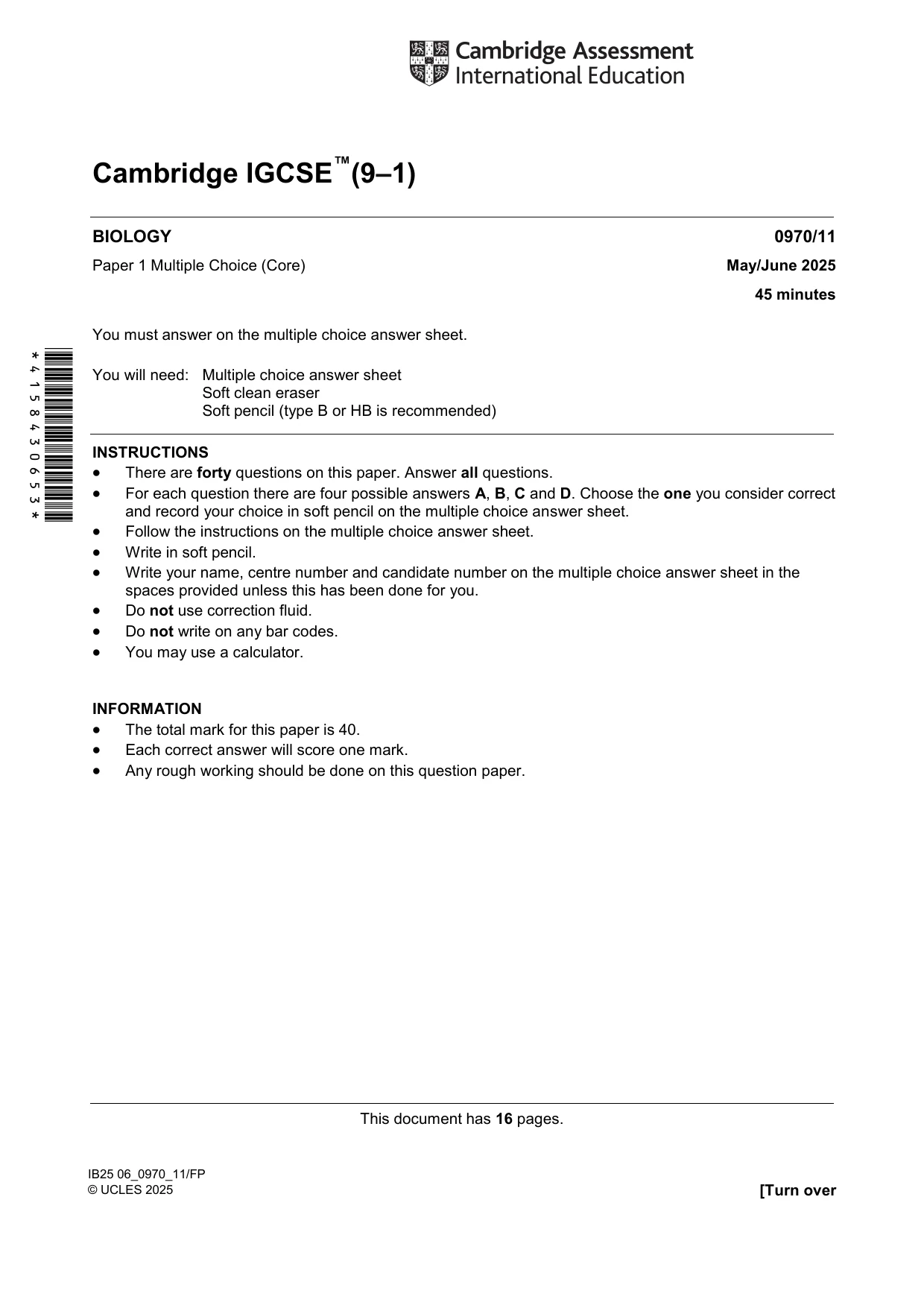
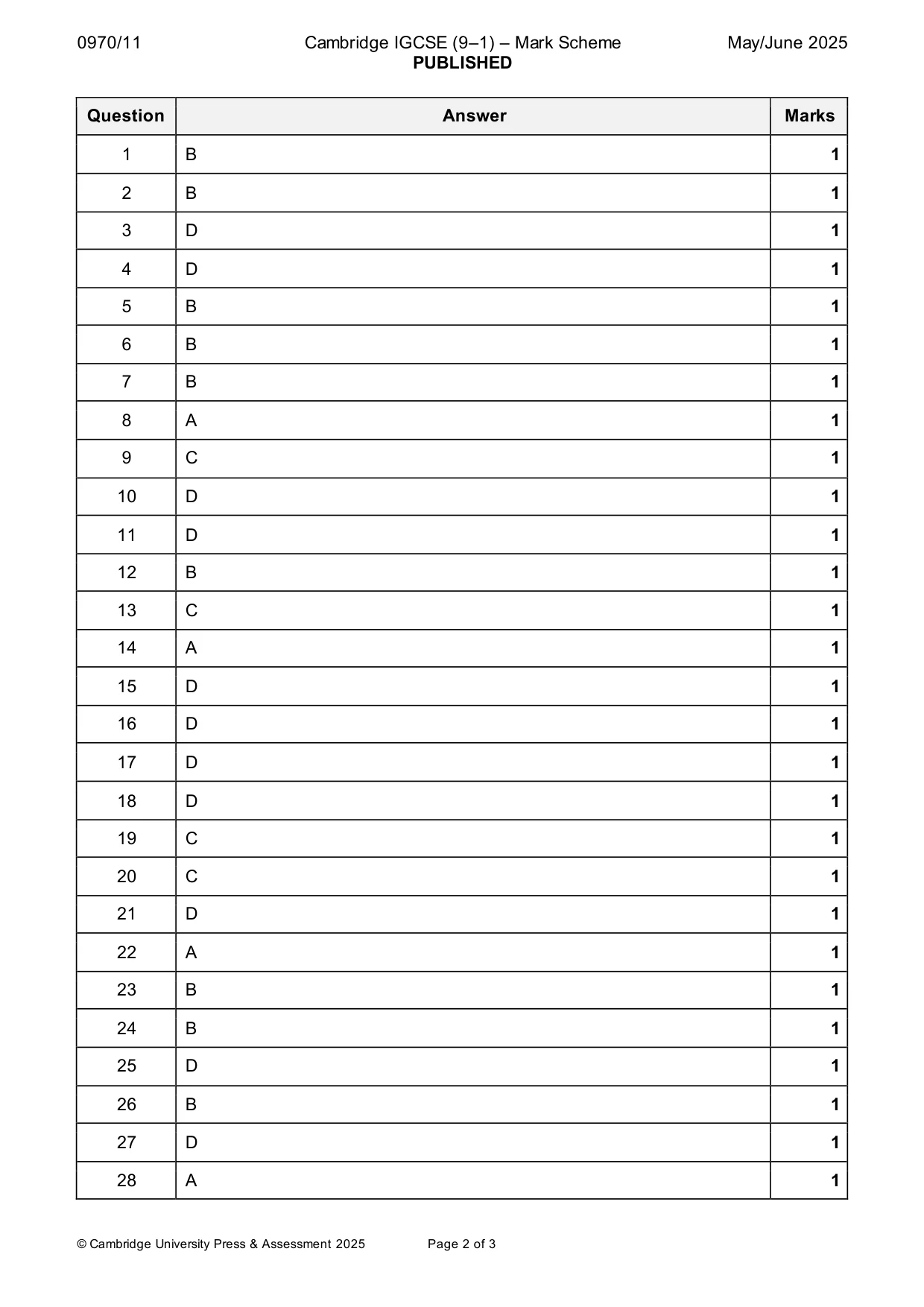
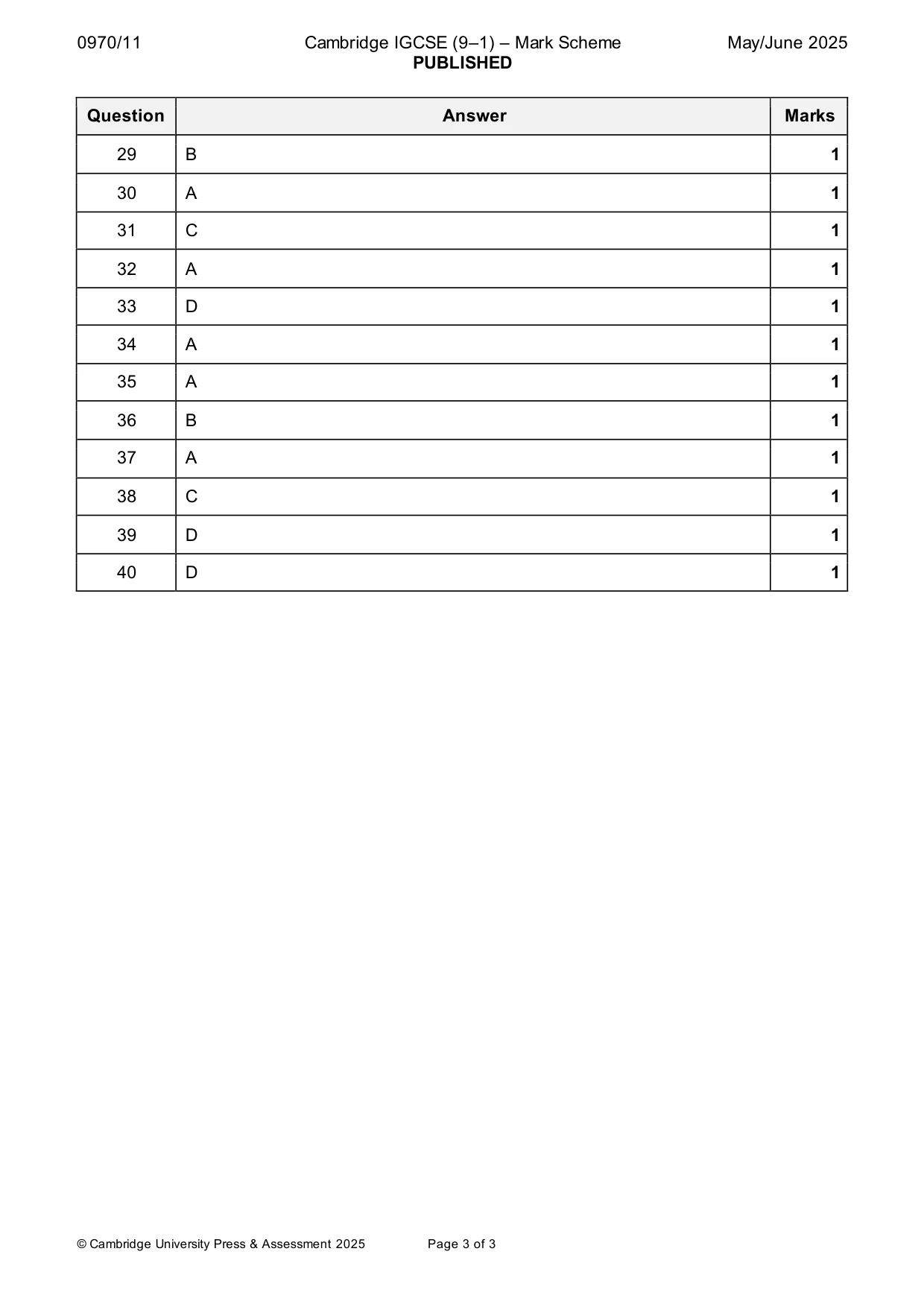
Mark scheme3 pages
Answers below. Sit the paper first if you are practising.
Questions as text
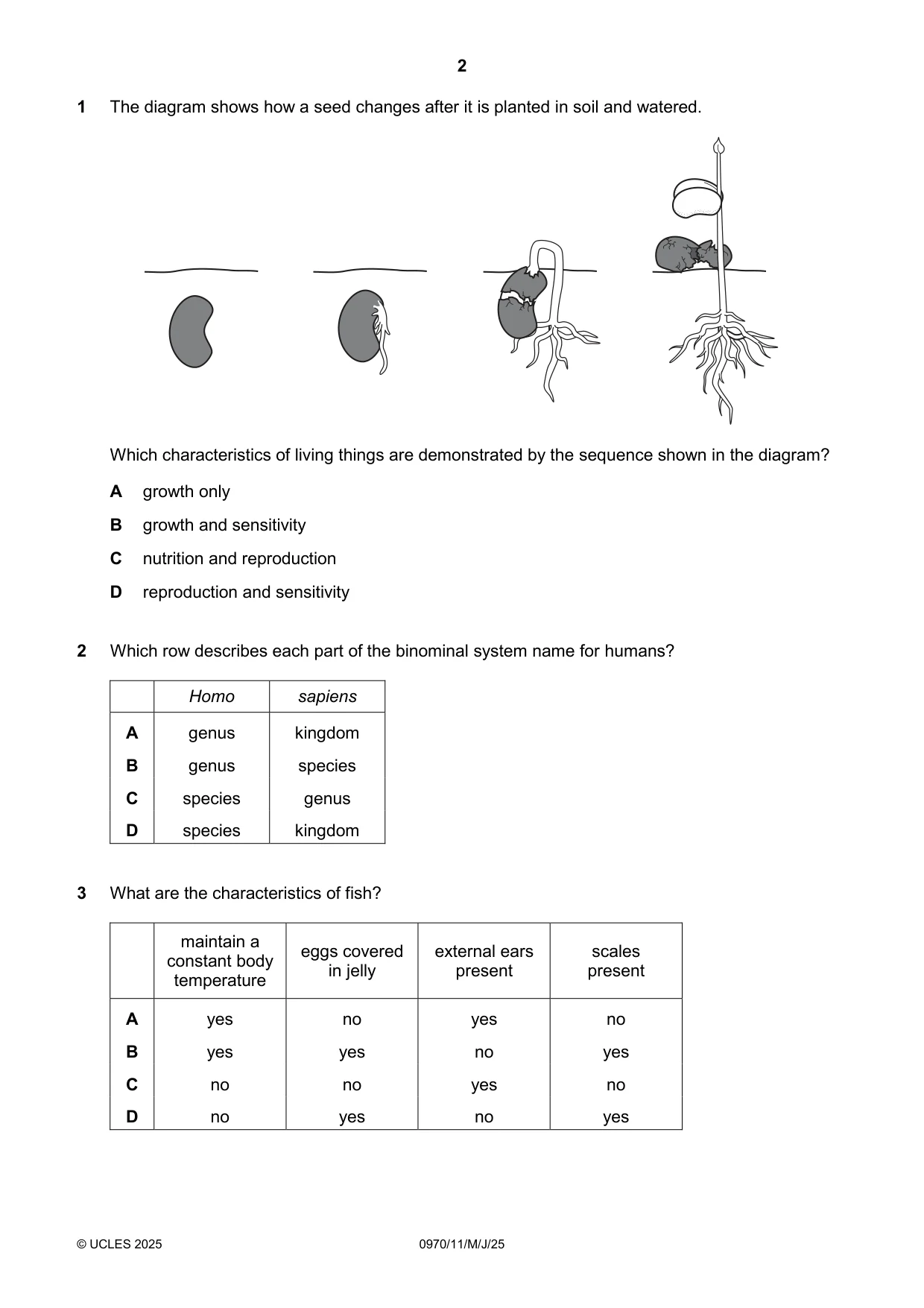
Q1 · The diagram shows how a seed changes after it is planted in soil and watered
1 The diagram shows how a seed changes after it is planted in soil and watered. Which characteristics of living things are demonstrated by the sequence shown in the diagram? A growth only B growth and sensitivity C nutrition and reproduction D reproduction and sensitivity
Mark scheme: B
Q2 · Which row describes each part of the binominal system name for humans?
2 Which row describes each part of the binominal system name for humans? Homo sapiens A genus kingdom B genus species C species genus D species kingdom
Mark scheme: B
More questions on Concept and uses of classification systems
Q3 · What are the characteristics of fish?
3 What are the characteristics of fish? maintain a eggs covered external ears scales constant body in jelly present present temperature A yes no yes no B yes yes no yes C no no yes no D no yes no yes
Mark scheme: D
Q4 · Which type of cell transports oxygen?
4 Which type of cell transports oxygen? A ciliated cell B neurone C palisade mesophyll cell D red blood cell
Mark scheme: D
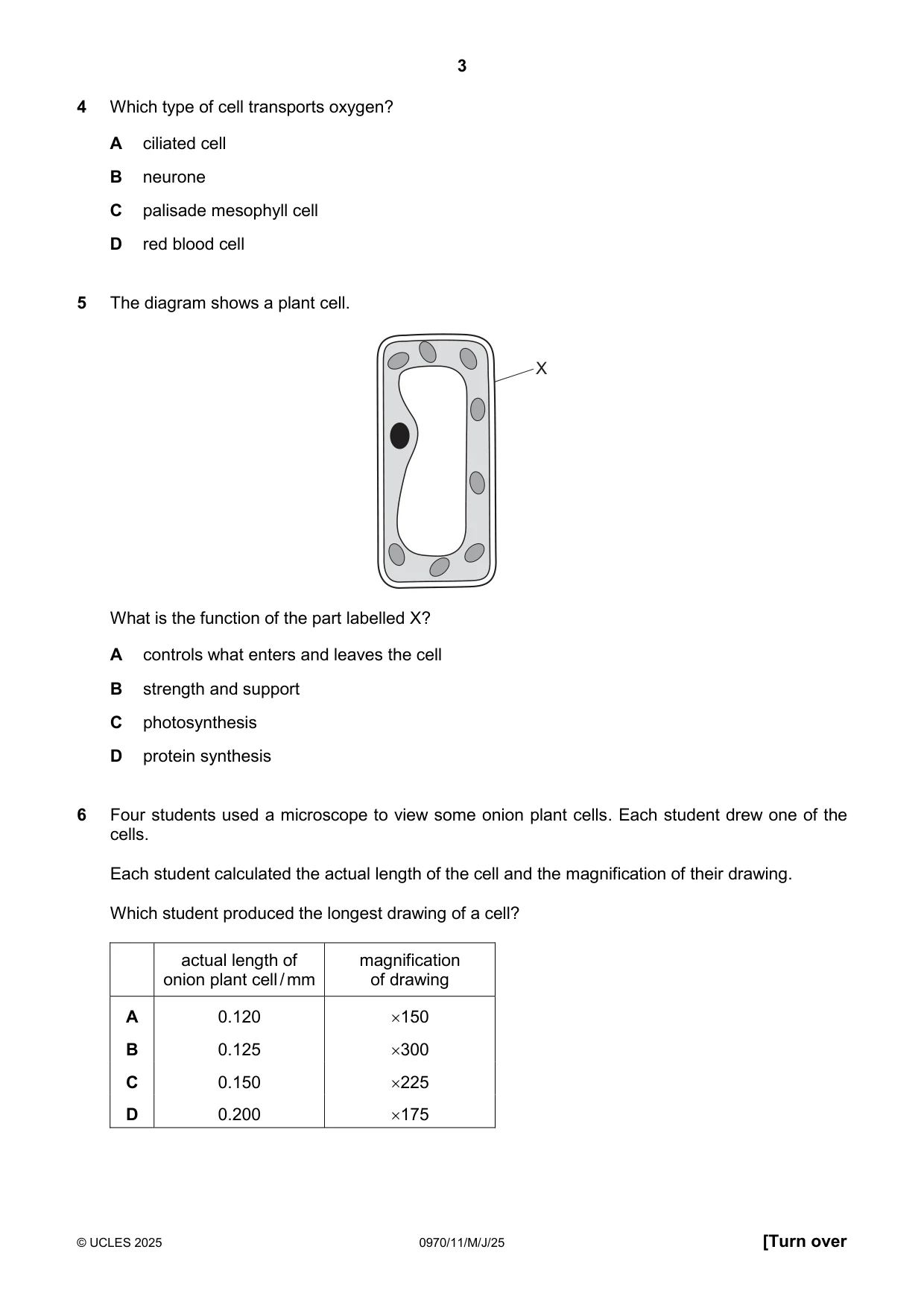
Q5 · The diagram shows a plant cell
5 The diagram shows a plant cell. X What is the function of the part labelled X? A controls what enters and leaves the cell B strength and support C photosynthesis D protein synthesis
Mark scheme: B
Q6 · Four students used a microscope to view some onion plant cells
6 Four students used a microscope to view some onion plant cells. Each student drew one of the cells. Each student calculated the actual length of the cell and the magnification of their drawing. Which student produced the longest drawing of a cell? actual length of magnification onion plant cell / mm of drawing A 0.120 150 B 0.125 300 C 0.150 225 D 0.200 175
Mark scheme: B
Q7 · The table shows the concentration of gases in a blood vessel and in an alveolus
7 The table shows the concentration of gases in a blood vessel and in an alveolus. Which row shows the conditions that cause a substance produced in respiration in humans to diffuse from the blood vessel into the alveolus? substance substance substance produced in concentration in concentration in respiration the blood vessel the alveolus A carbon dioxide low high B carbon dioxide high low C oxygen low high D oxygen high low
Mark scheme: B
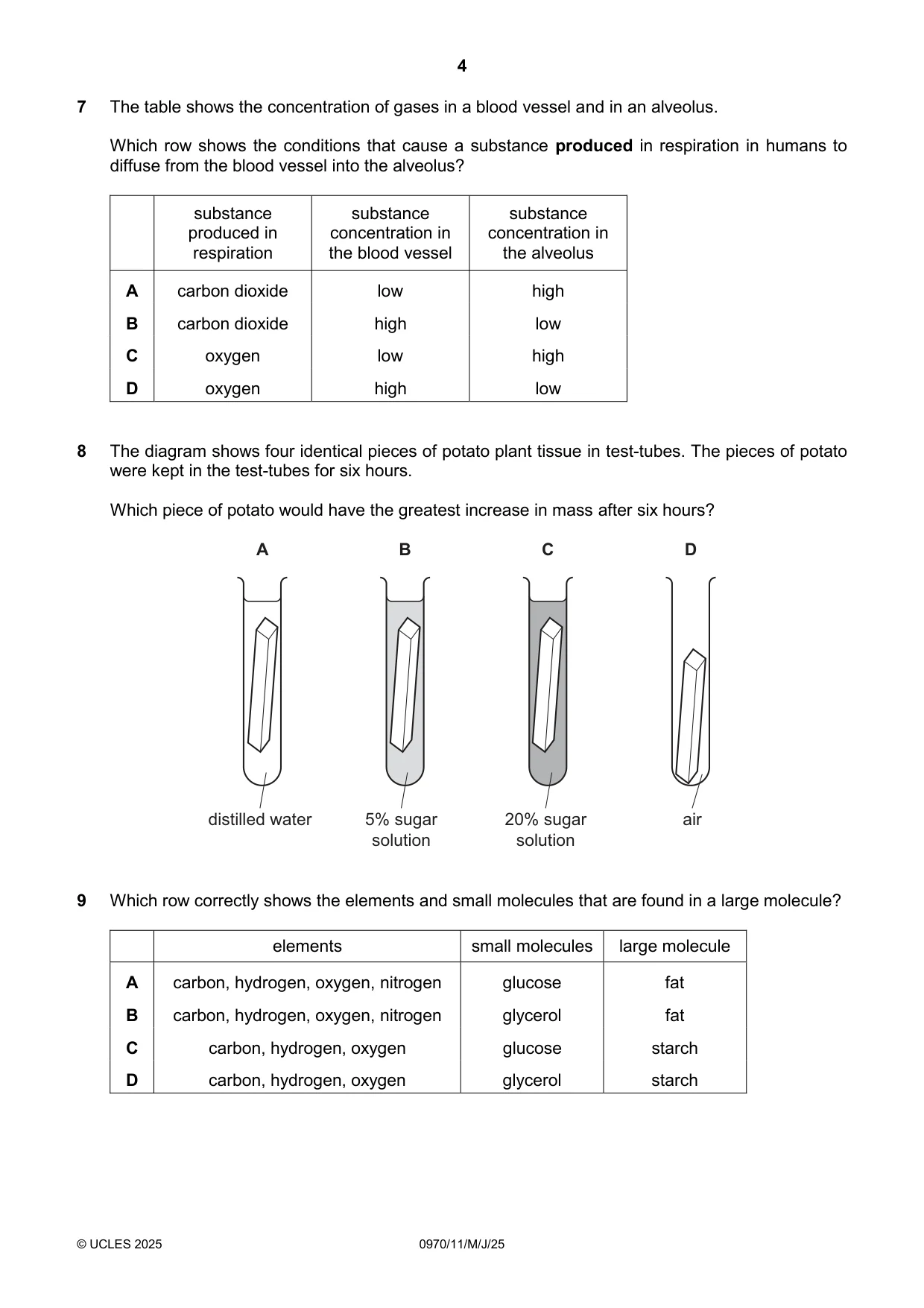
Q8 · The diagram shows four identical pieces of potato plant tissue in test-tubes
8 The diagram shows four identical pieces of potato plant tissue in test-tubes. The pieces of potato were kept in the test-tubes for six hours. Which piece of potato would have the greatest increase in mass after six hours? A B C D distilled water 5% sugar 20% sugar air solution solution
Mark scheme: A
Q9 · Which row correctly shows the elements and small molecules that are found in a large…
9 Which row correctly shows the elements and small molecules that are found in a large molecule? elements small molecules large molecule A carbon, hydrogen, oxygen, nitrogen glucose fat B carbon, hydrogen, oxygen, nitrogen glycerol fat C carbon, hydrogen, oxygen glucose starch D carbon, hydrogen, oxygen glycerol starch
Mark scheme: C
Q10 · Which substance is the DCPIP test used for?
10 Which substance is the DCPIP test used for? A fat B protein C starch D vitamin C
Mark scheme: D
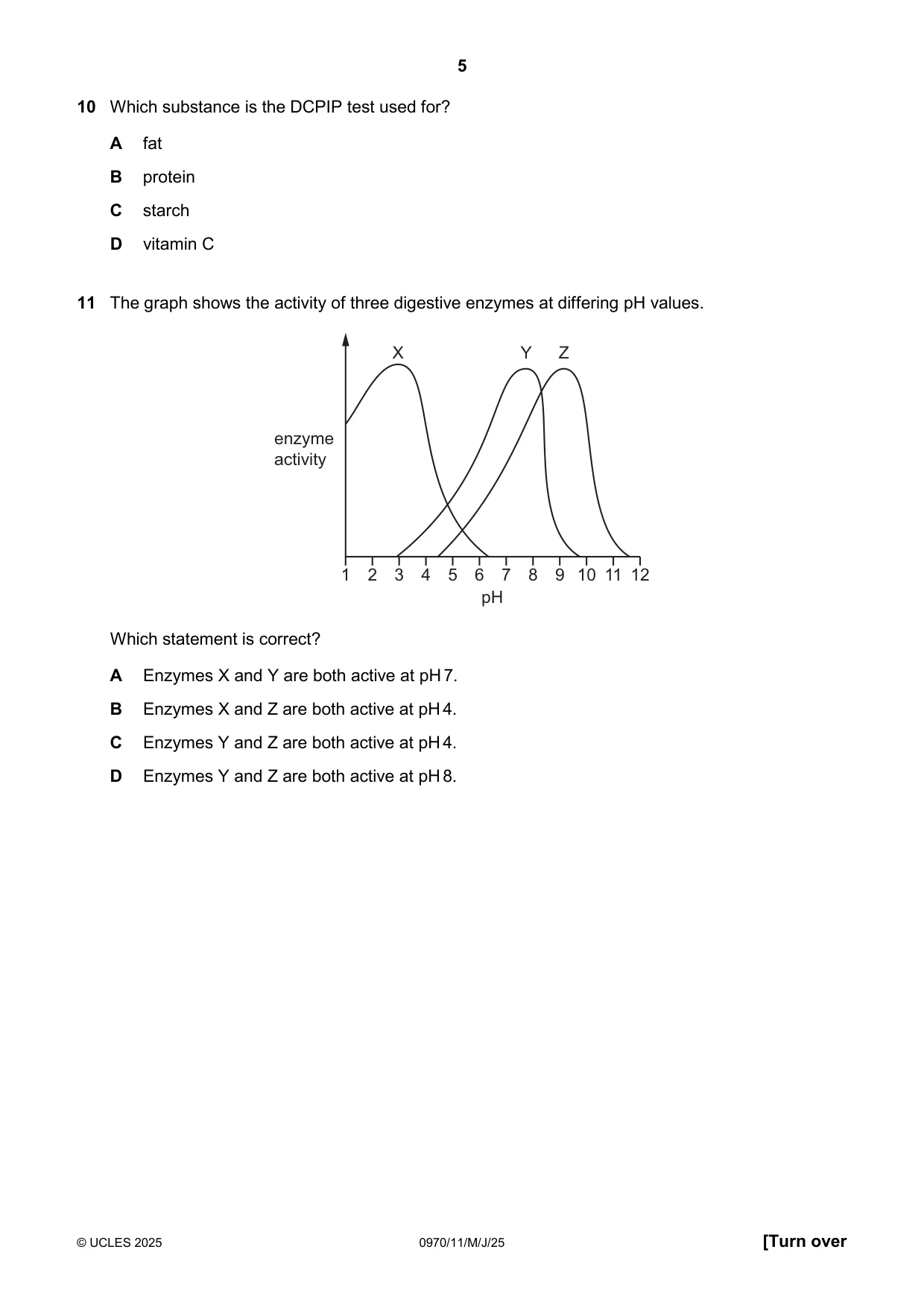
Q11 · The graph shows the activity of three digestive enzymes at differing pH values
11 The graph shows the activity of three digestive enzymes at differing pH values. X Y Z enzyme activity 1 2 3 4 5 6 7 8 9 10 11 12 pH Which statement is correct? A Enzymes X and Y are both active at pH 7. B Enzymes X and Z are both active at pH 4. C Enzymes Y and Z are both active at pH 4. D Enzymes Y and Z are both active at pH 8.
Mark scheme: D
Q12 · A student drew a diagram to show the substances used and produced in photosynthesis in a…
12 A student drew a diagram to show the substances used and produced in photosynthesis in a leaf. 1 + 2 are used by the leaf 3 + 4 are produced by the leaf Which row shows the correct labels for the diagram? 1 2 3 4 A carbon dioxide glucose oxygen water B water carbon dioxide glucose oxygen C oxygen water carbon dioxide glucose D glucose oxygen water carbon dioxide
Mark scheme: B
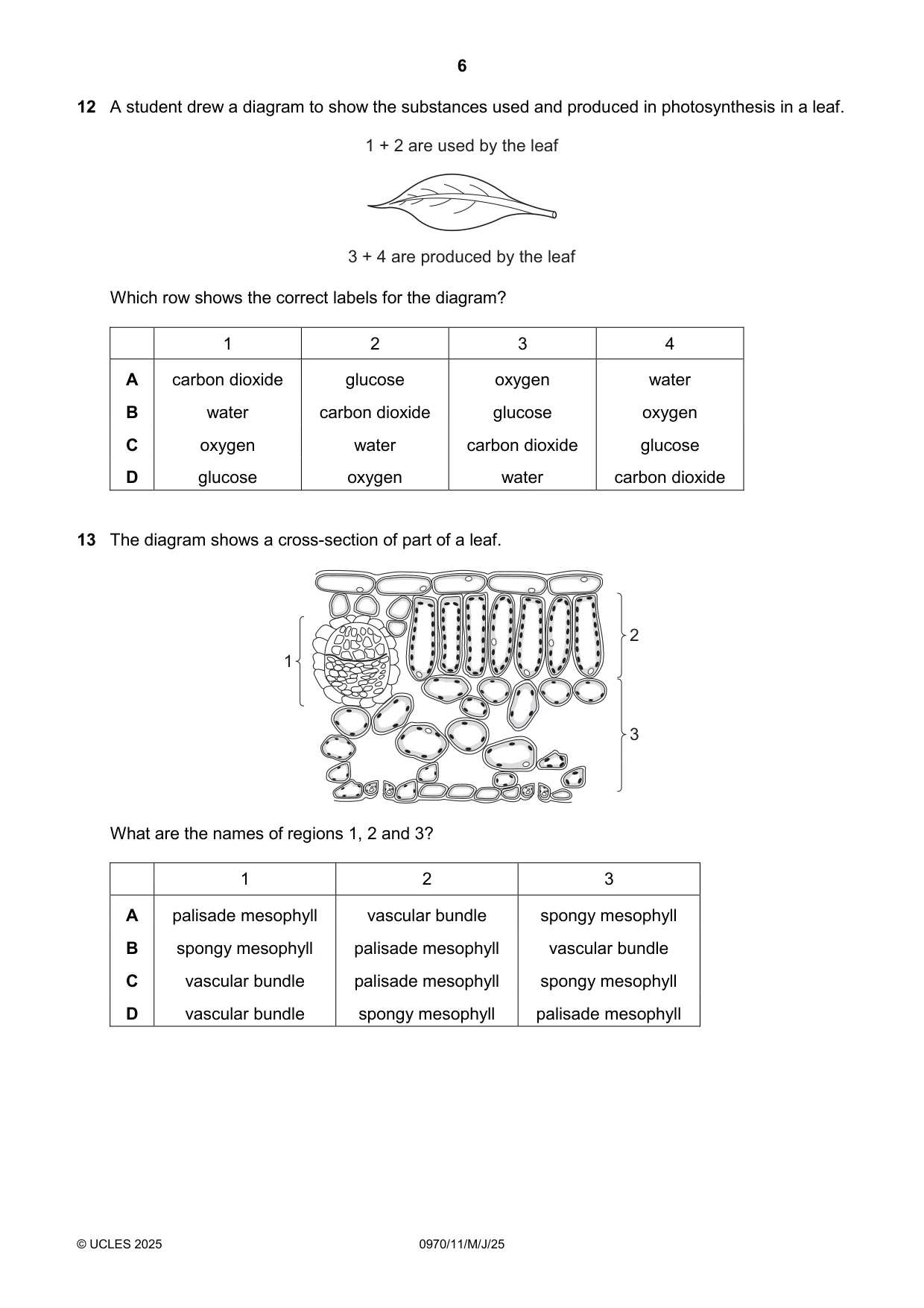
Q13 · The diagram shows a cross-section of part of a leaf
13 The diagram shows a cross-section of part of a leaf. 2 1 3 What are the names of regions 1, 2 and 3? 1 2 3 A palisade mesophyll vascular bundle spongy mesophyll B spongy mesophyll palisade mesophyll vascular bundle C vascular bundle palisade mesophyll spongy mesophyll D vascular bundle spongy mesophyll palisade mesophyll
Mark scheme: C
Q14 · Why is iron an important component of the human diet?
14 Why is iron an important component of the human diet? A Iron is needed to make haemoglobin. B Iron is needed to prevent rickets. C Iron is needed to prevent scurvy. D Iron is needed to strengthen teeth.
Mark scheme: A
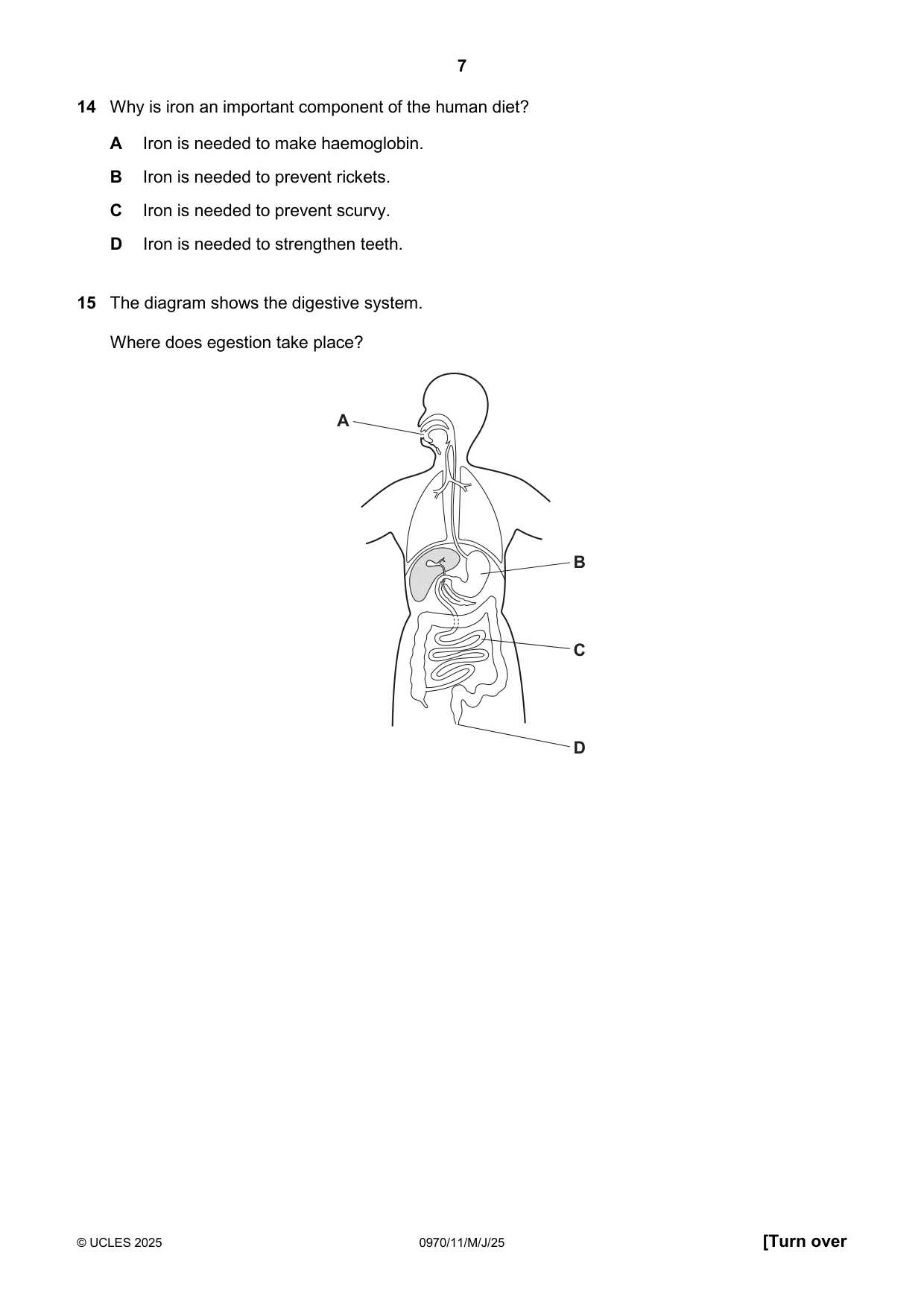
Q15 · The diagram shows the digestive system
15 The diagram shows the digestive system. Where does egestion take place? A B C D
Mark scheme: D
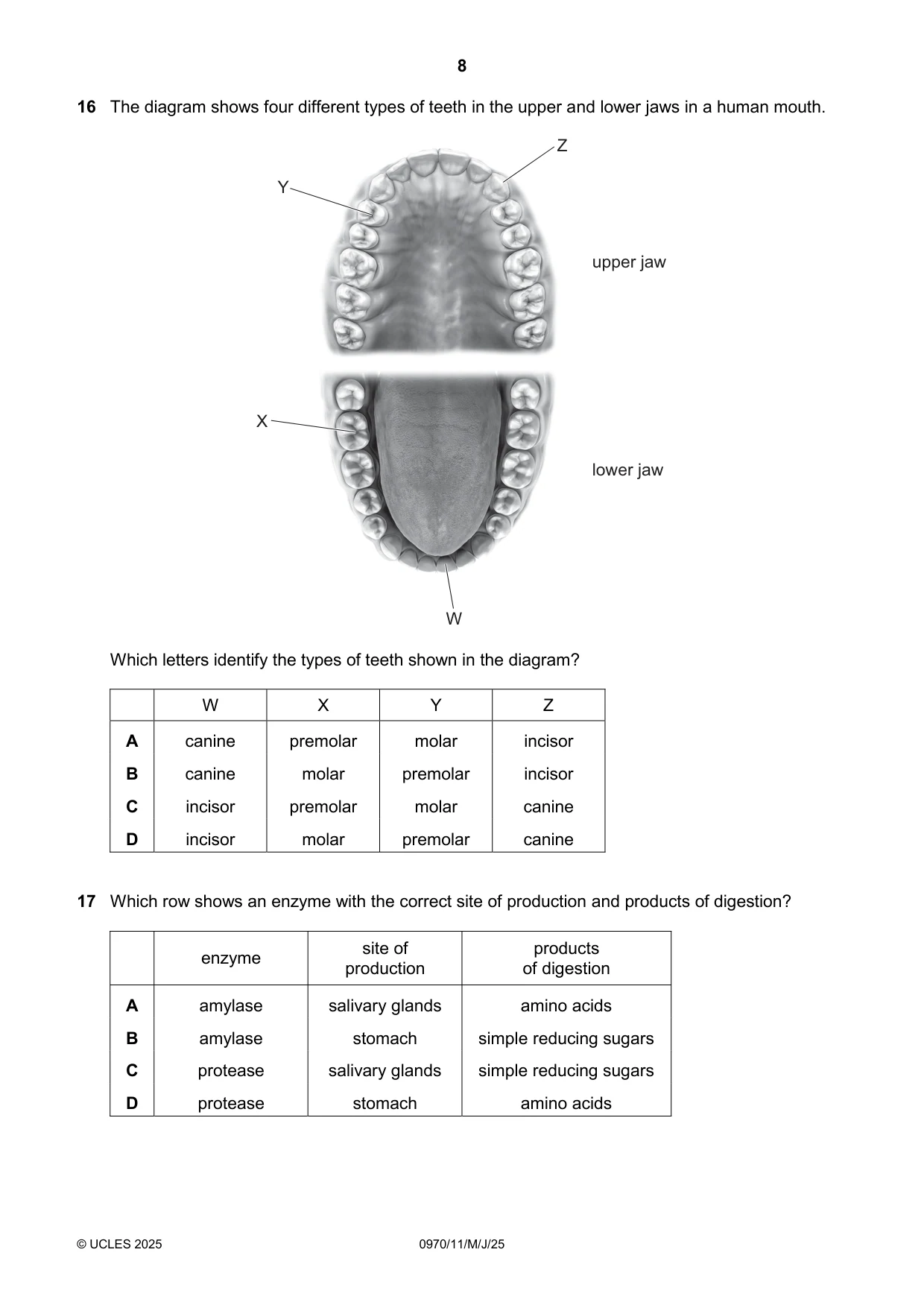
Q16 · The diagram shows four different types of teeth in the upper and lower jaws in a human…
16 The diagram shows four different types of teeth in the upper and lower jaws in a human mouth. Z Y upper jaw X lower jaw W Which letters identify the types of teeth shown in the diagram? W X Y Z A canine premolar molar incisor B canine molar premolar incisor C incisor premolar molar canine D incisor molar premolar canine
Mark scheme: D
Q17 · Which row shows an enzyme with the correct site of production and products of digestion?
17 Which row shows an enzyme with the correct site of production and products of digestion? site of products enzyme production of digestion A amylase salivary glands amino acids B amylase stomach simple reducing sugars C protease salivary glands simple reducing sugars D protease stomach amino acids
Mark scheme: D
Q18 · The roots of a plant are cut off and the stem is placed in a beaker containing a liquid…
18 The roots of a plant are cut off and the stem is placed in a beaker containing a liquid red stain. After a few hours, in which part of the plant stem will the red stain be visible? A cuticle B phloem C style D xylem
Mark scheme: D
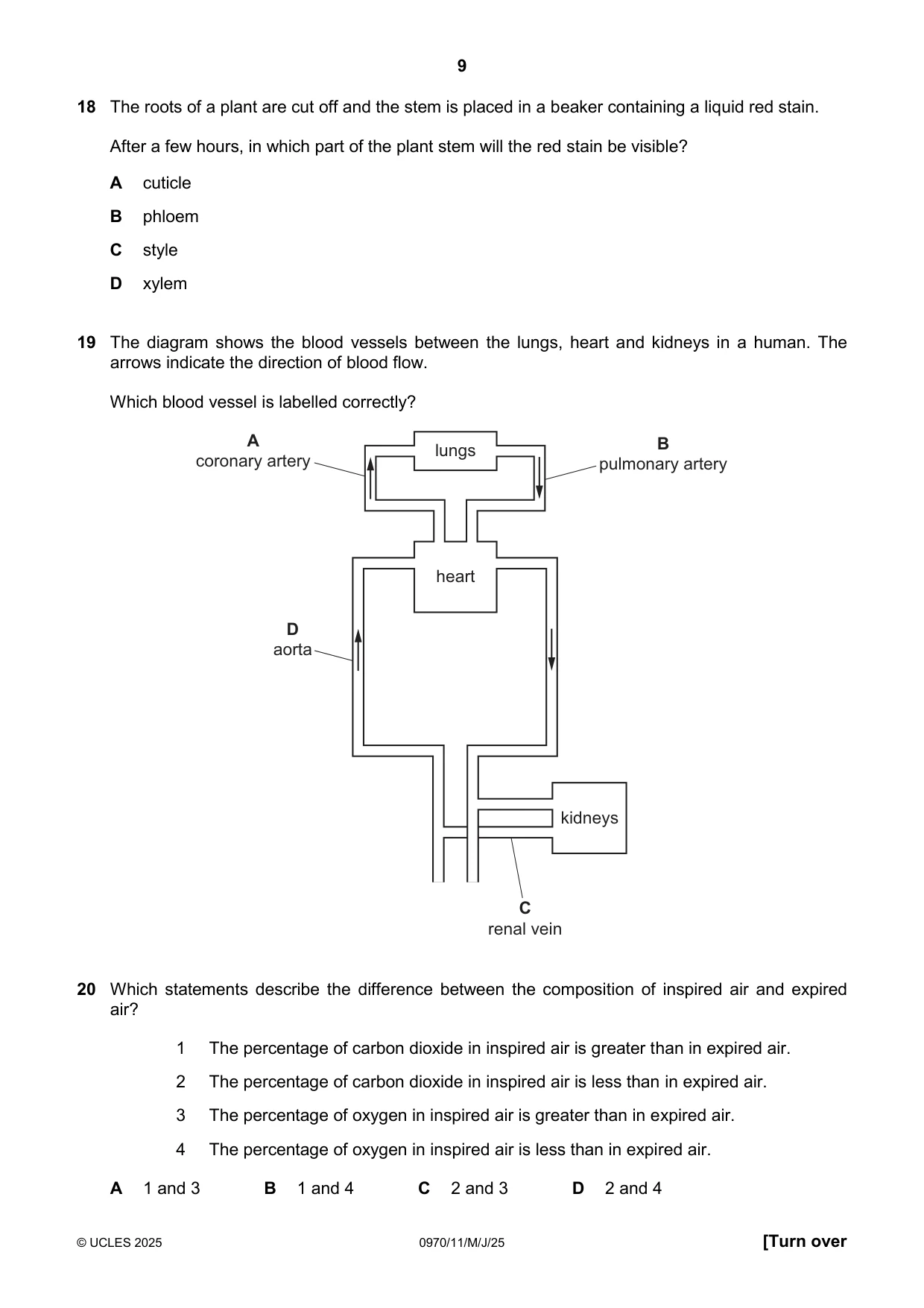
Q19 · The diagram shows the blood vessels between the lungs, heart and kidneys in a human
19 The diagram shows the blood vessels between the lungs, heart and kidneys in a human. The arrows indicate the direction of blood flow. Which blood vessel is labelled correctly? A B lungs coronary artery pulmonary artery heart D aorta kidneys C renal vein
Mark scheme: C
Q20 · Which statements describe the difference between the composition of inspired air and…
20 Which statements describe the difference between the composition of inspired air and expired air? 1 The percentage of carbon dioxide in inspired air is greater than in expired air. 2 The percentage of carbon dioxide in inspired air is less than in expired air. 3 The percentage of oxygen in inspired air is greater than in expired air. 4 The percentage of oxygen in inspired air is less than in expired air. A 1 and 3 B 1 and 4 C 2 and 3 D 2 and 4
Mark scheme: C
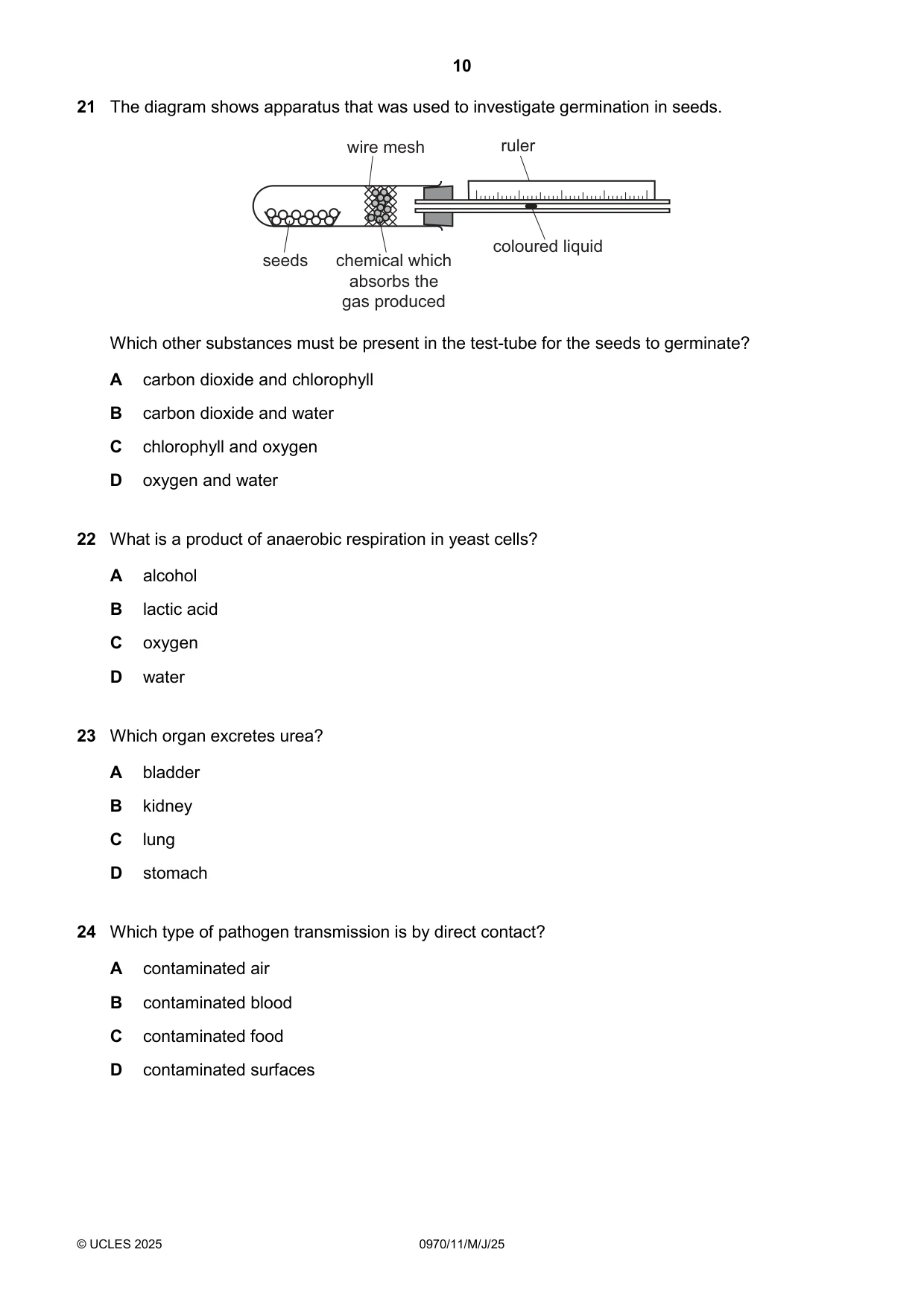
Q21 · The diagram shows apparatus that was used to investigate germination in seeds
21 The diagram shows apparatus that was used to investigate germination in seeds. wire mesh ruler coloured liquid seeds chemical which absorbs the gas produced Which other substances must be present in the test-tube for the seeds to germinate? A carbon dioxide and chlorophyll B carbon dioxide and water C chlorophyll and oxygen D oxygen and water
Mark scheme: D
Q22 · What is a product of anaerobic respiration in yeast cells?
22 What is a product of anaerobic respiration in yeast cells? A alcohol B lactic acid C oxygen D water
Mark scheme: A
Q23 · Which organ excretes urea?
23 Which organ excretes urea? A bladder B kidney C lung D stomach
Mark scheme: B
Q24 · Which type of pathogen transmission is by direct contact?
24 Which type of pathogen transmission is by direct contact? A contaminated air B contaminated blood C contaminated food D contaminated surfaces
Mark scheme: B
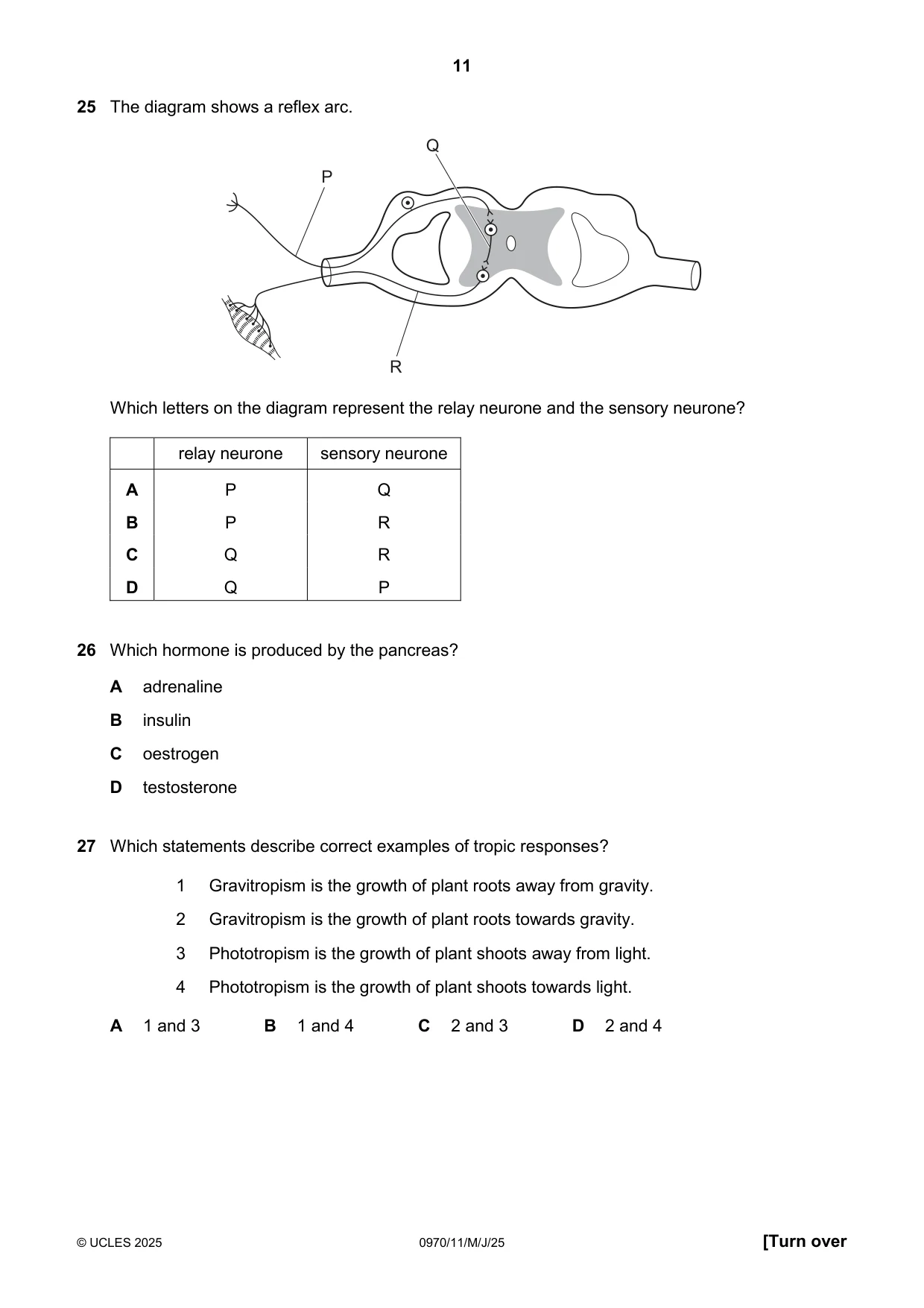
Q25 · The diagram shows a reflex arc
25 The diagram shows a reflex arc. Q P R Which letters on the diagram represent the relay neurone and the sensory neurone? relay neurone sensory neurone A P Q B P R C Q R D Q P
Mark scheme: D
Q26 · Which hormone is produced by the pancreas?
26 Which hormone is produced by the pancreas? A adrenaline B insulin C oestrogen D testosterone
Mark scheme: B
Q27 · Which statements describe correct examples of tropic responses?
27 Which statements describe correct examples of tropic responses? 1 Gravitropism is the growth of plant roots away from gravity. 2 Gravitropism is the growth of plant roots towards gravity. 3 Phototropism is the growth of plant shoots away from light. 4 Phototropism is the growth of plant shoots towards light. A 1 and 3 B 1 and 4 C 2 and 3 D 2 and 4
Mark scheme: D
Q28 · Which statement applies to antibiotics?
28 Which statement applies to antibiotics? A They kill bacteria. B They kill viruses. C They are produced by platelets. D They are produced by white blood cells.
Mark scheme: A
Q29 · Four statements about different types of reproduction are listed
29 Four statements about different types of reproduction are listed. 1 Offspring are formed that are genetically different. 2 Offspring are formed that are genetically identical. 3 It only occurs in animals. 4 The nuclei of two gametes fuse in fertilisation. Which statements describe sexual reproduction? A 1 and 3 B 1 and 4 C 2 and 3 D 2 and 4
Mark scheme: B
Q30 · What happens to the uterus lining at the start of the menstrual cycle?
30 What happens to the uterus lining at the start of the menstrual cycle? A The uterus lining breaks down. B The uterus lining grows new blood vessels. C An embryo implants in the uterus lining. D The uterus lining repairs and thickens.
Mark scheme: A
Q31 · What can reduce the transmission of HIV?
31 What can reduce the transmission of HIV? A clean water supplies B hygienic food preparations C use of condoms D sewage treatment
Mark scheme: C
Q32 · What are alternative forms of genes called?
32 What are alternative forms of genes called? A alleles B chromosomes C genotypes D phenotypes
Mark scheme: A
Q33 · Humans produce two types of ear wax, either wet or dry
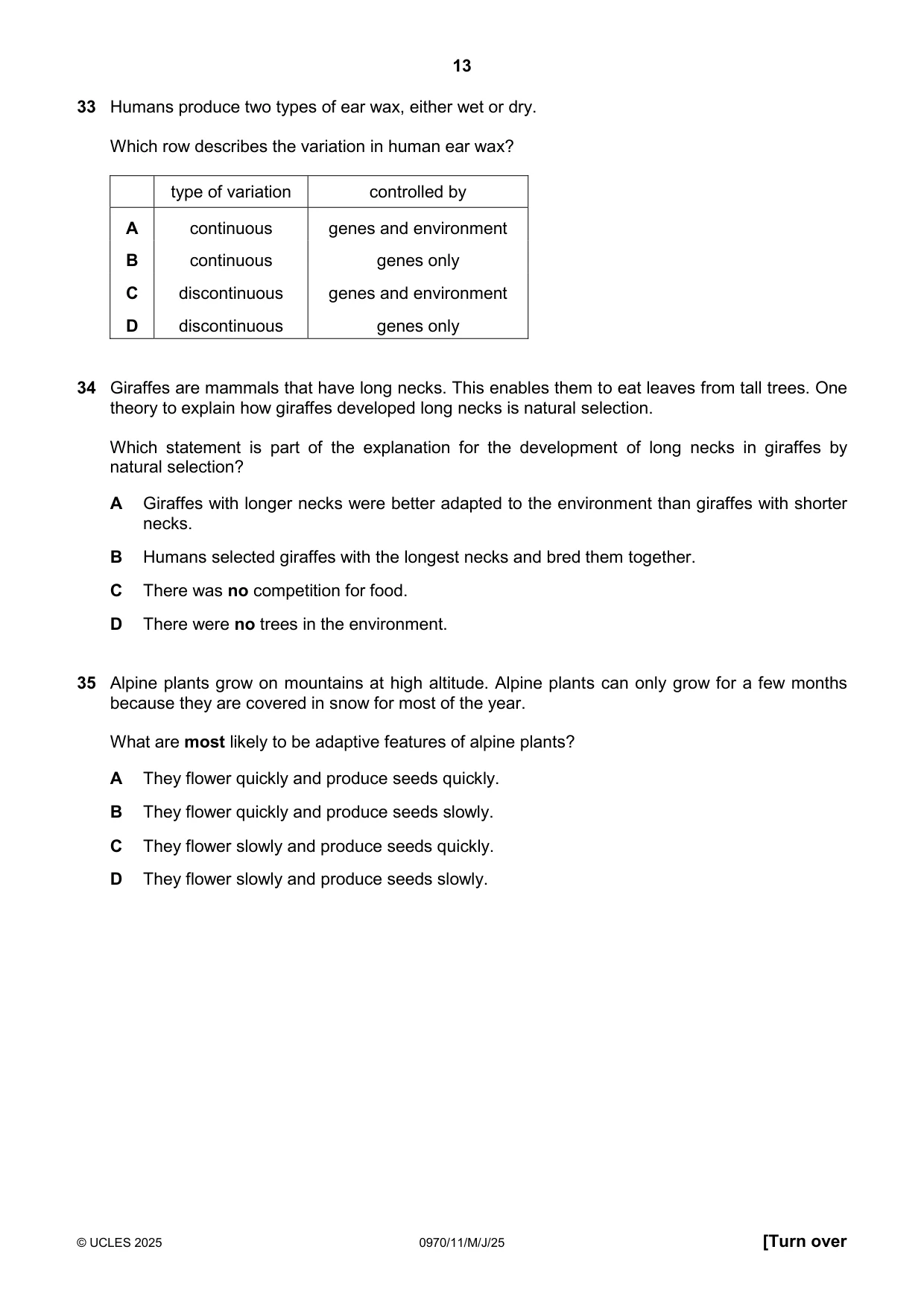
33 Humans produce two types of ear wax, either wet or dry. Which row describes the variation in human ear wax? type of variation controlled by A continuous genes and environment B continuous genes only C discontinuous genes and environment D discontinuous genes only
Mark scheme: D
Q34 · Giraffes are mammals that have long necks
34 Giraffes are mammals that have long necks. This enables them to eat leaves from tall trees. One theory to explain how giraffes developed long necks is natural selection. Which statement is part of the explanation for the development of long necks in giraffes by natural selection? A Giraffes with longer necks were better adapted to the environment than giraffes with shorter necks. B Humans selected giraffes with the longest necks and bred them together. C There was no competition for food. D There were no trees in the environment.
Mark scheme: A
Q35 · Alpine plants grow on mountains at high altitude
35 Alpine plants grow on mountains at high altitude. Alpine plants can only grow for a few months because they are covered in snow for most of the year. What are most likely to be adaptive features of alpine plants? A They flower quickly and produce seeds quickly. B They flower quickly and produce seeds slowly. C They flower slowly and produce seeds quickly. D They flower slowly and produce seeds slowly.
Mark scheme: A
Q36 · The diagram shows a food web
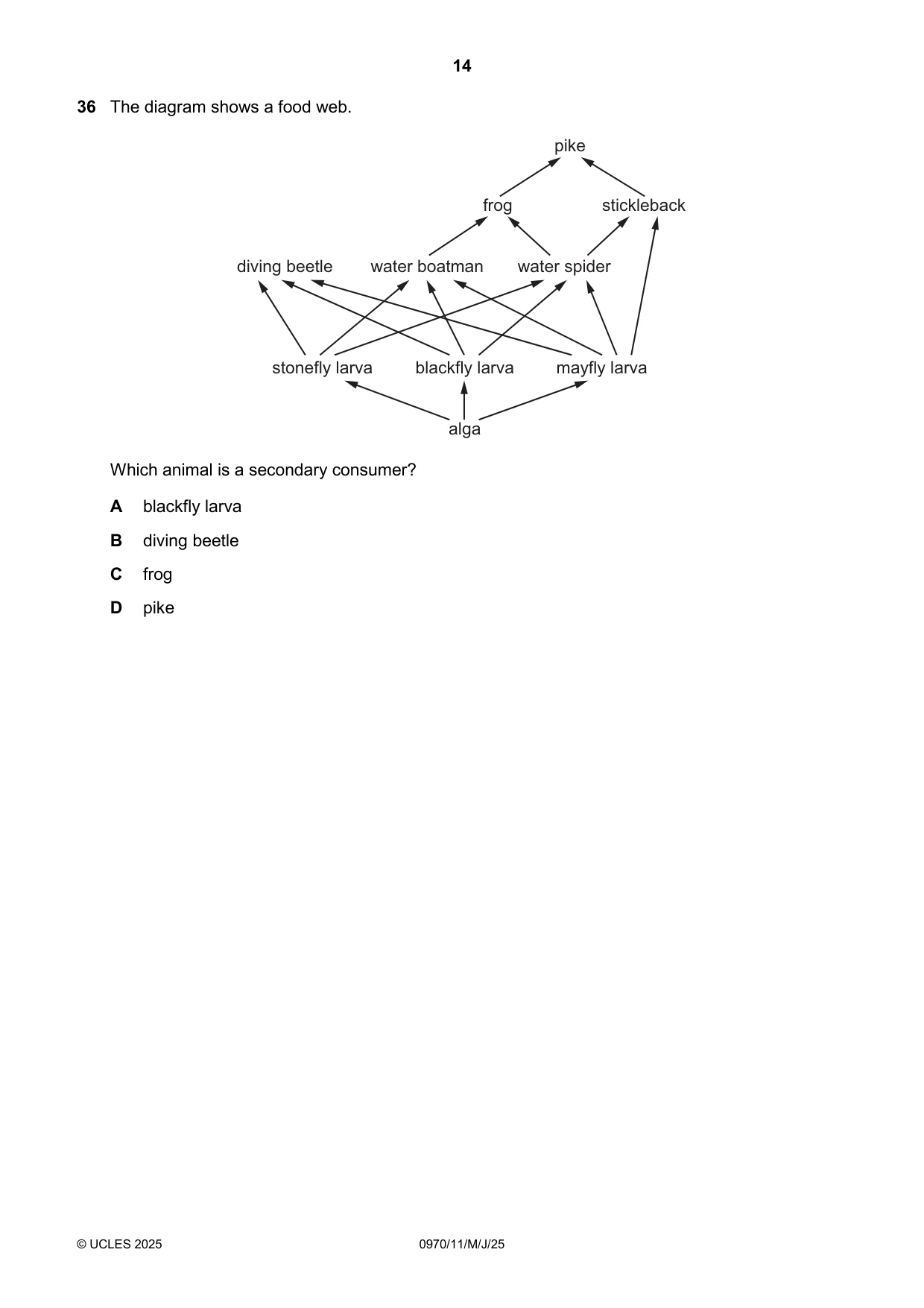
36 The diagram shows a food web. pike frog stickleback diving beetle water boatman water spider stonefly larva blackfly larva mayfly larva alga Which animal is a secondary consumer? A blackfly larva B diving beetle C frog D pike
Mark scheme: B
Q37 · The graphs show the number of herbivores in a habitat over a period of time
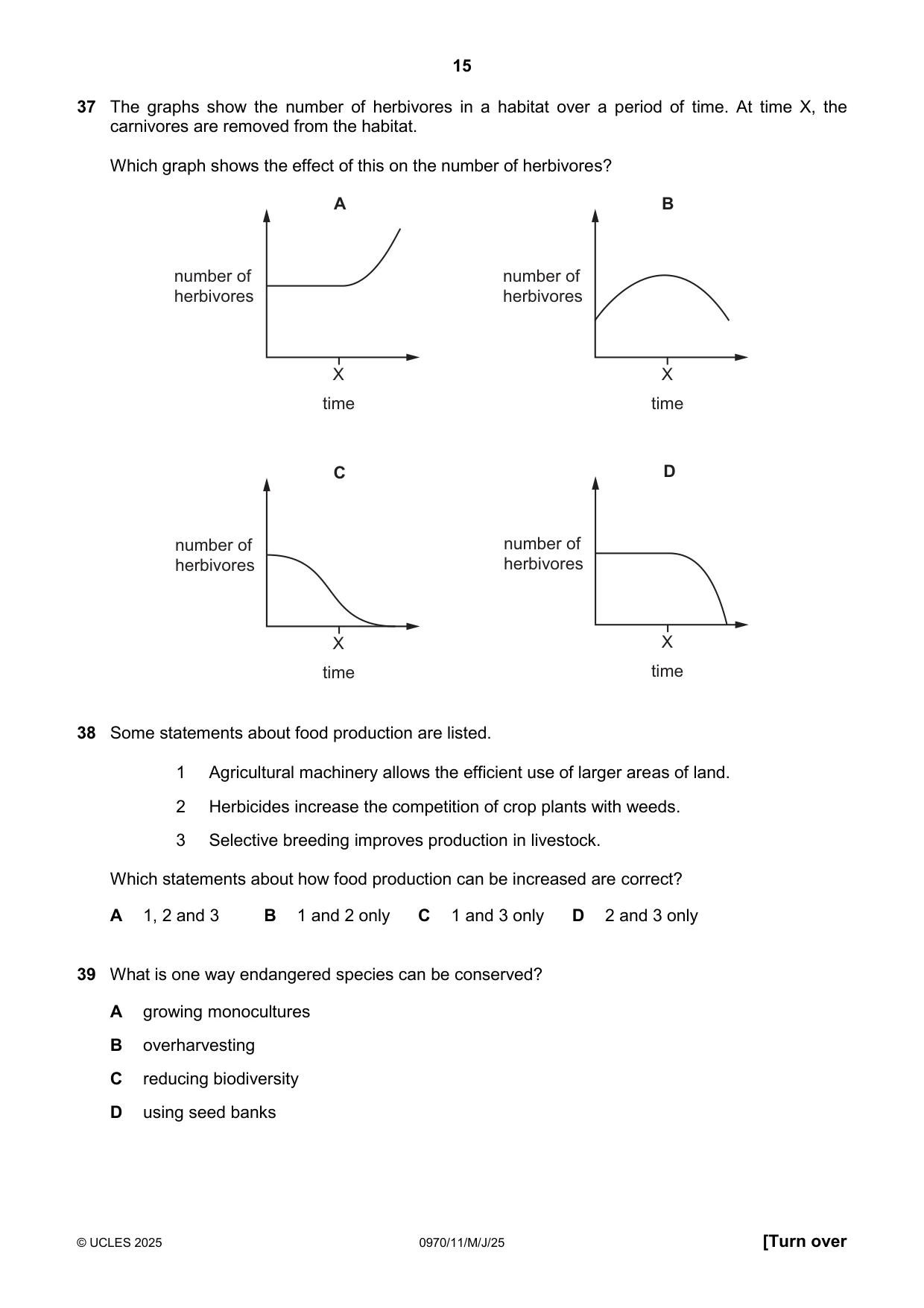
37 The graphs show the number of herbivores in a habitat over a period of time. At time X, the carnivores are removed from the habitat. Which graph shows the effect of this on the number of herbivores? A B number of number of herbivores herbivores X X time time C D number of number of herbivores herbivores X X time time
Mark scheme: A
Q38 · Some statements about food production are listed
38 Some statements about food production are listed. 1 Agricultural machinery allows the efficient use of larger areas of land. 2 Herbicides increase the competition of crop plants with weeds. 3 Selective breeding improves production in livestock. Which statements about how food production can be increased are correct? A 1, 2 and 3 B 1 and 2 only C 1 and 3 only D 2 and 3 only
Mark scheme: C
Q39 · What is one way endangered species can be conserved?
39 What is one way endangered species can be conserved? A growing monocultures B overharvesting C reducing biodiversity D using seed banks
Mark scheme: D
Q40 · The table shows the features of four different types of bacteria
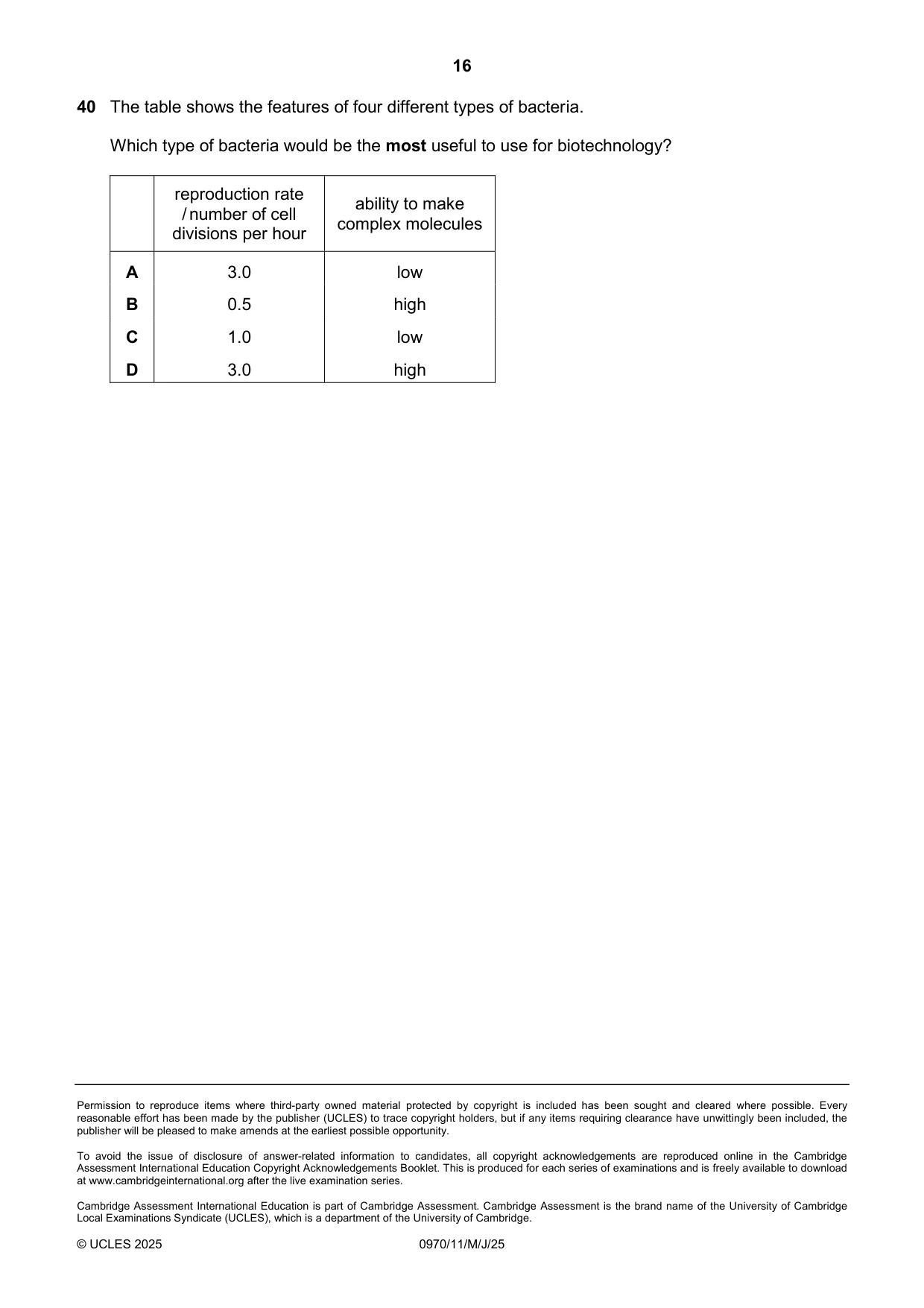
40 The table shows the features of four different types of bacteria. Which type of bacteria would be the most useful to use for biotechnology? reproduction rate ability to make / number of cell complex molecules divisions per hour A 3.0 low B 0.5 high C 1.0 low D 3.0 high
Mark scheme: D
What was in this paper
The subtopics covered by these 40 questions, and how many questions each got. Open one in a new tab to see every Cambridge question on it.
2Adaptive features1Aerobic respiration1Anaerobic respiration1Biotechnology and genetic modification1Blood1Cell structure1Characteristics of living organisms1Chemical digestion1Chromosomes, genes and proteins1Circulatory systems1Concept and uses of classification systems1Conservation1Coordination and response1Diet1Diffusion1Digestive system1Diseases and immunity1Drugs1Enzymes1Excretion in humans1Features of organisms1Food chains and food webs1Food supply1Gas exchange in humans1Hormones1Leaf structure1Osmosis1Photosynthesis1Physical digestion1Populations1Selection1Sexual reproduction1Sexual reproduction in humans1Sexually transmitted infections1Size of specimens1Tropic responses1Variation1Xylem and phloem1What you needed in this session
Cambridge’s own grade thresholds for 2025 May/June, Paper 1 · Variant 1. A higher threshold means an easier paper — the bar moves with how the cohort did.