Cambridge IGCSE Biology (9-1) 0970 — 2020 May/June Paper 1 · Variant 2
0970/12/M/J/20 · 40 questions · 40 marks · ≈45 min
The question paper and its mark scheme, free to read here and free to download. This is Cambridge’s own paper, exactly as it was sat.
Question paper16 pages
Mark scheme3 pages
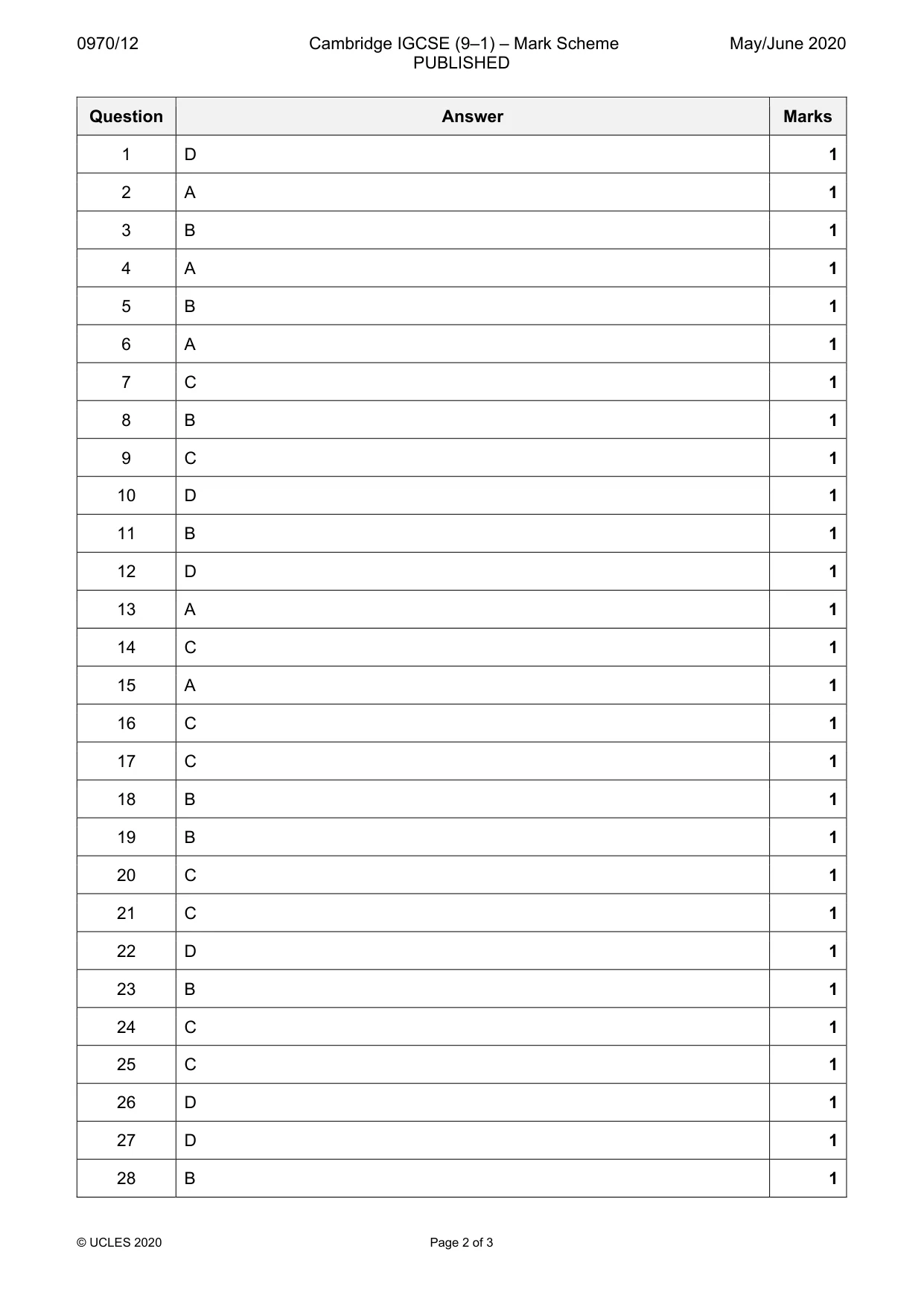
Answers below. Sit the paper first if you are practising.
Questions as text
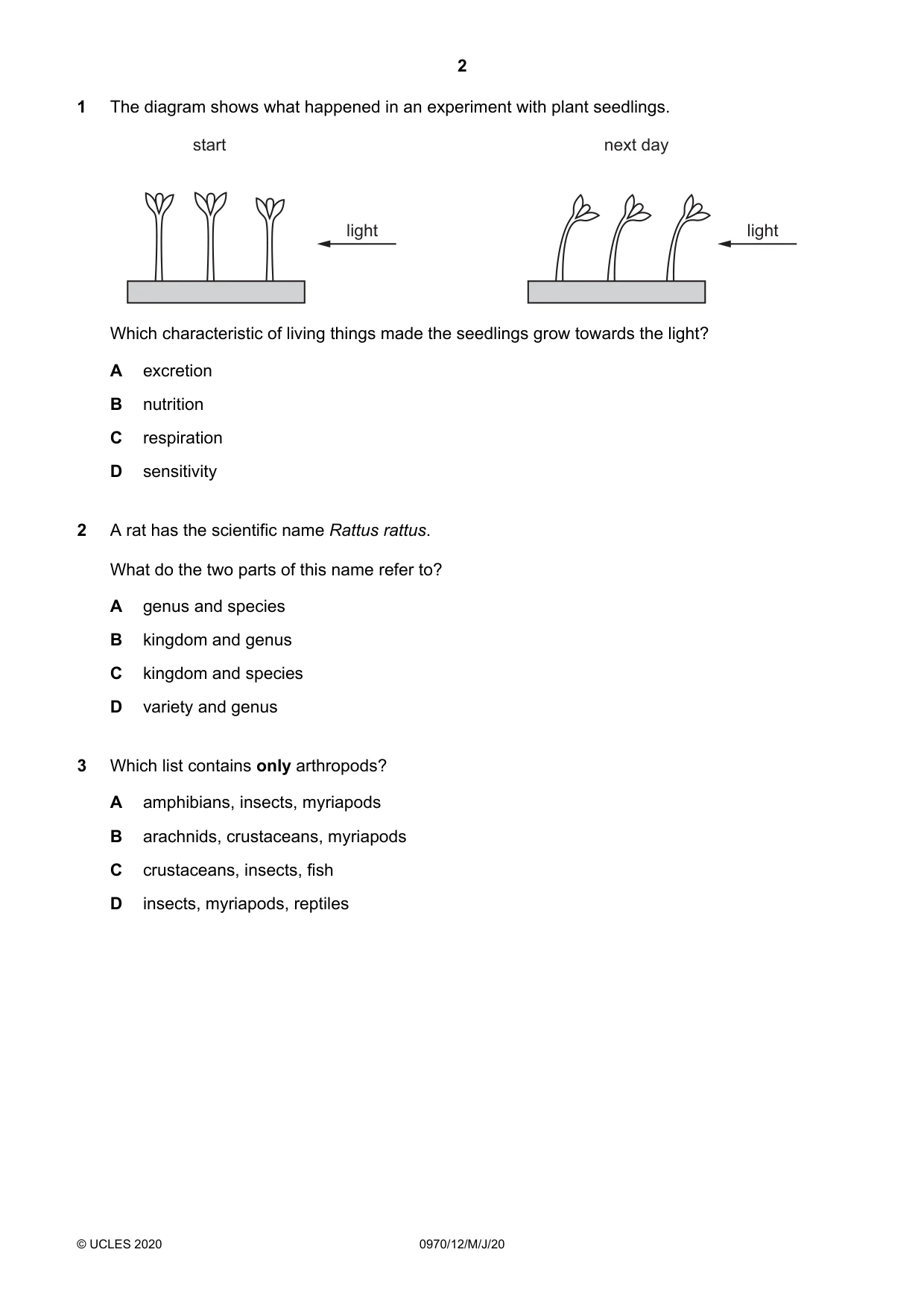
Q1 · The diagram shows what happened in an experiment with plant seedlings
1 The diagram shows what happened in an experiment with plant seedlings. start next day light light Which characteristic of living things made the seedlings grow towards the light? A excretion B nutrition C respiration D sensitivity
Mark scheme: D
Q2 · A rat has the scientific name Rattus rattus
2 A rat has the scientific name Rattus rattus. What do the two parts of this name refer to? A genus and species B kingdom and genus C kingdom and species D variety and genus
Mark scheme: A
More questions on Concept and uses of classification systems
Q3 · Which list contains only arthropods?
3 Which list contains only arthropods? A amphibians, insects, myriapods B arachnids, crustaceans, myriapods C crustaceans, insects, fish D insects, myriapods, reptiles
Mark scheme: B
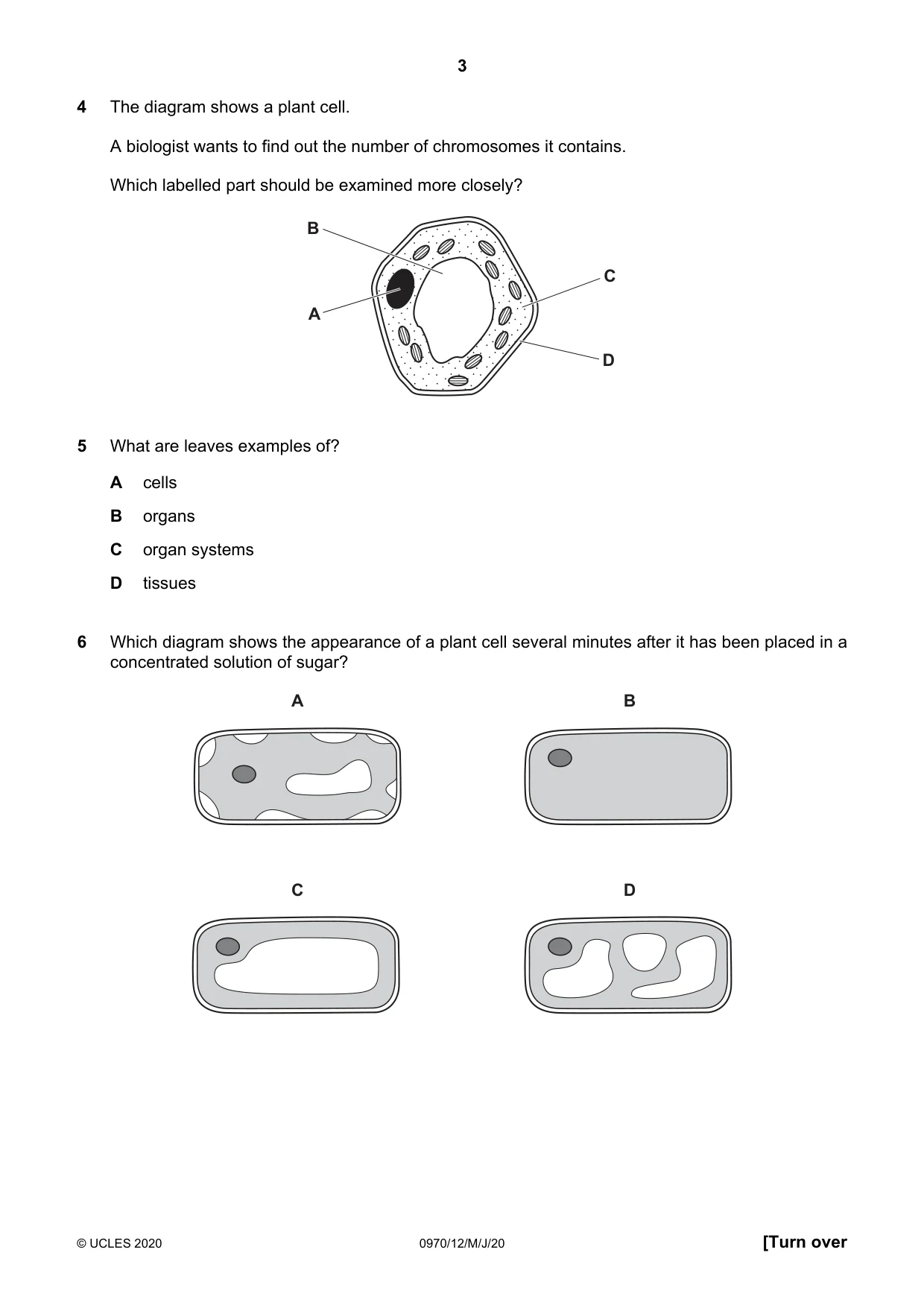
Q4 · The diagram shows a plant cell
4 The diagram shows a plant cell. A biologist wants to find out the number of chromosomes it contains. Which labelled part should be examined more closely? B C A D
Mark scheme: A
Q5 · What are leaves examples of?
5 What are leaves examples of? A cells B organs C organ systems D tissues
Mark scheme: B
Q6 · Which diagram shows the appearance of a plant cell several minutes after it has been…
6 Which diagram shows the appearance of a plant cell several minutes after it has been placed in a concentrated solution of sugar? A B C D
Mark scheme: A
Q7 · Uncooked pieces of potato of identical size were placed in different liquids for one hour…
7 Uncooked pieces of potato of identical size were placed in different liquids for one hour and then measured. Which liquid will cause a decrease in the size of the piece of potato? A pure water B sugar solution less concentrated than the potato cell contents C sugar solution more concentrated than the potato cell contents D sugar solution with the same concentration as the potato cell contents
Mark scheme: C
Q8 · Which food-testing solution shows a positive result when it turns from blue to purple?
8 Which food-testing solution shows a positive result when it turns from blue to purple? A Benedict’s solution B biuret solution C ethanol D iodine solution
Mark scheme: B
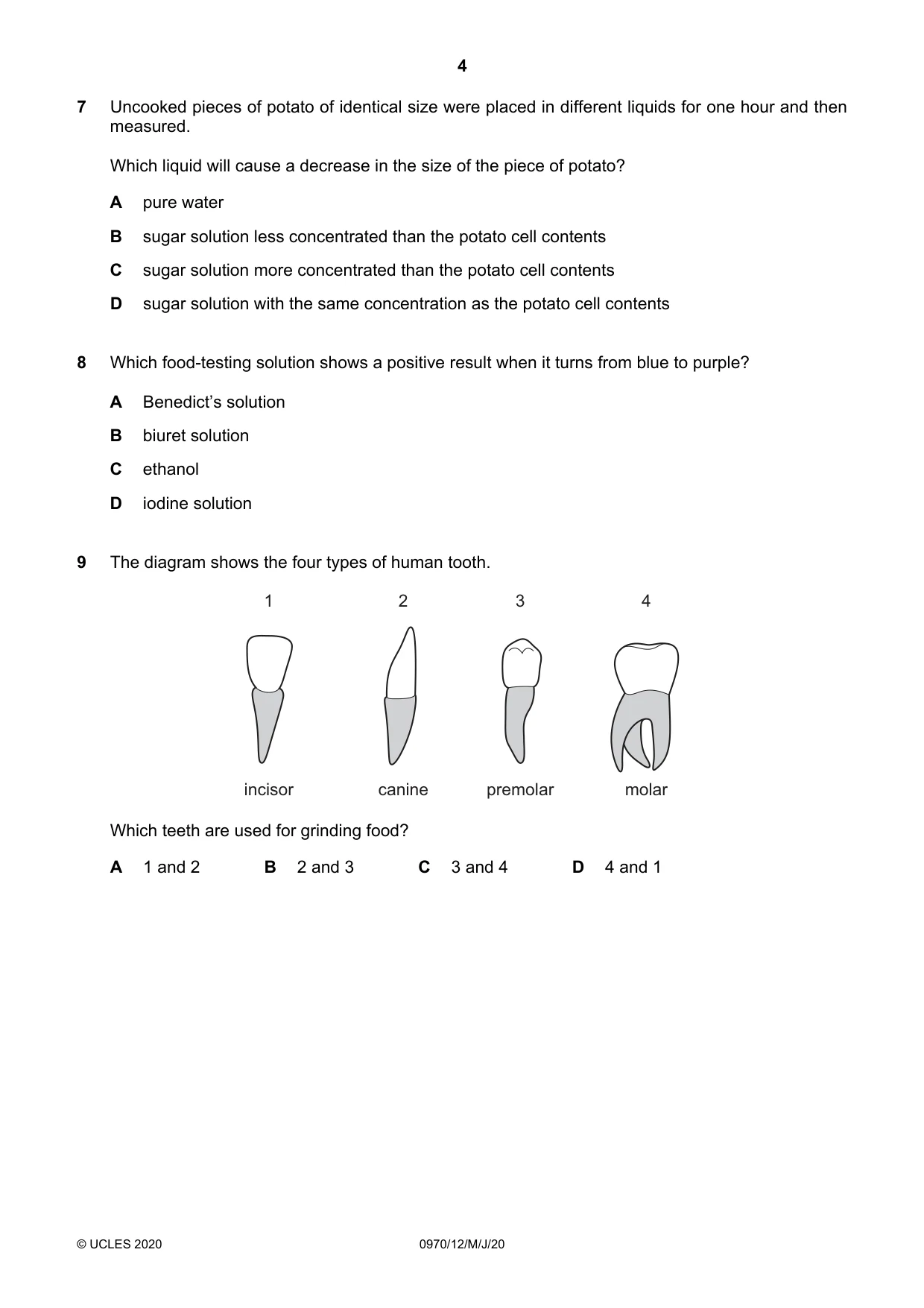
Q9 · The diagram shows the four types of human tooth
9 The diagram shows the four types of human tooth. 1 2 3 4 incisor canine premolar molar Which teeth are used for grinding food? A 1 and 2 B 2 and 3 C 3 and 4 D 4 and 1
Mark scheme: C
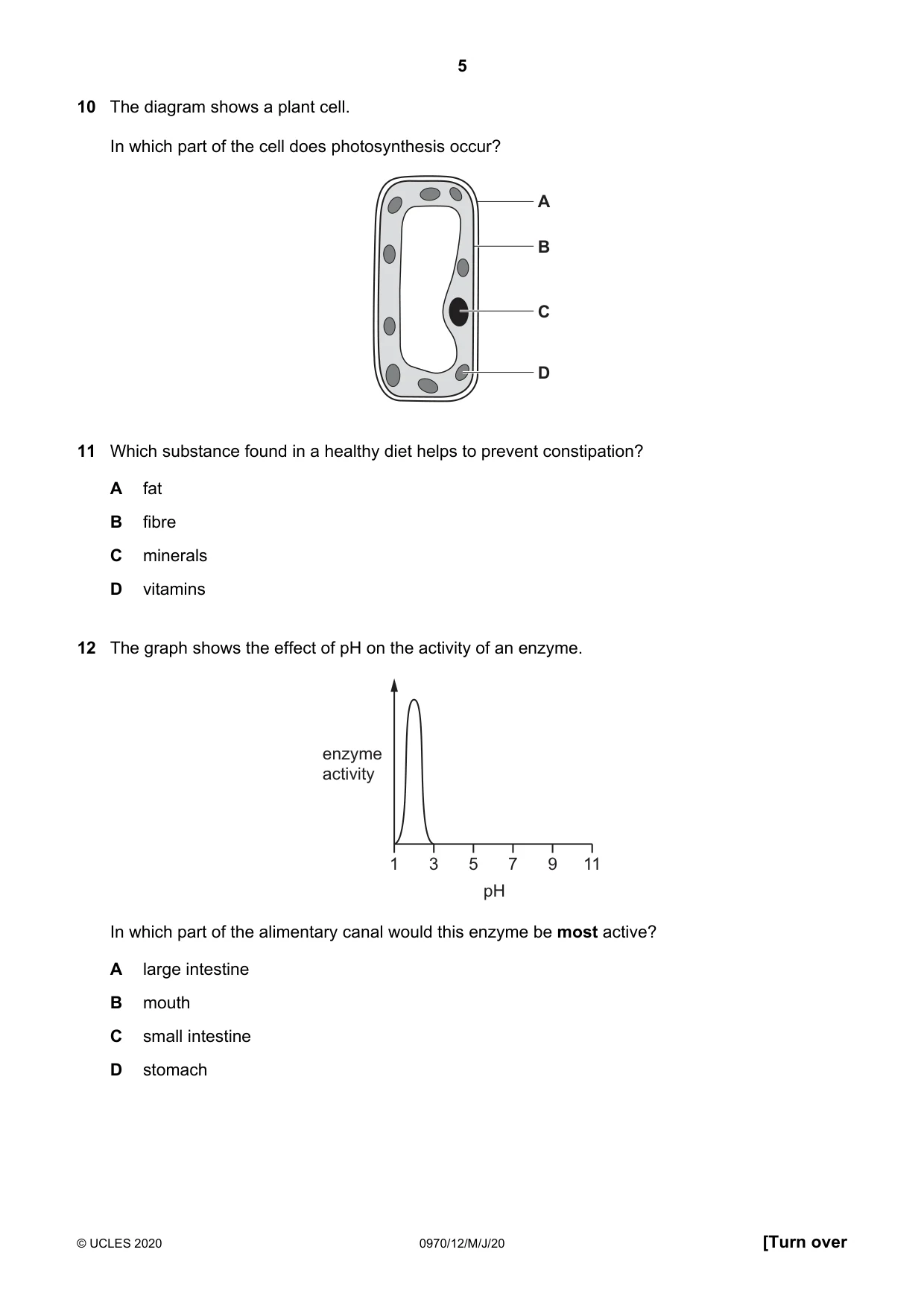
Q10 · The diagram shows a plant cell
10 The diagram shows a plant cell. In which part of the cell does photosynthesis occur? A B C D
Mark scheme: D
Q11 · Which substance found in a healthy diet helps to prevent constipation?
11 Which substance found in a healthy diet helps to prevent constipation? A fat B fibre C minerals D vitamins
Mark scheme: B
Q12 · The graph shows the effect of pH on the activity of an enzyme
12 The graph shows the effect of pH on the activity of an enzyme. enzyme activity 1 3 5 7 9 11 pH In which part of the alimentary canal would this enzyme be most active? A large intestine B mouth C small intestine D stomach
Mark scheme: D
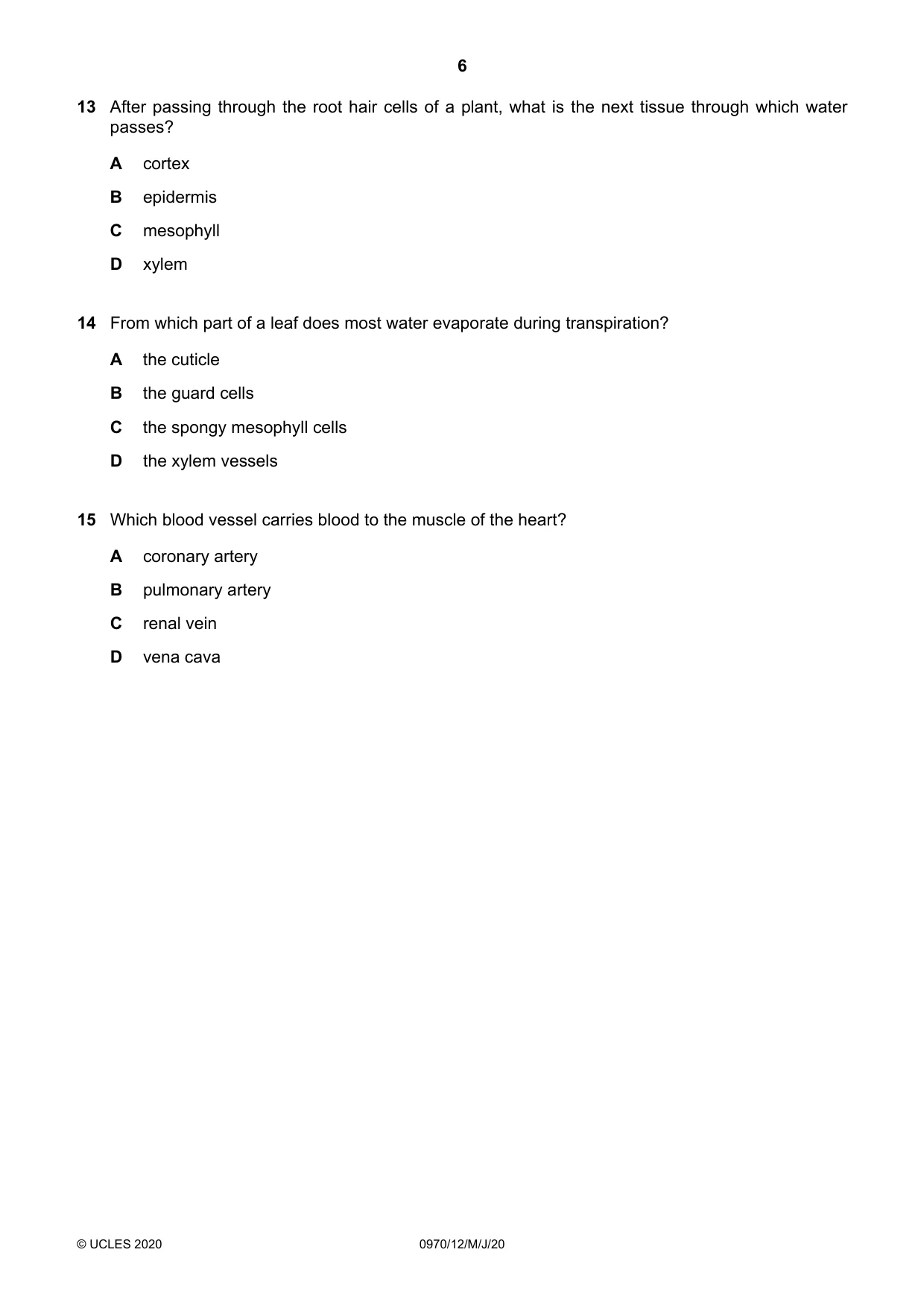
Q13 · After passing through the root hair cells of a plant, what is the next tissue through…
13 After passing through the root hair cells of a plant, what is the next tissue through which water passes? A cortex B epidermis C mesophyll D xylem
Mark scheme: A
Q14 · From which part of a leaf does most water evaporate during transpiration?
14 From which part of a leaf does most water evaporate during transpiration? A the cuticle B the guard cells C the spongy mesophyll cells D the xylem vessels
Mark scheme: C
Q15 · Which blood vessel carries blood to the muscle of the heart?
15 Which blood vessel carries blood to the muscle of the heart? A coronary artery B pulmonary artery C renal vein D vena cava
Mark scheme: A
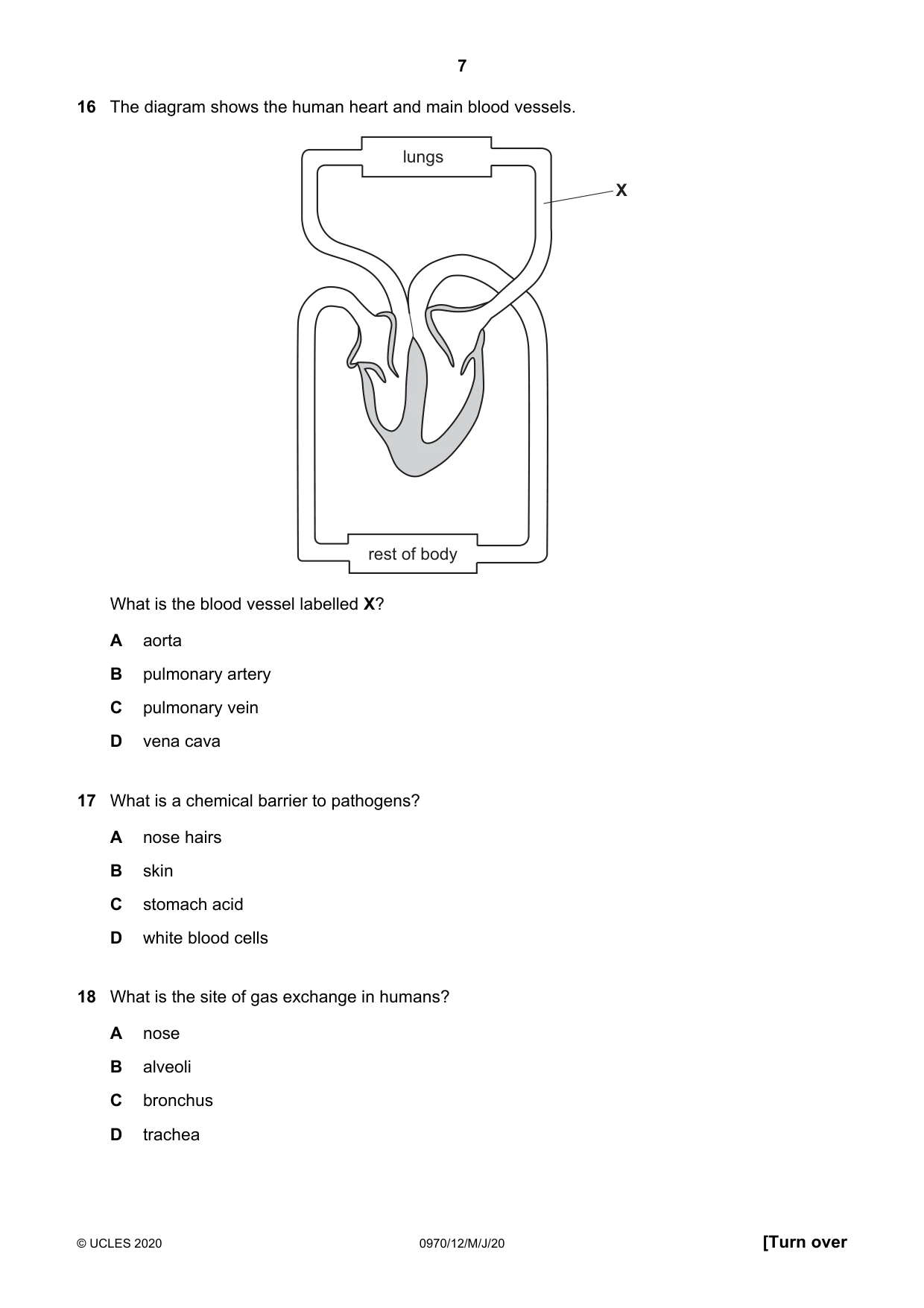
Q16 · The diagram shows the human heart and main blood vessels
16 The diagram shows the human heart and main blood vessels. lungs X rest of body What is the blood vessel labelled X? A aorta B pulmonary artery C pulmonary vein D vena cava
Mark scheme: C
Q17 · What is a chemical barrier to pathogens?
17 What is a chemical barrier to pathogens? A nose hairs B skin C stomach acid D white blood cells
Mark scheme: C
Q18 · What is the site of gas exchange in humans?
18 What is the site of gas exchange in humans? A nose B alveoli C bronchus D trachea
Mark scheme: B
Q19 · The substances listed are associated with aerobic respiration
19 The substances listed are associated with aerobic respiration. 1 carbon dioxide 2 glucose 3 oxygen 4 water Which substances are the products of aerobic respiration? A 1 and 3 B 1 and 4 C 2 and 3 D 3 and 4
Mark scheme: B
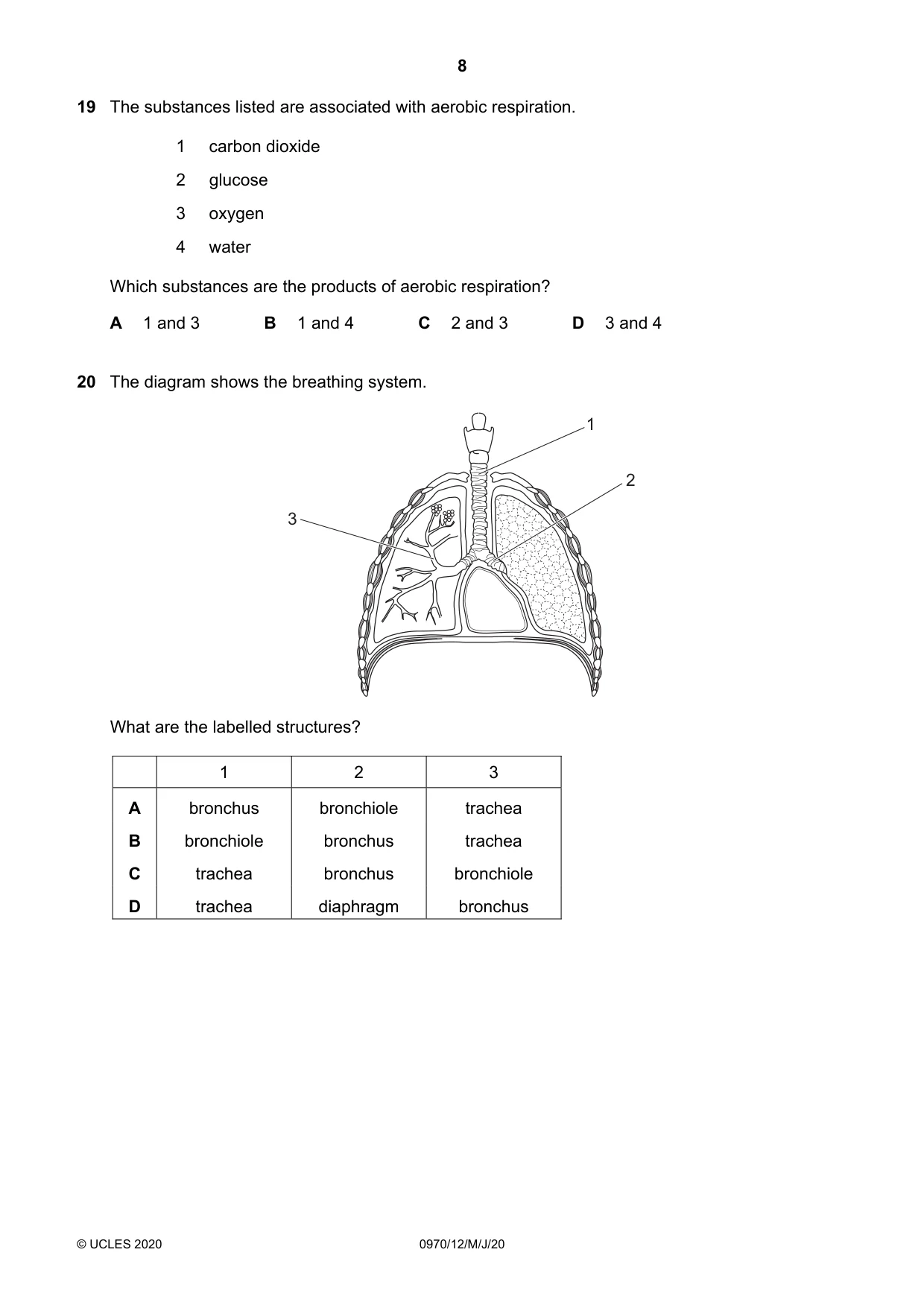
Q20 · The diagram shows the breathing system
20 The diagram shows the breathing system. 1 2 3 What are the labelled structures? 1 2 3 A bronchus bronchiole trachea B bronchiole bronchus trachea C trachea bronchus bronchiole D trachea diaphragm bronchus
Mark scheme: C
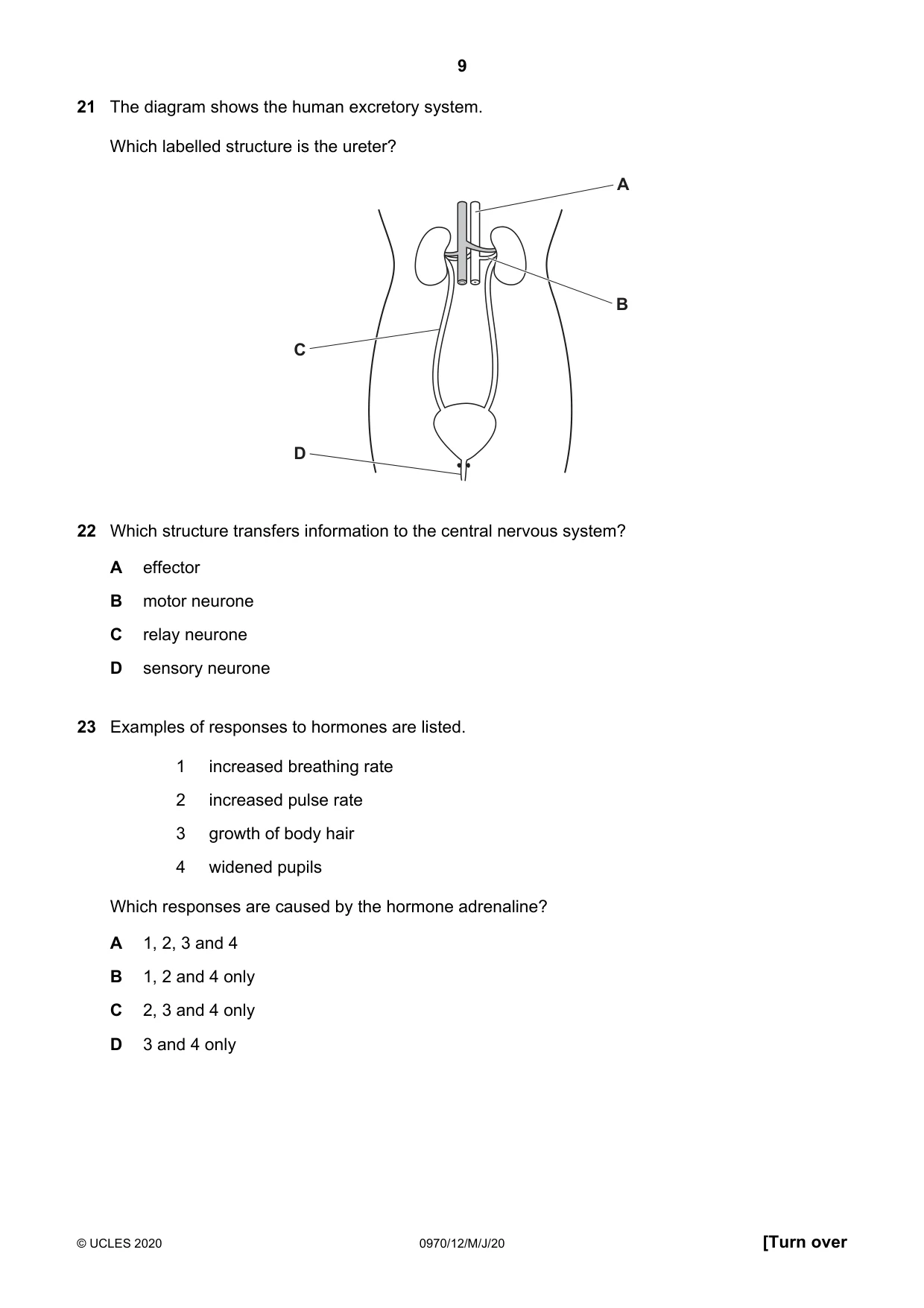
Q21 · The diagram shows the human excretory system
21 The diagram shows the human excretory system. Which labelled structure is the ureter? A B C D
Mark scheme: C
Q22 · Which structure transfers information to the central nervous system?
22 Which structure transfers information to the central nervous system? A effector B motor neurone C relay neurone D sensory neurone
Mark scheme: D
Q23 · Examples of responses to hormones are listed
23 Examples of responses to hormones are listed. 1 increased breathing rate 2 increased pulse rate 3 growth of body hair 4 widened pupils Which responses are caused by the hormone adrenaline? A 1, 2, 3 and 4 B 1, 2 and 4 only C 2, 3 and 4 only D 3 and 4 only
Mark scheme: B
Q24 · Which part of the eye focuses light?
24 Which part of the eye focuses light? A cornea B iris C lens D retina
Mark scheme: C
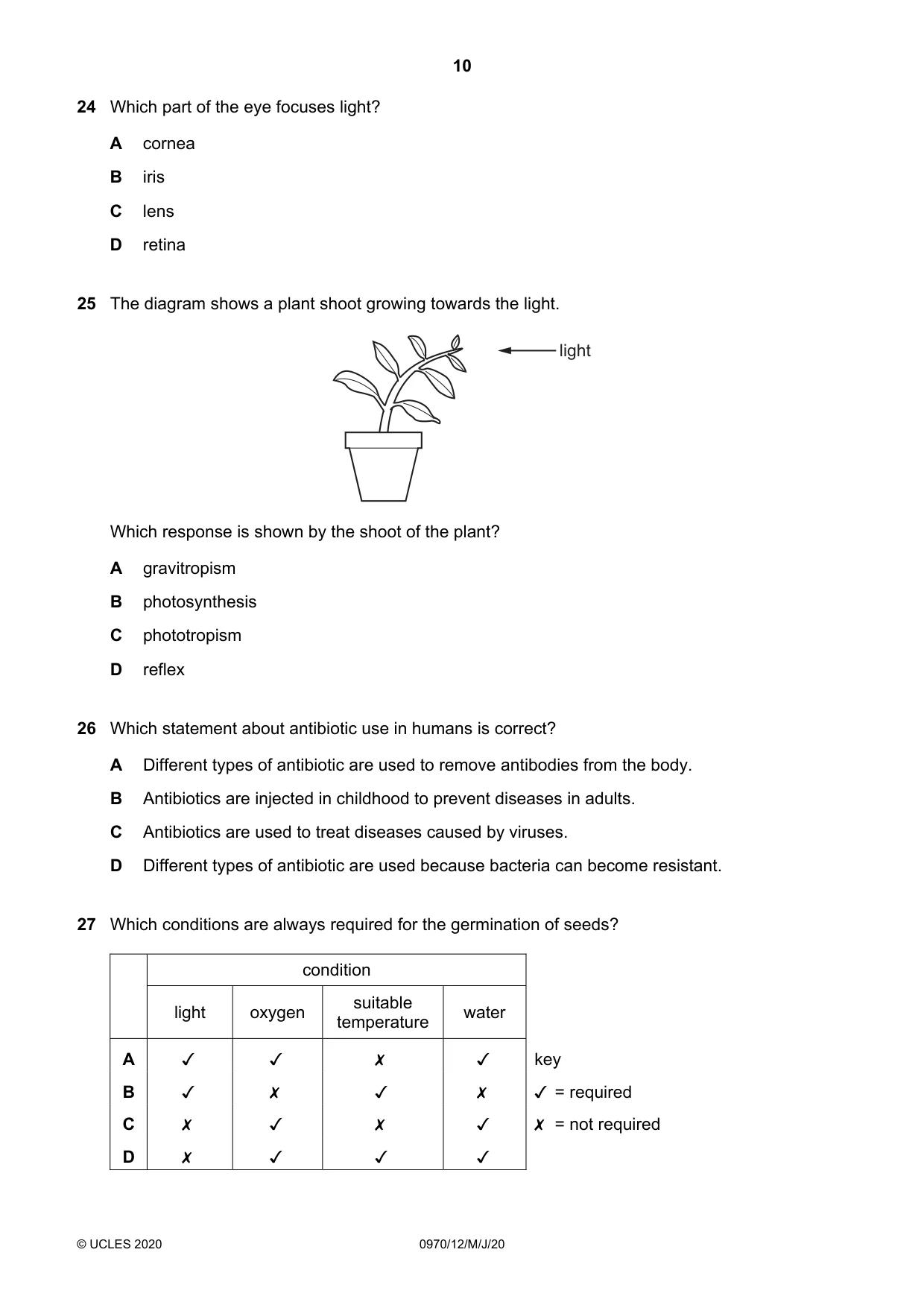
Q25 · The diagram shows a plant shoot growing towards the light
25 The diagram shows a plant shoot growing towards the light. light Which response is shown by the shoot of the plant? A gravitropism B photosynthesis C phototropism D reflex
Mark scheme: C
Q26 · Which statement about antibiotic use in humans is correct?
26 Which statement about antibiotic use in humans is correct? A Different types of antibiotic are used to remove antibodies from the body. B Antibiotics are injected in childhood to prevent diseases in adults. C Antibiotics are used to treat diseases caused by viruses. D Different types of antibiotic are used because bacteria can become resistant.
Mark scheme: D
Q27 · Which conditions are always required for the germination of seeds?
27 Which conditions are always required for the germination of seeds? condition light oxygen t suitable water emperature A v v x v B v x v x Cc x Jv x v D x v v v key v = required X = not required
Mark scheme: D
Q28 · Where do fertilisation and pollination occur in a flower?
28 Where do fertilisation and pollination occur in a flower? fertilisation pollination A carpel ovule B ovary stigma C stigma anther D style carpel
Mark scheme: B
Q29 · When do the following stages occur in a typical human menstrual cycle?
29 When do the following stages occur in a typical human menstrual cycle? bleeding ovulation A days 13 – 14 days 6 – 25 B days 1 – 4 days 27 – 28 C days 6 – 25 days 1 – 4 D days 1 – 4 days 13 – 14
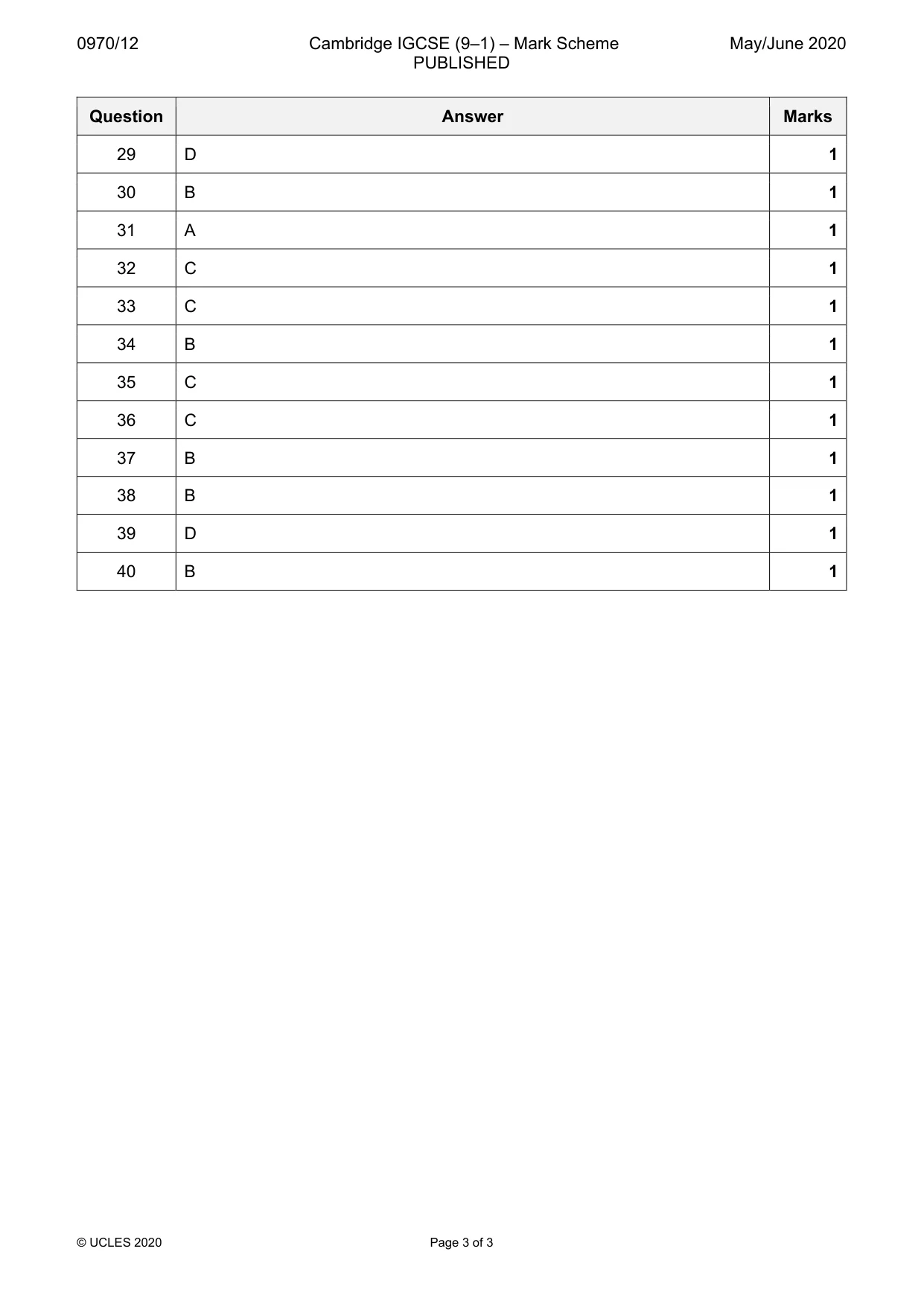
Mark scheme: D
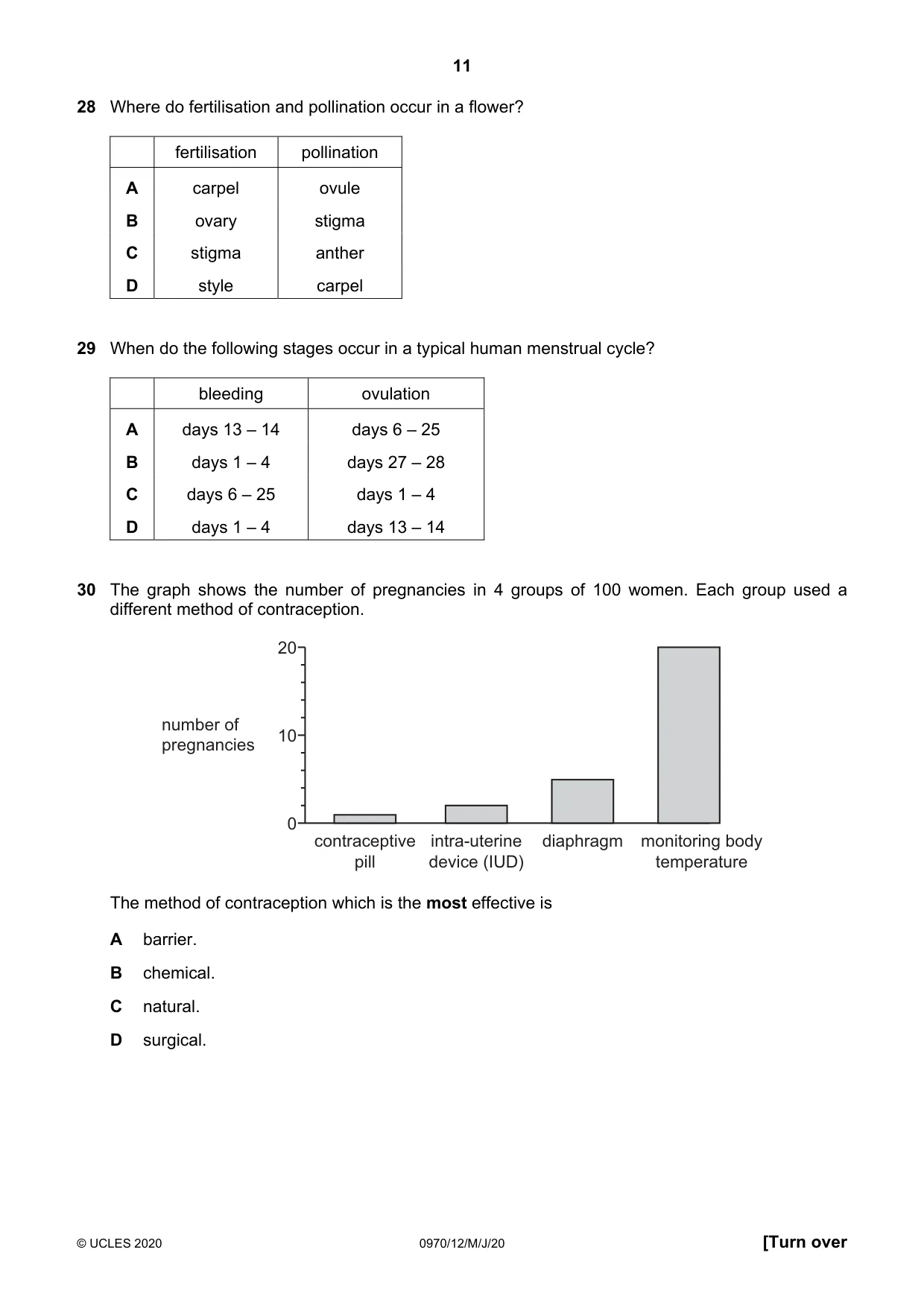
Q30 · The graph shows the number of pregnancies in 4 groups of 100 women
30 The graph shows the number of pregnancies in 4 groups of 100 women. Each group used a different method of contraception. 20 number of 10 pregnancies 0 contraceptive intra-uterine diaphragm monitoring body pill device (IUD) temperature The method of contraception which is the most effective is A barrier. B chemical. C natural. D surgical.
Mark scheme: B
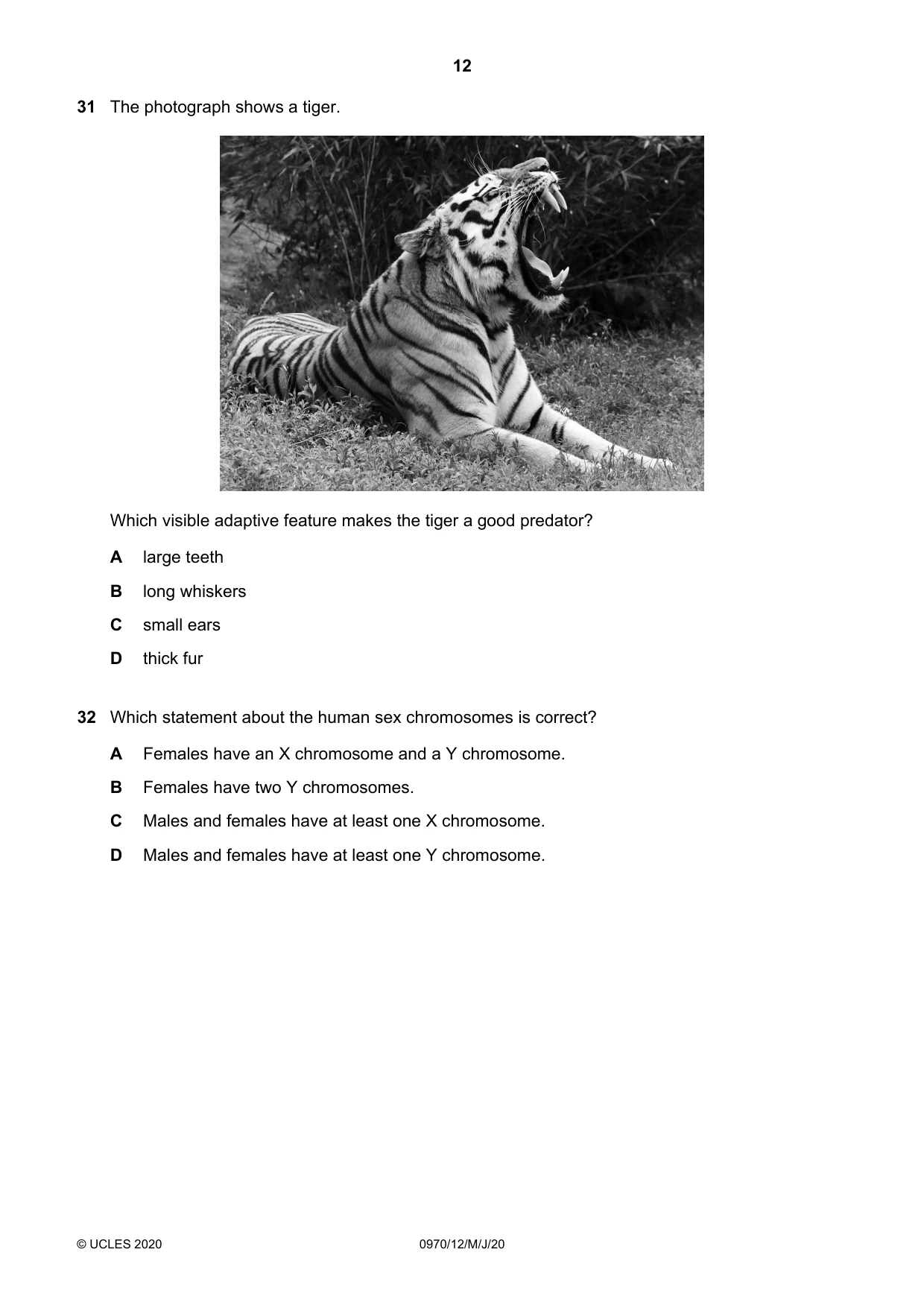
Q31 · The photograph shows a tiger
31 The photograph shows a tiger. Which visible adaptive feature makes the tiger a good predator? A large teeth B long whiskers C small ears D thick fur
Mark scheme: A
Q32 · Which statement about the human sex chromosomes is correct?
32 Which statement about the human sex chromosomes is correct? A Females have an X chromosome and a Y chromosome. B Females have two Y chromosomes. C Males and females have at least one X chromosome. D Males and females have at least one Y chromosome.
Mark scheme: C
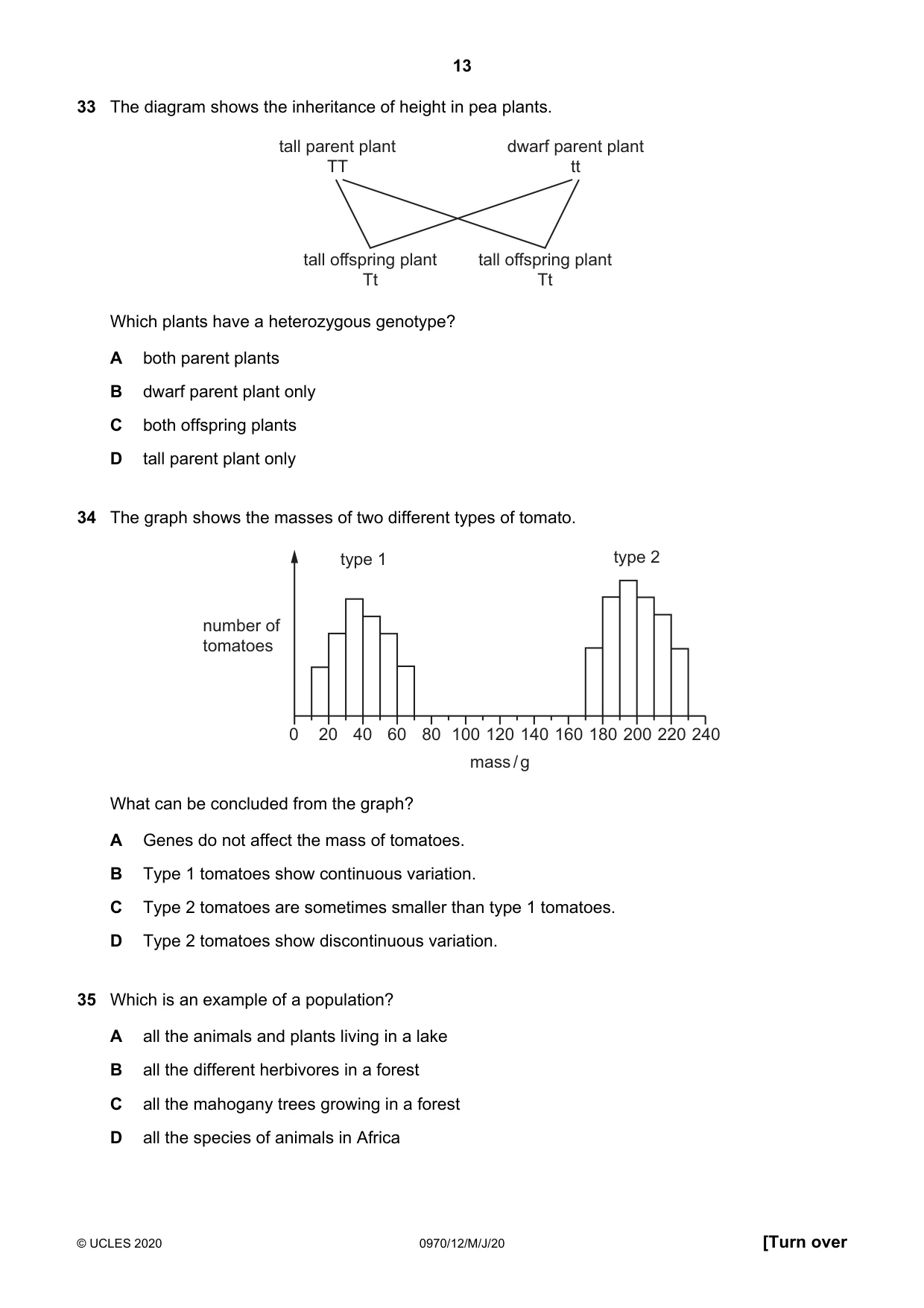
Q33 · The diagram shows the inheritance of height in pea plants
33 The diagram shows the inheritance of height in pea plants. tall parent plant dwarf parent plant TT tt tall offspring plant tall offspring plant Tt Tt Which plants have a heterozygous genotype? A both parent plants B dwarf parent plant only C both offspring plants D tall parent plant only
Mark scheme: C
Q34 · The graph shows the masses of two different types of tomato
34 The graph shows the masses of two different types of tomato. type 1 type 2 number of tomatoes 0 20 40 60 80 100 120 140 160 180 200 220 240 mass / g What can be concluded from the graph? A Genes do not affect the mass of tomatoes. B Type 1 tomatoes show continuous variation. C Type 2 tomatoes are sometimes smaller than type 1 tomatoes. D Type 2 tomatoes show discontinuous variation.
Mark scheme: B
Q35 · Which is an example of a population?
35 Which is an example of a population? A all the animals and plants living in a lake B all the different herbivores in a forest C all the mahogany trees growing in a forest D all the species of animals in Africa
Mark scheme: C
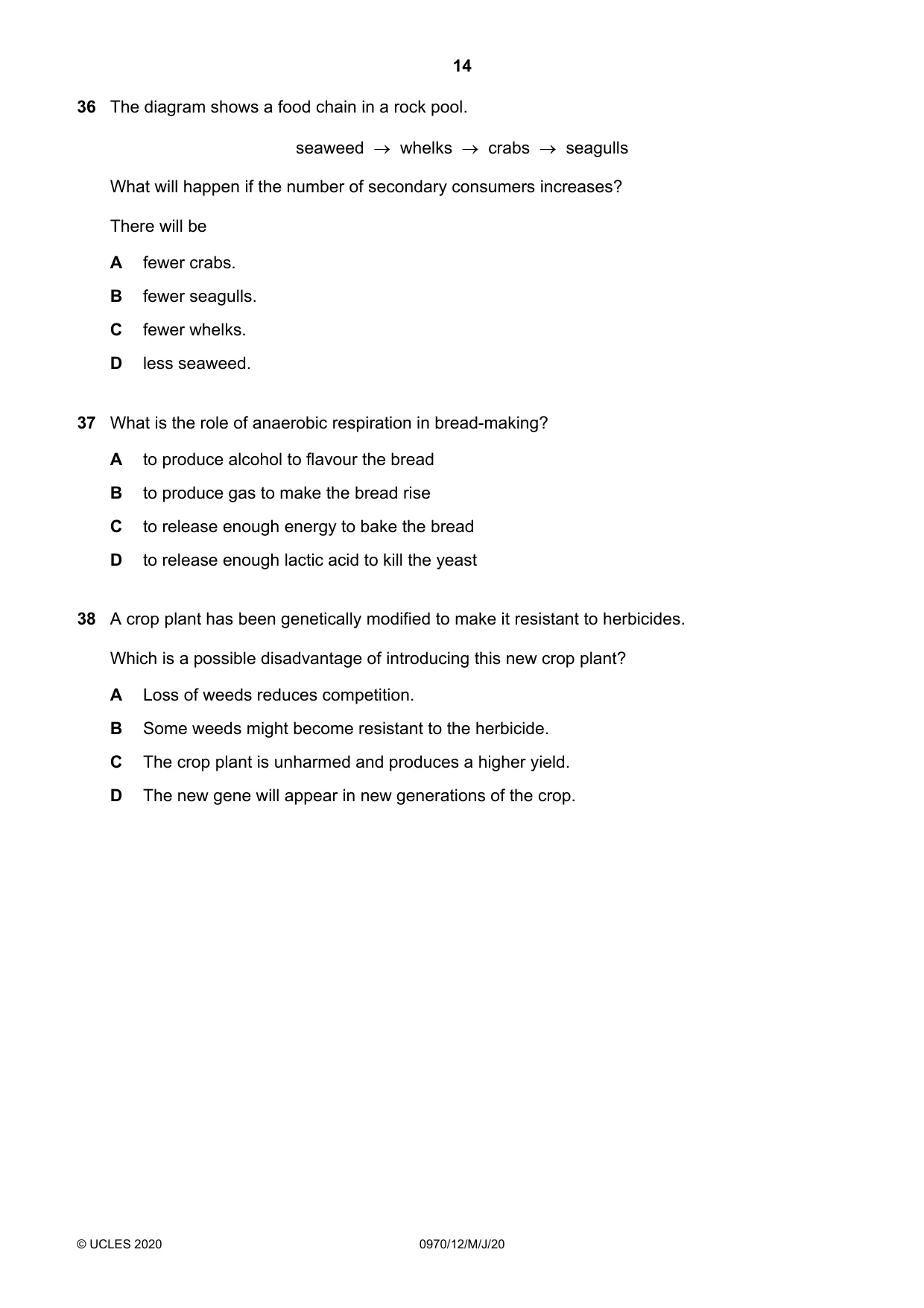
Q36 · The diagram shows a food chain in a rock pool
36 The diagram shows a food chain in a rock pool. seaweed → whelks → crabs → seagulls What will happen if the number of secondary consumers increases? There will be A fewer crabs. B fewer seagulls. C fewer whelks. D less seaweed.
Mark scheme: C
Q37 · What is the role of anaerobic respiration in bread-making?
37 What is the role of anaerobic respiration in bread-making? A to produce alcohol to flavour the bread B to produce gas to make the bread rise C to release enough energy to bake the bread D to release enough lactic acid to kill the yeast
Mark scheme: B
Q38 · A crop plant has been genetically modified to make it resistant to herbicides
38 A crop plant has been genetically modified to make it resistant to herbicides. Which is a possible disadvantage of introducing this new crop plant? A Loss of weeds reduces competition. B Some weeds might become resistant to the herbicide. C The crop plant is unharmed and produces a higher yield. D The new gene will appear in new generations of the crop.
Mark scheme: B
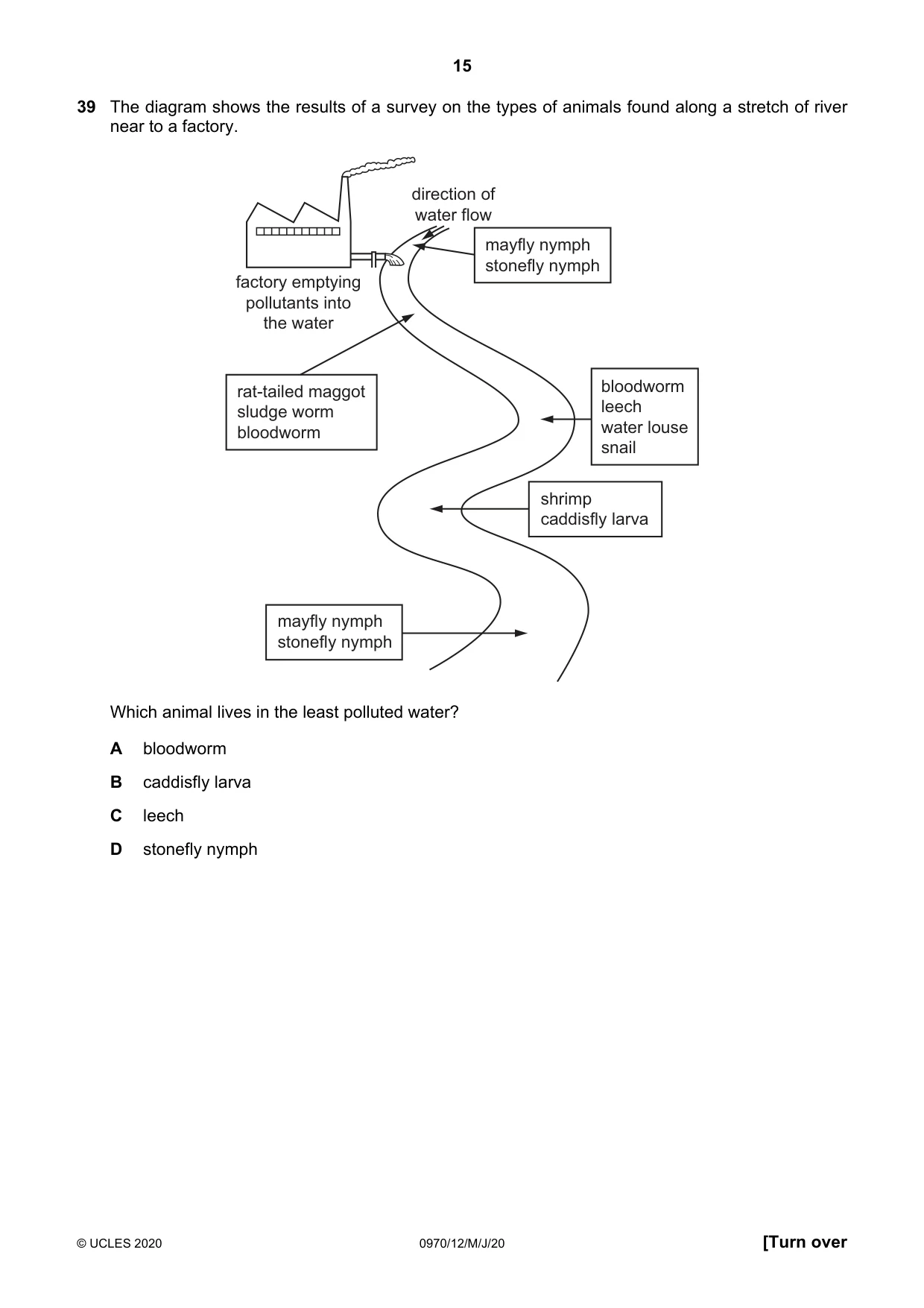
Q39 · The diagram shows the results of a survey on the types of animals found along a stretch…
39 The diagram shows the results of a survey on the types of animals found along a stretch of river near to a factory. direction of water flow mayfly nymph stonefly nymph factory emptying pollutants into the water rat-tailed maggot bloodworm sludge worm leech bloodworm water louse snail shrimp caddisfly larva mayfly nymph stonefly nymph Which animal lives in the least polluted water? A bloodworm B caddisfly larva C leech D stonefly nymph
Mark scheme: D
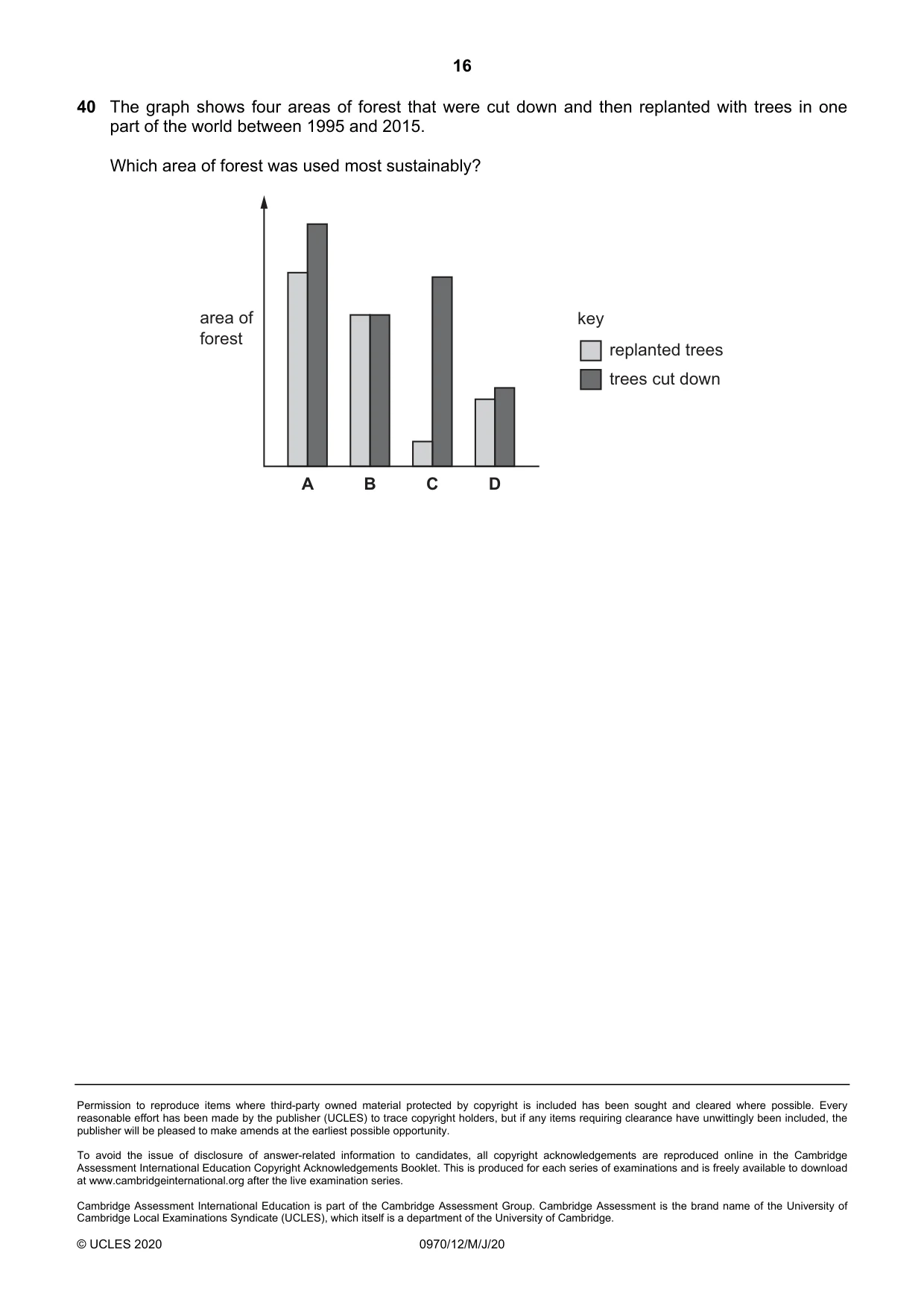
Q40 · The graph shows four areas of forest that were cut down and then replanted with trees in…
40 The graph shows four areas of forest that were cut down and then replanted with trees in one part of the world between 1995 and 2015. Which area of forest was used most sustainably? area of key forest replanted trees trees cut down A B C D
Mark scheme: B
What was in this paper
The subtopics covered by these 40 questions, and how many questions each got. Open one in a new tab to see every Cambridge question on it.
2Coordination and response2Gas exchange in humans2Heart2Osmosis2Sexual reproduction in humans2Sexual reproduction in plants2Adaptive features1Aerobic respiration1Anaerobic respiration1Biological molecules1Chromosomes, genes and proteins1Concept and uses of classification systems1Conservation1Diet1Diseases and immunity1Drugs1Enzymes1Excretion in humans1Features of organisms1Food chains and food webs1Genetic modification1Hormones1Monohybrid inheritance1Photosynthesis1Physical digestion1Pollution1Populations1Sense organs1Transpiration1Tropic responses1Variation1Water uptake1