Cambridge IGCSE Biology (9-1) 0970 — 2018 May/June Paper 1 · Variant 1
0970/11/M/J/18 · 40 questions · 40 marks · ≈45 min
The question paper and its mark scheme, free to read here and free to download. This is Cambridge’s own paper, exactly as it was sat.
Question paper16 pages
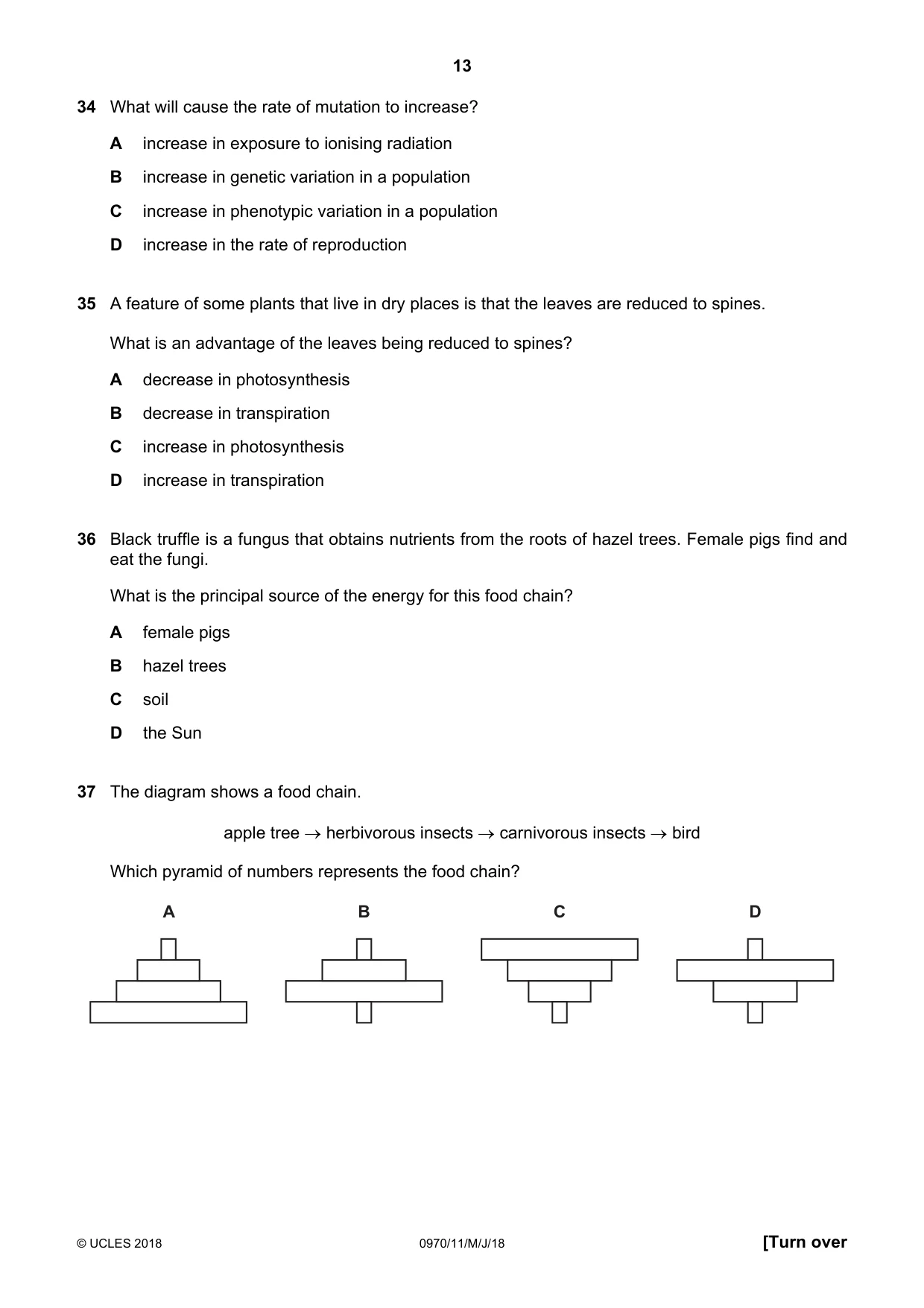
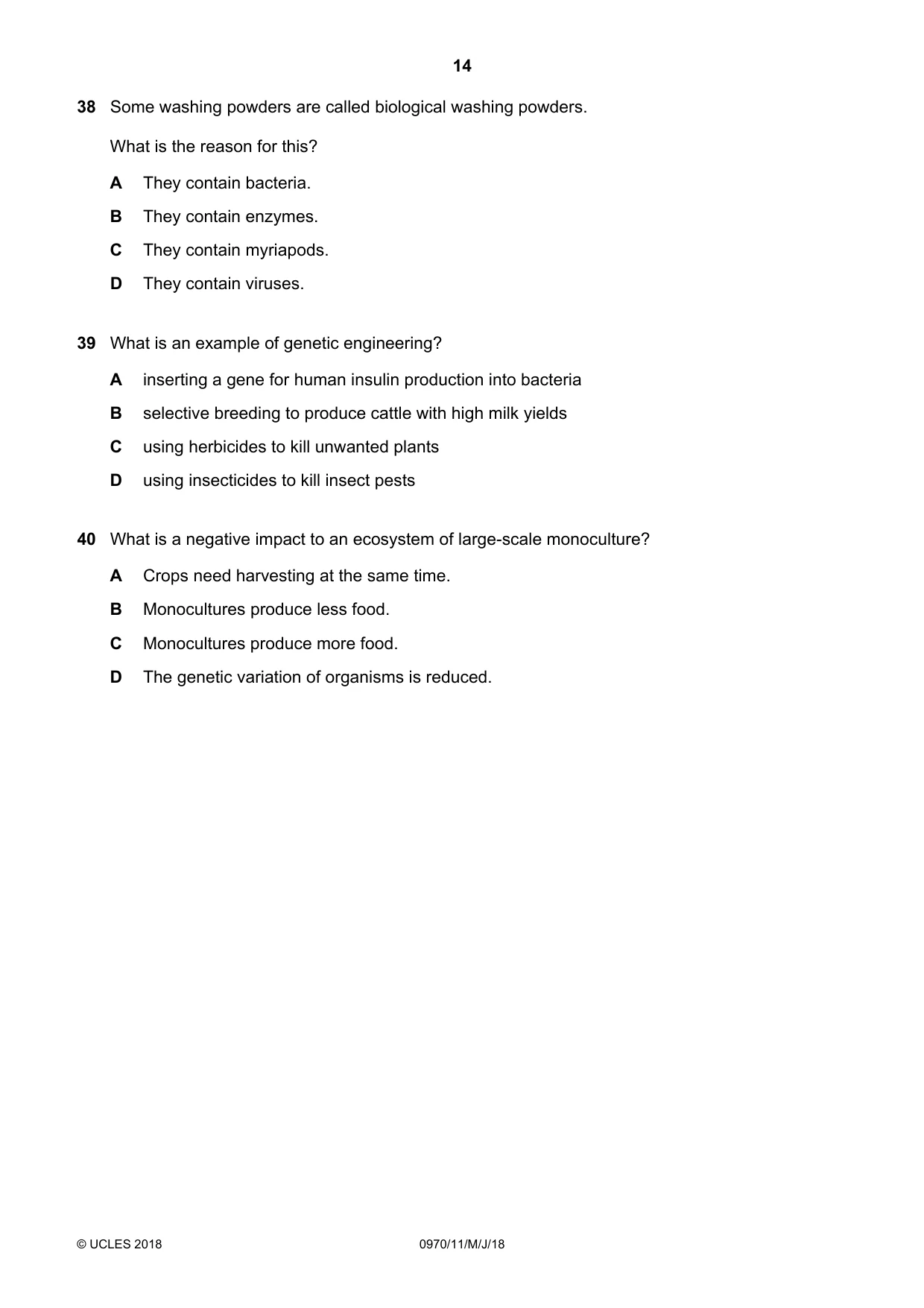


Mark scheme4 pages
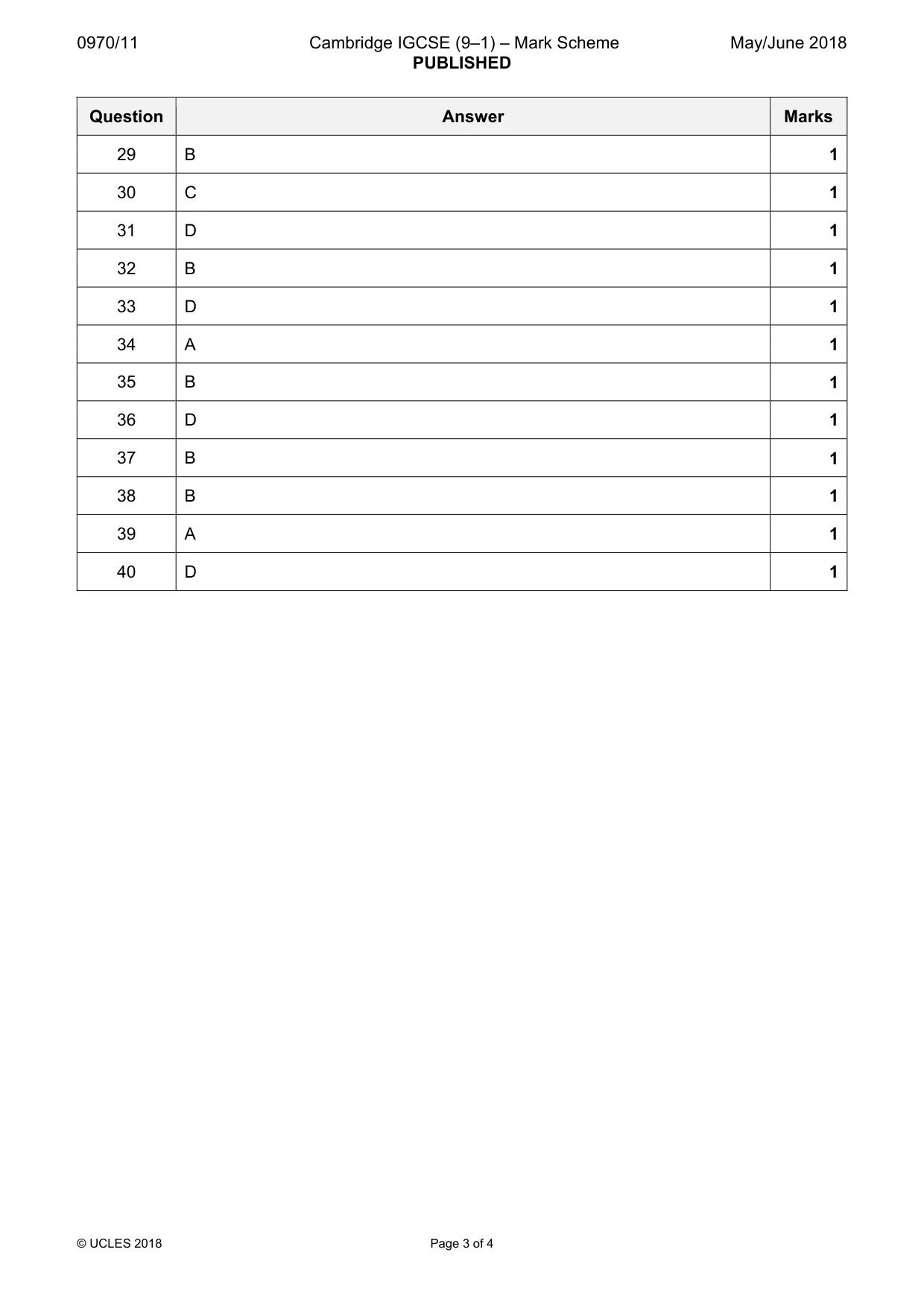
Answers below. Sit the paper first if you are practising.
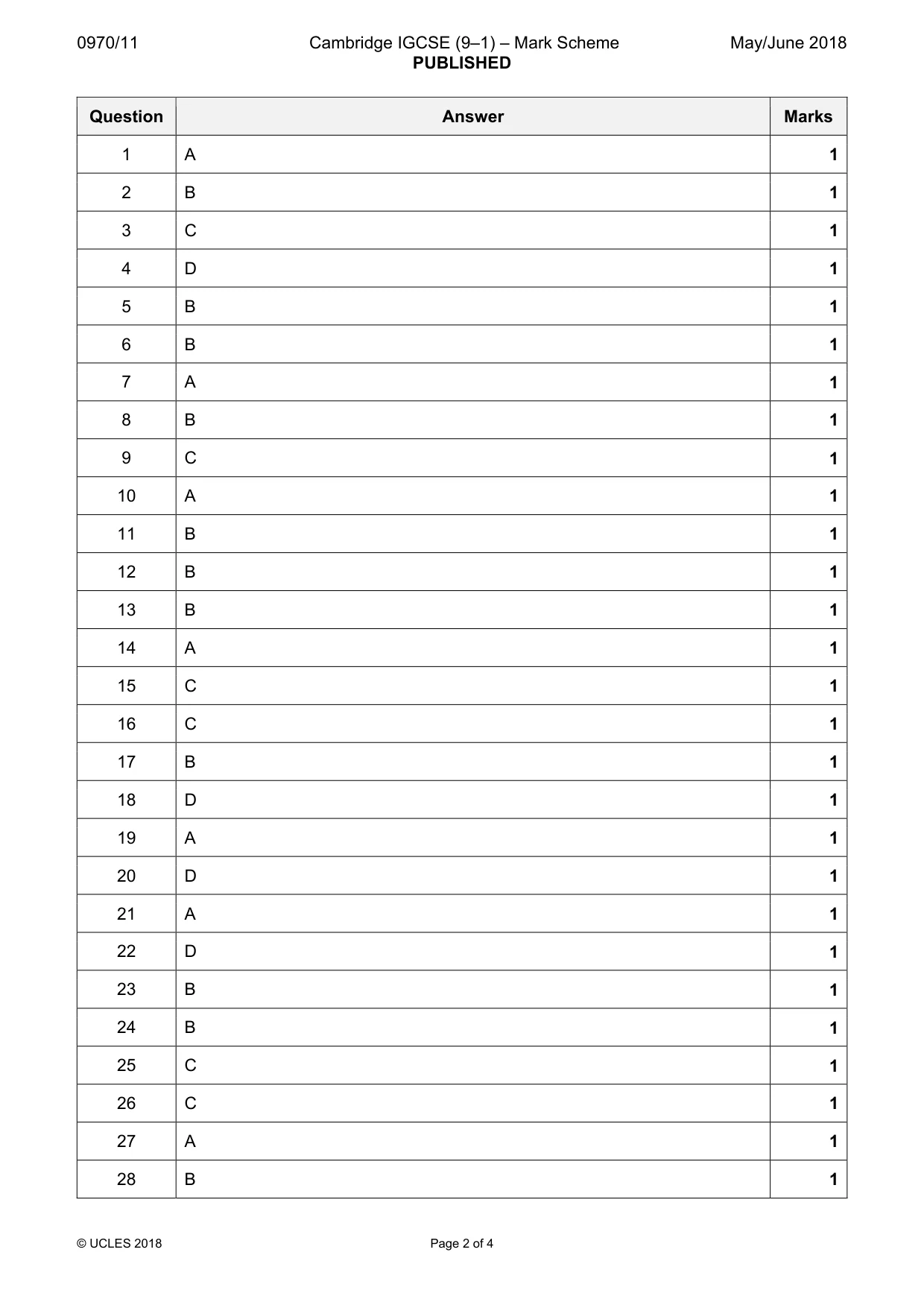

Questions as text
Q1 · Which organisms carry out respiration, growth, movement and excretion?
1 Which organisms carry out respiration, growth, movement and excretion? A all animals and all plants B animals only C arthropods and flowering plants only D plants only
Mark scheme: A
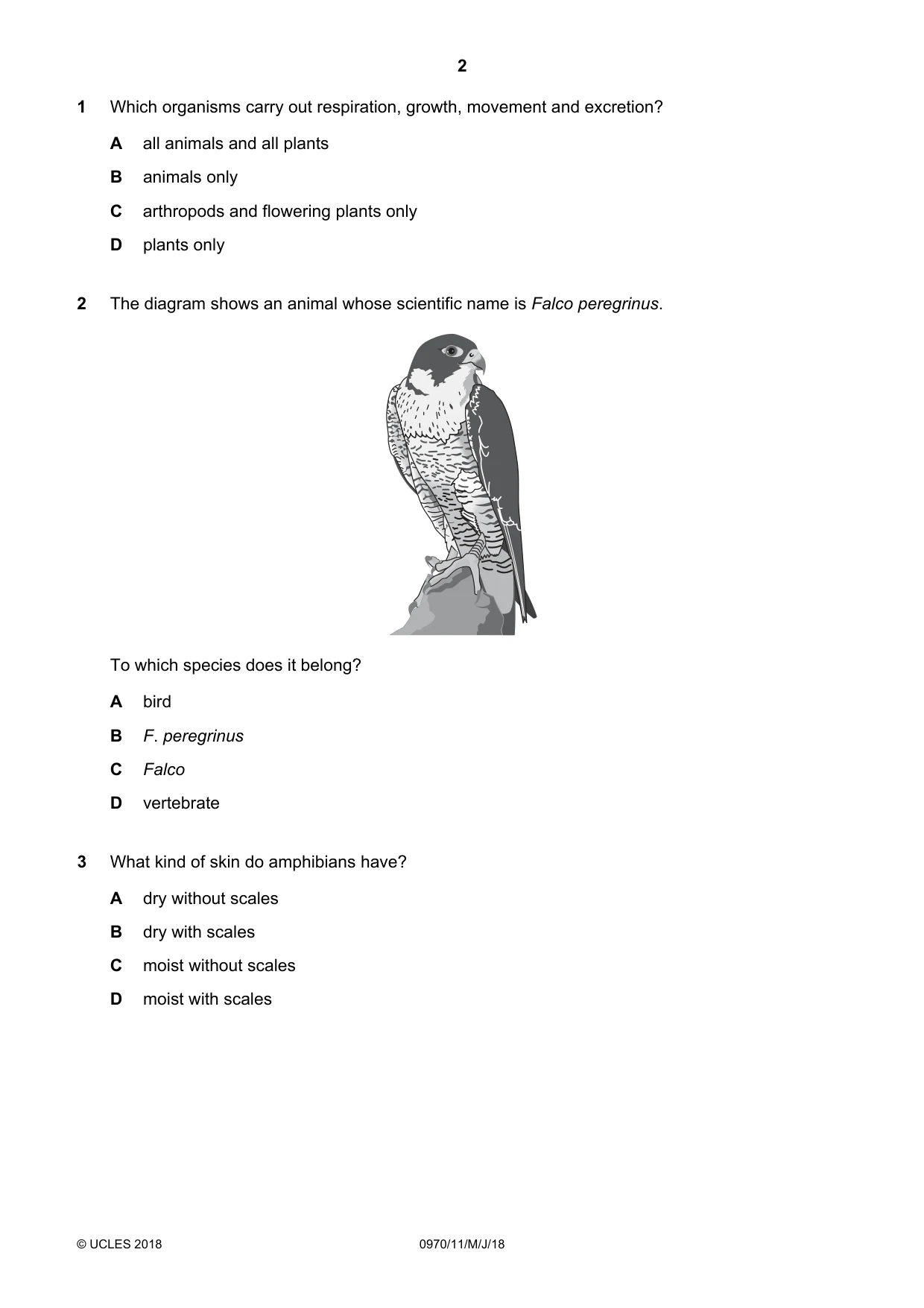
Q2 · The diagram shows an animal whose scientific name is Falco peregrinus
2 The diagram shows an animal whose scientific name is Falco peregrinus. To which species does it belong? A bird B F. peregrinus C Falco D vertebrate
Mark scheme: B
More questions on Concept and uses of classification systems
Q3 · What kind of skin do amphibians have?
3 What kind of skin do amphibians have? A dry without scales B dry with scales C moist without scales D moist with scales
Mark scheme: C
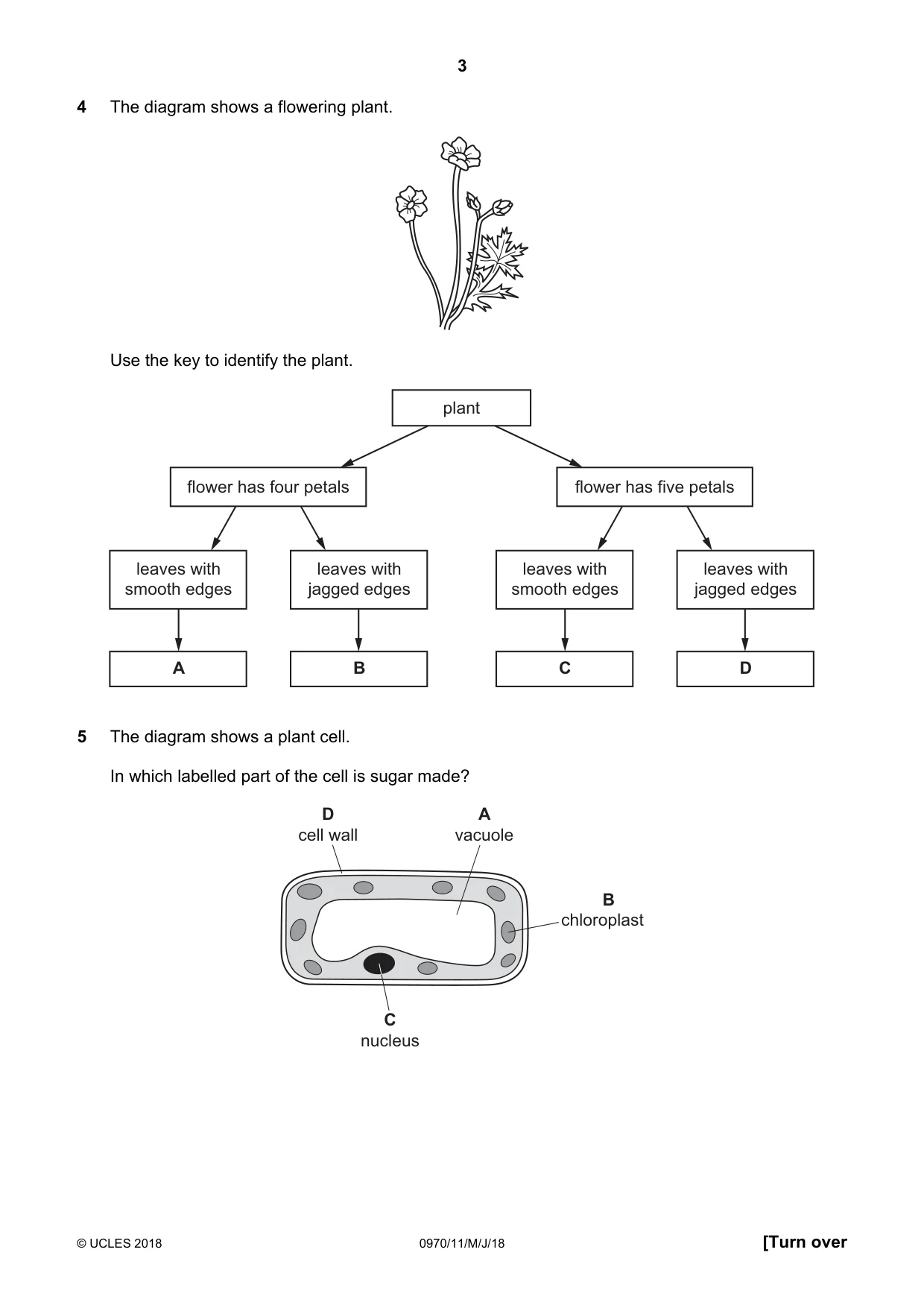
Q4 · The diagram shows a flowering plant
4 The diagram shows a flowering plant. Use the key to identify the plant. plant flower has four petals flower has five petals leaves with leaves with leaves with leaves with smooth edges jagged edges smooth edges jagged edges A B C D
Mark scheme: D
More questions on Concept and uses of classification systems
Q5 · The diagram shows a plant cell
5 The diagram shows a plant cell. In which labelled part of the cell is sugar made? D A cell wall vacuole B chloroplast C nucleus
Mark scheme: B
Q6 · Why do some root cells have root hairs?
6 Why do some root cells have root hairs? A for the maintenance of the temperature of the cell sap B to increase the surface area of the cells C to increase the volume of the cell sap D to provide a place for cell nuclei
Mark scheme: B
Q7 · Which words correctly complete the paragraph?
7 Which words correctly complete the paragraph? Diffusion may be defined as the net movement of particles from a region of their ««1«« concentration, to a region of their ««2«« concentration, where movement is ««3«« a concentration gradient. 1 2 3 A higher lower down B higher lower up C lower higher down D lower higher up
Mark scheme: A
Q8 · Which part of a plant root hair is partially permeable?
8 Which part of a plant root hair is partially permeable? A the cell sap B the cell surface membrane C the cell vacuole D the cell wall
Mark scheme: B
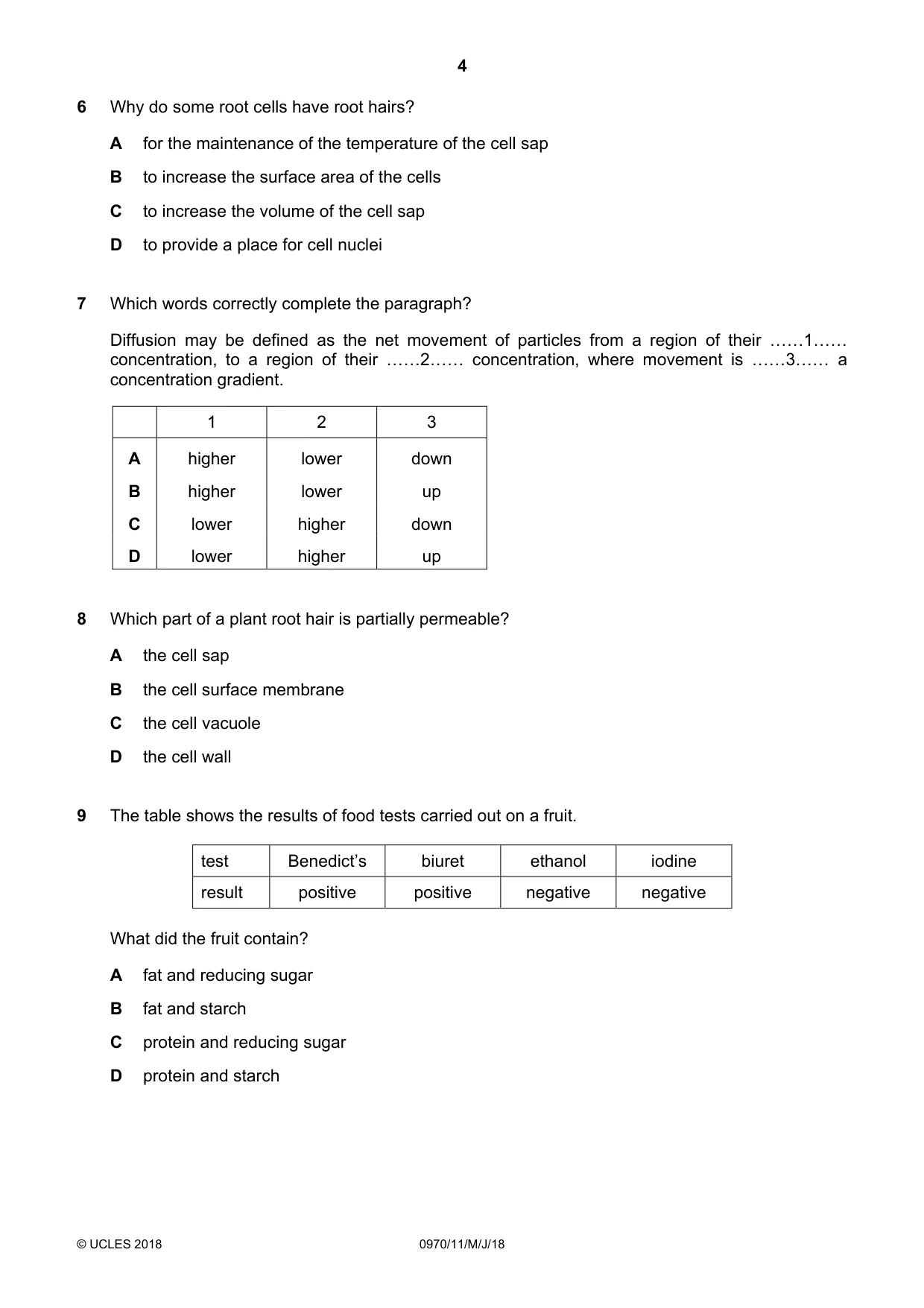
Q9 · The table shows the results of food tests carried out on a fruit
9 The table shows the results of food tests carried out on a fruit. test Benedict’s biuret ethanol iodine result positive positive negative negative What did the fruit contain? A fat and reducing sugar B fat and starch C protein and reducing sugar D protein and starch
Mark scheme: C
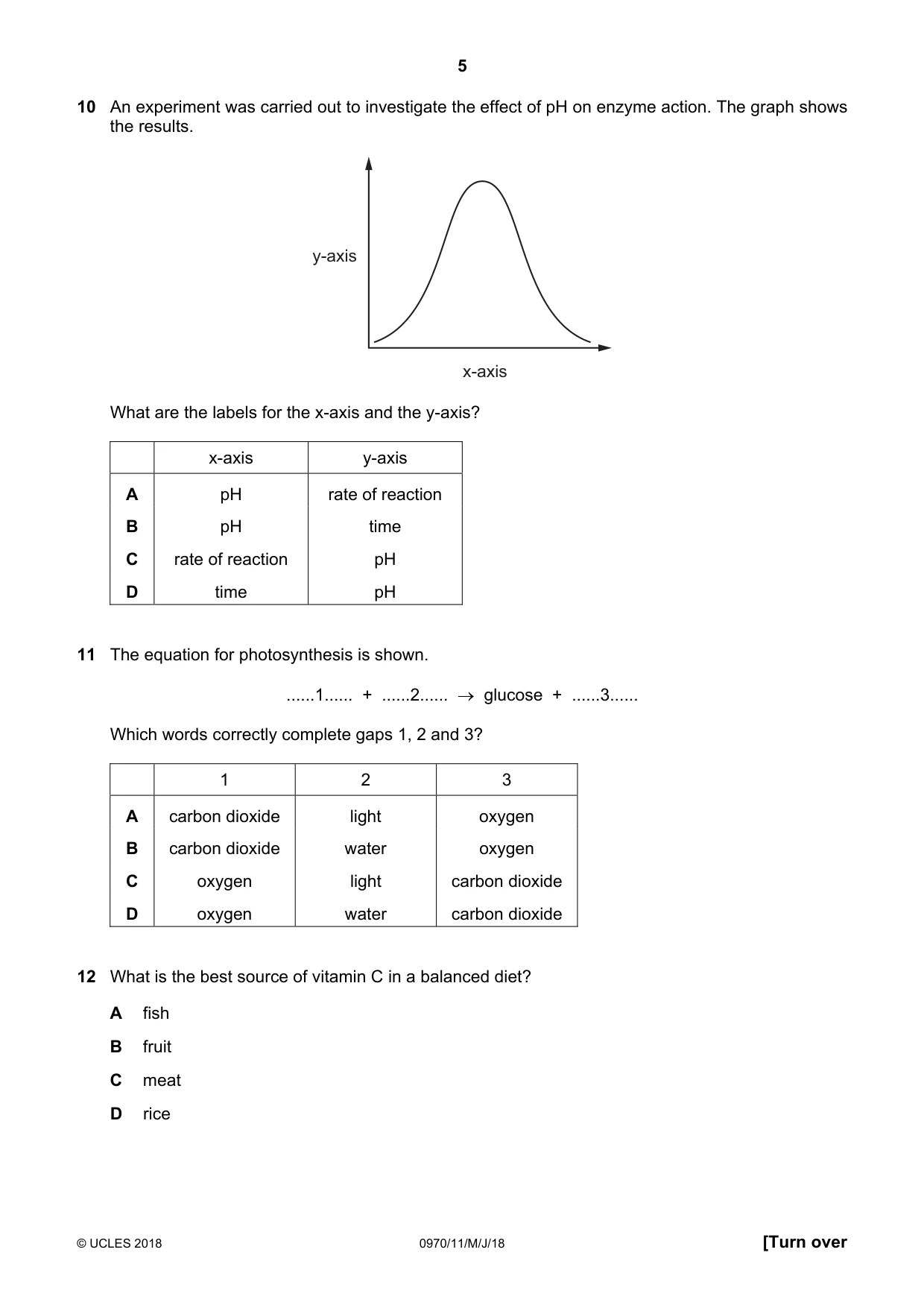
Q10 · An experiment was carried out to investigate the effect of pH on enzyme action
10 An experiment was carried out to investigate the effect of pH on enzyme action. The graph shows the results. y-axis x-axis What are the labels for the x-axis and the y-axis? x-axis y-axis A pH rate of reaction B pH time C rate of reaction pH D time pH
Mark scheme: A
Q11 · The equation for photosynthesis is shown
11 The equation for photosynthesis is shown. ......1...... + ......2...... → glucose + ......3...... Which words correctly complete gaps 1, 2 and 3? 1 2 3 A carbon dioxide light oxygen B carbon dioxide water oxygen C oxygen light carbon dioxide D oxygen water carbon dioxide
Mark scheme: B
Q12 · What is the best source of vitamin C in a balanced diet?
12 What is the best source of vitamin C in a balanced diet? A fish B fruit C meat D rice
Mark scheme: B
Q13 · A young, active woman requires more of which constituent in her diet than a young, active…
13 A young, active woman requires more of which constituent in her diet than a young, active man? A fat B iron C protein D vitamin C
Mark scheme: B
Q14 · Which condition could be caused by a lack of iron?
14 Which condition could be caused by a lack of iron? A anaemia B cholera C scurvy D diabetes
Mark scheme: A
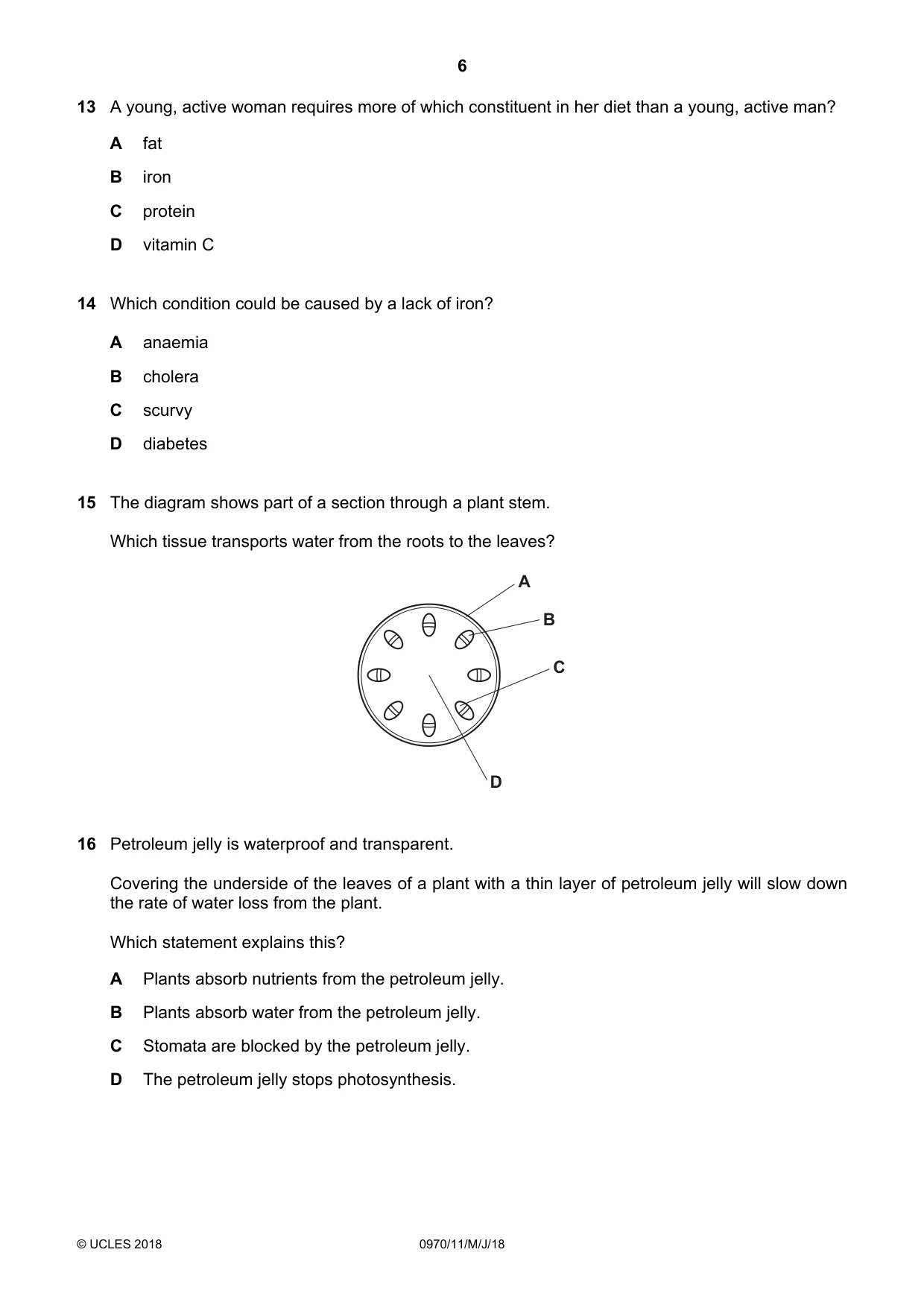
Q15 · The diagram shows part of a section through a plant stem
15 The diagram shows part of a section through a plant stem. Which tissue transports water from the roots to the leaves? A B C D
Mark scheme: C
Q16 · Petroleum jelly is waterproof and transparent
16 Petroleum jelly is waterproof and transparent. Covering the underside of the leaves of a plant with a thin layer of petroleum jelly will slow down the rate of water loss from the plant. Which statement explains this? A Plants absorb nutrients from the petroleum jelly. B Plants absorb water from the petroleum jelly. C Stomata are blocked by the petroleum jelly. D The petroleum jelly stops photosynthesis.
Mark scheme: C
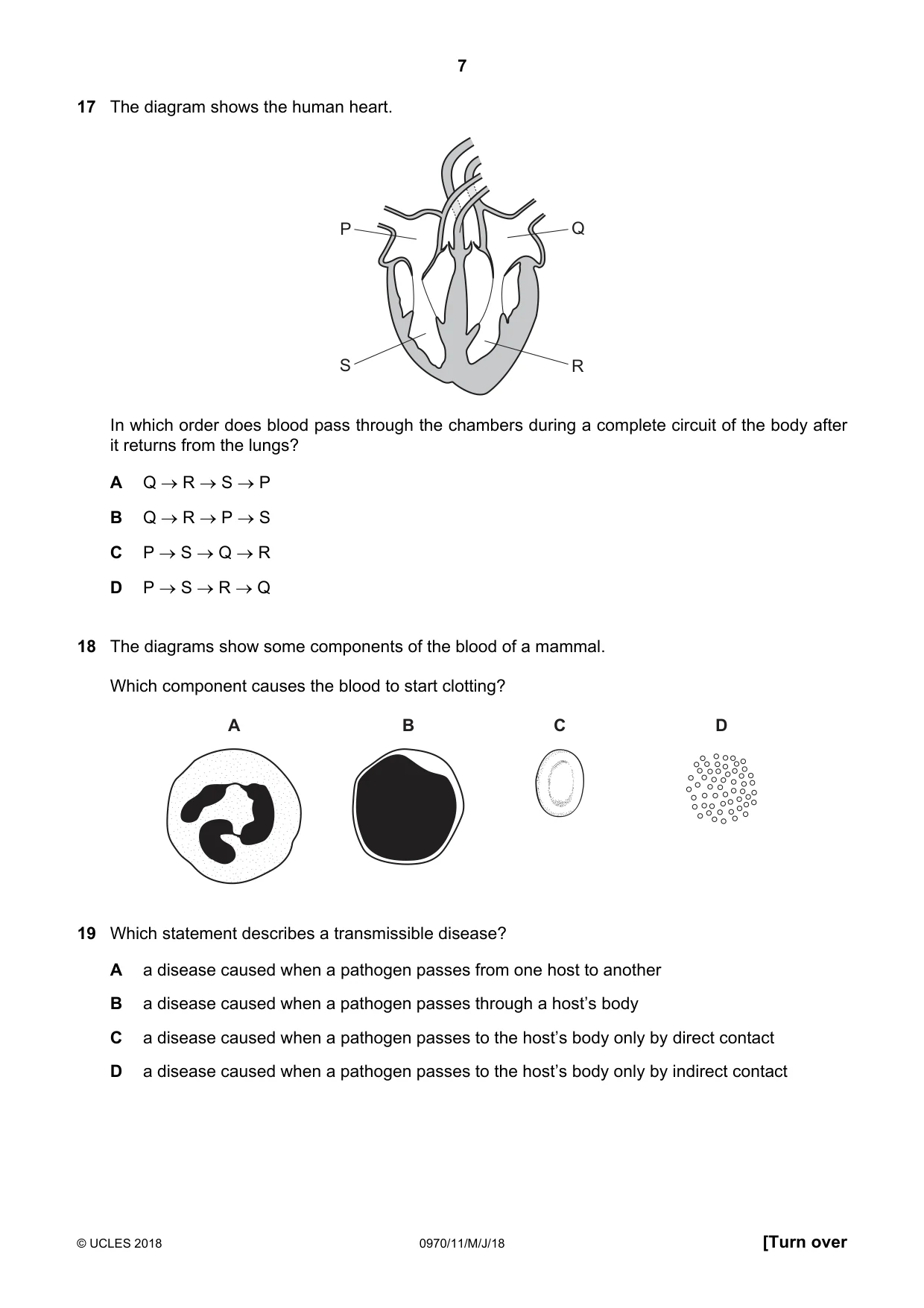
Q17 · The diagram shows the human heart
17 The diagram shows the human heart. P Q S R In which order does blood pass through the chambers during a complete circuit of the body after it returns from the lungs? A Q → R → S → P B Q → R → P → S C P → S → Q → R D P → S → R → Q
Mark scheme: B
Q18 · The diagrams show some components of the blood of a mammal
18 The diagrams show some components of the blood of a mammal. Which component causes the blood to start clotting? A B C D
Mark scheme: D
Q19 · Which statement describes a transmissible disease?
19 Which statement describes a transmissible disease? A a disease caused when a pathogen passes from one host to another B a disease caused when a pathogen passes through a host’s body C a disease caused when a pathogen passes to the host’s body only by direct contact D a disease caused when a pathogen passes to the host’s body only by indirect contact
Mark scheme: A
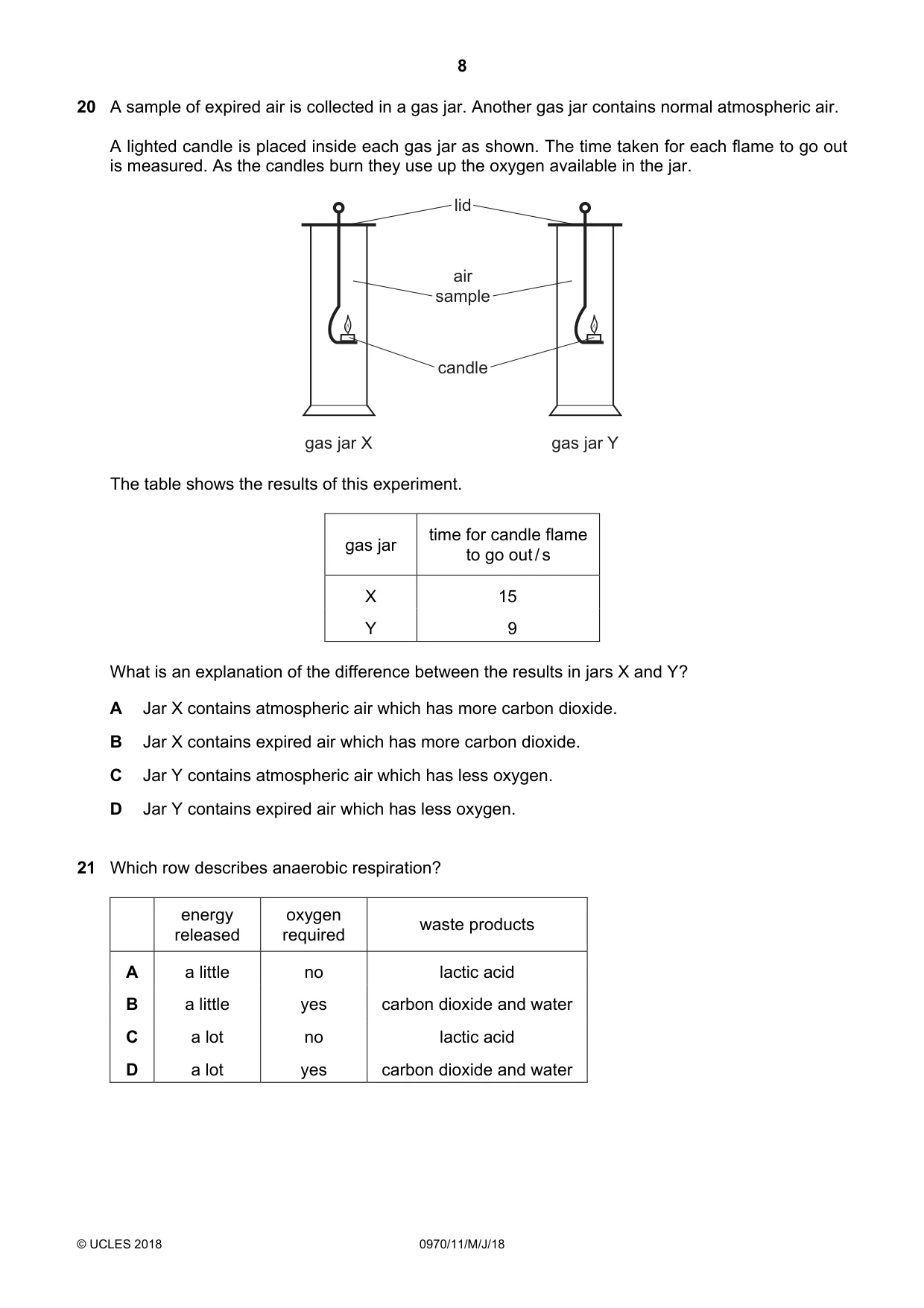
Q20 · A sample of expired air is collected in a gas jar
20 A sample of expired air is collected in a gas jar. Another gas jar contains normal atmospheric air. A lighted candle is placed inside each gas jar as shown. The time taken for each flame to go out is measured. As the candles burn they use up the oxygen available in the jar. lid air sample candle gas jar X gas jar Y The table shows the results of this experiment. time for candle flame gas jar to go out / s X 15 Y 9 What is an explanation of the difference between the results in jars X and Y? A Jar X contains atmospheric air which has more carbon dioxide. B Jar X contains expired air which has more carbon dioxide. C Jar Y contains atmospheric air which has less oxygen. D Jar Y contains expired air which has less oxygen.
Mark scheme: D
Q21 · Which row describes anaerobic respiration?
21 Which row describes anaerobic respiration? energy oxygen waste products released required A a little no lactic acid B a little yes carbon dioxide and water C a lot no lactic acid D a lot yes carbon dioxide and water
Mark scheme: A
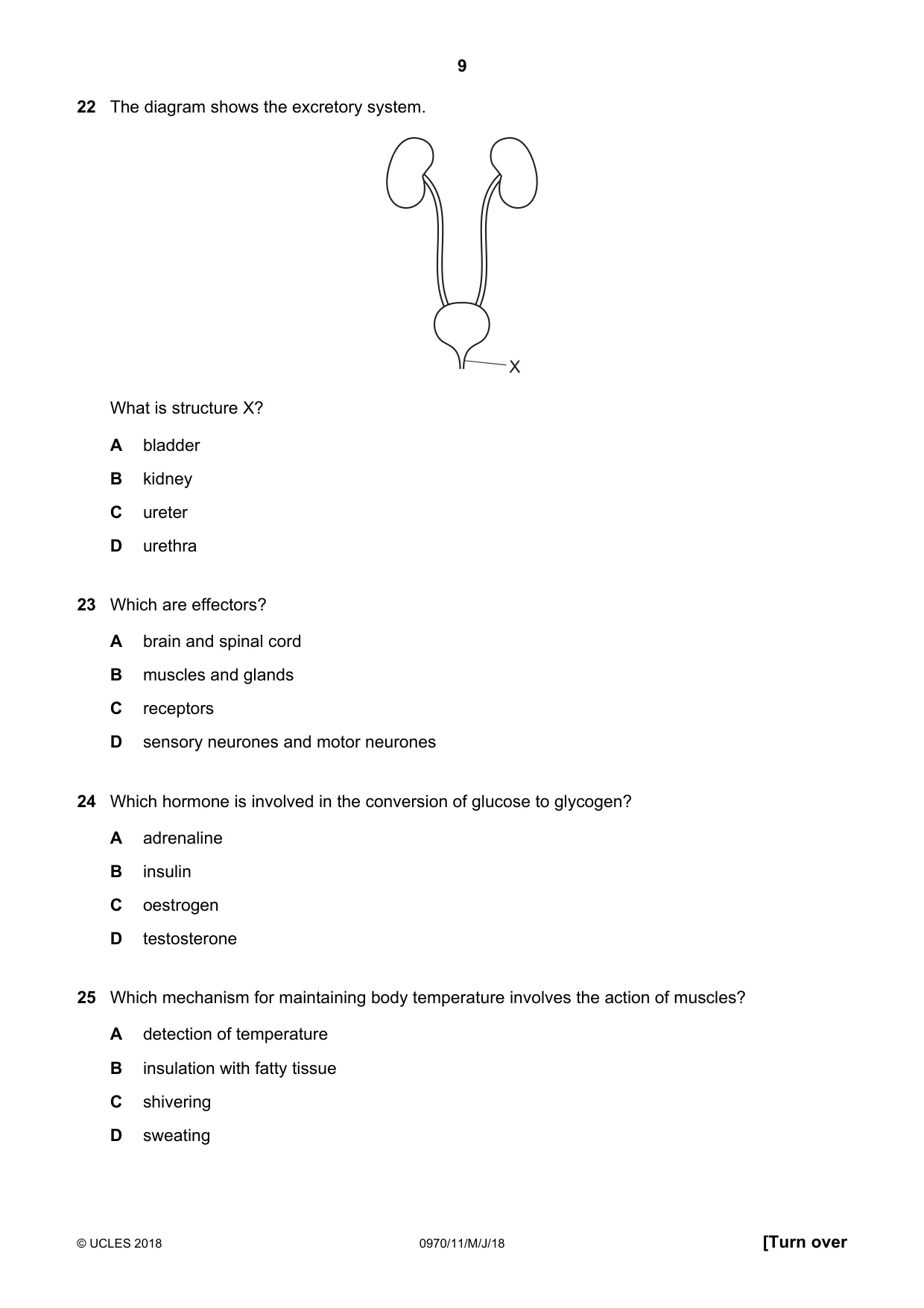
Q22 · The diagram shows the excretory system
22 The diagram shows the excretory system. X What is structure X? A bladder B kidney C ureter D urethra
Mark scheme: D
Question 23
23 Which are effectors? A brain and spinal cord B muscles and glands C receptors D sensory neurones and motor neurones
Mark scheme: B
Q24 · Which hormone is involved in the conversion of glucose to glycogen?
24 Which hormone is involved in the conversion of glucose to glycogen? A adrenaline B insulin C oestrogen D testosterone
Mark scheme: B
Q25 · Which mechanism for maintaining body temperature involves the action of muscles?
25 Which mechanism for maintaining body temperature involves the action of muscles? A detection of temperature B insulation with fatty tissue C shivering D sweating
Mark scheme: C
Q26 · Antibiotics are used to treat some diseases
26 Antibiotics are used to treat some diseases. Which diseases could they be effective against? bacterial infection SCUIVY v v v v v x x x
Mark scheme: C
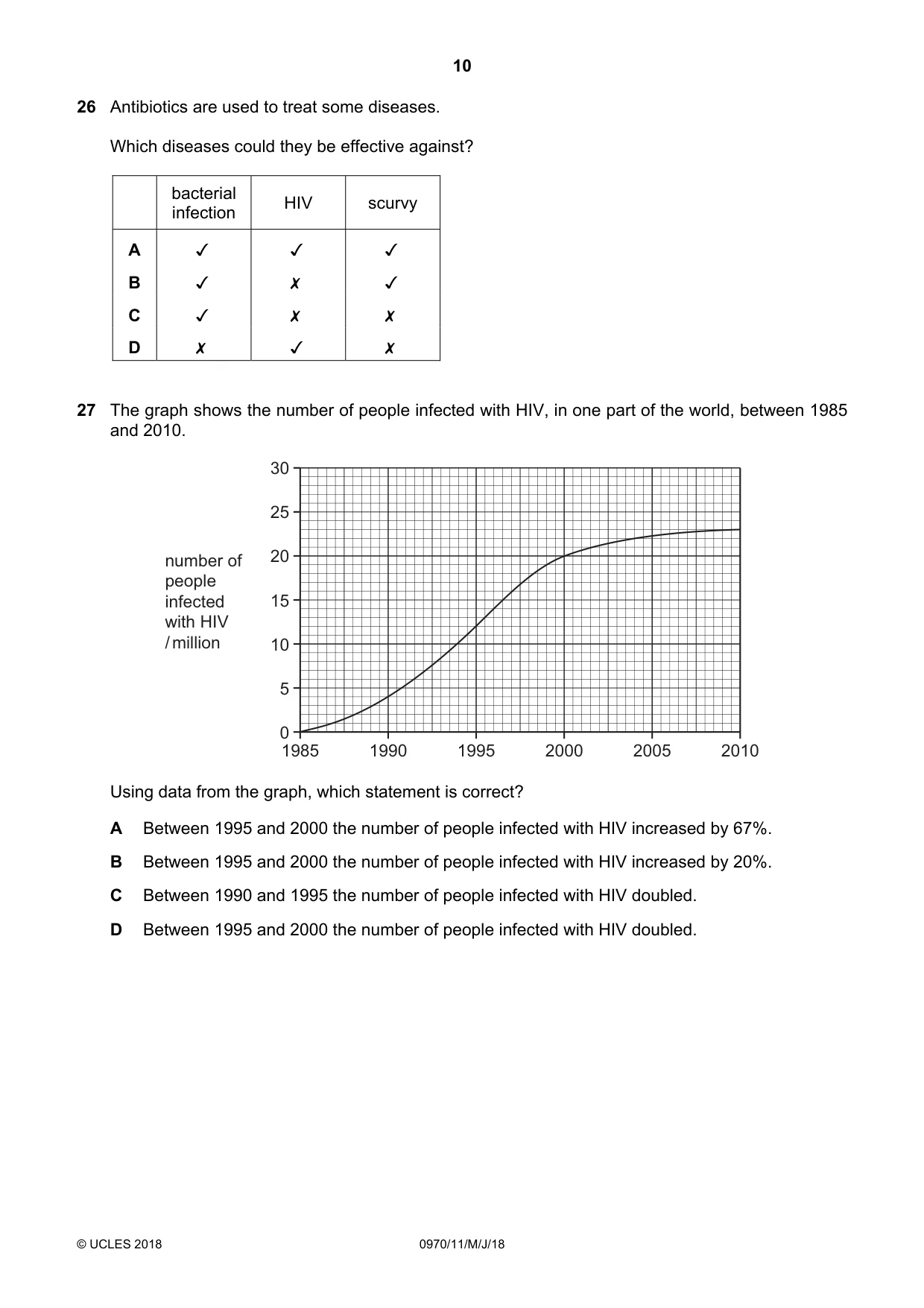
Q27 · The graph shows the number of people infected with HIV, in one part of the world, between…
27 The graph shows the number of people infected with HIV, in one part of the world, between 1985 and 2010. 30 25 number of 20 people infected 15 with HIV / million 10 5 0 1985 1990 1995 2000 2005 2010 Using data from the graph, which statement is correct? A Between 1995 and 2000 the number of people infected with HIV increased by 67%. B Between 1995 and 2000 the number of people infected with HIV increased by 20%. C Between 1990 and 1995 the number of people infected with HIV doubled. D Between 1995 and 2000 the number of people infected with HIV doubled.
Mark scheme: A
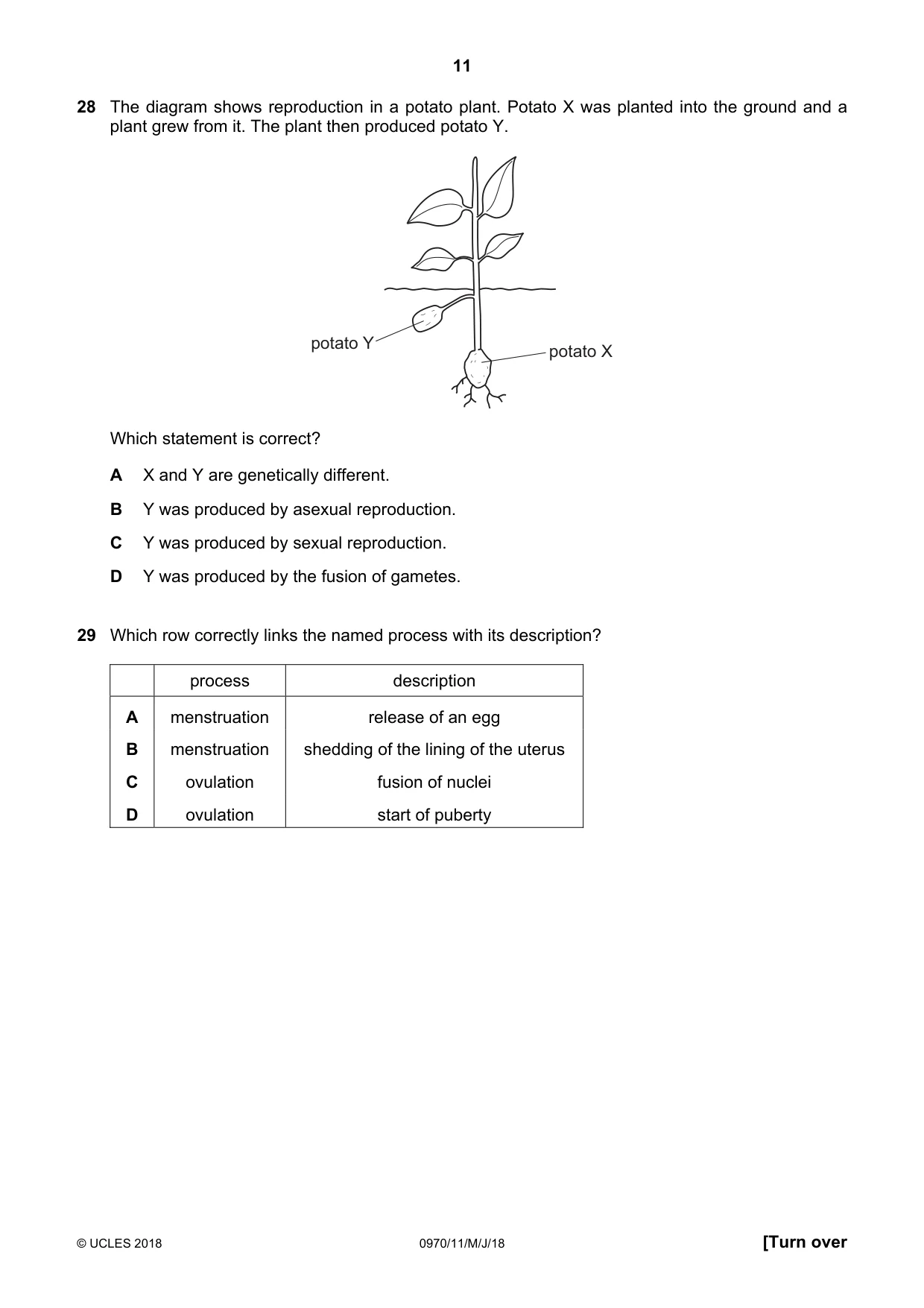
Q28 · The diagram shows reproduction in a potato plant
28 The diagram shows reproduction in a potato plant. Potato X was planted into the ground and a plant grew from it. The plant then produced potato Y. potato Y potato X Which statement is correct? A X and Y are genetically different. B Y was produced by asexual reproduction. C Y was produced by sexual reproduction. D Y was produced by the fusion of gametes.
Mark scheme: B
Q29 · Which row correctly links the named process with its description?
29 Which row correctly links the named process with its description? process description A menstruation release of an egg B menstruation shedding of the lining of the uterus C ovulation fusion of nuclei D ovulation start of puberty
Mark scheme: B
Q30 · The human immunodeficiency virus (HIV) can be transmitted in body fluid
30 The human immunodeficiency virus (HIV) can be transmitted in body fluid. Some examples of body fluids are listed. 1 blood 2 saliva 3 semen 4 tear fluid Which body fluids could transmit HIV? A 1, 2, 3 and 4 B 1, 2 and 3 only C 1 and 3 only D 3 only
Mark scheme: C
Q31 · Which method of birth control involves a surgical procedure?
31 Which method of birth control involves a surgical procedure? A condom B contraceptive pill C monitoring body temperature and cervical mucus D vasectomy
Mark scheme: D
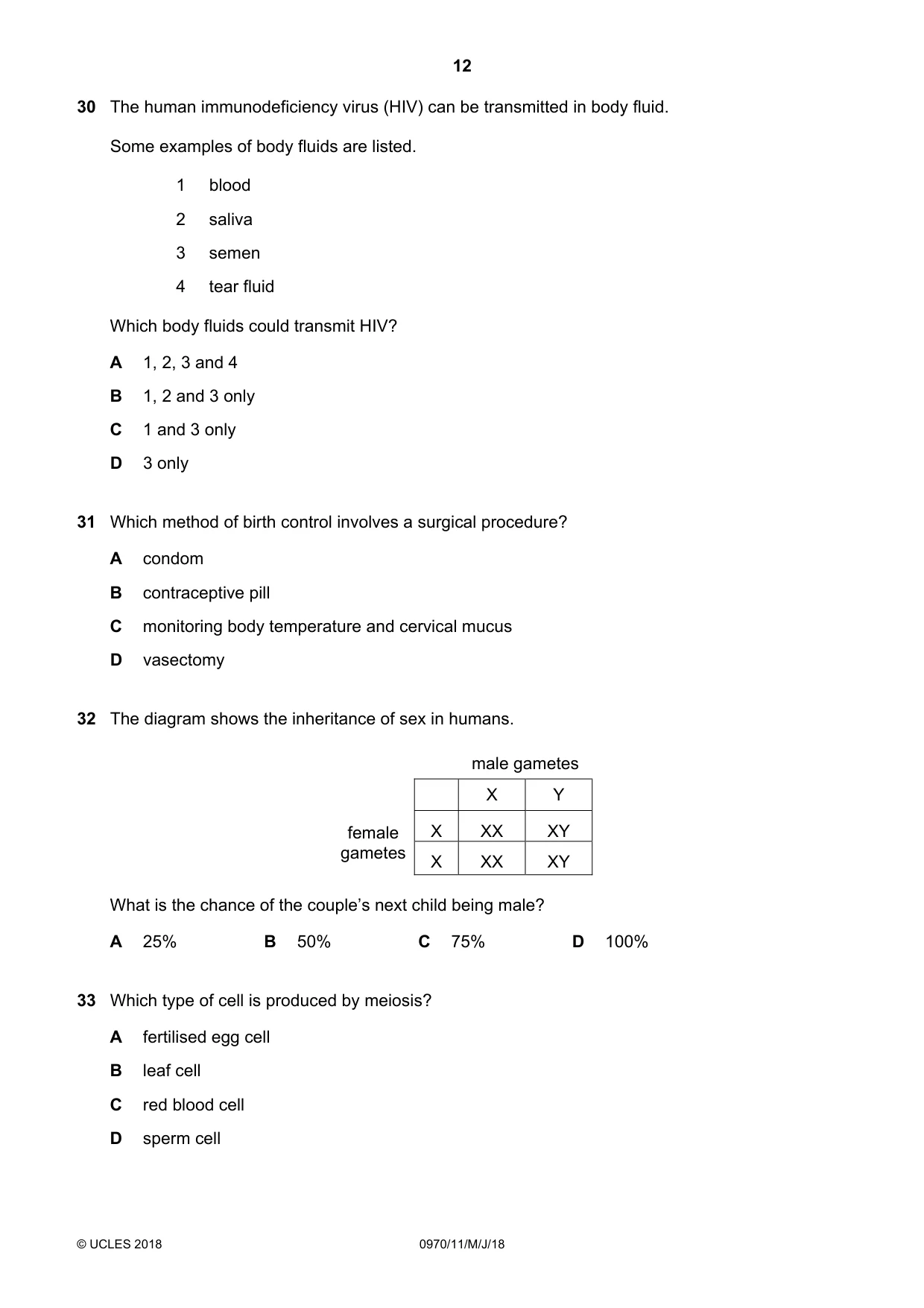
Q32 · The diagram shows the inheritance of sex in humans
32 The diagram shows the inheritance of sex in humans. male gametes X Y female X XX XY gametes X XX XY What is the chance of the couple’s next child being male? A 25% B 50% C 75% D 100%
Mark scheme: B
Q33 · Which type of cell is produced by meiosis?
33 Which type of cell is produced by meiosis? A fertilised egg cell B leaf cell C red blood cell D sperm cell
Mark scheme: D
Q34 · What will cause the rate of mutation to increase?
34 What will cause the rate of mutation to increase? A increase in exposure to ionising radiation B increase in genetic variation in a population C increase in phenotypic variation in a population D increase in the rate of reproduction
Mark scheme: A
Q35 · A feature of some plants that live in dry places is that the leaves are reduced to spines
35 A feature of some plants that live in dry places is that the leaves are reduced to spines. What is an advantage of the leaves being reduced to spines? A decrease in photosynthesis B decrease in transpiration C increase in photosynthesis D increase in transpiration
Mark scheme: B
Q36 · Black truffle is a fungus that obtains nutrients from the roots of hazel trees
36 Black truffle is a fungus that obtains nutrients from the roots of hazel trees. Female pigs find and eat the fungi. What is the principal source of the energy for this food chain? A female pigs B hazel trees C soil D the Sun
Mark scheme: D
Q37 · The diagram shows a food chain
37 The diagram shows a food chain. apple tree → herbivorous insects → carnivorous insects → bird Which pyramid of numbers represents the food chain? A B C D
Mark scheme: B
Q38 · Some washing powders are called biological washing powders
38 Some washing powders are called biological washing powders. What is the reason for this? A They contain bacteria. B They contain enzymes. C They contain myriapods. D They contain viruses.
Mark scheme: B
Q39 · What is an example of genetic engineering?
39 What is an example of genetic engineering? A inserting a gene for human insulin production into bacteria B selective breeding to produce cattle with high milk yields C using herbicides to kill unwanted plants D using insecticides to kill insect pests
Mark scheme: A
Q40 · What is a negative impact to an ecosystem of large-scale monoculture?
40 What is a negative impact to an ecosystem of large-scale monoculture? A Crops need harvesting at the same time. B Monocultures produce less food. C Monocultures produce more food. D The genetic variation of organisms is reduced.
Mark scheme: D
What was in this paper
The subtopics covered by these 40 questions, and how many questions each got. Open one in a new tab to see every Cambridge question on it.
3Concept and uses of classification systems2Diffusion2Diseases and immunity2Sexual reproduction in humans2Adaptive features1Anaerobic respiration1Asexual reproduction1Biological molecules1Biotechnology1Blood1Cell structure1Characteristics of living organisms1Chromosomes, genes and proteins1Coordination and response1Drugs1Energy flow1Enzymes1Excretion in humans1Features of organisms1Food chains and food webs1Gas exchange in humans1Genetic modification1Habitat destruction1Heart1Homeostasis1Hormones1Meiosis1Monohybrid inheritance1Photosynthesis1Sexually transmitted infections1Transpiration1Water uptake1Xylem and phloem1What you needed in this session
Cambridge’s own grade thresholds for 2018 May/June, Paper 1 · Variant 1. A higher threshold means an easier paper — the bar moves with how the cohort did.