Cambridge IGCSE Biology (9-1) 0970 — 2024 May/June Paper 1 · Variant 2
0970/12/M/J/24 · 40 questions · 40 marks · ≈45 min
The question paper and its mark scheme, free to read here and free to download. This is Cambridge’s own paper, exactly as it was sat.
Question paper20 pages



Mark scheme3 pages
Answers below. Sit the paper first if you are practising.
Questions as text
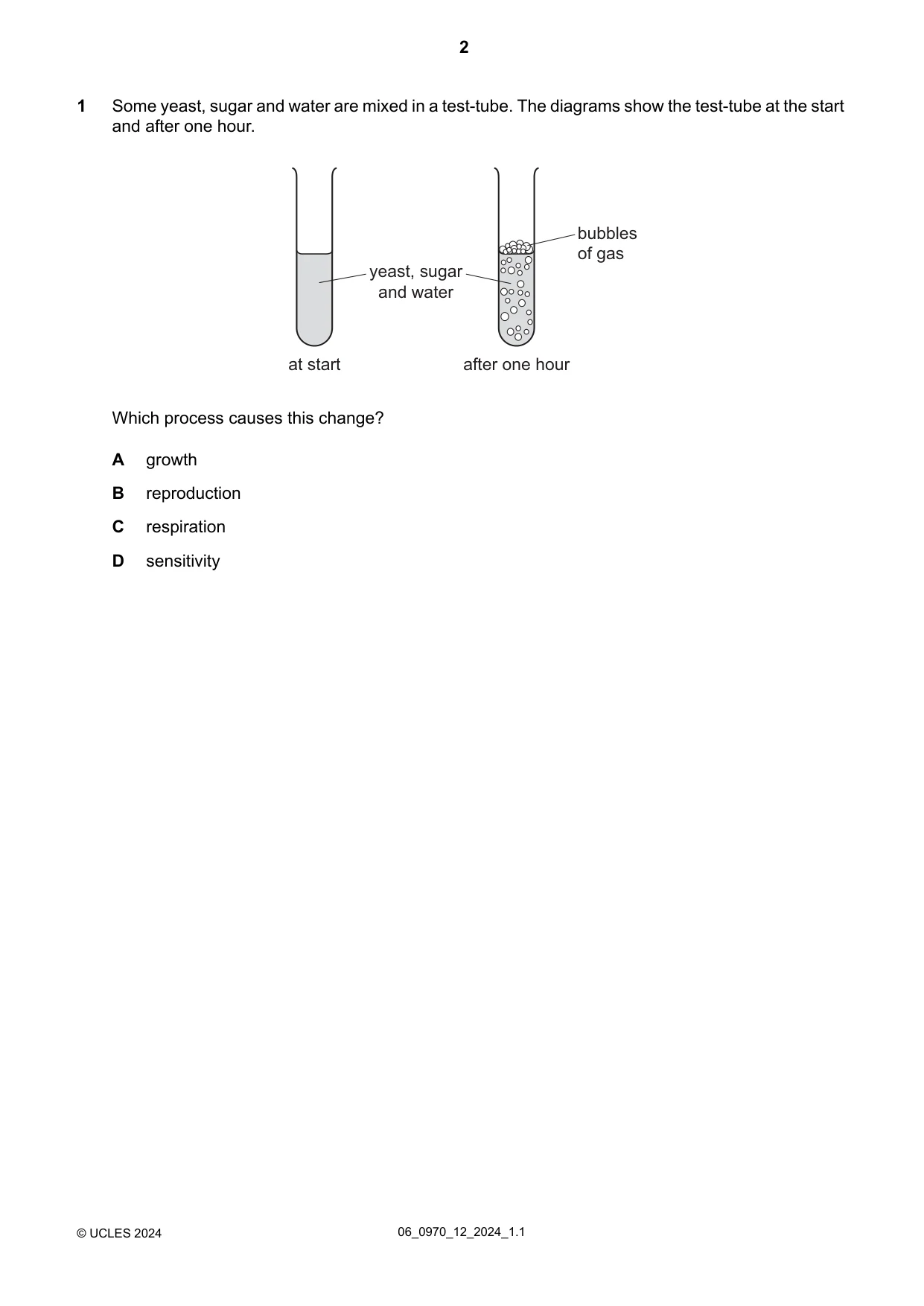
Q1 · Some yeast, sugar and water are mixed in a test-tube
1 Some yeast, sugar and water are mixed in a test-tube. The diagrams show the test-tube at the start and after one hour. bubbles of gas yeast, sugar and water at start after one hour Which process causes this change? A growth B reproduction C respiration D sensitivity
Mark scheme: C
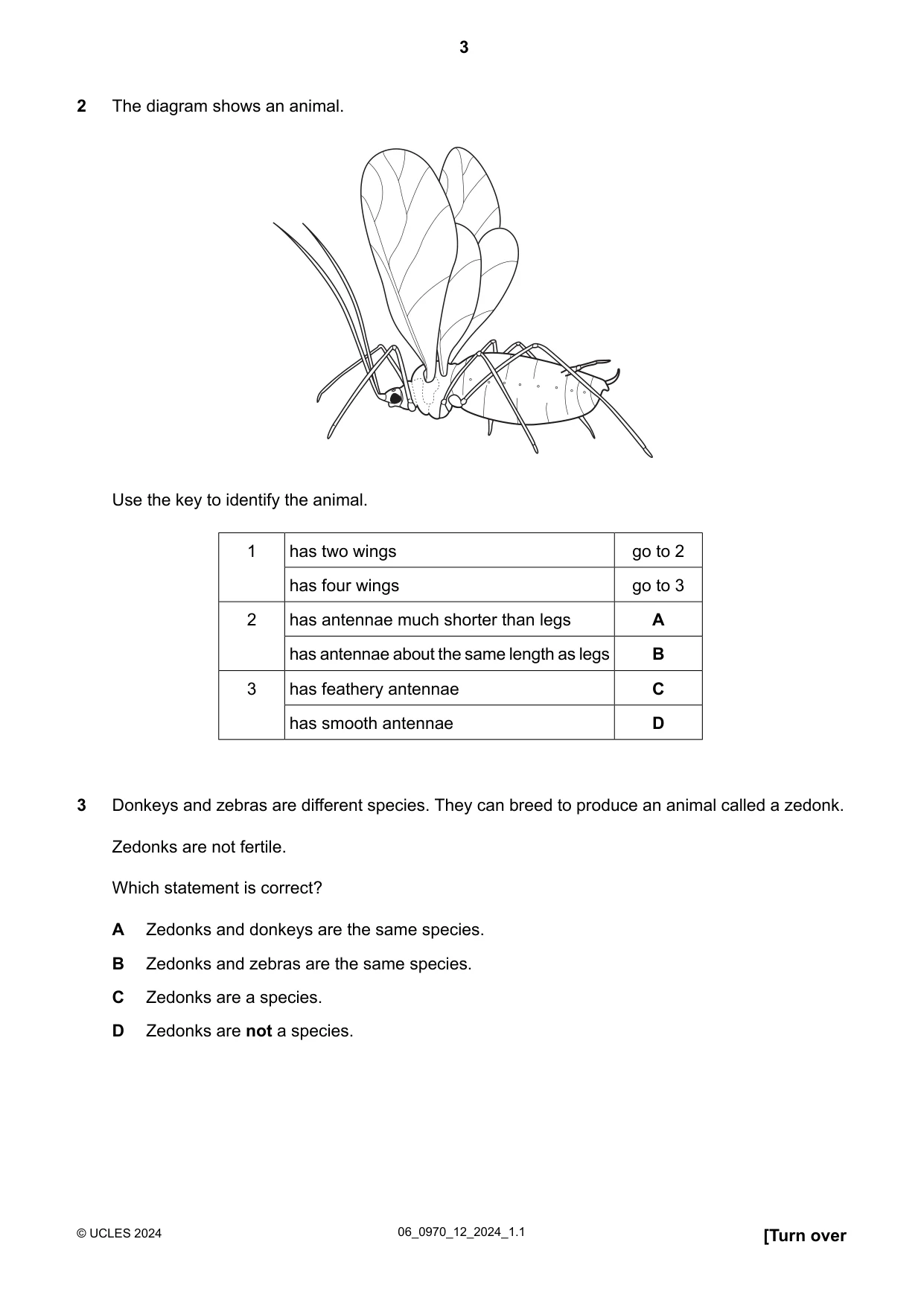
Q2 · The diagram shows an animal
2 The diagram shows an animal. Use the key to identify the animal. 1 has two wings go to 2 has four wings go to 3 2 has antennae much shorter than legs A has antennae about the same length as legs B 3 has feathery antennae C has smooth antennae D
Mark scheme: D
More questions on Concept and uses of classification systems
Q3 · Donkeys and zebras are different species
3 Donkeys and zebras are different species. They can breed to produce an animal called a zedonk. Zedonks are not fertile. Which statement is correct? A Zedonks and donkeys are the same species. B Zedonks and zebras are the same species. C Zedonks are a species. D Zedonks are not a species.
Mark scheme: D
Q4 · Crabs are arthropods with 10 jointed legs and two pairs of antennae
4 Crabs are arthropods with 10 jointed legs and two pairs of antennae. To which arthropod class do they belong? A arachnids B crustaceans C insects D myriapods
Mark scheme: B
Q5 · Heart muscle cells have a high rate of metabolism
5 Heart muscle cells have a high rate of metabolism. Which structure do they require to be present in high numbers? A chloroplasts B mitochondria C cell walls D vacuoles
Mark scheme: B
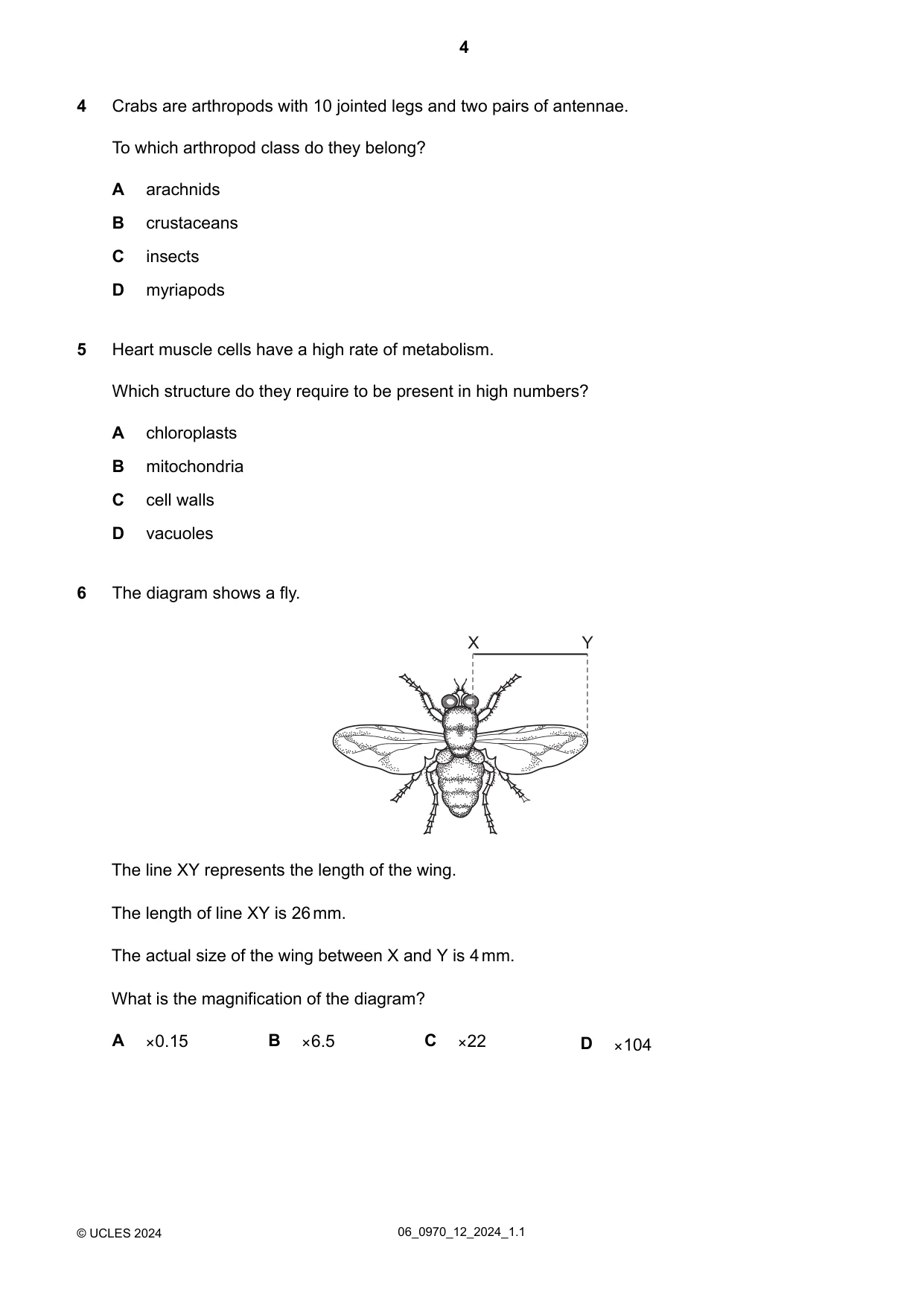
Q6 · The diagram shows a fly
6 The diagram shows a fly. X Y The line XY represents the length of the wing. The length of line XY is 26 mm. The actual size of the wing between X and Y is 4 mm. What is the magnification of the diagram? A ×0.15 B ×6.5 C ×22 D ×104
Mark scheme: B
Q7 · What is an example of diffusion?
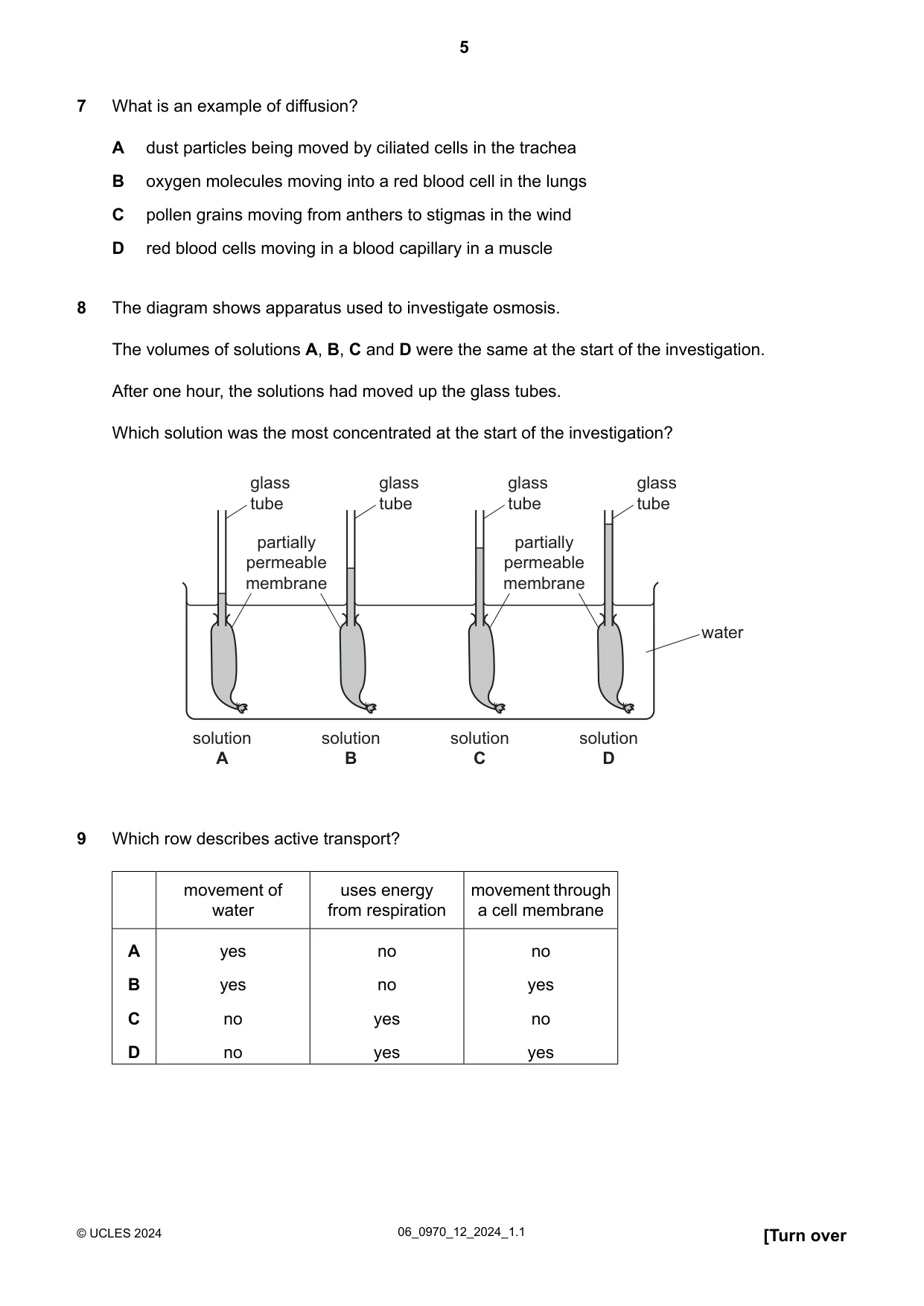
7 What is an example of diffusion? A dust particles being moved by ciliated cells in the trachea B oxygen molecules moving into a red blood cell in the lungs C pollen grains moving from anthers to stigmas in the wind D red blood cells moving in a blood capillary in a muscle
Mark scheme: B
Q8 · The diagram shows apparatus used to investigate osmosis
8 The diagram shows apparatus used to investigate osmosis. The volumes of solutions A, B, C and D were the same at the start of the investigation. After one hour, the solutions had moved up the glass tubes. Which solution was the most concentrated at the start of the investigation? glass glass glass glass tube tube tube tube partially partially permeable permeable membrane membrane water solution solution solution solution A B C D
Mark scheme: D
Q9 · Which row describes active transport?
9 Which row describes active transport? movement of uses energy movement through water from respiration a cell membrane A yes no no B yes no yes C no yes no D no yes yes
Mark scheme: D
Q10 · Iodine solution is added to a food sample that contains starch
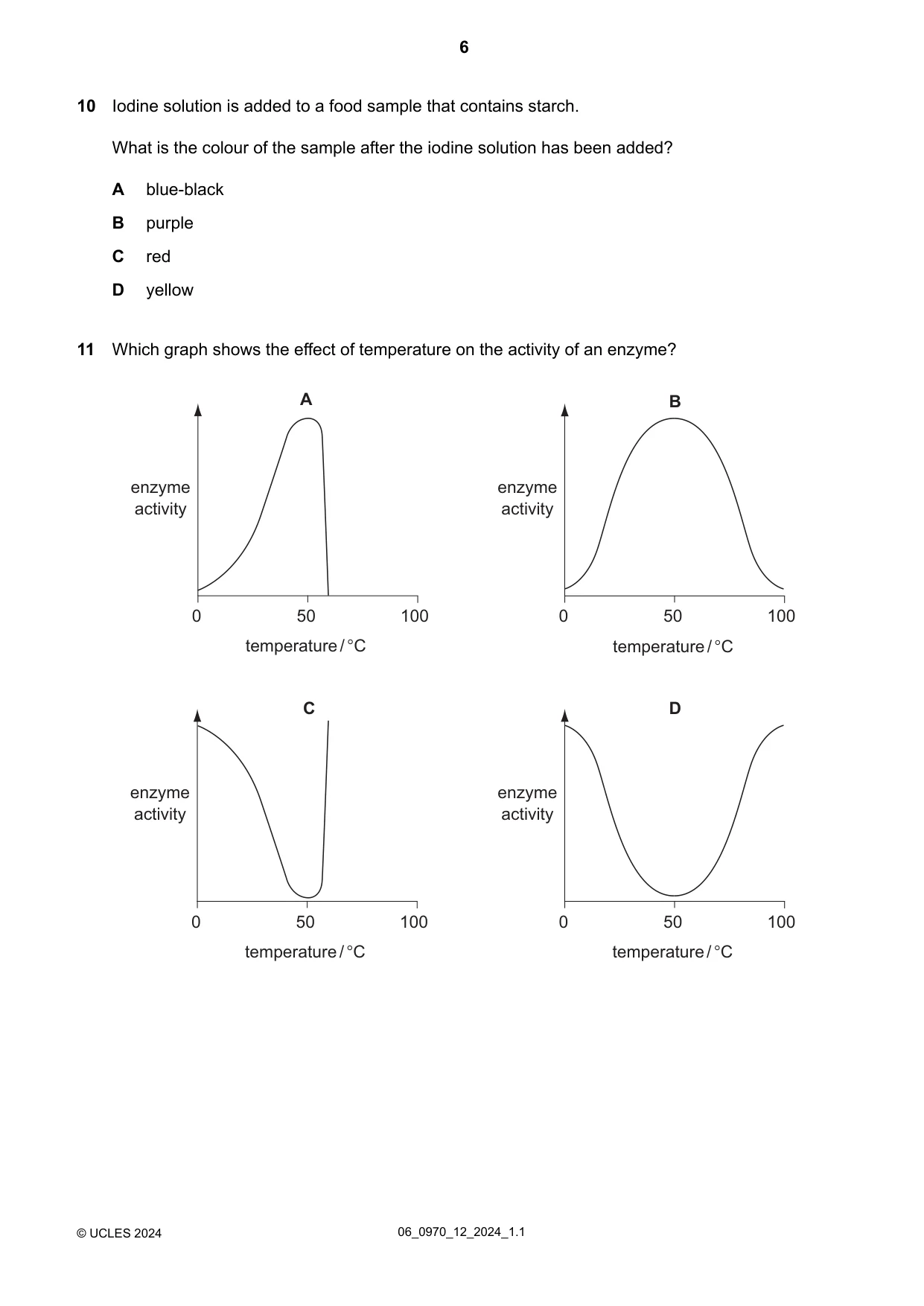
10 Iodine solution is added to a food sample that contains starch. What is the colour of the sample after the iodine solution has been added? A blue-black B purple C red D yellow
Mark scheme: A
Q11 · Which graph shows the effect of temperature on the activity of an enzyme?
11 Which graph shows the effect of temperature on the activity of an enzyme? A B enzyme enzyme activity activity 0 50 100 0 50 100 temperature / °C temperature / °C C D enzyme enzyme activity activity 0 50 100 0 50 100 temperature / °C temperature / °C
Mark scheme: A
Q12 · Which of these statements about enzymes are correct?
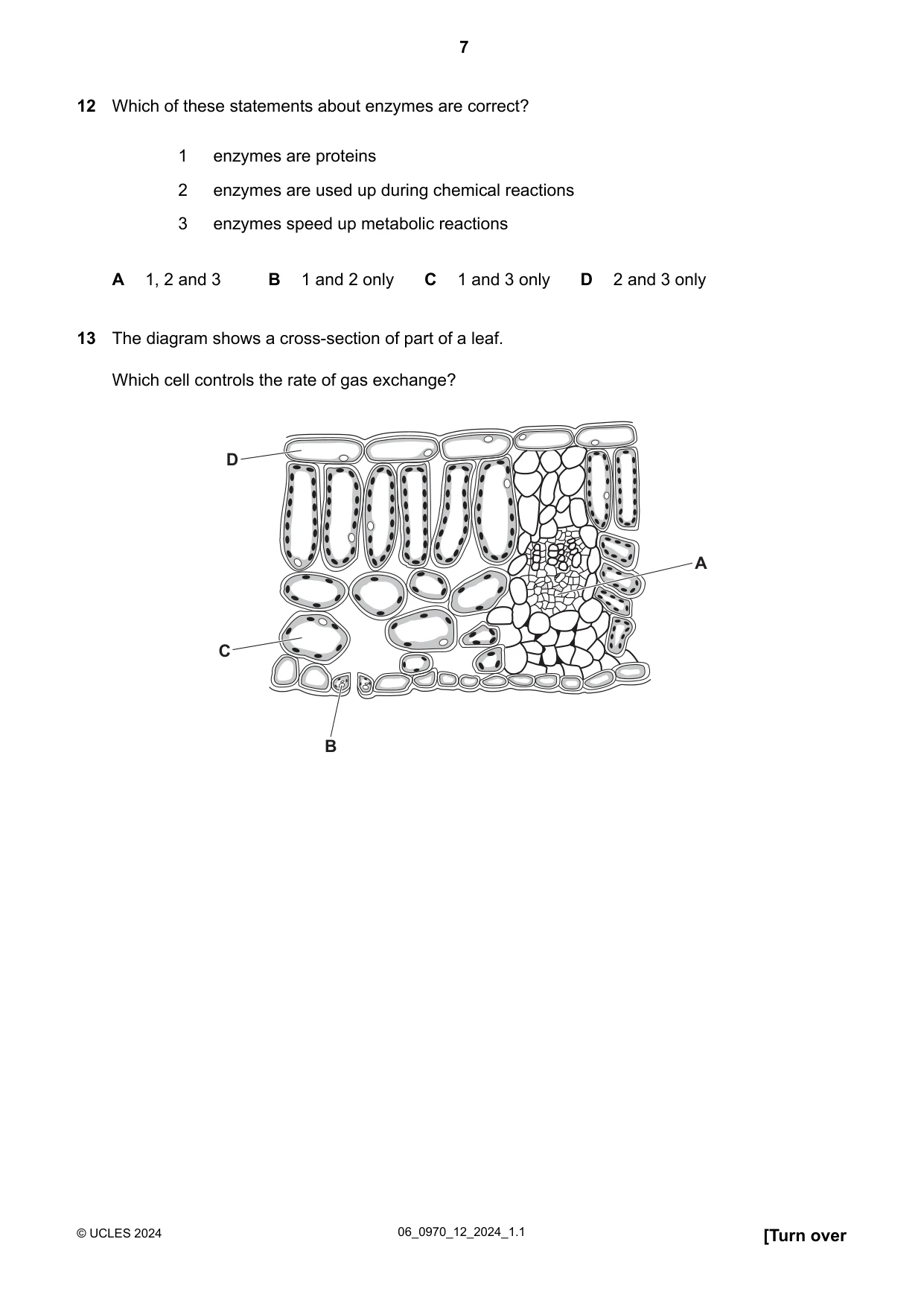
12 Which of these statements about enzymes are correct? 1 enzymes are proteins 2 enzymes are used up during chemical reactions 3 enzymes speed up metabolic reactions A 1, 2 and 3 B 1 and 2 only C 1 and 3 only D 2 and 3 only
Mark scheme: C
Q13 · The diagram shows a cross-section of part of a leaf
13 The diagram shows a cross-section of part of a leaf. Which cell controls the rate of gas exchange? D A C B
Mark scheme: B
Q14 · The diagram shows two cells
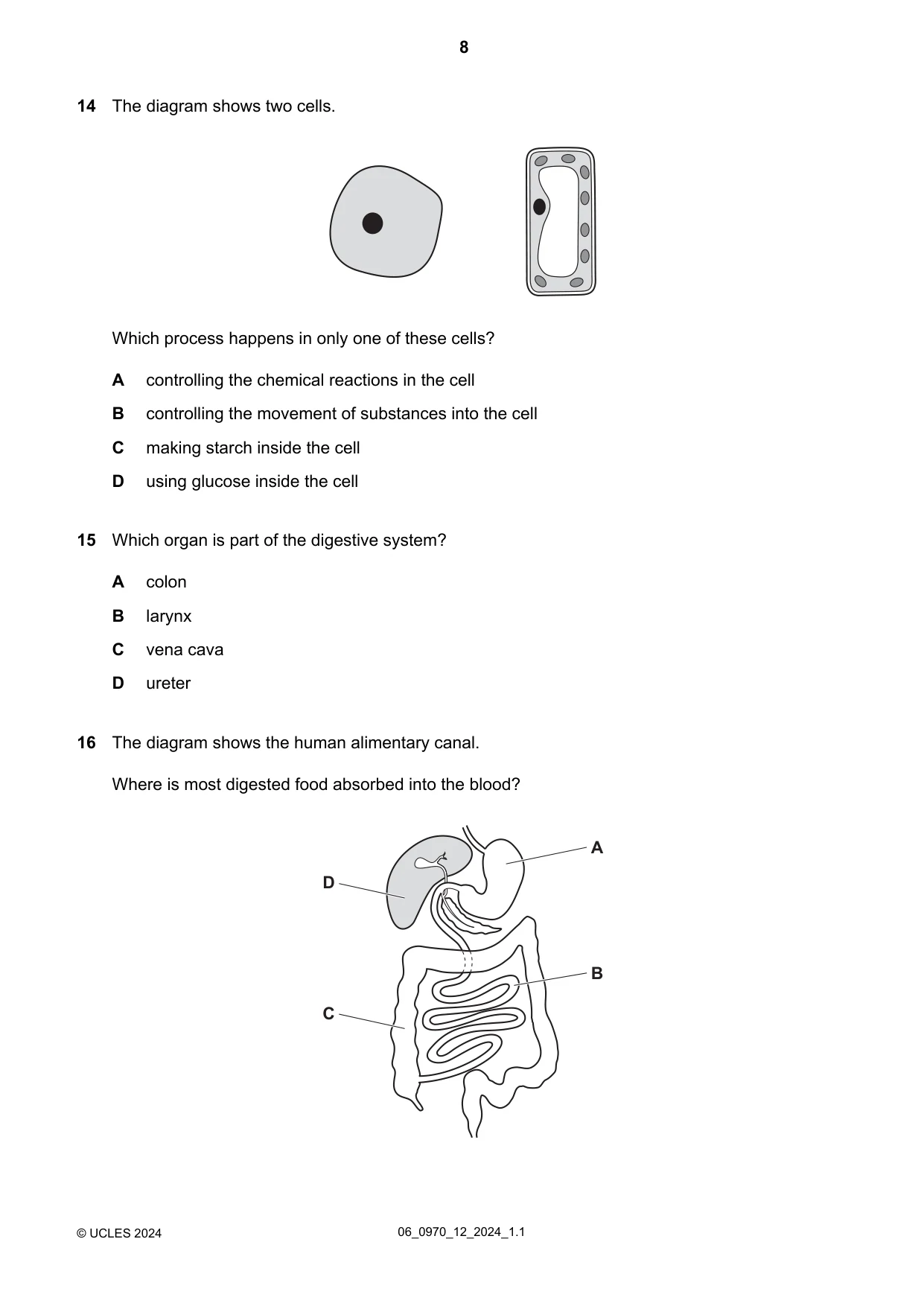
14 The diagram shows two cells. Which process happens in only one of these cells? A controlling the chemical reactions in the cell B controlling the movement of substances into the cell C making starch inside the cell D using glucose inside the cell
Mark scheme: C
Q15 · Which organ is part of the digestive system?
15 Which organ is part of the digestive system? A colon B larynx C vena cava D ureter
Mark scheme: A
Q16 · The diagram shows the human alimentary canal
16 The diagram shows the human alimentary canal. Where is most digested food absorbed into the blood? A D B C
Mark scheme: B
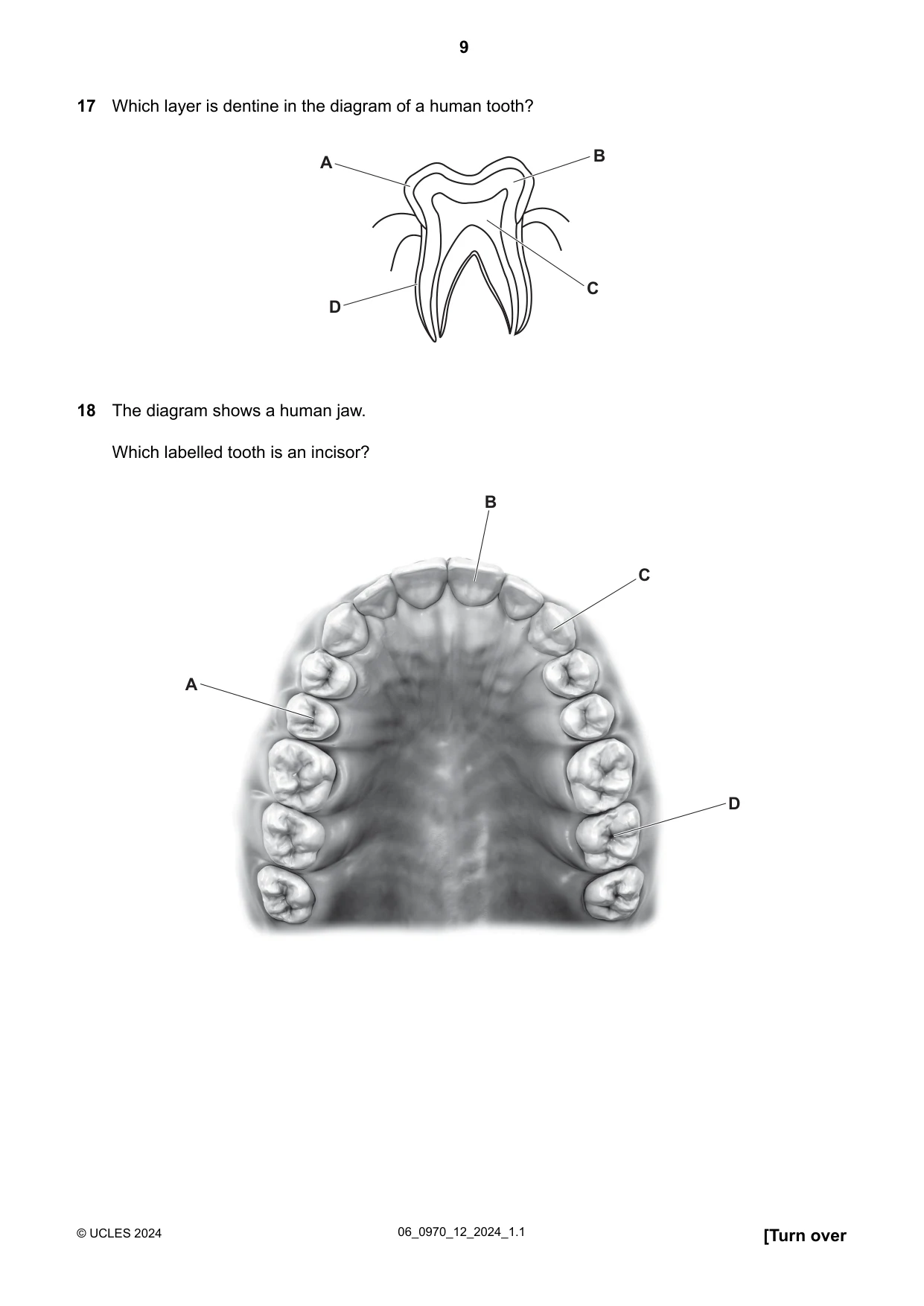
Q17 · Which layer is dentine in the diagram of a human tooth?
17 Which layer is dentine in the diagram of a human tooth? A B C D
Mark scheme: B
Q18 · The diagram shows a human jaw
18 The diagram shows a human jaw. Which labelled tooth is an incisor? B C A D
Mark scheme: B
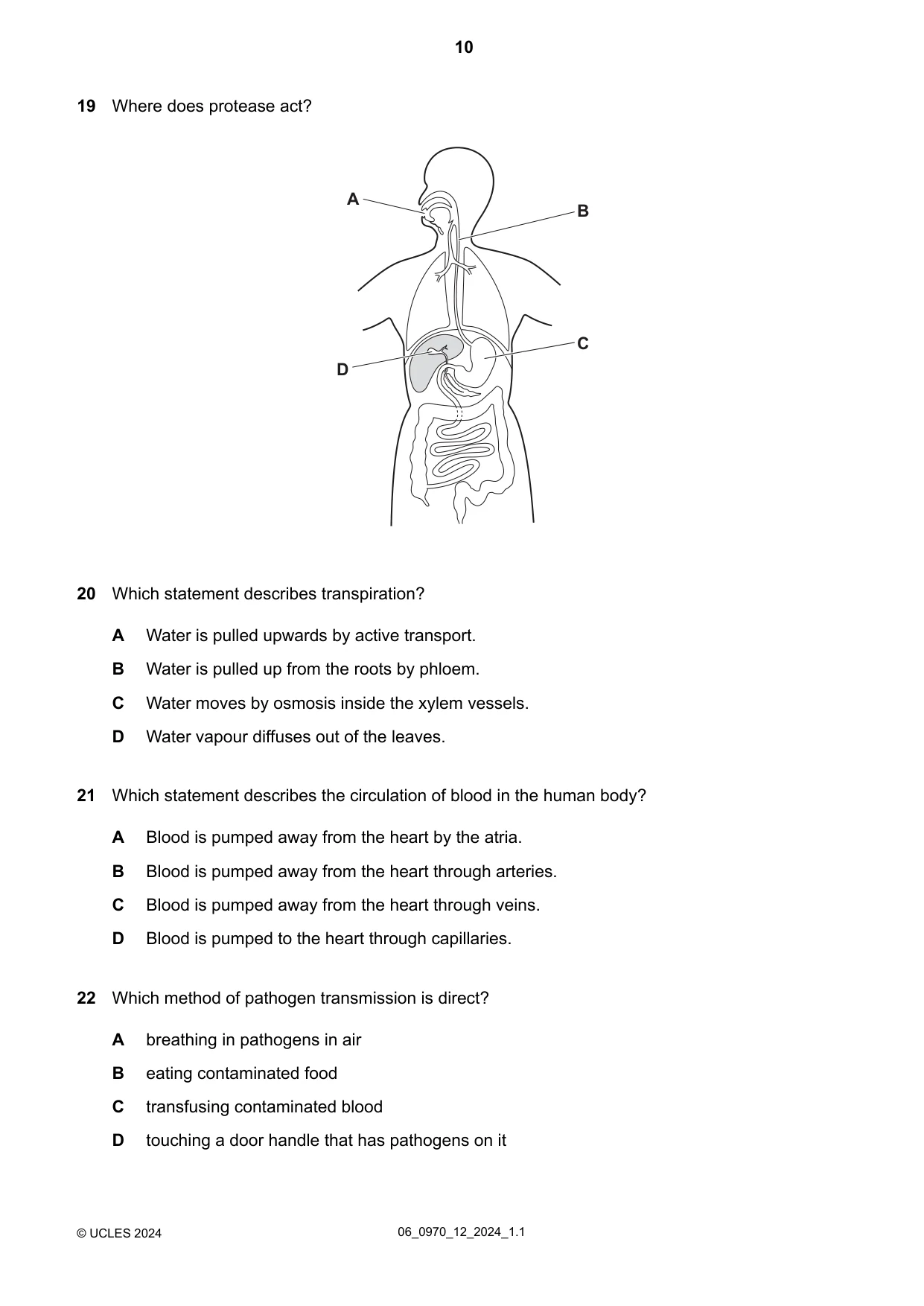
Q19 · Where does protease act?
19 Where does protease act? A B C D
Mark scheme: C
Q20 · Which statement describes transpiration?
20 Which statement describes transpiration? A Water is pulled upwards by active transport. B Water is pulled up from the roots by phloem. C Water moves by osmosis inside the xylem vessels. D Water vapour diffuses out of the leaves.
Mark scheme: D
Q21 · Which statement describes the circulation of blood in the human body?
21 Which statement describes the circulation of blood in the human body? A Blood is pumped away from the heart by the atria. B Blood is pumped away from the heart through arteries. C Blood is pumped away from the heart through veins. D Blood is pumped to the heart through capillaries.
Mark scheme: B
Q22 · Which method of pathogen transmission is direct?
22 Which method of pathogen transmission is direct? A breathing in pathogens in air B eating contaminated food C transfusing contaminated blood D touching a door handle that has pathogens on it
Mark scheme: C
Q23 · Which statement describes anaerobic respiration?
23 Which statement describes anaerobic respiration? A Anaerobic respiration in humans produces lactic acid and carbon dioxide. B Anaerobic respiration in yeast produces water and carbon dioxide. C Anaerobic respiration releases energy from glucose without using oxygen. D Anaerobic respiration releases more energy per glucose molecule than aerobic respiration.
Mark scheme: C
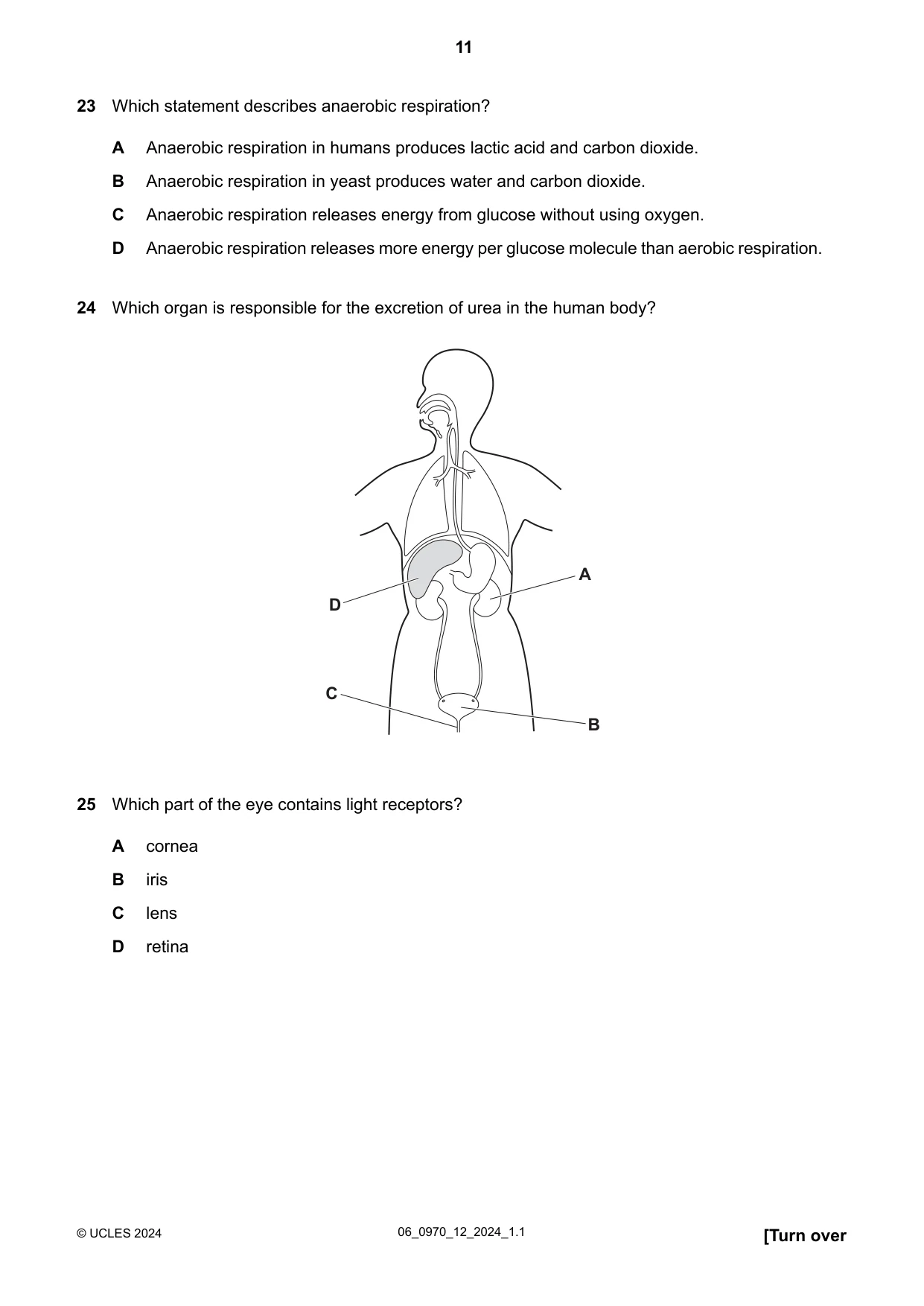
Q24 · Which organ is responsible for the excretion of urea in the human body?
24 Which organ is responsible for the excretion of urea in the human body? A D C B
Mark scheme: A
Q25 · Which part of the eye contains light receptors?
25 Which part of the eye contains light receptors? A cornea B iris C lens D retina
Mark scheme: D
Q26 · Which row shows the effects of adrenaline secretion?
26 Which row shows the effects of adrenaline secretion? pupil diameter heart rate A decreases decreases B decreases increases C increases decreases D increases increases
Mark scheme: D
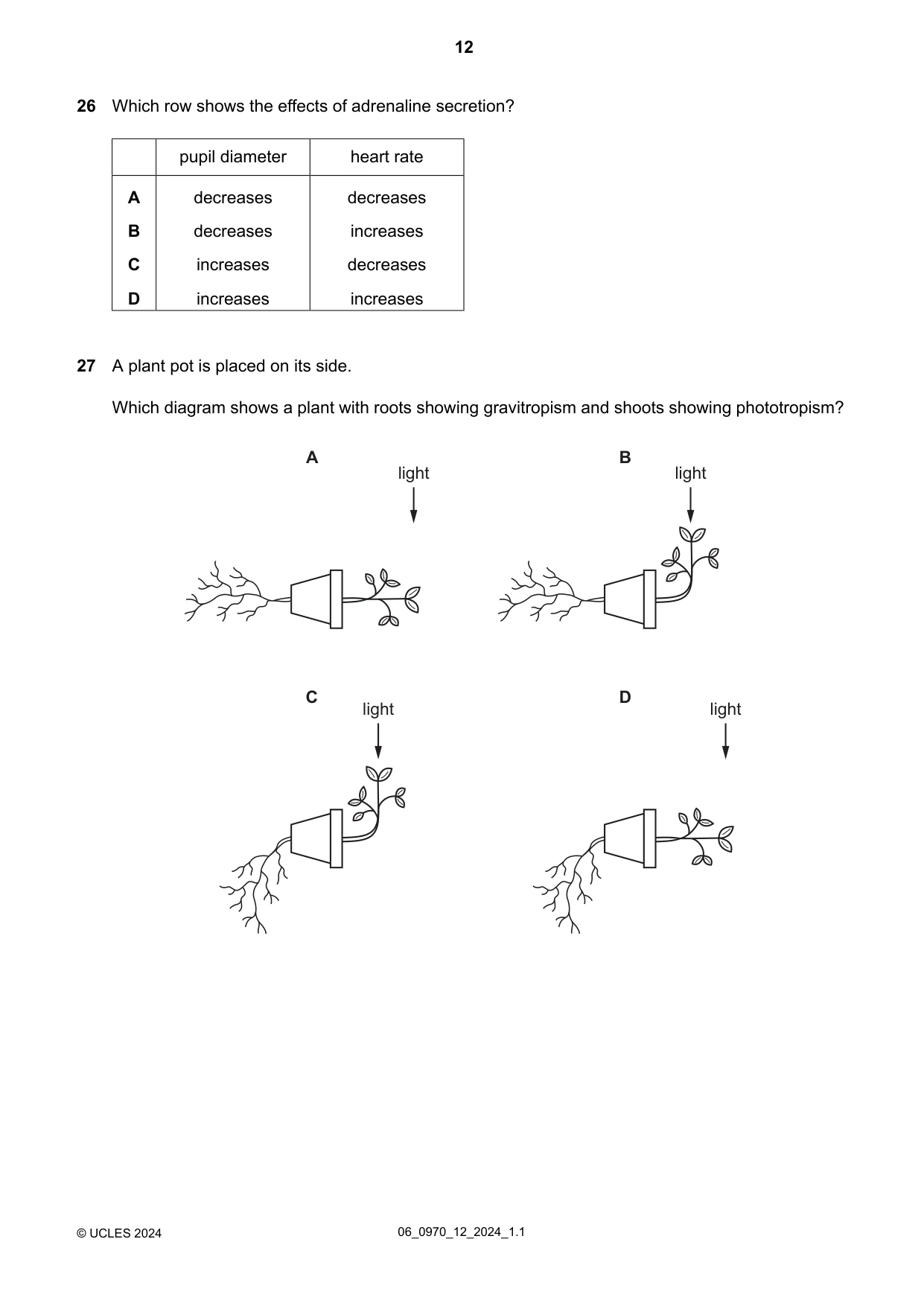
Q27 · A plant pot is placed on its side
27 A plant pot is placed on its side. Which diagram shows a plant with roots showing gravitropism and shoots showing phototropism? A B light light C D light light
Mark scheme: C
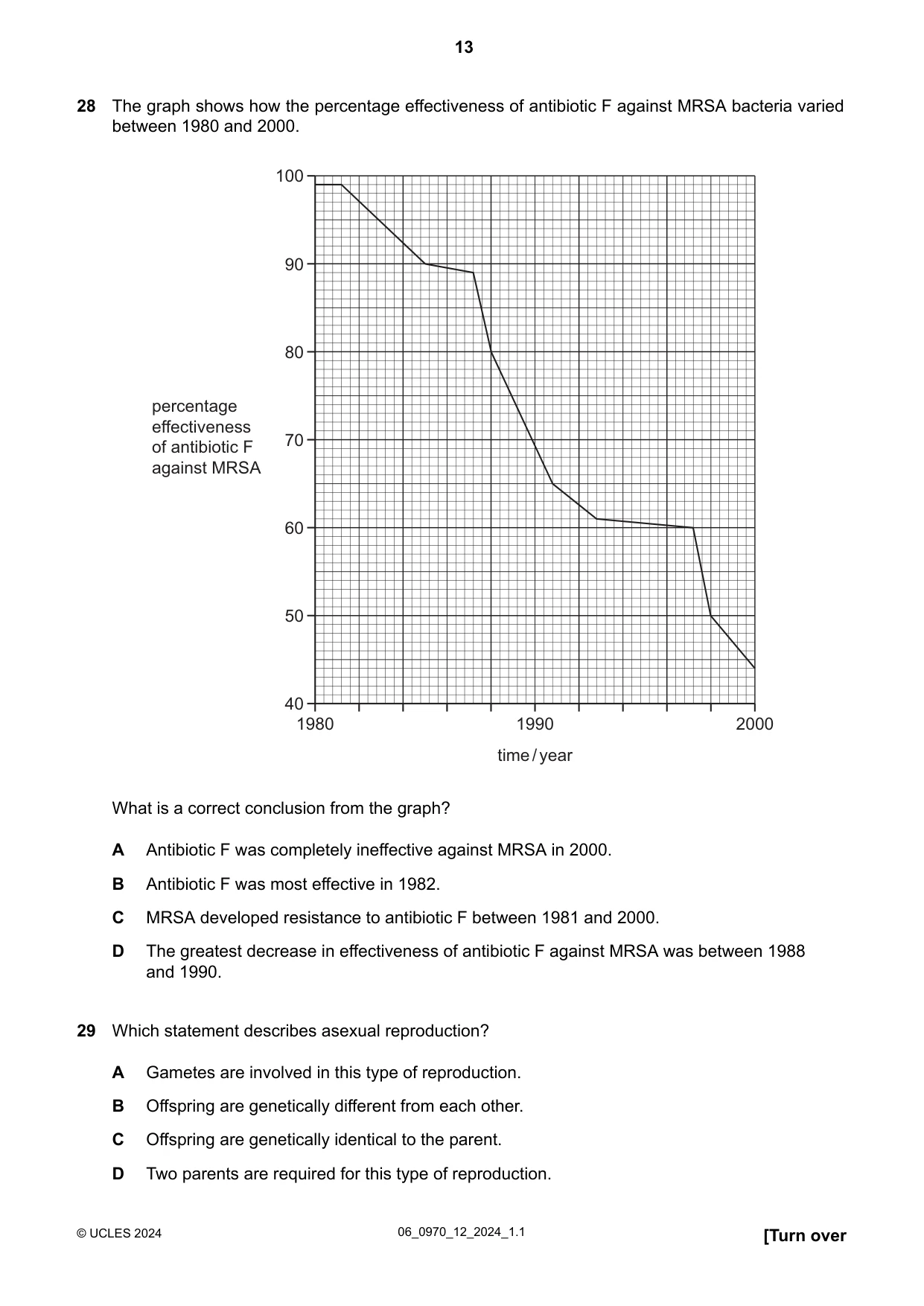
Q28 · The graph shows how the percentage effectiveness of antibiotic F against MRSA bacteria…
28 The graph shows how the percentage effectiveness of antibiotic F against MRSA bacteria varied between 1980 and 2000. 100 90 80 percentage effectiveness of antibiotic F 70 against MRSA 60 50 40 1980 1990 2000 time / year What is a correct conclusion from the graph? A Antibiotic F was completely ineffective against MRSA in 2000. B Antibiotic F was most effective in 1982. C MRSA developed resistance to antibiotic F between 1981 and 2000. D The greatest decrease in effectiveness of antibiotic F against MRSA was between 1988 and 1990.
Mark scheme: C
Q29 · Which statement describes asexual reproduction?
29 Which statement describes asexual reproduction? A Gametes are involved in this type of reproduction. B Offspring are genetically different from each other. C Offspring are genetically identical to the parent. D Two parents are required for this type of reproduction.
Mark scheme: C
Q30 · What is the function of the acrosome in a sperm cell?
30 What is the function of the acrosome in a sperm cell? A The acrosome contains enzymes that digest the jelly coat of an egg cell. B The acrosome is needed for the sperm cell to move. C The acrosome releases energy. D The acrosome stores genetic information.
Mark scheme: A
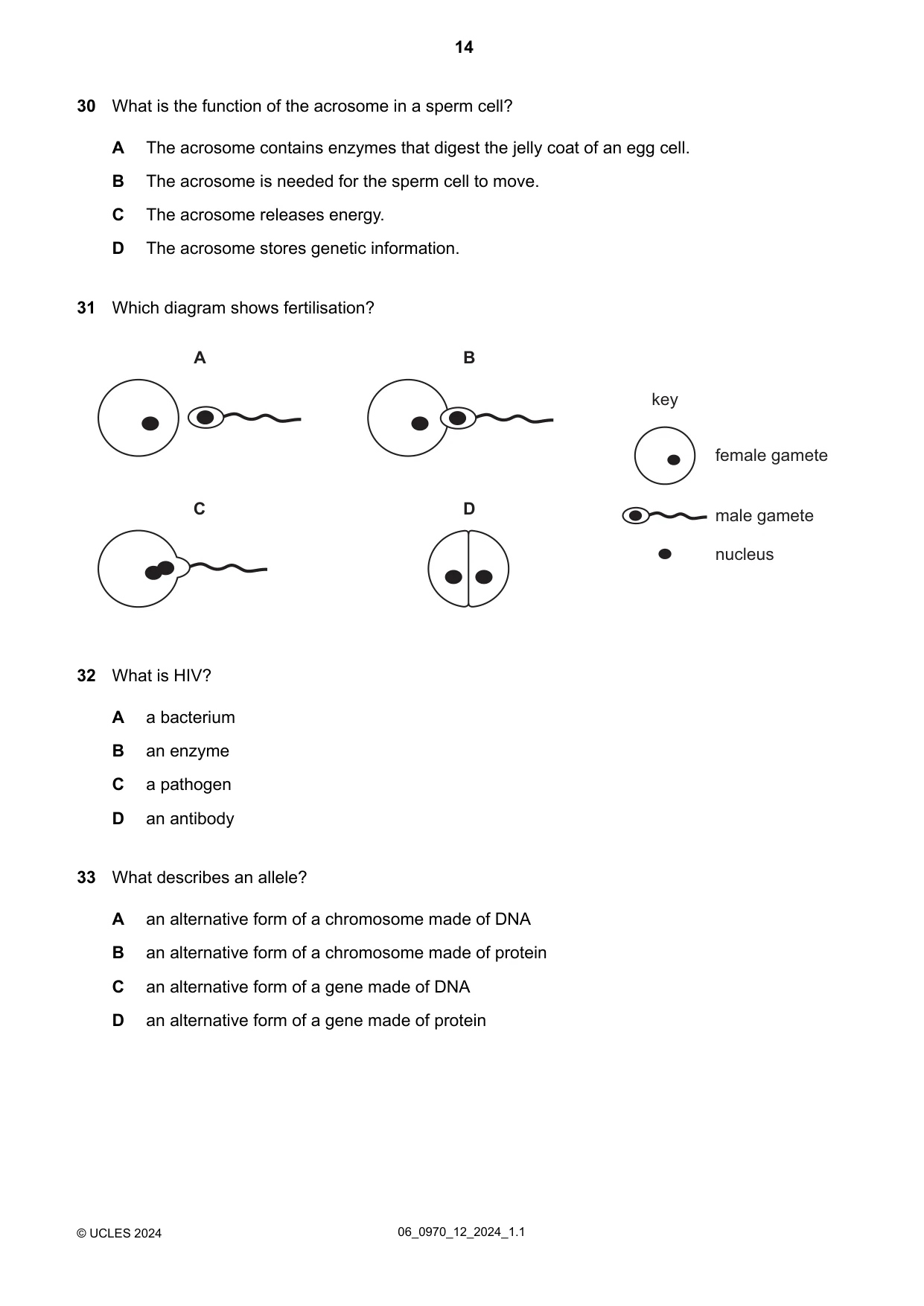
Q31 · Which diagram shows fertilisation?
31 Which diagram shows fertilisation? A B key female gamete C D male gamete nucleus
Mark scheme: C
Question 32
32 What is HIV? A a bacterium B an enzyme C a pathogen D an antibody
Mark scheme: C
Q33 · What describes an allele?
33 What describes an allele? A an alternative form of a chromosome made of DNA B an alternative form of a chromosome made of protein C an alternative form of a gene made of DNA D an alternative form of a gene made of protein
Mark scheme: C
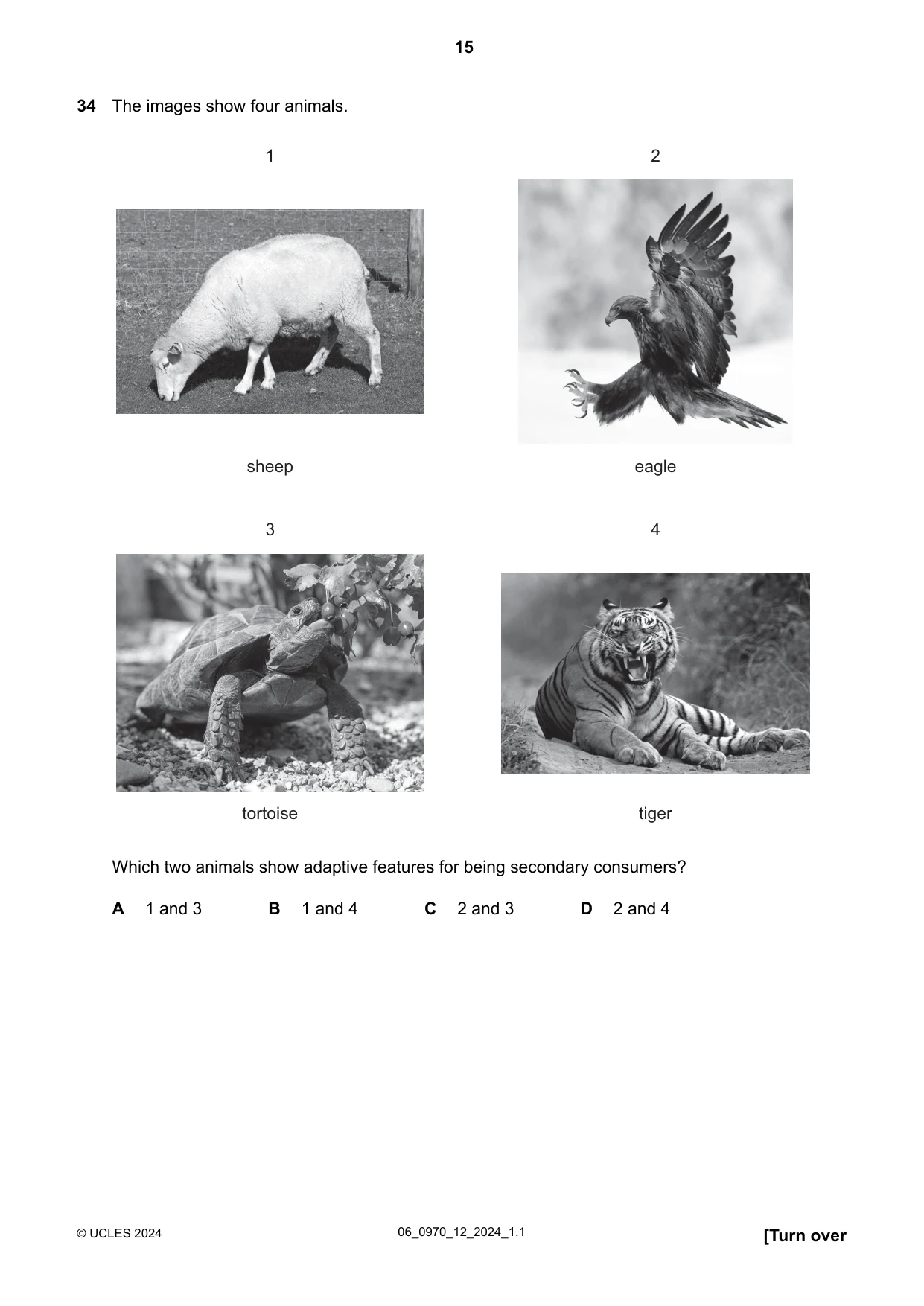
Q34 · The images show four animals
34 The images show four animals. 1 2 sheep eagle 3 4 tortoise tiger Which two animals show adaptive features for being secondary consumers? A 1 and 3 B 1 and 4 C 2 and 3 D 2 and 4
Mark scheme: D
Q35 · A gene is added to the genetic material of an avocado plant
35 A gene is added to the genetic material of an avocado plant. This gene makes the avocado fruits stay ripe for longer before they start to decompose. What is this process an example of? 1 adaptation 2 genetic modification 3 selective breeding A 1, 2 and 3 B 1 and 3 only C 2 only D 3 only
Mark scheme: C
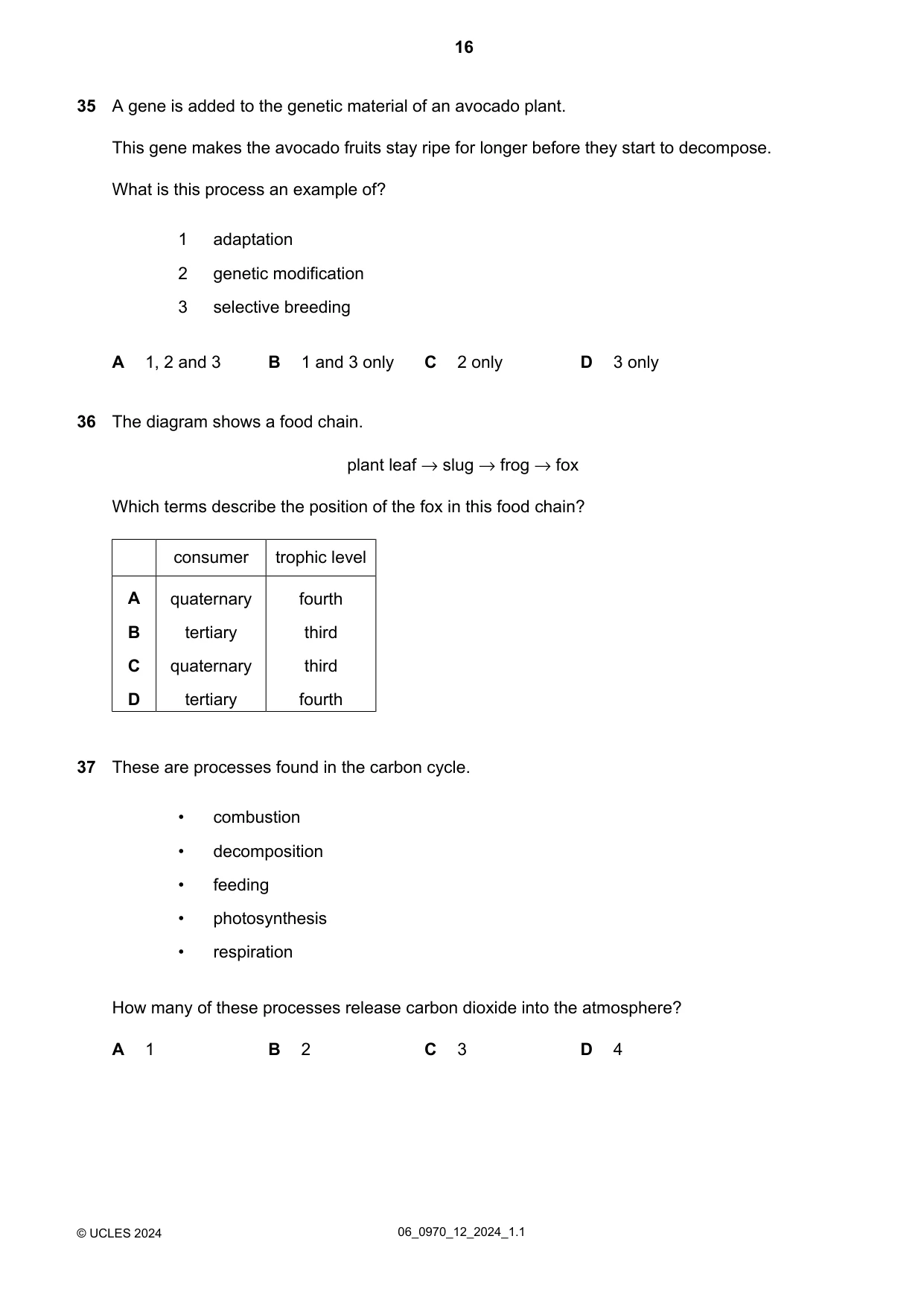
Q36 · The diagram shows a food chain
36 The diagram shows a food chain. plant leaf →slug →frog →fox Which terms describe the position of the fox in this food chain? consumer trophic level A quaternary fourth B tertiary third C quaternary third D tertiary fourth
Mark scheme: D
Q37 · These are processes found in the carbon cycle
37 These are processes found in the carbon cycle. • combustion • decomposition • feeding • photosynthesis • respiration How many of these processes release carbon dioxide into the atmosphere? A 1 B 2 C 3 D 4
Mark scheme: C
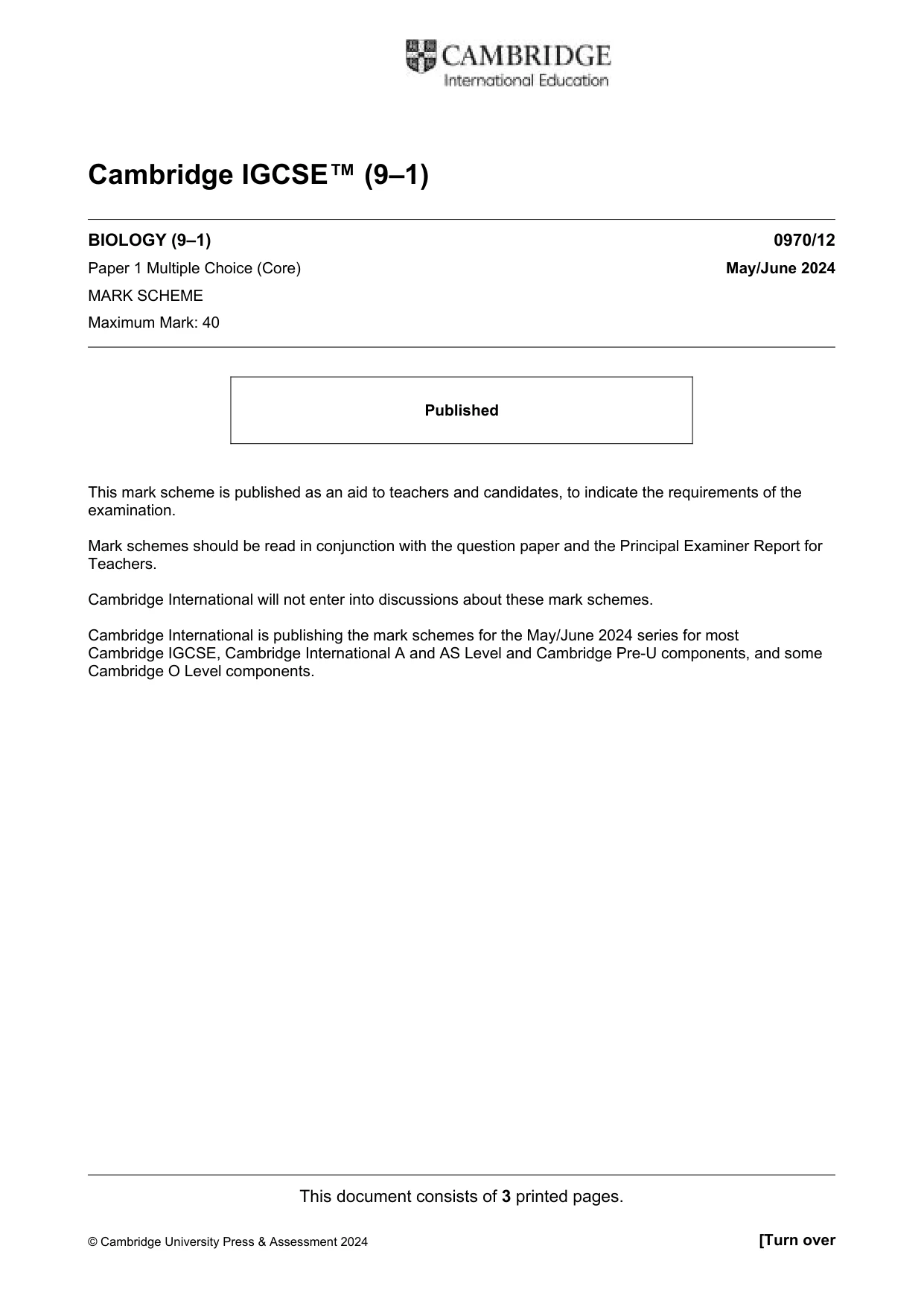
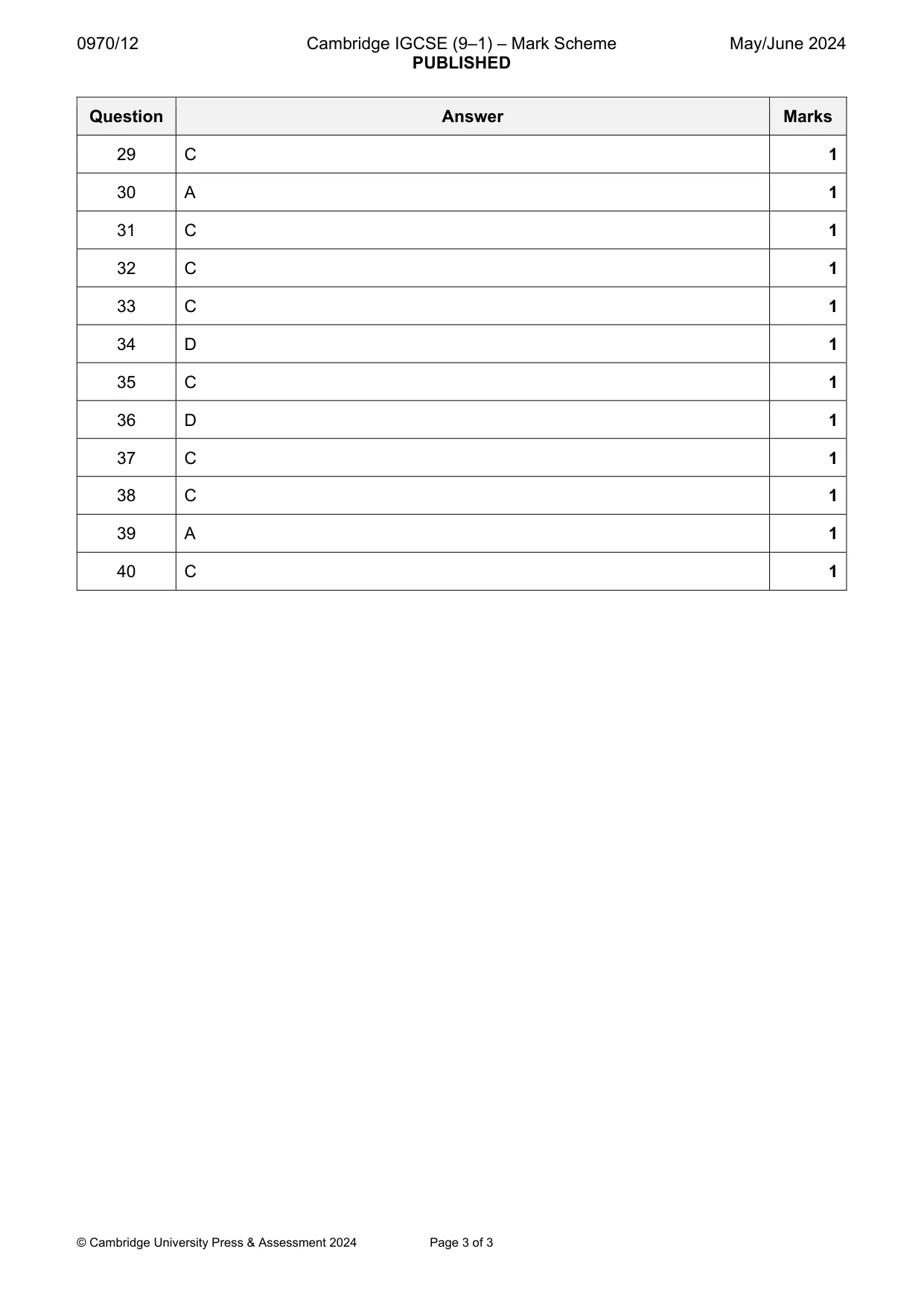
Q38 · Which change occurs when areas of forest are cleared for farming?
38 Which change occurs when areas of forest are cleared for farming? A decreased release of carbon dioxide into the atmosphere B increased biodiversity C increased loss of soil D increased release of oxygen into the atmosphere
Mark scheme: C
Q39 · What is a use of ethanol?
39 What is a use of ethanol? A biofuel production B biological washing powder C bread-making D fruit juice production
Mark scheme: A
Q40 · The diagram shows a label found on a container of biological washing powder
40 The diagram shows a label found on a container of biological washing powder. Biological washing powder • works at low temperatures • contains protease • contains lipase • keep out of reach of children Which stains does the washing powder remove? food stain food stain food stain food stain containing containing containing containing oil carbohydrates protein fat A ✓ ✓ ✗ ✗ key B ✓ ✗ ✗ ✓ ✓= yes C ✗ ✓ ✓ ✓ ✗= no D ✗ ✗ ✓ ✗
Mark scheme: C
What was in this paper
The subtopics covered by these 40 questions, and how many questions each got. Open one in a new tab to see every Cambridge question on it.
3Biotechnology2Cell structure2Diseases and immunity2Enzymes2Features of organisms2Sexual reproduction in humans2Absorption1Active transport1Adaptive features1Anaerobic respiration1Asexual reproduction1Biological molecules1Chemical digestion1Chromosomes, genes and proteins1Circulatory systems1Concept and uses of classification systems1Diffusion1Excretion in humans1Food chains and food webs1Genetic modification1Habitat destruction1Hormones1Leaf structure1Nutrient cycles1Osmosis1Respiration1Selection1Sense organs1Size of specimens1Transpiration1Tropic responses1What you needed in this session
Cambridge’s own grade thresholds for 2024 May/June, Paper 1 · Variant 2. A higher threshold means an easier paper — the bar moves with how the cohort did.