Cambridge IGCSE Biology (9-1) 0970 — 2022 May/June Paper 1 · Variant 2
0970/12/M/J/22 · 40 questions · 40 marks · ≈45 min
The question paper and its mark scheme, free to read here and free to download. This is Cambridge’s own paper, exactly as it was sat.
Question paper20 pages



Mark scheme3 pages
Answers below. Sit the paper first if you are practising.
Questions as text
Q1 · All living organisms release energy from nutrient molecules within their cells
1 All living organisms release energy from nutrient molecules within their cells. What is the name of this characteristic? A growth B nutrition C respiration D sensitivity
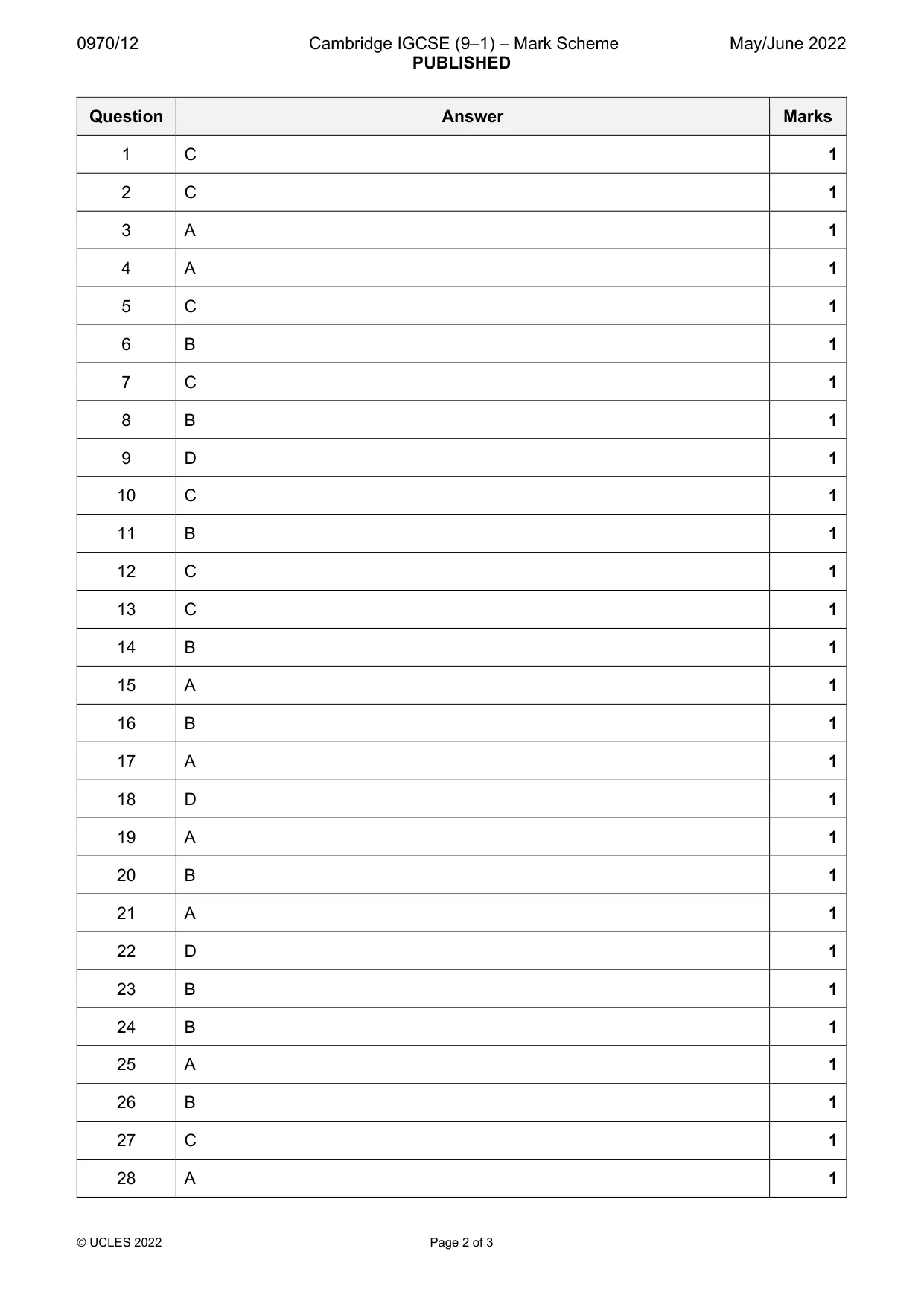
Mark scheme: C
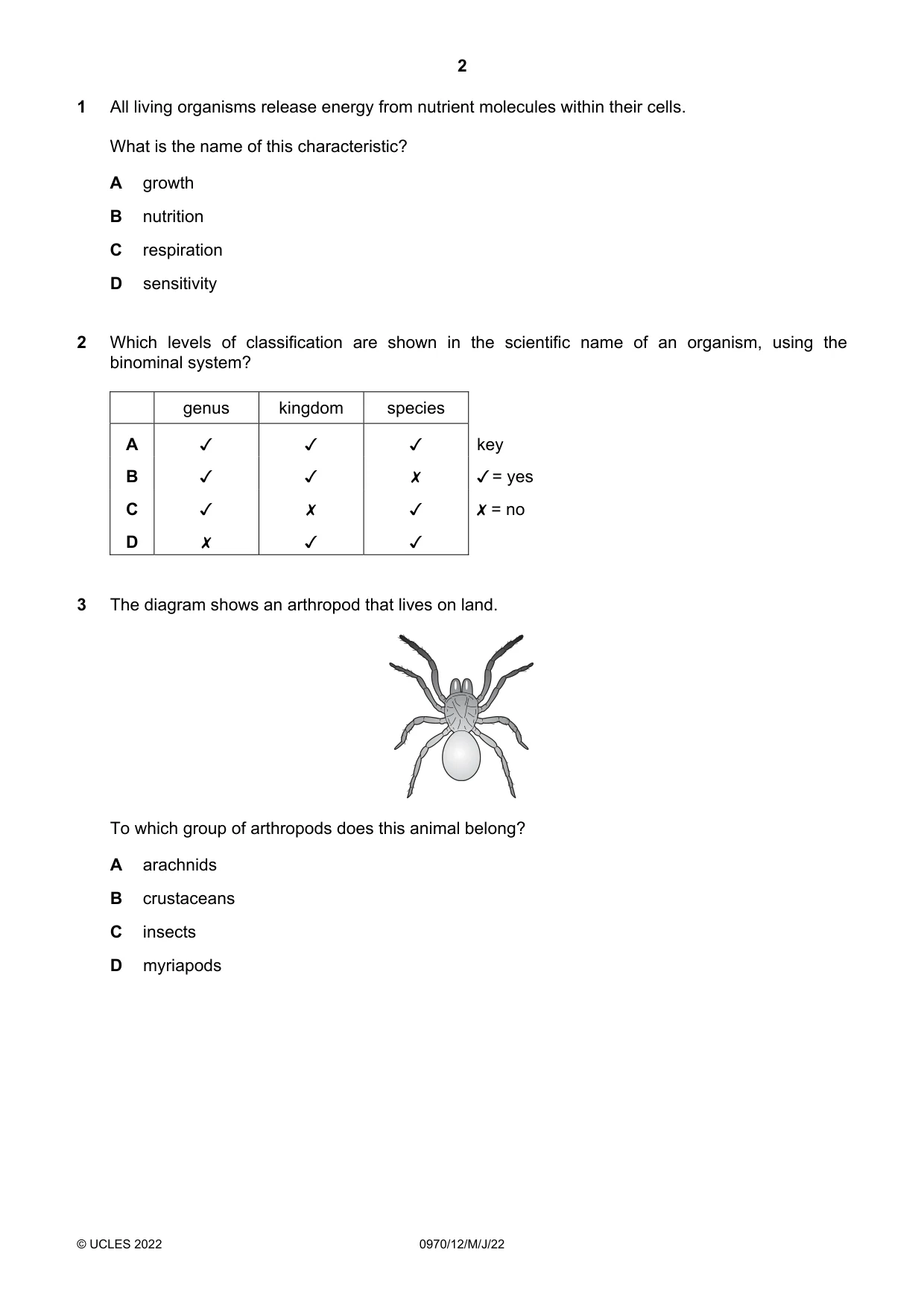
Q2 · Which levels of classification are shown in the scientific name of an organism, using the…
2 Which levels of classification are shown in the scientific name of an organism, using the binominal system? kingdom species x SOK v v x v v x v v key /=yes X=n0o
Mark scheme: C
More questions on Concept and uses of classification systems
Q3 · The diagram shows an arthropod that lives on land
3 The diagram shows an arthropod that lives on land. To which group of arthropods does this animal belong? A arachnids B crustaceans C insects D myriapods
Mark scheme: A
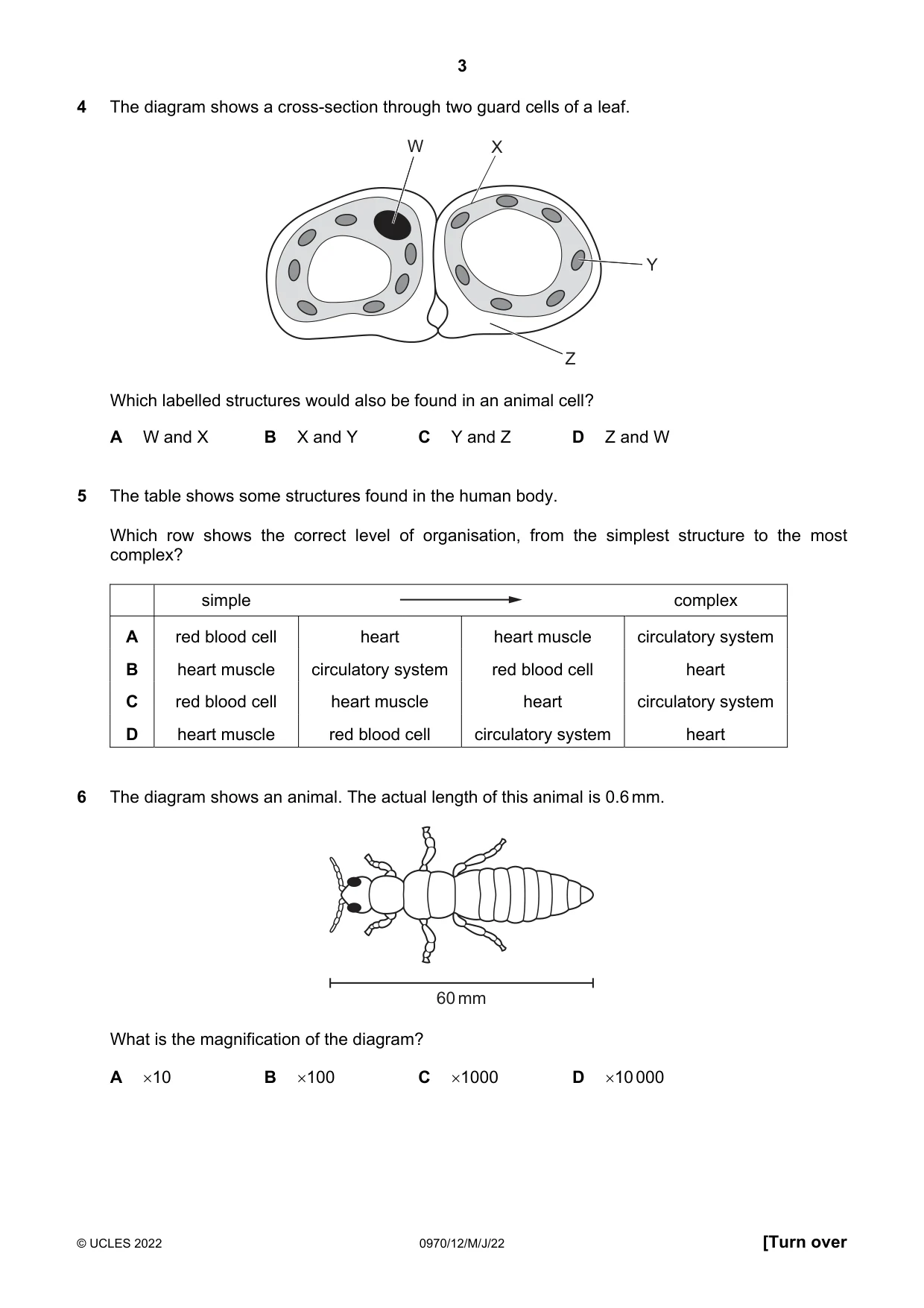
Q4 · The diagram shows a cross-section through two guard cells of a leaf
4 The diagram shows a cross-section through two guard cells of a leaf. W X Y Z Which labelled structures would also be found in an animal cell? A W and X B X and Y C Y and Z D Z and W
Mark scheme: A
Q5 · The table shows some structures found in the human body
5 The table shows some structures found in the human body. Which row shows the correct level of organisation, from the simplest structure to the most complex? simple complex A red blood cell heart heart muscle circulatory system B heart muscle circulatory system red blood cell heart C red blood cell heart muscle heart circulatory system D heart muscle red blood cell circulatory system heart
Mark scheme: C
Q6 · The diagram shows an animal
6 The diagram shows an animal. The actual length of this animal is 0.6 mm. 60 mm What is the magnification of the diagram? A 10 B 100 C 1000 D 10 000
Mark scheme: B
Q7 · By which process does oxygen move from a region of higher concentration in the alveoli to…
7 By which process does oxygen move from a region of higher concentration in the alveoli to a region of lower concentration in the blood? A osmosis B breathing C diffusion D active transport
Mark scheme: C
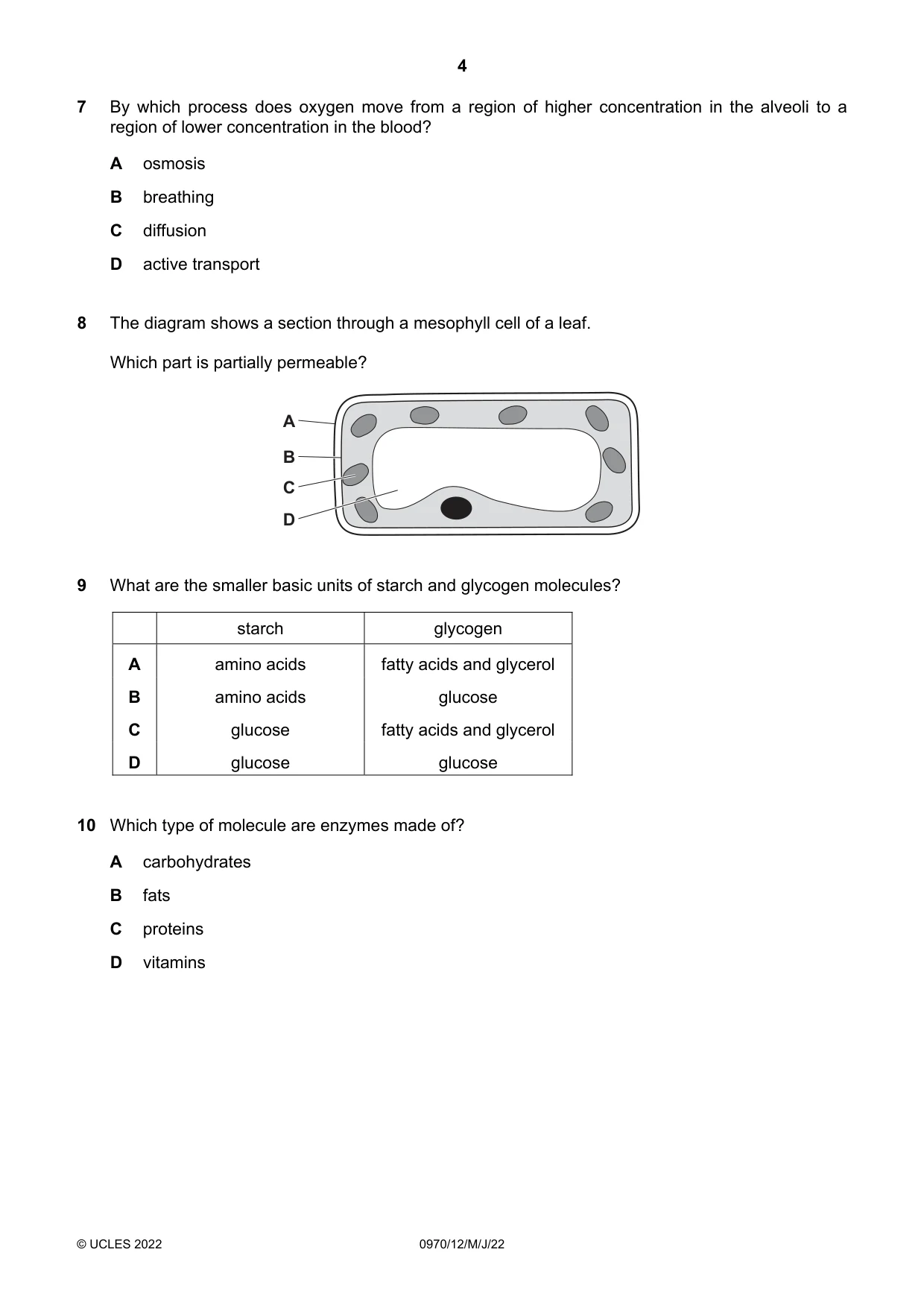
Q8 · The diagram shows a section through a mesophyll cell of a leaf
8 The diagram shows a section through a mesophyll cell of a leaf. Which part is partially permeable? A B C D
Mark scheme: B
Q9 · What are the smaller basic units of starch and glycogen molecules?
9 What are the smaller basic units of starch and glycogen molecules? starch glycogen A amino acids fatty acids and glycerol B amino acids glucose C glucose fatty acids and glycerol D glucose glucose
Mark scheme: D
Q10 · Which type of molecule are enzymes made of?
10 Which type of molecule are enzymes made of? A carbohydrates B fats C proteins D vitamins
Mark scheme: C
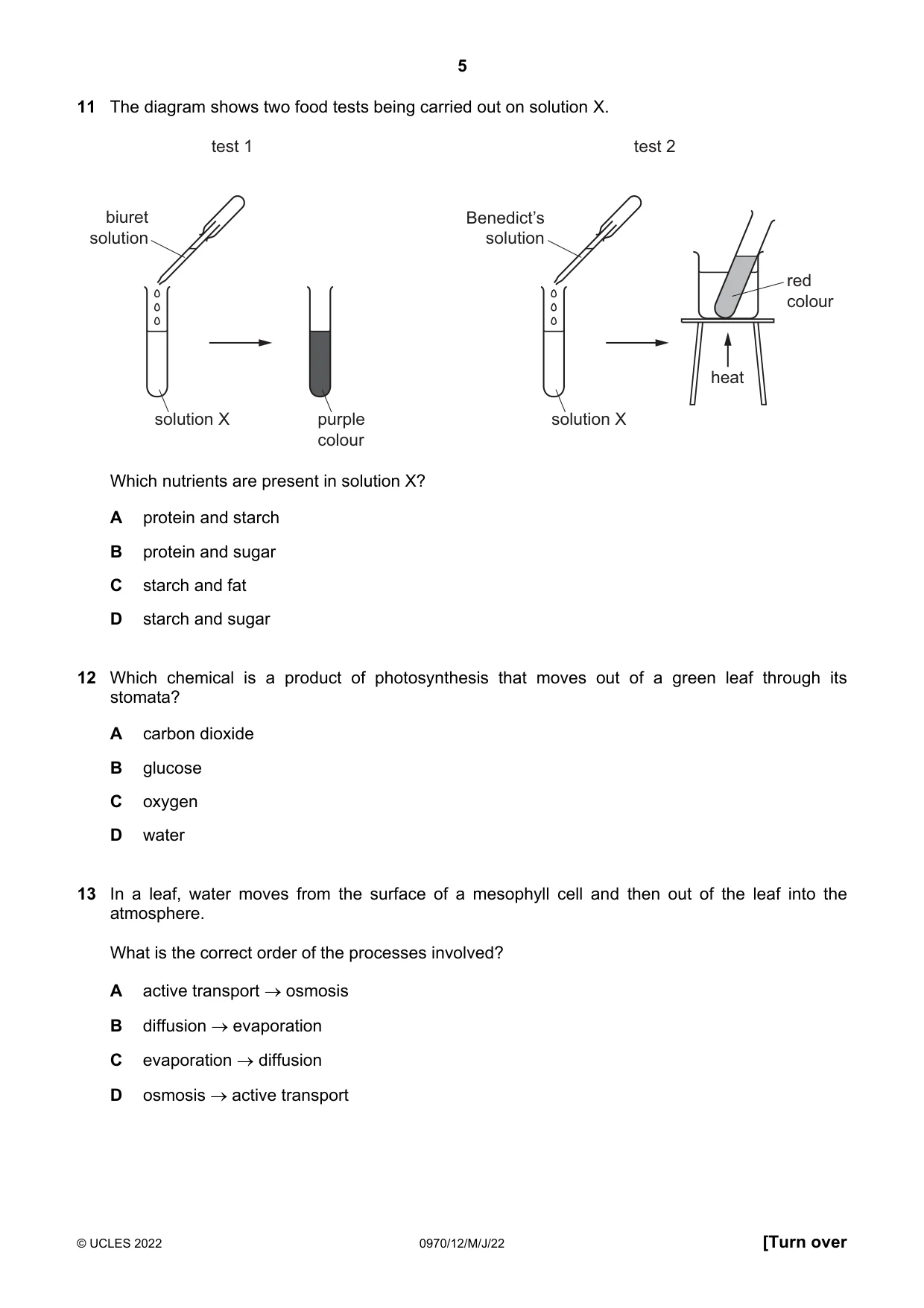
Q11 · The diagram shows two food tests being carried out on solution X
11 The diagram shows two food tests being carried out on solution X. test 1 test 2 biuret Benedict’s solution solution red colour heat solution X purple solution X colour Which nutrients are present in solution X? A protein and starch B protein and sugar C starch and fat D starch and sugar
Mark scheme: B
Q12 · Which chemical is a product of photosynthesis that moves out of a green leaf through its…
12 Which chemical is a product of photosynthesis that moves out of a green leaf through its stomata? A carbon dioxide B glucose C oxygen D water
Mark scheme: C
Q13 · In a leaf, water moves from the surface of a mesophyll cell and then out of the leaf into…
13 In a leaf, water moves from the surface of a mesophyll cell and then out of the leaf into the atmosphere. What is the correct order of the processes involved? A active transport osmosis B diffusion evaporation C evaporation diffusion D osmosis active transport
Mark scheme: C
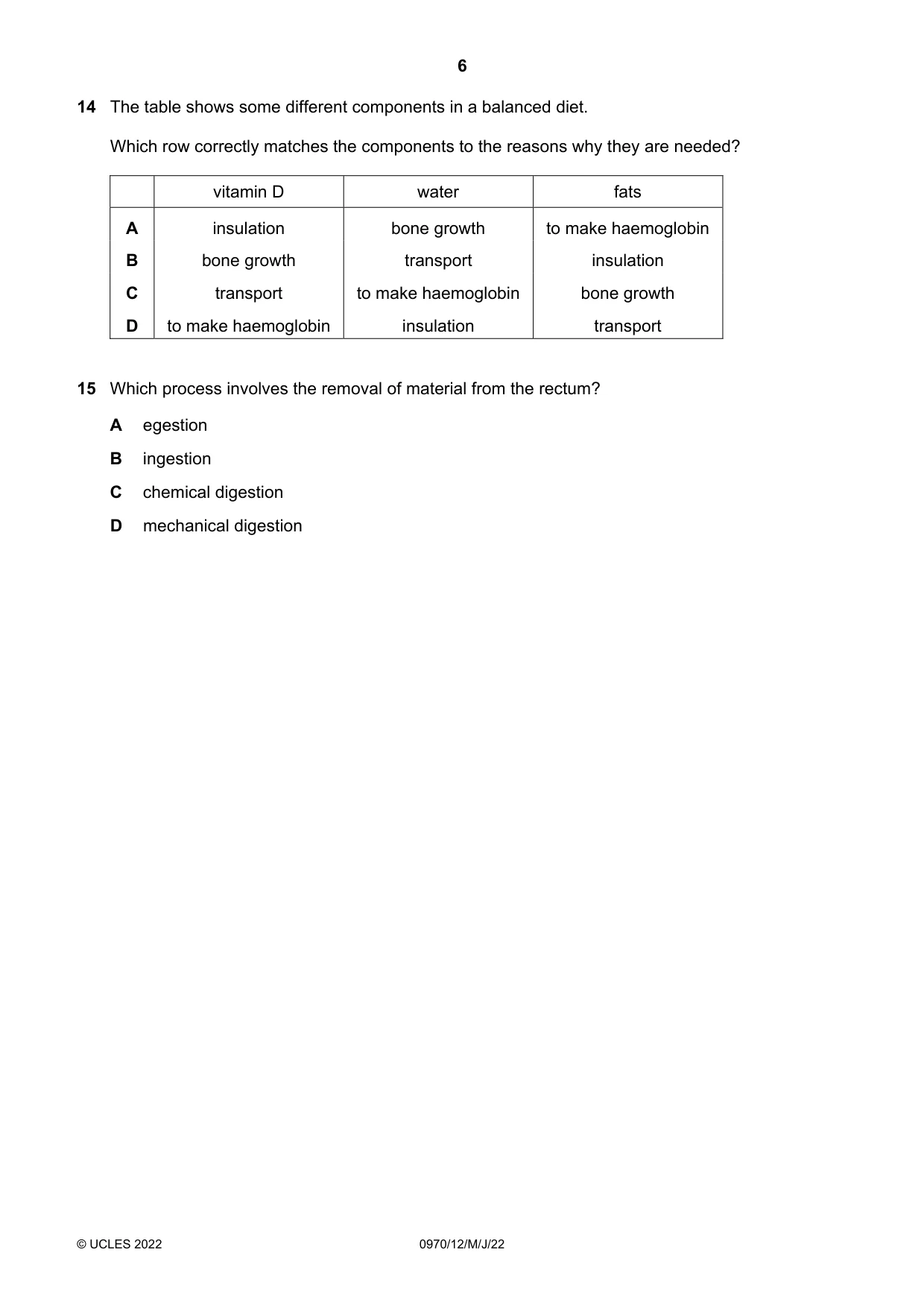
Q14 · The table shows some different components in a balanced diet
14 The table shows some different components in a balanced diet. Which row correctly matches the components to the reasons why they are needed? vitamin D water fats A insulation bone growth to make haemoglobin B bone growth transport insulation C transport to make haemoglobin bone growth D to make haemoglobin insulation transport
Mark scheme: B
Q15 · Which process involves the removal of material from the rectum?
15 Which process involves the removal of material from the rectum? A egestion B ingestion C chemical digestion D mechanical digestion
Mark scheme: A
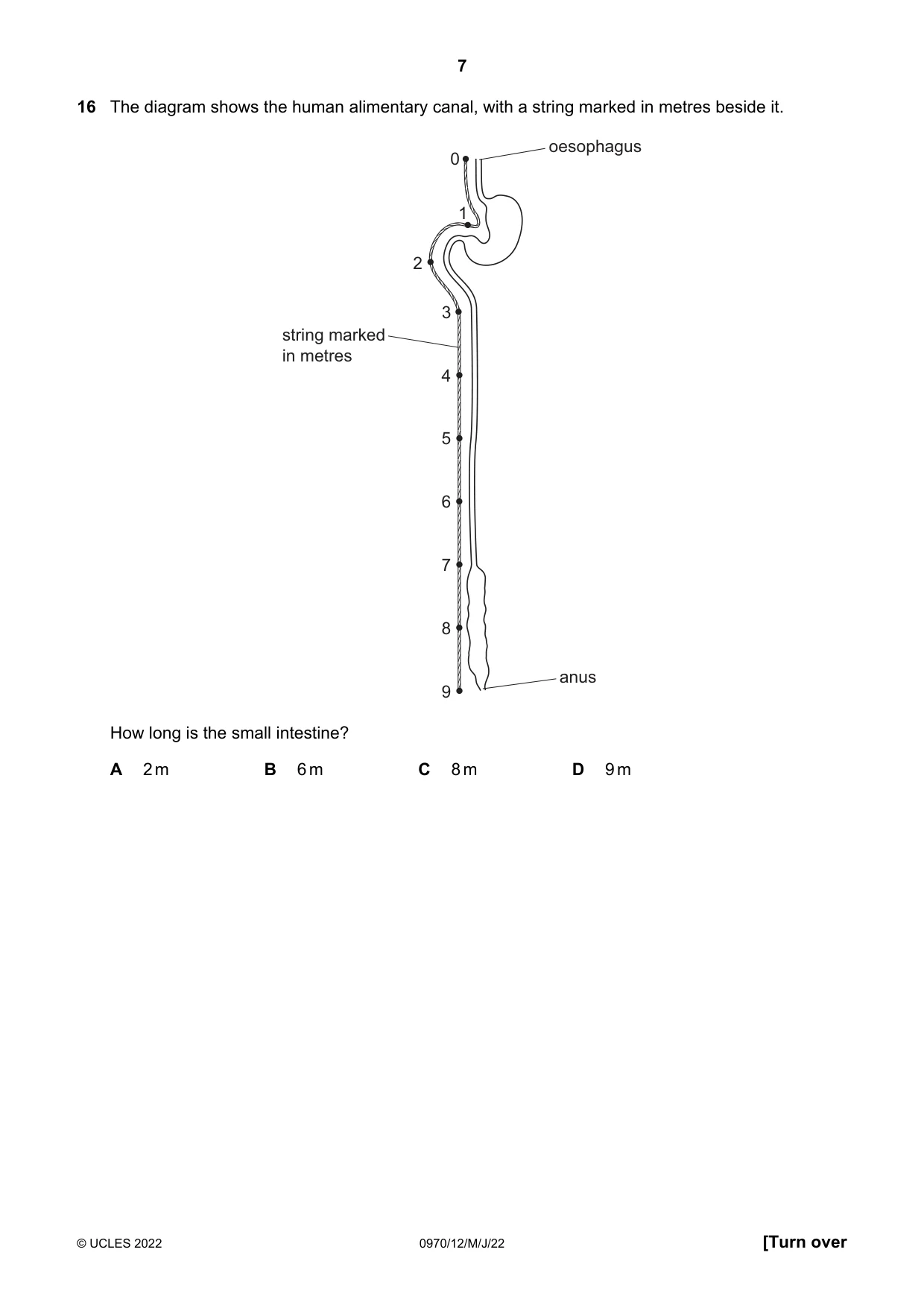
Q16 · The diagram shows the human alimentary canal, with a string marked in metres beside it
16 The diagram shows the human alimentary canal, with a string marked in metres beside it. oesophagus 0 1 2 3 string marked in metres 4 5 6 7 8 anus 9 How long is the small intestine? A 2 m B 6 m C 8 m D 9 m
Mark scheme: B
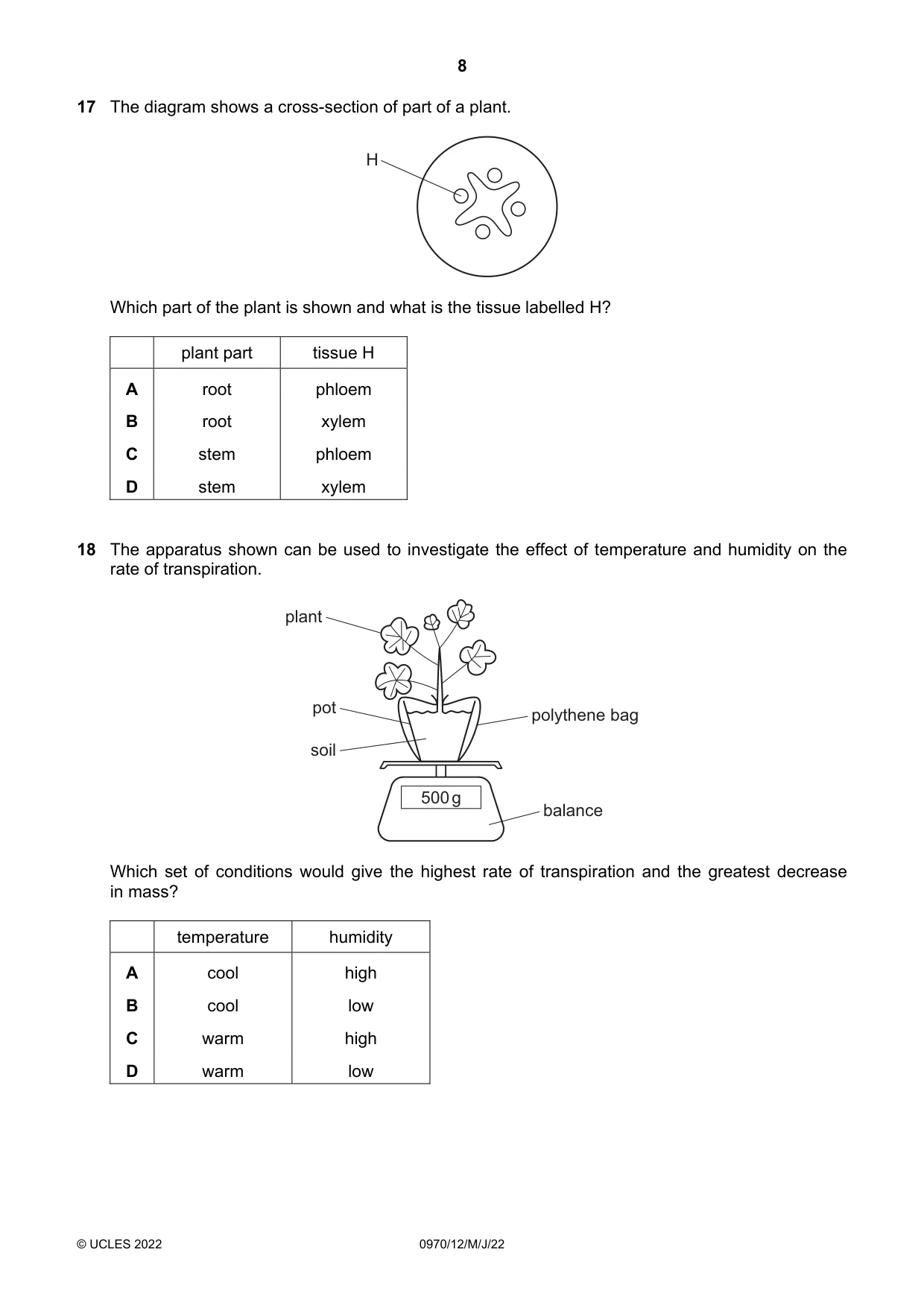
Q17 · The diagram shows a cross-section of part of a plant
17 The diagram shows a cross-section of part of a plant. H Which part of the plant is shown and what is the tissue labelled H? plant part tissue H A root phloem B root xylem C stem phloem D stem xylem
Mark scheme: A
Q18 · The apparatus shown can be used to investigate the effect of temperature and humidity on…
18 The apparatus shown can be used to investigate the effect of temperature and humidity on the rate of transpiration. plant pot polythene bag soil 500 g balance Which set of conditions would give the highest rate of transpiration and the greatest decrease in mass? temperature humidity A cool high B cool low C warm high D warm low
Mark scheme: D
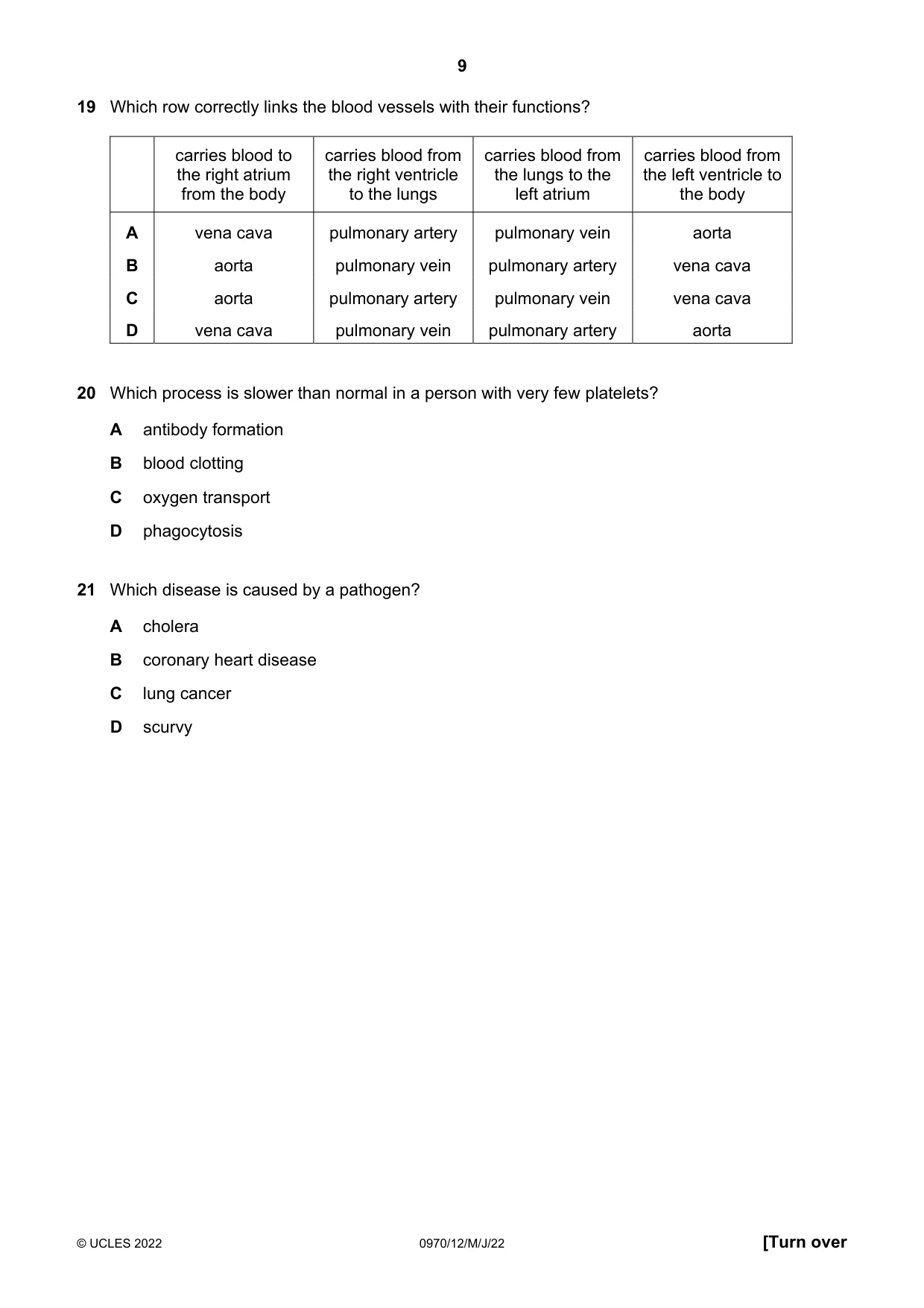
Q19 · Which row correctly links the blood vessels with their functions?
19 Which row correctly links the blood vessels with their functions? carries blood to carries blood from carries blood from carries blood from the right atrium the right ventricle the lungs to the the left ventricle to from the body to the lungs left atrium the body A vena cava pulmonary artery pulmonary vein aorta B aorta pulmonary vein pulmonary artery vena cava C aorta pulmonary artery pulmonary vein vena cava D vena cava pulmonary vein pulmonary artery aorta
Mark scheme: A
Q20 · Which process is slower than normal in a person with very few platelets?
20 Which process is slower than normal in a person with very few platelets? A antibody formation B blood clotting C oxygen transport D phagocytosis
Mark scheme: B
Q21 · Which disease is caused by a pathogen?
21 Which disease is caused by a pathogen? A cholera B coronary heart disease C lung cancer D scurvy
Mark scheme: A
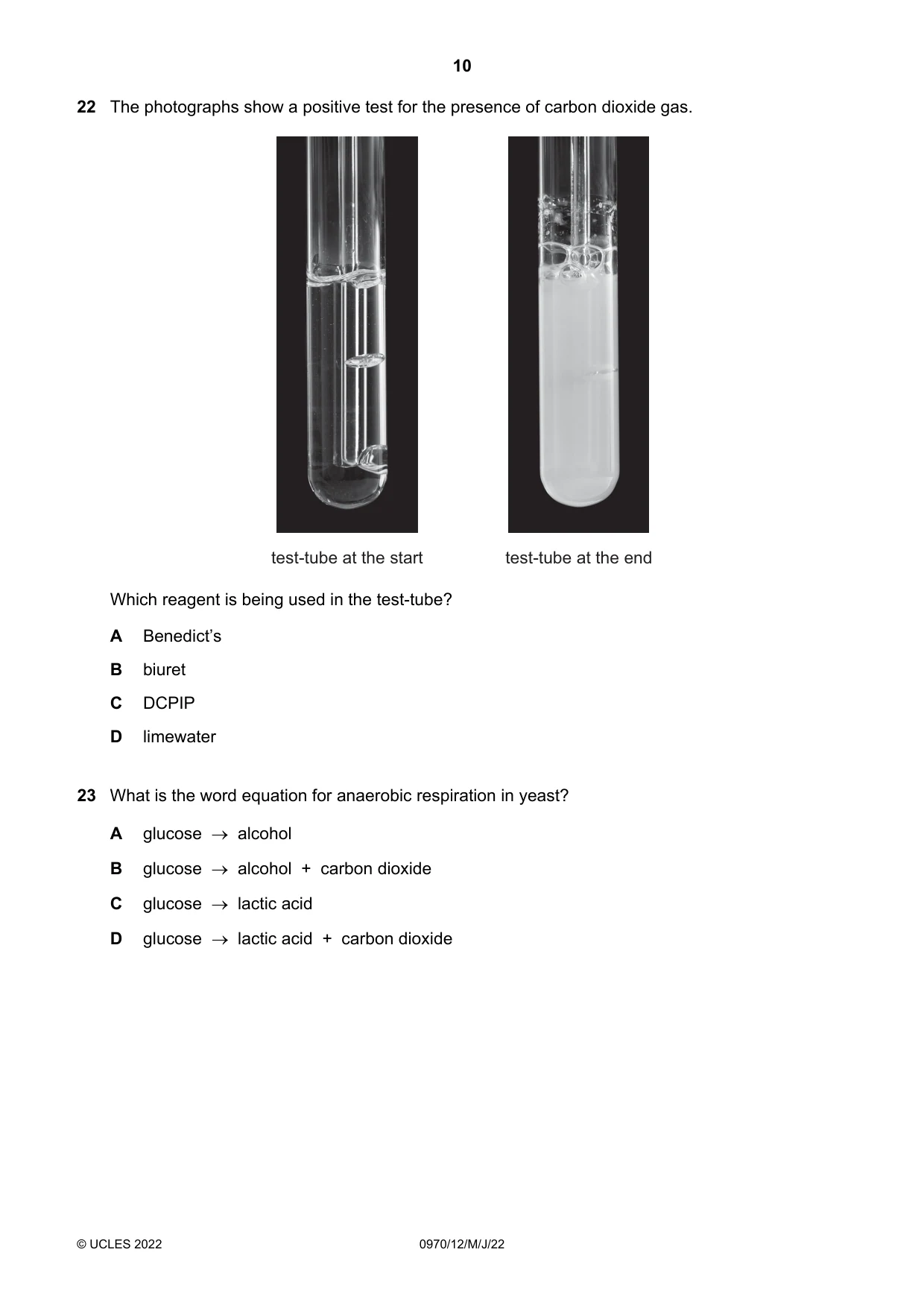
Q22 · The photographs show a positive test for the presence of carbon dioxide gas
22 The photographs show a positive test for the presence of carbon dioxide gas. test-tube at the start test-tube at the end Which reagent is being used in the test-tube? A Benedict’s B biuret C DCPIP D limewater
Mark scheme: D
Q23 · What is the word equation for anaerobic respiration in yeast?
23 What is the word equation for anaerobic respiration in yeast? A glucose alcohol B glucose alcohol + carbon dioxide C glucose lactic acid D glucose lactic acid + carbon dioxide
Mark scheme: B
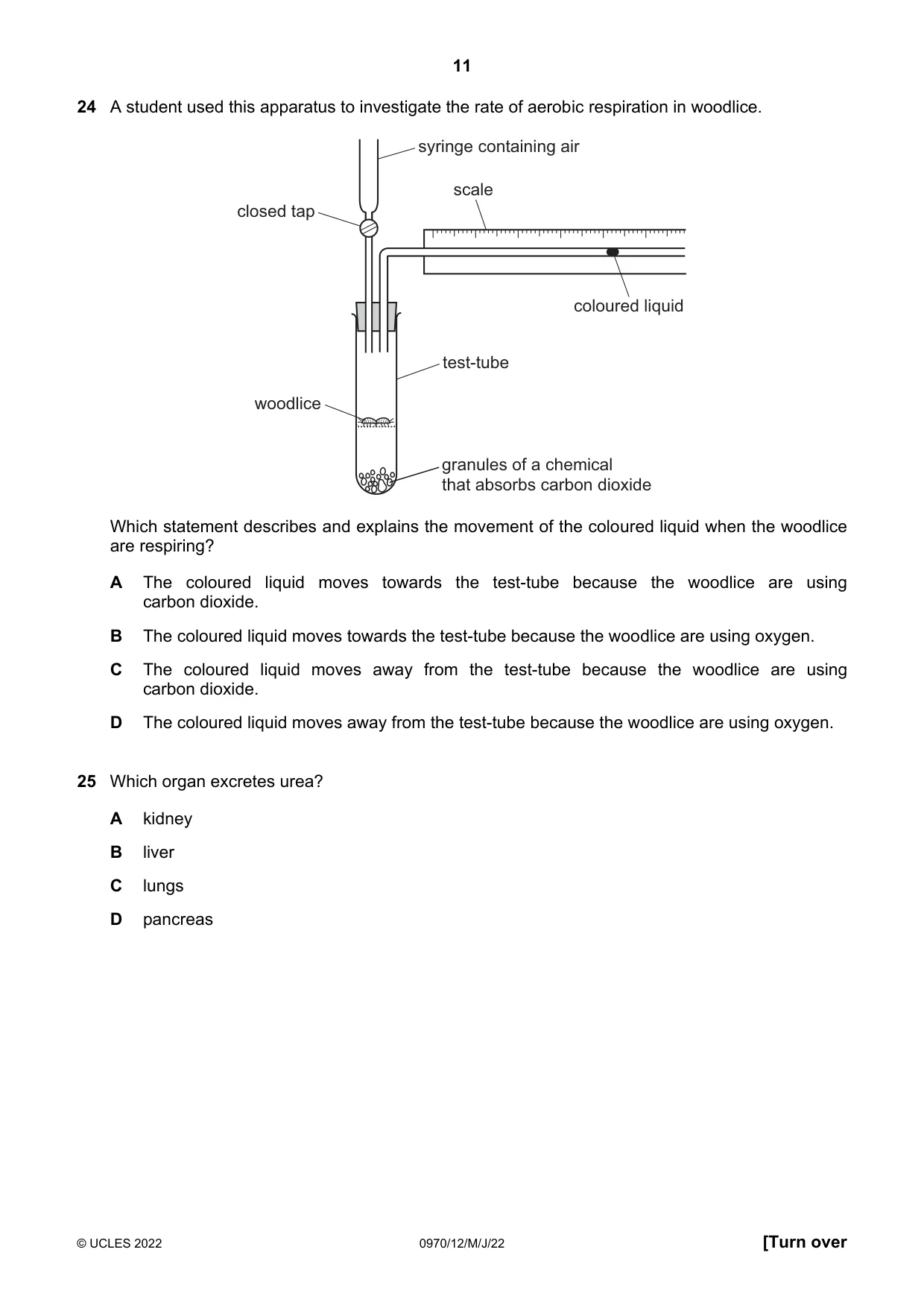
Q24 · A student used this apparatus to investigate the rate of aerobic respiration in woodlice
24 A student used this apparatus to investigate the rate of aerobic respiration in woodlice. syringe containing air scale closed tap coloured liquid test-tube woodlice granules of a chemical that absorbs carbon dioxide Which statement describes and explains the movement of the coloured liquid when the woodlice are respiring? A The coloured liquid moves towards the test-tube because the woodlice are using carbon dioxide. B The coloured liquid moves towards the test-tube because the woodlice are using oxygen. C The coloured liquid moves away from the test-tube because the woodlice are using carbon dioxide. D The coloured liquid moves away from the test-tube because the woodlice are using oxygen.
Mark scheme: B
Q25 · Which organ excretes urea?
25 Which organ excretes urea? A kidney B liver C lungs D pancreas
Mark scheme: A
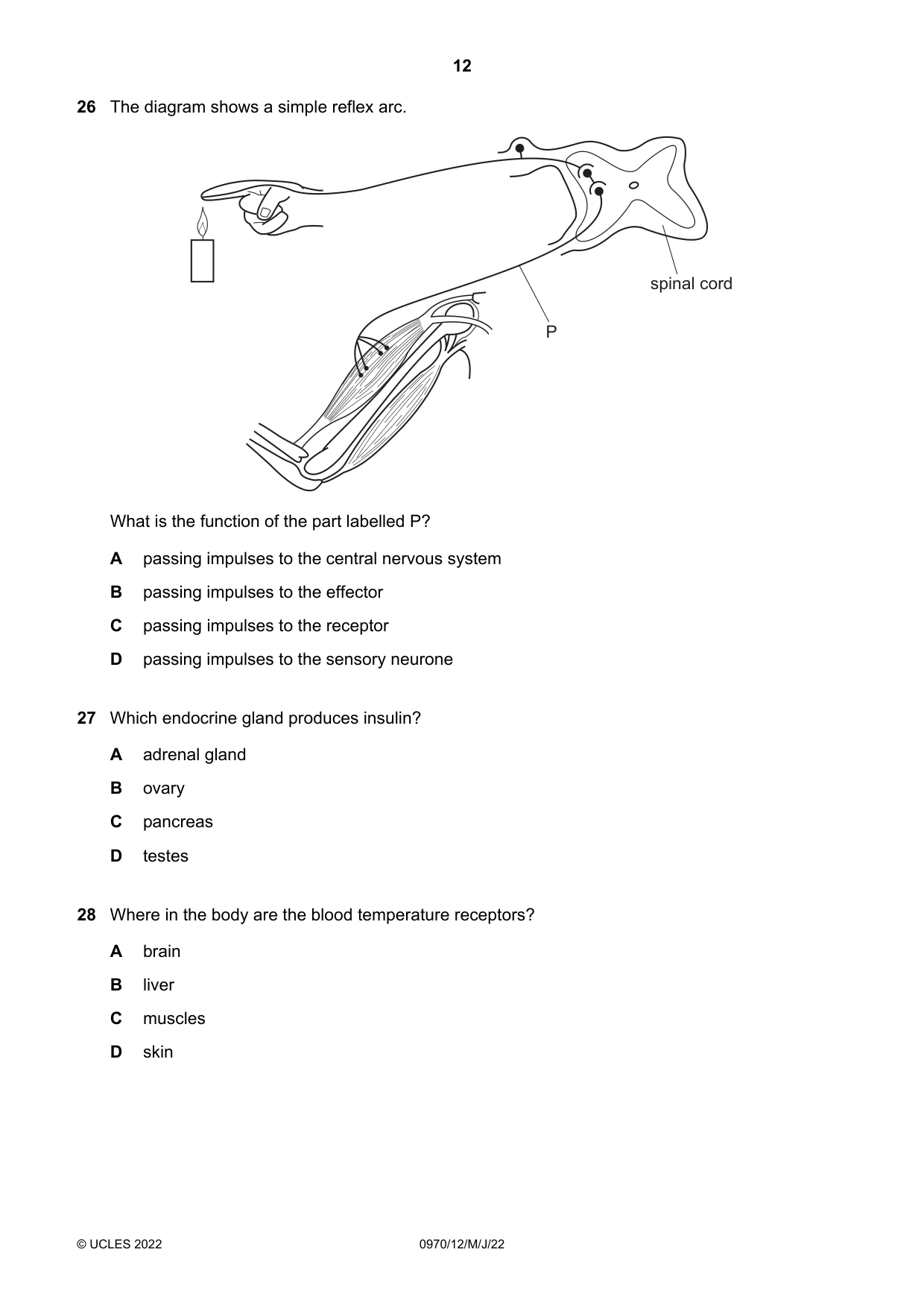
Q26 · The diagram shows a simple reflex arc
26 The diagram shows a simple reflex arc. spinal cord P What is the function of the part labelled P? A passing impulses to the central nervous system B passing impulses to the effector C passing impulses to the receptor D passing impulses to the sensory neurone
Mark scheme: B
Q27 · Which endocrine gland produces insulin?
27 Which endocrine gland produces insulin? A adrenal gland B ovary C pancreas D testes
Mark scheme: C
Q28 · Where in the body are the blood temperature receptors?
28 Where in the body are the blood temperature receptors? A brain B liver C muscles D skin
Mark scheme: A
Q29 · The graph shows the relationship between deaths from lung cancer and the number of…
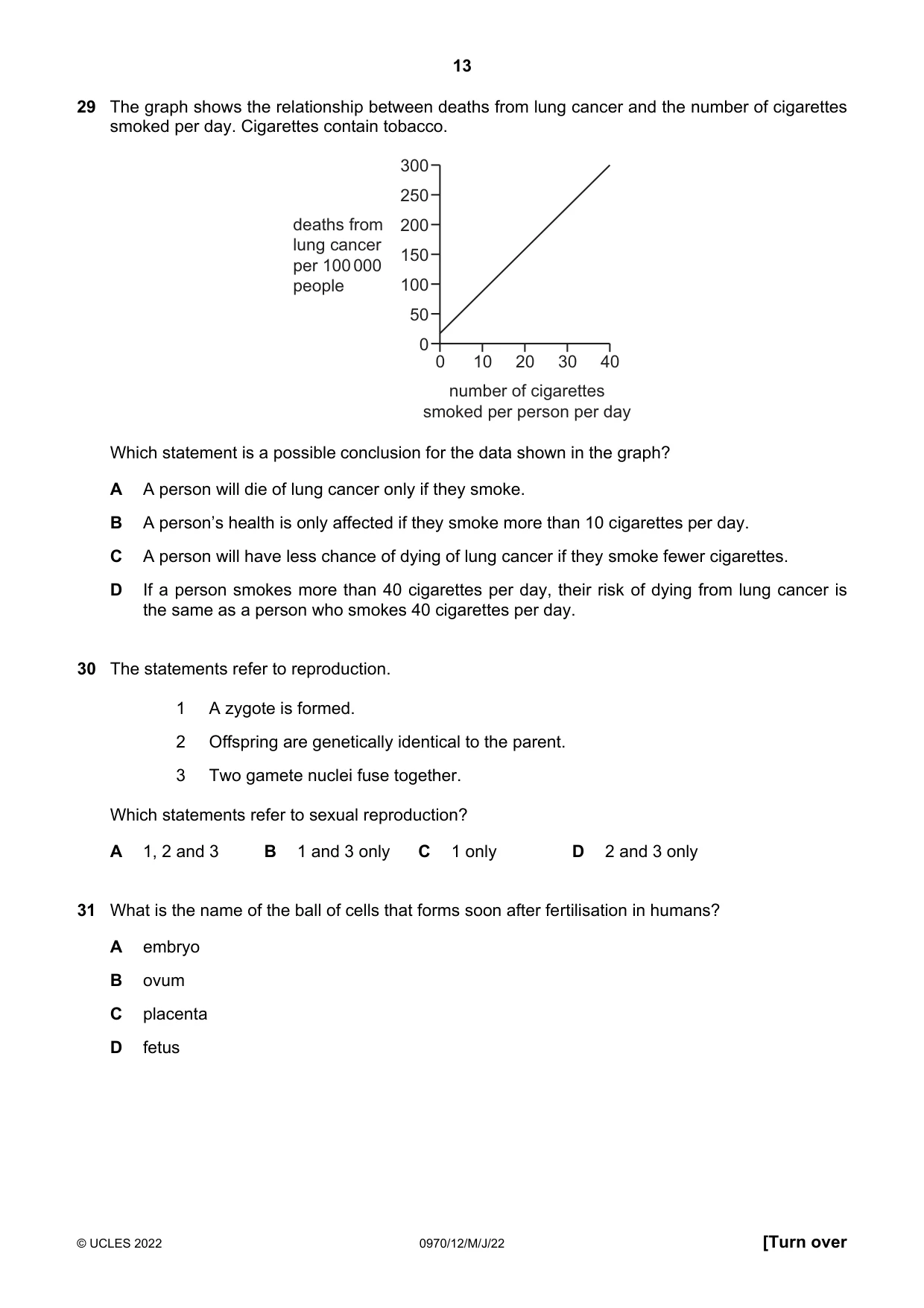
29 The graph shows the relationship between deaths from lung cancer and the number of cigarettes smoked per day. Cigarettes contain tobacco. 300 250 deaths from 200 lung cancer 150 per 100 000 people 100 50 0 0 10 20 30 40 number of cigarettes smoked per person per day Which statement is a possible conclusion for the data shown in the graph? A A person will die of lung cancer only if they smoke. B A person’s health is only affected if they smoke more than 10 cigarettes per day. C A person will have less chance of dying of lung cancer if they smoke fewer cigarettes. D If a person smokes more than 40 cigarettes per day, their risk of dying from lung cancer is the same as a person who smokes 40 cigarettes per day.
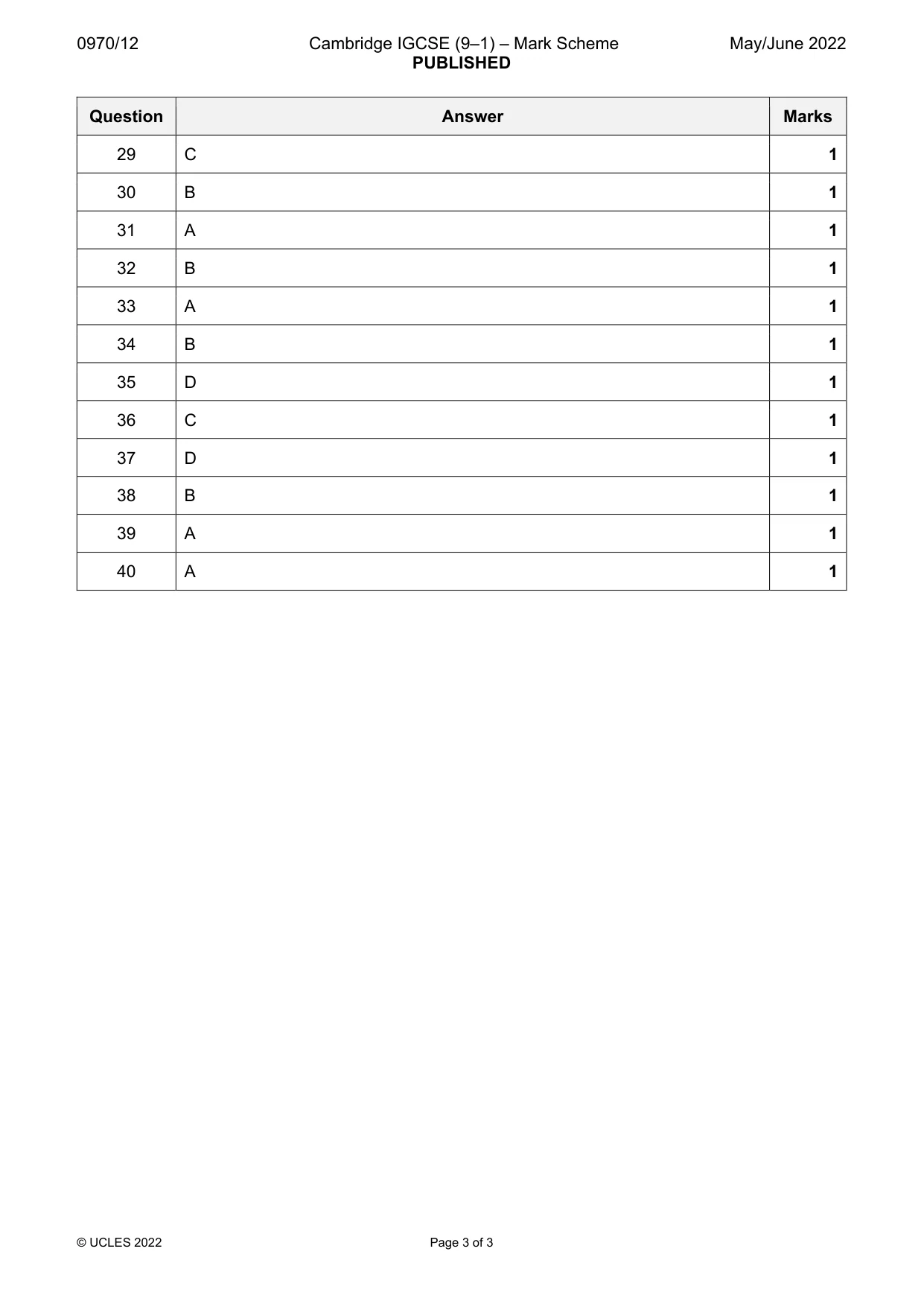
Mark scheme: C
Q30 · The statements refer to reproduction
30 The statements refer to reproduction. 1 A zygote is formed. 2 Offspring are genetically identical to the parent. 3 Two gamete nuclei fuse together. Which statements refer to sexual reproduction? A 1, 2 and 3 B 1 and 3 only C 1 only D 2 and 3 only
Mark scheme: B
Q31 · What is the name of the ball of cells that forms soon after fertilisation in humans?
31 What is the name of the ball of cells that forms soon after fertilisation in humans? A embryo B ovum C placenta D fetus
Mark scheme: A
Q32 · The diagram shows the inheritance of sex in humans
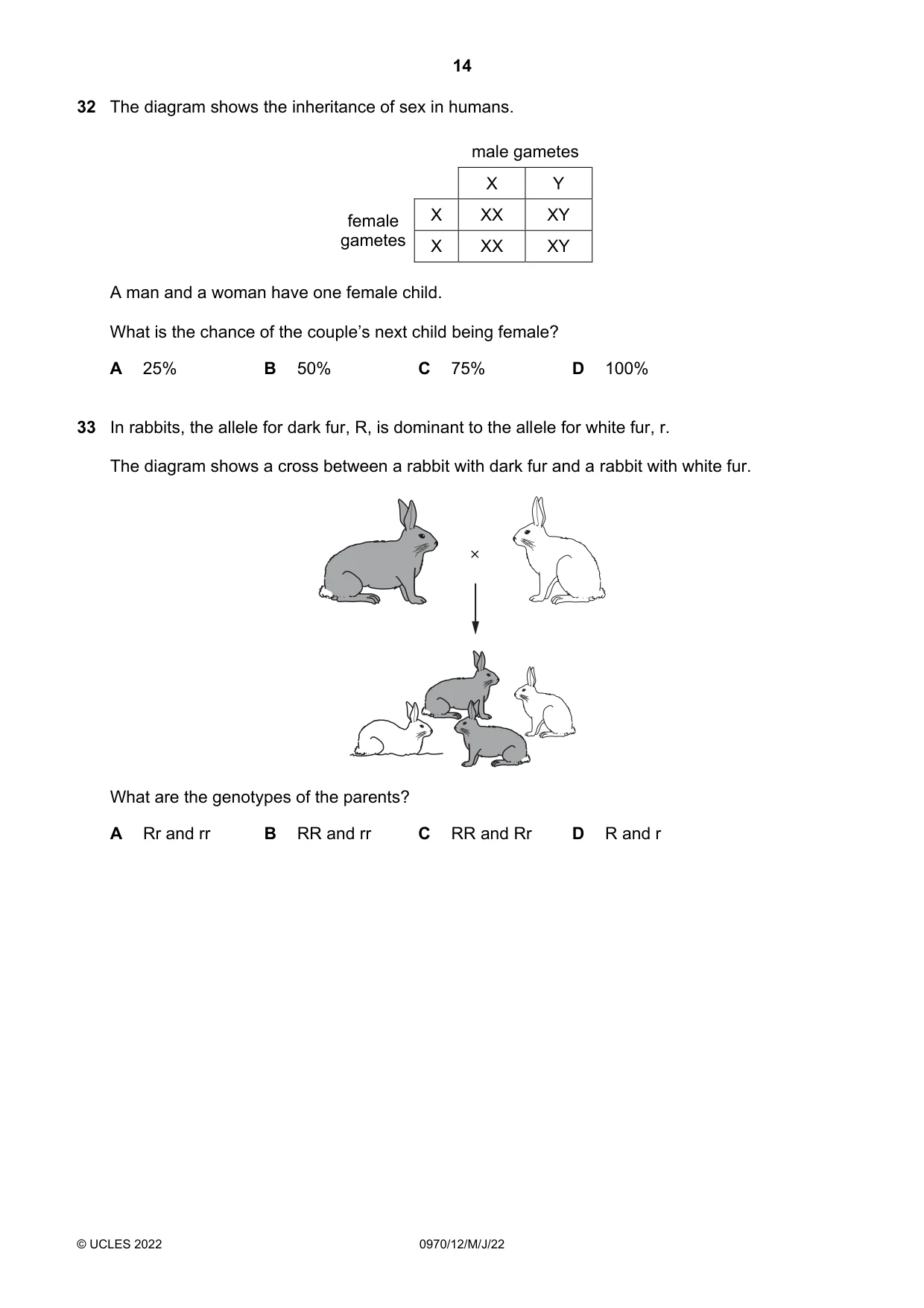
32 The diagram shows the inheritance of sex in humans. male gametes X Y female X XX XY gametes X XX XY A man and a woman have one female child. What is the chance of the couple’s next child being female? A 25% B 50% C 75% D 100%
Mark scheme: B
Q33 · In rabbits, the allele for dark fur, R, is dominant to the allele for white fur, r
33 In rabbits, the allele for dark fur, R, is dominant to the allele for white fur, r. The diagram shows a cross between a rabbit with dark fur and a rabbit with white fur. × What are the genotypes of the parents? A Rr and rr B RR and rr C RR and Rr D R and r
Mark scheme: A
Q34 · The graph shows the different heights of people in a human population
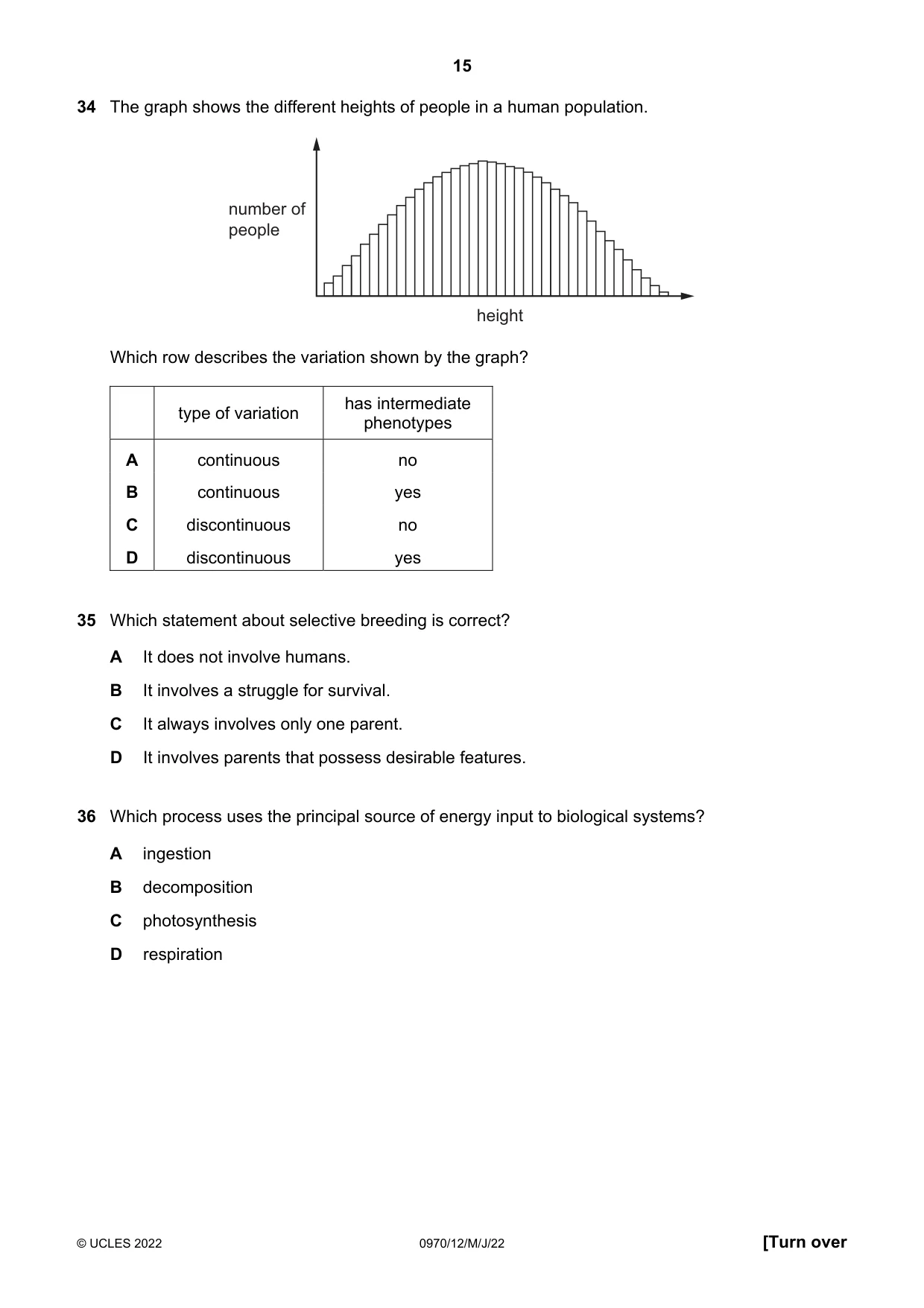
34 The graph shows the different heights of people in a human population. number of people height Which row describes the variation shown by the graph? has intermediate type of variation phenotypes A continuous no B continuous yes C discontinuous no D discontinuous yes
Mark scheme: B
Q35 · Which statement about selective breeding is correct?
35 Which statement about selective breeding is correct? A It does not involve humans. B It involves a struggle for survival. C It always involves only one parent. D It involves parents that possess desirable features.
Mark scheme: D
Q36 · Which process uses the principal source of energy input to biological systems?
36 Which process uses the principal source of energy input to biological systems? A ingestion B decomposition C photosynthesis D respiration
Mark scheme: C
Q37 · The diagram shows part of the carbon cycle
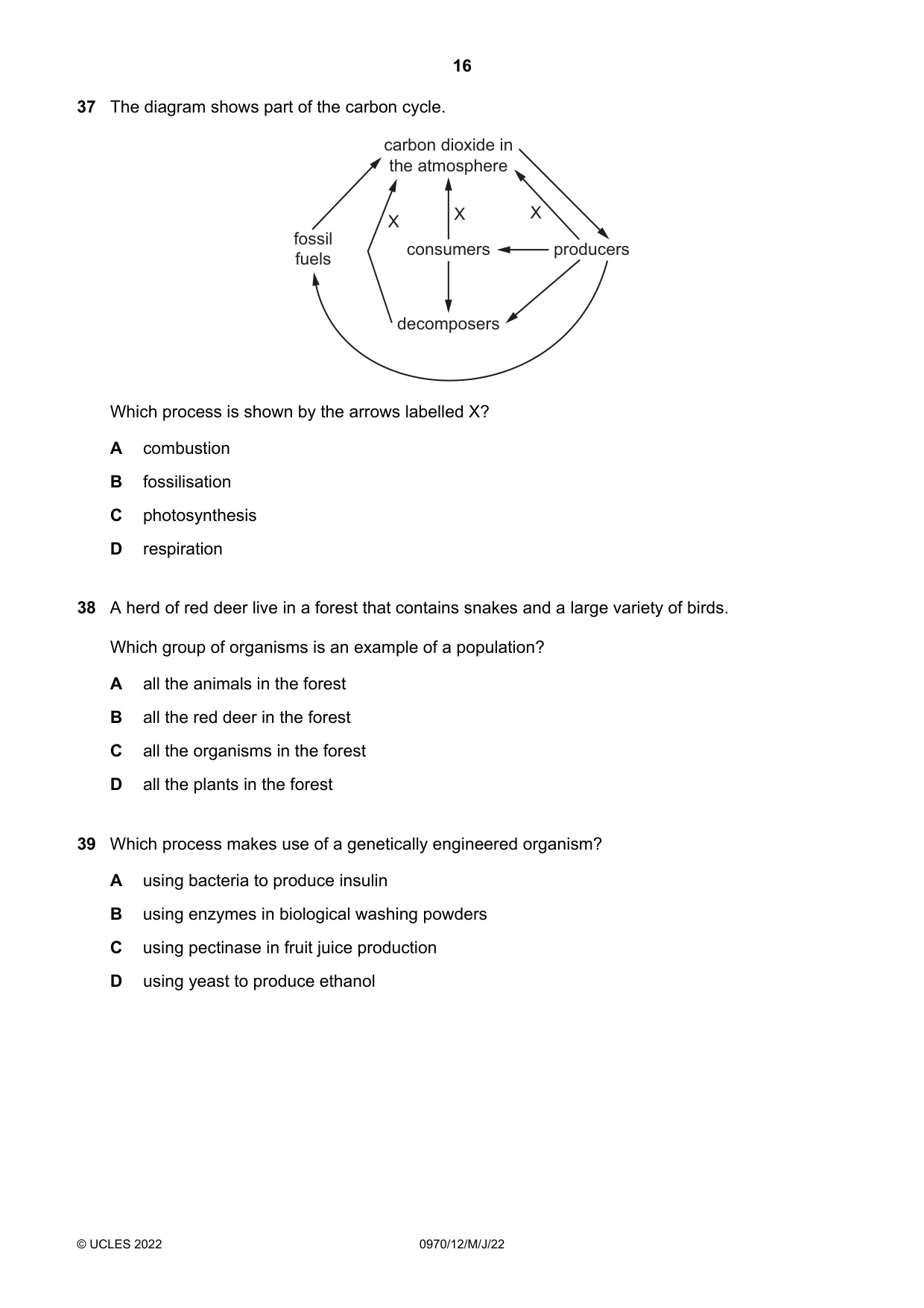
37 The diagram shows part of the carbon cycle. carbon dioxide in the atmosphere X X X fossil consumers producers fuels decomposers Which process is shown by the arrows labelled X? A combustion B fossilisation C photosynthesis D respiration
Mark scheme: D
Q38 · A herd of red deer live in a forest that contains snakes and a large variety of birds
38 A herd of red deer live in a forest that contains snakes and a large variety of birds. Which group of organisms is an example of a population? A all the animals in the forest B all the red deer in the forest C all the organisms in the forest D all the plants in the forest
Mark scheme: B
Q39 · Which process makes use of a genetically engineered organism?
39 Which process makes use of a genetically engineered organism? A using bacteria to produce insulin B using enzymes in biological washing powders C using pectinase in fruit juice production D using yeast to produce ethanol
Mark scheme: A
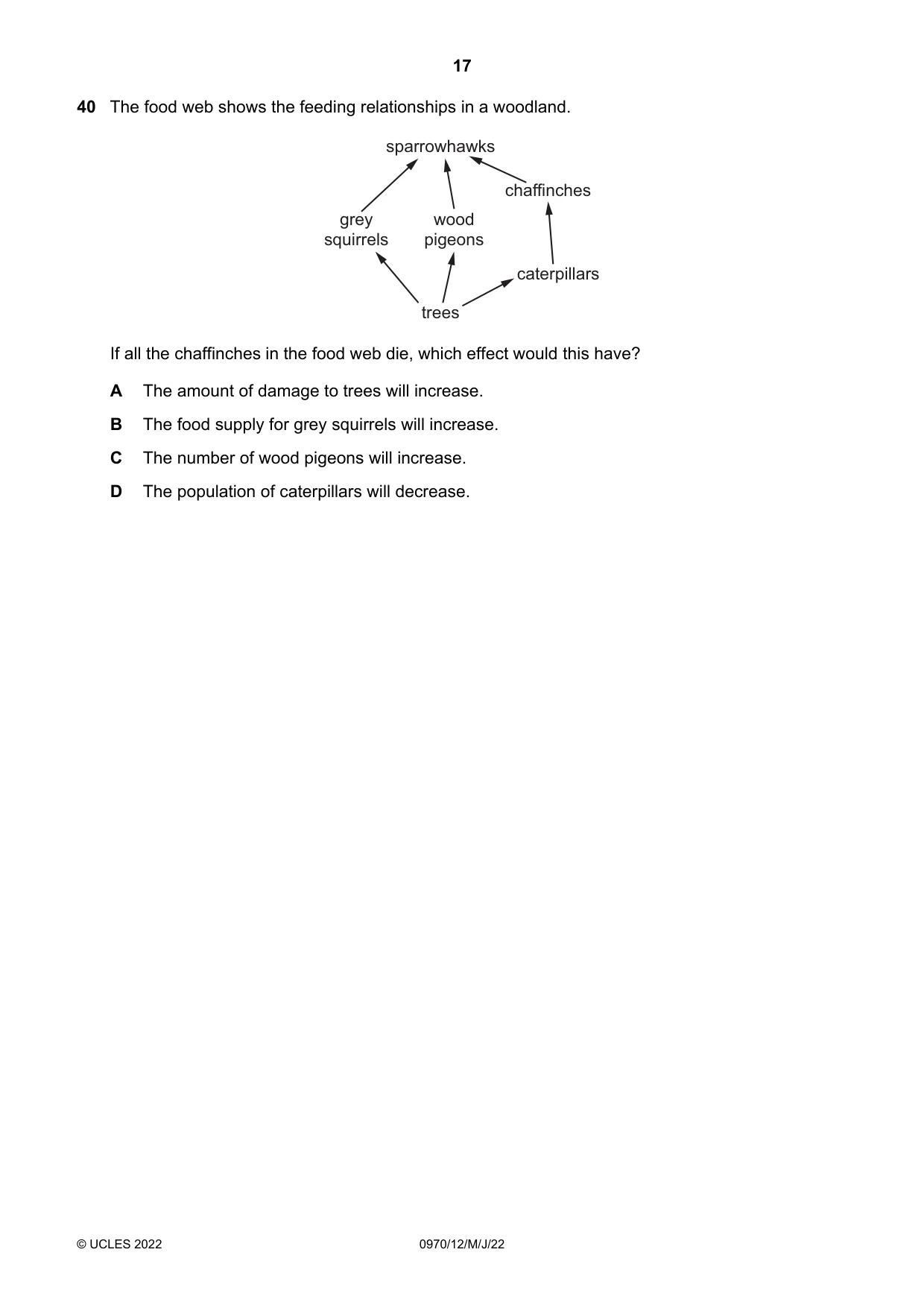
Q40 · The food web shows the feeding relationships in a woodland
40 The food web shows the feeding relationships in a woodland. sparrowhawks chaffinches grey wood squirrels pigeons caterpillars trees If all the chaffinches in the food web die, which effect would this have? A The amount of damage to trees will increase. B The food supply for grey squirrels will increase. C The number of wood pigeons will increase. D The population of caterpillars will decrease.
Mark scheme: A
What was in this paper
The subtopics covered by these 40 questions, and how many questions each got. Open one in a new tab to see every Cambridge question on it.
2Biological molecules2Cell structure2Diffusion2Monohybrid inheritance2Transpiration2Absorption1Anaerobic respiration1Biotechnology and genetic modification1Blood1Characteristics of living organisms1Concept and uses of classification systems1Coordination and response1Diet1Digestive system1Diseases and immunity1Drugs1Energy flow1Enzymes1Excretion in humans1Features of organisms1Food chains and food webs1Heart1Homeostasis1Hormones1Nutrient cycles1Photosynthesis1Populations1Selection1Sexual reproduction1Sexual reproduction in humans1Size of specimens1Variation1Xylem and phloem1What you needed in this session
Cambridge’s own grade thresholds for 2022 May/June, Paper 1 · Variant 2. A higher threshold means an easier paper — the bar moves with how the cohort did.