Cambridge IGCSE Biology (9-1) 0970 — 2019 Oct/Nov Paper 1 · Variant 2
0970/12/O/N/19 · 40 questions · 40 marks · ≈45 min
The question paper and its mark scheme, free to read here and free to download. This is Cambridge’s own paper, exactly as it was sat.
Question paper16 pages
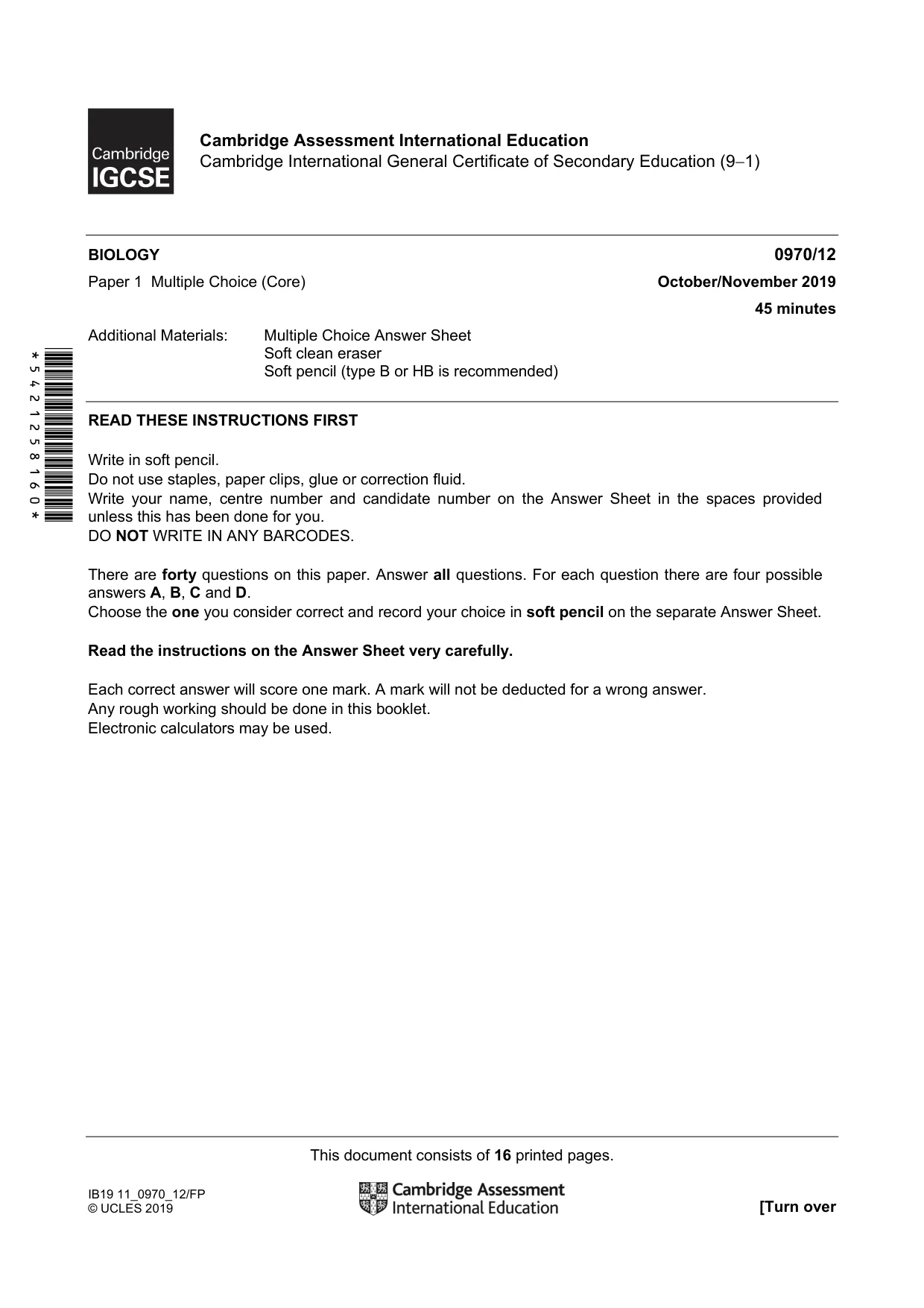
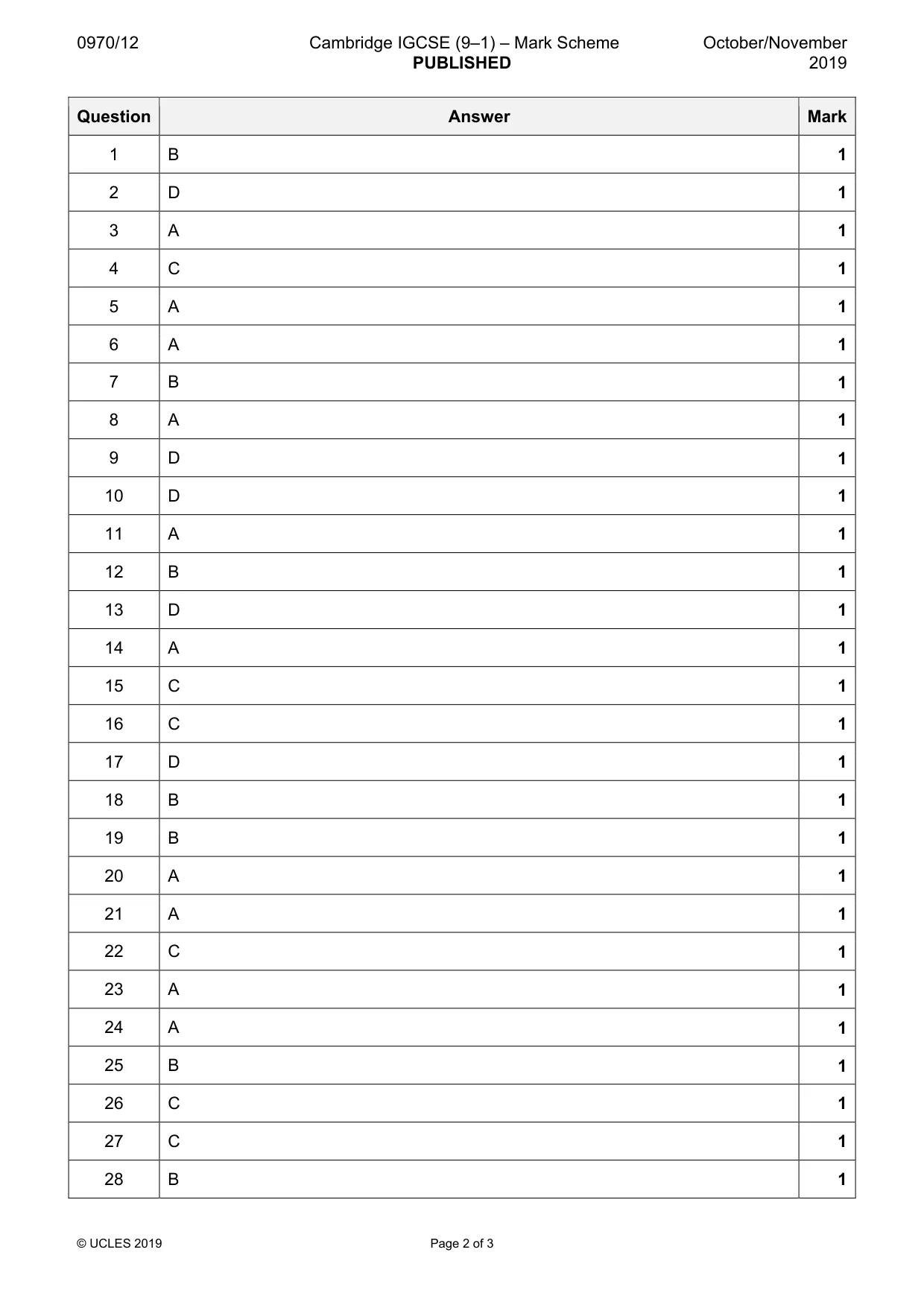
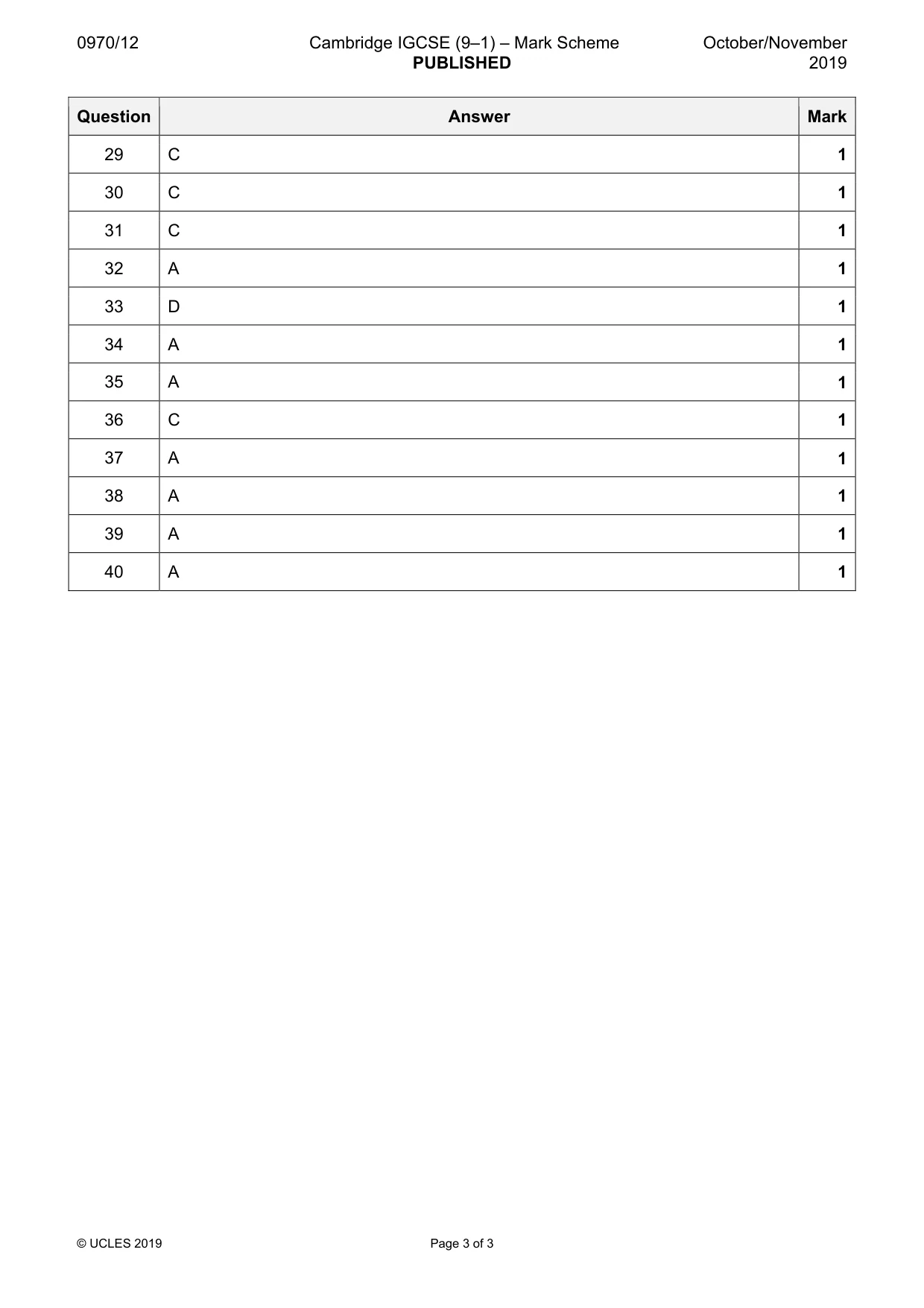
Mark scheme3 pages
Answers below. Sit the paper first if you are practising.
Questions as text
Q1 · The diagrams show a test-tube containing pond water
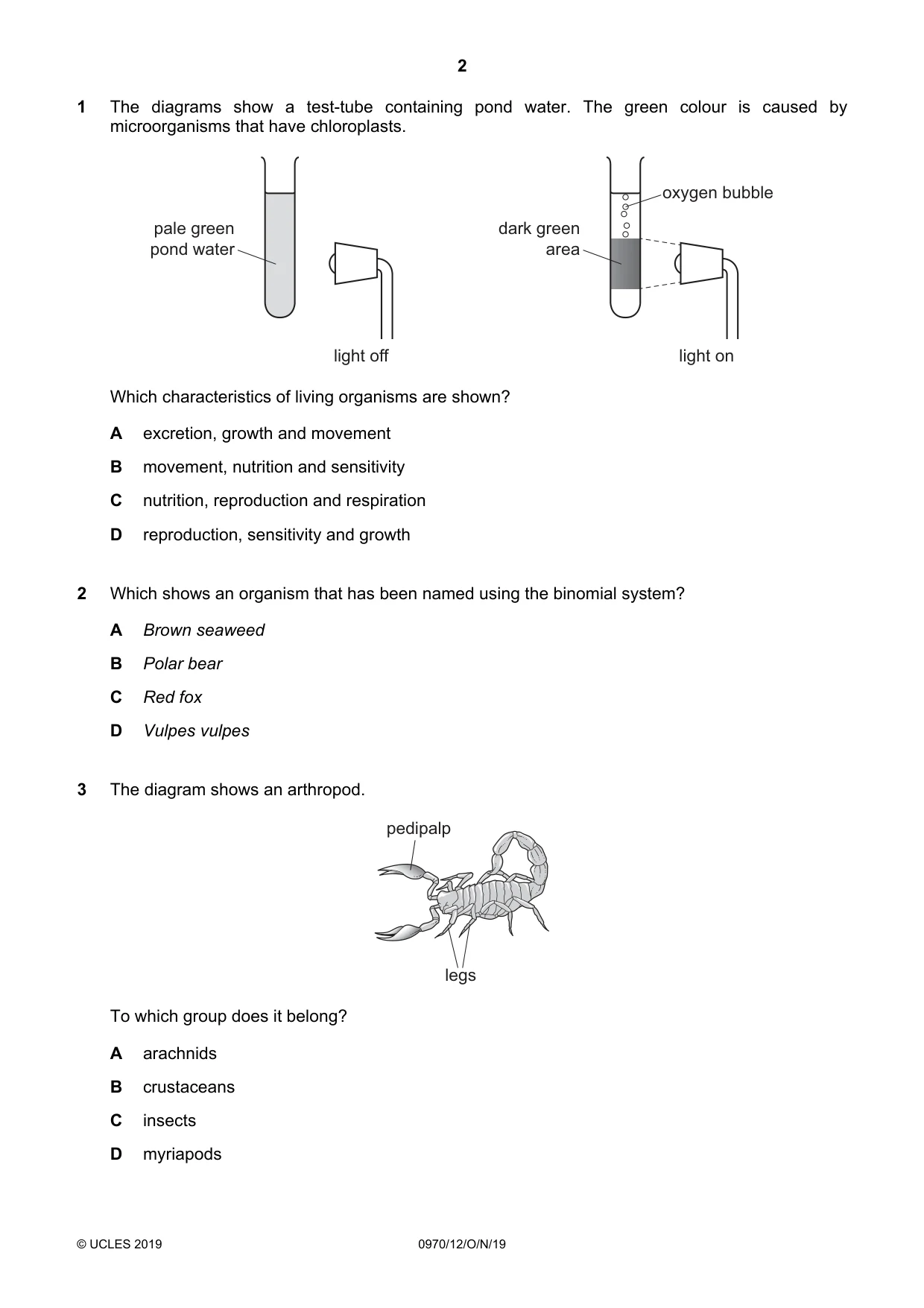
1 The diagrams show a test-tube containing pond water. The green colour is caused by microorganisms that have chloroplasts. oxygen bubble pale green dark green pond water area light off light on Which characteristics of living organisms are shown? A excretion, growth and movement B movement, nutrition and sensitivity C nutrition, reproduction and respiration D reproduction, sensitivity and growth
Mark scheme: B
Q2 · Which shows an organism that has been named using the binomial system?
2 Which shows an organism that has been named using the binomial system? A Brown seaweed B Polar bear C Red fox D Vulpes vulpes
Mark scheme: D
More questions on Concept and uses of classification systems
Q3 · The diagram shows an arthropod
3 The diagram shows an arthropod. pedipalp legs To which group does it belong? A arachnids B crustaceans C insects D myriapods
Mark scheme: A
Q4 · Which features do animal cells share with plant cells?
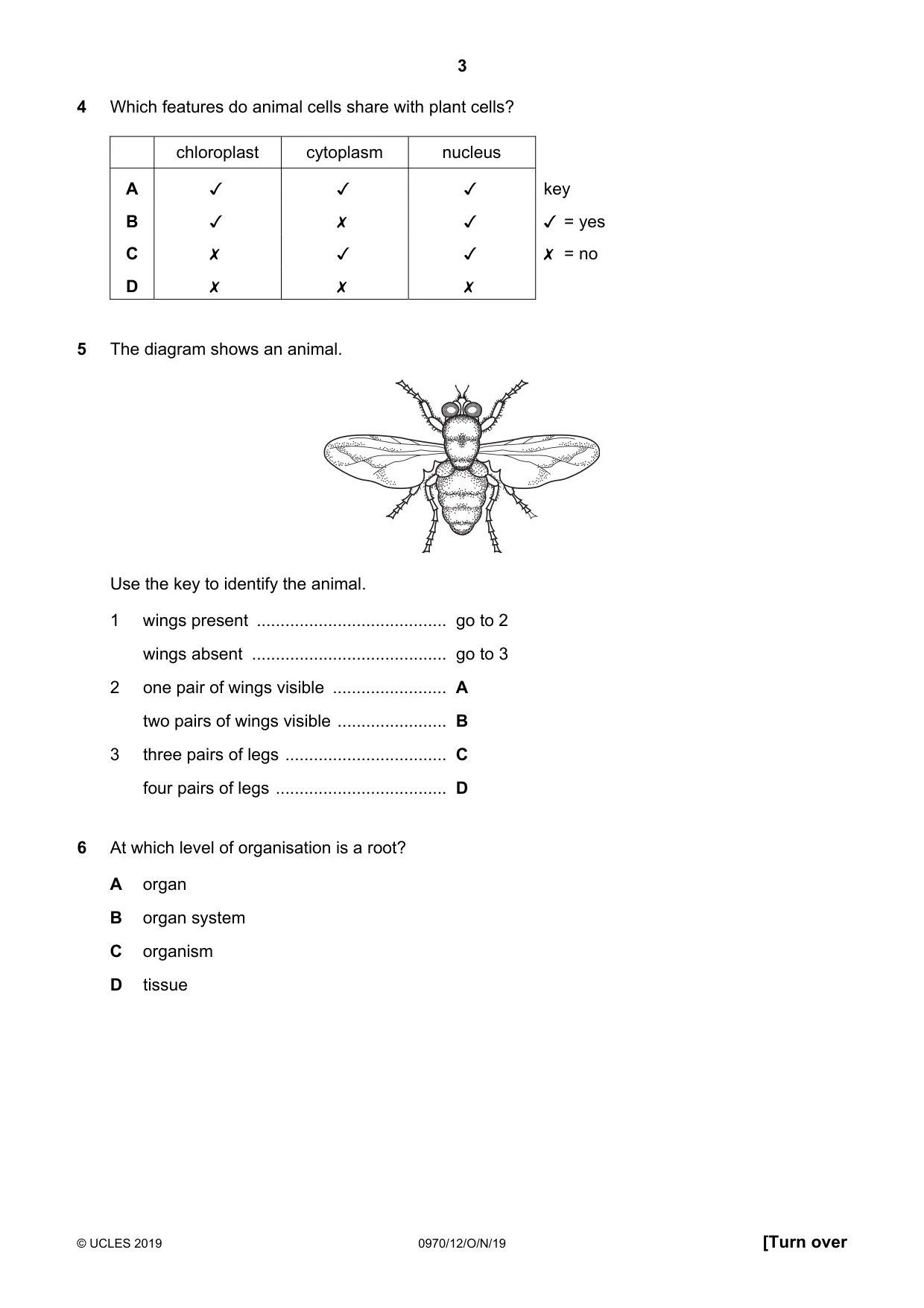
4 Which features do animal cells share with plant cells? chloroplast cytoplasm nucleus A Jv J J key B Jv x J J/ =yes Cc x v v X =no D x x x
Mark scheme: C
Q5 · The diagram shows an animal
5 The diagram shows an animal. Use the key to identify the animal. 1 wings present ........................................ go to 2 wings absent ......................................... go to 3 2 one pair of wings visible ........................ A two pairs of wings visible ....................... B 3 three pairs of legs .................................. C four pairs of legs .................................... D
Mark scheme: A
More questions on Concept and uses of classification systems
Q6 · At which level of organisation is a root?
6 At which level of organisation is a root? A organ B organ system C organism D tissue
Mark scheme: A
Q7 · Some pieces of potato were placed in a very concentrated sugar solution
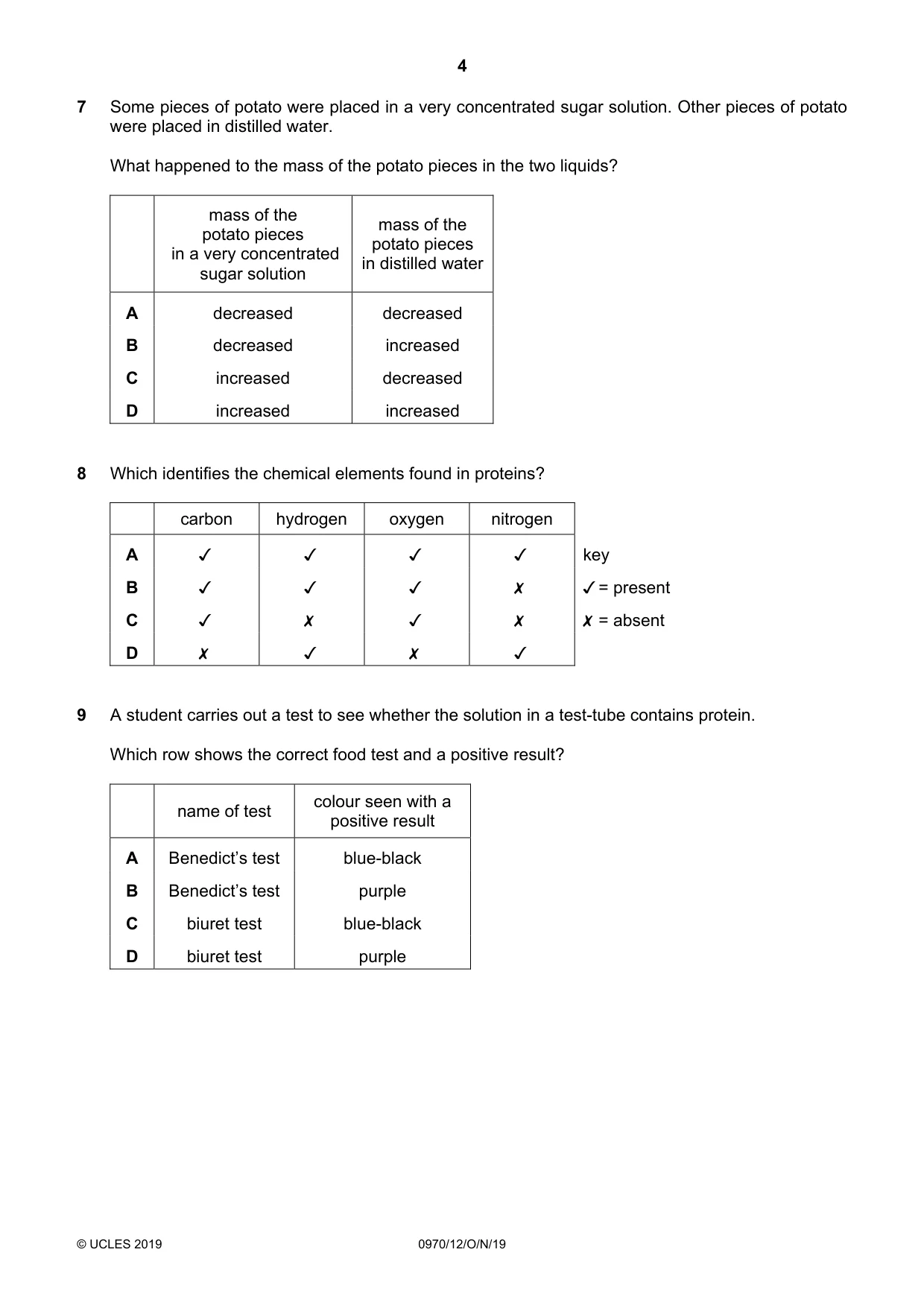
7 Some pieces of potato were placed in a very concentrated sugar solution. Other pieces of potato were placed in distilled water. What happened to the mass of the potato pieces in the two liquids? mass of the mass of the potato pieces potato pieces in a very concentrated in distilled water sugar solution A decreased decreased B decreased increased C increased decreased D increased increased
Mark scheme: B
Q8 · Which identifies the chemical elements found in proteins?
8 Which identifies the chemical elements found in proteins? carbon hydrogen oxygen nitrogen v v v v key J/ = present 0 0O WwW > J WA J x Jv x Jv x X = absent x Jv x WA
Mark scheme: A
Q9 · A student carries out a test to see whether the solution in a test-tube contains protein
9 A student carries out a test to see whether the solution in a test-tube contains protein. Which row shows the correct food test and a positive result? colour seen with a name of test positive result A Benedict’s test blue-black B Benedict’s test purple C biuret test blue-black D biuret test purple
Mark scheme: D
Q10 · The diagram shows an experiment investigating the effect of light intensity on an aquatic…
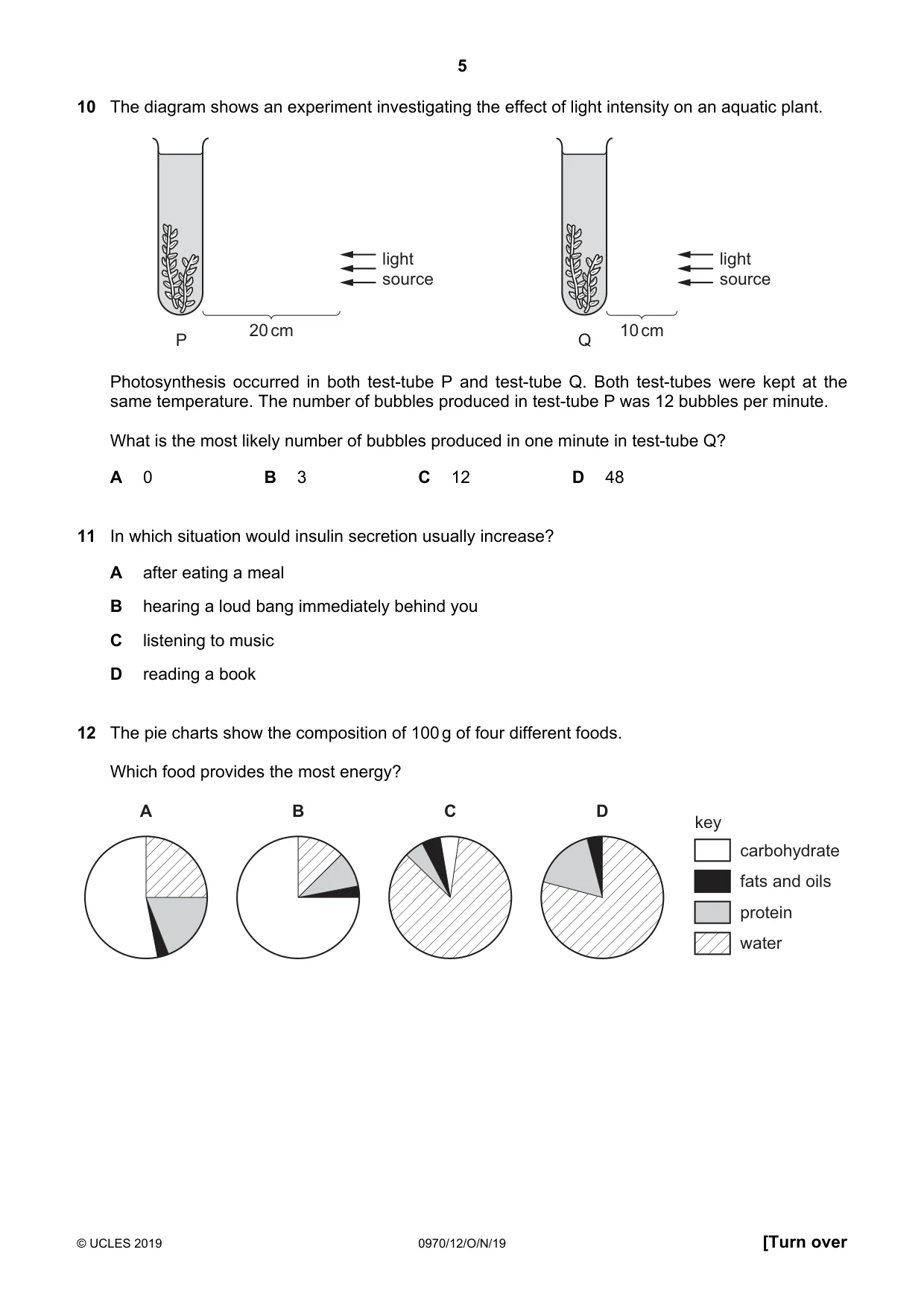
10 The diagram shows an experiment investigating the effect of light intensity on an aquatic plant. light light source source 20 cm 10 cm P Q Photosynthesis occurred in both test-tube P and test-tube Q. Both test-tubes were kept at the same temperature. The number of bubbles produced in test-tube P was 12 bubbles per minute. What is the most likely number of bubbles produced in one minute in test-tube Q? A 0 B 3 C 12 D 48
Mark scheme: D
Q11 · In which situation would insulin secretion usually increase?
11 In which situation would insulin secretion usually increase? A after eating a meal B hearing a loud bang immediately behind you C listening to music D reading a book
Mark scheme: A
Q12 · The pie charts show the composition of 100 g of four different foods
12 The pie charts show the composition of 100 g of four different foods. Which food provides the most energy? A B C D key carbohydrate fats and oils protein water
Mark scheme: B
Q13 · The diagram shows the digestive system
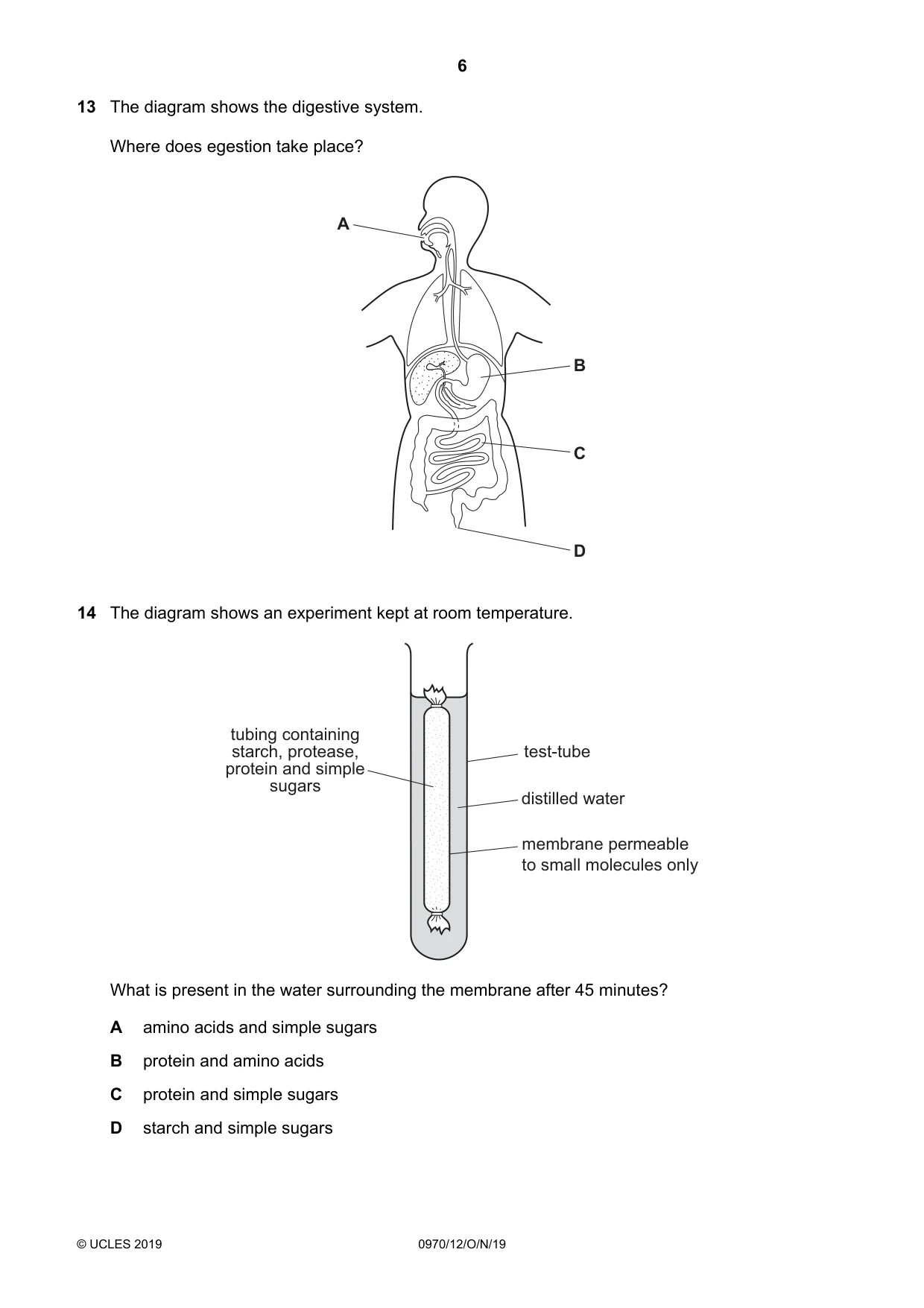
13 The diagram shows the digestive system. Where does egestion take place? A B C D
Mark scheme: D
Q14 · The diagram shows an experiment kept at room temperature
14 The diagram shows an experiment kept at room temperature. tubing containing starch, protease, test-tube protein and simple sugars distilled water membrane permeable to small molecules only What is present in the water surrounding the membrane after 45 minutes? A amino acids and simple sugars B protein and amino acids C protein and simple sugars D starch and simple sugars
Mark scheme: A
Q15 · The diagram shows an experiment to investigate transpiration
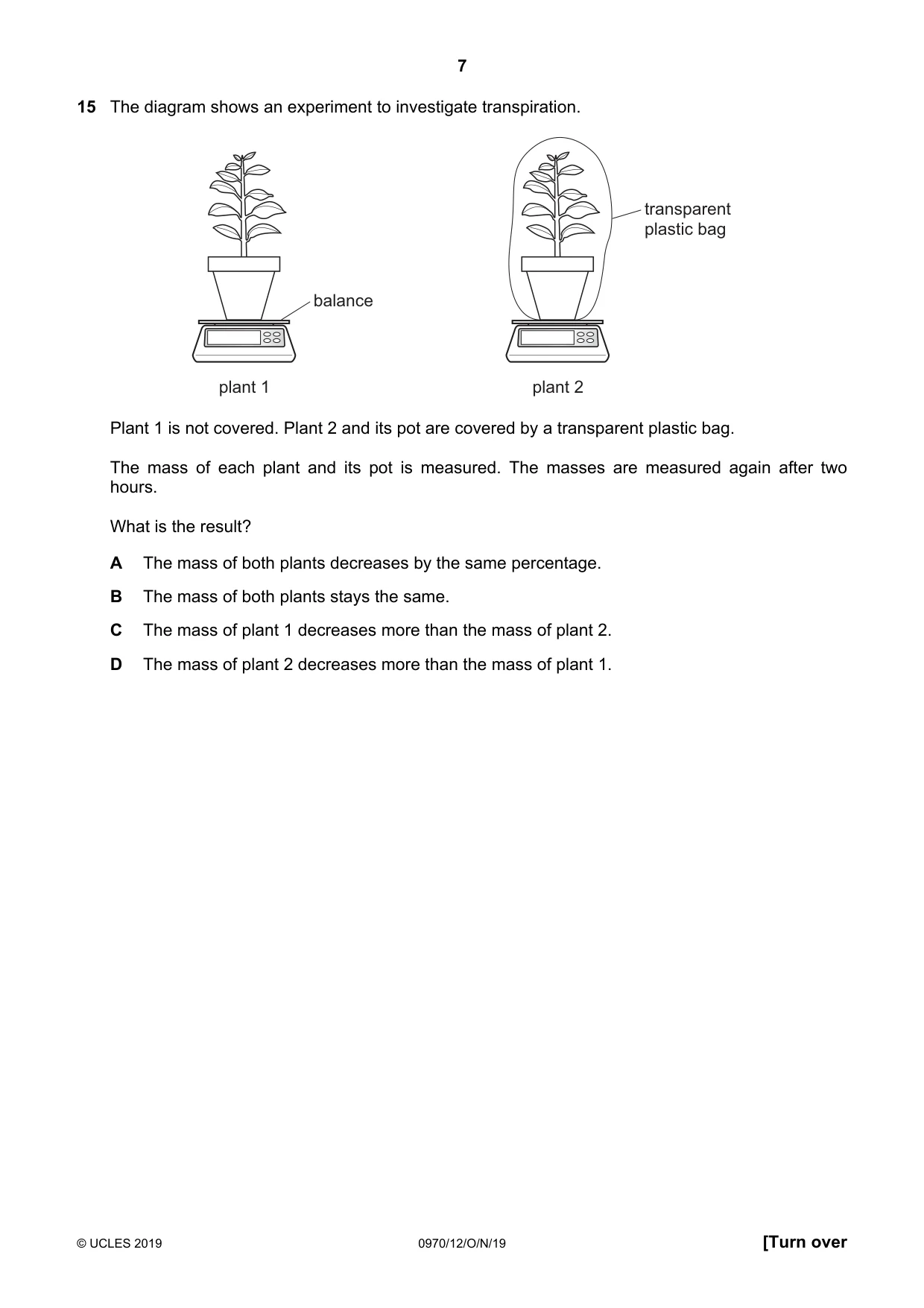
15 The diagram shows an experiment to investigate transpiration. transparent plastic bag balance plant 1 plant 2 Plant 1 is not covered. Plant 2 and its pot are covered by a transparent plastic bag. The mass of each plant and its pot is measured. The masses are measured again after two hours. What is the result? A The mass of both plants decreases by the same percentage. B The mass of both plants stays the same. C The mass of plant 1 decreases more than the mass of plant 2. D The mass of plant 2 decreases more than the mass of plant 1.
Mark scheme: C
Q16 · The diagram shows a vertical section through a human heart
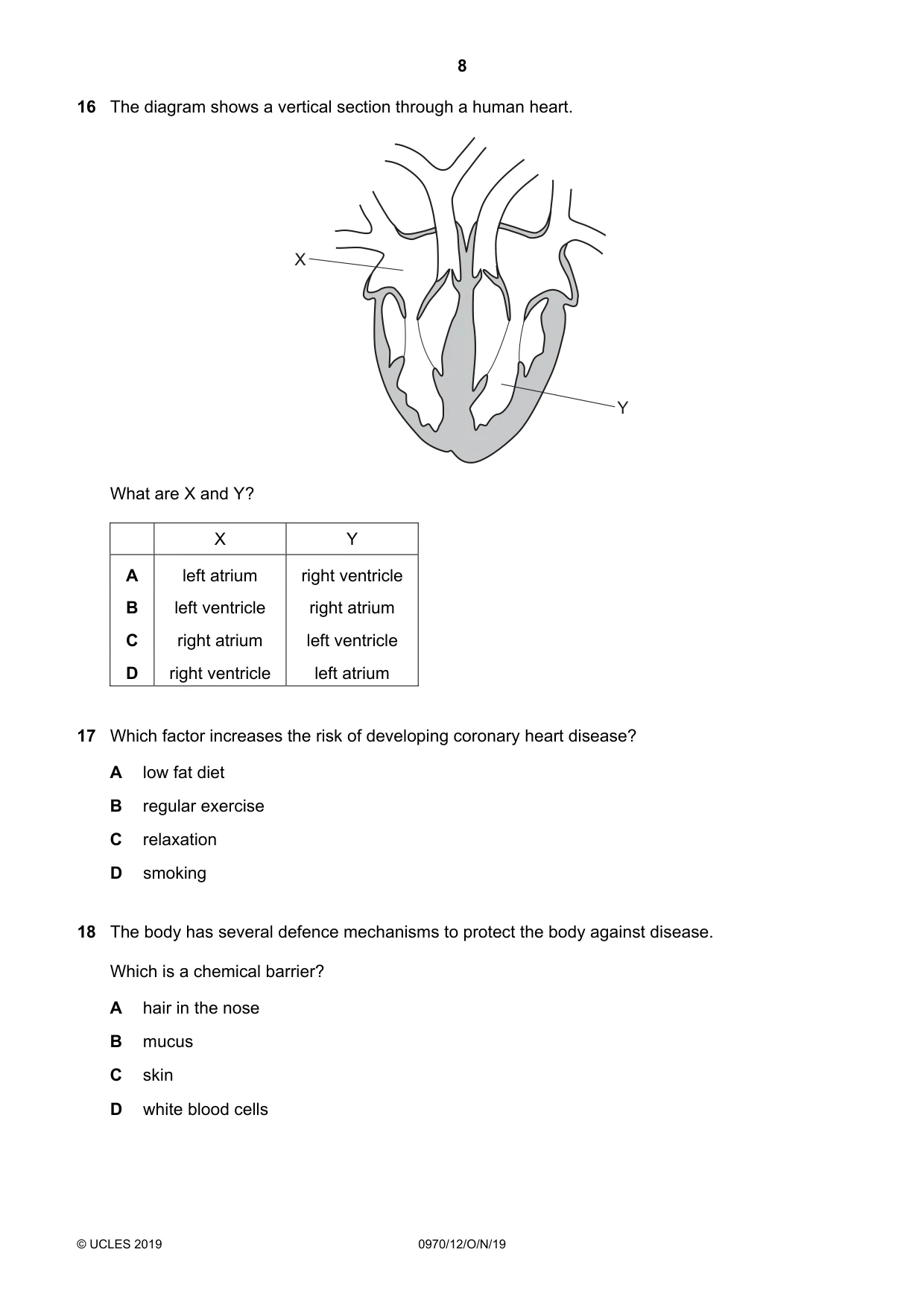
16 The diagram shows a vertical section through a human heart. X Y What are X and Y? X Y A left atrium right ventricle B left ventricle right atrium C right atrium left ventricle D right ventricle left atrium
Mark scheme: C
Q17 · Which factor increases the risk of developing coronary heart disease?
17 Which factor increases the risk of developing coronary heart disease? A low fat diet B regular exercise C relaxation D smoking
Mark scheme: D
Q18 · The body has several defence mechanisms to protect the body against disease
18 The body has several defence mechanisms to protect the body against disease. Which is a chemical barrier? A hair in the nose B mucus C skin D white blood cells
Mark scheme: B
Q19 · The diagram shows part of the human gas exchange system
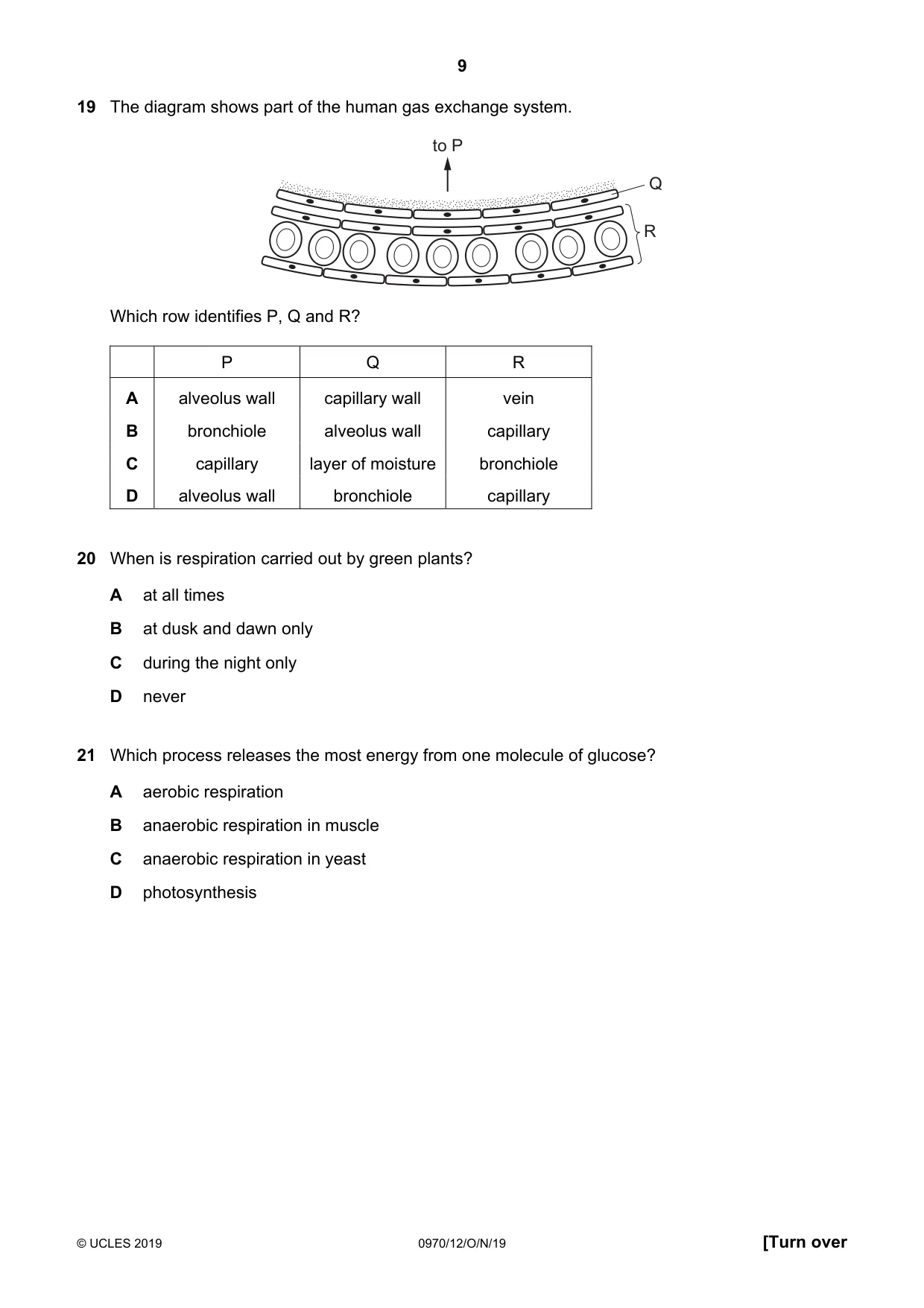
19 The diagram shows part of the human gas exchange system. to P Q R Which row identifies P, Q and R? P Q R A alveolus wall capillary wall vein B bronchiole alveolus wall capillary C capillary layer of moisture bronchiole D alveolus wall bronchiole capillary
Mark scheme: B
Q20 · When is respiration carried out by green plants?
20 When is respiration carried out by green plants? A at all times B at dusk and dawn only C during the night only D never
Mark scheme: A
Q21 · Which process releases the most energy from one molecule of glucose?
21 Which process releases the most energy from one molecule of glucose? A aerobic respiration B anaerobic respiration in muscle C anaerobic respiration in yeast D photosynthesis
Mark scheme: A
Q22 · The diagram shows a simple reflex arc
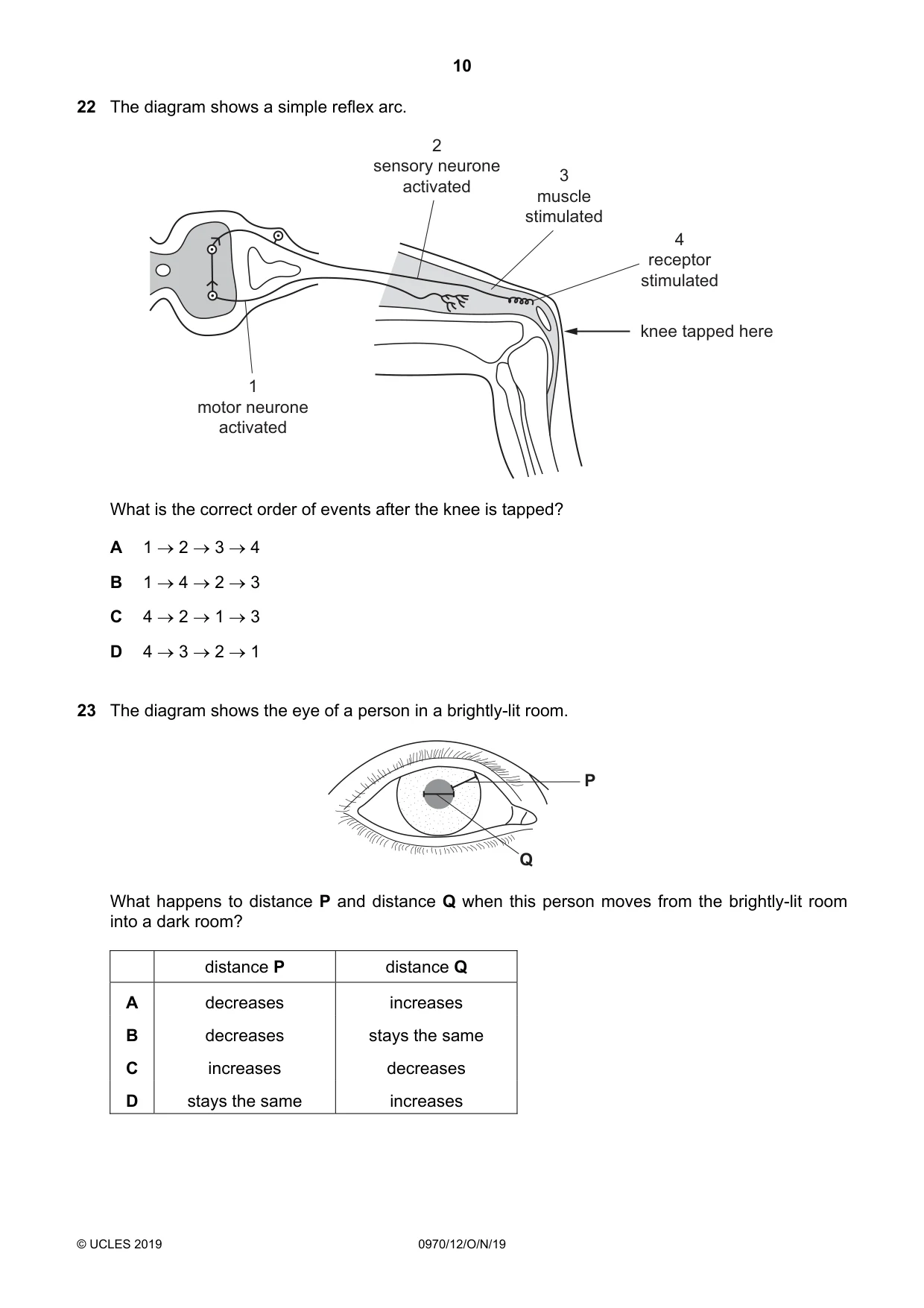
22 The diagram shows a simple reflex arc. 2 sensory neurone 3 activated muscle stimulated 4 receptor stimulated knee tapped here 1 motor neurone activated What is the correct order of events after the knee is tapped? A 1 → 2 → 3 → 4 B 1 → 4 → 2 → 3 C 4 → 2 → 1 → 3 D 4 → 3 → 2 → 1
Mark scheme: C
Q23 · The diagram shows the eye of a person in a brightly-lit room
23 The diagram shows the eye of a person in a brightly-lit room. P Q What happens to distance P and distance Q when this person moves from the brightly-lit room into a dark room? distance P distance Q A decreases increases B decreases stays the same C increases decreases D stays the same increases
Mark scheme: A
Q24 · The diagram shows a leaf as seen in cross-section under the microscope
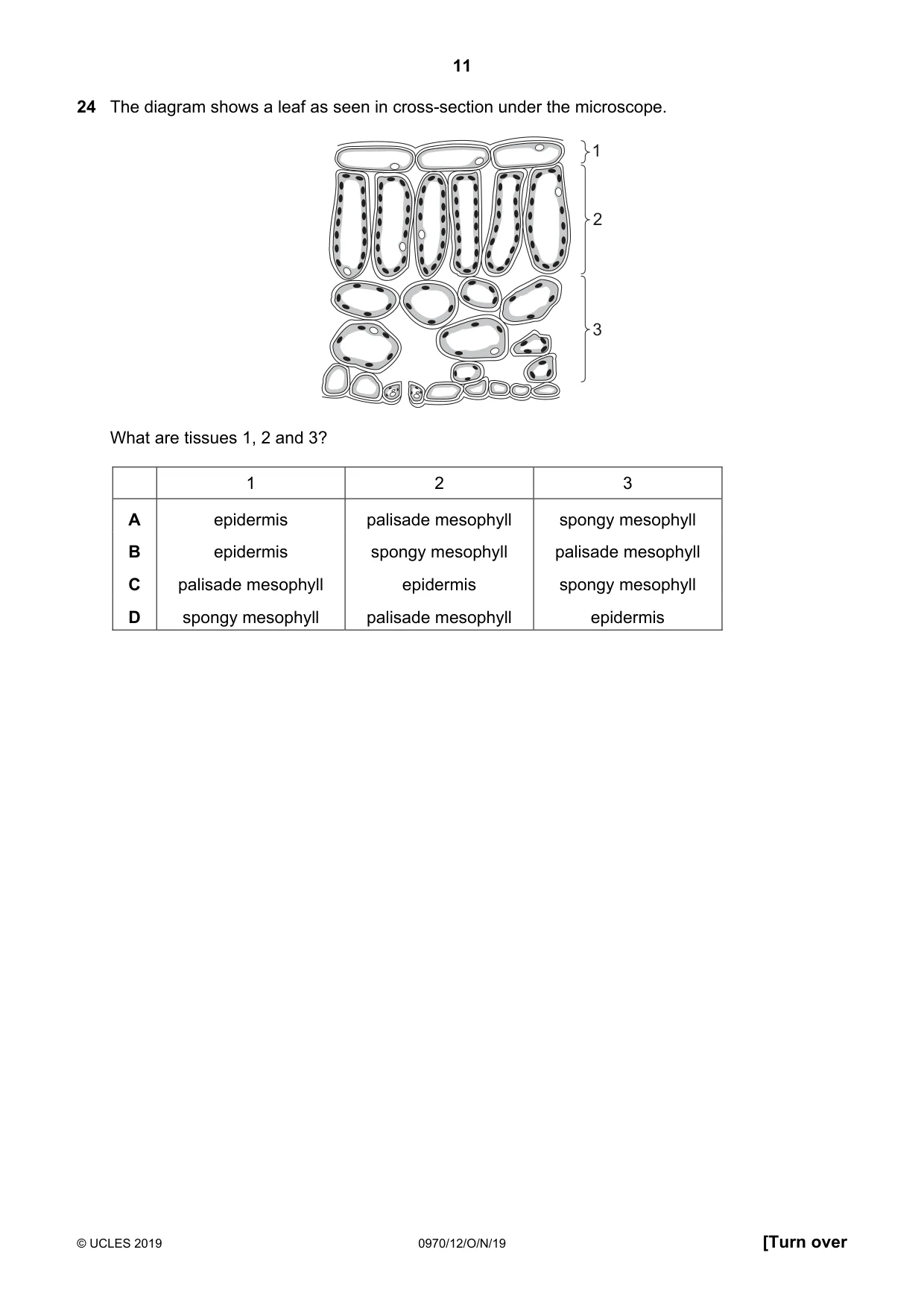
24 The diagram shows a leaf as seen in cross-section under the microscope. 1 2 3 What are tissues 1, 2 and 3? 1 2 3 A epidermis palisade mesophyll spongy mesophyll B epidermis spongy mesophyll palisade mesophyll C palisade mesophyll epidermis spongy mesophyll D spongy mesophyll palisade mesophyll epidermis
Mark scheme: A
Q25 · A patient has dye injected into the blood supply to his kidneys
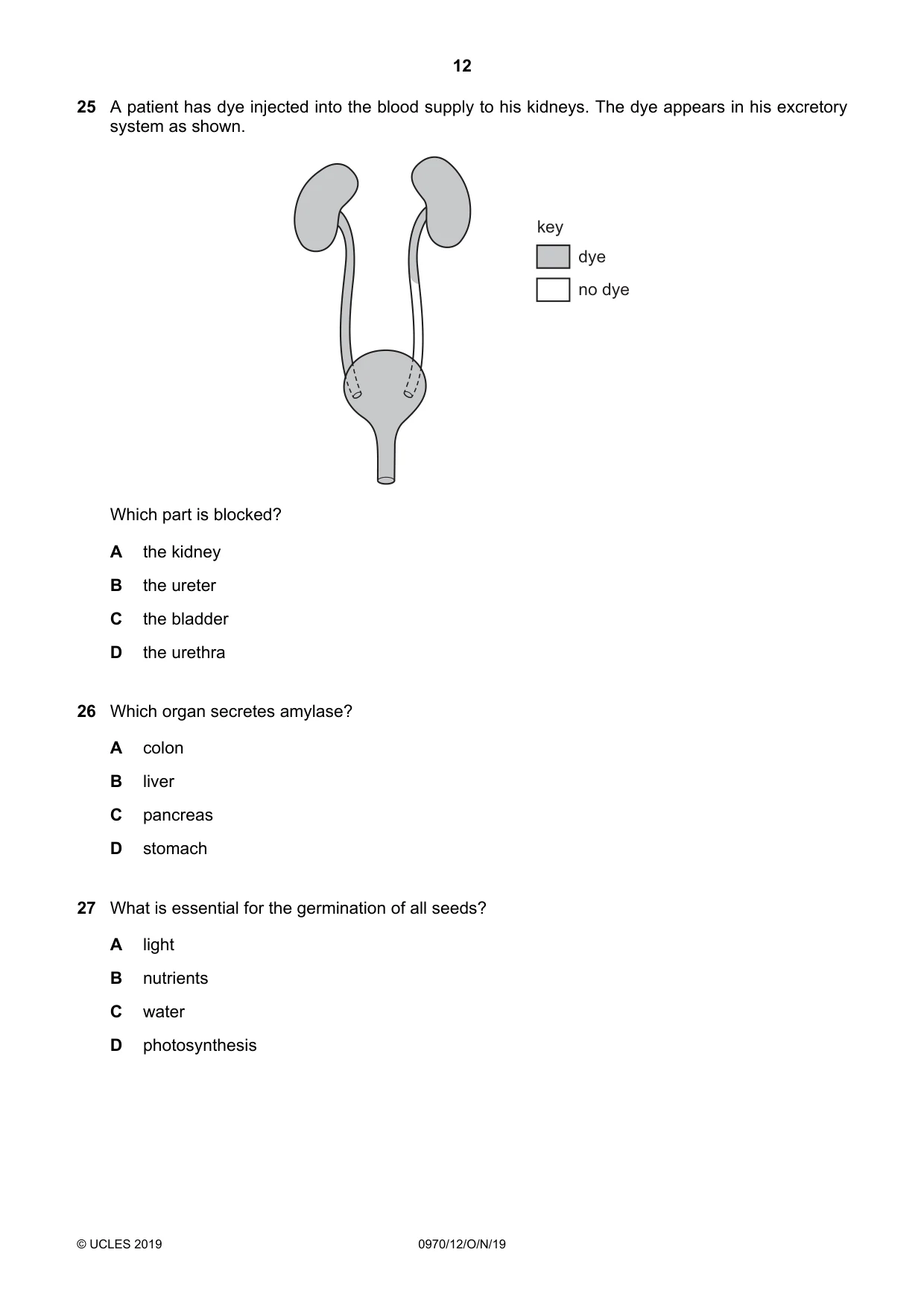
25 A patient has dye injected into the blood supply to his kidneys. The dye appears in his excretory system as shown. key dye no dye Which part is blocked? A the kidney B the ureter C the bladder D the urethra
Mark scheme: B
Q26 · Which organ secretes amylase?
26 Which organ secretes amylase? A colon B liver C pancreas D stomach
Mark scheme: C
Q27 · What is essential for the germination of all seeds?
27 What is essential for the germination of all seeds? A light B nutrients C water D photosynthesis
Mark scheme: C
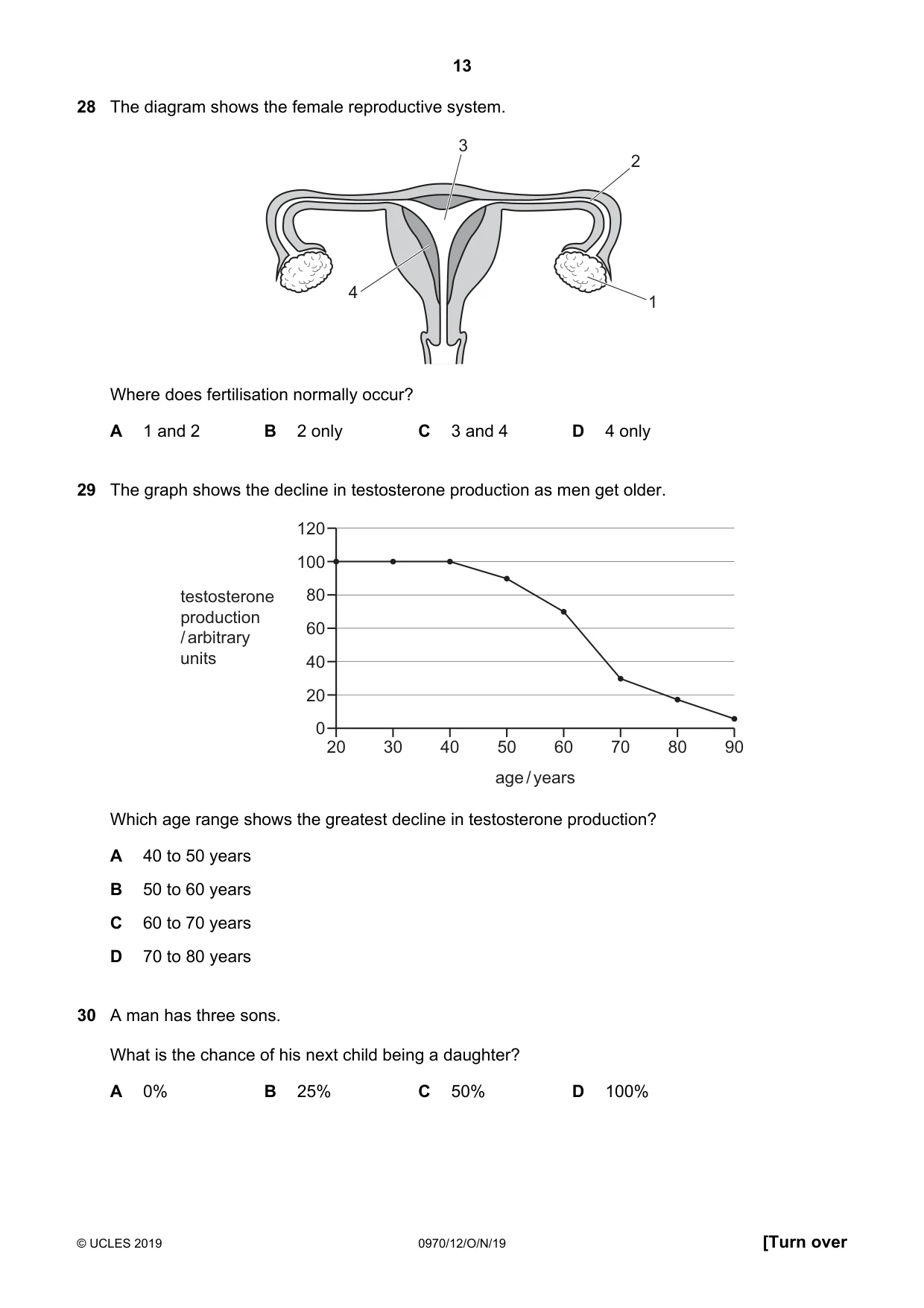
Q28 · The diagram shows the female reproductive system
28 The diagram shows the female reproductive system. 3 2 4 1 Where does fertilisation normally occur? A 1 and 2 B 2 only C 3 and 4 D 4 only
Mark scheme: B
Q29 · The graph shows the decline in testosterone production as men get older
29 The graph shows the decline in testosterone production as men get older. 120 100 testosterone 80 production 60 / arbitrary units 40 20 0 20 30 40 50 60 70 80 90 age / years Which age range shows the greatest decline in testosterone production? A 40 to 50 years B 50 to 60 years C 60 to 70 years D 70 to 80 years
Mark scheme: C
Q30 · A man has three sons
30 A man has three sons. What is the chance of his next child being a daughter? A 0% B 25% C 50% D 100%
Mark scheme: C
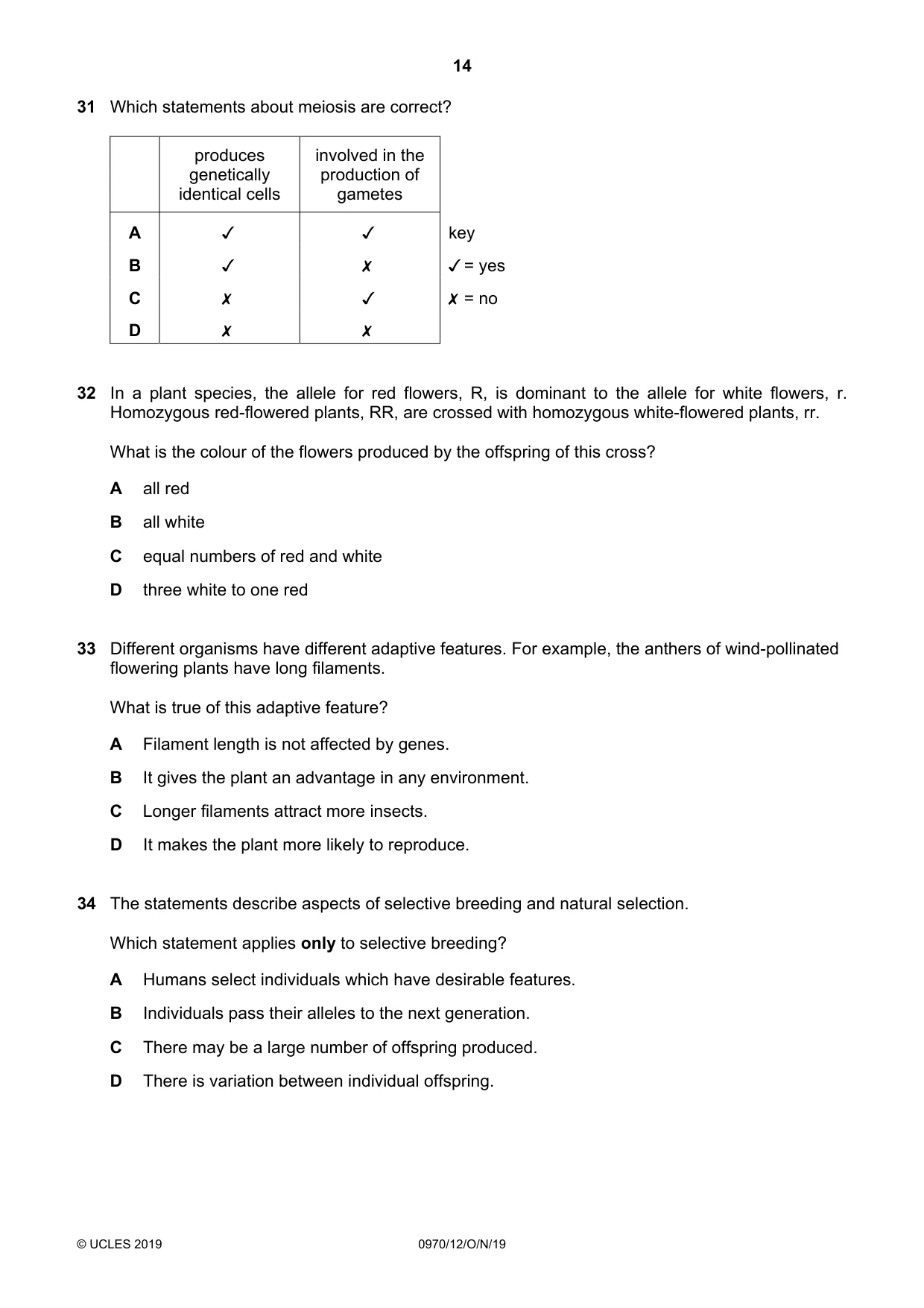
Q31 · Which statements about meiosis are correct?
31 Which statements about meiosis are correct? produces involved in the genetically production of identical cells gametes A v v B v x Cc x v D x x key J/ = yes X =no
Mark scheme: C
Q32 · In a plant species, the allele for red flowers, R, is dominant to the allele for white…
32 In a plant species, the allele for red flowers, R, is dominant to the allele for white flowers, r. Homozygous red-flowered plants, RR, are crossed with homozygous white-flowered plants, rr. What is the colour of the flowers produced by the offspring of this cross? A all red B all white C equal numbers of red and white D three white to one red
Mark scheme: A
Q33 · Different organisms have different adaptive features
33 Different organisms have different adaptive features. For example, the anthers of wind-pollinated flowering plants have long filaments. What is true of this adaptive feature? A Filament length is not affected by genes. B It gives the plant an advantage in any environment. C Longer filaments attract more insects. D It makes the plant more likely to reproduce.
Mark scheme: D
Q34 · The statements describe aspects of selective breeding and natural selection
34 The statements describe aspects of selective breeding and natural selection. Which statement applies only to selective breeding? A Humans select individuals which have desirable features. B Individuals pass their alleles to the next generation. C There may be a large number of offspring produced. D There is variation between individual offspring.
Mark scheme: A
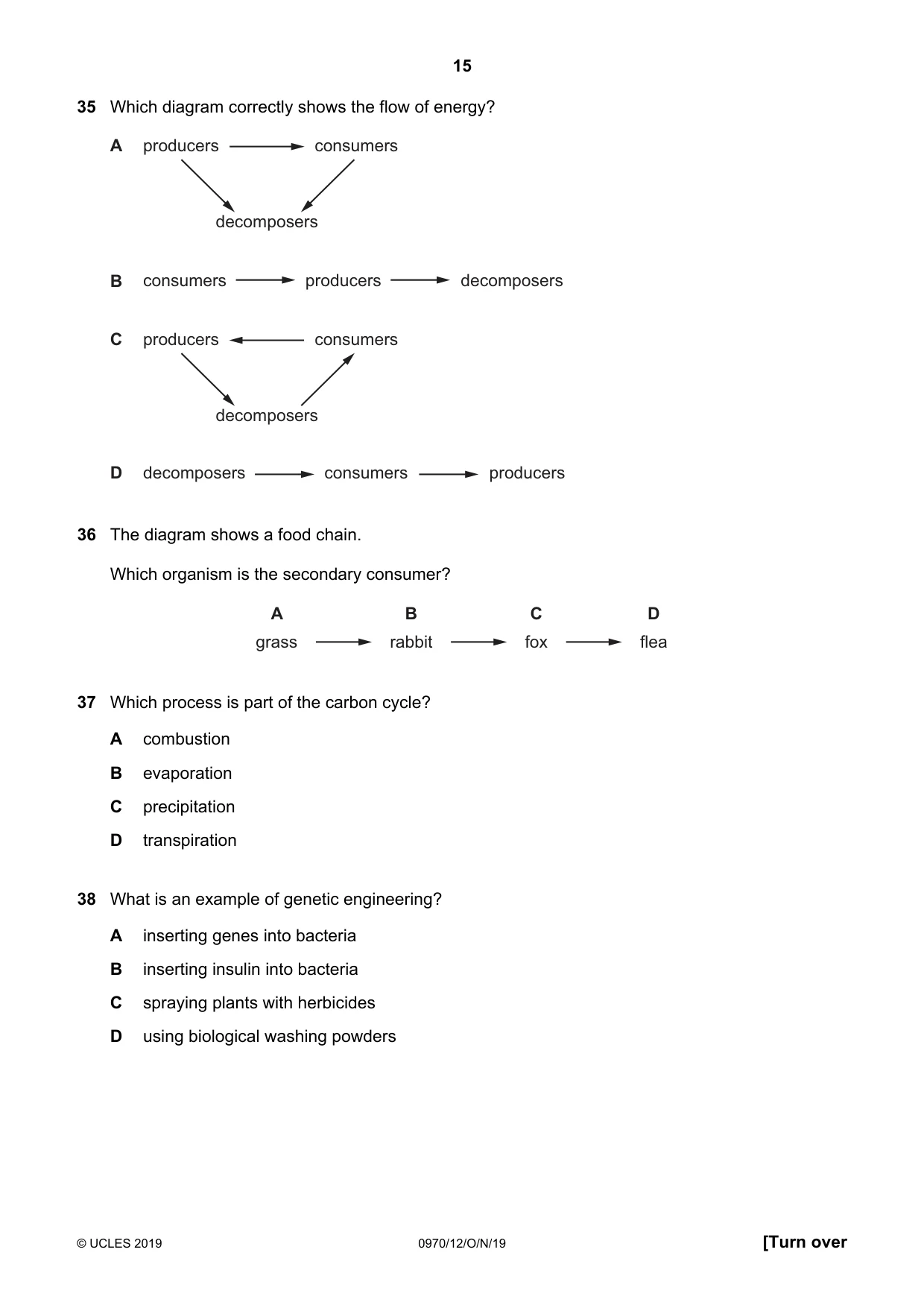
Q35 · Which diagram correctly shows the flow of energy?
35 Which diagram correctly shows the flow of energy? A producers consumers decomposers B consumers producers decomposers C producers consumers decomposers D decomposers consumers producers
Mark scheme: A
Q36 · The diagram shows a food chain
36 The diagram shows a food chain. Which organism is the secondary consumer? A B C D grass rabbit fox flea
Mark scheme: C
Q37 · Which process is part of the carbon cycle?
37 Which process is part of the carbon cycle? A combustion B evaporation C precipitation D transpiration
Mark scheme: A
Q38 · What is an example of genetic engineering?
38 What is an example of genetic engineering? A inserting genes into bacteria B inserting insulin into bacteria C spraying plants with herbicides D using biological washing powders
Mark scheme: A
Q39 · What are the possible effects of deforestation?
39 What are the possible effects of deforestation? decrease in atmospheric loss of soil flooding carbon dioxide A yes yes no B yes no yes C no yes no D no no yes
Mark scheme: A
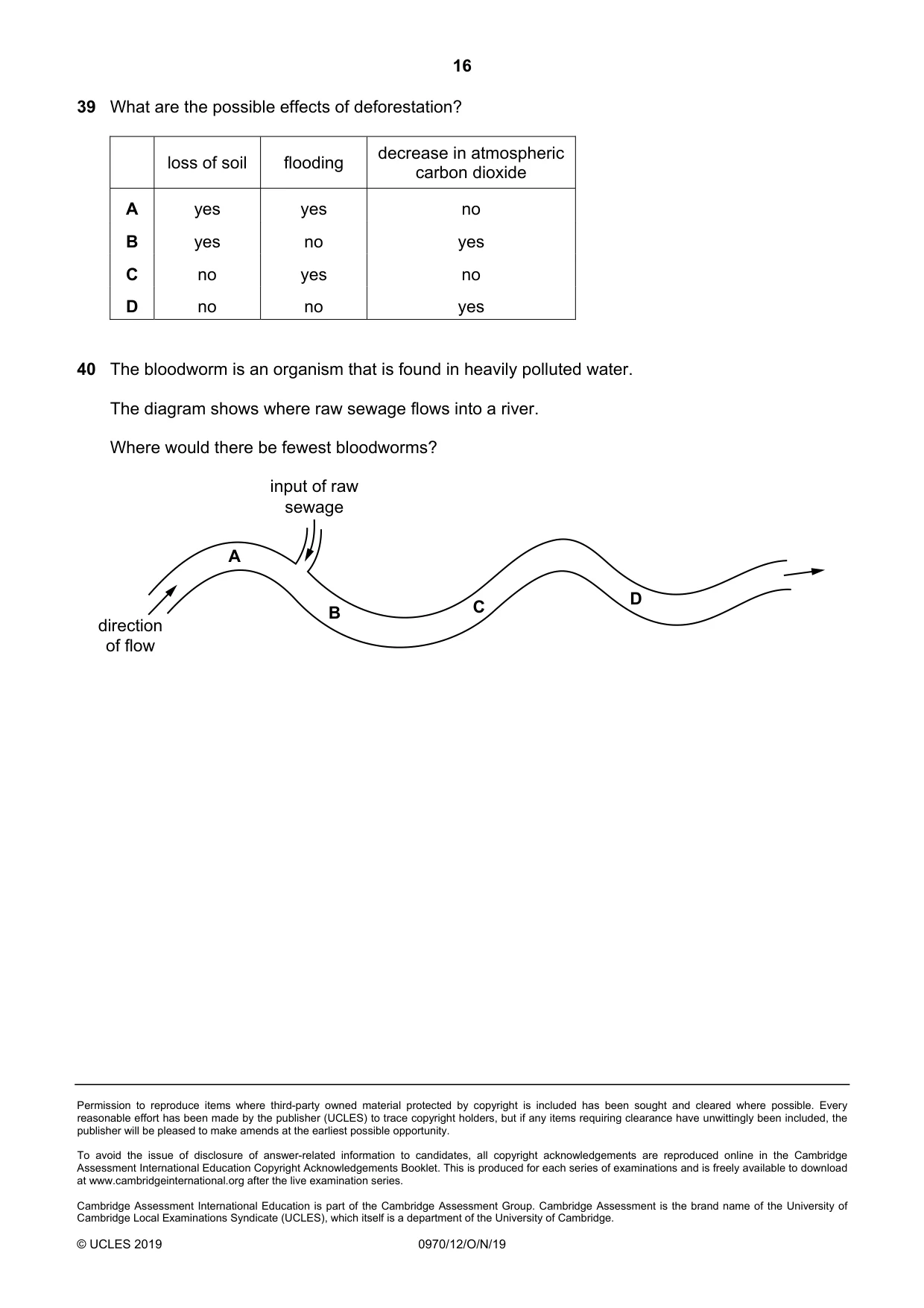
Q40 · The bloodworm is an organism that is found in heavily polluted water
40 The bloodworm is an organism that is found in heavily polluted water. The diagram shows where raw sewage flows into a river. Where would there be fewest bloodworms? input of raw sewage A D B C direction of flow
Mark scheme: A
What was in this paper
The subtopics covered by these 40 questions, and how many questions each got. Open one in a new tab to see every Cambridge question on it.
2Cell structure2Chemical digestion2Concept and uses of classification systems2Monohybrid inheritance2Adaptive features1Aerobic respiration1Characteristics of living organisms1Circulatory systems1Coordination and response1Diet1Digestive system1Diseases and immunity1Energy flow1Excretion in humans1Features of organisms1Food chains and food webs1Gas exchange in humans1Genetic modification1Habitat destruction1Heart1Hormones1Leaf structure1Meiosis1Nutrient cycles1Osmosis1Photosynthesis1Pollution1Respiration1Selection1Sense organs1Sex hormones in humans1Sexual reproduction in humans1Sexual reproduction in plants1Transpiration1What you needed in this session
Cambridge’s own grade thresholds for 2019 Oct/Nov, Paper 1 · Variant 2. A higher threshold means an easier paper — the bar moves with how the cohort did.