Cambridge IGCSE Biology (9-1) 0970 — 2023 Oct/Nov Paper 1 · Variant 2
0970/12/O/N/23 · 40 questions · 40 marks · ≈45 min
The question paper and its mark scheme, free to read here and free to download. This is Cambridge’s own paper, exactly as it was sat.
Question paper16 pages
Mark scheme3 pages
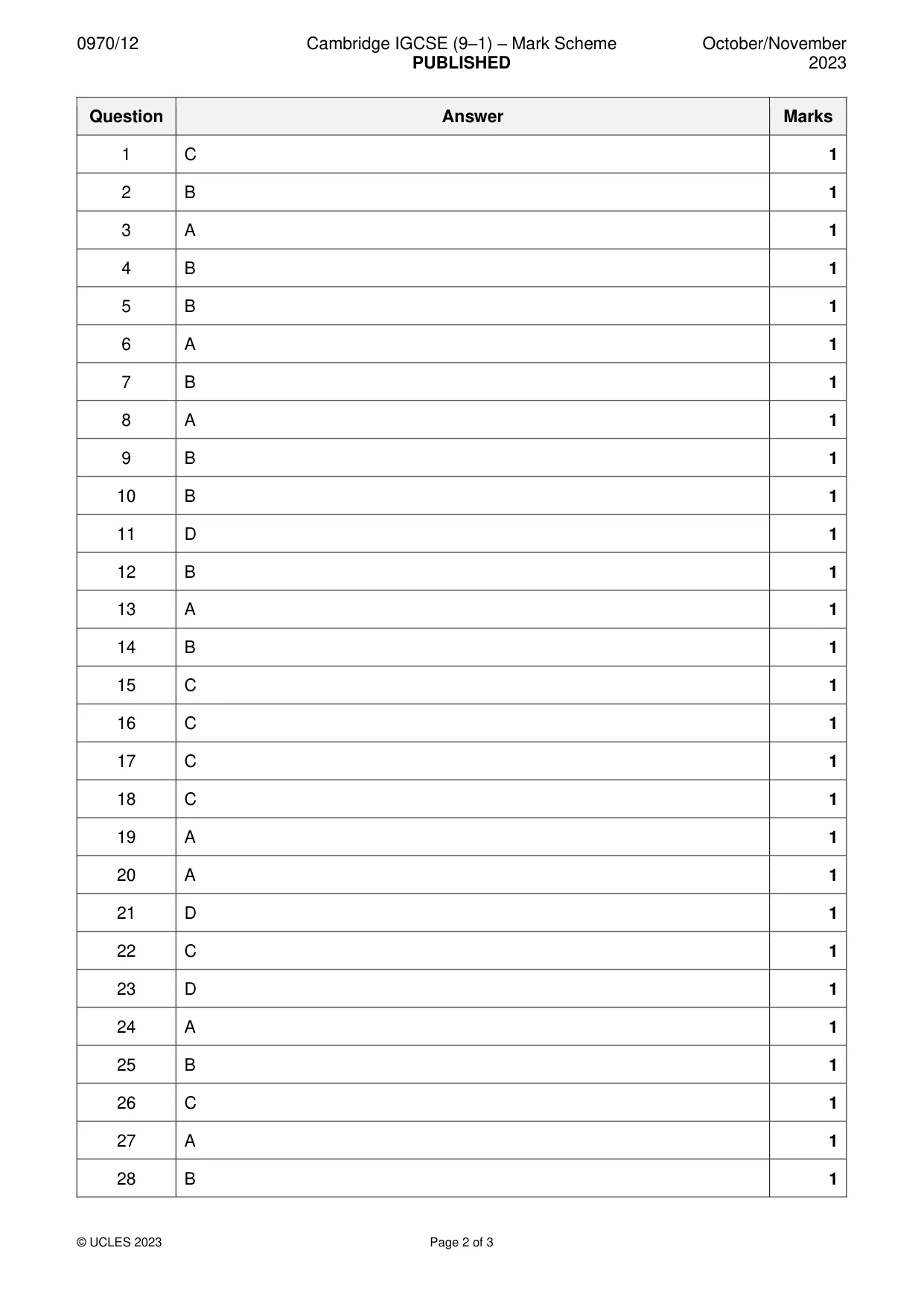
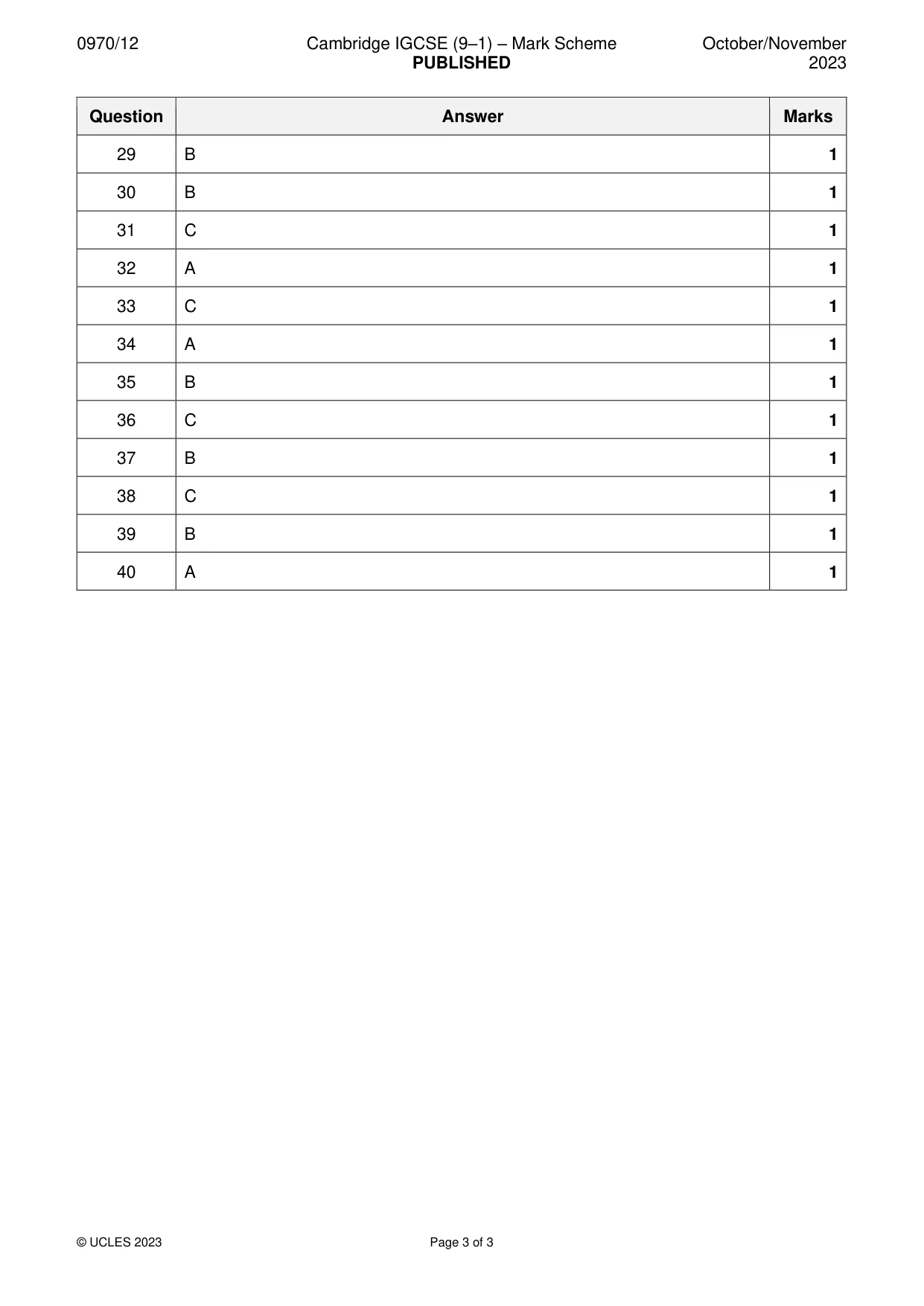
Answers below. Sit the paper first if you are practising.
Questions as text
Q1 · Which processes are characteristics of all living organisms?
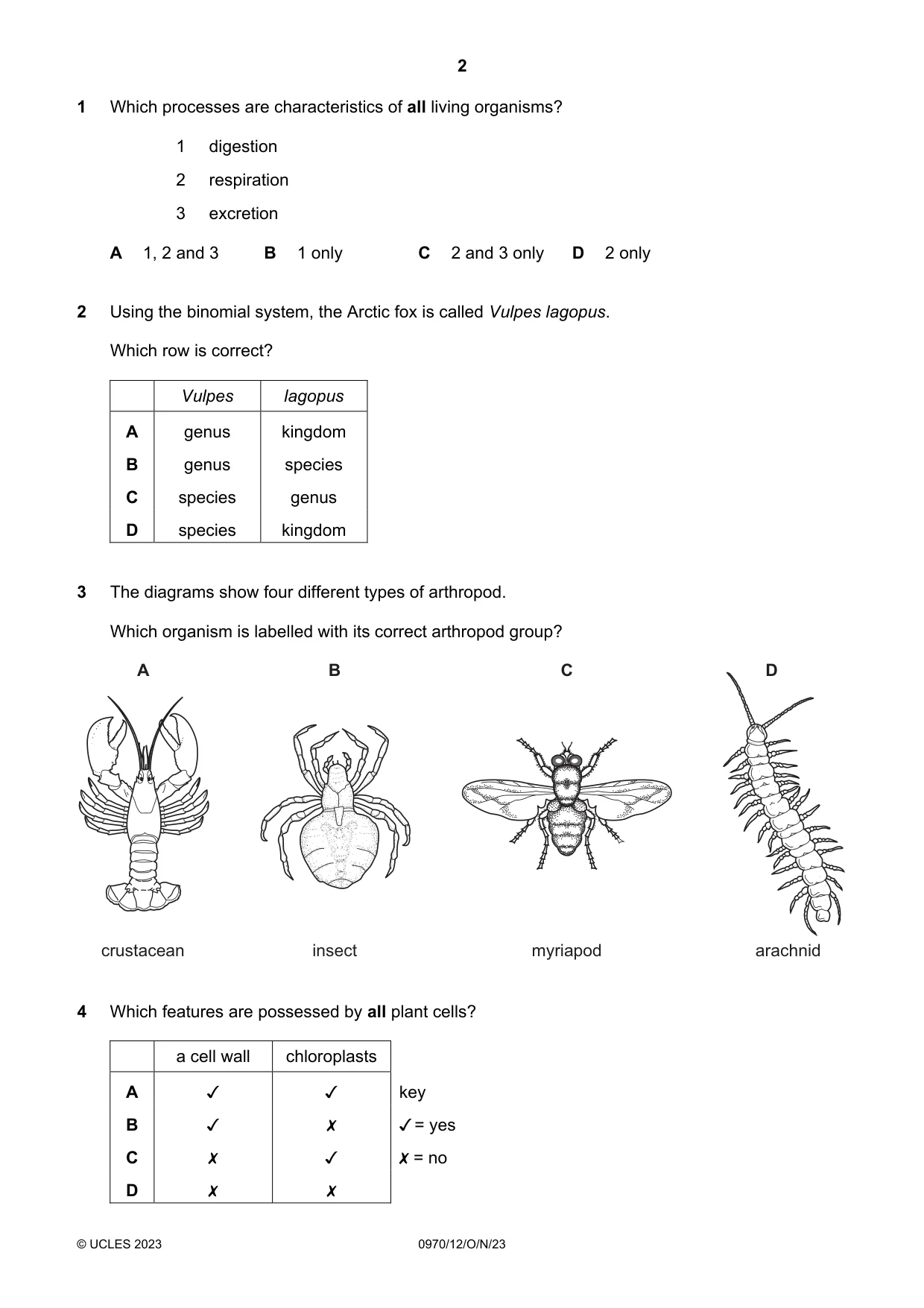
1 Which processes are characteristics of all living organisms? 1 digestion 2 respiration 3 excretion A 1, 2 and 3 B 1 only C 2 and 3 only D 2 only
Mark scheme: C
Q2 · Using the binomial system, the Arctic fox is called Vulpes lagopus
2 Using the binomial system, the Arctic fox is called Vulpes lagopus. Which row is correct? Vulpes lagopus A genus kingdom B genus species C species genus D species kingdom
Mark scheme: B
More questions on Concept and uses of classification systems
Q3 · The diagrams show four different types of arthropod
3 The diagrams show four different types of arthropod. Which organism is labelled with its correct arthropod group? A B C D crustacean insect myriapod arachnid
Mark scheme: A
Q4 · Which features are possessed by all plant cells?
4 Which features are possessed by all plant cells? a cell wall chloroplasts v v key /=yes 0 0O WwW > J x x Jv X=no x x
Mark scheme: B
Q5 · The diameter of an egg is 6.5 cm
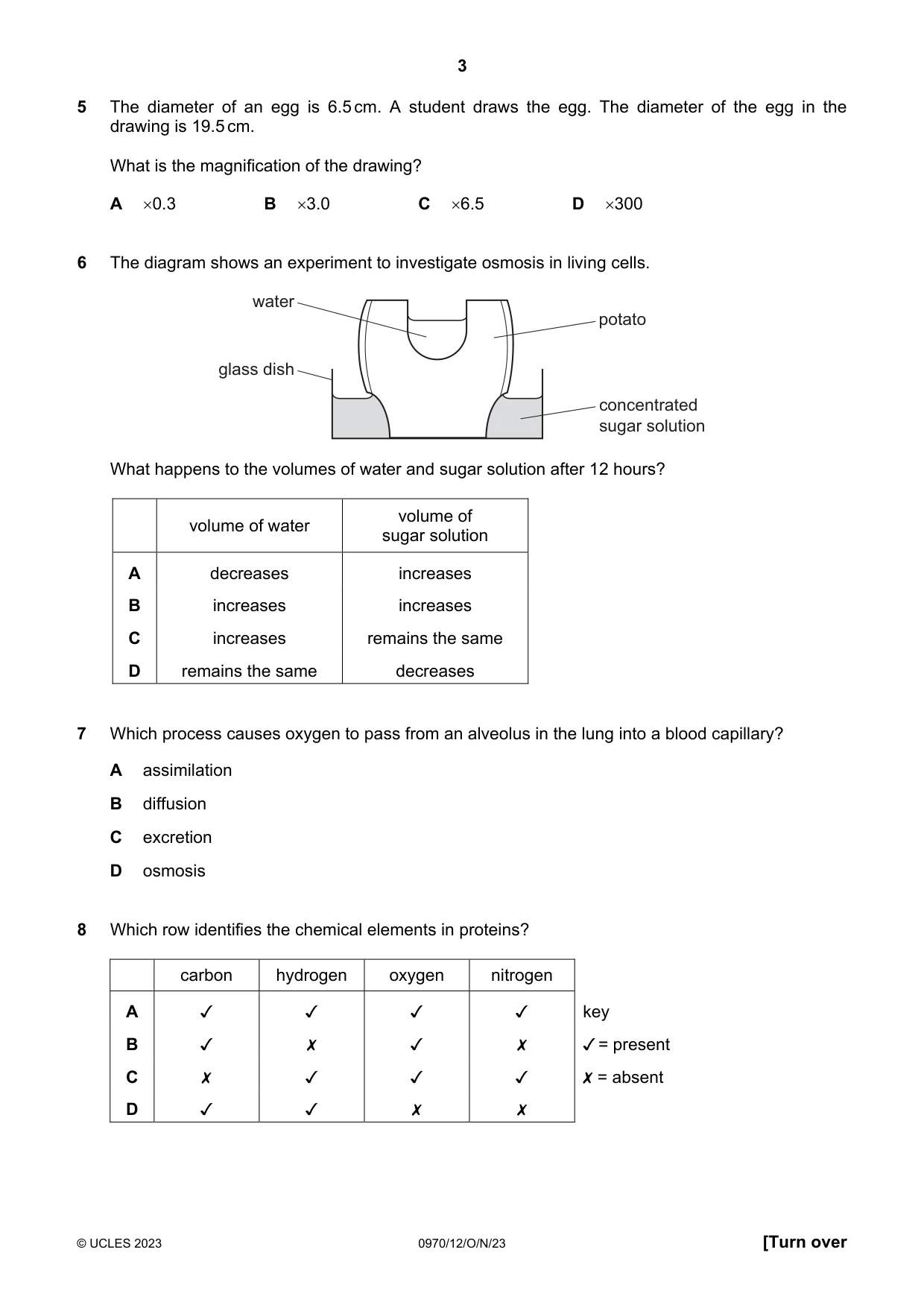
5 The diameter of an egg is 6.5 cm. A student draws the egg. The diameter of the egg in the drawing is 19.5 cm. What is the magnification of the drawing? A 0.3 B 3.0 C 6.5 D 300
Mark scheme: B
Q6 · The diagram shows an experiment to investigate osmosis in living cells
6 The diagram shows an experiment to investigate osmosis in living cells. water potato glass dish concentrated sugar solution What happens to the volumes of water and sugar solution after 12 hours? volume of volume of water sugar solution A decreases increases B increases increases C increases remains the same D remains the same decreases
Mark scheme: A
Q7 · Which process causes oxygen to pass from an alveolus in the lung into a blood capillary?
7 Which process causes oxygen to pass from an alveolus in the lung into a blood capillary? A assimilation B diffusion C excretion D osmosis
Mark scheme: B
Q8 · Which row identifies the chemical elements in proteins?
8 Which row identifies the chemical elements in proteins? carbon hydrogen oxygen nitrogen A v J J J key B Jv x Jv x / = present Cc x v v v X = absent D J J x x
Mark scheme: A
Q9 · The table shows some large biological molecules and some small biological molecules
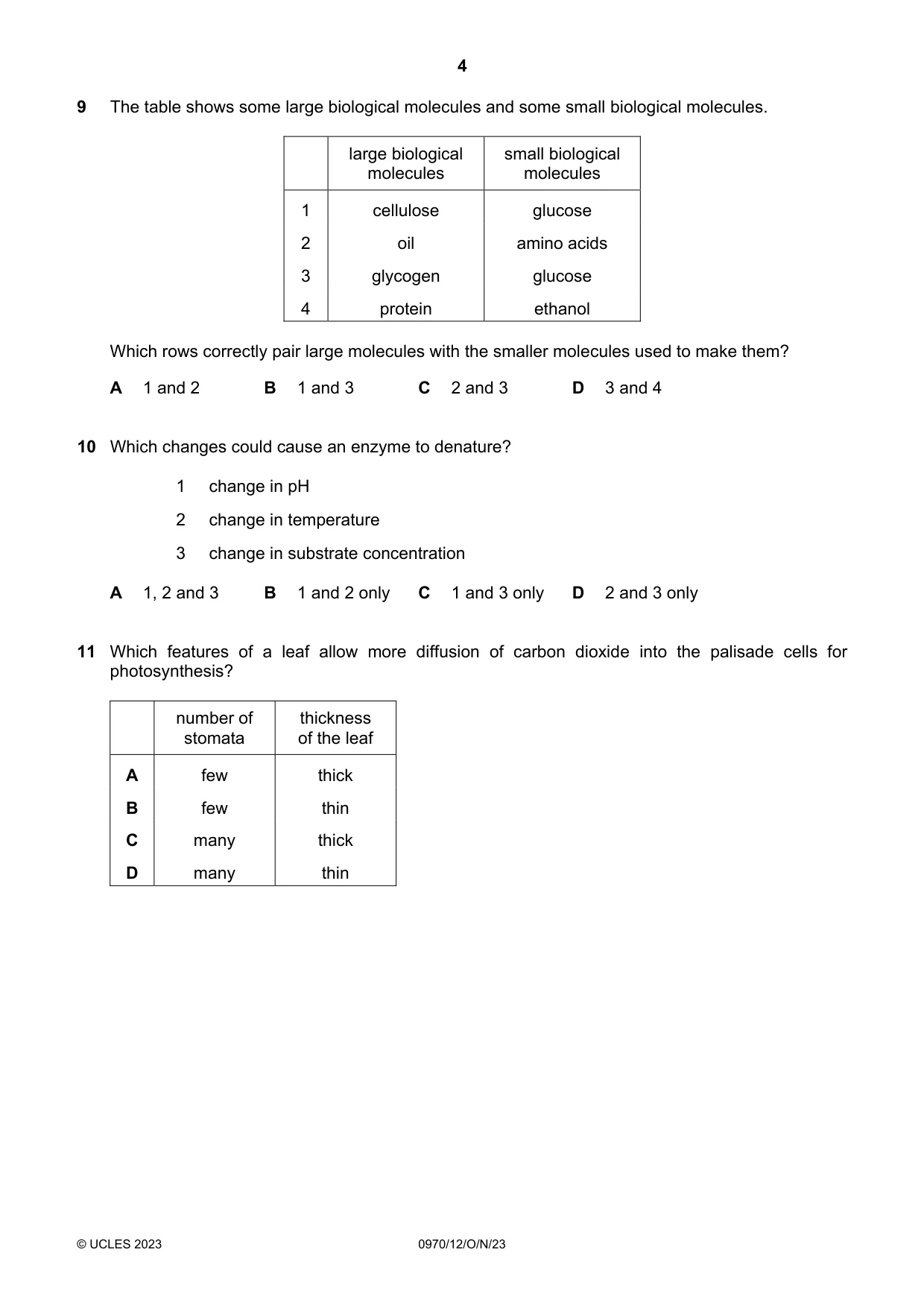
9 The table shows some large biological molecules and some small biological molecules. large biological small biological molecules molecules 1 cellulose glucose 2 oil amino acids 3 glycogen glucose 4 protein ethanol Which rows correctly pair large molecules with the smaller molecules used to make them? A 1 and 2 B 1 and 3 C 2 and 3 D 3 and 4
Mark scheme: B
Q10 · Which changes could cause an enzyme to denature?
10 Which changes could cause an enzyme to denature? 1 change in pH 2 change in temperature 3 change in substrate concentration A 1, 2 and 3 B 1 and 2 only C 1 and 3 only D 2 and 3 only
Mark scheme: B
Q11 · Which features of a leaf allow more diffusion of carbon dioxide into the palisade cells…
11 Which features of a leaf allow more diffusion of carbon dioxide into the palisade cells for photosynthesis? number of thickness stomata of the leaf A few thick B few thin C many thick D many thin
Mark scheme: D
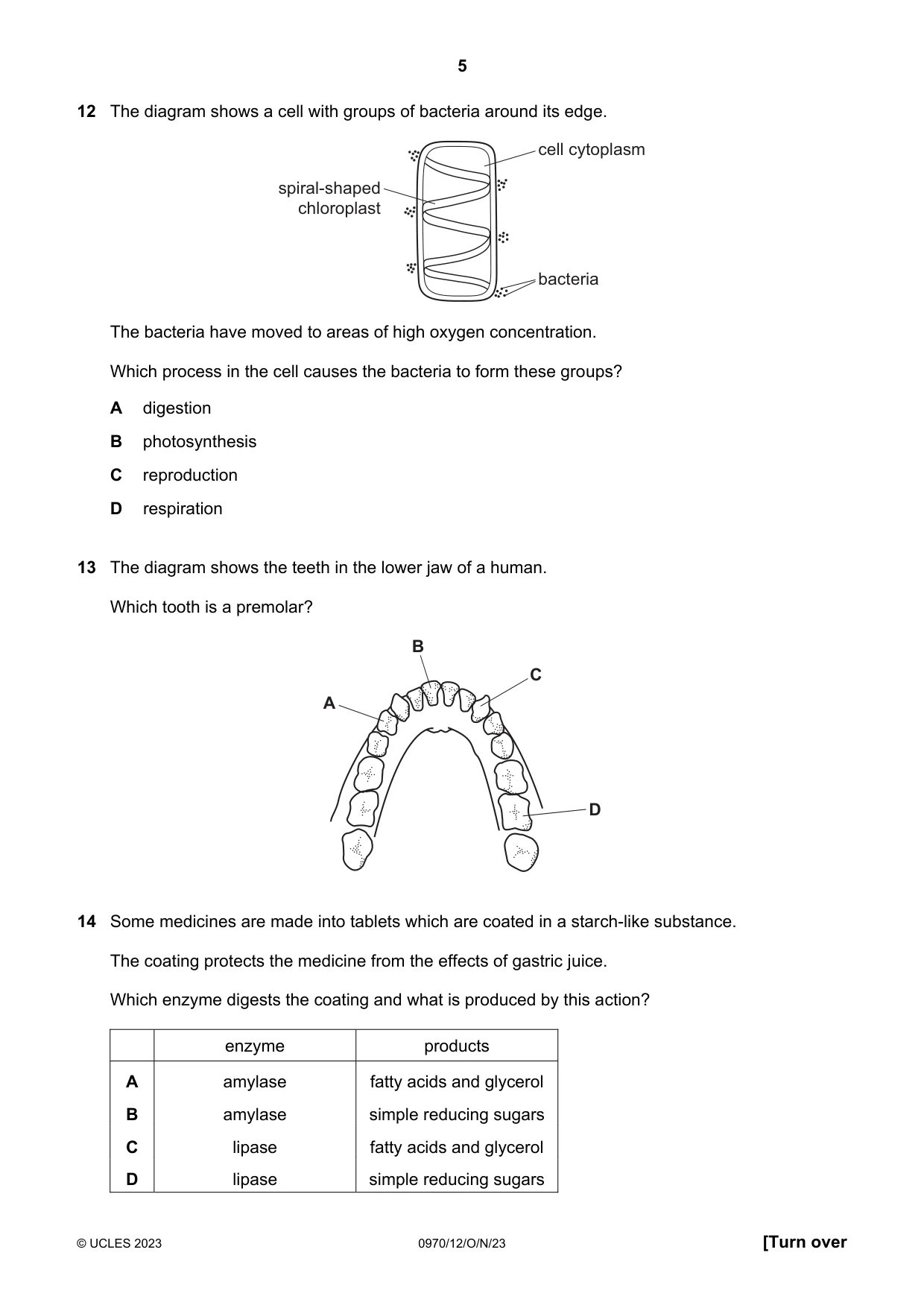
Q12 · The diagram shows a cell with groups of bacteria around its edge
12 The diagram shows a cell with groups of bacteria around its edge. cell cytoplasm spiral-shaped chloroplast bacteria The bacteria have moved to areas of high oxygen concentration. Which process in the cell causes the bacteria to form these groups? A digestion B photosynthesis C reproduction D respiration
Mark scheme: B
Q13 · The diagram shows the teeth in the lower jaw of a human
13 The diagram shows the teeth in the lower jaw of a human. Which tooth is a premolar? B C A D
Mark scheme: A
Q14 · Some medicines are made into tablets which are coated in a starch-like substance
14 Some medicines are made into tablets which are coated in a starch-like substance. The coating protects the medicine from the effects of gastric juice. Which enzyme digests the coating and what is produced by this action? enzyme products A amylase fatty acids and glycerol B amylase simple reducing sugars C lipase fatty acids and glycerol D lipase simple reducing sugars
Mark scheme: B
Q15 · In which part of the alimentary canal are most nutrients absorbed into the blood?
15 In which part of the alimentary canal are most nutrients absorbed into the blood? A colon B oesophagus C small intestine D stomach
Mark scheme: C
Q16 · From which part of a leaf does most water evaporate during transpiration?
16 From which part of a leaf does most water evaporate during transpiration? A the cuticle B the guard cells C the spongy mesophyll cells D the xylem vessels
Mark scheme: C
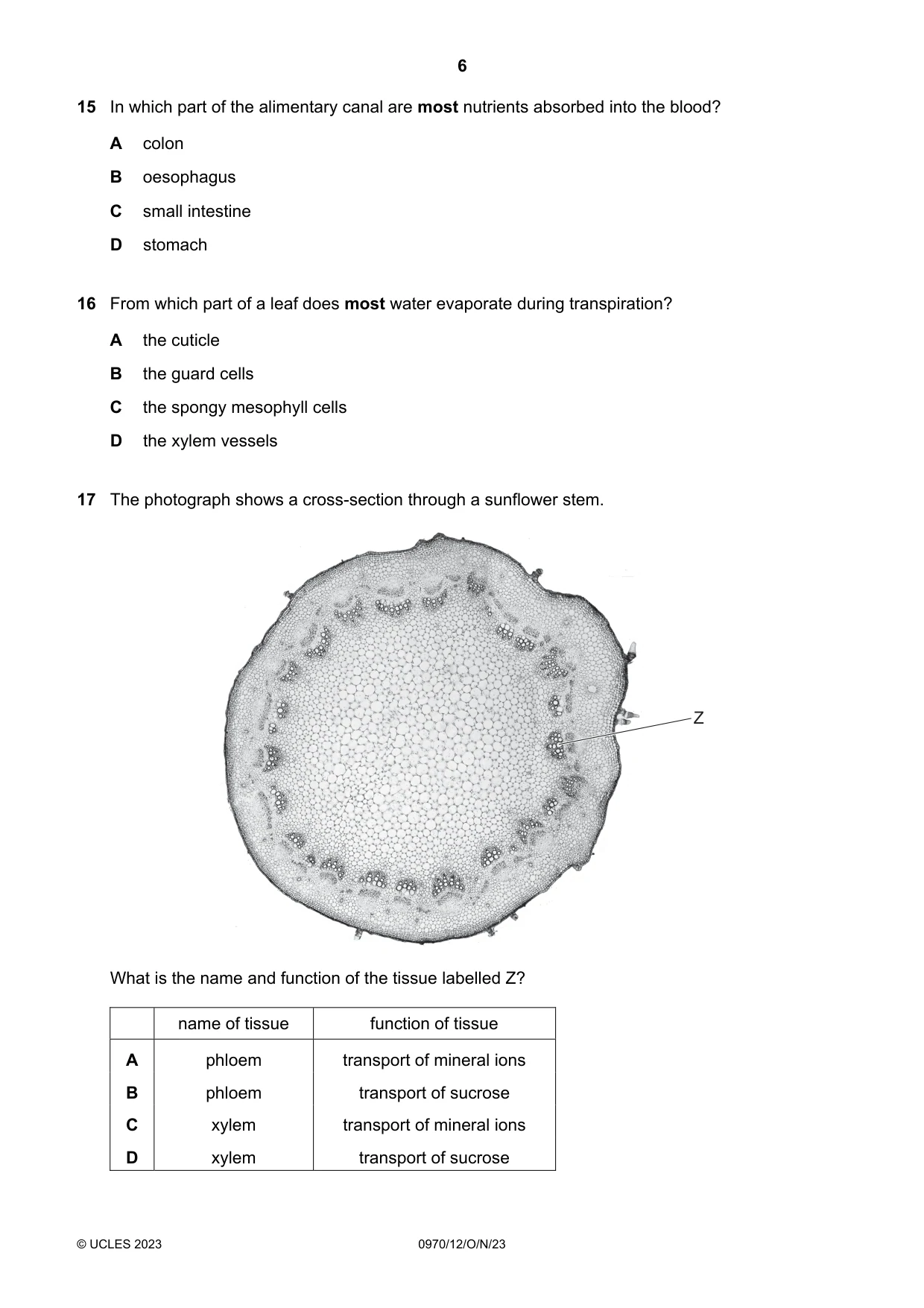
Q17 · The photograph shows a cross-section through a sunflower stem
17 The photograph shows a cross-section through a sunflower stem. Z What is the name and function of the tissue labelled Z? name of tissue function of tissue A phloem transport of mineral ions B phloem transport of sucrose C xylem transport of mineral ions D xylem transport of sucrose
Mark scheme: C
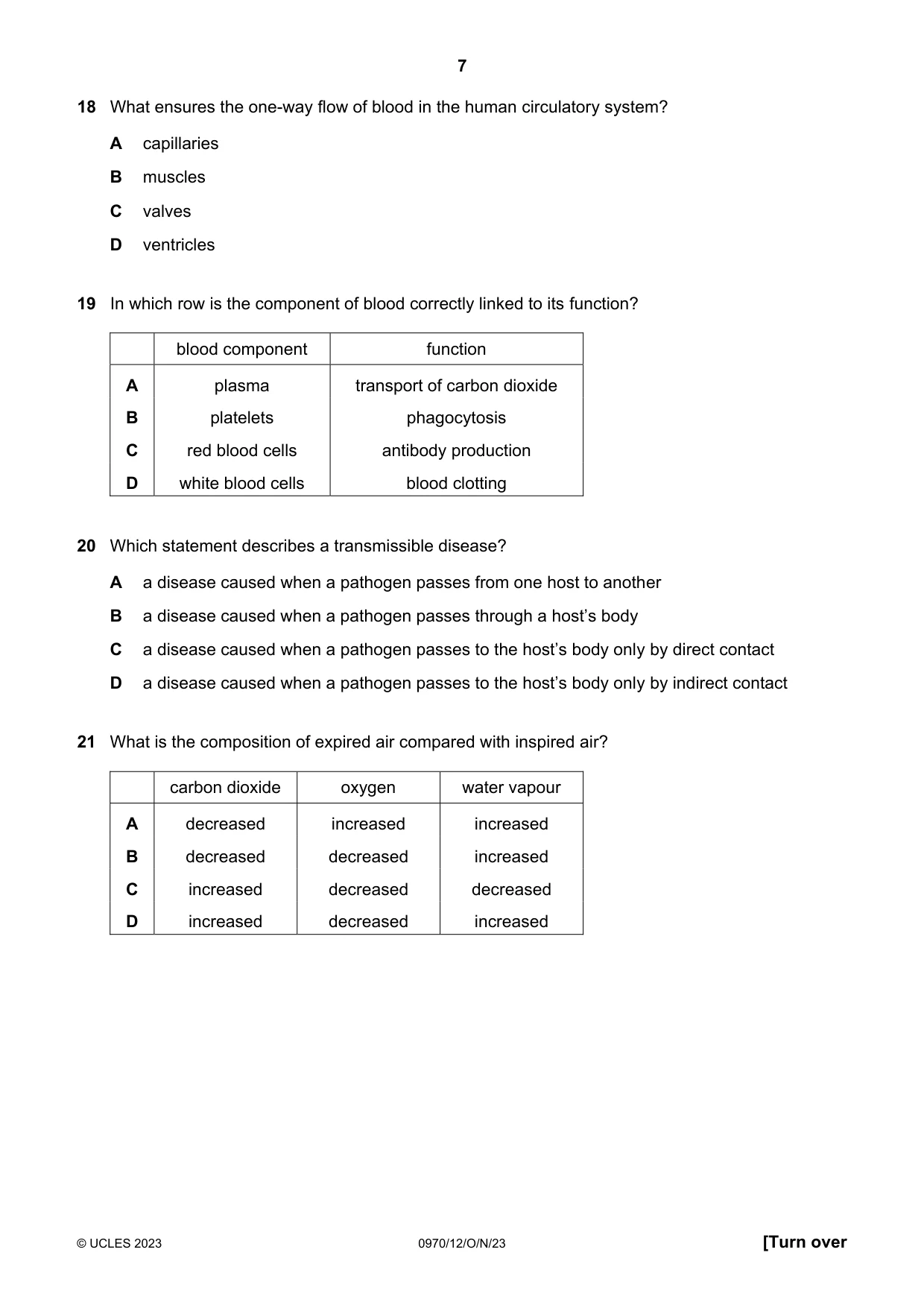
Q18 · What ensures the one-way flow of blood in the human circulatory system?
18 What ensures the one-way flow of blood in the human circulatory system? A capillaries B muscles C valves D ventricles
Mark scheme: C
Q19 · In which row is the component of blood correctly linked to its function?
19 In which row is the component of blood correctly linked to its function? blood component function A plasma transport of carbon dioxide B platelets phagocytosis C red blood cells antibody production D white blood cells blood clotting
Mark scheme: A
Q20 · Which statement describes a transmissible disease?
20 Which statement describes a transmissible disease? A a disease caused when a pathogen passes from one host to another B a disease caused when a pathogen passes through a host’s body C a disease caused when a pathogen passes to the host’s body only by direct contact D a disease caused when a pathogen passes to the host’s body only by indirect contact
Mark scheme: A
Q21 · What is the composition of expired air compared with inspired air?
21 What is the composition of expired air compared with inspired air? carbon dioxide oxygen water vapour A decreased increased increased B decreased decreased increased C increased decreased decreased D increased decreased increased
Mark scheme: D
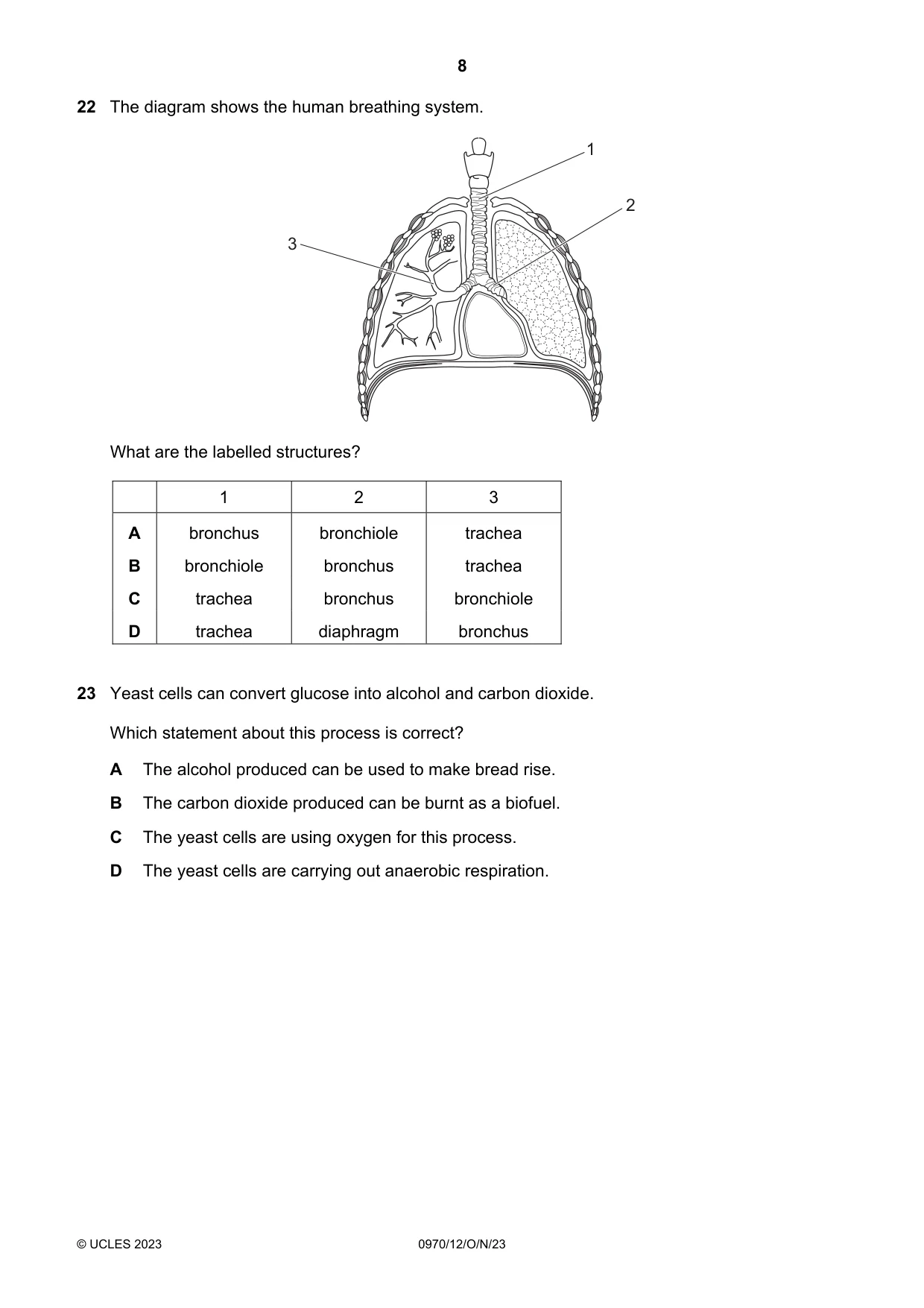
Q22 · The diagram shows the human breathing system
22 The diagram shows the human breathing system. 1 2 3 What are the labelled structures? 1 2 3 A bronchus bronchiole trachea B bronchiole bronchus trachea C trachea bronchus bronchiole D trachea diaphragm bronchus
Mark scheme: C
Q23 · Yeast cells can convert glucose into alcohol and carbon dioxide
23 Yeast cells can convert glucose into alcohol and carbon dioxide. Which statement about this process is correct? A The alcohol produced can be used to make bread rise. B The carbon dioxide produced can be burnt as a biofuel. C The yeast cells are using oxygen for this process. D The yeast cells are carrying out anaerobic respiration.
Mark scheme: D
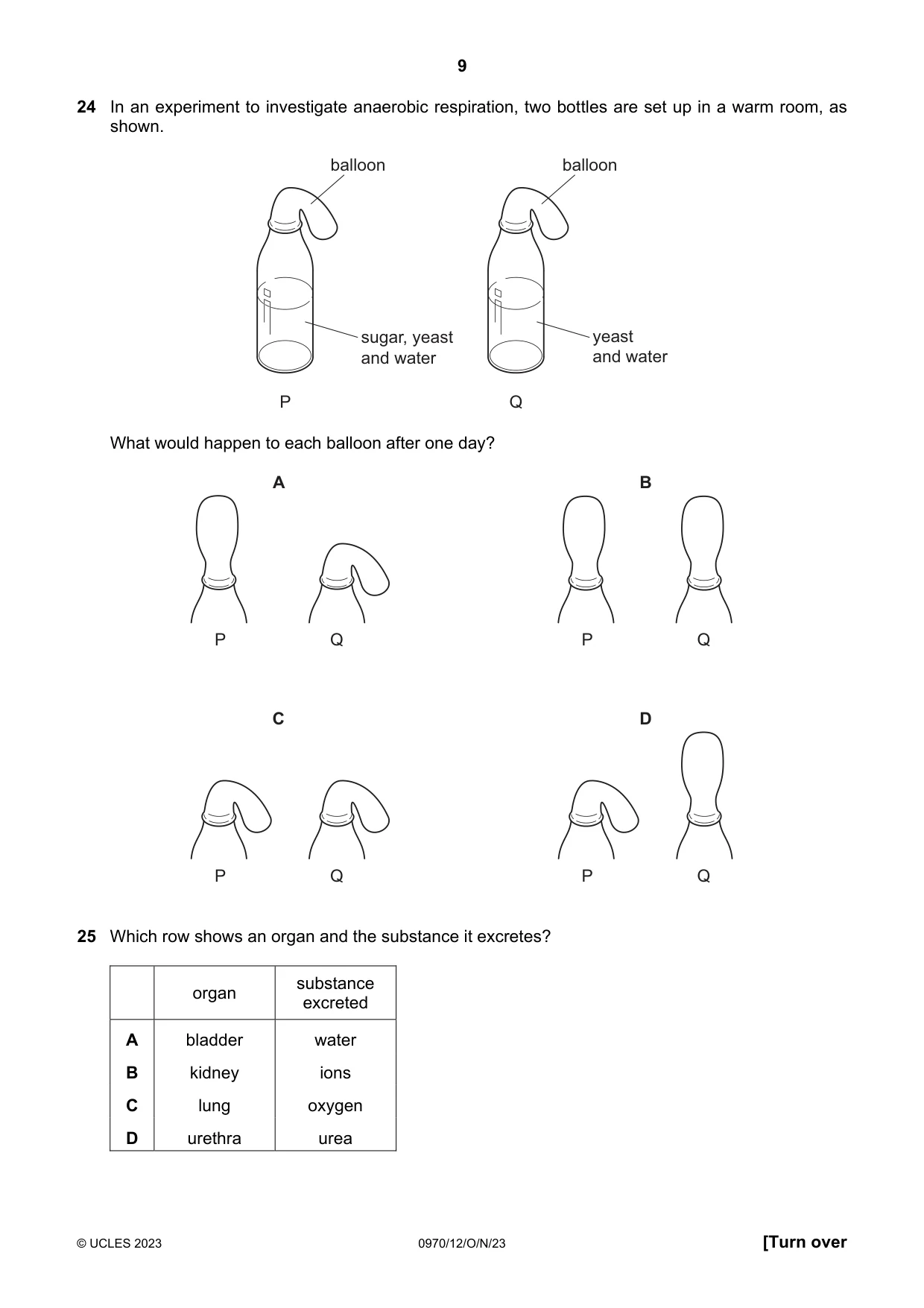
Q24 · In an experiment to investigate anaerobic respiration, two bottles are set up in a warm…
24 In an experiment to investigate anaerobic respiration, two bottles are set up in a warm room, as shown. balloon balloon sugar, yeast yeast and water and water P Q What would happen to each balloon after one day? A B P Q P Q C D P Q P Q
Mark scheme: A
Q25 · Which row shows an organ and the substance it excretes?
25 Which row shows an organ and the substance it excretes? substance organ excreted A bladder water B kidney ions C lung oxygen D urethra urea
Mark scheme: B
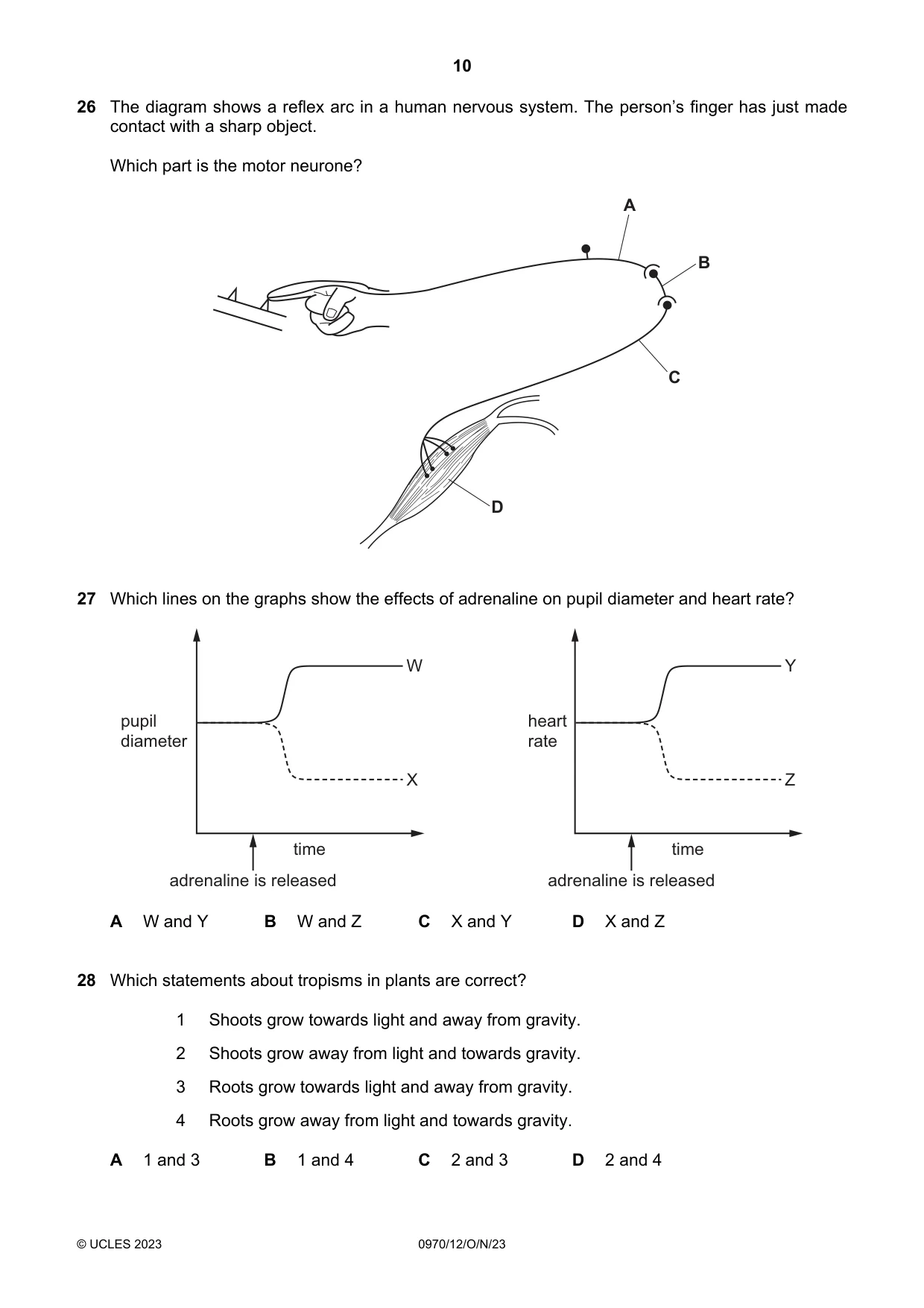
Q26 · The diagram shows a reflex arc in a human nervous system
26 The diagram shows a reflex arc in a human nervous system. The person’s finger has just made contact with a sharp object. Which part is the motor neurone? A B C D
Mark scheme: C
Q27 · Which lines on the graphs show the effects of adrenaline on pupil diameter and heart rate?
27 Which lines on the graphs show the effects of adrenaline on pupil diameter and heart rate? W Y pupil heart diameter rate X Z time time adrenaline is released adrenaline is released A W and Y B W and Z C X and Y D X and Z
Mark scheme: A
Q28 · Which statements about tropisms in plants are correct?
28 Which statements about tropisms in plants are correct? 1 Shoots grow towards light and away from gravity. 2 Shoots grow away from light and towards gravity. 3 Roots grow towards light and away from gravity. 4 Roots grow away from light and towards gravity. A 1 and 3 B 1 and 4 C 2 and 3 D 2 and 4
Mark scheme: B
Q29 · What is defined as a substance that is taken into the body and modifies or affects…
29 What is defined as a substance that is taken into the body and modifies or affects chemical reactions in the body? A antibody B drug C hormone D pathogen
Mark scheme: B
Q30 · Which row is correct for asexual reproduction?
30 Which row is correct for asexual reproduction? offspring compared number of parents with parent or parents A one genetically different B one genetically identical C two genetically different D two genetically identical
Mark scheme: B
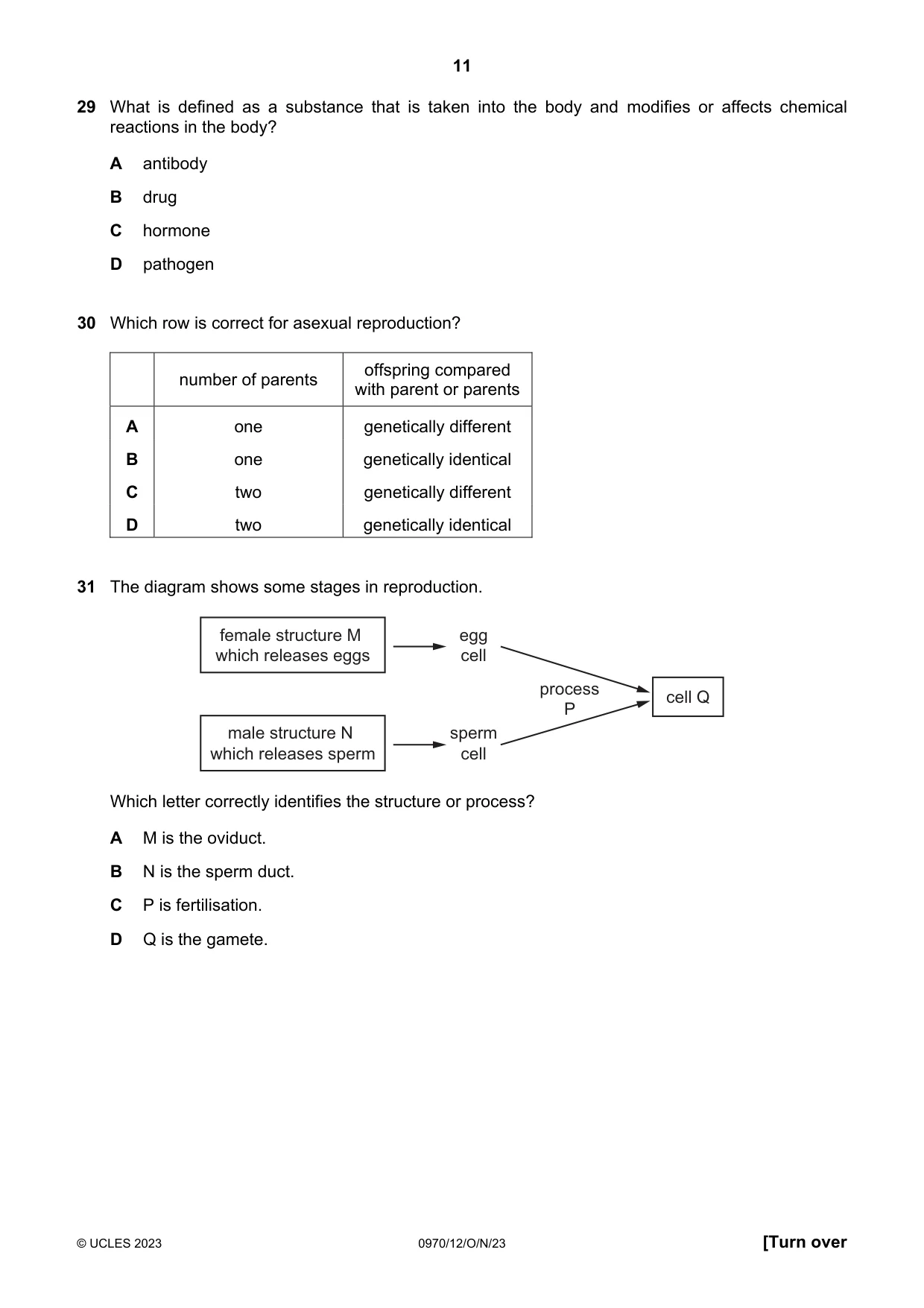
Q31 · The diagram shows some stages in reproduction
31 The diagram shows some stages in reproduction. female structure M egg which releases eggs cell process cell Q P male structure N sperm which releases sperm cell Which letter correctly identifies the structure or process? A M is the oviduct. B N is the sperm duct. C P is fertilisation. D Q is the gamete.
Mark scheme: C
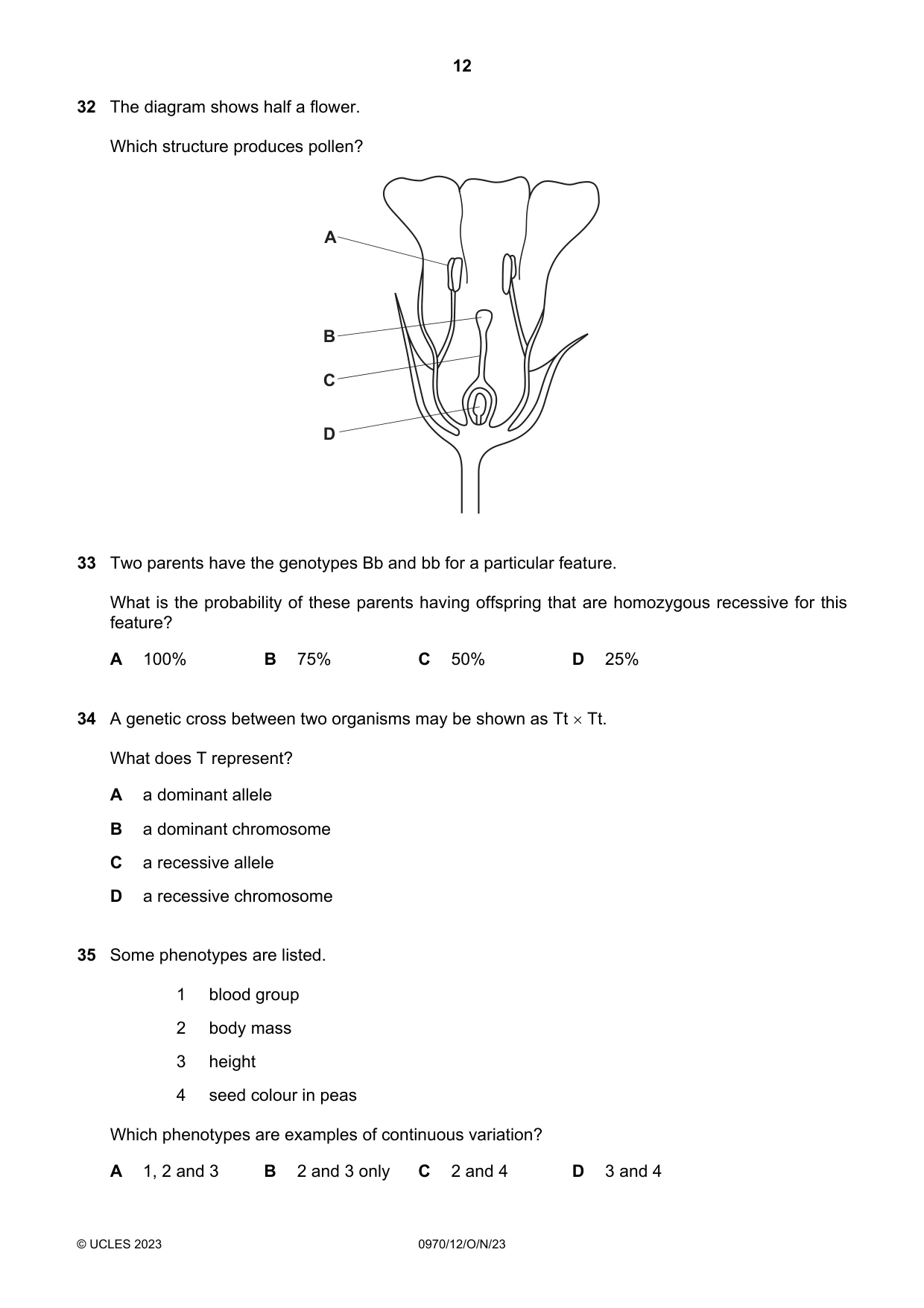
Q32 · The diagram shows half a flower
32 The diagram shows half a flower. Which structure produces pollen? A B C D
Mark scheme: A
Q33 · Two parents have the genotypes Bb and bb for a particular feature
33 Two parents have the genotypes Bb and bb for a particular feature. What is the probability of these parents having offspring that are homozygous recessive for this feature? A 100% B 75% C 50% D 25%
Mark scheme: C
Q34 · A genetic cross between two organisms may be shown as Tt Tt
34 A genetic cross between two organisms may be shown as Tt Tt. What does T represent? A a dominant allele B a dominant chromosome C a recessive allele D a recessive chromosome
Mark scheme: A
Q35 · Some phenotypes are listed
35 Some phenotypes are listed. 1 blood group 2 body mass 3 height 4 seed colour in peas Which phenotypes are examples of continuous variation? A 1, 2 and 3 B 2 and 3 only C 2 and 4 D 3 and 4
Mark scheme: B
Q36 · A food chain is shown
36 A food chain is shown. lettuce plant slug hedgehog By which process is energy transferred from the lettuce plant to the slug? A egestion B excretion C ingestion D respiration
Mark scheme: C
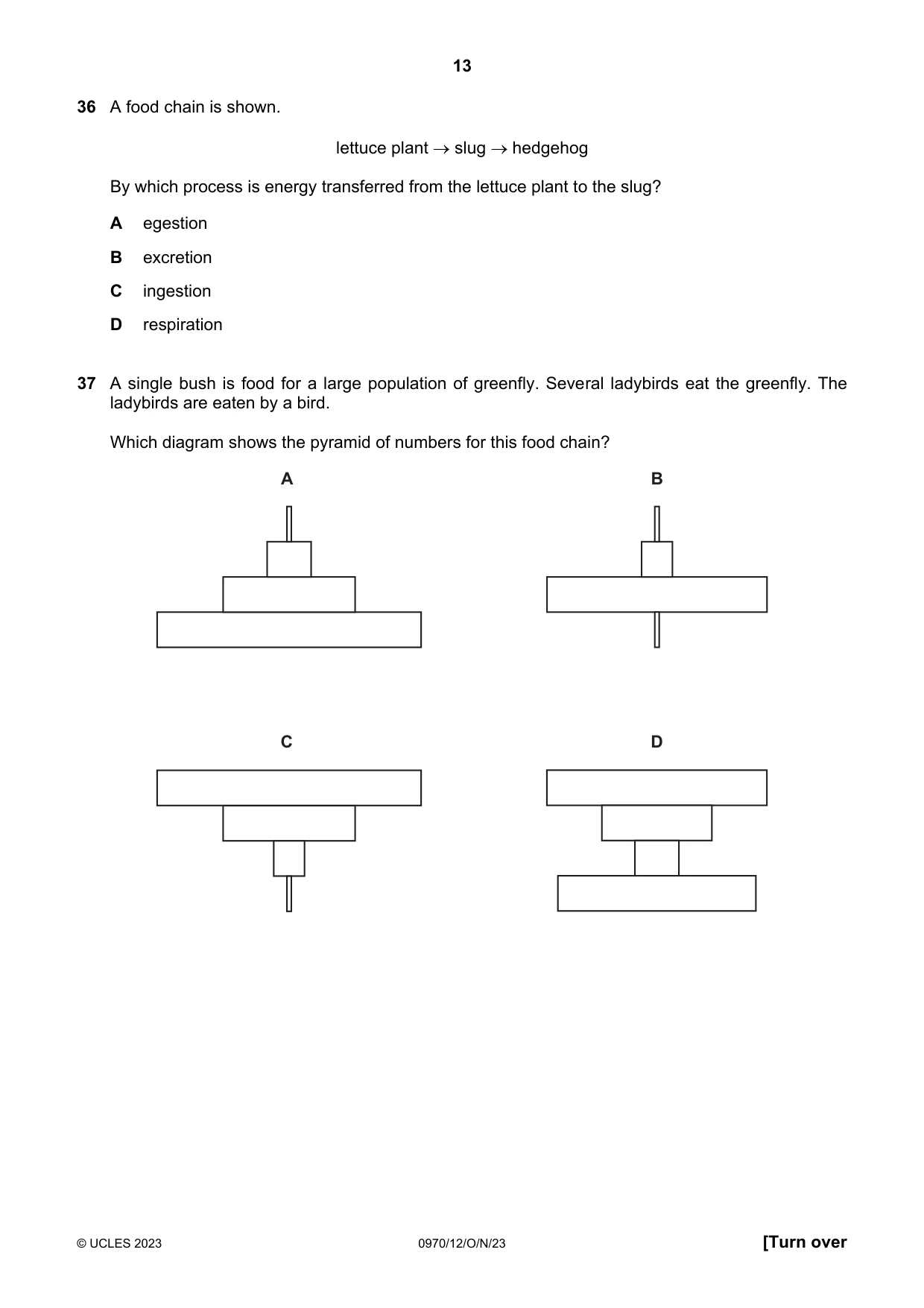
Q37 · A single bush is food for a large population of greenfly
37 A single bush is food for a large population of greenfly. Several ladybirds eat the greenfly. The ladybirds are eaten by a bird. Which diagram shows the pyramid of numbers for this food chain? A B C D
Mark scheme: B
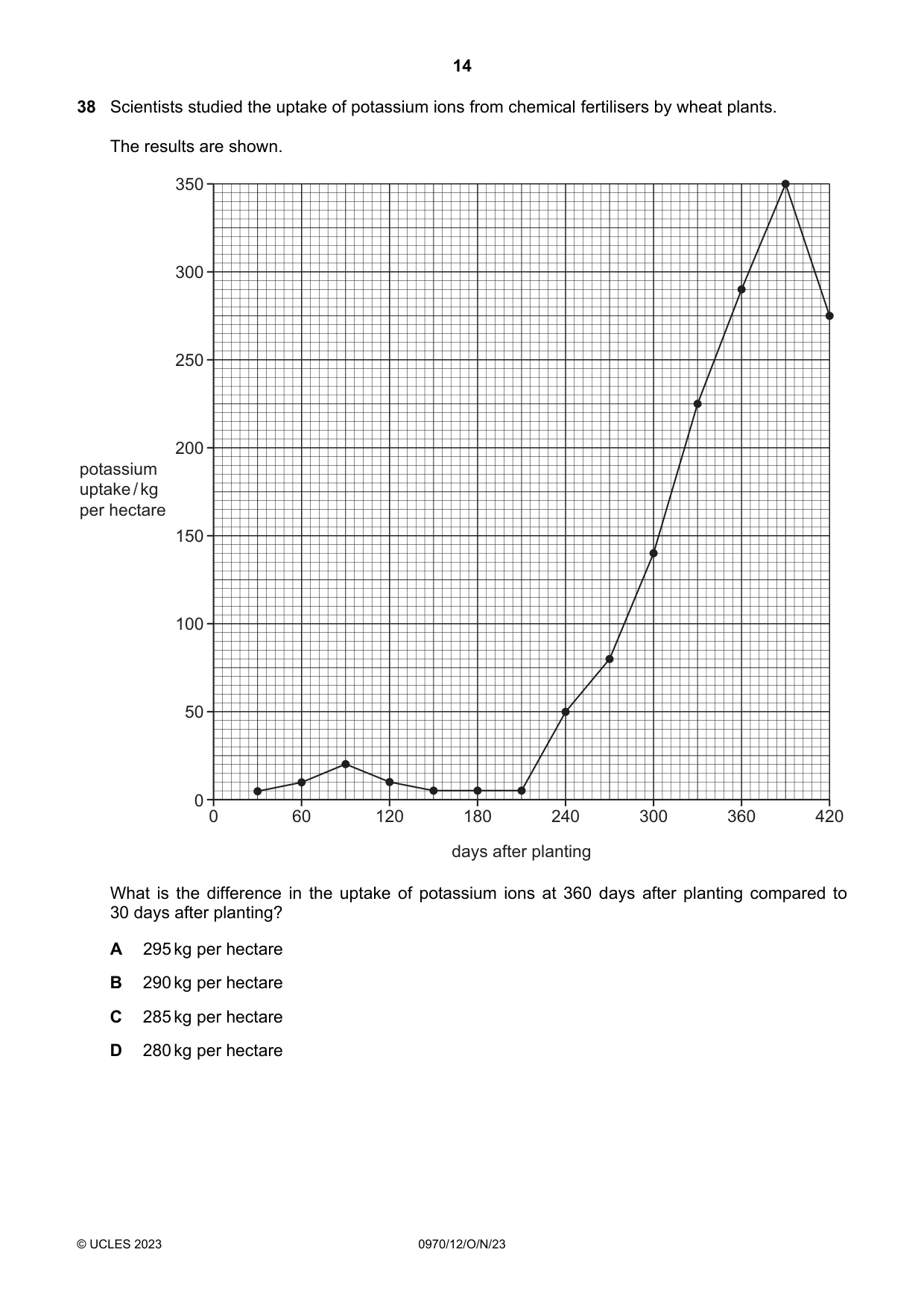
Q38 · Scientists studied the uptake of potassium ions from chemical fertilisers by wheat plants
38 Scientists studied the uptake of potassium ions from chemical fertilisers by wheat plants. The results are shown. 350 300 250 200 potassium uptake / kg per hectare 150 100 50 0 0 60 120 180 240 300 360 420 days after planting What is the difference in the uptake of potassium ions at 360 days after planting compared to 30 days after planting? A 295 kg per hectare B 290 kg per hectare C 285 kg per hectare D 280 kg per hectare
Mark scheme: C
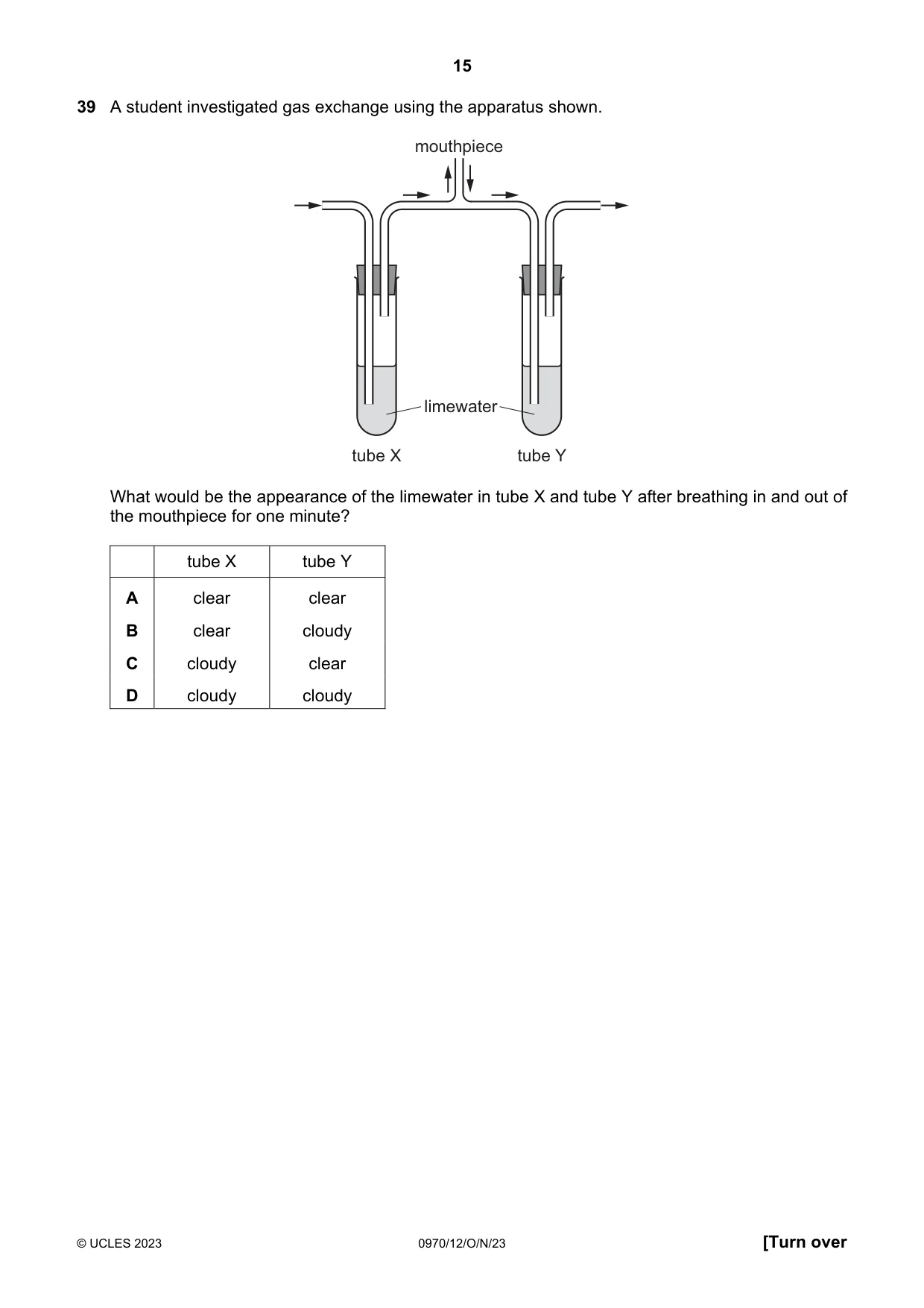
Q39 · A student investigated gas exchange using the apparatus shown
39 A student investigated gas exchange using the apparatus shown. mouthpiece limewater tube X tube Y What would be the appearance of the limewater in tube X and tube Y after breathing in and out of the mouthpiece for one minute? tube X tube Y A clear clear B clear cloudy C cloudy clear D cloudy cloudy
Mark scheme: B
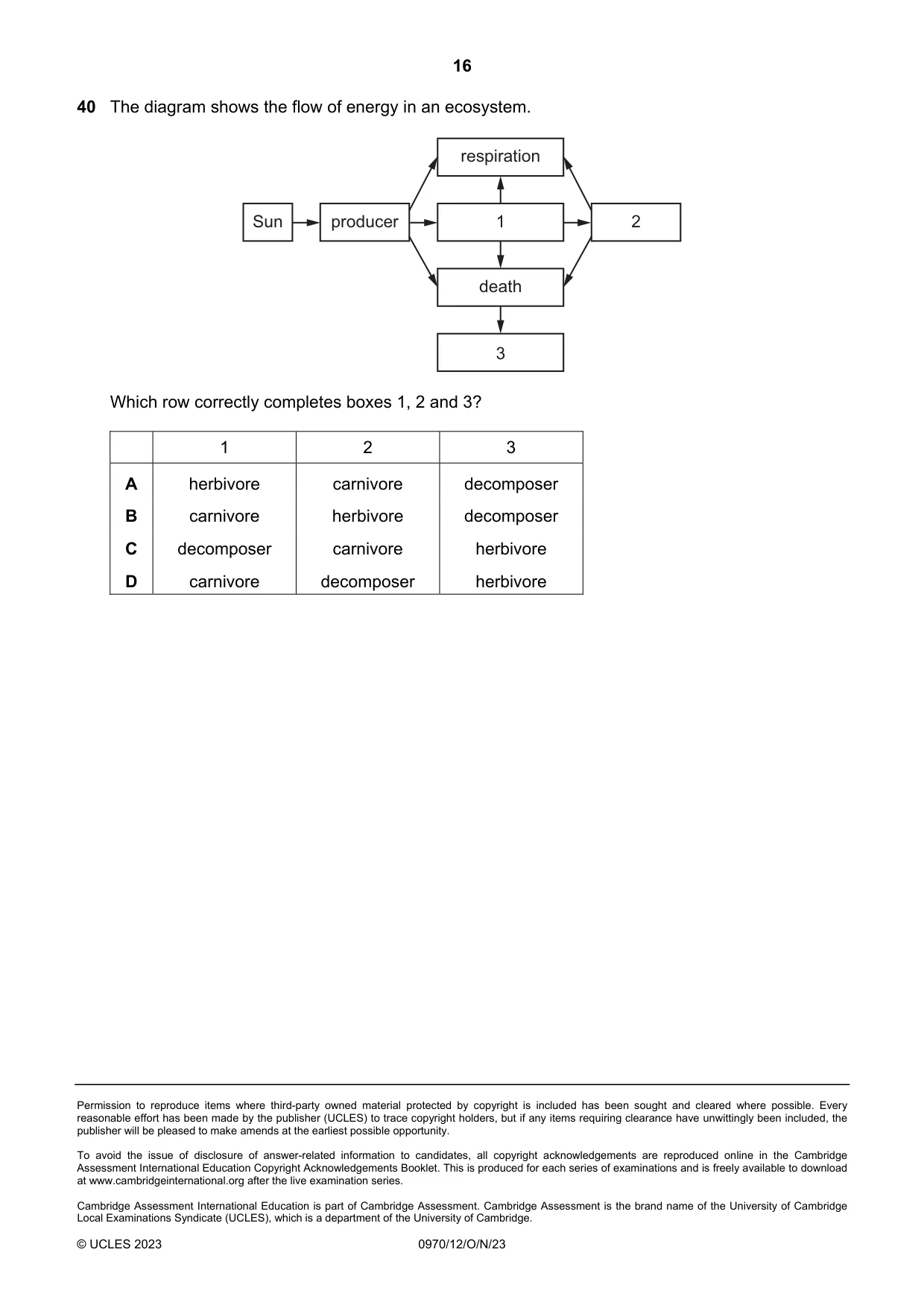
Q40 · The diagram shows the flow of energy in an ecosystem
40 The diagram shows the flow of energy in an ecosystem. respiration Sun producer 1 2 death 3 Which row correctly completes boxes 1, 2 and 3? 1 2 3 A herbivore carnivore decomposer B carnivore herbivore decomposer C decomposer carnivore herbivore D carnivore decomposer herbivore
Mark scheme: A
What was in this paper
The subtopics covered by these 40 questions, and how many questions each got. Open one in a new tab to see every Cambridge question on it.
3Anaerobic respiration2Biological molecules2Food chains and food webs2Absorption1Asexual reproduction1Blood1Cell structure1Characteristics of living organisms1Chemical digestion1Chromosomes, genes and proteins1Concept and uses of classification systems1Coordination and response1Diffusion1Digestive system1Diseases and immunity1Drugs1Energy flow1Enzymes1Excretion in humans1Features of organisms1Heart1Hormones1Leaf structure1Monohybrid inheritance1Osmosis1Photosynthesis1Sexual reproduction in humans1Sexual reproduction in plants1Size of specimens1Transpiration1Tropic responses1Variation1Water uptake1Xylem and phloem1What you needed in this session
Cambridge’s own grade thresholds for 2023 Oct/Nov, Paper 1 · Variant 2. A higher threshold means an easier paper — the bar moves with how the cohort did.