Questions as text
Q1 · Describe what psychologists have discovered about the misuse of health services 9990/31 Oct/Nov 2018
6 (a) Describe what psychologists have discovered about the misuse of health services. [8] (b) Evaluate what psychologists have discovered about the misuse of health services, including a discussion about generalisability. [10] Psychology and organisations Answer all questions.
18 marks
Mark scheme: 6(a) Describe what psychologists have discovered about the misuse of 8 health services. Misuse of the health services, including the following: • delay in seeking treatment (Safer, 1979) • misuse: hypochondriasis (Barlow and Durand, 1995) • Munchausen syndrome (Aleem and Ajarim, 1995) Delay in seeking treatment (Safer, 1979) There are three stages to this delay: appraisal, illness and utilisation. A variety of factors predict the length of the delay for each of the three stages. These include beliefs about symptoms and consequences of these symptoms, physical experiences of the illness and strategies used by the patient to resolve their own ailments. For example a patient who has an old illness and believes there are possible severe consequences of the illness may delay seeking treatment. Misuse: hypochondriasis (Barlow and Durand, 1995) According to DSM–IV–TR, the central feature of hypochondriasis is the preoccupation with fears of having a serious medical illness based on misinterpretations of benign (or minor) bodily sensations Barlow and Durand – The patient experiences physical sensations in a distorted way, Often take a better safe than sorry approach with their symptoms. There is evidence the condition may have a genetic component. Stressful life events, especially those involving exposure to death or serious illness may be a precipitating factor in the onset of the disease. Many also experience significant family illnesses during childhood. Assuming the ‘sick role’ may also be reinforced during childhood. Munchausen syndrome (Aleem and Ajarim, 1995) Munchausen syndrome is a psychological disorder where someone pretends to be ill or deliberately produces symptoms of illness in themselves. Aleem and Ajarim report a case study of a 22 year old woman with Munchausen who reported with swelling on her body. She had been seen on numerous occasions in the hospital since she was 17 and given various treatments. Suspicions were raised by the hospital when it was felt that the ailments she had did not appear to have a physical cause. Upon admittance to the psychiatric ward the nursing staff eventually found a needle with faecal material in it. The patient left the hospital when confronted after becoming very angry and did not return again. Mark according to the levels of response descriptors in Table A. Other appropriate responses should also be credited. 6(b) Evaluate what psychologists have discovered about the misuse of 10 health services, including a discussion about generalisability. • Named issue – Generalisability – 93 patients in the Safer study (38 males and 55 females), average age 44. Barlow and Durand study – a general description of hypochondriasis so reasonable to discuss generalisability to other people with hypochondriasis, as it considers all the symptoms and effects of this disorder. Aleen and Ajarim study – a 22 year old single female • Usefulness (application of psychology to everyday life) of theories about misuse of health service and various conditions. Helpful to practitioners as gives detailed symptoms of these disorders so that they can be spotted. Not all present a treatment (e.g. Aleem and Ajarim – just state the patient left with no treatment put in place). • Evaluation of method for studies on delay in seeking treatment (interview) and Munchausen syndrome (case study) • Reliability/validity of diagnosis of hypochondriasis and Munchausen syndrome. Discussion could centre on how difficult these are to diagnose as part of the problem is the patient lying/exaggerating symptoms and in the case of Munchausen syndrome may be causing some of these physical symptoms. Mark according to the levels of response descriptors in Table B. Other appropriate responses should also be credited. Psychology and organisations
This question in 9990/31 Oct/Nov 2018
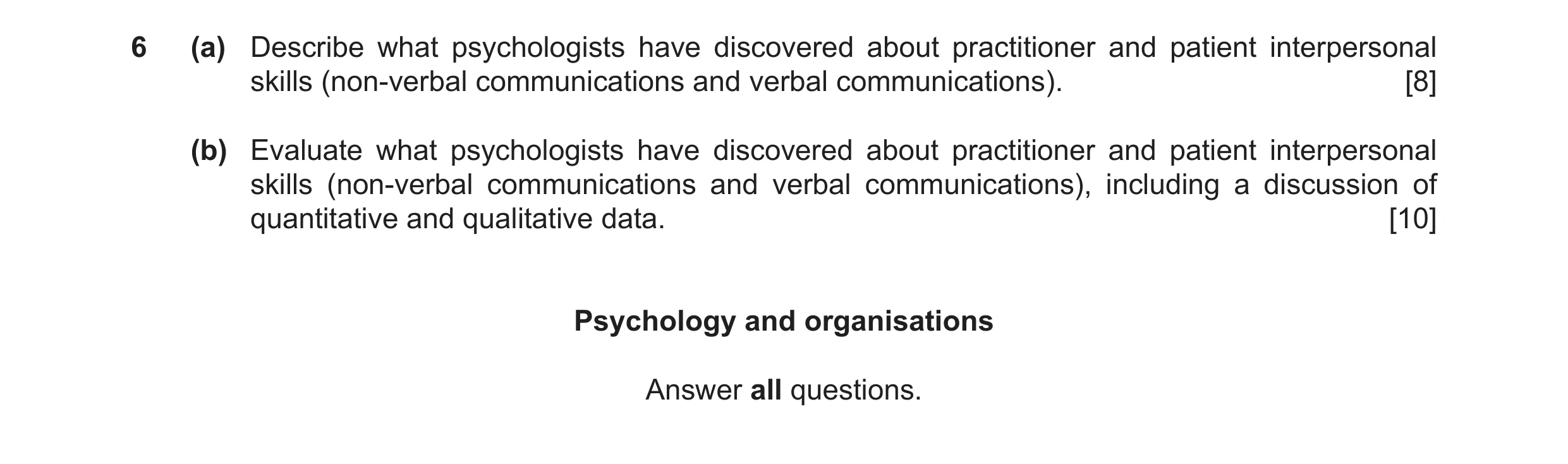
Q2 · Describe what psychologists have discovered about practitioner and patient interpersonal… 9990/32 Oct/Nov 2020
6 (a) Describe what psychologists have discovered about practitioner and patient interpersonal skills (non-verbal communications and verbal communications). [8] (b) Evaluate what psychologists have discovered about practitioner and patient interpersonal skills (non-verbal communications and verbal communications), including a discussion of quantitative and qualitative data. [10] Psychology and organisations Answer all questions.
18 marks
Mark scheme: 6(a) Describe what psychologists have discovered about practitioner and patient interpersonal skills (non-verbal communications and verbal communications). Practitioner and patient interpersonal skills, including the following: • Non-verbal communication – McKinstry and Wang, 1991; • Verbal Communications – McKinlay, 1975; • Verbal Communications – Ley, 1988; Non-verbal communication (McKinstry and Wang, 1991) Patients asked to look at 8 photographs – a man in five different styles and a woman in three different styles. White shirt over formal suite, formal suit white shirt and tie, denim jeans open neck and short sleeved shirt, etc. Woman – white coat over skirt and jumper, pink trousers jumper and gold earrings, etc. Asked ‘Which doctor would you be happiest about seeing the first time?’ Rated on 0–5 scale. Also asked about confidence of ability of the doctor in pictures, whether they would be unhappy about consulting any of them and which one looked most like their own doctor. Finally, closed questions about doctors’ dress in general and attitudes about specific items of clothing. 28% of patients said they would be unhappy about consulting one of the doctors shown, usually the ones informally dressed. Majority thought the way doctor dresses is important. 41% said they would have more confidence in the ability of their doctor based on their appearance. Male doctor in suit and tie most preferred and the female doctor in white coat. Verbal Communication – McKinlay (1975) Lower class and under-users of maternity services in Aberdeen, Scotland were interviewed about words used by practitioners. Scored independently. Those who did not use the maternity services very frequently had the lowest level of understanding although only for two words. The women often had a better understanding of the words than was anticipated by the practitioners. Verbal Communication – Ley (1988) The frequency of patients’ forgetting of practitioner advice linked to order of info, amount of info, nature of info, and perceived importance of info together with patient facts such as age, anxiety level, and medical knowledge. Ley proposed practitioner should use simple language, give key info first, give concrete and specific advice that is categorised (diagnosis, treatment, prognosis etc.) and repeat key points but summarising info at the end of the consultation. Other appropriate responses should also be credited. Question Answer Marks 6(b) Evaluate what psychologists have discovered about practitioner and patient interpersonal skills (non-verbal communications and verbal communications), including a discussion of quantitative and qualitative data. • Named issue – Quantitative and qualitative data – ease with collecting quantitative data versus the potential lack of validity in not collecting qualitative data. Arguably data from both McKinstry and Wang and McKinley is qualitative and then converted to quantitative. McKinstry and Wang collected a large amount of quantitative data from their 475 participants and analysed according to social class and age. A little qualitative data gathered in asking participants what items of clothes they would object to their doctor wearing. McKinlay self-report data that appears to be mostly quantitative; • Generalisability; • Practical Applications; • Methods; • Reliability and Validity; Mark according to the levels of response descriptors in Table B. Other appropriate responses should also be credited. 10
This question in 9990/32 Oct/Nov 2020
Q3 · Explain what is meant by ‘hypochondriasis’ 9990/32 Feb/March 2021
5 (a) Explain what is meant by ‘hypochondriasis’. [2] (b) Describe the study by Savage and Armstrong (1990) on practitioner consulting style and patient satisfaction. [4] (c) Explain two strengths of the study by Savage and Armstrong. [6]
12 marks
Mark scheme: 5(a) Explain what is meant by ‘hypochondriasis’. 2 Award 1 mark for a basic explanation of the term/concept. Award 2 marks for a detailed explanation of the term/concept. For example: Persistent fear of having a serious medical illness. (1) Often interpret normal symptoms/sensations as a sign of an illness with a negative outcome. (1) E.g. indigestion could be interpreted as stomach cancer. (1) Other appropriate responses should also be credited. 5(b) Describe the study by Savage and Armstrong (1990) on practitioner 4 consulting style and patient satisfaction. Award 1–2 marks for a basic answer with some understanding of the topic area. Award 3–4 marks for a detailed answer with clear understanding of the topic area. For example: 359 participants from a London general practice were used. Age 16–75. 200 used after many participants were excluded. Patient satisfaction with the GP’s perceived understanding of their problem and explanation they received and whether they felt that they had been helped were taken immediately after the consultation and one week later. Randomly assigned to either directing or sharing style of consultation. Found those with a directing style of consultation reported higher levels of satisfaction. Particularly true for those with a physical problem and those receiving a prescription. Concluded that style does influence satisfaction in some types of consultations (patients with physical problem and those receiving a prescription). 5(c) Explain two strengths of the study by Savage and Armstrong. 6 Likely strengths include – • Wide age range of participants used (200) • Quantitative data collected so comparisons can be made. • Tested both at the time of the consultation and a week later so can check that the participant still has the same feelings about the consultation. This improves the validity of the study. • Useful to practitioners so they can use a directing style while consulting those with a physical illness and/or where a prescription is required. • Satisfaction was measured using two measures so more likely to achieve a valid and/or reliable result. • Randomly allocated to conditions which increases validity. Mark according to the levels of response criteria below: Level 3 (5–6 marks) • Candidates will show a clear understanding of the question and will explain two strengths. • Candidates will provide a good explanation with clear detail. Level 2 (3–4 marks) • Candidates will show an understanding of the question and will explain one appropriate strength in detail. OR two strengths in less detail. Level 1 (1–2 marks) • Candidates will show a basic understanding of the question and will attempt an explanation of a strength. They could include two strengths but just as an attempt. • Candidates will provide a limited explanation. Level 0 (0 marks) No response worthy of credit. Other appropriate responses should also be credited.
This question in 9990/32 Feb/March 2021
Q4 · Outline one symptom of Munchausen syndrome 9990/32 Oct/Nov 2021
5 (a) Outline one symptom of Munchausen syndrome. [2] (b) Describe the findings of the study by McKinstry and Wang (1991) of non-verbal communications in the patient–practitioner relationship. [4] (c) Explain two weaknesses of the study by McKinstry and Wang. [6]
12 marks
Mark scheme: 5(a) Outline one symptom of Munchausen syndrome. 2 Award 1 mark for a basic explanation of the term/concept. Award 2 marks for a detailed explanation of the term/concept. For example: • Lying about symptoms • Self-infliction (cuts or burns) • Tampering with test results • Aggravating pre-existing symptoms. One symptom of Munchausen syndrome is self-infliction of injury on themselves in order to appear to have an illness. For example, injecting faecal matter into themselves. (2) Other appropriate responses should also be credited. 5(b) Describe the findings of the study by McKinstry and Wang (1991) of 4 non-verbal communications in the patient-practitioner relationship. Award 1–2 marks for a basic answer with some understanding of the topic area. Award 3–4 marks for a detailed answer with clear understanding of the topic area. For example: Overall patients favoured a more formal approach to dress, with the male doctor wearing a formal suit and tie and the female doctor in a white lab coat scored most highly (2), particularly for higher social classes. (1) Male doctor in tweed jacket was the least disliked of the outfits. (1) There was marked variation between preferences of patients registered with different practices. (1) 64% of patients thought the way their doctor dressed was very important or quite important. (1) Other appropriate responses should also be credited. 5(c) Explain two weaknesses of the study by McKinstry and Wang. 6 For example • Conditions of IV – researchers regretted not including a picture of a woman doctor in a suit and several patients did comment on this, leading the researchers to be cautious about recommending a white coat to be worn by female doctors. • Lack of control – other attributes of the doctors were not controlled for as questionnaires did not ask about importance of availability, kindness, willingness to listen, and clinical competence. • Generalisability – the sample of patients were taken from one specific area of Lothian, Scotland and skewed toward elderly so may not apply outside of the area. • Self-report – the findings are based on answers to closed questions (although there were many) so patients may not have a chance to express themselves properly • Response bias / individual differences – as there were significant variations between patients in different practices, it could be that patients were simply voting for the style of dress to which they had been accustomed. Mark according to the levels of response criteria below: Level 3 (5–6 marks) • Candidates will show a clear understanding of the question and will explain two appropriate weaknesses in detail. • Candidates will provide a good explanation with clear detail. Level 2 (3–4 marks) • Candidates will show an understanding of the question and will explain one appropriate weakness in detail or two weaknesses in less detail. • Candidates will provide a good explanation. Level 1 (1–2 marks) • Candidates will show a basic understanding of the question and will attempt an explanation of a weakness. They could include two weaknesses but just as an attempt. • Candidates will provide a limited explanation. Level 0 (0 marks) No response worthy of credit. Other appropriate responses should also be credited.
This question in 9990/32 Oct/Nov 2021
Q5 · Explain what is meant by ‘kleptomania’ 9990/32 Oct/Nov 2022
1 (a) Explain what is meant by ‘kleptomania’. [2] (b) Outline two of the components that Griffiths (2005) used to define addiction. [4] (c) Explain one strength and one weakness of the definition of addiction proposed by Griffiths. [6]
12 marks
Mark scheme: Psychology and abnormality Question Answer Marks 1(a) Explain what is meant by ‘kleptomania’. 2 Award 1 mark for a basic explanation of the term/concept. Award 2 marks for a detailed explanation of the term/concept. For example: Kleptomania is a non-substance addictive disorder in which the person concerned cannot resist the impulse to steal objects (1). The objects are not needed for personal use and they are not stolen because of their monetary value (1). Kleptomaniacs may feel tension or anxiety before the act of stealing and pleasure/gratification after the theft (1). Other appropriate responses should also be credited 1(b) Outline two of the components that Griffiths (2005) used to define 4 addiction. For each component: Award 1 marks for a basic answer with some understanding of the topic area e.g. naming the component. Award 2 marks for a detailed answer with clear understanding of the topic area. • Salience – the activity (e.g. gambling, pyromania) becomes the most important thing to the individual. They think about it all the time even when not engaged in it. This can be experienced as a ‘craving’ • Mood modification – the activity has the subjective experience of altering the person’s mood. This could be a ‘buzz’ or a ‘high’, ‘euphoria’, or paradoxically it can be tranquilising with an ‘escape’ or ‘numbing’. This can be for the same substance/activity • Tolerance – the process whereby increasing amounts of a particular activity are required to achieve the effects from before e.g. a gambler increasing their bet or spending longer periods of time in gambling • Withdrawal symptoms – The unpleasant feeling and/or physical effects occurring when the activity is reduced suddenly or stopped. This can be seen as irritability or physical (e.g. insomnia, headaches) • Conflict – this can be between the addict and those around them (interpersonal conflict) or within the individual themselves (intrapsychic conflict). This can result in compromising relationships, work or social activities. Intrapsychic conflict can be experienced by the individual as a ‘loss of control’ • Relapse – the tendency for repeatedly returning to the addictive behaviour even after a long period of abstinence or control Other appropriate responses should also be credited. 1(c) Explain one strength and one weakness of the definition of addiction 6 proposed by Griffiths. Likely strengths include: • Comprehensive definition with objective criteria. This makes it pretty clear whether or not an individual is an addict as they have to exhibit all 6 components. This can help with diagnosis • Individuals (and their families/colleagues) having knowledge of these components can even self-diagnose putting them in a position to acknowledge their problem and seek help • Clear diagnosis using these 6 components can lead to appropriate treatment or modification techniques and also ability to recognise when relapse has occurred • By classifying all addictions in the same way, whether substance or non-substance, the essential elements of what constitutes addiction can be better researched • There is a growing body of research that points to the similarities present in all addictions, whether pyromania, exercise, overeating, gambling, smoking or taking drugs. This model supports that Likely weaknesses include: • Possible lack of validity / individual differences. Someone engaging in a potentially addictive behaviour may not have experienced all of the components (e.g. relapse, as they have not yet tried to reduce the behaviour) but this would not necessarily mean they are not an addict • Components rely partly on the subjective experience of the individual who may still not wish to recognise their addiction and so deny, for example, that they need to do more and more to get their ‘fix’, potentially limiting treatment • It does not explain why someone becomes addicted and another person does not. Why, for example, might one person play a slot machine for 30 minutes one day (experiencing the ‘high’) and not do so again for years, but another person with the same experience finds themselves thinking about it all the time • Many would argue that to describe non-substance addiction in the same way as substance addiction is incorrect because there has to be a physiological aspect to withdrawal and this does not occur without a substance Mark according to the levels of response criteria below: Level 3 (5–6 marks) • Candidates will show a clear understanding of the question and will explain one strength and one weakness. • Candidates will provide a good explanation with clear detail. Level 2 (3–4 marks) • Candidates will show an understanding of the question and will explain one appropriate weakness in detail or one appropriate strength in detail. OR • one weakness and one strength in less detail. 1(c) Level 1 (1–2 marks) • Candidates will show a basic understanding of the question and will attempt an explanation of either a strength or a weakness. They could include both but just as an attempt. • Candidates will provide a limited explanation. Level 0 (0 marks) No response worthy of credit. Other appropriate responses should also be credited.
This question in 9990/32 Oct/Nov 2022
Q6 · Identify two biochemical tests that measure non-adherence in patients 9990/32 Oct/Nov 2022
5 (a) Identify two biochemical tests that measure non-adherence in patients. [2] (b) Describe the procedure used in the study by Chung and Naya (2000) on pill counting. [4] (c) Explain two weaknesses of the study by Chung and Naya. [6]
12 marks
Mark scheme: 5(a) Identify two biochemical tests that measure non-adherence in patients. 2 Award 1 mark for each one. For example: • Blood tests • Urine tests Other appropriate responses should also be credited. 5(b) Describe the procedure used in the study by Chung and Naya (2000) 4 on pill counting. Award 1–2 marks for a basic answer with some understanding of the topic area. Award 3–4 marks for a detailed answer with clear understanding of the topic area. • 57 patients (32 m, 25 f, aged 18–55) and taking oral medication for asthma took part (although only 47 completed the study) • Initial screening of 2–3 weeks to see if suitable patient for asthma study • Participants prescribed 20 mg of zafirlukast to be taken twice a day, with 12 hours between doses and not at mealtimes. Participants were given 56 tablets at a time and were asked to return to hospital every 3 weeks for more drugs • Study took place over 12 weeks • Medication bottles lids were fitted with a TrackCapTM device consisting of a microprocessor that recorded the time the bottle was opened • Returned to clinic every 3 weeks where they collected more tablets • Pill count done and compared to TrackCapTM data • Participants were told their pill-taking was being monitored but not exactly how Other appropriate responses should also be credited. 5(c) Explain two weaknesses of the study by Chung and Naya. 6 Likely weaknesses include: • Lack of generalisability – only a total of 47 patients completed the study; only trialled for 12 weeks; only one drug trialled • Ethics – although the participants did give consent and were told their tablet-taking was being monitored, they were not told how this was being done • Potential lack of validity – TrackCapTM does not actually record each time a pill is taken specifically. It does not recognise multiple openings that occurred within one minute of each other; cannot recognise how many pills are removed each time; if the cap was left off the bottle for more than 15 minutes it recorded an additional event • Demand characteristics – Participants knew that their pill-taking was being monitored and this could have caused them to be more (or less) adherent than they usually were • Study did not assess why the participants were (or were not) adherent to the drug and this could have impacted on their level of drug-taking • Adherence could depend on a number of factors including potential side-effects of the medication, seriousness of their condition or physiological consequences of not taking their medication all of which could act as additional ‘reminders’ (or not) to take their medication Mark according to the levels of response criteria below: Level 3 (5–6 marks) • Candidates will show a clear understanding of the question and will explain two weaknesses. • Candidates will provide a good explanation with clear detail. Level 2 (3–4 marks) • Candidates will show an understanding of the question and will explain one weakness in detail. OR • two weaknesses in less detail. Level 1 (1–2 marks) • Candidates will show a basic understanding of the question and will attempt an explanation of a weakness. They could include two weaknesses but just as an attempt. • Candidates will provide a limited explanation. Level 0 (0 marks) No response worthy of credit. Other appropriate responses should also be credited.
This question in 9990/32 Oct/Nov 2022
Q7 · Identify two of the stages in the model of delay in seeking treatment (Safer, 1979) 9990/32 Feb/March 2023
5 (a) Identify two of the stages in the model of delay in seeking treatment (Safer, 1979). [2] (b) Aleem and Ajarim (1995) conducted a case study on a 22-year-old female university student who was diagnosed with Munchausen syndrome. Outline two findings from this case study. [4] (c) Discuss the validity of the case study by Aleem and Ajarim. [6]
12 marks
Mark scheme: 5(a) Identify two of the stages in the model of delay in seeking treatment 2 (Safer, 1979). Award 1 mark for each stage. Two from: Appraisal delay Illness delay Utilisation delay 5(b) Aleem and Ajarim (1995) conducted a case study on a 22-year-old 4 female university student who was diagnosed with Munchausen syndrome. Outline two findings from this case study. Award 1 mark for a basic outline of a result. Award 2 marks for a detailed outline of a result. For example The patient saw a psychiatrist and became very defensive and rationalising in her answers. (1) She appeared to be under a great amount of stress because of conflicts she was experiencing. (1) The nurses found a syringe with faecal material along with needles in the patient’s bed. (1) When the patient found out about this she became very angry and hostile and left the hospital against medical advice. (1) Other appropriate responses should also be credited. 5(c) Discuss the validity of the case study by Aleem and Ajarim. 6 Points could include: • Good ecological validity as the study was done in a hospital environment. • Poor population validity as one patient with Munchausen syndrome. • Good validity of physiological measures (blood tests, x-rays) taken which were objective. The practitioners could be certain of her physical diagnosis. • Validity of self-reports from interview with psychiatrist could be open to bias. • Lower validity as no follow-up was possible as the patient left the hospital. Mark according to the levels of response criteria below: Level 3 (5–6 marks) • Candidates will show a clear understanding of the question and will discuss at least two points regarding validity. • Candidates will provide a good explanation with clear detail. Level 2 (3–4 marks) • Candidates will show an understanding of the question and will discuss one point about validity in detail or two or more in less detail. • Candidates will provide a good explanation. Level 1 (1–2 marks) • Candidates will show a basic understanding of the question and will attempt a discussion. • Candidates will provide a limited explanation. Level 0 (0 marks) No response worthy of credit. Other appropriate responses should also be credited.
This question in 9990/32 Feb/March 2023
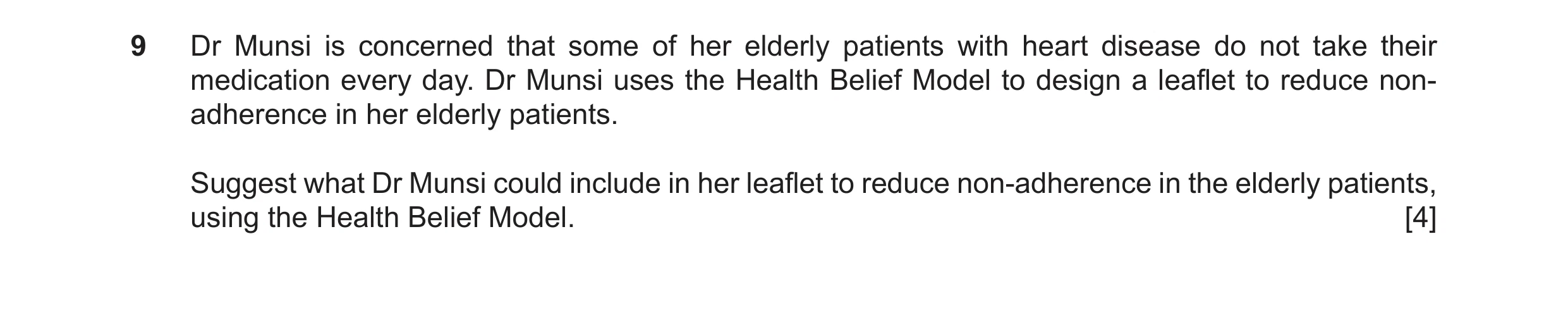
Q8 · Dr Munsi is concerned that some of her elderly patients with heart disease do not take… 9990/32 May/June 2024
9 Dr Munsi is concerned that some of her elderly patients with heart disease do not take their medication every day. Dr Munsi uses the Health Belief Model to design a leaflet to reduce non- adherence in her elderly patients. Suggest what Dr Munsi could include in her leaflet to reduce non-adherence in the elderly patients, using the Health Belief Model. [4]
4 marks
Mark scheme: 9 Dr Munsi is concerned that some of her elderly patients with heart disease do not take their medication every day. Dr Munsi uses the Health Belief Model to design a leaflet to reduce non-adherence in her elderly patients. Suggest what Dr Munsi could include in her leaflet to reduce non-adherence in the elderly patients, using the Health Belief Model. Award 3–4 marks for a detailed answer with clear understanding of Health Belief Model linked to helping Dr Munsi reduce non-adherence. Award 1–2 marks for a basic answer with some understanding of Health Belief Model linked to helping Dr Munsi reduce non-adherence. Likely suggestions for leaflet: Outline heart disease including short and long term symptoms and outcomes (increases knowledge of the disease). Opening hours of clinic and pharmacy with transport links so that it is easy for the elderly patient to attend the clinic/collect their medication (reduces barriers to access). Typical medications for heart disease and what the medication does to improve the heart (improves perception of benefits of the medication). Explain the possible side effects and likelihood of experiencing these side effects (knowledge of perceived cost/negative of medication). Space for Dr Munsi to write the individual patient's medication and how to take it (personalised information – could increase patient satisfaction with Dr Munsi/the clinic). Provide leaflet in large font size so easy for elderly patients to read (specific to the demographic) adherence/reduce non-adherence to taking medication every day. If no context max 2 marks. Context = elderly patients and/or heart disease and/or taking medication every day. 1 or more suggestions for the leaflet is allowed. Do not allow ideas that are linked to leading to high fear arousal. Ideas linked to low fear arousal are okay only when clearly linked to HBM. Question Answer Marks Guidance 9 Example: Dr Munsi should design her leaflet about heart disease to include information on the short term and long term symptoms of the disease. (1) The health belief model suggests that knowledge about the disease increases the likelihood that patients will adhere to taking their medication as they understand the consequences of heart disease without medication. (1) She could also include the side effects of the medication and the likelihood of experiencing each side effect. (1) This would give her patients the correct knowledge of the negatives of the medication. (1) As the positive reduction in symptoms and protecting the heart in the long term is known due to the leaflet, the positives outweigh the costs and patients should decide to take the medication. (1) Other appropriate responses should also be credited.
This question in 9990/32 May/June 2024
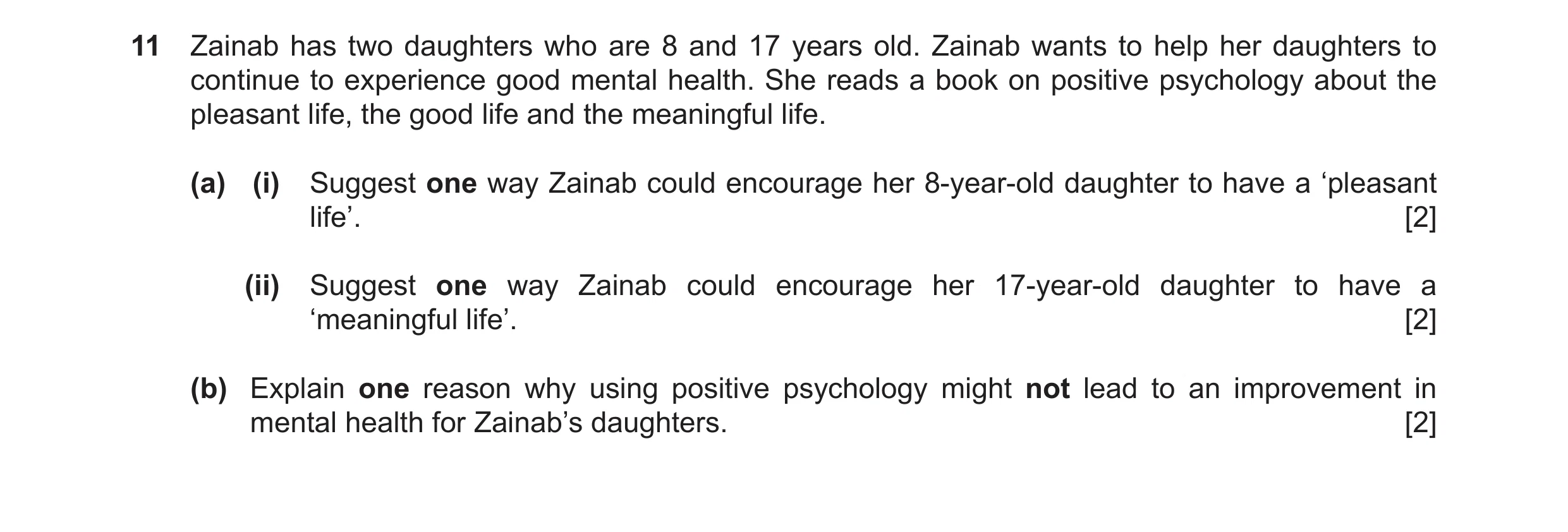
Q9 · Zainab has two daughters who are 8 and 17 years old 9990/32 May/June 2024
11 Zainab has two daughters who are 8 and 17 years old. Zainab wants to help her daughters to continue to experience good mental health. She reads a book on positive psychology about the pleasant life, the good life and the meaningful life. (a) (i) Suggest one way Zainab could encourage her 8-year-old daughter to have a ‘pleasant life’. [2] (ii) Suggest one way Zainab could encourage her 17-year-old daughter to have a ‘meaningful life’. [2] (b) Explain one reason why using positive psychology might not lead to an improvement in mental health for Zainab’s daughters. [2]
6 marks
Mark scheme: 11(a)(i) Suggest one way Zainab could encourage her 8-year-old daughter to have a ‘pleasant life’. For suggested way: Award 2 marks for a suggestion of the way to encourage ‘pleasant life’. Award 1 mark for a basic outline of the way to encourage ‘pleasant life’. Pleasant life – Enjoying daily pleasures in life; doing things you enjoy. For example, eating good food, doing activities you enjoy (reading, walks, sport, watching films, games, etc.). Positive emotions. For example: Zainab could encourage her 8-year-old daughter to lead a ‘pleasant life’ by doing things which bring about pleasure every day. (1) For example, she could suggest that her daughter does a pleasurable activity every day when she gets home from school such as playing a game she enjoys. (1) Other appropriate responses should also be credited. daily pleasures. Do not credit suggestions that imply the following: Good life – Having gratitude, knowing strengths and weaknesses, feeling you have experienced more positive than negative things in your life. Feeling your life has been well lived. Positive connections to other people (e.g. good relationships with others), satisfying work and enjoyable activities outside of work. Meaningful life – Having a purpose in your life that is greater than oneself. Being involved in service to others (e.g. charitable work/donations, altruistic behaviour). Question Answer Marks Guidance 11(a)(ii) Suggest one way Zainab could encourage her 17-year-old daughter to have a ‘meaningful life’. For suggested way: Award 2 marks for a suggestion of the way to encourage ‘meaningful life’. Award 1 mark for a basic outline of the way to encourage ‘meaningful life’. Meaningful life – Having a purpose in your life that is greater than oneself. Being involved in service to others (e.g. charitable work/donations, altruistic behaviour). Positive institutions such as strong family and democracy (within the family). Developing positive connections with others. For example: Zainab could encourage her 17-year-old daughter to lead a ‘meaningful life’ by doing things which involve service to others/gives her life purpose. (1) For example, Zainab could help her daughter to find a charity where she could volunteer some of her time each week. (1) Other appropriate responses should also be credited. 2 Credit any suggestion that help to create a meaningful life. Do not credit suggestions that imply the following: Good life – see above. Pleasant life - Enjoying daily pleasures in life; doing things you enjoy. For example, eating good food, doing activities you enjoy (reading, walks, sport, watching films, games, etc.). Question Answer Marks Guidance 11(b) Explain one reason why using positive psychology might not lead to an improvement in mental health for Zainab’s daughters. Award 2 marks for an explanation of why positive psychology might not lead to improvement. Award 1 mark for a basic explanation of why positive psychology might not lead to improvement. Reasons may include: Her daughters could have a mental health problem which needs medical support (such as taking anti-depressants). Everyone has ‘bad days’/periods in our lives which are very stressful where no amount of doing things you enjoy helps. Trying to engage in activities you enjoy/service to others could result in feeling stressed that you should be doing something. Spending time on activities you enjoy/charitable work means her daughters will have less time to spend on things such as schoolwork, seeing friends, a part-time job. Having less time for these activities may cause stress and worry. Mental health is already very good. Mental health is difficult to measure so hard to know if the activities that both daughters are involved with have improved their mood. Example: Zainab’s daughters might be experiencing stress in their lives due to having a lot of schoolwork/exams approaching. (1) Doing the meaningful/pleasant life activities could take time away from doing schoolwork and therefore Zainab’s daughters would experience a decrease in mental health due to the stress this creates. (1) Other appropriate responses should also be credited. 2 Zainab’s daughters not doing positive psychology at all (e.g. because they don’t want to) = 0 marks Can credit that trying to do positive psychology but they don’t believe in it, doesn’t suit their personality, not taking it seriously, etc.
This question in 9990/32 May/June 2024
Q10 · Outline the reductionism side of the reductionism versus holism debate 9990/31 Oct/Nov 2024
2 (a) Outline the reductionism side of the reductionism versus holism debate. [2] (b) Explain how the biochemical explanation of schizophrenia is reductionist. [2]
4 marks
Mark scheme: 2(a) Outline the reductionism side of the reductionism versus holism debate. 2 Award 2 marks for an outline of the term/concept. Award 1 mark for a basic outline of the term/concept. Example: The extent to which complex processes/phenomena/ideas can be put in simple terms/basic units (2) or explaining psychological phenomena by breaking it down into smaller component parts (2) Examples of 1 mark answers could include: • Lowest/most basic level of explanation • Simple/basic way to describe something • Ignoring other, more complex explanations Other appropriate responses should also be credited. 2(b) Explain how the biochemical explanation of schizophrenia is reductionist. 2 1 mark = biochemical explanation Award 2 marks for an explanation in context. 1 mark = how is it reductionist Award 1 mark for a basic outline/identification. Ignores environmental/cognitive/ Example: psychological factors = 0 A biochemical explanation of schizophrenia suggests it is caused by imbalance of dopamine in various parts of the brain (1) A chemical, like dopamine, is a single element and its actions are basic as they do not involve other processes such as cognition or family influences. (1) Other appropriate responses should also be credited.
This question in 9990/31 Oct/Nov 2024
Q11 · Outline what is meant by free-will, including an example from positive psychology 9990/31 Oct/Nov 2024
10 (a) Outline what is meant by free-will, including an example from positive psychology. [2] (b) Explain one reason why positive psychology can be considered to be deterministic. [2]
4 marks
Mark scheme: 10(a) Outline what is meant by free-will, including an example from positive 2 1 mark – definition of free-will psychology. 1 mark – example from positive psychology. Award 1 mark for an outline of the term/concept. Award 1 mark for applying the term/concept to an example from positive psychology. Example: Free will is the idea that we are able to have choice in how we act and assumes that we are free to choose our behaviour, in other words we are self-determined. As a result, we are able to change our health beliefs freely. (1) For example, by setting long-term goals and breaking these into smaller targets (losing weight, say) to achieve weekly so as to feel good about the achievement. Other appropriate responses should also be credited. 10(b) Explain one reason why positive psychology can be considered to be 2 Context = positive psychology deterministic. Definition of determinism = 0 Award 2 marks for an explanation in context. Award 1 mark for a basic outline Reasons could include: • Inevitability of using the concepts of positive psychology to improve life experiences • Reference to therapeutic interventions determining behaviour (because of the therapist rather than the individual themselves) • Reference to the Shoshani and Steinmetz study where the school interventions have determined the happiness of students (even if there were individual differences, all students showed improvements). Example: Determinism means something is constrained by internal or external forces. For example positive psychology asserts that if people take on goals for living a better life they will be happier. (2) It could be said that taking on these goals determine people’s future happiness. (1) Other appropriate responses should also be credited.
This question in 9990/31 Oct/Nov 2024
Q12 · Outline the reductionism versus holism debate 9990/32 Oct/Nov 2024
6 (a) Outline the reductionism versus holism debate. [2] (b) Explain one reason why a competitor‑focused sales technique can be considered reductionist. [2]
4 marks
Mark scheme: 6(a) Outline the reductionism versus holism debate. 2 Can award 1 mark for two poorly outlined definitions. Award 2 marks for an outline of both sides of the debate. Award 1 mark for a basic/incomplete outline of the debate Example: Reductionism occurs when concepts are broken down into small units to enable a more basic/elemental level of explanation/investigation (1) Holism occurs when behaviour is considered as a whole, taking into account all of the person’s influences – biological, cognitive, behavioural – in order to understand the individual better (1) Other appropriate responses should also be credited. 6(b) Explain one reason why a competitor-focused sales technique can be 2 1 mark = definition of competitor-focused considered reductionist. sales technique 1 mark = why reductionist Award 2 marks for an explanation in context. Award 1 mark for a basic explanation. Syllabus reference: Selling the product: Sales techniques focusing on customer-focused, competitor-focused, product-focused techniques including effect of each on buyer-seller relationship. Competitor-focused sales are those which draw comparisons with other products or sellers (best price or customer service). Example: A competitor-focused sales technique ignores the quality of the product and the specific needs of the individual customer and instead focuses primarily on comparing itself to other competitors’ products, which is a reductionist idea (1). This means that by changing the way they make comparisons, companies can investigate the best way to increase sales (1). The ability to change just one variable is a scientific approach, which is thus reductionist (1). Other appropriate responses should also be credited.
This question in 9990/32 Oct/Nov 2024
Q13 · There are two practitioner styles: doctor‑centred (directed) and patient‑centred (sharing) 9990/32 Oct/Nov 2024
10 (a) There are two practitioner styles: doctor‑centred (directed) and patient‑centred (sharing). Outline one of these practitioner styles in relation to an individual explanation. [2] (b) Outline one weakness of an individual explanation, using an example from practitioner styles. [2]
4 marks
Mark scheme: 10(a) There are two practitioner styles: doctor-centred (directed) and patient- 2 Context = practitioner style – doctor- centred (sharing). centred/patient-centred/directing/sharing Outline one of these practitioner styles in relation to an individual 1 mark = definition of doctor/patient- explanation. centred 1 mark for link to individual explanation Award 2 marks for an outline in context Award 1 mark for a brief outline. Example: An individual explanation would be one taking a view that behaviour is an innate trait/due to personality rather than one influenced by the situation they are in (1). One example of an individual explanation of practitioner style would be that a doctor-centred style of consultation is influenced by the professional expertise of the practitioner (1). Other appropriate responses should also be credited. 10(b) Outline one weakness of an individual explanation, using an example 2 Context = practitioner style – doctor- from practitioner styles. centred/patient-centred/directing/sharing Award 2 marks for an outline of the weakness in context. Patient-centred – Award 1 mark for a basic outline of the weakness. May find it difficult to communicate effectively about symptoms. Weaknesses may include: • Individual explanations can be seen as innate so somewhat inflexible. Social desirability is not creditworthy as it • Expertise of the individual (‘doctor knows best’) may lead to patients is not a weakness of an individual feeling reluctant to express their true feelings or views due to lack of explanation. confidence. • Individual explanations could be seen as less adaptable to different cultures or individual differences in patients. • Individual explanations could see the individual clinician as of higher status leading to less collaboration between patient and doctor. This could disempower the patient. Example: One weakness of an individual explanation is that as it is due to the personality of the doctor, this would tend to make it more inflexible (1). For example, a directing style of consultation would mean that there is no opportunity for the patient to have an input into their treatment (1) OR This could lead to the patient feeing that they are not being listened to. (1) Other appropriate responses should also be credited.
This question in 9990/32 Oct/Nov 2024
Q14 · Outline the reductionism side of the reductionism versus holism debate 9990/33 Oct/Nov 2024
2 (a) Outline the reductionism side of the reductionism versus holism debate. [2] (b) Explain how the biochemical explanation of schizophrenia is reductionist. [2]
4 marks
Mark scheme: 2(a) Outline the reductionism side of the reductionism versus holism debate. 2 Award 2 marks for an outline of the term/concept. Award 1 mark for a basic outline of the term/concept. Example: The extent to which complex processes/phenomena/ideas can be put in simple terms/basic units (2) or explaining psychological phenomena by breaking it down into smaller component parts (2) Examples of 1 mark answers could include: • Lowest/most basic level of explanation • Simple/basic way to describe something • Ignoring other, more complex explanations Other appropriate responses should also be credited. 2(b) Explain how the biochemical explanation of schizophrenia is reductionist. 2 1 mark = biochemical explanation Award 2 marks for an explanation in context. 1 mark = how is it reductionist Award 1 mark for a basic outline/identification. Ignores environmental/cognitive/ Example: psychological factors = 0 A biochemical explanation of schizophrenia suggests it is caused by imbalance of dopamine in various parts of the brain (1) A chemical, like dopamine, is a single element and its actions are basic as they do not involve other processes such as cognition or family influences. (1) Other appropriate responses should also be credited.
This question in 9990/33 Oct/Nov 2024
Q15 · Outline what is meant by free-will, including an example from positive psychology 9990/33 Oct/Nov 2024
10 (a) Outline what is meant by free-will, including an example from positive psychology. [2] (b) Explain one reason why positive psychology can be considered to be deterministic. [2]
4 marks
Mark scheme: 10(a) Outline what is meant by free-will, including an example from positive 2 1 mark – definition of free-will psychology. 1 mark – example from positive psychology. Award 1 mark for an outline of the term/concept. Award 1 mark for applying the term/concept to an example from positive psychology. Example: Free will is the idea that we are able to have choice in how we act and assumes that we are free to choose our behaviour, in other words we are self-determined. As a result, we are able to change our health beliefs freely. (1) For example, by setting long-term goals and breaking these into smaller targets (losing weight, say) to achieve weekly so as to feel good about the achievement. Other appropriate responses should also be credited. 10(b) Explain one reason why positive psychology can be considered to be 2 Context = positive psychology deterministic. Definition of determinism = 0 Award 2 marks for an explanation in context. Award 1 mark for a basic outline Reasons could include: • Inevitability of using the concepts of positive psychology to improve life experiences • Reference to therapeutic interventions determining behaviour (because of the therapist rather than the individual themselves) • Reference to the Shoshani and Steinmetz study where the school interventions have determined the happiness of students (even if there were individual differences, all students showed improvements). Example: Determinism means something is constrained by internal or external forces. For example positive psychology asserts that if people take on goals for living a better life they will be happier. (2) It could be said that taking on these goals determine people’s future happiness. (1) Other appropriate responses should also be credited.
This question in 9990/33 Oct/Nov 2024
Q16 · Outline what is meant by the nomothetic approach, including an example from a study on… 9990/31 May/June 2025
10 (a) Outline what is meant by the nomothetic approach, including an example from a study on preferences for practitioner clothing in non-verbal communication with patients. [2] (b) Explain one weakness of using a nomothetic approach to understand preferences for practitioner clothing in non-verbal communication with patients. [2]
4 marks
Mark scheme: 10(a) Outline what is meant by the nomothetic approach, 2 Context – preferences for practitioner clothing in non-verbal including an example from a study on preferences for communication with patients. practitioner clothing in non-verbal communication with patients. 1 mark definition 1 mark link to practitioner clothing Award 2 marks for an outline of the term/concept in context. Award 1 mark for a basic outline of the term/concept. Can also credit that nomothetic approach collects quantitative data. Example: Definition – The nomothetic approach in psychology Results from McKinstry and Wang establishes generalisations or laws which apply to all people. Overall patients favoured a more formal approach to dress, (1) with the male doctor wearing a formal suit and tie and the female doctor in a white lab coat scored most highly, Possible examples from preferences for practitioner clothing particularly for higher social classes. Male doctor in tweed – (McKinstry and Wang) Research would suggest that jacket was the least disliked of the outfits. There was • overall patients prefer a more formally dressed doctor. marked variation between preferences of patients registered (1) with different practices. 64% of patients thought the way • patients prefer a male doctor wearing a formal suit and their doctor dressed was very important or quite important. tie. (1) • patients prefer a female doctor in a white lab coat. (1) Preference for formally dressed doctors higher in older • lab coat is associated with attentiveness and patients. carefulness which is important for a patient when Preference for formally dressed doctors higher amongst visiting a practitioner. (1) those in higher social class. • attention to the practitioner will increase when a lab coat Overall, female doctors received higher ratings than male doctors. is worn and the person is clearly a doctor. (1) Female patients ranked male doctor in tweed jacket higher than the male patients. Other appropriate responses should also be credited. The female doctor in more traditional dress (jumper and skirt) overall scored higher with white coat in second place. However, this difference wasn’t significant. White coat (female doctor) received more acceptability scores of 5 compared to the skirt. However, the skirt received more acceptability scores of 4 compared to the white coat. 10(b) Explain one weakness of using a nomothetic approach 2 Context – preferences for practitioner clothing in non-verbal to understand preferences for practitioner clothing in communication with patients. non-verbal communication with patients. Award 2 marks for a detailed explanation of a weakness in context. Award 1 mark for a basic outline/identification of weakness. Weaknesses might include: • Assumes all patients will respond in the same way to the clothing of the practitioner. • Some practitioners may feel uncomfortable wearing formal attire and this will have a negative effect on their treatment of the patient. • Research into this nomothetic approach may take place in a lab so lacks ecological validity (Adam and Galinksy study) • Research into this nomothetic approach is done with a limited sample so lacks generalisability from findings so the general laws do not apply. (e.g. McKinstry and Wang conducted in Scotland). Example: One weakness of taking a nomothetic approach to preferences for practitioner clothing is not all patients will feel the same way about the clothing of the practitioner. (1) For example, McKinstry and Wang found there was a preference for formally dressed doctor amongst older patients so younger patients may show a preference for less formally dressed doctors and shows this general law is not true for the whole population. (1) Other appropriate responses should also be credited.
This question in 9990/31 May/June 2025
Q17 · Outline what is meant by the nomothetic approach, including an example from a study on… 9990/33 May/June 2025
10 (a) Outline what is meant by the nomothetic approach, including an example from a study on preferences for practitioner clothing in non-verbal communication with patients. [2] (b) Explain one weakness of using a nomothetic approach to understand preferences for practitioner clothing in non-verbal communication with patients. [2]
4 marks
Mark scheme: 10(a) Outline what is meant by the nomothetic approach, 2 Context – preferences for practitioner clothing in non-verbal including an example from a study on preferences for communication with patients. practitioner clothing in non-verbal communication with patients. 1 mark definition 1 mark link to practitioner clothing Award 2 marks for an outline of the term/concept in context. Award 1 mark for a basic outline of the term/concept. Can also credit that nomothetic approach collects quantitative data. Example: Definition – The nomothetic approach in psychology Results from McKinstry and Wang establishes generalisations or laws which apply to all people. Overall patients favoured a more formal approach to dress, (1) with the male doctor wearing a formal suit and tie and the female doctor in a white lab coat scored most highly, Possible examples from preferences for practitioner clothing particularly for higher social classes. Male doctor in tweed – (McKinstry and Wang) Research would suggest that jacket was the least disliked of the outfits. There was • overall patients prefer a more formally dressed doctor. marked variation between preferences of patients registered (1) with different practices. 64% of patients thought the way • patients prefer a male doctor wearing a formal suit and their doctor dressed was very important or quite important. tie. (1) • patients prefer a female doctor in a white lab coat. (1) Preference for formally dressed doctors higher in older • lab coat is associated with attentiveness and patients. carefulness which is important for a patient when Preference for formally dressed doctors higher amongst visiting a practitioner. (1) those in higher social class. • attention to the practitioner will increase when a lab coat Overall, female doctors received higher ratings than male doctors. is worn and the person is clearly a doctor. (1) Female patients ranked male doctor in tweed jacket higher than the male patients. Other appropriate responses should also be credited. The female doctor in more traditional dress (jumper and skirt) overall scored higher with white coat in second place. However, this difference wasn’t significant. White coat (female doctor) received more acceptability scores of 5 compared to the skirt. However, the skirt received more acceptability scores of 4 compared to the white coat. 10(b) Explain one weakness of using a nomothetic approach 2 Context – preferences for practitioner clothing in non-verbal to understand preferences for practitioner clothing in communication with patients. non-verbal communication with patients. Award 2 marks for a detailed explanation of a weakness in context. Award 1 mark for a basic outline/identification of weakness. Weaknesses might include: • Assumes all patients will respond in the same way to the clothing of the practitioner. • Some practitioners may feel uncomfortable wearing formal attire and this will have a negative effect on their treatment of the patient. • Research into this nomothetic approach may take place in a lab so lacks ecological validity (Adam and Galinksy study) • Research into this nomothetic approach is done with a limited sample so lacks generalisability from findings so the general laws do not apply. (e.g. McKinstry and Wang conducted in Scotland). Example: One weakness of taking a nomothetic approach to preferences for practitioner clothing is not all patients will feel the same way about the clothing of the practitioner. (1) For example, McKinstry and Wang found there was a preference for formally dressed doctor amongst older patients so younger patients may show a preference for less formally dressed doctors and shows this general law is not true for the whole population. (1) Other appropriate responses should also be credited.
This question in 9990/33 May/June 2025
Q18 · Describe what psychologists investigating practitioner diagnosis have discovered about: •… 9990/31 Oct/Nov 2025
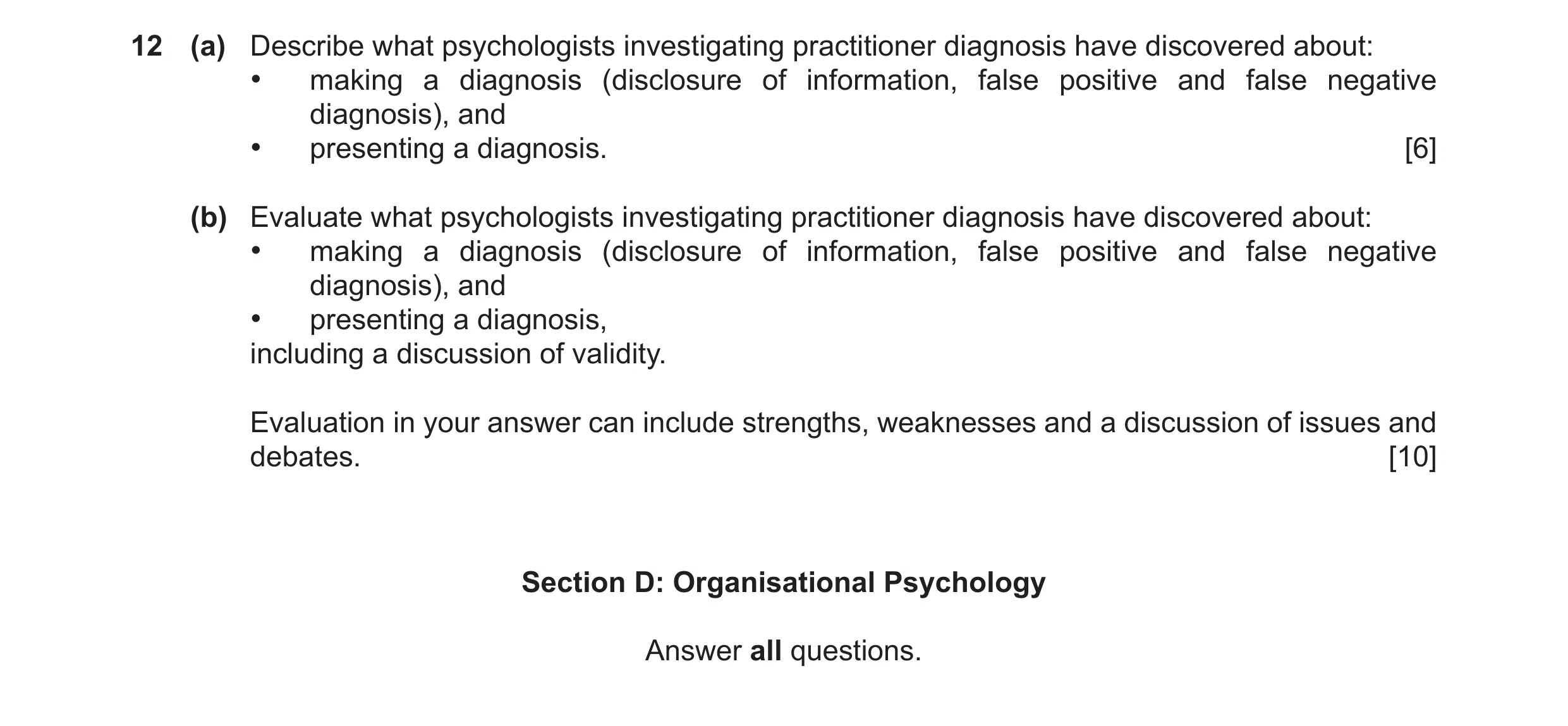
12 (a) Describe what psychologists investigating practitioner diagnosis have discovered about: • making a diagnosis (disclosure of information, false positive and false negative diagnosis), and • presenting a diagnosis. [6] (b) Evaluate what psychologists investigating practitioner diagnosis have discovered about: • making a diagnosis (disclosure of information, false positive and false negative diagnosis), and • presenting a diagnosis, including a discussion of validity. Evaluation in your answer can include strengths, weaknesses and a discussion of issues and debates. [10] Section D: Organisational Psychology Answer all questions.
16 marks
Mark scheme: 12(a) Describe what psychologists investigating practitioner diagnosis have discovered about: 6 Annotations: • Making a diagnosis (disclosure of information, false positive and false negative Add the levels to get the diagnosis), and mark awarded e.g. L1 and • Presenting a diagnosis L2 = 3 marks, L1 and L3 = 4 marks, L3 and L3 = 6 marks Use Table A: AO1 Knowledge and understanding to mark candidate responses to this question. Plus, overall level at the Syllabus content bottom of the response as Patient and practitioner diagnosis and style – practitioner diagnosis focusing on making a follows: diagnosis (disclose of information, false positive and false negative diagnosis) and presenting a 1 or 2 marks = L1 diagnosis. 3 or 4 marks = L2 5 or 6 marks = L3 For each bullet point awarded L1 to L3 depending on detail and accuracy Disclosure of information • Disclosure of information from the patient can sometimes be difficult as patients may struggle to communicate effectively, leading to errors in diagnosis. • Sarafino (2006) described how patients may find it difficult to disclose when they are angry or critical of the doctor, ignore what the doctor asks, insist on unnecessary medication or tests, want to be given a certificate for an illness they do not have, make inappropriate remarks towards the doctor. • Robinson & West (1992) found patients gave more information in a computerised interview than a questionnaire, and both methods gathered more information than a doctor gained when speaking to patients. This suggests that patients may not give full and accurate information to doctors, particularly if it is embarrassing in nature. False positive and false negative diagnosis • Errors in diagnosis are more likely to happen if the patient is not completely honest. The two types of misdiagnoses are: • A false positive diagnosis (Type 1 error) occurs when the patient is healthy, but the doctor misdiagnoses them as unwell • A false negative diagnosis (Type 2 error) occurs when the patient is unwell and does have a condition or illness but the doctor misdiagnoses them as being healthy. • Both false positive and false negative diagnoses can be problematic due to the patient either not receiving the treatment they need or being given treatment they don’t need. 12(a) Presenting a diagnosis • The traditional way to present a diagnosis is face to face but this may not always be best • Cooke and Colver (2016) gave 77 skin cancer patients a choice of how to receive their diagnosis (once the pros and cons of each method were given to them). 48% chose to receive their diagnosis by letter, 37% by phone, 11% face to face and 5% a combination of two methods. Of the 89% who received their diagnosis in the chosen manner, 94% of these were happy with the way they had received their diagnosis. Only 11% said they would wish to have received their diagnosis an alternate way • Karri et al. (2009) found that 52% of patients diagnosed with skin cancer preferred to receive the diagnosis by letter rather than face to face. Yet most skin care centres do not believe it is necessary to offer alternative methods to the traditional face-to-face approach. • Schofield et al. (2003) sent out a questionnaire to patients 4 months after they received a diagnosis of skin cancer to find out the relationship between the communication from doctors and the patients’ satisfaction, anxiety and depression. They found no significant differences between those who received their diagnosis by phone or face to face in these measures. However, they did find other factors did affect satisfaction such as whether they felt they had been prepared for the diagnosis, whether the word ‘cancer’ had been used, whether they felt they had been told everything, and whether the information had been presented clearly (all increased satisfaction). Other appropriate responses should also be credited. 12(b) Evaluate what psychologists investigating practitioner diagnosis have discovered about: 10 For each evaluation • making a diagnosis (disclosure of information, false positive and false negative point/issue/strength/weakness diagnosis), and /paragraph assess each and • Presenting a diagnosis, record level on left hand side. including a discussion of validity. Use AN for analysis and Use Table B: AO3 Analysis and evaluation to mark candidate responses to this question. CONT for specific detail. A range of issues could be used for evaluation here. These include: Overall level awarded underneath the candidate’s • Named issue – Validity – The research by Sarafino, Robinson & West, Cooke & Colver, response as follows – ‘best fit’ from individual points e.g. if all and Schofield et al. all appear to have high validity. High levels of control were evident in the Robinson & West study for example, and they all appear to have high ecological validity as L2 award L2 regardless of they are dealing with real people and their experience of diagnosis. Population validity does how many, e.g. 6 L2 = 4 marks. vary, with some of the research focusing specifically on those receiving a diagnosis of skin cancer and these findings may not apply to all conditions (including other types of cancer). If 1 L4 and 2 L3 award L4 (but • Application to everyday life – All of this section has a high application to everyday life give 7 rather than 8 marks). because issues to do with diagnosis are within the experience of almost everyone. The If only 2 points but different consequences of theoretical concepts such as false positive and false negative diagnoses levels not usually sufficient for need to be considered as these can have a huge impact on patients depending on their the higher level overall, condition. Much of the research has practical suggestions for how, for example, presenting a e.g. 1 L1 and 1 L2 = L1 (2 diagnosis can be improved to better benefit the patient. marks). e.g. 1 L2 and 1 L3 = L2 (4 • Individual and situational explanations – There are individual factors involved in the marks). doctor, patient and the potential condition they have, all of which can have an impact. Situational factors could include availability of treatment, stage of condition. • Cultural differences – In some cultures there could be difficulties with disclosure of sensitive information, in which case the manner of gathering information from the patient needs to be carefully considered together with cultural norms. It may be that the gender of the clinician is of particular importance. 12(b) • Determinism versus free-will – Much of this material is deterministic. If people disclose more information in a questionnaire than face to face then this method determines whether the clinician receives the correct information. Without this correct information, a false positive or false negative diagnosis is more likely, which can have huge implications for future treatment (or not). On the other hand, the work by Cooke and Colver and Schofield et al. shows that by giving patients choices in how they receive their diagnosis – some free will – this can greatly affect the way they deal with that diagnosis. Other issues could include • Reductionism versus holism • Methodological issues from any mentioned research • Generalisations from findings Other appropriate responses should also be credited. Section D: Organisational Psychology
This question in 9990/31 Oct/Nov 2025
Q19 · Outline the reductionism versus holism debate 9990/32 Oct/Nov 2025
14 (a) Outline the reductionism versus holism debate. [2] (b) Explain one strength of taking a holistic approach when investigating the effects of shiftwork on health and accidents. [2]
4 marks
Mark scheme: 14(a) Outline the reductionism versus holism debate. 2 1 mark for definition of both terms which are unclear / 1 mark definition reductionism. poorly expressed 1 mark definition holism. Example: The reductionism versus holism debate is about the extent to which behaviour can be best understood by breaking it down into its component parts/elements (1) or by looking at the behaviour in the context of the whole person (1). Other appropriate responses should also be credited. 14(b) Explain one strength of taking a holistic approach when investigating the effects of 2 shiftwork on health and accidents. 1 mark = strength 1 mark = explain with a link to effects on shiftwork on health and accidents Example: If researchers take a holistic approach, they avoid the problem of investigating elements of a problem and can instead look at the whole picture (1). With shiftwork and health and accidents, it can be straightforward to look at say how one shift pattern results in an increase in say cardiovascular disease but that relationship is correlational (1). It could be that the cardiovascular disease is caused by a lifestyle factor that happens to also correlate to higher levels of shiftwork (1). Other appropriate responses should also be credited.
This question in 9990/32 Oct/Nov 2025
Q20 · A university student, Chloe, thinks that she has less chance of becoming ill than other… 9990/33 Oct/Nov 2025
9 A university student, Chloe, thinks that she has less chance of becoming ill than other students. She also thinks that she has more chance of living longer than other students. This suggests unrealistic optimism in Chloe’s health beliefs. Suggest two reasons why Chloe may have unrealistic optimism in her health beliefs. [4]
4 marks
Mark scheme: 9 A university student, Chloe, thinks that she has less chance of becoming ill than other 4 1 = has not experienced students. She also thinks that she has more chance of living longer than other students. serious illness/injury before. This suggests unrealistic optimism in Chloe’s health beliefs. Suggest two reasons why Chloe may have unrealistic optimism in her heath beliefs. Syllabus content: Unrealistic optimism: reason for disregarding positive health advice, including a study, e.g., Weinstein (1980) For each suggestion: 1 mark – basic outline 1 mark – detail and context/example of health belief. Annotate with ticks to show where marks awarded Suggestions could include • Intensity of the positive or negative outcome • The perceived probability of the event occurring • Personal experience of the event • Perceived controllability of the event • Perceived stereotype about the type of person who is likely to be affected Examples: The students may believe that the probability of something bad happening to them is lower than it is for others (1). For example, they may think that eating an unhealthy diet will have little effect on them at the moment (1). This could be because they are young and it is only older people whose health is at risk from a poor diet (1). A female student may believe that she is at low risk of having a heart attack and so takes few measures to look after her heart health (1) such as taking regular cardiovascular exercise and maintaining a healthy diet (1). This is because people that she perceives to be at risk from heart attack are middle-aged men (she does not fit that stereotype) (1).
This question in 9990/33 Oct/Nov 2025
Q21 · Describe what psychologists investigating practitioner diagnosis have discovered about: •… 9990/33 Oct/Nov 2025
12 (a) Describe what psychologists investigating practitioner diagnosis have discovered about: • making a diagnosis (disclosure of information, false positive and false negative diagnosis), and • presenting a diagnosis. [6] (b) Evaluate what psychologists investigating practitioner diagnosis have discovered about: • making a diagnosis (disclosure of information, false positive and false negative diagnosis), and • presenting a diagnosis, including a discussion of validity. Evaluation in your answer can include strengths, weaknesses and a discussion of issues and debates. [10] Section D: Organisational Psychology Answer all questions.
16 marks
Mark scheme: 12(a) Describe what psychologists investigating practitioner diagnosis have discovered about: 6 Annotations: • Making a diagnosis (disclosure of information, false positive and false negative Add the levels to get the diagnosis), and mark awarded e.g. L1 and • Presenting a diagnosis L2 = 3 marks, L1 and L3 = 4 marks, L3 and L3 = 6 marks Use Table A: AO1 Knowledge and understanding to mark candidate responses to this question. Plus, overall level at the Syllabus content bottom of the response as Patient and practitioner diagnosis and style – practitioner diagnosis focusing on making a follows: diagnosis (disclose of information, false positive and false negative diagnosis) and presenting a 1 or 2 marks = L1 diagnosis. 3 or 4 marks = L2 5 or 6 marks = L3 For each bullet point awarded L1 to L3 depending on detail and accuracy Disclosure of information • Disclosure of information from the patient can sometimes be difficult as patients may struggle to communicate effectively, leading to errors in diagnosis. • Sarafino (2006) described how patients may find it difficult to disclose when they are angry or critical of the doctor, ignore what the doctor asks, insist on unnecessary medication or tests, want to be given a certificate for an illness they do not have, make inappropriate remarks towards the doctor. • Robinson & West (1992) found patients gave more information in a computerised interview than a questionnaire, and both methods gathered more information than a doctor gained when speaking to patients. This suggests that patients may not give full and accurate information to doctors, particularly if it is embarrassing in nature. False positive and false negative diagnosis • Errors in diagnosis are more likely to happen if the patient is not completely honest. The two types of misdiagnoses are: • A false positive diagnosis (Type 1 error) occurs when the patient is healthy, but the doctor misdiagnoses them as unwell • A false negative diagnosis (Type 2 error) occurs when the patient is unwell and does have a condition or illness but the doctor misdiagnoses them as being healthy. • Both false positive and false negative diagnoses can be problematic due to the patient either not receiving the treatment they need or being given treatment they don’t need. 12(a) Presenting a diagnosis • The traditional way to present a diagnosis is face to face but this may not always be best • Cooke and Colver (2016) gave 77 skin cancer patients a choice of how to receive their diagnosis (once the pros and cons of each method were given to them). 48% chose to receive their diagnosis by letter, 37% by phone, 11% face to face and 5% a combination of two methods. Of the 89% who received their diagnosis in the chosen manner, 94% of these were happy with the way they had received their diagnosis. Only 11% said they would wish to have received their diagnosis an alternate way • Karri et al. (2009) found that 52% of patients diagnosed with skin cancer preferred to receive the diagnosis by letter rather than face to face. Yet most skin care centres do not believe it is necessary to offer alternative methods to the traditional face-to-face approach. • Schofield et al. (2003) sent out a questionnaire to patients 4 months after they received a diagnosis of skin cancer to find out the relationship between the communication from doctors and the patients’ satisfaction, anxiety and depression. They found no significant differences between those who received their diagnosis by phone or face to face in these measures. However, they did find other factors did affect satisfaction such as whether they felt they had been prepared for the diagnosis, whether the word ‘cancer’ had been used, whether they felt they had been told everything, and whether the information had been presented clearly (all increased satisfaction). Other appropriate responses should also be credited. 12(b) Evaluate what psychologists investigating practitioner diagnosis have discovered about: 10 For each evaluation • making a diagnosis (disclosure of information, false positive and false negative point/issue/strength/weakness diagnosis), and /paragraph assess each and • Presenting a diagnosis, record level on left hand side. including a discussion of validity. Use AN for analysis and Use Table B: AO3 Analysis and evaluation to mark candidate responses to this question. CONT for specific detail. A range of issues could be used for evaluation here. These include: Overall level awarded underneath the candidate’s • Named issue – Validity – The research by Sarafino, Robinson & West, Cooke & Colver, response as follows – ‘best fit’ from individual points e.g. if all and Schofield et al. all appear to have high validity. High levels of control were evident in the Robinson & West study for example, and they all appear to have high ecological validity as L2 award L2 regardless of they are dealing with real people and their experience of diagnosis. Population validity does how many, e.g. 6 L2 = 4 marks. vary, with some of the research focusing specifically on those receiving a diagnosis of skin cancer and these findings may not apply to all conditions (including other types of cancer). If 1 L4 and 2 L3 award L4 (but • Application to everyday life – All of this section has a high application to everyday life give 7 rather than 8 marks). because issues to do with diagnosis are within the experience of almost everyone. The If only 2 points but different consequences of theoretical concepts such as false positive and false negative diagnoses levels not usually sufficient for need to be considered as these can have a huge impact on patients depending on their the higher level overall, condition. Much of the research has practical suggestions for how, for example, presenting a e.g. 1 L1 and 1 L2 = L1 (2 diagnosis can be improved to better benefit the patient. marks). e.g. 1 L2 and 1 L3 = L2 (4 • Individual and situational explanations – There are individual factors involved in the marks). doctor, patient and the potential condition they have, all of which can have an impact. Situational factors could include availability of treatment, stage of condition. • Cultural differences – In some cultures there could be difficulties with disclosure of sensitive information, in which case the manner of gathering information from the patient needs to be carefully considered together with cultural norms. It may be that the gender of the clinician is of particular importance. 12(b) • Determinism versus free-will – Much of this material is deterministic. If people disclose more information in a questionnaire than face to face then this method determines whether the clinician receives the correct information. Without this correct information, a false positive or false negative diagnosis is more likely, which can have huge implications for future treatment (or not). On the other hand, the work by Cooke and Colver and Schofield et al. shows that by giving patients choices in how they receive their diagnosis – some free will – this can greatly affect the way they deal with that diagnosis. Other issues could include • Reductionism versus holism • Methodological issues from any mentioned research • Generalisations from findings Other appropriate responses should also be credited. Section D: Organisational Psychology
This question in 9990/33 Oct/Nov 2025
![Question 1: (a) Describe what psychologists have discovered about the misuse of health services. [8] (b) Evaluate what psychologists have discovered ab…](https://img.pastlit.com/crops/62730e4c-5a1b-4b06-9ee3-d43b07cd82dc/q6.webp)
![Question 3: (a) Explain what is meant by ‘hypochondriasis’. [2] (b) Describe the study by Savage and Armstrong (1990) on practitioner consulting style …](https://img.pastlit.com/crops/9cb3996e-22c0-4c6f-8e9c-9c299ef2d5dd/q5.webp)
![Question 4: (a) Outline one symptom of Munchausen syndrome. [2] (b) Describe the findings of the study by McKinstry and Wang (1991) of non-verbal commu…](https://img.pastlit.com/crops/0bba3915-f998-4157-aa3f-6c02e605fdde/q5.webp)
![Question 5: (a) Explain what is meant by ‘kleptomania’. [2] (b) Outline two of the components that Griffiths (2005) used to define addiction. [4] (c) E…](https://img.pastlit.com/crops/5283092b-f364-4eb1-9c08-b0edf44b0d4c/q1.webp) 1 / 4
1 / 4![Question 6: (a) Identify two biochemical tests that measure non-adherence in patients. [2] (b) Describe the procedure used in the study by Chung and Na…](https://img.pastlit.com/crops/5283092b-f364-4eb1-9c08-b0edf44b0d4c/q5.webp)
![Question 7: (a) Identify two of the stages in the model of delay in seeking treatment (Safer, 1979). [2] (b) Aleem and Ajarim (1995) conducted a case s…](https://img.pastlit.com/crops/352dc226-4a7a-4b90-b25d-09745d482631/q5.webp)
![Question 10: (a) Outline the reductionism side of the reductionism versus holism debate. [2] (b) Explain how the biochemical explanation of schizophreni…](https://img.pastlit.com/crops/db9a5a92-c176-42b8-aac7-4534476124eb/q2.webp)
![Question 11: (a) Outline what is meant by free-will, including an example from positive psychology. [2] (b) Explain one reason why positive psychology c…](https://img.pastlit.com/crops/db9a5a92-c176-42b8-aac7-4534476124eb/q10.webp) 2 / 4
2 / 4![Question 12: (a) Outline the reductionism versus holism debate. [2] (b) Explain one reason why a competitor‑focused sales technique can be considered re…](https://img.pastlit.com/crops/b8366ef4-e3f7-4cd7-aeea-7a2d2c81d04e/q6.webp)

![Question 14: (a) Outline the reductionism side of the reductionism versus holism debate. [2] (b) Explain how the biochemical explanation of schizophreni…](https://img.pastlit.com/crops/f18b9c25-5711-42ba-89a5-71d306fd858c/q2.webp)
![Question 15: (a) Outline what is meant by free-will, including an example from positive psychology. [2] (b) Explain one reason why positive psychology c…](https://img.pastlit.com/crops/f18b9c25-5711-42ba-89a5-71d306fd858c/q10.webp)

 3 / 4
3 / 4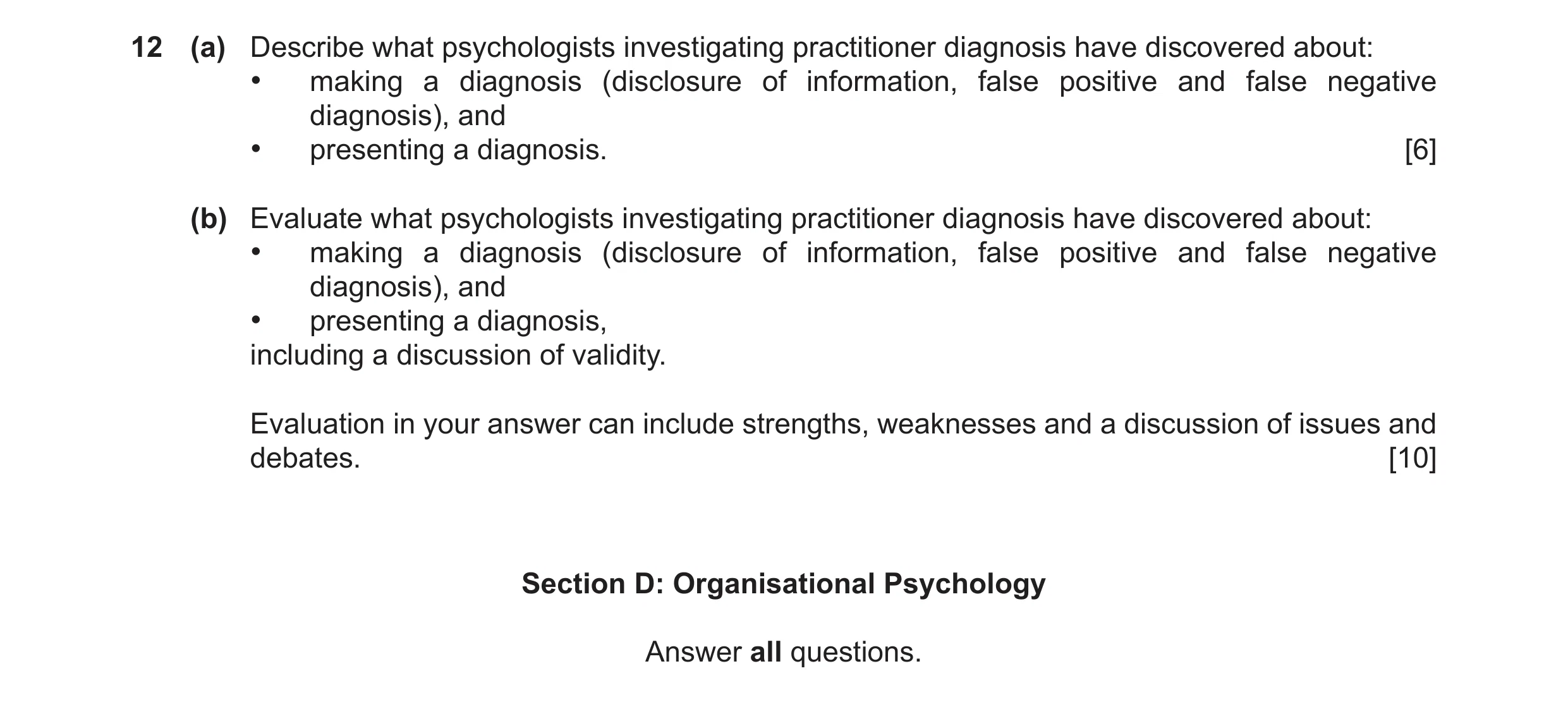
![Question 19: (a) Outline the reductionism versus holism debate. [2] (b) Explain one strength of taking a holistic approach when investigating the effect…](https://img.pastlit.com/crops/f9c34e1d-b432-4a74-b63e-d57843345cb1/q14.webp)

 4 / 4
4 / 4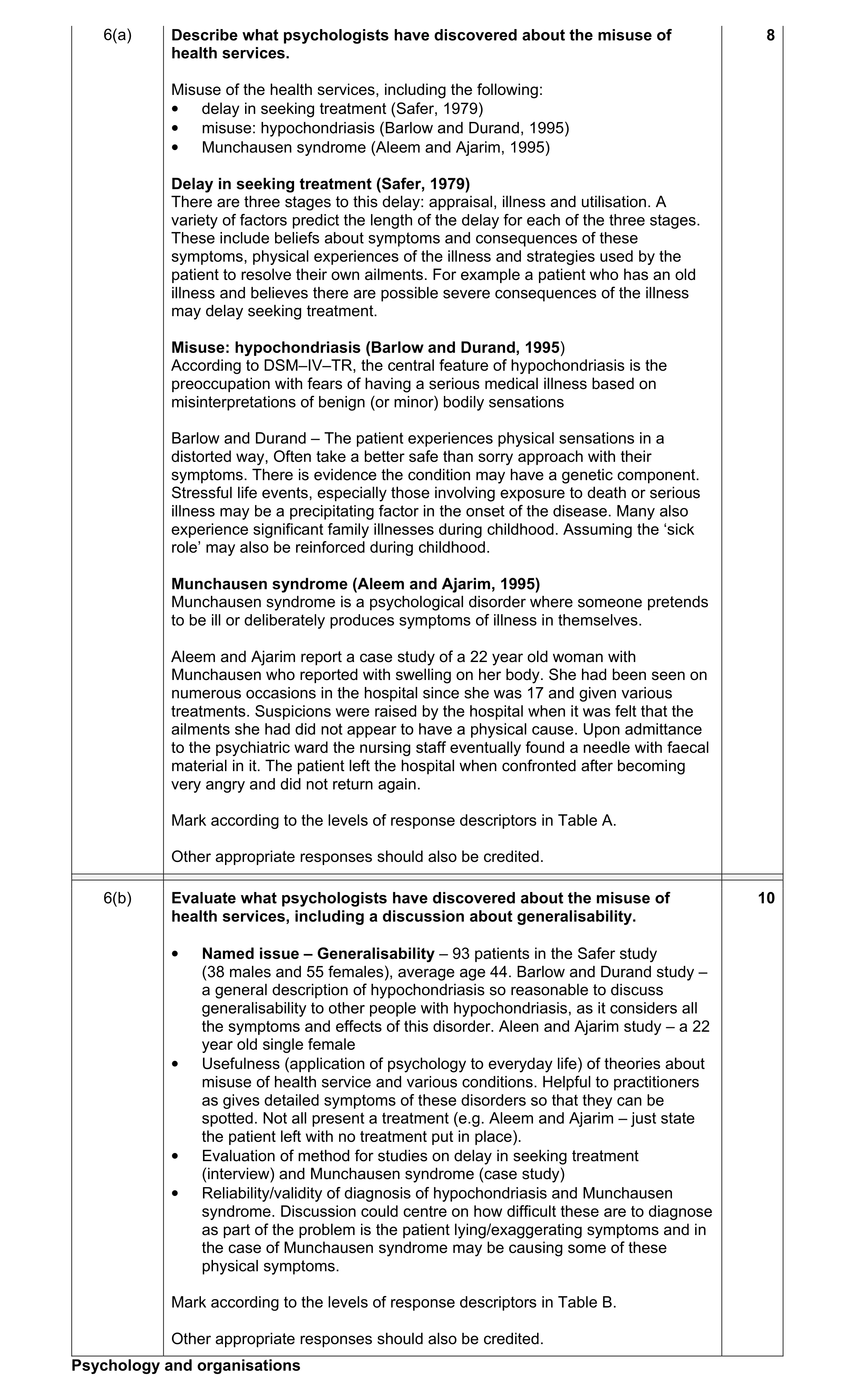 18
18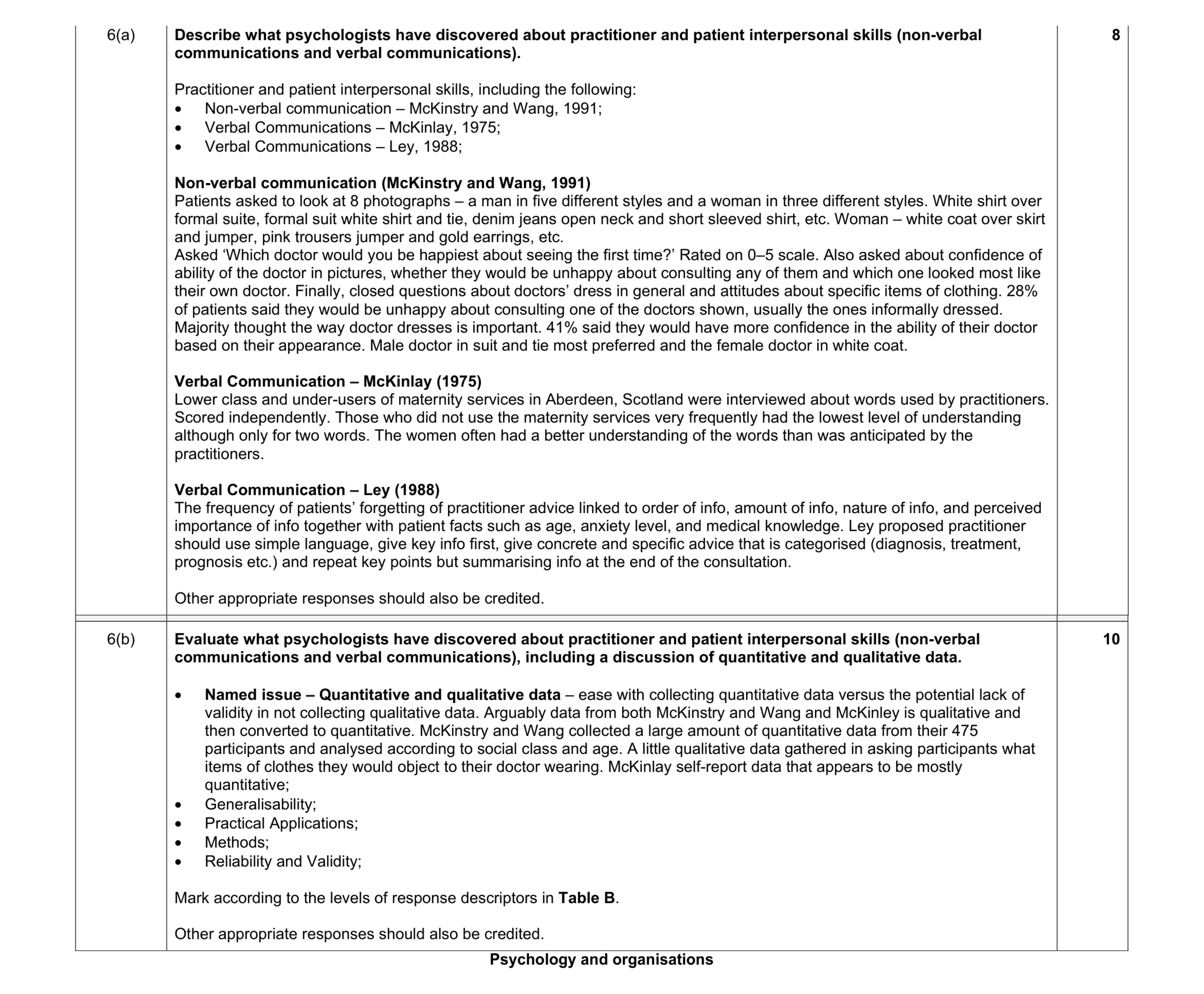 18
18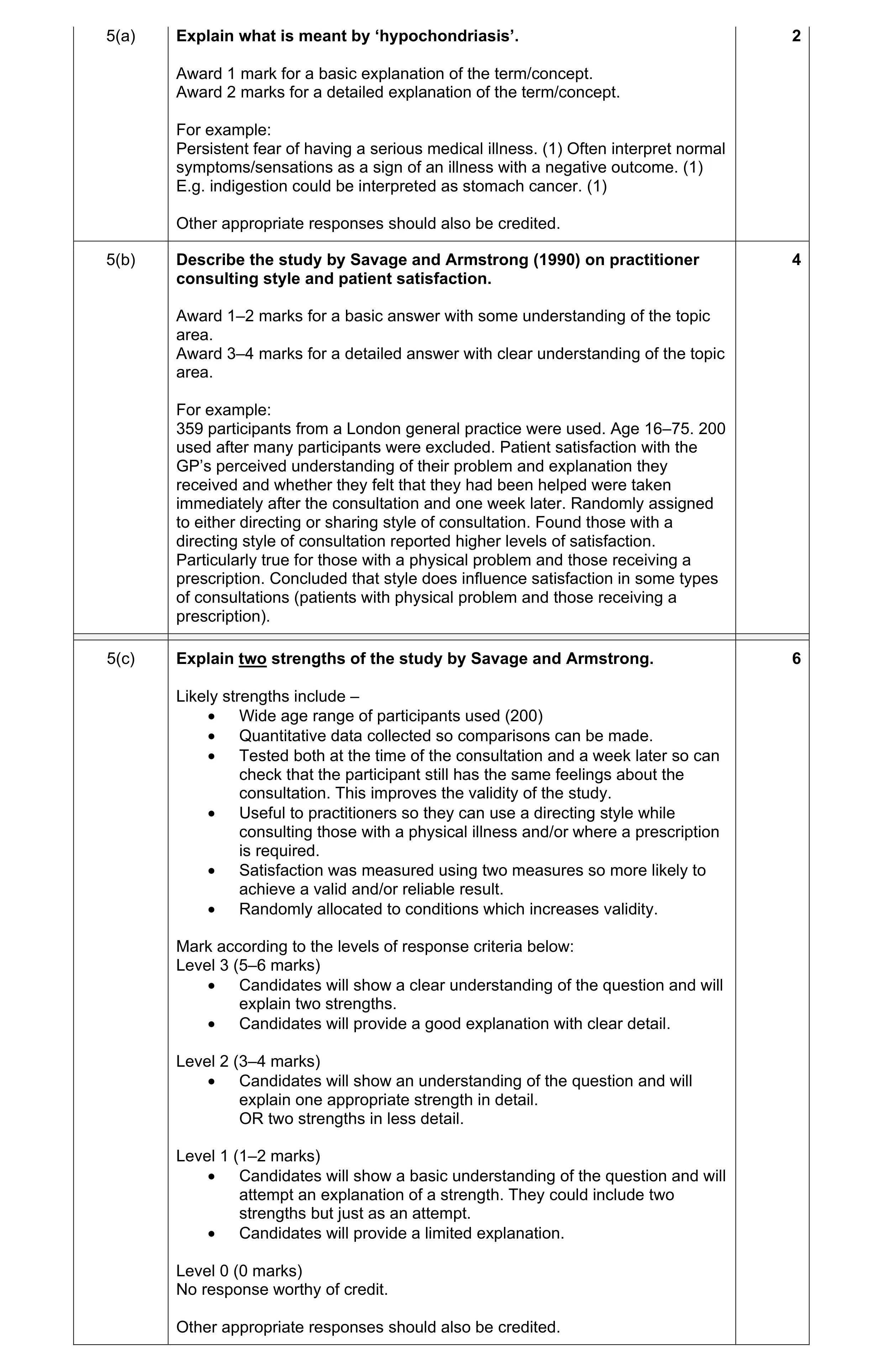 12
12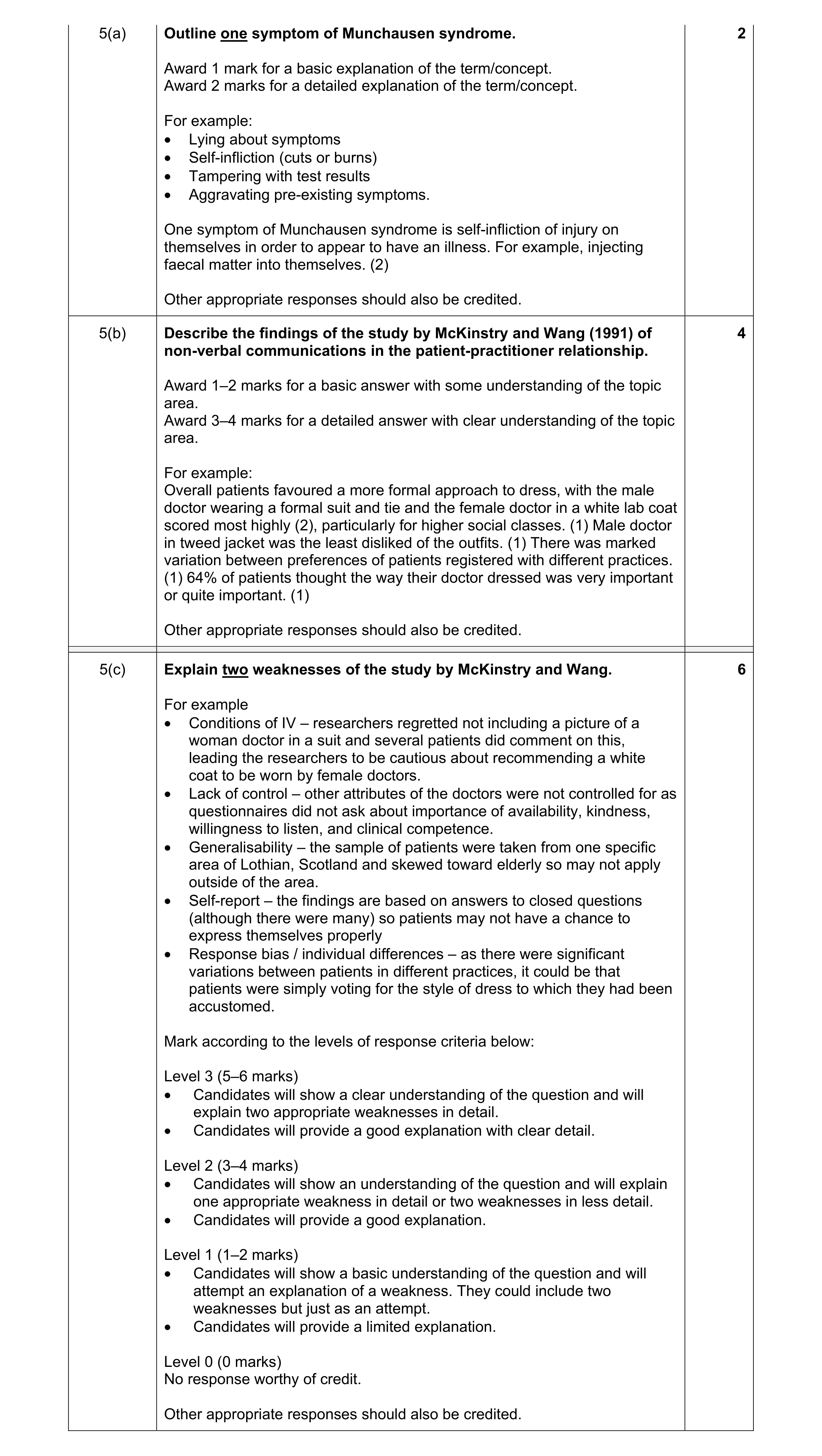 12
12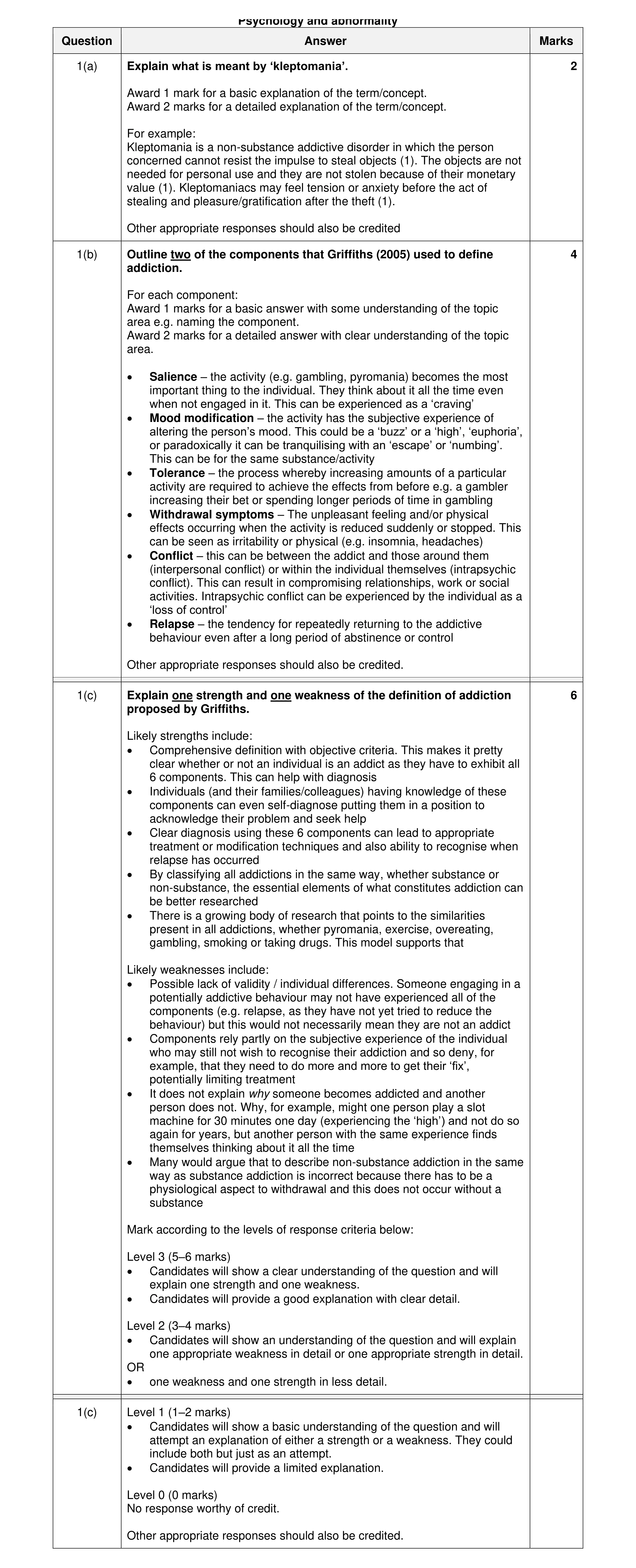 12
12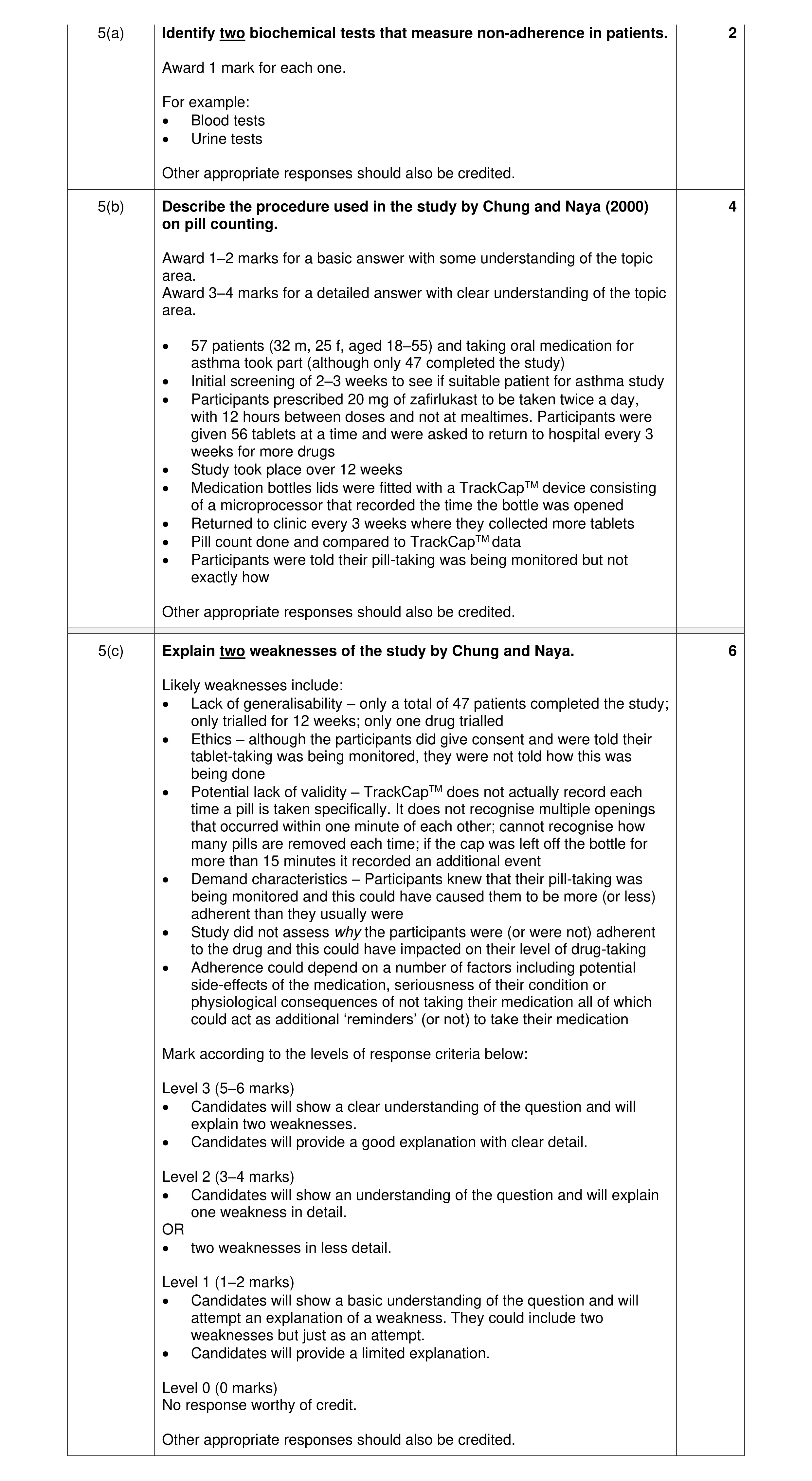 12
12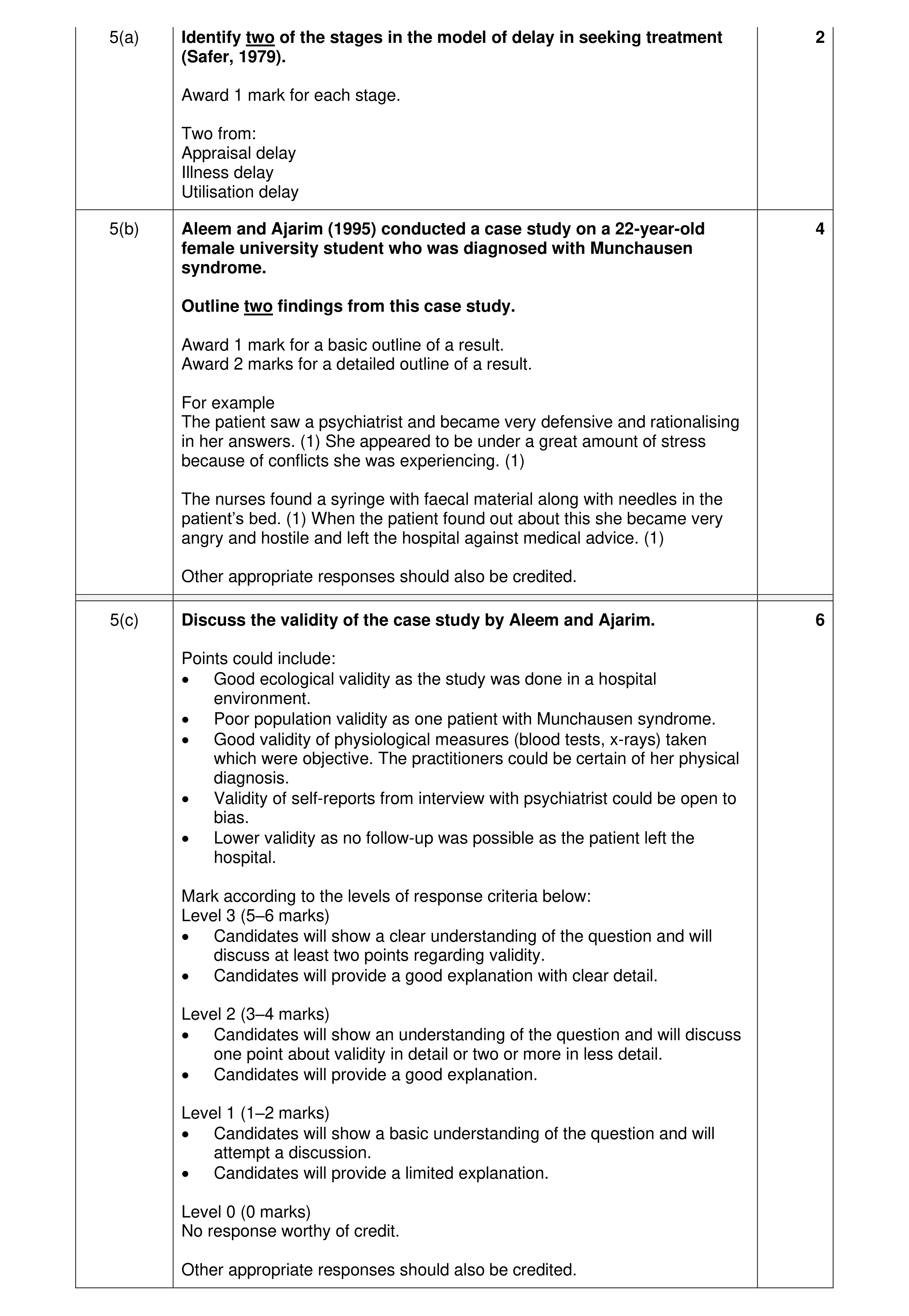 12
12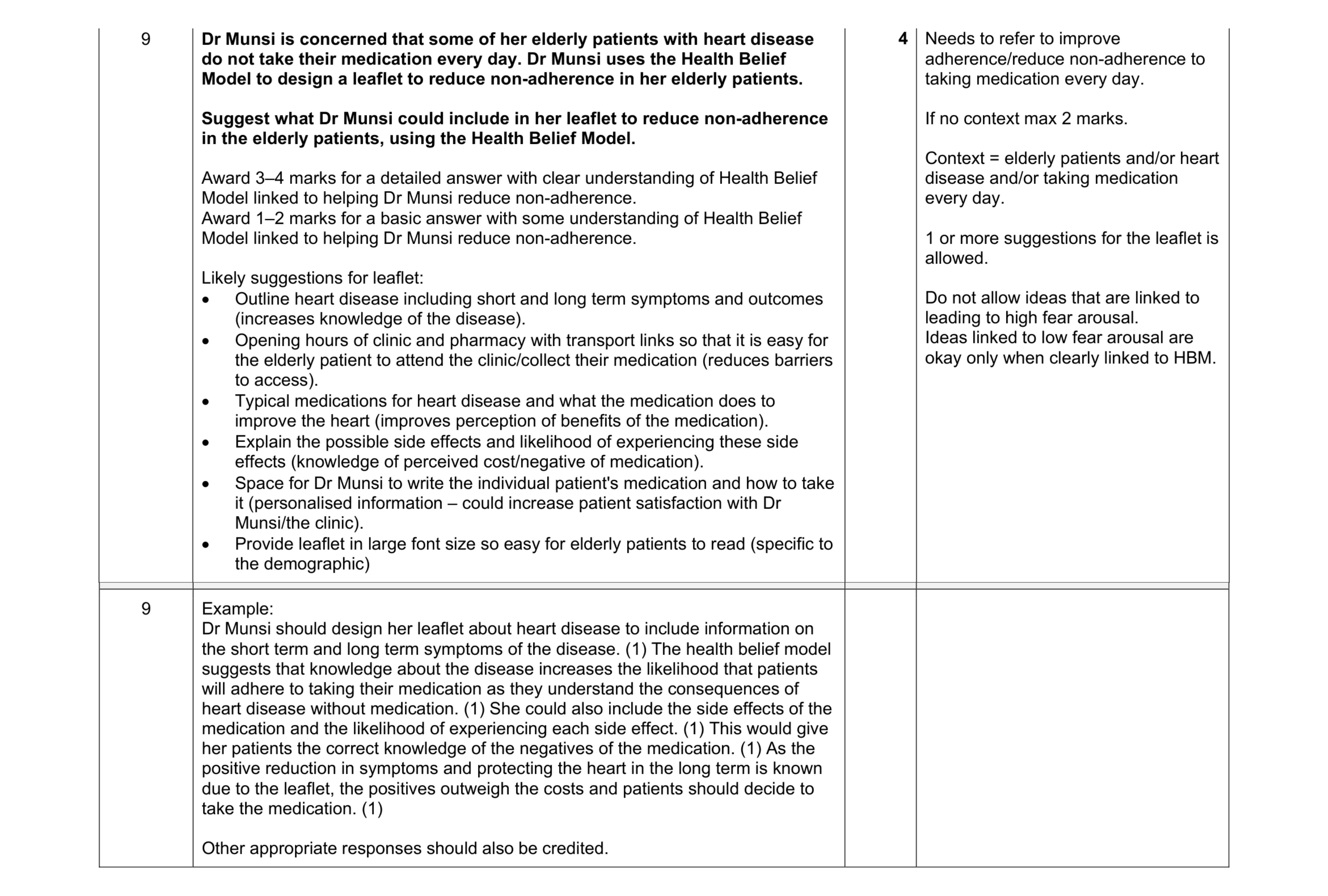 4
4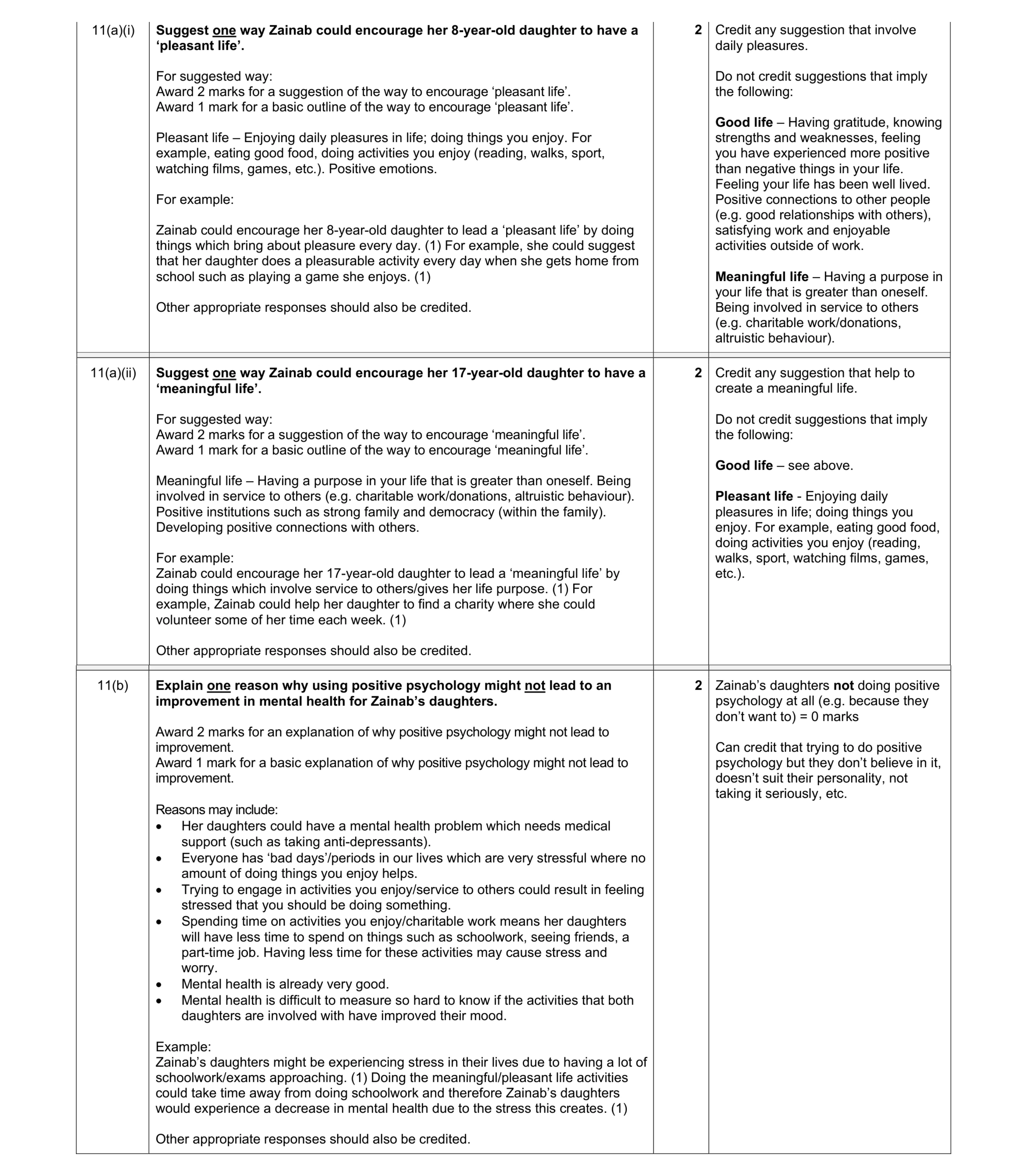 6
6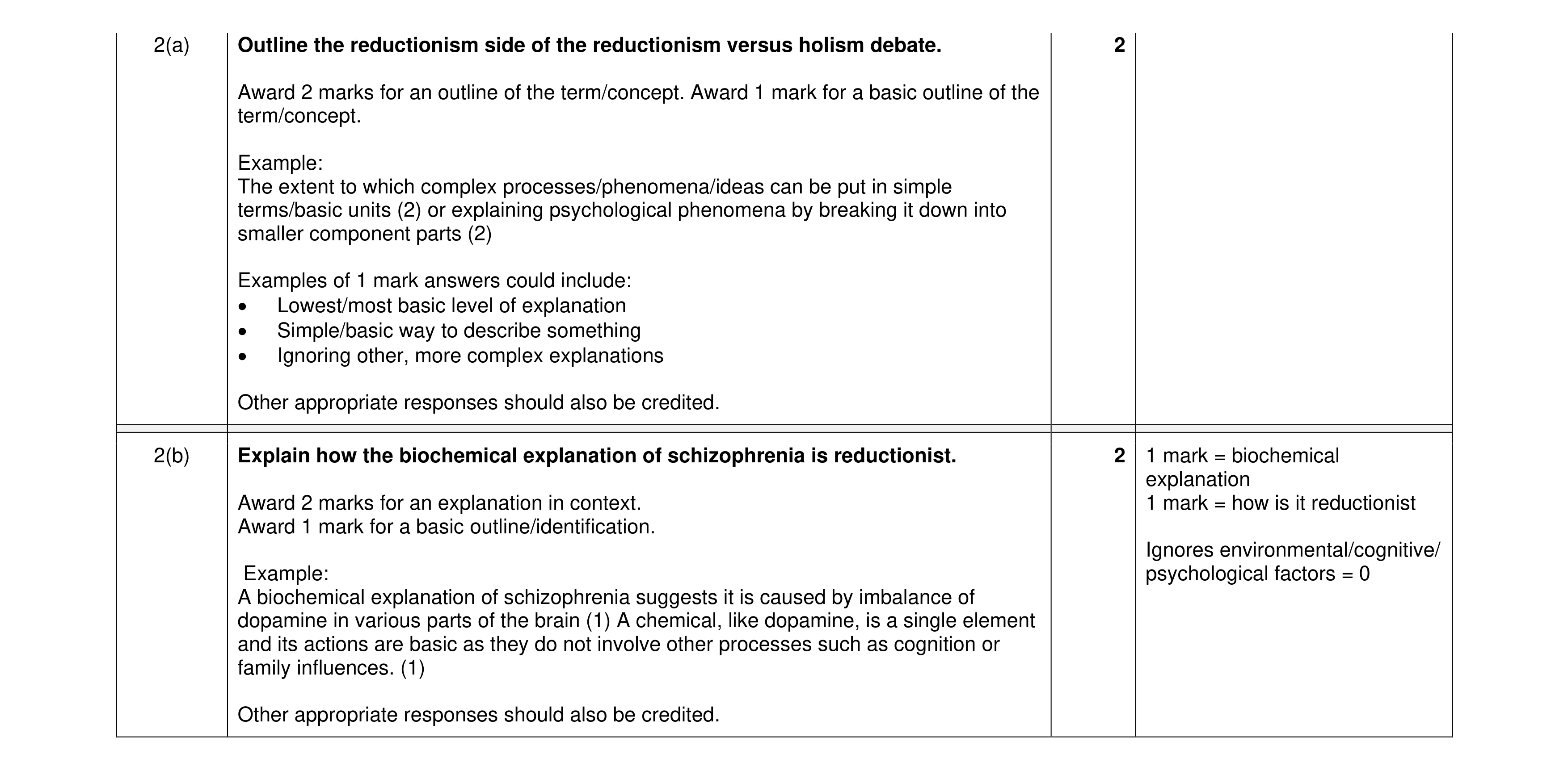 4
4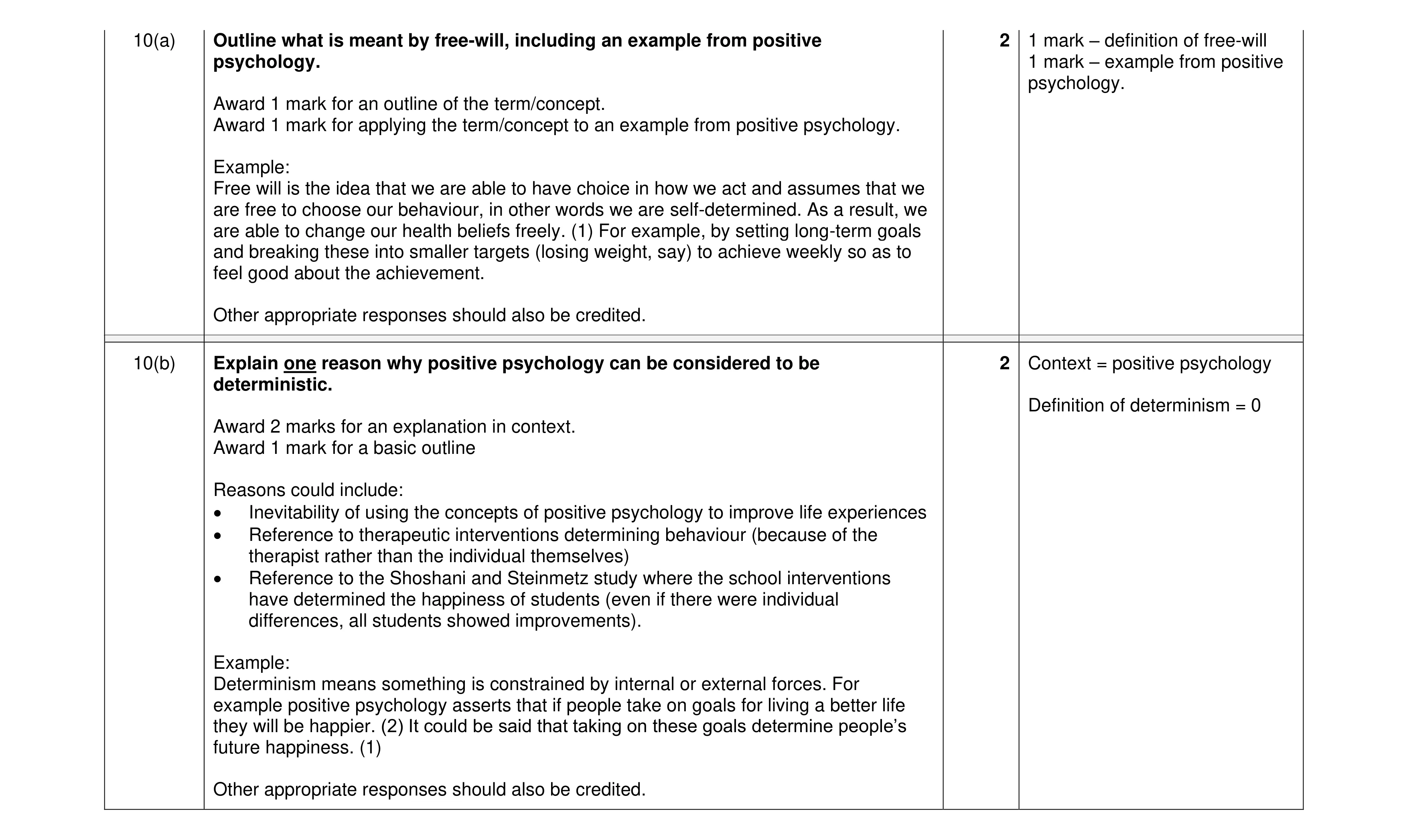 4
4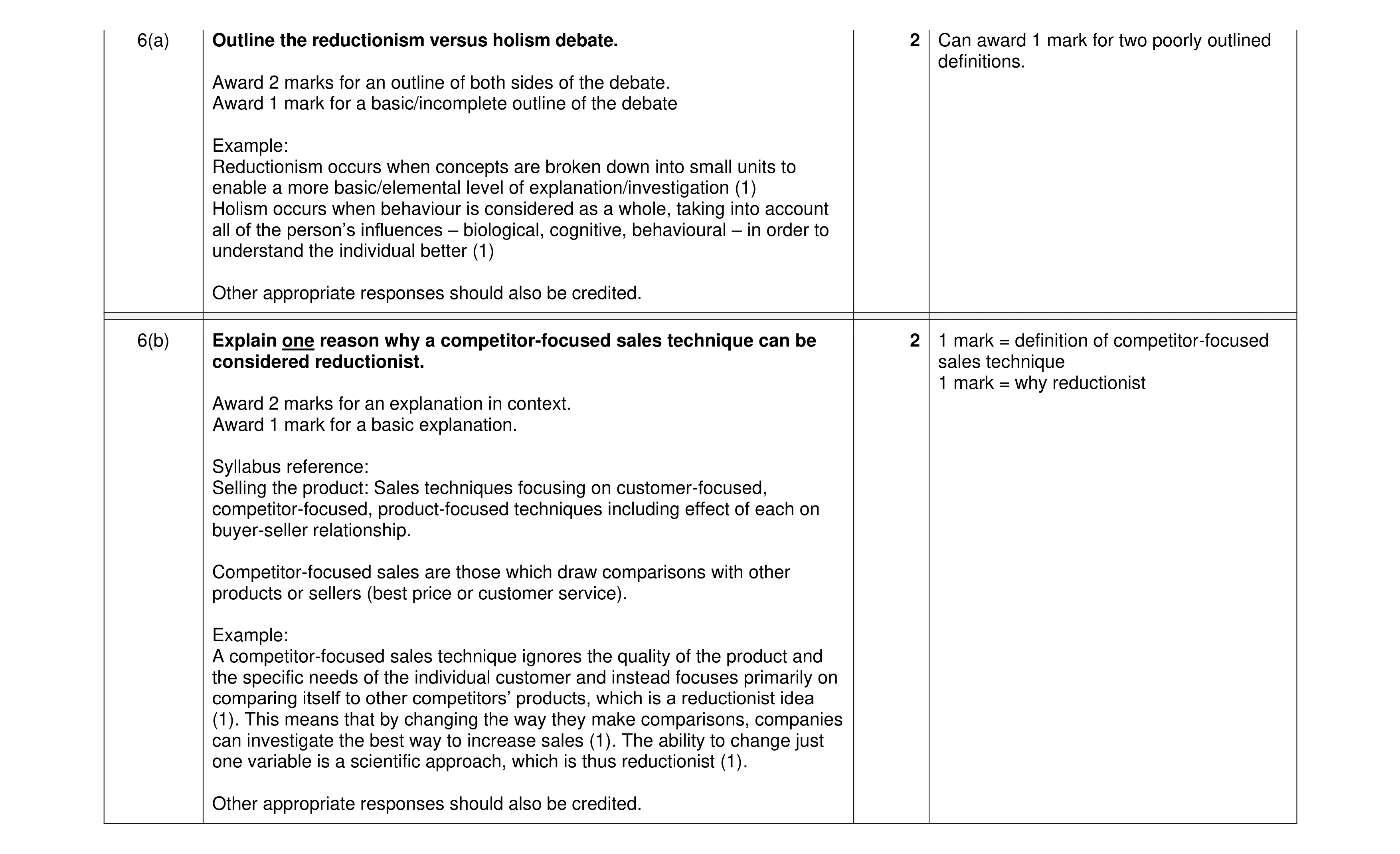 4
4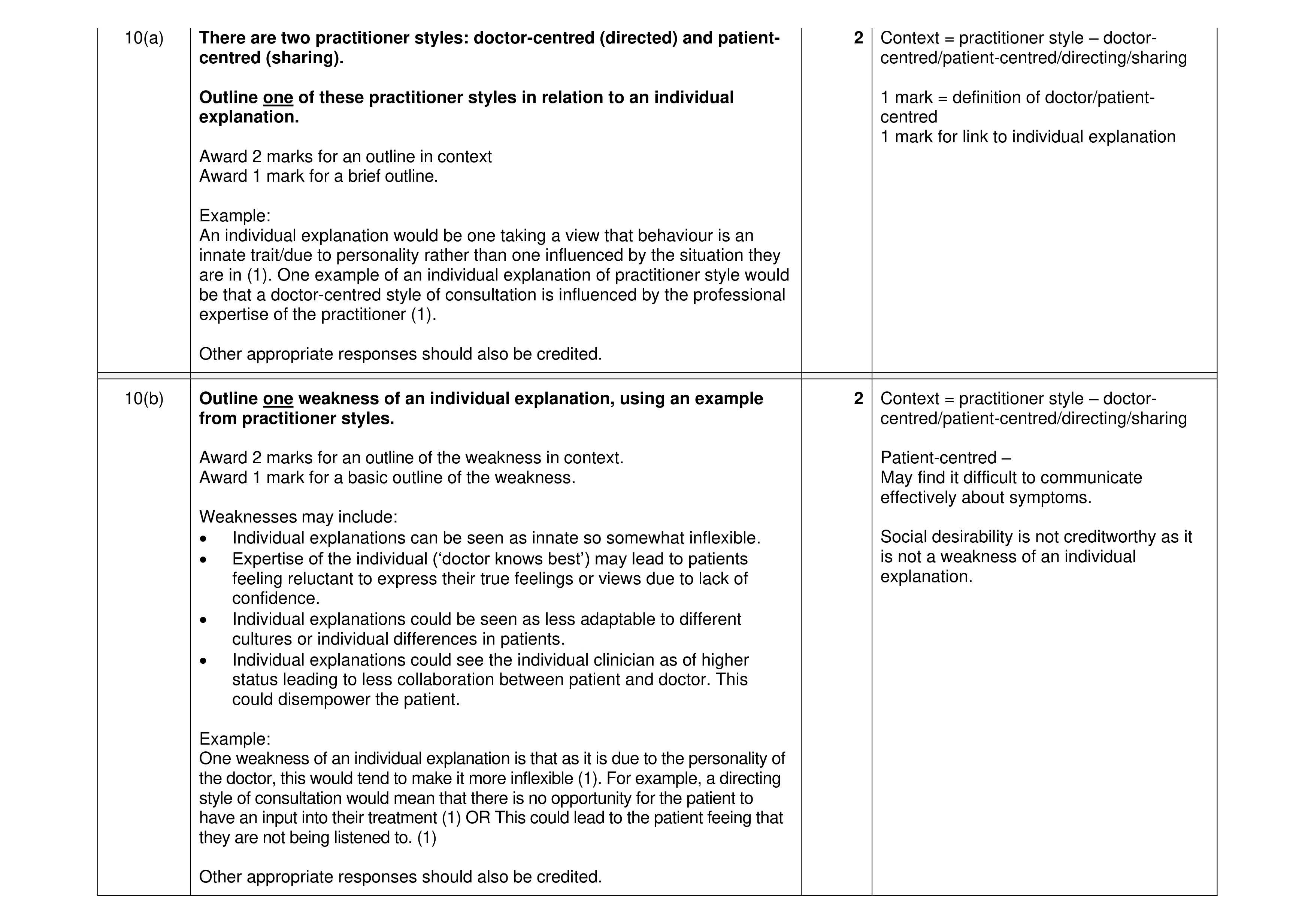 4
4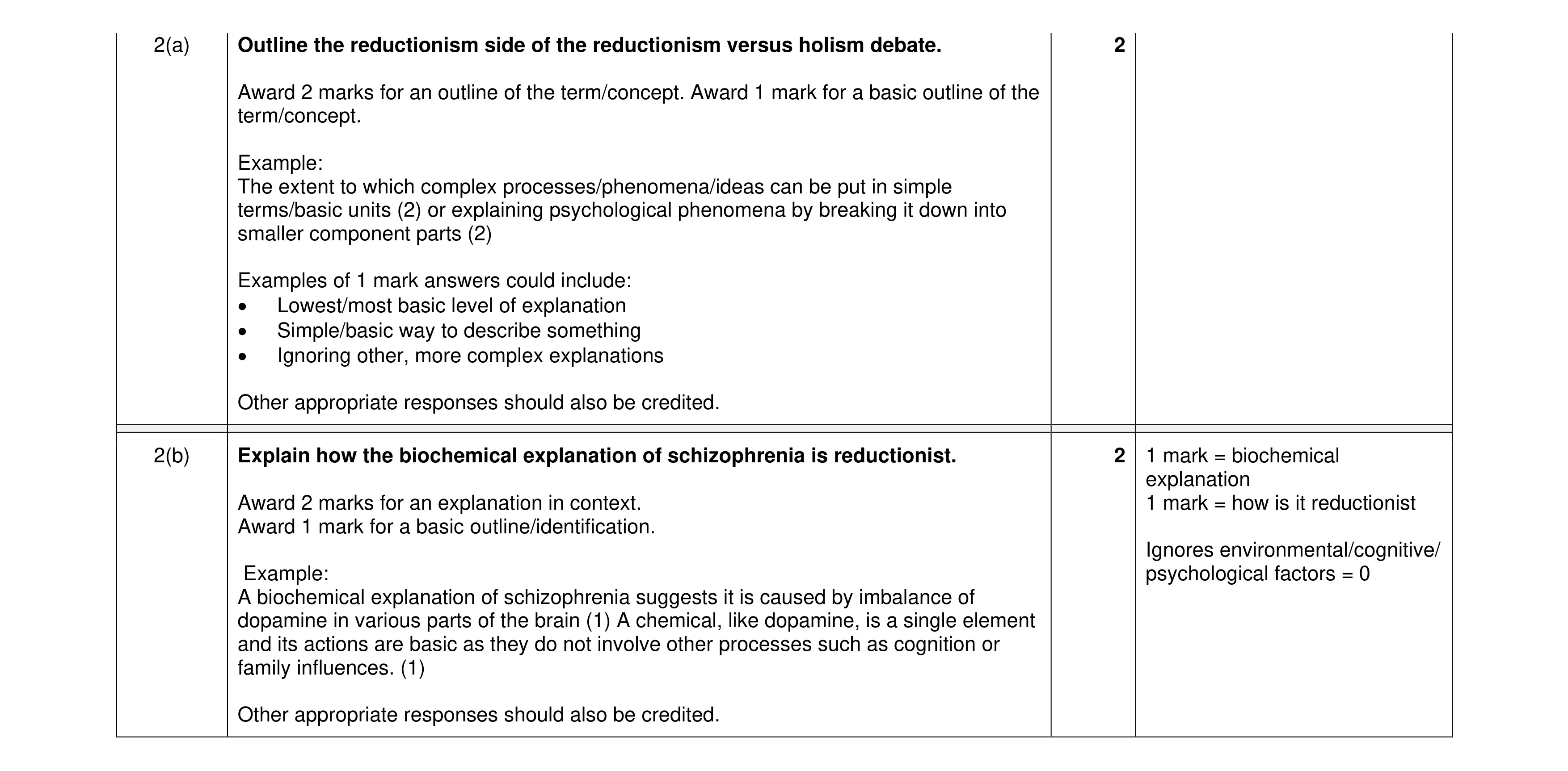 4
4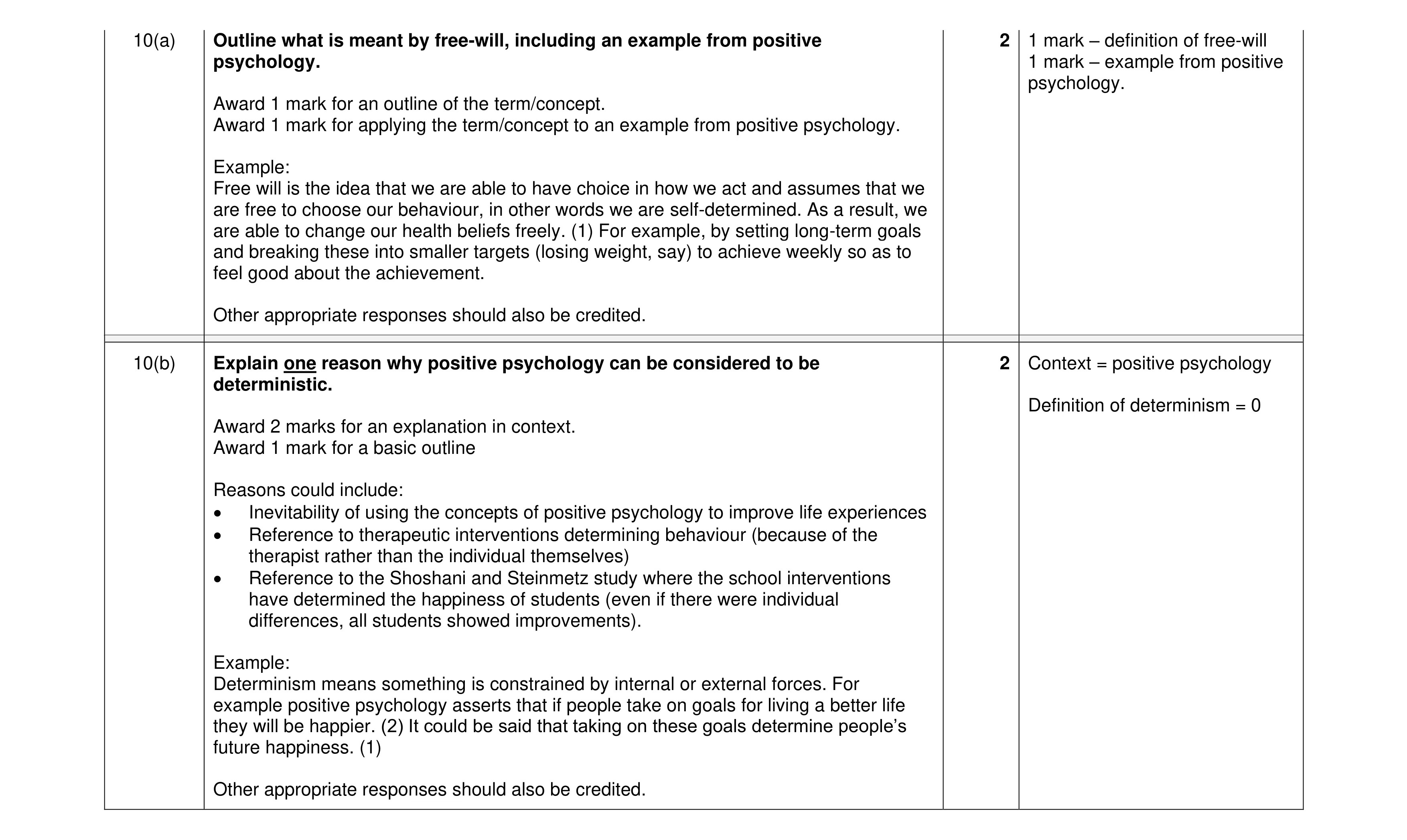 4
4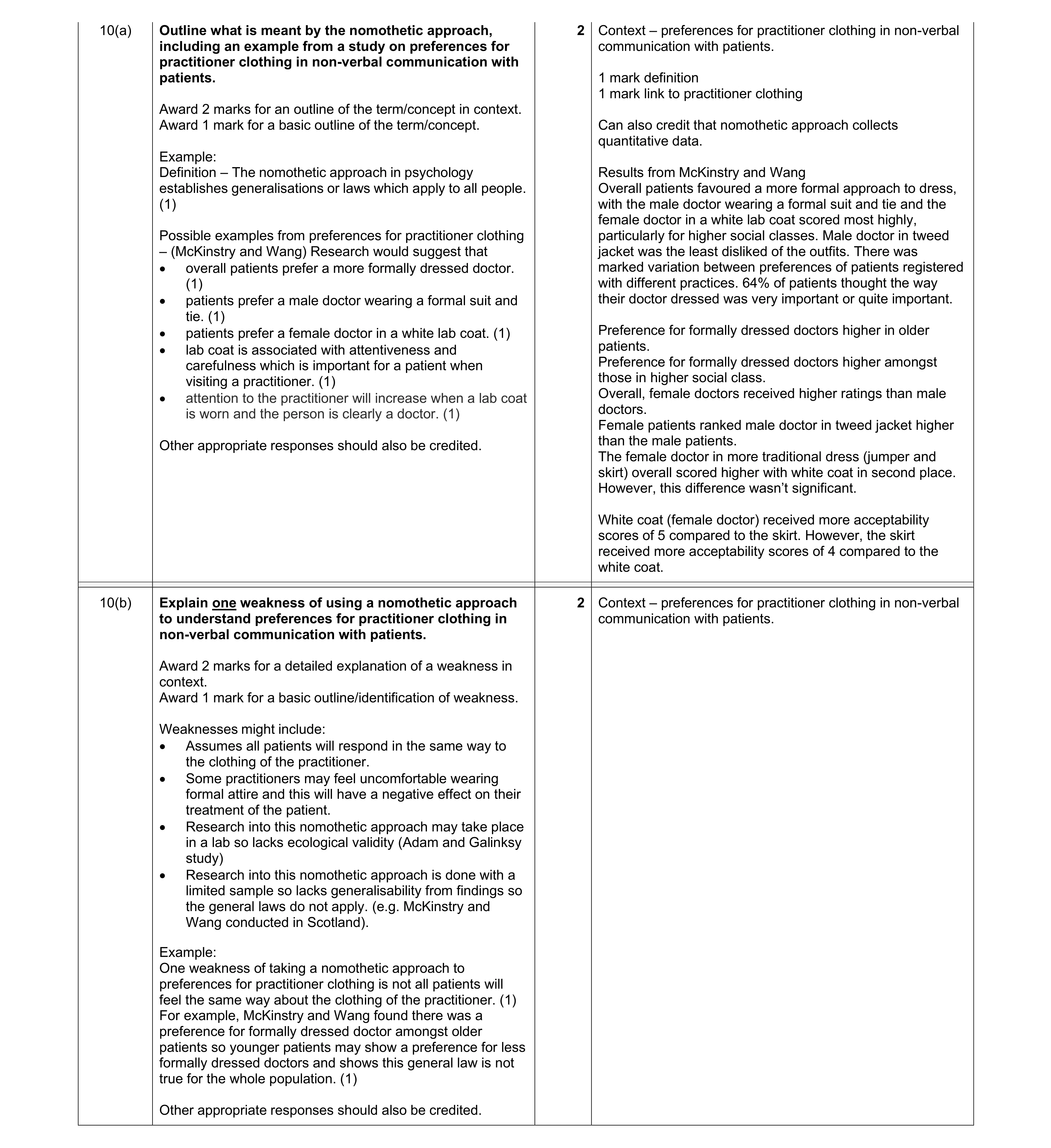 4
4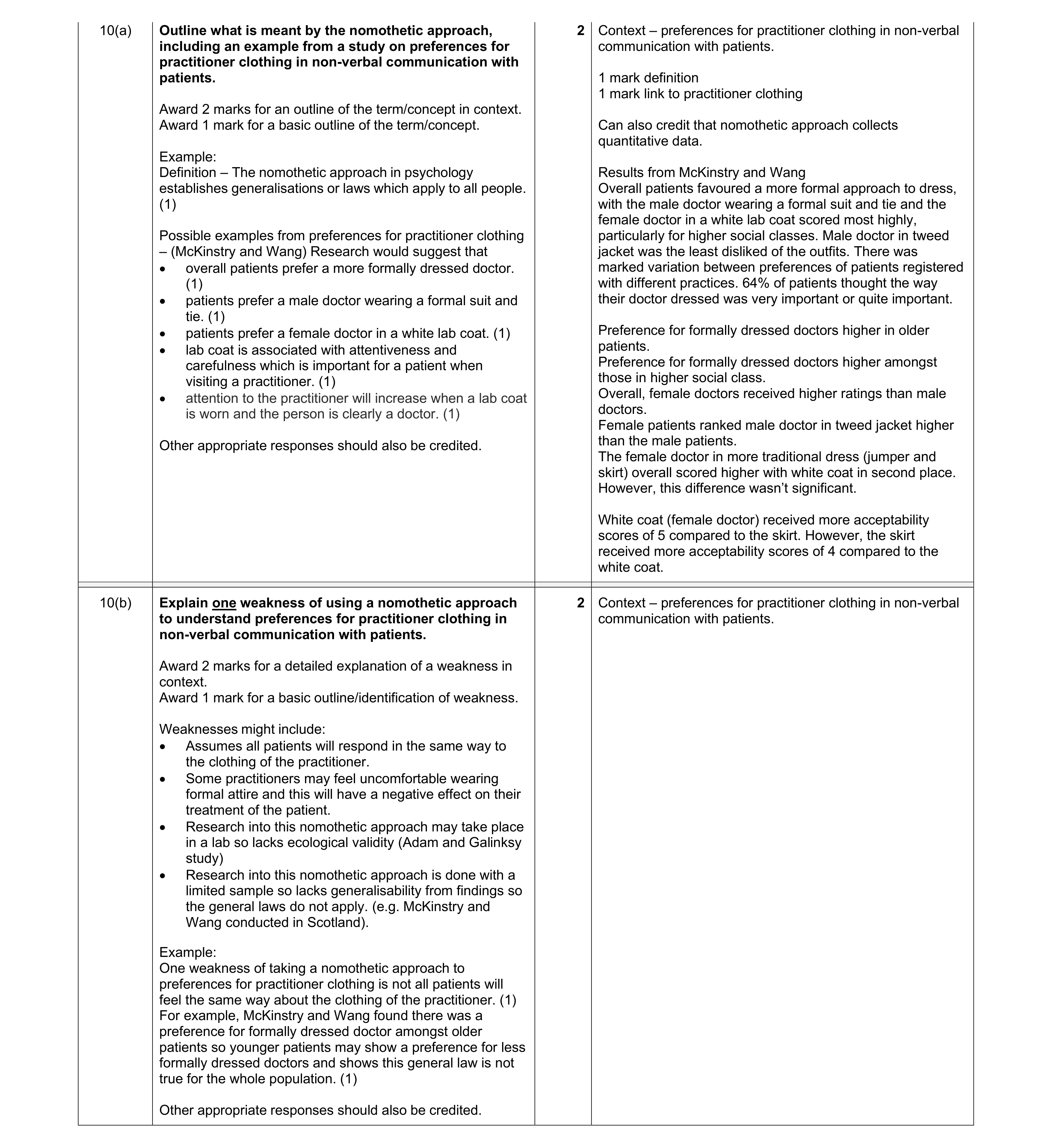 4
4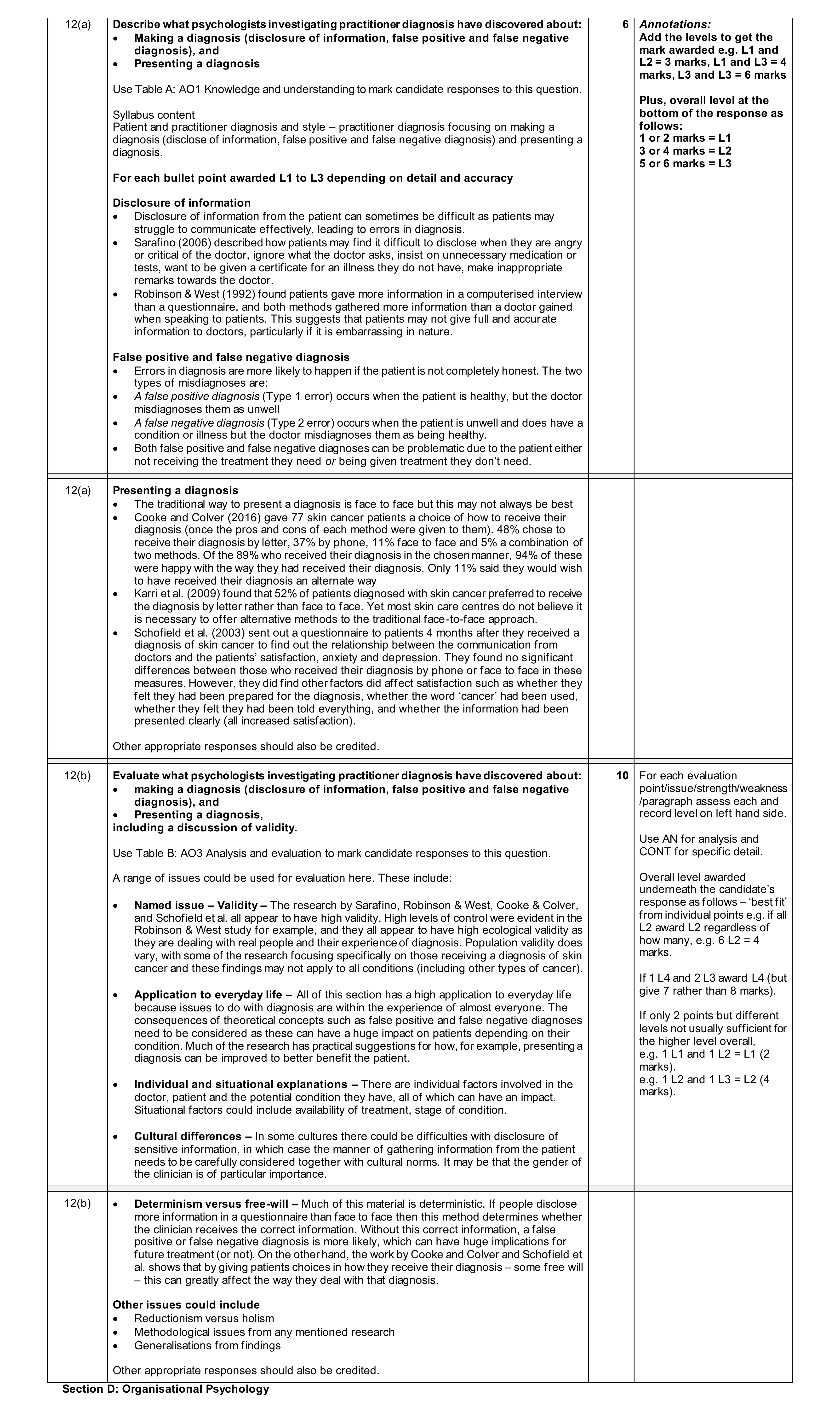 16
16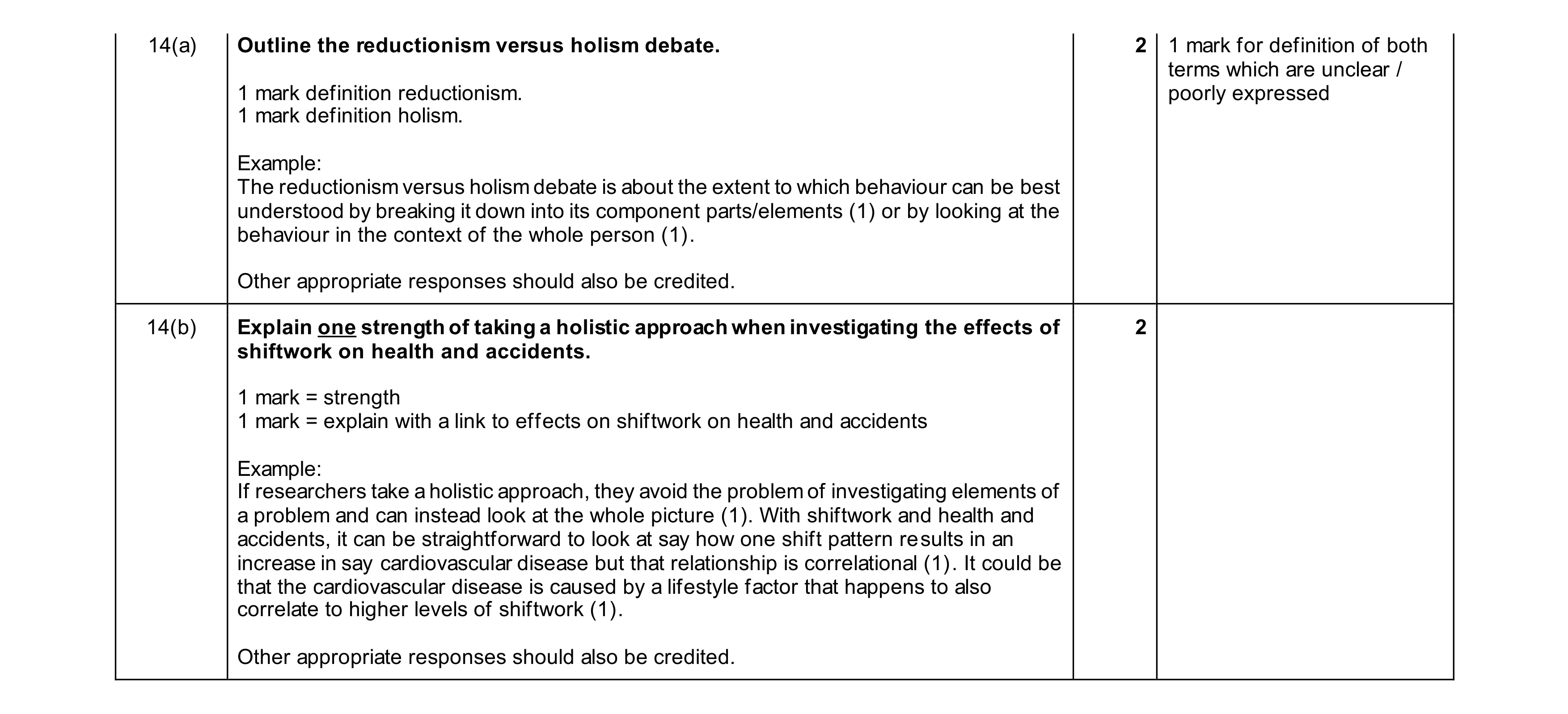 4
4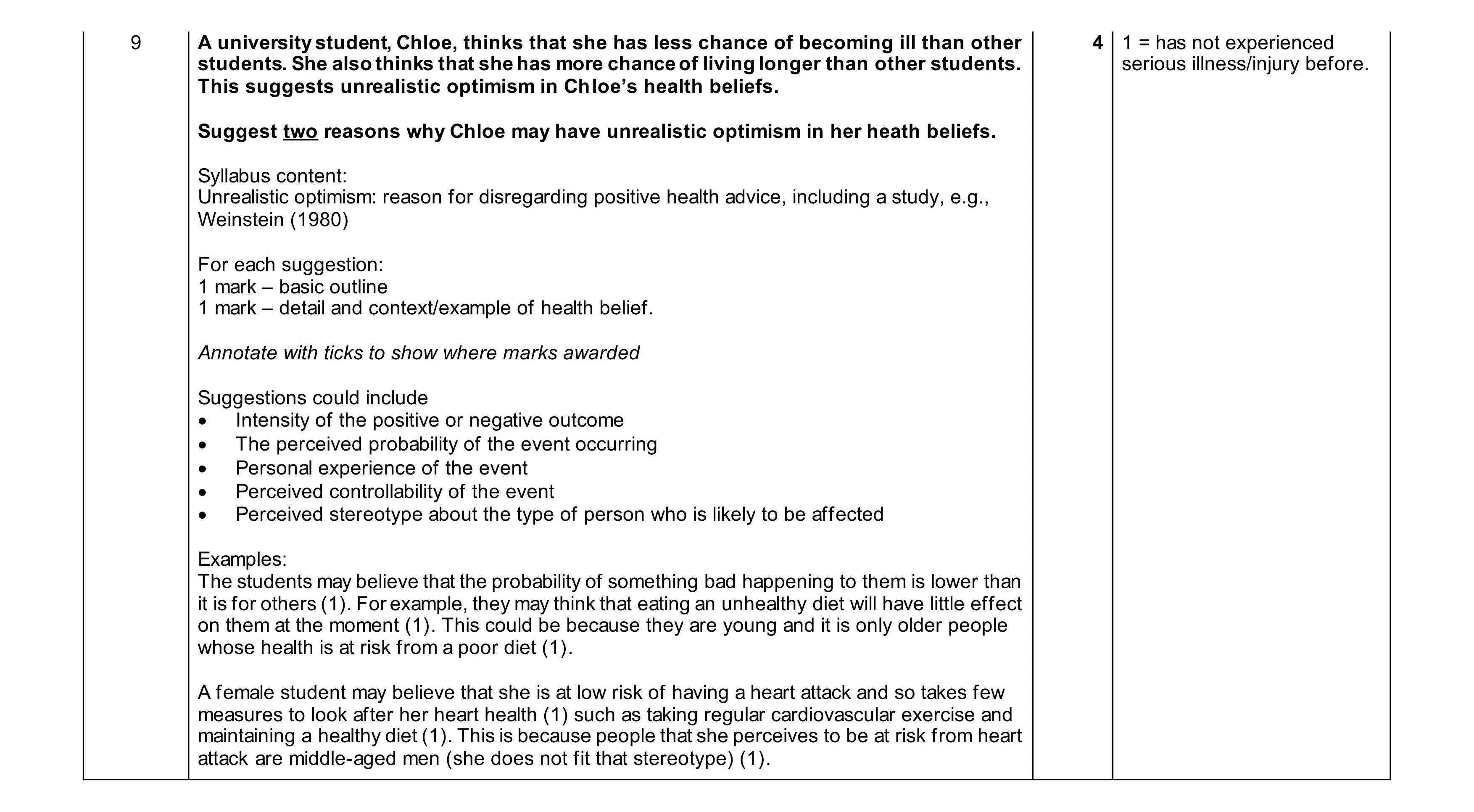 4
4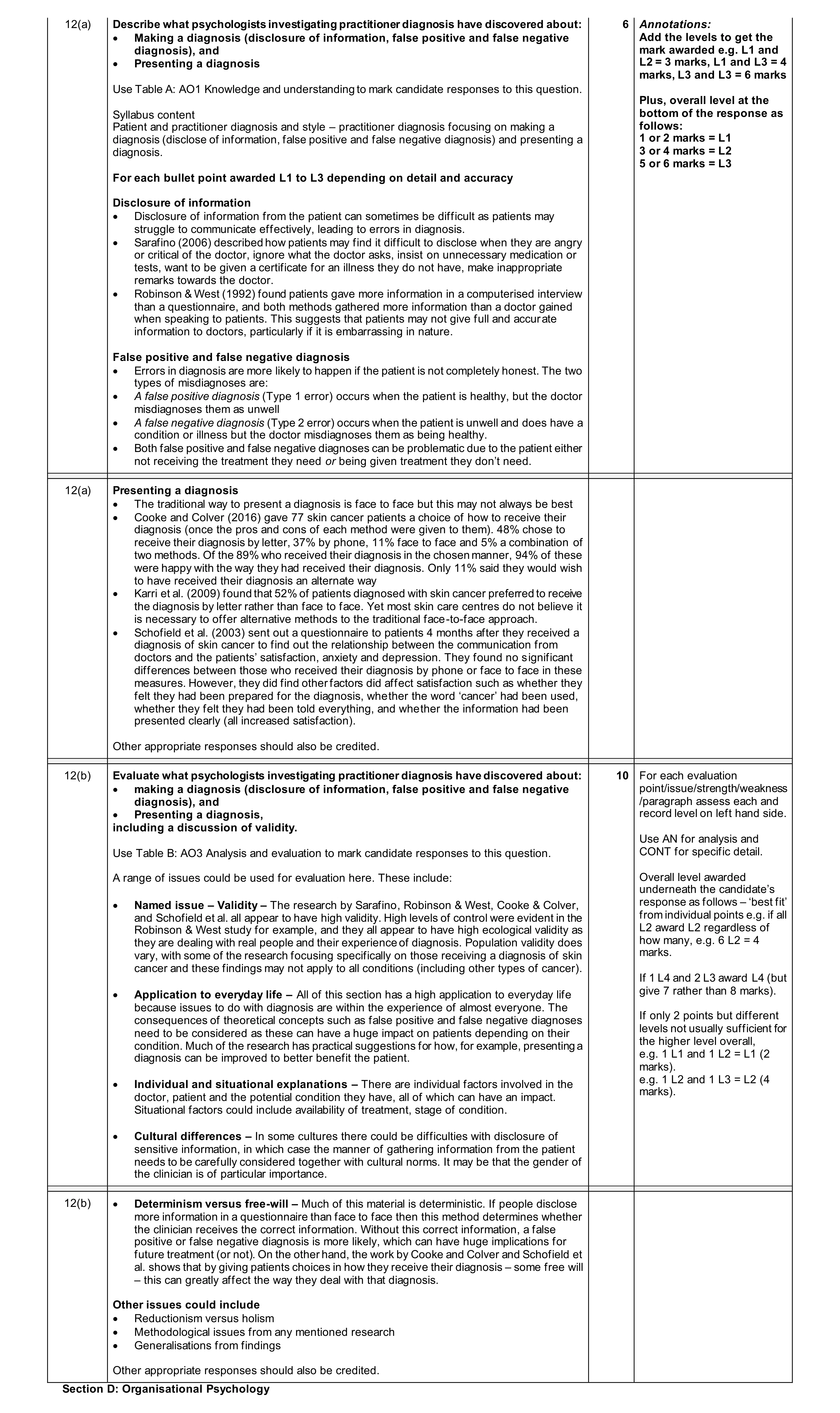 16
16