Cambridge A Level Psychology (from 2018) 9990 — 2023 Feb/March Paper 3 · Variant 2
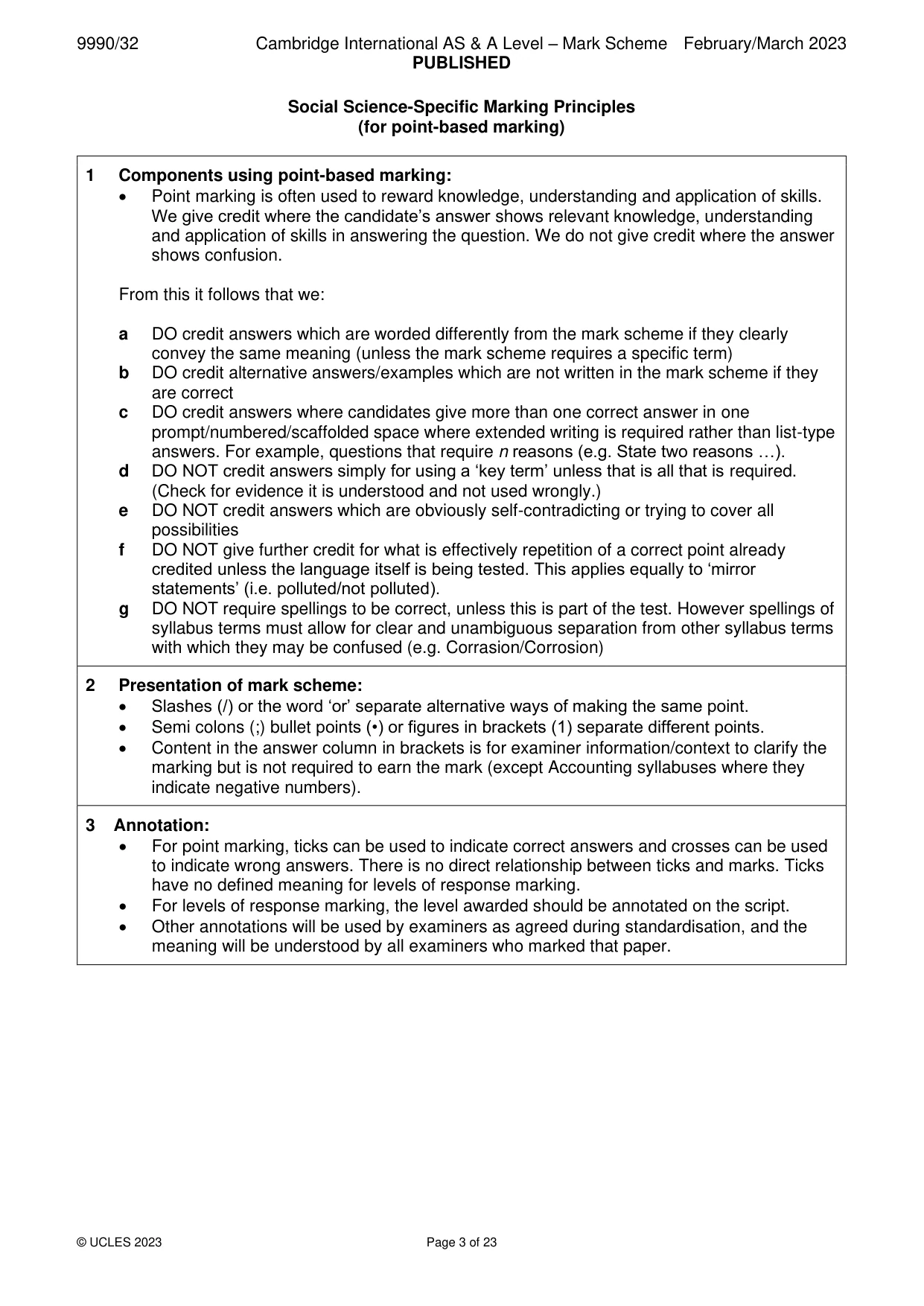
9990/32/F/M/23 · 8 questions · 60 marks · ≈68 min
The question paper and its mark scheme, free to read here and free to download. This is Cambridge’s own paper, exactly as it was sat.
Question paper4 pages
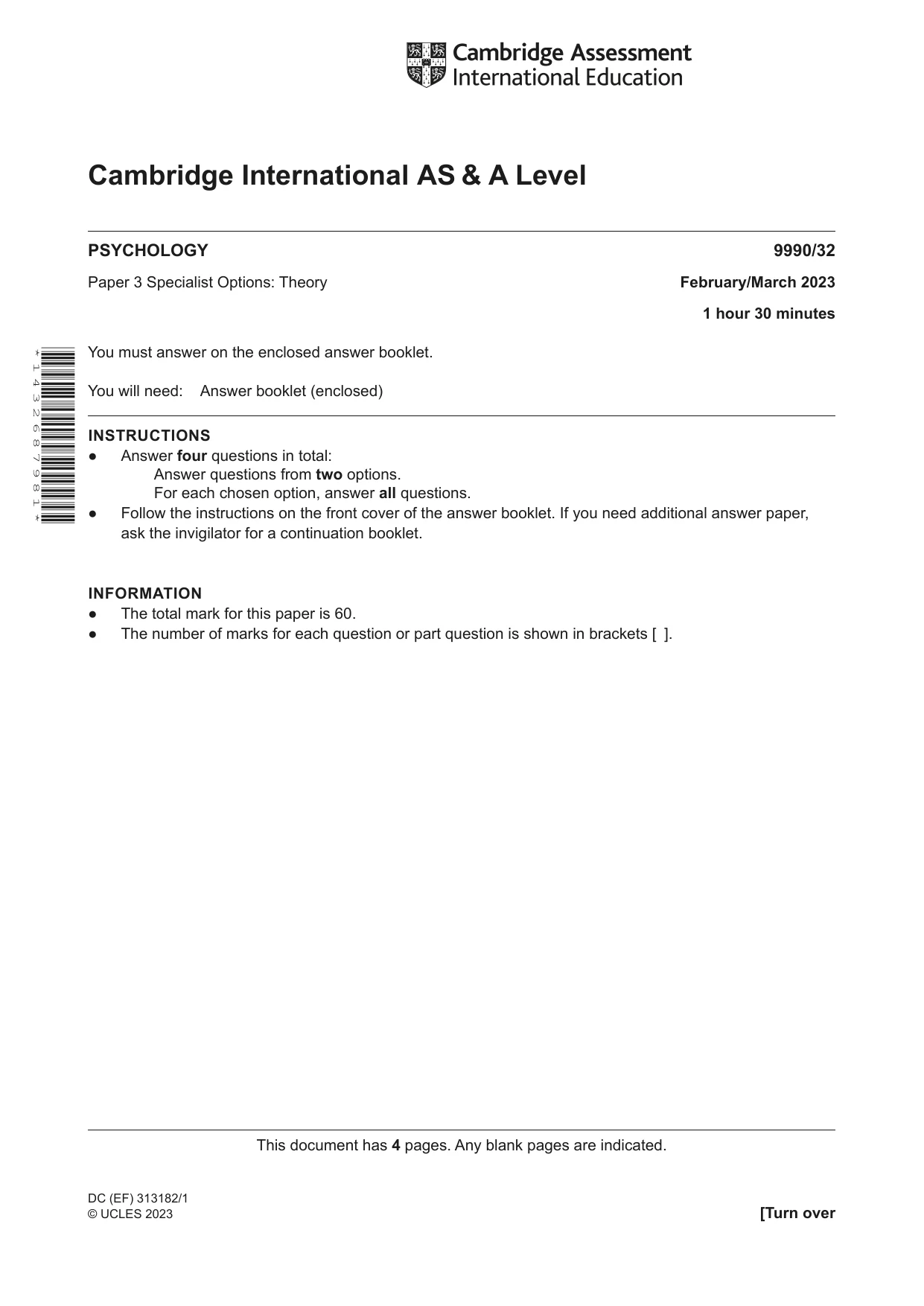
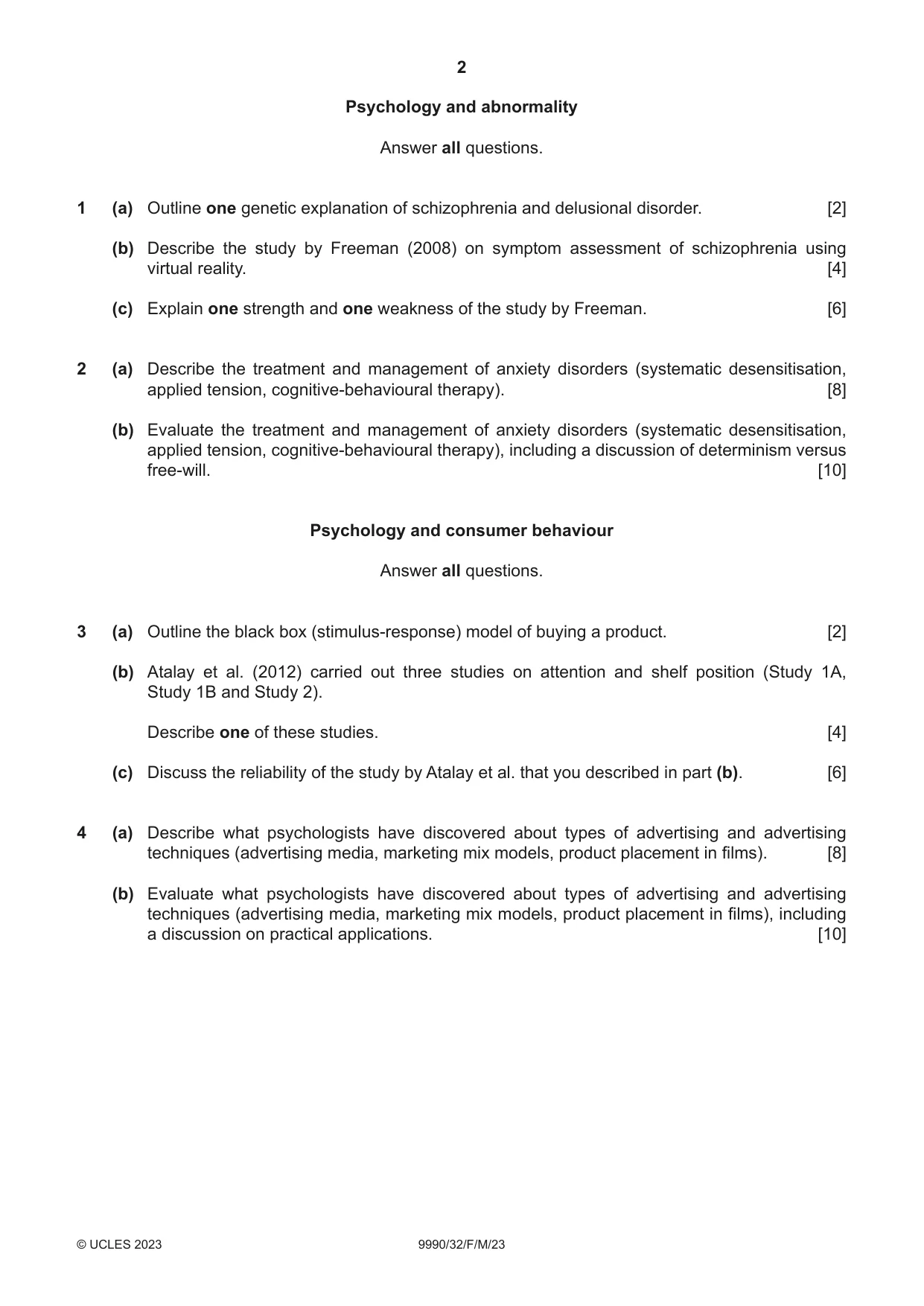
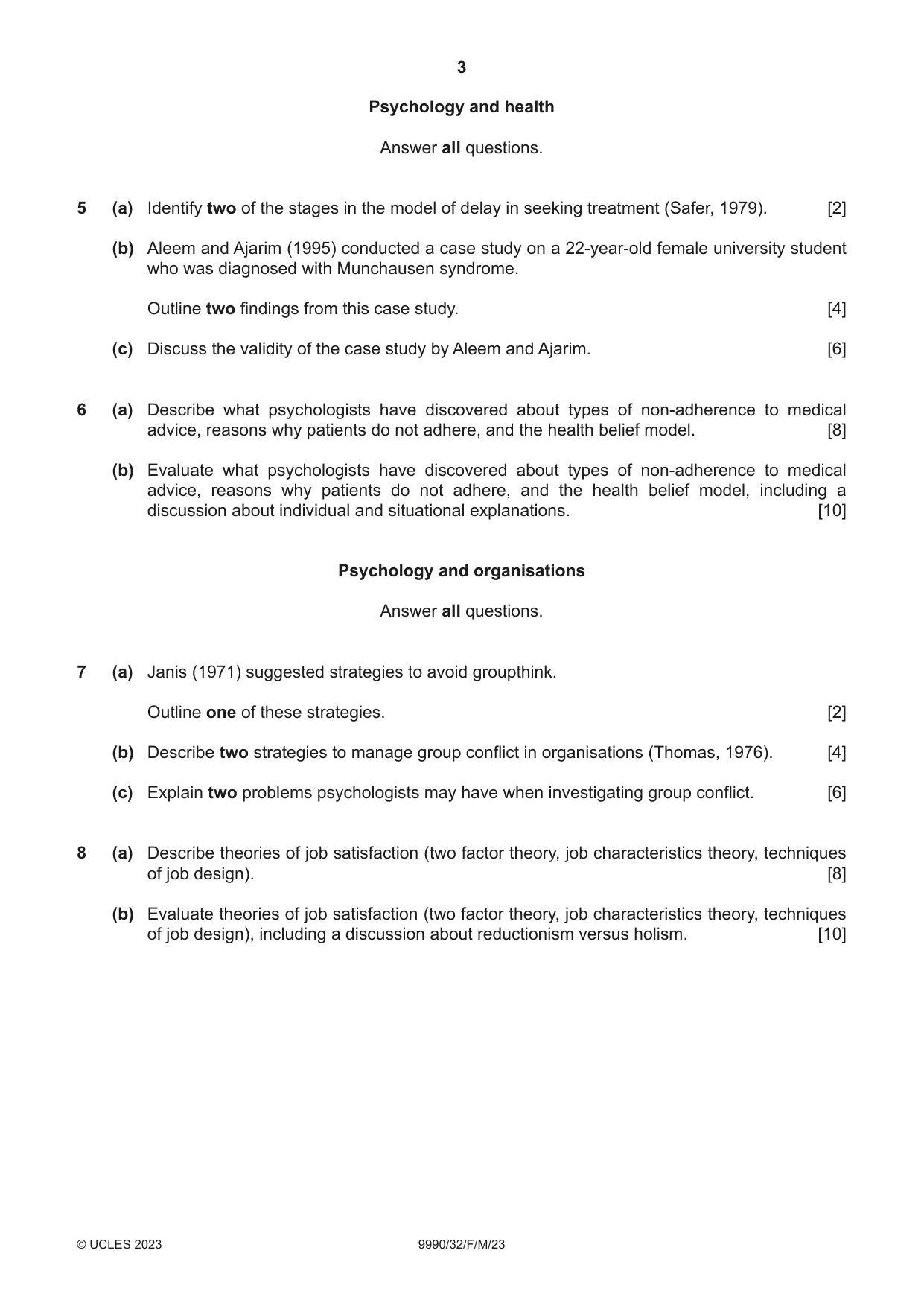

Mark scheme23 pages
Answers below. Sit the paper first if you are practising.




Questions as text
Q1 · Outline one genetic explanation of schizophrenia and delusional disorder
1 (a) Outline one genetic explanation of schizophrenia and delusional disorder. [2] (b) Describe the study by Freeman (2008) on symptom assessment of schizophrenia using virtual reality. [4] (c) Explain one strength and one weakness of the study by Freeman. [6]
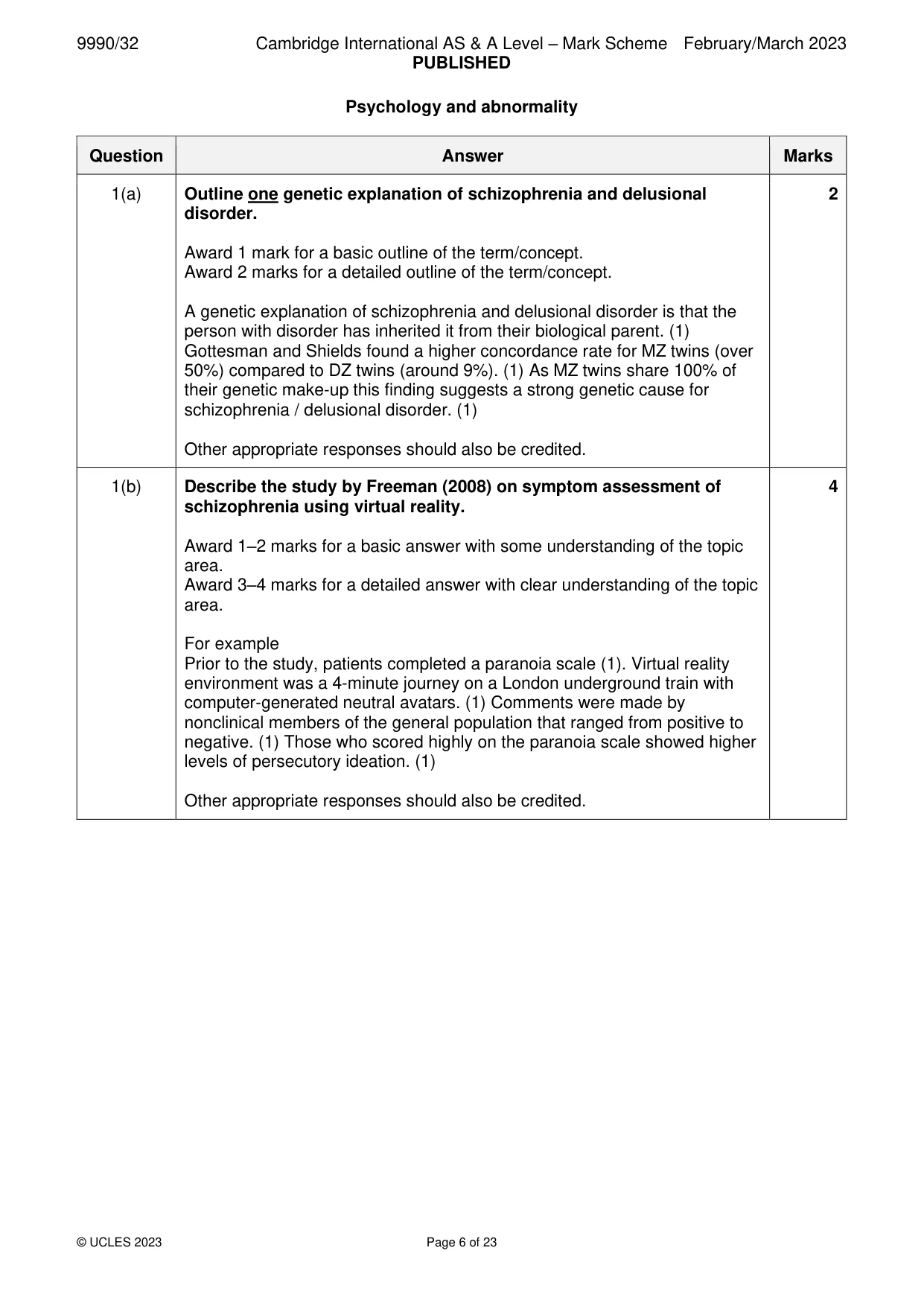
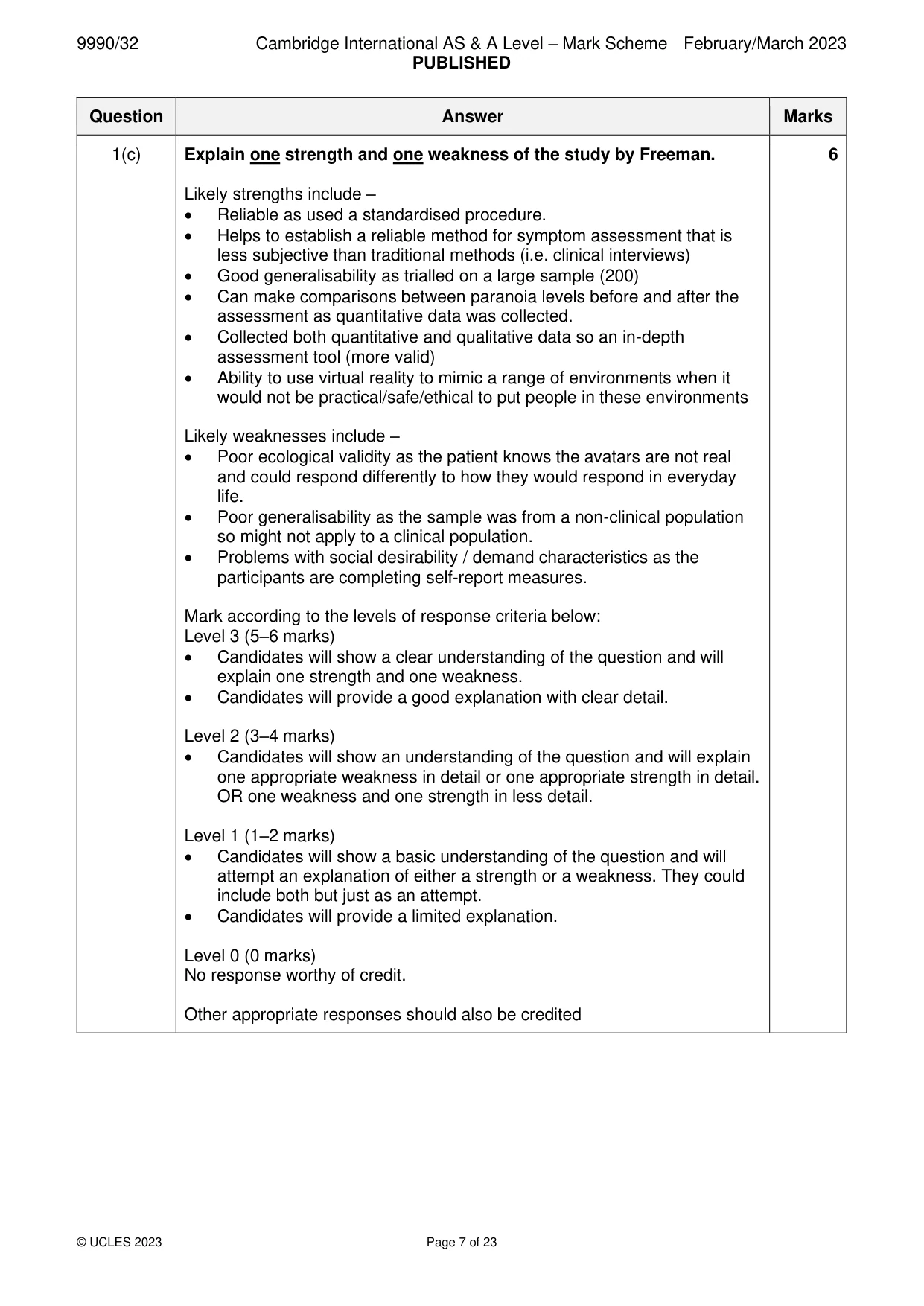
Mark scheme: Question Answer Marks 1(a) Outline one genetic explanation of schizophrenia and delusional 2 disorder. Award 1 mark for a basic outline of the term/concept. Award 2 marks for a detailed outline of the term/concept. A genetic explanation of schizophrenia and delusional disorder is that the person with disorder has inherited it from their biological parent. (1) Gottesman and Shields found a higher concordance rate for MZ twins (over 50%) compared to DZ twins (around 9%). (1) As MZ twins share 100% of their genetic make-up this finding suggests a strong genetic cause for schizophrenia / delusional disorder. (1) Other appropriate responses should also be credited. 1(b) Describe the study by Freeman (2008) on symptom assessment of 4 schizophrenia using virtual reality. Award 1–2 marks for a basic answer with some understanding of the topic area. Award 3–4 marks for a detailed answer with clear understanding of the topic area. For example Prior to the study, patients completed a paranoia scale (1). Virtual reality environment was a 4-minute journey on a London underground train with computer-generated neutral avatars. (1) Comments were made by nonclinical members of the general population that ranged from positive to negative. (1) Those who scored highly on the paranoia scale showed higher levels of persecutory ideation. (1) Other appropriate responses should also be credited. 1(c) Explain one strength and one weakness of the study by Freeman. 6 Likely strengths include – • Reliable as used a standardised procedure. • Helps to establish a reliable method for symptom assessment that is less subjective than traditional methods (i.e. clinical interviews) • Good generalisability as trialled on a large sample (200) • Can make comparisons between paranoia levels before and after the assessment as quantitative data was collected. • Collected both quantitative and qualitative data so an in-depth assessment tool (more valid) • Ability to use virtual reality to mimic a range of environments when it would not be practical/safe/ethical to put people in these environments Likely weaknesses include – • Poor ecological validity as the patient knows the avatars are not real and could respond differently to how they would respond in everyday life. • Poor generalisability as the sample was from a non-clinical population so might not apply to a clinical population. • Problems with social desirability / demand characteristics as the participants are completing self-report measures. Mark according to the levels of response criteria below: Level 3 (5–6 marks) • Candidates will show a clear understanding of the question and will explain one strength and one weakness. • Candidates will provide a good explanation with clear detail. Level 2 (3–4 marks) • Candidates will show an understanding of the question and will explain one appropriate weakness in detail or one appropriate strength in detail. OR one weakness and one strength in less detail. Level 1 (1–2 marks) • Candidates will show a basic understanding of the question and will attempt an explanation of either a strength or a weakness. They could include both but just as an attempt. • Candidates will provide a limited explanation. Level 0 (0 marks) No response worthy of credit. Other appropriate responses should also be credited
Q2 · Describe the treatment and management of anxiety disorders (systematic desensitisation…
2 (a) Describe the treatment and management of anxiety disorders (systematic desensitisation, applied tension, cognitive-behavioural therapy). [8] (b) Evaluate the treatment and management of anxiety disorders (systematic desensitisation, applied tension, cognitive-behavioural therapy), including a discussion of determinism versus free-will. [10] Psychology and consumer behaviour Answer all questions.
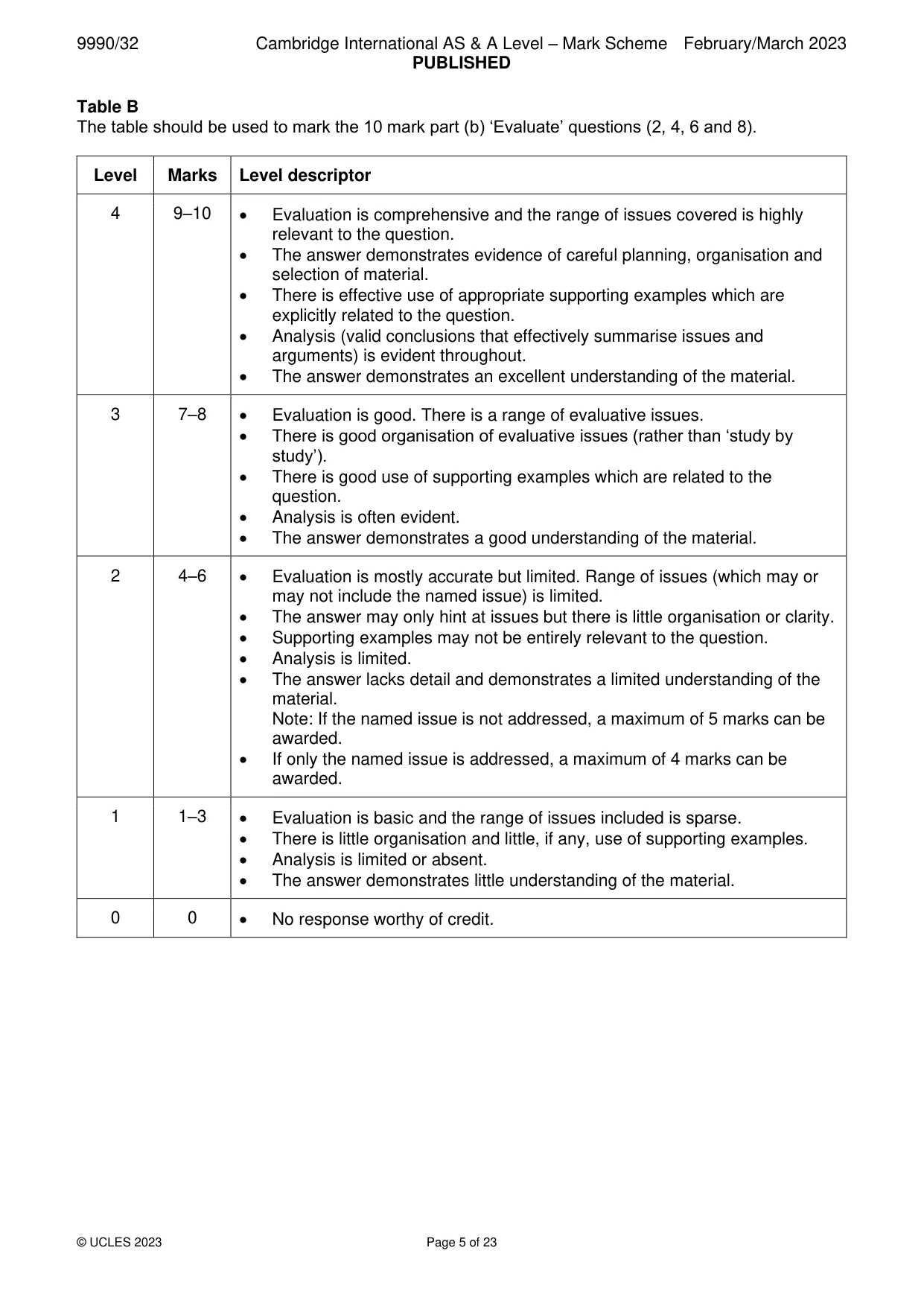
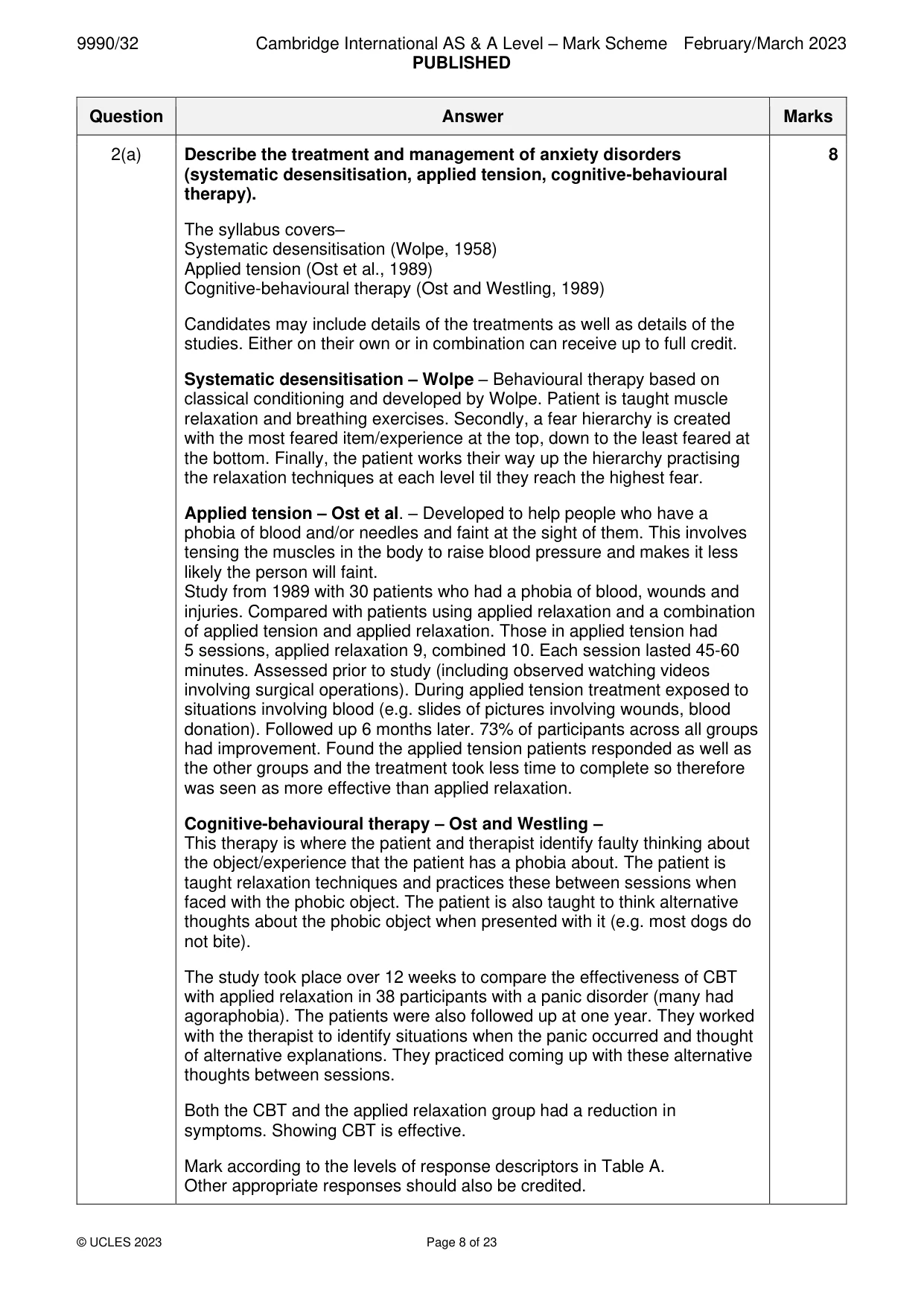
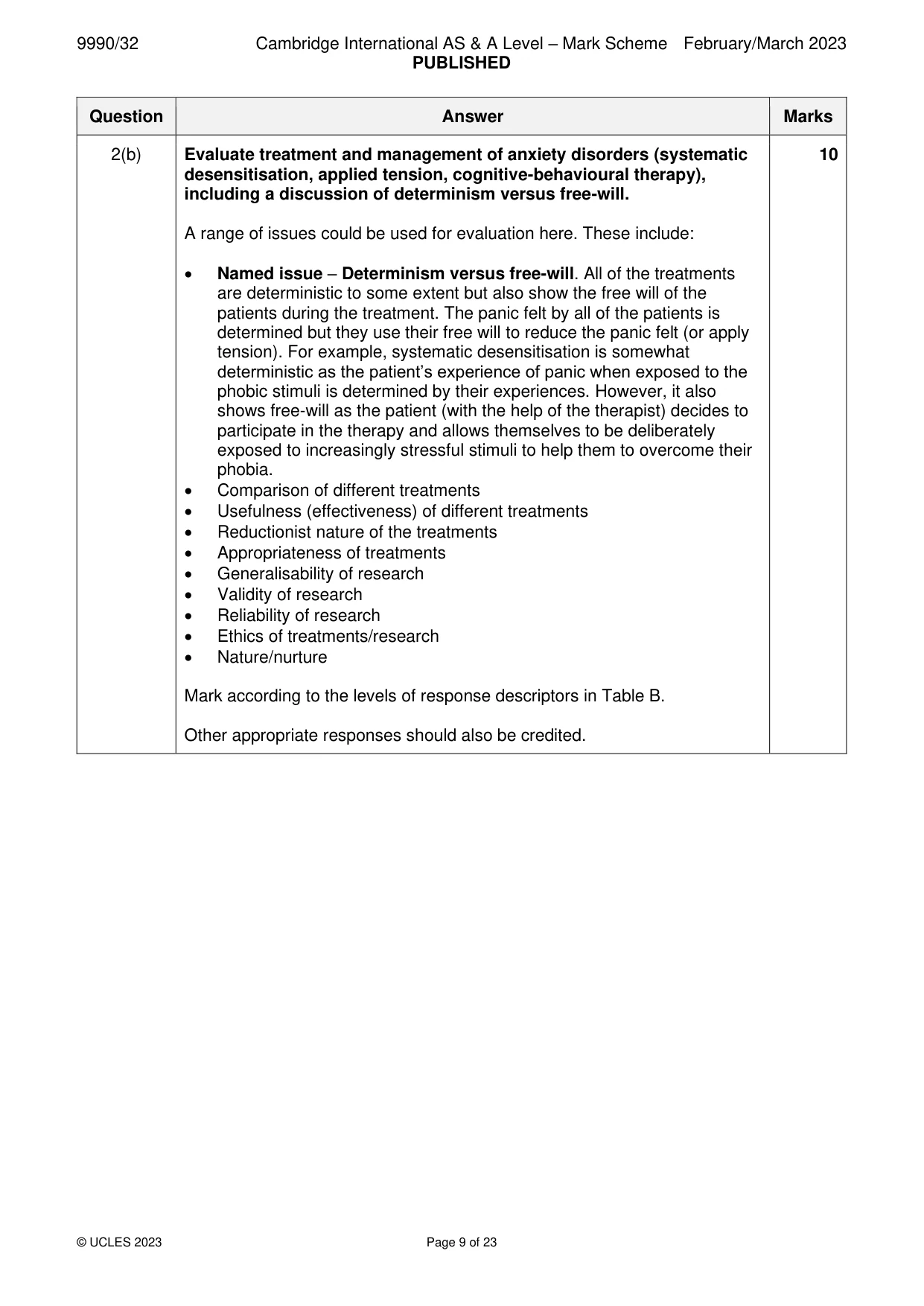
Mark scheme: 2(a) Describe the treatment and management of anxiety disorders 8 (systematic desensitisation, applied tension, cognitive-behavioural therapy). The syllabus covers– Systematic desensitisation (Wolpe, 1958) Applied tension (Ost et al., 1989) Cognitive-behavioural therapy (Ost and Westling, 1989) Candidates may include details of the treatments as well as details of the studies. Either on their own or in combination can receive up to full credit. Systematic desensitisation – Wolpe – Behavioural therapy based on classical conditioning and developed by Wolpe. Patient is taught muscle relaxation and breathing exercises. Secondly, a fear hierarchy is created with the most feared item/experience at the top, down to the least feared at the bottom. Finally, the patient works their way up the hierarchy practising the relaxation techniques at each level til they reach the highest fear. Applied tension – Ost et al. – Developed to help people who have a phobia of blood and/or needles and faint at the sight of them. This involves tensing the muscles in the body to raise blood pressure and makes it less likely the person will faint. Study from 1989 with 30 patients who had a phobia of blood, wounds and injuries. Compared with patients using applied relaxation and a combination of applied tension and applied relaxation. Those in applied tension had 5 sessions, applied relaxation 9, combined 10. Each session lasted 45-60 minutes. Assessed prior to study (including observed watching videos involving surgical operations). During applied tension treatment exposed to situations involving blood (e.g. slides of pictures involving wounds, blood donation). Followed up 6 months later. 73% of participants across all groups had improvement. Found the applied tension patients responded as well as the other groups and the treatment took less time to complete so therefore was seen as more effective than applied relaxation. Cognitive-behavioural therapy – Ost and Westling – This therapy is where the patient and therapist identify faulty thinking about the object/experience that the patient has a phobia about. The patient is taught relaxation techniques and practices these between sessions when faced with the phobic object. The patient is also taught to think alternative thoughts about the phobic object when presented with it (e.g. most dogs do not bite). The study took place over 12 weeks to compare the effectiveness of CBT with applied relaxation in 38 participants with a panic disorder (many had agoraphobia). The patients were also followed up at one year. They worked with the therapist to identify situations when the panic occurred and thought of alternative explanations. They practiced coming up with these alternative thoughts between sessions. Both the CBT and the applied relaxation group had a reduction in symptoms. Showing CBT is effective. Mark according to the levels of response descriptors in Table A. Other appropriate responses should also be credited. 2(b) Evaluate treatment and management of anxiety disorders (systematic 10 desensitisation, applied tension, cognitive-behavioural therapy), including a discussion of determinism versus free-will. A range of issues could be used for evaluation here. These include: • Named issue – Determinism versus free-will. All of the treatments are deterministic to some extent but also show the free will of the patients during the treatment. The panic felt by all of the patients is determined but they use their free will to reduce the panic felt (or apply tension). For example, systematic desensitisation is somewhat deterministic as the patient’s experience of panic when exposed to the phobic stimuli is determined by their experiences. However, it also shows free-will as the patient (with the help of the therapist) decides to participate in the therapy and allows themselves to be deliberately exposed to increasingly stressful stimuli to help them to overcome their phobia. • Comparison of different treatments • Usefulness (effectiveness) of different treatments • Reductionist nature of the treatments • Appropriateness of treatments • Generalisability of research • Validity of research • Reliability of research • Ethics of treatments/research • Nature/nurture Mark according to the levels of response descriptors in Table B. Other appropriate responses should also be credited. Psychology and consumer behaviour
More questions on Anxiety disorders and fear-related disorders
Q3 · Outline the black box (stimulus-response) model of buying a product
3 (a) Outline the black box (stimulus-response) model of buying a product. [2] (b) Atalay et al. (2012) carried out three studies on attention and shelf position (Study 1A, Study 1B and Study 2). Describe one of these studies. [4] (c) Discuss the reliability of the study by Atalay et al. that you described in part (b). [6]
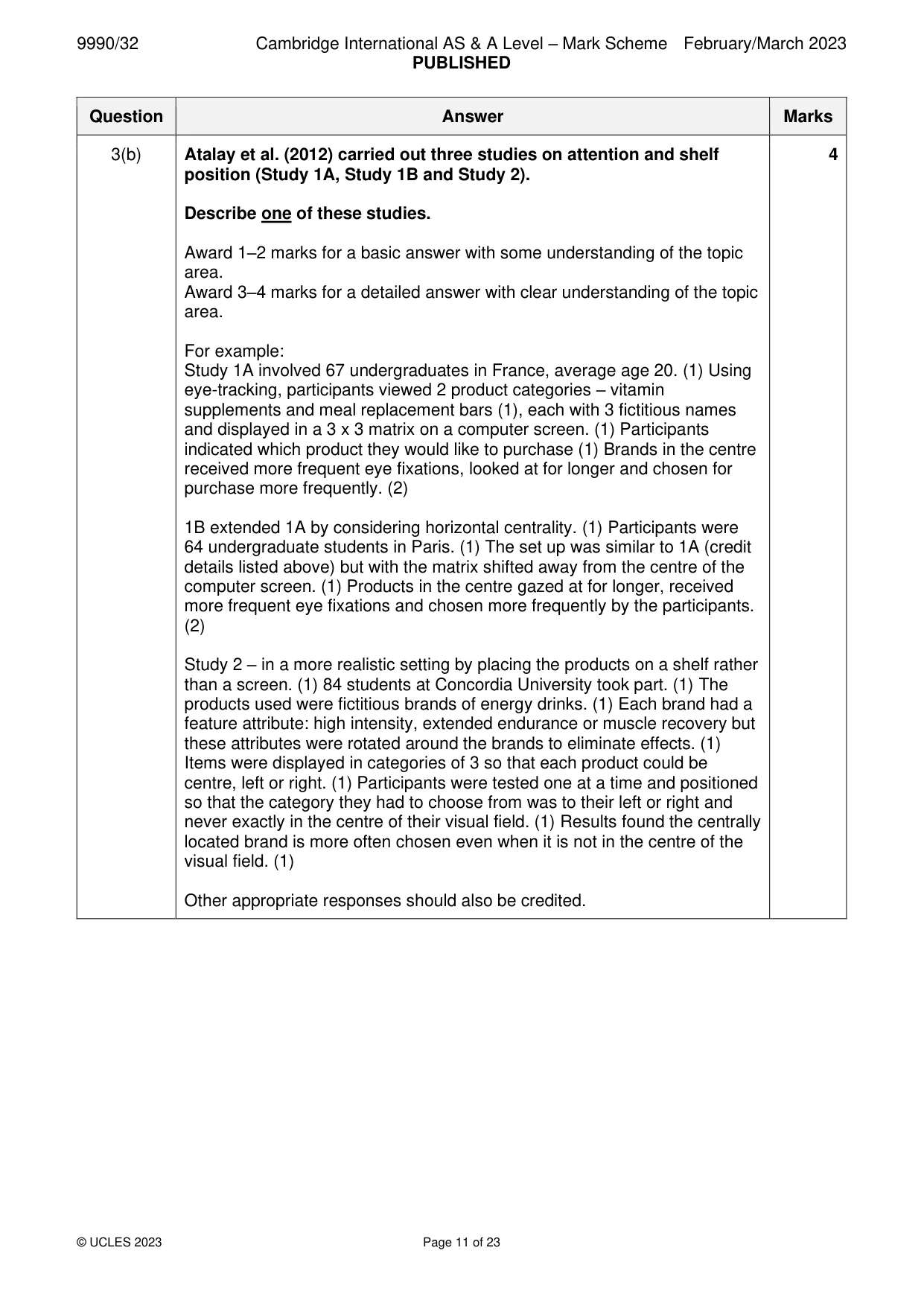
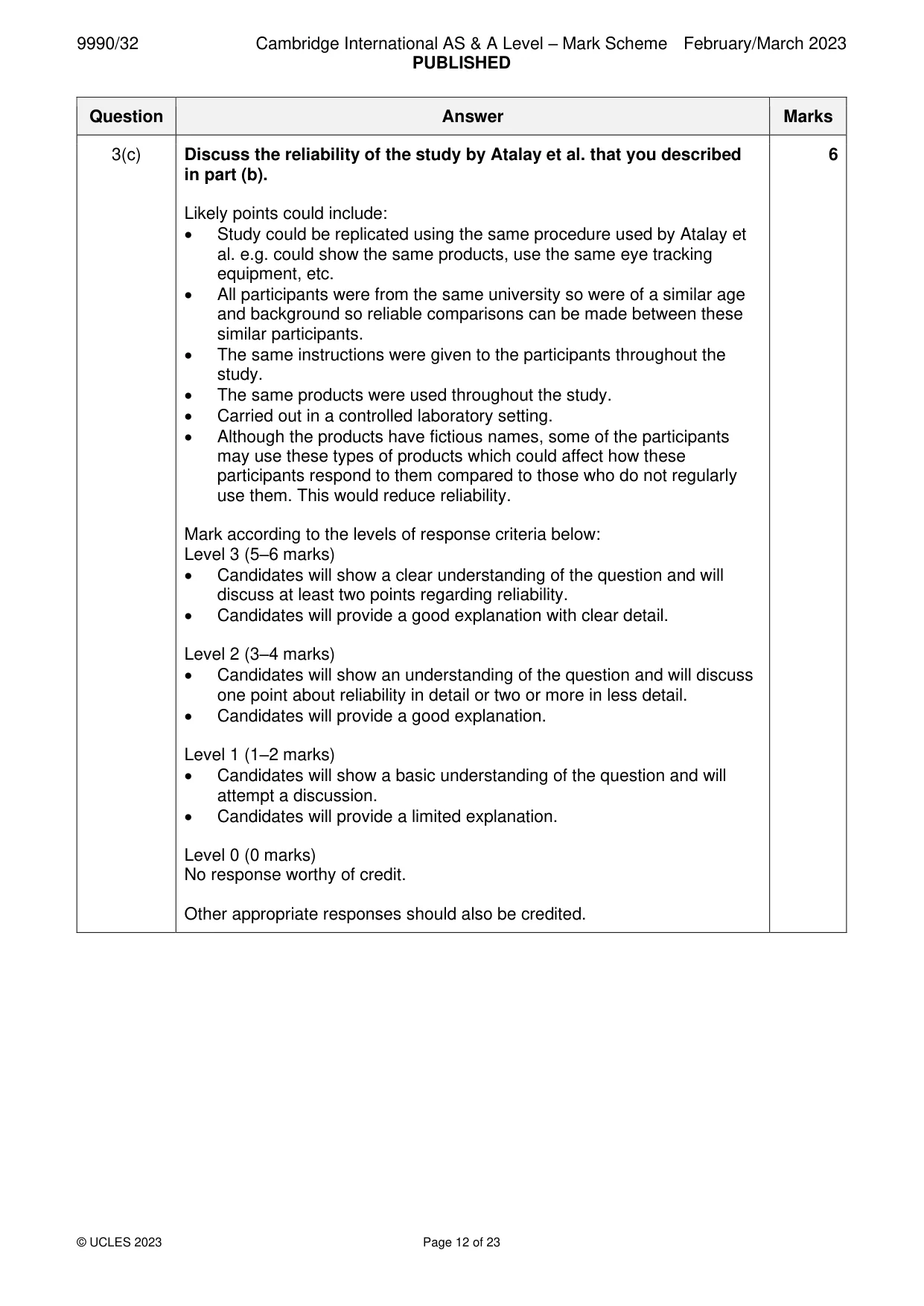
Mark scheme: 3(a) Outline the black box (stimulus-response) model of buying a product. 2 Award 1 mark for a basic outline of the term/concept. Award 2 marks for a detailed outline of the term/concept in the context of shoppers. For example: Buyers respond to stimuli in the environment such as marketing, price, the store environment. (1) The black box is how the consumer thinks about / is effected by this stimuli depending on the personal characteristics of the consumer. This leads the consumer to make the decision to purchase or not (response). (1) Other appropriate responses should also be credited. 3(b) Atalay et al. (2012) carried out three studies on attention and shelf 4 position (Study 1A, Study 1B and Study 2). Describe one of these studies. Award 1–2 marks for a basic answer with some understanding of the topic area. Award 3–4 marks for a detailed answer with clear understanding of the topic area. For example: Study 1A involved 67 undergraduates in France, average age 20. (1) Using eye-tracking, participants viewed 2 product categories – vitamin supplements and meal replacement bars (1), each with 3 fictitious names and displayed in a 3 x 3 matrix on a computer screen. (1) Participants indicated which product they would like to purchase (1) Brands in the centre received more frequent eye fixations, looked at for longer and chosen for purchase more frequently. (2) 1B extended 1A by considering horizontal centrality. (1) Participants were 64 undergraduate students in Paris. (1) The set up was similar to 1A (credit details listed above) but with the matrix shifted away from the centre of the computer screen. (1) Products in the centre gazed at for longer, received more frequent eye fixations and chosen more frequently by the participants. (2) Study 2 – in a more realistic setting by placing the products on a shelf rather than a screen. (1) 84 students at Concordia University took part. (1) The products used were fictitious brands of energy drinks. (1) Each brand had a feature attribute: high intensity, extended endurance or muscle recovery but these attributes were rotated around the brands to eliminate effects. (1) Items were displayed in categories of 3 so that each product could be centre, left or right. (1) Participants were tested one at a time and positioned so that the category they had to choose from was to their left or right and never exactly in the centre of their visual field. (1) Results found the centrally located brand is more often chosen even when it is not in the centre of the visual field. (1) Other appropriate responses should also be credited. 3(c) Discuss the reliability of the study by Atalay et al. that you described 6 in part (b). Likely points could include: • Study could be replicated using the same procedure used by Atalay et al. e.g. could show the same products, use the same eye tracking equipment, etc. • All participants were from the same university so were of a similar age and background so reliable comparisons can be made between these similar participants. • The same instructions were given to the participants throughout the study. • The same products were used throughout the study. • Carried out in a controlled laboratory setting. • Although the products have fictious names, some of the participants may use these types of products which could affect how these participants respond to them compared to those who do not regularly use them. This would reduce reliability. Mark according to the levels of response criteria below: Level 3 (5–6 marks) • Candidates will show a clear understanding of the question and will discuss at least two points regarding reliability. • Candidates will provide a good explanation with clear detail. Level 2 (3–4 marks) • Candidates will show an understanding of the question and will discuss one point about reliability in detail or two or more in less detail. • Candidates will provide a good explanation. Level 1 (1–2 marks) • Candidates will show a basic understanding of the question and will attempt a discussion. • Candidates will provide a limited explanation. Level 0 (0 marks) No response worthy of credit. Other appropriate responses should also be credited.
Q4 · Describe what psychologists have discovered about types of advertising and advertising…
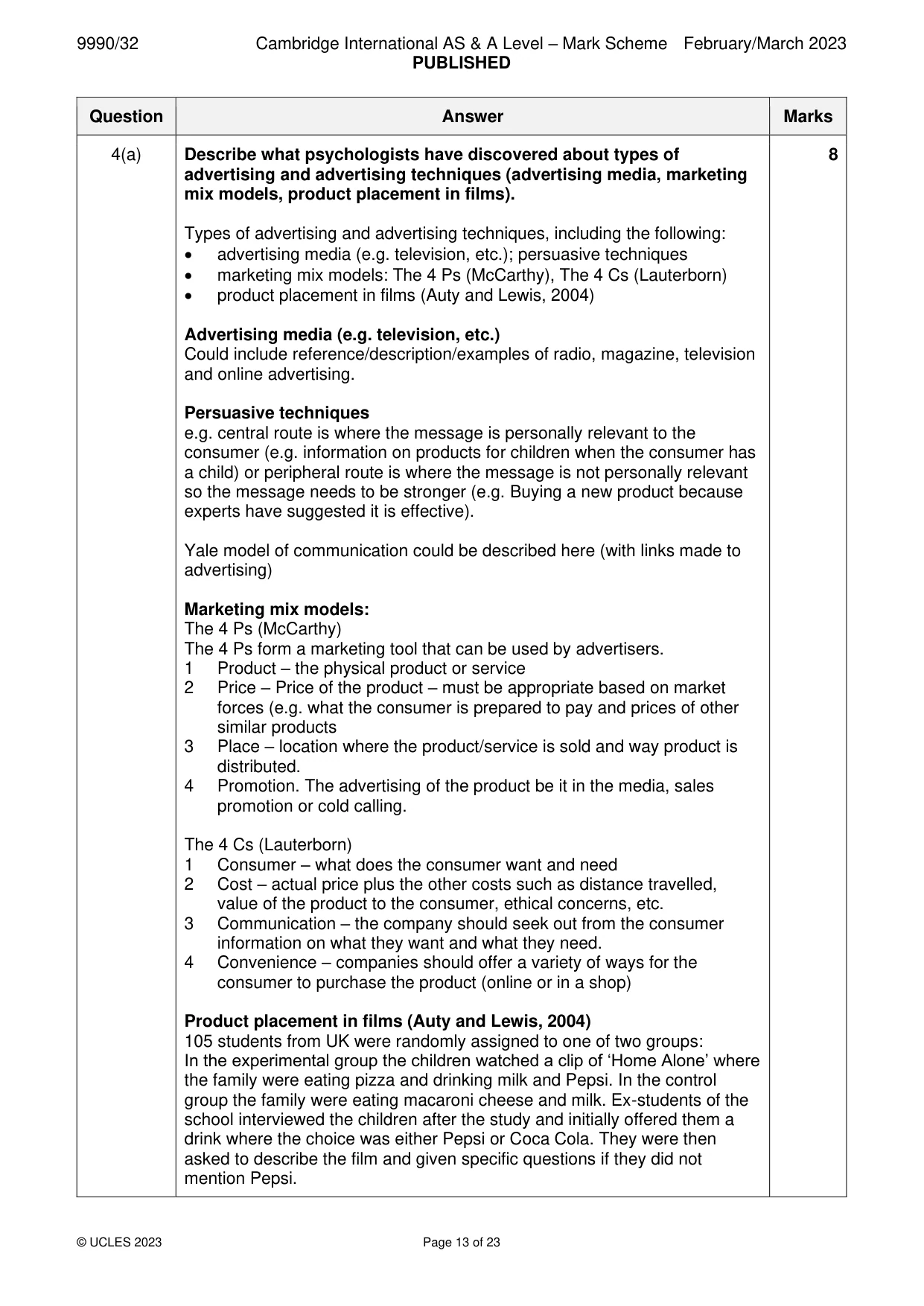
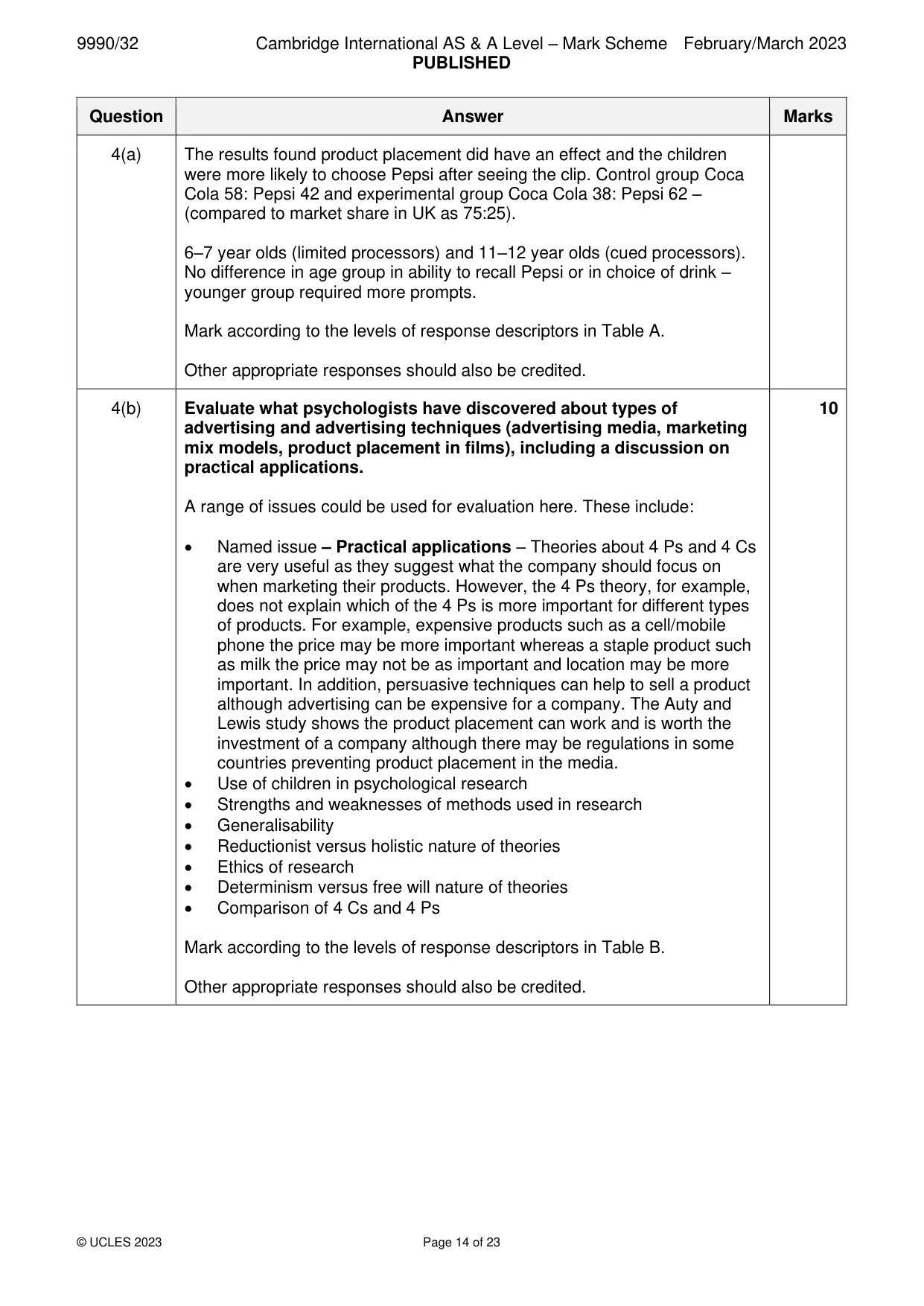
4 (a) Describe what psychologists have discovered about types of advertising and advertising techniques (advertising media, marketing mix models, product placement in films). [8] (b) Evaluate what psychologists have discovered about types of advertising and advertising techniques (advertising media, marketing mix models, product placement in films), including a discussion on practical applications. [10] Psychology and health Answer all questions.
Mark scheme: 4(a) Describe what psychologists have discovered about types of 8 advertising and advertising techniques (advertising media, marketing mix models, product placement in films). Types of advertising and advertising techniques, including the following: • advertising media (e.g. television, etc.); persuasive techniques • marketing mix models: The 4 Ps (McCarthy), The 4 Cs (Lauterborn) • product placement in films (Auty and Lewis, 2004) Advertising media (e.g. television, etc.) Could include reference/description/examples of radio, magazine, television and online advertising. Persuasive techniques e.g. central route is where the message is personally relevant to the consumer (e.g. information on products for children when the consumer has a child) or peripheral route is where the message is not personally relevant so the message needs to be stronger (e.g. Buying a new product because experts have suggested it is effective). Yale model of communication could be described here (with links made to advertising) Marketing mix models: The 4 Ps (McCarthy) The 4 Ps form a marketing tool that can be used by advertisers. 1 Product – the physical product or service 2 Price – Price of the product – must be appropriate based on market forces (e.g. what the consumer is prepared to pay and prices of other similar products 3 Place – location where the product/service is sold and way product is distributed. 4 Promotion. The advertising of the product be it in the media, sales promotion or cold calling. The 4 Cs (Lauterborn) 1 Consumer – what does the consumer want and need 2 Cost – actual price plus the other costs such as distance travelled, value of the product to the consumer, ethical concerns, etc. 3 Communication – the company should seek out from the consumer information on what they want and what they need. 4 Convenience – companies should offer a variety of ways for the consumer to purchase the product (online or in a shop) Product placement in films (Auty and Lewis, 2004) 105 students from UK were randomly assigned to one of two groups: In the experimental group the children watched a clip of ‘Home Alone’ where the family were eating pizza and drinking milk and Pepsi. In the control group the family were eating macaroni cheese and milk. Ex-students of the school interviewed the children after the study and initially offered them a drink where the choice was either Pepsi or Coca Cola. They were then asked to describe the film and given specific questions if they did not mention Pepsi. 4(a) The results found product placement did have an effect and the children were more likely to choose Pepsi after seeing the clip. Control group Coca Cola 58: Pepsi 42 and experimental group Coca Cola 38: Pepsi 62 – (compared to market share in UK as 75:25). 6–7 year olds (limited processors) and 11–12 year olds (cued processors). No difference in age group in ability to recall Pepsi or in choice of drink – younger group required more prompts. Mark according to the levels of response descriptors in Table A. Other appropriate responses should also be credited. 4(b) Evaluate what psychologists have discovered about types of 10 advertising and advertising techniques (advertising media, marketing mix models, product placement in films), including a discussion on practical applications. A range of issues could be used for evaluation here. These include: • Named issue – Practical applications – Theories about 4 Ps and 4 Cs are very useful as they suggest what the company should focus on when marketing their products. However, the 4 Ps theory, for example, does not explain which of the 4 Ps is more important for different types of products. For example, expensive products such as a cell/mobile phone the price may be more important whereas a staple product such as milk the price may not be as important and location may be more important. In addition, persuasive techniques can help to sell a product although advertising can be expensive for a company. The Auty and Lewis study shows the product placement can work and is worth the investment of a company although there may be regulations in some countries preventing product placement in the media. • Use of children in psychological research • Strengths and weaknesses of methods used in research • Generalisability • Reductionist versus holistic nature of theories • Ethics of research • Determinism versus free will nature of theories • Comparison of 4 Cs and 4 Ps Mark according to the levels of response descriptors in Table B. Other appropriate responses should also be credited. Psychology and health
Q5 · Identify two of the stages in the model of delay in seeking treatment (Safer, 1979)
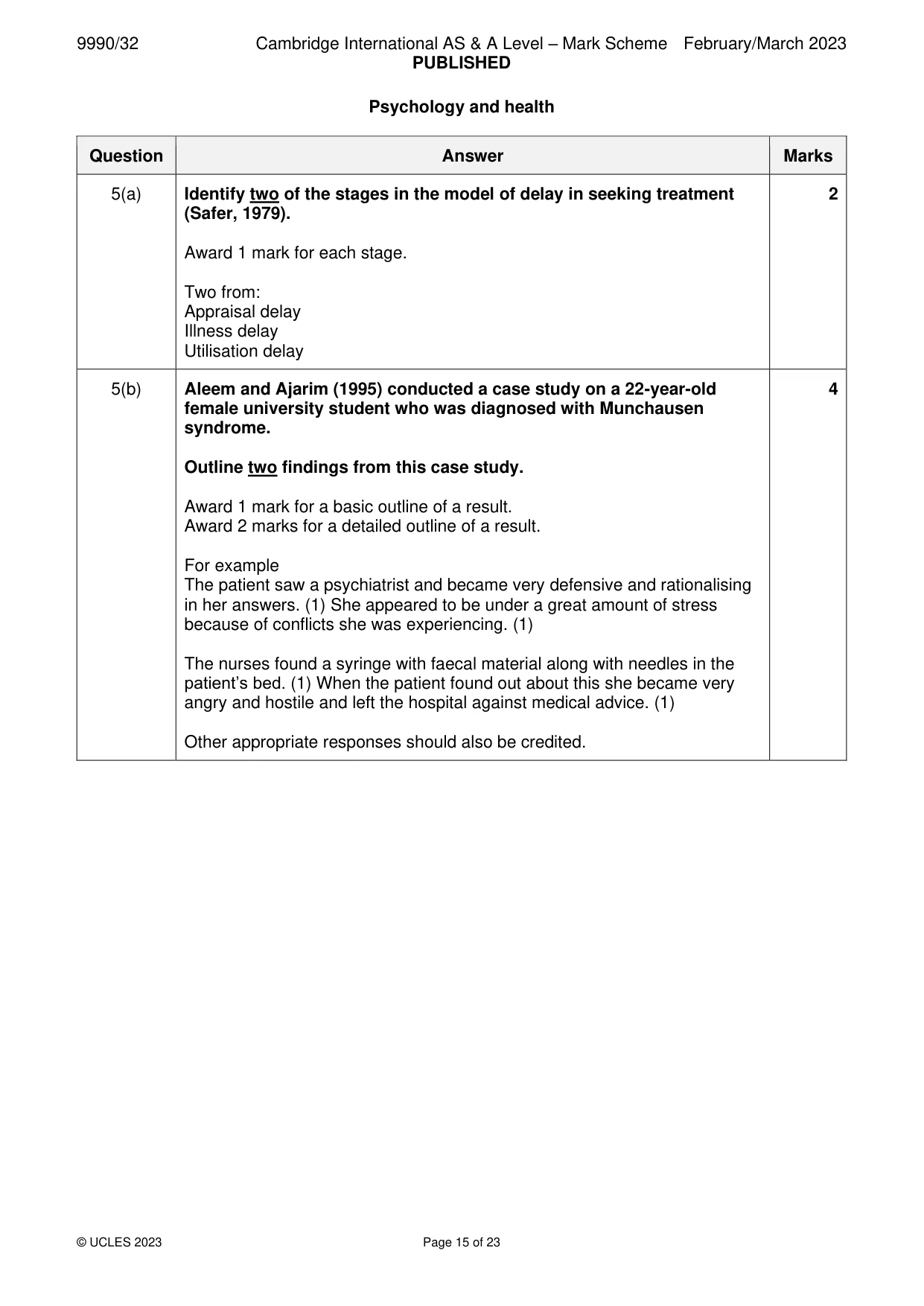
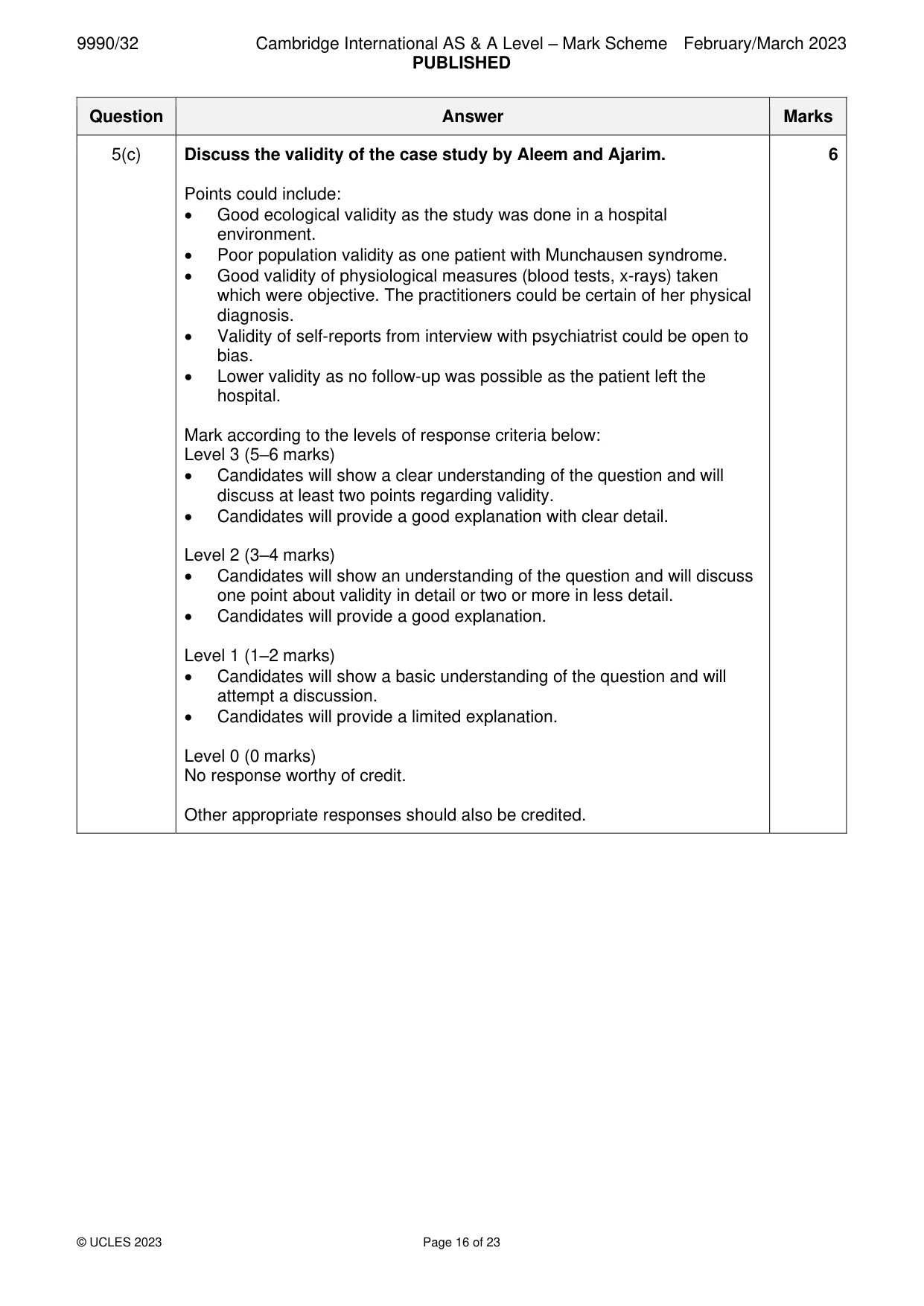
5 (a) Identify two of the stages in the model of delay in seeking treatment (Safer, 1979). [2] (b) Aleem and Ajarim (1995) conducted a case study on a 22-year-old female university student who was diagnosed with Munchausen syndrome. Outline two findings from this case study. [4] (c) Discuss the validity of the case study by Aleem and Ajarim. [6]
Mark scheme: 5(a) Identify two of the stages in the model of delay in seeking treatment 2 (Safer, 1979). Award 1 mark for each stage. Two from: Appraisal delay Illness delay Utilisation delay 5(b) Aleem and Ajarim (1995) conducted a case study on a 22-year-old 4 female university student who was diagnosed with Munchausen syndrome. Outline two findings from this case study. Award 1 mark for a basic outline of a result. Award 2 marks for a detailed outline of a result. For example The patient saw a psychiatrist and became very defensive and rationalising in her answers. (1) She appeared to be under a great amount of stress because of conflicts she was experiencing. (1) The nurses found a syringe with faecal material along with needles in the patient’s bed. (1) When the patient found out about this she became very angry and hostile and left the hospital against medical advice. (1) Other appropriate responses should also be credited. 5(c) Discuss the validity of the case study by Aleem and Ajarim. 6 Points could include: • Good ecological validity as the study was done in a hospital environment. • Poor population validity as one patient with Munchausen syndrome. • Good validity of physiological measures (blood tests, x-rays) taken which were objective. The practitioners could be certain of her physical diagnosis. • Validity of self-reports from interview with psychiatrist could be open to bias. • Lower validity as no follow-up was possible as the patient left the hospital. Mark according to the levels of response criteria below: Level 3 (5–6 marks) • Candidates will show a clear understanding of the question and will discuss at least two points regarding validity. • Candidates will provide a good explanation with clear detail. Level 2 (3–4 marks) • Candidates will show an understanding of the question and will discuss one point about validity in detail or two or more in less detail. • Candidates will provide a good explanation. Level 1 (1–2 marks) • Candidates will show a basic understanding of the question and will attempt a discussion. • Candidates will provide a limited explanation. Level 0 (0 marks) No response worthy of credit. Other appropriate responses should also be credited.
Q6 · Describe what psychologists have discovered about types of non-adherence to medical…
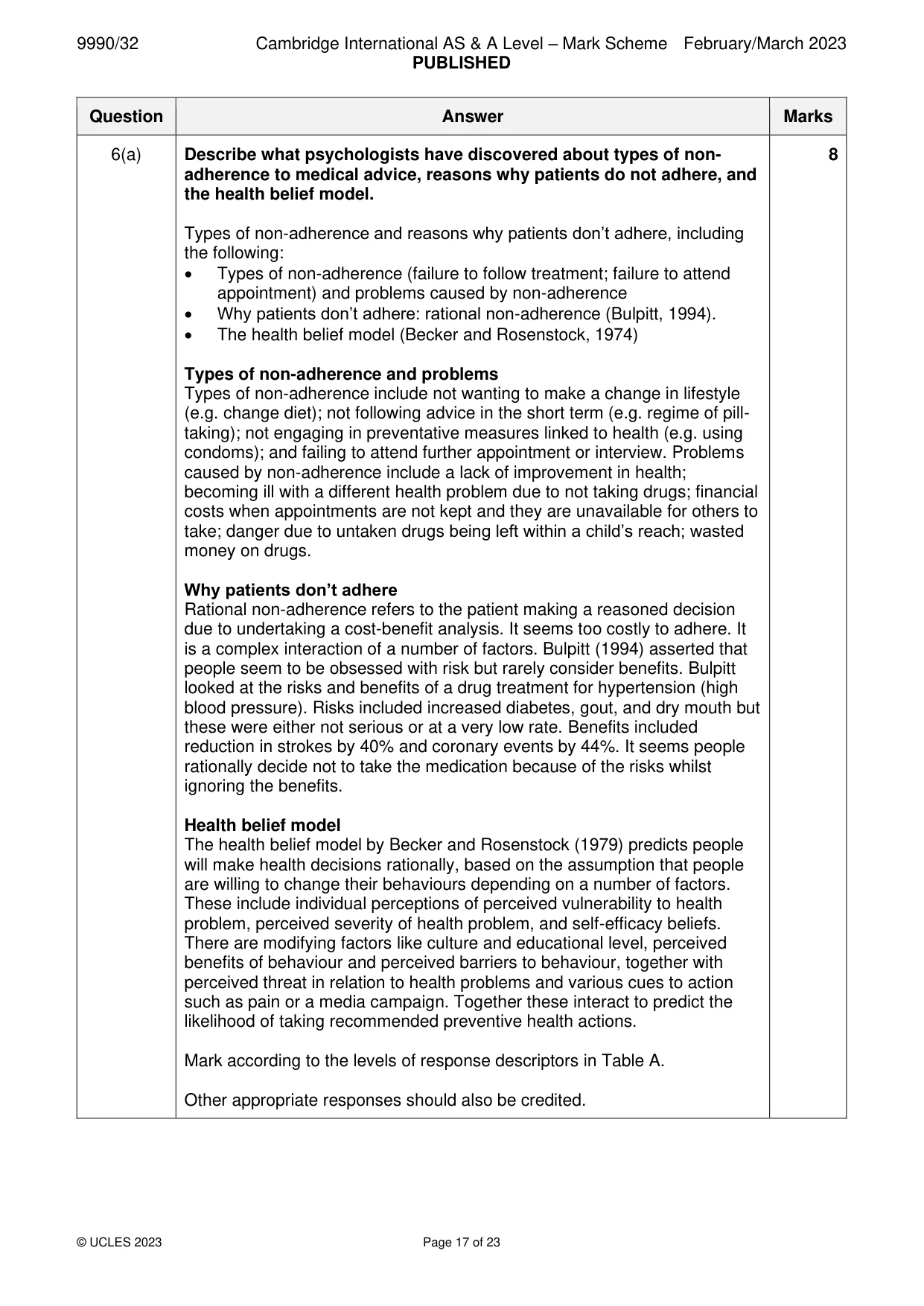
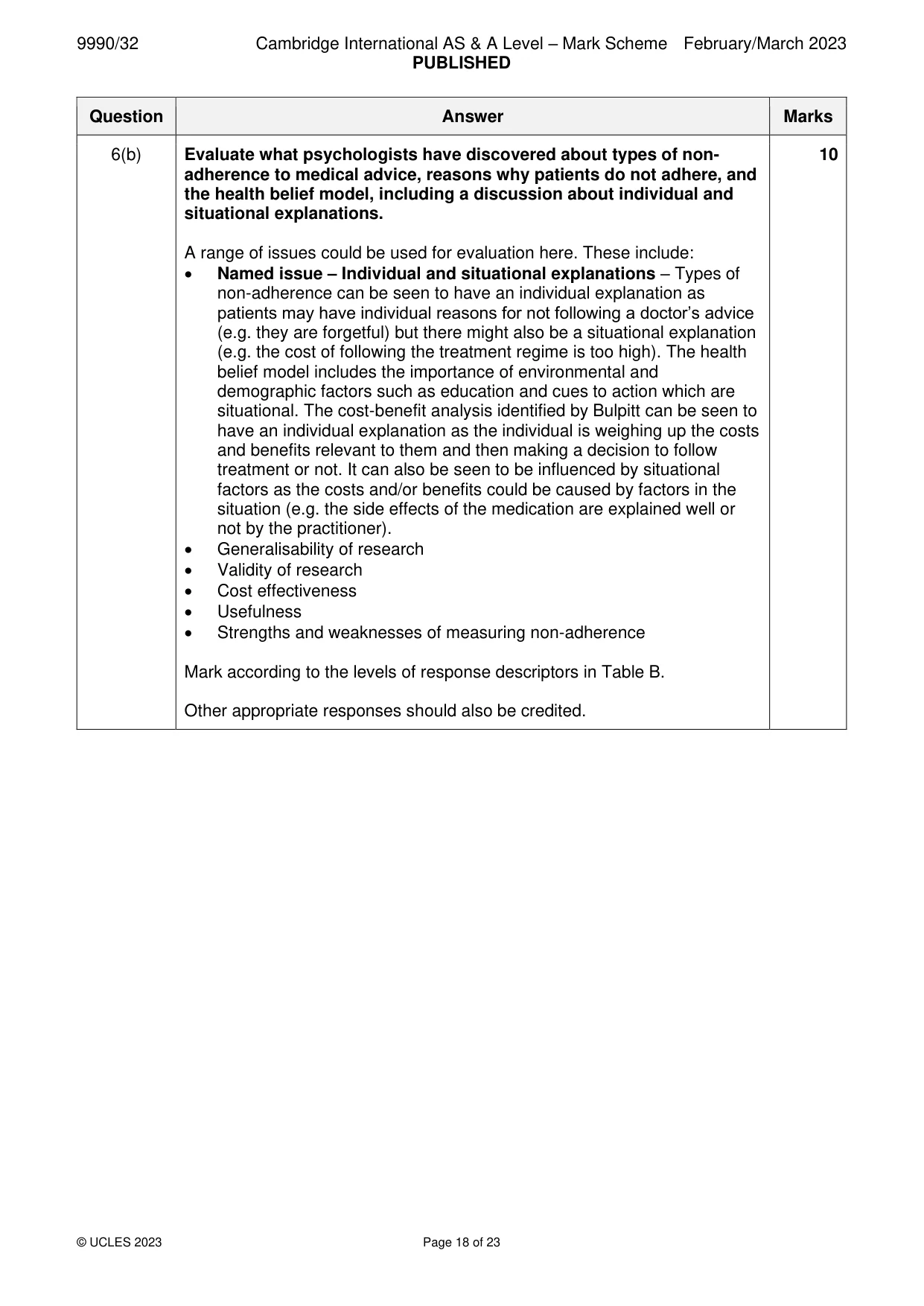
6 (a) Describe what psychologists have discovered about types of non-adherence to medical advice, reasons why patients do not adhere, and the health belief model. [8] (b) Evaluate what psychologists have discovered about types of non-adherence to medical advice, reasons why patients do not adhere, and the health belief model, including a discussion about individual and situational explanations. [10] Psychology and organisations Answer all questions.
Mark scheme: 6(a) Describe what psychologists have discovered about types of non- 8 adherence to medical advice, reasons why patients do not adhere, and the health belief model. Types of non-adherence and reasons why patients don’t adhere, including the following: • Types of non-adherence (failure to follow treatment; failure to attend appointment) and problems caused by non-adherence • Why patients don’t adhere: rational non-adherence (Bulpitt, 1994). • The health belief model (Becker and Rosenstock, 1974) Types of non-adherence and problems Types of non-adherence include not wanting to make a change in lifestyle (e.g. change diet); not following advice in the short term (e.g. regime of pill- taking); not engaging in preventative measures linked to health (e.g. using condoms); and failing to attend further appointment or interview. Problems caused by non-adherence include a lack of improvement in health; becoming ill with a different health problem due to not taking drugs; financial costs when appointments are not kept and they are unavailable for others to take; danger due to untaken drugs being left within a child’s reach; wasted money on drugs. Why patients don’t adhere Rational non-adherence refers to the patient making a reasoned decision due to undertaking a cost-benefit analysis. It seems too costly to adhere. It is a complex interaction of a number of factors. Bulpitt (1994) asserted that people seem to be obsessed with risk but rarely consider benefits. Bulpitt looked at the risks and benefits of a drug treatment for hypertension (high blood pressure). Risks included increased diabetes, gout, and dry mouth but these were either not serious or at a very low rate. Benefits included reduction in strokes by 40% and coronary events by 44%. It seems people rationally decide not to take the medication because of the risks whilst ignoring the benefits. Health belief model The health belief model by Becker and Rosenstock (1979) predicts people will make health decisions rationally, based on the assumption that people are willing to change their behaviours depending on a number of factors. These include individual perceptions of perceived vulnerability to health problem, perceived severity of health problem, and self-efficacy beliefs. There are modifying factors like culture and educational level, perceived benefits of behaviour and perceived barriers to behaviour, together with perceived threat in relation to health problems and various cues to action such as pain or a media campaign. Together these interact to predict the likelihood of taking recommended preventive health actions. Mark according to the levels of response descriptors in Table A. Other appropriate responses should also be credited. 6(b) Evaluate what psychologists have discovered about types of non- 10 adherence to medical advice, reasons why patients do not adhere, and the health belief model, including a discussion about individual and situational explanations. A range of issues could be used for evaluation here. These include: • Named issue – Individual and situational explanations – Types of non-adherence can be seen to have an individual explanation as patients may have individual reasons for not following a doctor’s advice (e.g. they are forgetful) but there might also be a situational explanation (e.g. the cost of following the treatment regime is too high). The health belief model includes the importance of environmental and demographic factors such as education and cues to action which are situational. The cost-benefit analysis identified by Bulpitt can be seen to have an individual explanation as the individual is weighing up the costs and benefits relevant to them and then making a decision to follow treatment or not. It can also be seen to be influenced by situational factors as the costs and/or benefits could be caused by factors in the situation (e.g. the side effects of the medication are explained well or not by the practitioner). • Generalisability of research • Validity of research • Cost effectiveness • Usefulness • Strengths and weaknesses of measuring non-adherence Mark according to the levels of response descriptors in Table B. Other appropriate responses should also be credited. Psychology and organisations
Q7 · Janis (1971) suggested strategies to avoid groupthink
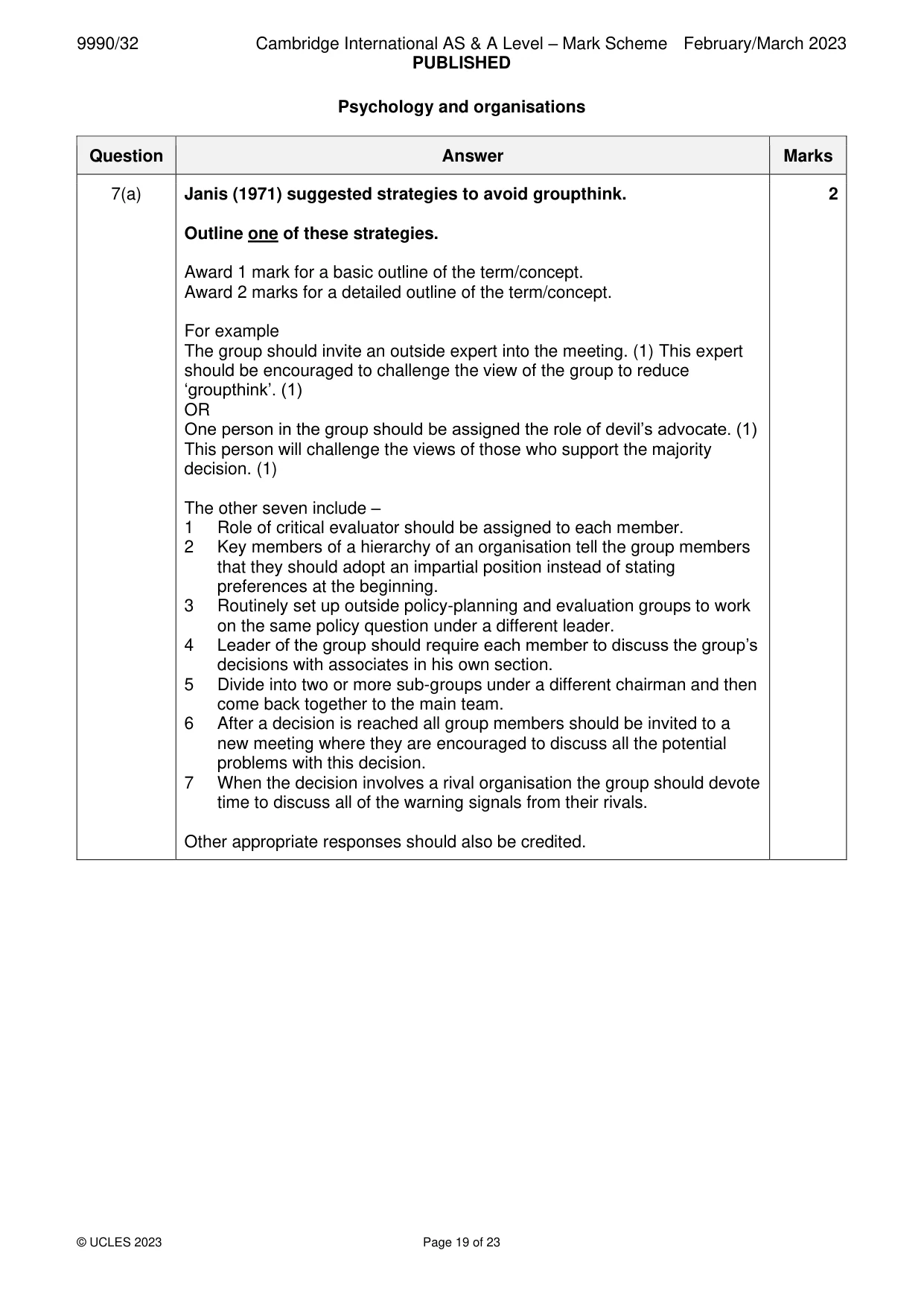
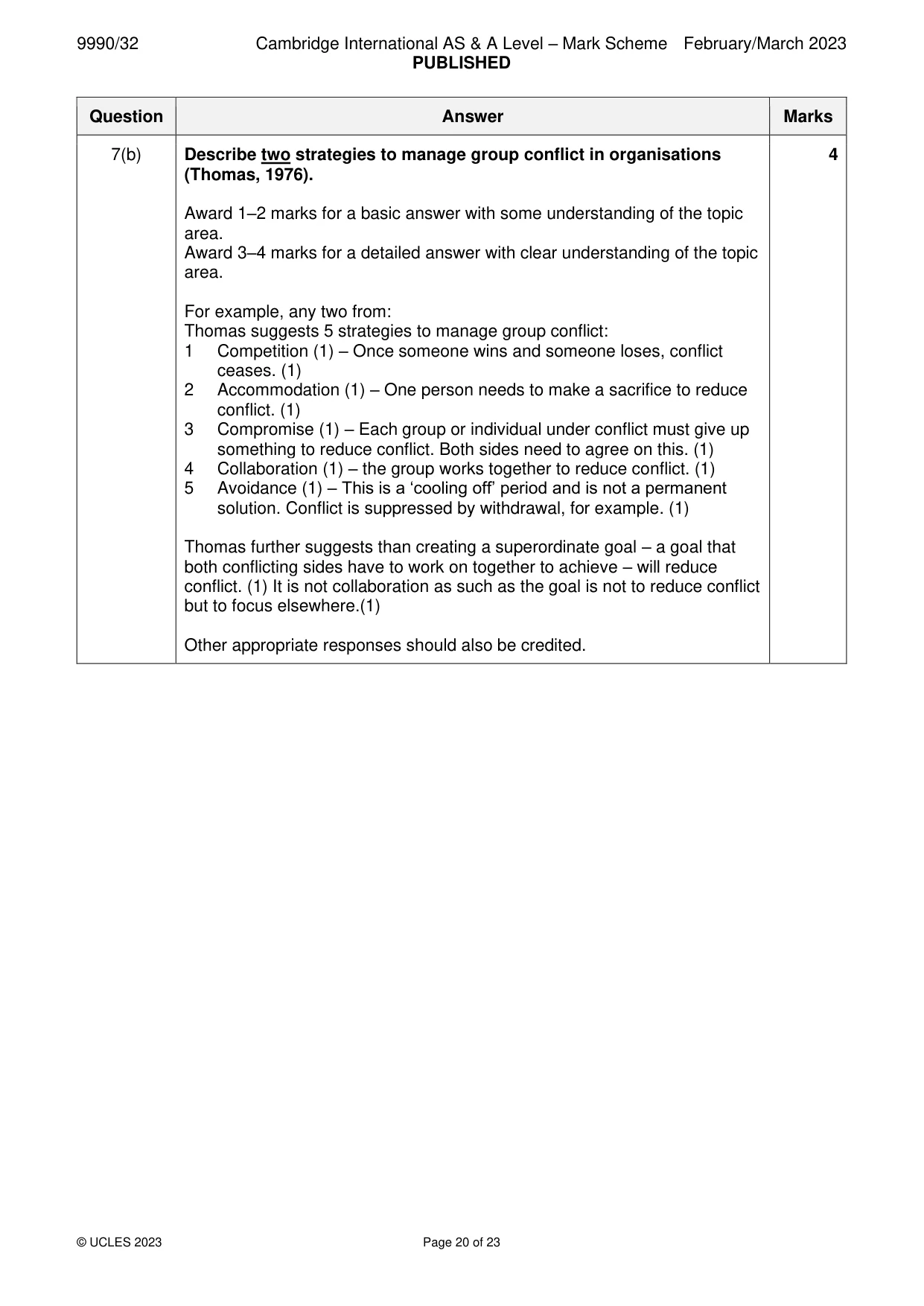
7 (a) Janis (1971) suggested strategies to avoid groupthink. Outline one of these strategies. [2] (b) Describe two strategies to manage group conflict in organisations (Thomas, 1976). [4] (c) Explain two problems psychologists may have when investigating group conflict. [6]
Mark scheme: 7(a) Janis (1971) suggested strategies to avoid groupthink. 2 Outline one of these strategies. Award 1 mark for a basic outline of the term/concept. Award 2 marks for a detailed outline of the term/concept. For example The group should invite an outside expert into the meeting. (1) This expert should be encouraged to challenge the view of the group to reduce ‘groupthink’. (1) OR One person in the group should be assigned the role of devil’s advocate. (1) This person will challenge the views of those who support the majority decision. (1) The other seven include – 1 Role of critical evaluator should be assigned to each member. 2 Key members of a hierarchy of an organisation tell the group members that they should adopt an impartial position instead of stating preferences at the beginning. 3 Routinely set up outside policy-planning and evaluation groups to work on the same policy question under a different leader. 4 Leader of the group should require each member to discuss the group’s decisions with associates in his own section. 5 Divide into two or more sub-groups under a different chairman and then come back together to the main team. 6 After a decision is reached all group members should be invited to a new meeting where they are encouraged to discuss all the potential problems with this decision. 7 When the decision involves a rival organisation the group should devote time to discuss all of the warning signals from their rivals. Other appropriate responses should also be credited. 7(b) Describe two strategies to manage group conflict in organisations 4 (Thomas, 1976). Award 1–2 marks for a basic answer with some understanding of the topic area. Award 3–4 marks for a detailed answer with clear understanding of the topic area. For example, any two from: Thomas suggests 5 strategies to manage group conflict: 1 Competition (1) – Once someone wins and someone loses, conflict ceases. (1) 2 Accommodation (1) – One person needs to make a sacrifice to reduce conflict. (1) 3 Compromise (1) – Each group or individual under conflict must give up something to reduce conflict. Both sides need to agree on this. (1) 4 Collaboration (1) – the group works together to reduce conflict. (1) 5 Avoidance (1) – This is a ‘cooling off’ period and is not a permanent solution. Conflict is suppressed by withdrawal, for example. (1) Thomas further suggests than creating a superordinate goal – a goal that both conflicting sides have to work on together to achieve – will reduce conflict. (1) It is not collaboration as such as the goal is not to reduce conflict but to focus elsewhere.(1) Other appropriate responses should also be credited. 7(c) Explain two problems psychologists may have when investigating 6 group conflict. Problems could include: • Difficult to get workers/employers to discuss conflict openly so could lower validity of findings. • Difficultly of access to a variety of companies so could lower the generalisability of the research. • Time consuming and expensive to get a large sample group • Cannot be measured in an objective manner as the definition of what is ‘conflict’ is open to interpretation by both the participant and the researcher. In addition there are different interpretations of what is meant by the ‘management of conflict’ – one employee may feel the conflict was managed well and a different employee might feel it was managed badly. This could lower the validity of the findings of research. • Cultural bias – some cultures and therefore the companies within these cultures may engage in more verbal arguments that are not viewed as conflict within that culture. However, in some cultures it might not be socially acceptable to engage in verbal conflict. If a psychologist was investigating a multi-national company, employees in different parts of the world could have a different interpretation of the types of questions asks. Mark according to the levels of response criteria below: Level 3 (5–6 marks) • Candidates will show a clear understanding of the question and will explain two problems. • Candidates will provide a good explanation with clear detail. Level 2 (3–4 marks) • Candidates will show an understanding of the question and will explain one problem in detail or two in less detail. • Candidates will provide a good explanation. Level 1 (1–2 marks) • Candidates will show a basic understanding of the question and will attempt an explanation of a problem. • Candidates will provide a limited explanation. Level 0 (0 marks) No response worthy of credit. Other appropriate responses should also be credited.
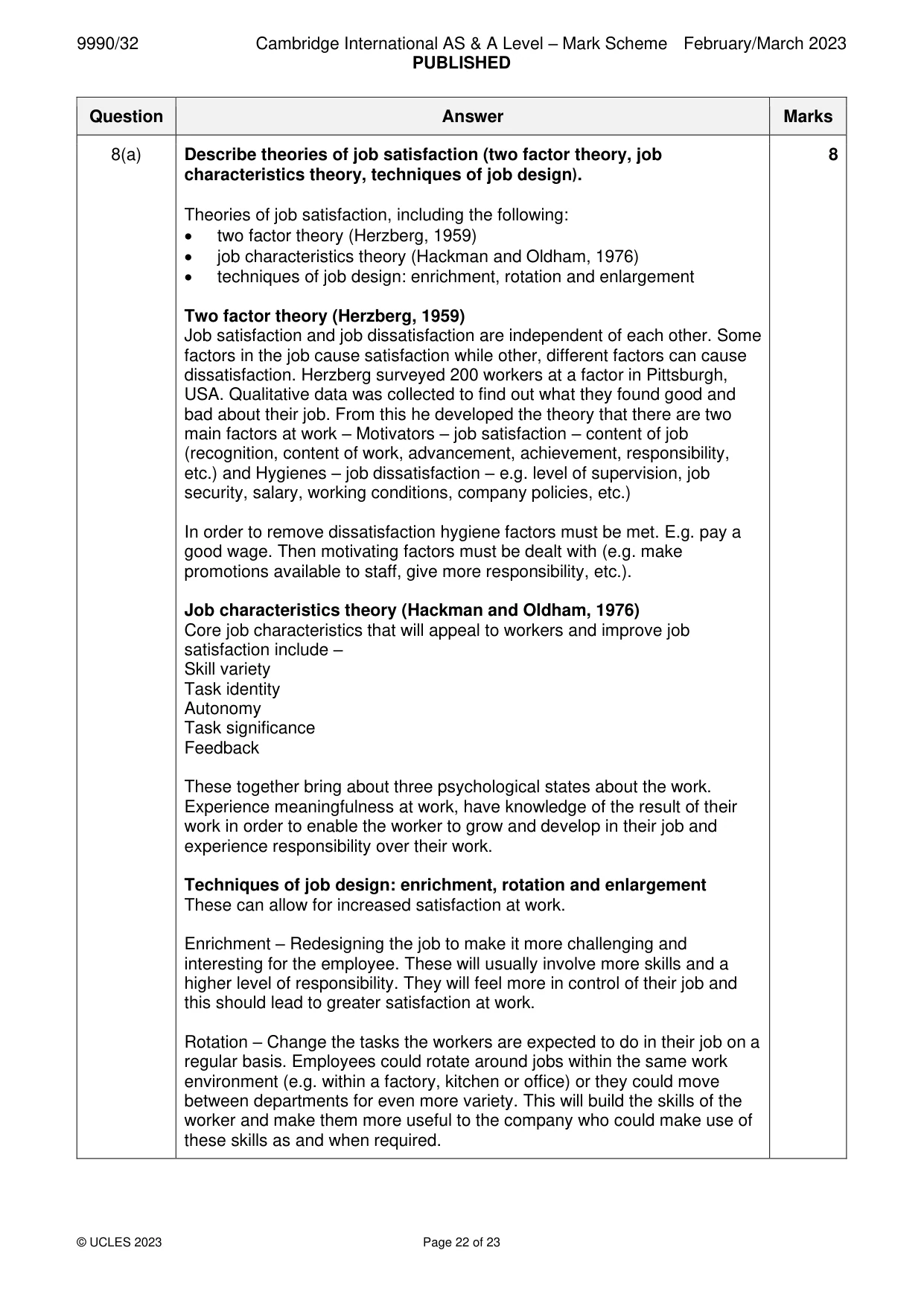
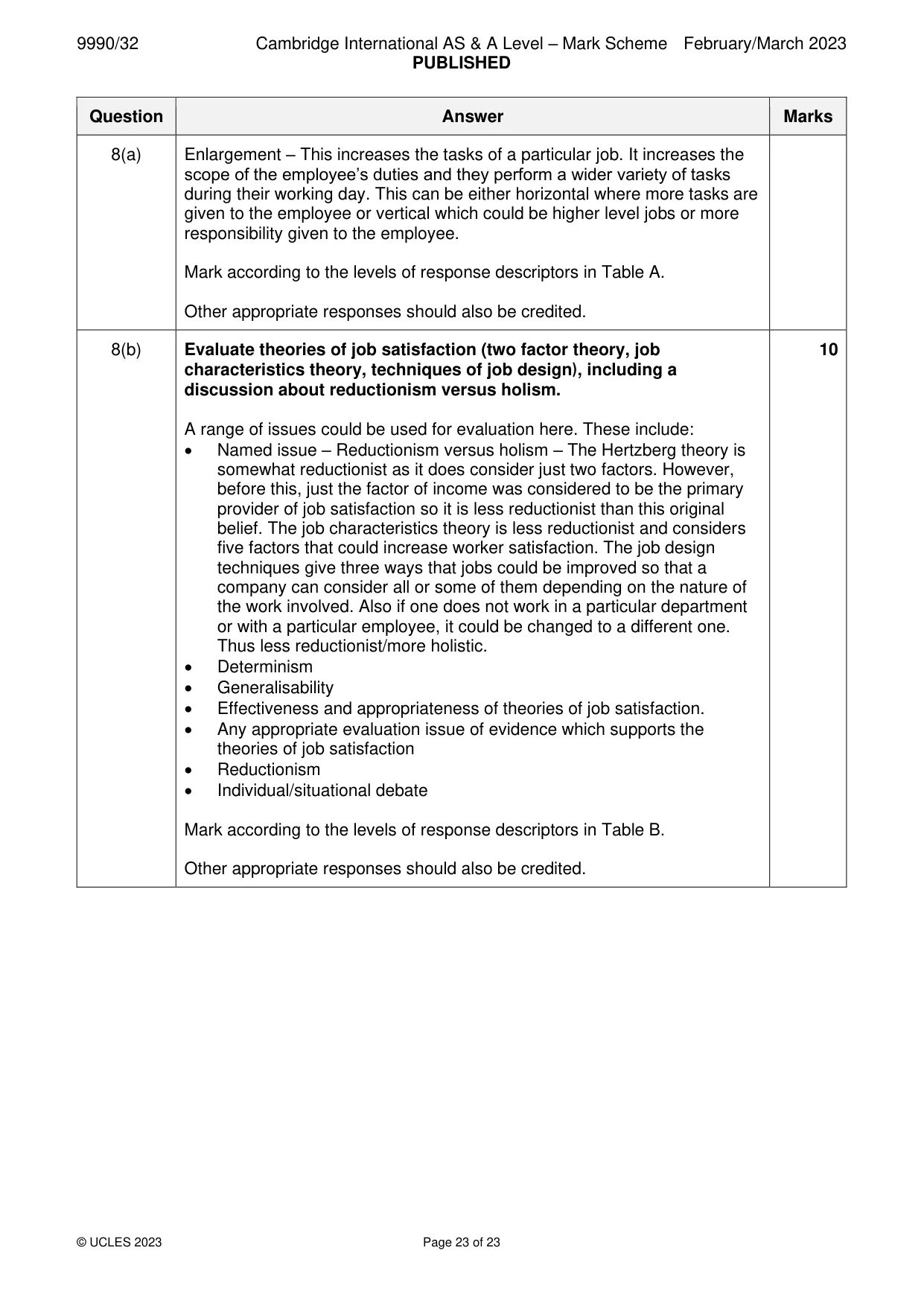
Q8 · Describe theories of job satisfaction (two factor theory, job characteristics theory…
8 (a) Describe theories of job satisfaction (two factor theory, job characteristics theory, techniques of job design). [8] (b) Evaluate theories of job satisfaction (two factor theory, job characteristics theory, techniques of job design), including a discussion about reductionism versus holism. [10]
Mark scheme: 8(a) Describe theories of job satisfaction (two factor theory, job 8 characteristics theory, techniques of job design . Theories of job satisfaction, including the following: • two factor theory (Herzberg, 1959) • job characteristics theory (Hackman and Oldham, 1976) • techniques of job design: enrichment, rotation and enlargement Two factor theory (Herzberg, 1959) Job satisfaction and job dissatisfaction are independent of each other. Some factors in the job cause satisfaction while other, different factors can cause dissatisfaction. Herzberg surveyed 200 workers at a factor in Pittsburgh, USA. Qualitative data was collected to find out what they found good and bad about their job. From this he developed the theory that there are two main factors at work – Motivators – job satisfaction – content of job (recognition, content of work, advancement, achievement, responsibility, etc.) and Hygienes – job dissatisfaction – e.g. level of supervision, job security, salary, working conditions, company policies, etc.) In order to remove dissatisfaction hygiene factors must be met. E.g. pay a good wage. Then motivating factors must be dealt with (e.g. make promotions available to staff, give more responsibility, etc.). Job characteristics theory (Hackman and Oldham, 1976) Core job characteristics that will appeal to workers and improve job satisfaction include – Skill variety Task identity Autonomy Task significance Feedback These together bring about three psychological states about the work. Experience meaningfulness at work, have knowledge of the result of their work in order to enable the worker to grow and develop in their job and experience responsibility over their work. Techniques of job design: enrichment, rotation and enlargement These can allow for increased satisfaction at work. Enrichment – Redesigning the job to make it more challenging and interesting for the employee. These will usually involve more skills and a higher level of responsibility. They will feel more in control of their job and this should lead to greater satisfaction at work. Rotation – Change the tasks the workers are expected to do in their job on a regular basis. Employees could rotate around jobs within the same work environment (e.g. within a factory, kitchen or office) or they could move between departments for even more variety. This will build the skills of the worker and make them more useful to the company who could make use of these skills as and when required. 8(a) Enlargement – This increases the tasks of a particular job. It increases the scope of the employee’s duties and they perform a wider variety of tasks during their working day. This can be either horizontal where more tasks are given to the employee or vertical which could be higher level jobs or more responsibility given to the employee. Mark according to the levels of response descriptors in Table A. Other appropriate responses should also be credited. 8(b) Evaluate theories of job satisfaction (two factor theory, job 10 characteristics theory, techniques of job design , including a discussion about reductionism versus holism. A range of issues could be used for evaluation here. These include: • Named issue – Reductionism versus holism – The Hertzberg theory is somewhat reductionist as it does consider just two factors. However, before this, just the factor of income was considered to be the primary provider of job satisfaction so it is less reductionist than this original belief. The job characteristics theory is less reductionist and considers five factors that could increase worker satisfaction. The job design techniques give three ways that jobs could be improved so that a company can consider all or some of them depending on the nature of the work involved. Also if one does not work in a particular department or with a particular employee, it could be changed to a different one. Thus less reductionist/more holistic. • Determinism • Generalisability • Effectiveness and appropriateness of theories of job satisfaction. • Any appropriate evaluation issue of evidence which supports the theories of job satisfaction • Reductionism • Individual/situational debate Mark according to the levels of response descriptors in Table B. Other appropriate responses should also be credited.
What was in this paper
The subtopics covered by these 8 questions, and how many questions each got. Open one in a new tab to see every Cambridge question on it.
What you needed in this session
Cambridge’s own grade thresholds for 2023 Feb/March, Paper 3 · Variant 2. A higher threshold means an easier paper — the bar moves with how the cohort did.