Cambridge A Level Psychology (from 2018) 9990 — 2018 Oct/Nov Paper 3 · Variant 1
9990/31/O/N/18 · 8 questions · 60 marks · ≈68 min
The question paper and its mark scheme, free to read here and free to download. This is Cambridge’s own paper, exactly as it was sat.
Question paper4 pages
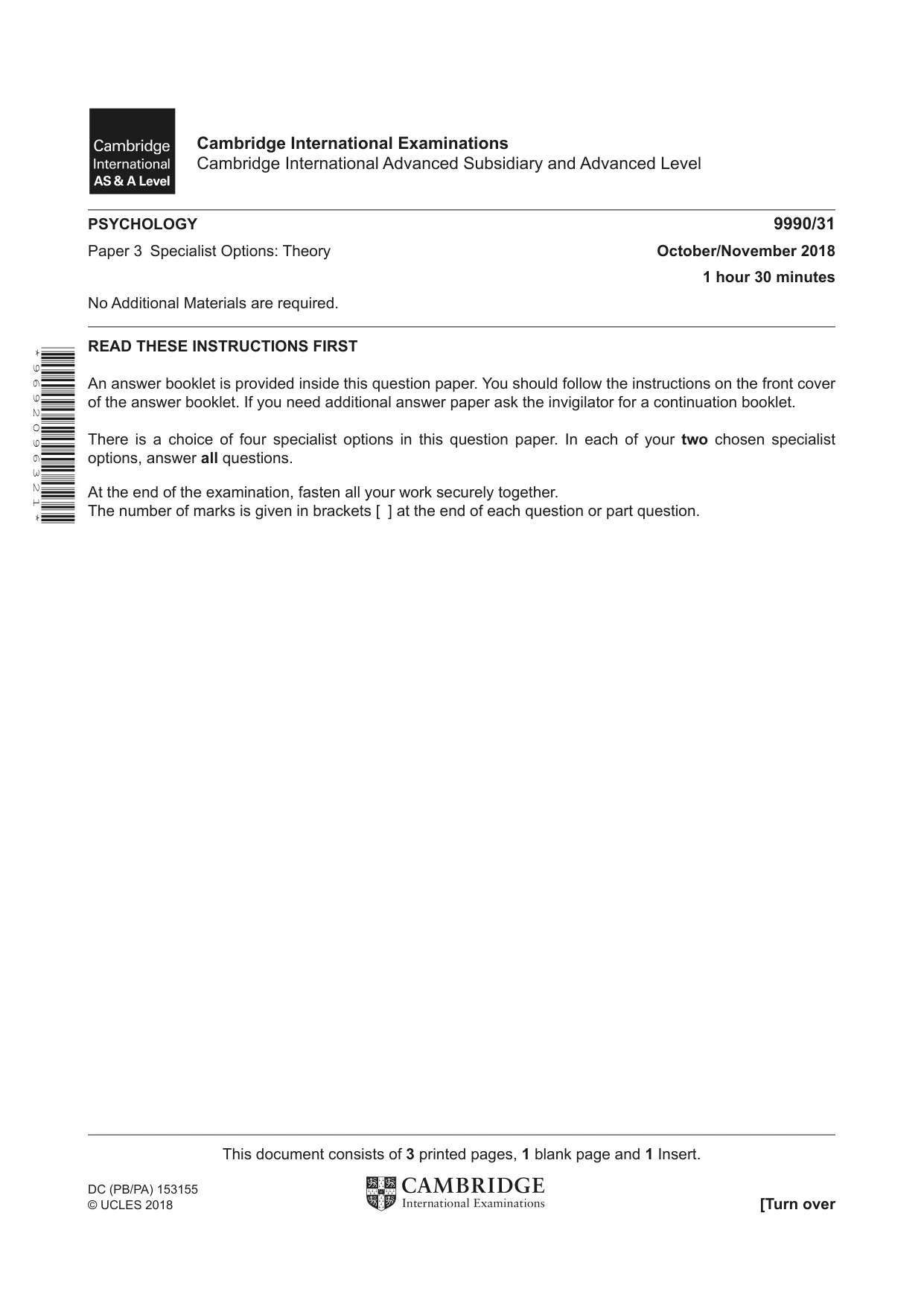
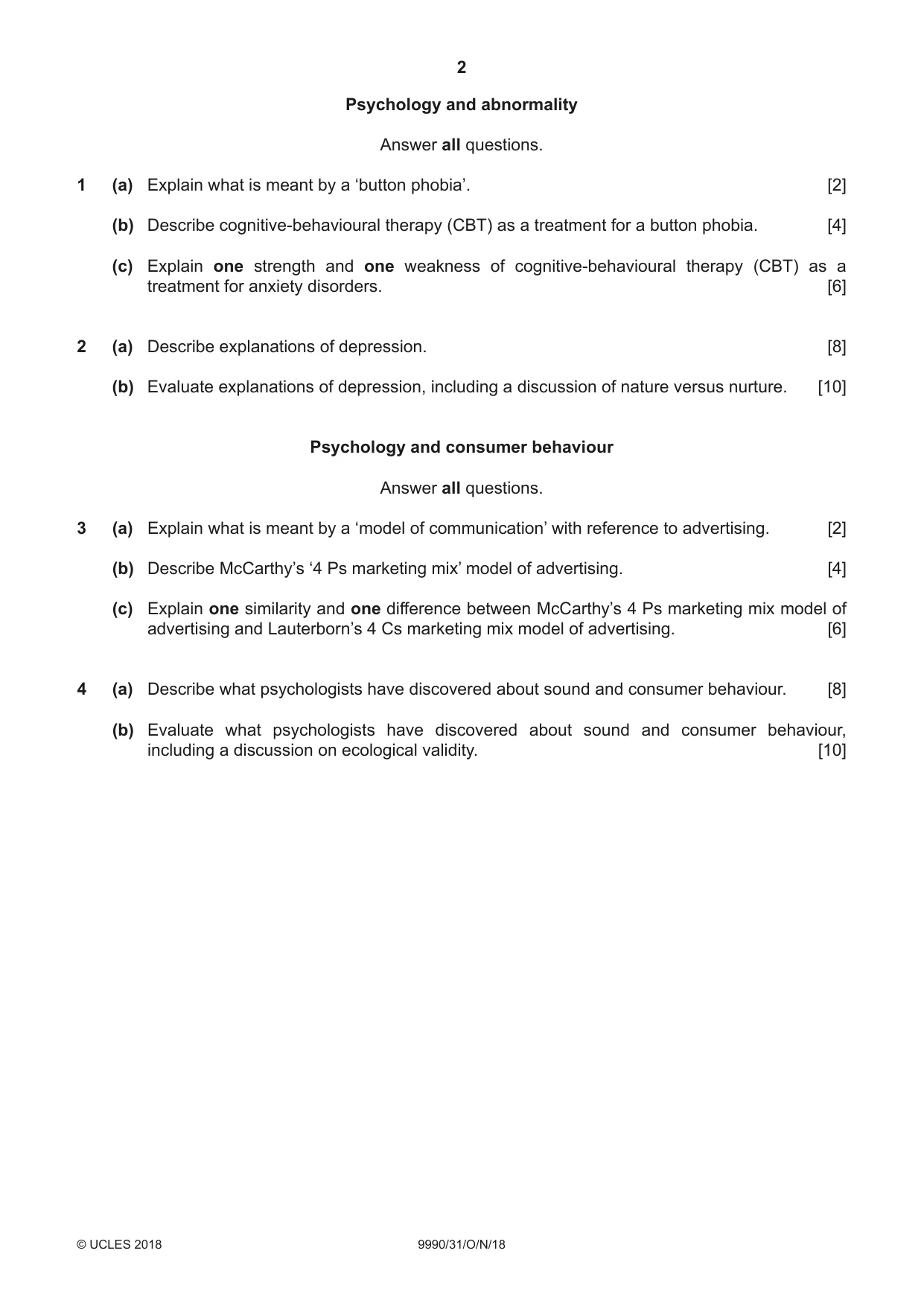
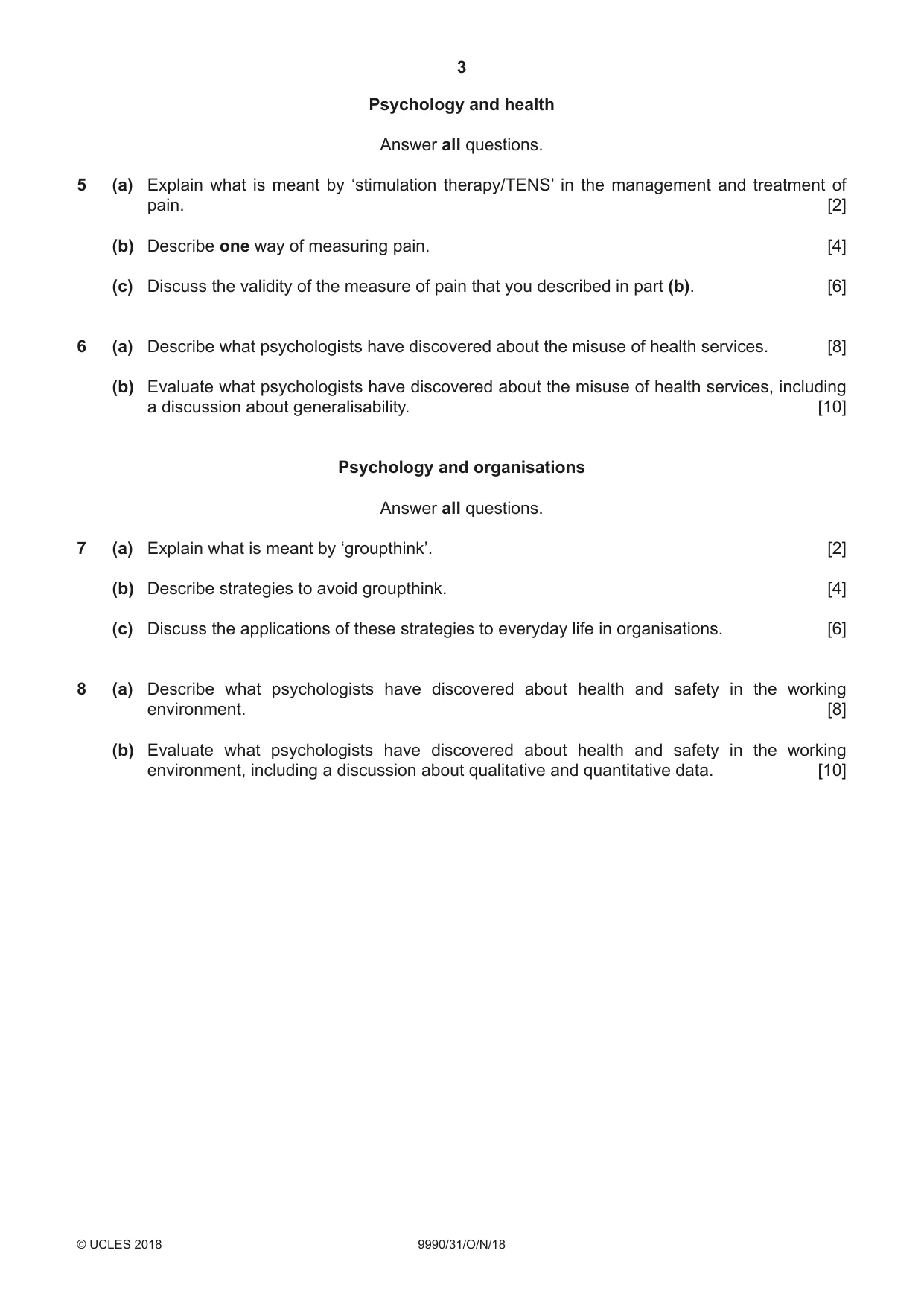

Mark scheme20 pages
Answers below. Sit the paper first if you are practising.
Questions as text
Q1 · Explain what is meant by a ‘button phobia’
1 (a) Explain what is meant by a ‘button phobia’. [2] (b) Describe cognitive-behavioural therapy (CBT) as a treatment for a button phobia. [4] (c) Explain one strength and one weakness of cognitive-behavioural therapy (CBT) as a treatment for anxiety disorders. [6]
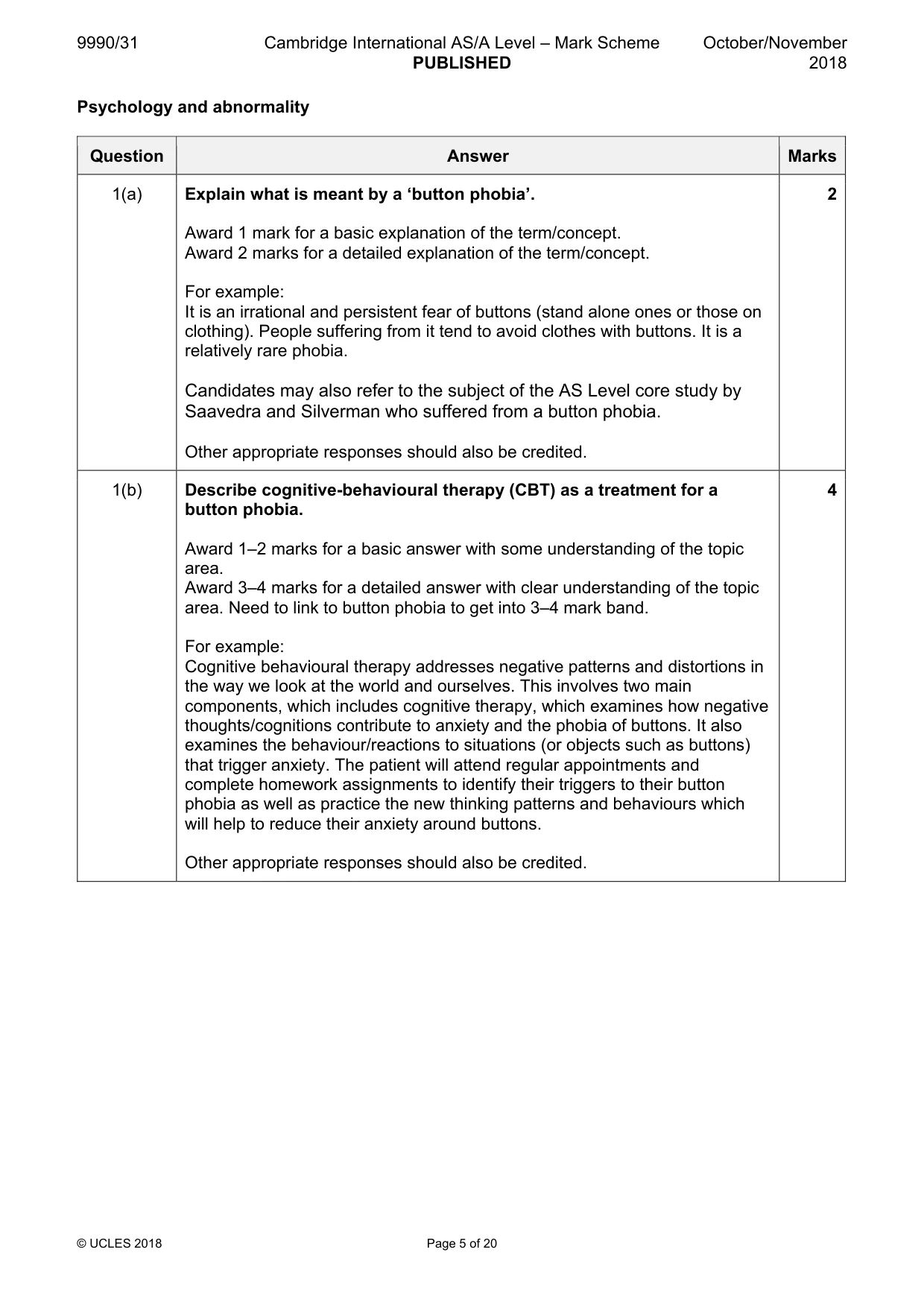
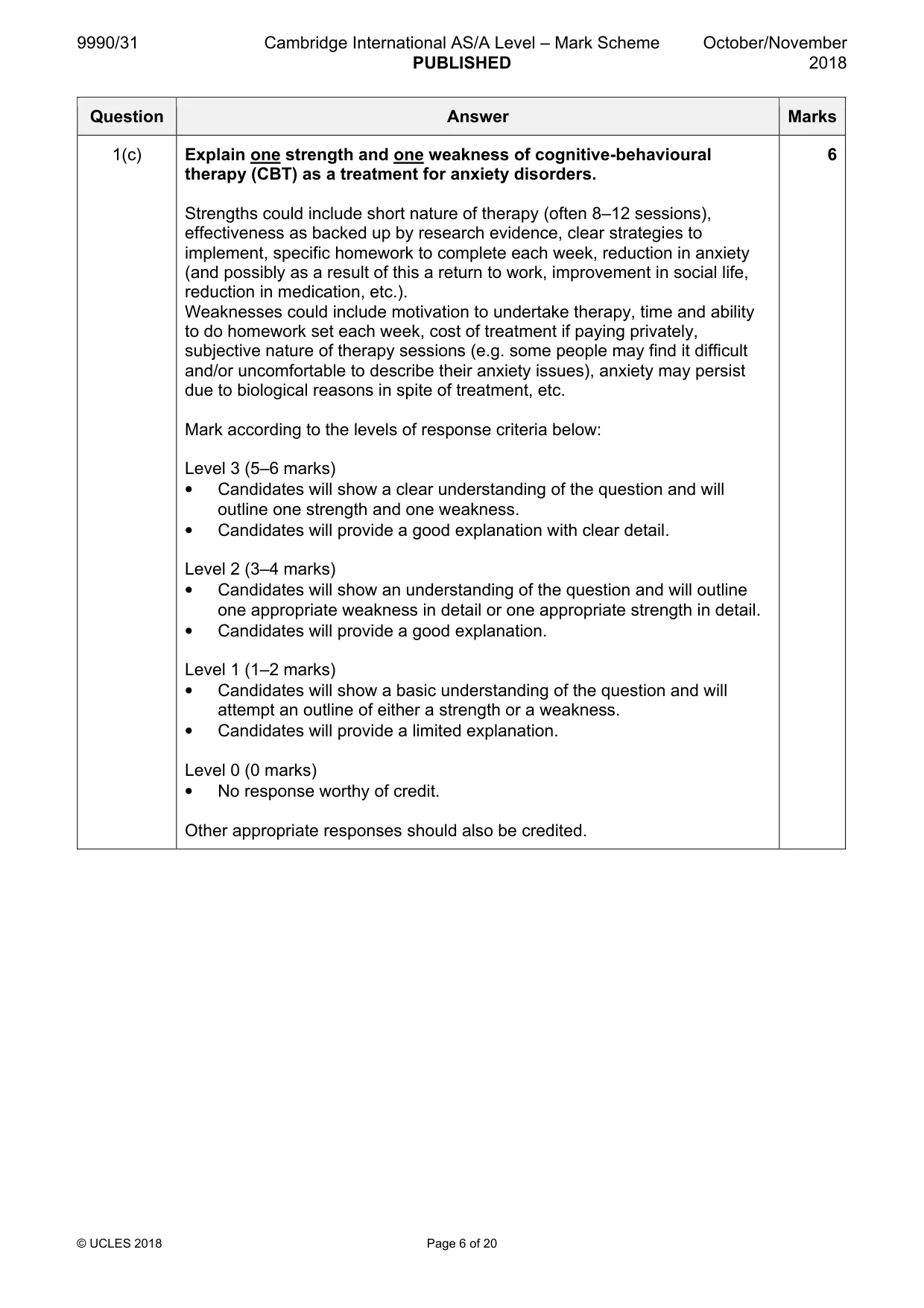
Mark scheme: Question Answer Marks 1(a) Explain what is meant by a ‘button phobia’. 2 Award 1 mark for a basic explanation of the term/concept. Award 2 marks for a detailed explanation of the term/concept. For example: It is an irrational and persistent fear of buttons (stand alone ones or those on clothing). People suffering from it tend to avoid clothes with buttons. It is a relatively rare phobia. Candidates may also refer to the subject of the AS Level core study by Saavedra and Silverman who suffered from a button phobia. Other appropriate responses should also be credited. 1(b) Describe cognitive-behavioural therapy (CBT) as a treatment for a 4 button phobia. Award 1–2 marks for a basic answer with some understanding of the topic area. Award 3–4 marks for a detailed answer with clear understanding of the topic area. Need to link to button phobia to get into 3–4 mark band. For example: Cognitive behavioural therapy addresses negative patterns and distortions in the way we look at the world and ourselves. This involves two main components, which includes cognitive therapy, which examines how negative thoughts/cognitions contribute to anxiety and the phobia of buttons. It also examines the behaviour/reactions to situations (or objects such as buttons) that trigger anxiety. The patient will attend regular appointments and complete homework assignments to identify their triggers to their button phobia as well as practice the new thinking patterns and behaviours which will help to reduce their anxiety around buttons. Other appropriate responses should also be credited. 1(c) Explain one strength and one weakness of cognitive-behavioural 6 therapy (CBT) as a treatment for anxiety disorders. Strengths could include short nature of therapy (often 8–12 sessions), effectiveness as backed up by research evidence, clear strategies to implement, specific homework to complete each week, reduction in anxiety (and possibly as a result of this a return to work, improvement in social life, reduction in medication, etc.). Weaknesses could include motivation to undertake therapy, time and ability to do homework set each week, cost of treatment if paying privately, subjective nature of therapy sessions (e.g. some people may find it difficult and/or uncomfortable to describe their anxiety issues), anxiety may persist due to biological reasons in spite of treatment, etc. Mark according to the levels of response criteria below: Level 3 (5–6 marks) • Candidates will show a clear understanding of the question and will outline one strength and one weakness. • Candidates will provide a good explanation with clear detail. Level 2 (3–4 marks) • Candidates will show an understanding of the question and will outline one appropriate weakness in detail or one appropriate strength in detail. • Candidates will provide a good explanation. Level 1 (1–2 marks) • Candidates will show a basic understanding of the question and will attempt an outline of either a strength or a weakness. • Candidates will provide a limited explanation. Level 0 (0 marks) • No response worthy of credit. Other appropriate responses should also be credited.
More questions on Anxiety disorders and fear-related disorders
Q2 · Describe explanations of depression
2 (a) Describe explanations of depression. [8] (b) Evaluate explanations of depression, including a discussion of nature versus nurture. [10] Psychology and consumer behaviour Answer all questions.
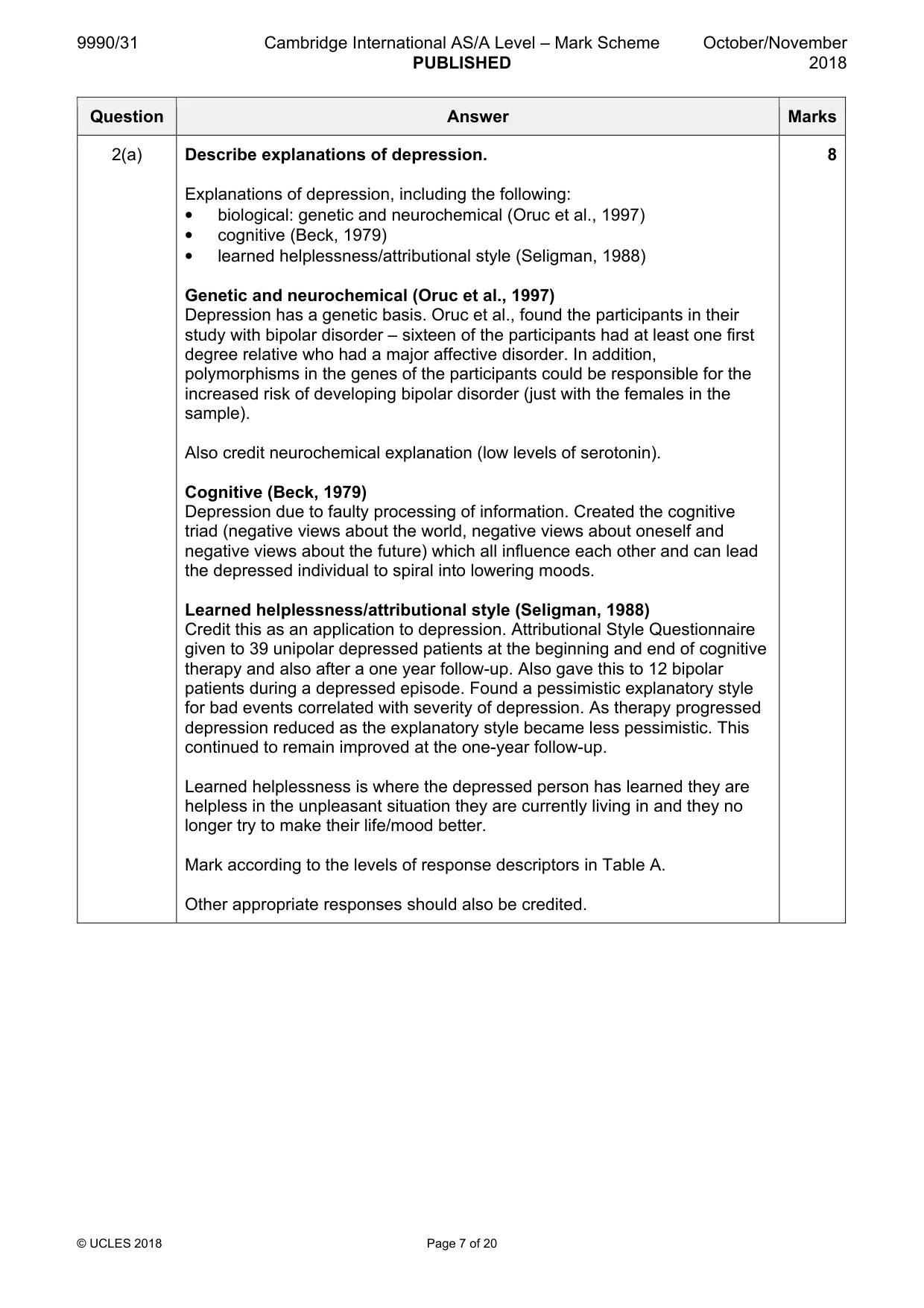
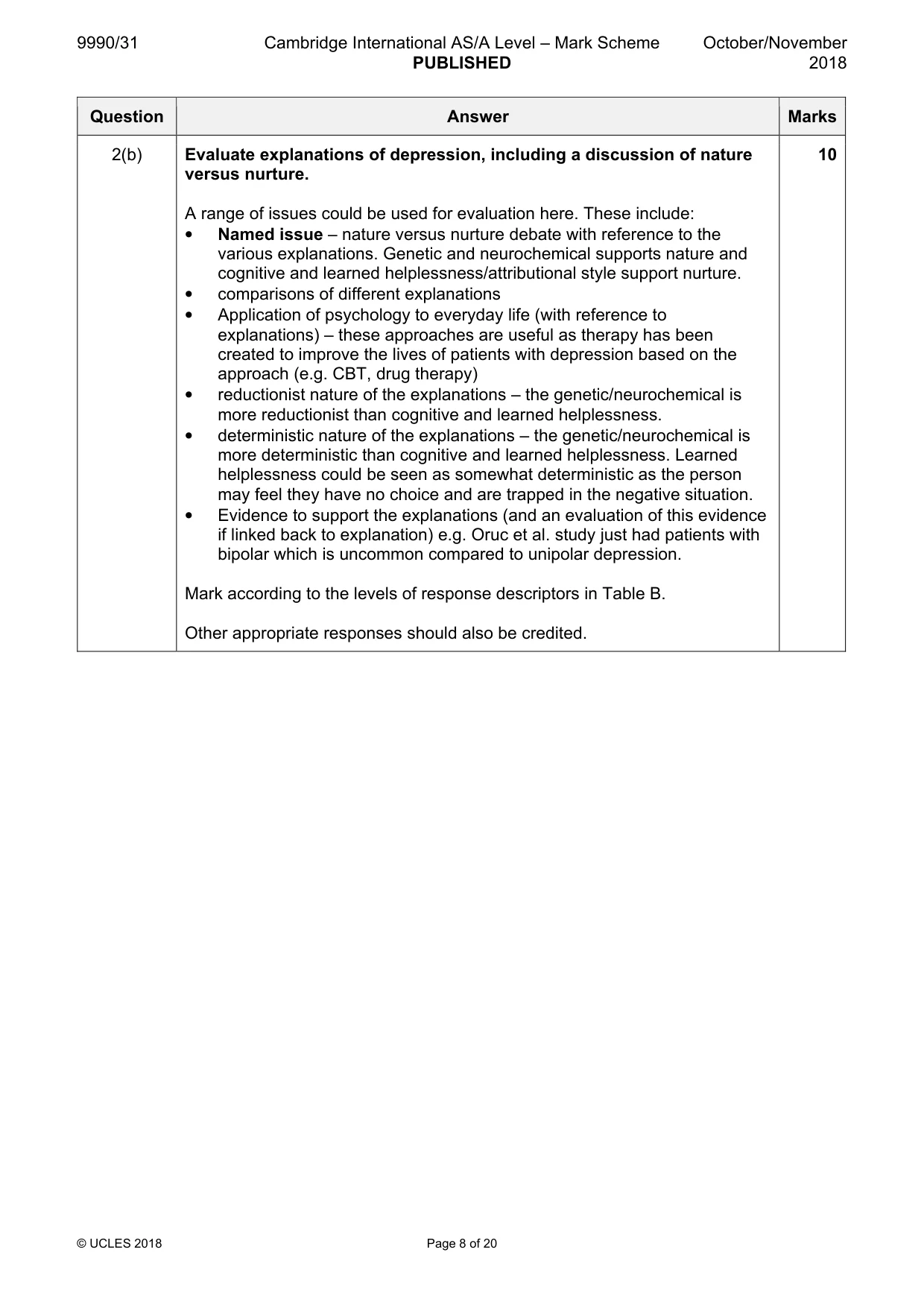
Mark scheme: 2(a) Describe explanations of depression. 8 Explanations of depression, including the following: • biological: genetic and neurochemical (Oruc et al., 1997) • cognitive (Beck, 1979) • learned helplessness/attributional style (Seligman, 1988) Genetic and neurochemical (Oruc et al., 1997) Depression has a genetic basis. Oruc et al., found the participants in their study with bipolar disorder – sixteen of the participants had at least one first degree relative who had a major affective disorder. In addition, polymorphisms in the genes of the participants could be responsible for the increased risk of developing bipolar disorder (just with the females in the sample). Also credit neurochemical explanation (low levels of serotonin). Cognitive (Beck, 1979) Depression due to faulty processing of information. Created the cognitive triad (negative views about the world, negative views about oneself and negative views about the future) which all influence each other and can lead the depressed individual to spiral into lowering moods. Learned helplessness/attributional style (Seligman, 1988) Credit this as an application to depression. Attributional Style Questionnaire given to 39 unipolar depressed patients at the beginning and end of cognitive therapy and also after a one year follow-up. Also gave this to 12 bipolar patients during a depressed episode. Found a pessimistic explanatory style for bad events correlated with severity of depression. As therapy progressed depression reduced as the explanatory style became less pessimistic. This continued to remain improved at the one-year follow-up. Learned helplessness is where the depressed person has learned they are helpless in the unpleasant situation they are currently living in and they no longer try to make their life/mood better. Mark according to the levels of response descriptors in Table A. Other appropriate responses should also be credited. 2(b) Evaluate explanations of depression, including a discussion of nature 10 versus nurture. A range of issues could be used for evaluation here. These include: • Named issue – nature versus nurture debate with reference to the various explanations. Genetic and neurochemical supports nature and cognitive and learned helplessness/attributional style support nurture. • comparisons of different explanations • Application of psychology to everyday life (with reference to explanations) – these approaches are useful as therapy has been created to improve the lives of patients with depression based on the approach (e.g. CBT, drug therapy) • reductionist nature of the explanations – the genetic/neurochemical is more reductionist than cognitive and learned helplessness. • deterministic nature of the explanations – the genetic/neurochemical is more deterministic than cognitive and learned helplessness. Learned helplessness could be seen as somewhat deterministic as the person may feel they have no choice and are trapped in the negative situation. • Evidence to support the explanations (and an evaluation of this evidence if linked back to explanation) e.g. Oruc et al. study just had patients with bipolar which is uncommon compared to unipolar depression. Mark according to the levels of response descriptors in Table B. Other appropriate responses should also be credited. Psychology and consumer behaviour
More questions on Mood (affective) disorders: depressive disorder (unipolar) and bipolar disorder
Q3 · Explain what is meant by a ‘model of communication’ with reference to advertising
3 (a) Explain what is meant by a ‘model of communication’ with reference to advertising. [2] (b) Describe McCarthy’s ‘4 Ps marketing mix’ model of advertising. [4] (c) Explain one similarity and one difference between McCarthy’s 4 Ps marketing mix model of advertising and Lauterborn’s 4 Cs marketing mix model of advertising. [6]
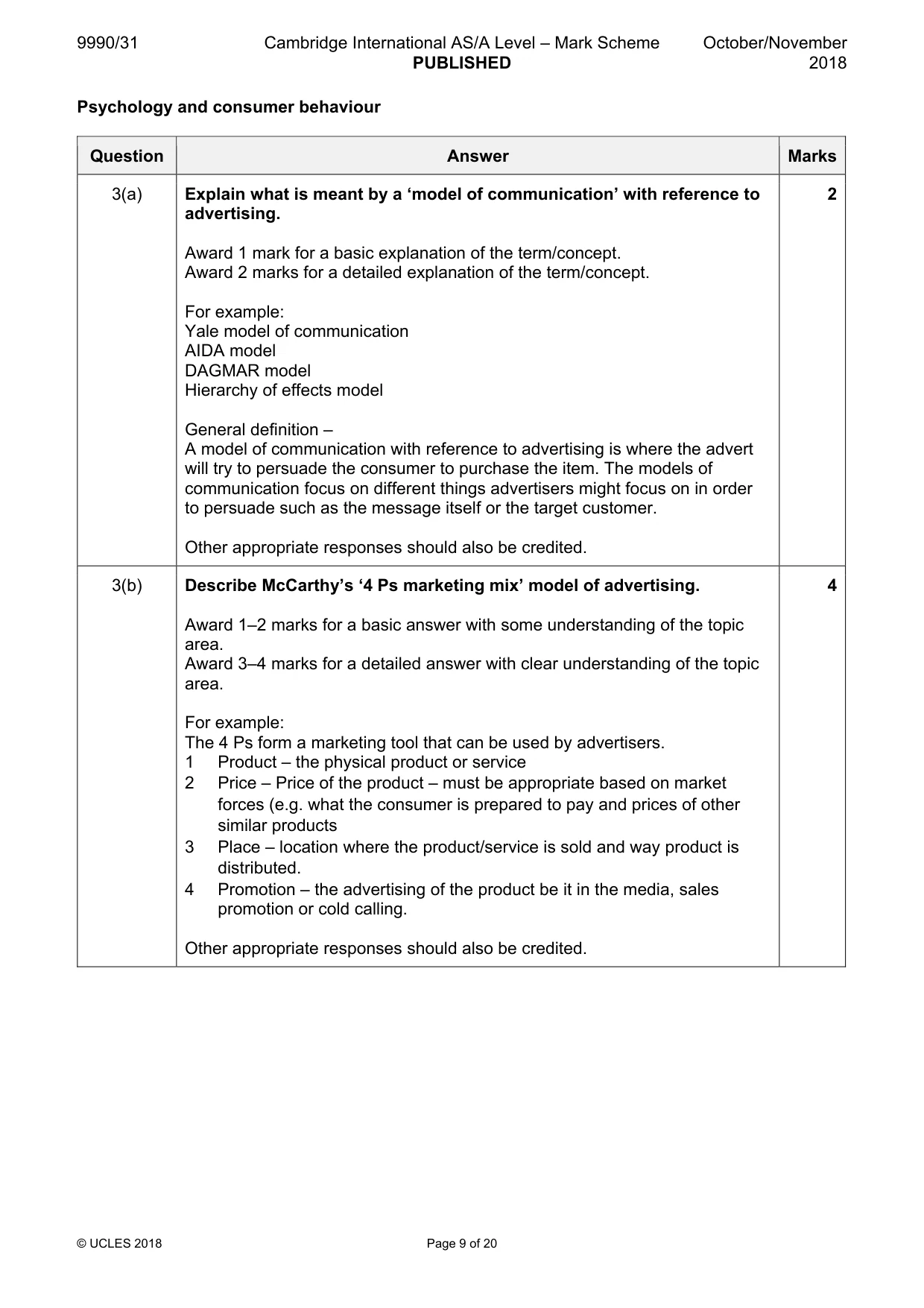
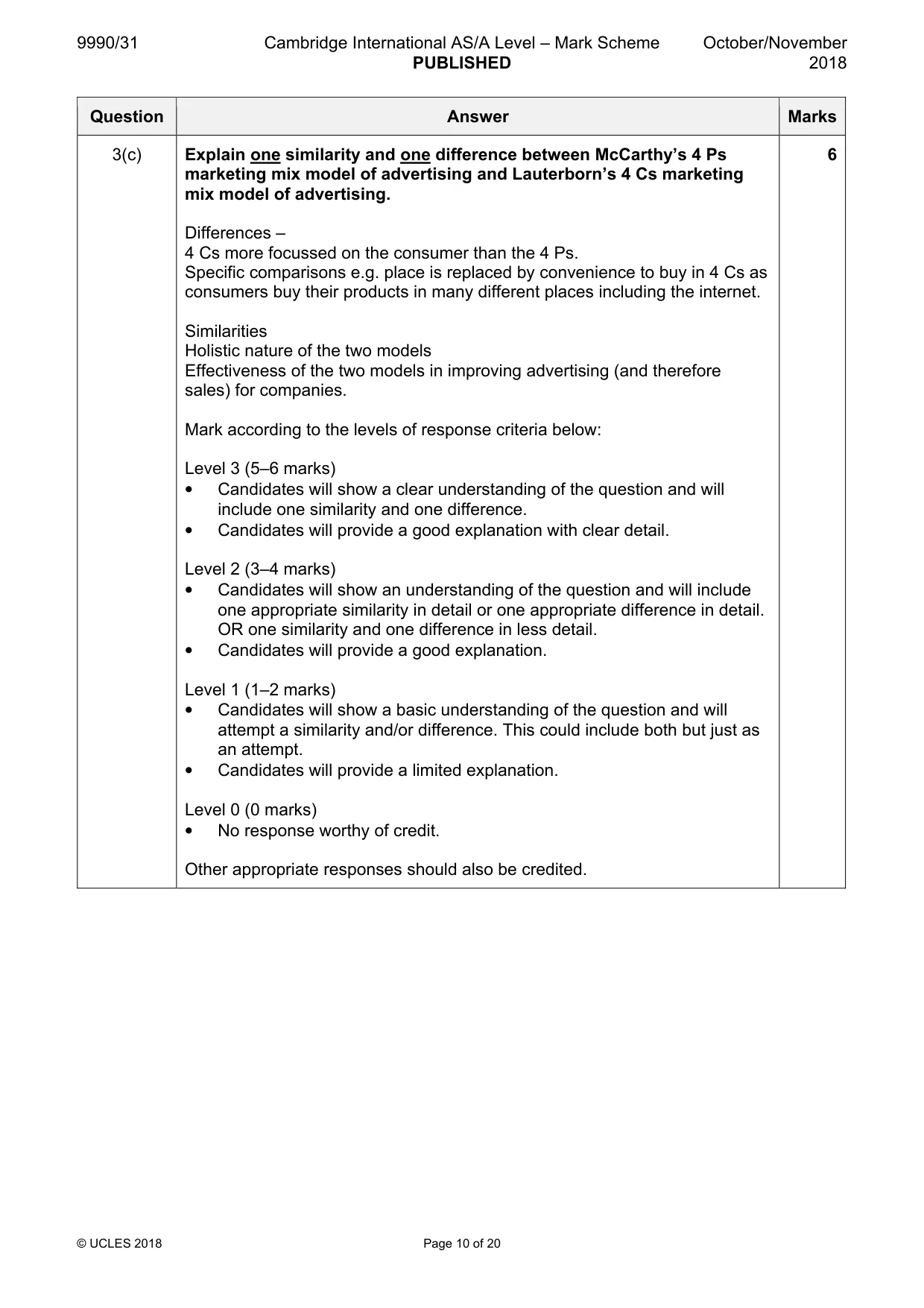
Mark scheme: 3(a) Explain what is meant by a ‘model of communication’ with reference to 2 advertising. Award 1 mark for a basic explanation of the term/concept. Award 2 marks for a detailed explanation of the term/concept. For example: Yale model of communication AIDA model DAGMAR model Hierarchy of effects model General definition – A model of communication with reference to advertising is where the advert will try to persuade the consumer to purchase the item. The models of communication focus on different things advertisers might focus on in order to persuade such as the message itself or the target customer. Other appropriate responses should also be credited. 3(b) Describe McCarthy’s ‘4 Ps marketing mix’ model of advertising. 4 Award 1–2 marks for a basic answer with some understanding of the topic area. Award 3–4 marks for a detailed answer with clear understanding of the topic area. For example: The 4 Ps form a marketing tool that can be used by advertisers. 1 Product – the physical product or service 2 Price – Price of the product – must be appropriate based on market forces (e.g. what the consumer is prepared to pay and prices of other similar products 3 Place – location where the product/service is sold and way product is distributed. 4 Promotion – the advertising of the product be it in the media, sales promotion or cold calling. Other appropriate responses should also be credited. 3(c) Explain one similarity and one difference between McCarthy’s 4 Ps 6 marketing mix model of advertising and Lauterborn’s 4 Cs marketing mix model of advertising. Differences – 4 Cs more focussed on the consumer than the 4 Ps. Specific comparisons e.g. place is replaced by convenience to buy in 4 Cs as consumers buy their products in many different places including the internet. Similarities Holistic nature of the two models Effectiveness of the two models in improving advertising (and therefore sales) for companies. Mark according to the levels of response criteria below: Level 3 (5–6 marks) • Candidates will show a clear understanding of the question and will include one similarity and one difference. • Candidates will provide a good explanation with clear detail. Level 2 (3–4 marks) • Candidates will show an understanding of the question and will include one appropriate similarity in detail or one appropriate difference in detail. OR one similarity and one difference in less detail. • Candidates will provide a good explanation. Level 1 (1–2 marks) • Candidates will show a basic understanding of the question and will attempt a similarity and/or difference. This could include both but just as an attempt. • Candidates will provide a limited explanation. Level 0 (0 marks) • No response worthy of credit. Other appropriate responses should also be credited.
Q4 · Describe what psychologists have discovered about sound and consumer behaviour
4 (a) Describe what psychologists have discovered about sound and consumer behaviour. [8] (b) Evaluate what psychologists have discovered about sound and consumer behaviour, including a discussion on ecological validity. [10] Psychology and health Answer all questions.
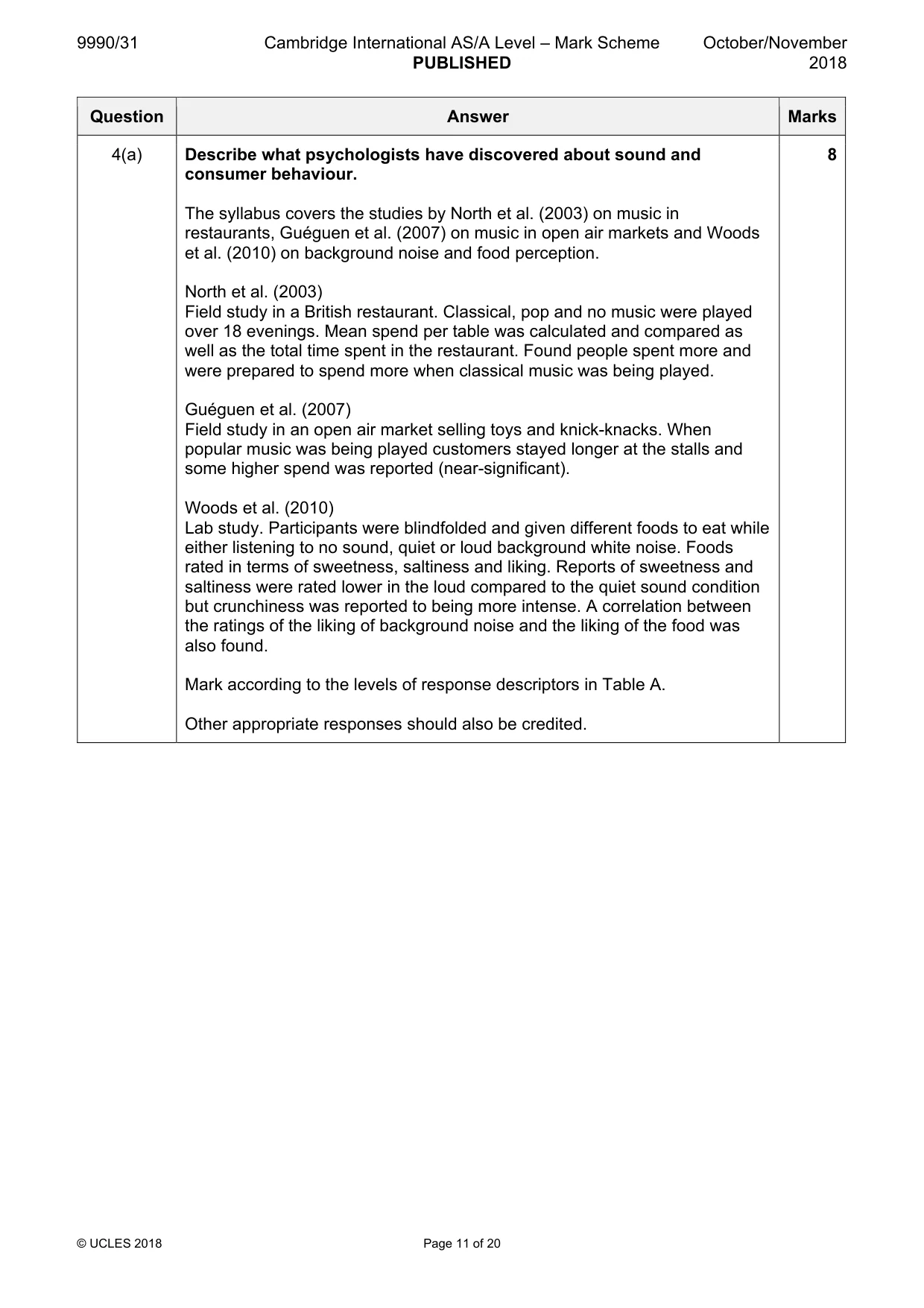
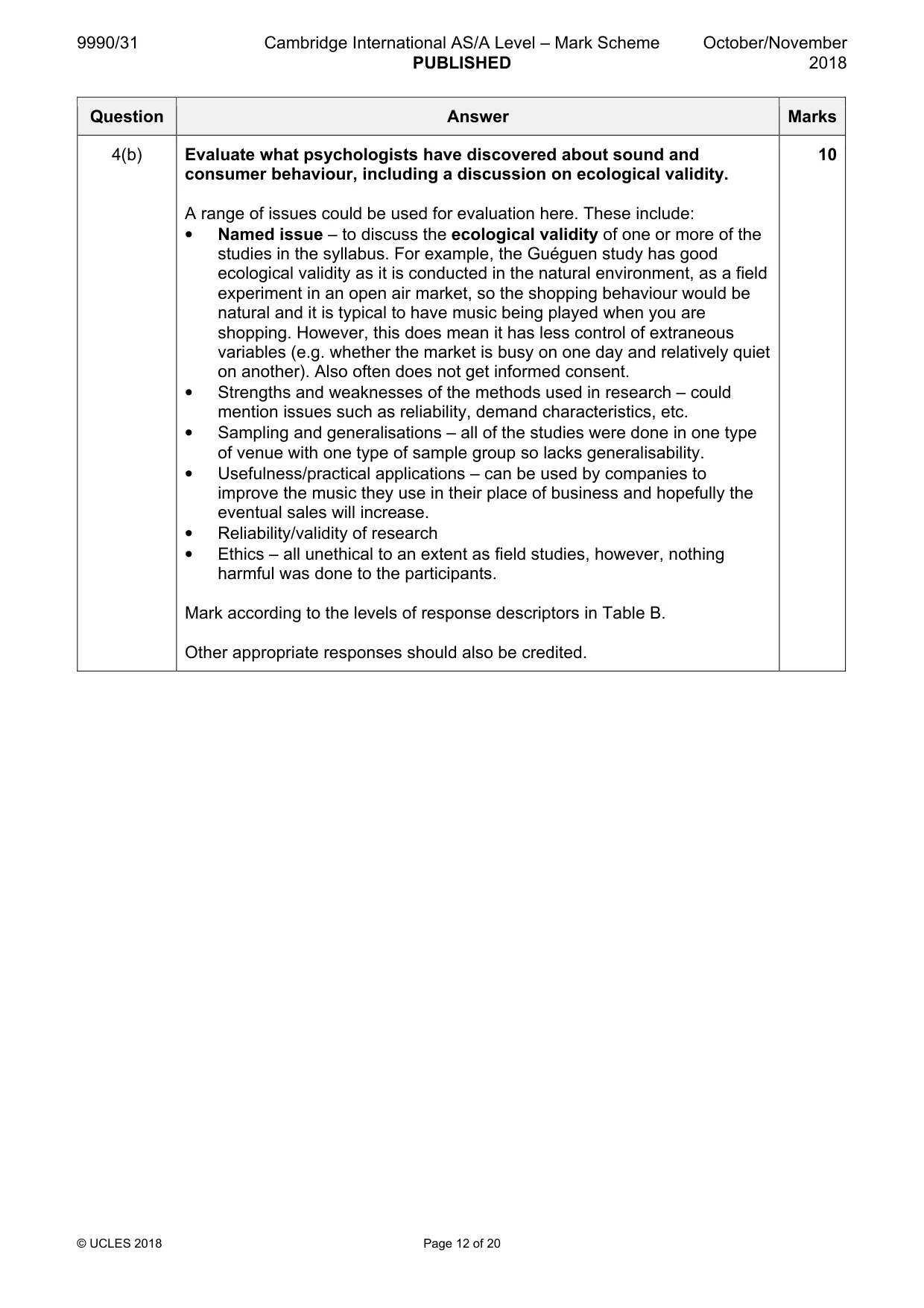
Mark scheme: 4(a) Describe what psychologists have discovered about sound and 8 consumer behaviour. The syllabus covers the studies by North et al. (2003) on music in restaurants, Guéguen et al. (2007) on music in open air markets and Woods et al. (2010) on background noise and food perception. North et al. (2003) Field study in a British restaurant. Classical, pop and no music were played over 18 evenings. Mean spend per table was calculated and compared as well as the total time spent in the restaurant. Found people spent more and were prepared to spend more when classical music was being played. Guéguen et al. (2007) Field study in an open air market selling toys and knick-knacks. When popular music was being played customers stayed longer at the stalls and some higher spend was reported (near-significant). Woods et al. (2010) Lab study. Participants were blindfolded and given different foods to eat while either listening to no sound, quiet or loud background white noise. Foods rated in terms of sweetness, saltiness and liking. Reports of sweetness and saltiness were rated lower in the loud compared to the quiet sound condition but crunchiness was reported to being more intense. A correlation between the ratings of the liking of background noise and the liking of the food was also found. Mark according to the levels of response descriptors in Table A. Other appropriate responses should also be credited. 4(b) Evaluate what psychologists have discovered about sound and 10 consumer behaviour, including a discussion on ecological validity. A range of issues could be used for evaluation here. These include: • Named issue – to discuss the ecological validity of one or more of the studies in the syllabus. For example, the Guéguen study has good ecological validity as it is conducted in the natural environment, as a field experiment in an open air market, so the shopping behaviour would be natural and it is typical to have music being played when you are shopping. However, this does mean it has less control of extraneous variables (e.g. whether the market is busy on one day and relatively quiet on another). Also often does not get informed consent. • Strengths and weaknesses of the methods used in research – could mention issues such as reliability, demand characteristics, etc. • Sampling and generalisations – all of the studies were done in one type of venue with one type of sample group so lacks generalisability. • Usefulness/practical applications – can be used by companies to improve the music they use in their place of business and hopefully the eventual sales will increase. • Reliability/validity of research • Ethics – all unethical to an extent as field studies, however, nothing harmful was done to the participants. Mark according to the levels of response descriptors in Table B. Other appropriate responses should also be credited. Psychology and health
Q5 · Explain what is meant by ‘stimulation therapy/TENS’ in the management and treatment of…
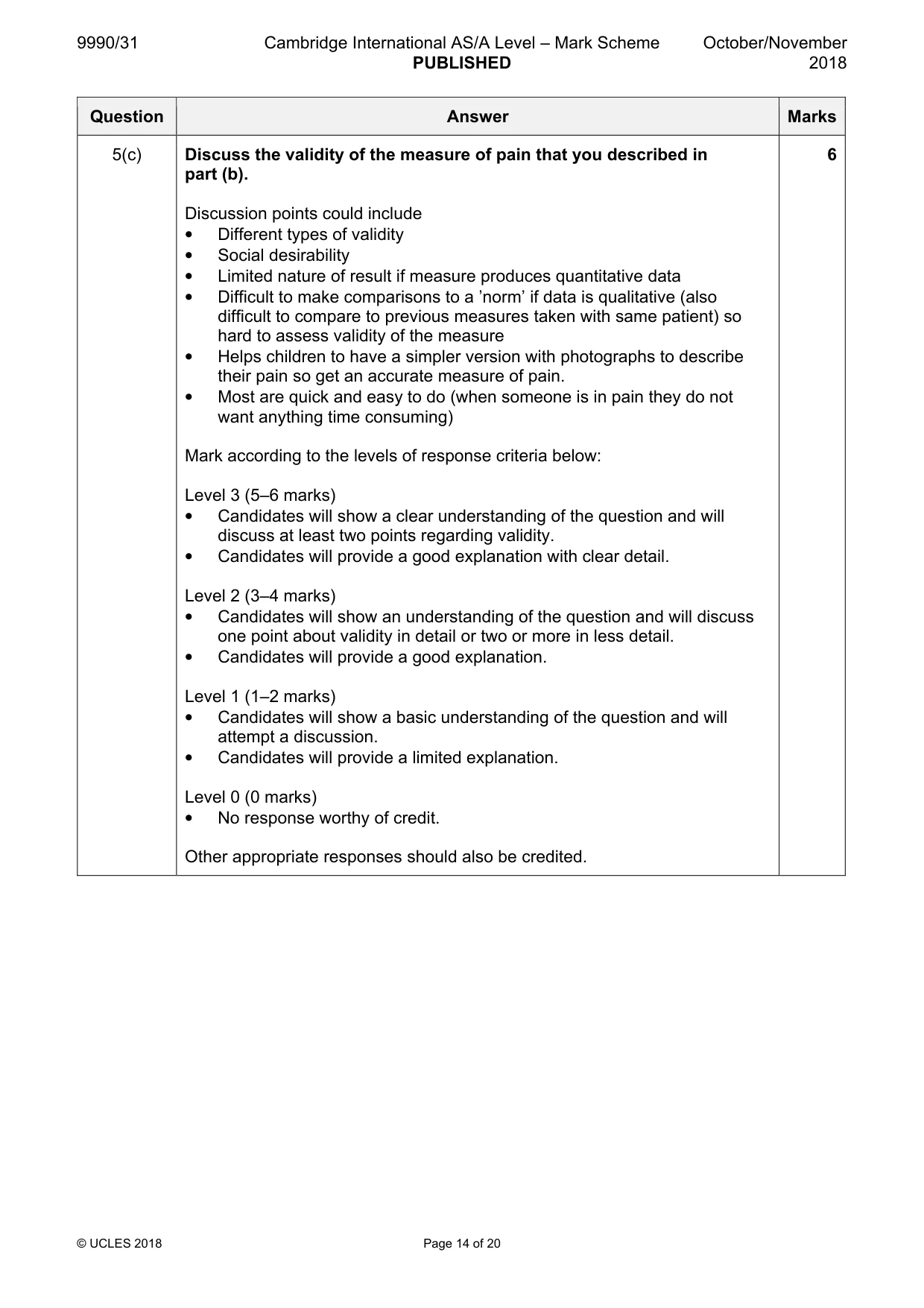
5 (a) Explain what is meant by ‘stimulation therapy/TENS’ in the management and treatment of pain. [2] (b) Describe one way of measuring pain. [4] (c) Discuss the validity of the measure of pain that you described in part (b). [6]
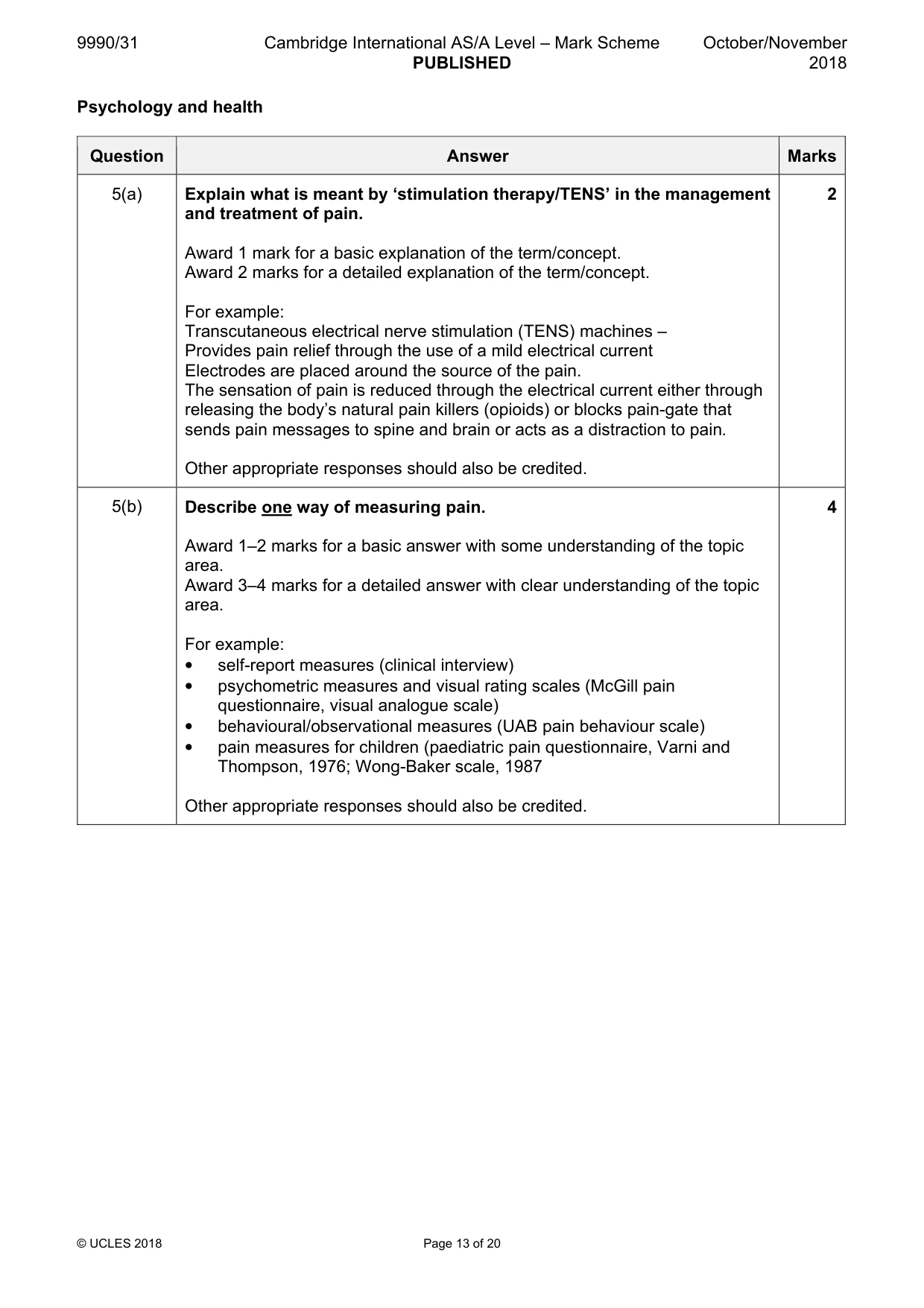
Mark scheme: 5(a) Explain what is meant by ‘stimulation therapy/TENS’ in the management 2 and treatment of pain. Award 1 mark for a basic explanation of the term/concept. Award 2 marks for a detailed explanation of the term/concept. For example: Transcutaneous electrical nerve stimulation (TENS) machines – Provides pain relief through the use of a mild electrical current Electrodes are placed around the source of the pain. The sensation of pain is reduced through the electrical current either through releasing the body’s natural pain killers (opioids) or blocks pain-gate that sends pain messages to spine and brain or acts as a distraction to pain. Other appropriate responses should also be credited. 5(b) Describe one way of measuring pain. 4 Award 1–2 marks for a basic answer with some understanding of the topic area. Award 3–4 marks for a detailed answer with clear understanding of the topic area. For example: • self-report measures (clinical interview) • psychometric measures and visual rating scales (McGill pain questionnaire, visual analogue scale) • behavioural/observational measures (UAB pain behaviour scale) • pain measures for children (paediatric pain questionnaire, Varni and Thompson, 1976; Wong-Baker scale, 1987 Other appropriate responses should also be credited. 5(c) Discuss the validity of the measure of pain that you described in 6 part (b). Discussion points could include • Different types of validity • Social desirability • Limited nature of result if measure produces quantitative data • Difficult to make comparisons to a ’norm’ if data is qualitative (also difficult to compare to previous measures taken with same patient) so hard to assess validity of the measure • Helps children to have a simpler version with photographs to describe their pain so get an accurate measure of pain. • Most are quick and easy to do (when someone is in pain they do not want anything time consuming) Mark according to the levels of response criteria below: Level 3 (5–6 marks) • Candidates will show a clear understanding of the question and will discuss at least two points regarding validity. • Candidates will provide a good explanation with clear detail. Level 2 (3–4 marks) • Candidates will show an understanding of the question and will discuss one point about validity in detail or two or more in less detail. • Candidates will provide a good explanation. Level 1 (1–2 marks) • Candidates will show a basic understanding of the question and will attempt a discussion. • Candidates will provide a limited explanation. Level 0 (0 marks) • No response worthy of credit. Other appropriate responses should also be credited.
Q6 · Describe what psychologists have discovered about the misuse of health services
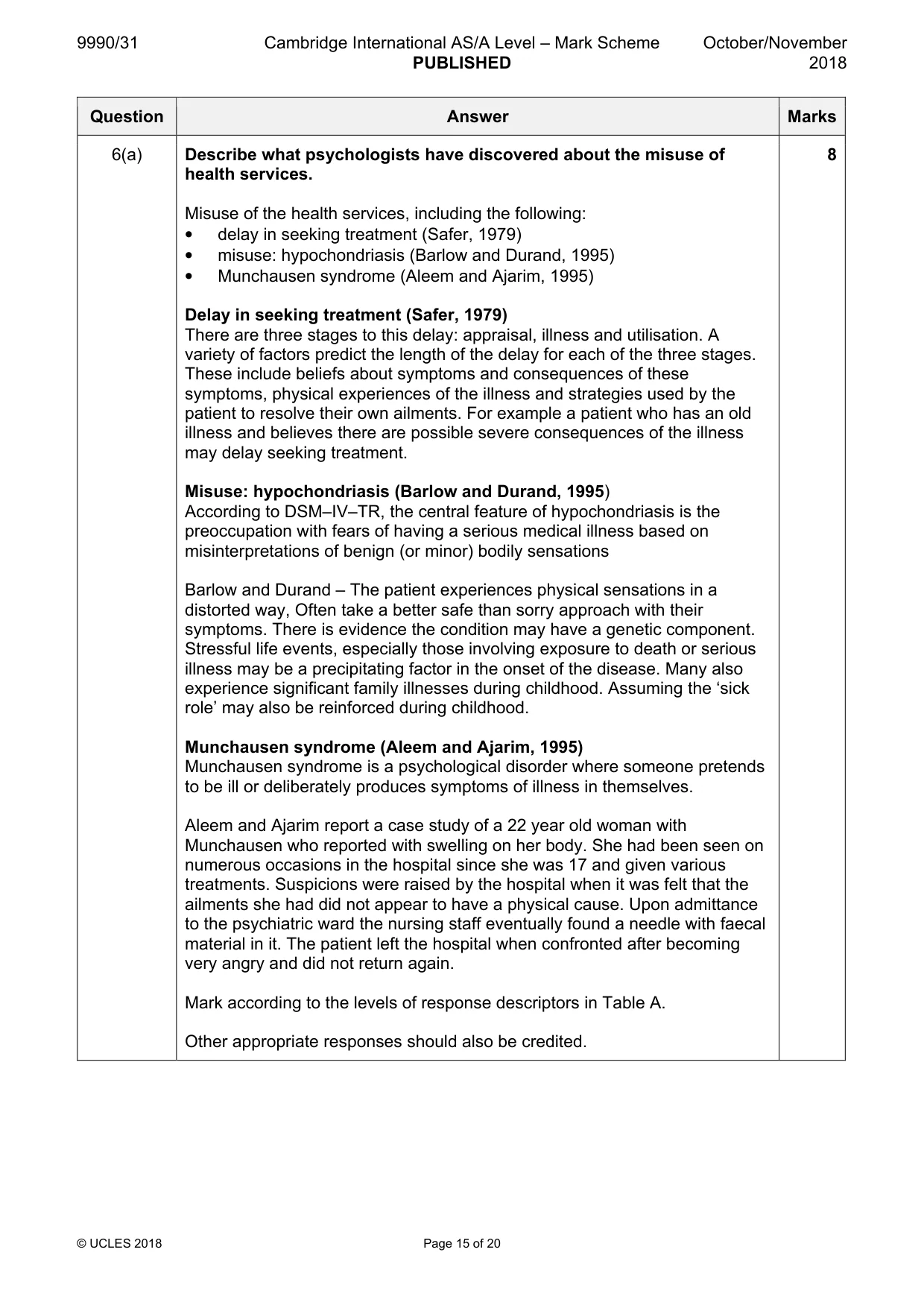
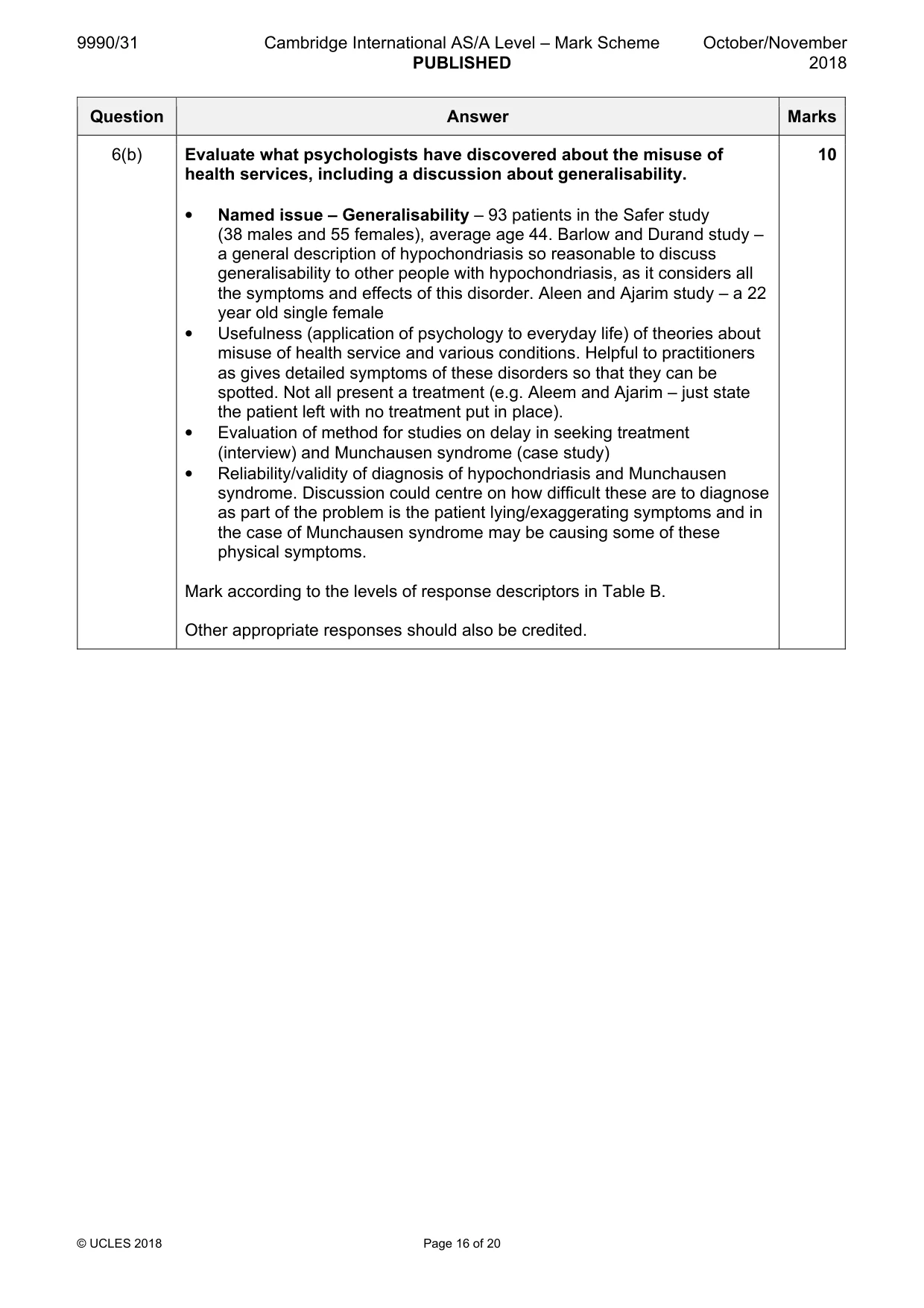
6 (a) Describe what psychologists have discovered about the misuse of health services. [8] (b) Evaluate what psychologists have discovered about the misuse of health services, including a discussion about generalisability. [10] Psychology and organisations Answer all questions.
Mark scheme: 6(a) Describe what psychologists have discovered about the misuse of 8 health services. Misuse of the health services, including the following: • delay in seeking treatment (Safer, 1979) • misuse: hypochondriasis (Barlow and Durand, 1995) • Munchausen syndrome (Aleem and Ajarim, 1995) Delay in seeking treatment (Safer, 1979) There are three stages to this delay: appraisal, illness and utilisation. A variety of factors predict the length of the delay for each of the three stages. These include beliefs about symptoms and consequences of these symptoms, physical experiences of the illness and strategies used by the patient to resolve their own ailments. For example a patient who has an old illness and believes there are possible severe consequences of the illness may delay seeking treatment. Misuse: hypochondriasis (Barlow and Durand, 1995) According to DSM–IV–TR, the central feature of hypochondriasis is the preoccupation with fears of having a serious medical illness based on misinterpretations of benign (or minor) bodily sensations Barlow and Durand – The patient experiences physical sensations in a distorted way, Often take a better safe than sorry approach with their symptoms. There is evidence the condition may have a genetic component. Stressful life events, especially those involving exposure to death or serious illness may be a precipitating factor in the onset of the disease. Many also experience significant family illnesses during childhood. Assuming the ‘sick role’ may also be reinforced during childhood. Munchausen syndrome (Aleem and Ajarim, 1995) Munchausen syndrome is a psychological disorder where someone pretends to be ill or deliberately produces symptoms of illness in themselves. Aleem and Ajarim report a case study of a 22 year old woman with Munchausen who reported with swelling on her body. She had been seen on numerous occasions in the hospital since she was 17 and given various treatments. Suspicions were raised by the hospital when it was felt that the ailments she had did not appear to have a physical cause. Upon admittance to the psychiatric ward the nursing staff eventually found a needle with faecal material in it. The patient left the hospital when confronted after becoming very angry and did not return again. Mark according to the levels of response descriptors in Table A. Other appropriate responses should also be credited. 6(b) Evaluate what psychologists have discovered about the misuse of 10 health services, including a discussion about generalisability. • Named issue – Generalisability – 93 patients in the Safer study (38 males and 55 females), average age 44. Barlow and Durand study – a general description of hypochondriasis so reasonable to discuss generalisability to other people with hypochondriasis, as it considers all the symptoms and effects of this disorder. Aleen and Ajarim study – a 22 year old single female • Usefulness (application of psychology to everyday life) of theories about misuse of health service and various conditions. Helpful to practitioners as gives detailed symptoms of these disorders so that they can be spotted. Not all present a treatment (e.g. Aleem and Ajarim – just state the patient left with no treatment put in place). • Evaluation of method for studies on delay in seeking treatment (interview) and Munchausen syndrome (case study) • Reliability/validity of diagnosis of hypochondriasis and Munchausen syndrome. Discussion could centre on how difficult these are to diagnose as part of the problem is the patient lying/exaggerating symptoms and in the case of Munchausen syndrome may be causing some of these physical symptoms. Mark according to the levels of response descriptors in Table B. Other appropriate responses should also be credited. Psychology and organisations
Q7 · Explain what is meant by ‘groupthink’
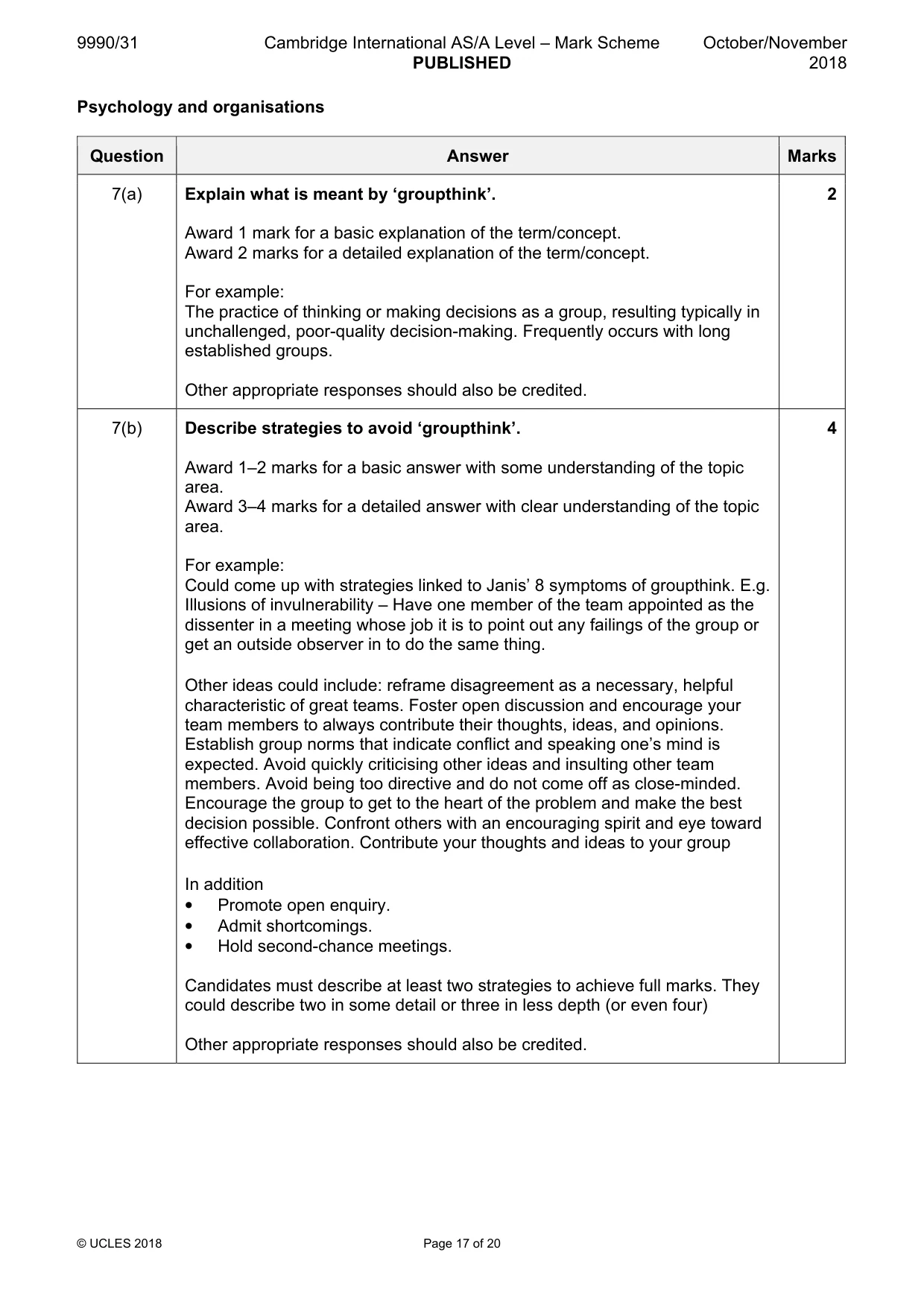
7 (a) Explain what is meant by ‘groupthink’. [2] (b) Describe strategies to avoid groupthink. [4] (c) Discuss the applications of these strategies to everyday life in organisations. [6]
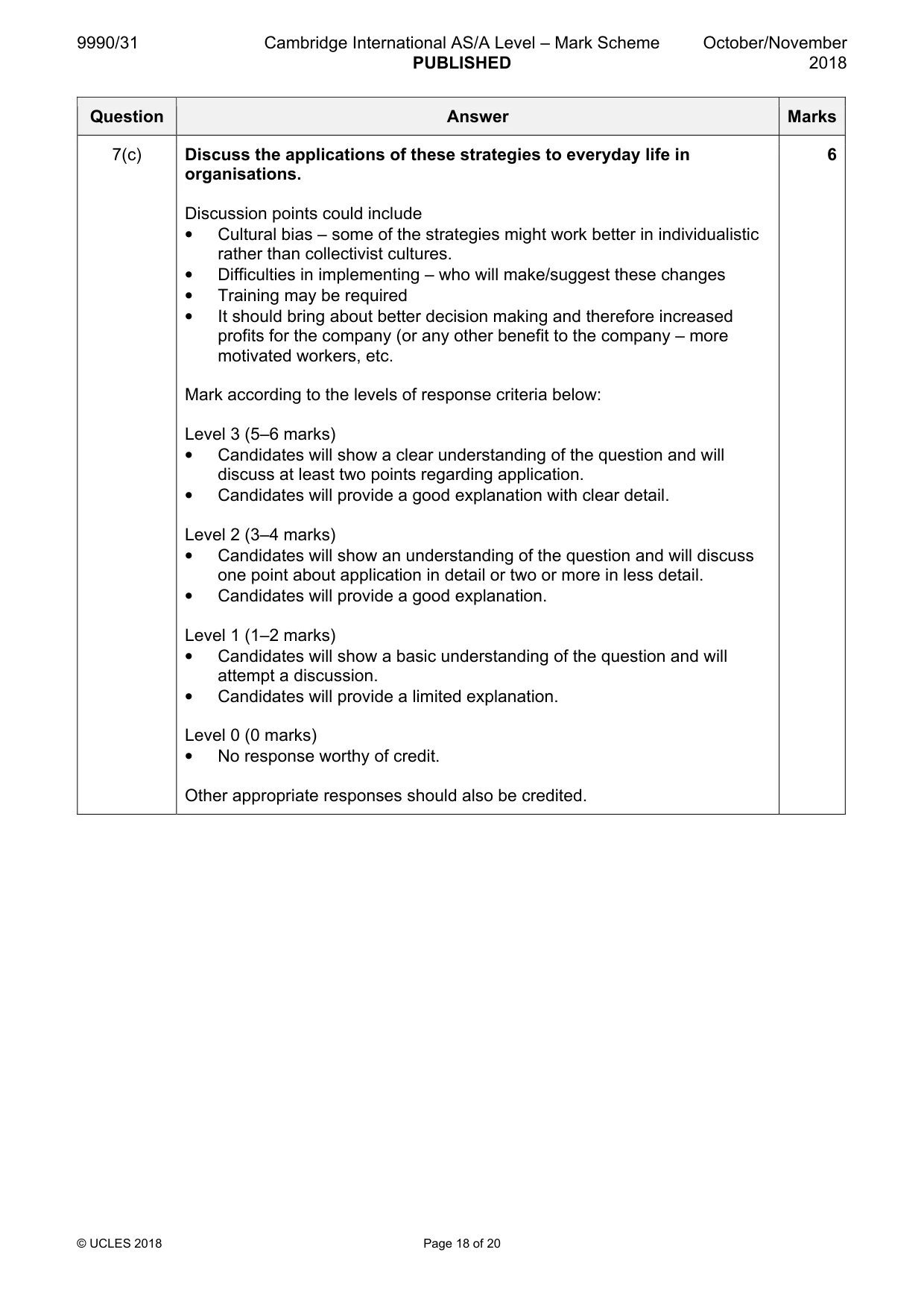
Mark scheme: 7(a) Explain what is meant by ‘groupthink’. 2 Award 1 mark for a basic explanation of the term/concept. Award 2 marks for a detailed explanation of the term/concept. For example: The practice of thinking or making decisions as a group, resulting typically in unchallenged, poor-quality decision-making. Frequently occurs with long established groups. Other appropriate responses should also be credited. 7(b) Describe strategies to avoid ‘groupthink’. 4 Award 1–2 marks for a basic answer with some understanding of the topic area. Award 3–4 marks for a detailed answer with clear understanding of the topic area. For example: Could come up with strategies linked to Janis’ 8 symptoms of groupthink. E.g. Illusions of invulnerability – Have one member of the team appointed as the dissenter in a meeting whose job it is to point out any failings of the group or get an outside observer in to do the same thing. Other ideas could include: reframe disagreement as a necessary, helpful characteristic of great teams. Foster open discussion and encourage your team members to always contribute their thoughts, ideas, and opinions. Establish group norms that indicate conflict and speaking one’s mind is expected. Avoid quickly criticising other ideas and insulting other team members. Avoid being too directive and do not come off as close-minded. Encourage the group to get to the heart of the problem and make the best decision possible. Confront others with an encouraging spirit and eye toward effective collaboration. Contribute your thoughts and ideas to your group In addition • Promote open enquiry. • Admit shortcomings. • Hold second-chance meetings. Candidates must describe at least two strategies to achieve full marks. They could describe two in some detail or three in less depth (or even four) Other appropriate responses should also be credited. 7(c) Discuss the applications of these strategies to everyday life in 6 organisations. Discussion points could include • Cultural bias – some of the strategies might work better in individualistic rather than collectivist cultures. • Difficulties in implementing – who will make/suggest these changes • Training may be required • It should bring about better decision making and therefore increased profits for the company (or any other benefit to the company – more motivated workers, etc. Mark according to the levels of response criteria below: Level 3 (5–6 marks) • Candidates will show a clear understanding of the question and will discuss at least two points regarding application. • Candidates will provide a good explanation with clear detail. Level 2 (3–4 marks) • Candidates will show an understanding of the question and will discuss one point about application in detail or two or more in less detail. • Candidates will provide a good explanation. Level 1 (1–2 marks) • Candidates will show a basic understanding of the question and will attempt a discussion. • Candidates will provide a limited explanation. Level 0 (0 marks) • No response worthy of credit. Other appropriate responses should also be credited.
Q8 · Describe what psychologists have discovered about health and safety in the working…
8 (a) Describe what psychologists have discovered about health and safety in the working environment. [8] (b) Evaluate what psychologists have discovered about health and safety in the working environment, including a discussion about qualitative and quantitative data. [10]
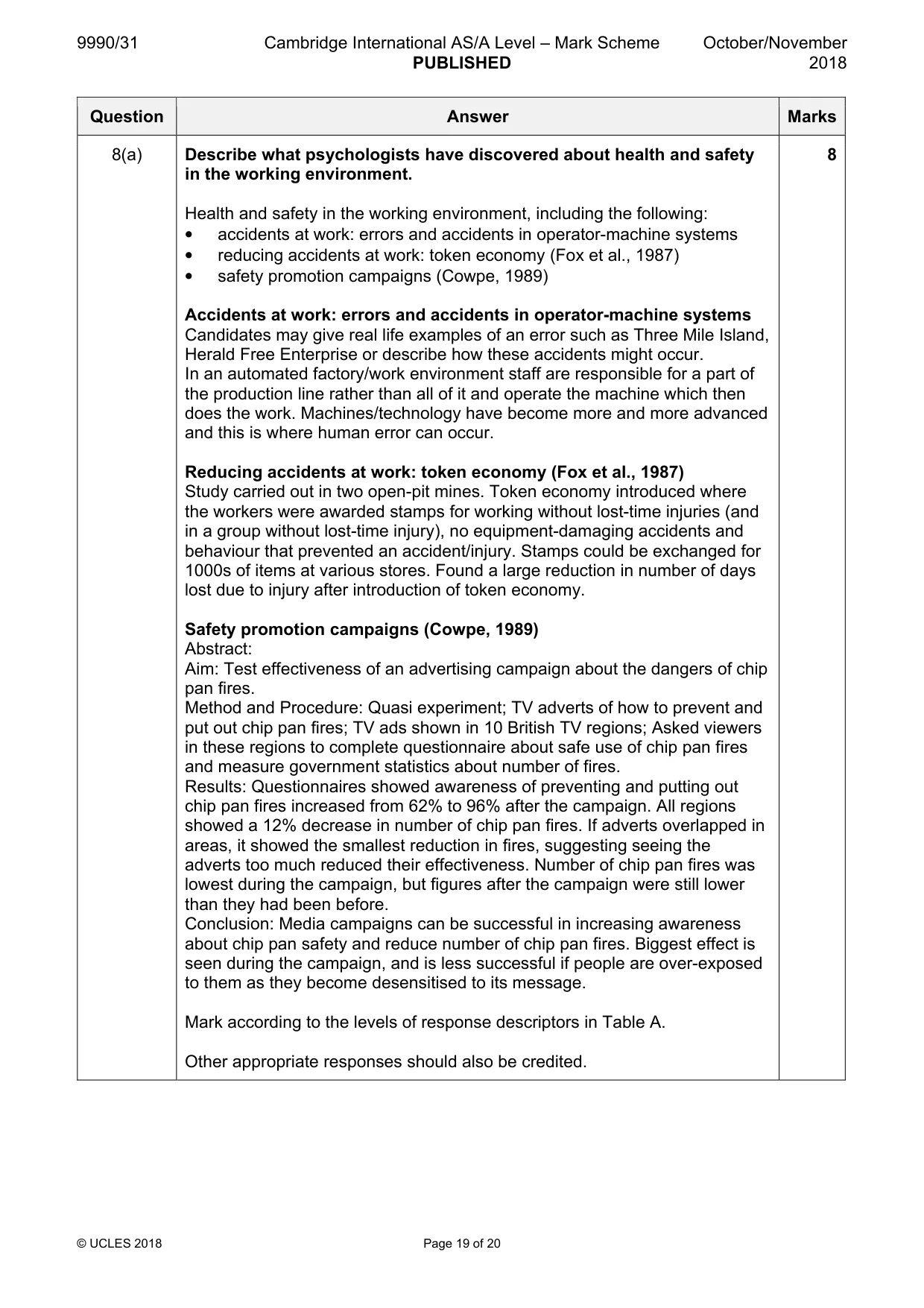
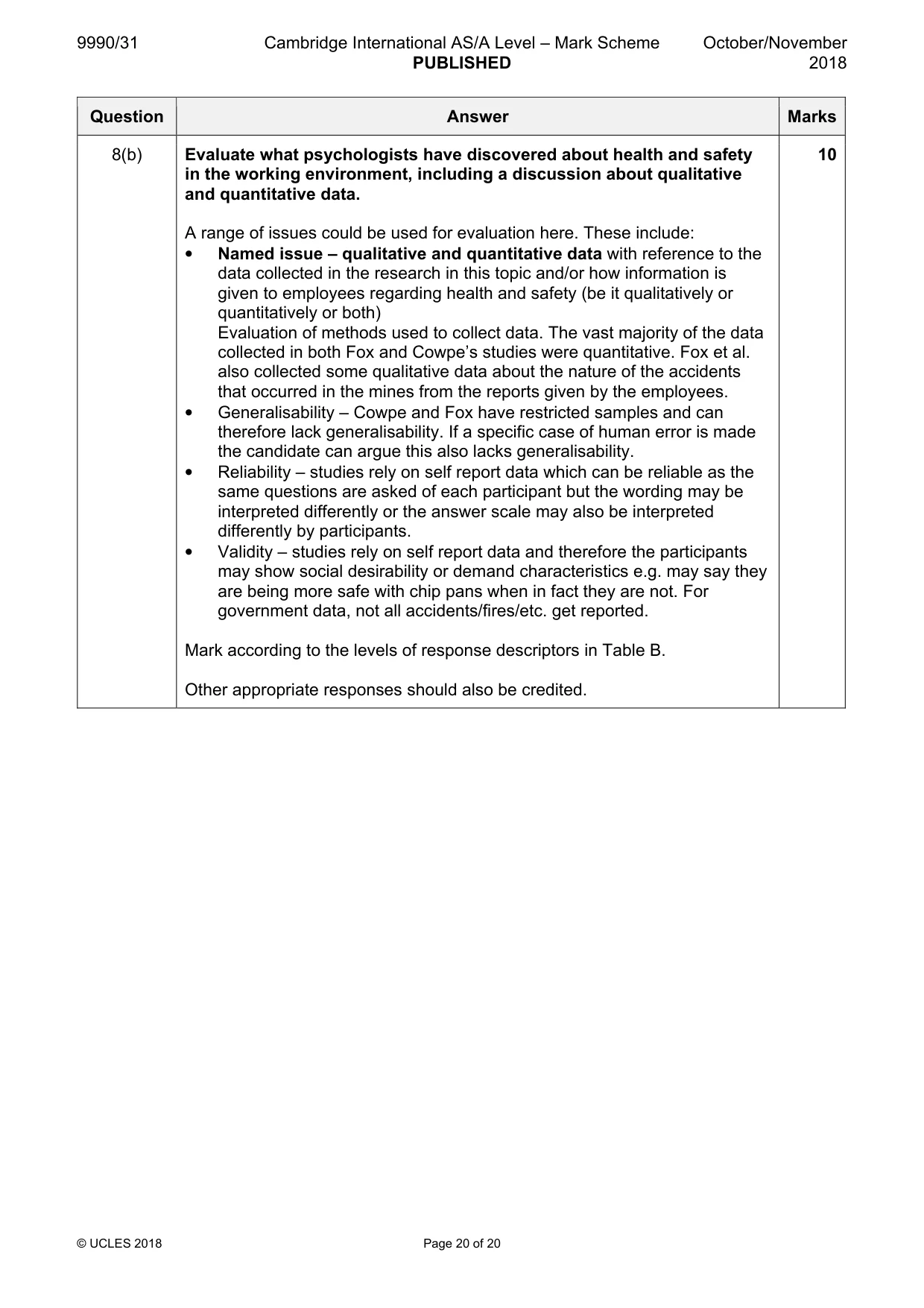
Mark scheme: 8(a) Describe what psychologists have discovered about health and safety 8 in the working environment. Health and safety in the working environment, including the following: • accidents at work: errors and accidents in operator-machine systems • reducing accidents at work: token economy (Fox et al., 1987) • safety promotion campaigns (Cowpe, 1989) Accidents at work: errors and accidents in operator-machine systems Candidates may give real life examples of an error such as Three Mile Island, Herald Free Enterprise or describe how these accidents might occur. In an automated factory/work environment staff are responsible for a part of the production line rather than all of it and operate the machine which then does the work. Machines/technology have become more and more advanced and this is where human error can occur. Reducing accidents at work: token economy (Fox et al., 1987) Study carried out in two open-pit mines. Token economy introduced where the workers were awarded stamps for working without lost-time injuries (and in a group without lost-time injury), no equipment-damaging accidents and behaviour that prevented an accident/injury. Stamps could be exchanged for 1000s of items at various stores. Found a large reduction in number of days lost due to injury after introduction of token economy. Safety promotion campaigns (Cowpe, 1989) Abstract: Aim: Test effectiveness of an advertising campaign about the dangers of chip pan fires. Method and Procedure: Quasi experiment; TV adverts of how to prevent and put out chip pan fires; TV ads shown in 10 British TV regions; Asked viewers in these regions to complete questionnaire about safe use of chip pan fires and measure government statistics about number of fires. Results: Questionnaires showed awareness of preventing and putting out chip pan fires increased from 62% to 96% after the campaign. All regions showed a 12% decrease in number of chip pan fires. If adverts overlapped in areas, it showed the smallest reduction in fires, suggesting seeing the adverts too much reduced their effectiveness. Number of chip pan fires was lowest during the campaign, but figures after the campaign were still lower than they had been before. Conclusion: Media campaigns can be successful in increasing awareness about chip pan safety and reduce number of chip pan fires. Biggest effect is seen during the campaign, and is less successful if people are over-exposed to them as they become desensitised to its message. Mark according to the levels of response descriptors in Table A. Other appropriate responses should also be credited. 8(b) Evaluate what psychologists have discovered about health and safety 10 in the working environment, including a discussion about qualitative and quantitative data. A range of issues could be used for evaluation here. These include: • Named issue – qualitative and quantitative data with reference to the data collected in the research in this topic and/or how information is given to employees regarding health and safety (be it qualitatively or quantitatively or both) Evaluation of methods used to collect data. The vast majority of the data collected in both Fox and Cowpe’s studies were quantitative. Fox et al. also collected some qualitative data about the nature of the accidents that occurred in the mines from the reports given by the employees. • Generalisability – Cowpe and Fox have restricted samples and can therefore lack generalisability. If a specific case of human error is made the candidate can argue this also lacks generalisability. • Reliability – studies rely on self report data which can be reliable as the same questions are asked of each participant but the wording may be interpreted differently or the answer scale may also be interpreted differently by participants. • Validity – studies rely on self report data and therefore the participants may show social desirability or demand characteristics e.g. may say they are being more safe with chip pans when in fact they are not. For government data, not all accidents/fires/etc. get reported. Mark according to the levels of response descriptors in Table B. Other appropriate responses should also be credited.
What was in this paper
The subtopics covered by these 8 questions, and how many questions each got. Open one in a new tab to see every Cambridge question on it.
What you needed in this session
Cambridge’s own grade thresholds for 2018 Oct/Nov, Paper 3 · Variant 1. A higher threshold means an easier paper — the bar moves with how the cohort did.