Cambridge A Level Psychology (from 2018) 9990 — 2025 Oct/Nov Paper 3 · Variant 1
9990/31/O/N/25 · 16 questions · 120 marks · 90 min
The question paper and its mark scheme, free to read here and free to download. This is Cambridge’s own paper, exactly as it was sat.
Question paper8 pages
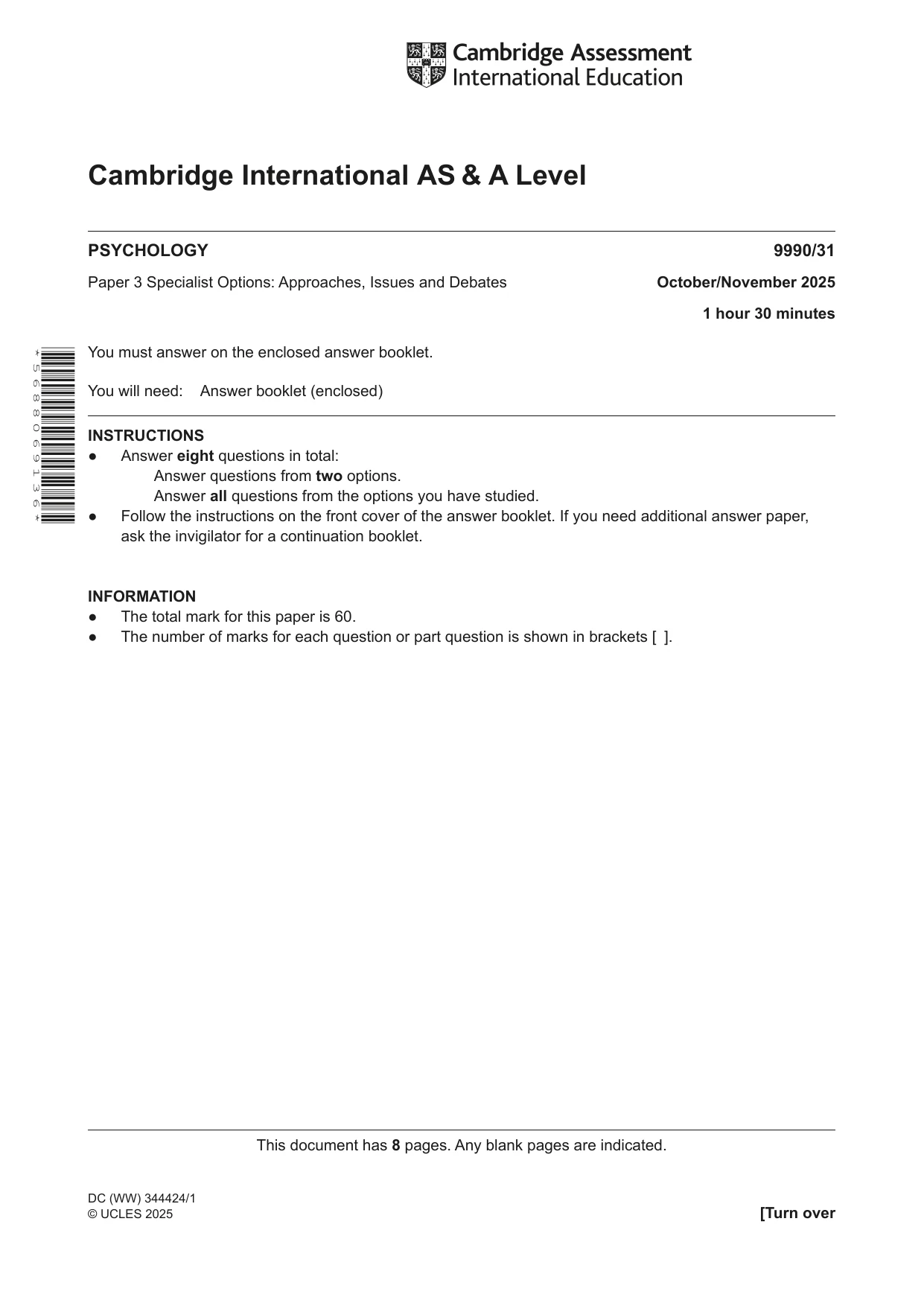
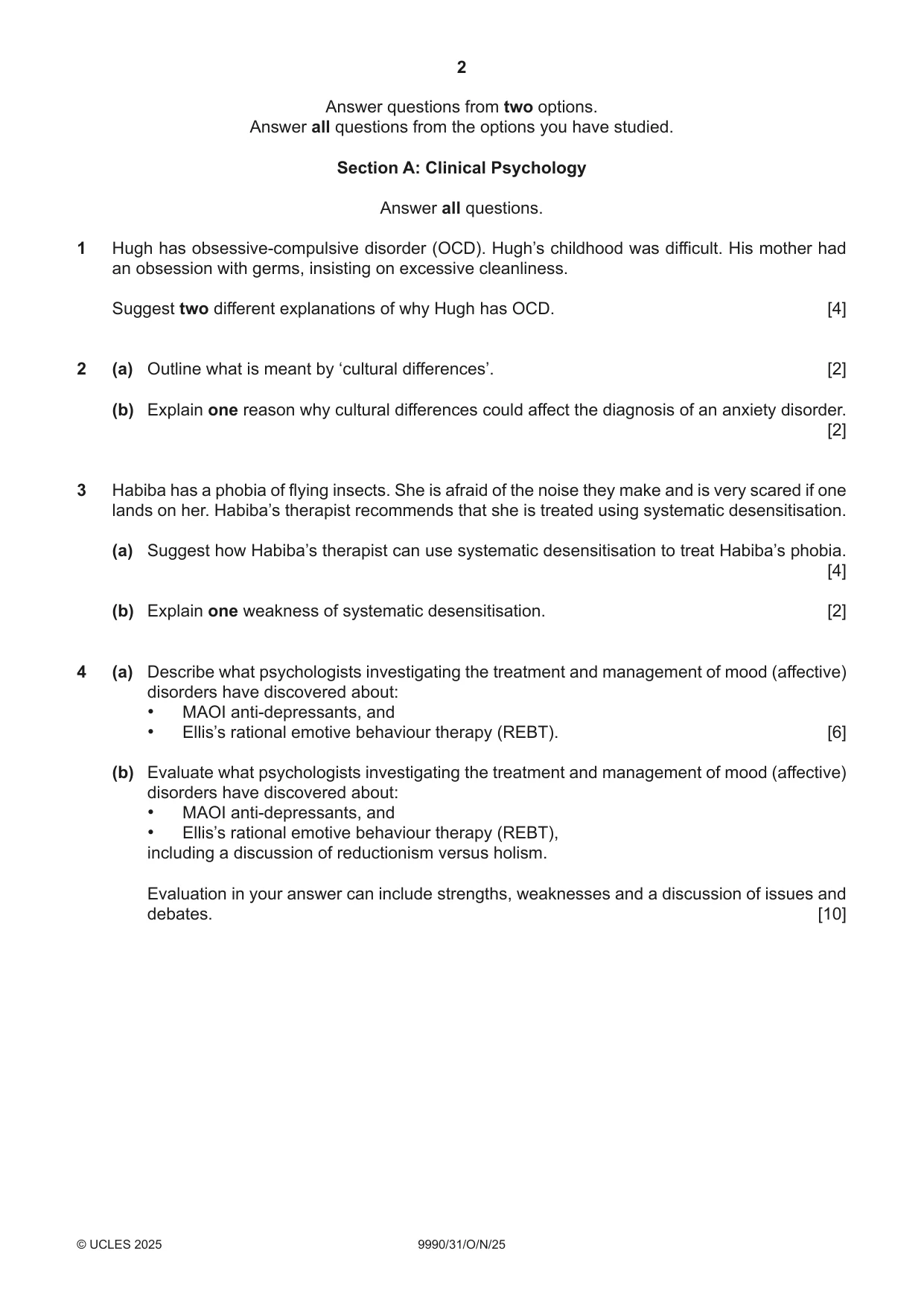
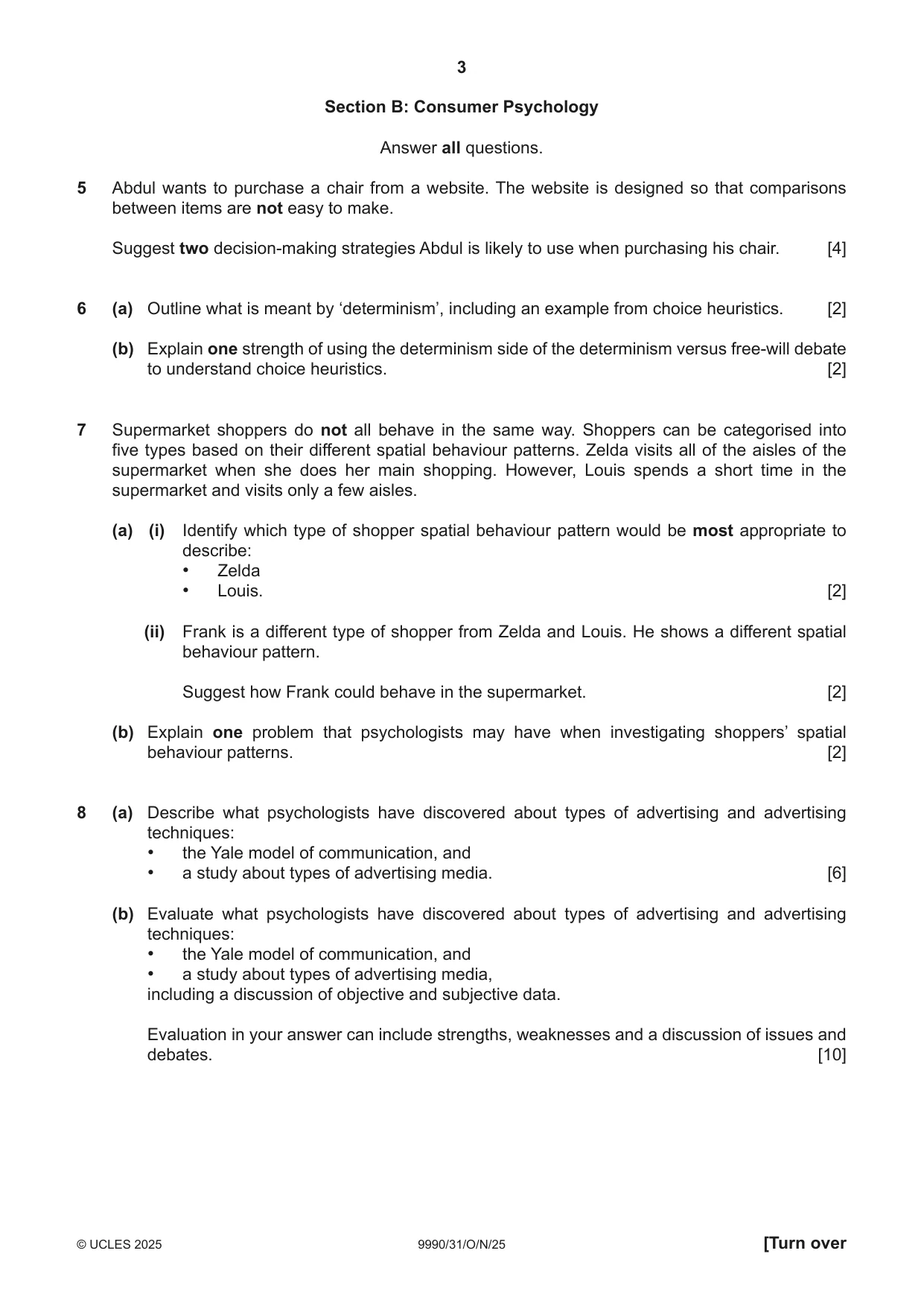
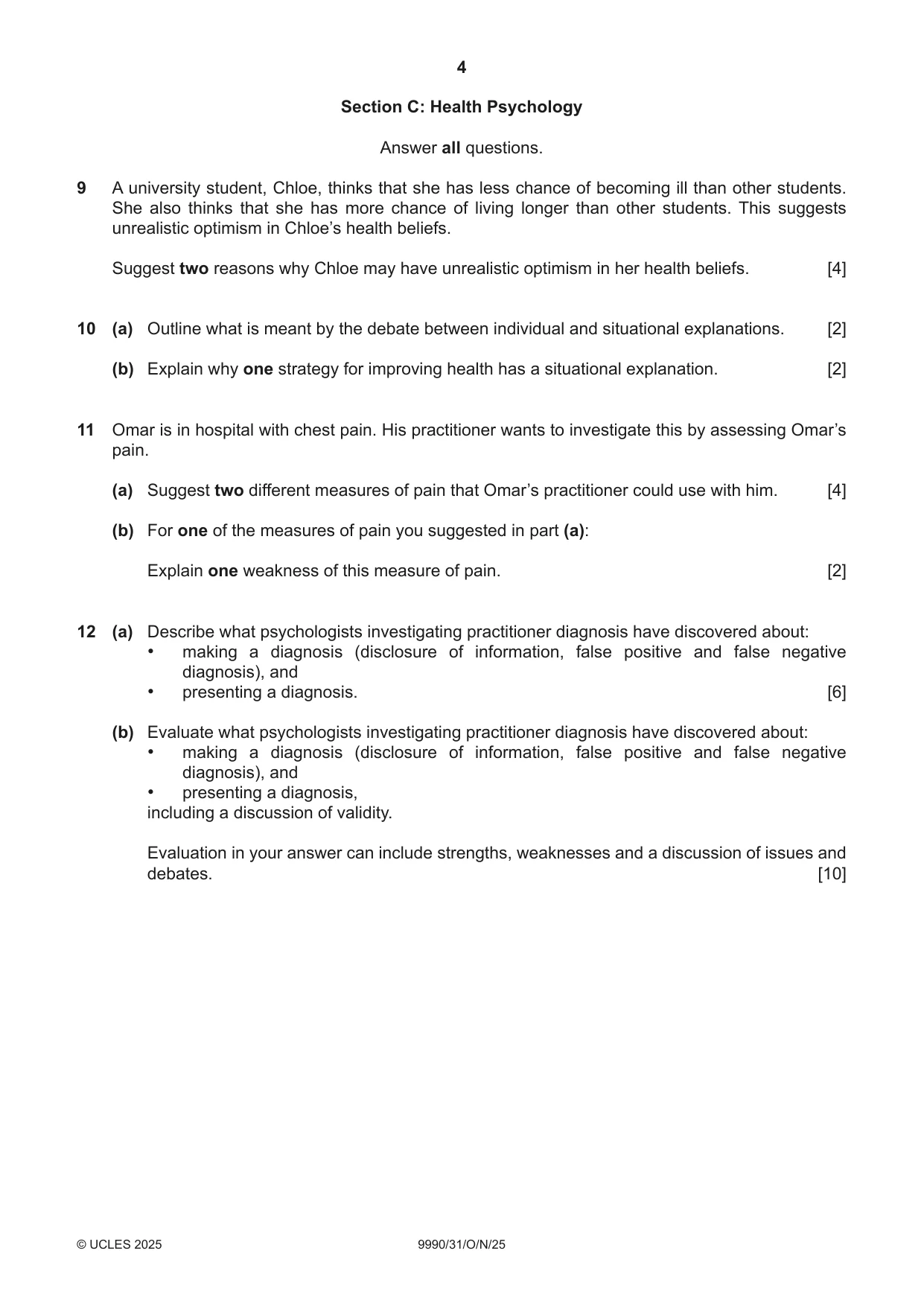



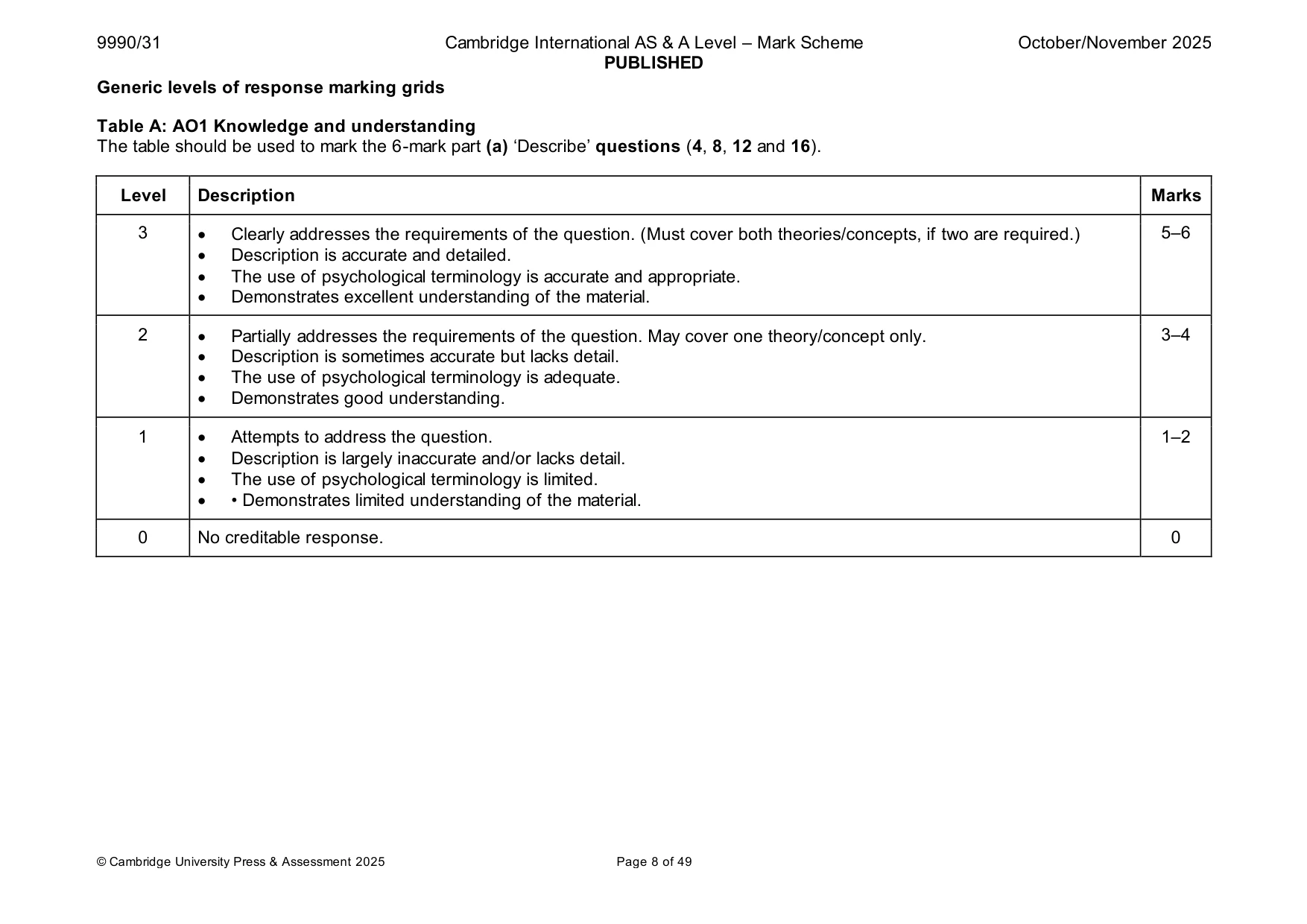
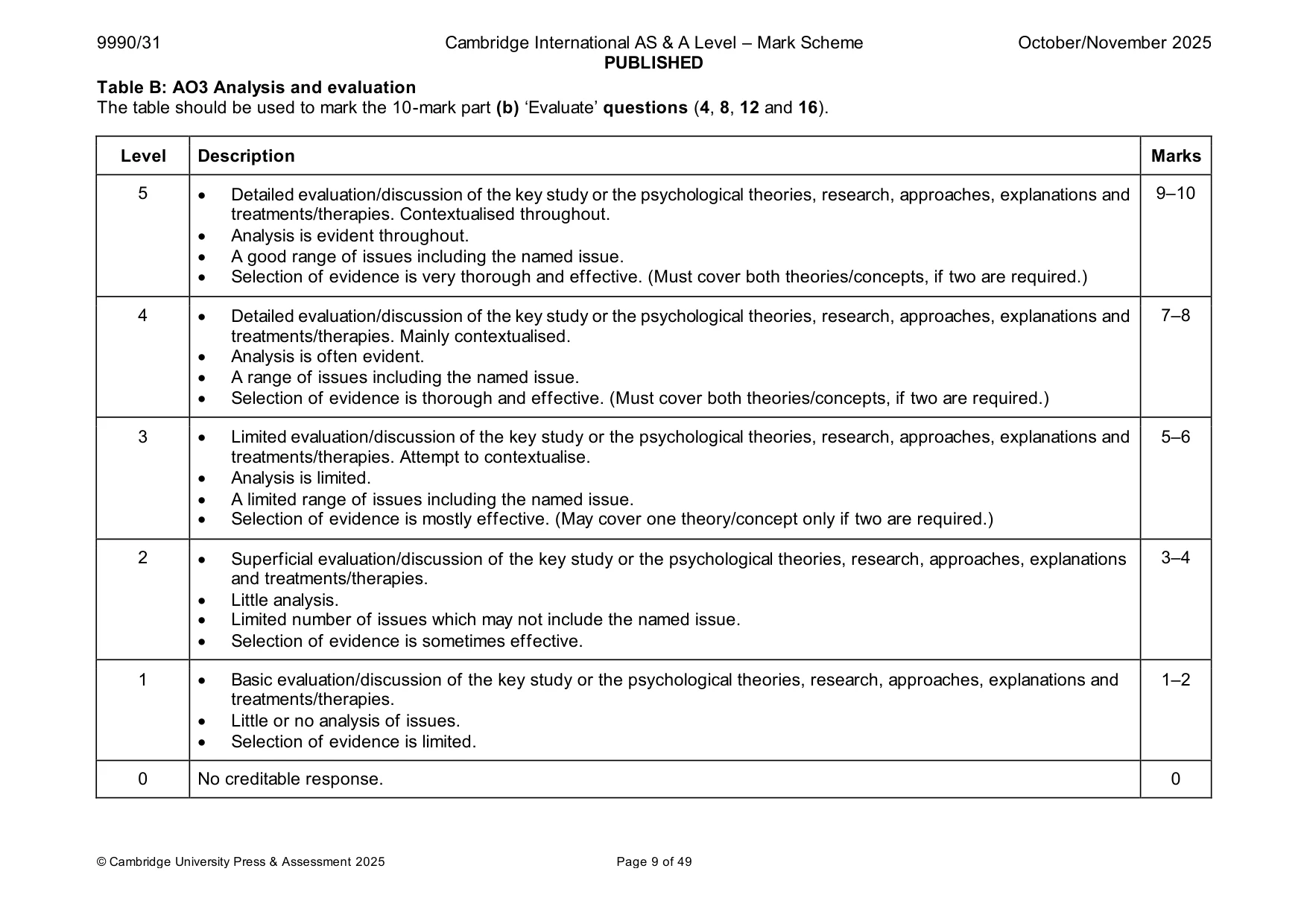
Mark scheme49 pages
Answers below. Sit the paper first if you are practising.






Questions as text
Q1 · Hugh has obsessive‑compulsive disorder (OCD)
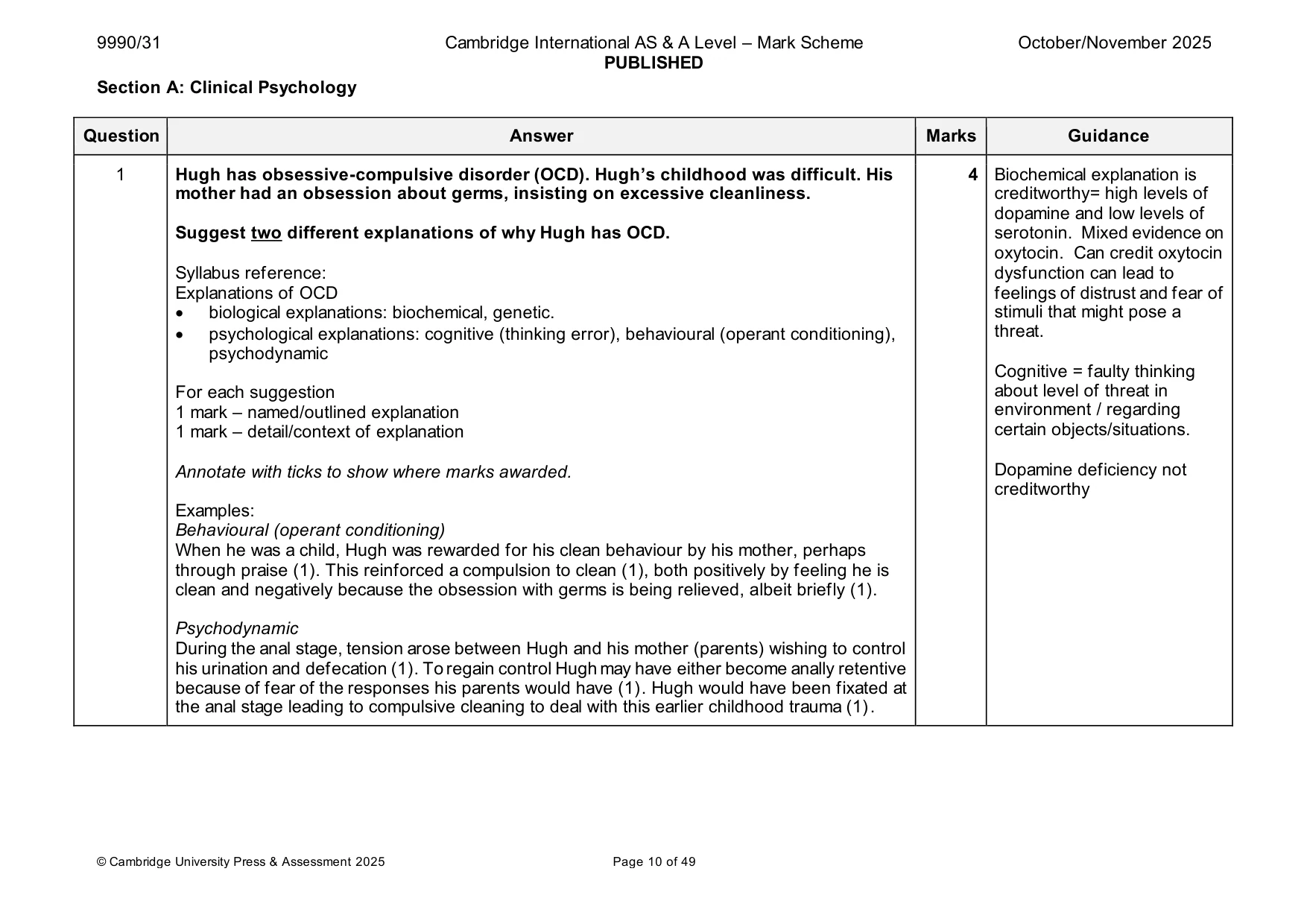
1 Hugh has obsessive‑compulsive disorder (OCD). Hugh’s childhood was difficult. His mother had an obsession with germs, insisting on excessive cleanliness. Suggest two different explanations of why Hugh has OCD. [4]
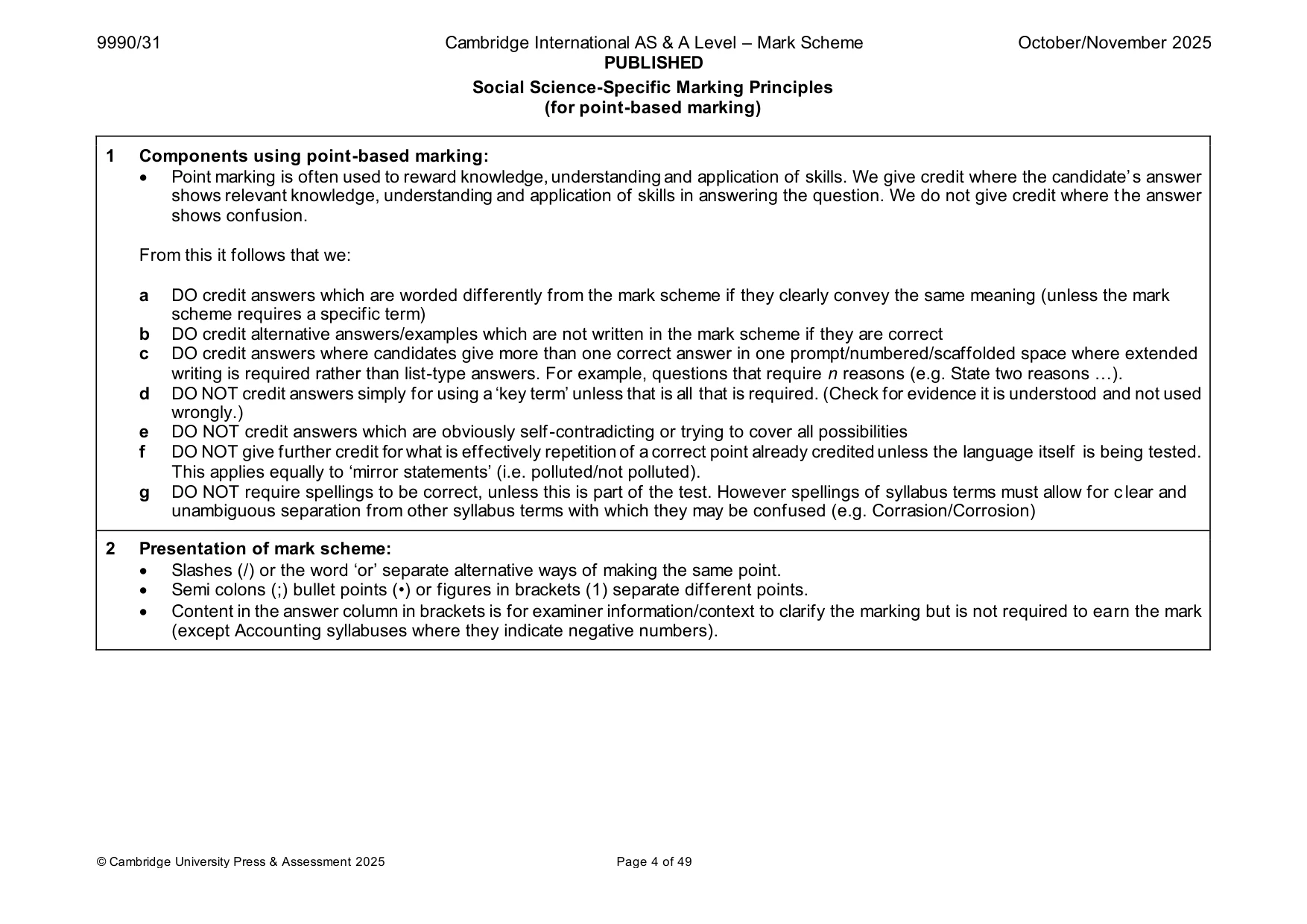
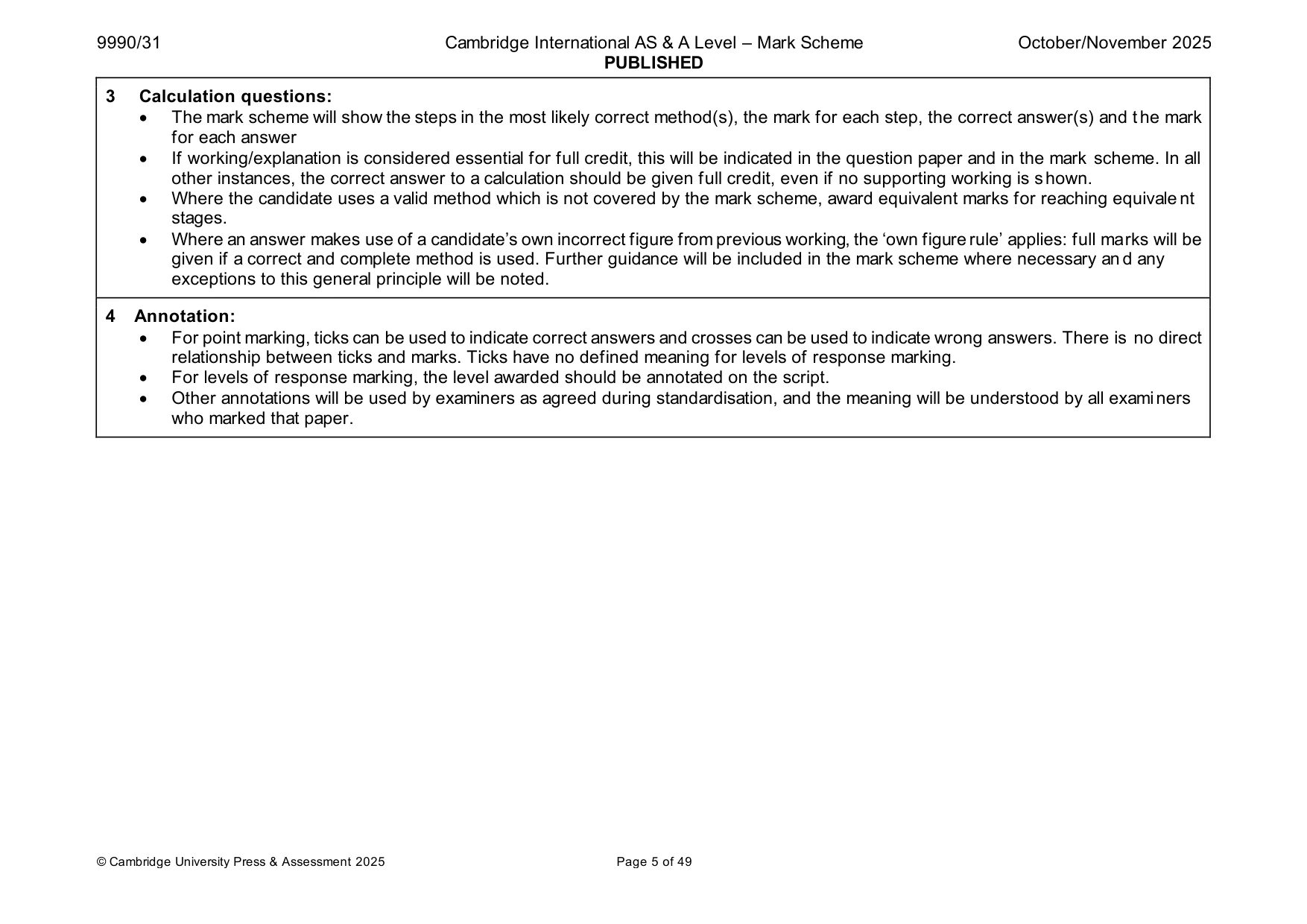
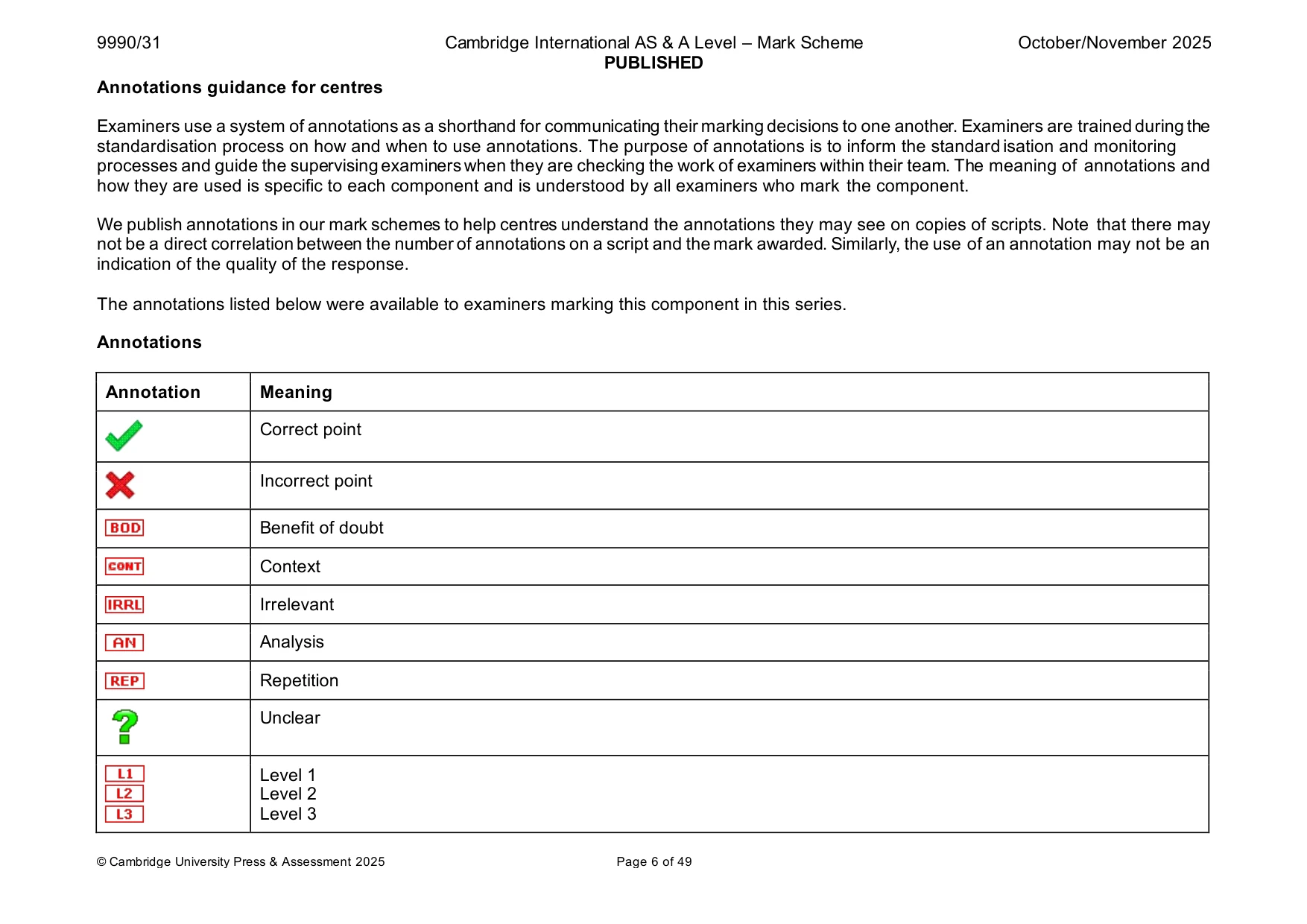
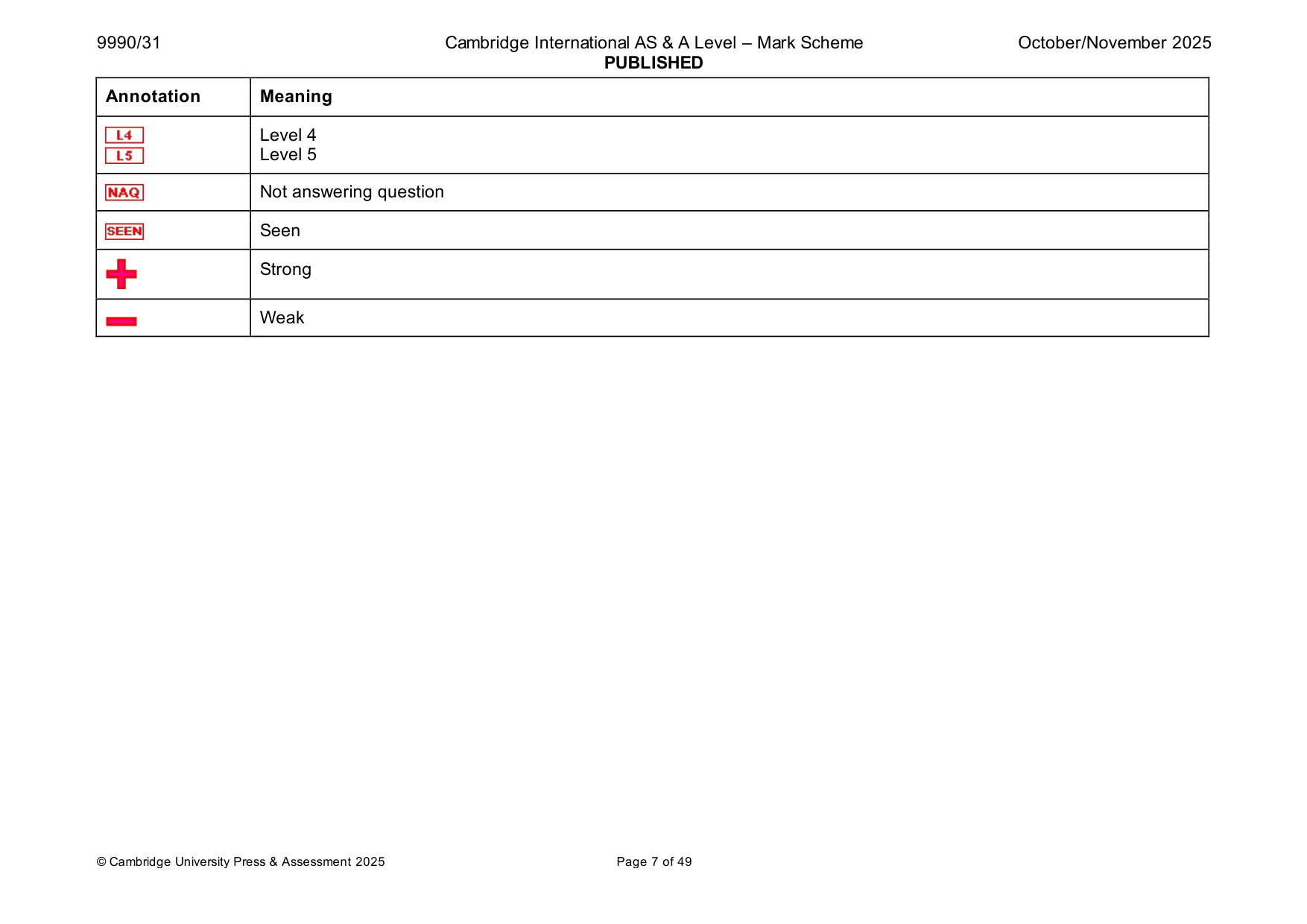
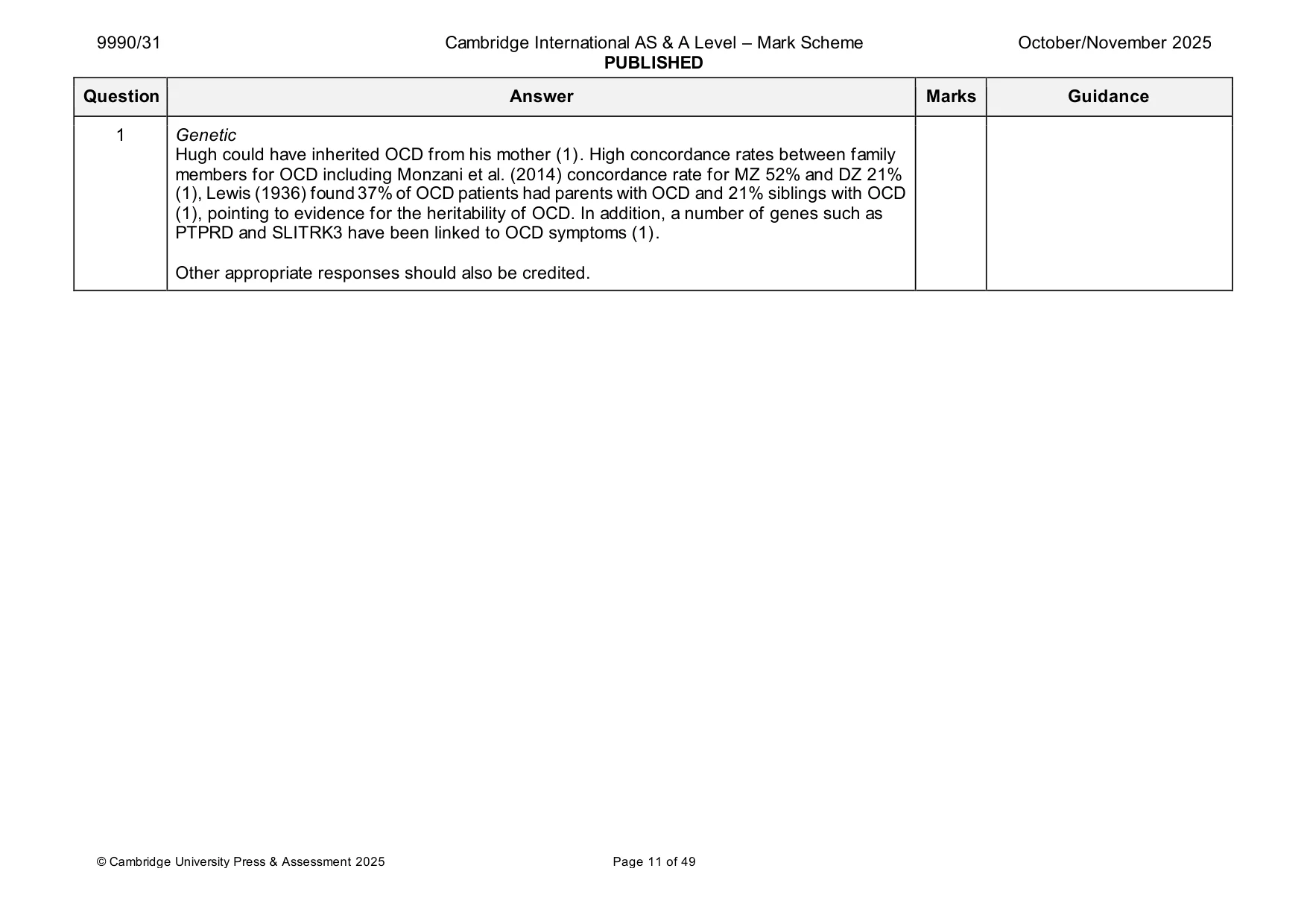
Mark scheme: Question Answer Marks Guidance 1 Hugh has obsessive-compulsive disorder (OCD). Hugh’s childhood was difficult. His 4 Biochemical explanation is mother had an obsession about germs, insisting on excessive cleanliness. creditworthy= high levels of dopamine and low levels of Suggest two different explanations of why Hugh has OCD. serotonin. Mixed evidence on oxytocin. Can credit oxytocin Syllabus reference: dysfunction can lead to Explanations of OCD feelings of distrust and fear of • biological explanations: biochemical, genetic. stimuli that might pose a • psychological explanations: cognitive (thinking error), behavioural (operant conditioning), threat. psychodynamic Cognitive = faulty thinking For each suggestion about level of threat in 1 mark – named/outlined explanation environment / regarding 1 mark – detail/context of explanation certain objects/situations. Annotate with ticks to show where marks awarded. Dopamine deficiency not creditworthy Examples: Behavioural (operant conditioning) When he was a child, Hugh was rewarded for his clean behaviour by his mother, perhaps through praise (1). This reinforced a compulsion to clean (1), both positively by feeling he is clean and negatively because the obsession with germs is being relieved, albeit briefly (1). Psychodynamic During the anal stage, tension arose between Hugh and his mother (parents) wishing to control his urination and defecation (1). To regain control Hugh may have either become anally retentive because of fear of the responses his parents would have (1). Hugh would have been fixated at the anal stage leading to compulsive cleaning to deal with this earlier childhood trauma (1). 1 Genetic Hugh could have inherited OCD from his mother (1). High concordance rates between family members for OCD including Monzani et al. (2014) concordance rate for MZ 52% and DZ 21% (1), Lewis (1936) found 37% of OCD patients had parents with OCD and 21% siblings with OCD (1), pointing to evidence for the heritability of OCD. In addition, a number of genes such as PTPRD and SLITRK3 have been linked to OCD symptoms (1). Other appropriate responses should also be credited.
Q2 · Outline what is meant by ‘cultural differences’
2 (a) Outline what is meant by ‘cultural differences’. [2] (b) Explain one reason why cultural differences could affect the diagnosis of an anxiety disorder. [2]
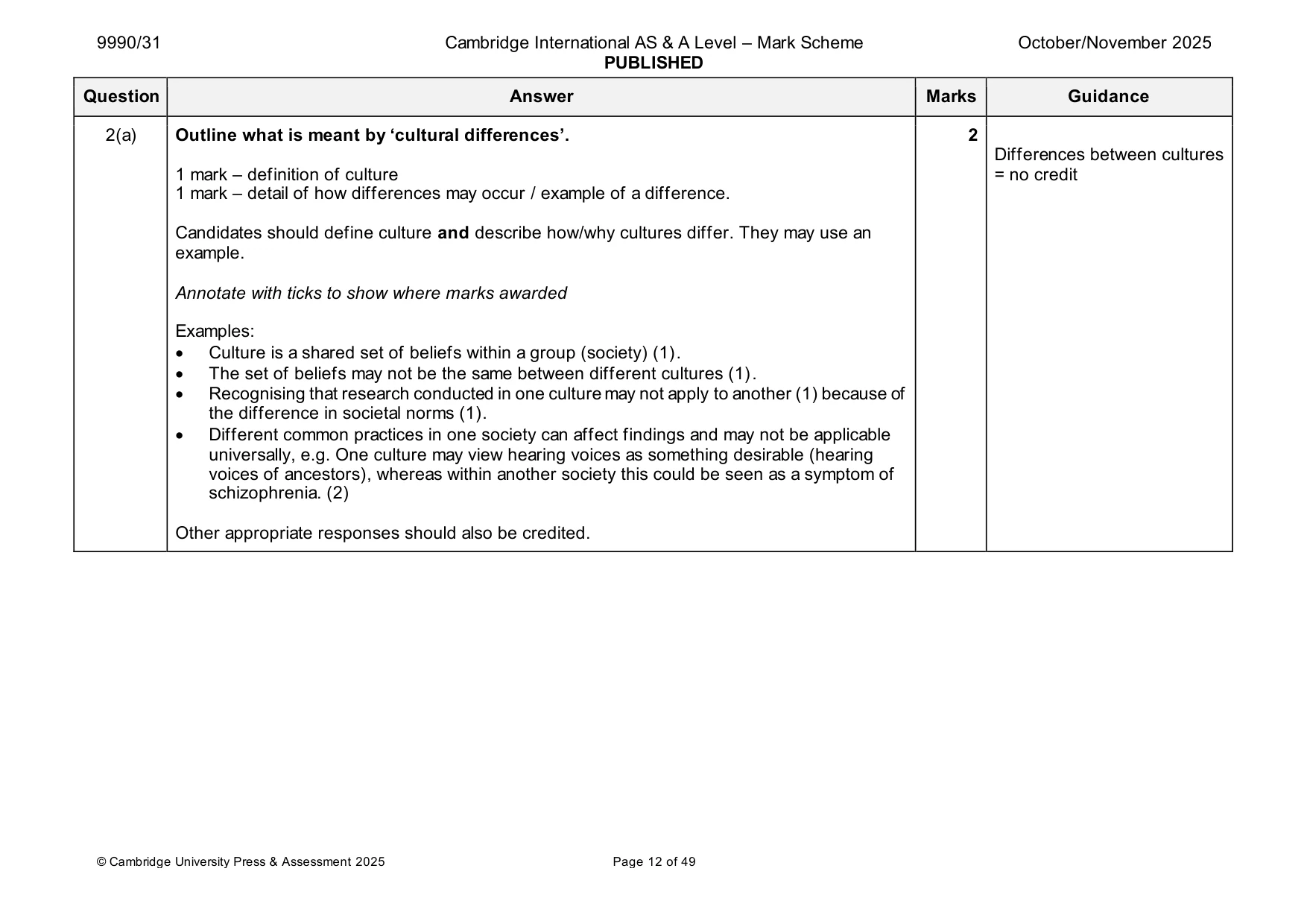
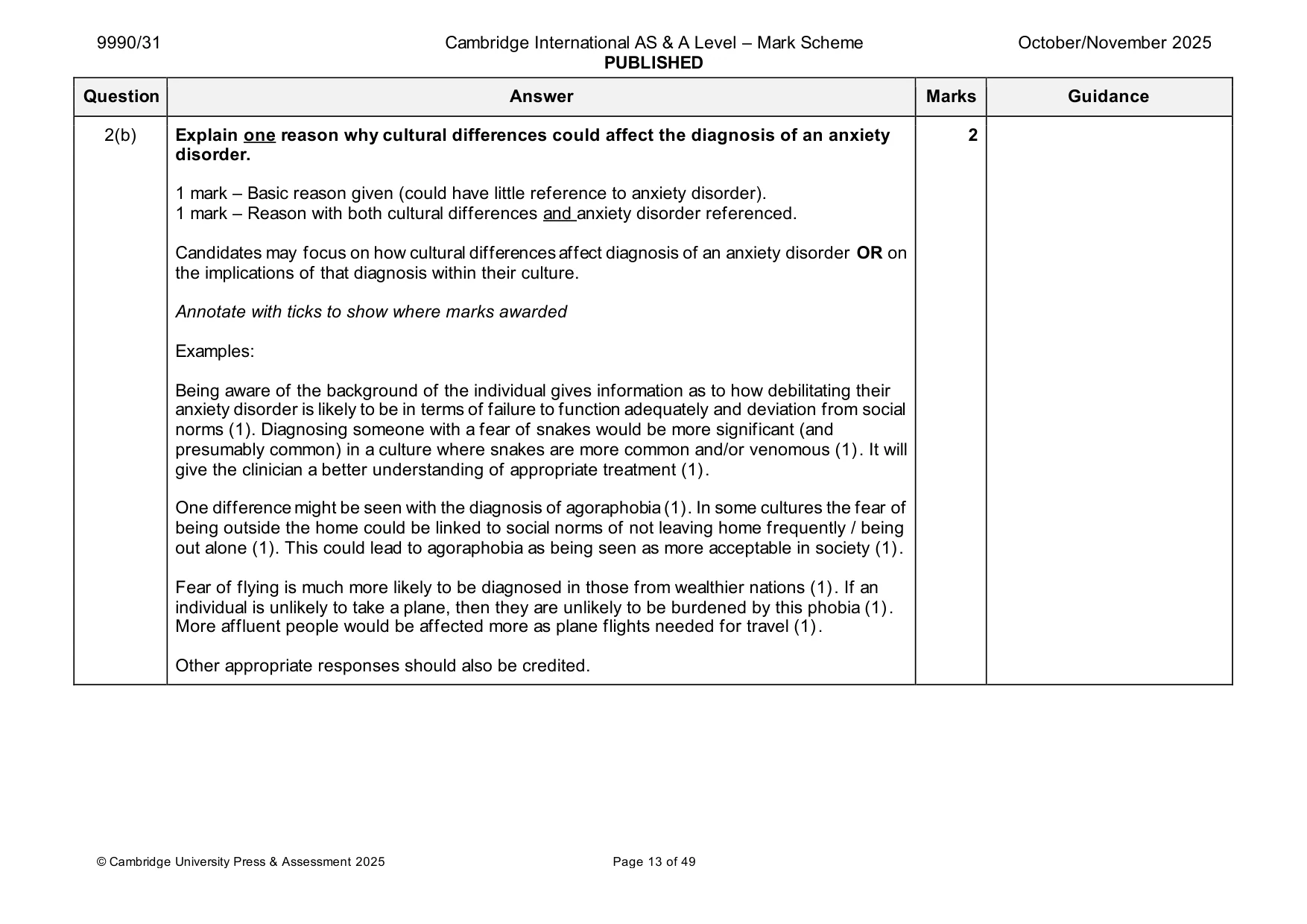
Mark scheme: 2(a) Outline what is meant by ‘cultural differences’. 2 Differences between cultures 1 mark – definition of culture = no credit 1 mark – detail of how differences may occur / example of a difference. Candidates should define culture and describe how/why cultures differ. They may use an example. Annotate with ticks to show where marks awarded Examples: • Culture is a shared set of beliefs within a group (society) (1). • The set of beliefs may not be the same between different cultures (1). • Recognising that research conducted in one culture may not apply to another (1) because of the difference in societal norms (1). • Different common practices in one society can affect findings and may not be applicable universally, e.g. One culture may view hearing voices as something desirable (hearing voices of ancestors), whereas within another society this could be seen as a symptom of schizophrenia. (2) Other appropriate responses should also be credited. 2(b) Explain one reason why cultural differences could affect the diagnosis of an anxiety 2 disorder. 1 mark – Basic reason given (could have little reference to anxiety disorder). 1 mark – Reason with both cultural differences and anxiety disorder referenced. Candidates may focus on how cultural differences affect diagnosis of an anxiety disorder OR on the implications of that diagnosis within their culture. Annotate with ticks to show where marks awarded Examples: Being aware of the background of the individual gives information as to how debilitating their anxiety disorder is likely to be in terms of failure to function adequately and deviation from social norms (1). Diagnosing someone with a fear of snakes would be more significant (and presumably common) in a culture where snakes are more common and/or venomous (1). It will give the clinician a better understanding of appropriate treatment (1). One difference might be seen with the diagnosis of agoraphobia (1). In some cultures the fear of being outside the home could be linked to social norms of not leaving home frequently / being out alone (1). This could lead to agoraphobia as being seen as more acceptable in society (1). Fear of flying is much more likely to be diagnosed in those from wealthier nations (1). If an individual is unlikely to take a plane, then they are unlikely to be burdened by this phobia (1). More affluent people would be affected more as plane flights needed for travel (1). Other appropriate responses should also be credited.
Q3 · Habiba has a phobia of flying insects
3 Habiba has a phobia of flying insects. She is afraid of the noise they make and is very scared if one lands on her. Habiba’s therapist recommends that she is treated using systematic desensitisation. (a) Suggest how Habiba’s therapist can use systematic desensitisation to treat Habiba’s phobia. [4] (b) Explain one weakness of systematic desensitisation. [2]
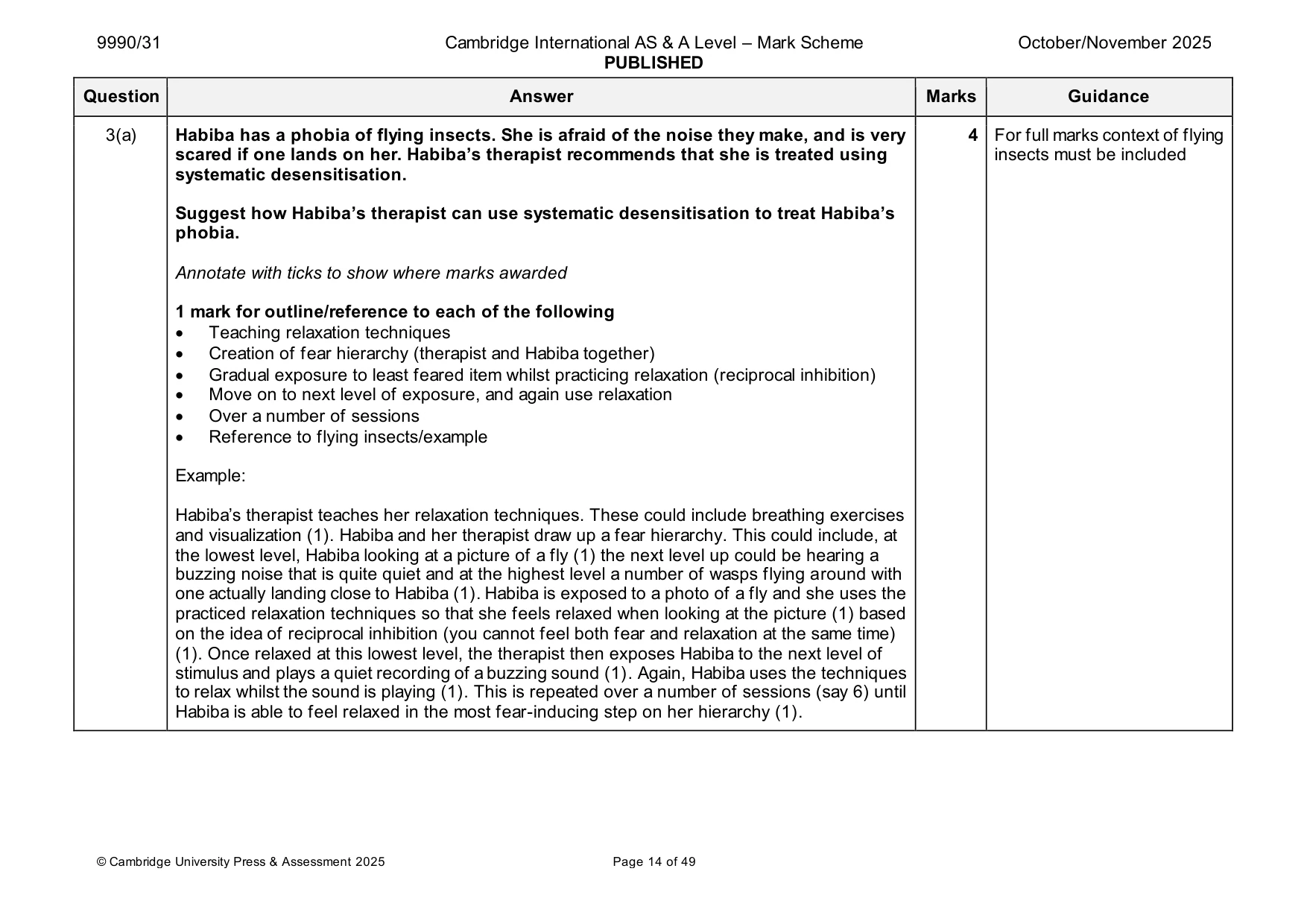
Mark scheme: 3(a) Habiba has a phobia of flying insects. She is afraid of the noise they make, and is very 4 For full marks context of flying scared if one lands on her. Habiba’s therapist recommends that she is treated using insects must be included systematic desensitisation. Suggest how Habiba’s therapist can use systematic desensitisation to treat Habiba’s phobia. Annotate with ticks to show where marks awarded 1 mark for outline/reference to each of the following • Teaching relaxation techniques • Creation of fear hierarchy (therapist and Habiba together) • Gradual exposure to least feared item whilst practicing relaxation (reciprocal inhibition) • Move on to next level of exposure, and again use relaxation • Over a number of sessions • Reference to flying insects/example Example: Habiba’s therapist teaches her relaxation techniques. These could include breathing exercises and visualization (1). Habiba and her therapist draw up a fear hierarchy. This could include, at the lowest level, Habiba looking at a picture of a fly (1) the next level up could be hearing a buzzing noise that is quite quiet and at the highest level a number of wasps flying around with one actually landing close to Habiba (1). Habiba is exposed to a photo of a fly and she uses the practiced relaxation techniques so that she feels relaxed when looking at the picture (1) based on the idea of reciprocal inhibition (you cannot feel both fear and relaxation at the same time) (1). Once relaxed at this lowest level, the therapist then exposes Habiba to the next level of stimulus and plays a quiet recording of a buzzing sound (1). Again, Habiba uses the techniques to relax whilst the sound is playing (1). This is repeated over a number of sessions (say 6) until Habiba is able to feel relaxed in the most fear-inducing step on her hierarchy (1). 3(b) Explain one weakness of systematic desensitisation. 2 Unethical – not creditworthy. 1 mark – basic weakness (could be true for other therapies) 2 marks – detailed weakness that references systematic desensitisation. Annotate with ticks to show where marks awarded Likely weakness from: • Requires the intervention of a therapist, which could make it difficult to obtain and/or costly • Takes place over several sessions and this requires commitment on behalf of patient • Patient may need to travel for treatment • Not suitable for some phobias • Treatment can be traumatic as involves exposure to feared stimulus – therefore the patient may stop treatment. Example: One weakness of using systematic desensitisation is that it requires commitment on the part of the patient because it usually takes place over a number of sessions (1). Sometimes patients do not have the financial resources or motivation to attend all of their sessions (1). Therapy is challenging as it means the patient has to confront their phobia and be exposed to it (1) as a result the therapy is not likely to be so successful as it hasn’t been completed (1). Other appropriate responses should also be credited.
More questions on Anxiety disorders and fear-related disorders
Q4 · Describe what psychologists investigating the treatment and management of mood…
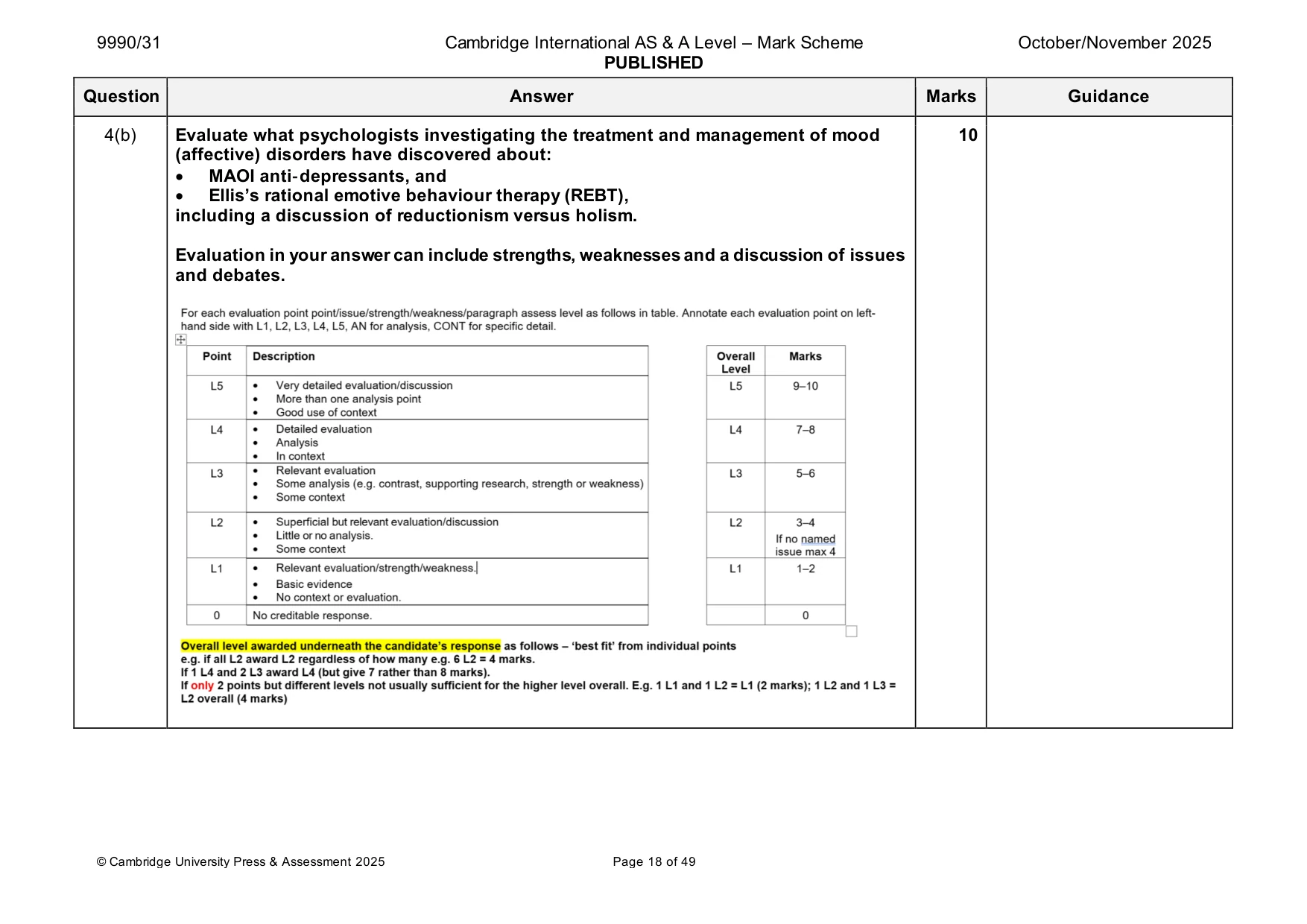
4 (a) Describe what psychologists investigating the treatment and management of mood (affective) disorders have discovered about: • MAOI anti‑depressants, and • Ellis’s rational emotive behaviour therapy (REBT). [6] (b) Evaluate what psychologists investigating the treatment and management of mood (affective) disorders have discovered about: • MAOI anti‑depressants, and • Ellis’s rational emotive behaviour therapy (REBT), including a discussion of reductionism versus holism. Evaluation in your answer can include strengths, weaknesses and a discussion of issues and debates. [10]
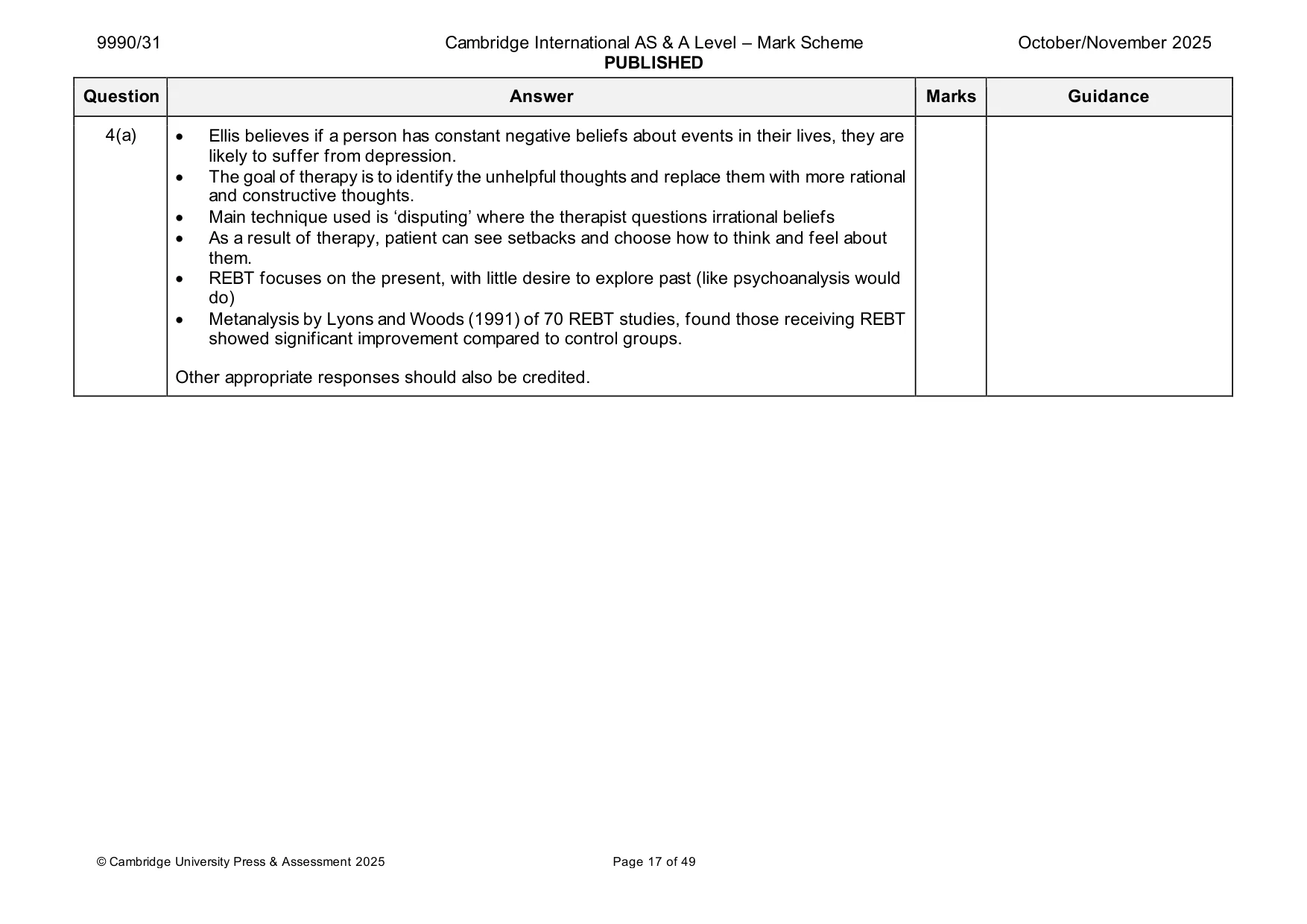
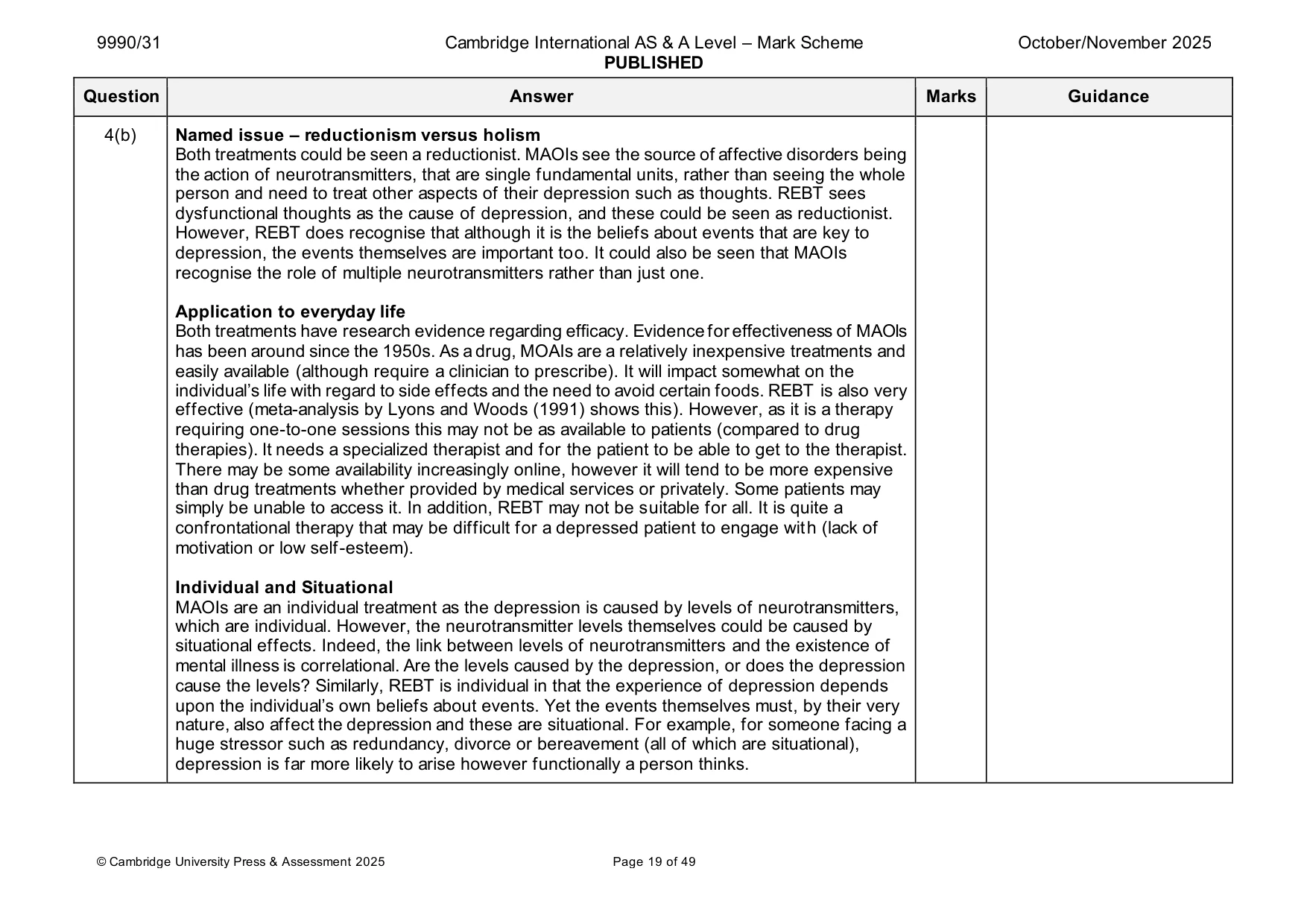
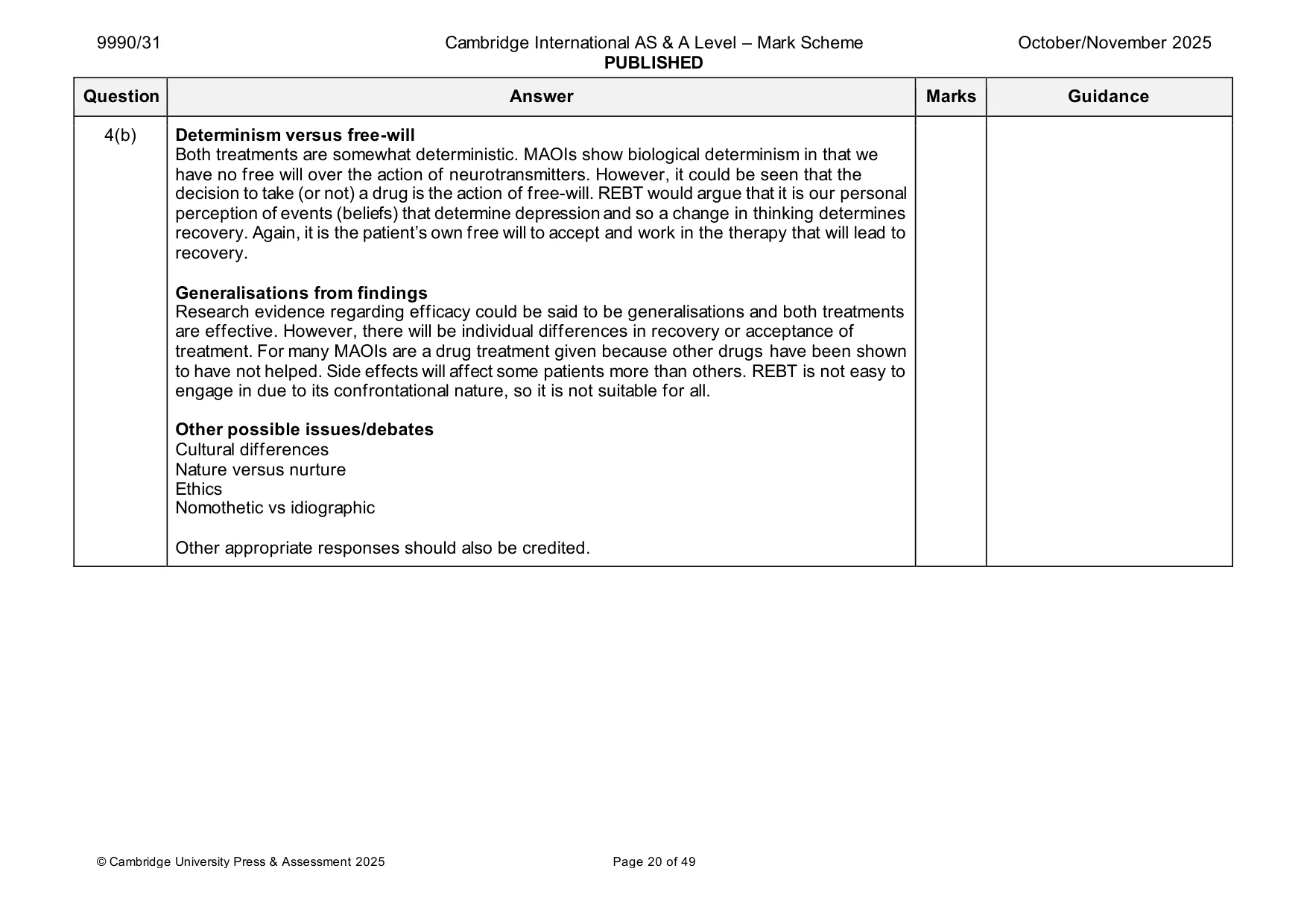
Mark scheme: 4(a) Describe what psychologists investigating the treatment and management of mood 6 Annotations: (affective) disorders have discovered about: Add the levels to get the mark • MAOI anti‑depressants, and awarded e.g. NAQ and L2 = 2 • Ellis’s rational emotive behaviour therapy (REBT). marks, L1 and L2 = 3 marks, L1 and L3 = 4 marks, L3 and Syllabus content L3 = 6 marks • Biological treatments including the use of anti-depressants (tricyclics, MAOIs and SSRIs) • Ellis’s rational emotive behaviour therapy (REBT) Plus, overall level at the bottom of the response as follows: For each bullet point award L1 to L3 depending on detail and accuracy. If bullet point not 1 or 2 marks = L1 creditworthy annotate with NAQ. 3 or 4 marks = L2 5 or 6 marks = L3 MAOIs • Monoamine oxidase inhibitors (MAOIs) act to inhibit the enzyme monoamine oxidase. REBT – if outlines features of • Monoamine oxidase is responsible for breaking down and removing the neurotransmitters CBT only can achieve L1 noradrenaline, serotonin and dopamine, which means MAOIs prevent this breakdown and levels of these neurotransmitters remain high in the brain. • Evidence shows MAOIs are effective. • MAOIs have been used since the 1950s but are usually only used now for depressive disorder where other antidepressants (such as SSRIs) have been unsuccessful. • Numerous side-effects – headache, drowsiness, insomnia, constipation but more importantly can interfere with other medication and certain foods high in tyramine (certain cheeses, red wine, fermented foods such as tofu). Can cause dangerously high blood pressure (hypertensive crisis). Ellis’s rational emotive behaviour therapy (REBT) • REBT is based on the principles of stoicism (we are only affected by our perception of external events rather than the events themselves) • In REBT therapist helps patient to understand the ABC model, where ‘B’ (belief) is most important part. • ABC model consists of ‘A’ Activating agent – what is the behaviour and/or attitude of the patient towards events in their lives, ‘B’ Beliefs – what is the belief of the patient toward the event, and ‘C’ Cognitive – what types of thoughts does the patient have with regard to the event. 4(a) • Ellis believes if a person has constant negative beliefs about events in their lives, they are likely to suffer from depression. • The goal of therapy is to identify the unhelpful thoughts and replace them with more rational and constructive thoughts. • Main technique used is ‘disputing’ where the therapist questions irrational beliefs • As a result of therapy, patient can see setbacks and choose how to think and feel about them. • REBT focuses on the present, with little desire to explore past (like psychoanalysis would do) • Metanalysis by Lyons and Woods (1991) of 70 REBT studies, found those receiving REBT showed significant improvement compared to control groups. Other appropriate responses should also be credited. 4(b) Evaluate what psychologists investigating the treatment and management of mood 10 (affective) disorders have discovered about: • MAOI anti‑depressants, and • Ellis’s rational emotive behaviour therapy (REBT), including a discussion of reductionism versus holism. Evaluation in your answer can include strengths, weaknesses and a discussion of issues and debates. 4(b) Named issue – reductionism versus holism Both treatments could be seen a reductionist. MAOIs see the source of affective disorders being the action of neurotransmitters, that are single fundamental units, rather than seeing the whole person and need to treat other aspects of their depression such as thoughts. REBT sees dysfunctional thoughts as the cause of depression, and these could be seen as reductionist. However, REBT does recognise that although it is the beliefs about events that are key to depression, the events themselves are important too. It could also be seen that MAOIs recognise the role of multiple neurotransmitters rather than just one. Application to everyday life Both treatments have research evidence regarding efficacy. Evidence for effectiveness of MAOIs has been around since the 1950s. As a drug, MOAIs are a relatively inexpensive treatments and easily available (although require a clinician to prescribe). It will impact somewhat on the individual’s life with regard to side effects and the need to avoid certain foods. REBT is also very effective (meta-analysis by Lyons and Woods (1991) shows this). However, as it is a therapy requiring one-to-one sessions this may not be as available to patients (compared to drug therapies). It needs a specialized therapist and for the patient to be able to get to the therapist. There may be some availability increasingly online, however it will tend to be more expensive than drug treatments whether provided by medical services or privately. Some patients may simply be unable to access it. In addition, REBT may not be suitable for all. It is quite a confrontational therapy that may be difficult for a depressed patient to engage with (lack of motivation or low self-esteem). Individual and Situational MAOIs are an individual treatment as the depression is caused by levels of neurotransmitters, which are individual. However, the neurotransmitter levels themselves could be caused by situational effects. Indeed, the link between levels of neurotransmitters and the existence of mental illness is correlational. Are the levels caused by the depression, or does the depression cause the levels? Similarly, REBT is individual in that the experience of depression depends upon the individual’s own beliefs about events. Yet the events themselves must, by their very nature, also affect the depression and these are situational. For example, for someone facing a huge stressor such as redundancy, divorce or bereavement (all of which are situational), depression is far more likely to arise however functionally a person thinks. 4(b) Determinism versus free-will Both treatments are somewhat deterministic. MAOIs show biological determinism in that we have no free will over the action of neurotransmitters. However, it could be seen that the decision to take (or not) a drug is the action of free-will. REBT would argue that it is our personal perception of events (beliefs) that determine depression and so a change in thinking determines recovery. Again, it is the patient’s own free will to accept and work in the therapy that will lead to recovery. Generalisations from findings Research evidence regarding efficacy could be said to be generalisations and both treatments are effective. However, there will be individual differences in recovery or acceptance of treatment. For many MAOIs are a drug treatment given because other drugs have been shown to have not helped. Side effects will affect some patients more than others. REBT is not easy to engage in due to its confrontational nature, so it is not suitable for all. Other possible issues/debates Cultural differences Nature versus nurture Ethics Nomothetic vs idiographic Other appropriate responses should also be credited.
More questions on Mood (affective) disorders: depressive disorder (unipolar) and bipolar disorder
Q5 · Abdul wants to purchase a chair from a website
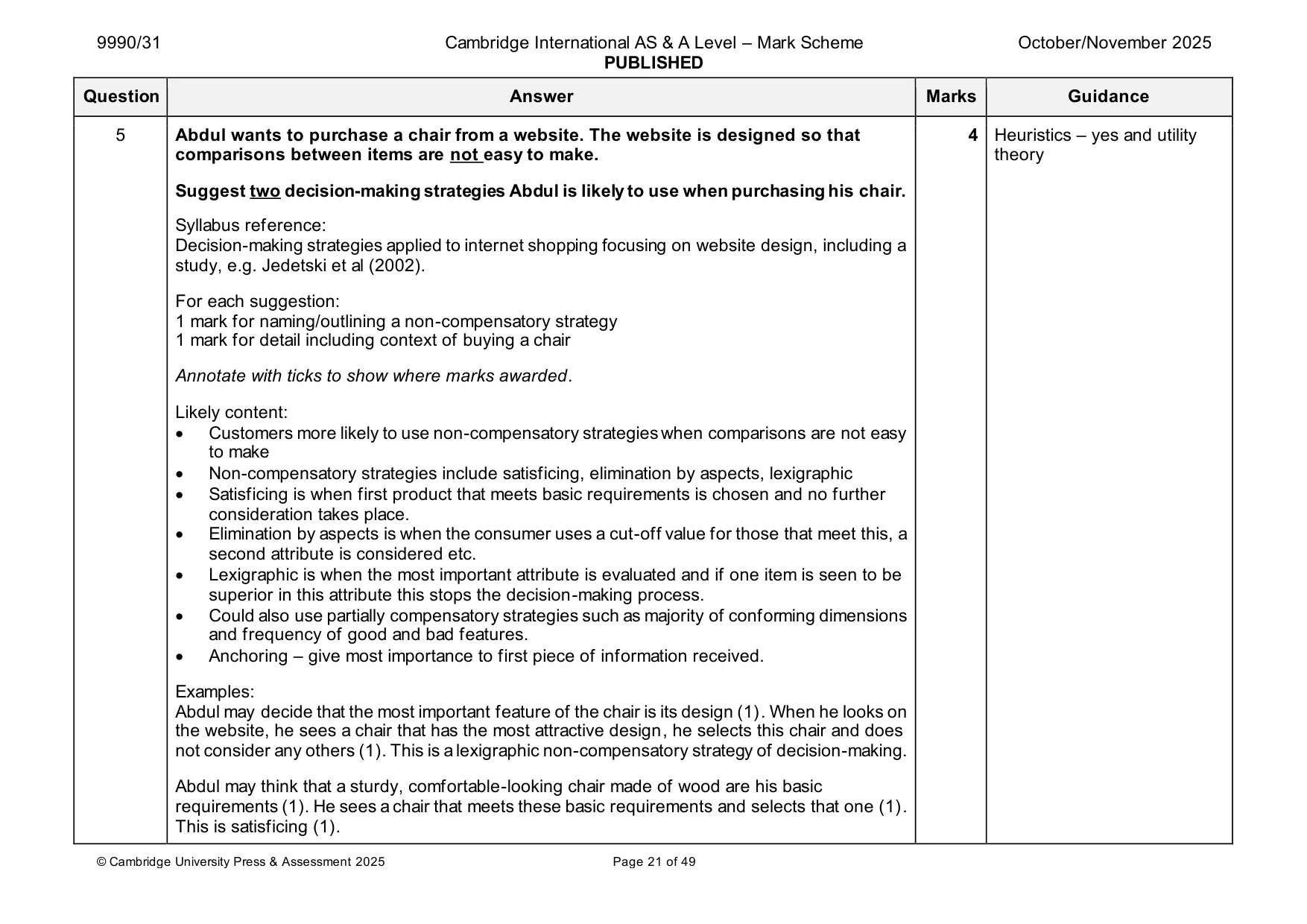
5 Abdul wants to purchase a chair from a website. The website is designed so that comparisons between items are not easy to make. Suggest two decision‑making strategies Abdul is likely to use when purchasing his chair. [4]
Mark scheme: 5 Abdul wants to purchase a chair from a website. The website is designed so that 4 Heuristics – yes and utility comparisons between items are not easy to make. theory Suggest two decision-making strategies Abdul is likely to use when purchasing his chair. Syllabus reference: Decision-making strategies applied to internet shopping focusing on website design, including a study, e.g. Jedetski et al (2002). For each suggestion: 1 mark for naming/outlining a non-compensatory strategy 1 mark for detail including context of buying a chair Annotate with ticks to show where marks awarded. Likely content: • Customers more likely to use non-compensatory strategies when comparisons are not easy to make • Non-compensatory strategies include satisficing, elimination by aspects, lexigraphic • Satisficing is when first product that meets basic requirements is chosen and no further consideration takes place. • Elimination by aspects is when the consumer uses a cut-off value for those that meet this, a second attribute is considered etc. • Lexigraphic is when the most important attribute is evaluated and if one item is seen to be superior in this attribute this stops the decision-making process. • Could also use partially compensatory strategies such as majority of conforming dimensions and frequency of good and bad features. • Anchoring – give most importance to first piece of information received. Examples: Abdul may decide that the most important feature of the chair is its design (1). When he looks on the website, he sees a chair that has the most attractive design, he selects this chair and does not consider any others (1). This is a lexigraphic non-compensatory strategy of decision-making. Abdul may think that a sturdy, comfortable-looking chair made of wood are his basic requirements (1). He sees a chair that meets these basic requirements and selects that one (1). This is satisficing (1).
Q6 · Outline what is meant by ‘determinism’, including an example from choice heuristics
6 (a) Outline what is meant by ‘determinism’, including an example from choice heuristics. [2] (b) Explain one strength of using the determinism side of the determinism versus free‑will debate to understand choice heuristics. [2]
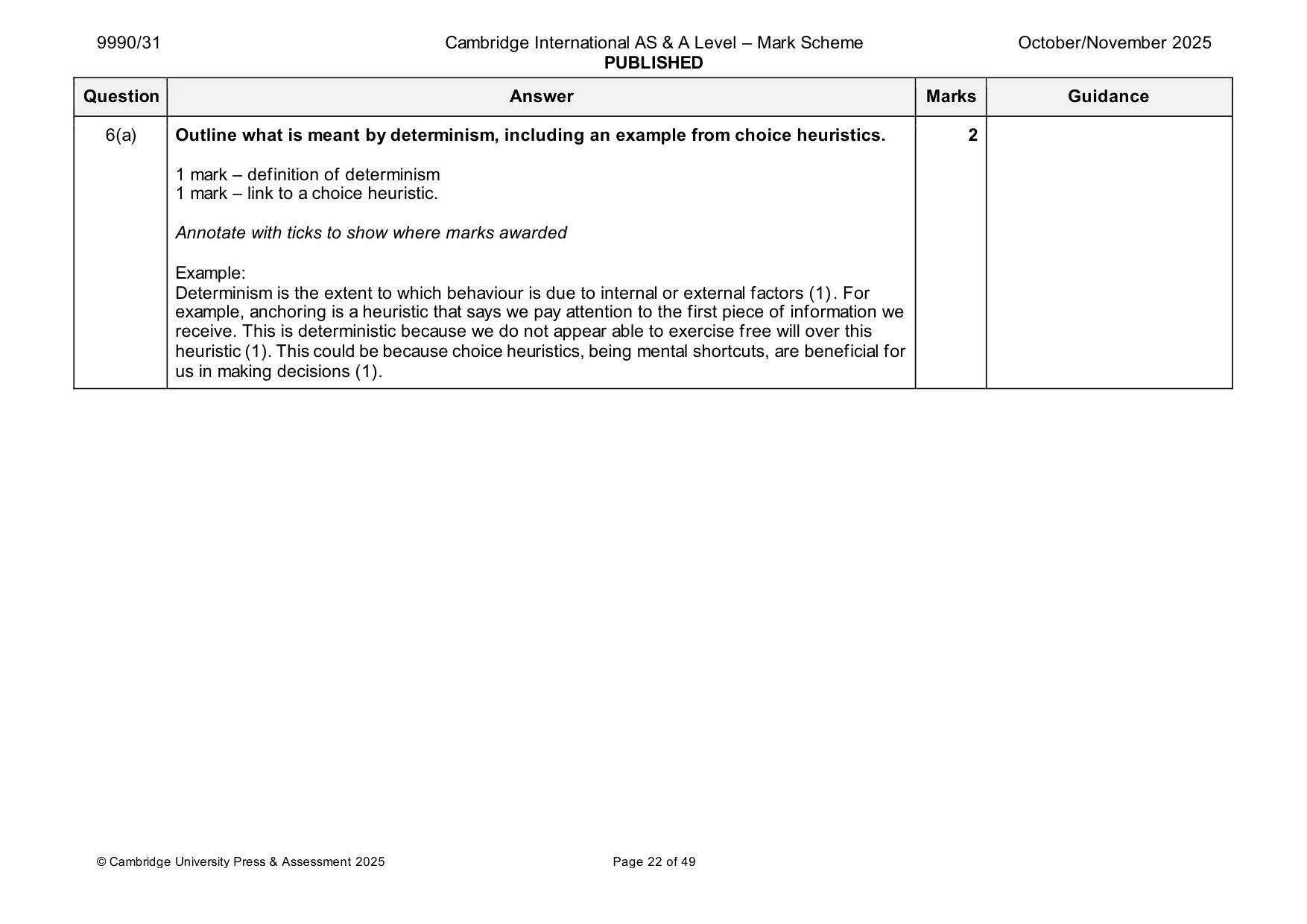
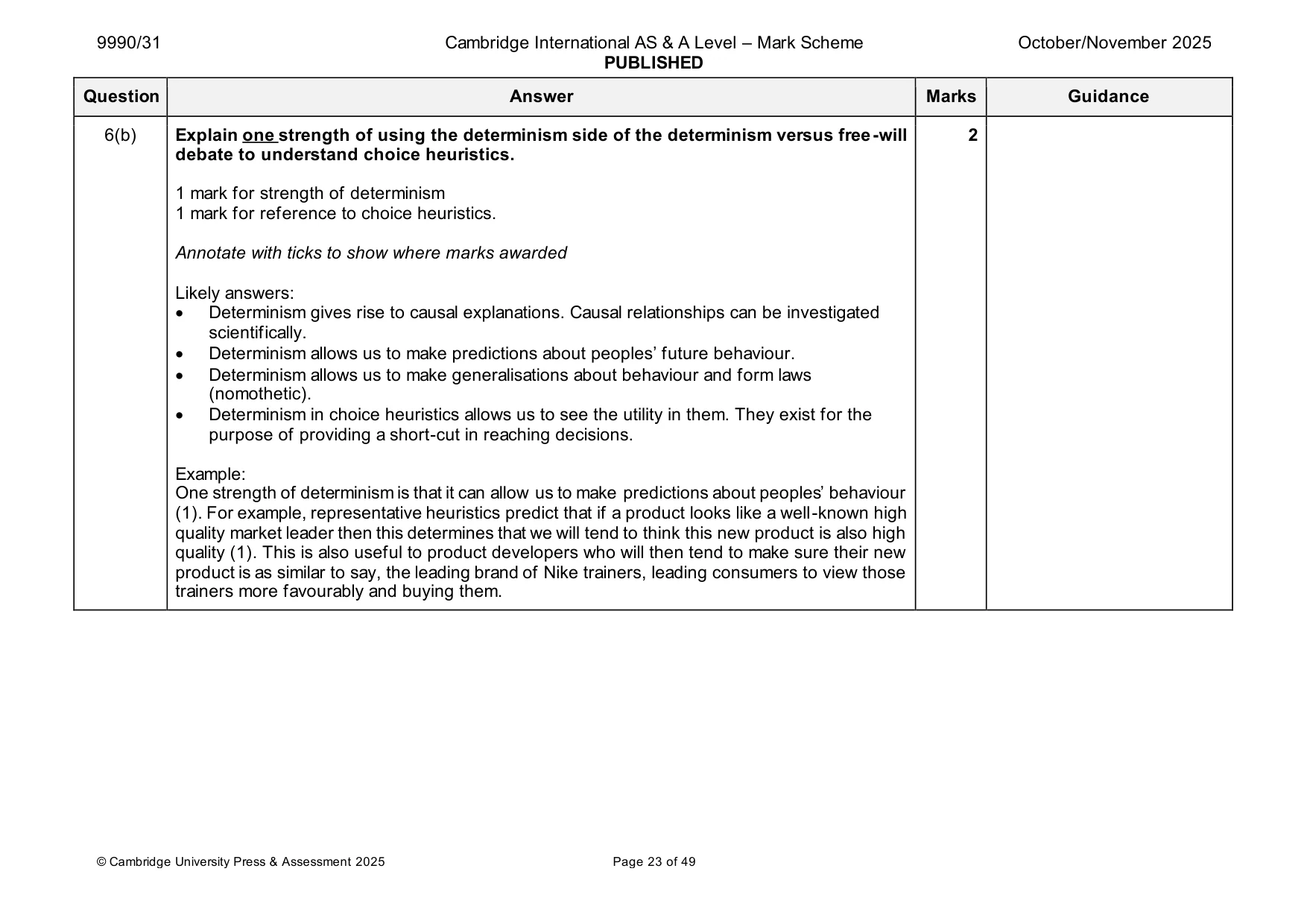
Mark scheme: 6(a) Outline what is meant by determinism, including an example from choice heuristics. 2 1 mark – definition of determinism 1 mark – link to a choice heuristic. Annotate with ticks to show where marks awarded Example: Determinism is the extent to which behaviour is due to internal or external factors (1). For example, anchoring is a heuristic that says we pay attention to the first piece of information we receive. This is deterministic because we do not appear able to exercise free will over this heuristic (1). This could be because choice heuristics, being mental shortcuts, are beneficial for us in making decisions (1). 6(b) Explain one strength of using the determinism side of the determinism versus free-will 2 debate to understand choice heuristics. 1 mark for strength of determinism 1 mark for reference to choice heuristics. Annotate with ticks to show where marks awarded Likely answers: • Determinism gives rise to causal explanations. Causal relationships can be investigated scientifically. • Determinism allows us to make predictions about peoples’ future behaviour. • Determinism allows us to make generalisations about behaviour and form laws (nomothetic). • Determinism in choice heuristics allows us to see the utility in them. They exist for the purpose of providing a short-cut in reaching decisions. Example: One strength of determinism is that it can allow us to make predictions about peoples’ behaviour (1). For example, representative heuristics predict that if a product looks like a well-known high quality market leader then this determines that we will tend to think this new product is also high quality (1). This is also useful to product developers who will then tend to make sure their new product is as similar to say, the leading brand of Nike trainers, leading consumers to view those trainers more favourably and buying them.
Q7 · Supermarket shoppers do not all behave in the same way
7 Supermarket shoppers do not all behave in the same way. Shoppers can be categorised into five types based on their different spatial behaviour patterns. Zelda visits all of the aisles of the supermarket when she does her main shopping. However, Louis spends a short time in the supermarket and visits only a few aisles. (a) (i) Identify which type of shopper spatial behaviour pattern would be most appropriate to describe: • Zelda • Louis. [2] (ii) Frank is a different type of shopper from Zelda and Louis. He shows a different spatial behaviour pattern. Suggest how Frank could behave in the supermarket. [2] (b) Explain one problem that psychologists may have when investigating shoppers’ spatial behaviour patterns. [2]
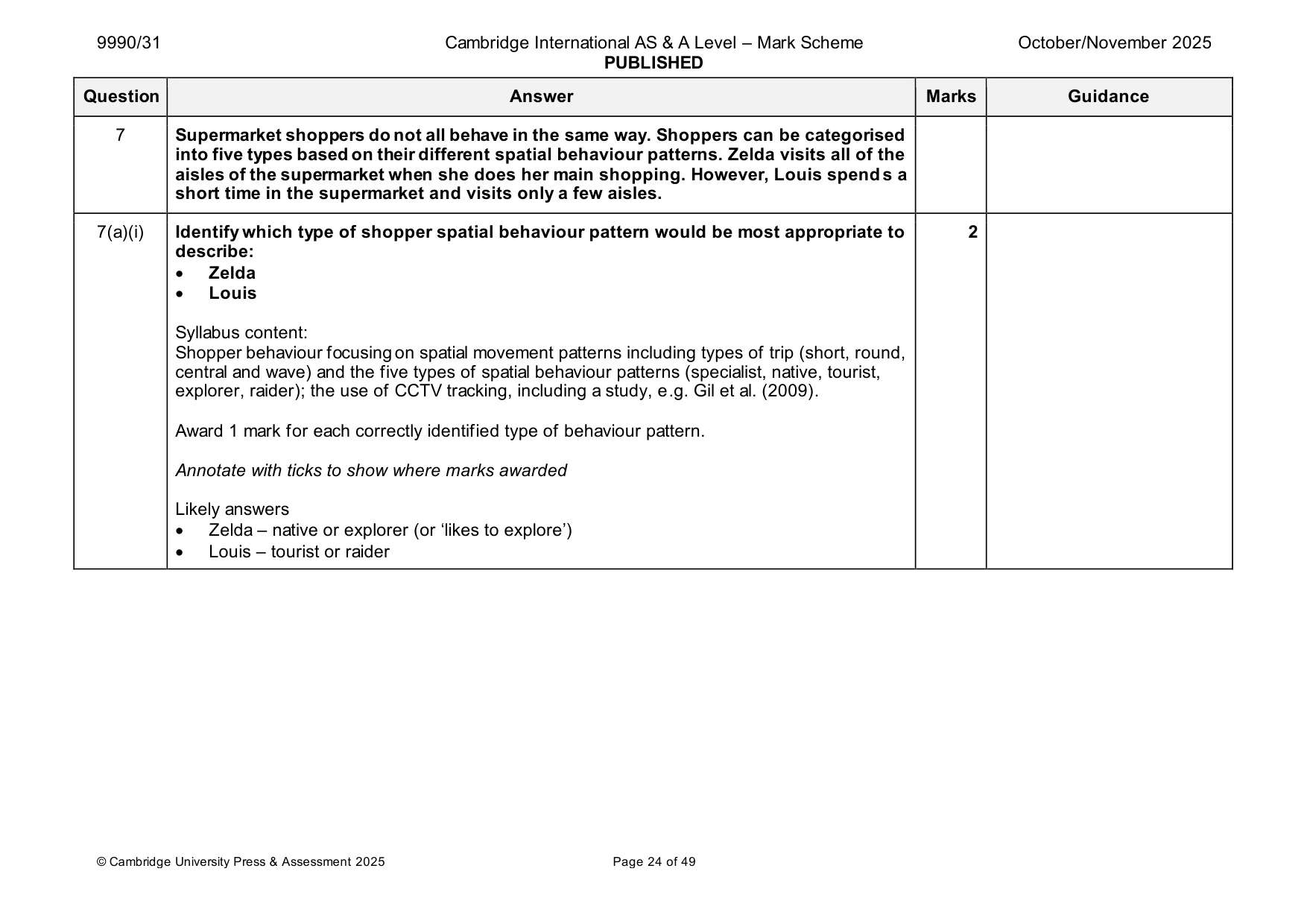
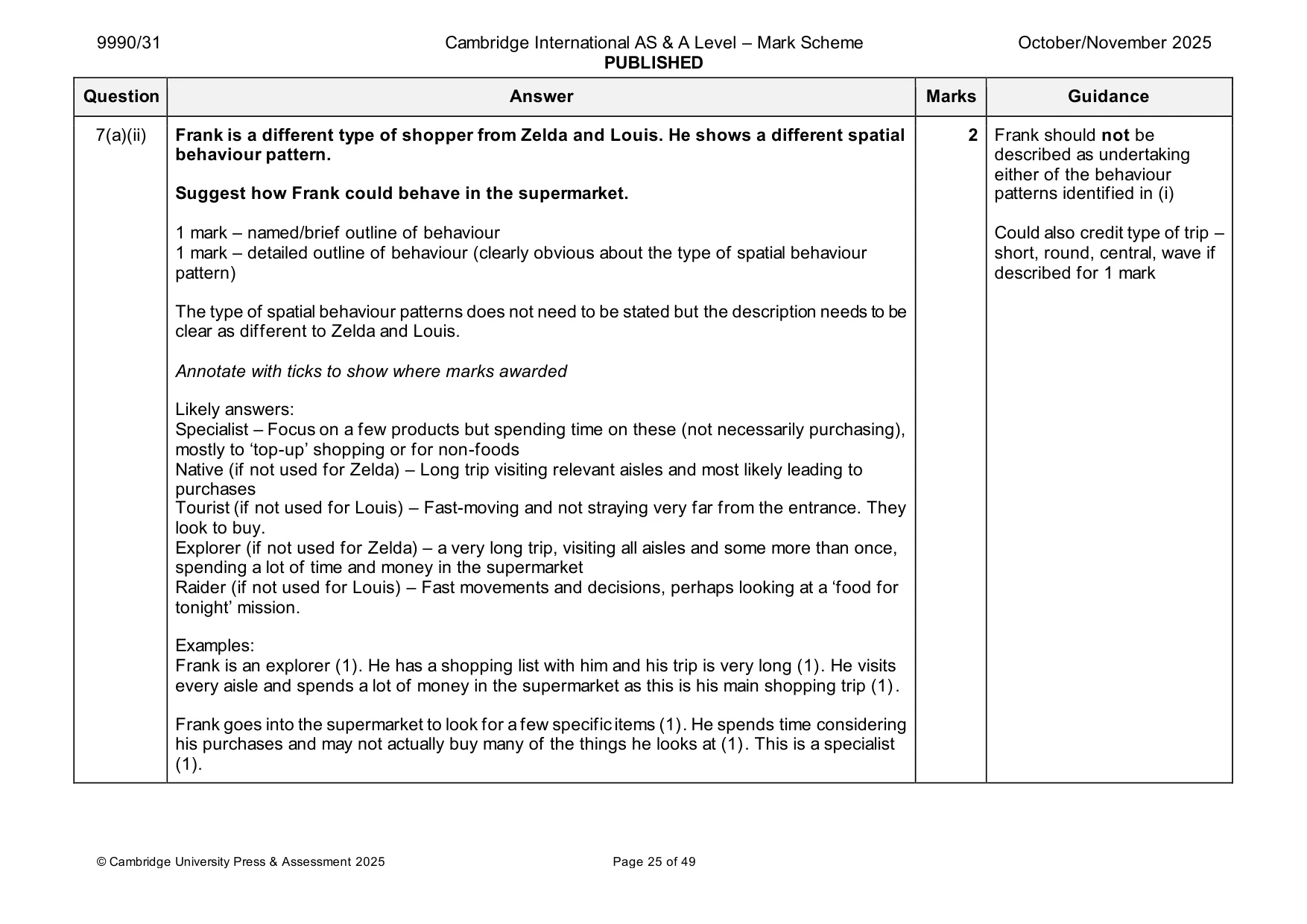
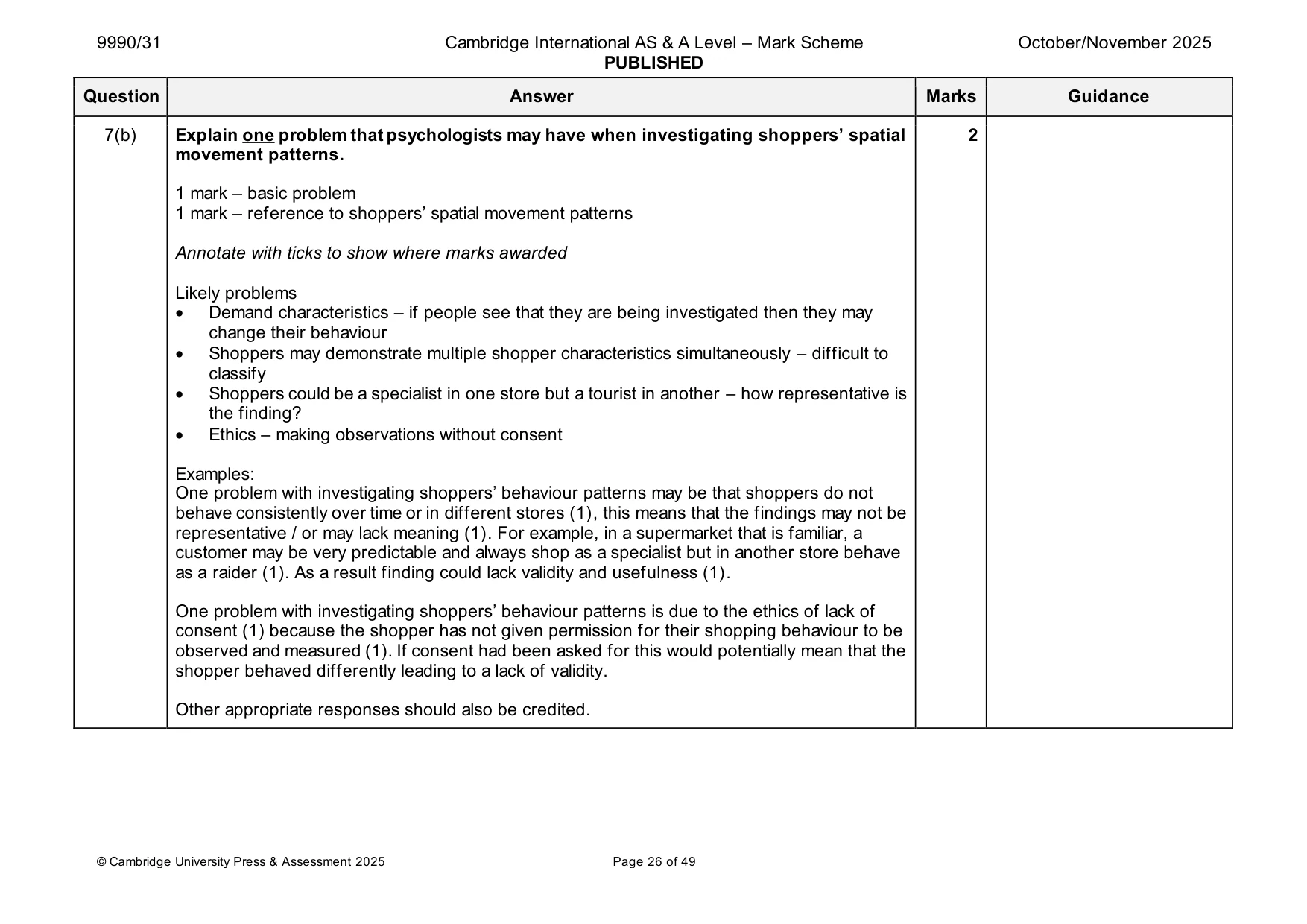
Mark scheme: 7 Supermarket shoppers do not all behave in the same way. Shoppers can be categorised into five types based on their different spatial behaviour patterns. Zelda visits all of the aisles of the supermarket when she does her main shopping. However, Louis spends a short time in the supermarket and visits only a few aisles. 7(a)(i) Identify which type of shopper spatial behaviour pattern would be most appropriate to 2 describe: • Zelda • Louis Syllabus content: Shopper behaviour focusing on spatial movement patterns including types of trip (short, round, central and wave) and the five types of spatial behaviour patterns (specialist, native, tourist, explorer, raider); the use of CCTV tracking, including a study, e.g. Gil et al. (2009). Award 1 mark for each correctly identified type of behaviour pattern. Annotate with ticks to show where marks awarded Likely answers • Zelda – native or explorer (or ‘likes to explore’) • Louis – tourist or raider 7(a)(ii) Frank is a different type of shopper from Zelda and Louis. He shows a different spatial 2 Frank should not be behaviour pattern. described as undertaking either of the behaviour Suggest how Frank could behave in the supermarket. patterns identified in (i) 1 mark – named/brief outline of behaviour Could also credit type of trip – 1 mark – detailed outline of behaviour (clearly obvious about the type of spatial behaviour short, round, central, wave if pattern) described for 1 mark The type of spatial behaviour patterns does not need to be stated but the description needs to be clear as different to Zelda and Louis. Annotate with ticks to show where marks awarded Likely answers: Specialist – Focus on a few products but spending time on these (not necessarily purchasing), mostly to ‘top-up’ shopping or for non-foods Native (if not used for Zelda) – Long trip visiting relevant aisles and most likely leading to purchases Tourist (if not used for Louis) – Fast-moving and not straying very far from the entrance. They look to buy. Explorer (if not used for Zelda) – a very long trip, visiting all aisles and some more than once, spending a lot of time and money in the supermarket Raider (if not used for Louis) – Fast movements and decisions, perhaps looking at a ‘food for tonight’ mission. Examples: Frank is an explorer (1). He has a shopping list with him and his trip is very long (1). He visits every aisle and spends a lot of money in the supermarket as this is his main shopping trip (1). Frank goes into the supermarket to look for a few specific items (1). He spends time considering his purchases and may not actually buy many of the things he looks at (1). This is a specialist (1). 7(b) Explain one problem that psychologists may have when investigating shoppers’ spatial 2 movement patterns. 1 mark – basic problem 1 mark – reference to shoppers’ spatial movement patterns Annotate with ticks to show where marks awarded Likely problems • Demand characteristics – if people see that they are being investigated then they may change their behaviour • Shoppers may demonstrate multiple shopper characteristics simultaneously – difficult to classify • Shoppers could be a specialist in one store but a tourist in another – how representative is the finding? • Ethics – making observations without consent Examples: One problem with investigating shoppers’ behaviour patterns may be that shoppers do not behave consistently over time or in different stores (1), this means that the findings may not be representative / or may lack meaning (1). For example, in a supermarket that is familiar, a customer may be very predictable and always shop as a specialist but in another store behave as a raider (1). As a result finding could lack validity and usefulness (1). One problem with investigating shoppers’ behaviour patterns is due to the ethics of lack of consent (1) because the shopper has not given permission for their shopping behaviour to be observed and measured (1). If consent had been asked for this would potentially mean that the shopper behaved differently leading to a lack of validity. Other appropriate responses should also be credited.
Q8 · Describe what psychologists have discovered about types of advertising and advertising…
8 (a) Describe what psychologists have discovered about types of advertising and advertising techniques: • the Yale model of communication, and • a study about types of advertising media. [6] (b) Evaluate what psychologists have discovered about types of advertising and advertising techniques: • the Yale model of communication, and • a study about types of advertising media, including a discussion of objective and subjective data. Evaluation in your answer can include strengths, weaknesses and a discussion of issues and debates. [10] Section C: Health Psychology Answer all questions.
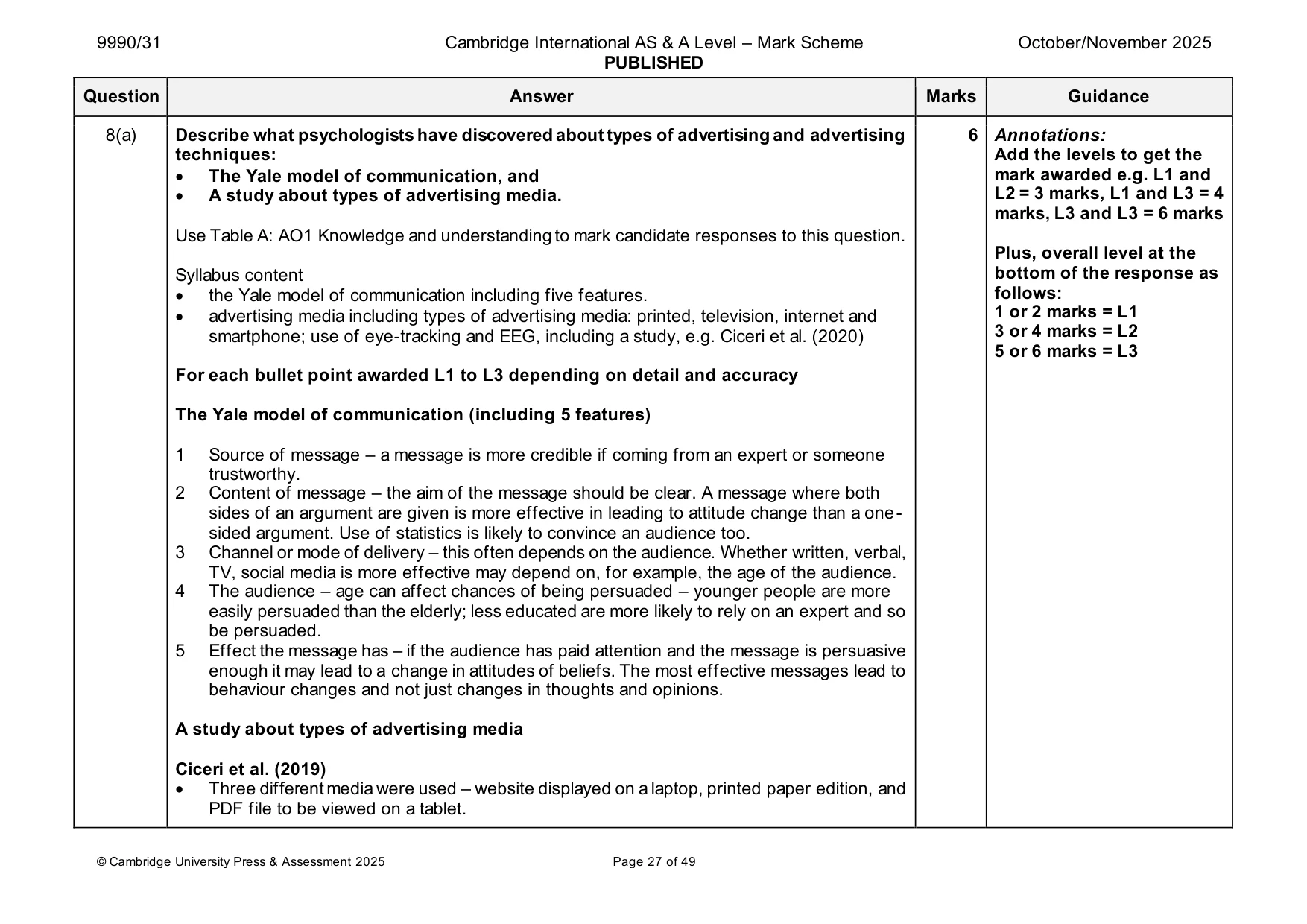
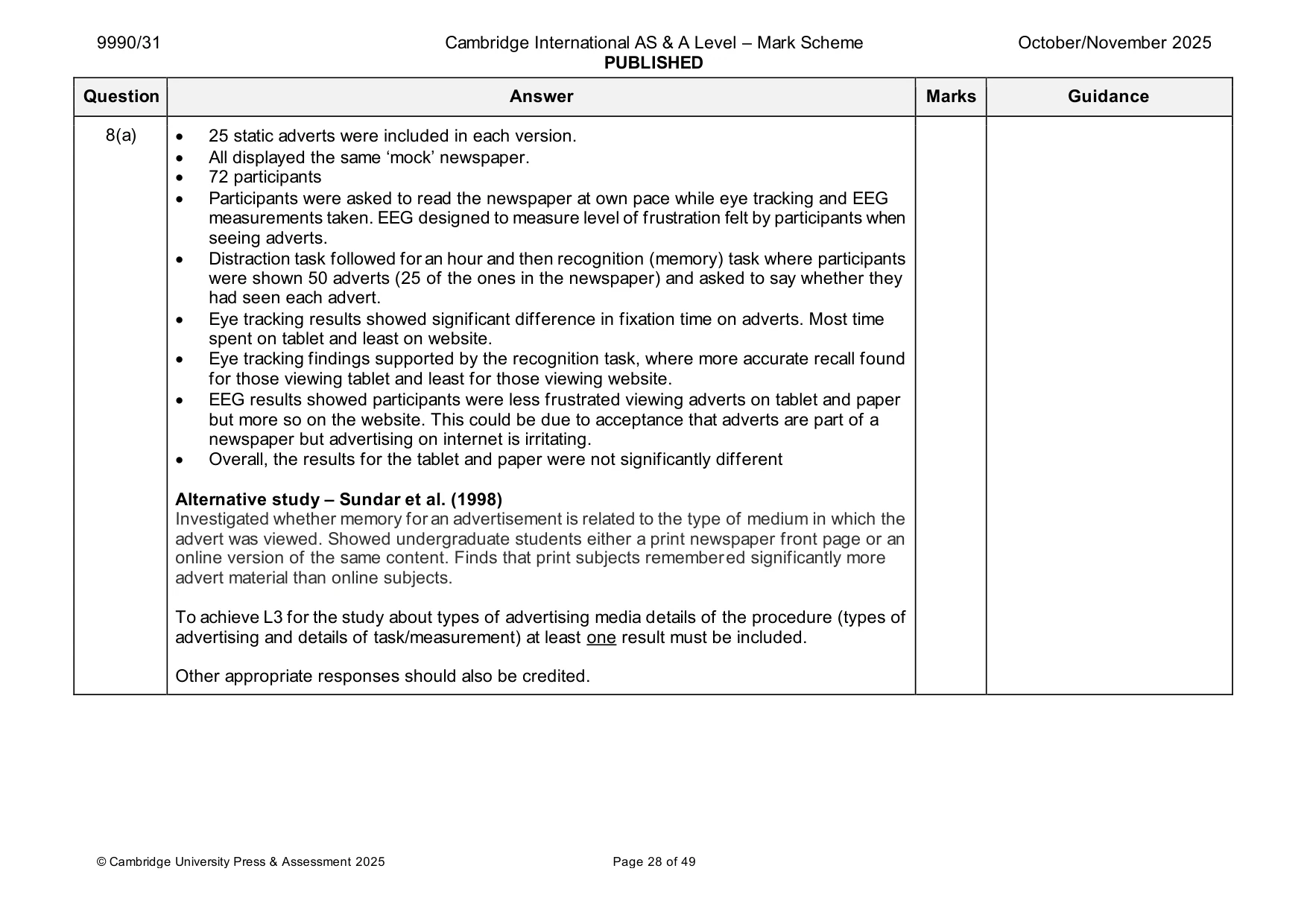
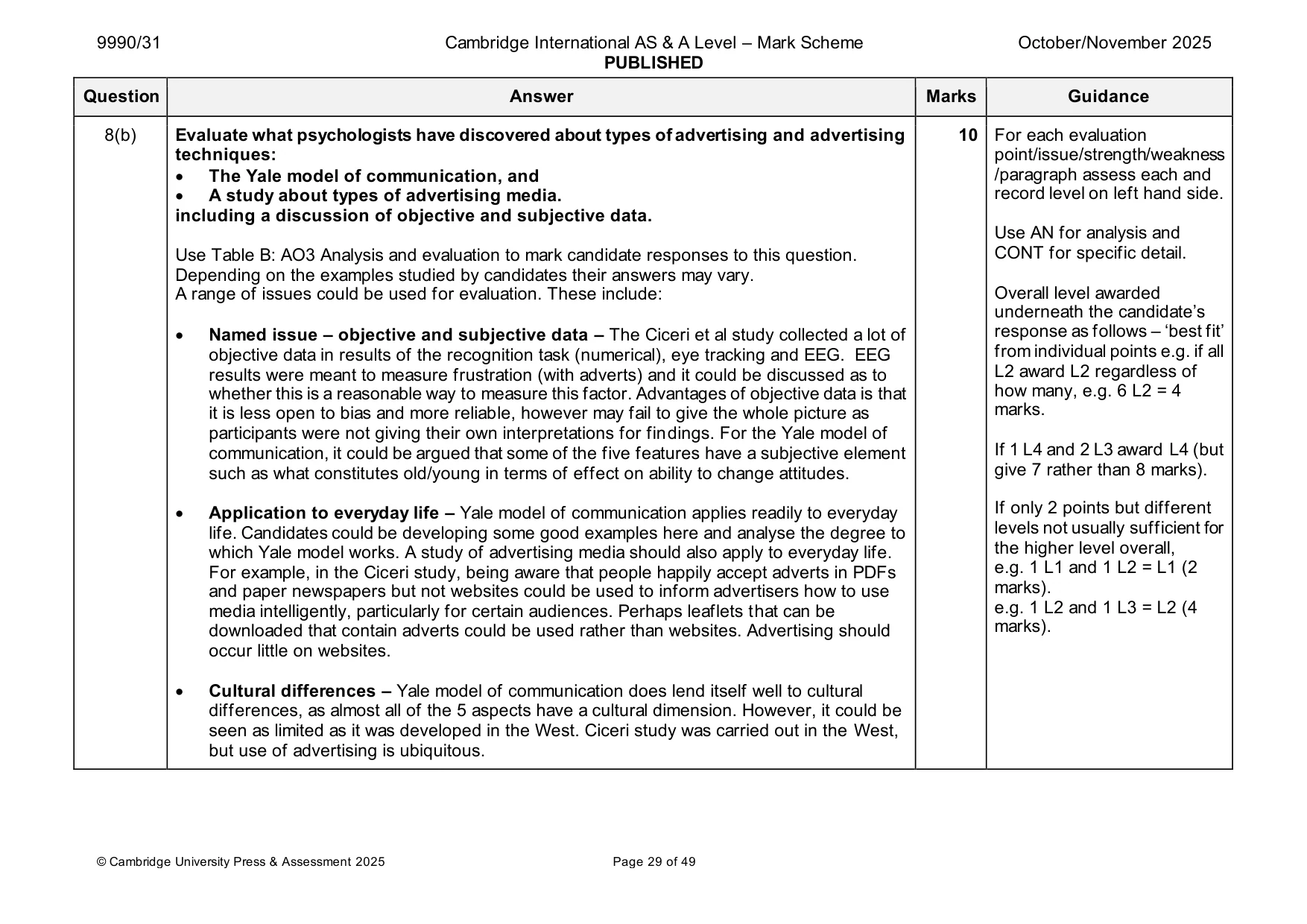
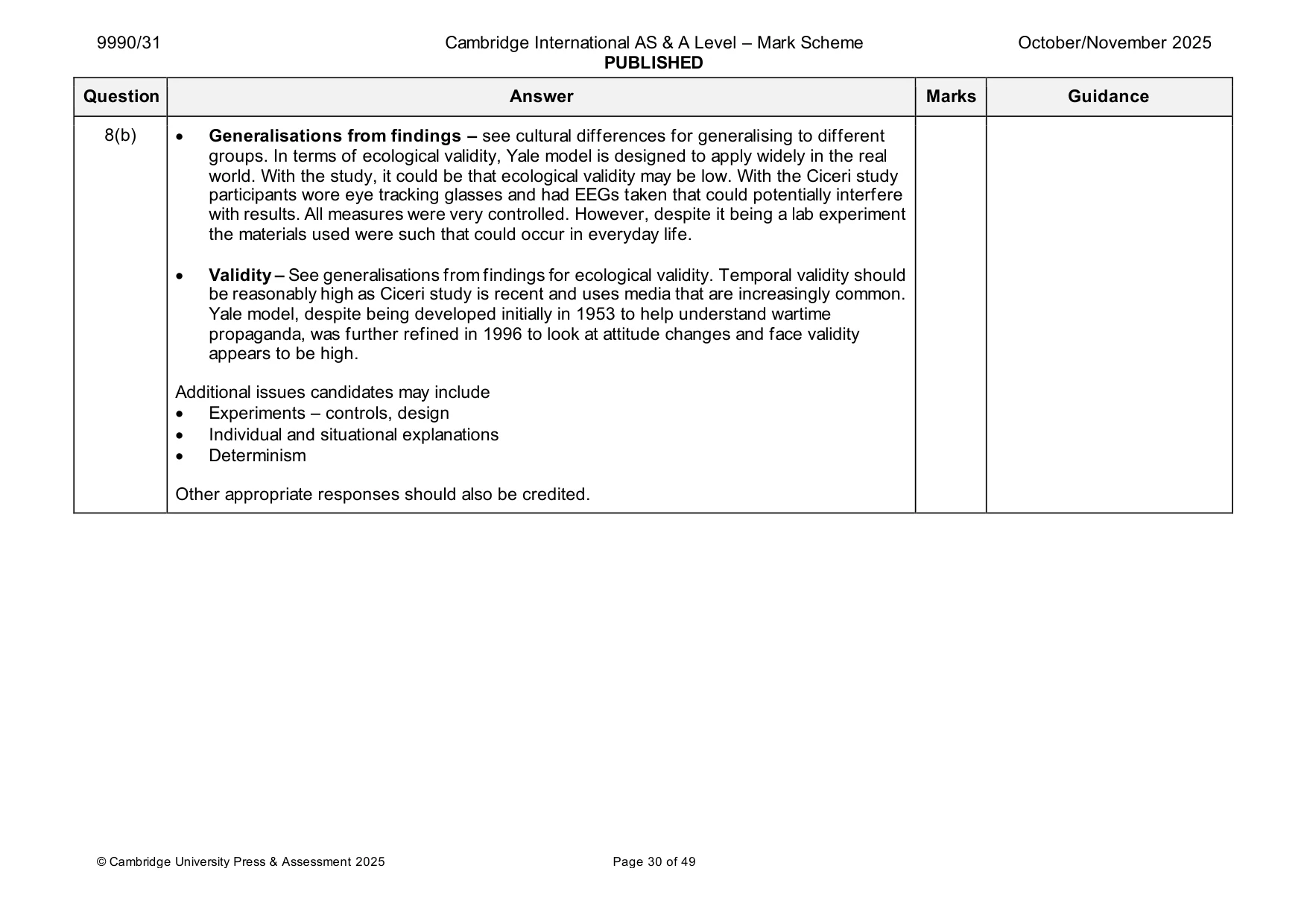
Mark scheme: 8(a) Describe what psychologists have discovered about types of advertising and advertising 6 Annotations: techniques: Add the levels to get the • The Yale model of communication, and mark awarded e.g. L1 and • A study about types of advertising media. L2 = 3 marks, L1 and L3 = 4 marks, L3 and L3 = 6 marks Use Table A: AO1 Knowledge and understanding to mark candidate responses to this question. Plus, overall level at the Syllabus content bottom of the response as • the Yale model of communication including five features. follows: • advertising media including types of advertising media: printed, television, internet and 1 or 2 marks = L1 3 or 4 marks = L2 smartphone; use of eye-tracking and EEG, including a study, e.g. Ciceri et al. (2020) 5 or 6 marks = L3 For each bullet point awarded L1 to L3 depending on detail and accuracy The Yale model of communication (including 5 features) 1 Source of message – a message is more credible if coming from an expert or someone trustworthy. 2 Content of message – the aim of the message should be clear. A message where both sides of an argument are given is more effective in leading to attitude change than a one- sided argument. Use of statistics is likely to convince an audience too. 3 Channel or mode of delivery – this often depends on the audience. Whether written, verbal, TV, social media is more effective may depend on, for example, the age of the audience. 4 The audience – age can affect chances of being persuaded – younger people are more easily persuaded than the elderly; less educated are more likely to rely on an expert and so be persuaded. 5 Effect the message has – if the audience has paid attention and the message is persuasive enough it may lead to a change in attitudes of beliefs. The most effective messages lead to behaviour changes and not just changes in thoughts and opinions. A study about types of advertising media Ciceri et al. (2019) • Three different media were used – website displayed on a laptop, printed paper edition, and PDF file to be viewed on a tablet. 8(a) • 25 static adverts were included in each version. • All displayed the same ‘mock’ newspaper. • 72 participants • Participants were asked to read the newspaper at own pace while eye tracking and EEG measurements taken. EEG designed to measure level of frustration felt by participants when seeing adverts. • Distraction task followed for an hour and then recognition (memory) task where participants were shown 50 adverts (25 of the ones in the newspaper) and asked to say whether they had seen each advert. • Eye tracking results showed significant difference in fixation time on adverts. Most time spent on tablet and least on website. • Eye tracking findings supported by the recognition task, where more accurate recall found for those viewing tablet and least for those viewing website. • EEG results showed participants were less frustrated viewing adverts on tablet and paper but more so on the website. This could be due to acceptance that adverts are part of a newspaper but advertising on internet is irritating. • Overall, the results for the tablet and paper were not significantly different Alternative study – Sundar et al. (1998) Investigated whether memory for an advertisement is related to the type of medium in which the advert was viewed. Showed undergraduate students either a print newspaper front page or an online version of the same content. Finds that print subjects remembered significantly more advert material than online subjects. To achieve L3 for the study about types of advertising media details of the procedure (types of advertising and details of task/measurement) at least one result must be included. Other appropriate responses should also be credited. 8(b) Evaluate what psychologists have discovered about types of advertising and advertising 10 For each evaluation techniques: point/issue/strength/weakness • The Yale model of communication, and /paragraph assess each and • A study about types of advertising media. record level on left hand side. including a discussion of objective and subjective data. Use AN for analysis and Use Table B: AO3 Analysis and evaluation to mark candidate responses to this question. CONT for specific detail. Depending on the examples studied by candidates their answers may vary. A range of issues could be used for evaluation. These include: Overall level awarded underneath the candidate’s • Named issue – objective and subjective data – The Ciceri et al study collected a lot of response as follows – ‘best fit’ objective data in results of the recognition task (numerical), eye tracking and EEG. EEG from individual points e.g. if all results were meant to measure frustration (with adverts) and it could be discussed as to L2 award L2 regardless of whether this is a reasonable way to measure this factor. Advantages of objective data is that how many, e.g. 6 L2 = 4 it is less open to bias and more reliable, however may fail to give the whole picture as marks. participants were not giving their own interpretations for findings. For the Yale model of communication, it could be argued that some of the five features have a subjective element If 1 L4 and 2 L3 award L4 (but such as what constitutes old/young in terms of effect on ability to change attitudes. give 7 rather than 8 marks). • Application to everyday life – Yale model of communication applies readily to everyday If only 2 points but different levels not usually sufficient for life. Candidates could be developing some good examples here and analyse the degree to the higher level overall, which Yale model works. A study of advertising media should also apply to everyday life. e.g. 1 L1 and 1 L2 = L1 (2 For example, in the Ciceri study, being aware that people happily accept adverts in PDFs and paper newspapers but not websites could be used to inform advertisers how to use marks). media intelligently, particularly for certain audiences. Perhaps leaflets that can be e.g. 1 L2 and 1 L3 = L2 (4 marks). downloaded that contain adverts could be used rather than websites. Advertising should occur little on websites. • Cultural differences – Yale model of communication does lend itself well to cultural differences, as almost all of the 5 aspects have a cultural dimension. However, it could be seen as limited as it was developed in the West. Ciceri study was carried out in the West, but use of advertising is ubiquitous. 8(b) • Generalisations from findings – see cultural differences for generalising to different groups. In terms of ecological validity, Yale model is designed to apply widely in the real world. With the study, it could be that ecological validity may be low. With the Ciceri study participants wore eye tracking glasses and had EEGs taken that could potentially interfere with results. All measures were very controlled. However, despite it being a lab experiment the materials used were such that could occur in everyday life. • Validity – See generalisations from findings for ecological validity. Temporal validity should be reasonably high as Ciceri study is recent and uses media that are increasingly common. Yale model, despite being developed initially in 1953 to help understand wartime propaganda, was further refined in 1996 to look at attitude changes and face validity appears to be high. Additional issues candidates may include • Experiments – controls, design • Individual and situational explanations • Determinism Other appropriate responses should also be credited. Section C: Health Psychology
Q9 · A university student, Chloe, thinks that she has less chance of becoming ill than other…
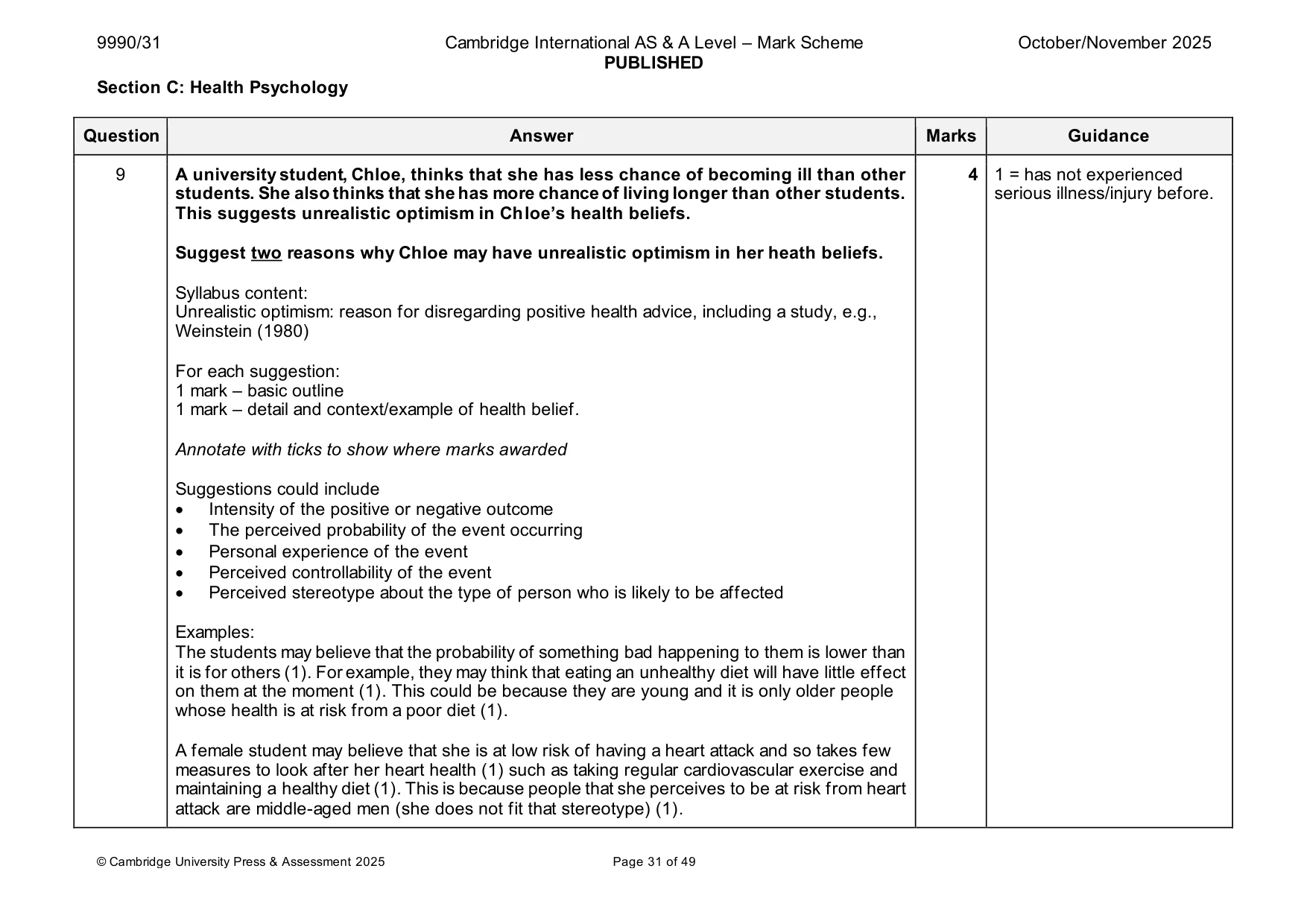
9 A university student, Chloe, thinks that she has less chance of becoming ill than other students. She also thinks that she has more chance of living longer than other students. This suggests unrealistic optimism in Chloe’s health beliefs. Suggest two reasons why Chloe may have unrealistic optimism in her health beliefs. [4]
Mark scheme: 9 A university student, Chloe, thinks that she has less chance of becoming ill than other 4 1 = has not experienced students. She also thinks that she has more chance of living longer than other students. serious illness/injury before. This suggests unrealistic optimism in Chloe’s health beliefs. Suggest two reasons why Chloe may have unrealistic optimism in her heath beliefs. Syllabus content: Unrealistic optimism: reason for disregarding positive health advice, including a study, e.g., Weinstein (1980) For each suggestion: 1 mark – basic outline 1 mark – detail and context/example of health belief. Annotate with ticks to show where marks awarded Suggestions could include • Intensity of the positive or negative outcome • The perceived probability of the event occurring • Personal experience of the event • Perceived controllability of the event • Perceived stereotype about the type of person who is likely to be affected Examples: The students may believe that the probability of something bad happening to them is lower than it is for others (1). For example, they may think that eating an unhealthy diet will have little effect on them at the moment (1). This could be because they are young and it is only older people whose health is at risk from a poor diet (1). A female student may believe that she is at low risk of having a heart attack and so takes few measures to look after her heart health (1) such as taking regular cardiovascular exercise and maintaining a healthy diet (1). This is because people that she perceives to be at risk from heart attack are middle-aged men (she does not fit that stereotype) (1).
Q10 · Outline what is meant by the debate between individual and situational explanations
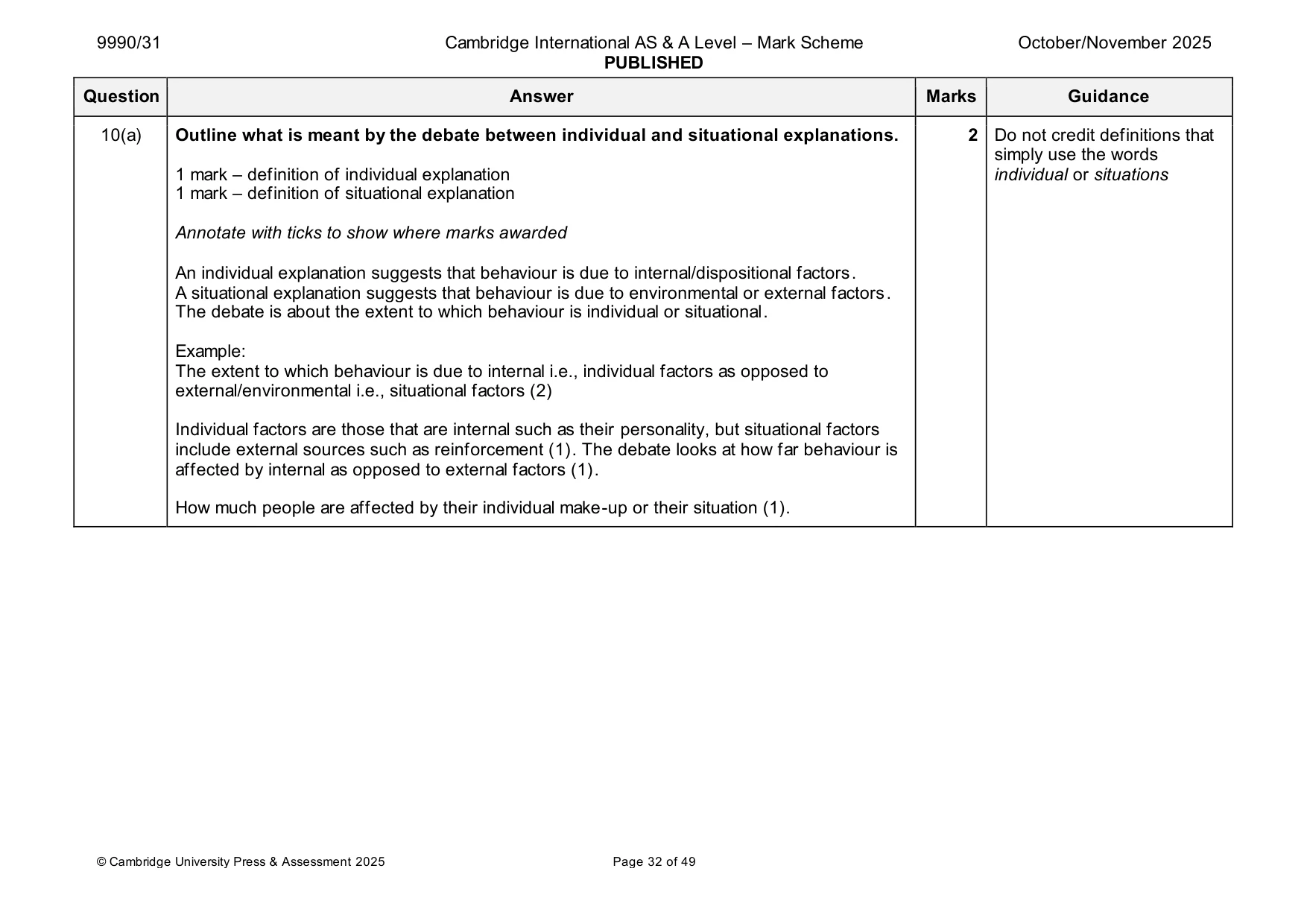
10 (a) Outline what is meant by the debate between individual and situational explanations. [2] (b) Explain why one strategy for improving health has a situational explanation. [2]
Mark scheme: 10(a) Outline what is meant by the debate between individual and situational explanations. 2 Do not credit definitions that simply use the words 1 mark – definition of individual explanation individual or situations 1 mark – definition of situational explanation Annotate with ticks to show where marks awarded An individual explanation suggests that behaviour is due to internal/dispositional factors. A situational explanation suggests that behaviour is due to environmental or external factors. The debate is about the extent to which behaviour is individual or situational. Example: The extent to which behaviour is due to internal i.e., individual factors as opposed to external/environmental i.e., situational factors (2) Individual factors are those that are internal such as their personality, but situational factors include external sources such as reinforcement (1). The debate looks at how far behaviour is affected by internal as opposed to external factors (1). How much people are affected by their individual make-up or their situation (1). 10(b) Explain why one strategy for improving health has a situational explanation. 2 Allow examples from improving health such as Strategies named in the syllabus: token economy and healthy Fear arousal and providing information eating programs like Tapper. 1 mark – outline of a health strategy Identification of health 1 mark – why that health strategy is situational strategy on its own = 0. Annotate with ticks to show where marks awarded Exercise is creditworthy. Reasons could include: External source is a situational factor and assumes all individuals react in a similar way. External source or reinforcement is not under the control of the individual. External sources do not depend on the personality or disposition. Example: The use of photographs of those with mouth cancers on cigarette packaging is used as fear arousal (1), which is a situational way to prevent someone smoking (1). This method assumes that all individuals will react in a similar way, which is why it is not individual (1). If people are provided with information in the form of pamphlets for how to improve their health this is situational (1) as the individual is not in control of the content of that leaflet and as a result can only use individual factors to choose to ignore or accept the information (1). Everyone receiving the information has received the same external material (1). Other appropriate responses should also be credited.
Q11 · Omar is in hospital with chest pain
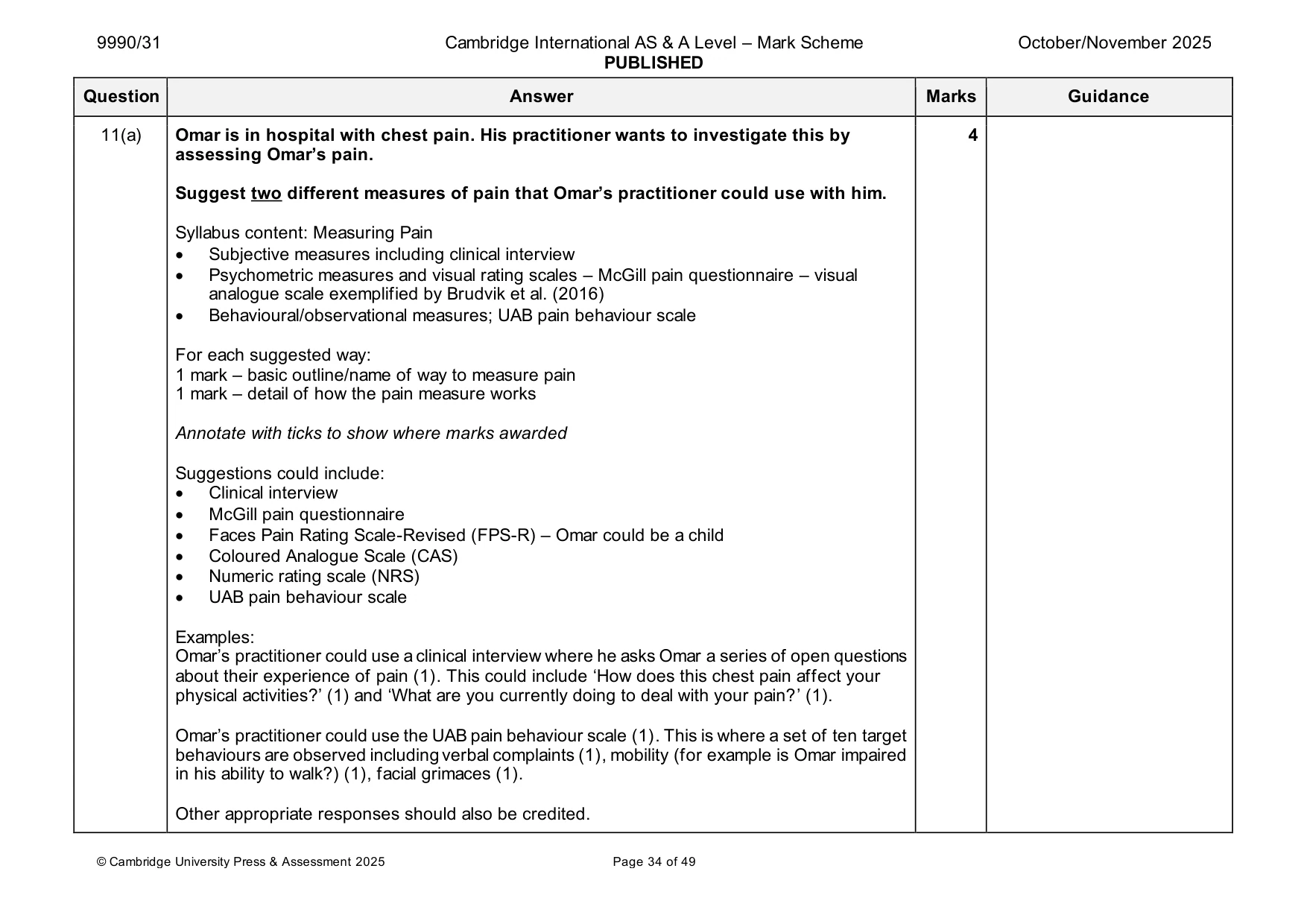
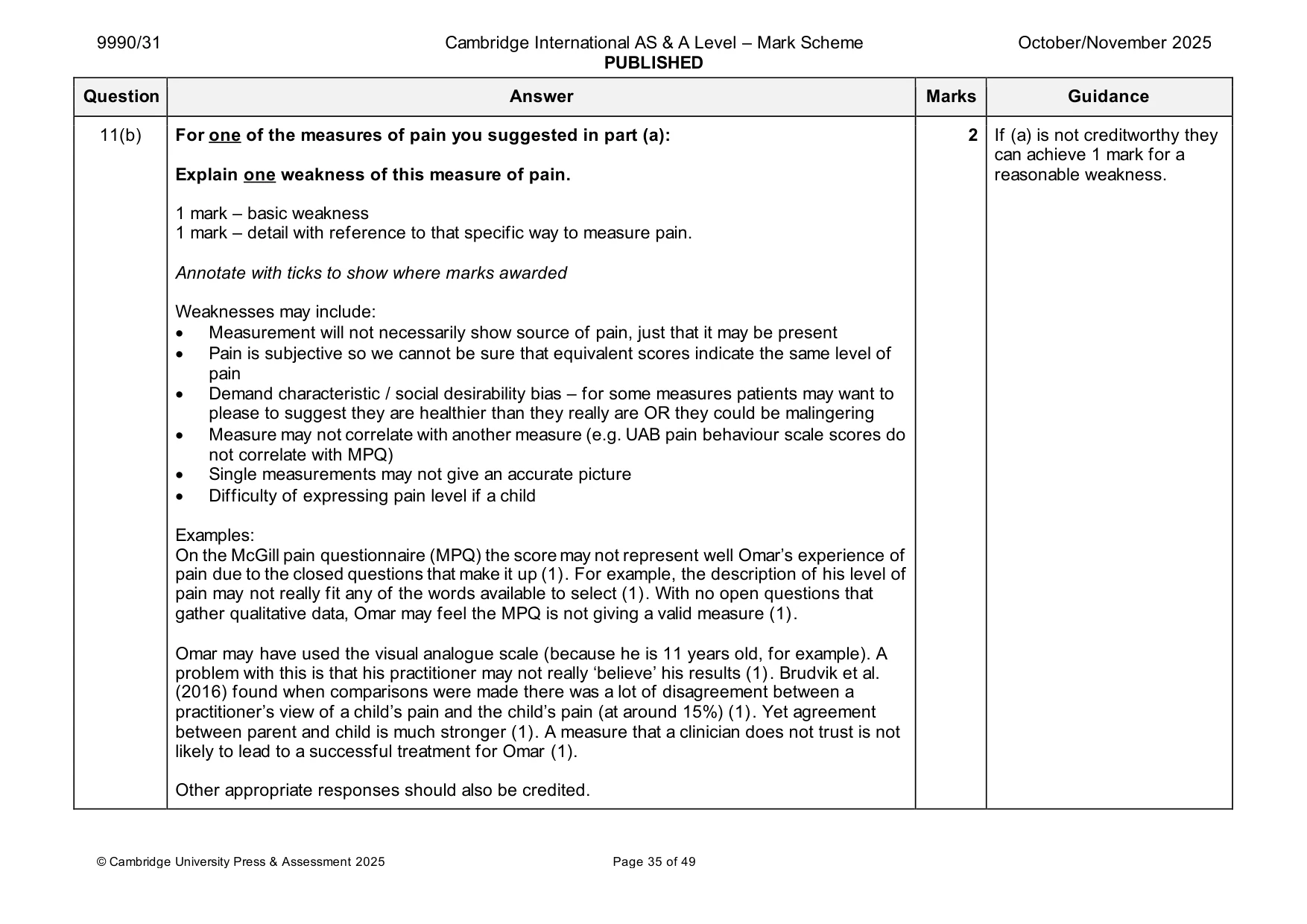
11 Omar is in hospital with chest pain. His practitioner wants to investigate this by assessing Omar’s pain. (a) Suggest two different measures of pain that Omar’s practitioner could use with him. [4] (b) For one of the measures of pain you suggested in part (a): Explain one weakness of this measure of pain. [2]
Mark scheme: 11(a) Omar is in hospital with chest pain. His practitioner wants to investigate this by 4 assessing Omar’s pain. Suggest two different measures of pain that Omar’s practitioner could use with him. Syllabus content: Measuring Pain • Subjective measures including clinical interview • Psychometric measures and visual rating scales – McGill pain questionnaire – visual analogue scale exemplified by Brudvik et al. (2016) • Behavioural/observational measures; UAB pain behaviour scale For each suggested way: 1 mark – basic outline/name of way to measure pain 1 mark – detail of how the pain measure works Annotate with ticks to show where marks awarded Suggestions could include: • Clinical interview • McGill pain questionnaire • Faces Pain Rating Scale-Revised (FPS-R) – Omar could be a child • Coloured Analogue Scale (CAS) • Numeric rating scale (NRS) • UAB pain behaviour scale Examples: Omar’s practitioner could use a clinical interview where he asks Omar a series of open questions about their experience of pain (1). This could include ‘How does this chest pain affect your physical activities?’ (1) and ‘What are you currently doing to deal with your pain?’ (1). Omar’s practitioner could use the UAB pain behaviour scale (1). This is where a set of ten target behaviours are observed including verbal complaints (1), mobility (for example is Omar impaired in his ability to walk?) (1), facial grimaces (1). Other appropriate responses should also be credited. 11(b) For one of the measures of pain you suggested in part (a): 2 If (a) is not creditworthy they can achieve 1 mark for a Explain one weakness of this measure of pain. reasonable weakness. 1 mark – basic weakness 1 mark – detail with reference to that specific way to measure pain. Annotate with ticks to show where marks awarded Weaknesses may include: • Measurement will not necessarily show source of pain, just that it may be present • Pain is subjective so we cannot be sure that equivalent scores indicate the same level of pain • Demand characteristic / social desirability bias – for some measures patients may want to please to suggest they are healthier than they really are OR they could be malingering • Measure may not correlate with another measure (e.g. UAB pain behaviour scale scores do not correlate with MPQ) • Single measurements may not give an accurate picture • Difficulty of expressing pain level if a child Examples: On the McGill pain questionnaire (MPQ) the score may not represent well Omar’s experience of pain due to the closed questions that make it up (1). For example, the description of his level of pain may not really fit any of the words available to select (1). With no open questions that gather qualitative data, Omar may feel the MPQ is not giving a valid measure (1). Omar may have used the visual analogue scale (because he is 11 years old, for example). A problem with this is that his practitioner may not really ‘believe’ his results (1). Brudvik et al. (2016) found when comparisons were made there was a lot of disagreement between a practitioner’s view of a child’s pain and the child’s pain (at around 15%) (1). Yet agreement between parent and child is much stronger (1). A measure that a clinician does not trust is not likely to lead to a successful treatment for Omar (1). Other appropriate responses should also be credited.
Q12 · Describe what psychologists investigating practitioner diagnosis have discovered about: •…
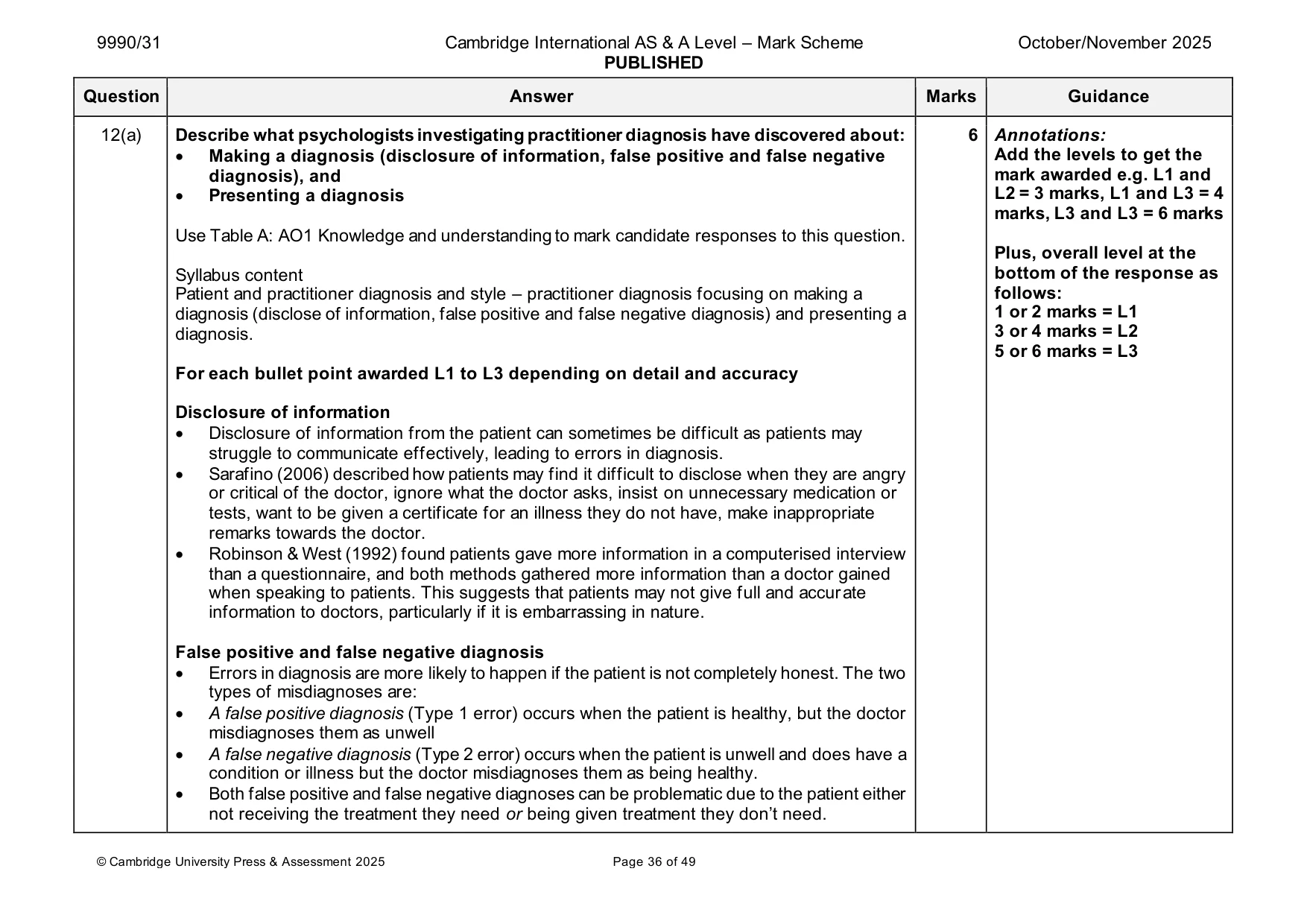
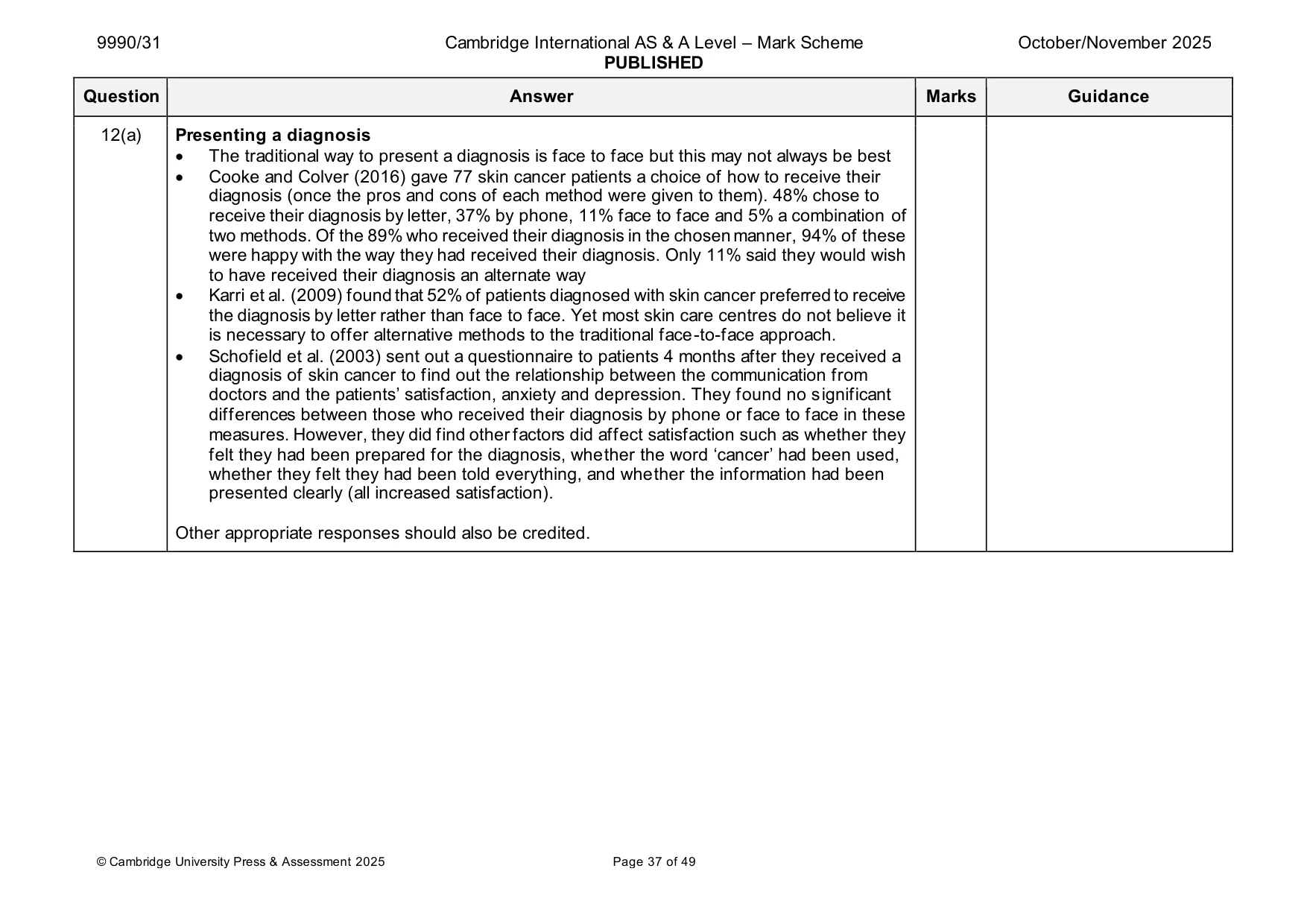
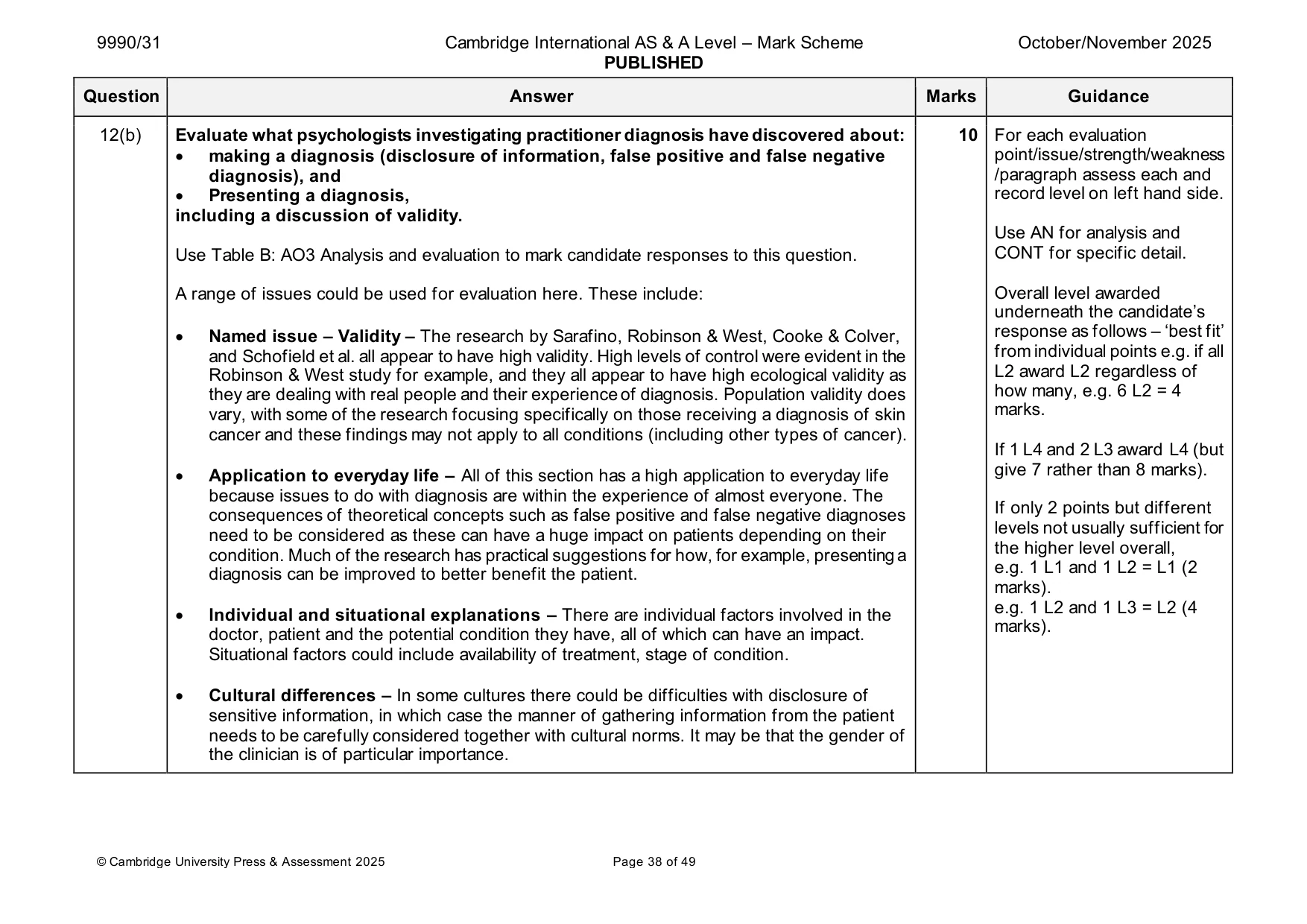
12 (a) Describe what psychologists investigating practitioner diagnosis have discovered about: • making a diagnosis (disclosure of information, false positive and false negative diagnosis), and • presenting a diagnosis. [6] (b) Evaluate what psychologists investigating practitioner diagnosis have discovered about: • making a diagnosis (disclosure of information, false positive and false negative diagnosis), and • presenting a diagnosis, including a discussion of validity. Evaluation in your answer can include strengths, weaknesses and a discussion of issues and debates. [10] Section D: Organisational Psychology Answer all questions.
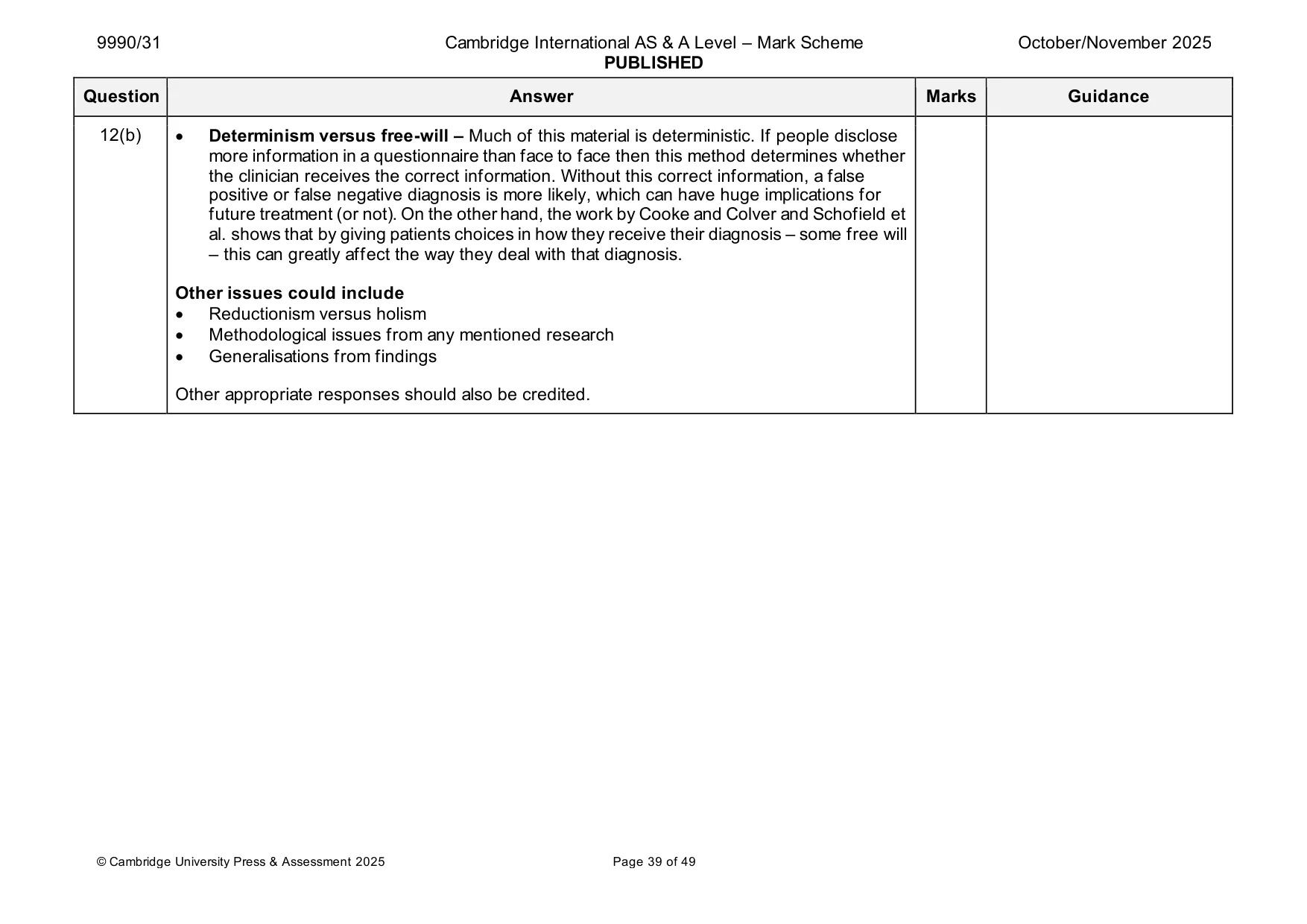
Mark scheme: 12(a) Describe what psychologists investigating practitioner diagnosis have discovered about: 6 Annotations: • Making a diagnosis (disclosure of information, false positive and false negative Add the levels to get the diagnosis), and mark awarded e.g. L1 and • Presenting a diagnosis L2 = 3 marks, L1 and L3 = 4 marks, L3 and L3 = 6 marks Use Table A: AO1 Knowledge and understanding to mark candidate responses to this question. Plus, overall level at the Syllabus content bottom of the response as Patient and practitioner diagnosis and style – practitioner diagnosis focusing on making a follows: diagnosis (disclose of information, false positive and false negative diagnosis) and presenting a 1 or 2 marks = L1 diagnosis. 3 or 4 marks = L2 5 or 6 marks = L3 For each bullet point awarded L1 to L3 depending on detail and accuracy Disclosure of information • Disclosure of information from the patient can sometimes be difficult as patients may struggle to communicate effectively, leading to errors in diagnosis. • Sarafino (2006) described how patients may find it difficult to disclose when they are angry or critical of the doctor, ignore what the doctor asks, insist on unnecessary medication or tests, want to be given a certificate for an illness they do not have, make inappropriate remarks towards the doctor. • Robinson & West (1992) found patients gave more information in a computerised interview than a questionnaire, and both methods gathered more information than a doctor gained when speaking to patients. This suggests that patients may not give full and accurate information to doctors, particularly if it is embarrassing in nature. False positive and false negative diagnosis • Errors in diagnosis are more likely to happen if the patient is not completely honest. The two types of misdiagnoses are: • A false positive diagnosis (Type 1 error) occurs when the patient is healthy, but the doctor misdiagnoses them as unwell • A false negative diagnosis (Type 2 error) occurs when the patient is unwell and does have a condition or illness but the doctor misdiagnoses them as being healthy. • Both false positive and false negative diagnoses can be problematic due to the patient either not receiving the treatment they need or being given treatment they don’t need. 12(a) Presenting a diagnosis • The traditional way to present a diagnosis is face to face but this may not always be best • Cooke and Colver (2016) gave 77 skin cancer patients a choice of how to receive their diagnosis (once the pros and cons of each method were given to them). 48% chose to receive their diagnosis by letter, 37% by phone, 11% face to face and 5% a combination of two methods. Of the 89% who received their diagnosis in the chosen manner, 94% of these were happy with the way they had received their diagnosis. Only 11% said they would wish to have received their diagnosis an alternate way • Karri et al. (2009) found that 52% of patients diagnosed with skin cancer preferred to receive the diagnosis by letter rather than face to face. Yet most skin care centres do not believe it is necessary to offer alternative methods to the traditional face-to-face approach. • Schofield et al. (2003) sent out a questionnaire to patients 4 months after they received a diagnosis of skin cancer to find out the relationship between the communication from doctors and the patients’ satisfaction, anxiety and depression. They found no significant differences between those who received their diagnosis by phone or face to face in these measures. However, they did find other factors did affect satisfaction such as whether they felt they had been prepared for the diagnosis, whether the word ‘cancer’ had been used, whether they felt they had been told everything, and whether the information had been presented clearly (all increased satisfaction). Other appropriate responses should also be credited. 12(b) Evaluate what psychologists investigating practitioner diagnosis have discovered about: 10 For each evaluation • making a diagnosis (disclosure of information, false positive and false negative point/issue/strength/weakness diagnosis), and /paragraph assess each and • Presenting a diagnosis, record level on left hand side. including a discussion of validity. Use AN for analysis and Use Table B: AO3 Analysis and evaluation to mark candidate responses to this question. CONT for specific detail. A range of issues could be used for evaluation here. These include: Overall level awarded underneath the candidate’s • Named issue – Validity – The research by Sarafino, Robinson & West, Cooke & Colver, response as follows – ‘best fit’ from individual points e.g. if all and Schofield et al. all appear to have high validity. High levels of control were evident in the Robinson & West study for example, and they all appear to have high ecological validity as L2 award L2 regardless of they are dealing with real people and their experience of diagnosis. Population validity does how many, e.g. 6 L2 = 4 marks. vary, with some of the research focusing specifically on those receiving a diagnosis of skin cancer and these findings may not apply to all conditions (including other types of cancer). If 1 L4 and 2 L3 award L4 (but • Application to everyday life – All of this section has a high application to everyday life give 7 rather than 8 marks). because issues to do with diagnosis are within the experience of almost everyone. The If only 2 points but different consequences of theoretical concepts such as false positive and false negative diagnoses levels not usually sufficient for need to be considered as these can have a huge impact on patients depending on their the higher level overall, condition. Much of the research has practical suggestions for how, for example, presenting a e.g. 1 L1 and 1 L2 = L1 (2 diagnosis can be improved to better benefit the patient. marks). e.g. 1 L2 and 1 L3 = L2 (4 • Individual and situational explanations – There are individual factors involved in the marks). doctor, patient and the potential condition they have, all of which can have an impact. Situational factors could include availability of treatment, stage of condition. • Cultural differences – In some cultures there could be difficulties with disclosure of sensitive information, in which case the manner of gathering information from the patient needs to be carefully considered together with cultural norms. It may be that the gender of the clinician is of particular importance. 12(b) • Determinism versus free-will – Much of this material is deterministic. If people disclose more information in a questionnaire than face to face then this method determines whether the clinician receives the correct information. Without this correct information, a false positive or false negative diagnosis is more likely, which can have huge implications for future treatment (or not). On the other hand, the work by Cooke and Colver and Schofield et al. shows that by giving patients choices in how they receive their diagnosis – some free will – this can greatly affect the way they deal with that diagnosis. Other issues could include • Reductionism versus holism • Methodological issues from any mentioned research • Generalisations from findings Other appropriate responses should also be credited. Section D: Organisational Psychology
Q13 · Celeste is a member of a newly formed school council
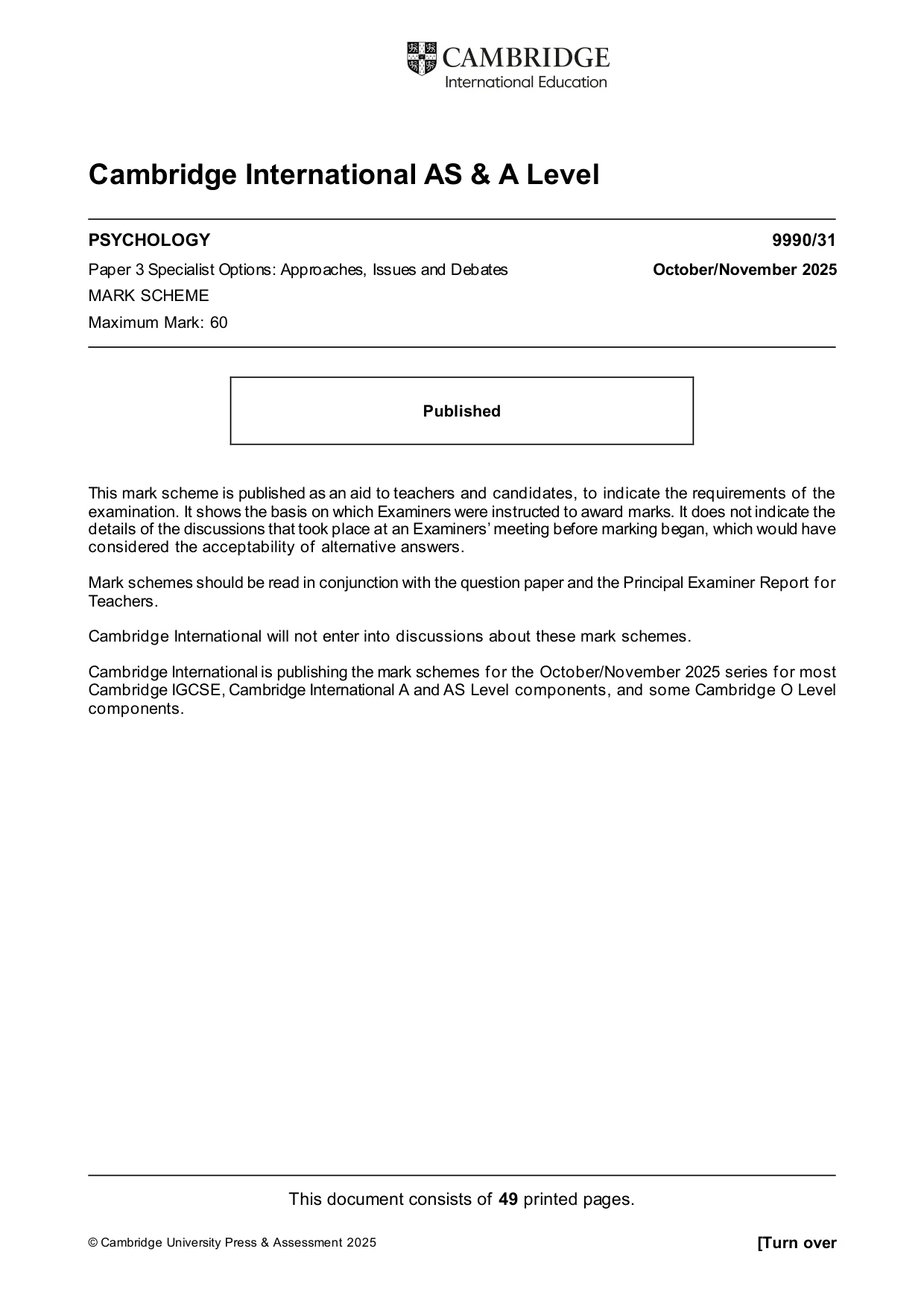
13 Celeste is a member of a newly formed school council. This is a group of student representatives who make decisions, such as what should be on the school menu and whether to have recycling bins or a new drinks machine. Suggest the stages of group development that the school council could go through as they make decisions. [4]
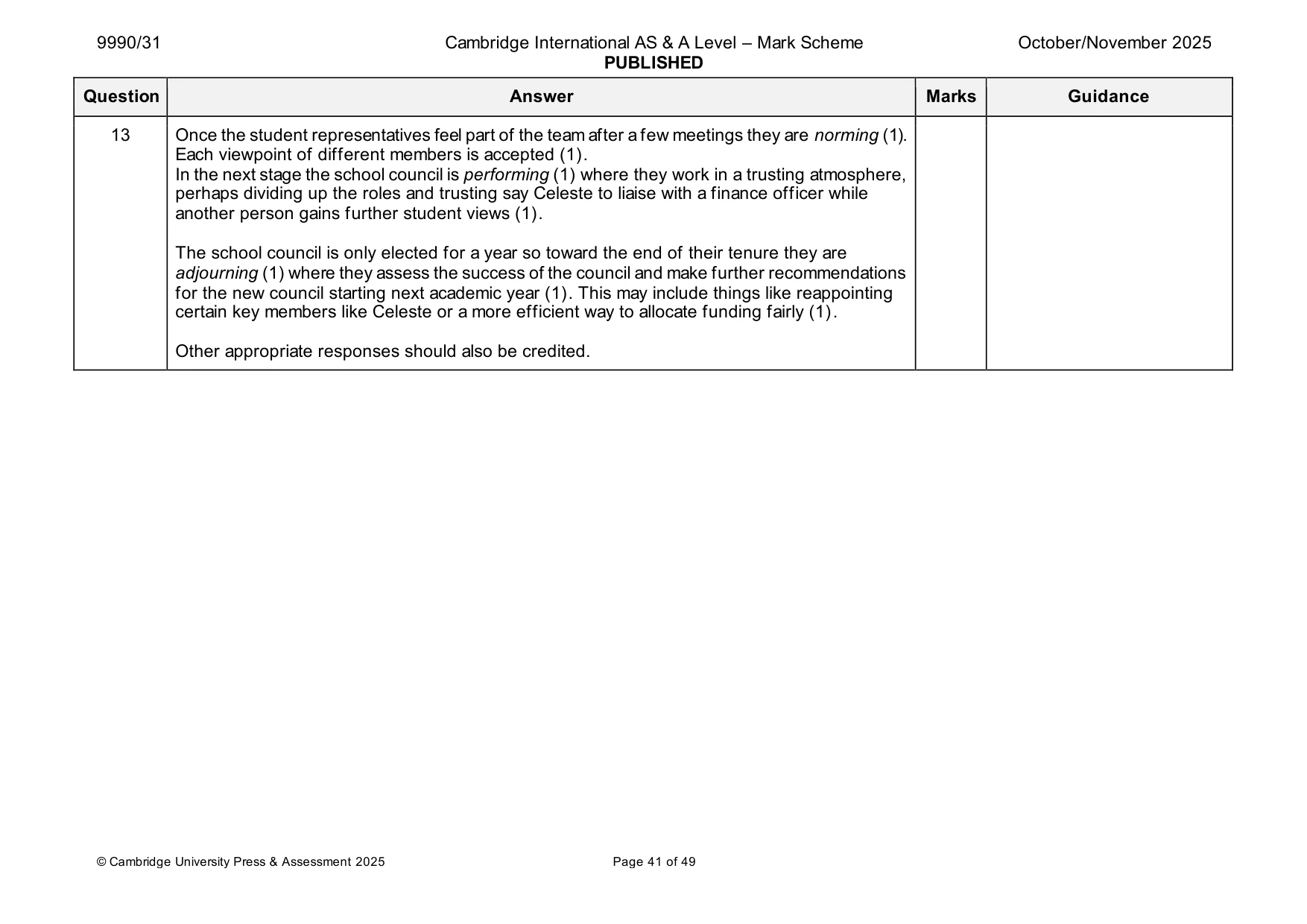
Mark scheme: 13 Celeste is a member of the newly formed school council. This is a group of student 4 For full marks must outline 3 representative who make decisions, such as what should be on the school menu and stages (in context) whether to have recycling bins or a new drinks machine. Max 3 if not in context. Suggest the stages of group development that the school council could go through as Context = school council, they make decisions. students, menu, drinks machine, Award 3–4 marks for a detailed answer with clear understanding of group development stages in context 1 mark Award 1–2 marks for a basic answer with some understanding of group development stages identify 3 stages 2 marks Annotate with ticks to show where marks awarded identify 2 stages and 1 clear and context or 2 a bit vague Syllabus content: (no context) Group development and decision-making: stages of group development 3 marks identify 2 stages and 2 clear Likely context: and context (may identify 3rd • Forming stage and outline is a bit • Storming vague/no context • Norming 4 marks • Performing identify 3+ stages and 3 clear • Adjourning and context Responses may refer to all of the stages of group development above or fewer but in more depth and detail. Example: The school council is new and the first stage is forming (1) when the student members establish some group rules such as how they will conduct the meetings (1). As they do not know each other well the relationships between members are formal (1). Celeste and the other members now start to talk more and they could become argumentative as they resist control by a leader (1). This is the storming stage and is vital in group development (1). 13 Once the student representatives feel part of the team after a few meetings they are norming (1). Each viewpoint of different members is accepted (1). In the next stage the school council is performing (1) where they work in a trusting atmosphere, perhaps dividing up the roles and trusting say Celeste to liaise with a finance officer while another person gains further student views (1). The school council is only elected for a year so toward the end of their tenure they are adjourning (1) where they assess the success of the council and make further recommendations for the new council starting next academic year (1). This may include things like reappointing certain key members like Celeste or a more efficient way to allocate funding fairly (1). Other appropriate responses should also be credited.
Q14 · Outline what is meant by a ‘nomothetic approach’, including an example from a need theory…
14 (a) Outline what is meant by a ‘nomothetic approach’, including an example from a need theory of motivation at work. [2] (b) Explain how a need theory of motivation at work could be investigated using an idiographic approach. [2]
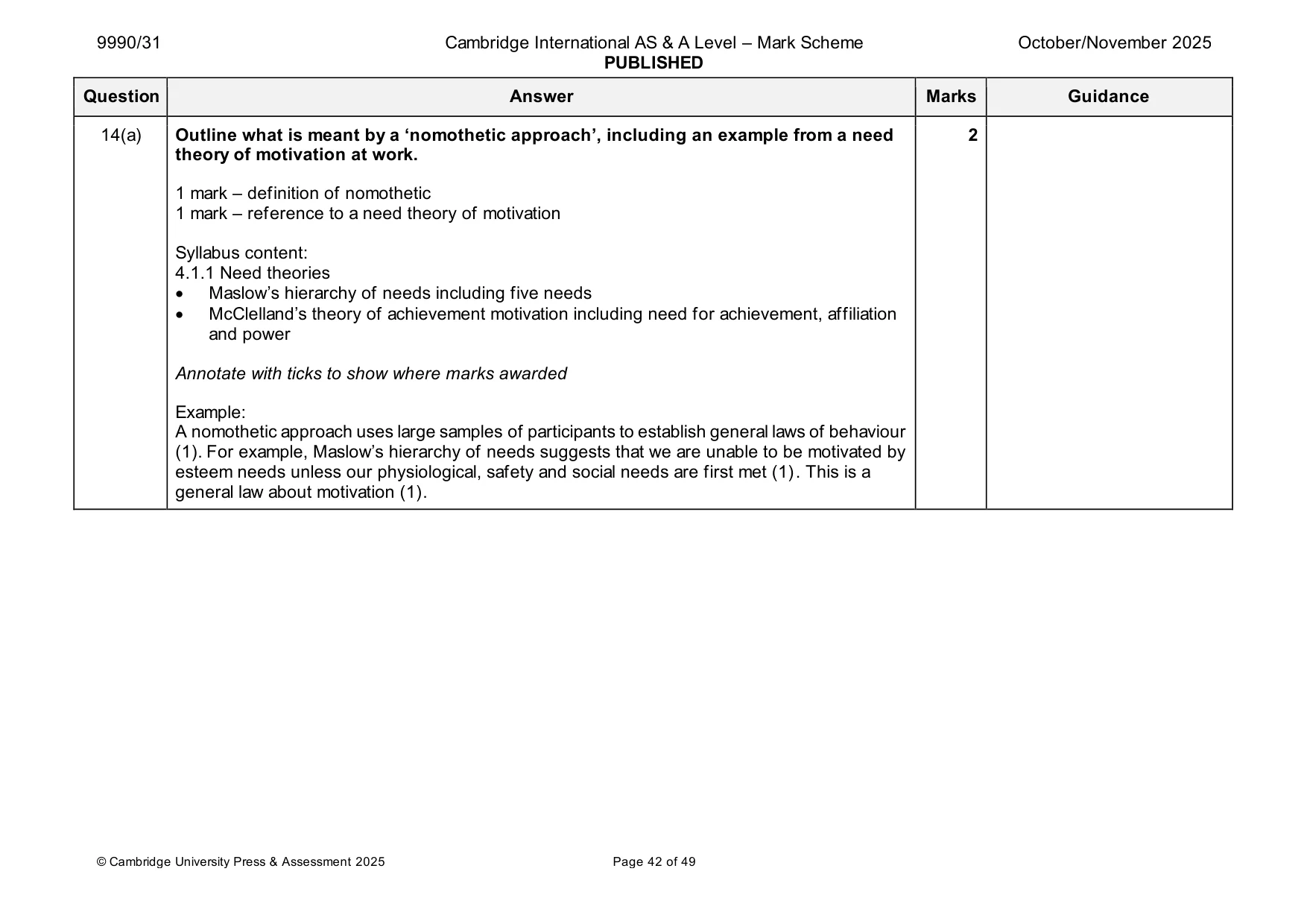
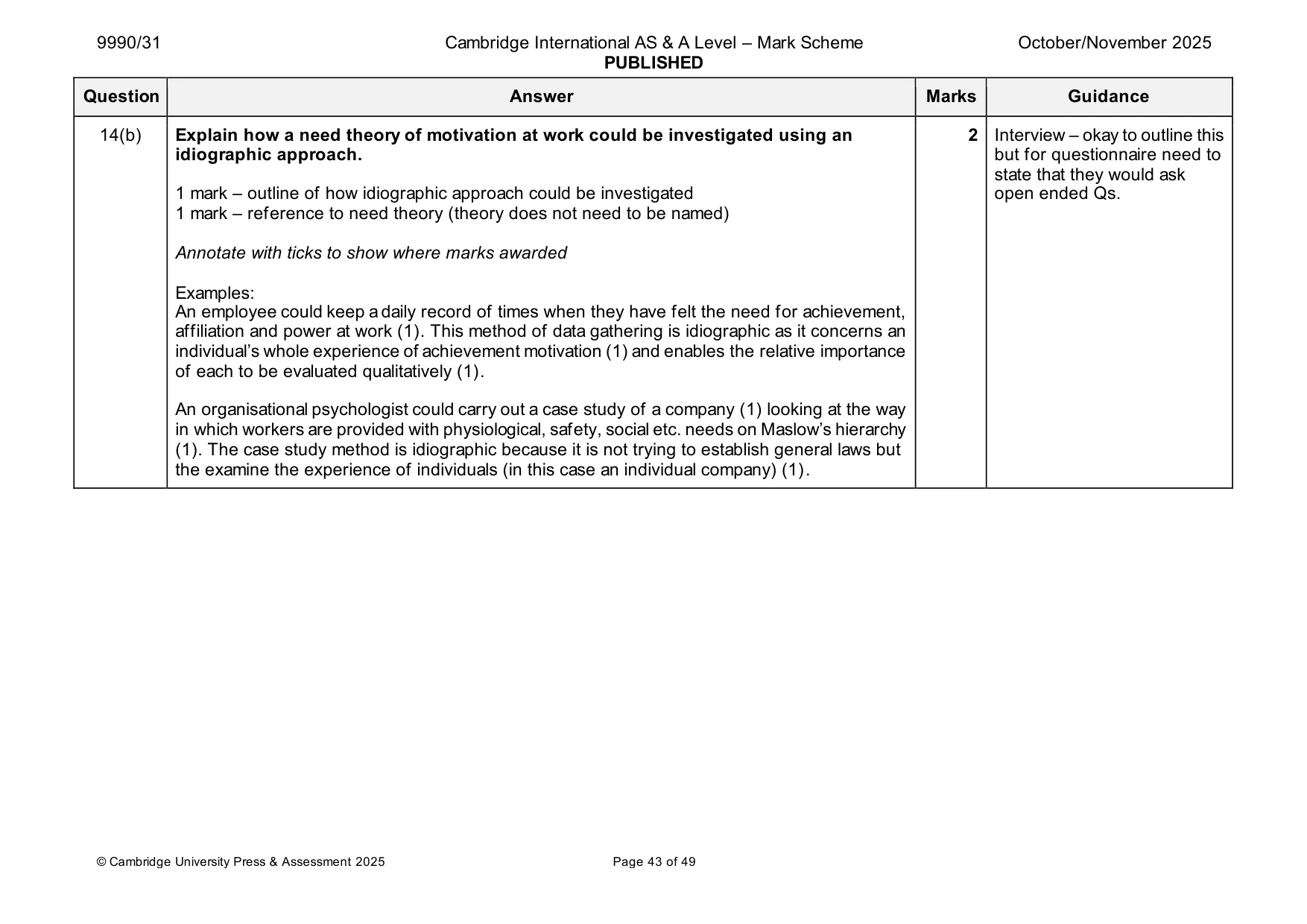
Mark scheme: 14(a) Outline what is meant by a ‘nomothetic approach’, including an example from a need 2 theory of motivation at work. 1 mark – definition of nomothetic 1 mark – reference to a need theory of motivation Syllabus content: 4.1.1 Need theories • Maslow’s hierarchy of needs including five needs • McClelland’s theory of achievement motivation including need for achievement, affiliation and power Annotate with ticks to show where marks awarded Example: A nomothetic approach uses large samples of participants to establish general laws of behaviour (1). For example, Maslow’s hierarchy of needs suggests that we are unable to be motivated by esteem needs unless our physiological, safety and social needs are first met (1). This is a general law about motivation (1). 14(b) Explain how a need theory of motivation at work could be investigated using an 2 Interview – okay to outline this idiographic approach. but for questionnaire need to state that they would ask 1 mark – outline of how idiographic approach could be investigated open ended Qs. 1 mark – reference to need theory (theory does not need to be named) Annotate with ticks to show where marks awarded Examples: An employee could keep a daily record of times when they have felt the need for achievement, affiliation and power at work (1). This method of data gathering is idiographic as it concerns an individual’s whole experience of achievement motivation (1) and enables the relative importance of each to be evaluated qualitatively (1). An organisational psychologist could carry out a case study of a company (1) looking at the way in which workers are provided with physiological, safety, social etc. needs on Maslow’s hierarchy (1). The case study method is idiographic because it is not trying to establish general laws but the examine the experience of individuals (in this case an individual company) (1).
Q15 · Tatpara is the manager at a carpet factory
15 Tatpara is the manager at a carpet factory. He is concerned about low production at his factory. Tatpara believes this may be due to a lack of motivation in the workers. (a) Suggest two ways Tatpara could use extrinsic motivators with the carpet factory workers to increase production. [4] (b) For one of your suggestions in part (a): Explain one strength of this suggestion, other than to increase production. [2]
Mark scheme: 15(a) Tatpara is the manager at a carpet factory. He is concerned about low production at his 4 factory. Tatpara believes this may be due to a lack of motivation in the workers. Suggest two ways Tatpara could use extrinsic motivators with the carpet factory workers to increase production. Syllabus reference: Extrinsic motivators at work: types of reward systems including pay, bonuses, profit-sharing, performance-related pay. For each suggestion: 1 mark – name/brief outline of extrinsic motivator 1 mark – detail and in context Annotate with ticks to show where marks awarded Suggestions are likely to be: • Pay (increase) • Bonus (one-off payment) • Profit-sharing • Performance-related pay It needs to be clear in the two suggestions that they are different extrinsic motivators Examples: Tatpara could introduce a performance-related pay scheme (1). The performance of workers will be monitored and those who are working the hardest/producing the most carpet will be paid more than those who are working less (1). Tatpara could have a bonus scheme (1) whereby if the profits of the factory increase (by x amount) then each contributing employee would get a bonus one-off payment (1). This could be a set amount for everyone so workers feel compelled to work well as a team to all get a share in the bonus (1). Other appropriate responses should also be credited. 15(b) For one of your suggestions in part (a), 2 If reasonable suggestion is given in 15a which received 0 Explain one strength of this suggestion, other than to increase production. marks it can be credited for this Q. e.g. job enrichment. 1 mark – basic strength of suggestion 1 mark – detail Annotate with ticks to show where marks awarded Strengths may include: • Employee more likely to continue to work for factory due to increased money and thus satisfaction • Employee feels more part of a team so committed to the factory • Bonus schemes may give enhanced view of fairness – we all benefit if we work together to do more • Performance-related pay could lead to a greater sense of a fair day’s pay for a fair day’s work • If profits from factory increase, Tatpara is investing that in the increased wage bill demonstrating little overall cost to the factory Examples: Increased pay for the factory workers may get them out of a rut of feeling undervalued (1). This is likely to lead to feeling not just more motivated but more cared for (1), causing the workers to work even harder (1). Profit sharing at the factory could not only increase motivation but also make the workers feel more invested in the work of the factory (1). The workers will know that all of the work they do that increases the profits of the factory will ultimately benefit them (1). This would increase commitment and teamwork (1). Other appropriate responses should also be credited.
Q16 · Describe what psychologists have discovered about temporal conditions of work…
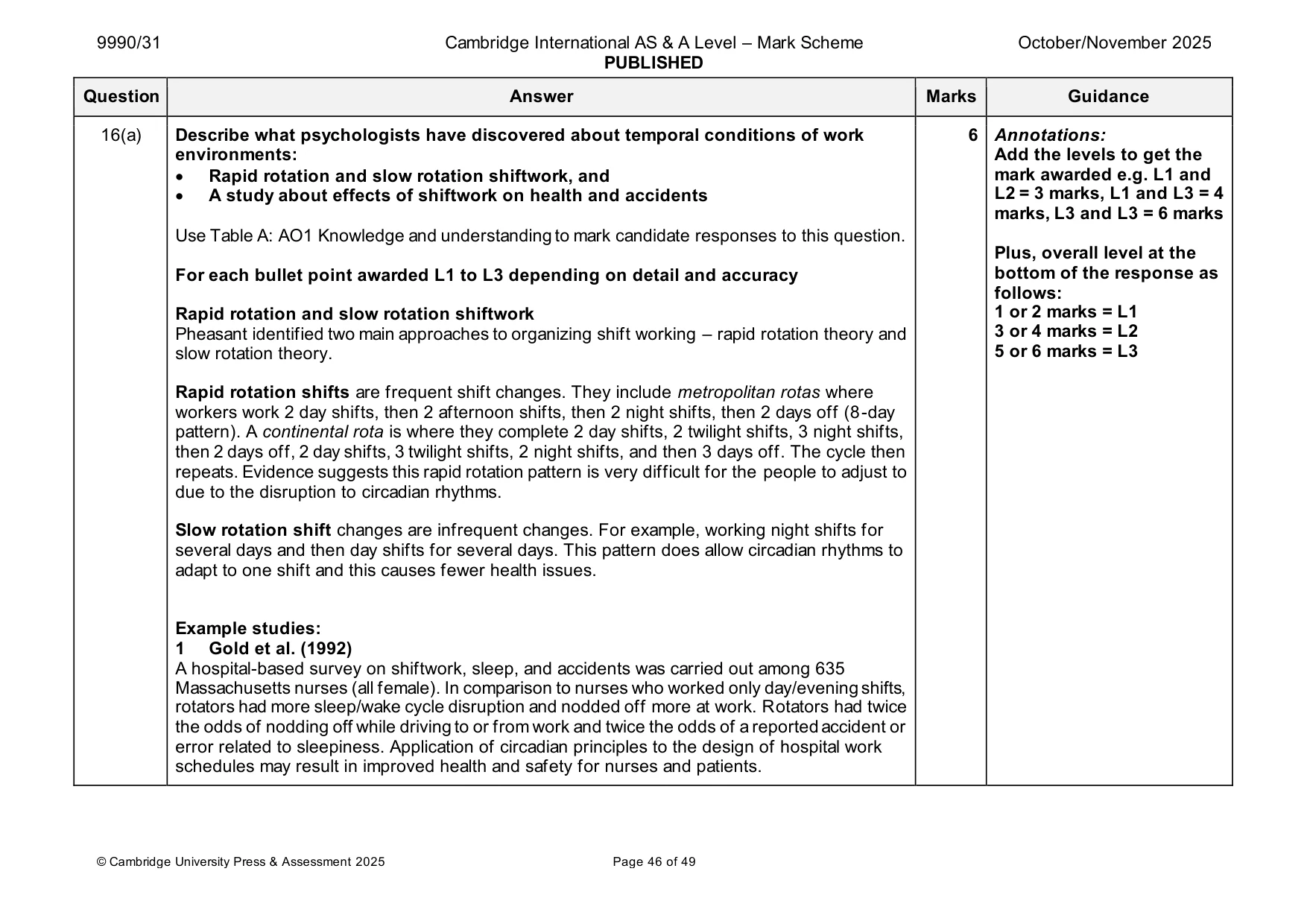
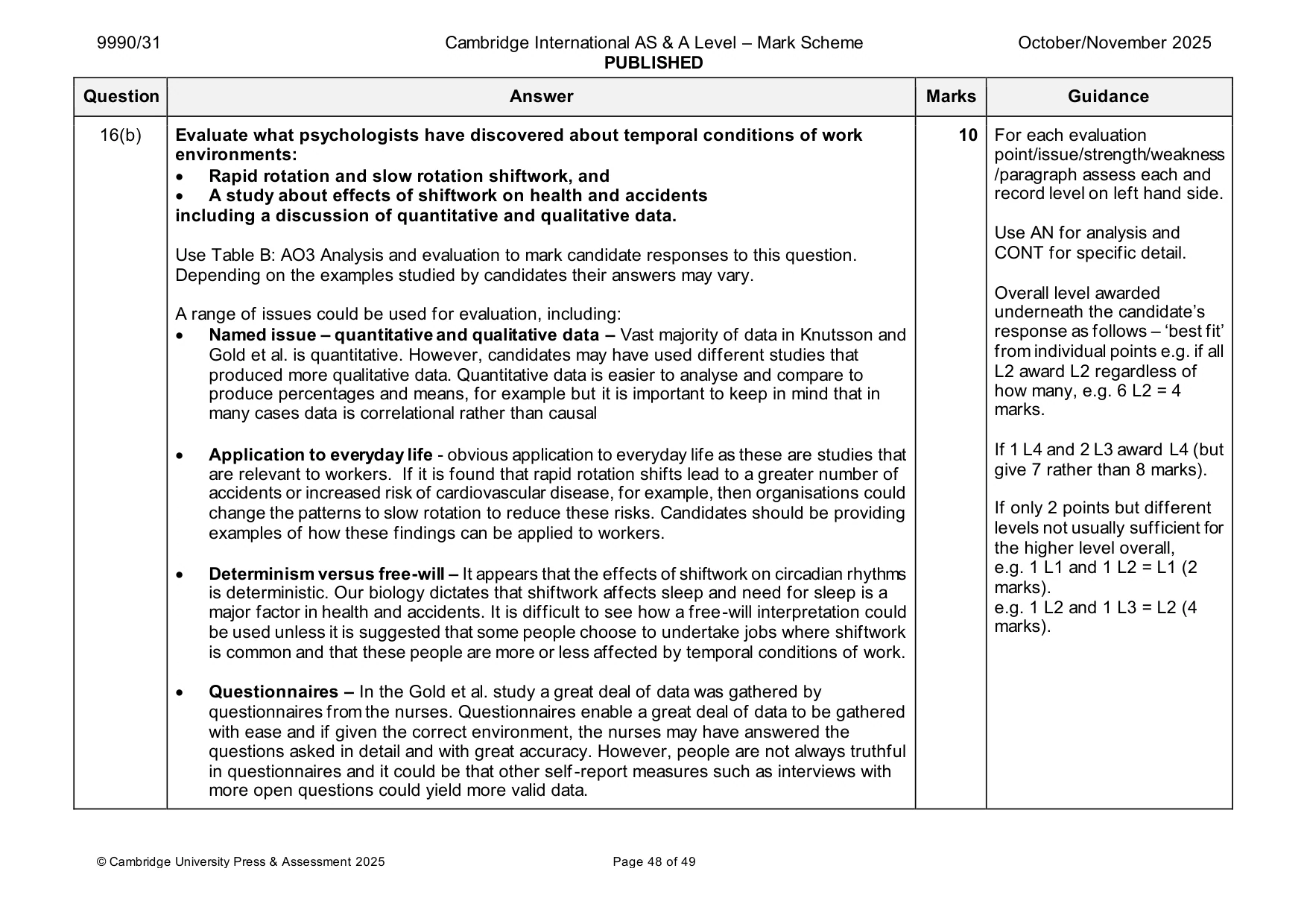
16 (a) Describe what psychologists have discovered about temporal conditions of work environments: • rapid rotation and slow rotation shiftwork, and • a study about the effects of shiftwork on health and accidents. [6] (b) Evaluate what psychologists have discovered about temporal conditions of work environments: • rapid rotation and slow rotation shiftwork, and • a study about the effects of shiftwork on health and accidents, including a discussion of quantitative and qualitative data. Evaluation in your answer can include strengths, weaknesses and a discussion of issues and debates. [10]
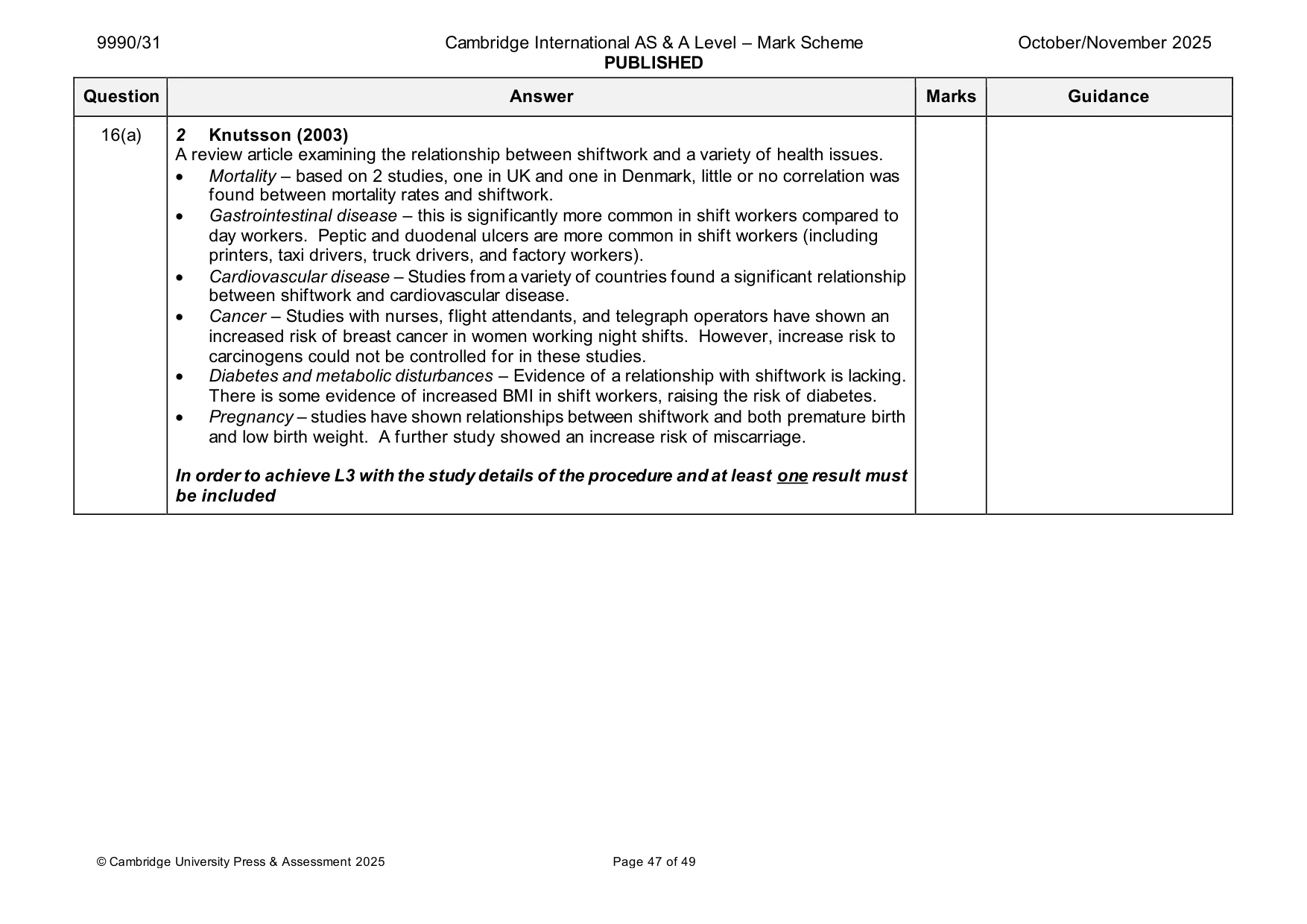
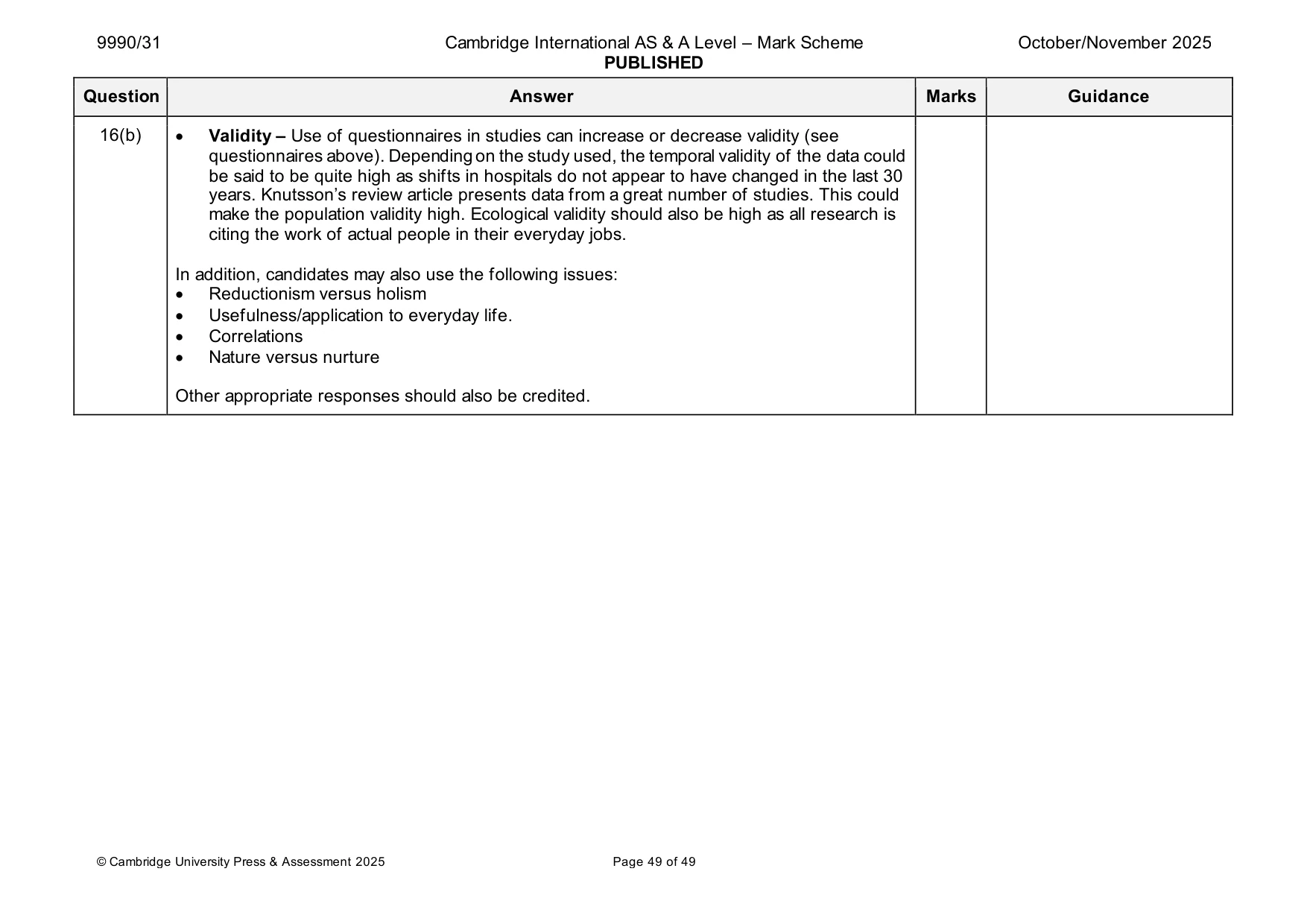
Mark scheme: 16(a) Describe what psychologists have discovered about temporal conditions of work 6 Annotations: environments: Add the levels to get the • Rapid rotation and slow rotation shiftwork, and mark awarded e.g. L1 and • A study about effects of shiftwork on health and accidents L2 = 3 marks, L1 and L3 = 4 marks, L3 and L3 = 6 marks Use Table A: AO1 Knowledge and understanding to mark candidate responses to this question. Plus, overall level at the For each bullet point awarded L1 to L3 depending on detail and accuracy bottom of the response as follows: Rapid rotation and slow rotation shiftwork 1 or 2 marks = L1 Pheasant identified two main approaches to organizing shift working – rapid rotation theory and 3 or 4 marks = L2 slow rotation theory. 5 or 6 marks = L3 Rapid rotation shifts are frequent shift changes. They include metropolitan rotas where workers work 2 day shifts, then 2 afternoon shifts, then 2 night shifts, then 2 days off (8-day pattern). A continental rota is where they complete 2 day shifts, 2 twilight shifts, 3 night shifts, then 2 days off, 2 day shifts, 3 twilight shifts, 2 night shifts, and then 3 days off. The cycle then repeats. Evidence suggests this rapid rotation pattern is very difficult for the people to adjust to due to the disruption to circadian rhythms. Slow rotation shift changes are infrequent changes. For example, working night shifts for several days and then day shifts for several days. This pattern does allow circadian rhythms to adapt to one shift and this causes fewer health issues. Example studies: 1 Gold et al. (1992) A hospital-based survey on shiftwork, sleep, and accidents was carried out among 635 Massachusetts nurses (all female). In comparison to nurses who worked only day/evening shifts, rotators had more sleep/wake cycle disruption and nodded off more at work. Rotators had twice the odds of nodding off while driving to or from work and twice the odds of a reported accident or error related to sleepiness. Application of circadian principles to the design of hospital work schedules may result in improved health and safety for nurses and patients. 16(a) 2 Knutsson (2003) A review article examining the relationship between shiftwork and a variety of health issues. • Mortality – based on 2 studies, one in UK and one in Denmark, little or no correlation was found between mortality rates and shiftwork. • Gastrointestinal disease – this is significantly more common in shift workers compared to day workers. Peptic and duodenal ulcers are more common in shift workers (including printers, taxi drivers, truck drivers, and factory workers). • Cardiovascular disease – Studies from a variety of countries found a significant relationship between shiftwork and cardiovascular disease. • Cancer – Studies with nurses, flight attendants, and telegraph operators have shown an increased risk of breast cancer in women working night shifts. However, increase risk to carcinogens could not be controlled for in these studies. • Diabetes and metabolic disturbances – Evidence of a relationship with shiftwork is lacking. There is some evidence of increased BMI in shift workers, raising the risk of diabetes. • Pregnancy – studies have shown relationships between shiftwork and both premature birth and low birth weight. A further study showed an increase risk of miscarriage. In order to achieve L3 with the study details of the procedure and at least one result must be included 16(b) Evaluate what psychologists have discovered about temporal conditions of work 10 For each evaluation environments: point/issue/strength/weakness • Rapid rotation and slow rotation shiftwork, and /paragraph assess each and • A study about effects of shiftwork on health and accidents record level on left hand side. including a discussion of quantitative and qualitative data. Use AN for analysis and Use Table B: AO3 Analysis and evaluation to mark candidate responses to this question. CONT for specific detail. Depending on the examples studied by candidates their answers may vary. Overall level awarded A range of issues could be used for evaluation, including: underneath the candidate’s • Named issue – quantitative and qualitative data – Vast majority of data in Knutsson and response as follows – ‘best fit’ Gold et al. is quantitative. However, candidates may have used different studies that from individual points e.g. if all produced more qualitative data. Quantitative data is easier to analyse and compare to L2 award L2 regardless of produce percentages and means, for example but it is important to keep in mind that in how many, e.g. 6 L2 = 4 many cases data is correlational rather than causal marks. • Application to everyday life - obvious application to everyday life as these are studies that If 1 L4 and 2 L3 award L4 (but give 7 rather than 8 marks). are relevant to workers. If it is found that rapid rotation shifts lead to a greater number of accidents or increased risk of cardiovascular disease, for example, then organisations could If only 2 points but different change the patterns to slow rotation to reduce these risks. Candidates should be providing levels not usually sufficient for examples of how these findings can be applied to workers. the higher level overall, • Determinism versus free-will – It appears that the effects of shiftwork on circadian rhythms e.g. 1 L1 and 1 L2 = L1 (2 marks). is deterministic. Our biology dictates that shiftwork affects sleep and need for sleep is a e.g. 1 L2 and 1 L3 = L2 (4 major factor in health and accidents. It is difficult to see how a free-will interpretation could marks). be used unless it is suggested that some people choose to undertake jobs where shiftwork is common and that these people are more or less affected by temporal conditions of work. • Questionnaires – In the Gold et al. study a great deal of data was gathered by questionnaires from the nurses. Questionnaires enable a great deal of data to be gathered with ease and if given the correct environment, the nurses may have answered the questions asked in detail and with great accuracy. However, people are not always truthful in questionnaires and it could be that other self-report measures such as interviews with more open questions could yield more valid data. 16(b) • Validity – Use of questionnaires in studies can increase or decrease validity (see questionnaires above). Depending on the study used, the temporal validity of the data could be said to be quite high as shifts in hospitals do not appear to have changed in the last 30 years. Knutsson’s review article presents data from a great number of studies. This could make the population validity high. Ecological validity should also be high as all research is citing the work of actual people in their everyday jobs. In addition, candidates may also use the following issues: • Reductionism versus holism • Usefulness/application to everyday life. • Correlations • Nature versus nurture Other appropriate responses should also be credited.
What was in this paper
The subtopics covered by these 16 questions, and how many questions each got. Open one in a new tab to see every Cambridge question on it.
3Consumer decision-making3Motivation to work22 Individual and group performance13 Health and safety1A Level Content1Advertising1Anxiety disorders and fear-related disorders1Mood (affective) disorders: depressive disorder (unipolar) and bipolar disorder1Obsessive-compulsive disorder (OCD)1Pain1