Cambridge A Level Psychology (from 2018) 9990 — 2025 Oct/Nov Paper 3 · Variant 2
9990/32/O/N/25 · 16 questions · 120 marks · 90 min
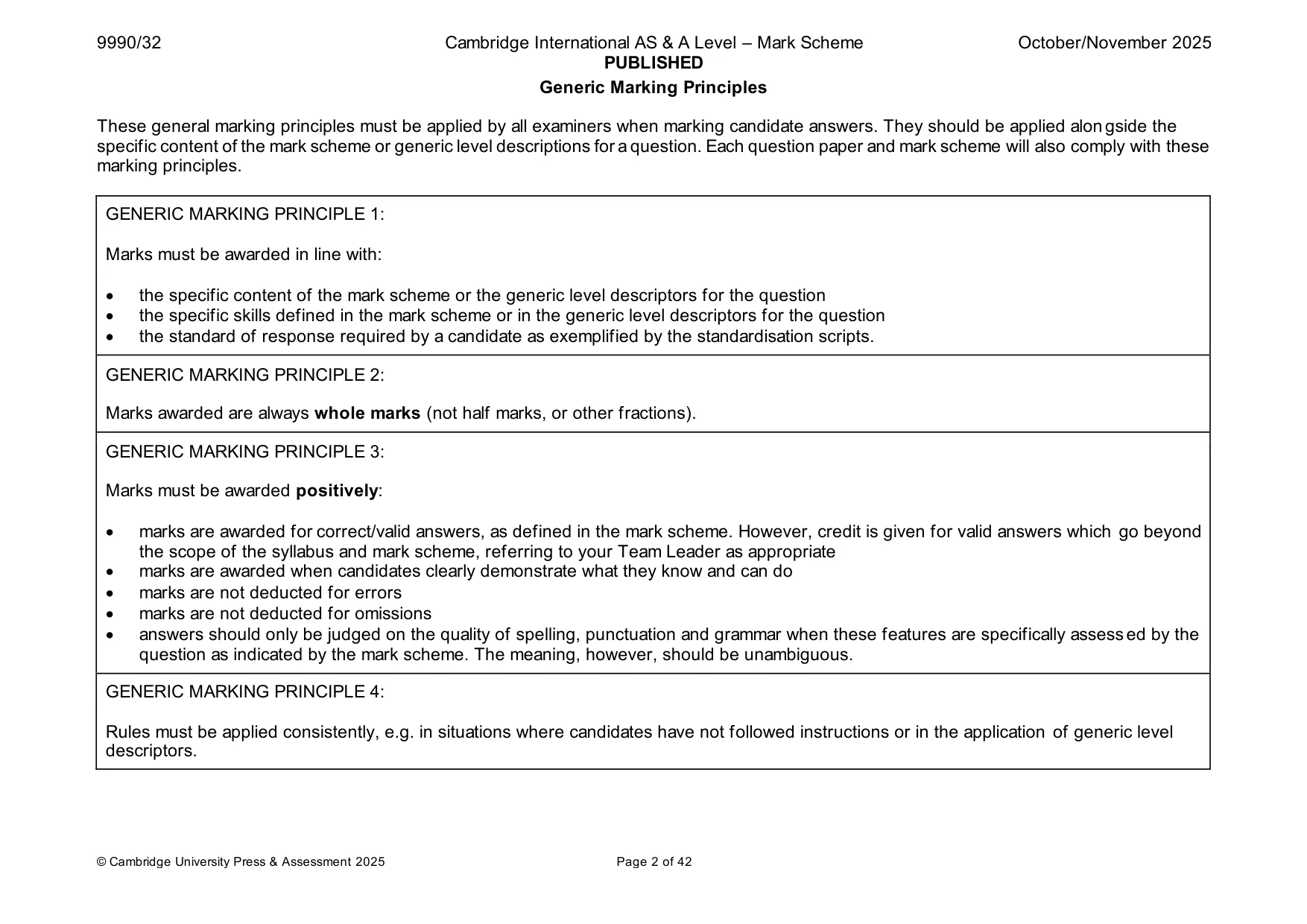
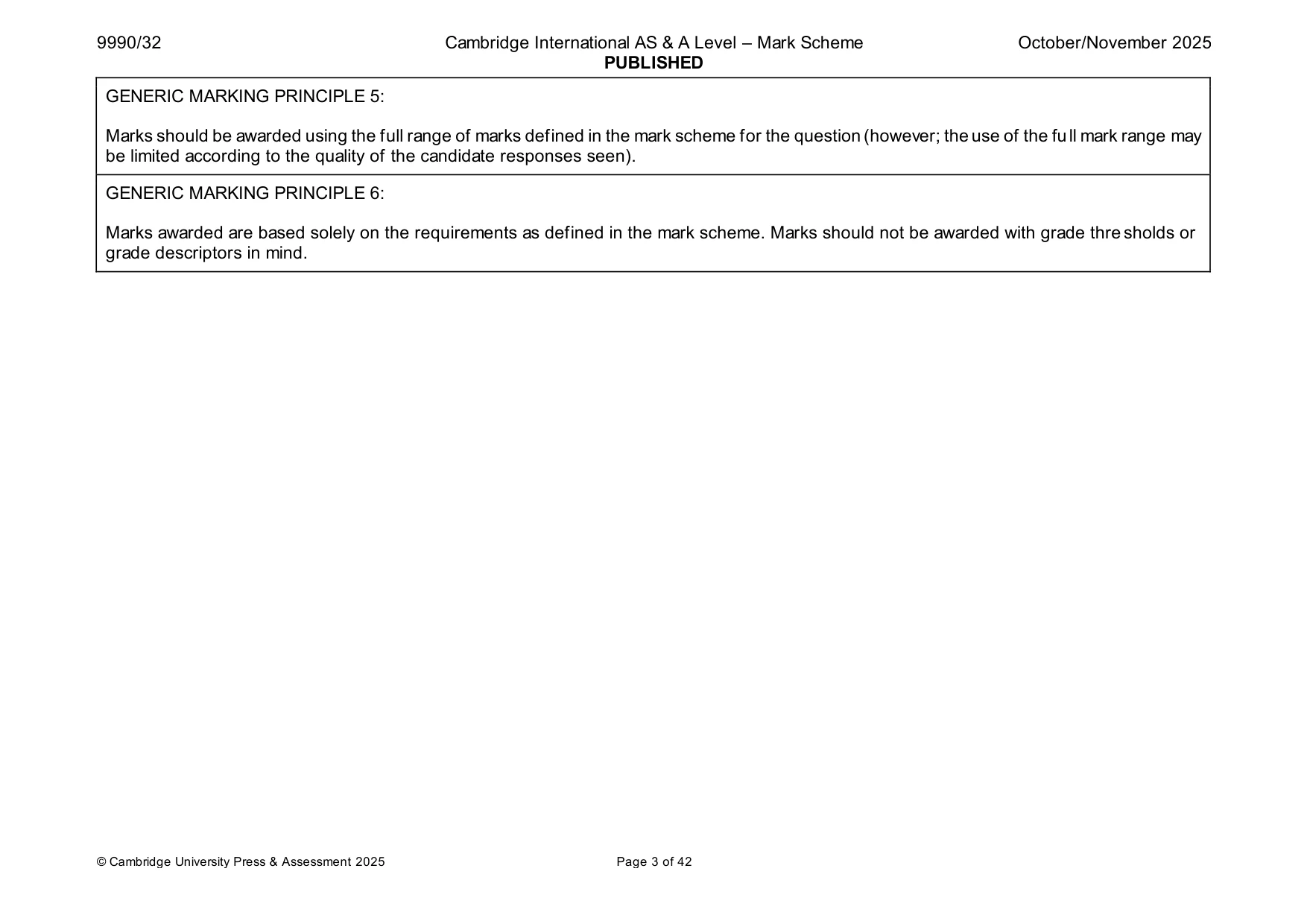
The question paper and its mark scheme, free to read here and free to download. This is Cambridge’s own paper, exactly as it was sat.
Question paper8 pages






Mark scheme42 pages
Answers below. Sit the paper first if you are practising.

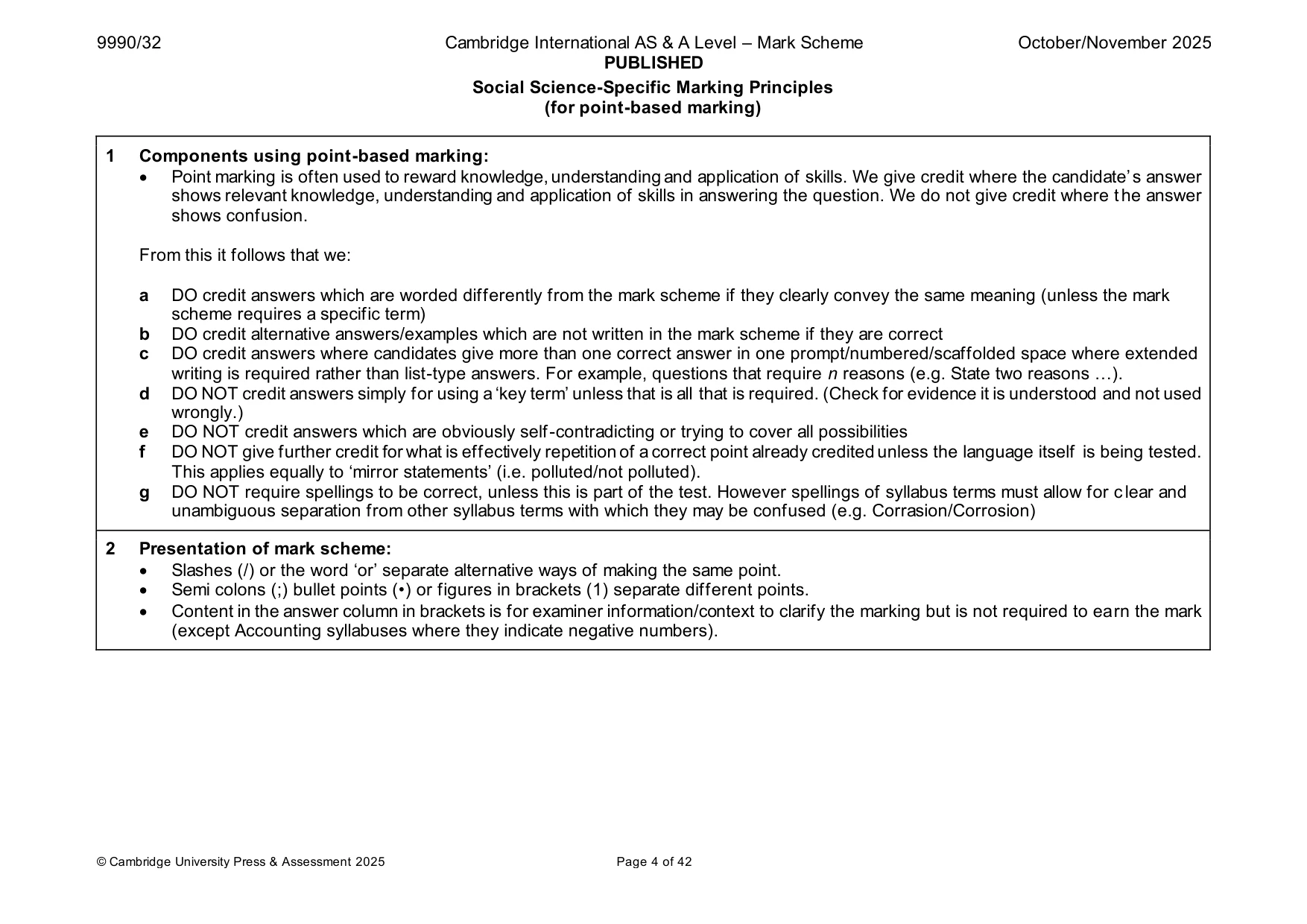
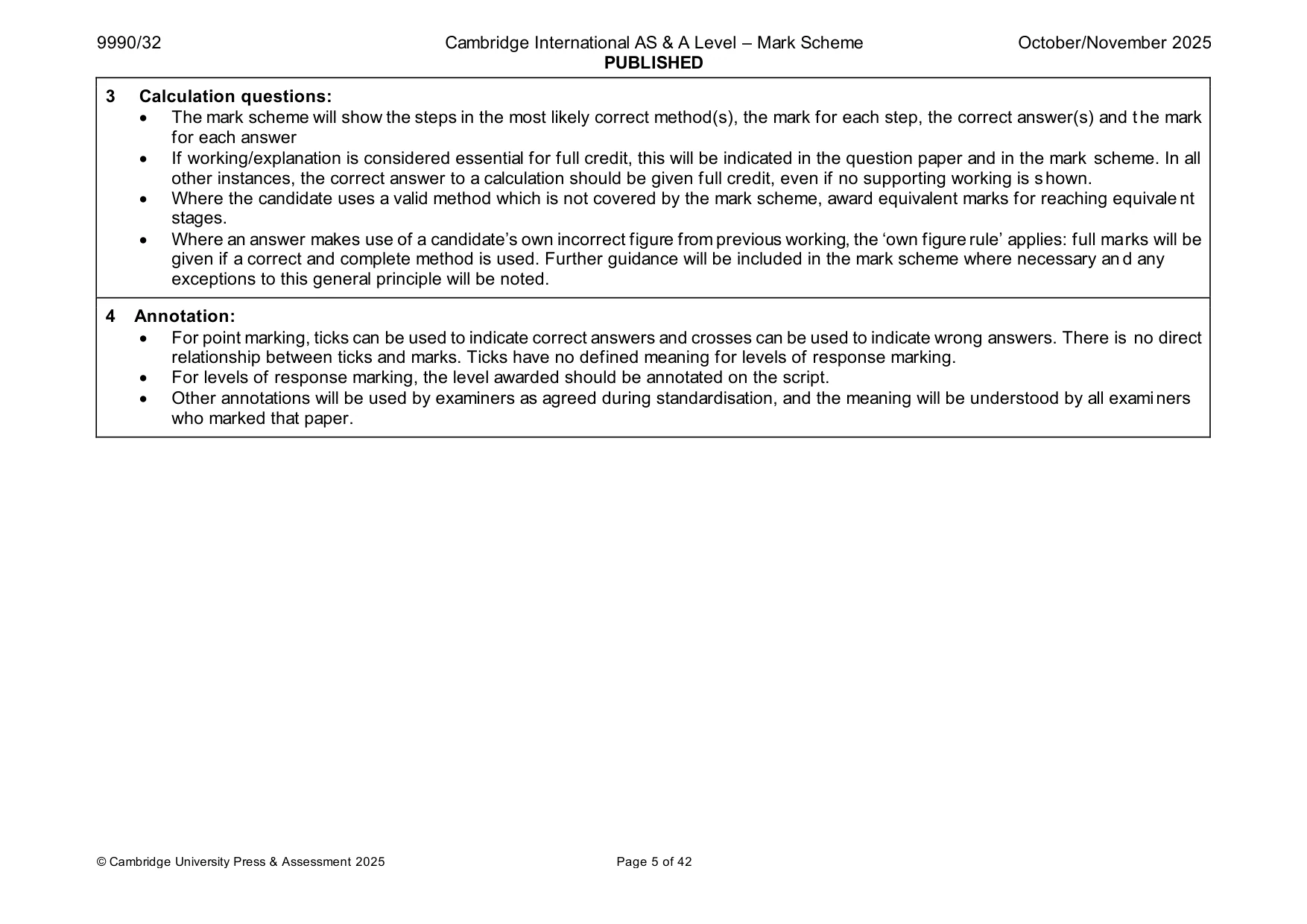
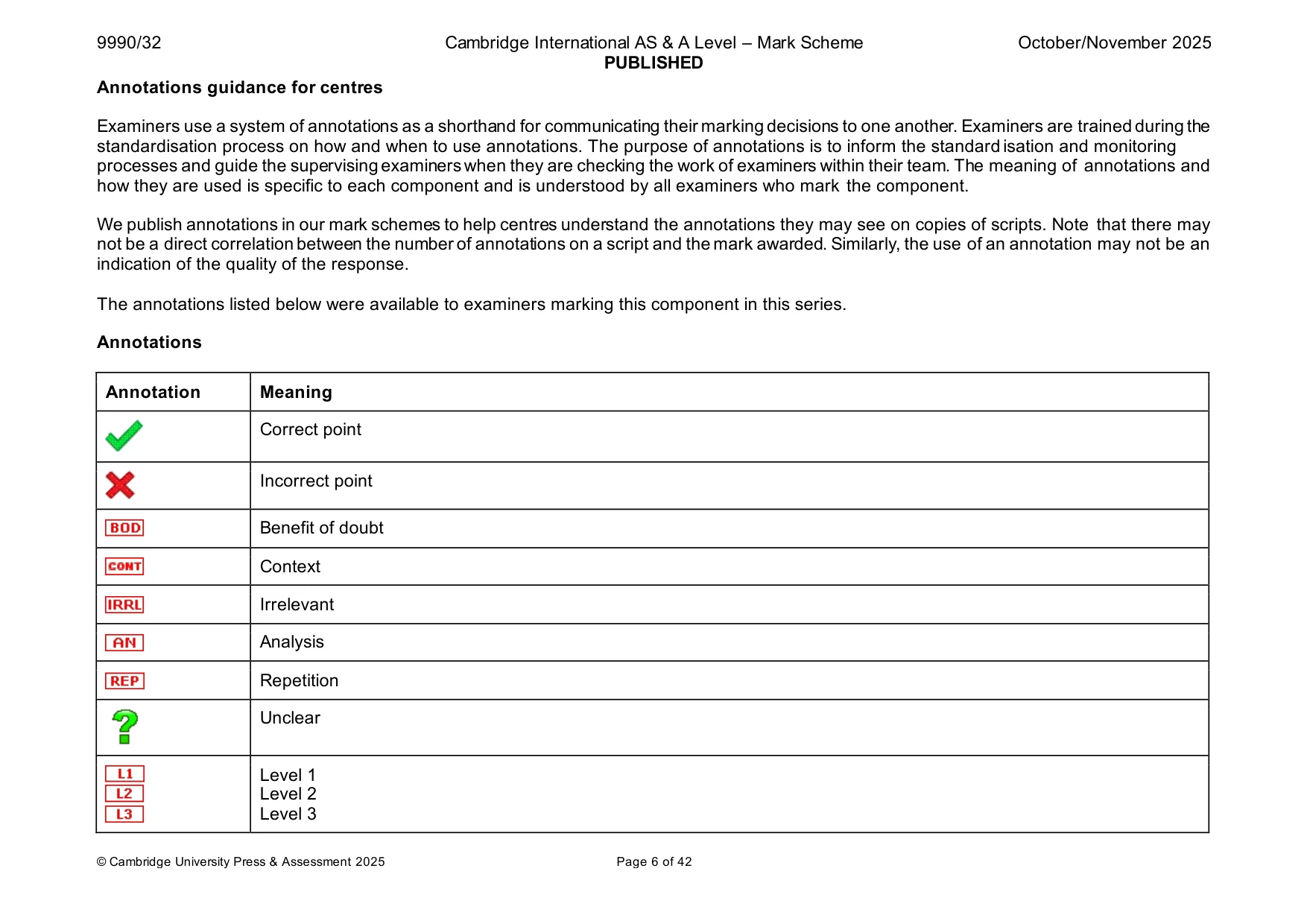






Questions as text
Q1 · Halema has been having depressed moods
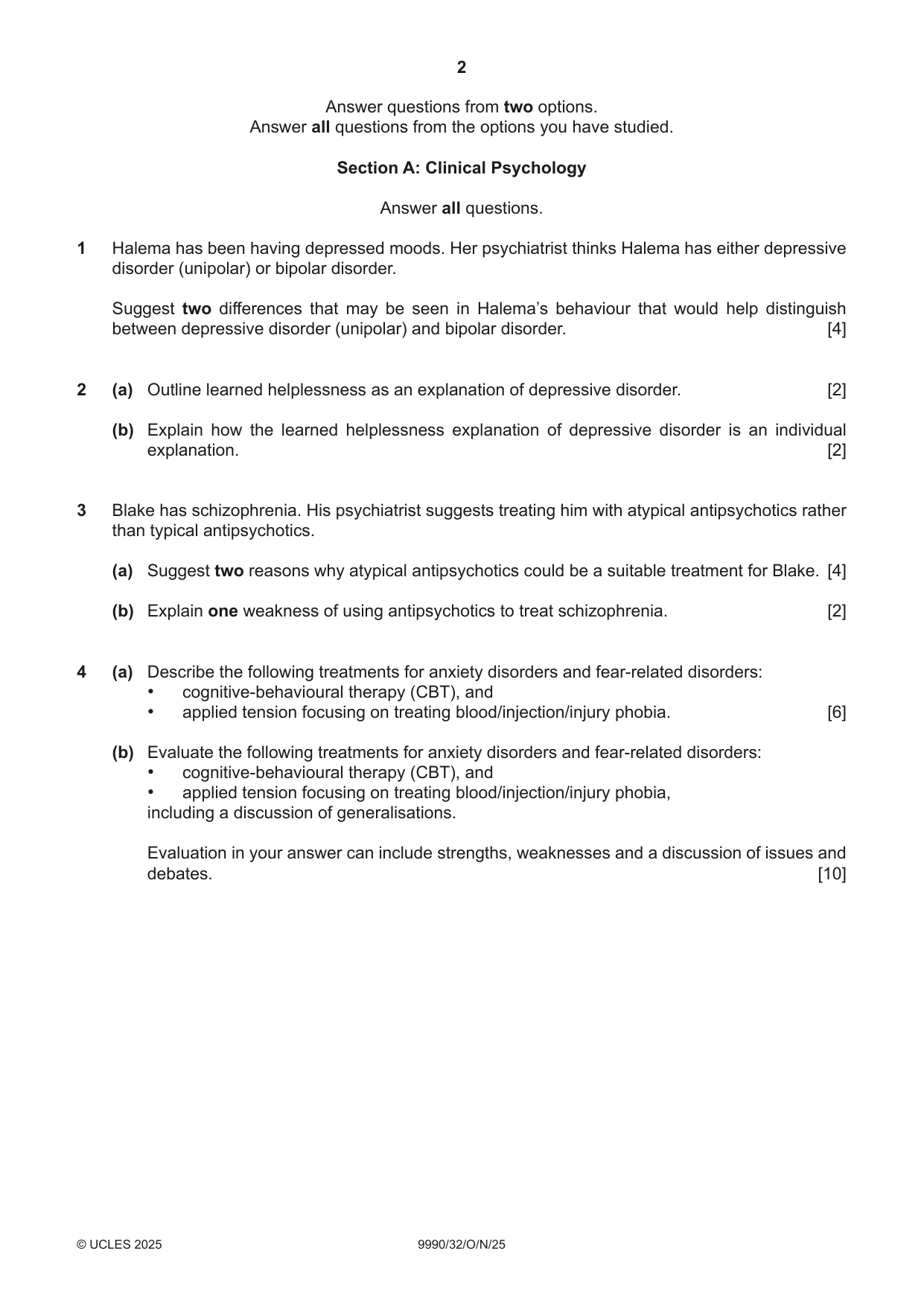
1 Halema has been having depressed moods. Her psychiatrist thinks Halema has either depressive disorder (unipolar) or bipolar disorder. Suggest two differences that may be seen in Halema’s behaviour that would help distinguish between depressive disorder (unipolar) and bipolar disorder. [4]
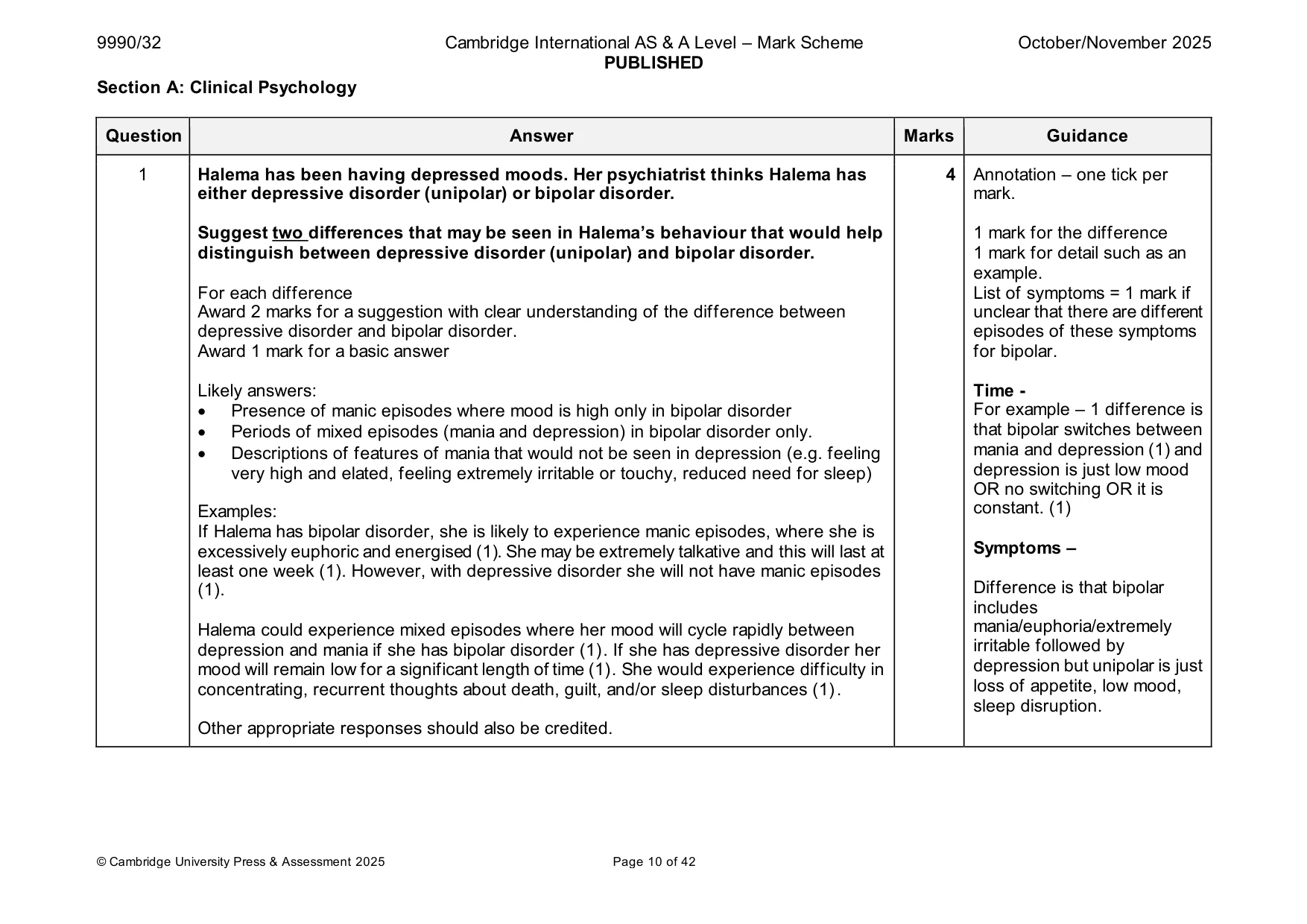
Mark scheme: Question Answer Marks Guidance 1 Halema has been having depressed moods. Her psychiatrist thinks Halema has 4 Annotation – one tick per either depressive disorder (unipolar) or bipolar disorder. mark. Suggest two differences that may be seen in Halema’s behaviour that would help 1 mark for the difference distinguish between depressive disorder (unipolar) and bipolar disorder. 1 mark for detail such as an example. For each difference List of symptoms = 1 mark if Award 2 marks for a suggestion with clear understanding of the difference between unclear that there are different depressive disorder and bipolar disorder. episodes of these symptoms Award 1 mark for a basic answer for bipolar. Likely answers: Time - • Presence of manic episodes where mood is high only in bipolar disorder For example – 1 difference is • Periods of mixed episodes (mania and depression) in bipolar disorder only. that bipolar switches between • Descriptions of features of mania that would not be seen in depression (e.g. feeling mania and depression (1) and very high and elated, feeling extremely irritable or touchy, reduced need for sleep) depression is just low mood OR no switching OR it is Examples: constant. (1) If Halema has bipolar disorder, she is likely to experience manic episodes, where she is excessively euphoric and energised (1). She may be extremely talkative and this will last at Symptoms – least one week (1). However, with depressive disorder she will not have manic episodes (1). Difference is that bipolar includes Halema could experience mixed episodes where her mood will cycle rapidly between mania/euphoria/extremely depression and mania if she has bipolar disorder (1). If she has depressive disorder her irritable followed by mood will remain low for a significant length of time (1). She would experience difficulty in depression but unipolar is just concentrating, recurrent thoughts about death, guilt, and/or sleep disturbances (1). loss of appetite, low mood, sleep disruption. Other appropriate responses should also be credited.
More questions on Mood (affective) disorders: depressive disorder (unipolar) and bipolar disorder
Q2 · Outline learned helplessness as an explanation of depressive disorder
2 (a) Outline learned helplessness as an explanation of depressive disorder. [2] (b) Explain how the learned helplessness explanation of depressive disorder is an individual explanation. [2]
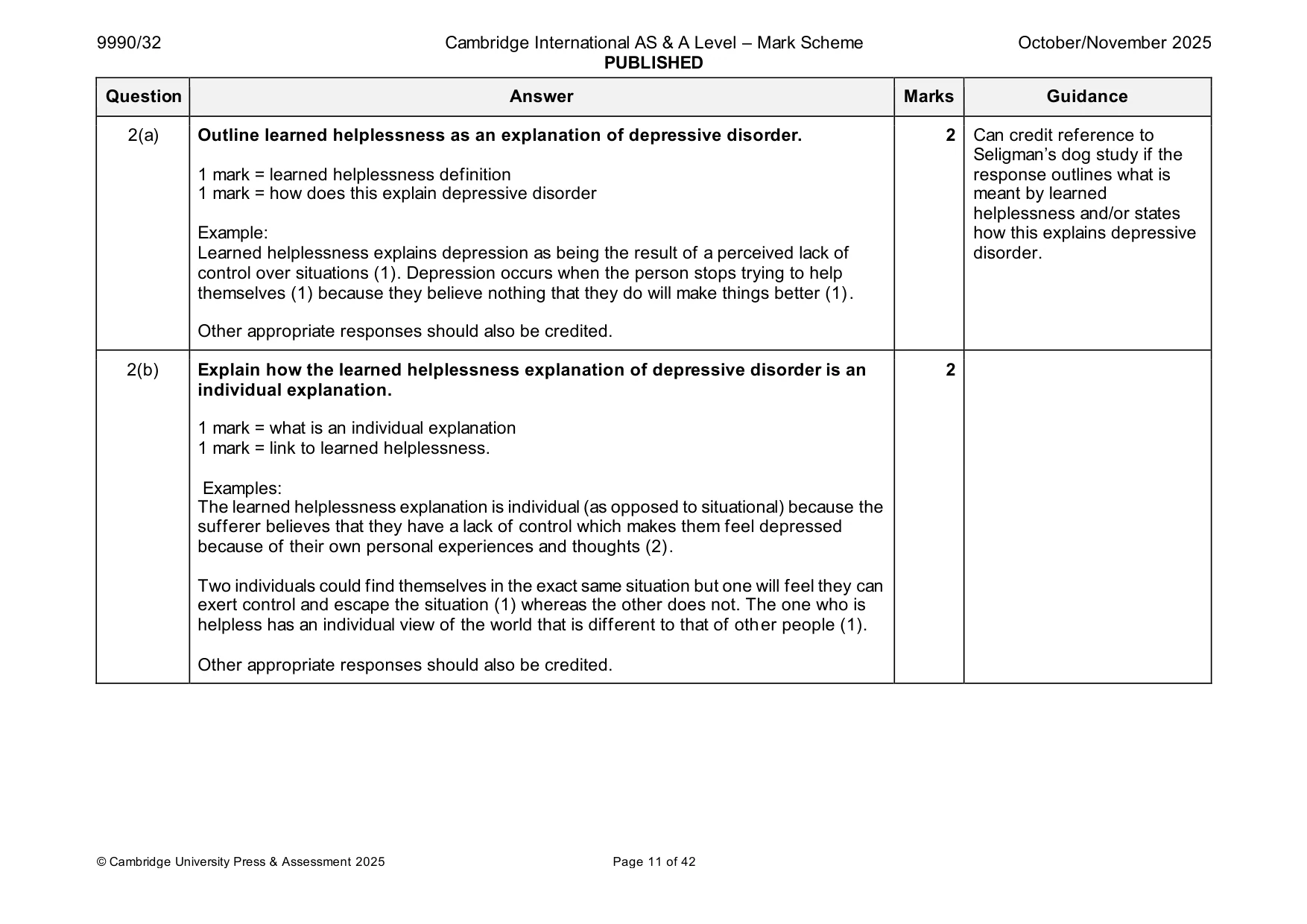
Mark scheme: 2(a) Outline learned helplessness as an explanation of depressive disorder. 2 Can credit reference to Seligman’s dog study if the 1 mark = learned helplessness definition response outlines what is 1 mark = how does this explain depressive disorder meant by learned helplessness and/or states Example: how this explains depressive Learned helplessness explains depression as being the result of a perceived lack of disorder. control over situations (1). Depression occurs when the person stops trying to help themselves (1) because they believe nothing that they do will make things better (1). Other appropriate responses should also be credited. 2(b) Explain how the learned helplessness explanation of depressive disorder is an 2 individual explanation. 1 mark = what is an individual explanation 1 mark = link to learned helplessness. Examples: The learned helplessness explanation is individual (as opposed to situational) because the sufferer believes that they have a lack of control which makes them feel depressed because of their own personal experiences and thoughts (2). Two individuals could find themselves in the exact same situation but one will feel they can exert control and escape the situation (1) whereas the other does not. The one who is helpless has an individual view of the world that is different to that of other people (1). Other appropriate responses should also be credited.
More questions on Mood (affective) disorders: depressive disorder (unipolar) and bipolar disorder
Question 3
3 Blake has schizophrenia. His psychiatrist suggests treating him with atypical antipsychotics rather than typical antipsychotics. (a) Suggest two reasons why atypical antipsychotics could be a suitable treatment for Blake. [4] (b) Explain one weakness of using antipsychotics to treat schizophrenia. [2]
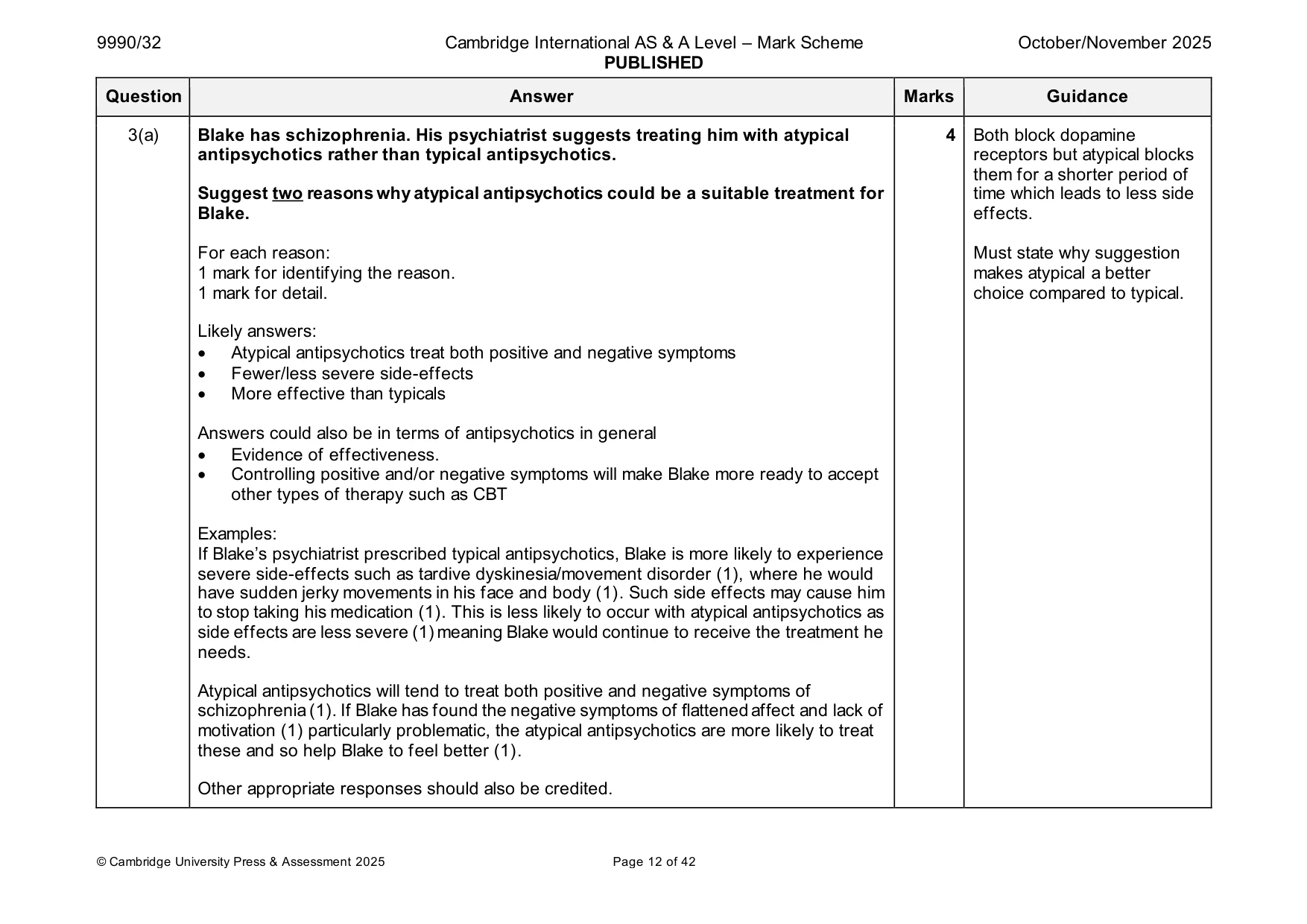
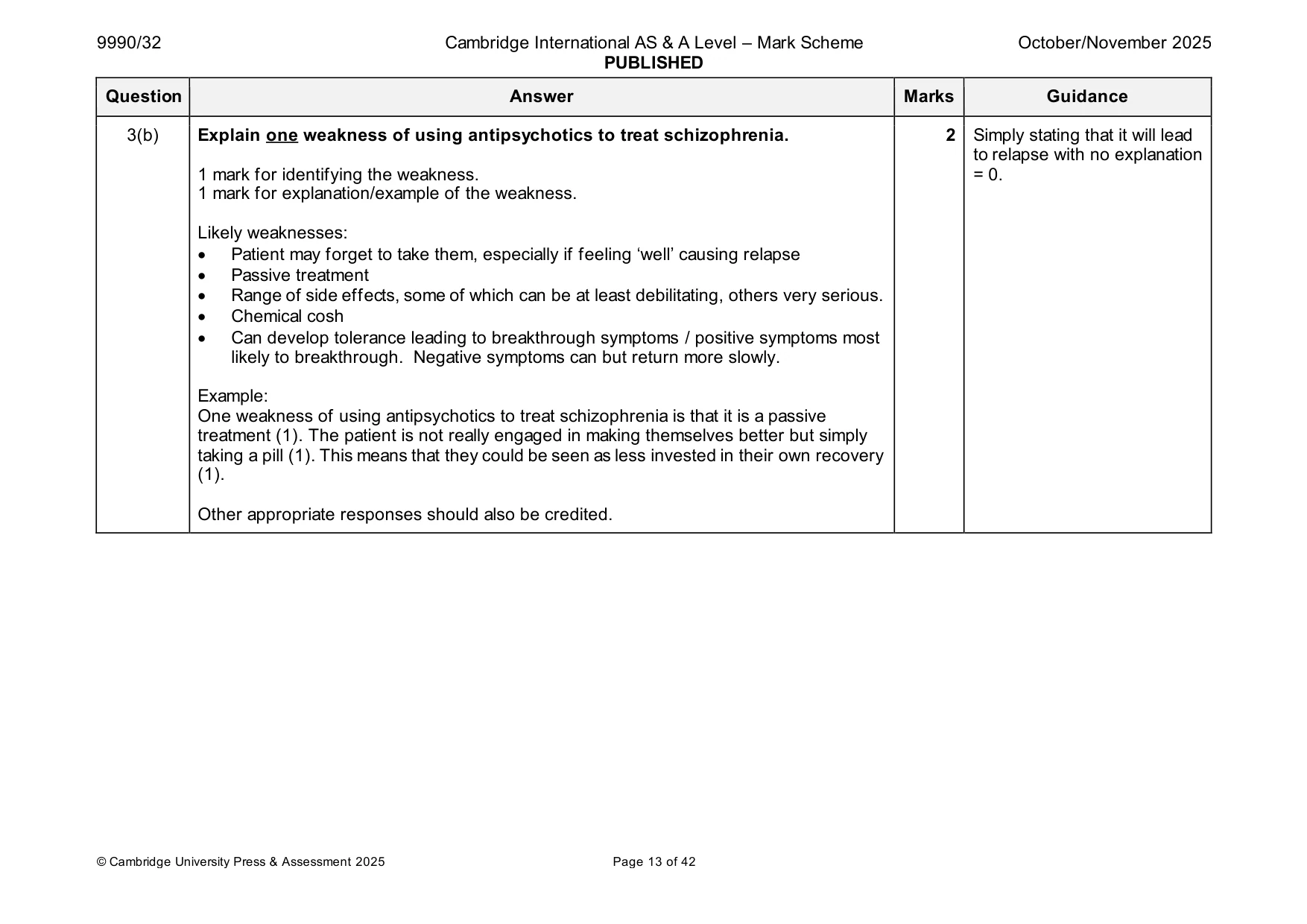
Mark scheme: 3(a) Blake has schizophrenia. His psychiatrist suggests treating him with atypical 4 Both block dopamine antipsychotics rather than typical antipsychotics. receptors but atypical blocks them for a shorter period of Suggest two reasons why atypical antipsychotics could be a suitable treatment for time which leads to less side Blake. effects. For each reason: Must state why suggestion 1 mark for identifying the reason. makes atypical a better 1 mark for detail. choice compared to typical. Likely answers: • Atypical antipsychotics treat both positive and negative symptoms • Fewer/less severe side-effects • More effective than typicals Answers could also be in terms of antipsychotics in general • Evidence of effectiveness. • Controlling positive and/or negative symptoms will make Blake more ready to accept other types of therapy such as CBT Examples: If Blake’s psychiatrist prescribed typical antipsychotics, Blake is more likely to experience severe side-effects such as tardive dyskinesia/movement disorder (1), where he would have sudden jerky movements in his face and body (1). Such side effects may cause him to stop taking his medication (1). This is less likely to occur with atypical antipsychotics as side effects are less severe (1) meaning Blake would continue to receive the treatment he needs. Atypical antipsychotics will tend to treat both positive and negative symptoms of schizophrenia (1). If Blake has found the negative symptoms of flattened affect and lack of motivation (1) particularly problematic, the atypical antipsychotics are more likely to treat these and so help Blake to feel better (1). Other appropriate responses should also be credited. 3(b) Explain one weakness of using antipsychotics to treat schizophrenia. 2 Simply stating that it will lead to relapse with no explanation 1 mark for identifying the weakness. = 0. 1 mark for explanation/example of the weakness. Likely weaknesses: • Patient may forget to take them, especially if feeling ‘well’ causing relapse • Passive treatment • Range of side effects, some of which can be at least debilitating, others very serious. • Chemical cosh • Can develop tolerance leading to breakthrough symptoms / positive symptoms most likely to breakthrough. Negative symptoms can but return more slowly. Example: One weakness of using antipsychotics to treat schizophrenia is that it is a passive treatment (1). The patient is not really engaged in making themselves better but simply taking a pill (1). This means that they could be seen as less invested in their own recovery (1). Other appropriate responses should also be credited.
Q4 · Describe the following treatments for anxiety disorders and fear-related disorders: •…
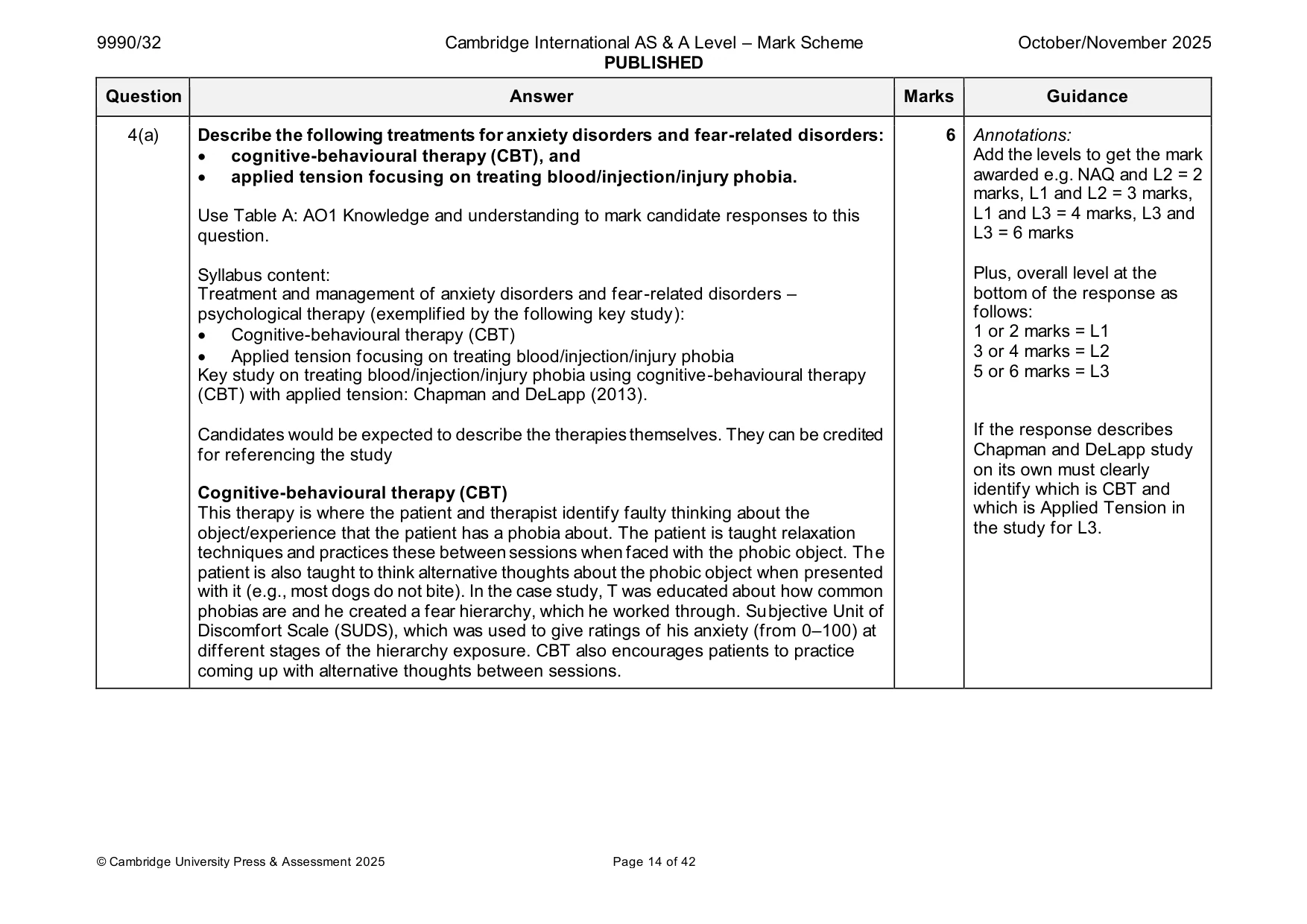
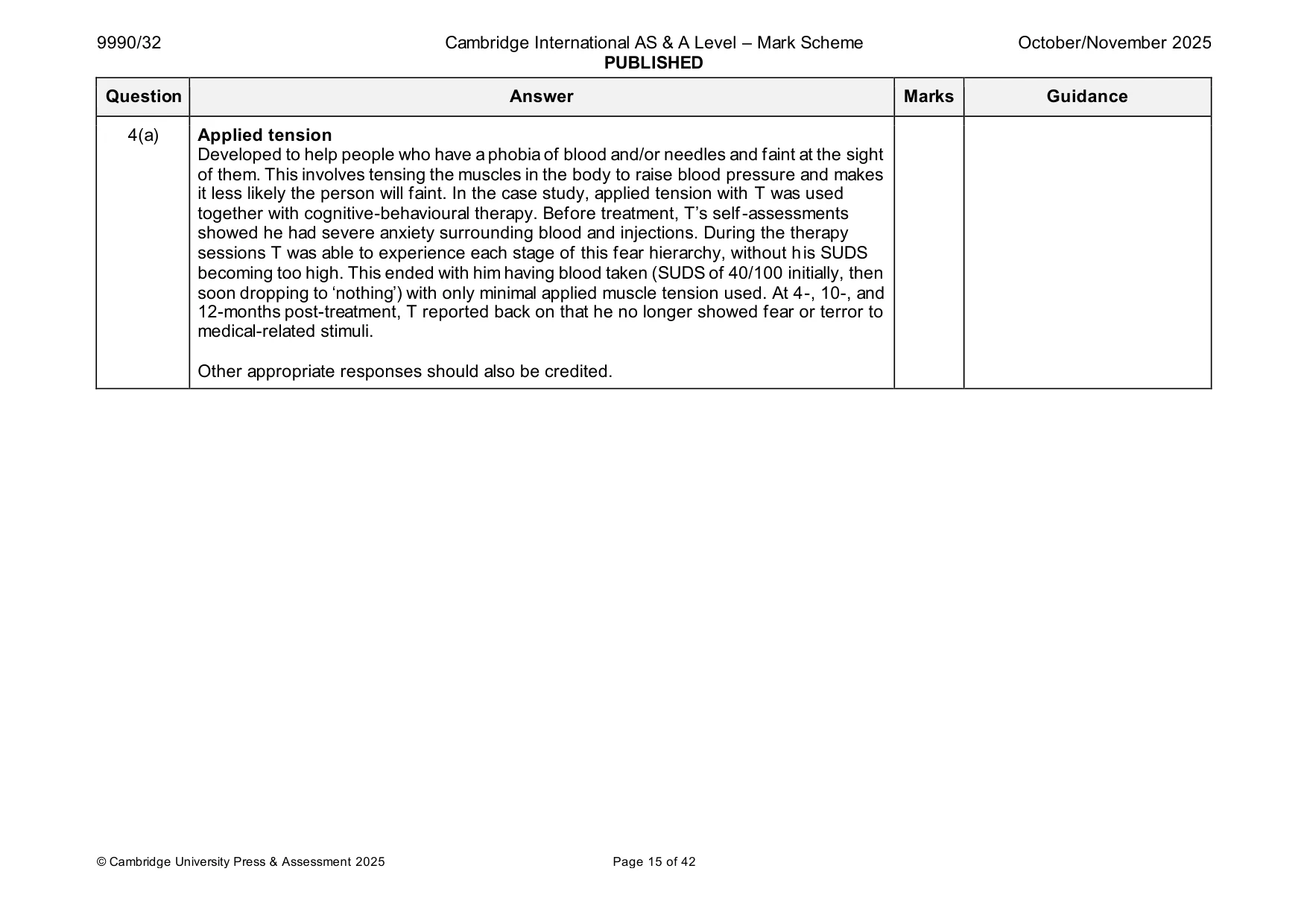
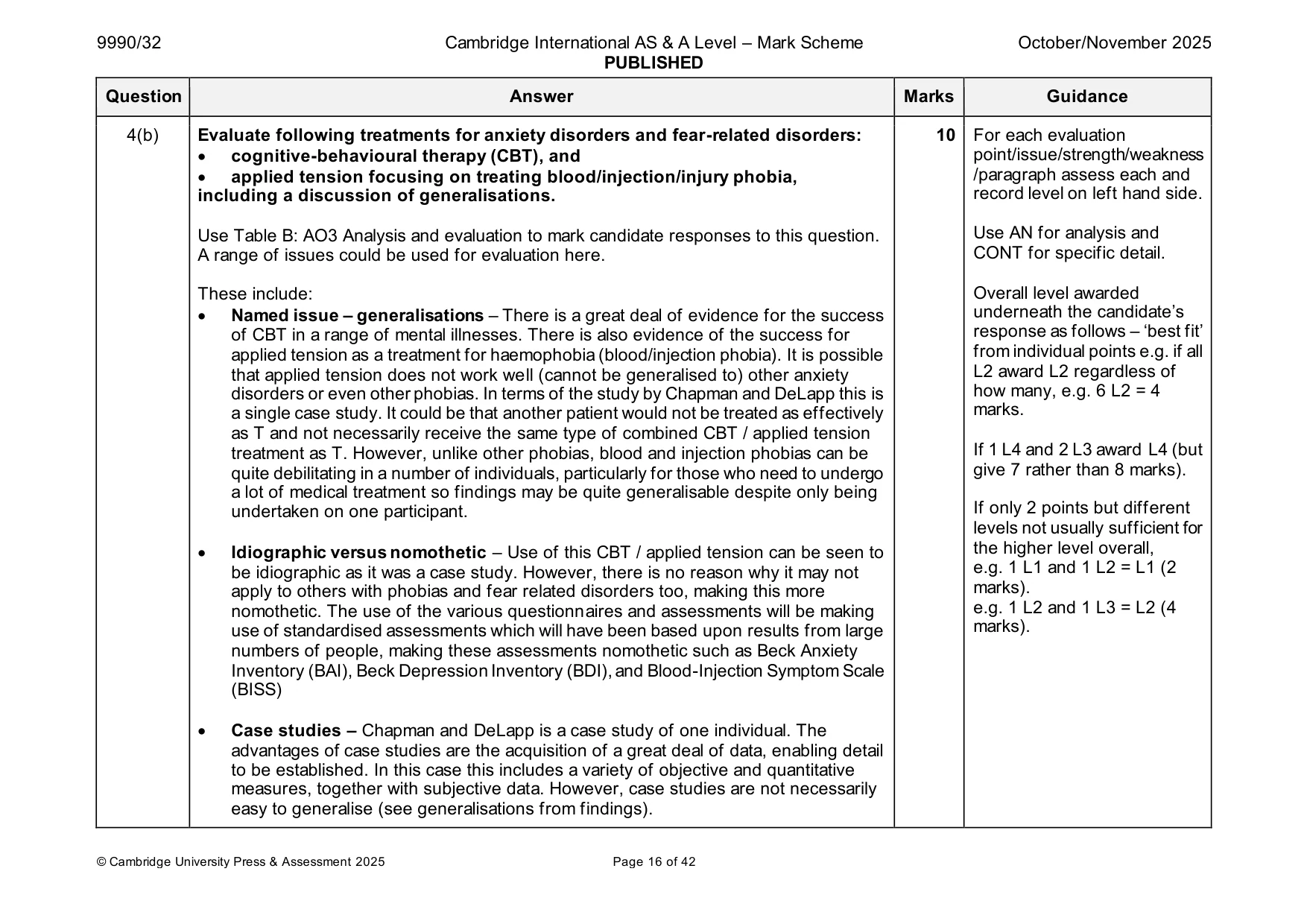
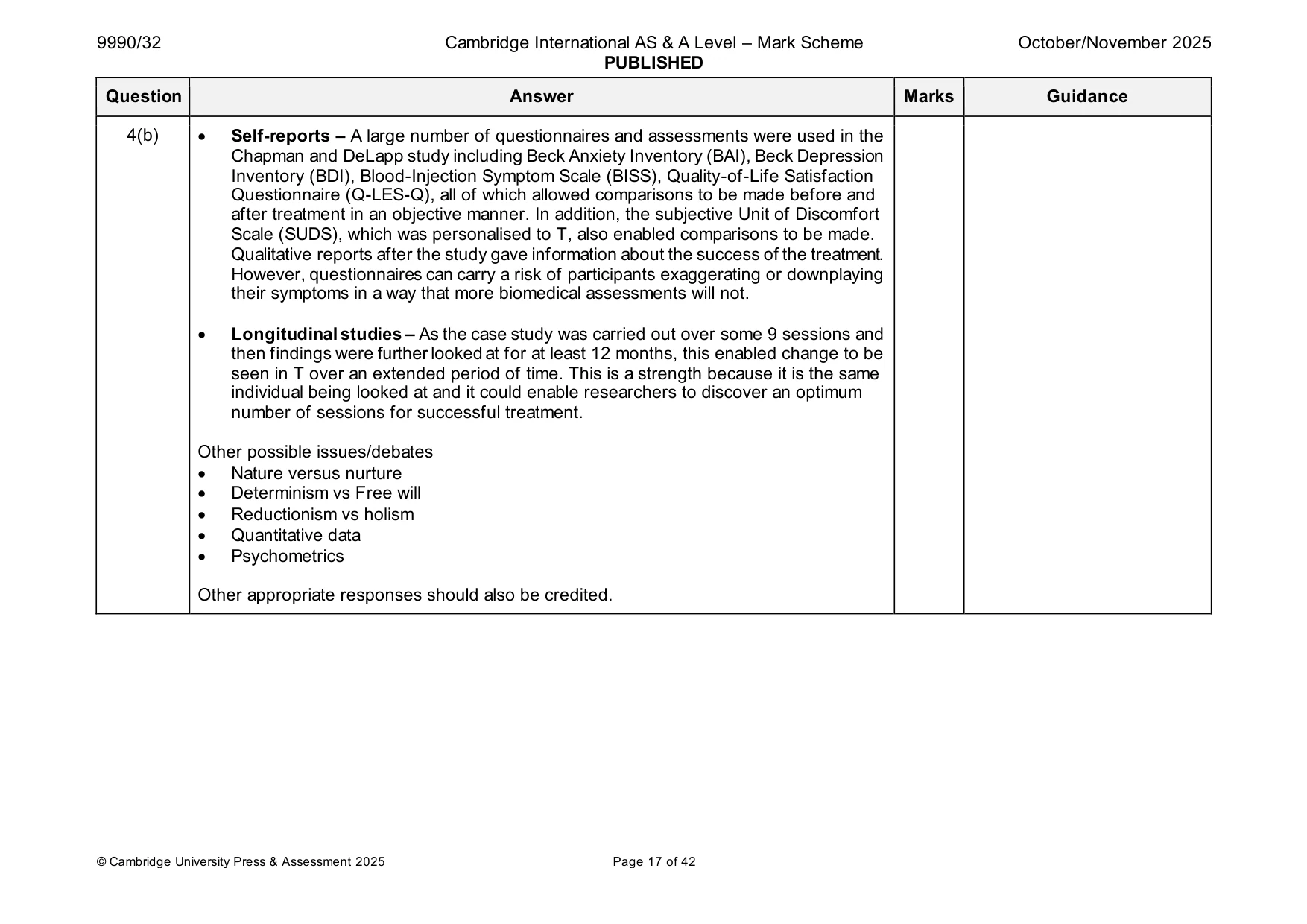
4 (a) Describe the following treatments for anxiety disorders and fear-related disorders: • cognitive-behavioural therapy (CBT), and • applied tension focusing on treating blood/injection/injury phobia. [6] (b) Evaluate the following treatments for anxiety disorders and fear-related disorders: • cognitive-behavioural therapy (CBT), and • applied tension focusing on treating blood/injection/injury phobia, including a discussion of generalisations. Evaluation in your answer can include strengths, weaknesses and a discussion of issues and debates. [10]
Mark scheme: 4(a) Describe the following treatments for anxiety disorders and fear-related disorders: 6 Annotations: • cognitive-behavioural therapy (CBT), and Add the levels to get the mark • applied tension focusing on treating blood/injection/injury phobia. awarded e.g. NAQ and L2 = 2 marks, L1 and L2 = 3 marks, Use Table A: AO1 Knowledge and understanding to mark candidate responses to this L1 and L3 = 4 marks, L3 and question. L3 = 6 marks Syllabus content: Plus, overall level at the Treatment and management of anxiety disorders and fear-related disorders – bottom of the response as psychological therapy (exemplified by the following key study): follows: • Cognitive-behavioural therapy (CBT) 1 or 2 marks = L1 • Applied tension focusing on treating blood/injection/injury phobia 3 or 4 marks = L2 Key study on treating blood/injection/injury phobia using cognitive-behavioural therapy 5 or 6 marks = L3 (CBT) with applied tension: Chapman and DeLapp (2013). If the response describes Candidates would be expected to describe the therapies themselves. They can be credited Chapman and DeLapp study for referencing the study on its own must clearly Cognitive-behavioural therapy (CBT) identify which is CBT and which is Applied Tension in This therapy is where the patient and therapist identify faulty thinking about the the study for L3. object/experience that the patient has a phobia about. The patient is taught relaxation techniques and practices these between sessions when faced with the phobic object. The patient is also taught to think alternative thoughts about the phobic object when presented with it (e.g., most dogs do not bite). In the case study, T was educated about how common phobias are and he created a fear hierarchy, which he worked through. Subjective Unit of Discomfort Scale (SUDS), which was used to give ratings of his anxiety (from 0–100) at different stages of the hierarchy exposure. CBT also encourages patients to practice coming up with alternative thoughts between sessions. 4(a) Applied tension Developed to help people who have a phobia of blood and/or needles and faint at the sight of them. This involves tensing the muscles in the body to raise blood pressure and makes it less likely the person will faint. In the case study, applied tension with T was used together with cognitive-behavioural therapy. Before treatment, T’s self-assessments showed he had severe anxiety surrounding blood and injections. During the therapy sessions T was able to experience each stage of this fear hierarchy, without his SUDS becoming too high. This ended with him having blood taken (SUDS of 40/100 initially, then soon dropping to ‘nothing’) with only minimal applied muscle tension used. At 4-, 10-, and 12-months post-treatment, T reported back on that he no longer showed fear or terror to medical-related stimuli. Other appropriate responses should also be credited. 4(b) Evaluate following treatments for anxiety disorders and fear-related disorders: 10 For each evaluation • cognitive-behavioural therapy (CBT), and point/issue/strength/weakness • applied tension focusing on treating blood/injection/injury phobia, /paragraph assess each and including a discussion of generalisations. record level on left hand side. Use Table B: AO3 Analysis and evaluation to mark candidate responses to this question. Use AN for analysis and A range of issues could be used for evaluation here. CONT for specific detail. These include: Overall level awarded • Named issue – generalisations – There is a great deal of evidence for the success underneath the candidate’s of CBT in a range of mental illnesses. There is also evidence of the success for response as follows – ‘best fit’ applied tension as a treatment for haemophobia (blood/injection phobia). It is possible from individual points e.g. if all that applied tension does not work well (cannot be generalised to) other anxiety L2 award L2 regardless of disorders or even other phobias. In terms of the study by Chapman and DeLapp this is how many, e.g. 6 L2 = 4 a single case study. It could be that another patient would not be treated as effectively marks. as T and not necessarily receive the same type of combined CBT / applied tension treatment as T. However, unlike other phobias, blood and injection phobias can be If 1 L4 and 2 L3 award L4 (but quite debilitating in a number of individuals, particularly for those who need to undergo give 7 rather than 8 marks). a lot of medical treatment so findings may be quite generalisable despite only being undertaken on one participant. If only 2 points but different levels not usually sufficient for • Idiographic versus nomothetic – Use of this CBT / applied tension can be seen to the higher level overall, e.g. 1 L1 and 1 L2 = L1 (2 be idiographic as it was a case study. However, there is no reason why it may not apply to others with phobias and fear related disorders too, making this more marks). nomothetic. The use of the various questionnaires and assessments will be making e.g. 1 L2 and 1 L3 = L2 (4 marks). use of standardised assessments which will have been based upon results from large numbers of people, making these assessments nomothetic such as Beck Anxiety Inventory (BAI), Beck Depression Inventory (BDI), and Blood-Injection Symptom Scale (BISS) • Case studies – Chapman and DeLapp is a case study of one individual. The advantages of case studies are the acquisition of a great deal of data, enabling detail to be established. In this case this includes a variety of objective and quantitative measures, together with subjective data. However, case studies are not necessarily easy to generalise (see generalisations from findings). 4(b) • Self-reports – A large number of questionnaires and assessments were used in the Chapman and DeLapp study including Beck Anxiety Inventory (BAI), Beck Depression Inventory (BDI), Blood-Injection Symptom Scale (BISS), Quality-of-Life Satisfaction Questionnaire (Q-LES-Q), all of which allowed comparisons to be made before and after treatment in an objective manner. In addition, the subjective Unit of Discomfort Scale (SUDS), which was personalised to T, also enabled comparisons to be made. Qualitative reports after the study gave information about the success of the treatment. However, questionnaires can carry a risk of participants exaggerating or downplaying their symptoms in a way that more biomedical assessments will not. • Longitudinal studies – As the case study was carried out over some 9 sessions and then findings were further looked at for at least 12 months, this enabled change to be seen in T over an extended period of time. This is a strength because it is the same individual being looked at and it could enable researchers to discover an optimum number of sessions for successful treatment. Other possible issues/debates • Nature versus nurture • Determinism vs Free will • Reductionism vs holism • Quantitative data • Psychometrics Other appropriate responses should also be credited.
More questions on Anxiety disorders and fear-related disorders
Q5 · Clive is the manager of a shopping mall
5 Clive is the manager of a shopping mall. He is aware of the pleasure-arousal-dominance (PAD) model. Clive wants to use a pleasant odour in the mall. Suggest two effects this pleasant odour could have on shoppers. [4]
Mark scheme: 5 Clive is the manager of a shopping mall. He is aware of the pleasure-arousal- 4 Max 3 marks if the response dominance (PAD) model. Clive wants to use a pleasant odour in the mall. does not make it clear that there are two effects. Suggest two effects this pleasant odour could have on shoppers. No marks for the effect that For each suggestion: odour is pleasant (this is in 1 mark for effect the Q), however can state 1 mark for link to study or detail of effect on shoppers. pleasant odour will lead to the shopper buying more (1) or Syllabus reference: spending longer in the mall Retail atmospherics – the effects of odour on shopper pleasure-arousal-dominance, (1). including a study, e.g., Chebat and Michon (2003). Likely suggestions (do not have to agree with findings from Chebat and Michon): • Shoppers like the smell, causing arousal and spend longer in the mall (than without the odour) • Shoppers spend more money • Shoppers will feel happier and more satisfied • Shoppers visit more outlets • Shoppers feel happier • Shoppers rate the shops in the mall as higher quality (than without odour) Examples: As customers will find the odour pleasant, this would lead to them spending a greater amount of time at the mall (1) than without the odour. Leading to them visiting more outlets and spending more money (1). Customers will find the smell arousing and enjoy their shopping experience more (1). This could lead to them coming back sooner than if there was no odour (1) and this could increase profits due to a greater number of customers in the mall (1). Other appropriate responses should also be credited.
Q6 · Outline the nomothetic approach, including an example from the effect of sound on…
6 (a) Outline the nomothetic approach, including an example from the effect of sound on consumer behaviour. [2] (b) Explain one strength of using a nomothetic approach in psychology. [2]
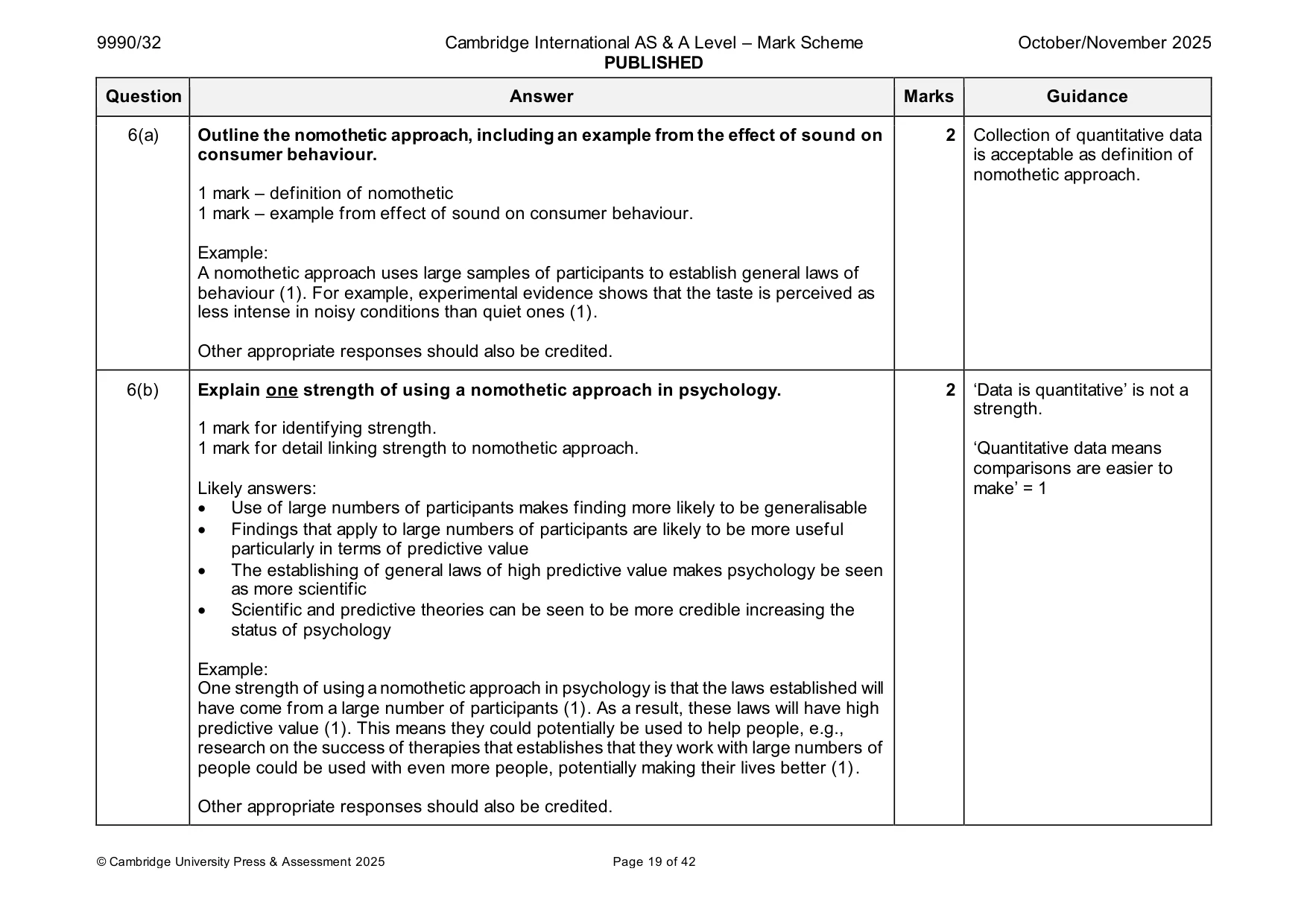
Mark scheme: 6(a) Outline the nomothetic approach, including an example from the effect of sound on 2 Collection of quantitative data consumer behaviour. is acceptable as definition of nomothetic approach. 1 mark – definition of nomothetic 1 mark – example from effect of sound on consumer behaviour. Example: A nomothetic approach uses large samples of participants to establish general laws of behaviour (1). For example, experimental evidence shows that the taste is perceived as less intense in noisy conditions than quiet ones (1). Other appropriate responses should also be credited. 6(b) Explain one strength of using a nomothetic approach in psychology. 2 ‘Data is quantitative’ is not a strength. 1 mark for identifying strength. 1 mark for detail linking strength to nomothetic approach. ‘Quantitative data means comparisons are easier to Likely answers: make’ = 1 • Use of large numbers of participants makes finding more likely to be generalisable • Findings that apply to large numbers of participants are likely to be more useful particularly in terms of predictive value • The establishing of general laws of high predictive value makes psychology be seen as more scientific • Scientific and predictive theories can be seen to be more credible increasing the status of psychology Example: One strength of using a nomothetic approach in psychology is that the laws established will have come from a large number of participants (1). As a result, these laws will have high predictive value (1). This means they could potentially be used to help people, e.g., research on the success of therapies that establishes that they work with large numbers of people could be used with even more people, potentially making their lives better (1). Other appropriate responses should also be credited.
Q7 · Nandi is a chef in a local restaurant
7 Nandi is a chef in a local restaurant. She is designing a menu and knows that food names can affect customers’ menu item choice. (a) Suggest how Nandi could use her knowledge about food names when designing a menu for her restaurant. [4] (b) Explain one problem with carrying out research into the effect of food names on menu item choice. [2]
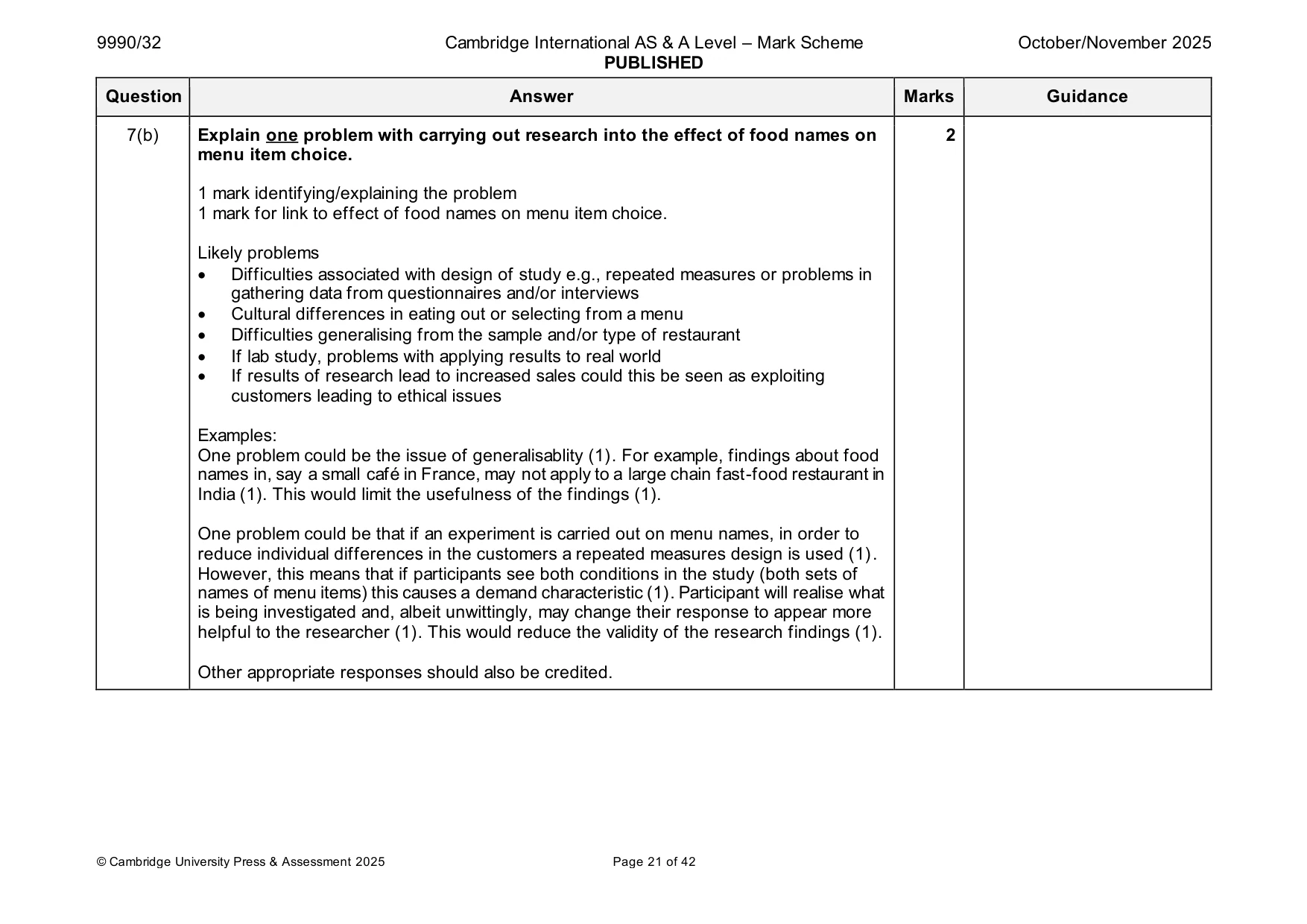
Mark scheme: 7 Nandi is a chef in a local restaurant. She is designing a menu and knows that food names can affect customers’ menu item choice. 7(a) Suggest how Nandi could use her knowledge about food names when designing a 4 Research has found many menu for her restaurant. different types of food names on menus effect customer Syllabus content: choice. A lot of the research • Menu design psychology – the effect of food name on menu item choice, including a findings/conclusions are study, e.g., Lockyer (2006). contradictory. Award 3–4 marks for a detailed description of how Nandi can use her knowledge about 1 mark – example of food food names in context. name (max 2 marks) Award 1–2 marks for a basic description of how Nandi can use her knowledge about food names. 1 mark – what name contains e.g. fresh, seasonal Likely suggestions may come from the study by Lockyer (2006) or from Wansink et al ingredients or simple to (2004). understand (2 marks max) Examples: 1 mark – effect of food name If Nandi uses a French description for a soup dish such as consommé julienne (1) is likely on diner (something the diner to lead to it being rated less appealing by customers (1) than if the description is more might say – such as tastes seasonal such as spring vegetables garnished in a fresh clear soup (1). She should use delicious or a behaviour – the second option as if customers find the item more appealing, they are more likely to more likely to order it. (max 2 order it (1). marks) Plain statements about dishes such as seafood filet (1) will not be sold as much as those e.g. A name like ‘grandma’s with more evocative names like Succulent Italian Seafood Filet (1). Customers are likely to homemade lasagna (1) rate the more descriptive name as more appealing to the eye (1), tasting better (1), feeling ‘sounds nostalgic so tastes satisfied after eating it (1), and having more calories than the basic descriptions (1). All of good (1) and they will these examples could lead to more sales for the more descriptive menu item (1). purchase it. (1) Other appropriate responses should also be credited. 7(b) Explain one problem with carrying out research into the effect of food names on 2 menu item choice. 1 mark identifying/explaining the problem 1 mark for link to effect of food names on menu item choice. Likely problems • Difficulties associated with design of study e.g., repeated measures or problems in gathering data from questionnaires and/or interviews • Cultural differences in eating out or selecting from a menu • Difficulties generalising from the sample and/or type of restaurant • If lab study, problems with applying results to real world • If results of research lead to increased sales could this be seen as exploiting customers leading to ethical issues Examples: One problem could be the issue of generalisablity (1). For example, findings about food names in, say a small café in France, may not apply to a large chain fast-food restaurant in India (1). This would limit the usefulness of the findings (1). One problem could be that if an experiment is carried out on menu names, in order to reduce individual differences in the customers a repeated measures design is used (1). However, this means that if participants see both conditions in the study (both sets of names of menu items) this causes a demand characteristic (1). Participant will realise what is being investigated and, albeit unwittingly, may change their response to appear more helpful to the researcher (1). This would reduce the validity of the research findings (1). Other appropriate responses should also be credited.
Q8 · Describe explanations and examples of compensatory, non-compensatory and partially…
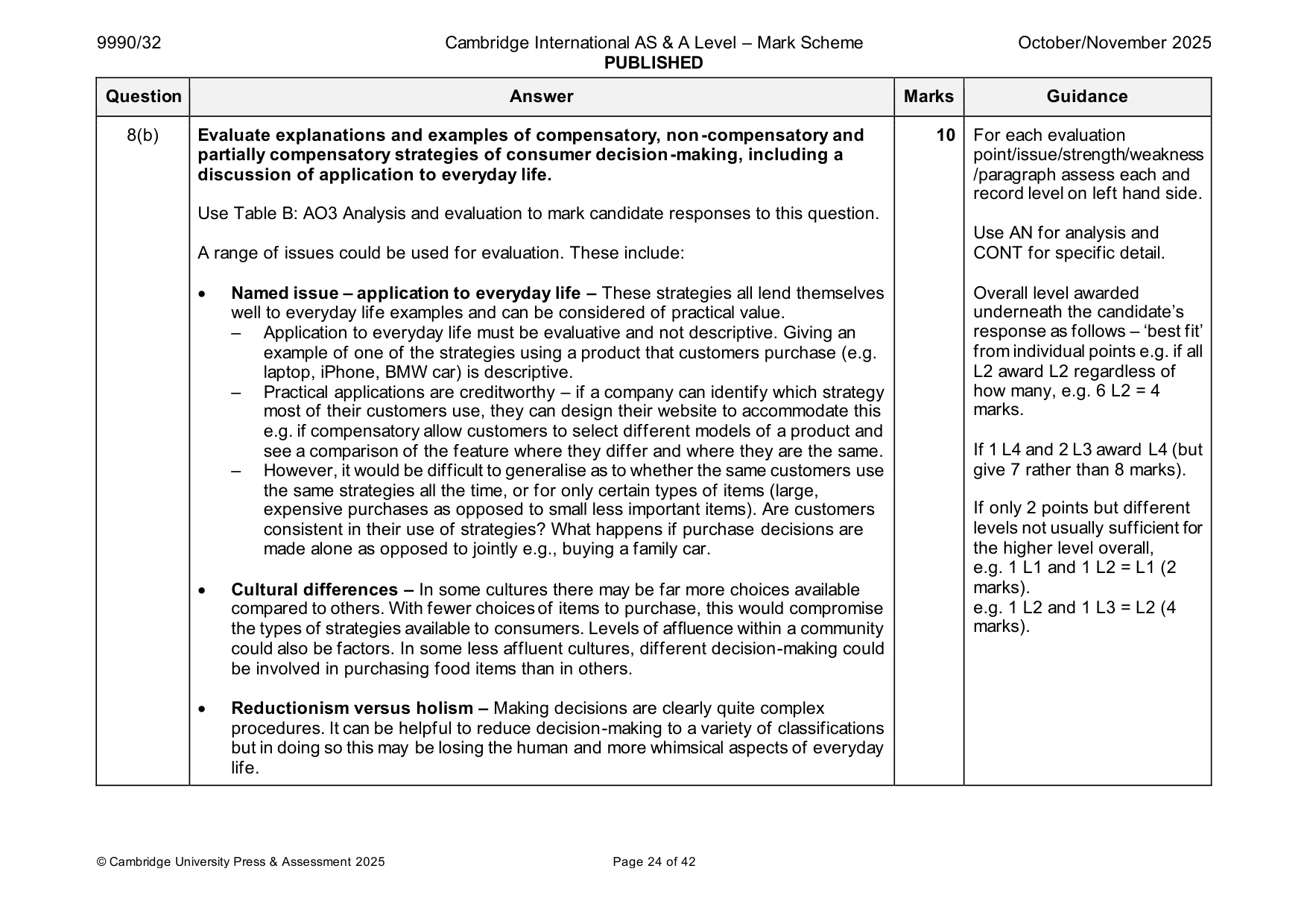
8 (a) Describe explanations and examples of compensatory, non-compensatory and partially compensatory strategies of consumer decision-making. [6] (b) Evaluate explanations and examples of compensatory, non-compensatory and partially compensatory strategies of consumer decision-making, including a discussion of application to everyday life. Evaluation in your answer can include strengths, weaknesses and a discussion of issues and debates. [10] Section C: Health Psychology Answer all questions.
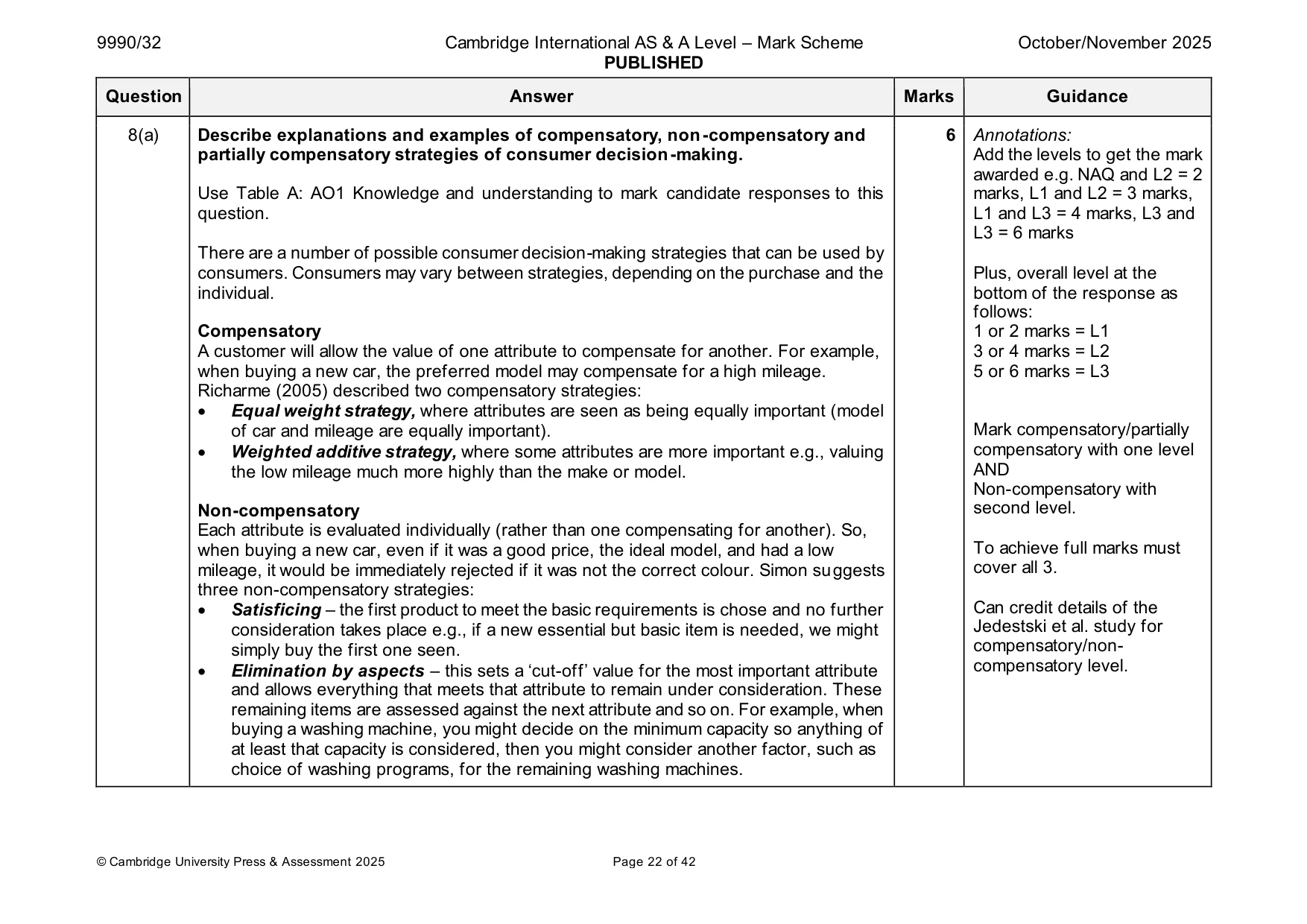
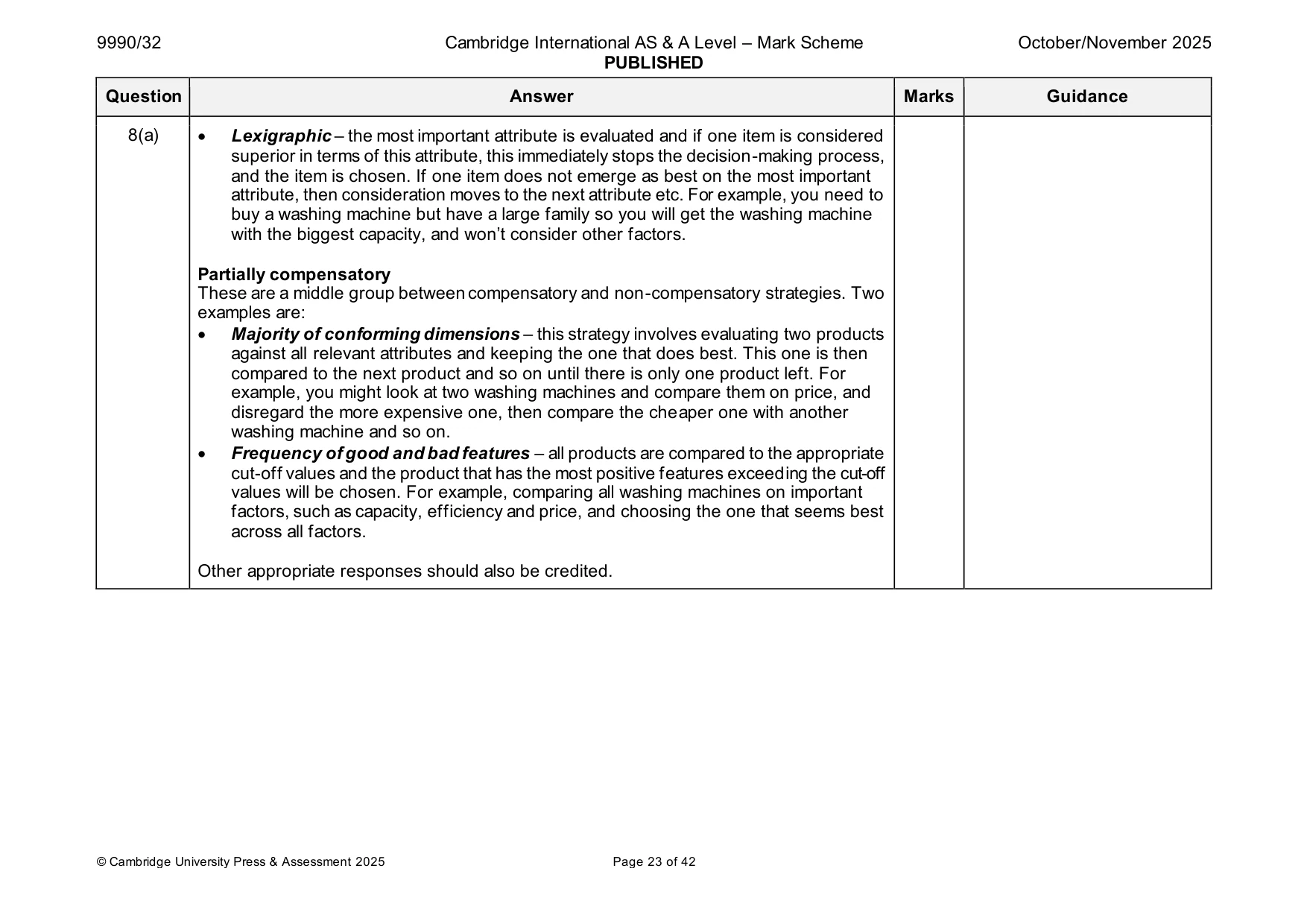
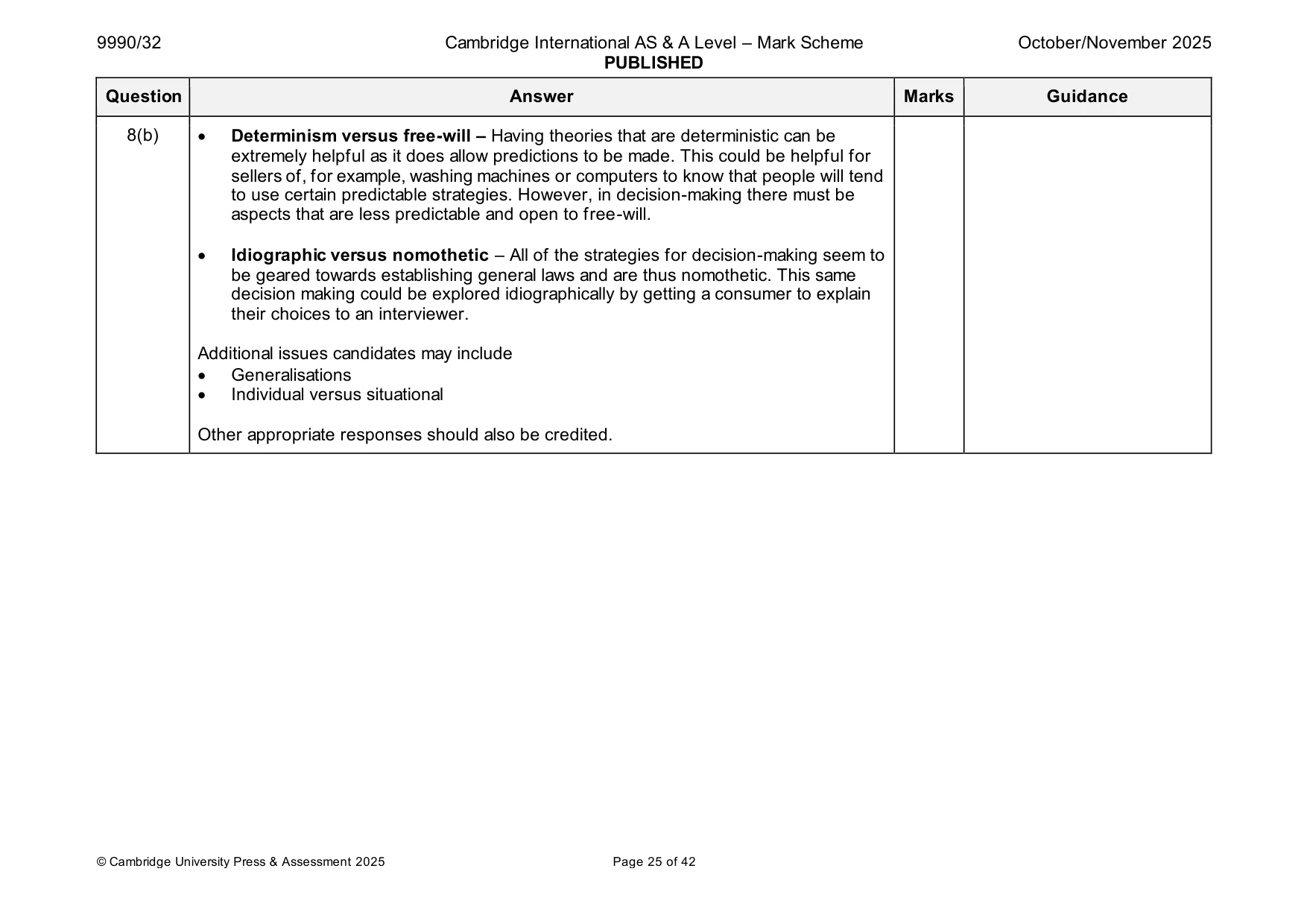
Mark scheme: 8(a) Describe explanations and examples of compensatory, non-compensatory and 6 Annotations: partially compensatory strategies of consumer decision-making. Add the levels to get the mark awarded e.g. NAQ and L2 = 2 Use Table A: AO1 Knowledge and understanding to mark candidate responses to this marks, L1 and L2 = 3 marks, question. L1 and L3 = 4 marks, L3 and L3 = 6 marks There are a number of possible consumer decision-making strategies that can be used by consumers. Consumers may vary between strategies, depending on the purchase and the Plus, overall level at the individual. bottom of the response as follows: Compensatory 1 or 2 marks = L1 A customer will allow the value of one attribute to compensate for another. For example, 3 or 4 marks = L2 when buying a new car, the preferred model may compensate for a high mileage. 5 or 6 marks = L3 Richarme (2005) described two compensatory strategies: • Equal weight strategy, where attributes are seen as being equally important (model of car and mileage are equally important). Mark compensatory/partially • Weighted additive strategy, where some attributes are more important e.g., valuing compensatory with one level the low mileage much more highly than the make or model. AND Non-compensatory with Non-compensatory second level. Each attribute is evaluated individually (rather than one compensating for another). So, when buying a new car, even if it was a good price, the ideal model, and had a low To achieve full marks must mileage, it would be immediately rejected if it was not the correct colour. Simon suggests cover all 3. three non-compensatory strategies: • Satisficing – the first product to meet the basic requirements is chose and no further Can credit details of the consideration takes place e.g., if a new essential but basic item is needed, we might Jedestski et al. study for simply buy the first one seen. compensatory/non- • Elimination by aspects – this sets a ‘cut-off’ value for the most important attribute compensatory level. and allows everything that meets that attribute to remain under consideration. These remaining items are assessed against the next attribute and so on. For example, when buying a washing machine, you might decide on the minimum capacity so anything of at least that capacity is considered, then you might consider another factor, such as choice of washing programs, for the remaining washing machines. 8(a) • Lexigraphic – the most important attribute is evaluated and if one item is considered superior in terms of this attribute, this immediately stops the decision-making process, and the item is chosen. If one item does not emerge as best on the most important attribute, then consideration moves to the next attribute etc. For example, you need to buy a washing machine but have a large family so you will get the washing machine with the biggest capacity, and won’t consider other factors. Partially compensatory These are a middle group between compensatory and non-compensatory strategies. Two examples are: • Majority of conforming dimensions – this strategy involves evaluating two products against all relevant attributes and keeping the one that does best. This one is then compared to the next product and so on until there is only one product left. For example, you might look at two washing machines and compare them on price, and disregard the more expensive one, then compare the cheaper one with another washing machine and so on. • Frequency of good and bad features – all products are compared to the appropriate cut-off values and the product that has the most positive features exceeding the cut-off values will be chosen. For example, comparing all washing machines on important factors, such as capacity, efficiency and price, and choosing the one that seems best across all factors. Other appropriate responses should also be credited. 8(b) Evaluate explanations and examples of compensatory, non-compensatory and 10 For each evaluation partially compensatory strategies of consumer decision-making, including a point/issue/strength/weakness discussion of application to everyday life. /paragraph assess each and record level on left hand side. Use Table B: AO3 Analysis and evaluation to mark candidate responses to this question. Use AN for analysis and A range of issues could be used for evaluation. These include: CONT for specific detail. • Named issue – application to everyday life – These strategies all lend themselves Overall level awarded well to everyday life examples and can be considered of practical value. underneath the candidate’s – Application to everyday life must be evaluative and not descriptive. Giving an response as follows – ‘best fit’ example of one of the strategies using a product that customers purchase (e.g. from individual points e.g. if all laptop, iPhone, BMW car) is descriptive. L2 award L2 regardless of – Practical applications are creditworthy – if a company can identify which strategy how many, e.g. 6 L2 = 4 most of their customers use, they can design their website to accommodate this marks. e.g. if compensatory allow customers to select different models of a product and see a comparison of the feature where they differ and where they are the same. If 1 L4 and 2 L3 award L4 (but – However, it would be difficult to generalise as to whether the same customers use give 7 rather than 8 marks). the same strategies all the time, or for only certain types of items (large, expensive purchases as opposed to small less important items). Are customers If only 2 points but different consistent in their use of strategies? What happens if purchase decisions are levels not usually sufficient for made alone as opposed to jointly e.g., buying a family car. the higher level overall, e.g. 1 L1 and 1 L2 = L1 (2 • Cultural differences – In some cultures there may be far more choices available marks). compared to others. With fewer choices of items to purchase, this would compromise e.g. 1 L2 and 1 L3 = L2 (4 the types of strategies available to consumers. Levels of affluence within a community marks). could also be factors. In some less affluent cultures, different decision-making could be involved in purchasing food items than in others. • Reductionism versus holism – Making decisions are clearly quite complex procedures. It can be helpful to reduce decision-making to a variety of classifications but in doing so this may be losing the human and more whimsical aspects of everyday life. 8(b) • Determinism versus free-will – Having theories that are deterministic can be extremely helpful as it does allow predictions to be made. This could be helpful for sellers of, for example, washing machines or computers to know that people will tend to use certain predictable strategies. However, in decision-making there must be aspects that are less predictable and open to free-will. • Idiographic versus nomothetic – All of the strategies for decision-making seem to be geared towards establishing general laws and are thus nomothetic. This same decision making could be explored idiographically by getting a consumer to explain their choices to an interviewer. Additional issues candidates may include • Generalisations • Individual versus situational Other appropriate responses should also be credited. Section C: Health Psychology
Q9 · Dr Jones knows that some of his adult patients do not take their medication every day
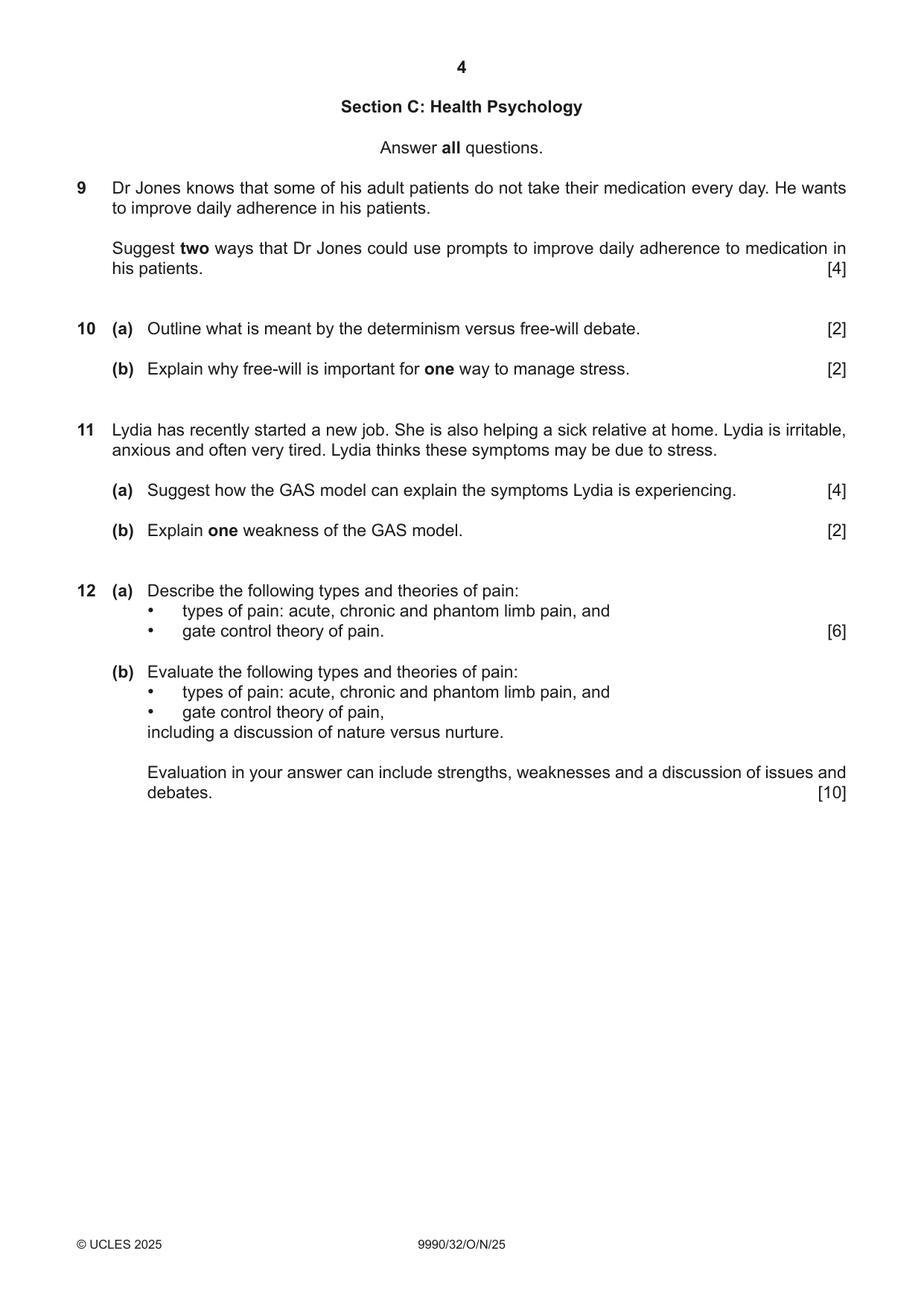
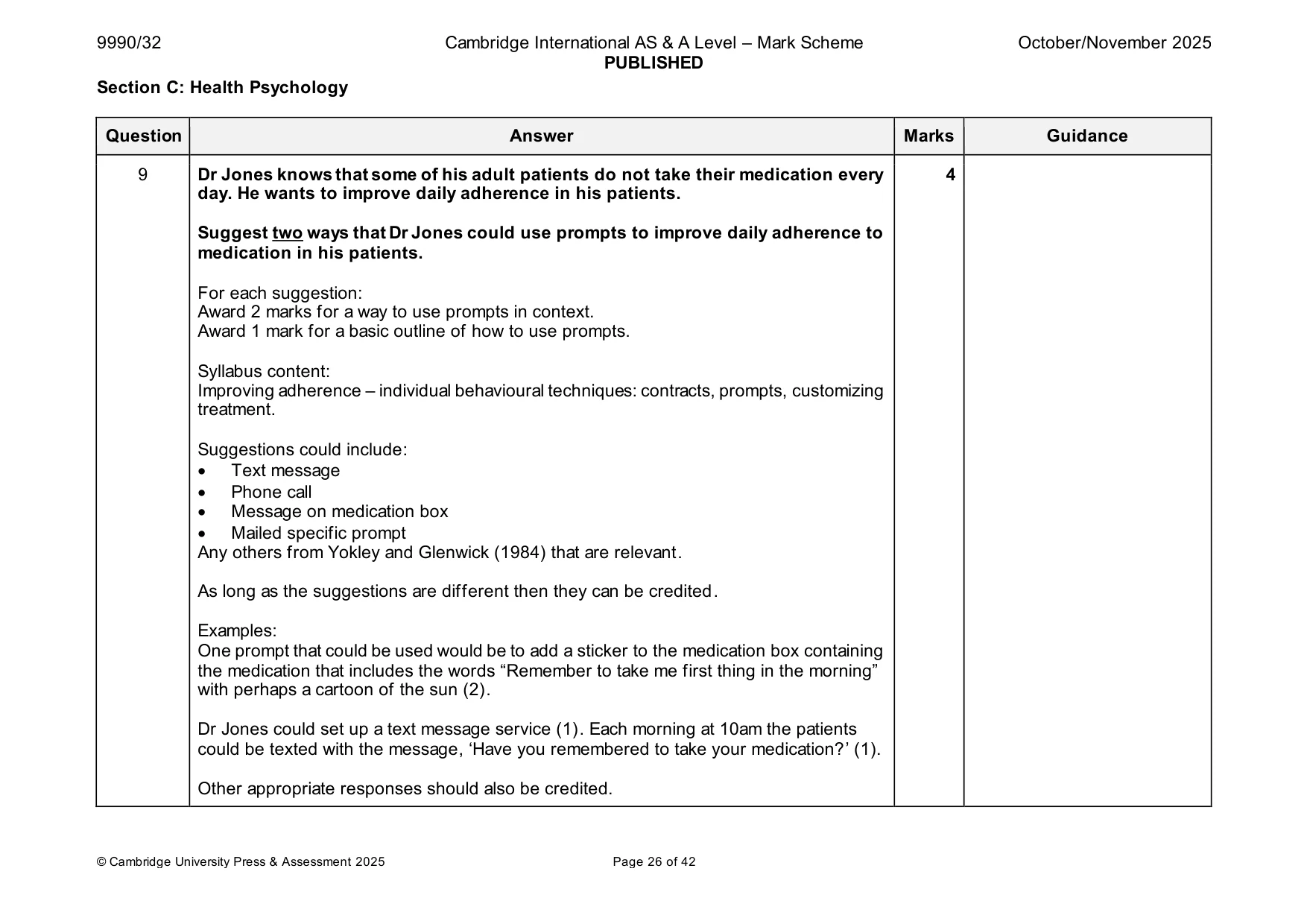
9 Dr Jones knows that some of his adult patients do not take their medication every day. He wants to improve daily adherence in his patients. Suggest two ways that Dr Jones could use prompts to improve daily adherence to medication in his patients. [4]
Mark scheme: 9 Dr Jones knows that some of his adult patients do not take their medication every 4 day. He wants to improve daily adherence in his patients. Suggest two ways that Dr Jones could use prompts to improve daily adherence to medication in his patients. For each suggestion: Award 2 marks for a way to use prompts in context. Award 1 mark for a basic outline of how to use prompts. Syllabus content: Improving adherence – individual behavioural techniques: contracts, prompts, customizing treatment. Suggestions could include: • Text message • Phone call • Message on medication box • Mailed specific prompt Any others from Yokley and Glenwick (1984) that are relevant. As long as the suggestions are different then they can be credited. Examples: One prompt that could be used would be to add a sticker to the medication box containing the medication that includes the words “Remember to take me first thing in the morning” with perhaps a cartoon of the sun (2). Dr Jones could set up a text message service (1). Each morning at 10am the patients could be texted with the message, ‘Have you remembered to take your medication?’ (1). Other appropriate responses should also be credited.
Q10 · Outline what is meant by the determinism versus free-will debate
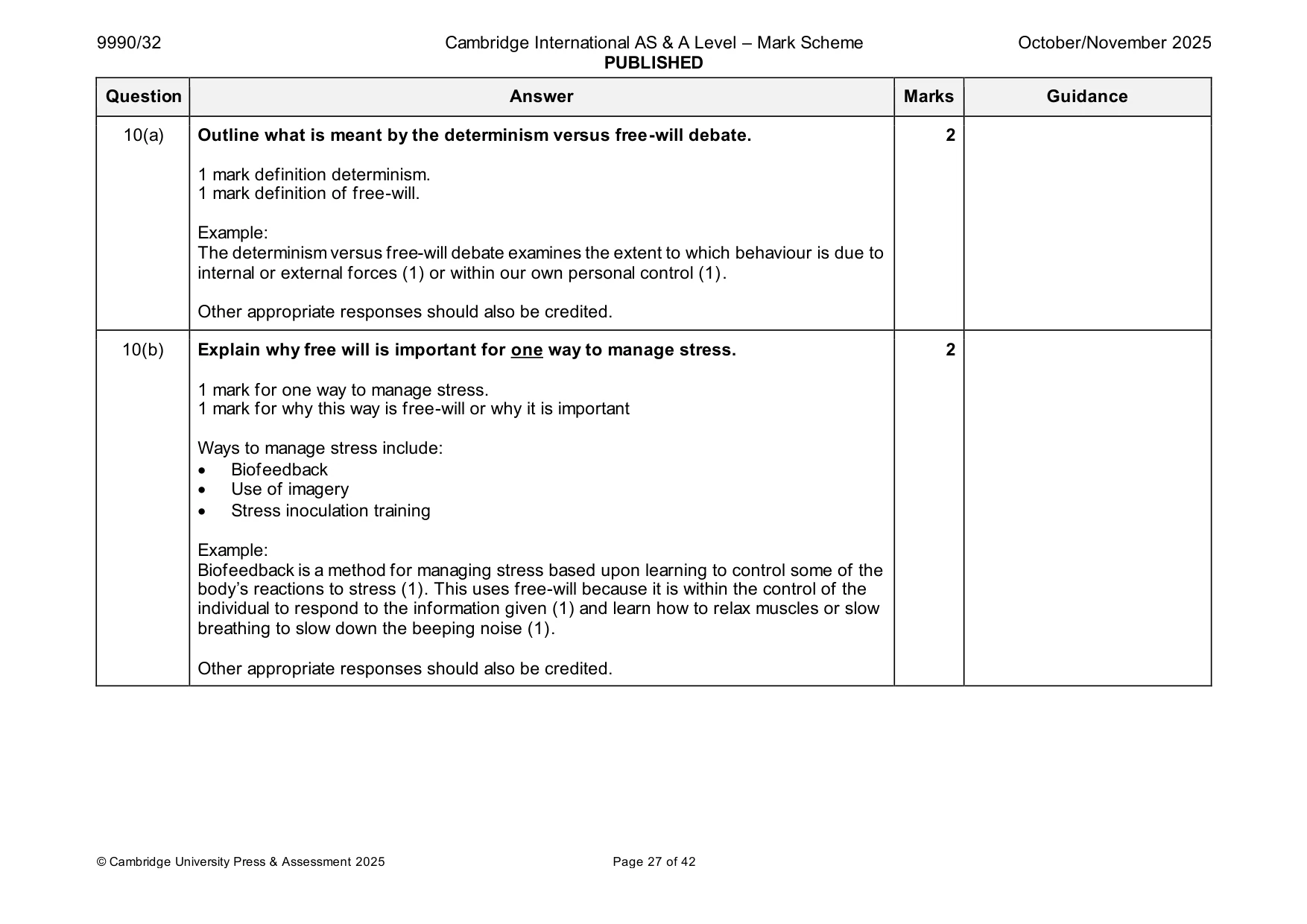
10 (a) Outline what is meant by the determinism versus free-will debate. [2] (b) Explain why free-will is important for one way to manage stress. [2]
Mark scheme: 10(a) Outline what is meant by the determinism versus free-will debate. 2 1 mark definition determinism. 1 mark definition of free-will. Example: The determinism versus free-will debate examines the extent to which behaviour is due to internal or external forces (1) or within our own personal control (1). Other appropriate responses should also be credited. 10(b) Explain why free will is important for one way to manage stress. 2 1 mark for one way to manage stress. 1 mark for why this way is free-will or why it is important Ways to manage stress include: • Biofeedback • Use of imagery • Stress inoculation training Example: Biofeedback is a method for managing stress based upon learning to control some of the body’s reactions to stress (1). This uses free-will because it is within the control of the individual to respond to the information given (1) and learn how to relax muscles or slow breathing to slow down the beeping noise (1). Other appropriate responses should also be credited.
Q11 · Lydia has recently started a new job
11 Lydia has recently started a new job. She is also helping a sick relative at home. Lydia is irritable, anxious and often very tired. Lydia thinks these symptoms may be due to stress. (a) Suggest how the GAS model can explain the symptoms Lydia is experiencing. [4] (b) Explain one weakness of the GAS model. [2]
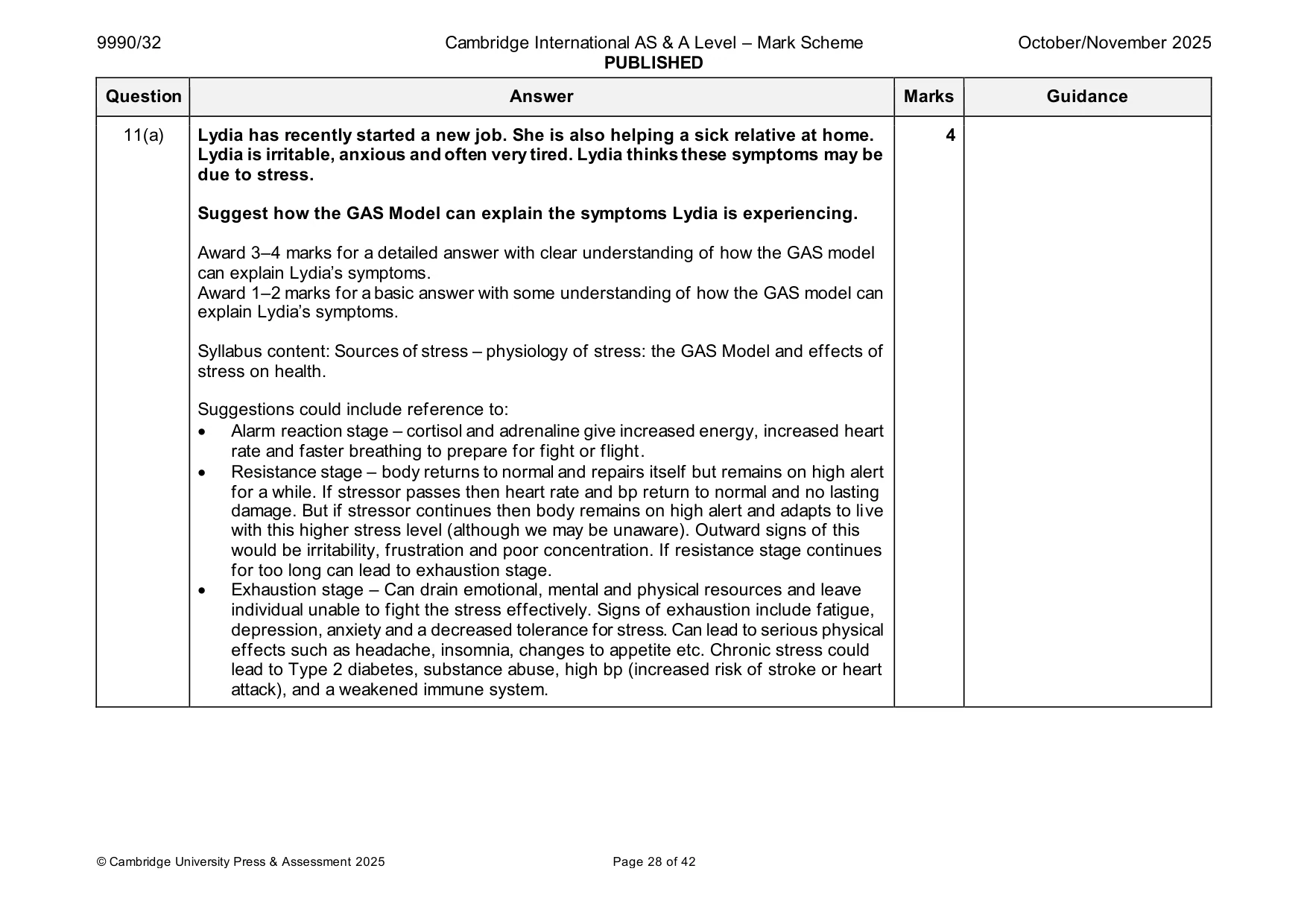
Mark scheme: 11(a) Lydia has recently started a new job. She is also helping a sick relative at home. 4 Lydia is irritable, anxious and often very tired. Lydia thinks these symptoms may be due to stress. Suggest how the GAS Model can explain the symptoms Lydia is experiencing. Award 3–4 marks for a detailed answer with clear understanding of how the GAS model can explain Lydia’s symptoms. Award 1–2 marks for a basic answer with some understanding of how the GAS model can explain Lydia’s symptoms. Syllabus content: Sources of stress – physiology of stress: the GAS Model and effects of stress on health. Suggestions could include reference to: • Alarm reaction stage – cortisol and adrenaline give increased energy, increased heart rate and faster breathing to prepare for fight or flight. • Resistance stage – body returns to normal and repairs itself but remains on high alert for a while. If stressor passes then heart rate and bp return to normal and no lasting damage. But if stressor continues then body remains on high alert and adapts to live with this higher stress level (although we may be unaware). Outward signs of this would be irritability, frustration and poor concentration. If resistance stage continues for too long can lead to exhaustion stage. • Exhaustion stage – Can drain emotional, mental and physical resources and leave individual unable to fight the stress effectively. Signs of exhaustion include fatigue, depression, anxiety and a decreased tolerance for stress. Can lead to serious physical effects such as headache, insomnia, changes to appetite etc. Chronic stress could lead to Type 2 diabetes, substance abuse, high bp (increased risk of stroke or heart attack), and a weakened immune system. 11(a) Example: Lydia’s symptoms are high levels of irritability, anxiety and fatigue (1). In the GAS Model, the alarm reaction stage could explain how Lydia needs extra energy (1) to deal with stressful demands such as her new job (1). In the resistance stage of the GAS model, Lydia is continuing to experience her stressors as her job will be stressful for a while and her sick relative’s needs continue (1). This can explain her experience of irritability as this is a characteristic experienced in the resistance stage (1). The exhaustion stage of the GAS Model would explain her tiredness and anxiety (1) as these are signs of the exhaustion Lydia is experiencing (1). Other appropriate responses should also be credited. 11(b) Explain one weakness of the GAS model. 2 Award 2 marks for an explanation of the weakness in the context of the GAS Model Award 1 mark for a basic explanation of the weakness. Weaknesses may include: • Deterministic – not much individuals can do to prevent it or help themselves • Individual – does not explain different levels of response to the same stressors and how some people experience chronic effects and others do not • Reductionist – does not really look at the ‘whole’ person • Does not distinguish between physical, emotional and mental stressors Example: One weakness of the GAS model to explaining stress is that it could be seen as reductionist (1). By dividing the stress response into stages it can miss the complexity of experiencing stress (1). For example, in Lydia’s case her new job could be a new stressor (putting her in the alarm reaction stage) but her sick relative is ongoing and she may be in the exhaustion stage in terms of caring responsibilities (1). The GAS Model fails to capture the complexity that the interaction of these stages may have on one another (1). Other appropriate responses should also be credited.
Q12 · Describe the following types and theories of pain: • types of pain: acute, chronic and…
12 (a) Describe the following types and theories of pain: • types of pain: acute, chronic and phantom limb pain, and • gate control theory of pain. [6] (b) Evaluate the following types and theories of pain: • types of pain: acute, chronic and phantom limb pain, and • gate control theory of pain, including a discussion of nature versus nurture. Evaluation in your answer can include strengths, weaknesses and a discussion of issues and debates. [10] Section D: Organisational Psychology Answer all questions.
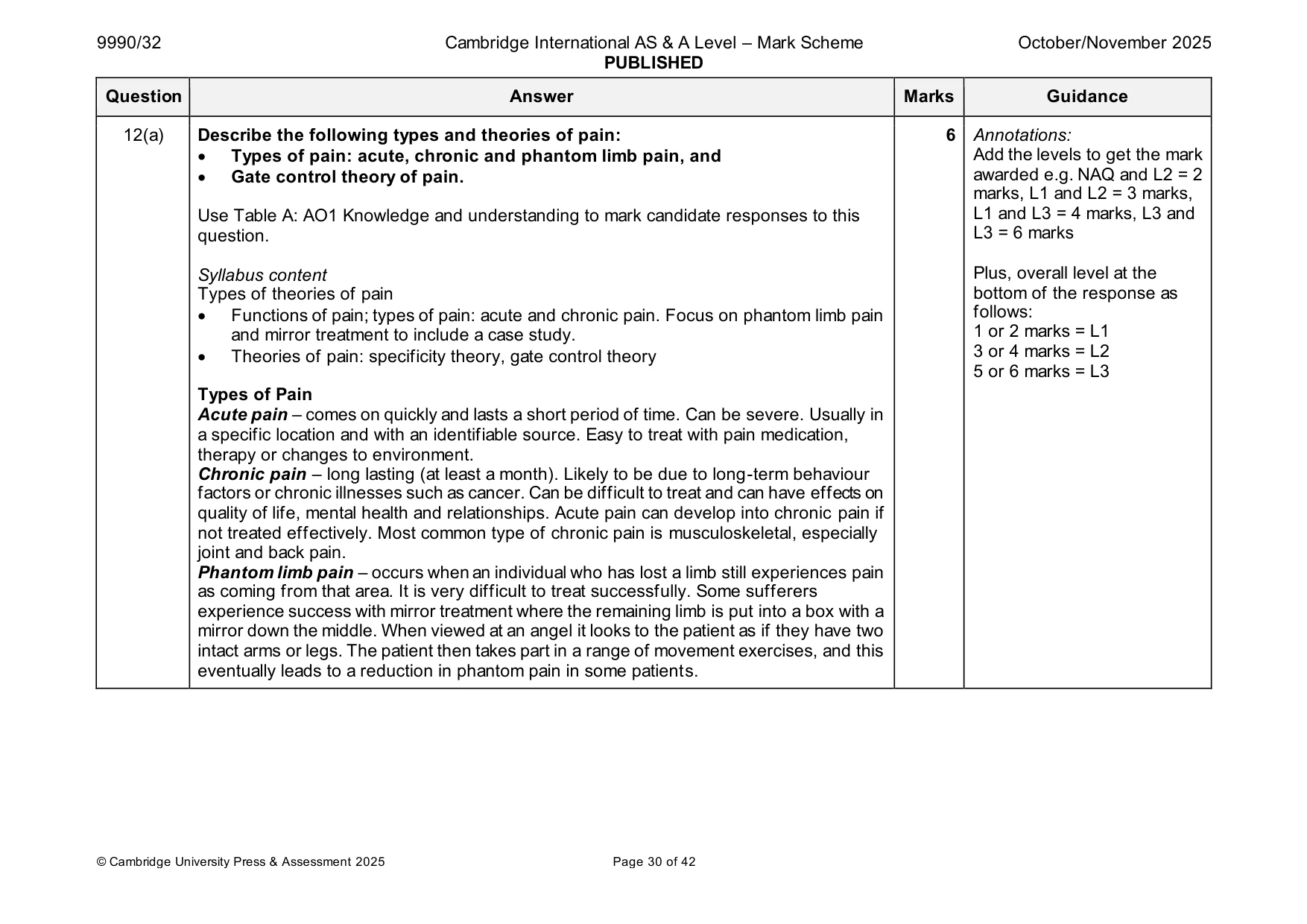
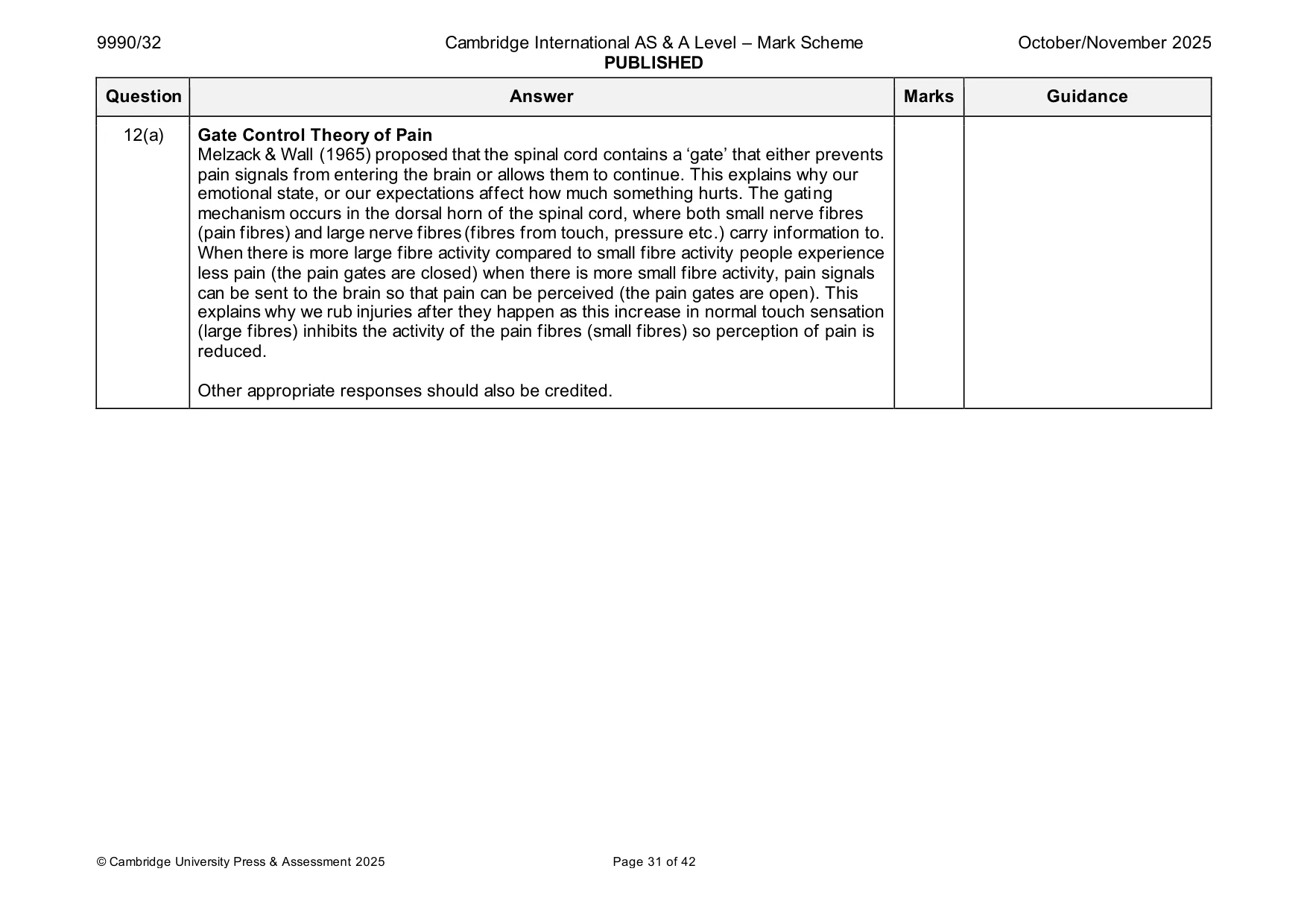
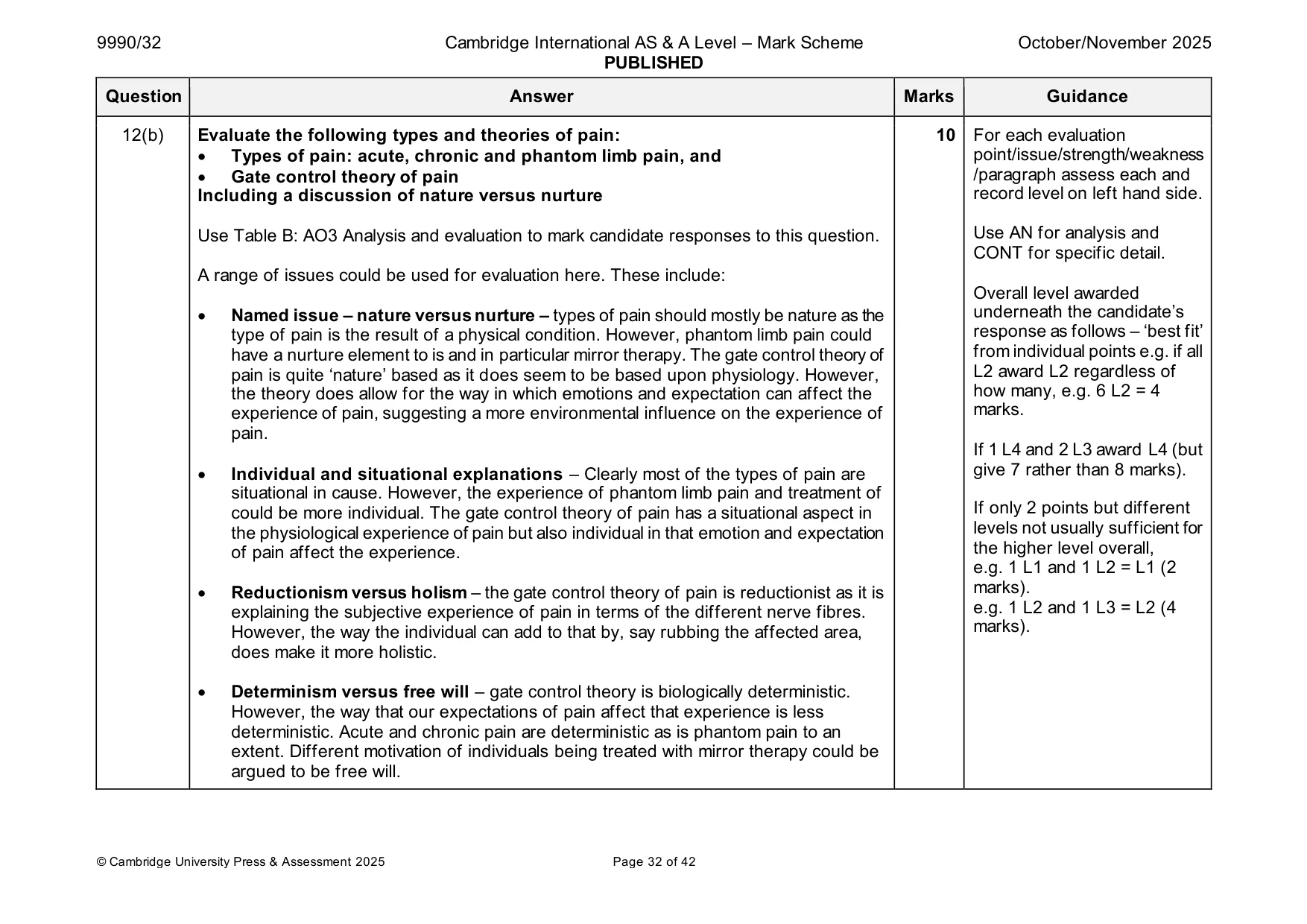
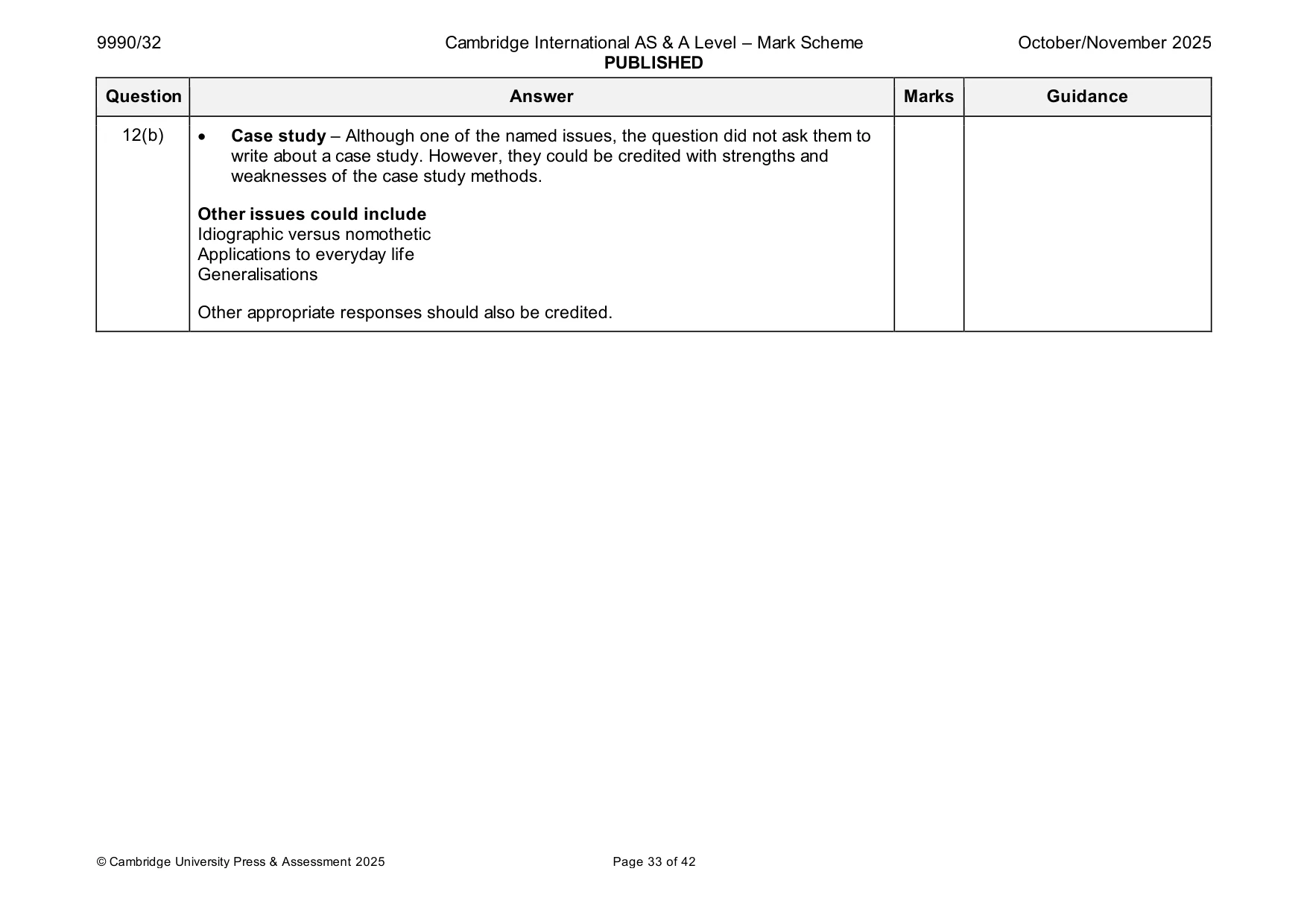
Mark scheme: 12(a) Describe the following types and theories of pain: 6 Annotations: • Types of pain: acute, chronic and phantom limb pain, and Add the levels to get the mark • Gate control theory of pain. awarded e.g. NAQ and L2 = 2 marks, L1 and L2 = 3 marks, Use Table A: AO1 Knowledge and understanding to mark candidate responses to this L1 and L3 = 4 marks, L3 and question. L3 = 6 marks Syllabus content Plus, overall level at the Types of theories of pain bottom of the response as • Functions of pain; types of pain: acute and chronic pain. Focus on phantom limb pain follows: and mirror treatment to include a case study. 1 or 2 marks = L1 • Theories of pain: specificity theory, gate control theory 3 or 4 marks = L2 5 or 6 marks = L3 Types of Pain Acute pain – comes on quickly and lasts a short period of time. Can be severe. Usually in a specific location and with an identifiable source. Easy to treat with pain medication, therapy or changes to environment. Chronic pain – long lasting (at least a month). Likely to be due to long-term behaviour factors or chronic illnesses such as cancer. Can be difficult to treat and can have effects on quality of life, mental health and relationships. Acute pain can develop into chronic pain if not treated effectively. Most common type of chronic pain is musculoskeletal, especially joint and back pain. Phantom limb pain – occurs when an individual who has lost a limb still experiences pain as coming from that area. It is very difficult to treat successfully. Some sufferers experience success with mirror treatment where the remaining limb is put into a box with a mirror down the middle. When viewed at an angel it looks to the patient as if they have two intact arms or legs. The patient then takes part in a range of movement exercises, and this eventually leads to a reduction in phantom pain in some patients. 12(a) Gate Control Theory of Pain Melzack & Wall (1965) proposed that the spinal cord contains a ‘gate’ that either prevents pain signals from entering the brain or allows them to continue. This explains why our emotional state, or our expectations affect how much something hurts. The gating mechanism occurs in the dorsal horn of the spinal cord, where both small nerve fibres (pain fibres) and large nerve fibres (fibres from touch, pressure etc.) carry information to. When there is more large fibre activity compared to small fibre activity people experience less pain (the pain gates are closed) when there is more small fibre activity, pain signals can be sent to the brain so that pain can be perceived (the pain gates are open). This explains why we rub injuries after they happen as this increase in normal touch sensation (large fibres) inhibits the activity of the pain fibres (small fibres) so perception of pain is reduced. Other appropriate responses should also be credited. 12(b) Evaluate the following types and theories of pain: 10 For each evaluation • Types of pain: acute, chronic and phantom limb pain, and point/issue/strength/weakness • Gate control theory of pain /paragraph assess each and Including a discussion of nature versus nurture record level on left hand side. Use Table B: AO3 Analysis and evaluation to mark candidate responses to this question. Use AN for analysis and CONT for specific detail. A range of issues could be used for evaluation here. These include: Overall level awarded • Named issue – nature versus nurture – types of pain should mostly be nature as the underneath the candidate’s type of pain is the result of a physical condition. However, phantom limb pain could response as follows – ‘best fit’ have a nurture element to is and in particular mirror therapy. The gate control theory of from individual points e.g. if all pain is quite ‘nature’ based as it does seem to be based upon physiology. However, L2 award L2 regardless of the theory does allow for the way in which emotions and expectation can affect the how many, e.g. 6 L2 = 4 experience of pain, suggesting a more environmental influence on the experience of marks. pain. If 1 L4 and 2 L3 award L4 (but • Individual and situational explanations – Clearly most of the types of pain are give 7 rather than 8 marks). situational in cause. However, the experience of phantom limb pain and treatment of If only 2 points but different could be more individual. The gate control theory of pain has a situational aspect in levels not usually sufficient for the physiological experience of pain but also individual in that emotion and expectation the higher level overall, of pain affect the experience. e.g. 1 L1 and 1 L2 = L1 (2 • Reductionism versus holism – the gate control theory of pain is reductionist as it is marks). e.g. 1 L2 and 1 L3 = L2 (4 explaining the subjective experience of pain in terms of the different nerve fibres. marks). However, the way the individual can add to that by, say rubbing the affected area, does make it more holistic. • Determinism versus free will – gate control theory is biologically deterministic. However, the way that our expectations of pain affect that experience is less deterministic. Acute and chronic pain are deterministic as is phantom pain to an extent. Different motivation of individuals being treated with mirror therapy could be argued to be free will. 12(b) • Case study – Although one of the named issues, the question did not ask them to write about a case study. However, they could be credited with strengths and weaknesses of the case study methods. Other issues could include Idiographic versus nomothetic Applications to everyday life Generalisations Other appropriate responses should also be credited. Section D: Organisational Psychology
Q13 · A mobile phone company has a large number of workers in a noisy open plan office
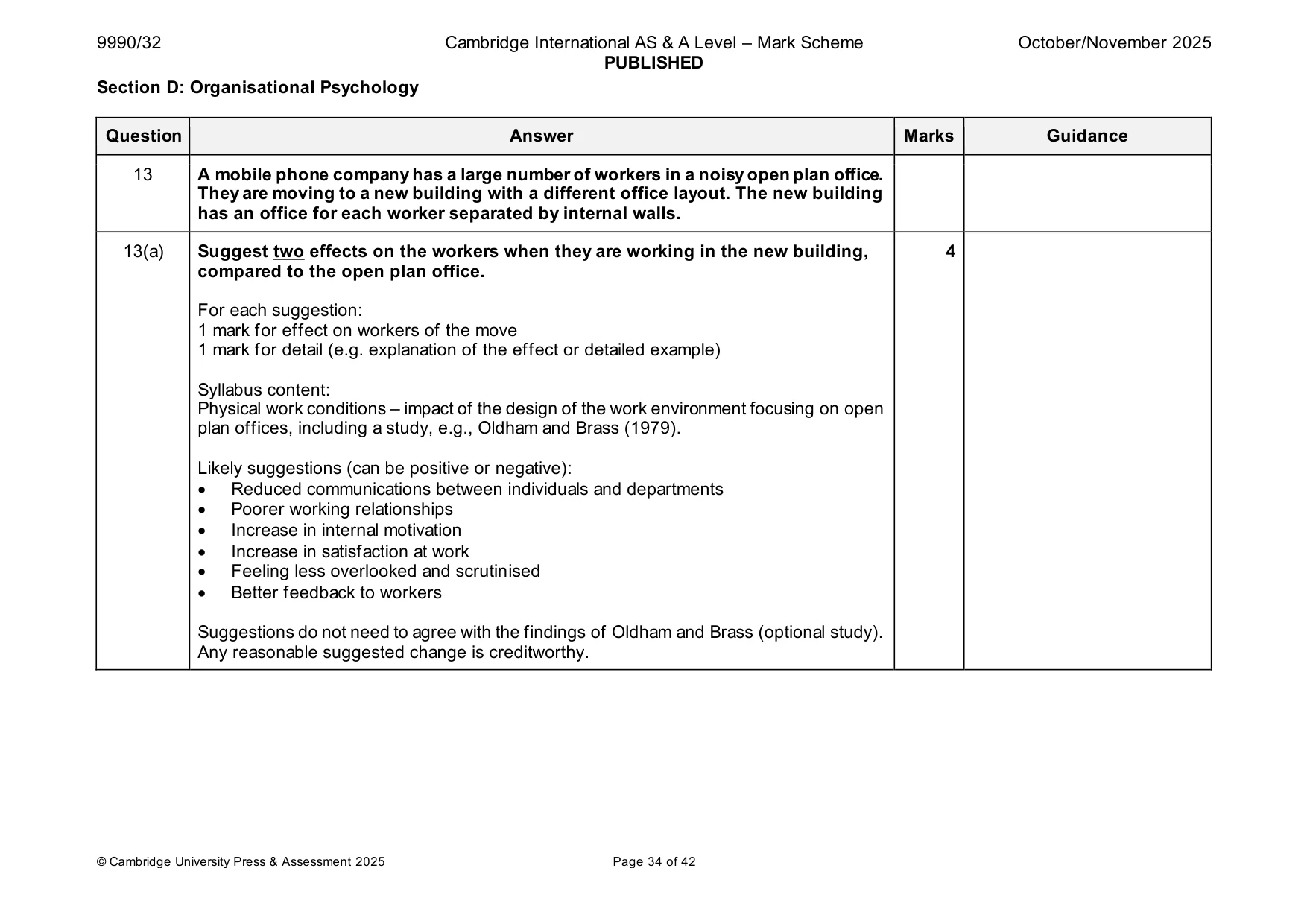
13 A mobile phone company has a large number of workers in a noisy open plan office. They are moving to a new building with a different office layout. The new building has an office for each worker separated by internal walls. Suggest two effects on the workers of working in the new building, compared to the open plan office. [4]
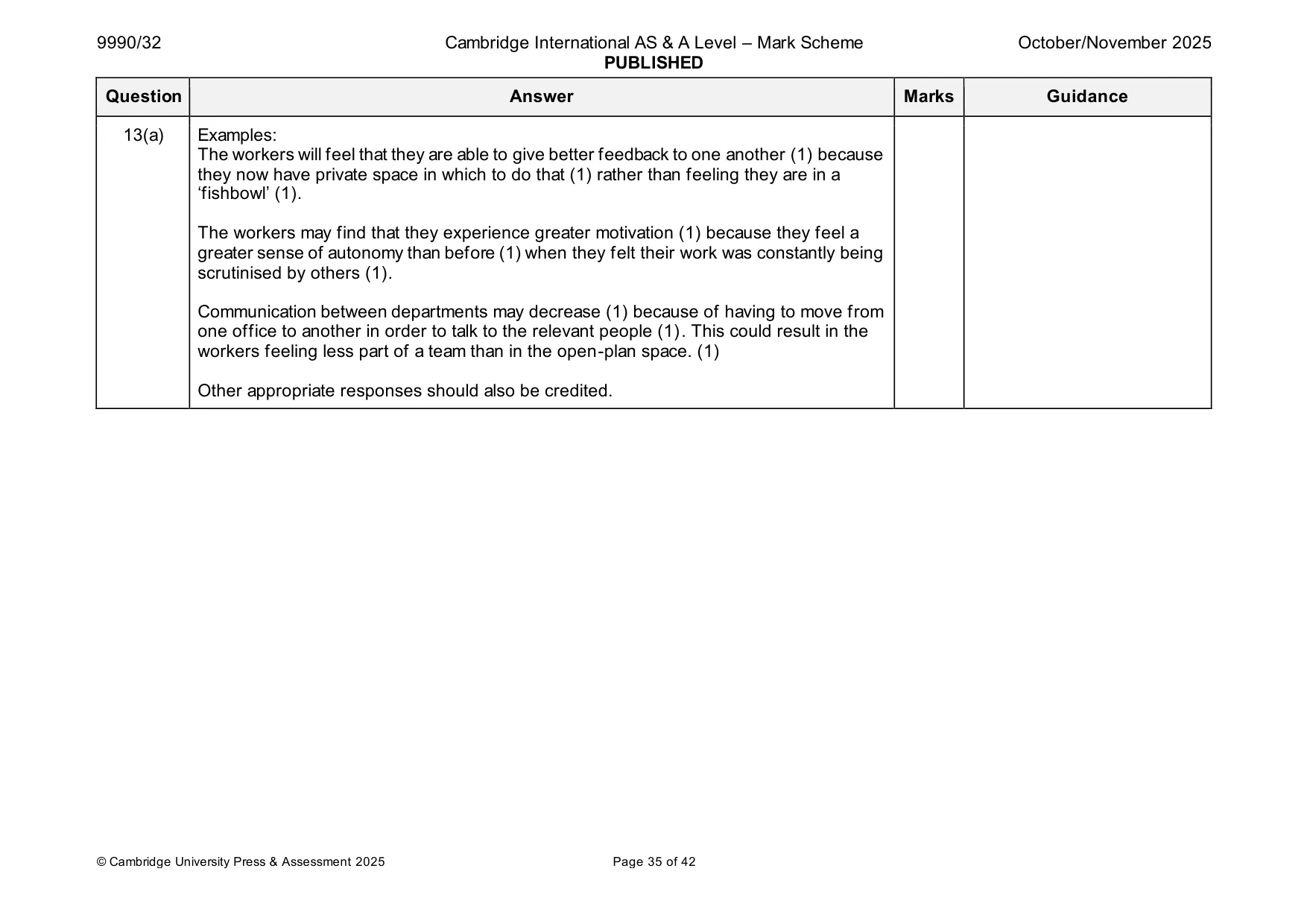
Mark scheme: 13 A mobile phone company has a large number of workers in a noisy open plan office. They are moving to a new building with a different office layout. The new building has an office for each worker separated by internal walls. 13(a) Suggest two effects on the workers when they are working in the new building, 4 compared to the open plan office. For each suggestion: 1 mark for effect on workers of the move 1 mark for detail (e.g. explanation of the effect or detailed example) Syllabus content: Physical work conditions – impact of the design of the work environment focusing on open plan offices, including a study, e.g., Oldham and Brass (1979). Likely suggestions (can be positive or negative): • Reduced communications between individuals and departments • Poorer working relationships • Increase in internal motivation • Increase in satisfaction at work • Feeling less overlooked and scrutinised • Better feedback to workers Suggestions do not need to agree with the findings of Oldham and Brass (optional study). Any reasonable suggested change is creditworthy. 13(a) Examples: The workers will feel that they are able to give better feedback to one another (1) because they now have private space in which to do that (1) rather than feeling they are in a ‘fishbowl’ (1). The workers may find that they experience greater motivation (1) because they feel a greater sense of autonomy than before (1) when they felt their work was constantly being scrutinised by others (1). Communication between departments may decrease (1) because of having to move from one office to another in order to talk to the relevant people (1). This could result in the workers feeling less part of a team than in the open-plan space. (1) Other appropriate responses should also be credited.
Q14 · Outline the reductionism versus holism debate
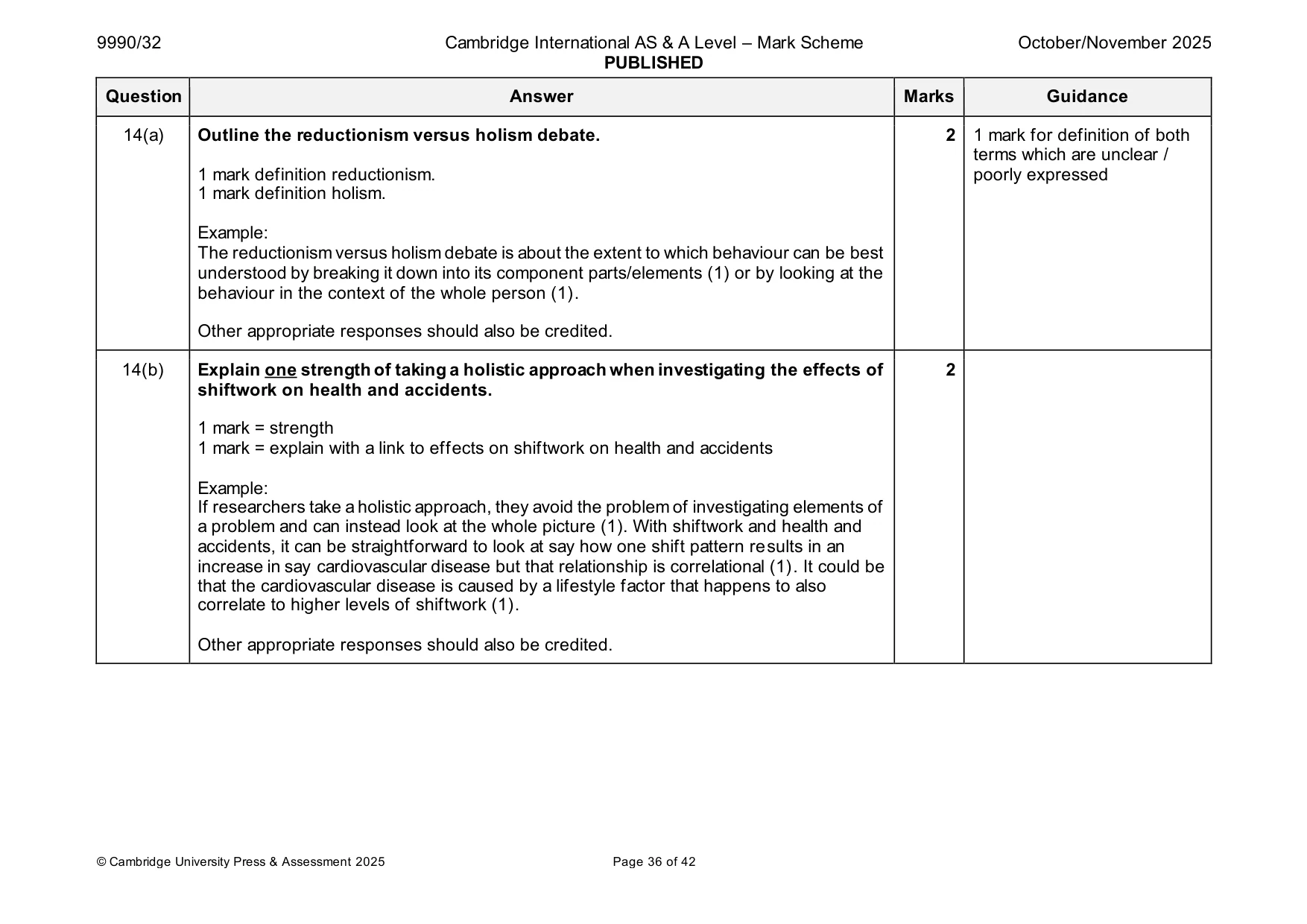
14 (a) Outline the reductionism versus holism debate. [2] (b) Explain one strength of taking a holistic approach when investigating the effects of shiftwork on health and accidents. [2]
Mark scheme: 14(a) Outline the reductionism versus holism debate. 2 1 mark for definition of both terms which are unclear / 1 mark definition reductionism. poorly expressed 1 mark definition holism. Example: The reductionism versus holism debate is about the extent to which behaviour can be best understood by breaking it down into its component parts/elements (1) or by looking at the behaviour in the context of the whole person (1). Other appropriate responses should also be credited. 14(b) Explain one strength of taking a holistic approach when investigating the effects of 2 shiftwork on health and accidents. 1 mark = strength 1 mark = explain with a link to effects on shiftwork on health and accidents Example: If researchers take a holistic approach, they avoid the problem of investigating elements of a problem and can instead look at the whole picture (1). With shiftwork and health and accidents, it can be straightforward to look at say how one shift pattern results in an increase in say cardiovascular disease but that relationship is correlational (1). It could be that the cardiovascular disease is caused by a lifestyle factor that happens to also correlate to higher levels of shiftwork (1). Other appropriate responses should also be credited.
Q15 · Ingrid is the headteacher in a large school
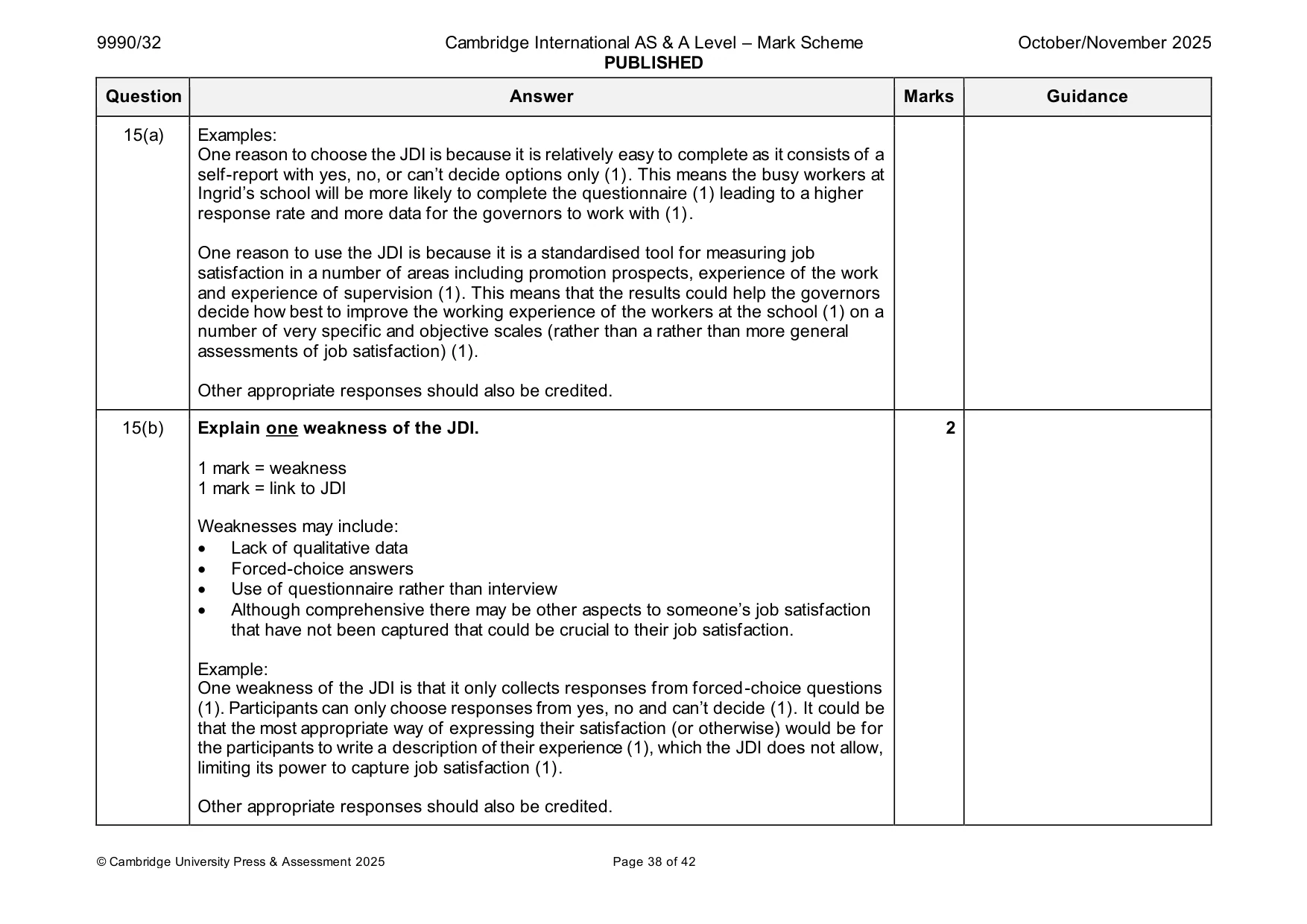
15 Ingrid is the headteacher in a large school. She would like to measure the job satisfaction of all the workers at the school, including teachers and other workers. She has decided to use the job descriptive index (JDI). (a) Suggest two reasons why the JDI is an appropriate measure of job satisfaction of all the workers at Ingrid’s school. [4] (b) Explain one weakness of the JDI. [2]
Mark scheme: 15(a) Ingrid is the head teacher in a large school. She would like to measure the job 4 satisfaction of all the workers at the school, including teachers and other workers. She has decided to use the job descriptive index (JDI). Suggest two reasons why the JDI is an appropriate measure of job satisfaction of all the workers at Ingrid’s school. For each suggestion: Award 2 marks for a reason for choosing the JDI to measure satisfaction in the context of the workers at a school Award 1 mark for a basic outline of a reason Syllabus reference: Measuring job satisfaction – job satisfaction rating scales and questionnaires focusing on the job descriptive index (JDI). Likely suggestions: • It uses self-report (questionnaire) making it relatively easy to administer. • Workers simply answer yes, no, or can’t decide to a series of statements about their job so it is fairly undemanding for the worker • It is a well-known and widely used measure of job satisfaction • It is quite comprehensive as it looks at 5 aspects of job satisfaction – experience of the work, salary, promotion prospects, experience of supervision, and experience of co- workers. • Results can be compared with standardised norms based on data from a large sample of people, which is regularly updated. • Scores can be compared with normative scores in respect of age, gender, job level, education etc. • It measures specific, objective areas of job satisfaction rather than satisfaction in general terms. • Relatively easy to read and does not use complex language so suitable to use with a large variety of people (including the less well-educated at the school, such as cleaners and caretaking staff). 15(a) Examples: One reason to choose the JDI is because it is relatively easy to complete as it consists of a self-report with yes, no, or can’t decide options only (1). This means the busy workers at Ingrid’s school will be more likely to complete the questionnaire (1) leading to a higher response rate and more data for the governors to work with (1). One reason to use the JDI is because it is a standardised tool for measuring job satisfaction in a number of areas including promotion prospects, experience of the work and experience of supervision (1). This means that the results could help the governors decide how best to improve the working experience of the workers at the school (1) on a number of very specific and objective scales (rather than a rather than more general assessments of job satisfaction) (1). Other appropriate responses should also be credited. 15(b) Explain one weakness of the JDI. 2 1 mark = weakness 1 mark = link to JDI Weaknesses may include: • Lack of qualitative data • Forced-choice answers • Use of questionnaire rather than interview • Although comprehensive there may be other aspects to someone’s job satisfaction that have not been captured that could be crucial to their job satisfaction. Example: One weakness of the JDI is that it only collects responses from forced-choice questions (1). Participants can only choose responses from yes, no and can’t decide (1). It could be that the most appropriate way of expressing their satisfaction (or otherwise) would be for the participants to write a description of their experience (1), which the JDI does not allow, limiting its power to capture job satisfaction (1). Other appropriate responses should also be credited.
Q16 · Describe the study by Claypoole and Szalma (2019) on concentration levels when being…
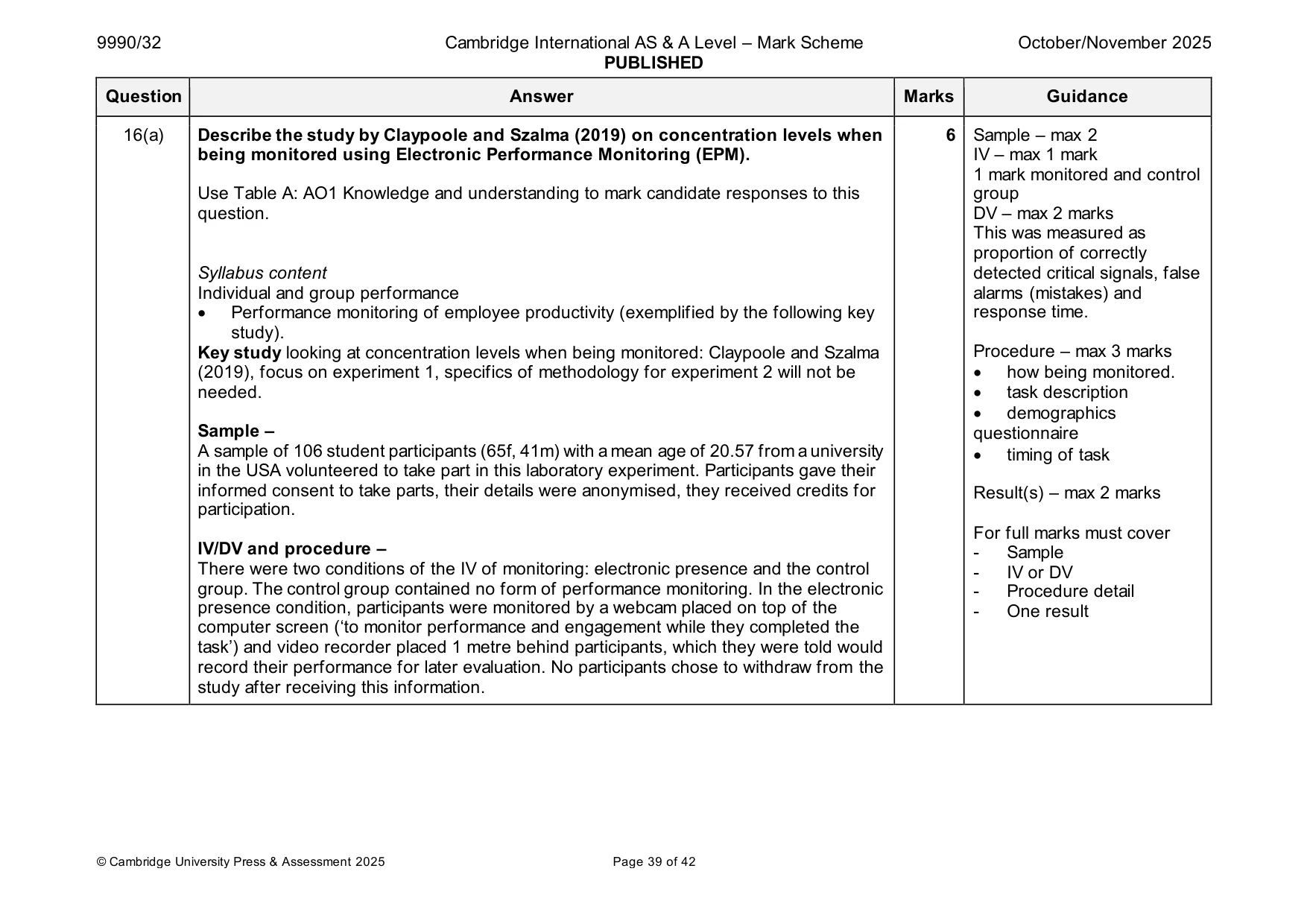
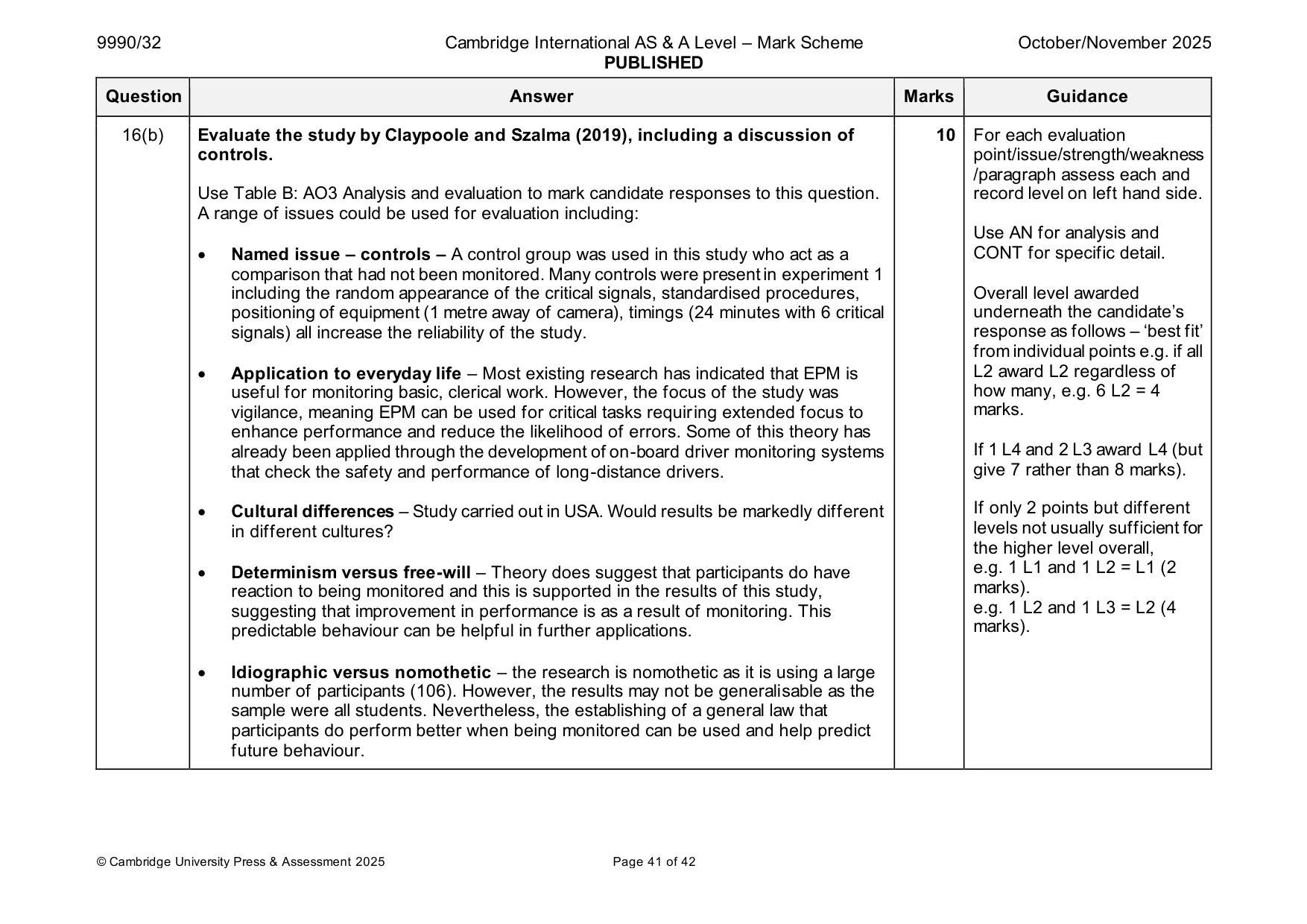
16 (a) Describe the study by Claypoole and Szalma (2019) on concentration levels when being monitored using Electronic Performance Monitoring (EPM). [6] (b) Evaluate the study by Claypoole and Szalma (2019), including a discussion of controls. Evaluation in your answer can include strengths, weaknesses and a discussion of issues and debates. [10]
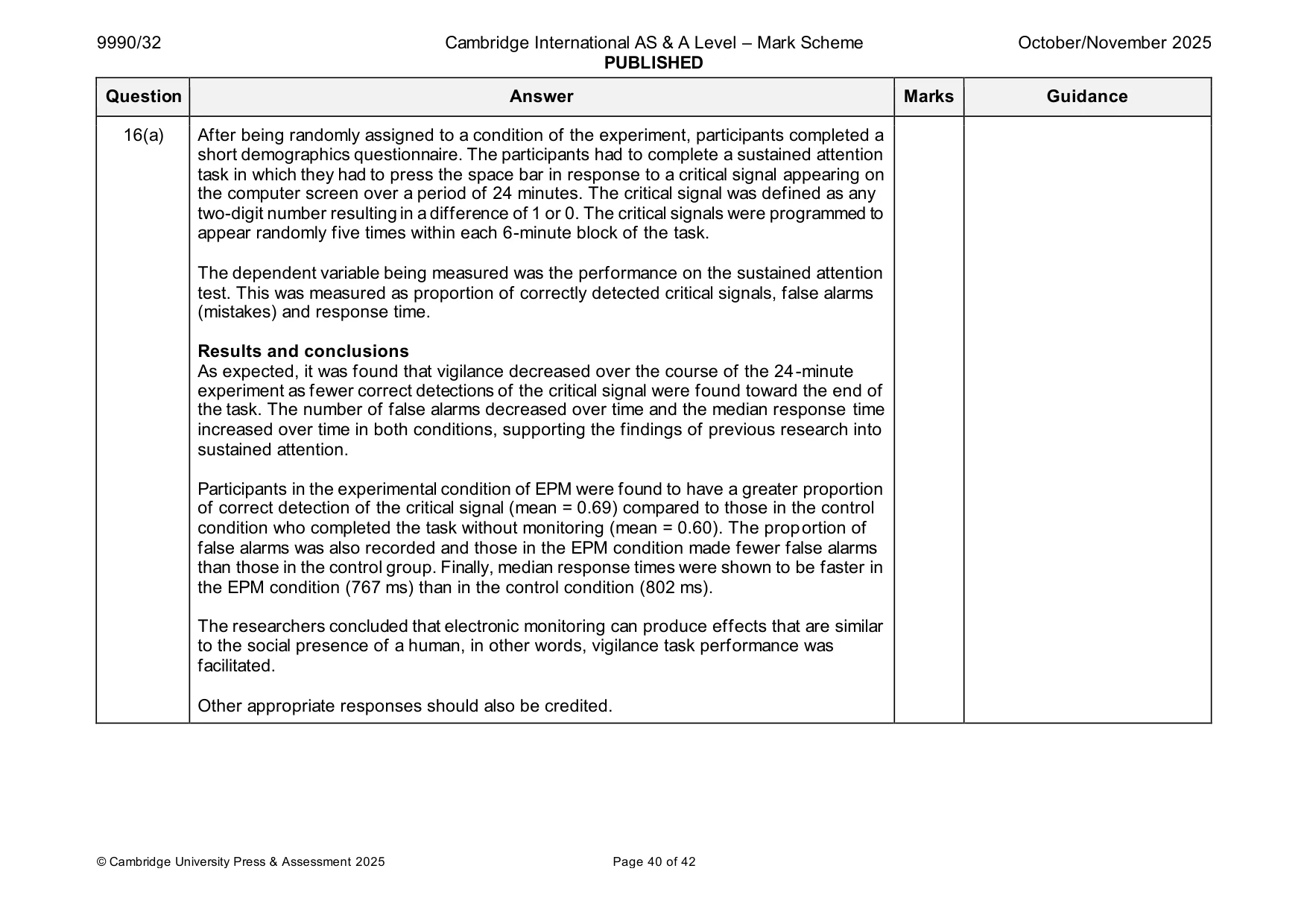
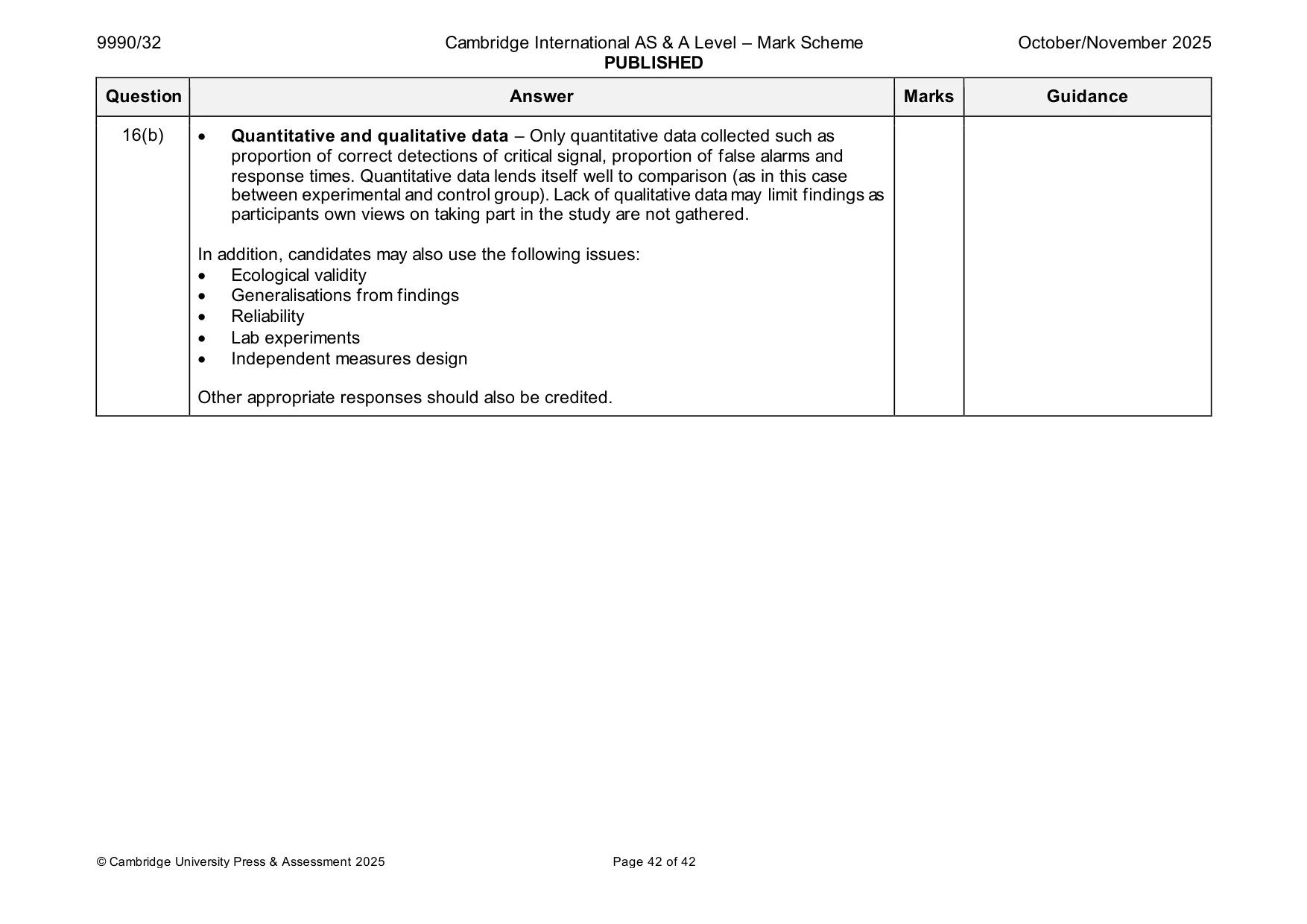
Mark scheme: 16(a) Describe the study by Claypoole and Szalma (2019) on concentration levels when 6 Sample – max 2 being monitored using Electronic Performance Monitoring (EPM). IV – max 1 mark 1 mark monitored and control Use Table A: AO1 Knowledge and understanding to mark candidate responses to this group question. DV – max 2 marks This was measured as proportion of correctly Syllabus content detected critical signals, false Individual and group performance alarms (mistakes) and • Performance monitoring of employee productivity (exemplified by the following key response time. study). Key study looking at concentration levels when being monitored: Claypoole and Szalma Procedure – max 3 marks (2019), focus on experiment 1, specifics of methodology for experiment 2 will not be • how being monitored. needed. • task description • demographics Sample – questionnaire A sample of 106 student participants (65f, 41m) with a mean age of 20.57 from a university • timing of task in the USA volunteered to take part in this laboratory experiment. Participants gave their informed consent to take parts, their details were anonymised, they received credits for Result(s) – max 2 marks participation. For full marks must cover IV/DV and procedure – - Sample There were two conditions of the IV of monitoring: electronic presence and the control - IV or DV group. The control group contained no form of performance monitoring. In the electronic - Procedure detail presence condition, participants were monitored by a webcam placed on top of the - One result computer screen (‘to monitor performance and engagement while they completed the task’) and video recorder placed 1 metre behind participants, which they were told would record their performance for later evaluation. No participants chose to withdraw from the study after receiving this information. 16(a) After being randomly assigned to a condition of the experiment, participants completed a short demographics questionnaire. The participants had to complete a sustained attention task in which they had to press the space bar in response to a critical signal appearing on the computer screen over a period of 24 minutes. The critical signal was defined as any two-digit number resulting in a difference of 1 or 0. The critical signals were programmed to appear randomly five times within each 6-minute block of the task. The dependent variable being measured was the performance on the sustained attention test. This was measured as proportion of correctly detected critical signals, false alarms (mistakes) and response time. Results and conclusions As expected, it was found that vigilance decreased over the course of the 24-minute experiment as fewer correct detections of the critical signal were found toward the end of the task. The number of false alarms decreased over time and the median response time increased over time in both conditions, supporting the findings of previous research into sustained attention. Participants in the experimental condition of EPM were found to have a greater proportion of correct detection of the critical signal (mean = 0.69) compared to those in the control condition who completed the task without monitoring (mean = 0.60). The proportion of false alarms was also recorded and those in the EPM condition made fewer false alarms than those in the control group. Finally, median response times were shown to be faster in the EPM condition (767 ms) than in the control condition (802 ms). The researchers concluded that electronic monitoring can produce effects that are similar to the social presence of a human, in other words, vigilance task performance was facilitated. Other appropriate responses should also be credited. 16(b) Evaluate the study by Claypoole and Szalma (2019), including a discussion of 10 For each evaluation controls. point/issue/strength/weakness /paragraph assess each and Use Table B: AO3 Analysis and evaluation to mark candidate responses to this question. record level on left hand side. A range of issues could be used for evaluation including: Use AN for analysis and • Named issue – controls – A control group was used in this study who act as a CONT for specific detail. comparison that had not been monitored. Many controls were present in experiment 1 including the random appearance of the critical signals, standardised procedures, Overall level awarded positioning of equipment (1 metre away of camera), timings (24 minutes with 6 critical underneath the candidate’s signals) all increase the reliability of the study. response as follows – ‘best fit’ from individual points e.g. if all • Application to everyday life – Most existing research has indicated that EPM is L2 award L2 regardless of useful for monitoring basic, clerical work. However, the focus of the study was how many, e.g. 6 L2 = 4 vigilance, meaning EPM can be used for critical tasks requiring extended focus to marks. enhance performance and reduce the likelihood of errors. Some of this theory has already been applied through the development of on-board driver monitoring systems If 1 L4 and 2 L3 award L4 (but that check the safety and performance of long-distance drivers. give 7 rather than 8 marks). • Cultural differences – Study carried out in USA. Would results be markedly different If only 2 points but different in different cultures? levels not usually sufficient for the higher level overall, • Determinism versus free-will – Theory does suggest that participants do have e.g. 1 L1 and 1 L2 = L1 (2 reaction to being monitored and this is supported in the results of this study, marks). suggesting that improvement in performance is as a result of monitoring. This e.g. 1 L2 and 1 L3 = L2 (4 marks). predictable behaviour can be helpful in further applications. • Idiographic versus nomothetic – the research is nomothetic as it is using a large number of participants (106). However, the results may not be generalisable as the sample were all students. Nevertheless, the establishing of a general law that participants do perform better when being monitored can be used and help predict future behaviour. 16(b) • Quantitative and qualitative data – Only quantitative data collected such as proportion of correct detections of critical signal, proportion of false alarms and response times. Quantitative data lends itself well to comparison (as in this case between experimental and control group). Lack of qualitative data may limit findings as participants own views on taking part in the study are not gathered. In addition, candidates may also use the following issues: • Ecological validity • Generalisations from findings • Reliability • Lab experiments • Independent measures design Other appropriate responses should also be credited.
What was in this paper
The subtopics covered by these 16 questions, and how many questions each got. Open one in a new tab to see every Cambridge question on it.