Cambridge A Level Psychology (from 2018) 9990 — 2020 Oct/Nov Paper 3 · Variant 2
9990/32/O/N/20 · 8 questions · 60 marks · ≈68 min
The question paper and its mark scheme, free to read here and free to download. This is Cambridge’s own paper, exactly as it was sat.
Question paper4 pages

Mark scheme21 pages
Answers below. Sit the paper first if you are practising.
Questions as text
Q1 · Outline two characteristics of schizophrenia
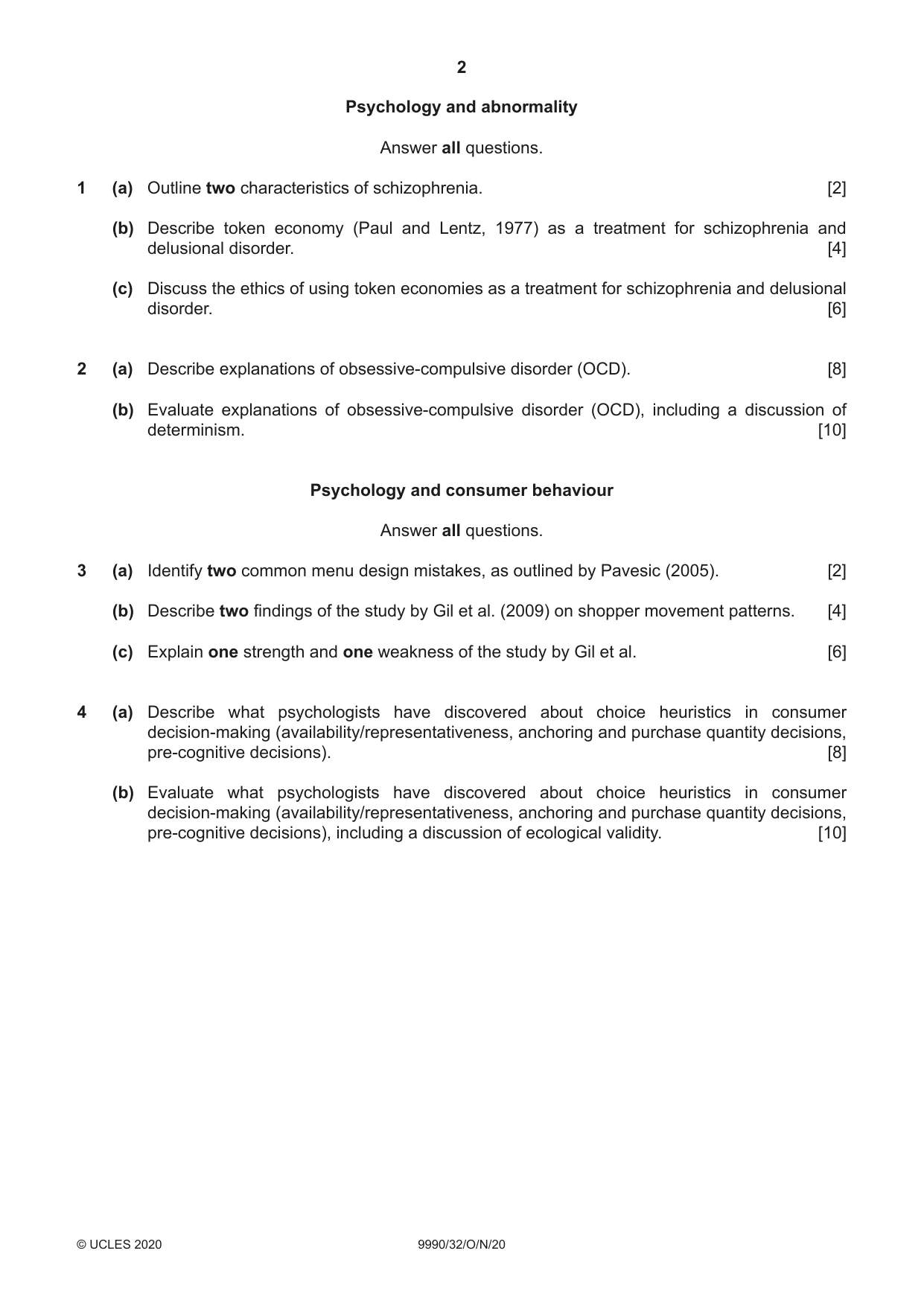
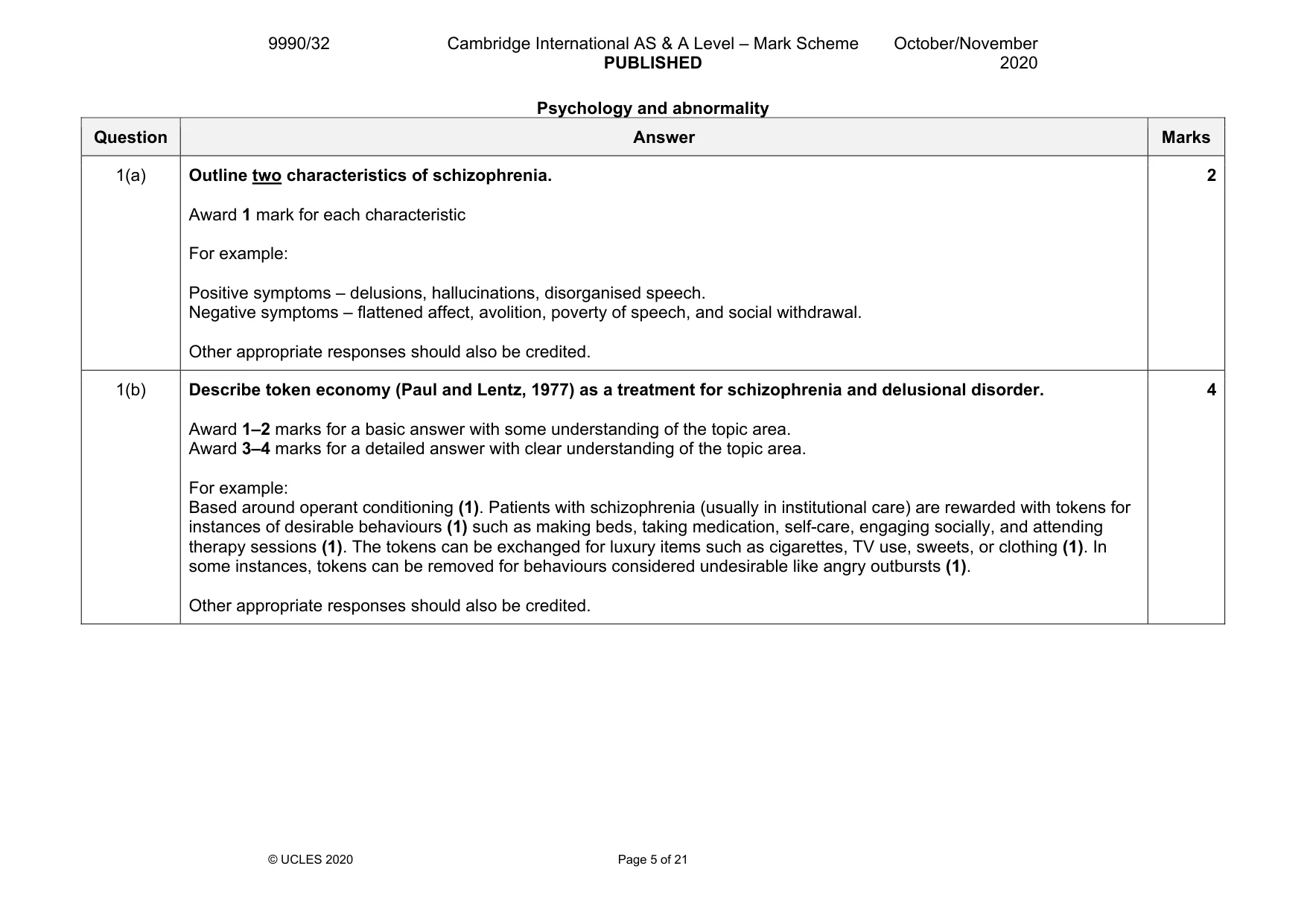
1 (a) Outline two characteristics of schizophrenia. [2] (b) Describe token economy (Paul and Lentz, 1977) as a treatment for schizophrenia and delusional disorder. [4] (c) Discuss the ethics of using token economies as a treatment for schizophrenia and delusional disorder. [6]
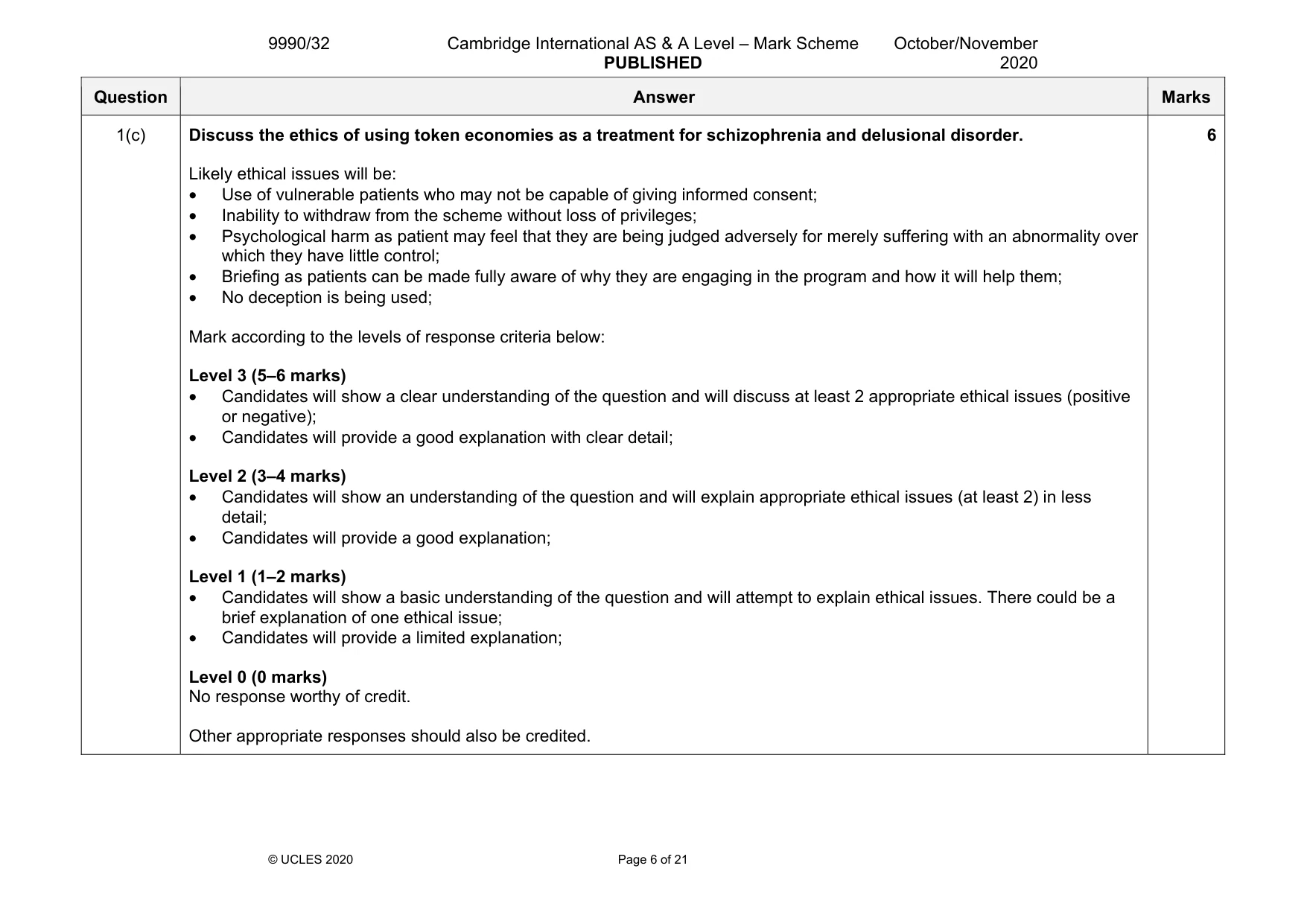
Mark scheme: 1(a) Outline two characteristics of schizophrenia. Award 1 mark for each characteristic For example: Positive symptoms – delusions, hallucinations, disorganised speech. Negative symptoms – flattened affect, avolition, poverty of speech, and social withdrawal. Other appropriate responses should also be credited. 1(b) Describe token economy (Paul and Lentz, 1977) as a treatment for schizophrenia and delusional disorder. Award 1–2 marks for a basic answer with some understanding of the topic area. Award 3–4 marks for a detailed answer with clear understanding of the topic area. For example: Based around operant conditioning (1). Patients with schizophrenia (usually in institutional care) are rewarded with tokens for instances of desirable behaviours (1) such as making beds, taking medication, self-care, engaging socially, and attending therapy sessions (1). The tokens can be exchanged for luxury items such as cigarettes, TV use, sweets, or clothing (1). In some instances, tokens can be removed for behaviours considered undesirable like angry outbursts (1). Other appropriate responses should also be credited. 4 Question Answer Marks 1(c) Discuss the ethics of using token economies as a treatment for schizophrenia and delusional disorder. Likely ethical issues will be: • Use of vulnerable patients who may not be capable of giving informed consent; • Inability to withdraw from the scheme without loss of privileges; • Psychological harm as patient may feel that they are being judged adversely for merely suffering with an abnormality over which they have little control; • Briefing as patients can be made fully aware of why they are engaging in the program and how it will help them; • No deception is being used; Mark according to the levels of response criteria below: Level 3 (5–6 marks) • Candidates will show a clear understanding of the question and will discuss at least 2 appropriate ethical issues (positive or negative); • Candidates will provide a good explanation with clear detail; Level 2 (3–4 marks) • Candidates will show an understanding of the question and will explain appropriate ethical issues (at least 2) in less detail; • Candidates will provide a good explanation; Level 1 (1–2 marks) • Candidates will show a basic understanding of the question and will attempt to explain ethical issues. There could be a brief explanation of one ethical issue; • Candidates will provide a limited explanation; Level 0 (0 marks) No response worthy of credit. Other appropriate responses should also be credited. 6
Q2 · Describe explanations of obsessive-compulsive disorder (OCD)
2 (a) Describe explanations of obsessive-compulsive disorder (OCD). [8] (b) Evaluate explanations of obsessive-compulsive disorder (OCD), including a discussion of determinism. [10] Psychology and consumer behaviour Answer all questions.
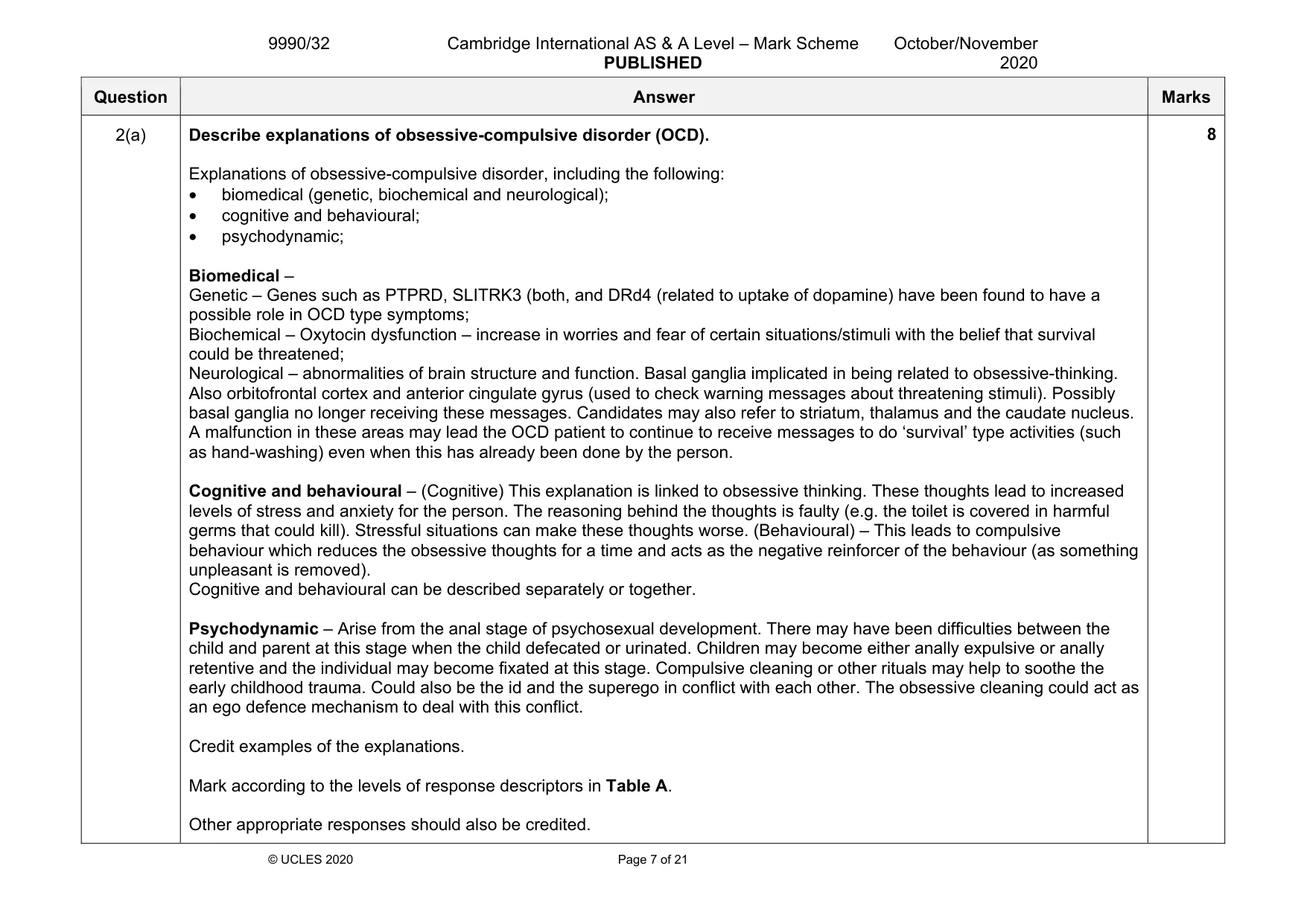
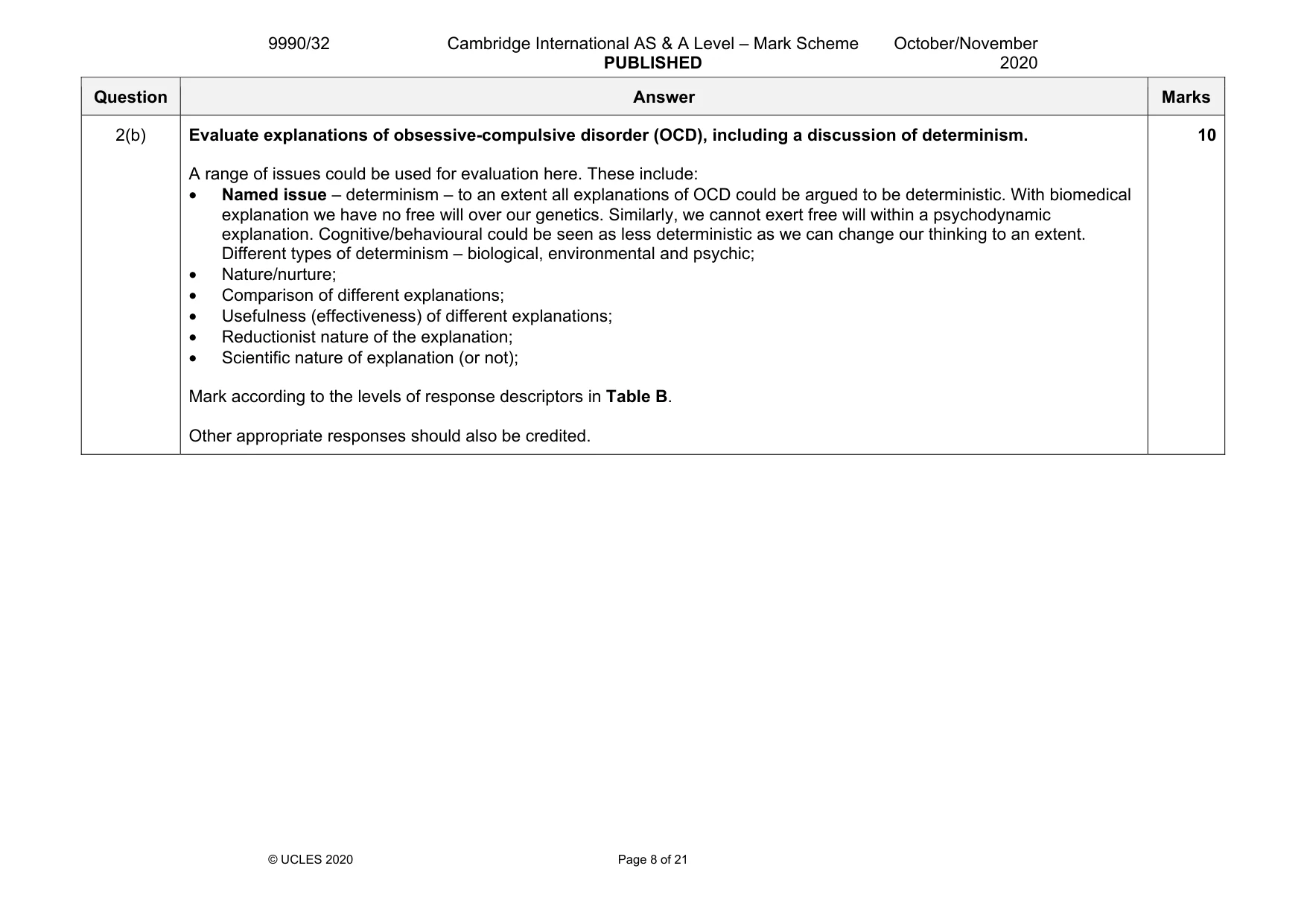
Mark scheme: 2(a) Describe explanations of obsessive-compulsive disorder (OCD). Explanations of obsessive-compulsive disorder, including the following: • biomedical (genetic, biochemical and neurological); • cognitive and behavioural; • psychodynamic; Biomedical – Genetic – Genes such as PTPRD, SLITRK3 (both, and DRd4 (related to uptake of dopamine) have been found to have a possible role in OCD type symptoms; Biochemical – Oxytocin dysfunction – increase in worries and fear of certain situations/stimuli with the belief that survival could be threatened; Neurological – abnormalities of brain structure and function. Basal ganglia implicated in being related to obsessive-thinking. Also orbitofrontal cortex and anterior cingulate gyrus (used to check warning messages about threatening stimuli). Possibly basal ganglia no longer receiving these messages. Candidates may also refer to striatum, thalamus and the caudate nucleus. A malfunction in these areas may lead the OCD patient to continue to receive messages to do ‘survival’ type activities (such as hand-washing) even when this has already been done by the person. Cognitive and behavioural – (Cognitive) This explanation is linked to obsessive thinking. These thoughts lead to increased levels of stress and anxiety for the person. The reasoning behind the thoughts is faulty (e.g. the toilet is covered in harmful germs that could kill). Stressful situations can make these thoughts worse. (Behavioural) – This leads to compulsive behaviour which reduces the obsessive thoughts for a time and acts as the negative reinforcer of the behaviour (as something unpleasant is removed). Cognitive and behavioural can be described separately or together. Psychodynamic – Arise from the anal stage of psychosexual development. There may have been difficulties between the child and parent at this stage when the child defecated or urinated. Children may become either anally expulsive or anally retentive and the individual may become fixated at this stage. Compulsive cleaning or other rituals may help to soothe the early childhood trauma. Could also be the id and the superego in conflict with each other. The obsessive cleaning could act as an ego defence mechanism to deal with this conflict. Credit examples of the explanations. Mark according to the levels of response descriptors in Table A. Other appropriate responses should also be credited. Question Answer Marks 2(b) Evaluate explanations of obsessive-compulsive disorder (OCD), including a discussion of determinism. A range of issues could be used for evaluation here. These include: • Named issue – determinism – to an extent all explanations of OCD could be argued to be deterministic. With biomedical explanation we have no free will over our genetics. Similarly, we cannot exert free will within a psychodynamic explanation. Cognitive/behavioural could be seen as less deterministic as we can change our thinking to an extent. Different types of determinism – biological, environmental and psychic; • Nature/nurture; • Comparison of different explanations; • Usefulness (effectiveness) of different explanations; • Reductionist nature of the explanation; • Scientific nature of explanation (or not); Mark according to the levels of response descriptors in Table B. Other appropriate responses should also be credited. 10
Q3 · Identify two common menu design mistakes, as outlined by Pavesic (2005)
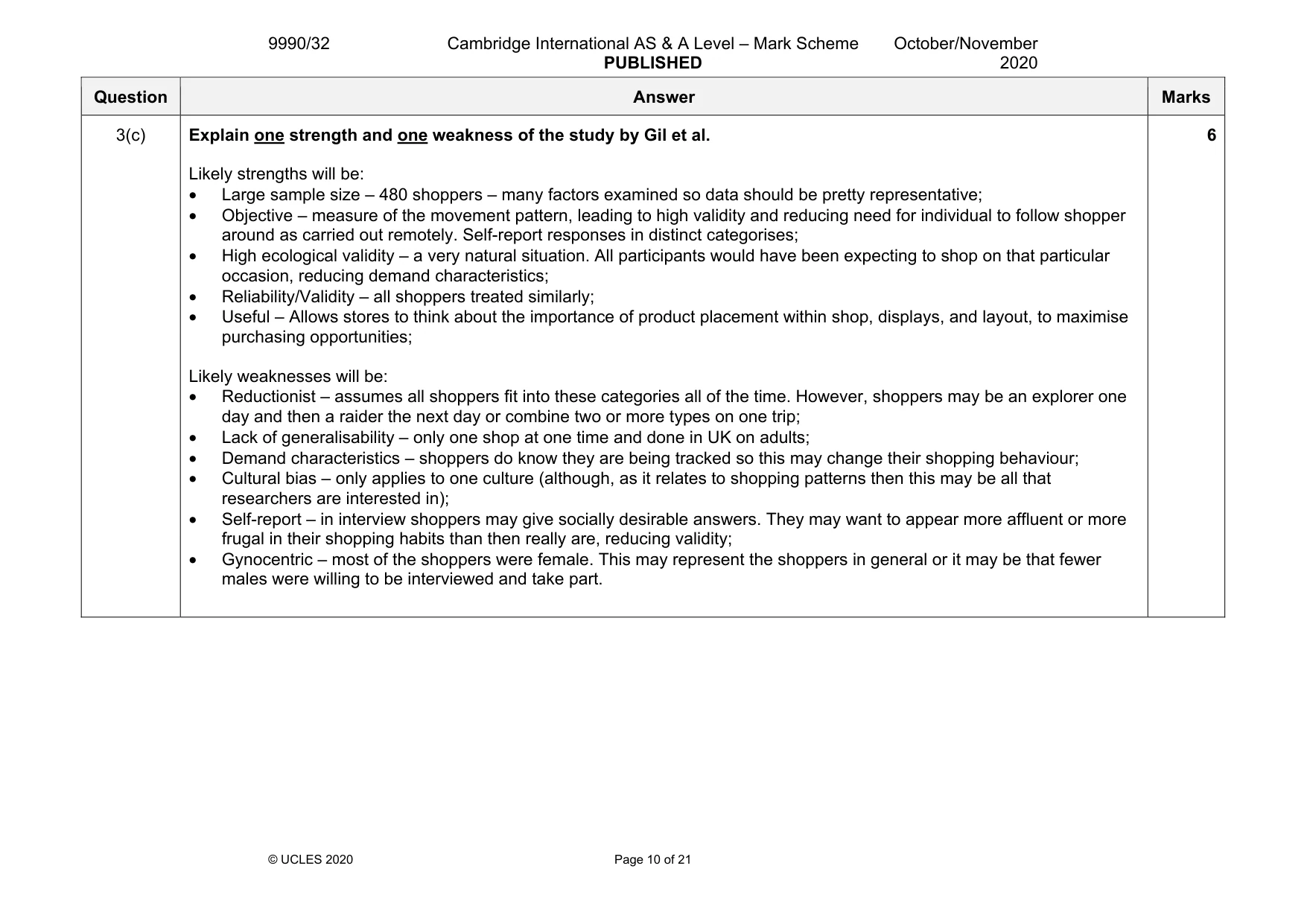
3 (a) Identify two common menu design mistakes, as outlined by Pavesic (2005). [2] (b) Describe two findings of the study by Gil et al. (2009) on shopper movement patterns. [4] (c) Explain one strength and one weakness of the study by Gil et al. [6]
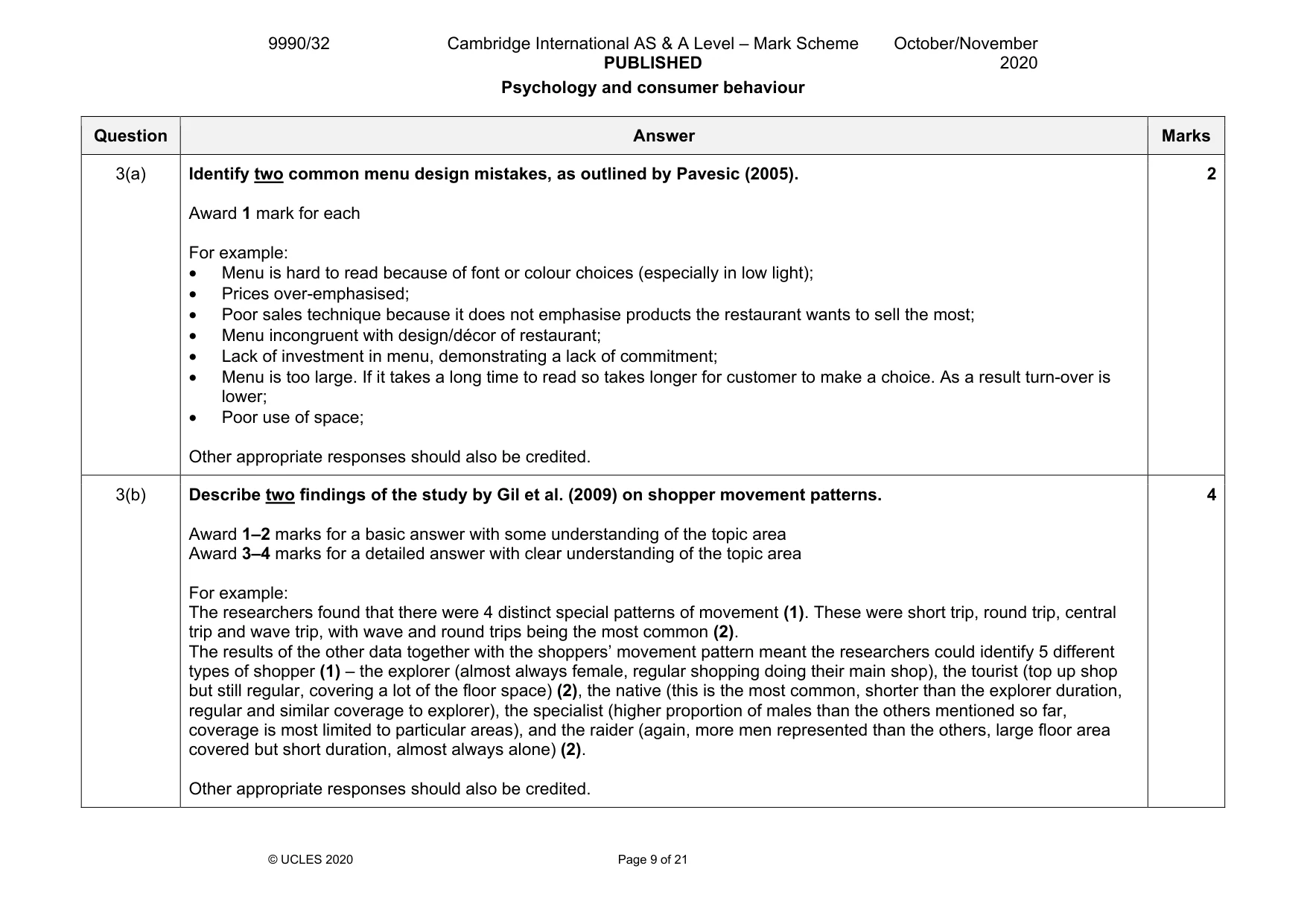
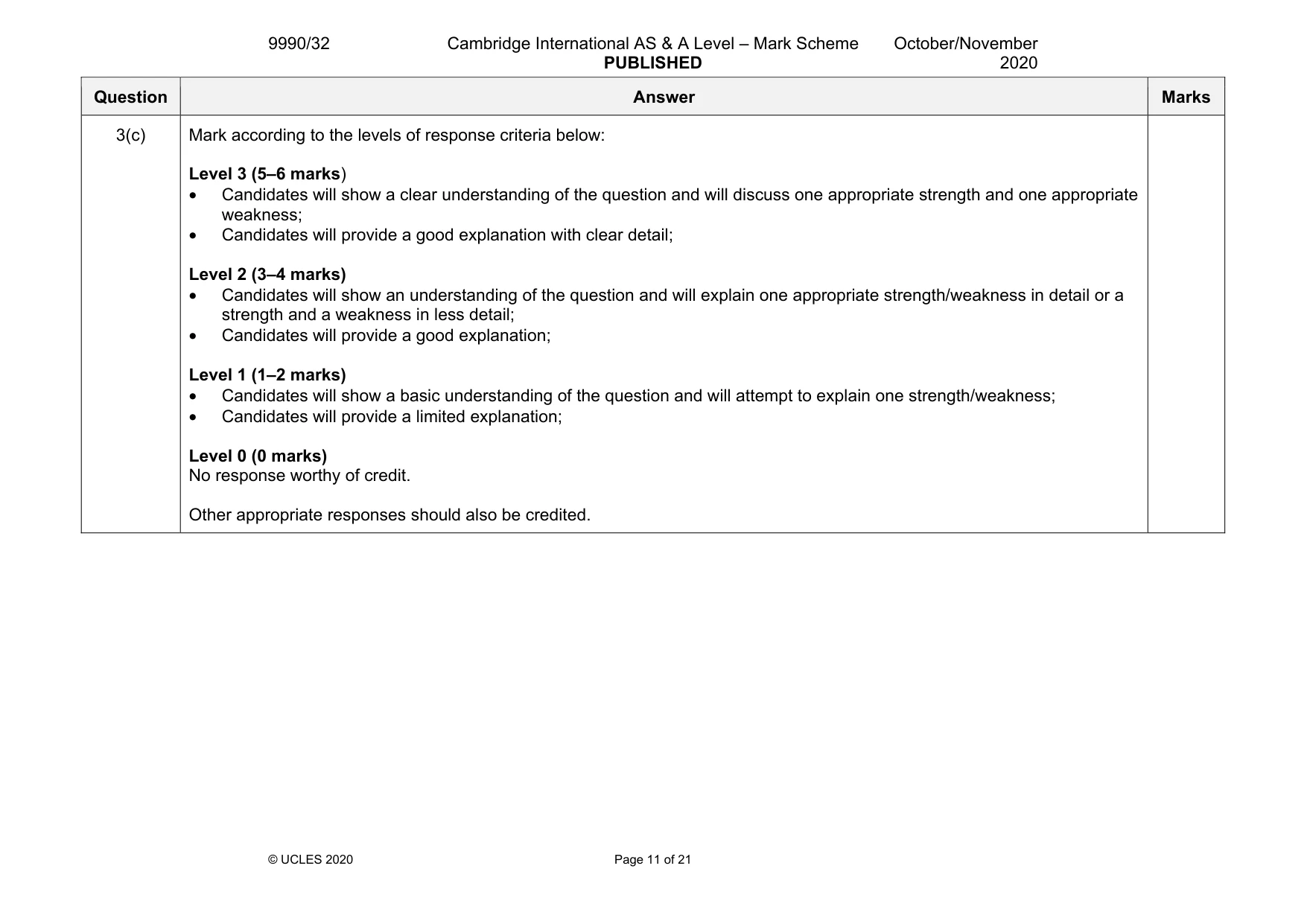
Mark scheme: 3(a) Identify two common menu design mistakes, as outlined by Pavesic (2005). Award 1 mark for each For example: • Menu is hard to read because of font or colour choices (especially in low light); • Prices over-emphasised; • Poor sales technique because it does not emphasise products the restaurant wants to sell the most; • Menu incongruent with design/décor of restaurant; • Lack of investment in menu, demonstrating a lack of commitment; • Menu is too large. If it takes a long time to read so takes longer for customer to make a choice. As a result turn-over is lower; • Poor use of space; Other appropriate responses should also be credited. 2 3(b) Describe two findings of the study by Gil et al. (2009) on shopper movement patterns. Award 1–2 marks for a basic answer with some understanding of the topic area Award 3–4 marks for a detailed answer with clear understanding of the topic area For example: The researchers found that there were 4 distinct special patterns of movement (1). These were short trip, round trip, central trip and wave trip, with wave and round trips being the most common (2). The results of the other data together with the shoppers’ movement pattern meant the researchers could identify 5 different types of shopper (1) – the explorer (almost always female, regular shopping doing their main shop), the tourist (top up shop but still regular, covering a lot of the floor space) (2), the native (this is the most common, shorter than the explorer duration, regular and similar coverage to explorer), the specialist (higher proportion of males than the others mentioned so far, coverage is most limited to particular areas), and the raider (again, more men represented than the others, large floor area covered but short duration, almost always alone) (2). Other appropriate responses should also be credited. 4 Question Answer Marks 3(c) Explain one strength and one weakness of the study by Gil et al. Likely strengths will be: • Large sample size – 480 shoppers – many factors examined so data should be pretty representative; • Objective – measure of the movement pattern, leading to high validity and reducing need for individual to follow shopper around as carried out remotely. Self-report responses in distinct categorises; • High ecological validity – a very natural situation. All participants would have been expecting to shop on that particular occasion, reducing demand characteristics; • Reliability/Validity – all shoppers treated similarly; • Useful – Allows stores to think about the importance of product placement within shop, displays, and layout, to maximise purchasing opportunities; Likely weaknesses will be: • Reductionist – assumes all shoppers fit into these categories all of the time. However, shoppers may be an explorer one day and then a raider the next day or combine two or more types on one trip; • Lack of generalisability – only one shop at one time and done in UK on adults; • Demand characteristics – shoppers do know they are being tracked so this may change their shopping behaviour; • Cultural bias – only applies to one culture (although, as it relates to shopping patterns then this may be all that researchers are interested in); • Self-report – in interview shoppers may give socially desirable answers. They may want to appear more affluent or more frugal in their shopping habits than then really are, reducing validity; • Gynocentric – most of the shoppers were female. This may represent the shoppers in general or it may be that fewer males were willing to be interviewed and take part. 6 Question Answer Marks 3(c) Mark according to the levels of response criteria below: Level 3 (5–6 marks) • Candidates will show a clear understanding of the question and will discuss one appropriate strength and one appropriate weakness; • Candidates will provide a good explanation with clear detail; Level 2 (3–4 marks) • Candidates will show an understanding of the question and will explain one appropriate strength/weakness in detail or a strength and a weakness in less detail; • Candidates will provide a good explanation; Level 1 (1–2 marks) • Candidates will show a basic understanding of the question and will attempt to explain one strength/weakness; • Candidates will provide a limited explanation; Level 0 (0 marks) No response worthy of credit. Other appropriate responses should also be credited.
Q4 · Describe what psychologists have discovered about choice heuristics in consumer…
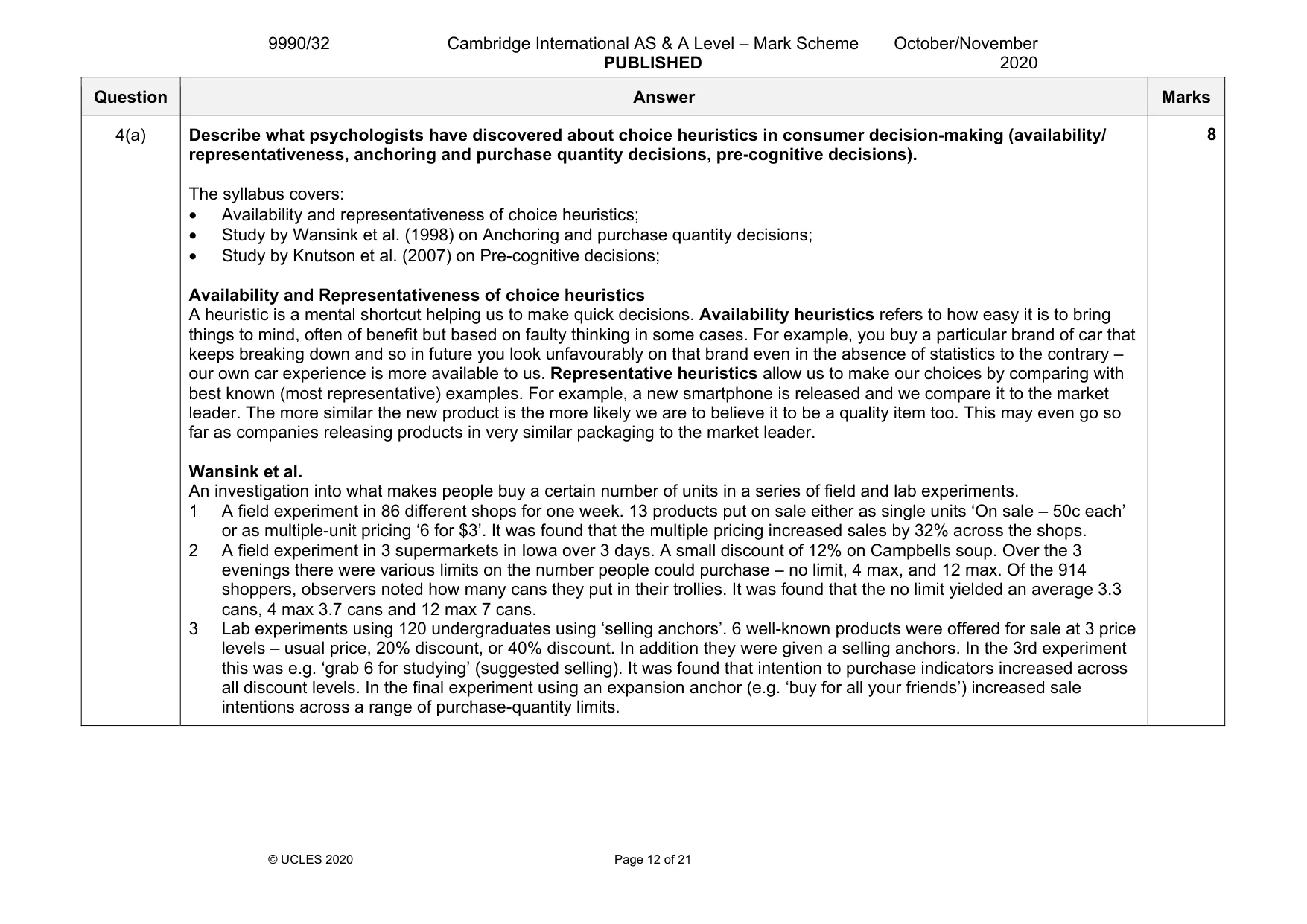
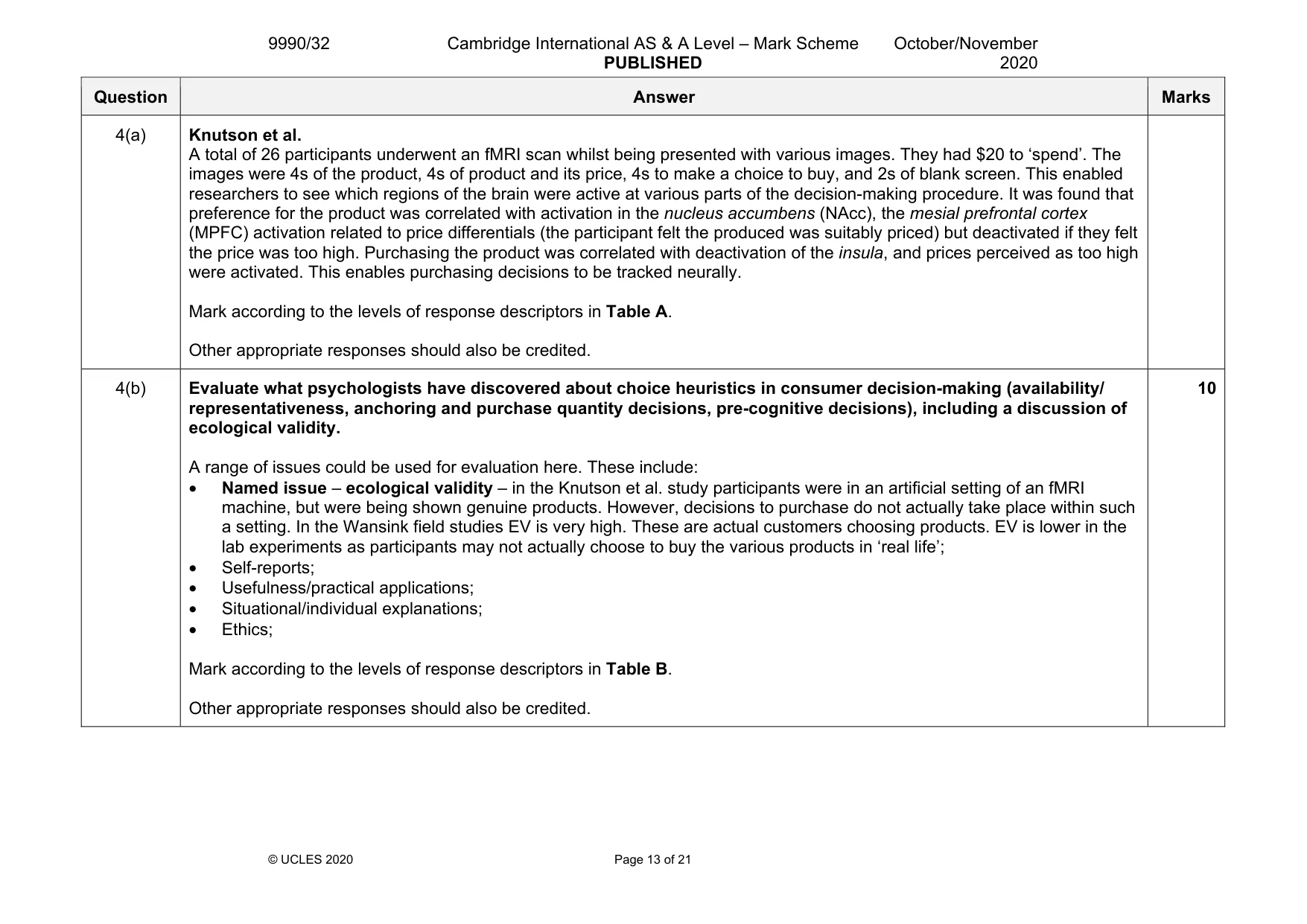
4 (a) Describe what psychologists have discovered about choice heuristics in consumer decision-making (availability/representativeness, anchoring and purchase quantity decisions, pre-cognitive decisions). [8] (b) Evaluate what psychologists have discovered about choice heuristics in consumer decision-making (availability/representativeness, anchoring and purchase quantity decisions, pre-cognitive decisions), including a discussion of ecological validity. [10] Psychology and health Answer all questions.
Mark scheme: 4(a) Describe what psychologists have discovered about choice heuristics in consumer decision-making (availability/ representativeness, anchoring and purchase quantity decisions, pre-cognitive decisions). The syllabus covers: • Availability and representativeness of choice heuristics; • Study by Wansink et al. (1998) on Anchoring and purchase quantity decisions; • Study by Knutson et al. (2007) on Pre-cognitive decisions; Availability and Representativeness of choice heuristics A heuristic is a mental shortcut helping us to make quick decisions. Availability heuristics refers to how easy it is to bring things to mind, often of benefit but based on faulty thinking in some cases. For example, you buy a particular brand of car that keeps breaking down and so in future you look unfavourably on that brand even in the absence of statistics to the contrary – our own car experience is more available to us. Representative heuristics allow us to make our choices by comparing with best known (most representative) examples. For example, a new smartphone is released and we compare it to the market leader. The more similar the new product is the more likely we are to believe it to be a quality item too. This may even go so far as companies releasing products in very similar packaging to the market leader. Wansink et al. An investigation into what makes people buy a certain number of units in a series of field and lab experiments. 1 A field experiment in 86 different shops for one week. 13 products put on sale either as single units ‘On sale – 50c each’ or as multiple-unit pricing ‘6 for $3’. It was found that the multiple pricing increased sales by 32% across the shops. 2 A field experiment in 3 supermarkets in Iowa over 3 days. A small discount of 12% on Campbells soup. Over the 3 evenings there were various limits on the number people could purchase – no limit, 4 max, and 12 max. Of the 914 shoppers, observers noted how many cans they put in their trollies. It was found that the no limit yielded an average 3.3 cans, 4 max 3.7 cans and 12 max 7 cans. 3 Lab experiments using 120 undergraduates using ‘selling anchors’. 6 well-known products were offered for sale at 3 price levels – usual price, 20% discount, or 40% discount. In addition they were given a selling anchors. In the 3rd experiment this was e.g. ‘grab 6 for studying’ (suggested selling). It was found that intention to purchase indicators increased across all discount levels. In the final experiment using an expansion anchor (e.g. ‘buy for all your friends’) increased sale intentions across a range of purchase-quantity limits. Question Answer Marks 4(a) Knutson et al. A total of 26 participants underwent an fMRI scan whilst being presented with various images. They had $20 to ‘spend’. The images were 4s of the product, 4s of product and its price, 4s to make a choice to buy, and 2s of blank screen. This enabled researchers to see which regions of the brain were active at various parts of the decision-making procedure. It was found that preference for the product was correlated with activation in the nucleus accumbens (NAcc), the mesial prefrontal cortex (MPFC) activation related to price differentials (the participant felt the produced was suitably priced) but deactivated if they felt the price was too high. Purchasing the product was correlated with deactivation of the insula, and prices perceived as too high were activated. This enables purchasing decisions to be tracked neurally. Mark according to the levels of response descriptors in Table A. Other appropriate responses should also be credited. 4(b) Evaluate what psychologists have discovered about choice heuristics in consumer decision-making (availability/ representativeness, anchoring and purchase quantity decisions, pre-cognitive decisions), including a discussion of ecological validity. A range of issues could be used for evaluation here. These include: • Named issue – ecological validity – in the Knutson et al. study participants were in an artificial setting of an fMRI machine, but were being shown genuine products. However, decisions to purchase do not actually take place within such a setting. In the Wansink field studies EV is very high. These are actual customers choosing products. EV is lower in the lab experiments as participants may not actually choose to buy the various products in ‘real life’; • Self-reports; • Usefulness/practical applications; • Situational/individual explanations; • Ethics; Mark according to the levels of response descriptors in Table B. Other appropriate responses should also be credited. 10
Q5 · Explain what is meant by ‘acute’ pain
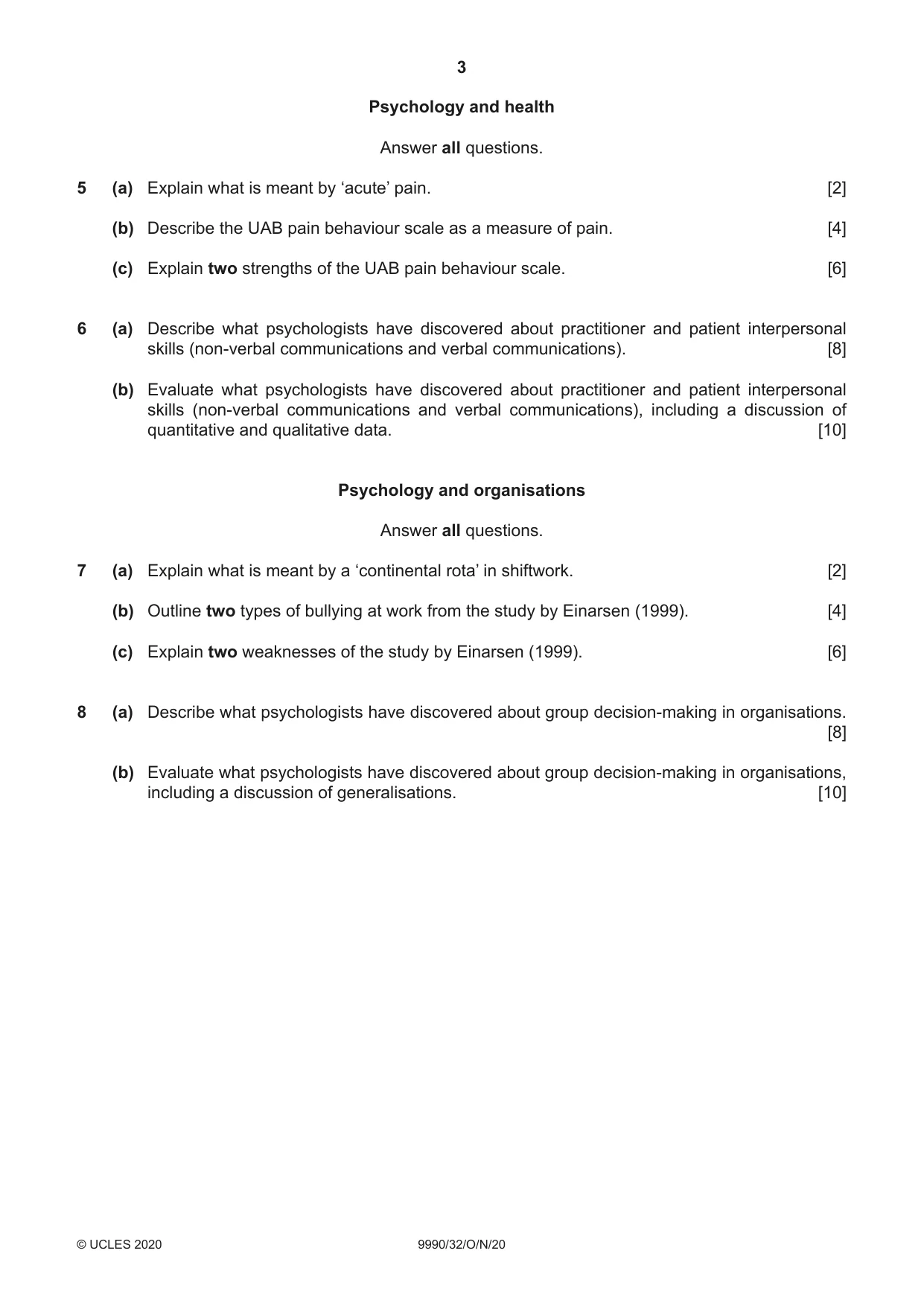
5 (a) Explain what is meant by ‘acute’ pain. [2] (b) Describe the UAB pain behaviour scale as a measure of pain. [4] (c) Explain two strengths of the UAB pain behaviour scale. [6]
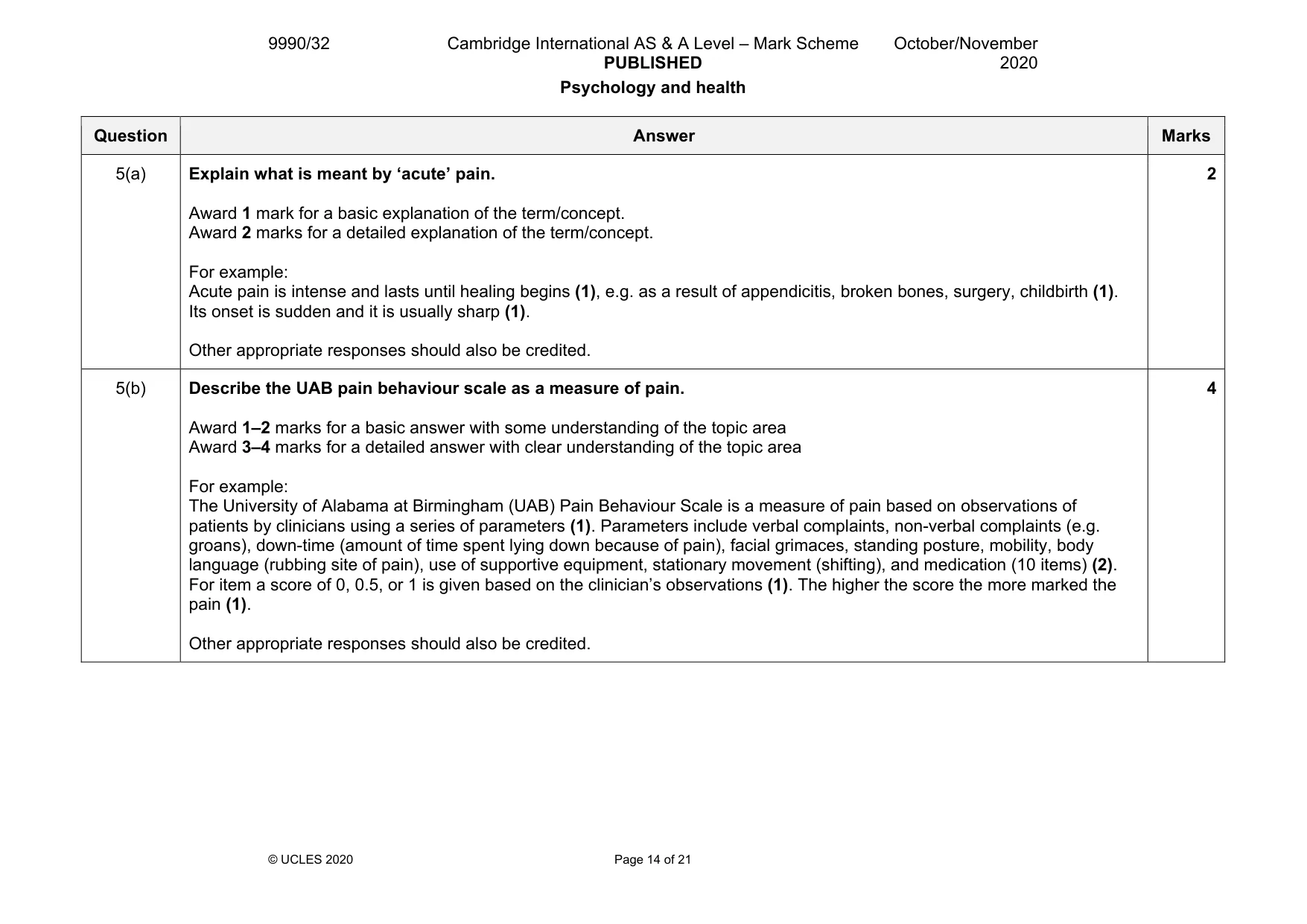
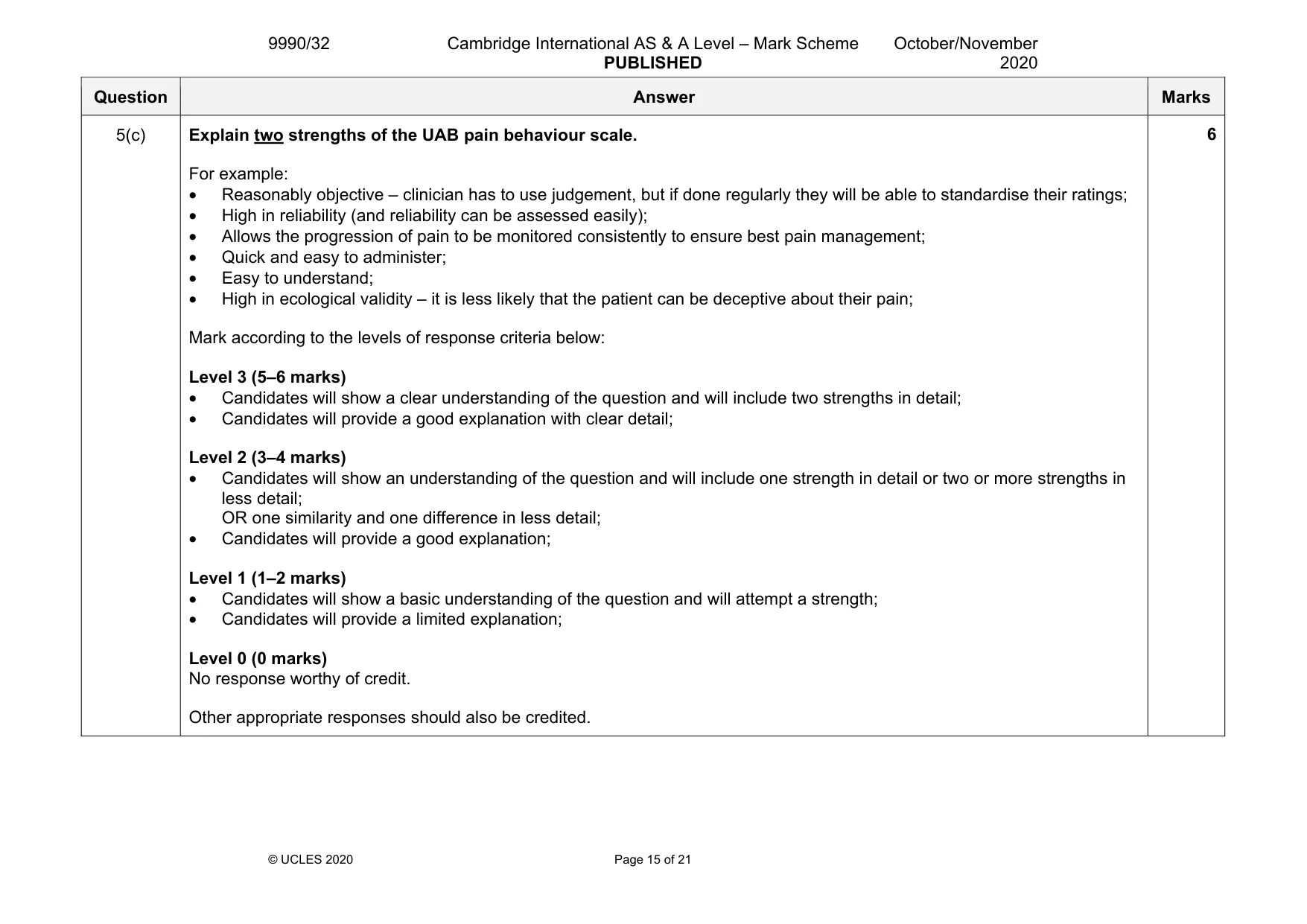
Mark scheme: 5(a) Explain what is meant by ‘acute’ pain. Award 1 mark for a basic explanation of the term/concept. Award 2 marks for a detailed explanation of the term/concept. For example: Acute pain is intense and lasts until healing begins (1), e.g. as a result of appendicitis, broken bones, surgery, childbirth (1). Its onset is sudden and it is usually sharp (1). Other appropriate responses should also be credited. 5(b) Describe the UAB pain behaviour scale as a measure of pain. Award 1–2 marks for a basic answer with some understanding of the topic area Award 3–4 marks for a detailed answer with clear understanding of the topic area For example: The University of Alabama at Birmingham (UAB) Pain Behaviour Scale is a measure of pain based on observations of patients by clinicians using a series of parameters (1). Parameters include verbal complaints, non-verbal complaints (e.g. groans), down-time (amount of time spent lying down because of pain), facial grimaces, standing posture, mobility, body language (rubbing site of pain), use of supportive equipment, stationary movement (shifting), and medication (10 items) (2). For item a score of 0, 0.5, or 1 is given based on the clinician’s observations (1). The higher the score the more marked the pain (1). Other appropriate responses should also be credited. 4 Question Answer Marks 5(c) Explain two strengths of the UAB pain behaviour scale. For example: • Reasonably objective – clinician has to use judgement, but if done regularly they will be able to standardise their ratings; • High in reliability (and reliability can be assessed easily); • Allows the progression of pain to be monitored consistently to ensure best pain management; • Quick and easy to administer; • Easy to understand; • High in ecological validity – it is less likely that the patient can be deceptive about their pain; Mark according to the levels of response criteria below: Level 3 (5–6 marks) • Candidates will show a clear understanding of the question and will include two strengths in detail; • Candidates will provide a good explanation with clear detail; Level 2 (3–4 marks) • Candidates will show an understanding of the question and will include one strength in detail or two or more strengths in less detail; OR one similarity and one difference in less detail; • Candidates will provide a good explanation; Level 1 (1–2 marks) • Candidates will show a basic understanding of the question and will attempt a strength; • Candidates will provide a limited explanation; Level 0 (0 marks) No response worthy of credit. Other appropriate responses should also be credited. 6
Q6 · Describe what psychologists have discovered about practitioner and patient interpersonal…
6 (a) Describe what psychologists have discovered about practitioner and patient interpersonal skills (non-verbal communications and verbal communications). [8] (b) Evaluate what psychologists have discovered about practitioner and patient interpersonal skills (non-verbal communications and verbal communications), including a discussion of quantitative and qualitative data. [10] Psychology and organisations Answer all questions.
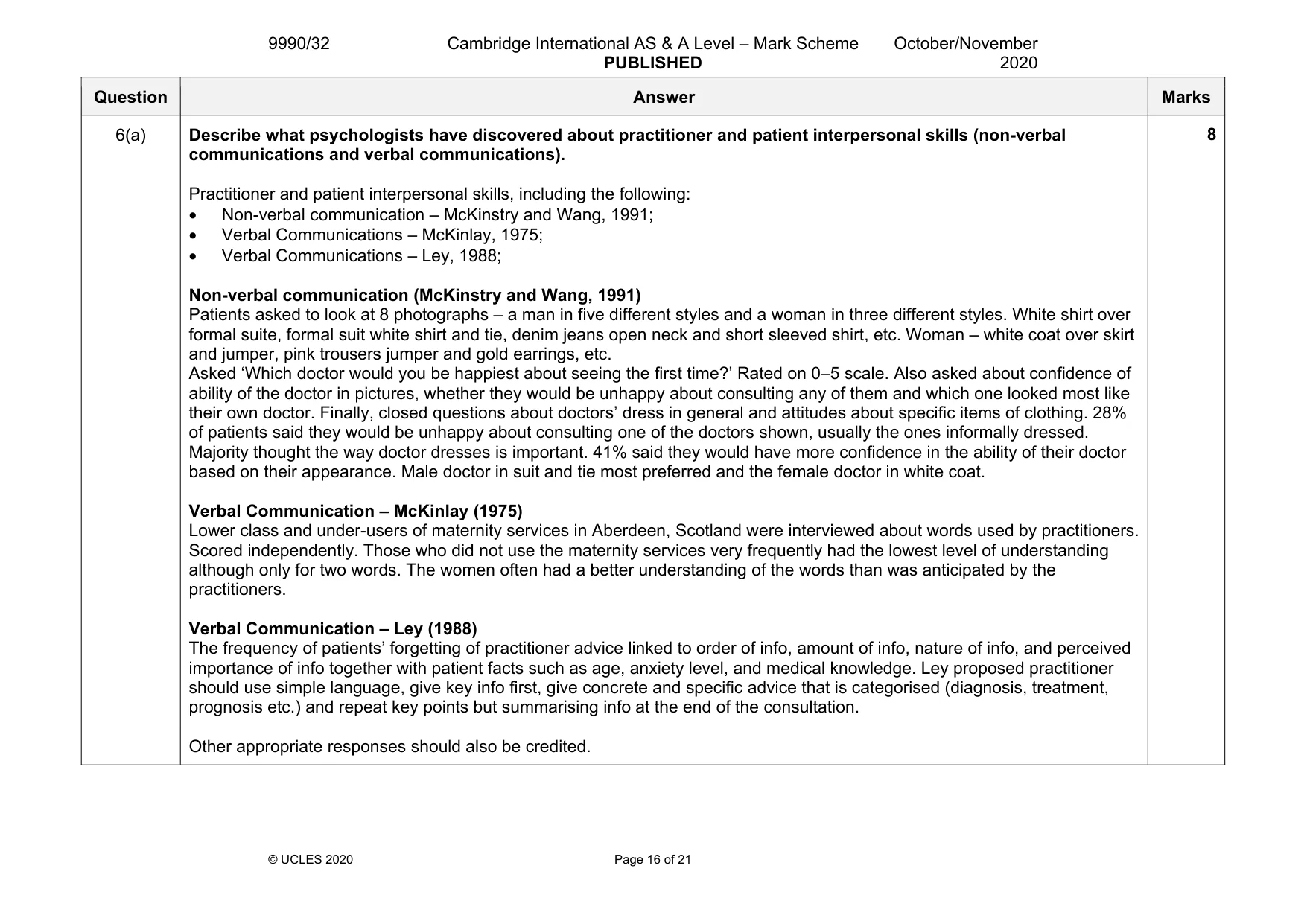
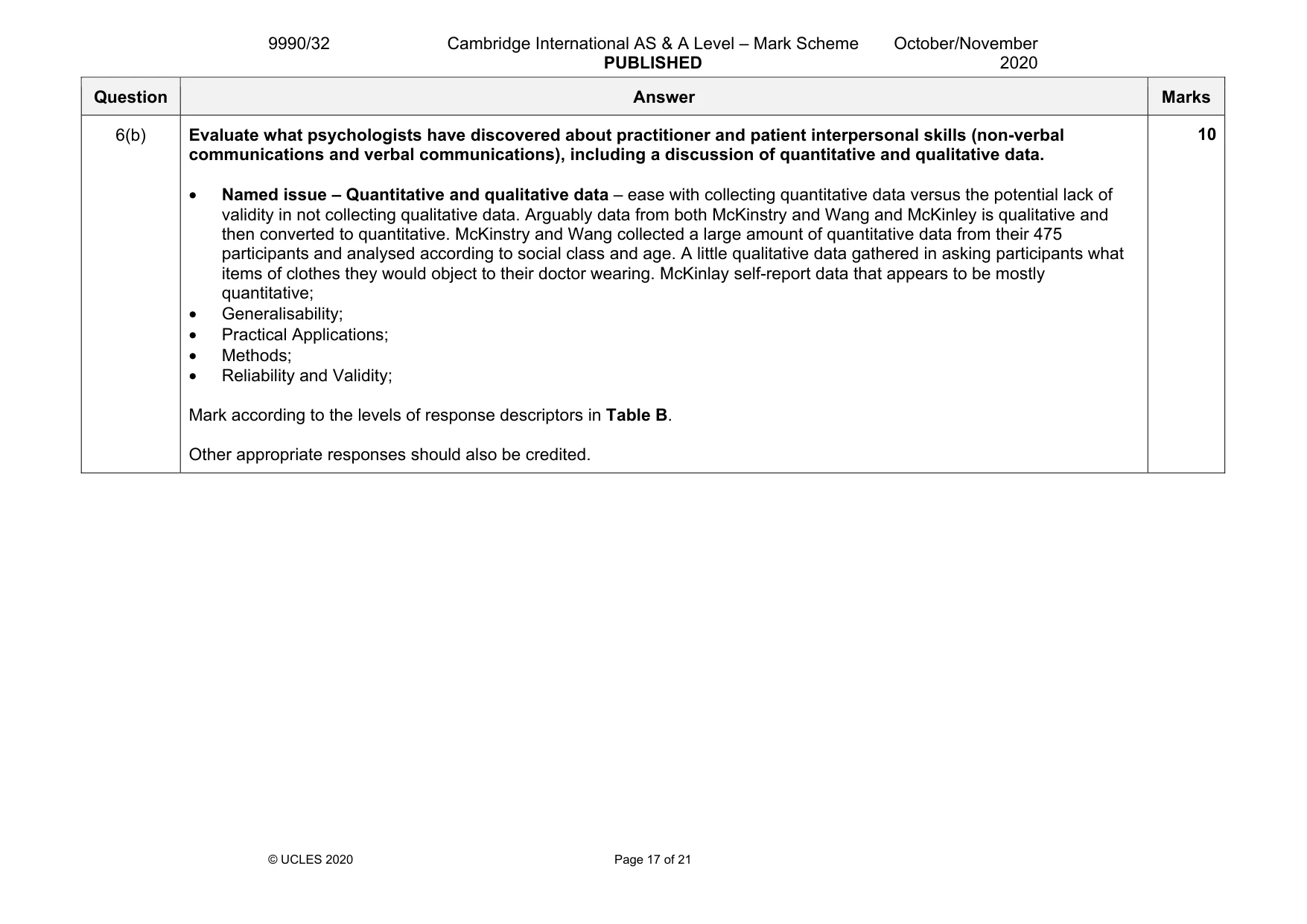
Mark scheme: 6(a) Describe what psychologists have discovered about practitioner and patient interpersonal skills (non-verbal communications and verbal communications). Practitioner and patient interpersonal skills, including the following: • Non-verbal communication – McKinstry and Wang, 1991; • Verbal Communications – McKinlay, 1975; • Verbal Communications – Ley, 1988; Non-verbal communication (McKinstry and Wang, 1991) Patients asked to look at 8 photographs – a man in five different styles and a woman in three different styles. White shirt over formal suite, formal suit white shirt and tie, denim jeans open neck and short sleeved shirt, etc. Woman – white coat over skirt and jumper, pink trousers jumper and gold earrings, etc. Asked ‘Which doctor would you be happiest about seeing the first time?’ Rated on 0–5 scale. Also asked about confidence of ability of the doctor in pictures, whether they would be unhappy about consulting any of them and which one looked most like their own doctor. Finally, closed questions about doctors’ dress in general and attitudes about specific items of clothing. 28% of patients said they would be unhappy about consulting one of the doctors shown, usually the ones informally dressed. Majority thought the way doctor dresses is important. 41% said they would have more confidence in the ability of their doctor based on their appearance. Male doctor in suit and tie most preferred and the female doctor in white coat. Verbal Communication – McKinlay (1975) Lower class and under-users of maternity services in Aberdeen, Scotland were interviewed about words used by practitioners. Scored independently. Those who did not use the maternity services very frequently had the lowest level of understanding although only for two words. The women often had a better understanding of the words than was anticipated by the practitioners. Verbal Communication – Ley (1988) The frequency of patients’ forgetting of practitioner advice linked to order of info, amount of info, nature of info, and perceived importance of info together with patient facts such as age, anxiety level, and medical knowledge. Ley proposed practitioner should use simple language, give key info first, give concrete and specific advice that is categorised (diagnosis, treatment, prognosis etc.) and repeat key points but summarising info at the end of the consultation. Other appropriate responses should also be credited. Question Answer Marks 6(b) Evaluate what psychologists have discovered about practitioner and patient interpersonal skills (non-verbal communications and verbal communications), including a discussion of quantitative and qualitative data. • Named issue – Quantitative and qualitative data – ease with collecting quantitative data versus the potential lack of validity in not collecting qualitative data. Arguably data from both McKinstry and Wang and McKinley is qualitative and then converted to quantitative. McKinstry and Wang collected a large amount of quantitative data from their 475 participants and analysed according to social class and age. A little qualitative data gathered in asking participants what items of clothes they would object to their doctor wearing. McKinlay self-report data that appears to be mostly quantitative; • Generalisability; • Practical Applications; • Methods; • Reliability and Validity; Mark according to the levels of response descriptors in Table B. Other appropriate responses should also be credited. 10
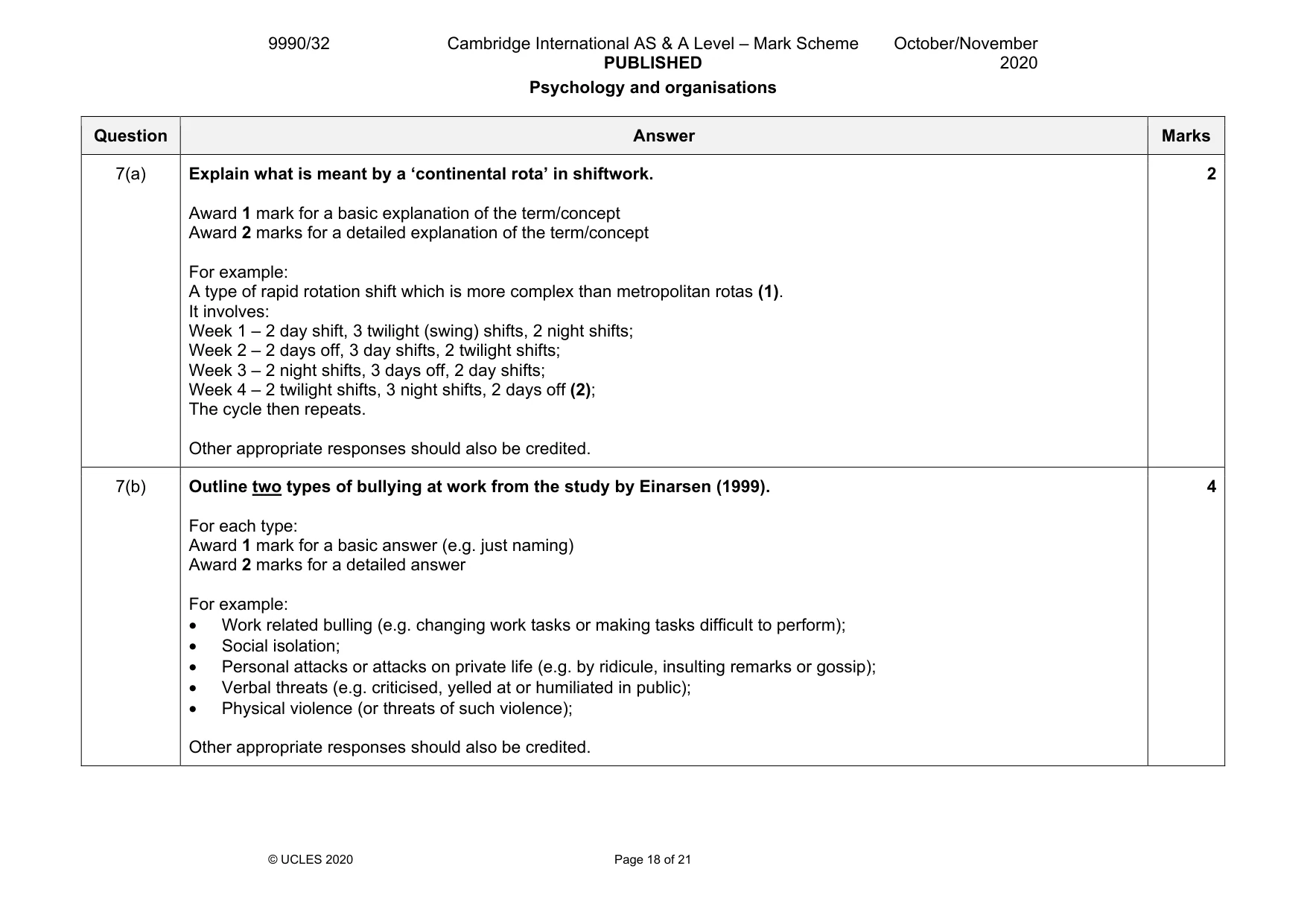
Q7 · Explain what is meant by a ‘continental rota’ in shiftwork
7 (a) Explain what is meant by a ‘continental rota’ in shiftwork. [2] (b) Outline two types of bullying at work from the study by Einarsen (1999). [4] (c) Explain two weaknesses of the study by Einarsen (1999). [6]
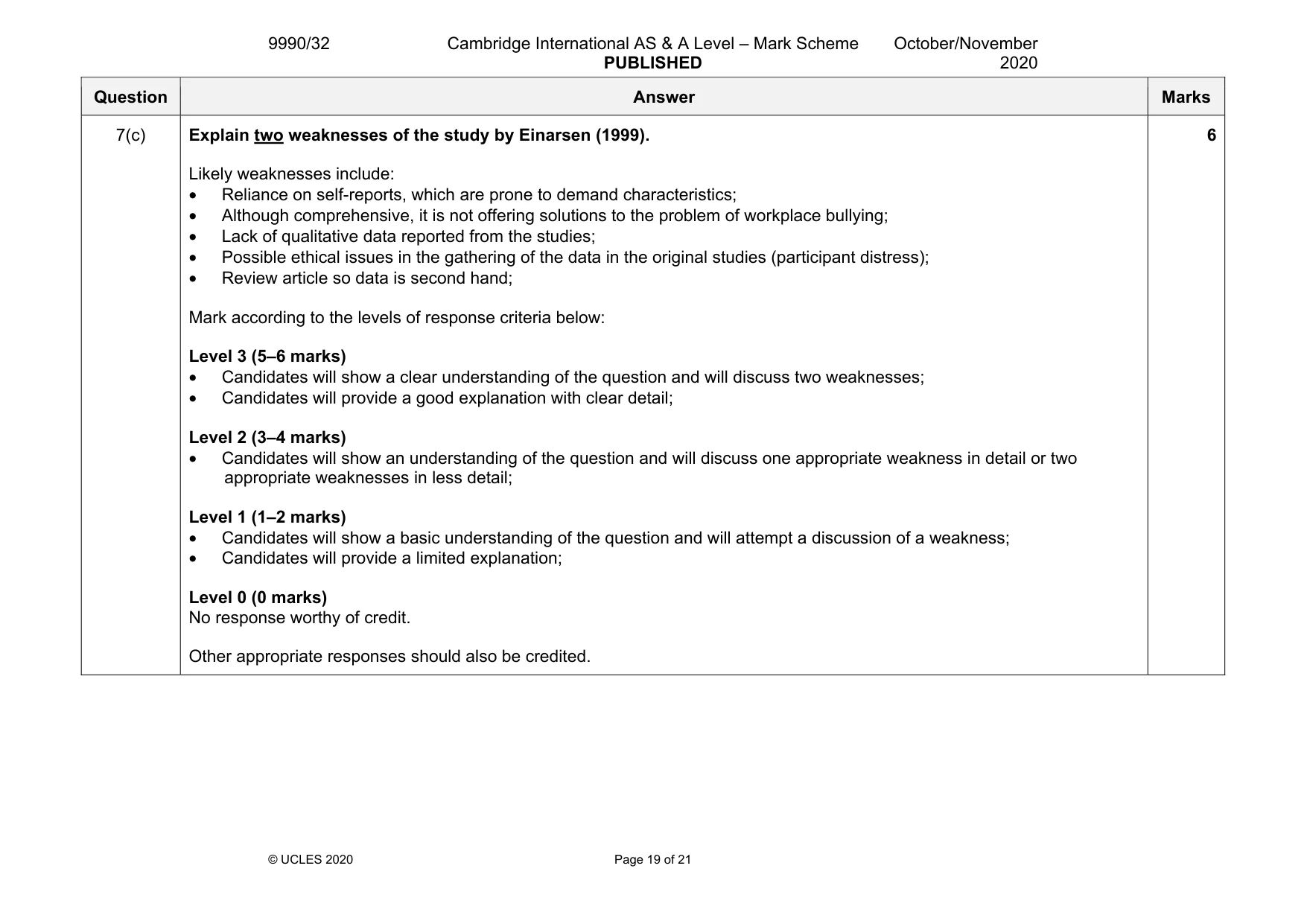
Mark scheme: 7(a) Explain what is meant by a ‘continental rota’ in shiftwork. Award 1 mark for a basic explanation of the term/concept Award 2 marks for a detailed explanation of the term/concept For example: A type of rapid rotation shift which is more complex than metropolitan rotas (1). It involves: Week 1 – 2 day shift, 3 twilight (swing) shifts, 2 night shifts; Week 2 – 2 days off, 3 day shifts, 2 twilight shifts; Week 3 – 2 night shifts, 3 days off, 2 day shifts; Week 4 – 2 twilight shifts, 3 night shifts, 2 days off (2); The cycle then repeats. Other appropriate responses should also be credited. 7(b) Outline two types of bullying at work from the study by Einarsen (1999). For each type: Award 1 mark for a basic answer (e.g. just naming) Award 2 marks for a detailed answer For example: • Work related bulling (e.g. changing work tasks or making tasks difficult to perform); • Social isolation; • Personal attacks or attacks on private life (e.g. by ridicule, insulting remarks or gossip); • Verbal threats (e.g. criticised, yelled at or humiliated in public); • Physical violence (or threats of such violence); Other appropriate responses should also be credited. 4 Question Answer Marks 7(c) Explain two weaknesses of the study by Einarsen (1999). Likely weaknesses include: • Reliance on self-reports, which are prone to demand characteristics; • Although comprehensive, it is not offering solutions to the problem of workplace bullying; • Lack of qualitative data reported from the studies; • Possible ethical issues in the gathering of the data in the original studies (participant distress); • Review article so data is second hand; Mark according to the levels of response criteria below: Level 3 (5–6 marks) • Candidates will show a clear understanding of the question and will discuss two weaknesses; • Candidates will provide a good explanation with clear detail; Level 2 (3–4 marks) • Candidates will show an understanding of the question and will discuss one appropriate weakness in detail or two appropriate weaknesses in less detail; Level 1 (1–2 marks) • Candidates will show a basic understanding of the question and will attempt a discussion of a weakness; • Candidates will provide a limited explanation; Level 0 (0 marks) No response worthy of credit. Other appropriate responses should also be credited. 6
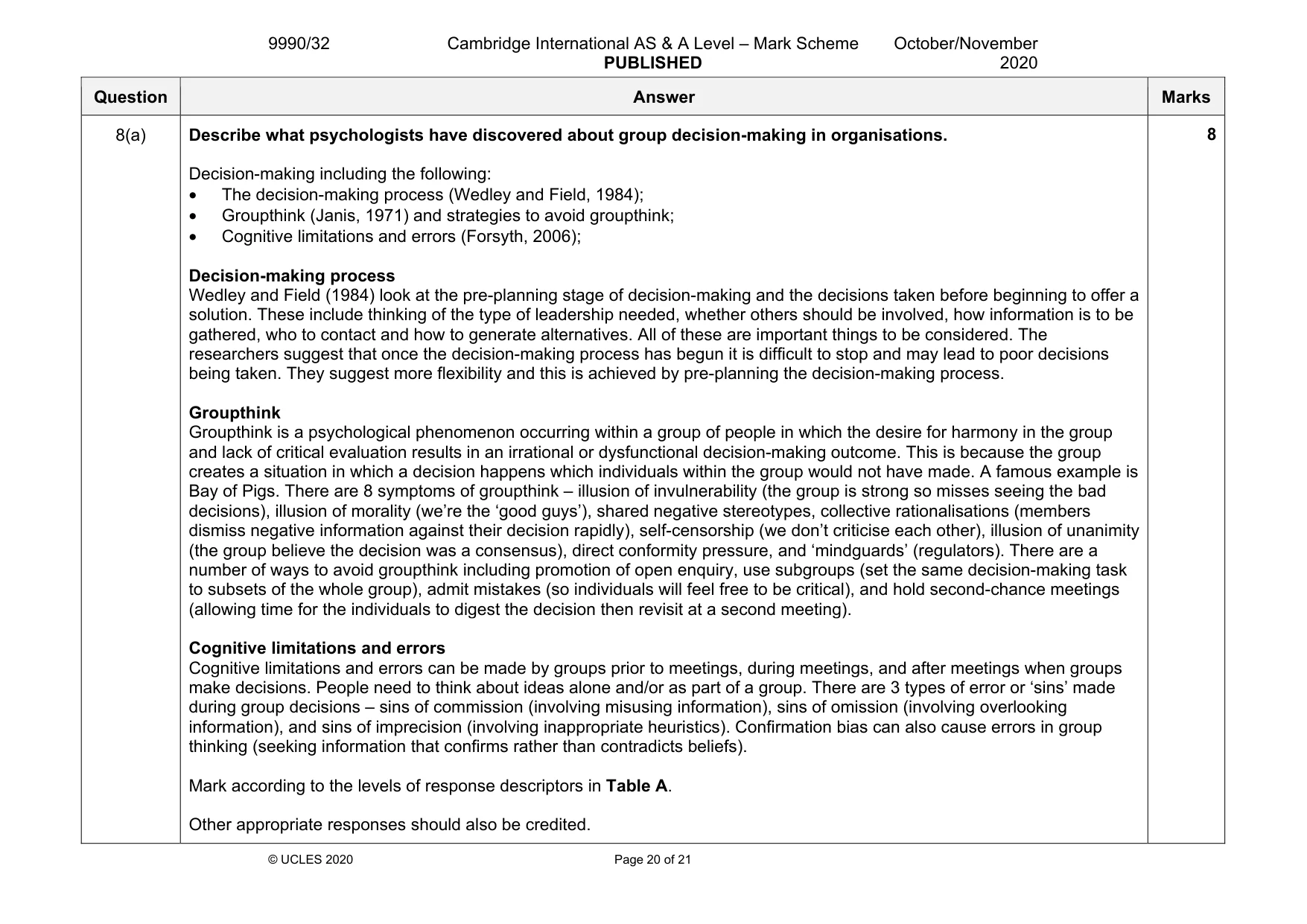
Q8 · Describe what psychologists have discovered about group decision-making in organisations
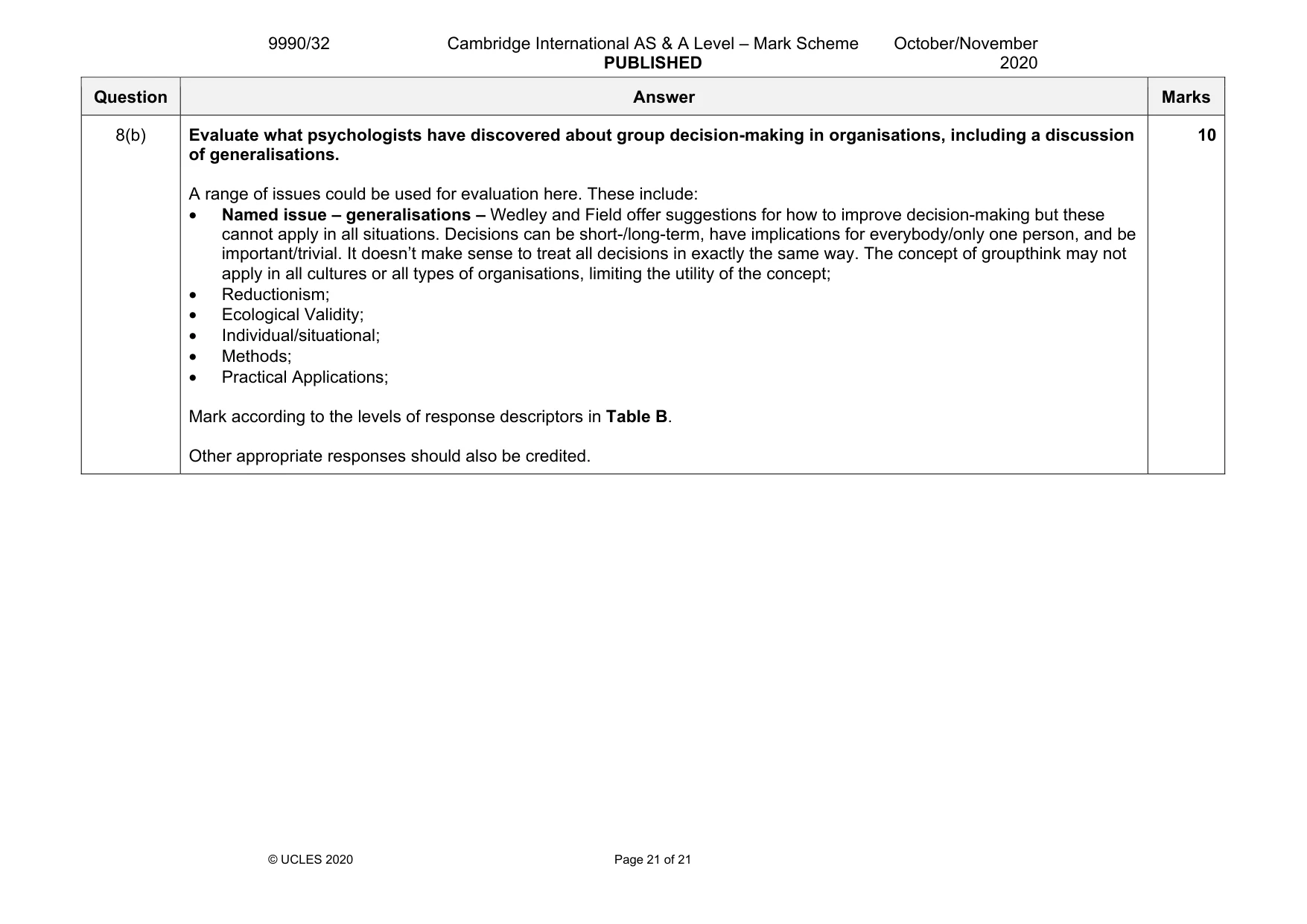
8 (a) Describe what psychologists have discovered about group decision-making in organisations. [8] (b) Evaluate what psychologists have discovered about group decision-making in organisations, including a discussion of generalisations. [10]
Mark scheme: 8(a) Describe what psychologists have discovered about group decision-making in organisations. Decision-making including the following: • The decision-making process (Wedley and Field, 1984); • Groupthink (Janis, 1971) and strategies to avoid groupthink; • Cognitive limitations and errors (Forsyth, 2006); Decision-making process Wedley and Field (1984) look at the pre-planning stage of decision-making and the decisions taken before beginning to offer a solution. These include thinking of the type of leadership needed, whether others should be involved, how information is to be gathered, who to contact and how to generate alternatives. All of these are important things to be considered. The researchers suggest that once the decision-making process has begun it is difficult to stop and may lead to poor decisions being taken. They suggest more flexibility and this is achieved by pre-planning the decision-making process. Groupthink Groupthink is a psychological phenomenon occurring within a group of people in which the desire for harmony in the group and lack of critical evaluation results in an irrational or dysfunctional decision-making outcome. This is because the group creates a situation in which a decision happens which individuals within the group would not have made. A famous example is Bay of Pigs. There are 8 symptoms of groupthink – illusion of invulnerability (the group is strong so misses seeing the bad decisions), illusion of morality (we’re the ‘good guys’), shared negative stereotypes, collective rationalisations (members dismiss negative information against their decision rapidly), self-censorship (we don’t criticise each other), illusion of unanimity (the group believe the decision was a consensus), direct conformity pressure, and ‘mindguards’ (regulators). There are a number of ways to avoid groupthink including promotion of open enquiry, use subgroups (set the same decision-making task to subsets of the whole group), admit mistakes (so individuals will feel free to be critical), and hold second-chance meetings (allowing time for the individuals to digest the decision then revisit at a second meeting). Cognitive limitations and errors Cognitive limitations and errors can be made by groups prior to meetings, during meetings, and after meetings when groups make decisions. People need to think about ideas alone and/or as part of a group. There are 3 types of error or ‘sins’ made during group decisions – sins of commission (involving misusing information), sins of omission (involving overlooking information), and sins of imprecision (involving inappropriate heuristics). Confirmation bias can also cause errors in group thinking (seeking information that confirms rather than contradicts beliefs). Mark according to the levels of response descriptors in Table A. Other appropriate responses should also be credited. Question Answer Marks 8(b) Evaluate what psychologists have discovered about group decision-making in organisations, including a discussion of generalisations. A range of issues could be used for evaluation here. These include: • Named issue – generalisations – Wedley and Field offer suggestions for how to improve decision-making but these cannot apply in all situations. Decisions can be short-/long-term, have implications for everybody/only one person, and be important/trivial. It doesn’t make sense to treat all decisions in exactly the same way. The concept of groupthink may not apply in all cultures or all types of organisations, limiting the utility of the concept; • Reductionism; • Ecological Validity; • Individual/situational; • Methods; • Practical Applications; Mark according to the levels of response descriptors in Table B. Other appropriate responses should also be credited. 10
What was in this paper
The subtopics covered by these 8 questions, and how many questions each got. Open one in a new tab to see every Cambridge question on it.
What you needed in this session
Cambridge’s own grade thresholds for 2020 Oct/Nov, Paper 3 · Variant 2. A higher threshold means an easier paper — the bar moves with how the cohort did.