Cambridge A Level Psychology (from 2018) 9990 — 2024 May/June Paper 3 · Variant 2
9990/32/M/J/24 · 16 questions · 60 marks · 90 min
The question paper and its mark scheme, free to read here and free to download. This is Cambridge’s own paper, exactly as it was sat.
Question paper8 pages
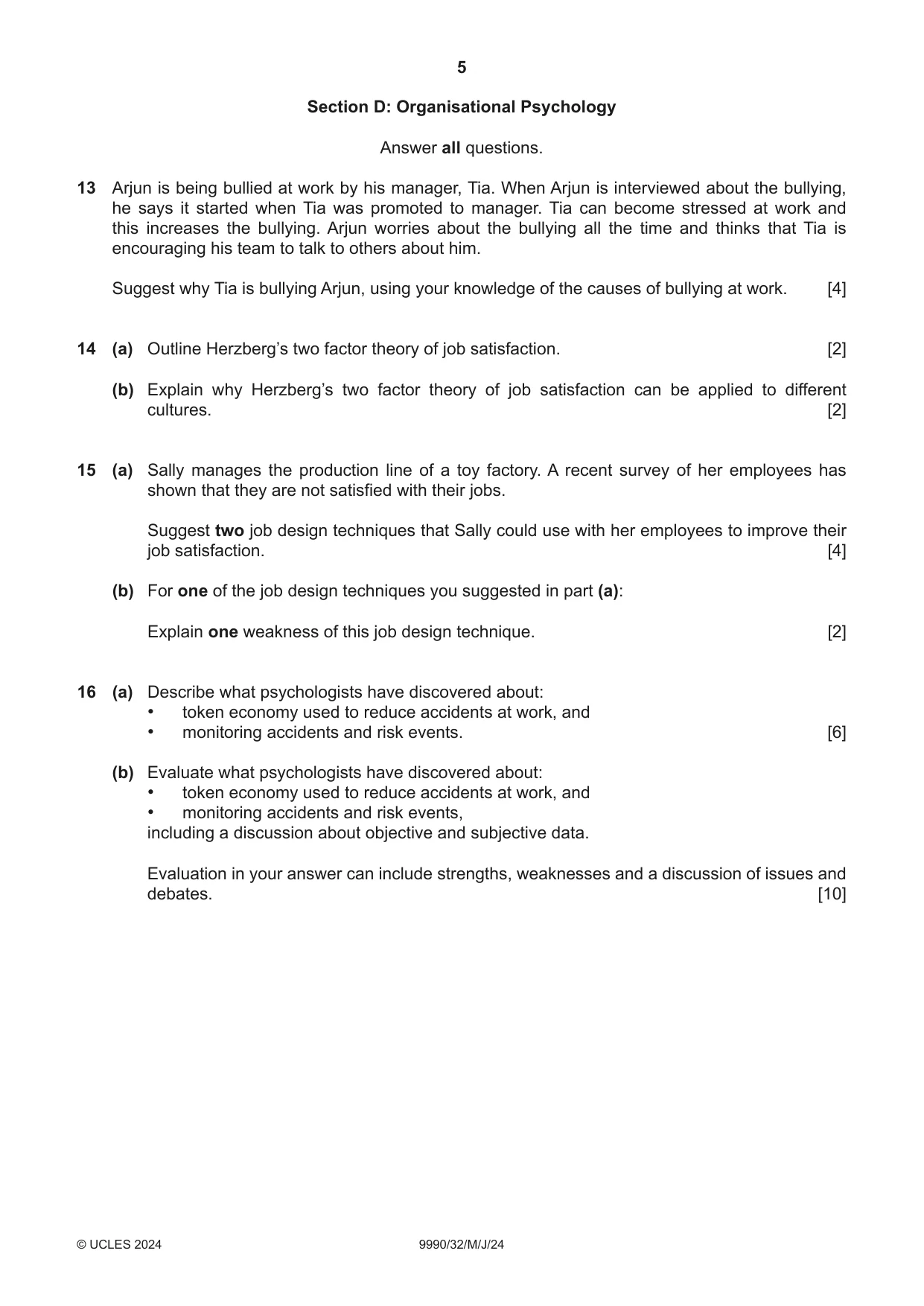



Mark scheme47 pages
Answers below. Sit the paper first if you are practising.
Questions as text
Q1 · Craig has a phobia of blood and injections
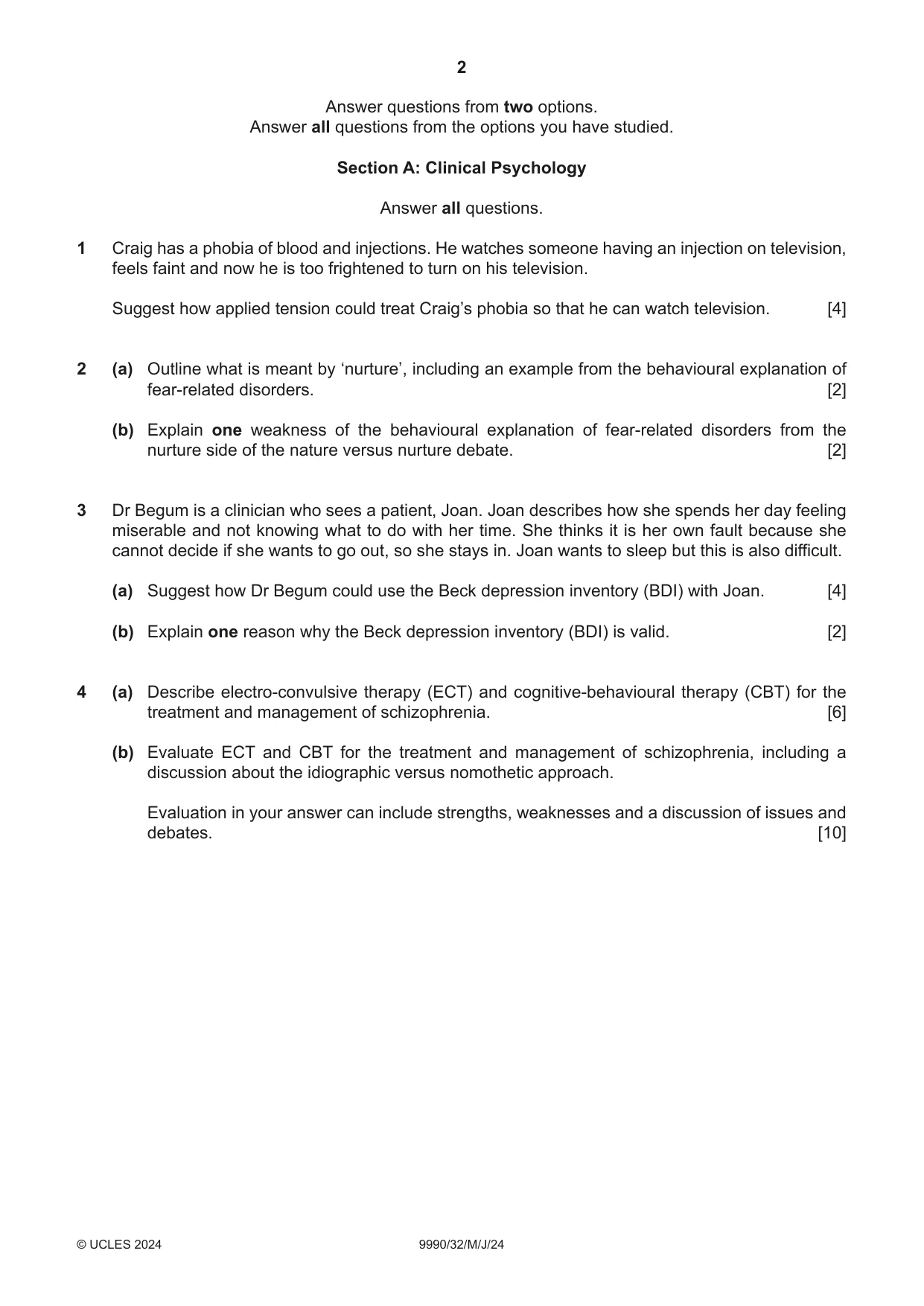
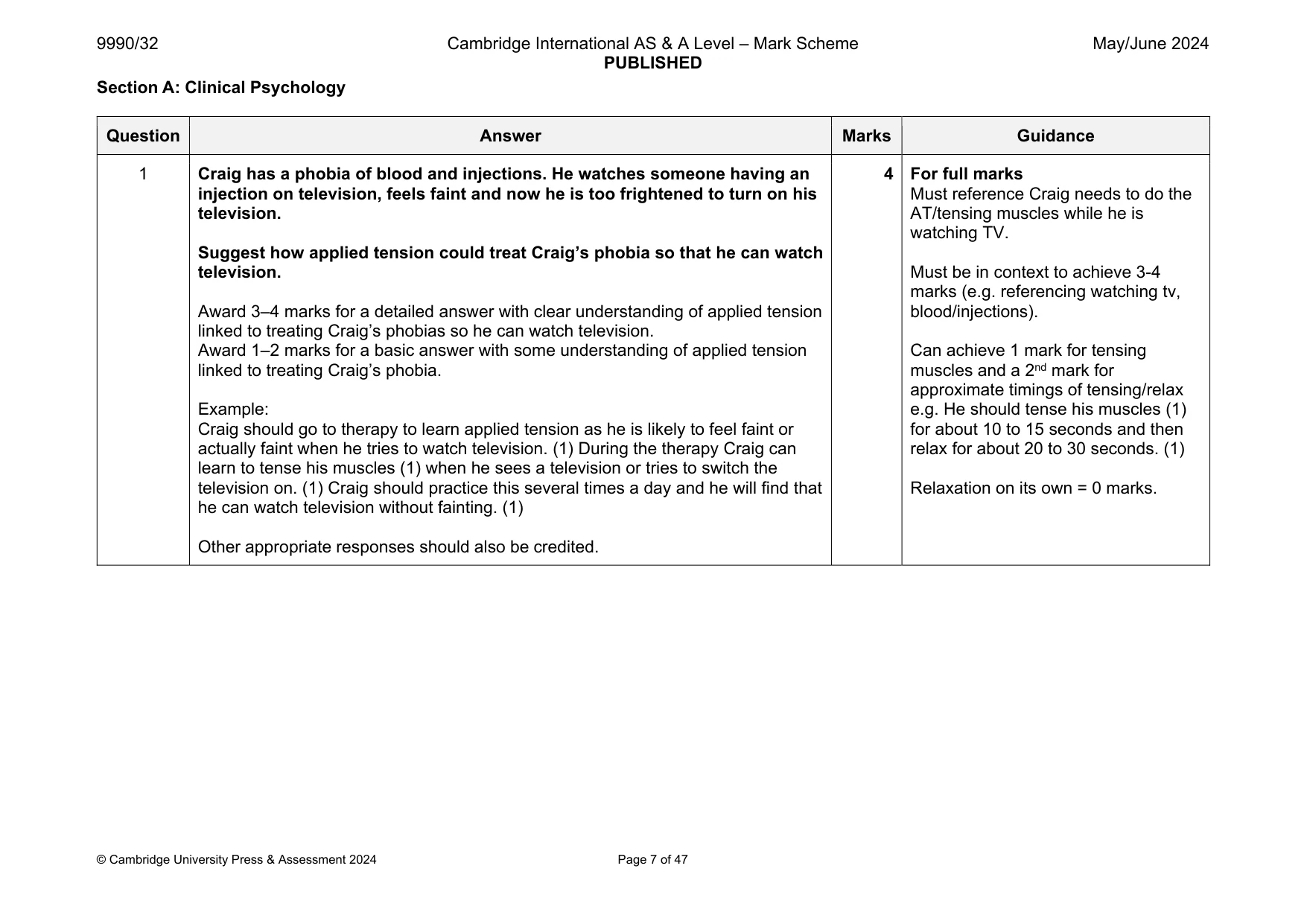
1 Craig has a phobia of blood and injections. He watches someone having an injection on television, feels faint and now he is too frightened to turn on his television. Suggest how applied tension could treat Craig’s phobia so that he can watch television. [4]
Mark scheme: 1 Craig has a phobia of blood and injections. He watches someone having an injection on television, feels faint and now he is too frightened to turn on his television. Suggest how applied tension could treat Craig’s phobia so that he can watch television. Award 3–4 marks for a detailed answer with clear understanding of applied tension linked to treating Craig’s phobias so he can watch television. Award 1–2 marks for a basic answer with some understanding of applied tension linked to treating Craig’s phobia. Example: Craig should go to therapy to learn applied tension as he is likely to feel faint or actually faint when he tries to watch television. (1) During the therapy Craig can learn to tense his muscles (1) when he sees a television or tries to switch the television on. (1) Craig should practice this several times a day and he will find that he can watch television without fainting. (1) Other appropriate responses should also be credited. 4 For full marks Must reference Craig needs to do the AT/tensing muscles while he is watching TV. Must be in context to achieve 3-4 marks (e.g. referencing watching tv, blood/injections). Can achieve 1 mark for tensing muscles and a 2nd mark for approximate timings of tensing/relax e.g. He should tense his muscles (1) for about 10 to 15 seconds and then relax for about 20 to 30 seconds. (1) Relaxation on its own = 0 marks.
More questions on Anxiety disorders and fear-related disorders
Q2 · Outline what is meant by ‘nurture’, including an example from the behavioural explanation…
2 (a) Outline what is meant by ‘nurture’, including an example from the behavioural explanation of fear-related disorders. [2] (b) Explain one weakness of the behavioural explanation of fear-related disorders from the nurture side of the nature versus nurture debate. [2]
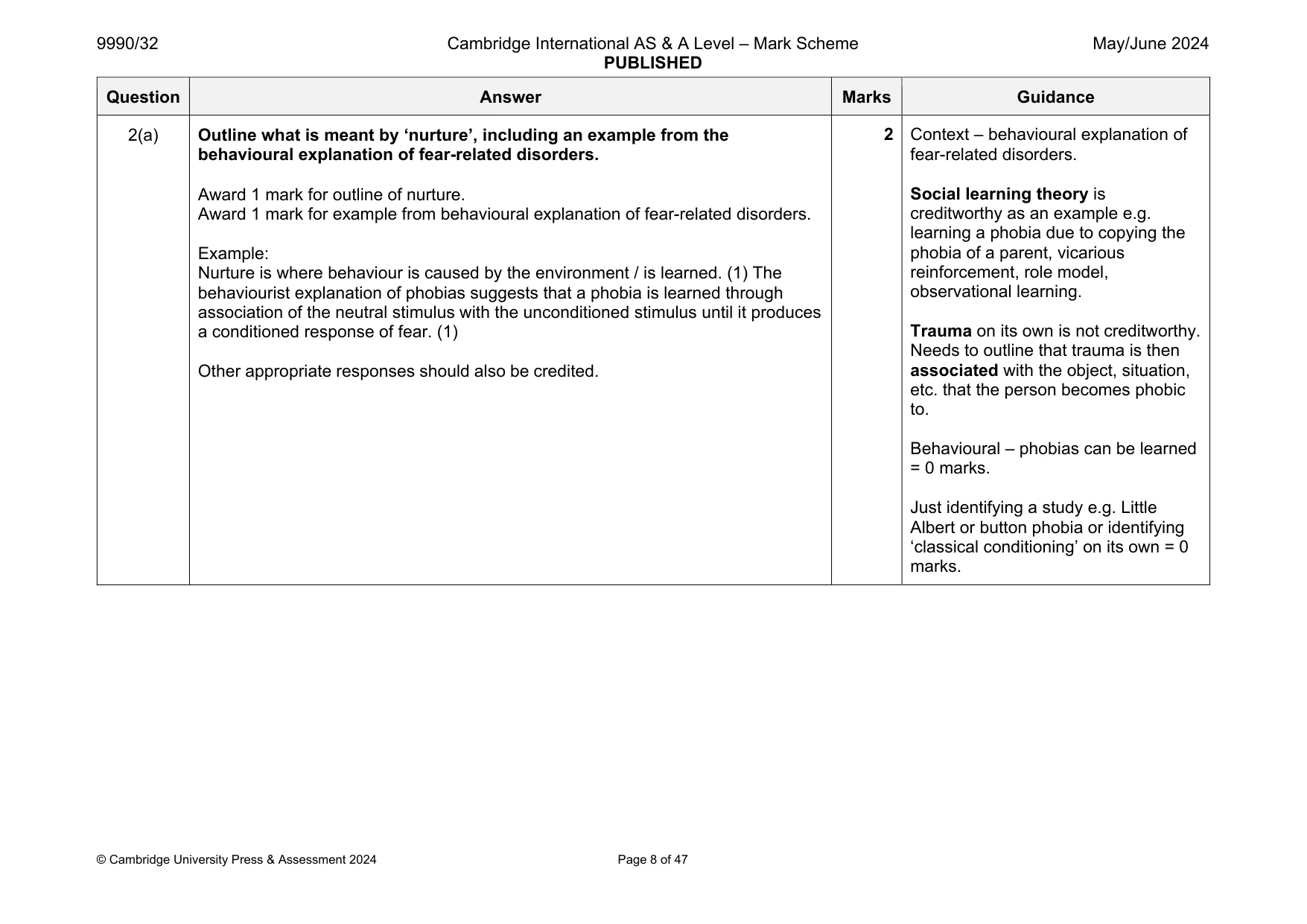
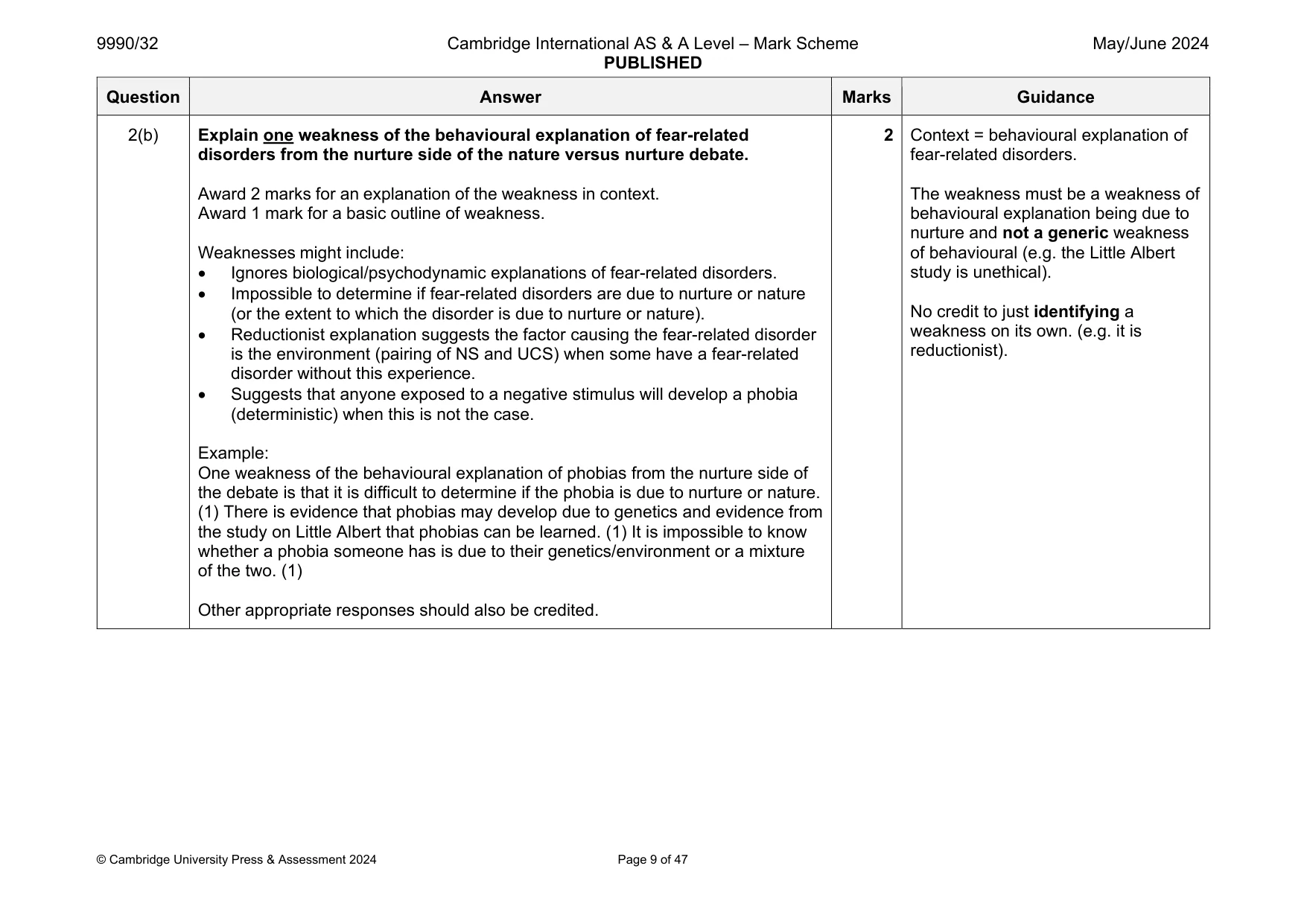
Mark scheme: 2(a) Outline what is meant by ‘nurture’, including an example from the behavioural explanation of fear-related disorders. Award 1 mark for outline of nurture. Award 1 mark for example from behavioural explanation of fear-related disorders. Example: Nurture is where behaviour is caused by the environment / is learned. (1) The behaviourist explanation of phobias suggests that a phobia is learned through association of the neutral stimulus with the unconditioned stimulus until it produces a conditioned response of fear. (1) Other appropriate responses should also be credited. fear-related disorders. Social learning theory is creditworthy as an example e.g. learning a phobia due to copying the phobia of a parent, vicarious reinforcement, role model, observational learning. Trauma on its own is not creditworthy. Needs to outline that trauma is then associated with the object, situation, etc. that the person becomes phobic to. Behavioural – phobias can be learned = 0 marks. Just identifying a study e.g. Little Albert or button phobia or identifying ‘classical conditioning’ on its own = 0 marks. Question Answer Marks Guidance 2(b) Explain one weakness of the behavioural explanation of fear-related disorders from the nurture side of the nature versus nurture debate. Award 2 marks for an explanation of the weakness in context. Award 1 mark for a basic outline of weakness. Weaknesses might include: Ignores biological/psychodynamic explanations of fear-related disorders. Impossible to determine if fear-related disorders are due to nurture or nature (or the extent to which the disorder is due to nurture or nature). Reductionist explanation suggests the factor causing the fear-related disorder is the environment (pairing of NS and UCS) when some have a fear-related disorder without this experience. Suggests that anyone exposed to a negative stimulus will develop a phobia (deterministic) when this is not the case. Example: One weakness of the behavioural explanation of phobias from the nurture side of the debate is that it is difficult to determine if the phobia is due to nurture or nature. (1) There is evidence that phobias may develop due to genetics and evidence from the study on Little Albert that phobias can be learned. (1) It is impossible to know whether a phobia someone has is due to their genetics/environment or a mixture of the two. (1) Other appropriate responses should also be credited. 2 Context = behavioural explanation of fear-related disorders. The weakness must be a weakness of behavioural explanation being due to nurture and not a generic weakness of behavioural (e.g. the Little Albert study is unethical). No credit to just identifying a weakness on its own. (e.g. it is reductionist).
More questions on Anxiety disorders and fear-related disorders
Q3 · Dr Begum is a clinician who sees a patient, Joan
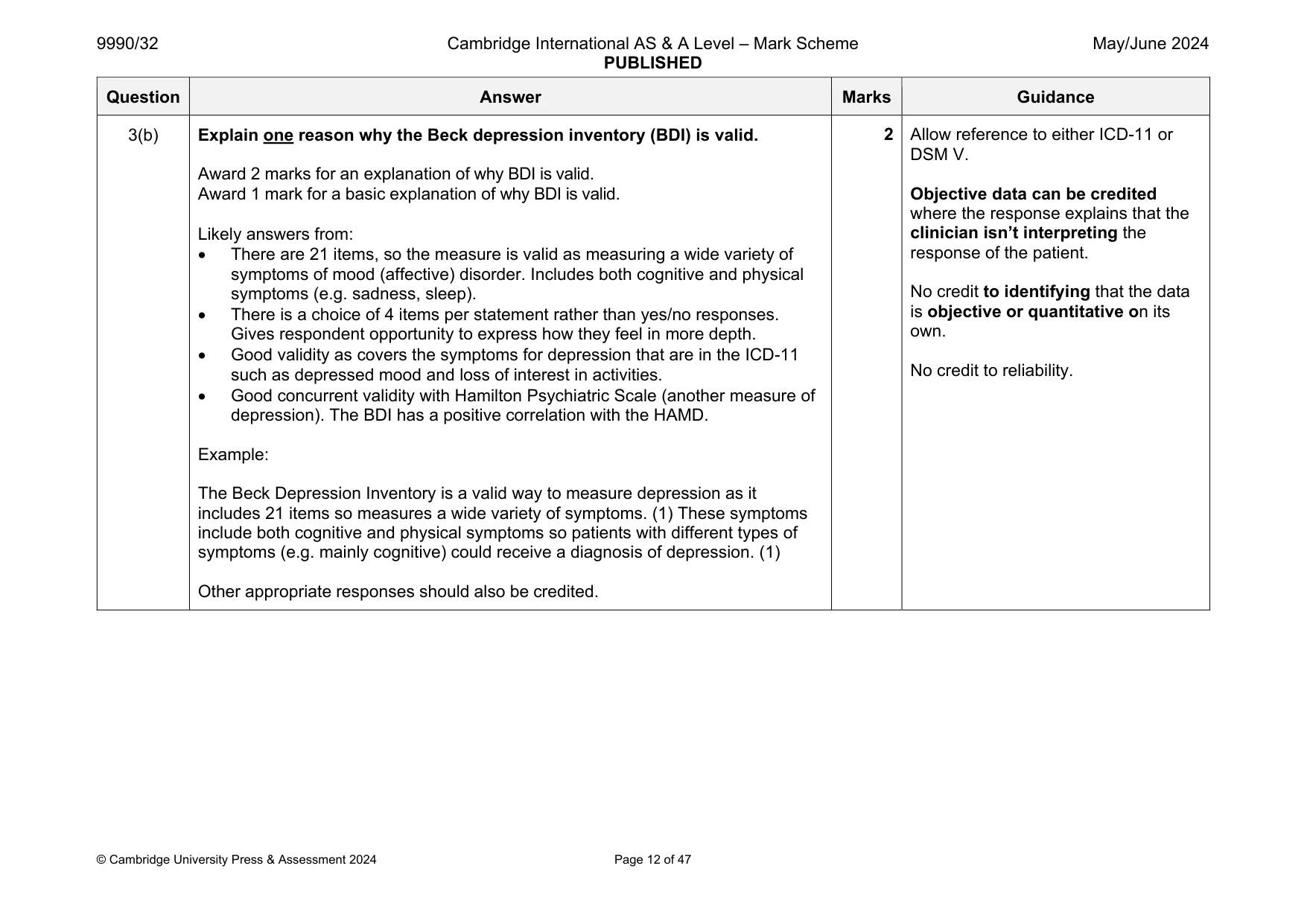
3 Dr Begum is a clinician who sees a patient, Joan. Joan describes how she spends her day feeling miserable and not knowing what to do with her time. She thinks it is her own fault because she cannot decide if she wants to go out, so she stays in. Joan wants to sleep but this is also difficult. (a) Suggest how Dr Begum could use the Beck depression inventory (BDI) with Joan. [4] (b) Explain one reason why the Beck depression inventory (BDI) is valid. [2]
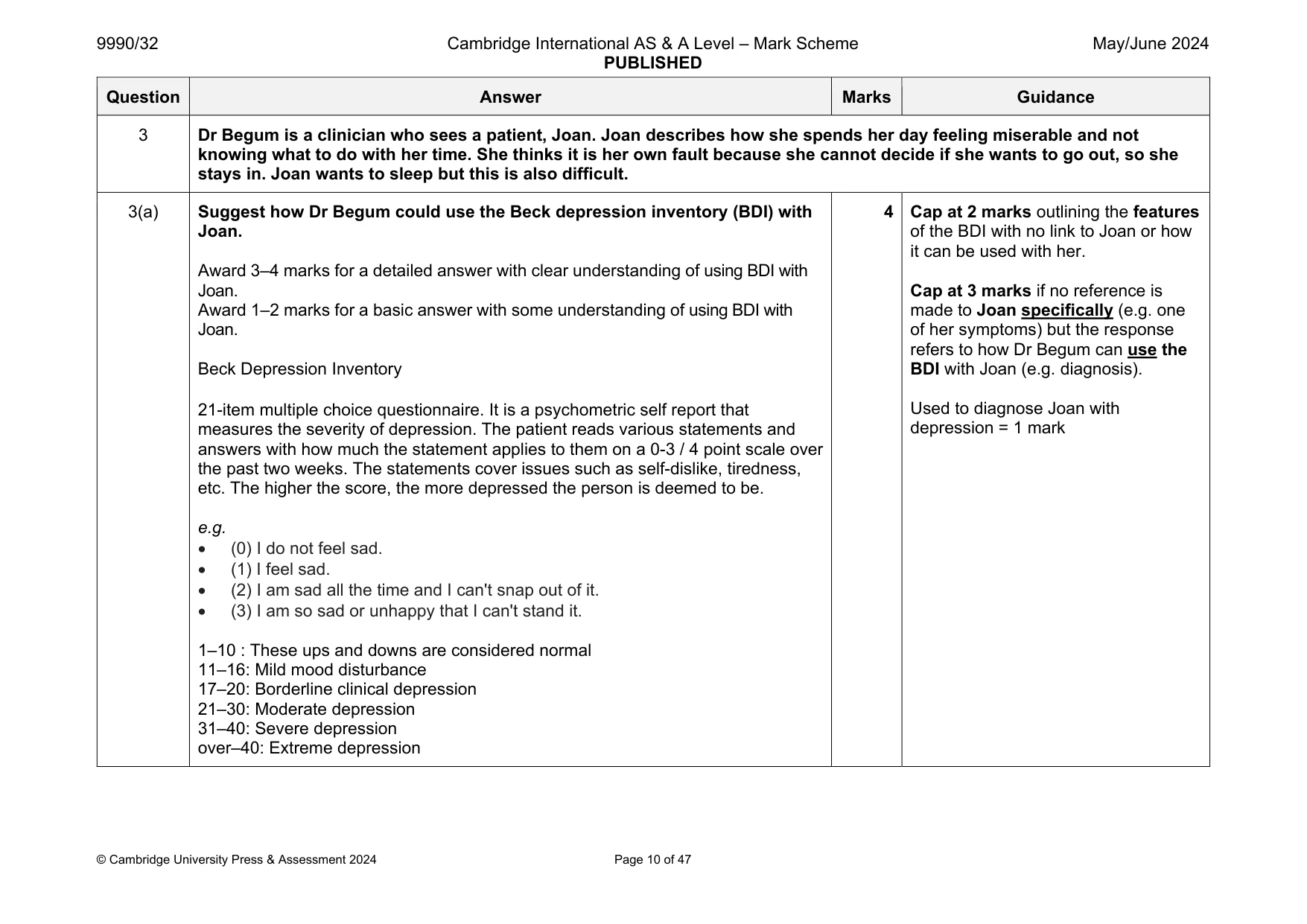
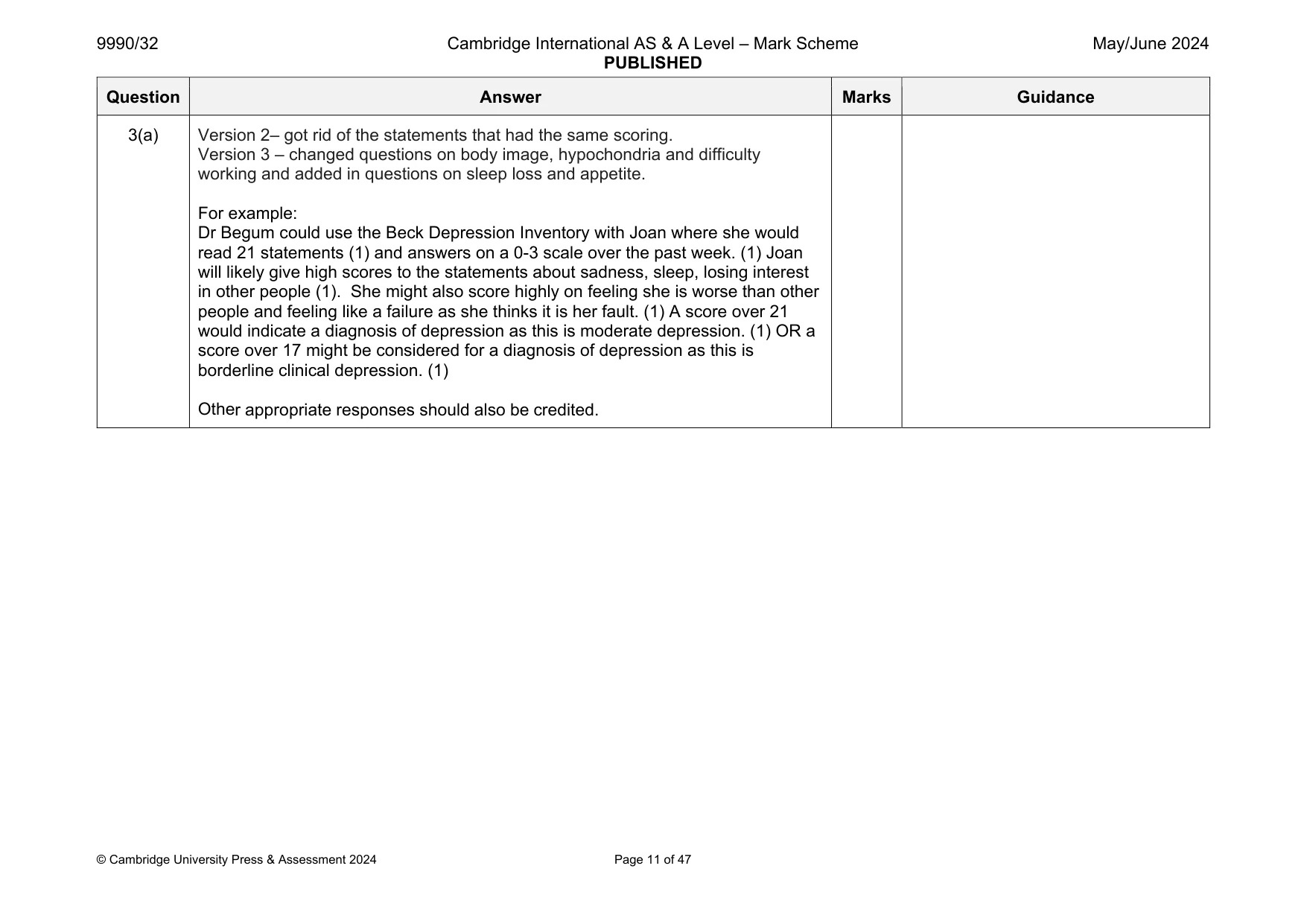
Mark scheme: 3(a) Suggest how Dr Begum could use the Beck depression inventory (BDI) with Joan. Award 3–4 marks for a detailed answer with clear understanding of using BDI with Joan. Award 1–2 marks for a basic answer with some understanding of using BDI with Joan. Beck Depression Inventory 21-item multiple choice questionnaire. It is a psychometric self report that measures the severity of depression. The patient reads various statements and answers with how much the statement applies to them on a 0-3 / 4 point scale over the past two weeks. The statements cover issues such as self-dislike, tiredness, etc. The higher the score, the more depressed the person is deemed to be. e.g. (0) I do not feel sad. (1) I feel sad. (2) I am sad all the time and I can't snap out of it. (3) I am so sad or unhappy that I can't stand it. 1–10 : These ups and downs are considered normal 11–16: Mild mood disturbance 17–20: Borderline clinical depression 21–30: Moderate depression 31–40: Severe depression over–40: Extreme depression 4 Cap at 2 marks outlining the features of the BDI with no link to Joan or how it can be used with her. Cap at 3 marks if no reference is made to Joan specifically (e.g. one of her symptoms) but the response refers to how Dr Begum can use the BDI with Joan (e.g. diagnosis). Used to diagnose Joan with depression = 1 mark Question Answer Marks Guidance 3(a) Version 2– got rid of the statements that had the same scoring. Version 3 – changed questions on body image, hypochondria and difficulty working and added in questions on sleep loss and appetite. For example: Dr Begum could use the Beck Depression Inventory with Joan where she would read 21 statements (1) and answers on a 0-3 scale over the past week. (1) Joan will likely give high scores to the statements about sadness, sleep, losing interest in other people (1). She might also score highly on feeling she is worse than other people and feeling like a failure as she thinks it is her fault. (1) A score over 21 would indicate a diagnosis of depression as this is moderate depression. (1) OR a score over 17 might be considered for a diagnosis of depression as this is borderline clinical depression. (1) Other appropriate responses should also be credited. Question Answer Marks Guidance 3(b) Explain one reason why the Beck depression inventory (BDI) is valid. Award 2 marks for an explanation of why BDI is valid. Award 1 mark for a basic explanation of why BDI is valid. Likely answers from: There are 21 items, so the measure is valid as measuring a wide variety of symptoms of mood (affective) disorder. Includes both cognitive and physical symptoms (e.g. sadness, sleep). There is a choice of 4 items per statement rather than yes/no responses. Gives respondent opportunity to express how they feel in more depth. Good validity as covers the symptoms for depression that are in the ICD-11 such as depressed mood and loss of interest in activities. Good concurrent validity with Hamilton Psychiatric Scale (another measure of depression). The BDI has a positive correlation with the HAMD. Example: The Beck Depression Inventory is a valid way to measure depression as it includes 21 items so measures a wide variety of symptoms. (1) These symptoms include both cognitive and physical symptoms so patients with different types of symptoms (e.g. mainly cognitive) could receive a diagnosis of depression. (1) Other appropriate responses should also be credited. 2 Allow reference to either ICD-11 or DSM V. Objective data can be credited where the response explains that the clinician isn’t interpreting the response of the patient. No credit to identifying that the data is objective or quantitative on its own. No credit to reliability.
More questions on Mood (affective) disorders: depressive disorder (unipolar) and bipolar disorder
Q4 · Describe electro-convulsive therapy (ECT) and cognitive-behavioural therapy (CBT) for the…
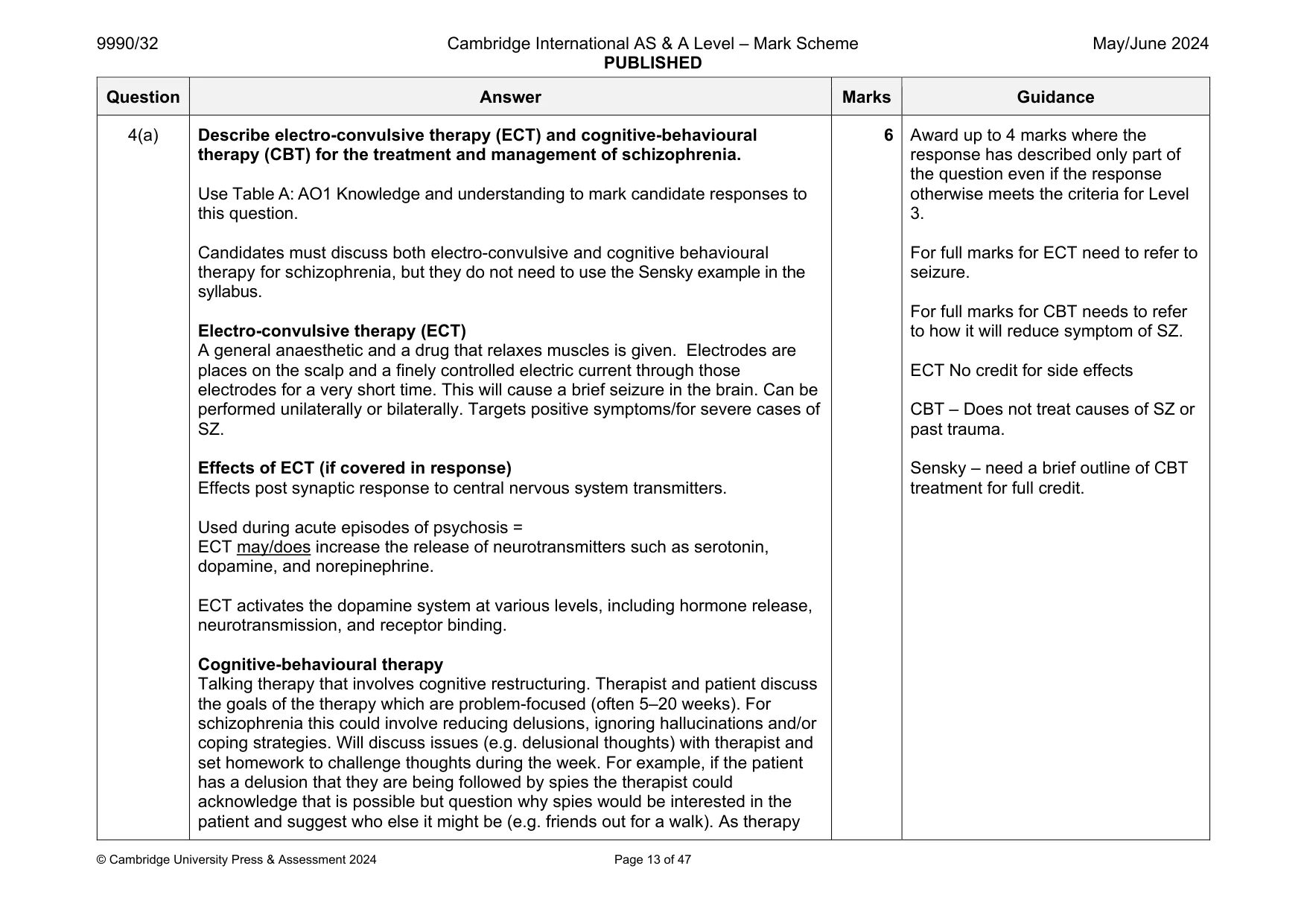
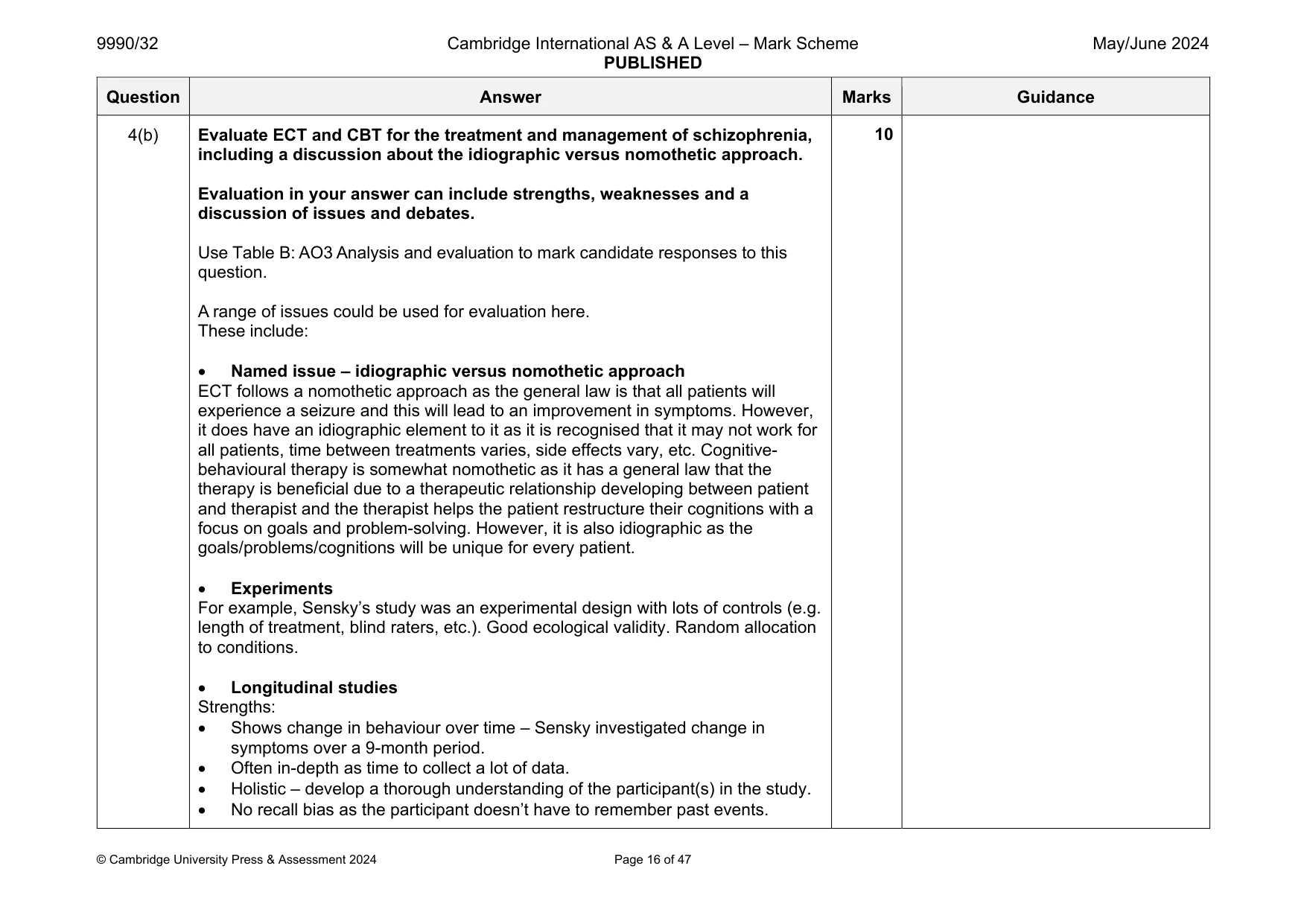
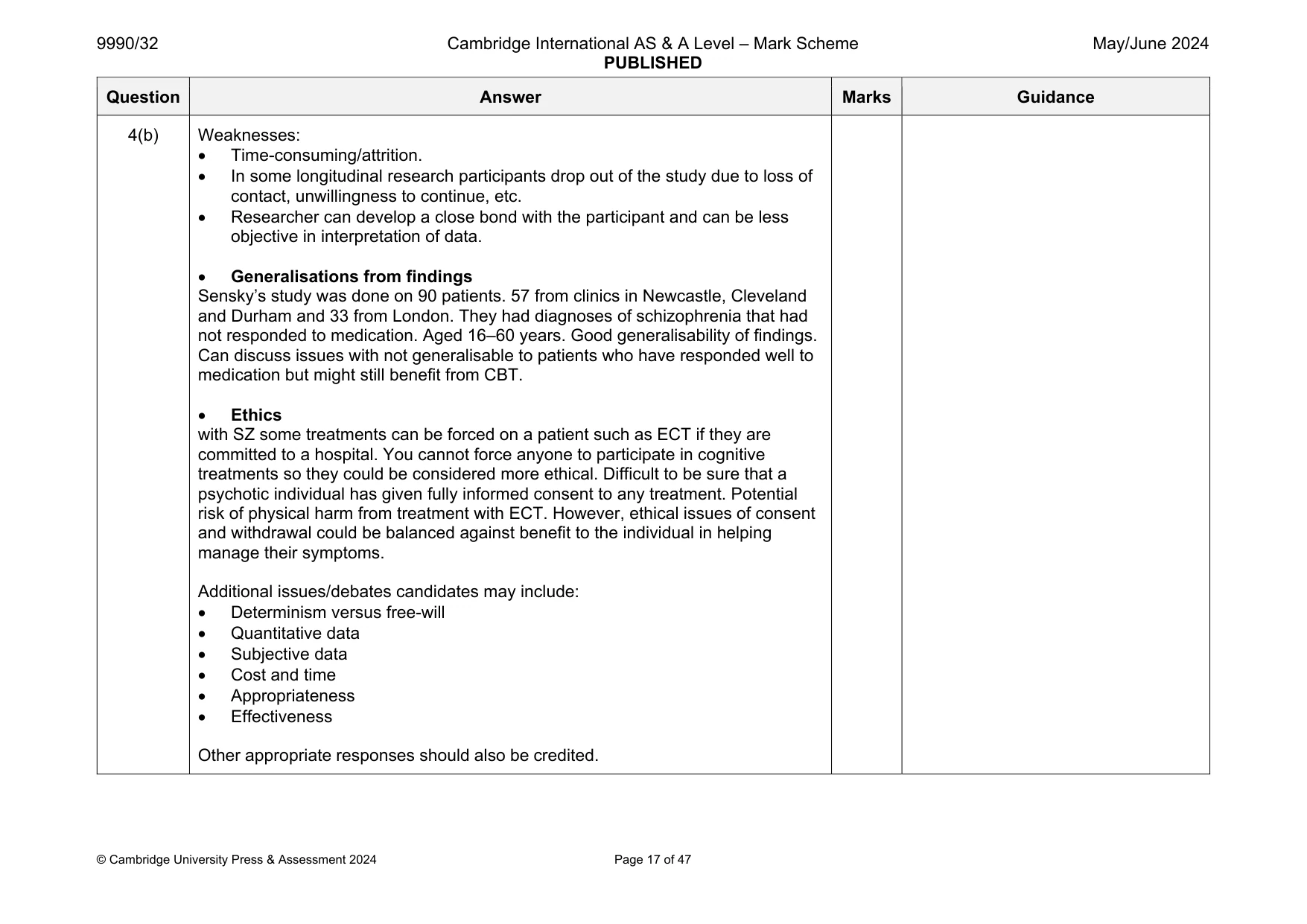
4 (a) Describe electro-convulsive therapy (ECT) and cognitive-behavioural therapy (CBT) for the treatment and management of schizophrenia. [6] (b) Evaluate ECT and CBT for the treatment and management of schizophrenia, including a discussion about the idiographic versus nomothetic approach. Evaluation in your answer can include strengths, weaknesses and a discussion of issues and debates. [10]
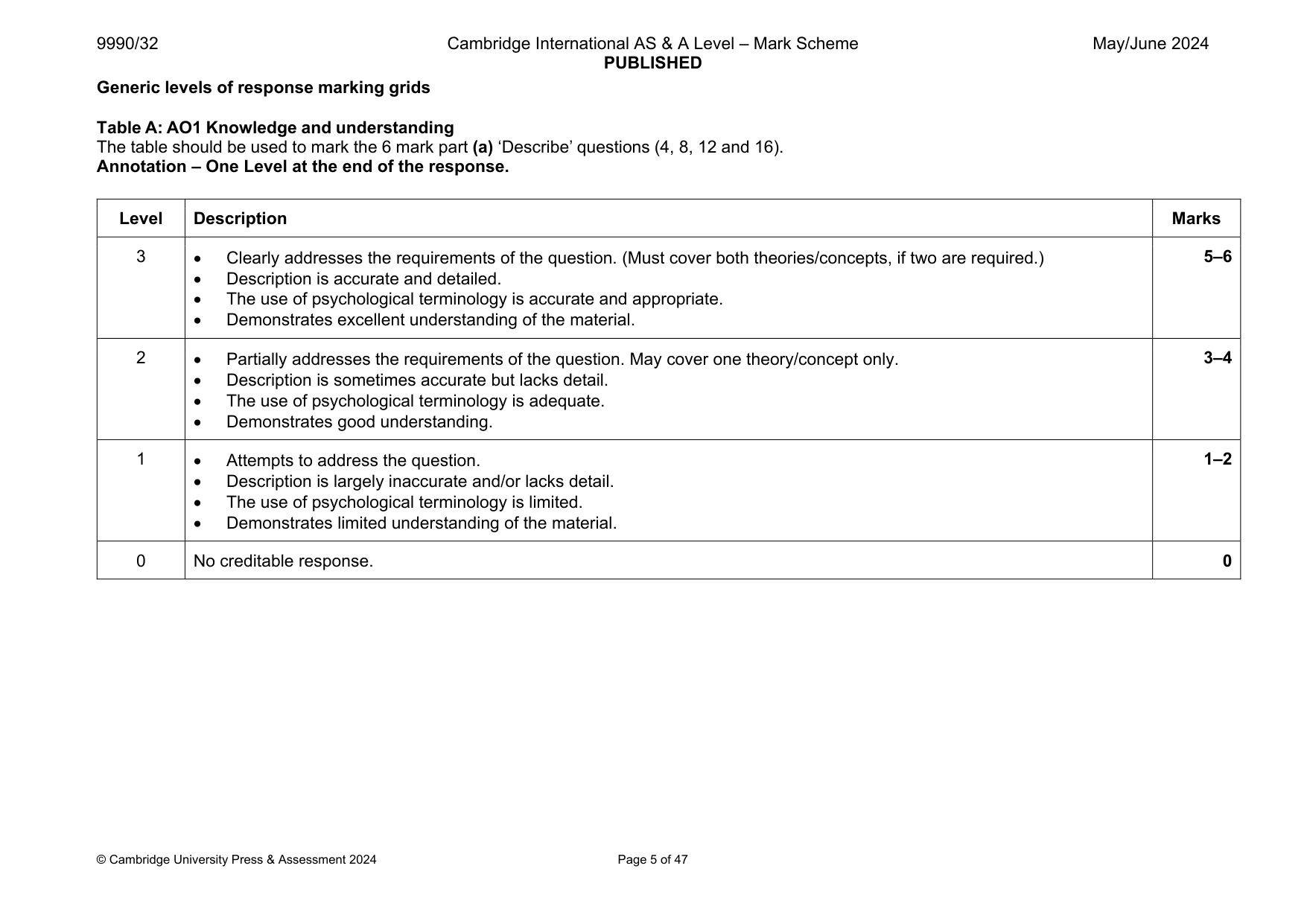
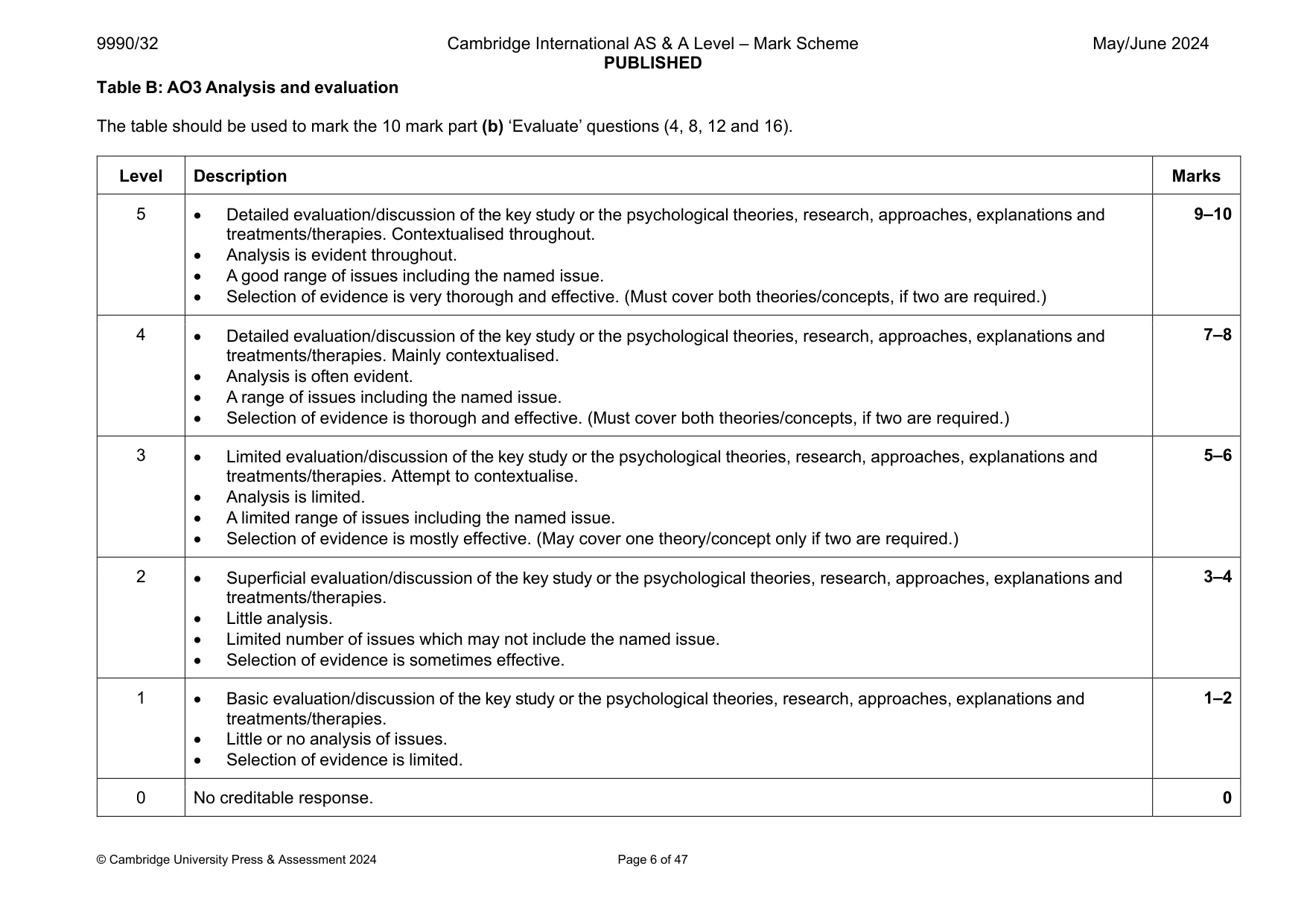
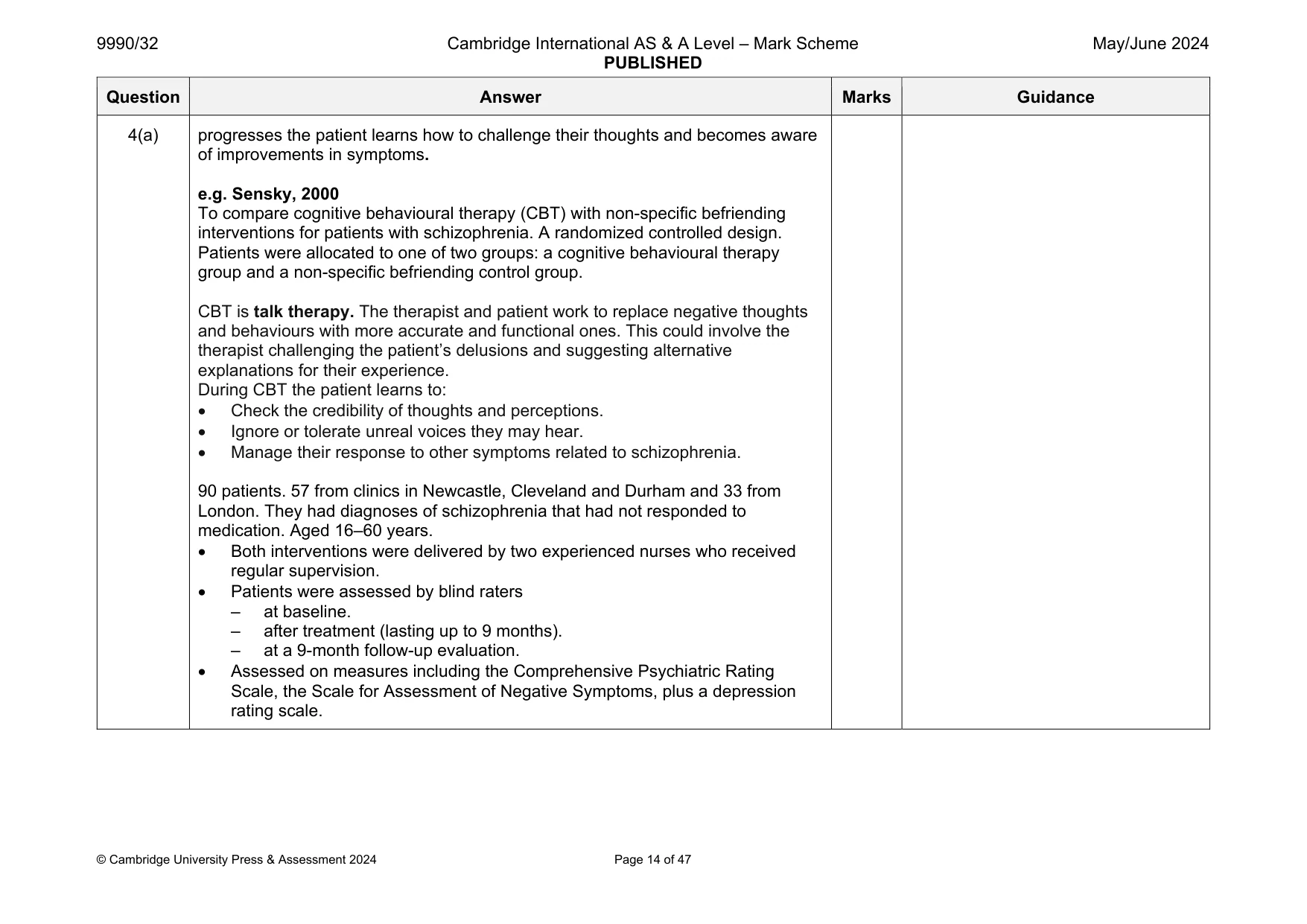
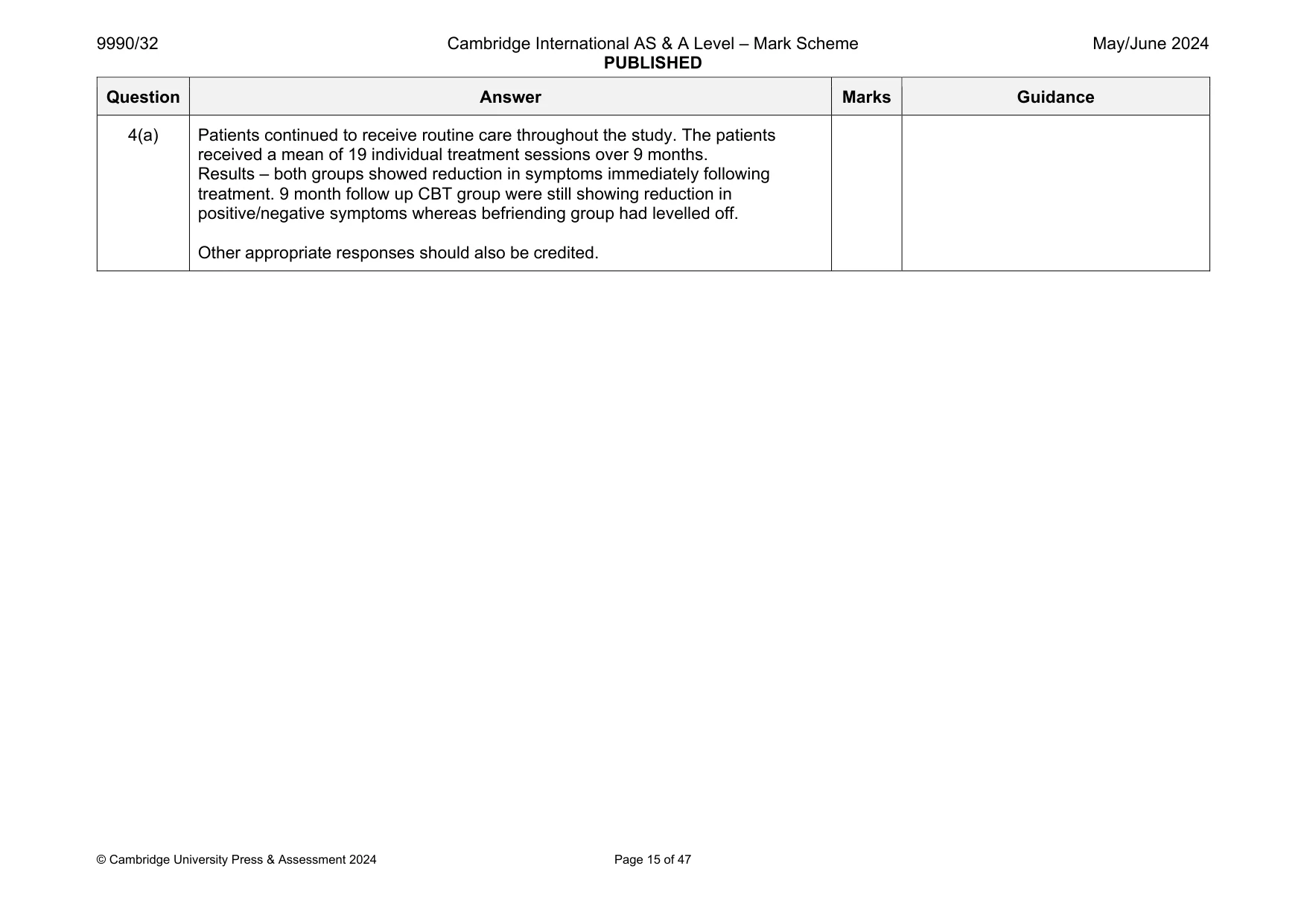
Mark scheme: 4(a) Describe electro-convulsive therapy (ECT) and cognitive-behavioural therapy (CBT) for the treatment and management of schizophrenia. Use Table A: AO1 Knowledge and understanding to mark candidate responses to this question. Candidates must discuss both electro-convulsive and cognitive behavioural therapy for schizophrenia, but they do not need to use the Sensky example in the syllabus. Electro-convulsive therapy (ECT) A general anaesthetic and a drug that relaxes muscles is given. Electrodes are places on the scalp and a finely controlled electric current through those electrodes for a very short time. This will cause a brief seizure in the brain. Can be performed unilaterally or bilaterally. Targets positive symptoms/for severe cases of SZ. Effects of ECT (if covered in response) Effects post synaptic response to central nervous system transmitters. Used during acute episodes of psychosis = ECT may/does increase the release of neurotransmitters such as serotonin, dopamine, and norepinephrine. ECT activates the dopamine system at various levels, including hormone release, neurotransmission, and receptor binding. Cognitive-behavioural therapy Talking therapy that involves cognitive restructuring. Therapist and patient discuss the goals of the therapy which are problem-focused (often 5–20 weeks). For schizophrenia this could involve reducing delusions, ignoring hallucinations and/or coping strategies. Will discuss issues (e.g. delusional thoughts) with therapist and set homework to challenge thoughts during the week. For example, if the patient has a delusion that they are being followed by spies the therapist could acknowledge that is possible but question why spies would be interested in the patient and suggest who else it might be (e.g. friends out for a walk). As therapy 6 Award up to 4 marks where the response has described only part of the question even if the response otherwise meets the criteria for Level 3. For full marks for ECT need to refer to seizure. For full marks for CBT needs to refer to how it will reduce symptom of SZ. ECT No credit for side effects CBT – Does not treat causes of SZ or past trauma. Sensky – need a brief outline of CBT treatment for full credit. Question Answer Marks Guidance 4(a) progresses the patient learns how to challenge their thoughts and becomes aware of improvements in symptoms. e.g. Sensky, 2000 To compare cognitive behavioural therapy (CBT) with non-specific befriending interventions for patients with schizophrenia. A randomized controlled design. Patients were allocated to one of two groups: a cognitive behavioural therapy group and a non-specific befriending control group. CBT is talk therapy. The therapist and patient work to replace negative thoughts and behaviours with more accurate and functional ones. This could involve the therapist challenging the patient’s delusions and suggesting alternative explanations for their experience. During CBT the patient learns to: Check the credibility of thoughts and perceptions. Ignore or tolerate unreal voices they may hear. Manage their response to other symptoms related to schizophrenia. 90 patients. 57 from clinics in Newcastle, Cleveland and Durham and 33 from London. They had diagnoses of schizophrenia that had not responded to medication. Aged 16–60 years. Both interventions were delivered by two experienced nurses who received regular supervision. Patients were assessed by blind raters – at baseline. – after treatment (lasting up to 9 months). – at a 9-month follow-up evaluation. Assessed on measures including the Comprehensive Psychiatric Rating Scale, the Scale for Assessment of Negative Symptoms, plus a depression rating scale. Question Answer Marks Guidance 4(a) Patients continued to receive routine care throughout the study. The patients received a mean of 19 individual treatment sessions over 9 months. Results – both groups showed reduction in symptoms immediately following treatment. 9 month follow up CBT group were still showing reduction in positive/negative symptoms whereas befriending group had levelled off. Other appropriate responses should also be credited. Question Answer Marks Guidance 4(b) Evaluate ECT and CBT for the treatment and management of schizophrenia, including a discussion about the idiographic versus nomothetic approach. Evaluation in your answer can include strengths, weaknesses and a discussion of issues and debates. Use Table B: AO3 Analysis and evaluation to mark candidate responses to this question. A range of issues could be used for evaluation here. These include: Named issue – idiographic versus nomothetic approach ECT follows a nomothetic approach as the general law is that all patients will experience a seizure and this will lead to an improvement in symptoms. However, it does have an idiographic element to it as it is recognised that it may not work for all patients, time between treatments varies, side effects vary, etc. Cognitive- behavioural therapy is somewhat nomothetic as it has a general law that the therapy is beneficial due to a therapeutic relationship developing between patient and therapist and the therapist helps the patient restructure their cognitions with a focus on goals and problem-solving. However, it is also idiographic as the goals/problems/cognitions will be unique for every patient. Experiments For example, Sensky’s study was an experimental design with lots of controls (e.g. length of treatment, blind raters, etc.). Good ecological validity. Random allocation to conditions. Longitudinal studies Strengths: Shows change in behaviour over time – Sensky investigated change in symptoms over a 9-month period. Often in-depth as time to collect a lot of data. Holistic – develop a thorough understanding of the participant(s) in the study. No recall bias as the participant doesn’t have to remember past events. 10 Question Answer Marks Guidance 4(b) Weaknesses: Time-consuming/attrition. In some longitudinal research participants drop out of the study due to loss of contact, unwillingness to continue, etc. Researcher can develop a close bond with the participant and can be less objective in interpretation of data. Generalisations from findings Sensky’s study was done on 90 patients. 57 from clinics in Newcastle, Cleveland and Durham and 33 from London. They had diagnoses of schizophrenia that had not responded to medication. Aged 16–60 years. Good generalisability of findings. Can discuss issues with not generalisable to patients who have responded well to medication but might still benefit from CBT. Ethics with SZ some treatments can be forced on a patient such as ECT if they are committed to a hospital. You cannot force anyone to participate in cognitive treatments so they could be considered more ethical. Difficult to be sure that a psychotic individual has given fully informed consent to any treatment. Potential risk of physical harm from treatment with ECT. However, ethical issues of consent and withdrawal could be balanced against benefit to the individual in helping manage their symptoms. Additional issues/debates candidates may include: Determinism versus free-will Quantitative data Subjective data Cost and time Appropriateness Effectiveness Other appropriate responses should also be credited.
Q5 · A pizza restaurant is redesigning its menu to encourage more purchases of mushroom pizza
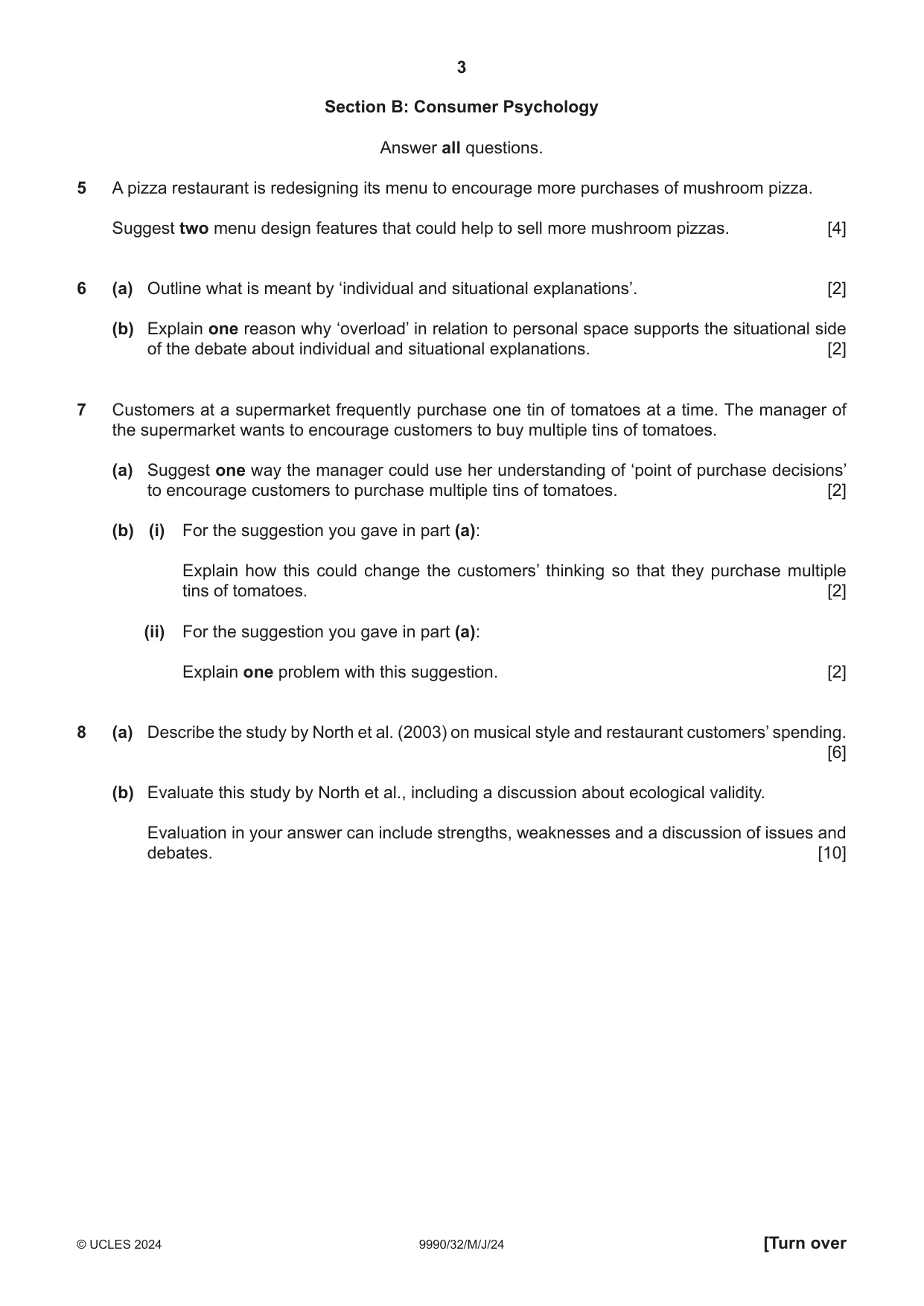
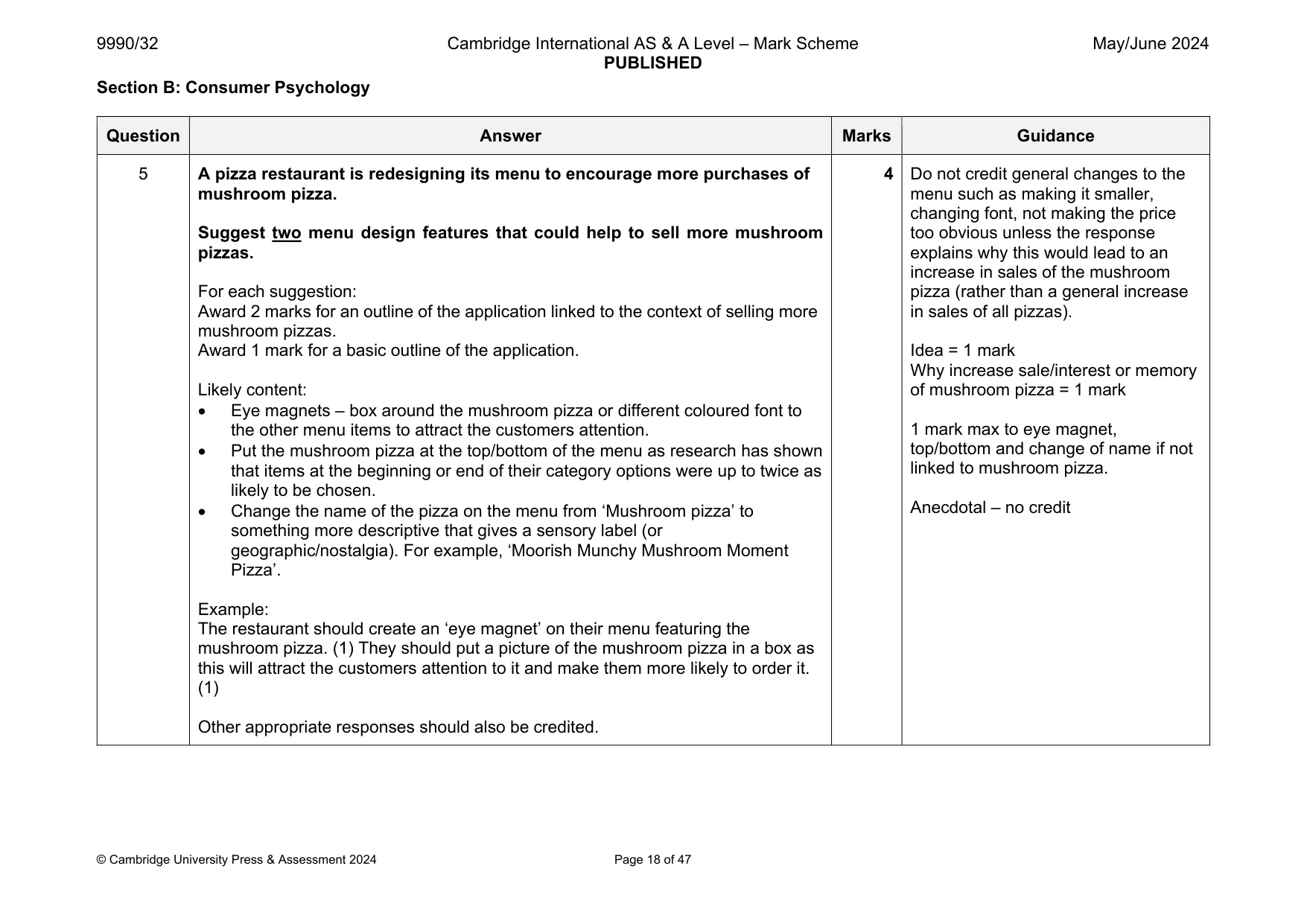
5 A pizza restaurant is redesigning its menu to encourage more purchases of mushroom pizza. Suggest two menu design features that could help to sell more mushroom pizzas. [4]
Mark scheme: 5 A pizza restaurant is redesigning its menu to encourage more purchases of mushroom pizza. Suggest two menu design features that could help to sell more mushroom pizzas. For each suggestion: Award 2 marks for an outline of the application linked to the context of selling more mushroom pizzas. Award 1 mark for a basic outline of the application. Likely content: Eye magnets – box around the mushroom pizza or different coloured font to the other menu items to attract the customers attention. Put the mushroom pizza at the top/bottom of the menu as research has shown that items at the beginning or end of their category options were up to twice as likely to be chosen. Change the name of the pizza on the menu from ‘Mushroom pizza’ to something more descriptive that gives a sensory label (or geographic/nostalgia). For example, ‘Moorish Munchy Mushroom Moment Pizza’. Example: The restaurant should create an ‘eye magnet’ on their menu featuring the mushroom pizza. (1) They should put a picture of the mushroom pizza in a box as this will attract the customers attention to it and make them more likely to order it. (1) Other appropriate responses should also be credited. 4 Do not credit general changes to the menu such as making it smaller, changing font, not making the price too obvious unless the response explains why this would lead to an increase in sales of the mushroom pizza (rather than a general increase in sales of all pizzas). Idea = 1 mark Why increase sale/interest or memory of mushroom pizza = 1 mark 1 mark max to eye magnet, top/bottom and change of name if not linked to mushroom pizza. Anecdotal – no credit
Q6 · Outline what is meant by ‘individual and situational explanations’
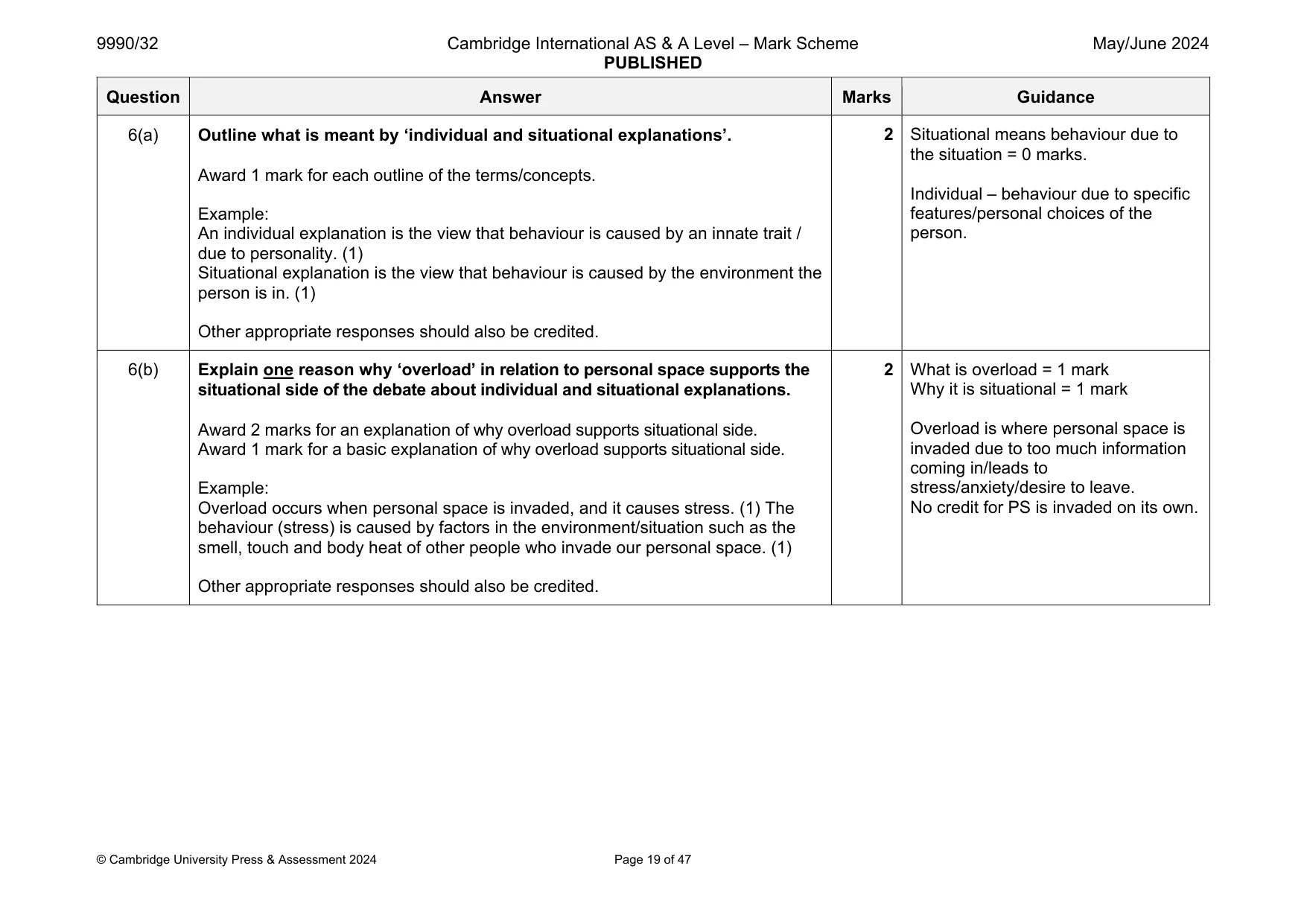
6 (a) Outline what is meant by ‘individual and situational explanations’. [2] (b) Explain one reason why ‘overload’ in relation to personal space supports the situational side of the debate about individual and situational explanations. [2]
Mark scheme: 6(a) Outline what is meant by ‘individual and situational explanations’. Award 1 mark for each outline of the terms/concepts. Example: An individual explanation is the view that behaviour is caused by an innate trait / due to personality. (1) Situational explanation is the view that behaviour is caused by the environment the person is in. (1) Other appropriate responses should also be credited. the situation = 0 marks. Individual – behaviour due to specific features/personal choices of the person. 6(b) Explain one reason why ‘overload’ in relation to personal space supports the situational side of the debate about individual and situational explanations. Award 2 marks for an explanation of why overload supports situational side. Award 1 mark for a basic explanation of why overload supports situational side. Example: Overload occurs when personal space is invaded, and it causes stress. (1) The behaviour (stress) is caused by factors in the environment/situation such as the smell, touch and body heat of other people who invade our personal space. (1) Other appropriate responses should also be credited. 2 What is overload = 1 mark Why it is situational = 1 mark Overload is where personal space is invaded due to too much information coming in/leads to stress/anxiety/desire to leave. No credit for PS is invaded on its own.
Q7 · Customers at a supermarket frequently purchase one tin of tomatoes at a time
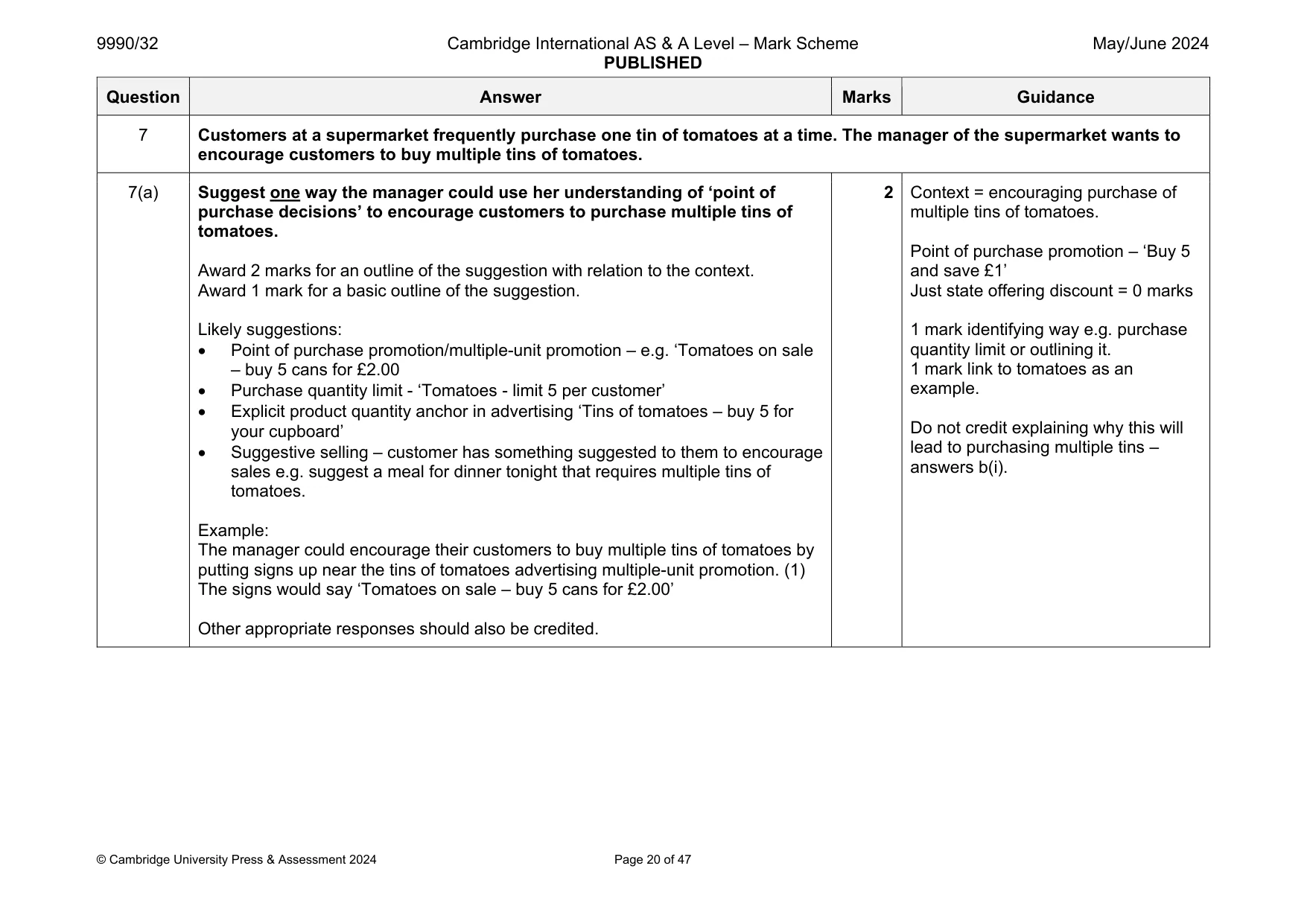
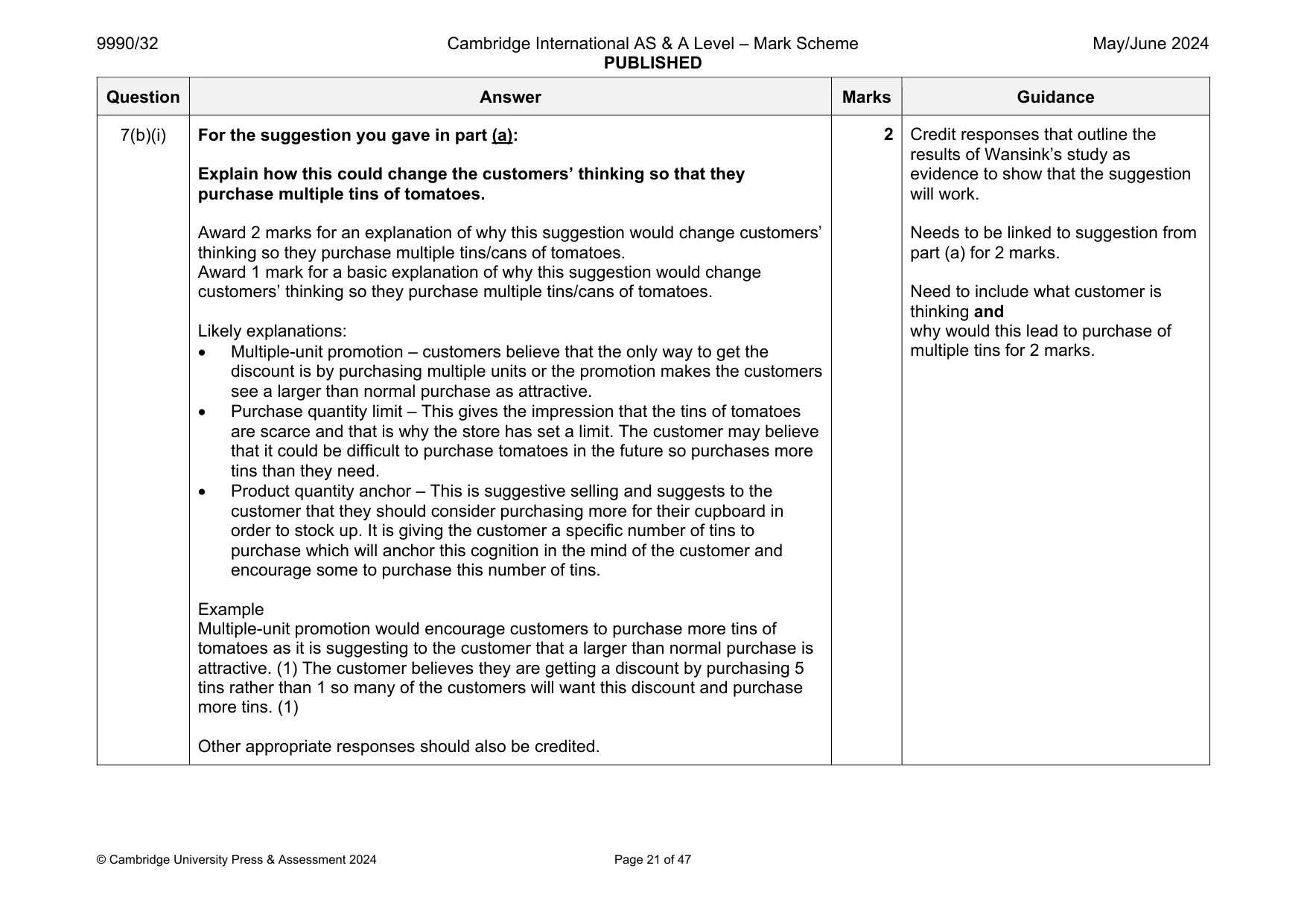
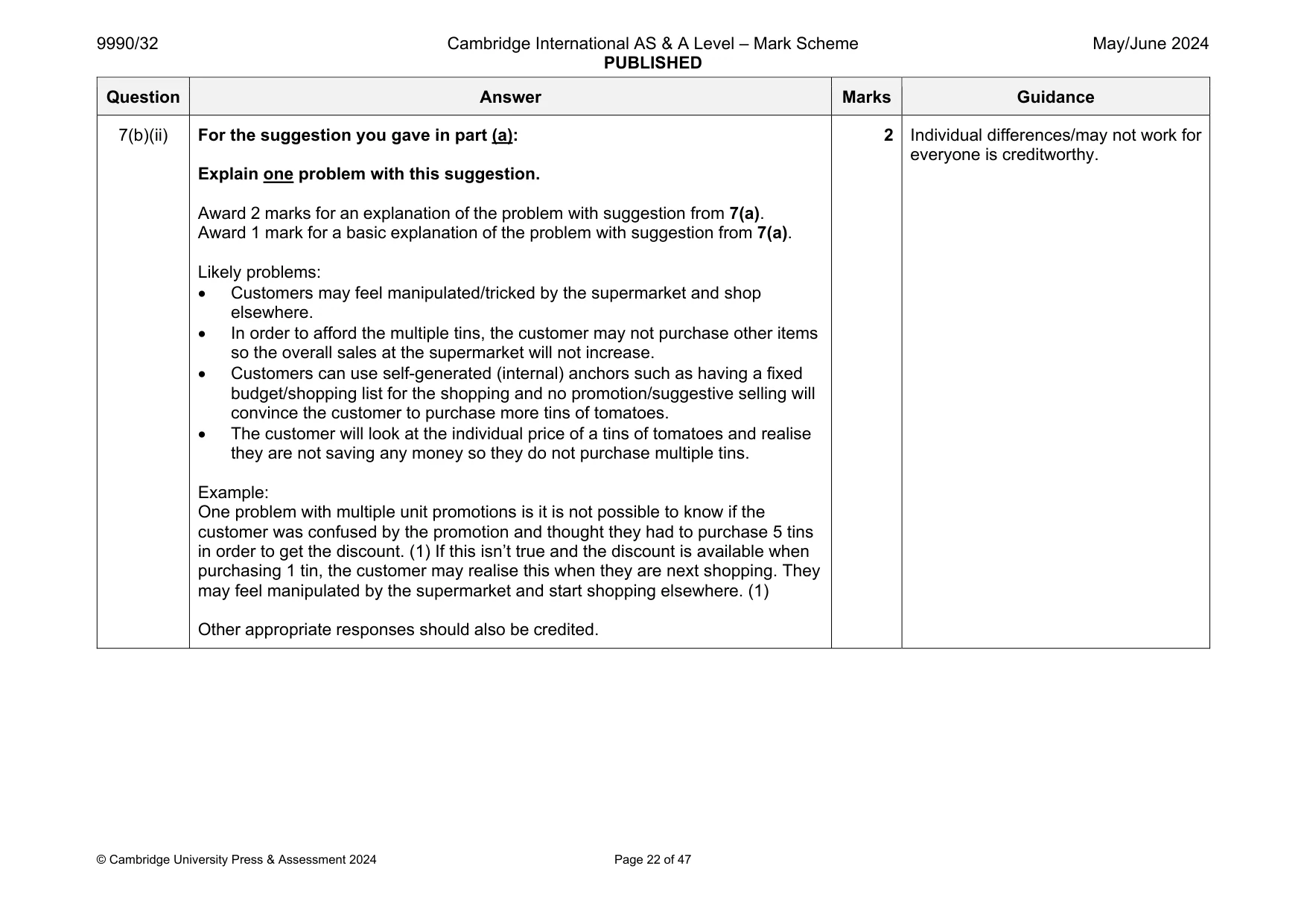
7 Customers at a supermarket frequently purchase one tin of tomatoes at a time. The manager of the supermarket wants to encourage customers to buy multiple tins of tomatoes. (a) Suggest one way the manager could use her understanding of ‘point of purchase decisions’ to encourage customers to purchase multiple tins of tomatoes. [2] (b) (i) For the suggestion you gave in part (a): Explain how this could change the customers’ thinking so that they purchase multiple tins of tomatoes. [2] (ii) For the suggestion you gave in part (a): Explain one problem with this suggestion. [2]
Mark scheme: 7(a) Suggest one way the manager could use her understanding of ‘point of purchase decisions’ to encourage customers to purchase multiple tins of tomatoes. Award 2 marks for an outline of the suggestion with relation to the context. Award 1 mark for a basic outline of the suggestion. Likely suggestions: Point of purchase promotion/multiple-unit promotion – e.g. ‘Tomatoes on sale – buy 5 cans for £2.00 Purchase quantity limit - ‘Tomatoes - limit 5 per customer’ Explicit product quantity anchor in advertising ‘Tins of tomatoes – buy 5 for your cupboard’ Suggestive selling – customer has something suggested to them to encourage sales e.g. suggest a meal for dinner tonight that requires multiple tins of tomatoes. Example: The manager could encourage their customers to buy multiple tins of tomatoes by putting signs up near the tins of tomatoes advertising multiple-unit promotion. (1) The signs would say ‘Tomatoes on sale – buy 5 cans for £2.00’ Other appropriate responses should also be credited. 2 Context = encouraging purchase of multiple tins of tomatoes. Point of purchase promotion – ‘Buy 5 and save £1’ Just state offering discount = 0 marks 1 mark identifying way e.g. purchase quantity limit or outlining it. 1 mark link to tomatoes as an example. Do not credit explaining why this will lead to purchasing multiple tins – answers b(i). Question Answer Marks Guidance 7(b)(i) For the suggestion you gave in part (a): Explain how this could change the customers’ thinking so that they purchase multiple tins of tomatoes. Award 2 marks for an explanation of why this suggestion would change customers’ thinking so they purchase multiple tins/cans of tomatoes. Award 1 mark for a basic explanation of why this suggestion would change customers’ thinking so they purchase multiple tins/cans of tomatoes. Likely explanations: Multiple-unit promotion – customers believe that the only way to get the discount is by purchasing multiple units or the promotion makes the customers see a larger than normal purchase as attractive. Purchase quantity limit – This gives the impression that the tins of tomatoes are scarce and that is why the store has set a limit. The customer may believe that it could be difficult to purchase tomatoes in the future so purchases more tins than they need. Product quantity anchor – This is suggestive selling and suggests to the customer that they should consider purchasing more for their cupboard in order to stock up. It is giving the customer a specific number of tins to purchase which will anchor this cognition in the mind of the customer and encourage some to purchase this number of tins. Example Multiple-unit promotion would encourage customers to purchase more tins of tomatoes as it is suggesting to the customer that a larger than normal purchase is attractive. (1) The customer believes they are getting a discount by purchasing 5 tins rather than 1 so many of the customers will want this discount and purchase more tins. (1) Other appropriate responses should also be credited. 2 Credit responses that outline the results of Wansink’s study as evidence to show that the suggestion will work. Needs to be linked to suggestion from part (a) for 2 marks. Need to include what customer is thinking and why would this lead to purchase of multiple tins for 2 marks. Question Answer Marks Guidance 7(b)(ii) For the suggestion you gave in part (a): Explain one problem with this suggestion. Award 2 marks for an explanation of the problem with suggestion from 7(a). Award 1 mark for a basic explanation of the problem with suggestion from 7(a). Likely problems: Customers may feel manipulated/tricked by the supermarket and shop elsewhere. In order to afford the multiple tins, the customer may not purchase other items so the overall sales at the supermarket will not increase. Customers can use self-generated (internal) anchors such as having a fixed budget/shopping list for the shopping and no promotion/suggestive selling will convince the customer to purchase more tins of tomatoes. The customer will look at the individual price of a tins of tomatoes and realise they are not saving any money so they do not purchase multiple tins. Example: One problem with multiple unit promotions is it is not possible to know if the customer was confused by the promotion and thought they had to purchase 5 tins in order to get the discount. (1) If this isn’t true and the discount is available when purchasing 1 tin, the customer may realise this when they are next shopping. They may feel manipulated by the supermarket and start shopping elsewhere. (1) Other appropriate responses should also be credited. 2 Individual differences/may not work for everyone is creditworthy.
Q8 · Describe the study by North et al
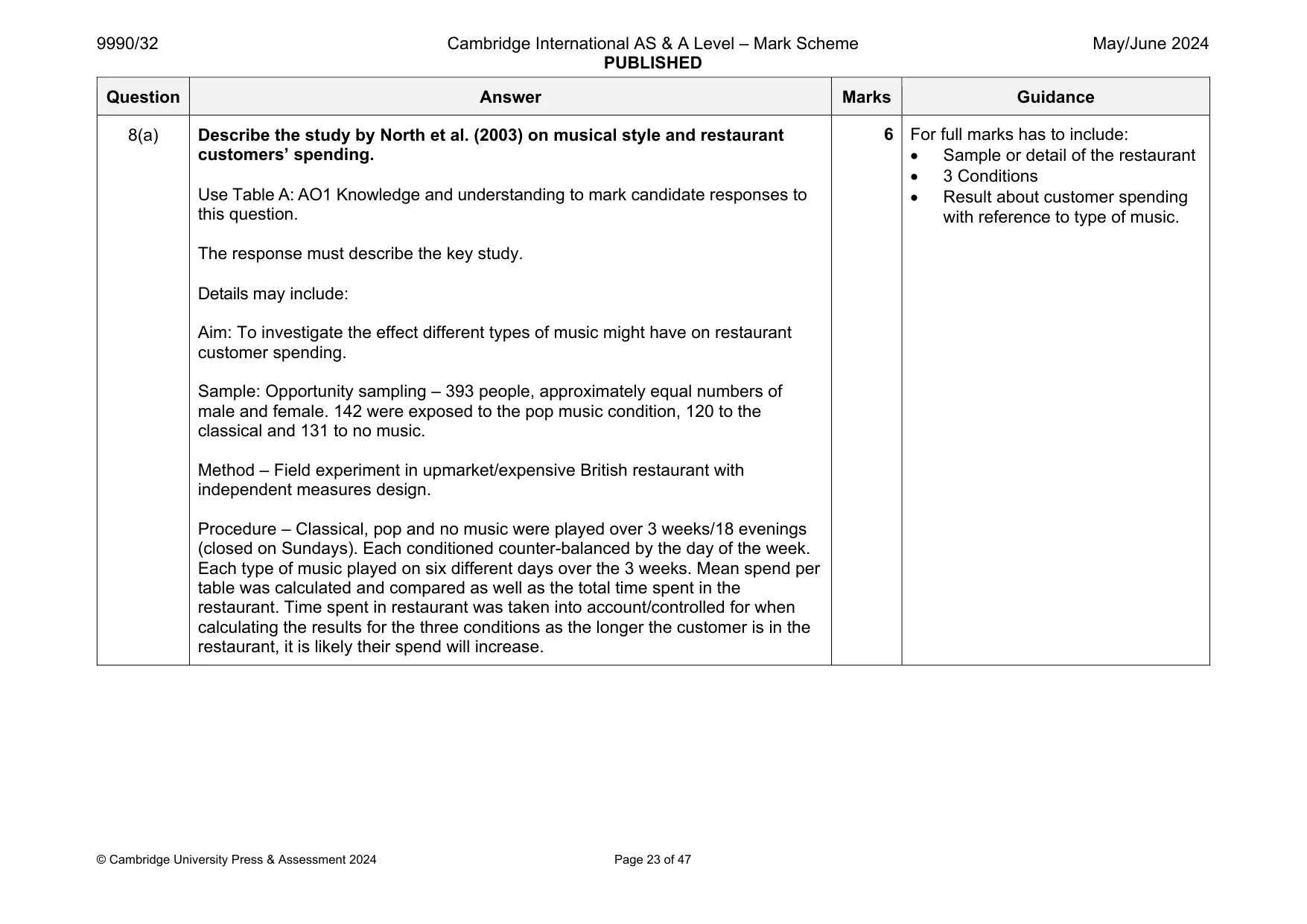
8 (a) Describe the study by North et al. (2003) on musical style and restaurant customers’ spending. [6] (b) Evaluate this study by North et al., including a discussion about ecological validity. Evaluation in your answer can include strengths, weaknesses and a discussion of issues and debates. [10] Section C: Health Psychology Answer all questions.
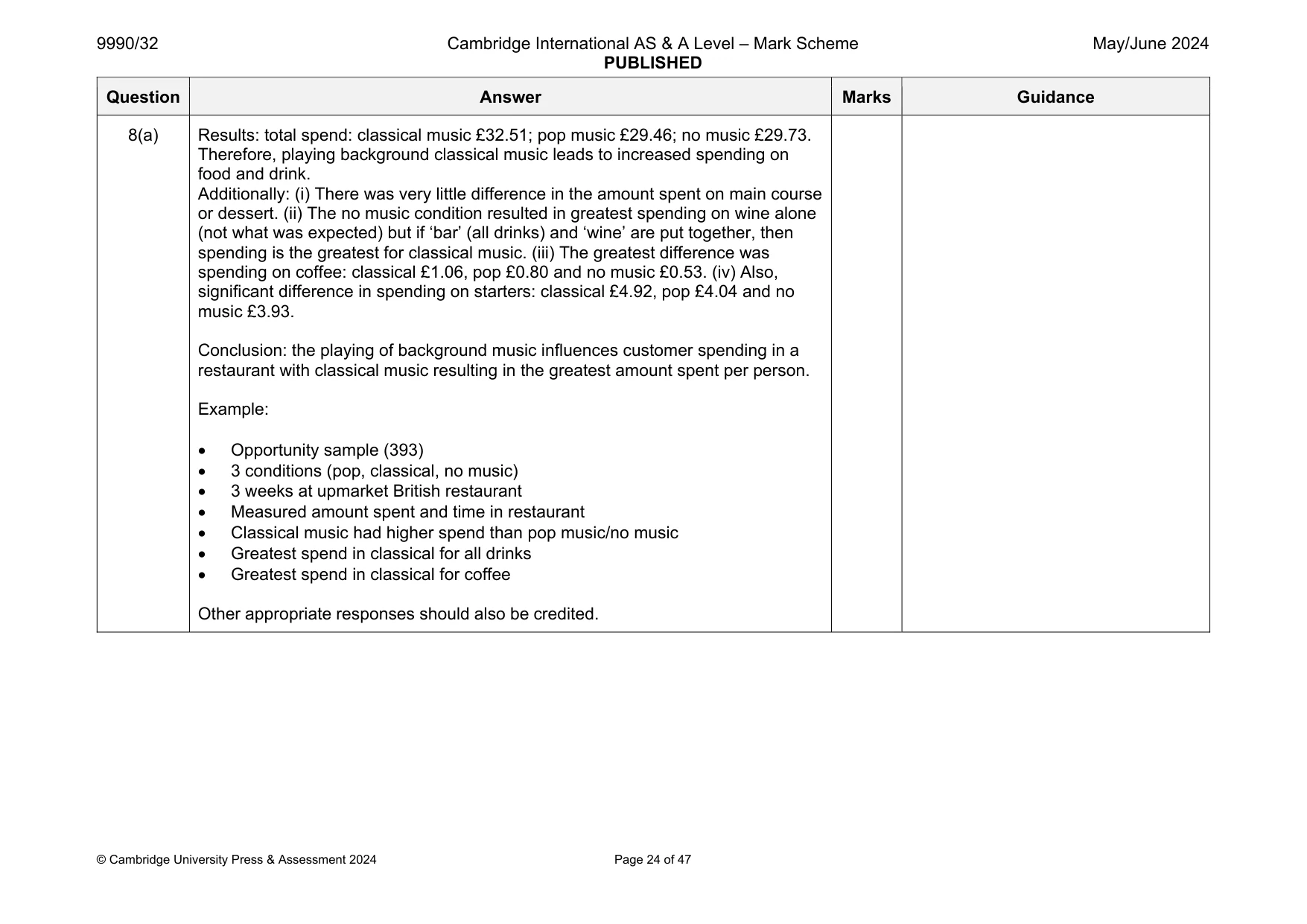
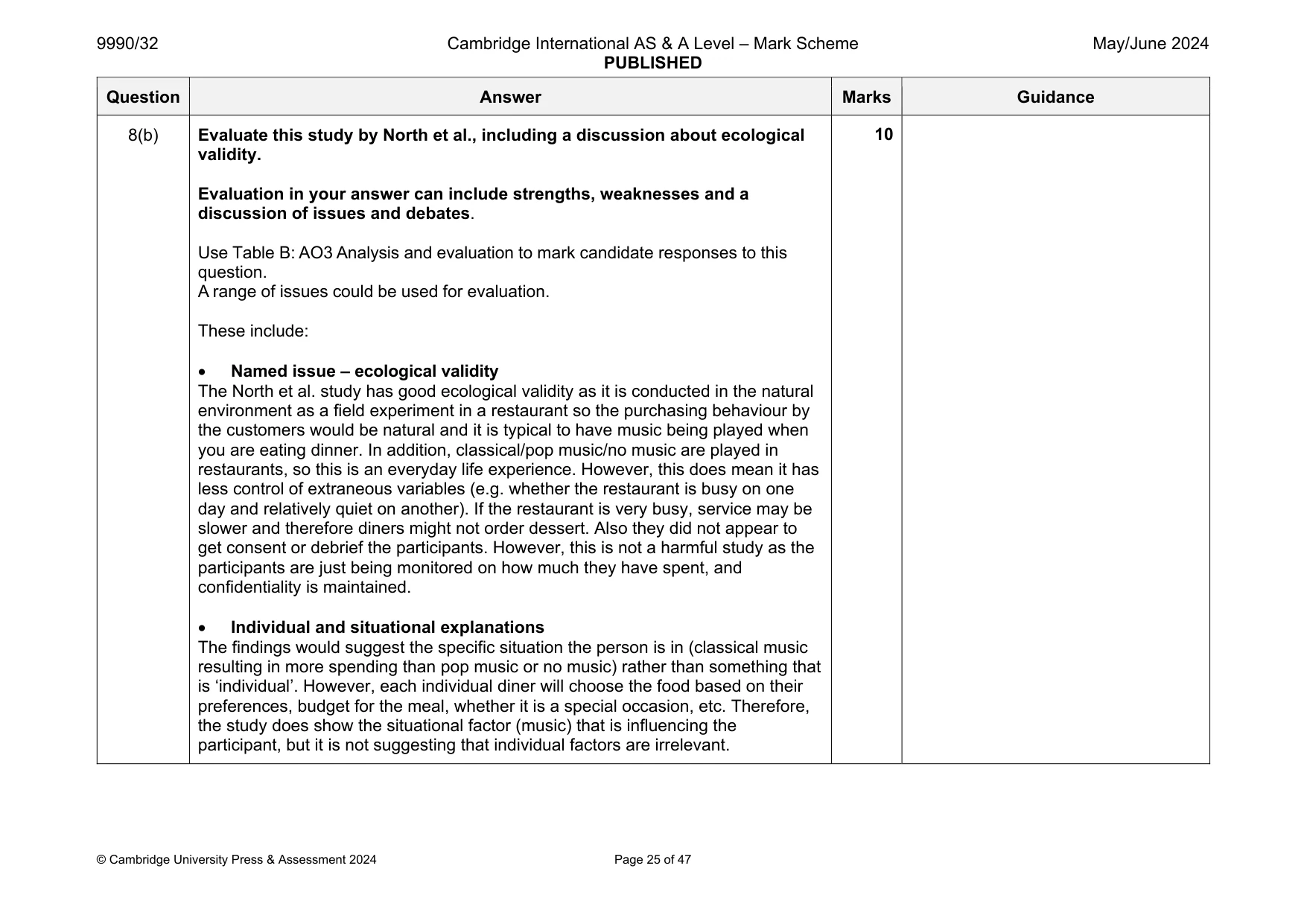
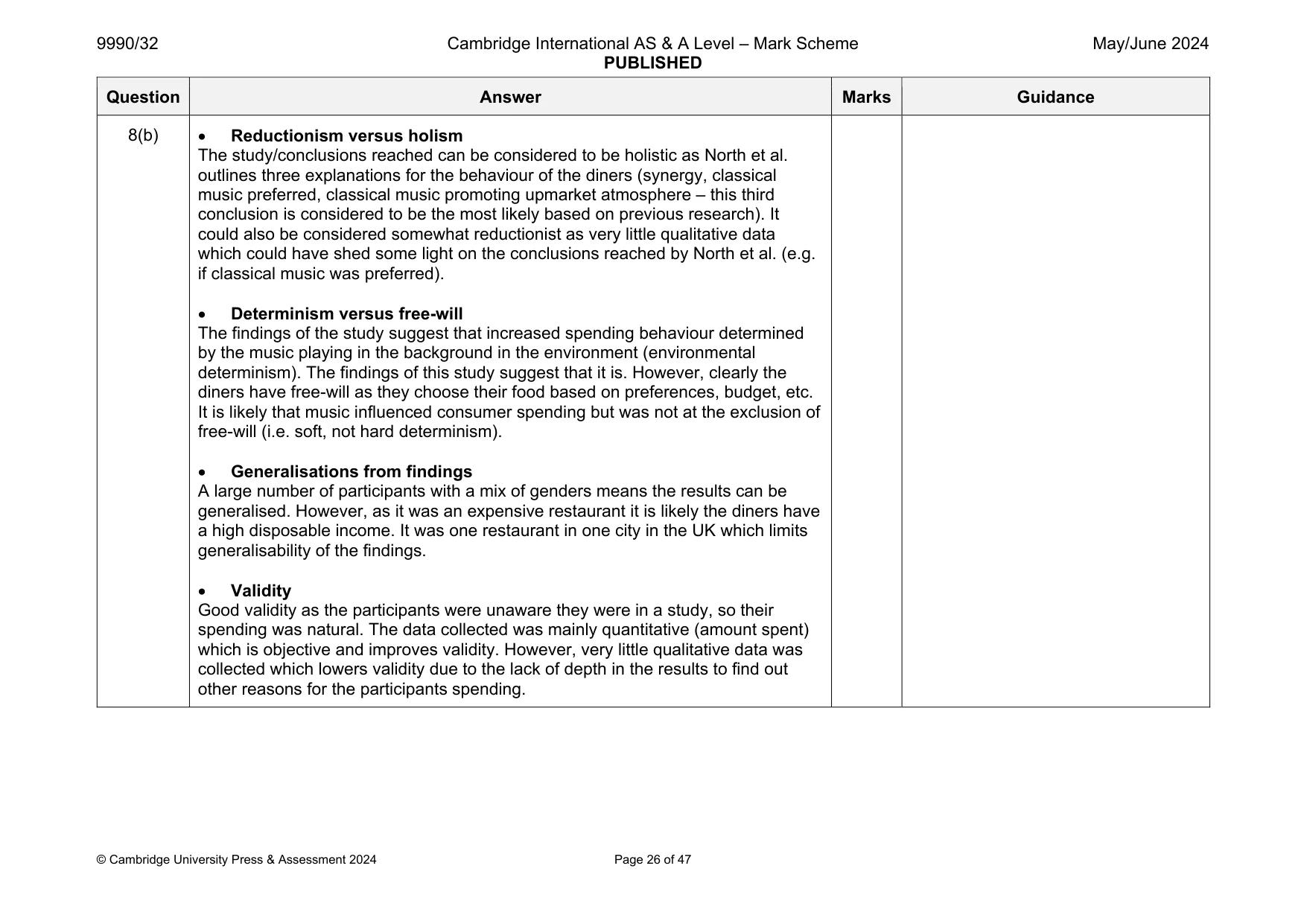
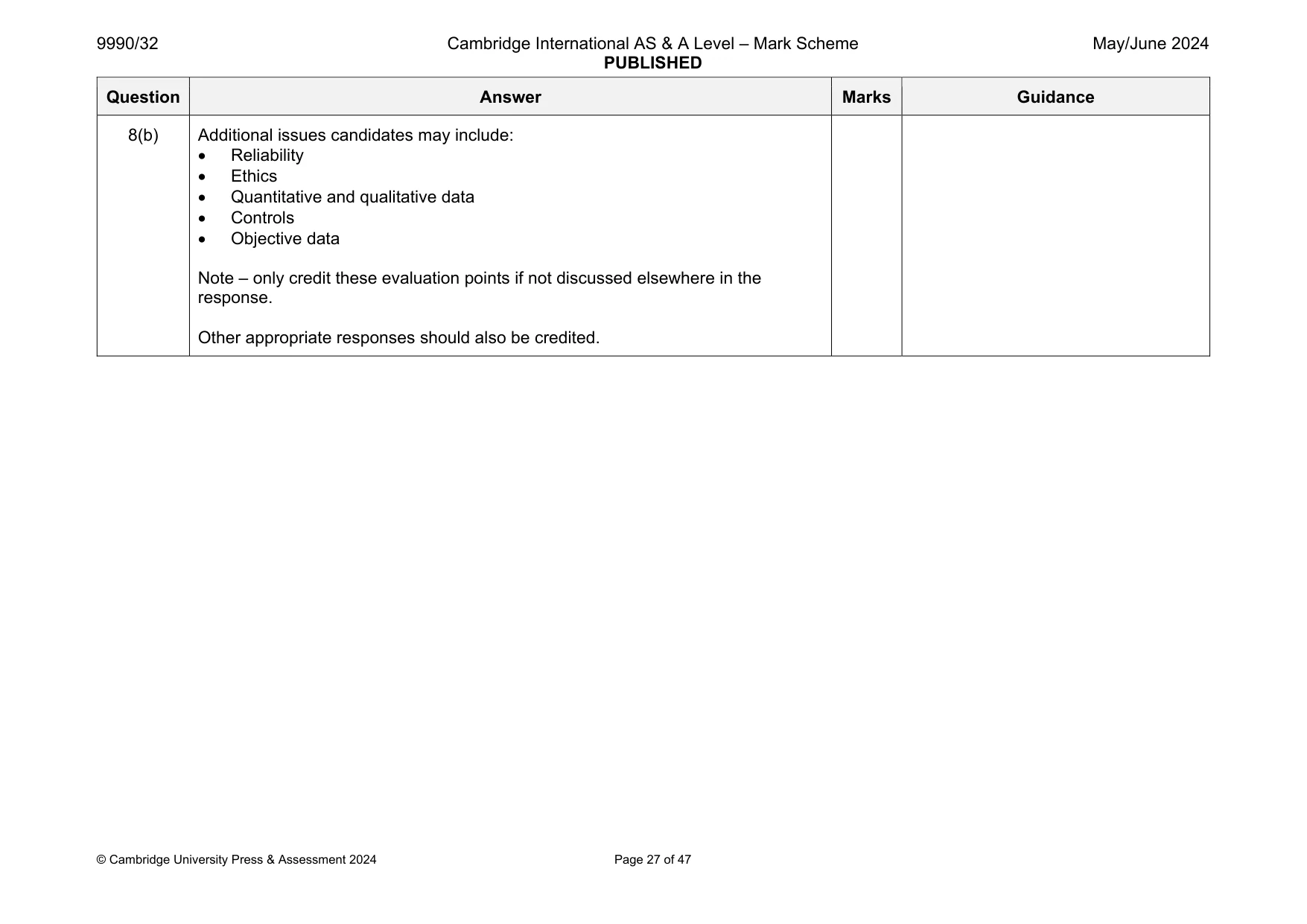
Mark scheme: 8(a) Describe the study by North et al. (2003) on musical style and restaurant customers’ spending. Use Table A: AO1 Knowledge and understanding to mark candidate responses to this question. The response must describe the key study. Details may include: Aim: To investigate the effect different types of music might have on restaurant customer spending. Sample: Opportunity sampling – 393 people, approximately equal numbers of male and female. 142 were exposed to the pop music condition, 120 to the classical and 131 to no music. Method – Field experiment in upmarket/expensive British restaurant with independent measures design. Procedure – Classical, pop and no music were played over 3 weeks/18 evenings (closed on Sundays). Each conditioned counter-balanced by the day of the week. Each type of music played on six different days over the 3 weeks. Mean spend per table was calculated and compared as well as the total time spent in the restaurant. Time spent in restaurant was taken into account/controlled for when calculating the results for the three conditions as the longer the customer is in the restaurant, it is likely their spend will increase. Sample or detail of the restaurant 3 Conditions Result about customer spending with reference to type of music. Question Answer Marks Guidance 8(a) Results: total spend: classical music £32.51; pop music £29.46; no music £29.73. Therefore, playing background classical music leads to increased spending on food and drink. Additionally: (i) There was very little difference in the amount spent on main course or dessert. (ii) The no music condition resulted in greatest spending on wine alone (not what was expected) but if ‘bar’ (all drinks) and ‘wine’ are put together, then spending is the greatest for classical music. (iii) The greatest difference was spending on coffee: classical £1.06, pop £0.80 and no music £0.53. (iv) Also, significant difference in spending on starters: classical £4.92, pop £4.04 and no music £3.93. Conclusion: the playing of background music influences customer spending in a restaurant with classical music resulting in the greatest amount spent per person. Example: Opportunity sample (393) 3 conditions (pop, classical, no music) 3 weeks at upmarket British restaurant Measured amount spent and time in restaurant Classical music had higher spend than pop music/no music Greatest spend in classical for all drinks Greatest spend in classical for coffee Other appropriate responses should also be credited. Question Answer Marks Guidance 8(b) Evaluate this study by North et al., including a discussion about ecological validity. Evaluation in your answer can include strengths, weaknesses and a discussion of issues and debates. Use Table B: AO3 Analysis and evaluation to mark candidate responses to this question. A range of issues could be used for evaluation. These include: Named issue – ecological validity The North et al. study has good ecological validity as it is conducted in the natural environment as a field experiment in a restaurant so the purchasing behaviour by the customers would be natural and it is typical to have music being played when you are eating dinner. In addition, classical/pop music/no music are played in restaurants, so this is an everyday life experience. However, this does mean it has less control of extraneous variables (e.g. whether the restaurant is busy on one day and relatively quiet on another). If the restaurant is very busy, service may be slower and therefore diners might not order dessert. Also they did not appear to get consent or debrief the participants. However, this is not a harmful study as the participants are just being monitored on how much they have spent, and confidentiality is maintained. Individual and situational explanations The findings would suggest the specific situation the person is in (classical music resulting in more spending than pop music or no music) rather than something that is ‘individual’. However, each individual diner will choose the food based on their preferences, budget for the meal, whether it is a special occasion, etc. Therefore, the study does show the situational factor (music) that is influencing the participant, but it is not suggesting that individual factors are irrelevant. 10 Question Answer Marks Guidance 8(b) Reductionism versus holism The study/conclusions reached can be considered to be holistic as North et al. outlines three explanations for the behaviour of the diners (synergy, classical music preferred, classical music promoting upmarket atmosphere – this third conclusion is considered to be the most likely based on previous research). It could also be considered somewhat reductionist as very little qualitative data which could have shed some light on the conclusions reached by North et al. (e.g. if classical music was preferred). Determinism versus free-will The findings of the study suggest that increased spending behaviour determined by the music playing in the background in the environment (environmental determinism). The findings of this study suggest that it is. However, clearly the diners have free-will as they choose their food based on preferences, budget, etc. It is likely that music influenced consumer spending but was not at the exclusion of free-will (i.e. soft, not hard determinism). Generalisations from findings A large number of participants with a mix of genders means the results can be generalised. However, as it was an expensive restaurant it is likely the diners have a high disposable income. It was one restaurant in one city in the UK which limits generalisability of the findings. Validity Good validity as the participants were unaware they were in a study, so their spending was natural. The data collected was mainly quantitative (amount spent) which is objective and improves validity. However, very little qualitative data was collected which lowers validity due to the lack of depth in the results to find out other reasons for the participants spending. Question Answer Marks Guidance 8(b) Additional issues candidates may include: Reliability Ethics Quantitative and qualitative data Controls Objective data Note – only credit these evaluation points if not discussed elsewhere in the response. Other appropriate responses should also be credited.
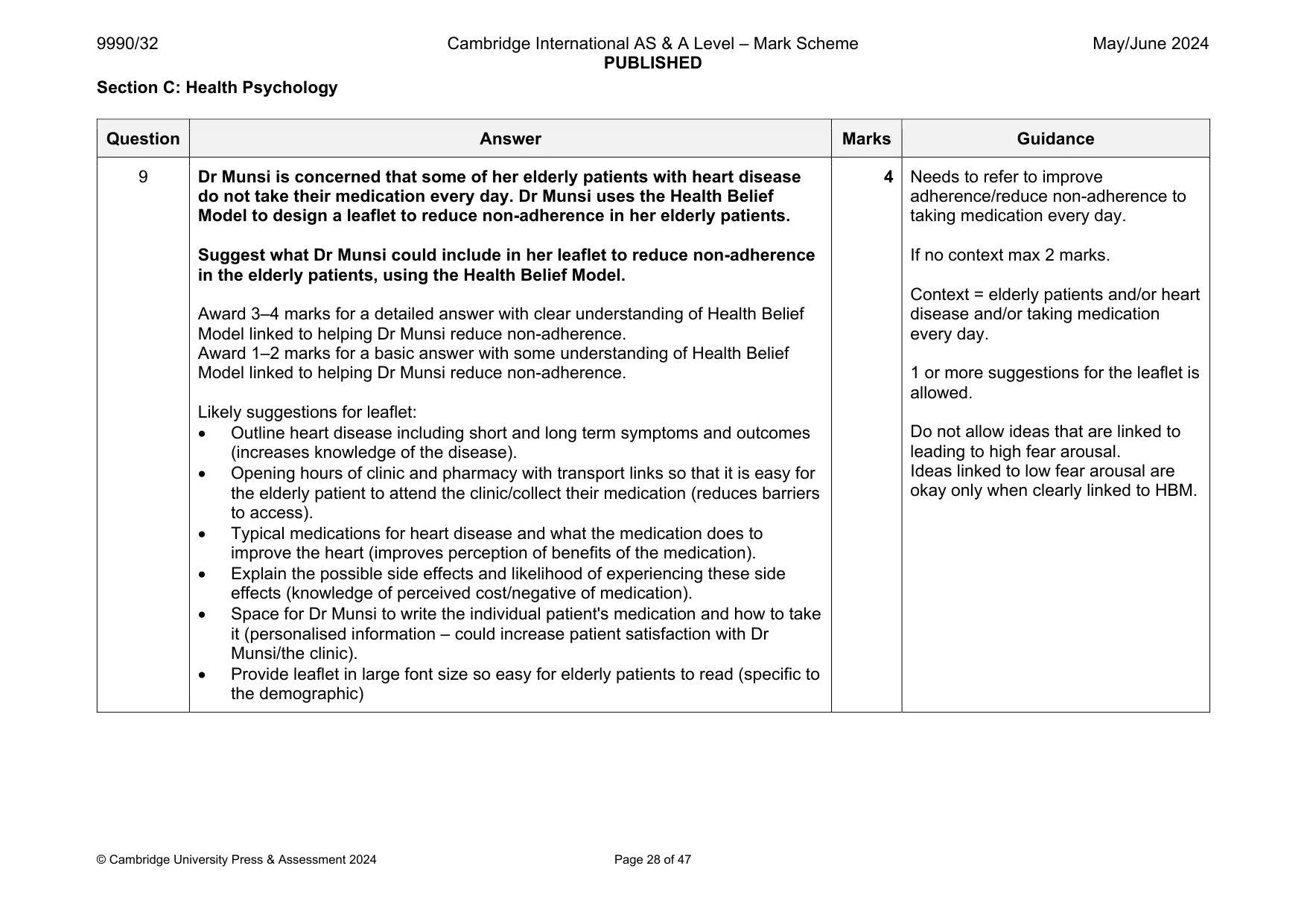
Q9 · Dr Munsi is concerned that some of her elderly patients with heart disease do not take…
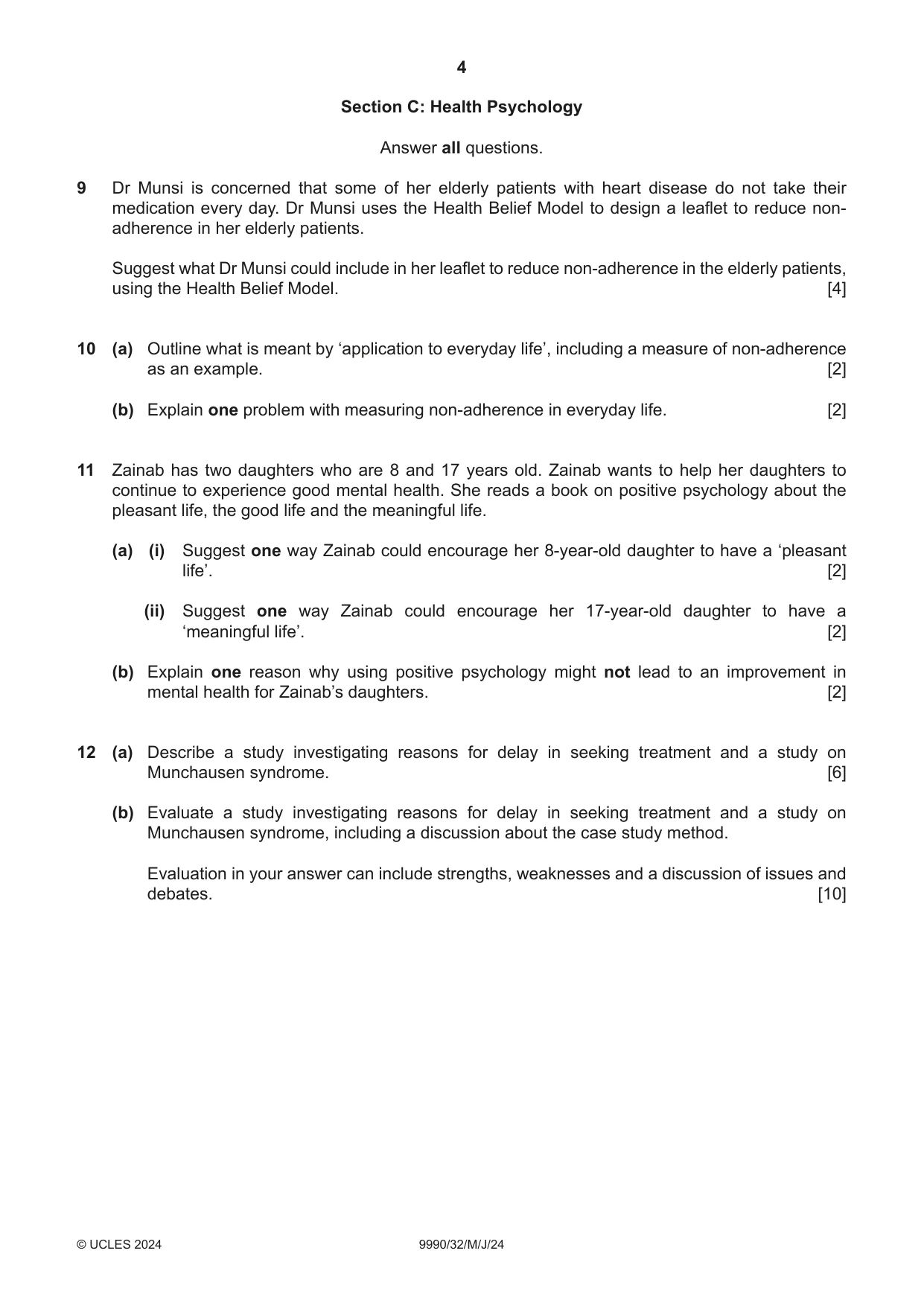
9 Dr Munsi is concerned that some of her elderly patients with heart disease do not take their medication every day. Dr Munsi uses the Health Belief Model to design a leaflet to reduce non- adherence in her elderly patients. Suggest what Dr Munsi could include in her leaflet to reduce non-adherence in the elderly patients, using the Health Belief Model. [4]
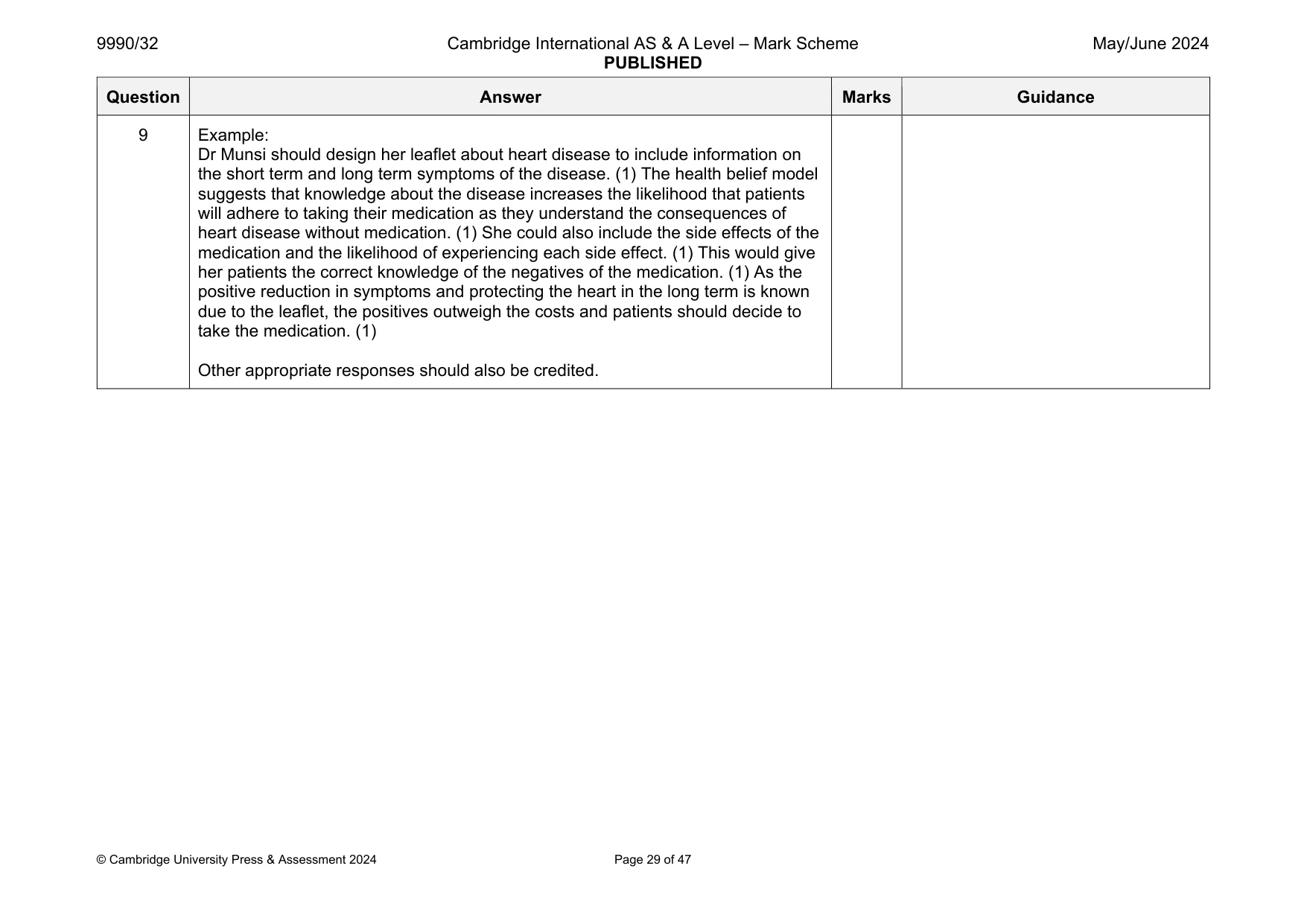
Mark scheme: 9 Dr Munsi is concerned that some of her elderly patients with heart disease do not take their medication every day. Dr Munsi uses the Health Belief Model to design a leaflet to reduce non-adherence in her elderly patients. Suggest what Dr Munsi could include in her leaflet to reduce non-adherence in the elderly patients, using the Health Belief Model. Award 3–4 marks for a detailed answer with clear understanding of Health Belief Model linked to helping Dr Munsi reduce non-adherence. Award 1–2 marks for a basic answer with some understanding of Health Belief Model linked to helping Dr Munsi reduce non-adherence. Likely suggestions for leaflet: Outline heart disease including short and long term symptoms and outcomes (increases knowledge of the disease). Opening hours of clinic and pharmacy with transport links so that it is easy for the elderly patient to attend the clinic/collect their medication (reduces barriers to access). Typical medications for heart disease and what the medication does to improve the heart (improves perception of benefits of the medication). Explain the possible side effects and likelihood of experiencing these side effects (knowledge of perceived cost/negative of medication). Space for Dr Munsi to write the individual patient's medication and how to take it (personalised information – could increase patient satisfaction with Dr Munsi/the clinic). Provide leaflet in large font size so easy for elderly patients to read (specific to the demographic) adherence/reduce non-adherence to taking medication every day. If no context max 2 marks. Context = elderly patients and/or heart disease and/or taking medication every day. 1 or more suggestions for the leaflet is allowed. Do not allow ideas that are linked to leading to high fear arousal. Ideas linked to low fear arousal are okay only when clearly linked to HBM. Question Answer Marks Guidance 9 Example: Dr Munsi should design her leaflet about heart disease to include information on the short term and long term symptoms of the disease. (1) The health belief model suggests that knowledge about the disease increases the likelihood that patients will adhere to taking their medication as they understand the consequences of heart disease without medication. (1) She could also include the side effects of the medication and the likelihood of experiencing each side effect. (1) This would give her patients the correct knowledge of the negatives of the medication. (1) As the positive reduction in symptoms and protecting the heart in the long term is known due to the leaflet, the positives outweigh the costs and patients should decide to take the medication. (1) Other appropriate responses should also be credited.
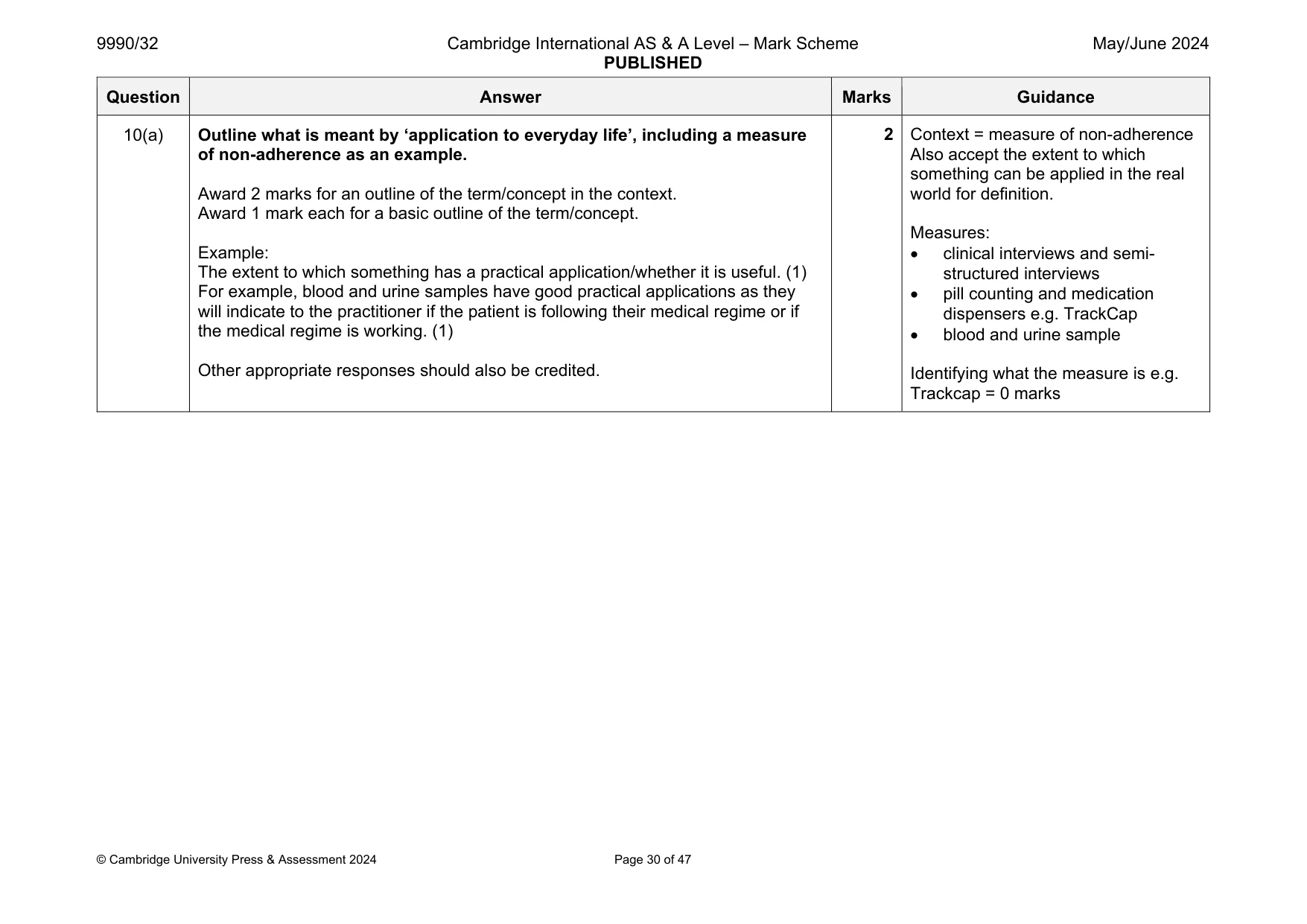
Q10 · Outline what is meant by ‘application to everyday life’, including a measure of…
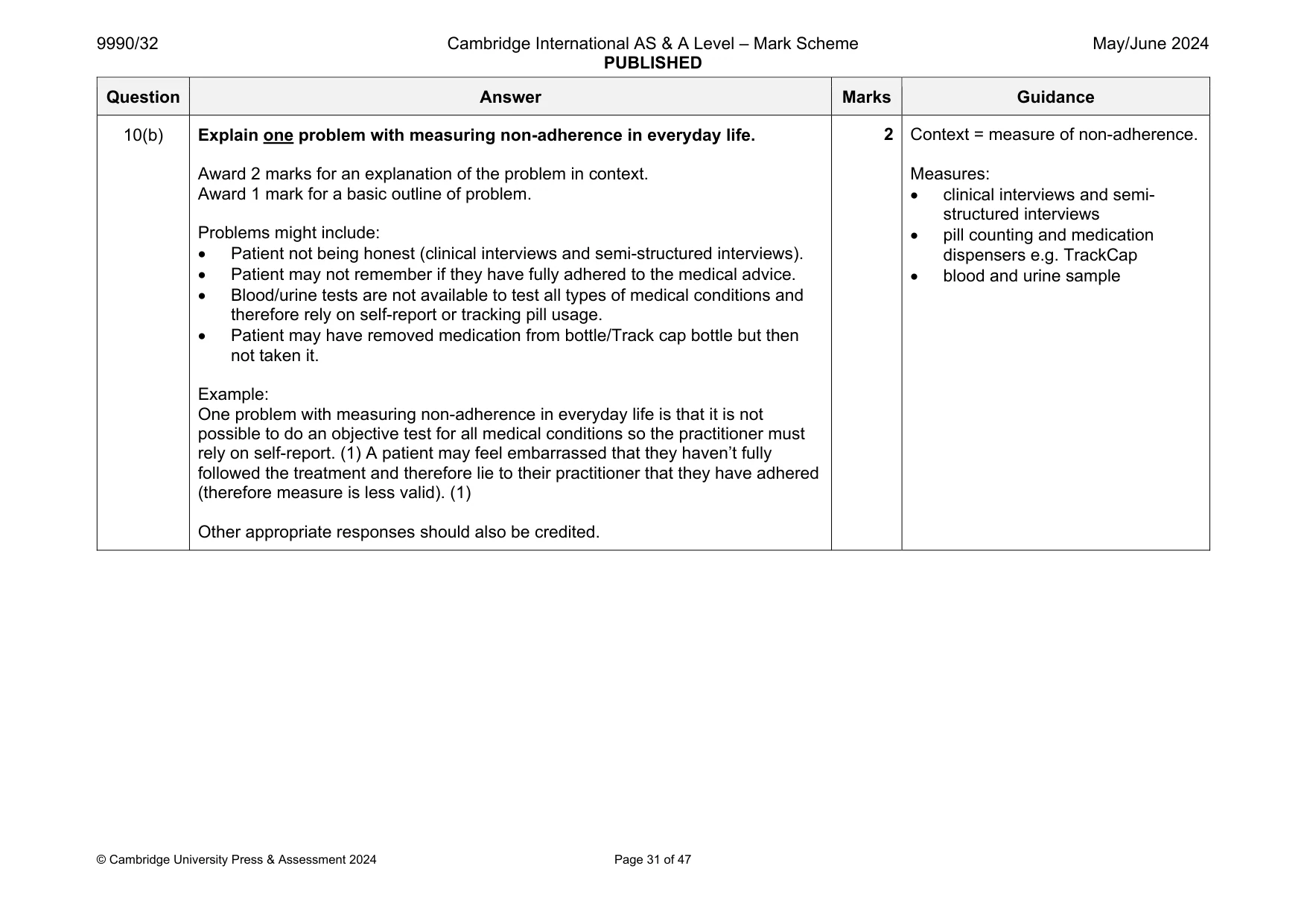
10 (a) Outline what is meant by ‘application to everyday life’, including a measure of non-adherence as an example. [2] (b) Explain one problem with measuring non-adherence in everyday life. [2]
Mark scheme: 10(a) Outline what is meant by ‘application to everyday life’, including a measure of non-adherence as an example. Award 2 marks for an outline of the term/concept in the context. Award 1 mark each for a basic outline of the term/concept. Example: The extent to which something has a practical application/whether it is useful. (1) For example, blood and urine samples have good practical applications as they will indicate to the practitioner if the patient is following their medical regime or if the medical regime is working. (1) Other appropriate responses should also be credited. Also accept the extent to which something can be applied in the real world for definition. Measures: clinical interviews and semi- structured interviews pill counting and medication dispensers e.g. TrackCap blood and urine sample Identifying what the measure is e.g. Trackcap = 0 marks Question Answer Marks Guidance 10(b) Explain one problem with measuring non-adherence in everyday life. Award 2 marks for an explanation of the problem in context. Award 1 mark for a basic outline of problem. Problems might include: Patient not being honest (clinical interviews and semi-structured interviews). Patient may not remember if they have fully adhered to the medical advice. Blood/urine tests are not available to test all types of medical conditions and therefore rely on self-report or tracking pill usage. Patient may have removed medication from bottle/Track cap bottle but then not taken it. Example: One problem with measuring non-adherence in everyday life is that it is not possible to do an objective test for all medical conditions so the practitioner must rely on self-report. (1) A patient may feel embarrassed that they haven’t fully followed the treatment and therefore lie to their practitioner that they have adhered (therefore measure is less valid). (1) Other appropriate responses should also be credited. 2 Context = measure of non-adherence. Measures: clinical interviews and semi- structured interviews pill counting and medication dispensers e.g. TrackCap blood and urine sample
Q11 · Zainab has two daughters who are 8 and 17 years old
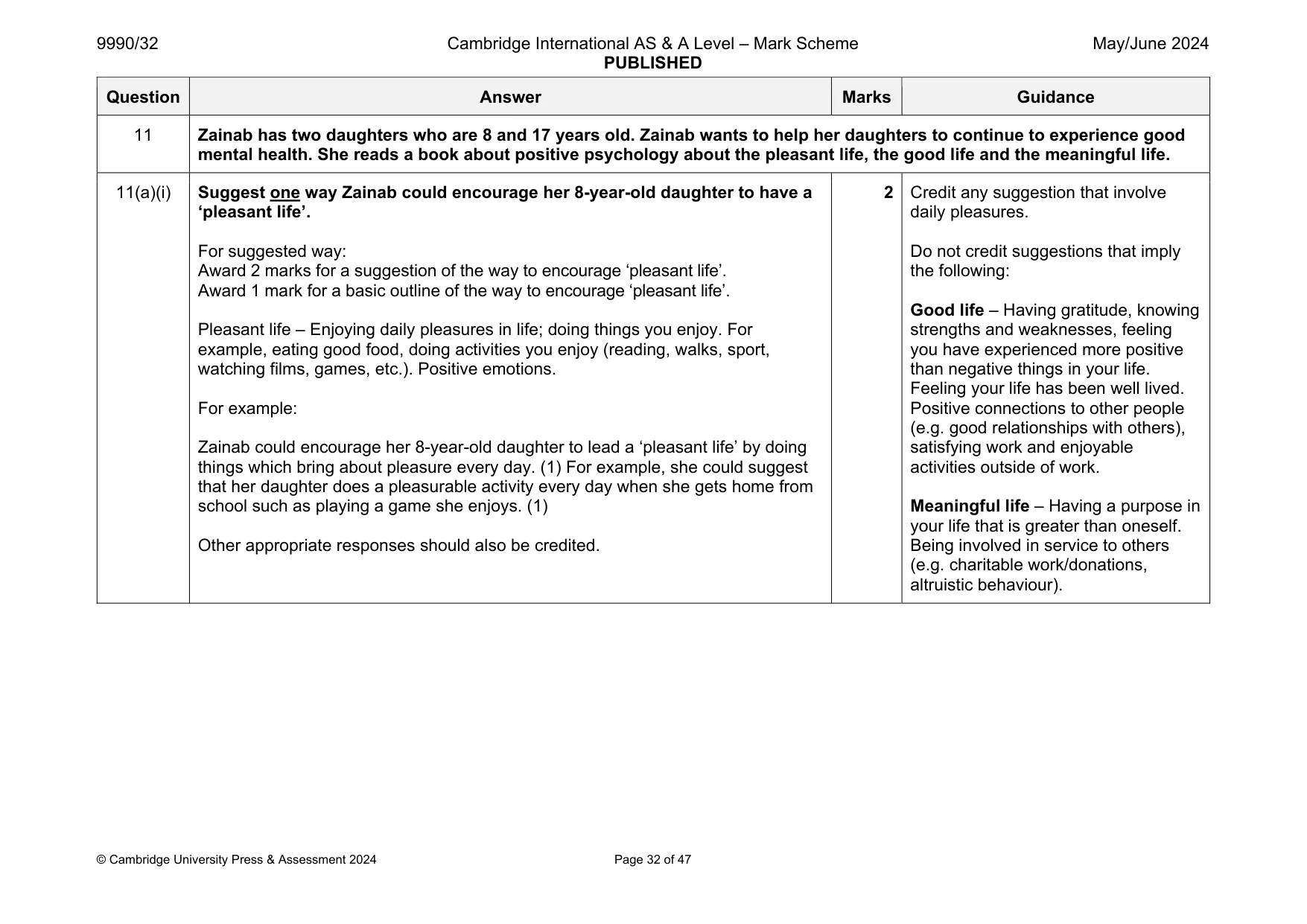
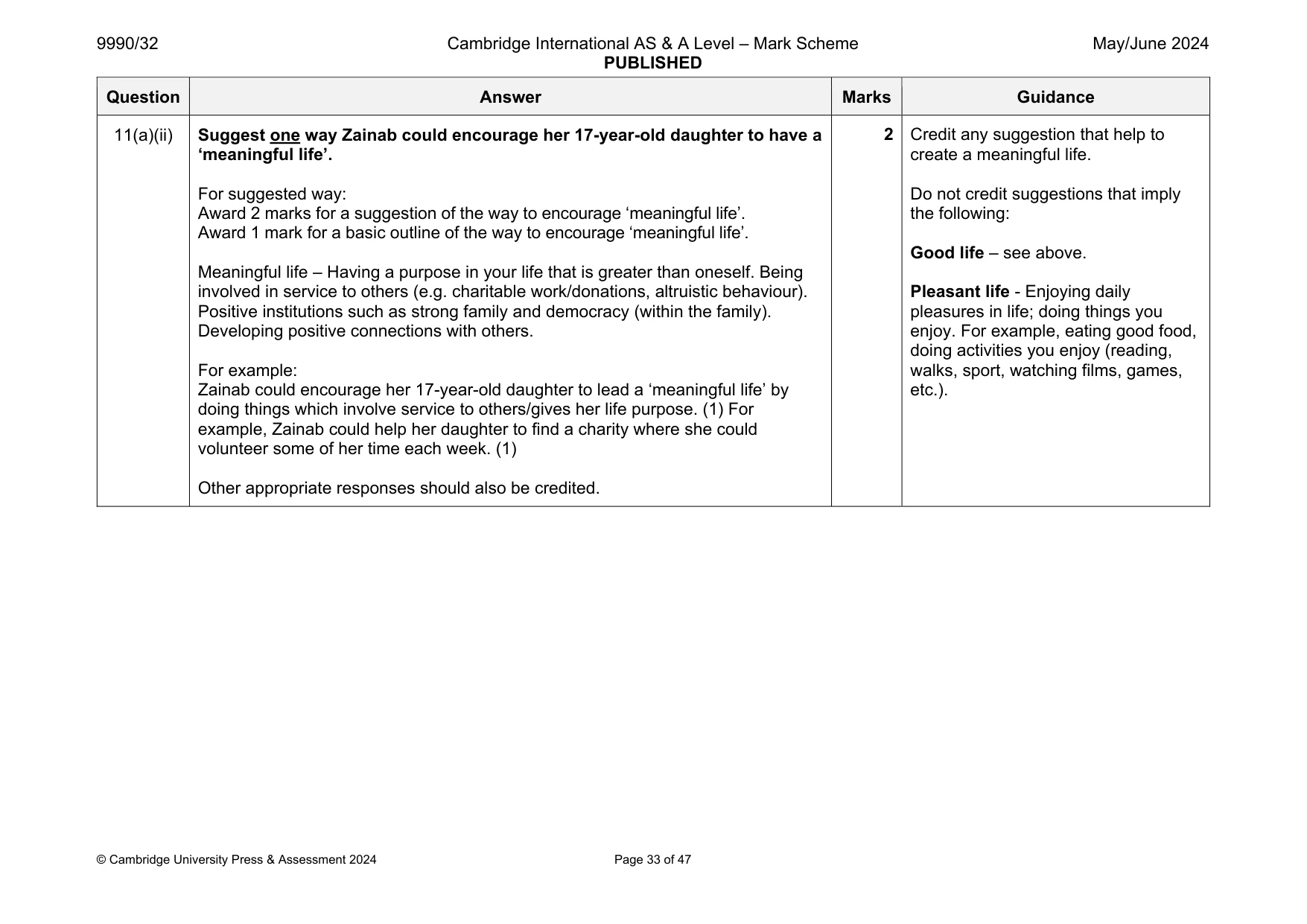
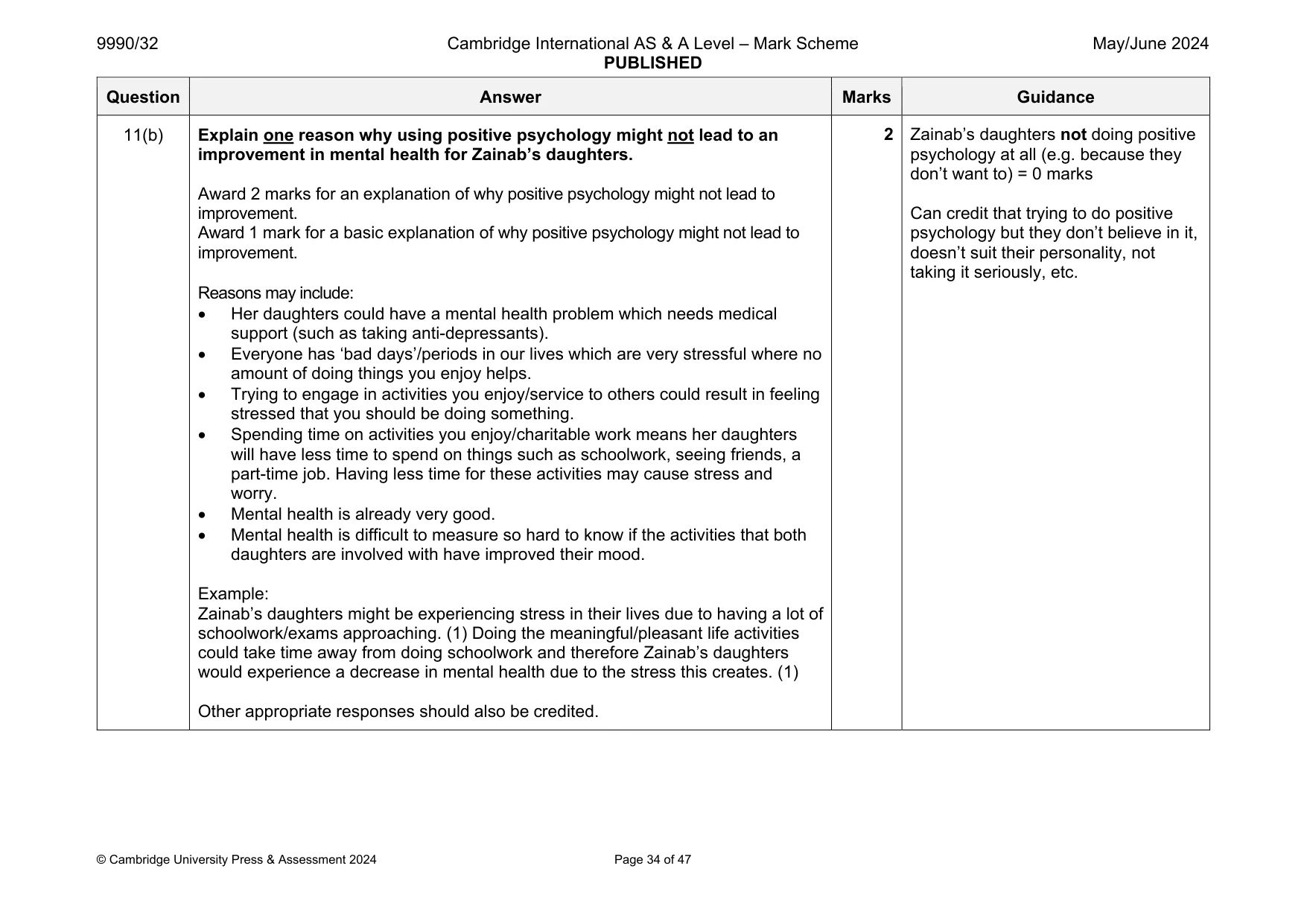
11 Zainab has two daughters who are 8 and 17 years old. Zainab wants to help her daughters to continue to experience good mental health. She reads a book on positive psychology about the pleasant life, the good life and the meaningful life. (a) (i) Suggest one way Zainab could encourage her 8-year-old daughter to have a ‘pleasant life’. [2] (ii) Suggest one way Zainab could encourage her 17-year-old daughter to have a ‘meaningful life’. [2] (b) Explain one reason why using positive psychology might not lead to an improvement in mental health for Zainab’s daughters. [2]
Mark scheme: 11(a)(i) Suggest one way Zainab could encourage her 8-year-old daughter to have a ‘pleasant life’. For suggested way: Award 2 marks for a suggestion of the way to encourage ‘pleasant life’. Award 1 mark for a basic outline of the way to encourage ‘pleasant life’. Pleasant life – Enjoying daily pleasures in life; doing things you enjoy. For example, eating good food, doing activities you enjoy (reading, walks, sport, watching films, games, etc.). Positive emotions. For example: Zainab could encourage her 8-year-old daughter to lead a ‘pleasant life’ by doing things which bring about pleasure every day. (1) For example, she could suggest that her daughter does a pleasurable activity every day when she gets home from school such as playing a game she enjoys. (1) Other appropriate responses should also be credited. daily pleasures. Do not credit suggestions that imply the following: Good life – Having gratitude, knowing strengths and weaknesses, feeling you have experienced more positive than negative things in your life. Feeling your life has been well lived. Positive connections to other people (e.g. good relationships with others), satisfying work and enjoyable activities outside of work. Meaningful life – Having a purpose in your life that is greater than oneself. Being involved in service to others (e.g. charitable work/donations, altruistic behaviour). Question Answer Marks Guidance 11(a)(ii) Suggest one way Zainab could encourage her 17-year-old daughter to have a ‘meaningful life’. For suggested way: Award 2 marks for a suggestion of the way to encourage ‘meaningful life’. Award 1 mark for a basic outline of the way to encourage ‘meaningful life’. Meaningful life – Having a purpose in your life that is greater than oneself. Being involved in service to others (e.g. charitable work/donations, altruistic behaviour). Positive institutions such as strong family and democracy (within the family). Developing positive connections with others. For example: Zainab could encourage her 17-year-old daughter to lead a ‘meaningful life’ by doing things which involve service to others/gives her life purpose. (1) For example, Zainab could help her daughter to find a charity where she could volunteer some of her time each week. (1) Other appropriate responses should also be credited. 2 Credit any suggestion that help to create a meaningful life. Do not credit suggestions that imply the following: Good life – see above. Pleasant life - Enjoying daily pleasures in life; doing things you enjoy. For example, eating good food, doing activities you enjoy (reading, walks, sport, watching films, games, etc.). Question Answer Marks Guidance 11(b) Explain one reason why using positive psychology might not lead to an improvement in mental health for Zainab’s daughters. Award 2 marks for an explanation of why positive psychology might not lead to improvement. Award 1 mark for a basic explanation of why positive psychology might not lead to improvement. Reasons may include: Her daughters could have a mental health problem which needs medical support (such as taking anti-depressants). Everyone has ‘bad days’/periods in our lives which are very stressful where no amount of doing things you enjoy helps. Trying to engage in activities you enjoy/service to others could result in feeling stressed that you should be doing something. Spending time on activities you enjoy/charitable work means her daughters will have less time to spend on things such as schoolwork, seeing friends, a part-time job. Having less time for these activities may cause stress and worry. Mental health is already very good. Mental health is difficult to measure so hard to know if the activities that both daughters are involved with have improved their mood. Example: Zainab’s daughters might be experiencing stress in their lives due to having a lot of schoolwork/exams approaching. (1) Doing the meaningful/pleasant life activities could take time away from doing schoolwork and therefore Zainab’s daughters would experience a decrease in mental health due to the stress this creates. (1) Other appropriate responses should also be credited. 2 Zainab’s daughters not doing positive psychology at all (e.g. because they don’t want to) = 0 marks Can credit that trying to do positive psychology but they don’t believe in it, doesn’t suit their personality, not taking it seriously, etc.
Q12 · Describe a study investigating reasons for delay in seeking treatment and a study on…
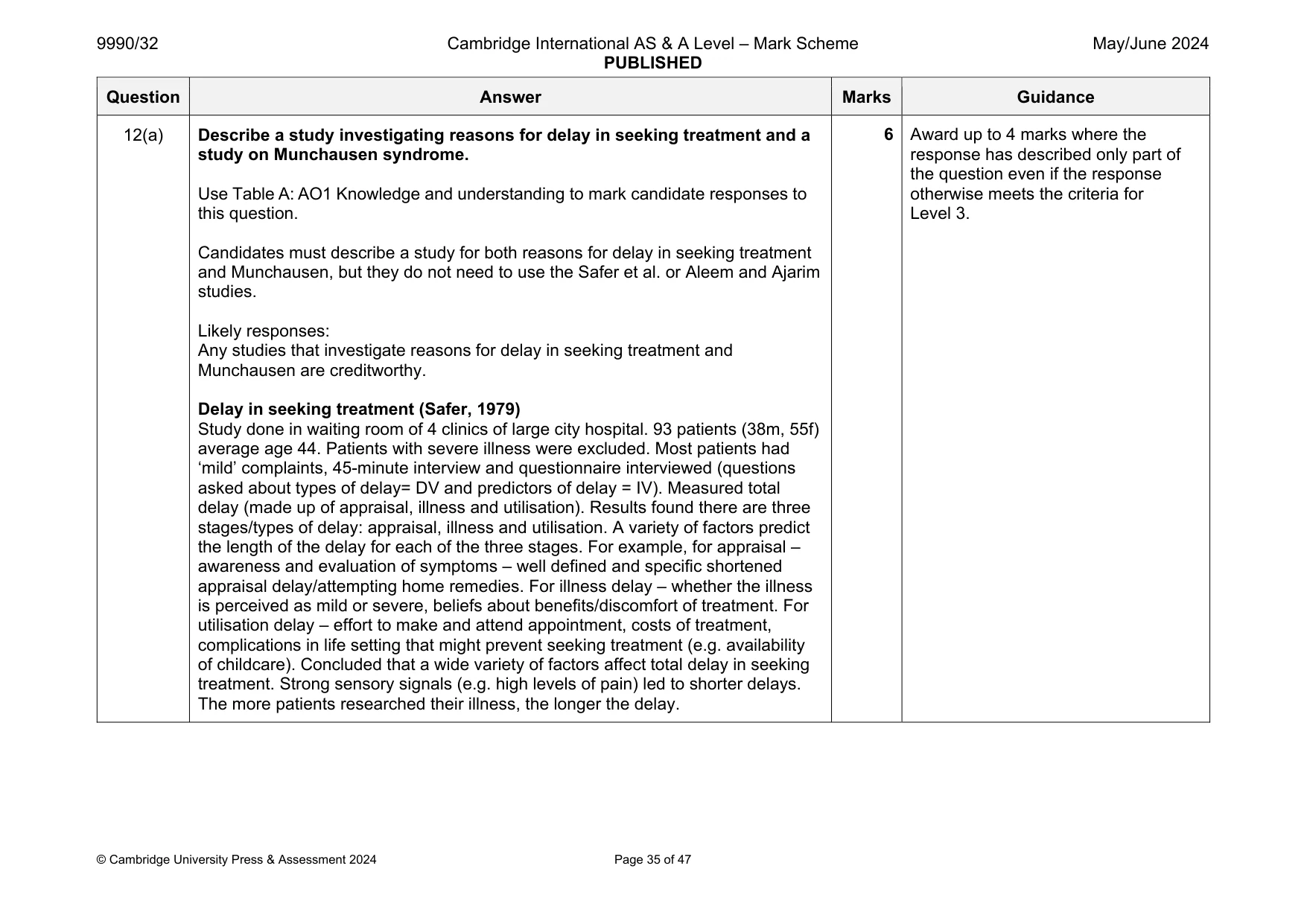
12 (a) Describe a study investigating reasons for delay in seeking treatment and a study on Munchausen syndrome. [6] (b) Evaluate a study investigating reasons for delay in seeking treatment and a study on Munchausen syndrome, including a discussion about the case study method. Evaluation in your answer can include strengths, weaknesses and a discussion of issues and debates. [10] Section D: Organisational Psychology Answer all questions.
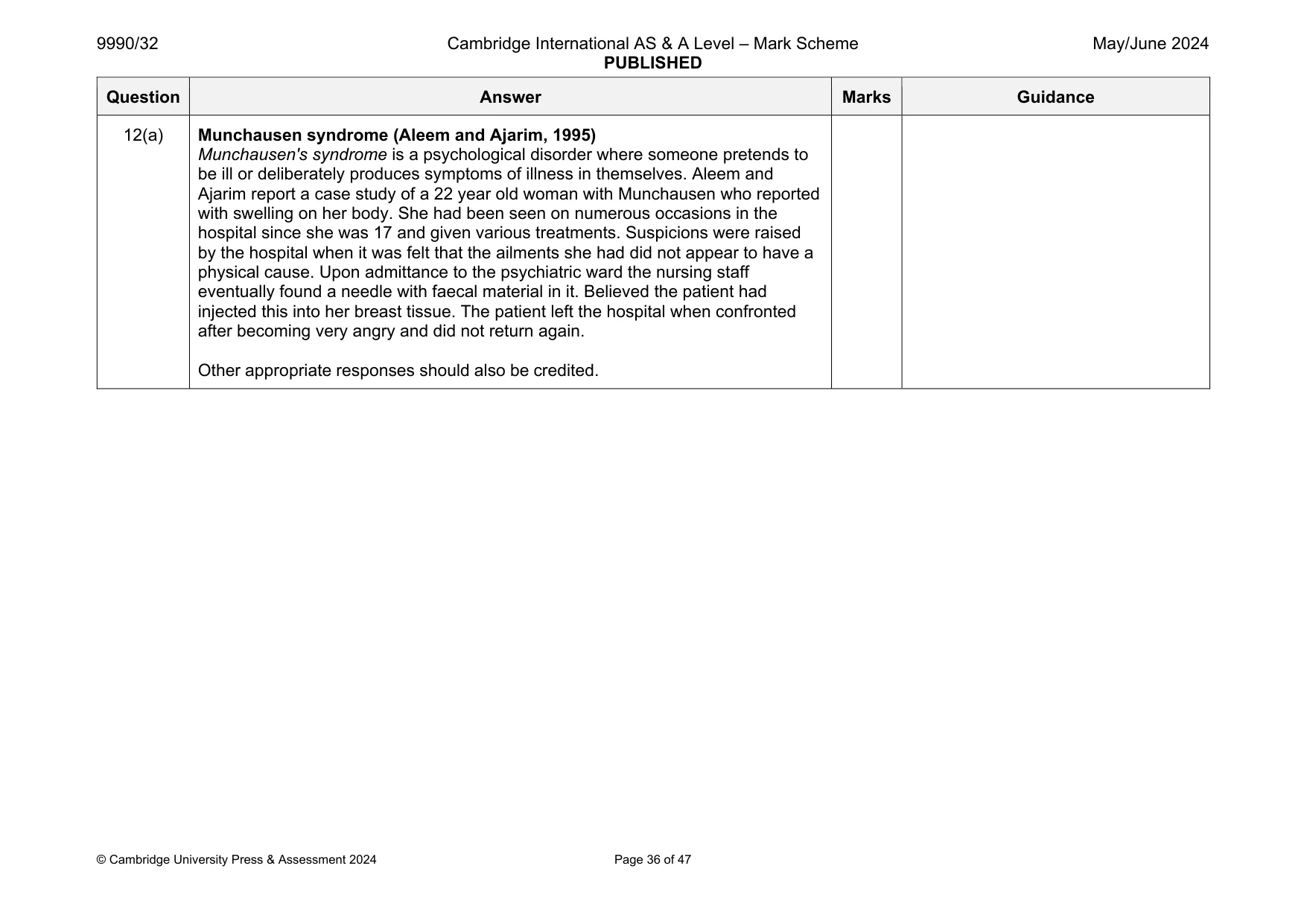
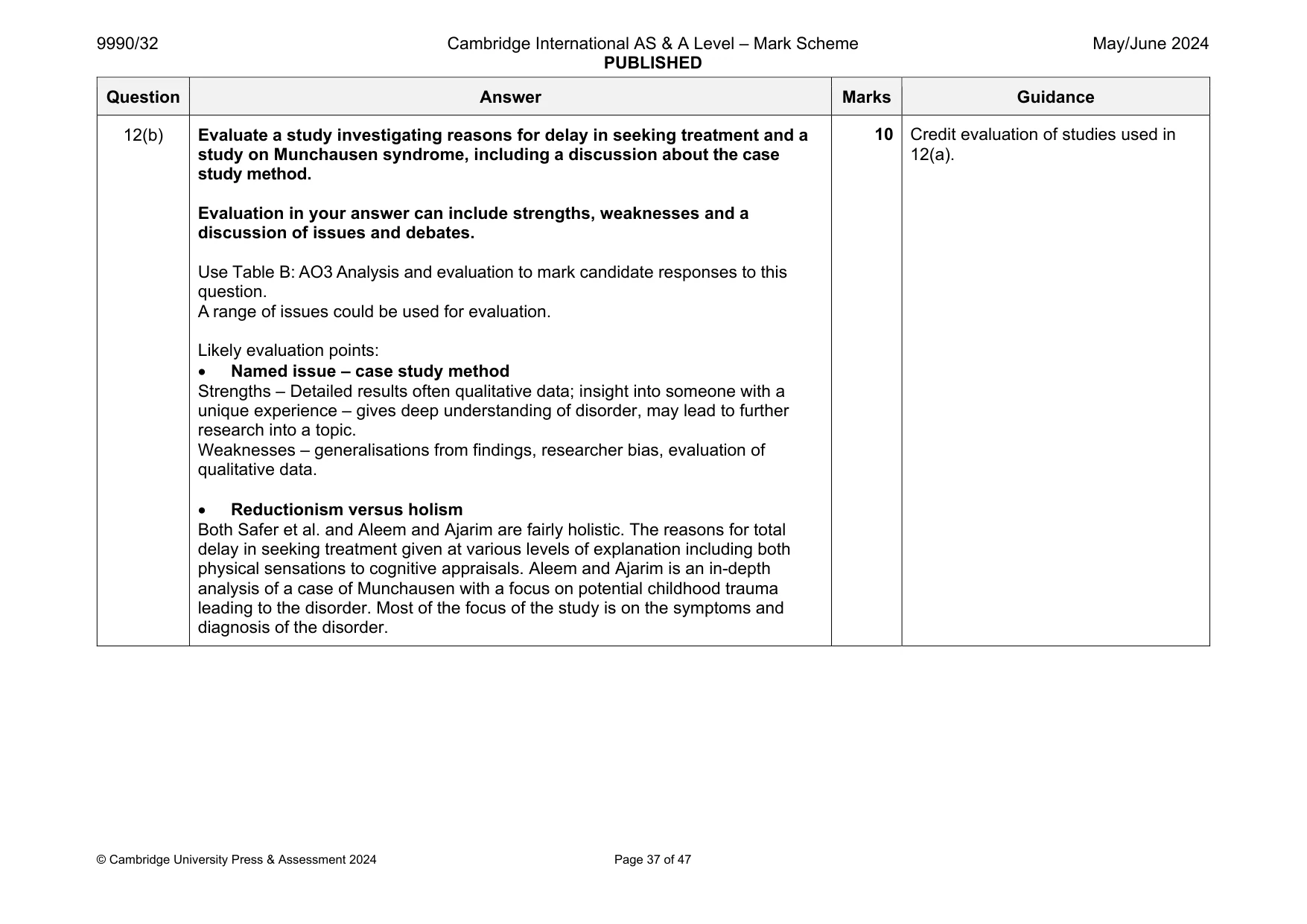
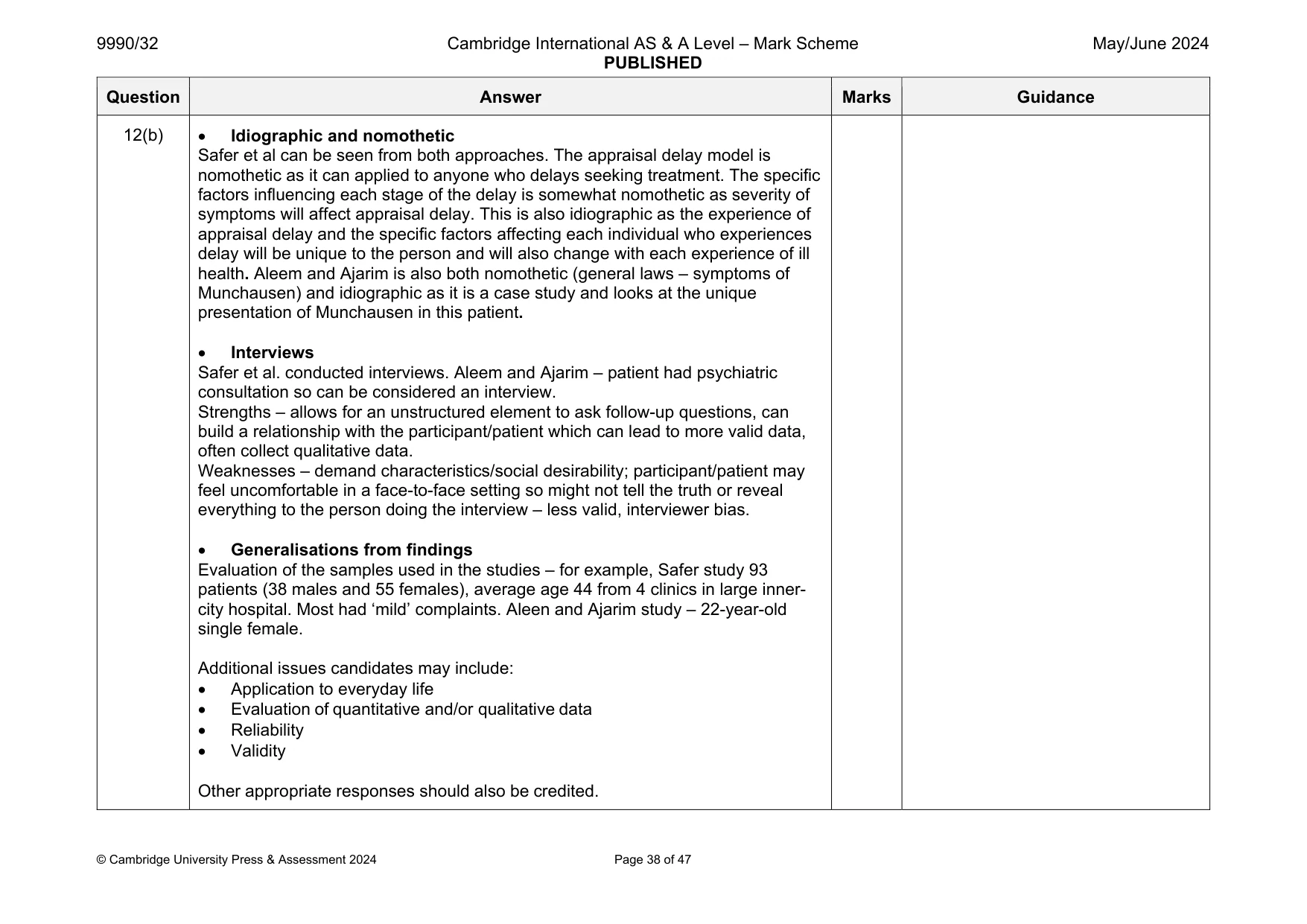
Mark scheme: 12(a) Describe a study investigating reasons for delay in seeking treatment and a study on Munchausen syndrome. Use Table A: AO1 Knowledge and understanding to mark candidate responses to this question. Candidates must describe a study for both reasons for delay in seeking treatment and Munchausen, but they do not need to use the Safer et al. or Aleem and Ajarim studies. Likely responses: Any studies that investigate reasons for delay in seeking treatment and Munchausen are creditworthy. Delay in seeking treatment (Safer, 1979) Study done in waiting room of 4 clinics of large city hospital. 93 patients (38m, 55f) average age 44. Patients with severe illness were excluded. Most patients had ‘mild’ complaints, 45-minute interview and questionnaire interviewed (questions asked about types of delay= DV and predictors of delay = IV). Measured total delay (made up of appraisal, illness and utilisation). Results found there are three stages/types of delay: appraisal, illness and utilisation. A variety of factors predict the length of the delay for each of the three stages. For example, for appraisal – awareness and evaluation of symptoms – well defined and specific shortened appraisal delay/attempting home remedies. For illness delay – whether the illness is perceived as mild or severe, beliefs about benefits/discomfort of treatment. For utilisation delay – effort to make and attend appointment, costs of treatment, complications in life setting that might prevent seeking treatment (e.g. availability of childcare). Concluded that a wide variety of factors affect total delay in seeking treatment. Strong sensory signals (e.g. high levels of pain) led to shorter delays. The more patients researched their illness, the longer the delay. response has described only part of the question even if the response otherwise meets the criteria for Level 3. Question Answer Marks Guidance 12(a) Munchausen syndrome (Aleem and Ajarim, 1995) Munchausen's syndrome is a psychological disorder where someone pretends to be ill or deliberately produces symptoms of illness in themselves. Aleem and Ajarim report a case study of a 22 year old woman with Munchausen who reported with swelling on her body. She had been seen on numerous occasions in the hospital since she was 17 and given various treatments. Suspicions were raised by the hospital when it was felt that the ailments she had did not appear to have a physical cause. Upon admittance to the psychiatric ward the nursing staff eventually found a needle with faecal material in it. Believed the patient had injected this into her breast tissue. The patient left the hospital when confronted after becoming very angry and did not return again. Other appropriate responses should also be credited. Question Answer Marks Guidance 12(b) Evaluate a study investigating reasons for delay in seeking treatment and a study on Munchausen syndrome, including a discussion about the case study method. Evaluation in your answer can include strengths, weaknesses and a discussion of issues and debates. Use Table B: AO3 Analysis and evaluation to mark candidate responses to this question. A range of issues could be used for evaluation. Likely evaluation points: Named issue – case study method Strengths – Detailed results often qualitative data; insight into someone with a unique experience – gives deep understanding of disorder, may lead to further research into a topic. Weaknesses – generalisations from findings, researcher bias, evaluation of qualitative data. Reductionism versus holism Both Safer et al. and Aleem and Ajarim are fairly holistic. The reasons for total delay in seeking treatment given at various levels of explanation including both physical sensations to cognitive appraisals. Aleem and Ajarim is an in-depth analysis of a case of Munchausen with a focus on potential childhood trauma leading to the disorder. Most of the focus of the study is on the symptoms and diagnosis of the disorder. 10 Credit evaluation of studies used in 12(a). Question Answer Marks Guidance 12(b) Idiographic and nomothetic Safer et al can be seen from both approaches. The appraisal delay model is nomothetic as it can applied to anyone who delays seeking treatment. The specific factors influencing each stage of the delay is somewhat nomothetic as severity of symptoms will affect appraisal delay. This is also idiographic as the experience of appraisal delay and the specific factors affecting each individual who experiences delay will be unique to the person and will also change with each experience of ill health. Aleem and Ajarim is also both nomothetic (general laws – symptoms of Munchausen) and idiographic as it is a case study and looks at the unique presentation of Munchausen in this patient. Interviews Safer et al. conducted interviews. Aleem and Ajarim – patient had psychiatric consultation so can be considered an interview. Strengths – allows for an unstructured element to ask follow-up questions, can build a relationship with the participant/patient which can lead to more valid data, often collect qualitative data. Weaknesses – demand characteristics/social desirability; participant/patient may feel uncomfortable in a face-to-face setting so might not tell the truth or reveal everything to the person doing the interview – less valid, interviewer bias. Generalisations from findings Evaluation of the samples used in the studies – for example, Safer study 93 patients (38 males and 55 females), average age 44 from 4 clinics in large inner- city hospital. Most had ‘mild’ complaints. Aleen and Ajarim study – 22-year-old single female. Additional issues candidates may include: Application to everyday life Evaluation of quantitative and/or qualitative data Reliability Validity Other appropriate responses should also be credited.
Q13 · Arjun is being bullied at work by his manager, Tia
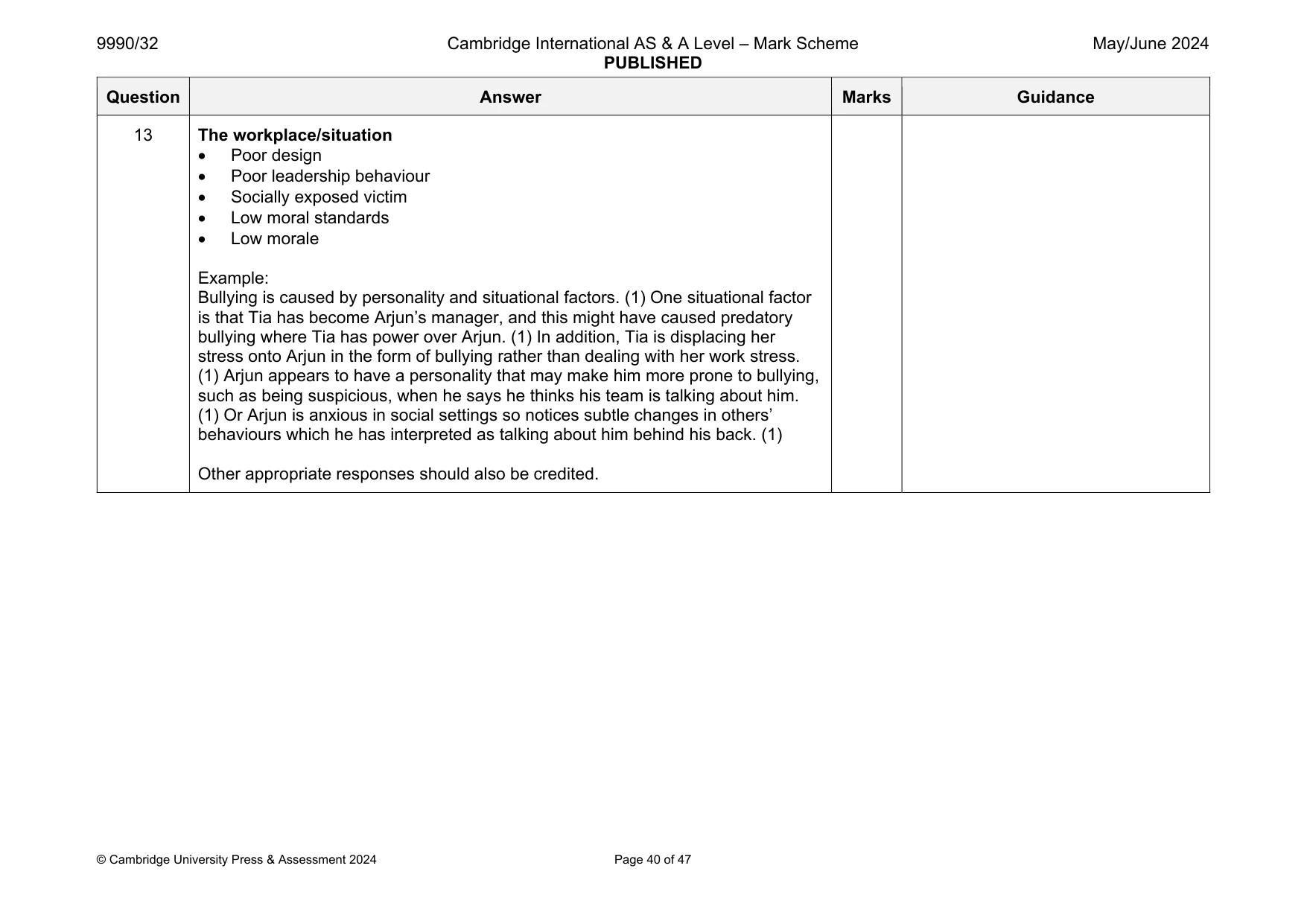
13 Arjun is being bullied at work by his manager, Tia. When Arjun is interviewed about the bullying, he says it started when Tia was promoted to manager. Tia can become stressed at work and this increases the bullying. Arjun worries about the bullying all the time and thinks that Tia is encouraging his team to talk to others about him. Suggest why Tia is bullying Arjun, using your knowledge of the causes of bullying at work. [4]
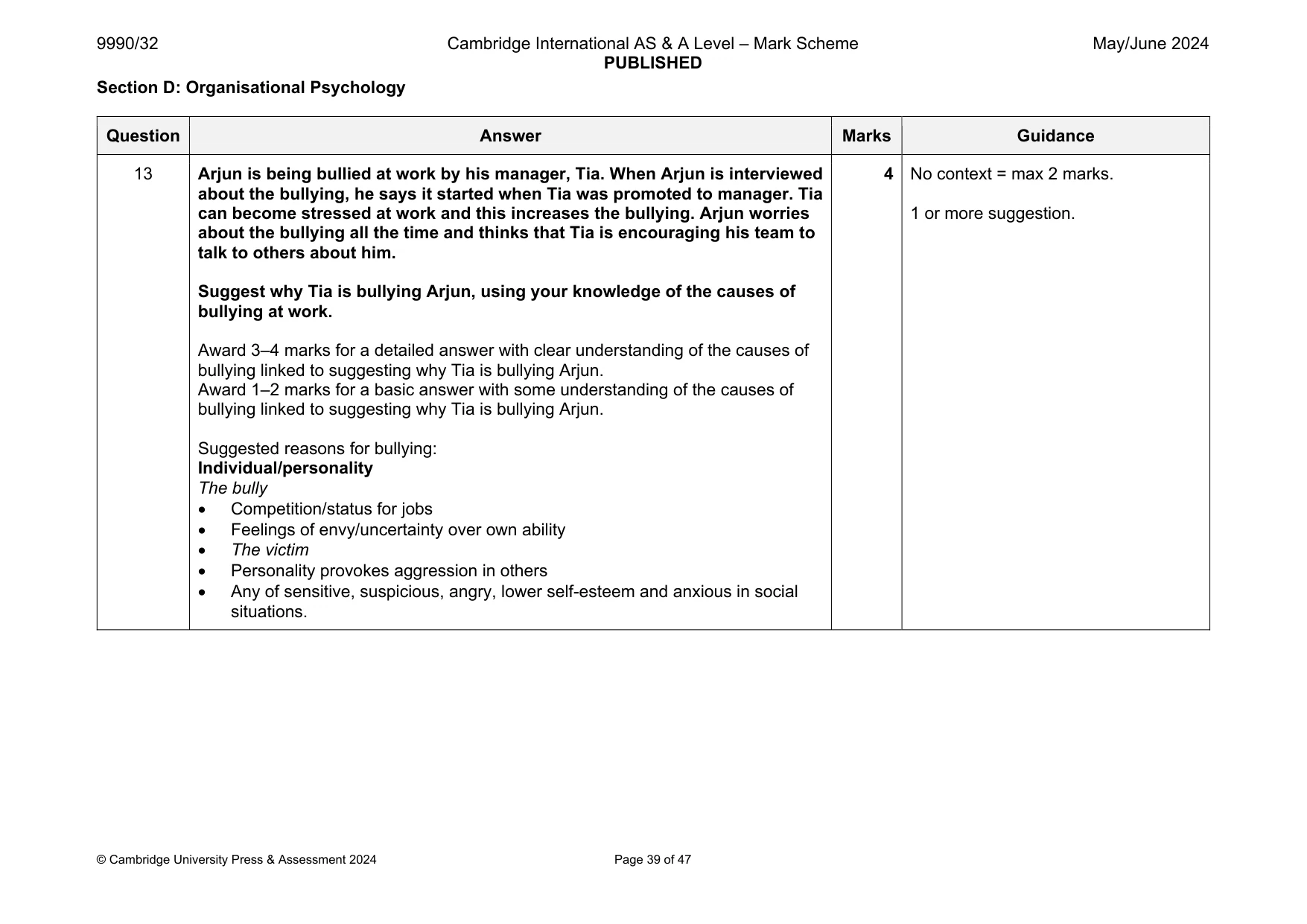
Mark scheme: 13 Arjun is being bullied at work by his manager, Tia. When Arjun is interviewed about the bullying, he says it started when Tia was promoted to manager. Tia can become stressed at work and this increases the bullying. Arjun worries about the bullying all the time and thinks that Tia is encouraging his team to talk to others about him. Suggest why Tia is bullying Arjun, using your knowledge of the causes of bullying at work. Award 3–4 marks for a detailed answer with clear understanding of the causes of bullying linked to suggesting why Tia is bullying Arjun. Award 1–2 marks for a basic answer with some understanding of the causes of bullying linked to suggesting why Tia is bullying Arjun. Suggested reasons for bullying: Individual/personality The bully Competition/status for jobs Feelings of envy/uncertainty over own ability The victim Personality provokes aggression in others Any of sensitive, suspicious, angry, lower self-esteem and anxious in social situations. 1 or more suggestion. Question Answer Marks Guidance 13 The workplace/situation Poor design Poor leadership behaviour Socially exposed victim Low moral standards Low morale Example: Bullying is caused by personality and situational factors. (1) One situational factor is that Tia has become Arjun’s manager, and this might have caused predatory bullying where Tia has power over Arjun. (1) In addition, Tia is displacing her stress onto Arjun in the form of bullying rather than dealing with her work stress. (1) Arjun appears to have a personality that may make him more prone to bullying, such as being suspicious, when he says he thinks his team is talking about him. (1) Or Arjun is anxious in social settings so notices subtle changes in others’ behaviours which he has interpreted as talking about him behind his back. (1) Other appropriate responses should also be credited.
Q14 · Outline Herzberg’s two factor theory of job satisfaction
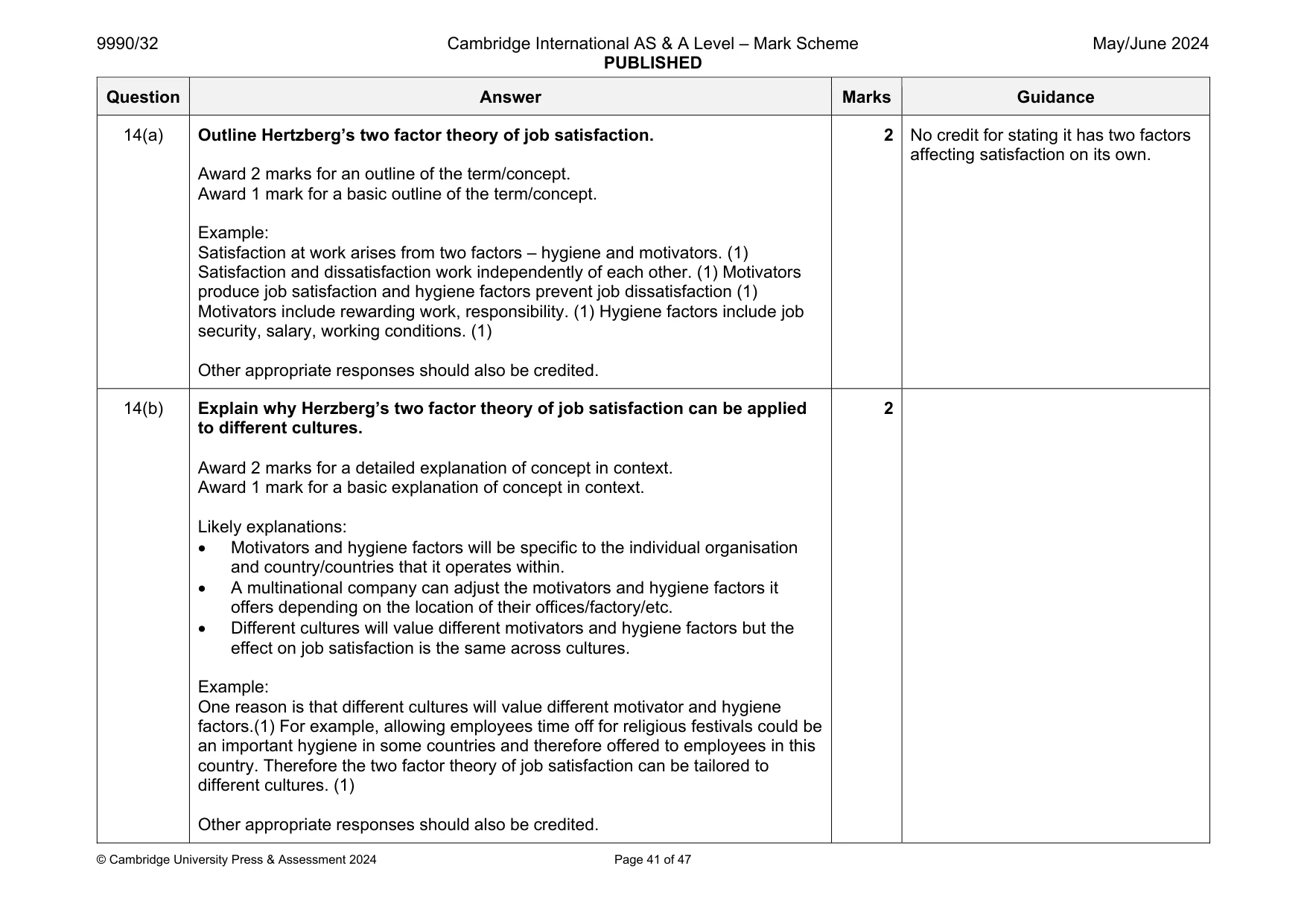
14 (a) Outline Herzberg’s two factor theory of job satisfaction. [2] (b) Explain why Herzberg’s two factor theory of job satisfaction can be applied to different cultures. [2]
Mark scheme: 14(a) Outline Hertzberg’s two factor theory of job satisfaction. Award 2 marks for an outline of the term/concept. Award 1 mark for a basic outline of the term/concept. Example: Satisfaction at work arises from two factors – hygiene and motivators. (1) Satisfaction and dissatisfaction work independently of each other. (1) Motivators produce job satisfaction and hygiene factors prevent job dissatisfaction (1) Motivators include rewarding work, responsibility. (1) Hygiene factors include job security, salary, working conditions. (1) Other appropriate responses should also be credited. 2 No credit for stating it has two factors affecting satisfaction on its own. 14(b) Explain why Herzberg’s two factor theory of job satisfaction can be applied to different cultures. Award 2 marks for a detailed explanation of concept in context. Award 1 mark for a basic explanation of concept in context. Likely explanations: Motivators and hygiene factors will be specific to the individual organisation and country/countries that it operates within. A multinational company can adjust the motivators and hygiene factors it offers depending on the location of their offices/factory/etc. Different cultures will value different motivators and hygiene factors but the effect on job satisfaction is the same across cultures. Example: One reason is that different cultures will value different motivator and hygiene factors.(1) For example, allowing employees time off for religious festivals could be an important hygiene in some countries and therefore offered to employees in this country. Therefore the two factor theory of job satisfaction can be tailored to different cultures. (1) Other appropriate responses should also be credited. 2
Q15 · Sally manages the production line of a toy factory
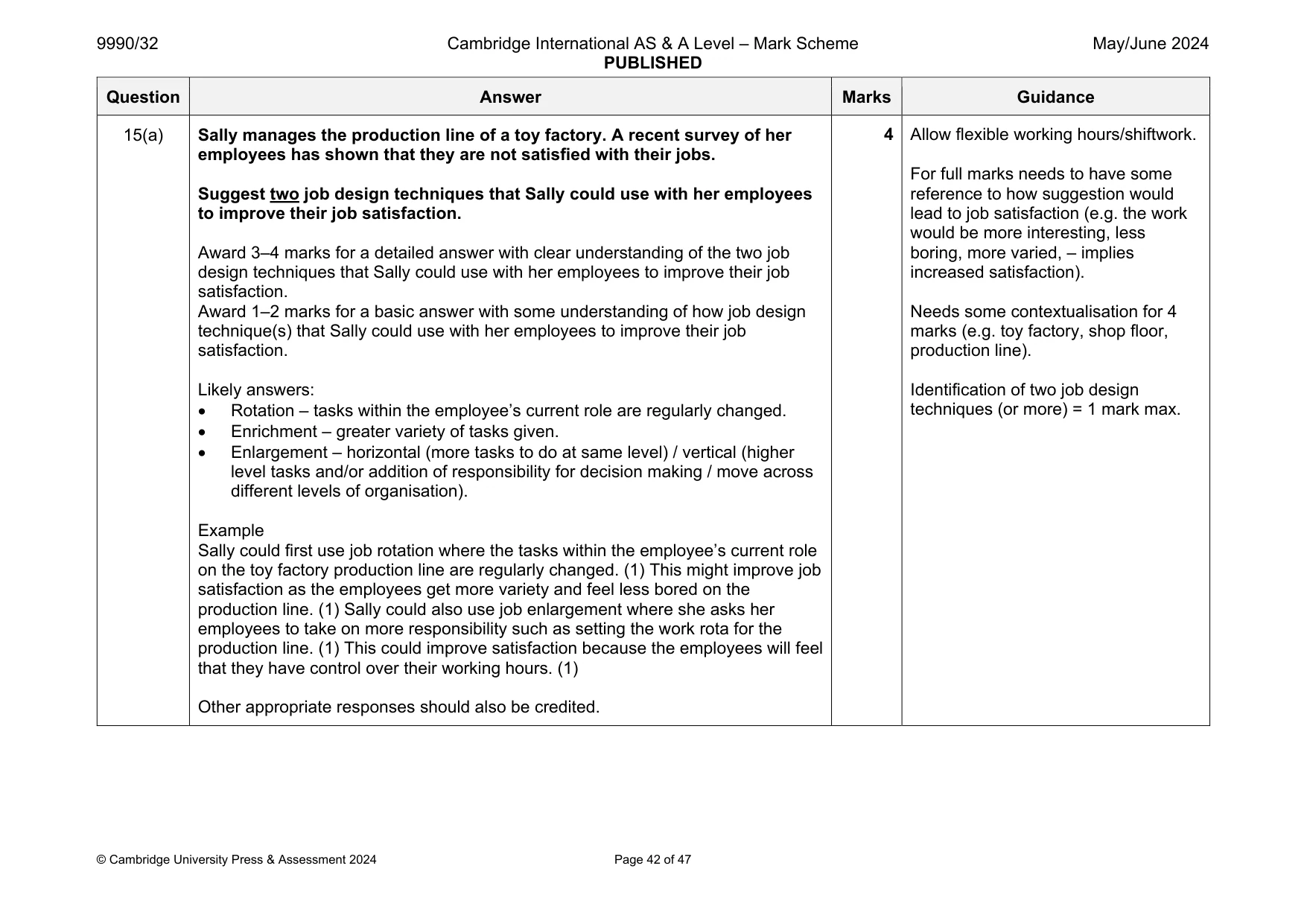
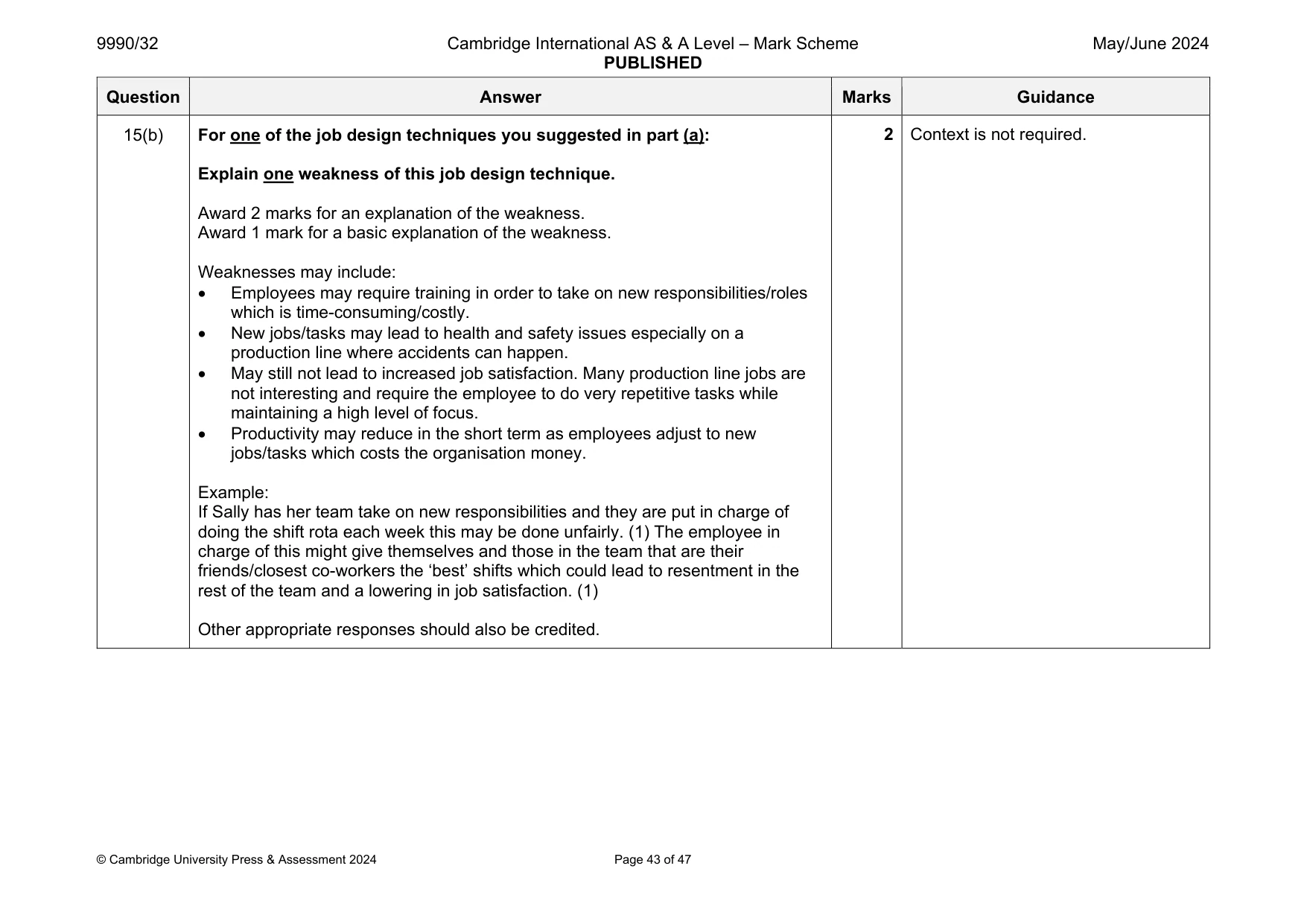
15 (a) Sally manages the production line of a toy factory. A recent survey of her employees has shown that they are not satisfied with their jobs. Suggest two job design techniques that Sally could use with her employees to improve their job satisfaction. [4] (b) For one of the job design techniques you suggested in part (a): Explain one weakness of this job design technique. [2]
Mark scheme: 15(a) Sally manages the production line of a toy factory. A recent survey of her employees has shown that they are not satisfied with their jobs. Suggest two job design techniques that Sally could use with her employees to improve their job satisfaction. Award 3–4 marks for a detailed answer with clear understanding of the two job design techniques that Sally could use with her employees to improve their job satisfaction. Award 1–2 marks for a basic answer with some understanding of how job design technique(s) that Sally could use with her employees to improve their job satisfaction. Likely answers: Rotation – tasks within the employee’s current role are regularly changed. Enrichment – greater variety of tasks given. Enlargement – horizontal (more tasks to do at same level) / vertical (higher level tasks and/or addition of responsibility for decision making / move across different levels of organisation). Example Sally could first use job rotation where the tasks within the employee’s current role on the toy factory production line are regularly changed. (1) This might improve job satisfaction as the employees get more variety and feel less bored on the production line. (1) Sally could also use job enlargement where she asks her employees to take on more responsibility such as setting the work rota for the production line. (1) This could improve satisfaction because the employees will feel that they have control over their working hours. (1) Other appropriate responses should also be credited. For full marks needs to have some reference to how suggestion would lead to job satisfaction (e.g. the work would be more interesting, less boring, more varied, – implies increased satisfaction). Needs some contextualisation for 4 marks (e.g. toy factory, shop floor, production line). Identification of two job design techniques (or more) = 1 mark max. Question Answer Marks Guidance 15(b) For one of the job design techniques you suggested in part (a): Explain one weakness of this job design technique. Award 2 marks for an explanation of the weakness. Award 1 mark for a basic explanation of the weakness. Weaknesses may include: Employees may require training in order to take on new responsibilities/roles which is time-consuming/costly. New jobs/tasks may lead to health and safety issues especially on a production line where accidents can happen. May still not lead to increased job satisfaction. Many production line jobs are not interesting and require the employee to do very repetitive tasks while maintaining a high level of focus. Productivity may reduce in the short term as employees adjust to new jobs/tasks which costs the organisation money. Example: If Sally has her team take on new responsibilities and they are put in charge of doing the shift rota each week this may be done unfairly. (1) The employee in charge of this might give themselves and those in the team that are their friends/closest co-workers the ‘best’ shifts which could lead to resentment in the rest of the team and a lowering in job satisfaction. (1) Other appropriate responses should also be credited. 2 Context is not required.
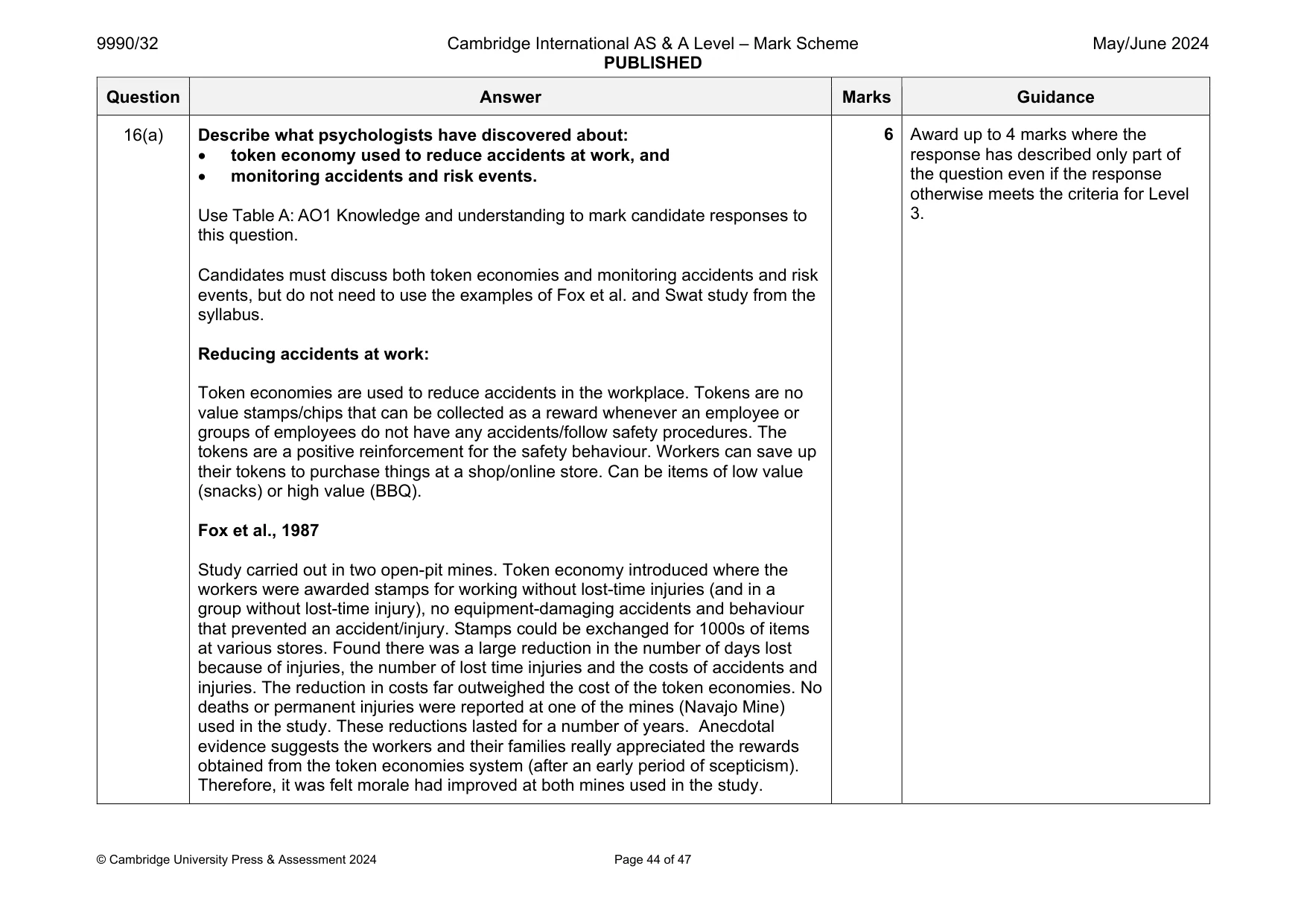
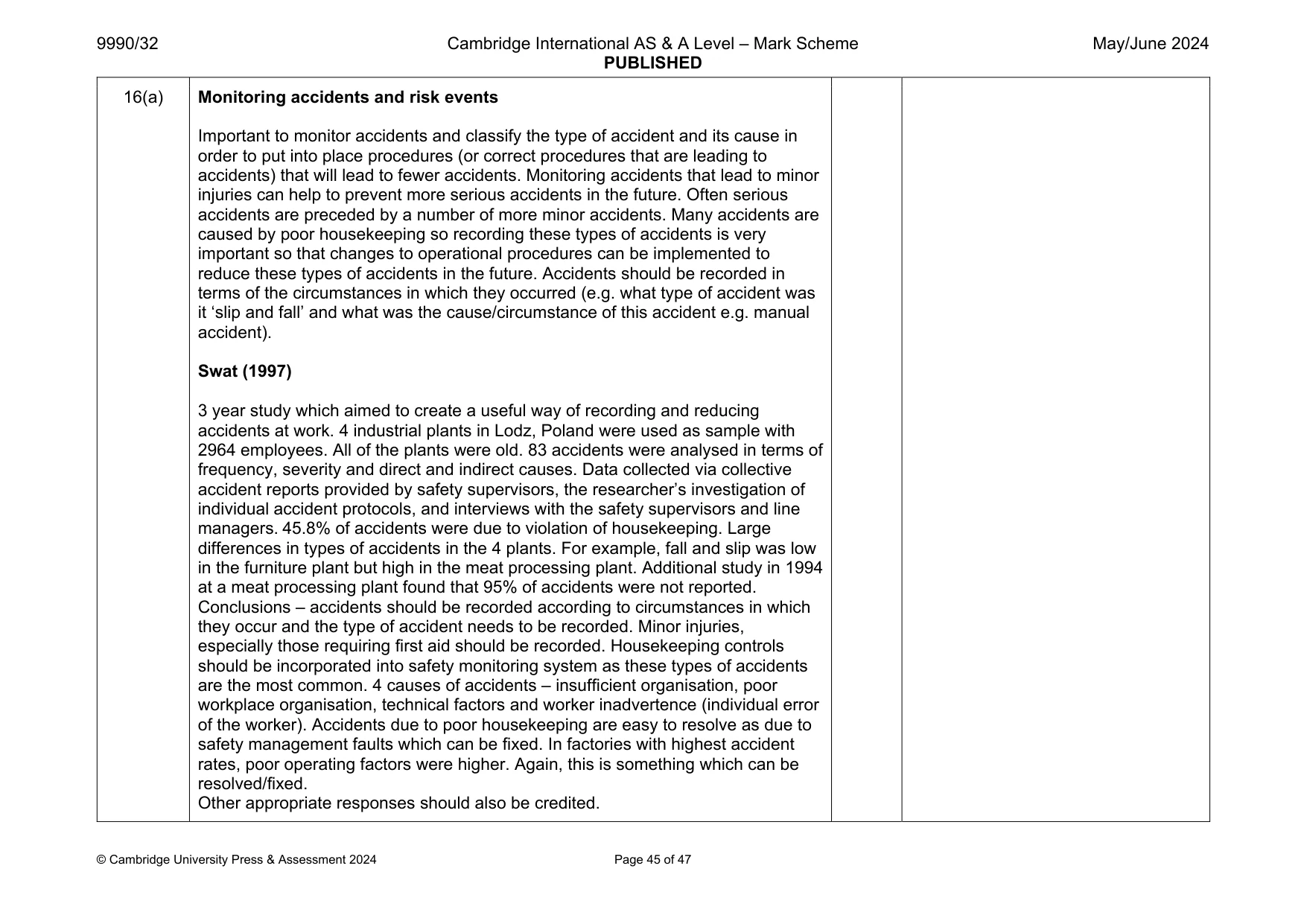
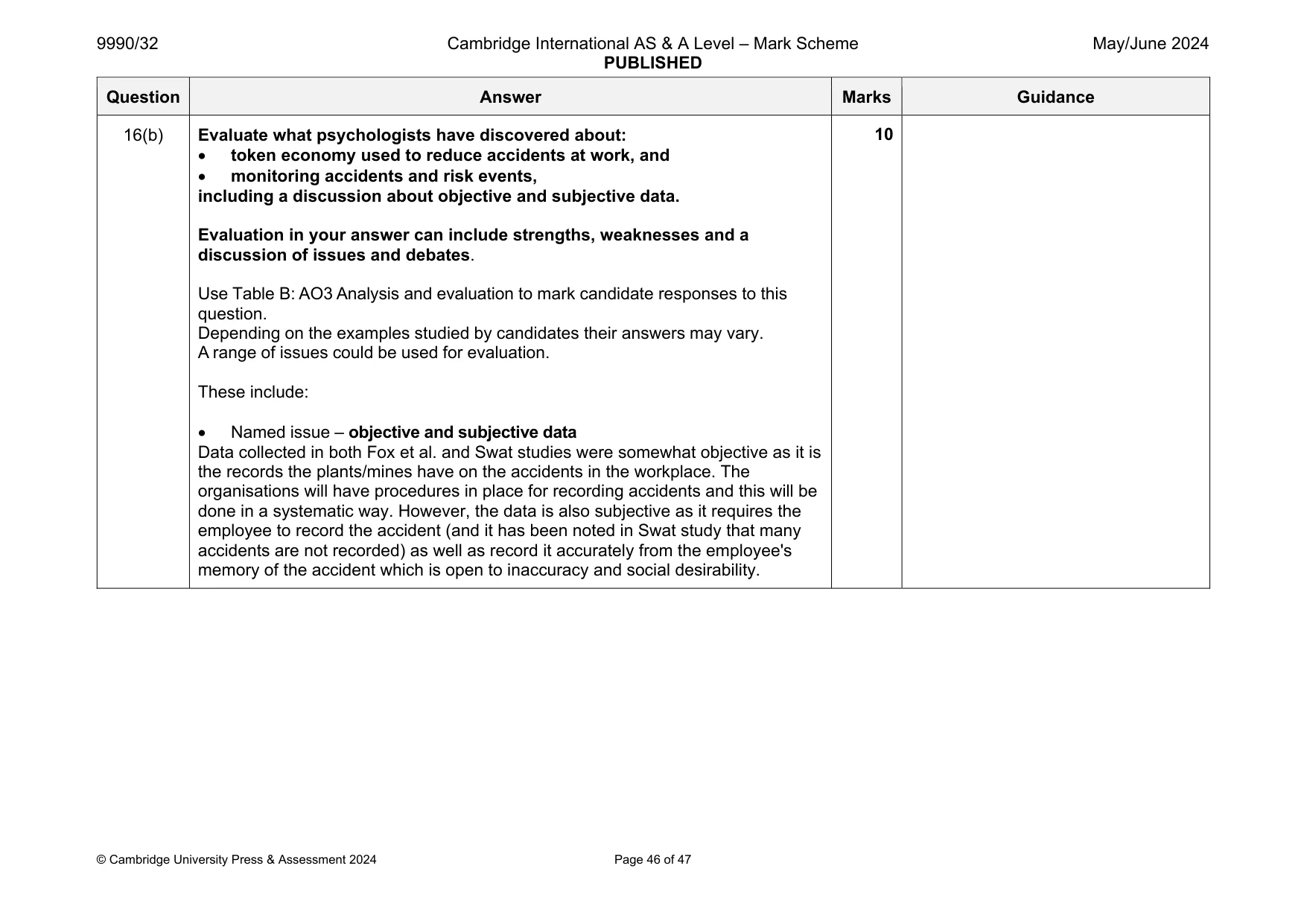
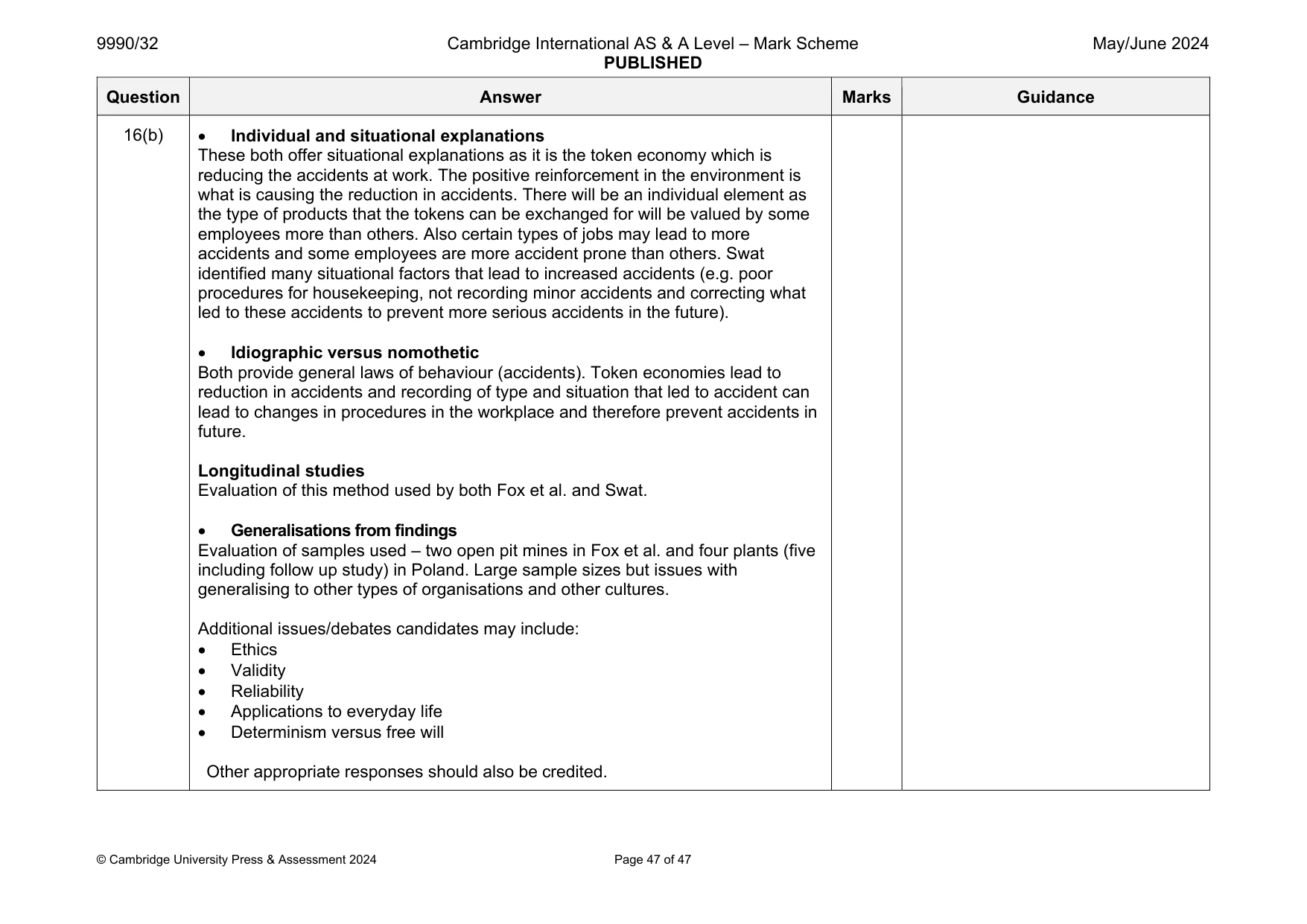
Q16 · Describe what psychologists have discovered about: • token economy used to reduce…
16 (a) Describe what psychologists have discovered about: • token economy used to reduce accidents at work, and • monitoring accidents and risk events. [6] (b) Evaluate what psychologists have discovered about: • token economy used to reduce accidents at work, and • monitoring accidents and risk events, including a discussion about objective and subjective data. Evaluation in your answer can include strengths, weaknesses and a discussion of issues and debates. [10]
Mark scheme: 16(a) Describe what psychologists have discovered about: token economy used to reduce accidents at work, and monitoring accidents and risk events. Use Table A: AO1 Knowledge and understanding to mark candidate responses to this question. Candidates must discuss both token economies and monitoring accidents and risk events, but do not need to use the examples of Fox et al. and Swat study from the syllabus. Reducing accidents at work: Token economies are used to reduce accidents in the workplace. Tokens are no value stamps/chips that can be collected as a reward whenever an employee or groups of employees do not have any accidents/follow safety procedures. The tokens are a positive reinforcement for the safety behaviour. Workers can save up their tokens to purchase things at a shop/online store. Can be items of low value (snacks) or high value (BBQ). Fox et al., 1987 Study carried out in two open-pit mines. Token economy introduced where the workers were awarded stamps for working without lost-time injuries (and in a group without lost-time injury), no equipment-damaging accidents and behaviour that prevented an accident/injury. Stamps could be exchanged for 1000s of items at various stores. Found there was a large reduction in the number of days lost because of injuries, the number of lost time injuries and the costs of accidents and injuries. The reduction in costs far outweighed the cost of the token economies. No deaths or permanent injuries were reported at one of the mines (Navajo Mine) used in the study. These reductions lasted for a number of years. Anecdotal evidence suggests the workers and their families really appreciated the rewards obtained from the token economies system (after an early period of scepticism). Therefore, it was felt morale had improved at both mines used in the study. response has described only part of the question even if the response otherwise meets the criteria for Level 3. 16(a) Monitoring accidents and risk events Important to monitor accidents and classify the type of accident and its cause in order to put into place procedures (or correct procedures that are leading to accidents) that will lead to fewer accidents. Monitoring accidents that lead to minor injuries can help to prevent more serious accidents in the future. Often serious accidents are preceded by a number of more minor accidents. Many accidents are caused by poor housekeeping so recording these types of accidents is very important so that changes to operational procedures can be implemented to reduce these types of accidents in the future. Accidents should be recorded in terms of the circumstances in which they occurred (e.g. what type of accident was it ‘slip and fall’ and what was the cause/circumstance of this accident e.g. manual accident). Swat (1997) 3 year study which aimed to create a useful way of recording and reducing accidents at work. 4 industrial plants in Lodz, Poland were used as sample with 2964 employees. All of the plants were old. 83 accidents were analysed in terms of frequency, severity and direct and indirect causes. Data collected via collective accident reports provided by safety supervisors, the researcher’s investigation of individual accident protocols, and interviews with the safety supervisors and line managers. 45.8% of accidents were due to violation of housekeeping. Large differences in types of accidents in the 4 plants. For example, fall and slip was low in the furniture plant but high in the meat processing plant. Additional study in 1994 at a meat processing plant found that 95% of accidents were not reported. Conclusions – accidents should be recorded according to circumstances in which they occur and the type of accident needs to be recorded. Minor injuries, especially those requiring first aid should be recorded. Housekeeping controls should be incorporated into safety monitoring system as these types of accidents are the most common. 4 causes of accidents – insufficient organisation, poor workplace organisation, technical factors and worker inadvertence (individual error of the worker). Accidents due to poor housekeeping are easy to resolve as due to safety management faults which can be fixed. In factories with highest accident rates, poor operating factors were higher. Again, this is something which can be resolved/fixed. Other appropriate responses should also be credited. Question Answer Marks Guidance 16(b) Evaluate what psychologists have discovered about: token economy used to reduce accidents at work, and monitoring accidents and risk events, including a discussion about objective and subjective data. Evaluation in your answer can include strengths, weaknesses and a discussion of issues and debates. Use Table B: AO3 Analysis and evaluation to mark candidate responses to this question. Depending on the examples studied by candidates their answers may vary. A range of issues could be used for evaluation. These include: Named issue – objective and subjective data Data collected in both Fox et al. and Swat studies were somewhat objective as it is the records the plants/mines have on the accidents in the workplace. The organisations will have procedures in place for recording accidents and this will be done in a systematic way. However, the data is also subjective as it requires the employee to record the accident (and it has been noted in Swat study that many accidents are not recorded) as well as record it accurately from the employee's memory of the accident which is open to inaccuracy and social desirability. 10 Question Answer Marks Guidance 16(b) Individual and situational explanations These both offer situational explanations as it is the token economy which is reducing the accidents at work. The positive reinforcement in the environment is what is causing the reduction in accidents. There will be an individual element as the type of products that the tokens can be exchanged for will be valued by some employees more than others. Also certain types of jobs may lead to more accidents and some employees are more accident prone than others. Swat identified many situational factors that lead to increased accidents (e.g. poor procedures for housekeeping, not recording minor accidents and correcting what led to these accidents to prevent more serious accidents in the future). Idiographic versus nomothetic Both provide general laws of behaviour (accidents). Token economies lead to reduction in accidents and recording of type and situation that led to accident can lead to changes in procedures in the workplace and therefore prevent accidents in future. Longitudinal studies Evaluation of this method used by both Fox et al. and Swat. Generalisations from findings Evaluation of samples used – two open pit mines in Fox et al. and four plants (five including follow up study) in Poland. Large sample sizes but issues with generalising to other types of organisations and other cultures. Additional issues/debates candidates may include: Ethics Validity Reliability Applications to everyday life Determinism versus free will Other appropriate responses should also be credited.
What was in this paper
The subtopics covered by these 16 questions, and how many questions each got. Open one in a new tab to see every Cambridge question on it.
What you needed in this session
Cambridge’s own grade thresholds for 2024 May/June, Paper 3 · Variant 2. A higher threshold means an easier paper — the bar moves with how the cohort did.