Cambridge A Level Psychology (from 2018) 9990 — 2018 May/June Paper 3 · Variant 2
9990/32/M/J/18 · 8 questions · 60 marks · ≈68 min
The question paper and its mark scheme, free to read here and free to download. This is Cambridge’s own paper, exactly as it was sat.
Question paper4 pages

Mark scheme22 pages
Answers below. Sit the paper first if you are practising.
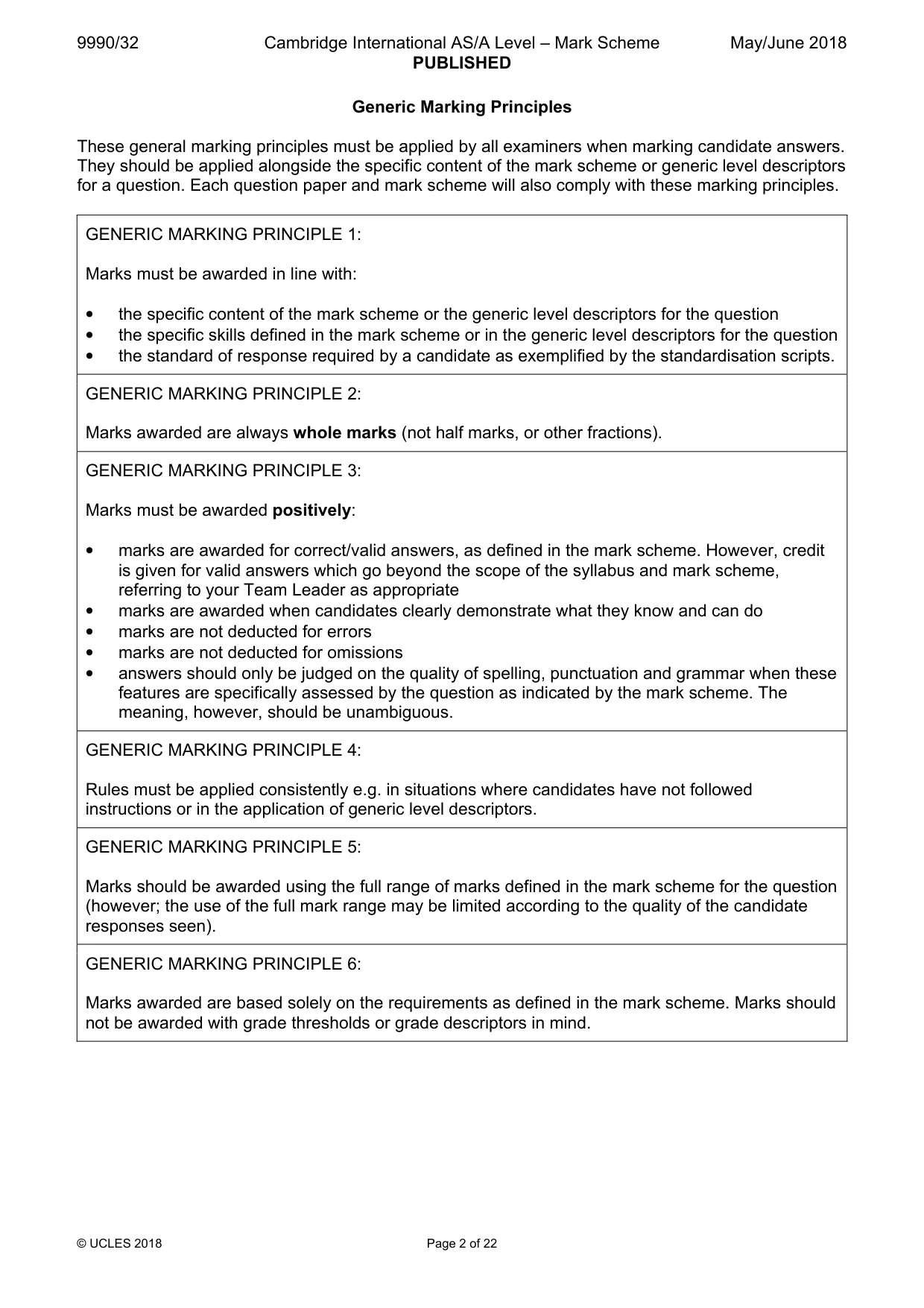

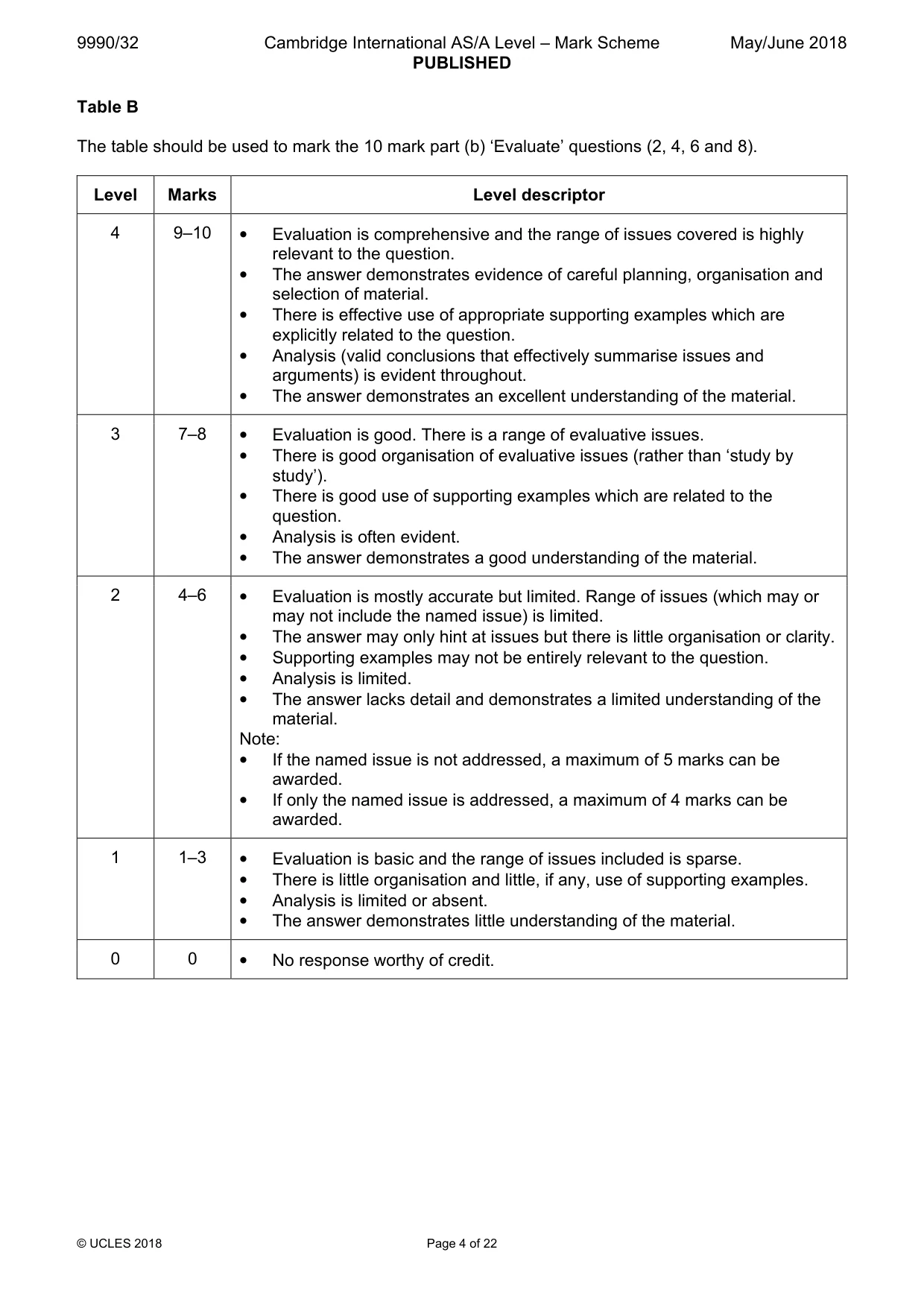


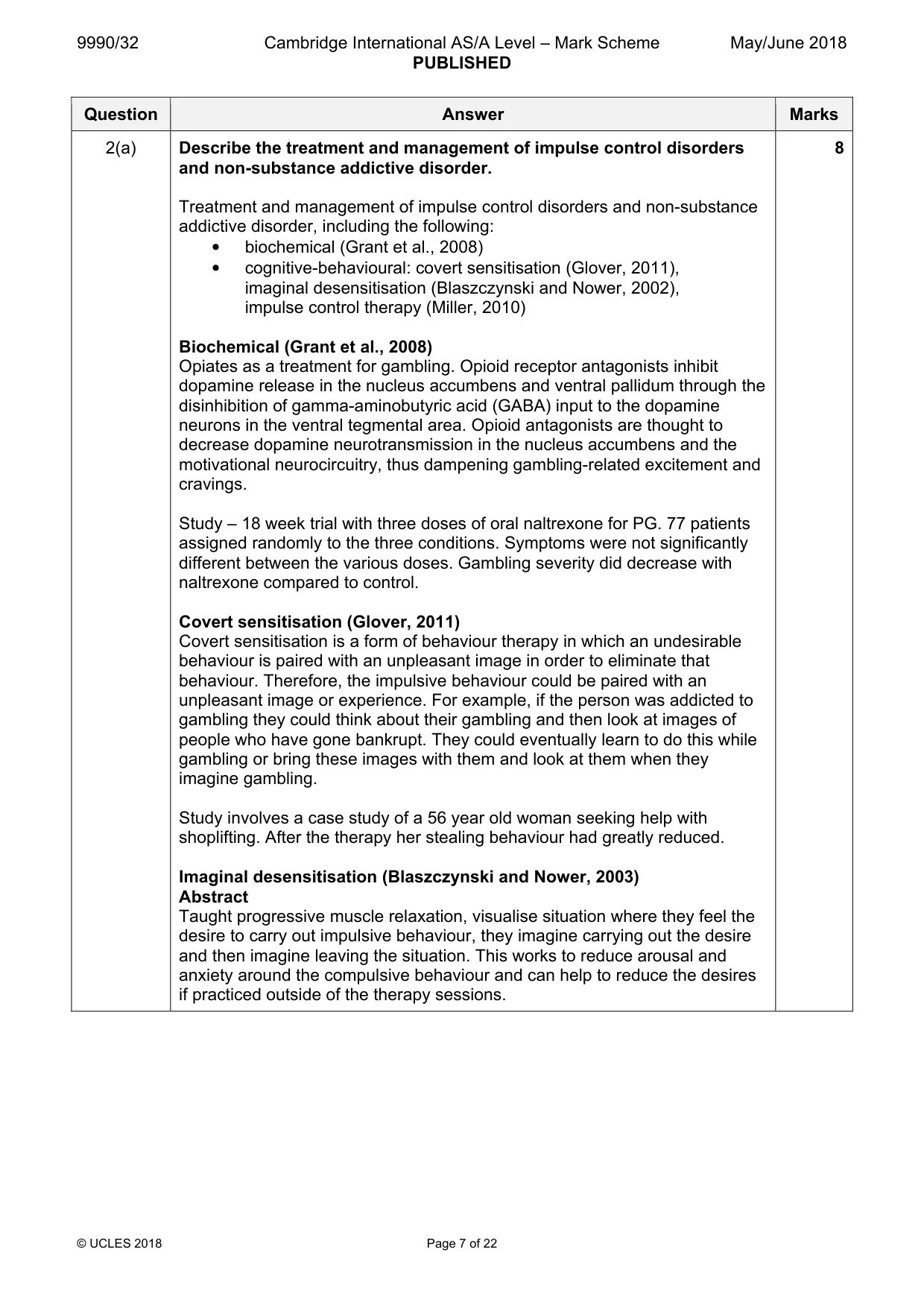
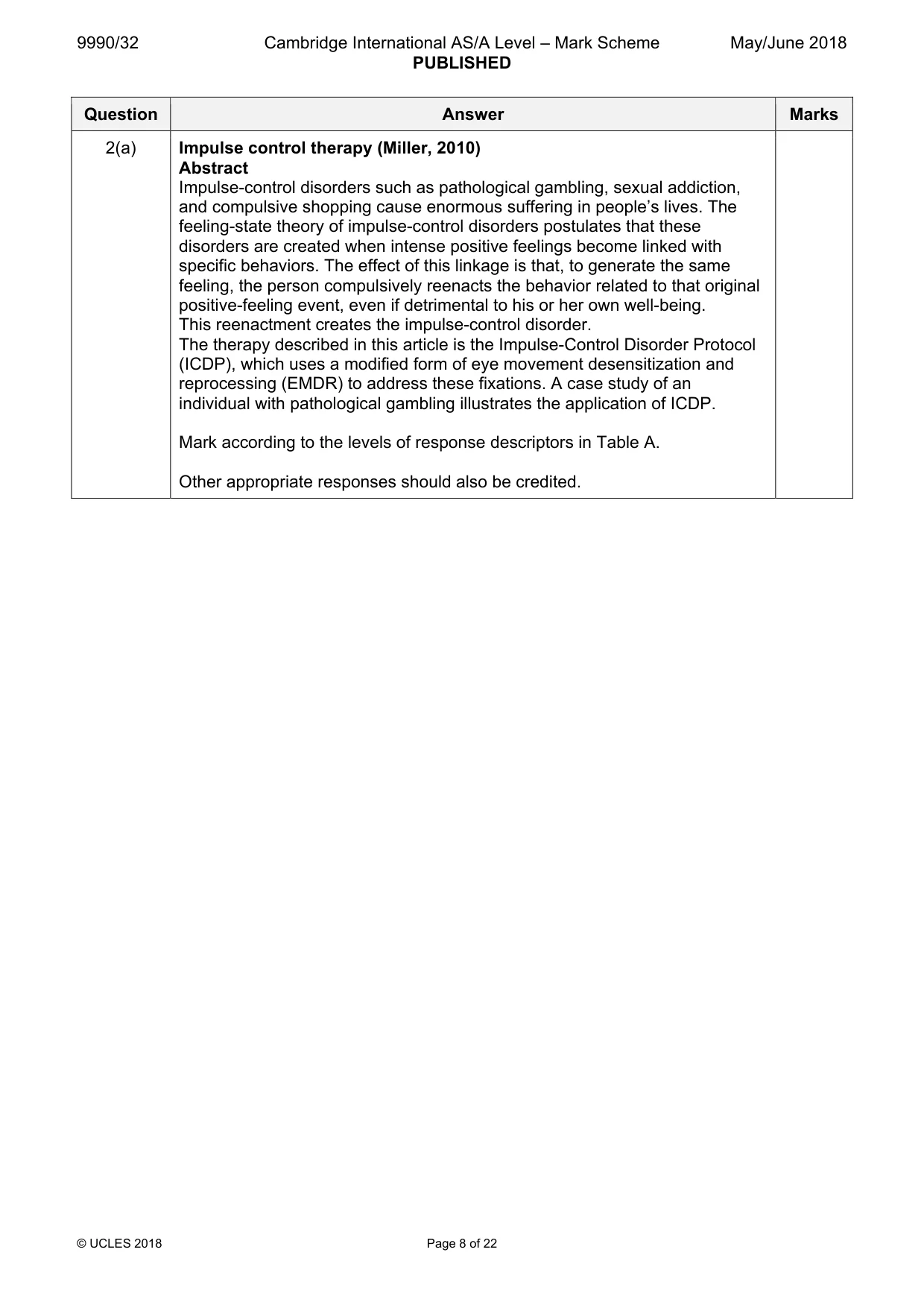
Questions as text
Q1 · Explain what is meant by ‘electro-convulsive therapy’ (ECT) as a treatment for…
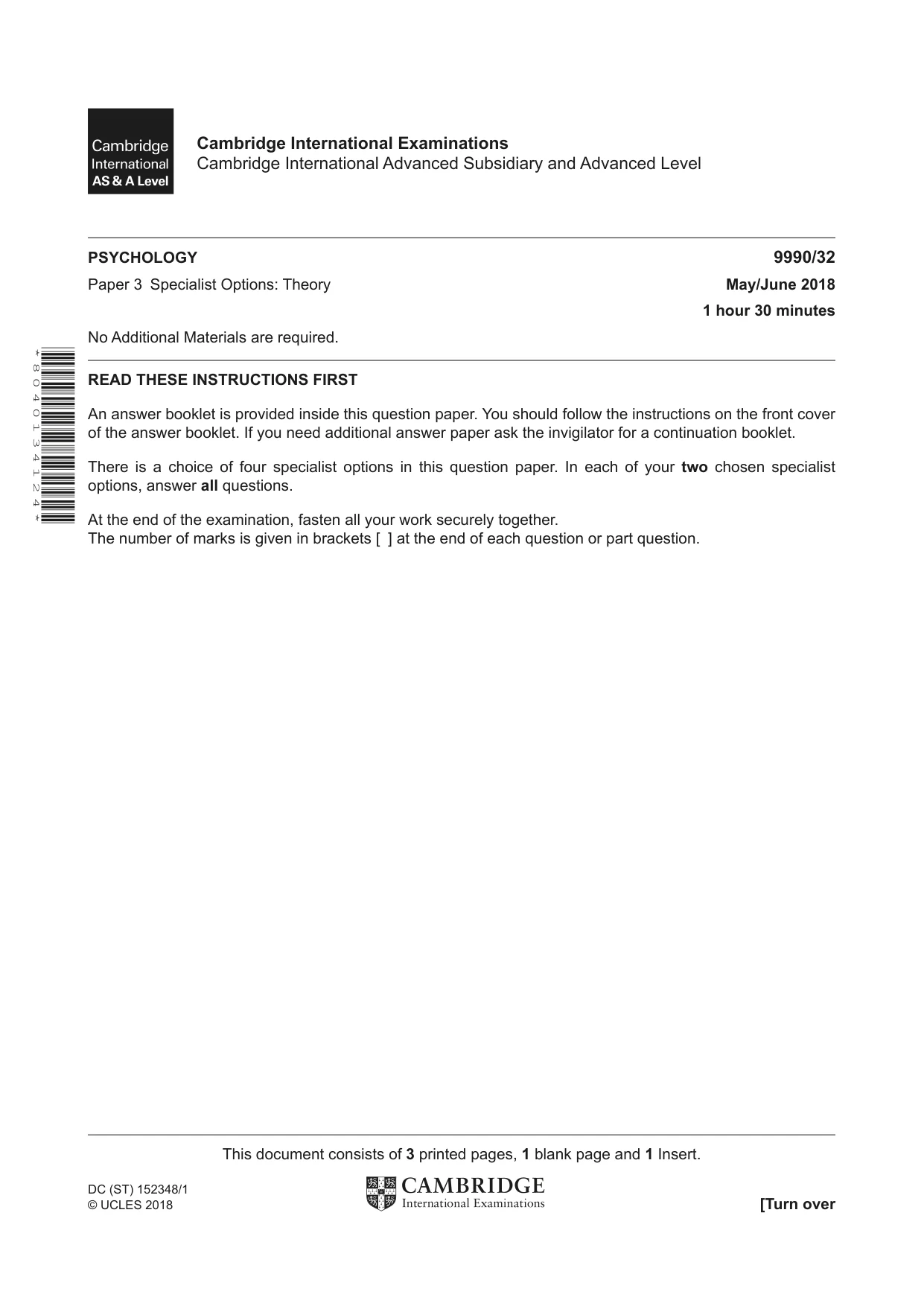
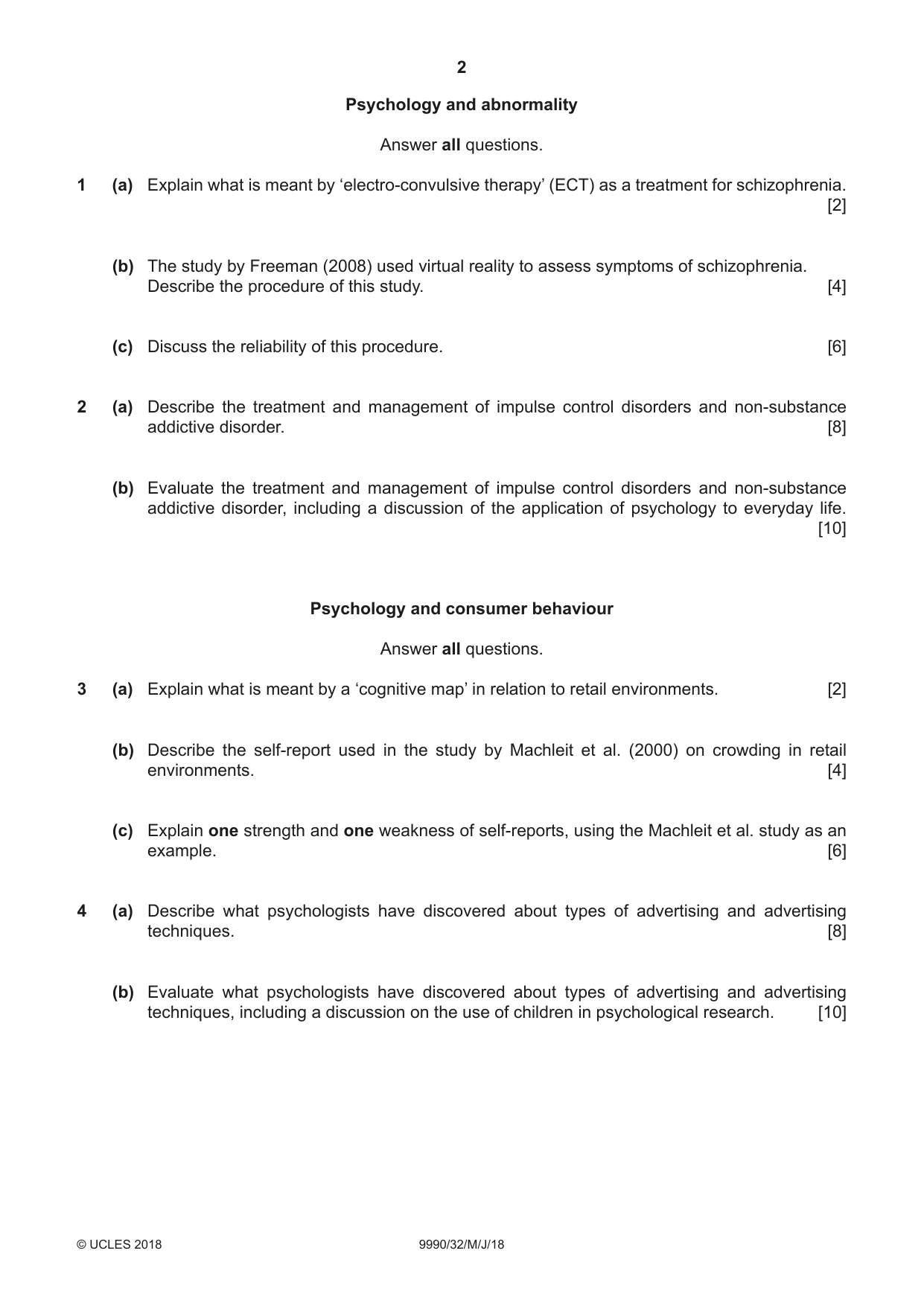
1 (a) Explain what is meant by ‘electro-convulsive therapy’ (ECT) as a treatment for schizophrenia. [2] (b) The study by Freeman (2008) used virtual reality to assess symptoms of schizophrenia. Describe the procedure of this study. [4] (c) Discuss the reliability of this procedure. [6]
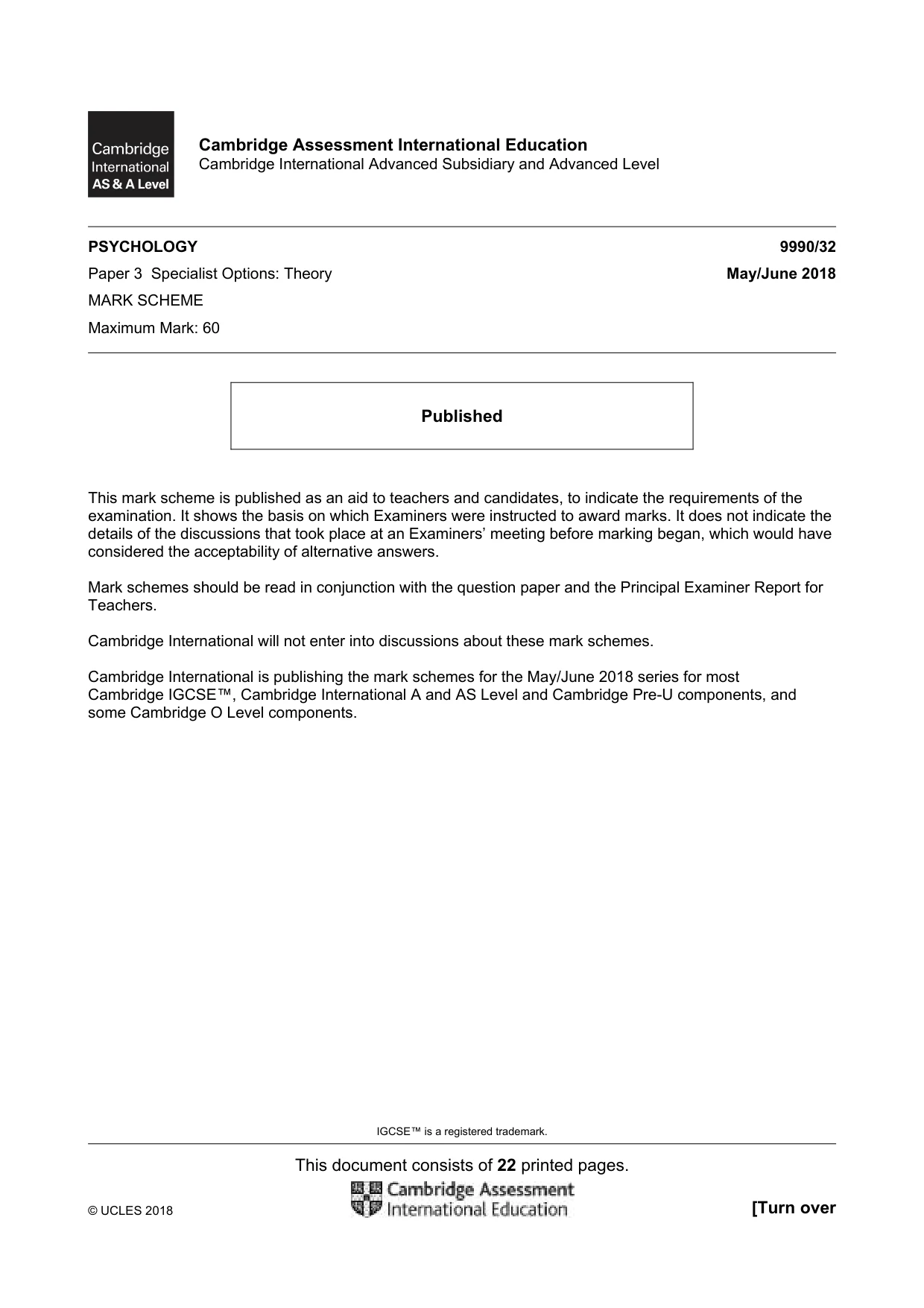
Mark scheme: Question Answer Marks 1(a) Explain what is meant by ‘electro-convulsive therapy’ (ECT) as a 2 treatment for schizophrenia. Award 1 mark for a basic explanation of the term/concept. Award 2 marks for a detailed explanation of the term/concept. For example: A person receives a brief amount of electricity to the brain to induce a seizure. Patient is anesthetised and given a sedative. Electrical current is passed through the head for no longer than a second via electrodes attached to the skull. The seizure will last for up to one minute. Can be bilateral – across both brain hemispheres or unilateral – across the non-dominant hemisphere. Other appropriate responses should also be credited. 1(b) The study by Freeman (2008) used virtual reality to assess symptoms of 4 schizophrenia. Describe the procedure of this study. Award 1–2 marks for a basic answer with some understanding of the topic area. Award 3–4 marks for a detailed answer with clear understanding of the topic area. In the author’s initial work with students, a library scene was used but subsequently a 5-minute ride on a London underground train between 2 stations has been developed consistent with continuum views of paranoia, it has been shown that approximately one-third of the general population have persecutory thoughts about the computer characters. Validating the methodology, those higher in trait paranoia experience higher levels of persecutory ideation in VR. In a study of 200 nonclinical members of the general population. Other appropriate responses should also be credited. 1(c) Discuss the reliability of this procedure. 6 Discussion points could include: • Some participants may show demand characteristics and others may not. • Use of a computer generated environment increased reliability e.g. all participants were on exactly the same 4 min journey on the same 4 min train ride. • The avatars responded differently to the participant depending on how the participant acted in the VR simulation e.g. if the participant looked at one of the avatars the avatar would smile at them. This means each participant had a different experience of engaging with the avatars which lowers the reliability. • Some participants may respond more to the fact this isn’t their natural environment due to the type of schizophrenia they have, whereas others may not be affected by it at all. This shows how the scenario could impact on the participants in a different way and lower reliability. Mark according to the levels of response criteria below: Level 3 (5–6 marks) • Candidates will show a clear understanding of the question and will discuss at least two points regarding reliability. • Candidates will provide a good explanation with clear detail. Level 2 (3–4 marks) • Candidates will show an understanding of the question and will discuss one point about reliability in detail or two or more in less detail. • Candidates will provide a good explanation. Level 1 (1–2 marks) • Candidates will show a basic understanding of the question and will attempt a discussion. • Candidates will provide a limited explanation. Level 0 (0 marks) No response worthy of credit. Other appropriate responses should also be credited.
Q2 · Describe the treatment and management of impulse control disorders and non-substance…
2 (a) Describe the treatment and management of impulse control disorders and non-substance addictive disorder. [8] (b) Evaluate the treatment and management of impulse control disorders and non-substance addictive disorder, including a discussion of the application of psychology to everyday life. [10] Psychology and consumer behaviour Answer all questions.
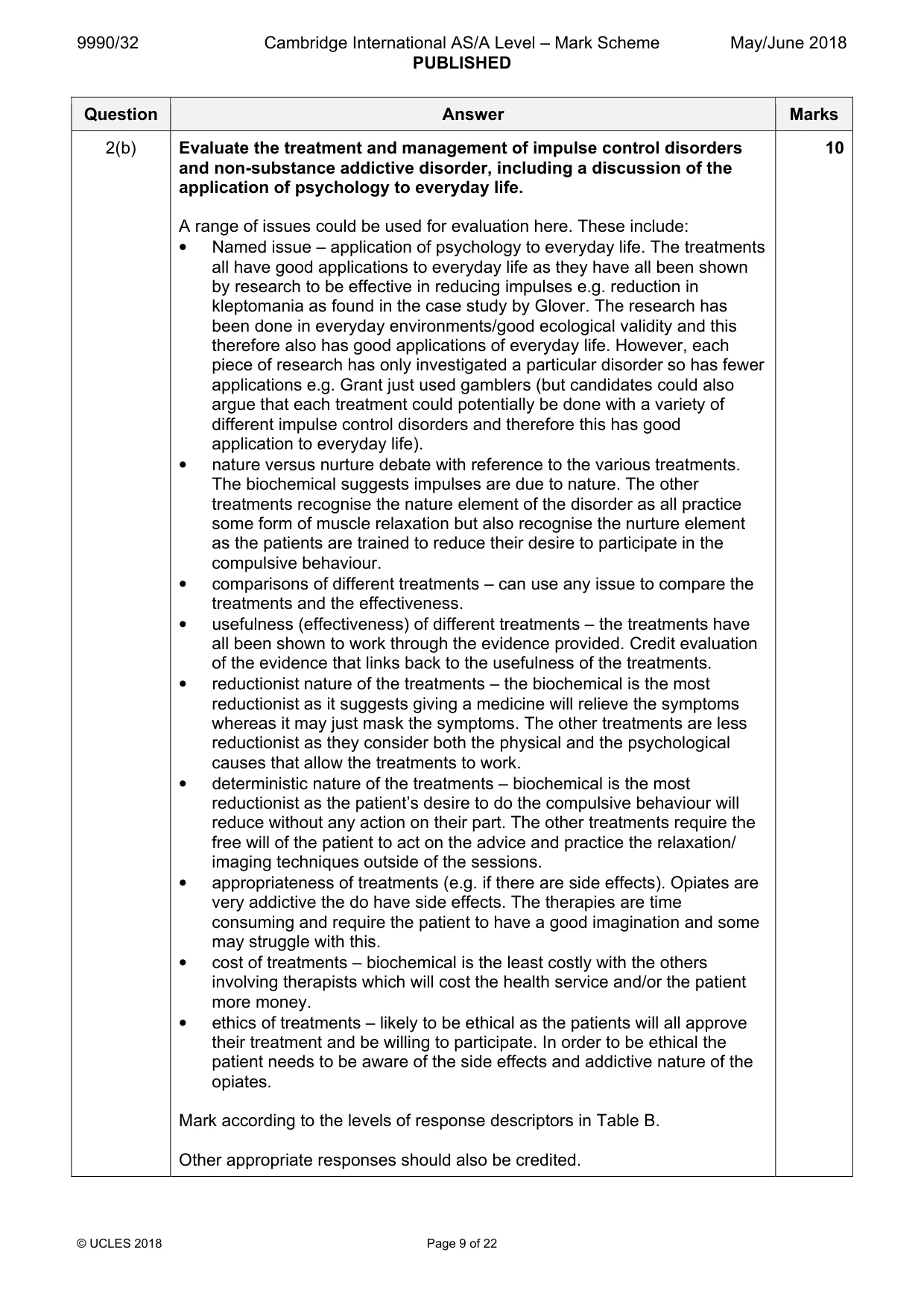
Mark scheme: 2(a) Describe the treatment and management of impulse control disorders 8 and non-substance addictive disorder. Treatment and management of impulse control disorders and non-substance addictive disorder, including the following: • biochemical (Grant et al., 2008) • cognitive-behavioural: covert sensitisation (Glover, 2011), imaginal desensitisation (Blaszczynski and Nower, 2002), impulse control therapy (Miller, 2010) Biochemical (Grant et al., 2008) Opiates as a treatment for gambling. Opioid receptor antagonists inhibit dopamine release in the nucleus accumbens and ventral pallidum through the disinhibition of gamma-aminobutyric acid (GABA) input to the dopamine neurons in the ventral tegmental area. Opioid antagonists are thought to decrease dopamine neurotransmission in the nucleus accumbens and the motivational neurocircuitry, thus dampening gambling-related excitement and cravings. Study – 18 week trial with three doses of oral naltrexone for PG. 77 patients assigned randomly to the three conditions. Symptoms were not significantly different between the various doses. Gambling severity did decrease with naltrexone compared to control. Covert sensitisation (Glover, 2011) Covert sensitisation is a form of behaviour therapy in which an undesirable behaviour is paired with an unpleasant image in order to eliminate that behaviour. Therefore, the impulsive behaviour could be paired with an unpleasant image or experience. For example, if the person was addicted to gambling they could think about their gambling and then look at images of people who have gone bankrupt. They could eventually learn to do this while gambling or bring these images with them and look at them when they imagine gambling. Study involves a case study of a 56 year old woman seeking help with shoplifting. After the therapy her stealing behaviour had greatly reduced. Imaginal desensitisation (Blaszczynski and Nower, 2003) Abstract Taught progressive muscle relaxation, visualise situation where they feel the desire to carry out impulsive behaviour, they imagine carrying out the desire and then imagine leaving the situation. This works to reduce arousal and anxiety around the compulsive behaviour and can help to reduce the desires if practiced outside of the therapy sessions. 2(a) Impulse control therapy (Miller, 2010) Abstract Impulse-control disorders such as pathological gambling, sexual addiction, and compulsive shopping cause enormous suffering in people’s lives. The feeling-state theory of impulse-control disorders postulates that these disorders are created when intense positive feelings become linked with specific behaviors. The effect of this linkage is that, to generate the same feeling, the person compulsively reenacts the behavior related to that original positive-feeling event, even if detrimental to his or her own well-being. This reenactment creates the impulse-control disorder. The therapy described in this article is the Impulse-Control Disorder Protocol (ICDP), which uses a modified form of eye movement desensitization and reprocessing (EMDR) to address these fixations. A case study of an individual with pathological gambling illustrates the application of ICDP. Mark according to the levels of response descriptors in Table A. Other appropriate responses should also be credited. 2(b) Evaluate the treatment and management of impulse control disorders 10 and non-substance addictive disorder, including a discussion of the application of psychology to everyday life. A range of issues could be used for evaluation here. These include: • Named issue – application of psychology to everyday life. The treatments all have good applications to everyday life as they have all been shown by research to be effective in reducing impulses e.g. reduction in kleptomania as found in the case study by Glover. The research has been done in everyday environments/good ecological validity and this therefore also has good applications of everyday life. However, each piece of research has only investigated a particular disorder so has fewer applications e.g. Grant just used gamblers (but candidates could also argue that each treatment could potentially be done with a variety of different impulse control disorders and therefore this has good application to everyday life). • nature versus nurture debate with reference to the various treatments. The biochemical suggests impulses are due to nature. The other treatments recognise the nature element of the disorder as all practice some form of muscle relaxation but also recognise the nurture element as the patients are trained to reduce their desire to participate in the compulsive behaviour. • comparisons of different treatments – can use any issue to compare the treatments and the effectiveness. • usefulness (effectiveness) of different treatments – the treatments have all been shown to work through the evidence provided. Credit evaluation of the evidence that links back to the usefulness of the treatments. • reductionist nature of the treatments – the biochemical is the most reductionist as it suggests giving a medicine will relieve the symptoms whereas it may just mask the symptoms. The other treatments are less reductionist as they consider both the physical and the psychological causes that allow the treatments to work. • deterministic nature of the treatments – biochemical is the most reductionist as the patient’s desire to do the compulsive behaviour will reduce without any action on their part. The other treatments require the free will of the patient to act on the advice and practice the relaxation/ imaging techniques outside of the sessions. • appropriateness of treatments (e.g. if there are side effects). Opiates are very addictive the do have side effects. The therapies are time consuming and require the patient to have a good imagination and some may struggle with this. • cost of treatments – biochemical is the least costly with the others involving therapists which will cost the health service and/or the patient more money. • ethics of treatments – likely to be ethical as the patients will all approve their treatment and be willing to participate. In order to be ethical the patient needs to be aware of the side effects and addictive nature of the opiates. Mark according to the levels of response descriptors in Table B. Other appropriate responses should also be credited.
Q3 · Explain what is meant by a ‘cognitive map’ in relation to retail environments
3 (a) Explain what is meant by a ‘cognitive map’ in relation to retail environments. [2] (b) Describe the self-report used in the study by Machleit et al. (2000) on crowding in retail environments. [4] (c) Explain one strength and one weakness of self-reports, using the Machleit et al. study as an example. [6]
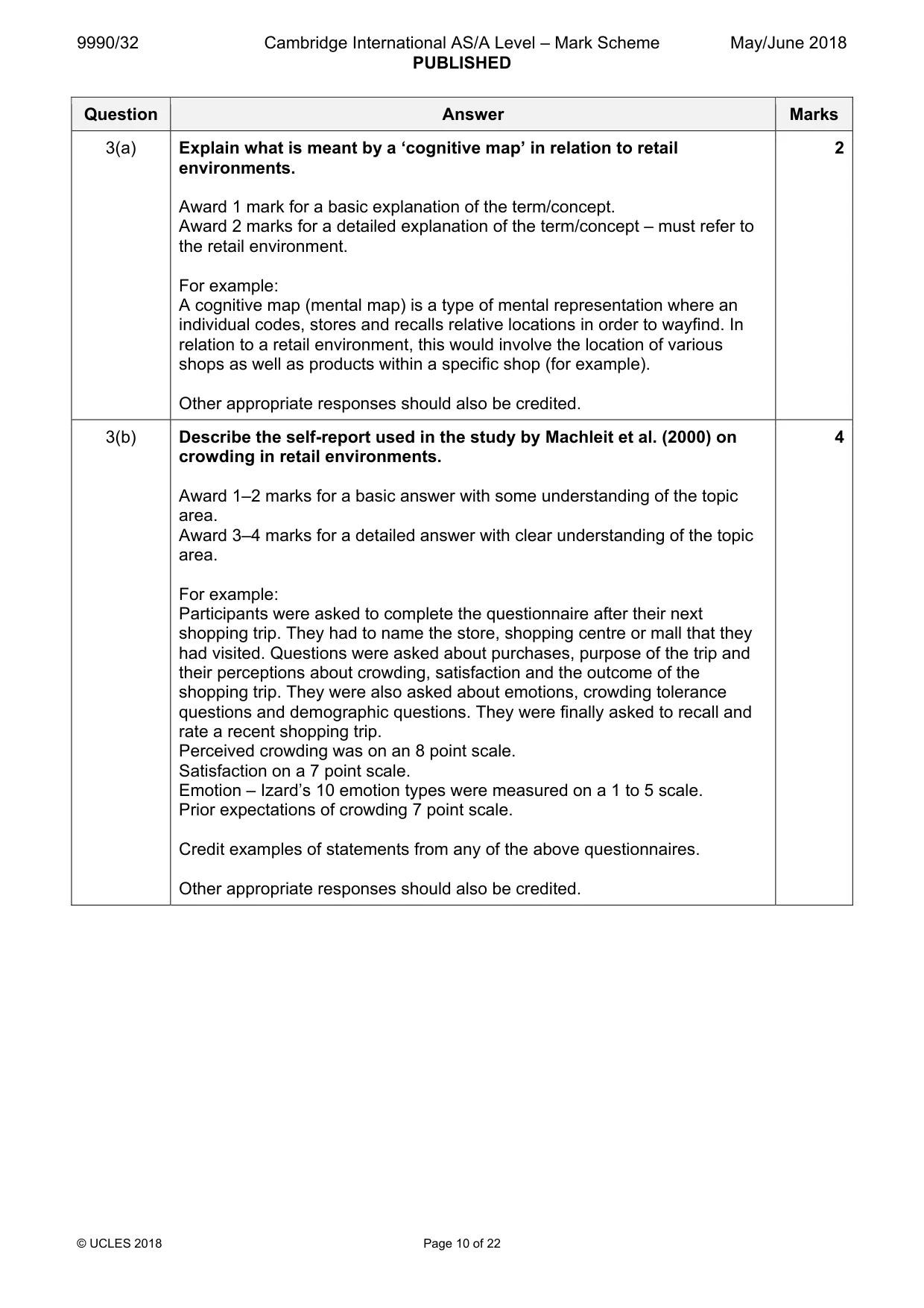
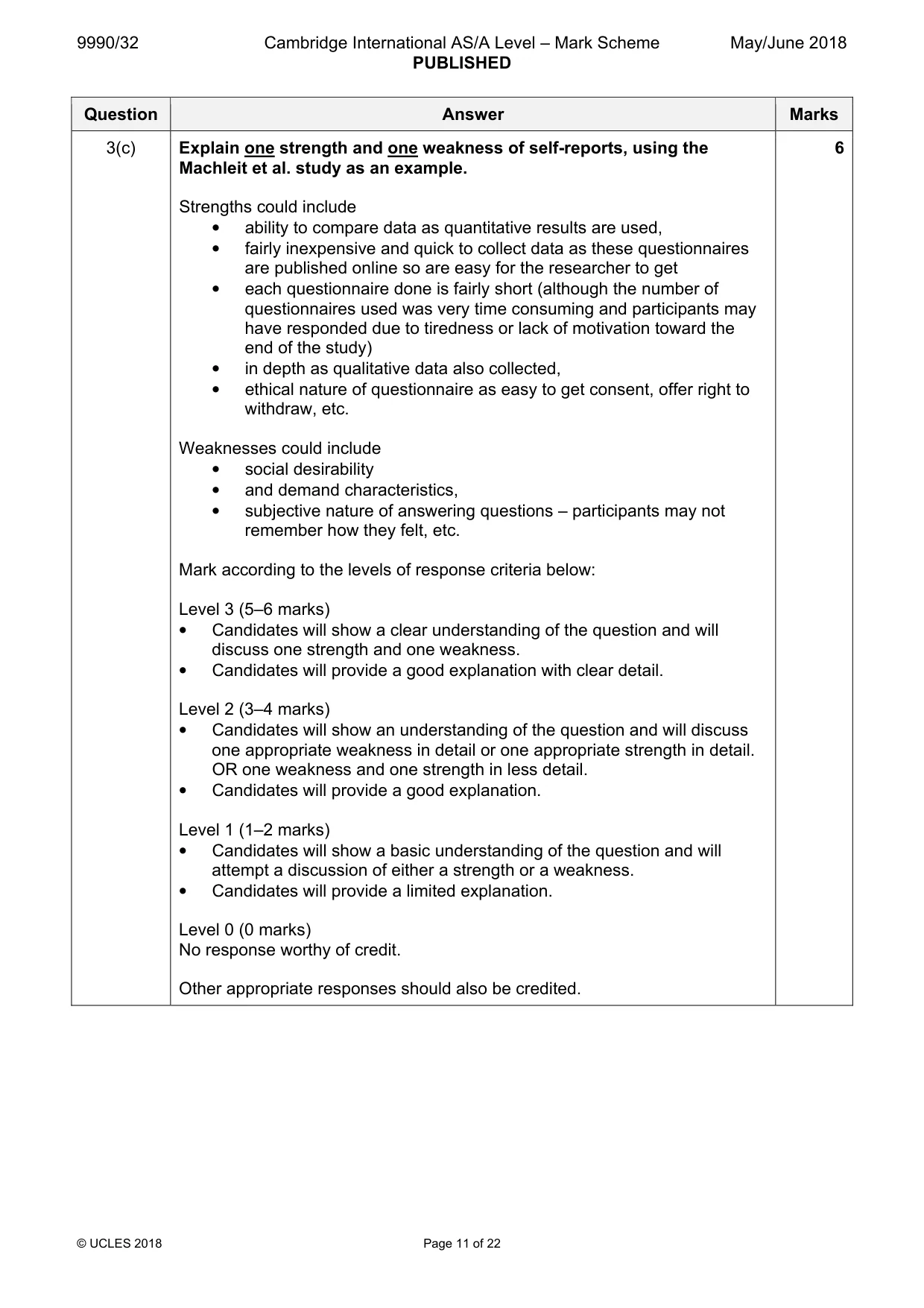
Mark scheme: 3(a) Explain what is meant by a ‘cognitive map’ in relation to retail 2 environments. Award 1 mark for a basic explanation of the term/concept. Award 2 marks for a detailed explanation of the term/concept – must refer to the retail environment. For example: A cognitive map (mental map) is a type of mental representation where an individual codes, stores and recalls relative locations in order to wayfind. In relation to a retail environment, this would involve the location of various shops as well as products within a specific shop (for example). Other appropriate responses should also be credited. 3(b) Describe the self-report used in the study by Machleit et al. (2000) on 4 crowding in retail environments. Award 1–2 marks for a basic answer with some understanding of the topic area. Award 3–4 marks for a detailed answer with clear understanding of the topic area. For example: Participants were asked to complete the questionnaire after their next shopping trip. They had to name the store, shopping centre or mall that they had visited. Questions were asked about purchases, purpose of the trip and their perceptions about crowding, satisfaction and the outcome of the shopping trip. They were also asked about emotions, crowding tolerance questions and demographic questions. They were finally asked to recall and rate a recent shopping trip. Perceived crowding was on an 8 point scale. Satisfaction on a 7 point scale. Emotion – Izard’s 10 emotion types were measured on a 1 to 5 scale. Prior expectations of crowding 7 point scale. Credit examples of statements from any of the above questionnaires. Other appropriate responses should also be credited. 3(c) Explain one strength and one weakness of self-reports, using the 6 Machleit et al. study as an example. Strengths could include • ability to compare data as quantitative results are used, • fairly inexpensive and quick to collect data as these questionnaires are published online so are easy for the researcher to get • each questionnaire done is fairly short (although the number of questionnaires used was very time consuming and participants may have responded due to tiredness or lack of motivation toward the end of the study) • in depth as qualitative data also collected, • ethical nature of questionnaire as easy to get consent, offer right to withdraw, etc. Weaknesses could include • social desirability • and demand characteristics, • subjective nature of answering questions – participants may not remember how they felt, etc. Mark according to the levels of response criteria below: Level 3 (5–6 marks) • Candidates will show a clear understanding of the question and will discuss one strength and one weakness. • Candidates will provide a good explanation with clear detail. Level 2 (3–4 marks) • Candidates will show an understanding of the question and will discuss one appropriate weakness in detail or one appropriate strength in detail. OR one weakness and one strength in less detail. • Candidates will provide a good explanation. Level 1 (1–2 marks) • Candidates will show a basic understanding of the question and will attempt a discussion of either a strength or a weakness. • Candidates will provide a limited explanation. Level 0 (0 marks) No response worthy of credit. Other appropriate responses should also be credited.
Q4 · Describe what psychologists have discovered about types of advertising and advertising…
4 (a) Describe what psychologists have discovered about types of advertising and advertising techniques. [8] (b) Evaluate what psychologists have discovered about types of advertising and advertising techniques, including a discussion on the use of children in psychological research. [10] Psychology and health Answer all questions.
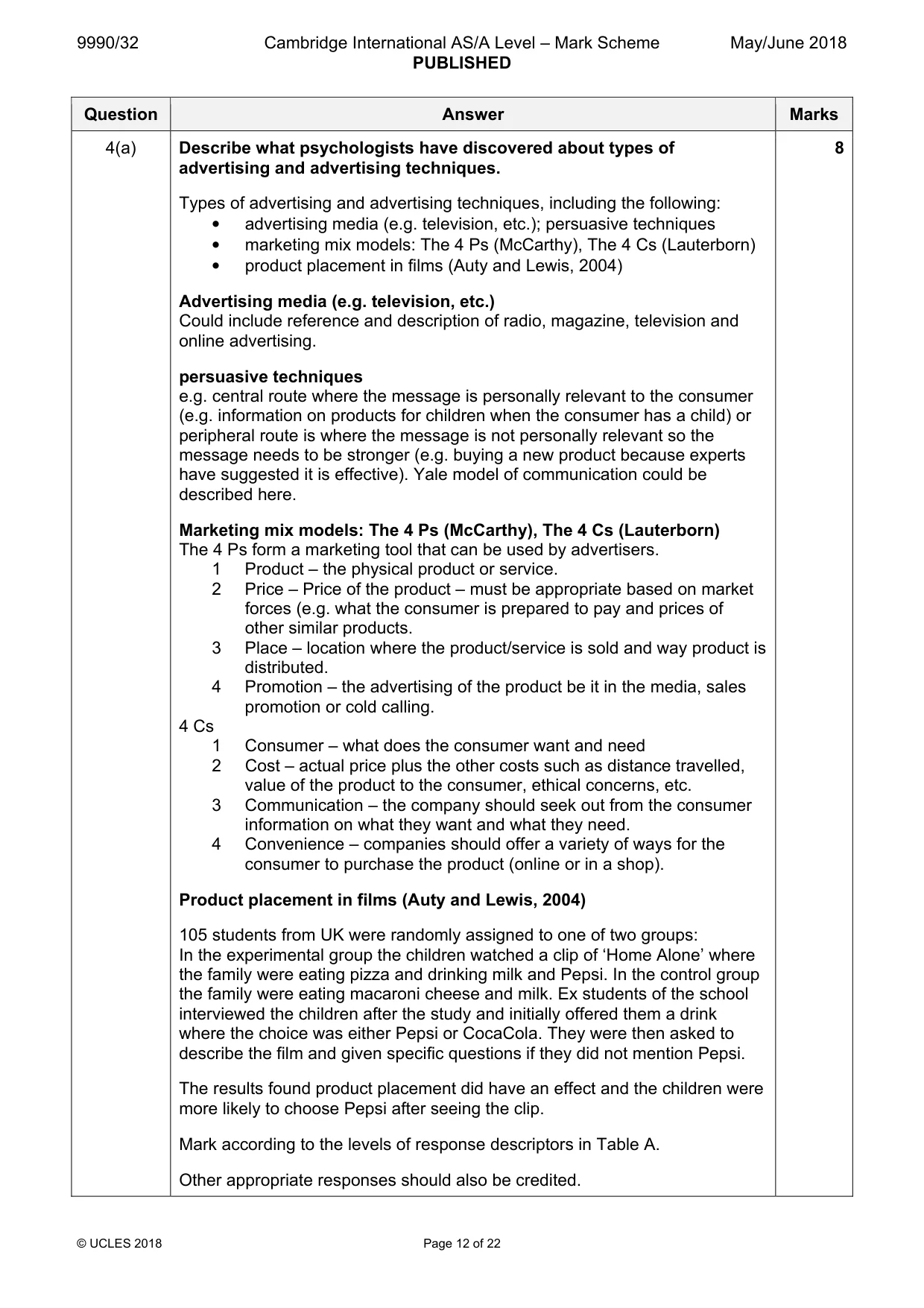
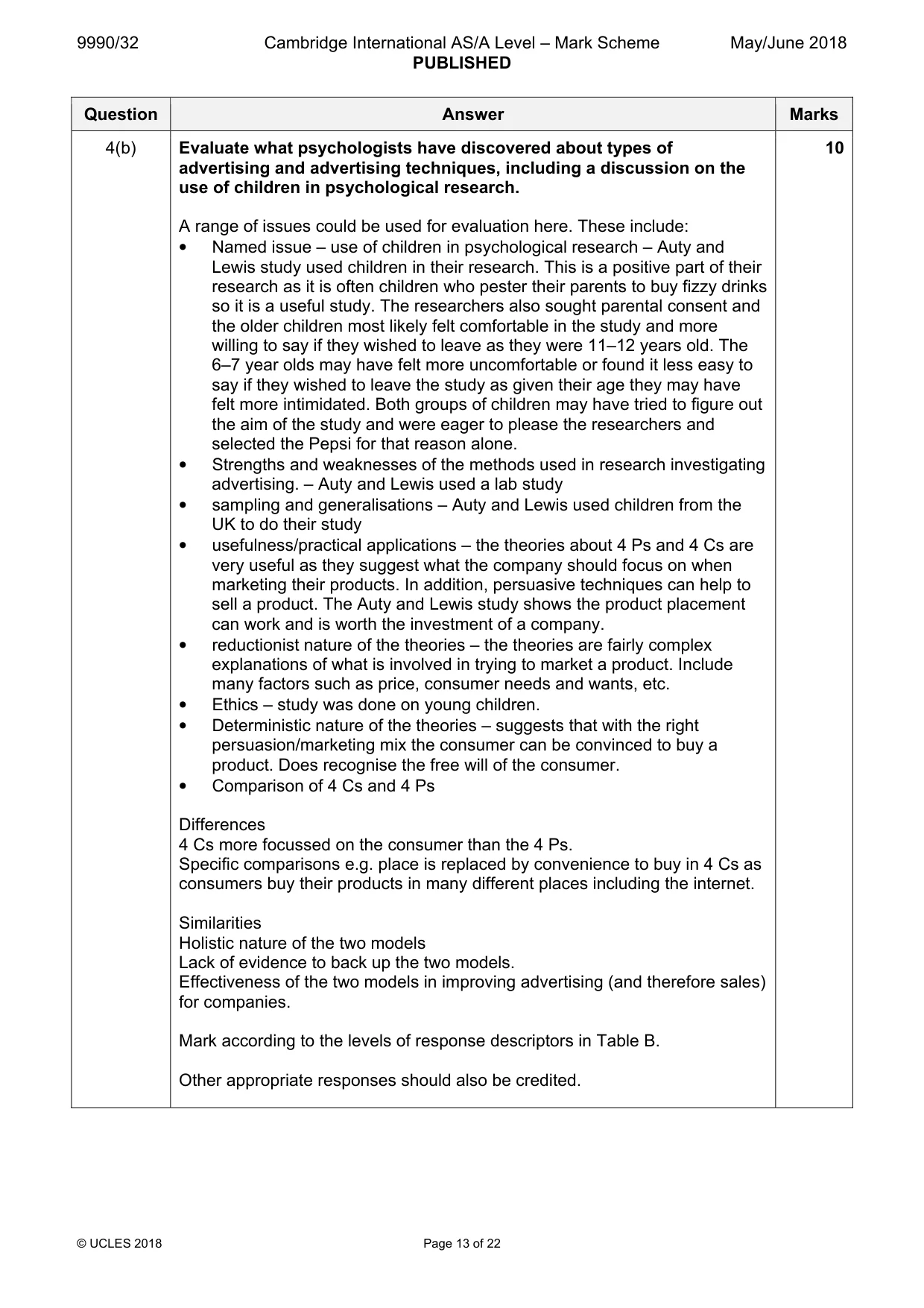
Mark scheme: 4(a) Describe what psychologists have discovered about types of 8 advertising and advertising techniques. Types of advertising and advertising techniques, including the following: • advertising media (e.g. television, etc.); persuasive techniques • marketing mix models: The 4 Ps (McCarthy), The 4 Cs (Lauterborn) • product placement in films (Auty and Lewis, 2004) Advertising media (e.g. television, etc.) Could include reference and description of radio, magazine, television and online advertising. persuasive techniques e.g. central route where the message is personally relevant to the consumer (e.g. information on products for children when the consumer has a child) or peripheral route is where the message is not personally relevant so the message needs to be stronger (e.g. buying a new product because experts have suggested it is effective). Yale model of communication could be described here. Marketing mix models: The 4 Ps (McCarthy), The 4 Cs (Lauterborn) The 4 Ps form a marketing tool that can be used by advertisers. 1 Product – the physical product or service. 2 Price – Price of the product – must be appropriate based on market forces (e.g. what the consumer is prepared to pay and prices of other similar products. 3 Place – location where the product/service is sold and way product is distributed. 4 Promotion – the advertising of the product be it in the media, sales promotion or cold calling. 4 Cs 1 Consumer – what does the consumer want and need 2 Cost – actual price plus the other costs such as distance travelled, value of the product to the consumer, ethical concerns, etc. 3 Communication – the company should seek out from the consumer information on what they want and what they need. 4 Convenience – companies should offer a variety of ways for the consumer to purchase the product (online or in a shop). Product placement in films (Auty and Lewis, 2004) 105 students from UK were randomly assigned to one of two groups: In the experimental group the children watched a clip of ‘Home Alone’ where the family were eating pizza and drinking milk and Pepsi. In the control group the family were eating macaroni cheese and milk. Ex students of the school interviewed the children after the study and initially offered them a drink where the choice was either Pepsi or CocaCola. They were then asked to describe the film and given specific questions if they did not mention Pepsi. The results found product placement did have an effect and the children were more likely to choose Pepsi after seeing the clip. Mark according to the levels of response descriptors in Table A. Other appropriate responses should also be credited. 4(b) Evaluate what psychologists have discovered about types of 10 advertising and advertising techniques, including a discussion on the use of children in psychological research. A range of issues could be used for evaluation here. These include: • Named issue – use of children in psychological research – Auty and Lewis study used children in their research. This is a positive part of their research as it is often children who pester their parents to buy fizzy drinks so it is a useful study. The researchers also sought parental consent and the older children most likely felt comfortable in the study and more willing to say if they wished to leave as they were 11–12 years old. The 6–7 year olds may have felt more uncomfortable or found it less easy to say if they wished to leave the study as given their age they may have felt more intimidated. Both groups of children may have tried to figure out the aim of the study and were eager to please the researchers and selected the Pepsi for that reason alone. • Strengths and weaknesses of the methods used in research investigating advertising. – Auty and Lewis used a lab study • sampling and generalisations – Auty and Lewis used children from the UK to do their study • usefulness/practical applications – the theories about 4 Ps and 4 Cs are very useful as they suggest what the company should focus on when marketing their products. In addition, persuasive techniques can help to sell a product. The Auty and Lewis study shows the product placement can work and is worth the investment of a company. • reductionist nature of the theories – the theories are fairly complex explanations of what is involved in trying to market a product. Include many factors such as price, consumer needs and wants, etc. • Ethics – study was done on young children. • Deterministic nature of the theories – suggests that with the right persuasion/marketing mix the consumer can be convinced to buy a product. Does recognise the free will of the consumer. • Comparison of 4 Cs and 4 Ps Differences 4 Cs more focussed on the consumer than the 4 Ps. Specific comparisons e.g. place is replaced by convenience to buy in 4 Cs as consumers buy their products in many different places including the internet. Similarities Holistic nature of the two models Lack of evidence to back up the two models. Effectiveness of the two models in improving advertising (and therefore sales) for companies. Mark according to the levels of response descriptors in Table B. Other appropriate responses should also be credited.
Q5 · Explain how a biochemical test can be used to measure non-adherence to medical advice
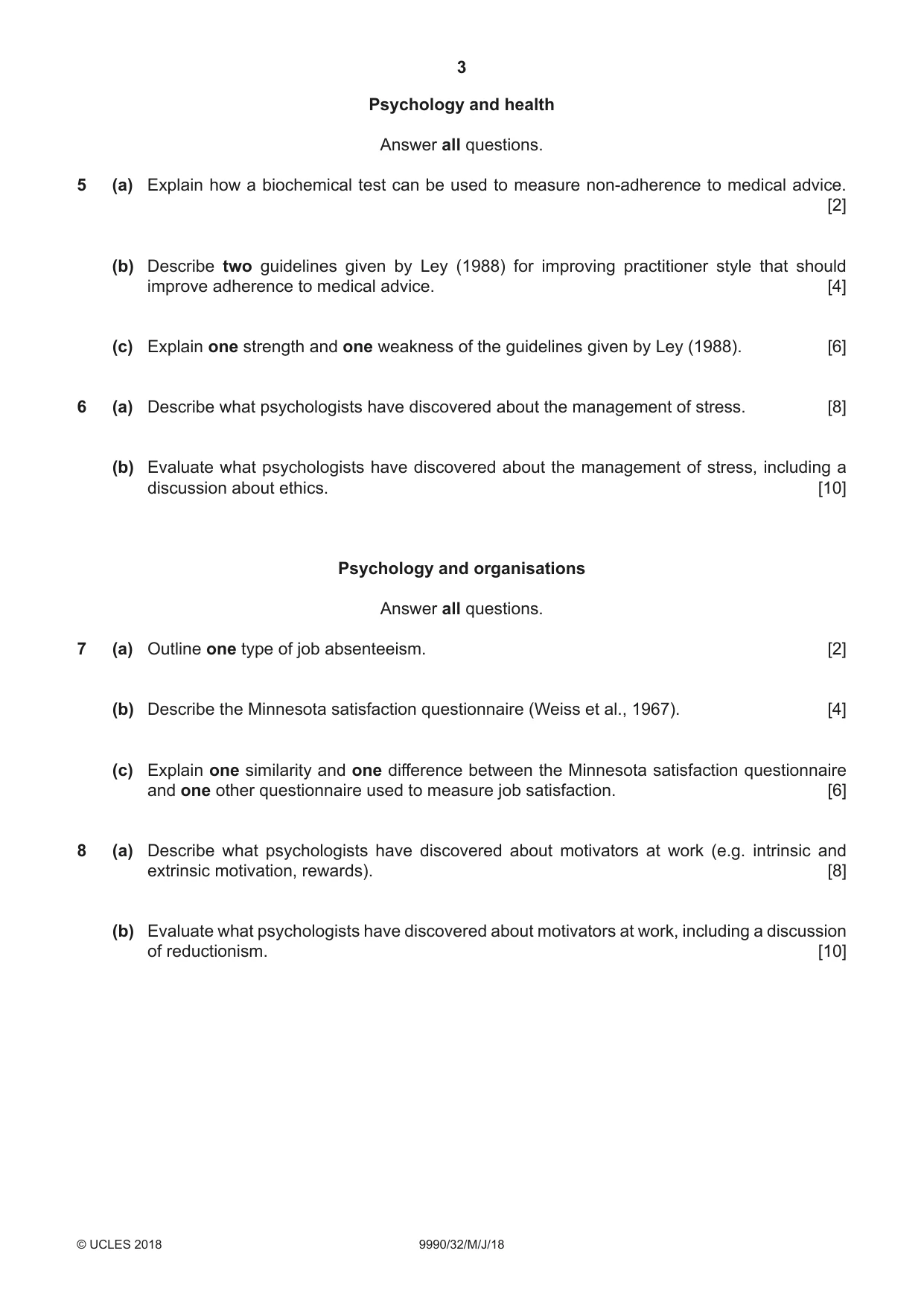
5 (a) Explain how a biochemical test can be used to measure non-adherence to medical advice. [2] (b) Describe two guidelines given by Ley (1988) for improving practitioner style that should improve adherence to medical advice. [4] (c) Explain one strength and one weakness of the guidelines given by Ley (1988). [6]
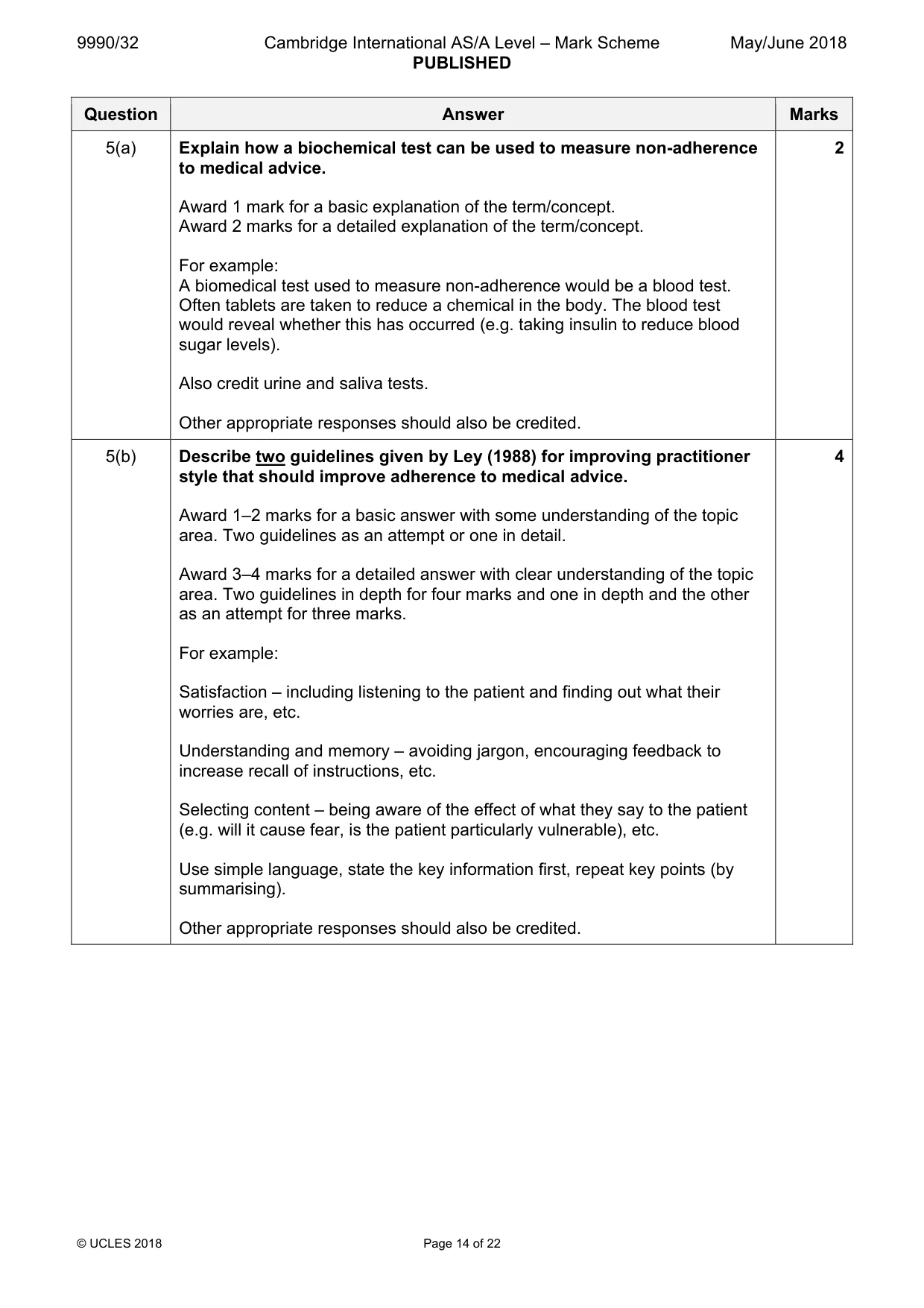
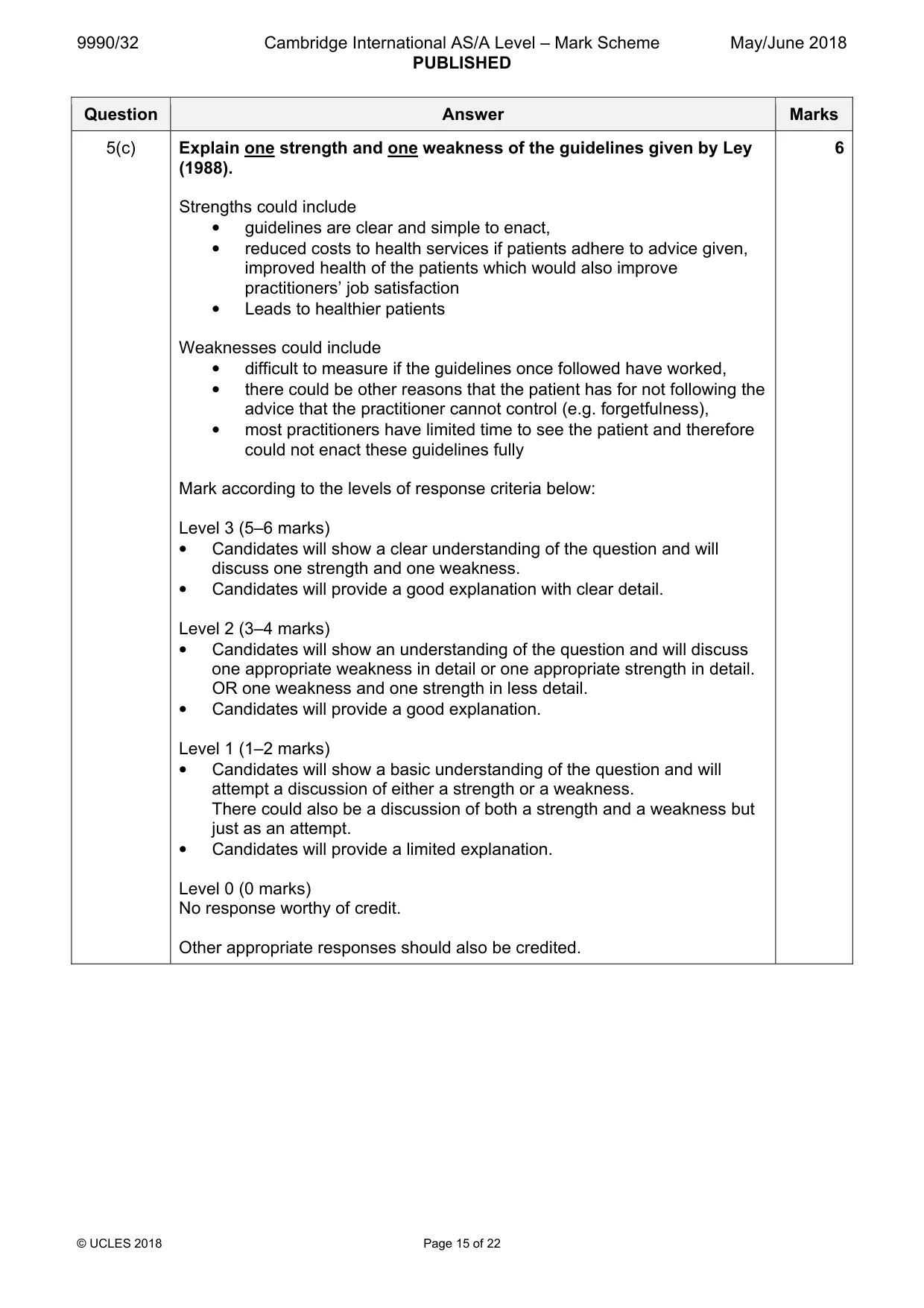
Mark scheme: 5(a) Explain how a biochemical test can be used to measure non-adherence 2 to medical advice. Award 1 mark for a basic explanation of the term/concept. Award 2 marks for a detailed explanation of the term/concept. For example: A biomedical test used to measure non-adherence would be a blood test. Often tablets are taken to reduce a chemical in the body. The blood test would reveal whether this has occurred (e.g. taking insulin to reduce blood sugar levels). Also credit urine and saliva tests. Other appropriate responses should also be credited. 5(b) Describe two guidelines given by Ley (1988) for improving practitioner 4 style that should improve adherence to medical advice. Award 1–2 marks for a basic answer with some understanding of the topic area. Two guidelines as an attempt or one in detail. Award 3–4 marks for a detailed answer with clear understanding of the topic area. Two guidelines in depth for four marks and one in depth and the other as an attempt for three marks. For example: Satisfaction – including listening to the patient and finding out what their worries are, etc. Understanding and memory – avoiding jargon, encouraging feedback to increase recall of instructions, etc. Selecting content – being aware of the effect of what they say to the patient (e.g. will it cause fear, is the patient particularly vulnerable), etc. Use simple language, state the key information first, repeat key points (by summarising). Other appropriate responses should also be credited. 5(c) Explain one strength and one weakness of the guidelines given by Ley 6 (1988). Strengths could include • guidelines are clear and simple to enact, • reduced costs to health services if patients adhere to advice given, improved health of the patients which would also improve practitioners’ job satisfaction • Leads to healthier patients Weaknesses could include • difficult to measure if the guidelines once followed have worked, • there could be other reasons that the patient has for not following the advice that the practitioner cannot control (e.g. forgetfulness), • most practitioners have limited time to see the patient and therefore could not enact these guidelines fully Mark according to the levels of response criteria below: Level 3 (5–6 marks) • Candidates will show a clear understanding of the question and will discuss one strength and one weakness. • Candidates will provide a good explanation with clear detail. Level 2 (3–4 marks) • Candidates will show an understanding of the question and will discuss one appropriate weakness in detail or one appropriate strength in detail. OR one weakness and one strength in less detail. • Candidates will provide a good explanation. Level 1 (1–2 marks) • Candidates will show a basic understanding of the question and will attempt a discussion of either a strength or a weakness. There could also be a discussion of both a strength and a weakness but just as an attempt. • Candidates will provide a limited explanation. Level 0 (0 marks) No response worthy of credit. Other appropriate responses should also be credited.
Q6 · Describe what psychologists have discovered about the management of stress
6 (a) Describe what psychologists have discovered about the management of stress. [8] (b) Evaluate what psychologists have discovered about the management of stress, including a discussion about ethics. [10] Psychology and organisations Answer all questions.
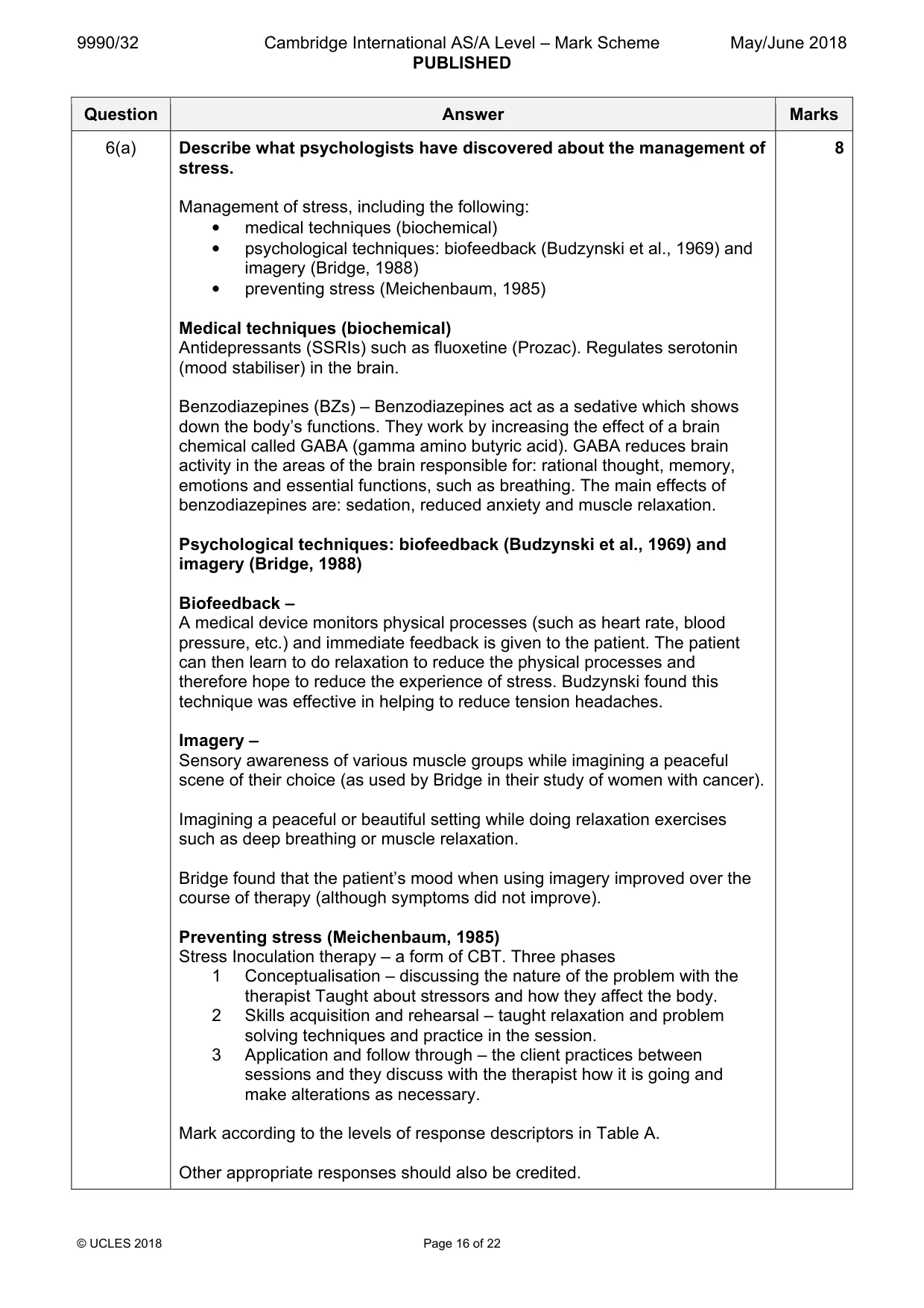
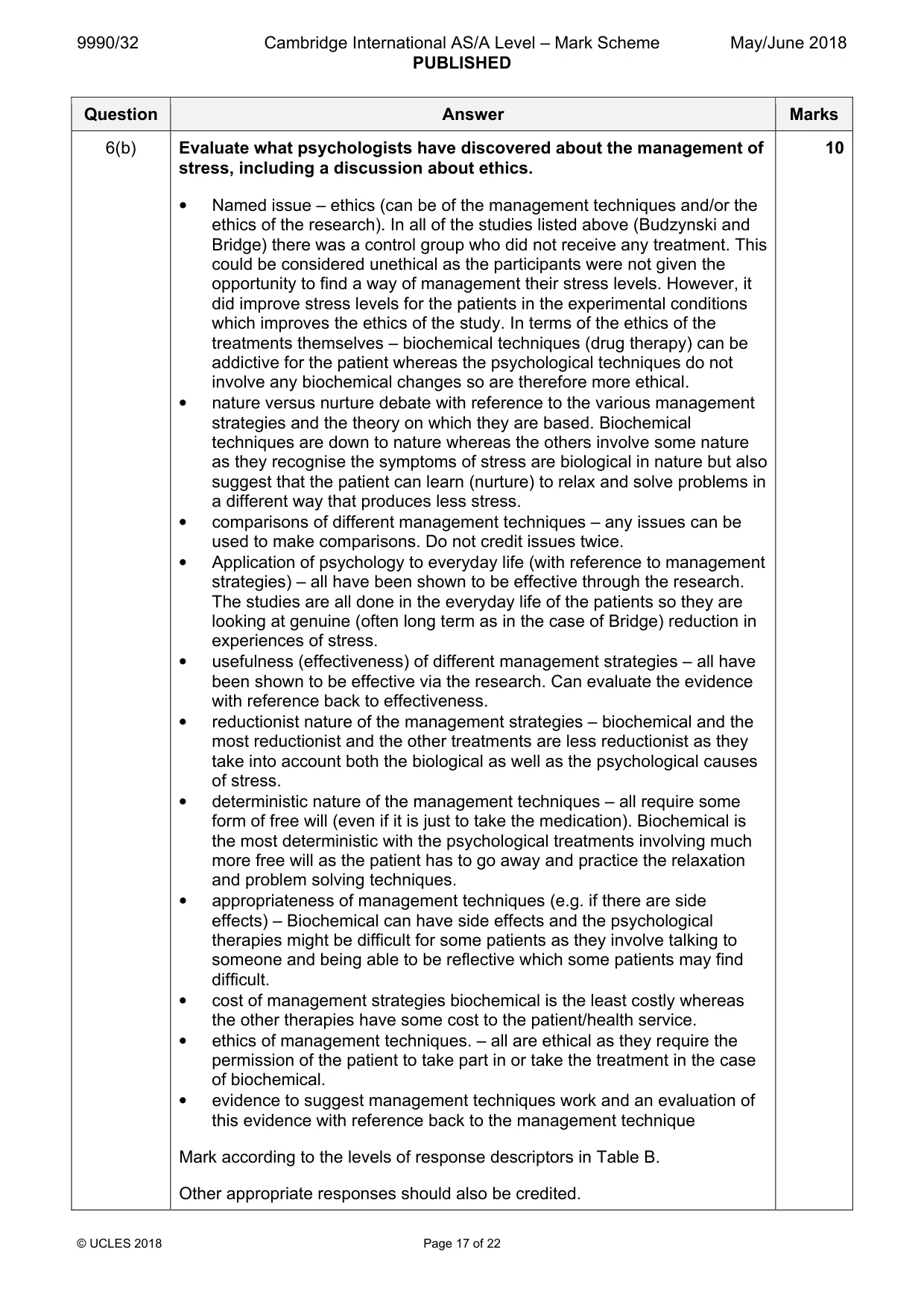
Mark scheme: 6(a) Describe what psychologists have discovered about the management of 8 stress. Management of stress, including the following: • medical techniques (biochemical) • psychological techniques: biofeedback (Budzynski et al., 1969) and imagery (Bridge, 1988) • preventing stress (Meichenbaum, 1985) Medical techniques (biochemical) Antidepressants (SSRIs) such as fluoxetine (Prozac). Regulates serotonin (mood stabiliser) in the brain. Benzodiazepines (BZs) – Benzodiazepines act as a sedative which shows down the body’s functions. They work by increasing the effect of a brain chemical called GABA (gamma amino butyric acid). GABA reduces brain activity in the areas of the brain responsible for: rational thought, memory, emotions and essential functions, such as breathing. The main effects of benzodiazepines are: sedation, reduced anxiety and muscle relaxation. Psychological techniques: biofeedback (Budzynski et al., 1969) and imagery (Bridge, 1988) Biofeedback – A medical device monitors physical processes (such as heart rate, blood pressure, etc.) and immediate feedback is given to the patient. The patient can then learn to do relaxation to reduce the physical processes and therefore hope to reduce the experience of stress. Budzynski found this technique was effective in helping to reduce tension headaches. Imagery – Sensory awareness of various muscle groups while imagining a peaceful scene of their choice (as used by Bridge in their study of women with cancer). Imagining a peaceful or beautiful setting while doing relaxation exercises such as deep breathing or muscle relaxation. Bridge found that the patient’s mood when using imagery improved over the course of therapy (although symptoms did not improve). Preventing stress (Meichenbaum, 1985) Stress Inoculation therapy – a form of CBT. Three phases 1 Conceptualisation – discussing the nature of the problem with the therapist Taught about stressors and how they affect the body. 2 Skills acquisition and rehearsal – taught relaxation and problem solving techniques and practice in the session. 3 Application and follow through – the client practices between sessions and they discuss with the therapist how it is going and make alterations as necessary. Mark according to the levels of response descriptors in Table A. Other appropriate responses should also be credited. 6(b) Evaluate what psychologists have discovered about the management of 10 stress, including a discussion about ethics. • Named issue – ethics (can be of the management techniques and/or the ethics of the research). In all of the studies listed above (Budzynski and Bridge) there was a control group who did not receive any treatment. This could be considered unethical as the participants were not given the opportunity to find a way of management their stress levels. However, it did improve stress levels for the patients in the experimental conditions which improves the ethics of the study. In terms of the ethics of the treatments themselves – biochemical techniques (drug therapy) can be addictive for the patient whereas the psychological techniques do not involve any biochemical changes so are therefore more ethical. • nature versus nurture debate with reference to the various management strategies and the theory on which they are based. Biochemical techniques are down to nature whereas the others involve some nature as they recognise the symptoms of stress are biological in nature but also suggest that the patient can learn (nurture) to relax and solve problems in a different way that produces less stress. • comparisons of different management techniques – any issues can be used to make comparisons. Do not credit issues twice. • Application of psychology to everyday life (with reference to management strategies) – all have been shown to be effective through the research. The studies are all done in the everyday life of the patients so they are looking at genuine (often long term as in the case of Bridge) reduction in experiences of stress. • usefulness (effectiveness) of different management strategies – all have been shown to be effective via the research. Can evaluate the evidence with reference back to effectiveness. • reductionist nature of the management strategies – biochemical and the most reductionist and the other treatments are less reductionist as they take into account both the biological as well as the psychological causes of stress. • deterministic nature of the management techniques – all require some form of free will (even if it is just to take the medication). Biochemical is the most deterministic with the psychological treatments involving much more free will as the patient has to go away and practice the relaxation and problem solving techniques. • appropriateness of management techniques (e.g. if there are side effects) – Biochemical can have side effects and the psychological therapies might be difficult for some patients as they involve talking to someone and being able to be reflective which some patients may find difficult. • cost of management strategies biochemical is the least costly whereas the other therapies have some cost to the patient/health service. • ethics of management techniques. – all are ethical as they require the permission of the patient to take part in or take the treatment in the case of biochemical. • evidence to suggest management techniques work and an evaluation of this evidence with reference back to the management technique Mark according to the levels of response descriptors in Table B. Other appropriate responses should also be credited.
Q7 · Outline one type of job absenteeism
7 (a) Outline one type of job absenteeism. [2] (b) Describe the Minnesota satisfaction questionnaire (Weiss et al., 1967). [4] (c) Explain one similarity and one difference between the Minnesota satisfaction questionnaire and one other questionnaire used to measure job satisfaction. [6]
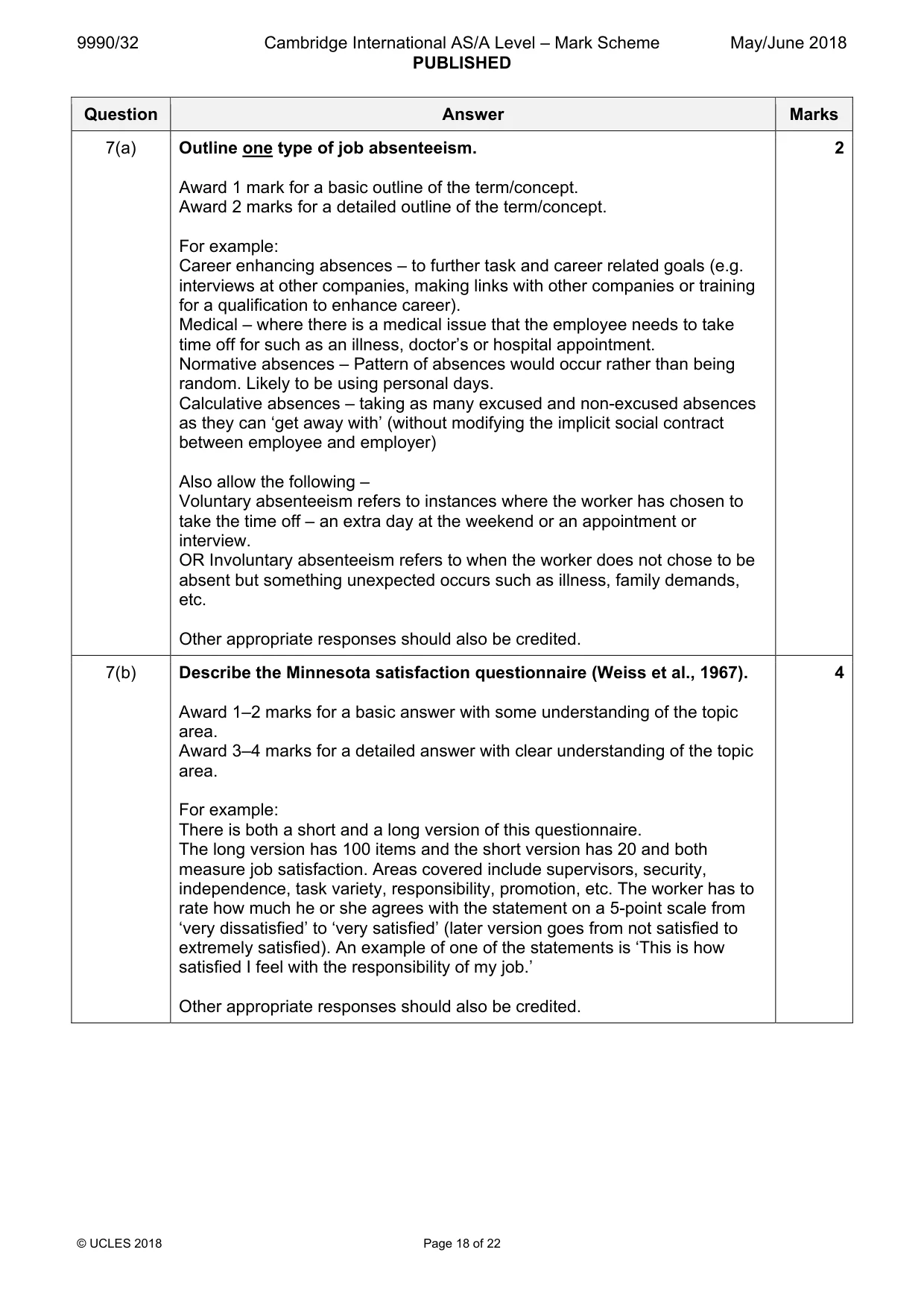
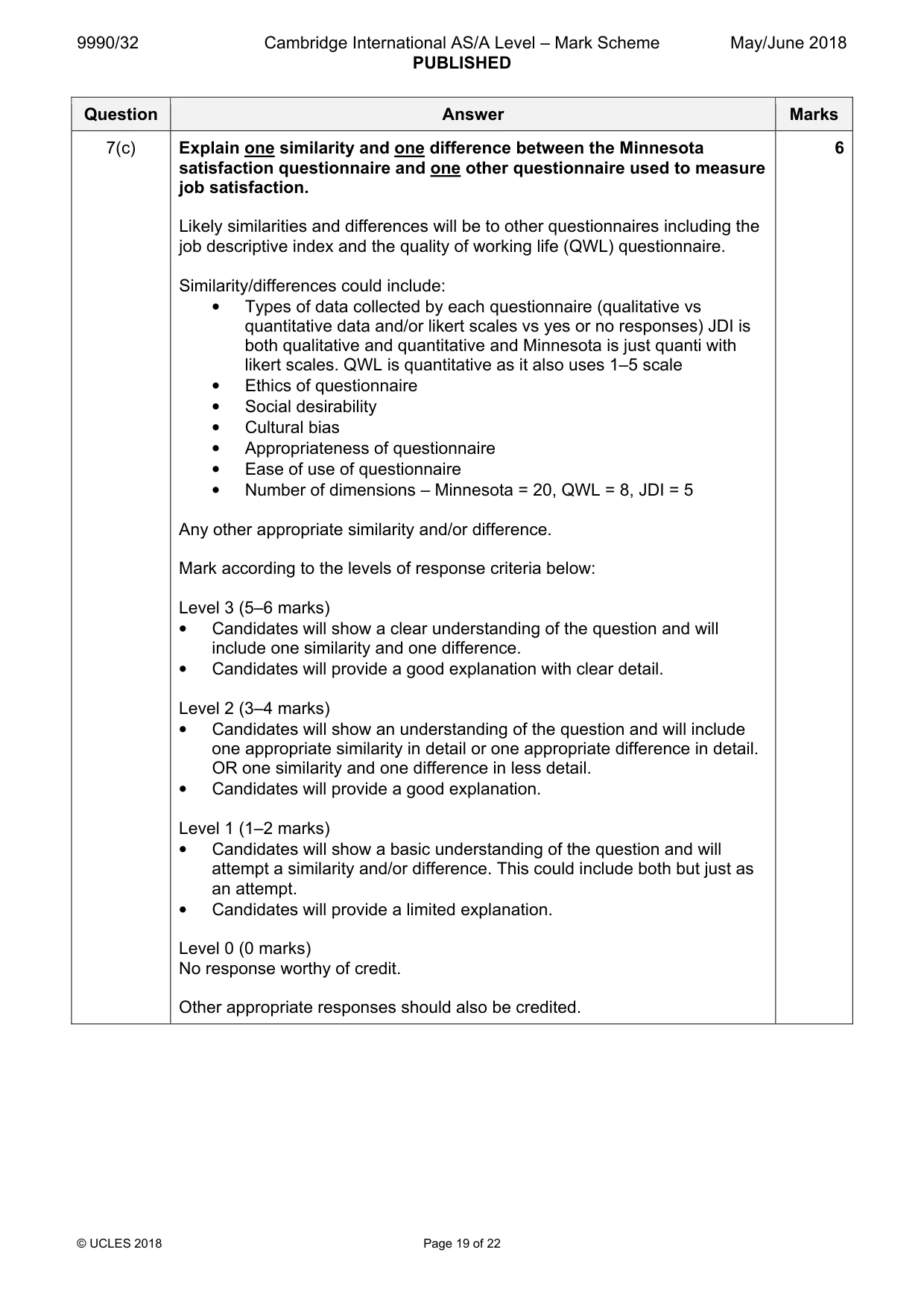
Mark scheme: 7(a) Outline one type of job absenteeism. 2 Award 1 mark for a basic outline of the term/concept. Award 2 marks for a detailed outline of the term/concept. For example: Career enhancing absences – to further task and career related goals (e.g. interviews at other companies, making links with other companies or training for a qualification to enhance career). Medical – where there is a medical issue that the employee needs to take time off for such as an illness, doctor’s or hospital appointment. Normative absences – Pattern of absences would occur rather than being random. Likely to be using personal days. Calculative absences – taking as many excused and non-excused absences as they can ‘get away with’ (without modifying the implicit social contract between employee and employer) Also allow the following – Voluntary absenteeism refers to instances where the worker has chosen to take the time off – an extra day at the weekend or an appointment or interview. OR Involuntary absenteeism refers to when the worker does not chose to be absent but something unexpected occurs such as illness, family demands, etc. Other appropriate responses should also be credited. 7(b) Describe the Minnesota satisfaction questionnaire (Weiss et al., 1967). 4 Award 1–2 marks for a basic answer with some understanding of the topic area. Award 3–4 marks for a detailed answer with clear understanding of the topic area. For example: There is both a short and a long version of this questionnaire. The long version has 100 items and the short version has 20 and both measure job satisfaction. Areas covered include supervisors, security, independence, task variety, responsibility, promotion, etc. The worker has to rate how much he or she agrees with the statement on a 5-point scale from ‘very dissatisfied’ to ‘very satisfied’ (later version goes from not satisfied to extremely satisfied). An example of one of the statements is ‘This is how satisfied I feel with the responsibility of my job.’ Other appropriate responses should also be credited. 7(c) Explain one similarity and one difference between the Minnesota 6 satisfaction questionnaire and one other questionnaire used to measure job satisfaction. Likely similarities and differences will be to other questionnaires including the job descriptive index and the quality of working life (QWL) questionnaire. Similarity/differences could include: • Types of data collected by each questionnaire (qualitative vs quantitative data and/or likert scales vs yes or no responses) JDI is both qualitative and quantitative and Minnesota is just quanti with likert scales. QWL is quantitative as it also uses 1–5 scale • Ethics of questionnaire • Social desirability • Cultural bias • Appropriateness of questionnaire • Ease of use of questionnaire • Number of dimensions – Minnesota = 20, QWL = 8, JDI = 5 Any other appropriate similarity and/or difference. Mark according to the levels of response criteria below: Level 3 (5–6 marks) • Candidates will show a clear understanding of the question and will include one similarity and one difference. • Candidates will provide a good explanation with clear detail. Level 2 (3–4 marks) • Candidates will show an understanding of the question and will include one appropriate similarity in detail or one appropriate difference in detail. OR one similarity and one difference in less detail. • Candidates will provide a good explanation. Level 1 (1–2 marks) • Candidates will show a basic understanding of the question and will attempt a similarity and/or difference. This could include both but just as an attempt. • Candidates will provide a limited explanation. Level 0 (0 marks) No response worthy of credit. Other appropriate responses should also be credited.
Q8 · Describe what psychologists have discovered about motivators at work (e.g
8 (a) Describe what psychologists have discovered about motivators at work (e.g. intrinsic and extrinsic motivation, rewards). [8] (b) Evaluate what psychologists have discovered about motivators at work, including a discussion of reductionism. [10]
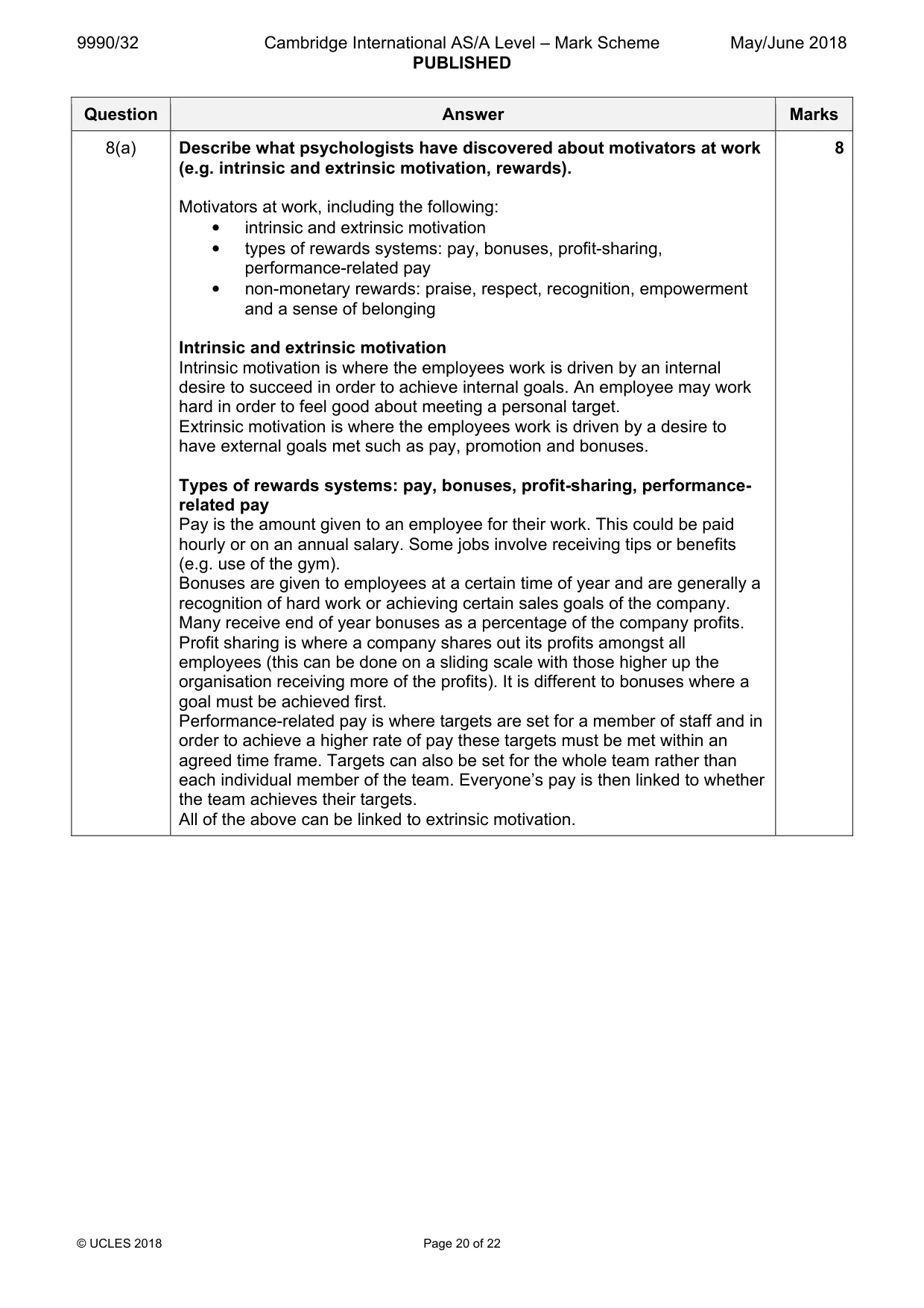
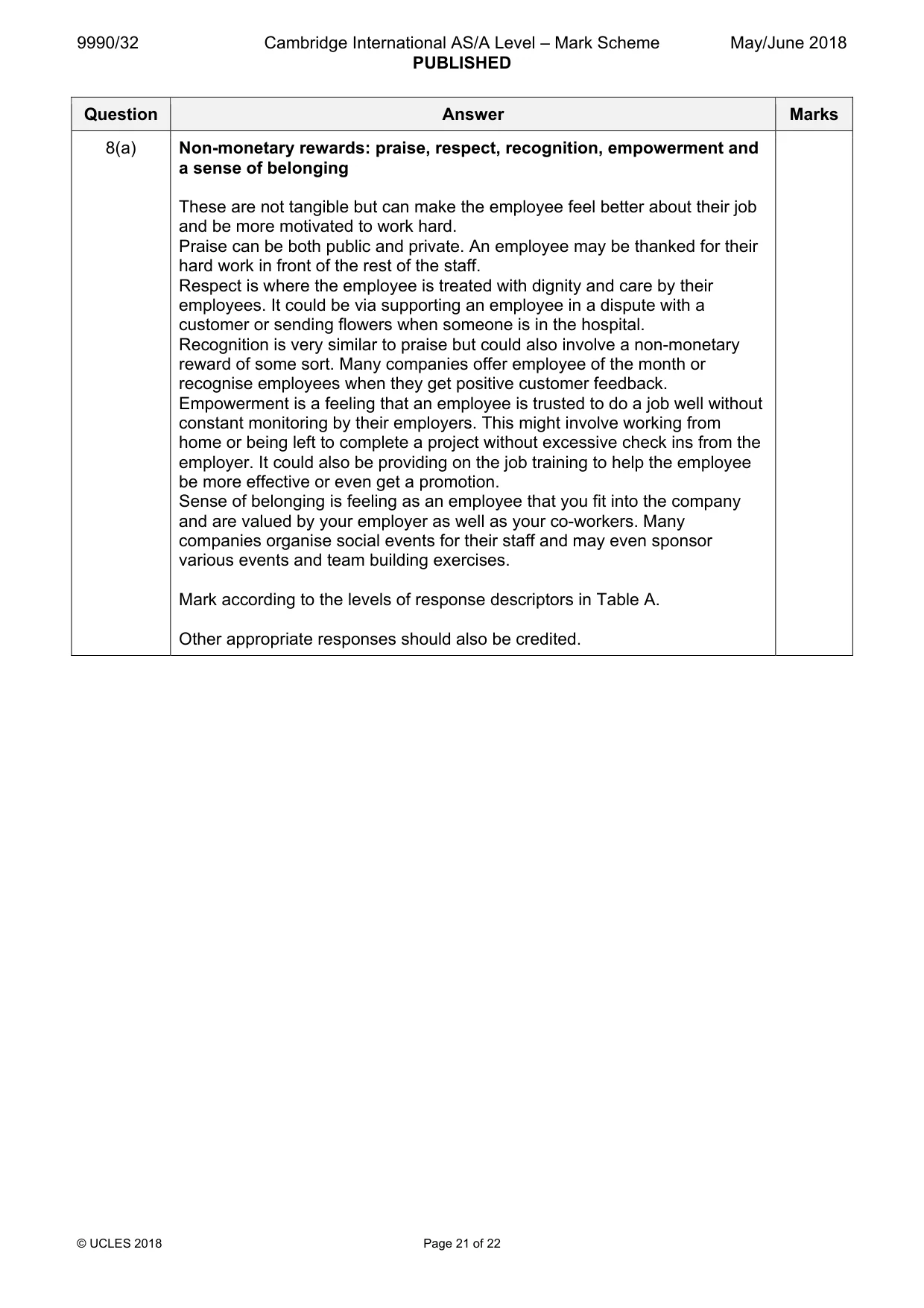
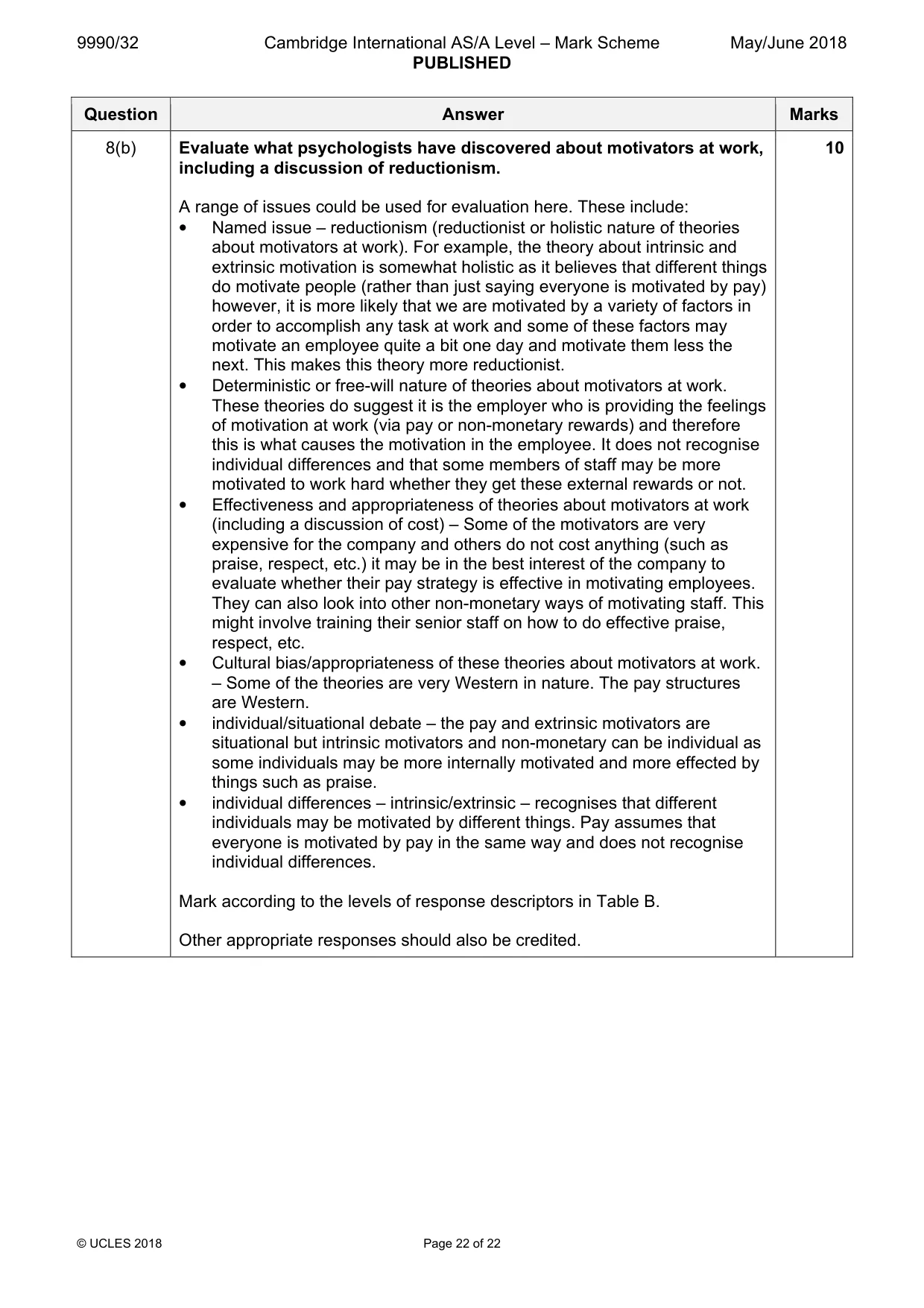
Mark scheme: 8(a) Describe what psychologists have discovered about motivators at work 8 (e.g. intrinsic and extrinsic motivation, rewards). Motivators at work, including the following: • intrinsic and extrinsic motivation • types of rewards systems: pay, bonuses, profit-sharing, performance-related pay • non-monetary rewards: praise, respect, recognition, empowerment and a sense of belonging Intrinsic and extrinsic motivation Intrinsic motivation is where the employees work is driven by an internal desire to succeed in order to achieve internal goals. An employee may work hard in order to feel good about meeting a personal target. Extrinsic motivation is where the employees work is driven by a desire to have external goals met such as pay, promotion and bonuses. Types of rewards systems: pay, bonuses, profit-sharing, performance- related pay Pay is the amount given to an employee for their work. This could be paid hourly or on an annual salary. Some jobs involve receiving tips or benefits (e.g. use of the gym). Bonuses are given to employees at a certain time of year and are generally a recognition of hard work or achieving certain sales goals of the company. Many receive end of year bonuses as a percentage of the company profits. Profit sharing is where a company shares out its profits amongst all employees (this can be done on a sliding scale with those higher up the organisation receiving more of the profits). It is different to bonuses where a goal must be achieved first. Performance-related pay is where targets are set for a member of staff and in order to achieve a higher rate of pay these targets must be met within an agreed time frame. Targets can also be set for the whole team rather than each individual member of the team. Everyone’s pay is then linked to whether the team achieves their targets. All of the above can be linked to extrinsic motivation. 8(a) Non-monetary rewards: praise, respect, recognition, empowerment and a sense of belonging These are not tangible but can make the employee feel better about their job and be more motivated to work hard. Praise can be both public and private. An employee may be thanked for their hard work in front of the rest of the staff. Respect is where the employee is treated with dignity and care by their employees. It could be via supporting an employee in a dispute with a customer or sending flowers when someone is in the hospital. Recognition is very similar to praise but could also involve a non-monetary reward of some sort. Many companies offer employee of the month or recognise employees when they get positive customer feedback. Empowerment is a feeling that an employee is trusted to do a job well without constant monitoring by their employers. This might involve working from home or being left to complete a project without excessive check ins from the employer. It could also be providing on the job training to help the employee be more effective or even get a promotion. Sense of belonging is feeling as an employee that you fit into the company and are valued by your employer as well as your co-workers. Many companies organise social events for their staff and may even sponsor various events and team building exercises. Mark according to the levels of response descriptors in Table A. Other appropriate responses should also be credited. 8(b) Evaluate what psychologists have discovered about motivators at work, 10 including a discussion of reductionism. A range of issues could be used for evaluation here. These include: • Named issue – reductionism (reductionist or holistic nature of theories about motivators at work). For example, the theory about intrinsic and extrinsic motivation is somewhat holistic as it believes that different things do motivate people (rather than just saying everyone is motivated by pay) however, it is more likely that we are motivated by a variety of factors in order to accomplish any task at work and some of these factors may motivate an employee quite a bit one day and motivate them less the next. This makes this theory more reductionist. • Deterministic or free-will nature of theories about motivators at work. These theories do suggest it is the employer who is providing the feelings of motivation at work (via pay or non-monetary rewards) and therefore this is what causes the motivation in the employee. It does not recognise individual differences and that some members of staff may be more motivated to work hard whether they get these external rewards or not. • Effectiveness and appropriateness of theories about motivators at work (including a discussion of cost) – Some of the motivators are very expensive for the company and others do not cost anything (such as praise, respect, etc.) it may be in the best interest of the company to evaluate whether their pay strategy is effective in motivating employees. They can also look into other non-monetary ways of motivating staff. This might involve training their senior staff on how to do effective praise, respect, etc. • Cultural bias/appropriateness of these theories about motivators at work. – Some of the theories are very Western in nature. The pay structures are Western. • individual/situational debate – the pay and extrinsic motivators are situational but intrinsic motivators and non-monetary can be individual as some individuals may be more internally motivated and more effected by things such as praise. • individual differences – intrinsic/extrinsic – recognises that different individuals may be motivated by different things. Pay assumes that everyone is motivated by pay in the same way and does not recognise individual differences. Mark according to the levels of response descriptors in Table B. Other appropriate responses should also be credited.
What was in this paper
The subtopics covered by these 8 questions, and how many questions each got. Open one in a new tab to see every Cambridge question on it.
What you needed in this session
Cambridge’s own grade thresholds for 2018 May/June, Paper 3 · Variant 2. A higher threshold means an easier paper — the bar moves with how the cohort did.