Cambridge A Level Psychology (from 2018) 9990 — 2022 Feb/March Paper 3 · Variant 2
9990/32/F/M/22 · 8 questions · 60 marks · ≈68 min
The question paper and its mark scheme, free to read here and free to download. This is Cambridge’s own paper, exactly as it was sat.
Question paper4 pages


Mark scheme28 pages
Answers below. Sit the paper first if you are practising.
Questions as text
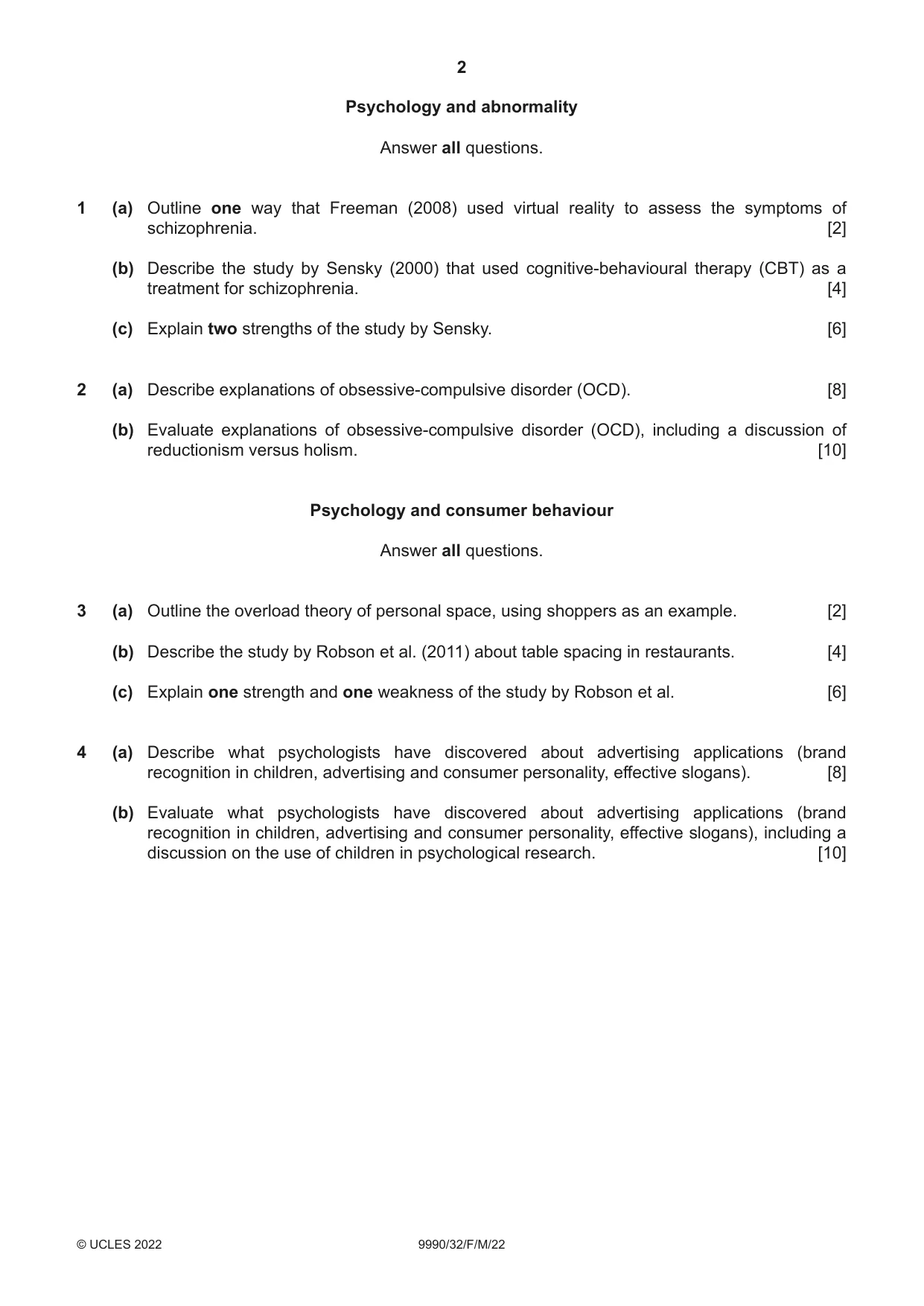
Q1 · Outline one way that Freeman (2008) used virtual reality to assess the symptoms of…
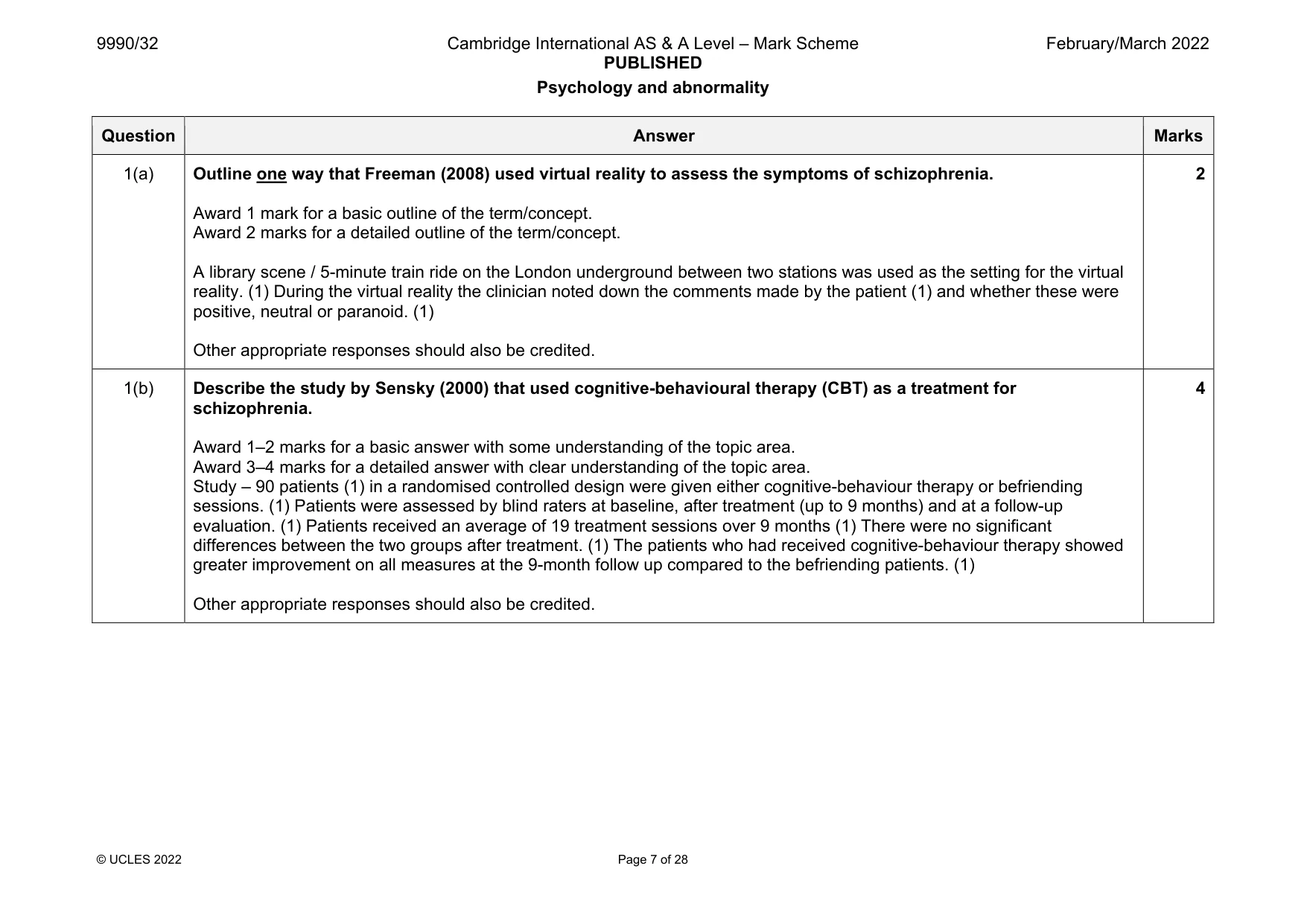
1 (a) Outline one way that Freeman (2008) used virtual reality to assess the symptoms of schizophrenia. [2] (b) Describe the study by Sensky (2000) that used cognitive-behavioural therapy (CBT) as a treatment for schizophrenia. [4] (c) Explain two strengths of the study by Sensky. [6]
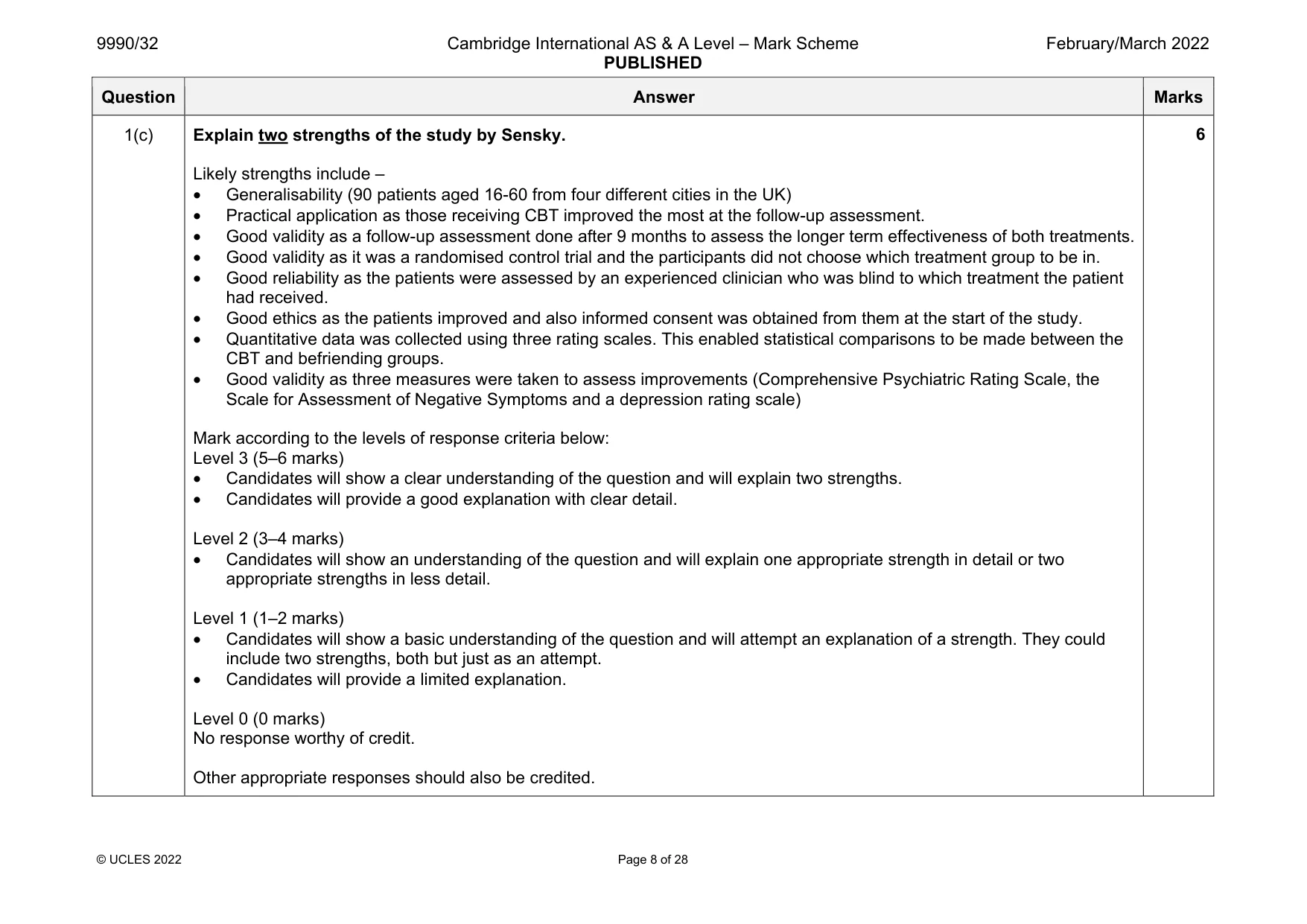
Mark scheme: 1(a) Outline one way that Freeman (2008) used virtual reality to assess the symptoms of schizophrenia. Award 1 mark for a basic outline of the term/concept. Award 2 marks for a detailed outline of the term/concept. A library scene / 5-minute train ride on the London underground between two stations was used as the setting for the virtual reality. (1) During the virtual reality the clinician noted down the comments made by the patient (1) and whether these were positive, neutral or paranoid. (1) Other appropriate responses should also be credited. 1(b) Describe the study by Sensky (2000) that used cognitive-behavioural therapy (CBT) as a treatment for schizophrenia. Award 1–2 marks for a basic answer with some understanding of the topic area. Award 3–4 marks for a detailed answer with clear understanding of the topic area. Study – 90 patients (1) in a randomised controlled design were given either cognitive-behaviour therapy or befriending sessions. (1) Patients were assessed by blind raters at baseline, after treatment (up to 9 months) and at a follow-up evaluation. (1) Patients received an average of 19 treatment sessions over 9 months (1) There were no significant differences between the two groups after treatment. (1) The patients who had received cognitive-behaviour therapy showed greater improvement on all measures at the 9-month follow up compared to the befriending patients. (1) Other appropriate responses should also be credited. 4 Question Answer Marks 1(c) Explain two strengths of the study by Sensky. Likely strengths include – • Generalisability (90 patients aged 16-60 from four different cities in the UK) • Practical application as those receiving CBT improved the most at the follow-up assessment. • Good validity as a follow-up assessment done after 9 months to assess the longer term effectiveness of both treatments. • Good validity as it was a randomised control trial and the participants did not choose which treatment group to be in. • Good reliability as the patients were assessed by an experienced clinician who was blind to which treatment the patient had received. • Good ethics as the patients improved and also informed consent was obtained from them at the start of the study. • Quantitative data was collected using three rating scales. This enabled statistical comparisons to be made between the CBT and befriending groups. • Good validity as three measures were taken to assess improvements (Comprehensive Psychiatric Rating Scale, the Scale for Assessment of Negative Symptoms and a depression rating scale) Mark according to the levels of response criteria below: Level 3 (5–6 marks) • Candidates will show a clear understanding of the question and will explain two strengths. • Candidates will provide a good explanation with clear detail. Level 2 (3–4 marks) • Candidates will show an understanding of the question and will explain one appropriate strength in detail or two appropriate strengths in less detail. Level 1 (1–2 marks) • Candidates will show a basic understanding of the question and will attempt an explanation of a strength. They could include two strengths, both but just as an attempt. • Candidates will provide a limited explanation. Level 0 (0 marks) No response worthy of credit. Other appropriate responses should also be credited. 6
Q2 · Describe explanations of obsessive-compulsive disorder (OCD)
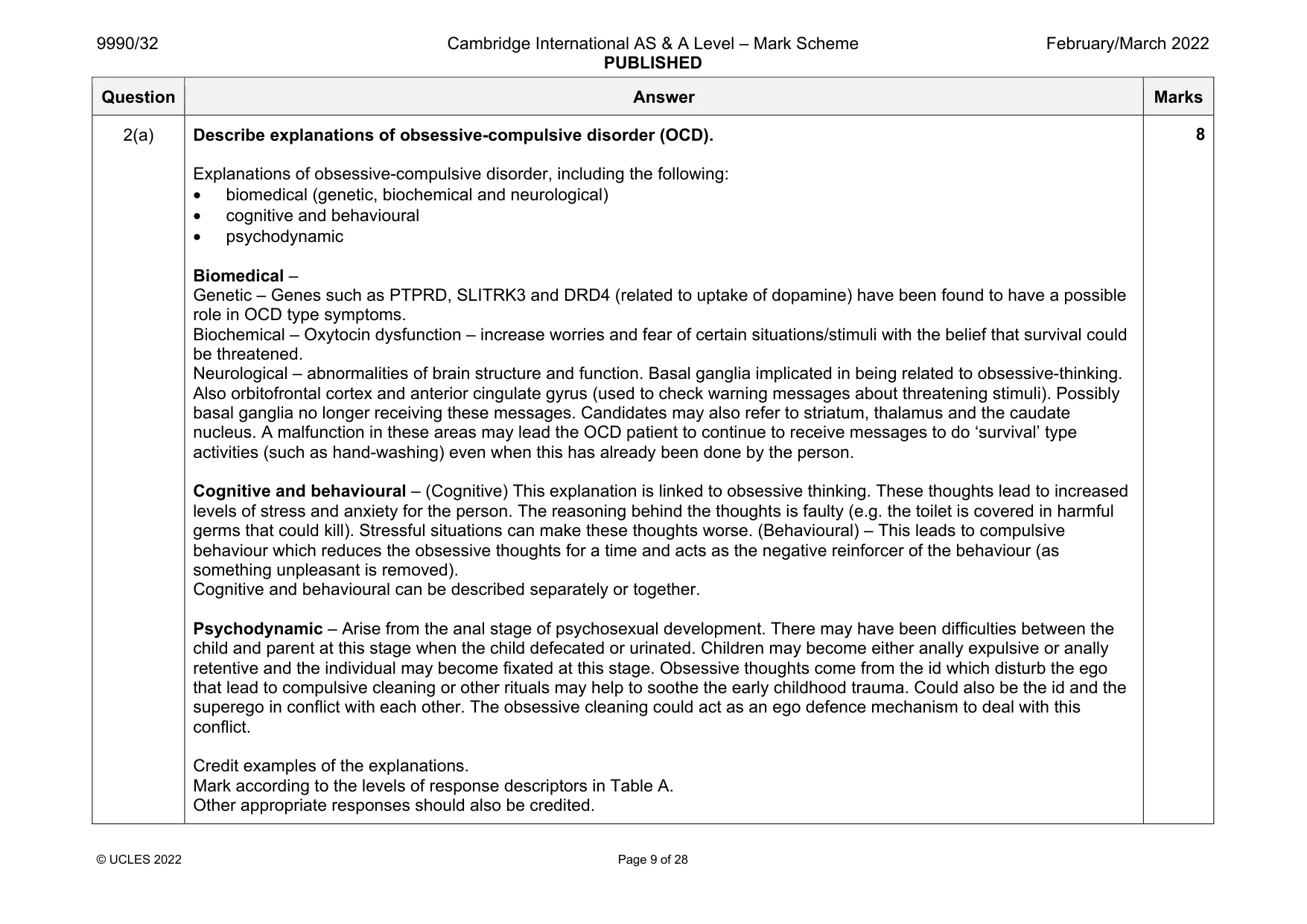
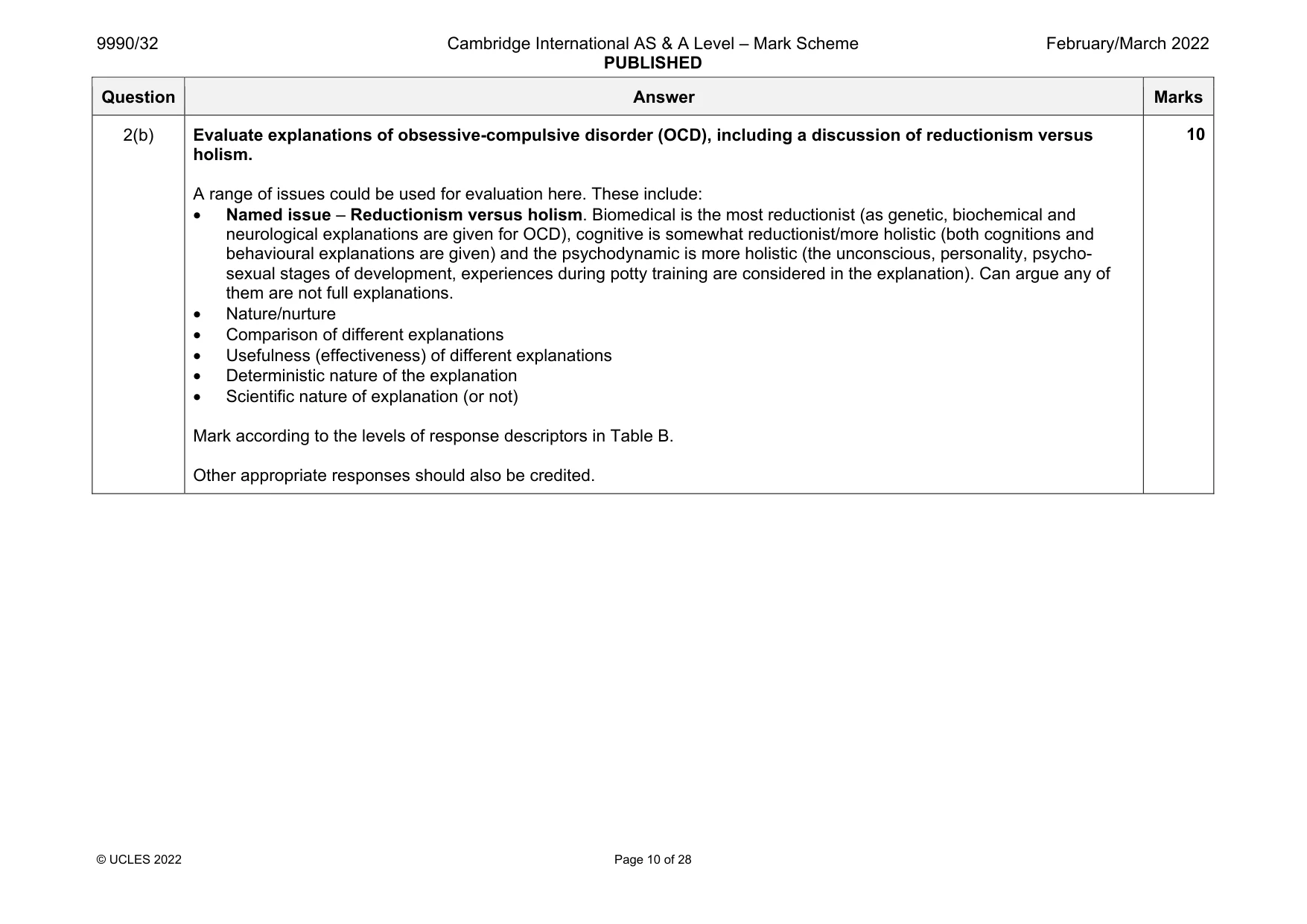
2 (a) Describe explanations of obsessive-compulsive disorder (OCD). [8] (b) Evaluate explanations of obsessive-compulsive disorder (OCD), including a discussion of reductionism versus holism. [10] Psychology and consumer behaviour Answer all questions.
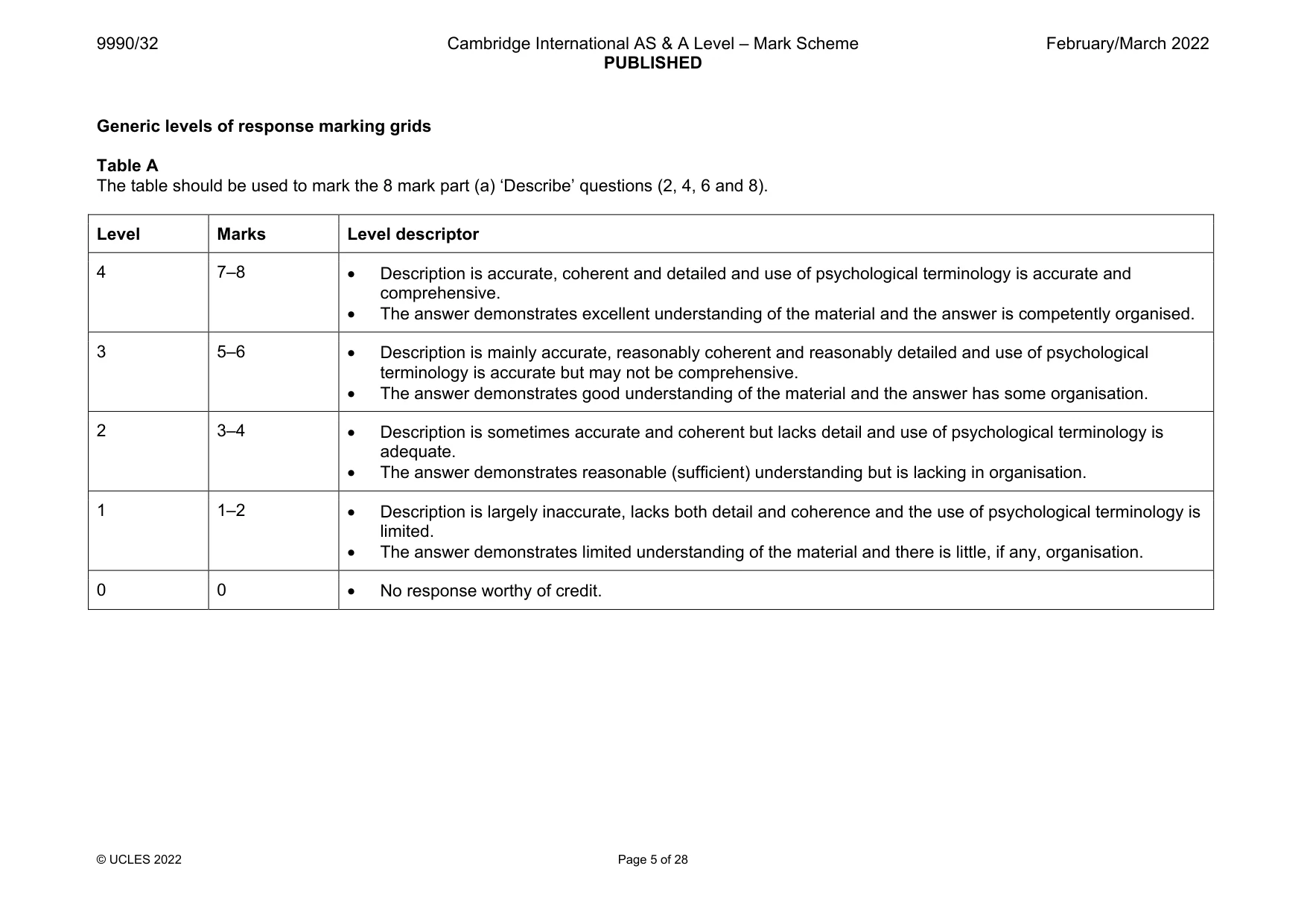
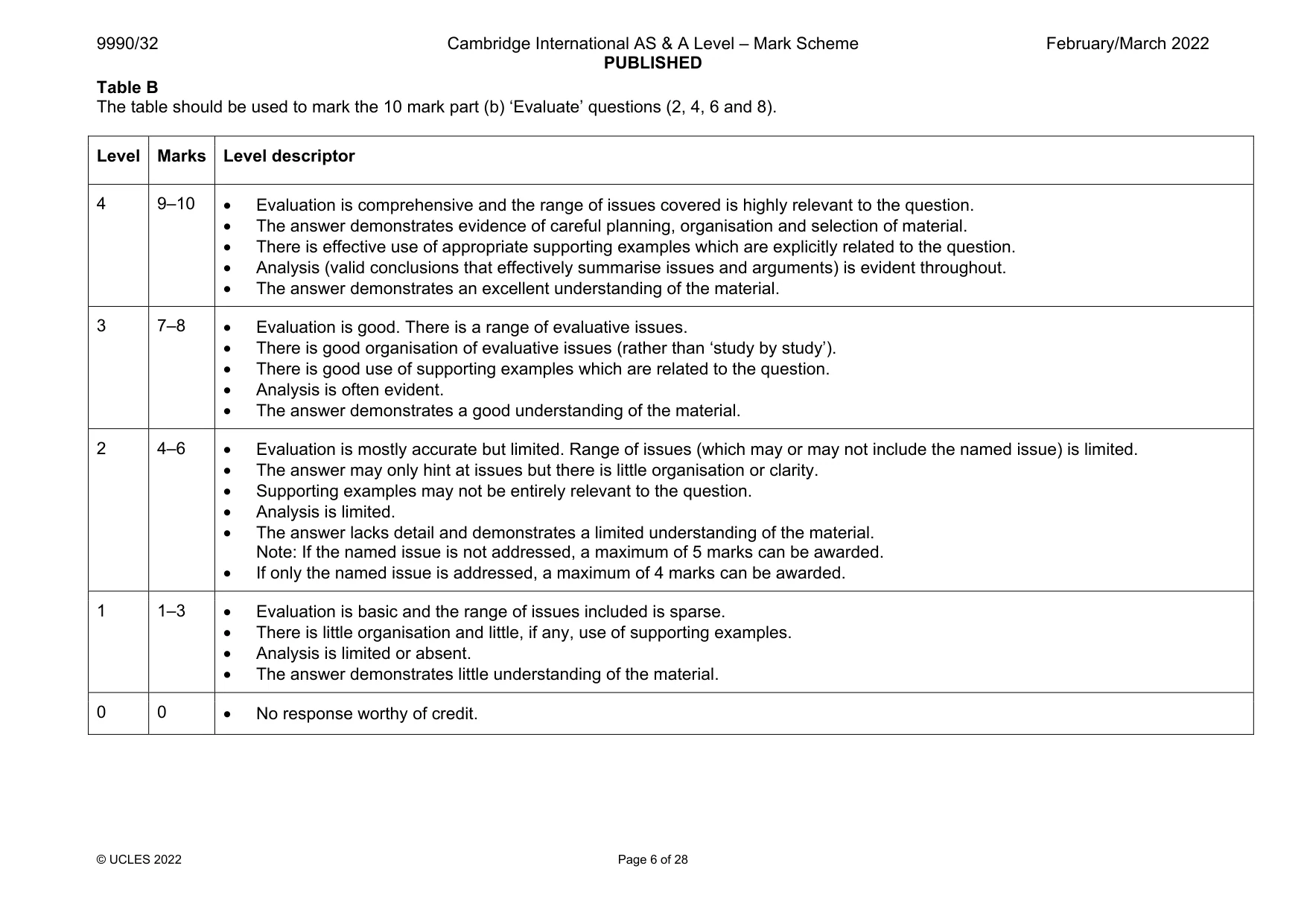
Mark scheme: 2(a) Describe explanations of obsessive-compulsive disorder (OCD). Explanations of obsessive-compulsive disorder, including the following: • biomedical (genetic, biochemical and neurological) • cognitive and behavioural • psychodynamic Biomedical – Genetic – Genes such as PTPRD, SLITRK3 and DRD4 (related to uptake of dopamine) have been found to have a possible role in OCD type symptoms. Biochemical – Oxytocin dysfunction – increase worries and fear of certain situations/stimuli with the belief that survival could be threatened. Neurological – abnormalities of brain structure and function. Basal ganglia implicated in being related to obsessive-thinking. Also orbitofrontal cortex and anterior cingulate gyrus (used to check warning messages about threatening stimuli). Possibly basal ganglia no longer receiving these messages. Candidates may also refer to striatum, thalamus and the caudate nucleus. A malfunction in these areas may lead the OCD patient to continue to receive messages to do ‘survival’ type activities (such as hand-washing) even when this has already been done by the person. Cognitive and behavioural – (Cognitive) This explanation is linked to obsessive thinking. These thoughts lead to increased levels of stress and anxiety for the person. The reasoning behind the thoughts is faulty (e.g. the toilet is covered in harmful germs that could kill). Stressful situations can make these thoughts worse. (Behavioural) – This leads to compulsive behaviour which reduces the obsessive thoughts for a time and acts as the negative reinforcer of the behaviour (as something unpleasant is removed). Cognitive and behavioural can be described separately or together. Psychodynamic – Arise from the anal stage of psychosexual development. There may have been difficulties between the child and parent at this stage when the child defecated or urinated. Children may become either anally expulsive or anally retentive and the individual may become fixated at this stage. Obsessive thoughts come from the id which disturb the ego that lead to compulsive cleaning or other rituals may help to soothe the early childhood trauma. Could also be the id and the superego in conflict with each other. The obsessive cleaning could act as an ego defence mechanism to deal with this conflict. Credit examples of the explanations. Mark according to the levels of response descriptors in Table A. Other appropriate responses should also be credited. Question Answer Marks 2(b) Evaluate explanations of obsessive-compulsive disorder (OCD), including a discussion of reductionism versus holism. A range of issues could be used for evaluation here. These include: • Named issue – Reductionism versus holism. Biomedical is the most reductionist (as genetic, biochemical and neurological explanations are given for OCD), cognitive is somewhat reductionist/more holistic (both cognitions and behavioural explanations are given) and the psychodynamic is more holistic (the unconscious, personality, psycho- sexual stages of development, experiences during potty training are considered in the explanation). Can argue any of them are not full explanations. • Nature/nurture • Comparison of different explanations • Usefulness (effectiveness) of different explanations • Deterministic nature of the explanation • Scientific nature of explanation (or not) Mark according to the levels of response descriptors in Table B. Other appropriate responses should also be credited. 10
Q3 · Outline the overload theory of personal space, using shoppers as an example
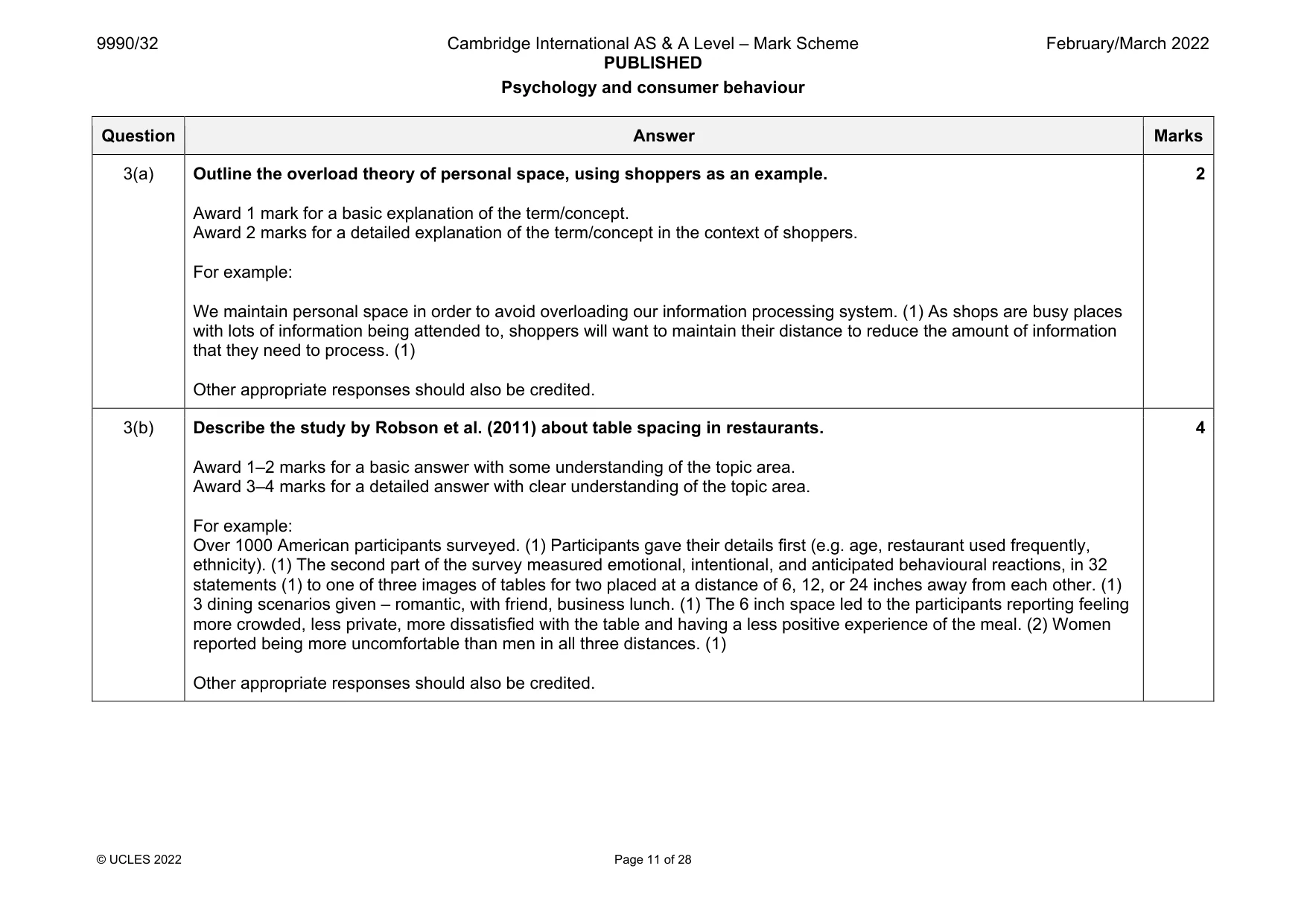
3 (a) Outline the overload theory of personal space, using shoppers as an example. [2] (b) Describe the study by Robson et al. (2011) about table spacing in restaurants. [4] (c) Explain one strength and one weakness of the study by Robson et al. [6]
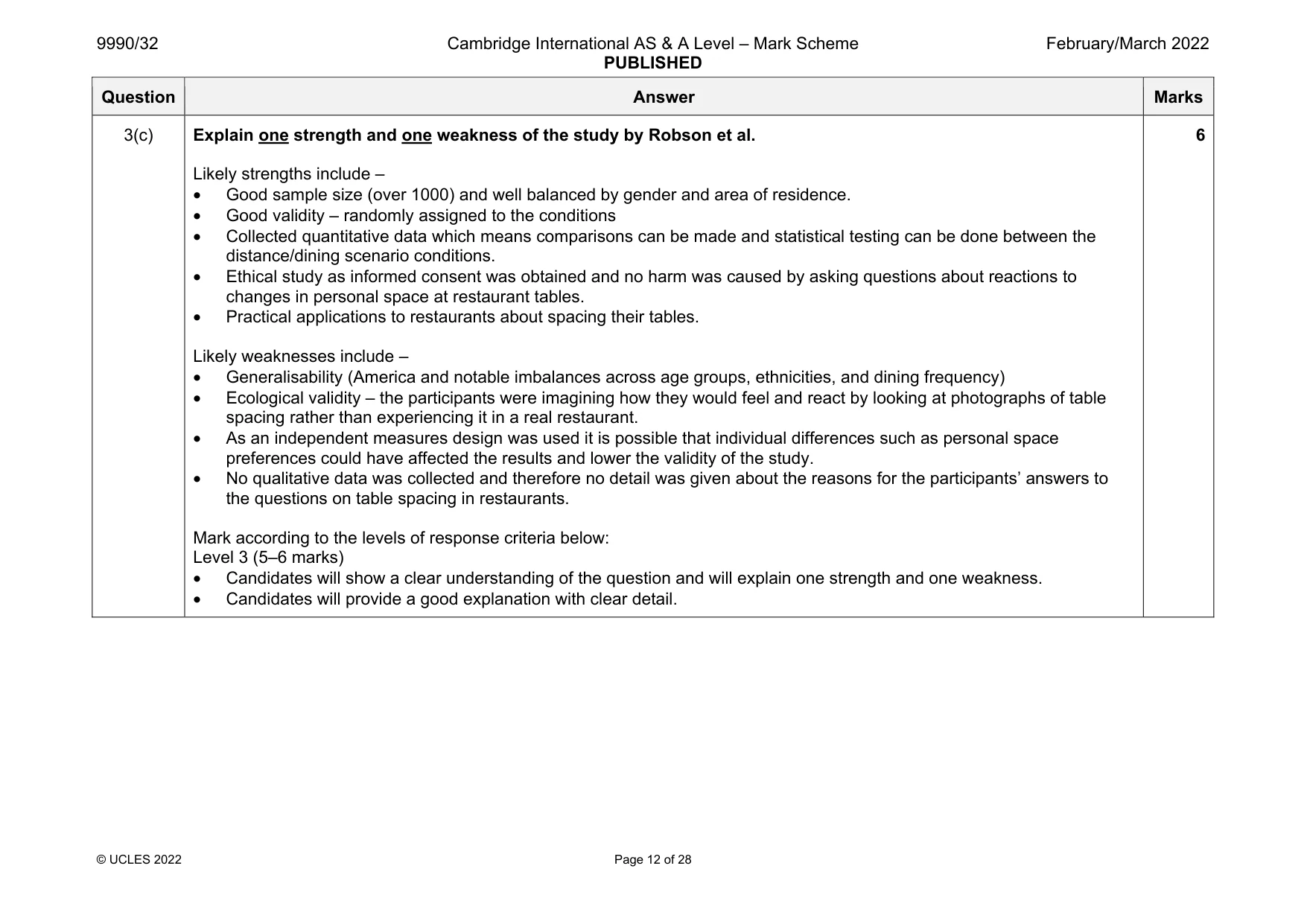
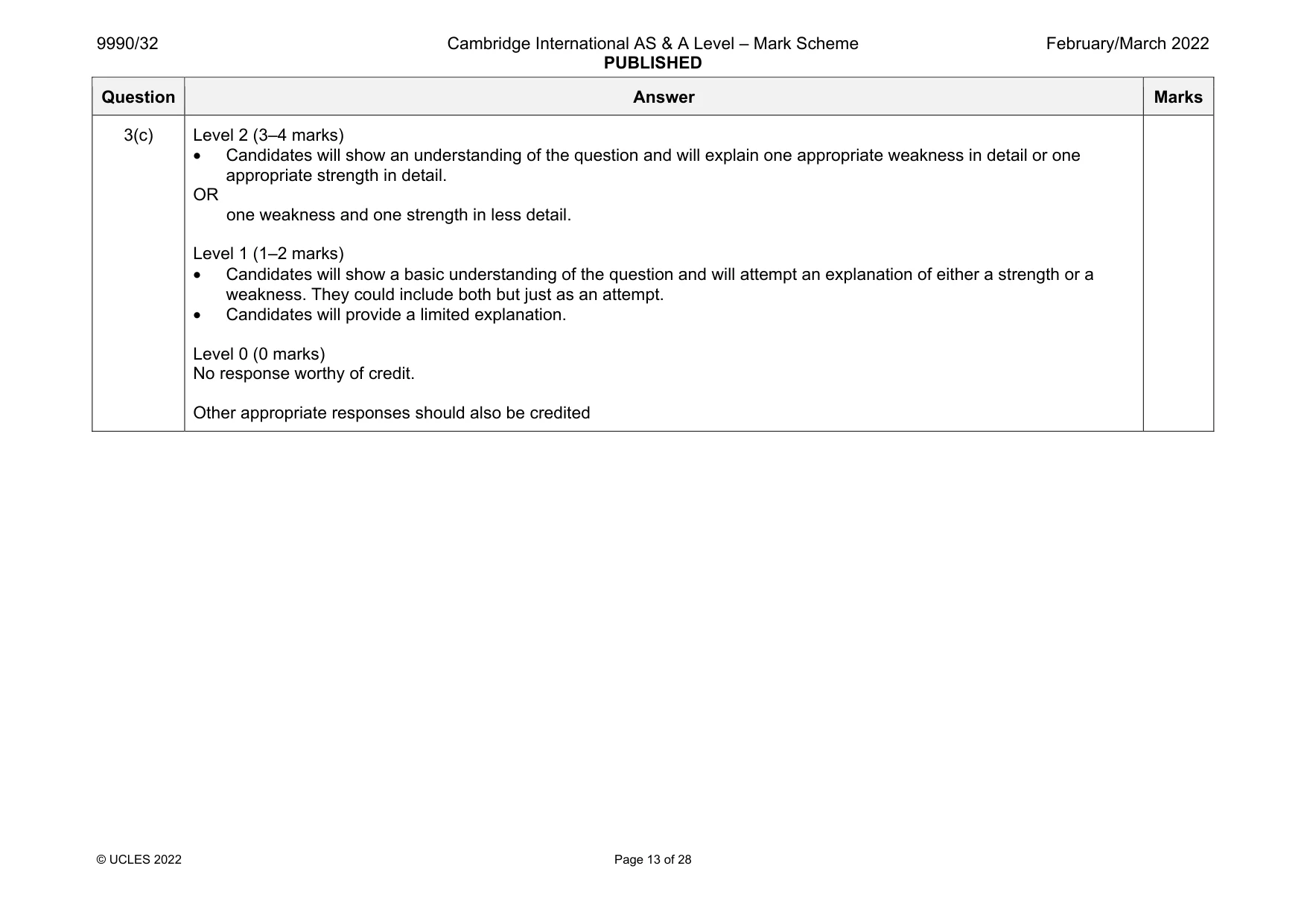
Mark scheme: 3(a) Outline the overload theory of personal space, using shoppers as an example. Award 1 mark for a basic explanation of the term/concept. Award 2 marks for a detailed explanation of the term/concept in the context of shoppers. For example: We maintain personal space in order to avoid overloading our information processing system. (1) As shops are busy places with lots of information being attended to, shoppers will want to maintain their distance to reduce the amount of information that they need to process. (1) Other appropriate responses should also be credited. 3(b) Describe the study by Robson et al. (2011) about table spacing in restaurants. Award 1–2 marks for a basic answer with some understanding of the topic area. Award 3–4 marks for a detailed answer with clear understanding of the topic area. For example: Over 1000 American participants surveyed. (1) Participants gave their details first (e.g. age, restaurant used frequently, ethnicity). (1) The second part of the survey measured emotional, intentional, and anticipated behavioural reactions, in 32 statements (1) to one of three images of tables for two placed at a distance of 6, 12, or 24 inches away from each other. (1) 3 dining scenarios given – romantic, with friend, business lunch. (1) The 6 inch space led to the participants reporting feeling more crowded, less private, more dissatisfied with the table and having a less positive experience of the meal. (2) Women reported being more uncomfortable than men in all three distances. (1) Other appropriate responses should also be credited. 4 Question Answer Marks 3(c) Explain one strength and one weakness of the study by Robson et al. Likely strengths include – • Good sample size (over 1000) and well balanced by gender and area of residence. • Good validity – randomly assigned to the conditions • Collected quantitative data which means comparisons can be made and statistical testing can be done between the distance/dining scenario conditions. • Ethical study as informed consent was obtained and no harm was caused by asking questions about reactions to changes in personal space at restaurant tables. • Practical applications to restaurants about spacing their tables. Likely weaknesses include – • Generalisability (America and notable imbalances across age groups, ethnicities, and dining frequency) • Ecological validity – the participants were imagining how they would feel and react by looking at photographs of table spacing rather than experiencing it in a real restaurant. • As an independent measures design was used it is possible that individual differences such as personal space preferences could have affected the results and lower the validity of the study. • No qualitative data was collected and therefore no detail was given about the reasons for the participants’ answers to the questions on table spacing in restaurants. Mark according to the levels of response criteria below: Level 3 (5–6 marks) • Candidates will show a clear understanding of the question and will explain one strength and one weakness. • Candidates will provide a good explanation with clear detail. 6 Question Answer Marks 3(c) Level 2 (3–4 marks) • Candidates will show an understanding of the question and will explain one appropriate weakness in detail or one appropriate strength in detail. OR one weakness and one strength in less detail. Level 1 (1–2 marks) • Candidates will show a basic understanding of the question and will attempt an explanation of either a strength or a weakness. They could include both but just as an attempt. • Candidates will provide a limited explanation. Level 0 (0 marks) No response worthy of credit. Other appropriate responses should also be credited
Q4 · Describe what psychologists have discovered about advertising applications (brand…
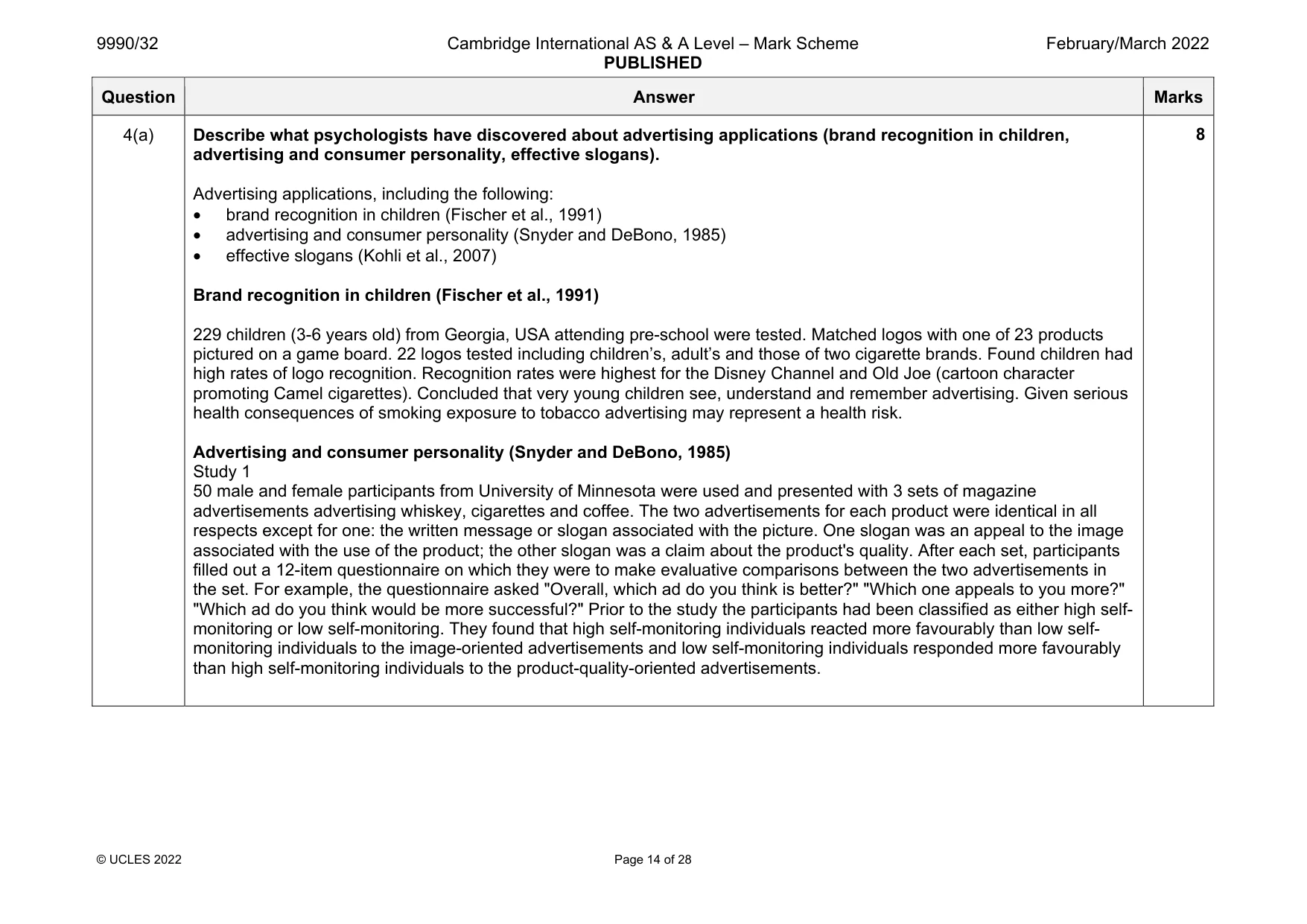
4 (a) Describe what psychologists have discovered about advertising applications (brand recognition in children, advertising and consumer personality, effective slogans). [8] (b) Evaluate what psychologists have discovered about advertising applications (brand recognition in children, advertising and consumer personality, effective slogans), including a discussion on the use of children in psychological research. [10] Psychology and health Answer all questions.
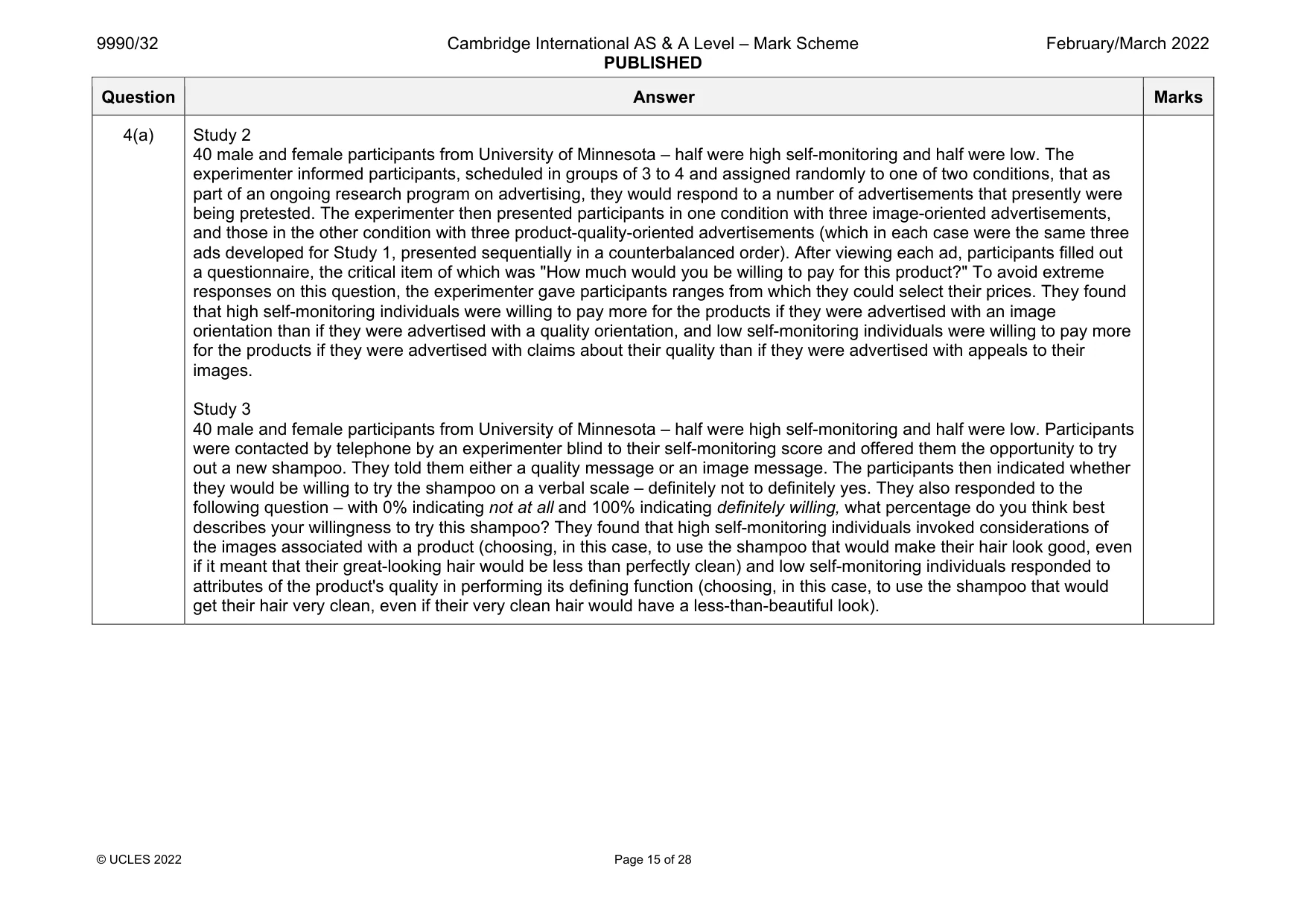
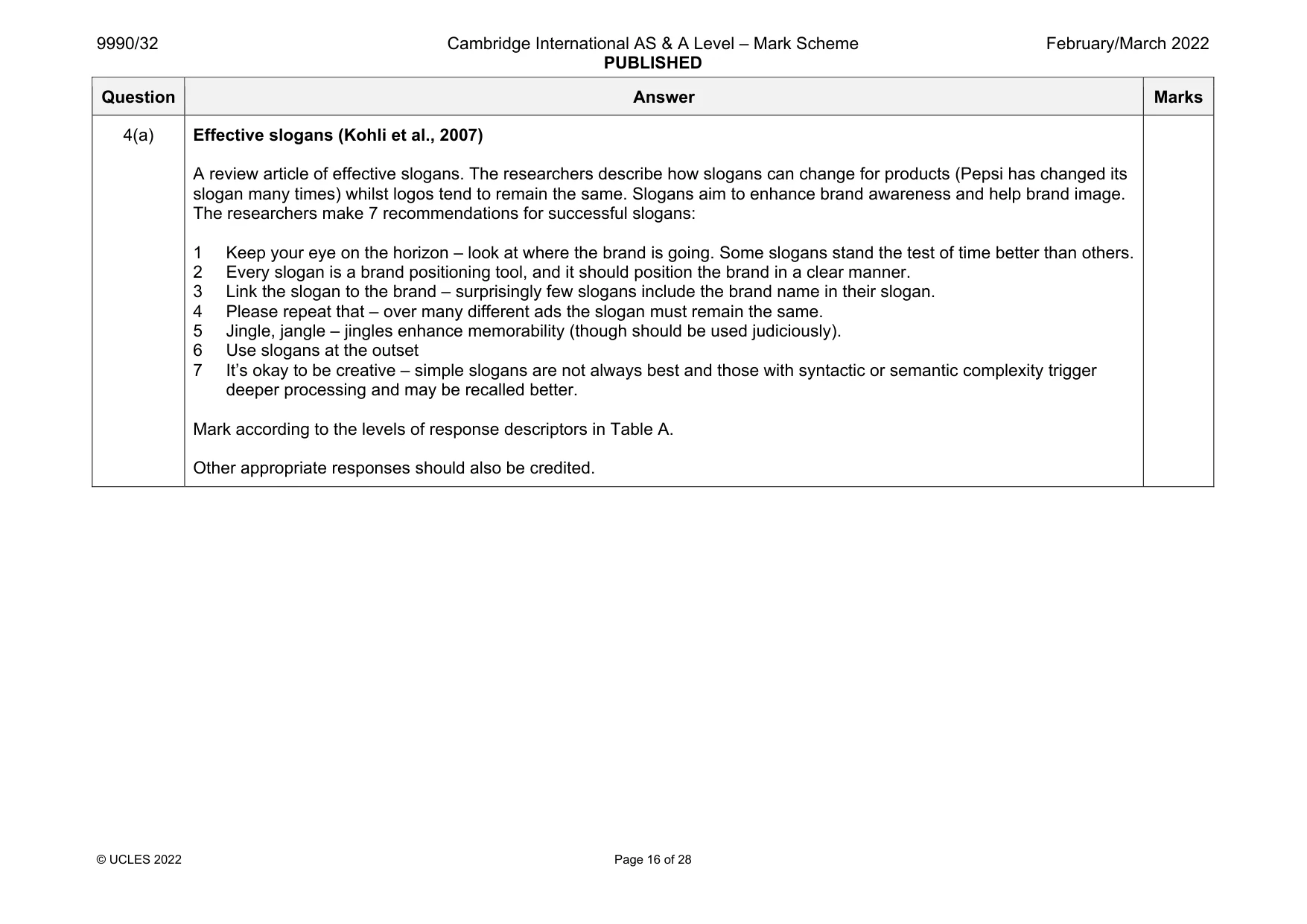
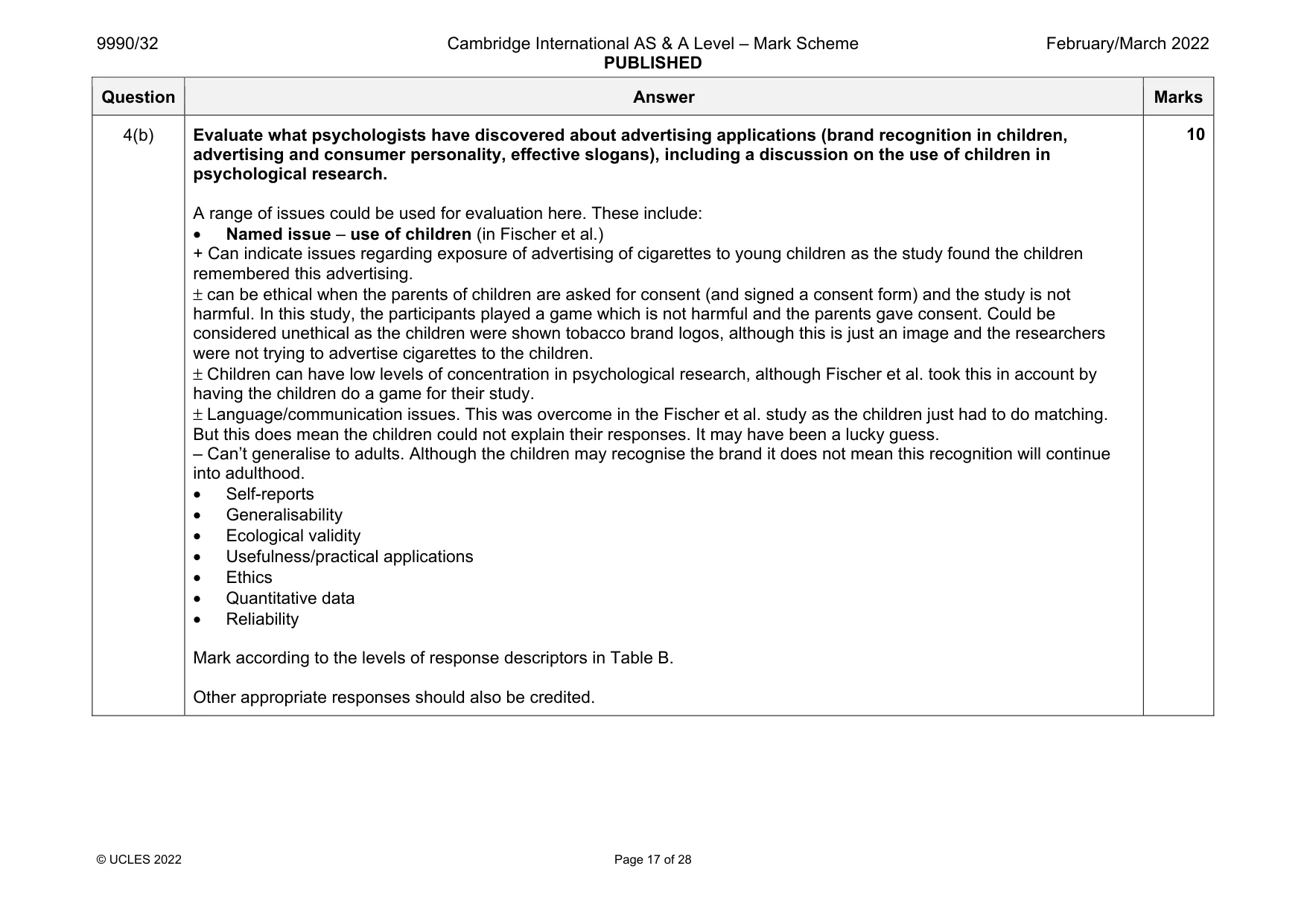
Mark scheme: 4(a) Describe what psychologists have discovered about advertising applications (brand recognition in children, advertising and consumer personality, effective slogans). Advertising applications, including the following: • brand recognition in children (Fischer et al., 1991) • advertising and consumer personality (Snyder and DeBono, 1985) • effective slogans (Kohli et al., 2007) Brand recognition in children (Fischer et al., 1991) 229 children (3-6 years old) from Georgia, USA attending pre-school were tested. Matched logos with one of 23 products pictured on a game board. 22 logos tested including children’s, adult’s and those of two cigarette brands. Found children had high rates of logo recognition. Recognition rates were highest for the Disney Channel and Old Joe (cartoon character promoting Camel cigarettes). Concluded that very young children see, understand and remember advertising. Given serious health consequences of smoking exposure to tobacco advertising may represent a health risk. Advertising and consumer personality (Snyder and DeBono, 1985) Study 1 50 male and female participants from University of Minnesota were used and presented with 3 sets of magazine advertisements advertising whiskey, cigarettes and coffee. The two advertisements for each product were identical in all respects except for one: the written message or slogan associated with the picture. One slogan was an appeal to the image associated with the use of the product; the other slogan was a claim about the product's quality. After each set, participants filled out a 12-item questionnaire on which they were to make evaluative comparisons between the two advertisements in the set. For example, the questionnaire asked "Overall, which ad do you think is better?" "Which one appeals to you more?" "Which ad do you think would be more successful?" Prior to the study the participants had been classified as either high self- monitoring or low self-monitoring. They found that high self-monitoring individuals reacted more favourably than low self- monitoring individuals to the image-oriented advertisements and low self-monitoring individuals responded more favourably than high self-monitoring individuals to the product-quality-oriented advertisements. Question Answer Marks 4(a) Study 2 40 male and female participants from University of Minnesota – half were high self-monitoring and half were low. The experimenter informed participants, scheduled in groups of 3 to 4 and assigned randomly to one of two conditions, that as part of an ongoing research program on advertising, they would respond to a number of advertisements that presently were being pretested. The experimenter then presented participants in one condition with three image-oriented advertisements, and those in the other condition with three product-quality-oriented advertisements (which in each case were the same three ads developed for Study 1, presented sequentially in a counterbalanced order). After viewing each ad, participants filled out a questionnaire, the critical item of which was "How much would you be willing to pay for this product?" To avoid extreme responses on this question, the experimenter gave participants ranges from which they could select their prices. They found that high self-monitoring individuals were willing to pay more for the products if they were advertised with an image orientation than if they were advertised with a quality orientation, and low self-monitoring individuals were willing to pay more for the products if they were advertised with claims about their quality than if they were advertised with appeals to their images. Study 3 40 male and female participants from University of Minnesota – half were high self-monitoring and half were low. Participants were contacted by telephone by an experimenter blind to their self-monitoring score and offered them the opportunity to try out a new shampoo. They told them either a quality message or an image message. The participants then indicated whether they would be willing to try the shampoo on a verbal scale – definitely not to definitely yes. They also responded to the following question – with 0% indicating not at all and 100% indicating definitely willing, what percentage do you think best describes your willingness to try this shampoo? They found that high self-monitoring individuals invoked considerations of the images associated with a product (choosing, in this case, to use the shampoo that would make their hair look good, even if it meant that their great-looking hair would be less than perfectly clean) and low self-monitoring individuals responded to attributes of the product's quality in performing its defining function (choosing, in this case, to use the shampoo that would get their hair very clean, even if their very clean hair would have a less-than-beautiful look). Question Answer Marks 4(a) Effective slogans (Kohli et al., 2007) A review article of effective slogans. The researchers describe how slogans can change for products (Pepsi has changed its slogan many times) whilst logos tend to remain the same. Slogans aim to enhance brand awareness and help brand image. The researchers make 7 recommendations for successful slogans: 1 Keep your eye on the horizon – look at where the brand is going. Some slogans stand the test of time better than others. 2 Every slogan is a brand positioning tool, and it should position the brand in a clear manner. 3 Link the slogan to the brand – surprisingly few slogans include the brand name in their slogan. 4 Please repeat that – over many different ads the slogan must remain the same. 5 Jingle, jangle – jingles enhance memorability (though should be used judiciously). 6 Use slogans at the outset 7 It’s okay to be creative – simple slogans are not always best and those with syntactic or semantic complexity trigger deeper processing and may be recalled better. Mark according to the levels of response descriptors in Table A. Other appropriate responses should also be credited. Question Answer Marks 4(b) Evaluate what psychologists have discovered about advertising applications (brand recognition in children, advertising and consumer personality, effective slogans), including a discussion on the use of children in psychological research. A range of issues could be used for evaluation here. These include: • Named issue – use of children (in Fischer et al.) + Can indicate issues regarding exposure of advertising of cigarettes to young children as the study found the children remembered this advertising. ± can be ethical when the parents of children are asked for consent (and signed a consent form) and the study is not harmful. In this study, the participants played a game which is not harmful and the parents gave consent. Could be considered unethical as the children were shown tobacco brand logos, although this is just an image and the researchers were not trying to advertise cigarettes to the children. ± Children can have low levels of concentration in psychological research, although Fischer et al. took this in account by having the children do a game for their study. ± Language/communication issues. This was overcome in the Fischer et al. study as the children just had to do matching. But this does mean the children could not explain their responses. It may have been a lucky guess. – Can’t generalise to adults. Although the children may recognise the brand it does not mean this recognition will continue into adulthood. • Self-reports • Generalisability • Ecological validity • Usefulness/practical applications • Ethics • Quantitative data • Reliability Mark according to the levels of response descriptors in Table B. Other appropriate responses should also be credited. 10
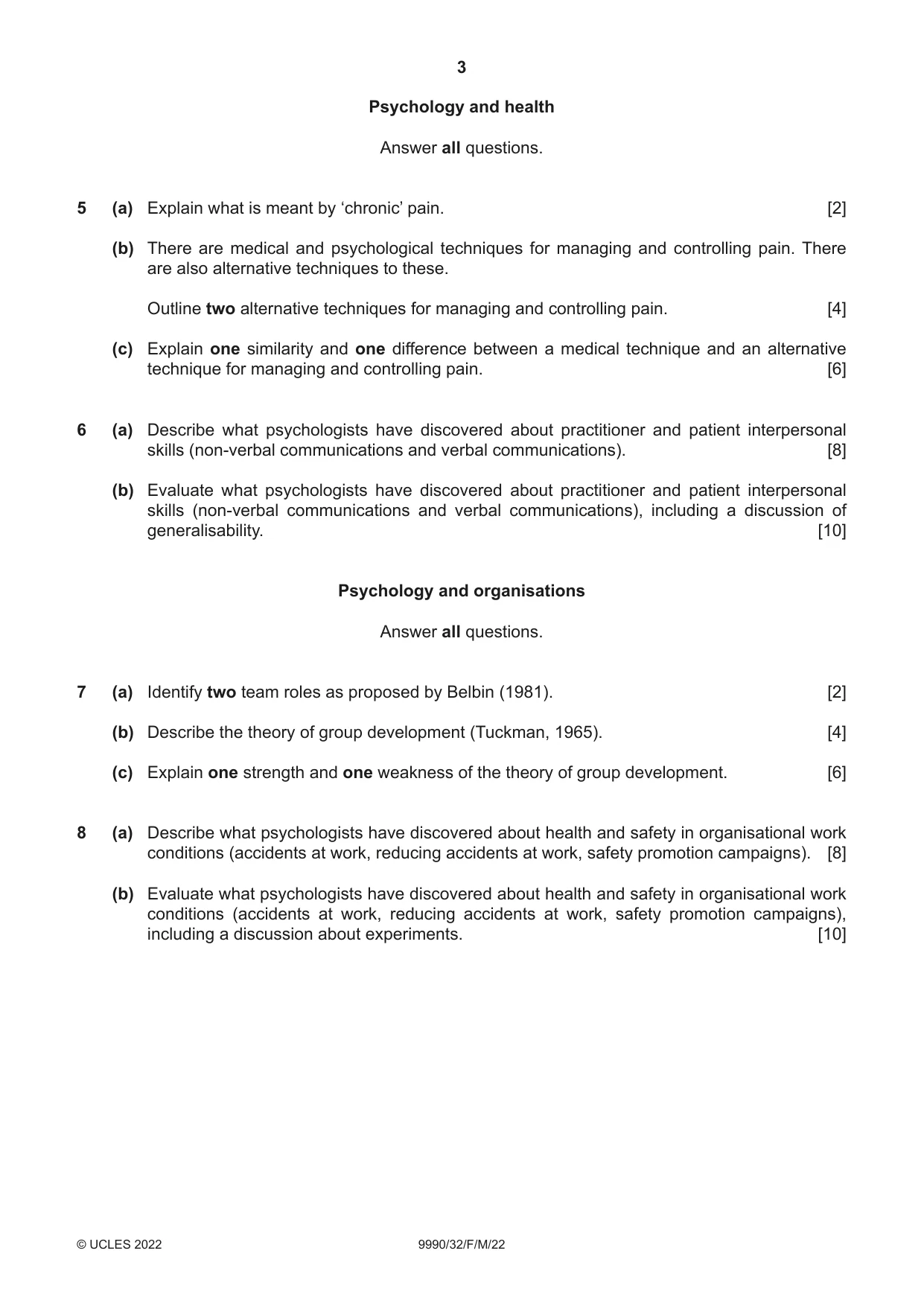
Q5 · Explain what is meant by ‘chronic’ pain
5 (a) Explain what is meant by ‘chronic’ pain. [2] (b) There are medical and psychological techniques for managing and controlling pain. There are also alternative techniques to these. Outline two alternative techniques for managing and controlling pain. [4] (c) Explain one similarity and one difference between a medical technique and an alternative technique for managing and controlling pain. [6]
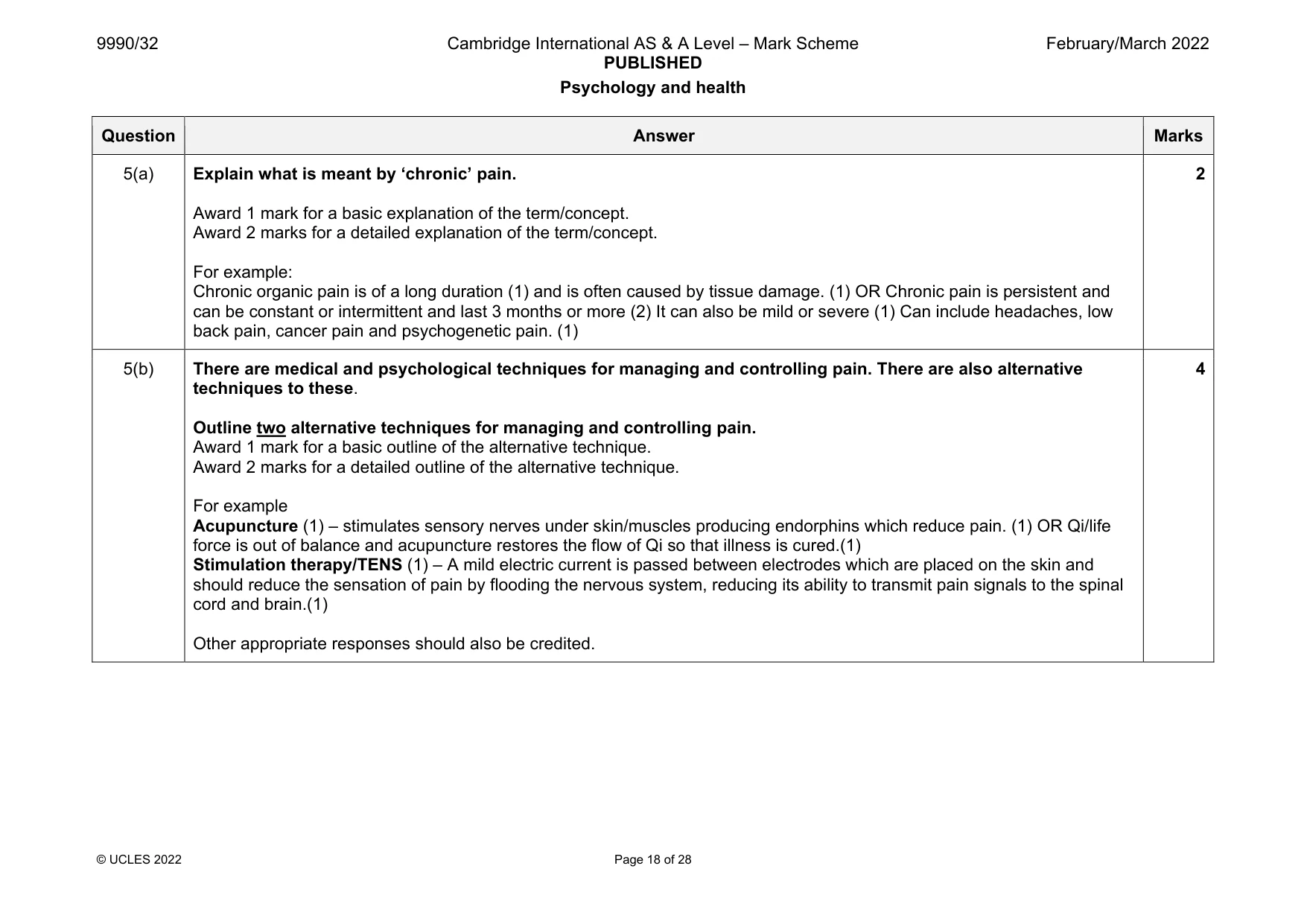
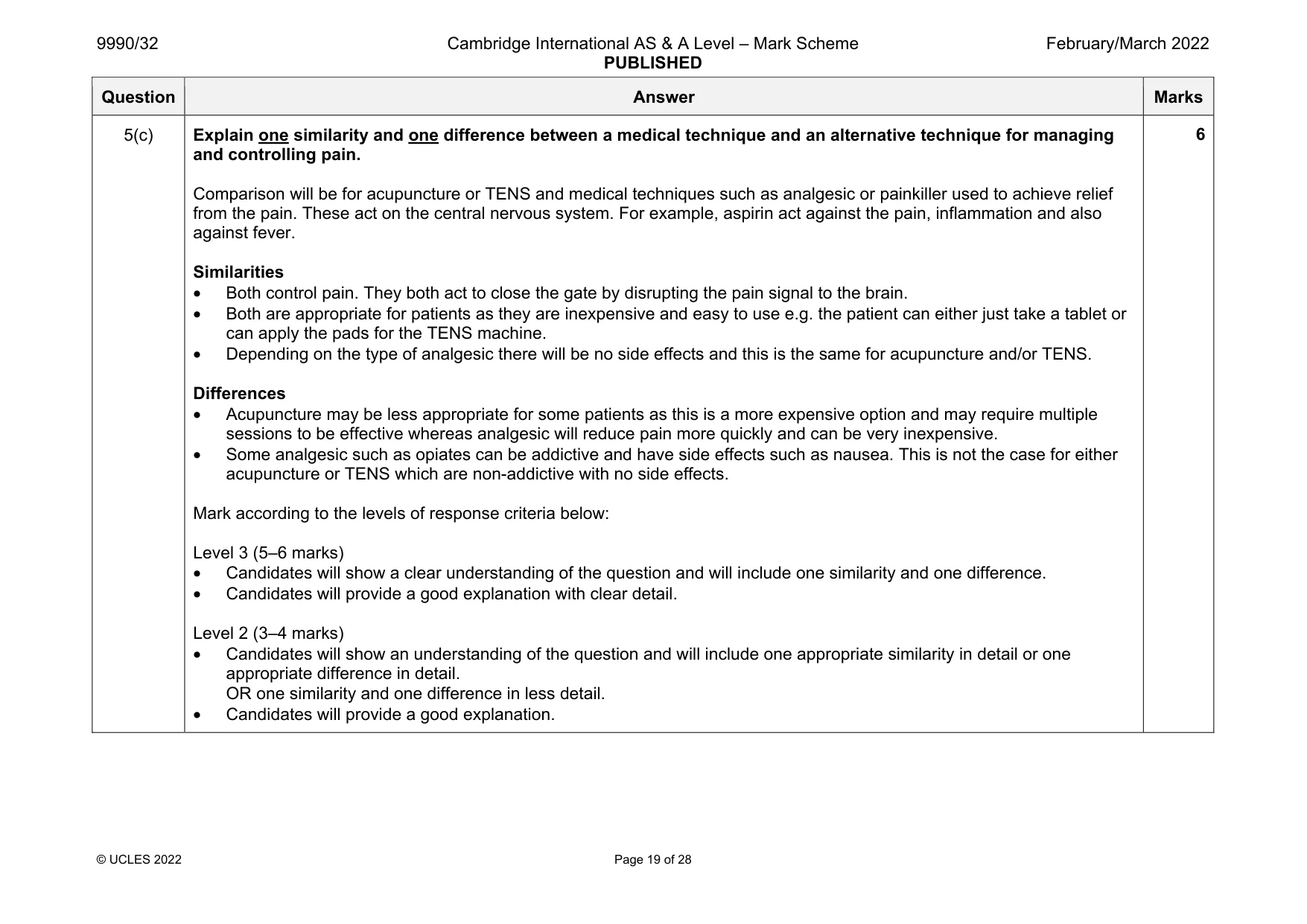
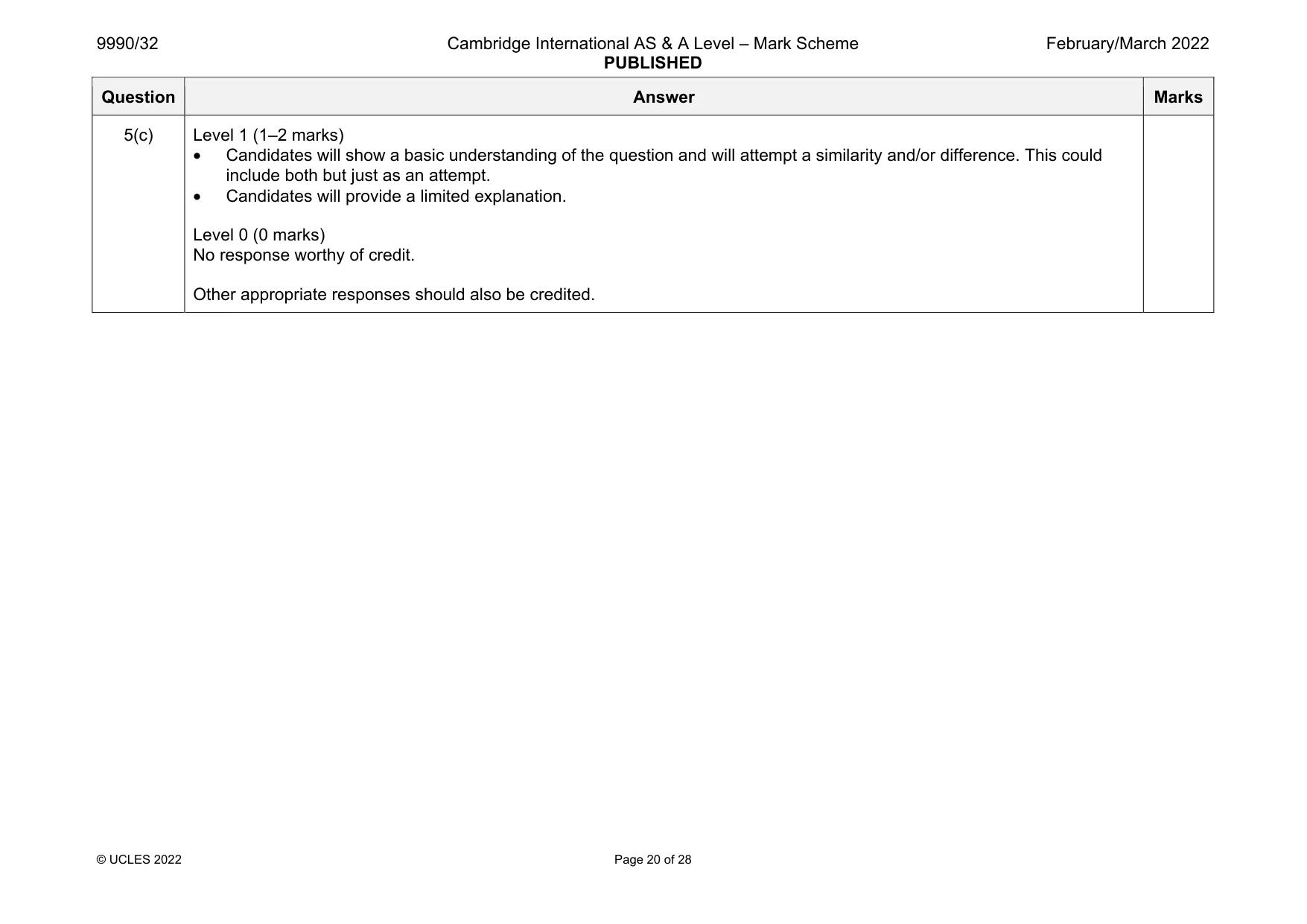
Mark scheme: 5(a) Explain what is meant by ‘chronic’ pain. Award 1 mark for a basic explanation of the term/concept. Award 2 marks for a detailed explanation of the term/concept. For example: Chronic organic pain is of a long duration (1) and is often caused by tissue damage. (1) OR Chronic pain is persistent and can be constant or intermittent and last 3 months or more (2) It can also be mild or severe (1) Can include headaches, low back pain, cancer pain and psychogenetic pain. (1) 5(b) There are medical and psychological techniques for managing and controlling pain. There are also alternative techniques to these. Outline two alternative techniques for managing and controlling pain. Award 1 mark for a basic outline of the alternative technique. Award 2 marks for a detailed outline of the alternative technique. For example Acupuncture (1) – stimulates sensory nerves under skin/muscles producing endorphins which reduce pain. (1) OR Qi/life force is out of balance and acupuncture restores the flow of Qi so that illness is cured.(1) Stimulation therapy/TENS (1) – A mild electric current is passed between electrodes which are placed on the skin and should reduce the sensation of pain by flooding the nervous system, reducing its ability to transmit pain signals to the spinal cord and brain.(1) Other appropriate responses should also be credited. 4 Question Answer Marks 5(c) Explain one similarity and one difference between a medical technique and an alternative technique for managing and controlling pain. Comparison will be for acupuncture or TENS and medical techniques such as analgesic or painkiller used to achieve relief from the pain. These act on the central nervous system. For example, aspirin act against the pain, inflammation and also against fever. Similarities • Both control pain. They both act to close the gate by disrupting the pain signal to the brain. • Both are appropriate for patients as they are inexpensive and easy to use e.g. the patient can either just take a tablet or can apply the pads for the TENS machine. • Depending on the type of analgesic there will be no side effects and this is the same for acupuncture and/or TENS. Differences • Acupuncture may be less appropriate for some patients as this is a more expensive option and may require multiple sessions to be effective whereas analgesic will reduce pain more quickly and can be very inexpensive. • Some analgesic such as opiates can be addictive and have side effects such as nausea. This is not the case for either acupuncture or TENS which are non-addictive with no side effects. Mark according to the levels of response criteria below: Level 3 (5–6 marks) • Candidates will show a clear understanding of the question and will include one similarity and one difference. • Candidates will provide a good explanation with clear detail. Level 2 (3–4 marks) • Candidates will show an understanding of the question and will include one appropriate similarity in detail or one appropriate difference in detail. OR one similarity and one difference in less detail. • Candidates will provide a good explanation. 6 Question Answer Marks 5(c) Level 1 (1–2 marks) • Candidates will show a basic understanding of the question and will attempt a similarity and/or difference. This could include both but just as an attempt. • Candidates will provide a limited explanation. Level 0 (0 marks) No response worthy of credit. Other appropriate responses should also be credited.
Q6 · Describe what psychologists have discovered about practitioner and patient interpersonal…
6 (a) Describe what psychologists have discovered about practitioner and patient interpersonal skills (non-verbal communications and verbal communications). [8] (b) Evaluate what psychologists have discovered about practitioner and patient interpersonal skills (non-verbal communications and verbal communications), including a discussion of generalisability. [10] Psychology and organisations Answer all questions.
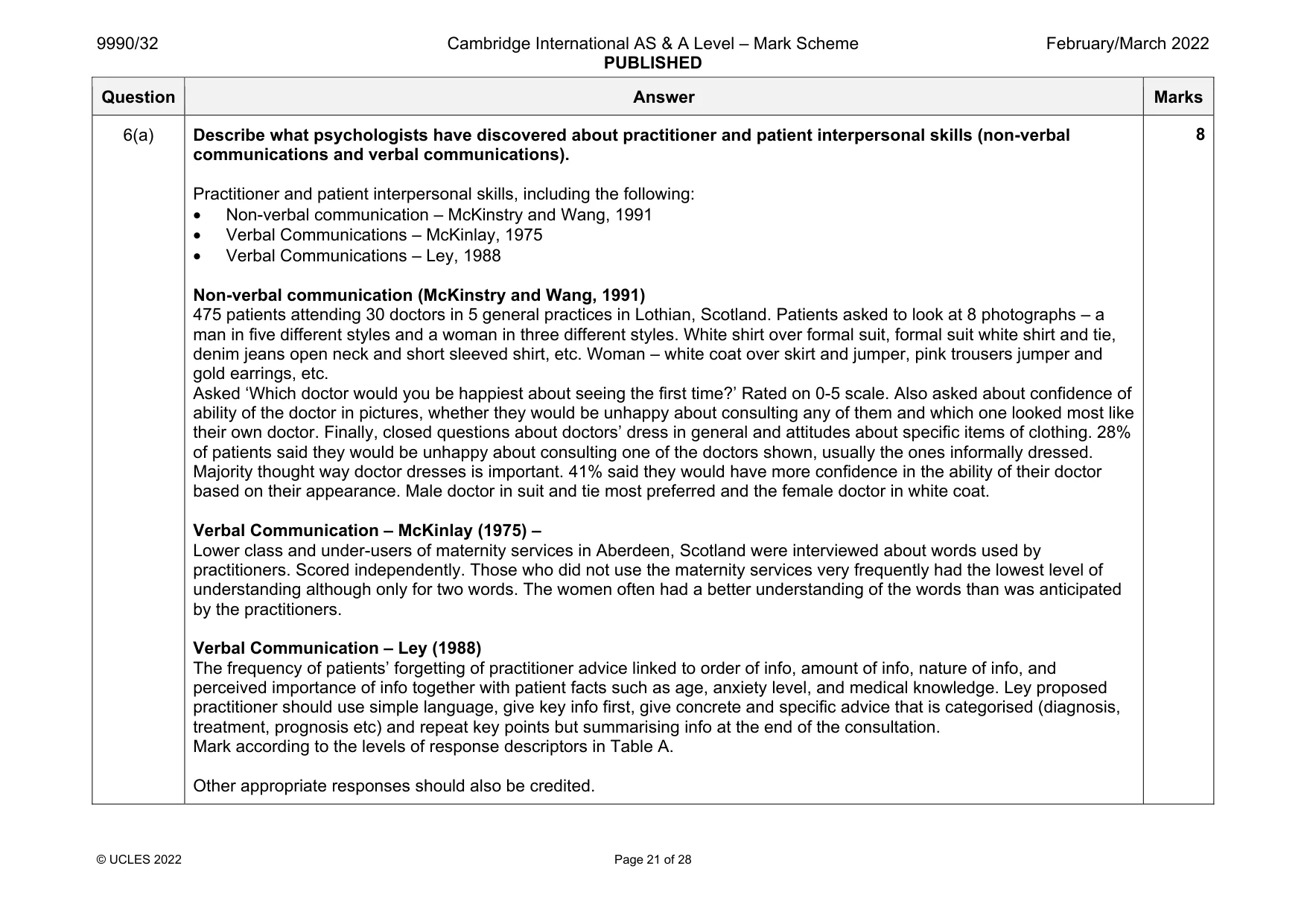
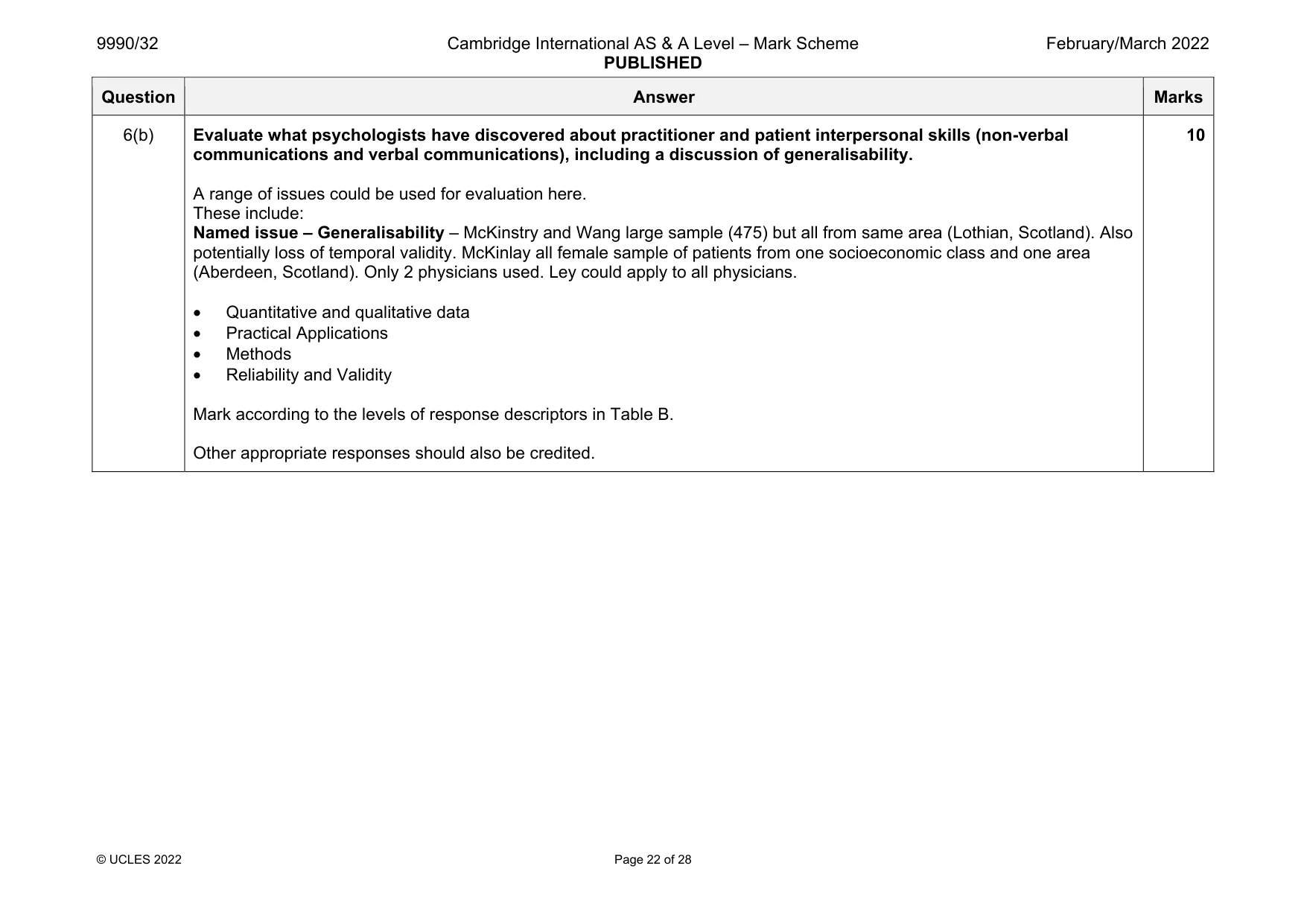
Mark scheme: 6(a) Describe what psychologists have discovered about practitioner and patient interpersonal skills (non-verbal communications and verbal communications). Practitioner and patient interpersonal skills, including the following: • Non-verbal communication – McKinstry and Wang, 1991 • Verbal Communications – McKinlay, 1975 • Verbal Communications – Ley, 1988 Non-verbal communication (McKinstry and Wang, 1991) 475 patients attending 30 doctors in 5 general practices in Lothian, Scotland. Patients asked to look at 8 photographs – a man in five different styles and a woman in three different styles. White shirt over formal suit, formal suit white shirt and tie, denim jeans open neck and short sleeved shirt, etc. Woman – white coat over skirt and jumper, pink trousers jumper and gold earrings, etc. Asked ‘Which doctor would you be happiest about seeing the first time?’ Rated on 0-5 scale. Also asked about confidence of ability of the doctor in pictures, whether they would be unhappy about consulting any of them and which one looked most like their own doctor. Finally, closed questions about doctors’ dress in general and attitudes about specific items of clothing. 28% of patients said they would be unhappy about consulting one of the doctors shown, usually the ones informally dressed. Majority thought way doctor dresses is important. 41% said they would have more confidence in the ability of their doctor based on their appearance. Male doctor in suit and tie most preferred and the female doctor in white coat. Verbal Communication – McKinlay (1975) – Lower class and under-users of maternity services in Aberdeen, Scotland were interviewed about words used by practitioners. Scored independently. Those who did not use the maternity services very frequently had the lowest level of understanding although only for two words. The women often had a better understanding of the words than was anticipated by the practitioners. Verbal Communication – Ley (1988) The frequency of patients’ forgetting of practitioner advice linked to order of info, amount of info, nature of info, and perceived importance of info together with patient facts such as age, anxiety level, and medical knowledge. Ley proposed practitioner should use simple language, give key info first, give concrete and specific advice that is categorised (diagnosis, treatment, prognosis etc) and repeat key points but summarising info at the end of the consultation. Mark according to the levels of response descriptors in Table A. Other appropriate responses should also be credited. Question Answer Marks 6(b) Evaluate what psychologists have discovered about practitioner and patient interpersonal skills (non-verbal communications and verbal communications), including a discussion of generalisability. A range of issues could be used for evaluation here. These include: Named issue – Generalisability – McKinstry and Wang large sample (475) but all from same area (Lothian, Scotland). Also potentially loss of temporal validity. McKinlay all female sample of patients from one socioeconomic class and one area (Aberdeen, Scotland). Only 2 physicians used. Ley could apply to all physicians. • Quantitative and qualitative data • Practical Applications • Methods • Reliability and Validity Mark according to the levels of response descriptors in Table B. Other appropriate responses should also be credited. 10
Q7 · Identify two team roles as proposed by Belbin (1981)
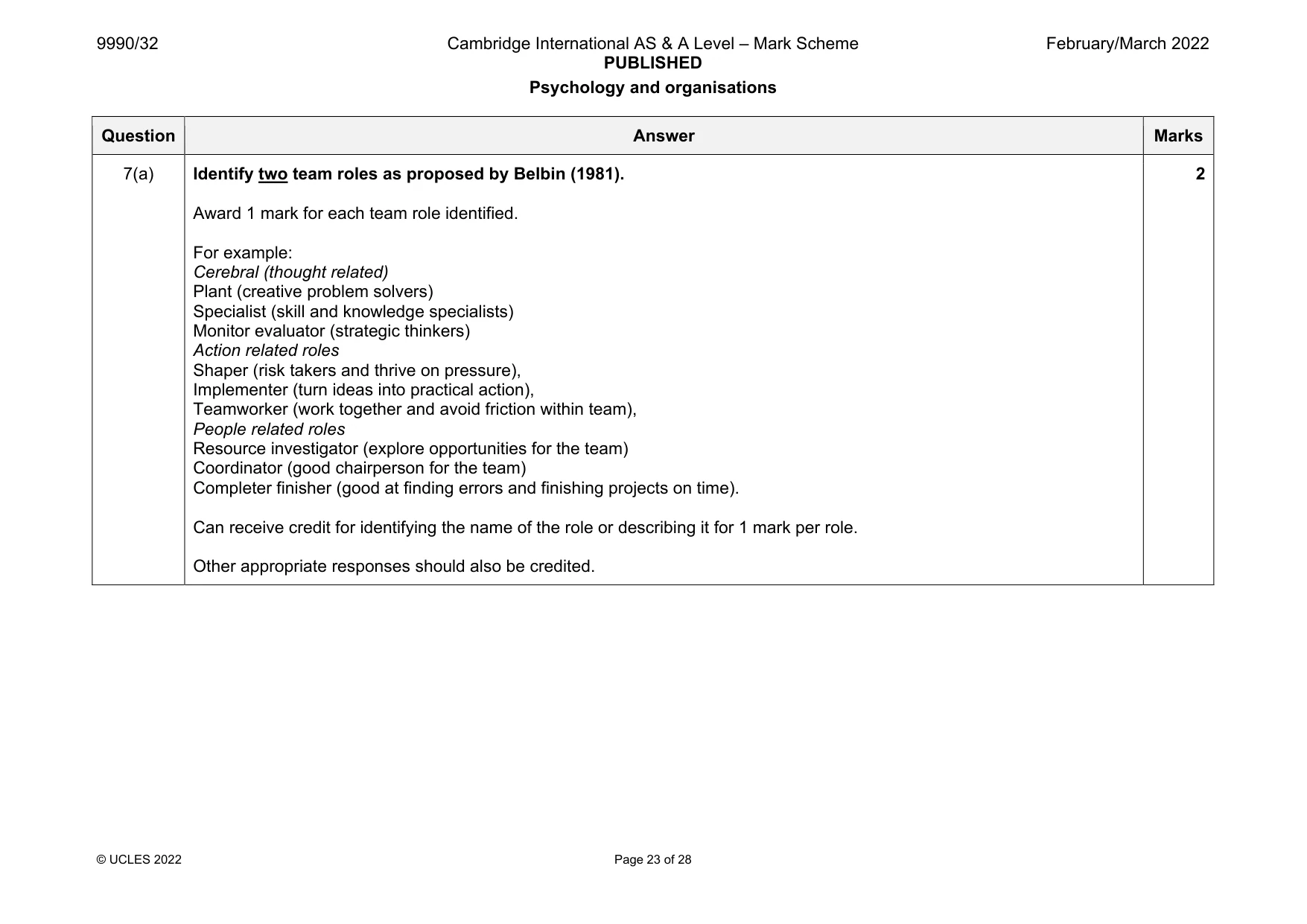
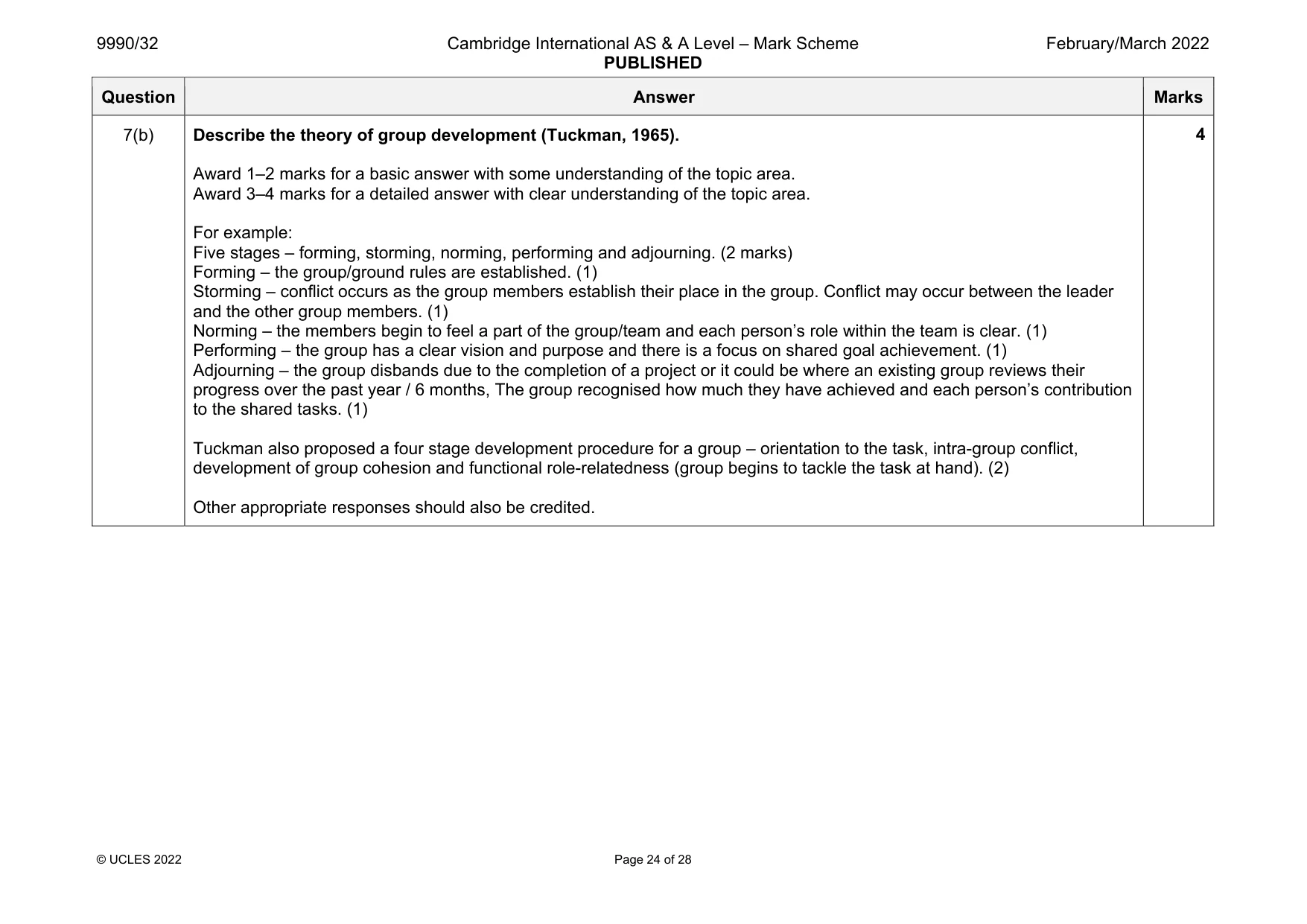
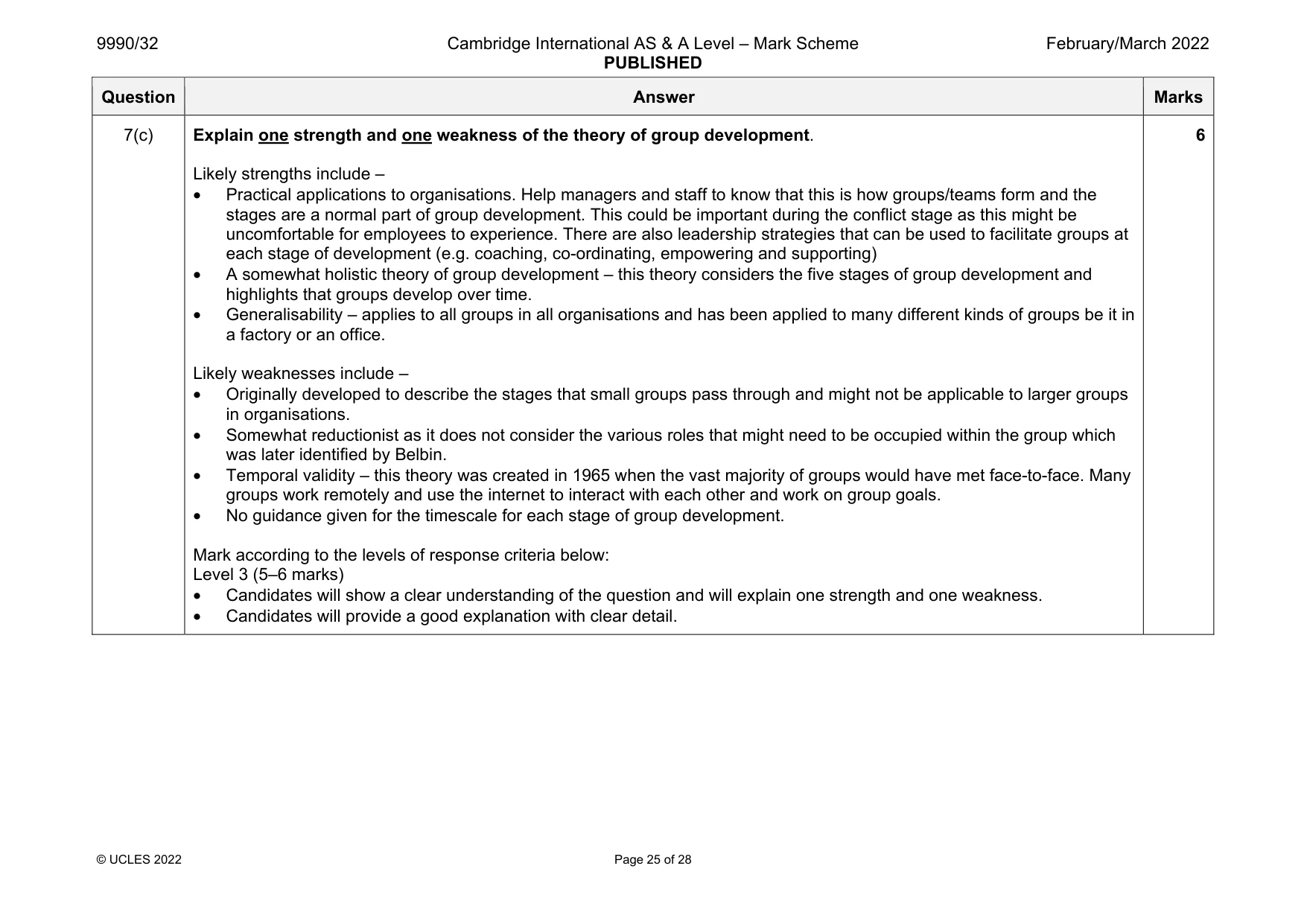
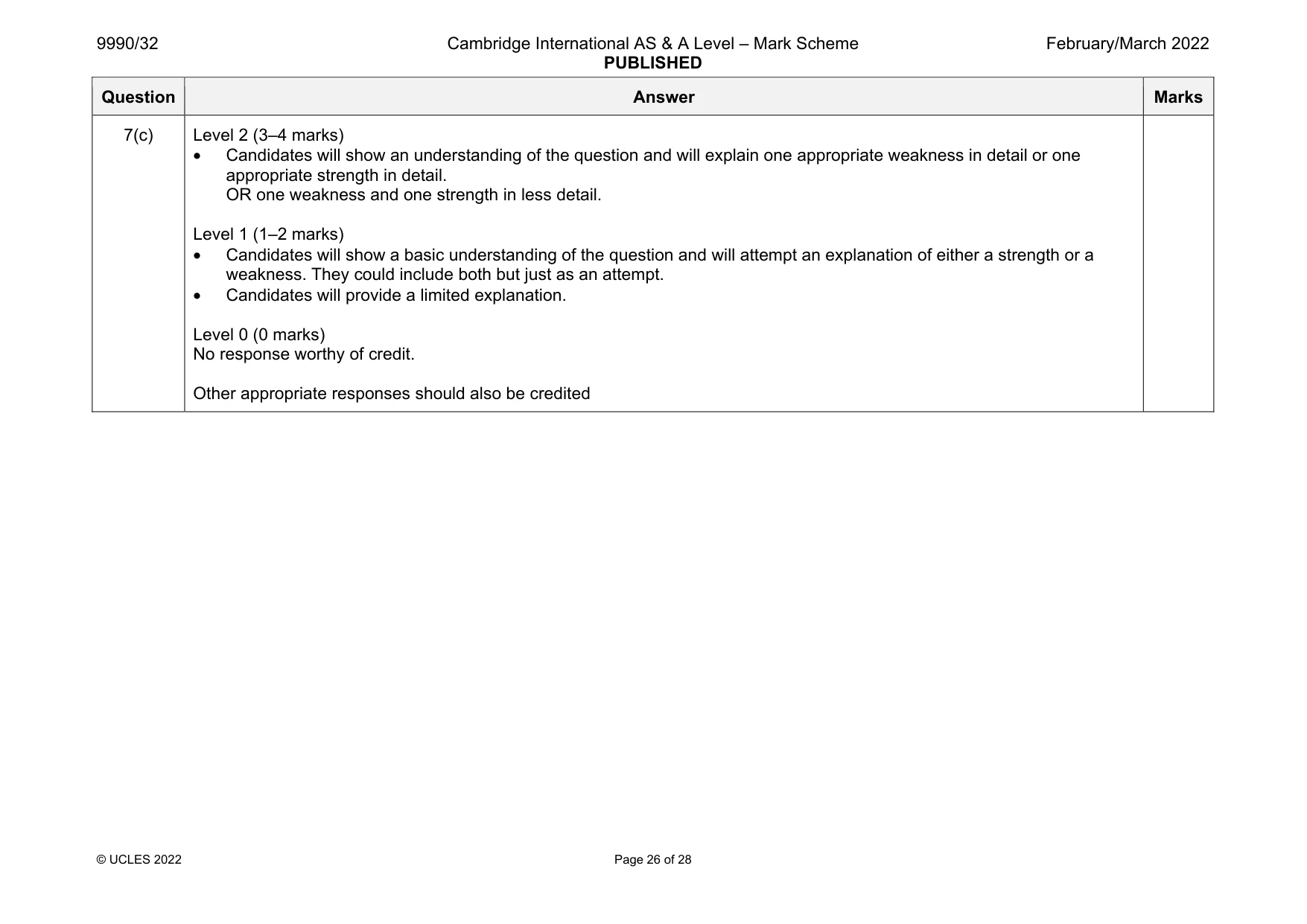
7 (a) Identify two team roles as proposed by Belbin (1981). [2] (b) Describe the theory of group development (Tuckman, 1965). [4] (c) Explain one strength and one weakness of the theory of group development. [6]
Mark scheme: 7(a) Identify two team roles as proposed by Belbin (1981). Award 1 mark for each team role identified. For example: Cerebral (thought related) Plant (creative problem solvers) Specialist (skill and knowledge specialists) Monitor evaluator (strategic thinkers) Action related roles Shaper (risk takers and thrive on pressure), Implementer (turn ideas into practical action), Teamworker (work together and avoid friction within team), People related roles Resource investigator (explore opportunities for the team) Coordinator (good chairperson for the team) Completer finisher (good at finding errors and finishing projects on time). Can receive credit for identifying the name of the role or describing it for 1 mark per role. Other appropriate responses should also be credited. Question Answer Marks 7(b) Describe the theory of group development (Tuckman, 1965). Award 1–2 marks for a basic answer with some understanding of the topic area. Award 3–4 marks for a detailed answer with clear understanding of the topic area. For example: Five stages – forming, storming, norming, performing and adjourning. (2 marks) Forming – the group/ground rules are established. (1) Storming – conflict occurs as the group members establish their place in the group. Conflict may occur between the leader and the other group members. (1) Norming – the members begin to feel a part of the group/team and each person’s role within the team is clear. (1) Performing – the group has a clear vision and purpose and there is a focus on shared goal achievement. (1) Adjourning – the group disbands due to the completion of a project or it could be where an existing group reviews their progress over the past year / 6 months, The group recognised how much they have achieved and each person’s contribution to the shared tasks. (1) Tuckman also proposed a four stage development procedure for a group – orientation to the task, intra-group conflict, development of group cohesion and functional role-relatedness (group begins to tackle the task at hand). (2) Other appropriate responses should also be credited. 4 Question Answer Marks 7(c) Explain one strength and one weakness of the theory of group development. Likely strengths include – • Practical applications to organisations. Help managers and staff to know that this is how groups/teams form and the stages are a normal part of group development. This could be important during the conflict stage as this might be uncomfortable for employees to experience. There are also leadership strategies that can be used to facilitate groups at each stage of development (e.g. coaching, co-ordinating, empowering and supporting) • A somewhat holistic theory of group development – this theory considers the five stages of group development and highlights that groups develop over time. • Generalisability – applies to all groups in all organisations and has been applied to many different kinds of groups be it in a factory or an office. Likely weaknesses include – • Originally developed to describe the stages that small groups pass through and might not be applicable to larger groups in organisations. • Somewhat reductionist as it does not consider the various roles that might need to be occupied within the group which was later identified by Belbin. • Temporal validity – this theory was created in 1965 when the vast majority of groups would have met face-to-face. Many groups work remotely and use the internet to interact with each other and work on group goals. • No guidance given for the timescale for each stage of group development. Mark according to the levels of response criteria below: Level 3 (5–6 marks) • Candidates will show a clear understanding of the question and will explain one strength and one weakness. • Candidates will provide a good explanation with clear detail. 6 Question Answer Marks 7(c) Level 2 (3–4 marks) • Candidates will show an understanding of the question and will explain one appropriate weakness in detail or one appropriate strength in detail. OR one weakness and one strength in less detail. Level 1 (1–2 marks) • Candidates will show a basic understanding of the question and will attempt an explanation of either a strength or a weakness. They could include both but just as an attempt. • Candidates will provide a limited explanation. Level 0 (0 marks) No response worthy of credit. Other appropriate responses should also be credited
Q8 · Describe what psychologists have discovered about health and safety in organisational…
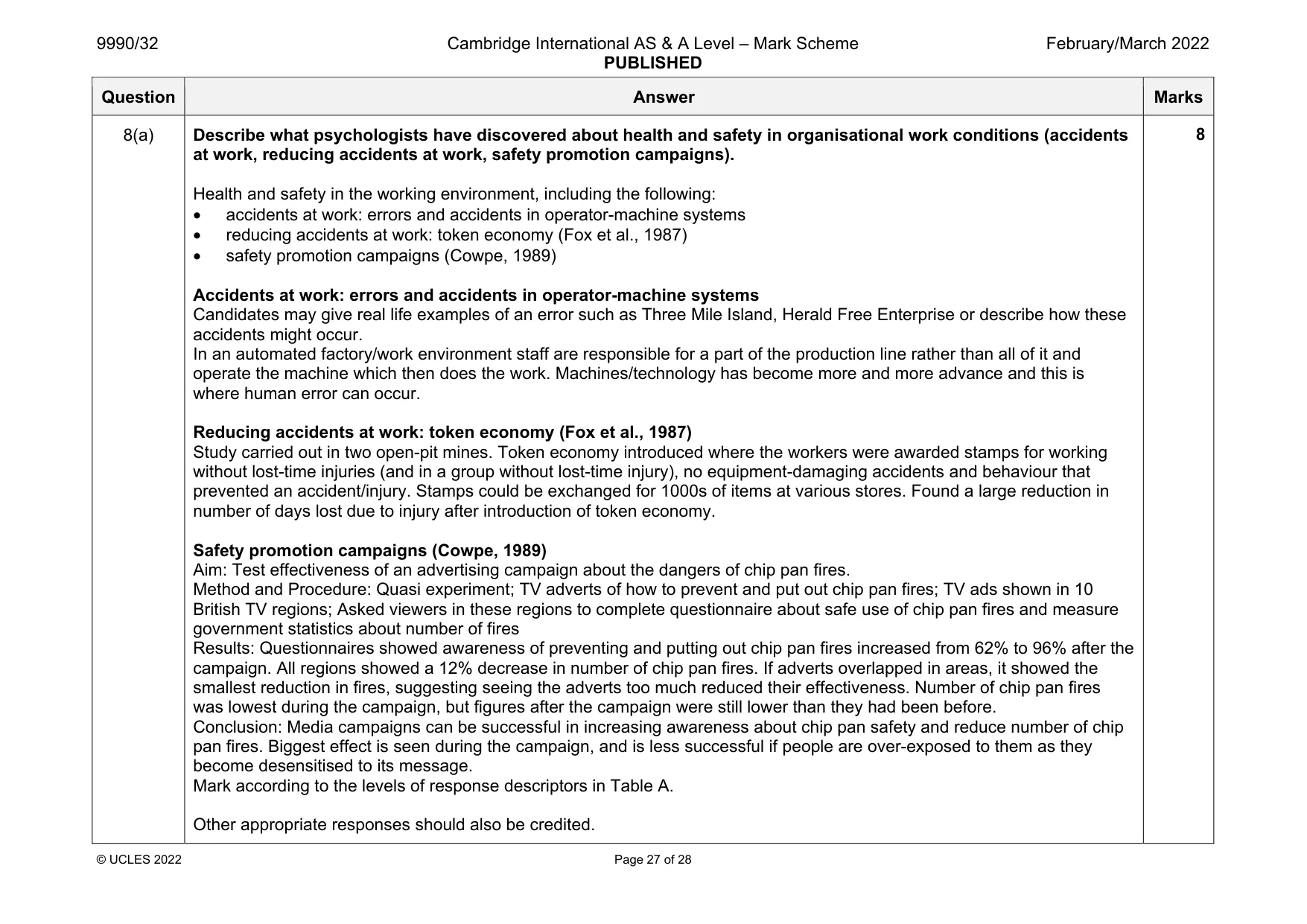
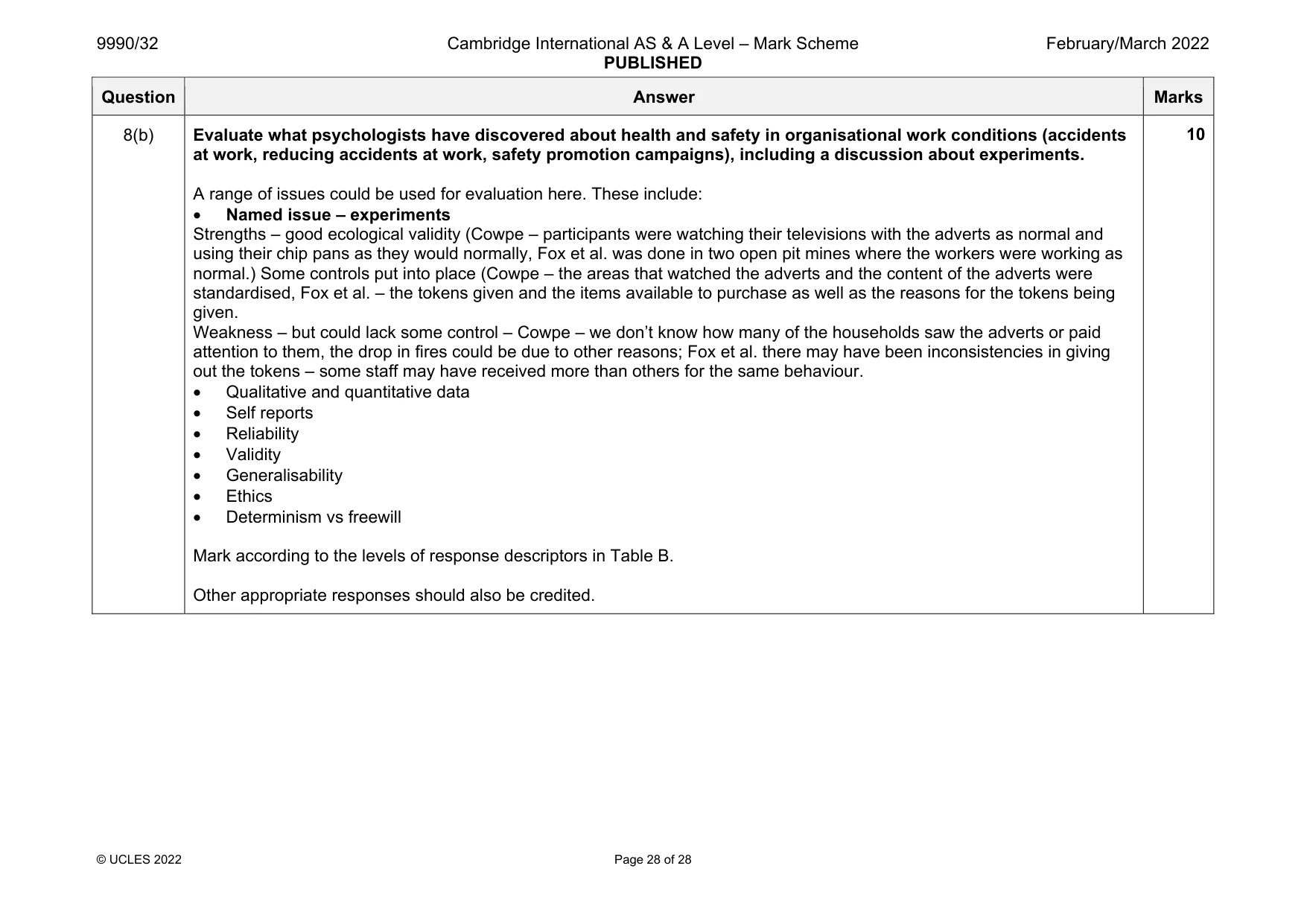
8 (a) Describe what psychologists have discovered about health and safety in organisational work conditions (accidents at work, reducing accidents at work, safety promotion campaigns). [8] (b) Evaluate what psychologists have discovered about health and safety in organisational work conditions (accidents at work, reducing accidents at work, safety promotion campaigns), including a discussion about experiments. [10]
Mark scheme: 8(a) Describe what psychologists have discovered about health and safety in organisational work conditions (accidents at work, reducing accidents at work, safety promotion campaigns). Health and safety in the working environment, including the following: • accidents at work: errors and accidents in operator-machine systems • reducing accidents at work: token economy (Fox et al., 1987) • safety promotion campaigns (Cowpe, 1989) Accidents at work: errors and accidents in operator-machine systems Candidates may give real life examples of an error such as Three Mile Island, Herald Free Enterprise or describe how these accidents might occur. In an automated factory/work environment staff are responsible for a part of the production line rather than all of it and operate the machine which then does the work. Machines/technology has become more and more advance and this is where human error can occur. Reducing accidents at work: token economy (Fox et al., 1987) Study carried out in two open-pit mines. Token economy introduced where the workers were awarded stamps for working without lost-time injuries (and in a group without lost-time injury), no equipment-damaging accidents and behaviour that prevented an accident/injury. Stamps could be exchanged for 1000s of items at various stores. Found a large reduction in number of days lost due to injury after introduction of token economy. Safety promotion campaigns (Cowpe, 1989) Aim: Test effectiveness of an advertising campaign about the dangers of chip pan fires. Method and Procedure: Quasi experiment; TV adverts of how to prevent and put out chip pan fires; TV ads shown in 10 British TV regions; Asked viewers in these regions to complete questionnaire about safe use of chip pan fires and measure government statistics about number of fires Results: Questionnaires showed awareness of preventing and putting out chip pan fires increased from 62% to 96% after the campaign. All regions showed a 12% decrease in number of chip pan fires. If adverts overlapped in areas, it showed the smallest reduction in fires, suggesting seeing the adverts too much reduced their effectiveness. Number of chip pan fires was lowest during the campaign, but figures after the campaign were still lower than they had been before. Conclusion: Media campaigns can be successful in increasing awareness about chip pan safety and reduce number of chip pan fires. Biggest effect is seen during the campaign, and is less successful if people are over-exposed to them as they become desensitised to its message. Mark according to the levels of response descriptors in Table A. Other appropriate responses should also be credited. Question Answer Marks 8(b) Evaluate what psychologists have discovered about health and safety in organisational work conditions (accidents at work, reducing accidents at work, safety promotion campaigns), including a discussion about experiments. A range of issues could be used for evaluation here. These include: • Named issue – experiments Strengths – good ecological validity (Cowpe – participants were watching their televisions with the adverts as normal and using their chip pans as they would normally, Fox et al. was done in two open pit mines where the workers were working as normal.) Some controls put into place (Cowpe – the areas that watched the adverts and the content of the adverts were standardised, Fox et al. – the tokens given and the items available to purchase as well as the reasons for the tokens being given. Weakness – but could lack some control – Cowpe – we don’t know how many of the households saw the adverts or paid attention to them, the drop in fires could be due to other reasons; Fox et al. there may have been inconsistencies in giving out the tokens – some staff may have received more than others for the same behaviour. • Qualitative and quantitative data • Self reports • Reliability • Validity • Generalisability • Ethics • Determinism vs freewill Mark according to the levels of response descriptors in Table B. Other appropriate responses should also be credited. 10
What was in this paper
The subtopics covered by these 8 questions, and how many questions each got. Open one in a new tab to see every Cambridge question on it.
What you needed in this session
Cambridge’s own grade thresholds for 2022 Feb/March, Paper 3 · Variant 2. A higher threshold means an easier paper — the bar moves with how the cohort did.