Cambridge A Level Psychology (from 2018) 9990 — 2024 May/June Paper 3 · Variant 1
9990/31/M/J/24 · 16 questions · 60 marks · 90 min
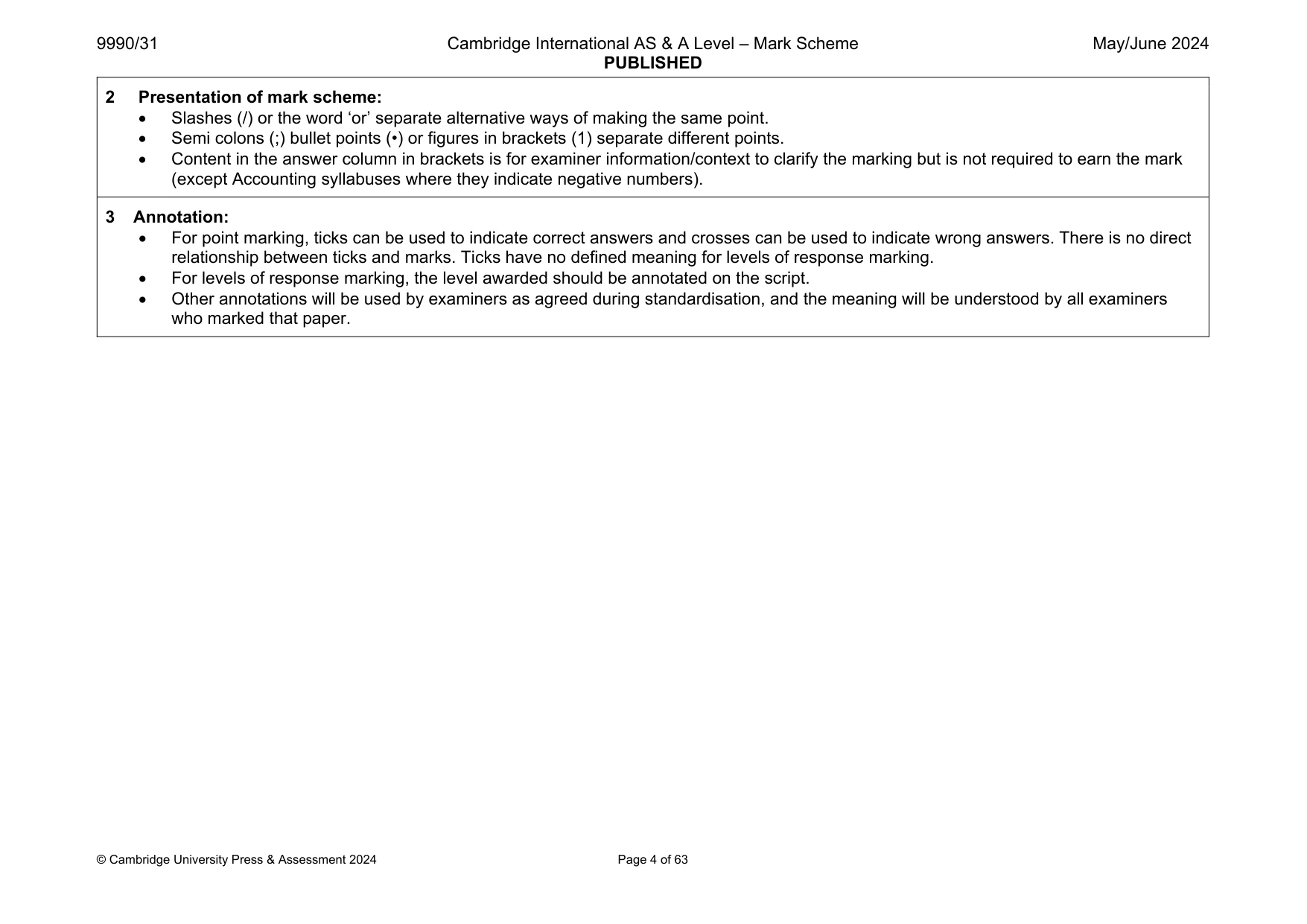
The question paper and its mark scheme, free to read here and free to download. This is Cambridge’s own paper, exactly as it was sat.
Question paper8 pages
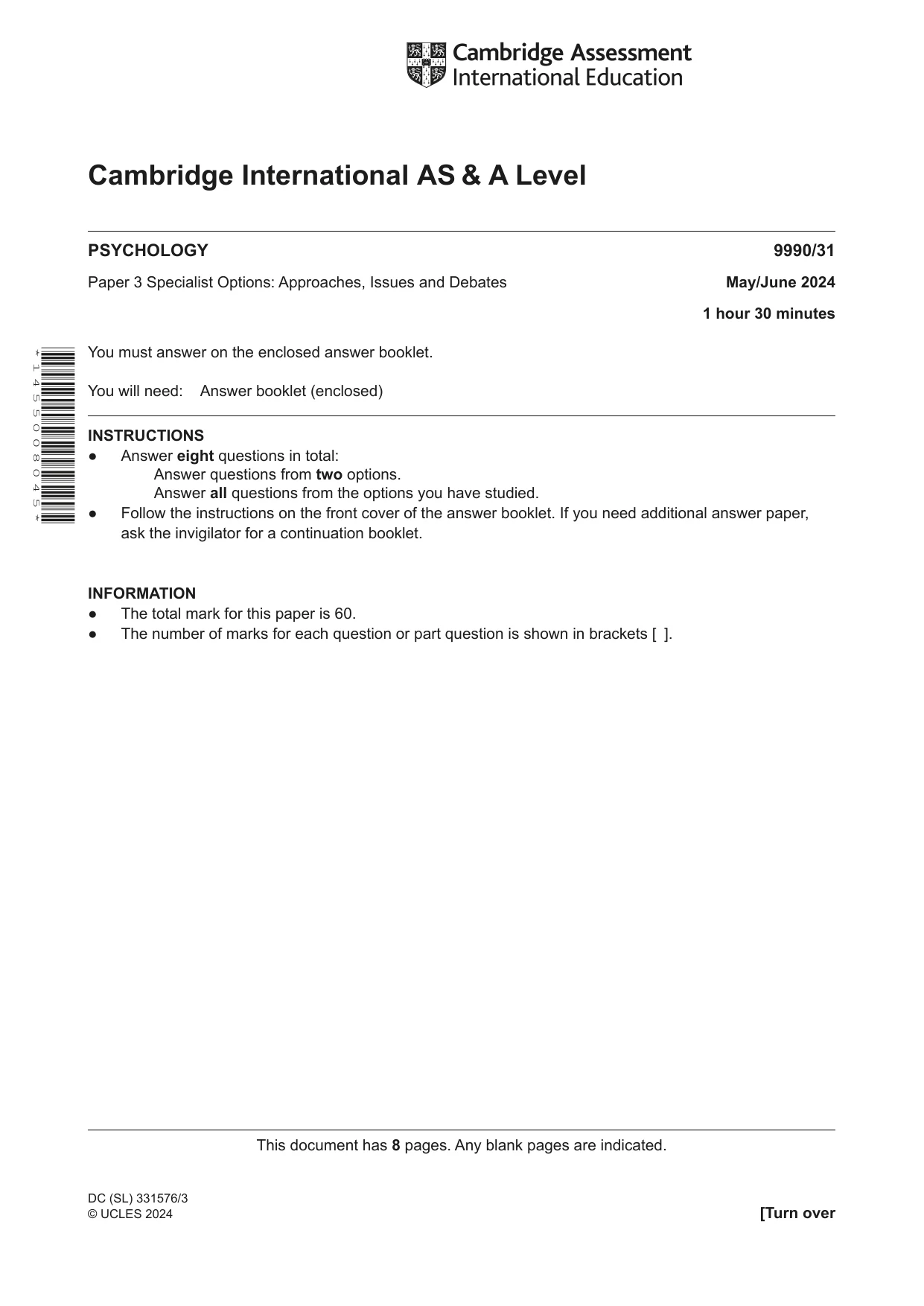
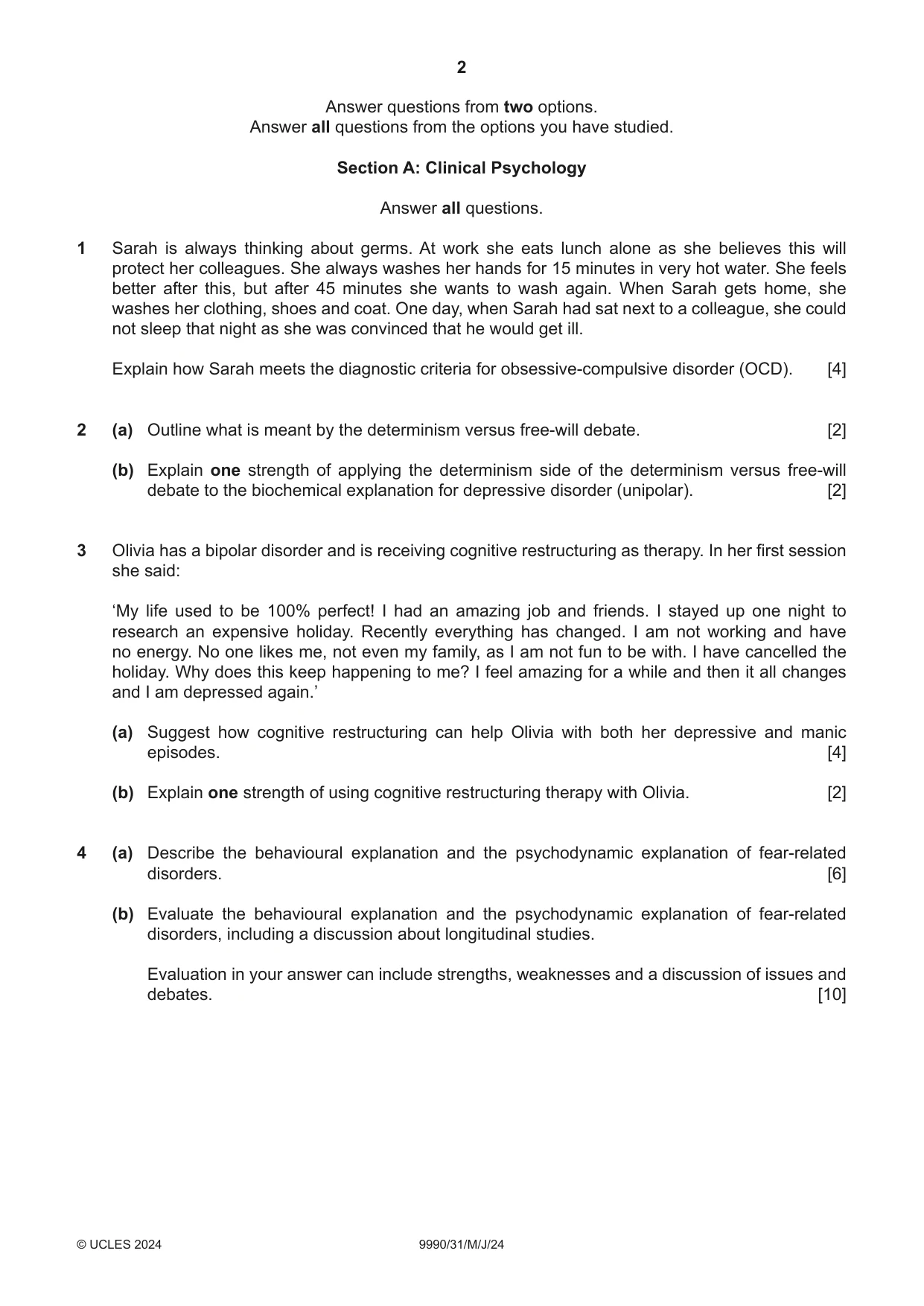
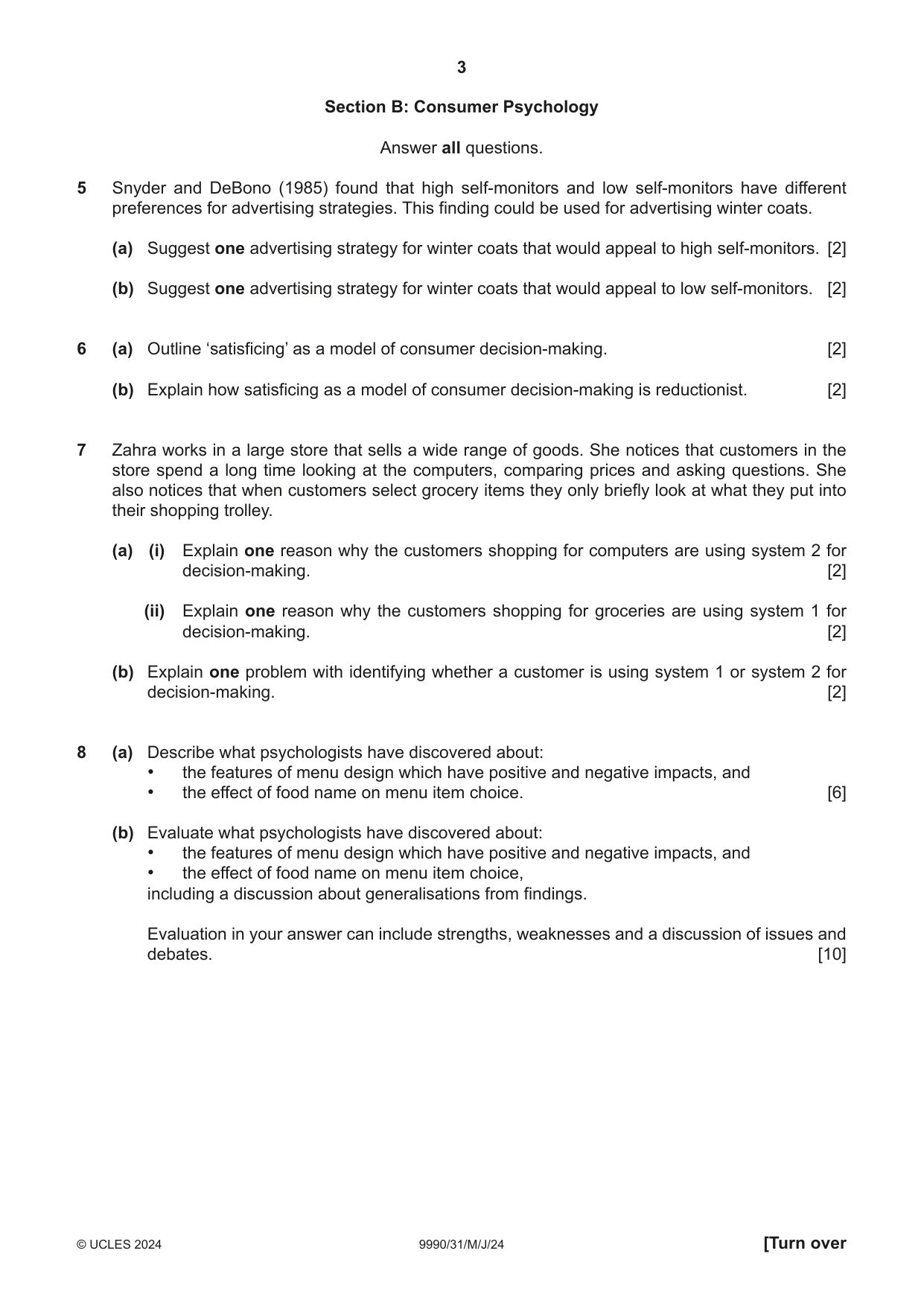
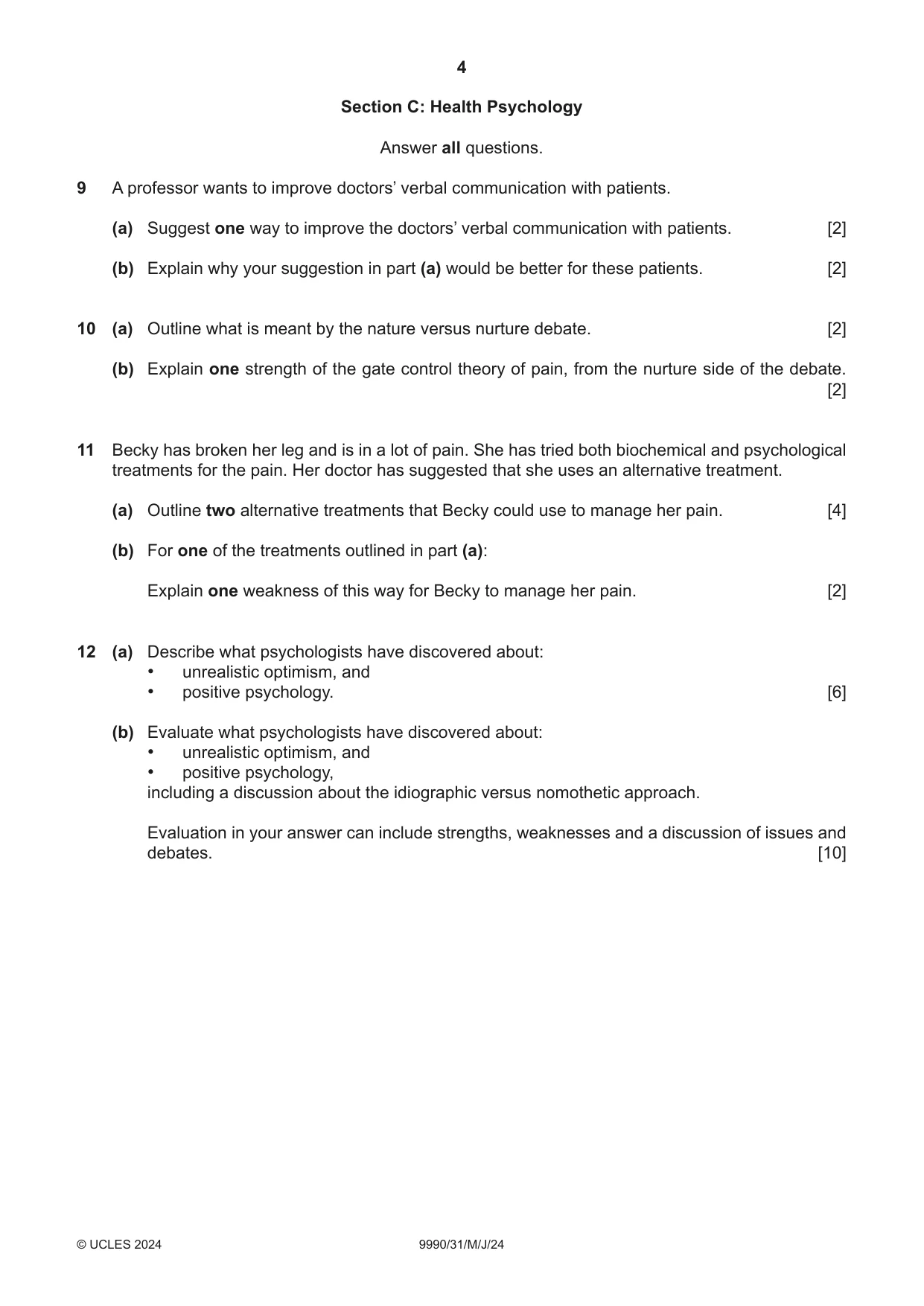
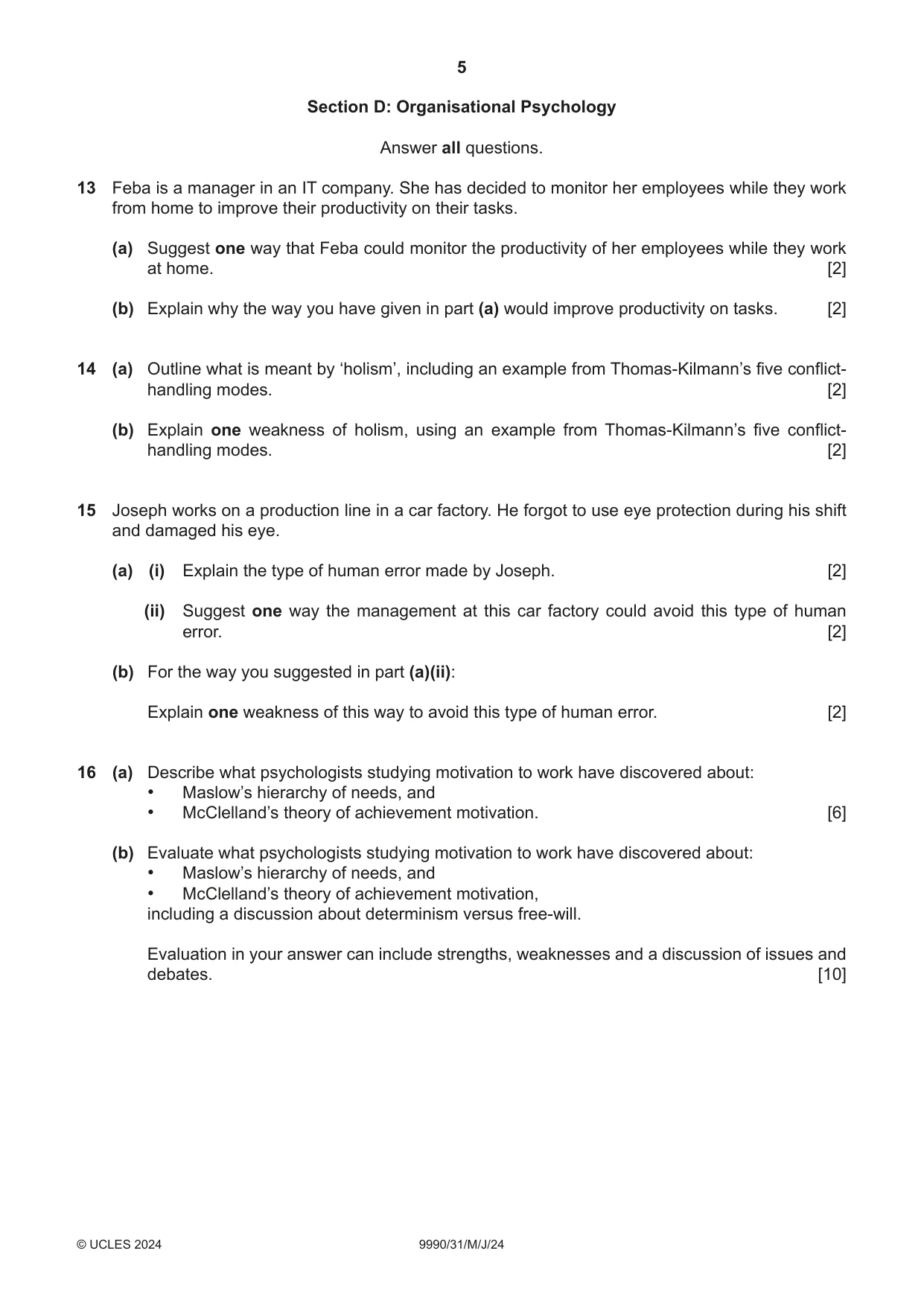



Mark scheme63 pages
Answers below. Sit the paper first if you are practising.

Questions as text
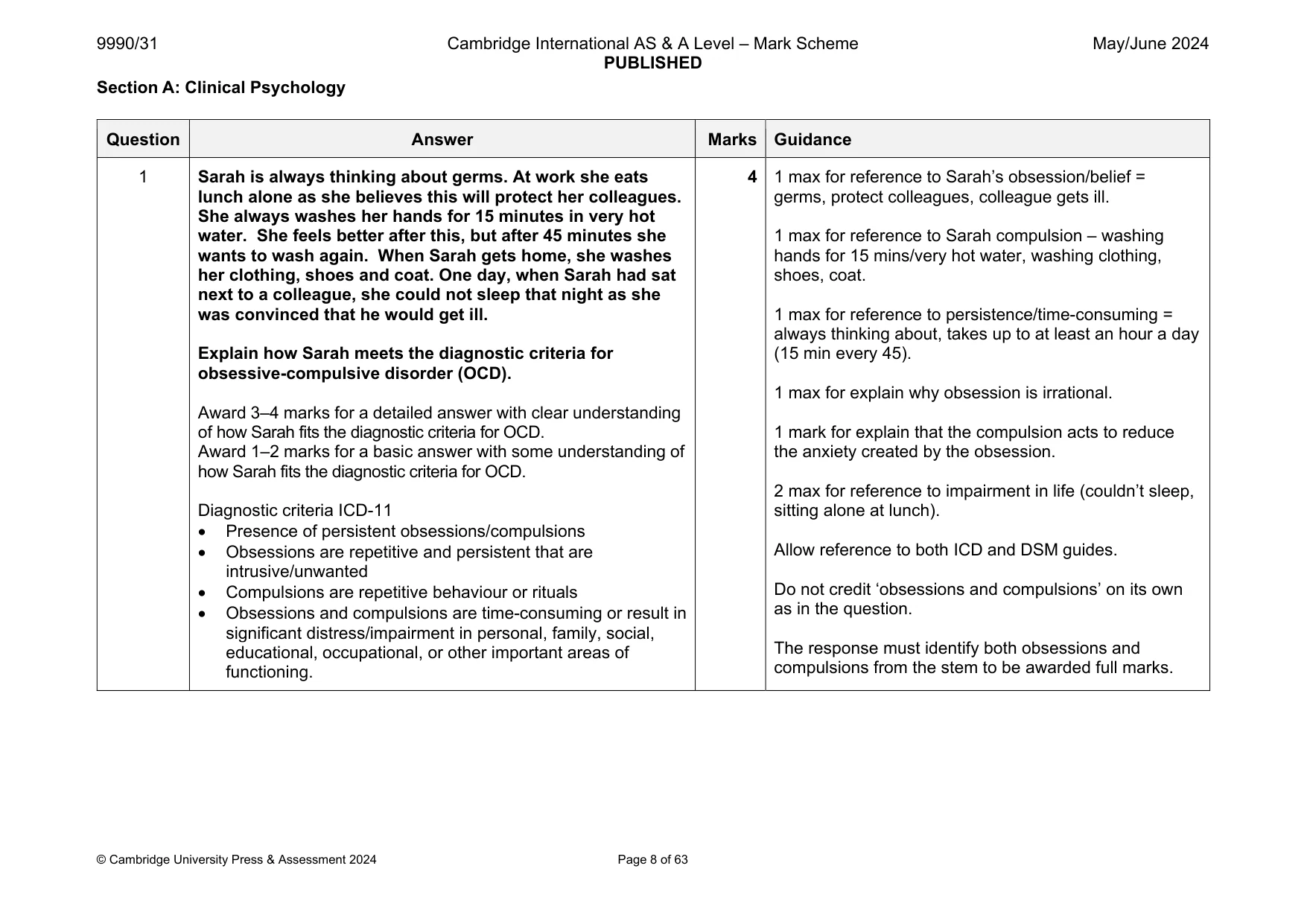
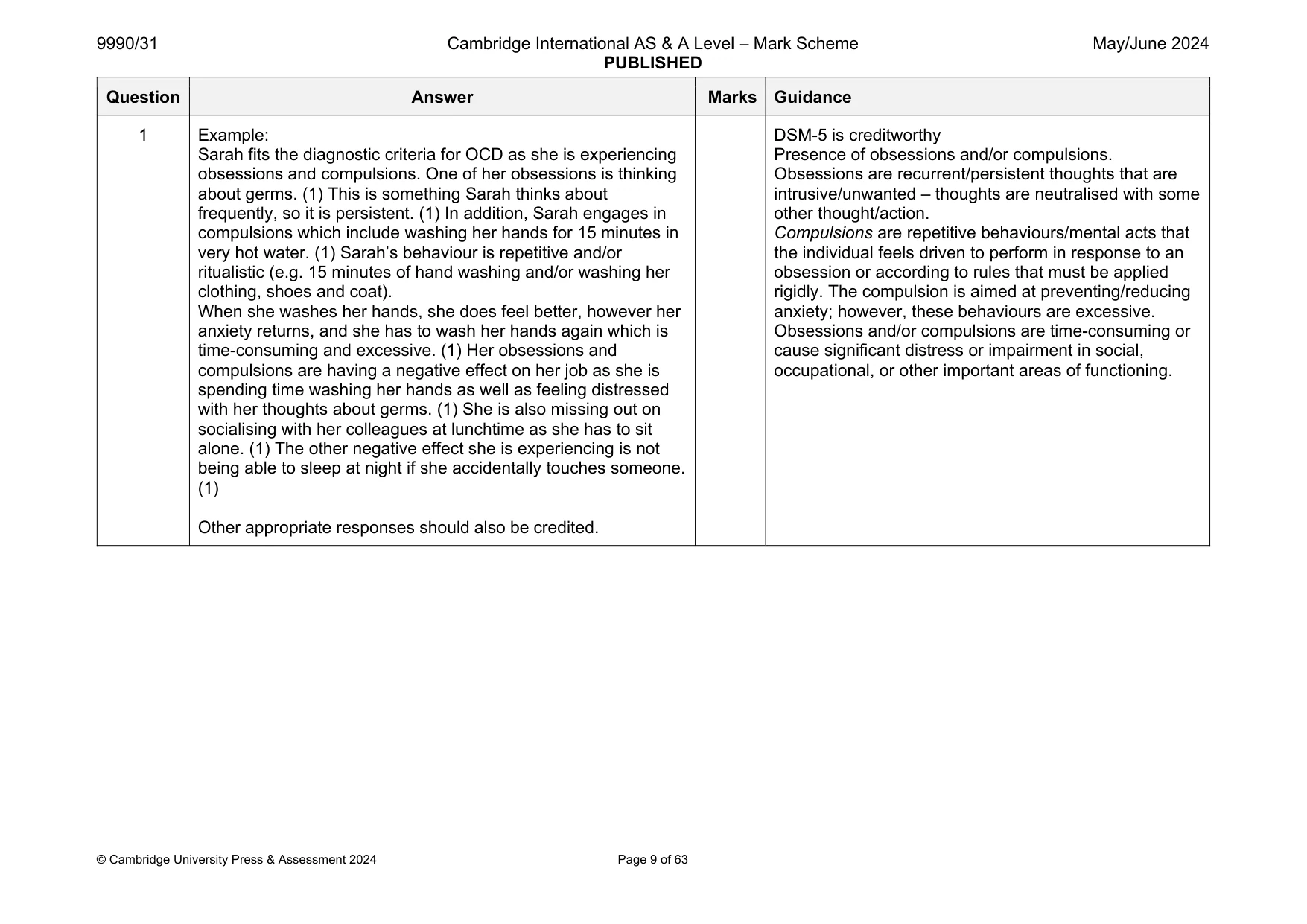
Q1 · Sarah is always thinking about germs
1 Sarah is always thinking about germs. At work she eats lunch alone as she believes this will protect her colleagues. She always washes her hands for 15 minutes in very hot water. She feels better after this, but after 45 minutes she wants to wash again. When Sarah gets home, she washes her clothing, shoes and coat. One day, when Sarah had sat next to a colleague, she could not sleep that night as she was convinced that he would get ill. Explain how Sarah meets the diagnostic criteria for obsessive-compulsive disorder (OCD). [4]
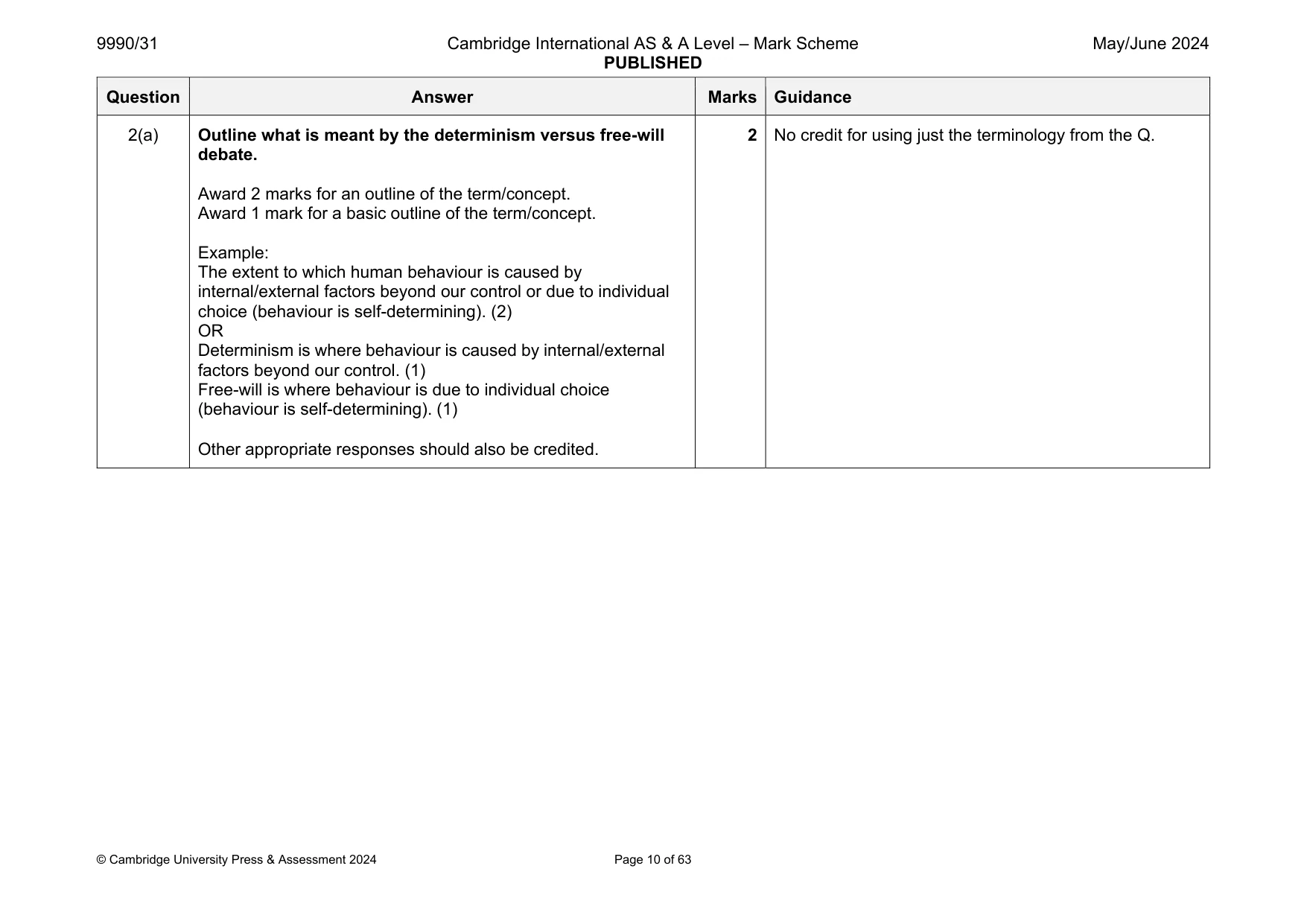
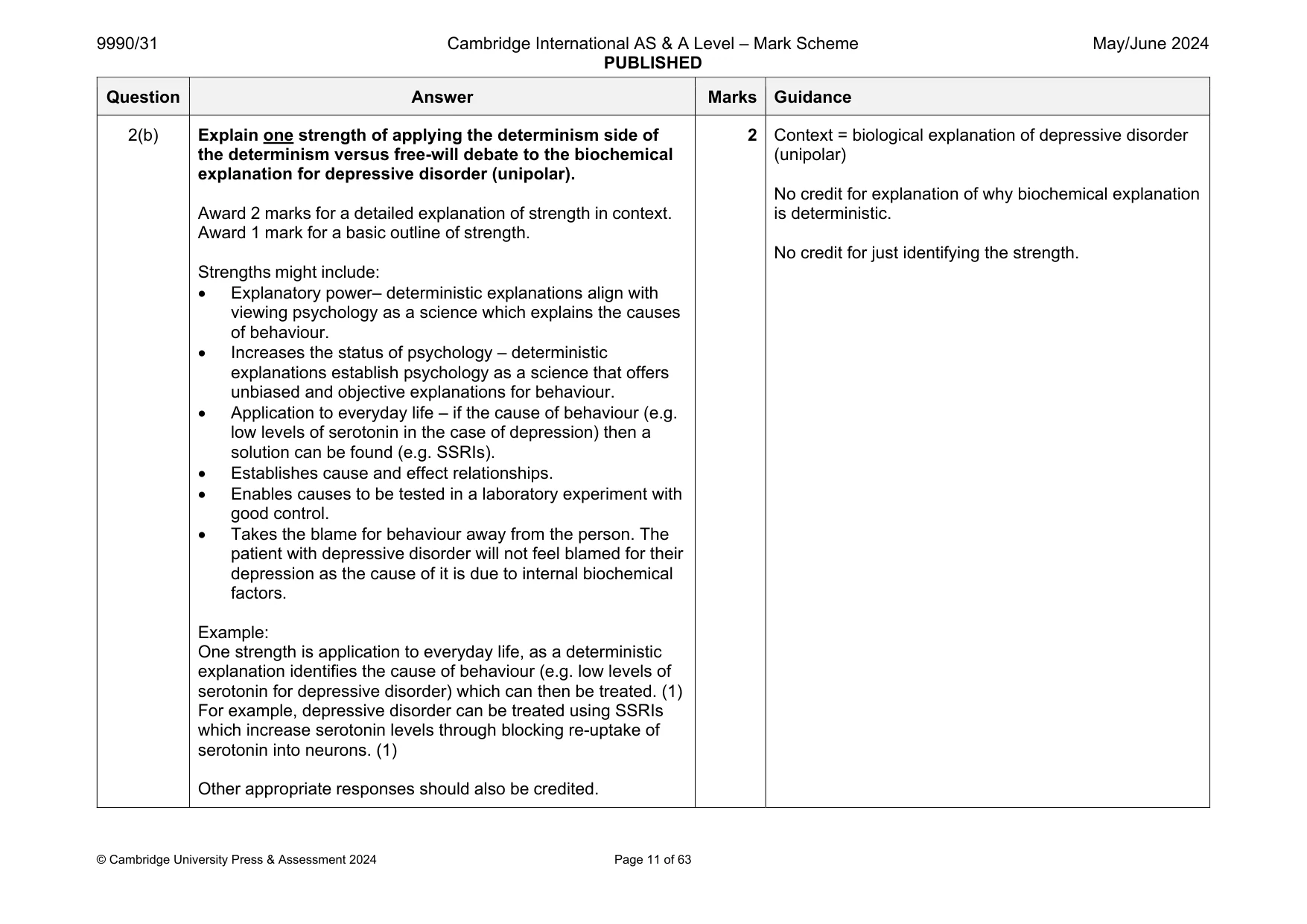
Q2 · Outline what is meant by the determinism versus free-will debate
2 (a) Outline what is meant by the determinism versus free-will debate. [2] (b) Explain one strength of applying the determinism side of the determinism versus free-will debate to the biochemical explanation for depressive disorder (unipolar). [2]
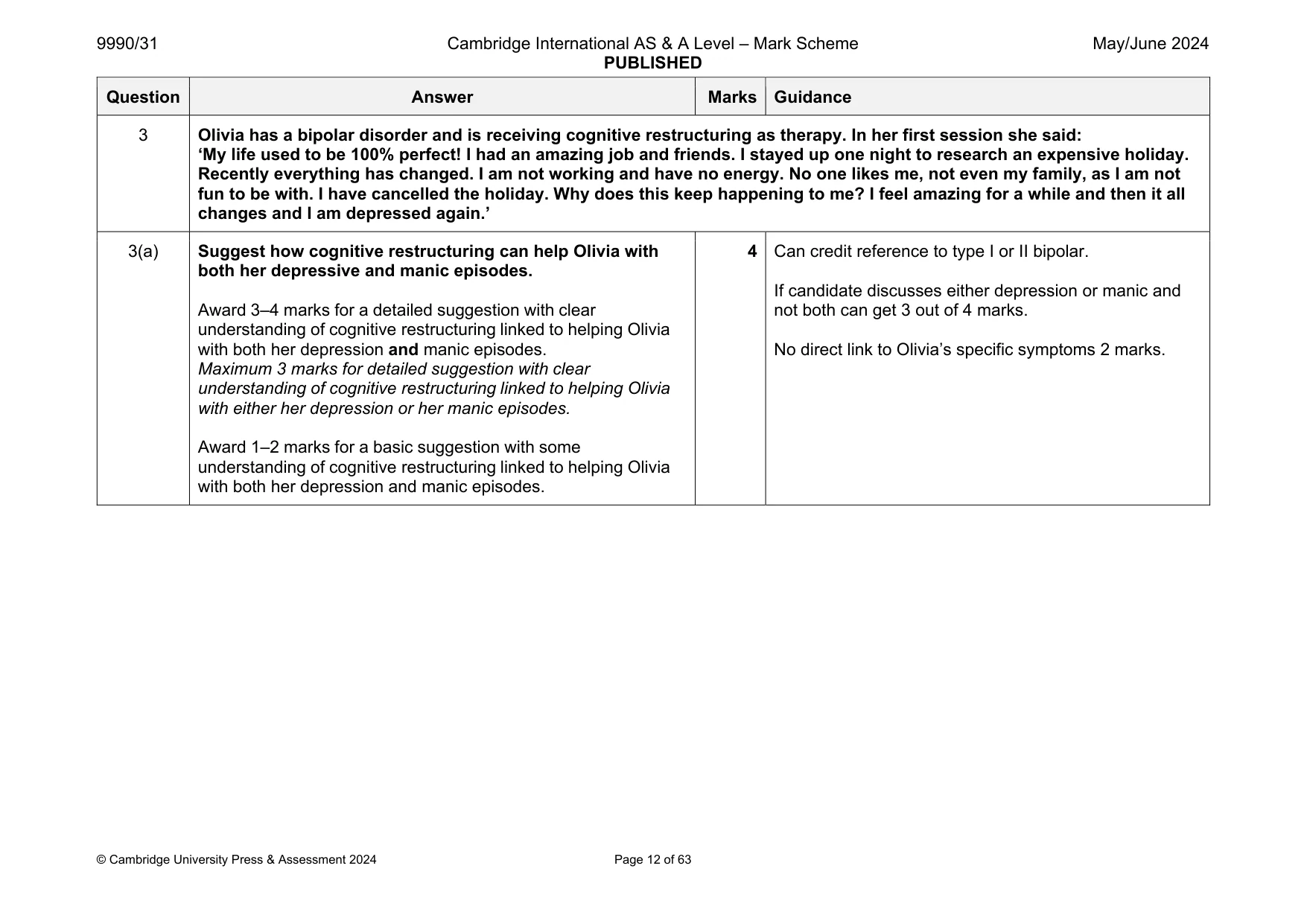
Q3 · Olivia has a bipolar disorder and is receiving cognitive restructuring as therapy
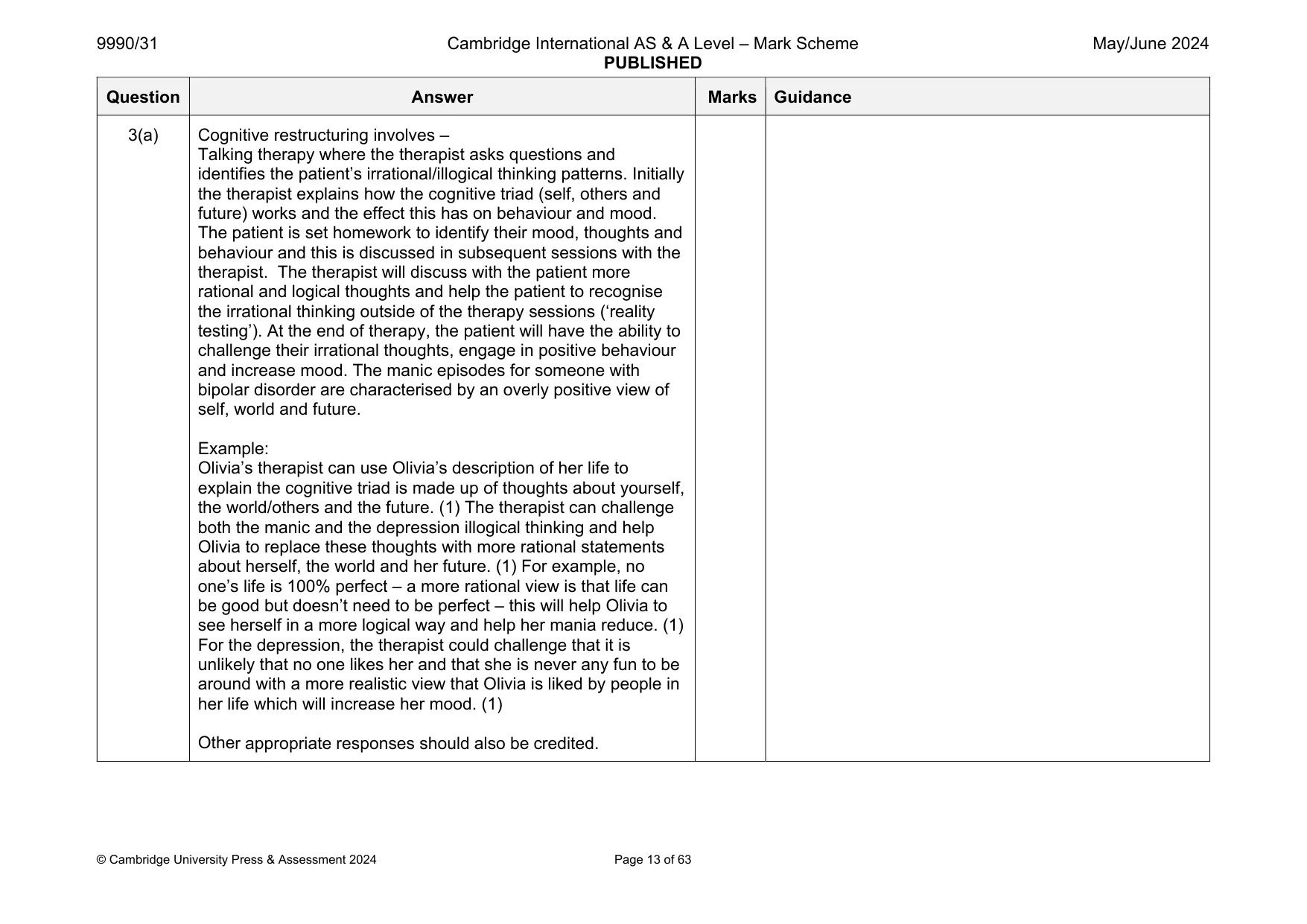
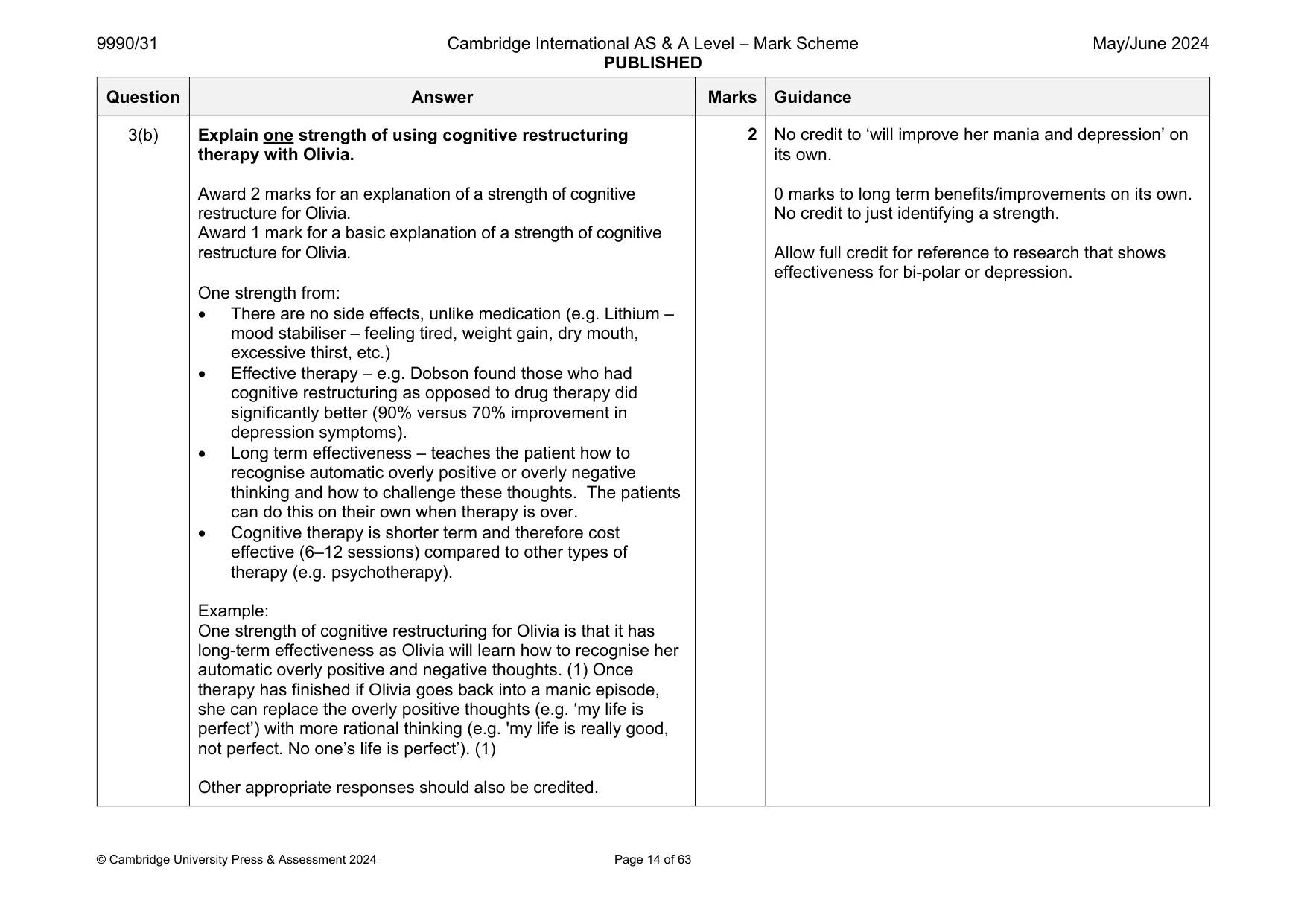
3 Olivia has a bipolar disorder and is receiving cognitive restructuring as therapy. In her first session she said: ‘My life used to be 100% perfect! I had an amazing job and friends. I stayed up one night to research an expensive holiday. Recently everything has changed. I am not working and have no energy. No one likes me, not even my family, as I am not fun to be with. I have cancelled the holiday. Why does this keep happening to me? I feel amazing for a while and then it all changes and I am depressed again.’ (a) Suggest how cognitive restructuring can help Olivia with both her depressive and manic episodes. [4] (b) Explain one strength of using cognitive restructuring therapy with Olivia. [2]
More questions on Mood (affective) disorders: depressive disorder (unipolar) and bipolar disorder
Q4 · Describe the behavioural explanation and the psychodynamic explanation of fear-related…
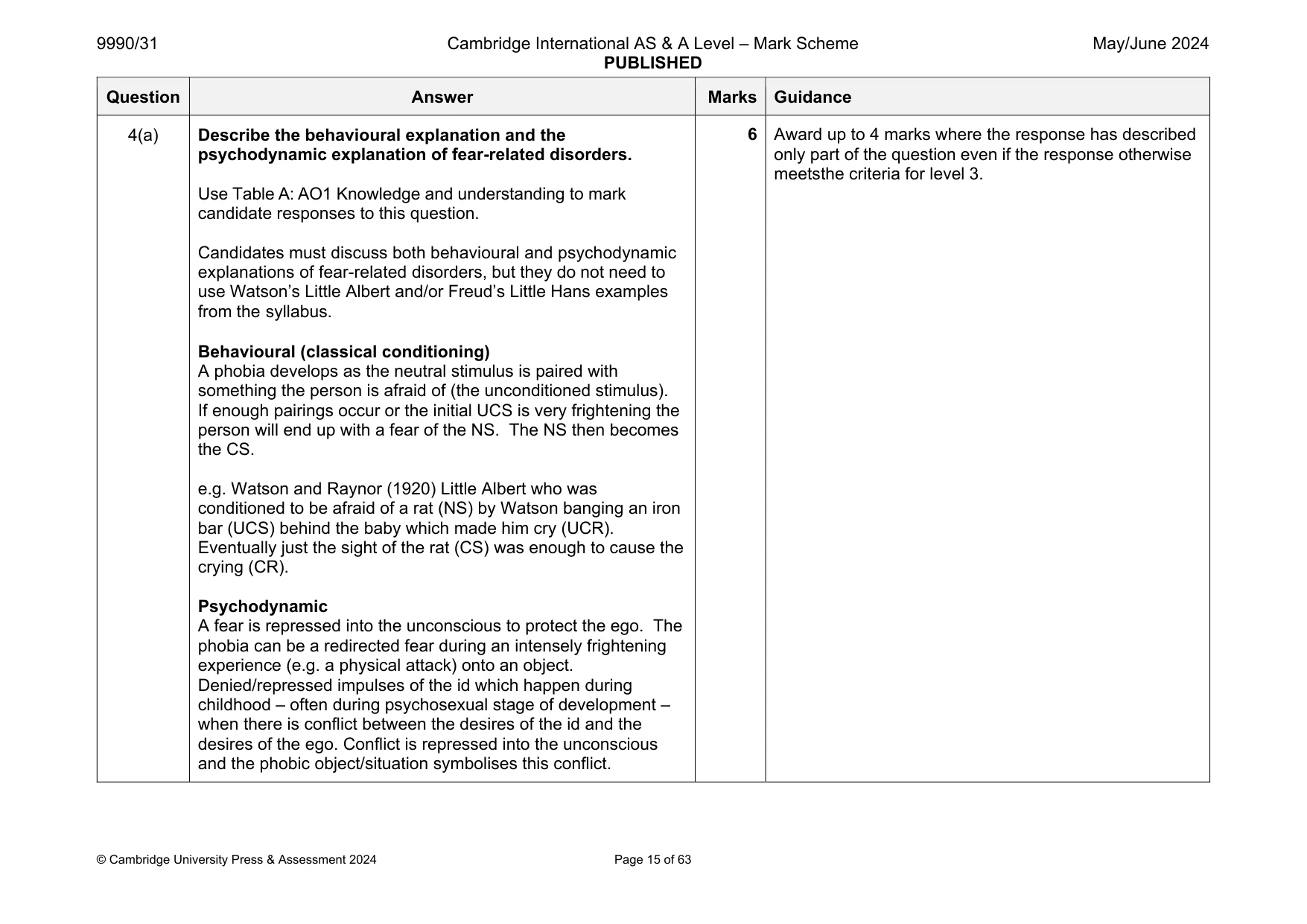
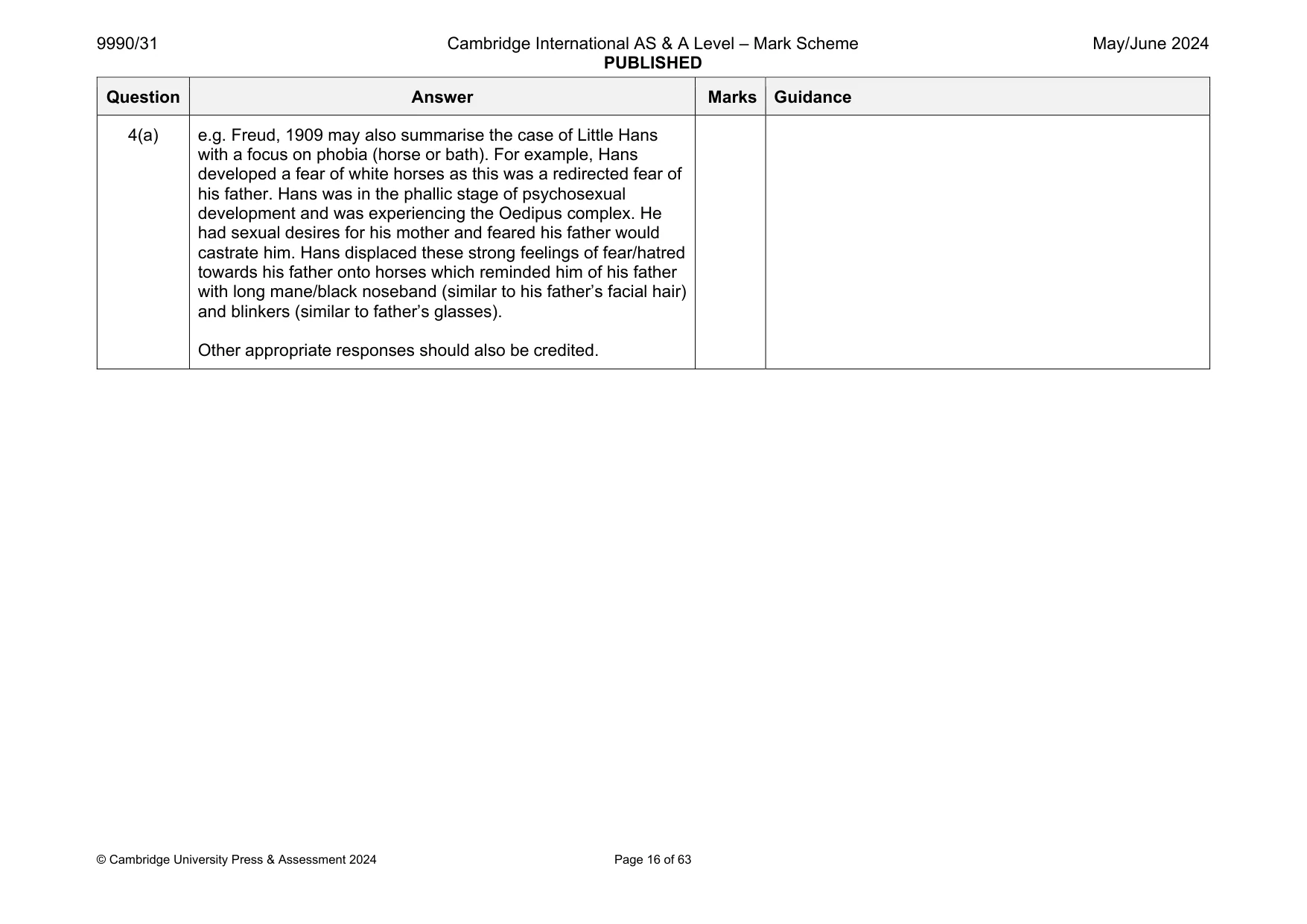
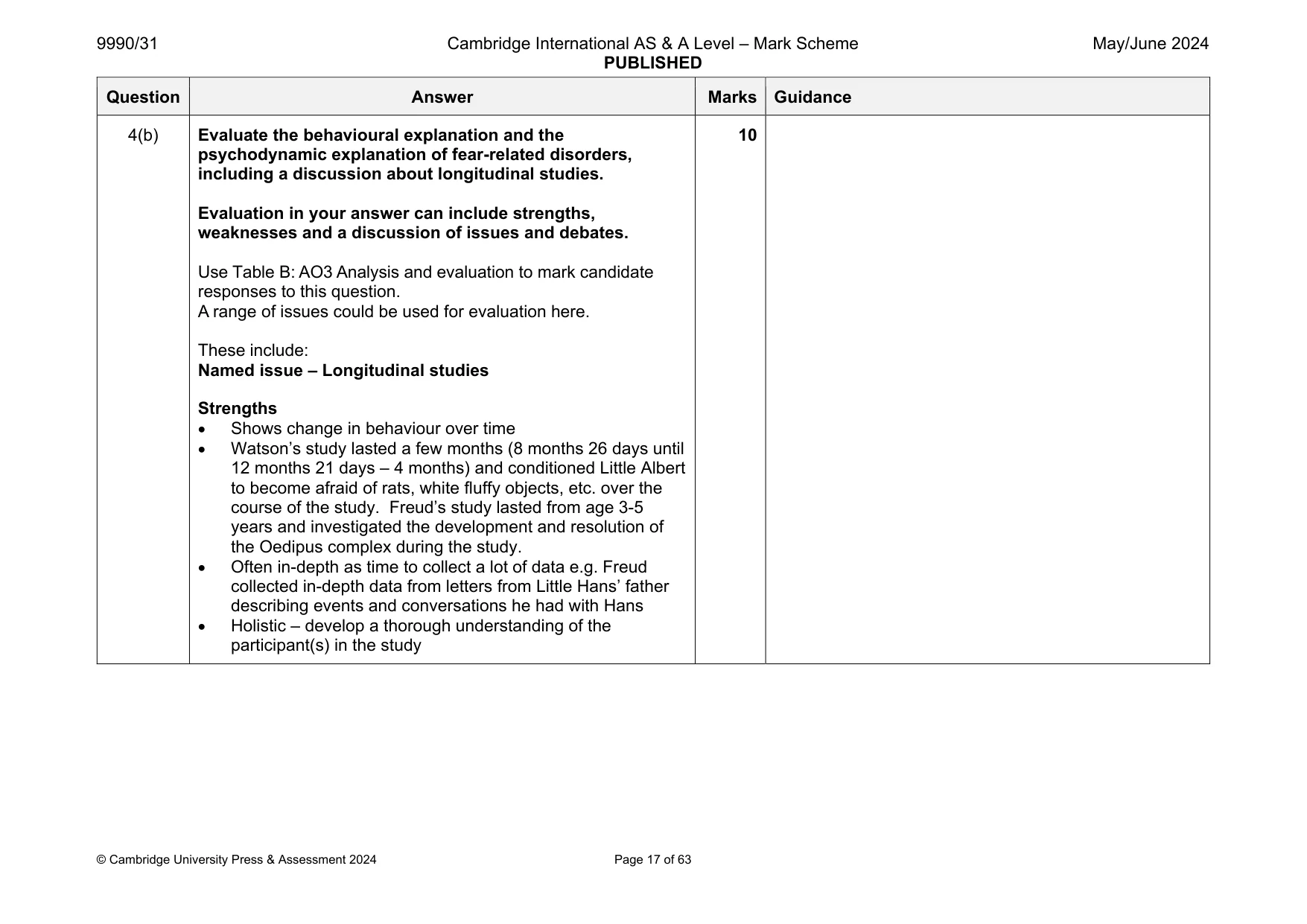
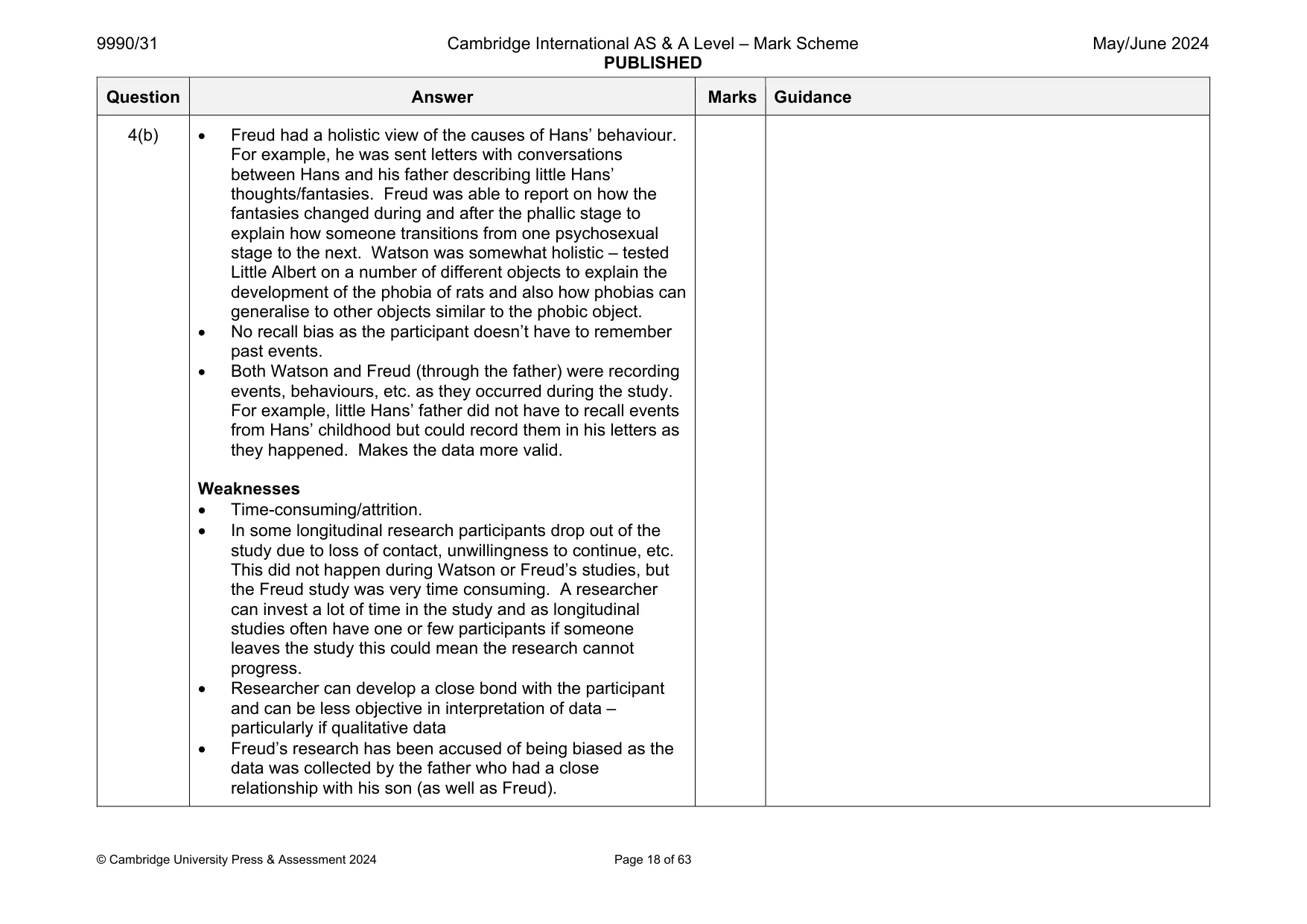
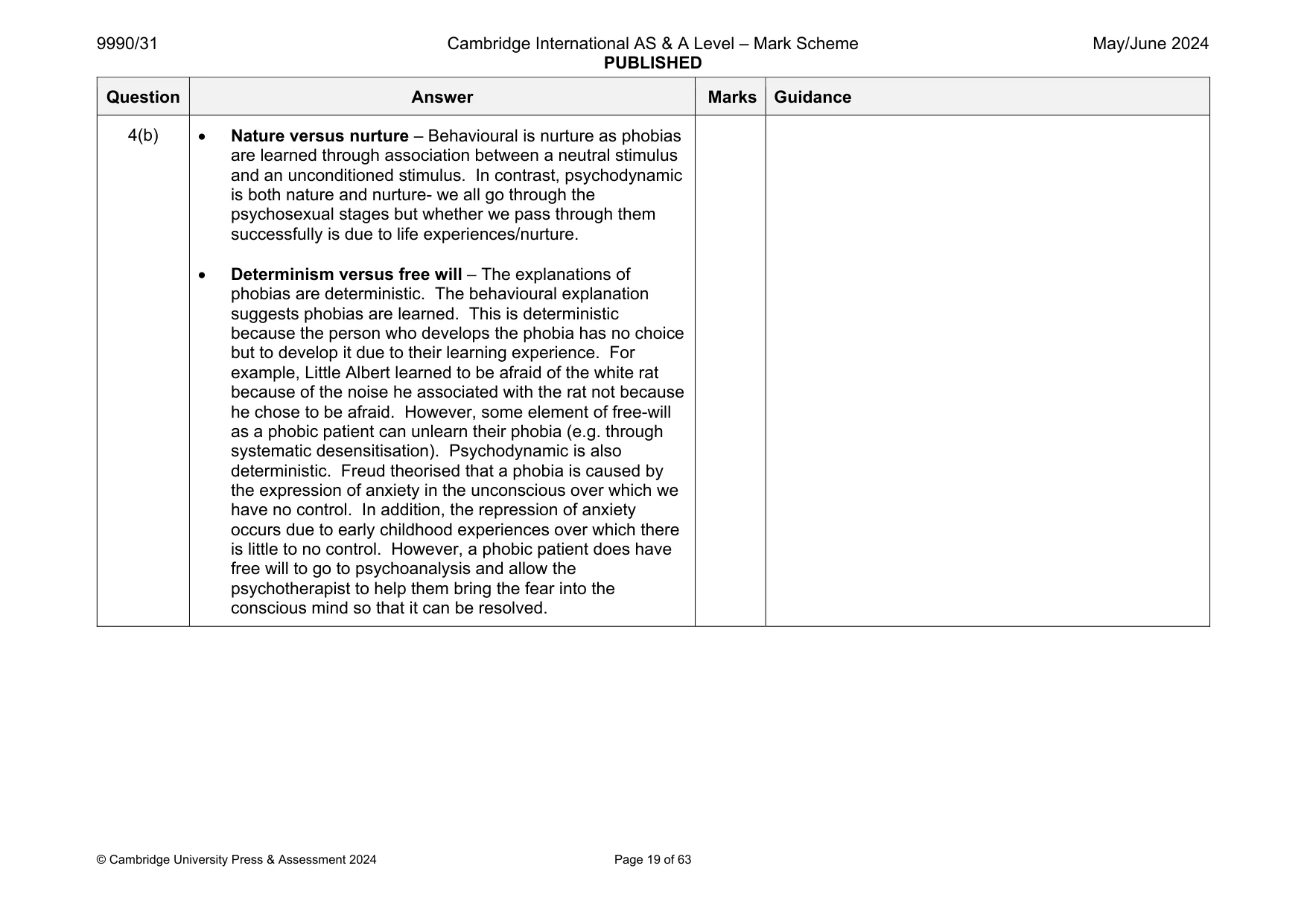
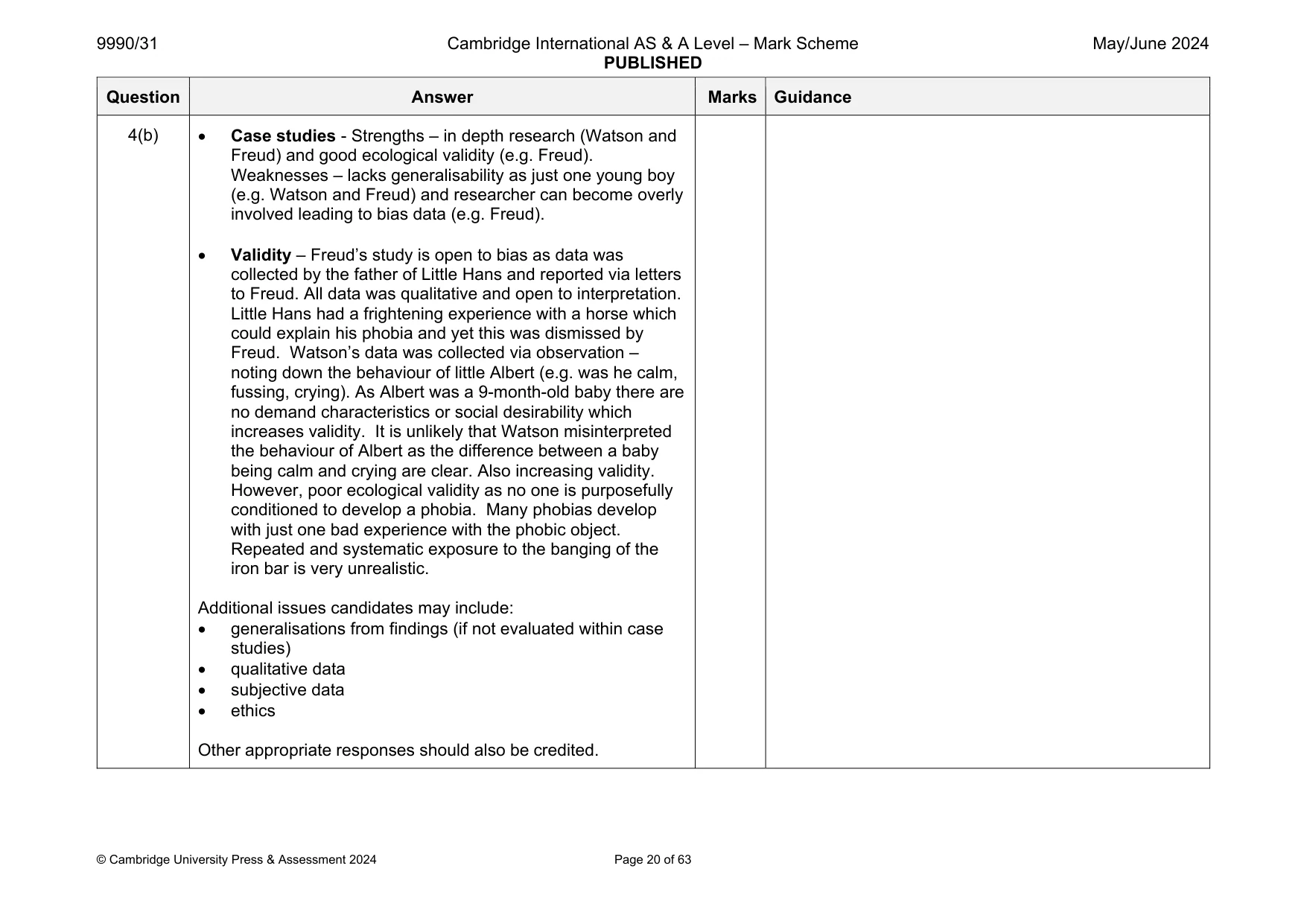
4 (a) Describe the behavioural explanation and the psychodynamic explanation of fear-related disorders. [6] (b) Evaluate the behavioural explanation and the psychodynamic explanation of fear-related disorders, including a discussion about longitudinal studies. Evaluation in your answer can include strengths, weaknesses and a discussion of issues and debates. [10]
More questions on Anxiety disorders and fear-related disorders
Q5 · Snyder and DeBono (1985) found that high self-monitors and low self-monitors have…
5 Snyder and DeBono (1985) found that high self-monitors and low self-monitors have different preferences for advertising strategies. This finding could be used for advertising winter coats. (a) Suggest one advertising strategy for winter coats that would appeal to high self-monitors. [2] (b) Suggest one advertising strategy for winter coats that would appeal to low self-monitors. [2]
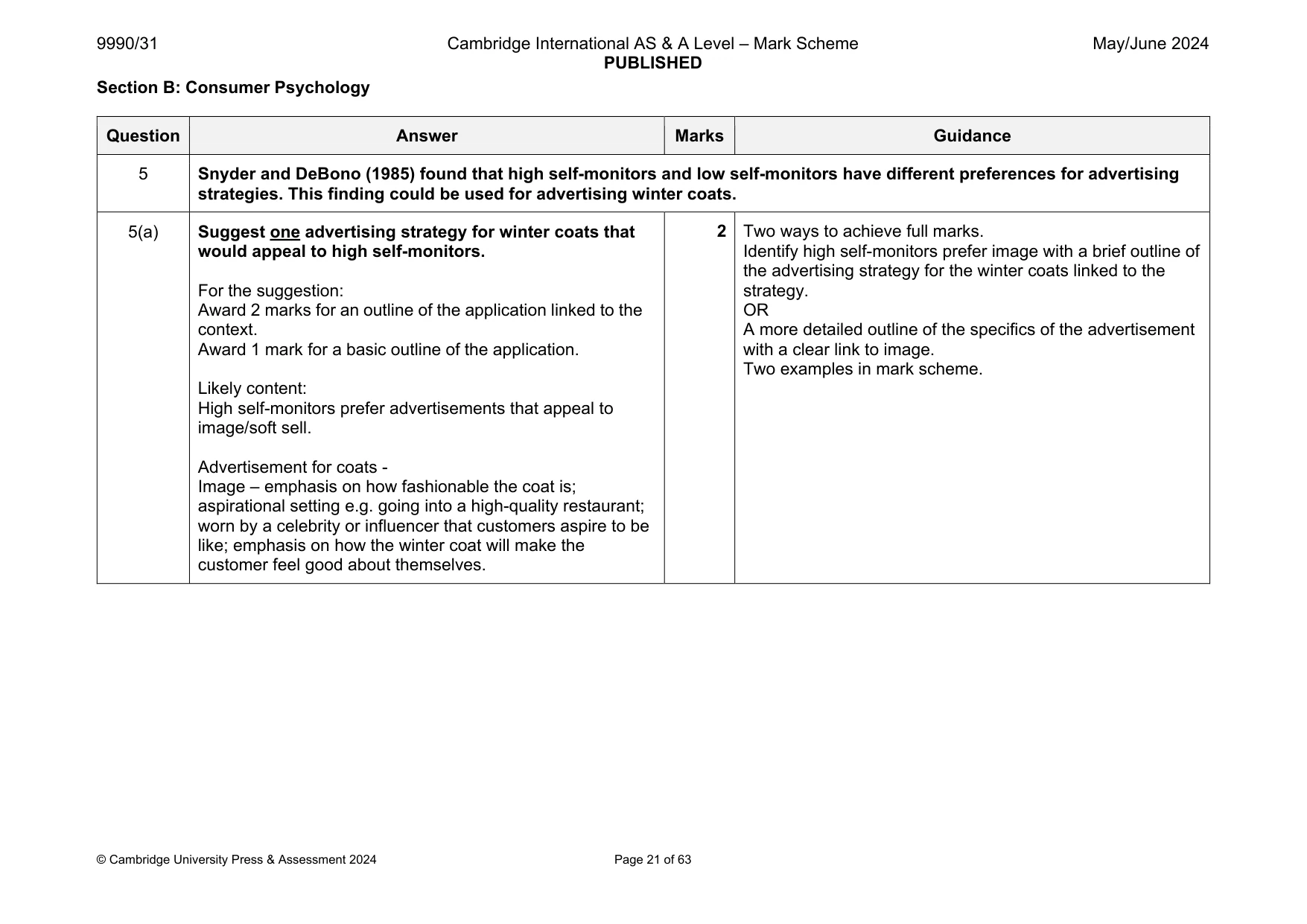
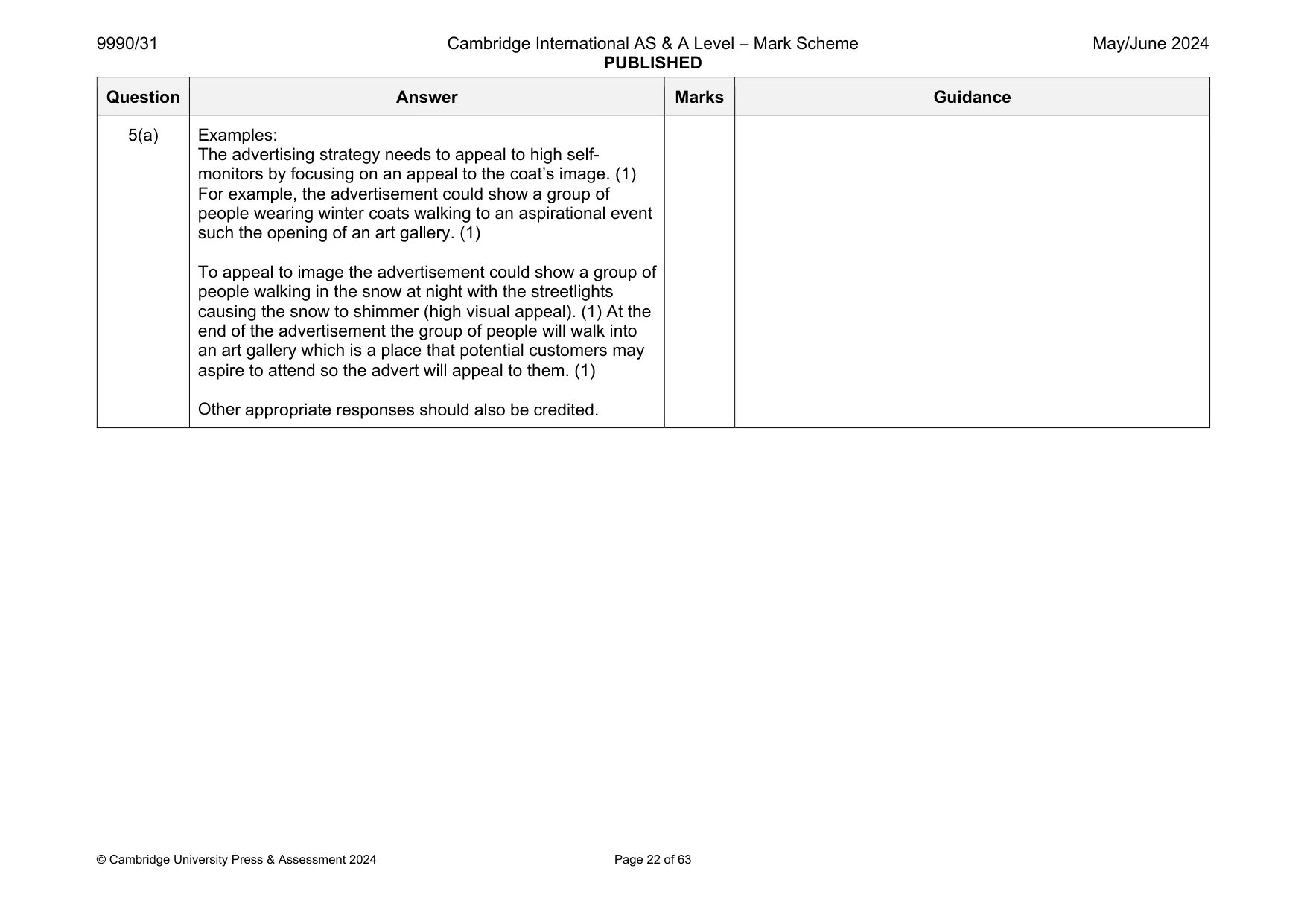
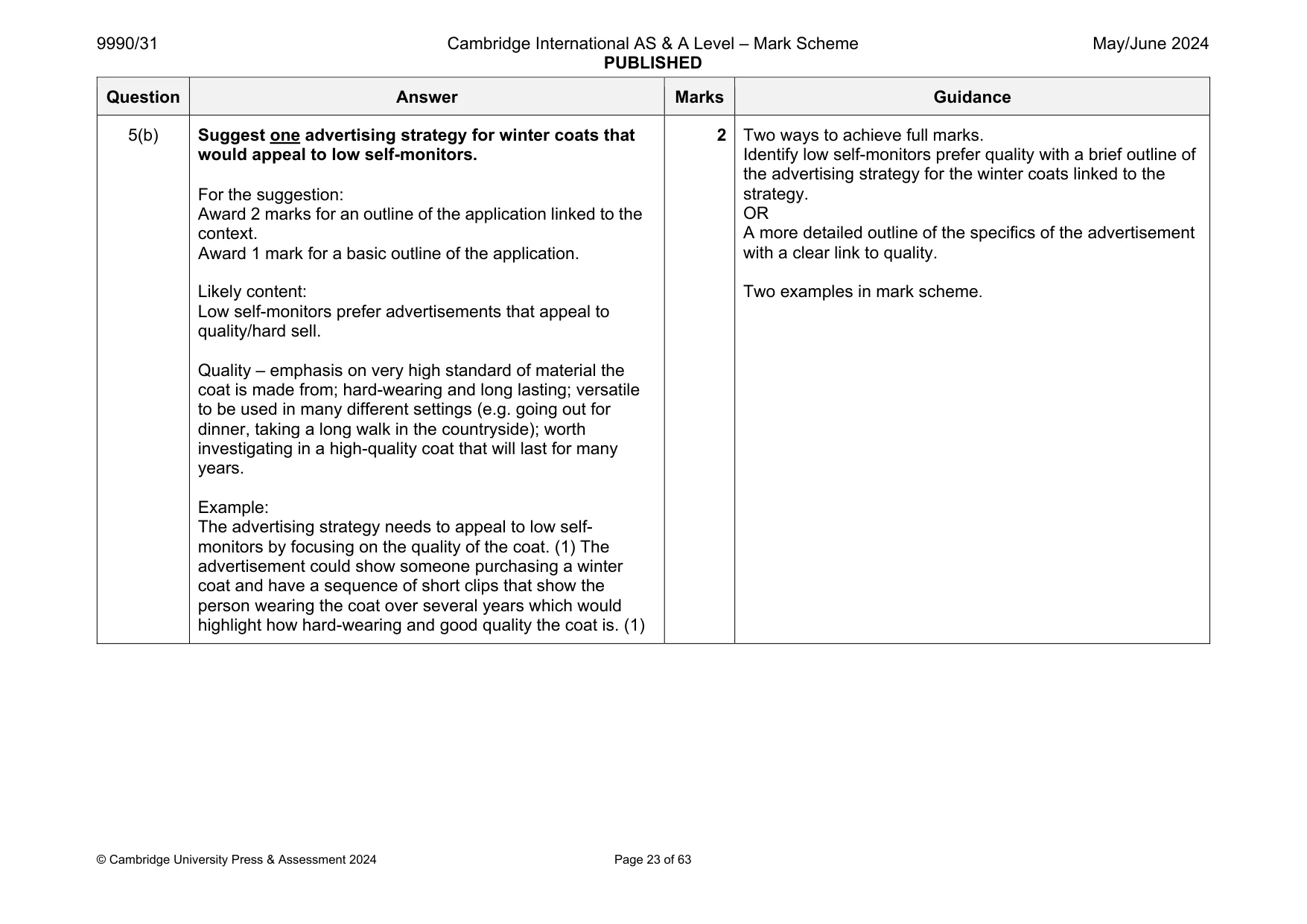
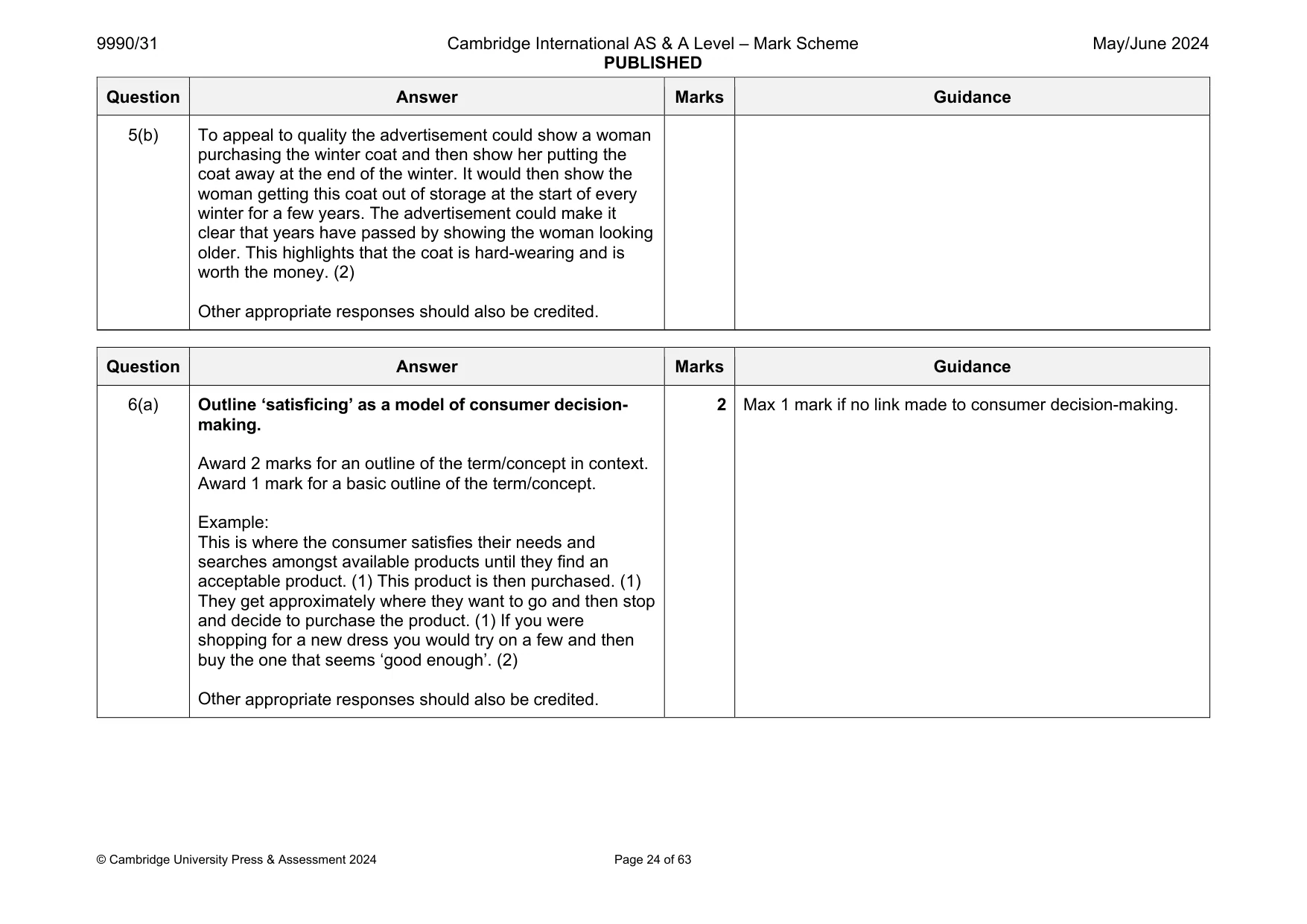
Mark scheme: 5(a) Suggest one advertising strategy for winter coats that would appeal to high self-monitors. For the suggestion: Award 2 marks for an outline of the application linked to the context. Award 1 mark for a basic outline of the application. Likely content: High self-monitors prefer advertisements that appeal to image/soft sell. Advertisement for coats - Image – emphasis on how fashionable the coat is; aspirational setting e.g. going into a high-quality restaurant; worn by a celebrity or influencer that customers aspire to be like; emphasis on how the winter coat will make the customer feel good about themselves. Identify high self-monitors prefer image with a brief outline of the advertising strategy for the winter coats linked to the strategy. OR A more detailed outline of the specifics of the advertisement with a clear link to image. Two examples in mark scheme. Question Answer Marks Guidance 5(a) Examples: The advertising strategy needs to appeal to high self- monitors by focusing on an appeal to the coat’s image. (1) For example, the advertisement could show a group of people wearing winter coats walking to an aspirational event such the opening of an art gallery. (1) To appeal to image the advertisement could show a group of people walking in the snow at night with the streetlights causing the snow to shimmer (high visual appeal). (1) At the end of the advertisement the group of people will walk into an art gallery which is a place that potential customers may aspire to attend so the advert will appeal to them. (1) Other appropriate responses should also be credited. Question Answer Marks Guidance 5(b) Suggest one advertising strategy for winter coats that would appeal to low self-monitors. For the suggestion: Award 2 marks for an outline of the application linked to the context. Award 1 mark for a basic outline of the application. Likely content: Low self-monitors prefer advertisements that appeal to quality/hard sell. Quality – emphasis on very high standard of material the coat is made from; hard-wearing and long lasting; versatile to be used in many different settings (e.g. going out for dinner, taking a long walk in the countryside); worth investigating in a high-quality coat that will last for many years. Example: The advertising strategy needs to appeal to low self- monitors by focusing on the quality of the coat. (1) The advertisement could show someone purchasing a winter coat and have a sequence of short clips that show the person wearing the coat over several years which would highlight how hard-wearing and good quality the coat is. (1) 2 Two ways to achieve full marks. Identify low self-monitors prefer quality with a brief outline of the advertising strategy for the winter coats linked to the strategy. OR A more detailed outline of the specifics of the advertisement with a clear link to quality. Two examples in mark scheme. Question Answer Marks Guidance 5(b) To appeal to quality the advertisement could show a woman purchasing the winter coat and then show her putting the coat away at the end of the winter. It would then show the woman getting this coat out of storage at the start of every winter for a few years. The advertisement could make it clear that years have passed by showing the woman looking older. This highlights that the coat is hard-wearing and is worth the money. (2) Other appropriate responses should also be credited.
Q6 · Outline ‘satisficing’ as a model of consumer decision-making
6 (a) Outline ‘satisficing’ as a model of consumer decision-making. [2] (b) Explain how satisficing as a model of consumer decision-making is reductionist. [2]
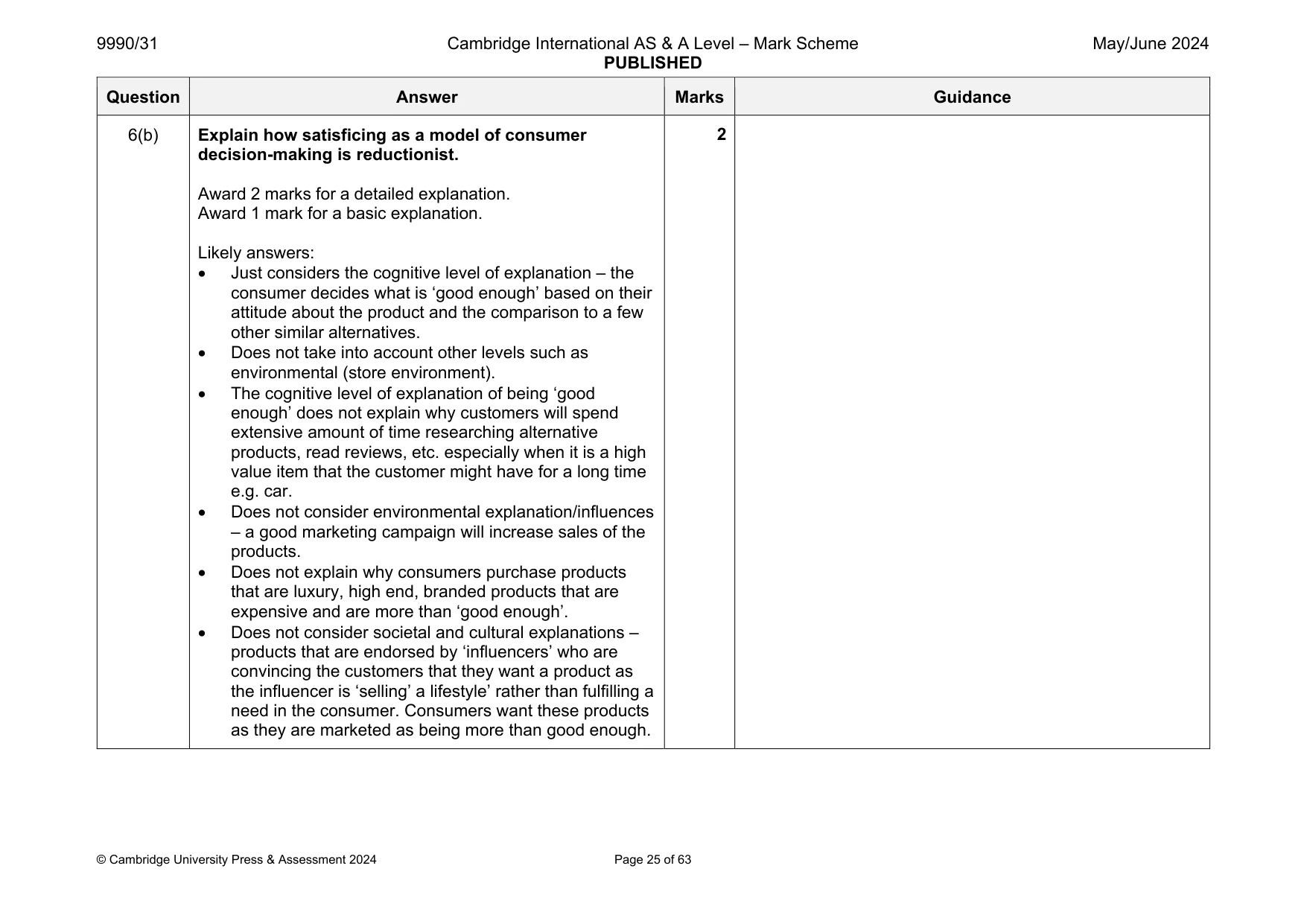
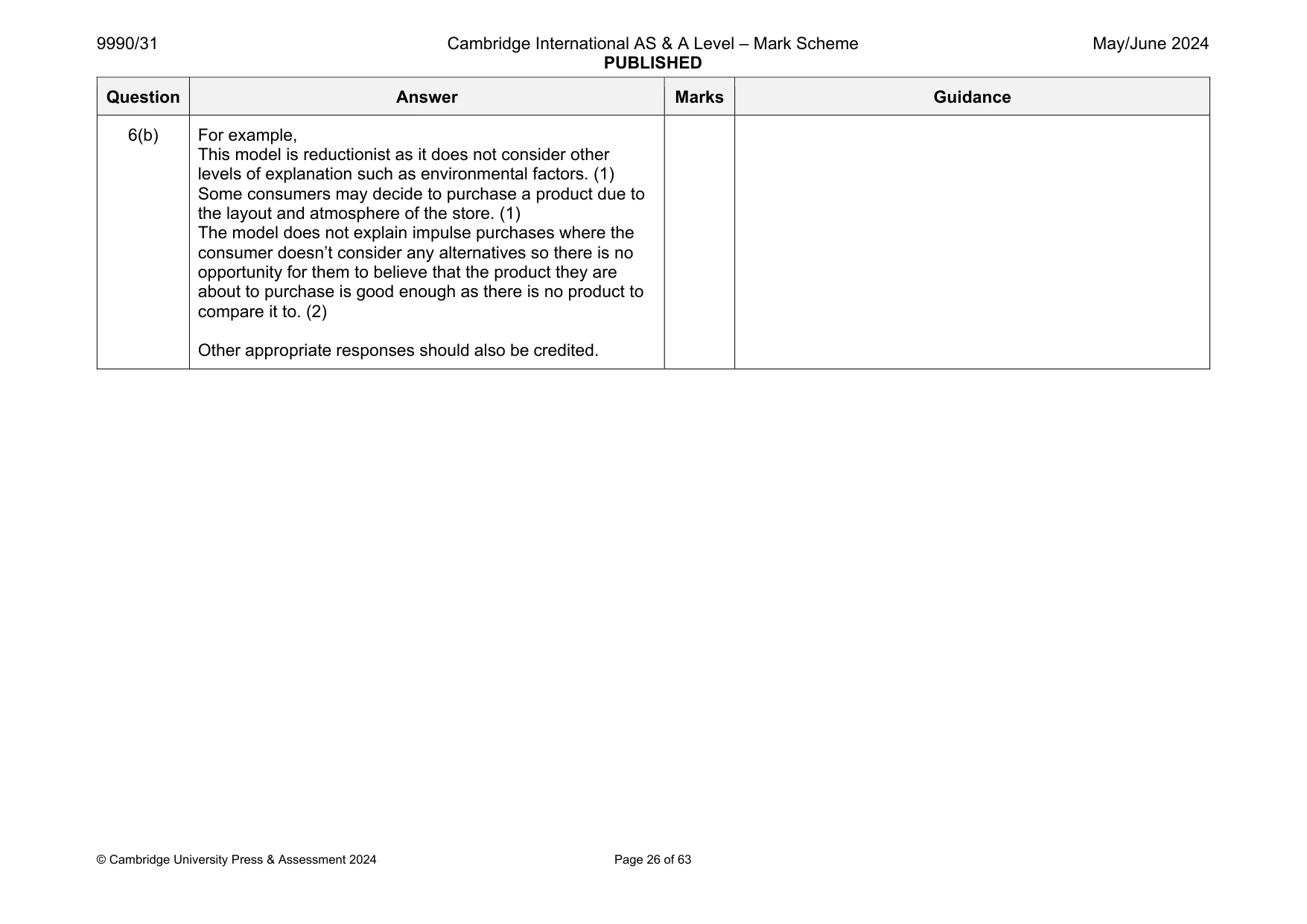
Mark scheme: 6(a) Outline ‘satisficing’ as a model of consumer decision- making. Award 2 marks for an outline of the term/concept in context. Award 1 mark for a basic outline of the term/concept. Example: This is where the consumer satisfies their needs and searches amongst available products until they find an acceptable product. (1) This product is then purchased. (1) They get approximately where they want to go and then stop and decide to purchase the product. (1) If you were shopping for a new dress you would try on a few and then buy the one that seems ‘good enough’. (2) Other appropriate responses should also be credited. Question Answer Marks Guidance 6(b) Explain how satisficing as a model of consumer decision-making is reductionist. Award 2 marks for a detailed explanation. Award 1 mark for a basic explanation. Likely answers: Just considers the cognitive level of explanation – the consumer decides what is ‘good enough’ based on their attitude about the product and the comparison to a few other similar alternatives. Does not take into account other levels such as environmental (store environment). The cognitive level of explanation of being ‘good enough’ does not explain why customers will spend extensive amount of time researching alternative products, read reviews, etc. especially when it is a high value item that the customer might have for a long time e.g. car. Does not consider environmental explanation/influences – a good marketing campaign will increase sales of the products. Does not explain why consumers purchase products that are luxury, high end, branded products that are expensive and are more than ‘good enough’. Does not consider societal and cultural explanations – products that are endorsed by ‘influencers’ who are convincing the customers that they want a product as the influencer is ‘selling’ a lifestyle’ rather than fulfilling a need in the consumer. Consumers want these products as they are marketed as being more than good enough. 2 Question Answer Marks Guidance 6(b) For example, This model is reductionist as it does not consider other levels of explanation such as environmental factors. (1) Some consumers may decide to purchase a product due to the layout and atmosphere of the store. (1) The model does not explain impulse purchases where the consumer doesn’t consider any alternatives so there is no opportunity for them to believe that the product they are about to purchase is good enough as there is no product to compare it to. (2) Other appropriate responses should also be credited.
Q7 · Zahra works in a large store that sells a wide range of goods
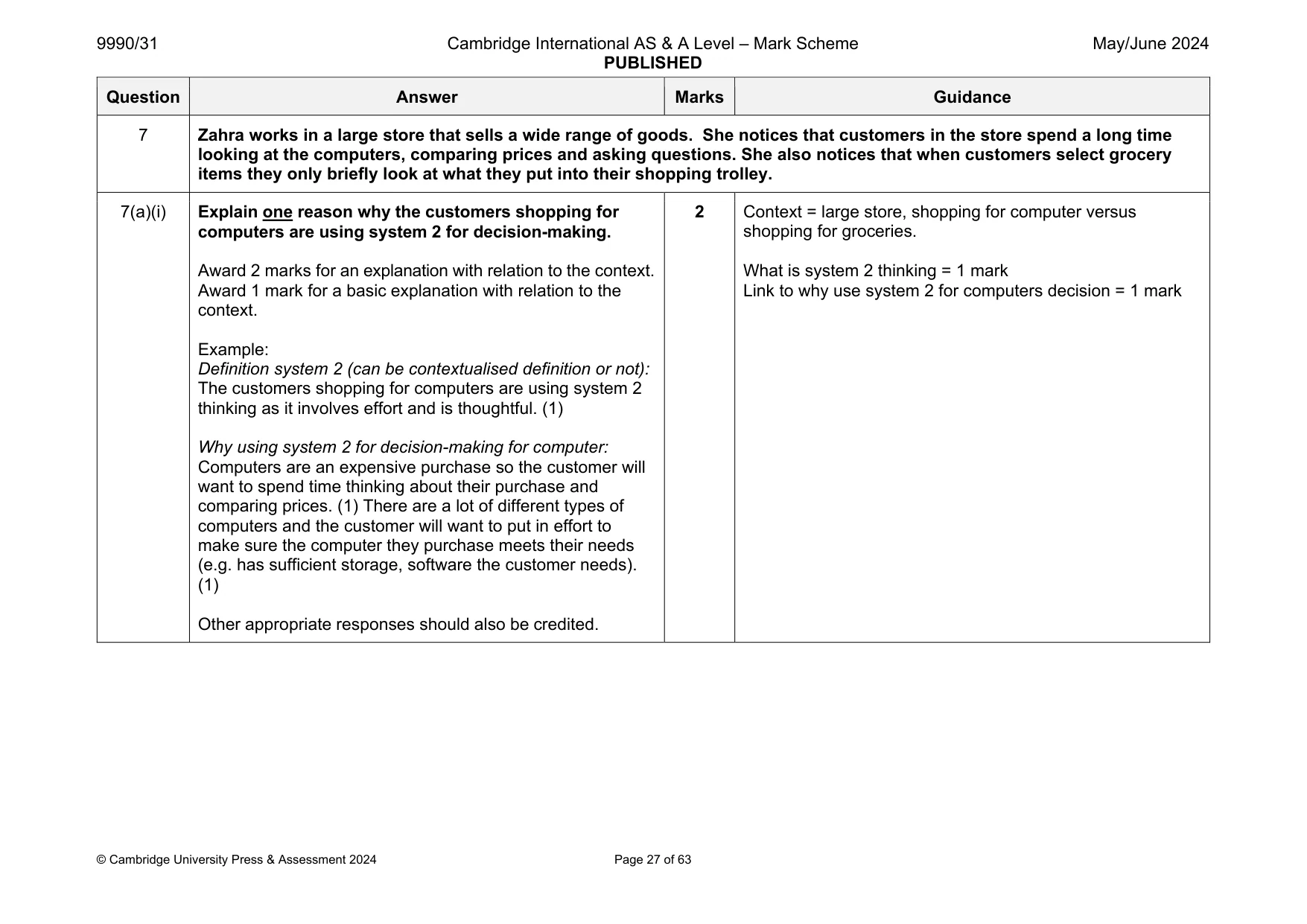
7 Zahra works in a large store that sells a wide range of goods. She notices that customers in the store spend a long time looking at the computers, comparing prices and asking questions. She also notices that when customers select grocery items they only briefly look at what they put into their shopping trolley. (a) (i) Explain one reason why the customers shopping for computers are using system 2 for decision-making. [2] (ii) Explain one reason why the customers shopping for groceries are using system 1 for decision-making. [2] (b) Explain one problem with identifying whether a customer is using system 1 or system 2 for decision-making. [2]
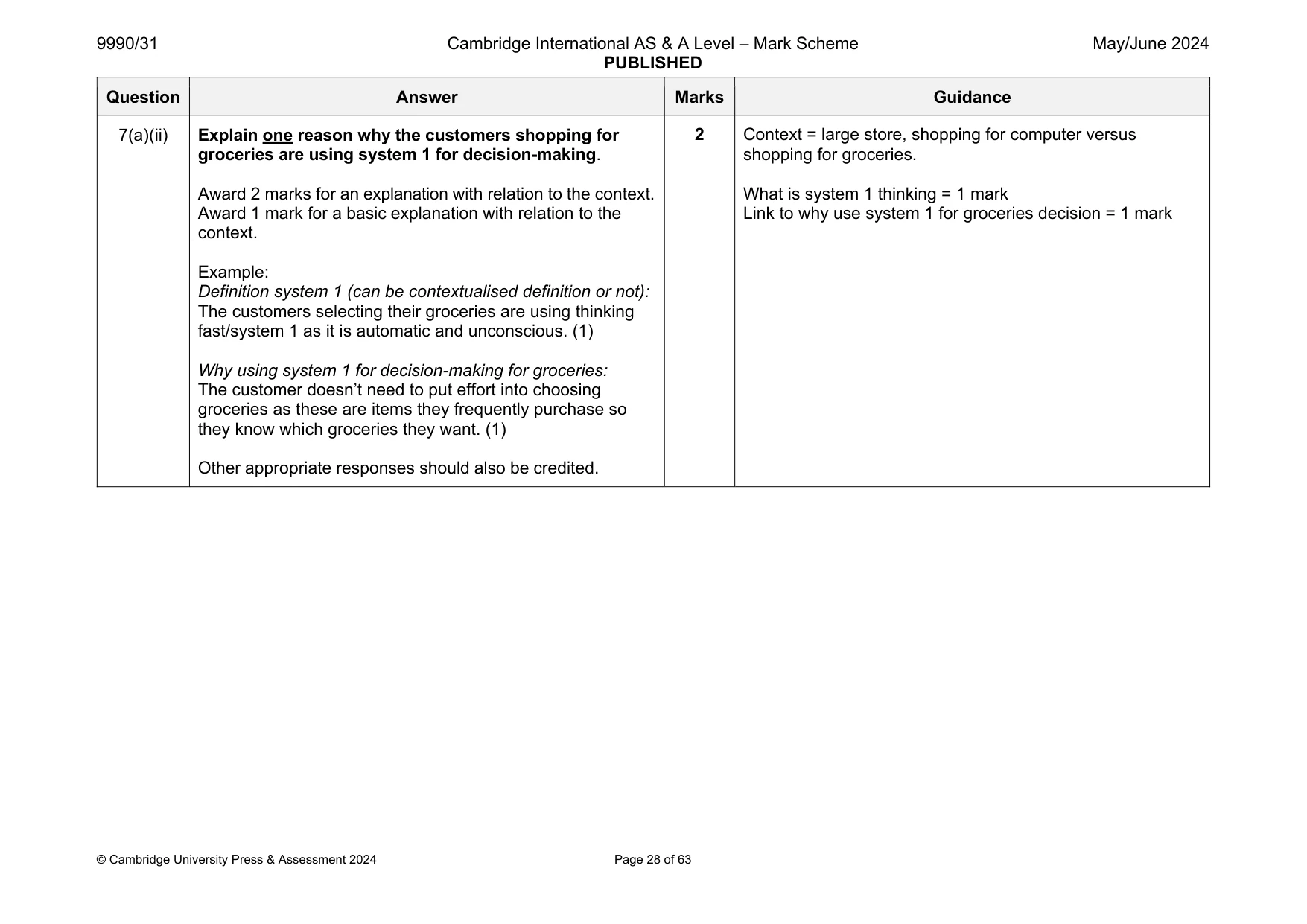
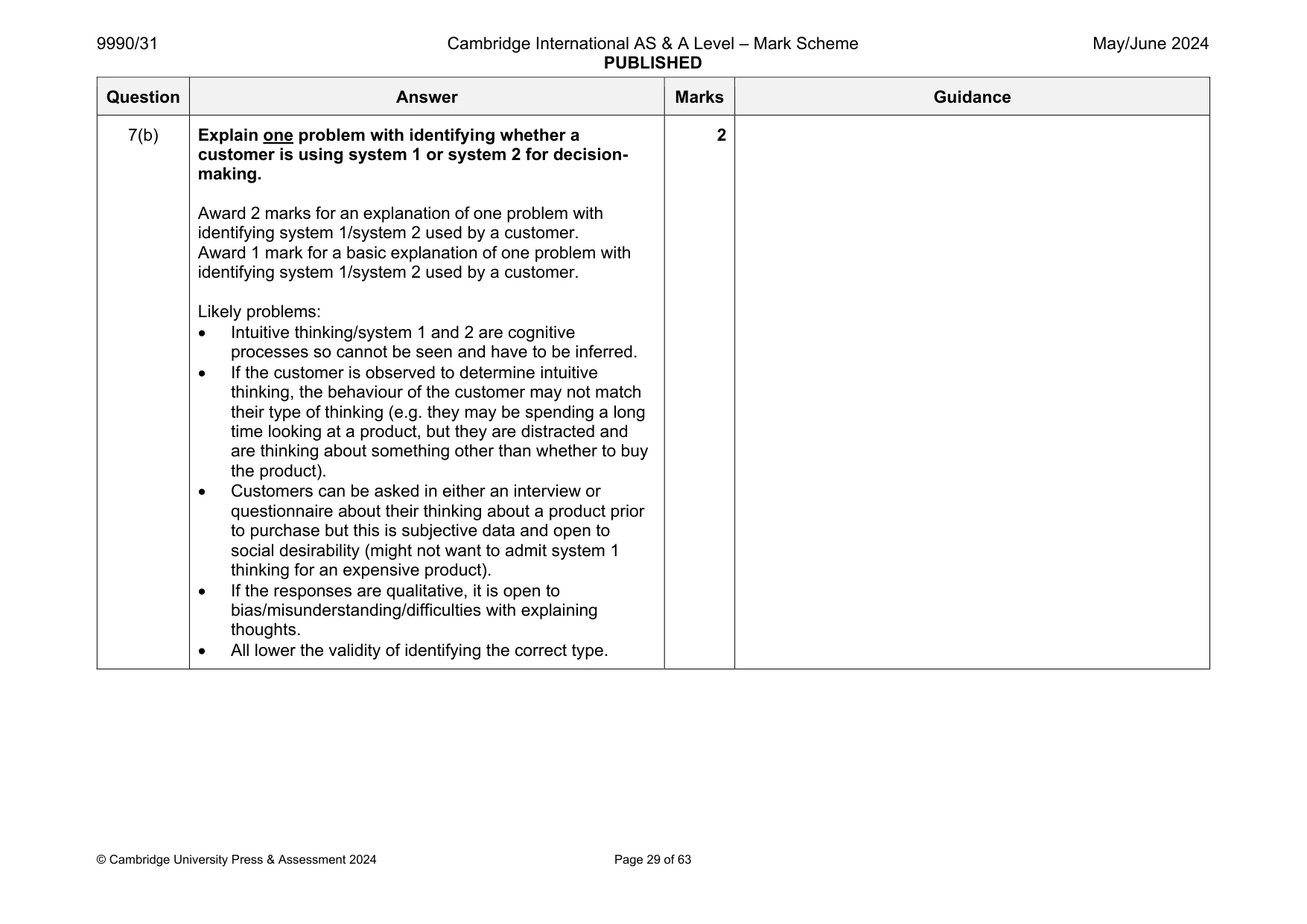
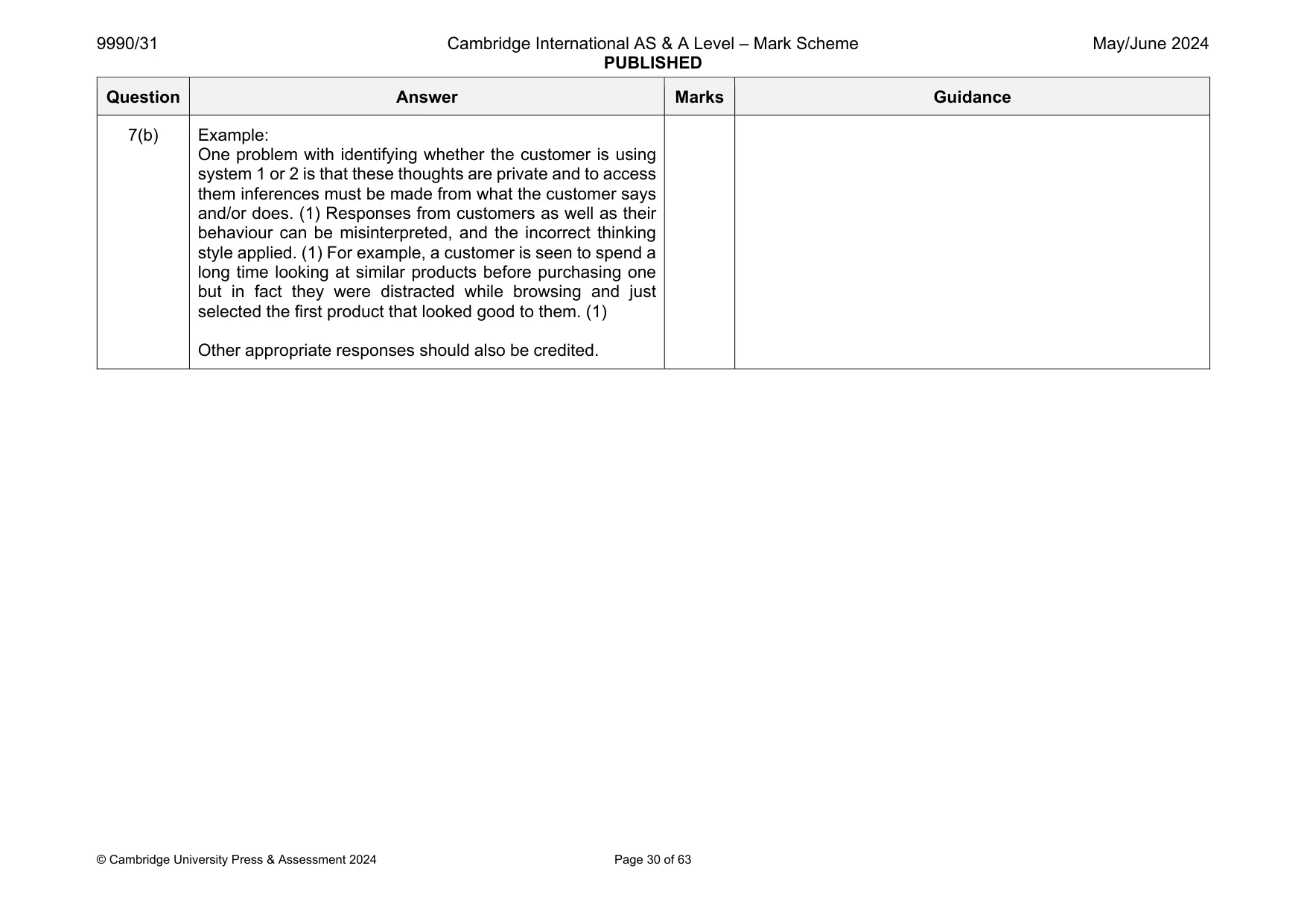
Mark scheme: 7(a)(i) Explain one reason why the customers shopping for computers are using system 2 for decision-making. Award 2 marks for an explanation with relation to the context. Award 1 mark for a basic explanation with relation to the context. Example: Definition system 2 (can be contextualised definition or not): The customers shopping for computers are using system 2 thinking as it involves effort and is thoughtful. (1) Why using system 2 for decision-making for computer: Computers are an expensive purchase so the customer will want to spend time thinking about their purchase and comparing prices. (1) There are a lot of different types of computers and the customer will want to put in effort to make sure the computer they purchase meets their needs (e.g. has sufficient storage, software the customer needs). (1) Other appropriate responses should also be credited. shopping for groceries. What is system 2 thinking = 1 mark Link to why use system 2 for computers decision = 1 mark Question Answer Marks Guidance 7(a)(ii) Explain one reason why the customers shopping for groceries are using system 1 for decision-making. Award 2 marks for an explanation with relation to the context. Award 1 mark for a basic explanation with relation to the context. Example: Definition system 1 (can be contextualised definition or not): The customers selecting their groceries are using thinking fast/system 1 as it is automatic and unconscious. (1) Why using system 1 for decision-making for groceries: The customer doesn’t need to put effort into choosing groceries as these are items they frequently purchase so they know which groceries they want. (1) Other appropriate responses should also be credited. 2 Context = large store, shopping for computer versus shopping for groceries. What is system 1 thinking = 1 mark Link to why use system 1 for groceries decision = 1 mark Question Answer Marks Guidance 7(b) Explain one problem with identifying whether a customer is using system 1 or system 2 for decision- making. Award 2 marks for an explanation of one problem with identifying system 1/system 2 used by a customer. Award 1 mark for a basic explanation of one problem with identifying system 1/system 2 used by a customer. Likely problems: Intuitive thinking/system 1 and 2 are cognitive processes so cannot be seen and have to be inferred. If the customer is observed to determine intuitive thinking, the behaviour of the customer may not match their type of thinking (e.g. they may be spending a long time looking at a product, but they are distracted and are thinking about something other than whether to buy the product). Customers can be asked in either an interview or questionnaire about their thinking about a product prior to purchase but this is subjective data and open to social desirability (might not want to admit system 1 thinking for an expensive product). If the responses are qualitative, it is open to bias/misunderstanding/difficulties with explaining thoughts. All lower the validity of identifying the correct type. 2 Question Answer Marks Guidance 7(b) Example: One problem with identifying whether the customer is using system 1 or 2 is that these thoughts are private and to access them inferences must be made from what the customer says and/or does. (1) Responses from customers as well as their behaviour can be misinterpreted, and the incorrect thinking style applied. (1) For example, a customer is seen to spend a long time looking at similar products before purchasing one but in fact they were distracted while browsing and just selected the first product that looked good to them. (1) Other appropriate responses should also be credited.
Q8 · Describe what psychologists have discovered about: • the features of menu design which…
8 (a) Describe what psychologists have discovered about: • the features of menu design which have positive and negative impacts, and • the effect of food name on menu item choice. [6] (b) Evaluate what psychologists have discovered about: • the features of menu design which have positive and negative impacts, and • the effect of food name on menu item choice, including a discussion about generalisations from findings. Evaluation in your answer can include strengths, weaknesses and a discussion of issues and debates. [10] Section C: Health Psychology Answer all questions.
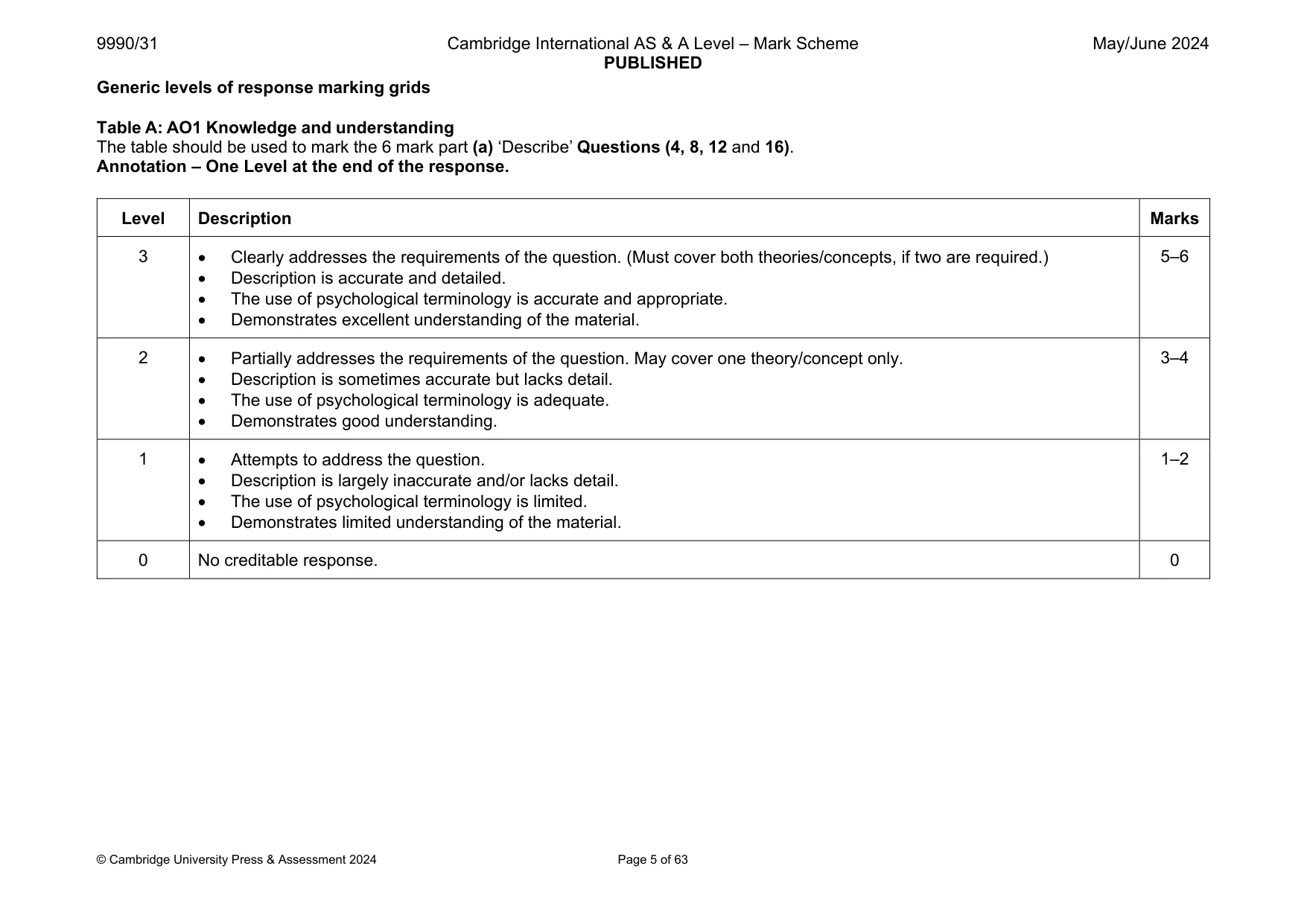
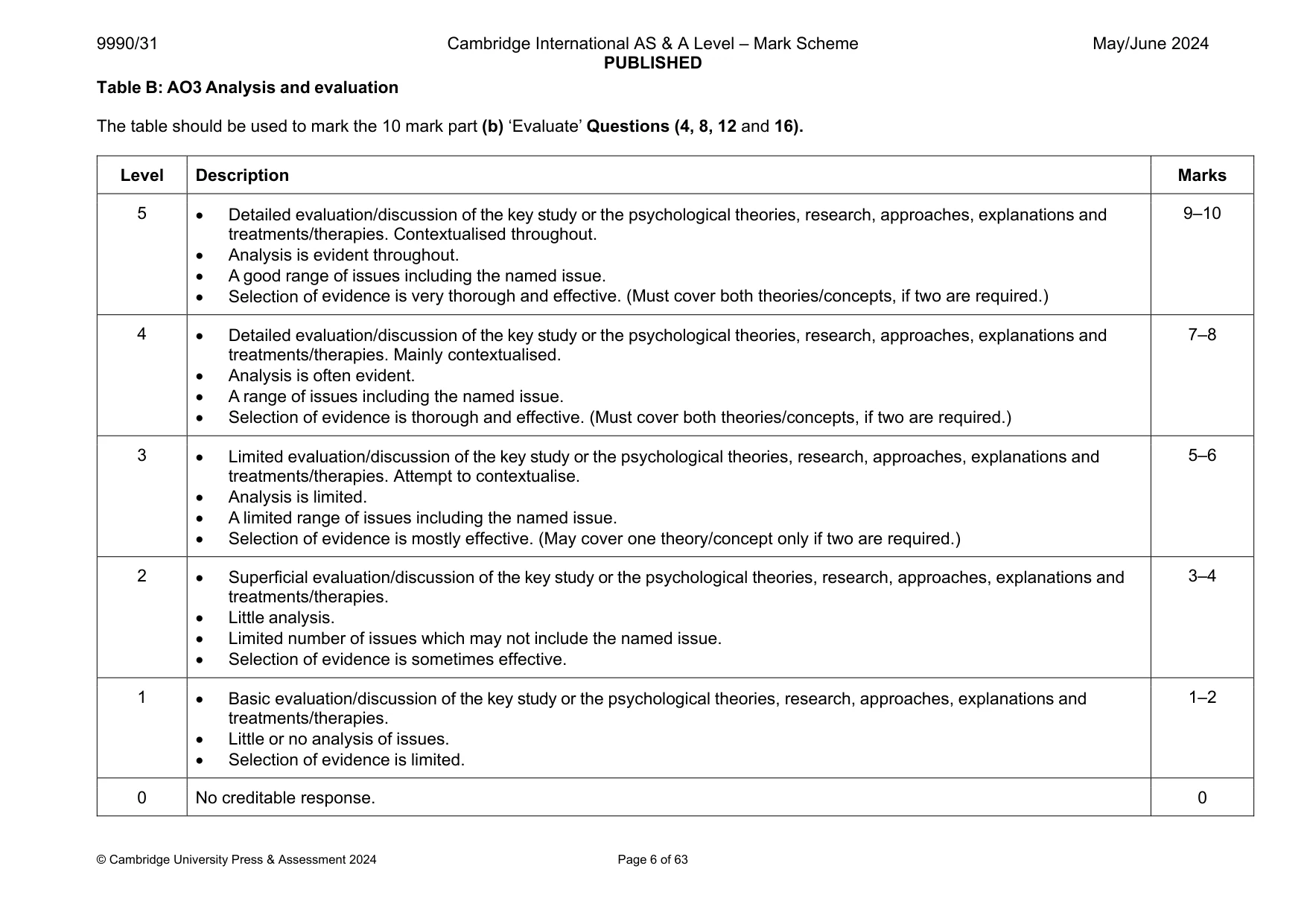
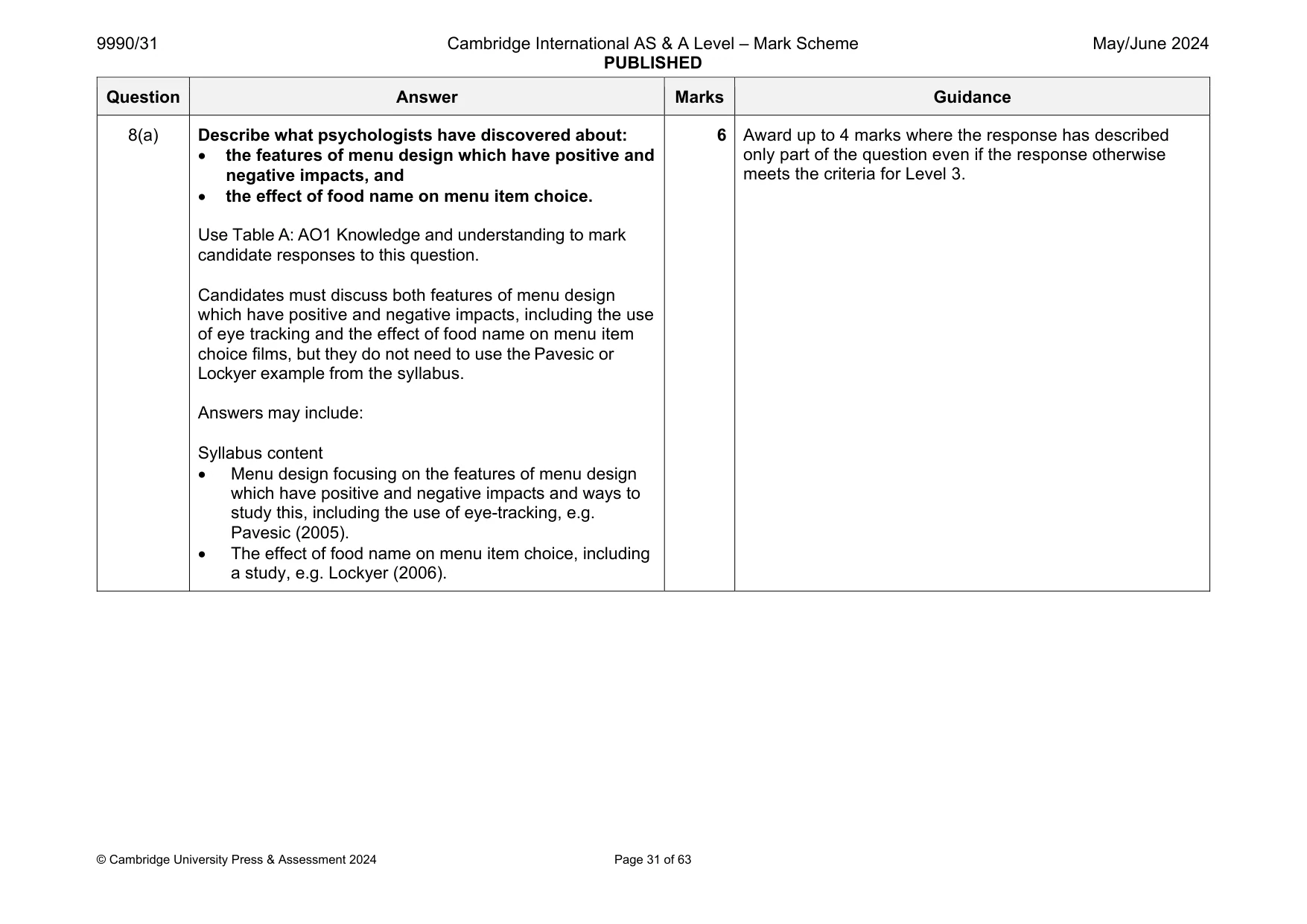
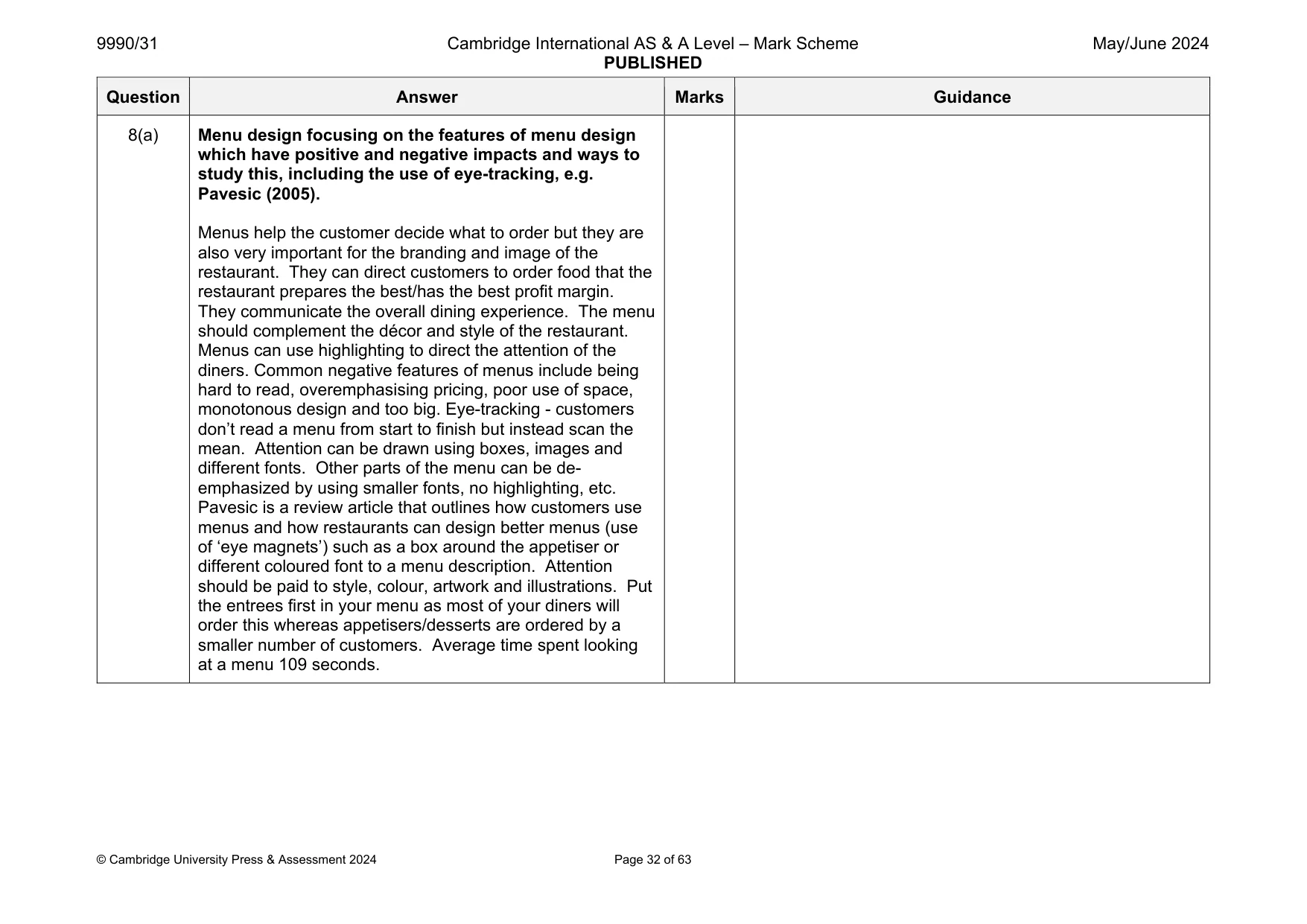
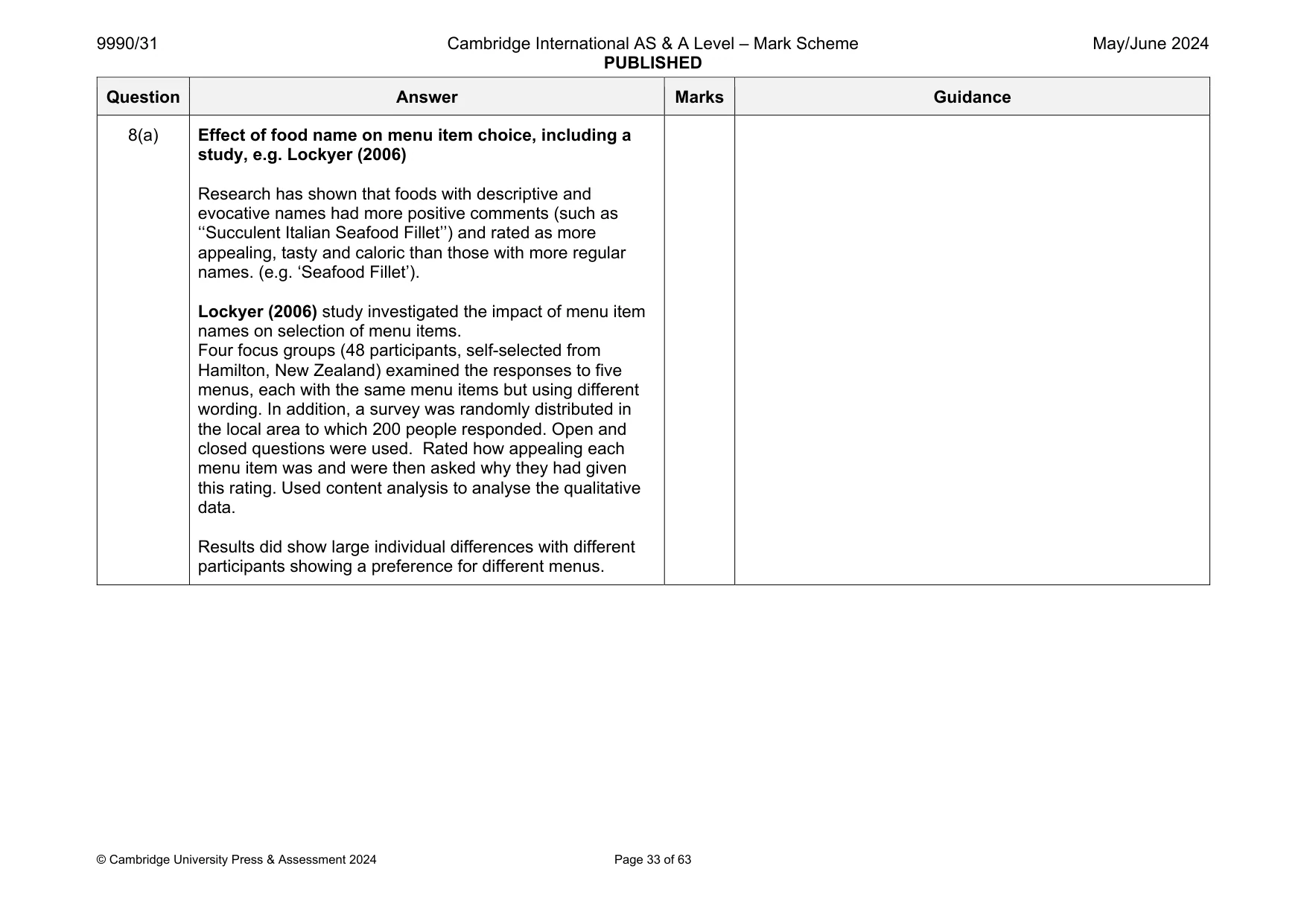
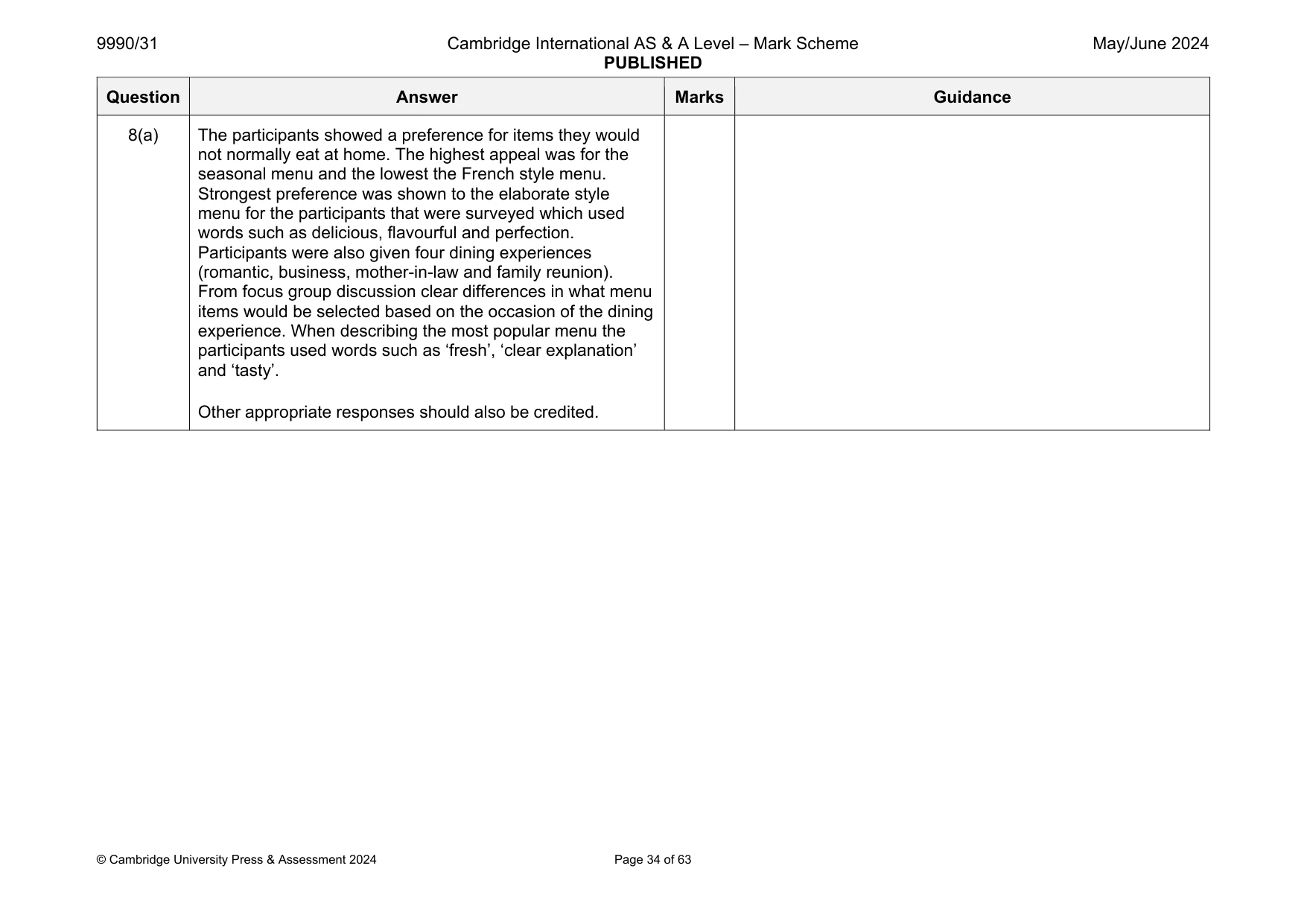
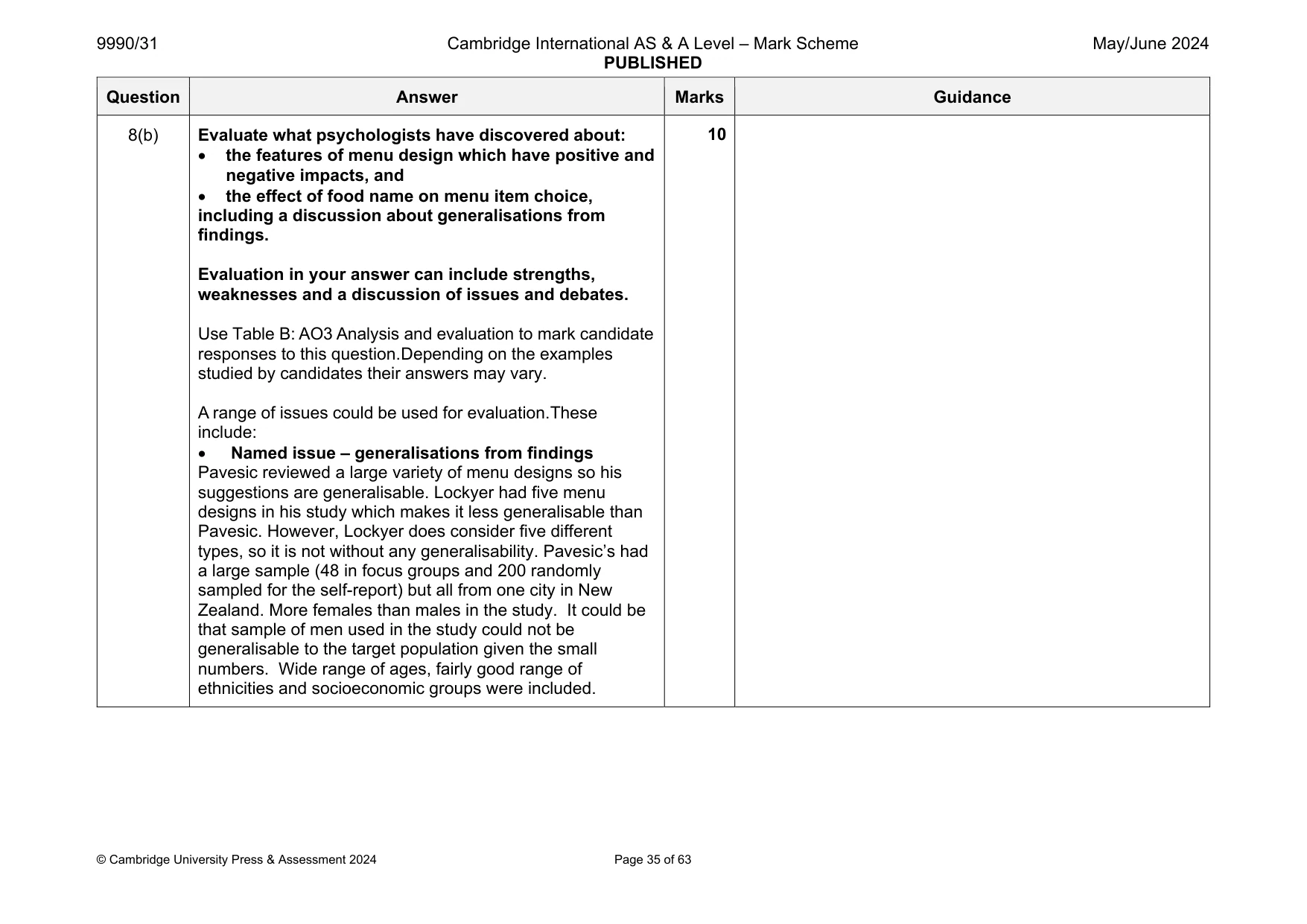
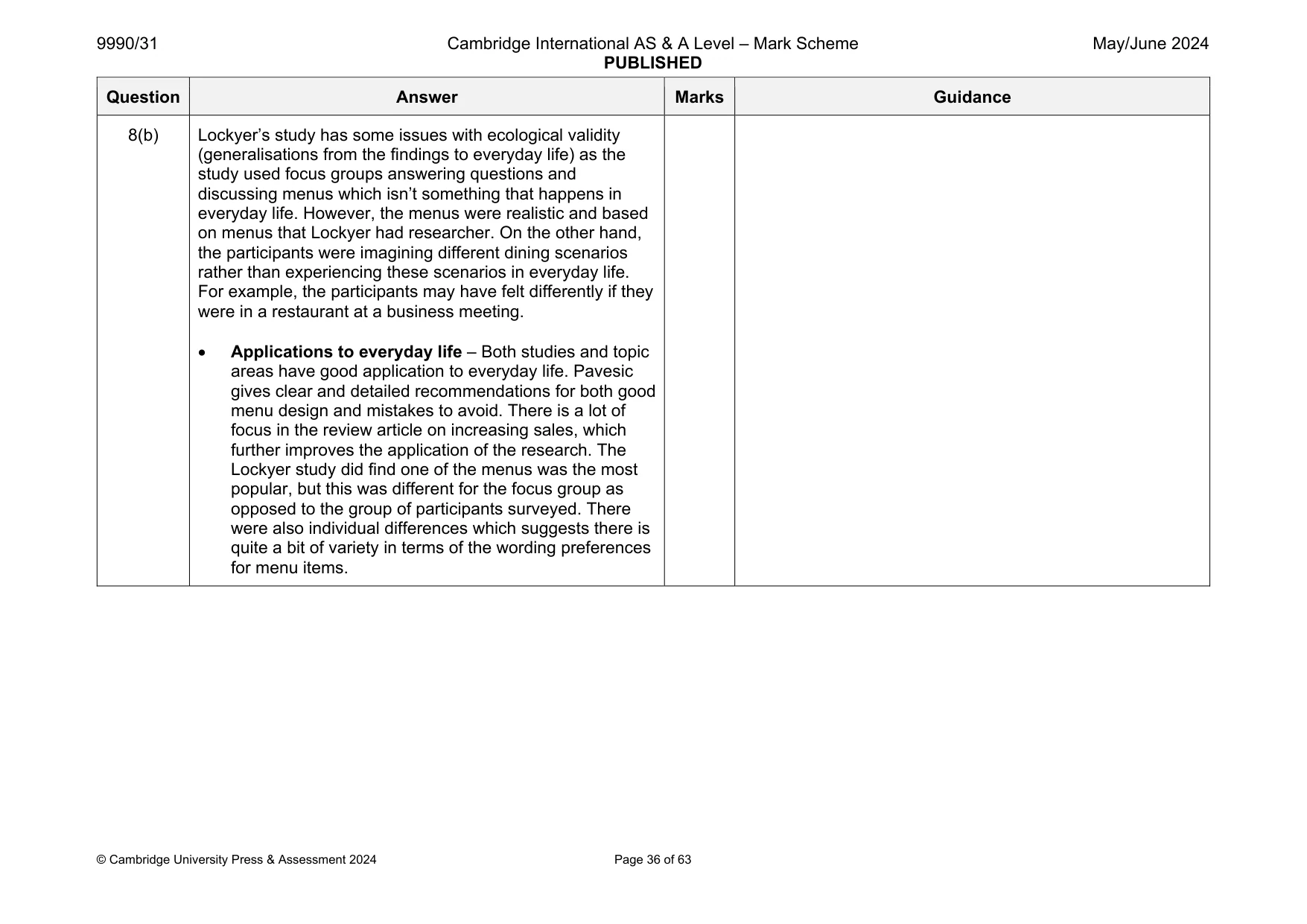
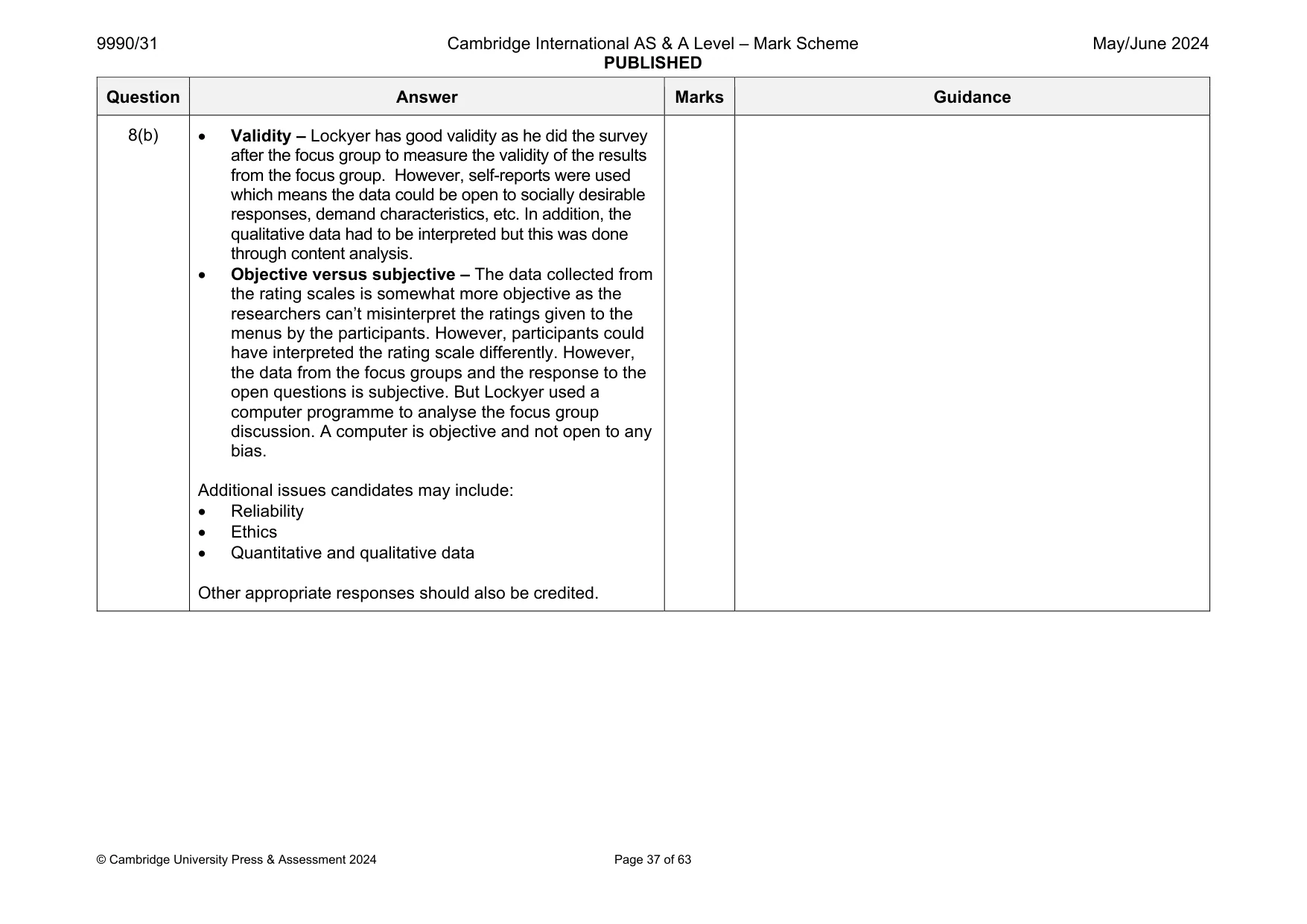
Mark scheme: 8(a) Describe what psychologists have discovered about: the features of menu design which have positive and negative impacts, and the effect of food name on menu item choice. Use Table A: AO1 Knowledge and understanding to mark candidate responses to this question. Candidates must discuss both features of menu design which have positive and negative impacts, including the use of eye tracking and the effect of food name on menu item choice films, but they do not need to use the Pavesic or Lockyer example from the syllabus. Answers may include: Syllabus content Menu design focusing on the features of menu design which have positive and negative impacts and ways to study this, including the use of eye-tracking, e.g. Pavesic (2005). The effect of food name on menu item choice, including a study, e.g. Lockyer (2006). 6 Award up to 4 marks where the response has described only part of the question even if the response otherwise meets the criteria for Level 3. Question Answer Marks Guidance 8(a) Menu design focusing on the features of menu design which have positive and negative impacts and ways to study this, including the use of eye-tracking, e.g. Pavesic (2005). Menus help the customer decide what to order but they are also very important for the branding and image of the restaurant. They can direct customers to order food that the restaurant prepares the best/has the best profit margin. They communicate the overall dining experience. The menu should complement the décor and style of the restaurant. Menus can use highlighting to direct the attention of the diners. Common negative features of menus include being hard to read, overemphasising pricing, poor use of space, monotonous design and too big. Eye-tracking - customers don’t read a menu from start to finish but instead scan the mean. Attention can be drawn using boxes, images and different fonts. Other parts of the menu can be de- emphasized by using smaller fonts, no highlighting, etc. Pavesic is a review article that outlines how customers use menus and how restaurants can design better menus (use of ‘eye magnets’) such as a box around the appetiser or different coloured font to a menu description. Attention should be paid to style, colour, artwork and illustrations. Put the entrees first in your menu as most of your diners will order this whereas appetisers/desserts are ordered by a smaller number of customers. Average time spent looking at a menu 109 seconds. Question Answer Marks Guidance 8(a) Effect of food name on menu item choice, including a study, e.g. Lockyer (2006) Research has shown that foods with descriptive and evocative names had more positive comments (such as ‘‘Succulent Italian Seafood Fillet’’) and rated as more appealing, tasty and caloric than those with more regular names. (e.g. ‘Seafood Fillet’). Lockyer (2006) study investigated the impact of menu item names on selection of menu items. Four focus groups (48 participants, self-selected from Hamilton, New Zealand) examined the responses to five menus, each with the same menu items but using different wording. In addition, a survey was randomly distributed in the local area to which 200 people responded. Open and closed questions were used. Rated how appealing each menu item was and were then asked why they had given this rating. Used content analysis to analyse the qualitative data. Results did show large individual differences with different participants showing a preference for different menus. Question Answer Marks Guidance 8(a) The participants showed a preference for items they would not normally eat at home. The highest appeal was for the seasonal menu and the lowest the French style menu. Strongest preference was shown to the elaborate style menu for the participants that were surveyed which used words such as delicious, flavourful and perfection. Participants were also given four dining experiences (romantic, business, mother-in-law and family reunion). From focus group discussion clear differences in what menu items would be selected based on the occasion of the dining experience. When describing the most popular menu the participants used words such as ‘fresh’, ‘clear explanation’ and ‘tasty’. Other appropriate responses should also be credited. Question Answer Marks Guidance 8(b) Evaluate what psychologists have discovered about: the features of menu design which have positive and negative impacts, and the effect of food name on menu item choice, including a discussion about generalisations from findings. Evaluation in your answer can include strengths, weaknesses and a discussion of issues and debates. Use Table B: AO3 Analysis and evaluation to mark candidate responses to this question. Depending on the examples studied by candidates their answers may vary. A range of issues could be used for evaluation. These include: Named issue – generalisations from findings Pavesic reviewed a large variety of menu designs so his suggestions are generalisable. Lockyer had five menu designs in his study which makes it less generalisable than Pavesic. However, Lockyer does consider five different types, so it is not without any generalisability. Pavesic’s had a large sample (48 in focus groups and 200 randomly sampled for the self-report) but all from one city in New Zealand. More females than males in the study. It could be that sample of men used in the study could not be generalisable to the target population given the small numbers. Wide range of ages, fairly good range of ethnicities and socioeconomic groups were included. 10 Question Answer Marks Guidance 8(b) Lockyer’s study has some issues with ecological validity (generalisations from the findings to everyday life) as the study used focus groups answering questions and discussing menus which isn’t something that happens in everyday life. However, the menus were realistic and based on menus that Lockyer had researcher. On the other hand, the participants were imagining different dining scenarios rather than experiencing these scenarios in everyday life. For example, the participants may have felt differently if they were in a restaurant at a business meeting. Applications to everyday life – Both studies and topic areas have good application to everyday life. Pavesic gives clear and detailed recommendations for both good menu design and mistakes to avoid. There is a lot of focus in the review article on increasing sales, which further improves the application of the research. The Lockyer study did find one of the menus was the most popular, but this was different for the focus group as opposed to the group of participants surveyed. There were also individual differences which suggests there is quite a bit of variety in terms of the wording preferences for menu items. Question Answer Marks Guidance 8(b) Validity – Lockyer has good validity as he did the survey after the focus group to measure the validity of the results from the focus group. However, self-reports were used which means the data could be open to socially desirable responses, demand characteristics, etc. In addition, the qualitative data had to be interpreted but this was done through content analysis. Objective versus subjective – The data collected from the rating scales is somewhat more objective as the researchers can’t misinterpret the ratings given to the menus by the participants. However, participants could have interpreted the rating scale differently. However, the data from the focus groups and the response to the open questions is subjective. But Lockyer used a computer programme to analyse the focus group discussion. A computer is objective and not open to any bias. Additional issues candidates may include: Reliability Ethics Quantitative and qualitative data Other appropriate responses should also be credited.
Q9 · A professor wants to improve doctors’ verbal communication with patients
9 A professor wants to improve doctors’ verbal communication with patients. (a) Suggest one way to improve the doctors’ verbal communication with patients. [2] (b) Explain why your suggestion in part (a) would be better for these patients. [2]
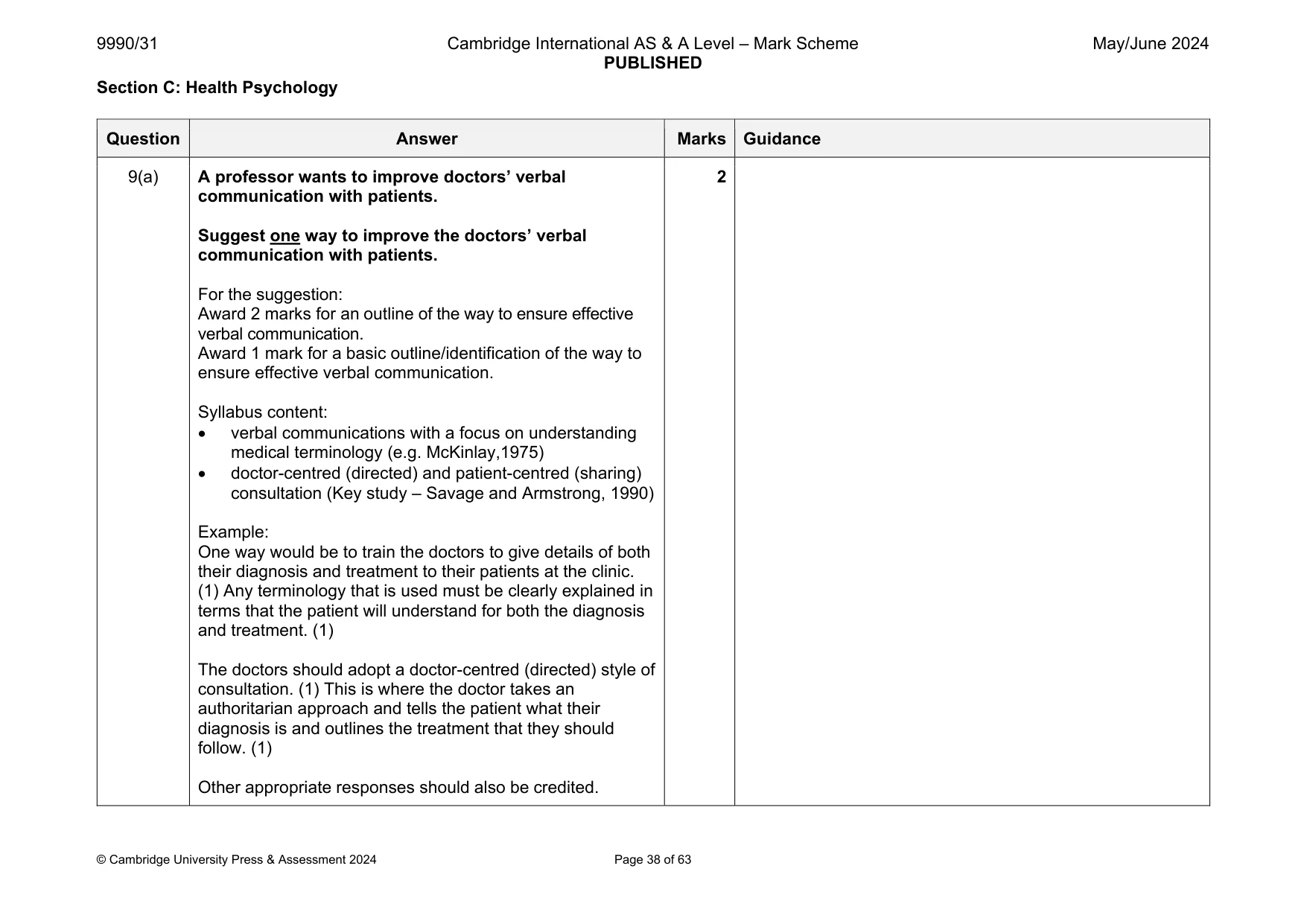
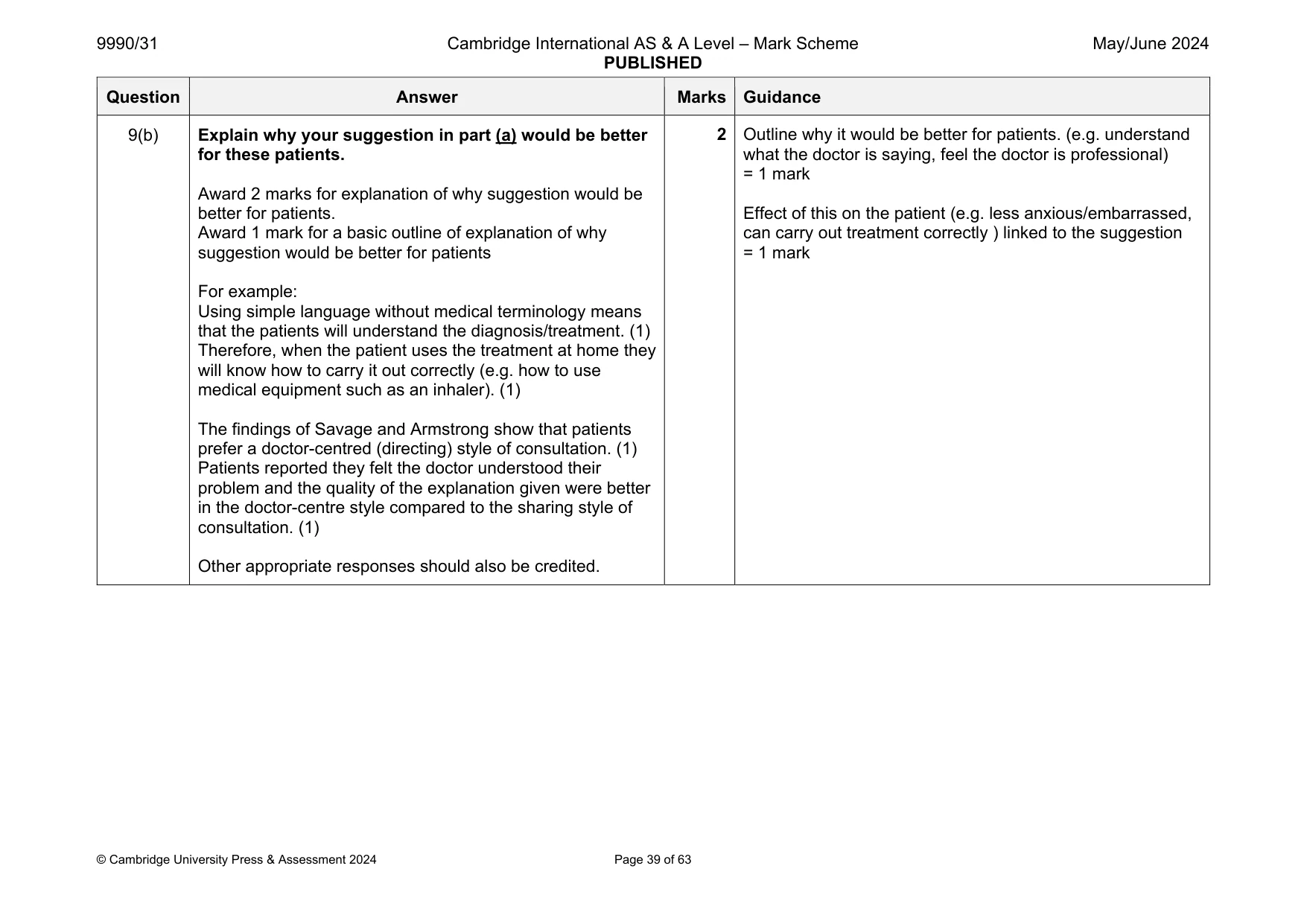
Mark scheme: 9(a) A professor wants to improve doctors’ verbal communication with patients. Suggest one way to improve the doctors’ verbal communication with patients. For the suggestion: Award 2 marks for an outline of the way to ensure effective verbal communication. Award 1 mark for a basic outline/identification of the way to ensure effective verbal communication. Syllabus content: verbal communications with a focus on understanding medical terminology (e.g. McKinlay,1975) doctor-centred (directed) and patient-centred (sharing) consultation (Key study – Savage and Armstrong, 1990) Example: One way would be to train the doctors to give details of both their diagnosis and treatment to their patients at the clinic. (1) Any terminology that is used must be clearly explained in terms that the patient will understand for both the diagnosis and treatment. (1) The doctors should adopt a doctor-centred (directed) style of consultation. (1) This is where the doctor takes an authoritarian approach and tells the patient what their diagnosis is and outlines the treatment that they should follow. (1) Other appropriate responses should also be credited. Question Answer Marks Guidance 9(b) Explain why your suggestion in part (a) would be better for these patients. Award 2 marks for explanation of why suggestion would be better for patients. Award 1 mark for a basic outline of explanation of why suggestion would be better for patients For example: Using simple language without medical terminology means that the patients will understand the diagnosis/treatment. (1) Therefore, when the patient uses the treatment at home they will know how to carry it out correctly (e.g. how to use medical equipment such as an inhaler). (1) The findings of Savage and Armstrong show that patients prefer a doctor-centred (directing) style of consultation. (1) Patients reported they felt the doctor understood their problem and the quality of the explanation given were better in the doctor-centre style compared to the sharing style of consultation. (1) Other appropriate responses should also be credited. 2 Outline why it would be better for patients. (e.g. understand what the doctor is saying, feel the doctor is professional) = 1 mark Effect of this on the patient (e.g. less anxious/embarrassed, can carry out treatment correctly ) linked to the suggestion = 1 mark
Q10 · Outline what is meant by the nature versus nurture debate
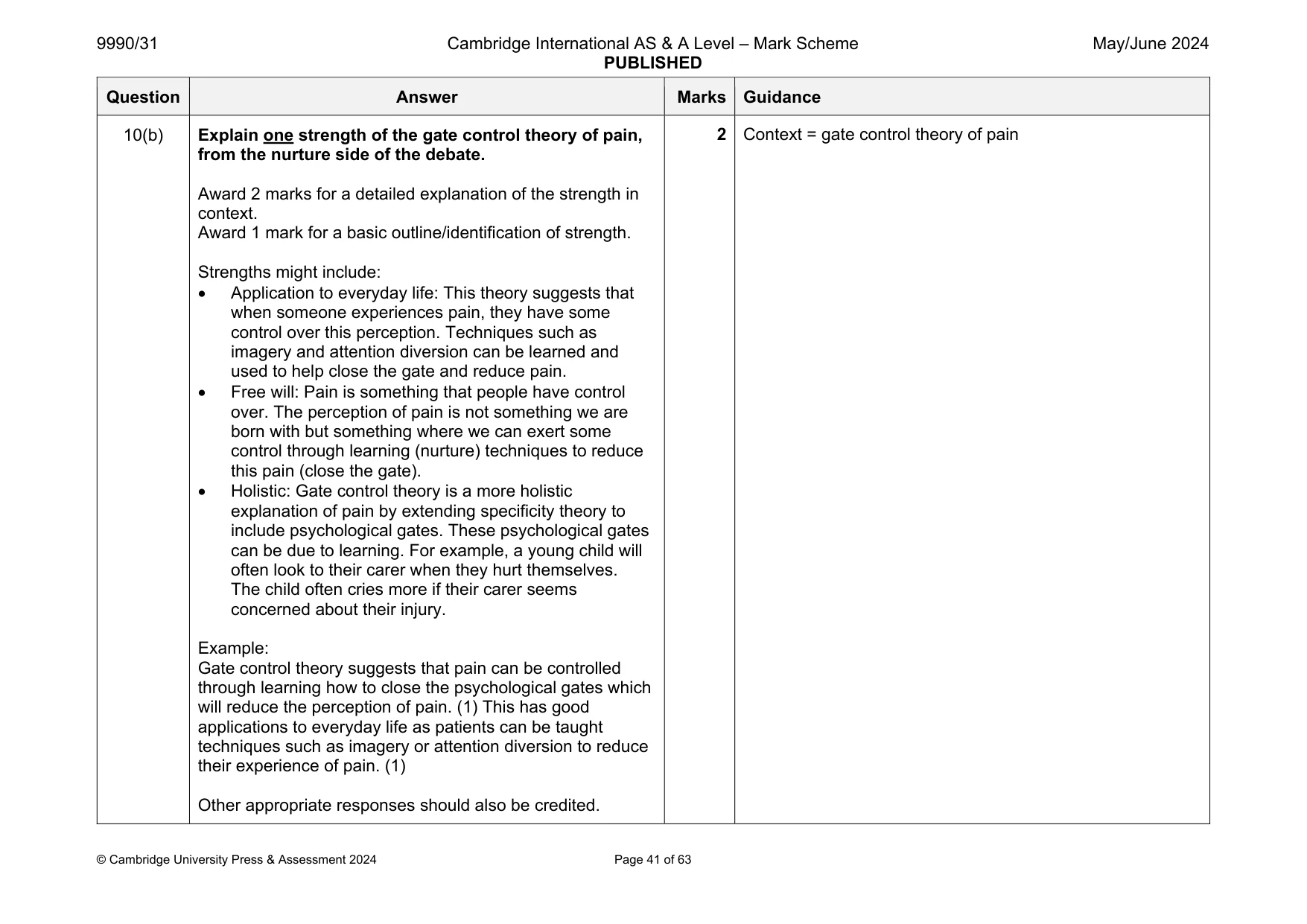
10 (a) Outline what is meant by the nature versus nurture debate. [2] (b) Explain one strength of the gate control theory of pain, from the nurture side of the debate. [2]
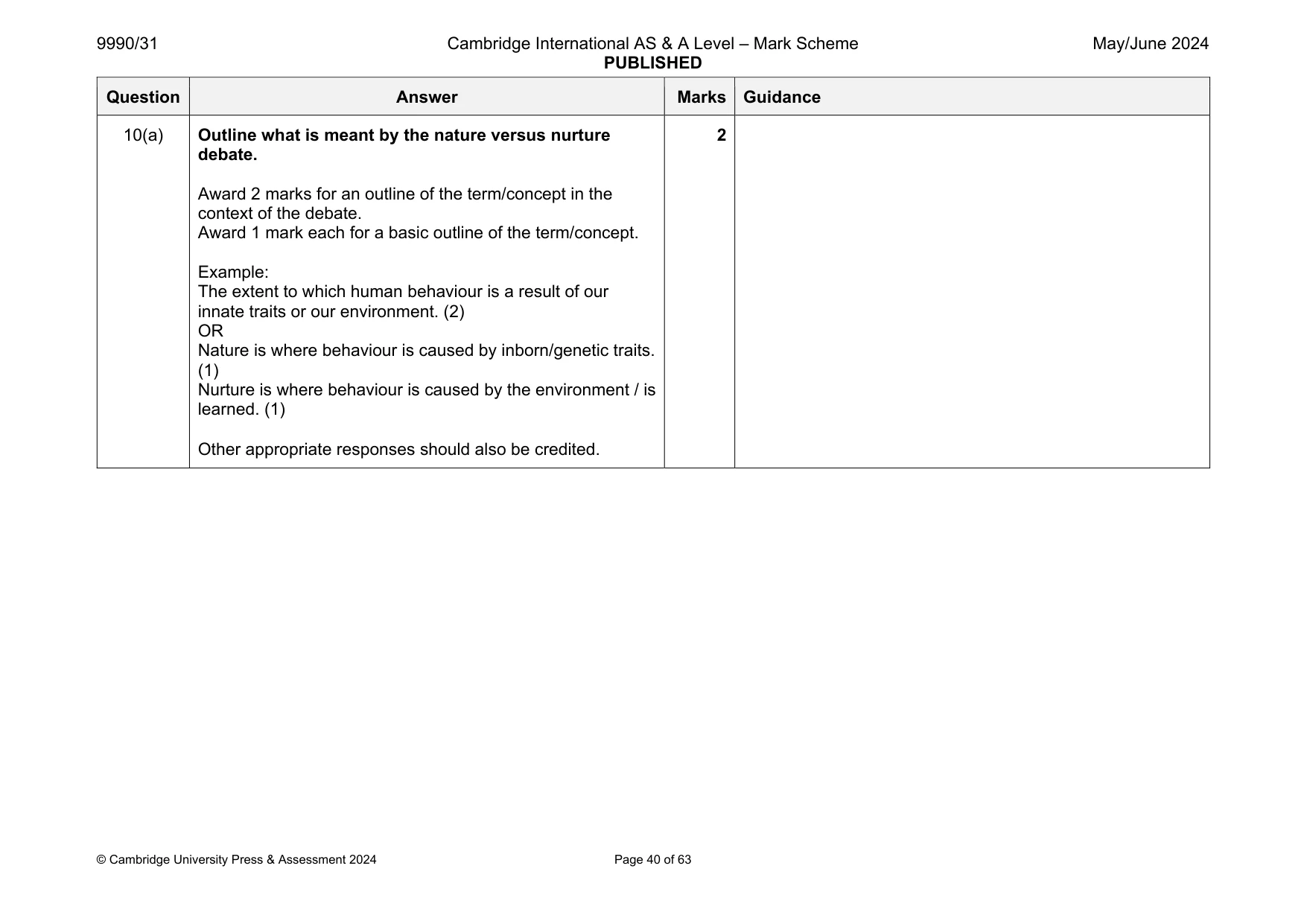
Mark scheme: 10(a) Outline what is meant by the nature versus nurture debate. Award 2 marks for an outline of the term/concept in the context of the debate. Award 1 mark each for a basic outline of the term/concept. Example: The extent to which human behaviour is a result of our innate traits or our environment. (2) OR Nature is where behaviour is caused by inborn/genetic traits. (1) Nurture is where behaviour is caused by the environment / is learned. (1) Other appropriate responses should also be credited. 2 Question Answer Marks Guidance 10(b) Explain one strength of the gate control theory of pain, from the nurture side of the debate. Award 2 marks for a detailed explanation of the strength in context. Award 1 mark for a basic outline/identification of strength. Strengths might include: Application to everyday life: This theory suggests that when someone experiences pain, they have some control over this perception. Techniques such as imagery and attention diversion can be learned and used to help close the gate and reduce pain. Free will: Pain is something that people have control over. The perception of pain is not something we are born with but something where we can exert some control through learning (nurture) techniques to reduce this pain (close the gate). Holistic: Gate control theory is a more holistic explanation of pain by extending specificity theory to include psychological gates. These psychological gates can be due to learning. For example, a young child will often look to their carer when they hurt themselves. The child often cries more if their carer seems concerned about their injury. Example: Gate control theory suggests that pain can be controlled through learning how to close the psychological gates which will reduce the perception of pain. (1) This has good applications to everyday life as patients can be taught techniques such as imagery or attention diversion to reduce their experience of pain. (1) Other appropriate responses should also be credited. 2 Context = gate control theory of pain
Q11 · Becky has broken her leg and is in a lot of pain
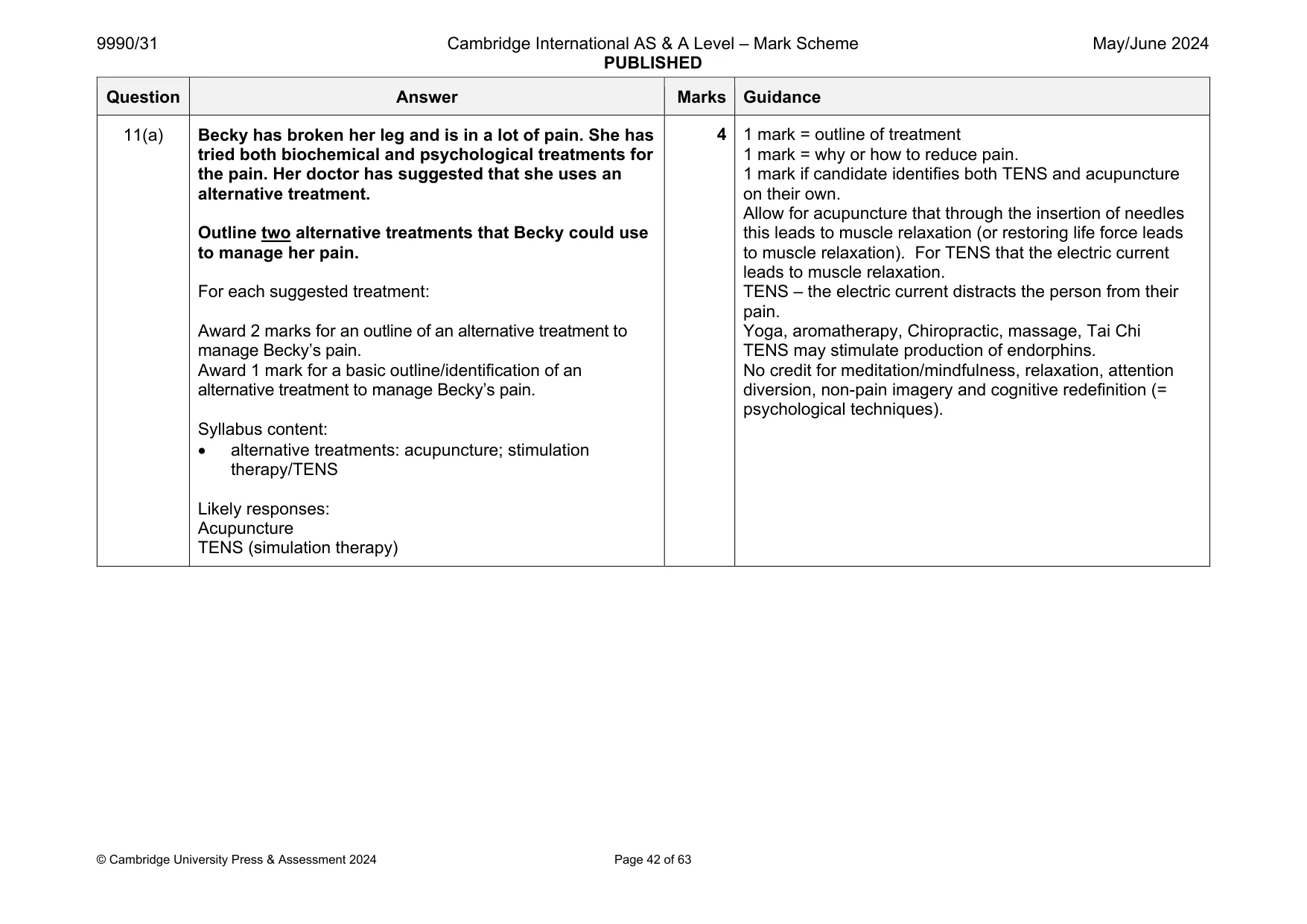
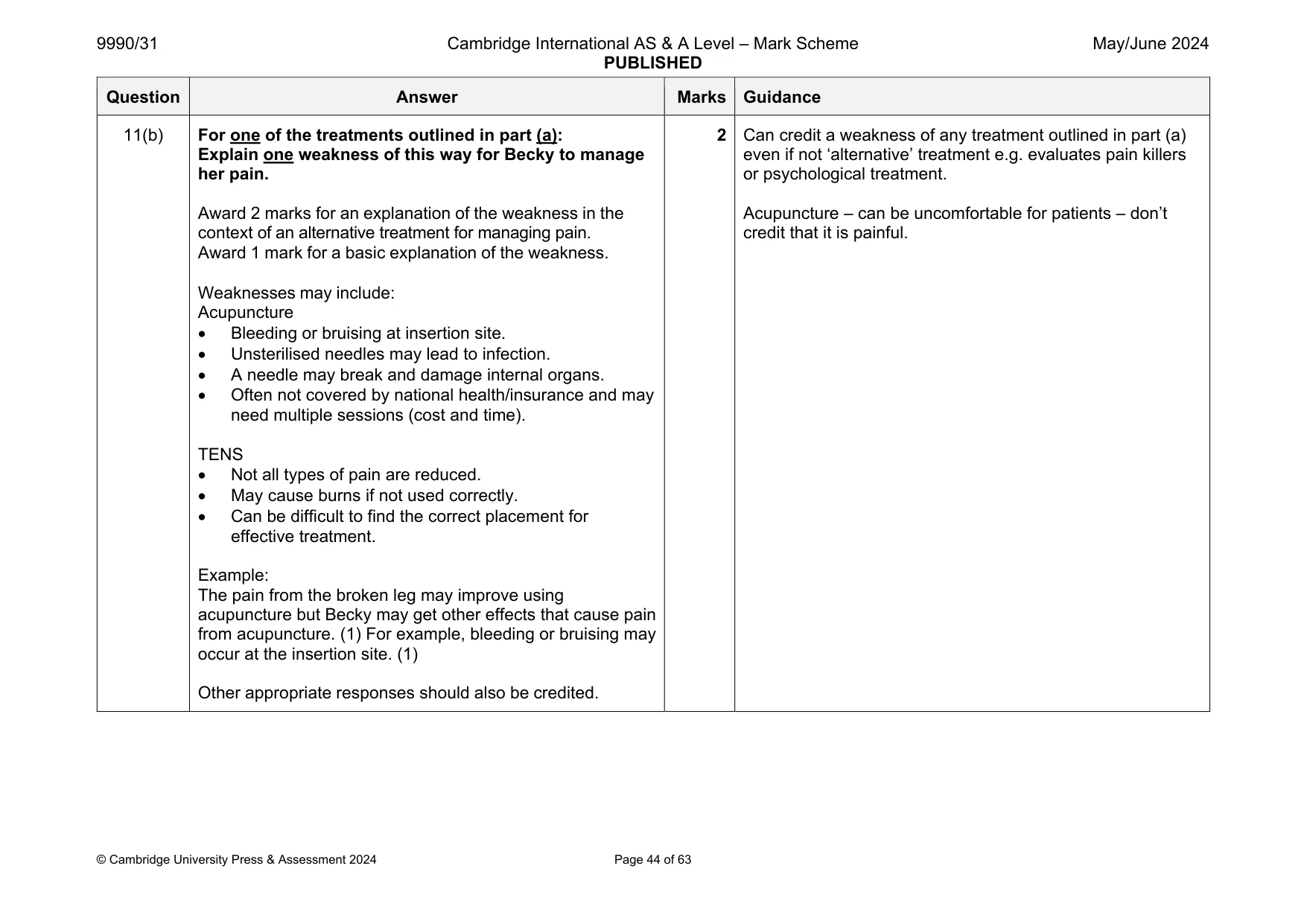
11 Becky has broken her leg and is in a lot of pain. She has tried both biochemical and psychological treatments for the pain. Her doctor has suggested that she uses an alternative treatment. (a) Outline two alternative treatments that Becky could use to manage her pain. [4] (b) For one of the treatments outlined in part (a): Explain one weakness of this way for Becky to manage her pain. [2]
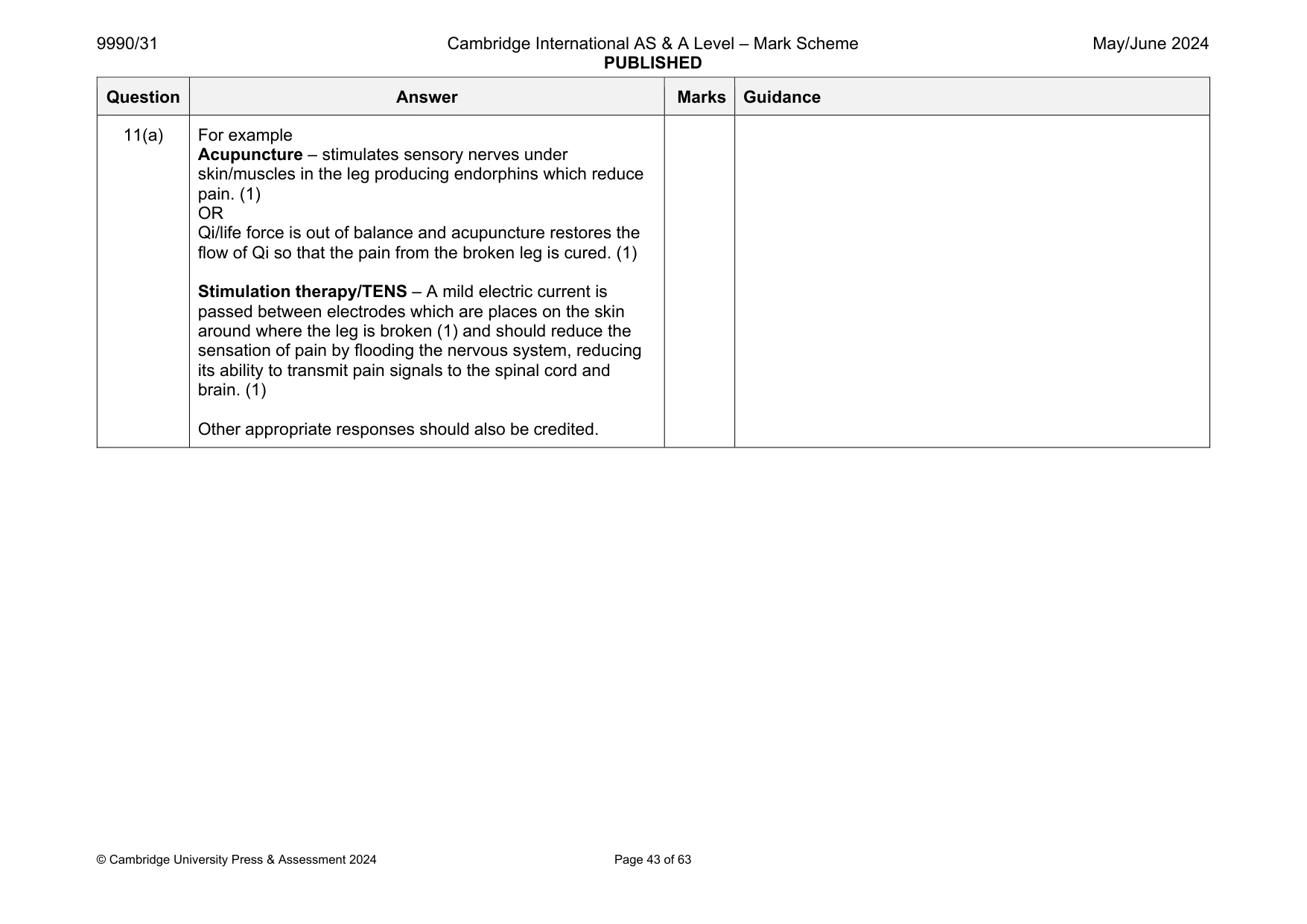
Mark scheme: 11(a) Becky has broken her leg and is in a lot of pain. She has tried both biochemical and psychological treatments for the pain. Her doctor has suggested that she uses an alternative treatment. Outline two alternative treatments that Becky could use to manage her pain. For each suggested treatment: Award 2 marks for an outline of an alternative treatment to manage Becky’s pain. Award 1 mark for a basic outline/identification of an alternative treatment to manage Becky’s pain. Syllabus content: alternative treatments: acupuncture; stimulation therapy/TENS Likely responses: Acupuncture TENS (simulation therapy) 1 mark = why or how to reduce pain. 1 mark if candidate identifies both TENS and acupuncture on their own. Allow for acupuncture that through the insertion of needles this leads to muscle relaxation (or restoring life force leads to muscle relaxation). For TENS that the electric current leads to muscle relaxation. TENS – the electric current distracts the person from their pain. Yoga, aromatherapy, Chiropractic, massage, Tai Chi TENS may stimulate production of endorphins. No credit for meditation/mindfulness, relaxation, attention diversion, non-pain imagery and cognitive redefinition (= psychological techniques). Question Answer Marks Guidance 11(a) For example Acupuncture – stimulates sensory nerves under skin/muscles in the leg producing endorphins which reduce pain. (1) OR Qi/life force is out of balance and acupuncture restores the flow of Qi so that the pain from the broken leg is cured. (1) Stimulation therapy/TENS – A mild electric current is passed between electrodes which are places on the skin around where the leg is broken (1) and should reduce the sensation of pain by flooding the nervous system, reducing its ability to transmit pain signals to the spinal cord and brain. (1) Other appropriate responses should also be credited. Question Answer Marks Guidance 11(b) For one of the treatments outlined in part (a): Explain one weakness of this way for Becky to manage her pain. Award 2 marks for an explanation of the weakness in the context of an alternative treatment for managing pain. Award 1 mark for a basic explanation of the weakness. Weaknesses may include: Acupuncture Bleeding or bruising at insertion site. Unsterilised needles may lead to infection. A needle may break and damage internal organs. Often not covered by national health/insurance and may need multiple sessions (cost and time). TENS Not all types of pain are reduced. May cause burns if not used correctly. Can be difficult to find the correct placement for effective treatment. Example: The pain from the broken leg may improve using acupuncture but Becky may get other effects that cause pain from acupuncture. (1) For example, bleeding or bruising may occur at the insertion site. (1) Other appropriate responses should also be credited. 2 Can credit a weakness of any treatment outlined in part (a) even if not ‘alternative’ treatment e.g. evaluates pain killers or psychological treatment. Acupuncture – can be uncomfortable for patients – don’t credit that it is painful.
Q12 · Describe what psychologists have discovered about: • unrealistic optimism, and • positive…
12 (a) Describe what psychologists have discovered about: • unrealistic optimism, and • positive psychology. [6] (b) Evaluate what psychologists have discovered about: • unrealistic optimism, and • positive psychology, including a discussion about the idiographic versus nomothetic approach. Evaluation in your answer can include strengths, weaknesses and a discussion of issues and debates. [10] Section D: Organisational Psychology Answer all questions.
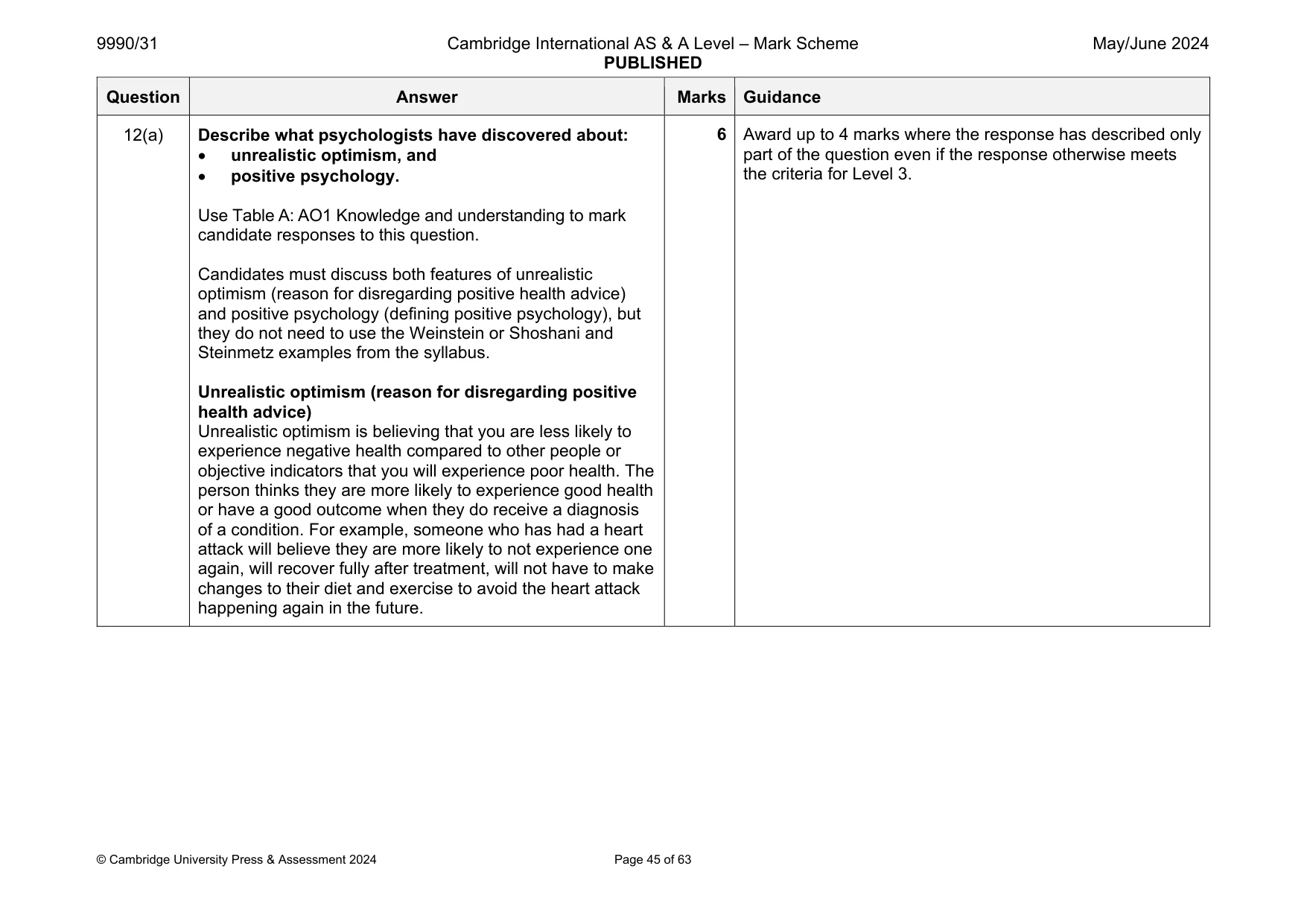
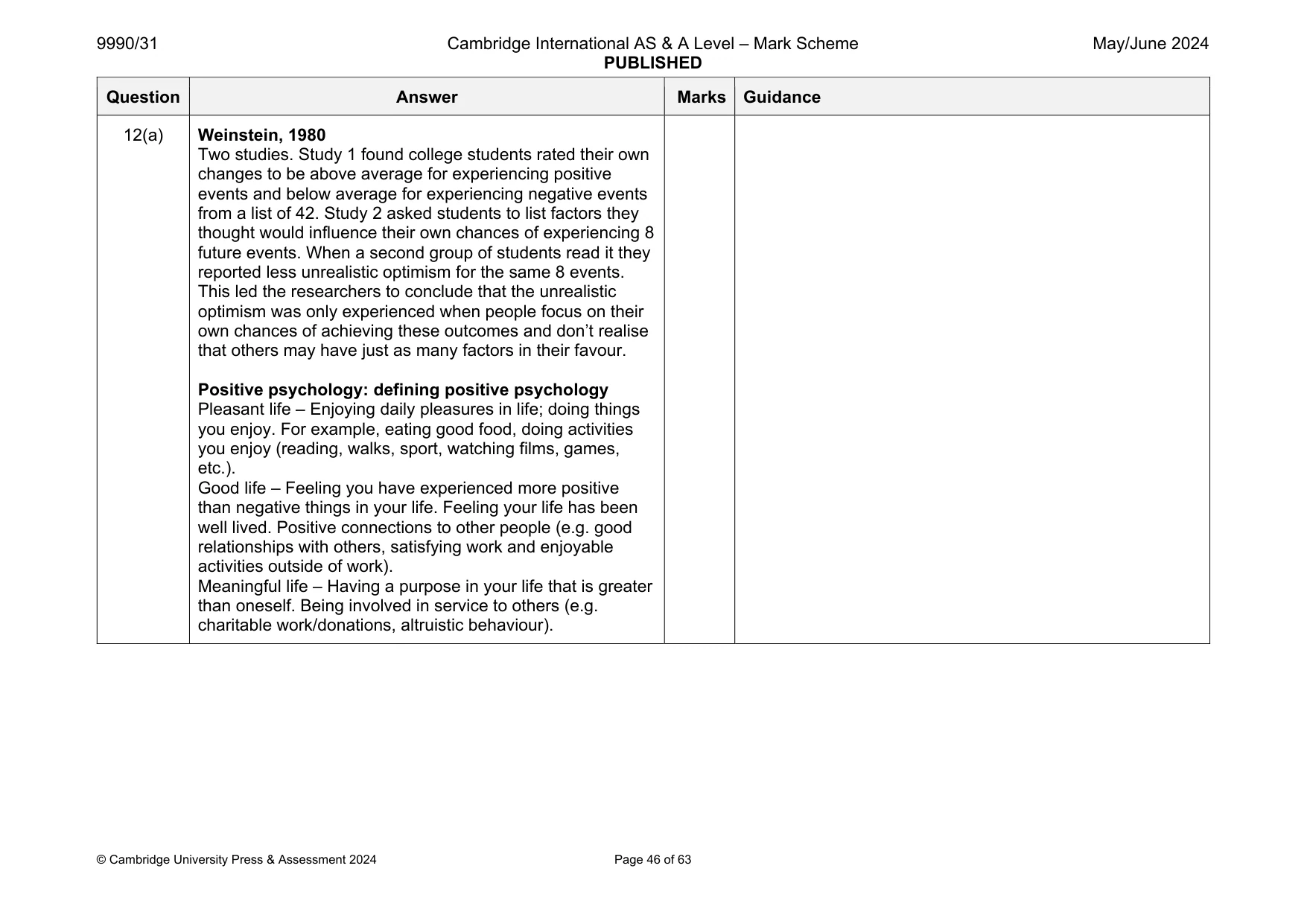
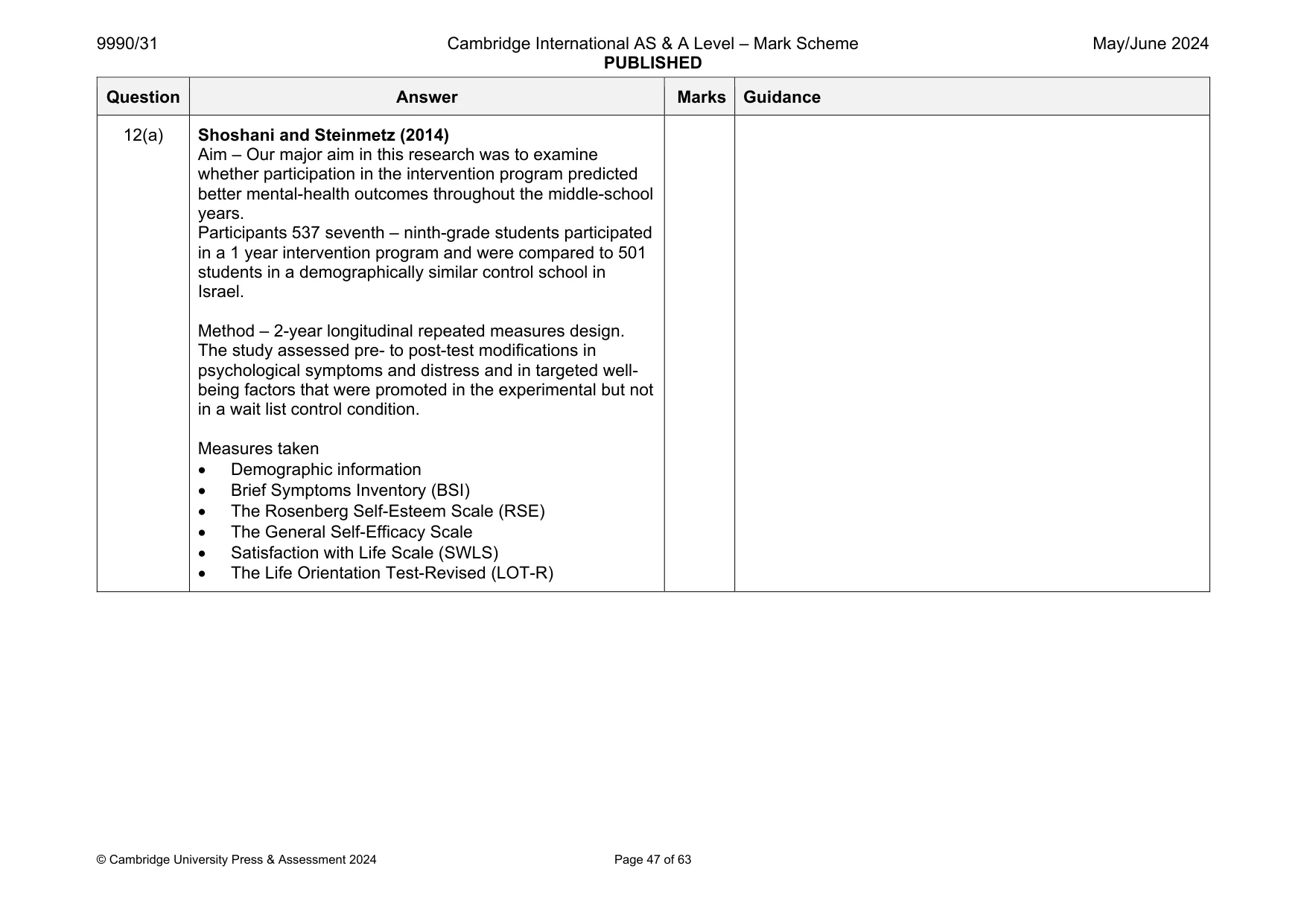
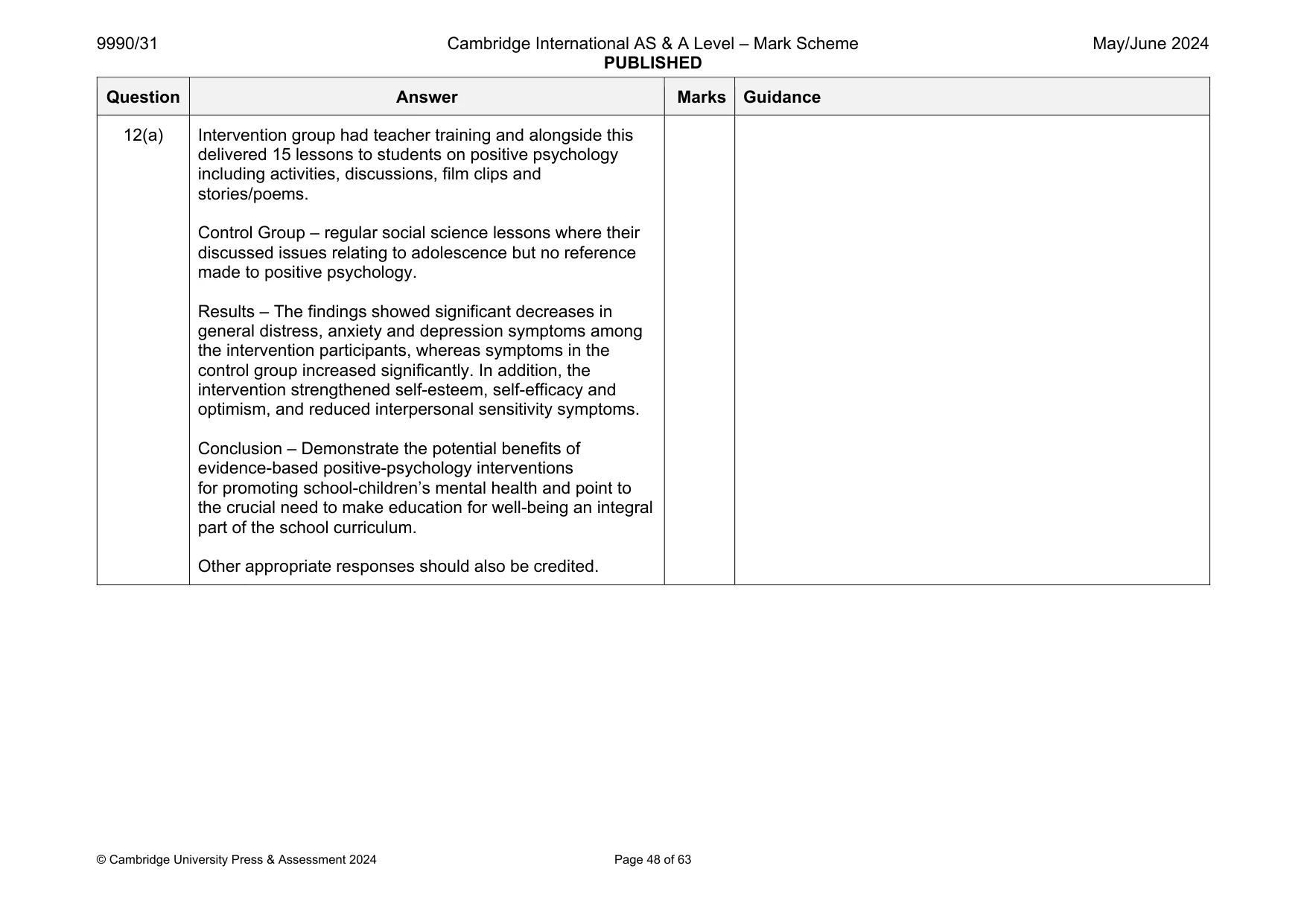
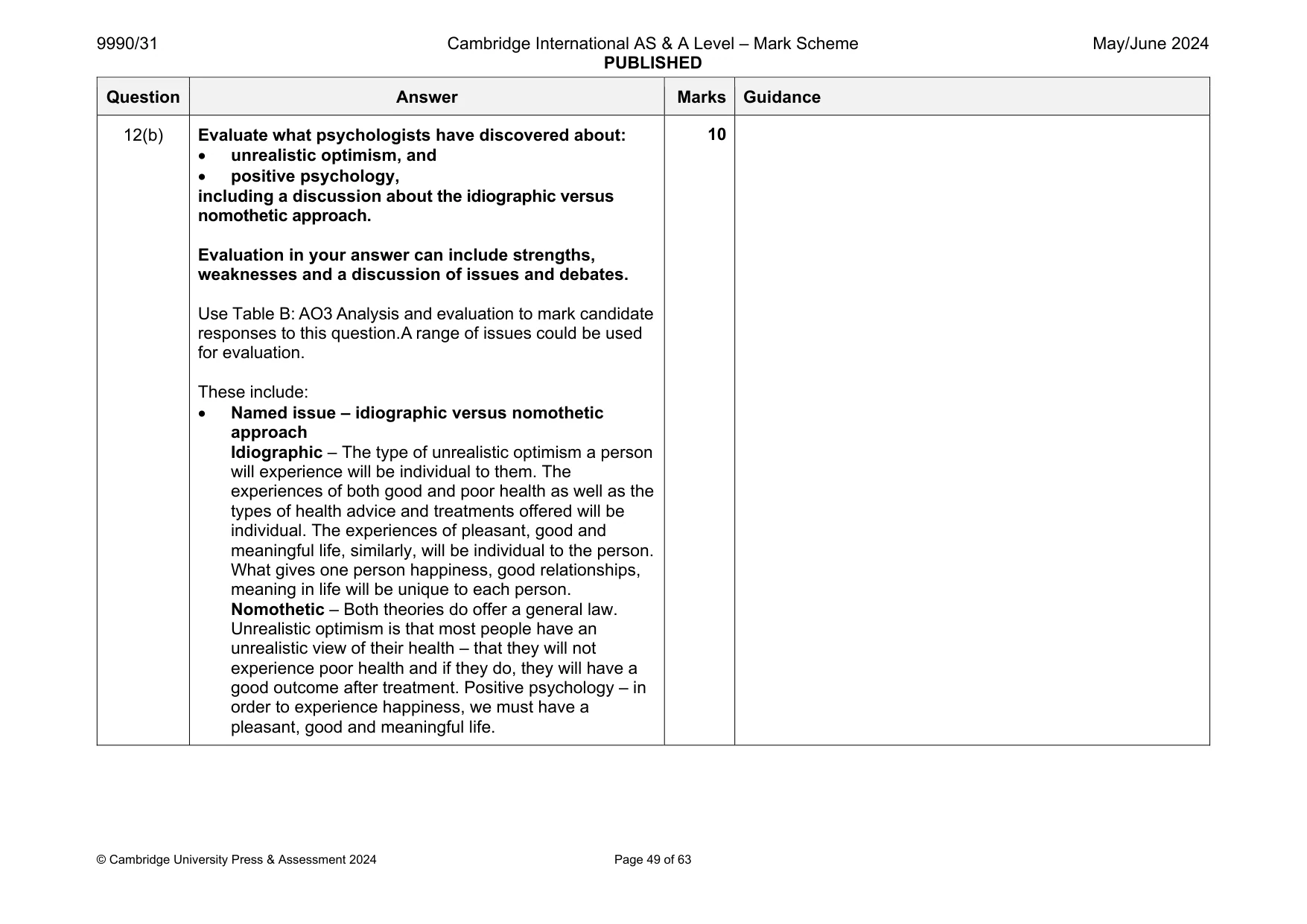
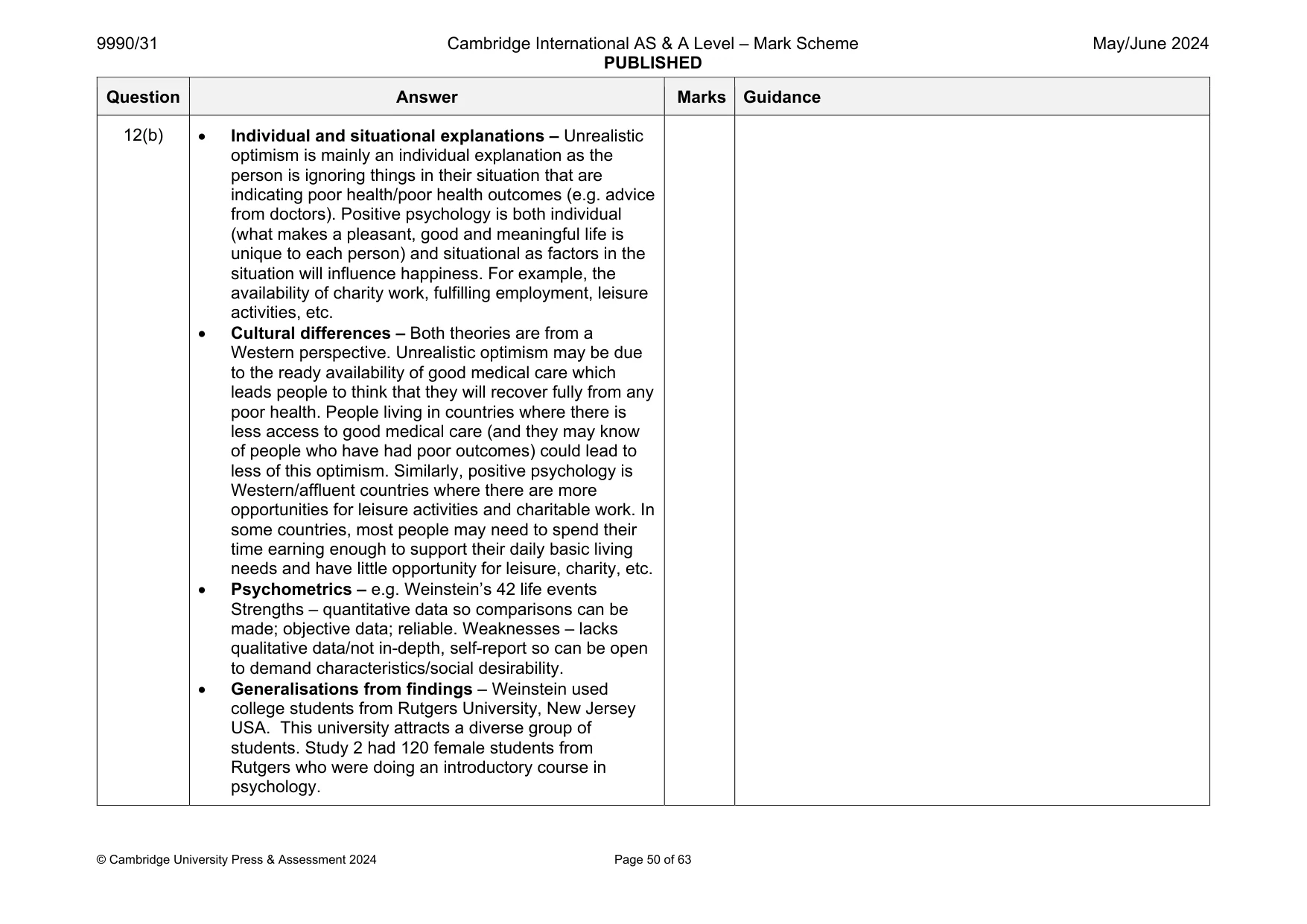
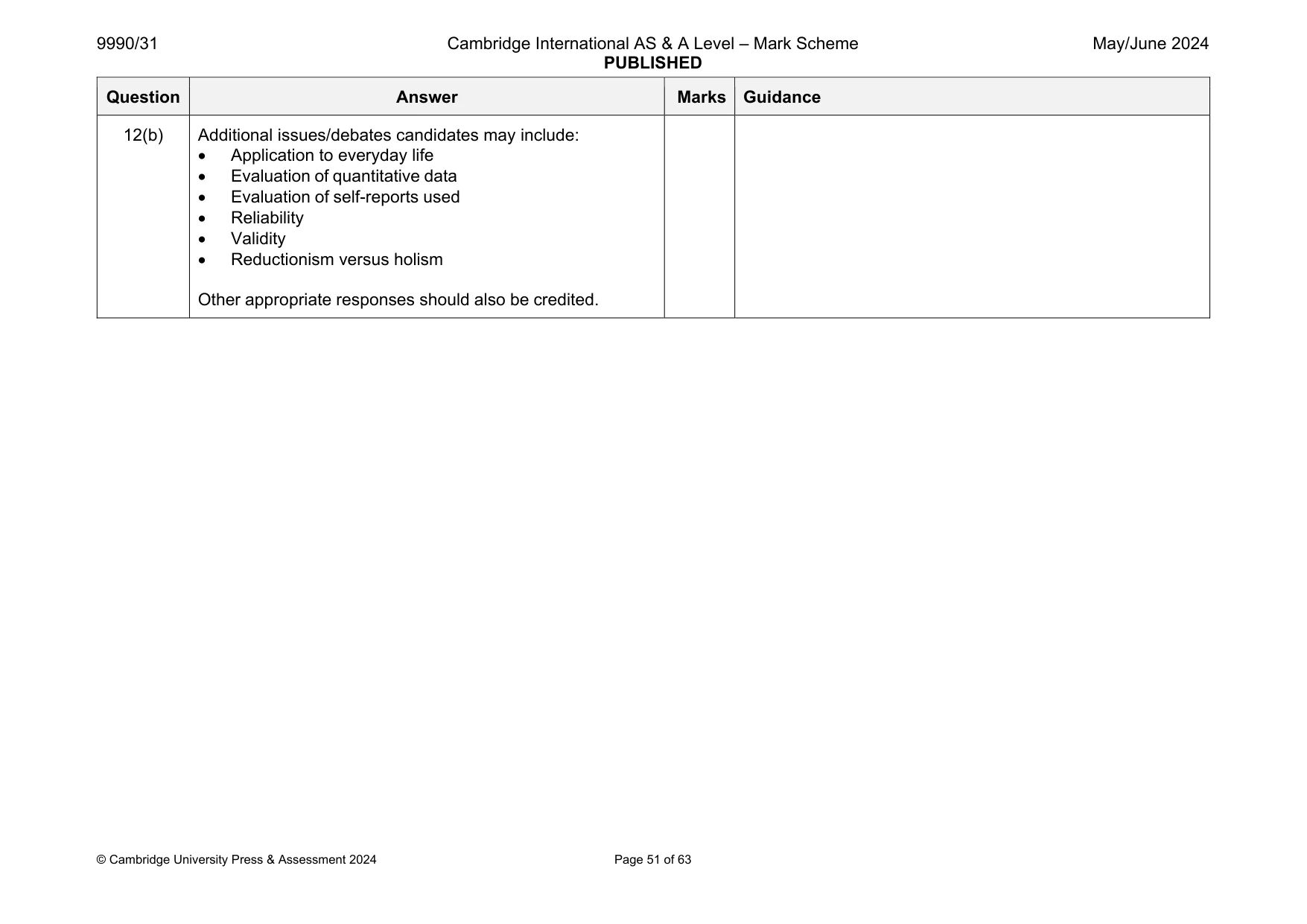
Mark scheme: 12(a) Describe what psychologists have discovered about: unrealistic optimism, and positive psychology. Use Table A: AO1 Knowledge and understanding to mark candidate responses to this question. Candidates must discuss both features of unrealistic optimism (reason for disregarding positive health advice) and positive psychology (defining positive psychology), but they do not need to use the Weinstein or Shoshani and Steinmetz examples from the syllabus. Unrealistic optimism (reason for disregarding positive health advice) Unrealistic optimism is believing that you are less likely to experience negative health compared to other people or objective indicators that you will experience poor health. The person thinks they are more likely to experience good health or have a good outcome when they do receive a diagnosis of a condition. For example, someone who has had a heart attack will believe they are more likely to not experience one again, will recover fully after treatment, will not have to make changes to their diet and exercise to avoid the heart attack happening again in the future. part of the question even if the response otherwise meets the criteria for Level 3. Question Answer Marks Guidance 12(a) Weinstein, 1980 Two studies. Study 1 found college students rated their own changes to be above average for experiencing positive events and below average for experiencing negative events from a list of 42. Study 2 asked students to list factors they thought would influence their own chances of experiencing 8 future events. When a second group of students read it they reported less unrealistic optimism for the same 8 events. This led the researchers to conclude that the unrealistic optimism was only experienced when people focus on their own chances of achieving these outcomes and don’t realise that others may have just as many factors in their favour. Positive psychology: defining positive psychology Pleasant life – Enjoying daily pleasures in life; doing things you enjoy. For example, eating good food, doing activities you enjoy (reading, walks, sport, watching films, games, etc.). Good life – Feeling you have experienced more positive than negative things in your life. Feeling your life has been well lived. Positive connections to other people (e.g. good relationships with others, satisfying work and enjoyable activities outside of work). Meaningful life – Having a purpose in your life that is greater than oneself. Being involved in service to others (e.g. charitable work/donations, altruistic behaviour). Question Answer Marks Guidance 12(a) Shoshani and Steinmetz (2014) Aim – Our major aim in this research was to examine whether participation in the intervention program predicted better mental-health outcomes throughout the middle-school years. Participants 537 seventh – ninth-grade students participated in a 1 year intervention program and were compared to 501 students in a demographically similar control school in Israel. Method – 2-year longitudinal repeated measures design. The study assessed pre- to post-test modifications in psychological symptoms and distress and in targeted well- being factors that were promoted in the experimental but not in a wait list control condition. Measures taken Demographic information Brief Symptoms Inventory (BSI) The Rosenberg Self-Esteem Scale (RSE) The General Self-Efficacy Scale Satisfaction with Life Scale (SWLS) The Life Orientation Test-Revised (LOT-R) Question Answer Marks Guidance 12(a) Intervention group had teacher training and alongside this delivered 15 lessons to students on positive psychology including activities, discussions, film clips and stories/poems. Control Group – regular social science lessons where their discussed issues relating to adolescence but no reference made to positive psychology. Results – The findings showed significant decreases in general distress, anxiety and depression symptoms among the intervention participants, whereas symptoms in the control group increased significantly. In addition, the intervention strengthened self-esteem, self-efficacy and optimism, and reduced interpersonal sensitivity symptoms. Conclusion – Demonstrate the potential benefits of evidence-based positive-psychology interventions for promoting school-children’s mental health and point to the crucial need to make education for well-being an integral part of the school curriculum. Other appropriate responses should also be credited. Question Answer Marks Guidance 12(b) Evaluate what psychologists have discovered about: unrealistic optimism, and positive psychology, including a discussion about the idiographic versus nomothetic approach. Evaluation in your answer can include strengths, weaknesses and a discussion of issues and debates. Use Table B: AO3 Analysis and evaluation to mark candidate responses to this question. A range of issues could be used for evaluation. These include: Named issue – idiographic versus nomothetic approach Idiographic – The type of unrealistic optimism a person will experience will be individual to them. The experiences of both good and poor health as well as the types of health advice and treatments offered will be individual. The experiences of pleasant, good and meaningful life, similarly, will be individual to the person. What gives one person happiness, good relationships, meaning in life will be unique to each person. Nomothetic – Both theories do offer a general law. Unrealistic optimism is that most people have an unrealistic view of their health – that they will not experience poor health and if they do, they will have a good outcome after treatment. Positive psychology – in order to experience happiness, we must have a pleasant, good and meaningful life. 10 Question Answer Marks Guidance 12(b) Individual and situational explanations – Unrealistic optimism is mainly an individual explanation as the person is ignoring things in their situation that are indicating poor health/poor health outcomes (e.g. advice from doctors). Positive psychology is both individual (what makes a pleasant, good and meaningful life is unique to each person) and situational as factors in the situation will influence happiness. For example, the availability of charity work, fulfilling employment, leisure activities, etc. Cultural differences – Both theories are from a Western perspective. Unrealistic optimism may be due to the ready availability of good medical care which leads people to think that they will recover fully from any poor health. People living in countries where there is less access to good medical care (and they may know of people who have had poor outcomes) could lead to less of this optimism. Similarly, positive psychology is Western/affluent countries where there are more opportunities for leisure activities and charitable work. In some countries, most people may need to spend their time earning enough to support their daily basic living needs and have little opportunity for leisure, charity, etc. Psychometrics – e.g. Weinstein’s 42 life events Strengths – quantitative data so comparisons can be made; objective data; reliable. Weaknesses – lacks qualitative data/not in-depth, self-report so can be open to demand characteristics/social desirability. Generalisations from findings – Weinstein used college students from Rutgers University, New Jersey USA. This university attracts a diverse group of students. Study 2 had 120 female students from Rutgers who were doing an introductory course in psychology. Question Answer Marks Guidance 12(b) Additional issues/debates candidates may include: Application to everyday life Evaluation of quantitative data Evaluation of self-reports used Reliability Validity Reductionism versus holism Other appropriate responses should also be credited.
More questions on 2 Health promotion in schools and worksites
Q13 · Feba is a manager in an IT company
13 Feba is a manager in an IT company. She has decided to monitor her employees while they work from home to improve their productivity on their tasks. (a) Suggest one way that Feba could monitor the productivity of her employees while they work at home. [2] (b) Explain why the way you have given in part (a) would improve productivity on tasks. [2]
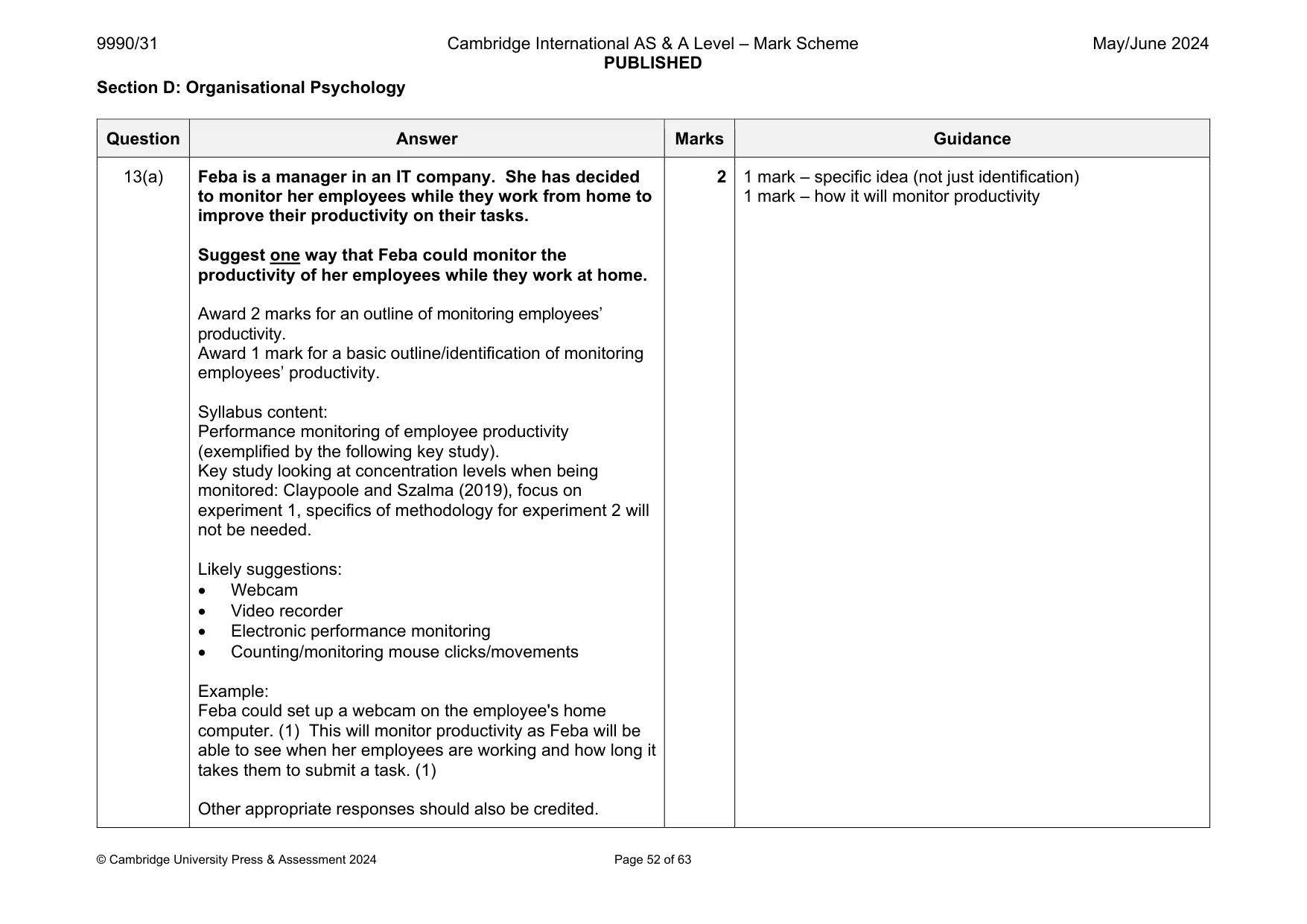
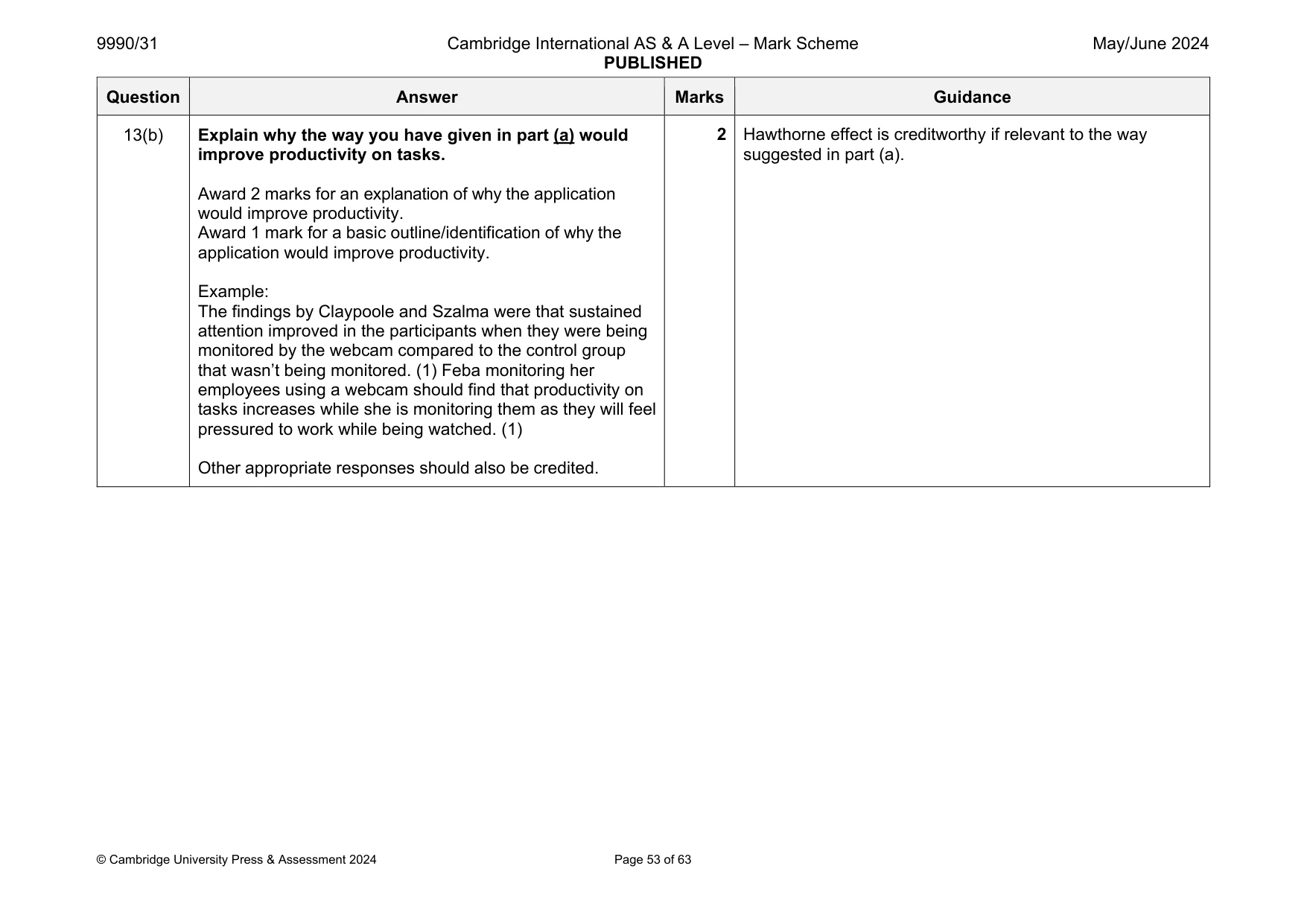
Mark scheme: 13(a) Feba is a manager in an IT company. She has decided to monitor her employees while they work from home to improve their productivity on their tasks. Suggest one way that Feba could monitor the productivity of her employees while they work at home. Award 2 marks for an outline of monitoring employees’ productivity. Award 1 mark for a basic outline/identification of monitoring employees’ productivity. Syllabus content: Performance monitoring of employee productivity (exemplified by the following key study). Key study looking at concentration levels when being monitored: Claypoole and Szalma (2019), focus on experiment 1, specifics of methodology for experiment 2 will not be needed. Likely suggestions: Webcam Video recorder Electronic performance monitoring Counting/monitoring mouse clicks/movements Example: Feba could set up a webcam on the employee's home computer. (1) This will monitor productivity as Feba will be able to see when her employees are working and how long it takes them to submit a task. (1) Other appropriate responses should also be credited. 2 1 mark – specific idea (not just identification) 1 mark – how it will monitor productivity Question Answer Marks Guidance 13(b) Explain why the way you have given in part (a) would improve productivity on tasks. Award 2 marks for an explanation of why the application would improve productivity. Award 1 mark for a basic outline/identification of why the application would improve productivity. Example: The findings by Claypoole and Szalma were that sustained attention improved in the participants when they were being monitored by the webcam compared to the control group that wasn’t being monitored. (1) Feba monitoring her employees using a webcam should find that productivity on tasks increases while she is monitoring them as they will feel pressured to work while being watched. (1) Other appropriate responses should also be credited. 2 Hawthorne effect is creditworthy if relevant to the way suggested in part (a).
Q14 · Outline what is meant by ‘holism’, including an example from Thomas-Kilmann’s five…
14 (a) Outline what is meant by ‘holism’, including an example from Thomas-Kilmann’s five conflict- handling modes. [2] (b) Explain one weakness of holism, using an example from Thomas-Kilmann’s five conflict- handling modes. [2]
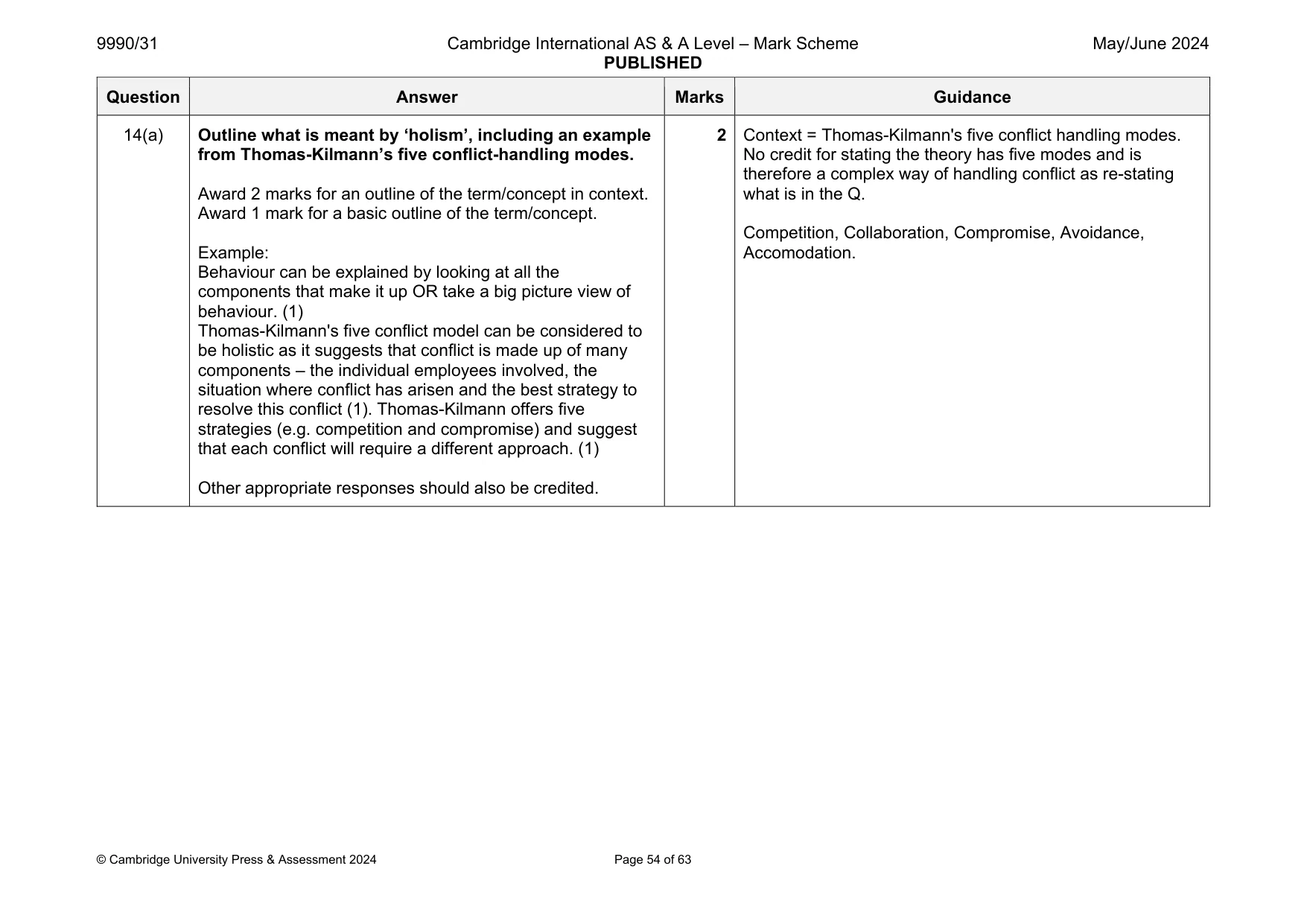
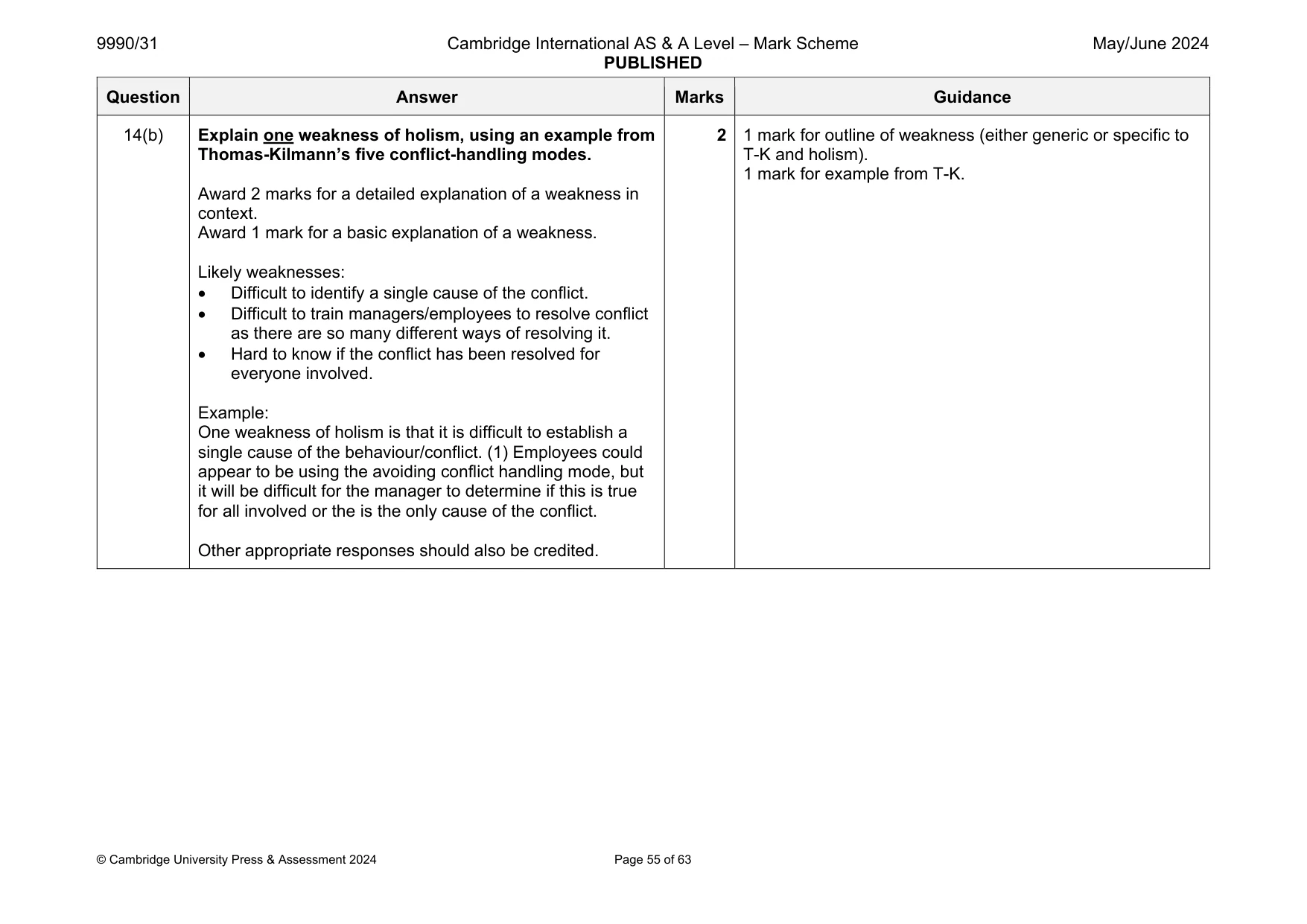
Mark scheme: 14(a) Outline what is meant by ‘holism’, including an example from Thomas-Kilmann’s five conflict-handling modes. Award 2 marks for an outline of the term/concept in context. Award 1 mark for a basic outline of the term/concept. Example: Behaviour can be explained by looking at all the components that make it up OR take a big picture view of behaviour. (1) Thomas-Kilmann's five conflict model can be considered to be holistic as it suggests that conflict is made up of many components – the individual employees involved, the situation where conflict has arisen and the best strategy to resolve this conflict (1). Thomas-Kilmann offers five strategies (e.g. competition and compromise) and suggest that each conflict will require a different approach. (1) Other appropriate responses should also be credited. 2 Context = Thomas-Kilmann's five conflict handling modes. No credit for stating the theory has five modes and is therefore a complex way of handling conflict as re-stating what is in the Q. Competition, Collaboration, Compromise, Avoidance, Accomodation. Question Answer Marks Guidance 14(b) Explain one weakness of holism, using an example from Thomas-Kilmann’s five conflict-handling modes. Award 2 marks for a detailed explanation of a weakness in context. Award 1 mark for a basic explanation of a weakness. Likely weaknesses: Difficult to identify a single cause of the conflict. Difficult to train managers/employees to resolve conflict as there are so many different ways of resolving it. Hard to know if the conflict has been resolved for everyone involved. Example: One weakness of holism is that it is difficult to establish a single cause of the behaviour/conflict. (1) Employees could appear to be using the avoiding conflict handling mode, but it will be difficult for the manager to determine if this is true for all involved or the is the only cause of the conflict. Other appropriate responses should also be credited. 2 1 mark for outline of weakness (either generic or specific to T-K and holism). 1 mark for example from T-K.
Q15 · Joseph works on a production line in a car factory
15 Joseph works on a production line in a car factory. He forgot to use eye protection during his shift and damaged his eye. (a) (i) Explain the type of human error made by Joseph. [2] (ii) Suggest one way the management at this car factory could avoid this type of human error. [2] (b) For the way you suggested in part (a)(ii): Explain one weakness of this way to avoid this type of human error. [2]
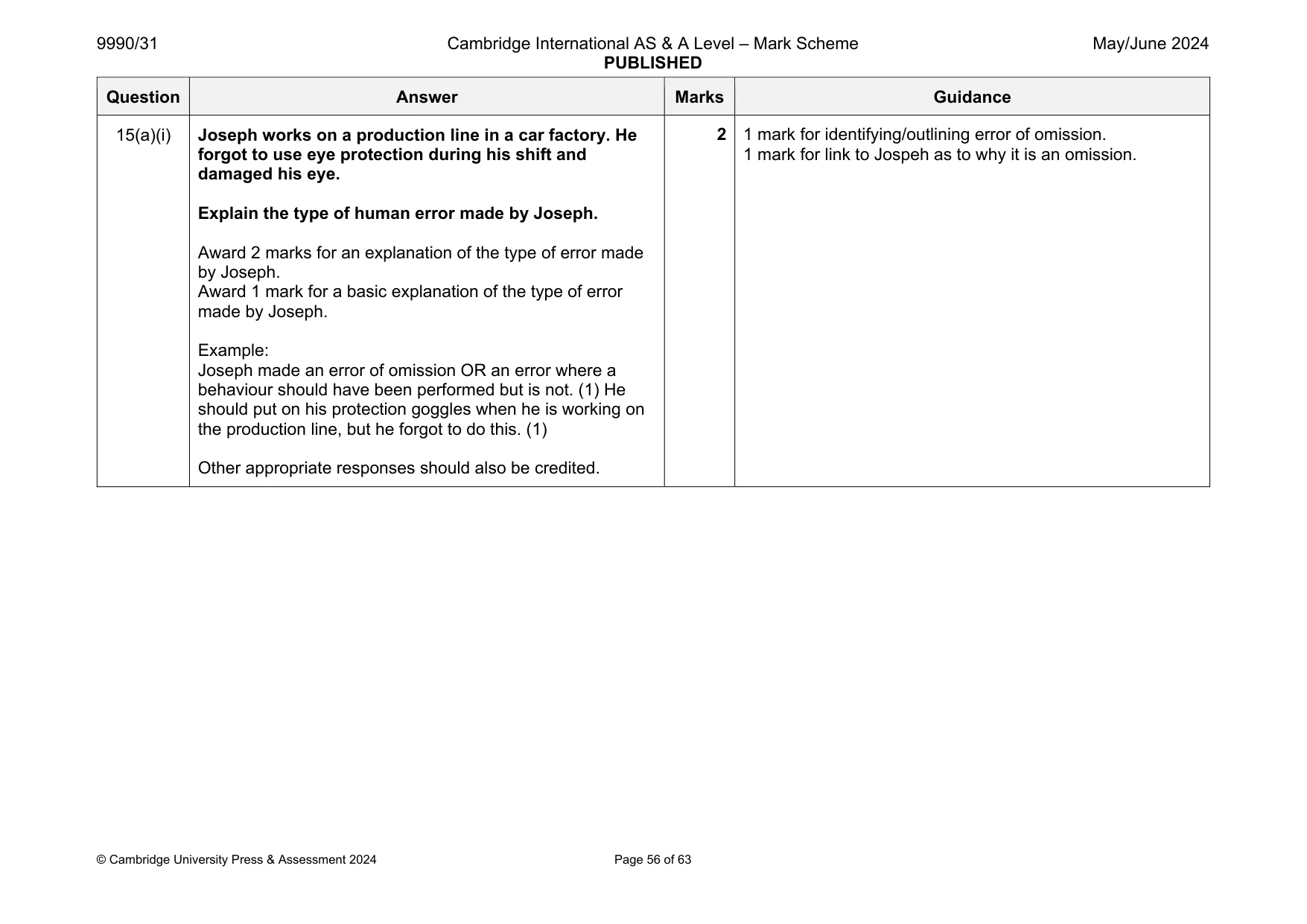
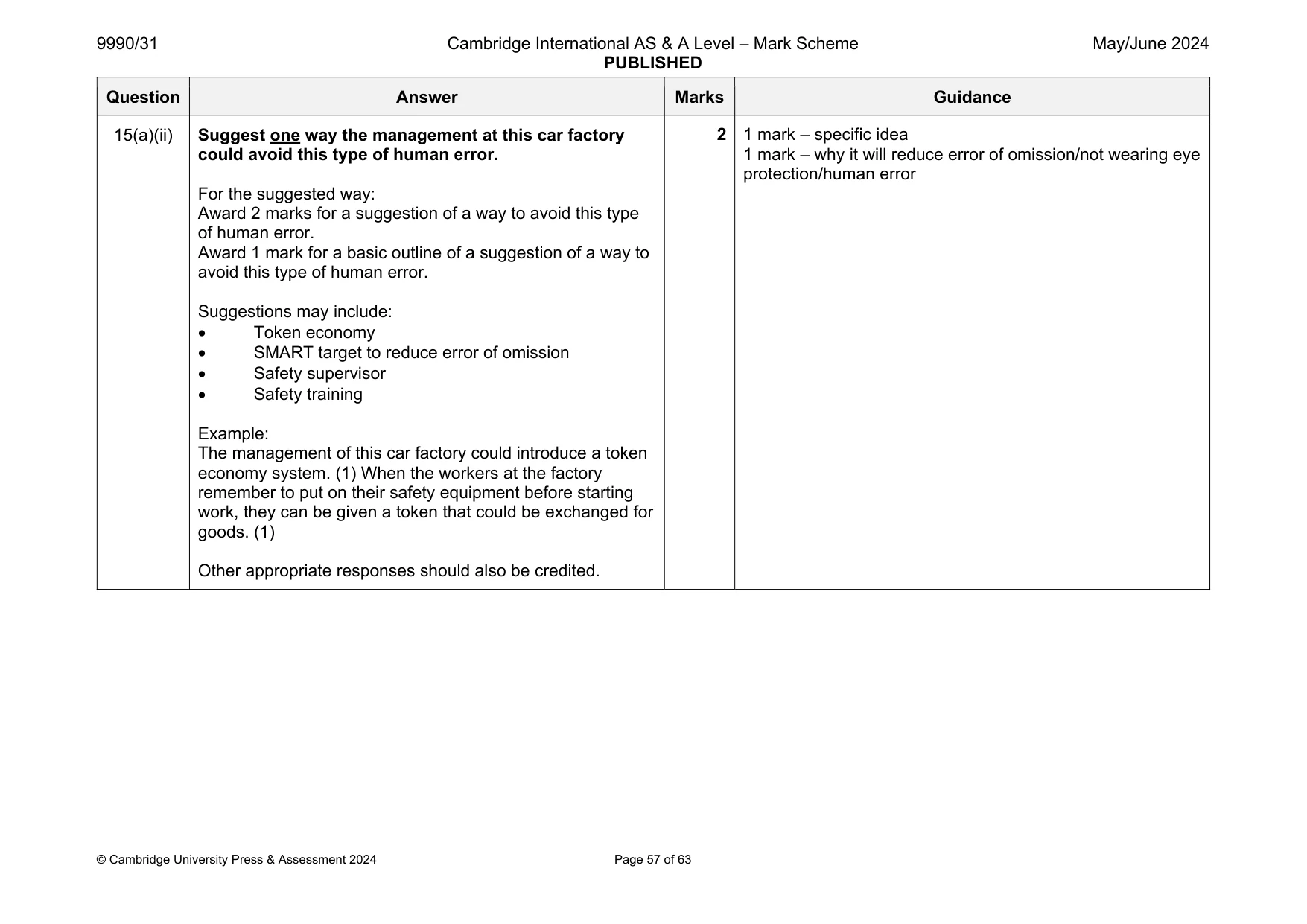
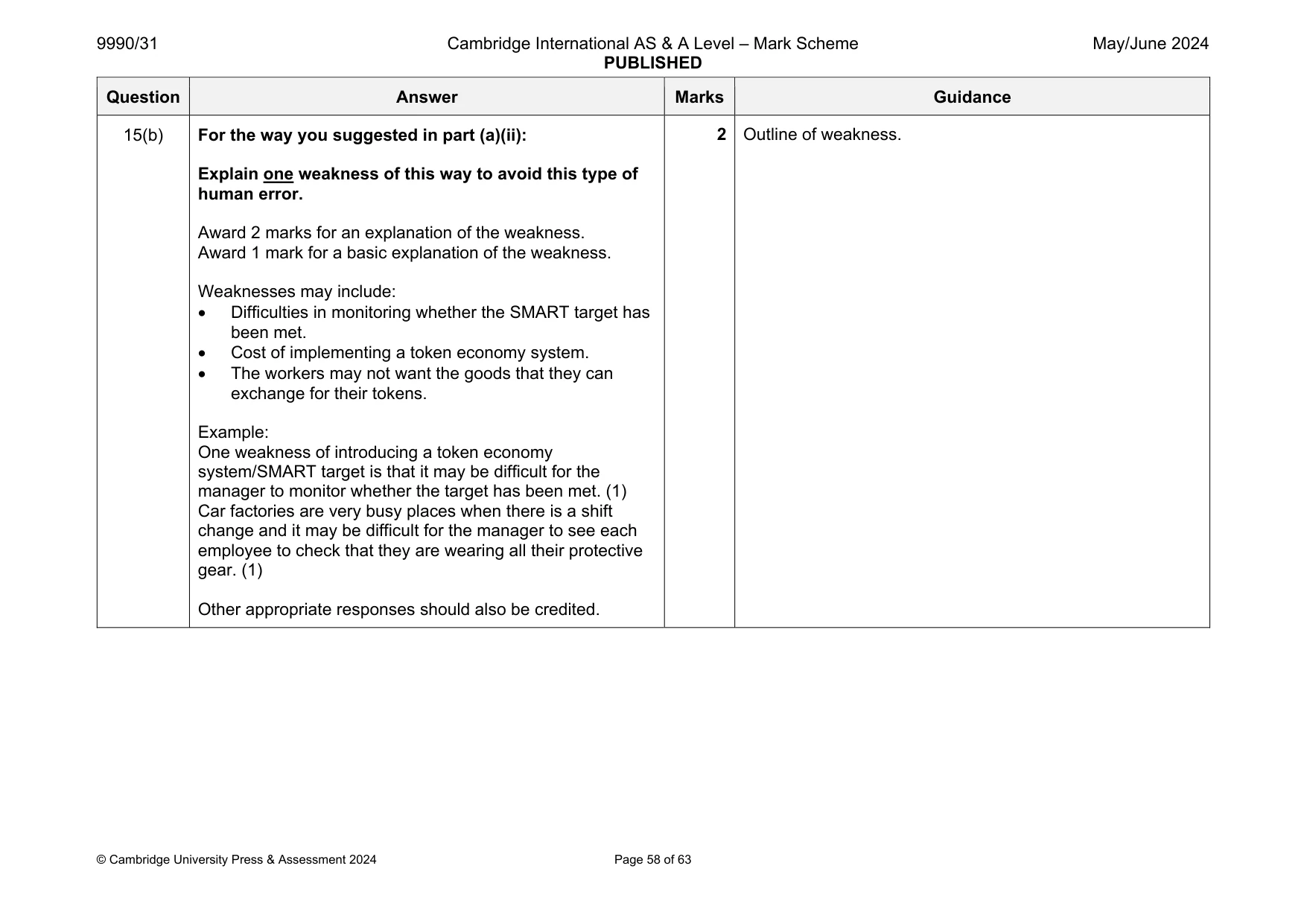
Mark scheme: 15(a)(i) Joseph works on a production line in a car factory. He forgot to use eye protection during his shift and damaged his eye. Explain the type of human error made by Joseph. Award 2 marks for an explanation of the type of error made by Joseph. Award 1 mark for a basic explanation of the type of error made by Joseph. Example: Joseph made an error of omission OR an error where a behaviour should have been performed but is not. (1) He should put on his protection goggles when he is working on the production line, but he forgot to do this. (1) Other appropriate responses should also be credited. 1 mark for link to Jospeh as to why it is an omission. Question Answer Marks Guidance 15(a)(ii) Suggest one way the management at this car factory could avoid this type of human error. For the suggested way: Award 2 marks for a suggestion of a way to avoid this type of human error. Award 1 mark for a basic outline of a suggestion of a way to avoid this type of human error. Suggestions may include: Token economy SMART target to reduce error of omission Safety supervisor Safety training Example: The management of this car factory could introduce a token economy system. (1) When the workers at the factory remember to put on their safety equipment before starting work, they can be given a token that could be exchanged for goods. (1) Other appropriate responses should also be credited. 2 1 mark – specific idea 1 mark – why it will reduce error of omission/not wearing eye protection/human error Question Answer Marks Guidance 15(b) For the way you suggested in part (a)(ii): Explain one weakness of this way to avoid this type of human error. Award 2 marks for an explanation of the weakness. Award 1 mark for a basic explanation of the weakness. Weaknesses may include: Difficulties in monitoring whether the SMART target has been met. Cost of implementing a token economy system. The workers may not want the goods that they can exchange for their tokens. Example: One weakness of introducing a token economy system/SMART target is that it may be difficult for the manager to monitor whether the target has been met. (1) Car factories are very busy places when there is a shift change and it may be difficult for the manager to see each employee to check that they are wearing all their protective gear. (1) Other appropriate responses should also be credited. 2 Outline of weakness.
Q16 · Describe what psychologists studying motivation to work have discovered about: • Maslow’s…
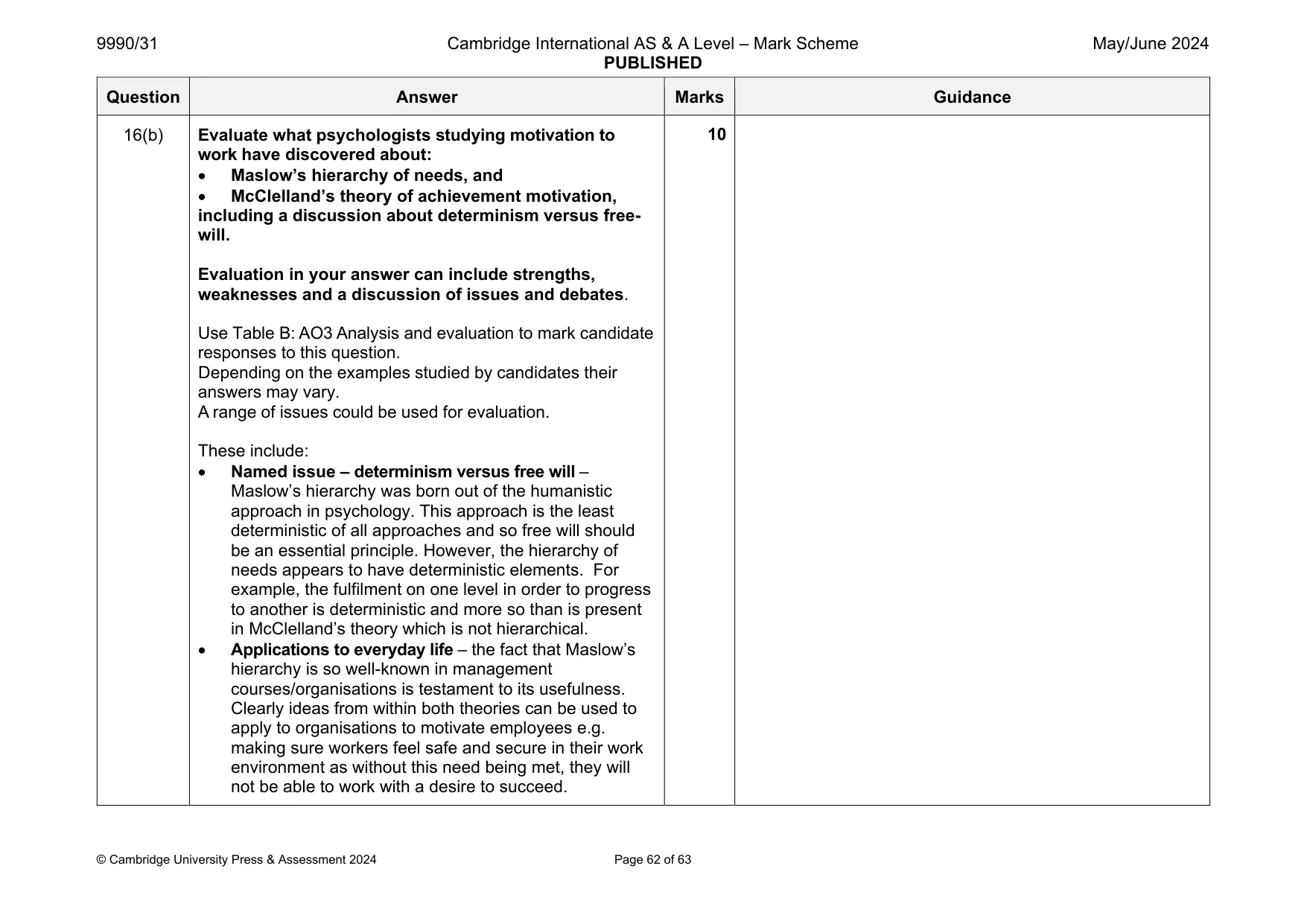
16 (a) Describe what psychologists studying motivation to work have discovered about: • Maslow’s hierarchy of needs, and • McClelland’s theory of achievement motivation. [6] (b) Evaluate what psychologists studying motivation to work have discovered about: • Maslow’s hierarchy of needs, and • McClelland’s theory of achievement motivation, including a discussion about determinism versus free-will. Evaluation in your answer can include strengths, weaknesses and a discussion of issues and debates. [10]
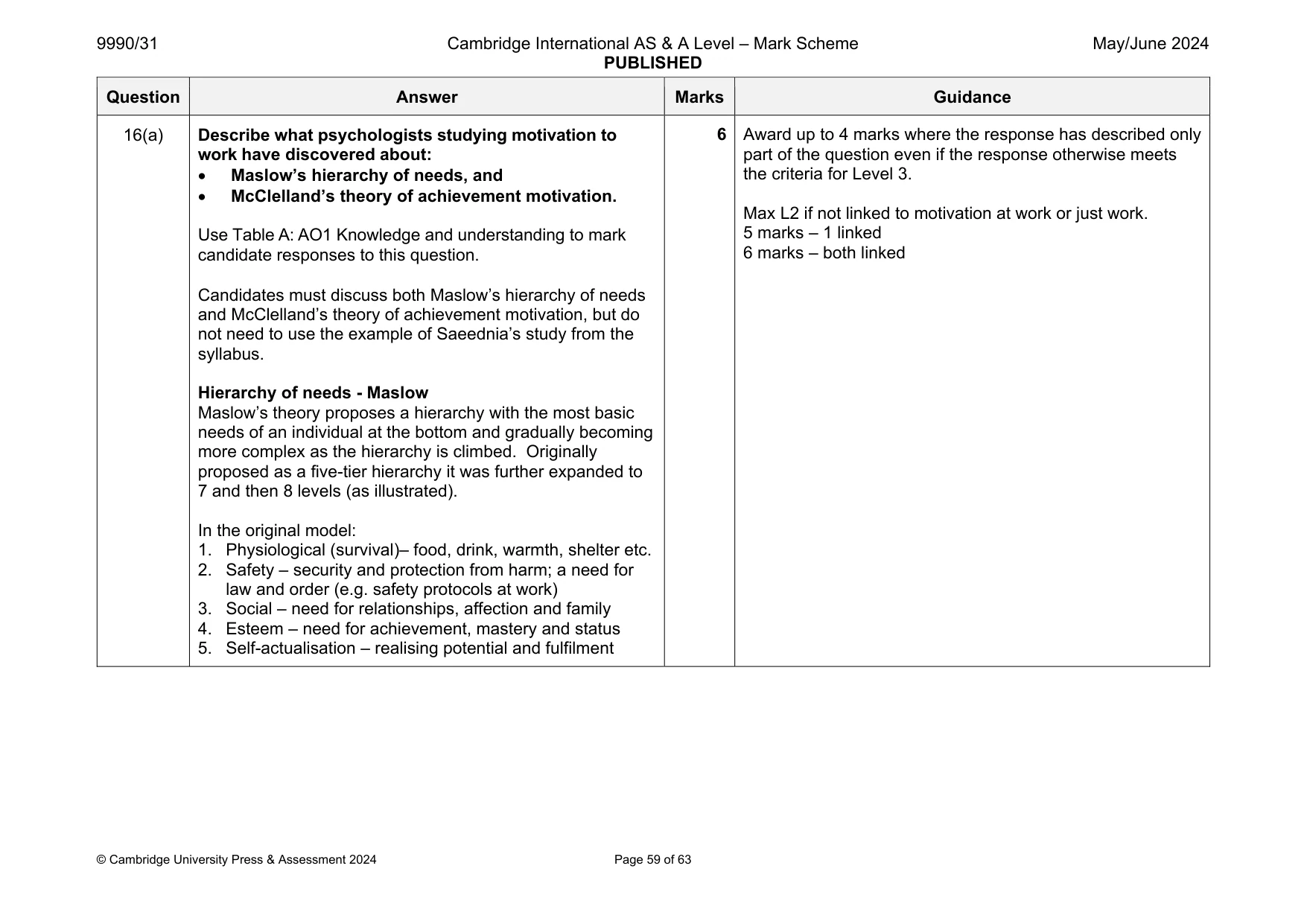
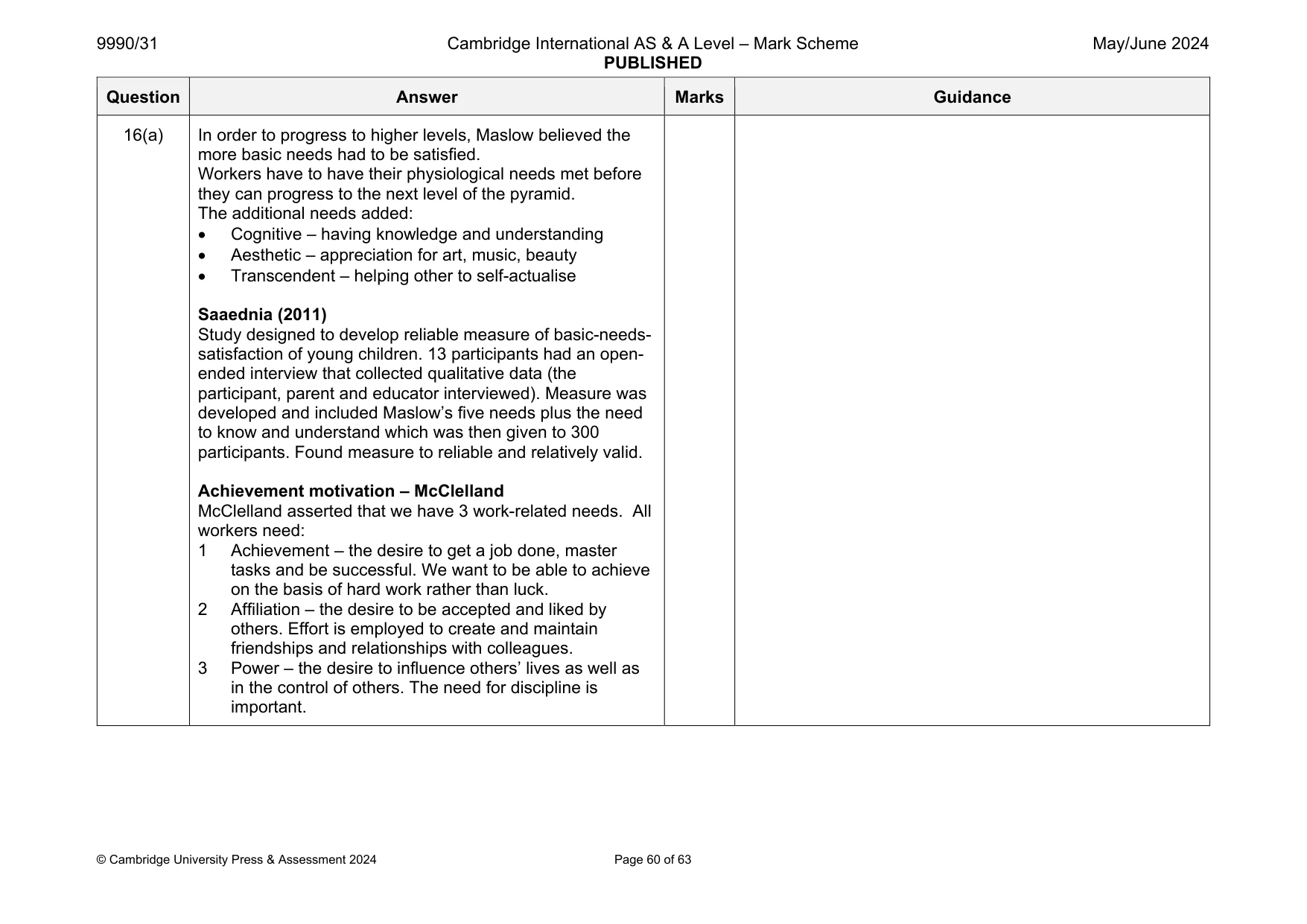
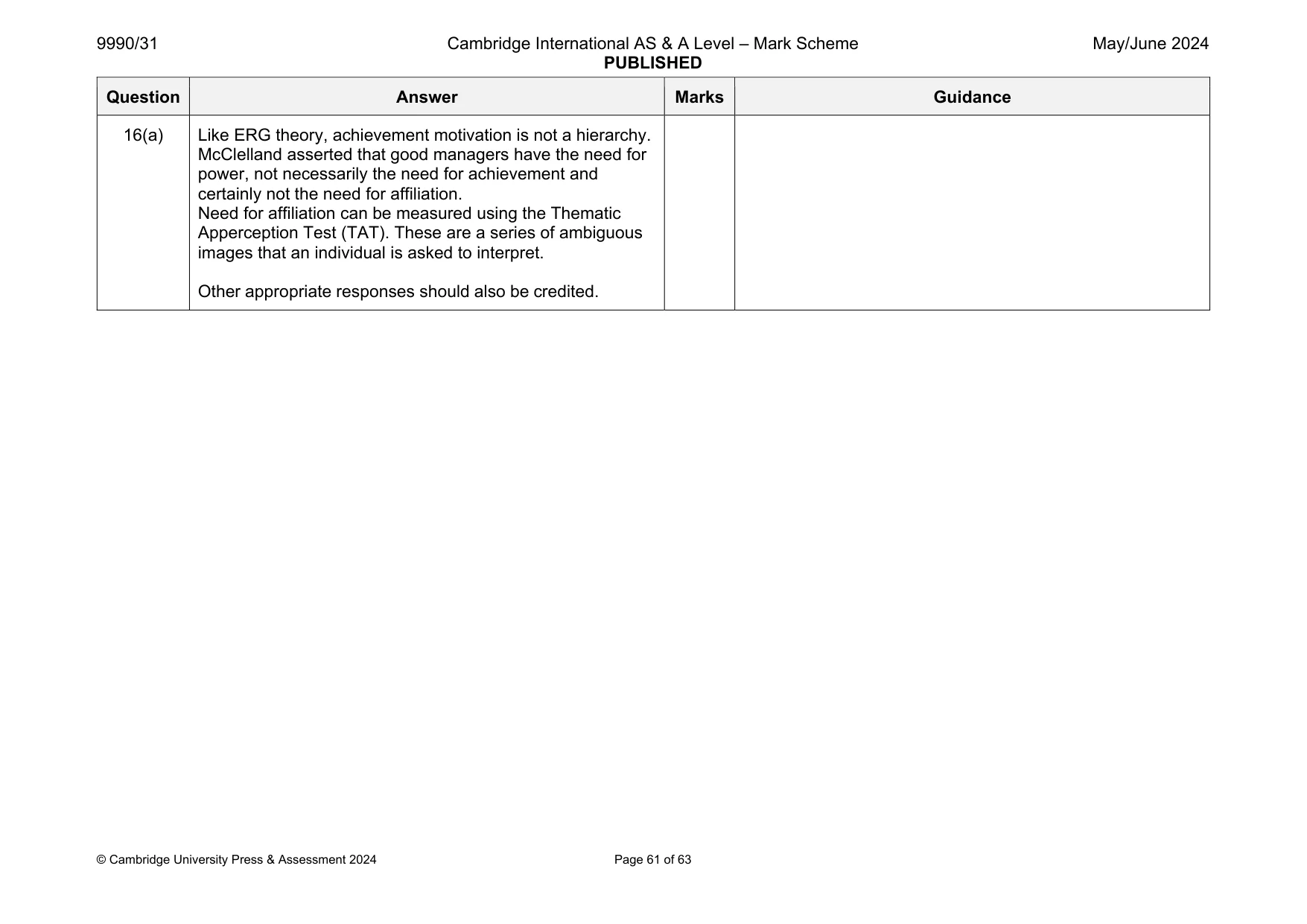
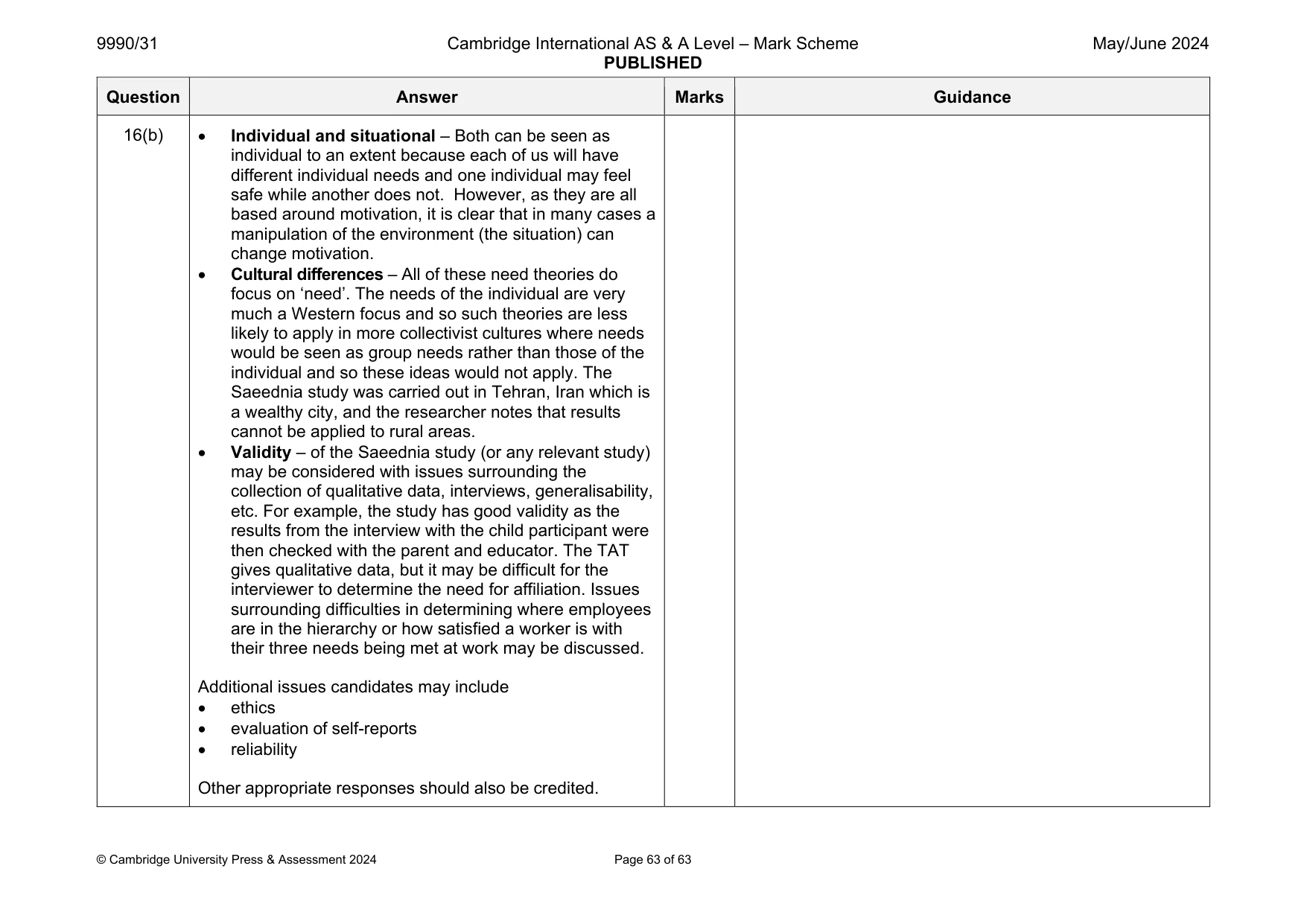
Mark scheme: 16(a) Describe what psychologists studying motivation to work have discovered about: Maslow’s hierarchy of needs, and McClelland’s theory of achievement motivation. Use Table A: AO1 Knowledge and understanding to mark candidate responses to this question. Candidates must discuss both Maslow’s hierarchy of needs and McClelland’s theory of achievement motivation, but do not need to use the example of Saeednia’s study from the syllabus. Hierarchy of needs - Maslow Maslow’s theory proposes a hierarchy with the most basic needs of an individual at the bottom and gradually becoming more complex as the hierarchy is climbed. Originally proposed as a five-tier hierarchy it was further expanded to 7 and then 8 levels (as illustrated). In the original model: 1. Physiological (survival)– food, drink, warmth, shelter etc. 2. Safety – security and protection from harm; a need for law and order (e.g. safety protocols at work) 3. Social – need for relationships, affection and family 4. Esteem – need for achievement, mastery and status 5. Self-actualisation – realising potential and fulfilment part of the question even if the response otherwise meets the criteria for Level 3. Max L2 if not linked to motivation at work or just work. 5 marks – 1 linked 6 marks – both linked Question Answer Marks Guidance 16(a) In order to progress to higher levels, Maslow believed the more basic needs had to be satisfied. Workers have to have their physiological needs met before they can progress to the next level of the pyramid. The additional needs added: Cognitive – having knowledge and understanding Aesthetic – appreciation for art, music, beauty Transcendent – helping other to self-actualise Saaednia (2011) Study designed to develop reliable measure of basic-needs- satisfaction of young children. 13 participants had an open- ended interview that collected qualitative data (the participant, parent and educator interviewed). Measure was developed and included Maslow’s five needs plus the need to know and understand which was then given to 300 participants. Found measure to reliable and relatively valid. Achievement motivation – McClelland McClelland asserted that we have 3 work-related needs. All workers need: 1 Achievement – the desire to get a job done, master tasks and be successful. We want to be able to achieve on the basis of hard work rather than luck. 2 Affiliation – the desire to be accepted and liked by others. Effort is employed to create and maintain friendships and relationships with colleagues. 3 Power – the desire to influence others’ lives as well as in the control of others. The need for discipline is important. Question Answer Marks Guidance 16(a) Like ERG theory, achievement motivation is not a hierarchy. McClelland asserted that good managers have the need for power, not necessarily the need for achievement and certainly not the need for affiliation. Need for affiliation can be measured using the Thematic Apperception Test (TAT). These are a series of ambiguous images that an individual is asked to interpret. Other appropriate responses should also be credited. Question Answer Marks Guidance 16(b) Evaluate what psychologists studying motivation to work have discovered about: Maslow’s hierarchy of needs, and McClelland’s theory of achievement motivation, including a discussion about determinism versus free- will. Evaluation in your answer can include strengths, weaknesses and a discussion of issues and debates. Use Table B: AO3 Analysis and evaluation to mark candidate responses to this question. Depending on the examples studied by candidates their answers may vary. A range of issues could be used for evaluation. These include: Named issue – determinism versus free will – Maslow’s hierarchy was born out of the humanistic approach in psychology. This approach is the least deterministic of all approaches and so free will should be an essential principle. However, the hierarchy of needs appears to have deterministic elements. For example, the fulfilment on one level in order to progress to another is deterministic and more so than is present in McClelland’s theory which is not hierarchical. Applications to everyday life – the fact that Maslow’s hierarchy is so well-known in management courses/organisations is testament to its usefulness. Clearly ideas from within both theories can be used to apply to organisations to motivate employees e.g. making sure workers feel safe and secure in their work environment as without this need being met, they will not be able to work with a desire to succeed. 10 Question Answer Marks Guidance 16(b) Individual and situational – Both can be seen as individual to an extent because each of us will have different individual needs and one individual may feel safe while another does not. However, as they are all based around motivation, it is clear that in many cases a manipulation of the environment (the situation) can change motivation. Cultural differences – All of these need theories do focus on ‘need’. The needs of the individual are very much a Western focus and so such theories are less likely to apply in more collectivist cultures where needs would be seen as group needs rather than those of the individual and so these ideas would not apply. The Saeednia study was carried out in Tehran, Iran which is a wealthy city, and the researcher notes that results cannot be applied to rural areas. Validity – of the Saeednia study (or any relevant study) may be considered with issues surrounding the collection of qualitative data, interviews, generalisability, etc. For example, the study has good validity as the results from the interview with the child participant were then checked with the parent and educator. The TAT gives qualitative data, but it may be difficult for the interviewer to determine the need for affiliation. Issues surrounding difficulties in determining where employees are in the hierarchy or how satisfied a worker is with their three needs being met at work may be discussed. Additional issues candidates may include ethics evaluation of self-reports reliability Other appropriate responses should also be credited.
What was in this paper
The subtopics covered by these 16 questions, and how many questions each got. Open one in a new tab to see every Cambridge question on it.
3Consumer decision-making32 Individual and group performance22 Health promotion in schools and worksites13 Health and safety1Advertising1Anxiety disorders and fear-related disorders1Mood (affective) disorders: depressive disorder (unipolar) and bipolar disorder1Motivation to work1Obsessive-compulsive disorder (OCD)1Pain1What you needed in this session
Cambridge’s own grade thresholds for 2024 May/June, Paper 3 · Variant 1. A higher threshold means an easier paper — the bar moves with how the cohort did.