Questions as text
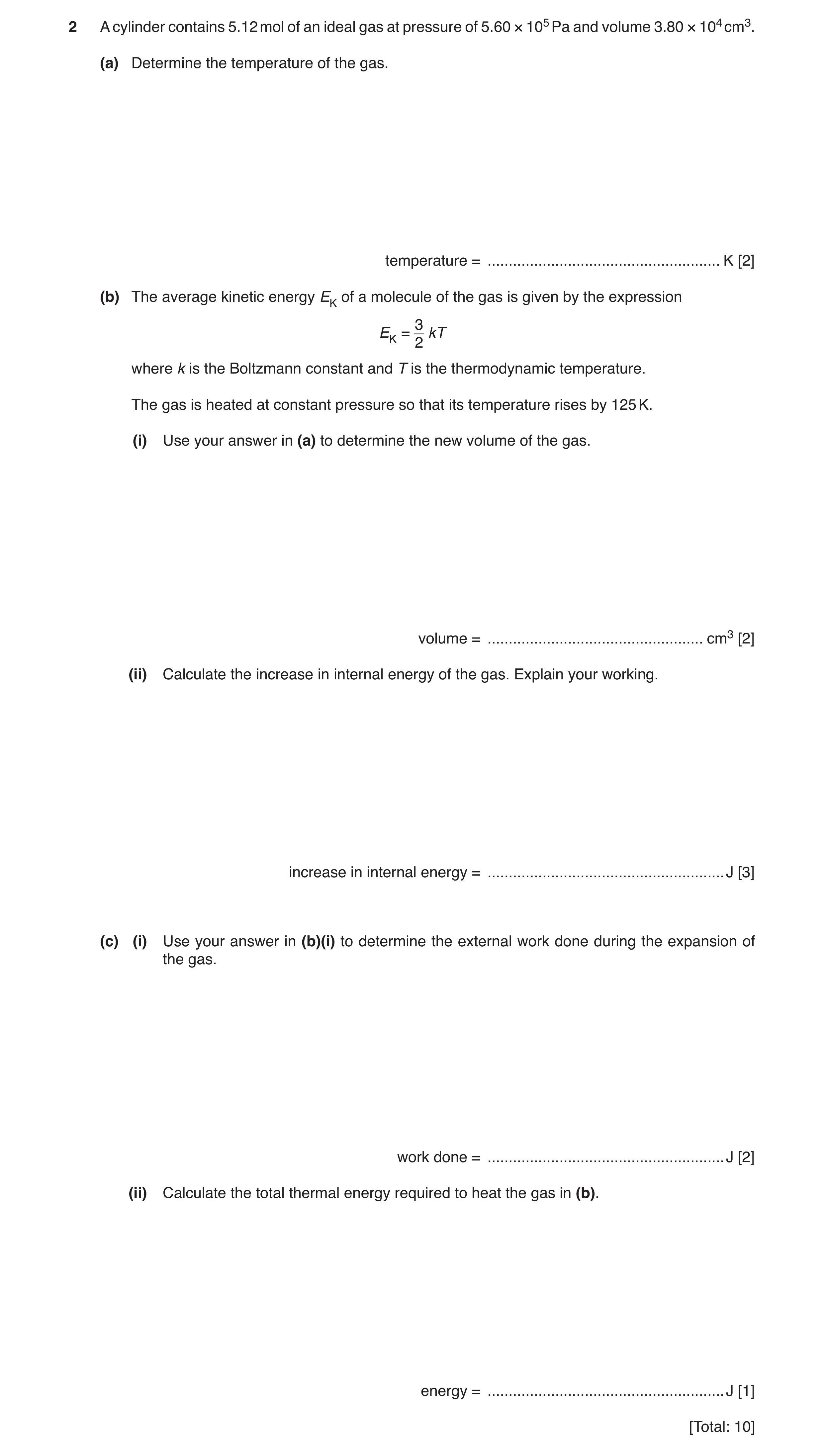
Q1 · A cylinder contains 5.12 mol of an ideal gas at pressure of 5.60 × 10⁵ Pa and volume 3.80… 9702/42 Feb/March 2018
2 A cylinder contains 5.12 mol of an ideal gas at pressure of 5.60 × 10⁵ Pa and volume 3.80 × 104 cm3. (a) Determine the temperature of the gas. temperature = … K [2] (b) The average kinetic energy EK of a molecule of the gas is given by the expression 3 EK = kT 2 where k is the Boltzmann constant and T is the thermodynamic temperature. The gas is heated at constant pressure so that its temperature rises by 125 K. (i) Use your answer in (a) to determine the new volume of the gas. volume = … cm3 [2] (ii) Calculate the increase in internal energy of the gas. Explain your working. increase in internal energy = … J [3] (c) (i) Use your answer in (b)(i) to determine the external work done during the expansion of the gas. work done = … J [2] (ii) Calculate the total thermal energy required to heat the gas in (b). energy = … J [1] [Total: 10]
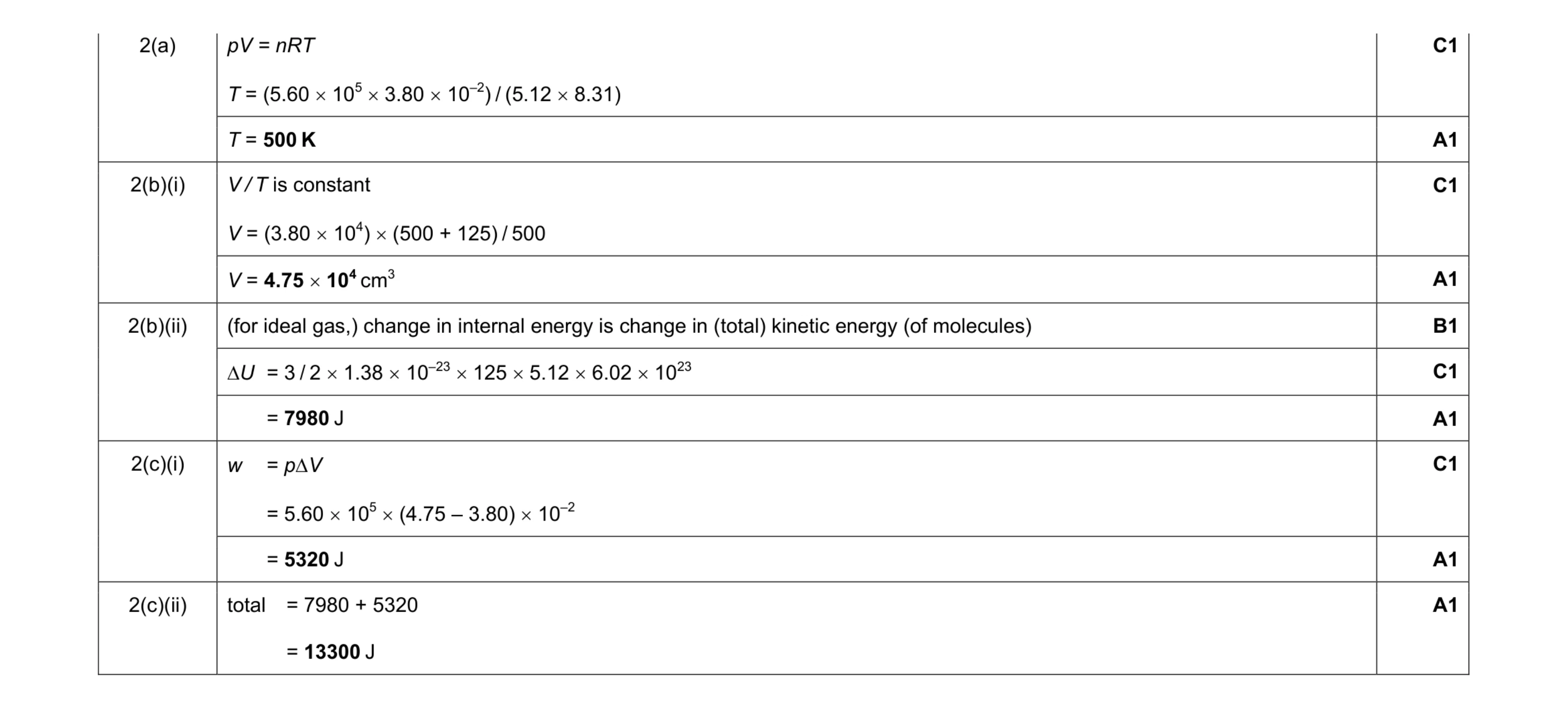
10 marks
Mark scheme: 2(a) pV = nRT T = (5.60 × 105 × 3.80 × 10–2) / (5.12 × 8.31) C1 T = 500 K A1 2(b)(i) V / T is constant V = (3.80 × 104) × (500 + 125) / 500 C1 V = 4.75 × 104 cm3 A1 2(b)(ii) (for ideal gas,) change in internal energy is change in (total) kinetic energy (of molecules) B1 ∆U = 3 / 2 × 1.38 × 10–23 × 125 × 5.12 × 6.02 × 1023 C1 = 7980 J A1 2(c)(i) w = p∆V = 5.60 × 105 × (4.75 – 3.80) × 10–2 C1 = 5320 J A1 2(c)(ii) total = 7980 + 5320 = 13300 J A1
This question in 9702/42 Feb/March 2018
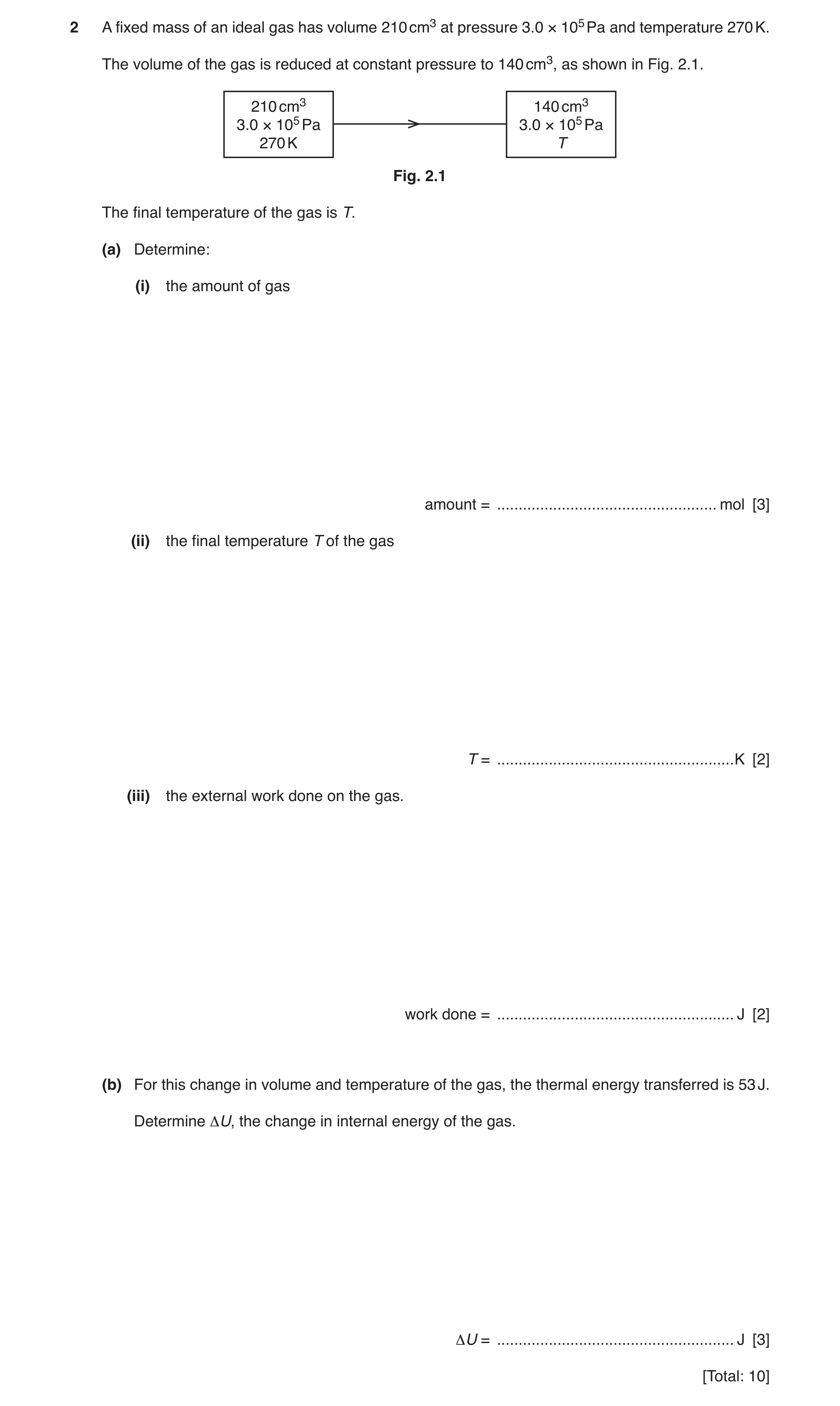
Q2 · A fixed mass of an ideal gas has volume 210 cm3 at pressure 3.0 × 10⁵ Pa and temperature… 9702/41 May/June 2019
2 A fixed mass of an ideal gas has volume 210 cm3 at pressure 3.0 × 10⁵ Pa and temperature 270 K. The volume of the gas is reduced at constant pressure to 140 cm3, as shown in Fig. 2.1. 210 cm3 140 cm3 3.0 × 10⁵ Pa 3.0 × 10⁵ Pa 270 K T Fig. 2.1 The final temperature of the gas is T. (a) Determine: (i) the amount of gas amount = … mol [3] (ii) the final temperature T of the gas T = … K [2] (iii) the external work done on the gas. work done = … J [2] (b) For this change in volume and temperature of the gas, the thermal energy transferred is 53 J. Determine ΔU, the change in internal energy of the gas. ΔU = … J [3] [Total: 10]
10 marks
Mark scheme: 2(a)(i) pV = nRT C1 n = (3.0 × 105 × 210 × 10–6) / (8.31 × 270) C1 = 0.028 mol A1 2(a)(ii) V ∝ T or T = pV / nR with value of n from (i) C1 T = (140 / 210) × 270 or T = (3.0 × 105 × 140 ×10–6) / (8.31 × 0.028) = 180 K A1 2(a)(iii) W = p∆V = 3.0 × 105 × (210 – 140) × 10–6 C1 = 21 J A1 Question Answer Marks 2(b) ∆U = w + q C1 = 21 – 53 C1 or ∆U = (nNA) × (3 / 2)k∆T (C1) = (0.0281 × 6.02 × 1023) × (3 / 2) × 1.38 × 10–23 × (180 – 270) (C1) or ∆U = (3 / 2)nR∆T (C1) = (3 / 2) × 0.0281 × 8.31 × (180 – 270) (C1) ∆U = (–)32 J A1
This question in 9702/41 May/June 2019
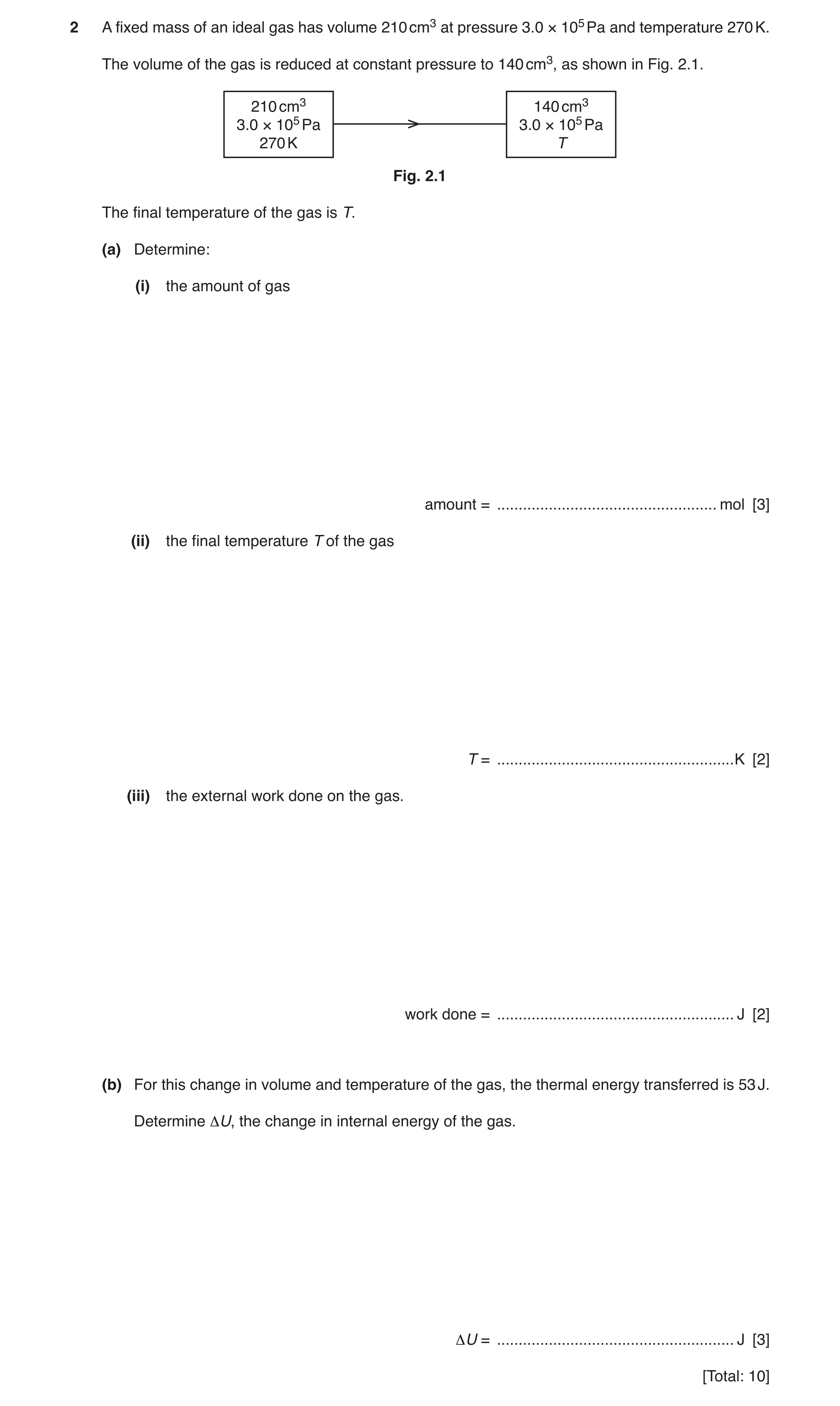
Q3 · A fixed mass of an ideal gas has volume 210 cm3 at pressure 3.0 × 10⁵ Pa and temperature… 9702/43 May/June 2019
2 A fixed mass of an ideal gas has volume 210 cm3 at pressure 3.0 × 10⁵ Pa and temperature 270 K. The volume of the gas is reduced at constant pressure to 140 cm3, as shown in Fig. 2.1. 210 cm3 140 cm3 3.0 × 10⁵ Pa 3.0 × 10⁵ Pa 270 K T Fig. 2.1 The final temperature of the gas is T. (a) Determine: (i) the amount of gas amount = … mol [3] (ii) the final temperature T of the gas T = … K [2] (iii) the external work done on the gas. work done = … J [2] (b) For this change in volume and temperature of the gas, the thermal energy transferred is 53 J. Determine ΔU, the change in internal energy of the gas. ΔU = … J [3] [Total: 10]
10 marks
Mark scheme: 2(a)(i) pV = nRT C1 n = (3.0 × 105 × 210 × 10–6) / (8.31 × 270) C1 = 0.028 mol A1 2(a)(ii) V ∝ T or T = pV / nR with value of n from (i) C1 T = (140 / 210) × 270 or T = (3.0 × 105 × 140 ×10–6) / (8.31 × 0.028) = 180 K A1 2(a)(iii) W = p∆V = 3.0 × 105 × (210 – 140) × 10–6 C1 = 21 J A1 Question Answer Marks 2(b) ∆U = w + q C1 = 21 – 53 C1 or ∆U = (nNA) × (3 / 2)k∆T (C1) = (0.0281 × 6.02 × 1023) × (3 / 2) × 1.38 × 10–23 × (180 – 270) (C1) or ∆U = (3 / 2)nR∆T (C1) = (3 / 2) × 0.0281 × 8.31 × (180 – 270) (C1) ∆U = (–)32 J A1
This question in 9702/43 May/June 2019
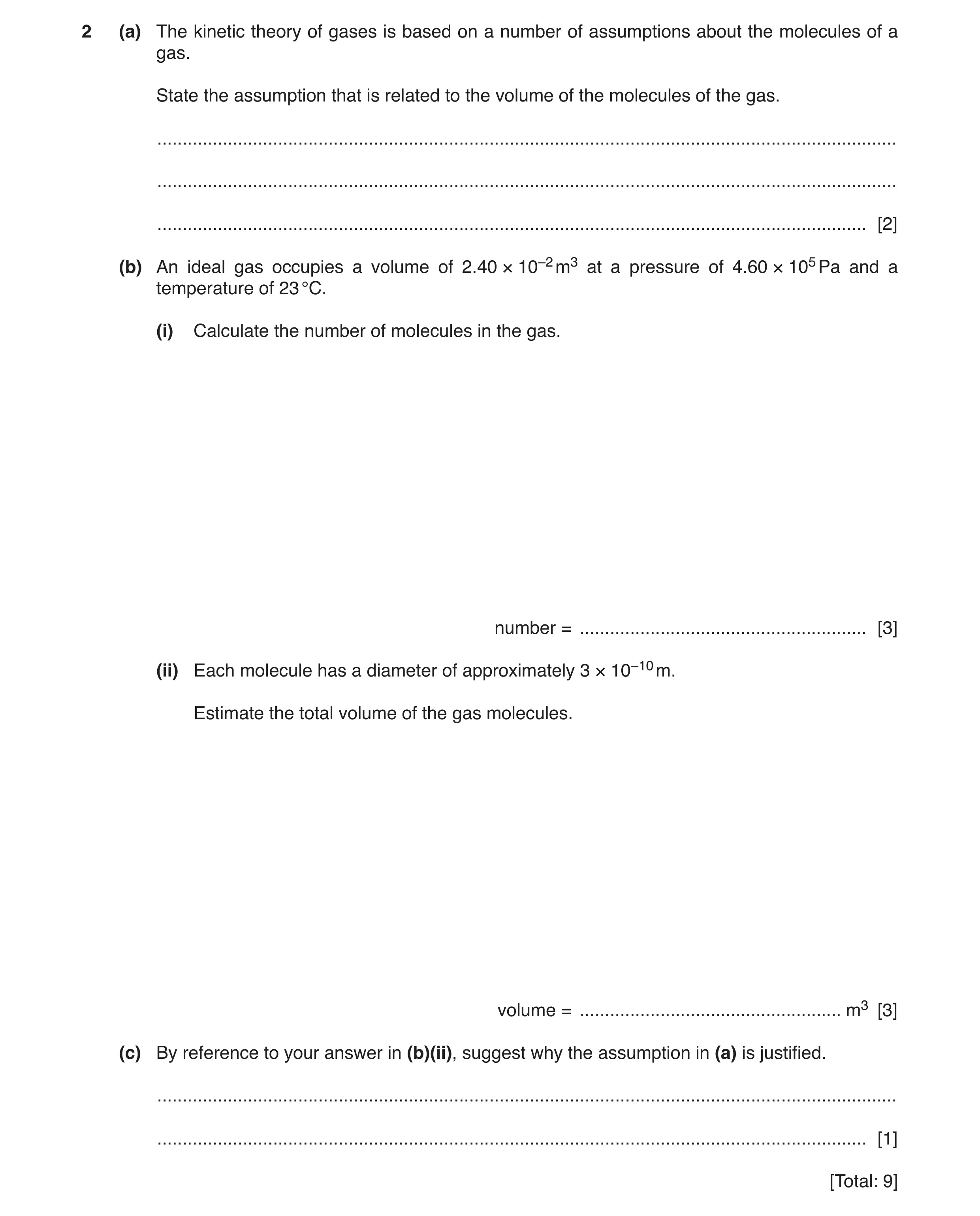
Q4 · The kinetic theory of gases is based on a number of assumptions about the molecules of a… 9702/41 Oct/Nov 2019
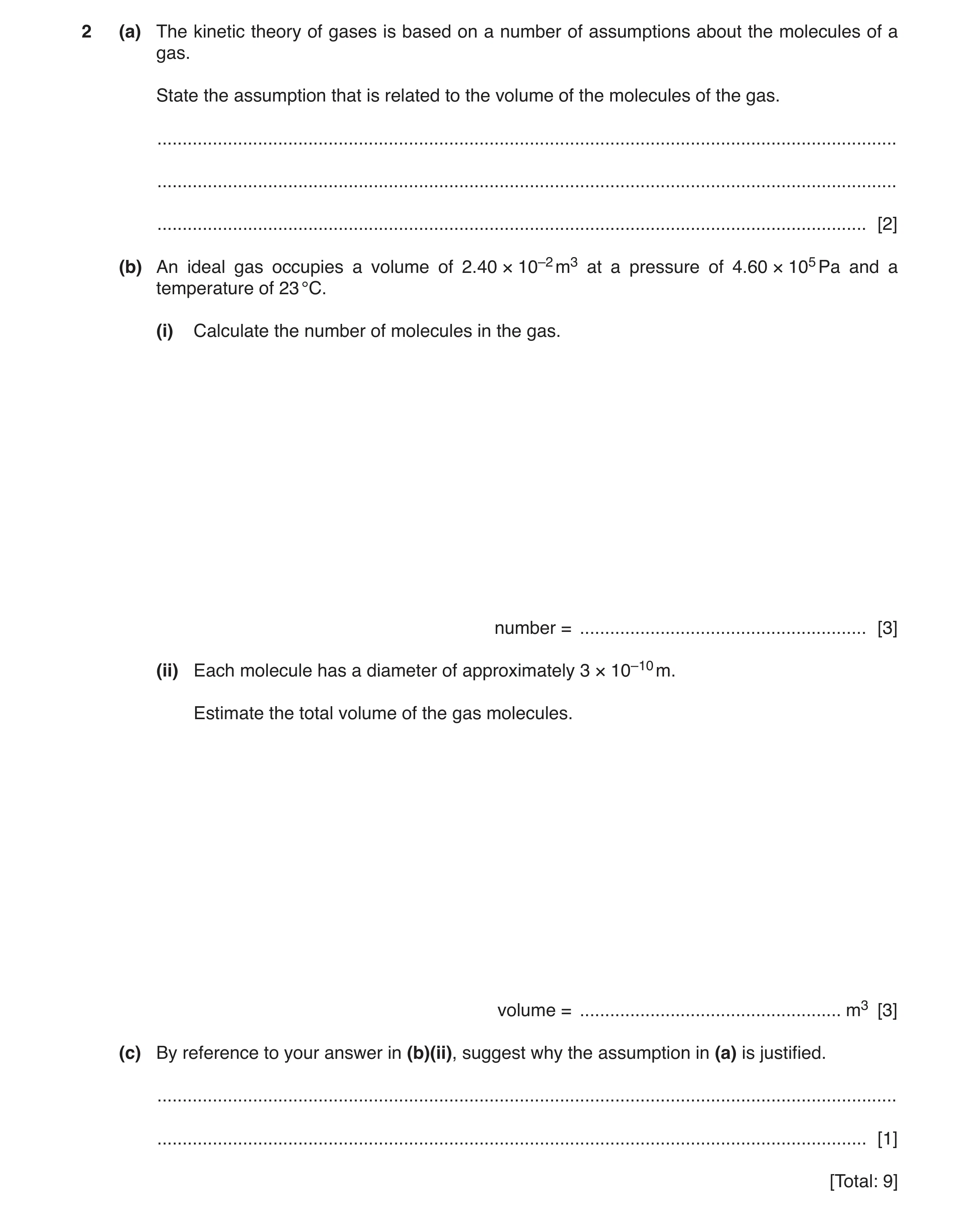
2 (a) The kinetic theory of gases is based on a number of assumptions about the molecules of a gas. State the assumption that is related to the volume of the molecules of the gas. … … … [2] (b) An ideal gas occupies a volume of 2.40 × 10⁻² m3 at a pressure of 4.60 × 10⁵ Pa and a temperature of 23 °C. (i) Calculate the number of molecules in the gas. number = … [3] (ii) Each molecule has a diameter of approximately 3 × 10⁻¹⁰ m. Estimate the total volume of the gas molecules. volume = … m3 [3] (c) By reference to your answer in (b)(ii), suggest why the assumption in (a) is justified. … … [1] [Total: 9]
9 marks
Mark scheme: 2(a) (total volume of molecules is) negligible M1 compared with volume occupied by the gas A1 2(b)(i) pV = NkT C1 4.60 × 105 × 2.40 × 10–2 = N × 1.38 × 10–23 × (273 + 23) C1 or pV = nRT (C1) 4.60 × 105 × 2.40 × 10–2 = n × 8.31 × (273 + 23) n = 4.49 (mol) N = nNA = 4.49 × 6.02 × 1023 (C1) N = 2.7 × 1024 A1 Question Answer Marks 2(b)(ii) volume of one atom = d3 (= 2.7 × 10⁻²⁹ m3) C1 volume of all atoms = 2.7 × 10–29 × 2.7 × 1024 C1 = 7 × 10⁻⁵ m3 A1 or volume of one atom = (4 / 3)πr3 (= 1.41 × 10⁻²⁹ m3) (C1) volume of all atoms = 2.7 × 1024 × 1.41 × 10–29 (C1) = 4 × 10⁻⁵ m3 (A1) 2(c) numerical comparison between answer to (b)(ii) and 2.4 × 10⁻² (m3) showing (b)(ii) is much less than 2.4 × 10⁻² (m3) B1
This question in 9702/41 Oct/Nov 2019
Q5 · Smoke particles are suspended in still air 9702/42 Oct/Nov 2019
2 (a) Smoke particles are suspended in still air. Brownian motion of the smoke particles is seen through a microscope. Describe: (i) what is seen through the microscope … … [1] (ii) how Brownian motion provides evidence for the nature of the movement of gas molecules. … … … [2] (b) A fixed mass of an ideal gas has volume 2.40 × 103 cm3 at pressure 3.51 × 10⁵ Pa and temperature 290 K. The gas is heated at constant volume until the temperature is 310 K at pressure 3.75 × 10⁵ Pa, as illustrated in Fig. 2.1. 2.40 × 103 cm3 2.40 × 103 cm3 3.51 × 10⁵ Pa 3.75 × 10⁵ Pa 290 K 310 K Fig. 2.1 The quantity of thermal energy required to raise the temperature of 1.00 mol of the gas by 1.00 K at constant volume is 12.5 J. Calculate, to three significant figures: (i) the amount, in mol, of the gas amount = … mol [3] (ii) the thermal energy transfer during the change. energy transfer = … J [2] (c) For the change in the gas in (b), state: (i) the quantity of external work done on the gas work done = … J [1] (ii) the change in internal energy, with the direction of this change. change = … J direction … [2] [Total: 11]
11 marks
Mark scheme: 2(a)(i) specks of light moving haphazardly B1 2(a)(ii) (gas) molecules collide with (smoke) particles or random motion of the (gas) molecules M1 causes the (haphazard) motion of the smoke particles or causes the smoke particles to change direction A1 2(b)(i) pV = nRT C1 n = (3.51 × 105 × 2.40 × 10–3) / (8.31 × 290) or n = (3.75 × 105 × 2.40 × 10–3) / (8.31 × 310) C1 or pV = NkT (C1) n = (3.51 × 105 × 2.40 × 10–3) / (1.38 × 10–23 × 6.02 × 1023 × 290) or n = (3.75 × 105 × 2.40 × 10–3) / (1.38 × 10–23 × 6.02 × 1023 × 310) (C1) n = 0.350 mol or 0.349 mol A1 2(b)(ii) energy transfer = (0.349 or 0.35) × 12.5 × (310 – 290) C1 = 87.3 J or 87.5 J A1 2(c)(i) zero A1 2(c)(ii) 87.3 J or 87.5 J A1 increase B1
This question in 9702/42 Oct/Nov 2019
Q6 · The kinetic theory of gases is based on a number of assumptions about the molecules of a… 9702/43 Oct/Nov 2019
2 (a) The kinetic theory of gases is based on a number of assumptions about the molecules of a gas. State the assumption that is related to the volume of the molecules of the gas. … … … [2] (b) An ideal gas occupies a volume of 2.40 × 10⁻² m3 at a pressure of 4.60 × 10⁵ Pa and a temperature of 23 °C. (i) Calculate the number of molecules in the gas. number = … [3] (ii) Each molecule has a diameter of approximately 3 × 10⁻¹⁰ m. Estimate the total volume of the gas molecules. volume = … m3 [3] (c) By reference to your answer in (b)(ii), suggest why the assumption in (a) is justified. … … [1] [Total: 9]
9 marks
Mark scheme: 2(a) (total volume of molecules is) negligible M1 compared with volume occupied by the gas A1 2(b)(i) pV = NkT C1 4.60 × 105 × 2.40 × 10–2 = N × 1.38 × 10–23 × (273 + 23) C1 or pV = nRT (C1) 4.60 × 105 × 2.40 × 10–2 = n × 8.31 × (273 + 23) n = 4.49 (mol) N = nNA = 4.49 × 6.02 × 1023 (C1) N = 2.7 × 1024 A1 Question Answer Marks 2(b)(ii) volume of one atom = d3 (= 2.7 × 10⁻²⁹ m3) C1 volume of all atoms = 2.7 × 10–29 × 2.7 × 1024 C1 = 7 × 10⁻⁵ m3 A1 or volume of one atom = (4 / 3)πr3 (= 1.41 × 10⁻²⁹ m3) (C1) volume of all atoms = 2.7 × 1024 × 1.41 × 10–29 (C1) = 4 × 10⁻⁵ m3 (A1) 2(c) numerical comparison between answer to (b)(ii) and 2.4 × 10⁻² (m3) showing (b)(ii) is much less than 2.4 × 10⁻² (m3) B1
This question in 9702/43 Oct/Nov 2019
Q7 · A large container of volume 85 m3 is filled with 110 kg of an ideal gas 9702/42 Feb/March 2020
2 A large container of volume 85 m3 is filled with 110 kg of an ideal gas. The pressure of the gas is 1.0 × 10⁵ Pa at temperature T. The mass of 1.0 mol of the gas is 32 g. (a) Show that the temperature T of the gas is approximately 300 K. [3] (b) The temperature of the gas is increased to 350 K at constant volume. The specific heat capacity of the gas for this change is 0.66 J kg−1 K−1. Calculate the energy supplied to the gas by heating. energy = … J [2] (c) Explain how movement of the gas molecules causes pressure in the container. … … … … … … … [3] (d) The temperature of a gas depends on the root-mean-square (r.m.s.) speed of its molecules. Calculate the ratio: r.m.s. speed of gas molecules at 350 K . r.m.s. speed of gas molecules at 300 K ratio = … [2] [Total: 10]
10 marks
Mark scheme: 2(a) n = 110 / 0.032 or 110000 / 32 or 3440 C1 pV = nRT C1 T = (1.0 × 105 × 85) / (8.31 × (110 / 0.032)) = 300 K A1 2(b) E = mcΔθ = 110 × 0.66 × 50 C1 = 3600 J A1 2(c) Any 3 from: • molecule collides with wall • momentum of molecule changes during collision (with wall) • force on molecule so force on wall • many forces act over surface area of container exerting a pressure B3 2(d) KE ∝ T v ∝ √T C1 ratio = √(350 / 300) = 1.1 A1
This question in 9702/42 Feb/March 2020
Q8 · State what is meant by the internal energy of a system 9702/42 Oct/Nov 2020
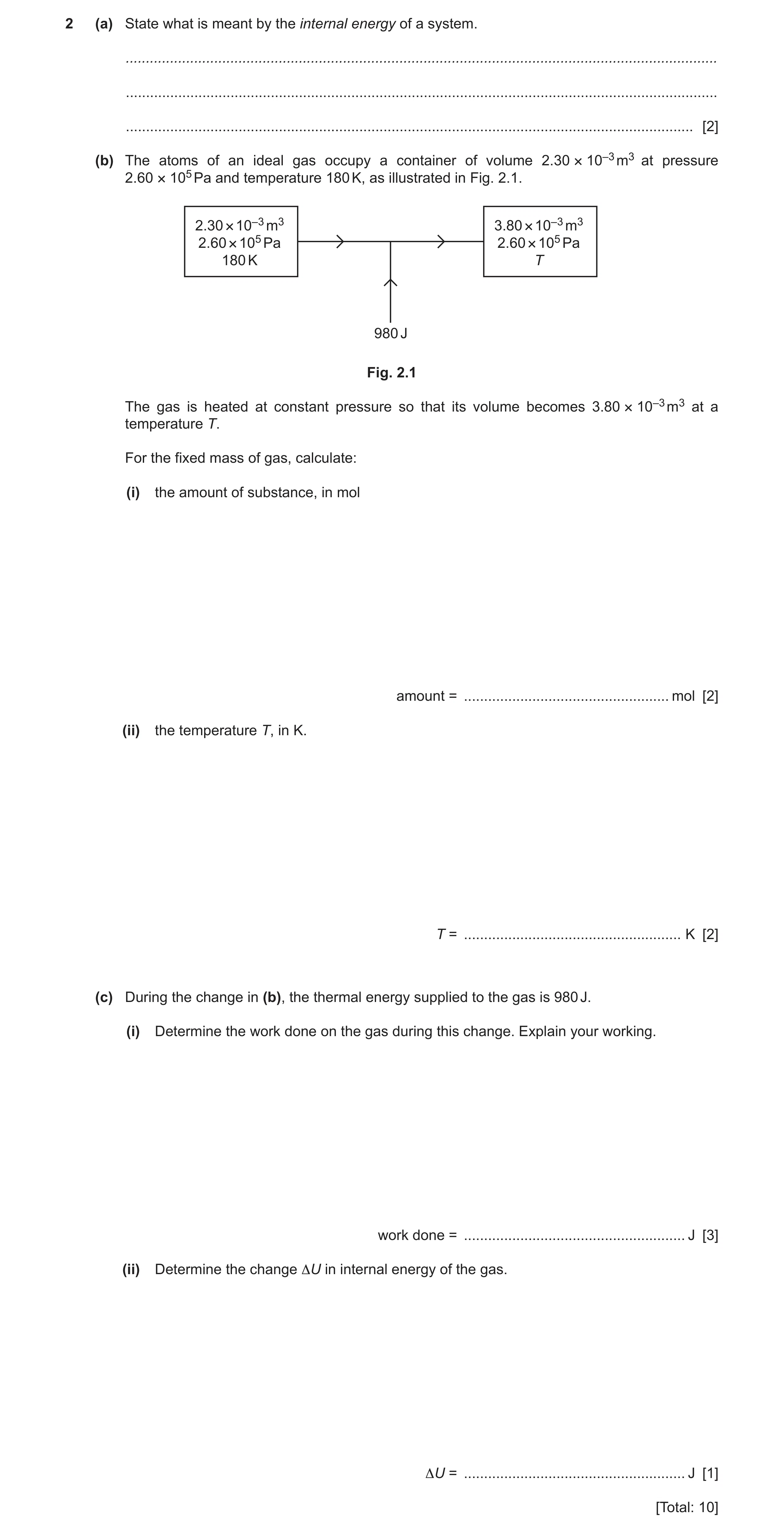
2 (a) State what is meant by the internal energy of a system. … … … [2] (b) The atoms of an ideal gas occupy a container of volume 2.30 × 10⁻³ m3 at pressure 2.60 × 10⁵ Pa and temperature 180 K, as illustrated in Fig. 2.1. 2.30 × 10⁻³ m3 3.80 × 10⁻³ m3 2.60 × 10⁵ Pa 2.60 × 10⁵ Pa 180 K T 980 J Fig. 2.1 The gas is heated at constant pressure so that its volume becomes 3.80 × 10⁻³ m3 at a temperature T. For the fixed mass of gas, calculate: (i) the amount of substance, in mol amount = … mol [2] (ii) the temperature T, in K. T = … K [2] (c) During the change in (b), the thermal energy supplied to the gas is 980 J. (i) Determine the work done on the gas during this change. Explain your working. work done = … J [3] (ii) Determine the change ΔU in internal energy of the gas. ΔU = … J [1] [Total: 10]
10 marks
Mark scheme: 2(a) sum of potential energy and kinetic energy (of particles) B1 (total) energy of random motion of particles B1 2(b)(i) pV = nRT C1 2.60 × 105 × 2.30 × 10–3 = n × 8.31 × 180 n = 0.400 mol A1 2(b)(ii) (2.30 × 10⁻³) / 180 = (3.80 × 10⁻³) / T or 2.60 × 105 × 3.80 × 10–3 = 0.400 × 8.31 × T C1 T = 297 K A1 2(c)(i) ΔW = pΔV = 2.60 × 105 × (2.30 – 3.80) × 10–3 C1 = (–)390 J A1 negative because work is done by gas or negative because work is done against atmospheric pressure or negative because volume of gas increases B1 2(c)(ii) ΔU = (980 – 390) = 590 J A1
This question in 9702/42 Oct/Nov 2020
Q9 · A fixed mass of an ideal gas is at a temperature of 21 °C 9702/42 Feb/March 2021
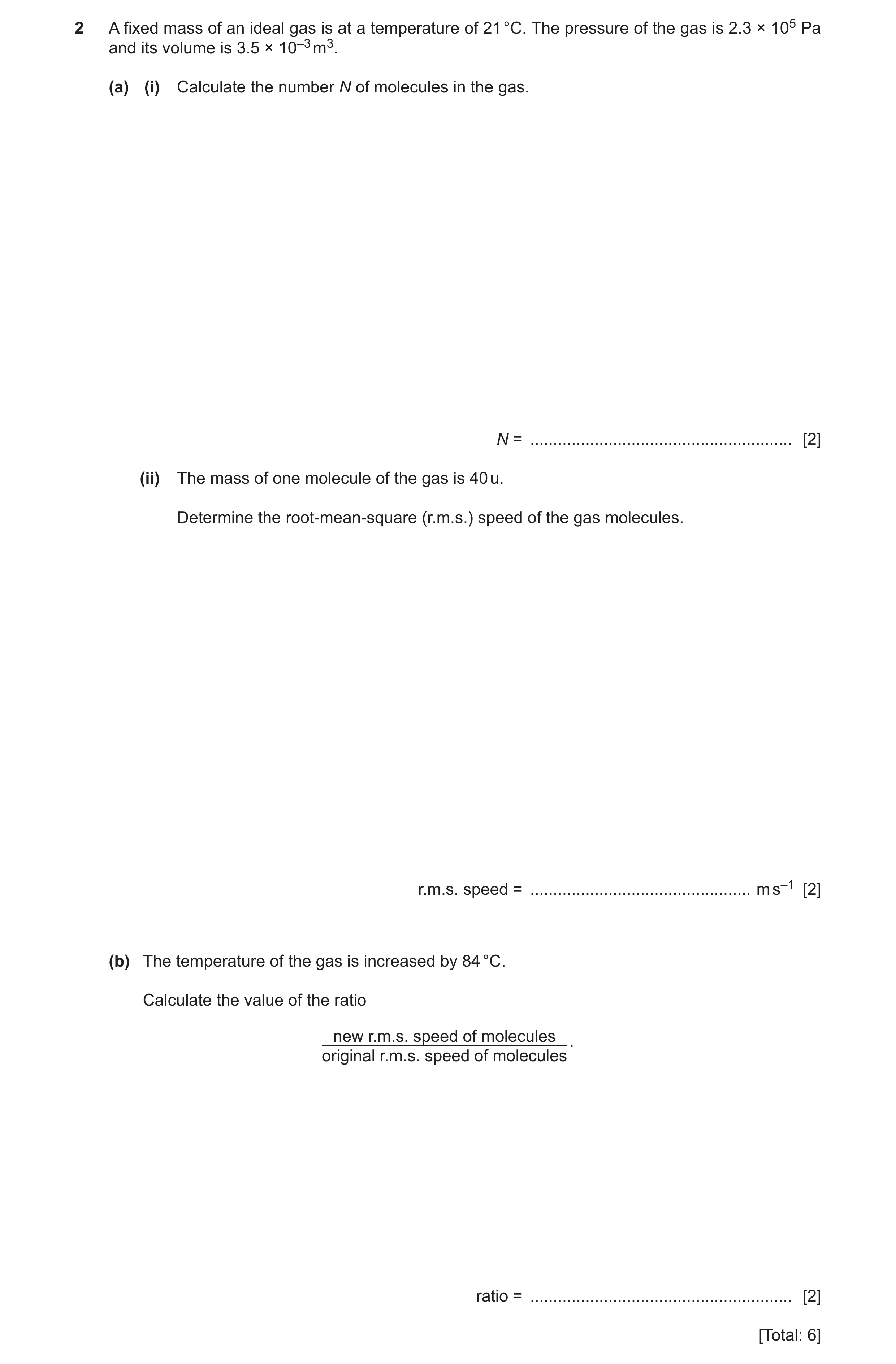
2 A fixed mass of an ideal gas is at a temperature of 21 °C. The pressure of the gas is 2.3 × 10⁵ Pa and its volume is 3.5 × 10⁻³ m3. (a) (i) Calculate the number N of molecules in the gas. N = … [2] (ii) The mass of one molecule of the gas is 40 u. Determine the root-mean-square (r.m.s.) speed of the gas molecules. r.m.s. speed = … m s–1 [2] (b) The temperature of the gas is increased by 84 °C. Calculate the value of the ratio new r.m.s. speed of molecules original r.m.s. speed of molecules . ratio = … [2] [Total: 6]
6 marks
Mark scheme: 2(a)(i) pV NkT = or pV nRT = and A N nN = 5 3 23 2.3 10 3.5 10 1.38 10 294 N − − × × × = × × = 2.0 × 10²³ A1 2(a)(ii) 2 1 3 pV Nmc = 5 3 2 23 27 3 2.3 10 3.5 10 2.0 10 40 1.66 10 c − − × × × × = × × × × = 182 000 r.m.s. speed = 430 m s–1 C1 or 2 3 12 2 mc kT = A1 23 2 27 3 1.38 10 294 40 1.66 10 c − − × × × = × × = 183 000 (C1) r.m.s.speed = 430 m s–1 (A1) Question Answer Marks 2(b) ( ) 23 23 2 23 27 3 2.0 10 1.38 10 294 84 2.0 10 40 1.66 10 c − − × × × × × + = × × × × 2 236000 c = 485 c = C1 485 1.1 430 ratio = = A1 OR v T ∝ or 2 v T ∝ (C1) 273 21 84 273 21 ratio + + = + or 378 294 ratio = 1.1 (A1)
This question in 9702/42 Feb/March 2021
Q10 · An ideal gas is contained in a cylinder by means of a movable frictionless piston, as… 9702/41 May/June 2021
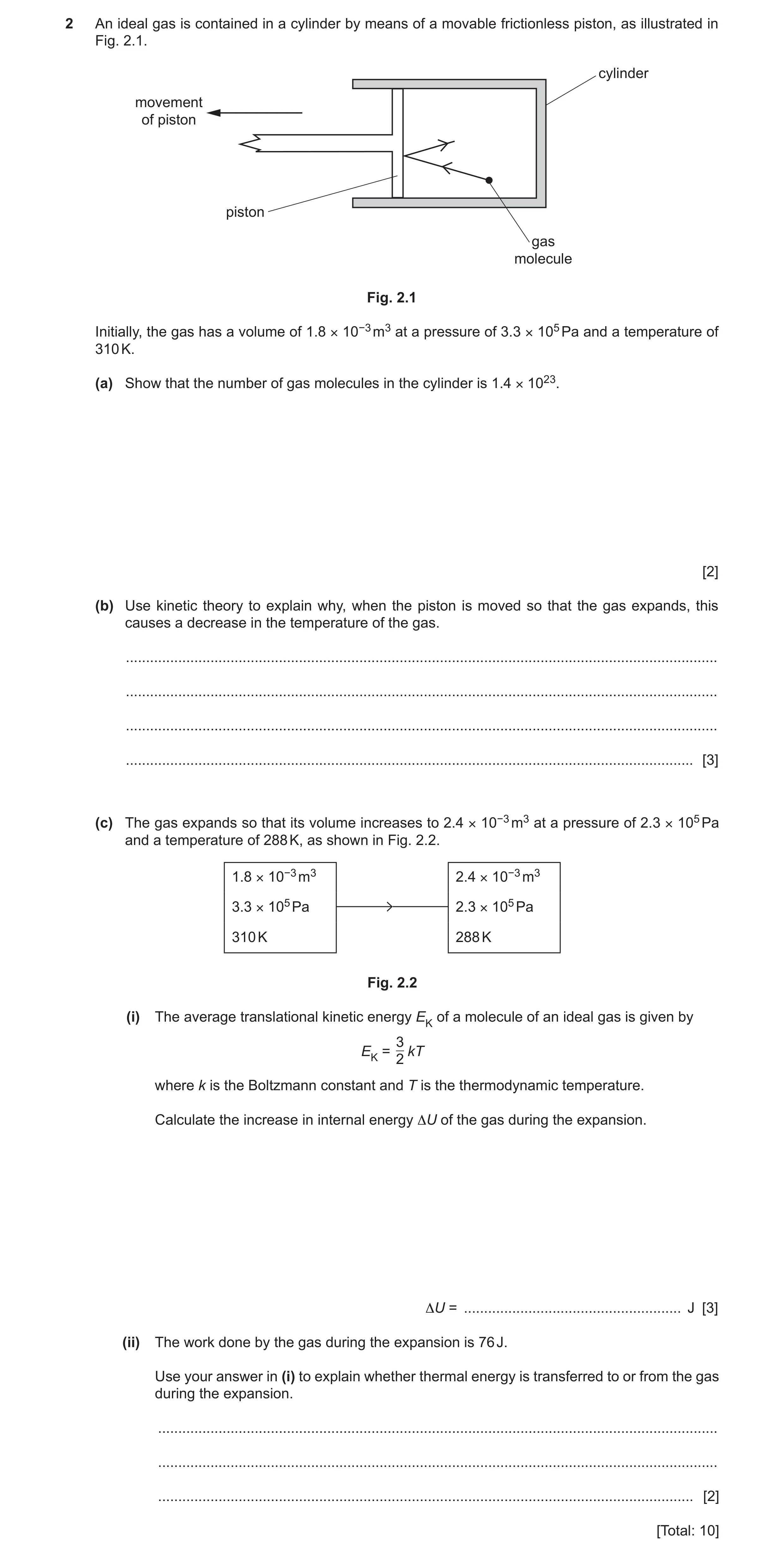
2 An ideal gas is contained in a cylinder by means of a movable frictionless piston, as illustrated in Fig. 2.1. cylinder movement of piston piston gas molecule Fig. 2.1 Initially, the gas has a volume of 1.8 × 10⁻³ m3 at a pressure of 3.3 × 10⁵ Pa and a temperature of 310 K. (a) Show that the number of gas molecules in the cylinder is 1.4 × 10²³. [2] (b) Use kinetic theory to explain why, when the piston is moved so that the gas expands, this causes a decrease in the temperature of the gas. … … … … [3] (c) The gas expands so that its volume increases to 2.4 × 10⁻³ m3 at a pressure of 2.3 × 10⁵ Pa and a temperature of 288 K, as shown in Fig. 2.2. 1.8 × 10⁻³ m3 2.4 × 10⁻³ m3 3.3 × 10⁵ Pa 2.3 × 10⁵ Pa 310 K 288 K Fig. 2.2 (i) The average translational kinetic energy EK of a molecule of an ideal gas is given by 3 EK = kT 2 where k is the Boltzmann constant and T is the thermodynamic temperature. Calculate the increase in internal energy ΔU of the gas during the expansion. ΔU = … J [3] (ii) The work done by the gas during the expansion is 76 J. Use your answer in (i) to explain whether thermal energy is transferred to or from the gas during the expansion. … … … [2] [Total: 10]
10 marks
Mark scheme: 2(a) pV = NkT C1 N = (1.8 × 10–3 × 3.3 × 105) / (1.38 × 10–23 × 310) = 1.4 × 10²³ A1 or pV = nRT and nNA = N (C1) N = (1.8 × 10–3 × 3.3 × 105 × 6.02 × 1023) / (8.31 × 310) = 1.4 × 10²³ (A1) 2(b) speed of molecule decreases on impact with moving piston B1 mean square speed (directly) proportional to (thermodynamic) temperature or mean square speed (directly) proportional to kinetic energy (of molecules) or kinetic energy (of molecules) (directly) proportional to (thermodynamic) temperature B1 kinetic energy (of molecules) decreases (so temperature decreases) B1 2(c)(i) ΔU = 3/2 × k × ΔT × N C1 = 3/2 × 1.38 × 10–23 × (288 – 310) × 1.4 × 1023 C1 = – 64 J A1 2(c)(ii) decrease in internal energy is less than work done by gas M1 (thermal energy is) transferred to the gas (during the expansion) A1
This question in 9702/41 May/June 2021
Q11 · An ideal gas has a volume of 3.1 × 10⁻³ m3 at a pressure of 8.5 × 10⁵ Pa and a… 9702/42 May/June 2021
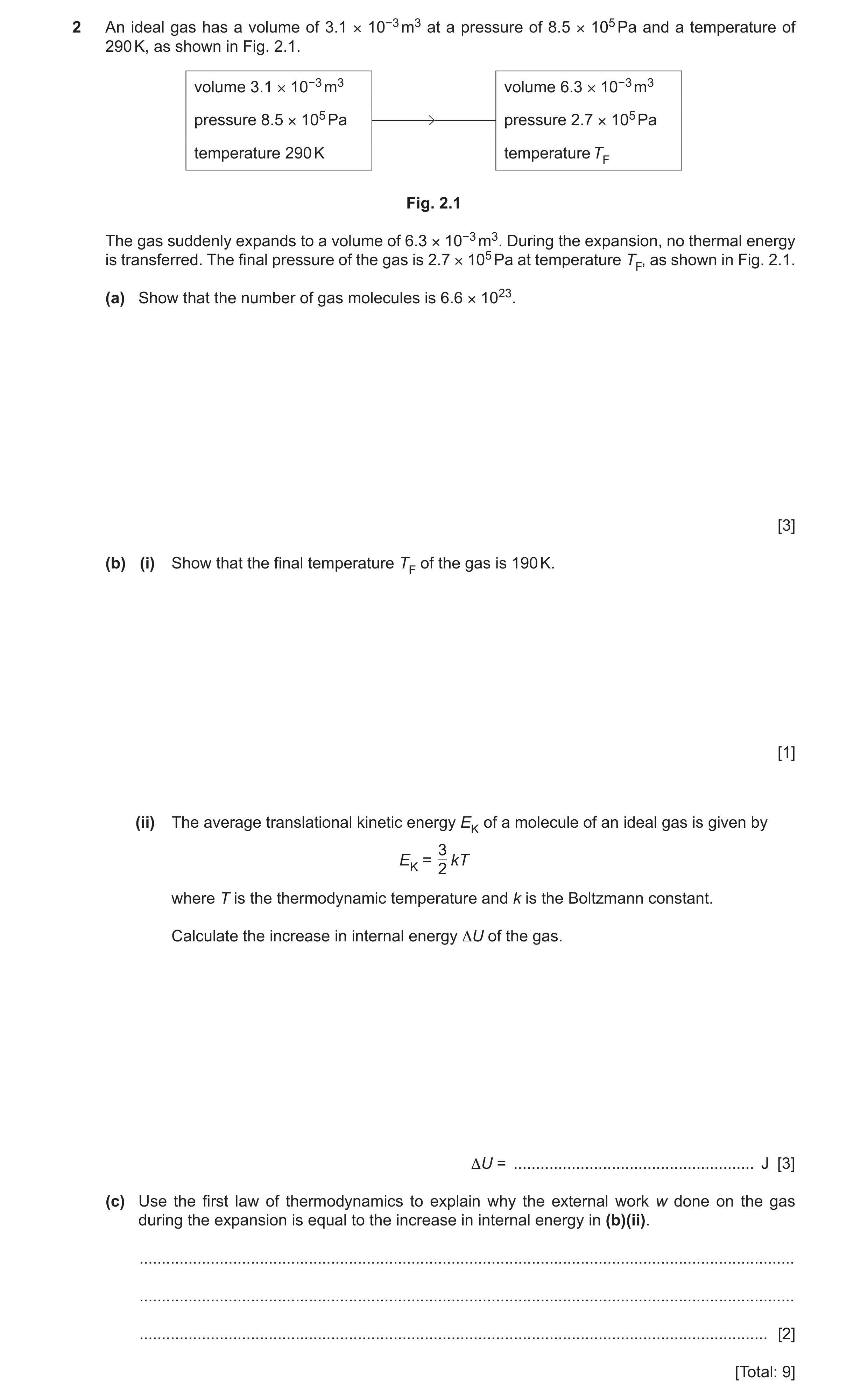
2 An ideal gas has a volume of 3.1 × 10⁻³ m3 at a pressure of 8.5 × 10⁵ Pa and a temperature of 290 K, as shown in Fig. 2.1. volume 3.1 × 10⁻³ m3 volume 6.3 × 10⁻³ m3 pressure 8.5 × 10⁵ Pa pressure 2.7 × 10⁵ Pa temperature 290 K temperature TF Fig. 2.1 The gas suddenly expands to a volume of 6.3 × 10⁻³ m3. During the expansion, no thermal energy is transferred. The final pressure of the gas is 2.7 × 10⁵ Pa at temperature TF, as shown in Fig. 2.1. (a) Show that the number of gas molecules is 6.6 × 10²³. [3] (b) (i) Show that the final temperature TF of the gas is 190 K. [1] (ii) The average translational kinetic energy EK of a molecule of an ideal gas is given by 3 EK = kT 2 where T is the thermodynamic temperature and k is the Boltzmann constant. Calculate the increase in internal energy ΔU of the gas. ΔU = … J [3] (c) Use the first law of thermodynamics to explain why the external work w done on the gas during the expansion is equal to the increase in internal energy in (b)(ii). … … … [2] [Total: 9]
9 marks
Mark scheme: 2(a) pV = nRT C1 pV = nRT and N = nNA or pV = NkT C1 3.1 × 10–3 × 8.5 × 105 = (N × 290 × 8.31) / (6.02 × 10²³) so N = 6.6 × 10²³ or 3.1 × 10–3 × 8.5 × 105 = N × 1.38 × 10–23 × 290 so N = 6.6 × 10²³ A1 2(b)(i) (3.1 × 10–3 × 8.5 × 105) / 290 = (6.3 × 10–3 × 2.7 × 105) / T so T = 190 K or 6.3 × 10–3 × 2.7 × 105 = 6.6 × 1023 × 1.38 × 10–23 × T so T = 190 K A1 2(b)(ii) ΔU = 3/2 × k × ΔT × N C1 = 3/2 × 1.38 × 10–23 × (190 – 290) × 6.6 × 1023 C1 = –1400 J A1 2(c) ΔU = q + w M1 q = 0 so ΔU = w A1
This question in 9702/42 May/June 2021
Q12 · An ideal gas is contained in a cylinder by means of a movable frictionless piston, as… 9702/43 May/June 2021
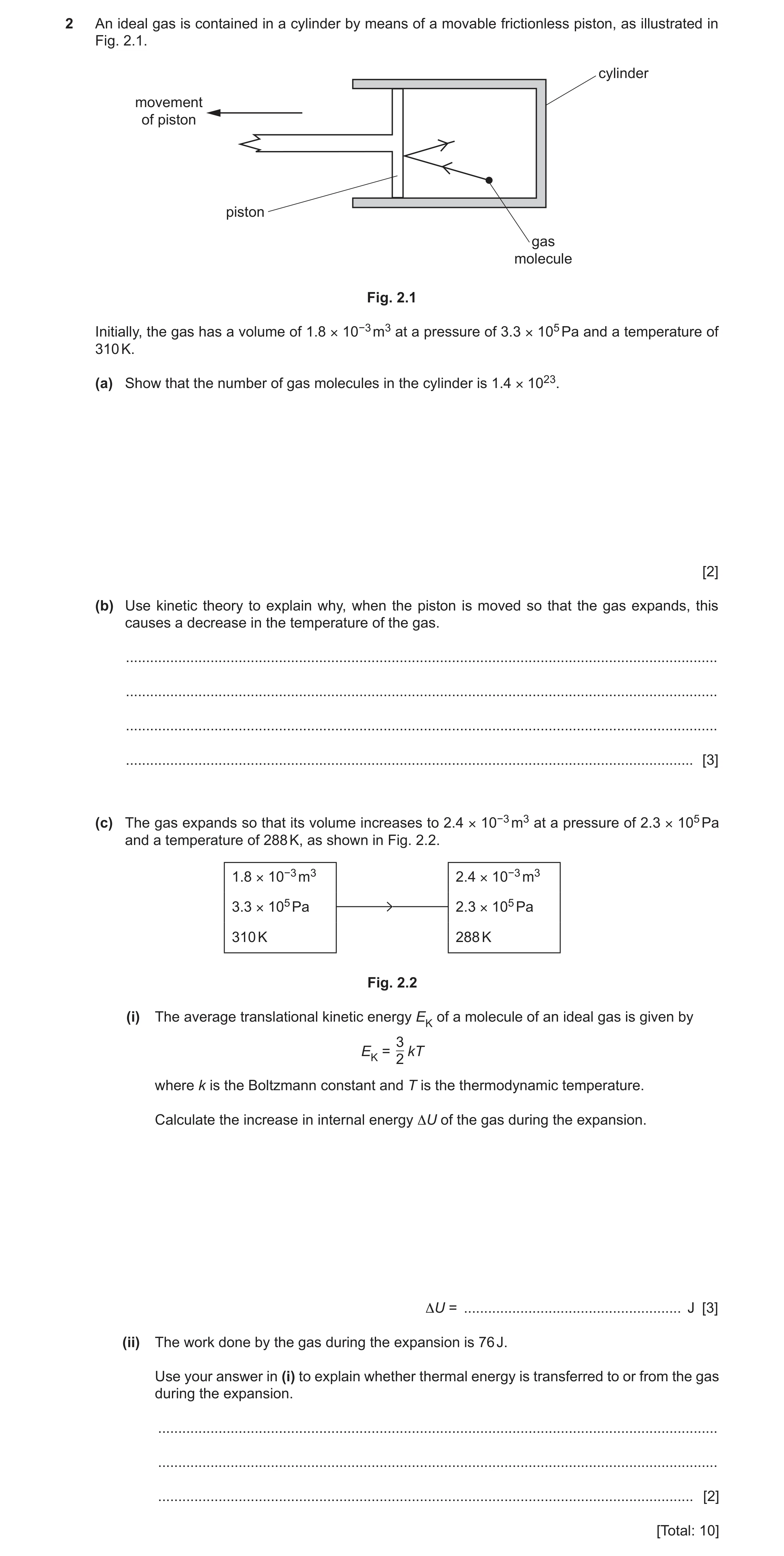
2 An ideal gas is contained in a cylinder by means of a movable frictionless piston, as illustrated in Fig. 2.1. cylinder movement of piston piston gas molecule Fig. 2.1 Initially, the gas has a volume of 1.8 × 10⁻³ m3 at a pressure of 3.3 × 10⁵ Pa and a temperature of 310 K. (a) Show that the number of gas molecules in the cylinder is 1.4 × 10²³. [2] (b) Use kinetic theory to explain why, when the piston is moved so that the gas expands, this causes a decrease in the temperature of the gas. … … … … [3] (c) The gas expands so that its volume increases to 2.4 × 10⁻³ m3 at a pressure of 2.3 × 10⁵ Pa and a temperature of 288 K, as shown in Fig. 2.2. 1.8 × 10⁻³ m3 2.4 × 10⁻³ m3 3.3 × 10⁵ Pa 2.3 × 10⁵ Pa 310 K 288 K Fig. 2.2 (i) The average translational kinetic energy EK of a molecule of an ideal gas is given by 3 EK = kT 2 where k is the Boltzmann constant and T is the thermodynamic temperature. Calculate the increase in internal energy ΔU of the gas during the expansion. ΔU = … J [3] (ii) The work done by the gas during the expansion is 76 J. Use your answer in (i) to explain whether thermal energy is transferred to or from the gas during the expansion. … … … [2] [Total: 10]
10 marks
Mark scheme: 2(a) pV = NkT C1 N = (1.8 × 10–3 × 3.3 × 105) / (1.38 × 10–23 × 310) = 1.4 × 10²³ A1 or pV = nRT and nNA = N (C1) N = (1.8 × 10–3 × 3.3 × 105 × 6.02 × 1023) / (8.31 × 310) = 1.4 × 10²³ (A1) 2(b) speed of molecule decreases on impact with moving piston B1 mean square speed (directly) proportional to (thermodynamic) temperature or mean square speed (directly) proportional to kinetic energy (of molecules) or kinetic energy (of molecules) (directly) proportional to (thermodynamic) temperature B1 kinetic energy (of molecules) decreases (so temperature decreases) B1 2(c)(i) ΔU = 3/2 × k × ΔT × N C1 = 3/2 × 1.38 × 10–23 × (288 – 310) × 1.4 × 1023 C1 = – 64 J A1 2(c)(ii) decrease in internal energy is less than work done by gas M1 (thermal energy is) transferred to the gas (during the expansion) A1
This question in 9702/43 May/June 2021
Q13 · A fixed mass of an ideal gas has a volume V and a pressure p 9702/42 Feb/March 2022
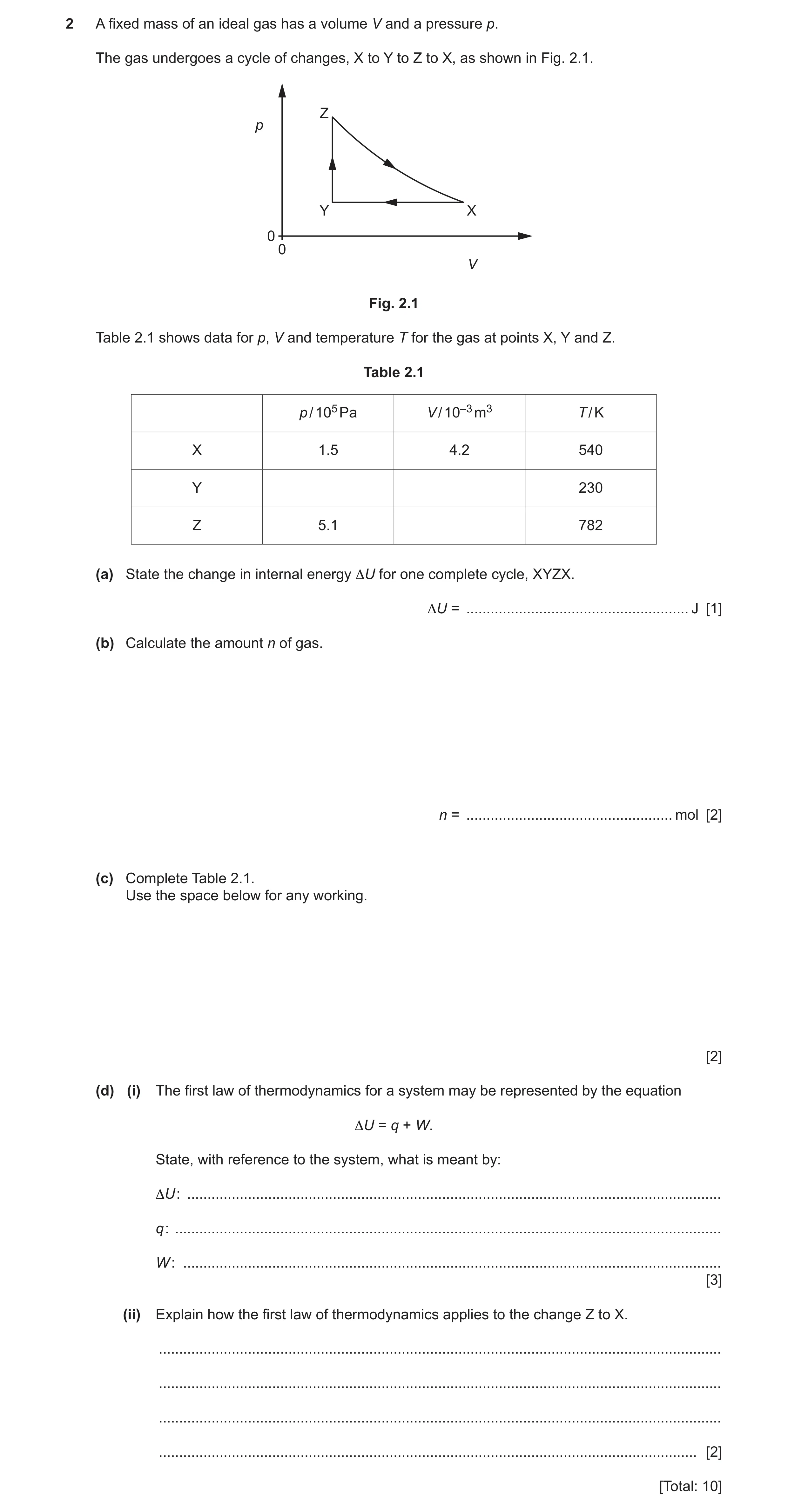
2 A fixed mass of an ideal gas has a volume V and a pressure p. The gas undergoes a cycle of changes, X to Y to Z to X, as shown in Fig. 2.1. Z p Y X 0 0 V Fig. 2.1 Table 2.1 shows data for p, V and temperature T for the gas at points X, Y and Z. Table 2.1 p / 105 Pa V / 10–3 m3 T / K X 1.5 4.2 540 Y 230 Z 5.1 782 (a) State the change in internal energy ΔU for one complete cycle, XYZX. ΔU = … J [1] (b) Calculate the amount n of gas. n = … mol [2] (c) Complete Table 2.1. Use the space below for any working. [2] (d) (i) The first law of thermodynamics for a system may be represented by the equation ΔU = q + W. State, with reference to the system, what is meant by: ΔU : … q : … W : … [3] (ii) Explain how the first law of thermodynamics applies to the change Z to X. … … … … [2] [Total: 10]
10 marks
Mark scheme: 2(a) 0 B1 2(b) pV = nRT (n =) 1.5 × 105 × 4.2 × 10–3 / 8.31 × 540 C1 = 0.14 mol A1 2(c) missing pressure 1.5 (× 105) B1 both missing volumes 1.8 (× 10–3) B1 2(d)(i) (ΔU:) increase in internal energy (of the system) B1 (q:) thermal energy supplied to the system B1 (W:) work done on system B1 Question Answer Marks 2(d)(ii) volume increases and work is done by the gas B1 temperature decreases and internal energy decreases B1
This question in 9702/42 Feb/March 2022
Q14 · A fixed mass of an ideal gas is initially at a temperature of 17 °C 9702/41 May/June 2022
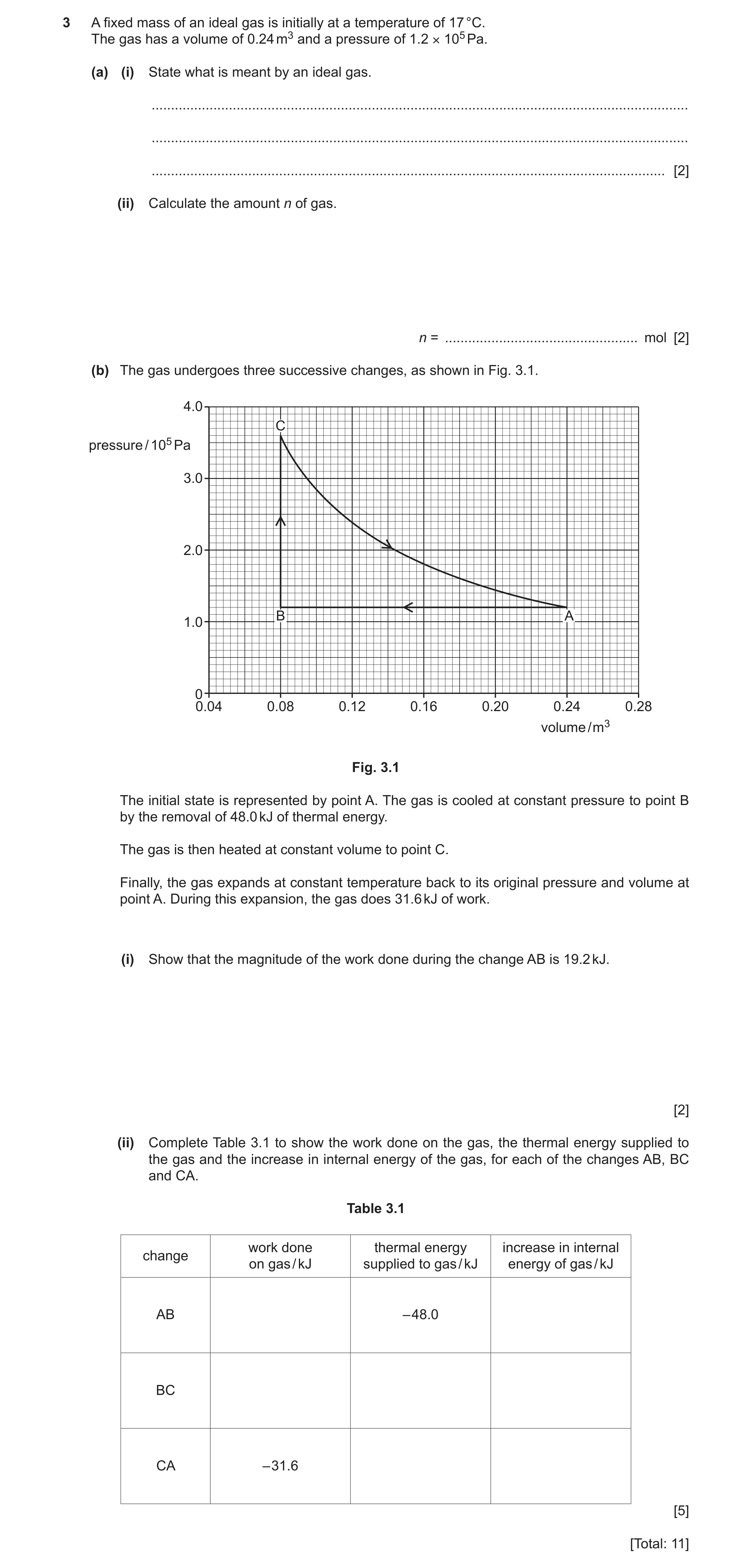
3 A fixed mass of an ideal gas is initially at a temperature of 17 °C. The gas has a volume of 0.24 m3 and a pressure of 1.2 × 10⁵ Pa. (a) (i) State what is meant by an ideal gas. … … … [2] (ii) Calculate the amount n of gas. n = … mol [2] (b) The gas undergoes three successive changes, as shown in Fig. 3.1. 4.0 C pressure / 105 Pa 3.0 2.0 B A 1.0 0 0.04 0.08 0.12 0.16 0.20 0.24 0.28 volume / m3 Fig. 3.1 The initial state is represented by point A. The gas is cooled at constant pressure to point B by the removal of 48.0 kJ of thermal energy. The gas is then heated at constant volume to point C. Finally, the gas expands at constant temperature back to its original pressure and volume at point A. During this expansion, the gas does 31.6 kJ of work. (i) Show that the magnitude of the work done during the change AB is 19.2 kJ. [2] (ii) Complete Table 3.1 to show the work done on the gas, the thermal energy supplied to the gas and the increase in internal energy of the gas, for each of the changes AB, BC and CA. Table 3.1 work done thermal energy increase in internal change on gas / kJ supplied to gas / kJ energy of gas / kJ AB – 48.0 BC CA – 31.6 [5] [Total: 11]
11 marks
Mark scheme: 3(a)(i) M1 where p = pressure, V = volume, T = thermodynamic temperature A1 3(a)(ii) T = (273 + 17) K C1 n = pV / RT = (1.2 105 0.24) / [8.31 (273 + 17)] = 12 mol A1 3(b)(i) work done = pV C1 = 1.2 105 (0.24 – 0.08) = 19200 J (= 19.2 kJ) A1 3(b)(ii) AB work done correct (19.2) A1 BC work done correct (0) A1 CA increase in internal energy correct (0) and CA thermal energy correct (31.6) A1 AB increase in internal energy calculated correctly from work done – 48.0 A1 BC increase in internal energy correctly calculated so the final column adds up to zero and BC thermal energy same as increase in internal energy (Fully correct table: AB 19.2 – 48.0 –28.8 BC 0 28.8 28.8 CA –31.6 31.6 0 ) A1
This question in 9702/41 May/June 2022
Q15 · A fixed mass of an ideal gas is initially at a temperature of 17 °C 9702/43 May/June 2022
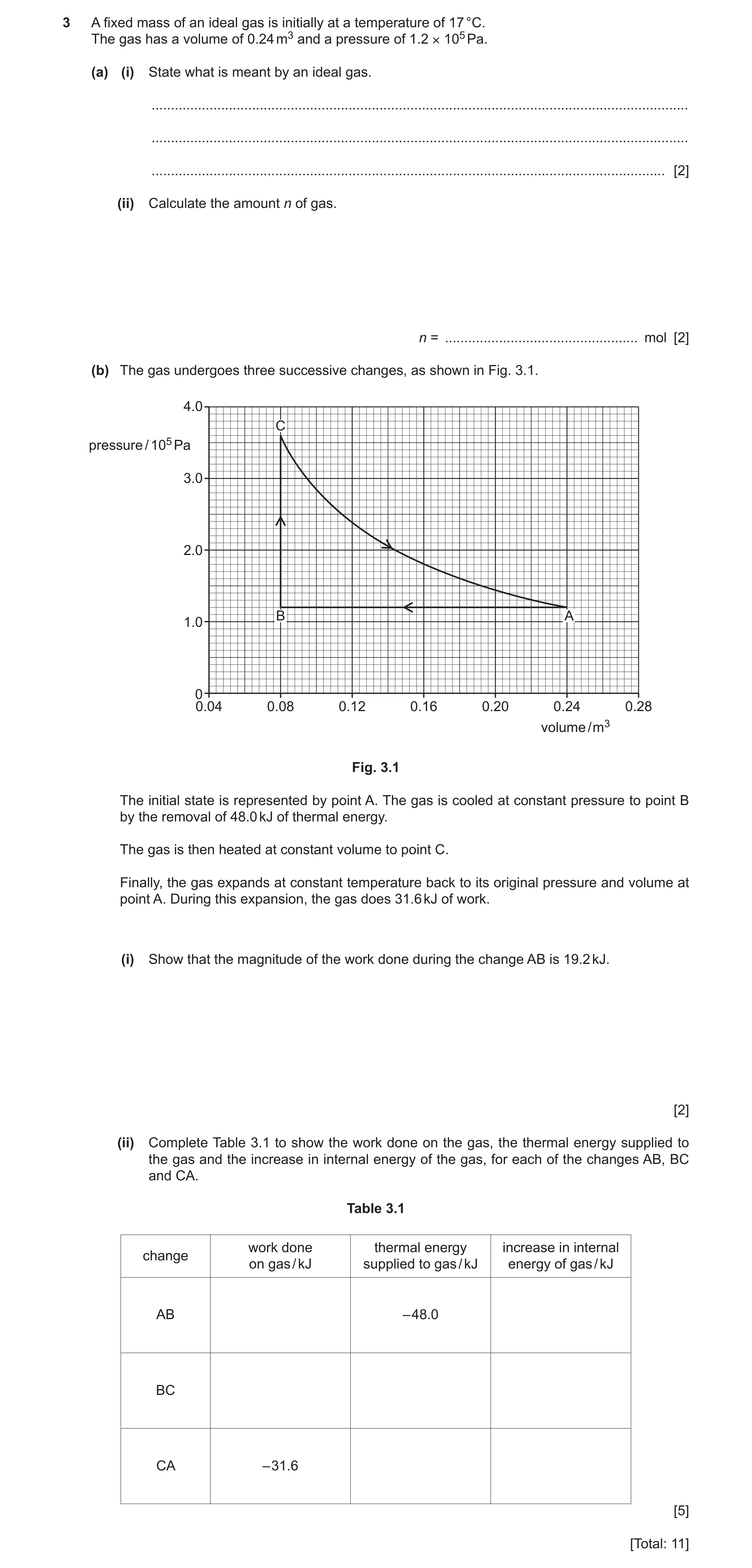
3 A fixed mass of an ideal gas is initially at a temperature of 17 °C. The gas has a volume of 0.24 m3 and a pressure of 1.2 × 10⁵ Pa. (a) (i) State what is meant by an ideal gas. … … … [2] (ii) Calculate the amount n of gas. n = … mol [2] (b) The gas undergoes three successive changes, as shown in Fig. 3.1. 4.0 C pressure / 105 Pa 3.0 2.0 B A 1.0 0 0.04 0.08 0.12 0.16 0.20 0.24 0.28 volume / m3 Fig. 3.1 The initial state is represented by point A. The gas is cooled at constant pressure to point B by the removal of 48.0 kJ of thermal energy. The gas is then heated at constant volume to point C. Finally, the gas expands at constant temperature back to its original pressure and volume at point A. During this expansion, the gas does 31.6 kJ of work. (i) Show that the magnitude of the work done during the change AB is 19.2 kJ. [2] (ii) Complete Table 3.1 to show the work done on the gas, the thermal energy supplied to the gas and the increase in internal energy of the gas, for each of the changes AB, BC and CA. Table 3.1 work done thermal energy increase in internal change on gas / kJ supplied to gas / kJ energy of gas / kJ AB – 48.0 BC CA – 31.6 [5] [Total: 11]
11 marks
Mark scheme: 3(a)(i) M1 where p = pressure, V = volume, T = thermodynamic temperature A1 3(a)(ii) T = (273 + 17) K C1 n = pV / RT = (1.2 105 0.24) / [8.31 (273 + 17)] = 12 mol A1 3(b)(i) work done = pV C1 = 1.2 105 (0.24 – 0.08) = 19200 J (= 19.2 kJ) A1 3(b)(ii) AB work done correct (19.2) A1 BC work done correct (0) A1 CA increase in internal energy correct (0) and CA thermal energy correct (31.6) A1 AB increase in internal energy calculated correctly from work done – 48.0 A1 BC increase in internal energy correctly calculated so the final column adds up to zero and BC thermal energy same as increase in internal energy (Fully correct table: AB 19.2 – 48.0 –28.8 BC 0 28.8 28.8 CA –31.6 31.6 0 ) A1
This question in 9702/43 May/June 2022
Q16 · The equation of state for an ideal gas can be written as pV = NkT 9702/42 Oct/Nov 2022
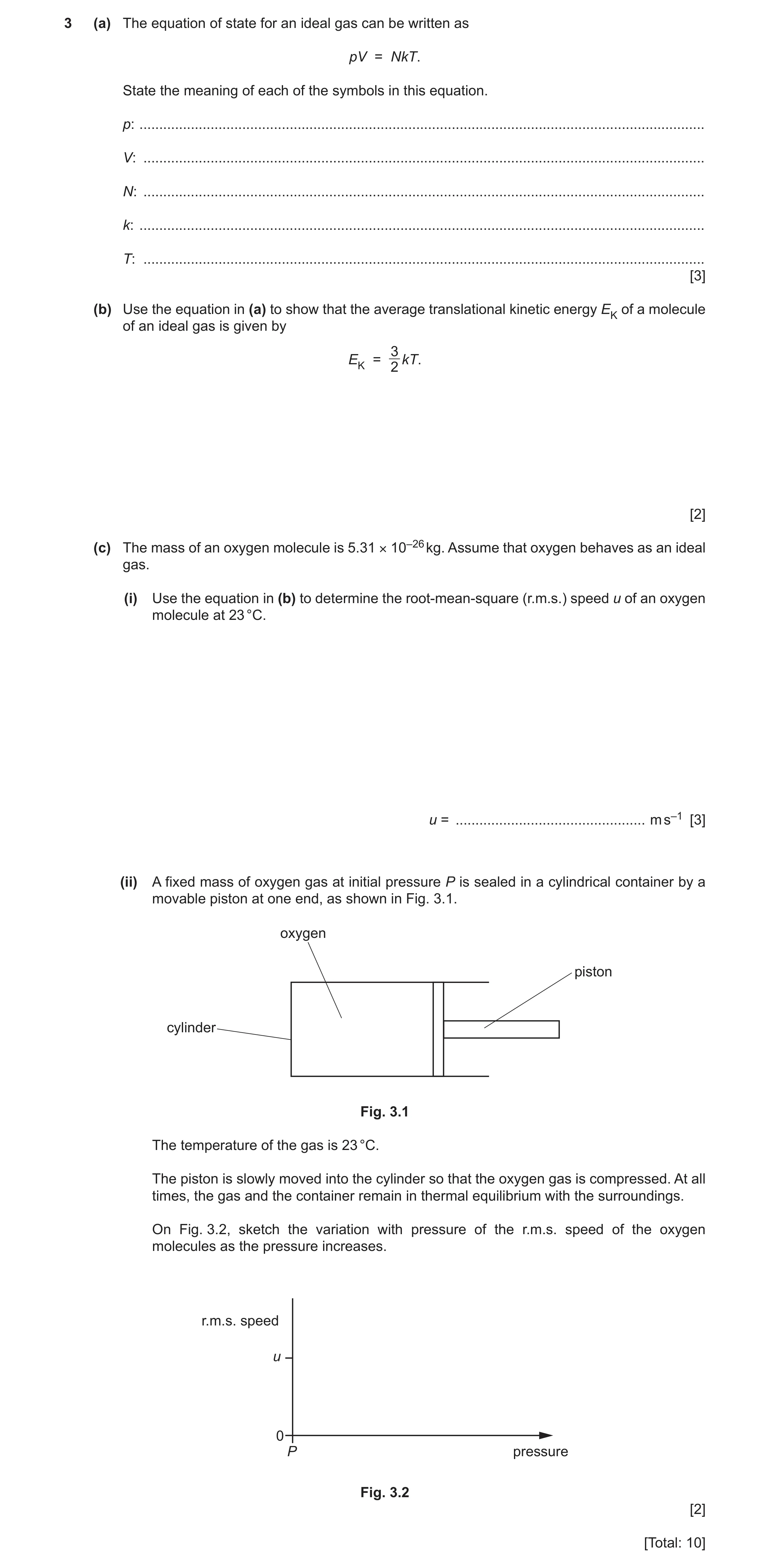
3 (a) The equation of state for an ideal gas can be written as pV = NkT. State the meaning of each of the symbols in this equation. p: … V: … N: … k: … T: … [3] (b) Use the equation in (a) to show that the average translational kinetic energy EK of a molecule of an ideal gas is given by 3 EK = 2 kT. [2] (c) The mass of an oxygen molecule is 5.31 × 10⁻²⁶ kg. Assume that oxygen behaves as an ideal gas. (i) Use the equation in (b) to determine the root-mean-square (r.m.s.) speed u of an oxygen molecule at 23 °C. u = … m s–1 [3] (ii) A fixed mass of oxygen gas at initial pressure P is sealed in a cylindrical container by a movable piston at one end, as shown in Fig. 3.1. oxygen piston cylinder Fig. 3.1 The temperature of the gas is 23 °C. The piston is slowly moved into the cylinder so that the oxygen gas is compressed. At all times, the gas and the container remain in thermal equilibrium with the surroundings. On Fig. 3.2, sketch the variation with pressure of the r.m.s. speed of the oxygen molecules as the pressure increases. r.m.s. speed u 0 P pressure Fig. 3.2 [2] [Total: 10]
10 marks
Mark scheme: 3(a) p = pressure (of gas), V = volume (of gas) and k = Boltzmann constant B1 N = number of molecules B1 T = thermodynamic temperature B1 3(b) (pV = NkT and pV = ⅓Nm<c2> leading to) NkT = ⅓Nm<c2> M1 algebra leading to (3/2)kT = ½m<c2> and use of ½m<c2> = EK leading to (3/2)kT = EK A1 3(c)(i) T = 296 K C1 ½m<c2> = (3/2)kT C1 ½ 5.31 10–26 u2 = (3/2) 1.38 10–23 296 u = 480 m s–1 A1 3(c)(ii) line passing through (P, u) B1 horizontal straight line B1
This question in 9702/42 Oct/Nov 2022
Q17 · State what is meant by an ideal gas 9702/42 Feb/March 2023
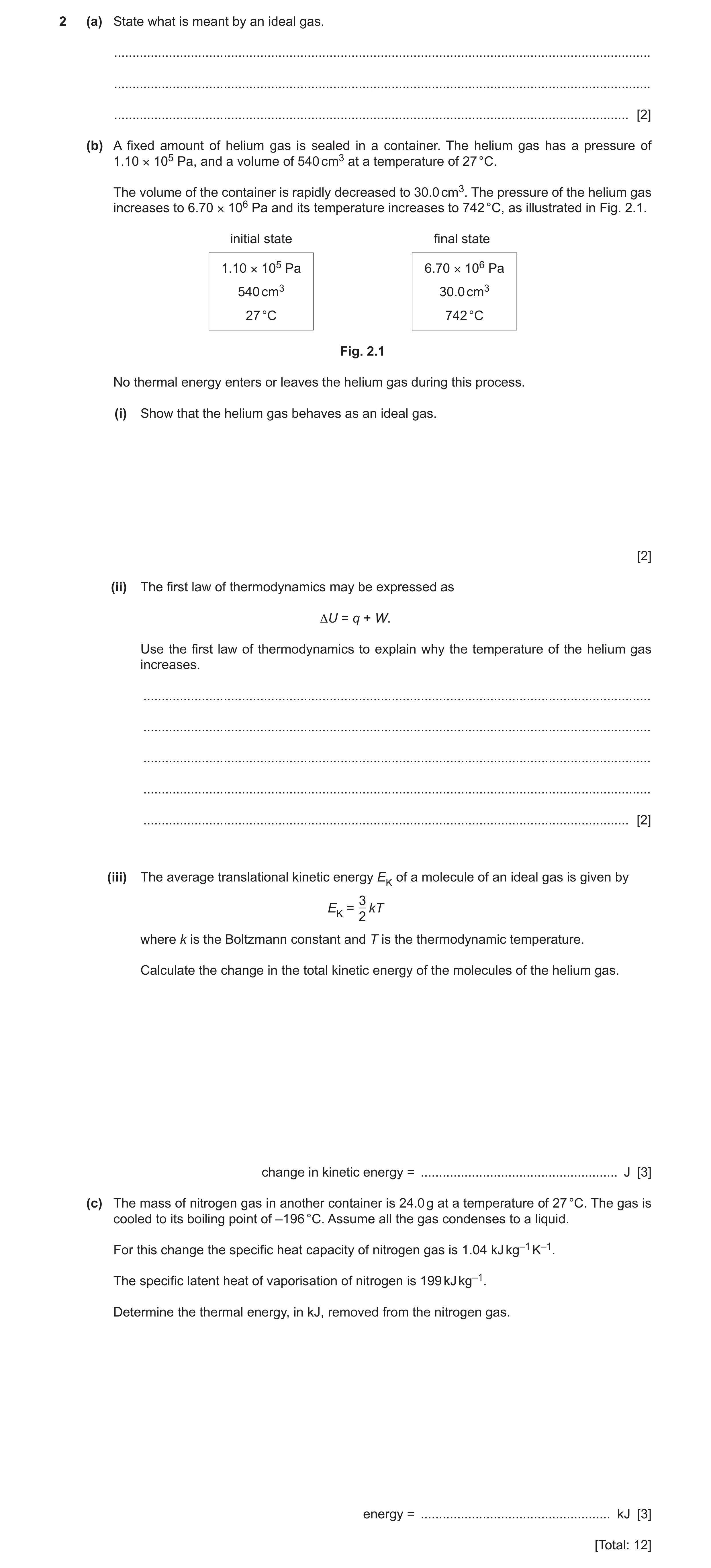
2 (a) State what is meant by an ideal gas. … … … [2] (b) A fixed amount of helium gas is sealed in a container. The helium gas has a pressure of 1.10 × 10⁵ Pa, and a volume of 540 cm3 at a temperature of 27 °C. The volume of the container is rapidly decreased to 30.0 cm3. The pressure of the helium gas increases to 6.70 × 10⁶ Pa and its temperature increases to 742 °C, as illustrated in Fig. 2.1. initial state final state 1.10 × 10⁵ Pa 6.70 × 10⁶ Pa 540 cm3 30.0 cm3 27 °C 742 °C Fig. 2.1 No thermal energy enters or leaves the helium gas during this process. (i) Show that the helium gas behaves as an ideal gas. [2] (ii) The first law of thermodynamics may be expressed as ΔU = q + W. Use the first law of thermodynamics to explain why the temperature of the helium gas increases. … … … … … [2] (iii) The average translational kinetic energy EK of a molecule of an ideal gas is given by 3 EK = kT 2 where k is the Boltzmann constant and T is the thermodynamic temperature. Calculate the change in the total kinetic energy of the molecules of the helium gas. change in kinetic energy = … J [3] (c) The mass of nitrogen gas in another container is 24.0 g at a temperature of 27 °C. The gas is cooled to its boiling point of –196 °C. Assume all the gas condenses to a liquid. For this change the specific heat capacity of nitrogen gas is 1.04 kJ kg–1 K–1. The specific latent heat of vaporisation of nitrogen is 199 kJ kg–1. Determine the thermal energy, in kJ, removed from the nitrogen gas. energy = … kJ [3] [Total: 12]
12 marks
Mark scheme: 2(a) gas for which pV T M1 where T is thermodynamic temperature A1 2(b)(i) evidence of two temperature conversions between C and K B1 two calculations shown, one for each state e.g. A1 1.10 105 540 10 −6 6.70 10 6 30 10 −6 = 0.198 and = 0.198 ( 273 + 27 ) ( 273 + 742 ) 2(b)(ii) work is done on the gas M1 internal energy increases (so temperature increases) A1 2(b)(iii) pV = NkT e.g. C1 1.10 10 5 540 10 −6 N = 1.38 10 −23 300 = 1.435 1022 Ek = (3 / 2) kTN 1.10 10 5 540 10 −6 C1 = (3 / 2) 1.38 1023 (742 – 27) 1.38 10 −23 300 = 212 J A1 2(c) E = mc and E = mL C1 = (27 + 196) or 223 C1 E = 0.0240 1.04 (27 + 196) + 0.0240 199 A1 = 10.3 kJ
This question in 9702/42 Feb/March 2023
Q18 · State two of the basic assumptions of the kinetic theory of gases 9702/41 May/June 2023
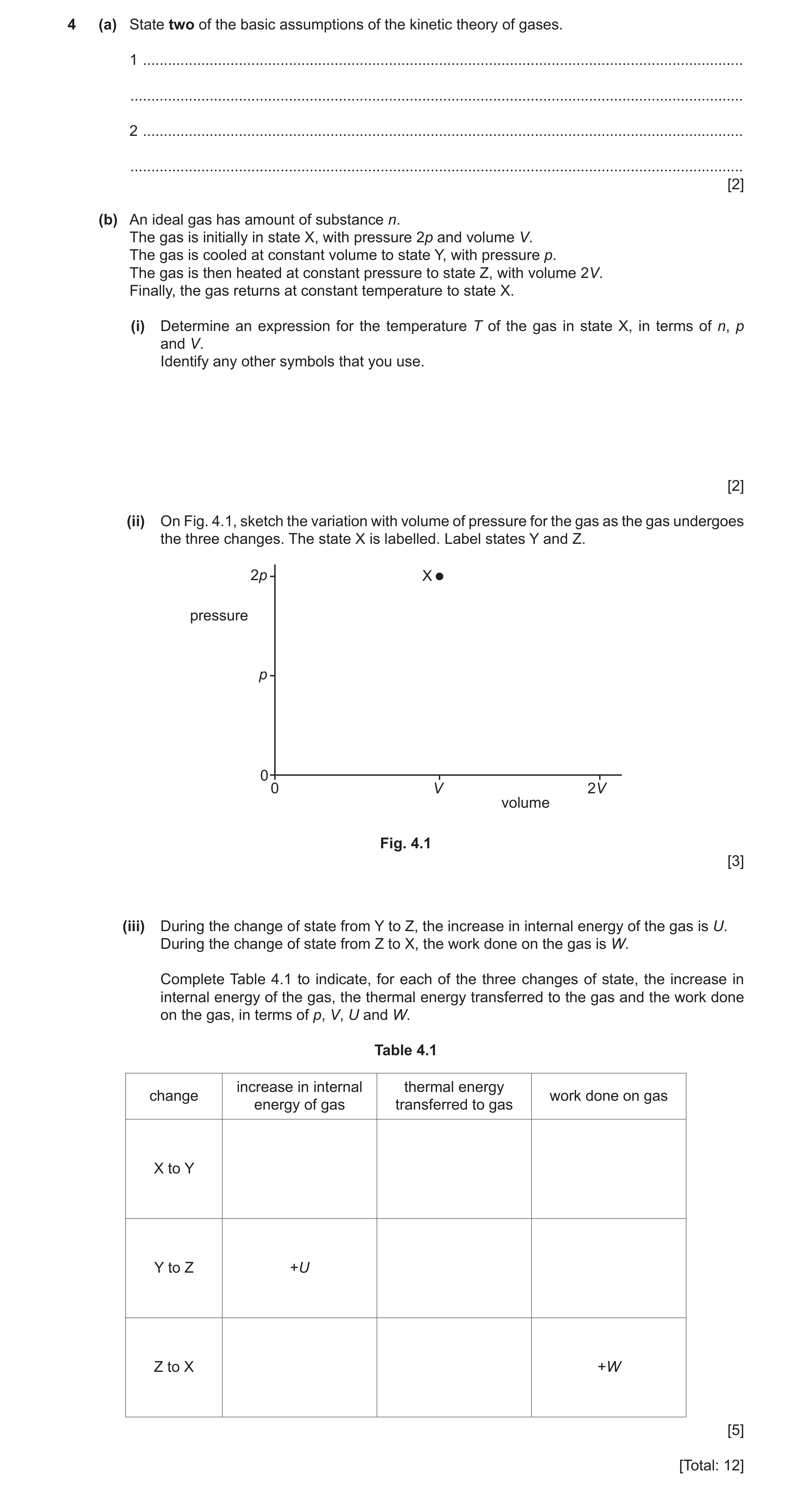
4 (a) State two of the basic assumptions of the kinetic theory of gases. 1 … … 2 … … [2] (b) An ideal gas has amount of substance n. The gas is initially in state X, with pressure 2p and volume V. The gas is cooled at constant volume to state Y, with pressure p. The gas is then heated at constant pressure to state Z, with volume 2V. Finally, the gas returns at constant temperature to state X. (i) Determine an expression for the temperature T of the gas in state X, in terms of n, p and V. Identify any other symbols that you use. [2] (ii) On Fig. 4.1, sketch the variation with volume of pressure for the gas as the gas undergoes the three changes. The state X is labelled. Label states Y and Z. 2p X pressure p 0 0 V 2V volume Fig. 4.1 [3] (iii) During the change of state from Y to Z, the increase in internal energy of the gas is U. During the change of state from Z to X, the work done on the gas is W. Complete Table 4.1 to indicate, for each of the three changes of state, the increase in internal energy of the gas, the thermal energy transferred to the gas and the work done on the gas, in terms of p, V, U and W. Table 4.1 increase in internal thermal energy change work done on gas energy of gas transferred to gas X to Y Y to Z +U Z to X +W [5] [Total: 12]
12 marks
Mark scheme: 4(a) particles are in (continuous) random motion particles have negligible volume (compared with the gas) negligible forces between particles (except during collisions) (all) collisions (perfectly) elastic time of collision negligible (in comparison with time between collisions) Any two points, 1 mark each B2 4(b)(i) (general starting equation) pV = nRT C1 T = (2pV / nR) where R is the (molar) gas constant A1 4(b)(ii) sketch: straight vertical line XY from (V, 2p) to (V, p) B1 straight horizontal line YZ from (V, p) to (2V, p) B1 curve with gradient increasing from Z to X from (2V, p) to (V, 2p) B1 4(b)(iii) XY work done on gas correct (= 0) B1 ZX increase in internal energy correct (= 0) B1 YZ work done on gas correct (= –pV) B1 XY increase in internal energy such that the increase in internal energy column adds up to zero B1 all three thermal energies transferred such that U = q + w in each row (completely correct answer: change U Q w X to Y Y to Z Z to X –U [ +U ] 0 –U U + pV –W 0 –pV [ +W ] ) B1
This question in 9702/41 May/June 2023
Q19 · State what is meant by an ideal gas 9702/42 May/June 2023
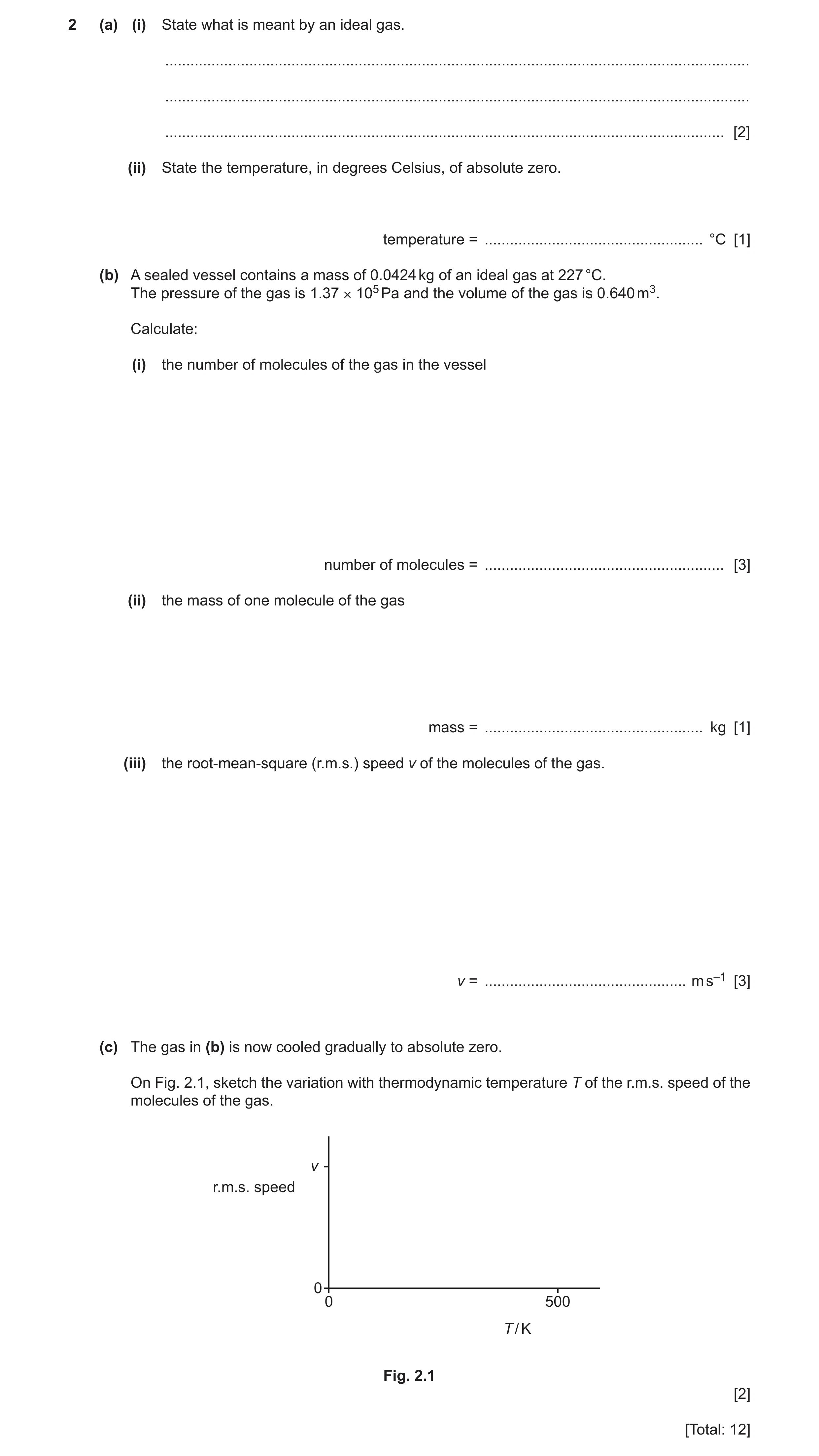
2 (a) (i) State what is meant by an ideal gas. … … … [2] (ii) State the temperature, in degrees Celsius, of absolute zero. temperature = … °C [1] (b) A sealed vessel contains a mass of 0.0424 kg of an ideal gas at 227 °C. The pressure of the gas is 1.37 × 10⁵ Pa and the volume of the gas is 0.640 m3. Calculate: (i) the number of molecules of the gas in the vessel number of molecules = … [3] (ii) the mass of one molecule of the gas mass = … kg [1] (iii) the root-mean-square (r.m.s.) speed v of the molecules of the gas. v = … m s–1 [3] (c) The gas in (b) is now cooled gradually to absolute zero. On Fig. 2.1, sketch the variation with thermodynamic temperature T of the r.m.s. speed of the molecules of the gas. v r.m.s. speed 0 0 500 T / K Fig. 2.1 [2] [Total: 12]
12 marks
Mark scheme: 2(a)(i) M1 where T is thermodynamic temperature A1 2(a)(ii) temperature = –273.15 °C A1 2(b)(i) pV = NkT C1 N = (1.37 105 0.640) / (1.38 10–23 (227 + 273)) C1 = 1.27 1025 A1 2(b)(ii) mass = 0.0424 / (1.27 1025) = 3.34 10–27 kg A1 2(b)(iii) ½m<c2> = (3 / 2)kT C1 3.34 10–27 v2 = 3 1.38 10–23 500 C1 v = 2490 m s–1 A1 or pV = ⅓(Nm) <c2> and Nm = mass of gas (C1) 0.0424 v2 = 3 1.37 105 0.640 (C1) v = 2490 m s–1 (A1) 2(c) sketch: line from (0, 0) to (500, v) B1 line with decreasing positive gradient throughout B1
This question in 9702/42 May/June 2023
Q20 · State two of the basic assumptions of the kinetic theory of gases 9702/43 May/June 2023
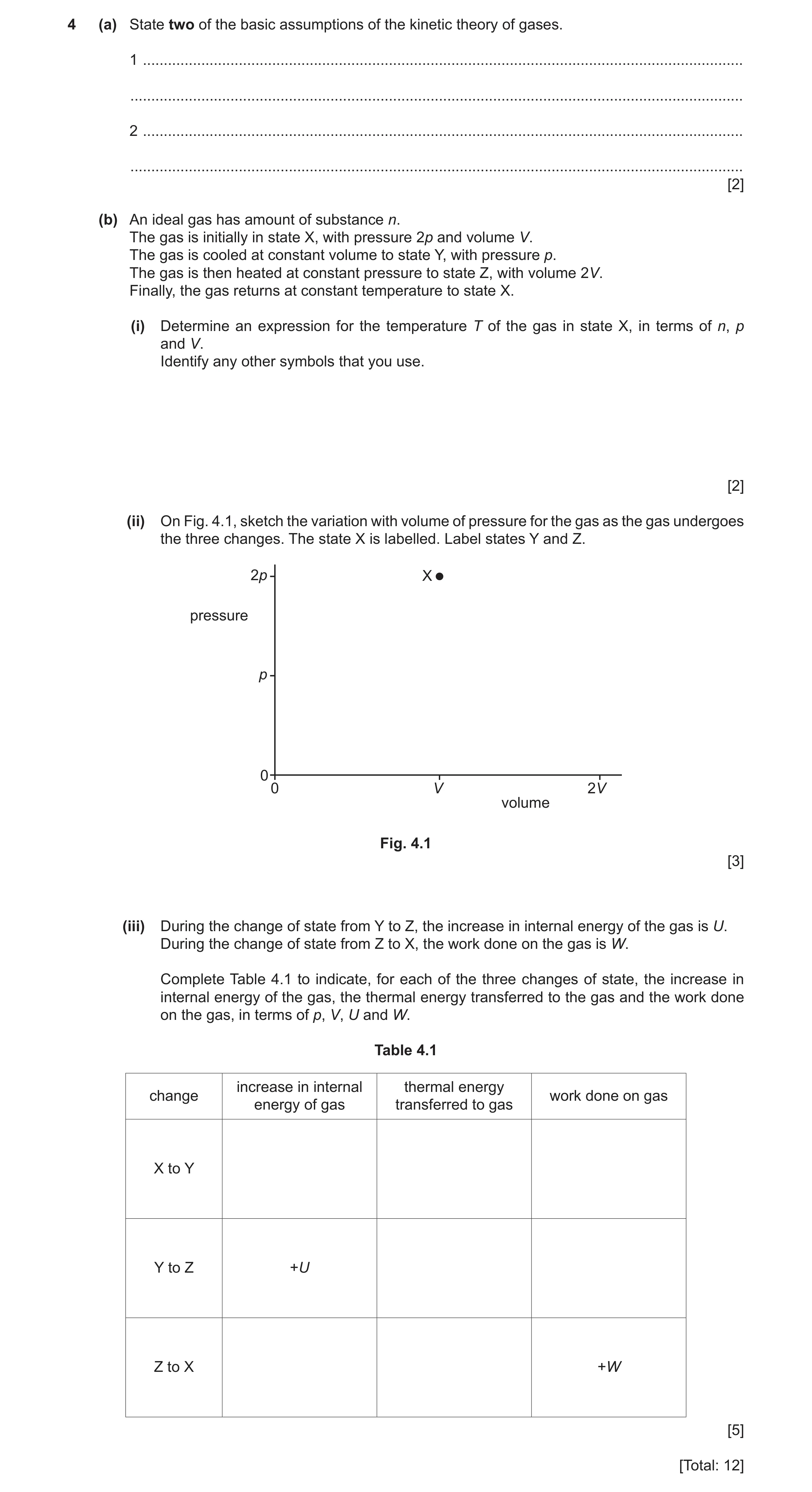
4 (a) State two of the basic assumptions of the kinetic theory of gases. 1 … … 2 … … [2] (b) An ideal gas has amount of substance n. The gas is initially in state X, with pressure 2p and volume V. The gas is cooled at constant volume to state Y, with pressure p. The gas is then heated at constant pressure to state Z, with volume 2V. Finally, the gas returns at constant temperature to state X. (i) Determine an expression for the temperature T of the gas in state X, in terms of n, p and V. Identify any other symbols that you use. [2] (ii) On Fig. 4.1, sketch the variation with volume of pressure for the gas as the gas undergoes the three changes. The state X is labelled. Label states Y and Z. 2p X pressure p 0 0 V 2V volume Fig. 4.1 [3] (iii) During the change of state from Y to Z, the increase in internal energy of the gas is U. During the change of state from Z to X, the work done on the gas is W. Complete Table 4.1 to indicate, for each of the three changes of state, the increase in internal energy of the gas, the thermal energy transferred to the gas and the work done on the gas, in terms of p, V, U and W. Table 4.1 increase in internal thermal energy change work done on gas energy of gas transferred to gas X to Y Y to Z +U Z to X +W [5] [Total: 12]
12 marks
Mark scheme: 4(a) particles are in (continuous) random motion particles have negligible volume (compared with the gas) negligible forces between particles (except during collisions) (all) collisions (perfectly) elastic time of collision negligible (in comparison with time between collisions) Any two points, 1 mark each B2 4(b)(i) (general starting equation) pV = nRT C1 T = (2pV / nR) where R is the (molar) gas constant A1 4(b)(ii) sketch: straight vertical line XY from (V, 2p) to (V, p) B1 straight horizontal line YZ from (V, p) to (2V, p) B1 curve with gradient increasing from Z to X from (2V, p) to (V, 2p) B1 4(b)(iii) XY work done on gas correct (= 0) B1 ZX increase in internal energy correct (= 0) B1 YZ work done on gas correct (= –pV) B1 XY increase in internal energy such that the increase in internal energy column adds up to zero B1 all three thermal energies transferred such that U = q + w in each row (completely correct answer: change U Q w X to Y Y to Z Z to X –U [ +U ] 0 –U U + pV –W 0 –pV [ +W ] ) B1
This question in 9702/43 May/June 2023
Q21 · State what is meant by an ideal gas 9702/41 May/June 2024
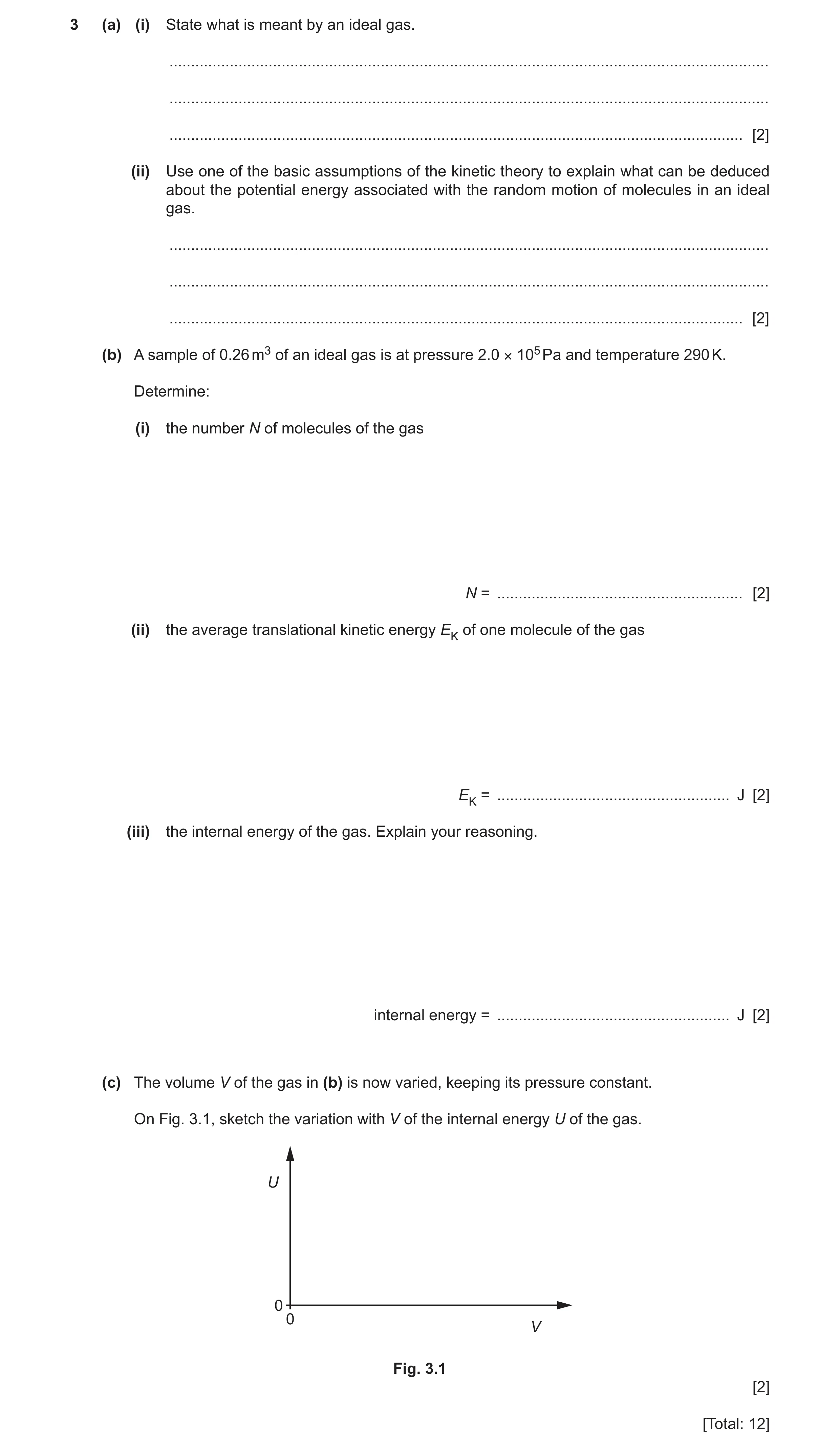
3 (a) (i) State what is meant by an ideal gas. … … … [2] (ii) Use one of the basic assumptions of the kinetic theory to explain what can be deduced about the potential energy associated with the random motion of molecules in an ideal gas. … … … [2] (b) A sample of 0.26 m3 of an ideal gas is at pressure 2.0 × 10⁵ Pa and temperature 290 K. Determine: (i) the number N of molecules of the gas N = … [2] (ii) the average translational kinetic energy EK of one molecule of the gas EK = … J [2] (iii) the internal energy of the gas. Explain your reasoning. internal energy = … J [2] (c) The volume V of the gas in (b) is now varied, keeping its pressure constant. On Fig. 3.1, sketch the variation with V of the internal energy U of the gas. U 0 0 V Fig. 3.1 [2] [Total: 12]
12 marks
Mark scheme: 3(a)(i) M1 where T is thermodynamic temperature A1 3(a)(ii) no intermolecular forces B1 (so) potential energy is zero B1 3(b)(i) pV = NkT C1 N = (2.0 105 0.26) / (1.38 10–23 290) = 1.3 1025 A1 3(b)(ii) EK = (3/2) kT C1 EK = (3/2) 1.38 10–23 290 = 6.0 10–21 J A1 3(b)(iii) internal energy = total KE + PE of molecules or PE = 0 so internal energy = total KE of molecules B1 internal energy = 1.3 1025 6.0 10–21 = 7.8 104 J A1 3(c) straight line with positive gradient B1 line passing through the origin B1
This question in 9702/41 May/June 2024
Q22 · State what is meant by an ideal gas 9702/43 May/June 2024
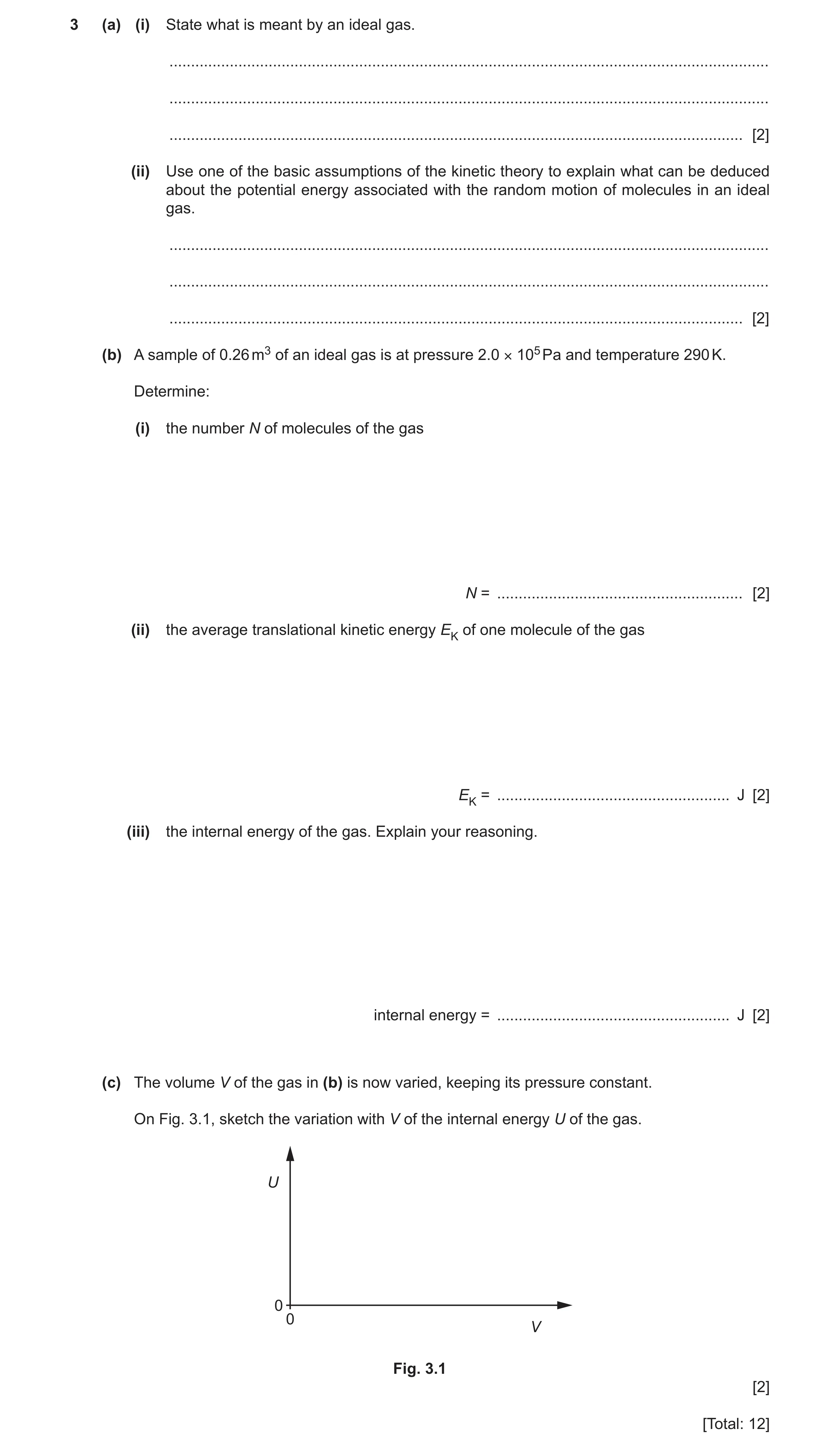
3 (a) (i) State what is meant by an ideal gas. … … … [2] (ii) Use one of the basic assumptions of the kinetic theory to explain what can be deduced about the potential energy associated with the random motion of molecules in an ideal gas. … … … [2] (b) A sample of 0.26 m3 of an ideal gas is at pressure 2.0 × 10⁵ Pa and temperature 290 K. Determine: (i) the number N of molecules of the gas N = … [2] (ii) the average translational kinetic energy EK of one molecule of the gas EK = … J [2] (iii) the internal energy of the gas. Explain your reasoning. internal energy = … J [2] (c) The volume V of the gas in (b) is now varied, keeping its pressure constant. On Fig. 3.1, sketch the variation with V of the internal energy U of the gas. U 0 0 V Fig. 3.1 [2] [Total: 12]
12 marks
Mark scheme: 3(a)(i) M1 where T is thermodynamic temperature A1 3(a)(ii) no intermolecular forces B1 (so) potential energy is zero B1 3(b)(i) pV = NkT C1 N = (2.0 105 0.26) / (1.38 10–23 290) = 1.3 1025 A1 3(b)(ii) EK = (3/2) kT C1 EK = (3/2) 1.38 10–23 290 = 6.0 10–21 J A1 3(b)(iii) internal energy = total KE + PE of molecules or PE = 0 so internal energy = total KE of molecules B1 internal energy = 1.3 1025 6.0 10–21 = 7.8 104 J A1 3(c) straight line with positive gradient B1 line passing through the origin B1
This question in 9702/43 May/June 2024
Q23 · State what is meant by the Avogadro constant 9702/41 Oct/Nov 2024
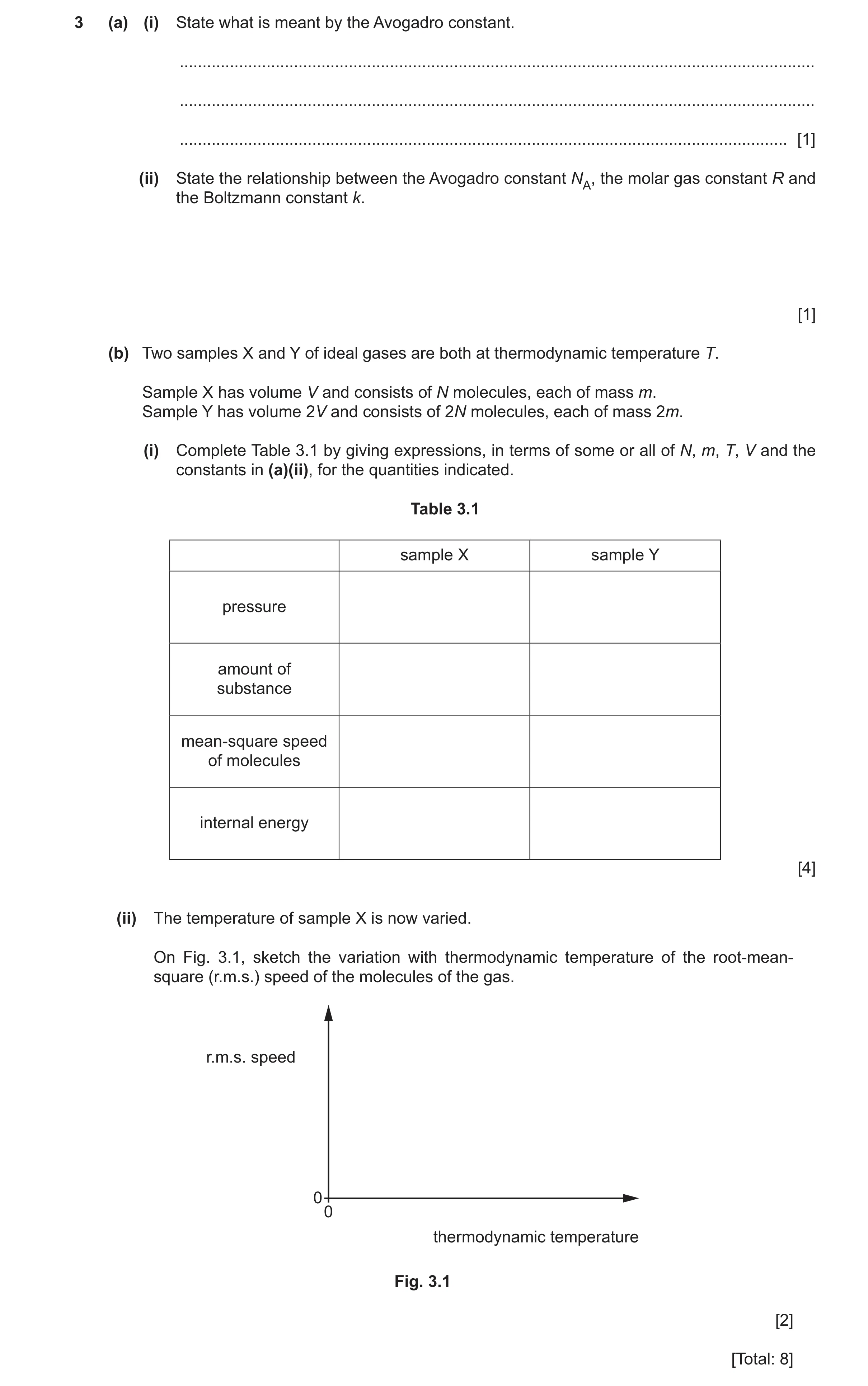
3 (a) (i) State what is meant by the Avogadro constant. … … … [1] (ii) State the relationship between the Avogadro constant NA, the molar gas constant R and the Boltzmann constant k. [1] (b) Two samples X and Y of ideal gases are both at thermodynamic temperature T. Sample X has volume V and consists of N molecules, each of mass m. Sample Y has volume 2V and consists of 2N molecules, each of mass 2m. (i) Complete Table 3.1 by giving expressions, in terms of some or all of N, m, T, V and the constants in (a)(ii), for the quantities indicated. Table 3.1 sample X sample Y pressure amount of substance mean-square speed of molecules internal energy [4] (ii) The temperature of sample X is now varied. On Fig. 3.1, sketch the variation with thermodynamic temperature of the root-mean- square (r.m.s.) speed of the molecules of the gas. r.m.s. speed 0 0 thermodynamic temperature Fig. 3.1 [2] [Total: 8]
8 marks
Mark scheme: 3(a)(i) number of particles per unit amount of substance B1 3(a)(ii) NA = R / k B1 3(b)(i) X pressure and Y pressure both = NkT / V B1 X amount = N / NA and Y amount = 2N / NA B1 X mean-square speed = 3kT / m and Y mean-square speed = 3kT / 2m B1 X internal energy = 3NkT / 2 and Y internal energy = 3NkT B1 3(b)(ii) line passing through the origin and not returning to either axis B1 curve with positive decreasing gradient B1
This question in 9702/41 Oct/Nov 2024
Q24 · State what is meant by the Avogadro constant 9702/43 Oct/Nov 2024
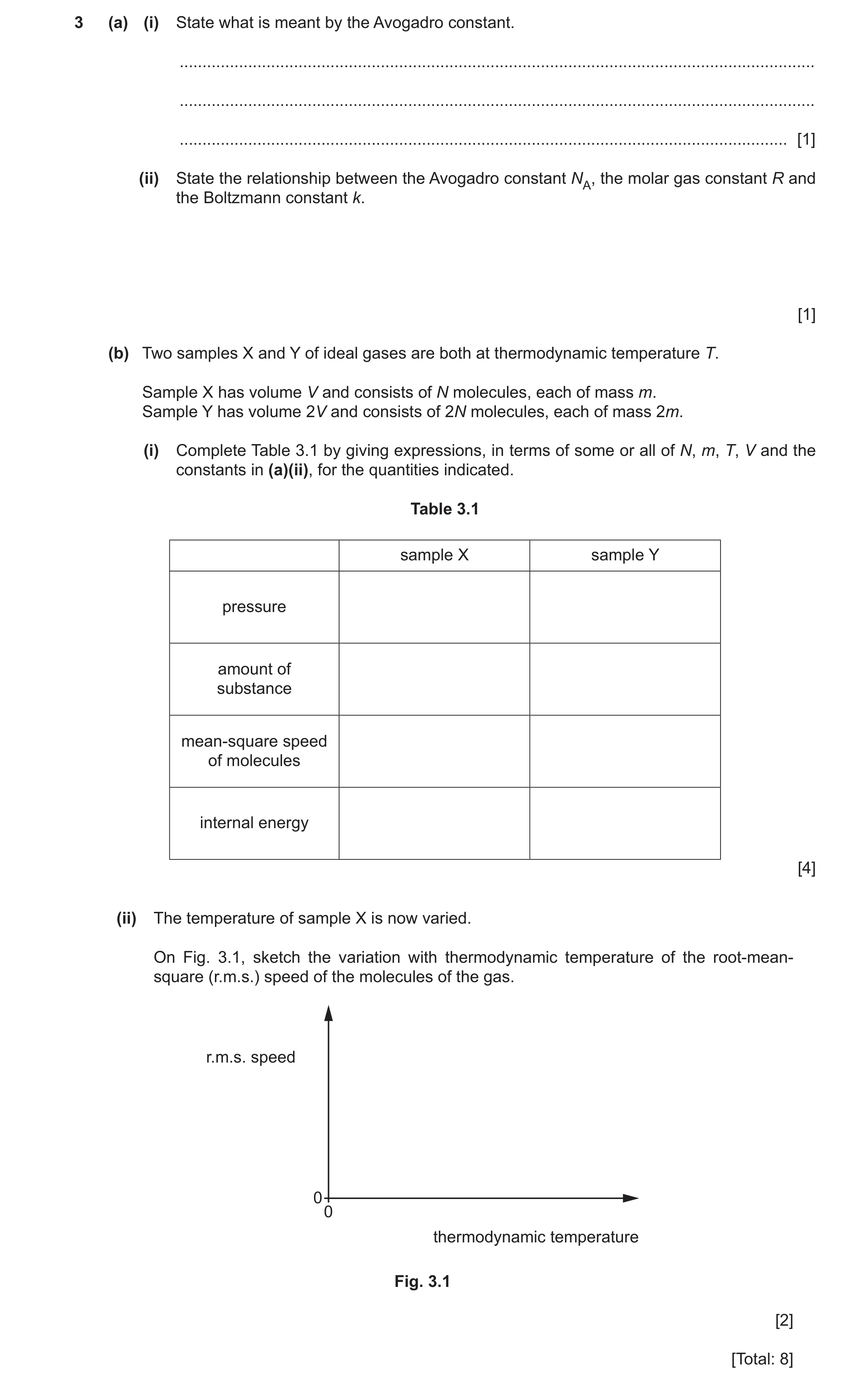
3 (a) (i) State what is meant by the Avogadro constant. … … … [1] (ii) State the relationship between the Avogadro constant NA, the molar gas constant R and the Boltzmann constant k. [1] (b) Two samples X and Y of ideal gases are both at thermodynamic temperature T. Sample X has volume V and consists of N molecules, each of mass m. Sample Y has volume 2V and consists of 2N molecules, each of mass 2m. (i) Complete Table 3.1 by giving expressions, in terms of some or all of N, m, T, V and the constants in (a)(ii), for the quantities indicated. Table 3.1 sample X sample Y pressure amount of substance mean-square speed of molecules internal energy [4] (ii) The temperature of sample X is now varied. On Fig. 3.1, sketch the variation with thermodynamic temperature of the root-mean- square (r.m.s.) speed of the molecules of the gas. r.m.s. speed 0 0 thermodynamic temperature Fig. 3.1 [2] [Total: 8]
8 marks
Mark scheme: 3(a)(i) number of particles per unit amount of substance B1 3(a)(ii) NA = R / k B1 3(b)(i) X pressure and Y pressure both = NkT / V B1 X amount = N / NA and Y amount = 2N / NA B1 X mean-square speed = 3kT / m and Y mean-square speed = 3kT / 2m B1 X internal energy = 3NkT / 2 and Y internal energy = 3NkT B1 3(b)(ii) line passing through the origin and not returning to either axis B1 curve with positive decreasing gradient B1
This question in 9702/43 Oct/Nov 2024
Q25 · The equation of state for an ideal gas may be written as pVA = NBT where p is the… 9702/42 May/June 2025
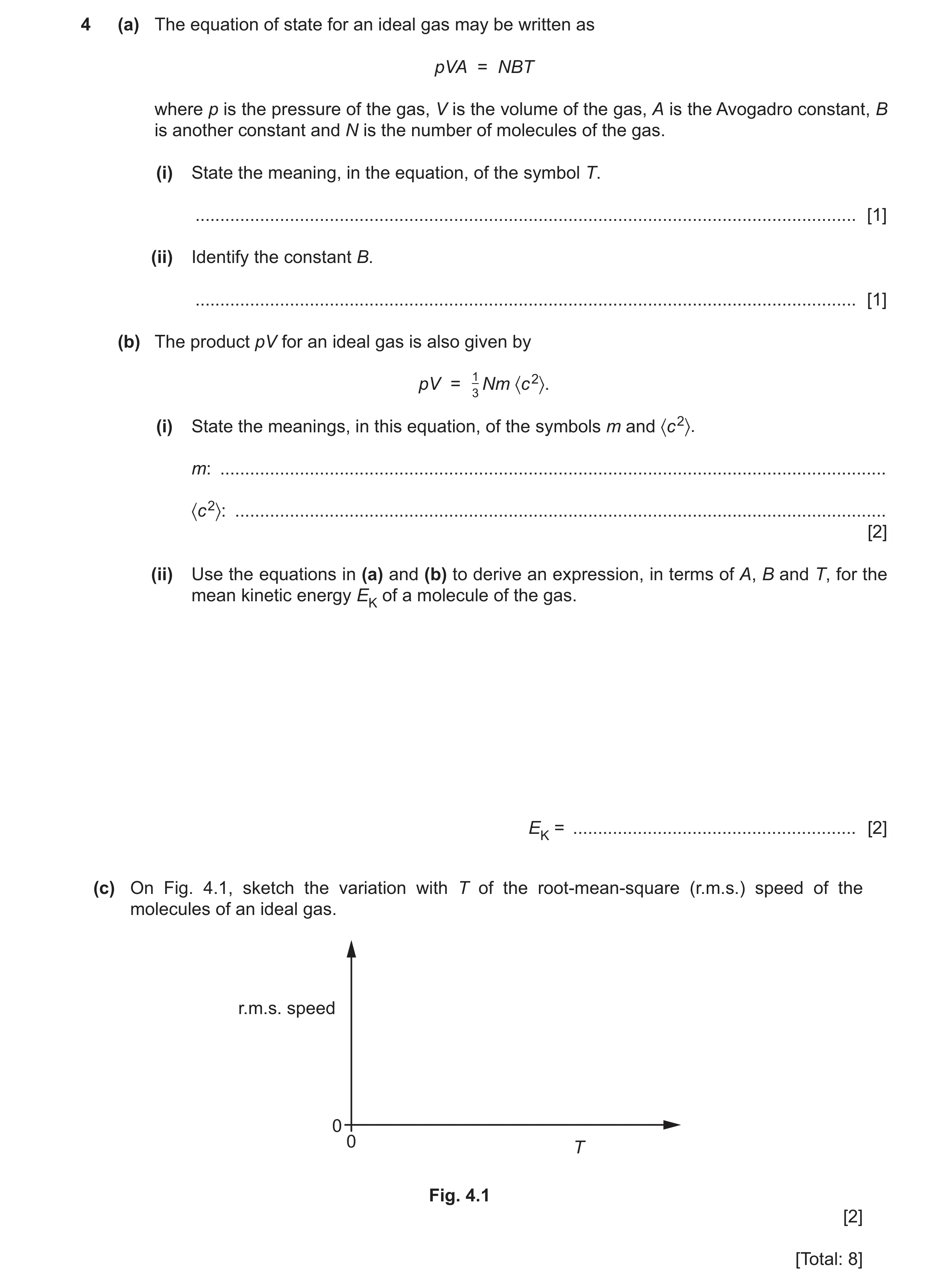
4 (a) The equation of state for an ideal gas may be written as pVA = NBT where p is the pressure of the gas, V is the volume of the gas, A is the Avogadro constant, B is another constant and N is the number of molecules of the gas. (i) State the meaning, in the equation, of the symbol T. … [1] (ii) Identify the constant B. … [1] (b) The product pV for an ideal gas is also given by pV = 1 Nm 〈c 2〉. 3 (i) State the meanings, in this equation, of the symbols m and 〈c 2〉. m: … 〈c 2〉: … [2] (ii) Use the equations in (a) and (b) to derive an expression, in terms of A, B and T, for the mean kinetic energy EK of a molecule of the gas. EK = … [2] (c) On Fig. 4.1, sketch the variation with T of the root-mean-square (r.m.s.) speed of the molecules of an ideal gas. r.m.s. speed 0 0 T Fig. 4.1 [2] [Total: 8]
8 marks
Mark scheme: 4(a)(i) thermodynamic temperature B1 4(a)(ii) molar gas constant B1 4(b)(i) m: mass of one molecule (of the gas) B1 〈c2〉: mean-square speed (of molecules) B1 4(b)(ii) 1 M1 NBT / A = Nm〈c2〉 3 1 A1 clear use of EK = m〈c2〉 leading to EK = 3BT / 2A 2 4(c) line with positive gradient passing through the origin B1 smooth curve with decreasing positive gradient B1
This question in 9702/42 May/June 2025
Q26 · State Newton’s law of gravitation 9702/42 Oct/Nov 2025
2 (a) State Newton’s law of gravitation. … … … [2] (b) One of the basic assumptions of the kinetic theory of gases is that there are no forces exerted between the molecules of the gas except during collisions. State two other basic assumptions of the kinetic theory of gases. 1 … … 2 … … [2] (c) Hydrogen gas consists of molecules that each have a mass of 3.34 × 10⁻²⁷ kg. Hydrogen may be considered to be an ideal gas. A spherical balloon contains 0.0160 mol of hydrogen gas at a temperature of 282 K. At this temperature, the volume of gas in the balloon is 1.87 × 10– 4 m3. (i) Determine the pressure of the gas. pressure = … Pa [2] (ii) Estimate the average separation of the hydrogen molecules in the gas. average separation = … m [2] (d) (i) Use your answer in (c)(ii) to calculate the average gravitational force between adjacent molecules in hydrogen gas. average force = … N [2] (ii) By considering the weight of a molecule, suggest with a reason whether your answer in (d)(i) is consistent with the assumption of the kinetic theory of gases that there are no forces exerted between molecules. … … … [1] [Total: 11]
11 marks
Mark scheme: 2(a) (gravitational) force is (directly) proportional to product of masses B1 force (between point masses) is inversely proportional to the square of their separation B1 2(b) Any two points from: B2 • molecules are in continuous random motion • molecules have negligible volume compared with volume of gas • collisions (involving molecules) are (perfectly) elastic • collisions (of molecules) are instantaneous 2(c)(i) pV = nRT C1 p = (0.0160 8.31 282) / (1.87 10–4) A1 = 2.01 105 Pa 2(c)(ii) number of molecules = 0.0160 6.02 1023 C1 separation = 3√[(1.87 10–4) / (0.0160 6.02 1023)] A1 = 2.7 10–9 m (allow any answer that is 3 10–9 m to one significant figure) 2(d)(i) F = 6.67 10–11 (3.34 10–27)2 / (2.7 10–9)2 C1 = 1.0 10–46 N A1 2(d)(ii) numerical comparison between 10–46 N (F) and 10–26 N (the weight of molecule) leading to a conclusion that the assumption B1 is supported
This question in 9702/42 Oct/Nov 2025
Q27 · State what is meant by two objects being in thermal equilibrium 9702/42 Oct/Nov 2025
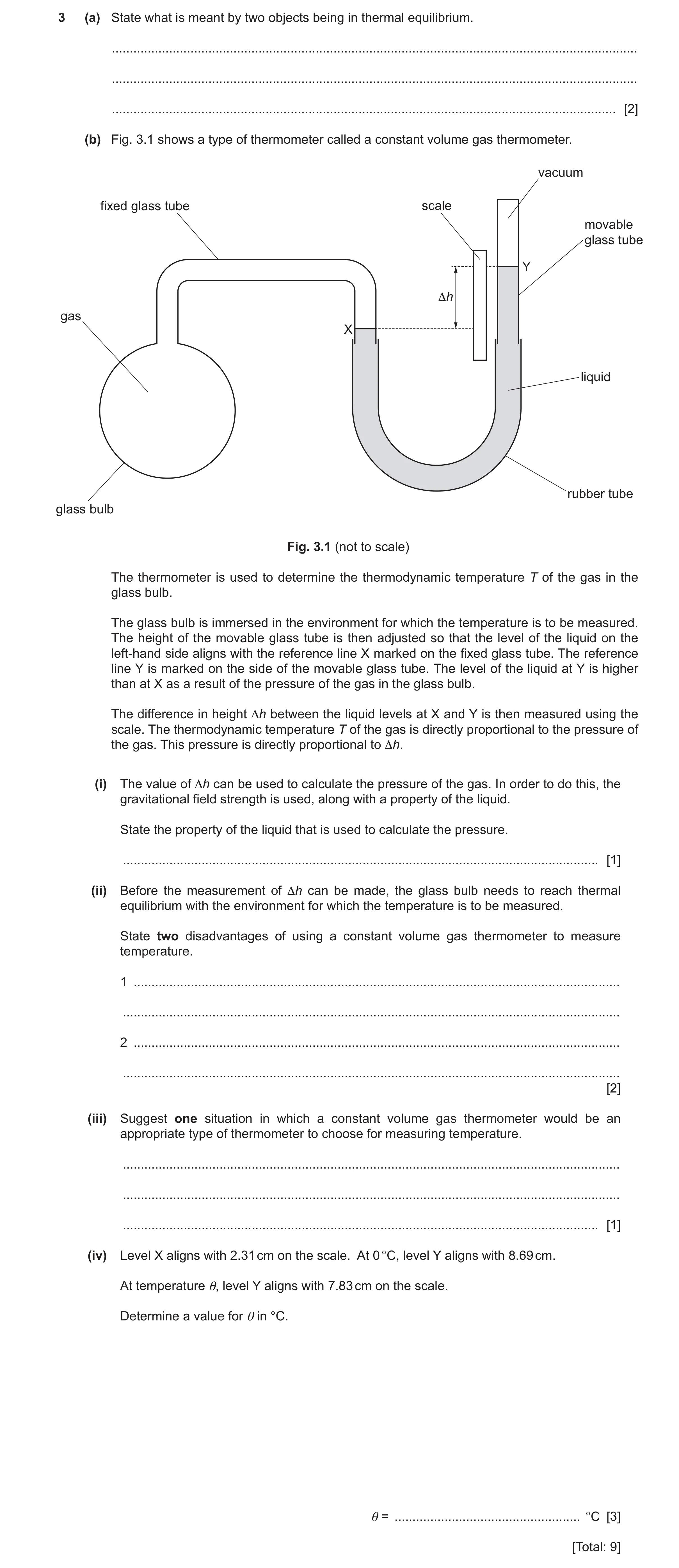
3 (a) State what is meant by two objects being in thermal equilibrium. … … … [2] (b) Fig. 3.1 shows a type of thermometer called a constant volume gas thermometer. vacuum fixed glass tube scale movable glass tube Y Δh gas X liquid rubber tube glass bulb Fig. 3.1 (not to scale) The thermometer is used to determine the thermodynamic temperature T of the gas in the glass bulb. The glass bulb is immersed in the environment for which the temperature is to be measured. The height of the movable glass tube is then adjusted so that the level of the liquid on the left-hand side aligns with the reference line X marked on the fixed glass tube. The reference line Y is marked on the side of the movable glass tube. The level of the liquid at Y is higher than at X as a result of the pressure of the gas in the glass bulb. The difference in height Δh between the liquid levels at X and Y is then measured using the scale. The thermodynamic temperature T of the gas is directly proportional to the pressure of the gas. This pressure is directly proportional to Δh. (i) The value of Δh can be used to calculate the pressure of the gas. In order to do this, the gravitational field strength is used, along with a property of the liquid. State the property of the liquid that is used to calculate the pressure. … [1] (ii) Before the measurement of Δh can be made, the glass bulb needs to reach thermal equilibrium with the environment for which the temperature is to be measured. State two disadvantages of using a constant volume gas thermometer to measure temperature. 1 … … 2 … … [2] (iii) Suggest one situation in which a constant volume gas thermometer would be an appropriate type of thermometer to choose for measuring temperature. … … … [1] (iv) Level X aligns with 2.31 cm on the scale. At 0 °C, level Y aligns with 8.69 cm. At temperature θ, level Y aligns with 7.83 cm on the scale. Determine a value for θ in °C. θ = … °C [3] [Total: 9]
9 marks
Mark scheme: 3(a) same temperature B1 no net transfer of thermal energy (between them) B1 3(b)(i) density B1 3(b)(ii) Any two points from: B2 • large response time / large time to reach equilibrium or cannot measure rapidly changing temperatures • reaching equilibrium requires (significant) transfer of energy or changes temperature of environment being measured or cannot measure temperature of small objects • bulky / difficult to set up or difficult to take readings / scale not calibrated to read temperature or cannot measure temperature of solid objects 3(b)(iii) substance with large mass B1 or temperature that is constant (over time) or to calibrate other thermometers (in a laboratory) 3(b)(iv) 0 °C = 273 K C1 T = 273 (7.83 – 2.31) / (8.69 – 2.31) C1 ( = 236 K) = 236 – 273 A1 = – 37 °C
This question in 9702/42 Oct/Nov 2025
Q28 · A cylinder contains a fixed mass of an ideal gas at pressure 2Y and volume 6X 9702/42 Oct/Nov 2025
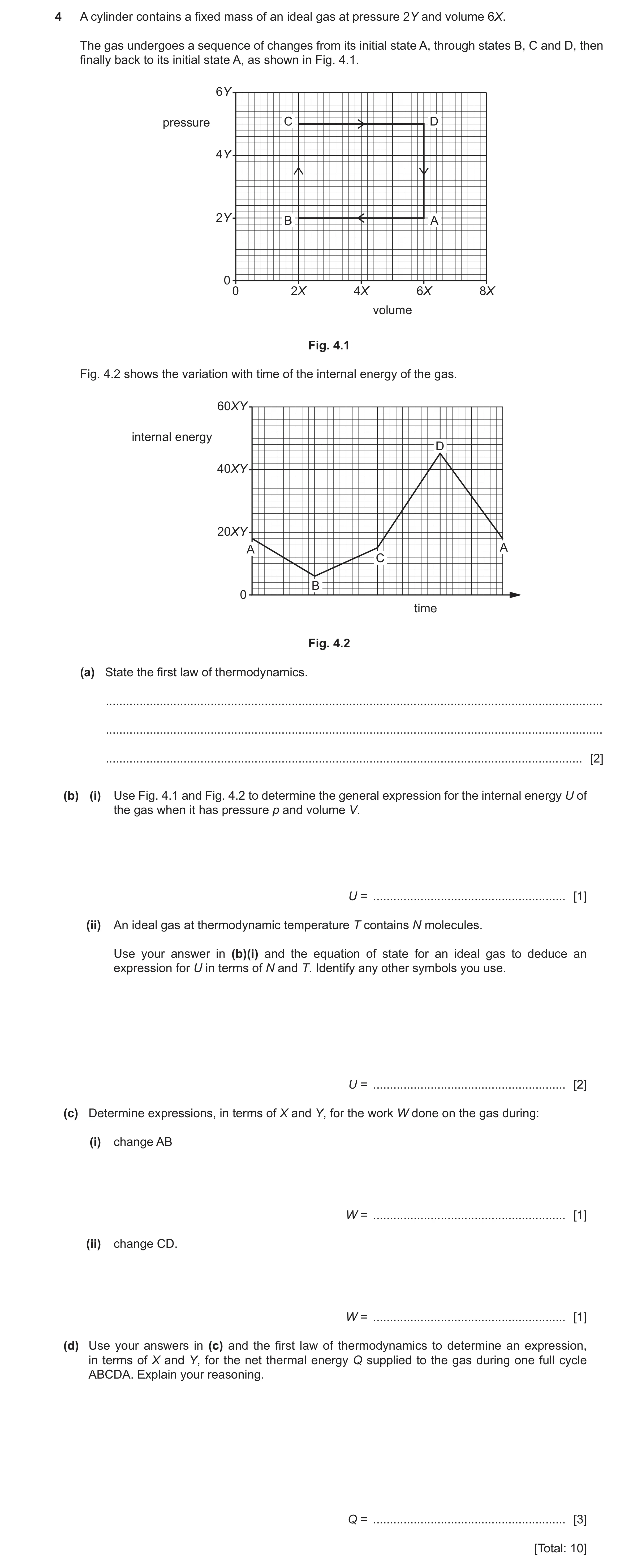
4 A cylinder contains a fixed mass of an ideal gas at pressure 2Y and volume 6X. The gas undergoes a sequence of changes from its initial state A, through states B, C and D, then finally back to its initial state A, as shown in Fig. 4.1. 6Y pressure C D 4Y 2Y B A 0 0 2X 4X 6X 8X volume Fig. 4.1 Fig. 4.2 shows the variation with time of the internal energy of the gas. 60XY internal energy D 40XY 20XY A A C B 0 time Fig. 4.2 (a) State the first law of thermodynamics. … … … [2] (b) (i) Use Fig. 4.1 and Fig. 4.2 to determine the general expression for the internal energy U of the gas when it has pressure p and volume V. U = … [1] (ii) An ideal gas at thermodynamic temperature T contains N molecules. Use your answer in (b)(i) and the equation of state for an ideal gas to deduce an expression for U in terms of N and T. Identify any other symbols you use. U = … [2] (c) Determine expressions, in terms of X and Y, for the work W done on the gas during: (i) change AB W = … [1] (ii) change CD. W = … [1] (d) Use your answers in (c) and the first law of thermodynamics to determine an expression, in terms of X and Y, for the net thermal energy Q supplied to the gas during one full cycle ABCDA. Explain your reasoning. Q = … [3] [Total: 10]
10 marks
Mark scheme: 4(a) change in internal energy = work done + energy transfer by heating C1 increase in internal energy = work done on system + energy transferred to the system by heating A1 4(b)(i) U = (3 / 2) pV A1 4(b)(ii) pV = NkT and k identified as Boltzmann constant B1 U = (3 / 2) NkT A1 4(c)(i) W = (+)8XY A1 4(c)(ii) W = –20XY A1 4(d) work done during stages BC and DA = 0 B1 change in internal energy (over complete cycle) = 0 C1 thermal energy supplied = 20XY – 8XY A1 = (+)12XY
This question in 9702/42 Oct/Nov 2025
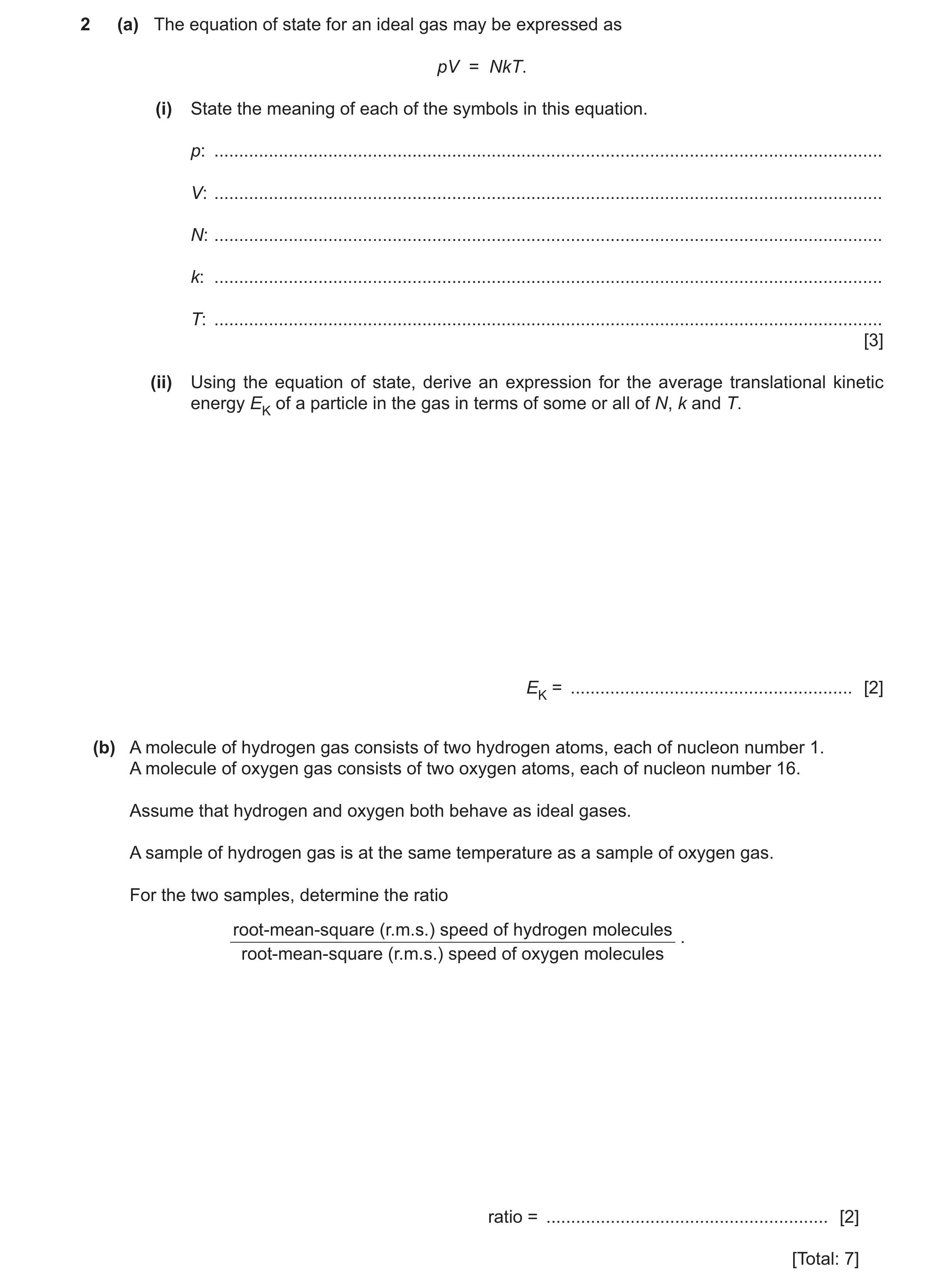
Q29 · The equation of state for an ideal gas may be expressed as pV = NkT 9702/44 Oct/Nov 2025
2 (a) The equation of state for an ideal gas may be expressed as pV = NkT. (i) State the meaning of each of the symbols in this equation. p: … V: … N: … k: … T: … [3] (ii) Using the equation of state, derive an expression for the average translational kinetic energy EK of a particle in the gas in terms of some or all of N, k and T. EK = … [2] (b) A molecule of hydrogen gas consists of two hydrogen atoms, each of nucleon number 1. A molecule of oxygen gas consists of two oxygen atoms, each of nucleon number 16. Assume that hydrogen and oxygen both behave as ideal gases. A sample of hydrogen gas is at the same temperature as a sample of oxygen gas. For the two samples, determine the ratio root-mean-square (r.m.s.) speed of hydrogen molecules . root-mean-square (r.m.s.) speed of oxygen molecules ratio = … [2] [Total: 7]
7 marks
Mark scheme: 2(a)(i) p = pressure (of gas), V = volume (of gas) and k = Boltzmann constant B1 N = number of molecules (in the gas) B1 T = thermodynamic temperature (of gas) B1 2(a)(ii) (pV =) NkT = ⅓Nm<c2> M1 EK = ½m<c2> = ½ 3kT = (3 / 2)kT A1 2(b) (same temperature so) (½)m<c2> must be same for both gases C1 ratio = √(mO / mH) = √(32 / 2) A1 = 4.0
This question in 9702/44 Oct/Nov 2025
Q30 · With reference to molecular kinetic energy and molecular potential energy, explain what… 9702/44 Oct/Nov 2025
3 (a) With reference to molecular kinetic energy and molecular potential energy, explain what is meant by the internal energy of an ideal gas. … … … [2] (b) A sample of an ideal gas is initially in state A, at a pressure of 2.0 × 10⁵ Pa and with a volume of 0.016 m3, as shown in Fig. 3.1. 6 pressure / 105 Pa 4 2 A 0 0 0.01 0.02 0.03 0.04 volume / m3 Fig. 3.1 In state A, the temperature of the gas is 400 K. The gas undergoes two successive changes X and Y. In change X, it is heated at constant volume to a pressure of 4.0 × 10⁵ Pa. At the end of change X, the gas is in state B. In change Y, it is then allowed to expand at constant temperature back to its original pressure. At the end of change Y, the gas is in state C. (i) Determine the internal energy of the gas in state A. internal energy = … J [2] (ii) Determine the temperature of the gas in state B. temperature = … K [1] (iii) Determine the volume of the gas in state C. volume = … m3 [1] (iv) On Fig. 3.1, draw two lines, one to represent change X and one to represent change Y. Label your lines X and Y respectively. [3] [Total: 9]
9 marks
Mark scheme: 3(a) total kinetic energy associated with random motion of molecules B1 potential energy (of molecules) is zero B1 3(b)(i) pV = NkT and U = (3 / 2)NkT C1 U = (3 / 2)pV A1 = (3 / 2) 2.0 105 0.016 = 4800 J 3(b)(ii) temperature = 800 K A1 3(b)(iii) volume = 0.032 m3 A1 3(b)(iv) straight vertical line labelled X between A and (0.016, 4.0) B1 curve from B with continuously decreasing negative gradient, labelled Y B1 line labelled Y between (0.016, 4.0) and (0.032, 2.0) B1
This question in 9702/44 Oct/Nov 2025
 5 / 43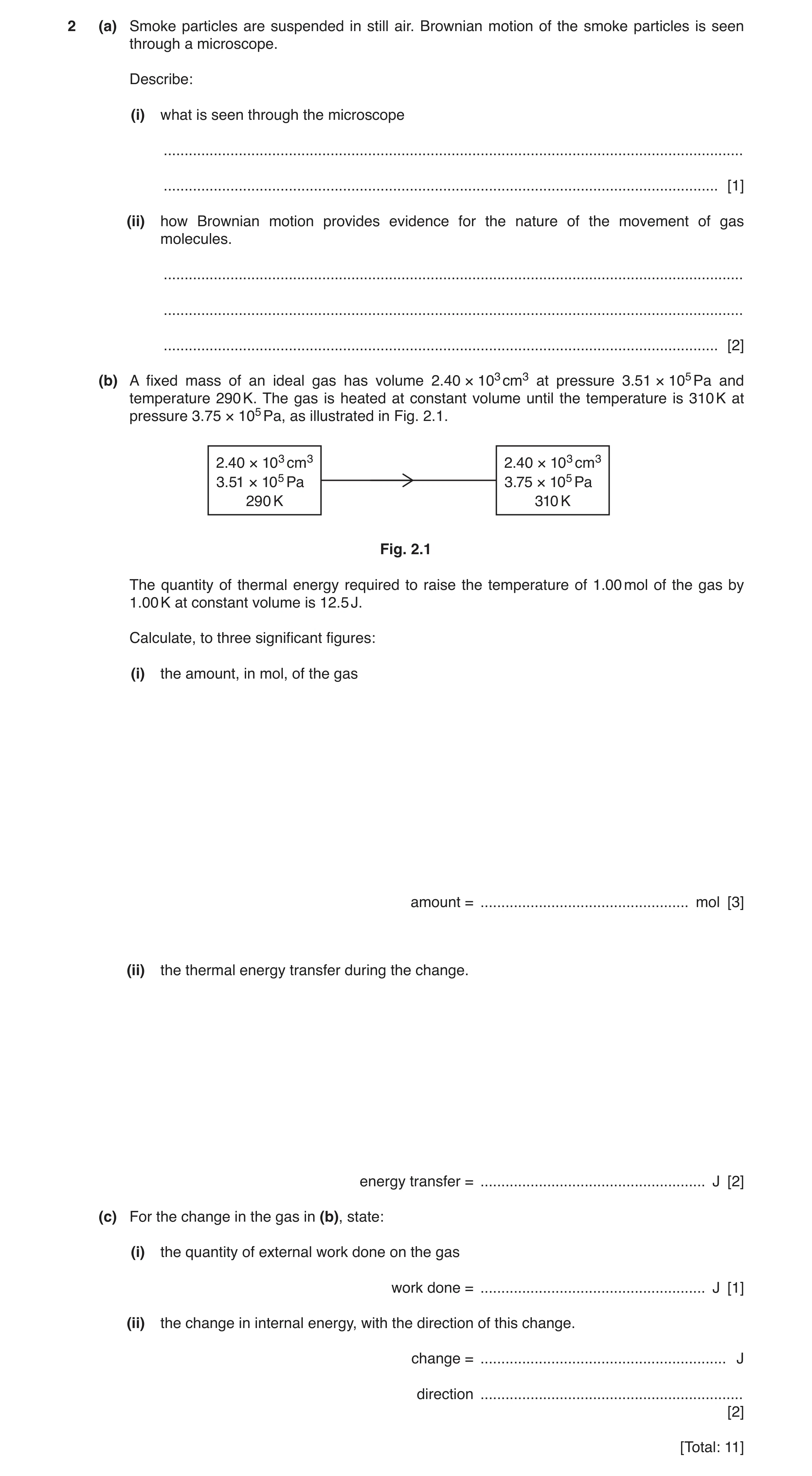
 8 / 43
 35 / 43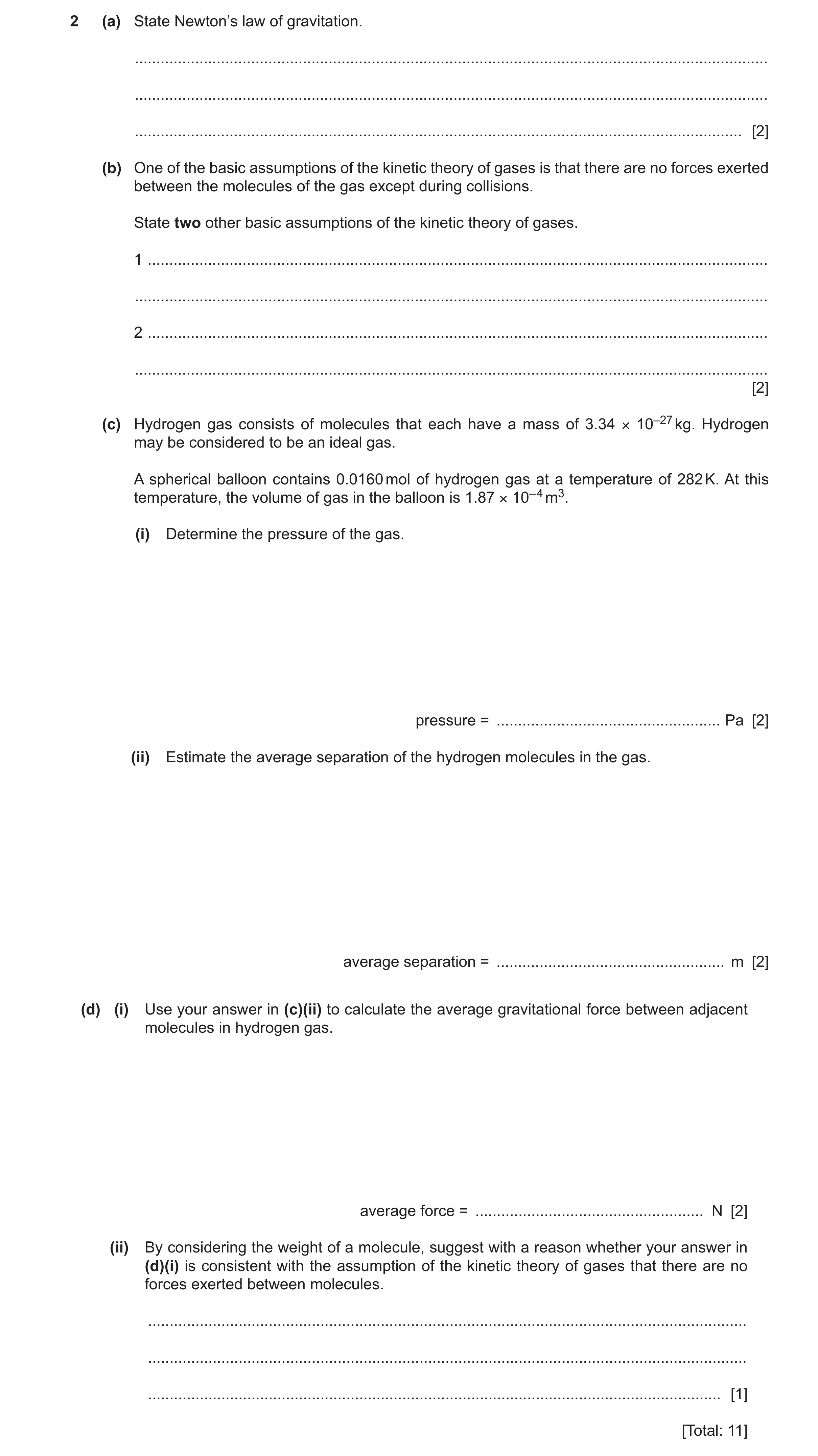
 41 / 43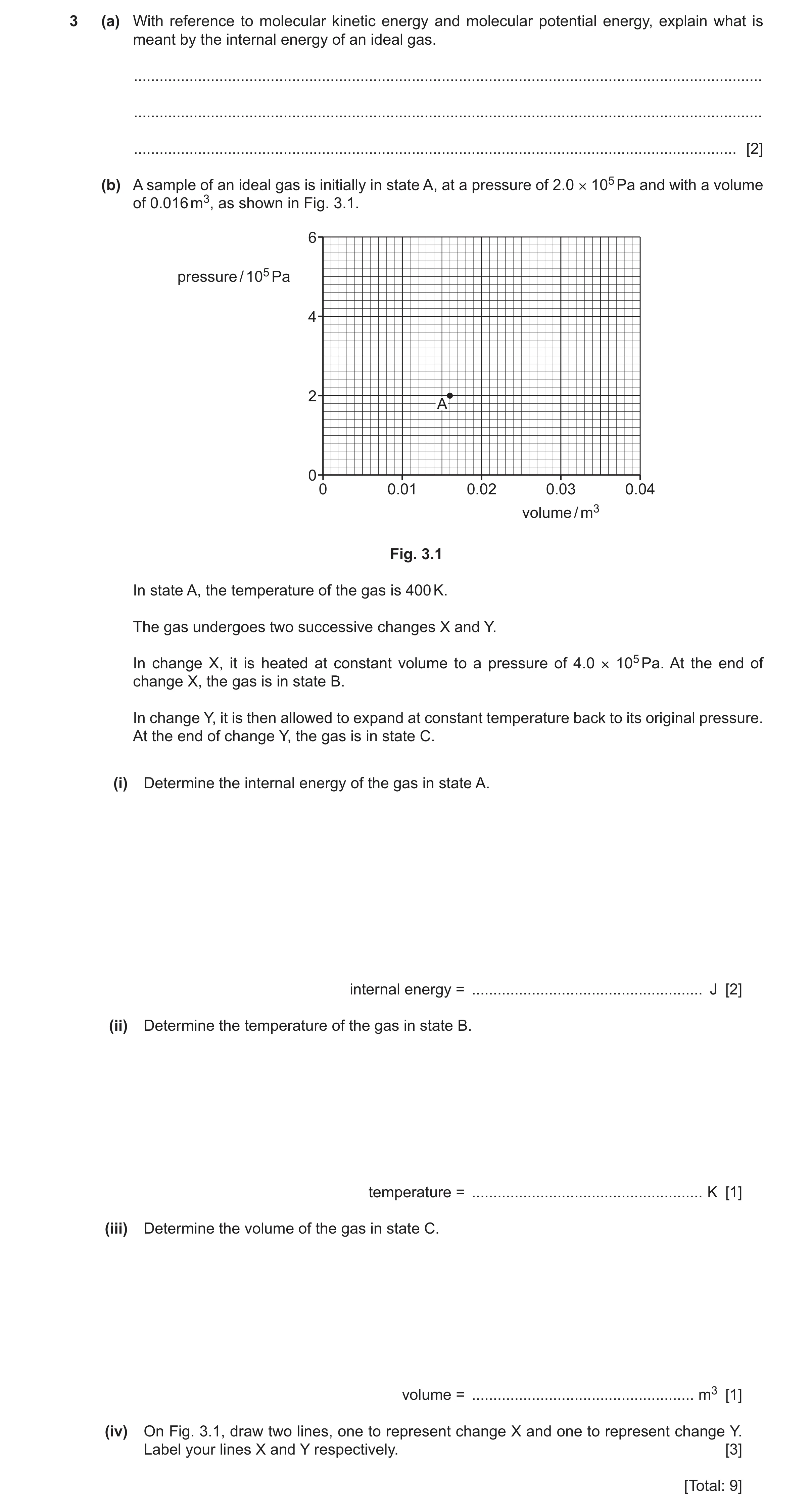
 10
10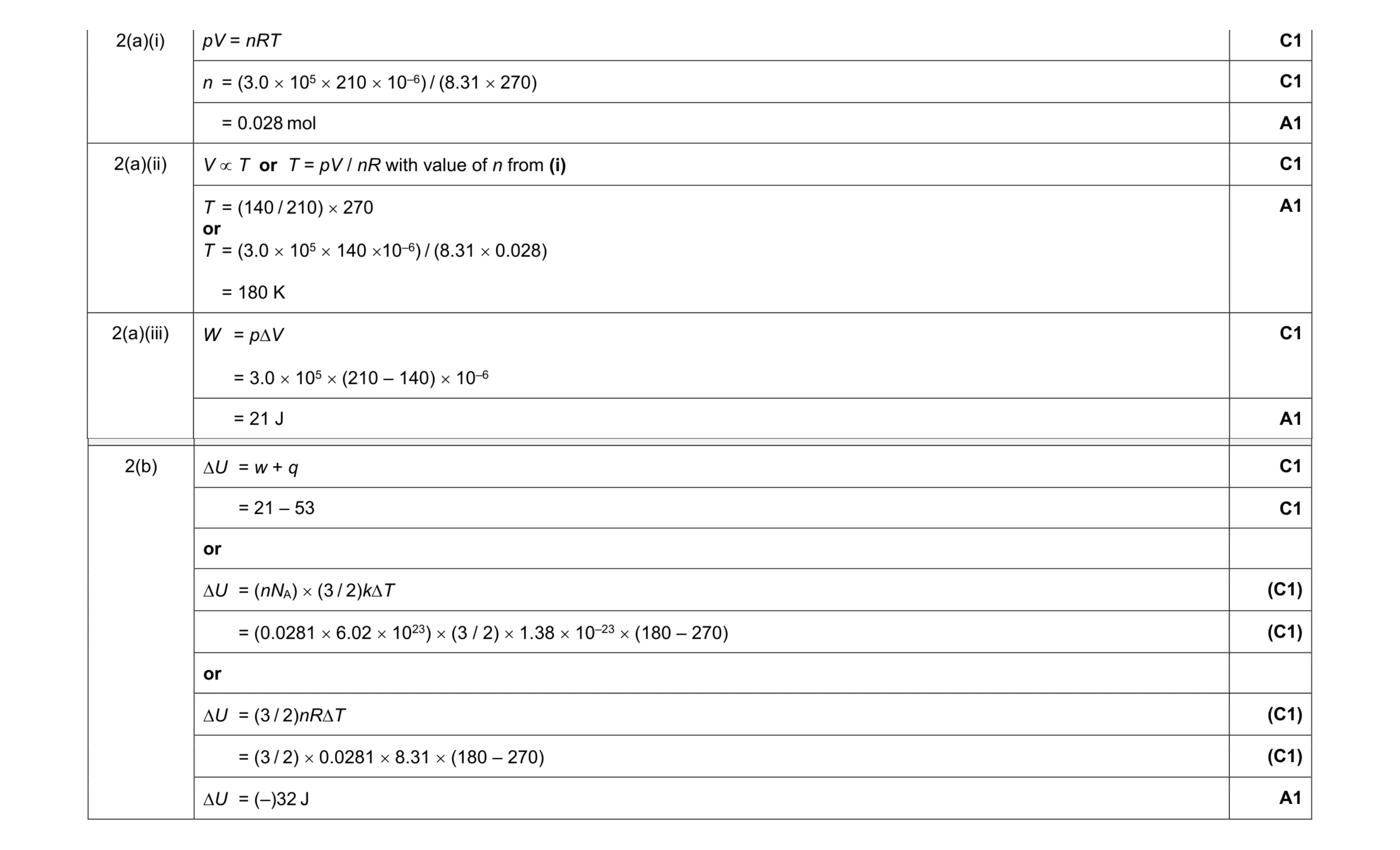 10
10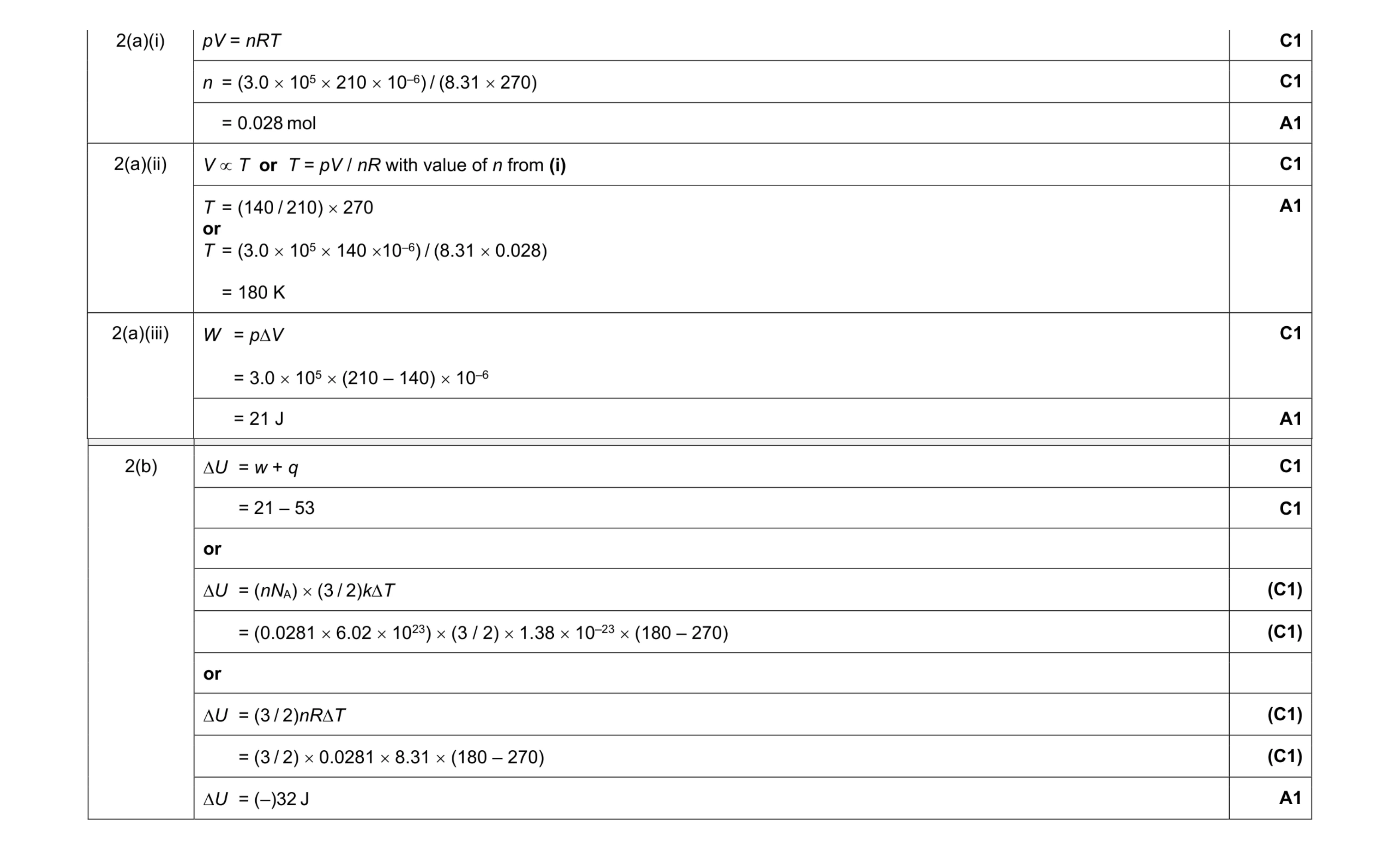 10
10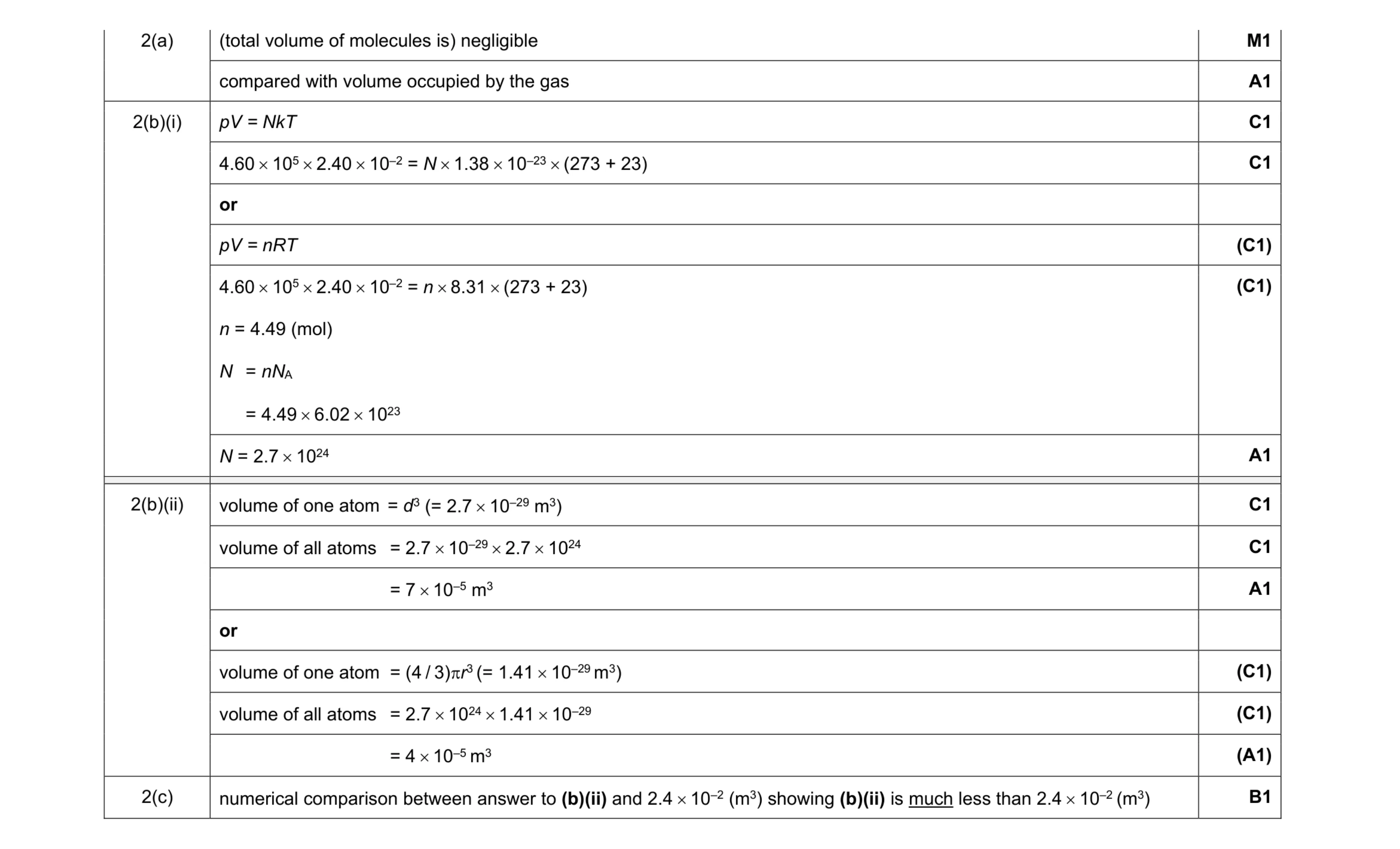 9
9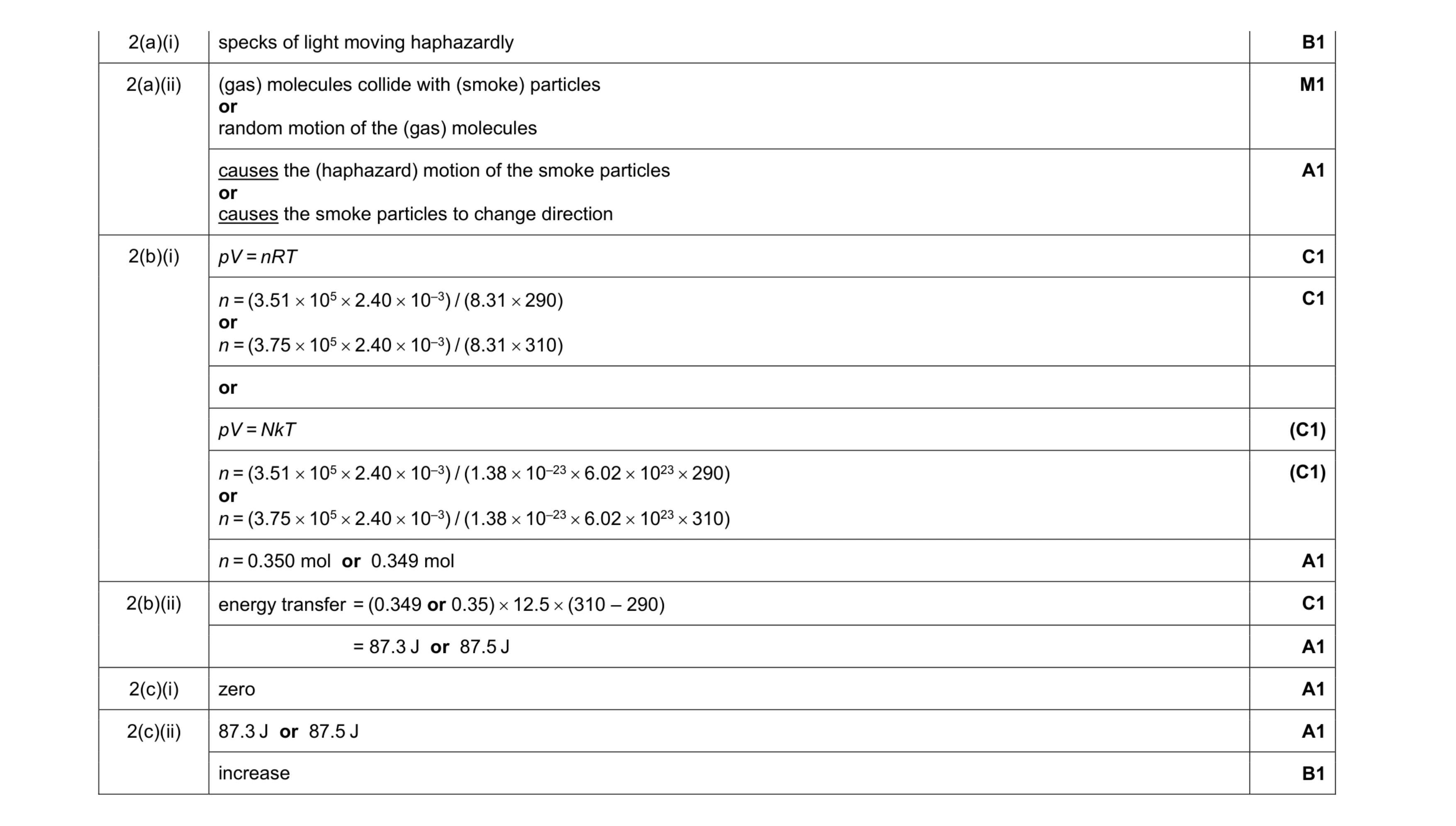 11
11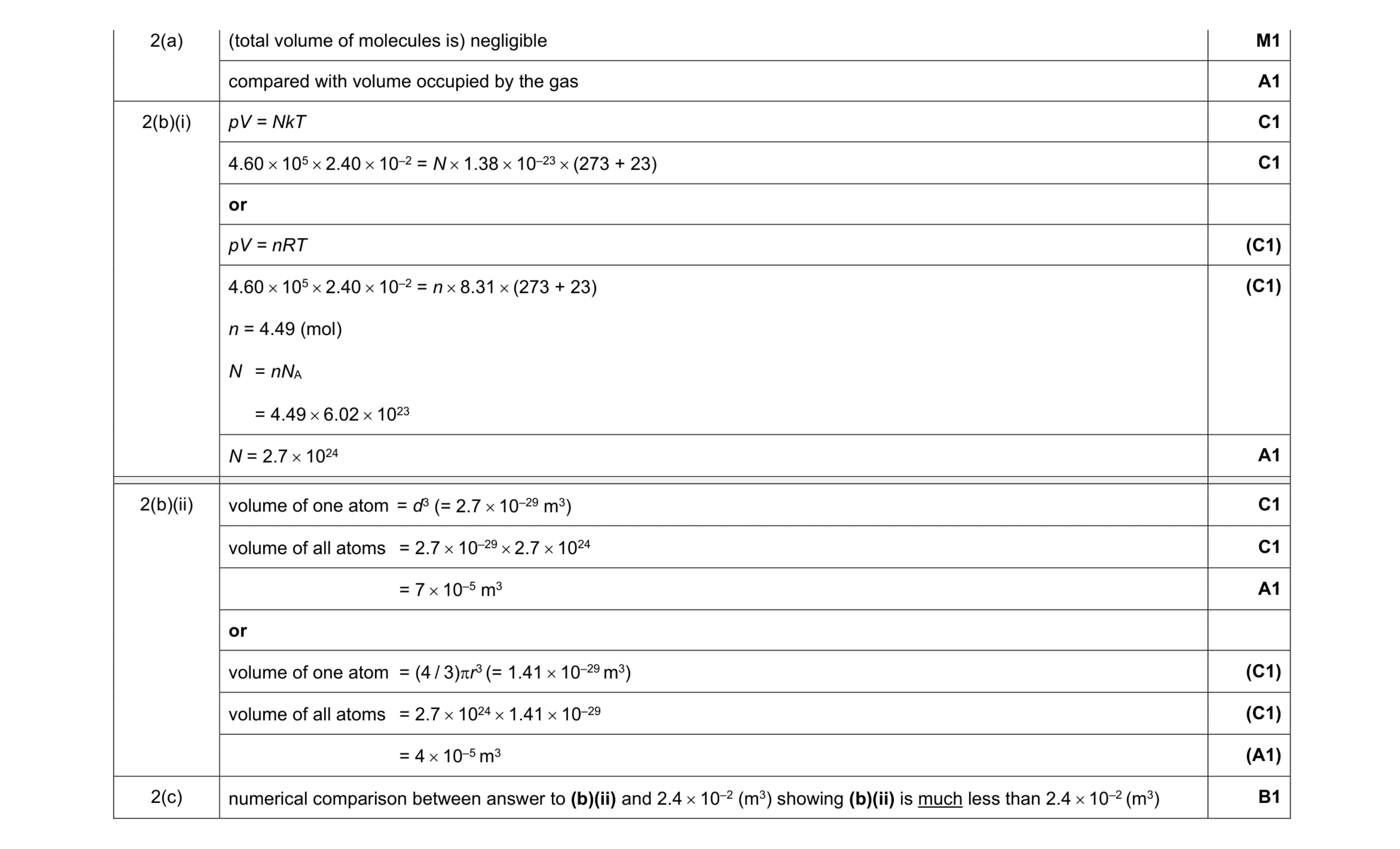 9
9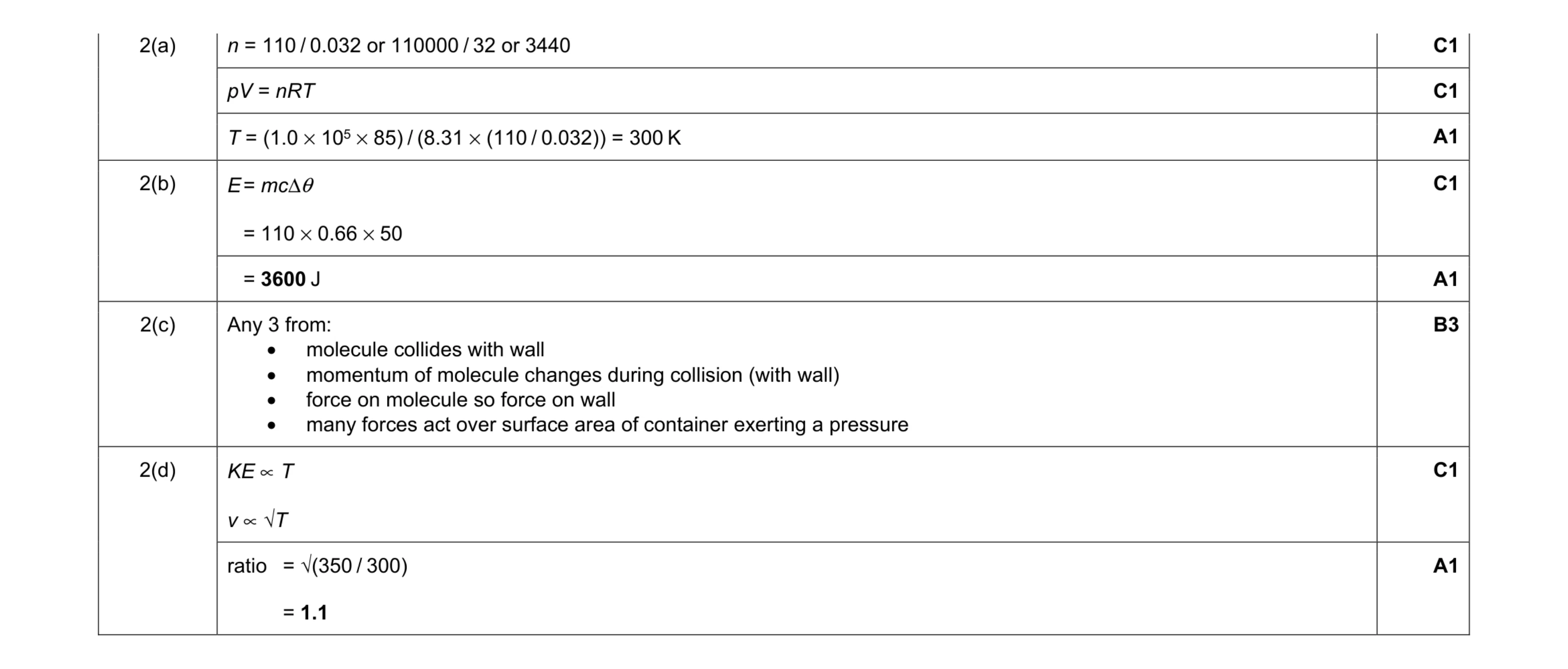 10
10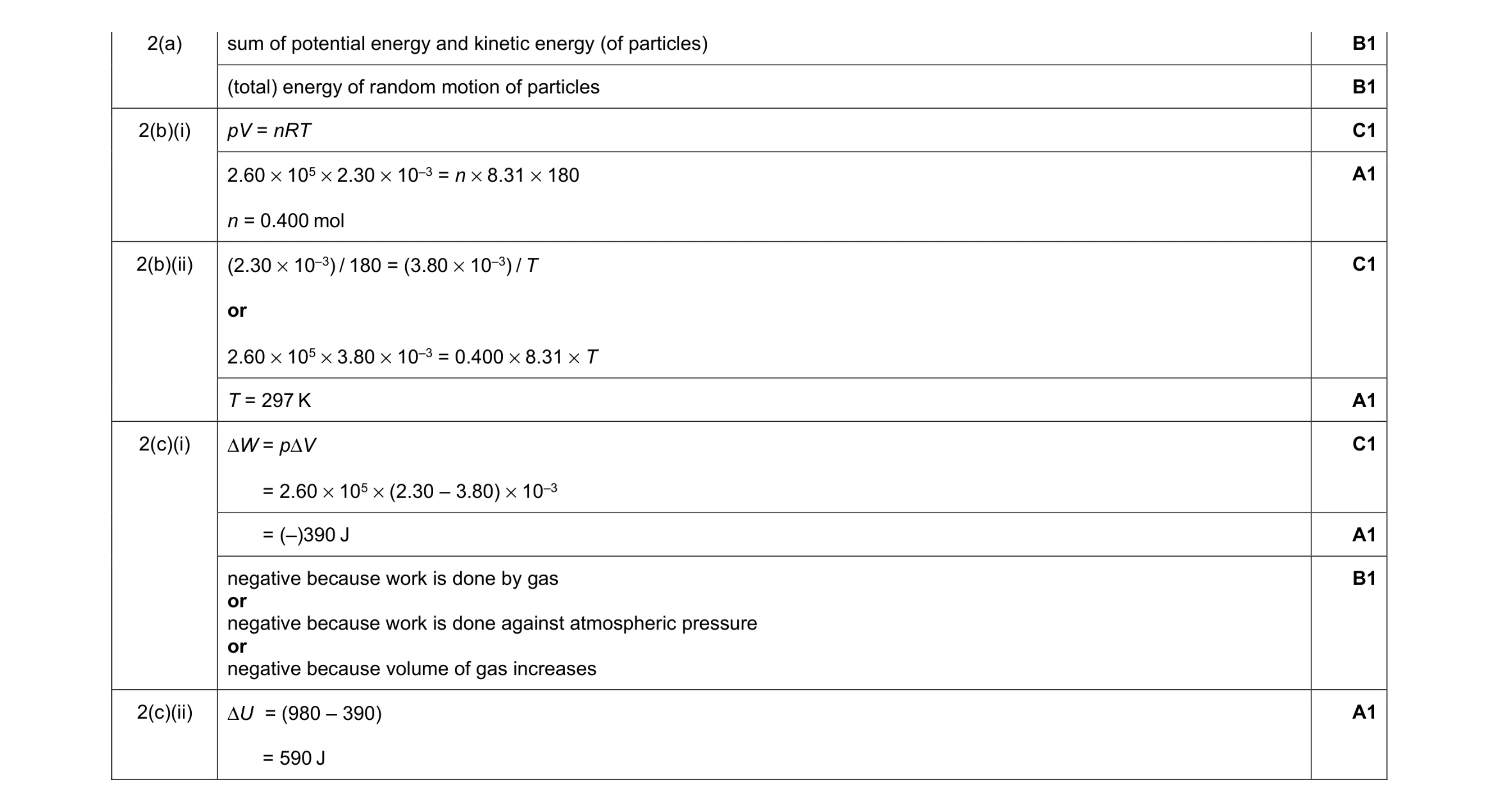 10
10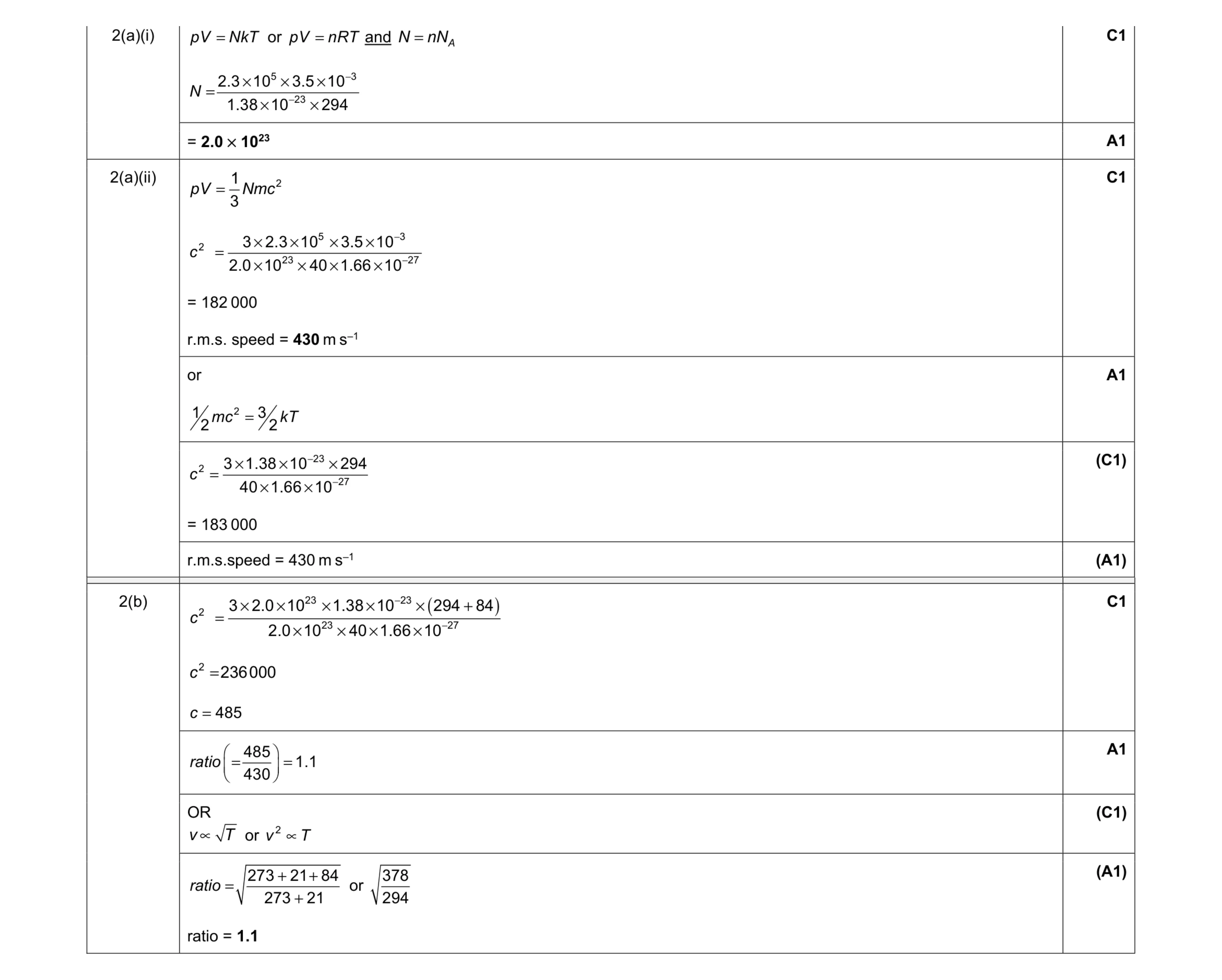 6
6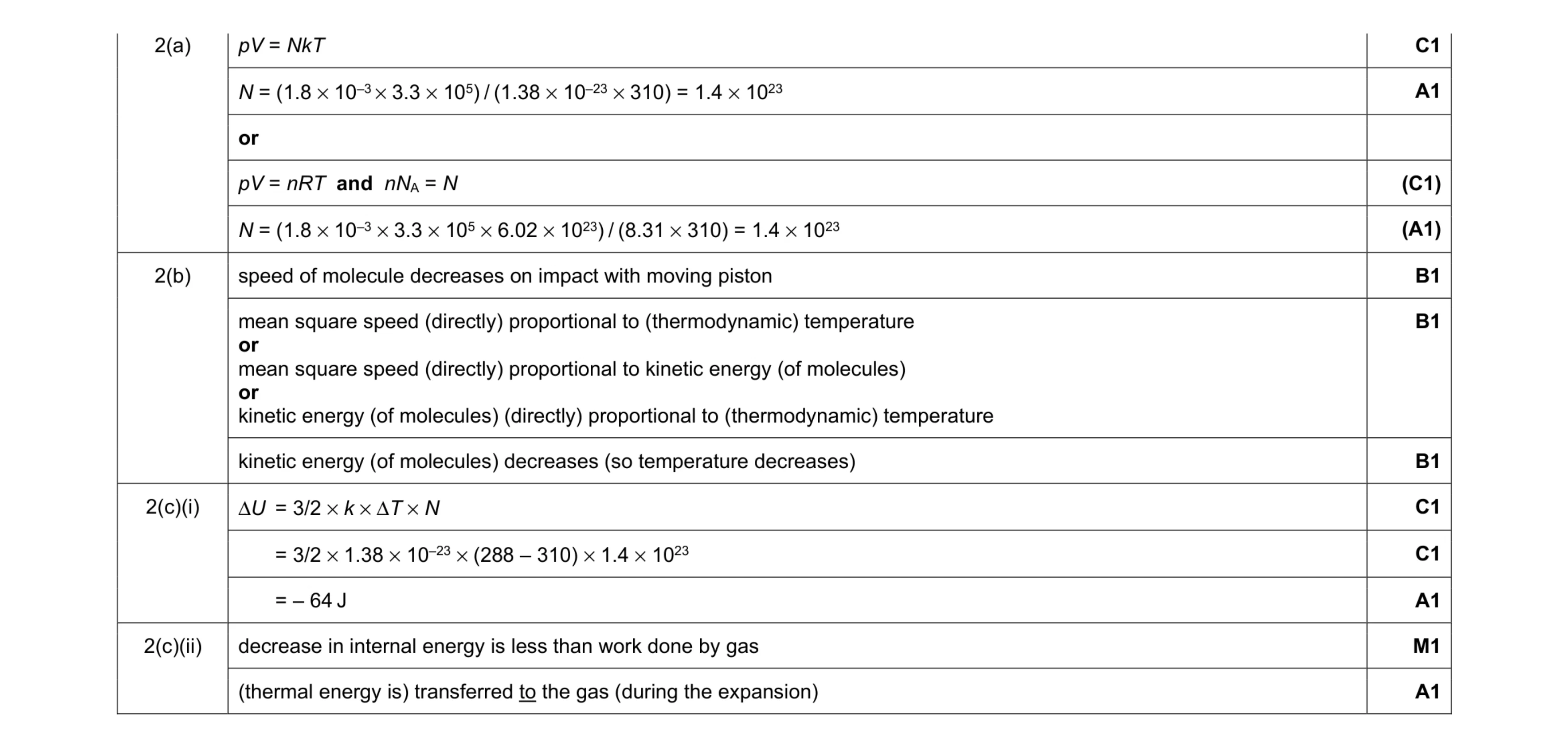 10
10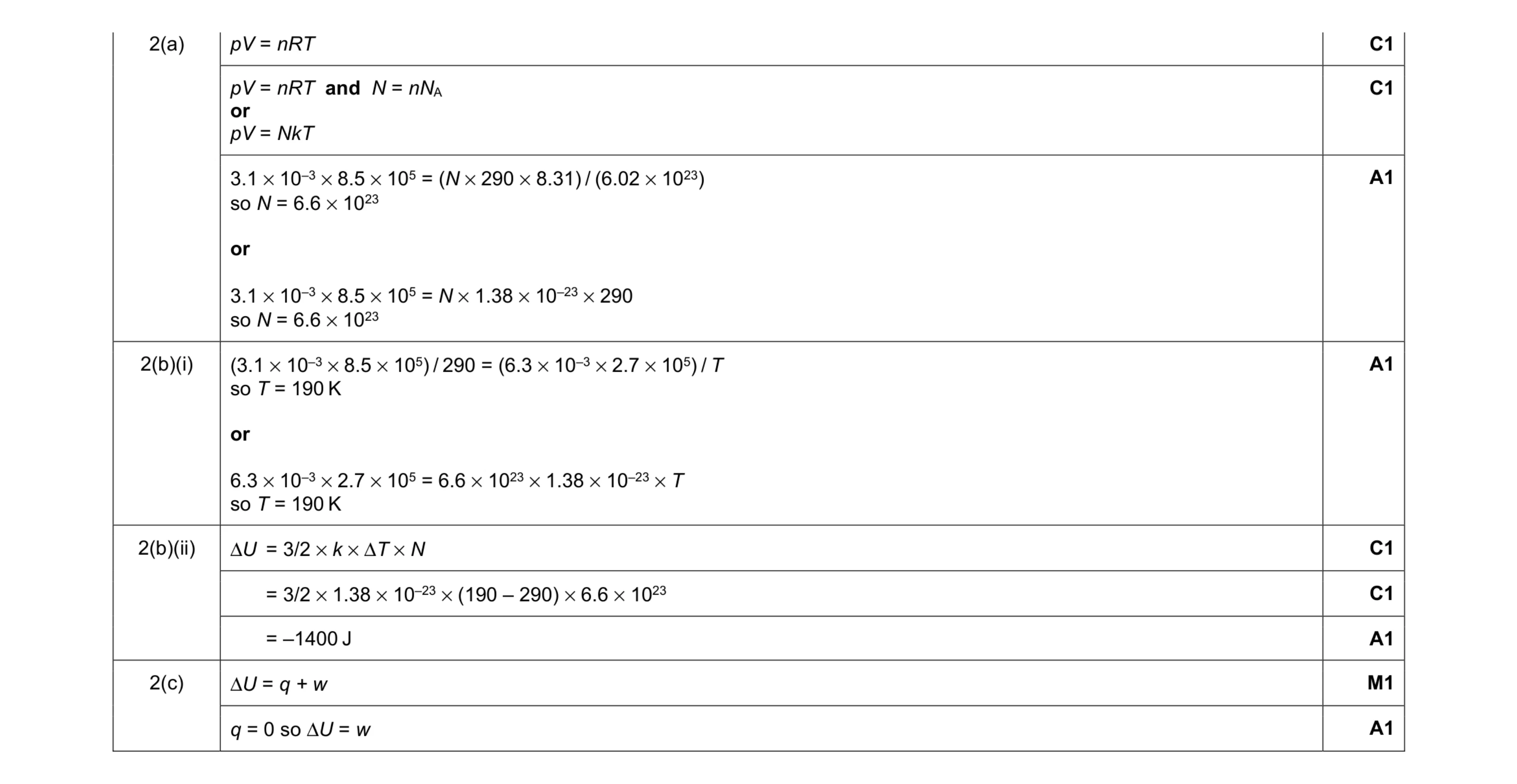 9
9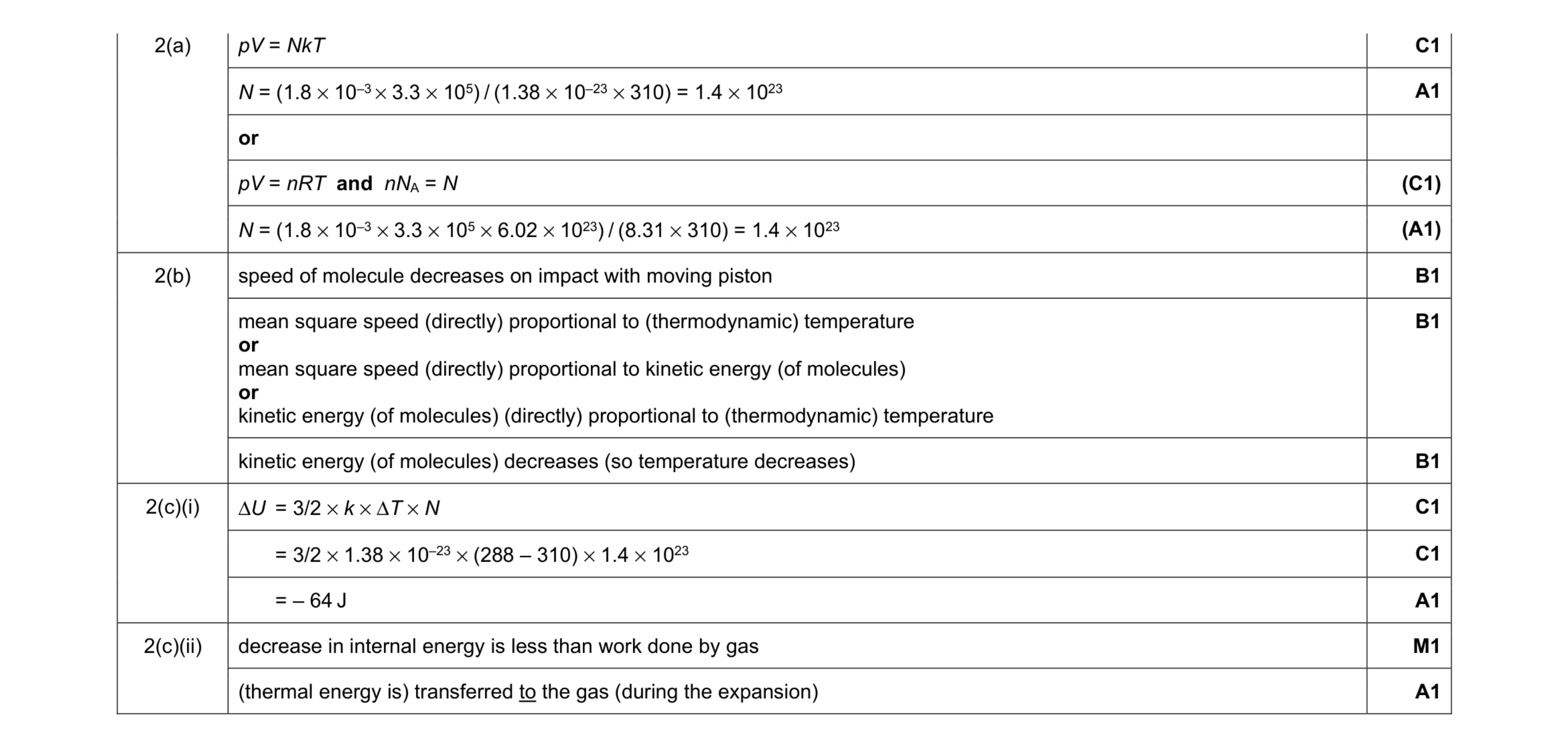 10
10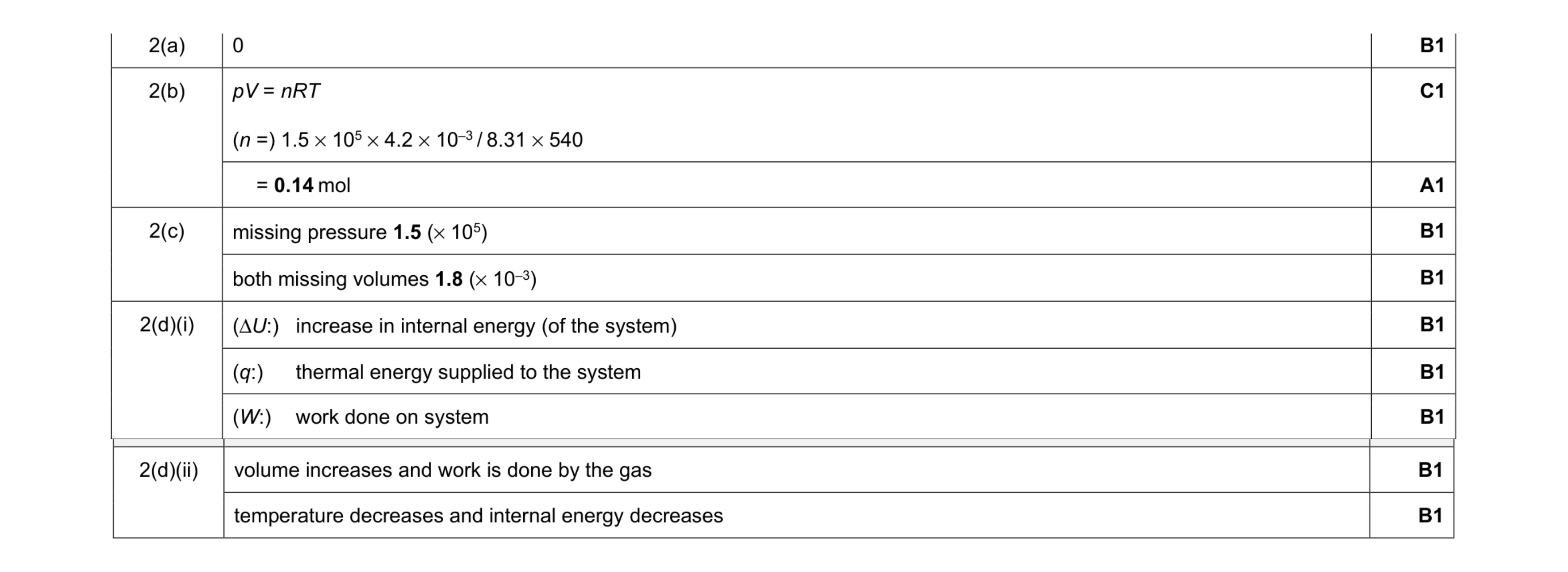 10
10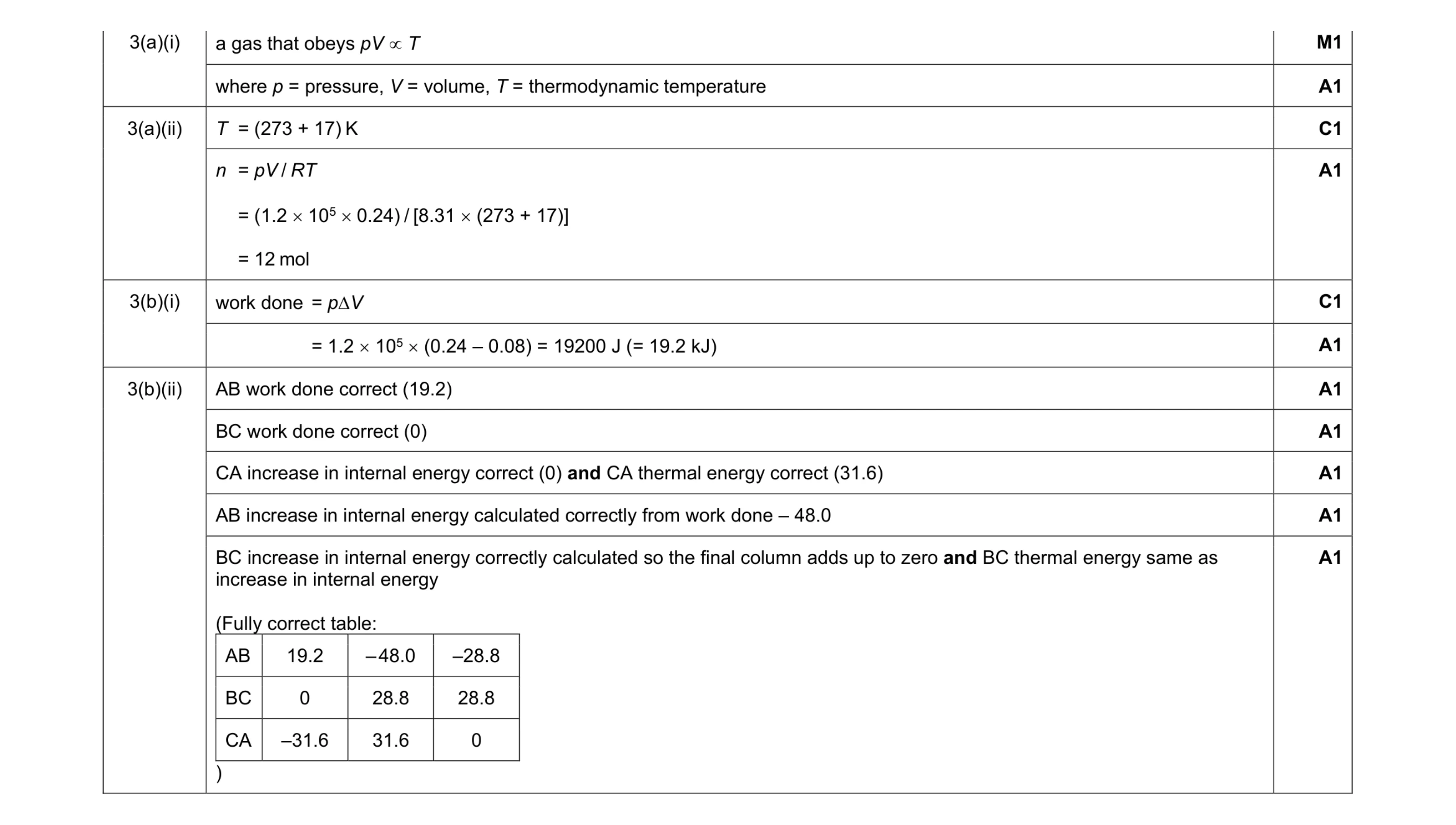 11
11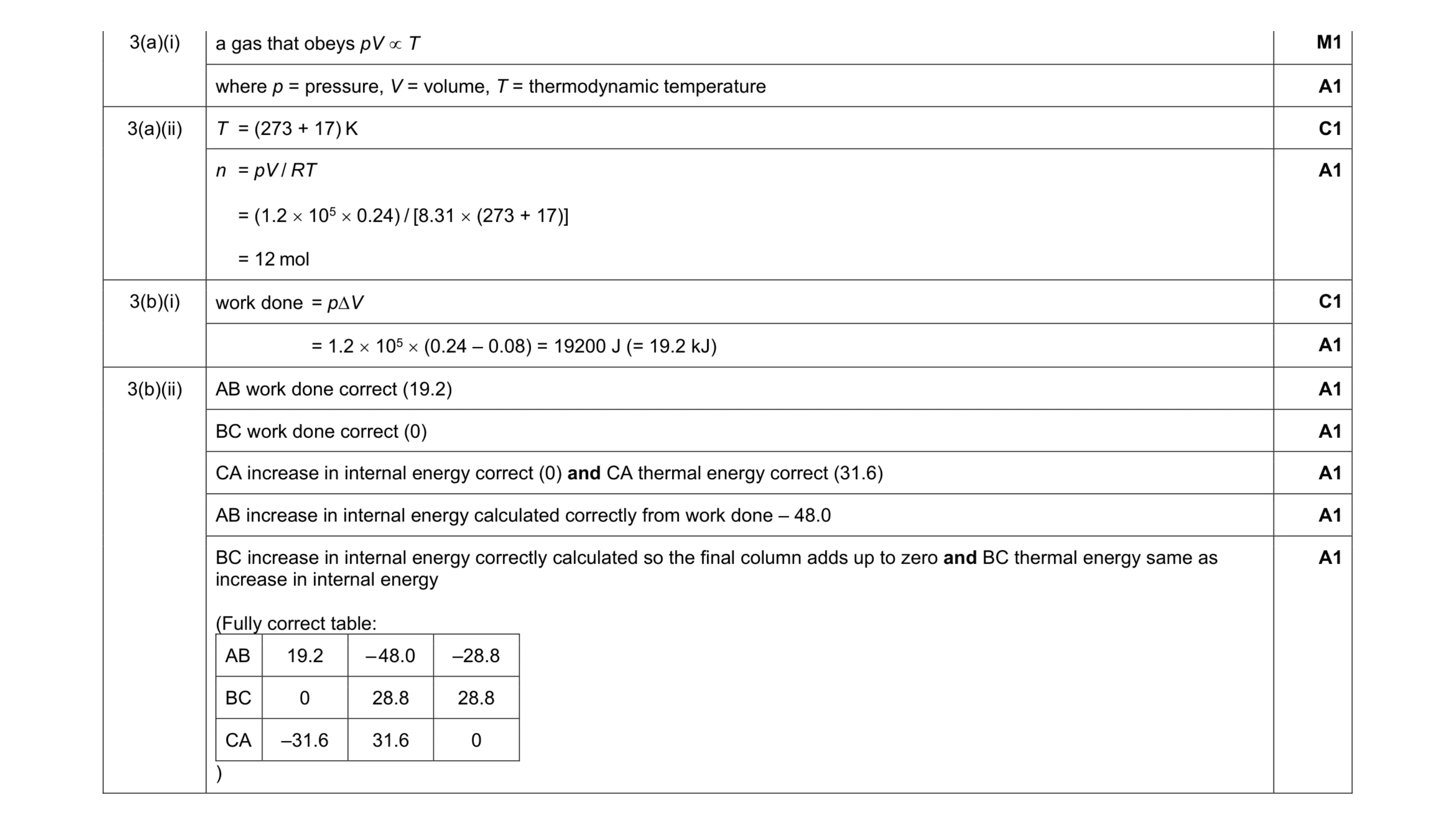 11
11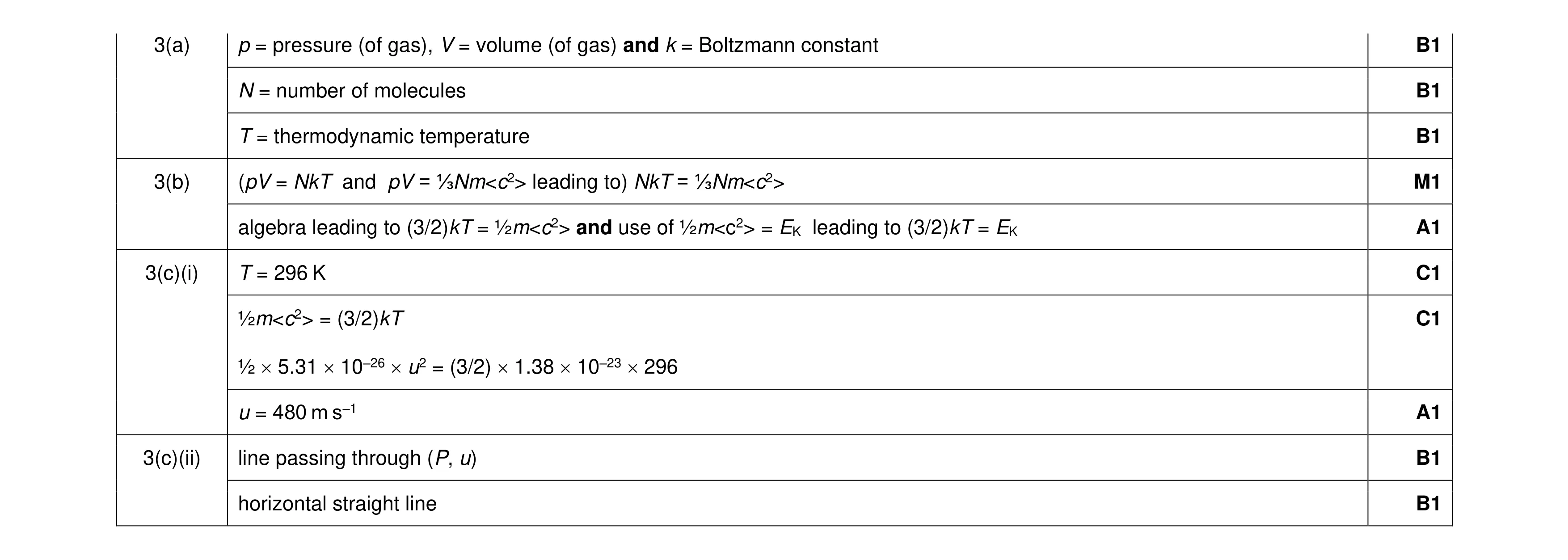 10
10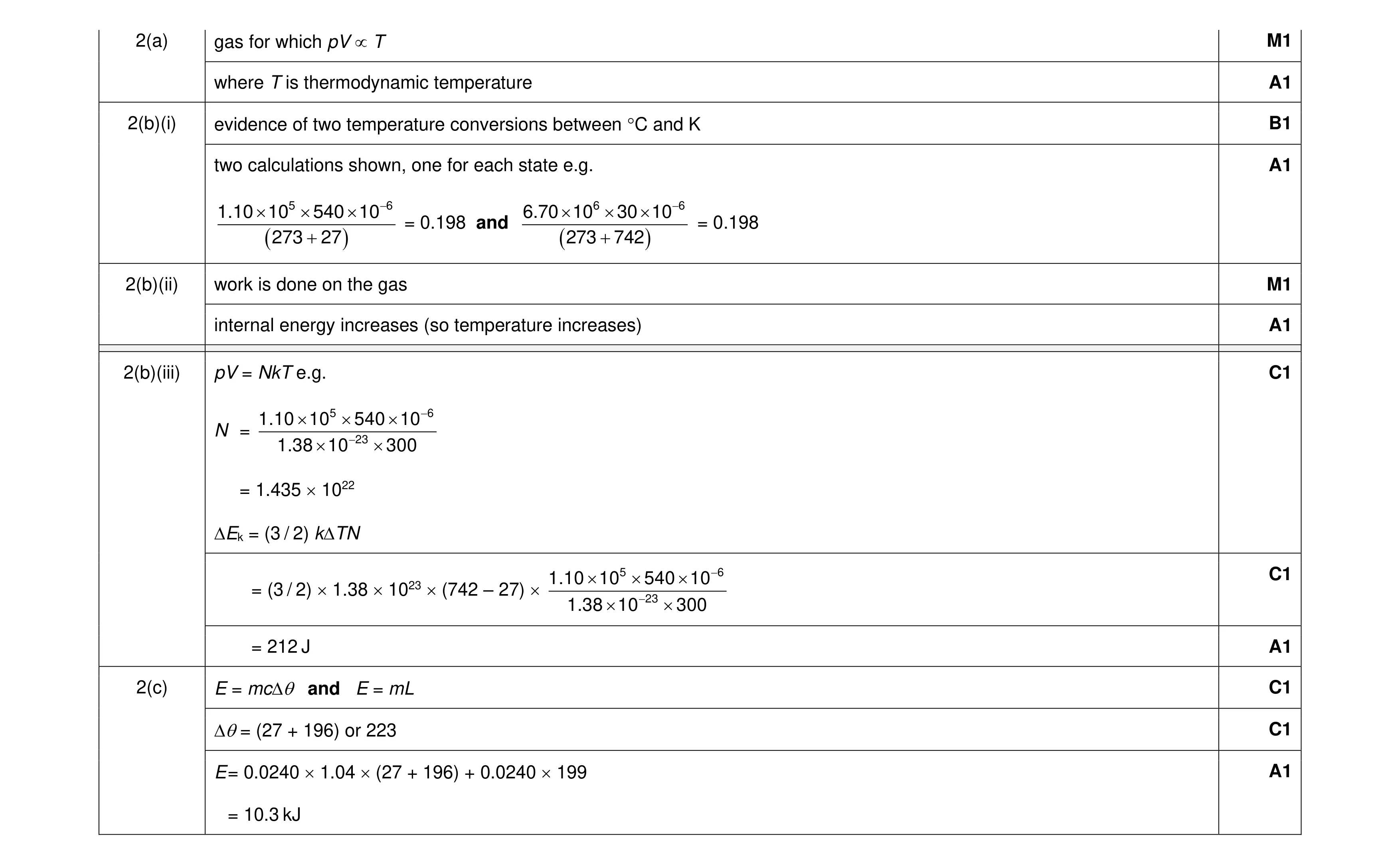 12
12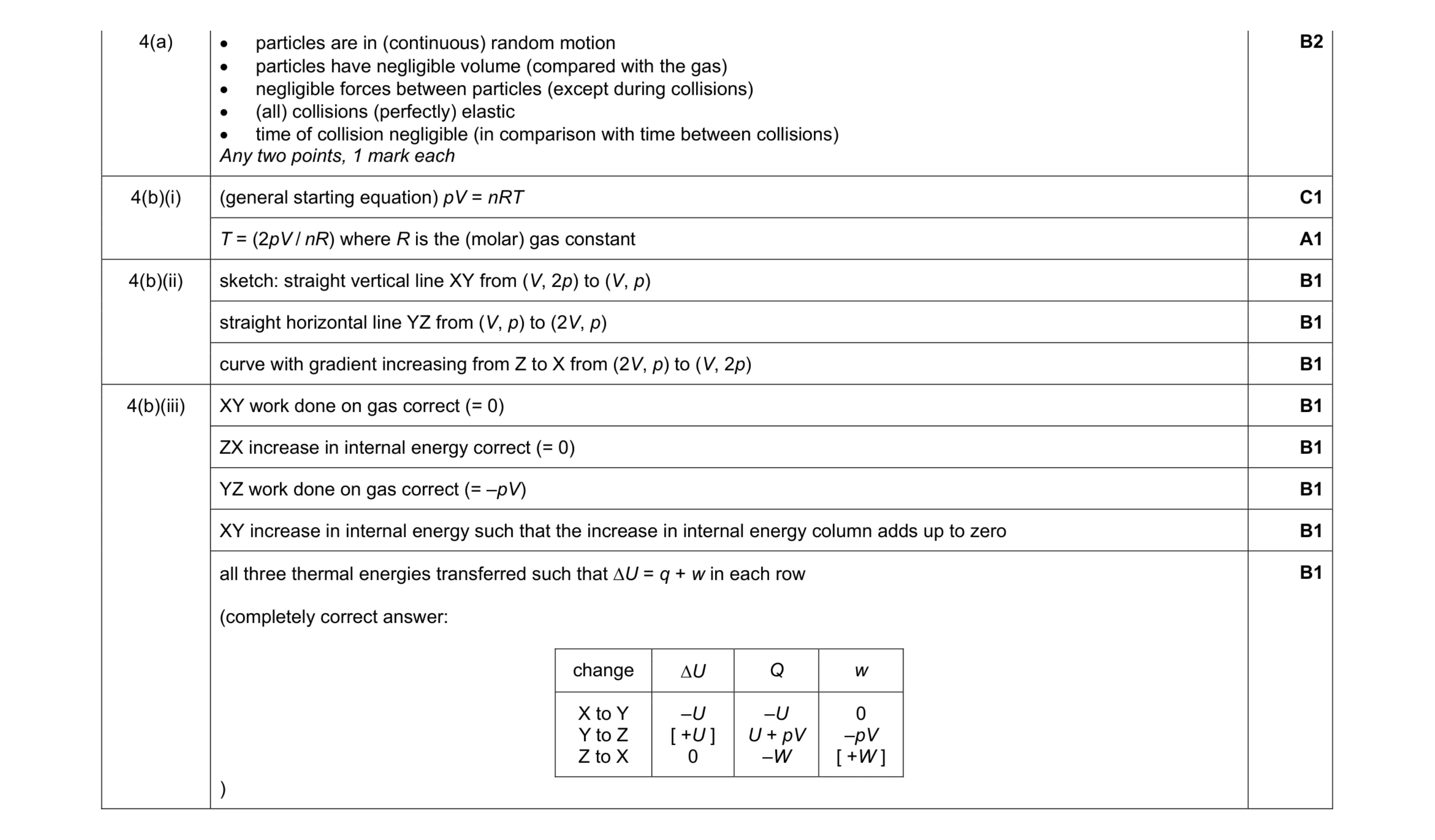 12
12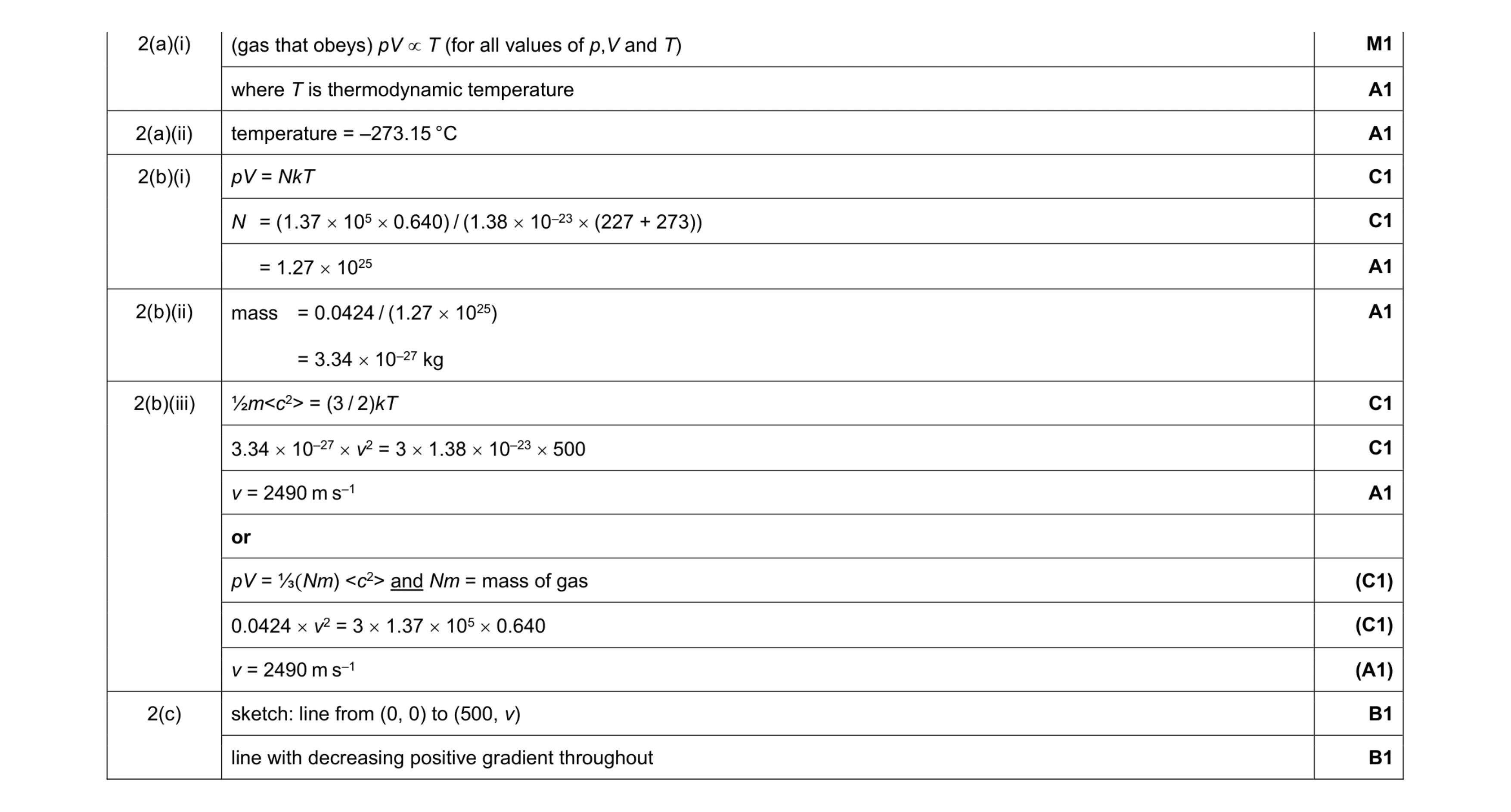 12
12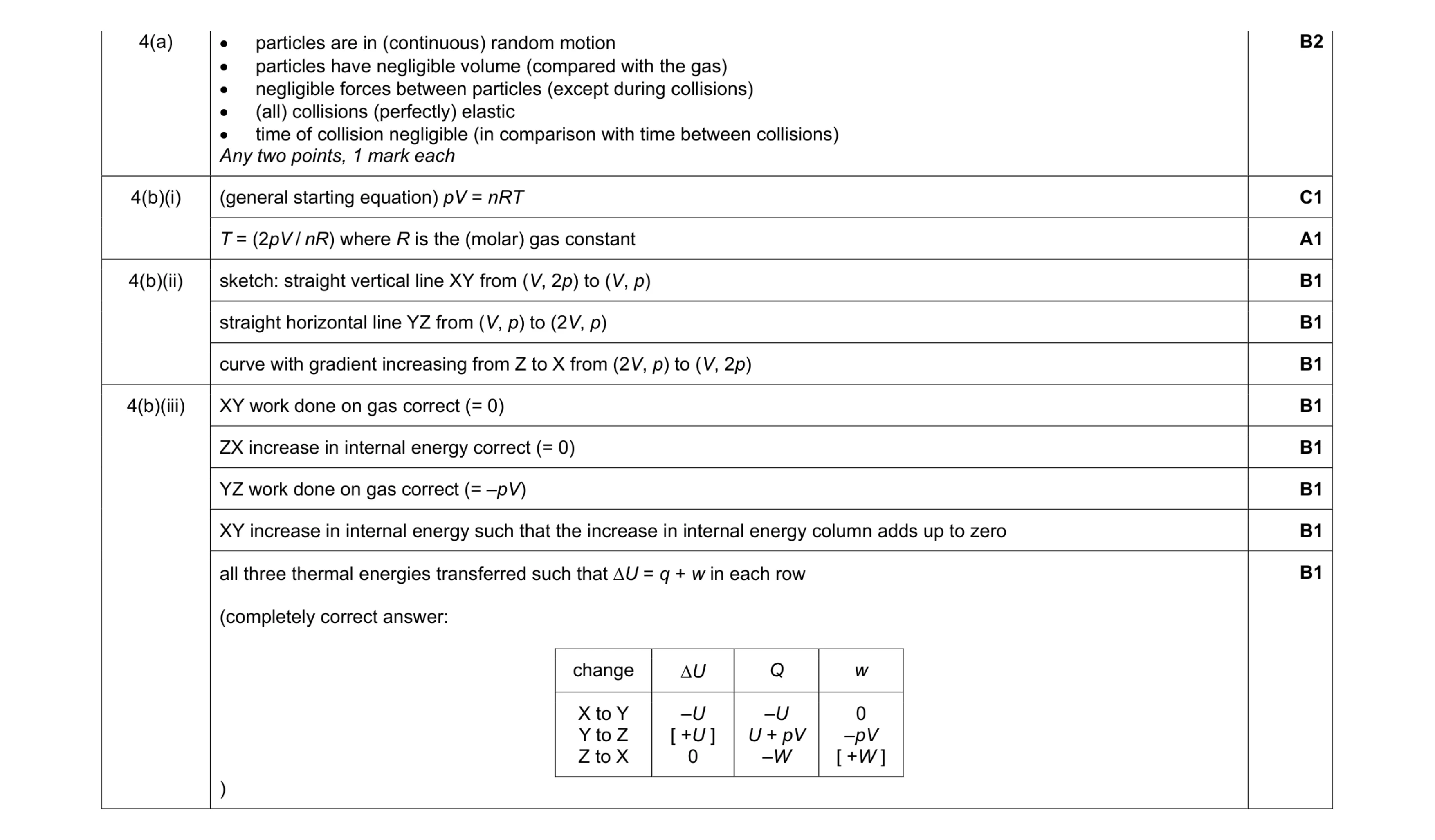 12
12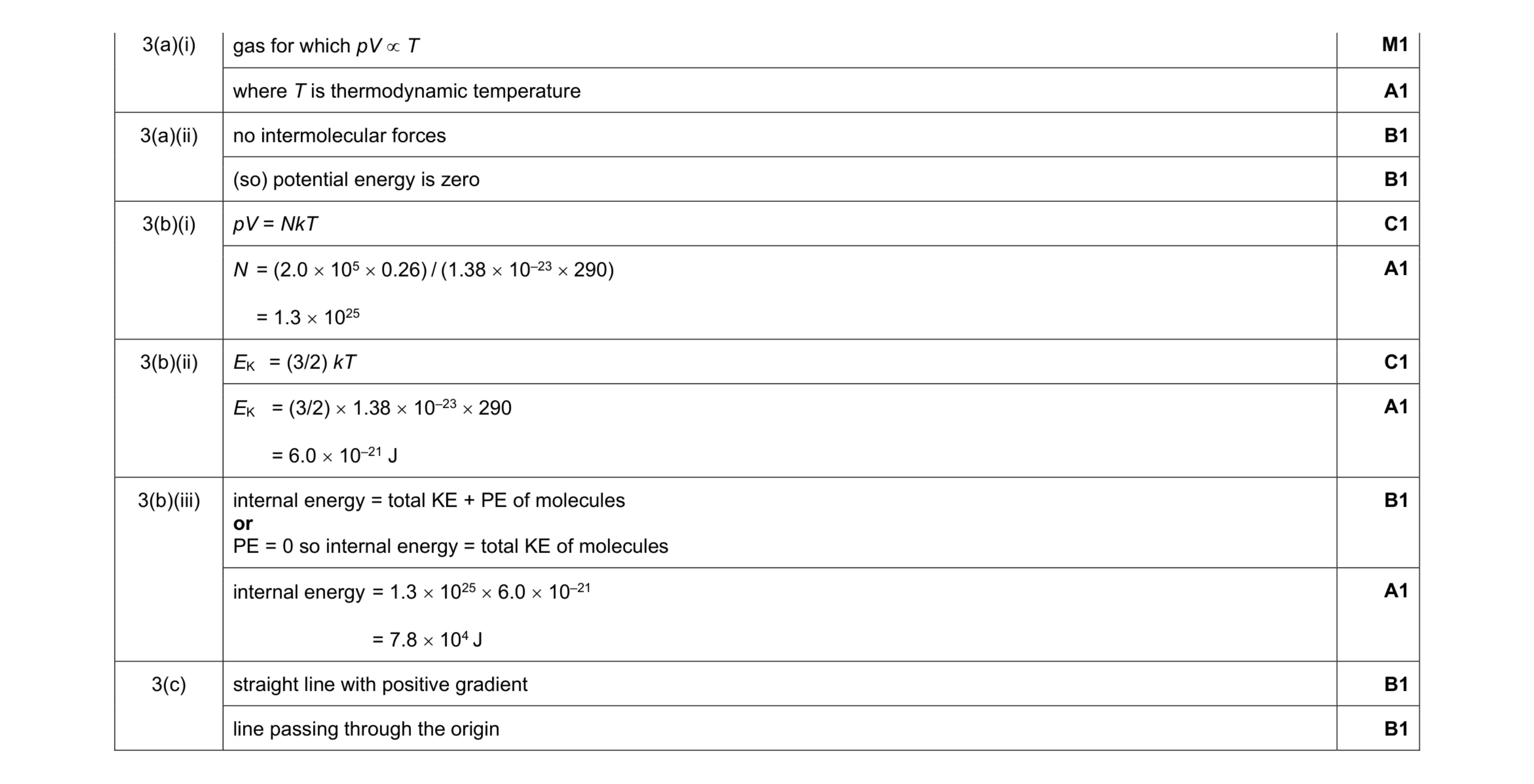 12
12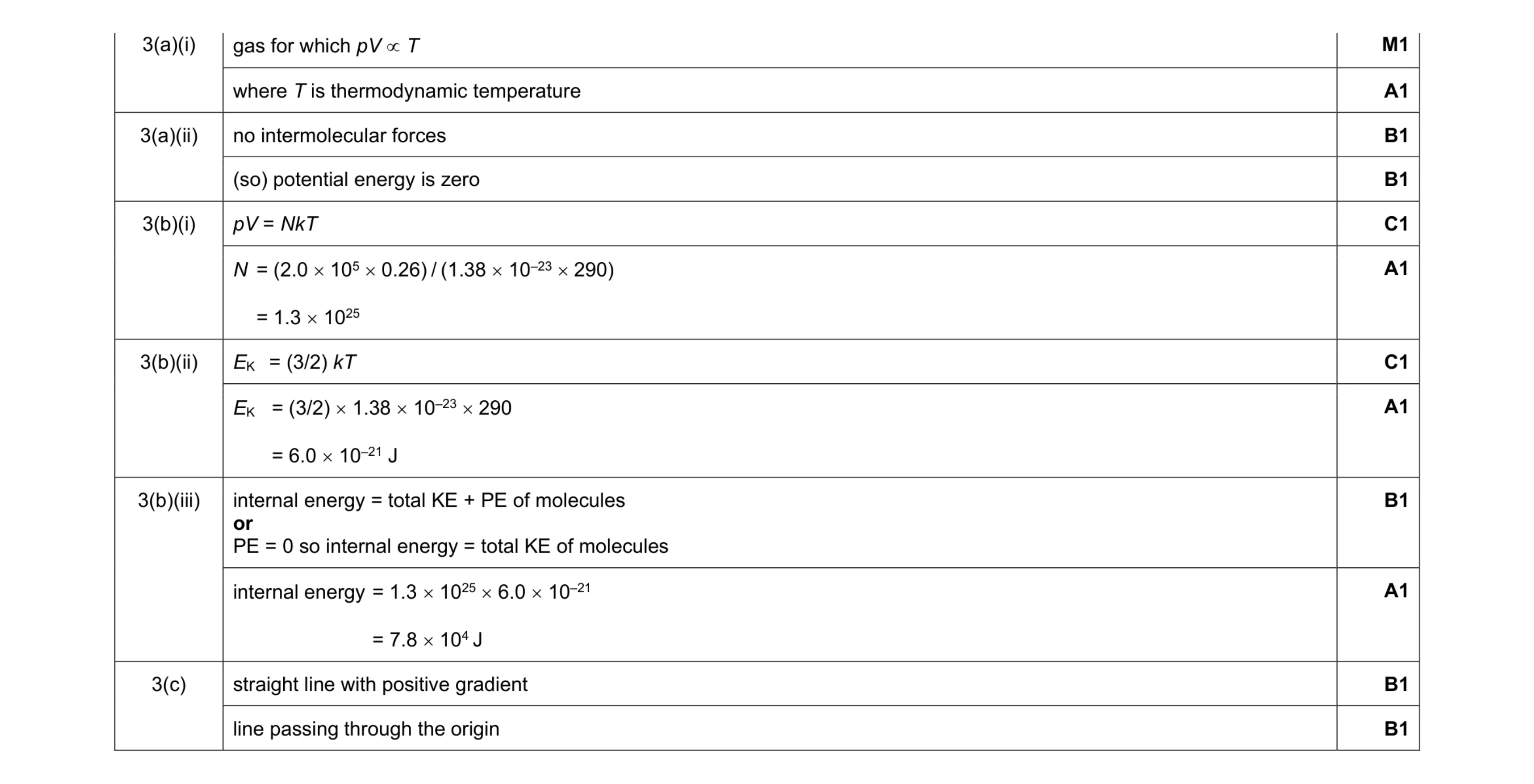 12
12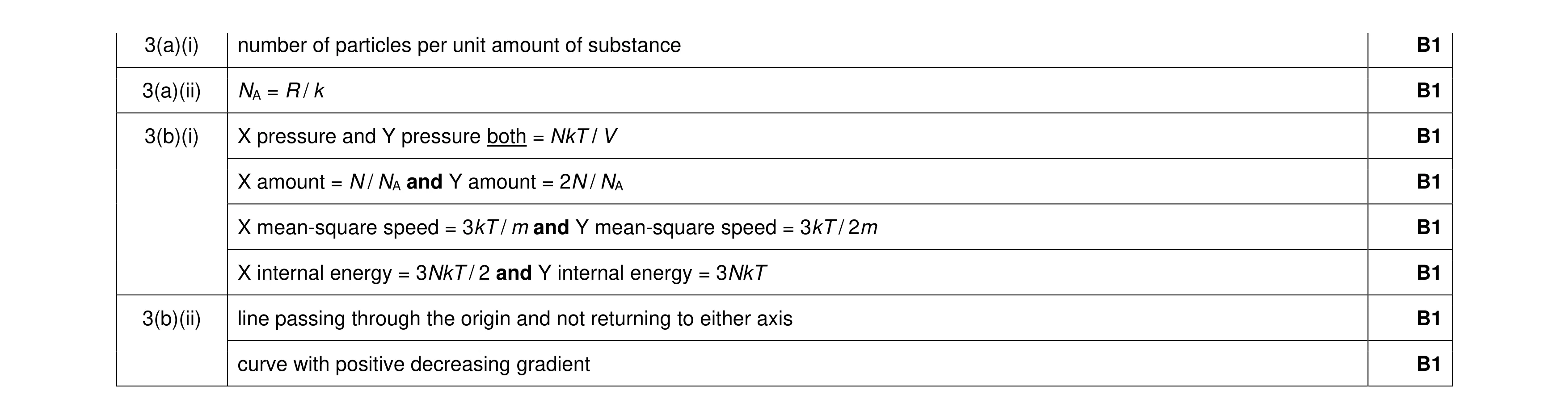 8
8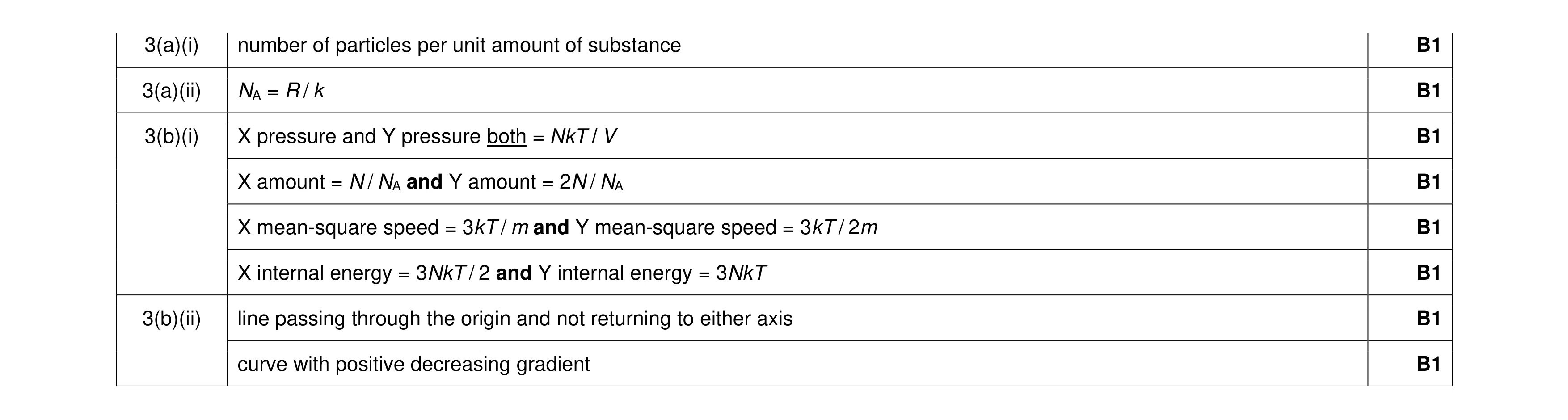 8
8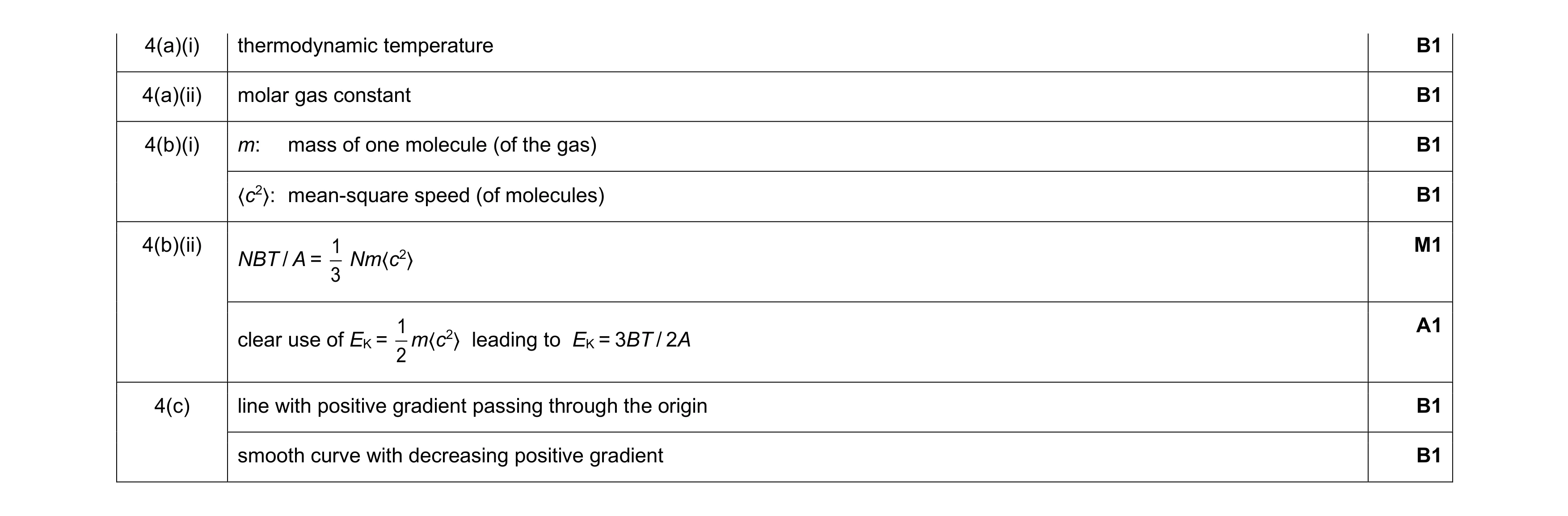 8
8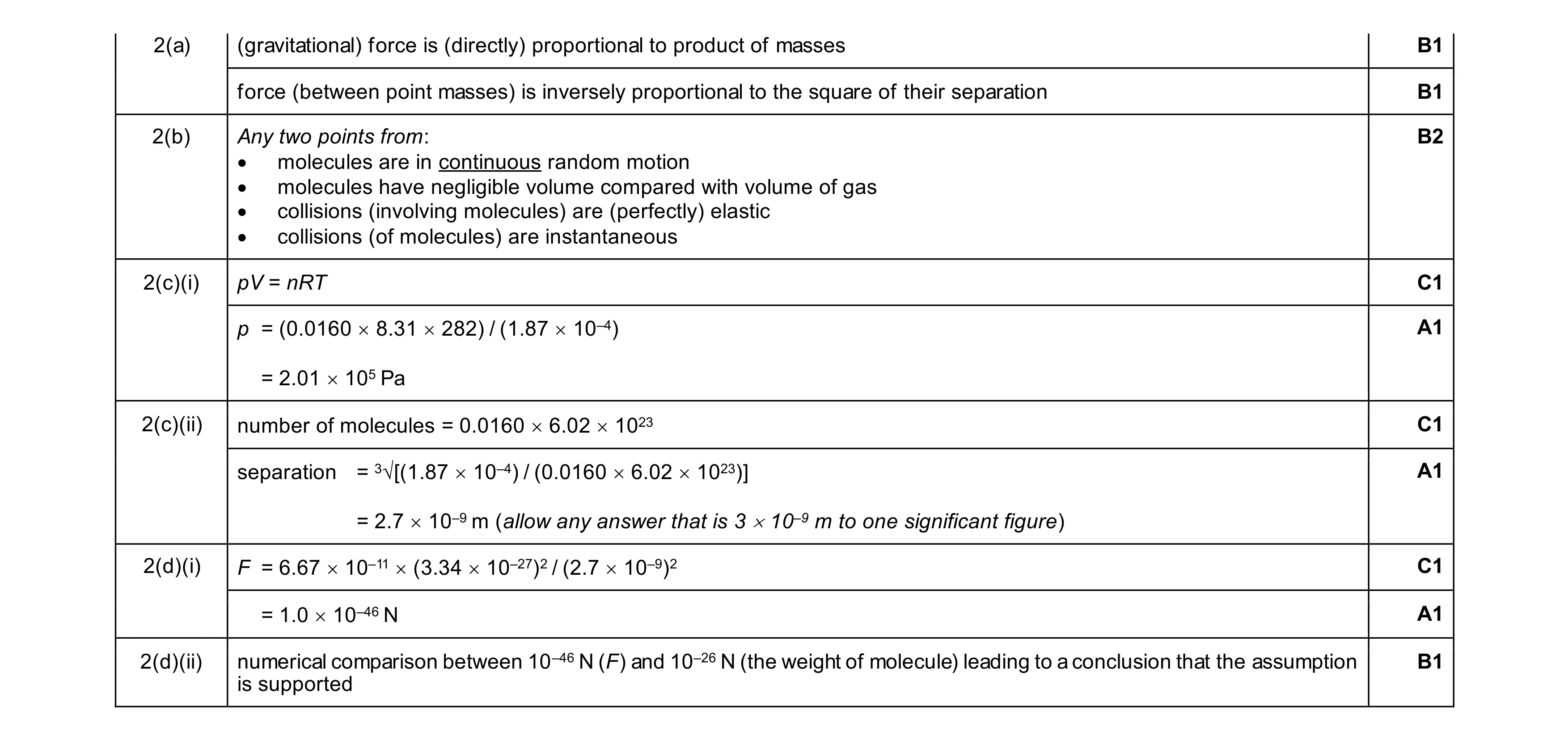 11
11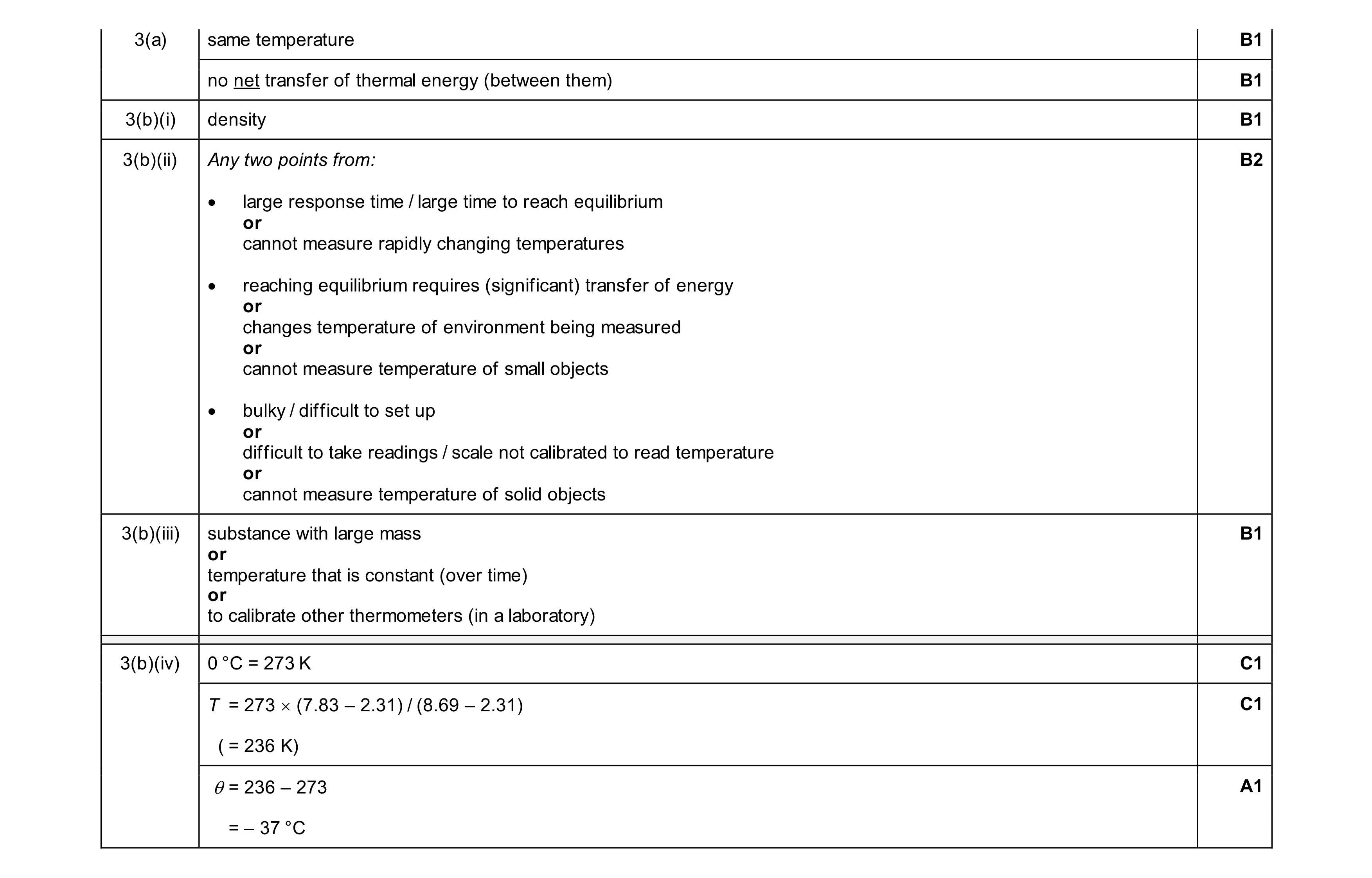 9
9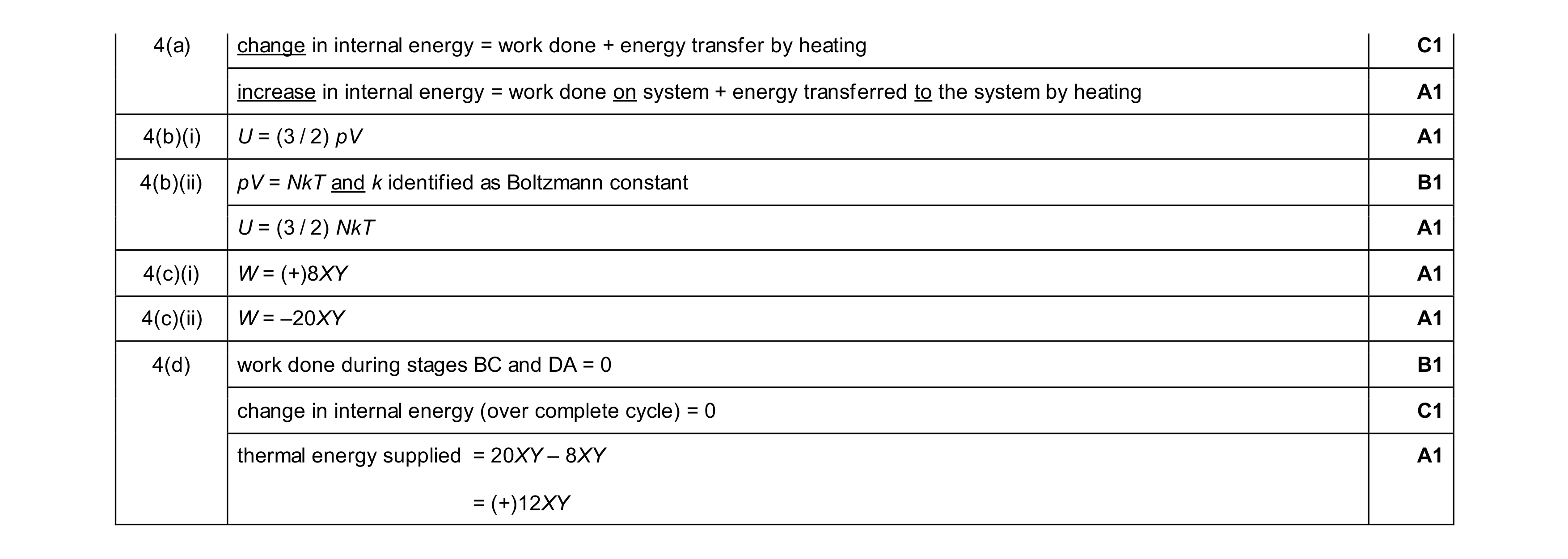 10
10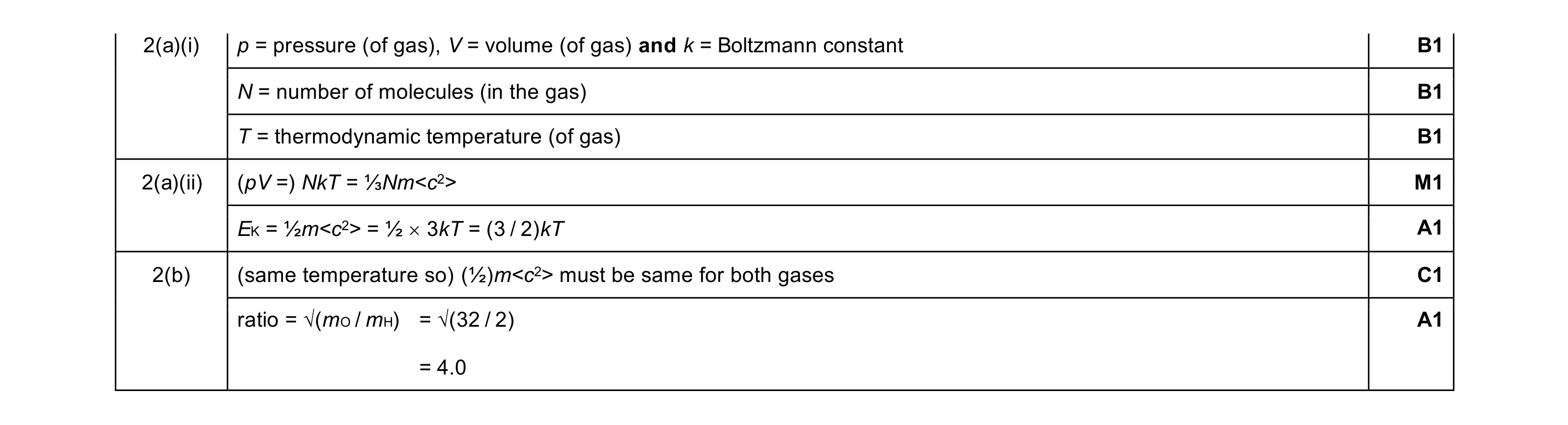 7
7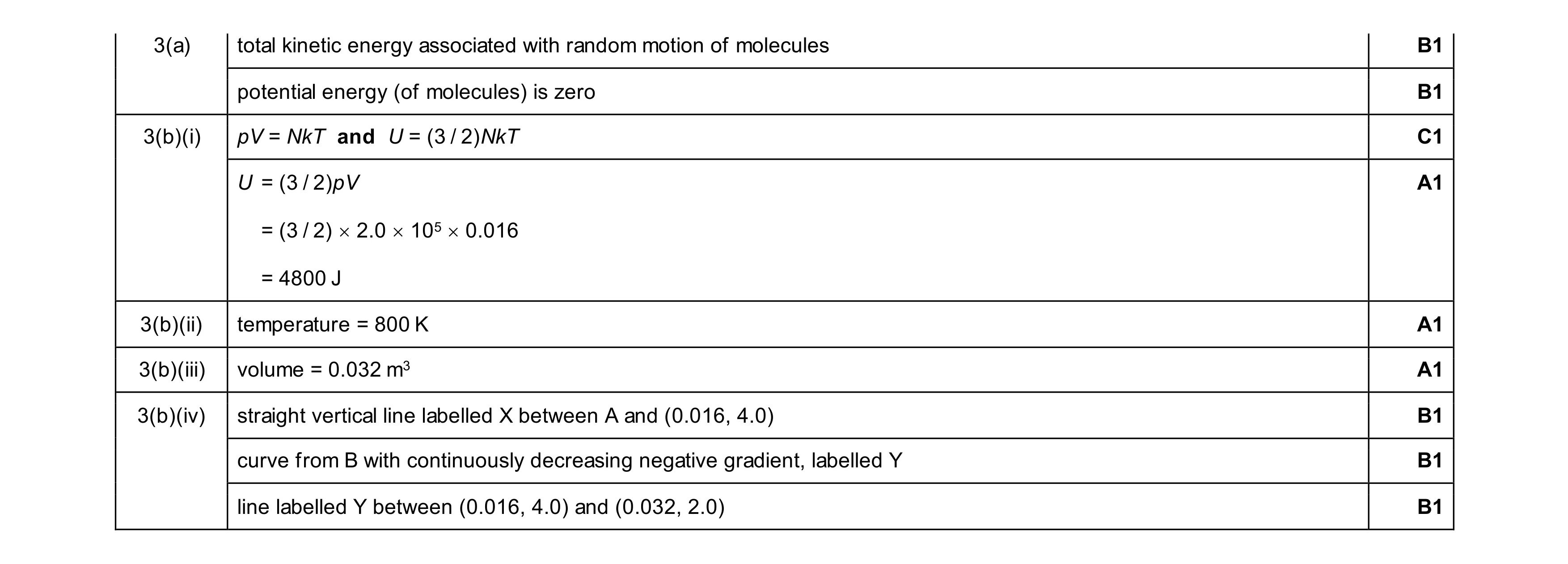 9
9