Cambridge A Level Mathematics 9709 — 2011 May/June Paper 5 · Variant 1
9709/51/M/J/11 · 7 questions · 50 marks · ≈56 min
The question paper and its mark scheme, free to read here and free to download. This is Cambridge’s own paper, exactly as it was sat.
Question paper4 pages
Mark scheme5 pages
Answers below. Sit the paper first if you are practising.
Questions as text
Q1 · A particle is projected with speed 15 m s−1 at an angle of 40◦above the horizontal from a…
1 A particle is projected with speed 15 m s−1 at an angle of 40◦above the horizontal from a point on horizontal ground. Calculate the time taken for the particle to hit the ground. [2]
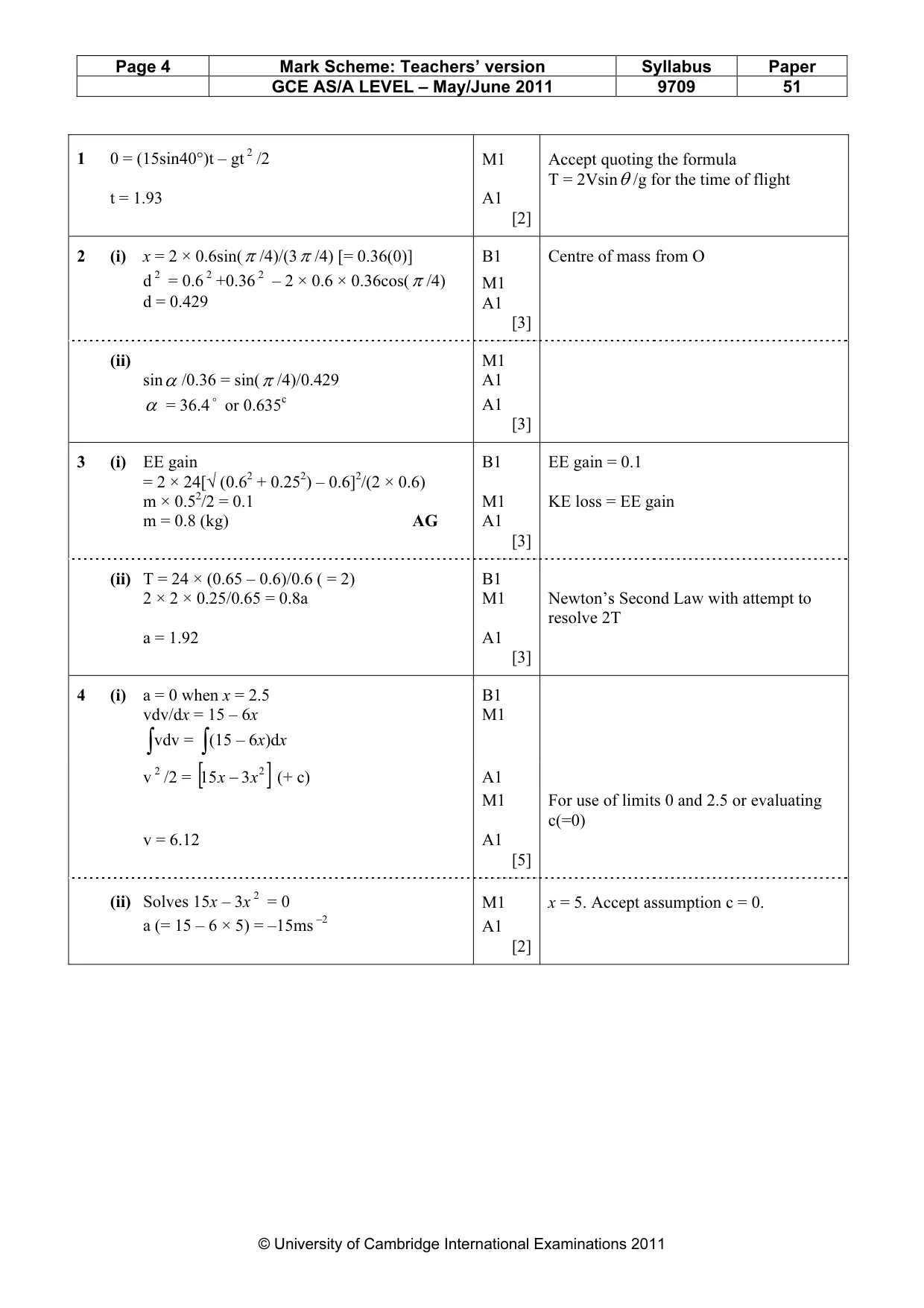
Mark scheme: 1 0 = (15sin40°)t – gt 2 /2 M1 Accept quoting the formula T = 2Vsinθ /g for the time of flight t = 1.93 A1 [2]
Q2 · A 0.6 m O 0.6 m B AOB is a uniform lamina in the shape of a quadrant of a circle with…
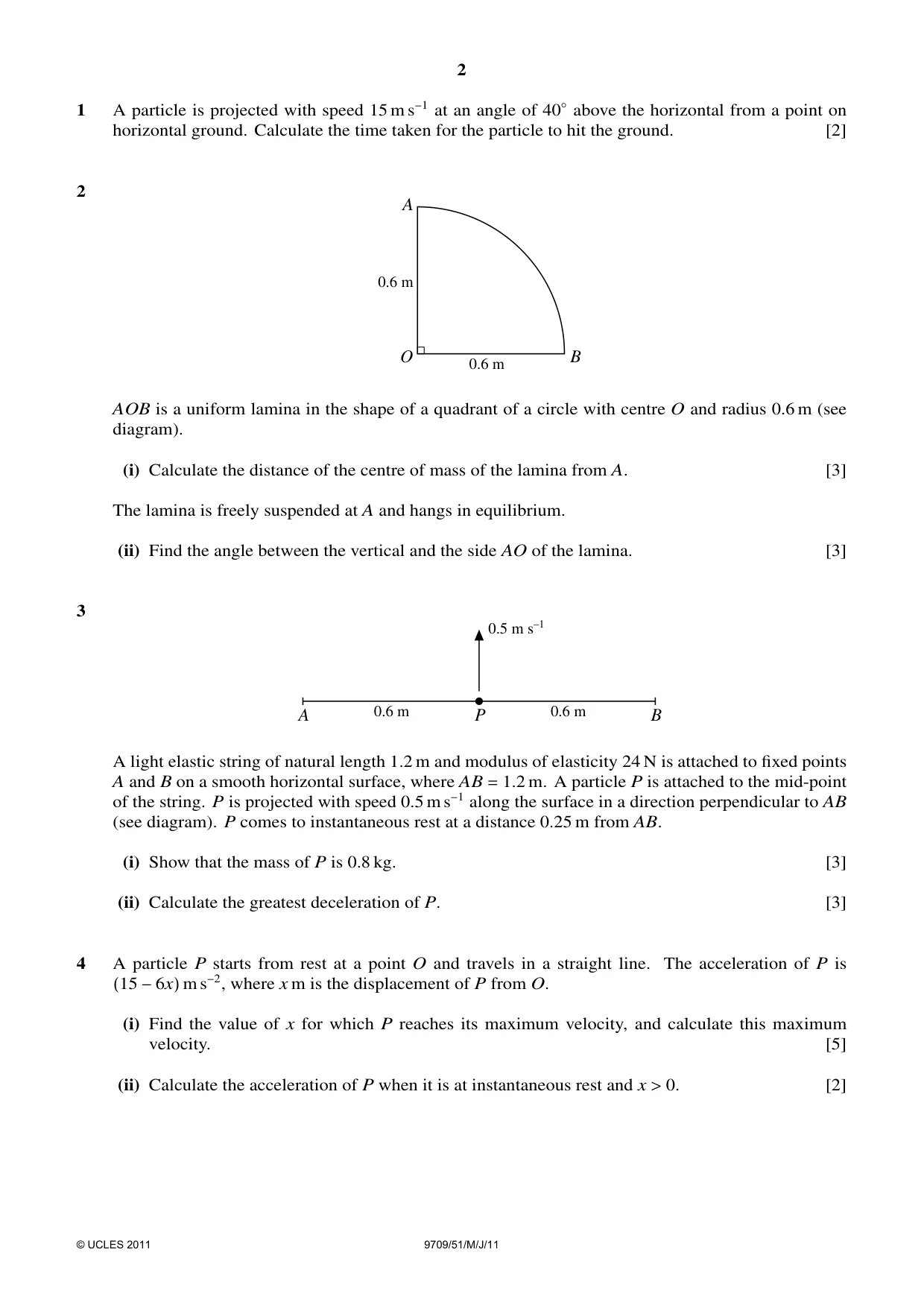
2 A 0.6 m O 0.6 m B AOB is a uniform lamina in the shape of a quadrant of a circle with centre O and radius 0.6 m (see diagram). (i) Calculate the distance of the centre of mass of the lamina from A. [3] The lamina is freely suspended at A and hangs in equilibrium. (ii) Find the angle between the vertical and the side AO of the lamina. [3]
Mark scheme: 2 (i) x = 2 × 0.6sin(π /4)/(3π /4) [= 0.36(0)] B1 Centre of mass from O d 2 = 0.6 2 +0.36 2 – 2 × 0.6 × 0.36cos(π /4) M1 d = 0.429 A1 [3] (ii) M1 sinα /0.36 = sin(π /4)/0.429 A1 α = 36.4 o or 0.635c A1 [3]
Q3 · 0.5 m s–1 0.6 m 0.6 m A P B A light elastic string of natural length 1.2 m and modulus of…
3 0.5 m s–1 0.6 m 0.6 m A P B A light elastic string of natural length 1.2 m and modulus of elasticity 24 N is attached to fixed points A and B on a smooth horizontal surface, where AB = 1.2 m. A particle P is attached to the mid-point of the string. P is projected with speed 0.5 m s−1 along the surface in a direction perpendicular to AB (see diagram). P comes to instantaneous rest at a distance 0.25 m from AB. (i) Show that the mass of P is 0.8 kg. [3] (ii) Calculate the greatest deceleration of P. [3]
Mark scheme: 3 (i) EE gain B1 EE gain = 0.1 = 2 × 24[√ (0.62 + 0.252) – 0.6]2/(2 × 0.6) m × 0.52/2 = 0.1 M1 KE loss = EE gain m = 0.8 (kg) AG A1 [3] (ii) T = 24 × (0.65 – 0.6)/0.6 ( = 2) B1 2 × 2 × 0.25/0.65 = 0.8a M1 Newton’s Second Law with attempt to resolve 2T a = 1.92 A1 [3]
Q4 · A particle P starts from rest at a point O and travels in a straight line
4 A particle P starts from rest at a point O and travels in a straight line. The acceleration of P is (15 −6x) m s−2, where x m is the displacement of P from O. (i) Find the value of x for which P reaches its maximum velocity, and calculate this maximum velocity. [5] (ii) Calculate the acceleration of P when it is at instantaneous rest and x > 0. [2]
Mark scheme: 4 (i) a = 0 when x = 2.5 B1 vdv/dx = 15 – 6x M1 ∫vdv = ∫(15 – 6x)dx 2 v 2 /2 = [15 x − 3 x ] (+ c) A1 M1 For use of limits 0 and 2.5 or evaluating c(=0) v = 6.12 A1 [5] (ii) Solves 15x – 3x 2 = 0 M1 x = 5. Accept assumption c = 0. a (= 15 – 6 × 5) = –15ms −2 A1 [2] GCE AS/A LEVEL – May/June 2011 9709 51
Q5 · B P 0.61 m 0.22 m C 0.61 m A ABC is a uniform triangular lamina of weight 19 N, with AB =…
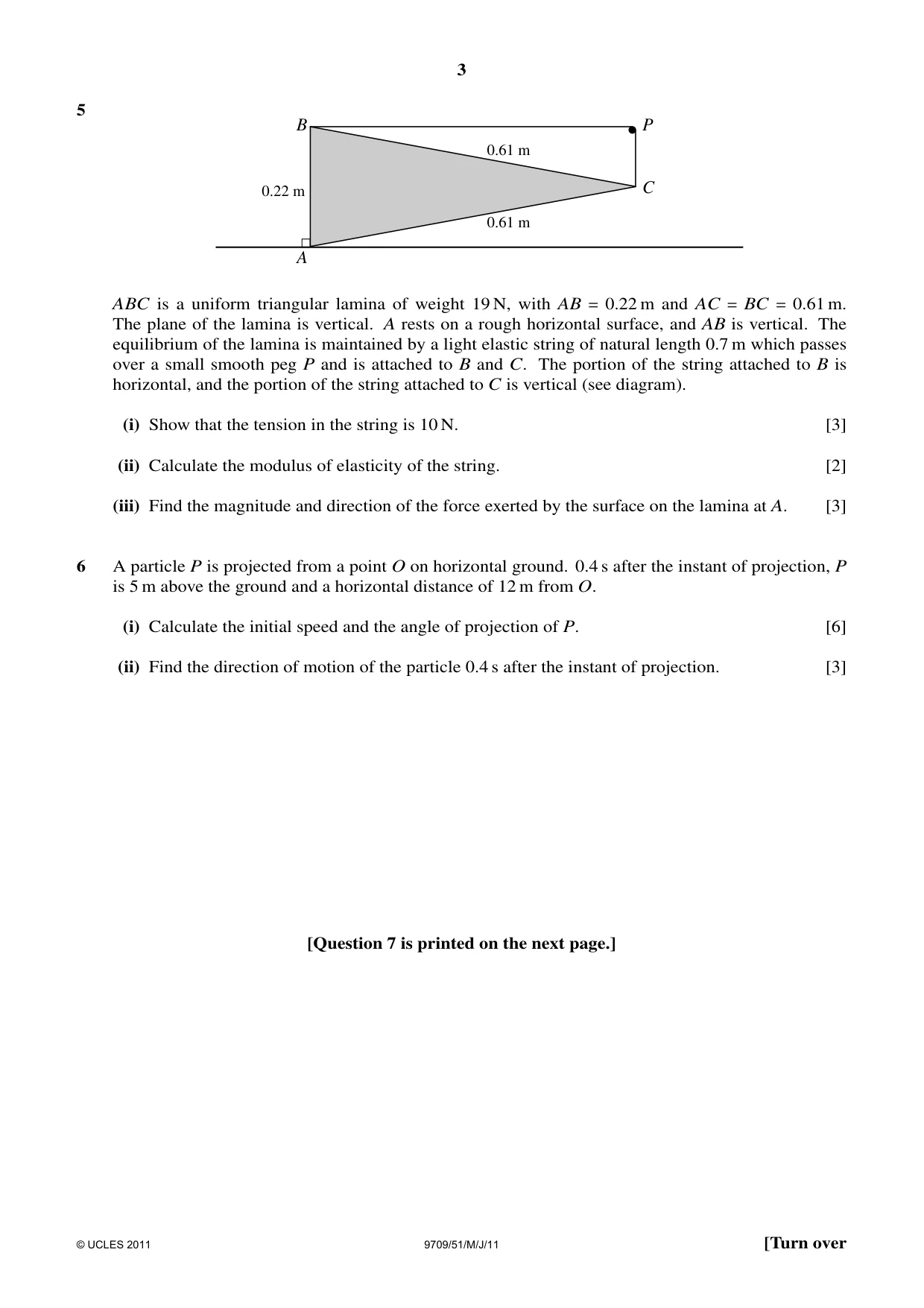
5 B P 0.61 m 0.22 m C 0.61 m A ABC is a uniform triangular lamina of weight 19 N, with AB = 0.22 m and AC = BC = 0.61 m. The plane of the lamina is vertical. A rests on a rough horizontal surface, and AB is vertical. The equilibrium of the lamina is maintained by a light elastic string of natural length 0.7 m which passes over a small smooth peg P and is attached to B and C. The portion of the string attached to B is horizontal, and the portion of the string attached to C is vertical (see diagram). (i) Show that the tension in the string is 10 N. [3] (ii) Calculate the modulus of elasticity of the string. [2] (iii) Find the magnitude and direction of the force exerted by the surface on the lamina at A. [3]
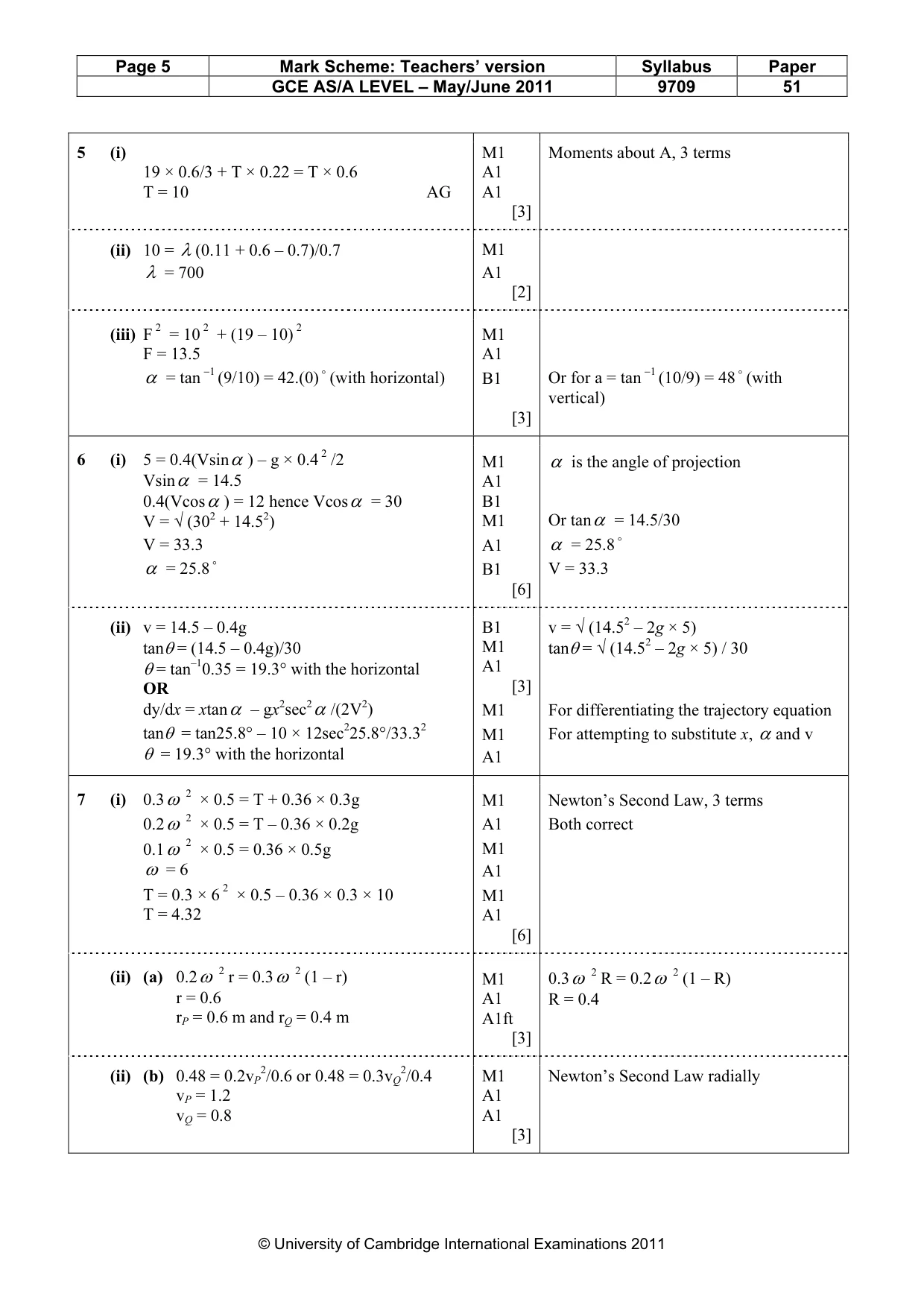
Mark scheme: 5 (i) M1 Moments about A, 3 terms 19 × 0.6/3 + T × 0.22 = T × 0.6 A1 T = 10 AG A1 [3] (ii) 10 = λ (0.11 + 0.6 – 0.7)/0.7 M1 λ = 700 A1 [2] (iii) F 2 = 10 2 + (19 – 10) 2 M1 F = 13.5 A1 α = tan −(9/10)1 = 42.(0) o (with horizontal) B1 Or for a = tan −(10/9)1 = 48 o (with vertical) [3] 2
Q6 · A particle P is projected from a point O on horizontal ground
6 A particle P is projected from a point O on horizontal ground. 0.4 s after the instant of projection, P is 5 m above the ground and a horizontal distance of 12 m from O. (i) Calculate the initial speed and the angle of projection of P. [6] (ii) Find the direction of motion of the particle 0.4 s after the instant of projection. [3] [Question 7 is printed on the next page.]
Mark scheme: 6 (i) 5 = 0.4(Vsinα ) – g × 0.4 2 /2 M1 α is the angle of projection Vsinα = 14.5 A1 0.4(Vcosα ) = 12 hence Vcosα = 30 B1 V = √ (302 + 14.52) M1 Or tanα = 14.5/30 V = 33.3 A1 α = 25.8 o α = 25.8 o B1 V = 33.3 [6] (ii) v = 14.5 – 0.4g B1 v = √ (14.52 – 2g × 5) tanθ = (14.5 – 0.4g)/30 M1 tanθ = √ (14.52 – 2g × 5) / 30 θ = tan–10.35 = 19.3° with the horizontal A1 OR [3] dy/dx = xtanα – gx2sec2α /(2V2) M1 For differentiating the trajectory equation tanθ = tan25.8° – 10 × 12sec225.8°/33.32 M1 For attempting to substitute x, α and v θ = 19.3° with the horizontal A1 2
Q7 · P O Q 1 m w rad s–1 A narrow groove is cut along a diameter in the surface of a…
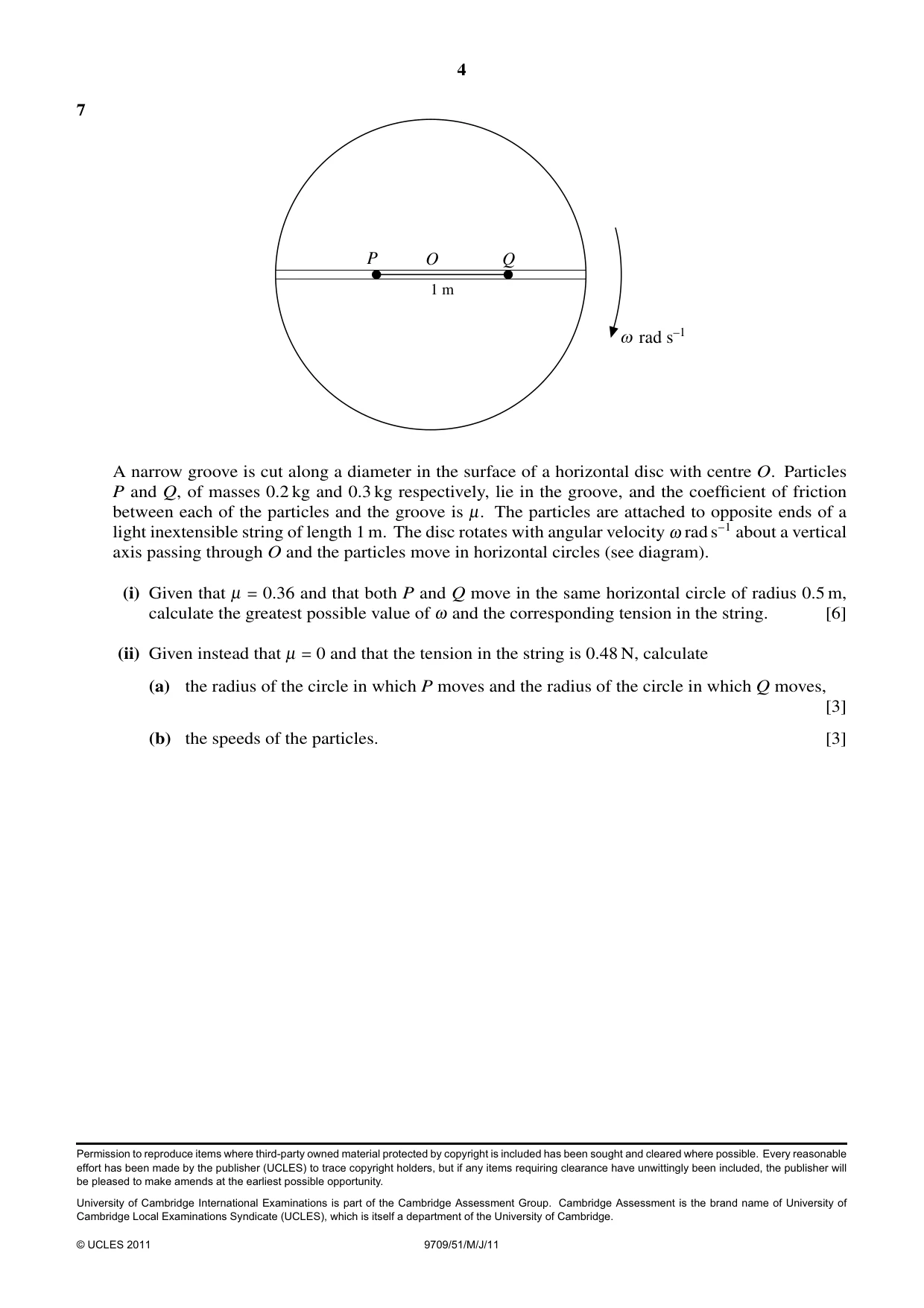
7 P O Q 1 m w rad s–1 A narrow groove is cut along a diameter in the surface of a horizontal disc with centre O. Particles P and Q, of masses 0.2 kg and 0.3 kg respectively, lie in the groove, and the coefficient of friction between each of the particles and the groove is µ. The particles are attached to opposite ends of a light inextensible string of length 1 m. The disc rotates with angular velocity ω rad s−1 about a vertical axis passing through O and the particles move in horizontal circles (see diagram). (i) Given that µ = 0.36 and that both P and Q move in the same horizontal circle of radius 0.5 m, calculate the greatest possible value of ω and the corresponding tension in the string. [6] (ii) Given instead that µ = 0 and that the tension in the string is 0.48 N, calculate (a) the radius of the circle in which P moves and the radius of the circle in which Q moves, [3] (b) the speeds of the particles. [3]
Mark scheme: 7 (i) 0.3ω 2 × 0.5 = T + 0.36 × 0.3g M1 Newton’s Second Law, 3 terms 0.2ω 2 × 0.5 = T – 0.36 × 0.2g A1 Both correct 0.1ω 2 × 0.5 = 0.36 × 0.5g M1 ω = 6 A1 T = 0.3 × 6 2 × 0.5 – 0.36 × 0.3 × 10 M1 T = 4.32 A1 [6] (ii) (a) 0.2ω 2 r = 0.3ω 2 (1 – r) M1 0.3ω 2 R = 0.2ω 2 (1 – R) r = 0.6 A1 R = 0.4 rP = 0.6 m and rQ = 0.4 m A1ft [3] (ii) (b) 0.48 = 0.2vP 2/0.6 or 0.48 = 0.3vQ2/0.4 M1 Newton’s Second Law radially vP = 1.2 A1 vQ = 0.8 A1 [3]
What was in this paper
The subtopics covered by these 7 questions, and how many questions each got. Open one in a new tab to see every Cambridge question on it.
What you needed in this session
Cambridge’s own grade thresholds for 2011 May/June, Paper 5 · Variant 1. A higher threshold means an easier paper — the bar moves with how the cohort did.